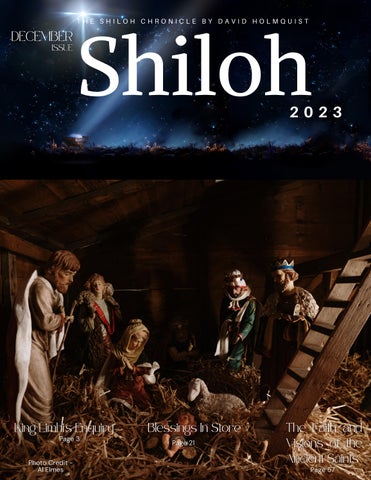
Shiloh
THE SHILOH CHRONICLE BY DAVID HOLMQUIST
2023
Shiloh
THE SHILOH CHRONICLE BY DAVID HOLMQUIST
The Shiloh Chronicle - December Issue Trustwriter Press, Rexburg, Idaho, 83440 © 2023 by Trustwriter Press LLC. All rights reserved. Digitalized and Printed in the United States of America ISBN 979-8-88526-100-5
The Shiloh Chronicle
01
Ye shall find the babe wrapped in swaddling clothes, lying in a manger.
Luke 2 - Christmas Story 03
Wiseman Asked; “Where is he that is born King of the Jews?”
The Search For Jesus 08
The proper relationship between men and God gives life its purpose.
Show Us the Father 12
We live in one of the most important dispensations that God ever given to man.
Ten Virgins - Last Dispensation 25
Photo Credit by Sebin Thomas
St. Peter escaped from his enemies, was about to flee, the Savior called to him and asked him if he was afraid to die.
Journey To Palestine
The Shiloh Chronicle
38
There are two other Prophets, besides Malachi, who have spoken of the house of the Lord.
Temples To Be Built 48
Before the great day of rest the Lord will again speak and say to the north give up, the south, keep not back.
Second Coming - Preperatory Work 57
Paul met with a number of disciples at Ephesus, and he inquired of them if they had received the Holy Ghost.
The Gospel Of Jesus 69
Satan sought power. There are two great forces. Hate & Love.
Man’s Free Agency 75
Photo Credit by Sebin Thomas
The more we caroled and shared baskets of cookies, the more excited we became.
Cookies & Carols
The Shiloh Chronicle
76
When we arrived at the cemetery, we were touched by what we found.
A Small, Snow-Covered Tree 77
As I thought about the place where the Savior was born, I began to understand His role as the Shepherd of mankind.
In Shepherds’ Field 78
A gentle reminder of the value of compassion and charity.
The Little Matchstick Girl 79
“What, then, did Peterson do?” “He brought round both hat and goose to me on Christmas morning
The Adventure of the Blue Carbuncle
Photo Credit by Sebin Thomas
THE SEARCH FOR JESUS 3
October 1965
by Elder Thomas S. Monson
This has been a most inspirational conference. As this the final session draws to its close, it is not my desire to speak to a formal text, but rather to bear my personal testimony concerning Jesus of Nazareth and to suggest that each person undertake a personal search for him. Many of you have traveled far to attend this conference. From Europe, from Canada, from Mexico, from the isles of the sea, and from many other points you have come. They Seek After Jesus In the New Testament of our Lord, John describes a similar journey by those who would worship. "And there were certain Greeks among them that came up to worship at the feast: "The same came therefore to Philip, which was of Bethsaida of Galilee, and desired him, saying, Sir, we would see Jesus" (John 12:20-21 italics added). I feel this is your desire even today. The little children have another way of expressing the same wish. Most often they say: "Tell me the stories of Jesus I love to hear; things I would ask him to tell me if he were here." (W. H. Parker, The Children Sing, No. 65.)
"And . . . I would commend you to seek this Jesus of whom the prophets and apostles have written, . " (Ether 12:38,41) For generations, enlightened mankind anxiously sought the fulfillment of prophecies uttered by righteous men inspired of Almighty God. For did not Isaiah declare: "Behold, a virgin shall conceive, and bear a son, and shall call his name Immanuel" (Isa. 7:14) And again, "For unto us a child is born . . . and his name shall be called . . . The Prince of Peace" (Isa. 9:6) ". . . A Savior, Who Is Christ the Lord" And on this continent God's prophets declared: ". . . the time cometh, and is not far distant, that with power, the Lord Omnipotent . . . shall dwell in a tabernacle of clay . . .
". . . he shall suffer temptations, and pain . . . "And he shall be called Jesus Christ, the Son of God" (Mosiah 3:5,7-8) Then came that night of nights when the angel of the Lord came upon shepherds abiding in the field, keeping watch over their flock, with the pronouncement: "For unto you is born this day in the city of David, a Saviour, which is Christ the Lord" (Luke 2:8-11) Thus, personally invited to undertake a search for the babe wrapped in swaddling clothes and lying in a manger, did these shepherds concern themselves with the security of their possessions? Did they procrastinate their search for Jesus? The record affirms that the shepherds said to one another, "Let us now go even unto Bethlehem . . . "And they came with haste . . ." (Luke 2:15-16 italics added).
4 He taught men the higher law During his earthly ministry, he taught men the higher law. His glorious gospel reshaped the thinking of the world. He blessed the sick; he caused the lame to walk, the blind to see, the deaf to hear. He even raised the dead to life. What was the reaction to his message of mercy, his words of wisdom, his lessons of life? There were a precious few who appreciated him. They bathed his feet. They learned his word. They followed his example.
"Crucify Him"
". . . born King of the Jews" Wise men journeyed from the East to Jerusalem, saying, "Where is he that is born King of the Jews? for we have seen his star in the east, and are come to worship him. "When they saw the star, they rejoiced with exceeding great joy. "And . . . they saw the young child with Mary his mother, and fell down, and worshipped him: and when they had opened their treasures, they presented unto him gifts; gold, and frankincense, and myrrh" Matt. 2:2,10-11 italics added). With the birth of the babe in Bethlehem, there emerged a great endowment—a power stronger than weapons, a wealth more lasting than the coins of Caesar. This child was to be the King of kings and Lord of lords (Rev. 19:16) the Promised Messiah, even Jesus Christ the Son of God. Born in a stable, cradled in a manger, he came forth from heaven to live on earth as mortal man and to establish the kingdom of God.
Then there were the many who denied him. When asked by Pilate, "What shall I do then with Jesus which is called Christ?" (Matt. 27:22) they cried, "Crucify him." They mocked him. They gave him vinegar to drink (Matt. 27:34) They reviled him (Matt. 27:39) They smote him with a reed. They did spit upon him (Matt. 27:30) They crucified him. Can we, in part, appreciate the suffering of God the Eternal Father as his Only Begotten Son in the flesh was placed on a cross and crucified? Is there a father or a mother who could not be moved to complete compassion if he or she heard a son cry out in his own Garden of Gethsemane, "Father, if thou be willing, remove this cup from me: nevertheless, not my will, but thine, be done" (Luke 22:42)? Offering a Son All of us love the beautiful account from the Holy Bible of Abraham and Isaac. How exceedingly difficult it must have been for Abraham, in obedience to God's command, to take his beloved Isaac into the land of Moriah, there to present him as a burnt offering. Can you imagine the heaviness of his heart as he gathered the wood for the fire and journeyed to the appointed place? Surely pain must have racked his body and tortured his mind as he bound Isaac and laid him on the altar upon the wood and stretched forth his hand and took the knife to slay his son.
JOURNEY TO PALESTINE 25
June 22, 1873
Brethren and sisters, I am exceedingly thankful, through the blessings of the Lord and your faith and prayers, that I have been permitted to perform a lengthy journey and to return and associate with you again, to behold your faces, and to lift my voice and bear testimony to the things of the kingdom of God in this Tabernacle. I feel exceedingly thankful to my heavenly Father for his preserving mercy, and to my brethren and sisters for their prayers and faith, and for their kind assistance, which was bountifully rendered to me, enabling me to bear the cost of a lengthy and expensive journey. The principal object of that journey was to visit the lands in which the events recorded in the Bible transpired. Incidentally we visited many countries and had an opportunity of acquiring information and extending acquaintances into lands which heretofore have been barred against visits from our Elders, as the Elders, when they went abroad went expressly to preach, and were frequently prohibited from entering these countries, or if permitted to enter were not allowed to speak of the Gospel. We, having means to travel, of course passed along as other travelers, for not being on a mission for preaching we were not interrupted, and this enabled us to acquire a knowledge of the laws and customs of the various countries we visited, and a variety of information that we had heretofore only got by reading;
by President George A. Smith
and I understand very clearly that a person may read almost any subject and yet a personal inspection will give better and perhaps more extended or different ideas from those gleaned solely from reading. In reading books, you learn the views, thoughts and reflections of the individuals who wrote them, modified more or less by a great desire in the human heart to make books readable, in order that they may sell. It is really true that a great share of the books in the world are written more to be read than to communicate facts. It is said that when Henry the Fourth was on his sick bed, his son, knowing his father had always been very fond of history, proposed to read a little history to him. “Oh,” said the dying king, “I am too far gone to bother my brains with romance.” That showed his opinion of history. As soon as we reached Rome, we began to find the localities referred to in Scripture. It was in the reign of Augustus Caesar, that Christ was born. At that time Judea was a tributary kingdom to Rome, its king being Herod. The decree which went forth from Augustus Caesar, that all the world should be taxed, (Luke 2:1) of course included Jerusalem and the entire kingdom of Judea, which at that time was of considerable extent. Joseph and Mary went to Bethlehem to be taxed with the house of David, (Luke 2:3-5) and there being no room in the inn, (Luke 2:7) they took up their quarters in a stable, and there the Savior was born.
26 Some years after the ascension of Jesus, St. Paul went to Rome, in order to get a hearing before Caesar, on an appeal case, (Acts 22:25-30) which had been adjourned from time to time before the authorities in Caesarea Philippi, in consequence of his refusal, it seems from the reading of the Book of Acts to furnish the “backsheesh.” Thinking that Paul's friends would pay liberally for his relief, his judges had kept him bound in prison; but as the expected bribe was not forthcoming he was eventually sent to Rome on his own appeal; and while we were at Rome we were shown places where he was said to have been imprisoned, and one room where they said he used to hold meetings, and a variety of places and incidents connected either directly or indirectly with the mission of the Apostles in the first century.
In the church of St. Mark, in Venice, they showed us the coffin of St. Mark, and while there they showed us a casket said to contain the remains of St. John the Baptist, also the marble slab on which his head fell when he was executed. I ascertained, however, to my satisfaction, that this was a local saint, carried by the Venetians, seven or eight hundred years ago, from Marsaba, in Palestine, where he was recognized as St. John of Damascus. There is so much relic worship, that it has been overdone; but we commenced, when we got to Rome, to tread the ground where the Apostles labored. We visited a prison in which it is said St. Peter was imprisoned. We saw the spot where he is said to have escaped from his enemies, and was about to flee, but the Savior called to him and asked him if he was afraid to die, so says tradition. They show the print that Peter's foot made when he heard the Savior's voice. That is on a spot outside of Rome. They built a church on that place, and it contains a statue of St. Peter, the toes of one of the feet have been worn off, we were told, by kissing, and their place supplied with bronze. They showed us the stairs, brought from Jerusalem, which they say led up to Pilate's judgment seat. We saw a great many people crawling up and down them on their knees, weeping and wailing and kissing every step. As we steamed towards the east, we passed the Isle of Candia, the Crete of Scripture, and were reminded by various places that we saw, of the incidents of St. Paul's shipwreck. (Acts 27:7-44)
In the cathedrals of almost all the countries which we visited we were shown relics that had been brought from Palestine. At Pisa there is a burying yard, probably an acre and a quarter in extent, nine feet of earth having been brought from Palestine as a covering for this burial place. It takes a permit from the Pope to be buried in that sacred soil. In the cathedral of San Lorenzo, in Genoa, they showed us the chain with which John the Baptist was bound, and the casket which they said contained his head, and a variety of other relics.
Before leaving London, we made arrangements with the firm of Thomas Cook & Son, to supply us with railroad facilities, hotel coupons, steamboat conveyance and transportation from London to Palestine, for one hundred and thirty days, terminating at Trieste, in Austria, via Constantinople and Athens. By this means, much of the annoyance of traveling in countries where we did not understand the languages and manners and customs was avoided. We reached Egypt and landed at Alexandria on February 6th. We were met on board our steamer by Mr. Alexander Howard, a dragoman of Messrs. Cooke & Co.