
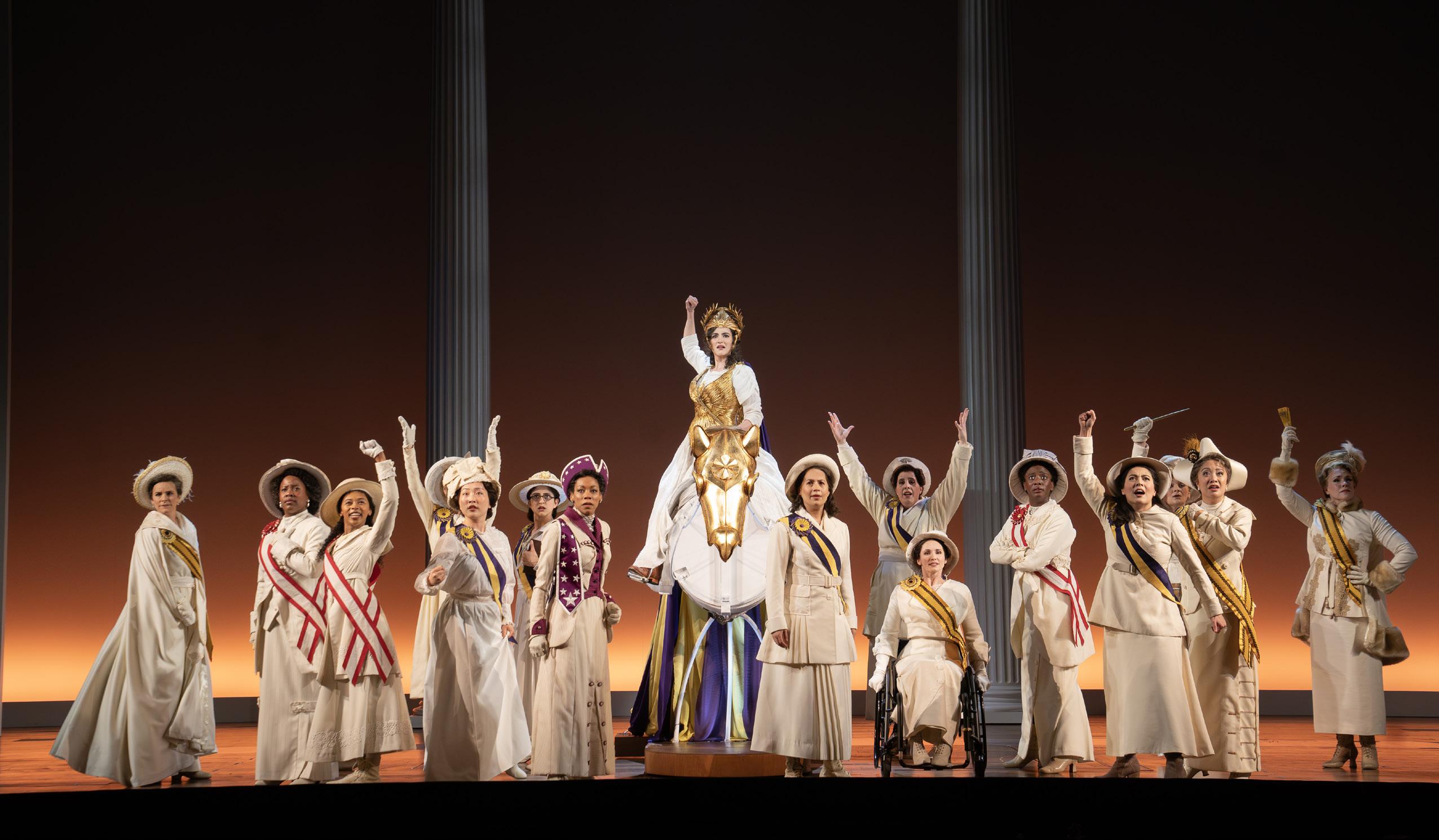
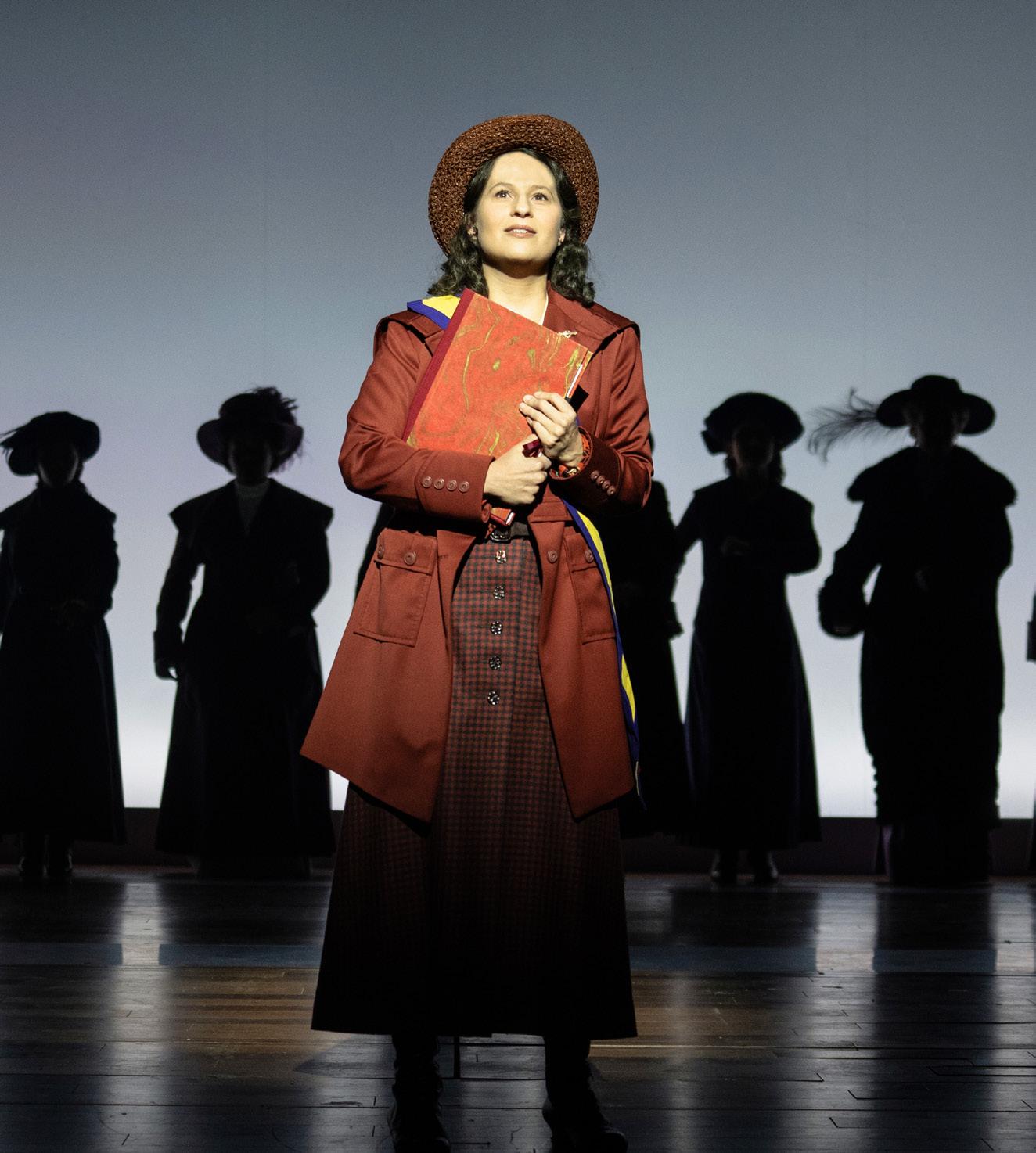
Hannah Cruz as Inez Milholland and the Suffs Broadway Company photo by Joan Marcus Adapted from
original Suffs Broadway Education Guide with
material by Timothy Reid, Jaime Marie, and Shavonne Davis for:
ShainaTaubisatwo-timeTonyAwardwinner,GrammyandEmmy-nominee, artist-in-residenceatThePublicTheater,andAtlanticRecordsrecordingartist. She starred in Suffs onBroadway,forwhichshewonTonyAwardsforBestBook andBestScore;OuterCriticsCircleAwardsforBestBook,BestScore,Best Musical;andaDramaDeskforMusic.Sheisthecreatorofthemusicals Twelfth Night and As You Like It withPublicWorks.SheisarecipientoftheJonathan LarsonGrant,theASCAPRichardRodgersNewHorizonsAward,Kleban Prize,FredEbbAward,andtheFrederickLoeweAward,andwasincludedon the 2024 Time100Nextlistofrisingleaders. www.shainataub.com
Excerptsbelowareeditedfromaphoneinterview.
What inspired you to write a musical about the American women’s suffrage movement? 11 years ago, Rachel Sussman, who’s one of the lead producers on Suffs, sat me down and asked me what I knew about the American women’s suffrage movement. I realized in that moment, at age 25, that I really didn’t know anything. I knew the name Susan B. Anthony and I think I vaguely knew that there was a women’s rights gathering of some kind in the 19th century. But it hit me like a ton of bricks.
I grew up going through American public schools, and I was lucky enough to go to college. I’m a passionate, hungry student who’s eager for history and learning. If this story had not made it to me until I was 25, who is it making it to? Because I’ve been searching for this history. I had sought it out in high school. I did an independent study on social movements because I was so into the musical Hair Hair taught me about anti-war protest music So I did this whole independent study on the civil rights movement.
I never knew about the suffrage movement, which to me is deeply interwoven with the civil rights movement in so many ways. So Rachel gave me this book called Jailed for Freedom that was written by a suffragist named Doris Stevens, who became a character in the show. I stayed up all night reading it. I just was so obsessed with the story. I had no idea that American women had been the first people to march down Pennsylvania Avenue for a political cause, and they were the first people to picket outside the White House, which is something we just take for granted now. They pioneered all of these tactics

of nonviolent direct action in this country. And then they were thrown in prison for that, and they went on hunger strikes. I couldn’t believe that I didn’t know about them.
They reminded me so much of my friends and the women I look up to-these tenacious, stubborn women who love to work together towards a difficult challenge. That’s where they found their joy in life. I just stayed up all night reading it, and I emailed her at 4: 00 AM saying, “We have to do this. We have to tell this story.”
For me, I realized that everything about the life I lead and all the independence I enjoy as a woman in America, even though we still have a lot farther to go in terms of the rights of women in America, and all the rights that I enjoy are because of these foremothers who fought for them for me. So in a way, how could I tell any other story?
When I was 13, learning about this movement would have meant so much to me. So I just wanted to write that show for the 13-year-olds out there who need to feel seen by a story like this so they can know, in a cynical world, that changing the world is still possible. That, in fact, people have done it before in even harder times.
How did you balance historical accuracy with creative storytelling in Suffs?
That was the challenge and the thrill of writing this show. In the early years of writing it, because it was a many-year long journey, I felt a sense of responsibility and obligation to these real historical women who I was dramatizing. I knew that, for many of my audience members, this might be an entry point for learning about them, because people don’t grow up with this story. I certainly didn’t. So I put a lot of pressure on myself to “get it right.”
I think the process of writing the show was a process of accepting the fact that there is no “getting it right.” No one really knows what these women were thinking late at night when they couldn’t sleep and they were obsessing over a worry or a fear or a hope. No one knows their inner emotional lives, which is what we go to the theater for. I wasn’t going to necessarily find those things in the history books. People go to history books and to museums and other great cultural institutions, which are important, to learn facts.
But in the theater, I realized it’s my job to humanize these women and make them come alive in our national imagination in a way that we haven’t been asked to. We haven’t been asked to see them as fully-fleshed human beings. So I think I had to allow myself to make choices that I felt were true emotionally, even if I was compressing some of the history, and to always prioritize the humanity over the history. While I strove for accuracy, where I had to find invention was really in
their inner lives, which is what a musical does so well. You’re privy to the thoughts of a character that no one else gets to hear. That’s why it’s so tantalizing to sit in the theater because we all wish we could hear other people’s thoughts, and we get to do it in the theater. That is the lesson I had to learn over many, many revisions of allowing myself to imagine these women. Also, so much of the themes of the show are about the acceptance of the perpetual incompletion of any social or political victory.
I had to accept the limitations of my one musical to tell this entire story and just accept that this is my version and my unique point of view on this story that I happened to write between my 20s and 30s. I hope that it serves as a gateway for people, and especially young people, to learn more and write their own versions. For me, growing up in a rural area, obsessed with musicals, even if I wasn’t seeing them on Broadway, just obsessed with the cast’s albums or getting to do them in high school, which is why high school theater is the most important theater, I think. When I listened then to a show like Ragtime, I was so obsessed with the character of Emma Goldman, who’s just a small character in Ragtime. But for me, that took me down a rabbit hole of this much larger investigation of Jewish activism. I hope that Suffs is just step one for people in their engagement with this history.
What challenges did you face writing the book, music, and lyrics?
I think it has its advantages and challenges. With this show, even though I’ve never written the book for a show before, I consider myself a songwriter, and I still do. Even though Suffs took me a long time to finish and to work on, and it went through many iterations, my overall idea for it and the arc of the story is something that I had from the very beginning. I always knew where the story began and where it ended. I had never had that before, a full take on an idea beginning to end. Even though I battled with self-doubt throughout the process, I fundamentally trusted that arc, even though I didn’t know how to realize it yet.
The benefit of writing it alone is that at the end of the day, I didn’t have anyone to answer to but myself in terms of staying true to that initial impulse. The
challenge for me was really learning how to write dialogue. I feel most at home when I’m writing a song, but I think it made me a better songwriter to have to learn how to, in 6-10 lines of dialogue, how to tee up a song for success. Even though my passion and my focus is writing scores, I feel like by going through this I got an unofficial MFA just trying to put together dramatic structure.
What message do you hope young people take away from Suffs?
I have an epigraph in Suffs, which is a quote I put in front of the script. That’s the first thing I ever wrote down when I opened a blank script document and began this 11 years ago, which is a quote from the Talmud: “You are not obligated to complete the work, but neither are you free to abandon it.” I heard that quote for the first time around when the Suffs story came into my life, and it just crystallized for me the contradiction and the tension and the complexity of trying to fight for a better world in your lifetime.
Whether we are full-blown activists or whether we are just involved in our school, our church, or synagogue, or even in our own family or parenting, we are all trying to, in some way, leave the world better than we found it. Just because you can’t finish it in your life doesn’t mean it’s not worth doing what you can. That, in fact, no one gets to truly see the fruits of their own labor in this lifetime. It’s something we share in common with every generation. It’s a scary world and there are lots of things happening in the country that are frightening and feel regressive and feel insurmountably hard to take on. The systems of power that want to divide us and keep us down and keep us cynical, would love nothing more than for us to think that it’s impossible to make real change. It behooves the people in power for us to feel hopeless and to give up and to not even try because it’s so insurmountable.
Stephen Colbert once said, “Despair is a victory for hate.” So we need to realize that actually we are powerful, and we can make a difference, and we can work with our friends and our communities to fight for something we believe in. History is full of stories of regular everyday people coming together and changing something for the better. I hope young people can experience
this story and see that over 100 years ago, before TV, before the Internet, before any of these tools that we have now, at a time where it was categorically a worse time to be a woman, and even worse to be a woman of color, that these women still changed the United States Constitution by organizing and coming together. Despite being the people with the least power, they were able to make a difference. It was an imperfect difference. The 19th Amendment, as Suffs shows, was not an end result. We are still fighting for voting rights today.
I hope young people walk away knowing that they can hold both of these truths: In one hand, how far we’ve come, and in the other hand, how far we still have to go. They should let that inspire them and not hold them back, because they’re not alone. No one has to take these fights on alone.
What advice would you give to students who want to use their creativity to make a difference in the world?
I always say find your community and find your discipline. By discipline, I mean whatever your creative practice is, whether it’s writing, performing, or whatever you’re passionate about. Whether it’s a particular art, or going to a gym, or going to a class, develop what the creative routine is in your life. Hone your craft and your skills and find out what that is, because the first step is having a creative practice. Your creativity shouldn’t be something that just happens every once in a while, but something that you truly commit to and make time for. There’s a great book that changed my life by Twyla Tharp called The Creative Habit. She suggests treating creativity like a habit and not just a magical thing that happens every once in a while.
Also, find your like-minded peers who also care about the world and care about being creative and create a weekly meetup where you all share your writing with each other, and then you all brainstorm ideas to use the song or the painting or whatever you’ve made. Ask yourselves: How can you share that with your wider community to send a message? How can you share your creations or whatever it is that you’re fighting for? Don’t just hole up in your room and make the art, but find your group and share it.
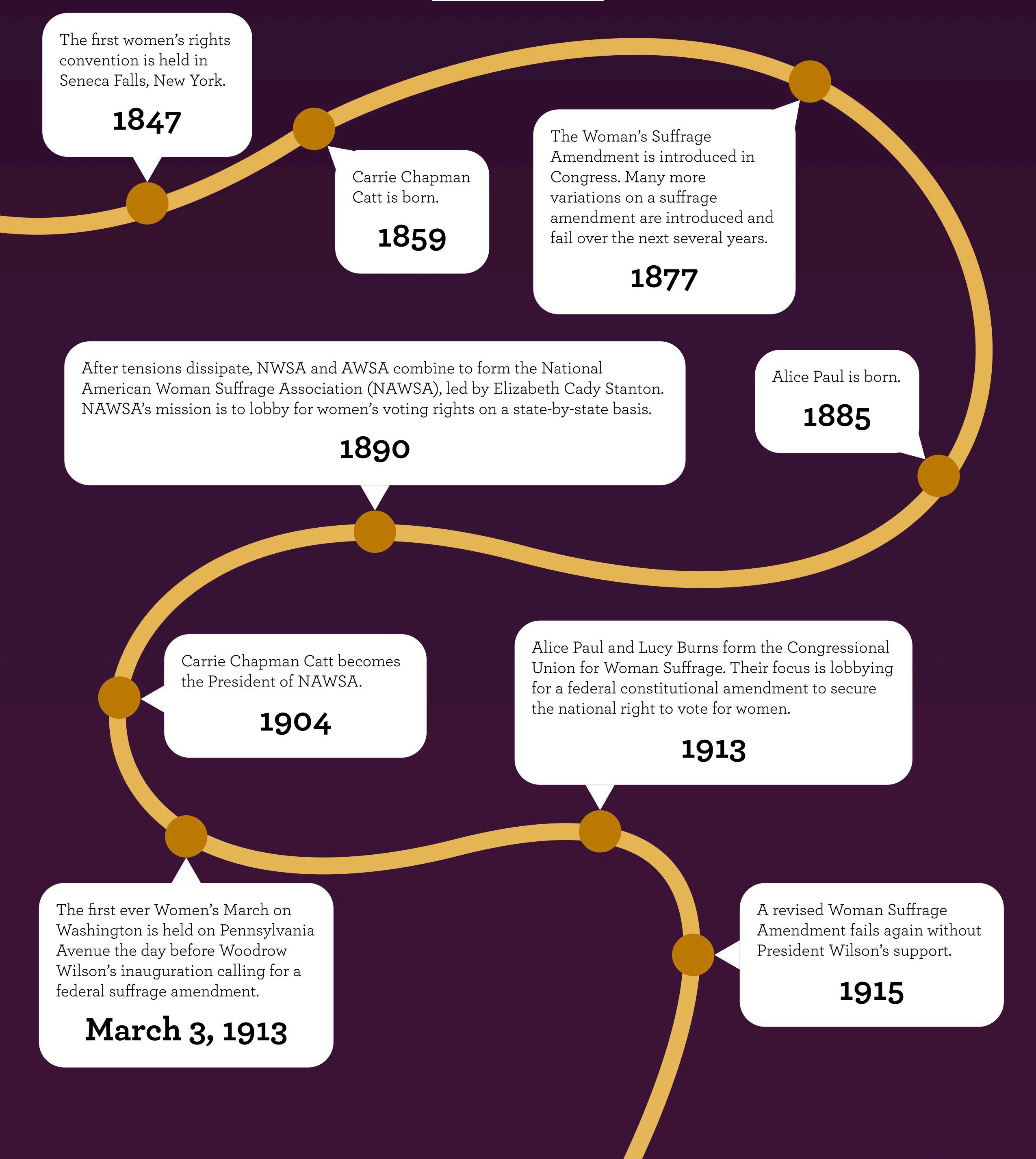
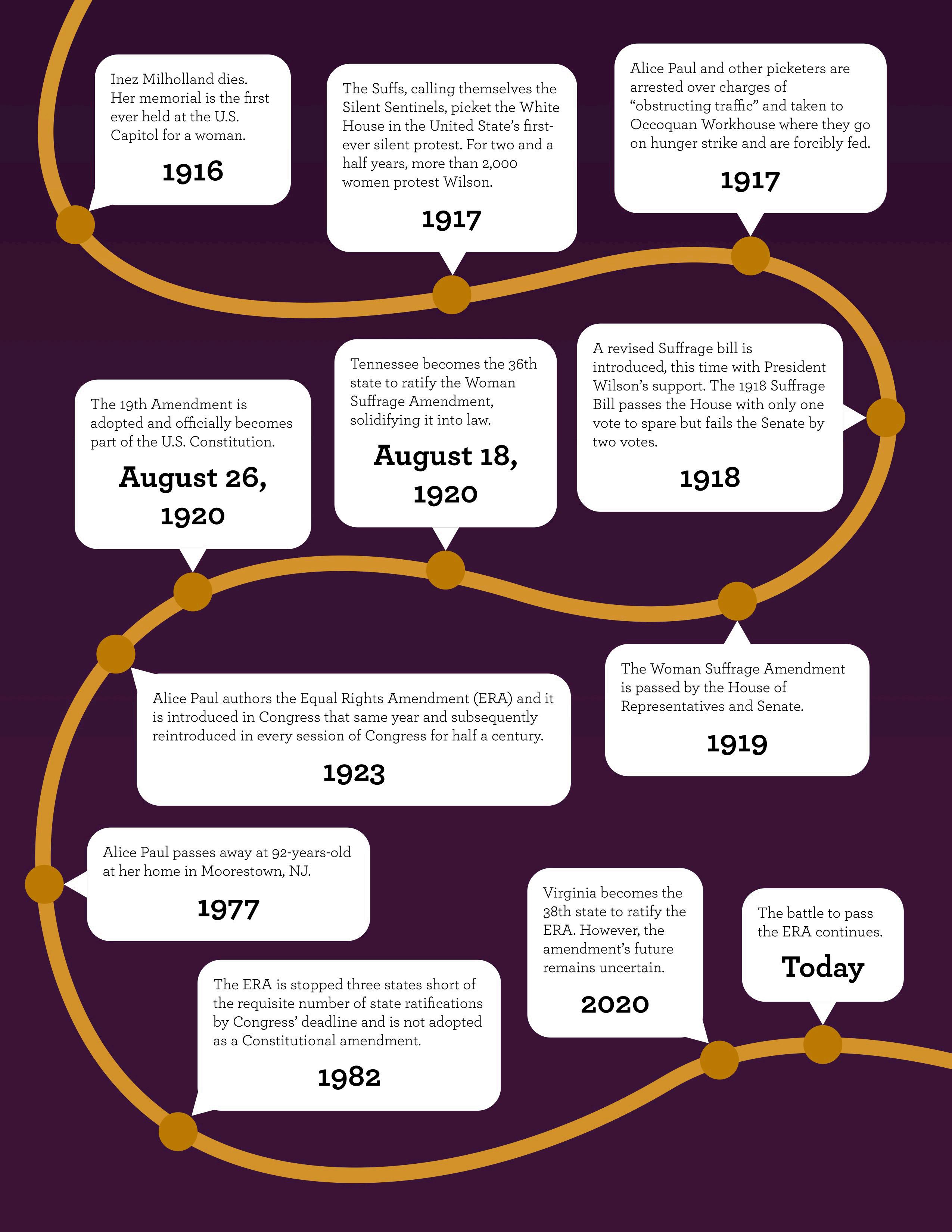
The Voting Rights Act is signed into law. It prohibits racial discrimination in voting and secures voting rights for many Black Americans who were still disenfranchised even after the 19th Amendment.


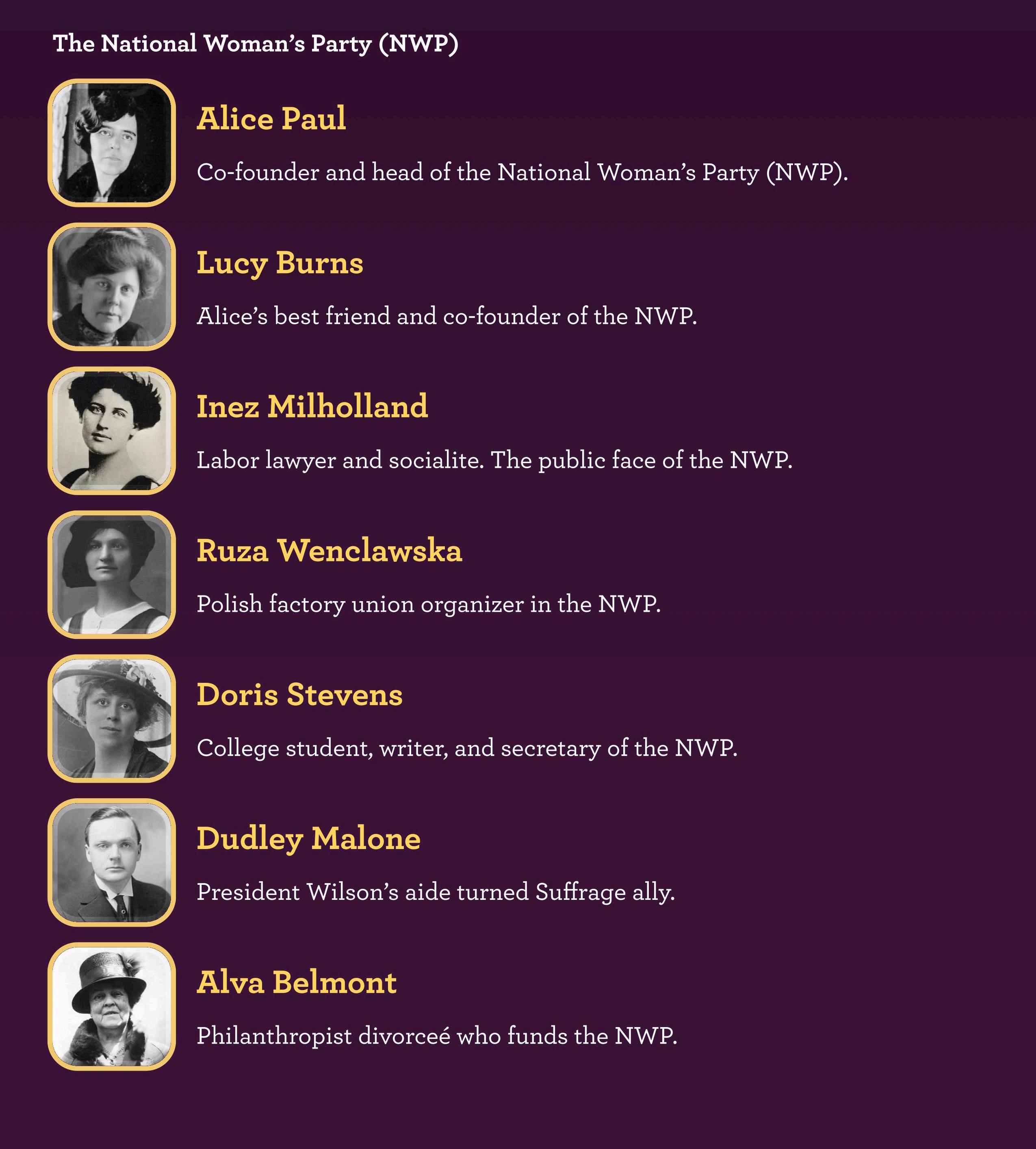
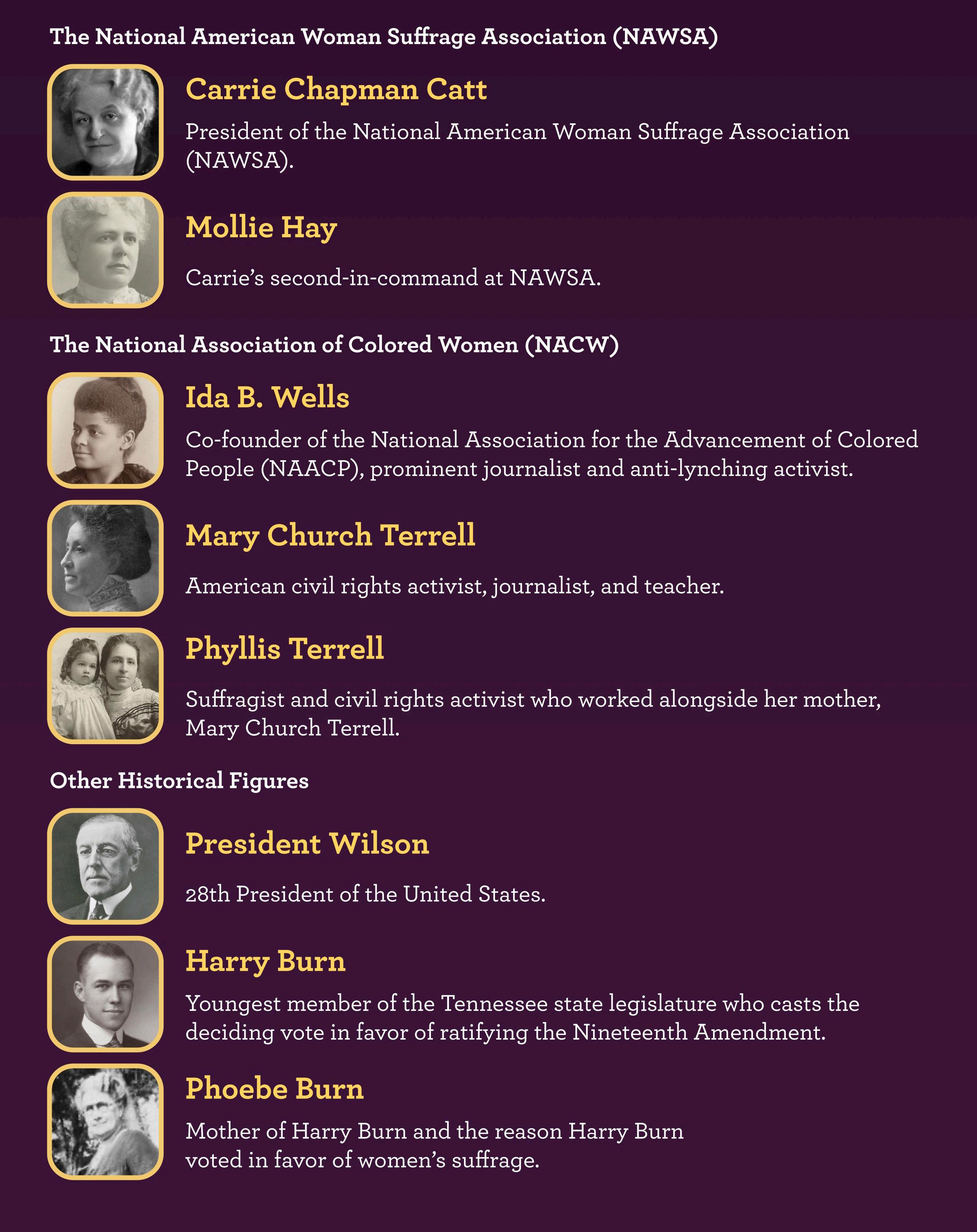
As Suffs demonstrates time and again onstage, there’s power in speaking up and inspiration in pushing the envelope. Below are some post-show discussion questions for you and your peers to dig into and expand on.
1.Why is voting important in a democracy? Can you think of someone whose voting habits or beliefs have influenced your own views about civic engagement?
2.Some argue the voting age should be lowered to 16 or raised to 21. What do you think, and how might that affect voter turnout or engagement?
3.What is the difference between equality and equity? Is voting rights an equality issue or an equity issue? What about women’s rights?
4.What are the most significant ongoing barriers to women’s empowerment and equality?
5.What personal experiences motivate you to think and/or care about gender/ racial equality?
6. What is the purpose of Women’s History Month, and how does it help (or fail to help) advance gender equality today? Can you think of a way it could be more impactful?
7.In Suffs, some male allies played important roles in supporting the movement. What can we learn from them about allyship today? How can men be effective and respectful allies in gender equality movements?
8.In your opinion, who was the most influential leader of the womens suffrage movement? Why?
9.What reasons did state governments give for denying women the right to vote? Why was women’s suffrage legal in some states and not others?
10.What role did state governments play in extending voting rights to women? What role did the federal government play?
11.What tactics and strategies did women use to win the right to vote? Which were successful? Which were not successful?
12.What protest tactics used by the Suffs do you still see in action today? What are new methods and strategies of protest?
These choice boards are designed to give students voice and choice as they explore the themes of Suffs — including protest, media, leadership, and internal conflict. Each board is organized into three categories: Learn, Create, and Reflect. Use these boards however best fits your goals and classroom time. Below are a few flexible ways to implement them:
Students choose any ONE task from any board. Ideal for a short class period, early finisher work, or bell ringers that still connect to the broader themes.
Students choose one task from each column (Learn, Create, Reflect) from a single board — or mix and match tasks from different boards. Encourages both creativity and deeper understanding across Suffs topics.
Standards Addressed:
Common Core State Standards
Writing 9-12: 1, 2, 3, 4, 9
Reading 9-12: 1 ,2
Speaking & Listening 6-12: 1, 2
National Core Arts Standards
Theater: TH:Re9.1.I/II
Music: MU:Re7.1.Ia • MU:Re7.2.I/II
MU:Cn11.0.Ia
Visual Arts: VA:Cr1.1.Ia • VA:Cr2.1.Ia
VA:Pr4.1.Ia
C3 Framework for Social Studies
D2.Civ.2.9-12 • D2.Civ.7.9-12
D2.Civ.10.9-12
D2.His.2.9-12 • D2.His.6.9-12
D2.His.14.9-12 • D2.His.16.9-12
Students team up to complete one or more tasks collaboratively.
Consider assigning roles (e.g., researcher, writer, designer, presenter) for group success.
You select one row, column, or individual task for the whole class to complete, based on your learning goals.
Useful for scaffolding or focusing on a particular skill (e.g., analysis, media literacy, persuasive writing).
Common Core State Standards
Writing 9-12: 1, 2, 6, 7, 9
Reading 9-12: 6, 7
Speaking & Listening 6-12: 5
National Core Arts Standards Theater: TH:Re9.1.I/II • TH:Cr3.1.I/II
Visual Arts: VA:Cr1.1.Ia • VA:Cr2.1.Ia
VA:Pr4.1.Ia
Media Arts: MA:Cr1.1.Ia • MA:Cr2.1.Ia
MA:Pr4.1.Ia • MA:Re8.1.Ia • MA:Cn11.1.Ia
C3 Framework for Social Studies
D2.Civ.2.9-12 • D2.Civ.7.9-12
D2.His.2.9-12 • D2.His.4.9-12
D2.His.14.9-12
D3.1.9-12 • D4.1.9-12 • D4.3.9-12
D4.6.9-12
Common Core State Standards
Writing 9-12: 1, 2, 3, 7, 9
Reading 9-12: 1, 2, 6
Speaking & Listening 6-12: 1, 4
National Core Arts Standards Theater: TH:Cr1.1.HSI/HSII
TH:Pr4.1.HSI/HSII • TH:Re7.1.HSI/HSII
TH:Cn11.1.HSI/HSII
Visual Arts: VA:Cr1.1.HSI/HSII
VA:Cr2.1.HSI/HSII • VA:Cn11.1.HSI/HSII
C3 Framework for Social Studies
D1.1.9-12 • D1.3.9-12
D2.His.1.9-12 • D2.His.4.9-12
D2.His.14.9-12 •D2.Civ.10.9-12
D2.Civ.7.9-12 • D3.1.9-12 • D3.3.9-12
D4.1.9-12• D4.2.9-12• D4.6.9-12
Experience the PBS interactive “The Vote: She Resisted ” and summarize how women used protest to influence change.
Based on what you saw in Suffs, design a protest sign that could be used today. Include a slogan inspired by a line or lyric from the show. Be ready to explain how it connects to both the musical and a modern issue you care about.
Write a journal entry from the POV of a young suffragist: What drives her to keep marching?
Use the PBS short history of the Women’s Suffrage Movement to identify key ideas and moments. Compare them to a modern protest movement.
Plan a dynamic dinner party where you strategically seat eight influential suffrage leaders from Suffs and explore the conversations their shared beliefs and conflicts would ignite.
Choose a modern or historical song that reflects the struggles and goals of the women’s suffrage movement. Write a brief analysis explaining the connection and why it resonates.
Choose a scene from Suffs that portrays public protest (e.g., picketing, speeches, or marches). Write or discuss how the staging, music, and choreography helped show the power of civic action. What mood or message did it send? How might that impact the audience?
Design a 1-page newspaper front page covering a suffrage protest as if you were a reporter at the time.
Reflect in a journal entry: Why did it take so long for the 19th Amendment to pass? What obstacles did reformers face, and how did they overcome them?
“The March (We Demand Equality)”
The suffragists used newspapers, songs, and speeches to spread their message. How did Suffs use lighting, sound, or costume to “broadcast” messages on stage? Choose a moment from the show and explain how theatrical elements replaced or enhanced historical media.
Create a TikTok-style video or PSA (30–60 sec) promoting a current civil rights issue, using persuasive visual messaging.
Use Suffrage and the Media to compare two media tactics from suffragists to those used in other historical protest marches.
Analyze a suffrage-era editorial or cartoon. What’s the bias or message? How does it aim to persuade?
Create a political cartoon that critiques or supports the suffragist movement. Include symbols and a caption that reflect public sentiment.
Create a graphic comparing key media moments in the suffrage movement and a modern movement of your choice.
Pick a scene or moment from Suffs and imagine how the characters would share it as a modern TikTok or Instagram reel. Script or storyboard the video — include hashtags, audio choices, and visual style. How would you capture the message using today’s tools?
Design a magazine cover featuring a modern youth activist (real or fictional). Include headlines and a teaser article.
Write a comparison essay: How would the suffrage movement have changed if social media had existed?
Read the PBS article “Black Women’s 200 Year Fight for the Vote” and take notes on the contributions of Black suffragists.
Write a letter as a Black suffragist (e.g., Ida B. Wells) to white allies explaining the need for inclusion and intersectionality.
Make a short slideshow comparing the challenges faced by Black women in the suffrage movement to those faced by Malala Yousafzai or other young activists.
Research and create a bio-sketch of one underrepresented figure in the movement (e.g., Mary Church Terrell).
Select a character from Suffs who you found intriguing or wished to explore further. Write a short monologue (1–2 paragraphs) from this character’s perspective. Consider what they might express in a private moment, revealing layers not overtly presented on stage.
In a small group or as a written dialogue, debate the ethical conflicts activists face when movements exclude marginalized voices.
Analyze and argue: Should the Equal Rights Amendment (ERA) be passed today? Why or why not? Use historical and current perspectives in your answer.
Draw or paint an image that represents both the strength and sacrifice of a suffragist or modern activist.
Identify a scene in Suffs where characters disagree — for example, over race, strategy, or generational differences. How did the actors’ body language, tone, or blocking highlight that conflict? Write a short analysis or journal entry reflecting on how theater made the tension feel real.
OFFICIAL BROADWAY SITE: suffsmusical.com
FACEBOOK: facebook.com/suffsmusical
INSTAGRAM: instagram.com/SuffsMusical
X: x.com/SuffsMusical
TIKTOK: tiktok.com/@suffsmusical
Shaina Taub’s Top 5 Picks
Jailed for Freedom by Doris Stevens
UphillwithBannersFlying by Inez Haynes Irwin
AlicePaul:ClaimingPower by J.D. Zahniser and Amelia R. Fry
AfricanAmericanWomenintheStrugglefortheVote by Rosalyn Terborg-Penn
FromEqualSuffragetoEqualRights by Christine Lunardini
Historical Nonfiction
TheWoman’sSuffrageMovement (Anthology edited by Sally Roesch Wagner)
The Woman’s Hour by Elaine Weiss
A Woman’s Crusade: Alice Paul & The Battle for the Ballot by Mary Walton
Vanguard:HowBlackWomenBrokeBarriers,WontheVote,andInsistedonEqualityforAll by Dr. Martha S. Jones
WhyTheyMarched by Susan Ware
RecastingtheVote:HowWomenofColorTransformedtheSuffrageMovement by Cathleen D. Cahill
Alice Paul
AlicePaul:ClaimingPower by J.D. Zahniser and Amelia R. Fry
Conversations with Alice Paul: Woman SuffrageandtheEqualRightsAmendment (Interview conducted by Amelia R. Fry)
Carrie Chapman Catt
CarrieChapmanCatt:APublicLife by Jacqueline Van Voris
Carrie Catt: Feminist Politician by Robert Booth Fowler
WomanSuffrageandPolitics:TheInner StoryoftheSuffrageMovement by Carrie Chapman Catt and Nettie Rogers Shuler
Ida B. Wells
CrusadeforJustice:TheAutobiographyof Ida B. Wells by Ida B. Wells
Ida:ASwordAmongLions by Paula Giddings ToTelltheTruthFreely:TheLifeofIdaB. Wells by Mia Bay
IdaB.theQueen:TheExtraordinaryLifeand LegacyofIdaB.Wells by Michelle Duster
Inez Milholland
Inez: The Life and Times of Inez Milholland by Linda J. Lumsden
Mary Church Terrell
A Colored Woman in a White World by Mary Church Terrell
UnceasingMilitant:TheLifeofMaryChurch Terrell by Alison Parker
FinishtheFight!TheBraveand RevolutionaryWomenWhoFoughtforthe RighttoVote by Veronica Chambers
The Bold and the Brave: Ten Heroes Who FoughtfortheRighttoVote by Kirsten Gillibrand, illustrations by Maira Kalman
IdaB.theQueen:TheExtraordinaryLifeand LegacyofIdaB.Wells by Michelle Duster
TheWoman’sHour:OurFightfortheRight toVote(AdaptedforYoungReaders) by Elaine Weiss Documentaries
AllIn:TheFightforDemocracy (Available on Amazon Prime)
The Vote (PBS’ American Experience)
TheDaily:ARiftOverPowerandPrivilegein the Women’s March (New York Times)
AndNothingLess:TheUntoldStoriesof Women’sFightfortheVote (Produced by the Women’s Suffrage Centennial Commission, the National Park Service, and PRX)
Hindsight:LookingBackat100Yearsof Women’sSuffrage (KMUW/NPR)