Cleaning Three-Story Residential Tile Roofs: A Modern Approach
Overcoming Obstacles
CETA Edge: PowerClean® 2026
Industry News
Profits and Private Companies in the Cleaning Industry
Ready to Run: The PWNA Contractor’s Spring Start-Up Playbook
Success Story: Alcatraz Island Project
Tips for Financial Success
Product News
OSHA Rules and Regulations CETA
EDITOR’S NOTE
Like many Americans I was glued to the news when one of our American F-15E Strike Eagle fighter jets was shot down over Iran in early April, with its pilot and weapons systems officer (WSO). The news came back quickly that the pilot had been rescued, but the fate of the WSO was uncertain. It was with relief that less than 48 hours later news started to trickle out that an amazing rescue had been executed and that while the WSO was wounded, he had been rescued successfully. I suspect that as more details are released Americans will be amazed by the amount of training, preparation, coordination, and communication that went into this officer evading capture, being located by U.S. forces, and then having a rescue executed successfully while the Iranian regime was hunting him.
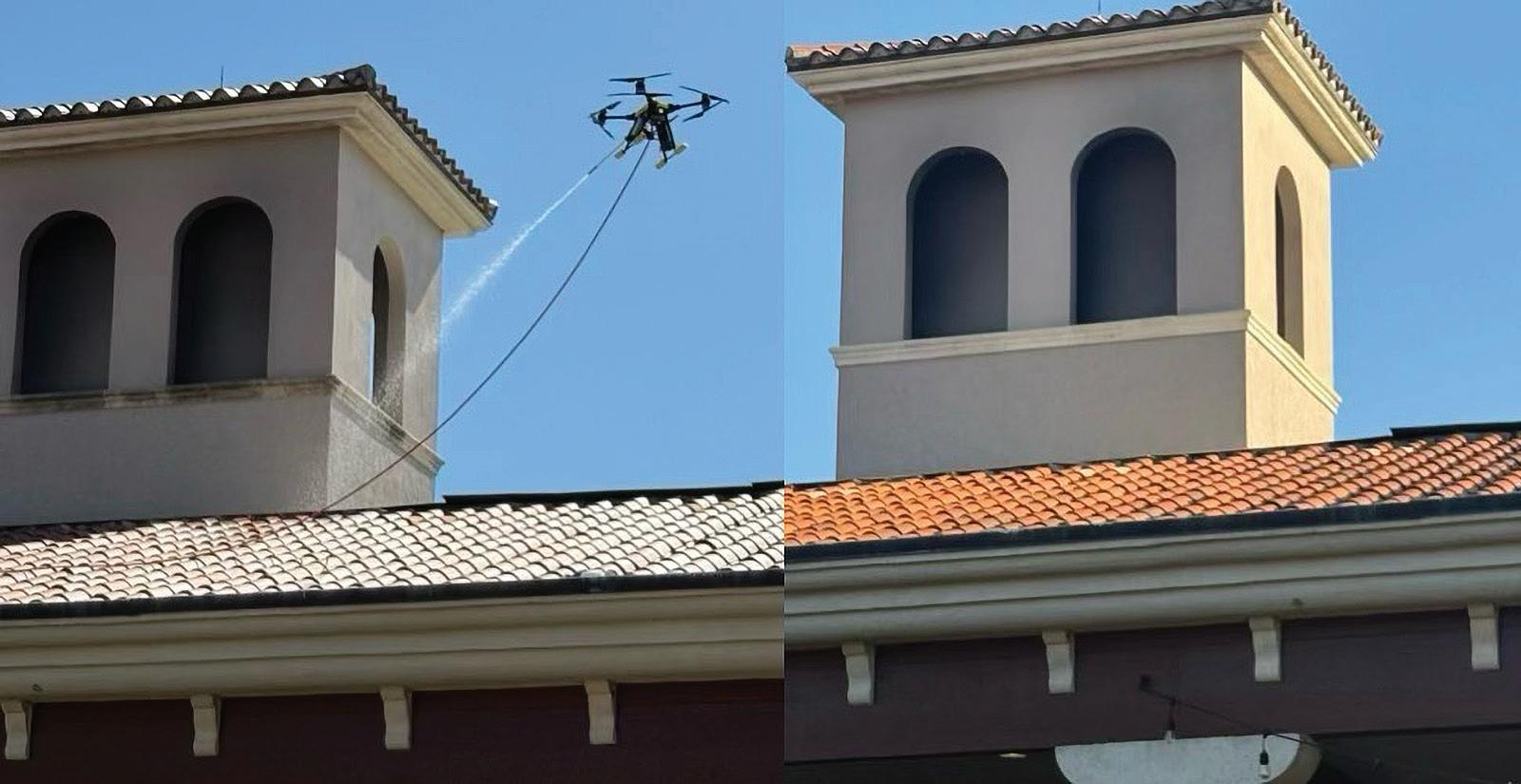
I bring this story up for two reasons in the May issue of Cleaner Times. The first reason is a reminder that success in the pressure washing industry doesn’t happen without proper training and preparation. This point is made clear on page 12 when Drone Shine shares their story of cleaning a three-story tile roof with algae, mold, and mildew. The company cleaned this roof while using drone-mounted soft-washing technology. As they point out,
With precision spraying, drones can apply cleaning solutions uniformly across steep slopes and hard-to-reach areas without putting technicians at unnecessary risk. This innovative method protects delicate tile surfaces while delivering a thorough, lasting cleaning.
The success of this story did not come without learning how to pilot the drone and use it in conjunction with the soft washing process to clean this dirty roof in a safer and more cost-effective way.
You will find on page 38 another brief case study where Pacific Bay Equipment in Northern California problem solved how best to install pressure washing equipment on Alcatraz Island. It was a project that required a high amount of coordination in order to get the equipment from the mainland to the island as well as good communication.
The second reason I bring up the aforementioned news story is that May is Memorial Day. I am extremely thankful this pilot and WSO are not having to be remembered on Memorial Day. However, we have had 13 U.S. service members who have given their lives in this conflict to protect us and our freedoms. Remember them and honor their sacrifice.
Michael Hamline mhamline@cleanertimes.com 800-525-7038
The publisher and editor(s) of this magazine do not accept responsibility for the content of any advertisement, including statements made by advertisers herein, or the opinions expressed by authors of by-lined articles. The publisher and editor(s) also reserve the right to reject any ad or article for objectionable content in verbiage or images. The intent of this publication is to provide general information only and is not intended to provide specific advice or recom-mendations. Appropriate legal, financial, or engineering advice or other expert assistance should always be sought from professionals.
HOW TO REACH US
Times 1000 Nix Road Little Rock, AR 72211 www.cleanertimes.com
SUBSCRIPTION RATES
One Year, $24 U.S. and $75 Canada. Back issues are available for $8 each. Reproductions of any part of this publication without the written consent of the publisher is prohibited.
LESSONS LEARNED
by Diane M. Calabrese
The lessons learned by others can be invaluable to us. In fact, the value of the lessons goes well beyond the basics, such as which plants are poisonous and which animals are predators. It extends to every dimension of life, including one’s professional life.
“One of the most valuable lessons I’ve learned in professional life is this: If it’s complicated, it probably isn’t clear,” says Scott Hansen, president of Alkota Cleaning Systems in Alcester, SD.
“Early on I thought that sounding sophisticated meant using more detail, more analysis, and more explanation,” says Hansen. “But I learned that the more complex a message becomes, the harder it is for people to act on it.”
“It’s a lesson that applies across all parts of a business,” explains Hansen. He adds, “Whether it’s strategy, sales goals, pricing changes, or internal communication, clarity wins. Communicate a simple message.”
With so many modes (channels) of communication, consideration of how to convey information becomes important. An email, a text, a call, or in person—which is the best choice? Obviously, it depends.
But a good corollary to the emphasis on clarity is to embrace simplicity. And that can mean talking in real time.
“One of the most valuable lessons I’ve learned in my professional life is simple: When something isn’t right, pick up the phone—don’t send an email,” says Karl Loeffelholz, channel sales manager—commercial pressure washer, Mi-T-M Corporation in Peosta, IA.
“Early on I realized that when situations are tense or unclear, emails can easily be misinterpreted,” explains Loeffelholz. “Tone and intent don’t always translate well in writing, especially when someone is frustrated.”
It’s much easier to respond to someone—whether customer, vendor, or colleague—in the fastest possible way when we can hear the nonverbal information that comes through with their voice. It could be anger, but it
could just as easily be something like a deep sigh that signals frustration.
“A quick phone call allows for real conversation, immediate clarification, and often defusing of issues before they escalate,” says Loeffelholz. “It builds understanding instead of creating assumptions.”
A commitment to talk in real time (via phone or video) with someone who has a concern also demonstrates respect, and being respectful of others goes a long way toward enhancing understanding.
Think of it all in terms of reciprocity. “Another principle that has guided me throughout my career is to treat customers the way I would want to be treated,” says Loeffelholz.
“When you lead with fairness, honesty, and respect, you’re not just working toward a transaction; you’re building trust,” says Loeffelholz “And trust is what turns a one-time customer into a lifetime relationship.”
LEARN FROM EVERY EXPERIENCE
“I am not sure who coined the phrase ‘business is about two things: winning and learning,’” says Jeff Theis, president and CEO of ProPulse, a Schieffer Company in Peosta, IA.
“Certainly, we can learn when we win,” explains Theis. “But many difficulties are often considered as losses at least initially.”
One’s outlook often changes over time. And a loss can become a lesson as well as a foundation for professional growth.
“Losing almost always brings about learning that can be applied immediately—or latently—for wins,” explains Theis. “Sometimes the most valuable lessons come with pain, and as humans we tend to remember pain for a very long time.”
The memory in our repository of life’s lessons is a good thing, says Theis. “So, when pain reoccurs, we often have already been enlightened to the cure.”
The sum of positives and negatives strengthens us. “To me, winning is important but not the most important thing,” says Theis. “The most important
Photo by
thing is resiliency in the moments we are not winning.”
Fall? Get up. Dust off. And keep going. Sometimes it means starting all over again, yes. But it’s starting over with more knowledge and understanding than on the previous try.
“I have often said that if I ever write a business book, it will be titled Plan B (Almost Always) Costs More,” says Theis. “Often we obsess about moving on when Plan A is irretrievably broken
because Plan B usually costs more in terms of money, time, reputation, etc.”
A second baseman who fails to tag out the runner sliding in may be covered with dust and humbled, but there’s still the other runner heading home from second who could be taken out with a long throw. Speed matters. No time for regrets.
The same applies to any profession. “The faster one accepts the death of Plan A and pivots to Plan B, the less
expensive it will be in the long run,” says Theis.
Top tier bridge (and poker) players never play the last hand. Instead they put that hand out of their mind and assess their odds anew to develop a strategy that fits the new hand.
Learn from experience, but don’t let an experience constrain a new approach. Focus is on resilience, not repetition.
LIFE-LONG LEARNING
“I have learned in my professional life—and personal life as well—that you can never stop learning, and you can never know too much,” says Chad Reiffer, distribution program manager, Hydro-Chem Systems (HCS) in Caledonia, MI. “That applied to my career prior to my entry into the power cleaning industry and has been especially true since transitioning into this field 10 years ago.”
Reiffer explains that the opportunities to keep learning are everywhere. Just seize them.
“Surround yourself with good people, and don’t be afraid to ask questions or start a conversation,” says Reiffer. “If you’re honest, genuine, and have good intentions, you’ll naturally be drawn to like-minded individuals who have achieved success and are open to giving back. Keep an open mind and be willing to learn and listen.”
Things change, and being open to the possibilities that changes bring is embedded in the lesson of life-long learning. One experience can build on another in unpredictable ways.
“Ten years ago I was managing bowling pro shops, and now I’m in a strategic position with Hydro-Chem Systems as well as serving on the CETA board of directors executive committee,” says Reiffer. He adds he has also earned recognition as an industry expert in his field.
“I have many people to thank for training, education, and mentorship, as well as living by their examples,” says Reiffer. “However, none of that would have directly led me to where I’m at today personally and professionally
without my willingness to learn, listen, and ask questions.”
Many kinds of lessons learned contribute to a strong professional (and personal) life. They should all be taken to heart.
“Some other lessons I’ve learned and passed along would be to ‘be willing to give more than you get’ and ‘give without asking to receive,’” says Reiffer. “I’m also a big fan of preparedness and education, so one of my favorite phrases to my kids and colleagues would be, ‘You’d rather have it and not need it than need it and not have it.’”
Reiffer sees the value in the various maxims we use to remind ourselves of important approaches to life. “I believe these quotes go hand in hand with the lessons I’ve learned and been taught in my professional and personal life.”
KINDNESS
We never liked the way some spell out the words in the KISS acronym as
“keep it simple, stupid” because it incorporates an aspersion. In happier times the slight might make us laugh because we have made a “stupid” mistake (more than once).
Yet in today’s world, it’s probably better to stay focused on positives. And the lessons shared herein add to a noteworthy positive approach to professional (and personal) life.
Be clear in all interactions. Never assume. (And that includes never attributing motives or inferring blame).
Do what it takes to boost clarity. Pick up the phone. Arrange an in-person meeting. Ask questions. Seek answers.
Learn from mistakes. Learn from every experience.
Commit to the philosophy of resilience. “This will make me stronger.”
Everyone (of every age) has something to teach us—whether it’s fluid mechanics or patience.
Instantaneous communication makes the need for patience seem obsolete, but the need to take the time
to listen, respond thoughtfully, and learn is greater than ever.
We can’t learn if we don’t think. And thinking, assessing, and reassessing take some time. That may be the lesson that encompasses all the others.
Put the highest priority on learning in the short term (e.g., the cause of a complaint, why a part failed, how a shipment got delayed). And learn from others who have picked themselves up and carried on during all kinds of crises.
But through it all, be kind. Stomping a foot because something has gone wrong is understandable. Venting in the digital sphere so that posterity will have a record (thanks to AI) of the venomous words is foolish.
Try this as added incentive to let kindness be the guide in life. Think of a helpful or memorable lesson learned. Thank the teacher—if not directly, at least by recalling him or her. Then, commit to sharing knowledge when the opportunity arises. CT
CLEANING THREE-STORY RESIDENTIAL TILE ROOFS A
by Drone Shine
MODERN APPROACH
Photo courtesy of Drone Shine
P
ROBLEM DESCRIPTION
In humid climates tile roofs on multi-story homes are particularly prone to unsightly dark streaks caused by algae, mold, and mildew. States like Florida and other southeastern regions of the United States see this problem frequently due to warm temperatures, frequent rainfall, and shaded roof areas that retain moisture. The algae Gloeocapsa magma is the primary culprit, feeding on minerals in the tiles and creating streaks that diminish curb appeal and can accelerate roof degradation.
Three-story homes pose unique challenges. Their height, steep pitch, and complex rooflines complicate cleaning and introduce significant safety concerns. Historically, highpressure washing was often used to address roof staining, but this method frequently caused more harm than good. The intense water pressure can crack or dislodge tiles, remove protective coatings, and even force water beneath the roofing system, leaving the roof vulnerable to damage. Moreover, pressure washing typically removes only surface stains, leaving the underlying algae to quickly return. Left untreated, biological growth retains moisture, encourages moss and
lichen formation, and can reduce the roof’s overall lifespan while visually affecting the home’s appearance.
SOLUTION DESCRIPTION
The industry has shifted toward soft washing, a safer and more effective method that eliminates algae and other biological growth at its source. Soft washing combines low-pressure application with a specialized cleaning solution, typically a diluted mixture of sodium hypochlorite and surfactants. This solution clings to the roof surface long enough to penetrate and kill algae colonies rather than just removing the visible staining.
Drone Shine takes this approach a step further by employing dronemounted soft-washing technology. Using drones allows the company to access even the tallest or most complex residential structures safely and efficiently. With precision spraying, drones can apply cleaning solutions uniformly across steep slopes and hard-to-reach areas without putting technicians at unnecessary risk. This innovative method protects delicate tile surfaces while delivering a thorough, lasting cleaning.
A recent project highlights the effectiveness of this approach. A threestory home presented extensive algae
staining, particularly on north-facing slopes that received minimal sunlight. Concerned about the risk of tile damage, the homeowner contacted Drone Shine for a safe and effective solution. Before cleaning, landscaping and vegetation were protected and downspouts monitored to manage runoff. Using drone-mounted soft-wash systems, technicians applied the cleaning solution in controlled sections, allowing it to dwell long enough to break down the algae colonies. Within hours, the dark streaks began to fade, and natural rainfall helped rinse away residue over the following days.
The outcome was dramatic: the roof returned to a clean, uniform appearance without any damage. The homeowner was impressed with both the speed and safety of the process compared to traditional methods. This project demonstrates that drone-assisted soft washing not only restores the roof’s appearance but also addresses the root cause of staining, helping to extend the life of the roofing system.
FURTHER OBSERVATIONS AND FINDINGS
Drone-assisted soft washing proves particularly effective for taller residential structures because it combines safety, accessibility, and precision.
Three-story homes can present logistical challenges due to steep pitches and complex rooflines, but drones eliminate the need for risky ladder setups or scaffolding, allowing technicians to maintain consistent application across the entire roof.
Regular maintenance remains important. While soft washing eradicates existing algae and biological growth, environmental conditions such as humidity, shade, and organic debris can lead to regrowth over time. Periodic inspections and scheduled cleanings help homeowners preserve both the appearance and integrity of their roofs.
From an industry perspective, incorporating drone technology reflects a broader trend toward safer, more efficient, and results-oriented exterior cleaning. Understanding chemical dwell times, roof architecture, and application techniques are critical to success. Homeowners benefit not only from restored aesthetics but also from
Photo by iStockphoto.com/schulzie
prolonged roof life, reduced risk of damage, and the peace of mind that comes from a safe, professional cleaning method.
In conclusion, three-story tile roofs in humid regions are particularly vulnerable to algae and other biological growth. Traditional pressure washing often fails to provide a longterm solution and carries risks of tile damage. Drone-assisted soft washing offers a safer, more effective alternative, eliminating stains at their source, restoring the roof’s appearance and extending its lifespan. Proper planning, safety measures, and ongoing maintenance ensure that homeowners receive lasting benefits from this modern approach to roof care.
DRONE SHINE
Drone Shine is a professional exterior cleaning company founded in 2025 by CEO Scott C. Richbourg. Specializing in residential and commercial roof cleaning, building washing, and surface
restoration, Drone Shine utilizes Apellix drones for both everyday residential and commercial jobs as well as government projects with the B2 and Blue models respectively. The drone-mounted soft-washing technology safely and efficiently cleans even the tallest or most complex surfaces. Their innovative approach protects
delicate materials while delivering longlasting results. With advanced equipment, trained technicians, and a focus on safety and precision, Drone Shine helps property owners maintain the appearance and longevity of their exteriors, setting a new standard for professional exterior cleaning. For more information, visit www.droneshinecleaning.com. CT
Photo courtesy of Drone Shine
OVERCOMING
OBSTACLES
Photo by
Muñoz Soriano
by Diane M. Calabrese
Avertical rock cliff may look formidable, and it is, but it is not a permanent barrier. Mountaineers scale. Engineers alter. There are many ways to work around 90-degree walls of solid rock.
Likewise, there are many ways to work around any obstacle that impedes our movement. Whether the obstacle is a bridge that has washed out or a supplier who can no longer fill orders, a full stop is the absolute last resort.
Find another way. That’s the simplest summation of how to overcome an obstacle. Still, it’s a little too stark.
In some cases, instead of circumventing an obstacle, we can alter it so that it becomes a good fit. (Think of constructing a terraced footpath from a rock ledge.)
Enough metaphors for now, although they certainly creep into the mind of any of us when we think about obstacles in business and professional life. First, realize that no one moves along without meeting a barrier.
“Whatever the obstacle is that I am confronting, I have learned to first try to understand it better,” says Dennis Black, president, McHenry Pressure Cleaning Systems Inc. in Frederick, MD. “In other words, I don’t look at it solely as it is affecting me and my business.”
Looking at the proverbial big picture brings clarity. “I attempt to understand the where, what, and how of the matter by trying to understand as much as possible,” says Black. “This assists me with how to deal with it.”
Not rushing to a decision also helps. “I have found that allowing myself some time to digest the situation is important,” says Black
“Once I do these things, I usually find it easier to come up with a counteracting strategy,” explains Black. “This may involve not doing much at all or coming up with a strategy that we can accomplish. Sometimes they work and sometimes they don’t, but we usually figure a way.”
Can Black provide an example of an obstacle that he could not overcome but that required the approach of a workaround? Yes.
“One example would be the influx of internet marketing and competing with internet pricing,” says Black. “I tried for years to figure out how to compete and deal with this.”
The effort was great. “Our company spent a lot of time and money attempting to compete with internet marketers,” explains Black.
“I finally realized we had to tailor our internet marketing to concentrate on what we do best and the markets that want our service and support,” says Black. “In other words, we concentrate on the markets that need our services and are willing to pay for them, which means we must ignore some of what goes on and the market it caters to so we can concentrate on the markets that make us successful and form those relationships.”
In Black’s example, an obstacle became something of a motivator. It allowed him to rethink his marketing strategy and refine it.
There’s no component of a business that cannot be rethought and refined when an obstacle presents itself. That can be a very good thing.
SHARPER APPROACH
Whether marketing, engineering, service, shipping or another part of a business, the bigger the obstacle, the more likely it is to sharpen the approach to getting around it or working to ameliorate it.
Consider safety. Getting it right is all about seeing obstacles, anticipating potential obstacles, and finding ways to navigate them safely. Doing so requires the full participation of team members.
“Just like anything in life, we all need constant reminders,” says George Erskin, co-founder of Eco Power Wash in Sacramento, CA. “Safety conversations, equipment checks, and job briefings help keep everyone aware and focused.”
Complacency about safe practices is an obstacle familiar to all members of our industry. Complacency is a big obstacle, and it demands skillful maneuvering and deft management to ensure that no team member succumbs to it.
“In my experience, the biggest way to keep people from getting complacent about safety is constant reinforcement,” says Erskin. “Safety can’t only come up after something goes wrong; it has to be part of the regular routine.”
And by regular routine, Erskin means that safety is prioritized. “We talk about it during onboarding, during per-shift meeting, and on jobsites when situations come up that crews can learn from.”
Moreover, safety is modeled. “As owners and supervisors, we also have to lead by example,” says Erskin. “If we expect technicians to wear proper PPE and follow chemical handling procedures, we need to do the same.
“We also rotate monthly safety topics and discuss real scenarios from the field so that lessons stay relevant,” continues Erskin. “When crews look out for each other and feel responsible for the safety of the whole team, not just themselves, that’s when you build a culture where complacency doesn’t take hold.”
Erskin says that safety must be built into the daily routine. It is about situational awareness.
“Safety has to start before the truck even leaves the yard, with equipment and chemical checks, and continue when the crew arrives on site, with proper walk-through and job assessment,” explains Erskin.
“We make it a habit to look at potential hazards right way,” says Erskin, “things like slip risks, chemical handling, electrical sources, or vehicle traffic around the work area.”
It’s a given that any owner of a business has enough challenges without unintentionally creating obstacles. Acute attention to safety ensures no obstacles are created.
“When those checks and conversations happen every day, safety becomes
second nature instead of something you only think about once in a while,” says Erskin.
It’s a highly interactive routine. “That kind of routine protects your crew, the client’s property, and your reputation as a contractor,” says Erskin.
TRAINING AND RESOURCES
The scholarly business literature and the commercial business literature are filled with recommendations for how to carry on despite obstacles. One article from the Arab Journal of Administration that’s particularly good because it includes a tabulated review of the literature is “Overcoming Obstacles to Progress: Exploring the Causes and Effective Solutions to Employee Resistance and Organizational Change,” which was published in December 2024. (The article is open access via https://journals.ekb.eg/art icle_358324_8c50fc248458dc4215a017 5f9c64b183.pdf.)
The “Overcoming…” article, which was published just about the time employee anxiety about AI started to overtake us, reveals that training and communication are linked tightly. Employees want to know why they are doing what they are asked to do, how processes and procedures result in better outcomes when followed, etc.
Both Black and Erskin, veterans of our industry, engage with employees as an integral part of day-to-day practice. So that when an obstacle emerges, it’s easily met by a team that can discuss and contribute to the development and implementation of a strategy.
Back to the metaphors: If a walking group—a team—encounters a boulder that obstructs their path, they will be better able to move the boulder or get around it if they all pause to discuss their next move.
There may be a walking group leader. But if the leader simply forges ahead with giving directions, such as step here and stand there, some members of the group may feel they are missing vital pieces of information.
Team members want to know the “why” that determines what they are
doing. Thus, training—whether in sales or safety—should include how their successes contribute to good outcomes and a vigorous company.
In business and in life, even the best plans can go awry. A water pipe can burst or a sewer can break. Sometimes we might experience a burst and a break at the same time.
At times of tandem unexpected expenditures, even the best reserves of cash may fall temporarily short. Being prepared for such a compound or costly obstacle is easier if a business has already familiarized itself with the sources of capital (loans, grants, and emergency funds) that can be leveraged though the U.S. Small Business Administration ( SBA.gov ).
Readers who have not recently checked on federal resources for small businesses should review the federal agencies that are offering capital to give a boost to the growth of small businesses.
The agencies are USDA, Commerce, Housing and Urban Development (HUD), Treasury, and Transportation. All are in addition to SBA. Some of the programs, such as the business and industry-guaranteed loan program and the rural energy for America guaranteed loan program (REAP) administered by USDA, are particularly good to know because of the guaranteed nature of the loans.
(See details by using this link: https://www.sba.gov/priorities/smallbusiness-resource-hubs/interagencycapital-resources-small-businesses.)
Reviewing the reach of the federal agencies ready with financial small businesses—and the state and local programs that stem from the agency funds—serves as a good foundation for quick response if the need arises. And an obstacle, such as a lender that will not increase a line of credit, may be converted to an opportunity.
Naturally, most obstacles are just that. But seeing the possibilities in finding a way to get across them makes a company stronger because necessity spurs innovation and invention. CT
POWERCLEAN® 2026
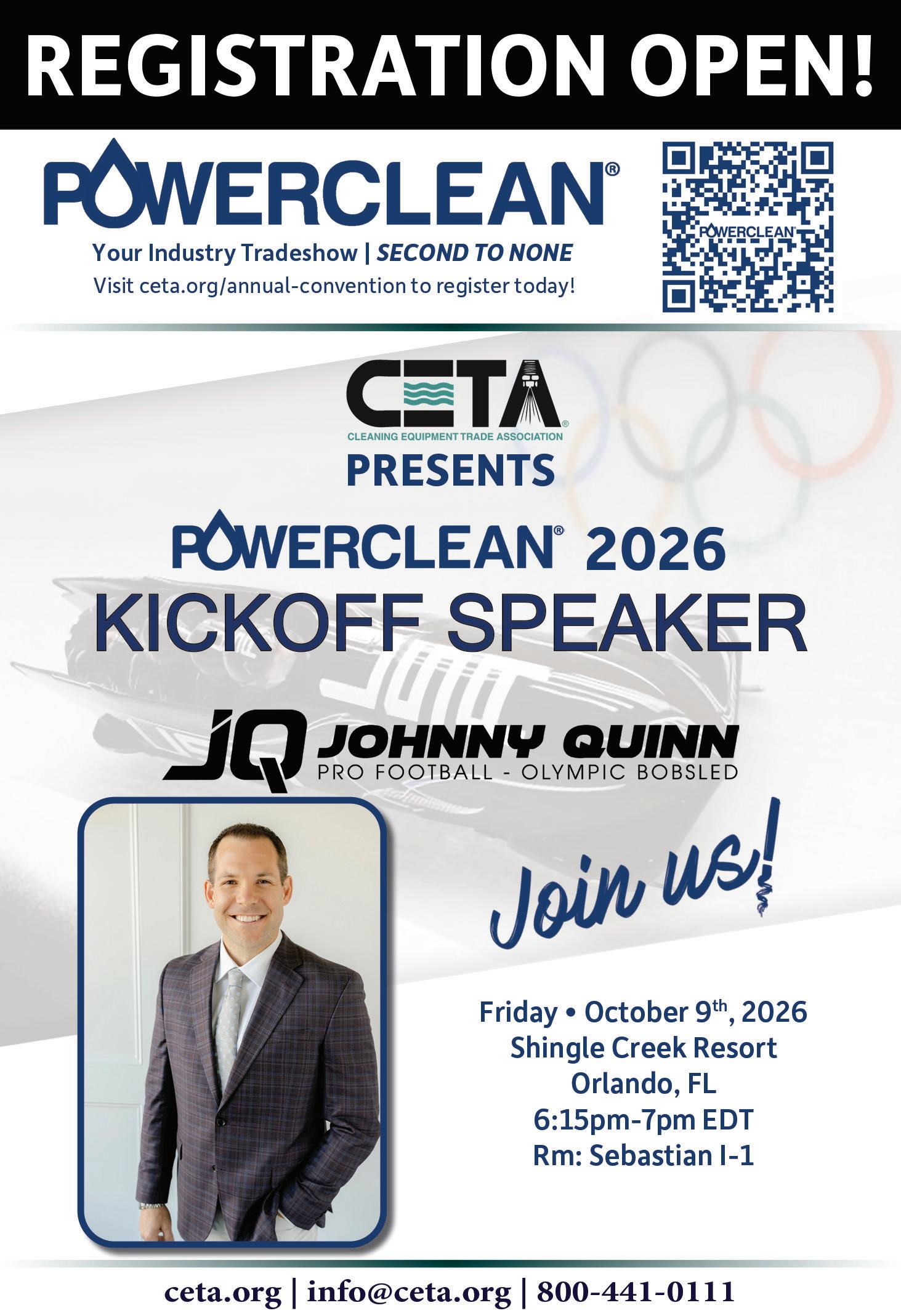
Learn, collaborate, and socialize. PowerClean ® 2026 will be held in Orlando, FL, October 8–11 at the Rosen Shingle Creek Resort)— the annual meeting and tradeshow of CETA, the Cleaning Equipment Trade Association—and will leave attendees wanting for only one thing: more time.
“There’s no better opportunity to see what’s new from everyone in the
industry,” says Delany Johnson, senior sales engineer at Wayne Combustion Systems in Fort Wayne, IN. “Come and see for yourself the best show for the pressure washer industry.”
Michayla Thomas, the sales supervisor at Pacific Bay Equipment in Modesto, CA, amplifies the attribute of being the best. “There’s just nothing better than seeing the latest equipment from top manufacturers when the
equipment is running and performing in real time.”
With manufacturers, distributors, suppliers, and contractors interacting for three days of focused attention on the industry, the energy is kinetic. “The meeting gives dealers an early look at where the industry is headed and a great opportunity to build connections so they can bring the best solutions back to their customers,” says Thomas.
by Diane M. Calabrese
As for what she most looks forward to this year, Thomas cites the outdoor training, which she expects to be a “standout” highlight in 2026. Still, she anticipates that ranking highlights will not be easy.
“The benchmarking session is one of our more valuable sessions,” says Thomas. “It gives companies a clear picture of how they stack up using real industry data—not guesswork—so
they can see what top performers are doing and where they can improve.”
Thomas says that attending the benchmarking seminar provides an immediate boost to thinking and planning. “You walk away with practical tools and reports you can actually use to make smarter financial decisions, which is huge in today’s fast-moving environment.
“There’s something for everyone,” says Thomas, “You’ve got a full lineup
of exhibits, training seminars, Women of CETA, and awards and giveaways.”
Then there’s the city of Orlando itself—a “relaxed setting where you can really take advantage of the networking and conversations,” says Thomas. Competitors talk and learn from one another.
In fact, with all there is to explore in and around Orlando, tacking a few extra days onto the trip and taking the
Photo by
family or traveling with a friend is a good option. So well-known is the Orange County, Orlando, FL, area that most people already have a list of places in the area they’d like to visit or revisit.
Yet how many ever took the time to play detective? To start, how did Orlando get its name?
There are at least four different viable theories from historians, and one of them brings William
Shakespeare’s As You Like It (and the character Orlando) into the mix. Given the happy-all-around resolution of that play, a happy ending that hinges on the fortitude and creativeness of Orlando, we like that theory.
Fortitude and creativity are much needed now as they always have been. And they will be nourished in Orlando.
Whichever seminars, hands-on training, meetings, social events, and extras an attendee chooses across the
days of PowerClean 2026, one thing is certain. “It’s a great mix of learning, relationship-building, and getting reenergized about where the industry is going,” says Thomas.
Make that where the industry is both going and innovating. “Last year introduced the new innovation award, and that’s going to be expanded this year to include multiple categories,” says Greg Sprunk, president of Superior Cleaning Equipment Inc. in Phoenix, AZ.
The innovation award competition encourages members of CETA to step forward and introduce the results of the continuous improvement to which they are all committed. The friendly competition among competitors is one of the many ways in which manufacturer and supplier members demonstrate that they collaborate even as they compete, all with the aim of making the industry stronger.
Seminars will cover a range of topics—all geared toward strengthening individual businesses. In 2025 Sprunk taught a class on CRM [customer relationship management] and marketing with AI.
The response to Sprunk’s session was excellent. Are you interested in a video of it? Sprunk explains a video of the session is available at the CETA website under CETA University: “I think that’s one of the many benefits of CETA, being able to see these panel seminars and share them with your staff.”
The repository of information from technical updates and the ties to fellow members available to CETA members is vitally important. Of course, a professional association keeps changing as it responds to members, and the easy give-and-take and brainstorming during PowerClean 2026 will be a great opportunity for members to share their ideas, not only with each other but also with current board members.
When Debbie Murray, managing director of CETA, anticipates PowerClean 2026, she is moved to superlatives. She says that it promises to be the most robust tradeshow and meeting yet.
How is that? It will be “bigger, bolder, and packed with opportunities to grow your business network, snag innovations, and level up like never before,” says Murray. The event should be a priority for anyone who wants to identify ways to realize the full promise of their company.
CETA is the only association dedicated to our industry. With the separation from PWNA in 2025, CETA is better positioned to focus on manufacturers, suppliers, dealers/distributors, and associate member relationships, reducing conflicts and allowing us to move forward more effectively.
Deeply involved in planning alongside fellow board members, Murray reminds us of the dedication each planner gives to CETA and to the industry. For starters, the planners evaluate past events to identify, retain, and amplify the best among them.
“The education lineup is always a highlight,” says Murray. “Think powerhouse seminars, hands-on equipment training, expert panels on cutting-edge techniques, business growth strategies, safety innovations, emerging tech, and real-world tactics that deliver immediate return on investment.”
The team of planners wants each attendee to leave the meeting and tradeshow with the confidence that he or she takes away some experience or knowledge that is new, useful, and inspiring— experience and/or knowledge that can be tapped to elevate operations or production or any facet of a business.
Being immersed in the wonder of spring, as we are in this month of May, it may be a little hard to recall that sometimes the advent of autumn is a different, slower time. But it need not be, not at all.
By partaking in the events of PowerClean 2026, an attendee recaptures the promise of spring, which is laden with fresh ideas for changes and new ventures. If the end of summer has caused any slowing of momentum, it will be quickly restored.
Murray explains that both the formal and informal sessions have a way of fueling each other and the attendees. Being able to connect with top manu-
facturers in the industry, watch demonstrations, and even test gear is a great opportunity.
Moreover, the opportunity is compounded by the diversity of sessions. There will be “epic giveaways—from tools to gamechangers—non-stop networking with passionate pros, golf outings, receptions, Women of CETA, and benchmarking sessions,” says Murray. And Murray adds there will also be “that electric Orlando vibe in
October”—an indefinable but recognizable phenomenon. Think of Shakespeare’s Orlando writing poems and slaying a lion. It will be nothing like that (save for poets quietly among us), but it will actually be a lot like that in recapturing the potent energy of spring.
Take time today to register for PowerClean 2026 at the CETA.org website. Not yet a member? Join via the website. CT
REMEMBERING JAMES F. COLEMAN
James (Jim) F. Coleman, age 90, a long-time resident of Maynard, MA, passed away peacefully on February 28, 2026.
Born April 29, 1935, in Waltham, MA, he was the beloved son of the late Joseph J. Coleman and Marion F. “Midge” (Norton) Coleman. Jim graduated from Waltham High School in the class of 1953
and proudly served in the U.S. Army from 1955–1956 in Korea.
In 1957 he married the love of his life, Vera (Robinson) “Vee” Coleman. They built their home in Maynard in 1958 and shared 59 devoted years of marriage until her passing in 2016. Jim is survived by his daughters—Kathi A. Ferrante and her husband Al of North Chelmsford, and Leanne C. Coles and her husband John of Maynard— as well as his cherished granddaughter, Lily (Connor) Coles.
Jim’s strong work ethic began at age 12, helping at a local gas station after school. That drive carried through his life as a successful entrepreneur and community leader. From 1977 to 1997 he founded Mobile Sales and Service for Commercial & Industrial Cleaning Equipment, trademarked Power America, building a respected business in the pressure washing and cleaning equipment industry. Even after retirement he felt the pull to return, and in 2007 he founded Power Washer Sales in Littleton. His work ethic and commitment to customer service defined his professional life.
He also remained deeply involved in his community, serving on the Maynard Planning Board and as town moderator for many years. Jim served as a board member of Middlesex Bank from 1975 to 2007 and continued as an honorary trustee.
Following a severe stroke in 2015, Jim showed remarkable determination, working out daily at Anytime Fitness in Acton for years. After his wife’s passing, he visited her graveside after each workout, reflecting on their life together.
Jim was fiercely loyal, generous, and patriotic. He loved reading, movies, Las Vegas trips, and caring for stray cats. He was often seen at the corner of Main and Summer Street proudly waving the American flag.
Jim will be remembered for his integrity, devotion to family, and enduring love of country. CT
AND
COMPANIES IN THE CLEANING INDUSTRY
by Dr. Bart A. Basi, PhD, CPA
Photo
There are big differences between operating a private company and a public company. All owners of private companies should know and understand the differences. Not knowing nor understanding the differences can lead to decisions resulting in higher taxes and lower cash flow.
The accounting and tax methods required by the federal government are different for public companies than the methods that govern accounting and tax matters allowed and used by private companies. Key areas for owners and officers of private companies to understand are depreciation, entity structure, and inventory methods.
DEPRECIATION
For individuals who own stock in a public company, the Securities and Exchange Commission (SEC) sets guidelines for reporting and deducting the cost of equipment owned and used in a business. Such a company often uses straight line depreciation, a method that lowers the expense deduction related to the equipment for each year and increases the profits for the company each year. Stockholders and the government favor this method as profits increase and expenses go down each year. Also, the balance sheet shows a higher net value for the company. Accordingly, investors believe that since the asset value of the company goes up, the value of the company also increases.
The private company can deduct the entire cost of the equipment used in the business in one year. This lowers the reported profit as the depreciation expense is much higher than if the company were a public company. In addition, the assets are decreased as the equipment is now on the balance sheet at a net zero figure since the entire cost of the equipment has been deducted on the income statement.
THE ENTITY STRUCTURE
One might look at a private company and a public company side by side and wrongly think that the public company is worth more than the private company. But the opposite may be true. Since the private company has lowered its profits, it should pay less taxes than the public company, and its cash should also increase.
This example assumes that all other items, such as the entity structure, are the same for both the private and the public company; and the operations are also the same for both types of companies. Unfortunately, some private companies that do not have the correct entity structure will end up paying more taxes on less profits, thus negatively affecting the cash flow.
The entity structure used by most public companies is a “C corporation” entity structure. This allows the company to pay taxes at a flat rate of 21 percent. A private company usually
does not use the C corp structure. As a result the private company uses a flow-through entity structure such as a “Subchapter S” structure. A flowthrough entity structure results in the profits being reported on the owner’s personal income tax return and being taxed at a much higher rate than 21 percent. The tax rate could reach as high as 37 percent.
The bottom line is that almost all private companies should consider changing their entity structure to a C corporation. Such a decision usually results in a lower tax rate and a higher cash flow, with nothing of the private company showing on the owner’s personal income tax return. It is important to also note that there is no “double taxation” for private companies.
Why does a company choose a Sub S entity over choosing a C entity structure? Generally it is the result of the company’s accounting firm not wanting to separate the
business from the ownership. This reasoning may not benefit the company. Recently a very large private company was filing a sub-S structured tax return and had the owners paying a very high tax rate on the profits because the profits were reported on the owner’s personal tax returns. When questioned, the answer was that it was easier for the accountant.
Of course, if the company was incurring a loss, then it is possible that the loss could be deducted on the personal income tax return of the owners. But again, that is only if the owners have invested and/or legally loaned money to the operating company. The tax law is clear in that losses of flow-through entities, such as a Subchapter S company, can only be deducted to the extent of owner investments and any debt where the owner is primarily liable. The company in question was showing a profit and not a loss.
INVENTORY METHODS
There are multiple inventory methods that can be used for companies. To calculate the cost of purchasing inventory, a company could include all of costs involved. Such costs could be delivery costs, insurance costs, storage costs, service charges, etc. Or, a company could include some but not all of the costs. The specific inventory method applied directly affects not just the inventory cost on the balance sheet; it also affects the cost of goods sold and the gross profit, which can affect commissions for salespeople as well as the net profit of the company.
Another method that a company could apply is to add all of the current costs of replacing the inventory, especially if the costs are going up. As one owner stated, “All costs related to items and components received allow for a measured and fast response should unusual perturbations occur.” While this
statement is true, the application can result in lower commissions as well as misleading business decisions regarding selling price, restocking levels, and financing. Keeping all such costs on the books until the specific inventory is sold is not wrong, but business owners should be fully aware of the effects on the company’s financial statements and their decision processes.
Suppose one owner adds all of the costs to acquire inventory to the books while a second owner decides to expense out the costs incurred in purchasing the inventory; what is the difference between the financial statements of the two companies each year?
The first owner will have a higher cost for carrying the inventory on its books, which would result in a higher asset listing on the balance sheet, a possible change in the selling price, a lower gross profit figure, and a smaller net profit when the inventory is sold. If the inventory is not sold in
the same time period in which it was purchased, the profit for the company will be higher in the purchase period, since none of the costs of purchasing the inventory will be deducted until the period when the inventory is sold. And, in the second period, when the inventory is sold, the profit will go down as all of the costs of the inventory will be deducted.
The second owner will have a lower cost on the inventory, resulting in a lower sales price and a higher reported gross profit. Also, if the inventory is not sold in the same period in which it was purchased, the second owner will make a lower profit in the first period as the costs will all be deducted. However, when the inventory is sold in the second period, the profit will be higher than the first owner as a result of the cost of the inventory for the first owner including all of the costs of the purchase of the inventory; the second owner will have just the net cost of the inventory, resulting in a higher gross profit.
Which method is the correct one?
The answer is that all methods are correct. As stated above, there are multiple inventory methods. If an owner keeps some of the expenses of a purchase and adds them to the cost of the inventory, and also deducts some costs, again, this would result in a third method that will also change the end results as stated above. The key is whether or not the owners and the key people running the company are aware of the effects on the financial statements and their decision processes regarding pricing and costs of the inventory method being used.
Finally, what happens if the cost of the inventory goes up during the year? What inventory is actually sold, the inventory purchased at a lower price or the inventory purchased at the newer price, or does the company use an average cost method? All of this gives one a lot to think about.
CONCLUSION
The purpose of this article is to point out that depreciation, entity
selection, and inventory methods in a private company are not the same as they are for a public company. Business owners should discuss these items with their accountant or a professional who knows the industry. Public companies are required to use generally accepted accounting principles, GAAP, but private companies do not have the same requirements. Understand the implications to the answers received from the accountant.
Business decisions dealing with these issues are not a science but an art! Know what methods your business is using and how the results affect your business decisions, which will be key to operating a successful company.
For more information on how the statements in this article affect your company profits and decision making, contact Bart Basi, PhD, CPA, attorney at law, and the author of this article at bbasi@taxplanning.com CT
READY TO RUN
THE PWNA CONTRACTOR’S SPRING START-UP PLAYBOOK
by PWNA
The jobs are already out there. The only question is, is your equipment ready to take them on?
Spring doesn’t ease in for exterior cleaning contractors. One week you’re slow, and the next your voicemail is full and your estimate calendar looks like a game of Tetris. There’s no warmup period and no dress rehearsal. The season opens hard, and whoever’s standing at the plate with a working
rig and stocked chemicals gets the at-bats. That’s the whole game.
At PWNA we talk a lot about what it means to operate as a true professional in this industry—and it starts long before the first trigger pull of the season. It starts in your driveway in March, with a checklist and an honest eye on everything you’re about to ask your equipment to do.
Whether you’re running residential house washes back-to-back across
three counties or managing large-scale, commercial contracts that can’t afford a single delay, the fundamentals are the same, equipment fails the same way, and chemicals degrade the same way. And the cost of being unprepared hits the same way—in lost jobs, rescheduled customers, and margin that quietly disappears before you realize where it went.
What separates the contractor who runs clean all season from the one
who’s constantly putting out fires isn’t talent, pricing, or even marketing. It’s preparation. Specifically, it’s the two or three hours you spend before the season opens—methodically going through your equipment, chemical inventory, and backup kit so that when you pull up to a job, the only thing on your mind is the work in front of you. This guide is that process laid out in plain terms. Run it once, run it right, and then go take the season.
START WITH THE PUMP EVERYTHING FLOWS FROM THERE
Your pump is the heartbeat of the operation. If it’s off, nothing else matters.
12-Volt Soft Wash Pumps
Before the season starts, run your 12 V pump from a fully charged battery and time how long it takes to reach operating pressure. If it’s slower than usual or struggling to maintain flow,
you’re looking at a worn diaphragm, fouled check valves, or a battery that doesn’t have the capacity it used to. None of those are road-trip problems—they’re driveway problems. Fix them there. Check your wiring harness from the battery terminals to the pump. Look for cracked insulation, loose connections, and any signs of corrosion at the terminals. Corrosion on a battery terminal is a voltage drop waiting to happen—clean it with a
wire brush, coat the terminals with dielectric grease, and move on.
Gas Pressure Washers
If you’re running a gas machine as your primary or secondary unit, treat it like a piece of equipment that deserves a proper service—not an “I’ll deal with it if it starts giving me trouble” situation.
Change the oil. It takes fifteen minutes and a few dollars. Swap the spark plug. Pull the air filter and hold it up to the light—if you can’t see through it, replace it. Drain whatever fuel was sitting in the tank all winter and put in fresh fuel. Ethanol-blended gasoline begins degrading in as few as 30 days and turns into a gummy varnish that will foul your carburetor and cost you a shop visit before you’ve billed your first job.
Test the unloader valve by running the machine up to pressure and releasing the trigger. The pressure should build, hold, and release cleanly. A sticky or seized unloader will deadhead your pump—building pressure past its rated limit with nowhere to go. That’s a safety issue, not just an equipment issue.
HOSES — THE THING NOBODY INSPECTS UNTIL IT’S TOO LATE
Walk your full hose inventory—not a glance but a hands-on walk.
Lay each hose on flat ground and run your hands along the entire length, squeezing every foot or so. Pay special attention within six inches of every fitting on both ends—that’s where flexing, pressure cycling, and cold temperatures cause fatigue cracks first. If you notice any stiffnesses, sponginess, or surface cracking in the outer jacket, retire the hose. A blown high-pressure line in the field isn’t just an inconvenience; depending on the pressure and proximity, it’s a safety event. While you’re at it, inspect every fitting. Look for cross-threading, hairline cracks in the brass, and O-ring condition. O-rings cost almost nothing. A spraying fitting at a job site costs you the customer’s trust, which costs considerably more.
What to stock as backup
• At least one full-length replacement hose for your primary run
• A short whip hose section (12–15 feet) for tight access situations
• A full assortment of replacement O-rings in a sealed bag
• Brass couplings and adapters in the sizes you run If a fitting blows in the field and you can’t finish the job, you don’t bill the job. That’s not just one lost invoice—that’s a rescheduled customer who now has to rearrange their day, a potential cancellation if the customer is impatient, and a gap in your route that’s almost impossible to fill at the last minute.
THE CHEMICAL SYSTEM: INJECTORS, PROPORTIONERS, AND THE LINES BETWEEN
Your soft washing chemistry is only as effective as the system delivering it.
Downstream Injectors
Pull your injector before the season. Physically remove it, hold it up, and look into both ends. The ball and spring inside are small and simple, but sodium hypochlorite (SH) is corrosive, and residue builds up over a winter of sitting. Flush it with clean water, then test it by submerging the inlet in a bucket of water and running your pump—watch for draw. You should be able to see the water level drop and feel the suction at the inlet. If it’s weak or not pulling at all, clean the injector or replace it. It is not expensive. Running a soft wash job with an injector that’s barely pulling means you’re applying glorified water to a customer’s house and hoping they don’t notice. Keep a backup injector in your kit, not in your shop but on the truck. Photo
Proportioners and Batch Systems
If you run a dedicated proportioning system or batch mix in your tank, inspect every component that touches chemistry. SH degrades rubber and certain plastics over time—hoses, gaskets, and valves on the chemical side of your system deserve closer scrutiny than the water side. Look for any discoloration, brittleness, or cracking in chemical-contact materials. Replace anything questionable before it fails mid-season.
Check all your tank fittings for sealing and verify your lids are seating properly. A slow SH leak in your trailer isn’t just a product loss issue— it’s a corrosion issue, a safety issue, and an odor issue if you’re transporting in a covered vehicle.
NOZZLES AND TIPS — SMALL PARTS, BIG CONSEQUENCES
Nozzle wear is insidious. It happens gradually, you get used to the results you’re getting, and you don’t notice
how far off your coverage has drifted until you get a callback.
An eroded orifice doesn’t just change your spray pattern—it increases your flow rate, which throws off every dilution ratio you’ve dialed in for downstream injection. What you think is a 0.5 percent application at the surface may be something different entirely. If you’re relying on consistent chemistry for biological kill (and with soft washing, you are), tip wear directly affects your results.
Get in the habit of replacing your primary tips at the start of every season, full stop. Keep the old ones as backup spares, but don’t trust them as your primary set. A box of tips costs less than one callback.
Tip kit to keep on the truck
• Full set of working tips in the sizes you run
• Back-up set of the sizes you use most
• Tip cleaning tool or thin wire
• Nozzle testing caps if you run a multi-outlet manifold
CHEMICAL INVENTORY KNOW WHAT YOU HAVE AND WHAT YOU’LL NEED
This section is where a lot of contractors lose money that doesn’t show up as a loss until later, and by then the season’s half over.
Sodium Hypochlorite
SH starts degrading the moment it’s produced. Heat accelerates it. Sun exposure accelerates it. Improper sealing accelerates it. By the time you pop open that drum from October, you may be working with something considerably weaker than what you ordered. Before you mix anything, test your SH concentration using a chlorine test kit or a refractometer. If you’re at 10 percent or above, you’re in good shape. If it’s dropped toward 6–7 percent, you’re adjusting your ratios significantly—and if you don’t adjust, you’re underperforming on every job
until you figure out why you’re getting callbacks. Don’t build your season on weak chemistry you’re hoping will hold.
Surfactants
Surfactant that’s been sitting in cold temperatures can separate, gel, or change viscosity enough that your normal ratios are off. Open it, look at it, stir it, and do a test mix before you’re in the field. If it looks or smells different, test it on a small surface before betting a whole job on it.
Calculating Your Buy
Estimate your realistic job volume for the first 30 days—number of houses, average size, and mix ratios you run. Multiply that by 1.5 to account for growth, weather windows, and the jobs that always come in bigger than the estimate. That’s your order quantity. Place it before peak season, not after. Bulk pricing is available early. By the time every other contractor is scrambling to restock in May, the price goes up and the availability tightens.
THE SPRING PREP CHECKLIST
Use this. Print it out. Check the box with your hand on the part, not from memory.
Engine and Pump
¨ 12 V pump tested under load, pulling at rated flow
¨ Battery connections cleaned and secured
¨ Gas engine oil changed
¨ Spark plug replaced
¨ Air filter replaced
¨ Carburetor flushed or fresh fuel loaded
¨ Unloader valve tested and cycling clean
¨ Bypass line clear
Hoses and Fittings
¨ All hoses walked and squeezed, especially at fittings
¨ Stiff or cracked hoses retired and replaced
¨ All fittings inspected for damage and corrosion
¨ O-rings checked, spares restocked
¨ Back-up hose on truck
Chemical System
¨ Injector pulled, flushed, and tested for draw
¨ Back-up injector in kit
¨ Proportioner valves and connections inspected
¨ Chemical-contact hoses and gaskets checked for degradation
¨ Tank fittings sealed, lids seating properly
Nozzles
¨ Primary tips replaced
¨ Back-up tip set on truck
¨ Orifices inspected and cleaned
¨ Tip cleaning tool in kit
Chemical Inventory
¨ SH concentration tested
¨ Surfactant inspected and verified
¨ 30-day volume estimated and ordered (with buffer)
¨ Neutralizer stocked
¨ Overflow supply staged
Safety
¨ Eye-wash station stocked and current
¨ PPE restocked with gloves, goggles, and chemical-resistant footwear
¨ Roof harness inspected if applicable
¨ SDS binders current and accessible in vehicle
¨ Trailer lights functional and safety chains in good condition
¨ Tie-downs inspected
LESSONS LEARNED — THE EXPENSIVE KIND
The list above isn’t theoretical. Every item on it exists because someone skipped it and paid for it. Here are the patterns worth knowing before you repeat them.
RUNNING OUT OF SH MID-ROUTE
A contractor running a three-job Tuesday in early May realized somewhere in the middle of his second job that he had less than half a drum left. He stretched it, adjusted the ratios, and finished the job hoping for the best. By job three he was significantly underdiluted—or depending on how you look at it, overdiluted—and the results showed it. Two weeks later he had a callback on house number two and a very unhappy customer on house three. He spent a full Saturday doing remedial work at no charge. Between the product, the fuel, and the lost billing day, his “three-job Tuesday” cost him closer to a week’s worth of margin.
THE PART THAT WASN’T IN THE TRUCK
It’s a two-person crew at a commercial job working a flat-rate contract. They’re 45 minutes from the shop when the downstream injector stops pulling. They don’t have a backup. Their options are as follows: drive back to the shop, drive to a supply store, or improvise. They call around and find a hardware store that carries something close. It’s not quite right. They make it work, sort of, finish behind schedule, and leave a
job that doesn’t look like their usual standard. The client notices. The contract renewal conversation six months later is harder than it needed to be.
A backup injector is $15–$25. A commercial contract renewal is worth several thousand. That math writes itself.
THE HOSE THAT WAITED FOR THE WRONG MOMENT
It’s the first week of March. A contractor skipped his hose walk because everything looked fine from ten feet. On the first day out, the high-pressure hose blows at a fitting while washing a customer’s driveway, not a slow seep—a full separation with water everywhere and the job stopped cold. He’s got no back-up hose in the truck. The customer has to wait while he drives to the nearest supplier. By the time he gets back, she’s annoyed and has told two neighbors—who were both planning to call him—about the experience. The job eventually gets finished. The referrals do not come.
That hose had a stress fracture at the fitting that would’ve been obvious on a five-minute inspection. It wasn’t found in the driveway. It was found in the field, in front of a client, at the worst possible time.
RESCHEDULING IS NOT FREE
Every contractor has a rescheduling story. What most don’t do is calculate what it actually costs. When you reschedule a job—for any reason— you’re not just shifting an appointment. You’re burning administrative time, creating a slot in your route that’s hard to backfill on short notice, and introducing friction into a customer relationship at the moment the customer was expecting to be impressed. Some customers handle it graciously, but some don’t call back. And in a referral-heavy business like exterior cleaning, the ones who don’t call back aren’t just a lost invoice—they’re a lost network.
Good preparation doesn’t just protect your equipment. It protects your reputation, routing efficiency, and the referral flywheel that grows a business worth having.
BUY BULK. STAY READY. MOVE FAST.
Spring prep isn’t a one-time task you check off and forget. It’s the foundation your entire season is built on— and the contractors who treat it that way are the ones still running strong in October when others have spent the season patching problems they should have prevented in March.
The checklist in this guide covers the fundamentals, but fundamentals only take you so far. The contractors who truly separate themselves in this industry are the ones investing in the knowledge behind the checklist— understanding why certain equipment fails, how chemical systems behave under real working conditions, and what compliance and safety standards actually protect when things go sideways in the field.
That’s exactly what PWNA is built for. Through PWNA’s technical training and safety and compliance programs, contractors get access to the kind of industry-specific education that doesn’t exist in a YouTube video or a Facebook group thread. From equipment operation and chemical handling to OSHA compliance and proper safety practices on the job site, these programs are built by people who work in this trade—and they’re designed to make you more capable, more confident, and more defensible when it matters.
And if you’re running a supply business, manufacturing operation, or distributing products and services to the contractors in this industry, PWNA Enterprise Membership puts your brand in front of the professionals who are actively investing in their businesses and looking for partners they can trust.
The exterior cleaning industry is growing. The standard of professionalism is rising with it. PWNA exists to make sure its members are leading that curve, not chasing it.
Get your rig ready, order chemicals, be current on your training, and then go take the season.
For more information on PWNA, visit www.PWNA.org CT
SUCCESS STORY: ALCATRAZ ISLAND PROJECT
by Pacific Bay Equipment
Photo
Installing pressure washing equipment on Alcatraz Island was a unique and rewarding experience completed for our customer Unify Now, a company that has successfully executed large-scale programs in facilities management, custodial services, community engagement, and more.
Our team deployed two coldwater pressure washers, each rated at four gpm and 4,000 psi, mounted on a towable trailer equipped with a water tank and hose reels. This configuration provided a fully selfcontained cleaning system to remove environmental contaminants and maintain Alcatraz Island’s cleanliness for visitors.
We also engineered and implemented a custom wastewater extraction (“honey-sucking”) system designed to extract and properly dispose of portable restroom water, supporting Alcatraz’s environmental sustainability initiatives.
The project required extensive logistical coordination, including transporting the trailer-mounted equipment from the mainland to the island via barge and crane to ensure safe and efficient installation. Since completion, Unify Now has reported significant improvements in cleaning performance and
maintenance operations, helping preserve Alcatraz as a world-class tourist destination.
For more information, visit Pacific Bay Equipment at PacificBayEquipment.com . CT
TIPS FOR FINANCIAL SUCCESS
by Diane M. Calabrese
Photo by
Can you sell square pegs to someone who must fill round holes? It is very unlikely. And trying harder, with hand-painted pegs or attentiongrabbing ads, still will not make the sale.
The top tip for financial success is the oldest one: Meet the needs of the customer.
Meeting the needs of a judicious buyer is part of catering to wants. A prospective customer may want a product with additional features beyond the basics but can’t budget for it.
Thus, investing in ways to persuade a potential buyer to pay more for desirable (but not truly necessary) extras could alienate the customer in the short term (by taking up time) or in the long term (when the bill comes due).
Then, what about introducing customers to innovations in products and services that will make their businesses stronger and more profitable? It is important as can be. Even so, the introduction must be done in the context of first meeting needs.
In business-to-business transactions, companies on either side of the buyer-seller relationship share the same objective. They want to be profitable.
In business-to-consumer transactions, such as power washing contractor to homeowner, the objectives of each side vary slightly. The contractor aims to be profitable. The homeowner aims to keep property in top condition so that it retains its value and perhaps increases its value.
The common denominator in all interactions between buyer and seller is return on investment (ROI). A manufacturer of pressure washers must verify the ROI in raw materials, marketing, transportation, sales, etc. A contractor must verify the ROI in tools, chemicals, vehicles, etc.
ROI applies to the purchaser of services as well. For example, when a homeowner or commercial building owner invests in exterior cleaning, the investment is made with the anticipation that outcomes promised will result.
Never overpromise regarding any transaction. Financial success of a business depends upon customers who are satisfied because they got what they expected for the price they paid.
Every expenditure a business makes should be assessed for the return it brings. Inundating prospective buyers with electronic (text or email) notices of discounts, sales, and limited time offers is the sort of approach that can be cost ineffective.
If the customer starts deleting without reading because of a deluge coming from all directions and types of sellers, the money spent to set up the digital contacts becomes a loss. Respect for a prospective customer’s time is important.
The respect extends to requesting reviews of purchases. Two features of requests for reviews that put off customers are rigidness (rating one to five) and the repetition. If a customer does not rate or review on the first request, it’s better to not keep asking. Show respect for time.
The truism “time is money” is manifest everywhere in 2026. Buyers of all sorts express concerns about how much things cost, the mismatch between income and cost of living, and how much time they must spend carrying on day-to-day activities.
Time is spent because they must bag their own groceries, pump their own gas, navigate intense traffic, and so on. Adding to the complexity of customers’ lives is not a positive move.
Analysis of ROI is a must. One helpful tool for analysis is benchmarking. Many vendors offer benchmarking products. The Cleaning Equipment Trade Association (CETA)
A FINANCIAL TIP THAT SOME WOULD FIND EXTRAORDINARY NOT LONG AGO INVOLVES CYBERSECURITY. IT IS SIMPLY THIS: THREATS ARE REAL, PERVASIVE, AND CONSTANTLY MUTATING; DON’T OVERLOOK CYBERSECURITY.
TRAINED TEAM MEMBERS MUST USE HYGIENIC METHODS IN THE DIGITAL REALM. IT’S THE SUREST WAY FOR A BUSINESS TO AVOID SUFFERING A FINANCIAL LOSS FROM A VIRUS OR RANSOMWARE ATTACK.
includes the price for benchmarking (if a member wishes to participate) in the cost of membership.
ROI by another name is a cost benefit analysis (CBA). When planning a new venture, do a CBA.
CBAs can disappoint, but they can also prevent a financially destructive decision. As many distributors have told us in the past, they have considered adding a service department only to decide against it because the cost of doing so could not be justified by the benefit.
The benefit of including a service department is obvious on the surface. It brings customers into the brick-andmortar establishment, customers who may look and buy. Equipment owners appreciate being able to seek repair and maintenance assistance at the establishment where they bought a machine.
But the cost of the service department may be prohibitive. A dedicated staff member who is technically skilled, space, and equipment required to do repairs and maintenance can
exceed the amount of money that can be collected for doing repairs.
Business experts on achieving financial success lead by example in one way. They don’t give away their expertise for free. They publish books and write articles that they put behind a pay wall.
Consider the pay wall as implicit advice to get paid for rendering services. (As a corollary, do not sell products at prices so low they are not profitable.)
Content on websites may bring more visitors, but will the visitors become buyers, or are they just looking for free information?
Similarly, will a YouTube video recruit a viewer to a customer, or will the viewer simply use the useful information? The video maker invested time and money in the video. What’s the ROI?
In 2018 (updated in 2022), the California Council on Economic Education (CCEE) published “8 Tips for
Financial Success” at the DFPI (California Department of Financial Protection and Innovation) website.
The eight tips apply specifically to individuals, but business owners get some solid reminders by reading them. Choose carefully, plan spending, and budget are three of the most salient tips that easily cross over to business. (See https://dfpi.ca.gov/ wp-content/uploads/sites/337/ 2019/06/8_Tips_for_Financial_ Success.pdf .)
A good product (or service) that gives customers the outcomes they want and returns a profit on investment forms the core of financial success. There’s a little more to it, though.
Not surprisingly, the “little more” involves regulators. Every level of government takes a keen interest in business establishments. The interest stems from the government’s need to find sources of revenue.
While a business sells a product or service to generate income,
federal, state and local governments generate their operating budgets by levying taxes and fees on businesses (and individuals). A business will not be a financial success if it ignores or forgets to comply with a government requirement.
Thus, staying legally compliant becomes much more than a tip for financial success. It becomes a mandate.
LEGAL COMPLIANCE
The structure of a business (e.g., owner/operator, LLC, corporation) determines the type of internal recordkeeping that must be in place. The records are required to comply with reporting requirements for taxes and payroll as well as special requirements (e.g. Affordable Care Act reporting for companies with 50 or more employees).
The state in which the business is anchored imposes its own requirements on business. Requirements may
include an annual report or biennial statement, statement filing fees, franchise tax, and more.
Then, there are the licenses, permits and certifications that may be required, particularly by state and local governments. In short, staying legally compliant constitutes a tip for financial success because failure to do so can undermine the financial health of a company.
Calculating ROI and/or CBA prevents self-deception. Consequently, the method of accounting selected for a business can boost financial success.
For example, although an accrual method of accounting can reduce a tax burden, it is not an easy method to manage. And its transient figures may cause an owner to think things are going better than they are.
A less sophisticated cash accounting method gives an owner a clear picture of cash flow, and it’s easy to understand. It makes self-deception much harder.
Deception merits a second look. An owner looking at the many orders for a product or contract jobs in the queue could become overly optimistic.
The tired cliché of not counting chickens before they hatch applies. Until a transaction is complete, it is not a done deal. A company slated to buy products may suddenly fold. A bad interval of weather may result in cancellation of many contract jobs.
Whether using a CPA or a bookkeeper—either of whom can be compensated on an in-house or contract basis—someone must handle bank reconciliation in addition to accounts receivable, accounts payable, available cash, and payroll. Informed decision-making regarding where to spend can only be made with accurate financials.
Businesses can insure against almost every type of loss. Those legally required as well as other insurance costs should be evaluated regularly with a broker who may be able to help
with bundling or alternatives that reduce cost.
A financial tip that some would find extraordinary not long ago involves cybersecurity. It is simply this: Threats are real, pervasive, and constantly mutating; don’t overlook cybersecurity.
Trained team members must use hygienic methods in the digital realm. It’s the surest way for a business to avoid suffering a financial loss from a virus or ransomware attack.
A business can conduct a vulnerability scan in-house by testing its own protocols or hiring a consultant; costly in time and money, but necessary.
Twenty-six years into the 21st century, many financial tips have not changed; but cybersecurity issues are new, vexing, and impossible to ignore.
Even so, after considering the many components of a business that affect financial success, the most important one remains: If a customer wants round pegs, don’t try to sell him square ones . CT
PRODUCT NEWS
WOOD DEFENDER ® LAUNCHES 200 SERIES AEROSOL STAIN & SEAL: CONTRACTOR-GRADE PERFORMANCE IN A SPRAY CAN
Standard Paints Inc. has launched Wood Defender® 200 Series Aerosol Stain & Seal, a precision spray format that delivers the brand’s proven oil-based stain and seal formula without the setup, cleanup, or tip failures contractors and dealers have come to expect from conventional aerosol stains.
The new aerosol was built specifically for punch-list items: cut ends, gates, hardware areas, and small repairs where hauling a sprayer isn’t practical. Because it matches Wood Defender’s Fence Stain & Seal and 200 Series liquid stain colors, contractors can maintain color continuity from largescale applications through final touchups using the same formula they already trust.
“Contractors don’t want to set up a sprayer or crack open a gallon just to hit a cut end or a gate,” said Laurel McEuen, director of marketing. “The 200 Series Aerosol gives them the same formula, same color, and same guarantee in a format that’s ready the second they reach for it.”
The aerosol is engineered to fully dispense its contents, addressing the clogging and tip failures that make conventional aerosol stains unreliable on the job site. Self-leveling
application ensures even coverage without brush marks or lap lines, just like liquid stain.
Beyond professional contractors, the product is well-suited for dealers and retailers serving DIY customers tackling gates, small repairs, and accent work. Sold in cases of 12, it complements existing 5- gallon and gallon programs without cannibalizing them, and functions as a strong add-on for pre-stain packages and contractor counter sales.
The can also doubles as a practical leave-behind for contractors. With a business card or custom label applied, it keeps the contractor’s name in front of the homeowner long after the job is done and puts a touchup solution in their hands for gates, repairs, and small projects between service calls.
The initial launch includes two best-selling colors: Transparent Oxford Brown (200304-SC) and Semitransparent Coffee Brown (200410-SC), in 12 oz (340g) cans. Additional colors will be added as demand grows. Like all 200 Series Wood Defender products, the aerosol carries the brand’s two-year guarantee.
Wood Defender 200 Series Aerosol Stain & Seal is available now through Wood Defender distributors, dealers, and select retail partners. Dealers interested in adding the SKU can contact their Wood Defender representative or reach the team at 800-658-KOTE.
Standard Paints Inc., based in Mansfield, Texas, manufactures Wood Defender®, a leading line of professional oil-based exterior wood stains trusted by contractors across North America for fence and deck protection. With a 70-year legacy of product innovation, Wood Defender offers a complete system of stains, equipment, and contractor resources backed by ongoing technical support. For more information, visit wooddefender.com or call 800-658-KOTE.
Note: Product News submissions should be emailed to jkidder@cleanertimes.com. Please be sure that your product announcement is accompanied by a high-resolution photo of the product CT
OSHA RULES AND REGULATIONS
by Diane M. Calabrese
Photo
An employer is required to provide a safe workplace.
That’s the essence of the Occupational Safety and Health Act of 1970, which created OSHA, the administration responsible for formulating and monitoring workplace safety and regulations.
A navigable route to all-thingsOSHA is Help for Employers (https:// www.osha.gov/employers ), which details employer responsibilities, compliance assistance, and state office contacts.
The best efforts to stay on track and adhere to OSHA regulations can be derailed by many factors, especially human nature. No matter how well trained and versed in relevant rules an individual is, a problem at home— sick child to burst water pipe—can cause a loss of focus.
Part of the answer, of course, is consistent training so that correct procedures become rote.
Distraction is not the only foil to compliance. Complacency always looms.
Unfortunately, a very safe workplace can cause some employees to begin to take chances, even ones along the lines of “just this once.” As in, just this once let’s skip eye protection or use a stool instead of a ladder.
Training and more training is the way to combat complacency.
“There is no way to ensure 100 percent compliance,” says Linda Chambers, brand and sales manager at GCE/Soap Warehouse Brand in Norcross, GA. “Nothing I have found works even 50 percent of the time.”
What are some examples of challenges? “Safety posters become invisible,” explains Chambers. “Verbal reminders become annoying, and staff can become hostile to them and the person giving them.”
A just-this-once transgression in a safe workplace does not register with many employees as that significant. For example, the step stool might seem perfectly sturdy and a reasonable way to reach a top shelf just once.
It’s not exactly that employees resist being reminded that they did not follow an OSHA rule. But they may think some feedback is too harsh and outsizes the actual event.
The employer must achieve a difficult balance. “No one wants to use written warnings because you don’t want to lose or fire a good employee just because he or she didn’t use proper PPE [personal protective equipment] all the time,” says Chambers.
“Good workers are too hard to find to have to let one go due to something that most likely would never have caused a dangerous issue or be seen by an enforcement officer,” says Chambers. “I worry about and enforce the bigger issues like improper container segregation, containers left open, and improper use of forklifts or driving vehicles.”
Chambers explains she reserves the strongest feedback for “things that can be dangerous to others” and uses softer feedback for things like discovering an employee who is not wearing ear plugs. Again, employer response to an employee’s health and safety transgression must be balanced.
It may not be as difficult as walking a tightrope, but occasionally maintaining balance feels that way. That’s why efforts to combat complacency—train and train some more—take priority in any workplace.
“Keeping up with and taking the time out for training, even if only to do annual refreshers, is a challenge,” says Chambers. “Another challenge is having staff follow the guidelines and not become complacent. They can have their ear protection hanging around their necks, but they won’t take the second needed to put the protection in before turning on a machine.”
So, is the human factor the most difficult part of meeting all the requirements of OSHA? Even given the copious expectations of OSHA, the answer should probably be a firm “yes.”
ABUNDANCE OF HELP
OSHA.gov is the entryway to rules that apply to a particular sector, as well
as explanations of the rules themselves. Using a search tool at the website, a business can verify its NAICS [North American Industry Classification System] six-digit designation and then retrieve regulations relevant to it.
For instance, enter “power washing” and retrieve the code 561790 (Other Services to Buildings and Dwellings) and determine the standards that apply. An interesting way to look at the applicable standards is in reverse.
OSHA gives various tallies of frequently cited standards in inspections and the penalties that result. For the period October 2024 through September 2025, the most frequently issued citations (and penalties) were in the categories of fall protection and falling object protection, respiratory protection, hazard communication, training requirements, and vehiclemounted elevating and rotating work platforms and ladders.
Each of the categories will look familiar to any power washing contractor because they encompass tools used on a routine basis. In addition to specific rules tied to NAICS 561790, there are general industry requirements. General industry requirements are just that. They cover close to all employers in our industry, whether a contractor, distributor, or manufacturer.
OSHA.gov includes a handy Compliance Assistant Quick Start for General Industry (https://www. osha.gov/complianceassistance/ quickstarts/general-industry).
The quick start serves as a refresher for industry veterans who want to assure themselves nothing has been overlooked. It also provides a concise introduction to new entrants to the industry about what’s expected of their companies.
The six major categories listed by the quick-start tool are hazard communication standard, emergency action plan standard, fire safety, exit routes, walking/working surfaces, and medical and first aid. The quick start not only provides links to
relevant fact sheets for each header but also gives direct links to relevant portions of the CFR [Code of Federal Regulations].
Let’s take a nugget-level look at each of the six categories. The hazard communication standard requires an employer to ensure that everyone exposed to hazardous chemicals in the workplace knows how to protect themself and communicate about dangers.
The emergency action plan standard requires that employers have an emergency action plan that details what employees should do in case of fire or another emergency. The action plan may only be recommended for certain types of employers, but it’s best to consider it a requirement.
Under the fire safety category, OSHA recommends a fire prevention plan for some employers and mandates it for others. Still, it’s best to consider it a requirement.
All employers must meet requirements for exit routes. The requirement includes meeting expectations for the design and construction of exit routes.
Enclosed stairwells with fireproof doors are a given in the 21st century. The downside of modern building is the jettisoning of asbestos-based fire retarding materials because of health concerns.
In 2017 OSHA expanded its scope when considering walking and working surfaces. Essentially, its concern broadened from employees falling from an aboveground position to employees falling while walking. It did so after concluding that slip-and-trip hazards resulted in many serious injuries.
Medical and first aid, the sixth broad general industry category, requires that available aid be commensurate with the type of medical situation that’s likely to arise. Among other tools, the category includes a link to a best practices guide (pdf) that reviews
the fundamentals of a workplace first aid program.
THINK FIRST
We all know that standing on a kitchen chair to change a light bulb is a bad idea, one we only entertain because we don’t want to take out the step ladder. OSHA will not come to investigate us at home if we fall and break a body part, but it will investigate an incident in the workplace.
Common sense begins with a commitment to think first and act second. In some settings we can quickly determine the safe approach. Many workplace settings, though, require evaluation (and relevant training) before any work can begin.
For example, a contractor cannot simply decide that respiratory protection is needed (because of dust, mist, fibers, or gases or fumes). The contractor must be versed in the proper use of and certified for certain types of equipment. Moreover,
the contractor must have carefully evaluated the respiratory protection. If it’s a disposable mask, does it offer the correct level of barrier to particles and gases?
Eye and face protection (such as face shields), protective clothing, masks and respirators, foot protection, and hand protection (gloves) all fall into the category of PPE. Choice of PPE begins with appraisal of the toxic or corrosive substances that will be in use, how close to the substance an individual will be, and how the cleaning will be accomplished (with hot water and steam requiring additional precautions be taken).
PPE is covered in OSHA standard 1910.132 (Personal Protective Equipment). The standard is one that gets less attention than it deserves because the second part of the expectation involves sanitation.
Even if the employee owns his or her own PPE, the employer is
responsible for ensuring it is adequate and properly maintained, including being sanitary. (See standard 1910.132(b).) Thus, if an OSHA inspector finds an employee using a soiled respirator, the employer can be cited.
An employer must not grow weary of training and retraining employees. Training keeps employees alert, if only by causing them to grumble “not again.”
Although there are industries partially exempt from OSHA standards because they are deemed low hazard (e.g., retail service, finance, insurance), most employers in our industry are subject to at least some standards. And unless they have 10 or fewer employees, employers are subject to reporting requirements. Even if measures are recommended rather than required and are not subject to reporting, it is in any company’s best interest to diligently keep safety foremost . CT
ZONE 1
American Waterworks, Inc. 13250 Weidner St. Pacoima, CA 91331 818-252-0706
www.americanwaterworks.net
Custom trailer system sales & service.
Nor Cal Pressure Washer Equipment
250-G S. Maple Ave. S. San Francisco, CA 94080 (866) 554-6601
www.norcalpressurewash.com
Hydro Tek Sales & Service, Industrial/Commercial.
Pacific Bay Equipment 609 G Street Modesto, CA 95354 (209) 578-3925/fax (209) 578-3120 www.pacificbayequipment.com
SF Bay area: 28301 Industrial Blvd. Hayward, CA 94545
ZONE 4
Pressure Systems, Inc.
1646 E. Jefferson Street Phoenix, AZ 85034 (602) 253-9579
www.pressuresystemsinc.com
Experience Makes a Difference. Working With Water & Finding Solutions Since 1965.
Superior Cleaning Equipment
4422 E. University Dr. Phoenix, AZ 85034 602-257-1357 sceclean.com
ZONE 5
American Cleaning Systems 5261 W. 42nd St. Odessa, TX 79764 (800) 205-7797
www.amcleaning.net
Pressure Washers, Soaps, Degreasers, Hot Shot
Alklean Industries, Inc. 2111 Catalina Dr. Pasadena, TX 77503 (281) 479-5966 www.alklean.com
Hotsy, Mi-T-M, Hydro Tek, Alkota, KEW, Alto, plus many more. POWERWASH.COM 2313 Cold Springs Rd. Fort Worth, TX 76106 (800) 433-2113 www.Powerwash.com
Pressure Washer Sales & Service, Parts, Chemicals. River City Pressure Cleaning Equipment 7306 NE Loop 410 San Antonio, TX 78219