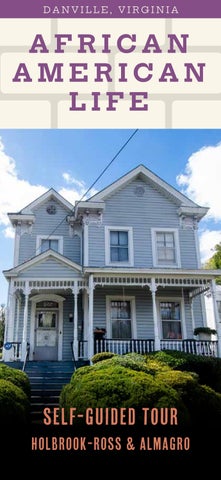
DANVILLE, VIRGINIA
AFRICAN AMERICAN LIFE
self-guided tour holbrook-ross & almagro 1
Holbrook-Ross
Self-Guided Tour of the Holbrook-Ross Historic District
14
GAY
15
ST
The First Neighborhood in Danville for African American Professionals
13
16
T
JOHN S
17
ó
18 19 20
12 11 10
21 22 23 24 HOLB
9 8
ST
T ROSS S
25
7
K ROO
TS ST ROBER
E ST
NRO MO 6
Virginia Historical Marker Intersection of Holbrook & Ross Streets
5 4 3
GR OV E
2
ó
ST MAURY
ST
26
27
2
AL
T
TO
RS S
MBE CHA
1
M AG RO
N AI M
ò
ST
The Holbrook-Ross Historic District, named for two major streets, was the first neighborhood in Danville for African American professionals. Lawyers, ministers, a doctor, a dentist, insurance agents, teachers, postal clerks, and skilled craftsmen made their homes here in the late 19th century. It grew rapidly during the 1880s following the construction of the Danville School, the City’s first public school for African Americans. Dozens of the houses, several churches, and stores built for grocers and other shopkeepers were constructed by their tradesmen/ neighbors. By the turn of the 20th century, Holbrook Street had become Danville’s foremost African American residential address. The district is listed on the National Register of Historic Places, and the Virginia Landmarks Register. It is also a Virginia Green Book location. 3
1
2
5
11. Original Sacred Heart Catholic Church 102 Holbrook Street This trim, frame building at the intersection of Holbrook and Ross Streets was built to serve as Danville’s first Catholic church. Consecrated in 1879, it is an excellent example of ecclesiastic Italianate architecture. In 1938, the congregation moved to Randolph and West Main Streets, and in 2001 they moved to 538 Central Boulevard. There has always been a good relationship between the Catholic and African American communities. It is appropriate that the first Catholic church is located at the entrance to the Holbrook-Ross Historic District. Sacred Heart Catholic School opened in 1953 and it was the first school in the area to integrate in 1960.
and Shop in the basement of this house. On the right side of the house is the add-on entrance to the shop. 66. Calvary Baptist Church 218 Holbrook Street Built in 1895, this Romanesque Revival church was a place of worship for many prominent African Americans including Camilla Williams (1919–2012), the first African American to sing with a major American opera company, the New York City Opera. She performed internationally.* Also, Edith Marie Whiteman was a member. She was an actress on the Amos ‘n Andy TV series in the 1950s. 77. Esdelia & William Boyd House 310 Holbrook Street Esdelia Boyd taught a kindergarten class in this 1920, two-story, brick house with a wraparound porch. Graduation was held in the basement of the Merritt House (see #11). Esdelia Boyd was the first African American principal at Grasty School.
22. Grove Street Cemetery Enter the cemetery on Grove Street. To the right is a monument that honors unnamed enslaved people. 33. Irvin & Marie Taylor House 206 Holbrook Street Born in 1879, Irvin Taylor was a principal in the Pittsylvania County and Danville School Systems from 1905 to 1942. This two-story, wood-frame house with intersecting gables was built in 1900.
88. Alpha Kappa Alpha Sorority House 320 Holbrook Street When this circa-1925 Craftsman-style house was the residence of Worden and Howard Yancey, it was listed in The Negro Motorist Green Book as a tourist home for traveling African Americans. The residence was donated to Alpha Kappa Alpha by the Yanceys’ adult children.
44. William & Naomi Holland House 208 Holbrook Street William Holland studied to be a brick mason at Hampton University and built this Craftsman-style house for his family in 1930.
Alpha Kappa Alpha Sorority is an international service organization founded at Howard University in 1908 in Washington, D.C. It is the oldest Greek-lettered organization established by African American college-educated women whose members have excellent academic records and proven leadership skills. They are involved in the global community through advocacy and service.
55. Tom & Lucy Jones House 214 Holbrook Street Tom and Lucy Jones owned several properties in Danville that they rented to others. Lucy ran the La France Beauty School
3
4
6
4
7
8
5
9
10
99. William F. Grasty Branch of the Danville Public Library vacant lot to the left of 320 Holbrook Street During segregation, African Americans were not allowed to use the public library at 975 Main Street. Therefore, the building that once stood on this vacant lot served as a small branch library from 1950 to 1969. It was demolished 40+ years later for a planned extension of Roberts Street that never happened. Grasty was the principal of Westmoreland School from 1888 to 1929. 10
11
Pringle’s Blue Room/ George and Ruth Pringle House 358 Holbrook Street In the 1950s, when African Americans were not allowed into whites-only restaurants, the basement of this house became a restaurant. George was the chef; Ruth was the restaurant manager. The family lived upstairs. The entrance to the restaurant was on the left side. Dr. Bishop Merritt & Mrs. Willette Merritt House* 364 Holbrook Street Dr. Merritt, a carpenter before he attended college and dental school, served as the general contractor and coordinated the construction of the house and the two-car garage behind the house. This home was the meeting place for Danville Links, a national organization for professional women founded in 1946 to promote friendship and service. The Danville chapter was chartered in 1953. Meetings of the Jack and Jill of America were also held here. This national mothers’ group was formed in 1938 to “provide children with constructive educational, cultural, civic, health, recreational and social programs.” The basement of the home was a gathering place for neighborhood children and was used for Mrs. Boyd’s Four/Five School graduation. (See #7)
12
E. A. & Nannie Gibson House 418 Holbrook Street This two-story frame house with square columns was built in 1900. E. A. Gibson was the principal at Westmoreland School in 1929 and became the first principal at John M. Langston High School where he served until 1948. A school on Industrial Avenue was named for him in 1952. See page 14.
6
11
12
13
Loyal Baptist Church* 468 Holbrook Street The Loyal Street Baptist Church congregation of former enslaved people organized between 1865 and 1866 on Old Hospital-Dance Hill. In 1870, they built a church on Loyal Street in the River District. Worship continued at that site until 1924 when they moved to Holbrook Street and built this Gothic Revival church with a square corner tower and changed the name to Loyal Baptist Church. Doyle J. Thomas was the pastor here from 1946 to 1994. A park in the 800 block of Green Street in the Old West End* is named in his memory.
14
Westmoreland Senior Apartments 540 Gay Street at the intersection with Holbrook Street Danville’s first dedicated school for African Americans, an eight-room brick building on Holbrook Street, was erected in the 1870s. First known as the Danville School, its name was changed to Westmoreland in 1885 to honor Westmoreland County where George Washington was born. In 1925, the building was replaced. The primary grades were in the main building and the high school in the annex. The annex has been demolished. In 1936, a high school was erected at the corner of Gay Street and Holbrook Street and renamed John M. Langston High School. Langston was a Virginian, the son of a white father and an African American mother. He became the dean and vice president of Howard University from 1868 to 1875. In 1888 he was elected to the U.S. Congress and died in 1897. In 1957, Langston High School moved to Cleveland Street. The buildings on Gay and Holbrook Streets continued as Westmoreland Elementary School. It closed at the end of the 1994–95 school year. The Gay Street building now houses nineteen senior apartments. Head Start occupies the building on Holbrook Street.
13
14
7
15
16
19
20
MID20TH CENTURY PHOTO
15
Grocery Stores
rian School (1885-1929). It provided education for Pittsylvania County children, because there were no secondary schools for African Americans in the county. The border between Danville and Pittsylvania County was Cleveland Street, one block away. Students received a basic education and Christian lessons. Fire destroyed the school in 1929.
vacant corner of Holbrook and Gay Streets In the past, there were three grocery stores on or near this corner: Jamerson, Brewton, and the Holbrook Street Grocery. (2011 historical picture) 16
Mackye Allen Williams & Jerry Williams House 407 Holbrook Street Built in 1900, this two-story, brick, Queen Anne house was built by Robert Allen, a local brick mason. The Robert Allen family home was later occupied by the youngest daughter, Ida Mackye Allen Williams and her husband, Jerry Williams Sr., an attorney for the local NAACP. In 1960, their son, Robert, and fifteen other youth from the NAACP chapter led the Civil Rights Movement peaceful demonstrations at the Danville Public Library and Ballou Park. The 2011 restoration converted the vacant single-family dwelling into a mixed-use structure with two dwelling units on the upper level and a conference room, two offices, and an exhibit hall on the lower level. It was named the Williams Community Resource Center.
19
20
17 Holbrook Street Presbyterian Church 353 Holbrook Street The Presbyterians organized in 1878 and worshiped in a white, frame structure on the same lot as the current church. The cornerstone of this Romanesque Revival church with a three-story corner tower was laid on March 28,1910. 18 Danville Industrial High School 355 Holbrook Street lot to the left side of the church – school no longer exists Danville Industrial High School was often called the Presbyte-
17
8
18
21
Mabel Cunningham Hughes & James Hughes House / Cunningham & Hughes Funeral Home 351 Holbrook Street Built in 1890, this was the Cunningham family residence on the second level and a prominent funeral home for the African American community on the first level. They also owned a cemetery on Piney Forest Road north of Wendell Scott Drive.* The house was built by Mr. Cunningham around 1900. During the Civil Rights Movement, Mabel Hughes posted this house as security for forty-four demonstrators who were jailed in June,1963. Their son, James Hughes, was a member of Wendell Scott’s crew from 1968 to1972.* Dr. Albert L. & Mrs. Cecelia R. Winslow / Catherine & Clyde Luck House 341 Holbrook Street This two-story brick house was built around 1890. Dr. Winslow was Danville’s first African American medical doctor and one of the founders of First State Bank.* Winslow Hospital in Almagro was named for him. (See page14.) Their daughter, Catherine, married Dr. Clyde Luck, and the couple lived here until her death in 1999. Catherine was a professor of economics at Bennett College in Greensboro and worked for the Community Improvement Council in Danville. Claudius (C. B.) Claiborne House vacant lot to the left of 327 Holbrook Street C. B. Claiborne played at Langston School under the guidance of Coach Hank Allen (See #25) and was the first African American to play basketball at Duke University. He is best remembered for having a starring role in Duke’s classic triple-overtime win over the University of North Carolina in 1969. Claiborne has a Ph.D. from Virginia Tech. While working at Ford Motor Company, he helped design the adjustable steering wheel. Claiborne is a professor of marketing at Texas Southern University in Houston.
9
22
22
23
Lula Saunders Williams & Dock Williams House 321 Holbrook Street Built in 1885, this two-story weatherboard vernacular, Italianate house remained in the Williams family for 125 years. Mr. Williams was a meat cutter at J. W. Haraway, one of the city’s leading markets and at Danville’s municipal meat market. For many decades into the 1980s, neighbors remember the ivorytrimmed, yellow house as the residence of Ora Williams. She taught Latin at Lynchburg’s Dunbar High School. She is also remembered for her attention to lawn and shrubbery around her neatly maintained dwelling.
26
25
Dr. Bishop Merritt and Mrs. Willette Merritt Apartments 243 Holbrook Street This one-story, wood-frame duplex with side-gable roof was built in 1895. The duplex was originally a single-family dwelling until 1910. Coach Howard “Hank” Allen rented here and worked at John M. Langston School. He taught his players how to win a game and how to win in life. One of his most famous players was Claudius Claiborne (See #21). The Galileo Magnet High School Gym on the Langston Campus on Cleveland Street is named for Coach Allen.
26
Doe/Brodnax House Pleasant Sanford Brodnax & Elizabeth Blackwell Brodnax House 203 Holbrook Street Thomas Doe owned the land that was subdivided in the 1870s to create Holbrook and Ross Streets. Doe lived in this Colonial Revival house with classical details until 1892. The dwelling was purchased in 1898 by Reverand R. G. Adams, one of the founders of Calvary Baptist Church. It was sold to the Brodnax family in 1914. Mr. Brodnax owned a grocery store on North Union Street in 1882. He was a member of Calvary Baptist Church and the Sunday School Superintendent. He started a branch of the YMCA for African Americans. In 1952, the African American YMCA on the corner of High and Ridge Streets opened and was named for him. There is a Broadnax [sic] Street that intersects with South Main Street near Danville Community College named in his honor. Many famous people visited at this house including George Washington Carver, Marian Anderson, and Camilla Williams.
27
Sacred Heart Catholic Church Rectory 153 Holbrook Street Built in 1886, this house features ornate hood moldings on the windows, decorative shingles, and small finials. It was the rectory until the church was sold in 1947.
23 23. Pleasant & Lucy Doswell House 311 Holbrook Street This Queen Anne house built in 1890 by carpenter John Hargraves has a gable over the entrance and a projecting round bay with turret roof and finial. Mr. Doswell was the first African American postal carrier in Danville. He was also one of the founders of First State Bank* and served as a vice-president until his death in 1938. 24. Hargraves House/ Dr. John Edward Geary & 24 Mrs. Nellie Geary House 307 Holbrook Street This 1890 Queen Anne two-story house has elaborate spindle work over the porch, intersecting gables, round vent windows with tin covers, and a metal roof. It was built by John Hargraves, a carpenter who worked on Millionaires Row (Main Street) mansions. Dr. Geary was a dentist and one of the founders of First State Bank in 1919. His wife, Nellie Hargraves Geary, was born at 330 Holbrook Street. A miniature golf course once existed on the side lawn.
24
10
25
27
To experience more of African American life in historic Danville, continue on Holbrook Street through its intersection with Main Street where its name changes to Holbrook Avenue. Drive approximately one-half mile to the T-intersection and turn right onto Branch Street. You are now in Almagro. Continue on Branch Street to the T-intersection with Foster Street and turn left. You will see E. A. Gibson School, the first stop on the self-guided Almagro driving tour.
11
Almagro
Almagro was a garden spot of the city. It was like a big family. Everyone knew each other. There was a lot of togetherness. —Marjorie Betts Holliness (1923–2005)
Self-Guided Driving Tour of Almagro
The current boundaries include Industrial Avenue and the Grove Park subdivision. Betts Street is the main road through the community. Historic Almagro included many homes built between 1880 and 1964, two grocery stores, two churches, two barber shops, a school, a baseball stadium, a hospital, and more.
the largest incorporated African American community in America dating to 1883 Before it was annexed into the city, Almagro was the largest incorporated black community in the state with its own post office, town council, and police force. The town establishment date is unknown; however, its post office was listed as early as 1897–1898 as a Pittsylvania County post office. Since 1932 when Danville annexed Almagro, the boundaries of the community have become increasingly blurred. The area bordered by Jackson’s Branch, which flows east into the Dan River, Oak Hill Cemetery, and South Main Street was considered to be Almagro. The Richmond Danville Railroad constructed in 1848 historically marked its northern border.
EP
10
PS
ò ò ST
ò 8 7
ò 11
13 12
16
ò
1
ó
ST
ITH
ST
9
2
ST
BIN MA
SM
ER ST
FO
ò
Several streets and the hospital were named for families or esteemed citizens. (Betts, Epps, Mabin, Vassar, Winslow, Broadnax). For example, Alexander Epps, a resident and homeowner in 1900, was a businessman and served as an elected justice of the peace for the Tunstall Magisterial District from 1897 to 1905. The African American hospital was named for Dr. Albert Winslow. He and his wife lived about one-half mile north of Almagro at 341 Holbrook Street in the HolbrookRoss Historic District. See page 9. Mr. Pleasant Brodnax (spelled Broadnax on the street sign) started a local branch of the YMCA. He and his family lived at 203 Holbrook Street in the Holbrook-Ross Historic District. See page 11. ST TS ST BET Y R E 14 ET M CE
6
12
3
ò
5
4
T BE
T
S TS
13
15
3
1
2
11 E. A. Gibson School 1215 Industrial Avenue Built in 1952, this school was named for Professor Edwin A. Gibson, who became principal of the Danville School in 1929. That eight-room Holbrook Street school—later known as Westmoreland School—was the city’s oldest African American public school. In 1936, a new high school opened on Gay Street and was renamed John Mercer Langston High School, with Gibson serving as principal until his death in 1948. The E. A. Gibson Elementary School was the first completed under a 1951 expansion plan. Gibson and his wife lived at 418 Holbrook Street; their home and the former Danville School/John M. Langston High School/Westmoreland School are in the Holbrook-Ross Historic District. See page 6. 22 Peters Park Historical Marker near 123 Foster Street Opened in 1948 by James Peters Sr., Peters Park (also known as Almagro Baseball Stadium) was home to the Danville All-Stars, an African American baseball team that Peters sponsored. One of the first lighted baseball stadiums in the nation, it hosted games and community events. Jackie Robinson played here in the early 1950s. The park closed in 1952 following baseball integration and the rise of televised games. 33 Winslow Hospital 709 Betts Street at the corner of Betts and Foster Streets Built between 1940 and 1943, this hospital was named for Dr. Albert Lincoln Winslow, one of the first African American doctors in Danville. J. Bryant Heard, a prominent architect in Danville, designed the hospital and C. M. Weber was the builder. The one-story Colonial Revival–style building has a 1962 Mid-Century Modern addition to the front entrance. The hospital was considered one of the best African American hospitals in Virginia. Winslow Hospital had 35 beds and a dedicated tuberculosis ward run by African American physicians, nurses, and staff. Those injured in the 1960s’ Danville Civil Rights Movement were treated here. In 1971, Winslow Hospital merged with Danville Memorial Hospital. The Danville Health Department operated here from 1971to 1981. In 1982, the building was converted into a 60-bed nursing home, Ashwood Home for Adults, and later Winslow Loving Care that closed in 2014.
14
5
4
44 Lafayette Bethel Restaurant (aka Bethel’s Place/Lafaye’s/Beth’s) 800 Betts Street In 1939, Lafayette Bethel (1908–1978) opened a café and store here. It was a community gathering spot and famous for its hot dogs, hamburgers, milkshakes, and jukebox music. The doors were always open and the welcome always warm. Bethel also operated Bethel’s Cab Service. The family’s home was in the back of the building; the store was in the front. After the businesses closed, the building was rented to Dr. Lamont Perry, general practitioner. His practice was downstairs and his family lived upstairs 55 Juanita White Residence/Beauty Shop 801 Betts Street This was Juanita White’s residence until her death in 2008. The beauty shop entrance was in the back. 66 Shiloh Baptist Church 901 Betts Street Founded in 1865 as the Jackson’s Branch Sunday School, Shiloh Baptist Church has stood near the intersection of Smith and Betts Streets since its inception. The church was the center of spiritual and social life. They purchased Peters Park and then sold half of it for the Boys and Girls Club. Turn left onto Smith Street. 77 Hattie J. Long Residence/ Beauty Shop 174 Smith Street near the intersection with Betts Street 88 Almagro Training School/Almagro Outreach 166 Smith Street Almagro Training School was built before 1915 with eleven grades and served Pittsylvania County students. For the twelfth grade, some pupils attended Danville Industrial High School at 353 Holbrook Street. (See page 8.) When E. A. Gibson School 6
7
15
8
9
was built in 1952, the Almagro Training School operated under the Danville Parks & Recreation Department/Almagro Outreach, a community center with a projection room for movies, a recreation room with pool tables and ping-pong tables, and a baby clinic. Eubelia Jones, an Almagro resident, was the first director.
12
10
11
12
Henderson Janitorial 141 Mabin Street George Henderson Sr. and his son owned and ran the business from the family home. Private Residence/Cake’s Grocery Store 170 Mabin Street From the early 1950s until the early 1980s, this home was also the location of Cake’s Grocery Store owned by Henry and Estelle Womack. Henry was known as Henry Cake because he loved eating the cakes that Estelle loved to bake! The store, located on the left side of the house, sold candies, gum, cookies, sodas, dipped ice cream (using a square dipper), canned goods, cigarettes, washing powder, bread, and chips. Almagro Masonic Lodge Chartered in 1875, the Nehemiah Lodge No. 26 is the oldest African American Lodge in Danville and one of the oldest in Virginia. The lodge moved three times before locating on the
10
11
13
Betts Family Home & General Store (now a park) corner of Betts and Mabin Streets In addition to running the store, William Betts was also a postmaster. His son, Gustavious Adolphus, worked in the store, operated a telegraph, and was a Western Union delivery man. He was also the Worshipful Master of Almagro Lodge No. 217. A small park exists on the site where he died when the family home burned. Turn left onto Betts Street.
14
Thomas Taxi Service 1406 Betts Street Johnnie Thomas lived here and operated the taxi service from his residence.
15
Oak Hill Cemetery 100 Walters Mill Road at intersection with Betts Street Established in 1901 and acquired by the city in 1931, this thirtyacre cemetery was once the only burial place for African Americans in Danville. There have been over 11,000 burials here. Make a U-turn and return to Betts Street.
16
Private Residence 1007 Betts Street Oral tradition reports this private residence was built around a small, three-room house, probably the oldest house in Almagro. A portion of the land was once a part of Nathaniel Greene’s estate. His daughter, Maria Greene, sold a plot to the Wingfield/ Mills families in 1886. It has been in the Pinchback and Ferrell families in recent history. Additional note: Jim Mitchell, defensive end and defensive tackle for the Detroit Lions from 1970 to 1977, grew up in Almagro at 110 Davis Street. His home has been demolished.
15
16
14
corner of Betts and Mabin Streets. The Almagro Masonic Lodge is a subordinate lodge of the Most Worshipful Prince Hall Grand Lodge of Virginia, Free and Accepted Masons No. 217.
99 Private Residence/ Former Horton Contractor Business 158 Smith Street Claude Horton and family lived in this house built in 1936. He ran his business as a contractor for cement finishing from this location. Driveways, patios, and basements were his specialties. His descendants continue to live here. Continue to the T-intersection. Turn right onto Branch Street. Turn right onto Mabin Street.
13
16
17
990
975
ST
MUSEUM
HOTEL
RESTAURANT/ WINE BAR
1009
HOLBROOK AVE
1009 Main Street. Crema & Vine. Once an Esso filling station, this building is now a gathering spot where locals connect over cups of steaming coffee, exquisite wines, craft beer, and artisanal-crafted food.
MAIN ST
W GREEN ST
1050 RESTAURANT
BROAD ST
RISON ST
1050 Main Street. King Cropp Kitchen. Built in 1895 as a Queen-Anne style, single-family home, this building has experienced extreme makeovers and facelifts. Now a family-owned New American restaurant, it specializes in gluten-free, dairy-free, vegetarian, vegan, and alpha-gal friendly options.
IN ST S MA
BROAD A LY
7 Chambers Street. Midtown Market. This small grocery store, named for its location midway between the historic Schoolfield Village and North Danville, has been in operation since 1921. Their chicken salad was featured in the “Cooking with Paula Deen” magazine as being one of the best in the country.
18
ERS
GRAY ST
MARKET
MAGRUDERS ALY
CH AM 7 B
DIBRELL ALY
Wine, Dine, & Stay
SUTHERLIN AVE
990 Main Street. The Holbrook Hotel. Originally built as offices for a group of nine doctors in 1957, this 45-room boutique hotel sits at the crossroads of the Old West End Historic District and the Holbrook Ross Historic District.
19
Museums
975 Main Street. Danville Museum of Fine Arts and History (DMFAH) It was in this family home that Jefferson Davis, President of the Confederacy, wrote the final proclamation of the Confederacy before the Civil War ended. Today, visitors will find recreated historic rooms, two art galleries, a Civil War exhibit, a Civil Rights Exhibit, the Camilla Williams Exhibit, Danville’s Wall of Fame, and a gift shop. The DMFAH is a Virginia Historic Landmark and is listed on the National Register of Historic Places and on the U.S. Civil Rights Trail.
Open: Thursday through Saturday 10:00 a.m. to 4:00 p.m. Sunday: noon to 4:00 p.m. Closed Monday through Wednesday. Be sure to call ahead to ensure hours of operation haven’t changed. (434) 793-5644 Admission costs vary. Visit www.danvillemuseum.org. On the side lawn of the DMFAH at the corner of Magruders Alley and Sutherlin Avenue is Learn, Explore, Enjoy. In this gathering space, visitors can learn more about the Danville area by reading the large information signs posted on granite slabs. On the opposite side of the DMFAH at Magruders Alley and Holbrook Avenue is the Perkinson Rose Garden.
20
To view an exhibit of Langston High School history, visit the Danville Public Schools office building, 220 Cleveland Street, during business hours. The school is stop #14 on page 6 in the Holbrook-Ross Historic District.
21
*Other African American Sites of Interest Camilla Williams Park 700 Memorial Drive This 6.5-acre, riverfront park and playground honors Camilla Williams, an operatic soprano and the first African American signed by a major U.S. opera company. Born in Danville, she sang in the Calvary Baptist Church choir. Her picture hangs in the Hall of Fame at the Danville Museum of Fine Arts and History. She was honored by the Library of Virginia as one of Virginia’s Outstanding Women in History. Virginia State University awarded her an honorary doctorate in 1985 and the Taylor-Williams Hall on its campus was named for her. A historical marker stands at 238 West End Avenue. Marie Frankie Muse Freeman 215 Ross Street (House no longer exists.) Freeman was born in Danville (1916–2018) and moved to St. Louis in 1948. She was a practicing attorney for nearly sixty years and a pioneer in the Civil Rights Movement in Missouri, representing the NAACP in the landmark case that ended racial discrimination in public housing. Freeman was the first woman to be appointed to the U. S. Commission on Civil Rights (1964–79) and was instrumental in creating the Citizens’ Commission on Civil Rights in 1982. From 1967 to 1971, she was the national president of Delta Sigma Theta sorority. In 2011 Freeman received the NAACP’s highest honor, the Spingarn Medal, given to an American of African descent who embodies outstanding and noble achievement The Merritt Building 224-226 North Union Street This building is named for the family who lived at 364 Holbrook Street (#11). It housed Washington-Douglas Drugstore, an ice cream shop and pharmacy. Dr. Merritt’s office was upstairs at 226 ½. The circa 1880 three-story brick building has letters spelling Merritt Building near the top. At street level, there are modern glass and stone storefronts with inset entries. Doyle Thomas Park 827 Green Street Doyle J. Thomas was a Danville city councilman, pastor of Loyal Baptist Church for 48 years, and president of the local chapter of the NAACP. This four-acre park with splash pad, playground, basketball court, and picnic tables is named in his honor. Loyal Street Baptist Church historical marker 400 block of Loyal Street M. C. Martin Park 615 Memorial Drive This 3.6-acre park across from the Camilla Williams Park is named for the longest-serving president of First State Bank (1951–1972). Martin was a behind-the-scenes civil rights supporter. He filed a suit challenging Virginia’s policy of providing state parks only for whites, leading to the creation of what is now Twin Lakes State Park. Its historical marker is at the junction of Route 360 and Route 621.
22
First State Bank Historical Marker 210 North Union Street This was the first African American–owned and –operated state-regulated bank in Virginia. In 2017, it was rebranded Movement Bank and moved to Piney Forest Road. High Street Baptist Church 630 High Street In 1865, emancipated African Americans withdrew from First Baptist Church, where they had worshiped from the balcony, and founded a congregation later known as High Street Baptist Church. Members erected their first sanctuary in 1873. Fire destroyed that structure and its replacement constructed in 1878. The present Romanesque Revival church was built in 1901. It served as a base for organizers of the local Civil Rights Movement and hosted the Rev. Dr. Martin Luther King Jr. in 1963. Wendell Scott Community corner of Wendell Scott Drive and Arnett Boulevard In 1963, Wendell O. Scott Sr. became the first African American to win a NASCAR Grand National race. The International Motorsports Hall of Fame inducted him as a member. There is a mural featuring him and a historical marker in front of his garage at 120 Wendell Scott Drive. In 2018 an 8.5-mile section of Route 29 was named for him. Freedman’s Cemetery 761 Lee Street This four-acre plot was established adjacent to Green Hill Cemetery for former enslaved people and free African Americans. It appeared on an 1877 F. W. Beers map, but it wasn’t until 1892 that the city acquired the plot. There might have been burials prior to 1864. Without records, it is impossible to determine how many people were buried here. Originally, over 100 graves had markers but fewer than thirty remain. True Friends of Charity Plaque 120–126 South Union Street South Union Street was a multi-tenant commercial block between 1904 and 1910. A plaque in the parking lot behind the building commemorates the African American organization that maintained a meeting hall on Patton Street during the late 19th century. (Enter the lot on Patton Street across from City Hall; count seven parking spaces and look for the plaque on the right wall.) The plaque tells about the discovery of a time capsule from 1870 that contained the script of a memorial service for Rev. Harrison Scott, the first pastor of Loyal Street Baptist Church.
23
So much to do, so much to see.
VisitSoSi.com • @VisitSoSi PRINTED APRIL 2026
There is little written history of African American communities in Danville. Therefore, the history of these neighborhoods is told through their physical structures. In the Holbrook-Ross District, oral history was provided by Nannie Geary Armstrong (1925–2019), Valeria Brodnax (1928–2018), Bertha Bruce (1926–2019), and Paula Martin Smith. Additional information was collected from local historian and author, Gary Grant, and the Virginia Department of Historic Resources. In Almagro, oral history was contributed by residents Tonie Thacker and Laura Horton. Additional information was gleaned from the Virginia Department of Historic Resources. All information was compiled and edited by Joyce Wilburn. Photography was provided by Danville Economic Development & Tourism.