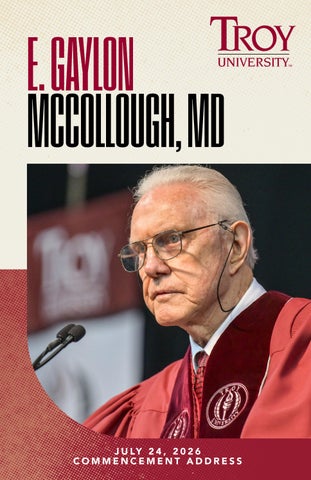
E. GAYLON MCCOLLOUGH, MD
J U LY 2 4 , 2 0 2 6 COMMENCEMENT ADDRESS
Thank you, Chancellor Hawkins. It is truly an honor to be here with you, your faculty, the distinguished trustees of this university, the graduates we celebrate today, and their families. Each of us recognizes that today’s graduates are tomorrow’s leaders, and this ceremony marks the next step in a lifelong progression of merit based advancements. With that in mind, I am privileged to offer a series of insights and experiences. As a lifelong student, I have learned that education is a never-ending process. We are expected by our Creator, in whose image we are made, to continue learning about ourselves and the world around us—beginning with who we are inside and out, our mind, body, and soul; our unique talents and limitations; the relationships we should embrace and those we should sever; and the leadership role we are expected to play in what I respectfully call the Universal Game of Life. I use the word “game” with full regard for Genesis 1:26, for the experience we know as life is composed of contestants, rules, boundaries, coaches, referees, observers, fans, winners, and losers. With that truth in mind, this morning, I am grateful to pass on to the graduates present today a series of lessons shared with me by mentors when I was your age, as well as those I have learned along the way; and I hope you find them as constructive as I have as you take your next steps toward a life defined by service, achievement, and fulfillment. The fact that you will receive a diploma today from Dr. Hawkins—in whose image Troy University has evolved over the past three and a half decades—is proof that you are already committed to becoming a better version of yourself. In addition to those that accompany a formal education, expect supplementary lessons to come from what is known as the School of Hard Knocks—an unconventional institution of learning from which my parents and many of their generation graduated. Their classrooms and laboratories were located not far from here, on the farms and construction sites of Coffee County, and extended to the battlefields of World War II. I am forever grateful that my parents insisted I experience elements of that same curriculum. In many ways, those of you graduating today are better prepared to make a difference in the world than others of your generation for whom a college education is a dream never to be realized. That you are better prepared is no coincidence. Grooming you to build upon and share what you know is a defining element of the culture you have experienced here at Troy University. 2
The diploma you receive today makes a statement. It announces to the world: I’m ready to take the next step. Show me how I can be of service. To build upon where you currently are on the Universal Ladder of Life, support systems are essential. And they exist in many forms. Walk through any major city and you will see buildings reaching toward the heavens, bridges stretching across rivers, and monuments standing firm against time. Yet what you do not see is the foundation upon which they stand. The same is true of a service oriented education—the kind to which the leadership of this university is committed. Part of that commitment involves building on and reinforcing the values you bring to the process: your habits, your beliefs, your emotional patterns, your resilience, and your spiritual connections. Collectively, these are the foundational characteristics of service leadership. However, there is another often underappreciated characteristic. One that I have witnessed throughout my career as a facial plastic surgeon: How you present yourself to the world. I am not the first to recognize the role appearance plays in advancement along the Ladder of Life. Twenty five centuries ago, Aristotle reminded his students—and all who would follow—that first impressions matter. He was explicit, saying that a pleasing appearance is more important than any letter of introduction, or what we would today call a résumé or transcript. The extended message of Aristotle’s words to the wise is this: When you walk through a door, the way you look and present yourself speaks volumes about who you are inside, your commitment to detail, your level of self discipline, and how you will care for other people and what matters to them. As you consider future career and personal pursuits, join the wisest elements of humanity: Pause and conduct a body, mind, and soul reassessment. Doing so may prove to be one of the greatest gifts you ever give to yourself. The wisdom of reassessment is why winning sports teams review game films, performing arts directors provide notes, and excellence focused universities engage in accreditation reviews. Perhaps the truth often shared with my teammates and me by the legendary University of Alabama football coach, Paul “Bear” Bryant, says it best: If you believe in yourself, display dedication and pride in everything you do, and never quit, you’ll be a winner (in the Game of Life) . The price of victory is high, but so are the rewards. 3
For those not familiar with Coach Bryant, he was the winningest coach in major college football history when he retired. He was, because he lived by the lessons he taught his players. Although there were many, the greatest lesson I learned from him came after the final play I ever played for him and the University of Alabama. It occurred in the Orange Bowl in Miami, Florida, on New Year’s Eve 1965—a night when the stadium became more than a sports arena. It became an unconventional classroom for players and referees alike. The lesson unfolded when Joe Namath clearly scored the come from behind winning touchdown on a quarterback sneak directly behind me, the offensive center. After sorting through the pile of players in the end zone, the closest official to the action took the football from Joe, raised his arms, and signaled “touchdown”. Without consultation, his decision was immediately overruled by his superior, who had been watching from far behind the action. In those days, instant replay did not exist, so the referee’s ruling was final. As my dejected teammates and I approached the sidelines, and the play clock expired, one of them said, “Coach, we scored.” Every player turned to see Coach Bryant’s response. He said nothing about the referee. Instead, he focused on us, saying: “If our offensive line had done a better job blocking and the quarterback had walked untouched into the end zone, there could have been no question as to whether Joe scored.” In that moment, the Orange Bowl became a classroom, and Coach Bryant rose to the occasion as an honorary professor of psychology and philosophy, affirming the role competitive sports play in a comprehensive education, including the lessons learned from the unconventional School of Hard Knocks. The extended lesson taught to my teammates and me—the reigning 1964 National Champions—that evening was this: In sports and in the unforgiving Game of Life, “good enough” is not enough, and there are no instant replays or do overs. The message I took away from that goal line incident is one I trust will be as life-altering for you as it was to a group of senior football players who’d be graduating from the University of Alabama to the next phase in our lives within the next few months, six decades ago. 4
The admonition is this: Whatever your goal, you must go above and beyond what is expected and leave no room for doubt, for the world will always be riddled with partisan referees, judges, juries, and critics who may not make the correct call. Another unconventional lesson transitioned from theory to reality after the game. One that applies to those who are expected to ensure fairness in the Game of Life. When the films were reviewed by the overruling referee’s superiors, they concluded that the erroneous goal line call was only one of a series of prejudicial rulings he had made that night and that season. As a result, his ability to officiate was revoked, affirming another statute from the Rulebook of the Universal Game of Life: Although justice may be slow, it is inevitable. Incidentally, thirty years later, Tommy Nobis, the All-American University of Texas linebacker who ended up on top of Joe Namath and me in the end zone, affirmed to a friend of mine, U.S. General David Bockel, that Joe scored. Even so, more than sixty years later, I still replay that lesson in my mind. Each time I do, I imagine my teammates and me doing more than expected and leaving no room for doubt. Yet as I do, reality always returns: The one time—that season—we left room for doubt is forever recorded in the record books of college football and in my every thought and undertaking. That’s a haunting legacy I hope you graduates will never have to endure. To see that it doesn’t, in whatever you undertake, do whatever it takes—and more—to leave no room for doubt. Your life’s journey will be paved with disappointments and heartbreaks—some justified, some not. Embrace them all! Use them as stepping stones to get a little better every day. And here’s a related fact of life that some of you may have already experienced: Becoming an even better version of yourself will not be celebrated by everyone you know or encounter along the way toward realizing your own dreams and purpose. Even so, if you proactively and truthfully examine your current station on the Universal Ladder of Life, then recognize your potential—not upon the shifting sands of impossible dreams, 5
but from the solid foundation upon which you stand today on this magnificent campus of a world-renowned university—”you’ll be a winner.” Perhaps no one exemplified this reality better than Tuscumbia, Alabama’s Helen Keller, who was left deaf, blind, and mute following a childhood illness. However, with the help of a tenacious teacher, Helen used what she later called “inconveniences” (i.e., the inability to see or hear) to inspire the world through her can do attitude. She often repeated—yes, repeated—for with her teacher’s insistence, Helen developed the ability to speak clearly and fluently. One of her most memorable sayings was derived from Everett Hale’s writings: I cannot do everything, but I can do some things. What I can do, I should do, and with the help of Almighty God, I will do what I can do. And “do” she did. Helen Keller embodied the truth that our attitude toward any circumstance determines whether we consider ourselves victims or difference makers in the making. As a long-time admirer of Helen Keller, I am delighted that Troy University honors her each year with a distinguished lecturer series. From her shoulders—and those of other giants whose insights allow us to see what we would otherwise never see—we are better prepared to do what we were created to do. I conclude my remarks with a related lesson I learned as a much younger man from one of the giants upon whose shoulders I have been fortunate to stand for longer than most of you graduates have been alive. It is the parable of a clever student who devised a ploy to test his professor’s wisdom. Holding a butterfly between his cupped hands, the student asked whether it was alive or dead. Realizing that if he said “alive,” the student would crush it, and if he said “dead,” the student would open his hands and let it fly away, the professor answered wisely: My son, the butterfly can be whatever you choose it to be. And, so it is with each graduate here today. Based on what you choose to do from this day forward, you hold your destiny, this university’s legacy, and the destiny of humanity in your hands. For you are now a product of Troy University—a proud alumnus. For the 6
2
rest of your life, Troy will be an indelible part of you, and you of it. This symbiotic relationship embodies the principles of quantum physics: Enhancing a single element of any entity enhances the entity itself and everything associated with it. So, becoming an even better version of who you already are is both an extraordinary opportunity and a scripturally ordered responsibility. As Luke, the physician disciple, challenged: Unto whom much is given, much is required. Every day—in every way—embrace that expectation with pride and reverence. Utilize the degree you have earned and the lessons learned here at Troy as a foundation upon which you will build a life and legacy of service and leadership. In doing so, you will enhance the entity known throughout the universe as humanity, one life at a time. Thank you again, Dr. Hawkins. It is truly an honor to celebrate this momentous occasion with you, your staff, this fortunate class of graduates, and their families.
A L L W A Y S R E A L . A L W A Y S T R O Y.
T R O Y. E D U