MAGAZINE NO. 4 – SUMMER/AUTUMN 2021
Marine fish for beginner aquarists
Spirulina
superfood for aquarium fish
How to properly set up a biotope aquarium
1
Dear Readers, here is the fourth issue of Tropical EDU Magazine with another large dose of knowledge. And you might have set your hobby aside during your vacation, I hope that our interesting articles will catch your attention. Perhaps while lying on the beach, kayaking or mountain climbing, you will start planning changes to your aquariums or terrariums. Possibly we will inspire you to buy a new species of fish, reptiles or amphibians, rearrange your tank or buy a new one. I hope in the pages of this issue you will find inspiring information that will awake the need for changes and further development after your summer holidays. Enjoy reading! Aleksandra Kwaśniak-Płacheta Chief editor
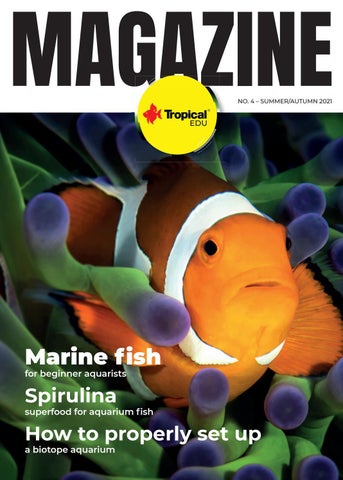
Chief editor: Aleksandra Kwaśniak-Płacheta, PhD Leading editor: Paweł Czapczyk, PhD DTP: Marek Kantor Publisher: Tropical Tadeusz Ogrodnik Cover photo: Amphiprion ocellaris
2
CONTENTS – TROPICAL EDU MAGAZINE NO. 4 Spirulina – superfood for aquarium fish – Aleksandra Kwaśniak-Płacheta, PhD
4
About piranhas in aquarium – and not only there (part 2) – Paweł Czapczyk, PhD 14 How to properly set up a biotope aquarium – Kamil Hazy 28 Marine fish for beginner aquarists (part 3) – Bartłomiej Stańczyk 36 Why is it a good idea to start the terrarium adventure? – Dawid Krótki 48
3
SPIRULINA
SUPERFOOD FOR AQUARIUM FISH
Aleksandra KWAŚNIAK-PŁACHETA, PhD Hydrobiologist, expert on feeding and breeding of ornamental fish, aquarium enthusiast. A highly recognized speaker of many aquarium training courses and symposiums. Author of articles published in domestic and foreign magazines including ”Nasze Akwarium”, ”Magazyn Akwarium”, ”Planeta Zwierząt”, ”Tanganika”, ”Fauna & Flora”, ”Pet Market”, ”Aquafeed Magazine”, ”Pet Worldwide” and various publications of Wrocław Aquarium Association.
4
5
Humans have long been searching for sources of protein to meet the growing needs of Earth’s population. Protein that will be cheap and efficient to produce and will have high nutritional value. These qualities can certainly be found in spirulina, a microalgae that has been widely cultivated and used in many industries for years. Its composition makes spirulina an excellent source of plant protein that can replace animal-derived protein used in aquaculture. In addition, it is a source of many valuable components with health-promoting effects.
6
HOW SPIRULINA BECAME POPULAR
the local people’s diet. They are harvested from small
In 1940, French phycologist Pierre Dangeard pub-
lakes and ponds located around Lake Chad. The green
lished information about a sample of interesting
and blue algae floating on the surface of the water
algae in the journal of the Linnaean Society of Bor-
are fished out and dried. The resulting dry ”dough” is
deaux. He found out about the algae from a pharma-
divided into small pieces and sold at the local market.
cist stationed at Lama Fort, in what is now the Repub-
Microscopic analysis carried out by the researcher re-
lic of Chad. The sample came from a local market in
vealed them to be filamentous, spirally twisted algae –
a small village, Massakora, located about 50 km from
Spirulina platensis. They are a major component of the
Lake Chad. Dangeard claimed that these strange al-
phytoplankton of many lakes located within the African
gae, called dihé in the local language, were part of
Great Rift.
Before drying, the spirulina is filtered and purified
It is likely that World War II caused this information
domain: Eukaryota (all nuclei)
to receive only little attention in the scientific world.
domain: Archaea (single-celled organisms known
Europe had to wait 25 years for further reports on
from extreme habitats, such as geysers)
spirulina, when the rediscovery of dihé was made by
domain: Bacteria
botanist Jean Léonard. The scientist confirmed that
type: Cyanobacteria
the green, dry ”cookies” available in the local market consist mainly of spirulina extracted from numerous
SPIRULINA OR ARTHROSPIRA?
lakes around lake Chad with alkaline and highly saline
The genus Spirulina was created by Pierre Jean Turpin
water.
in 1827. The algae he discovered had no visible trans-
At the same time, another species of spirulina, Spir-
verse walls (septa) dividing the trichomes, this is what
ulina maxima, was found across the Atlantic in Lake
we call the thread-like colonies of cells that form cy-
Texcoco near Mexico City. Although it was not used as
anobacteria. Following the isolation of species that
a human food in Mexico at that time, historical records
possessed such septa, Stizenberger created the ge-
from the Spanish Conquest period indicated that it
nus Arthrospira in 1852. Over the ensuing years, there
was a component of the Aztec diet. Spanish people
has been an ongoing debate about the validity of this
mentioned in their notes tecuitlatl cookies which
division. In the 1960s, scientists concluded that septa
the local people baked from a substance resembling
are also found in species of the genus Spirulina, they
blue-green sludge pulled from the lake with dense
just didn’t have the right equipment to see them be-
nets.
fore. Of course, the new possibilities that scientists
These discoveries indicating the use of spirulina as
gained from year to year meant that more differences
a food by humans initiated a number of studies on
began to be discovered, such as the structure of the
the properties of these algae. However, it should be
cell wall, which triggered further discussions about
mentioned that spirulina was known to science even
systematic classification. Now we know that we are
before Dangeard’s reports.
dealing with two distinct types: Spirulina and Arthrospira. And it is the latter type that includes species
SYSTEMATICS
that have health-promoting properties and are used
Spirulina was first isolated by Pierre Jean Turpin in
as food. Therefore, it is worth remembering that the
1827 from a sample taken from a stream. Originally,
correct species names of organisms used in the com-
these photosynthetic-capable organisms were classi-
position of products with ”spirulina” in the name are
fied as algae, a very large and diverse group of thallo-
Arthrospira platensis and Arthrospira maxima.
phytes (not having tissues or organs). It is worth men-
However, ”spirulina” will probably stay with us for
tioning that algae are a morphological-ecological
good, because in the cosmetics industry, as well as in
(rather than systematic) grouping of organisms that
the dietary supplement or pet industry, this is the name
are not related to each other. Spirulina belongs to the
used by manufacturers and recognized by clients.
prokaryotes, which are organisms that lack a nucleus. For this reason, it is often excluded from algae, which
OCCURRENCE OF SPIRULINA
are considered to be eukaryotic organisms (having
Spirulina can be found in a wide variety of environ-
a cell nucleus).
ments. It has been discovered in fresh water, sea
Since 1974, spirulina began to be classified in the cy-
water, brackish water, soil and sand, and even in
anobacteria division (Cyanobacteria) and now cyano-
hot springs. Arthrospira platensis occurs natural-
bacteria in type rank are included in the bacteria do-
ly in Africa, Asia and South America, while Arthros-
main. Domain is a systematic category higher than
pira maxima can be observed in Central America.
kingdom, introduced in 1990 as the category with the
The fact that spirulina was included in the diet of
highest taxonomic rank. This systematic approach
people living in the area of lakes Chad and Texco-
is now increasingly popular. Three domains were
co is related to the specific conditions of the reser-
created:
voirs from which it was harvested. Collected and
7
Pools for spirulina cultivation
dried green mats contained almost exclusively
sumption such as beluga (Huso huso), rainbow trout
Arthrospira platensis or Arthrospira maxima cells. The
(Oncorhynchus mykiss), olive flounder (Paralichthys
formation of these monocultures was closely related
olivaceus), Nile tilapia (Oreochromis niloticus), Cirrhi-
to the chemical parameters of the water, which was
nus mrigala, the walking catfish (Clarias batrachus),
characterized by significant salinity (>30 g/l, caused
Oplegnathus fasciatus, and ornamental fish such as
mainly by carbonates and bicarbonates) and high pH
guppy (Poecilia reticulata), goldfish (Carassius auratus).
(8.5-11 pH). These conditions are ideal for the development of spirulina and at the same time effectively
SPIRULINA PROTEIN
limit the development of other algae, cyanobacteria
Initially, the main reason for the interest in spirulina
and bacteria, the consumption of which could be
was the extremely high protein content in its cells,
dangerous for the health and even life of humans and
which ranges from 55% to 70%. This is impressive
animals.
compared to the protein content of meat (15-25%) or soy (35%). In addition, spirulina protein was found to be
8
SPIRULINA IN FISH NUTRITION
more valuable than legume protein and only slightly
Due to its composition, spirulina is an excellent source
inferior to milk or egg protein (it contains fewer amino
of protein for fish to replace animal proteins. Numer-
acids such as cysteine, methionine and lysine).
ous studies are available on the utilization of this
This high protein content was so promising that nu-
component in the diet of both fish intended for con-
merous studies were initiated on many species of fish
intended for consumption. Fish were fed with feeds
spirulina-eating flamingos. Carotenoids are an indis-
containing 1 to 100% spirulina. The effects were varied.
pensable component of fish’s diet, and it is not only
In some fish, such as Nile tilapia (Oerochromis nilot-
about intensifying their coloration; these compounds
icus) and carp (Cyprinus carpio), a significant effect
also have many important physiological functions, in-
of this algae on growth has been observed. However,
cluding stimulation of the immune system and play-
there were also fish, such as African sharptooth cat-
ing an important role in the process of maturation
fish (Clarias gariepinus), in which high doses of spir-
and reproduction of fish.
ulina inhibited growth. On this basis, the thesis was put forward that carp or tilapia, which in their natural
The role of carotenoids in the fish body:
diet have a significant share of plant components, are
a As antioxidants, carotenoids protect valuable cell
better adapted to utilize spirulina due to having ap-
components, including nucleic and fatty acids,
propriate digestive enzymes.
from the destructive effects of free radicals. a Some carotenoids are converted by fish into
NATURAL PIGMENTS CONTAINED IN SPIRULINA Spirulina subjected to careful study gradually revealed more of its secrets. It turned out that these spirally
vitamin A, which affects growth and skin function. a They increase resistance to viral, bacterial and fungal infections.
twisted cells are extremely rich in pigments, including
a They are beneficial for fish reproduction.
chlorophyll, beta-carotene, zeaxanthin, canthaxan-
a They protect skin and eggs from UV rays.
thin, xanthophyll and phycobilins.
a They also intensify fish’s coloration.
In terms of chlorophyll content (0.8-1.5% of dry weight), spirulina ranks among the top in nature. The bacteri-
Due to its high carotenoid content, spirulina is often
ostatic effect of this green pigment and its beneficial
used in the feeding of both ornamental fish and fish
effects on the body is used in the cosmetic and phar-
intended for consumption. However, we should keep
maceutical industries.
in mind that the effect of coloration will depend on
Carotenoid content in spirulina dry matter is estimat-
the species of fish and the frequency of food intake
ed at 0.5%. Beta-carotene is predominant (0.2-0.4%).
and spirulina dosage. Species with the ability to con-
It is responsible for the pink color of the feathers of
vert ß-carotene or zeaxanthin to astaxanthin will in-
9
Pools for spirulina cultivation
tensify their coloration better and faster compared to
they have antioxidant properties, effectively protect-
fish that do not have this ability. Rainbow trouts need-
ing fatty acids and other valuable compounds from
ed only 2.5% spirulina to significantly increase the
free radicals
concentration of pigments in their skin (24.98 µg/g
10
dry weight, compared to a control group of 9.05 µg/g),
UNSATURATED FATTY ACIDS
while in koi carp, color enhancement occurred at
The active ingredients of spirulina also include un-
a spirulina content of 7.5% in the food. The blue colora-
saturated fatty acids. Spirulina contains high amounts
tion of Metriaclima lombardoi gained intensity at 20%
of linoleic acid and gamma-linolenic acid, which are
spirulina in the feed, similar observations were made
precursors to arachidonic acid. It is arachidonic acid
for Pseudotropheus acei, where both blue and yellow
that plays an important role in the formation of
colors were enhanced. An example of a fish in which
prostaglandin, which helps in oocyte maturation
spirulina did not improve coloration would be the red
and ovulation. How important these acids are was
porgy (Pagrus pagrus), a fish intended for consump-
shown in an experiment in which two-spotted gurami
tion that lacks the ability to convert ß-carotene to as-
(Trichopodus trichopterus) was given food containing
taxanthin.
2.5%, 5.0%, and 10% spirulina, respectively. The higher
Phycobilins are also a significant group of spirulina
dose of spirulina in the feed reduced the time to first
pigments, which include blue phycocyanin and allo-
spawning by about 12 days compared to the control
phycocyanin and red phycoerythrin. Their function is
group. Pseudotropheus acei cichlids that received
to absorb the greenish-yellow radiation from the sun
as little as 2.5% spirulina in their feed produced sig-
that chlorophyll does not absorb. Like carotenoids,
nificantly more eggs compared to the control group.
The positive effect of spirulina on reproduction of
In the article we mention:
some fish species is attributed to its specific components. These include essential fatty acids, vitamins C and E, and carotenoids. EFFECT OF SPIRULINA ON THE IMMUNE SYSTEM Numerous studies with fish intended for consumption have shown positive effects of spirulina on the immune system of fish. Immunoactive components contained in it stimulated the activity of cells conducting phagocytosis, increased the production of lysozyme (a protein that breaks down the cell wall of bacteria, it is one of the mechanisms of non-specific immunity), increased the antimicrobial activity of fish mucus and increased the number of white blood cells, whose task is to protect the body from bacteria
food is given. Flakes placed on the surface of the water
and viruses.
will stay there for quite a while. On the other hand, given under the surface of the water, they will sink quite
IS SPIRULINA SAFE?
quickly. Flake foods are especially recommended for
Many species of cyanobacteria have been attributed
delicate fish, particularly those prone to gastrointes-
with toxic effects on living organisms. Spirulina as
tinal problems, as they are digested faster and easier
a representative of this group of organisms was also
than granulated foods. Flakes also work well in aquar-
questionable, especially as it began to be used exten-
iums where fish compete strongly for food. When dis-
sively in human nutrition as a source of protein and
persed all over the tank, the flakes allow the food to be
medicinal substances. Many studies have been car-
taken up also by fish that are lower in the hierarchy or
ried out to resolve doubts about its toxicity to living
simply more timid.
organisms. These studies involved a variety of animal species, including fish, and were often conducted on
GRANULATED FOODS WITH SPIRULINA
several generations. Scientists evaluated the overall
Granulated foods are the perfect solution for medium
condition of the animals and their reproduction. In-
and larger fish species that prefer to feed from the
depth histopathological studies were also performed. They did not show any toxic effects of spirulina on liv-
Check products at www.tropical.pl
ing organisms, regardless of the dose used. Positive research results allow to use spirulina on a large scale both in animal and human nutrition. HOW TO CHOOSE FISH FOOD WITH SPIRULINA? Tropical offers several foods for ornamental fish, where spirulina is an important ingredient. We offer to our customers foods in the form of flakes, granules, sticks, pellets and tablets with the content of spirulina ranging from 6% to 36%. FLAKE FOODS WITH SPIRULINA Flake foods can be used to feed both surface-feeding and bottom-feeding fish. It all depends on how the
11
bottom of the aquarium. Mini granules with spirulina are ideal for young fish and small species. Special production technology of Tropical granules ensures safety of fish feeding. Granules under the influence of water increase their volume only to a very small extent, so even a larger portion of granules does not lead to swelling of the food in the digestive tract and consequently to digestive problems. SPIRULINA FOODS FOR FRY Aquarists who have ever tried to breed their fish know how difficult it is to find a fine food that will be accepted by the fry. To meet hobbyists’ needs Tropical offers foods with spirulina, which intensify growth and development of young fish. For smaller fry we recommend Mikro-vit Spirulina, for slightly older ones Super Spirulina Forte Mini Granulat.
Mikro-vit Spirulina
FOODS IN THE FORM OF TABLETS WITH SPIRULINA Tablets are ideal for bottom-feeding fish, as a large group of popular bottom-feeding fish require plant foods in their diet. It is worth noting that adhesive tablets also allow feeding of young fish and those with small mouths. Adhered to the glass, they also give aquarists the opportunity to closely observe fish.
Super Spirulina Forte Mini Granulat
SUPER SPIRULINA FORTE TABLETS
12
HI-ALGE DISCS XXL
POLECO’S TABLETS
SUMMARY Beneficial effect of spirulina on living organisms is a result of combined action of all its components. Spirulina is not just another interesting ingredient of ready-made food that is eagerly eaten by the fish but it also significantly affect their condition. Regular use of foods with spirulina makes colors of fish more intense and limit digestive problems in sensitive, herbivorous species. Thanks to spirulina the overall condition of the fish and their vitality can be maintained at the highest level.
LITERATURE Chronakis I., Galatanu A., Nylander T., Lindman B. (2000), The behaviour of protein preparations from blue-green algae (Spirulina platensis strain Pacifica) at the air/water interfac, Colloids and Surfaces A: Physicochemical and Engineering Aspects, 173(1-3), 181-192. Ciferri O. (1983), Spirulina the edible microorganism, Microbiologica Reviews, Dec, 551-578. Gouveia L., Rema P., Pereira O., Empis J. (2003), Colouring ornamental fish (Cyprinus carpio and Carassius auratus) with microalgal biomass, Aquaculture Nutrition, 9(2), 123-129. Gupta S.K., Jha A.K., Pal A.P., Venkateshwarlu G. (2007), Use of natural carotenoids for pigmentation in fishes, Natural Product Radiance, 6(1), 46-49. Tang G., Suter P.M. (2011), Vitamin A, Nutrition, and Health Values of Algae: Spirulina, Chlorella, and Dunaliella, Journal of Pharmacy and Nutrition Sciences 1, 111-118. Zahira Y., Ehsan A., Afifi Z., Masita M., Mohd S.T. (2014), An overviev: biomolecules from microalgae for animal feed and aquaculture, Journal of Biological Research, 21:6. Zhang F., Bon Man Y., Yin Mo W., Hung Wong M. (2019), Application of Spirulina in aquaculture: a review on wastewater treatment and fish growth, Reviews in Aquaculture, 1-18.
13
Paweł CZAPCZYK, PhD For nearly 40 years a passionate aquarium and terrarium hobbyist, writer, editor and breeder; organizer of exhibitions and conferences on aquarium and terrarium hobby; author of many books and press articles, as well as radio broadcasts and screenplays for documentary films; nature photographer, editor-in-chief of “Aquarium Magazine”.
14
Carnivorous piranhas, or Pygocentrus nattereri and others
About piranhas
in aquarium (and not only there) – part 2 15
In old stories of travelers who reached the Amazon, we can read about many brave wanderers who had the courage to venture deep into the Amazon basin and who were attacked by bloodthirsty piranhas. However, in reality only some of the piranhas, espe-
ly tear through tough skin and bite into the soft tis-
cially from the genera Pygocentrus and Serrasal-
sues of the victims. The incredibly sharp, hard and
mus, the so-called proper piranhas, can be consid-
conical teeth (characteristic of carnivorous piranhas)
ered real danger to humans. They are famous for
leave relatively large and blood-broiling cavities in
their predation and group attacks on their prey.
the flesh. The red piranha can reach 50 cm in length. But only in natural biotope, in aquariums the largest
PYGOCENTRUS NATTERERI (KNER, 1858) –
specimens are usually around 30 cm long.
RED-BELLIED PIRANHA, RED PIRANHA
The species’ home is the South American queen
The red piranha is a legendary animal. This fish is
of rivers, the Amazon River, along with its tributaries.
emblematic of the family Serrasalmidae and re-
It can also be found in the watercourses of north-
sponsible for the reputation of the entire group. It
eastern Brazil and in the Parana, Paraguay and
has the look of a born killer. With a protruding and
Essequibo basins.
swollen mandible and an ominously immobilized
Like any predator, it has incredibly sharp senses. It
upper jaw, it can be frightening. Its mouth houses
gets excited by blood spreading through the wa-
an impressive row of teeth, as if designed to instant-
ter, even if it is in great dilution. The aroma of blood
Pygocentrus nattereri
16
Picture of Pygocentrus nattereri
causes the red piranha, which we thought to be
water ”boiling” with piranhas. The remains, stripped
a lazy and sluggish animal that lives in the lower
down to their skeletons, are then buried in the
parts of the tank, to transform into a bloodthirsty
ground by the natives.
beast. Each abnormal movement in the water like
Lovers of this species sometimes use in their tanks
a bird falling into the river, or a human swimming
solutions, which might seem surprising for amateurs.
and splashing through the water, or even anoth-
Along with the school of adult piranhas, they keep
er piranha entangled and fluttering unnaturally
a few dozen/hundred neon tetras. How is it possi-
among the plants, can stimulate similar behaviour.
ble that colourful Characiformes are not attacked?
Some local Indians insist that only an open wound
An old theory, mentioned in many aquarium
from which lymph and blood are oozing is likely to
guides, suggested that the light reflected by fluo-
stimulate piranhas to attack. Others rub their bodies
rescent fish causes fear among predators. Nowa-
with an extract of tropical herbs just before bathing
days it is rather believed that neon tetras get ”un-
or working in the river. Some tribes from the Ama-
noticed” because they are an overly microscopic
zonian are also known for purifying mourning rites
snack. Similarly, in the tanks of a public institution
involving immersing the corpse of the deceased in
that I am friends with, wild Mexican cichlids of the
17
Chapalipchthys pardalis species, much larger than
sudden movement in front of the aquarium or sud-
neons, coexist peacefully with piranhas.
den illumination of the tank and that’s why it is rec-
Aggressive reactions, on the other hand, can (and
ommended to use lighting with simulation of sun-
often do!) occur within the same species. Starved
rise and sunset. During the desludging process, fish
piranhas can easily pick a fight, attacking not only
can lie side by side in sand or hide behind plants in
the weakest specimen, but biting each other as well.
the darkest corners.
The protruding parts of the body are particularly vul-
On the other hand, when kept alone and having only
nerable to attack, namely the fins, the back and the
large cichlid fish for company, piranha appears to be
ventral region. It also happens that in the amok of
a docile and harmless animal. But in such a configu-
catching prey, lips and mouth parts are also bitten
ration when the fish is a „single”, it neither hides well
off. Fortunately, as long as we do not forget about
nor can its characteristic natural behaviours be ob-
abundant and regular feeding, the defects get quick-
served.
ly reconstructed, the gouged places get healed; with
Pygocentrus nattereri is a social fish leading a hierar-
only scars left, which are, humorously speaking,
chical life in the watercourses of Amazonia. In home
a field of work for the aesthetic doctor.
tanks, this fact should be respected and the species
You should remember no to introduce other, slight-
should not only be provided with adequate living
ly smaller specimens to tanks with piranha, because
space (the minimum tank capacity is currently con-
their fate seems to be sealed. And it is important to
sidered to be 500 liters, while the minimum length
follow basic safety precautions when feeding fish
should not be less than two metres) but also kept in
and doing any cleaning in the aquarium. Some aq-
groups of at least 6-7 individuals. Of course red pira-
uarists wear special wire gloves to protect their hand
nhas show their original beauty only in a school con-
and forearms. Others approach the fish (which have
sisting of a dozen or so representatives of their own
been amply fed before) with calmness, but closely
species, swimming in aquariums that decorate hotel
observe the situation in the tank. This is because, in
lobbies, shopping malls or gracefully arranged large
general, piranhas are timid. They react with fear to
living rooms in homes. Such tanks (about a dozen
The lighting of the piranha aquarium should be dim
18
Snails of the species Melanoides tuberculata, eating food scraps, prove very useful in tanks with piranhas
thousand liters in volume each) allow not only to
spawning and breeding season) in water that is
properly arrange the interior and take care of proper
much harder, even up to 20°dH. The water tempera-
water parameters, and then maintain the whole at
ture should range from 23-28°C.
a stable level, but also to be consistent with modern
As a substrate you can use both fine sand and grav-
lifestyle at one hand and the principles of biotope
el. The tank should be arranged to provide plenty of
aquaristics on the other.
free space, hiding places made of roots and branch-
Fish will feel best in clean, well-oxygenated and ef-
es and with strong and sturdy plants growing in
ficiently filtered water. Over-filtration achieved with
clumps in its corners and along the back wall of the
a sump or at least two large canister filters is not only
aquarium. The plants can include tape grass, bacopa,
advisable but indispensable. Why? Because it is right-
lesser water-plantains, cryptocorynes and Thai onion
ly assumed that all piranhas are particularly ”messy”
plants. The light should be moderate and diffuse as
fish, not only do they eat sloppily, but they have fast
excessive lighting of the tank will increase the stress
metabolism as well. Thus, they can contribute to sig-
of fish and enhance their natural skittishness.
nificant water quality degradation in a short period
Everyone knows that the red piranha is a declared
of time. To ensure correct development and color-
carnivore. However, not everyone suspects that
ation of the fish you need to provide slightly acidic
these fish are actually food opportunists, also eating
(within 5.5-7.5 pH) and soft (from 6 to 10°dH) water
seeds, nuts and fruits in the wild, depending on the
with a minimum concentration of nitrates. However,
season. In an aquarium, these fish can be fed with
it is possible to keep red piranhas (apart from the
both live and frozen food (but in room temperature).
19
Adolscent piranhas must be kept in a group of individuals of the same size
20
Other appropriate foods include whole fish and large
ed food with spirulina (which I have tried successfully
fillets, and occasional poultry, horse meat, and beef.
myself) works well as a dietary supplement, but pira-
After all, piranhas lurking in South American rivers
nhas need to get used to feeding dry food.
sometimes pose a threat to livestock coming down
Red piranhas reach sexual maturity in an aquari-
to the watering hole, as well as wild tapirs or deer.
um when they exceed about 15 cm (often even ear-
This situation occurs especially during droughts,
lier) and they are the most frequently reproduced
when starved fish are cut off from the mainstream in
members of the Serrasalmidae family by breeders!
shallow backwaters. It should be remembered, how-
The spawning tank must not be too small. Best
ever, that excess lipids from warm-blooded animals
results are obtained when a parent pair can match
are not metabolized properly and may be deposited
spontaneously within larger group of fish. The nest-
in internal organs, leading to their damage.
ing territory chosen by the male and the female is
The best food for the young is obviously fish meat.
immediately and fiercely defended. At this time
However, feeding with small carps and goldfish car-
it is advisable to darken the aquarium a bit, and to
ries the risk of parasites. It is a good idea to occasion-
oxygenate the water more intensively. The male digs
ally serve krill, shrimp, clams, common earthworms
a hole in the sand and the female lays up to sever-
or European nightcrawlers. A high-protein granulat-
al thousand eggs, usually stuck to plant roots, from
Two-month-old Pygocentrus nattereri with visible fin loss
which the larvae usually hatch after 2-3 days. The fry
Learn more about our products
fed several times a day with zooplankton grow quite rapidly but unevenly. Initially the male takes care of the offspring, sometimes the female supports him in the effort of upbringing. However, acts of cannibalism among adolescent fry (if we do not start separating the juveniles according to size in time) seem to be inevitable. PYGOCENTRUS CARIBA (HUMBOLDT, 1821) Although Humboldt described this piranha as early as the third decade of the 19th century, it is still commonly confused with Pygocentrus nattereri, and some breeders and ichthyologists even consider it to be its subspecies. Either way, Pygocentrus cariba can be found in the Orinoco River basin of South America within Colombia and Venezuela. It is most often spotted in acidic, tannin-rich, and mineral salt-poor „black waters” where it does not usually exceed 28 cm
of animal proteins: fish fillets, shrimp, earthworms.
in length. Like the red piranha, it has a stocky body
In addition, it is worth enriching their diet with pro-
that is strongly laterally flattened, and teeth that are
teinrich granules with spirulina.
pointed and conical, serving both to bite off bites and
A spacious aquarium should be set up and equipped
to crush food. In addition to fish, it eats invertebrates,
the same as in the case of Pygocentrus nattereri (pref-
seeds, fruits and green shoots of plants. Tank residents
erably sandy substrate, decoration with branches
should be fed a mixed diet with a predominance
and roots, partial stocking with hardy plants, but also
21
Picture of Pygocentrus cariba
leaving free swimming space). Over-filtration is also
hand. Is this ”beast” beautiful? Here, opinions are
necessary, preferably in the form of a sump or buck-
divided.
et filters. The water should be additionally changed
There are times when its ventral yellow-orange or
every week (up to about 40% of the tank volume).
fiery red body part, which when confronted with
The water pH should oscillate between 4-7 pH and
a darker silver-black back with lighter mottling, will
the temperature should be kept between 22-28°C.
take the breath away in someone looking for off-
It is recommended to keep the species in a group
beat colour solutions.
of at least several specimens. However, in especially
Pygocentrus piraya reaches a maximum length of
large tanks Pygocentrus cariba can successfully live
35 cm in the aquarium, although in the wild spe-
with Pygocentrus nattereri.
cimens even over 50 cm have been observed. The first English name, Gold Piranha, refers to the qual-
22
PYGOCENTRUS PIRAYA (CUVIER, 1819) – PIRANHA
ities of the fish; the second, San Francisco Piranha,
This is third piranha of the genus Pygocentrus,
indicates the primary location of the species, which
which is considered by some sources to be the most
is limited in South America primarily to the Rio São
dangerous member of the family Serrasalmidae.
Francisco and its tributaries. One can also come
Some experts believe that this fish, penetrating all
across the common name ”Piraya Piranha”, as well
parts of water, is also the strongest of all piranhas
as the catchy marketing term ”Man-Eating Pira-
in the world. A muscular head with a high forehead
nha”, which leaves no illusions as to the nature of
and strong jaws immediately betray adaptation and
this genre.
food specialization. So does its mandible, which is
When starved, these fish can be particularly fierce
thick and protruding and its extremely sharp teeth.
and aggressive. They can react similarly furiously
A healthy fish could easily bite off an adult’s toe or
when exposed to stressors. Some data tell of many,
sometimes massive, attacks on humans, however
a shoal of a dozen or so fish, at the end we will be
they have never been fully corroborated.
left with only the biggest and strongest one.
Pygocentrus piraya is obviously a definite carnivore.
Although the fish become statistically more tolerant
But, in addition to fish, it also eats large insects
as they age, they are strongly territorial during the
and almost anything that comes near its mouth. It
spawning season. Some U.S. breeders recommend
will also not disdain plant foods from time to time.
keeping individuals in a mixed school of mostly Py-
In the aquarium it eats fish and fish fragments,
gocentrus nattereri representatives, but this is not
shrimp, crabs, squid and krill. Occasionally, you can
a view that replicates the natural environment, as
feed it with frozen chicken and mice. If it is grad-
the two taxa, although closely related, are not found
ually accustomed to ready-made foods, it will also
together in the natural biotope.
consume high-protein granulated feeds, but these
The recommended aquarium capacity for Pygo-
should be fed in moderation.
centrus piraya is 1000 litres or more. The fish is quite
Breeding ”Man-Eating Piranha” in an amateur
tolerant of the chemical parameters of typical tap
aquarium is not easy, as fratricidal mutilation and
water so you can start with 6-7.5 pH (in the Rio São
acts of cannibalism can occur in a group of kept
Francisco basin, the water pH varies between 4.8
fish. It is highly likely that an accidentally bitten or
and 8.7 pH). It tolerates hardness above 20°dH well,
injured fish will attract the attention of the rest of
while the temperature should be kept at 21-24°C,
the stock and will end its life torn apart by the oth-
and should be raised only slightly for the breeding
ers. The smallest member of the group may face
season (then it is also good to lower the pH). The
similar aggression. And it may happen that from
water in the tank should be efficiently filtered and
Pygocentrus cariba
23
Serrasalmus rhombeus
aerated, as well as regularly refreshed, as this will
tries is prohibited. On the other hand, well cared
significantly improve the mood of the fish and re-
for and wonderfully colored they are an unques-
duce their aggression.
tionable decoration of large exhibition aquariums.
It is best to use a sandy substrate and decorate the
And as such, they are finding an ever-growing
interior with roots and the background and sides
group of enthusiasts who are willing to devote all
of the aquarium should be planted with clumps of
their free time to them.
hardy plants.
24
The mating habits of this species resemble those of
SERRASALMUS RHOMBEUS (LINNAEUS, 1766) –
Pygocentrus nattereri. However the female, which
THE REDEYE PIRANHA, ALSO KNOWN AS BLACK
is usually staying in deeper parts of the river, choos-
PIRANHA, WHITE PIRANHA, SPOTTED PIRANHA
es shallower area with sandy bottom for spawning.
OR YELLOW PIRANHA
The fishermen of the Rio São Francisco who wade
The characteristic features of this species include
in the river often bear on their feet and hands the
a distinctively beveled, rhomboid body, sharply de-
marks of ”close encounters of the third degree” with
fined dorsal and anal fins, and a black-edged cau-
the fierce and ferocious fish that guard the eggs
dal fin. In aquariums, this fish struggles to reach
and newly hatched fry. Their limbs are marked with
35 centimeters in length while in the wild it can
sickle-shaped scars, characteristic reminders of the
be even 20 centimeters bigger. Some researchers
razor-sharp teeth of piranhas. Human encroach-
maintain that the ”true” Serrasalmus rhombeus is
ment on the environment has caused significant
found only in Guyana and suggest that this taxon
population depletion and, at present, importation
needs to be more thoroughly studied and revised in
of this species from some South American coun-
systematics. However, most ichthyologists assume
that the range of all species varieties extends from
Serrasalmus rhombeus is a shy fish at first sight,
the Amazon and Orinoco rivers and their tributaries,
but with age the level of aggression in specific in-
through the coastal watercourses of northeastern
dividuals clearly increases. The bite force of this pi-
Brazil, to the eastern and northern rivers of Guyana.
ranha may seem shocking as according to some
The also claim that the individual populations (Guy-
sources, it is comparable to the jaw pressure of
anese, Brazilian, Venezuelan, or Peruvian) differ only
a white shark!
in coloration.
That’s why it must have been really surprising when
This species is considered a behavioural opportun-
in 1977 a stock of these piranha was discovered in
ist as it is characterized by high adaptability and tol-
the pond of an abandoned amusement park in the
erance to various chemical parameters of water. It
Miami area. Ichthyologists alarmed that the fish,
feels good not only in habitats with soft and black
most likely released by an extremely irresponsible
water, but also in typically white and quite hard wa-
aquarist, overwintered in Florida.
ters. This should make aquarists happy as spotted
However, in its homeland, this fish is sometimes
piranha does not have high requirements to the
caught by fishermen with fish bait. However, the
chemical composition of water and meticulous cor-
menu of this species is much richer. Serrasalmus
rection of its parameters is not necessary. The ar-
rhombeus preys on fish, small mammals, crus-
rangement of the interior of the tank and the type
taceans, lizards, beetles and other insects; and
of decorations used is a secondary matter as well.
sometimes even carrion. This should be taken into
You can use either rocks and stones (white waters),
account by the aquarists who need to make sure
or roots and leaves of beech, oak or ketapang lying
that fish’s diet is as varied as possible by including
on the bottom (black waters).
high-protein granules in the menu. Some breeders
Picture of Serrasalmus rhombeus
25
feed mostly with beef hearts but I personally don’t
taken when feeding, changing water, and desludg-
consider it obligatory. I believe that best food in-
ing the bottom. Remember that the skin on your
cludes fish parts (with skin and scales), crab meat,
hands must be free of wounds and fresh cuts from
and shrimp. From a purely moral point of view, it
which blood would ooze. Before any maintenance
may seem questionable to give live fish (goldfish or
inside the aquarium, you should also make sure
large livebearers from our own breeding), but it is
that the fish are well fed.
an action that is completely in line with the natural
Under certain conditions, Serrasalmus rhombeus
needs and hunting instinct of this species. However,
can become dangerous to humans. Cases of fierce
feed fish should be quarantined beforehand.
attacks and serious bites have been reported in
This predator rushes greedily at its prey, tearing
Suriname, among other countries.
it apart. Then the food particles float in the water,
In the wild, the redeye piranha can be found living
generating an increase in the concentration of ni-
solo or in groups. However, it is most often seen
trogenous substances. Good water aeration and,
grouped in loose shoals. In the tank be wary of
above all, effective and efficient filtration (over-fil-
keeping more than one individual in the aquarium,
tration!) are therefore basic requirements for suc-
whether a juvenile or adult. Only very experienced
cessful breeding.
growers can afford such an experiment. After all, it is
Fish should not be disturbed without reason, for ex-
not a sociable fish, able to lead a peaceful and har-
ample, by tapping on the glass. Care must also be
monious existence with other members of its own
A juvenile Serrasalmus manueli with clearly visible teeth
26
Check products at www.tropical.pl
and public tanks. This strong and agile swimmer and aggressor with needle-sharp teeth is native to the Amazon and Orinoco basins (inhabiting the waters of northern Brazil and Venezuela). It can be spotted in the Rio Negro, Rio Xingu as well as Rio Cassiquiare, Rio Atabapo and Rio Cunucunuma tributaries. It can reach nearly 50 cm in length (according to some sources even 55 cm, and according to local fishermen as much as 60 cm), but specimens of this size are practically unheard of in aquariums. It requires an eminently meaty but varied diet, although in the wild it also eats food of plant origin. It shows great environmental adaptability. In the wild it can be found in both black water and river biotopes characterized by high transparency (White Water). It does not avoid the main sections of rivers with fast current, sunny shallows with lush vegeta-
species. Sooner or later there will be a fratricidal
tion, or slow-moving or meandering watercourses
fight to the point of extinction, consisting of biting
in the middle of dense tropical jungle. As it grows
each other’s fins and eating out scales. In an aquar-
and reaches sexual maturity, the shape of the fish
ium Serrasalmus rhombeus grows quite slowly,
changes slightly, and the coloration of the gill cover
but is characterized by its longevity. It can live up to
changes from shades of silver and metallic celadon,
about 28 years.
through yellow and orange, eventually changing to a distinct fiery red.
SERRASALMUS MANUELI (FERNÁNDEZ-YÉPEZ
So far, this species, like many other members of
& RAMÍREZ)
the family Serrasalmidae, has not been successfully
Not entirely researched, yet fascinating representa-
propagated in an aquarium.
tive of the subfamily Serrasalminae is Serrasalmus manueli, which is very rarely found in both private
Photos: Paweł Czapczyk
27
Kamil HAZY A biotope aquarist with experience in international competitions. Advocate of systematization of environmental aquaristics. Organizer – together with ”Aquarium Magazine” – of the Polish Biotope Contest. He offers services of consulting and arrangement of biotope, habitat and environmental aquariums. He believes that aquaria are primarily intended to meet the needs of their inhabitants.
28
HOW TO PROPERLY SET UP
A BIOTOPE AQUARIUM
29
How to properly set up a biotope aquarium? This seemingly simple question needs quite a lengthy discussion, which can develop into even longer process of analyzing available options.
Corydoras hastatus
30
Let’s start with the fact that in order to make the tank
inhabit them. This issue is a little more difficult, but
arrangement look natural, we must search for inspi-
again, observation of nature and reading publications
ration in nature itself. This can be done in two ways –
about the flora and fauna of rivers and lakes in gener-
by taking trips to the places we want to recreate in
al, which contain basic information about the ecology
the aquarium and study the biotope ourselves, or
of aquatic ecosystems, will be helpful.
by relying on the work of people who have visited
Once we have gained the basic knowledge, we can
these places for us and taken photographs or videos.
begin to determine the specific biotope that has in-
The third way, which is indirect, is to go to a nearby
spired us and that we would like to recreate in our
river or lake and look for a habitat whose appearance
aquarium.
matches the type of habitat we want to recreate.
Let me stress at the beginning there is no one single
For it is well known that all over the world inanimate
approach that would be better than all the others and
matter is identical in principle and can arrange itself
that will work best with all the biotopes. Unfortunate-
similarly. Washed out roots of trees on river banks in
ly, it is not that easy, although it is much easier than it
Europe, Asia or South America will look almost identi-
was just a few years ago.
cal, and the differences will be limited only to the spe-
The Internet gives us plenty of tools we can use, pro-
cies of trees that grow on these banks.
vided we know how to use them, of course. The num-
Once we know what different types of habitats look
ber of available books that professionally present bio-
like, what materials are used to create their outline,
topes and their inhabitants is also growing, but they
we can begin to determine what groups of organisms
are often expensive and not always available. Unfortu-
nately, the print runs of specialty books are often too
STEP 2
small to meet the demand (despite the cost, many
Go to www.gbif.org and enter the Latin species name
enthusiasts collect such valuable stuff). The process
of our ”star” in the search engine. After a while the
I have outlined is one of several possible approaches
search result gives you a description and a map with
to the subject, and probably every advanced biotope
the range of the species, marked mainly on the ba-
aquarist has his or her own patents for acquiring hard-
sis of scientific observations. In the search results
er-to-reach information. I’ll try to explain my workflow
you can also find further information about the spe-
a bit, by giving you a specific example, which will
cies you are interested in, often also the name of the
make it easier. When searching for information about different biotopes, it might be useful to apply one certain pattern of behavior, but in many cases – to be successful – you have to modify it and be creative. The fun in biotope aquarium keeping lies precisely in this creativity in searching for information, composing plant and animal stocks, creating arrangement that provides suitable niches for the organisms and finally observing how they use these niches. Skipping any of the pieces of this puzzle may seem tempting, but in the long run it will reduce our satisfaction, limit our knowledge, and in some cases can cause problems leading to giv-
person who confirmed the presence of the fish in
ing up the hobby.
a given place. At this point please remember that in-
I will skip the process of selecting aquarium equip-
formation from the gbif.org website should always be
ment itself, as I would like to focus on searching for
verified, because as in all databases, also here (admit-
stock. So let’s assume that we already have an aquar-
tedly sporadically) mistakes happen. Another similar
ium and accessories, and we also know what size
website is www.discoverlife.org.
organisms will be adequate for the tank we have. In a dozen or so steps, supported by pictures, I will now describe how to find information and how to compose an interesting stock for a biotope tank using an excellent tool – the Internet. STEP 1 Choose which fish will be ”the star” of your tank, i.e. the species from which you will start your search and around which you will build your biotope. Choose the fish that you like best, that will not be too large for your aquarium and for which you can ensure suitable water parameters. You must also consider species characteristics when selecting the number of
STEP 3
stock. In this respect follow the basic principle of envi-
Using the occurrence map, find which river basins
ronmental aquaristics, which is the welfare of the fish
your species inhabit. In our case, we have a choice of
you want to keep. For the purposes of this article, let’s
the Rio Paraguay and Rio Guapore basins. We just got
assume that our ”star” will be Apistogramma trifas-
the first narrowing of the area from which we will be
ciata.
recreating the biotope. For further consideration, we assume that this will be the Rio Paraguay basin.
31
STEP 4
area. For example: I selected the publication Cono-
As our search focuses on South America, where most
cimiento de la Biodiversidad Paraguaya en el Río
publications are in Portuguese and Spanish, I use the
Paraguay, which was on the second page of search
phrase ”peces del Rio Paraguay” in the search engine. Of course, the first instinct for most of us would be to look for information in our native language (there’s usually no time to waste on that when we’re looking for information about non-local biotopes) and then in English. English is partially useful when we have problems with using a phrase in the most common language in the area. You can, of course, try searching in different languages – I encourage you to see what results it may produce.
results. In this material I found our fish on page 34. So I have confirmation of its occurrence in Rio Paraguay.
STEP 5 In the search results, we are most interested in PDF files, because they contain the most in-depth information, which on many pseudo-professional websites is heavily narrowed down to the author’s choice of more important things. Especially useful are pdfs (files of scientific research done on the site) from sites like www.researchgate.net, www.scielo.org, www.aca-
STEP 7
demia.edu, etc. Remember not to narrow your search
From the publication, I choose companion fish for our
only to the first page of search engine results – some-
biotope aquarium, of course taking into account the
times the real „gems” can be found on further pages.
size of the tank and the mutual relationships between
It should also be mentioned here that it is worthwhile
the fish, together with the niches they occupy in the
to search for information through search engines like
tank. Fish from the species Corydoras hastatus and
Google Scholar.
Aphyocharax rathbuni, for example, will be excellent companions for Apistogramma trifasciata.
STEP 6
32
Once you find several interesting publications, search
STEP 8
each of them for confirmation of the occurrence of
Look for a publication that lists the plants that occur
your ”star fish” in a given area and at the same time
in Rio Paraguay. Do this by typing in phrases such as:
you will get a list of fish that also occur in the same
”Aquatic plants of Rio Paraguay” or ”La vegetación
acuática Rio Paraguay”. I was lucky, because in the
parameters of the exact place we want to reproduce).
publication where I found the fish, I also got a list of
It is difficult. As difficult (and often even more difficult)
plants occurring in the studied area, starting from
as it is with fish and plants, so it won’t be a huge mis-
page 11.
use if we assume water parameters average for the region, rather than for the specific, smaller river we are recreating. STEP 10 Despite the general knowledge you have gained previously about habitat types and what they look like, your next step is to search the web to find underwater photos and videos of the region. With some luck, you may come across the work of enthusiasts such as Tai Strietman, whose films can be very useful in recreating a biotope for fish from the Rio Paraguay catchment. STEP 11 On websites with more general information (for example fishbase.org, seriouslyfish.com etc.) look for basic information about the species chosen for your aquarium, so that you can take into account the needs of your fish when arranging the tank. These generalities can often be very useful. STEP 12 Look for people who have arranged a tank with a chosen biotope before you, and ask, observe and tell them about your plans. The information obtained in such a way will certainly enable you to start more easily and ensure greater success while keeping your aquarium. STEP 13 In search of inspiration concerning the arrangement itself you can also look through the websites of the biggest biotope competitions in the world. However, I would caution against starting with this step, as you may then run the risk of repeating mistakes made by a contestant. STEP 14 Arrange your tank using all the information you have
STEP 9
gained and have at your disposal.
The same way we search for works in which we find parameters of water flowing in the rivers of the region we are interested in (ideally, of course, we should find
33
Apistogramma trifasciata – female
Apistogramma trifasciata – male
34
STEP 15 Enjoy observing your fish, draw conclusions and, if possible, share the knowledge gained in this way to make it easier for other aquarists to start with a similar tank. *** By following these steps you can enjoy a correct biotope aquarium. Nevertheless, remember that the arrangement and selection of flora and fauna is only the beginning. However, I am sure that after passing the stage of searching, the maintenance of the tank will simply be a pleasure for everyone, and the animals in such a tank will feel great. That would be it when it comes to basic rules. I could expand on each of the points with additional information and descriptions, but I want everyone to find their own way. Have fun searching for information, collecting it for others, and helping each other to discover underwater worlds. Keep on biotoping! Photos: Kamil Hazy
35
Bartłomiej STAŃCZYK Marine biologist, graduate of the Department of Invertebrate Zoology and Hydrobiology at the University of Łódź. The author of Reefhub.pl, a popular blog about marine aquaristics. Since 2018 Tropical expert on products dedicated to marine tanks – Marine Power.
36
Chelmon rostratus. Chelmons are very delicate fish. They should not be bought by beginner aquarists, especially to smaller and immature tanks with Acanthuridae fish
Marine fish FOR BEGINNER AQUARISTS
– fish selection (part 3) 37
Proper selection of fish will not only make your tank look spectacular but also significantly reduce the risk of potential health problems in fish.
In the first part of this series, I discussed the basic
Naso, Paracanthurus, Zebrasoma or Ctenochae-
issues that every aquarist must consider before
tus.
buying a particular fish, and in the second part,
Acanthuridae are big and massive fish growing up
some of the popular fish species of marine tanks.
to 70 cm in the wild (for example Naso unicorn).
In this article, I will present other popular marine
In an aquarium, they will also be one of the larg-
fish that are readily purchased by aquarists.
est fish, although their size will be limited by the
I didn’t use the word “all” species on purpose be-
conditions of the tank. In the largest home aquar-
cause it is virtually impossible to include all com-
iums, some of Acanthuridae fish can easily grow
mercially available fish families here. Marine aq-
up to 20 cm.
uaristics is a fast growing hobby and every now
The second important characteristic is their terri-
and then new, previously unimported species
torialism so in tanks with several individuals you
come into stores and it’s hard to keep up with
may expect fights. They can of course get used
their descriptions.
to each other, and in larger aquariums co-exist relatively peacefully, however this is not 100%
ACANTHURIDAE FISH
guaranteed. It also happens (although much less
Acanthuridae is one of the more popular families
frequently) that they “make friends” after initial
of fish in marine aquariums. Aquarium stores of-
quarrels and do not show any aggression at all,
fer practically all generas, including Acanthurus,
but they make a big noise about every new fish
Naso lituratus grows up to 50 cm in the wild, so it should not be kept in a small aquarium
38
Zebrasoma flavescens is one of the iconic marine fish. They are known for their beautiful yellow coloration and feisty nature
Learn more about our products
It is worth noting here that, for example, Paracanthurus hepatus, which is propagated in captivity for commercial purposes, often ends up in stores as 2-3 cm long fish. It already has a beautiful blue coloration and unfortunately it is often bought for small, even hundred liter tanks where it grows quite fast. It’s good if the aquarist is willing to give the fish back to the store later or resell it cheaply for a larger tank. Unfortunately, often representatives of this species stay in small aquariums, where they feel extremely stressed and end up with white spot disease. An unquestionable advantage of Acanthuridae, which by the way is largely responsible for their popularity in aquaristics, is their diet, because these fish prefer plant food. This is why they are often bought as part of a strategy to combat un-
of similar shape that comes later to the aquarium.
wanted algae. Even if the aquarium doesn’t have
That’s why these fish are in no way suitable for
this problem, they often gnaw biological film off
small tanks. The smallest species such as Zebra-
the glass and rocks in the aquarium, which in the
soma flavescens or Ctenochaetus strigosus re-
case of the latter increases their filtration poten-
quire tanks of at least 300 liters, although I know
tial.
that individuals do quite well in 240-liter aquari-
At the moment it is impossible to reproduce
ums.
them at home, so they are mostly imported to
39
aquarium stores. Recently, there have been some
The wrasses kept in aquariums are usually small,
laboratory attempts to reproduce yellow tangs
elongated and beautifully colored with a distinc-
(Zebrasoma flavescens), but it will be quite some
tive pointed snout. In larger aquariums, only some
time before this very popular species is success-
species grow to several centimeters in length.
fully propagated on a commercial scale.
And the most common ones, such as bluestreak
At this point it is worth mentioning that Hawaii’s
cleaner wrasse (Labroides dimidiatus), the six-
Department of Land and Natural Resources has
line wrasse (Pseudocheilinus hexataenia) or ca-
placed very strict restrictions on the harvesting of
nary wrasse (Halichoeres chrysus), do not usually
certain species, including the mentioned yellow
exceed 10-12 centimeters.
tangs, causing their price to skyrocket.
Wrasses are beautiful, active fish that seem to
Acanthuridae fish are dynamic and very active.
swim in a bit chaotic way. Most aquarium species
They will do best in large aquariums with fish that
have small mouths, which basically shows, that
will not become their direct competitors for food
their natural diet is mostly small crustaceans liv-
or territory. They require fairly intensive feeding
ing on rocks. In the aquarium, these fish will feed
with either natural foods (such as nori seaweed)
just as readily on food suspended in the body of
or foods enriched with plant materials. Common
water (such as frozen foods), but with a little pa-
health problems in these fish are often caused by
tience on the part of the aquarist, they will start
a deficiency of algae in their diet. They generally
eating dry food (such as small pellets) as well.
readily accept any type of food.
Despite reaching a relatively small size, some aquarium wrasses can be extremely aggressive
THE WRASSES
towards other fish from similar food niche. The
Wrasses are another very popular family of fish
popular six-line wrasse (Pseudocheilinus hexa-
that marine aquarists like to buy. In the wild, the
taenia) can be particularly aggressive and easi-
variety of wrasses is huge, from small, a few cen-
ly torture its competitor to death. An example
timeters long fish to big two-meter giants.
of a group of fish whose representatives should
A very interesting fish is the popular bluestreak cleaner wrass (Labroides dimidiatus), which in nature willingly develop symbiotic relationship with other fish, cleaning their skin and gills from parasites. This behavior can also be often observed in the tank
40
The popular Leopard Wrasse (Macropharyngodon meleagris) is one of the most beautifully colored wrasses living in aquariums. The fish is known for its ability to control the population of flatworms and nudibranch snails Check products at www.tropical.pl
dives into the sand substrate with a great speed. If the substrate layer in the tank is thick, this will not be problematic. However, if a thin layer of sand barely covers the glass, the fish can hurt itself. It is therefore advisable to either not have any sand in the aquarium at all and then the fish will perch somewhere under a rock, or to provide a place somewhere at the back of the aquarium with a few centimeters deep sand layer. An important characteristic of many wrasses is that they like jumping above the water, which unfortunately often ends in the death of the fish (when it falls outside the tank). This is most often the case when a fish swims rapidly upward along the glass. Therefore, cross reinforcements of the tank come in handy in case of these fish. Generally (and not only with the wrasses) it’s a good idea
not be kept together with six-line wrasses are
to cover the tank with a special net to protect all
mandarinfish. These gentle and very peaceful
the fish from jumping out of the water.
fish don’t stand a chance against the aggressive
Smaller species of wrasses feel well even in rela-
wrasses.
tively small tanks (about 200 liters), but due to the
Another interesting fact about wrasses is that
fact that they swim quite intensively, they should
many of them (including beautifully colored Mac-
have a considerable section of free space and
ropharyngodon meleagris) sleep buried in the
a lot of rocks for feeding.
sand. Often, this burrowing in the sand is done
Some species of wrasses, such as the six-line
in a rather radical way: the fish accelerates and
wrasse or canary wrasse, but quite a few others as
41
In the absence of a male, Pseudoanthias squampinnis female will become more massive and take on a purple color. In addition, its dorsal fin will become larger and its anterior part will become strongly elongated
well, are known to be able to control populations
rocks, forming huge shoals. They, however, do
of unwanted turbellaria or nudibranch snails
not swim along the rocks in search of food. They
(however not all do that), so it’s worth consider-
benefit from the fact that there are usually strong
ing having a wrasse as a primary stock fish in any
currents along the reef face that transport food.
aquarium.
Unfortunately, in shoals of thousands, individual
In many marine fish, you can observe sexual di-
anthias do not have the opportunity to get full, so
morphism. This means that the female and male
they must feed throughout the day before hiding
exhibit differences in coloration, which makes
among the rocks again before nightfall.
them even more attractive. In larger tanks, the
This lifestyle carries important information for
male and female will happily swim together in
the aquarist. These fish need to be fed as often as
search of food among the rocks.
possible and a single feeding, even of good quality, will not be sufficient. Therefore, the aquarist
42
ANTHIAS
who decides to have a small school of these fish
Anthias fish are undoubtedly one of the most
must consider feeding them at least three times
beautifully colored fish kept in reef aquariums.
a day, preferably with enriched food of high nutri-
Among the dominant colors in anthias, you will
tional value.
usually find shades of pink, yellow or orange. Un-
Like many marine fish, anthias can change sex.
fortunately, they are not the easiest fish to keep,
When the school lacks males, some females un-
as they require regular feeding.
dergo metamorphosis, changing into males with-
In the wild, these fish prefer the fronts of coral
in a few weeks. The same situation takes place in
reefs and ”drop-offs”. After dawn they swim out
an aquarium, so it should not surprise us when
in thousands from the nooks and crannies of
after some time one of five identical-looking fish
the reef, no more than a meter or two from the
starts changing its color.
There are many species of anthias available on
This automatically suggests that these fish, de-
the market, but by far the most popular is Pseu-
spite reaching a small size (even in the wild they
doanthias squampinnis. This fish has impressive
rarely exceed 10 centimeters in length), are suit-
coloration and I have seen two color variations:
able for rather larger tanks with elaborate rock
more pink and more orange. No matter which va-
structures in which they can spend the night.
riety you buy, these fish only show how beautiful
In my opinion, buying a single fish for a smaller
they really are in a school.
aquarium makes no sense.
A school of anthias on a reef usually extends along the reef face and may count many thousands of individuals
Learn more about our products
GOBIES Other common fish in marine tanks are fish from Gobiidae family. They are not as vividly colored as anthias or wrasses, but some of them, such as Valenciennea puellaris, have one feature that may be useful to the aquarist. They sift through the sand, eating the food (including nutritious detritus) out of it. As a result, they help keep the sand clean. Although sifting of sand may be useful, remember that consequently there are always particles of sand and detritus floating in the water where these fish reside. Additionally, gobies can ”unintentionally” bury some coral growing on the bottom, so take this fact into account when planning a coral stock.
43
Valenciennea puellaris is excellent at sifting through sand in search of food, but it can make a bit of a mess. Detritus and sand particles will then float in the water for a long time
Most gobies will live in the lower part of the
It’s also worth mentioning that many gobies don’t
aquarium, while Cryptocentrus cinctus will dig
have a swim bladder, so they can’t float motion-
a hole in the sand under a rock, near which it will
lessly in the depths. Most often, after swimming
lie on the bottom, ready to hide in it in case of any
a small stretch of water, these fish lay down on
danger. Yellow prawn-gobies additionally live in
the sand or rocks.
symbiosis with shrimps of the genus Alpheus and
The goby group includes some of the smallest
often inhabit the burrow they have dug togeth-
fish readily available in aquarium stores. The first
er. Of course, we will only see the beauty of this
is the neon goby (Elactinus oceanops), which, like
symbiosis if the aquarium has the right amount
a bluestreak cleaner wrass, can clean other fish of
of sand on the bottom.
parasites. It comes in both yellow and blue varie-
Elactinus oceanops is one of the smallest gobies regularly available in the trade. It is known for the ability to clean fish of parasites, although it doesn’t do it as efficiently as the bluestreak cleaner wrass
44
ties. The second goby is a tiny yellow clown goby (Gobiodon okinawe). This fish often sits on the
In the article we mention:
branches of corals, observing its surroundings with a great interest. Both fish do not exceed 2-3 centimeters in the aquarium and are perfect for the smallest saltwater tanks. MANDARINFISH Another very interesting group of fish are mandarinfish (dragonets) from the family Callionymidae. Many species in this family are beautifully colored and fairly available commercially. An example of a beautifully colored mandarin is the mandarin dragonet (Synchiropus splendidus) or its close relative, the picturesque dragonet (Synchiropus picturatus). These are fish that spend most of their lives on
culty switching to replacement food (in the form
the bottom. They forage for food, which is usually
of frozen foods or flakes, for example). Therefore,
small crustaceans.
when you decide to have mandarinfish, remem-
Mandarinfish are very delicate and even phleg-
ber to include quite a bit of rock in the aquarium
matic fish. However, their peaceful nature can
for them to feed on, plus live copepods should be
be shattered when the fish comes face to face
added to the water every week or two, especial-
with an individual of the same sex. This is when
ly until the mandarinfish switch to replacement
their fins stand up and they start a fight, which
food.
involves biting the opponent, but rarely ends in
One final, very important point about imported
serious bloodshed. This mainly affects males, es-
mandarinfish is that they cannot be introduced
pecially in the presence of a female. If there are
into a young system as it will not be able to feed
two males in one aquarium, one of them must be
these picky fish in the absence of natural rock
removed, as the weaker one will be permanently
vegetation.
oppressed by the stronger one. Mandarinfish, on the other hand, can be kept
BUTTERFLYFISH
in pairs and observed regularly for their mating
Butterflyfish are intensely colored fish very char-
dances, which usually take place in the evening,
acteristic of coral reefs. Most species have a more
under dim lighting. A couple in love floats toward
or less elongated snout which allows for very pre-
the surface of the water, performing pirouettes
cise food taking.
in their dance. Sometimes you can even see the
These fish are beautifully and vividly colored, so
gametes being released into the water.
they can be often found in marine tanks. Unfor-
Other popular dragonets are ruby dragonet (Syn-
tunately, they are not safe for aquarium reefs
chiropus sycorax) and marbled dragonet Synchi-
as their natural diet includes coral polyps and
ropus marmoratus. The latter is less strikingly
clams. In the wild, the abundance of corals on
colored, but it is known to have a taste for tur-
reefs is such that butterflyfish are not a problem
bellaria and control their population quite effec-
for them, but in the aquarium these fish can do
tively.
a lot of damage, biting or even completely eating
Mandarinfish have a fairly specific diet and im-
some LPS corals or clams.
ported fish (straight from the store) have diffi-
Often this practice can develop ”in secret” over
45
In an aquarium with plenty of rocks and rich microfauna you can try to keep a matched pair of mandarinfish that will swim together and perform mating dances
46
many months or even years. A fish that has ac-
They are very delicate and quite demanding fish.
cess to food will not be interested in corals until
When it comes to diet, often young imported
one time it bites some euphyllia or scolymia out
chelmons have trouble assimilating food other
of boredom. And once the fish gets a taste for
than what they know from the wild. In a tank,
polyps, it can eat a dozen of them in just a few
chelmon and other butterflyfish will take on tube
hours. The same is true for clams, such as tridac-
worms, sand worms (such as spaghetti worms)
na or lima, which will be a tasty treat for a Chelm-
and clams first. Unfortunately, they have no idea
on or Auriga.
how expensive these can be, and they can eat
Incidentally, this characteristic of butterflyfish
both wild clams and those for which the aquarist
is often deliberately exploited by aquarists who
has paid hard cash with equal interest.
are fighting infestations of wild anemones of
Butterflyfish after a few or several weeks in the
the genus Aiptasia. These anemones, when their
aquarium can switch to the frozen food given to
growth is not controlled, very easily and quickly
them, but they won’t stop feeding on the rock,
increase their population in the aquarium, dan-
constantly searching for treats that interest them.
gerously stinging those corals that come within
Because of their strongly bipedally flattened
range of their arms. Butterflyfish, however, have it
body shape and common yellow coloration, but-
in their nature to eat such anemones and there-
terflyfish are easily targeted by tangs, especially
fore aquarists often buy single specimens just to
the popular yellow tangs. Zebrasoma can oppress
fight aiptasia.
such a chelmon for a dozen or so days and if we
One of the more popular representatives of this
do not have a clever individual who will skillfully
group in reef aquariums is Chelmon rostratus.
get out of sight of the aggressor, the weak and
Due to their strongly elongated nose, some of the butterflyfish, such as Forcipiger flavissimus, are known as forceps
panicked butterflyfish will probably die of starva-
probably end up badly not only for this particular
tion under a rock somewhere.
fish, but also for the entire aquarium stock and ultimately for the aquarium hobbyist’s wallet.
SUMMARY
Familiarizing yourself with the characteristics and
You can have many more species in your marine
requirements of fish is not only a sign of sanity, but
aquarium that I have not described in this series.
also an ecological approach to this hobby. Keep
Their variety is so great that there would have to
conservation in mind by purchasing captive-bred
be several more episodes or separate articles, and
fish whenever possible. As our hobby affects coral
I’d probably leave something out anyway. The
reefs, let’s try to at least minimize this impact.
thought behind this series, however, was to teach beginner fish keepers to responsibly select fish for their aquarium. The beauty of marine aquarium keeping lies largely in the colors of the corals and fish. The biggest sin of aquarium hobbyists, when it comes to buying fish, is making decisions on impulse, without prior knowledge of the requirements of a given species. As I mentioned in the first episode, proper fish selection is the key to success in this hobby. If you do not take into account the size, character, dynamics, diet and other features of the fish, it will
47
WHY IS IT A GOOD IDEA
TO START THE TERRARIUM ADVENTURE?
Dawid KRÓTKI A graduate of the Faculty of Animal Breeding and Biology at the University of Agriculture in Krakow. Breeder of African and South American cichlids. An expert in the feeding and breeding of reptiles, amphibians and all kinds of invertebrates. Author of many aquarium and terrarium articles.
48
Spiders do not always have to be ugly and scary, just look at the beautiful Brachypelma boehmei
49
Have you ever considered buying your first reptile? Especially while looking at snakes, lizards or turtles in a pet shop or a zoo? When I’m talking about my hobby people often ask me questions like “Why do you need this at all ?”, “What’s in it for you?”, “Do they do anything besides lying down?”, “Aren’t you afraid they will bite you?”, “It’s horrible, how can anyone like that...?”. Terrarium hobby can become a real passion, a source of inspiration giving a different perspective on the surrounding nature. However, like any hobby, it requires knowledge. In this article I will tell you how to start your adventure with this hobby and why it is so interesting. MY FIRST STEPS WITH TERRARIUM For as long as I can remember I have always been most fascinated by animals other than mammals or birds. From an early age, I have enjoyed watching underground life of nearby forests, swamps and drainage ditches, the habitats of frogs, toads, newts, lizards and snakes. Admittedly, I could also
Boa constrictor is one of the most popular constrictors kept in captivity
50
follow a woodpecker far into the forest. However, I was far more likely to observe nature on my knees with my nose in the rushes than with my eyes looking up. The birth of moor frogs and grey toads has always been the first sign of spring for me. Not swallows or storks. For me it is the amplexus, or love hug of amphibians, that indicates the departure of winter. At this time of the year, virtually every major puddle in the woods or ditch with water is overflowing with amphibians avidly making love, so anxious for the continuation of their species. Later, with the coming of warmer days, lizards and snakes emerge from their
Corallus hortulana is also a constrictor – its slender build and strong muscles enable it to hunt in the treetops
winter hiding places. There used to be a lot of sand lizards and common lizards in the area, so you had to be careful where you stepped. Grass snakes on my favorite meadow could be found in every size. Around the second half of the summer, the first individuals hatched in, no bigger than a shoelace. I loved entering the habitat of these snakes cautiously. Making sure I will not scare them off before they’re in my line of sight. The way reptiles move, their activity starting with daily sunbathing to get the needed energy for hunting, their amazing camouflage and secretive lifestyle gave me great satisfaction with every successful observation. It all fascinated me. The fact that most of my peers remained indifferent or scared made me feel special. More than once, I’ve been attacked by my peers when I indignantly stood up for inflatable frogs or tortured snakes.
ARE THEY ACTIVE AT ALL? Reptiles are much more active than you might think. Admittedly, in order to boost their metabolism and jump into ”high gear” they need sun, or more precisely heat and UV radiation. This allows them, as cold-blooded animals, to raise their body temperature, thereby increasing their metabolism and obtaining the energy they need to live. Kept in unsuitable conditions, on a poor diet, often in too small, inadequately decorated terraria, they might be in poor condition and actually look as if they were not moving at all. It’s really sad to watch. A healthy reptile is strong and active. In the morning it goes under a source of light and heat to ”recharge its batteries”. It then sets off in search of food. It usually rests after a meal. Properly fed (but not overfed) reptiles sniff and roam around the terrarium. Of course, they are not as active as
51
small mammals or birds. There are also differences in the degree of activity between different species of reptiles or amphibians. In the vast majority, however, they are far more active than they seem to be. Everything depends on how much attention we devote to proper arrangement of the terrarium, its size and adequate diet. Often the cause of low mobility of reptiles is improper diet, leading to obesity, emaciation and avitaminosis manifested by apathy.
A black widow and her newly hatched offspring
52
AREN’T YOU AFRAID THEY WILL BITE YOU? Terrarium animals, even those born in captivity, are very often ”semi-wild”, untamed animals with self-preservation instincts not yet suppressed by many years of breeding. It is natural that in stressful situations (such as transportation after purchase or taking the animal out of the terrarium for basic activities such as health check and cleaning) they will try to defend themselves. However, there are species that have been farmed animals for tens of generations and in their case the subject of wildness, fear of man, practically does not exist. They can easily become accustomed to human presence and daily maintenance procedures in the terrarium. Letting reptiles loose around the apartment for extended periods of time is unacceptable. However, we can always let them take a short, controlled walk if the temperature is not too cold, or take them gently in our arms. The ability to safely (both for the animal and the caregiver) handle the animal makes the daily operation of the terrarium easier. It will also come in handy during veterinary checks. Although in the case of species such as common leopard gecko or bearded dragon it is difficult to talk about any aggression, there are exceptions and you should keep in mind that any live animal can bite. There are some differences in the degree to which a reptile can be tamed, so it is always a good idea to choose as your first pet one that you can easily and fearlessly care for. It should also be noted that terrarium hobby is the art of observing animals that do not particularly care for direct interaction with humans. Let the sight of an exotic animal in perfect condition, which is not afraid of us and eagerly comes towards us during feeding, be a sufficient reward. WHAT DOES TERRARIUM SCIENCE GIVE US? My growing fascination with reptiles has made the information in magazines, books, and the Internet insufficient. As a primary, then secondary school student, I did not yet know how to search for professional scientific publications, which are usually available in English. In Poland, not many people do research on reptiles and amphibians. You can for-
Holconia immanis are large, fast, but harmless to human life
get about nutritional research. Unfortunately there is also no magazine dedicated strictly to terrarium hobby, although there used to be a great “Draco” magazine. So I began to seek contact with these animals instead. First in pet shops, then at terrarium markets and zoos. Reptile shows and expos
satisfied my interest temporarily, as I was able to see the rarer species with my own eyes. Moreover, I could talk to experienced breeders and learn something new about the animals or about breeding techniques. It was a little worse with zoos. Apart from not very interesting stock, many of them used
53
Tadpoles hatching from a spawn in a mid-forest lake
Lacerta agilis in the wild is a great, though difficult, object for a longer observation
54
archaic methods of reptile and amphibian keeping, and the terrariums did not look very good either. Today the situation has definitely improved. Perhaps this is because in many zoos the zookeepers and section managers are true enthusiasts, who in addition to work often keep reptiles and amphibians in their own homes. As a result, both at work and at home, they use their specialist knowledge and experience to ensure that the animals develop healthily. What I like most about terrarium hobby is the fact that I can observe behaviors and habits of animals that are normally beyond the reach of average man living in our climate zone. POLISH HERPETOFAUNA The Polish herpetofauna is more species-rich than we may think. There are five species of snakes:
smooth snake (Coronella austriaca), Aesculapian snake (Elaphe longissima), grass snake (Natrix natrix), dice snake (Natrix tesselata), common European viper (Vipera berus), at least four species of lizards: sand lizard (Lacerta agilis), the Eurpean green lizard (Lacerta viridis), viviparous lizard (Zootoca vivipara), blindworm (Anguis fragilis) and one species of turtle – the European pond turtle (Emys orbicularis). The number of amphibians is even greater. Six species of frogs: the marsh frog (Pelophylax ridibundus), the pool frog (Pelophylax lessonae), the dible frog (Pelophylax esculentus), the common frog (Rana temporaria), the moor frog (Rana arvalis), the agile frog (Rana dalmatina), three species of toads: the natterjack toad (Bufo calamita), the common toad (Bufo bufo), the European green toad (Bufo viridis), two
Phelsuma grandis eating a moth in a terrarium
55
species of fire-bellied toads: the European fire-bellied toad (Bombina bombina), the yellow-bellied toad (Bombina variegata), there is also a garlic toad (Pelobates fuscus), the European tree frog (Hyla arborea), the fire salamander (Salamandra salamandra) and four species of newts: the alpine newt (Ichthyosaura alpestris), the northern crested newt (Triturus cristatus), the Carpathian newt (Triturus montandoni), the smooth newt (Lissotriton vulgaris). A problem of the recent times are foreign invasive species that have settled on the Polish territory, such as ornamental turtles, among others. It should be noted and reminded here that ALL species of native amphibians and reptiles are under protection, partial or complete. They must not be caught, held or even touched without special permits under penalty of a fine. It is also required to keep protective zones for smooth snakes, Aesculapian snakes, and European pond turtles in places where they breed and regularly live. Although I must admit that when I was young this prohibition seemed absurd to me, with age I began to understand it more. So I tried to make others aware of it, and to set an example myself. The greatest threat to modern reptiles and amphibians are environmental problems associated with habitat destruction. However, in difficult times for these animals, it is worth leaving them alone and not disturbing them unnecessarily. Despite being able to observe these animals at home, I have not stopped visiting natural amphibian and reptile habitats.
Phelsuma robertmertensi are ideal day geckos for small terrariums
56
PURCHASE OF TERRARIUM ANIMALS It’s worth to say a few words about conscious buying of terrarium animals. One of the greatest benefits of terrarium hobby in my opinion is the ability to breed animals which are in danger of extinction. Many people will probably argue that the place of wild animals is in the wild, in their natural environment. It’s hard to disagree with that, which is why a responsible terrarium keeper always purchases animals from a legitimate source. The vast majority of commercially available animals come from legal farms. Such farms are located in the
countries where the species are found and the animals are kept outdoors under natural sunlight. The area is only fenced and secured to prevent the animals from escaping, and food and water are given by the caretakers. Captive bred animals are the second best source – in my opinion. They are usually offered at higher prices. Undoubtedly, however, this translates into better condition and acclimatization abilities of the animal. It gives us certainty and peace of mind that none of our animals has been uprooted from its natural environment. It does not suffer the stress of transport and the difficulty of acclimatization to new conditions. Therefore, do not feel embarrassed when asking about the origin of the animal you intend to purchase.
ENDANGERED SPECIES For endangered animals listed in the Washington Convention, CITES Appendix I and II (https://www. cites.org/eng) you need documents proving that the animal was born on a farm or in captivity. Such an animal should then be registered in the appropriate office or district based on the document received. Everything that we have to face before we decide to buy a terrarium animal brings us closer to the world of nature, makes us aware of its protection and increases our knowledge about it. There is a ”wild element” in each of us, a remnant of our ancestors. We live artificial environments of concrete, iron and lately more and more often plastic but somewhere inside us sprouts the need to be in close contact with nature. Taking care of an animal that is not completely tamed can be
Python molurus is one of the larger and more aggressive constrictors. To deal with this species, it is helpful to have previous experience with large snakes
57
really fascinating. Moreover, such a terrarium often becomes an exotic, original decoration of the entire house. I believe that conscious terrarium
hobby increases our ecological sensitivity, teaches responsibility and requires at least an attempt to understand the diversity of the world around
Proper snakes, such as this gentle Lampropeltis triangulum, are a suitable species for beginning terrarists
58
us and the mechanisms that govern it. Increasing the level of public knowledge about wildlife has a direct and indirect impact on nature conservation and saving many animal species from extinction. Do not hesitate to try it. SUMMARY Summarizing my thoughts I must admit that it is difficult to list all the benefits of having a terrarium at home. Keep in mind that terrariums are not only about live animals but also plants. Nothing stands in the way of setting up a terrarium for tropical plants alone, such as orchids, insectivorous plants, tillandsias, mosses or ferns. A piece of nature will certainly enliven any interior, soothe the senses and allow you to discover the smaller and larger mysteries of the world of fauna and flora.
Photos: Dawid Krótki
60