Join us in creating a New Radio Experience
RADIO LISTEN HERE
trithismusic.com
IN THIS EDITION
p4
p7
p9
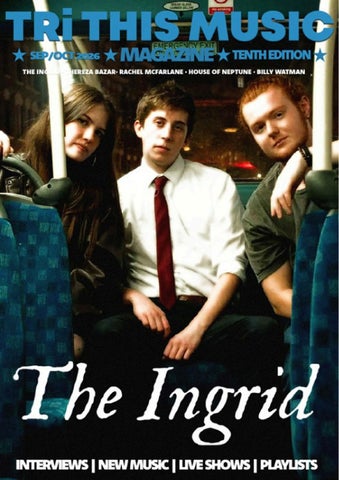
Welcome to TRi THIS Music Magazine Tenth Edition for September & October 2026. As the season changes, so does the soundtrack, and this issue is packed with plenty to discover. Alongside all your regular features, reviews, new music and artist discoveries, we’re bringing you interviews with Thereza Bazar, The Ingrid, Rachel McFarlane and House of Neptune. From fresh voices to established talent, there’s something here to spark your curiosity and hopefully add a few new favourites to your playlist. If you like what we are doing, be sure to like and share our socials, help us spread the word. As always, we’re building this with you, for you. Enjoy the music, The TRi THIS Music Team.
p14
Listen to the music of TRi THIS Music Magazine Tenth Edition.
trithismusic.com
@trithis_music
info@trithismusic.com
@trithismusic @TRiTHISMusic
p25
The greatest care has been taken to ensure accuracy, however there can be no liability accepted by the publisher for errors and omissions. We can under no circumstance be held responsible for any materials, matter or photographical copy submitted for publication or not within the website or magazine. The views and opinions expressed within our publications are not necessarily those of the publisher or indeed TRi THIS Music Magazine or any featured parties.
Formed while studying at university in Chichester, TRi THIS Music proudly introduces to you, The Ingrid. Comprised of Jess Charleslyn, Will Hornsblow and Josh Platt, the trio who are currently crafting a sound like no one else in the scene. A sound that’s described as a melodic calm meeting an emotional unease; their latest single ‘Lullaby’, perfectly encapsulates everything that the band are about and then some. The record is truly beautiful, blending themes of alt-rock and shoe-gaze, accompanied with stunning visuals and artwork. The track centres around the idea of a sense of saftey and comfort, exploring when the sense of comfort turns into something that becomes performative as opposed to authentic and true. Here Jess and Will take us further into their world...
ROSS: So I think the best place to start is your guys' starting point. So how did you guys come together, and where did it get started for you? JESS: So, for me, it originally started in Will's living room at uni, and we realised we'd both done music for a long time by ourselves, and we were like, wait, we've been friends for ages, why haven't we done this? And then through mutual friends, we met, other people who joined the band as well, and it kind of just fell into place that way, and it's taken many forms. Sometimes it's quite collective, sometimes we focus on solo stuff, but it really is just… this kind of creative hub, that I think we've both grown really fond of. WILL: We were both talking about, making music in our own time, and then just kind of went, why haven't we, you know? It'd be so obvious. But once we did, it just clicked and it was amazing. ROSS: Was this stuff that you guys were creating individually, similar to each other? JESS: We all come from quite different places with music. I really like dream pop, and Shoegaze, and just singer-songwriter, folk. WILL: I'm way more into, my bluesy kind of stuff, and surf, indie rock. But it works really well together, because we blended it in a way that just works, it's really good.
ROSS: How does the writing style work for you guys? How is that kind of set up? WILL: Well, I would say that, again, honestly, Jess is amazing with writing, especially lyric-wise. Music, I would say that it's a bit more collaborative, with all of us. But, definitely, lyrically and structurally, she aces it, to be honest. JESS: I guess, whenever I describe my music to people, I don't tend to lead with, I'm a vocalist, or I'm a musician. I can play the guitar, I can sing, if that's your interpretation of that. But, I would actually say what I like to do, and the main thing that I like to do, is storytell and story write, and sometimes the lyrics can feel really obscure, and I like the restraint in that way. I really, really enjoy that side of it, and I think it's always open to collaboration, there's no… preciousness about it, and I think that really helps with how we run. WILL: Yeah, I think it just works how we come together to make a song. Like, no one really feels like, that's my part, I can only do that bit. Everyone's very open, they're open to feedback. Let's say I'm playing a guitar part at some point. And, it doesn't really fit the vibe. We can be honest about that. And that helps, make it all get better. So, yeah, it's a really, really nice dynamic, really healthy, really good so far. ROSS: Do you think it's difficult, to translate those ideas into a music form? Or is it something that
comes naturally? Maybe this is, for you, Jess. Do you feel like you write from a personal experience, or are you more so inspired by the things That happen around you, your world that happens around you? JESS: I think both. I've tended to describe writing as more of a compulsion than a hobby. It really is an… outlet. Actually, our bigger release is called Sublimation, and that's pretty much a play on that word. To sublimate, is either a change in matter, or it's a change in… Or a way of processing emotions into something productive. And that's… what the collection of work does. But really, it's… it's a bit of everything. I really try, when I write, to not… write so definitively, and leave room for a little bit of depending, you know? Two things can be true at once, and that's what I really try and hold in my writing.
ROSS: Did you have that support? Were people there? Or have you guys kind of just figured it out on your own? JESS: I think a combination of the two. We both actually studied psychology at uni, and… I'm lucky that I think I've always had a desire to create, whether that's physical media or music. And that's a side of me that's been encouraged by people around me, which is something I'm eternally grateful for. So I think we probably had less of a preconception of what the industry would be like. I had some
...experience because I wrote and did some performances and things solo before. Kind of as a late teenager. WILL: I think I was even more in the dark than Jess was, to be honest, because I had never done, really, any sort of… actually putting myself out there at all, work before. So this was a big eyeopener, and yeah, luckily, we've had some help along the way, and also, we've helped each other work out how it all works, But it was a bit of an eye-opener. I mean, when it starts getting to any industry, I reckon, it is going to be quite difficult. JESS: And that… just having that help from the creative people around us has been so lovely, because if nothing else, we are just us, Josh, producers, sound engineers, photographers, artists, we're all kind of doing the same thing, and that is putting what's up here onto paper, or pen, or whatever it is. And I think that's something that's really nice about what we've done so far is everyone… is… everyone's for everyone. ROSS: What keeps, you guys, motivated? What keeps you guys working? Is it the audience? Is it being able to showcase your art and what you're doing? What is the feeling that keeps you so motivated in doing what you're doing? JESS: For me, I know that I will always write. Like, I've been writing for the last 7 years, and that's something I'm gonna continue to do forever, regardless of whether there's an audience to witness that or not. As long as I'm witnessing it, I guess. But it's nice to know you get comments on, like, TikTok or Instagram, and someone saying, wow, I love this, or oh, this is so beautiful, when is this on Spotify? It… just the fact that someone resonates with it and supports it means something to me, but look, this also means something to someone else, and that's really cool. WILL: Just, making music with your mates, and then, watching it grow into this, well, whatever they grow into at the end kind of thing. I'd say masterpieces, but, you know, that's just me. But, yeah, that's definitely a big motivator, just the happiness you get out of it, really.
ROSS: In the future where would you hope to be? What kind of position would you hope to be in? Would you hope that you'd kind of got more experimental, or maybe, followed the same kind of, dynamic, that's been working so well? Where would you hope to be? JESS: To be honest, I think there's room for anything. And I hope that the music continues to resonate with people, and they can take something away from it, whether it is the artwork, or the lyrics, or the melody, you know, that genuinely is… That seems pretty cool to me. WILL: Yeah, I'd say sort of the same thing, where I just hope that, we're still… basically just doing what we love, kind of thing. Like, you know, I've seen so many bands, l listen to so many bands where, I've listened to their first album, then I listened to their last album, and it just sounds so completely different. And, don't get me wrong, change is great, but to the point of where… it sounds nothing like the original stuff, or it doesn't sound authentic to who they were, then… then, yeah, I just… I'd say that we just want to stay authentic and keep creating things that we think
are just, cool and out there. ROSS: What would you say is, your guys' proudest moment, so far in this process, whether it be with music, or whether it be just something that's happened together, or something like that? What would you guys say is your proudest moment? JESS: For me, although it may seem small and futile to others, it was finally crossing 1,000 monthly listeners at once. Obviously, that fluctuates all the time because of release, radar, and all things like that, but that had been a goal of mine for so long as a tiny little songwriter who was sitting on, like. 200 monthly listeners, which is still an amazing number. For years, it was really cool to actually see it, like, huh, okay. Maybe people are beginning to understand what I'm saying. Yeah, and also just, like, on an artistic level. I think I've grown a lot as a writer, even the stuff not even in this kind of, project, but I feel like the things I'm writing now are more mature, and I feel like that's happened through practice and practice and practice. And that's something that I think I can be proud of if I let myself. WILL: It kind of answers to your question, because it's not really happened yet, but I think it will be my proudest moment. We're gonna be doing a gig soon, so as soon as we set out doing this band, we all had, like, one thing we wanted to do, and I wanted to play… I wanted to play live, and play, like, the best show we could ever play, kind of thing. So, for me, that will be my proudest moment, will be getting up on that stage and then, you know, playing our music, or… to whoever comes to see us, hopefully the fans, hopefully everyone comes to us. But, you know, that will be, for me, just, the best.
Our Spotlight on Street Cred!
BU SK BR ER EA K
Billy Watman Billy Watman is an award-winning Anglo-Brazilian guitarist whose playing brings together classical, flamenco, fingerstyle, rock and pop – all performed on guitar. Classically trained at London’s Royal College of Music, Billy picked up his first guitar at six and has been developing his distinctive sound ever since. His journey includes street performance as well as some impressive stages. A video project titled Behind the Busker gives a glimpse into that side of his musical life, while his career has taken him to festivals including Latitude and Edinburgh Fringe, as well as major venues and music events across the UK and Europe. Billy’s repertoire is wonderfully wide-ranging, moving from flamenco and classical pieces to familiar rock and pop favourites. His recordings include Riversong, Back Street Kid and the Queen-inspired EP On With the Show. He has also opened UK dates for Adam Wakeman’s Jazz Sabbath and performed alongside Rick Wakeman. Whether tackling a familiar classic or an original composition, Billy proves that sometimes one guitar is all you need to make a big impression.
ROSS: What was, say, the late 70s through to the end of the 80s like for you, looking back now, in comparison to today? THEREZA: It was hard. It's funny, it's almost like a second bite of the cherry decades later, and I can look back, and I really appreciate it now, far more than when I was living it. It was tough. It was a very male-dominated industry. I was in the 70s, didn't know what I was doing, because basically I just loved everything, and I was so giving, and wanted to be the best I could be, but very naive. I didn't have any street cred, I didn't have any fashion sense, I was just so conservative, but pure. But it was bloody hard work, and I was always terrified. If we had a hit record, I'd be going, ‘Oh, we've got a hit,’ but I would never really enjoy the hit record. I would be terrified about, ‘What are we gonna do next, and how are we gonna channel that forwards, and what do the fans want, and what do they want it to be like, and what does it sound like?’ It was always very high pressure, and maybe that's partly my personality, because I'm such a perfectionist and take everything so seriously, and I never really did the party thing. From the inside, looking out, it was a real trip and a fantastic experience, but I enjoy it and appreciate it so much more now, looking back. ROSS: Where do you feel the pressure was coming from? Do you feel it was an internalized pressure, and it was just how you worked and operated? Or was it more so the fact of the unknown? THEREZA: It was all of that. We were the very polished end of the pop world, and of course, you've got the coming out of the post-punk era and everything. It was very awkward most of the time, and we got slammed incredibly for all our records, which used to really hurt me. I used to get very sad, quite depressed, actually. Everyone thinks you've got all this support behind you. Well, you just don't. Not really. People are going out and saving their pocket money, or from their paper round or something, and they've chosen to walk and buy our record. And I used to sit in myself and go, ‘That must mean something, so don't listen to all of this noise to drag you down.’
ROSS: Where were those inspirations coming from? And did you have that direction in you where you were like, ‘Okay, this is what I want to do, this is how I want to present myself?’ THEREZA: Image-wise, it was always a challenge. It's not like I've got a wardrobe or stylist helping me, I do it all myself. And I'm walking past this very posh Harvey Nichols in London, in Sloan Street, the poshest of the posh, and I'm walking around going, ‘I don't know what I'm going to do, so if we get Top of the Pops, what am I going to wear?’ I stop in front of the shop, and they've got this image in the window. He's got this netting around him. Maybe I could get...
some netting and wrap it around, because it looked so amazing. I thought, ‘I know!’ I went to Marks and Spencer's, and I bought a pack of men's string vests. They come in twos, and I took them home, and I got some scissors, and I went, ‘You know what? I think I can work with this.’ And that's exactly what I wore. That's how it came about. It's desperation, but also looking at real professionals and admiring what they do, which I always do. I take inspiration from people that I go, ‘I could never do that.’ But I look at it and go, ‘Wow.’ ROSS: ‘The Big Kiss’ - What do you look back at that album and feel? THEREZA: I was actually heartbroken and crushed. I got the opportunity to work with these incredible songwriters, the cream of British pop. I didn't know these guys, and they agreed to work with me, and it was like a boot camp for learning how to be a better songwriter and to understand. They were all so wonderful, and I felt such a responsibility on my shoulders, because I just wanted to make it a success for us all as a team. It was like a team event. It wasn't me. And I've always been a team player. That's why being a solo artist never sat easy with me. I'm a team player. But I thought, ‘Well, I'm a solo artist, my name on the tin, but it's not just me, because I've got this group, and we're the team.’ It was crushing, but not because it was just, ‘Oh, I wanted a hit record,’ that's not it. I felt a sense of responsibility to everybody. Those songs were like my babies. And I cherished the musicians, and I cherished the writers, and I felt it was all on me, because I'd sucked them in with my little world, and they'd all committed to it. And it didn't work, and I felt it was my fault. I just did. ROSS: How do you move on from something like that? Where did you find that from? THEREZA: Well, I didn't. I called David and said, ‘Do you want to do something?’ Because I actually was crushed.
THEREZA: I ran into HMV in Oxford Street in London, because I was driving out to the Cotswolds. I bought the wrong album. And then ‘Oh L’amour’ comes on. And I'm going, ‘Oh! This is good.’ I always listen to something three times. If it gets better after the third listen, I know I'm into something. I stop the car, and I'm listening to it again after the fifth time, and going, ‘This is fantastic. But this wasn't a hit. Why?’ And immediately I could hear how it could be. I suddenly thought, ‘This time I'm gonna do it, I'll produce it, I'm gonna finance it, just do it my way.’ You can't get it right all the time, but if you have a belief in what you hear, and you can see it, just get on with it and try. I got my confidence back. I suppose it's confidence. ROSS: Have you thought about, today, revisiting the album, and having a push, and getting it out there to people that maybe haven't heard it? .
THEREZA: That's why we're having a conversation, because clearly, this is meant to be. And I believe in all of that stuff, I do. I'm much better when I'm intergenerational. I just had my great-nephew here today setting me up with my own studio here. You've got to keep moving forwards, because if you're not moving forwards, and you're standing still, you're really going backwards. I'm writing more songs than I ever thought I could ever do, and they're bloody good, actually. I think I've written some of the best songs I've ever written in my life in the last two months. ROSS: Do you feel a sense of freedom today, in comparison to the past? We've got ‘Risky Business’, with Stephen, who's wonderful. THEREZA: He is wonderful. We are as intense as each other, but in different ways. But creatively, he is astonishing. We've become more and more at one, and we're doing this swapping across the globe now. I'm in Sydney, he's in Leeds. We seem to have had this meeting of minds that's creating this whole new journey. And it's good, and it's classy, and it's credible, and I think the fans will love it. That's a real joy that there's never going to be any pressure from anyone, because it's on our terms now, and that's such a nice feeling. But we're demanding of one another and of ourselves, and it's got to be top notch, otherwise it doesn't make the cut. It just doesn't. ROSS: Surely that must be the most special and rewarding thing for you, to be in this position today, and to look across this scope of art. THEREZA: I am proud of it. Things are bubbling up that maybe have been suppressed because of, ‘Oh, I couldn't do that.’ Whereas now, I just don't care. I don't have to prove anything. I don't want to record stuff that sounds like I'm still back in the 80s. I'm not interested. So it means I've got to work harder to move forward. And getting older, that's a challenge, but I like a challenge. I'm not scared.
ROSS: What's coming up next for you, and what you're working on? THEREZA: We're recording a new album with all new material, which is just bonkers, really. Who does that? But we are. I'm very excited about it, because new music, and it's not boring, and the title of the album is ‘Love is War.’ Which is super passionate, and it's so true. It could be a child-parent relationship, or a couple
relationship, but love is war. It's just very succinct. The whole vibe of all of the tracks, there is a theme, and it's euphoric hope and uplifting belief that life can be good, and you can find what you want, whatever that is. It's a very positive vibe through all the music. It makes you want to wriggle and move around, and if you're cooking in the kitchen, you want to dance a bit and move, because it's bringing you up, and that's where I am. Everything's very up. ROSS: What would you say, looking back on everything in your life, is your proudest moment so far? THEREZA: Probably standing in the studio with Trevor Horn, very late at night. He gives me a piece of paper, and he says - this is the end of recording ‘Give Me Back My Heart’ - ‘Can you just go and sing this? I imagine you just singing this at the end of it.’ I'm going, ‘Okay.’ And it's actually about his dog that just died. He didn't tell me that at the time. Then he says, ‘Can you just go and make up something else?’ I said, ‘Just make it up?’ And I was so in awe of Trevor, and just so respectful, I said, ‘Well, yeah, okay.’ And I went and sang the very last bit, and it was just a cappella. I'm just singing it, just making up a tune. And I sing it that once, and Trevor grins at me, and he goes, ‘That was great.’ I'm going, ‘Okay, so we'll just go again.’ He goes, ‘No, that was it.’ I said, ‘That was it?’ He goes, ‘Yeah, come and listen to it.’ And it was just the first one take. And he said to me, ‘You sound like Julie Andrews.’ And what he didn't know is, as a little girl, when I didn't know who I was, I had no idea, but I was chubby and all over the place, and I used to listen to ‘The Sound of Music’, and Mary Poppins, and I just wanted that. He never knew that that meant so much to me, and every time I hear that at the very end of this most beautiful record, I go, ‘Just a moment when it was just pure magic.’ Just me, being me.
S I H T e r i o M R & T erch
50% OFF*
M
Time To Get GIG-Ready 12
13
ROSS: How has it been for the past seven months for you guys, together, still managing everything? What live performances have you guys been up to? And how's the songwriting going? EIMEAR: I actually think that we've jumped quite a bit since. I think it was January we last spoke, or maybe February? I'm not sure. But we've jumped quite a bit in terms of even gigging, the way that we perform on stage. Our music, we've been told, is a lot more together and a lot more unique, and we're definitely playing together as a collective group now rather than individuals. That's one thing I personally noticed. In terms of gigs, we've actually played quite a few since then, and newer venues. We've played two headliners since then in the Accidental Theatre and the Black Box in Belfast. DAIHTI: Played Voodoo. EIMEAR: Yes, we played Voodoo. Voodoo's quite well known here, so we have played quite a few. But now we're really working on the new tunes and that sort of thing. ROSS: In our first interview, there was a lot of shyness and a lot of anxiety around the idea of performing, which is understandable. Has that atmosphere dissipated? Do you guys feel better about presenting yourselves and what you've done on stage in front of people you don't know? EIMEAR: I feel everybody is nervous before they perform on stage. I think it's just a thing that happens. But I don't know about them two. For me personally, I'm a lot less nervous standing up on stage and performing. You'll still be nervous, but you're more excited now, in my opinion. NAOISE: I'd say if I care about my nerves. It means I care about the show.
ROSS: It feels like you guys are more out of your shell. It's like you guys know yourselves now. You know the sound and you know what you guys are trying to do. Do you guys feel that way as well? NAOISE: We've definitely grown closer, and we've grown collectively confident as well, which is very important. DAIHTI: Obviously we were making the music before, but it feels like we're making music as a band, not just someone's going, ‘Oh, that sounds cool.’ NAOISE: We have a direct style that we all know that we're going towards, and we all know that we're trying to make, because before we had a lot of different styles coming together, and that was a really good thing. That was really cool to have. We all do still have those other influences, but we're putting them together. We have an idea, and we know what we want from all those influences. We know how to get that, basically. ROSS: Looking back at ‘Spiral’, for example, when you listen to that now, and you look at the production, musically, and everything that you guys put into that single are you guys still happy with it? In reflection, looking back, do you still see it as something to be proud of in your discography so far? EIMEAR: I personally don't regret anything that we did with ‘Spiral.’ There's not really anything that we'd exchange. For it being our debut single, I think it was a really big success for us.
NAOISE: The main thing that I take away from it is that it was just such a great opportunity at the time. We were so grateful to have that. We got a lot of nice feedback on it, and it was really cool to see. ROSS: How are the rehearsals going? Do you still have that balance? Has it become easier? Do you get more stuff done? EIMEAR: We still rehearse most weeks anyway. We try to rehearse every week for two hours. We work faster. I think we can come up with a new song in one or two rehearsals, and then we can perfect it afterwards. We definitely can move faster. We know what to expect off of each other, and we are very honest with each other.
ROSS: In those seven months, we've now got ‘Dreamcatcher’. What's the story behind that? What was the experience like putting that single together? How has that been for you? EIMEAR: ‘Dreamcatcher’ itself is about not being able to grasp your dreams and them always feeling very out of reach. I think towards the end, we have the end more major, so it's a bit more upbeat towards the end. You could say it ends quite positively, but it's really up to people's own interpretations. EIMEAR: In terms of the production, we worked with Johnny Woods from 1980 Something Studio and it was great. I think we all really enjoyed that process. He gave you the entire day and he did everything bit by bit, and made sure that we were happy with everything. He was really good to work with. I think we're all really happy with the way that ‘Dreamcatcher’ turned out. DAIHTI: Johnny had come to rehearsal to hear the song. Five minutes before he walked in, I started using a new pedal for the song, and went, ‘Here, Johnny, do you like this?’ And he liked it, so I kept it, and I think it's my favourite part. If you listen between the first two verses, it's really prominent. It sounds like it's a big swooping aeroplane. I think it adds so much. EIMEAR: We also have a cello in it. At certain parts, it'll carry on with the vocal singing. I really like that part as well. NAOISE: I really liked using the cello. I thought that was a really cool part to add in. I also have an octave sort of part that I do in the chorus, which I was really happy with when I made it, and then Johnny really brought my confidence on in that because he said he really liked that part when I was recording it. He said that's very Smashing Pumpkins inspired, to make use of those octaves and the sort of rhythm that I was using. That was a major confidence boost. I was really happy with that part, so I'm really happy with how that turned out, especially in the chorus. EIMEAR: We definitely have a more clear vision of what we want to do, especially because we're more involved in the scene now and people know who we are here in the local scene. In terms of what we do in the future, there might be a single release in the next few months, and we're planning to do an EP. We've got a good few gigs coming up. I think we have big aspirations of what we want to do, but obviously we're still new, so we're still trying to work out when's the right time to do that sort of thing. DAIHTI: I think as well, it's not even necessarily what we want to do. Anyone can say what they want to do, but we know how to do it now. We know the pathways towards it.
VINYL JUNKIE Where the groove tellsthe the story The groove tells story
Walk into a record shop looking for one album and there's a fair chance you'll leave with three. That's the There are plenty of stories about vinyl, but few are quite as colourful as the story of Northern Soul. It wasn't magic of crate digging. Unlike shopping online, where clever algorithms suggest what you might like, a simply a musical genre. It became a movement, a dance culture and, perhaps most importantly for record record shop offers something no website ever can – the joy of the unexpected. collectors, a reason to search through thousands of forgotten records in the hope of finding something special. Every record shop has its own personality. Some are packed floor to ceiling with carefully organised collections, while others are gloriously chaotic, with boxes of vinyl waiting to be explored. That's part of the The story began in the 1960s, when American soul records were finding their way across the Atlantic. Some had attraction. You never quite know what you'll uncover. been released by famous artists, but many came from singers and groups who had never achieved much commercial success. British DJsexcitement began discovering these records playing increasingly enthusiastic For many collectors, the real isn't finding the recordand they camethem in forto – it's discovering the one audiences. they weren't expecting. One minute you're searching for a favourite album, the next you're holding a jazz classic you've never heard of or a forgotten soundtrack with artwork too good to leave behind. That's how The music had a particular energy. Fast, uplifting soul songs with powerful vocals and driving rhythms were collections grow, often by accident rather than design. perfect for dancing, and the scene quickly developed its own identity. Of course, record shops are about much more than buying music. They're places where conversations Places Twisted became important for the movement. Wigan begin.such Ask as theManchester's owner if they've had Wheel anything interesting arriveearly thathomes week and you'll usually beLater, rewarded Casino became legendary. Its sessions withoften dancers across the with a recommendation orall-night two. Mention a attracted favourite huge artistcrowds, and you'll findtravelling yourself from chatting with country to spend the night on the dance floor. another customer who's equally passionate. Before long, half an hour has disappeared and you've still only made it halfway through the 'M' section. And this is where vinyl became absolutely central. Northern Soul wasn't theweathered records that were alreadytimes. famous. In fact, someover, of the most sought-after Independent recorddriven shops by have some difficult When CDs took many disappeared sounds came fromstreets, obscure American 7-inch singles that had barely sold when theythe were originally released. from our high and the rise of streaming seemed certain to finish job. Yet somehow they survived. Today they're thriving once again, helped by a new generation of music lovers discovering that DJs became musicalfardetectives, searching record shops, warehouses and tapping American imports for something there's something more satisfying about holding an album than simply a screen. nobody else had. Finding an unknown track could transform a night on the dance floor. Suddenly, a record that had once been virtually worthless highly desirable. Perhaps that's because buying could vinyl isbecome an experience rather than a transaction. You study the cover, read That created a whole new type of record collector. the sleeve notes, admire the artwork and imagine how it will sound when the needle finally touches the groove. It's music you can see, touch and share. The hunt wasn't simply for great music. It was about finding the record. Original labels, rare pressings and Then there's the became thrill of the hunt.important, Every collector knows that feeling whenserious a familiar spine your eye. limited quantities hugely and collectors began paying money forcatches particular singles. It might be the first pressing you'vethe been searching a limited edition thought you'd or Some records became famous within Northern Soulfor, scene despite havingyou made virtually no never impactfind on the simply an charts album when that brings back memories mainstream they were first released.of another time. Those moments are impossible to recreate with an online search bar. That is one of the fascinating things about Northern Soul. It effectively created its own chart system. A record Someneed of my favourite on my list.discovered I once walked local record shop didn't to have beenrecords a hit in weren't America even or Britain. If shopping the right DJ it andinto the a dancers loved it, that determined to find a particular album that had eluded me for months. They didn't have it. Instead, I left was enough. with a record by an artist I'd never listened to before, recommended by the owner with the words, "Trust me,scene you'llhas thank me later." The continued to influence vinyl culture ever since. Northern Soul compilations and reissues have
repeatedly appeared in the UK charts, while Northern Soul – The Ultimate Collection even reached Number 7 on HeOfficial was right. the Compilations Chart in 2018. Record Store Day has also embraced the culture, with Northern Soul releases including a limited seven-inch box That albumrare is still onefrom of the most-played records in RCA, my collection, time I hear it I'm reminded set featuring tracks labels including Columbia, Epic, Bell, and Okehevery and Buddah. that the best musical discoveries are often the ones you never planned to make. But perhaps the best thing about Northern Soul is that it keeps the spirit of discovery alive. next time you're passing an independent record step inside. Leave your in ayour pocket, It So reminds us that a record doesn't have to be famous to shop, be important. Somewhere in anphone old box, charity shop take your time and flick through the racks. You might find the album you were looking for. crate or a collector's shelves could be a song that has been waiting decades for someone to discover it. Or, better still, you might find one you didn't even know you needed. Until next time…iskeep stylus clean andisthe And that, surely, whatthe being a vinyl junkie all records about. spinning. Until next time… keep the stylus clean and the records spinning.
YOUR STAGE YOUR STAGE
YOUR MERCH YOUR MERCH
FOR RAIN FOR RAIN & & SUNSHINE SUNSHINE
19
DOLLY PARTON Dolly Parton: More Than Just A Song There are singers, there are songwriters, and then there is Dolly Parton. A woman who could write a heartbreaking country ballad in the morning, deliver a global pop hit by lunchtime and probably have a business empire planned before dinner. Dolly Parton was never simply a music star. She was a force of nature. Born in 1946 in the Smoky Mountains of Tennessee, Dolly grew up in a large family with little money but plenty of music. Those early years would become the raw material for some of her greatest songs. “Coat of Many Colors”, for example, turned a childhood experience into a deeply personal song about pride, family and poverty. Her professional breakthrough came in the 1960s, initially through her partnership with country star Porter Wagoner. But Dolly was already writing songs that would eventually become classics. “Jolene”, “I Will Always Love You” and “9 to 5” are just three examples of a songwriter who understood something rather special: a great song doesn't need to shout to make itself heard.
Find out who you are and do it on purpose. Music is my personal addiction. So much of everything I've done has only been to open more doors for the music itself. It all gets back to the fact that I am, first of all, a songwriter and a singer.
1.57
-0.34
And then came Hollywood. 9 to 5 turned Dolly into a movie star as well as a recording artist, while her distinctive look, quick wit and enormous personality made her instantly recognisable far beyond country music. Her songs travelled even further. Whitney Houston's version of “I Will Always Love You” introduced Dolly's songwriting to an entirely new generation and became one of the biggest pop records of its era. Meanwhile, collaborations with Kenny Rogers, Emmylou Harris and Linda Ronstadt showed just how comfortably she could move between musical worlds. Yet perhaps the most remarkable thing about Dolly was that success never seemed to be the end of the story. Music, film, television, books, business and philanthropy all became part of her remarkable journey. She was inducted into the Country Music Hall of Fame, Songwriters Hall of Fame and Rock & Roll Hall of Fame, collected ten Grammys and continued creating well into her later years. Dolly Parton died on 25 August 2026, aged 80, bringing an extraordinary sevendecade career to a close. But listen to “Jolene”, “9 to 5” or “I Will Always Love You” and it quickly becomes obvious that Dolly isn't going anywhere. Some artists leave behind records. Dolly Parton left behind a songbook.
Read the full story, BUY THE BOOK NOW.
LISTEN HERE
1.57
-0.34
Wizard Rock Wizard Rock: When Fandom Finds Its Sound What do you get when a book series inspires people to pick up guitars? Wizard Rock, or “Wrock”—a wonderfully niche corner of music where rock, fandom and a little bit of magic collide. Rather than simply mentioning wizards in the occasional lyric, Wizard Rock takes its inspiration directly from the Harry Potter universe, with songs often written from the perspective of individual characters. The movement began in Massachusetts in the early 2000s, with Harry and the
LISTEN HERE!
Potters generally credited with starting the genre. Formed by brothers Joe and Paul DeGeorge in 2002, the band turned their shared love of the books into songs, live shows and an increasingly enthusiastic fan following. Their first album was recorded in the family living room—a suitably DIY beginning for a genre that grew largely through fan culture. Soon, other bands appeared, including Draco and the Malfoys, The Whomping Willows and The Hungarian Horntails. Live performances could involve costumes,
For Advertising opportunities in TRi THIS Music Magazine: Contact us!
character personas and plenty of audience participation, with shows taking place everywhere from rock clubs to libraries and fan conventions. What makes Wizard Rock interesting is that it’s about more than the music. It demonstrates how passionate fans can create their own musical world around something they love—and how a shared interest can turn into a genuine community. So, if you thought fandom was all about collecting merchandise and arguing over your favourite characters, think again. Wizard Rock proves that sometimes the best way to celebrate a story is to pick up a guitar and give it a soundtrack
Beyoncé once featured on a Coronation Street star's single. The actor-turned-singer somehow got Destiny's Child to feature on his 1998 single 'She's Gone' which, yes, is a cover of the Hall and Oates song of the same name. Karaoke means empty orchestra. The Japanese word karaoke comes from two other words. Karappo, which means empty in Japanese. And okesutura, the Japanized form of orchestra.
A I V I TR
“The Wreck of the Old 97” became America’s first millionselling pop song in 1924. It told the true story of a mail train that crashed in Virginia, killing the engineer. Jimi Hendrix was known for his electrifying guitar skills, and sometimes even played the guitar with his teeth! He was a left-handed guitarist who often flipped right-handed guitars upside down.
To celebrate the 50th Anniversary of his album, Songs in the Key of Life, Stevie Wonder surprise-released Songs in the Key of Life 50: The EP, which contains four previously unreleased studio recordings. These were released timed to the 50th anniversary of the release of the diamond-certified album, exactly when the last session for it wrapped up: 4.54am.
BUY HERE
BOOK CLUB
LISTEN HERE
ROSS: What was that time period like for you? How did you get started, and what was inspiring you at the time? RACHEL: The beginnings are just as important as where we are now. And that has helped to shape me. My beginnings were a church in Rusholme, in Manchester. My parents were ministers, so life was a bit different for me. At the age of about 11, people would join the choir because that's the thing to do. I didn't join the choir because I could sing. In fact, I was the last person in my family to make anyone think that Rachel had any sort of singing ability. The singers in my family were the sister above me, her name is Naomi, and my twin sister. They could sing like angels. It was a rite of passage to join the choir, which is what I did at the age of 11. And plus I wanted to wear heels. You could wear heels and tights. I felt like a big woman. You had to go every week because we're singing on a Sunday every week. Before you know it, you're gaining this craft. Your ear is being developed, you're knowing about harmonies and things like that. And then somebody put a microphone in my hand at the age of 12 to lead the choir, to lead the song. My knees were shaking, my hands were shaking, everything was shaking. I was sweating and everything. I was so nervous, because it's not something I'm used to doing. But the response from the church was amazing. Church was my training ground. Those who influenced me the most were gospel singers. It was always this message of the gospel, of good news, of celebration, of upliftment, and I've always been about that. ROSS: How was their reaction to you beginning to bloom in this way? RACHEL: They were proud, obviously, but just to go back to what you were saying, which I think is a valid point, that I was finding my voice. This is a way that I could express myself, because prior to that, I couldn't. I was the joker, so I would be always quiet, very insular. I'd be one at the back cracking the jokes and getting everybody else in trouble. I felt muted in so many ways. And I found this way that I could communicate this. I could express myself. It was liberating. It was exhilarating. And I clamoured for it. So that's all I wanted to do. My parents were so proud.
ROSS: Going into the 90s, how do you make this move? What happens next? RACHEL: I blame my brother. My brother Robert, I need to tell this story. Every time I speak about myself and my career, he will be right beside me. So I need to let the world know. My brother Robert was a rapper at the time. So he was the first star in the house. Then I was marched into this recording studio. I was about 16 at the time...
This was before the Loveland and everybody. And I ended up doing background vocals. I sang for them. They were in awe. One of the gentlemen there, his name was Johnny Jay. He's a bit of a music mogul in Manchester even now. He started a group called Family Foundation. That's how I started, recording in the studios. It was through my brother, it was through Johnny Jay, and then from the recordings, people started hearing me. People started to request me, so that's when the Loveland came in. But all the way through, I always considered myself a gospel singer. Back in the day, they would actually get samples of not just gospel artists but sermons. They would actually have sermons, anything that was about liberation and empowerment. And they would chop that up, scratch that up, and that would be the song. And I'm thinking, how amazing that they weren't afraid to do that. Those are the two genres that have shaped me. ROSS: What are the reactions like to you at the start? RACHEL: It's really strange. I just think people are being nice. I've been given this gift, so it's not even me, and it's more than me. I'd even say it's God in me. I am very confident at this time. You are when you're young, though, aren't you? And you feel unstoppable at this time. I'm just hungry to sing. I will sing anywhere. I will sing with anybody. What's amazing is I didn't have to pursue it. People came to me all the time. My answer was always yes. Regrettably, I did not know the music industry, I did not know the music business. My passion, it was just about singing. I'm always in awe of how people respond and resonate. You hope that somebody will like your music, but when it becomes a part of them, and a part of their life, it is the most humbling thing.
ROSS: In the 90s, one of the biggest things that winds me up into a frenzy is the zero credit. How is this allowed to happen? RACHEL: I had to fight just to get ‘featuring Rachel McFarlane’. Because if you were a singer and in particular a Black singer, let me speak from my perspective and the look I had, it wasn't according to the traditional beauty standards of the slim white blonde lady, who would invariably mime over a Black woman's voice anyway. When I came and I'm, ‘Well, I have a vision of myself,’ it's, ‘How dare you have a vision for yourself?’ We brought the validation, we brought the soul, we brought the songs to life. But if they could ink us out, they would. It's as though to be ripped off, to be exploited, is considered normal. It is not normal, ladies and gentlemen. This is why I'm grateful the time we have now, and the 90s resurgence we have now, because who knew that 30 years later the new generation wants to know, ‘So who's that singer?’ And as long as they're still here on this earth, we can find them. Now these ladies have a chance to tell the story and have a chance to correct the narrative. And a chance to start singing again! ROSS: Isn't it amazing now to be able to sit here and be able to talk about these brilliant voices, brilliant women in music? You're even closer to the audience as well. RACHEL: Absolutely connected. It's a whole different world. I don't need the gatekeepers anymore. I can start my own label. I can sign myself to my own label. I can choose myself. You can choose yourself. Whereas before, you were waiting to be chosen. Now I say, ‘Actually, no, I'm going to release the song. I'm going to write this song. I'm going to find myself a producer. I'm going to release it.’
ROSS: Why now for the single? What was putting together the single like for you? What has the reaction been like for you? RACHEL: When I recorded Love Lifted Me, I recorded the chorus in 2020. It stayed on my hard drive. My dad became ill, I became a carer for my dad, my dad then passes away, and then go through that whole journey of grief and loss and not wanting to sing. It's as though I can't articulate what I'm actually feeling. I went back to my community music days, and I founded a CIC called Amplified Voices. I take creative activities, I take singing, songwriting, performance into the community for well-being and to promote good mental health. All of a sudden, I felt, ‘I want to start singing again.’ And I remember having a conversation with a good friend of mine. She said something, and it triggered this memory that, ‘Oh, I wrote a song called ’Love Lifted Me.’ I listened to that song, and I was so blown away by just the chorus! I just thought to myself, ‘Rachel, why do you always doubt yourself? Why do you always second guess yourself? What made you think that that wasn't good enough?’ I was obviously not ready to write the song then and now I was ready to write the song after everything I've been through. I know what it feels like to be down in the valley feeling lost and alone, running on empty and being burnt out. Although it's not perfect, I know I've come a mighty, mighty long way and I'm here just to tell my story. When I released it, I was a little nervous because I haven't released anything in such a long time. I didn't know I needed that affirmation. I'm so grateful I put it out. Life is hard enough. So let me be a port of safety through that. That's how I see myself.
So You Want To Be A DJ? Excellent choice. You like music, you enjoy a night out, you've probably spent far too much money on headphones and you're convinced you could do a better job than the bloke currently playing ABBA. What could possibly go wrong? Well, quite a lot actually. Being a DJ looks easy from the dancefloor. Stand behind some decks, press a few buttons, play some music and occasionally point at the crowd. Job done. Except it isn't. If you're thinking about becoming a DJ, there are a few things you might want to tick off the list first. ☐ Do you love music?
DJ
Seems obvious, but it matters. You don't have to know every record ever made, but you need to genuinely enjoy discovering music. You need curiosity. What works? What doesn't? What's the song everyone has forgotten about? And why does that 1980s record suddenly sound fantastic at 11:45pm? ☐ Can you read a room? (This one is important.)
You can have the greatest playlist ever created, but if nobody wants to dance to it, you've got a problem. Being able to look at a room and understand what people are responding to is one of the biggest skills a DJ develops. ☐ Are you adaptable?
Because that carefully prepared playlist you've spent three hours putting together? Forget it.
Someone will request something you hadn't considered, the age range will be completely different from what you expected, or the dancefloor will suddenly go mad for a song you thought would clear the room. The good DJs adapt.
☐ Can you talk to people?
You don't have to be a professional presenter or the funniest person in the room, but being approachable helps enormously. You are often one of the first people guests speak to and sometimes the person they come to when something isn't quite going to plan. ☐ Do you have patience?
Because at some point somebody will walk up and say, "Can you play a song?" You will say, "Of course, what would you like?" They will reply, "I don't know." Good luck.
☐ Are you organised?
DJ
Equipment doesn't magically appear at the venue. There are cables, stands, lights, speakers, microphones, playlists, backups, batteries, chargers and approximately seventeen things you suddenly realise you've left in the van. Being creative is great. Being organised enough to remember where you put everything is even better. ☐ Can you stay calm when something goes wrong? (Something will go wrong.)
A cable will fail. A microphone will stop working. Bluetooth will mysteriously decide it no longer knows what Bluetooth is. Somebody will unplug something they shouldn't. The trick isn't avoiding problems. It's dealing with them without the entire room realising there was a problem in the first place.
J
☐ Do you have a sense of humour? You'll need it. There will be strange requests, unusual venues, interesting dance moves and people who become considerably more confident as the evening progresses. Sometimes the only sensible response is to smile and carry on. And finally... ☐ Do you actually enjoy making other people have a good time? Because that's probably the biggest box to tick. The best DJs aren't necessarily the ones with the most expensive equipment, the biggest music collection or the fanciest booth. They're the ones who understand that the night isn't really about them. It's about creating an atmosphere, bringing people together, knowing when to push the energy and when to let a song breathe. It's about watching a room full of strangers slowly become a party. So, if you've ticked most of the boxes, congratulations. You've probably got the beginnings of a DJ. If you've ticked every box, bought the equipment, learnt how to use it and still think you can improve your skills, you're probably on the right track. And if you've ticked absolutely none of them but you've already bought a set of decks... Well, welcome to the club. We've all started somewhere. If you have your own DJ story to tell, we'd love to hear from you. Get in touch at trithismusic.com.
INTRODUCING
Newsletter Now available on the TRi THIS Music website www.trithismusic.com