THE
TRINITY VOICE
October 2O26 Volume 29 Issue 1 Trinity Preparatory School 57OO Trinity Prep Lane Winter Park, FL 32792
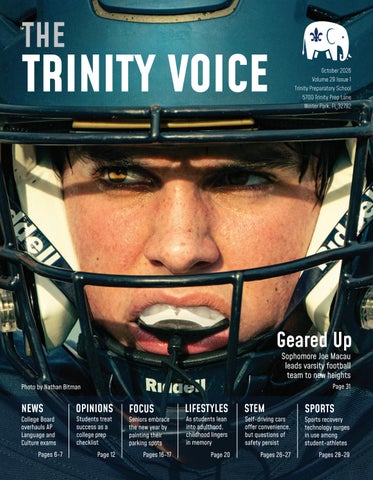
Geared Up Sophomore Joe Macau leads varsity football team to new heights Page 31
Photo by Nathan Bitman
NEWS
College Board overhauls AP Language and Culture exams Pages 6-7
OPINIONS Students treat success as a college prep checklist
Page 12
FOCUS
Seniors embrace the new year by painting their parking spots Pages 16-17
LIFESTYLES As students lean into adulthood, childhood lingers in memory
Page 2O
STEM
Self-driving cars offer convenience, but questions of safety persist Pages 26-27
SPORTS
Sports recovery technology surges in use among student-athletes Pages 28-29
October 2O26
TABLE OF CONTENTS
Table of Contents
5 24 26 1O Sunday School 13 FOCUS Beige Is the New Bold 18/ 19 ride through Vice of Life the new year! 25 Mental Game 14-17 3O Polo Policy
Administration implements weekly school-wide uniform day
Editor-in-chief Emily Lopez shares her advice for adapting as seasons change
Students personalize their parking spots and relive the nostalgia of the past decade as they gear up to
As time goes on, color is quietly disappearing from our lives
Individuals experience fear in vastly different ways
Injured athletes deal with overlooked mental struggles
d
Masthead and Online Content
October 2O26 STAFF Editors-in-Chief: Ashwin Anand, Emily Lopez
Broadcast
Non-Print Editors-in-Chief: Olivia Agnew, Ben Kleiman Managing Editors: Sami Haddadin, Mia Prince Layout Editors: Krish Gupta, Sarah Zobel News Department: Janav Ramprakash (Editor), Victoria Suarez Lifestyles Department: Lila Choudry (Editor), Kiti Jamir, Mari Valdivia Focus Department: Taylor Griffith (Editor), Amelia Sasser, Elena van Dijk Opinions Department: Omi Tikalal (Editor), Clara Greenlee, Allison Keen STEM Department: Jena Mhamdi (Editor), Coco Wu Sports Department: Julia Wu (Editor), Neve Judelson Broadcast Department: Brayden Kells (Editor), Skyler Campbell, Britt Voll Podcast Department: Aarav Gupta (Editor) Social Media and Online Department: Gabrielle Williams (Editor), Maggie Zissman Graphics Department: Aylin Garibay (Editor), Sina Gooshvar Photo Department: Lola Brown (Editor), Nathan Bitman, James Ellzey, Broc Williams Copy Editors: Neve Judelson, Victoria Suarez Business Manager: Skyler Campbell Advisers: Erin Miller, Brian Kells
Editorial Policy The Trinity Voice is a member of the Florida Scholastic Press Association and the National Scholastic Press Association. The Trinity Voice is produced by the newspaper/journalism class at Trinity Preparatory School of Florida. Editorials represent the opinion of The Trinity Voice writer and are not necessarily the views of the administration, faculty, or Board of Trustees of Trinity. The Voice welcomes letters to the editor and free-lance articles or photography. All submissions become the property of The Voice. Please send all correspondence to 5700 Trinity Prep Lane, FL 32792. The Voice may also be contacted via phone at 407-671-4140 and via e-mail at voice@trinityprep.org. For information regarding the purchase of advertising within The Voice, contact us by one of the methods mentioned above. The Voice is a monthly publication during the school year (with the exceptions of November and January).
Join social media editor Gabbie Williams for a behind-the-scenes look at one of Trinity’s fine arts classes, Stagecraft, taught by Carlos Acevedo.
Podcast
Socials
VOICE@TRINITYPREP.ORG THETRINITYVOICE.COM
Tune in as podcast editor Aarav Gupta speaks with new Trinity Prep guidance counselor Craig Johnson about what his position entails.
@TRINITY_VOICE @THETRINITYVOICE “THE TRINITY VOICE”
Website Exclusives In addition to the content contained within the monthly issue, The Voice regularly publishes articles found exclusively on its website. This month features written coverage on new faculty members, including guidance counselor Craig Johnson, orchestra director Holly Watters and economics teacher Nicole Narkiewicz.
The monthly lead editorial (lead ed) represents the view of The Voice’s Editorial Board, which comprises the current editors-in-chief, managing editors, layout editors and opinion department editor. The editorial vote in favor of and against the month’s opinion is indicated below the editorial, and a column expressing the dissenting opinion is featured on the subsequent page. This month’s lead ed can be found on page 12.
Advertisements
October 2O26
October 2O26
News
BIG/LITTLE, BIG IMPACT Article by Emily Lopez Photos Courtesy of Sophia Znosko, Graphics by Sina Gooshvar
matching costumes to One of Trinity’s time-honored traditions is the one with their own name on it. Inside celebrate Halloween the Big/Little Program, where sixth graders are the envelope, the littles discovered the in October, reflectpaired with seniors who serve as role models name of their senior big. ing during a thankthroughout the school year. Sixth grade stu“Finding out who my big fulness activity in dents are assigned their “big brother/sister” at was was really cool,” sixth November, or sharthe start of the school year and are then given grader Ryan Shen said. “I ing hot cocoa and opportunities each month to bond at Big/Lit- was paired with two secookies in December. tle events. niors, and I think having “The Big/Little event Although the mentorship program has been two was pretty cool because that I’m most looking around nearly as long as the school itself, it was they each had different perforward to is Trunk or only last year that students became involved sonalities and were really fun Treat because we get to dress in the pairing process. For quite some time, to be around.” up with our littles and get candy together,” former guidance counselor Rylan Smith, who The bigs and littles bonded over lunch that is now upper school dean of students, was same afternoon, where pizza and cookies were Znosko said. “I always see the seniors doing tasked with matching the “bigs” and “littles.” provided by the school. Senior Sophia Znosko it every year, and I’m always like, ‘I can’t wait This role has now expanded to the house pre- and her little hit it off right away, comfortably to do that.’” Senior Davis Washington is also excited for fects, seniors who are already greatly invested sharing fun facts about themselves and chatthe upcoming Big/Little events. in school culture via the house system. ting about their interests. “I’m really looking forward to the annual “The (prefects) have been able to give me “I bonded with her pretty quickly,” Znosko ideas about who would be a good match … said. “Our personalities completely matched, Headmaster’s Day water balloon toss,” Washington said. which is a perspective I don’t have,” Smith said. so we were a perfect fit.” Znosko also wants to find ways to support To determine who might be a good pair, Seniors and their sixth grade buddies will be both the sixth graders and seniors were asked given more chances to bond at events through- her sixth grade buddy and be a mentor she can to fill out a form assessing their interests and out the school year, whether it’s by dressing in look up to. “My little does swim, personality types. so I’ll go to one of her “They all took a survey, swim meets and cheer which we used to decide her on,” Znosko said. “I which (students) matched also told her we can get up the most,” Brokaw Starbucks sometime after House Prefect Julianna school. I just hope she Rivera said. “So if a sixth knows I’m here for her grader liked rock music and that I can give her and then a senior put that advice if she needs it.” they liked rock, it made For some seniors, inthem a good match.” cluding Znosko, this was Senior bigs and sixth their second time taking grade littles paired up impart in the Big/Little tramediately following the dition. She is determined annual Senior Investiture to be a supportive big chapel, held this year on because she remembers Aug. 27. They made their how much of a positive way out to the Quad, impact her senior budwhere littles were given dies had on her when she an envelope labeled with was in sixth grade. the name of one of their “I still keep in touch sixth grade peers. The with my big sisters,” seniors formed a circle Znosko said. “Now it around the sixth graders, Then-sixth grader Sophia Znosko poses with Six years later, Znosko, now a senior, feels kind of full circle.” who passed along the en- her “bigs,” then-seniors Ellie Watson ’21 poses with her “little,” sixth grader velopes until they found (left) and Sophie Robinson ’21 (right). Molly Dubay.
October 2O26
News
EXAM EVOLUTION
Article by Victoria Suarez Graphics by Sina Gooshvar
The College Board’s series of AP language and culture exams is experiencing a massive overhaul for the upcoming May 2027 AP exam season that will transform the experience of students and teachers alike. Across all the affected courses, the alterations to these exams are almost identical and include a redesigned free-response section, a switch to an entirely digital platform and many other updates. One of the most notable changes is the order of the test sections. Section one is now the free-response portion of the exam rather than the multiple-choice section, which came first in years prior. For some students, completing the more demanding free-response tasks first could reduce the anxiety of anticipating them throughout the first half of the exam. “I think that (the free response) is the most stressful part for us,” AP French student and junior Emilia Gonzalez said. “I think getting the free response out of the way first allows us to get the hard part out of the way instead of stressing about it.” Beyond moving to the beginning of the exam, the free-response section itself is also being entirely revamped. While most of the tasks are being replaced, many of the linguistic and cultural skills being asked of students remain the same, including cultural synthesis, grammatical proficiency, speaking ability and more. “One activity that has now disappeared is the email reply,” World Language Department Chair and AP French instructor Vanessa Spallone said. “Another (free-response task) that has been removed is a conversation, which was an impromptu conversation with five or so prompts coming at you and you’re supposed
to answer them in the target language. The other one that has disappeared is the cultural comparison. Now what’s left out of the four is the argumentative essay.” While it is certainly shocking to see most of the traditional tasks be removed, many teachers see this as a positive change that streamlines the exam to the most important skills the students need for their future in academics. “Not that a person is never going to talk to someone on the phone, but as far as the conversation, I think kids don’t do a lot of talking on the phone anymore,” AP Spanish teacher Rita Daugherty said. “I think that was a good
idea to remove that because it was something else the kids have to study for. I think the argumentative essay is a good thing that is still on there because it mimics some of the five paragraph essay type of things that kids have to do in English class. It goes in line with what students are doing in the regular classroom.” To replace the traditional free-response tasks, the College Board has added a multimonth-long cultural project worth around 35% of the students’ AP exam scores. The prompt will be released in January based on the topics of the course, and students will be expected to complete advanced research on
this topic, synthesize the information into a project and give a three-minute presentation on exam day. The AP teachers will have to rearrange their existing curriculum and lesson plans to dedicate the second semester entirely to the project preparation. “It gives you little time to cover the six units, which are still the same,” Spallone said. “The goal is for teachers to create as much as possible on the six themes during semester one so in semester two, students can focus on their project. It’s going to be an adjustment.” The modifications needed to their curriculum to fit in the research project will be a challenge but many teachers are actively looking forward to the experience of guiding students through the advanced research aspect. “Because so many things require research, I think that it’s a good thing that they’re going to be doing research because then they’re going to learn skills for college,” Daugherty said. Students will be allowed to submit a Personalized Project Reference (PPR) for their three-minute presentation and the following question-and-answer portion of the free response about their research topic. They will submit this one-page sheet of reference material to the AP digital portfolio by the end of April 2027. “It’s basically a sheet of paper where they will input some key words or even sentences,” Spallone said. “They are limited to 70 words. My understanding is that our college counseling office, who’s also in charge of AP exams, will print each individual sheet for the student. Seventy words is not very much, but it will be
O
C
October 2O26
News
College Board overhauls the AP Language and Culture exams on the desk waiting for the student on the day questions will be there. For the reading com“I don’t know how well it’s going to repof the exam, so that’s a little something to help prehension, it’ll be the same thing.” resent our French learning and French skills them, and they will of course choose what’s on In addition to changes coming to the for- compared to the other exams, but I think that that sheet.” matting and makeup of the exam, the College it’s important to change the structures from One of the main concerns for many teachers Board made the switch from a hybrid exam to time to time of the test just to see how students is regarding students memorizing their three a fully digital one. Previously, students would respond,” Gonzalez said. “I think that it’s pretminute presencomplete the mul- ty cool that I get to try something else, and I’m tation. While “The cultural aspect is ... just as im- tiple-choice and excited about the project.” the presentation portant, if not more important, than written-response Teachers who have spent years preparing is meant to be tasks on paper students for the previous exams face a particudone solely with just learning the language by itself. and used comput- larly large adjustment. Long-established lesson the Personalized These (projects) work hand in hand to ers only to record plans and strategies now have to be reconsidProject Referrespons- ered or scrapped to match the new tasks. widen our perspective about French cul- speaking ence and the ines. Now, the en“I was super annoyed because I already had formation they ture. It gives us more context about the tire exam will be it figured out,” Daugherty said. “It took me learned from language, which is something that ev- administered dig- years to get to that skill level where I knew their research, itally. While other what I needed, what I didn’t need. My stuwith five months ery student should have.” AP exams have dents were doing well. Now I’m stressed out of preparation - Emilia Gonzalez, junior already made sim- because I’m not as confident in teaching this for the project, ilar transitions, way yet.” students and teachers believe memorization is the language exams are one of the last groups An important factor to consider about the an inevitability. to make the switch, which will bring a new exam updates is their effect on the exams’ score “It’s very likely all of us will prepare a script set of challenges such as having to type accents distributions, particularly during the transition and have it committed to memory going into accurately on a computer, as well as benefits year and in the long term. Teachers, students it,” Gonzalez said. “I mean, if we have that op- like having listening prompts within students’ and administrators knew exactly what each portunity, it’s always better to be prepared. I individual headsets rather than on automatic score represented in the past exams and have also think that it’s important for us to probably recordings that yet to see how practice impromptu speaking before we take are played for “The goal is for teachers to create as much they will change the exam, regardless of this little byway that we the entire room. forward. as possible on the six themes during se- going have access to now.” “I’ve always Nevertheless, While many of the changes to the exam for- been used to mester one so in semester two, students students and mat are related to the free-response section, the writing my can focus on their project. It’s going to be teachers alike multiple-choice portion will also differ slightly French essays are prepared to from past exams. Most notably, the section will by hand,” Gon- an adjustment” respond and acbe shorter, decreasing from 65 questions to 55, zalez said. “It’s - Vanessa Spallone, World Language knowledge both and the timing will be shortened according- easier for me Department Chair the challenges ly. The types of multiple-choice questions will to go back and of these updatalso change, with two source questions from correct myself, but I think that I type faster ed exams and the positives they could bring, the previous exam being eliminated. These are than I write, so I’ll probably be able to revise including what many see as more culturally questions that included synthesis from two for a longer time. I’ve never tried typing my es- relevant tasks. sources that were either a reading, an audio or says, so maybe I’ll end up preferring that more. “When learning a language, the cultural a graph. ... I’m curious to see how that’s going to go for aspect is not always the focus, and it’s just as “Some of them were a graph and a reading, the exam.” important, if not more important, than just and then they had to interpret two things,” The changes follow years of feedback and learning the language by itself,” Gonzalez said. Daugherty said. “Sometimes you had an au- exam data as the College Board continues to “These (projects) work hand in hand to widen dio, a reading and then you had to interpret revise its AP courses and assessments. This year our perspective about French culture. It gives both. They’ve gotten rid of those. They’re just will be a major trial for the College Board in us more context about the language, which is going to have straight listening comprehen- terms of how students and teachers respond to something that every student should have.” sion. You listen, and then the multiple-choice the new exam style.
October 2O26
News
FORGOTTEN IN THE FIELDS Article by Sami Haddadin Graphics by Sina Gooshvar
Florida is often defined by its picturesque landscapes and sunny weather, from citrus groves to manicured lawns to seemingly endless beaches. Yet beneath that landscape, pesticides are routinely used to protect crops, maintain grounds and control pests. At Trinity, those applications happen when few students are around. For farmworkers who spend their days in agricultural fields and nurseries, pesticides are part of the workplace, whether they like it or not. Ubalda, a farmworker in Apopka, noticed that the pesticide storage room at her workplace was alarmingly close to the breakroom where she and her co-workers
ate lunch. She reported it. In Homestead, Ofelia reported symptoms she believed were caused by pesticide exposure and was later hospitalized. It was only after they made complaints to the Farmworker Association of Florida, where reports were filed with the Department of Agriculture and their supervisors took action. But this was not out of benevolence toward their employees; in the end, both women were fired. Though their stories unfold under different circumstances, they remain entangled in the same web of inequity and injustice that permeates Florida’s agricultural and chemical industrial complex, some of which sits just 20 miles from Trinity’s campus. Jeannie Economos, the pesticide safety and environmental health project coordinator at the Farmworker Association of Florida, has been in close contact with Ubalda and Ofelia, helping them personally navigate pesticide exposure and to the forefront of self-advocacy to seek justice. “I’ve been working on farmworers and pesticide issues for about 30 years,” Economos said. “It’s close to being taboo to talk about pesticides. That’s partly because the agricultural and pesticide industry don’t want there to be a lot of attention around pesticides because people start … (to) get worried about their food and … lawns. And so I think that there’s a bit of a concerted effort to not talk about (them).”
The implications are twofold. First, gaps in pesticide notification can allow unsafe practices to continue unchecked, particularly when workers become accustomed to seeing warning signs or pesticide use around their workplaces. Second, a lack of public awareness about who farmworkers are can make their working conditions easier to overlook. “I’ve been in spaces before (where) when I say farm workers, they say, ‘yes, I just love those farmers,’” Economos said. “People do not even know who farmworkers are. … They don’t think of (the) people working in the fields … farmers have access to capital, land, resources and agencies. Farmworkers don’t have any of that, and now they’re really under threat.” But the pesticide notification gap extends beyond agriculture, reaching private and higher-education facilities, residential and commercial lawn care, and public parks, playgrounds and athletic fields. Trinity offers one example of addressing the problem at its root, by reducing pesticide use broadly. By making nature a key facet of its campus, the school demonstrates an alternative that other institutions could emulate. “Our campus is very natural … so we don’t use a lot of herbicides or pesticides,” said Chief Financial Officer Michael Drake, who oversees Trinity’s groundskeeping operations. “The only times are on the fields … on the weekend or when no one’s around.” Nevertheless, political influence can shape which issues receive attention from lawmakers, particularly through campaign financing.
O
News
October 2O26
Farmworkers bear the hidden costs of pesticide exposure “Political Action Committee (PAC) money is (in) almost everything,” said Enzo Kuada, a sophomore who is involved in local political and environmental advocacy. “(With) young people, they don’t even know who the other candidates are. It’s literally just who they see. It’s who they vote for. And it’s the same thing for the older people. It’s … really important to keep money out of politics and especially for those who care about their environment.” The case reflects a broader debate over how pesticide risks are addressed, with agricultural companies pushing for liability protections while advocates argue that the focus should instead be on preventing exposure. “The pesticide industry is just substituting one kind of pesticide for another instead of moving towards sustainable ecological regenerative agriculture,” Economos said. “They are continuing to produce more pesticides. They’re continuing to get approval from the EPA … and the EPA accepts the science that the pesticide companies give them in order to approve the pesticides. … We spent 20 years trying to get chlorpyrifos banned, and they’re still out there.” Additionally, the temporary nature of the H-2A workforce, which allows agricultural employers to hire foreign workers on temporary work visas, can obscure the scope of pesticide exposure, complicating research and regulatory assessments of farmworkers’ long-term health and residual chemical contamination. “There are probably hundreds of farm workers … on short-term work visas … (and) we
don’t know if any of them have health problems when they go back to their home countries,” Economos said. Broader declines in agricultural capabilities and the polarization of immigration have further intensified pressures on farmers, who respond by skirting laws and regulations or cutting expenditures, as seen in the cases of Ubalda and Ofelia. “The only place that (farmers) feel they can cut their spending and increase their profit margins is to cut salaries to farm workers,” Economos said. “And they are feeling really pressured because they’re having a hard time. Immigration is causing them to lose a lot of their workforce and forcing them into the H-2A program. And so sympathy for farmworkers is even less now because of the anti-immigrant sentiment.” Yet farmers’ and farmworkers’ struggles continue to fail at gaining the legislative traction needed to meaningfully move the needle. Their concerns often compete with more visible and contentious issues that better serve some politicians’ interests. “(Bigger topics) like abortion (and) firearm safety … are the type of things … that get the politicians reelected,” said senior Jack Nave, who gained firsthand experience in state committee and floor hearings through the House Page Program. “They want to do what will … make them look like the best representative … (so) then they’ll be published in the media. When they go to run again, everyone will know who they are.”
When political priorities are shaped by visibility and reelection, issues affecting less-visible communities can struggle to receive the same level of attention. For students who cannot yet vote, however, political participation need not begin at the ballot box. “It’s the people electing these candidates that are going to pass these bills, (but it’s also) the people going out of their way to actually help and bring a better tomorrow (through) volunteering, going out, getting their hands dirty and actually helping,” Kuada said. Grassroots organizations have also provided farmworkers with avenues for education and advocacy. Since 1996, the Farmworker Association of Florida has trained several thousand farmworkers in pesticide safety, including approximately 500 workers annually from 2006 to 2018. After seeking help from the organization, Ofelia eventually left agricultural work and later helped train other farmworkers through its Homestead office. She has also continued speaking publicly about pesticide exposure, including in Washington, D.C. “It’s not like you’re just working on some policy out there,” Economos said. “When you see that you are empowering people to speak for themselves, and to recognize their own value and purpose, that’s what keeps you going. … After five years, I was burned out because it was tragedy day after day. … No matter whether you win or lose, you have to keep going. Because when you know the people, you know the impact on real lives.”
October 2O26
News
POLO POLICY
Administration implements weekly school-wide uniform day
Article by Victoria Suarez Photo by Lola Brown, Graphics by Sina Gooshvar
student feedback was considered through surveys and a discourse series regarding uniforms. “We determined everything based on the feedback,” Blickman said. “We wanted it to be a collection of information from as many people as possible, from as many different voices as possible, so that we could make sure that we had a large picture of what the school, community and family would like.”
On the other hand, critics of the uniforms often cite arguments such as the restriction on individual expression, cost and discomfort. “It certainly looks good for photos on Google, but when everyone has to wear the same thing, it can feel like everyone looks the same,” eighth grader Shane Landau said. Many students who have concerns with the uniforms still acknowledge various potential positives, and some have even changed their stance. Some of these students went to elementary schools with uniforms, such as Park Maitland, and came in with preconceived notions that were eventually challenged. “I thought (the uniforms) would be like the ones from Park Maitland,” Landau said. “It turns out they’re better and lightweight.” While reactions to the uniforms have varied, the range of responses was consistent with what faculty and students anticipated. “I think for me, having talked to enough students (and) been at schools where this has happened before, I wasn’t necessarily super surprised that this is something that the community wanted,” Blickman said. This early stage will be used to gather feedback and observations that will affect decisions regarding the policy’s tentative expansion over the next 18 months. “That first uniform day was a great day,” Blickman said. “I think kids knew what to expect. I thought there was some order to it, but who knows what that looks like in the winter or next week or in the spring? How does that uniform experience change? Is it bringing all the benefits we thought it might bring? I think it’s a year where we’re making sure that we are adjusting to this and making sure that it goes slowly while taking as much data in as we can.”
Student Satisfaction
Drawbacks
After a multi-year process of gathering data and deliberation, a weekly school uniform day has been implemented for the 2026-27 school year. All middle school and upper school students will now have to wear a uniform polo shirt on chapel days. Each student received a uniform shirt along with their books and class materials before the beginning of the school year. Middle school students’ shirts are blue, freshmen through juniors have the option to wear blue or white and seniors’ shirts are gray alongside dress code bottoms. Mandatory athletic uniforms have been instituted and vary by sport. “The idea is that the students are a little bit more uniform on days of chapel,” interim Head of Upper School Sebastiaan Blickman said. “(We are) just trying to add a little bit of professionalism and raise the level of expectation a little bit on that day in particular.” While it is being implemented this school year, the policy has been developing behind the scenes for some time. Recognizing that a uniform day was going to be an adjustment, administrators considered many factors such as pricing and comfort before settling on the policy. Photo Illustration: A blouse is allowed under “Since my first year we’ve been talking the regular dress code on most school days (left), about this idea of a uniform, what it would while a uniform polo shirt is now required once a look like, what it could look like,” Blick- week on chapel days (right). man said. “I would look at the vendors and help with price points and just propose differFor many students in favor of uniforms, the ent things.” argument tends to comprise of two main reaThe administration sought various perspec- sons: Uniforms prevent teasing based on clothtives before Head of School Byron Lawson ing, and they make getting ready easier. made the final decision. A faculty committee “You don’t have to buy clothes for school,” served to contribute to the discussions sur- sophomore Colette Voll said. “You can just rounding the uniform policy. Additionally, buy clothes for the weekend, which is nice.”
Benefits
Data gathered from survey of 350+ students
Opinions
October 2O26
UNIFORMS FORCE CONFORMITY Article by Sarah Zobel Graphics by Aylin Garibay
Gold, blue and white: The infamous colors representing Trinity Preparatory School of Florida have bled into more than just logos, sports jerseys and spirit days. Now, they represent the fashion sense and identity of every student on campus. Trinity’s decision to “transition to and expand the use of school uniforms over the next 18 months,” as stated in an email sent this past summer, has been undeniably controversial among students and parents alike. Given the imminent expansion of uniforms as referenced above, we must reconsider the unintended consequences they carry. Many of Trinity’s students, like myself, are no stranger to the standard of a school uniform. From kindergarten to eighth grade, I put on the same khaki skirt and school-colored polo each morning before school. As an ex-uniform wearer — that was, until this year — I have observed the countless negative impacts uniforms have on students, including the cost to self-expression, freedom and comfort. While these consequences are quite real and important to address, there is a crucial, lesser-discussed issue that has been overlooked: the cost uniforms have on a student’s development, both personally and professionally. To many, being able to mindlessly grab for the same collared shirt every day may
seem like a gift, but that repetition comes at the sacrifice of a student’s decision-making skills. Daily decision-making, like picking out clothes for school, prepares students for the real world, in which they will likely have to pick out their clothes each morning for work or college. The stress of wondering what to wear each day won’t disappear forever; instead, students won’t build the skills needed to cope with it before they graduate, consequently delaying the development of the confidence needed to dress themselves. Fortunately for me, I was able to experience that culture shock earlier, in my freshman year of high school. After wearing the same outfit every day for nine years, my first day ever wearing an outfit of my choice to school was at the age of 14. Because of my previous school’s reliance on a school uniform, I hadn’t had to choose an outfit for myself beyond the weekends until I was a teenager. I was left with a poor sense of fashion and an under-developed closet, as buying clothes separately for school and free time is costly. I would not wish that harsh transition on anyone, and I cannot imagine how much worse it would have been had my high school mandated a uniform as well.
By experiencing the expectation to select an appropriate daily outfit now, students can make mistakes and learn from them, instead of delaying those realizations. Trinity’s existing dress code did well in allowing for this natural growth to occur, while also teaching students how to dress professionally and face reality. According to the student handbook, Trinity students are still expected to dress nicely when not in uniform. Instead of mandating a specific outfit every student must wear each day, Trinity’s non-uniform-based dress code teaches students how to design outfits within the standards of an organization, which prepares students for future job interviews and careers. As a preparatory school, Trinity should be focused on preparing its students for their post-high school endeavors, but, by implementing school uniforms, they do exactly the opposite. Students need to develop the skills to make their own decisions about how they wish to present themselves and not become trapped in the falsely comforting environment Trinity has chosen to create. Until Trinity discontinues their current uniform progression, administration cannot claim to “develop ethical, resilient leaders” who “embrace diversity in thought and perspective,” as they are developing nothing more than a method of standardization.
October 2O26
Opinions
BEYOND THE CHECKLIST Students chase prestige in a culture that equates success with achievement
Get good grades. Take hard classes. Build (are) doing things that you admire … and you a resume. Attend a prestigious college. For want to be on the same level as your peers. So many students, success can look like a check- I feel (that) at Trinity I surround(ed) myself list. But once the boxes are checked, the harder with smart people.” question remains: What are students actually The problem emerges when exceptional working towards? achievement becomes an expectation rather In an environment where students have end- than inspiration. less opportunities to build resumes, win awards A student taking six AP classes can make and pursue selective colleges, achievement can five feel insufficient. A classmate’s college acbecome an end in itself. When accomplish- ceptance can become a benchmark. The stuments become measures of worth rather than dent achieving more is not the problem; the tools for crafting a meaningful future, success culture that turns individual accomplishment can become more about appearing successful into collective expectations is. than actually becoming successful. “I think when you have driven, motivated College is a powerful presence in the culture individuals who are aspiring and you have a of an independent school. system like a school that is set up to encourAustin Yuan, a Trinity alumnus now study- age students to pursue that excellence, you’re ing finance at the University of Pennsylvania’s going to have people chasing success, whatever Wharton School, said his parents initially that might look like,” interim Head of Upper chose Trinity largely because of its reputation School Sebastiaan Blickman said. and the opThe result is that stuportunities it “I always believe in an iron-sharp- dents start measuring could provide ens-iron mentality. ... The people their progress against for college. He people’s accomyou’re with (are) doing things that other focused almost plishments before they entirely on ap- you admire … and you want to be on have figured out what plying to highly the same level as your peers.” they actually want. ranked univer“I think a lot of peo- Austin Yuan ’23 ple, especially when sities because he knew what the prestige could offer him. it comes to college applications, for example, “You see your friends and siblings succeed take classes that look the best to colleges, which and you think you can do it as well,” Yuan in my opinion isn’t the purpose of school or said. “I just wanted to set myself up for a good college,” sophomore Ivan Gupta said. future. I thought that a good college with a Students can spend years accumulating acbrand name is step one.” tivities and classes they never truly care about His experience reflects a pressure that ex- because stopping feels like falling behind. tends far beyond Trinity. A 2025 Pew Research “I always tell kids when they’re starting to Center survey found that 68% of teenagers pick a class, don’t take the AP just because you feel at least a great deal of pressure to earn want the AP,” Blickman said. “Take the AP good grades, while 33% feel a fair amount because you’re really excited about it. … You of pressure to be involved in extracurricular might get a three or a four or something, but is activities. Ambition can become contagious. it worth it to be miserable?” Seeing classmates challenge themselves can That advice sounds simple, but following it push students toward the harder classes. can be much harder. “I always believe in an iron-sharpens-iron Students are influenced by parents, friends, mentality,” Yuan said. “The people you’re with, social media, college admissions and their own
expectations. Even when a school tells students that there are multiple paths to success, students may still absorb the idea that some paths carry more status than others. Starting something because it looks impressive doesn’t necessarily mean that the experience will be meaningless. An activity that began as a resume booster can become a passion. “I started a lot of things, I will admit, just because I thought they’re good skills and resume boosters to have,” Yuan said. “But then as time went on, I found myself enjoying them more, and (they) became more true passions of mine. So it’s a blurry line between the two.” That blurry line makes achievement difficult to define. Achievement matters. So does ambition. Being challenged can teach students how to handle failure, adapt and keep moving. But achievement is not a single ladder with one top rung. Blickman hopes students leave Trinity feeling challenged by their education while also feeling supported and connected to something larger than themselves. Trinity can start by changing what it celebrates: giving greater recognition to students who demonstrate curiosity, growth and genuine engagement whether or not those qualities come with a trophy. Meanwhile, students should be willing to ask if every achievement is worth pursuing. The goal is not to achieve less but to make achievement mean more. Trinity’s measure of success should be whether its students leave not only accomplished, but curious, resilient and confident in the person they have become. College acceptance letters will eventually become old news. Awards will gather dust. AP scores will fade into transcripts. Even careers can change. What remains is the person built underneath all of it. The Editorial Board supports this opinion.
PRO: 6 CON: 1
Opinions
October 2O26
DISSENT
SATISFACTION DOESN’T MEAN SUCCESS Column by Ashwin Anand Photo by Julia Hoskins
Trinity brands itself as a college preparatory school with the goal of graduating students who “thrive in the pursuit of excellence.” The editorial would have us abandon this mission for the mindset that success means nothing beyond one’s personal satisfaction. Fortunately, our campus has higher ideals in mind. Our tuition affords more than a simple venue at which we can grow into ourselves; a grandparent’s summer villa might fit that bill. Families are paying for the values, knowledge and skills needed to develop productive members of higher education and society at large. An adequate liberal arts education requires that students seek excellence in all domains of study, including those to which they are not naturally inclined. As far as the college admissions scene goes, shaping students for elite universities does more than secure them a wide alumni network and universally renowned degree (though these, of course, are worthy benefits). In building competitive applicants, our school pushes teenagers to embrace academic rigor, hone dormant skills and work toward something larger than their immediate wants. I’ll be the first to condemn hollow resume padding. However, the editorial foolishly dismisses any pursuit of excellence motivated by environmental expectations, regardless of the effort put in. Students willing to embrace scholastic challenges should be justly lauded — and emulated. An environment in tune with its preparatory mission cannot bear the blame for those ill-adapted to it. Indeed, when stripped of AP scores, awards and college acceptance letters, the person underneath remains. Our school’s job is to ensure that person is someone who understands not just where their passions lie but how to channel them into something of substance. This column expresses the sole dissenting opinion to this month’s lead editorial, found to the left on page 12. All sentiments are solely those of the column’s author. For comments on either the editorial or the dissenting opinion, contact voice@trinityprep.org.
EDITORIAL STATEMENT This column reflects editor-in-chief Emily Lopez’s personal Christian faith. The Trinity Voice represents the entire student body and does not have any particular religious affiliation. The Voice honors and respects all faiths, beliefs and worldviews within the school community.
13
SUNDAY SCHOOL
New season, same God Column by Emily Lopez Photo by Lola Brown, Graphic by Sina Gooshvar
“There is a time for everything, and a season for every activity under the heavens” — Ecclesiastes 3:1 (NIV)
Autumn has always been my favorite season. The crisp air. The warm smells of cinnamon and clove. The — slight, but noticeable — shift to cooler weather. I most love fall because of the transition from summer break to the start of a new school year. New classes, new people, new opportunities. A fresh start. While this is a season I look forward to, it is one others might dread. Summer is over, and school is back in session. That means we must experience change. And change can be difficult. We move through life in different seasons. Some are marked literally by the four we know as spring, summer, autumn and winter. Others are marked figuratively by our experiences: our friendships, relationships and heartbreaks; our classes, responsibilities and academic achievements; our trials and tribulations, joyful moments and times of growing maturity. Throughout all of these seasons, God is with us. He is always by our side, rooting us on when things get tough and celebrating our triumphs right alongside us. As we enter a new season, we should reflect on how God has served us throughout the previous seasons of our lives. Where and when did He show up when we needed Him most? Was it hard at times to trust that His plan for us is better than our own? I urge you to ask yourself these questions. Acknowledge His presence and give thanks for a God who is willing to stick by your side through the ups and downs of life. God meets us where we are, as we are. He wants to be by our side when times get tough; He wants us to lean on Him in all seasons. All good things come from Him and through Him, for “we know that in all things God works for the good of those who love him” (Romans 8:28). He has our best interest at heart. Learn to put your trust in Him. Pay attention to how He shows up for you during this season of your life.
October 2O26
Focus
Graphics by Aylin Garibay
Focus
October 2O26
2OOOs style makes a comeback with a modern twist Article by Mia Prince Graphics by Aylin Garibay Background Trending filters, snapping your friends and having interactive snaps used to be part of our daily life. Now, these trends are returning to bring back the nostalgia of people’s childhood. Through social media platforms and the cyclical nature of the fashion industry, the 2000s style has made a huge comeback, focusing on the 2010s with the iconic Y2K style. Unicorn Frappuccino The one and only nostalgic childhood drink that every kid seemed to want but their parents decided as far too sugary has made a limited-time comeback. This drink first made its debut in 2017, a perfect match for the colorful, lighthearted vibe that the 2016 era had. Starbucks limited the release of the frappuccino to only Aug. 15-16, which allowed the company to capitalize on the excitement around the drink. The hype around the drink spread through social media with influencers promoting it. “I tried it because I saw it on TikTok and social media,” junior Joanna Liu said. “So I just wanted to try it because of that.” Starbucks made the decision to bring the drink back after years of requests, as it reminded Gen Zers of their early childhood and the memorable trends of unicorns, rainbows and the Lisa Frank era. The drink itself had mixed reviews: some people found it to be overhyped while others thought it was perfectly rated.
“The drink itself was okay,” Liu said. “It could have been better, but it wasn’t as bad as everyone said it was.” Chokers These new chokers are putting a chokehold on this generation’s fashion industry. While the chokers have made a comeback, they have done so with a more modern take. Instead of the plastic, tight style that many are used to, they have taken on a looser fit. They are now made out of sculptural gold with a vintage, classical style to them. “I think we’ve leaned into old ‘90s and 2000s trends,” senior Caitlin von Weller said. “It’s bringing (2016) back because of the cut-up shirts and the Tumblr filters.” A big reason for the chokers’ comeback is that they go hand-in-hand with the new style of clothing that we are seeing. More tops have switched to square necks or lower necklines, so wearing a chunkier piece, like these chokers, fills the empty space and adds a statement. “I think it’s fun,” von Weller said. “Especially like tops with lower necklines, the chokers look good versus a long necklace.” There has also been a switch back to the jewelry ideology of 2016, from minimalistic pieces to maximalist items that stand out. Following COVID-19, the fashion industry focused on minimalist pieces like
dainty necklaces and earrings that complemented an outfit. Now, in 2026, the trends have switched back to bold statement pieces such as chunky necklaces or colorful big earrings. The change back stemmed from the old y2k style of chokers that were meant to be the main focus of an outfit. Capris Capris used to be seen as an awkward fashion choice that was hard to pull off, a bottom that was too long to be shorts but also too short to be pants. However, the short pants are now a trending fashion choice that many are choosing to pursue. Top designers and fashion icons like Carolina Herrera and Jacquemus have shifted the trend away from bulky, heavy jeans to light, breathable items such as capris. Capris have even made headway at multiple runways, with famous models like Bella Hadid and Kendall Jenner displaying them. Capris were known as a statement during the early 2000s and is instantly recognizable to that time period. Capris also provide a clothing option that is suitable in all seasons. “They are cute and a good in-between of pants and shorts,” senior Cordelia Sargent said. It has now been on trend to style capris in multiple ways. They are easy to dress up or down, making them appealing to many. The new fashion trend has influenced many major fashion magazines like Vogue, causing this new style to start trending worldwide.
16
October 2O26
Focus
Article by Taylor Griffith Photos by Brian Kells As seniors embrace their last year at Trinity, they receive their own personal parking spots. Painting a spot before the year starts has been a longstanding senior tradition. On Aug. 6 and 7, the Class of 2027 filled the parking lot, crafting spots that showcase their creativity, personality and individual interests.
1 1. Senior Ava Lieb’s parking spot was inspired by singer Noah Kahan’s song “You’re Gonna Go Far.” 2. Senior Broc Williams’ spot takes inspiration from the cover of Lil Uzi Vert’s mixtape “Lil Uzi Vert vs. the World.” 3. Senior Aylin Garibay’s spot recreates the cover of Tame Impala’s album “Currents.” 4. Senior Luke Kang’s spot features the logo of the Masters, a championship golf tournament.
2
3
“My parking spot is a Lil Uzi album cover, but I redesigned it to look like me. ... It took me a long time, I would say 12 hours.” - Broc Williams, senior
“I got to share some quality time with my mom. We both painted the spot. ... It was a super fun opportunity to just share my passion of golf and represent my love for the Masters, the best golf tournament in the world.” - Luke Kang, senior
4
6
Focus
October 2O26
17
Seniors detail the process of painting their parking spots “I feel like it kicked off senior year and ... made it feel more real.” - Campbell Alch, senior
“When I pull in, I’m just reminded that I’m a senior, and it makes me happy to see a positive message and the bright colors. It puts me in a good mood in the morning.” - Sophia Caputo, senior
5. Senior Sophia Caputo’s spot was inspired by an idea she found on TikTok. 6. Senior Caroline Rush’s spot is based on punk rock band Descendents’ debut studio album, “Milo Goes to College.” 7. Senior Campbell Alch’s spot plays on her first name, which she shares with a popular soup brand. The idea came from a younger girl she drives to school. 8. Senior Presley Sherman’s spot features a brightly colored beach theme.
“For the can, I freehanded it on a giant piece of cardboard, but then I cut it out to trace it. And then for all the lettering, I just used pieces of paper and cut it out and then traced it because the lettering was super specific and I wanted it to match the actual can, which is why I didn’t freehand it.” - Campbell Alch, senior
5 6
7
8
October 2O26
Lifestyles
BEIGE IS THE NEW BOLD Article by Krish Gupta Graphics by Sina Gooshvar
Spend enough time in a classroom on Trinity’s campus, and the walls start to blend together. Besides the white of the paint, the gray of the baseboards and the black of the lab tables, there isn’t much color. Even when a green or yellow accent appears, the overall monochrome palette leaves the space looking like a blank slate. The Nochur Sankar Science Center is the newest of these buildings, yet its palette looks like all the rest of them. Whether it is Holloway Hall, built in 1968, or Brokaw Hall, renovated in 2015, the buildings tend to use the same limited selection of colors. That sameness is not a coincidence, and it does not stop beyond the limits of our campus. Over roughly the past two decades, color has been draining out of design: out of buildings, out of furniture, out of cars, out of clothes. When the Science Museum Group in the United Kingdom analyzed photographs of over 7,000 everyday objects spanning two centuries, the results traced a steady drain in saturation. And a 2023 study from Wroclaw University of Science and Technology found that architects tend to avoid bold colors for two main reasons: They’re riskier in terms of client expectations, and colorful works are often dismissed as “kitschy” by designers. Interior designer Gail Bove, a Trinity parent, sees the same trend from a different angle. To her, whether the room actually needs color has less to do with taste than with scale. “A large room or a large home can tend to feel a bit cavernous and cold, and you need color to ground it,” Bove said. “It just makes the space feel …
cozy, and it balances the scale of the space with the feel of it.” However, the size of the room is only part of the explanation. Bove traces the desire for that emptiness to something that has nothing to do with design at all. “In some ways, it’s a response to our busy lifestyles (and) the chaos that we all are trying to create peace in our home environment,” Bove said. “Another piece of it is the response to COVID. During COVID, people were doing everything in their homes. … This led to the continued desire for more light in spaces.” Rob Smith, owner of residential construction firm E2 Homes and a Trinity parent, sees the same palette arriving from the construction side, even on projects that are supposed to be varied. Currently, he is building one house in black and white and another centered around copper accents, with this range sitting inside a shrinking set of choices as well. “It’s (transitioning) to safer colors,” Smith said. “When we do projects, we use these modern cream colors, but we always try to warm it up with natural wood or … accent walls to soften things so it doesn’t feel so institutional.” While Smith reaches for natural materials, Bove treats every color decision as something that has to hold up past the short-lived trends. “You want to feel like it’s updated but still timeless,” Bove said. “If I’m going to use color, I make very careful choices, whether it’s paint color or wallpaper or fabric.” Rita Canan, who has worked alongside Smith at E2 Homes as project manager, points to Yayoi Kusama, a Japanese polka-dot artist, as an example of exactly what the industry has lost across the past few decades. “I saw an exhibit of hers, and it was just incredible,” Canan said. “I wish
we had more of those playful, whimsical, fun and bold colors. Fashion has followed the same road, faster. Fine arts teacher Caberbe Joseph, whose own closet leans heavily towards blacks and grays, has spent decades watching where fashion trends are headed. “People are looking at how (they) can look a little bit more comfortable but also very stylish,” Joseph said. “They are looking at it from what we call a comfortable (and) expensive kind of look.” Joseph has always argued that one neutral piece can multiply into several outfits: one suit
C
October 2O26
Lifestyles
Color is quietly disappearing from our lives jacket and several shirts become several suits. Pastel colors push that practice even further than bolder combinations. “Let’s say I wear a sage green and a powder color with it,” Joseph said. “The next day, if I combine the sage green with something else, you won’t notice that much. But if I wear a bunch of bright colors, you 100% would notice that.” Joseph also believes social media plays a major role in shaping how students dress. “Young people don’t like to be left out,” Joseph said. “If the (social media) algorithm is the thing that keeps feeding your mind, of
course eventually you might change the way you look, the way you dress, the way you act.” Junior Spencer Scherer feels the shift toward bland colors in his wardrobe, especially with the recent addition of uniforms to Trinity. “I feel like people are pushing towards monotone colors rather than (being) more colorful, especially with the uniforms all being a dull blue color,” Scherer said. Bove has her own test for telling a real preference from a passing one: She has clients fill Pinterest folders for months, then delete whatever they’ve grown tired of. Trends, in her experience, rarely survive that process. “Generally, human nature is attracted to what is new and different,” Bove said. “(The) ikat (textile pattern) was very big a few years ago, and people had never seen it before. All of a sudden, every single fabric and wallpaper manufacturer started making ikats so that all you saw was that pattern everywhere. When it’s really big, it’s going to make it more likely to go out of style very quickly.” Bove notices a gap in how each generation is impacted by trends. “An older client has seen it all, and they know what they like,” Bove said. “The younger population has been influenced by what has been
in style for the last 10 or 20 years, and so they are more attracted to the neutral palette.” However, Canan is already betting on the exact opposite happening next. “Every trend like that, they come and go,” Canan said. “You’re going to have warmer colors come back, and that’s coming sooner than we think it is.” To avoid this trap, Bove focuses on timelessness in her designs. In her own 101-year-old home, she pulls colors from antique Persian rugs but never matches them exactly. Instead, she fades the tone down so it reads as current rather than copied, the same instinct found in architecture that outlasted its era. “Frank Lloyd Wright was an early modernist, and his styles are still being repeated today,” Bove said. “He was modern, yet he created a very timeless aspect of modern.” Unfortunately, it may be too soon to confidently say whether the Nochur Sankar Science Center will hold up the same way. “It is modern and bold-looking,” Bove said. “The only downside is, what is it going to look like in 20 years?” Neutral is supposed to be a safe choice, one that cannot go wrong. But safe and timeless are not the same thing, and monotone design is still a gamble. Ultimately, only time can tell if it pays off. “I would give myself an F if, 10 years later, (a client) came to me and said, ‘What you did is so outdated now,’” Bove said. “That’s something I just don’t ever want to do.”
Lifestyles News
October 2O26 October 2O25
GROWING PAINS
Students navigate the melancholy of moving forward Article by Kiti Jamir Photo Courtesy of Lydia Zou, Graphics by Aylin Garibay Growing up is an inevitable process — one that’s bittersweet and unpredictable. One moment there’s a wild game of tag during recess, and the world is colorful through a child’s gaze. But in the blink of an eye, playful giggles are replaced by latenight urges to plan for meaningful careers and incessant thoughts contemplating why life doesn’t look like it’s straight out of a picture book anymore. Many students agree that somewhere along the confusing path towards adulthood, difficult choices await, carrying heavy responsibilities and momentous changes. Although these facets of life are more than necessary to shape them into the people they will eventually become, an accumulation of such burdens can feel distressing. The first time people experience this transformative shift is often when they become upperclassmen. This is when school turns into a foundation for success and personal growth, and achieving the most to reach one’s potential becomes a priority. “I feel like there’s a lot more pressure for academics, success, and not just that, but also doing good in your extracurriculars and finding leadership opportunities,” junior Lydia Zou said. “I feel like a lot of my time is spent working on school, studying and doing homework, but also I try to balance that with other activities.” The difficulty of dealing with change does not just stem from the fear of life becoming increasingly complicated; usually it correlates with not wanting to leave the free-spirited part of oneself behind. Thus, as some teenagers begin to realize how quickly time flies and that carefree bliss isn’t forever, they look back on the moments when life used to be easier and wish they could return to the lighthearted times of elementary school. “When I go back up north, I always see my friends (and) old school,” senior Cordelia
Sargent said. “And then sometimes we’ll go to my old school, we’ll walk around and just (do) stuff that we used to do when I lived there.” Nostalgia is a gallery of faded pictures that some people hold onto for comfort when life seems to get ahead of them. It doesn’t just capture moments; it brings light to the small details that seem ordinary but carry deep meaning, like the distinctive smell of books in a childhood room or the touch of a cold breeze that used to welcome fall after an unforgettable summer. As irrelevant as these specifics seem, the blissful feelings attached are what make them memorable. “What we do a good job of remembering is the stuff that really scares us, the stuff that’s really fun and enjoyable, or anything we’ve repeated over and over and over again,” psychology teacher Michael Brown said. “Those things last really long. There doesn’t seem to be a limit to human memory. And so, as a kid, if you had a ton of fun, like playing a video game or watching a show over and over and over again, it’s going to be deeply ingrained into you.” There’s a quiet sense of contentment and sad longing when looking back at happy memories of adolescence. Reminiscing about brighter times feels heartwarming because it revives what was lost in the past, but ultimately it reveals just how much has changed over the years. Childlike wonder turns into practical goals, the mind that was once imaginative becomes more realistic and life overall becomes complex as reality sinks in. “When I was younger, I wanted to be a fashion designer,” Zou said. “I would draw a lot of different types of clothes and make them with cloth and paper. And now, as I’m older, I want to be a doctor because my mom is one, and she inspired me to start working towards that goal.” Childhood is valuable because time feels infinite. A toddler does not have to worry about balancing life, academics and personal well-being all together, and that makes every moment
feel special. When some students realize they can no longer hold on to that freedom, they often regret not making the most of their younger days. “Just … have fun while you’re young because you’re never going to have your childhood back again,” Sargent said. ”You’re still going to have a great time when you’re older in … high school and college, but it’s just different. And so when you’re carefree, I would say take advantage of it.” Although shifting from different stages of life is daunting, people don’t grow when they go down a smooth path. They mature when faced with adversity. “I feel like I’ve gotten a lot more mature, and I’m able to make decisions that align to my goals and values more instead of just following with what everyone else is doing, because I think a lot of when you’re younger is looking up to your parents and to other people who inspire you,” Zou said. “But as I’ve gotten older, I can find my own path in individuality.”
Junior L Isabel ydia Zou (r ight) a Zou ’2 nd her 6 ing tra s dition ( l e f t ) , dres s up in ister, al Chin match ese att ire.
Lifestyles
October 2O26
TABLE FOR TWO: DINER DIVE Kappy’s Subs does not disappoint Article by Clara Greenlee Graphics by Aylin Garibay Table for Two is bringing back an old Trinity tradition, previously dubbed “Dangerous Dining,” co-hosted by Bob Greenlee ’92 and Wes Drake ’92. Now, 35 years later, sophomores Maggie Rose Zissman and Clara Greenlee will try out unique restaurants in the Orlando area, with Greenlee detailing the dining experience. Kappy’s, an iconic landmark of the Maitland area since 1967, first captured my attention when I heard it was going out of business after 59 years. A public outcry ultimately saved the restaurant from closure. Table for Two wanted to see what all the hype was about. Kappy’s is a cross between a classic diner and a hot dog stand, with a counter for takeout orders and outdoor picnic tables, as well as diner-style bar seating with around 10 seats for customers who want to dine inside the restaurant. The atmosphere has a certain charm to it, with its 1950s-style decor.
For my first-ever chili dog, I was satisfied. The chili was sweet with a bit of spice, and the fresh onions on top allowed the flavors to blend seamlessly. The hot dog was sliced halfway through and fried, making a crispy interior and a bed for the chili. The bun was a bit lackluster, but it balanced the flavorful hot dog well. Personally, I am not the biggest fan of sweet and savory combinations, which docks a point from this item for me. Overall, I would rate it a 4/5 and would recommend it to any adventurous eaters interested in widening their palate.
Unlike the chili dog, my expectations were set high for the Philly cheesesteak. I look for flavorful meat, a generous amount of cheese and a soft bun; and to be honest, Kappy’s delivered. The meat was flavored well with onions and was fairly moist. The cheese was spiced with a mix of dried herbs, enhancing the provolone taste. The bun was similar to the chili dog bun in terms of its standard flavor, but I will say that its preparation was far superior. It was very soft with a buttery interior that soaked up the cheesesteak gravy perfectly. Additionally, it was made to order, adding an element of freshness, and nothing became cold or soggy. However, there wasn’t much food served for the price of $12.40. I would still rate this a 5/5 and would recommend it to anyone interested in a good Philly cheesesteak.
Maybe I’m biased because chocolate is my favorite flavor, but I couldn’t get enough of the chocolate milkshake. Despite the simple recipe — hand-scooped ice cream with chocolate syrup — the chocolate milkshake stood out to me. The ice cream was high quality, and the syrup-to-ice-cream ratio was on point throughout the shake. It started out a bit hard to drink because of the thickness, but after a few minutes, it reached a thinner, much more enjoyable consistency. I would rate this a solid 5/5. I loved the flavor profile and would buy it again without question.
The fries met my gold standard for texture. The crispy exterior balanced perfectly with the soft interior. Unfortunately, the flavor failed to match the texture. The fries were unmistakably bland, and while this could be offset with a dipping sauce like ketchup or the salt and pepper provided at the tables inside, I was still disappointed. Overall, I would rate the fries a 3/5 because of the texture and recommend them to anyone who enjoys less savory fries.
22
October 2O26
Lifestyles
SUMMER SCREENINGS Article by Lila Choudry Graphics by Aylin Garibay
“Minions & Monsters” may be one of the most entertaining movies of the summer, even if audiences did not exactly rush to the theaters for it. The film has grossed around $505.7 million worldwide, which sounds impressive until it is compared to the original “Minions” movie from 2015, which grossed approximately $1.157 billion or, in Minion terms, a difference of around 195 million bananas ($650 million). Commercially, the Minions may be losing some of their yellow grip on the world, but the movie was still highly rated. What makes the film so charming is the way it plays with film as an art. Rather than simply repeating the same mischief-filled formula for two hours, the movie borrows from different genres and eras, referencing films like “Jaws” and “Casablanca,” to give audiences another perfectly eclectic adventure. It balances the history of cinema, from medieval England to the vibrant scene of 1920s Hollywood, with a heartwarming tale of a friendship that defies time, monsters and, most importantly, creative differences. What I appreciated the most is that the film does not seem embarrassed by its own silliness. It knows the Minions are absurd, knows the audiences have grown up with them and knows exactly how to use nostalgia without turning the entire movie into a collection of references. “Minions & Monsters” is exactly what an animated summer movie should be: colorful, funny and completely unserious.
After 31 years, ending “Toy Story” is almost an impossible task. The franchise has always centered around the inevitable end of childhood, so returning to these characters after so much time could have easily felt unnecessary. Instead, “Toy Story 5” manages to be a heartwarming continuation while still carrying the emotional weight of the films that came before it. I especially enjoyed the increased focus on Jessie. Shifting some of the attention onto a female character gives the movie a different energy from the earlier installments without abandoning the characters and relationships that made the franchise so beloved. Jessie also feels like a natural choice for that role considering how much of her character has always revolved around abandonment, attachment and being left behind. There is also something strangely touching about seeing a franchise that began in 1995 continue to ask the same fundamental question in new ways: “What happens when the people you were made for grow up?” “Toy Story 5” does not have the same novelty of the original, but the warmth of familiarity makes up for that. The fact that toys can have bald spots is still deeply unsettling to me.
6
October 2O26
Lifestyles
23
There is probably no need to explain the plot of Christopher Nolan’s “The Odyssey” to anyone who survives first-semester English 9. Odysseus has practically become a member of the class, and Emily Wilson and I have already spent enough time together. “The Odyssey” is, at its core, a pleasant retelling of a very old story. The scale is enormous, the visuals are impressive and watching the epic unfold on an IMAX, as Nolan intended, is an experience in itself. At times, though, it was almost too much. There were moments that the size and sound of the screen made it seem like I was a victim of Polyphemus himself; while many enjoyed this aspect, I felt as if it was rather unnecessary. My other issue is the cast. The movie is so aggressively star-studded that I occasionally found myself recognizing the actor before recognizing the character. It was not quite the dreaded “iPhone face” (when an actor’s facial features appear too modern for a period piece), but the sheer familiarity of the cast made it harder to disappear into this ancient world. Still, Nolan gives the classic a visually spectacular retelling, even if the film sometimes feels more visually impressive than emotionally absorbing.
“Spider-Man: Brand New Day” is a much more melancholy movie than I expected it to be. Rather than leaning entirely into the bright, quippy superhero formula, the film carries a bittersweet sub-plot. Choosing to explore the way that Peter Parker is forced to exist with the consequences of his past actions created a unique aspect that is not seen a lot in Marvel movies. The movie feels more interested in having him continue after losing parts of his life, rather than giving him another adventure. The emotional weight is also where the film becomes less accessible. “Brand New Day” relies heavily on the history of the Marvel Universe, and while longtime fans will probably appreciate the connections, someone walking into the theater without extensive knowledge of the previous films may find themselves wondering about the significance of certain moments and characters. The movie assumes the audience has already completed the prerequisite viewings. The movie has one of my favorite soundtracks; Steve Lacy’s “oh yeah?” has essentially become my unofficial song of the summer. Tracks from the artists Tame Impala and Bad Bunny add to the film’s mixture of simultaneous nostalgia and modernity.
24
October 2O26
Lifestyles
REDEFINING RELICS
Misconceptions surround cultural talismans Article by Mari Frederickson Valdivia Graphic by Aylin Garibay Wishing at 11:11, believing broken mirrors bring bad luck or catching the bouquet at a wedding for good luck are all examples of superstitions, or beliefs that link unrelated actions or objects to specific events. Items like the jade bracelet and the evil eye are often classified as superstitions as well due to their similar definitions and purposes, but these talismans hold significant importance to specific countries, cultures or religions. While they may appear like superstitious practices, that categorization can oversimplify the long and important history of these symbolic talismans. “Some of these symbols have relevance,” social science teacher Patrick Castro said. “One of the things that separates humans from other species is our ability to have abstract thought. Symbols are an example of that abstract thinking.” Symbolism existed before literacy. Castro shared that during the Stone Age, cavemen drew on walls, leaving behind images and other symbols for historians and others to interpret, but also to leave a mark, as if to say they were there. The Encyclopedia Britannica defines abstract thinking as the human ability to think beyond physical observations and make conceptual connections through techniques like metaphors, analogies and spatial reasoning. This process can sometimes cause harmless cultural or religious pieces to be seen in a negative light because of what they are associated with. For example, the nazarlık commonly gets mischaracterized. Commonly referred to as an “evil eye,” the nazarlık is a wearable eye-shaped amulet made of concentric colored circles, signifying the resistance and protection a wearer has against the evil eye’s malice and bad omens. The word “nazar” comes from the Arabic word meaning “look” or “gaze.” According to Britannica, the history of the evil eye is primarily rooted in Turkish tradition, but it is also commonly found in other
cultures across South Asia and the Middle East. Its origins date back to Mesopotamia with the belief that the gaze of the evil eye was an involuntary poison and could be cast by anyone with even a hint of envy toward another. The blue color of the nazarlık is said to reflect back the negative energy sent by another envious soul.
Sophomore Ekin Kocaoz describes the nazarlık as a big tradition in her household and in Turkey. “(My grandparents) always have (nazarlıks) in their house, and sometimes she’ll give me a bracelet with one to wear, so I can take it with me,” Kocaoz said. Kocaoz shared that when she visits Turkey, she will often see the nazarlık hanging on
homes, doors and other public spaces, as well as on other people. Having the nazarlık present in her life connects Kocaoz more to her ethnic and cultural identity. “It ties back to when Turkey was first founded and all the beliefs that came with it,” Kocaoz said. “It’s a long tradition in my family.” Similarly, in Chinese culture, a jade bracelet offers a protective barrier for the wearer against malice and negative omens. According to Gemporia, an online jewelry store that shares the origins of the gemstones it sells, jade bracelets are often passed down through generations, carrying stories of love and luck. Jade is often referred to as the “stone of heaven” and is used for various ornaments, tools and ceremonial items, showcasing its value in Chinese culture and religion. However, wearing a jade bracelet does not always have to do with its history. Oftentimes, people wear it for its purpose to protect the wearer and attract luck, not necessarily for its value as jade. Junior Joanna Liu often wears one of these elegant green bangles, gifted to her by her father. While Liu is reminded of the culture and religion of her country when wearing the bracelet, she wears it more for the sake of luck than cultural practices. “To me, it’s a luck thing.” Joanna Liu said. “It’s not too much about religion or culture.” The symbolic value of these talismans makes them far more than just objects of superstition. While they may bear similarities to superstitions like broken mirrors, times of day and knocking on wood, they are deeply ingrained in culture, religion and tradition. These symbols take people back to their roots and cultural identity, carrying traditions on from one generation to another.
STEM
October 2O26
VICE F LIFE
Individuals experience fear in vastly different ways Article by Jena Mhamdi Graphics by Aylin Garibay Pumpkins: the round, orange vegetable associated with Halloween and fall. Pumpkins invoke feelings of coziness and nostalgia, reminiscent of cooler weather and the changing of leaves. But for someone with cucurbitophobia, the phobia of pumpkins, they are nothing more than demonic manifestations. Fear is a shared emotional response for all humans, regardless of age, gender or race, but the wide variety of phobias shows just how unique fear can be. For the most part, everyone’s brain interprets fear the same way, but the emotional output is highly personal. “Some people can watch scary movies, and others, like myself, cannot, because we internalize them and think things like that are going to happen to us (in real life),” science teacher Carrie Lopez said. According to the National Institutes of Health, the amygdala acts as the brain’s alarm system, detecting threats and signaling the hypothalamus and brainstem to activate the physical response. The prefrontal cortex and the hippocampus decide whether the threat is a false alarm or not. While the brain’s framework does play a huge role, the intensity of fear, the body’s reaction to it and how the experience is stored are all ultimately dependent on neurotransmitters. Glutamate is the brain’s primary excitatory neurotransmitter and activates the fear response, while the brain’s primary inhibitory messenger, gamma-aminobutyric acid
(GABA), deactivates it. Simultaneously, the chemical norepinephrine sharpens focus, serotonin regulates mood and dopamine shapes the learning experience, according to the University of Alabama at Birmingham. “If you’re in an environment where you’re constantly being exposed to fear, there are a lot of stress hormones that are going to be generated in your body,” science teacher Emily Massey-Burmeister said. “Interestingly enough, a lot of the things we associate with fear are actually similar responses to what you experience when you fall in love and have obsessive thoughts about another human.” Past experiences and learned trauma play a role in what makes someone afraid. Most things people are afraid of aren’t inherently scary; rather, experiences with those things trigger fear, and, for the most part, fear emerges when there is a perceived lack of control over a situation. For example, children aren’t born afraid of insects, but after they learn about the dangers of a wasp sting or a scorpion bite, or actually experience them, their fear begins to form. This is where the response of fight-or-flight comes in. “When it comes to fears that people have, they’re … largely based on survival,” Massey-Burmeister said. “Ultimately, organisms want to be able to survive, so if you have something which is universally considered (dangerous), you could potentially develop a fear of it.” What determines if someone loves or hates being scared? The answer may be genetics. The COMT gene, according to the University of Bonn in
Germany, directs how signals are transferred. People who have multiple copies of the gene are more susceptible to higher anxiety levels caused by fear. Those who interpret fear differently also have different psychological responses. A thrill-seeker would experience an endorphin rush after being scared and look forward to experiencing it again. Someone who doesn’t enjoy being afraid would simply be on alert and have sharpened senses. “(When I’m scared), I feel on edge,” sophomore Krista Rawle said. “I feel really, really stressed. I think I’m going to have that experience again, and then I start to be afraid of the feeling of experiencing that thing again.” While fear may provide an evolutionary advantage in protecting humans and animals from actual danger, sometimes it can also prevent people from stepping out of their comfort zones and pushing themselves to grow, as many people have an inherent fear of failure and messing up. “A lot of people get to the end of their life, and they regret the shots they didn’t take,” Massey-Burmeister said. “If you have a fear of XYZ and you don’t take those opportunities, they may never come back around.”
26
STEM
October 2O26
ROBOTS ON THE ROAD Article by Coco Wu Photo by Lola Brown, Graphics by Sina Gooshvar
Cruising down the road in her Tesla Model eras for a 360° view of their surroundings. A Sehgal uses the self-driving function as it 3, senior Ria Sehgal touches up her makeup few other functions include “Actually Smart provides convenience on the road but prefers in the mirror. Neither of her hands is on the Summon,” where a Tesla vehicle will navigate to navigate the student parking lot by hand. steering wheel, but thanks to self-driving tech- a parking lot to pick the user up, and “Auto“I don’t use (self-driving) as often, but when nology, her car drives safely. park,” where the vehicle will park on its own. I do, I use it if I’m really tired after cheer pracThe autontice or if it’s really omous vehicle bad weather and I (AV) industry can’t see,” Sehgal is constantsaid. “I learned ly on the rise. how to drive in According to a regular car, so I Fortune Busiuse that most of ness Insights, the time, but it’s the AV market really convenient is estimated to if I need to do increase from my hair or fix my $4.44 trillion in makeup ... to just 2026 to $41.75 press the button trillion by 2034. and have it drive The National for me.” Highway Traffic However, there Safety Adminare drawbacks to istration details electric vehicles, that all cars are such as a lower ranked on a zemaximum drivro-to-five scale ing range: A fully of automation, charged Tesla covzero being no ers significantly automation, as less distance than the driver cona gas car running trols all funcon a full tank. tions manually, Toyota’s weband five being site states that a Junior Carina Zhang uses the self-driving feature in her Tesla Model 3 on her way to school. the car fully full gas tank on a On campus, Teslas are a popular choice standard Toyota Camry with a tank capacity drives itself in all conditions. Only automobiles classified as level three and above are among students. Associate Head of School of 15.8 gallons lasts approximately 620 miles considered to be true AVs, as any level lower Dennis Herron states that as of now Trinity has on a highway. Meanwhile, as of 2026, Tesla’s no policies set in place on self-driving vehicles, models only run up to a maximum of 405 allows for human override. The most popular self-driving car brand, but it could become a discussion if an accident miles, per Lectron, a company specialized in Tesla, is currently classified as a level two on were to occur. making electric vehicle charging stations. While there has not been an accident inthis scale, as the driver is responsible for drivJunior Carina Zhang still appreciates her ing while the car provides continuous assis- volving a self-driving vehicle on campus, if one Tesla on longer road trips because its features were to happen, the human driver within the allow her to relax. tance with braking and acceleration. According to Tesla’s website, the cars have vehicle would still be held accountable, accord“It’s better because I don’t have to worry a full self-driving system using onboard cam- ing to Herron. about (the vehicle dying) because when you
6
STEM
October 2O26
27
Self-driving vehicles pose benefits and concerns put the self-driving on, it will tell you where you have to charge, which charging block you have to go next and how long you have to charge, so I don’t have to think about my car dying on the road,” Zhang said. “That’s my favorite part.” Although self-driving can provide convenience, there are still concerns surrounding safety. Engineering teacher Stephanie Scott prefers not to have a self-driving car and likes to have control over the steering wheel. She currently owns an Audi Q5 Crossover. “There is assistive technology in the Audi,” Scott said. “It’s limited. It still requires some type of human interface, and that’s probably what’s holding me back from getting a Tesla.” Scott is particularly concerned about the safety of true AVs, such as those used by Waymo, a ride-hailing service currently operating in 11 major cities, including Orlando, Miami and Tampa. Waymo’s vehicles are classified as level four on the automation scale, as the system has full control over the car but is only allowed to function within the operating limits set by geographical and environmental factors.
To get around, Waymo uses a system called lidar, short for light detection and ranging, to construct a 3D picture of its surroundings; however, this system is not ideal. “If you have white sand in California, it thinks it’s a crosswalk,” Scott said.
Despite these safety concerns, a study conducted by the Insurance Institute for Highway Safety in 2026 showed that Waymo AVs deployed in major cities such as San Francisco, Phoenix, Los Angeles and Austin caused 68% fewer crashes compared to human drivers. “The supporters of (self-driving) are saying the crash data from that is not any worse than human driving vehicles,” Scott said. “There are advantages to it to some degree, but I like having control over my car, because at this stage of things, I’m not 100% comfortable about the cyber risk.” All self-driving cars are linked to the internet, which makes them susceptible to numerous cyberattacks according to a 2026 study by Northeastern University. “If someone was able to intercept that radio wave, they could send different instructions to
the car and drive it into a wall,” network administrator Tim Eischens said. “Or they could tell it to stop in the middle of a freeway. Or they could lock it up and say, ‘I have your car for ransom. Give me $10,000 to get it back.’” As questions on cybersecurity still hang in the air, AVs continue to become more mainstream in America. According to Goldman Sachs, the cost of using an AV rideshare per mile was 300% higher than owning a battery-powered vehicle in 2024. As a result of lower manufacturing costs, the prices are predicted to meet around 2036, then continue to drop as self-driving vehicles become more widely available. With new advancements in self-driving technology, roads will require new and improved regulations at every scale, from the federal level down to Trinity’s parking lot. “I think it’s one of those cases where technology is growing faster than policy is chasing it,” Scott said.
The data displayed on this page was gathered from a survey of 100 upperclassmen.
October 2O26
Sports
RECOVERY REIMAGINED Article by Julia Wu Photo by James Ellzey, Graphics by Sina Gooshvar
For student-athletes training year-round, there is no off-season. There is always another game, another practice, another season. Amid the demands of packed athletic schedules, student-athletes often overlook one essential part of performance: recovery. What used to be a rest day: eight hours of sleep, drinking lots of water and a break from exercise now has become an industry. A day of rest has been compressed to a couple of minutes. A massage gun replaces a masseuse, an ice bath replaces a frozen bag of peas and a compression sleeve replaces something as simple as just resting your legs. This technology is all for the purpose of minimizing recovery time. “A modality is used generally after sports activity, but for a very short period of time,” athletic trainer Sheena Wilson said. “So it’s taking those approximate 12 hours of rest time in between activities and condensing it down to 20 or 30 minutes.” According to the National Library of Medicine, only 18.6% of high-school training room services consist of therapeutic modalities. Trinity Prep offers a wide variety of recovery tools so students have access to proper care after practices or
games. They can be accessed in the athletic Sophomore Daniela Gonzalez-Del Toro suftraining room. fered a major injury, a torn ACL, from playing “The specific modalities that we have (at lacrosse. Now, she is using recovery technology Trinity) are something as basic as a stretch to rebuild her strength and work her way back strap,” Wilson said. “Then we have things on to the field. the more expensive side. Cold tubs are in the “I’ve used the electro-stimulation technolothousands (of dollars), but you sit in there and gy where you press a button and it automatyou fill it up to about 40 degrees. With that ically fires your muscle,” Gonzalez-Del Toro you’ll see a little bit faster recovery.” said. “I’ve used game-ready compression ice Over the years, the gameplay of certain and a compression sleeve. … I just try to fire sports has increased the physical demands on my quad as much as I can because it lost all of athletes. As stated by the National Library of its strength.” Medicine, youth lacrosse injuries treated in Oftentimes, students’ first introduction to U.S. emergency the importance of rerooms rose from “A massage gun was a person back covery and recovery 1.9 per 10,000 technology comes afin 2000 to a peak in the day, and it was called a mas- ter injury. of 5.3 per 10,000 sage therapist. They still exist, but “Before getting inin 2012, before jured, I didn’t use any when you’re talking about the ef- recovery technology,” decreasing to 3.4 by 2016. Trini- ficiency of things, that’s where Gonzalez-Del Toro ty lacrosse coach modern technology steps in.” said. “After getting inMelody Shotwell jured, I think I go to has witnessed this the athletic office every - Sheena Wilson, athletic trainer shift firsthand. day after school.” “Lacrosse used to be a clean, beautiful game Sports-related injury rates tend to peak early to watch,” Shotwell said. “Now, you end the in the season due to sudden workload spikes game with 10 bruises from a stick hitting near and increased intensity. To manage this, athyour body or you get them on the ground, just letes may use recovery technology toward the from contact. It’s definitely more physical.” beginning of their season. The constant, resolute game and practice “I have noticed that there are more athletes schedules of all student-athletes also factor and other clients that will come around the into the physical wellness of the individual. fall time, just to start seeing what our services “We’re going to learn by actually playing are about to prevent injury,” said Aniya Dixa game,” Shotwell said. “So I try to schedule on, lead wellness representative at the Restore a lot of games. It’s hard to recover, especial- Hyper Wellness facility in Winter Park, which ly when you’re running a lot and you’re tired. offers high-technology services, such as cryoSo with denser schedules, for sure, they’re therapy and red-light therapy. slammed in.”
Sophomore Daniela Gonzalez-Del Toro uses a compression sleeve to ease the pain in her legs. She has been doing this for the past year since tearing her ACL.
Sports
October 2O26
Modern recovery technology is redefining athletic care Cryotherapy is a medical and wellness treat- … all to get these athletes to relax. They have ment that uses below-freezing temperatures, too many practices, and that’s increasing the typically ranging from demands of their body, -200 to -300 degrees “It surprised me how far (re- which is also increasing Fahrenheit. Cryotherthe demands on us.” apy particularly aids in covery) technology has gone. In light of new access lowering inflammation ... Having an open space for to sports recovery techand dull pain for aththere has never that at Trinity is really cool nology, letes and can be done been a more prevalent in two ways: whole because we can learn to take call for ensuring safety. body and localized. care of ourselves.” “I think people are Red-light therapy uses starting to realize that low-level wavelengths - Daniela Gonzalez-Del Toro, taking care of yourself of red or near-infrasophomore is very important,” Dixred light to increase on said. “Physical activcellular energy and promote better circulation ity is truthfully a way to a longer life. But while within the body. It also eases muscle soreness you are being physically active, you do have to and joint stiffness and promotes the healing of take care of yourself and recover.” minor wounds. These advanced recovery technologies aim to speed up the recovery process through science-backed methods, as opposed to traditional lengthier options. “You get those science benefits from hightech recovery devices,” Dixon said. “For example, cryotherapy is proven to trigger your fight-or-flight responses and also protect your internal organs. Once you’re done, your blood rushes back to your skin and muscles, and it brings back those nutrients and oxygen into the body.” Navigating the plethora of recovery devices, students find difficulty in understanding what they are used for or how they should be used. “There’s really minimal guidance and structural instructions for students,” Wilson said. “For example, if you use a massage gun, and it goes from one to max out 10, they’re pounding your muscles to the equivalent of being almost like a boxer. You don’t want to take those kinds of hits to your body when you try to recover.” The integration of recovery technology has helped reshape the physical demands and responsibilities of training staff. “(Recovery technology has) definitely given me another tool in my toolbox,” Wilson said. “Back then, people came into the athletic training room. We were the massage therapist, so we’re burning out our hands and fingers
RECOVERY PRODUCTS
October 2O26
Sports
MENTAL GAME
Mental health struggles are often overlooked in sport injuries Article by Neve Judelson Photo by Nathan Bitman, Graphic by Sina Gooshvar After spending his summer training diligently for his fourth year on the varsity football team, junior Forrest Venable’s season paused before it even began when he collided with another player at a preseason game and sustained a concussion. “I wasn’t able to play the first (game, and) the first game is always a big (event),” Venable said. “A lot of people usually show up for that. You’ve been practicing all offseason to get to the first game, and not (being) able to play it was a big thing.” Many athletes are placed in the same position as Venable, forced to physically sit out of their sport. Injuries are mostly discussed for the physical stress they put on the body, but they can be just as damaging on the mind. Ac-
cording to the National Library of Medicine, 65% of all high school athletes faced at least one injury in the span of their four years of competing in high school athletics, and 78.1% of these athletes found that their injury had a negative impact on their mental health. These statistics reflect the sad reality of how athletes respond to injury. Sports psychologist Riley Russell works with many athletes who face the hard mental block caused by injury. Throughout the wide range of injured athletes Russell treats, there are a few common challenges that her patients deal with. “The three main (challenges I see are) ... confidence, fear of ‘Am I going to get back to who I was?’ and then trying to understand this loss of identity, when they’re hurt,” Russell said. Injury recovery is often so focused on returning to prime shape that many athletes rush to get back to their sport before letting their body heal. “(You have to) make sure you sit out the full duration and don’t come back early, because if you come back early, you’ll get injured again, (which is) even more frustrating, and you’re out for longer,” Venable said. When athletes return to their sport before being physically healed, it can cause more problems for the athlete. The mind and body are much more connected than some may think, especially when it comes to playing sports. “(The mind and body) operate differently, but I think we have to realize, too, that they work in conjunction,” Russell said. “A lot of the time, (athletes) don’t stop and think about the other side of (sports) where there’s just a whole lot of mental skills that could be built.” The mind is behind all actions in sports, so once faced with not being Junior Forrest Venable returns to the football field able to perform the physical moveafter having to sit out due to a concussion.
ments, the mental aspect takes over. Sitting out due to injuries can make an athlete feel disconnected from the team, creating a sense of separation from a community they once felt included in. “If you’re on a team sport, or even individual sports … there is a sense of community,” Russell said. “I think one of the most dangerous things (about injury) is isolation.” To prevent this disconnect, a important part of mental and physical recovery is staying involved with the team. This could be accomplished by helping out with the team or still attending practices. Athletes often have to deal with injury that suspends them from playing the sport they enjoy until fully healed, but many forget that mental health is just as important. Navigating the challenges of the injury, including the loss of identity, confidence and community, is essential to recovery. “We have to recognize (a sport is) not the only thing that gives us any sort of worth or validation,” Russell said. “And I see that (this realization) works really well with athletes who are having this disconnect between the mind and the body. Be able to slow down. Be able to recognize that … there are other aspects of me that make me good at what I do.”
October 2O26
Sports
SAINTS SPORTS HIGHLIGHT
Article by Julia Wu Photos by Nathan Bitman
The varsity football team enters the field at their first game of the season, which took place on Aug. 21 against Central Florida Christian Academy.
Since sixth grade, sophomore Joseph Macau has made an impact as a member of the varsity football team, growing from a young player into the starting quarterback. Now one of the team’s captains, he has earned attention from colleges while leading his team both on and off the field. “I lead by example,” Macau said. “My actions are what influence my team. For my team to be great, I must be at the top of my game at all times.” Left: Sophomore Joseph Macau throws at the varsity football team’s first game of the season on Aug. 21. Right: Junior Wren Harasym has led the boys bowling team with a 225 game against Lake Wales and a 636 series against Trinity Christian, averaging 212 across three games.
Photography Photo
October 2O26
Photography Feature Photo by Nathan Bitman
The varsity football team huddles before the season opener on Aug. 21 against Central Florida Christian Academy. As of the publication of this issue, the team’s record is 2-2.