THE
TRINITY VOICE
November 2O26 Volume 29 Issue 2 Trinity Preparatory School 57OO Trinity Prep Lane Winter Park, FL 32792
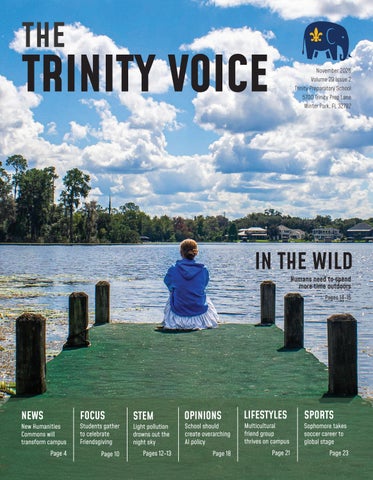
IN THE WILD Humans need to spend more time outdoors
Pages 14-15
NEWS
FOCUS
New Humanities Commons will transform campus
Students gather to celebrate Friendsgiving
Page 4
Page 1O
STEM
Light pollution drowns out the night sky Pages 12-13
OPINIONS
School should create overarching AI policy Page 18
LIFESTYLES
Multicultural friend group thrives on campus Page 21
SPORTS
Sophomore takes soccer career to global stage Page 23
November 2O26
TABLE OF CONTENTS
Table of Contents
14-15
12-13
Graphic by Sina Gooshvar
25
24 Photo by Lola Brown
Photo by Nathan Bitman
5 Nature’s Terms
County regulations protect wildlife during construction
17 Sunday School
Editor-in-chief Emily Lopez shares her perspective on gratitude
FOCUS
22 Two-Track Mind
gathering
24 Tough Crowd
Students embrace family traditions, cook for friends and plan weeklong trips,
to celebrate Thanksgiving with their loved ones
8-11
Chesarek twins share what it takes to be a competitive karter
Trinity’s sports teams face low student turnout at games
26 Athlete of the Month 27
Varsity cheerleader Madison White choreographs game day swap
Puzzles
Monthly puzzle page returns!
Masthead and Online Content
November 2O26 STAFF Editors-in-Chief: Ashwin Anand, Emily Lopez
Broadcast
Non-Print Editors-in-Chief: Olivia Agnew, Ben Kleiman Managing Editors: Sami Haddadin, Mia Prince Layout Editors: Krish Gupta, Sarah Zobel News Department: Janav Ramprakash (Editor), Victoria Suarez Lifestyles Department: Lila Choudry (Editor), Kiti Jamir, Mari Valdivia Focus Department: Taylor Griffith (Editor), Amelia Sasser, Elena van Dijk Opinions Department: Omi Tikalal (Editor), Clara Greenlee, Allison Keen STEM Department: Jena Mhamdi (Editor), Coco Wu Sports Department: Julia Wu (Editor), Neve Judelson Broadcast Department: Brayden Kells (Editor), Skyler Campbell, Britt Voll Podcast Department: Aarav Gupta (Editor) Social Media and Online Department: Gabrielle Williams (Editor), Maggie Zissman Graphics Department: Aylin Garibay (Editor), Sina Gooshvar Photo Department: Lola Brown (Editor), Nathan Bitman, James Ellzey, Broc Williams
Join social media editor Gabbie Williams for a behind-the-scenes feature on this semester’s upper school play, “Clue,” which ran from Oct. 14 to 17.
Podcast Tune in as podcast editor Aarav Gupta speaks with new Trinity Prep orchestra director Holly Watters about her journey and plans for the school year.
@TRINITY_VOICE @THETRINITYVOICE “THE TRINITY VOICE”
Website Exclusives
Business Manager: Skyler Campbell Advisers: Erin Miller, Brian Kells
The Trinity Voice is a member of the Florida Scholastic Press Association and the National Scholastic Press Association. The Trinity Voice is produced by the newspaper/journalism class at Trinity Preparatory School of Florida. Editorials represent the opinion of The Trinity Voice writer and are not necessarily the views of the administration, faculty, or Board of Trustees of Trinity. The Voice welcomes letters to the editor and free-lance articles or photography. All submissions become the property of The Voice. Please send all correspondence to 5700 Trinity Prep Lane, FL 32792. The Voice may also be contacted via phone at 407-671-4140 and via e-mail at voice@trinityprep.org. For information regarding the purchase of advertising within The Voice, contact us by one of the methods mentioned above. The Voice is a monthly publication during the school year (with the exceptions of November and January).
VOICE@TRINITYPREP.ORG THETRINITYVOICE.COM
Copy Editors: Neve Judelson, Victoria Suarez
Editorial Policy
Socials
Photo by Broc Williams
In addition to the content contained within the monthly issue, The Voice regularly publishes articles found exclusively on its website. Recent coverage includes the school’s new morning shuttle service and the updated upper school club schedule.
The monthly lead editorial (lead ed) represents the view of The Voice’s Editorial Board, which comprises the current editors-in-chief, managing editors, layout editors and opinions department editor. The editorial vote in favor of and against the month’s opinion is indicated below the editorial, along with a concurring opinion from a member of the Editorial Board. This month’s lead ed can be found on page 16. Send comments to voice@trinityprep.org.
News
November 2O26
NEW HOME FOR HUMANITIES
Humanities Commons set to transform learning and student life Article by Janav Ramprakash Photo Courtesy of Kelly Gaines As students returned to campus this year, “I feel like it just gives more opportunity for gether under one roof. Currently, the social familiar places around the Grille and Witmer people to relax and also gives more opportuni- science, English and world language departlooked strikingly different from the ones left ties for people to communicate with each oth- ments are spread across Stuart, Holloway, Brobehind in May. Fences now surround much of er and do their work,” junior Liam Weber said. kaw and MAC. the south end of campus as the school starts to “It frees up a lot of space and brings crowds to “Finding a common planning time to disprepare for the construction of the new Hu- the new building rather than different parts of cuss curriculum and see how we can collabmanities Commons. the school that could end up feeling cramped.” orate is always a challenge,” Spallone said. As the third phase of the school’s “Building While the new gathering areas will provide “It does not happen often because we are not for Tomorrow” campaign, the Humanities more space for students outside the classroom, under the same roof and we do not see each Commons follows the opening of the Nochur the building’s planned technology could also other very much. I feel like being hosted in Sankar Science Center in a broader effort to fundamentally change how they learn inside the same space, that’ll make those exchanges modernize academic facilities much easier.” across campus. In addition to its academic “The vision is a simple one,” improvements, the Humanities Head of School Byron Lawson Commons is expected to reshape said. “Balance advancement in the lunch experience, with a new facilities that have been started Grille on the first floor that will by Sankar across the campus and significantly expand both seating across clear areas of need.” and food service beyond what the The need for academic adcurrent space can provide. vancements helped shape the “Twice as many people will be school’s decision to focus its next able to eat in the new dining famajor project on the humanities cility as (the current one),” Lawside of campus, where many classson said. “We should be able to es are still held in the older Stuart serve more people faster than we and Holloway buildings. will now, which means lines are “We feel like, especially in Stushorter, which means your eating art, the building is falling apart,” experience should be better.” World Language Department The concept rendering of the Humanities Commons, which will be This increased capacity will Chair Vanessa Spallone said. also expand what the Grille can phase three of the school’s “Building for Tomorrow” campaign, highThe updated facility will bring lights the new learning and outdoor spaces planned for the facility. offer on its menu, with additionseveral parts of campus life into al stations featuring a wider varione building. Along with 18 humanities class- it. Among the proposed features are immer- ety of food. One of those will highlight foods rooms, the Commons is expected to include sive wall displays, which would function as from different cultures. upper school offices, a new Grille, three hu- large, interactive screens integrated into class“We have one that’s called Global Kitchen,” manities labs for different class activities and room walls, allowing students to explore places Head Chef Chris Behrens said. “South Korea two covered patios. around the world. is going to be one day. Venezuela could be The downstairs patio will hold roughly 150 “You can find yourself on the Great Wall of Monday, (and) Mexico could be Tuesday.” people while the upstairs patio will accommo- China if you’re in a Chinese class, and the next Beyond the classrooms, patios and dining date about 90, creating additional space for teacher would switch it to the Eiffel Tower,” spaces themselves, the broader goal of the Huclasses and larger activities. Spallone said. “You could explore Pompeii manities Commons is to create an environ“Having class out there, you can have im- in your Latin class on that huge wall. So that ment that changes how students learn, think promptu speeches,” Lawson said. “You can do would be absolutely fantastic.” and experience campus. more with oratory. You can do more with simAlong with introducing new ways for stu“I hope it’ll spark an idea,” Lawson said. “I ulations because you have space.” dents to learn, the Humanities Commons will hope it sparks new learning and also a new The patios are also expected to give students also make it easier for teachers to collaborate sense of calm.” more room to gather and socialize. by bringing the humanities departments to-
News
November 2O26
5
BUILDING ON NATURE’S TERMS County regulations protect the environment during construction Article by Coco Wu Graphic by Sina Gooshvar
The Nochur Sankar Science Center opened its doors last November after nearly two years of construction. Behind the scenes, before ground could even be broken, Trinity went through an arduous process to obtain a building permit. The first major hurdle was that the Seminole-Orange County border ran through the middle of the planned plot. After an interlocal agreement, it was decided that Orange County would oversee the construction, according to Chief Financial Officer Michael Drake. Orange County has strict rules and regulations regarding how wildlife must be handled during construction. “Nature’s going to happen, and they’re here first, and we have to take that into consideration,” Drake said. Some policies apply in all contexts, such as protection for migratory birds. Drake relates that, several years ago, when a protected bird nested on top of a broken field light, the light could not be repaired until the bird migrated. Other ordinances pertain specifically to development. For example, if native trees are cleared for construction, developers must either pay mitigation fees or plant new trees to offset the ones removed. The Orange County Florida Newsroom states that a survey of the trees cut down, including their species and diameters, would be conducted to determine the number of trees developers are required to plant. Per Drake, the school made an effort to save as many trees as it could during the construction of Sankar. Most were relocated and plant-
ed elsewhere on campus. Leftover trees were milled and saved in the maintenance shop. Head of School Byron Lawson may use the wood to build furniture, according to Drake. This ensures waste is minimized. Runoff is also an important concern with construction, especially due to the frequent rain in Central Florida. Soil is naturally permeable, allowing rainwater to seep through; concrete, on the other hand, is not, resulting in an increased flood risk in an area that is already flood-prone. In addition, when lands are paved, surface runoff filled with pollutants can flow into rivers and streams, degrading the water quality. To combat these worries, Trinity hired a civil engineer to supervise runoff and landscaping, and the retention ponds around campus help to prevent flooding. Trinity’s development atop once untouched swampland is far from unique in Florida. The Sunshine State, known for bright sunny skies and fresh, juicy oranges, was once declared by former Virginian Congressman John Randolph to be “a land of swamps, of quagmires, of frogs and alligators and mosquitoes! A man, sir, would not immigrate into Florida — and no, not from Hell itself.” Now, Florida is the third most populated state in the U.S. With the rise of the theme park industry, Orlando in particular has boomed. Orlando News projects its population to grow by nearly 100,000 people by 2035. To accommodate the influx, the city has been quickly expanding through urban sprawl, spreading into suburban neighborhoods. Al-
though more green space can be found in the suburbs, sprawl is less environmentally friendly than a compact city. “The suburban piece is going to require a lot more land usage,” AP Environmental Science teacher Emily Massey-Burmeister said. “In that regard, (suburbs are) worse than the city.” Due to the urban sprawl that Orlando has experienced in the past couple of decades, there has been an increased need for cars to travel around the area, increasing air pollutants such as ozone and other airborne particles. While urban sprawl grows larger in Central Florida, Orange County’s regulations ensure that wildlife will remain protected. On campus, wildlife will continue to be a priority as the school breaks ground again in the quad to replace Witmer. Sankar was only the first step of a three-phase plan released by the Board of Trustees in June 2026, and each new step will bring additional permitting and environmental discussions. “That oversight feels onerous when it happens, but after it happens you’re glad you went through it,” Drake said. “When (Trinity Prep founder Canon A. Rees Hay) was putting this place together, he knew what he was doing. ... He made sure it was environmentally sound but also sturdy.”
News
November 2O26
EDUCATION AND EXPERIMENTATION Article by Victoria Suarez Photos Courtesy of Sidarth Pothuraju, Graphics by Sina Gooshvar
Many Trinity students spend their summers ly as he connected his observations to global refined his vision for the center, he worked to serving their community by working summer trends and assumptions about the community. tackle the initial logistics of his plans. jobs or volunteering locally, but junior Sidarth By February 2025, he turned this desire into “First of all, it was building connections Pothuraju sought a way to serve beyond the a plan of action and an initiative to forge the at the school,” Pothuraju said. “Then it was traditional confines of the local community. essential connections to complete this project. talking to the higher-ups there (to ask) if I can Over the course of 18 months, Pothusomehow get a building. They were raju dedicated his summer and free not expecting it, but it ended up worktime to establishing the Amaravati Sciing. I also made a website for it.” ence Center in Tadikonda, India. The While it did work out in the end, center has already welcomed many the process of getting approved for a students since its soft launch on Aug. space did not occur without significant 1 and continues to host them as it prechallenges and effort. pares for its ultimate grand opening on “It was a lot of work to try and Jan. 4, 2027. get the former mayor to let me use a Pothuraju first became interested in building to put the science center in,” international STEM education during Pothuraju said. “That (process) took various trips he took where he saw sysa lot of time, almost six months, (of ) temic issues in the country. His long- Junior Sidarth Pothuraju oversaw the transformation of a just begging.” term interest and curiosity in the field disused building in Tadikonda, India, (top) into the new The next thing he needed was fiof science was also a significant factor Amaravati Science Center (bottom). nancial backing. Luckily, Pothuraju that made him realize the importance was able to leverage his new connecof patterns he noted. tion with the former mayor, who also “I used to go to India pretty often owned the school, which allowed for a in middle school and elementary,” significantly smoother process. Pothuraju said. “When I went to In“He helped me a lot with the funddia and volunteered in some schools ing, the location and everything,” Pothere, I realized that the education thuraju said. “All I needed to do was there is very basic. … There are no show him my ideas and plans for what lab activities that we have here, so I we would do.” wanted to help those children be more Local schools also provided donaengaged in STEM actions for the project after seeing the tivities and have more impact it would have for their stuhands-on learning.” dents. This was made possible because Pothuraju’s drive to ad“Even though there’s a big stereotype that of Pothuraju’s demonstrated dedication and dress the systemic issues in Indians want to do STEM, a large portion of the significant impact he knew he could make. the community only grew the population doesn’t really want to do it beFrom October 2025 to May 2026, Pothuraover the years, especial- cause they don’t know what STEM is,” Pothu- ju began the process of acquiring the necessary raju said. “I decided I have to build connec- elements to transform the space into a profestions, and the big project I wanted to do was sional science center. The renovato make the science center happen in India, tions began soon after. similar to (the) Orlando Science Center.” “That (time) was getHe spent roughly eight ting materials, getmonths, from February ting people to to October 2025, estab- help renovate lishing the necessary con- the buildnections for his project as ing and well as traveling around to getting centers in the U.S. and India gathering inspiration for layouts and exhibits. While he
News
November 2O26
Junior Sidarth Pothuraju establishes youth science center was a shift from his original vision in some ways. “The planning from what I initially wanted to do was pretty different than what actually happened once I saw the building in person,” Pothuraju said. “Initially I was not in India. I was here planning it, and my expectations of the dimensions and how it would be were completely different than when we went there, so I had to change a lot of the exhibit locations and sometimes what exhibits because they might not fit in the building.” The selection of exhibits included many visually striking structures as well as hands-on educational labs, Pothuraju (second from left) and contributors cut the ribbon at the Amaravati Science Center’s soft launch experiments and more. In addition, on Aug. 1. NASA scientist Nasa Chandru (center), the more labs for chemistry and biology event’s guest speaker, stands beside Pothuraju. will be added in the near future. “Mainly they were physics exhibits, like a the actual exhibits,” Pothuraju said. “Those large pendulum for Newton’s cradle,” Pothuratook a very long time to come in because ju said. “We have a butterfly (with) one wing they’re big and from (far away).” that is farther, one wing that is closer and the The home stretch came once everything ar- center in the middle. If you look at it from rived on location. Over the summer, he trav- a lens, it all comes together, even eled to Tadikonda; there he got to work setting though they’re parts away.” up the exhibits and ironing out the details The center held its soft openwhile providing his ideas to the workers. ing ceremony on Aug. 1, “I would go in the morning at 8 o’clock, at which it slowly opened and I would stay there until 4, watching the to the public. The initial people, making sure they’re doing it proper- success for Pothuraju bely,” Pothuraju said. “That’s what I did for all came clear as the center of summer. It was helping the people there welcomed its first students build the science center and them taking in to experience the exhibits, my ideas.” along with a guest speaker By summer’s end, the from NASA. building renovations “The kids from these rural arand setup were es- eas and the big cities, they came to sentially com- the science center, and seeing those kids pleted. While play with the experiments, try the different exstill closely hibits we had was such a good feeling to see,” matching Pothuraju said. “I was expecting that their parhis goal, ents forced them to go there or something, but the end they genuinely enjoyed it and had a bunch of fun. They learned a lot too, which made me so happy.”
Beyond the students, the center also welcomed a large group of STEM educators from around the region, whom Pothuraju was able to connect with through supplementary activities and material. “From the rural villages, teachers who taught at public schools there also came to the Science Center to see what they can do to help these kids learn STEM,” Pothuraju said. “I talked to a lot of them. I helped them. I showed them how they can make these smaller versions of the exhibits to take to their school. … (I) built a lot of connections with teachers.” Even after returning from India, Pothuraju continues to stay connected with the operations and development of the center. While the center has already made a significant difference in the community since the opening, impacting over 20,000 kids, it has made a massive impact on Pothuraju as well. “Probably the most important thing is you shouldn’t care about what other people think,” Pothuraju said. “Some people might think it’s a horrible idea, that no kids want to go … but if you truly believe that what you’re doing is good, it’ll be good. If you actually put in the time and effort to help and do something you truly believe (in), the outcome will always be good. That’s what I learned.” During the soft launch event, students, parents and educators interacted with the new science center’s numerous exhibits.
8
Focus
November 2O26
Focus
November 2O26
9
PASSED DOWN, PASSED AROUND Families source their Thanksgiving food in unique ways Article by Taylor Griffith Graphics by Aylin Garibay Celebrated widely throughout the United States, Thanksgiving has always been an occasion marked by the shared love of food. Different recipes and dishes bring families closer together and allow for traditions to be passed down through generations. Some families might go to the store and purchase their dishes, while others have unique ways that they make their Thanksgiving food at home. A lot of families buy their Thanksgiving dishes from the store because getting everything ready can take days, but for sixth grader Phoebe Landwer’s family, preparing their Thanksgiving meal is a year-long process. “We have a farm that we get a lot of “Me and my dad grow (a food from, but we also grow flowers all vegetable garden), and year that we enjoy we usually have vegeon Thanksgiving,” tables ready in time for Landwer said. In addition to what Thanksgiving.” they source from her grandparents’ family - Phoebe Landwer, sixth grader farm, Landwer and her father also initiated a tradition of their own. “Me and my dad grow (a vegetable garden), and we usually have vegetables ready in time for Thanksgiving,” Landwer said. Landwer plans to continue growing her own vegetables throughout her life because it shows the hard work done as a family throughout the year. Producing their meal from the ground up creates a more personal connection and makes the celebration more meaningful to Landwer and her family.
Another key part of Thanksgiving is the recipes passed down through generations, which are core to eighth grader Michael Garza’s celebration. “A bunch of casseroles have been passed down through my family,” Garza said. “It makes Thanksgiving feel more special because my grandma got the recipe from her grandma, and it shows the generations through food.”
Generational recipes can capture not only the good times but also the hard times that families went through, reflecting the period of history when each dish was first created. “My grandma always makes this broccoli cheddar casserole that’s super cheap and easy to make because her parents used to make it for her during Thanksgiving,” eighth grader Cade von Weller said. “It’s cheap because they lived through World War II, so that’s all they could have at (that) time.” Even though they live in different times now, the von Weller family continues this tradition to revisit the struggles that their family endured while also adding some recipes of their own. “For our turkey, we either “My grandma always get a ham from Honey Baked Ham or a turkey,” von Weller makes this broccoli ched- said. “We always inject the dar casserole. ... They turkey with apple juice to enhance lived through World War the flavor.”
II, so that’s all they could have at (that) time.” - Cade von Weller, eighth grader
November 2O26
Focus
FRIENDSGIVING FESTIVITIES Article by Elena van Dijk Photo Courtesy of Campbell Alch, Graphic by Sina Gooshvar The scent of rich spices, sweet pumpkin pie and baked turkey fills the kitchen during Thanksgiving week. Blessings, memories and old stories are shared around the table while everyone is able to enjoy a fulfilling meal. It sounds like an average Thanksgiving celebration, except one thing is different: The room is filled with friends, rather than family. Friendsgiving is a term that came about in the late 2000s. While Thanksgiving is often thought of as a highstress holiday that requires a ton of preparation, Friendsgiving provides a more relaxed alternative. “It probably should take more planning than I do,” senior Campbell Alch said. “I will normally just go to the dollar store and get cute little (decorations), and then I make a poster, but there’s not a lot of in-depth planning that goes on.” For a regular Thanksgiving dinner, the host is typically expected to provide the entire meal. With a Friendsgiving, though, the responsibility is evenly distributed throughout the group, with each guest typically bringing a small side dish or dessert such as mashed potatoes, stuffing or pumpkin pie. This not only reduces the host’s stress, but also allows the group to share their favorite recipes. “I prepare a lot of food, and I have all my friends bring a different dish so that we can all contribute,” sophomore Colette Voll said. Alch has hosted an annual Friendsgiving celebration for the past three years and finds that it is the perfect time to connect with all her friends. “I love hosting (because) I love having all my friends come together,” Alch said. “It’s a great time because the holidays are amazing
required. Activities are tailored to the group, so guests don’t feel obligated to participate in traditions that lack special meaning. Some groups, like Ramie’s, choose to keep things simple and enjoy a meal in each other’s company, but others prefer to lean into the true meaning of the holiday: gratefulness. “My friends wrote about why they were grateful for our friendship,” Voll said. “My favorite memory is reading all the cards. (It) was really special and made me feel so appreciated and loved.” Friendsgiving isn’t just about how the dining room looks, the organization that went into it, the activities or the taste of the food. It’s about spending time with the people you love and showing how much you value them. “It’s a great way to celebrate a great holiday … because you have so much gratitude and love not just for your family but also for your friends,” Voll said.
and we all get to talk about what we’re grateful for.” From the outside, a Friendsgiving celebration might appear to just be a fun social gathering, but for freshman Scout Ramie, Friendsgiving is so much more than that. “It gives me an opportunity to hang out with my friends and show them how much I appreciate them,” Ramie said. After the group has finished telling their favorite stories and discussing what they are thankful for, they begin eating. Friendsgiving is a flexible holiday, so sticking to normalities like watching football, running in the Turkey Trot or getting dressed up isn’t
Senior Campbell Alch (second from right) gathers with her friends on Nov. 22, 2025, for a Friendsgiving celebration, where each guest brings their own homecooked dish.
Focus
November 2O26
FAMILY, FLIGHTS AND FEASTS Students make the most of Thanksgiving break Article by Amelia Sasser Photo Courtesy of Cristina Garton, Graphic by Sina Gooshvar In the United States, Thanksgiving holds the record for the most traveled holiday weekend. For many, it is a time to gather with loved ones and share a traditional meal; however, celebrations can look different for everyone. While many travel locally to visit family, freshman Cristina Garton travels to the other side of the country — to California — each Thanksgiving to see her family. “I only see my family during Thanksgiving, so that’s why the trip is so special,” Garton said. “We always do a Turkey Trot together. It’s fun, even though it gets kind of hard, and then we come together and make dinner.” Most students use this break as a time to travel to see loved ones, but others use it as an opportunity to take a vacation. Senior Presley Sherman has traveled every Thanksgiving for the past five years. She especially enjoyed traveling to Park City, Utah, where the climate is significantly different from Florida. “Two years ago when we went to Park City, there was so much snow,” Sherman said. “It was very different from Florida because of all of the snow. It gives a ‘Christmas is coming’ feeling.” Although school might be out for Thanksgiving, sophomore Chloe Kang uses her break to debate. Each year, she travels to participate in a school-sponsored debate tournament with her teammates.
“It is definitely a really fun time because sometimes we get to skip the last Friday of school and get to travel,” Kang said. “Last year, and for most of the years to come, the tournament took place in Glenbrooks, which is the ‘winter Tournament of Champions’ for debate. ... After the tournament, we also got to fly out and see the Bean in Chicago and all of that fun stuff.” While the first part of Kang’s break is spent in a non-traditional way for most people, she does return home to her family for the rest of her break. One tradition she enjoys during her break is playing golf with her family. “We play golf really, really early in the morning, around 6 or 7,” Kang said. “And then we will play 18 (holes), so we finish around 10, maybe 11.” Another tradition that Kang holds dear is having a traditional Thanksgiving dinner surrounded by the people she loves. “We definitely like to stay and stick with traditions,” Kang said. “I help my mom, and we have this big Thanksgiving feast where we have stuffing, roasted or mashed potatoes, green bean casserole, and then the turkey and gravy. ... I really enjoy the cooking process, and it’s like Christmas where you’re just waiting all day and then you get to enjoy a nice feast.” Big crowds, long lines and heavy traffic are all factors that can add additional stress during the holiday season, but this does not stop people from traveling each year to see their family. In the U.S., Thanksgiving holds the record for having the most crowded airports. “Honestly, I do not experience crowds on cruises, because I think a lot of the time, people want to go to a family member’s house, but the airports do get crowded,” Sherman said. Cruises have become a popular way to travel for Thanksgiving break. They give people the opportunity to break away from the cold climate and also take away the stress of having to cook Thanksgiving dinner. While this may
Freshman Cristina Garton (second from left) vacations with her family in California over Thanksgiving break in 2025.
sound amazing for some people, Sherman prefers to spend her Thanksgiving break at a house with her family. “I don’t like that we go on cruises,” Sherman said. “It is weird to me, because when we go to Park City, I think it is fun, because we still have the traditional Thanksgiving meal. I know it’s a lot less stressful on my parents and my mom, because she normally is the one hosting, but I do like a traditional Thanksgiving meal.” A common theme among the students at Trinity is that they prefer to travel somewhere with a colder climate. Many think it makes the holiday appear more like Christmas and gives them a chance to experience snow, something they do not see in Florida, making the holiday even more special. “I really like flying and being able to go up north, especially because, preference-wise, I really like the cold, but definitely being able to travel as well is really nice,” Kang said. Thanksgiving travel continues to be a tradition for many American families. Whether it’s near or far, cold or warm, it’s ultimately the traditions created with family that keep this holiday special.
12
STEM
November 2O26
BLINDED BY THE LIGHTS Article by Sami Haddadin Graphic by Sina Gooshvar
Junior Simar Kang makes his way through downtown Orlando, stopping amid the excitement and frenzy to look up in admiration of the night sky — something he’s enjoyed doing since he was 8 years old. Expecting to be met with the comforting feeling of cosmic awe, Kang instead sees something more striking: a blanket of darkness, devoid of celestiality. The National Park Service reports that more than 99% of U.S. residents live in areas affected by artificial light pollution. Light pollution is defined by DarkSky International, a global nonprofit organization working to protect nighttime environments and reduce light pollution, as the human-made alteration of outdoor lighting levels and the excessive or inappropriate use of artificial light at night. The problem has since proliferated and become normalized in daily nightlife as societal trends shift the bright line for what is considered the bare minimum amount of light necessary. With this has come the need to delineate regions of light using the Bortle dark-sky scale, a nine-level numeric rating system that measures night-sky brightness and the impact of light pollution at a specific location. “I live in a Class 6 zone, so a decent amount of stars are visible, and then you could probably make out the Andromeda Galaxy, which is the closest galaxy to Earth,” Kang said. For comparison, downtown Orlando is Class 8-9, placing it in the highest levels of light pollution. Trinity’s campus usually falls in Class 6, considered a Bright Suburban Sky.
To the typical suburban dweller, a Bortle tor-prey relationship … to be super messed up Class 6 sky may appear sufficiently dark, with because predators can easily see birds.” little indication of the environmental conseSea turtles further exemplify the effects of quences of artificial lighting. Yet this percep- light pollution on the natural environment. tion reflects a shifting baseline, as generations “The natural flow would be that (baby sea of exposure to artificial light have normalized turtles) see the moon reflected off of the ocean a nighttime environment far removed from and head in that direction,” AP Environmenits natural state. Without a meaningful frame tal Science teacher Emily Massey-Burmeister of reference, said. “However, when residents may “‘Who created us? Why are we you have houses that also judge their skies have artificial lights on favorably by here? What’s going on out there?’ the outside of them, the comparing them … Without … the charm of Earth’s baby turtles turn around, with more heavand instead of heading ily light-pollut- natural beauty in the night sky, out into the sea, they ed areas, such you lose that spark for wonder.” turn towards suburban as downtown areas … instead.” Orlando, conIn both animals and - Simar Kang, junior flating a relative humans, light pollution improvement with an absence of harm. disrupts circadian rhythms, the internal biLight pollution’s impacts can be categorized ological clocks that regulate sleep, hormone in two ways: materially on the environment, production and other daily and seasonal proand psychologically within the human mind. cesses. In animals, this disruption can alter miEnvironmentally, light pollution plays a su- gration, reproduction and feeding patterns. In perficial and destabilizing role in disrupting humans, artificial night light can suppress melthe natural ebb and flow of ecosystems, both atonin production, interfering with sleep and on campus and regionally. contributing to broader health consequences. “(Light pollution) can disrupt (birds’) miDarkSky International attributes millions of gration patterns because a lot of them rely on animal deaths to excess artificial light alone. It the stars and natural sites to navigate,” Kang also reports that 30% of all outdoor lighting is said. “Lights can prematurely shift them off wasted unnecessarily across commercial buildtheir path, and even for resident birds here at ings, storefronts and residential properties, reTrinity like the sandhill cranes … it can reduce sulting in $3.3 billion in lost costs and roughly their habitat quality … (or) cause the preda- 21 million tons of carbon dioxide emissions.
6
STEM
November 2O26
13
Light pollution hampers human curiosity and environmental progress While some lighting is essential for safety and visibility, much remains illuminated long after it serves a practical purpose, often because people are unaware of its consequences. “In the business ... world, you can still see buildings that are lit up, and I guarantee you that that high-rise probably doesn’t have all 400 different offices currently working,” said English teacher Steven Krueger, a bird and outdoors hobbyist. “But absolutely, I think sometimes it’s (that) we just don’t even think about it. We just leave it on when it’s probably not necessary.” Compared to their outsized importance in checking ecosystems, insects often receive little attention as a casualty of light pollution. A 2017 study published in Nature found that artificial nighttime lighting reduced nocturnal pollinator visits by 62%, which is compounded by disrupted reproduction, increased predation and death upon contact with hot bulbs. Beyond its ecological consequences, the extent of light pollution has been magnified by the widespread adoption of cost-effective LEDs, hindering scientific discovery and photography of the cosmos. “Massive observatories have to move higher up or farther from cities, which is both expensive, especially if you’re building on a mountain, but also is just inconvenient, especially on the East Coast where you can’t really avoid light pollution,” Kang said. Outlets for human creativity, curiosity and passion are also paying a price, materialized
through examples such as accessibility barriers to photography and the notion that the Earth loses its charm. “It’s super hard to edit photos … because the sky is more washed out, and it’s harder to photograph distant objects without using (light pollution) filters that can run … $500,” Kang said. “When (people) go out and look at the stars, they find themselves wondering, ‘Who created us? Why are we here? What’s going on out there?’ … But without … the charm of Earth’s natural beauty in the night sky, you lose that spark for wonder.” Addressing light pollution demands practical changes to how institutions illuminate their spaces after dark. At Trinity, this could look like reconsidering whether existing lighting practices adequately balance campus safety with environmental responsibility. “(One) of the major ways is turning the lights off after 10 or 11 p.m. completely across the campus … from Sept. 1 to around Nov. 30 because that’s the peak migration season,” Kang said. “And with our position on the Atlantic Flyway … Trinity should contribute to that by using shielded lighting.” Additionally, the use of motion-activated lighting systems, light shielding or warmer-spectrum lighting remains a viable avenue for reducing impact. However, these solutions presuppose that awareness of the issue already exists, making staying informed a prerequisite for effectively mitigating risk. The awareness gap can be re-
solved by staying in tune with organizations like the Cornell Lab of Ornithology and DarkSky International, which offer resources to help people understand light pollution and take steps to reduce it. “A lot of us go through life (by) just … walk(ing) from place to place,” Krueger said. “We’re maybe a little bit oblivious or not really attentive to what’s going on around (us). And (my love for nature has) made me more aware and conscious of everything that’s around me.” Human attention is increasingly consumed by the demands of a fast-paced, material-driven society, leaving less time to pause and appreciate the natural world. This erosion of attentiveness threatens not only humanity’s relationship with the environment, but also our ability to recognize something larger than ourselves. Light pollution compounds this loss, obscuring the night sky and foreclosing the opportunity to experience the spark of curiosity and wonder that encourages us to reflect on our place in the natural world. “When we go to the senior trip in High Springs … every year, not everybody, but a fair number of seniors look up, and … you can tell that they haven’t seen a sky that full of stars and that alive,” Krueger said. “I don’t know if you can quantify the value of that, but it certainly is a sense of being part of something bigger and (gaining) more of an awareness of our position in the universe.”
STEM
November 2O26
TOUCH GRASS Article by Jena Mhamdi Graphics by Sina Gooshvar
Trapped within concrete walls and absorbed in technology, humans rarely walk out of their doorsteps anymore. In fact, as “the indoor generation,” students spend the majority of their day inside. According to the U.S. Environmental Protection Agency, on a daily basis, Americans spend around 87% of their time indoors and another 6% in vehicles. This leaves only 7% of the day, around 100 minutes, of time outside. While sometimes inevitable, this sedentary lifestyle can lead to health complications.
Among other things, being outdoors improves the circadian rhythm, the body’s internal clock. Spending too little time outdoors causes disruptions to the cycle. “If you’re inside for too long, it messes up your sleep cycle,” biology teacher Bryan Moretz said. “You might have trouble falling or staying asleep because of the unnatural light that’s being produced and overstimulation from the technology around you.” The circadian rhythm is heavily impacted by sunlight. According to Stanford University, sunlight exposure impacts the circadian rhythm by giving the body cues; bright sunlight means it’s time to wake up, and less or no light means it’s bedtime. These internal cues are regulated through serotonin, the mood hormone, and a lack of natural sunlight inhibits it. Serotonin is also a chemical building block, or precursor, to melatonin, the hormone that regulates sleep. Secondly, being outside lowers the level of cortisol, a stress hormone. In moderation, cortisol is beneficial and
even necessary, but an excess causes high blood pressure and irregular heart rhythms. Like serotonin, cortisol is also impacted by sunlight exposure, specifically in the morning. A lack of morning sunlight prevents a natural cortisol spike. This morning spike is needed to boost alertness and sharpen focus, and without it, the body may enter a high-anxiety or fight-orflight state. “Reconnecting with nature (allows you to) get away from a high-intensity anxiety situation,” Moretz said. “It relieves some of that natural fight-or-flight response and gets you back to a rest-and-digest state where you’re relaxing your mind, letting your body get back to its natural state.” Vitamin D is another essential hormone involved in outdoor benefits. The body can only make vitamin D when exposed to UVB rays, like those found in sunlight, and it is crucial in strengthening the immune system. Low vitamin D levels are also associated with chronic health issues like diabetes and osteoporosis. Although it is becoming harder to spend more time outside, that isn’t to say society is unaware of the benefits. For example, several students have traveled far and wide to go on excursions in nature and discover new places. “Every year, I go to France and hike a bunch of trails there, and it’s really fun to do,” freshman Isabelle Gervais
STEM
November 2O26
Spending more time outdoors offers health benefits said. “My favorite hike was when I was 8 and I went all the way to Machu Picchu on the Inca Trail with my sister.” The Inca Trail is among the most popular international nature retreats, alongside several mountain ranges and European coastlines. In the U.S., the wide variety of national parks is a fantastic way to explore the wilderness. However, not every nature getaway even has to be out of state. Central Florida offers several trails and parks to escape the confinement of being indoors. “There’s a hike here in Orlando, probably 20, 30 minutes away, called Black Bear Wilderness Preserve,” junior Ellie Rice said. “That one’s really fun. We always see alligators when we go, and it’s along a river, so we walk around it. I’ve also seen wild boar there, which was pretty cool.” Overlooking the St. Johns River in Sanford, the Black Bear Wilderness Preserve is 22.8 miles away from TPS and contains a 7.1-mile walkable loop. Its resident animals include black bears, alligators and
white-tailed deer. More local, Wekiva Springs, 13.9 miles away, is Orange County’s longest-running tourist attraction, offering experiences ranging from swimming to camping to even equestrian sports. Having access to nature retreats such as these allows students and teachers alike to spend as much time outside as possible. Scientists have developed various structured methods to combat the harmful but necessary effects of being inside, ranging from monthly and yearly resets to a so-called magical formula. Neuroscientist Rachel Hopman formulated the 20-5-3 rule, a rule for how much time should be spent in nature. The rule states that people should aim to spend 20 minutes outside in a local space, such as a park, several times a week; five hours per month in a semi-wild or natural environment; and three days a year in the wilderness. Studies conducted by the University of Michigan show that 20 minutes in nature daily is enough to help prevent elevated cortisol levels. “You can just sit around, walk and relax,
listen to the birds sing, enjoying the warmth of the sunshine,” Moretz said. “That is usually enough to reset your body and relieve those stress levels.” Unfortunately, most people don’t have all day to frolic in the sunshine, and those in urban areas lack direct access to nature. However, there are ways to bring the outside inside; this includes opening windows or skylights three to four times a day to let natural light in or adding greenery around the house. Some more accessible alternatives include listening to rain or bird-song ambience, using a scent diffuser with natural scents, purchasing a light therapy lamp or installing pictures of nature. However, while these can be a helpful shortterm solution, the benefits of nature cannot be fully replicated. “The best medicine is just to go outside as much as possible and spend time in nature,” Moretz said. “You can’t really substitute the sun or sleeping.” As technology becomes ever-present in society and students and teachers alike are forced to spend more and more time inside, it is important to remember the value of nature. “We are so absorbed by our phones and social media that we sometimes forget that we need to step outside into nature and reconnect with our roots,” Moretz said. “Our bodies have been evolving for hundreds of thousands of years to live outside and function their best outside, but post-COVID, after social distancing and self-isolating, we got stuck.”
November 2O26
Opinions
NEED FOR MORE CLARITY Trinity lacks transparency in financial aid
Someone who works a full-time job at Flori- information given and determines a financial tween raising awareness and creating expectada’s $15 minimum wage earns $31,200 a year: award amount. tions about assistance that the school cannot the same annual tuition of Trinity Preparatory For prospective families, that timing mat- guarantee blindly. School of Florida. For such a family, finan- ters. Families apply for admission and finanThat perspective is worth considering, but cial aid is necessary, but that sticker shock of cial aid simultaneously, but the formal award financial aid should be presented transparent$31,200 may turn some families away. is provided with the acceptance contract by ly. Advertising its existence but having families The biggest obstacle is that families do not Trinity’s financial aid committee, which makes not know what amount of aid they will receive find out about financial aid specifics until after the final award decision. until they go through the admissions process admission. Although it makes sense that TrinTrinity says financial aid information is could discourage prospective families from ity cannot make such bold promises on aid available through its website, virtual work- starting the initial application. without knowing how many students will at- shops, individual conversations with families Simply having information available does tend, such a timeand mail outreach. not guarantee that people understand how and line may discour- “I don’t think (current students) Clarity also pro- if it applies to them. The solution is not more age families from vides resources for advertising. It is clearer outreach to make sure even starting the personally get much information.” families completing families are knowledgeable about the check application prothe application. they have to write and the options that bal- Alan Parker, student who was cess. The challenge Communication ance it. is to what extent given a pseudonym matters especially Families should understand that assistance is general financial for families who available, know what the application requires aid information informs families on whether have never applied for private school financial and have an opportunity to discuss what Trinior not financial aid applies to them specifically. aid. For someone unfamiliar with the process, ty may be able to offer prior to applying. Trinity does get a few things right: The something simple like knowing where to begin None of this guarantees financial assistance. school acknowledges the complexity of a fami- can make a difference. It does not mean every family will qualify, nor ly’s annual income, and the admissions process Alan Parker, a student given a pseudonym does it erase the cost of private education. It is need-blind, meaning a family’s financial aid due to the sensitive nature of financial aid as gives families a more complete understanding application does not affect its admission deci- a whole, said his family knew about financial of the financial commitment before they make sion. Financial circumstances are more com- aid before he attended Trinity and found in- a decision. plicated than a single number on a tax return. formation through the school’s website and by Accessibility begins with knowing an opporA six-figure household income can look com- having conversations with representatives. tunity exists. If schools want families to serifortable until a mortgage, multiple children, “I think the student population knows very ously consider financial aid, they should unmedical expenses, student loans and other ob- little about it,” Parker said. “I don’t think we derstand that aid is part of the process before ligations begin to add up. personally get much information.” they see the price. Trinity does provide financial aid informaThat awareness matters beyond our campus. A tuition number may be the first thing a tion, and families can complete the applica- When current students understand that finan- family sees. It should not be the only thing tion through a third-party financial aid plat- cial aid exists, they can also speak more knowl- they consider. form called Clarity. The platform collects a edgeably about the possidetailed picture of a household’s finances, and bility of attending Trinity The Editorial Board unanimously supports this opinion. the application itself costs $65 unless a school with friends and family provides a fee waiver. Using a third party also outside of the school. separates the initial financial evaluation from Parker believes families the school itself. have a responsibility to reAccording to Victoria Johnston, interim search financial aid them“Families should not be forced to play a director of admissions and tuition assistance, selves. From his perspecguessing game about whether our school the system allows for an unbiased party to eval- tive, Trinity does not hide is even an option for them.” uate families’ financial documents before the its program, and there is - Ashwin Anand, editor-in-chief school’s financial aid committee considers the a legitimate balance be-
PRO: 7 CON: O
Opinions
November 2O26
SUNDAY SCHOOL
“Give thanks in all circumstances; for this is God’s will for you in Christ Jesus.” 1 Thessalonians 5:18 (NIV)
OMG, thank you! Article by Emily Lopez Photo by Lola Brown, Graphics by Sina Gooshvar Throughout my lifetime, I’ve watched countless sitcoms: “Modern Family,” “The Middle,” “The Goldbergs,” etc. My favorite episodes are the holiday ones, where the dysfunctional, hilariously chaotic families come together to carry on old traditions. Although the characters are different for each show, we can generally predict what their holiday celebrations will look like. They’ll go trick-or-treating on Halloween and open presents on Christmas morning. They’ll sit around the dinner table at Thanksgiving, sharing what they’re grateful for that year. I love watching these families share a meal, a prayer and some heartfelt conversations over Thanksgiving dinner because I can relate to it; I’ve grown up doing the exact same thing. Thanksgiving presents the perfect opportunity for us to reflect on our blessings and practice gratitude. We all are expected to take the time to appreciate all that we’re grateful for on one day each year. But what about the other 364? Gratitude should be a daily practice. It’s easy to be thankful when we’re surrounded
by loved ones and home-cooked meals. It’s easy to be thankful when we’re on a vacation over summer break or hanging out with our friends on a Friday night. It’s in the more mundane moments — the everyday rituals — that we often overlook how blessed we truly are. While going to school can sometimes feel dreadful, attending Trinity is a privilege in and of itself. We are all blessed to belong to a community that is dedicated to learning and growing together. I’ll admit, I groan alongside my classmates on the way to college counseling classes every now and then. I flippantly protest with my peers when we’re given a pop quiz in AP Lit. But then I think, “What a silly thing to be upset about.” We’re lucky enough to have college counselors who devote themselves to the juniors and seniors on their individual college journeys. We’re fortunate to be enrolled in AP classes led by teachers who truly work their hardest to not
only prepare us for the final AP exam, but to teach us with passion and fervor for the subject. It’s when we take a step back — when we address the ignorance of our complaints — that we finally realize how thankful we ought to be. I challenge you to do exactly that: take a step back. When you catch yourself wanting to complain about something as trivial as a pop quiz, try to look at the bigger picture. How lucky are we to end up here? We have an abundance of opportunities, support and freedom. We are able to explore our interests. We are encouraged to pursue our passions, and provided with the resources to do so. There are infinite things to be thankful for. Don’t be so quick to overlook them. God calls us to “give thanks in all circumstances” (1 Thessalonians 5:18). Gratitude is a fruit of the Spirit, a key virtue Jesus exemplifies throughout the Gospels. As the Holy Spirit lives and breathes in and through us, it produces this fruit within us. In Galatians 5:25, Paul writes: “If we live by the Spirit, let us also walk by the Spirit.” In other words, if we want to honor God, we must live by the virtues he calls us to, one of them being thankfulness. Let us continue practicing gratitude even after Thanksgiving Day is over. Let us focus on our blessings, rather than hyperfixating on nuisances. Let us praise God for looking after us, providing for us and blessing us every day of our lives. Let us give thanks.
Disclaimer: This column reflects editor-in-chief Emily Lopez’s personal Christian faith. The Trinity Voice represents the entire student body and does not have any particular religious affiliation. The Voice honors and respects all faiths, beliefs and worldviews within the school community.
November 2O26
Opinions
ARTIFICIAL CONFUSION
Differing AI policies across campus leave students confused Article by Allison Keen Graphic by Aylin Garibay If you ask three different teachers if you can use ChatGPT on an assignment, you’ll get three completely different answers. Artificial intelligence is constantly evolving and seemingly limitless. Yet the policy at Trinity remains largely undefined. Permitted AI use varies between grades, departments, classes and even individual assignments. As AI becomes more prominent in everyday life, Trinity needs to implement a campus-wide policy to eliminate student confusion. The administration does have a core philosophy guiding AI use. “The singular overarching policy is balancing both productivity and the authenticity of a student,” Head of School Byron Lawson said. Despite this overarching philosophy, the student handbook includes no true policy and just a few passing mentions of AI, doing little more than classifying inappropriate use of AI as academic dishonesty. Student temptation to use AI comes from this lack of clarity. Some classes allow for AI to be used in specific circumstances, like research for a project or making study materials, while in other classes, AI may be ruled out entirely. Instead of an overarching policy, the school has department-level policies. Such policies are in place to ensure students still learn the skills that a preparatory school promises to teach them, as well as preparing for the next step of college. “AI policies were given to us to do,” Social Science Department Chair Robin Grenz said. “We got feedback from everyone in the department. … Then we sat in a meeting and made sure we were all on the same page.” Even if policies were a collaborative effort within departments, having so many department-specific policies creates stark differences between classes.
For English classes, using AI at all takes away from the point of creativity and authenticity. According to English Department Chair Chad Pentler, the English department’s policy says AI must never be the primary intellectual engine, especially in a time when students are in the process of developing their writing voices. Across all departments, AI policies can be found as part of the course syllabus, but after the first month of school, the syllabus often becomes an afterthought that is viewed as barely enforced. Without a strict, overarching policy, restrictions remain unclear. If AI is permitted on any part of an assignment, it should say so, as done in many English classes.
Department policy also varies depending on grade level. Within social science classes of sixth and seventh grade, the use of AI is limited only to teacher-directed lessons and assignments. Generative AI tools are prohibited unless supervised by the teacher, unless it is strictly for study materials. “If we’re not skill-developing when we’re 13, you’re not going to skill-develop when you’re 16 or 17,” Lawson said. ”You’re just going to be behind and then dependent on it.” This rationale for limiting AI use is valid but should be made clear in a school-wide policy. By including the negative effects of AI in its policy, the school can make students aware of the harms instead of just being discouraged from using AI. “As AI tools evolve, they’ll be more friendly to the classroom, bearing in mind that we want students to develop thinking skills, without becoming overly reliant,” Grenz said. The issue with AI is the willingness of students to submit an assignment that has no original thoughts or authenticity. Cognitive offloading is defined as using alternate resources to reduce mental effort required for a task. AI takes this to an extreme; instead of taking a task off of the brain, it takes thinking as a whole, giving the user ideas or answers without any effort. This stops students from learning the skills that the assignments were meant to teach, something a policy could potentially prevent by warning about the negatives of AI. Flexibility is important when dealing with AI. But when policies constantly change, or are all completely different, it becomes a whole other task students are meant to remember and keep up with. A consistent, clear school policy is necessary to provide clarity and direction to students to ensure the work done is completely authentic.
Opinions
BEEN THE
MUST’VE
November 2O26
SCHWIND
EDITOR’S TAKE: AI POLICY Column by Ashwin Anand Photo by Eden Kiger It’s true that our school lacks a standardized policy on artificial intelligence. It also lacks a unified policy governing calculator use. Why? Because Expanded Pre-Algebra and AP Physics have vastly different educational goals, and calculators are a tool, just like rulers, dictionaries and spellcheck, to aid students in reaching those goals. AI, with its infinitely greater capabilities, deserves, at minimum, the same level of nuance. Notions of “productivity” and “authenticity” inherently vary from math to English, so each department will need its own balancing act. As long as students are made aware of the parameters for a particular assignment, there is no harm in tailoring them to the objective at hand. In fact, that’s what an effective teacher does. Students are perfectly capable of processing distinct guidelines in each of their classes, as well as adhering to syllabi they (theoretically) read and signed. Of course, additional clarity can never hurt, and teachers are more than willing to provide it. In solely condemning the institutional approach, we too eagerly absolve students of responsibility for how they choose to engage with AI. Color me cynical, but I don’t believe the majority of misuse stems from well-intentioned confusion. The sad truth is that AI is a quick and painless way to circumnavigate mental toil. No amount of standardization will weed out teenagers’ innate desire to cut corners. If we wish to eradicate AI abuse, students must look inward to their attitudes, not outward to the administration. Good policy requires discernment. A single AI standard for all grades, departments and courses would be artificial — and, dare I say, not too intelligent.
TIKALAL TALKS Three years to change the clock Article by Omi Tikalal Photo by Lola Brown, Graphic by Sina Gooshvar For Florida teenagers, 7 a.m. can feel less like the beginning of the school day and more like the middle of the night. House Bill 733, signed by Gov. Ron DeSantis on May 12, 2023, required middle schools to begin their instructional day no earlier than 8 a.m. and high schools no earlier than 8:30 a.m. The legislature gave districts until July 1, 2026, to make the change. The bill passed the House 92-90 and the Senate 38-2, making its original support difficult to characterize as a narrow partisan issue. The reason behind it is extremely simple: Teenagers need shuteye. Puberty naturally shifts adolescents’ circadian rhythms, making it harder for many teenagers to fall asleep early while their bodies still require substantial rest. The American Academy of Sleep Medicine supported HB 733, arguing that later start times align school schedules with adolescent biology. The science is convincing. The effects, however, have been considerably messier. For student-athletes, the argument is more complicated. A later school day could push practices and games later, potentially interfering with transportation, jobs and other activities. But earlier practices can come with their own costs, like athletes being asked to wake before sunrise before spending an entire school day in class. If the goal is to have students perform at their best both in classrooms and on athletic fields, giving them a reasonable opportunity to sleep should hardly be controversial. Yet changing the bell means changing much more than the bell. In 2023, the average public Florida high school started at 7:45 a.m., with 46% of them starting before 8:30 a.m. and 19% starting between 7:30 and 8 a.m. The national average for private schools, however, is 8:12 a.m. That means a large portion of high schools would
Each month, in this recurring column, opinions editor Omi Tikalal will tackle a political issue relevant to students.
need to change their schedules to meet the 8:30 requirement. Transportation is one of the biggest obstacles. Changes in high school schedules can force districts to rearrange bus routes, which could require additional buses and drivers. Florida knew this was coming. The state appropriated $5 million for an Early Start Time/ Transportation Grant Program to help districts plan for the transition and address transportation and instructional challenges. Three years should have provided sufficient time to work through those problems. Instead, when the deadline approached, Florida changed the rules. In 2025, the Legislature passed Senate Bill 296 unanimously in both chambers. The law allows a district to be considered compliant with the start-time requirement if it submits a detailed operational report to the Florida Department of Education. That report must include current school start times, strategies the district considered, financial impacts and unintended consequences. So the 2026 deadline arrived without the 8:30 a.m. bell boarding with it. There is a legitimate argument for that flexibility. A statewide mandate can overlook enormous differences between a rural district with limited transportation resources and a large county operating hundreds of bus routes. Schools cannot simply invent buses, drivers or childcare arrangements because Tallahassee changed the clock. But that just proved Florida has identified an issue with no solid solution. This leaves Florida with an unusual compromise. The state continues to require districts to educate their communities about the effects of sleep deprivation and consider the benefits of later start times, while allowing districts to keep earlier schedules if they complete the required reporting process.
2O 2O
November 2O26
Lifestyles
ADAPTING ADAPTATIONS Article by Lila Choudry Graphic by Aylin Garibay
In English 7, classes conclude their reading of S.E. Hinton’s “The Outsiders” with a watch of the 1983 film adaptation. Ponyboy, Johnny and the rest of the Greasers suddenly have faces, voices and a soundtrack. The story that lived in paperback pages becomes something physical on screen, and a class that already knew the ending finds itself invested in the story all over again. That strange ability to make an old story feel new has returned to theaters with Jane Austen’s “Sense and Sensibility,” released in the United States on Oct. 16. Georgia Oakley’s adaptation, starring Daisy Edgar Jones and Esmé Creed-Miles as Elinor and Marianne Dashwood, arrives more than 30 years after Ang Lee’s 1995 film and 214 after the initial publication. The two movies will tell the same Austen story in two very different expressions, separated by changing ideas about filmmaking, culture and the audience watching. English teacher and film enthusiast Steven Krueger believes that the constant return of stories is a crucial part of the reason they survive for so many years. “Writers tap into something that’s universal or so intriguing that it’s kind of hard to let go of,” Krueger said. Krueger describes the process as “almost like a time-traveling group project.” A filmmaker inherits a story written in another time, then has to figure out how to make sense of it in the present. That means some things stay intact while others inevitably shift. The distinction between a story’s spirit and its details matters. A book and film cannot communicate in exactly the same way. A novel can linger inside a character’s thoughts; a movie has performances, costumes, music, lighting and camera to do the work. Translation requires choices, and those choices are where the time period of an adaptation begins to show. That is also where adaptation becomes useful in an English classroom. Rather than treating the film as merely a visual, Krueger asks
students to pay attention to what changes between versions. “When I’m teaching adaptations, I like to look at what’s stable and what’s shifted,” Krueger said. “And then why did they make that change?” The question turns a difference in a movie into analysis. A director might emphasize a relationship that previously felt secondary, change the rhythm of a scene or frame a character in a completely different way. Those decisions reflect the interpretation of the filmmakers, but they also reflect what a contemporary audience expects from a story. “We want to be able to open up blind spots that we all have,” Krueger said. Seeing another interpretation can make a familiar character look stranger, funnier or more complicated. Something overlooked in a book can become impossible to miss on the screen. Krueger said he is especially drawn to adaptations that “invite more interpretive leaps,” because contemporary pacing and visual styles can make older work feel culturally relevant. That is where the newly released “Sense and Sensibility” becomes particularly interesting. Austen’s 1811 novel follows Elinor and Marianne Dashwood through romance, inheritance and the expectations placed on women. Lee’s 1995 adaptation translated those tensions for the end of the 20th century. Oakley’s 2026 version arrives in a world with a different vocabulary and meaning for relationships, independence and womanhood, meaning the same sisters can be viewed through an entirely different cultural lens. The Dashwood sisters have survived Regency England, the 1990s and now the streaming-era attention span. Their circumstances may belong to another century, but each adaptation gets to decide what still feels alive.
Lifestyles
November 2O26
FRIENDSHIPS BEYOND DIFFERENCES
Multicultural friend group embraces diversity Article by Kiti Jamir Photo by James Ellzey, Graphics by Sina Gooshvar Friendship does not require having the same native language, comparable upbringing or even the same food palate. For a certain group of juniors, what started as a few strangers new to Trinity during freshman year quickly evolved into a friendship that embraces cultural diversity. The group includes Azzurra Marchese, who regularly visits her family in Italy; Emilia Gonzalez, who enriches the circle with her Colombian background; and Cassidy Driscoll, who is not just Puerto Rican but also Native American. “We’re very open to (different cultures), which is why we work so well as a friend group because we like talking about them and comparing our own cultural identity with different ones,” Gonzalez said. Every hangout or celebration brings out a different cuisine, like the platter of Colombian dishes at Gonzalez’s quinceañera or Marchese’s signature pasta dishes at her birthday parties. A fun highlight was when the girls tried another friend’s Iranian foods for the first time. Not only was it an introduction to a new cuisine, but it also strengthened the group’s bond by helping them get to know each other on a deeper level. “I love how even though we might be all different culturally, that isn’t a roadblocker for us to become close,” Driscoll said. “And I know that’s very hard for people (because) sometimes when their cultures don’t align, they can’t be friends, but I think that’s what strengthens our friend group since we learn about each other and we all respect each other in many ways.” When Culture Fest comes around, the student body comes together to showcase their delicious
food and beautiful cultural attire. The friend group takes this opportunity to visit each other’s stalls to try unfamiliar treats, put on vibrant garments and share the excitement of honoring their respective cultures. Being immersed in these celebrations also allows them to make linguistic exchanges, influencing their everyday communication. “I definitely have learned a lot about their cultures, whether that’s being Colombian or Italian,” Driscoll said. “It’s definitely interesting to learn about how they say stuff in different languages, and we’ll say crazy phrases.” The three girls collectively express their intrigue with the different religions practiced in their circle to better understand each other. They are met with openness when approaching unfamiliar topics, choosing to avoid any misunderstandings. When track season happens at the same time as Ramadan, another one of their friends, who is Muslim with Tunisian roots, has to run without eating or drinking the entire day. Knowing this, Driscoll, Marchese and Gonzalez all sympathize and show their support. “I’ve asked (my friends) about their religion several times because I genuinely don’t know that much about it,” Marchese said. “They’ve always welcomed the questions and answered them honestly, so we’ve built something where it’s OK to ask questions and not know.”
Pictured left to right: Juniors Cassidy Driscoll, Emilia Gonzalez and Azzurra Marchese each contribute individual cultures to their diverse friend group.
Their connection isn’t just found in the various flavors they share or the cultural festivities they celebrate. It also resides in the quietness of intertwining their differences to lift each other up. “They help me a lot,” Driscoll said. “When I took Spanish, my friends who speak Spanish helped me (with my assignments).” As distinct parts of the world share a table, their connection allows the group to lead conversations with empathy and genuine curiosity. The mix of various traditions and experiences curates a multicultural lens, allowing the group to approach differing perspectives with acceptance. Interactions that build closeness in such ways show that people learn most from depending on each other. “(Being in a diverse friend group) has made me a lot more understanding and considerate of others,” Marchese said. “(I’m) also more open to things because I feel like I’ve adapted to being OK with not knowing everything about someone’s culture and being comfortable to openly ask and be respectful about it.”
November 2O26
Lifestyles
TW -TRACK MIND
Chesarek twins impart experience and interest in motorsports Article by Mari Frederickson Valdivia Photo by Broc Williams, Graphics by Aylin Garibay Karts zoom past, engines roaring. Sophomore twins Liam and Landon Chesarek are neck and neck for a place on the podium. Family and friends cheer from the stands, sitting on the edges of their seats, waiting to see who finishes out on top. Liam and Landon glance at one another through tinted helmets, feeling the push and pressure they apply on one another. Rivalries are common in all sports, internationally and domestically. In motorsports, it’s common to see a lot of teammate rivalry, given the sport’s individuality. In the case of the Chesarek twins, they have a healthy sibling rivalry dynamic. “We’ll race together in endurance races, and we race against each other in regular races, but we’re on the same team, so we try not to wreck each other,” Landon said. Kart racing is a competitive motorsport that features small, open-wheel professional gokarts, specialized racing engines and winding tracks specifically built for these high-speed races, different from regular go-karts. Karting is often used as an essential training ground for motorsports, particularly Formula One. Landon and Liam participate in various kart races at the Orlando Karting Center. Since Liam and Landon were little, automobile racing has been present in their lives. The Chesarek twins’ journey in motorsports began during the pandemic when their father practiced on racing simulators and kart rentals. “He enjoyed simulators, and I tried those and had fun,” Landon said. “So we started with rentals, started winning some trophies and events, and then went full-time into the owner’s group.” While Liam and Landon obtained their inspiration to race from their father, they also look up to various race car drivers, both in Formula One and NASCAR. In Landon’s case, he has been following NASCAR driver Joey Logano’s journey ever since he was younger. Logano inspires Landon specifically because of his drive to win. Liam
follows the journey of the most recent addition to the Formula One grid and to the Mercedes team, Kimi Antonelli. Liam admires the aggression Antonelli demonstrates at every race. Landon and Liam have been participating in kart racing competitively for three years, starting at the age of 12. Driving divisions are separated into age groups, which begin at 5 years old. Landon currently races in a division called Tillotson Senior, which is specifically for ages 15 and older, while Liam races in a four-stroke kart, which is its own division. To be a kart driver, Landon and Liam must maintain a healthy diet and routine. Weight, endurance and reaction training are all extremely important to keep up with due to the physical strain of G-forces and heavy steering that occur in these high-speed and sometimes long races. For their age group, the speed restriction for their karts is approximately 60-70 mph, which on average produces 1.5 to 2.5 Gs on outdoor tracks.
“For endurance races, like the 12-hour ones, you do a lot of running … and focus on having a good core,” Liam said. “That’s the best way to prepare for those.” Even then, the physicality of the sport isn’t the most challenging aspect for the Chesareks. It all has to do with mentality. Landon and Liam quickly learned what was necessary for being a kart driver: keeping a focused, positive attitude even while racing, which can be fairly difficult for anyone, especially competitive athletes. “Even if you don’t make a mistake, someone else can make a mistake that ends your race,” Landon said. “You just have to keep driving. It might not always be your fault, but if you fall, just try to get back up again.” During the first weekend of October, Liam came to a crash in his endurance race but continued to stay optimistic, ending up on the final podium. “I was third, but I had a crash,” Liam said. “It’s my first championship year, though, so it’s not done yet.” Whether it’s Formula One, NASCAR, rally cars or endurance racing, all drivers have the same goal: drive to win. And if a driver maintains that drive to win all the way until the finish, they could surprise themselves and everyone in the stands. “Being in last place doesn’t mean you’re done,” Landon said. “If you keep going, you can still finish first. You see it in F1. Just keep going.” Sophomore twins Liam (left) and Landon Chesarek (right) channel their sibling rivalry onto the road in competitive kart racing.
Sports
November 2O26
MOREL IN MOTION
Sophomore qualifies for Guyana’s national U-15 soccer team Article by Janav Ramprakash Photo Courtesy of Mateo Morel For sophomore and varsity soccer player Mateo Morel, years of dedication to the sport have led to an opportunity to compete on an international stage. Morel was recently invited to Guyana’s under-15 final camp in Georgetown, Guyana, where he secured a spot on the national team, representing the country in the FIFA U-15 World Cup and Festival on Oct. 24. The opportunity came after Morel took the initiative to contact the Guyana Football Federation, inspired by fellow club players who had received invitations to their own national teams. “I saw a lot of my peers at my soccer club getting brought up to their national teams,” Morel said. “My mom’s from Guyana. She was born there. So (I did) some research to see if I (was) eligible for it. Then I just sent an email (because) even if nothing happened, it didn’t hurt to (try).” That decision quickly paid off. After communicating with a youth development officer and submitting a highlight video, Morel was able to bypass earlier tryouts in Guyana and advance directly to the final camp. However, for Morel, this opportunity carries significance beyond soccer. Although he only recently began following Guyana’s national team, his strong connection to the country comes through his family. “It means a lot,” Morel said. “I have a lot of family from Guyana. Some are still there. So a lot of them are very proud of me, and I’m very excited to represent my mom’s nation.” This opportunity has come after years of development for Morel, who first began playing competitively at 9 years old. Now playing fullback, many of his teammates identify speed as one of the strongest parts of his game. “He’s probably the fastest player on the field whenever he’s on the field,” sophomore and soccer player Emmet Brown said. “No matter who’s on the field, he’s really fast.” Having played alongside Morel for several years, Brown has watched him improve his technical ability and decision-making.
“I’ve seen him grow physically with the speed, but also his foot skills have gotten a lot better and his soccer IQ,” Brown said. “He’s very confident in himself, and he knows what to do and when to do it.” Trinity Prep head varsity soccer coach Ray Sandidge has watched Morel develop into a more complete player, particularly in his willingness to compete against much physically stronger opponents. “He’s on the smaller side, but he doesn’t let people push him around,” Sandidge said. “He’s had to be a lot tougher because he doesn’t have that size.” Much of Morel’s development has taken place through both club soccer with Florida Kraze Krush and Trinity’s soccer program. Since joining Trinity’s varsity team as an eighth grader, Morel has gained experience competing alongside and against older athletes. “I built a lot of friendships, a lot of team chemistry, playing with older guys, learning from them,” Morel said. “So I value that for sure.” This early exposure to older competition has been an important part of Morel’s growth. “He’s out there playing against some kids that are three to five years older than him,” Sandidge said. “You have to make the adaptations pretty quick, because otherwise you get run over.” As Morel prepared for the final camp, that experience proved valuable. However, adjusting to unfamiliar teammates and a new playing environment brought new challenges that tested his resolve. “He’s got to get used to all the players in a very, very short time,” Sandidge said. “So, that’s always a challenge, and how he fits in and what position they want him to play.”
Even before he was selected for the team, receiving the invitation changed Morel’s view of his future in soccer. “It gives me confidence for sure,” Morel said. “To be wanted for a team is very important. So I’m very happy that a nation really wants me in their camp.” For Sandidge, Morel’s selection represents more than a chance to compete internationally. It is a reflection of the years of dedication that have brought him to this point. “One of the reasons I’m really happy for him is because he’s worked his butt off to get better,” Sandidge said. “You always want to see your players who have put in the time and effort get rewarded.”
On Oct. 4, sophomore Mateo Morel competed with a local club team against South Orlando at Young Pine Community Park.
November 2O26
Sports
TOUGH CROWD
Student attendance is low at Trinity sports games Article by Julia Wu Graphics by Sina Gooshvar Upon entering the football field, sophomore and varsity football player Kyle He can’t help but notice the silence in the student section. Every Friday night, as drums echo in the stadium and the clock ticks down toward kickoff, he observes the cheerleaders shouting to empty rows of bleachers. What used to be the loudest part of the stadium has quietly cleared out. The atmosphere has not looked this way in previous seasons. “Going from last year to where there were a decent amount of kids in the stands to none does kind of hurt,” He said. “Whenever there’s actually a student section, I think it makes a big difference. It makes you want to play better, just seeing all the eyes on you.” For senior and varsity cheerleader Julianna Rivera, the absence of students can be difficult to ignore. “It’s a little sad because as a cheerleader you’re cheering on the team just to turn around and cheer only to the parents,” Rivera said. “When we turn around and see a whole crowd start cheering with us, it makes the time more memorable.” The concern for student attendance at football games extend beyond high school. Across college football, fan attendance has also fallen from its historical peak. According to NCAA attendance data, FBS college football averaged 46,971 fans per game in 2008. By 2025, the average was about 41,727 fans per game, about an 11.2% decrease in attendance. “I played (football) at Georgia Southern,” varsity football coach Chaz Williams said.
“One time we played the University of Georgia with a crowd of 93,000. So you couldn’t hear yourself talk. It’s just different. … Now people go out just for the social aspect. They may go to games and think, ‘Oh, we’re going to leave at halftime. We don’t care if we win or we lose.’” The lack of attendance may be driven by academic rigor and other commitments. For students, attending a sports game can mean giving up several hours that can otherwise be spent studying or participating in other extracurriculars and activities. “I think it’s more of a time commitment,” Rivera said. “People have other practices they need to tend to and a whole lot of homework. Going to a football game from 6 to 10 is not really ideal. Just everyone’s too busy.” The lack of student support is not limited to the football field. For the varsity girls volleyball team, small crowds have become a familiar part of competing at home. “On a regular basis, (student attendance at volleyball games) is at most 10,” junior and varsity volleyball player Kamilah Henriquez said. “When you see it, it’s really demoralizing,
especially at the first game of the season. There were five people there.” Support came from an unexpected place when the varsity football team showed up to a varsity volleyball game against Windermere Preparatory School. This additional support helped push the team to victory and close out the game in four sets. “(The varsity football team) made such a big impact on our energy,” Henriquez said. “(Their support) really connected (us) with each other even more. It was really hype, and it made a great atmosphere for us to show up and play.” While typical football games struggle to fill the stands, past homecoming games have consistently drawn packed crowds. “During regular season games the energy just dies down,” He said. “But when it’s homecoming, the whole school comes out. It’s such a big difference, like night and day.” Homecoming unites the entire student body through weeklong dress-up events, pep rallies and alumni traditions, bringing a level of school spirit that can help strengthen Trinity Prep’s tight-knit community. “We’re a small school, so we all support each other,” Williams said. “I noticed that when the crowd is there, the team plays better, and I think that brought momentum in the past. So why don’t we use that to our advantage and continue the cycle? We don’t have to just win in the classroom. We can win in athletics, too.”
Sports
November 2O26
RUNNING THROUGH ROOTS
Cross-country runners maneuver through natural obstacles Article by Neve Judelson Photo by Nathan Bitman Junior Ellie Rice races across the ragged terrain of an early morning cross-country meet, seconds away from achieving her goal of a new personal best. That goal is instantly cut short by an unseen branch making her trip and roll her ankle. When people think of the sport as a whole, a few things may come to mind: PR times, distance and the overall activity of running. But when natural course obstacles are in the way, it becomes more of a mental game of “Where should I step next?” The ordinary tree roots that cross-country runners face on courses can lead to serious injury when unseen. The dangerous conditions that many running courses feature are another added difficulty to the sport. Though training and preparation remain consistent, the course itself becomes the unpredictable wildcard of every competition. If a runner isn’t looking at the ground while running but rather looking at the competition, it poses a major hazard. “One of our runners also did something similar on a recent course that we ran,” Rice said. “(The course) zigzagged through the grass, and it dipped off on the sides, and he wasn’t looking (at the ground) and stepped off, rolled his ankle and had to step out of the race.” The course conditions can even affect what runners wear, sometimes prompting them to substitute their spikes for usual running shoes.
“There’s definitely advantages and disadvantages (to) wearing spikes on our course, because if it is muddy, your foot is going to sink deeper when wearing a spike as compared to a trainer because there’s more surface area,” sophomore and varsity runner Gage Bittenbinder said. “But if the course is dry, the spikes are definitely going to help.” The obstacles a runner might face on the course can raise concerns for injury. In an effort to prevent these injuries, all courses are required to mark roots or obstacles with flags, chalk or cones to alert runners to upcoming hazards. According to the National Federation of State High School Associations, race officials must walk the course prior to each meet to make sure all uneven ground, exposed tree roots and standing water are marked. “Before our first meet, I went around with a can of yellow spray paint (and marked obstructing obstacles),” varsity cross country coach Amanda Dean said. “We’ve got some of our big traffic cones, like the ones that we use in the parking lot, that are out (to caution), ‘Hey, you need to be careful in this area.’ But as long as there’s that visual (marking) ... that’s what most places will do.” In addition to visual markings on the course, physical preparation in practice is a significant factor in athletes’ stability while running. To prepare for race-day conditions, the
team focuses on a variety of runs and exercises throughout the week. “Once a week, we usually do a course workout, so we do run on the course pretty much every week, which trains us for (any obstacles),” Bittenbinder said. The preparation that goes into practice shows on meet day when trying to run the safest route. The delay caused by maneuvering around obstacles can affect a runner’s time. “I would say (we go) either 30 to 40 seconds slower on our course compared to an average time (due to the obstacles on the course),” Bittenbinder said. “And we also scope out the course a day before so that we can see which areas are muddy and … figure out ways to either go around them or the safest way to go through them.” Since the majority of the high school courses surround school campuses, there is only so much adjusting that can be done in order to avoid the more difficult areas. “I think it’s really hard (to avoid roots and obstacles) because that’s the way that cross country has to be,” Rice said. “We have to run a 5K. So to find a loop that is 5 kilometers without running through mud or roots or anything is really hard. And it’s not like we can run on concrete the whole time because that also defeats the purpose of cross country.” Cross-country runners often step over natural obstacles, such as fallen branches and uneven ground, marked with yellow spray paint.
November 2O26
Sports and Advertisements
MADISON WHITE Since her freshman year, Madison White has consistently made a positive impact on the varsity cheer team through her confidence and encouragement. Now a junior, she has taken leadership in choreographing this year’s game day swap. “Being a leader on the cheer team shows how far I have come from being one of the two freshmen to now being an upperclassman,” White said. “After watching the older girls for years, it is super cool to finally step into the shoes of an upperclassman on cheer. I’m proud of all the progress that my grade has made, and I love getting to watch the team grow.” Game day swap is an upper school event in which female students play flag football against each other. One of the many traditions tied to this event is the game day swap dance, which is a comedic halftime routine performed by male upper school students acting as cheerleaders. “For the (game day swap) dance, we have to use either UCA dances or old dances from past homecoming routines,” White said. “As a group, the junior class worked together, and I had a really fun time going through old routines and finding ones to reuse. We used some of the dances from my freshman year, which was super fun to go back and look at and teach my peers.” For White, taking on these responsibilities has helped her develop skills that go beyond high school athletics. “Outside of sports, leadership positions like this have really shaped me as a person,” White said. “I’d say that they have given me time-management skills and better communication. I’ve learned how to work with others and set a good example.”
Article by Julia Wu Photo by Lola Brown, Graphics by Sina Gooshvar
Puzzles
November 2O26 Puzzles by Jena Mhamdi and Clara Greenlee Graphics by Aylin Garibay
WORD SEARCH
WORD BANK Nature Grille Multicultural Austen Pollution Film Construction Friends Sidarth Policy
U PSTRANDS T T A M M U H F Y I
DOWN
2. Location of FIFA U-15 World Cup and Festival (“Morel in Motion”) 4. _______ International, a global non-profit organization focused on protecting nighttime environments and reducing light pollution (“Blinded by the Lights”) 6. A gathering of friends on or near Thanksgiving (“Friendsgiving Festivities”) 7. The mood hormone and chemical precursor to melatonin (“Touch Grass”)
1. A vehicle used by Liam and Landon Chesarek in racing competitions (“TwoTrack Mind”) 2. A science center built in India by junior Sidarth Pothuraju (“Education and Experimentation”) 3. The phenomenon where cities expand into suburban neighborhoods (“Building on Nature’s Terms”) 5. Shoes that cross-country runners wear on meet days (“Running Through Roots”)
Answers
ACROSS
28
Photography
November 2O26
Photography Feature
Senior Davis Washington bursts onto stage as a singing telegram before promptly being killed in the upper school production of the murder mystery “Clue.” The play ran from Oct. 14 to 17 in the black box theater.
Photo by Lola Brown