Podcast Department: Aarav Gupta (Editor), Gustavo Membreno, Thomas Bonos
Social Media and Online Department: Gabrielle Williams (Editor)
Graphics Department: Aylin Garibay (Editor), Maxi de la Fuente, Natalie Baron
Photo Department: Lola Brown (Editor), Julia Hoskins, Eden Kiger, Ally Williams, James Ellzey
Copy Editors: Neve Judelson, Victoria Suarez
Business Manager: Skyler Campbell
Advisers: Erin Miller, Brian Kells
Editorial Policy
The Trinity Voice is a member of the Florida Scholastic Press Association and the National Scholastic Press Association. The Trinity Voice is produced by the newspaper/journalism class at Trinity Preparatory School of Florida. Editorials represent the opinion of The Trinity Voice writer and are not necessarily the views of the administration, faculty, or Board of Trustees of Trinity. The Voice welcomes letters to the editor and free-lance articles or photography. All submissions become the property of The Voice. Please send all correspondence to 5700 Trinity Prep Lane, FL 32792. The Voice may also be contacted via phone at 407-671-4140 and via e-mail at voice@trinityprep.org. For information regarding the purchase of advertising within The Voice, contact us by one of the methods mentioned above. The Voice is a monthly publication during the school year (with the exceptions of November and January).
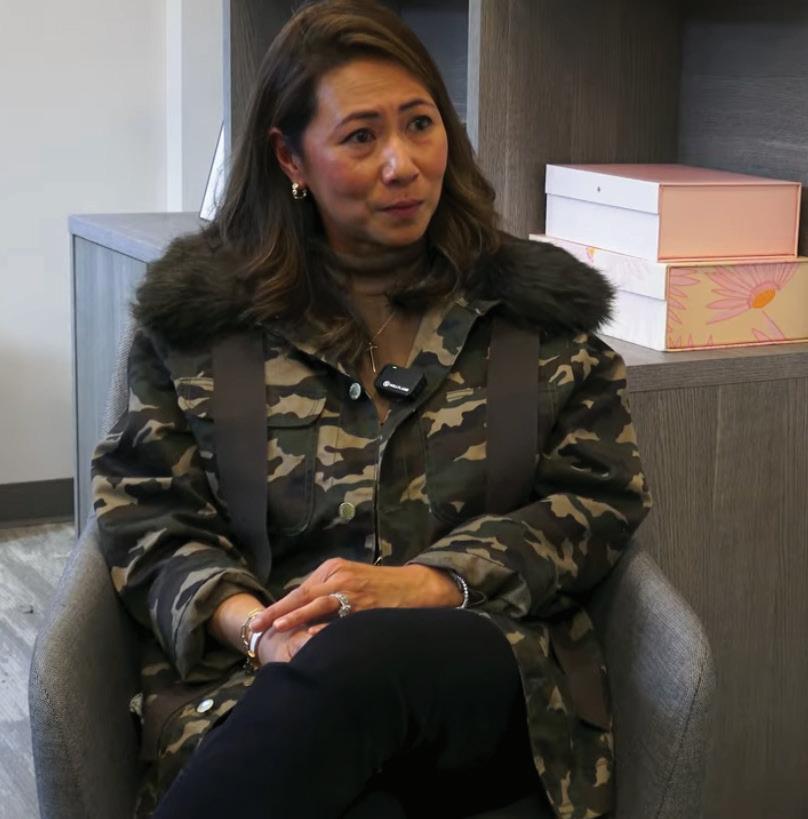
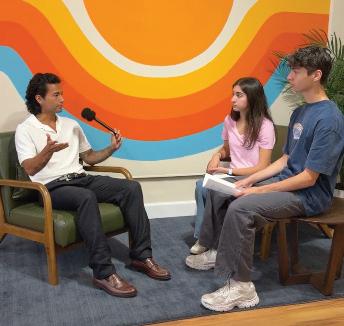
Nikhil Daniel ’26 speaks with former Congresswoman and now Orange County mayoral candidate Stephanie Murphy on the latest edition of Saints Talk Local.
Thomas Bonos ’26, Jack Aaron ’26 and Gustavo Membreno ’26 discuss their experiences with college applications, each through their own unique lens. Tune in to hear what it’s like to apply as a student-athlete, as a BS/MD candidate and as a traditional applicant.
Website
Visit The Voice’s website, TheTrinityVoice.com, to read about more departing faculty members not featured in this month’s Focus section.
The monthly lead editorial represents the view of The Voice’s editorial board, which comprises the editors-in-chief, managing editors, layout editors, opinion department editor and editors emeritae. The editorial vote in favor of and against the month’s opinion is indicated on the lead ed page, along with concurring and dissenting opinions from members of the board. This month’s lead ed can be found on page 23.
SPIN FOR THE WIN
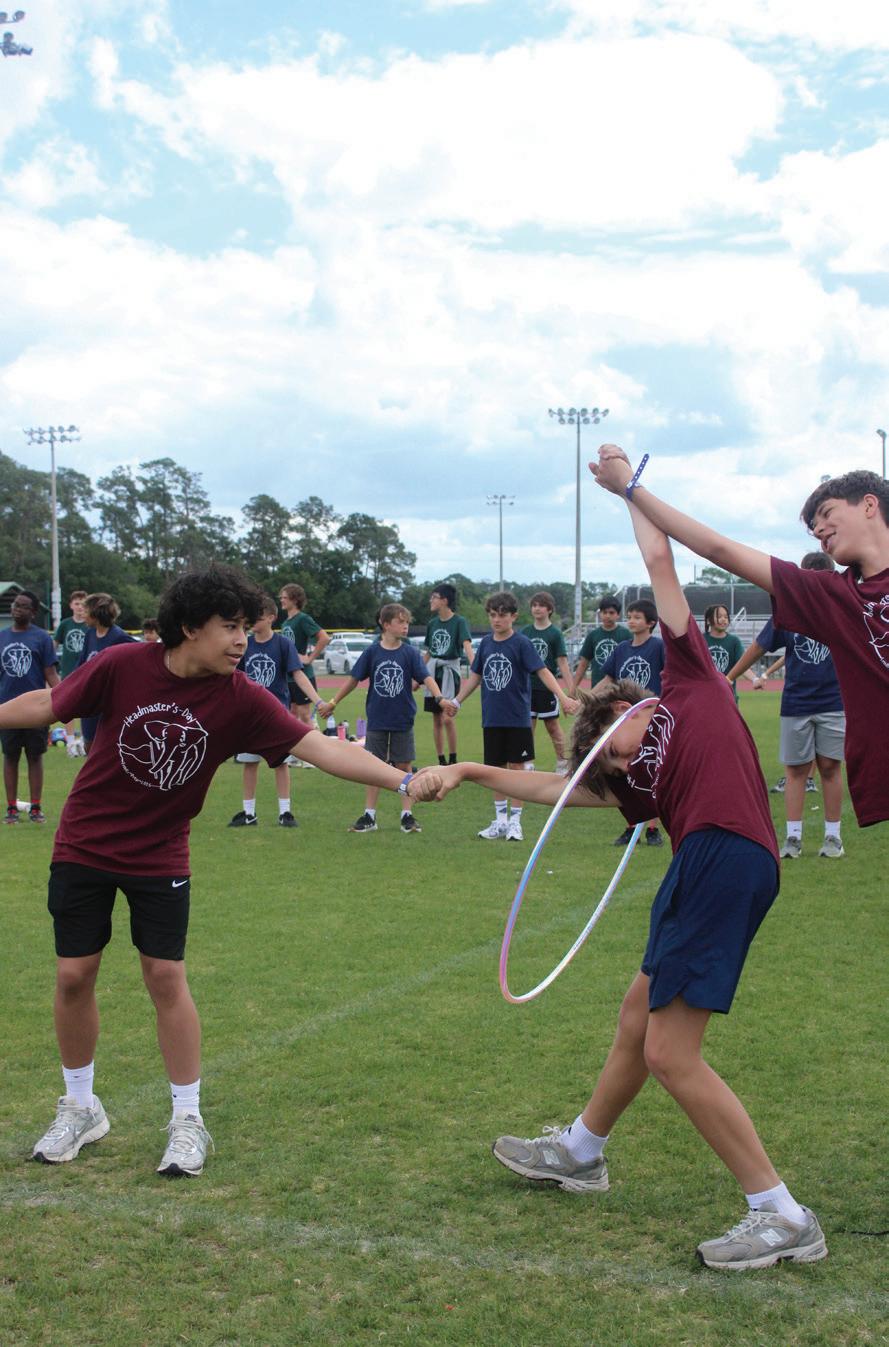
Headmaster’s Day debuts hula hoop relay as final event
Article by Victoria Suarez
Photo by Lola Brown, Graphic by Natalie Baron
Over the last three years, the upper school student council (STUCO) has been seeking a new and exciting alternative as the culminating event of Headmaster’s Day after the rope pull, a 40-year tradition for juniors and seniors, was discontinued due to safety concerns. The lack of a set final event meant more hoops to jump through and planning in anticipation of the annual field day.
“The beginning of the day is easy,” junior and STUCO Vice President Jack Nave said. “The rocket launch, we do that every year. The final event, that’s the harder part, because you have to get something that is as entertaining as the rope pull in years past and convert it into something new and get it approved by the school, all within about two months.”
In recent years, the final event has included water balloon contests, color wars and, most recently, Assistant Dean Kyle McGimsey’s capture-the-flag game from last year. This event, however, had many challenges, which led to something new for this year.
“It was a cool concept, (but) it just didn’t really play out the way we’d hoped,” said STUCO adviser Brian Kells, who is also an adviser for The Trinity Voice. “It was too easy to cheat, so it wasn’t a great game. But that’s trial and error. It was a great game on paper, but it didn’t work out in reality.”
This year, STUCO chose a hula hoop relay race between the upperclassmen as the event to close out the day — an idea that was first considered last year.
this event would do a better job of fostering inclusivity, bridging existing gaps and uniting both the players and audience.
“I think one of the great things with this one (is that) whatever shape or size you are, how coordinated you are, uncoordinated, it’s
have more opportunities for student participation. Sixth, seventh and eighth graders ran through the relay together before the juniors and seniors, giving the upperclassmen a frame of reference for the event.
“We’re going to give them a hula hoop at the end, and they have to pass the hula hoop through without letting it go,” Kells said. “You’ve got to drop it down, reach down (and) work as a group to get it to the very end, and whoever gets it to the end (first) wins.”
The hula hoop relay aimed to eliminate some issues from previous years by creating an event that is fair, safe and entertaining while still inspiring school spirit. The hope was that
perfect because you all work together as a big team,” Kells said. “I think it incorporates everybody together in that sense.”
One of the biggest challenges of the final event is student engagement and involvement. To address this, STUCO introduced a middle school component to this year’s event so as to
“You’re talking 800 kids total in hopefully 10 minutes,” Kells said. “That’s what we’re looking at.”
Middle schoolers lined up with their grades, linked arms and successfully passed the hula hoop from one end of the line to the other. While this was a different approach to the culminating event from years prior, it seems to have been received well.
“I think that the middle school students definitely enjoyed it,” eighth grader Ari Maeshiro said. “All my friends expressed a lot of content(ment) towards (middle school’s inclusion). … I think everyone just had a lot of fun in (the relay).”
While the middle schoolers were certainly eager to participate themselves, they were also very excited afterward to cheer on the upperclassmen during their round.
“I have a lot of senior friends, and I just feel like (it’s) an amazing thing to watch all my friends also play these great games out there,” Maeshiro said. “I think they should have a thing for every group because it’s always so fun.”
Ultimately, the implementation of this event is just part of the process of finding a permanent and widely enjoyed conclusion to Headmaster’s Day. STUCO is committed to figuring out what does and does not work and ultimately weighing what students respond to the best, not only with the final event but across the entire day.
“I really want to cement something that is as strong as the rope pull and doesn’t have to keep changing,” Nave said. “What I want to do with STUCO is have a better grasp of the activities. Maybe choose something unique and give every activity popularity.”
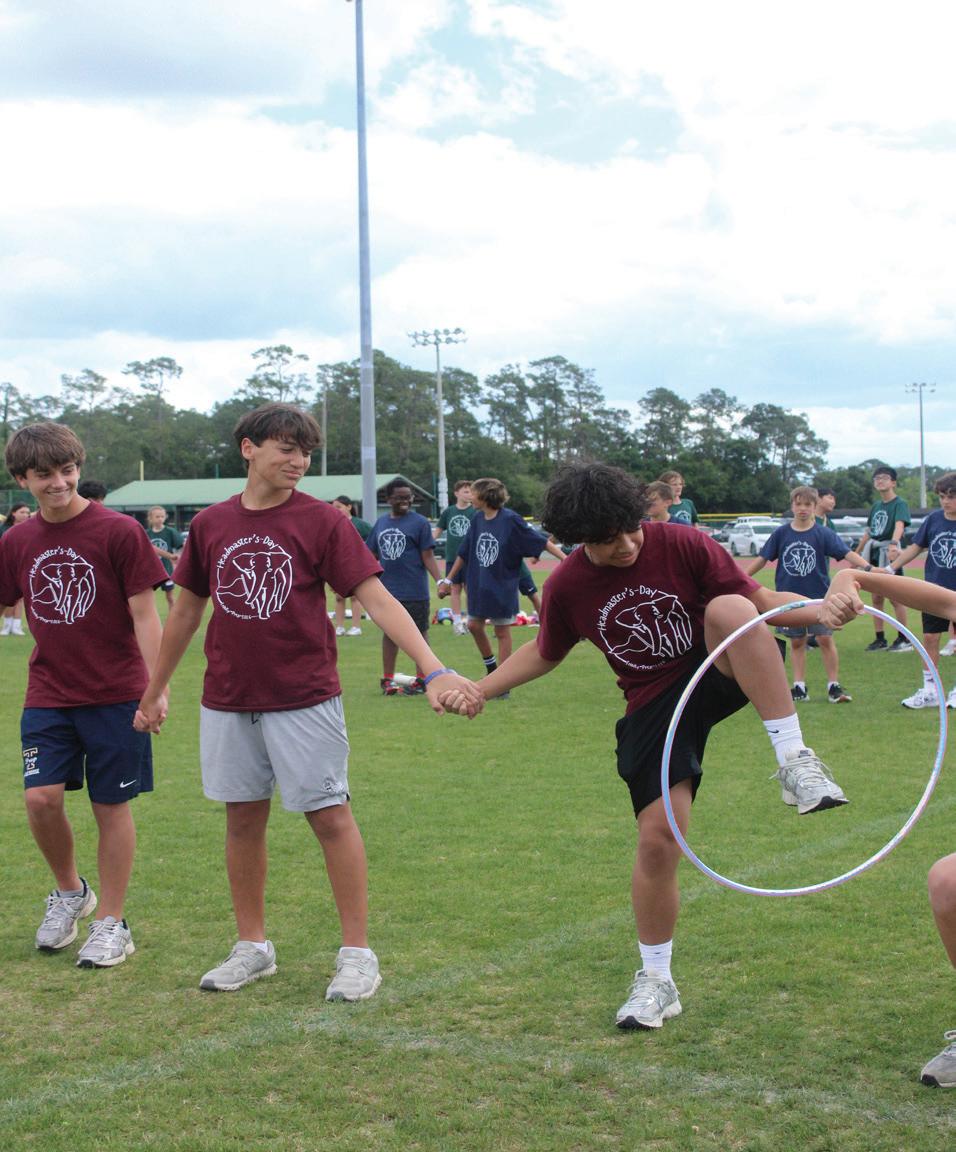
(Pictured left to right) Michael Benenati ’30, John Gardner ’30 and Nicholas Musselwhite ’30 collaborate to pass the hoop during the Headmaster’s Day hula hoop relay, contributing to eighth grade’s win.
STONE COLD ANALYSTS
Students compete in recent curling analytics challenge
Article by Janav Ramprakash
Graphics by Maxi de la Fuente and Natalie Baron, Photo courtesy of Donald Worcester
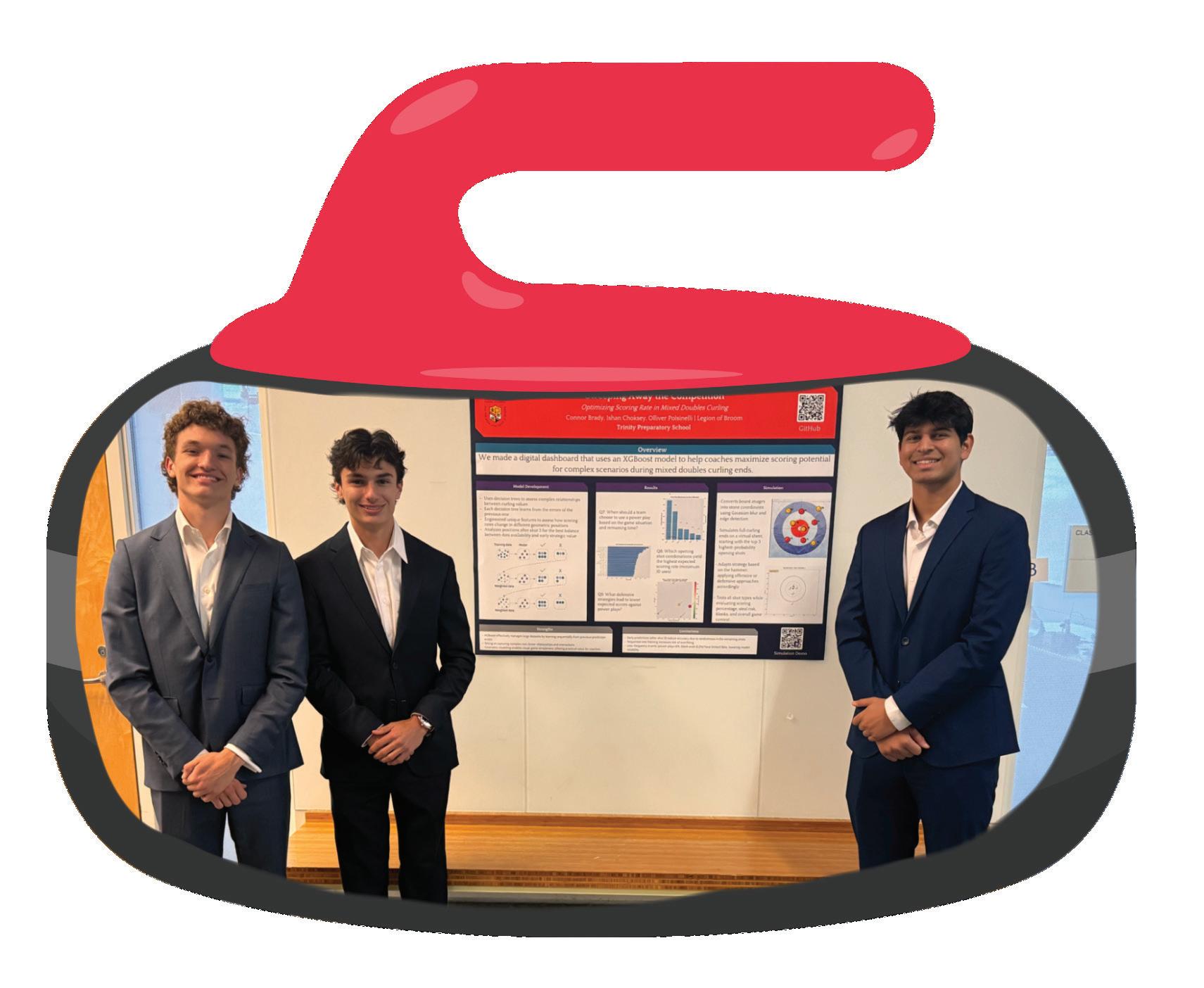
Carnegie Mellon, Yale and Harvard are just some of the teams seniors Ishan Choksey, Connor Brady and Olliver Polsinelli beat in this year’s Connecticut Sports Analytics Data Challenge. Selected as one of four finalist teams in the undergraduate/high school division, the trio advanced to present their research at the Connecticut Sports Analytics Symposium from April 10 to 11.
The competition centered on mixed dou bles curling, an Olympic sport in which teams slide stones toward a target on ice. It required students to work with large datasets and de velop their own research questions. Choksey, Brady and Polsinelli chose to focus specifically on the “power play,” a once-per-game op tion that shifts pre-placed stones to the side. Their analysis examined how this strategic decision impacted scoring outcomes.
“They had data from a bunch of different Olympic events over various years and they just had to figure it out,” team mentor and Mathematics Department Chair Donald Worcester said. “The actual competition gives some possible questions to look at. They don’t have to use them, nor do they have to use all of them. … It is 100% (really) student-driven.”
and reorganize them into a structured format that could actually be analyzed.
“There were 25,000 different curling shots that we had to be able to analyze and actually make matter,” Polsinelli said. “We created unique IDs for each of the shots to connect it to each of the games so we could assemble all the data into one large spreadsheet, which helped make it a lot easier to analyze and actually make usable.”
For the team, that independence meant learning the sport from the ground up. With little prior knowledge of curling, they had to quickly understand the rules and strategy before they could begin their analysis.
“We created an interactive dashboard that a prospective curling coach could use,” Polsinelli said. “The simulation would put forward, based on our model, strategic advice as well as show the team use of a power play on a scale from one to 10. (It would also) show a simulation of all the highest likelihood shots for scoring and would model it out through all 10 shots. You could see what the final score would be if you continued with the best strategy available (in the game).”
This simulation is what the team believes truly distinguished their project from others in the competition.
“Adding that application was a massive improvement, and it’s what all of us believe managed to get us to Connecticut in the first place,” Polsinelli said. “It’s nothing that any of the other teams that we saw there did. And I think it’s really what stood us apart.”
Though they competed against students at a much higher academic level, the team ultimately still earned its spot as finalists in the challenge.
and Ishan Choksey ’26 present their project at the Connecticut Sports Analytics Symposium from April 10 to 11. They received third place at the symposium.
“We didn’t really know anything about curling,” Polsinelli said. “We had to learn the entire sport from scratch and learn a lot of the strategy behind the sport itself as well as what everything meant.”
This learning process extended into how they handled the scale of the project, where they had to break down large amounts of data
Despite the complexity of the project, the team worked collaboratively to manage different parts as it developed.
“Connor was our main coder,” Polsinelli said. “He built the majority of the model. Ishan and I primarily wrote the paper and just put everything together that Connor made.”
Alongside a detailed paper and model, the team produced an interactive tool built to translate their findings into real-time strategy.
“They’re competing against the top data science and sports analytics (colleges),” Worcester said. “Multiple college professors read these. So I’m pretty proud of these guys.”
The group’s success was driven by their dedication and commitment to put in the extra work.
“A lot of it is just how much work they want to put in,” Worcester said. “A lot of it is selftaught, (and) they took the time to learn extra. It’s simply their drive and their wish to do well. I feel like the best computer programmers, you can teach them, but you really need that self-motivated individual to learn it.”
(Pictured left to right) Olliver Polsinelli ’26, Connor Brady ’26
A
April
ach April, Trinity’s art department hosts an exhibition highlighting the various artistic talents of its students. The campus is alive and bustling with creativity as students have the opportunity to admire the work of their talented peers. Exhibitions featuring sculptures, paintings and photos from students of all levels are displayed throughout the hallways, and the quad is transformed into a stage for various concerts and band performances. Every form of art has its own time in the spotlight until the week concludes with the annual Arts Hall of Fame induction.
Artists: 1. Ellison Clark ’26
2. Zoey Wallington ’26
3. Zoey Osterman ’26
4. Reese Macau ’26
5. Maiori Butz ’26
Spread by Sarah Zobel
Photos by Lola Brown
WHO MAKES THE CUT
Trinity’s hiring process is rigorous and global
Article by Nikhil Daniel
Graphic by Maxi de la Fuente
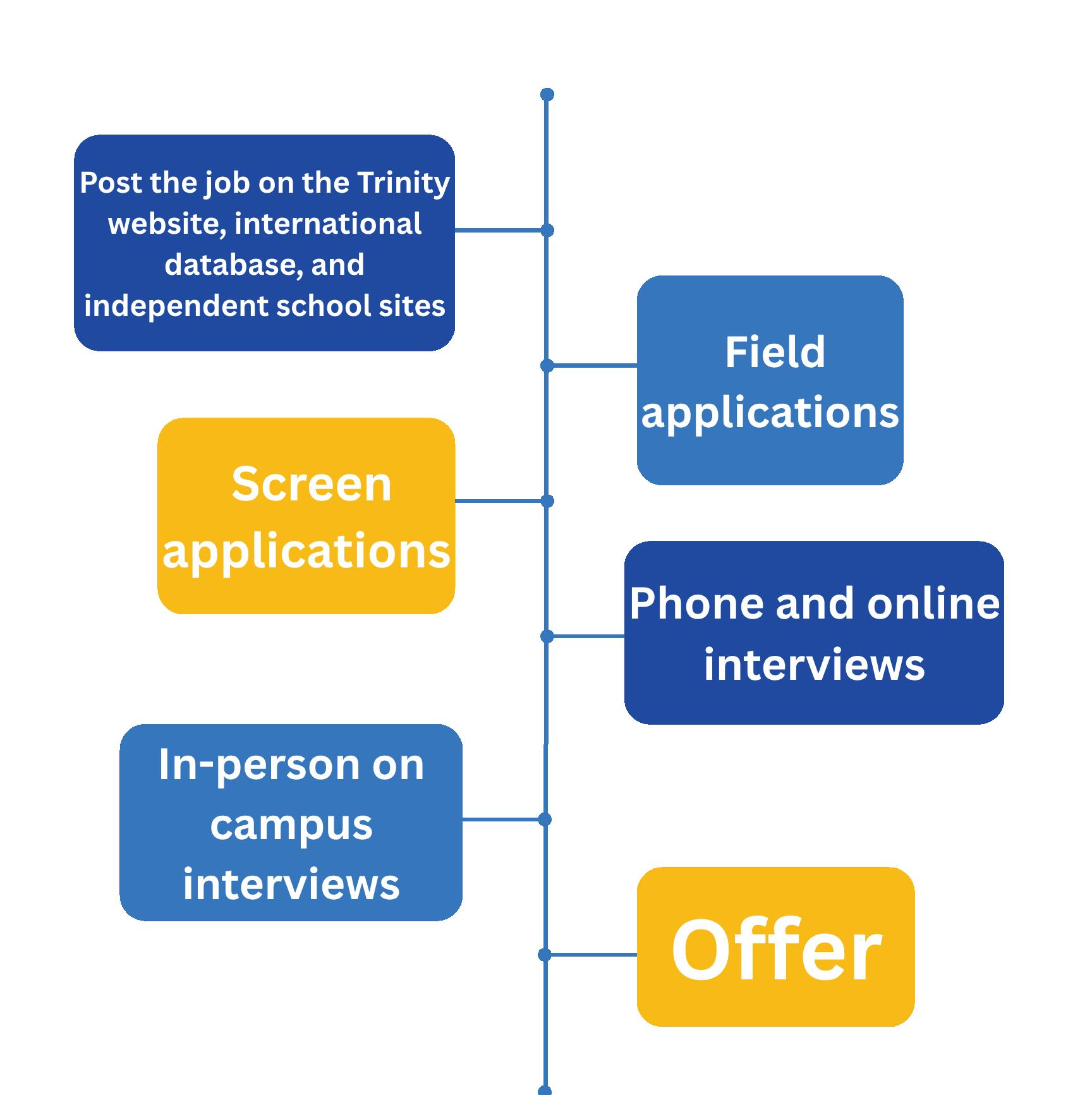
In recent years, Trinity has hired across nearly all departments and levels of leadership, making the hiring process an essential part of yearly operations. The systematic search and selection process comprises multiple layers from recruitment to on-campus interview rounds as the administration seeks to hire the best candidate from across the globe.
Since 2016, when he first came to Trinity, Head of School Byron Lawson has instituted changes that have fundamentally shifted some of the school’s hiring practices. Some major changes include expanding the process to be an international search for candidates, a written post-interview reflection rather than a conversation and a different approach to internal leadership promotions.
“There has been no change to the hiring philosophy, but the process has changed to be a little bit more formalized,” Associate Head of School and former mathematics teacher at Trinity Dennis Herron said. “We are trying to widen and deepen the depth and breadth of the candidate pool.”
Once a job description is finalized, the position is posted on Trinity’s website, inde pendent school-specific sites like the Florida Council of Independent Schools to recruit candidates, and an interna tional database.
“The only way you can apply for a job is to go through our database, and that ends up getting shared with people all over the globe,” Law son said.
Trinity is intentional about expanding the candidate pool and attracting diverse applicants to serve the school’s mission.
“The best way you can get a diversity of thought and perspective is to get different thoughts and perspectives into your facul ty,” Lawson said.
Recruiting diverse talent is not just limited to geography.
“We want a candidate pool and a faculty that is reflective of our commu nity,” Herron said. “When I say that,
that is bringing a diverse candidate pool in, and we will pick the best candidate.”
The approach of selecting the best possible candidate also extends to internal promotions and position changes, where current faculty members undergo the same process as any other applicant.
“I don’t think it is best for the school not to always look to hire and retain the best possible candidates,” Herron said. “When we have a leadership job, we have an obligation to test the market to see who can bring the most value to the school. Not that we don’t value our current faculty and staff.”
Herron, who rose from a math teacher to associate head of school, said that his rise to leadership would be considerably different now due to the current growth rate of the school and new hiring practices. However, Stephanie Dryden, former Trinity English teacher, college counselor and director of learning and instruction (DLI), who now serves as head of middle school, proves that internal promotion is possible, receiving both her DLI and current position in the new system.
Dryden said. “Now, I’ve just been part of the national search.”
However, the use of interim roles, such as the position Dryden held in the 2024-2025 school year as interim director of the middle school, can serve as a year-long, real-life interview for the role.
“(In an interim position), one of two things happens because you’re in a live interview,” Herron said. “Sometimes we will promote and offer them a full-time job, or we will continue to do interviews, and you’re still a candidate.”
Domestic finalist candidates are flown in for interviews with administrators and teachers and to teach a class to students. This is viewed by many, like Dryden and Science Department Chair Romina Jannotti, as the most important part of the holistic hiring process.
“In public school, I had a half-hour interview with an assistant principal, and at the end of that, I was hired,” Jannotti said. “So (Trinity’s hiring process) felt like I was being made to run the gauntlet.”
The interview process is the final step before offering a position and having the candidate accept the offer.
“The normal employment incentives are salaries, benefits, student ability levels, class sizes and the ability to teach a certain thing,” Herron said. “The best we can do (as an educational institution) is to have as strong a salary and benefits package as any other school. We are very competitive in this area. Then, a lot of the time, it boils down to teacher preference.”
The end goal of this process is to attract and hire the best teachers from across the globe to join the Trinity family.
“In a world where people are saying Americans have declining education and standards, and we’re falling behind this country and this country and this country, I say, come on over, take a look,” Lawson said. “I don’t care where you’re coming from; that’s not happening here.”
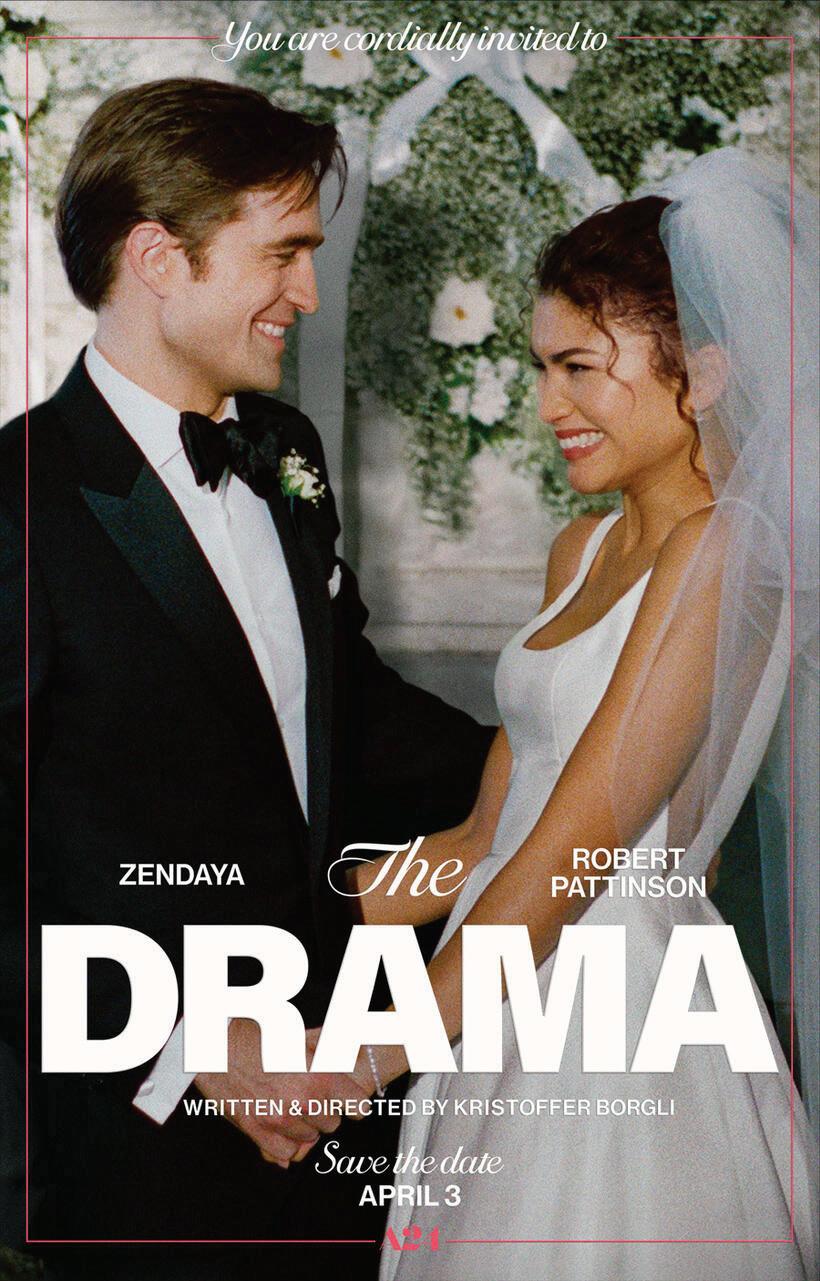
“THE DRAMA”: ALMOST COUNTS
Article by Lila Choudry
Graphics by Maxi de la Fuente
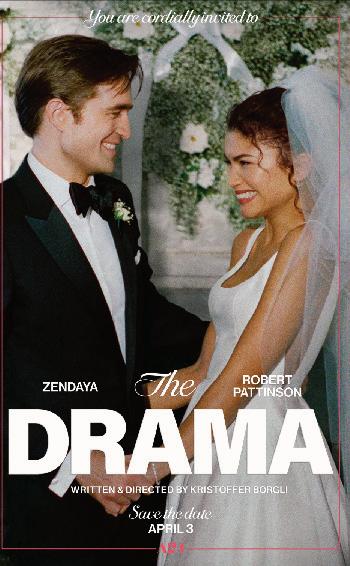
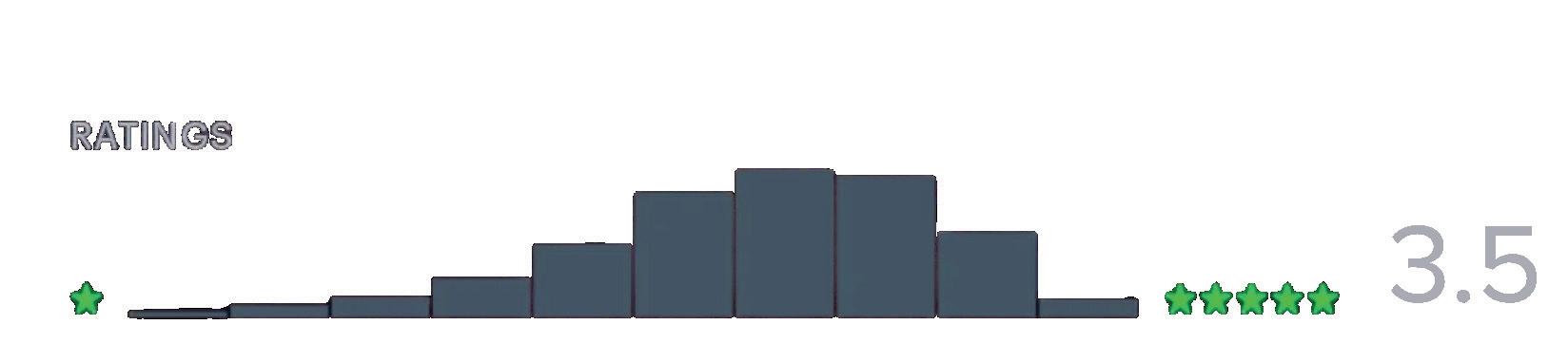
In “The Drama” (2026), everything shifts in a moment that feels almost too casual to matter. Directed by Kristoffer Borgli, the film presents itself as a romantic drama but quickly reveals something darker. It is less about love and more about what happens when love is forced to confront a version it cannot hold comfortably. Though the film has an audience score of 78% on Rotten Tomatoes, personally, I felt that it fell flat in developing the plot, making it unable to support the rather heavy-handed symbolism.
Set in a Boston suburb, the film follows Emma (Zendaya) and Charlie (Robert Pattinson), a couple approaching their wedding day. Their relationship begins with an awkward but somewhat endearing meet-cute, one that already plays with miscommunication as Emma reveals she is deaf in one ear. This detail felt quite insignificant at first, but it shapes how the plot handles understanding, or rather, a lack thereof.
The central conflict arises during a latenight conversation with friends, when the couple and their friends Rachel (Alana Haim) and Mike (Mamoudou Athie) share the worst thing they have ever done. The tone is casual until Emma’s turn, and what she reveals reframes everything. The confession lands heavily, not because of the action, but because of the possibility. The film becomes fixated on that “almost,” treating it as something that still exists alongside who Emma is now.
From there, the relationship begins to unravel in awkward, often uncomfortable ways. Charlie’s reaction drives much of the tension. He starts to question not just Emma’s past, but
his entire understanding of her. His fear is not grounded in evidence as much as imagination, which the film visualizes through repeated, sometimes heavy-handed imagery of a younger Emma with a weapon.
Zendaya’s performance works against that villainization, playing Emma with a refusal to turn her into a victim or villain. Her character explains her past, her growth, and mentions her activism, but the film does not fully explore that transformation. Instead, it keeps returning to the shock value of the confession, limiting how much we are allowed to see beyond it.
The film’s structure suggests depth without fully providing it. Flashbacks appear briefly, offering glimpses of Emma’s teenage years, but they feel underdeveloped compared to the weight they are meant to carry. A younger version of Emma appears throughout the film as a physical presence, representing anxiety and the persistence of past selves. While it was one of the more interesting ideas, the film failed to portray it to its full potential.
Where the film is most effective, though, is in its use of sound. Silence interrupts conversations at key moments, placing the audience within Emma’s partial hearing and destabilizing any sense of certainty. The soundtrack deepens this contrast with music produced by Daniel Pemberton, who created the scores for “Project Hail Mary” and both “Spider-Verse” movies. Early scenes are scored by softer, nostalgic music that frames the relationship as grounded and familiar. As tension builds, that coherence dissolves into chaotic EDM, mir-
Despite these strengths, the film feels limited in its emotional scope. Emma and Charlie’s relationship is central, yet it never feels fully lived-in. For a couple about to get married, they seem to know surprisingly little about each other. This absence becomes more noticeable as the film progresses further into its central question: whether mistakes can truly be forgiven.
“The Drama” is engaging and at times truly unsettling, but it simplifies the very complexity it sets out to examine. It raises questions about identity, forgiveness and whether people can truly change, but it stops short of fully exploring them.
Three and a half stars.
Poster courtesy of A24
DRESS TO EXPRESS
Article by Krish Gupta
Graphics by Aylin Garibay, Photo by Eden Kiger
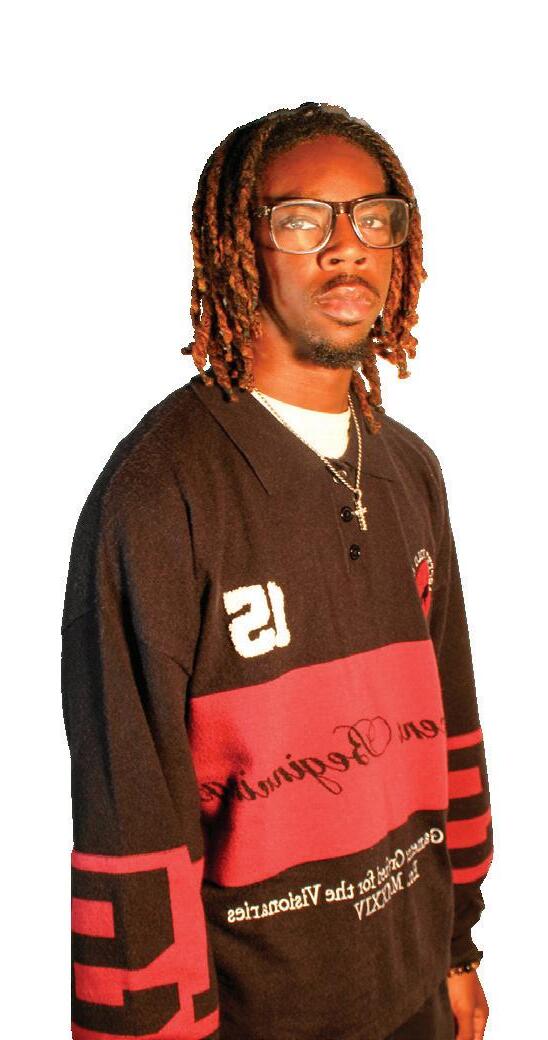
Sophomore Jonathan Nowlin walks into school wearing a bright pink outfit, earrings and confidence to match. Unfortunately, not everyone approves. At first, it bothers him. But instead of changing his style, he made a decision: wear what he wants, regardless of what others think.
“I’m just going to do me,” Nowlin said. “I’m not going to let anybody tell me what to do and tell me how to dress because I know how to dress. You need to wear (something) because it’s what you want to wear. It’s your opinion. It (shows) your perspective on your life.”
Two decades ago, that same out fit might have earned more stares than compliments.
Today, it’s just another expression of personal style. Men’s fashion, once boxed into rigid expectations, is expanding, and with it, the modern perception of masculinity itself.
a focus on individuality, while the 2000s saw the rise of streetwear blending with high-end fashion through brands such as Supreme and Off-White. More recently, celebrities such as Harry Styles and Billy Porter have contributed to a broader acceptance of unconventional styles in men’s fashion.
Self-expression through fashion has shifted, not only in industry, but also in culture: Society is entering an era where individualism is far more customary, far more widespread and far less stigmatized than ever before.
how their generation currently views fashion and self-expression.
“Something about how our generation has grown is that we’re more accepting of modern ideas,” senior Nathaniel Pitone said. “Fashion is just one of those modern ideas where people have just grown to see it as an option rather than something people are forced to wear a specific style.”
However, expression can feel limited in environments with strict expectations and consistency. even in a more accepting generation.
This shift, of course, did not happen overnight. According to the Saint Peter’s Tribune, men’s fashion has gradually become increasingly individualistic over time. After World War II, influential figures like David Bowie and Jimi Hendrix began challenging traditional norms through bold, expressive outfits. This was further amplified in the 1980s with
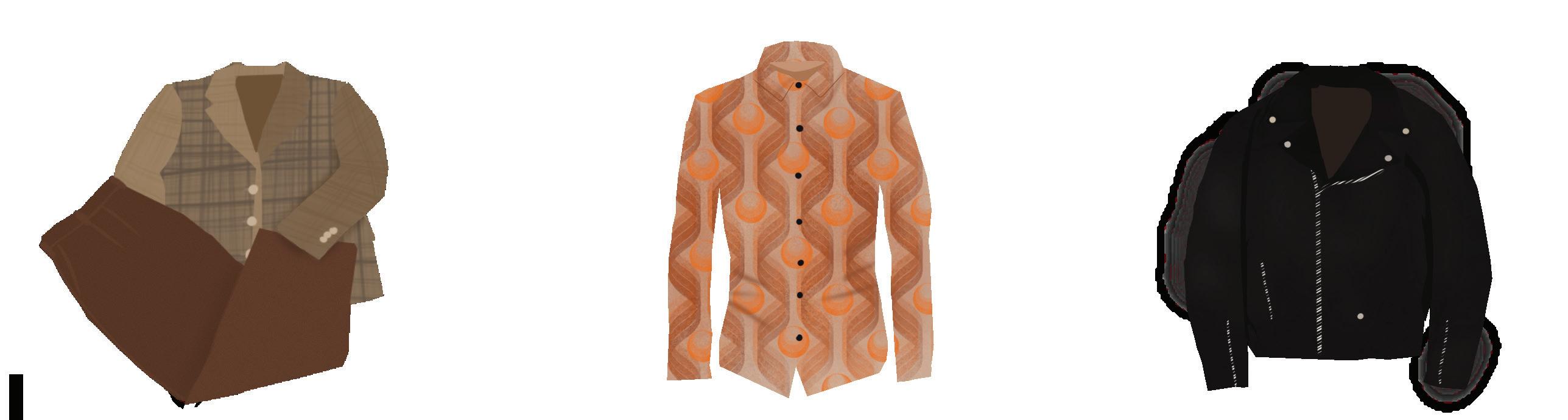
“If you look at the fashion industry now, it’s changing a lot,” fine arts teacher Caberbe Joseph said. “If you ever take time to look at how the runway is structured now, the clothing for men is close to how females are dressing up. … There is the freedom of wearing a sleek outfit versus how we used to wear polyesters and linen. They have a lot more selection now than they previously did.”
Younger generations are beginning to notice that increased freedom.
“(Men) definitely had fewer options (before),” Nowlin said. “(When) asking my brother what he wore in the 2000s, his fits weren’t really that hard. It was just a big shirt and long jeans.”
As the industry continues to evolve, students say the most noticeable change may be
“At Trinity, the way everybody dresses is kind of the same,” Nowlin said. “That’s the way I stand out. (On) any casual day, I always try to make sure I look good, and I put something different on that nobody else has worn.”
Still, standing out and embracing individuality doesn’t come without its challenges.
“I get judged all the time for what I wear,” Pitone said. “It’s just people who don’t like my outfit or think it’s not how it should be. I don’t really get affected by it. I am okay with my self-expression. I’m not too worried about what other people think.”
What may feel like personal criticism, however, often reflects broader societal attitudes rooted in deeper, foundational perceptions that frame ladylike fashion as incompatible with masculinity. This lingering stigma still affects how comfortable men feel when stepping outside traditional norms.
Jonathan Nowlin ’28 stands out in his school outfit and statement jewelry, embracing his individuality on campus.
Students redefine masculinity through individuality in fashion
“There are some men who can pull off pink, and then there are men who are afraid to wear pink,” Joseph said. “There’s nothing wrong with the color that you wear, but it all depends on who you are afraid of judging you.”
As the stigma fades, men’s fashion becomes less about fitting in and more about shaping culture, creating an opportunity for men to express themselves and redefine expectations.
“If you’re one of those people who like to create chaos and self-expression, then you go against the flow,” Joseph said. “You wear some-
Even while personal expression gives fashion its meaning, this still exists within a broader cycle of changing trends.
“Fashion is something that does not have a beginning or an end, because it’s always shifting or returning,” Joseph said. “It’s almost like a loop. Ripped jeans used to be a poor people’s clothing. Now, this is a fashion.”
Individual style is often shaped by the people and environments that surround someone as they grow up, especially as fashion continues to evolve.
until two to three years ago.
Once everyb odylikes that trend, every body’s going to hop on the trend.”
thing that does not fit with the environment and try to get the environment to fit with you. … If you wear the fashion, you’re influencing other people. If the fashion is wearing you, then you don’t have a strong personality.”
That shift toward influencing others rather than blending in is something that students are beginning to embrace in their own way.
“You should never be a follower,” Nowlin said. “You should always lead. I’d rather somebody copy me than me copying somebody else. Finding new (clothing) that nobody has is a great experience.”
For Nowlin, leadership is reflected not only in what he wears, but also in how he chooses to carry himself.
“(Jewelry) is way bigger now,” Nowlin said. “It’s another way to express yourself. … It’s not just for fashion, but it’s another way to remind yourself why you’re getting up every day.”
“When I was younger, I was mainly looking at how other men dress,” Joseph said. “Your influence would come from your role model, not social media or whatnot, because there was no such thing. I used to have my brother, who loved to dress up. I used to have my mentor, who was always in a suit and tie.”
As social media came into play, however, these influences shifted largely towards curated online personas.
“People definitely find role models from an expression standpoint, especially on Instagram and TikTok,” Pitone said. “People tend to fol low what they see on social media, and they’ll be influenced by people who are influenced.”
With that constant flow of influence, social media also allows trends to spread more quick ly than ever before.
“It’s easier to set a trend now,” Nowlin said. “The baggy stuff didn’t really start coming in
Trends may rise and fall between months, but the deeper shift lies in the cultural impact they leave behind. What was once considered unconventional or even unacceptable in men’s fashion is now becoming mainstream, illustrating a broader societal change in how masculinity itself is defined. With growing acceptance, fashion becomes not just what is worn, but how identity is expressed. For many, that expression is not random, but deliberate, shaped by the role they see themselves playing in a given moment.
MOCK MULTIMEDIA
AI-generated photos and videos take over social media
Article by Neve Judelson
Graphics by Maxi de la Fuente
Freshman Grant McElveen clicks send, posting an impressive video of his Jack Russell terrier doing cartwheels. The lifelike video wowed his friends, but it was nothing more than the result of a quick digital prompt.
Artificial intelligence is most often pinned as students’ number one homework helper. However, as the technology has advanced, so has its usage for various tasks. Now, many like McElveen are creating fake photos and videos that are indistinguishable from reality.
Often used for harmless pranks or tricks, AI-generated photos and videos have become popular amoung younger generations.
“I use AI (generated) photos and videos to trick my friends all the time,” McElveen said. “They think it’s so funny.”
All generative AI technology is built upon roughly the same predictive model, using in formation from trends, people and places.
“(All) AI large-language model(s), includ ing the image and video generation ones and the music ones … operate on a predictive text model,” said alumnus Karthik Stead, who is studying movie production and media at New York University. “They all look the same be cause they’re all trained on the same (model).”
The lack of human creation is what the AI media world is missing. AI media does not come from human creativity but rather from the monotonous results that a predictive algo rithm produces.
“The best kind of art ... comes from very real experiences and people pulling from real stuff that’s happened to them,” Stead said. “You lose that when you have a robot just making, really, what would be the most likely outcome.”
The generation of photos through AI can become dangerous quickly, the most harmful kind be ing called “deepfakes.”
According to Statis ta, as of 2024, 29% of fraud experts have
come across AI-generated video deepfakes as a way to trick people into scams.
“AI is already used, in terms of online, but when it’s used even on social media, and people start falling for it, that’s how rumors start, and these rumors can be really harmful,” fresh-
ence teacher Rick Rodriguez said. “(That) lends itself well to our discipline in the social sciences so that we can look at multiple sources, information, and try to figure out what is true and what is not true.”
When it comes to education through visual representation, AI can be beneficial. Pulling from multiple different resources, AI re-creations can allow students to have a visual match with the information given. Rodriguez incorporates AI media into his lessons by re-creating historical resources and asking students to analyze how they differ.
“If AI is going to be a thing outside the classroom, then we also need to prepare our students to deal with the reality that AI is here to stay, so for me, (I think) we should embrace AI,” Rodriguez said. “For me, (the comparison of primary sources and AI re-creations) creates a little bit of critical thinking because we’ve delivered the content and then you compare and
With the right resources and environments, AI media can be safely used as a tool. However, if left unchecked, the growth and improvement of AI media can cause harm when it comes to misinterpretation and obscuring
“You’re looking at situations where it can hurt people, because people are using those deliberately AI-created visuals, videos (and) pictures, and they’re using it to bully people or to make someone feel lesser than they are,” Rodriguez said. “I would hope eventually some laws are passed that put an end to that kind
VOICES BEFORE VOTES
Students express political opinions in classrooms, online and beyond
Article by Damien Layus
Graphics by Maxi de la Fuente, Photo courtesy of Enzo Kuada
At Trinity, some students are finding their voice before they ever step into a voting booth, spreading their ideas in classrooms, on social media, and even at protests or public events. While they cannot vote yet, they still know their opinions matter. For many, it is not just about the future. It is also about making a tangible impact right now.
“I’ve always been interested in things that I haven’t had the chance to learn about in school,” freshman Carson Wiener said. “Politics are very interesting. There’s a lot of different factors involved, a lot of policies that are very important.”
For a lot of students, that kind of curiosity is where it all starts. Wanting to understand what is going on in the world pushes them to look deeper, ask questions and form their own opinions. Over time, that curiosity turns into confidence.
But speaking out is not always simple. Wiener explained that while school can feel like a safe place for discussion, the real world is sometimes different.
People often have biases, and sharing opinions can come with risks. Even so, Wiener believes it is important to express ideas, because without doing so, no one would ever encounter new perspectives or ways of thinking.
For freshman Enzo Kuada, having a voice is about impact, even if it starts small. He believes that everyone’s opinion matters in some way, especially when it influences those around them. Through conversations with his peers, Kuada said he has been able to help others become more informed about political issues and think more deeply about what they believe.
Kuada is not afraid to take a public stance on major pol-
tical issues, such as the current administration’s immigration policies.
“I think it’s really not on the right side of the law, what we’re doing right now with ICE,” Kuada said. “I think it’s definitely something that needs to change and soon, and drastically change as well.”
At the same time, Kuada believes that how people communicate matters just as much as what they say. He focuses on staying calm during disagreements and keeping discussions respectful, even when he strongly disagrees with others.
Kuada worries that some students feel pressure to base their identity entirely on politics at a young age. He also mentioned that social media algorithms can influence what students see and believe, without them even realizing it.
Teachers also see both sides of student political involvement. Social science teacher Brandon Burmeister believes that while it is good for students to be informed, it is important to keep a sense of balance.
“Be a kid,” Burmeister said. “You have the rest of your life to be political.”
Social media plays a huge role in shaping how students get involved. Platforms like TikTok and Twitter are often where students first learn about political issues. While these apps can quickly spread information, they can also be misleading. Wiener pointed out that students should not rely only on what they see online, but should take the extra step to research the topics.
“The two that I’m always most worried about are Twitter and TikTok because the algorithms on Twitter are blatantly far right,” Burmeister said. “And then TikTok’s algorithms work so fast that it’s almost impossible to keep track of what the end game is.”
Because of that, Burmeister believes students should question information and think independently of others.
Even with these challenges, Trinity students continue to find ways to make their voices sheard. Brady Graham, senior at Boone High School and development director of the Florida High School Democrats (FLHSD), has seen how powerful student action can be when people come together.
“We got news attention, helicopters over our school,” Graham said, referring to a student walkout at Boone.
“It truly showed what high schoolers believe.”
Experiences like that show students that they do not have to wait until they can vote to get involved. From protests to speaking at events, there are many ways for students to participate and make an impact now.
“Obviously, me by myself, I can’t overthrow the government,” Kuada said. “But I do think my voice matters. ... Everyone’s voice matters.”
Enzo Kuada ’29 protests at the No Kings protest in Orlando with his mom, Giselle, on March 28. Enzo is one of many young students who find ways to express their political beliefs even though they cannot yet vote.
HEALTH OR HYPE
Article by Sami and Sofia Haddadin
Photo by Julia Hoskins, Graphics by Aylin Garibay
Meal prep, eating whole foods, hit the gym, repeat. If your social media feed is filled with influencers spreading similar wellness gospels and two-ingredient protein-filled recipes, you are not alone. In recent times, public and cultural perspectives have shifted toward a stronger emphasis on selfcare and wellness. With that comes a greater eagerness to follow health trends and shift lifestyle habits to align with current trends as social media continues to proliferate them.
Research from Cornell University revealed in 2025 that one in five teens active ly seek advice on social me dia platforms, in turn dictating their lifestyle choices based on these recommendations. Junior Brodie Wordell puts these trends into practice, most notably through his clean eat ing habits in the kitchen.
tein Shakes, and I realized how terrible those are for you. I have definitely changed in (that I’m) looking more into (the) ingredients (rather) than, ‘Oh, there’s too much sugar in this.’” It is important to be able to look out for unhealthy ingredients in pre-packaged and processed foods and beverages, and popular content has focused on a “less is more” mindset when it comes to ingredients in both food and
“Where tallow is above other natural ingredients is in ... its similar(ity) to the fatty acid profile of your skin,” Matthew Tam said. “What that means is your skin is being washed and cleansed with something that it recognizes, that it perhaps sees as its own. … For some people, (olive oil) … clogs your pores … whereas … tallow clogs much fewer pores than the other natural oils do. So I think that speaks beautifully to how your skin is really something that’s alive.”
But these trends do not emerge in a vacuum. Rather, the path towards ancestral well
“I only cook in butter, olive oil and beef tallow,” Wordell said. “I usually just cook … pretty simple meal(s) for meal prep. I try to use lean ground beef or grass-fed, pasture-raised chicken when I can get it, and good natural rice from the Asian store that I go to.”
Lifestyle changes extend beyond the tan gible, seeping into everyday decision-mak ing and thought processes regarding health. While not all health trends are out to harm consumers, the status quo of widespread, of ten blind adoption of these trends, or “fads,” warrants greater caution and nuance in decid ing which to incorporate into daily life. The possibility of influencers and brands promot ing harmful products on large platforms re mains ever-present when trends and addictive features exist.
“I would say (that for) a lot of the bigger food companies, I don’t really like to eat (them) anymore,” Wordell said. “Protein shakes are a big one. I used to drink the Fairlife Core Pro
Social media plays major role in health obsessions
is, and when used in moderation and responsibly, it can work to your benefit greatly. It’s a new problem that humans face, and … it’s not going away.”
For Wordell, similarly, social media serves as a useful tool that allows him to better align his daily habits with the health trends he believes hold water.
“I would definitely say social media has been more eye-opening to places I can go that do not have seed oils, like Cava,” Wordell said.
While social media can be an outlet for finding inspiration to improve your lifestyle, it is important to take a step back and reevaluate the broader context of wellness. Influencers often hide behind a façade of an ideal lifestyle, masking the time, dedication and reality of getting to their position.
Cockley said. “It’s not a quick fix. It takes work and discipline.”
Regarding trends, Wordell values research and awareness, boiling social media down to two key elements: simplicity and consistency.
“Don’t overcomplicate it,” Wordell said. “Keep it simple. Just eat clean foods. If you have questions, ask. … Have one or two people you really listen to, and follow their program. But also do your own research (and) don’t make blind decisions.”
“However it came out of the earth or the tree or however it was processed and butchered, that’s how we should be eating it. When it’s treated in this traditional way of breaking down those things that make it triggering, it’s much more digestible. … There’s no reason why you couldn’t have some well-prepared foods that are aligned with that ancestral outlook.”
- Matthew Tam, Co-Founder of Health y Sol
“People see influencers making this meal that might be well-rounded … and that they’re very lean … but they don’t take into account all the other work they’re probably doing, like exercising, maybe it’s genetics,” Orlando Regional Medical Center nutritionist Melissa
Whether for better or worse, social media has played a central role in the health consciousness that defines Gen Z.
“There’s no generation that is going to the gym more, doing more running clubs, thinking about protein more,” Matthew Tam said. “It’s going to lead to a very healthy generation … and we’ll just have to see what … humans are capable of, because really once you unlock a certain level of health, you’re able to manipulate it to whatever you want.”
Regardless of the noise social media brings into our daily lives, it is important to zoom out and not solely focus on the latest fad or trend.
Rather, by building a routine around what brings you joy and makes you feel your best, improved health and happiness is much more likely to follow suit.
“You are going to be healthiest and happiest … in this world … wherever you find fulfillment,” Matthew Tam said. “You want to do what makes you happy … and what’s going to … give you more strength … to pursue those things in better health. … (You need to) look at your life holistically and with every input from your relationships with food, people, environment, what goals you’re working to-
Check out Sofia and Sami’s interview with Matthew Tam, co-founder of Health y Sol. In their conversation, they dive into the importance of all-natural wellness and the pivotal role social media plays in influencing health trends among teens.
HEMPSTED’S HISTORIC GOODBYE Guidance counselor, alum and parent Chris Hempsted retires
Article by Mia Prince
Photos courtesy of Chris Hempsted
After 29 years as part of the Trinity community, Chris Hempsted is retiring from her role as guidance counselor and learning specialist for high school.
While at Trinity, Hempsted has seen the school go through a lot of changes, especially in the realm of field trips, food banks and community service.
“I think one of my favorite memories at Trinity is when we used to do the food drive, and we would load up all the food into students’ trucks and vans and cars,” Hempsted said. “And then we would take a caravan down to Second Harvest and actually help them unload it. That was really cool because the kids got to see not only the collection process, but actually where it goes. So I felt like that was very impactful for students.”
Not only did Hempsted start the food drive program at Trinity in November 2008, but she also helped make our school one of the most successful contributors. At one point, a few years after the initiative began, Trinity was Second Harvest Food Bank’s third overall provider behind huge corporations.
Another legacy that Hempsted is leaving behind consists of her fighting hard for students’ accommodations in classes.
“I’ve done a lot of stuff with accommodations and getting that process to run very, very smoothly,” Hempsted said. “I hope that whoever takes my place … can continue that so that it runs very smoothly and kids get what they need.”
Hempsted always took the time to make relationships with her students and to understand them better so that she could benefit them in the best possible way.
“I’ll miss the kids,” Hempsted said. “There are a lot of kids that I’ve been working with for a couple of years that I’m not going to see graduate, which is hard. But also my colleagues. I’m very good friends with a lot of people. We do things outside school. We travel together. And this has really been a social place for me as well as a place of work.”
Hempsted was also involved in various clubs and activities throughout her tenure.
“I would (say), especially (to) younger folks that might have more time, to really get involved with the community here and go to the baseball games and the football games and see the kids in the plays and everything and go on those forensic trips,” Hempsted said. “Just do something that might not be part of your job description, but it ingrains you into the community, and it really makes you love this place a lot.”
In December 2017, Hempsted and her advisory began an annual tradition of burrying a group photo in a time capsule. They dug up all these “little treasures” during their senior year in 2024.
complished at Trinity. She advises new teachers to remain present in everything that is happening around campus.
“It just felt like it was time,” Hempsted said. “I want to spend some more time with my family and do some other things too, so I was ready.”
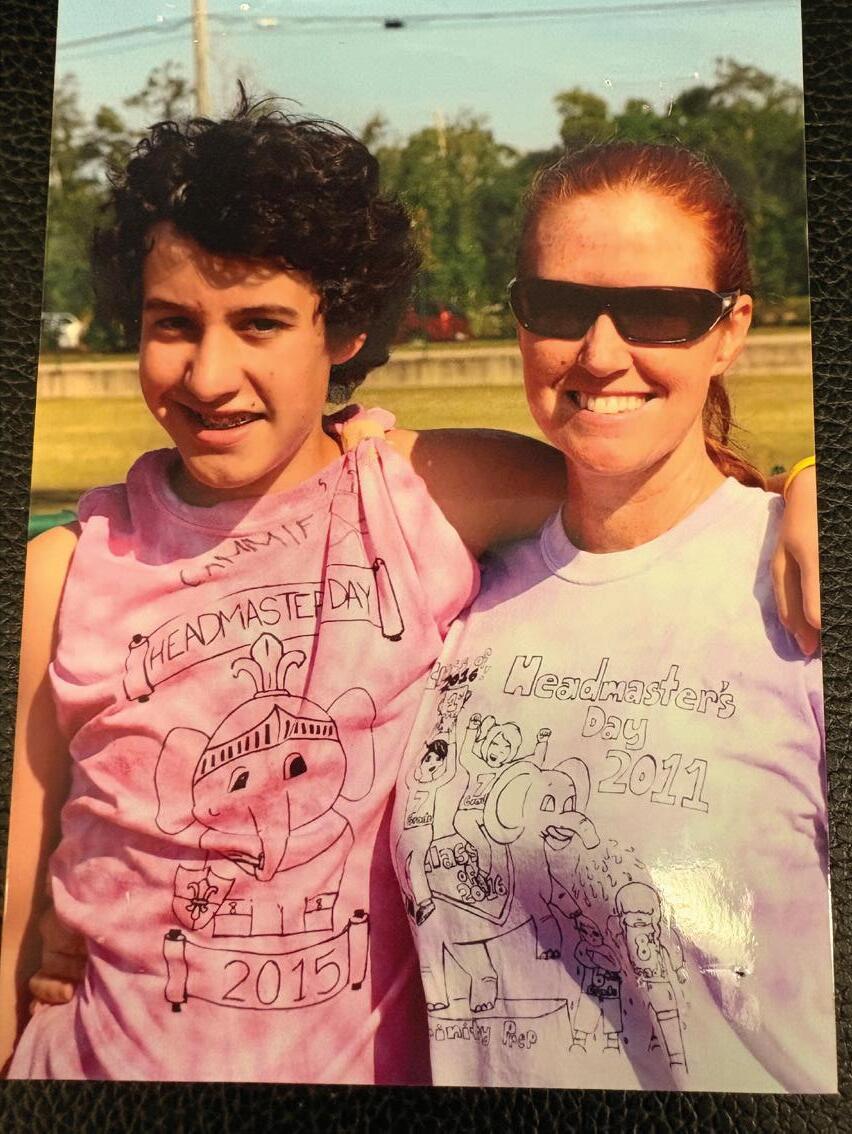
Hempsted and her late son, Sean, attend Headmaster’s Day in 2011.
Whether it be helping them in the classroom, giving them advice or simply providing a safe space to vent, Hempsted dedicated all her time at Trinity to supporting students.
Hempsted is retiring on a high note, ready to start the next chapter of her life while remaining grateful for all she has ac-
“I hope they remember that I helped them and that I always tried to help them with their best interests at heart, even though sometimes it was hard,” Hempsted said. “I maybe said things that weren’t necessarily what they wanted to hear, but it was in their best interest. And I hope they felt supported by me and like I was somebody they could always come to if they needed something.”
Article by Fay Zhao
courtesy of Tracy Bonday
In the summer of 2021, Head of Upper School Tracy Bonday stepped foot on campus, preparing to fully transition students from COVID-19 back to school. Five years later, with many vibrant programs established, Bonday will set out this summer to Maryland as the head of school at St. Martin’s-in-the-Field Episcopal School.
In addition to her move out of state, Bonday will be working with younger students at her new school, ranging from preschool through eighth grade. Despite these changes, one thing remains constant.
“I always think about the need to educate children holistically: mind, body, spirit, soul — however you wanted to find that third component,” Bonday said. “I always try to think about programming in that context.”
Following her personal philosophy coupled with driving Trinity’s mission, Bonday reconfigured many school programs to fully optimize student experiences, one of which included the introduction of the Sophomore Day of Service, a program where tenth grade students participated in community service, packaging food through U.S. Hunger and working with different local nonprofits.
Bonday’s New
When a new portion of Trinity’s mission statement was incorporated in 2023 to “embrace diversity in thought and perspective,” Bonday worked with faculty and students to launch a new interfaith council.
“(The mission is) something that constantly has to be evaluated and looked at,” Bonday said. “Students need change over time. … It constantly requires having conversations about how you can improve in order to make sure you’re providing valuable experiences.”
Diverse perspectives come not only through facilitating student conversations, but also programming that brings new resources to them.
Working with Interim Term Director Erin Miller, Bonday helped bring to life the inaugural Interim Term, where students were able to go on learning trips or acquire a new skill through experiential learning. Under Bonday’s leadership, the upper school House System was an additional initiative aimed at fostering community among different students.
However, program development only makes up a fraction of Bonday’s role; her day-to-day involves supporting department heads and faculty, executing administrative tasks and handling student discipline — oftentimes putting out fires left and right (or seeing to the multiple fire alarms over interim).
Throughout it all, transparency became Bonday’s greatest asset in making decisions as the head of upper
“It is very difficult to make everybody happy 100% of the time,” Bonday said. “There are frequently various stakeholders and or forces that are in direct opposition to each other. What I have found is that people have not always liked the answers I’ve
Photos
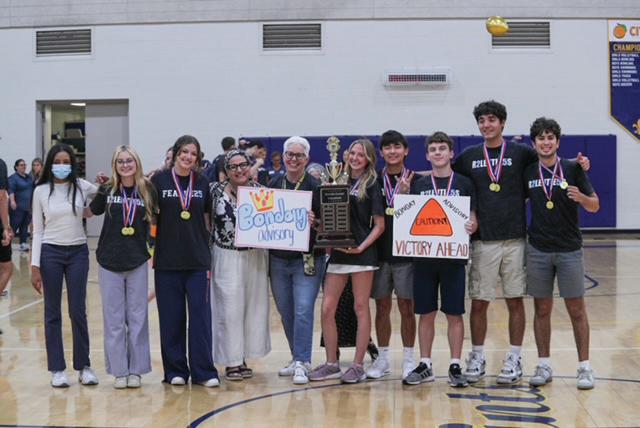
Bonday and her 2025 advisory pose in celebration of winning the Senior Games.
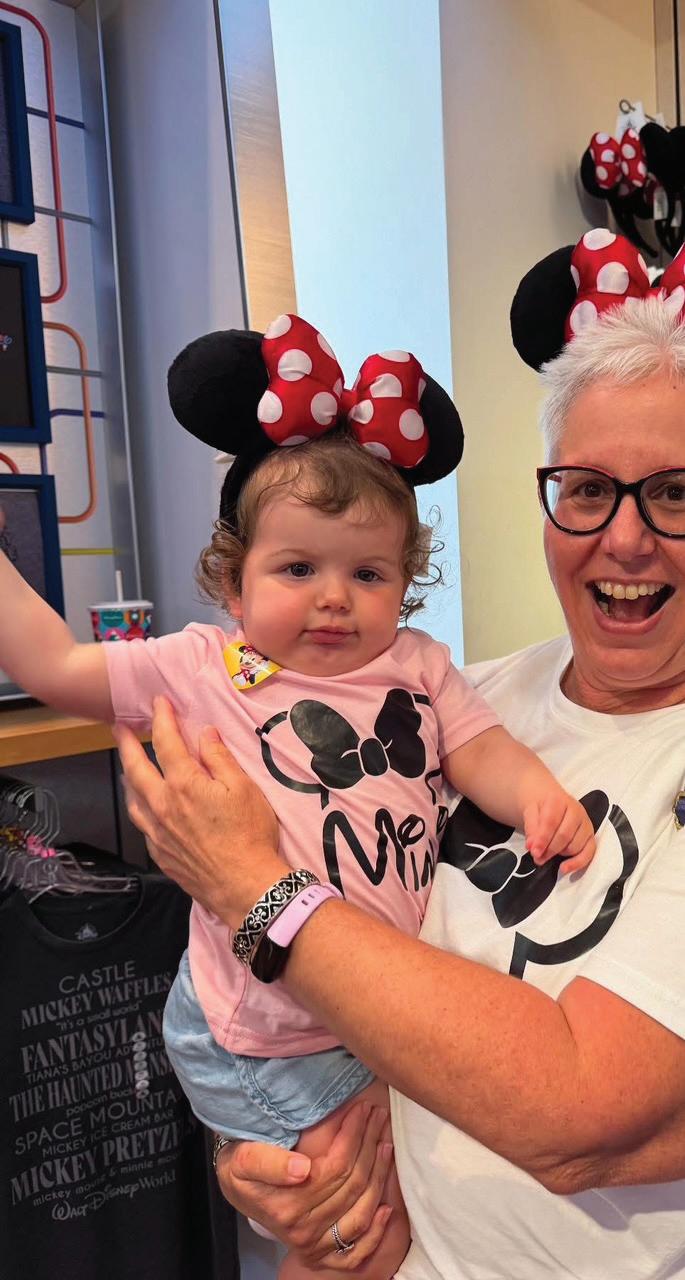
Bonday and her granddaughter Maddie ing Minnie Mouse headbands.
One of her highlights: Bonday students on a trip to Greece.
New Beginning
had to give them, but if I have provided them with the rationale for why those answers are what they are and why I’ve made the decision I’ve made, it’s helped to squash a lot of unnecessary noise or discontent.”
The commitment to transparency comes with careful attunement to the needs of those around: faculty, administration, students and parents. When she is not walking through campus checking with staff members or surveying for trouble, Bonday can be found in her office making time for official and unofficial meetings.
“I am very, very attentive,” Bonday said. “I don’t obviously shy away from conflict. When somebody calls me or I’m not expecting somebody to be here, I’ve never turned down a meeting. I take those types of meetings. I schedule meetings. I make sure I return calls within the appropriate period of time. I hope that what parents have found is that I’ve been a good resource for them to answer questions or be attentive to listening to some of their concerns.”
Outside of the meetings, Bonday managed to fit in many fun adventures throughout her tenure. Her highlights include dressing up for spirit days, helping with grade level trips, chaperoning for forensics — for her dedication she was named the Florida Forensic League Administrator of the Year — as well as traveling with students internationally to Iceland and Greece.
“One is to always have a certain sense of humility,” Bonday said. “Sometimes it involves a little bit of hu mor. … So one of the things that I have learned is do not hang your purse over your chair while you’re at a restaurant because it is very likely that it will be stolen. On my trip to Greece, I had my purse stolen with my passport and my phone and all my credit cards. So, I learned lots of things on that trip, includ ing how to deal with the U.S. embassy and work with American Express to have funds wired and all sorts of fun and games.”
and
A turn of events created an unforgettable memory where Bonday unfortunately missed out on a four-day cruise in the Mediterranean, and instead got dropped off at the police station for a police report and a passport replacement.
Reflecting on her time here, Bonday leaves the campus with many cherished memories and a hopeful future to which she has contributed.
“What I have tried to do throughout my career is feel that in time I depart from an institution that I can honestly look back at my tenure and feel that I have left the institution in a better place than when I arrived,” Bonday said. “I do feel pretty confident that at this point in my five years, there are a number of things that I’ve done to implement change, mentor others or staff members where I think they feel they’re in a better place.”
Moving forward, in addition to becoming head of school, Bonday will be closer to her youngest daughter, who also resides in Maryland, as well as her eldest daughter and her granddaughter who recently turned two, both living in Vir ginia. Bonday leaves the Trinity family with simple advice.
“Be true to yourselves and be kind to the people around you because you never know what is going on in individu als’ lives,” Bonday said. “Empathy and kindness goes a long way.”
granddaughter Maddie wear matchheadbands.
highlights: Bonday traveled with Greece.
Top
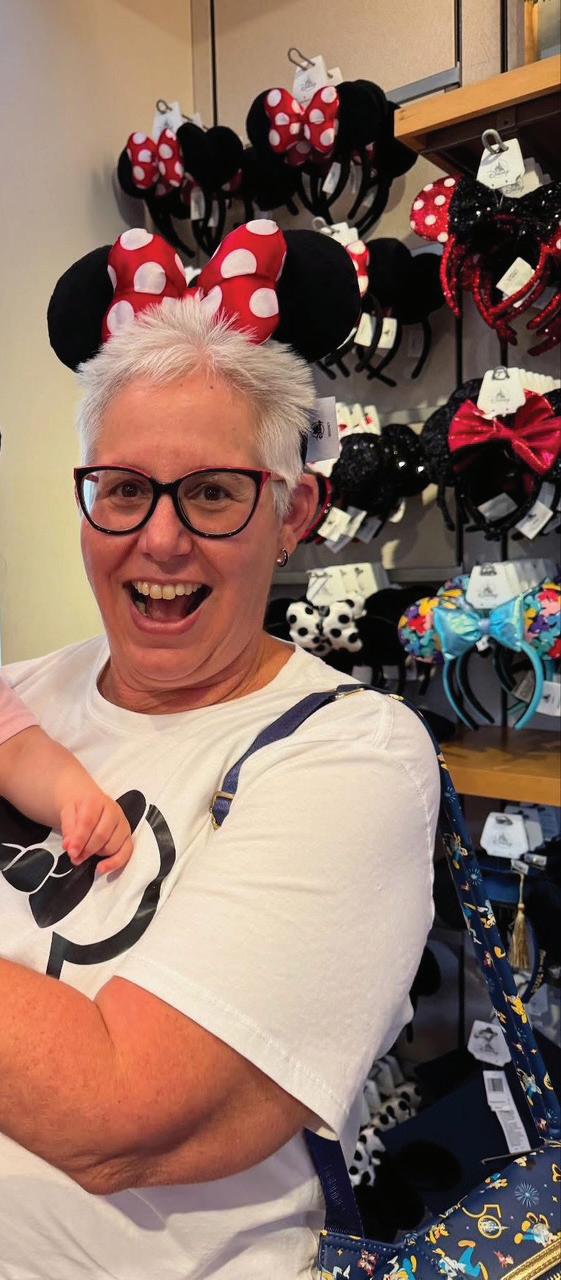
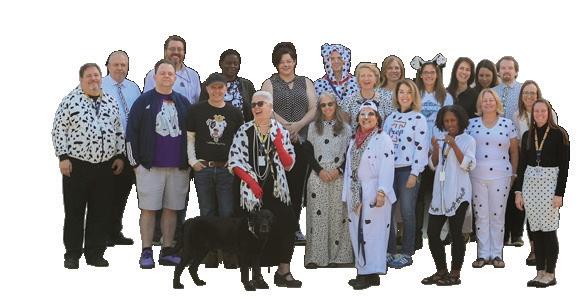
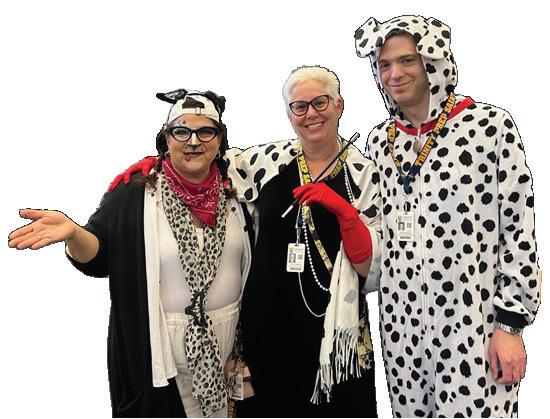
bottom right: During Homecoming week, for squad day, Bonday dressed up as Cruella with the rest of her faculty as dalmatians.
SENIOR SEND OFF
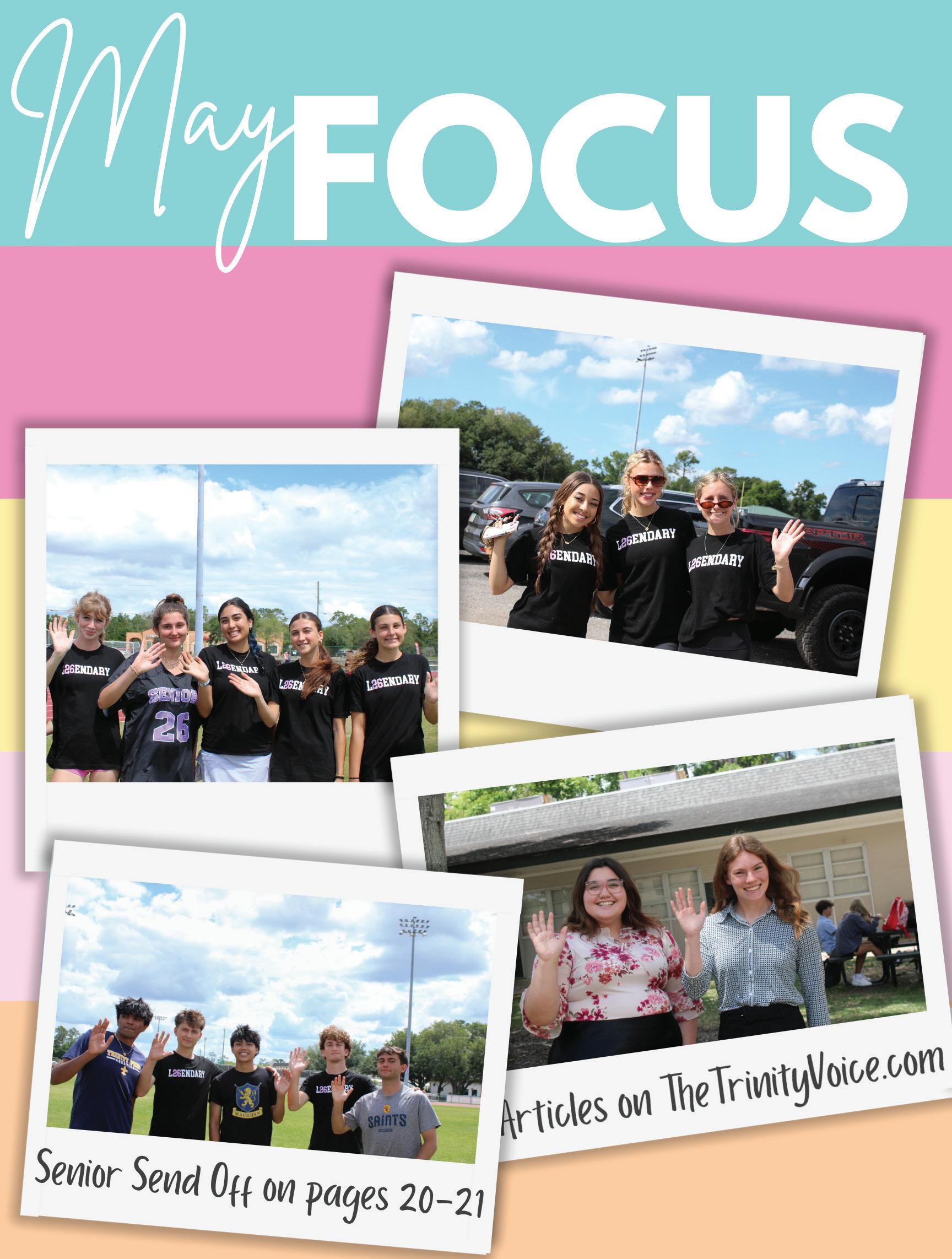
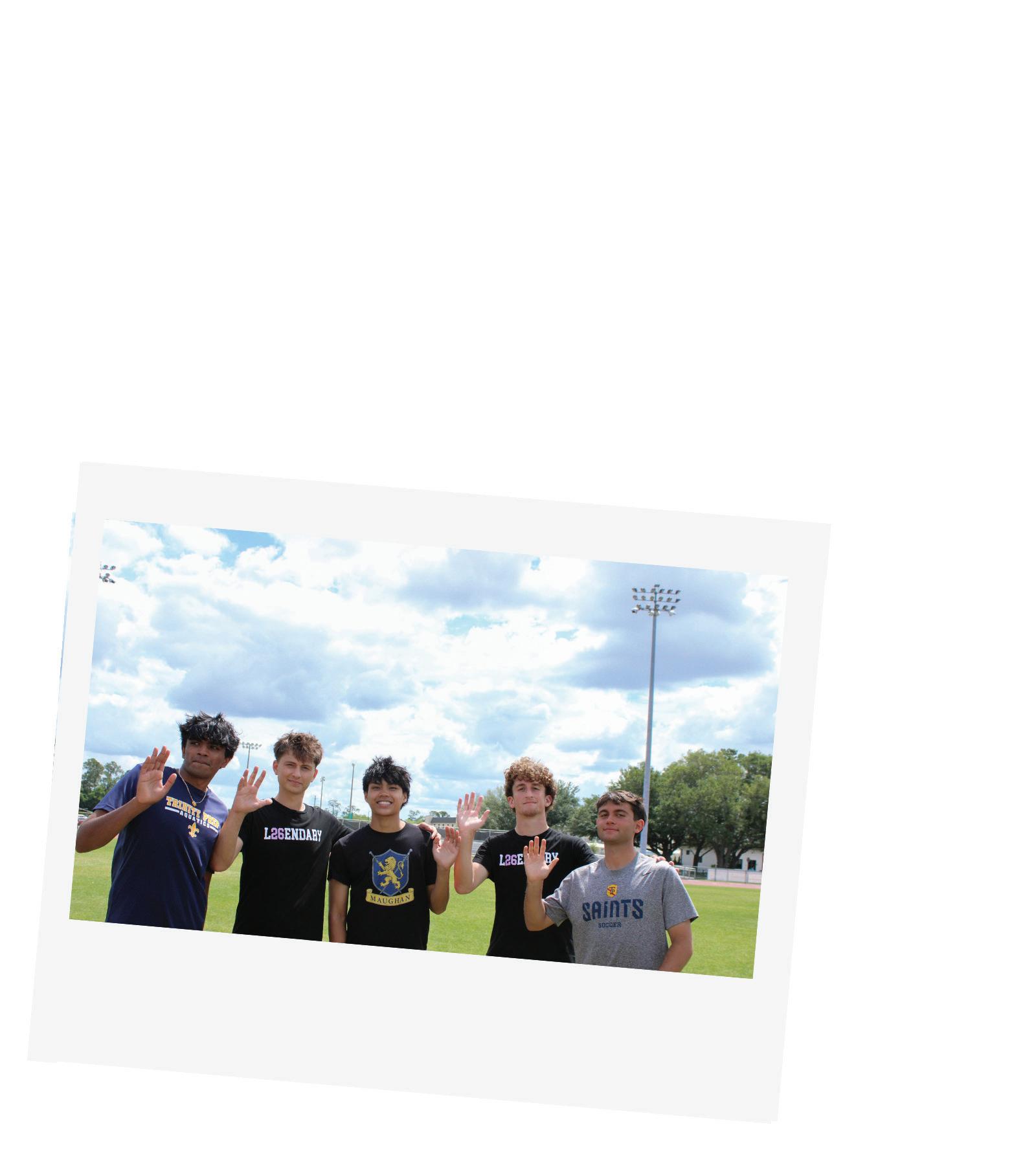
(Pictured left to right) Rishant Bokkisam ’26, Nate Pitone ’26, Mi- chael Salinas ’26, Finn Davidescu ’26 and Gavin O’Brien ’26 enjoy their last Headmaster’s Day.
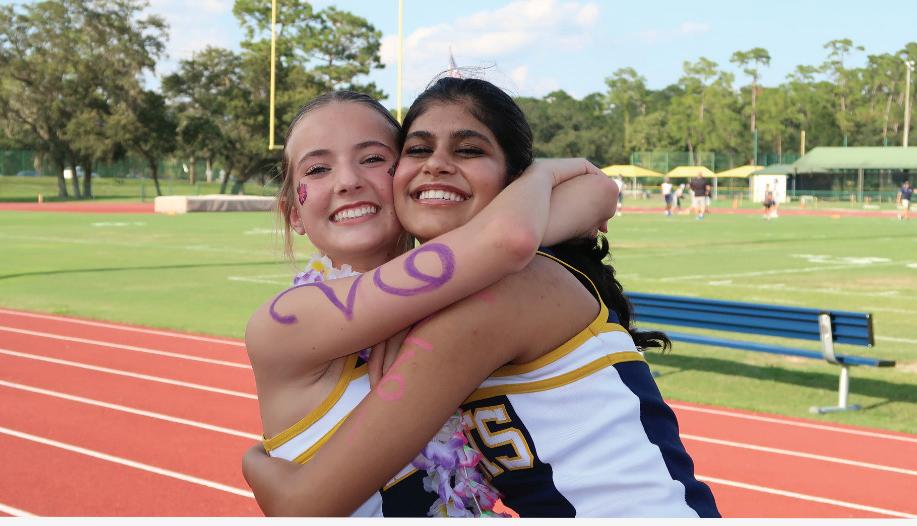
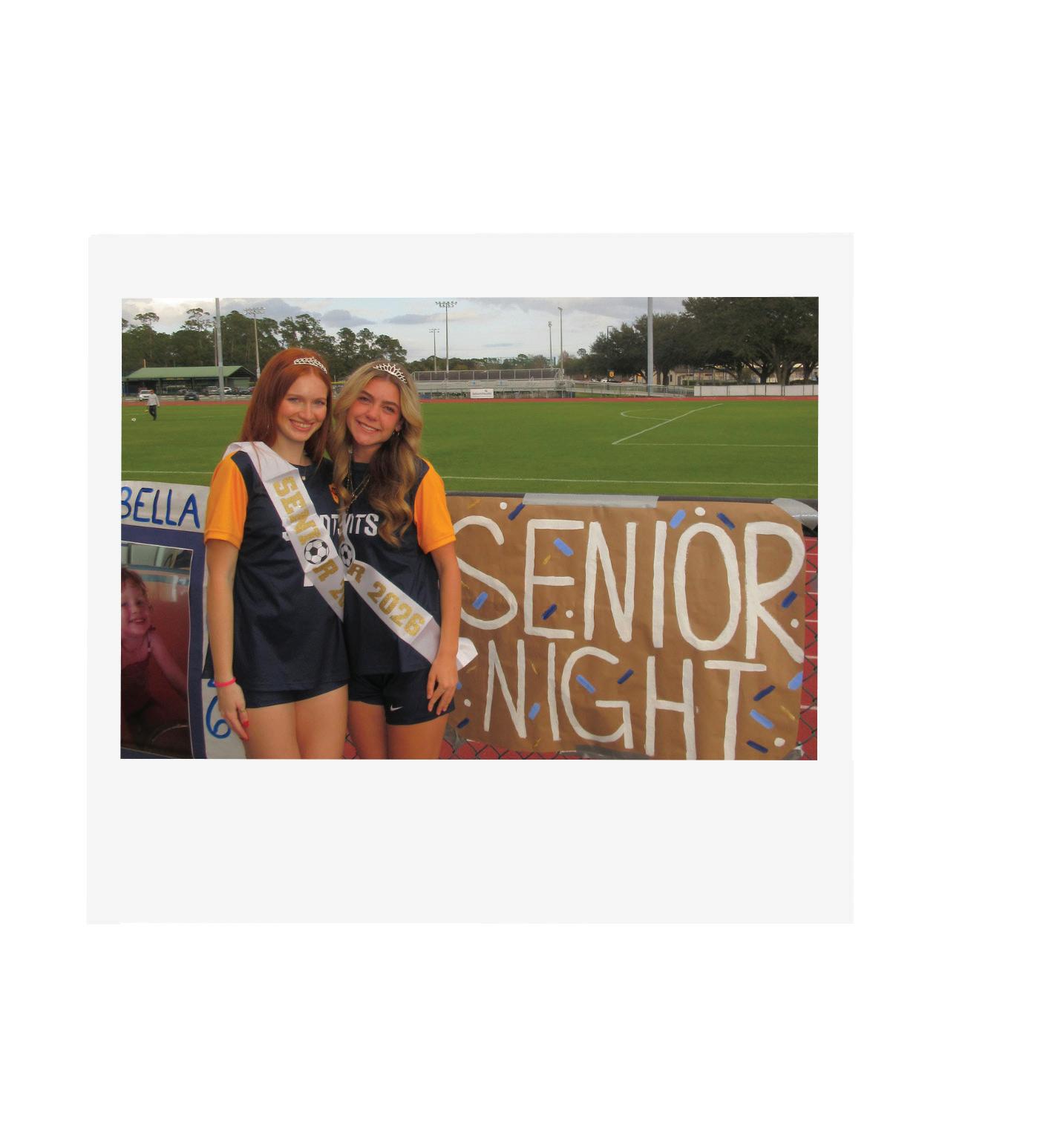
Finley Gattis ’26 celebrates her soccer senior night with Isabella Moore ’26.
SCHUTTLER SIGNS OFF
Article by Omi Tikalal
Photo courtesy of Hannah Schuttler
For most teachers, a school is simply a workplace. For English teacher and Class of 2013 alumna Hannah Schuttler, Trinity has been something much more — home.
After seven years of teaching, Schuttler is leaving Trinity, marking the end of a relationship with the school that stretches back far beyond her time in the classroom. Before she became a teacher, she spent her college summers painting buildings as part of the maintenance team. Even before that, she was a student here.
“I’ve done something on this campus for most every year of my life since I started here as a student,” Schuttler said.
That lifelong connection has shaped not only her experience, but also the way she approached teaching. Returning to Trinity as a faculty member meant stepping into a new role alongside her former teachers who now became her colleagues.
“I legitimately grew up on Trinity’s campus and then was a student here, (so) to come back and work with people that were my teachers and to experience a new form of relationship with them in so many ways has been so fun and cool,” Schuttler said.
Rather than being intimidated, working with her then-teachers was very transformative for Schuttler.
“I think that I’ve grown as a professional and just as a person in a way more here than ... if I had continued to teach elsewhere,” Schuttler said. “These people … knew what I was capable of, so they held me to these high expectations and these standards, (pushing) me to be better … and for that, I am so grateful.”
Over the years, Schuttler has taught English 7, English 9 and AP English Language, building relationships with students across multiple grade levels. While she does not have a single favorite class, each offered different highlights — from teaching Greek mythology and Shakespeare in English 9 to engaging in deeper, discussion-based learning in AP Lang.
“Especially in AP Lang, there have been so many times where (students) have asked me a question (and) I’m like, ‘I hadn’t thought of it that way,’” Schuttler said. “Then I have to reflect and think about it. And there’s absolutely nothing wrong with that. That’s something
that I want you guys to do. But it’s also a little intimidating to be able to do that in the middle of a class when people are expecting you to just have the answer.”
Schuttler has also witnessed major shifts in the student experience, particularly in the wake of COVID-19 and the rise of artificial intelligence. She points to a growing reliance on technology and changing expectations in the classroom.
“Not to say that it’s a bad thing, but it’s definitely a shift in the way that teachers have to approach class or approach how we set up assignments,” Schuttler said.
Beyond academics, Schuttler remained deeply involved in the Trinity community. A former student-athlete who played volleyball, softball and even bowling, Schuttler returned to coach softball, working alongside her former coach and mentoring students that she first met when they were sixth graders.
“It’s been cool (to) watch these girls because the current seniors were my first class of sixth graders,” Schuttler said. “So you get to see them go all the way through.”
Her connection to the school also gives her a unique perspective on its evolution. While physical changes, new buildings and repurposed spaces stand out, the biggest shift has been in the people.
“Next year will be the first year that there’s not a Parker on Trinity Prep’s campus,” Schutter said. “I hadn’t thought about it that way, but it’s true. There are so many people (who are) what we would call … staples to (the institution), that now that they have left, it just feels very strange. And there’s nothing wrong with it because change needs to happen, but it is weird.”
Now recognizing change is inevitable, Schuttler is stepping away for a different kind of role: becoming a mother. She plans to focus on spending time with her baby, something she is looking forward to after years of dedicating herself to her students.
“I’m going to hang out with the baby,” Schuttler said. “I spend so much time with other people’s kids that I want to spend time with my own, and I have the opportunity.”
As she leaves, Schuttler’s hopes for how she will be remembered are simple, Inspired by her own favorite teacher.
“I hope that that’s something that I have instilled in my students, that they are capable of doing whatever they set their minds to,” Schuttler said. “It may be hard to do it, but there is nothing stopping you other than you.”
Hannah Schuttler, then Hannah Parker, and her now-husband, John Schuttler ’13, celebrate their junior prom.
CODING A LEGACY
Henderson retires from teaching, continues coaching robotics
Article by Lola Mandia
Photo by Lola Brown
Computer science teacher Chris Henderson is retiring after four years of working at Trinity Prep. He has made a lasting impact on his students, specifically through the robotics program, which he grew from just a handful of kids to over 30 currently involved.
Henderson loves to teach because it allows him to connect with students who share his interests and pass on his knowledge. His favorite class is AP Computer Science, as it challenges students who are passionate about technology. He finds it meaningful to shape the next generation of computer scientists, especially now in an increasingly technology-powered world.
“I like being around the kids,” Henderson said. “(I enjoy) helping them learn at a time where they can use the help.”
Before Henderson started teaching, he was a software engineer for many years. He later transitioned into education, starting at Windermere Preparatory School for four years
before coming to Trinity. While he found the environments similar, he believes Trinity stands out for its academic focus.
“Trinity is a little more academically focused,” Henderson said. “(They’re) organized. When they do things, they lay it out and they have structure. A lot of schools don’t do it that way.”
more competitions than years prior and placing high regularly.
“(The robotics team is) really just getting to a point that they’re going
to have some real success ... and I want to be here to help with that.”
- Henderson, computer science teacher
In addition to teaching, Henderson is also the coach of multiple robotics teams. These teams have grown significantly in both size and skill over the past few years. When Henderson came to Trinity, the robotics department was small and still recovering from setbacks during COVID-19. With his help and the support of other robotics coaches, the teams are having some of their best seasons yet, competing in
Henderson works with a student in a robotics class. Henderson is retiring from teaching after four years at Trinity, but he will continue coaching the robotics teams.
“When I came here four years ago, we were kind of starting from scratch,” Henderson said. “We had a few returning kids, but not many, so mostly they were learning things for the first time. … We probably have 30 kids involved, so it’s come a long way in a short time.”
Henderson says that most of this growth was very organic, and the robotics department did not often need to recruit students to join the team. The kids who were interested invited their friends to come along, and eventually it became something more present at Trinity, allowing more students to join.
Despite Henderson’s retirement from his teaching position, he will still be around campus to coach the robotics teams.
“I’m going to continue as the robotics coach, so I’ll still be involved with the kids, and those are a lot of kids that I know really well,” Henderson said. “They’re really just getting to a point that they’re going to have some real success over the next few years, and I want to be here to help with that.”
While Henderson will still be coaching, he will have much more time for himself in retirement. With all of his kids now going to college, he plans to travel with his wife and enjoy a more relaxing lifestyle. Henderson won’t be leaving computers and technology behind, though; he plans to continue working on projects in his free time.
“I’ll miss teaching every day,” Henderson said. “But on the other hand, I’ll have a lot of time to do other things I haven’t been able to do.”
hello@foundryfinancial.org https://foundryfinancial.org youtube.com/@foundryfinancial Kevin Lum, CFP®
Three years after leaving the COVID-19 pandemic behind, our school remains committed to eradicating a much more persistent pathogen: cooties.
At least, that’s the impression you might get from our middle school and freshman advisories, which are segregated by gender. While this system has reasonable grounding, separating the sexes past seventh grade ultimately hinders students’ social development.
“We want (advisory) to not just (be) a gathering where (students) have breakfast, but also have meaningful conversation,” said guidance counselor Rylan Smith, who oversees the middle school advisory program. “We want to build a little family.”
Families, more often than not, consist of more than one gender. Why should those on our campus be any different?
“We have (advisories) separated by gender in sixth through ninth because … it’s much easier to approach some topics when you’re looking at it just from one gender standpoint, rather than trying to address things (for) every child in one space,” Smith said. “We’re specifically looking at the developmental changes that happen at that time period.”
The Head of School Advisory Committee recently revisited the structure of advisory in a two-year survey, upholding the longstanding gender split in sixth to ninth grade. The decision stemmed from developmental concerns for younger students, particularly in light of their isolation during the pandemic.
“I always say, ‘Whatever happens in advisory stays in advisory,’ and so those girls do talk about things that might make boys uncomfortable,” middle school girls’ advisor Ann Skippers said. “It’s important to create that safe environment so that they can take that sense of community and safety and create it elsewhere.”
Gendered advisories are thought to facilitate more meaningful dialogue about friendships and conflict resolution, for example, which young boys and girls usually approach in vastly different ways.
ILL-ADVISED Single-sex advisories pose concerns
Ensuring kids feel comfortable discussing these topics, especially as they adapt to a new school, is essential. However, continually shielding them from the potential discomfort of mixed-gender spaces neglects an equally important developmental concern: ensuring kids can socialize universally.
“This segregation, when we have it imposed within advisory ... bleeds into the normal friend patterns,” former freshman boys’ advisor Greg Wedel said. “We end up … with these giant all-boy and all-girl cliques, maybe three, four, five of them per grade level.”
Wedel observed much more cross-gender interaction during his time at Lake Howell High School. He attributes this largely to the lack of situations where gender division is normalized, like it is on our campus.
On the other hand, Skippers noticed similar self-segregation while teaching at a public school, even within the mixed-gender archery team she coached. To some extent, this inclination may be unavoidable.
“When boys and girls are together, they kind of just separate into their own groups on their own, and it’s just awkward sometimes,” eighth grader Arya Gandhi said.
Senior Reha Nagda recalls the boys and girls in her advisory choosing to sit entirely on opposite sides of the room in their first year together. Wedel has seen a similar trend this year among his sophomore advisees.
If children are inclined from birth to socialize with their own gender, it’s all the more pressing that we break students out of that mindset sooner than 10th grade. Mixed-gender advisories in eighth and ninth grade could give students the push they need to forge and maintain strong bonds with those of the opposite sex.
Single-sex advisories also run the risk of allowing students’ negative gender tendencies to resonate, inadvertently bolstering behaviors like rowdiness among boys or cattiness among girls. The gender balance in mixed advisories might mitigate this outcome.
“In the history of the world, the more men or boys get together, the more foolishness occurs,” Wedel said. “If you have a bunch of
immature young people, which let’s say most ninth graders are, having people (of) the same (gender) actually encourages them to commit those behaviors together.”
Though it might seem silly to place the burden solely on advisory when students spend 90% of their school week in a mixed-gender environment, the unique framing of advisory as the school’s center for holistic growth makes it the key space to set students up for longterm social success — or failure.
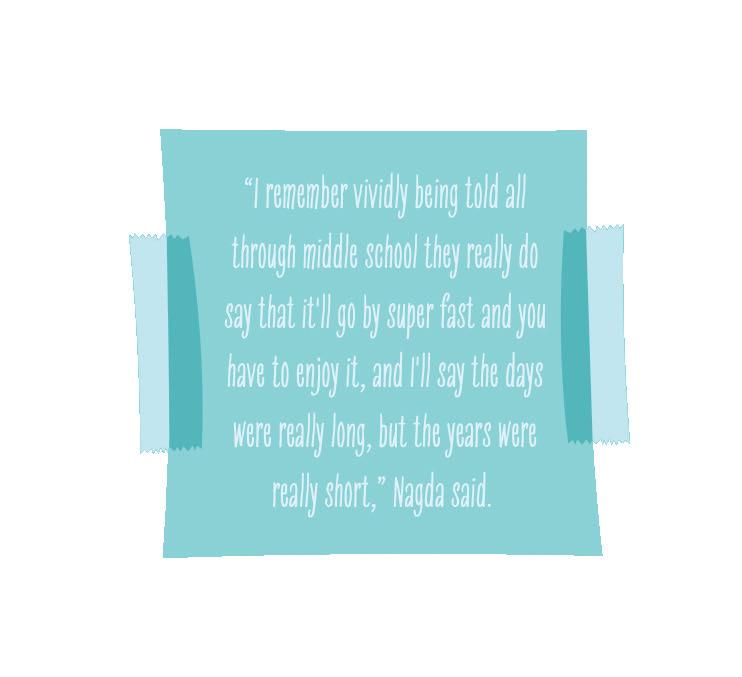
“As you begin to interact more and more … you come to see the other sex as less of an alien creature,” Nagda said. “It teaches you some of that maturity when you have to interact with the other sex, especially (in) a supervised space like an advisory.”
Healthy families reject division instead of reinforcing it.
The Voice’s editorial board supports thisopinionbya7-2vote.Pleasesend commentstovoice@trinityprep.org.
CONCURRING OPINION
Emily Lopez, Editor-in-chief
“Separating advisories by gender may unintentionally reinforce social divisions instead of preparing students for diverse relationships of the real world.”
DISSENTING OPINION
Omi Tikalal, Opinions editor
“The premise that students need mixed-gender spaces is overstated, since most students are not inherently uncomfortable with one another, and even in co-ed settings, they often self-segregate anyway.”
BATTLE OF THE BOOKS
Article by Omi Tikalal
Graphics by Aylin Garibay
In the United States, students are told to “do it all”: excel academically, lead clubs, play sports and build a well-rounded identity. But this balance is inherently unstable. Something has to give, and too often, it is academic rigor.
In many Asian countries, education is treated differently: as a serious, disciplined pursuit that demands consistent effort and sacrifice. It is the primary responsibility that the child has, not one priority among many. The U.S. should not fully replicate these systems, but it should adopt their emphasis on discipline and academic focus, especially in the way it defines success, because right now, it is not demanding enough from its students.
A major reason for this imbalance lies in the structure of the college admissions process. Unlike systems in other countries that rely heavily on standardized exams, the colleges in the U.S. evaluate students holistically. GPA, extracurriculars, leadership roles, essays, recommendations and everything in between all factor into admissions decisions.
This approach creates individuality, but it also spreads students thin. Instead of mastering academic material, students often prioritize building a long resume. The result leads to a system where effort is more divided rather than concentrated.
Standardized tests in the U.S., particularly the SAT and ACT, were originally intended to provide a more objective measure of academic ability. In theory, these exams could serve as a step toward the solely merit-based evaluation seen in countries such as China and Singapore.
But in practice, their influence has weakened substantially.
According to a 2025 Crimson Education article, more than 2,000 colleges have adopted test-optional policies in recent years, largely in response to the COVID-19 pandemic. While some institutions — including all eight Ivy League schools — have begun reinstating SAT and ACT requirements, overall the tests do not carry the same weight.
The system has lost one of its few shared measures of academic performance, reinforcing an environment where expectations vary and rigor is inconsistent.
China’s education system reflects the kind of sustained academic intensity the U.S. often avoids. With the largest state-run education system in the world, students there follow a highly structured curriculum centered around the Gaokao, a single exam that determines university placement and, for many, future opportunities. Students sit through long school days, complete hours of homework and then often proceed to participate in additional tutoring.
“What I would say is, in China, we learn relatively more narrowly, but more deeply, but here we learn a lot of (variety) … but not that deep,” Liang said.
The tradeoff is significant. While American students gain breadth, they often lose depth — and with it, the kind of academic endurance that builds longterm success.
“It’s the college entrance exam (that matters in China). ... They don’t care about GPA. ... One score determines your life.”
“It’s the college entrance exam (that matters),” said senior Wilbur Liang, who was educated in China up to middle school. “They don’t care about GPA. … One score deter mines your life.”
Singapore follows a similar educational model. Its centralized, meritocratic system relies heavily on standardized exams that determine what schools students attend and what opportunities are available to them.
“You would take this big public exam, and your results determine basically the next school you go to,” said sophomore Akkaash Naidu, who previously attended an international school in Singapore.
These systems are undeniably effective, pro ducing students who are disciplined, academi cally strong and accustomed to hard work.
“Having elementary and middle school in China … is the best because (in America) you won’t train yourself that self-discipline when you were a kid, like learning how to concen trate on one thing,” Liang said.
Without a set academic benchmark, expec tations within America vary widely between schools, making it difficult to define what ac ademic excellence actually means. Excessive flexibility in what students can focus on makes it easier to avoid academic challenges, there fore avoiding growth entirely.
- Wilbur Liang, senior
The difference extends deep into culture. In many Asian households, education is seen as the primary path to stability, and both
America should adopt Asian values surrounding education
here,” Liang said. “One of them spent two hours after school with me for nothing. … They don’t receive extra salaries or anything. … They’re just trying to be the best teacher they can to (their) students. I would say … they sacrifice their whole life as a teacher.”
That support exists within a system where pressure is built into the structure itself. Students are constantly aware of where they stand, encouraging them not to disengage because the consequences are immediate.
“Every single month ... we will actually (see the) ranking (of) who scores the highest to the lowest,” Liang said. “It’s published (for) everyone (to see).”
In these environments, comparison is
“A lot of students may … emotionally suffer,” Liang said. “Not in Beijing too much because (it is) the capital, but in some smaller rural areas, all (students) care (about) every single day (is) study(ing) 24/7, and they will have some mental issues.”
The mental health consequences are real and cannot be ignored. This is a place where the American system succeeds. Students are always encouraged to explore their vast interests outside the classroom, developing themselves socially and prioritizing their mental health alongside their academics.
But that does not mean there are no ways the U.S. should take education more seriously. Students benefit from structure, discipline and being pushed beyond what feels comfortable. With stronger support systems and a greater emphasis on mental health, the U.S. is better equipped to handle that pressure without letting it become so overwhelming for students.
“Students that go through the Chinese education system will be more resilient,” Liang said. “(Students there) suffered a lot when they were a child. So in the future when they have a lot of troubles and they are having problems, I would say they would be more resilient.”
That does not require a system built on a singular high-stakes exam, but it does require clear, nation-wide academic expectations. Schools can raise the standards by emphasizing mastery over participation and creating consistent benchmarks across classrooms. Standardized testing, when used carefully, should return as a consistent part of the admissions process. Requiring test scores, while weighing them alongside GPA and coursework, would help to restore clearer guidelines. America should not become Asia, but it should become more serious about education — and then use its resources to do it better. Success should not come at the cost of well-being; it should be built alongside it.
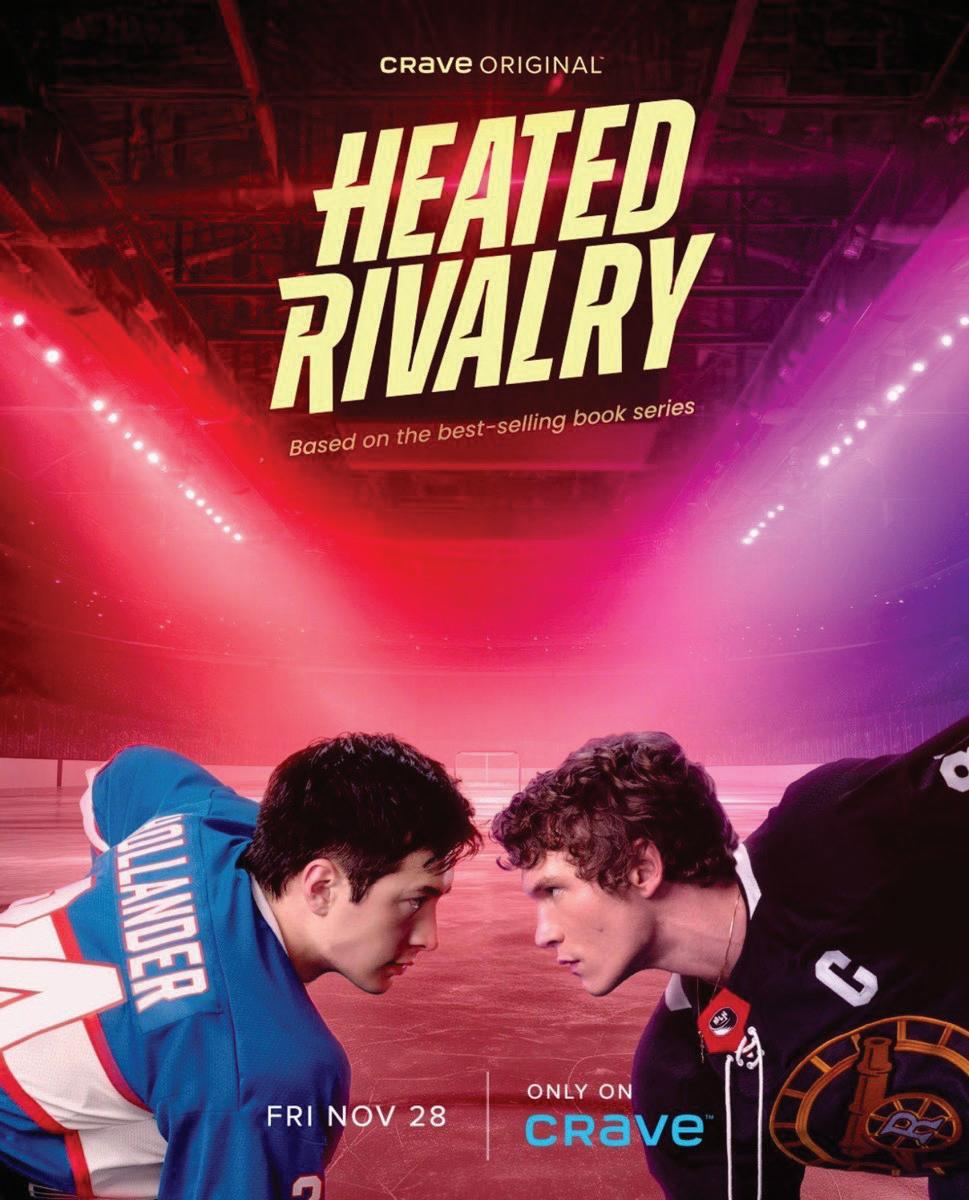
WATCH WITH PRIDE
“Heated Rivalry” marks a step in LGBTQ+ visibility in the media
Article by Mila Taylor
Graphic by Aylin Garibay
The release of the highly anticipated show “Heated Rivalry” has overrun social media for months. While there is still work to be done, the show’s popularity marks a significant step in the right direction when it comes to the accurate representation of LGBTQ+ people in the media.
Based on Rachel Reid’s popular series, “Game Changers,” the show focuses on Shane and Illya, two gay hockey play ers who fall in love.
From the two lead actors carrying the Milano Cortina 2026 Olympic torches, to Mayor Zohran Mamdani of New York advising his residents to stay home and read “Game Changers” during the 2026 snowstorm, the show and the book series have captured the hearts of millions of people.
ences who are outside the LGBTQ community. It tells a story of closeted athletes, but it portrays something anyone can relate to: yearning.
The “Heated Rivalry” phenomenon is unprec edented; queer media has never received this much attention. But more notably, an LGBTQ+ show that actually potrays the queer experience — or a subsection of it — has received love from not only queer people, but all types of people.
“I feel that (some media) can reaffirm certain negative stereotypes about gay people in a straight audience,” senior Van Knudsen said. “But on the other end, if you have a story that actually truly portrays the queer experience … that can offer a different side of people viewing the gay experience. It’s not just a joke. It’s not just a caricature. This person has feelings.”
“Heated Rivalry” is unique because it not only serves as a relatable portrayal of gay romance but also resonates with audi-
“I love the emotional vulnerability because a lot of people like us have experienced a lot of that stuff,” Knudsen said. “It’s also good that it shows men crying because generally in sports dramas, you don’t see men crying. And it shows a real representation of what it feels like to be queer, because it’s not easy.”
“Heated Rivalry” has evolved from years of LGBTQ+ people grasping for representation in media.
“Where it once was really, really performative for a very long time, (LGBTQ+ inclusion) is slowly starting to become less performative, more normalized,”
Director of Forensics and gender studies minor Katrina Brominguez said. “Normally, you had a token gay character. Now it’s just obvious that there would be some gay characters in movies or TV shows.”
In an even greater push for LGBTQ+ representation, the hit show “Bridgerton” set in Regency-era England, but is known for its diverse cast and storylines, has just announced its new season will feature a lesbian couple. Yet, in a shift from the massive amounts of support for “Heated Rivalry,” the upcoming season of “Bridgerton” has received significant criticism from its fanbase.
“People are going to be like, ‘It’s changed its ways’ and ‘It’s not the same show,’ but it’s still the same show,” senior Alexia Car-
vajal said. “I feel like a lot of people are probably not going to watch it.”
A loss in potential viewership of “Bridgerton” for something as simple as focusing on two women represents the constant struggle that queer people still face in mainstream media. The LGBTQ Media Advocacy Group reports a significant drop in LGBTQ+ women in shows and movies. Within the past few years, Netflix has canceled or removed several lesbian led shows, including “Everything Sucks!” (2018), “Warrior Nun” (2022), “I Am Not Okay With This” (2020) and “She-Ra and the Princesses of Power” (2018), citing lack of viewership or licensing issues.
Representation is even lower for queer people of color. Despite the strides that “Heated Rivalry” has made within the past year, there is still progress to be made. LGBTQ+ plotlines often tell the same story, where in reality, not all queer people live the same experiences.
“There’s always the classic, out of the closet, in the closet, which I find is overdone,” Knudsen said. “There needs to be just two people in the closet or two people out of the closet because it shows that queer relationships can just be normal.”
Once the media begins focusing more on representing the authentic lives of LGBTQ+ people, the more normal their existence will appear. Representation is everything, and giving audiences the ability to see LGBTQ+ people living joyful lives and having normal relationships paves the way for empathy and understanding in our society.
“When you realize that there’s no harm, there’s nothing that actually causes harm from that idea,” Brominguez said. “If (LGBTQ+ people are) in your literature, if (they’re) in your media, if (they’re) in your movies, your TV shows, you realize that there’s no detriment to the thing you were afraid of or the thing you were avoiding.”
Poster courtesy of HBO
ALL ABOUT LACS (LIBERAL ARTS COLLEGES)
Here’s
why I applied to liberal arts colleges, and you should too
Article by Sammy Lou
Graphic by Natalie Baron
When you’re applying to colleges, there are a lot of factors to take into consideration. As someone who just went through the college application process, I realized this pretty quickly. One really important aspect of figuring out where I wanted to go to college was the size of the school. I always knew I wanted a smaller school, which led me to discover the world of liberal arts colleges.
Some of you may never have even heard of liberal arts colleges like Pomona, Bowdoin or Swarthmore. Perhaps they are not on your radar because they only have a couple thousand undergraduate students at most, while the majority of state schools like Florida State University can have over 30,000 undergrads. In that way, liberal arts colleges are the exact opposite of your typical large state school.
A liberal arts education is all about branching out, exploring and taking classes across different subjects. You are encouraged to take classes in whatever your heart desires, not just classes in your major. You’ll get a broader education compared to a more narrowly focused or pre-professional education elsewhere. In fact, some liberal arts colleges like Amherst, Grinnell and Hamilton don’t even have core requirements for which classes to take.
But what’s so good about these small colleges? Below are three reasons why you should consider applying to liberal arts colleges.
Valuable Education in AI Age
Nearly all liberal arts students take classes in both STEM and the humanities. It’s a common misconception that not picking a high-paying STEM major like engineering or pre-med makes it hard to get a high-paying job. (Not true!) It’s also a misconception that if you major in something like history or philosophy, your only career path is academia. (Also not true!) Nowadays, employers are actually looking for students with a liberal arts education more and more in the age of AI. Interestingly, former Starbucks CEO Howard Schultz majored in communications, and former
YouTube CEO Susan Wojcicki majored in history and literature. While you should obviously major in what interests you, it can be helpful to take classes across different disciplines.
According to a January 2026 article in Forbes, in the age of AI, which can replace many jobs, employers are placing more value on a liberal arts education because it develops both critical thinking and the ability to see connections across disparate fields. You also get a better understanding of human nature, culture and ethics.
More Access to Resources
At most state schools, you will find yourself surrounded by 30,000+ undergrads, and that’s not even counting the grad students. For example, the University of Florida reported that they had 39,794 undergraduates in Fall 2024. They also have a student-faculty ratio of 17:1. Meanwhile, your typical liberal arts college like Williams College has only 2101 undergrads and a 7:1 student-faculty ratio, according to Williams’ website.
Small Community
Another advantage of small liberal arts colleges is that you will have much more access to resources such as research funding, professors and an easily accessible alumni network. Professors are focused on undergrads, not the grad students. Fewer undergrads also means that clubs are easier to join. Usually competitive clubs like the consulting or finance clubs are a lot easier to join at smaller liberal arts colleges and won’t require interviews to join. Sometimes, bigger schools where you have to compete for the same resources can be cutthroat, but not at liberal arts colleges.
Finally, liberal arts colleges have a small, tight-knit community, almost like Trinity’s. Most students live on campus for all four years. Also, smaller classes mean that having really thoughtful conversations among your classmates and your professor is easy. The small class sizes also make it easy to get to know your professor (who will never be a teaching assistant/grad student). Because they are able to form these relationships, students even have opportunities to become research assistants to their professors as undergrads.
Liberal arts colleges may have their downsides, like usually not having strong sports programs or huge party scenes, but this is made up for by all the benefits that they have to offer.
Dear Trinity,
Please accept this letter as formal notice that I am resigning from my position as the only funny person at this school. My last day of employment will be May 22.
I would like to thank you for the opportunities I have been given during my employment at this institution. It is at this time that I would like to recall all of the fond memories I’ve made over the years.
That took less time than I expected.
Upon my departure, there are many teachers I will miss. Most of them don’t work here anymore. My mom told me they all went to a farm upstate. Who would’ve guessed that farming was a more lucrative job than teaching at a private school?
Of course, there will be many things I won’t miss. I don’t think I’m allowed to say all of them, but I’ll list them down below in hopes they get through.
First off, askaaskdkdkdd
But who can forget when dkdkdkdddddddkdk
Oh, and there was that one
Despite my complaints, in the end, I do feel prepared. Although, I don’t know quite what I’m prepared for. Knowledge like that is above my pay grade — like teachers when you ask them how to fix the classroom’s AC.
During my final days, I am committed to ensuring a smooth transition for my successor. I have heard your complaints about him: “YOU’RE the Humor God, not him”; “I miss you already”; “nobody can replace you, king.” Trust me, I know. Nevertheless, in time I’m sure you’ll come to love him.
Jokes aside, I am forever grateful and appreciative for the opportunity to work with so many great teachers. But just like me, they’ve received better offers.
Yours truly, The Commentaaron
MOTIVES OF MOTIVATION
Article by Skyler Campbell
Graphics by Aylin Garibay
The human race has aety of people and systems that make it -
possible to group everyone into one category, but one ofmon factors-
fill specific goals. For teenagers, this can be something like getting accepted into a good college or making a change in the world. How teenagers go about achieving these goals, however, depends on how their brains process motivational information and rewards.
Learning specialist Dana Miller has seen firsthand how students’ self-discipline changes throughout the teenage years.
“As a teen, you have a lot of distractions in your life,” Miller said. “Your brain’s still developing, and you’re still kind of figuring out the world yourself. So I think if you’re older and you have more experience in your life, it’s easier to stay disciplined.”
During adolescence, the ability to respond to motivational stimuli is influenced by the mesolimbic pathway, a part of the limbic system that deals with instant gratification. It is also defined by the still-developing prefrontal cortex, responsible for long-term decision-making and impulse control. This continuum between the two parts of the brain explains the variety of motivations that teenagers experience, whether they’re due to academic pressure or the desire to fulfill a personal goal, and reflects how the developing brain can affect a teenager’s behavior.
According to the National Library of Medicine, there are two main categories of motiva-
tion: extrinsic and intrinsic. Younger teenagers often rely on extrinsic motivation, which is driven by a fear of consequences or a desire for some sort of reward. Meanwhile, older teenagers tend to rely not only on extrinsic motivation but also on intrinsic motivation, which is rooted in interest and a desire to complete a task for personal gain.
Freshman Chloe Kang demonstrates this change, as she starts to find motivation in her knowledge in various subjects and the desire to make an impact on society.
“Most people know that grades are pretty important to me,” Kang said. “But my overall outlook is not just for the letter, but it is also for the impact that I can have and the knowl edge which I can acquire, and that is definitely something that’ll stay with me for a while.”
The logical aspects of the prefrontal cortex don’t fully develop until the mid-to-late 20s. As adolescents continue to grow, the separate parts of the brain begin to reach similar levels of development, and teenagers often find their priorities shifting as they look towards the fu ture and more permanent goals.
Sophomore Sophie Matusiak has noticed this change in her long-term decision-making as she matures throughout high school.
allow the used ones to thrive. This means that when a teenager practices good discipline, they are helping to make gaining motivation easier in the future.
Miller acknowledges the benefits employing hard work and effort to achieve success.
“On average, I do think motivation is just training,” Miller said. “Teenagers are all similar in the fact that their brains aren’t fully
“I’d say as I’ve gotten older, I’ve become much more independent,” Matusiak said. “During middle school, I had a lot of missing assignments, and I didn’t really do my work much. But I think just as you get older and you have goals like getting into a good college, you realize you need to change your habits to make it better for yourself.”
While the brain’s imbalance can create prob lems for teenagers when it comes to the regu lation of instant gratification, the plasticity of the brain at this age makes it easier to shape habits that can be beneficial to learning and growing as a person.
According to the Cleveland Clinic, the brain is consistently strengthening its neuron path ways through a process called synaptic prun ing, where it discards any unused pathways to
TRUST YOUR GUT
Article by Jena Mhamdi
Graphics by Natalie Baron
The brain is for thinking, the stomach is for swallowing and the arms are for picking things up. These body systems may appear to be unrelated, and at first glance, their jobs certainly aren’t similar. But what some people fail to realize is that the body isn’t a sac of disassociated biological structures, each doing a different, unrelated job, as they may believe; it’s an interconnected system, a maze of neurons, sending messages back and forth.
One organ system that has substantial effects on the entirety of the body is the gastrointestinal tract, or the gut. The gut is made up of a series of organs, including the mouth,
With its jobs ranging from food digestion to pathogenic protection to even mood regulation, keeping the gut healthy is a priority.
The gut plays a huge role in mental health because of a connection between the gut and the brain called the gut-brain axis. The gutbrain axis, also called the gut-brain connection, is a communication network that links the central nervous system (CNS) with the gut’s own nervous system, called the enteric nervous system.
Over time, the gut-brain axis has evolved to help the gut and brain stay in close con tact. In fact, there are more nerve cells in
so an imbalance in the gut microbiome will result in low serotonin levels, lowering mood and sleep.
“If you don’t get the correct nutrients or your gut health is not that good, you might not be able to do certain activities or your stamina might be lower,” sophomore Lucia Fang said. “And in terms of mental health, the things you eat consume you in a way. It controls you, because it controls your mood … I get really angry and anxious when I don’t eat.”
An imbalance in the gut microbiome, also called gut dysbiosis, is usually caused by a poor diet or overuse of antibiotics. A study released by the National Institute of Health found that a high-calorie diet can cause gut dysbiosis. Chronic excessive energy intake, the constant consumption of more calories than needed by the body, causes gut dysbiosis by reducing the diversity in gut bacteria and weakening the gut lining. This reduction in diversity is because a high-calorie diet is also high in sugars, like fructose, that are the fuel for rapidly growing bacteria, rather than the beneficial bacteria that prefer fuel like fiber.
The gut is also home to 70% of the immune system tissue in a person’s body, according to UCHealth, meaning a direct impact on immune system can and certain diseases. A poor gut can lead to a weak immune system.
“The gut microbiome helps to protect and keep you safe from the bad bacteria that could cause an infection,” Moretz said. “Most people have experienced food poisoning before, and that’s usually caused by some sort of bad bacteria that’s going to make you sick. But usually, the gut microbiome is there to counteract
Gut microbiome plays an important role in overall health
that and it works with your immune system to kill off the bad bacteria that could potentially make you sick.”
The bacteria in the gut work together with the immune system to fight diseases by educating, training and regulating immune cells. For instance, according to Harvard Medical School, a microbial mediator located in the gut stimulates the activation and signaling of natural killer T cells, which are involved in immune regulation.
Luckily, there are several effective ways to restore microbial balance, such as probiotic supplements. Probiotics are live bacteria and yeasts that can improve gut health and usually
my health),” Fang said. “I also try to eat (a lot of) fiber and protein.”
Protein and fiber improve gut health by supporting digestion and balancing the microbiome by fueling beneficial bacteria. Additional foods beneficial for gut health include fermented foods, such as yogurt, kimchi, vegetables and legumes. Mediterranean diets, for example, are famous for their rich source of gut-healthy foods.
While it is important to keep a healthy gut, there is no such thing as a “perfect” gut in which all the bacteria are beneficial and serve to fight pathogens.
“It’s all individual,” Moretz said. “A lot of your
You’re made of trillions of bacteria in your gut with thousands of different species, and so there’s no specific perfect gut microbiome. Everyone is a little bit different and unique.”
The gut and the gut-brain axis are perfect examples of the uniqueness and complexity of the human body. Over time, humans have evolved to send messages more quickly, respond to stimuli better and maintain a homeostatic balance more efficiently. The gutbrain axis is one way the body sends messages to keep itself alive. Ensuring the health of the cells, tissues, organs and organ systems that form a body is necessary for ensuring optimum mental and physical health.
FROM HIGH SCHOOL YOUTHS
“Trinity has helped guide me through this process, which has allowed me to get a feel for communication skills, getting things done on time and also taught me to be a person behind the jersey.”
- McKenna Hawley, softball at the University of Central Florida
“I am looking forward to being a part of a team that feels like a family. This opportunity means a lot to me, and I can’t wait to play at the next level.”
- Naomi Tanielian, softball at Grinnell College
“Trinity has prepared me for college sports by having a school day with practice at the end or beginning of it. Coach Starling has helped and is preparing me by providing practices like the ones in college.”
- Mercer Wilson, softball at Florida National University
“Some things I’m most excited about committing to UConn is the family aspect the coaches and players bring as well as the competitive atmosphere.”
- Emma Hartung, softball at the University of Connecticut
“I’m most excited about the fact that I’m starting college with a group of people that I know I will get along with. My parents have helped a ton by driving me out of state or helping me buy equipment.”
- Noah Hornbeck, cycling at King University
Spread by Julia Wu
Photos by Julia Hoskins, Graphics by Maxi de la Fuente
TO COLLEGE RECRUITS
-
“Trinity prepared me for college sports by helping me balance academics and athletics. Having this experience will help me ease into college.”
- Grace Sheppeard, volleyball at Moravian University
“I’m most excited about the opportunity to not only go to a great school but also join a team at the collegiate level in a sport that I’ve grown to love.”
“I am most excited to keep advancing in my sport, especially at the collegiate level. I am also excited to be a part of a team where everyone pushes and motivates each other to get better.”
- Sarah Willoughby, diving at Denison University
“Trinity has prepared me by making sure I can balance both rigorous academics and high level athletics. Coach Kristy Nave has always been an incredibly positive influence and has taught me to be both a better diver and person.”
- Olliver Polsinelli, diving at Denison University
“I’m most excited about the opportunity to compete at a high level while being part of such a strong academic environment at Haverford. The balance of a great team culture, recent team success and the chance to pursue an accelerated masters with UPenn pushed me to commit.”
- Thomas Bonos, soccer at Haverford University
- J’ana Johnson, lacrosse at Beloit College
David Myers ’27 and Derek Hopkins ’28 battle in a game of ultimate frisbee.
Ashad Sarran ’26, Veer Patel ’27 and other students represent their grades in a pie-eating contest.
Eighth grade students work together to complete the hula hoop relay.