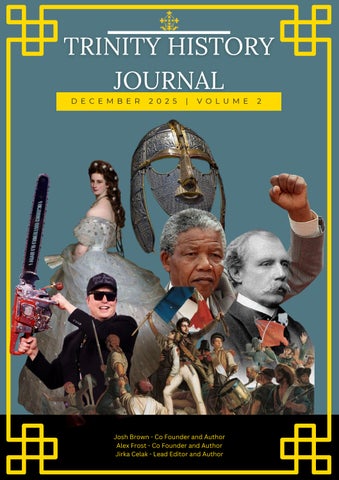
TRINITY HISTORY JOURNAL D E C E M B E R
2 0 2 5
|
V O L U M E
Josh Brown - Co Founder and Author Alex Frost - Co Founder and Author Jirka Celak - Lead Editor and Author
2
Contents A REVIEW OF ‘WHY NATIONS FAIL’
3
Seb Vials reviews, “Why nations fail,” a book on how we can see the success of nations through their history.
THE WHITE RAJAHS OF SARAWAK
4
Jirka Čelak talks about how one adventurer managed to effectively make his own kingdom in South east asia.
8
LA SERENISSIMA: WHY WAS IT SO SUCCESSFUL? Josh Brown talks about how Venice managed to successfully turn into a merchant power.
11
THE SUTTON HOO HELMET Alex Frost talks about the discovery of the Sutton Hoo Helmet
12
MUSK’S KIDS AND CHINESE CONCUBINES
Alex Frost talks about the similarities between the concubines of Qing dynasty and the children of Elon Musk
14
THE SOUTH AFRICAN BORDER WAR Jirka Čelak talks about the South African border war on the 50 th anniversary of the Cuban intervention.
18
A WHISTLESTOP TOUR OF DEMOCRACY Duncan Rout talks about the progress of democracy throughout history
20
SISI: AUSTRIAN PRINCESS DIANA
Josh Brown reflects on his travels to Vienna and discusses the cult of personality surrounding their historic empress.
2
Why nations fail- book review services that enables people can exchange and contract. This creates the engine for prosperity, they suggest, as it enables the various people to decide how to allocate resources which will lead to the most efficient allocation and through the development of technologies due to the incentive that is provided by the inclusive institutions to advance the technologies. The second process, creative destruction, Medieval occurs drawing as of a cockatrice being attacked new technologies are developed creating new by a weasel more efficient methods to replace the old, fuelling development. The books proves this connection through a huge number of examples across the entire span of history, from the Neolithic revolution to the developments in North and South Korea, from development in america after colonisation to those throughout history in china. However, one of the largest examples they focus on is the development of the political institutions in Britain and how that enabled it to develop through the industrial revolution. They show how the creation of pluralistic political institutions through Magna Carta (1215) and The Glorious Revolution (1668) created the capability for a wealthy middle class to maintain their interests which created the inclusive economic institutions. These led to the industrial revolution, due to the incentive produced by the patent system giving the entrepreneurs a reason to create new methods of production and new technologies. The institutions created Britain's prosperity up until the modern day.
Why the difference? They have the same In Nogales, Arizona, the climate, culture, and our ethnically average income is 30,000 dollars a years, most teenagers similar. So why did one have such a high standard of living while the other attend school while almost all doesn't? adult have a high school diploma, they have a high life expectancy in comparison to This is the fundamental question behind the world average and a large Why Nations Fail by Daron Acemoglu and James A Robinson. Why some number of government nations have achieved prosperity and provided services such as roads, electricity, sewage and aothers have failed, falling into poverty as legal system. They have always a consequence. The answer the two This is what I think makes this book exceptional, come too is that it is due to the been able to vote for their its ability to look through the huge number of mayor, their congressmen, institutions, both economic and political, historical examples, explain them concisely and that form in the nations that lead to their their senators and their interestingly before displaying the connection president, democracy is prosperity. Institutions are a set of rules between the institutions and the economic second nature to them. In and mechanisms for coercing individuals performance to prove its thesis. It is a must read Nogales, Sonora, the average to comply with rules that exist in society. for any history student who has an interest in income is 10,000 dollars a year, Those that form "inclusive institutions" the development of nations, in particular for many teenagers are not in prosper while those that produce those who are fascinated by the connection school while many adults did "extractive institutions" will suffer as a between politics, economics and history. Even if not receive a high-school consequence. you only want to learn lots of history of a large education, their life number of nations quickly, for this too the book expectancy is lower then their Inclusive institutions, as they define is exceptional due to how much history it covers northern neighbours, while them, are ones that allow and encourage in the small number of words it contains. It is their roads are dilapidated and the participation by the great mass of also noteworthy for its ability to convey complex they are far more likely to be people in economic activities that enable economic and political ideas easily through victims of crime. They only individuals to make their own economic simple, understandable proses. Overall, I would gained the right to their decisions. This includes secure private throughly commend Why Nations Fail to you. limited participation in property rights, an unbiased legal system democracy in 2000. and provisions of public-
3
The White Rajahs of Sarawak
The White Rajah of Sarawak
Bosnian National Museum in Sarajevo
The 1800s was the time when many However, James did not want people from Britain or America an elephant, he wanted a boat. would try to go out into the world Thomas agreed. He received a and try to capture a territory and 142 schooner which was then try to establish their own named the “Royalist”, and he personal kingdoms in North set sail for Brunei. America, South America or east Asia. The usual formula was that they The Sultanate of Brunei was a would go to a territory, declare country in decline. After a war themselves king and then proceed to from 1570 to 1578 against the be driven out by the Spanish, the kingdom was French/Americans/Mexicans/Brazil unable to control its waters ians, be arrested or forced out of and 200 years of territorial their newly created country. After expansion ended. To make this this, most of the time they were then worse for Brunei, at the start declared mentally insane and later of the seventeenth century, committed suicide. From James there was a civil war which Harden-Hickey of Trinidad (In the completely destabilised the Atlantic not the Caribbean) to country. There was an open Orélie-Antoine de Tounens of rebellion in the inner country Patagonia, there was almost always a by the Dayaks, who were the failure to establish their own indigenous inhabitants of personal kingdoms. However one Brunei, against the authority of person from this group succeeded the Sultan of Brunei. The and managed to create his own territorial waters were also personal kingdom or “Rajah” with inhabited by pirates. Dutch the kingdom surviving for 100 years. ships leaving Java and Spanish The state which was created was the ships trying to enter the so-called “white rajah of Sarawak” Philippines made sure to avoid Brunei’s waters. It began in 1803 with the birth of James Brooke soon landed in James Brooke in Bandel in Bengal. Brunei and met with the 23rd After leaving England for his Sultan of Brunei, Omar Ali education, he joined the army where Saiffuddin II, and decided to he was immediately shot in the lung. help with the piracy issue. He But fortunately for him, he was part soon separated the Dayaks of a very rich family. His dad, into “land” and “sea” Dayaks Thomas Brooke often was willing to and through repression and pay huge amounts of money to try amnesty for the co-operative and get his sons’ dreams true. This rebels and managed to end the can be shown with Thomas Brooke rebellion. paying a huge amount of money to James’ Brother for an elephant which he wanted.
5
Because of this Omar Ali gave him a large chunk of his land including the port city of Kuching, believing that he was a representative of the British. He was also given a pet orangutan named Betsy. James Brooke, at age 38, managed to establish his own kingdom. James was a coloniser but it in a time of exploitation and enslavement, he wasn’t the worst imperialist out there. He did seem that he wanted to help the people of Sarawak, even if it was in the paternalistic way of the time. He managed to take over 3,000 square miles of the island of Borneo and began to establish a court of justice. This was used to stop the common practise of “headhunting” with it being considered a means of consecrating important events. He also managed to ban slavery in the kingdom. But the most famous use of the courts was when he sentenced a man-eating crocodile to death (to prevent other crocodiles thinking it was “acceptable behaviour”). Brooke was seen as a national hero in Britain as a spreader of empire however the Singapore office distrusted him and soon launched an enquiry into massacring innocent people. However, this fell apart as it was bogged down in little details, such as trying to define what a pirate was, such as whether they had to have sails. Or, whether they needed to have paddles. In 1857, there was the launch of an anti-Brooke revolution by a Chinese Bornean known as Liu Shan Bang launched an uprising against him. Many ethnic groups in Sarawak where against Brooke, most notably Chinese expatriates and the Malay nobles who didn’t support him. Fortunately using the support of Dayak chiefs, he was able to crush the insurrection. Unfortunately for him, the person who he fancied, the brother of the local rajah, Badruhdeen was killed.
He became more depressed as his country slid into debt and hoped that the UK would try to buy the country of him which was denied. James was also gay, and at a time where being gay was illegal, he remained a bachelor and didn’t produce an heir. At the time of James’ death in 1868, the country was passed to his nephew, Charles. And so Charles Brooke was declared as the 2nd Rajah of Sarawak. Charles Brooke was a very competent rajah and managed to increase immigration from China which exploded the size of Kuching, the capital. There was also much more building by the new sultan, including a hospital, a prison, and a fortress named after the Sultan’s wife Margarita. The rajah’s palace the “Astana” was also built there and is still around today. In 1884, it managed to enter into the British empire’s system and lost control of it’s foreign and defence policy, but the government could still keep its domestic policy. The country was run as an absolute monarchy however a small group of native noblemen advised the rajah throughout the sultanate of Sarawak. The economy managed to recover after James’ Brooke’s death, mainly because of the discovery of oil and rubber which were brand new commodities. Other successes including establishing a railway and also establishing many schools where people would be taught in Malay. Charles Brooke however died in 1917, and passed the Rajah to his son, Vyner.
6
While Charles was a competent administrator and builder, he was not a good father. He banned Vyner from eating jam because he viewed it as “effeminate”. He also grew up socially anxious and would hide from guests in a cupboard. If this was an uninteresting period of time, he probably could have kept the kingdom together and showed signs of some competence, with the 1924 penal reform code. However, he was leader during one of the most unstable times in History, the Second World War.
Japan, under threat from US sanctions on oil and rubber, needed to get rubber and oil to try and conquer China. Under the Nashin-Ron doctrine, Japan would attack resource rich Indonesia, Malaysia and Philippines. Unfortunately, for Vyner this included Sarawak, which was subsequently occupied in 1941 by the Japanese, and he went into exile in Australia. When Sarawak was reoccupied by the Allies, Vyner found it in ruins. And so, Vyner decided to sell the kingdom to the British for a lot of money. This spawned an odd anti-colonial movement which wanted to gain independence for Sarawak and put a Brooke on the throne. This movement was quite popular for the people in Sarawak but when some pro-Indonesian rebels assassinated the governor, the movement was blamed and Vyner’s heir to the throne and nephew left the movement.
However, the people of Sarawak couldn’t hold true independence as the Indonesians under the leader Sukarno launched an offensive into the remainder of Borneo. With British and local regiments holding the front, Sarawak was given to the Malaysians in 1963, even though British troops remained in 1966. For the first time since 1841, the people of Sarawak elected leaders from Sarawak and not a foreign adventurer and his family.
1961 Indonesian Malaysian confrontation
7
The Venetian The Venetian Republic Republic
La Serenissima: La Serenissima: Why Why Was Was It It So So Successful? Successful?
8
The Venetian The Venetian Republic Republic From 697 to 1797, the Venetian Republic thrived, becoming one of Europe’s most successful city states, gaining it the name ‘La Serenissima,’ or the serene republic. There were several factors that contributed to Venice’s success. Of these, maritime power and location were the most significant as they gave Venice both the ability to project their military influence effectively, as well as helping to facilitate Venice’s economic strength. Economic innovation and control of trade routes was also a significant factor as it made Venice very commercially successful through facilitating the trade of goods between the East and West. Another crucial factor was its political structure and government. It balanced republican principles with an oligarchic rule which had the effect of both preventing the rise of a single ruler whilst also creating stability. The criteria for evaluating the significance of each of these factors will be based on their long term impact on Venice’s ability to retain its economic prosperity and its influence. The most significant factor in Venice’s success was its maritime power and location. Spread across a series of islands in the Adriatic, Venice had a geographical advantage that allowed it to control trade routes between the East and West. In tandem with this, Venice developed a powerful navy which protected Venetian interests and allowed it to spread influence across the Mediterranean. By the 12th century, Venice had asserted itself as a naval power, with a fleet capable of rivalling even the greatest maritime states of the time, including the Byzantine Empire, Genoa and later, the Ottoman Empire. This assertion was made in 1204 during the Fourth Crusade, where the Venetian fleet played a key role in the conquest of Constantinople as well as capturing various significant territories and gaining control of several lucrative trade routes in the Levant, Aegean, and the Adriatic. A key component of Venetian maritime power was Venice’s adeptness at shipbuilding, with specialised vessels such as galea and nefs being constructed. The galea in particular were manoeuvrable and versatile as they could be propelled by both sails and oars, allowing it to navigate against the wind and operate in both open seas and shallow waters, these features made it a successful warship. In addition to this the cargo capacity and speed made it useful as a cargo ship. Ships like this were the reason that Venice dominated trade and maritime warfare. Control of important trade hubs such as Cyprus and Crete further strengthened Venice’s economic dominance. Overall, Venice’s maritime power and strategic location was the foundation of Venice’s wealth and political power. Without control over trade routes, and a strong ability to defend them, Venice would not have been able to create or maintain its economic strength, and perhaps not even be able to maintain its independence. The Republic’s location allowed it to dominate commerce in the Mediterranean and gave it access to valuable Eastern trading partners. Venetian trading and control of trade routes was only made possible through the Venetian navy to protect and maintain them and to protect its interests. Therefore, maritime dominance provided the foundation for all other Venetian successes, such as its economic prosperity.
The Venetian Republic’s economic innovation and control of trade routes were also factors important to its success. Venice was a significant commercial hub and acted as the primary intermediary between Europe and the East. It facilitated the exchange of goods like silk, spices and precious metals. Venetian merchants were renowned for their ability to navigate the complex Mediterranean and European trade routes by capitalising on their naval supremacy and geographical location. A key economic achievement of Venice was that, in the 11th and 12th centuries, Venice was successfully able to establish itself as the centre for the importation of luxury goods from the Byzantine Empire, the Islamic world, and eventually Asia. This achievement secured Venice’s status as the wealthiest city in Europe by the 1300s. The Venetians developed an innovative system of banking and financial services too. This economic innovation included credit, loans and insurance which allowed Venice to finance and conduct long distance trade efficiently. Further example of Venetian innovation can be seen through the Republic’s mercantile institutions such as the Venetian Exchange. The Venetian Exchange played a key role in creating and expanding a stable commercial empire through its innovative systems such as the Venetian Money Market which handled large sums and financed much of Venice’s commercial activities. Overall, while economic innovation and control of trade routes were key factors in Venice’s prosperity, they were secondary to the maritime power that facilitated Venice’s economic activities. The Republic’s ability to control trade routes was largely due to its naval capabilities and without a powerful navy to protect and expand these trade routes, Venetian merchants would not have had the security needed to thrive. Therefore, though significant, economic power was a consequence of Venice’s dominant position as a maritime force. Another influential factor in the success of the Venetian Republic was its unique political structure. Venice as governed by a system that blended oligarchy and republican elements with power being distributed across multiple bodies. These included the Great Council, the Council of Ten, and the Doge, which together formed a complex system of checks and balances thus preventing any one faction from seizing absolute control. The Doge was elected for life and served as head of state; however, his power was largely symbolic, similar to the British Royal Family today. Instead, the true governing power was held by the Great Council with responsibilities including making laws and electing other government officials. In addition to the Great Council there was the Council of Ten which oversaw the Republic’s security and played a vital role in maintaining Venice’s political stability. The system also enabled Venice to ave a relative lack of corruption, which also aided in their success. Despite being controlled largely by the nobility, Venice maintained a form of rule with considerable preventative measures put in place to stop any one family or individual from rising to absolute power. One way this was done was by frequently rotating public offices to make certain that no one group could accumulate too much control over Venice. However, despite the Venetian political system creating a stable climate, the political structures were merely a safeguard that helped the economic and military successes of Venice to flourish, but they were not the root cause of its prosperity. Instead, this can be credited to Venice’s maritime power, which provided the resources and global reach needed to support Venice’s political autonomy, the political system would not have been effective without the revenue and military backing provided by trade and naval dominance.
A dragon made out of radishes for the radish carving competition
In conclusion, the Venetian Republic’s success and longevity were caused by a combination of maritime power, economic innovation, and a complex political structure. While all these factors contributed to its prosperity, it was the Republic's strategic location and naval supremacy that was the most significant contributing factor in its dominance. The ability to control vital trade routes across the Mediterranean ensured Venice’s economic strength and military security, enabling it to project influence and grow very wealthy. Economic control and innovation, along with its balanced political system, further enhanced Venice’s stability, but ultimately, it was its maritime power that secured its place as one of Europe's most enduring and successful city-states.
10
The Sutton Hoo Helmet The Sutton Hoo helmet is one of the most significant and iconic artefact of Earle’s medieval England and has greatly furthered our understanding of the time period. Discovered in 1939 as part of the famous Sutton Hoo Ship Burial in Suffolk, England, the helmet is though to date back to the early 7th Century and is believed to have belonged to an Anglo-Saxon noble or, possibly, King Rædwald of East Anglia. What makes it so important is its craftsmanship, design and symbolism which give us insight into early medieval military and artistic heritage. The helmet was discovered in the burial of a ship measuring almost 27 meters in length which was a form of funeral practice at the time associated with highstatus individuals in early and medieval Scandinavian and Germanic cultures. Alongside the helmet, the burial contained a variety of other artefacts including weapons and other armour (including a sword, shield and chainmail pieces), gold and garnet (a kind of precious stone) jewellery, silver tableware from the Byzantine Empire and other feasting equipment such as ornate drinking horns and a ceremonial lyre (a small musical instrument). The wealth as variety of the goods found at the site is what led archaeologists and historians to believe that the person buried at Sutton Hoo was either a ruler or a member of the elite class. The Sutton Hoo helmet is an undeniable masterpiece of medieval metalwork and reflects a mixture of Anglo-Saxon, Celtic, Scandinavian and Roman influences. It is made predominantly of iron with bronze fittings, however, it is decorated with a tinned copper alloy and gold foil. Traces of silver gilding and garnet inlays were also found across the helmet. This gilding can be found above the eyebrows that were styled to form the shape of boars which were a symbol of protection in Anglo Saxon culture. Other motifs of creatures can be found throughout the features of the helmet as the nose and moustache form the shape of a stylised dragon or serpent, other symbols of protection as well as power and the eyes are positioned below dragon motifs as well. The crest that runs on the top of the helmet is also decorated with a series of intricate patterns that could represent serpents or dragons. These dragon and serpent motifs and boar imagery reflect Viking and Norse traditions whilst the overall design of the helmet emphasises Roman influences. This is due to the crest and hinged cheek guards as well as the protective plate at the back that would cover the neck which shows the legacy of the Roman Empire in post-Roman Britain. Despite its design, it is unlikely that this helmet would have ever been used as a practical piece of armour an instead was primarily a status symbol. This conclusion is probably because despite its defensive design, the decorative nature of the faceplate and thinness of the iron would have made it exceptionally vulnerable in combat meaning it may have instead been worn during important events such as ceremonies, religious events or just a display of power. The helmet was originally found shattered int over 100 pieces and after painstakingly reconstructed at the British Museum over several years. It was agin reconstructed in the 1970s after new archaeological techniques revealed new details about its original form and can be seen on display at the British Museum. The helmet still remains one of the most interesting archaeological finds in British history as it not only provided invaluable insight into the political, artistic and spiritual life of early medieval England but also showed the interconnectedness of early Medieval Europe through its intricate detailing.
11
Musk’s Kids and Chinese Concubines An X (Twitter) post by @AngelicaOung was first to comment on how the dynamics of the different mothers of Elon Musk’s 14 or so children echo some of the drama tropes associated with Imperial concubines throughout Chinese history. Looking deeper, despite the wildly different cultural and social contexts, their similarities become eerily obvious. Concubines in China were almost always women who, while not legally married to the Emperor, held a significant position in the royal court and often bore his children who could therefore inherit the throne. Throughout Chinese history, concubines played a central role in the complex social and political factors of the royal court as it was not only about romantic relationships but also a way to gain status, power and a child that could rule the country. While the Empress held the highest rank as the official wife of the Emperor, concubines occupied a secondary but often highly influential position within the court hierarchy. Despite their main role being to produce heirs, Concubines were not just passive figures and were instead active players in the intense political drama of court life, where they navigated intense rivalries, formed alliances, betrayed their competitors and even influenced imperial decisions from behind the scenes. This high stakes game that could result in enormous power or demotion and exile has been something that has been widely studied as well as featured in Chinese film and due to this, several personality tropes have emerged based on writing by concubines and other members of the palace and their recorded actions. Not only can these personality tropes can be attributed, with examples, to all of the mothers of Elon Musk’s children, but also their actions to equivalents that happened in the Imperial court.
The current situation with Elon Musks children is not fully understood, however, as of now, he has had 3 relationships that resulted in children: His first wife, Justine Musk, who had 6 children with him and their marriage ended in a contentious divorce; Claire Boucher (professionally known as Grimes), whom he had 3 children with and Neuralink executive Shivon Zilis whom he has 3 children with. There is also Ashley St Clair who claims that she had Elon Musk’s 14th child and has filed a paternity lawsuit against him, seeking sole custody, however, Musk has never publicly addressed the situation. The children that he had with Justine Musk were Nevada Alexander Musk (born 2002, deceased at 10 weeks), twins Griffin and Vivian Jenna Wilson (born 2004; Vivian is transgender and has legal changed her name) and triplets Kai, Saxon and Damian Musk (born 2006). The children he had with Grimes are X Æ A-12 Musk (born 2020), Exa Dark Sideræl Musk (born 2021; nicknamed “Y”) and Techno Mechanicus (birthdate undisclosed; nicknamed “Tau”). The children that he had with Shivon Zilis are twins Strider and Azure Musk (born 2021), Arcadia Musk (born 2023) and Seldon Lycurges Musk (born 2024).
12
At the center of the drama is Musk’s second partner, Grimes. Despite Musk’s apparent favouritism towards her, their relationship has ben plagued by break-ups, public feuds and cryptic social media arguments. This has led her to be dubbed as the ‘beloved but defiant Concubine’ just like the legendary Pearl Consort of Emperor Guangxu who too was adored, yet punished for her refusal to conform. The Pearl Consort lived during the late Qing Dynasty (1874-1900) and was known for her intelligence, beauty and spirit. Unlike most concubines who were submissive and politically cautious, the Pearl Consort was known for her independence and willingness to challenge conventional ideas, making here a controversial figure of the Forbidden City. She was said to be highly educated and politically savvy. She supported the Emperor’s attempt to modernise and introduce western style elements to the Imperial court during the Hundred Days Reform (1898) but her ideals put her at odds with the Empress Dowager Cixi who effectively controlled the Imperial Court. Her defiant personality and close relationship with with the Emperor led to rumours being spread and the political rivalry between her and the Empress Dowager to reach new heights. This culminated with the Pearl Consort’s death where she was said to have been thrown down a well and killed under orders of Empress Cixi. Shivon Zilis is the director of the company Neurolink and well respected expert on Artificial Intelligence. Her Imperial Court equivalent would be the Consort Hui: a brilliant, competent and dutiful concubine of the Qing Dynasty who served Emperor Kangxi (1661-1722). Born into the Tong noble family, she possessed an already prestigious status within the courts, similar to Zilis’s previous respect in the AI community before here ascension to director of Neurolink by Elon Musk. Unlike more politically active concubines like the Pearl Consort, Consort Hui was known for her grace, loyalty, discretion and refined demeanour - characteristics that were valued in imperial women. Her mild temperament and diplomatic approach to palace affairs garnered her deep respect amongst the court, including the Emperor and Empress, however, due to here mild and reserved temperament and lack of ambition, she was not particularly assertive meaning that the emperor gravitated away from her to concubines that had stronger political connections and alliances due to their ambition. He also gravitated towards consorts who bore him important heirs as although she bore several children, none became central figures of court struggles or direct successors. This is not to say that she was a weak individual as her efforts played an essential role in maintaining stability and her influence could be exercised with here mere presence rather than political manoeuvring. Although Consort Hui was a favourite of the Empress (like Zilis’s relationship with those in Musk’s inner circle and possibly his mother), due to her quiet and temperate approach, she never became the Emperors favourite. Consort Hui’s strategic positioning, despite never receiving the Emperor’s full love, secured her children’s future and, if history were to repeat itself, Zilis may secure a position and create a lasting legacy in Musk’s seemingly forever expanding and evolving (or sometimes devolving) empire. Ashley St. Clair announced her pregnancy of supposedly Elon Musk’s child on Valentine’s Day leading the the thread dubbing her as ‘the scheming upstart concubine’ and likening her to Consort Gao. Consort Gao was also a concubine to Emperor Kangxi during the Qing Dynasty and was well known for her power-hungry, ambitious, outspoken nature and her intense desire to gain the Emperor’s attention and favour. Historical records also describe her as jealous, and assertive which set here apart from the more reserved and graceful concubines and her competitiveness led to her mercilessly sabotaging rivals in an attempt to gain a monopoly over the Emperor’s attention. Unfortunately, her attempts had the opposite effect as the Emperor was known for his strong leadership and preference for stability leading to him becoming frustrated with her behaviour. Her repeated attempts to manipulate court dynamics and at some points, cross the line resulted in the Emperor stripping her of her titles and banishing her – a rare and brutal punishment for such a high-ranking concubine.
13
The South African Border War: The violent fight for the end of Apartheid
The South African border war The struggle of Nelson Mandela to end Apartheid is mainly remembered as a peaceful struggle against the tyrannous Kang Kek Lew government of Apartheid in South Africa but there was also a violent element in the struggle against the Apartheid government. This November marks the 50th anniversary of the beginning of Operation Carlota which was the Cuban involvement in the Angolan civil war, preventing South Africa from conquering Angola and it is worth remembering the lives which contributed to the end of Apartheid. Following the 1948 election of the National Party, Apartheid began to be established with many acts including the banning of black South African political parties. However the African National Congress (ANC) and the Pan-African congress of Azania (PAC) were not the only parties banned by this government as after the First World War,Choeung South Africa occupied the state of Namibia under a Ek mandate formemorial the League of Nations. However, by the 1960s, there and the was the beginning a nationalist movement there with the surroundingof mass popularity ofgraves the Marxist South West African people’s organisation (SWAPO) increasing and it began a war of independence against the government of South Africa. They were operating in bases in Zambia who was a member of the so called, “Frontline states” which were states fighting against Apartheid. SWAPO used asymmetric tactics to fight off against the South African Defense forces and succeeded in establishing a popular support among the Namibian people. This also led to South Africa establishing conscription among all white men. And for South Africa things were going to get worse as in Portugal there was the Carnation revolution in 1974. Nuon Chea
During the same period, Portugal was facing similar issues in it’s African colonies, most notably in Angola, with the main resistance group in Angola being the People’s movement for the Liberation of Angola (MPLA), which was a Marxist organisation. However, there was another important organisation which was the National Union for the Total Independence of Angola (UNITA). UNITA was a Maoist turned to a capitalist Anti-Soviet organisation lead by enigmatic warlord Jonas Savimbi who initially helped the independence fight but as the war continued, there were simmering tensions between the two organisations. Fortunately for the Angolan people, Portugal’s fascist government experienced a coup in the Carnation revolution of August 1974, in which a new leftist government began decolonisation. During decolonisation, the tensions between UNITA and the MPLA boiled over and began the Angolan Tuol Sleng today anti-communists having been Civil war were (UNITA) fought against the transformed into a museum communists (MPLA) and memorial to the victims of the genocide
15
South Africa was watching events in Angola with concern as during the conflict in Namibia, SWAPO was already operating in bases in Angola, which Portugal allowed South Africa to attack. However, with a new Marxist government in Angola, South Africa feared that through development of “Domino theory” which is the theory were that a communist revolution would soon spread to bordering states, leading to revolutions in Rhodesia (Zimbabwe), Botswana and finally the end of the Apartheid regime. Therefore, after fighting in a South African dam, South Africa began Operation Savannah which is the intervention of South Africa into the Angolan civil war. South Africa then launched an invasion of 3,000 troops to try and destroy the MPLA, however this action by the Apartheid government brought in another country. By the 1970s, Cuba was using its army to spread revolution throughout Africa, with interventions in Ethiopia, Guinea Bissau, the Congo and Algeria. In Angola, they saw the opportunity to spread the revolution alongside stopping Apartheid South Africa from spreading it’s influence further across Africa. And so, the Cubans launched Operation Carlota, named after an escaped slave, to try and help the MPLA. Soon, this operation was relatively successful with a victory at the battle of Quifangondo causing a South African defeat. Cuban forces likely helped to save the MPLA from collapse. However, a South African offensive at Cassinga in 1978 which was a key base for SWAPO would lead to a massacre of the civilian population due to it being a refugee hub with 600 civilians being killed.
Portrait of Emperor Taejong of Joseon
The MPLA and SWAPO mostly used guerrilla warfare against the SADF, turning the South African Border War into a “South African Vietnam” in reference to the US war against Vietnam. Following the battle at Cassinga, the international community demanded South Africa move its troops out of Namibia and Angola. South Africa under their new president, P.W Botha ignored them. The USSR and to a lesser extent East Germany began supplying the MPLA with heavy armaments and supplies to fight off the SADF better. On South Africa and UNITA’s side, were the western governments of the USA and the UK which gave American and British arms under Ronald Reagan and Margaret Thatcher and were against calls to boycott the Apartheid government by their populations. This aid helped South Africa to continue its bloody war against the people of Angola and Namibia. In 1987, Soviet advisors to the MPLA recommended an offensive to Jamba which was the capital of UNITA with heavy brigades and to prepare for a decisive clash, Cuban officers recommended guerrilla tactics instead. However the MPLA listened to the Soviets and prepared an attack on Jamba which failed due to heavy barrages of South
16
African artillery fire. Soon UNITA and South Africa prepared to fight a decisive battle in the village of Cuito Carnavale. Cuban and MPLA forces managed to hold UNITA and South Africa back from Cuito Carnavale and the battle became a stalemate. Soon, Cuba was preparing another offensive into occupied Namibia. While the battle of Cuito Carnavale was a stalemate, Castro effectively managed to spin this into a victory, leading to more issues for South Africa. The failure of the capture of Cuito Carnavale and Cuban air superiority lead South Africa to the negotiating table causing the Tripartite accords which ended foreign interference in Angola and Namibia and lead to Namibia’s independence. In the first elections for Namibia in 1989, SWAPO won a decisive victory against the other parties. Nelson Mandela personally said on a visit to Cuba, “Without the defeat of Cuito Carnavale, our organisations wouldn’t be legalised, Cuito Carnavale marks the divide in the struggle for the liberation of Southern Africa.” This reveals the impact of the South African border war and the victory of Cuito Carnavale in ending Apartheid and helping to establish a free South Africa. This shows that without violent fightback from the MPLA and Cuba, Apartheid was very unlikely to have fallen.
Angola continued fighting its civil war between the MPLA and UNITA until 2003 when Jonas Savimbi, the leader of UNITA, was killed in the fighting. The MPLA have lead Angola since and the government has turned from Marxism-Leninism to social democracy but alongside that has become more corrupt with the country becoming a petrostate with large inequality. Cuba while valiant in it’s effort to end Apartheid, has been hit with more sanctions, and after the collapse of the USSR, entered into the “Special period” with worse standard of living and the island is still suffering from a US-led embargo which has been opposed by all the nations of the world except the US and Israel. And so the South African border war which began 60 years ago by next summer, show that oppressive regimes seem that they are uncollapsable until it is actually done and the fall of Apartheid South Africa shows that a mixture of boycotts, civil disobedience and regional wars, helped to end one of the worst regimes of the late 20th century. Mrs O’Leary’s Cow
17
A Whistlestop tour of democracy The concept of democracy, which many people stand for and believe in, has a long, complex, and global history spanning generations, and it's not quite as simple as some may make out, with wars, a millennium long gap and a changing level of representation leading to the system which we may identify today as a starkly different one too 2000 years ago. Democracy as a system can trace its roots back to the ancient Greeks who practised the first system of direct democracy in the 6th to 5th century BC. While Athens was not by any means the first it was the most well recorded. In the Ekklesia (Assembly) citizens could vote on laws themselves, rather than electing a representative to vote on their behalf, this practice was enabled by only a maximum of 30% of the population being able to contribute to these discussions. Free adult Athenian men were the only ones who could vote on laws directly excluding women, slaves, and non-citizens. So, while this system was a democracy, it was not by modern standards any semblance of a representative democracy where it accurately describes the will of all people, not just those at the top of society. Furthermore, checks and balances to the power of the rule of law were pioneered by the Roman Republic, not a democracy by modern standards but, a vital part of later democratic systems. After the rise of the Roman Empire after the republic fell under Augustus to an autocracy, the revival of democracy can be found in the medieval period. For example, the Magna Carta of 1215 in England established limitations on the king's Power and laid the foundations for early law and parliamentary systems. This led to the development of the British Parliament over the centuries as it asserted legislative power over the monarch towards the end of the 17th century during the Glorious Revolution of 1688-89, which introduced the Bill of Rights and limited the power of the crown.
18
The first of the so-called revolutionary democracies came during the American Revolution of 1776 and the French Revolution of 1789. This revolution deposed the kings who had achieved too much power and created representative republics. The Americans introduced a constitution and the Bill of Rights, although this was originally listed to white, landowning men, with the French introducing radical democratic ideals such as liberty, equality and fraternity, alongside universal male suffrage. In France however, this was short-lived as cycles of monarchies and republics have led to France's 5th republic being currently the system of democracy. In the 19th century, global change was occurring expanding democracy to people who had been barred from participating. Women’s suffrage was achieved in New Zealand (1893), the U.S. (1920) and France (1944) and the Civil Rights Movement addressed racial and economic exclusions in America and ended with the Voting Rights Act of 1965. Throughout the 20th century challenges to democracy were defeated, communism, fascism and military dictatorships rose and fell to democracy. In the 21st century democracy is again under threat due to disinformation and propaganda designed to tear apart not build as democracy once was. Hybrid Regimes combine electoral mispractice with authoritarian government to give the appearance of democracy to its citizens. These states and others facing the erosion of the rule of law, press freedom and independence. Democracy has not had a straight road to success, its initial ancient success was put on pause for millennia before rising through the next to its pinnacle. The truth is however that democracy is more than ever and if the cycle of one millennium on, one millers off is to be followed then we entering a dark age for democracy. But if we can learn from history and change the course, the world will be in an infinitely better state because History is about learning from mistakes so we do not repeat them, and this is not a mistake we can afford to make.
19
Sisi: Austrian Princess Diana When in Vienna over the summer holidays, I became aware of a historical figure that the people of Austria are deeply fond of. In the same way that the British hold Princess Diana in very high esteem, the Austrians have the same feelings towards their beloved Empress Elisabeth Habsburg of Austria, more commonly known as Sisi. Whilst in Vienna, I couldn’t understand the cultish following she has amassed among the Austrian people. Unlike Diana, Sisi is not remembered for grand humanitarian acts. Although Sisi did do good acts, in my experience they were rarely touched on by tour guides and museums alike. Of the various tours and museums I visited in Vienna, only one actually mentioned these acts, and even then, the singular humanitarian act they mentioned was glossed over very quickly. Instead, the guides and museums preferred to talk about other aspects of Sisi’s life, much more unremarkable aspects from things such as the size of her waist to how she converted a room in the royal palace into a gym. All the while I asked myself why she was such a significant figure in Austrian history? Do they love her so much simply because she was known for being beautiful? Or do they merely pretend to like her so as to bring in more money from tourism? Elisabeth was born into the noble Wittelsbach family of Bavaria and enjoyed quite an informal upbringing, spending lots of time outdoors and on horseback. This all changed in 1853 when Elisabeth and her family went to a party in Bad Ischl, arranged by Princess Sophie, the mother of Emperor Franz Josef of Austria. Twenty-three-year-old Franz Josef was much in demand in the European aristocratic marriage market, and Sophie hoped that at the party, he would take a fancy to his cousin, Helene. This, however, was not the case. Instead, Franz Josef fell head over heels for Helene’s 15 year old sister, Elisabeth. The engagement was announced before they had even left Bad Ischl. This is one way in which one could see the Austrian fascination and appeal of Sisi, as from this point, her story is one of tragedy. Sisi found the transition from her care-free life back in Bavaria to the stuffy, protocol-ridden existence of the Habsburg Court a very hard one. Sisi’s mother in law, Archduchess Sophie, made life very difficult. In the early years, she was very hard on Elisabeth as she tried to mould her into an empress capable of navigating the complex and protocolled life of royalty. This meant that, from the outset, the relationship between the two women was tense and strained. Sisi’s life was made harder by Sophie in 1855 with the birth of her first child, Sophie Frederike. Archduchess Sophie took custody of the child and raised her against Elisabeth’s will. The same was done for Sisi’s next two children as well. This was very difficult for Elisabeth, who reflected that “She took my children from me straight away. I was only allowed to see them when Sophie gave her consent. She was always present when I went to visit the children. Eventually I could only concede to her and only seldom went up to see them.” Elisabeth’s child related struggles were made harder in 1857, with the death of her firstborn, Sophie Frederike, and again in 1889 when her only son and heir to the throne of the Austro-Hungarian Empire, Crown Prince Rudolf of Austria, committed suicide. The death of Rudolf is something which Sisi never recovered from, causing her to withdraw from the court and embark on extensive travels, often alone and without family members.
20
Sisi: Austrian Princess Diana Similarly to Princess Diana, Empress Sisi engaged in humanitarian and kind acts. For example, Sisi was a driving force in brining about the dual monarchy of Austria Hungary (known previously as the Austrian Empire). Agreed upon in the 1867 Austro Hungarian Compromise, Sisi’s advocation for dual monarchy resulted in greater autonomy within its government and parliament. In addition to this, Sisi was known among the populace for her visits to hospitals and churches. These visits were empathetic by nature and unusual for a monarch of the time and are a strong demonstration of the symmetries between her and Princess Diana. Elisabeth also advocated kindness in the treatment of the mentally ill, a group which was stigmatised throughout the 19th century. This again has echoes of Princess Diana’s treatment of patients with AIDS. Sisi’s legacy of kindness and humanitarian support continues to this day as, royalties generated from her personal diary are still being donated to young female refugees.
Despite these numerous acts, they are not touched upon in any of the museums in Vienna. Much more focused on are the tragedies of her life, and her eccentricities. Most famous is her obsession with beauty and maintaining her youthful looks. Elisabeth was so passionate about this that she had gymnasiums installed in every palace she lived in, her beauty routine dictated that she wake up at 5:00 every morning because it took so long. It took three hours to do Elisabeth’s hair alone, and the routine involved strange ritualistic processes such as washing in raw eggs and brandy. Her strict diet (an eating disorder by modern standards) and exercise meant that she maintained a waist size of just forty centimetres! This is where the appeal lays in Empress Sisi, the Austrians do not love her for being a good person or for her humanitarian acts, they love her because of what she represents. Even in the highly regulated and stuffy atmosphere of the Habsburg Court, where freedoms were extremely limited, Sisi continued with her eccentricities. She ignored what government officials and members of the royal family wanted from her, and she refused to give up what made her happy. Sisi’s story of rebellion and adversity is what captivates the Austrian people, more than her humanitarian achievements. The themes of Sisi’s story are ones which, to many Austrians and people around the world, remain relevant to this day, and this is why Sisi herself has remained relevant.
21
Trinity History Journal: We hope that you enjoyed the second edition of the Trinity History Journal. If you would like to write an article for the Trinity History Journal, please email Josh Brown, Alex Frost or Jirka Celak.
History Society News: If you are interested in giving a talk at History Society next term, please email Josh Brown
Josh Brown - Co Founder and Author Alex Frost - Co Founder and Author Jirka Celak - Lead Editor and Author