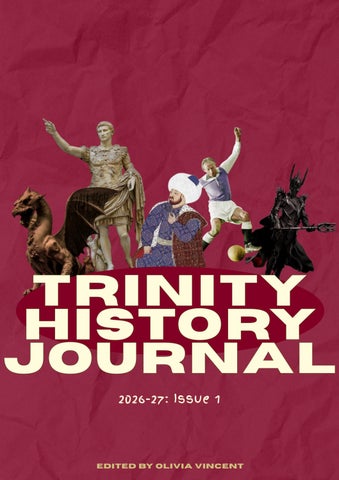
Trinity History Journal 2026-27: Issue 1
edited by Olivia Vincent
Editor Olivia Vincent Contributors Aarush Vakeesan Anya Mehta Ibrahim Mujaver Josh Ramtahal Olivia Beale Creative Input Amber Jerrari
To submit your own article, email: 106325@trinity.croydon.sch.uk ojg@trinity.croydon.sch.uk Or scan the QR code below:
Contents
01
The area in which Augustus was most successful was in his political policy. How far do you agree? 02
To Kill or Not to Kill: How Stopping the Killing Began the Death of an Empire 03
Historical Influences on J. R. R. Tolkien’s Lord of the Rings 04
Theme in Focus: The History of Dragons 05
Individual in Focus: Matthias Sindelar
The area in which Augustus was most successful was in his political policy. How far do you agree?
Joshua Ramtahal
“He could justly boast that he had found [Rome] built of brick and left it in marble.” [1] Augustus was the heir of Julius Caesar, the first Roman emperor and one of if not the most successful emperors of the Julio-Claudian dynasty. Augustus’ political success can be seen through him bringing stability and through the creation of the principate, his social success can be seen through the golden age of literature in Rome and his moral legislation. However he had his greatest success was militarily as he achieved peace in the empire. Augustus’ success will be judged as followed, how long did these successes last, how many people were affected by them, how revolutionary were they and whether their success was contingent. The area in which Augustus had the greatest success was military. After the death of Caesar in 44BC Rome entered a complex period of civil wars which are as follows: At the funeral of Caesar, Mark Antony shifted public opinion away from the assassins through his speech, he also read Caesar’s will which appointed Octavian (later Augustus) as his heir. This caused Brutus and Cassius, the two main agents of the assassination, to flee eastward. Octavian having inherited 400 million sesterces used this and his reputation as Caesar’s heir to win over Caesar’s legions which he then used to oppose Mark Antony. The senate army, supported by Octavian’s private army authorised by the senate, opposed Antony in the war of Mutina, which culminated in Antony being defeated in the battle of Mutina 43 BC. After this Antony, Octavian and Lepidus joined forces forming the second triumvirate and they fought against Brutus and Cassius in the Liberators civil war. The most important battle in this war was the battle of Phillipi in 42 BC, which was won by the Triumvirs following Cassius’ suicide after defeat by Antony because of a false report that Brutus was also defeated. A few weeks after this Brutus took his life after a second encounter with the Triumvirs. Subsequently the empire was divided with Octavian taking Italy and the West, Antony taking the east and Lepidus Africa. This division unsurprisingly led to another war, the war of Perusia. Antonius (the brother of Antony) and Antony’s wife Fulvia briefly seized Rome but were then forced to retreat to Perusia where they were subsequently besieged by Octavian and killed. Lepidus was defeated after he attempted to seize Sicily leaving Octavian and Antony as the only real powers and their relationships gradually deteriorated until the war of Actium. This war was won by Octavian with the suicide of Antony and his mistress Cleopatra. After this the doors of Janus were closed symbolising the end of civil war and the beginning of the Pax Augusta which led to “every corner of the world [being] safe from the fear of brigandage.”[2]. This was a great success for Augustus as the growth of the empire was brought to a standstill by these wars and he was the one to end them all and declare peace. This early reputation as a bringer of peace was useful and was invoked in the aftermath of later struggles[3]. Augustus military success did not end there, as he also expanded the territory of the Illyricum (modern day western Balkans) to the Danube, which was his greatest success[4]. This was hugely significant as it formed one of Rome’s key defences for hundreds of years as it brought the boundary of the empire to a logical very defensible point. His military success was very long lasting, for the rest of the Julio Claudian dynasty there were no more civil wars and his creation of stable borders such as at the Danube kept Rome secure for hundreds of years after his reign.
Augustus’ time in power was not free from failure the worst of which was the Teutoburg Forest. This episode took place in Germania during an attempt to consolidate Roman power there, Varus was ambushed by Arminus and the XVII, XVIII and XIX were annihilated, which was 1/10th of the army, and their legionary eagles were captured. This does not detract from the success of Augustus however as responsibility for this failure lies almost entirely with Varus. While some factors in this defeat such the Romans being forced to stay on the track due to the terrain or the natural chokepoint selected for the ambush were unavoidable but this defeat was worsened by Varus’ poor leadership. Segestes, another chieftain, had warned Varus that Arminus was plotting an ambush and he was ignored, so this whole episode could have been avoided. In addition to this Varus did not cope well with the crisis and made many tactical blunders such as lighting the baggage train on fire and allowing the cavalry to be led off by a subordinate. If there had been a more competent commander, the legions could have been formed up into a coordinated fighting line which could have mitigated the disaster. Varus killed himself after this defeat, as his father had done after the battle of Phillpi, showing his failure.[5] This success affected every single person in the empire as civil wars drained the resources of the state and also led to great bloodshed, therefore his ending of these provided a springboard for the recovery and growth of the empire. His military success was revolutionary as there was no other emperor faced civil war on the scale that he did and in addition to this his expans cementing of existing territories was pivotal in preserving the empire for future generations. Finally his military success is not contingent on success in any of the other areas, as military success was his first accomplishment and is what allowed him to have success in all other areas, as stability is needed for reform. The area in which Augustus had the second greatest success was in his political policy. Augustus initially gained political policy in the second triumvirate, and as shown above forced out Lepidus and Antony to have sole control of the empire. This was a dangerous as when Caesar’s power start to rise to the level of a king, the senate killed him fearing he would become another Tarquinius Superbus. However this is not to say that the Triumvirate was a perfect system, it was marked by violence, illegality and the arbitrary abuse of power[6] and the triumvirate was in fact so unlawful that Augustus felt the need to abolish all illegal acts that had taken place under this[7]. The largest atrocity committed under the second triumvirate were the proscription lists, which were lists of political enemies of Rome whose lands were confiscated and they were declared outlaws and could legally be killed. The most notable example victim was Marcus Tullius Cicero whose head and hands were cut off and nailed to the rostra [8] as he wrote the Philippicae which strongly condemned Antony. However accounts of the proscription lists must be taken with a grain of salt as these accounts were later written to discredit members of the triumvirate, so examples such as Flavia sticking needles into the tongue of Cicero are likely exaggerated[9]. After the end of the second triumvirate Augustus took supreme power, however wary of not being seen as a king he created the Principate. Octavian nominated himself “princeps”(leading citizen) and asserted himself as primus inter pares (first amongst equals)[10] therefore preserving the role of the senate. He established the basis of the principate in the first
settlement, was unpopular amongst the senators as it halved their influence as half of the most important roles were occupied by Augustus. This caused the first major element of the second settlement which was the resignation of Augustus as consul. This did not mean that he gave up his proconsulship therefore outside of pomerium[11] he maintained his imperium[12], but not inside of it.[13] To circumvent this he was given imperium proconsulare maius('power over all the proconsuls) therefore he did not have to give up his imperium to enter the pomerium. He now outranked all the consuls outside and inside of Rome. He was also given Tribunicia Potestas(Tribunican power) which gave him all the powers of a consul. The result of the second settlement was that he had essentially established himself as a dictator in everything but title and made the senate practically useless. This was a success as it established him as emperor and also created a model which could be inherited by future emperors. An alternative way of interpreting the first and second settlements is as the destruction of the republic. Syme suggests that “The Senate was no longer a sovran body, but an organ that advertised or confirmed the decisions of the government”. Augustus had so much power that no one could have opposed him so he did not restore the republic as he suggests in the Res Gestae, but destroys it. There are two things that must be considered in relation to this, the first is that the Roman people preferred monarchy to civil war, as Plutarch writes “An unlawful civil war is worse than monarchy.”[14] People did not disagree with Augustus’ monarchy as he brought greater levels of prosperity[15] Furthermore Augustus put a final nail in the coffin of the empire but “Caesar and Pompey...were the evils by which [the empire] perished.”[16] Augustus’ political policy was long lasting, with the principate used all the way until Diocletian in AD 284, showing how effective it was. It did not directly affect everyone in the empire as even before Augustus the settlements Augustus was essentially a military dictator so the change to princeps did not affect everyone in the empire the same way that the end of the civil war did. It was a revolutionary success as it was the start of Roman emperors and the end of the republic. This is not his greatest success as the only way he was able to do this is because he won the civil wars, had he not been able to get rid of Lepidus and Antony, which he did through military victories, he would have been stuck in the triumvirate. The area in which Augustus had the least success was in his social policy. Augustus’ social policy was rooted in a restoration of traditional Roman values and centred around three main laws. The first of which was the Lex Julia de Adulteriis (Julian Law on Adultery), this was passed in 18 BC and worsened the penalties for adultery. Prior to this there were only two forms of recompense for men who’s wives had committed adultery either they divorced them, which often seemed too weak to the men as at worst it led to a loss of dowry, or he could kill her, but this was seen as too drastic. Adultery committed by men was not seen as a problem as it did not endanger legitimate inheritance. Augustus’ reforms completely changed this, he wanted a return to marriage “liberorum quaerundum causa”(for the sake of producing children) [17]and a departure from marriage for love, something the Romans were alleged to
have discovered at 100 B.C[18]. This reform moved responsibility of prosecuting adultery into the public courts, making it a public matter, and also made it a crime for men to not bring their wives adultery to court. It also opened up many new harsh penalties for adulterers such as relegatio (banishment). Adultery could still only be committed by the married woman however the crime of stuprum was introduced, which was the “violation of an unmarried female person (femme sole), and the extramatrimonial sexual intercourse,” meaning that men now had some accountability. It also removed the ancient right of a man to kill his wife if she was caught in flagrante delicto(in blazing offence)[19]. The next two reformations were the Lex Iulia de Maritandis Ordinibus (Julian Law on Marrying the Social Orders) and the Lex Papia Poppaea(Papia-Poppaean Law) which can be grouped together as they build on each other. The Lex Iulia de Maritandis Ordinibus aimed to increase marriage and birth rate by doing the following: It imposed penalties on all childless women over 20 and men over 25 it also restricted inheritance for unmarried and childless people. The Lex Papia Poppaea increased penalties on the childless and introduced rewards for parents such as them being favoured in the distribution of on table goods but the main benefit was the ius liberorum (right of children). This allowed for women to not need a male guardian and have more legal autonomy and led to men being favoured in public office. Widows were also forced to remarry. If this is to be interpreted as the state exercising social control as Syme suggests then it was hugely effective, however if it was about making people revert to ancient standards of marriage it was a failure. This can most evidently be seen by Julia the elder, his daughter being banished for adultery and his grand daughter Julia the younger also being banished for adultery. Law can be changed but people’s opinions can’t be. One area he did have undeniable success in was overseeing a flourishing of literature with Vergil, Ovid, Livy and many others being sponsored by Augustus and producing masterpieces such as the Aeneid, Metamorphoses and History of Rome. Augustus’ social policy was long lasting and did affect many people, however it was not a significant achievement as the hearts and minds of the people were not changed, and these laws were often cheated. Furthermore even the successful elements such as the flourishing of writing was contingent on the empire being stable enough to spend money to sponsor these works. This was less of a success than his political reformations as his political reformations provided tangible benefit to the empire and was undoubtedly responsible for its long term survival, whereas while this may have provided benefit we simply can’t tell as things like birth and marriage rates weren’t recorded. In conclusion Augustus had a hugely successful reign and is often regarded as one of the greatest Roman emperors. His military successes are of particular note as he not only freed Rome from twenty years of civil wars[20] the likes of which had never been seen before and would never be seen in the empire but he also cemented the borders of the empire. While cementing the borders of the empire in places like Illyricum were not as glamorous as Trajan’s capture of swathes of land, this work was pivotal in ensuring the territories won by men like Trajan were not lost. He was not free of military failure as can be seen by the Teutoburg forest, however this specific
instance was not Augustus’ fault and even if it was it would not have overshadowed his other great work. The area he was second most successful in was politically, he was named as Caesars heir at only 18 years old and managed to force Lepidus and Antony out of the Triumvirate, this alone is a monumental success. However he also set up his own effective monarchy in the form of the principate via the first and second settlements. This system was used by subsequent emperors for hundreds of years after him. While it is indeed true that Augustus did end the republic, he merely delivered a coup de grâce. The empire was hugely dysfunctional before its end and other systems, such as the sharing of power was clearly ineffective as can be seen by the two failed triumvirates. This was not the area in which he had the greatest success as if he had not had military success then he would not have been able to have political success. The area in which he had the least success was socially. His greatest social achievement was the flourishing of literature, however even this is seen by some as being mere propaganda[21]. His moral laws were monumental in terms of reforming the system but they are difficult to gauge the success of. We do not know whether his laws increased marriage and childbirth while reducing adultery, which were his aims, as there are no records of this. This lack of evidence as to whether his was successful is why it must be seen as his least successful achievement.
References [1] Suetonius The Life of Augustus, 28.3 (trans. Rolfe) [2] Tacitus, Ann. 1. 2 (Loeb translation) [3] Osgood Ending Civil War at Rome: Rhetoric and Reality, 88 B.C.E.-197 C.E. pp.3-4 [4] Syme, Ronald The Roman Revolution(2002): p. 390 [5] Goldsworthy, Adrian Augustus First emperor of Rome (2014): pp. 448-453 [6] Millar, Fergus. “Triumvirate and Principate.” The Journal of Roman Studies 63 (1973): 50–67. [7] Dio, Cassius. “Roman History” 53, 2.5 [8] Where he gave his orations [9] Gowing, Alain M. “Lepidus, the Proscriptions and the ‘Laudatio Turiae.’” Historia: Zeitschrift Für Alte Geschichte 41, no. 3 (1992): 283–96. [10] Augustus, Res Gestae Divi Augusti 34.3. [11] Dio 53.11.4 [12] Turpin, William. “Res Gestae 34.1 and the Settlement of 27 B. C.” The Classical Quarterly 44, no. 2 (1994): p. 430. [13] Post Moenium, i.e Rome [14] Imperium=command/authority [15] DROGULA, FRED K. “AUGUSTAN MANIPULATION OF TRADITIONAL IDEAS OF PROVINCIAL GOVERNANCE.” In Commanders and Command in the Roman Republic and Early Empire. University of North Carolina Press, 2015. pp.358-360 Plutarch Brutus 12 (Loeb translation) [16] Goldsworthy, First Emperor of Rome [17] Lucan, Pharsalia 1.79–81(Loeb trans.) [18]Cook et al. Cambridge Ancient History Vol 10 pp 443-448 [19] Frank, Richard I. “Augustus’ Legislation on Marriage and Children.” California Studies in Classical Antiquity 8 (1975): 41–52. https://doi.org/10.2307/25010681. [20] Csillag Pál , “The Augustan Laws on Family relations” PP. 175-189 [21] Paterculus, Velleius History 2.89(trans. Loeb)
To Kill or Not to Kill: How Stopping the Killing Began the Death of an Empire
Ibrahim Mujaver
‘Of any of my sons that ascends the throne, it is acceptable for him to kill his brothers for the common benefit of the people. The majority of the scholars have approved this; let action be taken accordingly.’ These were the words of Sultan Mehmed II, hero of the Ottoman Empire, and the only man in history to have ever bypassed the formidable walls of Constantinople. After he defeated the Byzantine Empire in 1453, beginning the Ottoman Golden Age, he stated this law to his people: that any of his sons, after he, Mehmed, passes away, will be allowed to fight to the death for the throne. Fratricide. Eliminating all other competition for the monarchy. A brutal ruling, yes, but in some ways, logical. With the sultan’s (or king’s) brothers still alive and free, they could stir up rebellions to claim the throne and plunge the Empire into political turmoil. According to the wisdom of Mehmed II, an ‘Ottoman Hunger Games’ must be completed in order to return stability to the kingdom. But how far could the fratricide go? In 1595, a different Sultan, Mehmed III, strangled 19 of his brothers, as per the laws of fratricide. It was considered taboo to spill royal blood, so mute executioners carried out the murder with silken cords, strangling the victims chosen by the oldest heir to the throne. Only four of the 19 victims were adults: the rest children, the youngest being only eleven. After 19 small, Cyprus coffins were carried into the cemetery, the Ottoman people were in outrage. So much for the Empire’s ‘Hunger Games’ maintaining political stability. 8 years later, when the next ruler, Sultan Ahmed I, came into power, he decided to put an end to the fratricide, and created the Kafes. Otherwise known as the ‘Prison Palace.’ In Ahmed’s new laws, younger brothers of the Sultan were to be confined in small, elegant palaces, isolated from the rest of the world, while the Sultan himself could rule, knowing he was protected from siblings seeking to overthrow him. While ‘Kafes’ actually meant ‘Cage’ in Turkish, rather than living in dark, cramped animal cages, princes were secluded in highly decorated apartments with crimson couches, built-infountains, and blue, stained-glass windows. Though these windows were high or faced inwards to obscure princes from the world outside, completely isolating them. The Kafes consisted of 12 rooms all centring around a small, enclosed courtyard. This is what the brothers of the Sultan lived in- their whole world. They knew nothing else but the comforts of their little home. They were well fed and guarded by eunuchs, but was this luxurious replacement of fratricide really beneficial to the Ottoman Empire? It is reported that Ottoman Sultans raised in the Prison Palace were significantly older than the rulers of the fratricidal era when they came to power, as they were forced to wait for their older brother to die before taking the throne. Spending so long in the confinements of the Kafes depleted much of their mental sanity, an infamous example of this being Sultan Ibrahim ‘The Mad’. Historian, David Graeber, said: ‘Each would take the throne in turn until none were left and then power would revert to the son of the first. This ensured that by the time most
did come to power, they were not only quite old, but also lacked any experience of the world, and often were struggling with severe mental health issues caused by decades of solitary confinement… The most notorious, perhaps, of the period’s rulers, Ibrahim I (“the mad,” r. 1640–48), exercised absolute and arbitrary power inside the palace, at one point ordering his entire harem be tied into weighted sacks and drowned; at the same time, he knew almost nothing of life outside, and his interventions in public life were largely whimsical. (At one point he is said to have ordered his officials to locate the fattest woman in the empire, whom he ultimately made governor of Aleppo.) Eventually he was deposed and a child was made sultan in his place.’ Moreover, many Sultans that came from the Kafes appeared to be less interested in global affairs, but instead in poetry, art, and theatre: subjects that were almost useless to the Empire. While the Prison Palace provided a seemingly safer, gentler way to protect the Sultan-in-power from being overthrown, it did not necessarily help the Empire progress. Some even take it as far as the Ottomans lost the First World War due to poor leadership from Kafes-raised Mehmed VI. Both methods, founded by two Ottoman Sultans, were created in order to end the ‘Overthrowing Problem’, and both had their pros and cons. While fratricide was deeply despised by the people of the Empire, for its bloodshed and brutality, there may have been some logic behind it. Killing all competition was harsh, but ensured the survival and stability of the Sultan, as well as his kingdom. It also created a survival-of-the-fittest-style system, where the ruler was almost guaranteed to be the strongest, and the one who would assist the Empire in progressing the most. When Sultans such as Mehmed III took it a step too far, that is when the outrage began. As for the Kafes, it was not a perfect ideology either. In fact, it may even be described as worse than the ‘Ottoman Hunger Games’ after all. At first glance, it appeared to be a more humane way to solve the Overthrowing Problem, but in reality, stopping the killing may have just caused the death of the Empire. The Prison Palace produced leaders of far less quality than those of the fratricidal era. They were mentally ill, completely uninterested in politics and warfare (two crucial subjects the Empire should have been focused on in the time they were living in) and often described as ‘soppy poets’ by those living by them. The production of these rulers lead the Empire into a path of distraught and desperation, ending in their collapse after WWI. Although both methods had major flaws, it was, in truth, the softening of methods that destroyed the Ottomans from the inside.
Historical Influences on J. R. R. Tolkien’s Lord of the Rings
Anya Mehta
J. R. R. Tolkien’s Lord of the Rings series is undoubtedly one of the most famous trilogies ever written, defining the genre of fantasy. This could not have been possible without the intense care he pays to his world building, drawing from eras throughout British history. Inspired by the Anglo-Saxons, Victorian England, and the horrors experienced during World War One (among other periods of history and mythology), Tolkien’s works can be used to explore the simple lives of those during these times. Beginning in around 450 CE, the Anglo-Saxons, specifically the Mercians, provided a template for the Kingdom of Rohan. There are many linguistic parallels between names from Old English and the Rohirrim, such as with the characters Éomer and Éowyn, meaning ‘one who wins renown with horses’ and ‘woman who loves horses’ respectively. They come from the root ‘éoh,’ meaning ‘horse’. Old English is a West Germanic language, having developed out of the North Sea Germanic dialects, and evolved largely during the conversion of Anglo-Saxons to Christianity during the 7th century CE. Comparisons can also be made between Tolkien’s work and the AngloSaxon epic ‘Beowulf ’, specifically through Rohan’s golden hall of Meduseld, reflective of the great mead-hall Heorot. Both have similar architectural layouts, as well as customs upon entry: the doorkeeper Háma challenging the fellowship’s entry is a direct translation of the coast-guard challenging Beowulf ’s entry to Heorot. Tolkien’s inspirations from history are seen all over Middle Earth, most notably in the Shire. The intimacy of the land of the hobbits is reflective of everyday life in a preindustrialised England, with social divides between wealthy landowners and labourers. Families like the Tooks and Brandybucks, who inherited titles, dominated the social hierarchy with families such as the Gamgees acting as labourers. This notion of preindustrialised England being a basis for the Shire can be taken further when exploring the Scouring of the Shire. In this episode, humans corrupt and enslave the hobbits, bringing down trees, building mills, and polluting rivers. This mirrors the technological advancements before and during Tolkien’s life: his home, Birmingham, was an industrial powerhouse to which Tolkien has outwardly expressed his contempt of. His dislike of the polluting of nature is illustrated through the character of Tom Bombadil who is implemented to represent the spirit of the vanishing countryside in which Tolkien grew up in. The most poignant moment in history which impacts Tolkien's works is the world he is currently living in at the time of writing. His friend and fellow Inklings member C.S. Lewis said that ‘Tolkien’s war has the very quality of the war my generation knew.’ Having begun creating the world of Middle Earth in 1914, his stories reflect both the grief and loss experienced in war, as well as the simplicity of life before this. Tolkien’s childhood friends were inspiration for the fellowship and took part in the notorious Battle of the Somme in 1916, with Robert Gibson and Geoffrey Bache Smith being killed (signifying the breaking of the fellowship). This battle in particular had a profound effect on the world building of Middle Earth: Tolkien himself has said that the Somme was inspiration behind the Dead Marshes in Mordor. This is evident through the similarities between passages written by other authors about the Somme and a
moment where the character Sam falls in the Dead Marshes, witnessing faces of the dead who previously passed through here. Additionally, Sam’s character was influenced by numerous soldiers and privates Tolkien encountered during the war. The description of the downfall of Sauron has also been compared to an extract from ‘Memories of a Fox-Hunting Man’ by Siegfried Sassoon, both influenced by memories of shells bursting and smoke floating in battle. However, the struggles on the battlefield were not the only real-life experiences Tolkien alluded to in his works. He goes into depth describing life in the Shire in The Fellowship of the Ring before Frodo must embark on his mission, reminiscent of the summer of 1914. The Shire is a symbol of life before the war yet also displays soldiers’ sense of loss as such places can never be looked at the same again. Frodo states in ‘Return of the King’ that ‘no image of moon or star are left to me,’ encapsulating the effect war has on soldiers long after the battle is complete. The inability to reinstate his previous life in the Shire being clouded by his trauma from war is similar to Tolkien’s own experiences of shell shock and PTSD. Another mental burden experienced by soldiers is their desire to maintain normalcy during war. Tolkien would frequently continue working on his stories whilst on the battlefront, retaining some part of his previous life. This is similar to Frodo’s determination to ritualistically celebrate Bilbo’s birthday every year with his own in an attempt to briefly mask Bilbo’s departure. The story of Lord of the Rings explores both the struggles of war and the periods acclimatising to life after it, examining themes of loss and displacement which Tolkien himself was familiar with. Tolkien’s knowledge of history and implementation of different eras into the world of Middle Earth has created a foundation for the world of fantasy, as well as a mythology for Britain.
Theme in focus: the history of Dragons
Aarush Vakeesan
Dragons are the most famous mythological creatures of all time. Picture winged lizards soaring through the sky, breathing fire. However, this depiction of the dragon is one of the most recent, Western ideas. There are many more depictions of them across the world over a 5000-year period! In this report, I will show you many of these dragons, some you may not expect. Dragons from around the globe Chinese Dragons- 4500 BCE-1912 CE The belief in dragons was probably the longest lasting with the Chinese Dragons. There are even people who still believe in them to this day. Here are some of their stories. The 4 Dragon Kings Once upon a time, there were four dragon kings. The people of the land were suffering without water, which the Jade Emperor had. They scooped the water from the sea and sprayed it onto the Earth as rain. The Jade Emperor was furious, punishing them by trapping them under a mountain each. Desperate to help their people, they turned into four rivers, The Yangtze, the Yellow, Pearl, and Black, to forever help the people. Carp Leaping over the Dragon’s Gate A school of carp were going to swim against the harsh flow of the river under the dragon’s gate on the legendary waterfall. Many could navigate through the harsh environment, but few were brave enough to take the final leap over the dragon’s gate. Some did, however, and became golden, gleaming dragons. Mesopotamian Dragons, 3500-539 BCE Mesopotamia was an ancient region in Iraq, based on the river Tigris. It was made up of 5 main empires: the Sumerian, the Akkadian, the Babylonian, the Assyrian, and the Neo-Babylonian. They were famous for their rich mythology, most notably ‘dragons’. These dragons originate from creation epics, like the Enûma Eliš (also known as the Enuma Elish). There were 4 main dragons in Mesopotamia: Tiamat Tiamat was the primordial Goddess of water and chaos, being the mother of the gods and personifying the salt sea. She had conflict with her children and the young gods, so went to war with them. She was slain by the chief god of the ancient city of Babylon: Marduk. He created the whole universe from her body. The Goddess was mainly believed in by the Babylonians. In later myths, she was depicted as a reptilian, serpent-like creature. This is said to come from the texts of the Enuma Elish, describing her as being a woman or a fresh body of water. She was also said to have a tail. These physical details sprouted the vision of her reptilian body.
Mušhuššu Mušhuššu (also known as Mushussu) was a mythological hybrid creature. It had the talons of an eagle, forelimbs of a lion, a snake like tongue, a horned head, a long tail and neck, and a crest. It was believed in by the Neo-Babylonian Empire. He was the symbol animal of Marduk. His name translates to ‘reddish snake’. His most famous appearance was on the reconstructed Ishtar Gate. There is also a sculpture for it in Relais Pantin, Greater Paris. It welcomes people to the restaurant and terrace. Kur Kur was a dragon that lived in the primal sea. He personified the Sumerian underworld. He kidnapped the goddess, Ereshkal, and the god, Enki, saved her. Kur gave a brave fight, heaving boulders at the god. People who discovered the legend were unable to find the end, but they predicted that Enki succeeded in saving Ereshkal, and Kur was slayed. His name translates to mountain. This could mean he was the embodiment of the large, mountain-like underworld. Basmu Basmu was associated with birth, the goddesses of birth, poison, and the god of the underworld, Ningishzida. He is also pictured entwining a staff. He was one of the 11 primeval monsters told to kill the younger gods by Tiamat. He is usually depicted as a horned, feathered serpent.
Christian and Western belief The Western and Christian culture of dragons is by far the most famous depictions of all dragons. They influenced pop culture and books from Minecraft and Pokemon to the Hobbit and the Chronicles of Narnia. First, I will talk about a famous story about a dragon. I will then explain their general appearance. St George and the Dragon George was born in Cappadocia. His parents raised him to be faithful to the Christian religion. One day, when he was riding on the fields of Libya, he found a town called Silene. The people there had received great misfortune: a colossal dragon had settled into the area. The dragon had eaten all the meat, so heartbroken parents reluctantly had to let two of their children to get eaten every day. The king’s daughter was soon forced to go, weeping at all the victims’ bones before her. George found her and promised he would slay the dragon. He injured it with his lance and bound it with a girdle. He told the people he would only kill the dragon if all got baptised. And so, they did. George then beheaded the dragon. This gave dragons a malevolent portrayal in Western culture. Appearance A dragon is usually a horned lizard with big wings. It has smaller fore limbs and larger hind limbs. It usually breathes fire, and green in colour. It has a long tail and small spikes on its body. I think this is what you all visualise when the word ‘dragon’ comes up.
Conclusion There are many dragons around the world. Some come from imagination, from the wyrms of Tolkien to the Hungarian Horntail of JK Rowling. However, many dragons existed traditionally and religiously. Understanding them is crucial to learn about history, from the contrast of the harsh, malevolent dragons of Western Culture vs the benevolent guardians of China, to the early metaphors for dragons in the early Christian depictions of Greek dragons. Thank you for reading.
Individual in focus: Matthias Sindelar
Olivia Beale
In a time where it is not unusual for footballers to use their influence to raise awareness and stage protests it may be difficult to imagine a period when they may have died for it. Matthias Sindelar was born on the 10th of February 1903 to working class parents in Vienna, however some may say his life did not truly begin until the 28th of September 1926 when he made his debut for the Austrian national football team. He was revealed to be an extraordinary player, nicknamed ‘Der Papierene’- the Paper Man- due to his slender build and incredible ability to glide between defenders as though weightless. Franz Schwarz- son of the FK Austrian club president throughout the 1920s and 30s- recalls ‘In his speech, in his manner, he was an ordinary Viennese person, but he was something very special in his talent, really exceptional.’ Sindelar played a key role in the team’s outstanding performance, by the summer of 1934 Austria had won or drawn 28 out of 31 games, narrowly losing the semi-finals of the World Cup: bringing Sindelar fame and wealth. Sindelar’s play was thought to be truly incredible, with Alfred Polgar - A theatre critics- describing him as having ‘brains in his legs,’ alongside a newspaper at the time who referred to Sindelar as a ‘grandmaster playing chess’. A track record such as this suggests a large fan base even now, however there is very little sign of Sindelar in Austria today, Dr Erich Krenslehner - an Austrian football historian- comments ‘For a great star like Sindelar’s, not to have a memorial of some sort is very unusual, a mystery’. The situation becomes even more strange when we consider that Sindelar’s is the Austrian ‘nation’s greatest sports star’ as a poll in 2008 claims. So why is it that such a big star appears ‘wiped out’ from history? After the Anschluss- where Austria and Germany were united under Hitler- in March 1938, the Nazis dissolved the Austrian national side: players were pressured to either join Germany’s World Cup squad or stop playing internationally, and even the name “Austria” disappeared. FK Austria Wien was ‘Aryanised’, with Jewish or suspected Jewish figures removed; surviving members were ordered to cut ties with them, an order which Sindelar openly ignored; he told the highly respected Schwarz, shortly before the depended president fled abroad: ‘The new club president has forbidden us to talk to you but I will always speak to you, Herr Doktor’. This is an example of Sindelar showing early resistance to the new regime. Following this, on the third of April 1938, in a ‘reunification’ match between Austria and Germany that was meant to be a staged draw, Sindelar inspired a 2–0 Austrian victory and celebrated directly ‘in front of a director’s box full of high-ranked Nazi officials. I believe that in order to attempt to decipher Sindelar’s story one must understand the ways in which the Nazi’s utilised football as a means of propaganda. The Nazis prioritised football as a mass spectator sport that could reach huge crowds and promote unity, discipline, and loyalty to the regime. International matches were tightly managed for prestige; defeats were treated as political embarrassments, fixtures were arranged only when victory seemed likely, and players were under immense pressured to win. For example, on the 20th of April 1941, Germany played a match against Switzerland. Germany lost 1-2 to the Swiss. Goebbels saw losing to Switzerland on Hitler’s birthday as unforgivable and is said to have told the Reichssportführer that no
that no further internationals were to be arranged where ‘the result is the least bit unpredictable.’ The players were given an incentive to avoid further humiliation: another defeat would see them being sent to the Eastern Front. To no one’s surprise Germany won their next match six weeks later, beating Romania 4-1. Sindelar’s blatant disregard for the Nazi’s plan for the match likely angered the Nazis. A common interpretation of Sindelar’s story is that his refusal to conform to the Nazi regime, killed him. The Nazis saw football players as a means of spreading propaganda and nothing more, football players were merely pawns in Hitler’s game. Sindelar later went even further, rejecting involvement in Nazi sport, keeping close relationships with Jews, and buying a café from a Jewish owner under Gestapo watch. Overall, by refusing to play his ‘role’, Sindelar placed a target on his own back. Furthermore, On the 23rd of January 1939, Gustav Hartmann- a friend of Sindelars’ who was worried, having not heard from him in a while- forced his way into Sindelar’s flat, finding him and his partner, Camilla Castagnola- rumoured to be a prostitute who became his girlfriend- dead; the official verdict was accidental carbon monoxide poisoning caused by a faulty flue, though to this day many continue to doubt this view of events. Six months after the incident, the Public Prosecutor had still not reached a conclusion when the Nazi regime instructed that the case be closed once and for alldeepening suspicions around the case. The Austrian newspaper Kronen Zeitung went so far as to suggest that Sindelar had been a ‘victim of murder through poisoning’, while one of his former teammates and friends, Egon Ulbrich, told a BBC documentary in 2003 that local officials had been bribed to record the death as an accident. Others have proposed different interpretations altogether including the poem Gedicht vom Tode eines Fußballers (“Ballad on the Death of a Footballer”) by Friedrich Torberg. In his poem he advanced the theory that Sindelar had taken his own life, portraying him as a man who felt increasingly ‘disowned’ by what he refers to as the ‘New Order’- the Nazi regime. I will end with a quote from Robin Stummer, who described Sindelar’s funeral as ‘Vienna’s first, and last, rally against the Nazis’ in reference to the 20,000+ mourners who showed up to mourn the life of a talented, determined, and moral player.
References Aspects of History. (2021). Football and the Nazis. [online] Available at: https://aspectsofhistory.com/football-and-the-nazis/. Cancian, D. (2019). Matthias Sindelar: the great pre-war footballer who danced before the Nazis. [online] These Football Times. Available at: https://thesefootballtimes.co/2019/02/14/matthias-sindelar-one-of-the-greatest-prewar-footballers-who-danced-before-the-nazis/. Stummer, R. (2008a). Matthias Sindelar: the striker who snubbed Hitler. [online] New Statesman. Available at: https://www.newstatesman.com/long-reads/2008/06/austriasindelar-soccer-nazi [Accessed 11 Mar. 2026]. Stummer, R. (2008b). The Paper Man: life and death of a footballer. The Observer. [online] 14 Jun. Available at: https://www.theguardian.com/football/2008/jun/15/austria.euro2008groupb. Times, T.F. (2015). The extraordinary life and death of Matthias Sindelar. [online] These Football Times. Available at: https://thesefootballtimes.co/2015/01/18/matthiassindelar-paper-man/.
Thank you for reading this edition of the Trinity History Journal. The journal welcomes submissions from Trinity students in all year groups on any topic related to history, meaning it is an ideal space to explore topics that interest you and conduct research.
To submit your own article, email: 106325@trinity.croydon.sch.uk ojg@trinity.croydon.sch.uk Or scan the QR code below: