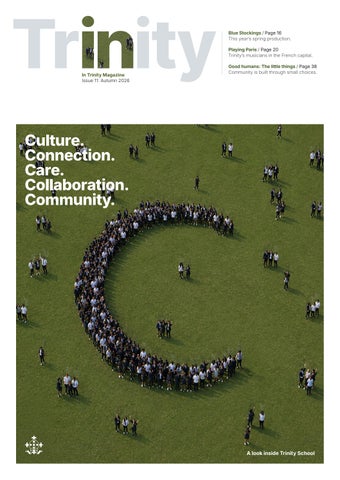
Blue Stockings / Page 16 This yearʼs spring production. Playing Paris / Page 20 Trinityʼs musicians in the French capital.
In Trinity Magazine Issue 11: Autumn 2026
Good humans: The little things / Page 38 Community is built through small choices.
Culture. Connection. Care. Collaboration. Community.
A look inside Trinity School
A note from the Editor... Al Kennedy opens this issue with a simple yet powerful concept; that our community is the fertile ground from which everything else special about Trinity grows. Community, fittingly, is the focus of this edition.
Tuki Rounds Senior Deputy Head
The fruit of that ground is found in the academic results that our students celebrated this summer, but even more so in the opportunities they open up. Whilst academic results may have secured those onward opportunities, it is the broader experience of our community that has helped our students find their passion and grow as people; perhaps on the hockey pitch, in the DT Department, through our 110-year-old CCF or our musical tours. Perhaps in all of the above! All of these are experiences feature in this edition. There is perhaps no more communal an activity than our annual Open Art Award, which brings together creativity from across the community: students of all ages, staff, alumni and parents. You’ll find some stunning examples within. Creativity was in abundance on the boards as well as the canvas with our two drama productions. Our Sixth Form presented Blue Stockings, exploring the damage caused by exclusion and, conversely, what inclusion can achieve. Our Lower School put on Prometheus, a triumph for a large cast of our youngest students, with contributions from across the community, including student tech assistants, associate directors and a script written by our own Sofia Deas.
This issue also celebrates success of the quieter kind: simply being good humans. Jack Munnery shares our ‘Good Humans’ initiative, which recognises and celebrates the small, daily behaviours that help shape the community we are. And because communities are made by people, often working quietly behind the scenes, it is a pleasure to share an insight of Phil Jupp and Dean Sammut, who lead our Estates team and make sure that the school runs smoothly for all of us who enjoy it. Community also reaches beyond our gates, and we are proud that our work in this area was recognised at this year’s School House Awards, where Trinity was named Social Mobility Champion. Our buildings and commitment to social mobility have come together in another way this year, as our T60 Campaign has brought the whole community together to celebrate 60 years at Shirley Park and our ongoing commitment to bursary provision. We believe that provision benefits our whole community, not only its recipients, and says something important about who we are. Finally, we step from our past and present buildings into our exciting future. In this edition, we are pleased to share more about the next chapter in our history, with a look at our planned developments. As ever, they are being designed around the people who will use them: our future, fully coeducational community, and how they will learn, play and grow together within them.
In Trinity Magazine Contents 1
In this issue 02
Headmasterʼs Introduction
04
Academic
12
Art
16
Drama
20
Music
22
Sport
26
Community
43
Co-ed
Features 16
Drama: This yearʼs spring production of Blue Stockings by Olivier Award-winning playwright Jessica Swale.
20
Music: Trinityʼs musicians in the French capital.
38
Community: At Trinity, community is built through thousands of small choices.
2 In Trinity Magazine Headmasterʼs Introduction
In Trinity Magazine Headmasterʼs Introduction 3
Headmasterʼs intro
WHERE
CHARACTER
GROWS... When we think about education, it is natural and easy to focus on academic achievement. Examination results, qualifications and the future doors they open matter, and every school has a responsibility to help young people reach their intellectual potential. Yet education, while certainly not being less than this, is about much more than what students know and understand. It is, we believe, about the kind of young people our students are becoming.
The development of character and values is central to this belief. These lie at the heart of education because the research is compelling: it tells us that these qualities are closely related to how a young person makes the most of their school years, and to their chances of living a broadly happy and successful adult life. Our young people will face challenges, both professionally and personally, that require not only knowledge and skills, but also resilience, integrity, compassion and courage. Success in life is rarely determined by academic attainment alone. It is shaped by the ability to work with others, to show empathy, to make responsible decisions and to persevere when circumstances are difficult. Our school has a vital role in helping students develop these qualities. Every lesson, conversation, assembly and cocurricular activity offers an opportunity to reinforce the values that will guide young people throughout their lives. We want our students to understand what ambition and purpose mean for them, but equally the importance of kindness, respect and honesty. We want them to recognise their responsibilities to others and to appreciate the impact they can have on their communities, even now.
Character and values are not developed in isolation. They flourish within a supportive and positive community, as young people learn as much from the culture around them as they do from formal teaching; seeing these values lived is more powerful than simply being told about them. When students sense they are safe, valued and supported, they are more willing to take risks, learn from mistakes and contribute positively to the lives of others. A good school community creates the conditions in which character and values can grow.
Equally important is the diversity of the community in which our students learn. Schools bring together individuals from different backgrounds, experiences and perspectives, and this diversity is one of our greatest strengths at Trinity. It provides daily opportunities for students to broaden their understanding of the world, challenge their assumptions and develop empathy across socio-economic, cultural and other divides. By learning alongside those whose experiences may differ from their own, our students gain a deeper appreciation of both what makes us unique and what unites us, and they are better prepared for the world beyond school as a result. In such an environment, students learn that belonging does not require conformity. Rather, they discover that every individual has something valuable to contribute. Our educational mission is to see each one of our students fully drawn into our community, to experience it as joyful and compelling, and to choose to make the character and values expressed in it their own.
Academic
46% grade 9 at GCSE. AAA average at A Level. This summer brought exceptional academic results at Trinity, but, as Headmaster Alasdair Kennedy says, “results tell only part of their story”. Across the following pages, we meet some of the students behind the numbers and discover what comes next, from Sixth Form and universities around the world to professional sport and apprenticeships.
In Trinity Magazine Academic 5
GCSEs With 46% of all grades awarded at grade 9, our Fifth-Year students achieved Trinity’s second-best GCSE results outside the Covid-affected years. Of the 138 students, 72% of all grades were awarded at 9-8 and 87% at 9-7. Almost a third of the year group achieved seven or more grade 9s, with 19 students achieving nine or more and three achieving eleven. “To see so many students achieving at the very highest level academically, while also pursuing their passions across music, drama, sport and so many other areas, is particularly impressive,” says Headmaster Alasdair Kennedy. Head of Fifth Year Stephanie Baulf was equally proud of the way students supported one another: “They have all supported each other through the exams and, despite many checking their grades online, it was lovely to see everyone here, celebrating together.” For most, the next step is Trinity’s Sixth Form, where they’ll be joined by new students and have the opportunity to focus more deeply on the subjects that interest them most. GCSEs AT A GLANCE 46% grade 9 72% grades 9-8 87% grades 9-7 44 students achieved seven or more grade 9s 19 students achieved nine or more 3 students achieved eleven grade 9s
FIVE STUDENTS. FIVE VERY DIFFERENT STORIES. Josh | STEM + symphonies Eleven grade 9s
Jamie | Building what's next Six 9s, two 8s, three 7s and one 6
Physics, Maths, Religious Studies and German are next for Josh, but music will remain a major part of his Trinity life. He plays with Stoneleigh Youth Orchestra and Trinity’s Symphonic Wind Orchestra and Symphony Orchestra, and counts performing at national festivals among his school highlights. “Music gives me a bit of a break from academics. There’s a lot more expression in what you can do, and I think that’s really valuable.” And after eleven grade 9s, his perspective on comparing results with others is refreshingly simple: “I try not to care about other people’s results.”
Arkwright Engineering Scholar Jamie is already looking beyond his A Levels in Maths, Further Maths, Physics and Computer Science towards mechanical or aerospace engineering and, eventually, motorsport. Over the summer he has been coding the infrastructure for a machinelearning competition, which he hopes to turn into a Trinity club where other students can learn to create their own machine-learning bots. “I’ve really enjoyed going to specific clubs and doing projects on my own as well as all the subjects. Now I’m excited to focus on the things I’m really interested in.”
Sebastian | From Trinity to Palace Five 9s, four 8s, one 7 Sebastian has been part of Crystal Palace FC Academy since he was eight and now leaves Trinity to join the club full-time on a scholarship while continuing his education. Football might have been the plan, but one of his proudest Trinity achievements came in a sport he hadn’t played before joining. “When I came to Trinity, I thought I was just going to focus on football, but over the years I grew to really like rugby. Rugby is pretty intense. You have to be courageous and brave, and I’ve been able to transfer that to football and be brave on the pitch.” His advice to students just beginning at Trinity? “Seize the moment. When you start, you think you’re going to be here forever, but it goes by pretty quickly.” Romil | Speaking his language Twelve 9s For Romil, Sixth Form means the chance to concentrate on what really fascinates him. He will study Maths, Further Maths, Greek and Chinese, with ambitions to study Linguistics at university. He also plays piano and saxophone and enjoys making music with other students. “Having breaks and doing other things helps you in your studying rather than taking time away from it.”
Ed | Captain. Writer. Sixth Former. Five 9s, two 8s and three 7s Last summer, Ed missed selection for England hockey’s summer tournaments. This summer, he captained England U16. “Getting to go away this year and captain has been a real full-circle moment. I’m really proud.” Next comes Biology, Psychology, Geography and English at A Level, alongside trials for England U18. He is already exploring another possible future too: after work experience with The Hockey Paper, Ed had his first article published and is considering journalism. Balancing international-level sport with school hasn’t always been easy, but support from his family, club and Trinity has helped him manage both. “I’m looking forward to meeting all the new joiners and having a more narrowed-down subject pool, studying things I’ve chosen and know I’ll enjoy.”
6 In Trinity Magazine Academic
A LEVELS From universities across the UK and overseas to apprenticeships and professional sport, our Upper Sixth students are heading in all directions after another outstanding set of A Level results. Of the 156 students, 28% of all grades were A*, 66% were A*-A and 93% were A*B. Twenty-six students achieved at least three A*s, including ten who achieved four or more. Warwick is this year’s most popular university destination, followed by Bath, Bristol, Exeter and Nottingham, while three students are heading to the USA. Economics and Engineering are the most popular courses, alongside subjects ranging from Medicine and Veterinary Science to Classics, Music, Law and Psychology. University isn’t the only route. Kaiden and Henry are combining professional rugby contracts at Harlequins with degrees, while Head Boy Oscar has taken a different route altogether, turning down his university place to begin an apprenticeship with a Swiss private bank. A LEVELS AT A GLANCE 28% A* 66% A*-A 93% A*-B 26 students with three or more A*s 94% secured their first or second-choice course
Oscar | A different route A* A* A | Investment operations apprenticeship Oscar’s original plan was engineering. An Arkwright Engineering Scholar studying Maths, Physics and Further Maths, he was also a Drama Scholar, Head Boy, pianist and keen sportsman. Through those different experiences, he realised he wanted a career that combined analytical thinking with working with people. “I realised that as well as my A Levels being very STEM-focused, I had a real passion for performance and communication.” Two weeks before Results Day, Oscar began a two-year investment operations apprenticeship with a Swiss private bank. Despite achieving the grades for his firstchoice university, he turned it down.
Leo | A life in music A*AA | Music, Cambridge A Music Scholar, singer, bassoonist and member of Trinity Boys Choir, Big Band and the National Youth Orchestra, Leo has performed everywhere from Ronnie Scott's to Glyndebourne and spent three months in Sweden performing in A Midsummer Night's Dream. Now heading to Cambridge to study Music, he says: “The Music Department has been like a second home. It’s really made me not only skills-wise, but human-wise, the person I am today.” Also heavily involved in Drama, Leo’s advice to his younger self sums up his Trinity experience: “Go and do everything. Try everything you can.”
“Being Head Boy helped me communicate with all sorts of people and build confidence. Part of the reason I’ve appreciated being at Trinity so much is the number of different things I’ve been able to be involved in at once and not just having to choose one thing.” Imogen | Oxford bound Two A*s, an A + A* EPQ | English, Oxford Imogen joined Trinity in Lower Sixth looking for a change and leaves with an Oxford place, great friends and no doubts about her decision. “I loved my previous school, but I wanted something different for Sixth Form. I’ve had a great time; it was definitely the right decision. I’ve really enjoyed my classes; everyone is so supportive and we’ve had a lot of fun.” Alongside her studies, Imogen played hockey and netball, and enjoyed History and Literature Societies. Favourite memories include the leavers’ sports day and BBQ: “All the silliness before exams!”
Nell | A dream since she was five Four As + A EPQ | Veterinary Science, Liverpool Nell has wanted to become a vet since she was five. Support from Trinity’s Medical, Dental and Veterinary programme helped her navigate the application process and now that ambition is becoming a reality. But some of her strongest memories are of hockey and the friendships it created across year groups. “The community is so supportive. By the summer of Year 12, you’re best friends with everyone. It was just so much fun.”
In Trinity Magazine Academic 7
Jacob | From Croydon to Dublin to New York Three A*s + A* EPQ | Trinity College Dublin + Columbia University Deputy Head of School Jacob will spend two years at Trinity College Dublin studying Middle Eastern and European Languages and Culture before moving to Columbia University in New York to major in Political Science. His Trinity experiences have already taken him further afield, from two months in Sweden with Trinity Boys Choir to volunteering with Trinity’s partner schools programme in Malawi. “Being in the community, working with Fisherman’s Rest and being around people from Trinity I might not normally be as close to, we all made connections.” After eight years here, his approach has been simple: “I’ve tried to make the most of all the opportunities we’re privileged enough to get.” Kaiden | Taking rugby to the next level A*, B, B + B EPQ | Finance, Accounting and Management at Nottingham University + Harlequins Kaiden will combine a degree at Nottingham with a professional contract at Harlequins, having already represented England in rugby last season. He credits Trinity with helping him retain the enjoyment that has driven his progress in rugby. “The main part is that you enjoy the game. Trinity definitely gave me that passion and I just pushed myself to go further with the academy.” Alongside rugby, Kaiden has played basketball and served as a prefect on Trinity’s EDI Committee.
EPQ | Independent thinking
WHERE NEXT?
60 students completed an Extended Project Qualification, a key element of Trinity’s Sixth Form Diploma. Students independently research a subject of their choice, developing skills in research, critical thinking and communication.
Most popular universities Warwick 20 Bath 16 Bristol 14 Exeter 13 Nottingham 12 King's College London 10 Leeds 10 Durham 9
Topics ranged from rap and cultural identity to spaceflight, law and medicine. 1 in 3 achieved A* 3 in 4 achieved A*–A
Most popular subjects Economics 21 Engineering 17 Medicine & Veterinary Medicine 13 Business 10 History 8 Law 8 Mathematics 8 Psychology 8 Further afield: Three students are heading to the USA, including Max to UCLA and Deputy Head of School Jacob, who will spend two years at Trinity College Dublin followed by two at Columbia University in New York, graduating with degrees from both institutions.
+
23 integrated years in industry • 6 planned years abroad • professional rugby • an apprenticeship
8 In Trinity Magazine Academic
Academic
Spotlight:
Design & technology Made at Trinity There is something satisfying about making an object yourself. In Trinity’s Design & Technology workshops, that might mean casting pewter, learning to use a lathe, sketching a product by hand or turning a digital design into a prototype using a laser cutter or 3D printer. Traditional craft sits comfortably alongside newer technology here. Students learn how things are designed and made, but also what happens when an idea doesn’t quite work first time. “You’ve got to have the practical skills and knowledge of what you can make,” explains Head of Design & Technology Dan Currigan, “but you also want people to be experimental and explore new things.”
In Trinity Magazine Academic 9
Learning by making All students have around an hour and a quarter of DT each week in the Lower School, so there is time to build practical skills properly. The department has particular depth in product design, with students working extensively with wood, metals and plastics. Projects become more ambitious as students learn more. Some are deliberately structured so that everyone can master a new process and come away with something that works; others give students much more freedom to experiment. In Second Year, for example, students explore flat-pack furniture. They learn different ways of joining materials before developing their own design and producing a scale model with the laser cutter. Not every idea survives intact. “You might think, ‘Every time I do it, it collapses, so I’m going to try a different way,’” says Dan. “That’s iteration.” By Third Year, students are bringing together traditional workshop techniques, laser cutting and 3D printing to design and make an adjustable lamp. Over time, there is less instruction about exactly how to make something and more expectation that students will work it out for themselves. Around a third of the year group choose to continue DT at GCSE, with this year’s cohort achieving particularly strong results.
GCSE Design & Technology
62%
Grade 9
87%
Grades 9–8
92%
Grades 9–7
The workshops get plenty of use outside lessons too. Students come back to work on personal projects, extend classwork or create practical pieces for an EPQ. And you don’t necessarily have to study DT to use them. Physics students have come in for help making experimental rigs, while Art students have used the facilities for welding and sculpture. “Students know there’s a supportive environment here,” says Dan. “They can come and ask for advice; they can come and work on things.” For Lower Sixth student Sophie, those opportunities were one of the reasons she chose Trinity. “One of the things which made me want to come to Trinity for Sixth Form was the DT department. I looked around a couple of different schools, but the department at Trinity really stood out to me.” Since joining, Sophie has tried new materials and machinery, written for the school’s STEM magazine and taken on projects of her own. She now hopes to study Product Design at university.
10 In Trinity Magazine Academic
Students taking the lead When a group of Lower Sixth students wanted to create another opportunity for younger students to make, they didn’t just suggest a new club. They ran it.
Keeping the craft Despite all the technology in the workshops, there are plenty of older machines, skills and techniques that the department is keen not to lose.
Sophie, Helena, and their classmates devised a six-week project in which First Years made their own small lamp. With support from staff and technicians, the Sixth Formers planned the project, prepared the kit, promoted the club and led the sessions.
Trinity has kept specialist machinery that has disappeared from some school workshops, as well as staff who know how to use it. “One of the reasons these things get made redundant is because someone doesn’t know how to use them,” says Dan.
OLEO uses waste cooking oil to remove microplastics from polluted water, an idea developed by three Lower Sixth students.
Many of Trinity’s DT teachers worked in industry before moving into teaching, with backgrounds in architecture, product design, set design and film special effects. Their own interests creep into school life too. Dan recently learnt silversmithing as a hobby and is now sharing those skills with students, while other staff expertise has led to everything from special-effects projects to soapbox vehicles.
Auto-Mate uses eye-gaze tracking and voice commands to enable people with motor disabilities to play chess.
“They did everything,” says Dan, who believes the older students learnt just as much through teaching the process themselves. The group have since become unofficial DT ambassadors.
A new Junior Sketching for Design club is also going back to basics. Students begin with 3D sketching before moving on to marker rendering, a technique widely used in professional product design. By Christmas, each will have developed a product of their own and created an advertising poster for it. “We’re trying to put some more old-school techniques back into the subject,” explains Teacher of DT Jonny Townsend. “A professional designer is going to put pencil to paper before they start spending hours designing something digitally. It’s a fundamental skill.” The two approaches aren’t in competition. A pencil sketch, a lathe, CAD software or a 3D printer are simply different ways of working through an idea and figuring out how to make it.
Ideas in Action
Removing microplastics
£10,000 Samsung Solve for Tomorrow winners.
Making chess more accessible
Outstanding Innovator Award.
Future engineers
Two Arkwright Scholars a year on average Trinity has averaged two successful Arkwright Engineering Scholars a year over the past decade, with a record five selected in one year. Projects have ranged from modular gliders and robot spiders to an AI Rubik’s Cube-solving robot. Head of DT Dan Currigan leads Trinity’s Arkwright programme, supporting students through the application process.
In Trinity Magazine Academic 11
Taking it further Students interested in Architecture can take part in design challenges and get support developing the portfolios required for university applications, while Sixth Form students visit New Designers in London each year to see work from the UK’s latest design graduates. Both exam boards and universities have commented on the high level of Trinity’s computer-aided design work. Former students have also returned to say that their understanding of the design process put them well ahead when they began university. Not everyone who spends time in these workshops will go on to become a product designer, engineer or architect, of course. But they will know what it feels like to start with an idea, work out how to make it, get something wrong and have another go. And, hopefully, end up with something that works.
Where can DT take you? Henry Aldridge | Class of 2017 Trinity → Architecture at Cambridge → UCL → Heatherwick Studio.
Tom Beadle | Class of 2021 Trinity → Product Design at Loughborough → industry placement → Omlet.
Henry gained a First in Architecture at Cambridge before continuing his studies at UCL’s Bartlett School of Architecture, where he was awarded a prestigious RIBA Wren Scholarship. His work has combined physical and digital experimentation, including using 3D virtual reality technology for his final Cambridge presentation.
An industry placement with pet product company Omlet led to a permanent role, designing products for the company.
Henry Aldridge
Tom Beadle
12 In Trinity Magazine Art
Art
Open Art Awards
In Trinity Magazine Art 13
More than 50 entries from students, staff, families and alumni filled the Shaw Gallery, celebrating the creativity that flourishes across the Trinity community through our annual Open Art Awards. By the final week of the summer term, the Shaw Gallery feels transformed. Alongside the GCSE and A Level Art and Photography Exhibition, the Open Art Awards fill the walls with paintings, photography, textiles, sculpture, embroidery, origami, poetry and mixed media created by students, staff, families and alumni. Every display offers something unexpected. Now in its eighteenth year, the Open Art Awards have become one of Trinity's most joyful traditions. Since 2008, the competition has invited students, staff, families and alumni to create a piece in any medium, on any subject, with complete creative freedom. One of the exhibition's greatest strengths is revealing different sides of people. Students known for excelling in sport, drama or music exhibit alongside Art Scholars, while teachers and operational staff from across the school share work alongside professional artists and enthusiastic beginners. This year's exhibition featured more than 50 entries, each offering a glimpse into the interests, passions and talents that often go unseen during the school day. It's this mix that makes the Open Art Awards so special. Visitors don't simply admire the artwork. They discover new stories about the people behind it.
14 In Trinity Magazine Art
Among this year's entries, First Year Art Scholar Alex was awarded the overall prize for his ambitious portrait of Russian composer Dmitri Shostakovich. Created across nine individual panels, the work combines acrylic paint, charcoal, pastel, collage and coloured pencil, with each square exploring a different artistic style. "I usually do things on A4," Alex explained. "But this time, I wanted to do something bigger, so I thought I could put multiple A4 pieces together. I wanted to give every square a different colour theme or style. Afterwards I noticed the three on the diagonal are non-naturalistic colours, the other diagonal is monochrome and the ones around the centre are naturalistic. That was completely unplanned!" Winning came as a surprise: "There were lots of good things here, so I wasn't sure if I'd win. I'm really happy." Third Year student Micah was named runner-up for his beautifully observed series of photographs capturing spring flowers. "All of the pictures came from just one walk down my road," he said. "When I find a nice flower, I try a few different ways to capture it." Photography runs in Micah's family, with both grandfathers sharing his passion, and he now uses one of his grandfather's old cameras to continue that tradition. "I submitted lots of photographs and Mrs Fulker helped me select these for the final piece. I was really surprised because there were so many great entries, but I'm really pleased."
In Trinity Magazine Art 15
This year's Staff Award went to Assistant Librarian Mx Peers, whose two deeply personal entries, Waste not (my love), a rainbow crochet blanket created from leftover yarn, and The Lesson, an original poem presented in calligraphy on tracing paper, explored themes of identity, hope and making something meaningful from what already exists. "My two pieces came very much from the heart," they said. "The blanket became a piece celebrating eking out something useful that will keep you warm and happy from the scraps and margins of more traditional pieces." For Mx Peers, that spirit of sharing is what keeps people returning to the exhibition each year. "I love the Open Art Awards for their fantastic ability for the whole school community to showcase the journeys that they go on, whether of technical skill or deeper meaning." School Office Administrator Grace Pink, whose nine-year old son entered the Open Art Awards for the second-year running, said, "There aren't many opportunities for a nine-year-old to have their artwork displayed in a gallery, so just seeing his piece on the wall was a really proud moment. I love that the awards are open to everyone, with artwork from students, staff, families and alumni all displayed together." For many, the exhibition has become a highlight of the final week of term, offering the chance to see the Trinity community through a different lens. The creativity on display extends beyond the Open Art Awards. Visitors can also explore the exceptional GCSE and A Level portfolios that represent two years of artistic development, while winning entries from our Trinity Partner Primary Schools' Art on a Postcard competition bring work from 16 local schools into the space. Families, governors, alumni and friends of Trinity visit throughout the week, creating a gallery that is as much about connection as it is about art. Every contribution adds something different, but together they create an exhibition that could only happen at Trinity.
16 In Trinity Magazine Drama
Blue Stockings Drama
“Thought-provoking and beautifully directed and performed.”
“The acting was often at a professional level and was incredibly engaging to watch.”
In Trinity Magazine Drama 17
The Sixth Form transported audiences to Cambridge in 1896 for this year's spring production of Blue Stockings by Olivier Award-winning playwright Jessica Swale. Directed by Director of Drama Miss Lucy Robinson alongside Lower Sixth student James, the production brought together students from across the Sixth Form in stage and behind the scenes to explore the fight for women's access to higher education through a story that remains strikingly relevant today. The cast and crew were also delighted when Jessica Swale accepted the invitation to attend on opening night. Before the performance, students James and Sapphy hosted a Q&A with the playwright, offering a fascinating insight into her creative process before she watched the production herself.
“It's hard to believe it was actually a school production.”
Lucy Robinson, Director of Drama Blue Stockings felt like the perfect choice as Trinity prepares to become fully coeducational. It offered our students the opportunity to explore the history of women's education through the experiences of a remarkable group of young people, while tackling themes of equality, ambition and friendship that continue to resonate today. Throughout rehearsals, we spent hours discussing the characters' relationships, ambitions and motivations. It quickly became a rehearsal room where everyone felt able to contribute ideas, challenge one another thoughtfully and shape the production together. Watching the cast bring those conversations to life on stage with such warmth, humour and compassion was one of the most rewarding parts of the process. As Upper Sixth student Fatima, who played Tess, reflects, "The rehearsals felt like a safe space where we could express our ideas, share our thoughts without judgement and work together to create a piece that we all felt connected to." One of the greatest strengths of the production was the maturity with which students approached challenging ideas. They worked hard to understand every character's perspective, resulting in thoughtful, nuanced performances that encouraged audiences to reflect as well as be entertained. Welcoming Jessica Swale to Trinity on opening night was a real privilege. Seeing our students discuss her work with such confidence during the Q&A, before sharing their own interpretation of the play with her, was a moment none of us will forget. Her generous praise for the cast's sensitivity and maturity was wonderful recognition of the months of dedication shown by everyone involved.
Whether students were stepping onto the stage for the first time or taking their final bow before leaving Trinity, every member of the cast and crew brought something unique to the production. Watching them grow in confidence, support one another and create something they could all be proud of reminded me that the most memorable productions are built on trust, generosity and teamwork. That's exactly why I love directing school productions. Lower Sixth James, Co-director Having worked on several productions at Trinity, I thought I knew what to expect from Blue Stockings, but this was unlike anything I'd experienced before. The genuine professionalism shown by every member of the cast and crew made it the most productive and rewarding production I've been part of. Working with an all-Sixth Form cast meant we could really explore the depth of each character, and that emotional maturity transformed the Mitre into 1896 Cambridge every evening. A highlight for me was co-hosting the Q&A with Jessica Swale. It was genuinely nerve-wracking, but an invaluable masterclass that deepened my understanding as both a director and an aspiring playwright. Working alongside Miss Robinson also gave me a fascinating new perspective on directing and has really influenced the way I approach productions. Lower Sixth Olivia, who played Celia I auditioned because I wanted to continue my love of acting, even though I don't study Drama at Trinity. I really connected with my character, Celia, because, like her, I know what it's like to work incredibly hard. Thinking about what she might have been feeling in every scene, even when it wasn't written in the script, helped me build the character. We also researched the Cambridge riots over women's right to graduate and even how bicycles gave women greater freedom at the time. It really helped bring the story to life. Knowing Jessica Swale was in the audience made us even more determined to perform at our very best, but my favourite part of the whole experience was the friendships we built. Plays are a brilliant way to meet new people, especially when you're new, and I was lucky enough to be surrounded by such lovely and talented actors who supported me throughout.
“An emotional rollercoaster that had me gripped from start to finish.”
18 In Trinity Magazine Drama
PROME Drama
We win together. We lose together.
Bringing together 51 students from Junior Year to Second Year, this year's Lower School production of Prometheus was much more than a school play. Written and directed by Teacher of Drama Miss Sofia Deas, alongside student Assistant Directors Thomas and James, the ambitious retelling of the ancient Greek myth combined imaginative staging, energetic storytelling and a true ensemble spirit. As friendships formed across year groups and every student took responsibility for bringing the story to life, the production became a celebration of the Lower School community as much as the performance itself. From performers and assistant directors to backstage crew, lighting, costume, front of house and box office, every student had an important role to play, creating a production that celebrated curiosity, courage and kindness, both on and off the stage. Sofia Deas, Teacher of Drama Writing Prometheus gave me the opportunity to create a story that would challenge our younger students while ensuring every member of the company had a meaningful part to play. It's a story about curiosity, courage and choosing to do what is right, even when it isn't easy, and those ideas shaped our rehearsals just as much as they shaped the performance.
In Trinity Magazine Drama 19
THEUS One of the greatest joys of directing the Lower School production is seeing students from different year groups come together. From the very first rehearsal, friendships blossomed as they encouraged one another, solved problems and embraced every challenge with enthusiasm. Whether students were on stage, backstage or welcoming audiences into the theatre, every contribution mattered.
“The immersive staging was probably the highlight. Characters moved all around the theatre, making the audience feel part of the story.” Flynn, Second Year
Our cast motto became, "We win together. We lose together." It perfectly summed up the spirit of the production. Success wasn't about individual performances. It came from every student committing to the story, taking responsibility for one another and supporting those around them. Seeing audiences respond so warmly to the performances was a wonderful reward for months of creativity, commitment and teamwork. And, as we joked throughout rehearsals, all we needed in the end was the eternal flame! Second Year Ibrahim, who played Theophilos I didn't get into last year's Lower School production. It was gutting, but I wasn't going to give up. I attended Drama clubs, paid extra attention in lessons and even started LAMDA because I was determined to improve and get into Prometheus. When I found out I'd been cast as Theophilos, I couldn't believe it. Performing in front of such a large audience for the first time was demanding, but months of rehearsals prepared me for opening night. Looking back, I'm really proud that I persevered because it made the whole experience even more rewarding. Being welcomed by the rest of the cast made it much easier to keep pushing myself.
Second Year Aaryav, Storyteller I'm quite a shy person, so taking part in Prometheus was a great way to challenge myself. When I found out I'd been cast as one of the Storytellers, I was so happy and my parents were really proud too. The best moment was hearing the audience laugh and applaud. It gave us such a sense of pride because we were finally sharing something we'd all worked on for so long. The play helped me overcome my fear of performing in front of an audience, and I enjoyed every minute of it. First Year Ethan, who played Prometheus This was my first Trinity production because I'd only joined the school this year, so I was delighted when I heard there were auditions. I remember feeling nervous afterwards and wondering whether I'd done enough. My favourite part of rehearsals was seeing everything gradually come together. By the time we reached the performances, it was exciting to watch the story come to life and share it with such a big audience. I hope they enjoyed it as much as I enjoyed being part of it. As someone new to Trinity, it also helped me make friends across different year groups.
20 In Trinity Magazine Music
Playing Music
More than a concert tour, Trinity's musicians found friendship, confidence and unforgettable performance opportunities in the French capital.
For many students, the Music Department becomes a community within the wider Trinity community. Rehearsals, concerts and competitions bring together students from different year groups who share the same passion, often leading to friendships that stretch well beyond the rehearsal room. This summer, that community packed its instruments and headed to Paris. Forty-four students from Trinity's Symphonic Wind Orchestra and Big Band 1 spent six days performing in three exciting venues across the French capital, including the iconic Videopolis Theatre at Disneyland Paris. The tour marked the culmination of 16 months of planning and months of rehearsals, giving students the chance to perform for international audiences while experiencing some of France's most famous landmarks.
The performances reflected the exceptionally high standards expected of Trinity's senior ensembles. Both the Symphonic Wind Orchestra and Big Band 1, fresh from receiving Platinum awards at this year's National Concert Band Festival, performed programmes that showcased not only their musical ability but also the professionalism with which they represent the school.
"Our students were fantastic," says Head of Woodwind and tour leader Rob Lawrence. "Their performances were amazing, and the group displayed a lovely camaraderie throughout the trip. Performing at Disneyland is something they'll remember for the rest of their lives. The trip also attracted a sizeable contingent of parents, who made the journey to Paris to cheer on the ensembles from the audience." Alongside concerts in central Paris and Disneyland, the final performance took place in the beautiful Église Saint-Philippedu-Roule. As the final notes faded, the audience rose to its feet in a standing ovation, before organisers invited Trinity to return for future performances.
For Fifth Year student Emile, the tour offered much more than memorable concerts.
"I really enjoyed it and learnt a lot about music, as well as being able to meet new people who I otherwise wouldn't have spoken to. A special thank you also has to go to our coach driver, Steve, whose witty commentary on the city never failed to keep us entertained. It was a genuinely brilliant trip and I'm really looking forward to carrying on in SWO in Sixth Form!" That sense of connection is one of the hallmarks of music at Trinity. Students from different year groups rehearse together week after week, supporting one another as they tackle increasingly ambitious repertoire. Tours provide the chance to strengthen those friendships even further, living, travelling and performing together as one team. Upper Sixth student Sylvia, making her final overseas tour with Trinity, reflected on what the experience meant.
In Trinity Magazine Music 21
44
6
2
3
Students
Staff
Ensembles
Concerts
16
Ovation
Disneyland
Experiences
Standing ovation in the final concert
Performance at Disneyland Paris
Visits to Notre Dame, Versailles, Montmartre and the Seine
Paris Months of planning
"My time on the Paris trip is one that I will never forget. I was able to talk to people that I wouldn't have if it weren't for the trip and gain once in a lifetime experiences such as performing at Disneyland Paris. I hope that future musicians can have an experience similar to mine." Away from the concert venues, students immersed themselves in Parisian culture, visiting Notre Dame Cathedral, Versailles, Montmartre, the Arc de Triomphe and the Champs-Élysées, as well as taking a boat trip along the River Seine and, naturally, finding time to enjoy the rides at Disneyland once the instruments had been packed away. A large group of parents also travelled to support the concerts, creating a familiar Trinity audience hundreds of miles from home and adding to the sense that the school community had travelled together.
For the six Upper Sixth students on their final Trinity music tour, it was a fitting farewell. For many of the younger musicians, it was a glimpse of what lies ahead: more performances, more friendships and more opportunities to represent Trinity with pride, wherever the music takes them. And perhaps, for some, the beginning of stories they'll still be telling when it's their turn to lead the next tour.
22 In Trinity Magazine Sport
Sport Fast, attacking and never boring: hockey at Trinity is powered by people who love the game, whether they are pulling on an England shirt, picking up a stick for the first time or passing what they know on to the next generation. “If you watch a Trinity team, it’s not going to be boring.” That’s the promise from Head of Hockey Nick Giles. Trinity teams are encouraged to attack, take risks and, above all, have a go. “We probably focus more on what we can do with the ball and how we can attack,” says Nick. “We want it to be a fun, exciting brand of hockey.” If a young player is learning to throw an aerial, for example, the coaches would rather they try it and occasionally get it wrong than play safe.
A love the gam
“They’re never going to get better if they don’t try it. We want them to have the confidence to give it a go.”
e of ame
In Trinity Magazine Sport 23
Coaching that goes beyond school Nick combines his role at Trinity with coaching for England and Great Britain Hockey and is Head Coach at Oxted Hockey Club in the Men’s Premier Division. That high-level experience runs through the coaching team, with staff playing and coaching at leading clubs.
PE teacher and hockey coach Dave Beckett, for example, helped guide Surbiton Women to the Women’s Hockey League Premier Division title this year after an unbeaten season
NATIONAL CHAMPIONS
Surbiton Women 2025/26 19 wins · 2 draws · 0 defeats · 80 goals “We wanted to be the most exciting team in the league and in the country across both genders,” says Dave. For him, one of the greatest compliments is hearing that people have enjoyed watching his team. “You want young players watching and thinking, ‘I want to play like that.’” At Trinity, they do.
24 In Trinity Magazine Sport
From watching to playing When Upper Sixth student Lucas arrived in Year 6, he was one of those younger players watching.
Pulling on an England shirt Lower Sixth student Ed played in Trinity’s 1st team while still in Fifth Year and this summer captained England U16s.
“My love for hockey really began in my first Games sessions here,” he says. “Having top coaches around me constantly pushing me, and seeing older boys like Joe Cotton and Liam Writer playing 1st team and England U18, really drove me to keep working and get there myself.”
“Calling my mum to let her know I was captaining my country for the first time is a moment I’ll never forget!” - Ed, Lower Sixth
Now a 1st team player, Lucas has played at Wimbledon Hockey Club and Talent Academy level, reaching national club finals and England age-group trials. But having once looked up to older Trinity players, he now coaches younger students himself. “Seeing the Year 6 and 7 boys that I coach grow their skills and their confidence, and genuinely enjoy playing, is super rewarding. It’s great knowing that I can be a positive role model for them.”
“The coaches have been huge in my journey, not only giving feedback specific to me but also helping outside school to choose the club that would help my development most. It was also the Head of Hockey who put me up for England trials, so I wouldn’t be half the player I am today without them.” This summer, Ed also completed an internship with The Hockey Paper, interviewing coaches including members of Trinity staff, and is now training with a Premier League team.
Trinity → England Ed Morris
England U16 captain, 2026 And one of the players Lucas once watched has completed the circle. Former England age-group player Joe Cotton returned to Trinity this year as a Sports Graduate and is now coaching the next generation himself.
Caragh Haspel
England U18 · Cambridge Blues Women’s Captain
Oscar Sabourin England U16
Hannah Bond
England U21 · Four-year hockey scholarship, University of Maryland, USA
“I know how much of an impact teachers, coaches and experiences can have on a student, and I’m excited to be on the other side of it.” - Joe Cotton, Trinity alumnus and Sports Graduate
Also among Trinity’s recent England players:
Joe Cotton · Liam Writer · Zach Downey · Lars Hansen · Will Haspel
In Trinity Magazine Sport 25
Growing the girls’ game Girls have played competitive hockey at Trinity since the co-educational Sixth Form opened in 2011, and the programme is growing ahead of younger girls joining from September 2027. Last season, Trinity’s girls progressed beyond the area stage of the indoor competition for the first time. This year they step up to Tier 2 England Hockey competition, with the longer-term ambition of girls and boys both competing at Tier 1. For some of the most committed players, hockey already continues beyond the girls’ season, with Upper Sixth students Sophie, Eloise and Rosie training alongside the boys throughout the year. But it isn’t simply about producing elite players. Upper Sixth student Nishi doesn’t see herself as particularly sporty, yet one of her favourite Trinity memories comes from her first Games lesson.
“We were playing hockey in the pouring rain,” she says. “We were soaked, but it was so much fun. Having teachers come out and support us made it even more memorable.” It’s an experience Nick recognises. “We’ve had girls say, ‘I didn’t like hockey at my other school’, and then find that actually they really enjoy it here.” “It doesn’t really matter who you’re coaching, A team, B team, girls or boys. We’ve got people who just love their hockey.” When Year 6 and 7 girls arrive in 2027, that philosophy will run through the younger age groups too. “We want the offering ultimately to be the same for girls and boys,” says Nick. “Long term, we want both playing Tier 1 hockey.”
A pitch to match Trinity’s new elite-level astro opened in 2025. Its fast-playing surface suits the attacking hockey Nick wants his teams to play. “When it gets wet, it just zips.” The warm-up area alongside it means students can practise even while matches are under way. More students playing, more touches on the ball. Lucas’s favourite Trinity match so far was a 3-2 home win over Gresham’s. “A top-class performance from the team,” he remembers, “and great home crowd support, as usual.” There are international players, Premier League coaches and national ambitions here. But around them is something simpler: people turning up to watch, older students coaching younger ones, alumni returning and a lot of people who really, really like hockey.
26 In Trinity Magazine Community
Assemblies: What we talk Community
What do ants, dumbphones, dementia, Malawi and a night in a South American jail have in common? They've all made it into whole school assembly this year.
Once a week, the usual rhythm of school pauses as the whole Trinity community comes together in the Concert Hall. There is no set formula for what follows. A teacher might share something deeply personal, students might perform their own poetry, or an accidental encounter with an ant might lead to a journey through science, language and culture. Across the year, we've heard from students, staff, alumni and guests on subjects ranging from belonging and ambition to equality, adventure, service and the environment. Some assemblies make us laugh, some celebrate what's happening around school and others ask us to look at something differently. Together, they create a shared conversation, and send us into the week with ideas that have stayed with us long after everyone has headed off to lessons. Here are just a few of the things we have talked about this year.
Dumbphones Mr Benjamin's phone is ten years old. It has no internet, apps or emojis, stores around 50 photos and can hold songs, provided they're no longer than 37 seconds. But having to plan journeys, keep track of your belongings and even get bored isn't necessarily a bad thing. They're all on the list of important skills Mr Benjamin's dumbphone has helped him develop. "I can't rely on my phone to do anything. So, I sort of have to rely on myself." – Mr Benjamin, Teacher of German and Spanish.
Belonging What makes somewhere feel like your place? To launch Trinity Mental Health Week, Miss Wiltshire explored how a sense of belonging can change the way we show up: giving us the confidence to speak, try new things and take risks. But belonging isn't about changing yourself to fit in. It grows through the small ways we notice and include one another, from saying hello and using someone's name to offering a seat, an invitation or a moment of genuine listening. "Belonging isn't something the school gives you. It's something we build together." – Miss Wiltshire, Mental Health Lead. "Your uniqueness isn't a barrier to belonging. It's your contribution."
Etymology Mrs Pardo's journey into etymology began in an unlikely place: on the astro, where she accidentally swallowed an ant while drinking from her water bottle. Its surprisingly lemony taste led her to discover formic acid, named after the Latin word for ant, formica. From there, she explored the stories hidden in everyday words, and the connections between language, science, history, food and culture. "If you only know one language, you only see one version of the world." – Mrs Pardo, Head of French.
Black History Month For Black History Month, students took centre stage. Reflecting on the theme Standing Firm in Power and Pride, Joel challenged the idea that the conversation should only look back at significant figures from history, arguing that today's students are "vessels of new stories". Madinah, Dami and Keaden then shared original poetry exploring identity, language, community and change. "I would have fallen off of my ladder if it wasn't made of shoulders." – Madinah, Upper Sixth.
In Trinity Magazine Community 27
about Adventure Ice climbing, white-water rafting, volcano hunting, a Category 3 skydiver and even a night in a South American jail all featured when Mr Holdsworth, Outdoor Activity Programme Co-ordinator, asked staff to share their adventures. But his challenge to students wasn’t to travel further or do something more extreme. It was to step beyond comfort, embrace experiences that require a little more effort, and recognise that adventure can be found much closer to home. As he reflected on adventures shared with his own brothers, it was the “memories of shared experience” that had shaped them ever since.
Ideas that stayed with us
"Ambition is not something you claim, it is something you demonstrate." – Mr King, Director of Sport.
"Joy is a privilege that should be treasured whenever it is felt." – Mr Hardman, Deputy Head – Academic, reflecting on his father's experience of dementia.
"We win together. We lose we together." – Thomas, Student Assistant Director, on the Lower School production of Prometheus.
"That's exactly what good humans do." – Mr Rounds, Senior Malawi After three weeks in Malawi, Sixth Form students Zara, Jess, Lillian, Katy and Matt shared the moments that had stayed with them: visiting the home of a student whose family was counting on his education, repairing boreholes alongside local villagers, building fuel-efficient stoves and being thoroughly challenged on the football and netball courts. Their stories offered a glimpse of Trinity’s longstanding partnership with Hope4Malawi, and of service built around relationships as much as practical support. “It was a privilege to work alongside the villagers, not just as helpers, but as welcomed guests." – Matt, Class of 2025.
Deputy Head, after sharing the story of two Trinity students who stopped to help a young child separated from her mother on a bus as he encouraged the school to be ‘upstanders’.
"Making someone feel welcome doesn't take much, a few words, a small gesture, even a smile can go a long way." – Joel, Upper Sixth, remembering his first days at Trinity.
28 In Trinity Magazine Co-curricular
Flying solo, heading off to a Navy camp where you don't know anyone, leading younger students and unexpectedly meeting the King. We step inside a year with Trinity's Combined Cadet Force, 110 years after its first cadets put on their uniforms.
On Monday afternoons, around 100 cadets swap their usual school day for something rather different. Across the Army, Royal Navy and RAF sections, they might be learning first aid or navigation, preparing for an exercise or, as they become more experienced, teaching someone else how to do it. Despite the uniform, Contingent Commander Major Anthony Muirhead is quick to dispel one misconception. “The CCF is a military-themed youth organisation, but it is not designed to train young people as soldiers.” Instead, he says, it provides a framework for developing “leadership, discipline, resilience and confidence”, while having plenty of fun along the way.
A YEAR
Co-curricular
In Trinity Magazine Co-curricular 29
Finding your feet Fifth Year student Sam joined CCF in Third Year. His first surprise? “I thought it would be a bit stricter,” he admits. “You have to make sure your uniform’s really good, but it’s not as strict as you’d think.” What he hadn't expected was the number of opportunities beyond school. This summer, Sam headed to HMS Raleigh in Plymouth for a Navy camp where he knew nobody when he arrived. “I met a bunch of new people,” he says. Back at Trinity, older cadets teach lessons and help younger students find their feet. Now Sam is approaching the point where he'll learn to teach CCF lessons himself. That progression is built into CCF. “As a cadet becomes more senior, they learn how to get the best from themselves and others around them,” says Major Muirhead.
Golden moments Then there are what Major Muirhead calls CCF's “golden moments”, the trips, camps and experiences that cadets tend to remember. For Lower Sixth student Cpl Vedanth, one came several thousand feet above the ground. A lifelong fascination with aviation led him to an RAF gliding scholarship, culminating in his first solo flight in April. “There was a mixture of nerves and excitement as I strapped into the cockpit,” Vedanth remembers. “Those nerves were all washed away as I was slingshot into the sky and soared into the deep blue.”
Eight more Trinity RAF cadets took to the skies at RAF Benson this year, experiencing aerobatics in Grob Tutor aircraft and taking the controls themselves. Back on terra firma, Easter saw the return of adventurous training, this time on the Isle of Wight. Cadets tackled everything from orienteering and climbing to raftbuilding, laser battles and axe throwing. They also took responsibility for their own accommodation and one another. The verdict afterwards? “The best camp that we have run,” says Major Muirhead.
He was equally struck by the instructors, from doctors and firefighters to RAF pilots, who give up their time voluntarily to make opportunities like this possible. He came away with more than flying skills too: “Leadership, resilience, focus and team work to name a few.”
IN CCF
30 In Trinity Magazine Co-curricular
Looking beyond Trinity One of the year's biggest CCF events happened at school itself. Trinity hosted more than 100 young people each day for the YOU London Leadership Development Weekend, bringing together 11 uniformed youth organisations, from police and fire cadets to St John Ambulance, Scouts and Guides and the military cadet forces. For two days, Trinity cadets welcomed visitors, helped run activities and supported the coordination of the weekend. Upper Sixth student James describes it as “a highlight of my CCF career”, with activities ranging from clearing rooms with Police Cadets to team-building with Royal Navy Cadets. For Major Muirhead, the weekend isn't about recruitment. It's a chance for young people from different organisations to meet, try each other's activities and learn from one another. Trinity's cadets weren't just taking part either. They were helping to make the weekend happen.
Stepping up Upper Sixth student Eloise arrived at Trinity with previous cadet experience, but joining a new contingent still took some adjustment. By the end of her first half term, she had “made great friends and was well settled in the CCF”. She particularly enjoyed Recruits Camp, leading and teaching around 30 new Third Year cadets. “It’s not easy,” she admits. It's been an eventful year in other ways too. Eloise was appointed Lord-Lieutenant's Cadet (CCF) for Greater London, the highest honour that can be awarded to a cadet which means supporting the LordLieutenant at official events.
CCF is influencing what comes next too. Eloise has been awarded an Army Scholarship and hopes, after studying English Literature at university, to enter the Royal Military Academy Sandhurst. Selection included a three-day assessment camp at Westbury, which she describes as “a cross between Kingsman and Squid Game, without any death”. An Army career now appeals because of “the camaraderie, the opportunities it offers and its meritocratic structure”.
She also found herself unexpectedly meeting King Charles III. “The overall highlight definitely has to be meeting the King!”
110
YEARS →
In Trinity Magazine Co-curricular 31
A year in CCF... 110 years ago Trinity's Cadet Corps began its uniformed life in October 1915, in a school and a world very different from today's. The First World War was ever-present in school life. School publications carried news of Old Boys serving at the Front and a regular Roll of Honour, while the Headmaster provided references for former students seeking military commissions. The Cadet Corps' first uniformed parade came in particularly tragic circumstances. On 19 October 1915, cadets attended the funeral at St Matthew's Church of Gordon, Roy and Brien Currie, three Trinity students aged just 10, 14 and 15 who had been killed in a Zeppelin air raid. By the following year, the Corps was already a significant part of school life. Cadets joined the Founder's Day procession in March and, according to one student's account, perhaps half the school belonged to the Corps. That summer brought its first Field Day, with cadets marching to Farthing Downs for a military exercise.
Remembering together That history still gives CCF a particular place in one of Trinity's most important community moments. Each November, cadets join students, staff and alumni for the school's Act of Remembrance, honouring members of the Trinity community who lost their lives in conflict.
You can see some of that in the smaller things too. Volunteer instructors giving up their weekends so Vedanth can fly; older cadets teaching the newest recruits; Trinity students welcoming young people from other uniformed organisations; or cadets taking their place alongside alumni at Remembrance.
The connection was especially poignant in CCF's 110th year. At the 2025 service, Trinity Archivist and former student Mr Laurie King remembered Old MidWhitgiftians who died in 1915, the same year the Cadet Corps was formed, including the three Currie brothers whose funeral its first uniformed cadets had attended.
For Sam, that cycle is about to start again. Having spent the past two years learning from older cadets, he is now preparing to teach others himself.
Today, CCF's purpose is very different. But this is one moment in the year when today's cadets stand alongside the wider Trinity community and remember those who came before them, as well as all those affected by conflict. Major Muirhead has seen CCF have a “profound effect” on young people, whether or not, like Eloise, they ultimately choose a military career.
The experiences may be anything but ordinary, but much of what CCF teaches is surprisingly simple: how to play your part, look out for the people around you and, when it’s your turn, help someone else find their feet.
32 In Trinity Magazine Community
Community
The
T60
Challenge One target. Hundreds of different ideas. As Trinity celebrated 60 years at Shirley Park, students, staff, families and alumni came together to raise funds for the Trinity Bursary Fund. T60 Challenge Heroes
The challenge was simple: could every Trinity student raise £60 for the Trinity Bursary Fund? Some baked. Others ran, cycled, read, drew or sold things they had made. A few went further, from Tough Mudders and December sea swimming to an epic 600mile journey by land, water and air.
Together, these efforts formed part of T60, Trinity's 60th anniversary campaign to raise £1.4 million, enough to fund 60 bursaries for one year.
In Trinity Magazine Community 33
Music Department | 600 miles The challenge: Over eight days, a team from the Music Department travelled 600 miles, linking the locations that inspired Trinity's House system, from Pembroke to Worcester, Cambridge to Canterbury, before finishing back at Trinity. They travelled by bike and kayak, hiked, ran and swam, and even took to the skies in a light aircraft.
Raised: £5,000
L6DJL | Bake sale
Sidd | Junior Year
Oliver | Junior Year
The challenge: Nine students baked and sold 16 different treats at a T60 breaktime sale.
The challenge: Created six flavours of fruit smoothie and sold them to his neighbours.
The challenge: Completed a sponsored read-a-thon, reading 15 books recommended by friends and family.
Raised: £150 “It's really important to get involved, so everyone has an opportunity to come to Trinity. It brings the community together and makes it more diverse, which is good for everyone.”
Raised: £60 “When lots of people help, it can have a big impact and support those who need it.”
Raised: £350 “A lot of my sponsors have looked forward to me reading their suggestions and receiving my thoughts on their favourite books.”
34 In Trinity Magazine Community
Ed | Third Year The challenge: Swam in the sea every day for seven days over the Christmas holidays, in water as cold as 9°C.
Raised: £250
Makers' Market 40 stalls. One lunchtime.
Raised: £1,200 For one lunchtime in May, the Concert Hall became a bustling marketplace, with 34 student-run and six staff-run stalls selling everything from baked treats and crocheted animals to handmade soaps and homegrown tomato plants. Together, they raised £1,200 for the Trinity Bursary Fund. “It gives the opportunity for other students to come to Trinity and it's a way of us giving back to the community.” – Melanie, Sixth Form
In Trinity Magazine Community 35
And that was just the start... • 200km cycled by Aarush over 21 days • £410 raised by Elias by running 2.6km in the Mini London Marathon Championships • 40 pairs of earrings made and sold by Sixth Form girls • 23 sketches created by Jesse in a sponsored sketch-a-thon • 33,000 steps walked along the tramline by three members of teaching staff • 60km trekked across the South Downs by Head of English Mr Magee • 2 Tough Mudders completed by Harrison and Stanley • 10km run by Caleb • 2 mousse cakes baked by Seryafim • 9 weeks of Couch to 5K completed by Cole Together: • 175 student fundraisers • £20,207 raised by students • Leading the way: 85% of 1S reached their £60 milestone The individual challenges were just one way the community got involved. Across the year, students, parents, staff, governors and alumni supported T60 through fundraising events and concerts, including the 60th Anniversary Music Concert, Golf Day and Summer Telephone Campaign.
Why bursaries matter Importantly, bursaries are not funded through school fees. Significant bursary support is provided by the John Whitgift Foundation, while the Trinity Bursary Fund raises additional funds to widen access. Every pound raised through T60 went to the Trinity Bursary Fund. As part of the campaign, alumni shared what bursaries and Trinity's socioeconomic diversity had meant to them, sometimes in ways they only came to appreciate after leaving the school. For Wil Coma (Class of 2007), now Trinity's Head of Junior Year and an Art teacher, this was something he only fully appreciated when he returned as a teacher. He said, “As a student, I was largely unaware of the different socio-economic backgrounds that existed then, as they also do now. However, the diversity of my peer group, many of whom I remain close to today, played a significant role in shaping my values and outlook on life.” Kristian (Class of 2025) put it more simply: “I wasn't a bursary recipient. But quite a few of my finest friends were, and I couldn't imagine life without them.” Their experiences capture something at the heart of T60: bursaries create opportunities for individual students, while enriching the community for everyone.
A community effort T60 is now well on the way to reaching its £1.4 million target and has been shortlisted for Independent School of the Year for Outstanding Fundraising Achievement. For retiring Director of Development Jason Court, the response was the perfect way to end his time at Trinity: “I have thoroughly enjoyed how the whole Trinity School community has got behind this. I couldn't have wished for a better swansong as I retire.” From sponsored reads and cake sales to a 600-mile adventure by land, water and air, hundreds of individual efforts have added up to something much bigger: helping to keep a Trinity education open to talented young people, whatever their financial circumstances.
36 In Trinity Magazine Community
The people behind the place Community
From childhood games on the school fields to leading Trinity's Estates team through its biggest transformation in decades, Dean Sammut and Phil Jupp know almost every corner of the school. We meet the duo helping to shape Trinity's next chapter.
There are few people who know Trinity quite like Dean and Phil. They know the service tunnels beneath the Quad and the loft spaces hidden above classrooms. They know what it takes to turn the Concert Hall from an assembly space into an evening performance venue, keep hundreds of doors unlocked and secure, and ensure everything is ready for another busy school day. They also know the school from a rather different perspective. Dean moved into one of the cottages on site when he was four. His father, Mario, was Trinity's Head Porter for 29 years. "It felt like living in a palace," Dean remembers. "The grounds became my playground. It was a child's paradise." Phil's connection also began through family. His father, Dave, was Head of Maintenance, and as a teenager Phil spent several summers helping around the school before joining the Estates team fulltime in 2008.
Dean
Dean followed in 2011. Although they had known each other through football for several years, working together quickly cemented a friendship that remains as strong today.
In Trinity Magazine Community 37
Back then, their role was known simply as 'porter'. The work involved opening and securing the site, moving furniture, delivering parcels and preparing spaces for assemblies, concerts and events. It also meant getting to know every corner of the school and almost everyone in it. "We were always out and about," Phil says. "You'd see everyone and know what was going on everywhere." The school around them has changed dramatically since those early days. Phil has seen the Concert Hall transformed, the Sixth Form Centre created from the old gymnasium, the Music School built and countless other improvements across the site. At the same time, Trinity has become busier than ever, with an increasingly full calendar of performances, sport, community events and weekend activities. "The school doesn't sleep," Dean says. "It's open seven days a week." Today, Dean is Head of Building Services and Phil is Head of Estates. Together they lead a team of around 15 people, overseeing everything from maintenance and grounds to Trinity's Boetius Outdoor Activity Centre in Wales. Ask either of them about their favourite part of the job, though, and neither talks first about buildings. "The people," Phil says simply and Dean agrees, "Trinity has always been such a positive place. There are so many friendly people across every department. You make some really good friends here." For Dean, Trinity's influence extends far beyond his career. After playing professional football, the school funded his coaching qualifications, helping him establish the football academy he still runs today. "It's given me everything," he says. "An amazing childhood, a coaching career and friendships. It's always felt like home, and I just want the best for the school." That sense of community extends to the Estates team itself, whose work often goes unnoticed but touches almost every part of school life. "The Estates team are the heartbeat and engine of the school," Dean says. "If they don't come in, the school doesn't open." The role has changed considerably over the years. Alongside the day-to-day running of the school, the team now oversees everything from health and safety and compliance to energy management, major maintenance projects and the school's growing programme of events.
Increasingly, they also work alongside students.
A day in Estates
Recent meetings with Trinity's Green Council have helped shape discussions around recycling, water fountains and reducing waste, with students contributing ideas for making the school more sustainable. Phil's work often focuses on the parts of the school that few people ever see, from heating systems and electrical infrastructure to solar panels and energy efficiency. "It's not necessarily the glamorous stuff," he says. "But when it goes wrong, everyone notices." Dean and Phil have stepped into leadership at one of the most exciting moments in Trinity's history. As the school moves towards full co-education, a £40 million investment is transforming the campus, creating outstanding new sports facilities, Sixth Form spaces, landscaped gardens and a striking new entrance that will shape how generations of students experience the school. For the Estates team, it means helping to deliver that vision while ensuring Trinity continues to run smoothly. They work closely with architects, contractors and colleagues across the school, balancing long-term planning with the practical details that keep a busy school moving. The current dining hall project is perhaps the most challenging phase, sitting right at the heart of the school while lessons, lunches and daily life continue around it. Once complete, future phases of the development will become more selfcontained as the transformation gathers pace. "It's exciting to see it all coming together," Dean says. "The plans look fantastic, and it's going to make such a difference for future students." The changes are personal too. The cottages beside the school, where Phil raised his family and Dean spent much of his childhood, will eventually make way for Trinity's new entrance. One reminder of those years, however, will remain. A blossom tree planted by Dean's father is being preserved as part of the new landscaping. It feels a fitting symbol. Trinity is changing, but it is building on strong foundations, shaped by people who care deeply about the place. As the school enters its next chapter, few are better placed to help shape it than two colleagues who have spent so much of their own lives calling it home.
One day might include...
Unlock the school before 6.30am
Move a Steinway grand piano for a concert
Meet architects about new building works
Fix a leaking pipe
Set up the Concert Hall for assembly
Check boilers, alarms and heating systems
Rescue a colleague locked in the school
Lock up the site after 10pm
And then there are the jobs nobody sees coming...
Escort a flock of grumpy Canadian geese off site
Retrieve a student's shoe from a roof
Rescue injured wildlife and call the RSPCA
38 In Trinity Magazine Community
Community
Good humans: the little things At Trinity, community is built through thousands of small choices: noticing someone who needs help, taking responsibility, including others and doing the right thing when nobody is watching.
Extraordinary
Respect
Always thankin g the bus driver when get ting off the bus in the mo rning. Artwork by Trinit
y student xyz
In Trinity Magazine Community 39
A student holds back his friends at a bus stop to let members of the public board first. During a fire alarm, a Sixth Former notices her teacher is cold and offers her scarf. Another spots a classmate without a team and makes sure they're included. None of these moments appears in examination results. Most last only a few seconds. Yet together, they say a great deal about the community we want Trinity to be. Every school hopes its students will grow into kind, responsible and compassionate people. The harder question is how those qualities become part of everyday behaviour rather than words on a wall. It's a question Assistant Head, Lower and Middle School Jack Munnery has spent several years thinking about. Working with colleagues across the school, he is helping to nurture the qualities we hope students will carry long after they leave. For Jack, the motivation is simple: "I think we need more people who are willing to do good things for other people, not because they're going to see the benefit of it, but because it's just the right thing to do."
"Initially, it was about trying to recognise all the little things that the kids do over the course of their year. In year one, we had about 650 nominations. Year two, we were at about 900. This year will be about 1,100.
Growing Good Humans Good Humans isn't simply a collection of kind acts. Each nomination connects to values that evolve as students grow. Jack describes it as a "culture of alignment".
"What's been really good is that it's become much more natural. When staff see goodness, when they see good choices and good values, their instinct goes beyond thinking, 'That's a really nice thing that kid did.' They're thinking, 'I want to show that we value that.'"
"Each value builds on the next. Each one is actually harder to do than the last. But as you move through the school, you build the ability to be able to do this."
Extraordinary
Kindness Charlie helped a ne w First Year source a shelf for his locke r and then helped him fit it because he wa s struggling to reac h. He was kind and patie nt with the new stud ent. Artwork by Trinity
The values are woven into Lower School life. Through the Lower School Award, students set personal challenges connected to them, including a kindness challenge, while new First Year students are invited to complete one over the summer. But knowing the vocabulary matters less than living it. "I don't necessarily want them to know the words. I want them to know the behaviours intrinsically. What am I expecting when they leave a mess? When they lose a game of rugby? When their friend doesn't get the mark they wanted? How do I want people to respond in those moments?"
student xyz
That belief sits at the heart of Good Humans. Staff nominate students when they spot everyday actions that reflect Trinity's values, recognised with handwritten postcards home, Good Human breakfasts and awards at Prizegiving.
Values that grow with them Lower School
→
Middle School
→
Sixth Form
Curiosity
→
Ambition
→
Endeavour
Responsibility
→
Honesty & humility
→
Leadership
Resilience
→
Resilience
→
Resilience
Joining in
→
Togetherness
→
Community
Kindness
→
Empathy & compassion
→
Upstanding
As students grow, so do our expectations of how they put the values into practice.
40 In Trinity Magazine Community
A culture we all build Culture can't belong to one person. Heads of Year and pastoral colleagues have helped shape the approach, while staff across Trinity model, notice and reinforce those behaviours every day. Staff nominate one another as Good Humans too, recognising that the same values belong to the whole community. Rather than constantly spelling the values out, Jack has deliberately woven them into everyday school life: through challenges, assemblies and shared experiences, the conversations that follow them, and the moments staff notice and recognise along the way. "You can't force it down. I've had to be patient with the process of weaving it slowly into people's operating systems. The difference for us is how we show that we care about these things. "As a staff body, we need to take two minutes to remember the thing we saw that week. For the Heads of Year, we prioritise writing the postcard home, not typing or automating it. This is Good Humans, and a very human thing to do is to write." That willingness to stop and notice, in the middle of a busy school week, is what turns the idea into a shared culture.
Growing into leadership This year's Upper Sixth were in Third Year when Jack began embedding the approach more deliberately across Middle School. Now many are taking responsibility for the wider school in leadership roles, offering an early glimpse of how that culture might grow with them.
Extraordin
ary
Curiousit y
Olive has lea rnt the names of eve ryone in the form, and m ade sure everyone con tributed something to the so they felt h session eard and included.
"The prefect body is exceptional this year. They're very good every year, but there's something different about this group when they've spoken to me or contributed in meetings. As a year group, they've been very, very impressive." School is only one of many influences that shape a young person's character, but seeing this cohort grow into positions of responsibility is an encouraging sign.
Artwork by
Trinity stu
dent xyz
As Trinity prepares to welcome girls into Years 6 and 7, they will join that established culture from their first day and help shape its next chapter.
Extraordinary
Service
ing student sit vi a ed ni pa m co ac e gi ag M arrived alone d ha ho w n ai tr e th on e hom r parents at the 16+ tour evening. Heanks for making wrote in to extend their thcomed their daughter feel so wel and comfortable. ity student xyz
Artwork by Trin
Extraordinary
Resilience
Finn noticed that one of his library books got wet in the he avy rain. He decided to buy anothe r copy as he knew it was a popular series and didn't want anyone to ha ve to wait longer for it. Artwork by Trinity stude
nt Caden Cheong
In Trinity Magazine Community 41
Good Humans in action Curiosity
→
Ambition
→
Endeavour
→
Leadership
→
Community
→
Upstanding
“Josh is bubbling with enthusiasm for Classics. On his way to a Cambridge Classics trip, he was reading Euripides’ Cyclops, which isn’t on the syllabus, and he plans to read all of Euripides’ plays over the summer.”
Responsibility
→
Honesty & Humility
“Lourenço immediately to admit to an accidental handball and that the goal should be disallowed.”
Resilience “Dylan was nervous about trying a new club, so he found a friend to go along with and ended up really enjoying it.”
Joining in
→
Togetherness
“Maggie accompanied a visiting student home after she arrived alone at our 16+ tour evening, helping her feel welcome and comfortable.”
Kindness
→
Empathy & Compassion
“Struan helped a fellow student manage his emotions during Games, offering reassurance and encouraging slow breathing.”
Real Good Human nominations, 2025/26.
Goodness breeds goodness For Jack, the purpose ultimately reaches far beyond Trinity. "I think we need more people that are willing to do things for other people, not because they’re going to see the benefit of it, but because it’s the right thing to do. I think it makes us a better society. "The thing I want to affect the most is to try and help nurture as many good human beings as physically possible in my life." The habit of looking for goodness has an effect on the adults too. Zainab Dungarwalla, Teacher of Chemistry, is a frequent nominator. She says, "In a busy school day, it is very easy for the things that need correcting or dealing with to demand most of your attention, whereas Good Humans gives you a reason to actively notice what is going well too."
Stacia Long, Head of Girls Games, agrees: "It's one of my favourite parts of the week, when I sit and record my Good Humans nominations. I imagine the effect it might have on that young person: helping them feel noticed and showing them that their actions and behaviour matter." Those small acts accumulate, shaping what people come to expect from one another. And perhaps noticing goodness makes us a little more likely to practise it ourselves. Or, as Jack puts it much more simply: "Goodness tends to breed more goodness."
42 In Trinity Magazine Community
Community
Champion
#1 We are the Social Mobility... We believe these things are connected: a great education should broaden horizons – our students’ own, and those of the people around them.
What the judges said “I was moved by pupils’ dedication to supporting partner school St Mary’s when children with no outside space to play at home might lose their play areas. Trinity is committed to breaking down negative perceptions of independent schools.” – Annabel Heseltine, School House Awards judge Partnership in action | St Mary’s When an unexpected boiler failure meant partner school St Mary’s had to abandon plans for a new outdoor learning space, Trinity students stepped in.
Trinity has been named Social Mobility Champion in the School House Magazine Awards 2026 – recognition of a commitment to widening opportunity that has been part of the school’s purpose for more than 140 years. At Trinity, social mobility is about more than who can access the school. We believe everyone benefits from being part of a genuinely diverse community, learning alongside people with different backgrounds, experiences and perspectives – and understanding their responsibility to the world beyond the school gates.
For a school where 75% of pupils have no access to outdoor space at home, losing the project mattered. Over five weeks, Trinity Sixth Formers used their volunteering time to help transform the area into an outdoor classroom and garden, supported by Mrs Antonia Prestney, the teacher behind Trinity’s own community garden. It is a small example of something bigger: partnership that starts with listening to what another school actually needs – and students who understand that they can make a difference.
Today, that commitment runs through bursary provision, our partnerships with local primary schools and the thousands of hours Trinity students give to volunteering and community projects each year. Around 15% of Trinity students receive means-tested bursary support, with more than £2.5 million provided annually through the John Whitgift Foundation and Trinity Bursary Fund, donated by alumni, staff and parents. At the same time, our Trinity Partner Primary Schools programme recorded more than 12,000 pupil engagements last year, with Trinity students themselves playing an active role as mentors, coaches, musicians and sports leaders.
140+ years
of widening opportunity
15%
of students receive means-tested bursary support
12,000+
primary pupil engagements last year
In Trinity Magazine Co-ed 43
Co-ed
Building community
Over the next five years, as Trinity becomes fully co-educational and grows to 1,450 students, new and reimagined spaces across the school are being designed with something important in mind: how do we make sure everyone still feels known, connected and part of the community? A £40 million investment will bring new facilities and reshape how existing ones are used. But for Senior Deputy Head Tuki Rounds, who has been leading the development project, making Trinity bigger is only part of the job. “We don’t want to lose the feel of our current community, where people feel known and have a sense of belonging,” he says. “Part of that means ensuring there are communities within communities.” That idea sits at the heart of the plans. Planning permission for the major works was granted earlier this year, with work beginning in January 2027. There will be dedicated spaces for different sections of the school, places designed to bring ages together, and more informal spots to sit, chat, work or simply bump into people.
44 In Trinity Magazine Co-ed
Spaces of their own For students joining Trinity, having a space of their own can help them settle in and feel at home. This year, Junior and First Year students will have the playground outside the Student Entrance as a dedicated space for the first time. From September 2027, when our first fully co-ed year groups join, they will also share the Student Entrance foyer, giving girls and boys across both year groups a natural space to mix from the start. And that is only the beginning. Tuki’s longer-term plan is for every section of the school to have its own space, with Heads of Year based as close as possible to the students they support. The new Sixth Form Centre will unlock much of that. Once it is complete, the current Sixth Form Centre will become a larger base for Fourth and Fifth Year (FaFY) students, the Mitre Café will become the Lower School base for First and Second Year, and the current FaFY area will become a dedicated Junior Year space. It all comes back to those “communities within communities”: as Trinity grows, every student will still have a part of the school that feels like their own.
Growing into Sixth Form For Sixth Formers, their new space will have a more university-like feel, designed to support greater independence as they prepare for life beyond Trinity.
Coming together Creating smaller communities within school is only part of the plan. Just as important are the places where those communities overlap.
The ground floor will have a café and stepped seating for meeting friends, informal gatherings and presentations. Upstairs will be collaborative working space, while the top floor will become a quiet reading room for focused study, with views across the school and the greenery of the golf club.
The new, expanded dining and lecture space will mean more students of different ages, including Sixth Formers, can eat together. It will also give Trinity’s relaunched House System a home, in time, the extra room will allow students to come together as whole House for assemblies.
That collaborative middle floor space came directly from students. During consultation with the architects, Sixth Formers asked for somewhere they could work together, rather than having to choose between a social area and silent private study. For Tuki, it is about preparing students for what comes next. Whether that is university, an apprenticeship or work, the new Sixth Form Centre will give them more independence and more choice over how and where they work. Outside, separate gardens and seating for Sixth Form and FaFY will sit alongside one another, creating more places to gather.
Those connections between year groups are already an important part of Trinity life. Sixth Form mentors support younger students each week, while the cocurricular programme brings students from across the school together through art, music, drama, sport, clubs and societies. As younger girls arrive, those connections will matter too: with older girls who already know Trinity well, with older boys, and with the wider community around them. The buildings don’t create that community. But they can make it easier for it to happen.
In Trinity Magazine Co-ed 45
Places to stop Then there are the spaces that aren’t really destinations at all. Tuki calls these the school's 'stopping spaces': the places between destinations where students might sit down, meet someone or stay for a chat. Around the new buildings at the front of the school there will be lawns, planting, biodiversity areas, gardens and benches. A covered route around the new fitness centre will connect the sports facilities, with places to sit along the way. Other pockets of the school will gain more informal seating and landscaping too. “We pride ourselves on being a school where everyone finds their tribe,” says Tuki. For some, that might be their year group or House. For others, it is music, drama, the Library, sport, a club or the community garden. Not everyone wants the same kind of space, just as not everyone finds their people in the same place.
15 Years of co-ed
Then and now When Trinity welcomed its first girls into the Sixth Form in September 2011, the school’s spaces evolved with its community. A new Sixth Form Centre was opened in preparation for that first cohort, creating a shared home for the newly co-ed Sixth Form. Fifteen years on, girls are an established part of Trinity life, and that experience gives us plenty to build on as we welcome younger girls in 2027.
There’s a neat connection between then and now. A space created as Trinity took its first step into co-education will find a new purpose as we take the next. One reflection on that first change came from a students who experienced it. At the end of her first year, Hannah Karim (Class of 2013) wrote in the school magazine: “I believe I speak for all the girls when I say we are now not so much girls at Trinity but Trinity students and it is hard to imagine Trinity without us!” Then Deputy Head Mr McKee agreed: “For such a notable year in Trinity's history perhaps the most notable aspect of all (for me) was the sense that the arrival of the first girls in the school's long history actually didn't change much, at any profound level. It's the same place... It's business as usual, which is often quite unusual, of course.”
Still Trinity For all the changes, there has been no desire to make Trinity suddenly look or feel like somewhere else. When the school moved to its current site in 1965, its Portland stone buildings were purpose-built for a modern Trinity. Their architecture is unmistakably of its time: Brutalist, solid and functional, but designed to be welcoming rather than imposing. The new buildings have been designed to sit alongside them, rather than turn away from that character. Tuki jokes that the existing buildings “keep us humble”, but there is a serious point behind it. Trinity wants to be a place where people from different backgrounds feel equally at home. The buildings matter, of course, but it is the people, relationships and send of community within them that make Trinity what it is. “The build, from the start, has been to augment what we’ve got and what we are, not to reinvent it.” says Tuki.
On the cover
Thank you
Contact
A community is something we all help to create. This issue celebrates the people, connections and contributions that shape life at Trinity and the way our students learn to play their part.
Thank you for reading this issue of In Trinity magazine, it has been compiled by Nicky Blunt with the help of staff and students to give you further insight into the life and culture of the school. We would like to thank Simon Stacpoole and Dan Fearon for their photography, and Onthree for the design.
Addiscombe Road Shirley Park CR0 7LB
020 8656 9541 trinity-school.org marketingmailbox@trinity.croydon.sch.uk