Editor-in-Chief
Charlotte Lightman ‘26
Vice Editor-in-Cheif
Lila Choudry ‘28
Art Head
Gracie Asher ‘26
Cover Art
Zoey Osterman ‘26
Contributing Photographers
Allison Williams ‘26
Contributing Writers
Kitilemla Jamir ‘28
Regina Podchaski ‘26
Forrest Venable ‘28
Alison Keen ‘27
Parker Tchekmeian ‘26
Ona Nwobi ‘26
Emily Lopez ‘27
Natalia Aguilar ‘28
Saffat Ahmad ‘29
Contributing Artists
Mila Taylor ‘26
Zoey Osterman ‘26
Maiori Butz ‘26
Azzurra Marchese ‘28
Victor Fang ‘26
THE TEAM
Charlotte Lightman ‘26
Lila Choudry ‘28
Zara Ray ‘29
Gracie Asher ‘26
Misha Choudry ‘26
Mila Taylor ‘26
Xiaotai Zhang ‘29
Amuleek Mehta ‘29
Anna Wang ‘28
Teacher head
Mr. Chad Pentler
FROM THE EDITORS
We are incredibly proud to present this year’s edition of Skylight.
This issue took shape gradually, without a fixed plan, until a pattern emerged: nostalgia, though not the gentle kind. Here, memory is active. It lingers, interrupts, and reshapes what we thought we understood. Within these pages, you will find reflections shaped by loss, change, and the quiet realization that time rarely moves in ways that feel convenient.
The works in this collection are varied in form and perspective. You will encounter poetry that feels like recollection, prose that moves between past and present, and artwork that captures what cannot be said aloud. Each piece offers its own way of seeing, its own way of holding on to something that might otherwise be lost. We are deeply grateful to our team of student editors, whose thoughtfulness and attention shaped this publication, and to Mr. Pentler for his guidance throughout the process. Most importantly, we thank every student who submitted their work. This publication exists because of your willingness to share.
As you read, we invite you to sit with each piece. Let it unfold at its own pace. You may find that what feels distant is not as far away as it seems.
Editors-in-Chief
Lila Choudry
CharlotteLightman
HometownSeverance
We were dreamers
Who looked at lilac skies on rooftops, Gazed at soaring birds with gleaming eyes
The same pair that looked at stars Under the moon’s iridescence at dusk, And made it all ours
We anticipated the future, Grew up like philosophers of the night, Buried ambition under quilts of knowledge, And traveled through the history of time with everlasting conversations
Yet we danced like fools, Filled rooms with puerile laughter, Stuck together, inseparable, like book spines, As the wise old tree we once knew watched us blossom like his very own
And we shaped our witty banters Into the solace of a loving home, Spent our lives hunting for passion, for meaning While being lost in the sweet delusion Of eternity as one
So who would’ve ever thought I would now come home to The quietness of desolate, empty rooms, The stillness of passing days, with the loneliness of someone present, But on the other side of the world
‘28
There is a certain kind of girl who realizes, sooner or later, that she is not quirky. Quirky implies intention, a curated eccentricity arranged for public viewing. This is something quieter and far less cooperative.
She is simply strange.
She keeps attachments to objects long after their usefulness expires. She rehearses conversations that will never happen. She feels an unreasonable wave of emotion while staring out of car windows or sitting alone with a drink that tastes better precisely because there are no witnesses.
Fortunately, art has always made room for such people. Artists were documenting the strange logic of those who live slightly sideways to reality. These four works do not attempt to contain the weird girl. They simply recognize her existence.
“Amélie” — Jean-Pierre Jeunet (2001)
Some films tell stories. “Amélie” teaches a way of seeing. Amélie Poulain moves through Paris as a series of small conspiracies waiting to be solved. She returns lost treasures, invents elaborate acts of kindness, and treats coincidence as a principle. Nothing she does is heroic in the traditional sense, yet everything feels enormous because she refuses indifference. The film understands a distinctly weird-girl instinct: the belief that tiny gestures matter disproportionately. That imagination is participation rather than escapism. Watching “Amélie” feels like remembering that wonder is not naïvety.
“Emma” — Jane Austen (1815)
Emma Woodhouse is absolutely certain she understands everyone around her, which is precisely why she understands almost nothing at all. Her matchmaking schemes unfold with spectacular confidence and equally spectacular error. Yet Austen never punishes Emma for her misreadings. She allows intelligence and absurdity to coexist, creating a heroine whose imagination runs slightly ahead of reality itself. Emma’s strange charm lies in her refusal to observe life passively. She must interpret, rearrange, and narrate it. The novel quietly reassures the overthinker that to care enough to be wrong is, in its own way, a kind of brilliance.
“Hyperballad” — Björk (1995)
If the weird girl had a patron saint, she might be Björk. The song opens with a confession both unsettling and oddly practical: each morning, the narrator imagines climbing a mountain and throwing objects into the void before calmly returning to domestic life. Björk embodies the weird girl all weird girls secretly aspire to be, someone who does not shrink her world to make others comfortable. “Hyperballad” suggests that odd rituals are not signs of instability but acts of emotional engineering. Sometimes you must invent a small, private mythology just to make ordinary happiness possible.
“Automat” — Edward Hopper (1927)
The woman in “Automat” looks like she has wandered into the middle of her own thoughts and forgotten how to leave. Sitting alone beneath harsh light, staring into a cup of coffee as though it might explain something important. Hopper captures a deeply odd moment: being alone in public while feeling intensely alive inside your own head. One can almost hear the internal monologue, the quiet self-interrogations that stretch longer than intended. The painting understands that solitude is imagination with nowhere to go except inward.
Oscar Wilde once suggested that consistency is the refuge of unimaginative minds, These artists seem to agree. Their characters linger, misinterpret, and feel too much. In doing so, they reveal a gentler truth: Strangeness is simply perception sharpened into art.
Together, these worlds form a quiet reassurance. Oddness is not a phase or a personality trait. It is a way of moving through the world with excessive attention, a refusal to let moments pass unnoticed.
The weird girl does not stand outside life. She experiences it intensely, sometimes inconveniently, often beautifully.
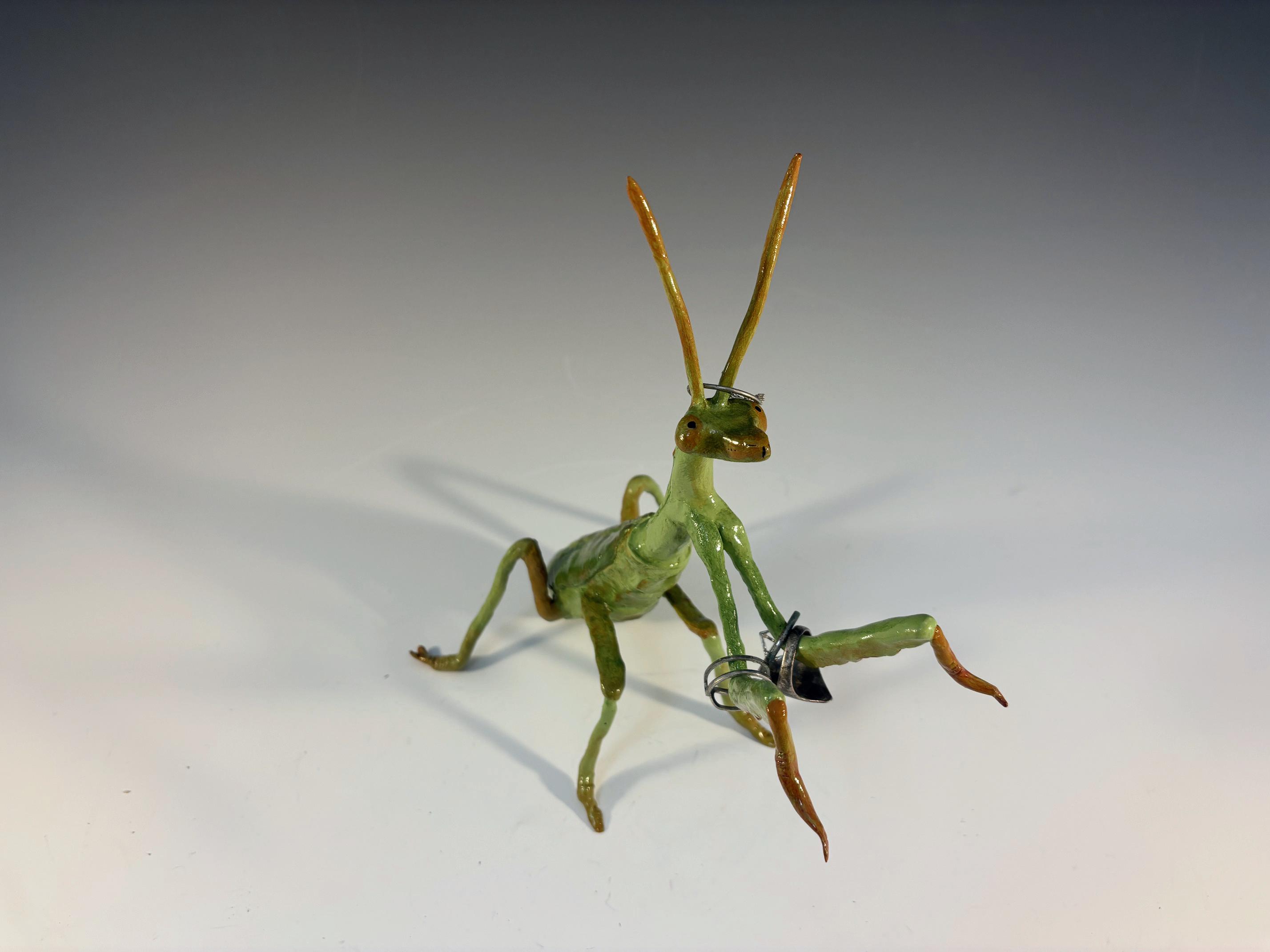
MANTIS
Mila Taylor ‘26
REGINA PODCHASKI ‘26
PushandPull
The Ocean loves the Moon
The Ocean sends its tide,
But the moon returns it,
Scared of how quick the tide approaches.
For when the Ocean loves, it decides you belong to it
And if something that belongs to the ocean gets hurt
The waves that gently lapped the sides of the boat
Will become the ones that swallow it in a storm
The currents that gently caresses and guide
Will become the riptide that drags you under
The Ocean is gentle
The Ocean is intense
The Ocean doesn’t know how to love
Any other way
The Moon loves the Ocean
The Moon is hundreds of thousands
Of miles away
How can it get closer?
It tries, oh how it tries
Some nights it is close enough that it touches the ocean
Some nights they couldn’t be further away
Some nights it shows it face,
Bright, shining, and full
Some nights it hides, lost
In the vastness of space
Spaceships and satellites pass by, stop for a while
But everyone leaves the Moon
So it stays there,
Nothing around it
No one to connect to
So the Moon stays different, because
The Moon doesn’t know how to love
Walking down the hill from school,
I see the old red stump at the corner of our yard.
The fire hydrant,
Still cold to the touch from last night’s frost,
Emanates an unexplained yet undeniable warmth upon seeing it.
To its right,
A pile of leaves sit unattended in the fall sun,
Waiting for the Saturday morning yardwork to bag and drag them away.
There’s light glinting off the ice crystal covered leaves in all directions,
Making it look like a weathered flannel disco ball.
In the center of the yard, two magnolia trees sit. Their branches diverging at the base of the trees
Giving them the appearance of two hands, grasping for the sky.
Reaching for the sun like Icarus flying away, both doomed to come back to the earth.
These trees are adorned with magnolia bulbs
Surrounding the base and the branches of them,
Like spiky Christmas ornaments or,
To the overactive imagination of a child,
The perfect thing to throw at your brother.
Propped up against the trees sits Jeff the skeleton,
An old Halloween decoration we bought from Kroger.
Jeff sat six feet tall and was a dirty bone color, evidence of his outdoor lifestyle.
His hand is propped up so he could wave at any kids or cars passing by,
Putting a smile on their faces and, when the time comes, Halloween candy in their baskets.
At the far corner, past the front door, sits a long dead cherry tree.
The tree’s corpse stands there, Towering over the rest of the yard, Never bearing any fruit, Never causing any problems, Like a peaceful mummy entombed in dirt and sunlight. And although it was a regular Wednesday, And I still had homework to do, And I still had school tomorrow, When that chilly October wind brushed through the yard, An indescribable sense of happiness and contentment overtook me.
Love,HoweverFilmWorthy
ALLISON KEEN ‘27
We love like a movie, but never a romantic comedy. No neat confessions in the rain.
If it were ever that simple, I’d doubt it was even real. Love is sudden, never clear.
A frame, half-lit. clouds parting, but not enough to see the sun. To love was to hand over your heart. An organ without control over emotion, somehow holding power.
We love it like a coming-of-age film.
The early scenes are awkward, unfinished.
At first, nothing makes sense, until finally finding your place. Love begins as nothing, glances held half-seconds too long. Then, all-consuming, the camera tightens. Centered around a single new face.
When life is forever in motion- loud, chaotic. Love is finally relaxing, a final still frame, roll the credits. A cool breeze after air too thick to even breathe. Love isn’t given away, it’s shared with pain and a smile.
Shared in whispers, but not secrets.
Love was the right answer, never the clear one.
Mila Taylor
Victor Fang ‘26
In one fluid motion, it leaped, clung to the ceiling, limbs pressed flat against the popcorn texture. Hanging above my head, it arched its neck backward to stare at me.
Slowly, it lifted the disc to its ragged mouth. The plastic edge ripped the sides of its mouth wide open, dripping black blood straight onto my frozen face. We held our gaze, balancing in that moment of shared horror.
Then, a weird calm like floating on a dark sea washed over me.
Veinsofthe Dark
“Mom?”
FLASHBACK GROWTH
Found in orchids, found in fields
A fresh tone that’s never concealed
Ruby, garnet, Tiger’s Eye
Magenta, yellow unify
Buttons, tulips, fluffy friends
Sightings of this hue never end
Look into my eye and see the vessel
The bruise on my exterior post-wrestle
Crimson fire, apple skin
Seeps out of the cut on my dark skin
Burns, rosacea, and overreactions
A carmine tint that’s always in action
It blushes, it bites, it stains what it touches
Red doesn't ask. It takes. It rushes.
Red
EMILY LOPEZ ‘27
ActofLoving
I love the act of loving; I do not love you.
I love dressing up for dinner dates and wearing my hair the way you like it.
I love making handmade gifts and peeling pomegranates.
I love the way your jackets fit me as if they were designed specially.
I like to pretend this is how you were created; That you were made just for me.
I love the act of loving; I do not love you.
I love writing letters and telling myself that “romance is not dead.”
I love learning about you; I know your favorite color is blue and that you’ve always felt out of place in this world.
I love the act of loving; I do not love you.
I’ve memorized your dreams, your fears, the person you aspire to be,
because I love the act of loving. I wish I loved you.
I love being your hiding place from a world that doesn’t make room for you.
I love the act of loving; If only I loved you.
Zoey Osterman
BeautiflyWildAconites
Love is an intangible whisper, a dance in the air.
A metamorphic entity trapped in the heart’s tender snare.
In a world razed by selfishness, where shadows extend,
This winter aconite blooms in the frost, where others could not.
Where our imperfections may mend.
We dwell in self’s embrace
Igniting a spark, revealing an uncharted space.
Love infuses people with insanity’s fire
Injection of magnanimous fervor and altruistic desire.
It beckons us to yearn, the ballad sung by a new choir.
Kindling a being willing, too eager to endure
To absorb every shard of torment,
With the embrace of this essence so pure.
A requital for another’s pure content,
For others’ sake. Narcissism’s finale
In exchange for sinless piety.
Thus, love is insanity, a beautiful spree,
Surpassing instinct, where wild heart may run free.
It is lunacy, but not idiocy
Interwoven with threads of rapturous light.
A prison break from the dullness of life.
Love lingers in every echo of sweet endearment shared, Between the silent bond of an owner and a pet is declared.
In the warmth of a parent and child’s gaze, In passions ignited by dreams and desires set ablaze. Through quarrels of siblings, despite the vexation that flares. Love weaves through the fabrics of memories and moments Life urges we share.
A call to share life through kindred spirits
With enduring friendships, where we’re set bare.
As water is ice and ice is still water
Property is the same, appearance just altered.
For love knows no boundaries, structure not defined, Yet constant in essence, clear to the blind. This feeling transcends the connotation of feeling, The constant of life, steadfast, unyielding.
Ultimately, love can’t be an emotion but something more. A paradox woven, elusive, and bright, Only resonance capable of starting all wars.
The madness enchants, not always romance, But a wild dance that tethers humanity. Lovely chaos, yet so absurd. It unravels me,
A warmth I never don’t want to endure.
SCANNED Zoey Osterman ‘26
When I was younger, I would always dig a hole at the beach, where the tide silvered into the horizon. Not for any purpose, my hands just loved the work, salt digging into my nose, the way sand moved like sweet sugar, the way it slipped through without leaving a trace, like time slipping through a narrow glass. There was something safe about moving the earth.
I liked seeing the hollow form, a shape that hadn’t been one. It was a small mouth on the shore, and I waited for anything it had to say.
I always tried to refine the edges after I was done, even when my arms got tired and silver water licked the sand, they ended up curving apart, like tired lips losing words. Sometimes I took a bucket from the ocean and dumped it into my hole, making the warm sand feel heavy and cold.
SilverShores
SAFFAT AHMAD ‘29
Later, the sun would stick and slip down the sky like a ceramic plate, shadows stretching over dunes, seagulls’ cries, scooping and ripping the air.
It was always a tradition to fill the hole.
Piles of sand that I pushed with my feet. No matter how much, how carefully, how I tried to put it in, It wasn’t enough.
I didn’t know what I was practicing then, but now
I’ve tried to convince myself that all holes are the same. You pour days, explanations, intentions into them, and something essential is still missing.
I’ve tried to convince myself that filling the hole is the end, that resolution is responsibility. That everything, eventually, settles.
But some things widen the more you polish them, like sand collapsing even under your careful hand. Sometimes emptiness isn’t an absence and is just space smoothing out.
And space can be left smooth. Sometimes nothing asks to be finished because the tide will take away what we’ve loosened over time, and give us new sand.
Finalnotes
We often think of the past as something we leave behind, but memory is orbits. We circle the same moments, finding that they reshape us each time we can pass by. As this volume closes, we leave these pages as a space smoothed out, waiting for the next tide to bring new sand.
We are always looking for new voices. If you're interested in submitting to next year's Skylight, watch for announcements in the fall or email pentlerc@trinityprep.org.
WWW.TPSSKYLIGHT.COM