2
HUmour
The Real World: London John Hollingworth ‘ Do you have any skills?’ I mentally review my largely improvised CV: ‘art house projection assistant’ (out and out lie calculated to make me sound cultural in a leatherjacket-and-smouldering-Gauloise way), ‘extensive office experience’ (dealing with college administration for four years), ‘good knowledge of manual labour’ (a week spent chasing sheep across a farm in Australia in a gleaming 1950s fire truck in 1999), ‘bookseller’ (true but useless), ‘awardwinning team-player’ (not untrue: Bradford City Council ‘Learn to Swim’ badge 1986, Employee of the Month at Staples, Odsal branch, March 1997). Suddenly it hits me. I do have tangible proof of my skills as a human being, of course I do, why… ‘I have a degree in English Literature from Trinity College Dublin’ I offer, shocked at how pompous and yet desperate the words sound in the cramped, nicotine-stained recruitment office I’m sat in on a rainy London morning. The man sat opposite me, who resembles a heavyweight-boxerturned-heroin-addict, stares at me as if I’d just crapped in my hands and fed it into his fax machine. ‘You’ve… got… what? From where?’ he says slowly and deliberately. The cleaner-cum-secretary momentarily stops mashing her tea bag and eyes me warily. ‘A degree in… books, you know reading and all that. Fiction. Poetry.
Well I mean not just that, there’s other stuff like history and psychology involved, yeah… from, uh, college. In Dublin. I just graduated…’ My voice trails off. I feel like I’m trying to justify my suspicious presence at a particularly gruesome murder scene. I want to grab him by the shoulders and tell him I’m from Yorkshire, that whilst my accent has slowly been sandpapered away by absence from home I’m still a handy lad at heart, I come from good working stock, can bale hay and shovel shit as well as the next man and for god’s sake can’t he see from my withered waistline that I’ve never needed money more desperately in my life? ‘Yes’ I add firmly, by way of explaining this. So began my search for a full-time job not five weeks ago. After much soul-searching the boxer/heroin guy (‘Gav’) interviewing me at a small, independent temping agency offered me a job working on a processing line in an abattoir checking for anomalies in raw chicken parts. Having repressed the urge to ask when chicken parts had become standardised in the first place I made my excuses and left, quite reasonably citing the meagre _5-per-hour wage as the reason. Strolling jobless once more into the slightly dank air of Shepherds Bush Green I wondered, and not without a pang of bowelwrenching fear, how I was going to find the scandalous amount of cash requested by my jovial landlord in order to remain amongst the housed
classes. ‘Rent’ in London (more accurately described as ‘financial rape’) is an unforgiving taskmaster, a hungry monster that demands a salary, no matter how measly, to feed its gargantuan cash-based appetite. I won’t bore you with the details: I missed my acting audition for the daily Mockney pageant that is the London Dungeon (hungover), was designated as ‘unsuitably trained’ to be employed as a theatre usher (paroxysms of unspeakable rage), couldn’t muster the moxie to write for an in-house business gazette and, shockingly, was refused the editorship of the Guardian and told in no uncertain terms that the job had never been advertised as vacant in the first place (may as well aim high etc). Finally, like a sloth returning to its muddied sea-bed womb, I was offered a job working in the fiction section of a high-street bookselling chain which has had the dubious pleasure of my employ on several previous occasions. So, I still have no answer to Gav’s question, but can disguise my seeming lack of ‘skills’ by blathering about books all day, which is rather like doing an English degree, so that’s fine. Except now I get paid, but only enough to stay on the scurvy and rickets side of health. I’ll keep you posted.
www.whiteninjacomics.com
TNT DUBLINS HIDDEN ELITE MAKE AN ENEMY OUT OF ME Seamas O’Reilly Idiots. Fools. Buffoons. Titcakes. What do all these words have in common? They’re all synonyms for “Fresher”. It’s true, go check your thesaurus. That is to say your thesaurus for which you paid 35 euro. Because you’re a fresher. An arsehat. For all of us, fresher’s week is the time to get to grips with our course, make new friends and get a good start in all of the extracurricular activities handily arranged by those in charge. For Dublin’s booksellers, barmen, taxi drivers and sellers of ironic Tshirts, it’s time in which they begin deciding whether to have Ferrari or a Porsche after retirement. Attack helicopter or nuclear sub. Difficult decisions you’ll agree, so let’s not think for one moment that Fresher’s week is easy on anyone. There is evidence to back up my claims. Next time you get a taxi, make note of the driver’s overly extravagant solid gold shoes. Such subtle things most Dubliners have become attuned to, but to an untrained eye may slip quite easily undetected. Freshers spend their first week going to the city’s dingiest bars, clubs and restaurants and paying hilarious prices for crap drink, music and food. When we all go home, Dublin’s aforementioned hidden elite let our a long laugh and go to their own parities, where everything is always 50 cent but it doesn’t matter because everyone pays for their goods in gold bars and rough-cut diamonds anyway. Just last week in Grafton Street, a man paid for a pizza with the Dead Sea Scrolls. Meanwhile I was confronted with a bill of 13 euro for a double vodka and coke. I’d like to think that beneath that sticky formica tabletop, past the rusting taps lay a secret pathway to a hidden chamber wherein 100 well fed orphans spend their days on treadmills powering a platinum silver vodka distillery pulping Seville oranges with their immaculately manicured hands. But no. It was Smirnoff and Britvic and water and I paid the 13 euro anyway. Because I’m a Fresher. I’m an idiot.
TNT
3
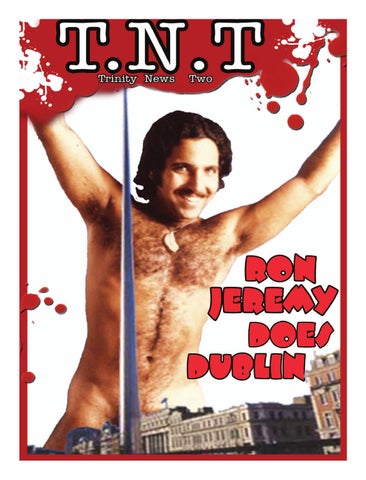
Contents Ron Jeremy gets his cock out! On the piss with a porn star, TNT reports.
FEATURE
PAGE 8 & 9
Interview with Divine Comedy’s Neil Hannon. Dogs Die in Hot Cars.
MUSIC
PAGE 6 & 7
Alan Leech, star of Man About Dog, speaks to TNT. Kill Bill - A Feminist Statement?
FILM PAGE 4 & 5
Shining City, Sabotage, Portia Coughlan. Plus: What’s on in Dublin.
THEATRE PAGE 12 & 13
Bohemian Style Shoot.Shopping in the City. How not to look orange: Fake Tan.
FASHION
PAGE 14 & 15
HUMOUR
BOOKS
TN SPY
PG 2 John Hollingworth reports from London.
PG 10 Booker Prize: Winner takes it all.
PG 11 The Eyes and Ears of Trinity.
Photo: Matt Pitt
TNT My friend recently got a dream job at Google. A young, innovative company, great money and a job description that basically entailed looking up porn sites all day. That was his job – looking at porn. He was, of course, elated for the first week or so, the envy of all the lads. Three months later however, he reappeared desperately miserable and disillusioned. It’s ruined my social life, he moaned. I’ve no interest in sex anymore. All the body parts look the same, and did you know that the story plots are actually really poor? Familiarity breeds contempt. And over-exposure inevitably leads to: boredom. This first issue of TNT has an obvious theme. Ron Jeremy came, saw and conquered, all over Trinity last weekend. There was little or no protest at his arrival to the campus. There was however, plenty of admiration, respect and downright awe for a person who has built an international renown based on stud-dom. Any complaints towards the star targeted weaknesses in his personality, but never his choice of profession. If Trinity’s reception of Mr. Jeremy is anything to go by, society has become indifferent to any stigma attached to porn, prostitution and public sexual displays. Looking at the wider world, this seems quite an obvious statement. Australia’s largest brothel Daily Planet, has been put on the stock market. Rebecca Loos fondles a pig on television. References to oral, anal and orgy sex litter American sitcoms. And yes, we students all feel very savvy and astute, welcoming a porn legend into our open arms, quite convinced that Dublin is just one step away from Amsterdam. This superficial acceptance however, is starkly misleading of our actual stance on adult entertainment. This seeming broad-mindedness is more often than not a misinterpreted jadedness. When it comes to real examples, stigma is very much alive. British press recently reported on a female golfer with a single figure handicap, expelled from a prestigious golf course, when it was discovered she had posed for page three, twenty years ago. Marylin Chambers, featured inside, in the Porn VIP, still expresses frustration in the media, at never having been given the opportunity to star in mainstream films because of her success in the blue ones. Ex-porn star, Dr. Sharon Mitchell (not the Eastenders one, before you ask) may be making progress in her fight for sex workers rights, having set up the Adult Industry Medical Centre but the tolerance is conditional. It’s more often a case of it’s fine for THEM but not for you, me or anyone we actually know. Paradoxically, while society moves to regulate porn films, the rules governing the rest of arts and media are growing lax. The glimpses of breasts, bums and beastly organs are becoming ever more common in movies, ever more “integral to the integrity of the storyline”. Our Film page this issue, tackles the ever current question of essential nudity in the movies. Music videos have long stopped their attempts to portray anything other than soft porn and even advertising is getting more risqué –shampoo orgasm anyone? We have double standards where sex is concerned and the lines between art and porn are increasingly blurred. With so many heated images bandied around, it becomes very difficult to tell the difference, supposing there really is one anyway. The point I’m trying to make though, is that while we race ahead to create an open and sexually uninhibited world, it’s time for our under-rated brains to catch up with our bodily desires. It’s all very well to acknowledge publicly the deeds that have long been conducted behind closed doors – we don’t want to be hypocritical after all – but we also should think about the consequences of a gyrating Britney doll, 3D porn experiences and mini-Jordans in glass boxes for sale. Will somebody pleeeease think of the children. Of exploited women and the feminist cause. Of those unfortunate porn stars caught up in the HIV outbreak (because condoms ruin the fantasy). And more importantly, on a philosophical scale, of the future of human procreation. Because what if our interest in the opposite sex, becomes entwined in an unattainable quest for constant excitement, with no understanding of the other aspects of a relationship, like an ageing porn star whose life vision is warped. Scarier still, what if we really do get bored? I don’t think we’re ready for a world in which sex is passé.
Neasa Cunniffe TNT Editor
4
Film
TNT
On a phone box near you ... Interview with Allen Leech In an impromptu selection of famous exTrinity students one might include Jonathan Swift , Michael O'Leary and Allen Leech. Allen Leech? Why yes, as the star of current Irish blockbuster ‘Man about dog’ Leech will not only be tarting up for his graduation ceremony in the next couple of months but also a fair few international premieres. In deference to his alma mater (perhaps!), he sat down with me to discuss his Trinity roots, Irish cinema and why Guy Ritchie recently called him a “cheeky cunt”. First to get praised in his list of influences is the good old Trinity Players society. This was where Leech began his acting career in earnest and he would recommend it as “very beneficial, a great outl e t
for anyone who wants to experience any type of theatre”. It was during a Players performance of ‘This Lime Tree Bower’ by Conor McPherson that he was spotted by his first agent, who happened to be representing one of the other professional actors in the play. When I ask him whether he considers professionalism to come bonded with a salary he replies intently “If it’s your career, you’re always going to consider yourself professional, whether you’re getting paid or not”. His first two roles with professional earnings however, were for American TV. Leech is very aware of the importance of American money; “Everything that gets cast, even Irish stuff goes through LA first”.
Nevertheless he believes domestic Irish cinema is on the up; by being better funded and through slowly encouraging an indigenous audience that was not there before. He mentions several movies to illustrate this point – including ‘Intermission’ and current hit ‘Inside I’m Dancing’. Leech also sees the international market for Irish films expanding, for instance his first feature film ‘Cowboys and Angels’ was recently released in the US with “great reviews” in the New York Times. As both of his starring roles were filmed while he was still a student at Trinity, I am curious as to what advice he has for students wanting to pursue a full time career in acting: “First you have to make sure it’s what you want to do, if you can see yourself doing anything else, then do that first. If you come to the conclusion that you want to be an actor, then go for it! The first thing you should do is get head shots done, send them out to agents and try and get a show that they can see you in. Once you get an agent you can go for professional work and then, well, just hope for the best…” When questioned as to the differences between his initial theatre work and film acting Leech explains that acting on screen is a lot more subtle – “you can get away with a lot more on stage, people are a lot further away… On screen my eye could be seven foot wide. The most simplistic way that you can explain it is that theatre acting is external and a lot of film acting is internal. Film is about keeping
Towards the end of last year, I made my submission to the DU Filmmakers Society to direct a fifteen minute short film. I’d had a little experience before then working on other student shorts, and I’d skimmed through a few books on budget filmmaking. I was determined to be well prepared, and leave as little to chance as possible. I’d tried to do a f e w things to make life
easier when writing my script, and although there were different locations, almost the whole thing was set indoors at night, which meant I could use friends’ flats and film any time of day by putting bin-liners over the windows. When I finally began filming, it was after over a year spent working on the screenplay, several months of pre-production, and a few weeks of rehearsals with actors.
things was realising what was dispensable and what was not. Many people, myself included, when visualising a film in their mind have various shots or images that they become slightly in love with, and it was difficult to restrain the temptation to bend the plot and action around the inclusion of these images, some of which became unnecessary as the project developed. Ultimately every beautiful shot, every hour spent dressing the set, every carefully planned camera movement will be meaningless if the central strand of the film- its story- is weak or not properly told. The shoot took seven days, and what was striking was that all the weeks of preproduction, all the planning and all the writing was ultimately made good or bad by what happened in these days. I had decided that rather than film in any location as I found it, I wanted to plan exactly what should be in each scene: what colours, what kind of furniture, what costumes, and so on. It was perhaps primarily a film that placed mood and atmosphere above action.
Becky Jackson
One o f t h e most difficult
Alexander Christie-Miller
When we began the shoot I started to appreciate just how challenging the director’s job is. I could only describe it as an uneasy mixture of storyteller, crisis manager, and actor. You had to work under tight time pressure, with problems multiplying all around you, and yet still make every shot work exactly the way it needed to. Looking back on it, I think the clarity of my story suffered somewhat from my inex-
the same focus and energy – you could be doing the same scene for four hours…” While we’re on the subject of energetic performances, comedy man Pat Shortt was one of Leech’s co-stars in ‘Man About Dog’ and sure enough Leech has a farcical off-set anecdote to tell: “We were all staying in this hotel and we went on the batter one night, half-way through the night Pat got up to go to the bathroom and the bathroom door and the front door were right beside each other…. And he got locked out, completely naked!” Back to the subject of influences Leech cites Philip Seymour Hoffman; “He’s incredible…He always plays really interesting choices and that’s what I’m attracted by… he plays his own persona very well but it’s his ability to make tiny little changes that make him so interesting to watch”. Seymour Hoffman is an unusual choice but one that is perhaps indicative of Leech’s determination to perfect his craft. As Seymour Hoffman plays variations on the perennial loser character we discuss typecasting. Leech says this was an initial worry – after ‘Cowboys and Angels’ he got three scripts immediately flown over to play other gay parts; “Its funny how people just assume that’s the way you’re going to go”. Having spent an instructive hour in his company it seems to me whichever way Leech goes he’ll end up resolutely on his feet. Delighted to answer anything I put to him, including which actress he’d most like to sleep his way to the top with,( Natalie Portman in case you’re interested), Allen Leech is a lovely guy who will continue to earn all the success that comes his way. Natalie Portman could well be on the cards. perience and lack of confidence on set. The atmosphere was also crucial, and as director, you had to try and seem completely confident, certain, and energetic since if the crew and actors were run down, irritated, or pessimistic the quality of the work would inevitably suffer. One morning in particular we began at 8.30am and I had to ask the actors to help drag all the equipment to our first location; we were then working nearly non-stop until 2am that night. Although you do have to push people, pushing them this hard made looking through the sixty or so different takes from that day a depressing process. My short was screened at Filmmakers’ ‘Clingfilm’ event at the start of last summer. In retrospect it was an ambitious project, and although I was reasonably happy with it as a first film, I don’t think any reaction, favourable or otherwise, could have given a return to the hundreds of hours of work that had gone into those fifteen minutes. I remember how much I loved the actual filming and planning (not writingthat was hell), and it was the process of making it, as much as the final project that made the whole thing worthwhile. I left with a newfound respect for anyone who makes films, even really bad ones, since it was more difficult than I could ever have imagined. I also left with a renewed determination to carry on making them.
TNT
Film
Kill Bill: ‘All about girl power’? Tallie Maughan The films of Quentin Tarantino, with their obsessive intertextual referencing and their devotion to the contemporary world, frequently resonate with the present moment. Tarantino describes Kill Bill, his fourth film, as a ‘feminist statement’, which is ‘all about girl power’, a claim that has attracted some debate, but one which I think holds true. Kill Bill: Volume One seems to be one of those films that you either love or hate. In it, Uma Thurman’s Bride embarks on a graphic rampage of bloody revenge for her betrayal at the hands of the Deadly Viper assassination squad, and most particularly her former lover and boss, David Carradine’s Bill. Some people adored the film as a grand epic of choreographed cinematic violence, whilst others felt that its lack of anything else made its brutality unpalatable. It also seems that for most who disliked Kill Bill: Volume One, Volume Two was something of an improvement, but for those who adored it, the second was something of a let down. I fell into the first category, feeling that the first film lacked any really involving characterisation, and that in a world in which we feel more paranoid about physical safety than ever, yet another film celebrating violence purely for the sake of it was utterly unjustifiable. I felt that as a feminist statement the Bride’s rampage was at best a form of mimicry, her mission was to ‘assimilate into a male culture via toughness’, thereby losing the female self. It was the development of the plot and the emotional depth of the second film that began to change my mind about the feminist trajectory of Kill Bill. Kill Bill: Volume Two explored the problem of contemporary woman who in most areas can enter the male domain on equal terms, but who must also retain traditionally female roles. In it we see the Bride reclaim her role as mother using her qualifications as a ‘masculine’ hero. She is a hero invigorated with ‘female’ qualities, particularly the ability to express and cope with emotion. She is also a woman deeply affected by
her biological connection with her baby. Thus she is able to be a hero with a perspective and motivation that her male counterpart could never have. Kill Bill: Volume Two revealed an emotional complexity to her relationship with Bill that explained his physical domination of her in terms of her emotional power over him, which thus explored realistic female power, not simply a fantasy of being physically more powerful. However, for many that loved the first film, the second was a bit of a let down. My friend Julie felt that, rather than being a justification for the first film’s violence, it in fact closed down the revolutionary statement that its predecessor had established. Julie saw in Kill Bill: Volume One the liberation of the protagonist from the role of heroine, it allowed her to be a hero in the Clint Eastwood mould. Although at it’s the beginning we see a woman at her most vulnerable, in the most extreme situation of femininity and powerlessness possible, pregnant and shot i n the
head, Thurman’s Bride is able to be truly feminist by transcending the expected delineation of gender and unambiguously occupying the role of hero. Her argument was convincing and I was forced to see that Kill Bill: Volume One was more about ‘girl power’ than I had initially given it credit for. It is full of strong female characters, occupying traditionally male roles. Unlike a film like Charlie’s Angels which eroticises the female action hero, Tarantino was prepared to present his Bride as ugly, at the beginning really quite deformed. When she cries, it is no coy whimper, but true bawling, she becomes puffy eyed and realistic in the process. We also see, a novelty in a Hollywood film, her rape from her perspective, it is not appropriated and eroticised by the male gaze. For Julie, Kill Bill: Volume Two, with its increased emotional trajectory, and traditional plot movement, entered into a more stereotypical presentation of women. It left ‘Black Mamba’ a weeping white trash mum, in foetal position around her daughter. Its reconnection with the theme of nurture, and Thurman’s deep felt, motivating impulse to act as a mother, displaced, and tritely explained away the revolutionary effect of the powerful, for once decisive, brutal and physically strong female hero of the first volume. I had to acknowledge the validity of her perspective. Towards the end of Kill Bill: Volume Two women are indeed presented in a more traditional way. The pimp whom she has to go to in order to ascertain Bill’s location, is surrounded by women physically carrying scars that signify their sexual subordination to him. I began to wonder if it was possible that I had not liked the first film precisely because it was so subversive. Perhaps I became much more comfortable with the film as its representation of femininity became more conventional simply because I could relate to it more deeply, and wasn’t truly liberated at all….
Unnecessary Nudity ? James von Simson “Sight is the weakest of the sexual senses,” claimed the Marquis de Sade in 120 Days of Sodom. But he would. As a committed, literally and figuratively, pervert. But despite his dubious accolades he was right when he claimed in a letter to his poor suffering wife that “to see if far less sensual than to imagine”. The growth of wanton nudity in film has outstripped the changes in moral perceptions in society. Indeed, as Peter Biskind argued in ‘Raging Bull…’ it is actually the cause of the shift in traditional attitudes. Now, I don’t want to be misunderstood; I applaud this, and I have no problem with shabby scripts and plot holes being shored up with nudity. In grossing $352,700,00 & $116,300,000 worldwide respectively Basic Instinct (1992) & Sliver (1993) perfectly illustrate the industry safe option. But artistic merit is frequently being wiped away with the proliferation of unnecessary states of undress. As ever there is a time and a place. The centerpiece in Stephen Frears’ excellent adaptation of Choderlos de Laclos 1782 novel Les Liaisons Dangereuses (1988) is the deflowering of Uma Thurman’s Cecile Volanges by John Malcovich’s
Vicomte de Valmont. Her chastity, as symbolized by her traditional attire, was juxtaposed with the nakedness of her new promiscuity. Or in French cinema. Where the present vogue is what the Canadian critique James Quandt dubbed the “New French Extremity”. He argued in ArtForum that the notorious Argentinian-born prodigy Gaspar Noé’s latest work Irréversible (2002), which has sealed his reputation as the ne plus ultra of cinematic provocation, was simply a “macho endurance test designed to test the viewer’s mettle”. But what he failed to appreciate was the redemption of it’s virtuoso brutality in the eyes of the audience by the tenderness of the congress between the victim and her partner which we see after the near unforgiving nine-minute single-take rape scene. Quandt echoed Biskind in arguing that cinema’s nude tendency is “a narcissistic response to the collapse of ideology in a society traditionally defined by political polarity and theoretical certitude”. But then he probably hadn’t seen JeanClaude Brisseau’s Secret Things (2002) in which two young women plot to over throw the social order by old-fashioned pussy power, that’s to say Marxism filtered through Penthouse.
But it wasn’t the prudish nature of Janet Leigh, nor budgetary constraints, which left much of the infamous shower scene in Psycho to the imagination. Rather it was Hitchcock’s innate understanding of the overriding dilution by nudity of tension and even intimacy. Katie Holmes didn’t need to disrobe for her role in The Gift (2000) nor did Jennifer Lopez in Oliver Stone’s brilliant U-Turn (1997). Hillary Swank’s nudity in her Oscar-winning role in Boys Don’t Cry (1999) didn’t augment the horrifying nature of her attack, but seemed out of place. Not least because she has a cheerleader’s body, not that of a sixteen year-old suffering from gender-deficiency. Surprisingly maybe Jude Law’s new squeeze Sienna Miller, who has just made her debut in Mathew Vaughn’s cracking Layer Cake (2004), put the distinction best by claiming that she was “an actress who can take her clothes off, not a nude model who can act”. (Is too much onscreen nudity never enough? Look out for the next issue of TN, the entire film section will be devoted to that most controversial of film genres: pornography -Ed)
5 Cinema popcorn: What you need to know Bought by weight and sold by volume, popcorn has an astronomical profit margin. This perhaps explains why it is marketed as the traditional cinema snack of choice for the western world. In fact, without the food stand most cinemas would find it hard to stay in business. Why then must cinemas rely on super-size mega deals to make their money? It breaks down roughly like this: a cinema might only receive 20% of the ticket price depending on how long the film shows for and although they might also make something from showing trailers and adverts, the real money is to be had persuading customers to complete the sensual blitzing with some high flavour chow. Accordingly all that slurping and crunching is imperative to the cinema owners pocket, in effect they are showing movies to lure you into buying trashy food. Fair enough perhaps but consider the pathetically low value of the food they must sell in order for this to be cost effective. I am reliably (of course!) informed that it costs more to refrigerate the soft drinks than to buy the Coke syrup in the first place. Having said this if you’re prepared to forgo any concern for your health, a large popcorn with sweets on the side constitutes the daily calorie allowance for an average male. And its fun eating in the dark.
6
Music
TNT
CD REVIEWS Elliott Smith: From a Basement on the Hill ‘And everything that you do makes me wanna die’ - poignant words from ‘The Biggest Lie’. This album too is littered with ominous song titles such as ‘Last Hour’ and ‘A Fond Farewell’. But the press release doesn’t mention the singer’s violent suicide, so here’s a novelty: let’s forget the facts and concentrate on the reason that Elliott is so sadly missed: his music. First up is ‘Coast to Coast’, a grand rock song in the richer style developed on his previous ‘Figure 8’ album, loud without being distorted, his fragile voice more of an instrument than a centrepiece. Many of the songs are in the acoustic style of his earlier recordings, and one song, ‘Ostriches and Chirping’ is exactly that: recorded bird sounds. His pop sensibilities are still evident, especially on tracks like ‘King’s Crossing’ where the melodies are sometimes hard to associate with lyrics like “It’s Christmas time/And the needle’s on the tree/A skinny Santa is bringing something to me”. Elliott’s music has never been happy per se, and this album isn’t the easiest thing to listen to, but it would be a mistake to cast off his work as something for jaded lovers and manic-depressives, and the surprisingly upbeat ‘Memory Lane’ - which is “A place where suffering is just a game” - seem to confirm these suspicions. However, he sings the chorus to ‘Don’t go Down’ with such quiet conviction that the idea occurs that this is just the ongoing work of a genius. Oh, and R.I.P.
Rahul Bery
Travis – Singles The past 18 months have been difficult for Travis – drummer Neil Primrose’s brush with death in a French swimming pool, their latest album 12 Memories flopped, allegations that the band are drug abusers (started by none other than themselves) – the band showed serious signs of collapse. Indeed this spelled waning popularity and may even eventually lead to the band’s rumoured self-destruction sooner rather than later. If the worst comes to worst, they have at least left us with this almost-perfect greatest hits compilation. The singles are all cleverly scripted tunes featuring alluring pop hooks at every chord change. First track ‘Sing’ launches the album, kicking away with its catchy chorus, before leading seamlessly onto ‘Driftwood’, one of The Man Who’s most endearing numbers. A very welcome addition is new single ‘Walking in the Sun’, a massively optimistic song, featuring one of the best videos of the year. Old classics like ‘All I Wanna Do Is Rock’, ‘U16 Girls’ and ‘Happy’ are warm and fun to recall – it goes to show that Travis’ songwriting has neither improved nor decayed in the years since they emerged, but rather has always maintained a high standard. A band begins - 4 albums and 4 million sales later, they still have not achieved the massiveness that outro track ‘Turn’ would make you believe (or that they deserve). Even The Man Who only managed 2 stars from Q magazine at the time. However, this CD proves that Travis have never been substandard, hugely unimaginative or (dare I say it) boring as they have been criticised over the years, but have been a silently remarkable band, leagues ahead of the Stereophonics and Keane comparisons that really have been unjustly emplaced upon them. Finally – a really great Greatest Hits. Here’s to another 4 million.
Ruairi Hickson
Halite – Courses At last – an Irish band it’s not unfashionable to like. And as a nice bonus, they also happen to be quite good to boot. Halite’s debut album Head On was, it must be said, a huge let down. Here was the sound of a band who began without an idea and were missing a sound of their own. The tunes were unrefined and the resulting record felt too minimal to be satisfactory. Thankfully, Halite were listening very closely to their bill-mates when performing at Slane last year, and it’s all the better for it. Running through the length of new album Courses can be heard the distinct influences of Dave Grohl & Josh Homme. The album breaks from the stalls with the nicely loud and charging ‘Note to Self’, an intro that sets a very honest tone to this album. Leadoff single ‘A Fine Thing To Steal’ follows, with rough-yet-polished guitars and nice intricate vocals. Third song ‘Patsy’ is the kind of song that is very much in the vain of a melodic Foo Fighters. Eventually, the songs do trundle along a little and seem to prefer the ‘fade out’ approach to their finales rather than the traditional ‘end’ end, but these are minor blips on a wholly enjoyable record. Such is the nature of Irish music that it will be recognised nowhere outside this island. But finally, this is a band and record that deserves attention. It’s by no means an incredible album, but a very solid effort. And 8 minute outro ‘Courses’ should go a long way to please the melodically adventurous among us.
Ruairi Hickson
We Love The Darkness
Conor Doyle, SS BESS “Straight-forward rock-out music. There’s no reason not to like them”
Colm Dowds, JS History “They’re taking the piss, and people find them funny so what’s the problem?”
“
A Testament to the
The Divine Comedy’s Neil Hannon on the past, present,
Neil Hannon surely has one of the most distinctive voices in music today - a fact that goes entirely over my head when the Divine Comedy mainman picks up the phone with trademark northern burr… and I ask to speak to Neil Hannon. Sigh… thankfully it’s a mistake shrugged off - today, the singer seems to be in a sleepy mood, yet still eager to talk about past, present and future - at the healthy rate of one sound-byte every twenty seconds. “Fire away”, he says. And we do… Since 1990,The Divine Comedy have undergone several line-up changes, further confused by Hannon’s dismissal of the band in late 2001 and new solo career under the same name. In the sleepiest of accents, he begins to tease out the meaning of the name: “The Divine Comedy is… basically the name that gives me an excuse to make records, and it’s almost fictional. The reasons I still use it are 1) I like the name, 2) I don’t like my name, 3) It’s a brand now, it would be foolish to change it”. Happily, he broaches the thorny subject of his 1995-2001 bandmates before I do: “That’s part of the evolution. Regeneration in 2001 was very much a ‘band’ kind of album. And then I just ran out of ideas came to a full stop. That’s sort of frightening, so the only thing to do was to wipe the slate clean”. That would make him a solo artist. “…But I’m not comfortable with that description! The problem with being a solo artist is that whenever you hear such-and-such a solo artist singing, you can’t help that -by the very nature, it’s one person on the record singing a song - you automatically assume that every word they say is true”. No-one in particular is mentioned, mind you. “You get so obsessed with what goes on in that one person’s mind. In a way, The Divine Comedy is to prevent me from being so up front,
and the focus of everything. I know I am! But it removes me one stage from that minutiae. Because when I write songs, they’re fictional. I like the idea - there’s an element of uncertainty about who the hell I am”. Despite that, the latest album - Absent Friends - whittles that uncertainty away somewhat. Ponderous, reflective, the record shows the Enniskillen man at his most personal. “I suppose it’s a little less frantic than previous albums… I hope I made it a little more within myself, not trying to experiment too wildly. I’ve always tried to make it timeless, or at least not too contemporary. I just don’t want people to pin it down”. One senses a sound-byte being hastily prepared… “It seems down and yet it’s not. I find it quite hopeful, because I like … the small light in the darkness, rather than a dark spot in a lot of light. That makes perfect sense, doesn’t it?!”. A little abstract, at best… Neil is proud of the artwork on the album. “That was my idea!”, he beams down the telephone. “We’d had a few meetings… I hate meetings. At the end of the day I didn’t like any of the ideas and I thought, I’ve just moved to Dublin and it’s really nice so let’s do it there. And they just thought I was being lazy…”. So the session took place on Henrietta Street. “Apparently, it’s the oldest standing Georgian street in Dublin. Half of them are in a really dire state of repair, but that served my purposes rather well”. After years of his famous suits-and-sunglasses look, it’s no surprise that Hannon sees image and artwork as crucial to the album itself. “Yeah. They are testament to the pure ego at work! In the old days when people commissioned portraits of themselves, it’s a bit like that - you’re in complete control of the situation and you’re just trying to get something that makes you look really
The Greatest Bandname in the World! It’s all the same to Craig McIntosh of Dogs Die in Hot Cars “I wish I had Paul Newman’s eyes/ And every day came with some surprise…”. Welcome to the strange world of Dogs Die in Hot Cars. “The greatest band name of all time!” proclaims Craig McIntosh, singer and guitarist in the Dogs. “Rolling Stone magazine said it was the greatest band name in the history of all band names, and then the NME said the worst band name in the history of all band names they’re just as much a compliment as each other”. Make of that what you will. The Dogs are different. They have a philosophy. Their music is a reaction. And Craig can talk all day about it: “When you go to an art gallery, people read the meaning behind somebody’s painting often before they look at it. We just wanted to throw the question back at people and say “describe yourself!”.
Because if you want to be honest, then you shouldn’t be able to describe yourself. We’re indescribable”. Brave words. Hence their equally brave album, Please describe yourself. It’s funny, it’s unorthodox… and it’s rather good. “It’s your standard, classic start-up at school as kids… When we were 18, we started playing pubs. We went to university… after a year or so, we decided we needed to choose one or the other and really go for it. So we basically decided to drop out and all move into a flat in Glasgow. We signed our record deal in October, and then from there we’ve been gigging non-stop around the world! I just found out today that last week the album came out in Japan and we sold 6000 in a week, which is… we haven’t even played
TNT
Music
7
LIVE REVIEWS The Radio – Live at the Temple Bar Music Centre, 8 October
HERO OF THE DAY William Shatner covers Pulp’s Common People. Fuckin’ funny stuff.
MOMENTS IN TIME Lee Harvey and the Oswalds rock the Dallas City Jail, 1963.
pure ego at work! and future as represented by his beloved i-Pod.
”
By Ruraidh Conlon O’Reilly
good. It’s terribly biased imagery, but I think that matches the bias in the music itself”. Again, complete control. This man must be the most relaxed, laidback control freak there has ever been. When a Divine Comedy album is released, it rarely avoids mention of the usual suspects Noel Coward, Scott Walker… “It’s a little lazy sometimes, that the same old names are trotted out because they were read in another paper. It’s very hard to say what your influences are what would you get if you asked a writer or an author what his influences are, would he just trot out a list of novelists”? Hmmm. Or if a writer said he was influenced by Shakespeare, of course everyone is influenced by Shakespeare… “Exactly! And if you’re influenced by The Beatles, it’s exactly the same thing. So I’m musically influenced by things that aren’t actually music. But I can’t actually tell you what they are, because I probably don’t know”. So what is on his stereo these days then? “Well my I-Pod actually!”, as he descends into self mockery. “They’re great inventions, they really are! It’s saved my bacon, because at last I can take my record collection on tour without losing half of it. I just got all the ‘70s Eno albums out and stuck them on...”. Pop music has always been a passion, and as Franz Ferdinand are finding a niche in well cut suits and catchy tunes, it’s okay to be popular once more. “Oh I like the singles, the album I thought was a little patchy. And then it won the Mercury Music Prize and I was astonished! I have always been a child of pop”. That’s in evidence on Absent Friends, yet again. Could he ever abandon that sensibility? “I wouldn’t have thought so, because it’s what I do best. The only thing is that I like stretching out what is allowed”.
There follows one of the most polite rants against the music industry in recent times. “And unfortunately the radio… they like it to be ever narrowed, so that they can keep control of it. The music business seems to be involved in a massive attempt to… not peddle shit to the masses as some people decide, but they just like to know what’s going on from its inception, so as soon as anything vaguely original comes up, they and the advertising industry just swallow it whole so that nothing can be underground any more. The trick is, if you can be in the midst of the whole pop/commercial world, while doing your bit to subvert it... Credibility is over-rated!”. As a solo artist in denial, live shows have become more complicated. Hannon now has a panel of musicians from which to choose. It’s a lot more work, but it’s coming together. Most importantly, he doesn’t get bored onstage anymore. It comes as a surprise that he ever did. “Yeah. If you play with exactly the same lineup and palette of instrumentation, you do come to a conclusion and can’t do any more. I like to have the whole orchestra/ theatricality thing, I also like the naked fear of being on your own”. Now he has the freedom to attempt ‘No-one knows’ by Queens of the Stone Age in the pouring rain at Oxegen. “I really did feel for the audience, it was one of the worst… I was alright, I was sheltered, everyone else looked miserable”. Thanks. If nothing else, Hannon remains the most genteel popstar around. After a decade of fame, our twenty minutes yielded one single expletive and much good humour. With an album that takes its place among a string of near-classics, and a new DVD and tour on their way, it’s hard not to wish him the very best. I hang up the phone to a jolly “Cheerio”.
The Worst Bandname in the World! By Ruraidh Conlon O’Reilly there, know what I mean? I’ve done two newspaper interviews for the whole of Japan!”. Enthusiastic barely begins to describe this man. The lyrics are bonkers. William the Conqueror? 1066? “It had to be done!”, claims McIntosh, collapsing into laughter. And that name? “1997. That’s when we came across these five words that we thought basically sounded beautiful to our ears, and looked beautiful to our eyes, and sounded beautiful when they came out of our mouths. That was really when we decided to have the greatest band name of all time”. With such an eager front man, there’s surely a master plan. “No. There’s not. A lot of people lose the point and are driven by ambition.. If we’re not having fun, we’ll do some-
thing else. But as soon as we stop and we become bitter and horribly corrupt and be twisted by this cruel world of music industry types, come and slap me and say ‘leave!’. Hopefully that won’t happen…”. Brave words, and a brave, brave band.
Irish. Indie. Supergroup. “About time” you say, before piercing your cheek with your tongue and laughing sarcastically. The potential for disaster is immense, given such a statement – and especially since this is their first gig. This ex-Chicks, ex-Rollerskate Skinny, ex-Johnny Pyro conglomerate released their debut Kindness in August and seem to have done little since, but tonight’s show represents a charming, if sloppy, statement of intent. Firstly, the laptop sounds and projections of Jimmy Behan bewilder a fully seated Music Centre. Freeform beats, samples and synths bounce off the four walls in a dreamy way - the only way you really know a piece has finished is when Jimmy sits back and gives a polite wave of thanks. Intriguing. Thirty minutes later, The five-piece Radio take to the stage and belt into ‘Remember Me, Remember You’ – surely the most perfect song to come from this country this year. Amidst the ooohs and aaahs, Annie Tierney’s knifelike vocals cut through the sound for a few glorious minutes of a glorious song. Magic. However, they quickly fail to reach such heights again, despite all efforts: “Sorry, it’s our first ever gig” squeaks Tierney, as two songs have to be restarted. High notes are missed. And the guitarist won’t stop meddling with his instrument in between songs. Forgive them, it is their first day at work… All told, it is a debut with potential. Depending largely on backing tracks, the band nonetheless conjure a very honest live sound which is every bit as massive as that on Kindness. ‘Empire’ and ‘Whatever Gets You Through Today’ show a level of refinement that many bands would envy. Tierney is a capable and quirky frontwoman with the natural ability to win an audience, and there’s nothing to suggest that those teething problems won’t be solved by, say, their second ever gig - which is an achievement in itself. Supergroup? Not yet. But excuse them, it’s their first day at work. Ruraidh Conlon O’Reilly
Franz Ferdinand - Live at the Olympia Theatre, 13 October The Franz arrived in Dublin to a reception befitting a far more established band. Belying the fact their last Irish gig was less than 6 months ago, two nights of a sold out Olympia greeted them with a fervour not seen since the height of Strokes-mania in 2002. Unfortunately the underbill left something to be desired, The Kills offering passable one man-one woman sexual-tension filled blues rock, while The Beat-Up drowned in a pool of their own, obviously extensive, knowledge of rock’n’roll cliché. Lucky then, that the headliners are creating a new rock iconography for themselves. Franz Ferdinand have nothing if not style and they without doubt demonstrate they have the poise of a potentially era-defining band. The Franz have mastered the form certainly, but questions of substance remain. Initially signs don’t look good, ‘Dark of the Matinee’ doesn’t quite catch fire and there is a suspicious smell of a mediocre live band in the air. However, by the end of the gig, the most cynical observer couldn’t have failed to be won over. Beginning with an unexpectedly fantastic B-side ‘All For You Sophia’ and followed by the disco-rock behemoth that is ‘Take Me Out’, the gig finally proves the Franz are up to it. The reception to the latter is frankly astonishing, with the band having to delay starting the next song to accommodate the continuing deafening raucous approval - the equivalent of a standing ovation in the middle of a play. From there on in, the Franz are on cruise control, a wonderfully climactic ‘Darts of Pleasure’ prefaces an encore of beefed up versions of ‘Shopping For Blood’ and ‘This Fire’. The gig is a timely reminder that rock’n’roll isn’t dead; all it needed was an injection of style - though someone should probably tell the drummer that in no universe are gold lamé bomber jackets cool. Carl Cullinane
We Hate The Darkness
Claire Chambers, SF Psychology
Frankie Whelan, JF TSM
“They’re like Spinal Tap, but they’re not remotely funny”
“The Darkness Suck! Listen to Zeppelin”
8
TNT
He Arrived a Legend...
Patrick Cosgrave witnesses the Ron Phenomenon He arrived a legend, he left a Phil legend. It’s the simple story of the brilliant, the intelligent and the hilarious porn-mega-star that is Ron Jeremy and his trip to the Phil. He is an icon for all that man is capable of. A role model for thousands, and a source of morning after discomfort for thousands more.Ron has achieved the unachievable. In the space of 25 years, he has bedded the equivalent of every female undergraduate on campus. There is little tension in Ron’s life. But then, would there be in yours? Ron arrived into Dublin Airport a small, round, scruffy little man. Instantly, he was set upon by a raucous crowd, consisting of four airport security personnel, who had decided to halt baggage check to come down to greet him, a hen party from Essex, and a lovely Dominican nun who had by chance sat beside Ron on the flight from Heathrow. The poor lady hadn’t the slightest notion what was going on. But she didn’t have a clue for one very good reason. And that reason is down to the quality of Ron’s character. Ron doesn’t have to a talk about eight-man-interracialgang-bangs replete with midgets and donkeys to nuns, instead he can talk about other things. Family, life, love, and even god.That’s where you begin to learn that there more to Ron than meets the eye. He has two BA’s, and a Masters. To top that all off, he is a very accomplished classical pianist, he loves theatre, reads voraciously, and is worryingly aware of the world’s perception of American foreign policy. But back to the raucous crowd in Dublin Airport. Having cleared the arrivals hall, Ron, with his habitual luggage laden plastic bag in hand, moved at a casual pace to the taxi rank. Now, there is one small problem with hailing a taxi when you are Ron Jeremy: The problem is, you are Ron Jeremy. It’s like Pele asking a group of lads if one of them wants to join him for a kick around in his backgarden, or Justin Timberlake or Brad Pitt asking a group of girls if one them wants to go for dinner. You raise your hand and the gates of apocalypse will suddenly open. Ron raised his hand. A few minutes of shouting and beeping later we were on our way. Ron, Patricia Quinn, the star of The Rocky Horror Picture Show, Tom Dillon, editor of Philander, Lillies regular, and all round funnyman, and a slightly dazed me. It was in those twenty minutes that I began to get a small glimpse into the world of Ron Jermey. It was kind of like a roller-coaster ride on speed. Only I’ve never been on a roller-coaster because I am too scared, and I have never tried speed because I have never tried speed. But still, things were coming thick and fast. “Sure, I’ve banged thousands of beautiful women”, “yeah, I know Brad”, “I’ll tell you what, Mini-me is packing, it’s like a third leg”, “as far as rappers go Jay-Z is a really nice guy, real down to earth, so is Ice-T”. He’s rubbed shoulders with all the giants. But back to getting to Trinity. Eventually we arrived in Trinity. We hurried Ron across the cobblestones to Phil rooms. He showered, dried, courteously showed us his cock, dressed, and we headed out for dinner. Dinner talk was more sombre. Ron reflected on life, and his younger days in New York. His best friend during those years he told us “was a
man by the name of Michael Mulvey. We were best buddies. He eventually returned to Ireland, and is now Director of Tourism in DIT, I think”. A few bottles of wine later we departed for Front Arch only for Ron to be swarmed by a swathe of photographers and cameramen. Unfazed, he wooed them and wowed them with a stream of articulated blabber that only Ron Jeremy could coin. Ahead lay a Chamber packed to the rafters, outside of which loitered a hopeful mob of Phil members who had had to be turned away. Once again Ron wooed them and wowed, stopped for pictures, singed breasts and chests, and then skipped on his merry way into the GMB. T h e Chamber rose to their feet when Ron entered the room, and clapped and clapped. And some really cool Dublinhomie first years from Castlerock College thought it would be real cool to shout “get your cock out”. Of course they failed to realise that getting your cock out for other boys is just something they did in their cool schools. Anyway, when the noise level had sufficiently dropped Ron jumped to his feet and began to deliver one of the most brilliant and memorable displays ever witnessed. Leaving many that had come before him trailing in his wake. After an hour and half of talk and banter Ron left the room to a standing ovation which seemed to last for somewhere between 30 and 35 seconds. The legend had left the building and was bound for Cocoon. From Cocoon it was off to Club Philth 2 in Coyote, where Ron tried out some moves on the dance floor with an unsuspecting girl. He told me later that “I really like Irish girls, you can just walk up to them and feel their boobies and their totally cool with it”. I pretended to agree, explaining how I thought it was great too. As if I even have balls to go up to girl and talk to her, never mind take a lunge for one of her breasts. But Ron could do it, because as one of lads at Front Gate explained to me when I stumbled home later that night: “He is a genius, therefore he is allowed”. I wasn’t to sure if they were taking the Mickey out of me, but one of them kept pointing at me and laughing. Anyway, back to Ron. From Coyote we headed to Lillies. Ron didn’t like the crowd downstairs. To be honest neither did I. Girls in contemptuously comfortable shoes, guys wearing bracelets and drinking cocktails, something was up. So Ron demanded we head for the Piano Bar. It was full of kind-of important people. I had no idea who joke was indeed fantastic but Ron still seems dissatisfied. Ever the entertainer, he proceeds to juggle an apple, a lemon and an orange. We applaud, a little mystified by what has just happened. Back on the streets of Temple Bar Ron didn’t have to do anything to receive attention. All the drunken guys wanted to
shake his hand and tell him he was a legend while the girls wanted a little kiss and a photograph. He was, I must admit, in his element. Here he was, helping out the folk of little ol’ Ireland with his charm and celebrity status. As he walked, the revellers literally thronged around him. Shouts of “legend” and “I love your work” echoed his every footfall. It turns out the Irish do know a thing or two about the Adult industry. We went searching for traditional Irish music and ended up in the tourist trap of the century- Oliver St. John Gogarty’s. It was swamped inside. Patricia Quinn was firmly on her own buzz at this stage and she rocked to the diddly-aye of the band. Ron informed me that he could play the violin and would love to give it a go when the band had a break. The rest of our party were a little uncertain but by closing time Ron had secured the fiddle in one hand and the bow in his other. Everyone stared in disbelief and then joy as he rattled out a good Scottish tune. Once more he was centre of attention and smiled at the lively crowd. By now I was starting to enjoy Ron a bit more. He seemed like the ideal person to bring to a party. He could entertain in whatever way you wanted him to. He started to open up a little after the
pub, and revealed his own insecurities by asking me did I think he played well. I was more than a little surprised by the query. Why should a cultural icon, a multi-millionaire and more importantly a man who has laid himself bare for over twenty years really care about what two hundred tourists thought of his violinplaying? How could this serial show-boater have any concerns? I suppose it was a bit charming really because it virtually destroyed the power-hungry monster he had presented. I think it revealed a humanity which shows that everyone has social concerns irrelevant of their position in life. I told him it went fine and he seemed pleased. My night and interview with Ron ended in the Piano Bar in Lilies. Once more he hit centre stage, this time playing a number of lively tunes on the piano. I bid him adieu and wished him the best of luck. I told him he was a real entertainer. He told me I should watch his biography movie to find out more information. Somehow I think I learned a lot about
him without all the biographical detail. cthey where, but they kept hugging each other and telling each other how great they were. A few drinks later and Ron was ready to head back to a room for the night. I must stress at this point, it was not his room. What a legend. Once again hailing a taxi proved dangerous, so using my alcohol enhanced decision making powers I thought it advisable to place Ron and a lady in a random supped up Toyota Pajero with alloys, a spoiler, tinted windows, and go fast stripes. Where he ended up after that, I don’t know. But all know is when I met Ron and her (her will not be named to threat of libellous), she was walking like a duck, and Ron was still Ron – a small, round, scruffy little man. Just without the little man syndrome.
TNT
BIG BAD RON
Patricia Quinn, of Rocky Horror fame, is speaking about how much she loves Shakespeare. Big Ron appears a little disgruntled beside her. All eyes are focussed on Patricia. She tells us she once played Lady Macbeth. I tell her that I study English, her interest is piqued and an interesting conversation should entail. But, No, no, no. Out of nowhere, Ron leans across and tells us all he has a fantastic joke and that we’ll love it. He confirms with Patricia that there is a place in England called Yarmouth. Then he draws some reference to Camelot. The joke is set up tragically. I have but vague recollections of dirty wordplay ending with “Camelot in Yarmouth.” This is Ron Jeremy. I met him firstly at the Guest Rooms at House 40. Phil Pres. Patrick Cosgrave told him that I would be hoping to do an interview with him over the night. However, Big Ron was more concerned with the national media. He was ravaging through the national press in search of articles about his visit. He told us he wanted to bring all the articles back home so that his friends could see that he really did visit Trinity. I have a sneaking suspicion though that this isn’t the first country in which Ron collected every bit of available publicity on himself. It was, admittedly, an intimidating first few minutes because I didn’t know how to break through this apparent selfobsession and direct it towards conversation. Our first stop was the Stag’s Head at Dame Lane. Ron wanted to see a traditional Irish pub and have a good pint of Guinness. Instead, he had a Baileys with Brandy while contemplating loudly that it was a very odd combination. Patricia Quinn was knocking the G&T’s and the whole atmosphere was a little disconcerting. I decided to throw the floor open to Jeremy’s ego and ask a few questions. Monosyllabic answers were my greeting. Ron didn’t want to talk business or life- he had his heart set on a good time. So I stopped asking about his education, earlier life, big break etc. because frankly he didn’t care for the questions and I didn’t care for the answers.
There was a big cock, dirty jokes and the smallest violin, but Rory Loughnane found there was something lacking
Instead, all of our party went about our own conversations and when Ron needed to be lavished with attention we duly smiled and nodded. The night was only young though and Ron had yet to show his full character. Every so often he cracked a crude joke or grabbed Patricia but it was all a little surreal. What made the early evening all the more surreal was the constant whispering in the background. Hushed voices proclaiming, “Do you know who that is?” (as if it’s a thing of pride to recognise him immediately - get out more) and “It’s him, it’s him.” A businessman beside us just looked genuinely bewildered by the attention being lavished on this fifty year old tracksuit-wearing, hairy man. With pints and Bailey’s downed our party headed for dinner. He still wasn’t forthcoming with any sound-bites so I turned my attention to his guest Patricia Quinn. She played the part of Magenta or “Lips” in the Rocky Horror Picture Show and she told me of her pride in the cult fascination with her movie. I asked her how she knew Ron and she told me she didn’t really at all. She met him at a convention in New Jersey where he lavished attention on her and made her promise that he could take her to dinner. As it turned out the Phil society actually took her to dinner both nights of their stay but at least Big Ron was present. He told her at the convention that he knew Lou Adler, the executive producer of the movie, but as she soon sussed out he didn’t really. Likewise, Ron dropped all sorts of names to us over the night, (from Jay Leno to Brad Pitt) but I’m not all that convinced. Meeting is different than knowing, but perhaps not in the celebrity world. Possibly the most interesting insight into Ron over the night was his views on love. They are, as one might predict, a little skewed. He starts promisingly though. “Love, for me, is two old people walking along a mountain-top” (one has to suspect that not many old people can reach mountain-tops but we’ll let him off with this image). Next though his sex-centred view of things becomes apparent. He speaks of how if there is no sexual excitement still thirty years into a relationship, then it is somehow lessened. He jokes that it would be hard to do new things at that time (“like maybe hang-glide into her”). When challenged over the value of companionship, he admits that it is a nice concept and that he wishes it could work for everybody. There is a strong logic but the emphasis he places upon the sexual aspect appears to wreck his true appreciation of this idea. Coming from him world though, I guess we could expect a slight
Patricia Quinn, Ron Jeremy and Henrietta Norton.
re-arranging of priorities. Throughout dinner Ron promised us that he would show us “a fantastic joke” at the end of dinner. Coming off the back of the Camelot joke, I was slightly sceptical. He grabs a salt shaker, a pepper shaker, some liquid soap and a plate lightly filled with water. The joke is alright. It was made a little lame by its demonstration. Ron starts by sprinkling salt into the water saying they are white people. Then he sprinkles pepper into the water proclaiming the granules to be black people. Matt, the photographer in our party, jokes that Ron’s demonstration could be a little racist. This puts Ron off completely. He looks at me, the reporter, and insists that it will not be racist. We all smile and nod. The joke ends with a pun on the Irish. But Ron makes sure to insist that he could have been mocking any nation and not just us Irish. We insist that the joke was indeed fantastic but Ron still seems dissatisfied. Ever the entertainer, he proceeds to juggle an apple, a lemon and an orange. We applaud, a little mystified by what has just happened. Back on the streets of Temple Bar Ron didn’t have to do anything to receive attention. All the drunken guys wanted to shake his hand and tell him he was a legend while the girls wanted a little kiss and a photograph. He was, I must admit, in his element. Here he was, helping out the folk of little ol’ Ireland with his charm and celebrity status. As he walked, the revellers literally thronged around him. Shouts of “legend” and “I love your work” echoed his every footfall. It turns out the Irish do know a thing or two about the Adult industry. We went searching for traditional Irish music and ended up in the tourist trap of the century- Oliver St. John Gogarty’s. It was swamped inside. Patricia Quinn was firmly on her own buzz at this stage and she rocked to the diddly-aye of the band. Ron informed me that he could play the violin and would love to give it a go when the band had a break. The rest of our party were a little uncertain but by closing time Ron had secured the fiddle in one hand and the bow in his other. Everyone stared in disbelief and then joy as he rattled out a good Scottish tune. Once more he was centre of attention and smiled at the lively crowd. By now I was starting to enjoy Ron a bit more. He seemed like the ideal person to bring to a party. He could entertain in whatever way you wanted him to. He started to open up a little after the pub, and revealed his own insecurities by asking me did I think he played well. I
All Photographs by Matt Pitt
9
was more than a little surprised by the query. Why should a cultural icon, a multimillionaire and more importantly a man who has laid himself bare for over twenty years really care about what two hundred tourists thought of his violin-playing? How could this serial show-boater have any concerns? I suppose it was a bit charming really because it virtually destroyed the power-hungry monster he had presented. I think it revealed a humanity which shows that everyone has social concerns irrelevant of their position in life. I told him it went fine and he seemed pleased. My night and interview with Ron ended in the Piano Bar in Lilies. Once more he hit centre stage, this time playing a number of lively tunes on the piano. I bid him adieu and wished him the best of luck. I told him he was a real entertainer. He told me I should watch his biography movie to find out more information. Somehow I think I learned a lot about him without all the biographical detail.
10
Books
Just Published Rhodes’ latest offering consigned to the dog house Klara Kubiak Timoleon Vieta Come Home Dan Rhodes Canongate Proclaimed to be a “deeply moving and hysterically funny free-wheeling take on the Lassie legend”, Timoleon Vieta Come Home caused some distortion of my childhood memories. If Timoleon Vieta is, as the blurb claims, a ‘deeply moving and hysterically funny’ take on this proverbial tale, then I have no desire to relive the Lassie experience ; if dan Rhodes ‘ novel is supposed to be an improvement on it, the reality may prove a huge disappointment and tarnish many a happy youthful memory. Rhodes’ novel is divided into two parts; the first chronicles the mongrel with a ridiculous name, and his master’s (a disgraced, disgruntled homosexual composer named Cockroft) existence in the Italian countryside, in which he has sought refuge following a publicly humiliating ending to his previously successful career and socialite life. Apparently it is not only Cockroft’s professional life that has failed. Numerous photos of ex-lovers litter his house, as painful reminders of unsuccessful affairs, and a daughter with whom he endures a severely estranged relationship is also evasively mentioned. Though he revels in his solitary existence to an extent, celebrating, as one does, the fact that living alone allows one to indulge in such pastimes as using pubic hairs and toenail clippings as bookmarks, Cockroft still yearns for male company. So when a “mysterious and malevolent ‘Bosnian’”, arrives unexpectedly one evening, Cockroft is desperate for him to stay, despite the fact that blatant obstacles to any developing relationship are immediately evident . But the old man’s decision to keep him as a house mate is aided, no doubt, by the fact that the foreigner grudgingly pays his weekly rent not in the local currency, but in sexual favours. This irritatingly elusive ‘Bosnian’ becomes increasingly intolerant of the TimoleonVieta’spresence, and eventually persuades a lonely and drunken Cockroft to abandon the animal on the streets of Rome, after issuing an ultimatum that either he, or it, must leave. The latter part of the book contains a collection of seemingly unrelated stories, connected only by the the marooned Timoleon Vieta’s presence at some stage in the narrative as he continues, aided by some manner of internal compass, on his determined journey home. These anecdotes share similar tragic themes- loss, regret, disappointment, and death, but are too many and too brief too evoke any genuine sentiment in the reader. The characters enter and vanish so quickly that one cares little for their fate as their stories all blend into one big overly-sentimental yarn, the overall point of which is difficult to ascertain. Lassie, Old-Yeller, Lady and the Tramp-fear not: you can all sleep soundly safe in the knowledge you are unlikely to be replaced by this ludicrously titled mongrel as the world’s most cherished canine character. The thought of Timoleon Vieta and Cockroft sharing left-over spaghetti in a dark alley does not fill one with the joie de vivre of a Disney movie. If Rhodes wishes to borrow anything from this canon of canine literature, perhaps emulating the unhappy fate of Old-Yeller would be the most humane option: Timoleon Vieta contracts rabies in chapter one and is reluctantly shot in the barn by his owner, thus saving us not only from fatal infection but also the spectacle of the next 300 pages.
Booker Prize Nominee Mitchell maps out silver lining Cloud Atlas Neasa Cunniffe
David Mitchell Sceptre
Having read the first half of this book, I harboured suspicion and resentment towards a novel that seemed lazily composed of half a dozen individual short stories, loosely linked with inserted references to each other, in a weak effort to create continuity. Each of the characters and their surrounding worlds were so distinct. The reader had but winked an interest in the story, when they were abruptly interrupted to start from laborious scratch with a new voice. It wasn’t until I reached the fifth character, that of Sonmi 451, did I appreciate the depth of the underlying themes that Mitchell has conveyed throughout this impressive book. Abandoning my initial scepticism I began to appreciate the
TNT
Now in its 35th year, the Booker Prize is fast approaching middle age, but still remains one of the ultimate accolades in literary fiction. Of the six books shortlisted this year, two are the authors’ second novels, while others are those of well established writers. Sarah Hall’s The Electric Michelangelo has been the subject of comparison with last year’s winner, Vernon God Little by D.B.C. Pierre. Her allegorical novel follows a tattooist as he flees to New Yorkfrom his English home to escape a violent past. Setting up business on the Coney Island boardwalk, he encounters a mysterious circus performer who commissions him to take on an unusual project. Achmat Dangor’s, Bitter Fruit, also echoes the subject matter of a previous winner. Set in the author’s birthplace of Johannesburg, it follows a family’s struggle to deal with their past in postapartheid Africa, displaying an obvious affinity with J.M. Cotezee’s work. Like Hall’s offering, I’ll Go To Bed at Noon is Gerard Woodward’s second novel. With Woodward’s brother providing a template for one of the main characters, his semi-autobiographical book addresses the problem of alcoholism as it seeps through the generations of a family. Interestingly, two feature, in entirely different ways, the American-born author Henry James; Colm Tóibín’s The Master recreates the period of James’ life from the critical failure of his first play and his problematic personal life, to the production of his body of now classic novels. As joint favourite to win, only David Mitchell’s Cloud Atlas threatened Alan Hollinghurst’s (who was previously nominated in 1994 for The Folding Star) eventual success. In The Line of Beauty, James is featured far more indirectly, as his work is the subject of student Nick Guest’s Ph.D. Set against the backdrop of 1980’s London in the height of Thatcherism, Guest becomes caught up in the lavish lifestyle of the Tory MP with whom he is staying. Hollinghurst, announced as the winner on October 19th, will inevitably benefit from the increase in sales and recognition enjoyed by past recipients. ideology and social commentary that pervade the stories. Each character’s saga is told in two halves. The first is a fairly disagreeable Adam Ewing travelling on the Pacific in the 19th century. The second is a vain bisexual composer, fleeing a tarnished reputation in Britain. The third is a pompous publisher who finds himself trapped in a ridiculous tyranny between WW1 and WW2. The fourth is a moralistic journalist in 1975 California, chasing after her father’s legacy in the name of truth. The fifth is a genetically modified clone, who stands accused of attempting to overthrow her oppressors. The sixth is an innocent young island boy learning a lost past and witnessing the beginning of another cycle in humanity. All the characters are embedded in a unique language style that defines their era with considerable originality. Mitchell’s use of diverse experiences only compounds the transparent repetition of humanity’s mistakes. Time and time once more, the characters witness the masses’ greed for power. In these worlds, brutality or passive dehumanisation are two equally deadly tools, which allow the strong to subjugate the weak.Slavery is ever present in obvious or subtle forms. A respect for peace offers no defence against a lust for power. A wisp of reincarnation echoes the repeat of history in the form of a comet shaped birthmark that is passed on through characters and generations. Our future seems stonily etched, and reads as doomed. There is some silver lining in Mitchell’s Cloud Atlas however, and it comes in the soft form of restraint. This restraint is what civilisation is based on; the ability to control one’s impulses, to think of consequences in a rippling pond, to see tomorrow. Only by embracing the idea that the security of our own selfish happiness depends on extending that security to our neighbours, can our will to unfulfilling power be quenched. Not only does Mitchell make a worthy attempt to tackle a weighty subject in this novel but he does so with personally engaging narrators. The accounts themselves, intrinsically appealing on their own, are even more fascinating in the context of the larger portrait of humanity.
TNT
TN SPY
11
Kayleighs night on the tiles The 2003 FHM High Street Honey Kayleigh Pearson who visited Trinity College in Freshers Week did more than simply chair a Phil-hosted debate. Excitement fuelled the entire Trinity male population at rumours that she had dumped her boyfriend and in her own words was just looking for a good time Irish honey, along with her gorgeous brunette friend who came instead of the boyfriend and, as Spy understands, this was exactly what they found. On the Tuesday of Freshers Week, after doing an Ents event in the Buttery, Spy hears Kayleigh allegedly drank too much and went off to dance the night away at the infamous Red Box on Harcourt Street. Once there Spy is told that she looked like a fish out of water on the dancefloor; literally flapping uncontrollably and gasping for oxygen. According to one insider she got wildly hammered and had to be taken home and looked after by a Phil council member, accompanied by her friend and a mysterious male companion, allegedly a friend of Ents Officer Niall Morris. She failed to make it to her interviews on Wednesday morning.
Ron Jeremy to do Dublin Spy has learned that following his visit to Trinity College as a guest of the Phil, the porn megastar Ron Jeremy is planning to shoot his first porn movie in Ireland. In an official press release Jeremy explains that I was so impressed by the historical sites, the beautiful scenery, and the fantastic culture, that I just feel it would really work. Can you imagine a scene on the Cliffs of Moher or in Glendalough, it would just be amazing. Of course it would cause a furore in Ireland, but on the flip-side you have to understand that there would be a huge market for something like this elsewhere. Take the States for example, the Irish-American market is just huge, it would be a hit . Jeremy adds that people have this perception that Ireland is a saintly catholic island, and that s what makes it so attractive — it s just a magical contradiction. We would have to do a convent girls scene . However, Jeremy admits that given that this would be a first for Ireland, the planning process, in terms of legal and production issues, will probably take some time, perhaps up to a year, but who know s . Luckily though , he adds I have some good friends in high places, such as my old friend [the producer] Michael Mulvey, who perhaps might lend a hand .
Geography students lose their way Undergraduates at the Geography Department recently embarked on a fieltripto Majorca to study geology at the University of Palma. However Spy hears that they stayed in a luxurious hotel, with some students getting as drunk as sailors, attending lectures sozzled out of their minds and urinating outside nightclubs. Worst of all one Geography mole told Spy that the students failed to adhere to the planned Geography study programme. Spy understands that 10 of the students were asked to meet the Junior Dean last Friday 22nd October to explain this unworldly behaviour.
Boat Club to come clean! Dublin University Boat Club have just received notice from DUCAC to clean up their act. Although only just over a year old, their new changing facility is at risk of being shut down by health and safety inspectors because of the mess created by the members. One Boat Club member told Spy that the place is a total sty and that someone even went as far as to put up a notice at the changing rooms entrance saying: ’Dirty wet towels and other sweaty gear left in the changing rooms are creating a bad smell and it is becoming a health issue.’ So who is to blame? Are the men the pariahs of cleanliness and the women the Angels of Hygiene? Apparently not. One male rower told Spy that the women rowers are actually a lot worse than the men. They leave all sorts of stuff lying around: knickers, bras, pennants you name it. Spy hears that the women even have a nude poster of the famous British rower James Cracknell on the wall!
Francis goes in for a cheeky peck on the cheek. Easy Tiger!
12
Theatre
TNT
A city that doesn’t exactly shine... ‘Shining City’ at the Gate by Conor McPherson Until 20th November by Alan Murrin Apparently Conor McPherson is a very important playwright. This was something that I had absolutely no idea of, before I received my programme and took my seat in the Gate Theatre at what was the Irish premiere of ‘Shining City’. I should have guessed really, but not until I did a head count of all the journalists, politicians and former ‘Fair City’ actors in the audience, and also read McPherson’s résumé, did I quite gather the relevance of what was about to take place. Among other achievements McPherson is the author of the screen play for the most successful Independent Irish film of its day, ‘I Went Down’, and his play ‘The Weir’ was the winner of the Laurence Olivier BBC Award for Best New Play in 1999. I could continue, but let’s just say that this thirtythree year old already has an incredible career history. ‘Shining City’ is a Gate Theatre and Royal Court Theatre co-production and follows in a line of artistic collaborations between The Gate and McPherson who both wrote and directed this play,. The play has five scenes, with a time span of two months per scene. This idea is realised through the use of lighting, as the actors move through dark and light creating a cutting affect making it almost seem like they are being fast forwarded. It is a very effective technique that marries well with the soft country music that accompanies it. The only character who appears in all five scenes is Ian, played by Michael McElhatton. He is the embodiment of the fragile and temporary heart that lies at the centre of the work. The office he works in as a counsellor is also his home, making it the setting for the entire play. It’s everchanging appearance gives it a sense of impermanence. Indeed, it would appear that there is nothing permanent in Ian’s life. Even Nessa, the mother of Ian’s child is apparently disposable. We learn that he had trained to be a priest in the past yetthat did not last very long either. Ian is marked by an innate inability to articulate himself that links him closely to his patient John. The men carry on conversations in
mostly broken sentences. Ian, the paid professional, seems to be able to offer John little by way of professional help other than by lending him his ear. Both in his everyday life and his career, he is somehow debilitated. John clings to profanities to express himself while the more intellectual Ian appears to have nothing at all to cling to. As stories of the men’s past and present unravel it becomes apparent that they are both searching for some kind of solace. Such consolation is not necessarily sexual, being more of a search for comfort. We discover that John’s partner Nessa had turned to someone else for comfort, again not purely sexual, but that hadn’t felt right for her either. A desperate sense of inertia pervades the entire play, an inability that the characters share to continue and move on. Characteristically, by the end of the play John is leaving for somewhere else, but from the knowledge the audience has Kathy Kiera gained of his character we are aware that this “somewhere different” is a movement backwards that will not necessarily improve his current situation. From the small glimpses we see of Laurence’s life, it is clear that he too is also debilitated, both physically and emotionally. It is clear that he does not know what he wants or where he is going to; he is lost. By profession, (a rent boy), Laurence is supposed to provide a sort of relief for others but he is no less in need of being relieved of his own confusion than any of the characters in this play. In some small part this is a play about ghosts, both real and imagined. And it also begs the question, what is the difference? If John has or has not seen the ghost of his dead wife, what does it matter? Is she any more powerful or real than the thoughts that haunt Ian? McPherson is exploring the
Clarke as Nessa, photo; Paul McCarthy difference between what we experience and what we imagine, and the effects of such upon our mental state. Problems of timing and the plausibility of the relationship between Nessa and Ian are the only flaws in the play. We are given an insight into their personal history, but even this does not assist us in coming to terms with how two such people ever came to be in a relationship in the first place. Even the accents of the two characters jar as the educated and well-spoken voice of Ian battles it out with the excruciating accent of Nessa, played by Kathy Kiera Clarke, who seems to have arrived on stage from Ballymun via Belfast. ‘Shining City’ is a funny and compassionate play that finds its soul not in its central character, but in John, who is brought to life by an outstanding performance from
The Dublin Festival The last month has seen one of the most varied and successful Dublin festivals yet, with both the Fringe and the Theatre festivals providing varied and exclusive plays across the city. From ex-trinity student Patrick Stewart’s psychological drama ‘The Man Who’, with its cast of mostly Samuel Becket students brought back the succesful play from last year. The play is a kind of showcase of people with each with different neurological disorders. By representing each condition in a different way, the play provides an sympathetic and interesting insight into the fragility and vlnerability of the human psyche. On a more traditional note, the Abbey celebrated with a collection of eighteen
plays in fourteen days, with high profile plays from Frank McGuinness to J.M.Synge. Despite the whirlwind timetable, the theatres covered both figureheads of the Literary Revival, like Synge and Yeats, with contemporary writers like Tom Murphy and Marina Carr, with her haunting and moving exploration of loss, desire and depression ‘Portia Coughlan’. The programme featured a series of free public readings in the Abbey rehearsal rooms, offering a rare opportunity hear plays from ‘Across the Decades’. Each reading was introduced by a prominent member of the Abbey, either from the past or present; analysing the play within the context of the theatre at that time and of
the decade itself. The decade 1974- 1984 was introduced by Sean McCarthy, actor/ writer/ director at the Abbey since 1964, and was illustrated by a performance of Tom MacIntyre’s play the Great Hunger, a salutation to Patrick Kavanagh’s great poem of the same name. It provided a meditation of the play’s themes, “in and above the poem”. Like Kavanagh, MacIntyre is keen to emphasise the animalistic nature of Maguire, and the banality of his lifestyle. Adopting Kavanagh’s imagery he describes his sister’s movements ‘like a sow changing position’. The repetition throughout the play, with phrases like ‘down the rockety pass, down the rockety pass’, mirror the repetition in their lives. This, combined with the simplicity and bareness of the language throughout the play mirror the sterility of their lives.
Stanley Townsend. Recently bereaved and haunted by much more than the spirit of his wife who has cast him out of his own home, John is difficult, amiable and human. In contrast with Ian, his lack of selfawareness make the audience empathise with his awkwardness. By the end of the play this slight lack of self-consciousness allows John to move forward in a way that we fear Ian’s mind will never allow him to do. John is a character of light and dark, like everyone else in this play. They exist in a city that does not exactly shine, but exists in a semi-permanent haze that contains every shade and variation of all that is good and bad of the human condition.
McCarthy commented on how the 80’s at the Abbey saw a revival of the Irish language through a series of brave and challenging plays that questioned the very existence of the Irish language and its role in Irish society. Productions at the Abbey had been criticised for being so deeply rooted in naturalism and narrative, until Tom MacIntyre’s play formed a bridge between image and the spoken word, the need for relevance and modernity and a desire for posterity. The play was both specifically located in rural Ireland, and yet appealed to Ireland as a whole. Like Kavanagh’s poem, the play raised fundamental questions about missed opportunities, destiny and choice. Can anyone choose the path of their destiny? Would it make a difference anyway? Or is it the very futility of any choice that marked the rural Irish consciousness at this time?
TNT
Theatre
PORTIA COUGHLAn AT THE PEACOCK... ‘Portia Coughlan’ by Marina Carr at the Peacock Theatre Part of the Dublin Theatre Festival, Oct 2730 by Erica Walsh A miserable figure walking across a dark stage to the sound of a choirboy singing. This is our first glimpse of Portia Coughlan, after whom the play is named. It is her thirtieth birthday and the voice is that of her dead twin, Gabriel, who died fifteen years ago. It is from his sombre starting point that the play takes its tone. The ghostly singing becomes a recurring theme throughout the play, following Portia whenever she’s alone, but stopping anytime someone else joins her on the stage, like her own personal ghost and curse. Her relationship with her husband, and her fundamental lack of any maternal and loving instincts towards her children are all symptomatic of her grief. She is afraid of loving anyone like she once loved Gabriel, in case they too should die. The bleakness of the first act is interspersed with moments of comedy, critiques of in-breeding, wealth and class in-between Portia’s longing and mourning for her brother. The themes of grief, loss and mourning resonate throughout the play, as do those of the
‘I Do Not like thee Dr. Fell’ by Bernard Farrell Abbey theatre, 8 pm Until November 13th Farrell’s 1979 comedy about a self-help group and the jealousy that invades it is returning to the Abbey. Ironically,their attempts to be totally honest with each other reveal the dishonesty that characterises most of the group.
. Photo by: Tom Lawlor strange, almost other-worldly theme about the bond between twins. One moment they seem innocent and angelic in their total absorbtion and love for each other, the next, obsessive and somewhat sordid in their obsession. Their relationship is reminiscent of that between Heathcliff and Kathy, she declares they are the same person, they are one, their souls are united. How can she live without Gabriel? At times they lost the sense of them being anything other than the same person. The events that led to Gabriel’s death unravel throughout the play, with each revelation being increasingly more disturbing than the last. Time, as a concept, is repeatedly confused and distorted throughout the play. The lighting is more or less muted, giving a sense that t could be anytime, and by the use of flashbacks Marina Carr deliberately overlaps and mixes more than one period of time. The confusion of time ties the present to the past, mirroring how Portia herself has never been able to move beyond the death of her brother in her mind. As we learn more about her family’s past, and more secrets surrounding the shady death of Gabriel are revealed, we see history going full cycle so to speak. Marina Carr raises the question surrounding incest and inter-marriage, and the potentially
SABOTAGE ‘Sabotage: in fine form’, Players’ Theatre. DUBLIN FRINGE FESTIVAL by Cian Hallinan The Fringe Festival can often be a dangerous thing. After watching particularly bad pieces of theatre – interpretative dance featuring chrysalises, mimes who
‘SABOTAGE: IN FINE FORM’
disastrous consequences it can have. The play explores the theme of escape, of being tied down, to a place, to a family or a relationship, or even a ghost. Gabriel wanted to escape. The twins were planning to escape together, but Portia got scared and has been left with the guilt of her brothers death. From what did they want to escape? From history? From self? The theme of the river runs through the play, the river in which Gabriel drowned and where Portia has visited since his death. It is the only place she feels peace in; “I came here because I always come here”. The climax of the play is as tragic and as turbulent as the play as a whole. Portia Coughlan, a deep and heavy character is brought to life, revealing Portia as the complex and tormented woman she is. The lead actress became her part so completely that it was strange to see her in another role at the Abbey later that week. Portia Coughlan was a deeply moving and passionate play, and it is testimony to the level of theatre at the Abbey that such a production was only one out a series of eighteen lays in fourteen days.
apparently inhabit glass boxes and people painting the word ‘freedom’ in the air – the spectator can find themselves what exactly are these things on the fringes of? Taste? Decency? Comedy? Talent? Fortunately the Fringe can also throw up real gems. It’s the stage equivalent of the curate’s egg. This random chaotic reality is in fact what attracts most people to the festival. Certainly in Edinburgh the second fiddle to the main event has now become the main event itself. Dublin’s doppelganger is a poor relation indubitably, but many of the same acts recur here and can prove to be a very rewarding experience. ‘Sabotage: in fine form’ is one such piece of theatre. It played brilliantly in Edinburgh, earning such plaudits as “an hour of fantastic comedy invention” and was shortlisted for the coveted Perrier Best Newcomer award. On first entering Players’ Theatre I was a little worried though by the broad open “space” lit only by a single overhead purple light. It seemed too arty, too self-conscious to be the natural habitat of real humour. Two men wearing only pyjamas emerged from behind the curtains holding chairs. “Oh
13 ‘ THEATRE EVENTS...
‘Observe the Sons of Ulster Marching Towards the Somme’ by Frank McGuinness Abbey theatre, 8 pm, until the 13th November. McGuinness moving play about a group of soldiers analyses war, friendships, religion and sacrifice. The men are united by their fear and their experiences in the trenches, in spite of the differences of class, religion and personality that initially divide them. ‘Dublin by Lamplight’ by Michael West Corn Exchange, Project Arts Centre, Temple Bar Until 20th November, 8 pm. Set in Dublin at the turn of the century, a dirty, anarchical place ridden with politics and art. A place filled with ‘fading stars, rebels, whores, romantics and royalty’, an exposure of this strange and lurid world. The Belfast Theatre Festival. 22nd Oct- 7th Nov, the Belfast festival is featuring a mixture of theatre, dance, film and talks. In venues across the city, highlights include a theatre adaptation of Yann Martel’s novel ‘The Life of Pi’ (pictured). Other highlights include Chekov’s ‘The Seagull’, Samuel Becket’s ‘Endgame’, and the allegorical farce ‘Bedmates’ as part of the Ulster Literary Theatre Showcase.
no,” I thought, “not another tedious hamit-up pseudo-comical lamestravaganza”. How wrong I was! Almost immediately we were bombarded by a barrage of well honed one-liners and hectic physical comedy. Shenoah Allen and Mark Chavez, two Albuquerque turkeys from burning cities new works company, move about the stage like little comic balls of energy. They’ve won an extraordinary number of comedy awards over the years and here it’s easy to see why. Mixing the pithiness of the Marx Brothers with the pratfalls and movement of Chaplin, the two flap around a gigantic mental playground full of surreal swings and roundabouts. With not a prop between them they manage to conjure up an almost tangible world in the mind’s eye. Their arms, their legs and even their faces flail about like inhabited rubber and one moment involving a horse’s lips and gums is as memorable as your first kiss. (Particularly if that first kiss involved the actual lips and gums of a horse.) Disparate sketches and a vast menagerie of outlandish characters spring seamlessly from each other. A king and his homicidal horse give way to a magi-
cian father and his manic idiot of a daughter. Two public school buffoons with the same name slide into a geriatric Southern couple with a penchant for lemonade and bland food. One magical moment, like some sort of hiatus from the frenzied vaudevillian back-and-forth of the pair, involved one of the actors exhorting the crowd to acknowledge just how supremely beautiful he really was. “When I say ‘I am’”, he shouted in an attempt at some audience participation, “You say, ‘So fucking attractive!’”. At times it is like watching some world class improv, and in fact much of the material is apparently extemporaneous. The moronic chattering of what sounded like an aerobics class next door was incorporated beautifully by the pair, while their tendency to break into real laughter and bemusement as they went off on adlibbed tangents infected the audience with mirth. Tears appeared in my eyes, snot came out of my nose and I think I just might have wet the seat a little. Anarchic, innovative, always witty and never ever dull, this may very well have been the highlight of the Fringe.
14
FashIon
TNT
Carried Away in the Big Apple Catherine Higgins This summer, like many self-respecting Trinity students I headed off on my J1 to the land of opportunity to “live the dream”. I wasn’t headed off for an American coastal resort to recreate a mini-Ireland with 2,000 other students, I was off to get a taste of real American city life. I was even going with an American boyfriend. I headed for what I believed to be the coolest, hippest, fastest moving city in the western world, a city filled with models and film stars. A city that features in nearly every American advert and film. A city so good they named it twice- New York, New “every girl’s shopping dream” York. The place where Carrie, Charlotte, Miranda and Samantha got their
Fifth Avenue is so luxurious, as Audrey Hepburn said in ‘Breakfast at Tiffany’s’, ‘You feel like nothing bad could ever happen there. shoes! I couldn’t wait. I was headed for shopping heaven, and if it meant that I had to forgo eating to buy what I wanted, I was willing to do it, in fact all the better I thought, “get skinny and have great clothes”. I was thinking like a Manhattan woman already. So I packed every funky thing I owned, but was sure to leave room for the mountains of clothes and shoes I was sure to buy. There was, however, a flaw in my plan. When you are at home or in Trinity and you need a plaid miniskirt for the school disco in POD, or some knee high boots for college, we all know where to go for it- Penney’s if you’re skint and Grafton Street if you’ve just got your student loan. You can also avoid shopping when the tourists hit the town at weekends, and skip your Monday morning lecture to have the
shops to yourself. In New York, there is no such thing as a quiet Monday morning, and the tourists are always there. There’s no good time to go shopping in the Big Apple, and you can count on being accosted by beggars, street performers and other tourists asking for directions thinking you live there (because you’ve started pushing past people too). I learnt to build up a tolerance to the crowds, and the stifling midsummer heat, and made it downtown to The Village where there were lots of chic boutiques, the type you see Liv Tyler coming out of in ‘Now!’ magazine. Many of these weren’t too busy, and they would buzz you in to reveal gorgeous jewellery and beautiful vintage bags. The fact that Liv Tyler and her famous pals shop there means that the owners can hike up the prices, leaving this mere mortal so close, yet still so far from prime New York fashion. I did get one absolute steal, a gorgeous Marilyn style black dress in a cool and fair priced store on the Upper West Side called ‘Lord of the Fleas’. It is a weird name, but the store has great clothes and accessories, and there wasn’t a creepy crawly in sight. I usually settled for H&M and Old Navy, and Macy’s was inexpensive for basics. The real shopping dream though, if money is no object, is Fifth Avenue. Trump Tower, Tiffany’s, Barney’s, Gucci, Prada and Louis Vuitton all have seductive displays that fool you into believing they can transform you into the next Carrie Bradshaw. Fifth Avenue is so luxurious, as Audrey Hepburn said in ‘Breakfast at Tiffany’s’, “you feel like nothing bad could ever happen there”. Do beware when you go out to dinner though that you are probably being weighed up the minute you walk in the door to see if you are attractive and welldressed enough to have a prominent table.
Tantastic! Marianne Craig It's the start of summer term and half your class have been backpacking around Borneo. The furthest you've been is a caravan in Bundoran- but they don't need to know that. Giving the impression you've collected a few stamps on your passport over the summer months is mercifully easy. Faking your tan will take about an hour which is time well spent when you consider that getting a real one is practically a nine to five job. You will also avoid sunburn, peeling, strap marks, liverspots and premature ageing. Remember girls a tan is a sign of skin damage! The key to a successful fake tan is preparation. Start with a thorough exfoliation. Think of this as sanding a door before you varnish it. When it comes to moisturising the jury is split. Some claim it aides an even application whilst others feel it creates a barrier that stops the tan from reacting fully with your skin. I would agree with the second camp, unless this is your first
foray into the world of autobronzant. The most foolproof fake tan is one that you can wash off. This is particularly advisable if you're a fetching shade of bluewhite to begin with. If you're feeling extra cautious you can dilute it with body lotion which gives a subtle wash of colour as opposed to a full on Aguilera effect. Try to blend as quickly as possible before the colour has time to 'grab' to the skin. A circular motion will help to avoid streaks. Always get a flatmate to do your back, unless you live in digs in Blackrock with an ageing widower; in which case it's safer not to. Rimmel Sunshimmer is probably the most cost effective wash off at just 8 euro. The downside of temporary tan is that it's not just soap and water that'll remove it: rain, sweat and vodka and coke will all leave their mark, a fact worth remembering before you hit the Pav. If you've spent half an hour lacquering yourself up you'd probably prefer to get a few days out of your tan without limiting yourself to Ballymun showers (squirt of
Having spent the summer working as a hostess in a celebrity frequented restaurant on the Upper West Side, I learnt all about ‘Merchandising’, and how it is policy in many restaurants to seat the ‘pretty people’ at the window. The managers told me somewhat unconvincingly “we hate to do this Catherine, but…”. In Manhattan it seems that image really is everything. The ironic thing is that I could get away with wearing my $2.50 flat sequinned shoes at work and still put women in $250 jackets at the back of the restaurant. You can buy as many diamonds and facelifts as you like, but I discovered that it’s not so much wealth, but youth that gets you where you want in Manhattan. Fashion in a city as diverse as New York could never be distilled to a few key trends. The secret to style in the city that never sleeps is to wear your clothes with a pride that would have Dubliners shouting “who the feck does she think she is?”.
Right Guard). This is where tinted, wear off formulas come in. The tinted guide means you can see where you're putting it so application time is much the same as for a wash off formula. These will last an average of 4 days and can be reapplied to keep the colour up for as long as you can be bothered. Exfoliate frequently to keep it even. Boots No. 7 does an
“
Always get a flatmate to put the tan on your back, unless you live in digs in Blackrock with an ageing widower; in which case it's safer not to.
”
excellent tinted formula for 12 euro that dries quickly and gives a natural colour. The tinted guide can be buffed away with toilet roll after a few hours which will save your sheets, and the Blackrock widower from thinking he's discovered the second Turin Shroud. If you're feeling very brave, there's untinted fake tan. These tend to develop to a darker shade, but make a mistake here and it's going to be with you for a few days minimum. Not even exfoliating with Ajax is
going to get rid of this one. I would recommend them to top up an existing tan, but otherwise leave these in the hands of professionals. Unless of course you're David Beckham in which case you should steer clear of beauty therapists for a while. The best developing fake tan on the market is Lancaster at 18 euro, which turns a gorgeous golden brown. An applicator mitt (The Body Shop, 8.50 euro) is a must to avoid streaky finger marks. Try putting it on under a bright light, the skin will shine when damp with lotion which helps to avoid missing bits. The major drawback with all developing self-tanning lotions is the musty stench, think somewhere between rising damp and curry. For this reason it's always best to apply them the night before and shower in the morning. If this all seems a bit too much like hard work (or if you're a fella), there are easier ways to get that just back from holiday look: braid your hair, adorn yourself wrist to elbow with wangs, get a crap henna tattoo and wear flip flops until mid December. Tell your classmates their postcards got lost in the mail.
TNT
FashIon
15
Bohemian Rhapsody Jeananne Craig Being a hippy has never been so hip. In a reaction against the overly groomed Footballers’ Wives and soap stars who dominate our magazines, and taking the lead from bohemian babes Kate Moss and Sienna Miller, the high street has produced eclectic, artfully dishevelled ranges this season. The seventies boho look should appear effortlessly thrown together, like you have just got out of bed or rolled off your futon. For inspiration, think of a mix between your mad great aunt Phyllis and that art teacher in school who grew cannabis in her store cupboard. Peasant skirts, cowboy boots and ponchos are the order of the day. With so much choice available, it’s easy to embrace your eccentricity and appear well-travelled, even if the furthest you’ve been to get the clothes is down Grafton Street. In Topshop you’ll find some gorgeous eclectic pieces, with floaty skirts and delicate
sequinned shoulder capes. Warehouse has an Indian influenced collection of beaded chiffon halternecks, kaftans and dresses. It stocks a very bohemian brown peasant skirt with multicoloured embroidery. Penneys, however, has its doppelganger for a fraction of the price. Tell admirers that it was a handwoven gift from a blind beggar during a gap year in the mountains of Nepal. They won’t know any better. For one-of-a-kind bohemian clothing, head to George’s Street Arcade. Maharani is an Aladdin’s Cave of brightly coloured eastern garments with sumptuous embroidery and beading. Just across the Arcade, Om Diva has some amazing affordable customised clothing. Its owner Ruth Lynch sources garments from Asia, and also designs her own range, Diva Delicious, using Indian fabrics, so you won’t bump into anyone wearing the same outfit.
Ponchos, just like Big Brother 5 contestants, are everywhere this season. They are a major part of the boho look (ponchos, not BB stars), but familiarity breeds contempt, so there’s no point spending a fortune when they might not be in style for much longer. Furthermore, an unflattering one can make the wearer resemble a Mongolian sheep herder. Penney’s has a vast selection of cheap and cheerful ponchos ranging from very fine yarns to chunky knits. Prices start at just 13 euro. Why not invest in a faux fur box jacket instead, as sported by the aforementioned Miss Miller? They vary in price from 150 euro (Oasis) to 59.99 euro (Envy, St. Stephen’s Green Centre). While the Oasis jackets are cosy and sumptuous, the much cheaper Envy version has straggly white fur which screams mutt, not mink, and puts the hoe into boho. AWear has a fairly good quality version for 60 euro in black or ivory. Accessories are integral to the retro bohemian look. You don’t have to clutch incense sticks or hang a cowbell round your neck, but a chunky leather belt or a beaded necklace can really set off the outfit. The newly refurbished River Island has sequinned bags, suede belts with bejewelled clasps, and a great collection of winter boots to complete the look. Urban Outfitters in Templebar stocks second hand cowboy boots which would look great teamed with a peasant skirt or tucked into jeans. If, however, you’re worried about contracting athlete’s foot or some sort of linedancing bug, Penneys has limited edition first hand pairs for 50 euro. Hippy chic may prove quite impractical for many Hamilton students- flowing locks and Bunsen burners spell disaster and insurance claims- but it’s perfect for Arts Block girls, who can recreate the heady atmosphere of a seventies opium den on the smoker’s ramp, or pose pensively at the Early Printed Books section of the library. Do beware of overkill, however, as too many boho pieces this close to Halloween could have people looking for directions to the fancy dress party. With thanks to Inga and Aisha at Urban Outfitters, and all at Om Diva, George’s Street Arcade.
Customised clothing from Om Diva. MODEL: Eleanor Kelly PHOTO: Cassidy Knowlton
Accessories by Urban Outfitters, Templebar PHOTO: Dave Ring