... e intanto fugge Questo reo tempo, e van con lui le torme Delle cure, onde meco egli si strugge; E mentre io guardo la tua pace, dorme Quello spirto guerrier ch’entro mi rugge. Ugo Foscolo, ‘Alla Sera’
The Trinity Journal of Literary Translation (JoLT)
This publication is funded by the DU Trinity Publications Committee. The publication claims no special rights or privileges. All serious complaints may be directed towards chair@trinitypublications.ie or Chair, Trinity Publications, House 6, Trinity College Dublin, Dublin 2. Appeals may be directed to the Press Council of Ireland. Get involved with Trinity Publications through Facebook, Twitter and Instagram or email secretary@trinitypublications.ie
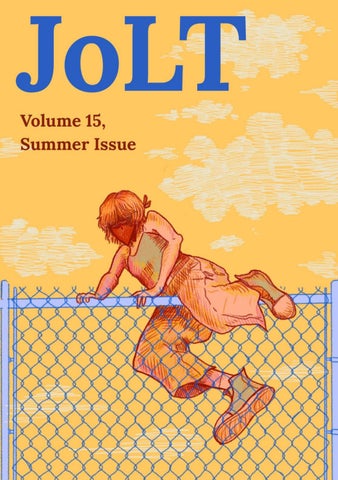
Volume 15, Summer Issue
“REBELLION”
‘Istruitevi, Agitatevi, Organizzatevi’. So Italian philosopher Antonio Gramsci exhorts the masses to ‘learn, stir up, organise’. He theorises that rebellion can become revolutionary, when it is sustained by education and communal solidarity. Rebellion is a natural phase of life and history, from which one takes away its best form of selfexpression both in their individuality and inside their own community. Thinking of the word ‘rebellion’, the first thing that comes to mind can often be politics: to stand up for your ideals, to fight for what you think is right. Many translations enclosed in this Journal come from this pool of ideas: many of this issue’s pieces were written under political silence and showcase an ability to make art as the maximum expression of rebellion. But rebellion can also come from within. Rebellion can be dormant in us, waiting to spring out of our chests like Italian poet Ugo Foscolo writes: ‘sleeps / that warrior spirit that roars in me’. A number of translations and artworks in this issue show how humans have always processed their loudest, most violent, rebellious feeling through literature and art, and how they have painted their emotions beautifully with brushes and pens. I wish to infinitely thank this new amazing Editorial Team, who has already shown huge dedication and affection to this publication. Your knowledge of literature and languages made this issue come to life. I also wish to thank Kaja Bérard and Lisa Domokeeva for their time and help, which has greatly contributed to make this issue possible. And a really huge thanks to Ioana Răducu, who preceded me in this role, and whose experience has been invaluable in helping me have this issue come together.
4
And lastly, most importantly, thank you for all the contributors for having trusted us with your translations and your art. From each submission seeps through pieces of your personality and of your history. This issue would not exist without each of you. Welcome to JoLT’s Volume 15, Summer Issue.
Jules Nati
Editorial Staff 2026/27 Editor-in-Chief Jules Nati Deputy Editor Jes Paluchowska General Assistant Editors Maike Bergfeld Bryn Connelly Layout and Design Editor Ray La Paglia
Language Editors Lucía Novella del Castillo Nooran Al-Rubaiee Juliana Schaum Tiernan Farrell Lynch Oscar Duffield Nell Gardiner Faculty Advisor Dr Peter Arnds
Art Editor Cate Slattery
5
Contents Cover Art by Cate Slattery Editorial
2-3
Perspektiva Czech-English Translation by Maria McChrystal
30
31
BURN Art by Aoibhinn Lawlor
5
Le Rebelle French-English Translation by Cassandre Maréchal-Pignard
6-7
Break the Cycle in Half and Leave Your Skin on the Floor Art by Angela Feijoo
32-33
De mi cartera Apuntes de 1902 Spanish-English Translation by Gerald Friedman
8-11
He came to me again last night English-Irish Translation by Pól Ó hÍomhair
34-37
To je teď celá moudrost moje Czech-English Translation by Maria McChrystal
12-13
Do prostego człowieka Polish-English Translation by Tyna Szwiec
38-39
Coup d’État Welsh-English Translation by Emily Vlismas
14-19
“Les Plaintes d’un Icare” French-English Translation by Martina Stoilovska
40-45
Оқып жүрген жастарға Kazakh-English Translation by Ildana Ospanova
20-21
Zametki o chelovechestve Russian-English Translation by Cyril Huziev
46-49
ARM Art by Penny Stuart
22
Love Lessons in a Time of Settler Colonialism English-German Translation by Juli Schaum
Proverbios y cantares VIII Spanish-English Translation by Maria McChrystal
23
RUNĄ Polish-English Translation by Jes Paluchowska
50-51
Gladiatrix Welsh-English Translation by Emily Vlismas
24-29
Defeated Art by Penny Stuart
52
Artists
53
Contributors
54-55
6
Aoibhinn Lawlor, BURN
7
French
Le Rebelle Charles Baudelaire In this poem Baudelaire presents the monologue of a violent angel to a man. The angel tries to impose Divine Love as something obligatory. However, the man refuses to obey, which is an act of rebellion. In the last line, the poet offers the man an answer to the angel being ‘never shall I’ (in the translation). This answer bears a strong connotation of rebellion. The strong negation is an affirmation of the man’s will and of the man standing his ground which seems to be in itself a great act of rebellion.
Un Ange furieux fond du ciel comme un aigle, Du mécréant saisit à plein poing les cheveux, Et dit, le secouant: «Tu connaîtras la règle! (Car je suis ton bon Ange, entends-tu?) Je le veux! Sache qu’il faut aimer, sans faire la grimace, Le pauvre, le méchant, le tortu, l’hébété, Pour que tu puisses faire à Jesus, quand il passe, Un tapis triomphal avec ta charité. Tel est l’Amour! Avant que ton coeur ne se blase, À la gloire de Dieu rallume ton extase; C’est la Volupté vraie aux durables appas!» Et l’Ange, châtiant autant, ma foi! qu’il aime, De ses poings de géant torture l’anathème; Mais le damné répond toujours: «Je ne veux pas!»
8
English
The Rebel Translated by Cassandre Maréchal-Pignard
From the sky a furious Angel like an eagle swoops down, From the miscreant, grabs a fistful of hair, And while shaking him, says: ‘The rule to you shall be laid down! (For, I am your good Angel, do you hear?) I declare! Know that you have to love, without grimaces, The poor, the mean, the twisted, the king of idiocy, So that you can unfold, when Jesus passes, A carpet of triumph made from your charity. For such is true Love! Before your heart loses its spark, For God’s glory, ignite your rapture; For it is the true Delight which forever lasts!’ Then, so the punishing Angel shall love, With his giant’s fists of torture imposes anathema; Though the damned soul forever will answer: ‘Never shall I!’
9
Spanish
De mi cartera Apuntes de 1902 Antonio Machado The poem shows, among other things, Machado’s rebellion against the modernismo of the late 19th and early 20th centuries, with its emphasis on flawless refinement of craft and a luxurious variety of images.
I Ni mármol duro y eterno, ni música ni pintura, sino palabra en el tiempo. II Canto y cuento es la poesía. Se canta una viva historia, contando su melodía. III Crea el alma sus riberas; montes de ceniza y plomo, sotillos de primavera. IV Toda la imaginería que no ha brotado del río, barata bisutería.
10
English
From My Wallet Notes from 1902 Translated by Gerald Friedman
I Not marble eternal and hard, neither music nor painting, but in Time, a word. II Singing and telling is poetry. A living story is sung by telling its melody. III The soul makes shores as it flows: hills of ash and lead, springtime groves. IV All fancy imagery that has not sprung from the river, cheap costume jewelry.
11
Spanish
V Prefiere la rima pobre, la asonancia indefinida. Cuando nada cuenta el canto, acaso huelga la rima. VI Verso libre, verso libre… Líbrate, mejor, del verso cuando te esclavice. VII La rima verbal y pobre, y temporal, es la rica. El adjetivo y el nombre, remansos del agua limpia, son accidentes del verbo en la gramática lírica, del Hoy que será Mañana, del Ayer que es Todavía.
12
English
V Prefer your rhyme to be poor, your assonance undefined. When the singing tells no story, does the rhyme even strike. VI Free verse, free verse… Better free yourself from verse when it makes you a slave. VII Poor rhyme on suffixed verbs and time-words is most rich. The adjective and the noun, pools of clean water, are accidents of the verb in the grammar of the lyric, of Today that will be Tomorrow, of Yesterday that is Today.
13
Czech
To je teď celá moudrost moje František Gellner
In this poem, Gellner rebels against socially prescribed ideals of success, responsibility and restraint. Instead, he embraces a more decadent and self-indulgent lifestyle. In doing so, he presents a rebellious mindset, encouraging the reader to join him in challenging the constraints of conventional respectability.
To je teď celá moudrost moje: Milovat hlučnou vřavu boje, za nocí vnikat do snů žen a trochu býti zadlužen, pískat si, jak mi zobák narost, vínem si plašit z čela starost, svůj život rychle utratit, nic nezískat, nic neztratit.
14
English
Now, This Is All My Wisdom Translated by Maria McChrystal
Now, this is all my wisdom: to love tumultuous fights, to enter into women’s dreams and slip into their nights. To be in debt a little, yet to march to my own drum; to chase my woes away with wine and wash them from my brow. To spend my life so quickly that I burn through it at whim, with neither anything to lose nor anything to win.
15
Welsh
Coup d’État Siân Jones
This dystopian book follows a Welsh family experiencing a coup from the English military. This excerpt describes the rebellion of Tom Tom, both for the implied reason of his arrest and for his attempt to escape, and Rhian’s growing desire to rebel contrasted against the headmaster’s unwillingness to rebel.
‘Faint o fet ei fod e mas yn cael peint gyda Jac,’ ebe Dilwyn yn ysgafn. ‘Siŵr o fod.’ Edrychodd y ddau ar y sgrin o’u blaenau, heb ddweud dim. Clustfeinient ar lais eu mam, ond yr unig beth a glywsant yn glir oedd sŵn drws yr ystafell yn ailagor a’u mam yn sefyll yno a’i hwyneb yn wyn fel y galchen. ‘Fe aeth milwyr i’r marina am bedwar heddi a mynd ag e gyda nhw,’ meddai mewn llais rhyfedd, a’i dwylo yn chwarae ag ymyl ei brat. Edrychodd Dilwyn a Rhian arni’n gegrwth. Gwireddwyd eu hofnau. Ni fedrent symud gewyn. Ymlwybrodd Marian Dafis yn araf at gadair ei gŵr ac eistedd ar y fraich. ‘Mae Mr Watts wedi trio ffonio o gwmpas oddi ar ‘ny, i gael gw’bod i ble maen Nhw wedi mynd ag e. Ond doedd neb yn fodlon dweud dim. Mae e wedi addo trio ffindio mas ‘fory.’ [...] Ar hyn, tawelodd Janice wrth glywed cerbydau’n rhuo i fyny’r ffordd i gyfeiriad yr ysgol. Taranodd dau jîp milwrol a fan gaeedig i mewn drwy’r clwydi, trwy ganol ceir yr athrawon ac at y drws ffrynt. Neidiodd amryw o filwyr o’r ddau jîp a rhuthro i mewn i’r adeilad. Dilynodd dyn pwysicach yr olwg hwy i mewn drwy’r drws. Gwisgai hwnnw ddillad bob dydd yn hytrach na rhai milwrol.
© Coup d’État, Sian Jones. Gomer@Y Lolfa
16
English
Coup d’État Translated by Emily Vlismas
‘What’s the betting he’s out having a pint with Jack,’ Dilwyn said softly. ‘Bound to be.’ The two looked at the screen in front of them, without saying a thing. They eavesdropped on their mum’s voice but the only thing they could hear clearly was the sound of the door to the room reopening and their mum standing there with her face white as chalk. ‘Soldiers went down to the marina at four today and they took him with them,’ she said in a strange voice, and her hands playing with the edge of her apron. Dilwyn and Rhian looked at her, open-mouthed. Their fears came true. They couldn’t move a muscle. Marian Dafis trudged slowly to her husband’s chair and sat on the arm. ‘Mr Watts has tried phoning around, to find out where They’ve taken him. But no one was willing to say anything. He swore he’d try find out tomorrow.’ [...] At this, Janice became quiet, hearing vehicles roaring up the road in the direction of the school. Two military jeeps and a closed van thundered in through the gates, between the teachers’ cars and to the front door. A few soldiers jumped out of the two jeeps and charged into the building. A more important-looking man followed them in through the doors. He wore plain clothes instead of military ones.
17
Welsh
Beth oedd ar ddigwydd tybed? Dechreuodd Janice symud yn llechwraidd i lawr i waelod y stepiau a chroesi i gysgod clawdd prifet a redai hyd ymyl y maes parcio. Dilynodd Rhian hi. Yr oedd yr wyth ar y cwrt wedi stopio chwarae hefyd, ond nid oeddynt wedi symud gewyn. Roedd tawelwch annaturiol ym mhob man. ‘Beth sy’n digwydd, wyt ti’n meddwl?’ sibrydodd Janice. ‘Maen nhw wedi dod i mo’yn rhywun, gei di weld,’ atebodd Rhian. ‘Wyt ti’n meddwl? Pwy, tybed?’ ‘Duw a ŵyr.’ ‘Athro, siŵr o fod.’ ‘Neu un ohonon ni.’ ‘Wyt ti’n meddwl?’ gofynnodd Janice yn ofnus. ‘Paid â phoeni. Dw i ddim yn meddwl bod dy enw di ar eu rhestr nhw.’ ‘Usht, be oedd hwnna?’ ‘Chlywais i ddim byd…’ Gwrandawodd y ddwy’n astud ond nid oedd unrhyw sŵn i’w glywed heblaw am si’r gwybed o amgylch y clawdd a gwenynen neu gachgi bwm yn hwmian yn rhywle. Roedd y gwres a’r tawelwch yn llethol. Yna clywyd sŵn drws yn agor a daeth dau filwr i’r golwg, yn cario’u gynnau yn uchel o’u blaenau. Tu ôl iddynt ymddangosodd tri dyn. Dau filwr ac un mewn dillad cyffredin a’i ddwylo mewn cyffion. ‘Pwy yw…?’ dechreuodd Janice. ‘Twm… Twm,’ meddai Rhian yn araf. ‘Pam fe?’ sibrydodd Janice eto. ‘Duw a ŵyr… ond fu e erioed yn un i gefnogi pethe Saesneg.’ Yn sydyn, rhoddodd Twm Twm hergwd yr un i’r ddau filwr bob ochr iddo a dechrau rhedeg tua’r llwyni oedd o flaen yr adran Adfer. Rhuthrodd syniadau trwy feddwl Rhian - i ble y gallai e ddianc? I lawr i’r ffordd fawr? Cael lifft yno? I’r coed ar y bryn gyferbyn? Bydden Nhw’n chwilio amdano. Roedd yn ddyn rhy fawr i gael lle taclus i guddio; ni fedrai ymdoddi i dorf…
© Coup d’État, Sian Jones. Gomer@Y Lolfa ©
18
English
What was happening, she wondered? Janice began to move, sneaking down to the bottom of the steps and crossed to the shaded privet hedge and ran along the edge of the car park. Rhian followed her. The eight people on the court had stopped playing too, but they hadn’t moved a muscle. There was an unnatural silence everywhere. ‘What’s happening, d’you think?’ Janice whispered. ‘They’ve come to take someone, watch,’ Rhian answered. ‘D’you think? Who, I wonder?’ ‘God knows.’ ‘A teacher, surely.’ ‘Or one of us.’ ‘You think?’ Janice asked fearfully. ‘Don’t worry. I don’t think your name is on their list.’ ‘Shh, what was that?’ ‘I didn’t hear anything…’ The two listened closely but there was no sound to hear apart from the whirring of gnats around the hedge and honeybees or bumblebees humming somewhere. The heat and silence were overwhelming. Then the sound of a door opening was heard, and two soldiers came into view, carrying guns high in front of them. Behind them emerged three men. Two soldiers and one in common clothes with his hands in cuffs. ‘Who is…?’ Janice began. ‘Tom… Tom,’ Rhian said slowly. ‘Why him?’ Janice whispered again. ‘God knows… but he was never one to support English things.’ Suddenly, Tom Tom gave a shove to each of the two soldiers either side of him and began running towards the bushes that were in front of the Recovery area. Ideas were rushing through Rhian’s head – where could he escape to? Down to the main street? Get a lift there? To the trees on the hill nearby? They would look for him. He was too big a man to have a neat place to hide, he couldn’t mould into a crowd…
19
Welsh Torrodd clecian gynnau ar draws ei meddyliau. Gwelodd Twm Twm yn disgyn yn fflat ar ei wyneb i ganol y llwyni rhosod. Teimlodd law yn gafael fel gelen yn ei braich. Trodd mewn arswyd, ond dim ond Janice oedd yno, a dagrau yn cronni yn ei llygaid. Clywodd sŵn y tu ôl iddynt a throdd i weld Biffi’n tywys y chwaraewyr tennis yn frysiog oddi ar y cwrt ac o olwg y milwyr. Teimlodd Rhian law oer yn cau am ei chalon wrth wylio dau o’r milwyr yn cerdded yn araf tuag at Twm Twm ac yn ei godi gerfydd ei freichiau fel sach o datws a’i lusgo’n ôl tuag at cerbydau wrth y drws ffrynt. Clywai Rhian sŵn ei esgidiau’n crafu ar hyd y tarmac wrth iddynt ddiflannu o’i golwg y tu ôl i’r fan. Dyna hi wedi gweld rhywun yn cael ei ladd am y tro cyntaf; oerodd drwyddi. Ai dyna fu tynged ei thad? Ailymddangosodd y milwyr a Twm Twm wrth ddrws cefn y fan. Bellach, gallai glywed sŵn griddfan hefyd. Roedd e’n dal yn fyw, o leiaf. Agorwyd drws y fan, a lluchiwyd yr athro’n ddiseremoni i’w chrombil. Caewyd y drws yn glep a diflannodd y cerbydau drwy’r clwydi ac i lawr y ffordd. Sythodd Rhian o’i chwrcwd a sylweddoli bod dagrau’n llifo’n ddi-dor i lawr gruddiau Janice. Helpodd hi i godi ar ei thraed cyn cerdded yn araf tua’r man lle safai’r fan funud ynghynt. Nid oedd ofn arni bellach. Ni theimlai ddim ond ton o gynddaredd yn codi’n raddol o’i mewn, a muriau oer yn cau am ei chalon. Ar y llawr, gwelodd ddiferion coch crwn. Syllodd arnynt heb symud gewyn. Yna, teimlodd law ar ei hysgwydd. Trodd ei phen yn araf a gweld bod y prifathro’n sefyll yn ei hymyl. ‘Dewch i’m stafell i am funud,’ meddai’n dawel. Gafaelodd yn ei braich a’i harwain yno. ‘’Steddwch,’ meddai, wrth gau’r drws ar eu holau. ‘Mae’n debyg i chi weld y cyfan.’ ‘Do.’ ‘Os yw e o ryw gysur i chi, yn ei goesau y saethwyd Mr Jones, fe fydd e byw. Mi welais i’r cyfan drwy’r ffenestr hon.’ Pwyntiodd at y ffenestr y tu ôl i’w gadair. ‘Allech chi byth wneud dim i’w rhwystro Nhw?’ ‘Does gen i ddim grym yn erbyn y Lluoedd Arfog. Ac mae’n rhaid i mi edrych ar eich holau chi i gyd - yn ddisgyblion a staff. Roedd ganddyn Nhw warant, beth bynnag. Fedrwch chi wneud dim yn wyneb warant y dyddiau hyn. Mae pobl yn diflannu o bob man, bob dydd… fel y gwyddoch chi’n ddigon da. Gwell i chi fynd nawr. Mae hi bron yn amser i’r gloch ganu.’ Cododd Rhian. ‘Ceisiwch osod y cyfan o’ch meddwl.’ ‘Anghofia i byth be welais i heddi - byth bythoedd.’ Trodd Rhian ar ei sawdl a cherdded o’r ystafell. © Coup d’État, Sian Jones. Gomer@Y Lolfa
20
English
The crackling of guns cut across her thoughts. She saw Tom Tom fall flat on his face among the rose bushes. She felt a hand grab her arm like a leech. She turned around in fright, but it was only Janice there, and tears were accumulating in her eyes. She heard a sound behind them and turned to see Biffy hurriedly guiding the tennis players away from the court and from the soldier’s sights. Rhian felt a cold hand closing on her heart as she watched two of the soldiers walking slowly towards Tom Tom and lifting him by his arms like a sack of potatoes and dragging him back toward the vehicles by the front door. Rhian heard his feet scraping along the tarmac as they disappeared from view behind the van. That was the first time she saw someone be killed; she was chilled to the core. Was that the fate of her dad? The soldiers and Tom Tom reappeared by the back door of the van. She could now hear the sound of groaning too. He was still alive, at least. The van door opened, and the teacher was thrown unceremoniously onto his stomach. The door was slammed shut and the vehicles disappeared through the gates and down to the road. Rhian straightened from her crouched position and realised tears were endlessly streaming down Janice’s cheeks. She helped her get on her feet before walking slowly towards where the van had been a minute ago. She wasn’t scared anymore. She didn’t feel anything but a wave of fury growing gradually inside her, and cold walls closing in on her heart. On the floor, she saw globular red drops. She gazed at them without moving a muscle. Then, she felt a hand on her shoulder. She slowly turned her head and saw that the headmaster was standing next to her. ‘Come to my room for a minute,’ he said quietly. He took hold of her arm and led her there. ‘Sit,’ he said as he shut the door behind them. ‘It seems you saw the whole thing.’ ‘I did.’ ‘If it’s of any consolation to you, Mr Jones was shot in the leg, he’ll live. I saw the whole thing through this window.’ He pointed at the window behind his chair. ‘Couldn’t you do anything at all to obstruct Them?’ ‘I have no power against the Armed Forces. And I have to look after you all – students and staff. They had a warrant, anyway. You can’t do anything faced with a warrant, these days. People are disappearing everywhere, every day… as you well know. You better leave now. It’s nearly time for the bell to ring.’ Rhian stood. ‘Try to put it out of your mind.’ ‘I’ll never forget what I saw today – never ever.’ Rhian turned on her heels and walked out the room.
21
Kazakh
Оқып жүрген жастарға Sultanmakhmut Toraigyrov The poem presents rebellion as a generational awakening. Toraigyrov urges young people to reject passivity and inherited suffering, calling them to stand against injustice. Rather than a sudden uprising, rebellion becomes a collective choice to reject silence and move from childhood toward struggle, responsibility, and purpose.
Үмітпенен жоқ қуған Үмітпенен жоқ қуған Талабы алда баламыз. Басқалар жоғын тапқанда, Біздер қайтіп қаламыз. Тәуекелге бел бусақ, Көрдегіні аламыз. Жеткізбей кетер жүйрік жоқ, Қусақ бәрін шаламыз. Іс істейік бір болып, Ашылмасын саламыз. Сұмдар салған жүректе Аз ба біздің жарамыз Тепкісінде басқаның, Қор боп жүдеп барамыз. Көріне көзге азапта Мәңгі қайтіп қаламыз?
22
English
To the Learning Youth Translated by Ildana Ospanova
Still, we carry hope within, our children look ahead. Those who seek will always find, only the seeker finds. We’ll dig it out from under the earth, whatever must be won, my friends. No horse exists upon this earth too fast for it to be outran. Let us stand, brothers, shoulder to shoulder, let us stand, brothers, hand in hand. Our hearts bear wounds enough, wounds struck from behind, in the dark. So much evil fills our life, So much darkness on the Kazakh steppe. Can it be that we are fated to remain the most wretched of all? Away with childish games and play, The time has come to take up work!
23
Penny Stuart, ARM
24
Spanish
Proverbios y cantares VIII Antonio Machado
This poem is particularly interesting because of its dual approach to addressing the theme of rebellion. Firstly, it explores a man’s rebellious instinct to conquer his perceived rivals. However, it also invites the reader to introspectively rebel against this instinct. I have translated it in the form of a limerick.
El hombre, a quien el hambre de la rapiña acucia, de ingénita malicia y natural astucia, formó la inteligencia y acaparó la tierra. ¡Y aún la verdad proclama! ¡Supremo ardid de guerra!
English
Proverbs and Songs VIII Translated by Maria McChrystal When urged by his malicious hunger the man took the earth as his to plunder and through cunning stealth claimed it as his for his own wealth. A war trick! And yet he still declares truth!
25
Welsh
Gladiatrix Bethan Gwanas This excerpt from a historical fiction about the Romans’ conquest of Anglesey describes previous and contemporary rebellions of Celtic tribes against the Romans, including the Celts hearing news of the incoming invasion and preparing to rebel against the Roman forces by rallying the inhabitants and making offerings to the Gods.
‘Iolo,[...] o lwyth y Tegeingl ar lannau’r Ddyfrdwy. [...] Daeth y Brigiaid â negeseuon brys i ni; roedden nhw am i ni eich rhybuddio bod y Rhufeiniaid ar eu ffordd i Ynys Môn. Maen nhw wedi cyhoeddi eu bod am gael gwared ohonoch chi, y Derwyddon unwaith ac am byth.’ Syllodd y Derwyddon arno’n fud am rai eiliadau, yna, ‘Aros di funud… pam fyddai’r Brigiaid am ein rhybuddio?’ gofynnodd Mordaf Foel, ‘Maen nhw wedi hen blygu glin i’r diawliaid.’ ‘Mae gan nifer fawr ohonyn nhw gywilydd am hynny mae’n debyg,’ atebodd Iolo, ‘ac maen nhw’n dal yn gandryll efo’u brenhines am fradychu Caradog.’ [...] Wedi colli brwydr yn erbyn y Rhufeiniaid, roedd o [Caradog] wedi llwyddo i ddianc at y Frenhines Cartimandes [o’r Catuvellauni], dim ond i’r gnawes honno ei roi mewn cadwynau a’i gludo’n ôl i ddwylo’r Rhufeiniaid. ‘Fe ddaw hynny yn ôl i’w brathu hi…’ meddai’r Derwydd dall, Cynyr Hen. ‘A da hynny, ond yn y cyfamser, mae hi a’i phobl yn weision bach i’r Rhufeiniaid,’ meddai Mordaf Foel, ‘felly pam ddylen ni gredu neges gan Frigiaid?’ ‘Oherwydd ei fod yn wir, pob gair,’ meddai Cynyr Hen gan droi at Iolo gyda’i lygaid gwynion. ‘Mae’n amlwg ers blynyddoedd mai bwriad y Rhufeiniaid yw dwyn a rhwygo popeth allan nhw o diroedd Ynys Prydain er mwyn gyrru’r cyfoeth yn ôl i Rufain. Maen nhw wedi gorchfygu talpiau mawrion o’r de a’r dwyrain, ond wedi methu yma yn y gorllewin a hynny o’n herwydd ni a’r duwiau.’ ‘A dyna pam eu bod nhw ar eu ffordd yma i ymos od arnoch chi,’ meddai Iolo. ‘A’r Cadfridog Suetonius Paulinus ei hun sy’n eu harwain nhw.’ ‘Suetonius Paulinus? Yr un sy’n ddigon digywilydd i alw ei hun yn Llywodraethwr Prydain gyfan?’ meddai’r un barfog. ‘Y fath hyfdra a’r un Rhufeiniwr erioed wedi mentro’n agos aton ni fan hyn!’ © Gladiatrix, Bethan Gwanas. Y Lolfa
26
English
Gladiatrix Translated by Emily Vlismas
‘Iolo, […] from the Tegeingl tribe on the shores of the Dee. […] The Brigantes came with urgent messages to us; they wanted us to warn you that the Romans were on their way to Anglesey. They’ve announced that they mean to get rid of you, the Druids, once and for all.’ The Druids gazed mutedly at him for a few seconds, then, ‘Wait a minute… why would the Brigantes warn us?’ Mordaf The Bald asked, ‘They’ve long bent the knee to the devils.’ ‘Many of them are ashamed of that, it seems,’ Iolo answered, ‘and they’re still furious with their Queen for betraying Caratacus.’ […] Having lost a battle against the Romans, he [Caratacus] had been able to escape to Queen Cartimandua [of the Catuvellauni], only for that bitch to put him in chains and transport him back into the Romans’ hands. ‘That will come back to bite her…’ said the blind Druid, Cynyr The Old. ‘And that’s good, but in the meantime, she and her people are little servants to the Romans,’ Mordaf The Bald said, ‘so why should we believe this message from the Brigantes?’ ‘Because it’s true, every word,’ Cynyr The Old said, turning to Iolo with his white eyes. ‘It’s been obvious for years that the Romans’ objective was to steal and tear up everything they could from the lands on the Isle of Britain in order to drive wealth back to Rome. They’ve conquered huge chunks of the south and the east but have failed here in the west and that’s because of us and our gods.’ ‘And that’s why they’re on their way here to attack you,’ Iolo said. ‘And the General Suetonius Paulinus himself is leading them.’ ‘Suetonius Paulinus? The one who’s shameless enough to call himself Governor of the whole of Britain?’ the bearded one said. ‘Such boldness as any Roman who has ever ventured near us here!’
27
Welsh
‘Ond maen nhw am fentro y tro yma,’ meddai Iolo. ‘Ac mi allen nhw fod yma ymhen llai nag wythnos - maen nhw eisoes bron â chyrraedd tiroedd y Cornowi. Ond bydd fy mhobl i’n gwneud popeth o fewn eu gallu i’w harafu.’ ‘Wrth gwrs. Disgwyl dim llai gan y Tegeingl,’ meddai Mordaf Foel. ‘Fe godwn ninnau niwloedd a stormydd i’w harafu hefyd.’ ‘Pob dim y gall y duwiau eu taflu atynt a mwy,’ meddai Cynyr Hen. ‘Ond gwell rhannu’r neges gyda phawb yn awr.’ [...] ‘Roedden ni wedi gweld yr arwyddion ers blynyddoedd. [...] Roedd y duwiau a’r sêr wedi ein rhybuddio ac roedden ni’n gwybod yn iawn y bydden nhw, y dieithriaid - y Rhufeiniaid - yn cyrraedd Ynys Môn yn hwyr neu’n hwyrach.’ Dechreuodd y dorf aflonyddu a mwmian yn ofnus. Roedd pawb wedi clywed am y Rhufeiniaid ac wedi rhyfeddu at y straeon am y miloedd ar filoedd o filwyr o ben draw’r byd oedd wedi llwyddo i orchfygu, lladd a dofi cymaint o lwythi Ynys y Cedyrn dros y blynyddoedd. Cwta ddeng mlynedd oedd wedi mynd heibio ers iddyn nhw guro’r enwog Caradog, ac yntau ar y pryd yn arwain byddin o’u llwyth eu hunain, yr Orddwig, yn ogystal â Silwriaid. Roedd y beirdd wedi canu droeon am hanes y frwydr ger Cerrig y Dewrion a byddai plant ac oedolion yn gofyn yn aml i gael clywed hanes Caradog a’i ddynion yn ymladd mor hynod o ddewr, dim ond i’r Rhufeiniaid ddal a charcharu ei wraig a’i ferch. Ildio wnaeth ei frodyr, ond llwyddodd Caradog i ddianc i’r gogledd at y Brigiaid. Ond yno, cafodd ei dwyllo a’i fradychu gan y sguthan Cartimandes ‘na. Wyddai neb ddim o’i hanes ers hynny. Ond fyddai neb, byth yn ei anghofio, diolch i’r beird a’u caneuon hyfryd yn canmol Caradog i’r cymylau. Ond doedd neb yn teimlo fel canu rŵan. ‘Mae’n debyg eu bod ar eu ffordd yma ac yn bwriadu ein difa. Ond peidiwch â phoeni!’ meddai Cadog Farfog yn uwch, o glywed rhai yn ebychu mewn ofn. ‘Chaiff neb, byth ein difa. Ni yw Derwyddon Prydain! Derwyddon Ynys y Cedyrn! Rydan ni’n bod ers cyn cof ac mi fyddwn ni’n dal yma pan fydd y Rhufeiniaid wedi hen ddiflannu a phydru ac yn ddim byd ond llwch ac atgofion cas.’ a’u caneuon hyfryd yn canmol Caradog i’r cymylau.
© Gladiatrix, Bethan Gwanas. Y Lolfa
28
English ‘And that’s why they’re on their way here to attack you,’ Iolo said. ‘And the General Suetonius Paulinus himself is leading them.’ ‘Suetonius Paulinus? The one who’s shameless enough to call himself Governor of the whole of Britain?’ the bearded one said. ‘Such boldness as any Roman who has ever ventured near us here!’ ‘But they will venture this time,’ Iolo said. ‘And they could be here in less than a week – they’ve already nearly arrived in the Cornovii lands. But my people will do everything in our power to slow them down.’ ‘Of course. We wouldn’t expect less from the Tegeingl,’ Mordaf The Bald said. ‘We’ll raise clouds and storms to slow them too.’ ‘Everything the gods can throw at them and more,’ Cynyr The Old said. ‘But we’d better share the message with everyone now.’ […] ‘We had seen the signs for years. […] The gods and the stars had warned us, and we knew well that they, the strangers – the Romans – would reach Anglesey sooner or later.’ The crowd started becoming restless and murmuring fearfully. Everyone had heard of the Romans and had been astounded by stories of thousands upon thousands of soldiers from another side of the world that had succeeded in conquering, killing and domesticating so many tribes on the Island of the Mighty over the years. Just ten years had gone by since they hit the famous Caratacus, and he at the time leading an army from his own tribe, the Ordovices, as well as the Silures. Bards have sung many times of tales of the battle’s history near Cerrigydruidion, and children and adults often ask to hear the story of Caratacus and his men fighting so bravely, only for the Romans to grab and imprison his wife and daughter. His brother surrendered, but Caratacus succeeded in escaping to the north to the Brigantes. But there, he was tricked and betrayed by that scum Cartimandua. No one knew anything of his story since then. But no one would ever forget him, thanks to the bards and their beautiful songs praising Caratacus to the heavens. But no one felt like singing now. ‘It seems that they’re on their way here and aim to wipe us out. But don’t worry!’ Cadoc The Bearded said louder, hearing some exclaiming in fright. ‘No one will ever wipe us out. We are Britain’s Druids! Island of the Mighty’s Druids! We’ve been here since before memory, and we’ll still be here when the Romans are long gone and decayed, and nothing but dust and bad memories.’
29
Welsh
‘Byddwn yn eu gyrru’n ôl o lle daethon nhw, a’u cynffonnau rhwng eu coesau!’ cyhoeddodd Mordaf Foel, mewn llais oedd bron yn canu. ‘Fel y gwnaeth Derwyddon y de gan mlynedd yn ôl, pan geisiodd Cesar ei hun ein gorchfygu, byddwn yn creu stormydd i’w drysu a’u chwalu. Yn enw Taranis!’ ‘Yn enw Taranis!’ bloeddiodd y dorf. Cododd Cynyr Hen ei ddwylo i’r awyr ac aros nes bod pawb yn gwbl dawel eto. ‘Ond bydd angen rhoi anrhegion iddo ac i’r duwiau i gyd. Bydd angen nerth, ffydd a hud a lledrith mwy na’r cyffredin i gadw’r gelyn draw y tro hwn. Pan fydd yr haul yn gwawrio yfory, awn i’r llyn sanctaidd, Llyn Cerrig Bach, gyda’n hoffrymau. Bydd angen cleddyfau, gwaywffyn a thariannau i fendithio ein milwyr, ond bydd angen rhywbeth hardd, rhywbeth o werth neilltuol i’n bendithio ni, y Derwyddon. Felly mi fydda i yn offrymu fy nhorch efydd,’ meddai gan daro ei dorch gyda’i ddyrnau. ‘Yn enw Lleu, duw’r goleuni!’ gwaeddodd. ‘Yn enw Lleu, duw’r goleuni!’ bloeddiodd pawb arall. ‘A’r tro hwn, bydd angen offrymu gwaed…’ cyhoeddodd Cynyr Hen. ‘Yn enw Arawn, duw’r Arallfyd!’ ‘Yn enw Arawn, duw’r Arallfyd!’ bloeddiodd y dorf, a’u cynnwrf yn crynu yn eu lleisiau. ‘Ewch i gasglu’r offrymau,’ meddai Cadog Farfog, ‘rhannwch y neges, a byddwch wych. Yn enw Cernunnos, duw’r nos!’ ‘Yn enw Cernunnos, duw’r nos!’ ‘A gofynnwn i bob gof ar yr ynys i ofalu bod yma ddigon o arfau!’ bloeddiodd Mordaf Foel. ‘Go brin y bydd eu hangen, ond bydd pob tinc a thonc o gân yr ordd yn plesio’r duwiau.’ ‘Yn enw’r duwiau!’
© Gladiatrix, Bethan Gwanas. Y Lolfa
30
English
‘We’ll drive them back to where they came from, with their tails between their legs!’ Mordaf The Bald announced in a voice that almost sang. ‘As the Druids of the south did a hundred years ago, when Cesar himself tried to conquer us, we will create storms to confound and destroy them. In the name of Taranis!’ ‘In the name of Taranis!’ the crowd shouted. Cynyr The Old raised his hands to the sky and waited until everyone was completely quiet again. ‘But we’ll need to give gifts to him and all the gods. We will need more than usual of strength, faith, and magic to keep the enemy away this time. When the sun dawns tomorrow, we will go to the holy lake, Llyn Cerrig Bach, with our offerings. We will need swords, spears and shields to bless our soldiers, but we will need something beautiful, something of particular value to bless us, the Druids. So, I will be offering my bronze torc,’ he said, hitting his torc with his fists. ‘In the name of Lleu, god of light!’ he shouted. ‘In the name of Lleu, god of light!’ everyone else shouted. ‘And this time, we will need blood offerings…’ Cynyr The Old announced. ‘In the name of Arawn, god of the Otherworld!’ ‘In the name of Arawn, god of the Otherworld!’ the crowd shouted, their excitement trembling in their voices. ‘Go to collect the offerings,’ Caratacus The Bearded said, ‘share the message, and you’ll be magnificent. In the name of Cernunnos, god of the night!’ ‘In the name of Cernunnos, god of the night!’ ‘And we ask that every blacksmith on the island takes care that there are plenty of weapons!’ Mordaf The Bald shouted. ‘They will hardly be needed, but every ding and dong of the hammer will please the gods.’ ‘In the name of the gods!’
31
Czech
Perspektiva František Gellner In this poem, Gellner urges the reader to seize the moment and follow their passions, seeking pleasure and intimacy in defiance of an indifferent world and inevitable death. This reflects the theme of rebellion by challenging the restrictive social norms of Gellner’s time in favour of personal enjoyment.
Má milá rozmilá, neplakej! Život už není jinakej. Dnes buďme ještě veseli na naší bílé posteli! Zejtra, co zejtra? Kdožpak ví. Zejtra si lehneme do rakví.
English
Perspective Translated by Maria McChrystal My darling, do not cry! For life will not change, so instead let’s make merry now together; you and I, on our white bed! And as for what tomorrow brings, who knows what can be said? Tomorrow come the coffins, and in those we’ll lie down—dead.
32
Angela Feijoo, Break the Cycle in Half and Leave Your Skin on the Floor
33
English
He came to me again last night Grant Chemidlin Is téacs é seo a théann i ngleic leis an duine féin agus an cheannairc shíoraí idir é agus an eagla inmheánach a eascraíonn ón tsochaí féin i gcomhthéacs na haiteachta. | This is a text which deals with the self and the eternal rebellion between it and internal fears arising from society itself in a queer context. Is my mind, this dream, the only place he allows himself to un-hide? To be free? We snuck out from the cabin where our families were sleeping to lie in the snow. The trees all dressed like brides. We snuck out like we did when we were teens, risked ungloved hands to feel skin. This time, I didn’t feel ashamed. I even went to kiss, but heard from close by, the low growl of muscled night, the bear that followed him in. He wanted us to run, so we did. We barely made it. Inside, in the cabin light, the snowflakes dusting his eyes melted into tears. I reached my hand to brush back his hair. He flinched. I said, I am so sorry. You can’t come back. © “ORIGINALLY PUBLISHED IN ‘IN THE MIDDLE OF A BETTER WORLD: POEMS’ CENTRAL AVENUE POETRY, 2026.
34
Irish
An Téacs Aistrithe: Tháinig sé chugam aríst aréir Translated by Pól Ó hÍomhair
An í mo mheabhair, an bhrionglóid seo, an t-aon áit a ligeann sé dó fhéin imeacht ón bhfolach? Bheith saor? D’éalaíomar gan fhios amach ón mbothán a raibh ár dteaghlaigh ina gcodladh le luí sa sneachta. Na crainn ar fad gléasta ar nós na brídí. D’éalaíomar mar a d’éalaíomar agus muid inár ndéagóirí, ag dul sa seans le lámha nochta d’fhonn craiceann a bhrath. An uair seo, níor mhothaíos náire. Chuas ar thóir póige, fiú, ach chualas ó chóngar, lagdhranntán na hoíche tréine, an béar a lean isteach é. Theastaigh uaidh go rithfimist. Ritheamar. Ba bheag nár shroicheamar é. Taobh istigh, fé sholas an bhotháin, leáigh na spitheoga spréite ar a shúile isteach ina ndeora. Shíneas mo lámh lena ghruaig a shlíocadh siar. Baineadh biongadh as. Adúirt mé, Thá fíorbhrón orm. Ní féidir leat teacht thar n-ais.
35
Polish
Do prostego człowieka Julian Tuwim Tuwim’s “To the Simple Man” is an anti-war poem that challenges propaganda and the manipulation of ordinary people by those in power. Although published in 1929, it remains a universal manifesto against violence. The poem disillusions people whose patriotism and honour are exploited in the political games of ruthless leaders.
Gdy znów do murów klajstrem świeżym Przylepiać zaczną obwieszczenia, Gdy »do ludności«, »do żołnierzy« Na alarm czarny druk uderzy I byle drab, i byle szczeniak W odwieczne kłamstwo ich uwierzy, Że trzeba iść i z armat walić, Mordować, grabić, truć i palić; Gdy zaczną na tysiączną modłę Ojczyznę szarpać deklinacją I łudzić kolorowym godłem, I judzić »historyczną racją« O piędzi, chwale i rubieży, O ojcach, dziadach i sztandarach, O bohaterach i ofiarach; Gdy wyjdzie biskup, pastor, rabin Pobłogosławić twój karabin, Bo mu sam Pan Bóg szepnął z nieba, Że za ojczyznę — bić się trzeba;
36
English
To the Simple Man Translated by Tyna Szwiec
Once they stick ads to the wall Again with glue perfectly fresh, Once to the soldiers and to the all Black print in alarm starts to call And any pup, and any wretch Starts to believe what they recall That one must go and start a fire, To murder, plunder what desire; Once they start the same old manner To declaim the home of their youth And fool them with a coloured banner, And incite with “historical truth” About the fights for land so small Fathers, sacrifice and glory, Heroes, battles, homeland’s story; Once come the bishop, pastor, nun To bless your treasure, deadly gun, As God Himself from Heaven said That one for nation must be dead
37
Polish
Kiedy rozścierwi się, rozchami Wrzask liter z pierwszych stron dzienników A stado dzikich bab — kwiatami Obrzucać zacznie »żołnierzyków«. — — O przyjacielu nieuczony, Mój bliźni z tej czy innej ziemi! Wiedz, że na trwogę biją w dzwony Króle z panami brzuchatemi; Wiedz, że to bujda, granda zwykła, Gdy ci wołają: »Broń na ramię!«, Że im gdzieś nafta z ziemi sikła I obrodziła dolarami; Że coś im w bankach nie sztymuje, Że gdzieś zwęszyli kasy pełne Lub upatrzyły tłuste szuje Cło jakieś grubsze na bawełnę. Rżnij karabinem w bruk ulicy! Twoja jest krew, a ich jest nafta! I od stolicy do stolicy Zawołaj, broniąc swej krwawicy: »Bujać — to my, panowie szlachta!«
38
English
When the headlines scream of doom In a filthy, foul and shameless way And herds wild hags, flowers’ bloom They throw on soldiers from away Oh, my dear unlearned friend My fellowman from alien worlds The bells toll to mark the end Of kings and their fat-bellied lords; It’s simple nonsense, lie they spread When they shout: “Go hold your gun!”, That oil has sprung from soil somewhere And suddenly the money’s there; That they sniffed out a pile of cash That their banks have reached the bottom, Or greedy fat crooks saw their chance, To slap a heavier tariff on cotton. Rake the pavement with your gun! The blood is yours, theirs is the oil! And through the cities, one by one Defend your gains, shout loudly son: To fool another is our toil!
39
French
Les Plaintes d’un Icare Charles Baudelaire In both life and poetry, Charles Baudelaire, as a poète maudit, was a rebellious figure who challenged social conventions. Like Icarus, he refused to conform to what was expected of him, instead pursuing beauty and freedom. Yet, like the mythical figure who flew too close to the sun, this defiance also brought his inevitable downfall, as depicted in “Les Plaintes d’un Icare”.
Les amants des prostituées Sont heureux, dispos et repus; Quant à moi, mes bras sont rompus Pour avoir étreint des nuées. C’est grâce aux astres nonpareils, Qui tout au fond du ciel flamboient, Que mes yeux consumés ne voient Que des souvenirs de soleils. En vain j’ai voulu de l’espace Trouver la fin et le milieu; Sous je ne sais quel oeil de feu Je sens mon aile qui se casse; Et brûlé par l’amour du beau, Je n’aurai pas l’honneur sublime De donner mon nom à l’abîme Qui me servira de tombeau.
40
English
Complaints of an Icarus Translated by Martina Stoilovska
Prostitutes are encircled by crowds Of lovers who are content, satisfied and ready, While I have arms growing unsteady For having clutched, with eager fingers, clouds. It is by virtue of stars without peer, Twinkling at the bottom of the sky, That nothing shines in my eye But of suns the souvenir. In vain I tried to search for The end and the centre of space; Under I know not what fiery gaze the disgrace took place: I felt such pain when my wings tore; And being of beauty a burnt slave I shall the sublime honour miss Of bestowing my name to the abyss Which will serve as my own grave.
41
Russian
Zametki o chelovechestve Zinaida Hippius The author rebels against conventional notions of a united humanity and uniform nature of all human beings, prompting the reader to reflect on what makes us humans. The political and social cataclysms of the first decades of the 20th century provoked the Russian noble émigré to capture a watershed moment in human history in apocalyptic colours. Никакого «человечества» нет. Пора сказать это прямо. Пожалуй, и пора прошла: кому сейчас интересно, есть оно или нет? Вопрос без резонанса. Если, из любезности или добросовестности, и выслушают мое утверждение, то возразят: а когда же это самое «человечество» было? Были страны, племена, народы, нации, слои, классы, партии, группы, индивидуумы, и всегда, как теперь, были они друг против друга, благодаря разности интересов. Собственно же человечества (уж не с большой ли буквы?) никогда не существовало. В мечтах разве? В воображении? В идее? Да, да, и тут вся перемена, — громадной важности. Не было — но могло быть, к тому шло. Мечта, воображение, идея, — есть предварительная стадия бытия чего-нибудь. Во всяком случае, единственная возможность бытия. Пока «человечество» жило в идее, оно могло реализоваться. А если «погасить идею в уме?». С ней, естественно, гаснет воля, что же остается? Ничего, меньше пустого места. Подозрительно быстро гаснут в наше время всяческие «идеи». «Человечество» — только одна из целого ряда, не менее важных. Вообразительное бытие ценностей, — т. е. идеи, — имеют громадное влияние на реальность. Когда они отмирают, гаснут — это немедленно отражается на всех явлениях жизни, изменяет ее облик, существенно изменяя облик самого человека. Стоит представить себе: без воображенья, без воли, идущей далее настоящего момента, — разве будет человек похож на то, что мы привыкли называть этим именем? Если и «похож» — не очень… Угасание идей есть начало (долгого, правда) пути к перерождению человека в «человекообразное».
42
English
Notes on Humanity Translated by Cyril Huziev
There is no ‘humanity’. It is time to say so plainly. Perhaps even the time has already passed: who cares now whether it exists or not. The question has no resonance. If, out of courtesy or conscientiousness, someone were to listen to my assertion, they would object: but when did this very ‘humanity’ ever exist? There have been countries, tribes, peoples, nations, strata, classes, parties, groups, individuals, and they have always, just as now, stood against one another because of their differing interests. Strictly speaking, humanity itself (should I put a capital H?) has never existed. Except in dreams? In imagination? In an ideé? Yes, yes, this is precisely where the very crux lies – one of immense importance. Never existed – but could have, things were moving towards it. A dream, imagination, an idea is the preliminary stage of something coming into being. In any case, it is the only possibility of its existence. As long as ‘humanity’ lived as an idea, it could be realised. But what if ‘the idea is extinguished in the mind?’. With it, naturally, the will goes out, and what remains? Nothing - less than empty space. ‘Ideas’ of all kinds are dying out with suspicious rapidity nowadays. ‘Humanity’ is only one of a whole series, none less significant. The imaginary existence of values – i.e. ideas – has an enormous impact on reality. When they die out, when they are extinguished, this is immediately reflected in all the aspects of life, disfiguring its appearance, and significantly disfiguring the appearance of the human being himself. One need only imagine: without imagination, without a will that reaches beyond the present moment - will a human being resemble what we have become accustomed to calling by that name? Even if they do ‘resemble’ it - not much... The dying out of ideas is the beginning of a (long, admittedly) path towards the transformation of the human being into a ‘humanoid’.
43
Идея погасла — но соответственное «слово» еще держится, переживает ее. Так, мы повторяем слово «культура». Культура имела тоже лишь «вообразительное бытие». И она может лишь «становиться», — при условии существования ее идеи. Слово осталось; но что под ним разумеется? Не сузилось ли, незаметно, понимание «культуры» до «технических достижений»? А в общем не свелось ли к понятию чисто количественному, и, наконец, к «рекорду»? Задача «культуры» превращается, понемногу, в задачу произвести наибольшее количество движений в наименьшее количество времени, или обратно. Какого рода движения, — это уже все равно. И только одни «рекорды», — всевозможные количества в круге техники и физики — еще вызывают чувства восхищения, возмущения (скорее досады) и удивления. Способность возмущаться и удивляться решительно гаснет. Это понятно. Когда слабеет воображенье, вместе с ним слабеет и память. Не с чем сопоставить, не с чем сравнить данный, настоящий момент. Содержание его и принимается, как данное, просто; и если непосредственно, сейчас, не затрагивает, — не забавляет, не досадует, — то и не интересует. Старых слов осталось порядочно. И «наука», и «политика», и целая куча других. Но почти в каждом можно найти червоточинку, если присмотреться. Вот, хотя бы такая мелочь: никто не удивился, приняли и к «науке» отнесли африканскую экспедицию, снаряженную советским правительством для вывоза специальных обезьян: советы приготовили у себя, в Сухуме, питомник и собираются там делать, «научным способом», попытки получения новых подданных, скрещивать обезьян со старыми — с «людьми». ... В так называемой «политике» столько этого не удивляющего, хотя и нового «данного», как данное принятого, что не знаешь, за который факт взяться. Межгосударственная торговля телами, например, вошедшая в обычный «политический» порядок. Она идет от «института заложников», — но какие там институты, к чему эти фиговые листы! Просто торговля телами (именно телами, а не «душами», ведь политикато «реальная»!). Эта коммерция называется «политикой». Почему бы ей и не называться, раз принято, как «политика», и такое, например, положение: правительство одной страны объявляет правительствам других: «Я существую, чтобы вас уничтожить.Или я — или вы. Давайте, поговорим. Чем вы мне посодействуете?». Ему отвечают: «Что ж, поговорим. Конечно, вы существуете для уничтожения нас.
44
The idea has extinguished - but the corresponding ‘word’ still clings, outlasting it. Thus, we repeat the word ‘culture’. Culture, too, had only an ‘imaginary existence’. And it can only exist in the state of ‘becoming’ - provided that its idea exists. The word has remained; but what is meant by it? Has not the meaning of ‘culture’ imperceptibly narrowed to ‘technical achievements’? And, in general, has it not ultimately been reduced to a purely quantitative concept, and finally to a ‘record’? The task of ‘culture’ is gradually becoming the task of doing the greatest number of things in the shortest possible time, and vice versa. What kind of things – that no longer matters. And only ‘records’ alone – ‘numbers’ of all kinds in physics and technology – still arouse feelings of admiration, indignation (rather annoyance) and surprise. The capacity for indignation and surprise is decisively dying out. It is nothing to be surprised at. As imagination weakens, so too does memory. There is nothing with which to compare, to juxtapose the present, this very moment. Its content is simply perceived as given; and if it doesn’t immediately, at the moment, affect or touch one – if it neither amuses, nor annoys – then it doesn’t interest one either. Quite a wealth of old words remain. ‘Science’, ‘politics’, and a whole multitude of others. But almost every one of them contains a wormhole, if one looks closely. Look, for example, at this small detail: no one was surprised; everyone accepted and classified as ‘science’ the African expedition organised by the Soviet government to bring back special monkeys: the Soviets had set up a nursery, at their place, in Sukhumi, and intended there to attempt, ‘by scientific means’, to obtain new subjects by interbreeding monkeys with the old ones – with ‘humans’. ... In so-called ‘politics’ there is so much of this new yet unsurprising ‘given’, accepted as given, that one hardly knows which fact to take up. International trade in bodies, for instance, which has become part of the normal ‘political’ order. It stems from the ‘institution of hostages’ - but what institutions are we talking about! what need is there for these fig leaves! It is simply trade in bodies (bodies, specifically, not ‘souls’, since this is ‘Realpolitik’!). This commerce is termed ‘politics’. Why shouldn’t it be, if a state of affairs such as this, for instance, is accepted as ‘politics’: the government of one country declares to the governments of others: ‘I exist to destroy you. Either me – or you. Let’s talk. How will you collaborate?’ They respond: ‘Well, let’s talk. Of course, you exist to destroy us. But this is your business. We don’t interfere in foreign affairs.’
45
Но это ваше дело. Мы в чужие дела не вмешиваемся». И говорят… о посторонних вещах. Произносят разные слова — часто старые, под которыми уже нет прежних понятий, да и не может быть. «Если вы… такие-сякие, — вдруг кричит последняя, — не дадите мне, чего требую, — не хочу больше разговаривать! Не желаю! И вот увидите!.. Вы меня знаете!». Противник ничего не знает (что знал, то забыл), но смутно боится потерять «данное», и если очень боится, «любезно идет навстречу…». ... Грозные знаки перерождения «человеческой» материи — повсюду, в каждом «случае», т. е. в отношении ко всякому случаю. Я говорю: «грозные» знаки… Но почему грозные? Почему, спросят меня, это плохо, если все «идеи», вплоть до идеи «человечества», погаснут в уме человечества? Допустим, что оно окажется несколько иным, но вполне похожим на человеческое; но жить без памяти и без воображения очень можно. Еще вопрос, что значит «жить»; прежде уверяли, что это значит «мыслить и страдать»; а если нет? Если просто — кормиться, драться, плодиться и забавляться? Память и воображенье бесспорно «умножают скорбь». Неужели звание «человека» стоит, чтобы за него держаться при явных невыгодах? Беда в том, что всегда останутся «атависты», т. е. люди; и непременно они удрученные памятью и воображеньем, полезут к человекообразным с обличеньями, увещаньями, с требованьем «покаяться». Боюсь, что это непрактично, и «пророки» успеха иметь не будут… впрочем, не желая им подражать, я ничего не предсказываю. Я ничего не знаю; я знаю, как пойдет и как будет развиваться далее этот процесс. Он только в начале, хотя можно сказать, что и начало недурно. Для меня, как неисправимого «атависта», хранящего память и страдающего воображением, для меня, ясно видящего абсурдные перебои, опустошенные слова и бессмысленные жесты современности, — это все, конечно, определенное принижение жизни. Как-никак — а «гибель» человека… Среди советских обезьян, привезенных в Сухум с научными целями, особенно веселы две, громадные, — «собакоголовые». Может быть, недалеко время, когда «люди» вступят в переговоры с этими собакоголовыми, или с их отпрысками. И называть будут переговоры «политикой», а то еще какнибудь. Тогда не вправе ли мы, атависты, сказать: нет, не люди, — это человекообразные разговаривают с собакоголовыми? Люди погибли. И все-таки — вольному воля. Кто, будучи еще человеком, веселой ногой вступает на путь человекообразия, — оставьте его. Захочет опомниться, сам воротится.
46
And they talk... about irrelevant topics. They utter different words – often old ones, deprived of the old concepts, and inevitably so. ‘If you... such-and-such,’ the latter suddenly cries, ‘do not give me what I ask for, I do not want to talk any more! I refuse! And you’ll see!.. You know me!’ The adversary knows nothing (whatever he knew, he has forgotten), but is vaguely afraid of losing ‘the given’, and if he is very frightened, then he ‘graciously accommodates’ them. ... Menacing signs of the transformation of ‘human’ matter are everywhere, in every ‘case’, i.e. in our ‘attitude’ to every case. I say: ‘menacing’ signs... But why menacing? Why, some may ask, is it bad, if all ‘ideas’, down to the idea of ‘humanity’, die out in the mind of humanity. Say it becomes somewhat different, yet still quite similar to what we call human; but to live without memory and imagination is by all means possible. Another question is: what does it mean ‘to live’; we used to be assured that it meant ‘to think and suffer’, but what if it doesn’t? What if it simply means to consume, fight, conceive, and amuse oneself? Memory and imagination undoubtedly ‘increase grief ’. Is the rank of ‘human’ still worth clinging to in the face of the obvious disadvantages? The calamity is that there will always remain ‘atavists’, i.e. humans; and inevitably, dispirited by memory and imagination, they will come to the humanoids with their denunciations, exhortations, and demands to ‘repent’. I am afraid that this is impractical, and the ‘prophets’ will have no success... but then, not wishing to imitate them, I make no predictions. For me, as an incorrigible ‘atavist’, retaining memory and suffering from imagination, for me, who sees clearly the absurd disruptions, hollowed-out words and meaningless gestures of modernity - all this is, of course, a definite degradation of life. After all, it is the ‘death’ of the human being... Among the Soviet monkeys, brought to Sukhum for scientific purposes, two enormous ‘dogheaded’ ones are particularly cheerful. Perhaps the time is not far off when ‘humans’ will enter into negotiations with these dogheads, or with their descendants. And the negotiations will be called ‘politics’, or something else of the kind. Have we, the atavists, not a right to say: no, these are not humans – these are humanoids speaking with dogheads? Humans have perished. And yet – to the free, their freedom. Whoever, while still human, cheerfully embarks on the path towards humanoidhood – leave him alone. If he fancies coming to their senses - he will return of their own accord.
47
English
Love Lessons in a Time of Settler Colonialism Tanaya Winder Tanaya Winder is an Indigenous writer and activist. She is a member of the Duckwater Shoshone Tribe and has ancestral ties to the Southern Ute, Pyramid Lake Paiute, Dine, and Black tribes. In this 2018 poem, she addresses the historical and ongoing settler colonial violence against Indigenous women, while insisting on the fierce act of remaining despite it all.
I am not murdered, and I am not missing, but parts of me have been disappeared. — Leanne Simpson They too know all too well that some cracks were built just for us to fall through. We live in a world that tries to steal spirits each day; they steal ours by taking us away. From Industrial Schools to forced assimilation, genocide means removal of those who birth nations — our living threatens. Colonization has been choking us for generations. I tell my girls they are vessels of spirit, air to lungs expanding; this world cannot breathe without us. There are days I wish I didn’t have to teach these lessons, but as an Indigenous womxn silence is deadening. There is danger in being seen, our bodies are targets marked for violence. We carry the Earth’s me too inside us, a howling wind, our mothers & their mothers swallowed these bullets long ago.
© Tanaya Winder
48
German
Was man in der Zeit des Siedlerkolonialismus über die Liebe lernen kann Translated by Juli Schaum
Ich wurde nicht ermordet, und ich bin nicht verschwunden. Aber es gibt Anteile von mir, die ausgelöscht worden sind. — Leanne Simpson Auch sie wissen nur zu gut, dass manche Risse nur dafür da sind, dass wir hineinfallen. Wir leben in einer Welt, die jeden Tag versucht, Lebenskraft zu stehlen; sie stehlen unsere, indem sie uns weg bringen. Von Umerziehungsschulen zu Zwangsassimilierung, Völkermord bedeutet, diejenigen auszulöschen, die Völker auf die Welt bringen — unsere Lebendigkeit ist bedrohlich. Der Kolonialismus hält uns seit Generationen im Würgegriff. Ich sage den Mädchen, dass sie die Ursprünge der Lebenskraft sind, die Luft für sich ausdehnende Lungen; die Welt kann ohne uns nicht atmen. Es gibt Tage, an denen ich wünschte, ich müsste diese Dinge nicht mehr lehren, aber als Indigene Frau ist Stille tödlich. Gesehen zu werden ist gefährlich, unsere Körper sind Zielscheiben, gekennzeichnet für Gewalt. Wir tragen das Me Too der Erde in uns, einen heulenden Wind, und unsere Mütter & deren Mütter, die schon vor uns diese Kugeln geschluckt haben.
49
English
The voices ricochet I wish I were invisible I wish I were invisible I wish echoes in my eardrums — we know what it’s like to live in fear. Colonialism’s bullet sits cocked, waiting behind a finger on trigger. We breathe and speak and sing for survival. We carve out in lines; we write — I know joy I know pain I know love I know love I know — lessons we’ve carried throughout time. Should I go missing: don’t stop searching; drag every river until it turns red and the waters of our names stretch a flood so wide it catches everything. And we find each other whole and sacred, alive and breathing and breathing and breathing.
© Tanaya Winder
50
German
Die Stimmen schallen wie Echos in meinem Trommelfell wider — ich wünschte ich wäre unsichtbar ich wünschte ich wäre unsichtbar ich wünschte — wir wissen, was es bedeutet, in Furcht zu leben. Die Kugel des Kolonialismus liegt gespannt wartend hinter einem Finger am Abzug. Wir atmen und sprechen und singen, um zu überleben. Wir meißeln uns in Zeilen; wir schreiben — Ich kenne Freude ich kenne Schmerz ich kenne Liebe ich kenne Liebe ich kenne — Lektionen, die wir durch die Zeit hindurch getragen haben. Sollte ich verschwinden: hört nicht auf zu suchen; durchzieht jeden Fluss, bis er sich rot färbt und die Gewässer unserer Namen zu einer Flut anschwellen, die so umfassend ist, dass sie alles ergreift. Und wir werden einander finden, in unserer Würde ganz, lebendig und atmend und atmend und atmend.
51
Polish
RUNĄ Zbigniew Turek
The authorship of the 1939 poem Runą was for the longest time a mystery with some, incorrectly, accrediting the text to Czesław Miłosz. In 1989, Zbigniew Turek, a Polish schoolteacher who wrote under a pseudonym Adam Śreżoga, came out as the author. Written in simple, obvious rhymes, the text was published in Soviet-occupied Lviv, with its goal being to avoid censure. When read vertically, it praises Stalin and the Soviet regime, but upon horizontal reading the text reveals itself to be pro-Polish propaganda.
Runą i w łunach spłoną pożarnych Krzyże kościołów, krzyże ofiarne… dzwony… I w bezpowrotnym zgubi się szlaku Z ziemi lechickiej Orzeł Polaków
Na ziemskim globie flagi czerwone Będą we wichrach grały jak
O jasne słońce, wodzu Stalinie, godziny... Niech sława Twoja nigdy nie zginie… Niech nas jak orły powiedzie z gniazda Pięcioramienna Sowietów gwiazda…
Zaćmij się rychło w wieczne
52
Czerwona Armia i wódz jej Stalin – Odwiecznych wrogów na wiek obali.
Polsko, i Twoje córy i syny, Wiara i każdy krzyż na mogile U stóp nam w prochu legnie i pyle.
English
RUNĄ Translated by Jes Paluchowska
Shall fall and burn out on pyres Crosses of churches, crosses of martyrs… And irretrievably it shall be lost The Polish Eagle, from Lechite coast
All around the world those scarlet banners Shall stand like holy and proud spires… The Red Army and its Leader Stalin For ages will find its enemies ruin.
O you bright sunshine, Leader Stalin May your fame remain unfailin’… May us, like eagles, guide from our nest The five-pointed Soviet crest
Dimmen you swiftly, reach final hours O Poland, O its sons and its daughters Faith and each every grave-marking cross Shall at our feet lay in the dust.
53
Penny Stuart, Defeated
54
Artists Ángela Feijoo is a student of the M.Phil. Literary Translation at Trinity College who should probably be finishing her Dissertation right now. She is a clearly lost-in-life individual who only knows one thing – she loves anything artsy. She lowkey hopes that one day, she’ll get the same love back. Aoibihinn Lawlor is a second year European Studies student. Before joining Trinity she completed a year of graphic design. She adores brainstorming ideas for new art work and has created an Instagram to display and sell her art. Her account is @amml.design. Penny Stuart is a Dublin-based visual artist whose practice explores the intersection of drawing, literature and translation. Her ongoing series, inspired by James Joyce’s The Dead, transforms literary characters into expressive life drawings. Her work has been exhibited at the James Joyce Tower in 2024 and Stuart is currently preparing for a solo exhibition in The James Joyce Centre, Dublin in Oct/Nov 2026.
55
Contributors Is mac léinn le Nua-Ghaeilge agus Teangeolaíocht sa cheathrú bliain é Pól Ó hÍomhair. Tá filíocht dá chuid foilsithe in An Dearcán. Tionlacann sé a dhúspéis sa Ghaeilge le tae ina shlaoda. | Pól Ó hÍomhair is a Modern Irish and Linguistics student in fourth year. He has had his poetry published in An Dearcán. He accompanies his obsession with Irish with copious amounts of tea. Cassandre Maréchal - Pignard studied the English language, civilization and translation for four years. My undergraduate degree has been split between France and England (Erasmus year) which kept me even more curious about the world around me and different customs. This year I took a Literary Translation master degree, hoping it will enhance my chances to become an independent translator for children’s books. Maria McChrystal is a graduate of the M.Phil in Literary Translation and the M.Phil in Chinese Studies. Having studied abroad in both Spain and Czechia, she has produced extensive volumes of poetry in both Czech and Spanish. An intrepid traveller and explorer, she’s also currently planning her PhD. Gerald Friedman grew up in the suburbs of Cleveland, Ohio, and teaches physics and mathematics in Santa Fe, New Mexico, USA. He has published poetry in various journals, and translations from Machado in journals including RHINO, Poet Lore, Book of Matches, and the Columbia Review. Emily Vlismas completed Trinity College Dublin’s Literary Translation MPhil in 2024, graduating with a distinction. She currently works as a freelance translator, with her self-founded business, Vlismas Translations, translating from Spanish, Italian and Welsh into English, as well as English into Welsh. She mostly translates legal and medical documents.
56
Tyna Szwiec is a postgraduate student of Modern and Contemporary Literary Studies at Trinity College Dublin. She previously studied English at the University of Gdańsk, specialising in Translation Studies. Literature has always been her passion, and translation allows her to explore the relationship between languages and literary expression. Martina Stoilovska is a third-year undergraduate in English Studies. She really loves tea, the colour pink, and the most decadent poetry she can find. She is going to legally take residence in the library, one of these days. Ildana Ospanova is a second-year Law student at Trinity College Dublin. Originally from Kazakhstan, she has a strong interest in literature, history, and Kazakh cultural heritage. Her work explores the role of poetry in reflecting social change and the experiences of younger generations. Cyril Huziev is a third-year History and English student. Originally from Poland, Jes Paluchowska is a Master’s student in Modern and Contemporary Literature. They are the Deputy Editor in JoLT and the Literature Editor in University Times. They hold great hatred for Hegel. Juliana (Juli) Schaum is student of the MPhil Literary Translation at Trinity. She jumps at every opportunity to translate a poem that speaks back to power.
57
... and so flies This offensive time, and with it go wholly My worries, where beside me it falls into ruins; And as I gaze at your peace, sleeps That warrior spirit that roars in me. Ugo Foscolo, ‘To Dusk’ Translated by Jules Nati
Trinity Journal of Literary Translation www. trinityjolt.org