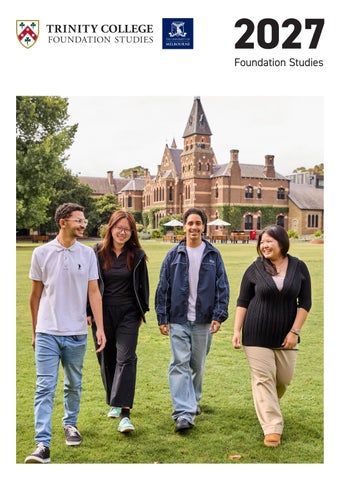
2027 Foundation Studies
The University of Melbourne is Australia’s foremost university. Distinguished by its breadth and depth, our curriculum encourages students to explore the interplay of their strengths and passions. Our students graduate ready for the professional world, equipped with the knowledge, real-world experience and qualifications that place them among the most employable graduates globally. The Trinity College Foundation Studies program can help kickstart a University of Melbourne journey. For international students planning to study in Australia, the program provides an introduction
Trinity College Foundation Studies is a sector-leading program that over the last 35 years has seen thousands of graduates matriculate to the University of Melbourne. It is a cornerstone of our institution, which was the first college to be established at the University of Melbourne. Trinity College truly prepares students for success at university. Our program provides students with the academic tools to succeed at university, and beyond. We do this by ensuring our program aligns to the ways of learning at the University of Melbourne. Thanks to our carefully tailored curriculum, we also help students develop soft skills, such as confidence speaking conversational English and presentation skills. Further, we emphasise the type of critical thought and analysis which many students have not encountered before and which is essential for success at university. Finally, we give students tailored academic and personal support from dedicated teachers and wellbeing staff who are highly trained in working with international students. We understand that our students are entering our program during a period of great change, with most living away from their homes and families for the first time. We place a great deal of importance on our wellbeing and support structures, to ensure Trinity offers a ‘soft landing’ for these students. We believe this kind of environment nurtures their development in and out of the classroom, which is ultimately reflected in their success in the program and at university. We know our program sets students up for success, as the majority of Trinity’s Foundation Studies students matriculate to the University of Melbourne, where they are, year on year, among the University’s top academic achievers, with the lowest non-completion rate and a high rate of achieving an Honours grade. Joining us at Trinity also means gaining access to our extensive alumni network, which is made up of almost 30,000 people in more than 80 countries. Becoming part of this alumni group helps our former students access ongoing opportunities in their personal life and career. I hope you will consider studying with us. I look forward to welcoming you to Trinity College soon. Professor Russell Goulbourne Warden and CEO Trinity College
to university learning in a supportive environment, building the research, analytical and communication skills essential for future success. I highly recommend Trinity College Foundation Studies as a proven pathway for international students interested in studying at the University of Melbourne. Professor Glyn Davis Interim Vice Chancellor, University of Melbourne
MELBOURNE CITY CENTRE
Contents 02 Discover Melbourne 04 Why choose Trinity College? 06 Why choose the University of Melbourne? 06 The University of Melbourne (UoM) degrees 07 The University of Melbourne campus 08 Your journey begins here 10 Scholarships and awards CRICOS Provider Number: 00709G
12 The Trinity College campus 14 TCFS pathway to the University of Melbourne
34 Accommodation 37 Accommodation map 38 Entry requirements 41 Sample Foundation Studies application form 42 How to apply 43 Dates and fees
16 What will you study? 18 Core curriculum subjects 22 Elective curriculum subjects 44 Staying in touch 28 University of Melbourne with your alma mater entry requirements 46 Policies 30 Student life 31 Student wellbeing and support
1
DISCOVER MELBOURNE Melbourne is one of the world’s most dynamic cities, known for its exciting events, restaurants, cafes, business hubs, sports, multicultural communities and world-class education. Spend time exploring the famous cobblestone lanes or walk to a scenic park or gallery. Whatever you enjoy, it’s easy to navigate safely to your destination in a city connected by public transport and bike paths. Find out more at visitmelbourne.com
About Melbourne Average maximum daytime temperature in Melbourne
The world’s fourth most livable city
Population of more than 5 million
State capital of Victoria and the second largest city in Australia
More than 100 languages spoken by Melbourne residents
Largest tramway system in the world
More cafes and restaurants per capita than anywhere in the world
Sources Australian Bureau of Statistics, Trading Economics, based on Economist Intelligence Unit 2025 statistics
2
Trinity College Foundation Studies 2027 program information | CRICOS Provider Number: 00709G
1. Lygon Street The heart of Melbourne’s ‘Little Italy’ and home to some of the city’s best Italian restaurants, bars and shops.
TRINITY COLLEGE
2. Queen Victoria Market A bustling marketplace with fresh, quality produce and specialty shopping.
Morrah St tram stop
3. Melbourne Central A large shopping centre and a Melbourne transport hub.
THE UNIVERSITY OF MELBOURNE Melb Uni tram stop
Parkville Station
Swanston Street
5. Degraves Street Located across the road from Flinders Street Station, this is one of Melbourne’s first laneways, lined with cafes and restaurants. 6. Federation Square The home of major cultural attractions and considered Melbourne’s meeting place. 7. Southbank Melbourne’s bustling waterfront hub, renowned for restaurants, public art and stylish retailers.
2. Queen Victoria Market
Carlton
Lygon Stree t
4. State Library of Victoria A place to explore a world of information and stories, or to study in throughout the semester.
1. Lygon Street
3. Melbourne Central
4. State Library of Victoria
8. National Gallery of Victoria Australia’s oldest, largest and most-visited art museum. Melbourne Central Station
Parliament Station Flagstaff Station
Melbourne CBD
n St nsto Swa
City
am le tr Circ
reet
6. Federation Square
5. Degraves Street Southern Cross Station Flinders Street Station
7. Southbank
CRICOS Provider Number: 00709G
Yarra River
8. National Gallery of Victoria
3
WHY CHOOSE TRINITY COLLEGE? Proven results Successful completion of Trinity College Foundation Studies provides guaranteed entry into your preferred University of Melbourne course (provided you meet the required entry score and subject prerequisites), with 85% of Trinity graduates successfully progressing to the university. Once there, they perform better than students joining the university via all other modes of entry. This means Trinity College doesn’t just help you get into Australia’s top university, it helps you succeed once you get there. More than a university pathway Success at a world-class university requires far more than subject knowledge. Trinity is designed to develop capable, confident and adaptable young people, who are able to thrive in a Western university environment and beyond. Alongside academic knowledge, students build critical thinking, communication, collaboration, research and independent learning skills that prepare them not only for tertiary study, but for future careers, leadership and lifelong learning.
4
Support every step of the way Studying in a new country is a major life transition. At Trinity College, students benefit from small classes, dedicated teachers, tailored academic assistance, wellbeing services, mentoring and a vibrant student community. Every student is known, supported and encouraged to achieve their full potential, and feels a strong sense of belonging. A future without limits For more than 35 years, Trinity College Foundation Studies has helped students build successful futures. Graduates join a global network of around 30,000 alumni across more than 80 countries and go on to make their mark in business, technology, healthcare, entrepreneurship, the arts, public service and more. The University of Melbourne is not the end goal – it’s the foundation for a lifetime of opportunity.
Trinity College Foundation Studies 2027 program information | CRICOS Provider Number: 00709G
Why Choose Trinity College?
Jack Qian, Trinity College TCFS 2012 Senior Software Engineer, Google
I landed in Australia from my hometown of Harbin in China when I was 17, and the realities of living abroad hit hard and fast. I realised that I would have to speak English every day, for all kinds of everyday conversations. Trinity offered an environment where we could practice the language without fear and with plenty of feedback, and we worked to specific goals, like understanding and expressing ideas. At Trinity College, I always felt supported and encouraged, and everything was tailored to ensure my future success. For instance, I didn’t understand why I needed to take drama classes at the time, but these classes ended up teaching me some of the biggest lessons in terms of holding myself and speaking with confidence, and these skills helped me at university and when I started my career at Google. The time I spent at Trinity was so critical, marking the beginning of my journey studying and working abroad. It was also the starting point of me becoming a more independent, capable individual and really was the ‘foundation’ that set me up for personal and professional growth.’
‘Red’ Hong Yi TCFS 2004 Artist
‘When I talk about Trinity, I just smile because it was such a great year for me. I was experiencing a totally different education system from the one at home. At Trinity, teachers were super encouraging and really passionate’, says internationally acclaimed installation artist ‘Red’ Hong Yi. Working with everything from socks to carnations, soil and burnt matchsticks, Red says her Foundation Studies year informed her art, with ‘an explosion of ideas’ and a discovery of environmental issues. Hailed by the Sotheby’s Institute of Art as one of the ‘11 world art entrepreneurs you should know’ in 2018, Red’s work has been commissioned by Google, Gucci, Porsche and the Mandarin Oriental.
CRICOS Provider Number: 00709G
5
WHY CHOOSE THE UNIVERSITY OF MELBOURNE? The University of Melbourne (UoM) degrees University of Melbourne degrees aren’t like others you’ll find in Australia. They’re aligned with those offered by many top institutions worldwide, which means more opportunities for you. A different way of thinking You’ll start with an undergraduate degree. You can then choose to join the workforce or specialise at graduate level. Today’s workplace demands forward-thinking graduates who are skilled and resilient, with a broad outlook and collaborative approach.
It begins with your undergraduate degree Your undergraduate (bachelor) degree is your first university degree. You can choose from more than 100 major fields of study, giving you broad exposure to different ideas and ways of thinking across many disciplines. You can focus on your major from day one or keep your options open and discover new study possibilities along the way.
Your major Your major is your chosen specialisation within your degree. You’ll develop a deep understanding of your major study area from first to third year. In most degrees, you won’t need to select your major on day one. In first year, you’ll be able to explore a range of subject areas you’re interested in, so by the time it comes to choosing your major, you’ll be well informed.
What is a breadth subject?
take a breadth subject in Mandarin Chinese – a great choice for a scientist looking to work internationally and help solve global issues. You can also simply explore something you’ve always been curious about. Some of our students find that after taking a breadth subject they discover a passion they’d never known about and may even change their career plans. Others might use breadth subjects to improve their career prospects by complementing their major with a language, communications or business subject. ‘Breadth tracks’ (groups of subjects taken throughout your degree) may even qualify you for graduate study in a field that’s very different to your major.
Your next step: graduate study When you’re informed and ready, you can choose from hundreds of graduate study options. You’ll get the full benefit of the graduate school experience by studying intensively in small classes led by experts and alongside others who share your interests and desire to succeed. You can work towards a professional qualification (for example, law through the Juris Doctor) or join our world-class researchers by taking a research higher degree. Your graduate degree will be internationally recognised and will set you apart from those who study a traditional Australian single or double undergraduate degree.
A breadth subject is one taken from outside your core studies or major. Most University of Melbourne undergraduates take breadth subjects. Not only do breadth subjects provide you with a greater understanding of the world around you, they will allow you to tailor your course to fit your individual passions and career ambitions. You might, for example, study science but
6
Trinity College Foundation Studies 2027 program information | CRICOS Provider Number: 00709G
Why Choose the University of Melbourne?
South Lawn
Faculty of Business and Economics
The University of Melbourne campus You’ll feel at home the moment you step onto the University of Melbourne grounds. Our Parkville campus is a city within a city. With cafes, libraries, gyms, specialty stores and a small supermarket, you’ll never have to leave. The Parkville campus is situated within a renowned knowledge precinct, which includes eight hospitals, many leading research institutes and a wide range of knowledge-based industries. Your Foundation Studies classes are taught at the University’s Parkville campus and in nearby Carlton, so you can enjoy the benefits of campus life from day one. See page 12 for more information about the Trinity College Foundation Studies (TCFS) teaching facilities and locations.
11
45+
libraries
Miguel Valmayor, Philippines
cafes
August Standard 2023 Bachelor of Science
15
museums and galleries
CRICOS Provider Number: 00709G
150+
student clubs
40+
sporting clubs
I found transitioning to life and studies in Australia to be pretty smooth, especially with the support of the staff at Trinity College and the friends I’ve made while being here. At first, thinking about how different it was from home made it somewhat daunting, but after embracing the local culture, I’ve come to really appreciate and enjoy it.
7
YOUR JOURNEY BEGINS HERE
8
Trinity College Foundation Studies 2027 program information | CRICOS Provider Number: 00709G
Your Journey Begins Here
Trinity College was founded in 1872 following the model of the English colleges of Oxford and Cambridge, and was affiliated as a college of the University of Melbourne. It is the University’s oldest residential college. Trinity College Foundation Studies (TCFS) was established in 1990 to provide a preparatory pathway for talented international students seeking entry to the University of Melbourne. Today, more than 85 per cent of Trinity’s Foundation Studies students enter the University of Melbourne, where they are among the university’s best performers.
Your path to the University of Melbourne High school in your home country
About the program TCFS is the only foundation studies program with guaranteed entry into University of Melbourne undergraduate courses for students who achieve the required scores. TCFS is a rigorous academic program taught by leading academics. The program has been designed in conjunction with the University of Melbourne and is supervised by the University’s Academic Board.
Where will I study? Parkville (on the University of Melbourne campus) and Carlton
What does it lead to? 1st year undergraduate degree at the University of Melbourne
Trinity College Foundation Studies
TCFS to university progression TCFS is recognised as a pathway to all Australian universities, including:
• the University of Melbourne • the Australian National University • the University of Queensland • the University of Sydney • Monash University • the University of New South Wales • the University of Western Australia • the University of Adelaide. More than 90 per cent of graduating TCFS students are eligible for an offer at a Group of Eight university.
When will I commence?
1st year University of Melbourne bachelor degree
TCFS graduates have also found a pathway to various international institutions,2 including:
• the University of Oxford (UK) • Massachusetts Institute of Technology (USA)
• McGill University (Canada) • the University of Manchester (UK) • Boston University (USA) • the University of Nottingham (UK) • the University of Leeds (UK) • the University of Liverpool (UK) • the University of Leicester (UK) • London College of Fashion (UK). 1. Minimum entry requirements apply, based on English language skills and level of study achieved in your home country. 2. Applications to institutions outside Australia are considered on a case-by-case basis.
January, February, June, July, August or September1
What type of classes do I attend? Lectures and tutorials, just like at university, with a maximum of 15 students per tutorial.
Hazel Callista, Singapore February Standard 2026
Trinity College stood out as a specialised pathway for international students to enter the University of Melbourne, my dream school. The tailored support, established alumni network, and international student community reassured me.
CRICOS Provider Number: 00709G
Our classes at Trinity are more university-style with lectures and tutorials, which encourages independent learning. My experience at Trinity has been great. I’ve made friends from all over the world and feel supported by staff and tutors.
9
Your Journey Begins Here
Scholarships and awards Our scholarships and awards are designed to celebrate your talent and commitment to your education. Scholarships for future students Trinity College Foundation Studies scholarships are awarded to outstanding students in each intake on the basis of academic merit, intake and region, and are allocated on a competitive basis.
Princess Saofaialo Taula-Mafulele, Samoa July Comprehensive 2024
The staff at Trinity College have been incredibly helpful during my time here. Whenever I had questions regarding topics that I didn’t understand, the teachers were always ready to answer and whenever I had trouble searching for textbooks in the library, the librarians would always lend a helping hand without fail.
All prospective students are automatically considered for a scholarship at the time of application. To be eligible, you need to have achieved excellent high school results and have lodged a Trinity College Foundation Studies application form. For more information, visit trinity.unimelb.edu.au/fsp-scholarships
University of Melbourne scholarships Trinity College Foundation Studies graduates are eligible to apply for a range of University of Melbourne scholarships. For more information, visit scholarships.unimelb.edu.au
Michael Dharmawan, Indonesia Dux, September Fast Track 2023
Uncertainty can’t be eliminated, the same goes for your fear and doubts. If you are thinking of studying here, I really recommend you do it and see it for yourself. I believe studying at Trinity College provided me with a smoother transition into university.
10
Trinity College Foundation Studies 2027 program information | CRICOS Provider Number: 00709G
Your Journey Begins Here
CRICOS Provider Number: 00709G
11
Your Journey Begins Here
The Trinity College campus From modern classrooms and high-tech laboratories to historical architecture, our campuses are equipped with first-class teaching facilities. All campus locations are within easy walking distance of the main Trinity College campus and the University of Melbourne.
Trinity College main campus 100 Royal Parade, Parkville, Melbourne Within the grounds of the University of Melbourne 2.6km walk or tram ride from Melbourne CBD
Bishops’ Building The historical Bishops’ building is Trinity College’s most loved building. It includes the campus reception as well as Trinity’s A C C Farran Hall and cafeteria. On the adjacent lawn, called the Bulpadock, you can relax between classes and enjoy annual events like our food and entertainment festival.
12
Leeper Library From the beginnings of the College in 1872, the Leeper Library has formed an important part of Trinity’s historical and cultural significance, and is an excellent resource for students.
Gateway Building The Gateway building offers direct pedestrian access for all Foundation Studies students between Trinity and the University of Melbourne. Here you will enjoy class time in tutorial rooms, drama studios, music practice rooms and a 250-seat lecture theatre. It’s also the perfect place to find a quiet space to study between classes.
Trinity College Foundation Studies 2027 program information | CRICOS Provider Number: 00709G
Your Journey Begins Here
Victoria Street campus
Bouverie Street campus
200 Victoria Street, Carlton, Melbourne
243 Bouverie Street, Carlton, Melbourne
2-minute walk to Queen Victoria Market
1.5km walk from Trinity College main campus
1.5km walk to Trinity College main campus Close to the University of Melbourne, Victoria Street is a contemporary campus with modern classrooms and open study spaces. There is also plenty of room to study with a group of friends. From Victoria Street, take a two-minute walk to the Queen Victoria Market and enjoy the cultural flavours of Melbourne during your class breaks.
500m from Lygon Street Trinity College science labs are located at our Bouverie Street campus, adjacent to the University of Melbourne. Here you will learn about biology and chemistry. From Bouverie Street, take a six-minute walk to Lygon Street, also known as Little Italy, and sample an exhaustive array of Mediterranean-inspired menus.
Chelsea Terriyanto, Indonesia February Main 2019 Bachelor of Science | Singer and Actor
What made moving [to Melbourne] so much easier was the fact that I made friends who were also doing the same thing. They were as young as me, also 17, and it was their first experience of moving from their home country. I realised I wasn’t alone. I also had Trinity and my student accommodation, which helped me to get settled in. I really gained my independence by moving here.
CRICOS Provider Number: 00709G
13
Your Journey Begins Here
TCFS pathway to the University of Melbourne When you apply to join Trinity College Foundation Studies (TCFS), admissions staff will assess your application and make an offer for the intake that best suits your academic and English requirements, and best prepares you for your chosen bachelor degree.
2027 JAN
FEB
MAR
APR
MAY
JUN
JUL
AUG
SEP
OCT
NOV
JANUARY COMPREHENSIVE 12 Jan 2027 - 3 Dec 2027
A program that allows students from some countries to commence at Trinity College at a different phase of their secondary schooling and provides additional preparation in mathematics.
FEBRUARY STANDARD 11 Feb 2027 - 26 Nov 2027
Our two Standard intakes are our most popular programs and suit students who are confident with their English and mathematics.
JUNE FAST TRACK 15 June 2027 - 28 Jan 2028
DEC
An intensive program with higher entry requirements than the Standard intakes.
JULY COMPREHENSIVE 13 July 2027 - 2 June 2028
AUGUST STANDARD 5 Aug 2027 - 26 May 2028
SEPTEMBER FAST TRACK 28 Sept 2027 - 26 May 2028
14
Trinity College Foundation Studies 2027 program information | CRICOS Provider Number: 00709G
Your Journey Begins Here
The TCFS program meets the requirements for foundation programs registered on the CRICOS for delivery in Australia to overseas students, providing academic preparation for entry into first-year undergraduate study or its equivalent.
2028 JAN
FEB
MAR
APR
MAY
JUN
JUL
AUG
SEP
OCT
NOV
DEC
Enter university February 2028
A program that allows students from some countries to commence at Trinity College at a different phase of their secondary schooling and provides additional preparation in mathematics.
Our two Standard intakes are our most popular programs and suit students who are confident with their English and mathematics. Enter university July 2028 An intensive program with higher entry requirements than the Standard intakes.
CRICOS Provider Number: 00709G
15
WHAT WILL YOU STUDY?
16
Trinity College Foundation Studies 2027 program information | CRICOS Provider Number: 00709G
What Will You Study?
The Trinity College Foundation Studies (TCFS) curriculum is specifically designed to give you the best foundation for success at top Australian and overseas universities. The university environment will require you to speak in front of others, work in groups, develop an argument, and be creative, constructive, analytical and critical. The academic skills and critical thinking outcomes of the core curriculum will give you the confidence and ability to achieve success in your future studies. 2 Core subjects
3 Elective subjects
(studied by all students)
(students select three of the following elective subjects)
English (includes three components: English Literature, Drama and English for Academic Purposes)
Accounting
History of Ideas
Biology Chemistry1 Economics
1. You must have prior knowledge of these subjects in order to enrol in them. 2. Y ou can only select Music if your University of Melbourne chosen degree is the Bachelor of Music. 3. Music is taken as a fourth elective and attracts an additional fee. Note: elective subjects that are a prerequisite for a University of Melbourne bachelor degree are offered for each intake. Electives that are not a prerequisite may not be offered for an intake, subject to enrolments.
Standard intake The core curriculum in the Standard intake is specifically designed to develop intellectual breadth. You can choose elective subjects to suit your particular areas of study interest. Certain electives, such as Mathematics 1 and science subjects (Biology, Chemistry and Physics), are prerequisites for entry to some courses at the University of Melbourne, and you will need to have prior knowledge of the subject in order to enrol in it.
Fast Track intake The Fast Track intake is aimed at students who meet higher academic and English language entry requirements. It follows the same curriculum as the Standard program, but is taught in an accelerated timeframe. Note: Music is not available in the Fast Track intake.
Comprehensive intake
Environment, Development and Design Mathematics 11 Mathematics 21
Media and Communications Music1,2,3 Physics1 Psychology
Pedagogy The Trinity College Foundation Studies curriculum is unique in its approach to preparing students for university. Grounded in a liberal arts ethos that emphasises individual expression and critical thinking, the program provides students with both the opportunity and the support needed to adjust to Western culture and education. Alongside traditionally academic subjects such as Accounting, Mathematics, and Chemistry, the core curriculum includes contemporary subjects like Drama and History of Ideas. Many of our students arrive at Trinity academically strong, but it is subjects like Drama and History of Ideas that broaden students’ perspectives, build self‑confidence, and foster the critical thinking skills needed to succeed in Western tertiary and professional environments.
Assessment All subjects are assessed through a combination of tests, work throughout the year, and a final exam. Assessment is designed to help you to achieve results that show your full potential. Subject and assessment information can be found from page 22 of this brochure, and more detailed information is available on our website trinity.unimelb.edu.au/fsp-explainer
The Comprehensive intake allows students from some education systems to commence their studies at Trinity College at a different phase of their secondary schooling. The Comprehensive intake also allows students requiring additional preparation in mathematics to be considered. This intake provides flexibility in catering for students with varying academic backgrounds, ensuring everyone in the program is prepared to transition to the University of Melbourne and succeed from day one of their degree. Note: Music is not available in the Comprehensive intake.
CRICOS Provider Number: 00709G
Scan to learn more
17
What Will You Study?
Core curriculum subjects English The English subject consists of three components: • English for Academic Purposes (EAP) • English Literature – worth 70% of your overall mark for English • Drama – worth 30% of your overall mark for English
English for Academic Purposes (EAP) EAP is part of the core subject of English. You must achieve a score of at least 50 per cent in EAP. However, a score of less than 70 per cent in EAP may require you to do a bridging subject at the University of Melbourne. EAP is designed to help you develop study skills in the following areas: • Interpreting information – understanding spoken and written academic texts, identifying relevant information, synthesising information from listening and reading texts, and recognising points of view and bias. • Expressing ideas – formulating an opinion, presenting an argument using academic style in both oral and written forms, paraphrasing, using academic referencing conventions, structuring academic essays, reports and presentations, and participating in discussions.
Assessment Written assessments: 70% Oral assessments: 25% Participation and independent learning: 5%
Jiale Xing, China February Standard 2026
Trinity is not only a school but also a really warm place for my life in Melbourne. I’ve met so many friends from different countries and everyone is so kind and supportive. The teachers here are amazing and so passionate. They truly care about my progress and I can always seek help from them. Trinity has been a place for me to step out of my comfort zone: I’ve joined a lot of clubs and really enjoy my life here!
18
Trinity College Foundation Studies 2027 program information | CRICOS Provider Number: 00709G
What Will You Study?
English Literature English Literature is designed to improve your English and academic skills by providing instruction in reading, analysing, discussing and writing about a variety of literary texts. This subject will help you develop a nuanced understanding of different uses of language and various English-speaking cultures. The study of English literature prepares you for life in English-speaking environments, including universities and the broader Australian community. It will also assist you in developing critical thinking, communication and writing skills, which are essential in all tertiary subjects. In English Literature, you will study texts including: • short fiction • poetry • a novel • Shakespearean drama. These texts will develop your ability to interpret and use sophisticated forms of language, such as symbolism, connotation, metaphor and narrative.
Assessment Written assessment (essays and exams): 50% Class participation: 10% Creative and/or reflective assignment: 5% Group presentation: 5% (Final 30% made up by Drama)
CRICOS Provider Number: 00709G
Mohammed Alharthi, United Arab Emirates August Standard 2024
At Trinity, I found much more than lectures and assignments; I found friends. I have teachers who are excellent tutors and guides – mentors who bring out the best in me. The classes are well structured, allowing freedom to learn in a manner that suits everyone. I certainly discovered more about myself during my time here. I see Trinity as a pivotal moment in my educational journey.
19
What Will You Study?
Drama This subject develops communication skills and will help you learn how to use English language within the Australian social and cultural context. It promotes group skills, fosters creativity and imagination, develops self-confidence and encourages initiative, responsibility and leadership. Drama will help you develop: • a confident understanding of the impact of body language and vocal skills for effective communication • an understanding of dramatic elements, such as space, time and tension • exploration, understanding and development of text, working solo, in pairs or in larger groups • an understanding of improvisation, characterisation, roleplay, monologue and dialogue • theatrical storytelling – both literal and abstract (through images, text and poetry) – culminating in group performances • voice projection and articulation.
February Standard 2026
Assessment Solo physical communication task and solo monologue task: 10% Group-devised performance, incorporating performance, self-evaluation and participation components: 10% Final group performance exam, incorporating performance and participation components: 10% (Other 70% made up in English Literature)
20
Angela Hou, China I really enjoy being part of Trinity College because of the welcoming and supportive community here. One of my favourite things is meeting people from different backgrounds and sharing both academic and everyday experiences together. Trinity has made my university journey feel much more meaningful and connected.
Trinity College Foundation Studies 2027 program information | CRICOS Provider Number: 00709G
What Will You Study?
History of Ideas This subject is an intensive university preparation subject that examines Western society and the ideas that affect our lives. Through this subject, you will develop the specific academic skills required in all university faculties, including academic communication through oral and written discussion, research and correct use of published material, critical use of data and analysis of complex issues. You will read about and discuss important philosophers, scientists and religious and political writers, and formulate your own responses. Within these themes, History of Ideas examines: • reasoning, science and methods of achieving knowledge • educational methods and aims • scepticism and debate • democracy and other political views • power relationships and equality • ideas of rights and freedom • religious and philosophical influences on society • colonialism, racism and globalisation • the twenty-first century and the questioning of ‘truth’.
Assessment All students must pass History of Ideas in order to pass Foundation Studies. Standard and Fast Track intakes Exam: 30% Essays: 50% Participation: 20% Comprehensive intakes Exam: 25% Essays: 60% Participation: 15%
CRICOS Provider Number: 00709G
Keysha Lee, Malaysia August Standard 2022 Bachelor of Arts, Psychology
At Trinity, I developed key skills that shaped both my academic and personal growth. Socially, I learned to step out of my comfort zone, meet new people, and become more independent. Academically, I gained strong timemanagement skills, as I had to stay on top of my own responsibilities without constant reminders. Despite this independence, the supportive staff were always available for guidance, offering help through consultation sessions and after-school mentoring whenever I needed clarification or support.
21
What Will You Study?
Elective curriculum subjects Accounting This subject introduces you to fundamental accounting tools to provide a basis for analysing and interpreting financial statements and internal management documents throughout your career. The educational philosophy used is based on the ‘building blocks’ approach (the accounting cycle), a sequence of steps or procedures related to a firm’s accounts and account entries, which culminates in the ultimate objective of financial reports.
Course outline Semester 1 • Understanding basic accounting concepts
Andrea Salvador, Philippines
• Summarising and reporting accounting information
August Standard 2020
• The measurement of profit
Watch this video to hear about Andrea’s FS experience
• Special aspects and application of decision-making
Semester 2 • Accounting for accounts receivable and bad debts • Alternative inventory valuation models • Goods and Services Tax (GST) • Valuation of non-current assets and making financial decisions • Accounting for partnerships and companies • Ethics and its relevance to business • Financial statement and ratio analysis • Management and manufacturing; application of costing the cash-flow statement
Assessment Exams: 70% Assignment: 10% Reports: 10% Attendance and participation: 10%
Annli Tee, Malaysia August Main 2014
Watch this video to hear about Annli’s FS experience
22
Trinity College Foundation Studies 2027 program information | CRICOS Provider Number: 00709G
What Will You Study?
Biology
Chemistry
Biology aims to foster an understanding of major biological concepts, an awareness of how such concepts are connected within the biological sciences, and an appreciation and interest in biological science as an integral part of society and everyday life. The subject provides a strong foundation for further study of the biological sciences and related disciplines.
This subject provides a foundation for further study in chemistry and related disciplines. The focus is on understanding chemical concepts and calculations, development of laboratory and reporting skills, awareness of safety protocols, fluency in terminology, and an appreciation of the role of chemistry in our world.
Course outline
Course outline Semester 1
Semester 1
• Nomenclature and stoichiometry
• Cell structure and function – biological molecules, prokaryotes, eukaryotes and organelles, and energy systems • Plants – plant cells, tissues and the plant body • Animals – organ systems, tissues and organs
Semester 2 • Genetics – cell division, inheritance, gene expression, genetic engineering, human genetics, reproduction and development • Evolution and diversity – evidence and mechanisms for evolution, viruses, bacteria, fungi and protists
• Atomic structure and bonding • Liquids, gases and solids • Chemistry of main group elements, transition metals and coordination chemistry
Semester 2 • Organic chemistry and spectroscopy • Food chemistry • Sustainable chemistry • Fundamentals of chemical reactions – thermochemistry, kinetics and chemical equilibria • Acid-base equilibria
Assessment
• Redox chemistry, electrolysis and extraction of metals
Exams: 70% Assignment: 10%
Assessment
Practical classes: 20%
Exams: 60% Assignment: 10%
Subject Leader Dr Catherine Symington BAgrSc(Hons), PhD La Trobe, MEd(EdMgt) Melb
Quizzes: 10% Practical classes: 20%
Ea Va Tan, Malaysia September Fast Track 2024
Studying at Trinity has helped refine my leadership and event management skills, especially through organising student events and leading the Gateway Club. I’ve learned how to collaborate with diverse groups, navigate challenges, and take initiative in creating engaging experiences for others. Living in a new environment has also strengthened my adaptability and confidence, allowing me to connect with people from different backgrounds and step outside my comfort zone. These experiences have shaped me into a more resourceful and proactive individual.
CRICOS Provider Number: 00709G
23
What Will You Study?
Economics
Environment, Development and Design
This subject covers major issues and institutions related to the Australian economy. It aims to help you:
The concept of environmentally sustainable development is at the heart of this subject, and is increasingly becoming the focus of government policy, business and educational institutions.
• gain an understanding of economics as a field of study, and consider issues from an economic perspective • learn the basic concepts and principles of economics • obtain knowledge of major aspects of the Australian economic system • develop a capacity to think analytically, and discuss and write effectively about economics.
You will become familiar with environmentally sustainable development and its application globally and will come to understand how different environments and societies interact. We investigate design solutions to many current global challenges.
Course outline
This subject is recommended for students wishing to study a Bachelor of Design at the University of Melbourne.
Semester 1: Microeconomics
Course outline
• The nature and method of economics
Semester 1 and 2
• Supply and demand analysis in the competitive market
• Ecological history of humanity
• Applications of the competitive model
• Population growth and resource consumption
• The concept of market structure
• What is sustainability?
• Perfect competition, monopoly, oligopoly and monopolistically competitive markets
• Economic sustainability and globalisation
• Market failure
• Sustainable business • Social sustainability and gender
Semester 2: Macroeconomics
• What is climate change?
• Monitoring and understanding the macroeconomy
• Climate change and related hazards
• GDP as a measure of total production, income and economic growth
• Who is affected most by climate change?
• Unemployment rate, labour force participation rate and types of unemployment
• Responses to climate change
• CPI and inflation rate • Exchange rate • Aggregate expenditure multiplier • Demand and supply side policies – fiscal, monetary, microeconomic reforms and income
Assessment
• Consequences of climate change • Renewable energy as a solution • Sustainable water use • What is a city? • Sustainable city design • Megacities • Slums • Resilient and liveable cities
ESQ quiz: 20%
• Sustainable building design
Mid-semester 2 assignment: 20%
• Melbourne: a sustainable, liveable, resilient city?
Final exam: 50%
• Urban agriculture
Attendance and participation: 10%
Assessment Quiz: 5% Exam: 30% Fieldwork report: 25% Research essay: 25% Group research presentation: 15%
24
Trinity College Foundation Studies 2027 program information | CRICOS Provider Number: 00709G
What Will You Study?
Mathematics 1
Mathematics 2
This subject develops mathematical knowledge and skills in pre-calculus, calculus, matrices, statistics and probability, as preparation for a wide variety of university courses.
This subject is a specialised mathematics subject that aims to provide you with the skills to succeed in university courses requiring a high level of analytical and logical thought, such as mathematics, statistics, data science, computer science and actuarial studies.
Course outline Semester 1 • Review of algebra and trigonometry
Course outline
• Functions and graphs
Semester 1
• Limits, continuity, differentiability, differentiation from first principles, and differentiation formulae
• Logic
• Implicit differentiation
• Matrices and transformations
• Related rates of change
• Ellipses and hyperbolas
• Applications of differentiation and optimisation
• Vectors
Semester 2
• Complex numbers
• Computer programming
• Anti-differentiation, fundamental theorem of calculus and evaluation of areas
Semester 2
• Indefinite integrals and further applications of integration
• Techniques of anti-differentiation
• Permutations and combinations
• Volumes of solids of revolution
• Introduction to probability, probability distributions, expected values and standard deviation
• Approximation of definite integrals
• Binomial, hypergeometric and geometric distributions • Continuous probability density functions, mean, median, variance and applications
• Statistical inference
• Differential equations • Computer programming
Assessment
• Normal distributions and confidence intervals for a population proportion
Term 1 assessment: 25%
Assessment
Term 3 assessment: 25%
Quizzes: 10%
Term 4 assessment: 25%
Term 2 assessment: 25%
Assignments: 10% Tests and exams: 80%
CRICOS Provider Number: 00709G
25
What Will You Study?
Media and Communications
Physics
In this subject, you will be introduced to the dynamic world of the media and associated industries, and their influence on society and the individual.
This subject provides a foundation for further studies in physics and related analytical-type disciplines, such as science and engineering. You will learn to develop problem-solving strategies and laboratory skills, as well as quantitative physical models, and will become aware of the assumptions upon which these models are based.
Through a combination of theory, application and practice, you will emerge with a greater understanding of how the media works and an ability to design and produce a range of media products.
Course outline Semester 1 • Media literacy, media representation, film language, genre theory and audiences • The story of film – from silent movies to blockbusters and beyond • Film marketing and advertising – the trailer and film poster
Semester 2 • Journalism and the newsroom – from newspapers to podcasts and citizen journalism
You will also learn to apply electronic, mechanical and optical techniques of measurement in the laboratory, and record quantitative data with associated uncertainties. The laboratory measurement techniques also include computer-interfaced experiments for collecting and analysing data.
Course outline Semester 1 • Physical quantities and units • Vectors • Motion in 1D and 2D • Forces and Newton’s laws • Statics and torque
• Marketing and communications – traditional and new media advertising forms, brands and brand identity, and public relations and public service campaigns
• Energy and work, conservation of energy
Assessment
Semester 2
Exams: 35%
• Electric circuits, electric fields and Gauss’s law
Assignments: 55%
• Magnetic fields, electromagnetic forces and Ampere’s law
In-class tasks and participation: 10%
• Electromagnetic induction
• Momentum, conservation of momentum principles • String waves and sound waves
• Wave-particle duality • Energy-mass relationship • Relativity • Bohr’s model of a hydrogen atom • Nuclear reactions, fusion and fission, binding energy • Particle decays, half-life and nuclear activity
Assessment Exams: 70% Assignments: 5% Practical classes: 20% Quizzes: 5%
26
Trinity College Foundation Studies 2027 program information | CRICOS Provider Number: 00709G
What Will You Study?
Psychology
Music (Practical)
This subject will introduce you to a broad range of psychological theories and principles that explain human behaviour, as well as the diversity of human experience. Practical demonstrations and experiments, both in and out of the classroom, are designed to help you understand and explore the theoretical concepts underlying human cognition (thinking) and behaviour.
This subject is available to students who wish to prepare for university study in either the Bachelor of Music or Diploma in Music. It is designed to enable you to reach an advanced level of skill and mastery of a particular musical instrument, and to give you a broad understanding of music performance. The Melbourne Conservatorium of Music (MCM) at the University of Melbourne allocates the teachers for this subject.
Course outline
Course outline
• Scientific theory and critical thinking
You will attend 24 individual 45-minute practical lessons with your teacher across the course of one year. Lessons include a study of selected repertoire on your instrument, principles of interpretation, style and technical work. In addition to these lessons, students are required to undertake extensive individual practice.
• Biology of mind • Development through the lifespan – infancy, childhood, adolescence and adulthood • Social psychology • Personality
Entry requirements
• Psychological disorders
• Intelligence
Applicants are required to have a minimum of Grade 6 practical in the Associated Board of the Royal Schools of Music (ABRSM), or Trinity College London exams, or Grade 6 (Grade 5 for singers) in the exams of the Australian Music Examinations Board (AMEB) or to perform at a minimum equivalent level. Students intending to take this subject must pass an audition before enrolling in TCFS.
Assessment
Assessment
Exams: 70%
End of year 15–20 minute practical examination consisting of a solo repertoire studied throughout the year. The performance exam is graded out of 100, as both a TCFS subject and simultaneously as an audition for the University of Melbourne’s Bachelor of Music.
• Therapy • Stress and health • Emotion • Learning
In-class quiz: 10% Written task and presentation: 20%
Note: Music is taken as an additional elective. You can only select Music if your University of Melbourne chosen degree is the Bachelor of Music. Results in this subject cannot be used in the calculation of entrance scores for other faculties of the University of Melbourne. This subject is only offered in Standard intakes.
Giselle Lei, China, Macau SAR Dux of August Standard 2022 Bachelor of Commerce
My time in Trinity was very pleasant and meaningful. I met lots of encouraging and inspiring peers who motivated me in various ways. I also met long-lasting friends who are always here to support me during hardships. I am so lucky to have them as my friends for both Trinity and university! Trinity provides quality education and prepared me well for university. The lecturers and tutors are all very helpful and were willing to answer any questions I had. Overall, my time at Trinity was very enjoyable and I learnt a lot throughout the year!
CRICOS Provider Number: 00709G
27
What Will You Study?
University of Melbourne entry requirements Successful completion of Trinity College Foundation Studies guarantees you a place in your preferred course at the University of Melbourne if you meet the required prerequisites and score. Calculating your final score All TCFS students study five subjects: two compulsory core subjects and three electives. A final score is calculated by taking the average best four subjects, excluding English for Academic Purposes (EAP). Mathematics 1 is included in the best four score for Commerce; and English and History of Ideas are included for Arts. Music (Practical) results cannot be used in the calculation of entrance scores for nonmusic-related faculties. Students must achieve a score of at least 50 per cent in each of the following core subjects: English (consisting of Literature and Drama), EAP and History of Ideas, plus at least two electives to successfully complete the program. The University of Melbourne requirements for students to enter specific courses are outlined in the table below. Please note that some courses require students to study prerequisite subjects. The University of Melbourne will only accept students who meet the entry score and have studied the required subjects. Visit the University of Melbourne website for entry requirements to other undergraduate degrees study.unimelb.edu.au/find Course Bachelor of Agriculture
TCFS entry score
2027 prerequisite subjects
Major at the University of Melbourne
75
EAP, English, History of Ideas and Mathematics 1
Agricultural Economics, Plant and Soil Science, Production Animal Science
77
EAP, English^ and History of Ideas. Applicants planning to major in Economics must complete Mathematics 1
Ancient World Studies, Anthropology, Arabic Studies, Art History, Asian Studies, Chinese Societies, Chinese Studies, Classics, Creative Writing, Criminology, Development Studies, Economics, English and Theatre Studies, English Language Studies, Environmental Studies, European Studies, French Studies, Gender Studies, Geography, German Studies, Hebrew and Jewish Studies, History, History and Philosophy of Science, Indigenous Studies, Indonesian Studies, Islamic Studies, Italian Studies, Japanese Societies, Japanese Studies, Korean Studies, Law and Justice, Linguistics and Applied Linguistics, Media and Communications, Medieval and Early Modern Studies, Philosophy, Politics and International Studies, Psychology, Russian Studies, Screen and Cultural Studies, Sociology, Spanish and Latin American Studies
February (Semester 1) and July (Semester 2) #25 in the world for Veterinary Science1 #1 in Australia for Life Sciences
Bachelor of Arts February (Semester 1) and July (Semester 2) #3 in Australia and #43 in the world for Social Policy & Administration #1 in Australia and #23 in the world for Arts & Humanities #1 in Australia and #33 in the world for Modern Languages
Bachelor of Biomedicine February (Semester 1) and July (Semester 2) #3 in Australia and #43 in the world for Social Policy & Administration
*Study area available as a minor only
84
EAP, English, History of Ideas, Chemistry and Mathematics 1
Biochemistry and Molecular Biology, Biomedical Engineering Systems, Biotechnology, Cell and Development Biology, Genetics, Human Nutrition, Human Structure and Function, Immunology, Infection and Immunity, Microbiology, Neuroscience, Pathology, Pharmacology, Physiology, Psychology, Public Health and Epidemiology
#1 in Australia and #23 in the world for Arts & Humanities #1 in Australia and #33 in the world for Modern Languages
28
Trinity College Foundation Studies 2027 program information | CRICOS Provider Number: 00709G
What Will You Study?
Course Bachelor of Commerce
TCFS entry score 85
February (Semester 1) and July (Semester 2)
2027 prerequisite subjects
Major at the University of Melbourne
EAP, English, Mathematics 1 and History of Ideas
Accounting, Actuarial Studies, Business Analytics, Economics, Finance, Management, Marketing Additional note: Applicants planning to begin a major in Actuarial Studies must complete Mathematics 2 if entering mid year. For Semester 1 entry, Mathematics 2 is recommended but not compulsory.
#2 in Australia and #50 in the world for Business and Management Studies1
Bachelor of Design
80
EAP, English and History of Ideas. Environment, Development and Design is recommended. Applicants without Mathematics 1 intending to major in Civil Systems, Computing, Construction, Mechanical Systems, Property or Spatial Systems may need a bridging mathematics subject in first year
Architecture, Civil Engineering Systems, Computing & Software Systems, Construction, Digital Infrastructure Engineering Systems, Game Design, Graphic Design, Interior Design, Landscape Architecture, Mechanical Engineering Systems, Performance Design, Property, Urban Planning, User Experience Design
N/A*
EAP, English, History of Ideas, Music, and knowledge of music theory/harmony at least AMEB Grade 5 or equivalent
Composition, Interactive Composition, Jazz and Improvisation, Performance
Option 1: EAP, English, History of Ideas, Mathematics 1 and one of Biology, Chemistry or Physics
Agricultural Science, Animal Health and Disease, Animal Science and Management, Biochemistry and Molecular Biology, Biomedical Engineering Systems, Biotechnology, Cell and Developmental Biology, Chemical Engineering Systems, Chemistry, Civil Engineering Systems, Climate and Weather, Computing and Software Systems, Data Science, Digital Infrastructure Engineering Systems, Ecology and Evolutionary Biology, Ecosystem Science, Electrical Engineering Systems, Environmental Engineering Systems, Environmental Science, Food Science, Genetics, Geography, Geology, Human Nutrition, Human Structure and Function, Immunology, Infection and Immunity, Marine Biology, Mathematical Physics, Mathematics and Statistics, Mechanical Engineering Systems, Mechatronics Engineering Systems, Microbiology, Neuroscience, Pathology, Pharmacology, Physics, Physiology, Plant Science, Psychology, Veterinary Biosciences, Zoology
February (Semester 1) and July (Semester 2) #3 in Australia and #26 in the world for Architecture and Built Environment
Bachelor of Music February (Semester 1) and July (Semester 2) for Performance major only #1 in Australia and #40 in the world for Performing Arts1
Bachelor of Science
80
February (Semester 1) and July (Semester 2) #1 in Australia and #15 in the world for Life Sciences and Medicine #3 in Australia and #46 in the world for Computer Science
Bachelor of Fine Arts
OR Option 2: EAP, English, History of Ideas, Mathematics 1 and Mathematics 2
N/A*
EAP, English, History of Ideas
February (Semester 1)
February (Semester 1)
Acting, Animation, Dance, Film and Television, Music Theatre, Production, Screenwriting, Theatre, Visual Art Additional note: Students wishing to undertake Fine Arts should enrol in any Trinity degree once. Additional entry requirements apply (e.g. audition, interview, folio presentation). Entry is only available in February and places for international students are limited.
#1 in Australia and #40 in the world for Performing Arts1
Bachelor of Oral Health
Additional note: Students wishing to undertake Composition, Interactive Composition, Jazz & Improvisation should enrol in any Trinity degree once. Additional entry requirements apply (e.g. audition, interview, folio presentation). Entry is only available in February and places for international students are limited.
90
EAP, English, History of Ideas and one of Biology or Chemistry
Clinical and Preventative Dentistry, Oral Health Sciences, Social Sciences and Health Promotion, Vocational Clinical Practice
#1 in Australia and #34 in the world for Dental Health
^ These prerequisite subjects must be included in the final best four calculation * A range of criteria is used for selection – check for additional requirements at study.unimelb.edu.au 1. QS World University Rankings by Subject 2026 Note, all entry scores are indicative only and entry is not guaranteed.
CRICOS Provider Number: 00709G
29
STUDENT LIFE
30
Trinity College Foundation Studies 2027 program information | CRICOS Provider Number: 00709G
Student Life
Student wellbeing and support ‘Wellbeing’ is a contemporary word someone may use when describing what makes a good life for them, or when asking how we can help ourselves and others to feel good, function well and contribute to life. Many of the answers are informed by what we value and the social context we live in. We place a great emphasis on the physical and mental wellbeing Counselling of our students at Trinity College. We facilitate a range of student-led activities and events to foster real connections and friendships. Students also have access to a range of professional staff who are trained and experienced in helping students learn skills and capabilities to manage stress and challenges, understand and better leverage their strengths, and share and celebrate cultural stories.
English Conversation Corner At the English Conversation Corner, TCFS students and staff share ideas and experiences, give and receive advice, and make friends. The English Conversation Corner provides a place and time to relax and communicate informally, but in a meaningful way. Participation is voluntary, free and open to everyone at Trinity.
Our counselling service provides psychological support to enhance the wellbeing and mental health of our students. Our counsellors can assist in students building positive emotions, increasing their engagement with activities that improve their life satisfaction and wellness, building positive relationships with peers, family and others and setting and achieving goals.
Under-18 support: ISA Student Advocates We understand that adjusting to a new life away from home can be a challenge. Our aim is to help you find the best support and make the best decisions to enhance your time at Trinity College. In addition to the support services on offer at Trinity College, each student under the age of 18 is required to sign up to a student care arrangement with Trinity’s partner organisation, ISA Student Advocates.
Students also have the opportunity to take on leadership roles by proposing and running their own student-led clubs. These experiences foster independence, teamwork and confidence, while developing valuable organisational and communication skills that are transferable to university and future careers.
This company will allocate all under-18 students an independent advocate who can help them navigate the range of individual challenges faced by young people living in a country other than their own. This support service is available 24 hours a day, seven days a week to answer all types of questions. The service is a requirement for students to be issued with a Confirmation of Appropriate Accommodation and Welfare (CAAW) from Trinity College. It is not required, however, for those who have had their accommodation and welfare approved by the Department of Home Affairs. Please refer to the accommodation section on page 34 for further information.
Academic advice and support
More information
Trinity clubs and activities Trinity clubs and activities offer students meaningful ways to connect, create and grow beyond the classroom. Students can join a diverse range of clubs that reflect their interests and inspire new passions such as cooking, badminton, chess, music, photography and English conversation practice.
We offer the support students need to help them progress into their desired degree. Our team is happy to help students with everything from changing degree preferences to subject selection.
Mentoring program Trinity College Foundation Studies includes a well-established and successful mentoring program. During their time at Trinity College, students are allocated a mentor to provide guidance and support in both their academic and personal life. Teachers or another professional staff member are typically mentors and they are the first point of contact for students. It is an important and rewarding relationship.
CRICOS Provider Number: 00709G
For more information about wellbeing and support, including Overseas Student Health Cover (OSHC), attendance and the out-of-hours helpline, visit trinity.unimelb.edu.au/fsp-wellbeing
Child safe policy Trinity College is committed to providing a safe, inclusive and welcoming environment where all students are empowered to develop their talents, interests and abilities through a curriculum that fosters the intellectual, physical, social, emotional, and moral and spiritual development of the student. To uphold this commitment, the College will promote the safety of all children, including through a child safe policy.
31
32
Trinity College Foundation Studies 2027 program information | CRICOS Provider Number: 00709G
Molly Adamson-Gill Student Experience Manager Pathways School
Every year, I meet students who are excited about joining Trinity, but understandably nervous about the challenges ahead. Parents often share those same feelings. Trinity’s academic reputation is one of our greatest strengths, but what many families discover after arriving is that they are joining a community equally committed to student wellbeing, belonging and personal growth. Our Student Wellbeing team includes counsellors, wellbeing support officers and an on-campus nurse, ensuring students have access to professional care whenever they need it. Just as importantly, students are supported by staff who genuinely know them, care about their success and are invested in their journey. Our Student Experience team helps students build confidence, connection and a sense of belonging from day one. Through events, activities, clubs and excursions, students quickly find their place within the Trinity community, creating a family away from home that supports them through both the exciting and challenging moments of student life. These connections help our students feel safe, valued and supported, giving them the foundation to thrive academically, socially and personally at Trinity, university and beyond. We understand that for many students, this is their first time living away from home. That’s why our teachers and mentors are so dedicated, providing guidance, encouragement and support throughout the student journey. At Trinity, we challenge students to achieve their potential, but they never have to do it alone. Students leave Trinity prepared for the academic demands of university, confident in themselves, and ready to thrive at the University of Melbourne and into adulthood. It’s an experience they wouldn’t get anywhere else.
CRICOS Provider Number: 00709G
33
Student Life
Accommodation Trinity College has a range of approved accommodation options, including purpose-built student accommodation (PBSA) and apartments to ensure you have living arrangements that are safe and adequately suit your age and needs. Our staff work closely with accommodation providers to make sure you find the best place to live during your studies. Your living arrangement while at Trinity is a huge part of your experience in Melbourne. There are many accommodation options for you to choose from to suit your personal circumstances. The Trinity Accommodation Office staff work closely with accommodation providers to ensure you have a safe and secure living environment. The Accommodation Office is also here to help you with: • booking accommodation • information, advice and referrals • contracts, rights and responsibilities, rental locations and transport information • advocacy.
Students under 18 Special accommodation arrangements must be made for students under 18 years of age. If you are under the age of 18, you can apply to the Department of Home Affairs to live with an eligible relative, or you can request that Trinity College issues a Confirmation of Appropriate Accommodation and Welfare (CAAW) letter. Trinity College will only issue a CAAW for students who stay in one of Trinity’s pre-approved accommodation options. Trinity College will need to confirm your accommodation arrangements before a CAAW is issued. The Department of Home Affairs will use this CAAW when processing your student visa application. For more information regarding under-18 accommodation, visit trinity.unimelb.edu.au/fsp-accom-u18
Room options
34
Student apartments
Student hostel (18+)
Private apartments and houses (18+)
Each student apartment has its own kitchen and bathroom. Apartments may be studio, one- or two-bedroom, or three- to six-bedroom multishare, and most are located within walking distance, or a short tram ride, to Trinity College. Some student apartment costs cover electricity, gas and internet access. You will be required to commit to a six- to 12-month lease agreement.
Student hostels are designed to cater to the needs of students. You will usually have your own bedroom but share a bathroom, kitchen and lounge room. Each room is furnished and is usually within walking distance, or a short tram ride, to Trinity College. Utility bills such as electricity, gas and water are included in the rental fee. You will be required to commit to a six- to 12-month lease agreement.
Private apartments allow you greater independence while studying at Trinity College. Apartments are usually unfurnished. You should start looking at least one to three months before commencing your course and should also allow some time in Australia to attend inspections so you can find an apartment that’s right for you. It’s important to note that most private apartment rentals require a 12-month minimum lease period.
Trinity College Foundation Studies 2027 program information | CRICOS Provider Number: 00709G
Student Life
Accommodation options
Scape Swanston
Iglu Melbourne City
Under 18
Under 18
Scape Swanston accommodation is less than a 10-minute walk from Trinity College’s Victoria Street campus, and is within easy reach of Melbourne Central, a large shopping, entertainment, dining and public transport hub. At Scape Swanston, you can choose from a variety of modern studios, with access to superfast Wi-Fi, study areas and communal spaces. Various events and programs bring students together and help build a sense of community. Better still, all utilities are included!
Scape Victoria Street Under 18
Meals
Live in a private double studio (with or without Insta-worthy green balconies), with all-inclusive meals at Scape Eats. The culturally diverse team of chefs ensure students enjoy a variety of meals prepared fresh for breakfast, lunch and dinner every day. You will have access to communal hangout spots, study hideouts, a gym, cinema and a spectacular rooftop view. Live your best student lifestyle at Scape, with 24/7 support, security, all-inclusive billing, and a calendar loaded with social events.
CRICOS Provider Number: 00709G
Iglu Melbourne City offers support when you need it and independence when you want it. A combination of fully furnished living spaces and hotel-inspired communal areas allow you to connect and expand socially and academically, with the added benefit of knowing there is dedicated 24/7 onsite support. Located next to Melbourne’s iconic Queen Victoria Market, it’s a 15-minute commute to our Parkville campus, either by public transport or on foot. You can choose to share an apartment with your own private bedroom and bathroom, or opt for a more private studio apartment. Your all-inclusive weekly rent covers unlimited internet, utilities, weekday breakfast, resident events and more.
Scape Uni Square Under 18 Scape Uni Square is renowned for its spacious social areas. These spaces allow students to study, enjoy downtime by themselves or spend time with new friends. From its libraries, cinema and games room through to the beautiful, landscaped courtyards, Scape Uni Square is great place to start your Trinity journey. Also included are 24/7 support, security, convenient all-inclusive billing, and a calendar bursting with social events.
35
Student Life
Accommodation options
Journal Campus House
Under 18 Journal Campus House offers a great student experience and is just a two-minute walk from Trinity College and directly across from the University of Melbourne. This brand-new building features stylish rooms and large social spaces, including rooftop terraces with sensational city views, lounges, games areas and gym. With large study zones and a jam-packed events calendar, you’ll find a great balance of academic-focus and student life. A warm community and 24/7 on-site staff will also ensure you feel supported. Choose from a range of fully furnished studio and shared room options, with all-inclusive rent covering utilities, unlimited internet and events.
Scape Queensberry
Under 18 With a 360-degree rooftop terrace, Scape Queensberry boasts standout views of Melbourne. The property features a gym, cinema and games room, and has 24-hour security. Choose from a studio or shared apartment and get access to a kitchenette, super-fast Wi-Fi, a large study desk, comfy bed, storage space, and a private or shared bathroom. All utilities are included. You’ll also be able to get involved in many events and meet like-minded students.
Scan for more info on accommodation options
36
Trinity College Foundation Studies 2027 program information | CRICOS Provider Number: 00709G
Student Life
Accommodation Map This map shows Foundation Studies learning spaces and accommodation providers located in the University of Melbourne precinct and the Melbourne CBD. For a comprehensive list, visit trinity.unimelb.edu.au/fsp-accomodation Map key Foundation Studies learning spaces
Trinity College
Accommodation Morrah St tram stop
Lygon Stre et
North Melbourne Melb Uni tram stop
Bouverie Street
Carlton
Swanston Stre
et
Journal Campus House
Scape Queensberry
Scape Uni Square
Trinity College Victoria Street
Parliament Station
Melbourne CBD
Flagstaff Station
Scape Swanston
Atira
reet
n St
nsto
Swa
City
Scape Victoria
Melbourne Central Station
Iglu Melbourne City Iglu
am le tr Circ
City Circle tram
Southern Cross Station Flinders Street Station
CRICOS Provider Number: 00709G
Yarra River
37
ENTRY REQUIREMENTS
38
Trinity College Foundation Studies 2027 program information | CRICOS Provider Number: 00709G
Entry Requirements
Entry requirements Also check our website regarding entry requirements: trinity.unimelb.edu.au/fsp-entry-requirements Note: Students must be at least 16 years of age when commencing studies.
English requirement (any of the following) IELTS
TOEFL
Pearson
Standard
6.0 (no band lower than 5.5)
iBT 67 (W 14) 3.5 (W 3.0)
47 (W 41)
Comprehensive
5.5 (no band lower than 5.0)
iBT 51 (W 9) 3.0 (W 3.0)
45 (W 41)
Fast Track
6.0 (No band less than 6.0)
iBT 67 (W 19) 3.5 (W 4.0)
47 (W 60)
As an alternative to the above tests, some applicants may sit the Trinity English Test.
Academic requirements Region
Standard
Comprehensive
Fast Track
Australia
Completion of Year 11 with B average
Completion of Year 11 with C average
Completion of Year 11 with A average
Bangladesh
Completion of Higher Secondary Certificate (HSC) with B average
Completion of Higher Secondary Certificate (HSC) with C average
Completion of Higher Secondary Certificate (HSC) with A average
Brazil
Completion of Year 12 with 8.0 average (or 80%)
Completion of Year 11 with 8.0 average (or 80%)
Completion of Year 12 with a 9.0 average (or 90%)
Cambodia
Completion of Upper Secondary Education with C average
GCC Countries
Completion of Year 12 with 80% average
Completion of Year 12 with 70% average
Completion of Year 12 with 90% average
GCE O Levels / IGCSE
A* - E grading scale
A* - E grading scale
A* - E grading scale
Five academic subjects with a score of 19 (A=5, B=4, C=3, D=2, E=1)
Five academic subjects with a score of 15 (A=5, B=4, C=3, D=2, E=1)
Five academic subjects with a score of 23 (A=5, B=4, C=3, D=2, E=1)
9 – 1 grading scale
9 - 1 grading scale
9 – 1 grading scale
Five academic subjects with a score of 26 (A*=9, A=7-8, B=5-6, C=4, D=3, E=2)
Five academic subjects with a score of 21
Five academic subjects with a score of 32 (A*=9, A=7-8, B=5-6, C=4, D=3, E=2)
Preliminary results accepted for Malaysia, Brunei, Singapore and Sri Lanka
Preliminary results accepted for Malaysia, Brunei, Singapore and Sri Lanka
Preliminary results accepted for Malaysia, Brunei, Singapore and Sri Lanka
Hong Kong (SAR)
Completion of Form 5 with two subjects at level 3, and two subjects at level 4 (or 15 above pass mark)
Completion of Form 5 with two subjects at level 2, and two subjects at level 3 (or 10 above pass mark)
Completion of Form 6 with four subjects at level 3 (or 20 above pass mark)
India
Completion of CBSE 11th / ISC 11th Standard with 65% average
Completion of CBSE 11th / ISC 11th Standard with 60% average
Completion of CBSE 12th Standard with 75% average
Indonesia
Completion of SMA 3 with 70% average
Completion of SMA 2 with 70% average
Completion of SMA 3 with 75% average
Completion of Upper Secondary Education with B average
Completion of SMA 2 with 80% average International Baccalaureate
Completion of first year of IB Diploma with an aggregate of 23
Completion of 1st year of IB Diploma with an aggregate of 20
Completion of first year IB Diploma with an aggregate of 26
Iran
Completion of Year 12 with an average of 15
Completion of Year 12 with an average of 13
Completion of Year 12 with an average of 18
Japan
Upper Secondary School Certificate with 4 average
Completion of Year 2 with 4 average
Upper Secondary School Certificate with 5 average
Completion of Year 2 with 5 average
CRICOS Provider Number: 00709G
39
Entry Requirements
Region
Standard
Comprehensive
Fast Track
Kenya
Completion of Kenyan Certificate of Secondary Education with B average
Completion of Year 11 with B average
Completion of Kenyan Certificate of Secondary Education with A average
Macau (SAR)
Completion of Form 5 (Year 11) with 75% average (65% for English medium schools)
Completion of Form 5 (Year 11) with 65% average (60% for English medium schools)
Completion of Form 5 (Year 11) with 80% average (75% for English medium schools)
Malaysia
Completion of SPM with B level (forecast results accepted)
Completion of SPM with C level (forecast results accepted)
Completion of SPM with four As and one B (forecast results accepted)
UEC: Completion of Senior Middle 2 with 70% average (forecast results accepted) Mexico
Completion of Bachillerato with 8.0 average (or 80%)
Completion of Bachillerato with 7.0 average (or 70%)
Completion of Bachillerato with 9.0 average (or 90%)
Mongolia
Completion of Year 12 with 80% average (or B average)
Completion of Year 11 with 80% average (or B average)
Completion of Year 12 with 90% average (or A average)
Myanmar
Completion of Myanmar Matriculation with 70% average
Completion of Myanmar Matriculation with 65% average
Completion of Myanmar Matriculation with 80% average and four distinctions
Pakistan
Completion of Higher Secondary School Certificate with B average (80%)
Completion of Higher Secondary School Certificate with C average (70%)
Completion of Higher Secondary School Certificate with A average (90%)
People’s Republic of China
Completion of Senior Middle 3 with 80% average
Completion of Senior Middle 2 with 75% average
Completion of Senior Middle 3 with 90% average
Completion of Senior Middle 2 with 85% average South Korea
Completion of Year 2 with 75% average
Completion of Year 2 with 70% average
Completion of Year 3 with 75% average
Taiwan
Completion of Senior High School Diploma with 70% average
Completion of Senior 2 (Year 11) with 70% average
Completion of Senior High School Diploma with 80% average
Completion of Matayom 5 with GPA 3.0 in four subjects
Completion of Matayom 6 with GPA 3.5 in four subjects
Completion of Senior 2 (Year 11) with 80% average Thailand
Completion of Matayom 5 with GPA 3.5 in four subjects
The Philippines
Completion of Year 11 with 80% average
Türkiye
Completion of Year 12 with 75% average
Completion of Year 12 with 70% average
Completion of Year 12 with 80% average
US
Completion of US Grade 11 with 80% average
Completion of US Grade 11 with 80% average
Completion of US Grade 12 with 90% average
Vietnam
Completion of Year 11 with 8.0 average
Completion of Year 11 with 7.0 average
Completion of Year 11 with a 8.5 average
West African Secondary School Certificate
Completion with B average
Completion with C average
Completion of Year 11 with 90% average
Please contact Trinity College for further information regarding academic requirements: trinity.unimelb.edu.au/pathways-school/enquiries Trinity College will base assessment on results in relevant academic subjects for each course and will require five subjects (unless specified above). The above minimum entry requirements are deemed to be equivalent to Australian Year 11. Trinity College may issue a conditional letter based upon first semester, forecast mock or preliminary results. Some applicants may be required to sit for diagnostic testing in English, Mathematics and/or Sciences. Trinity College and the University of Melbourne require prerequisite subjects for some areas of study. Your results in these subjects may form part of the assessment of your application.
40
Trinity College Foundation Studies 2027 program information | CRICOS Provider Number: 00709G
Trinity College Foundation Studies Application Form 2027
Representative’s contact details
This is a sample application form. We encourage you to apply online at trinity.unimelb.edu.au/pathways-school/apply Please note that Australian and New Zealand citizens are not eligible to apply.
PERSONAL DETAILS (as appear on passport) Family name
Given names
Citizenship
Country of birth
Male
Female
Other
Date of birth (DD/MM/YY)
/
/
Do you have Australian or New Zealand citizenship or Australian permanent residency status?
Yes
No
Have you applied for Australian citizenship or permanent residency?
Yes
No
Do you currently hold a visa for Australia?
Yes
No
If yes, what type?
Tourist
Student
Other
STUDENT CORRESPONDENCE DETAILS Address City
Postcode
Country
Telephone
Mobile
PREFERRED FOUNDATION STUDIES INTAKE January Comprehensive
February Standard
June Fast Track
July Comprehensive
August Standard
September Fast Track
PREFERRED UNIVERSITY COURSE Bachelor of
Major (if known)
Do you require a packaged letter of offer with the University?
Yes
No
ACADEMIC HISTORY (Certified true copies of all latest available academic results or forecast results should accompany this form) Name of qualification (e.g. O levels, SPM, SMA3) Name of school
Year awarded Address of school
Further study (e.g. A levels)
OTHER Do you have a parent who previously studied at TCFS?
Yes
No
Yes
No
If yes, please provide full name of parent Do you have a sibling who previously studied/is currently studying at TCFS? If yes, please provide full name of sibling Do you have any existing condition/s (medical, psychological or physical condition or disability) that may require additional support from Trinity College?
TCFS ID (if known) Yes
No
If yes, please provide further information
CRICOS Provider Number: 00709G
41
Entry Requirements
How to apply You can apply to Trinity College Foundation Studies (TCFS) directly or via our overseas representatives. Overseas representatives
Direct application to Trinity College
Trinity College has a worldwide network of registered overseas representatives to help you apply for TCFS. They provide detailed information about our program and can assist with the application process, accommodation arrangements and student visas. For more information, visit eap.ascentone.com/trinity
If you wish to apply directly to Trinity College, you will need to submit: • a completed online application (see trinity.unimelb.edu.au/pathways-school/apply) • certified copies of original academic qualifications • evidence of English language proficiency (if applicable).
Successful applicants 1 Receive letter of offer
2 Accept your offer
3 Pay your first fee instalment
Accepted students receive a letter of offer, which details their intake, fees payable, course commencement date and relevant policies, including our refund policy.
To confirm your place at Trinity College, you need to:
Payment of fees can be made via a bank draft, credit card or telegraphic transfer/direct deposit.
• meet any conditions stated in the letter of offer • sign and date the acceptance page • pay the first fee instalment shown on the letter of offer. By signing this form, you are entering into a legally binding contract with Trinity College under the laws of the Commonwealth of Australia.
4 A rrange your accommodation and Student Advocate Students under the age of 18 must have their approved accommodation and care arrangements in place before Trinity College can issue a Confirmation of Appropriate Accommodation and Welfare (CAAW). If the student is staying with a relative they must apply directly to the Department of Home Affairs for approval.
Please include your TCFS ID number (found on the top left-hand corner of your letter of offer) on the transfer document. If you do not, Trinity College cannot identify which students’ fees have been paid. Trinity College prefers transfers to be made via landing-pages.flywire.com/ landing/trinity-college
5 Have your enrolment confirmed
6 Secure your visa
On receipt of payment and meeting Department of Home Affairs guidelines, Trinity College confirms all student enrolments by issuing an electronic confirmation of enrolment (e-COE).
Present your e-COE, CAAW letter (if you are under 18) and other required documents to an Australian diplomatic mission, or submit them online, to apply for a student visa. If you apply to Trinity via an overseas representative, they will assist you with your student visa application. Find more information at immi.homeaffairs.gov.au/visas/ getting-a-visa/visa-listing/student-500
For further information about this process, visit trinity.unimelb.edu.au/fsp-accept
42
Trinity College Foundation Studies 2027 program information | CRICOS Provider Number: 00709G
Entry Requirements
Dates and fees Intake
Duration
English requirement
Semester 1
Semester 2
Fees
January Comprehensive*
36 weeks
5.5 IELTS (no band less than 5.0)
12 Jan – 18 June 2027
12 July – 3 December 2027
$58,050
30 weeks
6.0 (no band less than 5.5)
11 February – 25 June 2027
12 July – 26 November 2027
$46,770
27 weeks
6.0 (no band less than 6.0)
15 June – 24 September 2027
4 October 2027 – 28 January 2028
$46,770
36 weeks
5.5 IELTS (no band less than 5.0)
13 July – 17 December 2027
10 January – 2 June 2028
$58,050
30 weeks
6.0 (no band less than 5.5)
5 August – 17 December 2027
10 January – 26 May 2028
$46,770
27 weeks
6.0 (no band less than 6.0)
28 September 2027 – 21 January 2028
31 January – 26 May 2028
$46,770
CRICOS Course Code: 102517M
February Standard CRICOS Course Code: 073413G
June Fast Track CRICOS Course Code: 073416E
July Comprehensive* CRICOS Course Code: 102517M
August Standard CRICOS Course Code: 073413G
September Fast Track CRICOS Course Code: 073416E
*If students meet the Fast Track English entry requirements, they will have a $3000 bursary applied to their fees Note: Students who have had a sibling or parent undertake the Trinity College Foundation Studies program will receive a 5% fee reduction
Additional fees for 2027 Enrolment fee (non-refundable)
$310
Applies to all intakes
Laboratory fees (Biology, Physics, Chemistry)
$400 per subject
Charged after course commencement for Science students
Music surcharge
$1000 each
Charged after course commencement for Music students
Overseas Student Health Cover
Visa length cover (VLC)
Amount dependent upon the VLC
CRICOS Provider Number: 00709G
43
STAYING IN TOUCH WITH YOUR ALMA MATER
44
Trinity College Foundation Studies 2027 program information | CRICOS Provider Number: 00709G
Staying in Touch With Your Alma Mater
Upon completion of the TCFS program, you will become a lifelong member of the Trinity College alumni community, a network of almost 30,000 people doing amazing things in more than 80 countries. Connect
Participate
Connect with the wider Trinity community to expand your network through My Trinity Connect, our online platform exclusive to our alumni (mytrinityconnect.com.au). This platform is designed to connect alumni, providing opportunities to support other Trinitarians. Many alumni also post internship or employment opportunities on the site for our young alumni seeking work experience.
Maintain contact with friends and academic staff through reunions in Australia and overseas. Come to our career events to meet with other alumni and gain insights into their career journeys in various industries. All these events are advertised on My Trinity Connect or through emailed invitations. In the future, you can volunteer to help young students by speaking at events, informally mentoring a young alum, or just offering to help on My Trinity Connect or by emailing alumni@trinity.unimelb.edu.au. It’s a great way to give back to the college you will come to love!
Michelle Lim, Singapore February Main 1997 2020 FS Alum of the Year
My time at Trinity College was incredibly valuable and it provided me with a strong platform to excel in a career that I truly love. In 2016, I started the Australian Coalition to End Loneliness (now known as Ending Loneliness Together) to tackle loneliness in Australia. One of the most vulnerable age groups is 18 to 25 years and Trinity is home to young people of this age who are living away from their home countries and communities for the first time. During this time, it is important to feel like someone has our back. This is what is so wonderful about the Trinity community. It provides a strong social environment that can help students feel meaningfully connected to each other, to feel cared for, supported and valued. I am so grateful to have had this environment during my time at Trinity.
CRICOS Provider Number: 00709G
45
POLICIES
Familiarity with a range of policies is a condition of enrolment at Trinity College. You need to read and understand the policies listed in these terms and conditions before accepting your offer of enrolment. These policies are available on our website under our policy page. Visit trinity.unimelb.edu.au/fsp-policy Education Services for Overseas Students legislative framework Australia’s laws promote quality education and consumer protection for overseas students. These laws are known as the Education Services for Overseas Students (ESOS) framework, and include the ESOS Act 2000 and the National Code 2018. Trinity College requests that you familiarise yourself with your rights and responsibilities under the ESOS framework prior to enrolling at internationaleducation.gov.au
Attendance In accordance with government legislation, Trinity College monitors your attendance at all lectures, tutorials and practical sessions. International students studying Foundation Studies courses are required to attend a minimum of 80 per cent of all scheduled classes each semester. If your attendance falls below 80 per cent, Trinity College will need to investigate your reasons for being absent and may need to report you to the Department of Home Affairs. If your attendance falls below 70 per cent, Trinity College will have to report you to the Department of Home Affairs. Please refer to the Attendance Policy and Procedure for further details.
Satisfactory academic progress You must achieve satisfactory academic results, as outlined in our Academic Progress and Completions Policy, to continue to study the program. If you do not meet the requirements for progression, you may not be able to continue studying your course and you may be reported to the Department of Home Affairs.
46
Community portal and academic reports You and your parents are able to view class attendance records and academic reports on the Trinity College Community Portal, and are informed by email if your attendance is unsatisfactory.
Care arrangements for international students under the age of 18 The Department of Home Affairs has established special requirements relating to your accommodation and welfare while you are under the age of 18. You will need to have appropriate accommodation and welfare arrangements in place before you apply for your visa. Your parents can apply directly to the Department of Home Affairs for approval if you wish to live full-time with a relative in Australia. Alternatively, your parents can request that Trinity College issue a Confirmation of Appropriate Accommodation and Welfare (CAAW). If Trinity College issues the CAAW, you will be required to live in accommodation approved by Trinity College and engage the services of a Trinity College-approved student advocate.
Change of address In accordance with your student visa conditions, you must notify us within seven days of any change to your Australian residential address. Failure to do so puts you in breach of your visa conditions. If you are under 18 years of age you should not sign a lease and/or move into new accommodation before speaking to our Accommodation or Student Wellbeing office. You may be in breach of your student visa conditions if you fail to comply.
Trinity College Foundation Studies 2027 program information | CRICOS Provider Number: 00709G
Policies
Complaints and appeals
Age of students
Trinity College’s complaint policy and procedure is available on our website under our policy page.
Students must be at least 16 years of age at the time of commencing studies in a Trinity College Foundation Studies intake.
Visit trinity.unimelb.edu.au/fsp-policy You are able to lodge a complaint if you feel that you have been treated unfairly or are unhappy with the services or resources at Trinity College. This policy also covers how to lodge an appeal.
Privacy Trinity College collects personal information provided by and about people. For further information about how personal information you provide to Trinity College is collected, held, used, corrected, disclosed and transferred, please visit the Trinity College website.
Publicity Trinity College regularly produces editorial, photographs and audiovisual recordings of people for its publications, promotional and marketing material, and for use on its website to promote the Trinity College Foundation Studies program and the University of Melbourne. By applying for Trinity College, you agree that profile photography and videography, in which you may be identified, may be used for promotional communication. We may also take incidental photographs and/or videos of you as a participant in group activities. If you, or your parent/ guardian (if you are under 18 years old), do not wish for you to participate in any promotional photography or videography, please contact Trinity College in writing. Note, the withdrawal of your permission does not apply retroactively and the College is not obliged to remove from its websites and from circulation any publications that contain your image and likeness. The College will use its reasonable endeavours to ensure you are not photographed or recorded at any College event, but you may nevertheless be incidentally included as part of the crowd or in the background.
CRICOS Provider Number: 00709G
Please note that Trinity College, its employees and related entities expressly disclaim to the full extent permitted by the law, any liability whatsoever in relation to any claim, action, suit, demand, cause of action, expenses or costs of whatsoever kind or wheresoever situation arising out of or in respect of information, advice or opinion provided by Trinity College, its employees, agents and/or its related entities in respect to matters other than Trinity College Foundation Studies itself. Any such information or advice or opinion is offered to students as an endeavour to assist them but it is not intended to be relied upon in a matter which will create any legal rights. While Trinity College emphasises the value of student welfare and seeks to make appropriate and useful services available to students, whether or not a student avails him or herself of these services is a matter of individual choice. Trinity College is anxious to ensure the wellbeing of students who are minors and will endeavour to provide reasonable supervision of such students, however, no responsibility is taken by Trinity College, its employees, agents and related entities for the conduct and upbringing of students participating in Foundation Studies. To the best of our knowledge, the information provided in this information brochure is correct at the time of printing. Trinity College reserves the right to change course offerings, fees and all other aspects without notification. Trinity College accepts no responsibility for any errors, nor any liability for any consequences that may follow from any person’s use of this material.
47
Trinity College Foundation Studies 2027 PROGRAM INFORMATION Trinity College 100 Royal Parade Parkville, VIC 3052, Australia +61 3 9348 7154 ABN 39 485 211 746 CRICOS Provider Number: 00709G Date of publication: 2026 © Trinity College The University of Melbourne 2026 trinity.unimelb.edu.au/tcfs tcfsunimelb trinityfoundationstudies trinityfsunimelb 墨尔本大学预科 TCFS