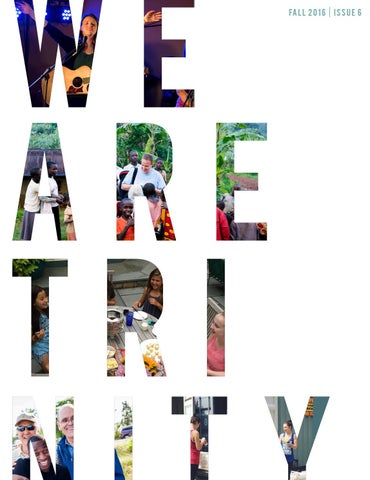
fa l l 2 0 1 6
issue 6
2
a S PA C I O U S P L A C E
mISSIONS,
6
OUTREACH & j U S T I C E AT TRINITY
contents 13
shifting the bottom line Getting
18
Connected at T r i n i t y : H o wa r d ' s S t o r y
21
Loving Our N eighbors a s O u r s e lv e s
welcome Welcome to the Fall 2016 issue of Trinity Life magazine! Our hope is that this edition will give you a snapshot of our community in action, and give you a f lavor of how you can connect, grow, and serve as part of the Trinity family. If you are new, be sure to check out page 18 for ways you can get connected! Within these pages, you will find stories from Trinity family members about how they have found a place of deeper engagement with the move of God’s Spirit in our community. Whether it is Howard’s story of connecting into the Trinity family, Phoebe talking about serving locally and abroad, or Ben ref lecting on the power of Kingdom enterprise, I hope that you will be inspired about the spacious place God is leading us all into and encouraged about your unique place in His story. In His love, Drew Williams, Senior Pastor
Trinity Life team: Ruth May, Katie Stallard (content); Julien Jarry (photography); Kelly Teufel (desig n)
A
S PACI O U S P L AC E DR E W W I L L I A M S Once a month I meet with a group of senior pastors from Greenwich to pray together. We have done this for about two years and my fellow brothers-in-arms have become a faithful circle of friends. I am touched by the way God leads us to pray with real heart and conviction for each other’s churches and for the world. This small group of pastors has been aware of Trinity’s ongoing search for real estate and in March of 2015 one of them offered me what he felt was a word of encouragement from the Lord. The word was “Rehoboth.” Rehoboth means “a spacious place,” a place that God has set aside for us. The word first appears in the book of Genesis. Isaac has for a long time sought a well and finally God provides such a place. We are told that Isaac “…called its name Rehoboth, saying, ‘For now the Lord has made room for us, and we shall be fruitful in the land.’” (Genesis 26:22). My friend’s encouragement was that we should not give up our search but press on, trusting that the Lord would faithfully provide us with a spacious place where we as a church family could grow and f lourish. Over a year later, God is faithfully fulfilling His promise as we prepare to move into 5 River Road, our new
base of Kingdom operations, and lease office space at 1 River Road.
The promise of God’s presence is not dependent upon our faithfulness but upon the faithfulness of God.
2
“Rehoboth” was always, however, so much more than real estate! What, then, is the spiritual cartography of our new spacious place? It begins with the promise of God’s presence. To Isaac, the Lord said, “Sojourn in this land and I will be with you…” (Genesis 26:3). Mercifully, the promise was not dependent upon Isaac’s virtue or performance, as Isaac made many of the same mistakes that Abraham, his father, made (including passing off his wife as his sister!). Very clearly, the promise of God’s presence was not dependent upon Isaac’s faithfulness but upon the faithfulness of God. This promise is true for us today. How do we come into that promise of His presence? It’s always a matter of Word and Spirit. His living Word needs to be proclaimed and ingested, implanted, and imprinted on our hearts and all that happens by His Spirit who brings His Word alive and provides us with His power to do it.
The spacious place that God has in mind is also a place perhaps more a way of living where He is faithful to provide and we trust in His provision. Isaac’s story starts with scarcity. In the middle of a famine, God provided, and more than Isaac needed. Why is this important? Because when we can trust His promise to provide, come what may, we find that we are already standing in the spacious place and we become the bearers of His provision to others. The promise of “Rehoboth” was for Isaac, but it was also for the world. The Lord says to the people of God that through the tribes of Jacob (Isaac’s son) “I will make you as a light for the nations, that my salvation may reach to the end of the earth.” (Isaiah 49:6).
5 r i v er ro a d
Finally, the spacious place contains the promise of God’s peace. Peace comes not from the absence of bad circumstances but in the reassurance of God’s presence and promise to provide. For Isaac, God’s spacious place came in the midst of dispeace. We, too, take possession of our spacious place in a time of dispeace. But when we trust His promises, we find that we have the capacity to bring His peace to one another, to our community
1 r i v er ro a d 3
But as we
towards faith in Him … that [the Church] is so full of the life and joy of Christ that it overf lows with the reality of the presence of Jesus…” In this extraordinarily simple rendering of Jesus’ Great Commission, here is our calling in the spacious place.
accept His invitation and enter it, trusting in His promise to be present, to provide and to be our peace, we will find that this spacious place becomes broader, wider, higher, and deeper.
and country, and to the world. In fact, we are not truly at peace until we are able to do so. Our new base of Kingdom operations is a place from which God will equip us to go out and be His peace. Pain and poverty, disability and debt, injury and injustice have no place in God’s restored creation. The Holy Spirit is actively working against them now. And what Jesus desires to do, the Holy Spirit will empower Jesus’ people to do. Five River Road is a tangible expression of God’s empowerment. This spacious place, this place that God has provided for us, is indeed a place where as a family we can grow and be fruitful. God truly desires to bless and meet us in this place. But as we accept His invitation and enter it, trusting in His promise to be present, to provide and to be our peace, we will find that this spacious place becomes broader, wider, higher, and deeper. It increases as we make space for others to enter in. Earlier this year, the Archbishop of Canterbury, Justin Welby, asked people to pray for just three things: “…that all Christians find new life in their relationship with Jesus Christ… that all those you meet and are close to might see something of Jesus that draws them
4
In this way, perhaps 5 River Road is more like a greenhouse a place where the Trinity family is nourished and streng thened in our faith and in our love for one another and in everything we are already doing. It’s also a place to propagate new Kingdom life: seedlings transplanted and new ones planted, a proliferation of a whole new set of Spirit-led enterprises (Trinity is seriously one of the most entrepreneurial churches I have ever encountered), new out-workings of His love, new strategies of hope and healing and love. And it will be life to us. But it is life that is not just for us. It is life that we are to take out with us into the world.
Drew Williams is Senior Pastor of Trinity Church. Drew’s ministry has been directed toward helping people find and deepen an intimate relationship with God through Jesus Christ. He is passionate to see the church renewed and mobilized in the love and justice of God. Prior to Drew’s ordination in the Anglican Church in 2000, he practiced as a litigation attorney. Drew and his wife Elena came to the U.S. in 2009 to lead and serve Trinity.
2 01 6 E A S T E R PHO TO B O O T H
5
MISSIONS, OUTREACH & JUSTICE
a t Tr i ni t y
RUTH MAY T R A N S F OR M I NG O U R WOR LD T H R O UGH T H E L OV E OF GOD . This has been the vision statement of Trinity for a number of years and it drives us towards finding our place, as individuals and as a church, in God’s redemptive mission in this world. This vision is about being so captured by God’s
R E L IGION T H AT I S P U R E A N D U N DE FI LE D B E F OR E GOD , T H E FAT H E R , I S T H I S : TO V I SIT OR P H A N S A N D W I D OW S I N T H E I R A F F L IC TION , A N D TO K E E P ON E SE L F U N S TA I N E D F R OM T H E WOR LD .
J A M E S 1 : 27
redeeming love for us, so aware of how we have been rescued, that we find we can’t help but want to be a part of rescuing others. This rescue can be anything from inviting a colleague to attend an Alpha course, serving at a soup kitchen, reaching out to a lonely neighbor, being part of a mission trip, or getting involved in serving at Trinity’s home base. It is this heart to share the love of God with a broken world that has drawn Trinity to expand our “hub” in order to develop a resource center that can help fulfill this vision. It is this heart to
6
and we know that each of us has a place, a role, and a calling to be part of this vision. And, of course, the story is always the same – it is in giving that we receive. It is one of those gloriously mysterious cycles of God: that we love because we were first loved; we give out of what God has already put in our hearts; and then, as we give, we find it returned to us and multiplied over as we find we too are changed. “ … GI V E , A N D IT W I L L B E GI V E N TO YO U . GO OD M E A SU R E , P R E S SE D D OW N , S H A K E N TO GE T H E R , R U N N I NG OV E R , W I L L B E P U T I N TO YO U R L A P . F OR W IT H T H E M E A SU R E YO U U SE IT W I L L B E M E A SU R E D B ACK TO YO U . ” L U K E 6 : 3 8
see the Kingdom of God come in Greenwich, Fairfield and Westchester counties, the Northeast, and further afield that is calling us to develop a “spoke” model of church. And it is this heart that drives us to pack our bags and travel to Uganda, to run food drives for Neighbor to Neighbor, to serve meals at New Covenant Center, and to partner with outreach organizations locally and internationally. As a church, our dream is to be part of God’s Kingdom coming on earth, in all the different ways that He would lead us in this,
7
A
A helpful framework for thinking about missions and outreach is to think about there being three levels of engagement. The first level is the work of relief. This is the incredibly important emergency care after a natural disaster or crisis situation. It is direct and immediate aid that intervenes in a moment of crisis. Locally, this would include things such as soup kitchens for the homeless, emergency shelters for domestic violence, and overnight shelters for the homeless. It is about meeting an immediate physical, emotional, or spiritual need. The second prolific area of engagement is the work of development. If relief looks at a famine and delivers emergency food aid, development aims to look at the causes of the famine and might then seek to teach and encourage alternative farming practices and food storage to avoid the need for emergency aid. In our locality, an example would be Neighbors Link in Stamford, an organization that focuses on teaching English to
FOR D OING M I S SION
non-native English speaking families, providing them with legal support, and trying to help people find employment.
Development seeks to make it possible for
Development is teaching vocational skills to a recently rescued trafficking victim, or building schools and wells in developing countries. It includes education, job creation and training, and affordable housing programs. Development seeks to make it possible for an individual, a family, or a community to move beyond dependency on relief and into a place of self-sufficiency. Both relief and development are incredibly necessary; they need each other and are often found working in tandem together. They also tend to be the areas that gain funding and support. They can provide volunteer opportunities, and the work is often readily quantifiable and measurable – it is possible to tell supporters how many wells were built, how many
8
an individual, a family, or a community to move beyond dependency on relief and into a place of selfsufficiency.
homeless were fed, or how many job-seekers found employment. Historically, these areas have been the purview of Christian volunteerism and secular philanthropy. The church has found a place in financially and practically supporting development work, and the role of the church in these areas is needed and valuable. However, there is also a third level of engagement, known as social reform or system transformation. This is about changing a national, or international, system in order to end, eradicate, or reverse a societal norm that has enabled systemic poverty or under-development. This can take many forms. For example, in addition to sponsoring Rwandan children through World Vision to receive an education, system tranformation would entail going on to work with the Minister of Education in Rwanda in helping address the education needs of the whole nation. It is International Justice Mission (IJM) that, alongside rescuing young Cambodian girls from sex-trafficking, also trains and equips the national law and order infrastructure of Cambodia to rescue, prosecute, and ultimately end trafficking in that country. It is Partners in Health that responds to the urgent health needs of rural communities, and also builds a training hospital that serves the whole region of East Africa and changes the nature of health care. Or it is working with the mayor of Bridgeport to address the chronic issue of affordable housing, and advocating on a state level for support to end the cycle of poverty found in that community and other cities.
Globally, the church has tended not to engage so much with the work of system transformation. We often feel ill-equipped to wade into what can be complex and controversial issues. It can also be hard to gain support as the work is slow and arduous, and results can frequently be intangible and immeasurable. Social transformation aims to move beyond relief and development, and seeks to change the conditions that caused, or conditioned, that need. When Tim Keller writes about social reform in his book Generous Justice, he uses the story Jesus tells in Luke 10 of the Good Samaritan. Keller describes how the Samaritan takes care of the man who was beaten, caring for his wounds and nursing him to health. Keller says this is analogous to relief work, and then goes on to say, “Imagine a sequel to the Good Samaritan parable. The months go by and every time he makes a trip from Jerusalem to Jericho he finds another man in the road, beaten and robbed. Finally the Samaritan says, ‘How do we stop the violence?”’
9
SO W HAT I S At Trinity, we believe that we really are called to be part of seeing our world transformed through the love of God. We believe that we are equipped and called to be willing to respond and engage at each level of engagement. We support relief agencies such as New Covenant Center that every day serves more than 300 meals to those in need in Stamford, World Vision as they respond to a myriad of relief needs globally, JENGA in Uganda as they feed street children a daily meal in Mbale, and Neighbor to Neighbor that provides food and basic living essentials to families in need in Greenwich. We also want to come alongside our partner organizations as they do development work, such as New Covenant Center as they expand into job skills programs enabling the unemployed to seek work, and Neighbors Link as they work to sustainably integrate immigrant communities in Stamford, teaching English and connecting with employment opportunities. This also means being willing to step into and play our part in social transformation and
responding to God’s call to be a beacon of hope and light in a suffering and broken world. One tangible way is through partnering with IJM as they seek an end to slavery globally. We would love for you to consider where you might be being called to share the transforming love and grace of God. Maybe there is a neighbor or colleague you could reach out to and invite for coffee, to an Alpha course or to church on a Sunday. Or maybe you want to consider being part of a Trinity service team at one of our local partner organizations or even explore joining us on an overseas mission trip. Maybe God is calling you to take a prayer ministry course and step out in praying for the broken and hurting around you. Our dream is that, as a church family, we would play our part in God’s redemptive and transformational mission in the world – that each of us would be so captured by His love and grace in our lives that it would f low out of us and into the world around us, that we would each see His kingdom come on earth as it is in Heaven.
V I S I T T H E S E RV E PA G E S OF T H E T R IN IT Y WE BSIT E F OR IN F OR M A T ION O N H O W YO U C A N S E RV E IN A N D W IT H T R IN IT Y, OR C ON TA C T M E A T R UT H .M A Y @ T R I N I T YC H U R C H . L IF E Ruth May, Mission and Mobilization Pastor, holds a Masters in International Peace and Security and has worked for a number of years for development NGOs in Uganda and in the U.K. Ruth is passionate about seeing the church fulfill its mandate to partner with God in His redemptive mission in the world.
10
WE A S K E D P H O E B E M O R R IS, A REC ENTLY GRAD UATED S ENI OR FROM G REENWI C H AC A D E M Y WH O S E RV E D AS A S UM M ER I NTERN AT TRI NI TY C HURC H, TO WRI TE ABOUT H E R E X P E R IE N C E O F S E RV IN G L OC AL LY AND I NTERNATI ONAL LY.
When it comes to doing justice, oftentimes people find themselves starting by serving locally and growing out from there, eventually doing missions globally. I happened to do it backwards! Without having much exposure to serving the needy in my own community, I jumped at the opportunity in 2011 to go to Jamaica as an eighth grader with Trinity Youth. One moment we were a group of forty Greenwich students shivering in the Northeastern snow, and the next we were sweating under the Jamaican sun. We were in a culture we didn’t understand, with kids who spoke a language unknown to us and who were going through trials unimaginable to our young and protected hearts. Looking back on that first trip I can see that I wasn’t prepared for how it would change me, and it is obvious to me that all the good we did was by the grace of God. God used us in our weakness; when we stepped in on behalf of the poor, the weak, and the hurting, giving our trust, resources, and time to the Lord, He did incredible work. I went back to Jamaica with Trinity Youth two more times after that and each time I could see how God grew my understanding of justice. He was breaking my heart for the people He loves. And I began to hear God’s voice calling me to look beyond third-world countries as the only mission field. God showed me that there were less obvious hurting hearts surrounding me in my everyday life. It seemed easier for me to do mission in a far removed place such as Jamaica, and being part of God’s mission near home was something different and something that seemed very difficult for me. My junior year of
high school, “doing justice” was no longer confined to my annual mission trip to Jamaica. God was asking me to be His hands and feet, to carry His heart, on a more local level. It became so obvious to me that God’s heart was breaking for even my neighbors; I didn’t have to look far to find where I could ref lect God’s character of caring for the needy every day of my life. My huddle (a group of girls in my grade at youth group) especially showed me how to do justice and mission locally. One memory in particular stands out in my mind, when, at Christmastime, we walked the aisles of Whole Foods in Greenwich, praying and listening for God’s voice. We asked Him to show us who He wanted each of us to give an envelope to that contained encouraging Bible verses and money to help with all of the demands of the holiday season. God pulled each of us out of our comfort zone and into a place of vulnerability in order to do His work. That night, numerous Whole Foods employees were blessed by our faith, but we were infinitely more blessed by how we got to know God’s heart a little better. This summer, I found myself volunteering during Sunday morning services for the middle school group and 4th and 5th graders as well as at both weeks of Sky Camp. I know that God has been calling me even more locally – into my own church community – to do justice and ref lect His character. There is no right way to do mission, no right order or plan. For me, doing justice is about stepping out of the safe, comfortable place I am in and stepping into the lives of the vulnerable, weak, poor, and needy. God is ready to use each of us, wherever, whenever, however we are willing. God happened to use me first on a global level where I was most comfortable before stretching me to see the people who are hurting in my own life. It wasn’t logical, but my journey of doing justice has God’s hand all over it and I know that my heart was changed somewhere along the way. God changed my heart as I experienced His love and care for me, and for those around me, and I found I can’t help but love His people.
11
WE ARE T R INIT Y
12
Shifting T H E
B O T TOM
L IN E
B E N VA L E N T I N E
When we think about money and Christianity, we typically think of traditional philanthropy or “making donations,” but there is another, broader trend towards generosity that extends to how we spend our money and run our businesses. Nationally, the quest for “social good” is becoming central to how many entrepreneurs are defining their priorities. I had the opportunity to speak with several local business leaders, both from Trinity and the wider Christian community, to ask them about how following Jesus is shaping their business efforts, and for their recommendations and encouragement for those of us who are better trying to integrate our lives as Christians, consumers, and contributors to the larger society and economy. Here are excerpts from our fascinating conversations. To hear more of their stories, video interviews are available at www.trinitychurch.life/blog
A B O UT K Y LE
BE L L INGE R
LESLE Y
K ING
One of the owners of Back 40 Farm Group, consisting of Back 40 Farm in Washington, CT; two restaurants in Greenwich (Back 40 Kitchen and Mill Street Bar & Table); and Back 40 Mercantile, a general store in Old Greenwich
Part owner of NEAT Coffee, with locations in Darien and Westport; part owner of a coffee farm in southern Columbia called Finca El Mirador W I L L HAUGH E Y Co-founder of Tegu, a toy company based in Connecticut with a manufacturing facility in the country of Honduras in Central America. Tegu makes, designs and has invented magnetic wooden toys.
N AT E L AU Lead designer for Tegu
13
W H AT A R E Y O U T RY I N G T O D O D I F F E R E N T LY I N Y O U R BUSINESS? W i l l : When we talk about Tegu’s mission, what we are really talking about is our reason for being. When my brother and I were determining what this company would be, we agonized over the mission. Ultimately we concluded that, in response to God’s love for humanity, Tegu exists to bring hope, purpose, and opportunity to the people of the developing world through the creation of enduring commercial profit. We started with 12 people in an empty space in Honduras, filled it with some manufacturing equipment, and began to put them to work seven years ago. Today, that number is over 300. Last year, we brought everyone in the company down to Honduras and we hosted a day for the families of the workers. To see the sheer magnitude of what it means to employ 300 Honduran people and how that ripples through families is just a really incredible thing to behold. We often get the question, “Are you a Christian company?” and as one of my early investors told me, no business has a soul. First of all, the answer is no, we’re not a Christian company. What I would hope, as one of the founders, is that the company would bear the mark of Christ. I happen to be of the viewpoint and perspective that that’s a really good thing for business. We want to employ certain values that are universally appealing. But when you peel the layers back, really where is that coming from? It’s coming from this idea from the top that the way that Christ would work and serve is a great thing for business, whether it’s in a secular or a Christian realm. K y l e : When I’m buying coffee from other farmers or even from my own farm the goal is to give the farmers a price that is not only just sustainable, but is actually a lucrative business
W i l l Ha u g h ey ( l ef t ) a n d Na t e L a u ( r i g ht )
for them. Our goal is to actually incentivize farmers by paying them close to $3 a pound across the board (which is more than twice what the market price is) with the hope that we would get the highest quality possible in return and, obviously, develop long-term relationships with these growers. It’s not like we’re going in, buying coffee once, and never seeing these people again. The hope is to go back year after year after year. While we’re a young company, every relationship that we have begun with a grower is still in place. L e s l e y : We feel it’s our responsibility to take care of God’s earth. As we’ve gotten more and more invested in the organic farming community, we’ve realized that this is a great way to give back to the land. And so our farming goal is to leave the land with more nutrients and to leave the land in a better place than where we found it. Another intentional purpose of the farm is to employ
14
young people who want to be farmers. We’ve been working with Stone Barns to have the farmers who graduate from their internship (that is really like a Masters in Agriculture) come to Back 40 Farm and work with us on the rest of their skill set, such as where to distribute the product, how to do the accounting, and how to hire people and train people. The farm then led to a bunch of other businesses that have really grown organically (the pun is intended). Our farming efforts have led to amazing conversations, mostly around people at Trinity, that have led us into launching the Wednesday afternoon Farmer’s
Market in Old Greenwich, the restaurant business and then into this general store in Old Greenwich, Back 40 Mercantile. And when we decided to open up the general store, our goal was really to provide to our community a way to get access to great products that are high quality, aesthetically pleasing, and from amazingly talented artists. We carry things like Tegu wooden blocks (Will and Nate’s company) local people who are doing the right thing bringing a product that is sustainably-produced but that is fun to play with and has a lasting impact on the youth around here. We carry pottery by David Serianni, who made the pitcher and cups we use for Communion at Trinity. We sell Just Three Words, Karen Newman’s book about her journey with breast cancer, and that leads to so many more conversations about what it is to be a follower of Christ and what
15
it is to live a life that includes your faith and your beliefs in your everyday conversations. So while there is nothing around the store that absolutely declares our love of Jesus, it really is in all of our products and all of our choices and we have very natural conversations with people about what it means to be part of this loving community. We feel like we’ve gotten back so much more than we’ve given because of those conversations. When I have interactions with a customer, a vendor, or an artist and talk to them about their faith, I feel like I’m filled up and God’s love fills me up every day. We also decided early on that we would donate 10% of the store’s profits to the Partners In Health Food Security Program because a lot of what we had done as a family leading up to this more recent journey around the organic food movement was around Partners In Health and their social justice efforts.
W H AT W O U L D Y O U R LOVING CHALLENGE AND ENCOURAGEMENT TO THE CHURCH BE WHEN IT COMES TO HOW AND WHERE WE SPEND OUR MONEY? N a t e : I think in the time that I’ve been at Tegu, creating products that are meaningful and that will last, I’m learning more about my own personal tastes for things. As a consumer, I’m now not just thinking “Is this going to benefit me?” but I’m thinking “Is this a thoughtful purchase for me? Do I need to spend the money on this thing? How long is this thing going to last in my life?” But that’s just the first step. The second step is thinking about the people who are making this product. Are they thoughtful as well? It doesn’t necessarily mean that they need to be a Christian company; it doesn’t mean that they have to give back in one way or another. But are
Ky l e
B el li n g er
we being deliberate, are we being thoughtful, are we being good stewards of all the wealth that God has gifted us with? L e s l e y : The choices and decisions that we make and the products that we buy, both as employers and company owners and as consumers, can make a difference and have an impact on our world. We really have to challenge ourselves about what decisions we are making because they can change the trajectory of where things are going. I think of the verse (paraphrasing Luke 12:48b) “to those who have been given much, much is expected.” In this beautiful community that we live in we feel like we should be sharing as much of our gifts and our talents and our time as we can. Our vision was so much smaller than God’s vision. God’s vision was that this was going to be a much bigger, community-driven, mission-
driven effort that started with a little garden and has grown to be such a bigger community effort. Our challenge to the Trinity community is to figure out what it is that you want to give, what talent you have, and go for it with a passion that is really Godcentric but community-driven because the more we interact with each other, the more we get back. K y l e : I think no matter the organization, people generally want to be penny-pinchers. They want to be conscious of spending as little as possible. I think it’s okay to be frugal but I think, on the f lip side, there has to be an understanding that products come from somewhere. It’s not just coffee. It could be any product. It could be clothing. There are many products that come from somewhere that were produced by somebody’s hand and I think if the church is looking to spend as little as possible on certain products, it demonstrates a real disconnect between the beginning of the supply chain and the end. I’ve been fortunate enough to travel throughout Central and South America, and there are people who end up suffering if they don’t get the money that makes their businesses sustainable. The good news is people are still drinking coffee all the time. Most of us are going to be drinking coffee tomorrow morning and we have a choice. We can choose to pay more to make sure that the people that produce those coffees were compensated well for what they do. There are thousands and thousands of farmers in the world who all have the potential to create amazing quality but don’t have someone like NEAT or another company who can champion them. You can be a champion of their qualities, if you will, and ultimately make their businesses sustainable.
16
B u t
u l t i m a tel y ,
w h ere of
ever y
we
a s p e c t
a l s o of
wa nt w h a t
to
b e
i n
a
we
do
b ear s
po s i t ion the
m ark
Chr i s t .
W i l l : One of the great things that is happening with the onset of social entrepreneurship and the way in which it’s intersecting with the church is we’re no longer in a world where the sort of marching orders are that church members and church goers would make money and give money. What we’re talking about now is a much more nuanced integration. What we’re talking about is tithe as life. Can we tithe ourselves? Can we give ourselves? Can we sacrifice the trajectory of our career? Can we walk away from that next opportunity to focus on another opportunity that doesn’t really advance our agenda like you typically would for one’s self but actually opens up opportunities for other people? I think really the opportunity for the church in this day is to pour ourselves out and to think about that as our tithe and our offering. Yes, of course, we need to support the local church and be fed by the local
church and for that to be a good and healthy relationship. But ultimately, we also want to be in a position where every aspect of what we do bears the mark of Christ.
Ben Valentine, Associate Pastor, can often be spotted at his “second office,” NEAT in Darien, and loves visiting the Back 40 Far m on church retreats. When at home with his wife, Anne, High School Coordinator at Trinity, and young daughter, Tegu blocks are never far away. Ben is consistently inspired by stories of Christians using their gifts, platforms, and creativity to enrich culture.
17
L esley
K i n g
GE T TI NG
C ON N EC T E D
AT
T R I N IT Y :
Howard's Story BY K AT I E E VA N S
Whether you have just arrived at Trinity or have been with us for a while, there is a place for you in the family. We want to help you find that place and take the next step in your journey of faith. To paint a picture of what that could look like we thought we would share the story of a recent newcomer to Trinity Church.
Howard walked into that Saturday morning Bible Study unsure of what he might find and walked out feeling embraced by the community he found there. He says, “I was so overwhelmed with the love I received that first Saturday that I wanted to see the church.” That Sunday, while filling out a Connection Card at the Get Connected table, men he had met in the Trinity group kept coming up to greet him and introduce him to others! That morning he also met many others who would eventually become good friends.
Living in Brooklyn, Howard DaCosta was not expecting to attend a church in Greenwich, Connecticut. However, a life-threatening event in October 2015 and an intense encounter with God left him open to God’s leading. Ref lecting back, he says, “In the moment, when the first shot was fired at me, I remember calling out ‘God’ in my mind…The gunman turned back around and looked at me, but it was like he was looking at something else; something bigger than him. He then ran away. God was present that night with me.... I started to talk to Him more. I finally realized that Jesus has been with me all my life and that He loves me. I started crying and asking God for forgiveness.” Soon after this, Howard’s path crossed with one of Trinity’s Men’s Bible Study regulars, he was given an invitation to check out the men’s group, and much to the man’s surprise, he showed up!
Wanting to find out more about Trinity Church, Howard attended a Welcome to Trinity Breakfast. He learned about the mission, vision, and history of Trinity Church. He shared his story and met others who were also new to the church. He already felt like Trinity would be his church home. “I became a member of Trinity that day in my heart…The fellowship at Trinity has tremendously impacted my walk with God and I’m so grateful to be a part of this community.” As Howard continued to take part in the Men’s Bible Study, building relationships and growing deeper in his faith in God, he felt a tug toward serving in the Trinity community. He joined the Connection Team to warmly welcome others on Sunday
W h at i s y o u r n e x t s t e p at T r i n i t y ? Welc ome B reak fa s t
A l ph a
Joi n a Grou p 18
S er ve
Ba pt i s m
Alpha
mornings just as he had been. He jumped in to volunteer at both Christmas Eve services, helping people find seats and putting out more chairs when needed. He was quickly becoming woven into the fabric of the Trinity community.
Alpha is an opportunity to explore the basics of the Christian faith in a friendly, informal environment over ten weeks and a day retreat. Each session includes good food, a short talk designed to encourage conversation, and time to share thoughts and ideas on the topic in a small group. Alpha is an open and honest space to discuss life’s big questions together.
Trinity offered Alpha this past spring and Howard eagerly signed up to take the free 10-week course. With the help of the engaging Alpha videos and discussion groups, Howard began to process his life through this new lens of faith. He was given the opportunity to learn about Christianity, and to ask any and all of his questions. The discussion group became a place of safe conversation and true community. In June, Howard publicly proclaimed his faith in Jesus Christ through baptism. He braved going down into the cold waters of the Long Island Sound and symbolically rose with Christ in new life. About his baptism, Howard says, “I was blown away to see how many people came out to show their support.”
Alpha is a worldwide phenomenon. You’ll find courses running in 169 countries and in all 50 states, in 112 languages, and across denominational lines… meeting in churches, homes, prisons, coffee shops, and even bars. More than 29 million people have taken the Alpha course. Might it be your turn?
Our hope is that Howard’s story would, in some way, be all of our stories – that each member of the Trinity family would discover that they are known and loved, and find their place in the community. Like Howard, a great way to do this is to attend an Alpha course and serve on a team. If you would like to find out more about how you can connect with the Trinity family, grow in your faith, or serve our community, write to me at katie.evans@trinitychurch.life, or visit the Get Connected area on a Sunday morning!
FOR MORE INFO OR TO REGISTER FOR THIS FREE COURSE, GO TO
Katie Evans, Connections Pastor, loves helping people find their place in the family of God. She is passionate about seeing people find (and create!) meaningful Christian community and discover ways to live on mission with God. When not at Trinity, she can be found trying to keep up with her soon-to-be toddler, Luke, and spending time with her husband, Mason. No matter the season, they love walking as a family at Cove Island Park in Stamford and enjoying the beach.
1919
F e at u r e d T o p i c s
www.trinitychurch.life/alpha Is there more to life than this? Who is Jesus? Why did Jesus die? How can we have faith? Why and how do I pray? Does God heal today? Who is the Holy Spirit? What does the Holy Spirit do? How can I be filled with the Holy Spirit? Why and how should I read the Bible? How does God guide us? How can I resist evil? Why and how should I tell others?
SU PPOR T GROU P S DI VORCE CA R E A support group that meets weekly for 13 sessions to help you face challenges and move forward toward rebuilding your life
YO U T H G R O U P S
Kick-off S E P T . 18 A T 6 P M AT A RCH S T R E E T 10 0 A R C H S T . G R E E N W IC H
S e p t . 13 - D e c . 13 , 2 016 Tu e s d a y s , 6 : 45 - 8 : 3 0 p m a t Tr i n i t y H o u s e i n G r e e n w i c h TO
R EGI S T E R
call Rick Lewis & Jenn Eckart at 203-209-4332
huddles M I DW E E K S M A L L G R O U P S BY GE N DE R & GR A DE
MO U R N I NG W IT H HOP E A 10-week support group for those dealing with the grief of having lost a loved one, led by caring people who have experienced grief and have successfully rebuilt their lives
Questions? M I DDLE SCHO OL k r i s ten . ol s en @ t r i ni t ych urch . life
HIGH SCHO OL LE A R N
MOR E
AT
w w w.trinitychurch.life/g rief
j o e . bi s c o ch o @ t r i n i t y ch u rch . l i f e
L O V I N G O U R N E I G H B O R S A S O U R S E LV E S Ka t ie Sta l lard
photo: Joe Biscocho
“T e a c h e r , w h i c h i s t h e g r e at e s t c o m m a n d m e n t i n t h e L a w ? ” J e s u s r e p l i e d : “ L o v e the Lord your God with all your heart and with all your soul and with all yo u r m i n d. T h i s i s t h e f i r s t a n d g r e at e s t c o m m a n d m e n t. A n d t h e s e c o n d i s l i k e i t: L o v e y o u r n e i g h b o r a s y o u r s e l f. ” M at t h e w 2 2 : 3 6 - 3 9 Over the summer, more than 75 people participated in our first-ever Trinity Reads, gathering in geographically-based small groups to discuss The Art of Neighboring and consider what it would mean, practically, to “love your neighbor as yourself.” Randy Frazee writes in the book’s foreword, “The command to love our neighbors lies at the core of God’s plan for our lives... The journey begins when we choose a lifestyle of conversation and community over a lifestyle of busyness and accumulation. It’s about making room for life and choosing to befriend those God has placed around us.”
Reframing Hospitality In the middle of Romans 12, in a section on genuine love in action, you’ll find this: “Practice hospitality.” The exhortation is not qualified. It’s not preceded by “if you are naturally friendly, like to meet new people, enjoy throwing a party, are willing to open your home to visitors, or are gifted in making strangers feel welcome.” Elsewhere in the New Testament we are told “offer hospitality to one another without grumbling” (1 Peter 4:9). Author Kathy Chapman Sharp points out, “The Book of 1 John makes it plain that when we love others, we are showing our love for God… when we love and serve others in the community through hospitality, we are also serving God.”
21
These days the word “hospitality” often brings to mind having someone over for a meal. Scripture would have us think more broadly. Consider the parable of the Good Samaritan (Luke 10:25-37). It was the Samaritan, not the priest or the Levite, who showed mercy in getting the Jewish victim to a place where he could be tended to and then paid for the man’s medical and living expenses while he recovered. In The Art of Neighboring, Jay Pathak and Dave Runyon make this observation: “Jesus assumed that his audience would be able to love those nearest to them, their literal neighbors, the people most like them, who shared the same heritage and geography. In telling the parable, Jesus was stretching their concept of neighbor to include even people from a group they didn’t like.” Making a similar point, author Dave Stelzl writes, “Hospitality is about welcoming people into our lives, meeting their needs, and reaching out even to strangers, enemies, and hostile people.” Can we reframe hospitality, releasing it from any pre-conceived notions that might hold some of us back, such as an expectation of having a perfect home or the skill to prepare a gourmet meal from scratch? Can we see it instead as a means of showing God’s love to others? From that lens, who has God put on your heart and mind who might be lonely and appreciate your time, even if it’s just a phone call? Are there a handful of people who you think would really hit it off were they to get to know one another while drinking lemonade in your backyard?
W h en w e o f f er ho s pi ta li t y , es p e c ia l ly to fol k s who a re u s u a l l y o v er l o o k e d o r u n d er va l u e d b y t h e l a rg er s o c iet y , we m a k e a s t ro n g s t a t em en t a b o u t w h o i s va l u a bl e a nd g o o d to b e w i t h . W h en w e w el c o m e s ome one , we t a k e s er i o u s l y t h ei r h u m a n n e s s , t h ei r n e e d s and g if ts, v u l n era bi l i t i e s and c on t r ibu t ion s . I n o f f er i n g ho s pi ta li t y , w e o f t en a l s o o f f er a p l a c e i n c ommu ni t y . - Ch r i s t i n e Po h l , A s s o c ia te P ro v o s t a n d P ro f e s s o r o f Ch u rch a nd S o c iet y / Ch r i s t i a n Et h i c s , A s b u r y T he olo g ica l S em i n a r y
22
photo: Troone Marchak
Getting Started The extroverts amongst us are ready to jump in. If you’re an introvert, don’t stop reading yet! Why not set your sights on reaching out to one or two people and set a date to get coffee or go for a walk? Or, think about how you can be part of a group of people who are practicing hospitality together. You can f lip the hamburgers while an extrovert greets people at the door. Perhaps you can create the invitations that someone else personally hands out. With thanks to the writings of Jami Balmet, James Nored and Jen Wilkin, here are some tips:
Have new neighbors moved in?
Having people over for a meal?
Greet them with a plate of cookies or fresh f lowers, and a card with your name and contact information on it (it helps to have names in writing)
Set a table that makes everyone feel comfortable Choose a menu that allows you to be with your guests instead of being chained to the stove
Offer to share the names of your favorite local restaurants, your dentist, the plumber or electrician you use, etc.
Consider making it a potluck and ask guests to bring salad, a side or dessert Tidy up the space to make things pleasant, but don’t feel the need to conceal evidence of everyday life
Wa n t t o p r a c t i c e h o s p i ta l i t y w i t h i n t h e T r i n i t y f a m i ly ? Want to get to know other families but feel your space is too small to fit everyone?
Speak with Katie Evans, Connections Pastor, about being on the Connections Team
Bring muffins, fruit, or cheese & crackers for the Coffee Hour refreshments on a Sunday
Meet in a park for a picnic lunch so you can get to know each other in the sunshine while your kids play together
Find out about hosting a small group or an Alpha course in your home (someone else will be the facilitator)
Have each family bring their own meal while you provide the dessert
Open your home for ministry team gatherings, etc.
Hospitality is not the outward trappings of the event itself; hospitality is motivated by a genuine interest in the other person, expressed in a way that makes him or her feel seen and heard and welcomed. May we be a church family that is known for how we care for those around us.
Katie Stallard, Administration & Communications Director, credits how quickly her family felt welcomed into the Trinity family as making a big difference when they moved here from out-of-state in 1999. She joined the staff 11 years later.
23
MID-WEEK GROUPS CR A F T S
GA M E S
S H O R T TA L K
Women’� Retreat
P R AY E R SONGS
sparks
�
F O U R Y E A R O L D S - K I N D E R GA R T N E R S Tu e s d a y s 3 : 45 - 5 p m
J A N U A R Y 2 0 - 2 2, 2 017
s t a r t i n g S e p t . 13
Made to Thrive “ ” L i v i n g f r o m t h e Fr e e d o m �
& � Fu l l n e s s o f t h e C r o s s
Speaker
Jea n n ie Cu n n ion 1
S T
- 3
R D
Register at
G R A D E R S
We d n e s d a y s 5 : 3 0 - 7p m s t a r t i n g S e p t . 14
4
T H
& 5 TH G R A D E R S We d n e s d a y s 5 : 3 0 - 7p m s t a r t i n g S e p t . 14
w w w. t r i n i t y ch u rch . l i f e / ev en t s
24
S TA F F D I R E C T O RY Locations (through Dec.31, 2016): Office: 1 River Road, 1st Floor Cos Cob, CT 06807 203-618-0808
Trinity House: 15 Sherwood Place Greenwich, CT 06830
Staff email addresses: firstname.lastname@trinitychurch.life
MEG NEWTON Operations Assistant
DREW WILLIAMS Senior Pastor
KRISTEN OLSEN Middle School Coordinator
JOSH BARTON Student Ministry Pastor
A N N PA R K Admin Assistant
H I LLARY B ERCOVI CI Senior Fellow – Trinity Institute
K AT I E S TA L L A R D Administration & Communications Director
DYLAN B ER RY 4th & 5th Grade and Middle School Coordinator
K E L LY T E U F E L Graphic Desig ner
JOE BISCOCHO High School Coordinator
KARA THOMPSON Finance Admin / Bookkeeper
BETH BULL Care & Community Pastor
A N N E VA L E N T I N E High School Coordinator
D AV E E D WA R D S Worship & Arts Director
B E N VA L E N T I N E Associate Pastor
K AT I E E VA N S Connections Pastor
E V E LY N V I A N A Volunteer Care & Community Assistant
A N D Y H AY B A L L Executive Pastor
ELENA WILLIAMS Prayer Ministry Director
MIKE IODICE CFO
F I N D
J U LI EN JAR RY Story teller / Videog rapher BETSY KEARNS Early Childhood Coordinator K E L LY L A L LY Admin Assistant
U S
R U T H M AY Mission & Mobilization Pastor
WEBSITE www.trinitychurch.life FA C E B O O K : Trinity Church - Greenwich, CT Trinity Kids CT Trinity Church: Student Ministries Trinity Church Women’s Ministry - Greenwich, CT Men of Trinity Church - Greenwich, CT T W I T T E R , I N S TA G R A M : @TrinityChurchCT
K AT H Y N E L S O N Volunteer Staff Assistant
25
MOBILE APP Trinity Church Life