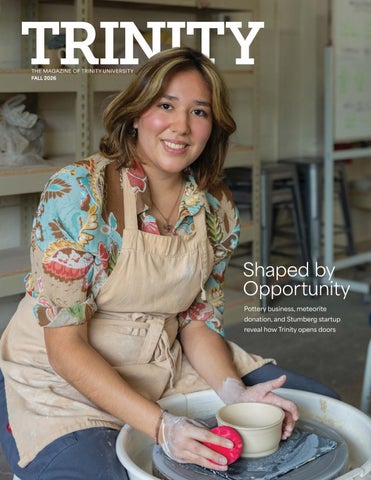
THE MAGAZINE OF TRINITY UNIVERSITY FALL 2026
Shaped by Opportunity Pottery business, meteorite donation, and Stumberg startup reveal how Trinity opens doors
TABLE OF CONTENTS
C2
TRINITY Fall 2026
Making an Impact Phil Mani ’80 donated 24 meteorite specimens to the Department of Earth and Environmental Geosciences this summer, establishing Trinity University’s first research collection of meteorites.
42
FEATURES 34 Full Circle 42 Making an Impact 50 Clicking Together
DEPARTMENTS 6
Trinity Today
14 Syllabus 21 Faculty Books 22 Trinity University Press 26 Tiger Pride 33 In Memoriam 56 Our Time 64 Alumni News 69 Class Notes 78 Club Activities 80 Commentary
trinity.edu/trinity-magazine
TRINITY
1
PRESIDENT’S MESSAGE Dear friends,
TRINITY Fall 2026
We’ve had much to be thankful for since last spring. Summer was busy with students studying away, conducting research, and forging their futures through internships. I joined the Trinity in Italy program’s field trips to Pompeii and Herculaneum, which renewed my appreciation for studying away with our faculty, guided by their expertise. I saw our students gaining the kinds of knowledge and perspective that can be attained only by standing in history’s footprints. The experience was just one of many hands-on learning opportunities at Trinity, some of which you can read about in our student features. Fall is also the season when several groups publish their national rankings, which continue to spotlight Trinity. You can read more about these, too. Rankings reflect our community’s devotion to excellence and external groups’ recognition of Trinity’s success. When we look only at rankings, though, it can be difficult to see the full extent of the dedication, brilliance, and hard work of our students, faculty, and staff. These efforts go far beyond what can fit on a spreadsheet. Looking into the future, we will begin 2027 with a new front door for the university. The Welcome Center, off Beneski Parkway, is a vibrant, beautiful space where prospective students can meet the Trinity community and mingle with current students, faculty, and staff. While Our Time: The Campaign for Trinity University continues to reach impressive milestones, there is still time to contribute to its momentum. Once again, the 1869 Challenge showcased how any gift, no matter the size, can make a difference for Trinity students. Our donors’ depth of generosity and devotion is felt throughout campus and is very much appreciated. We look forward to a strong finish and to celebrating your generosity when the campaign concludes in May. Whenever you read this, I hope you see yourself in the pages of this magazine. You’re here. Your good work has made indelible contributions to making Trinity the amazing university it is today and will be for generations to come.
Editor
Kennice Leisk ’22 Art Director and Graphic Designer
Laura Rodriguez Graphic Designer
Alfredo Valenzuela Copy Editor
Ashley Festa Magazine Staff
Gloriana Cardenas David Clark ’20 Clinton Colmenares Anh-Viet Dinh ’15 Tom Evelyn Danielle Gamiz Jeremy Gerlach Mason McLerran Lucero Salinas Cal Siewert ’22 Interns
Carmen Coulon ’28 Diego Bonilla Mena ’28 Porter Rice ’27 Joscelyn Flores Silva ’28 Contributors
Kenneth Caruthers ’15 Ryan Finnelly Halle Hamilton ’26 Kris Howland
With gratitude,
James Hill ’76 Thomas Jenkins Reign Kingsberry Sarah Moser
Vanessa B. Beasley, Ph.D. President, Trinity University
Justin Parker ’99 Joannah Pickett Pat Reyes This past summer, Trinity President Vanessa B. Beasley met up with students in the Trinity in Italy program during their field trips to Pompeii and Herculaneum, both active archaeological digs and busy tourist attractions.
2
TRINITY Fall 2026
Robyn Ross Aimee Rowse Blair Smith ’10 Terris Tiller ’00 Emma Winans ’29 Amanda Wise ’06, M’08
EDITOR’S NOTE Dear reader, President
Vanessa B. Beasley Board of Trustees
Ruth K. Agather P’18 Shari Becker Albright ’83, M’86 April Ancira ’02 Erin M. Baker ’99 Annell R. Bay ’77, P’13 Ted W. Beneski P’11, P’14 Bruce Blakemore ’80 John Brozovich Miles C. Cortez ’64, P’91 Sally Deitch M’03, P’29 Cydney C. Donnell Marshall A. Hess ’88 Gen. James T. Hill (Ret.) ’68 Ambassador Robert W. Holleyman II ’76 Jelynne L. Jamison M’88 E. Carey Joullian IV ’82 Christopher M. Kinsey ’79 John C. Korbell Michael J. Lynd Jr. ’95, P’24 Jeffrey W. Mueller ’00 Carey A. O’Connor ’93 Thomas Schluter ’85, P’16, P’18 Pat Semmes Darsh Preet Singh ’08 Jessica W. Thorne ’91 Scott W. Tinker ’82, P’14, P’20 John B. Tobola ’94 Paul Hensley ’87 Trinity University Alumni Association Board President The Rev. Dr. James D. Freeman ’83 Synod of the Sun Representative
One of the first doors that opened for me at Trinity University was actually through one that seemed shut. It was November 2018, and I was registering for spring classes. Still full of first-year nerves, I readied myself to enter the registration battlefield: Tiger Paws. A few nauseated seconds later, and I was almost in the clear, but then, as I went to enroll in “The Roman Novel,” I got the dreaded notification: “You don’t have the prerequisite for this class.” But I did. I had placed directly into advanced Latin coming into Trinity and was currently taking “Comedy and Satire” with Dr. Thomas Jenkins, unpacking the grammar and innuendos in Roman plays. (Hear more from Jenkins on p. 80.) I sent Dr. Jenkins an email, and he connected me with Dr. Timothy O’Sullivan, the then-classics department chair, who was teaching “The Roman Novel.” They quickly resolved the matter and then informed me of an opportunity that would shape the rest of my Trinity experience: the Roman World Lab. My first project in the lab was to work on a glossary for the commentary on Book 11 of Apuleius’ The Golden Ass that Dr. O’Sullivan and another student had started back in 2017. On and off from 2020 to 2021, my fellow researchers and I (one of whom is now my work colleague Cal Siewert ’22) read Apuleius’ text in Latin and English, compiling words and phrases into a glossary that would help readers fully understand the story’s historical, cultural, and political nuances. In a recent email, eight years after that first fateful one that unlocked the door to the lab, Dr. O’Sullivan shared the exciting news that our project will be published soon, with nearly 20 alumni named on the title page! The features in this issue reveal how stories like mine are the rule, not the exception, at Trinity. Apple Garcia’s pottery business and the Stumbergwinning startup HandiDoor illustrate how Trinity’s entrepreneurship program provides students with the resources and connections they need to pursue their passions with purpose. Like me, Phil Mani ’80 had a Trinity professor who made a lasting impression on him. And now, by donating meteorite specimens to the geosciences department, he’s opening doors for students following in his footsteps. I hope that, as you read this issue, you, too, reminisce about the opportunities and people who helped shape who you are today. Sincerely,
Trinity is published by the Office of Strategic Communications and Marketing and is sent to alumni, faculty, staff, and friends of the university who remain engaged with Trinity. Editorial Office
Kennice Leisk ’22 Editor, Trinity Magazine
Trinity University | Strategic Communications and Marketing 1 Trinity Place, San Antonio, TX 78212-7200 marketing@trinity.edu | 210-999-8406 trinity.edu/trinity-magazine
Scan or visit trinity.edu/logo-initiative to follow the progress of the Trinity Logo Conversation.
trinity.edu/trinity-magazine
TRINITY
3
THE BIG PICTURE What happens when Trinity University’s story meets San Antonio creativity? The wall outside the Coates Student Center has a whole new look, thanks to San Antonio muralist Nik “Soup” Soupe, who brought campus icons and local culture together in a colorful new work. Working with artist and designer Christie Kaye, Soupe created a mural featuring Murchison Tower, Trinity mascot LeeRoy, and mountain laurels alongside Talavera patterns and papel picado inspired by San Antonio. The project took 40 cans of paint and plenty of creativity, but for Soupe, the mural is about more than what ends up on the wall. It’s about the conversations, connections, and memories created along the way. photo by Anh-Viet Dinh ’15
4
TRINITY Fall 2026
Scan to watch a time-lapse video of the mural’s creation.
TRINITY TODAY
Photo caption: A student presents a poster during the 2026 Summer Undergraduate Research and Internship Symposium.
Making Discoveries of Their Own Trinity’s summer research program gives undergraduates an opportunity to move beyond the classroom and into original inquiry by Gloriana Cardenas For Trinity University students, summer gives under-
graduates opportunities to move from learning what others have discovered to making discoveries of their own. This year, 256 students participated in Trinity’s Summer Undergraduate Research Fellowship (SURF), spending 10 weeks immersed in faculty-mentored research and Trinity-related internships. Their work culminated in the annual Summer Undergraduate Research and Internship Symposium, where students shared their discoveries, experiences, and lessons with the Trinity community. This summer, computer science major Iniya Gopal ’28 researched the effectiveness of tools used to measure artificial intelligence (AI) data center energy consumption. “I hope that our findings will help researchers more accurately estimate the environmental impacts of generative AI, which is important in shaping policy and how we will use AI in the future,” she says. Now in its 42nd year of showcasing chemistry research and its 21st year of featuring interdisciplinary
6
TRINITY Fall 2026
work, the symposium reflects Trinity’s longstanding commitment to hands-on undergraduate learning. Of this summer’s participants, 217 conducted research and 39 completed Trinity-related internships, tackling projects spanning disciplines from business to the sciences, the humanities, the arts, and more. For students, these experiences offer more than a line on a résumé. Working closely with faculty mentors gives them the opportunity to develop confidence, sharpen professional skills, and explore questions with real-world implications. Each SURF participant received a $5,000 stipend, free summer housing, funding for travel and supplies, and one course credit. As Trinity President Vanessa B. Beasley, Ph.D., reminded students at the SURF President’s Reception, the summer provides its own evidence of what they can accomplish: difficult, meaningful work that can make a difference.
Rankings Roundup
Trinity Rises in 2027 Niche Rankings Hands-on approach to liberal arts, small environment fuel surge
position among liberal arts colleges in the nation. Trinity is now ranked No. 15 in the Best Small Colleges in America category (up four spots from last year) and No. 16 in the Best Liberal Arts Colleges in America category (up three spots), ahead of schools such as Colgate, Richmond, and Bates. The university rose 11 spots in the Best Colleges in America category, which ranks all public and private universities, to No. 65. Once again, Trinity ranked as the No. 1 Best Liberal Arts College and Best Small College in Texas. Among colleges of all sizes, Trinity is now one of the top 50 Private Universities in America (No. 47) and has risen 10 spots to No. 64 among the Best Research Universities in America. Niche draws data for its rankings from sources such as the U.S. Department of Education and the National Science Foundation. The ranking system prioritizes direct reviews from students on each school’s academics, diversity, athletics, value, and campus life.
National Liberal Arts Colleges
16
Best Liberal Arts Colleges in America
34
Small Private Colleges
#
by Jeremy Gerlach Trinity University has risen in the 2027 Niche rankings and continues to carve out a strong
38
#
#
U.S. News & World Report, 2027
Niche, 2027
Forbes, 2027
U.S. News & World Report, 2027 National Liberal Arts Colleges
1 in Texas #15 in Most Innovative Schools #35 in Top Private Schools #
Niche, 2027 Best Liberal Arts Colleges &
1 Best Small Colleges in Texas
#
Best Small Colleges
15 in America
#
Top Private Universities
47 in America
#
Best Research
64 Universities in America
#
65 Best Colleges in America
#
The Princeton Review
The Best 392 Colleges: 2027 Edition
Listed in Best Value Colleges, Best Southwest, Colleges That Create Futures
11 Best Science Lab Facilities
#
16 Great Financial Aid
#
25 Best Health Services
#
Top 50 Best Value Colleges
44 (Private Schools)
#
trinity.edu/trinity-magazine
TRINITY
7
TRINITY TODAY Trinity Student Selected as a Truman Scholar Alynn Jimenez Miranda ’27 is the first Truman Scholar from Trinity since 1998 by Clinton Colmenares, MFA Alynn Jimenez Miranda ’27, a political
science and international studies major at Trinity University, has been named a 2026 Truman Scholar, one of the nation’s highest and most competitive honors for undergraduate students. Jimenez Miranda is Trinity’s fourth Truman Scholar and the first since 1998. She was one of 55 scholars chosen from 781 candidates based on their academic success, leadership accomplishments, and prospects to become a public service leader. The scholars receive funding for graduate school, leadership training, and special internship and fellowship opportunities in the federal government. Jimenez Miranda’s public policy work began years ago. As a teen, she saw that violent crime was committed disproportionately against women in Victoria, Mexico, where she lived. In 2021, she organized four virtual workshops on gender-based violence attended by 250 people, and she debated policy on femicide and women’s rights in the Mexican Congress. In 2023, she founded Revolución Violeta, a bilingual organization that fights gender-based violence across borders.
Welcoming New Leaders, Investing in Trinity’s Future University renews President Beasley’s contract and welcomes new alumni leaders In May, the Trinity University Board of Trustees unanimously
approved a new five-year contract for President Vanessa B. Beasley, Ph.D. Beasley, who became Trinity’s 20th president in 2022, still had one year remaining on her current contract. During her first four years, Beasley led the strategic planning process that resulted in Ready. Set. Rise. and oversaw several major accomplishments, including new student recruitment records, two of the largest single gifts in university history that named the D. R. Semmes School of Science and the Carlos Alvarez School of Arts and Humanities, Our Time: The Campaign for Trinity University being on track to reach its $300 million goal, and the university’s rise to No. 37 on the U.S. News & World Report’s 2026 National Liberal Arts Colleges list. The Board of Trustees also named a new chair and vice chair and welcomed two new board members:
Cydney C. Donnell Chair
Professor emerita at Texas A&M University’s Mays Business School with a specialty in real estate who has served on Trinity’s Board of Trustees since 2019
Jeffrey W. Mueller ’00 Vice Chair
Co-founder, partner, and portfolio manager at Mueller Power Partners, an adjunct professor at Columbia Business School, and a former U.S. Marine Corps aviator and fighter tactics instructor
Bruce Blakemore ’80 Trustee
President of Primavera Resources Inc. who spent decades building a successful career in the energy industry and developed a reputation for resilience, entrepreneurship, and strategic leadership
Ambassador Robert W. Holleyman II ’76 Trustee
Retired following a distinguished career in international trade, technology policy, and public affairs, including serving as Deputy United States Trade Representative from 2014-17 under former President Barack Obama
8
TRINITY Fall 2026
Meet the Class of 2030 Accepted with a 28% admit rate, these impressive new Tigers are ready to shine at Trinity by Kennice Leisk ’22 This fall, Trinity University welcomed 654 new Tigers to its sunny campus. These 654
students enrolled after being selected from 11,658 applications, with a 28% admit rate. “The Class of 2030 includes truly exceptional academic scholars and students with a broad range of talents beyond the classroom. It will be so exciting to witness the contributions they make to our special community,” says Justin Doty, dean of Admissions.
They recognize you as a whole person and not just a number.” Even before setting foot on campus, Rowan Hankins ’30 has already explored the idea of zero gravity as an intern with NASA, designing a payload that carried lunar soil and water aboard a parabolic flight. Now, she’s excited about how Trinity’s engineering science major will help launch her dream of becoming an aerospace engineer. Hankins is also one of 167 recruited athletes in the Class of 2030 and is ready to make an impact on the women’s soccer team. She was drawn to Trinity for its small class sizes and approachable faculty, saying, “They recognize you as a whole person and not just a number.”
Tigers Across the Globe Meet three recent Trinity alumni who are conducting Fulbrights by Clinton Colmenares, MFA
Jackson Delhagen ’25
Fulbright Teaching Award to Spain
Delhagen majored in political science and minored in Spanish and history. Through his Fulbright, Delhagen says he hopes to not only “impart something on students that they’ll take with them forever but also become so deeply immersed in my community so that it becomes a part of who I am.”
Lara Lashus ’26 Fulbright Research Award to India
Class of 2030 Profile 28% admit rate 11,658 applications (third-highest in university history) 654 enrolled students 86% of the enrolled first-years applied early to Trinity, 27% through Early Decision and 59% through Early Action. 29 U.S. states, with a 7% increase in domestic applications and a 12% increase in Texas applicants Represents
Represents
20 countries, with the second-highest number of enrolled
international students over the past decade
Middle 50% of admitted students:
1360-1490 SAT score 31-34 ACT score 3.79 GPA (unweighted 4.0 scale)
Data accurate as of September 2026
Lashus majored in sociology and global health, and her research focused on gender, sexuality, and social and political injustice. In India, she’s “studying ethnomedicine and cultural and environmental shifts related to the business and harvest of native plants for medicinal uses” and extending her honors thesis work on hijra identity and the Indian state.
Marina Oquendo ’26
Fulbright Teaching Award to Spain’s Canary Islands
Oquendo triple majored in art history, global Latinx studies, and Spanish and minored in museum studies. She was a contributor to Conmemorando a la Comunidad, a digital humanities project that documents the Latinx experience at Trinity. In Spain, she says she hopes “to use my love of the arts and passion for my culture to connect with my students.”
trinity.edu/trinity-magazine
TRINITY
9
TRINITY TODAY
Trinity Launches Redesigned Website A story-forward approach and better organization highlight the new site by Clinton Colmenares, MFA If you’ve visited trinity.edu in the past few months, you
may have noticed things look a bit different. In July, Trinity University launched a redesigned website, marking a significant step forward in Trinity’s digital space. “The website is by far our most visible presence with more than 1.4 million unique visitors each year,” says Stephanie Enoch, the director of digital strategy in Trinity’s Office of Strategic Communications and Marketing (SCM). “Our goal is to ensure we’re delivering the right information in the right place at the right time, whether visitors are exploring, gathering information, or taking an important next step in their journey.” As a recruiting tool, the new design is studentcentric, Enoch says, with more stories and anecdotes about the student experience as well as more photos and videos of students and campus that show off the vibrant community and student engagement. To organize the nearly 5,000 pages of information, Trinity’s web team worked with partners from across campus and created an advisory council that represented the perspectives, needs, and expectations of the university’s audiences. They also
10
TRINITY Fall 2026
engaged students in a user experience class, led by Communication Professor Melissa McMullen, Ph.D., to participate in audience workshops and complete surveys that informed key decisions around content strategy. Enoch’s team partnered with Fastspot and ImageX Media to design and develop the website, and everyone in SCM contributed to the implementation.
Our guiding principle was to treat the redesign like a symphony. There were many players contributing to the success, and it all came together beautifully. It was really a community effort.” “Our guiding principle was to treat the redesign like a symphony. There were many players contributing to the success, and it all came together beautifully. It was really a community effort,” Enoch says.
Visit trinity.edu/news to see our redesigned Newscenter and read more Trinity stories.
Investing in the Scientists of Tomorrow The Semmes Foundation’s $6.1 million gift will expand research opportunities, faculty support, and hands-on learning by Gloriana Cardenas A $6.1 million gift from the Semmes Foundation is
creating new opportunities for Trinity University students and faculty to pursue scientific discovery on campus and around the world. The latest investment builds on the foundation’s decades of support for the sciences at Trinity, dating back to the 1950s. With this gift, the Semmes Foundation’s contributions during Our Time: The Campaign for Trinity University total more than $34.5 million for the university. Of the $6.1 million, $2.5 million will expand undergraduate research experiences, allowing students to work with leading scientists beyond Trinity in San Antonio, across the country, and internationally. The funding will also support year-round research opportunities through the Semmes Undergraduate Research Fellowship program. Meanwhile, $3.5 million of the gift has established the endowed Semmes Distinguished Professorship in Psychology, strengthening a growing department known for its research and experiential learning. Carolyn Black Becker, Ph.D., has been selected as the inaugural holder of the professorship. (Read more about Becker on p. 15.) The remaining gift funding will pilot a postbaccalaureate program that allows select graduating seniors to remain at Trinity for a fifth year to conduct intensive faculty-mentored research.
For Pat Semmes, Ph.D., a trustee and former computer science professor at Trinity, and Tom Semmes, who served as a Trinity trustee from 1994 to 2021, the foundation’s investments begin with students and the faculty who challenge and inspire them.
We want Trinity to be the college of choice for outstanding faculty and the brightest students.” “Everything is built around the students—the facilities, the investments, all of it. But right behind that is the faculty, because you can’t have great students without a stellar faculty,” Pat Semmes says. “When I ask students why they came to Trinity, they invariably say because of the faculty. When I ask the faculty why they came, they say it’s because of the high-caliber students. We want Trinity to be the college of choice for outstanding faculty and the brightest students.” The result is an environment where undergraduates don’t simply study science; they contribute to it. “Faculty and students are making discoveries,” says David Ribble ’82, Ph.D., dean of the D. R. Semmes School of Science. “This is real research. It’s research with undergraduates.”
trinity.edu/trinity-magazine
TRINITY
11
TRINITY TODAY
Pull quote: The university approached the building and its relationship to the surrounding neighborhood as a whole. That kind of sensitivity makes a real difference in a historic district, and the finished project speaks for itself.”
Historic Holt Center Enters a New Era
— Ryan S. Reed, Chair of the Monte Vista Historical Association Architectural Review Committee
The newly renovated building on Oakmont Court pairs its Spanish Revival roots with modern spaces for meetings, conferences, and events by Danielle Gamiz Pull up to the front of Trinity University’s
William Knox Holt Center and you’ll be transported to 1920s San Antonio—an era of fascination with Spanish Revival architecture. Step inside and you’ll find modern refinement and a refresh of the historic home’s original style elements. It’s a chameleon building, designed to be both a sophisticated gathering hall and a tech-equipped conference venue. Working with the Monte Vista Historical Association and Studio8 Architects, the university just wrapped a two-year renovation and historic preservation project of the building. A contribution from an anonymous donor set the Holt Center project in motion, bringing the 100-year-old structure firmly into the modern era, ready not only to be used by Trinity but also to be rented by outside groups. The William Knox Holt Foundation gifted funds to Trinity to renovate the building during a fundraising campaign in the 1980s, and now another donor’s gift is making sure the building stays in Trinity’s community for the next generation.
2026 The ground floor is centered around a dining room that accommodates up to 60 people and can be transformed into a small lecture room, complete with audiovisual equipment and acoustical treatments.
c. 1980
12
TRINITY Fall 2026
2020s
2026
c. 1984
2026
top Original glasswork and moldings were maintained to keep the historic home’s character intact even after modernization. bottom Original fireplaces remain. Vaulted ceilings, carpeting, and acoustical wall paneling combine historic residential details with the practical requirements of a modern conference facility.
Reconfiguring the exterior walk-ups to the Holt Center has provided an accessible entrance to the front of the building.
2026
trinity.edu/trinity-magazine
TRINITY
13
SYLLABUS
photo caption: Students in the course prepared informative leaflets with their research to support visitors’ experiences.
Jane Austen: A Semiquincentennial Exhibition Curating community and literary scholarship by Cal Siewert ’22 For more than two centuries, Jane Austen’s
stories have captivated readers around the world. This year, students in an English seminar collaborated with Trinity University’s Special Collections to curate an exhibition of Austen-related holdings in celebration of the 250th anniversary of Austen’s birth. Students worked closely with English Professor Betsy Tontiplaphol, Ph.D., and Special Collections Librarian Colleen Hoelscher, MLS, to learn how to handle rare books, conduct research, and meaningfully represent their work for the public. “A project like this encourages students to think like public humanists, to remember that they’re cultivating knowledge that has value beyond the classroom,” Tontiplaphol says.
14
TRINITY Fall 2026
photo caption: English Professor Betsy Tontiplaphol (left) and Special Collections Librarian Colleen Hoelscher (center) helped prepare students for hands-on humanities research and public displays of their work.
Pull quote: I’ve felt so grateful to be a student at a university that invests so greatly into the humanities so that undergraduate students have the opportunity to participate in research.” — Emma Buhrman ’26
You’re Invited! Visit Special Collections in Coates Library to explore the exhibition yourself until Thursday, December 17.
Shaping an Intentional, Innovative Business Education Associate Dean Shage Zhang shares strategic priorities and exciting projects by Cal Siewert ’22 In her more than 13 years as a professor at
Trinity University, Shage Zhang, Ph.D., has earned a reputation for transforming goals into meaningful actions and improving the student experience along the way. Earlier this year, Zhang stepped into a new role as the associate dean of the Michael Neidorff School of Business. We asked Zhang to share some updates on her vision for the future. ARE THERE ANY PROJECTS THAT YOU’RE PARTICULARLY EXCITED ABOUT?
We have just finished a year of strategic planning work. One of the main pillars emerging from this process is “Path and Purpose,” which focuses on creating an exceptional four-year experience for students that integrates academic progression, leadership and professional development, and experiential learning. Another pillar emphasizes societal impact and making meaningful contributions to the communities around us. One new initiative is the Neidorff Summer Business Institute, a six-week
residential business experience for non-business students. Through faculty-led courses, company visits, networking events, and a consulting and community engagement project, students will build practical business skills and strengthen their career readiness. HOW ARE YOUR PRIORITIES TAKING SHAPE FOR THE NEXT YEAR?
The next review from our accreditor, the Association to Advance Collegiate Schools of Business (AACSB), is in Fall 2028, so our work is ramping up this year. What is particularly helpful is that many of the AACSB expectations and our strategic initiatives align and reinforce each other. That gives us opportunities to think intentionally about where we are, what we do particularly well, and where we want to go next. I have come to appreciate the value of connecting people and ideas and building on things that are already working well.
A Professorship With Purpose Carolyn Black Becker named Semmes Distinguished Professor of Psychology by Danielle Gamiz When Trinity University Psychology Professor Carolyn Black Becker, Ph.D., was
named the D. R. Semmes School of Science Distinguished Professor of Psychology last spring, the world-recognized researcher knew just how to use the time and resources that come with the title. Becker says the award gave her a sense of validation to rededicate herself to her students. “For the last phase of my career, I’m able to really focus on what I came here to do,” she says. Just a few months after she took on her new title, one can already see Becker putting this sentiment into practice: This semester, she has a line of undergrads snaking out her door during office hours, seeking academic support and advice on applying to graduate school. Supported by $3.5 million from the Semmes Foundation, the endowed professorship recognizes Becker’s excellence in teaching, research, and mentorship and will allow her to expand undergraduate research, clinical psychology mentorship, resilience training, and community-based mental health research.
photo caption: Associate Dean Shage Zhang (far right) hopes to create new initiatives to improve the four-year experience for business students.
trinity.edu/trinity-magazine
TRINITY
15
SYLLABUS
IMPACT: Accolades and Achievements Trinity University celebrates the scholarship, creativity, community engagement, and accomplishments of our faculty and
staff. Read some of the most recent highlights below.
Eduardo Davalos Anaya, Ph.D. Computer Science
Davalos had his research featured on Bioengineer.org. Together with researchers from St. Mary’s University in San Antonio, Vanderbilt University, and the Accenture Center for Advanced AI, Davalos helped make a groundbreaking advancement in medical imaging that enhances cochlear implant bone removal surgery.
Jane Childers, Ph.D. Psychology
Childers had her article “Investigating Children’s Noun Learning in Uganda” published in the Journal of Cognition and Development.
Christina Cooley, Ph.D. Chemistry
Cooley recently published collaborative research with the Harris Lab at UT Health San Antonio, with Megan Tansiongco ’26 as a co-author. Cooley also had her lab’s research “Systematic Optimization of Fluorogenic ARGET ATRP toward Rapid and Oxygen-Tolerant Analyte Detection” published in a special issue of ACS Omega that highlights the role of undergraduate research as meaningful career preparation. Four students, now alumni, were co-authors: Jordan McMurry ’21, Jose Ricardo dos Remedios ’22, Nicholas Cipolla ’25, and Max Chamoun ’19.
16
TRINITY Fall 2026
Michael Fischer, Ph.D. English Emeritus
Fischer had his book How Books Can Save Democracy selected as the 2026 Gold Winner in the political and current events category by the Independent Book Publishers Association.
Jorge Gonzalez, Ph.D.
Education and School Psychology
Gonzalez was recognized by the School Psychology Review with an Editorial Appreciation Award for exceptional service on the 2025 Editorial Board. Gonzalez was selected for the quality, timeliness, and constructive nature of his reviews and for his contributions to support the advancement of research, practice, and policy in school psychology.
Rachel Joseph, Ph.D.
Human Communication and Theatre
Joseph had her book, Screened Stages: On Theatre in Film, published by Routledge in June 2025.
Andrew Kania, Ph.D. Philosophy
Kania had his article “Theorizing Covers” published in the British Journal of Aesthetics. Kania also participated in two events in Greece celebrating the
publication of the Greek translation of his book Philosophy of Western Music. In Athens, he joined a panel discussion about the translation organized by the book’s publishers. He also appeared at the fifth annual Chania Book Festival in Crete, where he took part in an interview about his work.
Carl Leafstedt, Ph.D. Music
Leafstedt was awarded $5,000 by the GRAMMY Museum in Los Angeles to support his project to restore and preserve the complete catalog of an independent classical record label active in New York City after World War II. (Read more about Leafstedt’s grant on p. 19.)
Lindsay LeBlanc Alumni Relations and Development
LeBlanc won a Circle of Excellence Award from the Council for Advancement and Support of Education (CASE) for her innovative playing cards used as invitations for last year’s Night Out in Vegas event.
Andrew Porter, MFA English
Porter had his novel The Imagined Life selected as a finalist for the International Lattes Grinzane Book Prize, a major international book prize curated by the Bottari Lattes Foundation in Italy.
photo caption: From left to right: Christina Cooley, Rebecca Rapf, and Aaron Harrison
Jacob Tingle ’95, Ed.D. Business
Administration
Tingle and his research colleagues have been selected as recipients of the 2026 National Intramural-Recreational Sports Association (NIRSA) President’s Article of Distinction Award, which celebrates outstanding writing from the previous year’s Recreational Sports Journal, recognizing impactful contributions that help shape and inspire the field of campus recreation. Tingle was awarded this distinction for the article “NIRSA Student Referees: Exploring the Connection Between Sense of Community and Positive Health and Wellbeing Outcomes.”
Luke Tunstall, Ph.D.
Academic Success
Tunstall was invited to participate in the Transforming Post-Secondary Education in Mathematics Modernizing Undergraduate Math Summit at Harvard University. Sixty leaders from mathematics, higher education, industry, and partner organizations gathered at Harvard to develop a shared vision and roadmap for undergraduate math in the artificial intelligence and data era.
Adam Urbach, Ph.D. Chemistry
Urbach was awarded a grant of more than $535,000 by the National Institutes of Health (NIH) to conduct research with Trinity students on developing new methods for accessing proteins in their native environments.
Jie Zhang, Ph.D.
Modern Languages and Literatures
Zhang had her co-translated volume, Time Tunnel: Stories and Essays by Eileen Chang, shortlisted for the Baifang Schell Book Prize: 2025 Literature Award by the China Books Review and Asia Society in New York and received an honorable mention. The jury described Zhang’s volume as “a thrilling reminder of Chang’s incomparable ability to trace the private thoughts of people caught up in times of cultural and social upheaval.”
Got an Accolade To Share? We want to hear it! Email us at stories@trinity.edu for a chance to have your achievement listed in the next magazine issue.
Hands-On Chemistry $1.05 million Welch Foundation grant supports three faculty and their undergraduate researchers by Jeremy Gerlach At Trinity University, three chemistry
professors and their undergraduate researchers are tackling questions with potential real-world impacts, supported by more than $1 million in new funding from the Welch Foundation, one of the nation’s largest private funders of fundamental chemical research. These three grants support the research of Christina Cooley, Ph.D., Rebecca Rapf, Ph.D., and Aaron Harrison, Ph.D. Their awards bring the number of Welch-funded faculty in Trinity’s chemistry department to five, including Jason Shearer, Ph.D., and Adam Urbach, Ph.D. Cooley’s, Rapf’s, and Harrison’s projects demonstrate how basic science can lay the groundwork for discoveries with real-world impact. For Cooley, the focus is on borinic acid prodrugs designed to activate in the presence of reactive oxygen species, potentially enabling more targeted treatments for conditions such as cancer and neurodegenerative diseases. Rapf’s students use advanced instrumentation to investigate chemical reactions at air-water interfaces, gaining experience that can prepare them for careers across the sciences. Harrison’s lab explores how molecular surroundings influence photochemical reactions in atmospheric aerosols, with implications for biomedical and materials research.
trinity.edu/trinity-magazine
TRINITY
17
SYLLABUS
University Honors Faculty and Staff Awardees Trinity University recognizes outstanding faculty and staff whose teaching, research, service, advising, and leadership have made a lasting impact
on the campus community. The annual awards celebrate individuals whose contributions advance student success, academic excellence, and the university’s mission across disciplines and departments. Dr. and Mrs. Z. T. Scott Faculty Fellowship The highest recognition of excellence in teaching and advising at Trinity
Timothy O’Sullivan, Ph.D. Classical Studies
O’Sullivan’s teaching philosophy emphasizes developing skills in his students that have broad application, including discernment via active engagement with scholarly debates and source criticism. He has designed many unique learning experiences for students, including the first humanities lab at Trinity.
Danny and Kimberly Anderson Faculty Prize Recognizes exceptional mentorship of research students in honor of former Trinity President Danny Anderson, Ph.D., and his late wife, Kimberly
Carolyn Black Becker, Ph.D. Psychology
Deneese L. Jones Award for Inclusive Excellence Recognizes outstanding support of inclusive excellence in honor of Deneese L. Jones, Ph.D., former Trinity vice president for Academic Affairs
Distinguished Achievement Awards Awards recognize outstanding dedication and accomplishments at the university
Michele Johnson, Ph.D.
Emma Treadway ’11, Ph.D.
Biology
Engineering Science
E’Randa Newsome
Emilio de Antuñano Villarreal, Ph.D.
Center for International Engagement
Distinguished Early Career Faculty Teaching and Research Award
History
Murchison Term Professorships Awards honor exceptional achievement in teaching, scholarship or creative activity, and service among Trinity faculty members
Award for Distinguished Advising
Maria Pia Paganelli, Ph.D.
Community, and Professional Service
Economics
Andrew Porter, MFA
and Mentoring
Maxence Leconte, Ph.D.
Modern Languages and Literatures Award for Distinguished University,
Kelly Grey Carlisle, Ph.D. English
English
Award for Distinguished Scholarship,
Amy Stone, Ph.D.
Heather Sullivan, Ph.D.
Sociology and Anthropology
Research, or Creative Work or Activity Modern Languages and Literatures
Helen Heare McKinley Employee Excellence Award Trinity University recognizes staff members whose leadership, innovation, and dedication have a meaningful impact behind the scenes.
Paul McGinlay
Head Coach of Trinity Men’s Soccer
Andrew Tucker
Academic Office Manager for the Department of Music
18
TRINITY Fall 2026
NSF Grant To Power Trinity Research New high-performance computing cluster will level up faculty-student research by Danielle Gamiz The National Science Foundation (NSF) awarded Trinity University a $750,000
photo caption: Music Professor Carl Leafstedt (far right) is working alongside Trinity students to organize a new collection from Bartók Records.
Bartók Gets a New Spin Trove of original Bartók Records masters, hidden for 70 years, now in care of Trinity professor by Jeremy Gerlach Music Professor Carl Leafstedt, Ph.D., is now
the caretaker of a trove of records, master tapes, books, scores, letters, and other artifacts from Bartók Records, the label founded by Peter Bartók, son of legendary Hungarian composer Béla Bartók. “This collection is a godsend to the music community,” says Leafstedt, who received a GRAMMY Museum grant to catalog, study, and preserve the collection. “This is such a rare chance to have all the original production materials in one place from such a prominent label.” Peter Bartók launched his label in 1949, recording some of the era’s finest musicians and producing early recordings of his father’s compositions. After years of political conflict surrounding the Bartók family legacy, Peter eventually retreated to Florida, where he preserved his collection in seclusion. Now, Leafstedt and Trinity University student researchers have started organizing the collection. Before graduating
in May, Greta Shadle ’26 helped organize thousands of books and documents in 17 languages, discovering handwritten notes, signatures, and even pressed flowers left behind. Graduate student Jake Cipolla ’26, M’27, starting as an undergrad, has organized 700 historic reel-to-reel tapes, researching the label’s early history along the way. “It’s a surreal feeling, to touch things, letters, records that are from the 1920s and probably earlier,” Cipolla says. Leafstedt has also brought Music Professor Melissa Camp, Ph.D., a specialist in historic recording technology, onto the project. Together, they’re working to reunite more scattered pieces of the estate. With any luck, Trinity may soon have direct access to the world’s largest collection of Bartók originals. “If you’re excited about music history,” Leafstedt says, “we’re rebuilding a bit of it here in real time.”
Major Research Instrumentation grant to upgrade its high-performance computing cluster. The new multimachine cluster will feature updated graphics processing unit (GPU) technology and support computing-intensive research across computer science, mathematics, chemistry, physics, biology, and other disciplines. Led by Computer Science Professor Matthew Hibbs, Ph.D., the cluster will primarily support faculty-student summer research. Projects range from protein aggregation and gene-function prediction to genome assembly and large-scale data analysis. Expected around the beginning of 2027, the new equipment will provide a big leap in terms of GPUs, which can handle thousands of calculations at once—ideal for research projects. Hibbs adds that access to this level of computing gives Trinity students research opportunities more commonly associated with major research universities.
pull quote: GPU technology has changed a lot over the last 10 years, so I’m excited for students and faculty to have access to more cutting-edge hardware.” — Matthew Hibbs, Ph.D., Computer Science Professor
trinity.edu/trinity-magazine
TRINITY
19
SYLLABUS
Conversations Across Disciplines President’s Book Club brings faculty and staff together by David Clark ’20 A new Trinity University tradition is giving
faculty and staff another way to learn from one another. In the summer of 2025, Trinity President Vanessa B. Beasley, Ph.D., launched the President’s Book Club, a way to gather the campus community around literature from Trinity authors. Each 90-minute conversation creates space to explore the ideas, experiences, and research behind each book. The summer selection, I Am Trying to Love the Whole World, comes from Poetry Professor Jenny Browne, MFA, the 2018 Poet Laureate of Texas and Distinguished Fulbright Scholar in Creative Writing at Queen’s University Belfast in Northern Ireland. Some of the collection’s earliest poems are from the pandemic, when Browne was navigating isolation, online teaching, parenting, and the terminal illness of a close friend. One day on Zoom, she told her students, “I’m just trying to love the whole world, you know?” The declaration became a daily writing prompt for five years and, eventually, the book’s title. For its fall gathering, the club chose The Choir Playbook by Gary Seighman, D.M.A., professor, music department chair, and director of choral activities. Drawing from music, sports, film, psychology, and everyday life, Seighman illustrates how the qualities that make an ensemble thrive—listening, trust, collaboration, and shared purpose—can strengthen the way we all lead, work, and connect with others.
20
TRINITY Fall 2026
Out of Office, On Fellowship Kathryn Vomero Santos gives an update on her experience as a National Humanities Center Fellow by Gloriana Cardenas If you’ve emailed English Professor Kathryn Vomero Santos, Ph.D., this fall, you may have
received an out-of-office message. That’s because she’s hard at work as a 2026-27 fellow at the National Humanities Center. Santos is part of a cohort of 29 scholars chosen from 450 applicants nationwide to bring their work to one of the most prestigious stages in the humanities. Situated in the forest in Durham, North Carolina, the center is full of natural light and offers a wide range of workspaces. Surrounded by shelves stocked with supporting materials, Santos is advancing her latest project: her next book, Mischiefs Manifold: A Cultural History of Sycorax. “While Mischiefs Manifold is a project about an absent female character in Shakespeare’s The Tempest, Shakespeare will ultimately play a small role in the story I seek to tell about the many artistic and intellectual afterlives Sycorax continues to inspire,” Santos says. “I’m incredibly grateful for the opportunity to do this work in conversation with a remarkable group of humanities scholars from a wide range of fields because I see this transmedial, transhistorical book about Sycorax as a truly interdisciplinary project.” At Trinity University, Santos teaches courses on Shakespeare and his afterlives; early modern literature; translation studies; Borderlands studies; critical race and ethnic studies; and women’s, gender, and sexuality studies. She also regularly mentors undergraduate researchers. “The book that I will be working on during this fellowship grows directly from a seminar on ‘Absent Women in Shakespeare’ that I regularly teach at Trinity,” Santos says. “I look forward to carrying my students’ insights and curiosities into my research.”
FACULTY BOOKS
Hot off the Press Welcome to the space dedicated to celebrating books authored, edited, or translated by Trinity University faculty. The selections for this issue were published between March and September. I Am Trying to Love the Whole World
Contemplative Praxis and Politics
The Choir Playbook: Tools
by Jenny Browne, MFA
co-edited by Shannon Mariotti, Ph.D.
for the Imaginative Conductor
English
Qi as Lived Experience: Breath, Wind, Potency, and Mind in Chinese Thought
co-authored by Stephen Field, Ph.D.
Modern Languages and Literatures The Ancient House: Constructing Community in the Seventeenth-Century New York Borderlands
Erin Kramer, Ph.D. History
Political Science
Ecologies of Resistance: Arts, Activism, and Transdisciplinary Futures in Latin America and the Latinx Worlds
co-edited by Ana María Mutis, Ph.D.
Modern Languages and Literatures Jazz, Race, and Writing, 1945-1970
Willis Salomon, Ph.D. English
Gary Seighman, D.M.A. Music
Published a Book? Next issue, we’re expanding this section to include books from faculty, staff, and alumni! Submit your recent and upcoming book publications to stories@trinity.edu for a chance to have your work featured in the next magazine issue.
trinity.edu/trinity-magazine
TRINITY
21
TRINITY UNIVERSITY PRESS
A Letter From Trinity University Press As we get closer to the end of the year and the
press’s closure, we find ourselves reflecting on nearly six decades of publishing, events, author partnerships, and much more. We want to take a moment to thank our readers for the years of love and support you have shown our authors, books, and staff. Each event you attended and every book you purchased and read helped build a community around books, ideas, and stories worth telling. We also extend our gratitude to Trinity University’s leadership for their guidance through this transition and their support of the press staff. The venerated magazine Texas Monthly is relaunching its Texas Monthly Press book imprint and bringing members of our team on board in similar roles. We hope you’ll continue to support our authors and the books they’ve given the world. And most important, we hope you’ll continue reading! With gratitude, Trinity University Press staff
photo caption: Trinity University Press has published about 300 books since 2002, when it was restarted after a decade-long hiatus, and in the decades since its founding in 1967.
22
TRINITY Fall 2026
The Carework Project: Reckoning with Love, Labor, and the Living World by Jennifer Case
Part memoir and part cultural reflection, The Carework Project combines intimate storytelling with research, interviews, and visual art to explore what care means in a time of climate crisis. Jennifer Case shows how caregiving, often invisible, gendered, or undervalued, is central to our survival. She examines how trauma and burnout affect our ability to connect and how healing can start with the smallest gestures of attention. The book invites readers to envision a world where care is not a burden but a source of mutual renewal and belonging. Visually striking collage postcards enhance the text. The result is a hybrid work that feels both timely and timeless, honoring the messy, creative, and transformative act of caring for one another and the living world.
Texas Trails & Glass Pyramids: Creating the San Antonio Botanical Garden by Lewis F. Fisher
This history of the San Antonio Botanical Garden and its ambitious design, native plants, and enduring civic commitment traces the vision and bold choices behind its transformation. For nearly a century, San Antonio dreamed of a botanical garden. Ideas surfaced, sites were debated, and plans repeatedly fell away. Texas Trails & Glass Pyramids tells the compelling and often surprising story of how that long-deferred vision finally took root and how a neglected ridge shaped by reservoirs, park fragments, and municipal afterthoughts became the San Antonio Botanical Garden, now recognized as one of the nation’s leading regional gardens.
trinity.edu/trinity-magazine
TRINITY
23
THE BIG PICTURE Trinity University’s softball team advanced to the Southern Athletic Association (SAA) Championship game with a 14-4 win over Rhodes College. While the team ultimately fell to Berry College and finished as the runner-up of the 2026 SAA Conference Tournament, the Tigers made a triumphant return to the NCAA Playoffs for the first time since 2007, finishing 37th nationally. photo by Emma Winans ’29
24
TRINITY Fall 2026
TRINITY
25
TIGER PRIDE
Winter 2025-26 Athletics
Fenn
photo caption: From left to right: Ben Estis ’27, Jackson Lawson ’28, Connelley McWilliams ’27, and Taylor Starr ’28; images courtesy of Trinity Athletics
Men’s Basketball The Tiger men’s basketball team was led by Head Coach Marwan Elrakabawy, who completed his first season at Trinity with a 22-7 overall record and a 12-2 record in the SAA. Trinity finished as the SAA Regular Season Co-Champion and was the runner-up at the SAA Tournament. Zach Fenn ’26 was named the SAA Defensive Player of the Year, and the Tigers received an at-large bid to the NCAA Playoffs. Trinity won its opening round of postseason play but fell in the second round to NCAA quarterfinalist University of St. Thomas.
Tigers in Brazil Four students competed on USA D-3 teams this summer by Justin Parker ’99 This summer, four Trinity University student-athletes brought their Tiger spirit to the
Brazil Tour 2026. Organized by USA Sports Tours & Events, the Brazil Tour 2026 brings together NCAA Division III athletes from across the country who have earned recognition at the national, regional, and conference levels. From June to July, volleyball players Connelley McWilliams ’27 and Taylor Starr ’28 represented Trinity as members of the USA D-3 Volleyball Blue Team, and from July to August, men’s basketball players Ben Estis ’27 and Jackson Lawson ’28 competed on the USA D-3 Basketball Red Team. The basketball team visited São Paulo, one of the largest cities in the Western Hemisphere, and both teams spent time in Rio de Janeiro on Copacabana Beach, the site of the 2016 Olympic Beach Volleyball competition. When they weren’t competing, the students experienced educational, cultural, and social aspects of Brazilian life through city, school, and sports club visits, and they toured internationally recognized landmarks such as the Christ the Redeemer statue, Sugarloaf Mountain, and Ipanema Beach.
26
TRINITY Fall 2026
Minter Women’s Basketball Trinity’s women’s basketball team won the SAA Regular Season Championship in 2025-26, finishing with a 16-11 overall record and an 11-3 SAA record. Head Coach Cameron Hill ’99 was named the SAA Coach of the Year and picked up his 300th career victory in his 14 seasons with the Tigers. Kylie Minter ’26 was a Third Team All-Region selection by D3hoops.com, and the team finished second at the SAA Tournament.
Spring 2026 Athletics
Burns
Hellings
Swimming & Diving Head Coach Cathleen Pruden led the Trinity men’s and women’s swimming and diving teams to a sweep at the SAA Championships, earning SAA Coach of the Year honors for both teams, and Diving Coach Tommy Law was the SAA Women’s Diving Coach of the Year. Neely Burns ’26 was the SAA Women’s Swimmer of the Meet, and first-year Jack Hester ’29 was named Swimmer of the Meet and Rookie of the Year in the SAA. Burns and Hester both qualified for the NCAA Championships, along with several other teammates. Burns was a First Team All-American in the 400-meter individual medley and earned Second Team All-American honors in the 200-meter individual medley and the 200-meter breaststroke, and she was part of the 800-meter freestyle relay team that also secured Second Team All-America recognition. Burns was joined on the team by Kaya Alvegaard-Struble ’29, Amy Benson ’27, and Julia Carter ’27. Hester also earned First Team All-America honors in the 100-meter backstroke and Second Team accolades in the 200-meter backstroke. Luke Fender ’28 was a First Team All-American in the 500-meter freestyle and qualified for the All-America Second Team in the 1650-meter freestyle. Benson, Burns, and Carter were honored as CSCAA Scholar All-Americans for the women’s teams. Fender and Daniel Apostol ’29 garnering the same awards for the Trinity men’s squad. At the NCAA Championships, Trinity’s women finished 21st nationally, and the men were 23rd.
Baseball Trinity Baseball, under the direction of Head Coach Tim Scannell, finished the season with a 25-19 record and a 14-7 mark in SAA play. That was good enough to secure the SAA Regular Season Championship, and the Tigers finished third at the SAA Tournament. Scannell was named the Co-Coach of the Year in the SAA, and Will Hellings ’26 was a Third Team All-Region selection by D3baseball.com.
Trinity Athletics Wins 2025-26 SAA Commissioner’s Cup In its first year with the conference, Trinity
Rossi Men’s Golf Head Coach Sean Etheredge led the Trinity men’s golf team back to the NCAA Championships in the spring, and the Tigers finished 19th at the national event. Sam Rossi ’27 was named a PING First Team All-Region player. The Tigers finished third in their first SAA Tournament after moving over from the SCAC.
University has captured the Southern Athletic Association (SAA) Commissioner’s Cup all-sports trophy. The cup recognizes the all-sports champion among SAA member institutions, with points awarded according to each program’s finish in the regular-season sports standings. This is the 15th consecutive all-sports conference championship for Trinity University, following a 14-year streak in the Southern Collegiate Athletic Conference (SCAC) that ended when the Tigers joined the SAA for the 2025-26 school year. Trinity won 13 SAA regular-season championships and piled up a remarkable 140 points in the standings. That’s the most points scored in the league since 2015 and the most ever in the current scoring structure. Portions of this story were taken from the SAA release.
trinity.edu/trinity-magazine
TRINITY
27
TIGER PRIDE
Trinity Athletics Finishes 14th in Learfield Directors’ Cup Standings
Mason
Kersten
Women’s Golf Women’s Golf finished second at the SAA Championships, led by Head Coach Shelby DeVore ’18. Although the team fell just short of qualifying for the NCAA Championships, Jessica Mason ’26 made the individual draw. Mason finished fourth at nationals to earn the highest-ever finish for a Tiger golfer. She was named an Honorable Mention All-American by the WGCA, marking her fourth straight season to earn All-America honors. Mason also earned Third Team Academic All-American recognition from the College Sports Communicators and was awarded an NCAA Postgraduate Scholarship.
Men’s Tennis Head Coach Russell McMindes ’02 led the Tigers to a 14-9 overall record last year and to SAA runner-up finishes in both the regular season and the tournament. Trinity advanced to the third round of the NCAA Playoffs, while Kishan Kersten ’27 and Jared Perry ’27 also qualified for the NCAA Doubles Championship. Kersten also made the field for singles and picked up All-American honors in both singles and doubles, while Perry was also a doubles All-American. Ethan Flores ’27 and Roshin Kamath ’28 won last fall’s ITA Regional Doubles title to earn All-America honors this past season. Kersten was also the SAA Player of the Year and the ITA West Region Most Improved Player.
Trinity University Athletics finished 14th in
the Learfield Directors’ Cup for the 2025-26 school year. Established by the National Association of Collegiate Directors of Athletics (NACDA) and USA Today, the Learfield Directors’ Cup recognizes the nation’s top collegiate athletic programs based on their performances in NCAA Championships.
765.5 points compiled, a new school record
9th overall top-15 finish 1st top-15 finish since the 2007-08 season
5th consecutive season finishing in the top 25
19th top-25 finish in the past 31 years
28
TRINITY Fall 2026
Kriechbaum Softball Head Coach Bailey Wittenauer led the softball team to a 31-13-1 overall record and a 14-4 record in conference play. Trinity finished as the SAA Regular Season Co-Champion and finished second at the SAA Tournament. The Tigers earned a bid to the NCAA Playoffs for the first time since 2007, finishing third at the Seguin Regional Tournament. Megan Kriechbaum ’27 was the SAA Pitcher of the Year. Hannah Boudreaux ’27 (Second Team) and Kriechbaum (Third Team) were both named to the NFCA All-Region Teams.
Tin Women’s Tennis Trinity won both the SAA Regular Season Championship and the SAA Tournament title this year, finishing with a 17-2 overall record and an undefeated 5-0 record in conference. Head Coach Andrew Cohn was named the SAA Coach of the Year for his efforts, while rookie sensation Eva Kovachev ’29 was both the SAA Player of the Year and SAA Rookie of the Year. The Tigers swept the ITA Regional
Singles and Doubles Championships this past fall, securing All-America honors for Lucy Nabedrick ’28 (singles), Trinity Levy ’26 (doubles), and Rosabella Andrade ’27 (doubles). Lauren Tin ’28 was also named the ITA West Region Player to Watch. The Tigers advanced to the second round of the NCAA Playoffs as a team, with Kovachev also qualifying for the NCAA Singles Championships.
Diagana Track & Field Head Coach Marcus Whitehead picked up SAA Coach of the Year honors after leading the women’s indoor track and field team to the SAA Championship in the winter season. (The men finished second.) Thomas Melina Raab ’26 and Gianna Keena ’27 were named the SAA Men’s and Women’s Distance Runners of the Year for indoors, respectively, while Annabelle Lanik ’27 and Bocar Diagana ’26, M’27 both qualified for the NCAA Indoor National Championships. Lanik finished third in the long jump for First Team All-America honors, and Diagana was 16th in the triple jump to pick up Second Team All-America recognition. Melina Raab was also awarded the NCAA Jim McKay Scholarship, and Diagana added the NCAA Postgraduate Scholarship to his impressive career at Trinity. Both Tiger teams finished second at the SAA Outdoor Championships, and both Lanik and Diagana once again qualified for the national meet. Lanik earned another third-place finish for another First Team All-America accolade.
trinity.edu/live Tiger Network is Trinity’s livestreaming network, covering athletics and special events for a worldwide audience. Tiger Network showcases #TigerPride in full HD with real-time replays, color commentary by professionals and student-athletes, and on-demand options.
Watch events
ON DEMAND
On-demand videos include: • Concerts and performances • Archived speakers and lectures • Commencement exercises • And more!
trinity.edu/trinity-magazine
TRINITY
29
TIGER PRIDE
Right images courtesy of Trinity Athletics
Tiger Football Player Named SAA Man of the Year Caleb Bayer ’26 becomes the first Trinity student-athlete to receive the conference’s highest individual honor by Justin Parker ’99 Trinity University football All-American Caleb Bayer ’26 was
named the Southern Athletic Association (SAA) Man of the Year for the 2025-26 school year, becoming the first Tiger student-athlete to receive the highest individual honor awarded by the conference. This award puts an exclamation point on Bayer’s career as one of the most decorated Tiger football players in school history. Bayer earned his neuroscience degree this spring, following another successful fall season of Trinity football, leading the team to a 10-2 overall record and a fifth straight appearance in the NCAA Playoffs. The Tigers advanced to the third round of the postseason for the first time since 2002. As a student, Bayer logged 100 hours of volunteer work with Corazón Ministries Clinic, providing care and assistance to people experiencing homelessness and addiction throughout San Antonio. Working alongside medical professionals, he helped with conducting health evaluations, taking patient vitals, distributing
30
TRINITY Fall 2026
prescription medications, and providing wound care to individuals in need. He also participated in outreach efforts that delivered food, clothing, and clean needles to encampments for people experiencing homelessness. In addition, Bayer volunteered with the animal rescue organization SNIPSA, assisting with pet adoption events and helping connect rescued dogs and cats with prospective families. On campus, he played an active role in the Bengal Lancer fraternity, organizing philanthropy initiatives that raised funds for the Pat Tillman Foundation and strengthened community engagement among Trinity students. This past summer, Bayer completed Officer Training School after being commissioned into the U.S. Air Force through the Health Professions Scholarship Program. This fall, he started at the McGovern Medical School at UTHealth Houston through the Joint Admissions Medical Program (JAMP).
Legends in Sports, Leaders in Life See what three former star student-athletes are up to now
During Alumni Weekend 2026, Trinity University Athletics inducted seven
individuals and two teams into its Hall of Fame. Among the individuals were 1998 Division III Offensive Lineman of the Year David Coney ’00, four-time All-American tennis player Lindsay Smith ’03, and 2014 Southern Collegiate Athletic Conference Offensive Player of the Year Kelsey Falcone Lytle ’15. Let’s see how these former athletes are applying what they learned at Trinity to their careers.
by James Hill ’76
Lindsay Smith ’03 Tennis
Coney David Coney ’00
Smith majored in communication at Trinity and received her master’s in sports science and sports rehabilitation from Logan University. She now serves in several roles for Vetta Sports in St. Louis: directing adult tennis programs out of two facilities, teaching private lessons, leading clinics, and captaining the ladies interclub league. She is also the coordinator and scorekeeper for the entire interclub league in St. Louis.
Football
For 25 years, Coney has built a reputation as a financial adviser and regional leader at Edward Jones by mentoring 57 fellow advisers and counseling clients about income and long-term lifestyle impacts. Coney credits his Trinity education, where he earned a bachelor’s degree in business with a concentration in finance, for setting him on that path.
David Coney ’00 quote:
I love being a financial adviser and working at Edward Jones. My favorite part is the deep, lasting relationships I have with my clients, helping them achieve what is most important to them and watching them enjoy it.”
Lindsay Smith ’03
quote: I attribute my
preparation for these roles to the relationships that I built over my four years at Trinity. The long-lasting friendships, my coaches, and my professors really gave me the tools to survive the working world.”
Smith
Lytle Kelsey Falcone Lytle ’15 Women’s Soccer
Now an emergency medicine physician with Methodist Healthcare in San Antonio, Lytle (far right in photo) credits Trinity with setting her on a path to a medical profession. After earning degrees in biology and communication, Lytle attended McGovern Medical School at UTHealth Houston and completed her emergency medicine residency at Vanderbilt University Medical Center in Nashville before moving back to San Antonio in 2022.
Kelsey Falcone Lytle ’15 quote: Science
courses in particular encouraged me to move beyond rote memorization and to integrate information I’ve learned to critically evaluate new problems. As an ER doctor, I do this with every single patient, every single day.”
trinity.edu/trinity-magazine
TRINITY
31
TIGER PRIDE
Record-Setting 1963 Men’s Tennis Team Joined Trinity Athletics Hall of Fame The undefeated Tigers who sparked Trinity’s championship tradition were inducted during Alumni Weekend 2026 by James Hill ’76 For more than six decades, the accomplishments of Trinity
University’s 1963 men’s tennis team have echoed through the program’s history. At Alumni Weekend 2026, that legacy was permanently enshrined in the Trinity Athletics Hall of Fame. The 1963 team included Trinity’s Director of Tennis Butch Newman ’65, Trustee Miles Cortez ’64, and Trustee Emeritus Cliff Buchholz ’65, all of whom are also individual Hall of Fame members. Also on the squad were 1963 Wimbledon champion Chuck McKinley ’64, who died in 1986 and was inducted posthumously into Trinity’s Hall of Fame, and 1963 U.S. National Men’s Singles Championships runner-up Frank Froehling ’64, who was inducted into the Hall of Fame before his death in 2020. Bobby Joyner ’65, who died last February, was also recognized at the ceremony, having compiled a perfect 17-0 doubles record with Froehling from 1961 to 1963. The numbers alone tell an extraordinary story. The 1963 Tigers completed their third consecutive undefeated season, extending what became a 60-match winning streak. The program’s dominance continued through 1965, when Trinity set an NCAA record of 78 consecutive victories. Decades later, Inside College Tennis ranked the 1963 squad as the fifth-greatest men’s college tennis team of all time. McKinley compiled a 48-2 career record, including a 25-match winning streak during the 1962-63 season.
He and Newman became Trinity’s first tennis All-Americans following the 1963 season. Newman posted a career singles record of 53-2, still the best individual mark in Trinity history. Buchholz earned All-America honors in 1965 and teamed with Newman to reach the NCAA Doubles quarterfinals that same year, while Newman collected his second All-America honor.
pull quote: Looking back at those incredible years that went so quickly, I think they laid the foundation for all the notoriety that the Trinity tennis program has continued to attain.” “Looking back at those incredible years that went so quickly, I think they laid the foundation for all the notoriety that the Trinity tennis program has continued to attain,” Newman says. “But I would be remiss if I didn’t mention the importance of our coach, Clarence Mabry, our leader, who put this team together. He was a great mentor and role model for us young men and was genuinely concerned for each of us to always be the very best we could be!”
photo caption: Members of the 1963 tennis team and friends at a reunion on campus; from left to right: Trustee Miles Cortez ’64, the late Bobby Joyner ’65, the late Frank Froehling ’64, tennis supporter Ken Smith ’65, Trinity’s Director of Tennis Butch Newman ’65, and Trustee Emeritus Cliff Buchholz ’65
32
TRINITY Fall 2026
IN MEMORIAM
Michael Doyle
Deli Yang
Michael P. Doyle, Ph.D., Trinity University’s inaugural Semmes Distinguished Professor of Chemistry, died April 10. He was 83. Doyle joined Trinity in 1984. During his tenure, he transformed the chemistry department’s approach to research by expanding opportunities for undergraduate students and increasing both the scale and visibility of faculty scholarship. Under Doyle’s leadership, Trinity developed one of the nation’s largest undergraduate summer research programs, and the number of students engaged in meaningful research grew substantially. Doyle championed the belief that students, even in their first year, could contribute meaningfully to scholarly research. He advanced this vision through his teaching and mentorship and by advocating for funding and national recognition of undergraduate research. His efforts helped establish a national award recognizing faculty research at undergraduate institutions, supported by the Research Corporation for Science Advancement and presented by the American Chemical Society. Even after Doyle retired from Trinity in 1997, he continued to mentor faculty and support students. He and his wife, Janice, made a generous gift to establish the Michael and Janice Doyle Chemistry Summer Research Fund, which will support students pursuing careers in the chemical sciences in perpetuity. In honor of Doyle’s extraordinary impact, the Department of Chemistry has established the Michael P. Doyle Award for Outstanding Summer Research. This award will be given annually to a student who best exemplifies Doyle’s deep commitment to undergraduate research. Doyle is survived by his wife, his two daughters, and his four grandchildren. Memorial contributions may be made to the Doyle Chemistry Endowment Fund.
Deli “Lilly” Yang, Ph.D., the Neidorff Family/Centene Corporation Endowed Professor of Business Administration, died August 20 of cancer. She was 62. An accomplished scholar of international business and intellectual property, Yang spent 17 years contributing to Trinity University as a teacher, researcher, mentor, and academic leader. Most recently, she served as director of the international business program in the Michael Neidorff School of Business. Prior to joining Trinity in 2009, Yang served for eight years on the faculty at the University of Bradford School of Management in the U.K. She secured competitive research funding from major organizations, including the National Science Foundation and the Economic and Social Research Council, and was recognized for her expertise by the World Intellectual Property Organization. Deeply committed to discovery, she authored numerous books, scholarly articles, and book chapters. At Trinity, Yang helped advance the university’s international business curriculum, founded the international business major, and directed the international business program for several years. She also served on the Faculty Senate and previously held the role of associate dean of the Neidorff School of Business. Her greatest impact, however, was felt by the students she taught and mentored. Yang emphasized experiential learning and approached teaching with the same rigor and purpose that characterized her scholarship. She cared deeply for her students, treating them with a warmth and devotion that often made colleagues feel familial. Yang is survived by her husband, Maho Sonmez, her parents, her older brother, her younger sister, and her two nieces.
trinity.edu/trinity-magazine
TRINITY
33
Full Circle Pottery startup AppleBliss blends student’s heritage, creative spirit words by Jeremy Gerlach, photos by Carmen Coulon ’28, with assistance from Mason McLerran and Porter Rice ’27
Centering, throwing, pulling, wiring.
photo caption: The art above is an early sketch by Apple Garcia ’29 of how her plates would look after being decorated.
34
In a quiet pottery studio in San Antonio’s Southtown, Apple Garcia’s hands slowly blur as she shapes mauve clay, her wheel whirring as the summer heat simmers like a kiln of its own outside. Some days, small cups, or copitas, emerge from her wheel, followed by bowls and other tableware. These little vessels will one day carry spirits, caffeine, or even pinches of salt. But while her fingers are still stained with clay, Garcia aspires to work with an even more valuable material: time. “I want my pieces to invite you to stay at a table longer,” Garcia says. “There’s this tradition, sobremesa, which is the time after a dinner or a lunch where everyone stays seated at the table talking, sometimes longer than the actual dinner itself. You feel lighter; you laugh a little louder. That’s what I want my cups to bring to the table.” Heading into her second year at Trinity University, Garcia ’29 has launched a small startup, AppleBliss, which draws on her South Texas roots and Latina heritage to create earthenthemed tableware built around the concept of sobremesa. Emboldened by the flexibility of Trinity’s liberal arts environment and connected with San Antonio’s dynamic cultural and entrepreneurial opportunities, Garcia is shaping her future with her own hands.
TRINITY Fall 2026
photo caption: Garcia throws a cup on a wheel at a pottery studio near campus.
Open Table
photo caption: An early sketch by Garcia of a matching plate and cup featuring designs inspired by caladium plants.
Garcia enjoys a whole set of hobbies that readers might not expect from a person her age. “Yes, I crochet. I sculpt. I make pottery,” Garcia says. “Younger people are picking these types of activities up.” For Garcia, creating art is a way to feel in control when life is hectic. Since she was a kid, she’s popped on a pair of headphones (with music ranging from The Beatles and Latin Mafia to Melanie Martinez) and worked with a medium she can shape. Garcia, named by her father for the 1995 Peter Cetera song “Apple of Your Daddy’s
Eye,” started crocheting plushies and little key chains as a teen. She took custom orders and sold them at local markets around San Antonio with such success that she often ran out of materials. Garcia says she got this entrepreneurial, hands-on itch from spending time with her maternal aunt, Michelle Gonzales. “I had family dinners at my own house, but I would go over to my aunt’s house in Corpus Christi [two hours south of San Antonio] every other weekend with my sister when I was younger,” Garcia says. “My aunt does catering, baking, and seeing her make a living with her own hands, that was my first
trinity.edu/trinity-magazine
TRINITY
35
experience of entrepreneurship. I just didn’t know the term for it.” Garcia’s aunt left a 20-year banking career to launch her own catering business in 2016. “I’ve always loved having my table open and [seeing] the reaction people have to my food,” Gonzales says. “My niece has always been adventurous with her appetite. She was never shy about tasting something new.”
writing for the student-led campus newspaper, the Trinitonian, played tennis and swam, and joined Top Naach, a Bollywood Fusion student dance team. But she struggled with a nonstop impulse. “Even if I’ve worked 40 hours this week and I need to rest, this voice in my head is always saying, ‘You should be doing something. Have you done enough?’”
“My niece has always been adventurous with her appetite. She was never shy about tasting something new.” pull quote:
Gonzales’ table has overflowed with everything from lobster and crawfish to cookies and enchiladas, with a little blend of Tex-Mex and Southern homestyle. Her stalwart gas stove has endured through crises, such as Hurricane Harvey in 2017, when Gonzales opened her doors to strangers who didn’t have power in their own kitchens. Here was Garcia’s first taste of sobremesa. “People are always telling stories at [my aunt’s] table, reminiscing, debating,” Garcia says. “It’s just so much deeper than a normal conversation. These [moments] happen a lot at my aunt’s house because her house has a very open policy. I love the energy because of how lively it is, how there is always company and things to learn from the people there.”
Garcia found pottery lessons in the San Antonio community to soothe this restlessness, falling in love with the medium. But before launching AppleBliss, she found a different outlet to direct her creative appetite to: grilled cheese.
photo caption: Growing up, Garcia (left) and her sister, Mikayla, made fond memories at her aunt Michelle Gonzales’ (center) table.
Cheesy Story Life moved fast for Garcia as she headed to college in the summer of 2025. “Going to Trinity, honestly, I was ready for the academic rigor, and I was looking forward to a change of pace from high school,” she says. Garcia, who aspires to be a studio art and marketing double major, was challenged early by classes in business management, philosophy, and marketing but also enjoyed a painting class. “I usually work in 3D, so that was a nice surprise to find,” she says. Garcia was also relieved to find plenty of free time outside of class. She took up
36
TRINITY Fall 2026
Just one exit south on U.S. Hwy 281 from campus sits the Pearl, a must-visit location for shoppers, visitors, and foodies of all stripes. Here, Trinity University and the San Antonio branch of the Culinary Institute of America (CIA) collaborated on a pilot Entrepreneurship Bootcamp in early 2026 that teamed up students from each institution and tasked them with creating and marketing a gourmet grilled cheese sandwich at the farmers market that packs the Pearl weekly.
TRINITY
37
sobremesa pull quote:
“There’s this tradition, sobremesa ... the time after a dinner or a lunch where everyone stays seated at the table talking, sometimes longer than the actual dinner itself. You feel lighter; you pull quote:
laugh a little louder.
That’s what I want my cups to bring to the table.” 38
TRINITY Fall 2026
photo caption: Garcia (left) and her Loco Flamma teammate sold their grilled cheese at the Pearl’s farmers market during the Entrepreneurship Bootcamp.
“I’d never been inside the CIA Pearl building, so it was so cool to see the kitchens and that whole space,” Garcia says. “But what I really loved was the marketing … evoking a feeling in people through the sandwich.” Garcia’s team ended up winning the popular vote in the competition by blending a bit of Tex-Mex and French culture, producing a “three-cheese croquemonsieur,” made with a bit of blow-torched showmanship and accompanied by elote and a soothing watermelon agua fresca to drink. “People were stopping by to see the blowtorch, to see us pour the drinks, to see the colorful display we’d made,” Garcia says. “The story mattered just as much as the product. It actually helped to slow down so people could see how we were making everything.”
Launching a Startup This past summer, Garcia found herself wondering whether she could tell similar stories with her pottery. Working with Trinity’s Incubator summer program, Garcia found an entire
network of support and resources for crafting her own business. Elsa Fernandez, program manager for Trinity’s Center for Innovation and Entrepreneurship, says Garcia is one of many students who come to campus dreaming of building a new business. “Apple has been really inspiring to see. Even from the jump as a first-year, she little by little dipped her toe into different resources,” Fernandez says. “She’s come to networking events, and that connected her with the Entrepreneurship Bootcamp in January, which in turn connected her with our Incubator summer program.” During the 10-week Incubator program, Garcia received mentoring, consulting feedback, and crash courses in business topics, all of which helped strengthen her vision for AppleBliss. In a world that’s increasingly driven by tech and digital priorities, Fernandez says she has a special place in her heart for Trinity students who make things by hand. “The center is so excited to be working with an increasingly diverse group of students that includes those within the
trinity.edu/trinity-magazine
TRINITY
39
arts [and humanities],” Fernandez says. “Because of Apple’s experience this summer in our Incubator program and witnessing her unique needs as a maker in the arts, [the center has] been inspired to add a new second summer program that runs concurrently with the Incubator, specifically for students in the arts that caters to their needs in building a brand.”
Setting a Place In a big city, her city, Garcia says she’s seeing a perfect place to grow a tabletop business like AppleBliss. Her favorite pottery studio is just eight minutes from Trinity’s campus, and she’s finally having her own small kiln installed at her parents’ house this year. Then, there’s the food scene.
“Trinity has given me a way to become really good at networking with people,” Garcia says of her CIA and entrepreneurship experience. “I didn’t enjoy the legal side as much, so I know that’s something where I’m going to have to branch out and hire people, maybe who I meet right here on campus.” Fernandez, a 10-year entrepreneur herself who also hails from San Antonio, says she’s excited to see a young Trinity student stay true to her roots. “She wants to build her brand upon the visuals and the essence of the culture in San Antonio and her Mexican heritage, and that makes her story that much more beautiful,” Fernandez says. “I know some of my friends will be excited to be some of her first customers.” And when things get tough, San Antonio is also within driving range of Gonzales’ table in Corpus.
"Sometimes the food is less important than the company you’re with. Even if you’re not Hispanic, even if you’re not of Latin descent, community is such a big part of San Antonio culture." pull quote:
“The whole Tejano culture plays such a big role here in San Antonio, with the significance of meals,” she says. “Sometimes the food is less important than the company you’re with. Even if you’re not Hispanic, even if you’re not of Latin descent, community is such a big part of San Antonio culture.” Working with the entrepreneurship center, she’s now on a three-year plan toward being able to sell her pieces, including a formal production schedule, and she’s already conducted customer interviews that have her primed to deliver a tabletop-ready product. Garcia has streamlined her design process, focusing on elegant earth tones, and she has a more definitive vision for her catalog: “I’m moving away from plates and really focusing on small cups and bowls, things that can fit on the table while it’s still messy.” And soon, Trinity’s campus might help Garcia expand her own table.
40
TRINITY Fall 2026
“I’ve told my niece that if she wants to be an entrepreneur, I hope the pottery business works out,” Gonzales says. “But what [will truly] make her successful is if she finds happiness in it. I see that this makes her happy.” Back at the pottery studio, Garcia’s fingers shape a new cup, one that ends up a bit bigger than intended. “Double shot of espresso,” she says, shrugging with a laugh. No matter what table the cup ends up on, it will be carrying a bit of Garcia’s story with it. Gonzales’ story, too. The pottery wheel slows, as if the cup wants to stay in motion just a bit longer. “When you’re in a place with good friends, in the aftermath of a great meal, and you’ve got something to sip and enjoy,” Garcia says, “you don’t need to rush.”
TRINITY
41
Making an
with donated meteorites from his ex tensive
collection , phil mani ’80 opens new research opportunities for trinit y students
words by ROBYN ROSS, photos by LUCERO SALINAS and
CARMEN COULON ’28 and courtesy of PHIL MANI ’80
trinity.edu/trinity-magazine
TRINITY
43
On the morning of February 15, 2009, a cameraman was filming runners in the Austin Marathon when a fireball streaked through the sky above them and disappeared behind the tree line. The fireball itself made news, and when Phil Mani ’80 heard about it, he jumped into action.
caption:
WHAT’S A METEORITE? A meteor is a chunk of space rock descending through Earth’s atmosphere. If it reaches the ground, the fragment is called a meteorite.
44
Mani studied the marathon course and, using Google Street View, found the spot where the cameraman had been standing, facing northeast. Assessing the footage and the man’s location, Mani concluded that any meteorites would have fallen northeast of the capital city, in a triangular swath of land that widened as it stretched toward Oklahoma. The next morning, Mani directed staff at his law firm to call radio stations and sheriffs’ offices in towns northeast of Austin, inquiring about reports of sonic booms or unexplained roof damage. By 10 a.m., he knew the meteorites had landed near the town of West, north of Waco: Some men working outdoors had called law enforcement to report an unseen assailant throwing rocks. Soon Mani’s meteorite-hunting colleagues had secured permission to search local farms, and Mani joined them later that week. Since the turn of the millennium, Mani has amassed a collection of about 4,000 meteorite specimens representing roughly 1,000 different rocks. While most have come through purchases and trades, Mani has found dozens himself through searches like the one in West. “The geology fascinates me,” Mani says. So do the big questions meteorites inspire, some answerable and
TRINITY Fall 2026
others less so. “How did the solar system form? How did Earth get so lucky to be in the right zone for life? Why are we here?”
Now, Trinity University students can contemplate these questions with the help of Mani’s donation of 24 meteorite specimens to the university’s Department of Earth and Environmental Geosciences in June. The specimens constitute the university’s first research collection of meteorites and create academic opportunities that are relatively rare in undergraduatefocused teaching institutions. “Meteorites are underrepresented in most university collections,” Mani says. “But since they’ve been such a major part of my life, I picked out some pieces I thought would be best preserved for educational purposes—and where better than Trinity?” Mani has built a strong relationship with the geosciences department. In 2023, he led a lab for a planetary science course taught by Les Bleamaster III ’98, Ph.D., director of operations for Trinity’s D. R. Semmes School
photo caption: From left to right: Les Bleamaster III ’98, Graham Edwards, and Phil Mani ’80 unpack Mani’s donated meteorites in a classroom in Marrs McLean Hall, home to Trinity’s geosciences department.
of Science. Mani showed students how to identify different types of meteorites and distinguish between meteorites and terrestrial lookalikes, or “meteorwrongs.” The following day, Mani gave a talk about meteorite-hunting techniques and ethics. For two years, Marrs McLean Hall showcased a roughly 200-pound iron meteorite on loan from Mani, a fragment of the massive meteor that created Meteor Crater near Flagstaff, Arizona. That rock was replaced this fall with a new loan, a stony meteorite called an ordinary chondrite. Meteorites are valuable because they allow scientists to study material from space without sending a mission to collect samples. Roughly 99% are fragments of asteroids that formed roughly 4.5 billion years ago, early in the development of the solar system. Their study yields clues about the early history of both asteroids and the planets, including Earth. The remaining 1% of meteorites are pieces of Mars or the moon.
Mani’s donation includes the three major compositional types of meteorites (irons, stony-irons, and stony meteorites). It also includes specimens discovered within days of falling to Earth as well as pieces that had sat on Earth and weathered significantly before they were found. Scientists who study meteorites often have access only to tiny slices of rock they can scrutinize under a microscope. Mani made sure his samples were robust enough for students to handle and large enough to examine with a hand lens. Several of Mani’s specimens have both a cut face, revealing the interior of the rock, and a fusion crust: the dark, glossy exterior formed when the outer layer of rock melts as it descends through the atmosphere and then cools. These features allow students to study the rock’s entire history, says Geosciences Professor Graham Edwards, Ph.D. “When you look in the interior, you are looking at the first few million years of our solar system,
“I picked out some pieces I thought would be best preserved for educational purposes—and where better than Trinity?” pull quote:
trinity.edu/trinity-magazine
TRINITY
45
“All of a sudden, I couldn’t shut up about meteorites—for the next 20 years.” photo caption:
photo caption: below Edwards holds the Seymchan pallasite slice up to the light so he and Bleamaster can see its translucent olivine crystals.
46
TRINITY Fall 2026
a whole 4.5 billion years ago,” he says. “Then, when you look at the surface, you’re looking at those seconds during which this rock was falling through our atmosphere to Earth.” Edwards and his students will conduct the analysis required for three of the donated specimens to become classified, or officially known to science. They will study the rocks’ texture and the relative abundance of various minerals inside them and submit their findings to the Meteoritical Society for peer review. If approved, the specimens will be given official names and added to the Meteoritical Bulletin Database. Portions of the meteorites will be sent to an official repository such as the Oscar E. Monnig Meteorite Collection at Texas Christian University (TCU). Mani’s specimens also will allow Bleamaster to integrate meteorite samples into his courses throughout the semester. The new collection will facilitate independent study and summer research and perhaps even outreach beyond campus. “It’s an opportunity for us to think creatively about how we can use a set like this to spark excitement and interest in planetary science, cosmochemistry, and meteoritics within and beyond Trinity,” Edwards says.
Mani’s curiosity about the geologic record began in childhood, when he spent afterschool hours collecting rocks and fossils along San Antonio’s Salado Creek. He initially attended The George Washington University as a pre-medical student, but, realizing the curriculum and career weren’t for him, he transferred to Trinity because it was close to home and had a strong academic reputation. Searching for direction, he signed up for an introductory geology course taught by then-Geosciences Professor Robert Freed, Ph.D. (Read more about Freed on p. 62.) An initial lab required the students to identify and describe a group of mineral samples. Mani was the first to turn in his assignment and headed for the door. “Not so fast,” Freed told him. “You’re my new lab assistant. Go help the other students.” Mani realized that he had both a photographic memory for rocks and minerals and an aptitude for teaching. Freed’s faith in him boosted his own self-confidence, and he decided to pursue geology. Mani went on to earn a master’s in petroleum geology from Texas A&M University,
A GLIMPSE OF THE COLLECTION photo caption:
Take a closer look at some of the meteorite specimens Phil Mani ’80 has provided to the geosciences department.
photo caption:
Seymchan Pallasite A spectacularly beautiful polished slice of a stony-iron meteorite found in 1967 in the USSR
photo caption:
Ash Creek
Meteorites are usually named for the town closest to the fall site, but the Meteoritical Society decided that naming a meteorite for the town of West, Texas (which is not in West Texas), would be confusing, so this ordinary chondrite was named after a nearby waterway.
photo caption: photo caption:
Allende
A carbonaceous chondrite; a fragment of roughly two tons of rock that fell in the desert of Northern Mexico on February 8, 1969
Suspected Lunar Meteorite To be classified by Geosciences Professor Graham Edwards and his students
photo caption:
ON LOAN Mani loaned the ordinary chondrite to the geosciences department this January. The department will hold the meteorite until December 31, 2028, unless the loan is extended.
photo caption:
Ordinary Chondrite
This ordinary chondrite, previously exhibited at NASA’s Johnson Space Center, is displayed in Marrs McLean Hall. Its polished surface reveals a mixture of chondrules, or droplets of molten rock; matrix, fine-grained space dust; and calcium–aluminum-rich inclusions (CAIs), formed when rock vapor condensed to solid rock. CAIs are the first known solids to form in the solar system.
trinity.edu/trinity-magazine
TRINITY
47
photo caption: On October 16, 2005, Mani captured a photo of the 1,433-pound Brenham meteorite being lifted out of the ground. Photo courtesy of Radiant Point, Ltd.
photo caption: Mani and his colleague Steve Arnold (pictured) built an oversized metal detector that would work down to 10 feet below ground to find the Brenham meteorite. The detecting device sends an electromagnetic signal in a loop around a heavy wire inside the rectangular PVC-pipe frame. The signal is disrupted when iron or metal is located within the loop’s perimeter and triggers a sound the ATV driver can hear. Photo courtesy of Radiant Point, Ltd.
48
TRINITY Fall 2026
motivated after the oil embargo of the 1970s to help his country achieve energy independence, and joined a Dallas-based exploration company as a geologist. He later earned his Juris Doctor at St. Mary’s University School of Law and worked as a landman in Fort Worth, Texas, before focusing on oil and gas law for the bulk of his career. One Sunday in 2000, Mani saw a news segment about a meteorite auction. “I didn’t even know you could own a meteorite,” he remembers. He began reading about them and formed a friendship with the late Art Ehlmann, Ph.D., a professor emeritus of geology at TCU and the volunteer curator of the institution’s Monnig Meteorite Collection. “All of a sudden, I couldn’t shut up about meteorites—for the next 20 years,” Mani says. In 2003, Mani went on his first meteorite hunt in the Chicago suburb of Park Forest, Illinois, after seeing news reports that witnesses had spotted a fireball. Over several days, he found about 20 small fragments on city streets. Two years later, he made an astonishing “cold find,” the discovery of a long-buried meteorite, in Brenham township, about 100 miles west of Wichita, Kansas. The hamlet is
“Phil is phenomenally generous, and because he is a geologist, I think that draws him to consider what samples he donates in terms of their educational value. He’s trying to create opportunities.” pull quote:
— Rhiannon Mayne, Ph.D., Curator of the Monnig Meteorite Collection and Gallery at TCU
well known for the meteorites that have been found there since the 1880s, when a farmer struck them with his plow. Mani funded the expedition and built an oversized metal detector that would work down to 10 feet below ground. The equipment helped his colleague recover the first several meteorites, some weighing 300 pounds or more, and, when Mani joined the search, they turned up a rock weighing 1,433 pounds. The size of a coffee table, it’s the largest meteorite ever found at Brenham.
When Mani parts with a meteorite, it’s for the sake of advancing science and introducing new audiences to meteoritics. He loaned the Brenham find to NASA’s Johnson Space Center in Houston for display and later sold it to the new natural history museum in Abu Dhabi, the capital of the United Arab Emirates. A contact there sent him photos of schoolchildren touching and marveling at the stone. “I was just a temporary curator of that piece,” Mani says. “I’m really proud of what I did there, to be able to preserve it and send it off into the world.”
Over the past five years, Mani has donated dozens of specimens to the Monnig Meteorite Collection and Gallery. These include samples of lunar and Martian meteorites and the El Sauz meteorite that fell in South Texas in 2023, another piece of which is included in his donation to Trinity. “Phil is phenomenally generous, and because he is a geologist, I think that draws him to consider what samples he donates in terms of their educational value,” says Rhiannon Mayne, Ph.D., the Monnig’s curator. “He’s trying to create opportunities.” Mani’s collecting, and his generosity, have opened doors for him as well. This past May, Mani was invited to visit the Vatican’s 1,200-piece meteorite collection, to which he plans one day to contribute. He previously was invited to visit the Johnson Space Center’s lunar sample laboratory, which is not open to the public. And he has met Harrison “Jack” Schmitt, the geologist who walked on the moon in 1972. “This geological journey into meteorites has been a storybook,” Mani says. “It’s taken me places that I never could have dreamed.”
photo caption: Through his donation, Mani is opening doors to new research opportunities for Trinity geosciences faculty and students.
photo caption: FUN FACT The collection donated to Trinity contains meteorites that, by coincidence, all fell on February 15: Ash Creek, Texas (2009); Chelyabinsk, Russia (2013); and El Sauz, Texas (2023).
trinity.edu/trinity-magazine
TRINITY
49
Clicking Together Trinity startup, HandiDoor, helps users with limited mobility open doors at the push of a button words by Jeremy Gerlach | photos by Lucero Salinas with assistance from Diego Bonilla Mena ’28
50
TRINITY Fall 2026
The whole point of a door is what’s beyond. We’re so excited to show people what this device can do and what it’s going to let them do. pull quote:
A
Alone in a dark room, cartoons buzzing on his half-opened laptop,
Nathaniel Troxel ’27, all 6-feet 4-inches and 200 pounds of him, sat painfully in bed and stared at his toughest opponent yet. As a football tight end, he’d fearlessly trucked through linebackers and defensive backs, only to now be stymied by a new obstacle: his own door. In 2023, then-high school senior Troxel was home in Katy, Texas, recovering from emergency surgery after a car wreck had left his femur “pointing the wrong way.” Instead of looking forward to his first season at Trinity University, Troxel says that “the toughest thing I had to do all day was just getting through my door. I dreaded it. I wanted my independence back.” Troxel got better and played for three years at Trinity before retiring. But he never forgot that feeling of losing his
The toughest thing I had to do all day was just getting through my door. I dreaded it. I wanted my independence back.”
independence. Using his passion for entrepreneurship and backed by a well of Trinity talent, he’s now creating a solution for people facing the same challenge of accessibility. Enter HandiDoor, a startup Troxel launched with football teammate Xadrian Huerta ’26, M’27 in 2024, that’s building a compact, mechanical door opener that you can click with a key fob that’s easy to attach to a walker, wheelchair, cane, or any other mobility device. After winning Trinity’s Louis H. Stumberg Venture Competition in 2025, the business has honed its mission toward serving individuals with limited mobility, helping them better retain their independence. After adding two new Trinity faces to the team, the group is now on their third prototype, and the device has begun making trial rounds in the San Antonio retirement home circuit this summer. Troxel says HandiDoor just ran its first successful demo day at Morningside Ministries, which offers independent living, assisted-living, and other types of care for older adults, to rave reviews. “The whole point of a door is what’s beyond,” Troxel says. “We’re so excited to show people what this device can do and what it’s going to let them do.” photo caption: In 2023, then-high school senior Nathaniel Troxel ’27 was in a severe car wreck that left him with a broken femur and forced him to have hand reconstruction surgery.
trinity.edu/trinity-magazine
TRINITY
51
New Openings At Trinity, Troxel helped create openings on the practice field for teammate Huerta, a running back. When the pair sat together in an “Entrepreneurial Mindset” class, Troxel pitched his teammate a vision for a remotely opened door. “This was one of the first entrepreneurship classes I took at Trinity, and I originally had asked myself, ‘Why would anybody go to school for that?’” Troxel says. “But [in entrepreneurship classes] you learn to think in a problem-solution sense. I went from thinking about my problem to thinking about everyone who might have this problem.” Huerta, who’d had his own experience with injuries, was sold. “I’ve been drawn to the idea of helping people for a long time,” he says. “This was just the opportunity to do it through entrepreneurship.” pull quote: I’ve been drawn to
the idea of helping people for a long time. This was just the opportunity to do it through entrepreneurship.”
photo caption: Troxel (left) and his football teammate Xadrian Huerta ’26, M’27 launched HandiDoor in 2024.
52
TRINITY Fall 2026
Teaching the class was Entrepreneurship Professor Matt Glazer, Trinity’s former entrepreneur-in-residence, who served as the pair’s first set of critical eyes and ears. “My classes are a safe space for ideas and sometimes to tell students, ‘Your baby is ugly,’” Glazer says. “But that honesty also means that much more when I tell them that they’ve got something.” In a sea of ideas for apps and AI-driven processes, Glazer was intrigued by Troxel and Huerta’s “unusual” desire to make a physical product, which reminded him of a previous Trinity startup’s success story. “I will say that the two most successful student startups I ever had the chance to really know at Trinity work with hardware,” Glazer recalls. “One was Gavin [Buchanan ’20] with PatchRx, who was inspired by trying to fight the opioid crisis.” Buchanan, along with co-founder Andrew Aertker ’21, sold PatchRx in a multimilliondollar deal in 2025. “And the second,” Glazer continues, “is going to be HandiDoor.”
photo caption: HandiDoor is a device that attaches to the bottom of a door. Once powered on, users can open and close the doors with the click of a button on a key fob.
Hinge, Hinge,With WithaaPivot Pivot Glazer thought Troxel and Huerta’s baby had enough Gerber-level potential to insist the pair enter it in Trinity’s Stumberg Competition in early 2025. The pair advanced through the spring preliminaries, then honed the business through the Center for Innovation and Entrepreneurship’s 10-week summer Trinity Incubator program. The group connected with fundraising, mentoring, and consulting resources while taking crash courses in necessities like accounting, marketing, and talent acquisition, all supported by additional guidance from Trinity’s current Entrepreneur-in-Residence Matt Reedy ’79 and Entrepreneurship Professor John Burnam. The group made two crucial pivots that summer. First, a mechanical problem. “We wanted to have the mechanical hinge to the side of the door, not the bottom,” Troxel says. “But after testing, we realized the key fob was going to work better with the device at the base of the door.” After solving the wireless link, the team also needed to make a better connection with their users, Troxel explains. And that meant learning the difference between a user and a customer. “People who are retired, they might need this device but be reluctant to admit it,”
Troxel says. “So really, after talking to our potential customers, we realized that we needed to market it to family members buying it for their parents, their aunts and uncles, their grandparents, not the users themselves.” Now it was time to get better acquainted with their potential users. And Trinity’s location in San Antonio proved the perfect place to begin. About 13% of the city’s population is over 65, with that number expected to grow to 20% by 2040, according to a 2023 San Antonio Metropolitan District Health Study. Troxel and his team decided to coordinate a visit to Morningside Ministries, which is just minutes away from Trinity’s campus. There, Troxel learned more about his business than he ever would in a class. “There were times when I stopped by Morningside for just a quick question, and I’d stay there for six hours, plus a happy hour, and really got to know the folks,” Troxel says. “They’ve lived so much and seen so many things through a different perspective, and that gives them experience where they’ll tell you stories all day long.” With this change in perspective, Troxel and Huerta entered and won the finals of Stumberg, taking home a $45,000 grand prize. But this was just the beginning of the startup grind.
trinity.edu/trinity-magazine
TRINITY
53
I feel like [HandiDoor] is doing something good for the world. That’s as important as any of its mechanics.” pull quote:
photo caption: After winning the Stumberg Competition, HandiDoor added marketing major Alison Maass ’27 (left) and engineering science major Tudor Constantinescu ’27 to its ranks.
Trinity’s Trinity’sTeam Team Life after Stumberg hasn’t been glamorous. As Troxel continued to wrestle with the device, Huerta took a part-time job at Nike and is still working toward a Master of Arts in Teaching at Trinity, thinking about perhaps becoming a football coach. The pair needed help, specifically with marketing and engineering. “We needed to get the prototype functioning, and we needed to grow our awareness and get people wanting HandiDoor,” Huerta says. Glazer encouraged the pair to draw upon one of San Antonio’s biggest talent pools: Trinity’s own campus. “Trinity students are talented because they are interdisciplinary, yes, but they are also talented because the university has made so many affirmative choices to be welcoming,” Glazer says. “We have people from different countries, people who have been working since they were 14, people in sports, people who’ve faced big problems with their families. When I teach team formation, I teach about leveraging different experiences—if Nate had never been in that car accident, he would have never brought this idea to Xadrian.” Tapping into this community, Troxel and Huerta found HandiDoor’s engineer, Tudor Constantinescu ’27. Constantinescu has been taking things apart and putting them back together since he was 4, disassembling rotary phones in Măgurele, Romania. Growing up in a “science town” with a population of just
54
TRINITY Fall 2026
14,000 and a concentration of nine major research institutes, Constantinescu came to Trinity because he wanted a smaller engineering school that gave him a diverse, well-rounded look at the field. “I feel like [HandiDoor] is doing something good for the world,” Constantinescu says. “That’s as important as any of its mechanics.” As part of the team, Constantinescu focuses on ensuring the safety of the device. And he’s getting to apply what he’s learned in the classroom. “I took a mechatronics class that really helped me understand, ‘Okay, this is how you make the plan, this is how you choose components, and this is how you make sure that they work together,’” Constantinescu says. “And now with HandiDoor, I get to take this overarching vision of taking a whole project from the beginning and seeing it through the end, which involves 3D printing, motors, and everything else that we’re doing.” Yet, none of the tech matters if the startup can’t spread its message to the world. That’s where marketing major Alison Maass ’27 comes in. The team decided to hire Maass after she struck up a conversation with Huerta in class. Now, Maass is conducting website audits, creating marketing materials, managing social media posts, and leading user research for the team. “I love being hands-on with the work in a way that goes beyond the classroom,” Maass says. “With HandiDoor, I get the chance to see the stuff I work on being put out in the world.”
Maass, like Troxel, especially cherishes her visits to the folks at Morningside. “When we talk to the end users, we get to see how much of a difference this can make for them,” Maass says. “So, I think the biggest thing that I’ve discovered is that I love helping people. My work, as hard as it is, just becomes this great step to helping those people.” Solving SolvingProblems, Problems,Together Together Troxel and Huerta say their team is headed for big things, powered by this blend of technical ability and personal connection to their mission. And those qualities, Huerta says, are embodied by the type of people Trinity opens doors for. “Trinity does a really good job of recruiting students. Every person that I’ve come across on campus is very good at what they do, and they’re very smart,” he says. “But what’s really special is that everyone’s here with a purpose.”
Passing from one door to the next, Troxel is constantly finding new challenges. Yes, his prototype works, but the team now needs to figure out how to rely on more durable, easily manufactured parts. Getting the product to market isn’t just about the bottom line. Perhaps Troxel, tinkering with gears and Bluetooth connections, is thinking about the stories he’s heard at Morningside Ministries. But he’s also thinking about his grandmothers: one who helped raise him after his father passed away, and the other who “loves to grow tulips up in Nebraska.” Might they also be staring at a door with the same sense of dread that their grandson once did? With the click of a button, could the HandiDoor key fob help them hold onto their independence just a bit longer?
Now, alongside Huerta, Maass, and Constantinescu, that’s a door Troxel doesn’t have to open alone.
photo caption: Together, the HandiDoor team continues to test and revise their product.
trinity.edu/trinity-magazine
TRINITY
55
Our Time for Impact The impact of Our Time: The Campaign for Trinity University is already being felt
through increased scholarship support, broadened summer research programming, renewed campus spaces, and newly developed hands-on learning experiences. Together, the Trinity community’s generosity is expanding access, creating opportunity, and advancing the academic excellence that defines a Trinity education.
This campaign is about your engagement with Trinity. Your gift, no matter the size, matters to our students and faculty. Your volunteer time, your decision to come back for a reunion or hire a graduate: These are all ways you have made a difference in this campaign. And your willingness to keep doing those things for Trinity is what shapes our future.” pull quote:
— Jim Dicke III ’93, National Campaign Chair
A Million Reasons To Say Thank You In its 12th year, the 1869 Challenge raised $1.03 million and brought thousands of Tigers together by Pat Reyes, Ed.D. From September 16 to 17, Tigers everywhere came together around the people, programs,
and experiences that mean the most to them. When the Trinity University community comes together, our students feel it. Alumni, families, students, faculty, staff, and friends contributed more than $1.03 million to 225 funds during this year’s 1869 Challenge. From academic departments and scholarships to student organizations, athletics, Greek Life, and areas of greatest need, each gift represents someone who believes in what Trinity students can do. And, in true 1869 Challenge fashion, a little friendly competition made those 1,869 minutes even more exciting. Challenges and matches inspired Tigers to rally their communities, climb leaderboards, and unlock additional support. Nearly 1,000 donors supported academic areas, more than 1,400 rallied around Trinity Athletics, and hundreds more supported student organizations, Greek Life, endowed funds, critical funds, KRTU 91.7 FM, Health Care Administration, and the Trinity Fund. The result was a powerful expression of One Trinity and the collective spirit at the heart of Our Time: The Campaign for Trinity University. In just 1,869 minutes, 3,873 donors turned thousands of individual choices into more than $1.03 million in collective impact. Together, those gifts are expanding access and opportunity for students, advancing excellence across the university, and strengthening the distinctive experiences that define a Trinity education. Thank you to every Tiger who gave, shared, challenged, encouraged, and celebrated during the 1869 Challenge. Your generosity is helping shape what’s possible for Trinity students today and for generations to come. Explore the rest of the challenge results at gotu.us/challenge.
56
TRINITY Fall 2026
In just seven months, 31 individuals created
Passing Opportunity Forward
10 funds
internship
Donor generosity created enduring support to prepare students for life after graduation
abroad 5 study funds
by David Clark ’20 In just seven months, the Trinity University community’s generosity has created a lasting
impact by completing the Moody Opportunity Match. The Moody Foundation’s $1 million matching commitment allowed donors to build a permanent source of endowed funds for internships, undergraduate research, study abroad, and career preparation. These invaluable experiences connect academics to the world beyond the classroom, helping students build confidence, clarify their goals, develop the skills employers value most, and prepare for what comes next. For many donors, inspiration to participate in the match came from the people and moments that made a lasting difference in their lives: a mentor who opened a door, an experience that shaped a career, or a loved one whose memory and influence they hope to carry forward. Together, those individual commitments, with the support of the Moody Foundation, will help ensure that as many students as possible can take part in the defining experiences of a Trinity education, no matter their financial circumstances.
1
graduate school prep support fund
5 funds
research
9 funds
unrestricted
through the Moody Opportunity Match, the equivalent impact of 40 new endowed opportunities for hands-on learning.
trinity.edu/trinity-magazine
TRINITY
57
Generosity, Multiplied The Cortez Legacy Challenge brought the Trinity community together to create impact today and for generations to come by David Clark ’20 For Miles ’64 and Jan Cortez, giving to Trinity
University has always been about more than individual acts of generosity. It has been about inspiring others to consider what they, too, could make possible. Miles’ active presence at Trinity stretches back to the early 1960s. An economics major, Triniteer, four-year varsity tennis player, and a Trinity trustee for the past 20 years, he has remained closely involved in the university throughout his life. Together, Miles and Jan have supported Trinity for decades, including naming Trinity a significant beneficiary of their estate. In 2022, they invited others to join them. The couple set out to test a simple idea: Could one gift inspire another? They established the Cortez Legacy Challenge, hoping to encourage 100 people to name Trinity in their will and estate plans. The challenge also prompted donors who had long intended to include Trinity in their plans to formalize those commitments, allowing the university to recognize and steward their generosity during their lifetimes.
58
TRINITY Fall 2026
Miles and Jan set straightforward guidelines for participation: When someone names Trinity to receive $10,000 or more in their will or estate plan, they unlock $1,000 of the Cortezes’ money for immediate use in any area of Trinity they choose. The couple pledged $100,000 to activate the initiative, creating two powerful timelines of impact: support from the challenge’s funds for students, faculty, and programs on campus today as well as planned gifts from participants that will open doors at Trinity for years to come. Miles did more than just issue the challenge. He wrote personally to classmates, alumni, Greek Life leaders, trustees, and friends, encouraging them to participate. He followed up with thank-you notes and calls when they did. His pitch occasionally came with a grin and a cheeky call to “spend Miles’ money.” The answer to the couple’s question came quickly. The Trinity community rose to the challenge—then drove it to new heights. After 100 inspired alumni, parents, faculty, staff, and friends of the university accepted the challenge within
pull quote: As the Cortez Legacy
Challenge builds support for Trinity’s future, its immediate-use funds are already making a meaningful impact across our schools, departments, and programs today.”
Explore the Cortez Legacy Challenge’s Impact $29.5 million
— Megan Mustain, Ph.D., Provost and Vice President for Academic Affairs
committed in will and estate plan gifts to Trinity
$110,000
unlocked for immediate use across campus
$2.2 million
in endowment capital would be required to generate the same impact as the challenge’s $110,000 immediate-use funds.
100%
of alumni participants are Trinity True.
Long-Term Designation just three years, the couple pledged another $10,000 so 10 more could take part. Inspired by Miles and Jan, Amy Carrier ’97 then pitched her own challenge to fellow Alumni Association Board leaders, generating additional planned gifts for Trinity. “What excited Jan and me from the beginning was the multiplier effect,” Miles says. “We could make one commitment, but if it encouraged other people to think about what Trinity meant to them and make commitments of their own, the impact could become much greater than anything we could do alone.” Four years after the start of the Cortez Legacy Challenge, Miles and Jan’s original act of generosity has become something much larger: a community coming together to ensure access, opportunity, and excellence for Trinity students today and for years to come.
For more information, contact Kris Howland, director of Gift and Estate Planning, at khowland@trinity.edu or 210-999-7697.
Scholarships
Academic Departments 40%
47%
Athletics
Undesignated/ Greatest Need 12.5%
0.5%
Immediate-Use Designation Academic Departments 32%
Undesignated/ Greatest Need 20% Athletics 11%
Scholarships
Student Experience 13%
24%
trinity.edu/trinity-magazine
TRINITY
59
A Vision in Motion Five years after a transformative gift from Michael Neidorff ’65, Trinity’s business school is bringing his vision to life by Gloriana Cardenas In Trinity University’s Chapman Center, students
move between renovated classrooms and gathering spaces, conducting research, exploring new technologies, and preparing for careers that will take them far beyond campus. Michael Neidorff ’65 once stood in their place. Neidorff came to Trinity from a small town in Pennsylvania before becoming a distinguished leader of Centene Corporation and a prominent figure in the St. Louis community. His connection to Trinity endured throughout his life, including 17 years of service on the university’s Board of Trustees. In 2021, Neidorff, along with his wife, Noémi, and the Neidorff Family Trust, made a $25 million gift to Trinity’s business school. The school became the Michael Neidorff School of Business, carrying forward his vision for an education grounded in both business and the liberal arts and sciences.
60
TRINITY Fall 2026
“Michael Neidorff’s gift gave us the ability to think expansively about what a business education at Trinity could be,” says Raquel Alexander, Ph.D., dean of the Michael Neidorff School of Business. “Its impact is visible in our spaces, our faculty, our programs, and the many lives of future leaders who will benefit from a Neidorff business school education.”
pull quote: Michael Neidorff’s gift gave
us the ability to think expansively about what a business education at Trinity could be.” For Ann Baumann ’27, that impact meant looking beyond the numbers on a financial statement. Working alongside Accounting Professor Julie Persellin, Ph.D., Baumann used eye-tracking
technology to study how people read financial statements and make investment decisions (pictured right on p. 60). The project brought together accounting, finance, psychology, and behavioral decision-making while giving Baumann firsthand experience with how academic research takes shape. Across the school, students are also preparing for a business world being transformed by technology. More than 70% of business faculty incorporated artificial intelligence topics into their Spring 2026 courses, pairing emerging tools with the judgment, creativity, and critical thinking that effective leadership still requires. Many students are putting that preparation to work with real stakes. Through Trinity’s Student Managed Fund, students make investment decisions involving $19 million, making it the largest student-managed fund in the nation overseen by an undergraduate class. Together, these experiences reflect the kind of education Neidorff envisioned: rigorous, interdisciplinary, connected to the world beyond campus, and continually evolving. Five years after his gift, Neidorff’s legacy reaches far beyond the name of the school. It lives in the students who conduct research, manage investments, adapt to new technologies, and carry what they learn at Trinity into whatever comes next.
Michael Neidorff School of Business Fast Facts Since 1980, accredited by the
Association to Advance Collegiate Schools of Business (AACSB)
2 among liberal arts universities in the nation, Poets&Quants, 2026 #
140+ sophomores declared a business major in 2025-26.
$19 million in the Student
Managed Fund, overseen by an undergraduate class
99% of Neidorff School of Business
graduates in the Classes of 2023, 2024, and 2025 were either employed or enrolled in graduate school within six months of graduation.
83% of Neidorff School of Business
graduates in the Class of 2025 had at least one internship during their time at Trinity.
trinity.edu/trinity-magazine
TRINITY
61
A Legacy Carved in Stone Honoring Professor Emeritus Robert Freed’s lasting impact by Blair Smith ’10
$57,000+
awarded to students through the Freed Scholarship to date
2 students
supported annually
12+ students
supported since the scholarship’s establishment
From 1968 to 1999, Geosciences Professor Emeritus Robert Freed, Ph.D., shaped how Trinity
University students understood the Earth beneath their feet. In his classrooms, curiosity was nonnegotiable, precision expected, and excellence earned. His mineralogy course was legendary, and the famously rare “A” was a badge of honor. Yet, behind the rigor was a professor deeply invested in his students. Today, his legacy lives on through the Robert Lowell Freed Scholarship. Following the geosciences department’s 50th anniversary in 2015, Geosciences Professor Emerita Diane Smith, Ph.D., and alumni Byrd Larberg ’74; Scott Tinker ’82, P’14, P’20, Ph.D.; Vee Atnipp Cross ’86; David Shiels ’83, P’12; JD Godchaux ’00; Lela Prashad ’00; and Annell Bay ’77, P’13 led an effort to honor Freed by investing in future geoscientists. Alumni rallied around a $100,000 fundraising goal—and reached it in less than a year. “This scholarship was created out of deep respect and gratitude for Bob,” Smith says. “Investing in the students who embody the excellence he championed was the perfect expression of that.” Each year, the scholarship is awarded to two students, rising junior or senior geosciences
majors for their outstanding performance in the study of mineralogy and petrology. Stacked on top of other Trinity financial aid, the scholarship serves as one of Trinity’s most unique and meaningful sources of support for geosciences students. Several recipients were working as many as 20 hours a week off campus to cover living expenses. The additional support allowed them to reduce those hours, freeing up precious time and energy to fully engage in the Trinity experience. In a field as demanding as geosciences, where lab work, field studies, and detailed analysis are essential, a gift of time can be transformative. “Receiving the Freed Scholarship as a sophomore propelled my geosciences career forward. I am grateful to the generous alumni who made this scholarship possible,” says recipient Anna Heikes ’26. In many ways, the scholarship is a recognition of excellence, made more meaningful by generations of Trinity geoscientists investing in those who follow them—and opening doors to bigger discoveries.
left Geosciences Professor Emeritus Robert Freed poses during the 2012 geosciences alumni field trip. right Students gather during a geosciences class field trip to Enchanted Rock.
62
TRINITY Fall 2026
photo caption: left Paul Myers (left) and Ron Prather pose together during their time spent at the University of Denver. right Trinity’s computer science department in 1999; from left to right: Tom Hicks, Aaron Konstam, Paul Myers, Maurice Eggen, Gerald Pitts, Ronald Prather, and John Howland
The Professor Behind the Professor A matching gift, a lifelong friendship, and a scholar worth remembering by Blair Smith ’10 One person can change everything. Paul
Myers, Ph.D., Trinity University’s Caruth Distinguished Professor of Computer Science, knows this better than most. As a master’s student at the University of Denver, Myers encountered Professor Ron Prather, Ph.D. Prather’s rigor, curiosity, and ability to make abstract ideas feel alive left a lasting impression. After Prather encouraged Myers to pursue his doctorate, Myers became his first doctoral student—and discovered a love of teaching. “That decision changed everything,” Myers reflects. “It opened up an entirely new career path I hadn’t considered.” Myers joined Trinity’s faculty in 1985. Shortly afterward, he nominated Prather to join as Trinity’s first Caruth Distinguished Professor of Computing and Information Science. Together, they would shape generations of students. For Myers, the throughline has always been clear: Prather gave him something that couldn’t be quantified, and that kind of gift doesn’t stop with the person who receives it. It moves forward. It multiplies.
The seed of giving back was planted in 2011, when Myers helped establish the Howland, Eggen & Pitts Fellowship to honor three retired faculty members while supporting summer research opportunities. The fellowship showed Myers the power of preserving the memory of those who shaped a field. When he learned in 2024 about the Trinity Commitment, a matching gift initiative that would double his contribution, the decision was clear. Myers committed $50,000 to establish the Ronald E. Prather Computer Science Scholarship Fund for students pursuing a computer science degree. The Trinity Commitment matched it in full, transforming one man’s gratitude into a resource that will touch students’ lives for generations. After Prather suddenly passed away in 2025, what began as an act of gratitude became something more: a tribute, a memorial, and a promise. Prather’s influence didn’t retire when he did in 1999. Thanks to Myers, it’s just getting started.
Make a Gift in Someone’s Honor Like Myers, you can honor someone who shaped you by making a gift in their honor that will open doors for the next generation of students. Visit gotu.us/inhonorof or scan to make your gift.
trinity.edu/trinity-magazine
TRINITY
63
ALUMNI NEWS
Celebrating the 2026 Alumni Award Winners Nine alumni honored during October’s Alumni Weekend The Trinity University community came together during Alumni Weekend to
celebrate this year’s alumni award recipients. The Trinity University Alumni Association recognized seven alumni, and the Health Care Administration (HCAD) Alumni Association honored two alumni.
Distinguished Alumni Award Highest award presented by the Trinity University Alumni Association, recognizing alumni who graduated at least 16 years ago and have distinguished themselves through personal or professional achievement
Alumni Association Christopher “Kit” Goldsbury Jr. ’66 Distinguished Alumni Award
Goldsbury founded Silver Ventures and helped transform NatureSweet into a leading greenhouse-grown tomato producer. He spearheaded the revitalization of San Antonio’s historic Pearl Brewery into a nationally acclaimed destination. A former Trinity trustee and dedicated supporter of students, he is also a member of the Texas Business Hall of Fame.
Ashley M. McMullen ’10, M.D.
Chief Warrant Officer Tyler D. Ogle ’09
Fraternity/Sorority Life Alumni Adviser of the Year Award
A Distinguished U.S. Army Intelligence Officer since 2004, Ogle balanced active-duty military responsibilities as a student. He has led critical interagency security operations, collaborating with the Federal Bureau of Investigation and the U.S. Secret Service to secure high-profile global events. Ogle has remained a steadfast mentor and advocate for the Triniteers and helped establish the Triniteer Alumni Foundation.
Tower Award
Dr. McMullen’s career reflects Trinity’s commitment to service and lifelong learning. She is a primary care physician at the San Francisco Veterans Affairs Medical Center, serving underserved veterans and mentoring future physicians, and an associate professor of medicine at the University of California, San Francisco, where she received the Henry J. Kaiser Award for Excellence in Teaching and the John A. Watson Faculty Scholar Award.
Butch Newman ’65 Spirit of Trinity Award
Newman, who has served Tigers for nearly 40 years, is in his 18th year as the director of tennis. He has strengthened connections among tennis alumni, led fundraising and facility improvements, and inspired generations of student-athletes. A three-time Intercollegiate Tennis Association National Coach of the Year, Newman has his enduring legacy honored on campus through the Butch Newman Tennis Center.
64
TRINITY Fall 2026
Octavio Solis ’80, M’83, MFA Tower Award
Solis’ works have been produced by leading theaters nationwide and explore migration, faith, masculinity, identity, and belonging through a Chicano and Borderlands perspective. One of the most influential Latino playwrights of his generation, he exemplifies Trinity’s values of creative excellence, cultural engagement, and the courage to enter into conversations about complex truths.
Nominate a Tiger Know any outstanding Trinity alumni who should be considered for next year’s Alumni Awards? Visit gotu.us/alumniawards.
Spirit of Trinity Award Recognizes alumni who embody what it means to be a Trinitonian through their exceptional service to the community or university Tower Awards Recognizes alumni who have maintained a commitment to connect with and improve their alma mater or have made a significant contribution to their field, profession, or greater community
Outstanding Young Alumni Award Recognizes alumni who graduated in the past 10 years whose achievements in their profession or chosen field and/or in service to the community set a standard of excellence Fraternity/Sorority Life Alumni Adviser of the Year Award Recognizes outstanding service to a Trinity University fraternity or sorority by alumni who have served in an advisory capacity
HCAD Alumni Association Buzz White ’04, M’06 Tower Award
White helped establish a regional health information organization in Dallas, served as the founding executive director of the North Texas Accountable Healthcare Partnership, founded BlueHub Health, and co-founded Afoundria, now ChartPath, where he serves as chief executive officer. Through Trinity’s Health Care Administration program, he helped launch and guide the Tiger Tank and Healthcare PRISm competitions.
Bria Woods ’16
Outstanding Young Alumni Award
An accomplished photographer, artist, and public speaker, Woods has spoken at SXSW, TEDxSanAntonio, and DreamWeek, and her work has appeared in BBC.com and Edible San Antonio. She developed The Herstory Project, a multimedia series celebrating women leaders in San Antonio that has been exhibited with support from City of San Antonio grants. Woods serves as content director for Trinity’s KRTU 91.7 FM.
Scan to watch videos spotlighting some of the alumni award winners.
The Duce Award Recognizes outstanding leadership and significant contributions to the health services administration field, named in honor of former Trinity Dean Leonard A. Duce
Kevin Ormand M’98
Ormand is a managing partner at Chartis, a mission-driven health care consulting firm committed to materially improving health care. As a member of the firm’s executive leadership team, he has contributed to the firm’s exponential growth, with the firm tripling in size in the past six years. An active member of the Healthcare Financial Management Association and the American College of Healthcare Executives, Ormand is also an accomplished speaker and author. The Momentum Award Recognizes early careerists ages 40 and younger for outstanding achievements in the field of health care management
Amanda Thrash M’09
A fellow of the American College of Healthcare Executives, Thrash has served since July 2022 as president of Texas Health Allen, where she is responsible for the 88-bed hospital’s annual operating plan. Throughout her career, she has focused heavily on market strategy, physician relationships, and streamlining hospital operations. In June 2024, she was recognized as a 40 Under 40 honoree by the Dallas Business Journal, and she received the Allen Chamber of Commerce Top 20 Under 40 Award for 2025.
trinity.edu/trinity-magazine
TRINITY
65
ALUMNI NEWS
More Than a Trainer Remembering the enduring legacy of Levi “Knock” Knight by Pat Reyes, Ed.D. Nearly four decades after Levi “Knock” Knight last stood on the sidelines at
Trinity University, former studentathletes can still hear his voice. They remember the advice, the laughter, the tough love—and an unmistakable refrain: “Hey baby, ain’t got no time!” “Knock was one of, if not the most beloved and respected individuals on the athletic staff,” remembers baseball and football player Scott Williams ’89. “I am so grateful to have had this kind and generous man in my life.” Williams helped turn those memories into something permanent. Together with more than 30 alumni and friends whose lives were touched by Knight, Williams spearheaded an effort to carry Knight’s legacy forward through a tribute wall, dedicated during Alumni Weekend 2026. Knight served Trinity Athletics as an athletic trainer and equipment manager from 1946 to 1954 and from 1962 to 1990. Yet, his influence extended far beyond his job. William Thompson ’88 remembers Knight’s extraordinary care after a devastating knee injury. Though doctors initially thought he might never run again, Knight’s persistence helped him return to competitive sports. Kim Lieder Abramson ’88 remembers that same care at a time when Women’s Soccer was still relatively new at Trinity. “I would get knocked around on the field,” she
recalls. “Knock always took care of my injuries as if I was a star football player. He was a knight in the truest sense of the word—always a kind and noble soul.” Jody Thompson ’87 remembers Knight as “unflappable,” kind even when frustrated, and positive when disappointed. To Tom Gerhardt ’91, Knight was “a living institution” whose stories and no-nonsense approach made him feel at home.
Knock always took care of my injuries as if I was a star football player. He was a knight in the truest sense of the word—always a kind and noble soul.” pull quote:
Knight died in March 2001 and was inducted into the Trinity Athletic Hall of Fame that same year. While Knight has already secured his place in Trinity’s history, the new tribute wall preserves something more personal: the man behind that legacy. For a man famous for saying he had no time, decades of Tiger athletes remember just how much of it he gave them. Now, as new Tigers, athletes, coaches, and staff pass his wall and discover his story, they, too, will understand why Levi “Knock” Knight meant so much to so many. Moreover, they will gain an understanding of the essence of what it means to be part of the Tiger family.
Scott Williams ’89 and Linda Knight Berkley, Levi “Knock” Knight’s daughter.
66
TRINITY Fall 2026
photo caption: Alumni engaged in roundtable discussions during the April 2026 Young Alumni Summit.
ACE Continues To Grow and Impact the Tiger Community Review ACE’s current and future programming as the office celebrates two years since its launch by Terris Tiller ’00 Celebrating two years since its launch in 2024, Trinity
University’s Alumni Career Engagement (ACE) Office continues building on inaugural programs core to alumni career development, including one-on-one career coaching, the Trinity University Alumni LinkedIn group (with nearly 7,900 members), peerto-peer connections, and the Young Alumni Summit. Year Two focused on strengthening community bonds through small-group programming, offering alumni a welcoming pathway to foster connections while learning. Kirstin Atkinson ’07, who participated in the six-week financial literacy cohort, spoke to that experience: “The group dynamic was so fun and welcoming,” she said. “Thoughtful quality programs like this one make me feel proud and fortunate to have chosen Trinity University all those years ago. It’s a community that gives back and supports.” The small-group model also created space for alumni to volunteer and share wisdom. “There is something really special about watching the next generation of Tigers figure out who they are and where they are going,” said participant Donya Ahmadi ’23. “It reminded me how much the relationships and opportunities I found at Trinity shaped the path I am on now and how important it is to stay connected to that even after graduation.”
The Young Alumni Summit, held in April, drew 17 alumni volunteers from across the state to sit with recent graduates and discuss navigating the workplace, building resiliency, and exploring new opportunities. Hannah Huebotter ’23 described the experience as “invaluable.” “Experienced alumni offered amazing advice for anyone navigating the professional world, and staff and faculty provided resources for us to remain connected with Trinity postgraduation,” Huebotter added. ACE also launched three brand-new initiatives in its second year: online career forums, regional career clinics with alumni clubs, and the What Makes a Tiger Roar podcast. Additional partnerships with business faculty supported other endeavors, including the Trinity Real Estate Forum and an alumni finance dinner. In collaboration with Trinity’s Center for Experiential Learning and Career Success, ACE also extended programming to graduating seniors to proactively support their transition to careers. Looking ahead, ACE plans to expand regional career clinics, grow online programming for early career development, and continue partnering with faculty and staff to host meaningful events that bring together alumni and students. Learn more at gotu.us/ace.
trinity.edu/trinity-magazine
TRINITY
67
ALUMNI NEWS
Trinity Alumni Are Going Places Something exciting is on the horizon: the Trinity University Alumni Travel Program, featuring curated itineraries, guided experiences, and a community that makes every destination feel like home. Alumni can soon travel to two hand-picked destinations each year, one international and one domestic. International trips will be custombuilt with private, Trinity-centric itineraries and an on-ground tour manager handling every detail, while domestic trips will take alumni to iconic North American destinations with the same care and quality you expect from Trinity. From national parks to global landmarks, the adventure begins in 2027. The only thing missing is your boarding pass.
Scan to let us know where you’d like to go.
photo caption: Chapman Family Circle founding members; from left to right: Luci Leykum P’26, Rosalie Maria Papadopoulos Leykum ’26, and Kyriakos Papadopoulos P’26
Become a Member of the Chapman Family Circle Your student chose Trinity. Now you can help ensure the next generation of Tigers does, too.
The Chapman Family Circle is Trinity University’s flagship giving society for families who believe in the power of a Trinity education. Through a pledge or total gifts of $50,000 while your student is at Trinity, directed to any area of campus you’re passionate about, you’ll help sustain the excellence in teaching, research, and service that makes Trinity exceptional. As a member, you’ll deepen your connection to campus life through exclusive benefits, including reserved parking for commencement, invitations to special events at Fall Family Weekend and Parent Appreciation Weekend, reserved seating at distinguished lectures, access to the Lynd Gardner hospitality suite at all non-playoff home football games, a parking permit, and a private reception and professional family photo the evening before your student’s commencement. More than a gift, Chapman Family Circle membership is a legacy—a commitment to ensure that the students who choose Trinity will always find a university worthy of that choice.
Ready To Make Your Mark on Trinity’s Future? Contact Aliza Holzman-Cantu ’92, M’94, director of Family Engagement, at 210-999-7410.
68
TRINITY Fall 2026
CLASS NOTES
1966
1973 Jay Gamel,
retired and divorced, continues to live in Kenwood, California, after losing his home in the 2020 wildfires. Like many in his stage of life, he contends with the usual assortment of aging-related issues. Despite those challenges, he spends his days writing and catching up on the many books he postponed reading over the past 40 years. He also devotes time to playing music, hiking, and otherwise making the most of the years he has left.
1969 Susan Masinter Riley presented
her third solo exhibition at Art Gallery Prudencia on May 9 through June 13. Riley discussed her work during an artist talk scheduled on May 30. She is honored to have her artwork featured in a beautiful gallery in the Monte Vista neighborhood near Trinity. Her years at Trinity as a music major continue to inspire her work as a piano teacher, whose students performed their annual recital in May at the conclusion of the school year.
1972 Tom Barth retired after more
than 35 years in sales and marketing.
Chris Scruggs
has begun the publishing journey for Leviathan & the Lambs, the final book in the Arthur Stone series written under the pen name Alystair West. The series, which also includes Marshland and Peace at Battle Mountain, follows Arthur Stone’s evolution from an uncertain young lawyer to a skilled and successful attorney. Each novel weaves together financial crises, murder, and economic crimes with spiritual themes, exploring the interplay between visible events and hidden spiritual forces. In Leviathan & the Lambs, Arthur Stone confronts a global financial crisis fueled by greed, risky lending, and Wall Street manipulation, threatening his family, colleagues, and the nation. He faces his most dangerous adversary yet—one of the world’s wealthiest and most powerful men. Leviathan & the Lambs is now available on Amazon, Barnes & Noble, and other platforms. Scruggs encourages readers to purchase, read, and review the book online. While he has paused novel writing for now, he is considering a future spy novel in an imaginary place near where he grew up.
1976 Gordon England obtained a
consulting contract to conduct a quality control review of plans and hydraulic calculations for
1972
A Life in Full Composition Tom Masinter M’76 is a composer, music director, master piano
historian and restorer, nationally certified teacher of music (NCTM), and avid gardener. At Trinity, while geology professors nurtured his passion for nature, Masinter’s music composition professors and the late Choir Director Claude Zetty created opportunities that jump-started an extraordinary career. Masinter’s piano compositions have been published by Warner Brothers, Stardreams, RBC Music, Noteworthy, and Alfred, while his acclaimed musical Gone to Texas earned an Alamo Theatre Arts Council Globe Award for Excellence in Music across productions in San Antonio, Austin, and New York. Fire on the Bayou, his musical written with Mark Leonard, has had two productions in San Antonio. Never forgetting where his journey began, Masinter is an active fixture in Trinity alumni life, hosting annual holiday gatherings, attending Alumni Weekend, and consistently supporting the university as a Trinity True donor. For Masinter, supporting Trinity means promoting an ecosystem where creative minds thrive.
Trinity is for someone who is imaginative, creative, and really wants to contribute something more than just do a job. It’s the perfect environment to have your goals nurtured. Trinity was life-changing for me.” pull quote:
— Tom Masinter ’72, M’76
trinity.edu/trinity-magazine
TRINITY
69
CLASS NOTES
a $5 million government flood control project in Nassau, Bahamas.
1977 Evelyn Delgado
1982 Tommy Mathews (left) and Gary Nicholls celebrated the 30th anniver-
sary of WESTWARD, an engineering, geology, and environmental consulting firm they founded in 1996.
1984 Mary Ullmann Japhet was recently
named San Antonio Business Journal’s 2026 Women’s Leadership Awards Woman of the Year. Japhet has led promotions for national championships, has built campaigns addressing community health, and started her own business, Japhet Media, in 2019.
70
TRINITY Fall 2026
recently retired from a Texas nonprofit organization, Healthy Futures of Texas, following a long career in state government overseeing statewide preventive health programs for women, children, and families. While CEO of Healthy Futures of Texas, Delgado guided the organization through a strategic merger with the Texas Campaign and the North Texas Alliance to Reduce Unintended Pregnancy in Teens in 2022. The move created a unified statewide organization with greater reach, resources, and momentum to reduce teen unintended pregnancies and sexually transmitted infections across Texas. She was recognized nationally for her public service and advocacy to improve access to preventive health care for Texas women.
1979 Brooke Shaner Oestreich
retired from the federal government and relocated to Panama City Beach, Florida. In May, she marked a significant personal milestone, celebrating four years of sobriety. #ODAAT
During her time at Trinity, Heather Turner Vick
spent a year studying in France and ultimately graduated early. She lived in the South and Lightner residence halls and would welcome the opportunity to reconnect with anyone who remembers their time together. She is a STEAM (science, technology, engineering, arts, and mathematics) teacher at Casady School, a private school in Oklahoma City.
1981 Jeff Ramsey completed
a series of 12 meditations designed to accompany the 12 Steps for recovery from alcoholism and other addictions, expressing sincere hope that the work will support those struggling with the disease. Visit inwardboundnetwork. com/12-step-meditations to learn more.
American Progress. Before joining the Georgetown Law faculty, she was a senior fellow with the Carr-Ryan Center for Human Rights Policy at Harvard Kennedy School and a practitioner-inresidence at Georgetown’s Walsh School of Foreign Service. Previously, Massimino spent 27 years with Human Rights First, serving as its president and CEO for nearly a decade. The Washington-based publication The Hill consistently named her one of the most effective public advocates in the country. Washingtonian magazine has repeatedly recognized her on its list of the most influential people shaping U.S. foreign policy. She enjoys kayaking and spending time on the Chesapeake Bay with her husband and their dog, Charlie.
1983
1982 Elisa Massimino
is a visiting professor and the executive director of the Human Rights Institute at Georgetown University Law Center, where she recently served as the Robert F. Drinan, S.J., Chair in Human Rights. She serves as a senior fellow in national security and international policy at the Center for
Jeff Smith is regarded as a
pragmatic visionary and a serial technology entrepreneur with a doctorate in artificial intelligence and robotics. Beyond his professional achievements, he is a devoted husband, a proud father to a magical child, and a best friend to
Harley. Smith retired to build a homestead in East Texas and then moved to an English hamlet in the forest south of Atlanta in a community called Serenbe. He spends most of his time building robots in his makerspace, teaching and consulting in artificial intelligence and robotics, and hiking with his wife of 28 years at their homes in Serenbe and in the Rocky Mountains.
1984 After a 38-year career in public education, Tammy Sax Stuckey retired in Bethesda, Maryland. Her journey began in the San Antonio Independent School District immediately after graduation, but the majority of her career was spent within the Richardson Independent School District in Texas at Hamilton Park Pacesetter Magnet School and with the Montgomery County Public Schools (MCPS) in Maryland. For the past 28 years, Stuckey taught English to elementary school children. MCPS serves over 28,000 emergent multilingual learners representing 164 countries and 184 languages. She is deeply grateful for the early opportunities and guidance provided by the late John H. Moore III ’60, Ed.D., who served as the chair of Trinity’s Department of Education.
1985
Lisa Crowley Feinstein served
on the Delivering a Strong Education for New Jersey Children policy action team, one of 10 groups formed during the transition of New Jersey Governor Mikie Sherrill. Feinstein is a retired New Jersey public school teacher.
1986 Marc Smith is a career civil
servant with 30 years of service in Air Force Intelligence and at the national level. He currently serves as a contractor officer representative, managing U.S. Department of Defense contracts at the 57th Intelligence Squadron, 16th Air Force. He has been married to his wife, JoAnn, for 36 years. Together, they have one daughter, Amber, and five grandsons.
1987 Bill Miller is serving as a U.S.
Army civilian and the pest management consultant for Army garrisons and installations around the world. He just completed serving four years as the chairman of the Armed Forces Pest Management Board. His current focus is on the biosecurity of Army
1986
Curiosity, Community, and a Career in the C-Suite Mike McCarty has spent his career making big decisions.
Today, as chief financial officer of Bloomberg Industry Group, headquartered in Arlington, Virginia, he helps assess major opportunities and guide the company’s long-term growth. McCarty’s path to the C-suite began at Trinity University, where he arrived already fascinated by business. On campus, he became active with the Bengal Lancers fraternity, where he says his closest friendships began. McCarty went on to The University of Texas McCombs School of Business, where he earned his master’s degree in 1991. McCarty worked in corporate finance at a number of technology companies, including IBM. He was the CFO of multi-billion-dollar divisions at IBM, Nokia, and Computer Sciences Corp. (CSC) before landing the Bloomberg position more than 10 years ago.
Be intellectually curious and never stop learning. The business world changes constantly, and the people who continue reading, asking questions, and embracing new challenges are the ones who continue to grow throughout their careers.” pull quote:
— Mike McCarty ’86
trinity.edu/trinity-magazine
TRINITY
71
CLASS NOTES
equipment and cargo to prevent the introduction of invasive species to the U.S., to countries the Army trains in, or during deployments.
1991
1992
Foundation First Clare Cooper serves as senior director
of the Enterprise Project Management Office (ePMO) at Whirlwind Steel Buildings and Components, a Houstonbased manufacturer of pre-engineered metal buildings. Cooper also has a consulting business, Aircoop Technologies LLC, which focuses on strategic and tactical work in program and project management. Cooper credits her time at Trinity University with laying the foundation for a career that blends business strategy, technology, and leadership. Beyond the classroom, Cooper’s Trinity experience was defined by athletics and campus life. She competed on Trinity’s women’s basketball and volleyball teams, was a member of the Spurs sorority, and was involved in the intramural sports program. She continues to give back as a Trinity True supporter, directing many of her contributions toward Athletics, Fraternity and Sorority Life, and the Coleen Grissom Endowed Scholarship.
pull quote: The
relationships you build at Trinity can last a lifetime and often open doors in unexpected ways.” — Clare Cooper ’92
72
TRINITY Fall 2026
Daniel Monson
has transitioned into a mortgage banker role at Sunflower Bank in Houston, Texas. Tara Lowery Rolstad is
a professional speaker on organizational culture, mental health, and parenting. In March 2025, she published What to Do Right Now When Your Child Is Suicidal, a guide for parents of children in mental health crisis.
1993 Tim Miller M’94, M’98
started a new role as senior vice president at Prolego, a division of the Satterfield & Pontikes Construction Inc., in June. He is based in Georgetown but travels throughout Texas, providing construction project services to K-12, higher education, and health care clients. Brian Webster has been named a governor-nominee for the American Society of Mechanical Engineers (ASME) Board of Governors for fiscal years 2028-2030. The nomination recognizes long-term volunteer service and leadership within
ASME, where Webster currently serves as past chair of the petroleum division and has held numerous other volunteer leadership roles. Webster is grateful to the colleagues, mentors, volunteers, and friends who have contributed to his professional journey, and he views the nomination as a reflection of the many teams he has had the privilege to serve alongside. Additional information is available in ASME’s official announcement.
1994 In 2024, Mary C. Maloof purchased a historic farmhouse in Windsor, North Carolina, located between Virginia Beach, Raleigh, and the Outer Banks. Restoring it is the project of a lifetime and a true labor of love. She plans to dedicate more time to another great love of hers, writing, in the months to come. She encourages those traveling through the area to stop by and reconnect. Alexis Moor Eidson serves
as the board chairman of San Antonio Pets Alive! (SAPA). One of the largest nonprofit rescues in San Antonio, SAPA saves the most vulnerable cats and dogs from euthanasia at the city shelter. The nonprofit was founded by a Trinity alum and now has three alumni on its board. Since its founding, the organization has saved over 80,000 little lives.
Eidson still remembers the sense of giving back and volunteerism she learned at Trinity and as part of the Spurs sorority.
1996 In January, Jennifer Huerta Montes accepted a position at the University of Texas at San Antonio as an assistant professor of practice in the Department of Social Work.
1999 Scott Bennett was
announced earlier this year as the new senior vice president and chief operating officer of Southwest Transplant Alliance.
2002 Andrew Gnann
became president and CEO of Ascension St. Vincent’s Riverside, a major hospital serving the Jacksonville, Florida, community in September.
2004 Joy Hermansen joined
Amherst College in February 2025 as the associate director for employer and alumni engagement at the Loeb Center for Career Exploration and Planning.
2007 Elizabeth Glaessner, who
majored in studio art at Trinity, was featured in Art in America, Summer 2026. The editors of Art in America selected a global group of 20 exciting artists to watch.
president of Texas Health Harris Methodist Hospital Fort Worth, one of the largest acute-care hospitals in North Texas, a role he assumed in September 2024.
Julia Shaddox recently led
the development and launch of Wild Thumb, a new app designed to help Texans incorporate more native plants to support pollinators and conserve water.
2010 Stephanie Allen-Givens
accepted the position of collections manager for the Crow Museum of Asian Art at the University of Texas at Dallas in 2024. She helped design and install a new museum facility on the campus of the University of Texas at Dallas in Richardson, Texas. The facility opened to the public in September 2024. Christina Rasmussen
was promoted to chief operating officer at Palm Beach Gardens Medical Center in Palm Beach Gardens, Florida, on September 1, 2025. Jared Shelton, the recipient
of Trinity’s 2024 Momentum Award, made the 2026 Modern Healthcare and Fort Worth Inc. 40 Under 40 lists. He is
Mindy Tran Champion M’20 and Nico Champion M’20, M’25
2012 Will Parker
2008
2018
taught high school theater in San Antonio for four years after graduating from Trinity University. In 2018, he continued his education at Yale Divinity School, where he met his wife, Cecelia Bellomy. The couple married in October 2020. Following seminary, Parker worked for several years as a musician and teaching artist before returning to Yale Divinity School to pursue a one-year master’s degree. He was ordained as an Episcopal priest in January and now works at St. Mark’s Episcopal Church in Houston. During his senior year at Trinity, he got sober, and he is grateful to the nurse at the university’s Student Health Center who provided him with a list of 12-step meetings for young people in San Antonio. In January, Parker celebrated 14 years of sobriety.
Matthew Jones is currently
an assistant coach for the men’s basketball team at the University of Idaho. His team recently captured the Big Sky Conference Championship on March 11 and advanced to the NCAA Men’s Basketball Tournament, March Madness, to compete in Oklahoma City on March 19. The achievement marks a significant milestone for the Vandals, as they were the 7th seed in their tournament and secured their first NCAA tournament appearance in 36 years.
(married in 2022 by Education Professor Angela Breidenstein ’91, M’92, Ed.D.) moved from San Antonio to Houston last year, where Mindy is getting her doctorate in higher education leadership and policy studies at the University of Houston and Nico is an assistant principal at Energy Institute High School.
2021 Genevieve Humphreys and Tom Loveday ’22 got engaged
in Florence, Italy, this summer. They said, “We are so happy that Trinity brought us together.” Sara Kate Phelps moved back
to Texas and accepted a position as a TXST One Stop navigator at Texas State University.
2019
2026
Brittney Ivanov serves as
Nathaniel Trevino is working
a Youth Climate Council facilitator with EcoRise, a national nonprofit focused on empowering students to address realworld environmental challenges. In this role, she supports young leaders as they design and implement sustainability initiatives within their schools and communities.
at a clinical research company for a gap year.
Stay Connected
with Trinity’s latest alumni news, events, and more!
trinity.edu/trinity-magazine
TRINITY
73
CLASS NOTES
photo caption: Dean Zach ’24 (right) stands with Jeopardy! host Ken Jennings.
Trinity Alumnus Makes Jeopardy! History Dean Zach ’24 reveals how Trinity’s liberal arts curriculum was his ace in the hole on Jeopardy! by Kenneth Caruthers ’15 As he was walking through a gallery at the Museum of Fine Arts
in Houston, Dean Zach ’24 noticed an unfamiliar Los Angeles area code light up his phone screen. Slipping into a quiet corner, he answered with a whisper and listened in absolute shock as he learned that he was going to be a Jeopardy! contestant. On the day of his Jeopardy! appearance, Zach jokes that he aged five years from all the excitement. Sleep was hard to come by, and he woke up “way too early,” fueled by adrenaline. The morning began in a makeshift waiting area in the studio parking garage, lined with white folding chairs. Surrounded by the other impressive contestants, initial anxiety and awkward conversations quickly gave way to a strong sense of camaraderie. During rehearsals, host Ken Jennings came out to calm everyone’s nerves. For Zach—a self-described geography nerd who had spent countless hours in his dorm room at Trinity listening to the Omnibus podcast and reading Jennings’ book Maphead: Charting the Wide, Weird World of Geography Wonks— making small talk with the trivia icon was a major highlight. Before arriving on the show, Zach had crammed on a personal knowledge gap: birthstones. The extra studying
74
TRINITY Fall 2026
paid off immediately when the topic appeared in his very first round, right alongside a King of the Hill category packed with Texas clues. Zach ultimately walked away from a two-game stint with $39,000 in winnings, becoming only the fourth person in Jeopardy! history to double his money on back-to-back Daily Doubles and the first person to do so in regular-season play. “Trinity’s liberal arts curriculum set me up for success on Jeopardy!, 100%,” says Zach, who double-majored in English and political science and minored in creative writing. Courses like his First-Year Experience (FYE) “Climate Changed,” medieval Islamic history with David Lesch, Ph.D., and witchcraft in literature with Willis Salomon, Ph.D., armed him with a sprawling mosaic of facts. “I’m thankful that I had so much freedom at Trinity to get to know these amazing professors and collect so much knowledge,” Zach adds. As Zach looks ahead, he remains focused on his academic pursuits, working toward completing his master’s degree in creative writing from the University of Houston.
Promoting the Beautiful Game Halle Hamilton ’26 reflects on how Trinity helped her score a summer internship with the North Texas FIFA World Cup Organizing Committee by Halle Hamilton ’26 Throughout my final semester at Trinity University, I was
completing my “Sport in England” class with Dr. Jacob Tingle ’95, P’30, Dr. Angela Breidenstein ’91, M’92, and Coach Paul McGinlay, three people I consider huge mentors in my life. The class introduced me to the passion surrounding soccer and the deep emotional attachment fans form with their teams across the world. We spent a great deal of time studying soccer, which allowed me to branch out into a sport I had not previously been passionate about. This sparked my interest and motivated me to explore opportunities across different sports for my next internship. With the help of my track coach and fellow Trinity alum Todd Wildman ’09, M’10, I was connected with Rob Sender ’09, the brand marketing and communications executive for the Dallas Cowboys. Rob was teaching a class at Trinity with Rick Hill ’91 and would occasionally come down from Dallas to host guest lectures that I attended. After several conversations and calls, Rob helped me gain a better understanding of different career paths within the sports industry. He introduced me to Joe Trahan from Tony Fay PR, one of the agencies that collaborates closely with the Dallas Cowboys, and encouraged me to apply for an internship with the North Texas FIFA World Cup Organizing
Committee. Shortly after, I was fortunate to be accepted as one of their interns. While we initially interviewed for either media operations or social media and content creation, Tony Fay PR encouraged us to experience both. I assisted media operations at FIFA Fan Fest as a photo marshal, ensuring media members were properly credentialed and in designated areas, while also learning the importance of social listening and public perception. I helped capture the energy and excitement that fans from around the world brought to North Texas alongside the social media team for the @FWC26Dallas Instagram page. Creating reels, graphics, and fan-focused content while attending team matches and watch parties was an incredible experience. Marching with Egypt fans and watching matches alongside Mexico supporters showed me firsthand how deeply football is tied to culture and identity. Next, I will begin my postgraduate career as a customer success manager with Iron Sheepdog, a software company in the transportation industry, while continuing to strengthen my public relations skills, stay connected to the sports industry, and build my professional portfolio.
trinity.edu/trinity-magazine
TRINITY
75
CLASS NOTES
What’s New? Scan to submit your updates today or visit gotu.us/classnotes.
Births Lacey to Mindy Tran
Champion ’19, M’20 and Nico Champion ’19, M’20, M’25 July 13, 2026
Marriages Sana James ’16 and Jon Kuhl September 18, 2025
Gavin Barrera ’22 and Thao Dinh ’23
Cole Brewer ’17 and Sarah Billman ’18
November 21, 2025
February 14, 2026
Barrera and Dinh found more than an education at their alma mater—they found each other. The couple first met at the Dickie Smith Art Building during Barrera’s senior year when Dinh needed help opening the door to her bookbinding classroom. Barrera answered the call for assistance, beginning a friendship that would eventually blossom into love. Their paths continued to cross around campus, from Coates Library and McLean Hall to Trinity University events, and their connection grew naturally over time. When Dinh returned to Vietnam in 2024, Barrera followed, promising to go wherever she went. After showing himself to be husband material to her traditional family, the couple married in November 2025 in a joyful multicultural celebration in Vietnam. They were surrounded by more than 400 family members and friends from Vietnam, the United States, and Japan, including fellow Trinity alumni. Their love story and wedding made national news in Vietnam. The newlyweds honeymooned in Japan.
76
TRINITY Fall 2026
Sam Afshari ’19 and Natalie Boucard ’19
Donovan de Hoog ’21 and Bella Tablante-de Hoog ’23
April 4, 2026
March 28, 2026
In Memoriam Bob Roberts ’50
James Ray ’63
Dick Layton ’74
Timothy Gibbons ’85
February 5, 2026
June 4, 2026
April 21, 2026
May 13, 2026
Bruce Nell Hoermann Gooler ’51
Frank Grijalva ’64
J Stadler ’74
January 24, 2026
May 30, 2026
Lauren Ann Sullivan Graham ’87
Melodye Jackson ’64
Jeffrey Taxman ’74
February 23, 2026
May 1, 2026
Betty Thomas Lindsey ’64
Wanda Stillman Shelton ’75
February 25, 2026
August 25, 2026
Dwight Neal ’64
Eugenia Wade ’75
March 16, 2026
June 14, 2026
Mary Gill Bankhead ’66
Linda Moorhead Zuflacht ’75
June 5, 2026
May 26, 2026
Dale Fincke ’66
Susan Chevalier ’76
March 23, 2026
April 9, 2026
Marian Strange Cheatham ’67
Pamela Charlton Davidson ’76
March 25, 2026
May 25, 2026
Cynthia Guedin Schiavo ’68
Arlene Fulmer ’76
April 27, 2026
December 22, 2025
Sara Murphy Sundstrom ’69
Richard Taylor ’76
May 13, 2026
February 6, 2026
Mona Chamberlain Givens ’71
Curtis Anderson ’77
June 5, 2026
Barbara Walters Hodges ’53 March 18, 2026
Albert Bazaldua ’54 March 13, 2026
Jack Savage ’57 January 2, 2026
Carroll Erwin ’59 March 28, 2026
Kathleen Lindemann Erwin ’59 April 1, 2026
K Kinzie ’59 February 2, 2026
Edna Adhemar Tortorilla ’59 January 26, 2026
John Fulton ’61 March 5, 2026
Judith Potter Gates ’61 May 8, 2026
Jimmy Higginbotham ’61 May 30, 2026
Preston Phillips ’61 April 19, 2026
Paul Henson ’62 March 29, 2026
Kenneth Farrimond ’63 December 31, 2025
John Hagy ’63 March 11, 2026
June 27, 2026
Jose Garza ’72 March 13, 2026
Raymond Zowarka ’72 June 16, 2026
Jeanne Roach ’73 February 9, 2026
David Dameron ’74 January 20, 2026
Carrie Harrington ’74 June 27, 2026
Linda King ’74
March 12, 2026
Todd Redding ’87 January 25, 2026
Shakti Murthy Dalal ’96 October 12, 2025
Linda Weisbaker Mosley ’97 May 15, 2026
Elizabeth Webb Roehl ’00 February 24, 2026
Jeff Gilley ’01 April 20, 2026
Justin Walsh ’04 February 6, 2026
Maria Greene Wallace ’10 April 10, 2026
June 20, 2026
Christian Pfister ’78 March 18, 2026
Theodore Thorsen ’79 July 14, 2026
Nancy Schwertz ’80 June 19, 2026
Mary Zuschlag ’80 April 26, 2026
Alan Gordon ’81 December 16, 2024
Daniel Martin ’83 February 1, 2026
February 4, 2026
trinity.edu/trinity-magazine
TRINITY
77
CLUB ACTIVITIES Learning and Exploring Together Tigers are staying curious and experiencing the communities they call
home together. Whether exploring Nordic culture in Seattle (below) or tasting their way through New York City (right), discovering architecture and design in Washington, D.C., or experiencing the Houston Livestock Show and Rodeo, alumni are finding new ways to learn, explore, and connect. Tigers are also coming together to enjoy local sports and entertainment, including a New York Liberty game, a Colorado Rapids match in Denver, and a RoughRiders game in North Texas. Across the country, alumni are turning local experiences into opportunities to build connections and make the most of the communities they call home.
New York
Seattle
Making a Difference Nationwide, Trinity alumni are giving their time
and talents to make their communities stronger. Regional club members supported environmental organizations by participating in the North Texas Shoreline Cleanup and Houston Earth Day Cleanup (left), as well as volunteering with Keep Austin Beautiful. They helped families in need by repairing furniture with the Seattle Furniture Bank and sorting clothing for those in need at a Sunday Sorting Event in New York. Lastly, alumni volunteered in San Antonio alongside Skyline Scholars with Gardopia to help make their community more beautiful.
Houston
78
TRINITY Fall 2026
A Community of Tigers Our regional alumni clubs thrive because of
the Tigers who share their ideas and enthusiasm to bring alumni together. Thank you to everyone who helped organize events, volunteered their time, or joined us at events throughout the year.
Austin
Supporting Future Alumni The Trinity connection is especially meaningful when Tigers help Tigers. Alumni are
making the most of opportunities to connect with today’s Tigers—cheering on the team at a San Antonio softball bash, enjoying a Trinity Jazz Ensemble performance (above) in Austin, Texas, and meeting up with students from Trinity’s Student Managed Fund during their competition in New York. These moments are more than opportunities to reconnect; they are ways alumni invest in students, helping them build confidence, expand their networks, and experience firsthand that their Trinity family extends far beyond campus.
pull quote: Getting
involved with the Houston Alumni Club after graduation gave me an instant community and a way to give back to the place that shaped me. If you’ve been meaning to reconnect, start with one event. You’ll be surprised how quickly it feels like home again.” — Donya Ahmadi ’23
On-Campus
Get Involved
Welcoming Our Newest Tigers
There are a variety of ways to get involved and make an impact. If you’d like to join a club near you, reach out to Amanda Wise ’06,M’08, at amartin1@trinity.edu or 210-999-7235.
Alumni helped make the transition to Trinity a little more special for the newest members
of our community by giving incoming students opportunities to connect with fellow Tigers before arriving on campus. Regional alumni clubs supported Summer Send-Off events across the country, and the Albuquerque, Seattle, and New York Alumni Clubs hosted their own gatherings. Alumni near and far also welcomed incoming Skyline Scholars and first-year student-athletes with personal notes of encouragement, while local alumni joined Team Trinity to welcome the full first-year class to campus (above). From a word of encouragement to a helping hand on Move-In Day, alumni are showing our newest Tigers that they already have a community cheering them on.
trinity.edu/trinity-magazine
TRINITY
79
COMMENTARY
Looking Back at Antiquity (and Modernity) Professor emeritus reflects on his original course and how classics and pop culture intersect by Thomas Jenkins, Ph.D. One of the many virtues of Trinity University (both for
students and faculty) is its support of taking risks, of trying something new. Almost 25 years ago, Trinity graciously allowed me, a freshly minted assistant professor, to design a course in an emerging branch of classical studies, one rather awkwardly called “reception studies.” This new subset of the field focused on the “reception” of Greco-Roman antiquity in later cultures and social climates, with a special emphasis on how the meaning of a work is reconstituted over time. So I created “Antiquity and Modernity,” which I now consider the vaguest course title ever. (Perhaps I should have included “and Tomorrow,” just to cover all bases.) But that preposterously expansive name reflected the petri dish nature of the subject matter, which, in the finest Trinity tradition, allowed for experimentation and juxtapositions that more rigid programs might quash. This was mostly for the better, but occasionally for the, um, less better. So to my very first group of “Antiquity and Modernity”ers (in 2003!), I hereby apologize profusely for assigning Ezra Pound’s World War I-inflected Homage to Sextus Propertius. I am so, so sorry. And I salute you. Over time, though, that course became the primary engine of my research (and often those of Trinity students, including their senior theses and interdisciplinary projects in other departments). And as I included more and more versions of Homer and especially Euripides’ Iphigenia at Aulis, I saw that a huge section of the course would always include receptions of the ancient world that commented on contemporary American conflicts, whether World War I, World War II, Vietnam, or Iraq. Often, those versions would focus on the psychology of an individual hero or soldier under the stresses of conflict, both political and personal. At Trinity, we always emphasize that a main purpose of a course is to develop and practice critical-thinking skills, of sifting through data and drawing well-reasoned conclusions about art, science, or policy. So it’s no wonder that the concepts we explored in “Antiquity and Modernity” can help us contemplate one of the hottest topics in American pop culture right now: Christopher Nolan’s film The Odyssey. Much has been made of the
80
TRINITY Fall 2026
movie’s “Americanization” of the accents (and the story)—but that won’t come as a surprise to anybody who has taken the course. Indeed, I taught Lisa Peterson and Denis O’Hare’s An Iliad for more than 10 years—in which Homer is transparently a displaced American veteran. What’s admirable about Nolan’s film is its seriousness of purpose: He comments on contemporary warfare and post-traumatic stress disorder with a mighty ethical sense; and even if (as a critic) I question some of his choices, I appreciate the attempt to keep classics in our national conversation about what America is now (and what modern America might yet be).
pull quote: At Trinity, we always em-
phasize that a main purpose of a course is to develop and practice critical-thinking skills, of sifting through data and drawing well-reasoned conclusions about art, science, or policy.” I was overjoyed that my last class at Trinity was the 2026 iteration of “Antiquity and Modernity,” after which I retired to the extremely balmy clime of … Houston. But I appreciate the opportunity to ruminate a bit over a course that was integral to my academic life as well as the university that offered me the chance to take a chance. And a special shout-out to all the Trinity alumni who have forwarded to me their often extremely passionate takes on Nolan’s The Odyssey: Nothing warms the cockles of a professor’s heart more than hearing that a course (just like Homer!) possesses an enduring afterlife!
Thomas Jenkins, Ph.D., is a
professor emeritus of classical studies at Trinity who retired this spring after 25 years.
Every student. Every gift. Every year. One gift can open a door. Showing up year after year is what keeps it open. That kind of commitment shows up in the scholarship that makes the Trinity experience possible, the professor who stays late to explain it one more time, and the friendship that turns into family. This commitment makes you Trinity True.
Trinity True honors loyal alumni, faculty, staff, and students who give any amount to any area of campus consecutively each fiscal year (from June 1 to May 31). And while your Trinity True status unlocks opportunities for students, it also unlocks benefits for you.
Scan to start your Trinity True journey today or visit gotu.us/trinitytrue.
1 Trinity Place San Antonio, TX 78212-7200 CHANGE SERVICE REQUESTED
THESE TILES ARE TRINITY Each card carries a message—a hope, a memory, a word of thanks—from an alum, a student, a faculty member, or a friend of the university, left in their own hand throughout Our Time: The Campaign for Trinity University. Together, they tell the story of what the campaign is built on: Access opens doors, opportunity deepens the Trinity experience, and excellence shines when people are truly supported. photo by Diego Bonilla Mena ’28
Non-Profit Organization U.S. Postage PAID Permit No. 210 San Antonio, TX 78212