current lines September 2018
A monthly publication for Tri-County EMC members
In this issue:
Cooperative Election page 1
Cross-Country Electric Vehicle page 2
Electric Vehicle Continued page 3
Scholarship, Recipe Box page 4
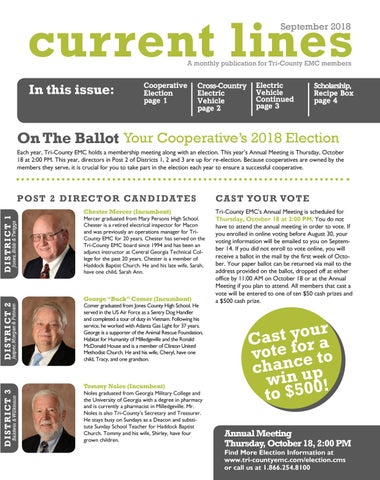
On The Ballot Your Cooperative’s 2018 Election Each year, Tri-County EMC holds a membership meeting along with an election. This year’s Annual Meeting is Thursday, October 18 at 2:00 PM. This year, directors in Post 2 of Districts 1, 2 and 3 are up for re-election. Because cooperatives are owned by the members they serve, it is crucial for you to take part in the election each year to ensure a successful cooperative.
Baldwin & Wilkinson
DISTRICT 3
Jasper, Morgan & Putnam
DISTRICT 2
Jones, Bibb & Twiggs
DISTRICT 1
P O S T 2 D I R E C TO R CA N D I DAT E S Chester Mercer (Incumbent)
Mercer graduated from Mary Persons High School. Chester is a retired electrical inspector for Macon and was previously an operations manager for TriCounty EMC for 20 years. Chester has served on the Tri-County EMC board since 1994 and has been an adjunct instructor at Central Georgia Technical College for the past 20 years. Chester is a member of Haddock Baptist Church. He and his late wife, Sarah, have one child, Sarah Ann.
George “Buck” Comer (Incumbent)
Comer graduated from Jones County High School. He served in the US Air Force as a Sentry Dog Handler and completed a tour of duty in Vietnam. Following his service, he worked with Atlanta Gas Light for 37 years. George is a supporter of the Animal Rescue Foundation, Habitat for Humanity of Milledgeville and the Ronald McDonald House and is a member of Clinton United Methodist Church. He and his wife, Cheryl, have one child, Tracy, and one grandson.
Tommy Noles (Incumbent)
Noles graduated from Georgia Military College and the University of Georgia with a degree in pharmacy and is currently a pharmacist in Milledgeville. Mr. Noles is also Tri-County’s Secretary and Treasurer. He stays busy on Sundays as a Deacon and substitute Sunday School Teacher for Haddock Baptist Church. Tommy and his wife, Shirley, have four grown children.
CA S T YO U R VOT E Tri-County EMC’s Annual Meeting is scheduled for Thursday, October 18 at 2:00 PM. You do not have to attend the annual meeting in order to vote. If you enrolled in online voting before August 30, your voting information will be emailed to you on September 14. If you did not enroll to vote online, you will receive a ballot in the mail by the first week of October. Your paper ballot can be returned via mail to the address provided on the ballot, dropped off at either office by 11:00 AM on October 18 or at the Annual Meeting if you plan to attend. All members that cast a vote will be entered to one of ten $50 cash prizes and a $500 cash prize.
r u o y t s Ca for a vote ce to chan up win 00! to $5 Annual Meeting Thursday, October 18, 2:00 PM Find More Election Information at www.tri-countyemc.com/election.cms or call us at 1.866.254.8100
Co-ops’ Road Trips Lead To Valuable Research on Long Distance EV Travel By Derrill Holly, Staff Writer, NRECA
C
harging is the next big hurdle for long-haul travel in electric vehicles, and the nation’s electric cooperatives could play huge roles in delivering sustainable solutions for their consumermembers and other travelers. “Charging presents a challenge. We who live in and drive through rural America still charge our vehicles, but it often requires more creativity, more time, or help from a friend,” said Alan Shedd, director of energy solutions for Touchstone Energy® Cooperatives. “Ready access to public charging is not commonplace in rural areas.” The Touchstone Energy Drive to CONNECT Event, during which teams of co-op employees from different parts of the U.S. drove EVs to a conference in Utah, provided opportunities for real-time research on long-distance travel. The event involved the use of several different vehicles, including plug-in hybrids and a range of EVs produced by different manufacturers, and the research took into account the various routes, driving conditions and charging options. An EV enthusiast for nearly 45 years and a national expert on the topic, Shedd has made many trips covering more than 200,000 miles using both plug-in hybrid vehicles and EVs. That experience has paid off in knowing when, how and where to plug in. “I’m a member of four different charging networks,” Shedd admits. But he still keeps extension cords, adapter plugs, a custom charger, tools and test equipment handy so he can plug in at a motel or other location where EV chargers are not available. “There are still large areas of the country that are underserved,” said Shedd. “You don’t have to stray far from an interstate or urban area to outrun charging convenience.”
Road-Tested Travelers
Shedd was among the co-op staffers who spent several days in May learning firsthand about the challenges facing motorists traveling long distances in electric cars. While electric vehicles are gaining popularity for commuter use, with home and workplace charging options becoming more common, experience with long-range travel remains limited. “Driving cross-country is part of the American psyche—the lure of the open road,” said Shedd. “We take the car for granted while not too many years ago a cross-country trip in a gas-powered car was a big undertaking and not altogether certain.” Sharing their adventures on social media using the hashtag #DriveEVent, teams started out in six states with a goal of arriving in Salt Lake City on or before May 7 so they could discuss their travels at a pre-conference workshop.
Mike Smith of The Electric Cooperatives of South Carolina and his son, Colin, recharged their Chevy Bolt at a public library in Park City, Utah. Photo Courtesy of ECSC.
While every team arrived in time, some faced more challenges than others. (18582001) Mike Smith and his son Colin, 16, drove a Chevy Bolt from Cayce, South Carolina, to Salt Lake City by way of Interstate 80 and documented parts of the trip on Twitter. “The route we chose had everything to do with charging availability and avoiding the mountains if we could,” said Smith, vice president of business and technology strategy for The Electric Cooperatives of South Carolina. In Wyoming, they used a 240-volt dryer outlet to charge the car at one stop and a 50 amp campground power pedestal at another. “We did a 5,000 mile road trip in a first-generation Honda Insight gasoline-powered car last year, and sometimes covered 1,100 miles a day,” said Smith, who traveled 2,116 miles one-way to Utah. “This time we had trouble doing 300 to 400 miles a day through Nebraska and Wyoming because of the lack of fast chargers.” Direct current fast chargers (DCFC) operate at high power outputs of between 20 and 150 kilowatts, said Smith. “The fastest we have been able to charge the Bolt is 45 kW, which adds 170 miles of range per hour of charging. If a DCFC is not available, our next choice is a Level II charger, which adds between 20 and 30 miles of range per hour.”
“This is what we had to use on the last half of our trip,” Smith added “If we are really desperate for a charge, which we weren’t this time, we can get a Level I charge from a standard 20 amp 120 volt outlet, delivering a paltry five miles of driving range per hour. At that rate, a full charge would take about 46 hours for our car.” “We could drive for about three hours and then we had to charge for six,” said Colin Smith. “Our days and nights got mixed up towards the end. When the car was fully charged, we went; but when the car needed a charge we stopped and slept while the car was charging.” Two employees of Melrose, Minnesota-based Stearns Electric Association made much better time in a Tesla Model S, in part because they had access to Tesla’s fast-charging network. Amanda Groethe and Whitney Ditlevson, who staff Stearns Electric’s communications and marketing department, made the 1,216-mile trip to Salt Lake City with just nine recharging stops, and none of those lasted more than two hours.
When unable to find an EV charger in Wyoming, the Smiths used a 240-volt dryer outlet to charge the car at one stop. Photo Courtesy of ECSC.
With planning, they were able to time charging stops to coincide with meal breaks or sight-seeing, and the Tesla charging stations were always conveniently nearby. (78091004) “Generally the Tesla was fully charged by the time we were done with everything we wanted to do,” said Groethe. She added that on a typical road trip with her family, she’d stop every two or three hours to see to the needs of her younger children.
The Cooperative Key
Teams from Montana and Colorado also completed the trip, but William Boyd Lee, vice president of strategic planning at CKEnergy, faced big challenges trying to get his Chevy Bolt from Binger, Oklahoma, to Salt Lake City. “Charging facilities west of Oklahoma City and up to Albuquerque, New Mexico are very lacking,” said Lee, who blogged about facing frustrating detours and charging equipment performance issues, in Amarillo, Texas.
Amanda Groethe and Whitney Ditlevson drove from Stearns Electric Association’s Melrose, Minnesota, headquarters to Salt Lake City in a Tesla Model 3. Photo Courtesy of Stearns EA
Lee and his son, Jay, 27, decided to tow his EV to Salt Lake City from Oklahoma with a gasoline-fueled F150 pickup truck, but his data will help provide a comparison to EV travels to be discussed in a Touchstone Energy national webinar. “Increased consumer demand for EVs and the need for manufacturers to ensure that charging options are available will create opportunities for private-sector investment in charging stations,” said Lee. He added that it could also offer new markets for power sales for electric cooperatives. “With more automotive manufacturers entering the EV market, there’s a lot of incentive for building out a reliable charging network,” said Lee. “Electric vehicles are going to be a huge part of our world in the years ahead.”
EV 18
Are you curious to know if an electric vehicle fits in your lifestyle? Could an EV save your business a lot of money? Join us and the Eatonton-Putnam Chamber of Commerce on November 1 at the Plaza in Eatonton for EV18, an Electric Vehicle Demonstration Day. Hear presentations from industry experts, test drive an electric vehicle and get a free lunch.
Scholarship Applications Due October 15
Earn Funds for College Through Operation Roundup!
I
n addition to funding community grants, the Tri-County EMC Foundation offers scholarships to undergraduate and graduate students—with preference given to non-traditional students—to help pay their college costs.
Through Operation Roundup, a total of $4,000 ($1,000 per winner) is awarded annually to students residing in the homes of Tri-County EMC members. Applicants must be enrolled in any U.S. accredited college, university or technical school and have maintained at least a 2.0 average. Applications are judged based on merit by an independent panel of judges. Applications can be mailed by request or completed online at www.tri-countyemc.com/roundupscholarship.cms. Applications are due October 15. To learn more about the Operation Roundup scholarship and other opportunities for students, visit www.tri-countyemc.com/scholarshipsoverview.cms. For more information, contact Kim Broun at 478.986.8126 or kimb@tri-countyemc.com. (65502001)
Did you find your account number?
Find your complete account number inside parentheses in this issue of Current Lines and win a $50 bill credit. Call 478.986.8126 to claim your bill credit.
Recipe Box Marinated Country Ribs Thanks to Fannie Batchelor of Baldwin County for sharing this delicious recipe! Did you know that your recipe is worth $20 if chosen? Send your best recipes to kimb@tri-countyemc.com or mail to P.O. Box 487, Gray, GA 31032. Ingredients: • 3 (3 pounds each) packages country style ribs • 1/3 cup soy sauce • 3 tablespoons salad oil • 1 teaspoon ground ginger • ¼ teaspoon pepper • 1 clove garlic, crushed • 1 teaspoon dry mustard Directions: Parboil ribs until tender; drain well. Mix remaining ingredients together and pour over ribs; marinate 24 hours, rotating several times. Prepare grill and cook ribs until done, basting with remaining marinade. Yield: 6 servings
Ray Grinberg, CEO
Owned by Those We Serve
P.O. Box 487 Gray, GA 31032 478.986.8100 FAX 478.986.4733 www.tri-countyemc.com
Board of Directors Brenda P. Green, Chairman Sammy Hall, Vice-Chairman Thomas Noles, Secretary/Treasurer George “Buck” Comer, Dan Greene, Chester Mercer, Marion Nelson, Cecil Patterson, Mike Rainey
current lines Monthly Publication for Tri-County EMC Members Kim Broun, Editor Communications Specialist