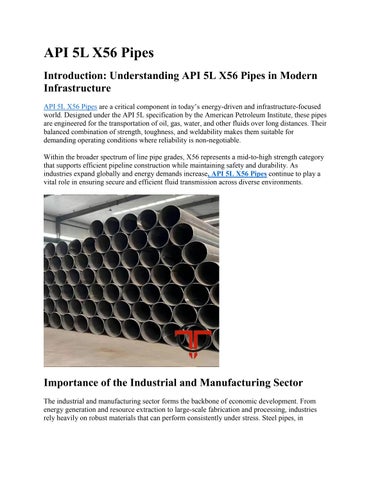
API 5L X56 Pipes Introduction: Understanding API 5L X56 Pipes in Modern Infrastructure API 5L X56 Pipes are a critical component in today’s energy-driven and infrastructure-focused world. Designed under the API 5L specification by the American Petroleum Institute, these pipes are engineered for the transportation of oil, gas, water, and other fluids over long distances. Their balanced combination of strength, toughness, and weldability makes them suitable for demanding operating conditions where reliability is non-negotiable. Within the broader spectrum of line pipe grades, X56 represents a mid-to-high strength category that supports efficient pipeline construction while maintaining safety and durability. As industries expand globally and energy demands increase, API 5L X56 Pipes continue to play a vital role in ensuring secure and efficient fluid transmission across diverse environments.
Importance of the Industrial and Manufacturing Sector The industrial and manufacturing sector forms the backbone of economic development. From energy generation and resource extraction to large-scale fabrication and processing, industries rely heavily on robust materials that can perform consistently under stress. Steel pipes, in
particular, are indispensable for connecting systems, transporting resources, and enabling automation. Within this ecosystem, standardized piping materials help maintain safety, quality control, and interoperability across projects and regions. API-compliant line pipes support global infrastructure by meeting strict mechanical and chemical requirements, ensuring that pipelines remain operational even under high pressure and varying temperatures.
Role of Key Industries Using API 5L X56 Pipes Oil and Gas Industry The oil and gas sector is the primary consumer of API line pipes. Exploration, production, and transmission activities require pipes capable of withstanding high internal pressure and harsh environmental conditions. API 5L X56 Pipes are commonly used in onshore and offshore pipelines, gathering lines, and transmission systems where moderate to high strength is required without sacrificing weldability.
Petrochemical and Refining Industry Petrochemical plants depend on reliable piping networks to transport crude oil, refined products, and intermediate chemicals. In these environments, material consistency and compliance with international standards are crucial. The mechanical properties of X56 grade pipes help ensure long service life and reduced risk of leakage or failure during continuous operations.
Water and Infrastructure Development Beyond hydrocarbons, large-scale water transmission and infrastructure projects also utilize line pipes. Municipal water supply systems, desalination plants, and industrial water networks benefit from the strength and durability offered by API-specified pipes, especially where long-distance transmission is involved.
Power Generation Industry Thermal and combined-cycle power plants rely on extensive piping systems for fuel supply, cooling water, and auxiliary services. While specialized alloys are used for high-temperature sections, API 5L X56 Pipes are often applied in fuel gas and utility pipelines supporting power generation facilities.
Connection Between Industries and API 5L X56 Pipes The connection between these industries and API 5L X56 Pipes lies in the shared requirement for safety, efficiency, and standardization. Pipelines frequently span thousands of kilometers, crossing varied terrains and climates. A failure at any point can lead to operational shutdowns, environmental damage, and economic loss.
By adhering to API 5L requirements, X56 pipes provide predictable performance across projects. Their compatibility with automated welding processes and inspection methods further strengthens their role in modern industrial systems, where speed and quality control are equally important.
Benefits of API 5L X56 Pipes Across Industries Mechanical Strength and Efficiency API 5L X56 Pipes offer a minimum yield strength of approximately 386 MPa, enabling thinner wall designs compared to lower grades while maintaining pressure capacity. This translates into material efficiency, reduced weight, and easier handling during installation.
Weldability and Fabrication Quality Controlled carbon content and alloying elements ensure good weldability, reducing the risk of cracking during fabrication. This is particularly important for long pipeline projects that involve extensive field welding.
Compliance With International Standards While governed by API 5L, these pipes are often compared or used alongside materials from standards such as ASTM, ASME, DIN, and JIS in integrated projects. For example, ASTM A335 Pipes—commonly used for high-temperature applications—may coexist in systems where different service conditions apply. Such standard harmonization allows engineers to design complex facilities with confidence.
Safety and Reliability Strict chemical composition limits and mandatory testing requirements, including hydrostatic testing and non-destructive examination, enhance operational safety. This reliability is a key reason why API 5L X56 Pipes are trusted in critical infrastructure.
Global Supply and Certification With growing international demand, certified manufacturers and exporters ensure traceability, mill test certification, and compliance with project specifications. The presence of an experienced API 5L X56 Pipes Manufacturer or API 5L X56 Pipes Exporter helps industries source consistent quality material for cross-border projects.
Industry Applications API 5L X56 Pipes are used in a wide range of applications, including:
Crude oil and natural gas transmission pipelines
Offshore platform flow lines and risers Refinery transfer lines and utility pipelines Industrial water and wastewater transport Fuel gas pipelines in power plants Cross-country pipeline networks supporting regional infrastructure
Their adaptability to different manufacturing processes—such as seamless and welded forms— further broadens their application scope.
Conclusion: Long-Term Value and Future Relevance As global infrastructure expands and energy systems evolve, the demand for reliable, standardized piping solutions will continue to rise. API 5L X56 Pipes represent a balanced solution that meets mechanical performance requirements while supporting efficient manufacturing and installation practices. Their widespread acceptance across oil and gas, petrochemical, power, and infrastructure sectors underscores their long-term value. With advancements in steelmaking, inspection technologies, and sustainability practices, these pipes are expected to remain a cornerstone of industrial pipeline systems well into the future.