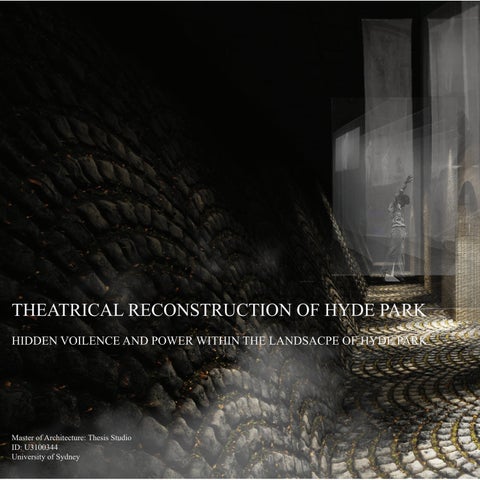
THEATRICAL RECONSTRUCTION OF HYDE PARK HIDDEN VOILENCE AND POWER WITHIN THE LANDSACPE OF HYDE PARK
Master of Architecture: Thesis Studio ID: U3100344 University of Sydney
‘To speak of the unspeakable violence of space will necessarily be to disturb the terms of traditional discourse and make available new ways of talking. It is not simply a matter of addressing a different aspect of space. Rather it is a matter of dining different form address.
The problem is to make space speak, to feed and furnish it; like mines laid in a wall of rock which all of a sudden turns into geysers and bouquets of stone.’ - Antonin Artaud, Theatre and its Double, trans. C.M. Richards (New York: Grove Press, 1958), 98
100 000
90 000
80 000
70 000
Religious Institutions
60 000 Proposed Site Legal Institutions High Density Metropolis
50 000
Hyde Park Barracks Anzac Parade Memorial
40 000
Existing Landscaped Area
30 000
20 000
10 000
0.0
10 000
20 000
30 000
40 000
50 000
C O N T E X T P LAN
60 000
70 000
80 000
90 000
Abstract
Australia’s identity has been a topic for discussion since colonialism in 1788. It has only been in recent decades the unresolved fragmentations have began to erode the sociocultural aspects of our Australian identity as a nation. Before colonisation and the establishment of Hyde Park, the land was occupied by the aboriginal people and was established as sacred land and a vital source of food and life. It was not until the arrival of the British empire, it then evolved into a violent battle between the indigenous community and colonial settlers to determine who would then occupy greater Sydney to develop what the city is today. Therefore, built on the basis of conflict and violence, Hyde Park’s narrative marked the beginning of the journey towards our fragmented national identity as a country willing to establish itself at the expense of death, violence, chaos, loss and the disposal of an already existing colony. The landscape of the battlefield was then rapidly transformed. Monumentalized and constructed with heavy ornamentation idealising the accomplishment with an illusion of glorification. It is because of this, Hyde Park remains a powerful spatial tool in representing the underlying violent and corruptive nature of Australia’s true dystopic identity. This project aims to speculate on Australia’s violent colonial legacy and aims to further understanding how these have shaped Hyde Parks urban setting and its surrounding city. Also speculate how in conjunction to its violent past time, how modernised Sydney has been impacted by societal addiction which contributes to modern urbanized violence, a concept created by western powers during globalisation which revolutionised Australian society resulting in the normalization of mass societal fragmentation, which has lead to mass dislocation. To explore these speculations, a post-disaster theatrically reconstructed park will take place in replacement of Hyde Park, deconstructing its existing elements to formulate renewed imaginaries utilizing existing ideologies. Fostering what Peter Eisenmann identifies as the sublime vs. the grotesque as well as the constructivist spatial operations adopted in Bernard Tschumis Manhattan Manuscripts. The programmatic theatres throughout the space adopt the concept of Antonine Artaud exploration into a series of paradox’s. To recover from violence, fear and the fragmented psych Artuard created the theatre of his desire to immerse himself into the dissolution that once haunted him. Allowing the architecture to take form of his own fragmentations he induce spatial disorder, a breaking point, disintegrating space and de-anesthetized of the spectator. He provided a transformative place to be a tool for psychological healing, clarity and self realization. These operations will be utilized to weaponize the reconstruction of Hyde Park, enabling the architecture to be a tool and a space for liminality that drives perspective shifting and collective consciousness transformation for its users. Keywords; contradictions, imperialism, illusion, capitalism, urbanisation, technologies, liminality.
MAS T E R P LAN N I N G CONCEPT
Introduction Hyde park mirrors its surrounding urban typology, presenting as a highly maintained, uninterrupted and pristine and manicured landscape, scattered with carefully ornamented monumental pieces of architecture strategically placed and itemised according to colonial typologies segmented through a series of careful spatial operations. These spatial operations operate as the initial footprint that would slowly manifest into Sydney’s city embedded with colonial institutionalism. The Barracks, housed Australia’s first and most violent convicts, the Cathedral or St. Mary’s, representing our devotion ad influence of Christianity and a series of Government Houses and Law Courts, all structures remain preserved as artefacts as well as the made up ideological constructs that came from them remain resistant to transformation. The resistance to change other than the transfer to an artefacts solidifies its integral importance to the city and because of this form the primary societal fragmentation that contributes to Australia’s dystopian identity. Engulfing the landscape is the city itself which embodies a further fragmentations manifested from the institutions that lay within and makeup Hyde Park. Symbolizing the modern era and an agricultural and industrial revolution the city induces waves of neoliberalism, corporate culture, high-tech surveillance, overrunning efficiency in manufacturing, financial crises and finally ecological devastation which remains as one of the main widespread out of city repercussions of these terminal social fragmentations found within the city. It is because of this, the theatrically reconstructed park, fills a niche not realized yet in the context of Sydney. Within a social context, the greatest hinderance towards achieving reconciliation between Australia’s identity and its past is the lack of acknowledgement or confrontation of the truth of Australia’s violent past time. Reinforced by a political discourse this guarantees separation of cultures alongside sociopsychological and physical boundaries. The centre for archiving and pavilion promenade work to provide a platform for truth seeking and working towards closure for the Australian identity as well as the representation of the trauma and violence embedded within Sydney and the Australian community. It aspires towards responsibility for wrong doing and bicommunal transmission from a wounded nation to a city built upon acknowledged foundations of violence and contestation.
L O W E R L E V E L F L O O R P LAN
N
1. Archival Interactive Space 2. Ampitheatre for Archival Reviewing 3. Renewed Monument Park 4. Temple of contemplation and Reflection 5. Amenities 6. Reflection Space 7. Renewed Monument Park 8. Ampitheatre for Conflict Transformation
G R O U N D F L O O R P LAN
N
9. Entry 10. Barracks Monument 11. Renewed Monument Park 12. Temple of Reflection 13. Theatre for Conflict Transformation 14. Theatre for Technology 15. Anzac Parade Monument 16. Exit Ramp 17. Exit Path
9.
10
11
12
13
14
15 16
17
N
S I T E P LAN
Background Research The Dislocation Theory The dislocation theory refers to societal fragmentation which stems from human addiction. Addiction in the modern era in the context of Sydney, refers to aspects of life such as addiction to social status, luxury living, overworking, power and other forms of fulfilment. From an evolutionary perspective this modern day label of addiction is biologically ingrained within us from the perspective of the need to survive therefore highlights the why this is problematic in the modern world we are rapidly progressing towards. The overconsuming city represents the human condition. Fragmentation is an aspect of modern world civilisation that has bestowed vast amounts of technical and industrial productivity which has now made it possible to support the human population. However, despite this accomplishment, this propels civilisation into terminal trouble due to the repercussions and consequences of the fragmentation. In the context of Sydney as well as on a global scale, this means the pulverisation of families, abandoning of religious or cultures and ethnic traditions as well as in the context of the indigenous people, knowledge of the heath and land has been forgotten at the expense of the modernised world we are entering.
Societal Dislocation In the context of Sydney’s rapid growth to capitalism ad globalisation, dislocation refers to the individualised psychological aftermath one experiences. This refers to the absence of connection between families, occupations, traditions, communities, god or environment. Without these it leads to the absence of belonging, a loss of meaning and identity. For the city of Sydney, normalizing mass dislocation at the expense of economic power will only result in radical proposition which has already taken on many forms in modern society. Hence the project is to take on the form of a radical proposition which will counteract the Sydney’s mass dislocation.
Lorem
SECTION : (A)
Forms of Technological Advancements as Manifestations of Power and Control Devices The use of power language has also been utilized as a form of technological advancement that has been deployed to delineate the city of Sydney which began the overrun of fragmentations we now face. De Certeau proposes the idea that of power language is a deployment of formal urbanization in itself which results in the city positioning itself as a totalizing and almost mythical landmark for socioeconomic and political strategies which have driven Sydney into a capitalist society, and ultimately its downfall . Jane Jacobs also explores this conception of colonial spatial power through other collective technologies such as art and photography through the lens of the post-colonial settler. Paul Carter then expands on the reasons behind imperial expansion and De Certeau theory by approaching the spatial history of colonial settlement with the belief that space creates history by inventing the spatial and conceptual co-ordinates within which history occurs; by providing points of reference of ‘here’ and ‘there’ these points define the architecture of the map. Australian landscape was considered ‘unknown’ and a ‘blank canvas’ through the eyes of colonial settlers to which Paul Carter suggests that such ordering was especially evident in the planning of colonial cities deriving off the spatial template of the grid and that these plans placed a rational spatiality of urban order over the unknown or ‘irrational’ spatiality of aborigines / natural landscape. Jane Jacob further stipulates on this misconception by exploring postcolonial mediums such as art and photography, which present themselves as formalised expressions of the human psyche that are then then physically manifested and constructed collectively influencing the collective psyche of the city’s inhabitant. The same narrative applies to architecture and urbanisation in the city of Sydney which can be seen through the monomialisation throughout Hyde Park. Jacobs then also refers to the motive of a photograph is to influence its audience through the construct of its composition involving a subject that is then captured through the lenses of the artists / photographers ideological agenda. Applying this narrative to post-colonial landscape artists at the time, similar to the photograph, the land was what they saw was conceived as a ‘blank canvas’ ready to be materialised and established to reflect Europeans structures of ‘civilised’ order. The landscape had been composed to convince its inhabitants of a political, social and spiritual hierarchy and power. Bill Grammage also proves however that prior to British colonisation, the landscape of Australia was “unnatural”, contradictory to post colonial artists first impression, and that it was carefully and systematically managed.
Urban Island O.M.Ungers - Student Dormitory, Enschede Holland Beaux - Arts & Classicalism
Pergamon, Acropolis Plan Linear Colonnade Passageway
The Planoptic Exodus ‘The Inspection House’ (1791)
High Museam of Art Atlanta, Georgia 1905 - 1983 Renzo Piano
Palace of Charles V Renaissance (1527)
Basilica of St. Vitale 526 - 547, Ravenna, Italy
Pergamon, Acropolis Plan Ancient Greecek Theatre, Turkey
Pergamon, Acropolis Plan Greek Courtyard & Amputheatre
Jean-Nicolas-Louis Durand (Paris, 18 September 1760 – Thiais, 31 December 1834) Neoclassicism
Columade Type (1a)
Columade Type (2a)
Columade Type (1b)
Columade Type (2b)
Clumade Type (1c)
Clumade Type (2c)
ARCHITECTURAL REFERENCES
Columade Type (1d)
Columade Type (2d)
Segregation
Line of Axis
Archways
Division
Multiple Passages
Window Arrangment
Materiality ; Brick, Stone & Masonary
Enclosing Borders
Typical Colonial Pitched Roof
Ornamentation
Envelope
Porthole Windows
Floor Plan (1)
Floor Plan (2)
H Y D E PAR K BAR RAC K S
Archway Typology (1)
Ornamentation (w) Human
Archway Typology (2)
Dome Ceiling
Colonade
Linear Stairwell
Floor Plan Typology (1)
Ornamented Detailing
Curved Entrance Stairwell
Geometrically Ornamented Slab
Skylight
Engraved Art - Archiving
Floor Plan Typology (2) Colonade
Prominade Ramp
AN ZAC WAR M E M O R IAL
Expressed Directionality (1)
Expressed Directionality (2)
Expressed Directionality (3)
Expressed Directionality (4)
Expressed Directionality (5) Diagonal Axis’s
H Y D E PAR K LAN D S CAP E
TYPOLOGIES Existing typologies from Hyde Park Barracks, Anzac War Memorial and the Landsape
Expressed Directionality (5) Cross Sectional Axis’s
Enclosed Archway
Plan Typology
Historical Fallacies, and the made up construct of the ‘other’ The landscapes including its scattered monuments have been used as a device to represent an ideological hyper illusion dystopic reality through the creation of made up constructs such as the perpetuated sense of ‘others’. This construct of the ‘otherness’ stems of the representational imbalances which occur within architecture as a result of a historical definition of the ‘civilized self’ against the non-European ‘primitive other’, Hyde Park presents itself as a product. Theorist Edward W. Said reference of the Orient. He uses this as the basis for colonial analysis. He refers to the process of imperialism and that it is the act of “geographical violence through which virtually all spaces in the world is explored, chartered and then finally brought under control”. He suggests that the desire for imaginary geographies from colonial descendants manifested into material spatiality’s of political connection, architectural imposition also landscape transformation as well as economic dependency. Said also suggests that this spatial power exploits the non-European ‘other’ which also, has been carefully and strategically constructed with the intent to reinforce the strength of imperial expansion.
Historical Consciousness ad Individualized Memory in order for Lasting Transformation In order to move forward radical change must be provided and coinciding with this, there must be awareness through historical consciousness to ensure lasting transformation and a collective shift. Australias pastime should not be covertly covered but exposed through its existing forms. Rusen defines history as being a cultural resource that everyone uses to make sense of their identity and of continuity and change the world in the world around them, also that collective memory is a form of historical knowledge that helps shape what we as a society see plausible as well as possible in the course of human events. In the context of Hyde Parks monuments and its surroundings, he defines traditional historical consonance is the belief that monuments should remain untouched because of their time lapse which in this context is rejected. Critical historical consciousness in regards monuments argues the destruction or removal of monuments which were designed to convey or symbolize oppression therefore, the physical removal removes the ideology it symbolizes by destabilizing and denaturizing the object to which in the same context, applies. Genetic historical consciousness seeks to historicize all categories of human construction that change over time in a response changeable and dynamic cultural, political, economic and social contexts. The monuments in Hyde Park should stand and be historicized, however presented in a means which presents their truthful political and ideological context in which they were erected.
H Y D E PAR K M O N U M E N T S Existing
Obeleisk
Chess Board
Sundial
F.J. Walker Memorial Fountain
Proposed
FOLLIES Defiled Monuments
John Baptist Fountain
Busby Bore
Plan
Axonometric
Confronting Violence to Force Healing; A theatre for conflict resolution and truth seeking In order for recovery violence needs to be confronted during time of catastrophic world events, for instance the bloody battlefield that erupting in Hyde Park. Mark Wigly refers to the term of a ‘loud silence’. He states that it masks the more nuanced and ongoing relationship between violence and space. In order to confront the complicity between architecture and brutal or destructive incidences this must then be broken. The war and confrontation incited violence, death and destruction. Currently, architecturally, ideologically or monumentally this is not revealed, however it still exists within the space in this context and must be revealed to force healing. Artuard Antonine’s Theatre for Cruelty was determined to mine spatial depths, in order to release and reveal inherent violence as a restorative force. Artaud’s Theatre of Cruelty, as both a performance and architecture, sought to activate spatial volatility in order to confront and combat cruelty. His manifestos revealed an Architecture of Cruelty as the site of recovery. His theatre was a perceived as a cruel and impossible mechanism which was to build upon extreme action pushed beyond all limits with its true and only value found in an excruciating magical relation to reality and danger. An apparatus to combat cruelty through what is refers to as the interruptive forces of fissuring the space on the stage, and within this opening, the real, as traumatic surplus makes its unbearable presents felt.
Hypothesis The introduction of colonialism brought with it the westernized construct of addiction. It is this addiction which results in and overrun and over productive society constantly needing to technologically advance and upgrade. It is because of this hyper productivity it has lead to societal fragmentations such as violence, corruption and disillusion which has then resulted into mass dislocation on the individual.
Reimagined Barracks Monument
The user is confronted with hallways and multiple directions. The repetitiveness creates an atmosphere of disorientate and confusion in an entrapped and enclosed them. The user finding themselves a puppet to the maze, under and overwhelmed with the sensation of control. Tying them to the idelogies of its past time. Above are projectors, televisions and LED lights held up and fixed to grids of steel and wiring. Using archiving and photography as a medium the projectors present archival footage from colonial wartime to immerse the user visually and enhance their overall experience.
POSTCARD
Research Question:
1What infrastructure, conceptual narrative and modernised ideological framework needs to be constructed and then implemented injected into the reconstruction to reclaim autonomy and agency and cease the impact of imperialism, addiction, social fragmentation and mass dislocation in the context of Hyde Park and its surroundings?
POSTCARD
R
E
IM
A
G
IN
E
D
M
O
N
U
M
E
N
T
S
Anzac War Memorial
Hyde Park Barracks
Aim The aim for the project is firstly to analysis other possibilities of technologies of post colonialism and how they have informed urbanisation and therefore the ideologies that exist and how through this existing framework they are manifested through the formation of monuments and architecture in Sydney, using Hyde Park as an example. Secondly, is to understand what the role of the monuments in Hyde Park are which will allow for further analysis as to whether or not they satisfy. Then, to respond to the current framework by suggesting a possible alternative which fosters the adoption of complexities and rejects traditional sublimity (beauty) to better represent and underpin ideologies.
Objectives The objectives are to deconstruct the monuments of Hyde Park by exploring and identifying their pre existing ideologies. Establish a plausible framework that firstly identifies fallacy found in Hyde Park and present what this is based on with references, then to identify the fragmentations presented within the illusion and propose an alternative new imaginary adopting alternative strategies that acknowledge, support and accurately rectify wrongdoings through accurate representation using architecture as a pool to do so.
SECTION
Methodology The landscape, monuments and its surroundings will be deconstructed by using Bernard Tschumis Manhattan Manuscripts. This entails a series of spatial and architectural operations that will disrupt the existing typology and recreate a new imaginary . This will allow the first step of infestations and propose what this new imaginary might look like as well as reveal some of the existing typologies which have not yet been symbolized. The landscape will then be theatrically reconstructed by using the revealed constructs to which it will then reimpose its existing landscape of Hyde Park back into it, demonstrating that both ideologies can coexist and that the existing ideologies do not need to be decoyed or removed however they need to be deconstructed and transformed into a new imaginary. This deconstruction of the architecture and opposing institution it removes the politics and restores pollical agency and autonomy and establishes an entirely transformed new architectural framework. Power language was a powerful tool in the way it influenced spatial formation and transformation. For this project it will be used as a architectural spatial tool to reconstructed the park whilst also showing how it was previously been been materialized in the context of Hyde Park by showing it being superimposed again. Abstraction of monumentality drawing off Bernrd Tschumis Parc De Ville Park will inspire the reconstruction and transformation of the new narrative. This will also be adopted through the use of a number of theoretical frameworks and sources that provoke or contradict the existing rational arrangement of Hyde Park as well as understand further the existing ideology’s. Such as Orientalism by Edward W Said, Edge of Empire by Jane M. Jacobs, and more. The project will also be accompanied with a visual creative exploration which will be used to explore the post colonial narratives previously discussed and attempt to convey the misinterpretations and contradictions. The design of the project will employ the necessary abstraction and manipulation using the existing and proposed frameworks to speculate what the new imaginary’s might look like.
Reference List: Said E. (1978) Orientalism. London: Routledge & Kegan Paul. Eisenman P. (2017) Monumentality and the Sublime, Memorial to the Murdered Jews of Europe T. Bernard (1974 The Architectural Paradox (http://davidrifkind.org/fiu/cejas_readings_files/tschumi.architectural-paradox.lib-iss.pdf) K. Ziva, K. Rachel (2008) The Politcs of Landscape (Re) Production. Haifa Between Colonialism and Nation Building H. Micheal (1968) Architecture Theory MIT Press, Cambridge Massachusetts M. Murphy (1992) Architecture of the Other 99% Power, Economy ad the Dillema of History, Architecture Violence, Architecture Power: The Fall of the Post Political and New Empowerment, p.g 80-86 Slavoj Zizek, ‘In his Bold Gaze My Rui n is Writ Large, ‘ in Everythig You Always Wted to Know about Lacan (But Were Afraid to Aks Hitchcok) ed. Slavoj Zizek (London: Verso, 1992), 239. Acker, C.J. (2012). Caroline Jean Acker on Bruce Alexander’s “Addiction: The Urgent Need for a Paradigm Shift.” Substance Use & Misuse, 47(13-14), pp.1484–1484. Antonin Artaud, Schumacher, C. and Singleton, B. (2004). Artaud on theatre. Chicago: Ivan R. Dee. Barnes, D. (2004). The Architect’s Paradox: Experience and the Creation of Space. [online] Available at: https://www.nottingham.ac.uk/cas/documents/landscapes/danielbarnesfinal.pdf [Accessed 6 Apr. 2020]. Bechir Kenzari (2011). Architecture and violence. Barcelona ; New York: Actar. Crook, P. and Murray, T. (2001). Assessment of Historical and Archaeological Resources of the Hyde Park Barracks, Sydney Volume 4 of the Archaeology of the Modern City Series A HISTORIC HOUSES TRUST OF NEW SOUTH WALES PUBLICATION. [online] Available at: https://www.latrobe.edu.au/humanities/huss-documents/Hyde-Park-Barracks-Assessment-Report.pdf. Davies, P. (2013). Archaeology and Religion at the Hyde Park Barracks Destitute Asylum, Sydney. Historical Archaeology, 47(4), pp.86–102. Fabrizi, M. (n.d.). “The Set and the Script” in Architecture: The Manhattan Transcripts (1976-1981) by Bernard Tschumi – SOCKS. [online] socks-studio.com. Available at: https://socks-stu dio.com/2015/10/13/the-set-and-the-script-in-architecture-the-manhattan-transcripts-1976-1981-by-bernard-tschumi/ [Accessed 12 Nov. 2021]. Fairclough, N. (2014). Language and power. London: Routledge. Linchenko, A. (2013). The Problem of Historical Consciousness in the JJrn RRsen’s Philosophy and Theory of History. SSRN Electronic Journal, 2(1). Marche, J.L. and Tschumi, B. (1995). Architecture and Disjunction. Journal of Architectural Education (1984-), 49(2), p.132. Nesbitt, K. (1995). The Sublime and Modern Architecture: Unmasking (an Aesthetic of) Abstraction. New Literary History, 26(1), pp.95–110. Olin, M. (2008). Overheard in the Memorial to the Murdered Jews of Europe. IMAGES, 2(1), pp.136–155. Rose, M.V. (1986). The actor and his double : mime and movement for the theatre of cruelty. Chicago: Actor Training & Research Inst. Press. Sklair, L. (2019). ICON PROJECT : architecture, cities, and capitalist globalization. S.L.: Oxford Univ Press Us. Thomas, T., Walter, P.S. and Walter, R. (2001). Landscape, Violence and Social Bodies: Ritualized Architecture in a Solomon Islands Society. Journal of the Royal Anthropological Institute, 7(3), pp.545–572. Tschumi, B. (1981). The Manhattan transcripts. London: Academy Editions ; New York. Tschumi.com. (2020). Bernard Tschumi Architects. [online] Available at: http://www.tschumi.com/projects/18/.
VIDEO: Title: Theatrical Reconstruction of Hyde Park - Masters of Architecture Thesis Video Link: https://youtu.be/VukFjrf4dHk