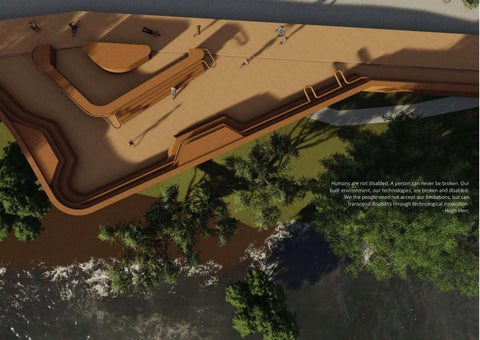
Humans are not disabled. A person can never be broken. Our built environment, our technologies, are broken and disabled. We the people need not accept our limita�ons, but can transcend disability through technological innova�on. - Hugh Herr,
RECONNECT TO THE SENSES RECONNECTING
REVIVING
REDISCOVERING WITH THE SENSES AND WITH OTHERS
TRICIA GILLETT & SOPHIE CORR
1.0 O U R
VISION
Within our built environment, especially in the design and development of public spaces it is evident that due to low levels of comprehensive and cohesive understanding of people with disabili�es these type of spaces have resulted in represen�ng the cornerstone of a lack of inclusivity for vulnerable groups. This is due to lack of knowledge and considera�on which results in poor, exclusive se�ngs and unsa�sfactory models that lack the necessary program, facili�es or equipment needed to make the space appropriate enough to be considered public. Because of these factors, this results in those unable to access these spaces isolated from them and perpetuates exclusion. Through our design, we hope to create and establish a model for vunerable groups such as the visually impared which will essen�ally strength the no�on and standard for what we define as public spaces.
2.3 B A C K G R O U N D R E S E A R C H
2.1
Side Affects of Vision Loss From loosing one of the senses which we are most dependent on a number of effects happen to the individual
1
Loss of Experience
4
>ŽƐƐ ŽĨ ĞdžƉĞƌŝĞŶĐĞ ŝƐ ƚŚĞ ŵŽƐƚ ƉƌŽĨŽƵŶĚ ĞīĞĐƚ ŽĨ ďůŝŶĚĞŶĞƐƐ͘ tŝƚŚŽƵƚ ƐŝŐŚƚ ƚŚĞ ŝŶĚŝǀŝĚƵĂů ŝƐ ƵŶĂďůĞ ƚŽ ĞdžƉĞƌŝĞŶĐĞ ƚŚĞ ǁŽƌůĚ ĂƐ ŚĞͬ ƐŚĞ once could
2
Loss of Intependence
Loss of Navigation dŚĞ ŝŶĚŝǀŝĚƵĂů ŝƐ ƵŶĂďůĞ ƚŽ ĂĐĐƵƌĂƚĞůLJ Žƌ ƉƌŽƉĞƌůLJ ŶĂǀŝŐĂƚĞ͘ EĞǁ ƚĞĐŚŶŽůŽͲ ŐŝĞƐ ĂƌĞ ƐůŽǁůLJ ďĞŝŶŐ ĚĞǀĞůŽƉĞĚ ƚŽ ĂƐƐŝƐƚ ƚŚŝƐ ĂŶĚ ŐŝǀĞ ƉĞŽƉůĞ ƐƵīĞƌŝŶŐ ĨƌŽŵ ďůŝŶĚĞŶĞƐƐ Žƌ ǀŝƐŝŽŶ ůŽƐƐ ƚŚĞŝƌ ŝŶĚĞƉĞŶĚĞŶĐĞ ďĂĐŬ ĂŶĚ ĂďŝůŝƚLJ ƚŽ ŶĂǀŝŐĂƚĞ ŝŶĚĞƉĞŶĚĞŶƚůLJ͘
6
5
Impacted social connec tions džƉĞƌŝĞŶĐŝŶŐ ŶĞŐĂƟǀĞ ƐŽĐŝĂů ŝŵƉĂĐƚƐ ŽĨ ďůŝŶĚĞŶĞƐƐ ŝƐ ĂůƐŽ ĐŽŵŵŽŶ͘ /ŶĚŝǀŝĚƵĂůƐ ĞdžƉĞƌŝĞŶĐĞ ƐŽĐŝĂů ŝƐŽůĂƟŽŶ ĚƵĞ ƚŽ ƚŚĞŝƌ ŝŶĂďŝůŝƚLJ ƚŽ ƉĂƌƟĐŝƉĂƚĞ Žƌ ŝŶƚĞŐƌĂƚĞ ƚŚĞŵƐĞůǀĞƐ ŝŶƚŽ ƐŽĐŝĞƚLJ ĂƐ ƚŚĞLJ ŽŶĐĞ ĐŽƵůĚ͘
5
Psychological side affects ƵĞ ƚŽ ĂīĞĐƚƐ ƐƵĐŚ ĂƐ ƐŽĐŝĂů ŝƐŽůĂƟŽŶ ĂŶĚ ƚŚĞ ĚƌĂƐƟĐ ĂĚũƵƐƚŵĞŶƚ ƉĞƌŝŽĚ ƚŚŝƐ ĐĂŶ ĐĂƵƐĞ ƉƌŽĨŽƵŶĚ ƉƐLJĐŚŽůŽŐŝĐĂů ĂīĞĐƚƐ ƐƵĐŚ ĂƐ ĚĞƉƌĞƐƐŝŽŶ ĂŶĚ ĂŶdžŝĞƚLJ ĂŵŽŶŐ ŵĂŶLJ ƉĞŽƉůĞ ĞdžƉĞƌŝĞŶĐŝŶŐ ůŽƐƐ ŽĨ ǀŝƐŝŽŶ͘
Other sense become hightened ƵĞ ƚŽ ŝŵƉĂƌĞŵĞŶƚ͕ ƚŚĞ ŝŶĚŝǀŝĚƵĂů ďĞĐŽŵĞƐ ƌĞůŝĂŶƚ ŽŶ ƚŚĞŝƌ ŽƚŚĞƌ ƐĞŶƐĞ ƚŽ ǁŚŝĐŚ ƚŚĞ ďƌĂŝŶ ƌĞƋŝƌĞƐ ƚŚĞƐĞ ƐĞŶƐĞ ƚŽ ďĞĐŽŵĞ ŚLJƉĞƌƐĞŶƐŝƟǀĞ ƚŽ ĐŽŵƉĞŶƐĂƚĞ ĨŽƌ ƚŚĞ ůĂĐŬ ŽĨ ƐŝŐŚƚ͘
tĞ ĚĞƉĞŶĚ ŚŝŐŚůLJ ŽŶ ŽƵƌ ǀŝƐŝŽŶ ƚŽ ďĞ ĂďůĞ ƚŽ ĐŽŵŵƵŶŝĐĂƚĞ ǁŝƚŚ ŽƚŚĞƌƐ ŽŶ Ă ĚĂŝůLJ ďĂƐŝƐ͘ tŝƚŚŽƵƚ ƚŚŝƐ ŝƚ ŝƐ ĚŝĸĐƵůƚ to interpret and understand others ĂīĞĐƟŶŐ ƚŚĞ ǁĂLJ ǁĞ ĐŽŵŵƵŶŝĐĂƚĞ ǁŝƚŚ ƐŽŵĞŽŶĞ ďůŝŶĚĞ͘
ŶŽƚŚĞƌ ƐŝŐŶŝĮĐĂŶƚ ĞīĞĐƚ ŝƐ ůŽƐƐ ŽĨ ŝŶĚĞƉĞŶĚĞŶĐĞ͘ ƵĞ ƚŽ ƚŚĞ ŝŶĂďŝŝƚLJ ƚŽ navigate or percieve ones surroundͲ ŝŶŐƐ ĂŶLJŵŽƌĞ ƚŚĞLJ ŚĂǀĞ ƚŽ ďĞ ĂĐĐŽŵƉĂŶŝĞĚ Ăƚ Ăůů ƟŵĞƐ ŝŶ ŽƌĚĞƌ ĨƵŶĐƟŽŶ ĂŶĚ ůŝǀĞ ĚĂLJ ƚŽ ĚĂLJ͘
3
Loss of Communication
7
Experiences the world in a whole new way dŚƌŽƵŐŚ ƚŚŝƐ ĞdžƉĞƌŝĞŶĐĞ ĂŶĚ ůĂĐŬ ŽĨ ƉĞƌĐĞƉƟŽŶ ƚŚĞ ŝŶĚŝǀƵĚĂů ƚŚĞƌĞŽĨŽƌĞ ĚĞǀĞůŽƉƐ ŶĞǁ ƚĂĐƟĐƐ ĂŶĚ ƐŬŝůůƐ ƚŽ ĞdžƉĞƌŝĞŶĐĞ ƚŚĞ ƐĂŵĞ ǁŽƌůĚ ŝŶ ǁŚŝĐŚ ƚŚĞLJ ĚŝĚ ǁŝƚŚ ƐŝŐŚƚ ƚŚƌŽƵŐŚ ŽƚŚĞƌ ǁĂLJƐ ƐƵĐŚ ĂƐ ƚŽƵĐŚ͕ ƐŽƵŶĚ͕ ƐŵĞůů͘
2.2
Vision impairment Demographics Demographic of individuals most affected by vision impairment The older you are, the more likely you are to be affected by blindness as follows: 0-9yo (0.25 per cent) – one in 400 Australians 10-29yo (0.4 per cent) – one in 250 Australians 30-39yo (0.48 per cent) – one in 200 Australians 40-49yo (0.6 per cent) – one in 160 Australians 50-59yo (1.13 per cent) – one in 90 Australians 60-69yo (3.39 per cent) – one in 30 Australians 70-79yo (5.67 per cent) – one in 16 Australians 80-89yo (9.59 per cent) – one in 10 Australians 90+yo (14.82 per cent) – one in 7 Australians.
Age range: 60 - 90 years old
1
4
575 000 people are currently blinde or have vision loss in Australia. This is mainly due to the rapid increase in age.
With the right sercices and support people with unavoidable blindeness can develop skills, remain independent and fully par�cipate and integrate into the community.
2
5
Aboriginal and Torres Strait Islander people suffer 6x more and 3x the rate of visiona impairment in contrasts to the rest of the popula�on.
As the popula�on ages there will be a recognisable increase in blindeness and vision imparement associated with old age. Because of this there may not be sufficient recogni�on within the aged care system for specialist blindeness services.
3
People who are blinde suffer x4 the rate of unemployment, twice as many falls, x3 the risk of depression and lose independence early on.
2.3
Existing forms of Communication for Visio Imparement ‘touch’ is the most impactful sense
4.1 Brail
For most people 80% of the environmental sensory experience is visual, therefore leaving just 20% for all remaining sense. For touch, it is the almost the an�thesis of sight and is especially key.
Sight is distance and is detached and there is no diret physical rela�onship between the object which is seen and the viewer. Touch however is immediate, and the most impac�ul sense and is the sense which allows you to directly engage.
This allows a window for opportunity for explora�on into new forms of experience. The primary concept of brail is u�lizing the ability of feel and touch expressed through the form of tac�lity to communicate informa�on through words, le�ers and messages.
4.2 Verbal Communication and Physical Touch
Verbal communica�on for a blind person involves speaking to the visually impared person and describing to them things which they cannot see.
Physical touch is the other form of interac�ve communica�on between an individual suffering vision imparement and someone not. Through physical touch and assistance one can help navigate as well as communicate ones appearing through touching of the face.
4.3 Other forms of communication 4.3.1 Assistive Technology Assis�ve technology is another form of communica�on which is consistantly becomming more developed.
Examples of this are certain glasses which detect and enhance light and LED rays which allow a person to see be�er.
Computers have also developed voice ac�vated technology whcih allows a blind person to navigate on the computer
Our concept will be based around the same concept of communica�ng ideas, informa�on and a concept through tac�lity using the concept of gradient, pa�erns and shapes to communicate informa�on.
3.1
3.0 Malabar Rock Pools
Botanical Exploration An abundance of na�ve Australian flora can be found along local rockpools such as Malabar Rock Pools. Our reason for choosing this feature of the Malabar Rock Pools is because of its naturally textured proper�es, diversity in terms of tac�lity and textures and because of this its versi�lity in explora�on. We collected a number of specific plants along the site and studied each one in rela�on to eachther and its proper�es. These plants were
1 2 3 4 5
Crassula Monstruosa Carpobrotus Glaucescens Banksia Integrifolia Callistemon Metrosideros Excelsa
3.2 Plant Collection: Photographs A collection of native australian botanic plants and shubs were collected from Malabar Rock Pools and its surrounding area. Native to Australia these plants were able to be used as a medium of familiarity to the occupants living here and its surroundig area.
These plants acquired a number of different textures, patterns and structural compositions to which we were then able to further study and analysis and compare and contrast which would contribute further to our overarching Australia botanical tactile theme.
3.3 Stages of Plant Growth and Development
Understanding the process of each plants life cycle is relevant and important to our overarching theme of change, transi�on, growth and decay. Each plant con�nuously transforms and develops over�me and then progressivly decrays, similar to the concept of the decrease in sight.
As the plant reaches its op�mal state of flowing, it then begins to decay into dried objects and reaches an ‘end’. For our theme we can relate this to an individual progressivly reaching complete loss of sight un�l they finally reach that point.
This concept of growth, progression and then finality of decary can inform the public about eyesight and that once an individual looses their sight, at the moment there is almost nothing that can be done to restore it.
3.4 3.5
• • • • • •
Botanical Studies
Crassula Monstruosa
Also known as a Crassula Ovata ‘Gollum’ due to its misshapen form Elongated, tubular leaves with puckered end The �ps of the plat have a reddish �nge when exposed to sunlight Flowers: appear starshaped and white or pink in colour Na�ve to the KwaZulu-Natal and eastern cape provinces of south Africa and Mozambique Can reach overall heights of 2.5m
3.6
Carpobrotus Glauscescens
• Commonly known as Pigface • Succulent leaves and daisy like flowers • Thick fleshy and smooth leaves which are triangular in cross sec�on • The name comes from the Ancient Greek word for fruit ‘karpas, and for edible ‘brotos’ • Endemic to south Africa, however there are six Australian species which are mostly found near the coastal shoreline • It grows naturally in coastal areas on sand dunes on the NSW, Victoria and Queensland cost. Acts as a sand dune stabiliser as it binds the sand together, allowing for other sand stabilisers to grow. • The fruit is eaten by many animals and birds which help to spread the plants seeds • The plant produces a red-purple berry fruit, which indigenous people once ate • The roasted leaves ca be used as a salt subs�tute • Early European explored used the plat as an an� scurvy treatment • The juice on the leaves can be sued to relieve pain from insect bites • Used for groundcover as they grow fast • Resistant to fire and drought • Salt and wind resistant
3.7
Coastal Banksia
• Commonly known as the coastal banksia • Grows: east coast of Australia • Highly variable in form • Grows up to 25m tall • Indigenous name (Gunai people of Gippsland) Birrna. Other indigenous names have since been lost. • Flowers: consist of several hundreds of flowers densely packed in a spiral around a woody axis. Usually, a pale yellow colour • Can grow in clay, sand, acidic and alkaline soils, resistant to wind and salt, makes it suitable for coastal plan�ng. • The Banksia genus has 173 na�ve species. The name comes from botanist Sir Joseph Banks who collected the plant specimens I 1770 when he arrived with captain cook • Indigenous use: Paintbrushes, ea�ng and sweet nectar of the flower spike • Unlike other banksia species, they don’t need fire to release their seeds
3.8
Bottlebrush
• Commonly known as the bo�lebrush • Na�ve to Australia, especially the east coast. However there are two species I Tasmania and several species I the southwest of western Australia • Referred to as the bo�lebrushes because of their cylindrical brus-like flowers that look like tradi�onal bo�le brushes • Favour moist condi�ons and a great food source for na�ve wildlife • La�n name callistemon comes form the combina�on of 2 Greek words ‘gallis’ meaning beauty and ‘stemon’ meaning stamen (the flowers of the plan) • Flowing is normally is spring and early summer but environmental condi�ons might cause flowering at different �mes of the year • Flowers: consist of the statement with the pollen at the �p of each filament • Flowers vary in colour according to species but most are red, some are yellow, green, orange or white • The seed capsules remain closed un�l s�mulated to open when the plant does or a fire burns the plat some species release the seeds annually
4.0 D E S I G N 4.1
3D Printing all plants allowed us to explore a number of textures and offer a new perspective in terms of its shape and structural composition.
P R O C E S S
3D PRINTING & Pattern Extraction
We had developed a number of 3D prints with the addition of scaled aspects allowing us to further explore the patterns and the textures presented and with this how the user can interact with it and how it would be percieved.
With these 3D Prints we were able to explore graphical representations and manipulations and correlate these concepts to vision imparement and the theme of gradient.
3D Prints:
4.2 Examples of 3d Prints from plants These images are the 3D printed representa�ons of our individual plants. As shown, there are a number of different textures and pa�erns found within each one. Each one shows a different concept to texture and pa�ern as well represen�ng mul�plicity, repe��on and accumula�on of individual segments. For our design we wanted to communicate the concept and texture of these plants to a visually impaired person through tac�lity. We also wanted to incorporate the understanding of visual impairment and the progressive change this occurs. In order to do this we began analysing and extrac�ng pa�erns from these pa�erns.
Plants:
The Callistemon has a very dis�nct pa�ern and texture. It comprises of an accumula�on of round circular segments each with their own dis�nct pa�ern of a ‘crossed’ shape. 3D prin�ng this also allowed us to explore the shape further as well as distor�ng it in 3D the shape was easily legible and understandable which allowed it to be easily communicable if felt or touched as it was dis�nct.
4.3 Types of Vision Imparments 1 Age Related Macular Degeneration
2
Initial symptoms: Clouded, blurred or
Initial symptoms: Gradual or sudden change in the quality of your vision or that straight lines appear distorted to you. This may gradually turn into a dramatic loss of your central vision. Other symptoms include: Dark, blurry areas or whiteout that appears in the center of your vision. Age: This disease is most common in people over 60 Duration until loss of sight: In the late stages, you may have difficulty seeing clearly. On average, it takes about 10 years to move from diagnosis to legal blindness, but there are some forms of macular degeneration that can cause sight loss in just days.
dim vision, Increasing difficulty with vision at night, sensitivity to light and glare, need for brighter light for reading and other activities, seeing "halos" around lights, frequent changes in eyeglass or contact lens prescription, fading or yellowing of colors.
Fine lines or details may become blurred
Causes:
A combination of heredity and environmental factors, including smoking, obesity and diet.
Double vision
Age: As cataract is mainly related to age symptoms can start appearing in their 40s to 50s. However, theyre vision may not be impacted by the time their in their 60s. Duration until loss of sight: If
Straight lines may become distorted or blurred
diagnosed in their 40s to 50s, they may not become visually impaired until their 60s.
What vision looks like: Developed in
What vision looks like: With
macular degeneration, a blind spot most often appears in the central visual field. If the disease progresses, the blurriness or darkness of the spot becomes larger and more severe.
Cataract
both eyes, the cataract blocks and scatters the light that comes through the lens not allowing images to be defined. As a result, your vision becomes blurred.
Dark spots may appear
Causes: Diabetes, Smoking, Excess alcohol use, Eye Injury, Prolonged use of corticosteroids, Prolonged exposure to sunlight or radiation
Fine lines or details may become blurred
3
Glaucoma
4
Initial symptoms: Spots or dark
Initial symptoms: Loss of
strings floating in your vision (floaters), blurred vision, fluctuating vision, impaired color vision, dark or empty areas in your vision, vision loss.
peripheral or side vision: This is usually the first sign of glaucoma. The individual might see distorted halos or lights and may see rainbow coloured circules around lights. They may be sensitive to lights as well.
Age: Diabetic retinopathy is one of the
most common cause of new cases of blindness among adults aged 20–74 years.
Age: Although it can happen at
any age to any adult it usually occurs past the ages of 60.
Duration until loss of sight: Approximately 20 years.
However this is a very slowly progressive disease and may only occur in one eye.
What vision looks like: Seeing halos around lights
Causes: Dilating eye drops. blocked or restricted drainage in your eye. medications, such as corticosteroids. poor or reduced blood flow to your optic nerve. high or elevated blood pressure.
Diabetic Retinopathy
Duration until loss of sight: It
Darkness from the edges of vision which narrows in with �me
normally takes several years for diabetic retinopathy to reach a stage where it could threaten your sight and for the induvial to loose vision. This normally occurs when the diabetes is left untreated or diagnosed.
What vision looks like: Spots or dark strings floating in your vision Causes: Diabetic retinopathy is caused by high blood sugar due to diabetes. Over time, having too much sugar in your blood can damage your retina
Dark spots or ‘floaters’ in vision
5
Refractive Error
6
Initial symptoms: The most common
symptom is blurred vision. Other symptoms may include double vision, haziness, glare or halos around bright lights, squinting, headaches, or eye strain.
Age: Almost all poeple will develop a
refractive error as they age beyond 40 years and become unable to focus at close distances.
Fine lines or details may become blurred
This is treatable are rarely leads to blindness. Refractive error occurs when the eye is unable to bend and focus light appropriately onto the retina. Theyre vision may start to become blurry, hazy, or doubled, causing you to squint and strain your eyes.
Causes: Eyeball length (when the
eyeball grows too long or too short) Problems with the shape of the cornea (the clear outer layer of the eye)
Initial symptoms: using the wrong colours for an object – e.g. purple leaves on trees, particularly using dark colours inappropriately, low attention span when colouring in work sheets, issues when identifying colours such as red or green Age: This is normally identifiable by the age of 5 Duration until loss of sight: Colour blindess does not result in vision loss only colour distortion.
Duration until loss of sight:
What vision looks like:
Color Blindeness
What vision looks like: Objects Double vision
appear incorrect colours as to what they are.
Causes; Color blindness can also happen if your eyes or the part of your brain that helps you see color gets damaged. This can be caused by: Eye diseases, like glaucoma or macular degeneration.i
Colour Blinde test for normal vision
Colour Blinde test for person with colour blindeness
4.4
Graphical Exploration / Black and White
3D Print images Panel: Metrosideros Excelsa The contrast between black and white allowed to clearly show the composi�on of the plants external shell. The prints allowed us to explore these composi�ons and how they were expressed graphically, also ways in whcih we can manipulate them without distor�ng the original representa�on.
3D Print images of The Callistemon The Callistemon has a dis�nct shape and form which can be easily communicated. As shown through 3D prin�ng this is evident as you can clearly see the defined shape of each circular nodule which wrap around in a cone like structure crea�ng an outershell. Unlike the other 3D prints, because of its defined shape, it shows more visual clarity than the others.
3D Prints of plants and exploration of B/W and colour inversion Exploring black and white representa�ons as well as inver�ng the images created a visual dialect and opened the narra�ve to exploring different tones and how this alters the original representa�on. With the white highlights, you are able to see the overall structure of the print with more clarity whereas if they were black.
3.6
Blurred Effect With the 2D representa�ons of the plants we were able to encorporate and correlate the discussion of visual impairment and the condi�ons that come with this such as blurred vision. The diagrams show explore another narra�ve of vision imparement which is this, blurred sight and loss of focus.
The graphical explora�on of the duplicated plant to the right opens up and furhters our themes exis�ng conversa�on of gradient, and progression. That blurred vision does not happen from one phase to the next but rather as a progression and transi�onal process.
Nomral Vision:
Focused:
Blurred Vision:
Partially distorted:
distorted:
5.0
Geometry Exploration Further design development concepts were the extrapala�on of geometric pa�erns. From the geometry created by the double vision geometric pa�erns were allowed to be formulated and experimented with:
B. 3D print
0.
C. linework & pattern concept
1.
2.
2.
3.
6.0 Concept Development
Plant
Multiplicity
Cluster
Flow
Stay
Continue
6.0 Concept Words in Brail
Plant
Multiplicity
Continue
Stay
Flow
Cluster
based upon our findings and understanding of botanical plants and the different types of textures, varia�ons and composi�ons we have established some of the main characteris�cs which were mul�plicity, stagnant, clustering, flowing and con�nua�on. We also considered the nature of the beach plants, that they con�nuously grow and decary, similar to vision it is a slow and gradually progression of decreasing. As the plants grew, stems would mul�ply and grow sharing the same physical a�ributes of clusters in form, elongated stems, sharp and slim edges and more. As individuals with progressive vision diseases suffered similar a�ributes of change, transi�on, progression in an incline. Our tac�le texture is to represent this change through a gradient, and the texture will derive from The Callistemon as it is most recognisable and has the most dis�nct characteris�cs, and the pallete will also combine the nature of the eye disease glaucoma which progressivly tunnels the vision. With this series of pa�erns a visually impared person as well as a visual able person could touch, and feel this object and have this idea and informa�on communicated to them through only touch.
6.1 Developed Pattern
This series represents the progression of eye diseases with particular focus on Glaucoma. As shown, the edges of ones vision slowly decreases with black dots accumilating from the edges of ones vision slowly tunnelling the view. This could be communicated through a pattern through the use of small holes or shapes around the edges of the tactile object, therefore someone would touch this, and understand the meaning behind it.
6.2 The Callistemon generated pattern
Process Illustra�ons:
A series of pa�erns generated from grasshopper and indesign show varia�ons of pa�erns inspired by the callistemon plant. This pa�er has been explored through different scales and arrangments.
Above shows a series of panels which outline the design process to from the Rockpools to the Chair. That from our ini�al explora�on and ananlysis we were able to extrapalate exis�ng pa�erns.
Incorpora�ng the theme of the gradient allowed this idea to furhter develop.
Pattern generation ideas:
With these pa�erns wer were able to manipulate them to as well as overlay and incorporate pa�erns whcih represented the gradual loss of sight.
6.3 Pattern Development
6.4 Robitic Milling - Initial Trial Based upon the extruded pa�ern this was our ini�al test with the robi�c milling. The blade used to cut the wood was 6mm and creates a deep incrimena�on.
6.5 Grasshopper generated Pattern Exploration Grasshopper Scripting
Through illustrator as well as grasshopper we experimented with designing different forms and shapes using scripts. We then designed a three part series using the inital pa�ern shown above however with varia�ons of each one. This pa�ern comprised of geometric pa�erns from the Banksia Plant. This pa�ern also showd the progression of the pa�ern as a gradient as shown. These pa�erns were then overlayed with a second pa�ern to create a three part storyboard.
Grasshopper Generated Pattern
6.6 Final Milling Process of 3 part series board
With these 3D Prints we were able to explore graphical representa�ons and manipula�ons and correlate these concepts to vision imparement and the theme of gradient.
6.7 150x150 Milled Boards
Board 1
Using the grasshopper generated scrip this pa�ern shows an array of circles scaling from large to small with no overlay.
Board 2
The same pa�ern was then generated with addi�onal milling milled in over the top of the ini�al pa�ern, these addi�onal ‘holes’ represent the ‘black dots’ which occur during vision loss.
Board 3
The third pa�ern is the same with more added holes crea�ng a rougher surface which appears more ‘decayed’. 3D printed inverted pieces were then printed to be placed within these holes as shown crea�ng a 3 layered compositon.
6.8 Patterns to 3d Milled Models
1
Crassula
All plants were printed to 1:1 scale showing the basic shape and textures of the exis�ng object. These were printed out in different kinds of materials and colours of black and white.
2
New Zealand ‘Christmas Tree’
These 3D prints accurately showed the variety of textures and pa�erns within the plants
3
Pigface
4
We then printed out certain aspects of the plants at a large scale to represent a more indepth analysis into the exis�ng textures and perhaps look at op�ons on how we can evolve and manipulate that into our project.
Bottle Brush
5
Bottle Brush Nodule
Vision Impairment in Australia
It is es�mated there are over 575,000 people who are blind or vision impaired currently living in Australia, with more than 70 per cent over the age of 65 and over 66,000 people who are blind.
The older you are, the more likely you are to be affected by blindness with one in 30 being over the age of 60 and one in 7 over the age of 90.
These figures indicate a growing need for facili�es and support.
People over the age of 65 are the largest group affected by the onset of vision impairment with only 7% not suffering from some form of impairment.
Current Services Available New South Wales offers a range of Government and none Government Bodies that support individuals with vision impairment.
The Centre for Applied Disability Research exists to improve the wellbeing of people living with disability by gathering insights, building understanding and sharing knowledge.
Na�onal Disability Services is the peak body for non- government disability services and its purpose s to promote quality service provision ad life opportuni�es for people living with disabili�es and includes more than 1030 non-government organisa�ons.
Vision 2020 Australia I the na�onal peak body for health and vision care sectors represen�ng around 50 member organisa�ons involved in local and global eye care.
The Australian Blindness Forum (ABF)comprises of 22 major services providers for people who are blind or vision impaired across Australia.
Leading Eye Conditions in Australia
1 Age Related Macular Degeneration
2
Cataract
3
Glaucoma
Ini�al symptoms involve clouded, blurred or dimmed vision. Sensi�vity to light and glare and seeing ‘halos’ also fading yellowing of colours.
Symptoms include loss of periperhal or side vision. Distorted halso or lights with rainbow colours and circles around lights may appear and also be sensi�ve to lights.
This is common for those over the age of 60.
This normally occurs a�er the ages of 50 and may not take full affect un�l a�er the age of 60.
In late stages, one may have difficulty in seeing clearly. On average it takes about 10 years to move from diagnosis to legally blinde but there are some rare forms that cause blindness in a ma�er of days.
Vision loss may develop in both eyes, the cataract blocks and scatters the light that comes through the lens not allowing images to be defined.
This normally occurs a�er the ages of 60 and may take approximately 20 years to be considered legally blinde.
This is caused due to a combina�on of heredity and environmental factors including smoking, obesity and diet.
This is caused due to diabe�cs, smokig, excess alcohol use, or prolong use of cor�costeroids and radia�on and light.
Symptoms: Gradual or sudden change in the quality of vision or straight lines appearing distorted. This then turns to drama�c loss of central vision including dark, blurry areas that appear in the centre of your vision.
Vision appears to have dark edges which narrow over �me. This is caused due to diala�ng eye drops or blocked or restricted drainage in ones eye.
4
Diabetic Retinopathy
Symptoms include dark spots or strings floa�ng in your visioin. This can happen between the ages of 20-74 and dura�on of vision loss may take place within a couple of years o�en caused if diabe�cs is le� untreated or undiagnosed. Main causes are due to high blood pressure over �me and having too much sugar in your diet which damages the re�na.
5
Refractive Error
Ini�al symtoms involve blurred vision. Glare or haziness as well as halos around bright lights, this can also be followed by squintyness and headaches. The onset occurs beyond the age of 40 with the dura�on un�l blindness a�er a number of years. The refrac�ve error occurs when the eye is unable to bend and focus light appropriately therefore resul�ng in blurriness or double vision.
6
Color Blindeness
Symptoms occurs when one does not use the correct colours for an object, example purple leaves on a tree. This can normally be iden�fied by the age of 5. Colour blindness does not result in vision loss, only colour distor�on.
Current Challenges
Societal Stigma Being blind in a world suited for the sighted, it means there will be mul�ple normal mishaps. Small accidents can be perceived by the sighted can be perceived as the inability to perform tasks, whilst in reality they stem from the inaccessibility of our world.
Living in isolation Provided the informa�on above, it is to no surprise that living with a visual impairment, might o�en signify living in isola�on. Emo�onally coping and dealing with vision impairment is challenging enough but the lack of emo�onal support, limited accessibility and ac�vi�es and informa�on, societal s�gma are all huge factors which lead the blind living in isola�on and o�en feeling unsupported and helpless. This point also illustrates how the problem for blindness is not so much the impairment but the level of segrega�on from anyone else.
Effects on Employment
health & wellbeing
Vision Australia and the Blind Founda�on found people with slight loss are significantly less likely to be employed compared to their sighted counterpart despite the technological advancements and educa�onal opportuni�es.
A vision impairment also affects an individual’s health and wellbeing, both physically and mentally. The effects of isola�on can o�en lead to depresion and anxiety and an overall disconnec�on with the world. Inaccessible exercise and sport facili�es can o�en result in a lack of exercise and movement.
In their survey they found 60% of respondents believe employer a�tudes are one of the main barriers into employment and half repor�ng feeling they had not been hired due to their sight loss.
Current Strategy
Due to poor design in these public spaces, this results in the decreased wellbeing and overall experience of individuals with visoin impairment.
Poor Design
>> Inaccessible >> Loss of Experience >> Exclusion >> Low Self Esteem >> Impacted Wellbeing
Proposed Strategy
Good Design
>> Accessible >> Inclusion
>> Opportunity to Integrate >>
Positive Psychological Effects
Design Objectives Adoping the following design objects to encorporate into the design allows us to cover a cohesive set of issues informed through the current challanges faced with public spaces and inclusivity.
Inclusive / Sensory Design
Rehabilitation
Interaction and Community
Universal inclusive design u�lises tac�lity, audito, aroma and changing ligh�ng condi�ons. These design principles all revolve around and u�lize the senses other than sight. Using the principles we are able to support the blind in a crea�ve, sensory and effec�ve way.
The purpose of vision rehabilita�on programmes is to increase the degree of independent living and func�onal ability, which has a posi�ve impact on quality of life.
Provide ameni�es that combat exis�ng social isola�on that is o�en a result of vision impairment. It is important to integrate individuals of all seeing capabili�es and facilitate connec�on between them, as well as with the greater community.
Movement / Exercise
Safety
Wayfinding
Exercise and movement assist with both physical and mental health. It is important to encourage individuals to move and engage with the whole site.
The site has to be safe for blind individuals to navigate it by themselves. The site itself is very steep as points and this has to be taken into considera�on.
Design should be barrier-free, and provide simplis�c circula�on in the building and across the site to ins�l mobility and orienta�on confidence.
Purpose of passive vision impairment rehabilitation
The purpose of vision rehabilita�on programme is to increase your degree of independent living and func�onal ability , which has a posi�ve impact on your quality of life.
Three ways in which we can rehabilitate the the visually impaired is: 1 By allowing them to feel connected and apart of the community 2 By allowing them to experience and explore their other senses through auditory, tac�lity and aroma 3. Provide them with the appropriate programs and ameni�es which boost self-esteem and confidence
Fostering the concept of Learning: Orientation & Mobility training
Informa�on from: Associa�on for Educa�on and Rehabilita�on of the Blind and Visually Impaired (AER)
Sensory Awareness: gaining informa�on about the world through hearing, smell, touch and propriocep�on Spa�al Concepts: realizing that objects exist even if not heard or felt, and understanding the rela�onships which exist between objects in the environment Searching Skills: loca�ng items or places efficiently Independent Movement: which includes crawling, rolling, walking, etc. Sighted Guide: using another person to aid in travel Protec�ve Techniques: specific skills which provide added protec�on in unfamiliar areas Cane Skills: use of various cane techniques to clear one's path or to locate objects along the way
Design Focused Proposal The following program will be used through the design in order to support and explore a built model prototype that supports and improves health wellbeing and community engagment.
Exercise | Activity | Educate | Experience Nature | Be amongst community
Public Exercise Furniture
Education and Rehabilitation Centre
Beach Walk
Jetty
Through public interac�ve furniture and tac�le plates designed for the blind and public to interact with
Foyer / Recep�on Tac�le museum Consulta�on Rooms Group Therapy Rooms Gym / Mobility and Orienta�on WC / Storage Aroma Gardens
Provides the opportunity to experience and being amongst nature and exercise with safe wayfinding measures
Provides the social infrastructure for community integra�on and also provides an in�mate experience with the water
Site Analysis
The site comprises of a range of topographys and natural scenery. Given its dense urban typology surrounding, and minimal area for a built form, the site s�ll offers the challange of spa�al configura�on with op�mal opportunity.
FISH
6
Site Analysis ERM
AN‘S
ROAD
5
DA CR
4
E ST
B
RE
3
ET
7 2
TR
1
A Y
A
LA
S B
T
B
R
G
N
EE
P A R
C
A DE
KEY LANDMARKS
Easterly Winds
FO
X
S
TR
EE
T
LEGEND
HAZARDS FOR BLIND PEOPLE
A
IC
Cafe
Pedestrian Entry
A
Proximity to Road
2
Carpark
Wind
B
Uneven Pathway
3
Playground
Bus Stop
C
Steep Slopes
4
BBQ Area
Noise from Road
D
Unconnected Handrails
5
Exis�ng Ameni�es
E
Stairs
6
Carpark
F
Proximity to Water
7
Beach
8
Boat Ramp
9
Pool
10
Golf Course
11
Carpark
8
B
V
1
TO R
D
B
IA ST R EE T
N
A
P
I
ER
S
TR
EE
T
B
E Southerly Winds
H
O
F
W
E
S
TR
EE
T
9 11 10
N
Masterplanning
Access Points
Along the western and nothern edge are carparking and drop off zones. These points are the main points of access to the proposed site.
Existing Roads
Surrounding the site are exisiting roads creating a boundary for the site which defined the extent
Surrounding Infastructure
Surrounding the site are residential and low commercial infastructure. This infastructure is low density and ranges from 5-7m in overall height and does not obstruct the site. The beach and ocean also reside along the eastern edge.
Walkability & Exisitng Pathways
Surrounding the roads are paths which people walk along whcih gives a more informed idea about user movement.
Proposed Site
The proposed site perimeter is situated within the space unobstructed by the previous features and is informed to be appropriate for a building.
Axis of Movement
The main axis of movement runs from drop of zones ontowards the existing pathway towards Malabar pools. The second axis of movement is informed by circulation which leads towards the beach.
Program Progrram has been informed by masterplanning and circulation
Beach Walk
Informed by circulation the beach walk begins at a drop off zone and continues into the exercise nodule and towards the rock pools.
Jetty
The Jetty flows from the line of axis out towards the ocean off the main access point.
Aroma Garden, Tactile Museam
Aroma Garden, Tactile Museam and Amenities are landscaped into the lower levels within their own private area barriered from distractions such as sound. This then directs the user towards the beach and the jetty.
Auditory Board Walk Passage
As an entry to the beach walk ahead, the user is introduced with a auditory board walk lined with timber beams, colums and boardwalks which echo the sound offering a sensory and wayfinding experience.
Rehabilitation Cetre
A rehabilitation centre acquires a number of group rooms, board rooms and small offices.
Exercise Nodule
The exercise nodule is one of three along the beach walk towards the new and improved Malabar rock pools.
Programming Concept
1
Ground Floor Floor Plan
2
3
4
1 2 3 4 5
5
Entry Aroma Garden Public Ameni�es Public Tac�le Museam Je�y
6
First Floor Plan 7
6 7 8 9
8
9
Auditory Board Walk Rehabilita�on Facility Exercise Nodule Beach Walk
Adapted Exercise Nodule To promote health and wellbeing the exercise nodule adopts univeral design principals 1 2 3 4 5
1
3
4 2
4
Exercise / Stretch Bars Step Ladder Tricep Dip Nodule & Public Sea�ng View Point / Strech Bar Tac�le Informa�on Point
The key design principals throughout the composi�onal strategy was to connect all aspects together and priori�se natural flow of movement.
Along the eastern to western edge air flow has been priori�sed allow for naturally ven�lla�on to flow through the site given the sites naturally dominant easterly wind rose. The key design principals throughout the composiThis natural aleviates the landscaped �onal strategyven�lla�on was to connect all aspects togetherarea andand stops the space fromflow becomming congested or priori�se natural of movement. overheated.
Along the southern edge the form has allowed for passive ven�lla�on to cool the area naturally.
GRID LAYOUT This diagram represents the general grid layout. The grid layout will inform the structural layout in rela�on to each part.
SIPHONIC DRAINAGE Using the resultant fall of the roof geometry stormwater will fall to the centre apex of the external roof. This water is then caught through a large downpipe and then into a drainage area to be siphoned from the roof to a deten�on tank reservoir for future re-use.
HEATING AND COOLING Given the yearly hot weather of Malabar, cooling the building is essen�al. With a building of this size, it can be easily achieved through passive and sustainable measures. Priori�zing orienta�on of the building to suite the southerly and eastern annual wind rose, the natural movement of air u�lizes stack ven�lla�on from the lower levels can be drawn through the upper levels. Natural hea�ng is achieved through the exposed roof and large double glazed windows throughout, allowing the warmth to penetrate the space inside, hea�ng the internals.
SOLAR ENERGY By placing photovolac�c panels on the roof structure building will be able to create and u�lize solar energy. The building will then be able to be en�rely solar energy efficient.
CARBON ANALYSIS OF STRUCTURE Based on assump�ons made, the structural design would be ‘carbon nega�ve’; i.e. it would hold more carbon that was used to produce the materials in the first place. Always worth remmebering though, once the building reaches the end of its life, if the �mber is disposed of, or burnt, that sequested carpon is re-released.
1
EXERICISE 1:STRENTH TRAINING
EXERICISE & MOBILITY DESIGN
Incorpora�ng colour into the design was essen�al which is why a bright orange railing has been used as orange is the most visible colour for people with vision impairment. 1
2
CARDIO
2
3
Cardio is the most effec�ve ac�vity for improved mood therefore integrated training steps have been incorporated.
As a facility for exercise and learning a range of ac�vi�es are incorporated through the design to improve mental wellbeing.
3
RUNNING
Travel path 1 indicates the running path route Travel path 2 indicates the exercise designs route
The tac�le objects are used on the face of the running path to encourage bypassers exercising and to make the path more user friendly.
tactile wall design
1
2
3
The feature wall of the building is divided into three parts, each with a different func�on. The first part is the spa�al mapping that communicates the layout of Malabar beach and what features to expect along the way. The second establishes a language of how to navigate the site safely. The third part is an interac�ve model that aims to facilitate connec�on between both blind and non-blind people and allow them to learn something from each other.
Wall Interior Eleva�on
tactile wall design
The final part of the wall consists of an interac�ve tac�le wall that aims to facilitate connec�on between both blind and non-blind people and allow both to learn something from each other. Each nodule in the wall combines informa�on about one plant found at Malabar and informa�on about one eye condi�on that we researched in the previous assignment. Each nodule consists of one plywood plate with a 3d printed plant, and around the plant is braille text that gives a blind person informa�on about the plant that they cannot see. Located adjacent to the plant piece is a plate with text informa�on about an eye disease. This can be read by a non-blind person that allows them to learn about what a par�ally blind person experiences. The addi�onal plates in the wall nodules are derived from the pa�erns of the plant that is 3d printed, however arranged in a way that imitates the visual experience of a person with the chosen eye disease - it is representa�ve of what a person with low-vision experiences.
hyperthetical user experience
Wall: Interac�ve Tac�lity
Building: Scented Plants
Je�y: Sound of Waves
Ac�vity Node: Interac�ve Tac�lity
Railing: Wayfinding Tac�lity
Pool: Interac�ve Tac�lity
colourful handrail: site wayfinding
Another aspect of the wayfinding is the use of colour as a direc�onal tool as our first assignment inves�gated the varied experience of low-vision we needed to introduce a naviga�onal tool for individuals who were par�ally blind, and perhaps had not learnt how to read braille yet. For these individuals, we decided on pain�ng the handrails a bright orange colour, as that seemed to contrast the most against the green and blue environment of Malabar.
This colourful interven�on will also be within the building in the wall design; the wall will have an indent within it that is the same colour as the railing so it will be one con�nuous wayfinding tool across the whole site.
Hypothetical users
June, 78
Henry, 6
Matthew, 43
June lives alone in the neighbouring suburb of Coogee. She is experiencing macular degenera�on over the last few years which causes blind spots in the centre of her vision. It has become harder for her to navigate around her local community. Her son, Jason, lives nearby and helps her with her daily tasks. They enjoy going on long walks for exercise and would like to do so at Malabar beach.
Henry was born with total blindness and lives with his parents and sister in a house in Redfern. He enjoys playing with his friends and is learning to read braille at the moment. He loves exercising however his parents having difficulty finding safe environments for him to exercise in. Henry and his family love going to the beach and would like to go to one that is safer for blind people so they can worry less.
Ma�hew is a Malabar local who lives alone. He developed Diabe�c Re�nopathy in his late 20s, which eventually developed into total blindness. He now uses a cane to assist him to navigate. He used to love going to Malabar beach when he had full sight and wishes to be able to experience it again. He also a�ends rehabilita�on therapy classes to help him con�nue living independently, however it would be if he could do these closer to home. He can experience loneliness at �mes and would like a local spot for him to connect with his community more o�en.
wayfinding language
The 3d printed objects from our first assignment will be embedded within the wall to establish a language of how to move through the site safely. The objects will be placed next to the braille text of the direc�on. These objects will be placed along the new and exis�ng handrails on the site and will indicate at which points to con�nue, navigate stairs or upon reaching an ac�vity node.
spatial map
The graphic pictured to the le� will be engraved on the wall within the building to communicate to blind people the layout of the beach; the key landmarks and ac�vity spots.
site spatial map - braille
The graphic pictured to the le� will be engraved on the wall within the building to communicate to blind people the layout of the beach; the key landmarks and ac�vity spots.
site spatial map - text
carpark
you are here
interactive wall
jetty
activity node
These are the transla�ons to English text of the following loca�ons / landmarks on the previous spa�al map
activity node
path 1
path 2
data/tactile board
water activity node road
sand pool
steep
Building spatial map - braille
This graphic will be engraved within the tac�le wall and communicates the main features of the interior of the building to assist with wayfinding.
Building spatial map - text
carpark
tactile wall
auditory board walk
rehabilitation facility amenities lift jetty
rehabilitation facility
lift
path 1 footpath to rest of site path 2
data/tactile board
water
building
vegetation
Lower floor
These are the transla�ons to English text of the following loca�ons / landmarks on the previous spa�al map
Upper floor
process model 1
stretch
scale
One of our process models was presented in Interim and consists of the light scanned plants 3D printed in resin. These models act as a preserva�on of the decayed plants. Below them is a transforma�on of the original plant that has also been 3D printed. The braille text below describes the transforma�on that has occurred. Stretch, scale and single.
single
process model 2
transi�on
change
Our other process model is derived from the pa�erns of the plants, the pa�erns of blindness and the graphics of gradients. It is a series of panels that communicate this concept of change and transi�on.The primary base pa�ern that is milled into the �mber is a gradient, which is derived off the Bo�lebrush plant that we collected in the earlier stages of the semester. The second layer of milling is derived from the random and rough pa�erns of the Coastal Banksia plant. It communicates the decay of vision that one experiences when they have the condi�on of glaucoma. The overall effect of this is ‘tunnel vision,’ and so our model gradually decays at the outer edges of the panel.
stages
gradient
layers
The final layer is a series of 3D printed objects, derived from the 3D scans of the plants, that interject within the robo�c milled �mber pa�erns. These replicate the experience of the condi�on of diabe�c re�nopathy, wherein ‘floaters’ appear within the person’s vision and disrupt the clarity of sight. The surrounding braille text reads ‘change,’ ‘transi�on,’ ‘gradient,’ ‘stages’ and ‘layers’ to help with the communica�on clarity of the concept. Ul�mately, the panels change significantly across the series, which communicates the process and staging of transi�ons and the decline in loss of vision. It is a bridging tool from which both people with low vision and people with normal sight can learn from.
tactile wall model
text for non-blind people about the condi�on of macular degeneta�on
na�ve
3D print of the bo�lebrush plant so a blind person can can connect the tac�le experience to the informa�on about the plant
laser engraved pa�ern to replicate the experience of macular degenera�on vision loss to a non-blind person (a loss of central vision)
callistemon
braille text to describe features / informa�on on the bo�lebrush plant for blind people
red
experimental tac�le pa�erns generated from the bo�lebrush plant
also known as bo�lebrush
seed pods
This model is a representa�on of the interac�ve tac�le wall that aims to facilitate connec�on between both blind and non-blind people and allow both to learn something from each other. Each nodule in the wall combines informa�on about one plant found at Malabar and informa�on about one eye condi�on that we researched in the previous assignment. Each nodule consists of one plywood plate with a 3d printed plant, and around the plant is braille text that gives a blind person informa�on about the plant that they cannot see. Located adjacent to the plant piece is a plate with text informa�on about an eye disease. This can be read by a non-blind person that allows them to learn about what a par�ally blind person experiences. The addi�onal plates in the wall nodules are derived from the pa�erns of the plant that is 3d printed, however arranged in a way that imitates the visual experience of a person with the chosen eye disease - it is representa�ve of what a person with low-vision experiences. This model is 1:1 in scale.
wayfinding communication model
stairs
upcoming ac�vity
con�nue
This model represents the 3d printed objects from our first assignment will be embedded within the wall to establish a language of how to move through the site safely. The objects will be placed next to the braille text of the direc�on. These objects will be placed along the new and exis�ng handrails on the site and will indicate at which points to con�nue, navigate stairs or upon reaching an ac�vity node. This model is 1:1 in scale.
building spatial map model
carpark
start
li�
je�y
exercise
pool
This 3D printed model would assist a blind individual to understand the architceture of the building and how to navigate it successfully. It consists of a base layer - which represents the lower level of the building, which is ramped and embeded in the landscape, and how it connects to the je�y. The second level is the top level and this can be slo�ed into the base layer to give an understanding of how the two levels fit together. This would be given to people upon entering the building. This model is 1:2 in scale; it would be more legible at a larger scale than the 3D printed model we have currently.
Additive workflow
In order to create our tac�les and models, there were two overarching workflow processes undertaken. Firstly, to generate the ‘addi�ve’ components of the project, the plants were scanned using a light scanner, then they were manipulated in rhino and 3D printed with the resin printer.
subtractive workflow
The second ‘subtrac�ve’ workflow process involved the genera�on of pa�erns from the plants, which were replicated in rhino and grasshopper to then be scripted to control the robot to mill the pa�erns out of the �mber.
sustainable development goals
The project �es in with the underlying theme of the United Na�ons Sustainable Development Goals, in par�cular Goals 3, 4, 10 and 11.
3
4
10
11
The scheme encourages interac�on between people of all seeing capability. A strong community is essen�al for good health and wellbeing and assists with combating lonliness. The project encourages people to move across the site and therefore is facilita�ng exercise for all, whch is cri�cal to good health.
The project provides a tac�le wall that allows for everyone to learn from. Blind people can learn about the plants of Malabar, through reading the braille text and engaging with the tac�les. Non-blind people can learn about the condi�ons of the eye by interac�ng with the same tac�le wall. This creates a mutual understanding and empathy between users.
By providing specific spaces and ameni�es along Malabar beach for blind people, this allows these individuals access to a place they are o�en excluded from, thereby reducing the inequali�es o�en faced in public spaces.
Universal design is a cornerstone of sustainable ci�es and communi�es. In order for a city to thrive, we must design for all, regardless of disability. In terms of environmental sustainability, the project u�lises sustainable materials such as �mber to reduce damage to the natural environment.
Local Vegetation Pallette
Soft Landscaping Pallette
Hard Landscaping Pallette
CONSTRUCTION & DETAILING
The building is sited on a heavy concrete base for protec�on of the �mber and steel structure above, as well for solidity and security. The internal �mber construc�on is a light, blonde, so�wood that is exposed throughout. This makes it warmer, so� approach, one that lends itself to the promo�on of health and wellbeing and recovery. The �mber boardwalk uses recycled hardwoord and is used as an external varia�on of the internal �mber language. This is kept to a minimal to remain undistrac�ng and uncomplicated as well as incorporates the design strategies of sound and acous�c varia�ons through its hollow boardwalk slat and curved archways.
PRESENTATION YOUTUBE VIDEO LINK BY TRICIA GILLETT & SOPHIE CORR
h�ps://youtu.be/AEUXtdgekHc