TRIANGLE REVIEW O F F I C I A L M AG A Z I N E O F T H E
S U M M ER
TR I A N G LE FR ATER N IT Y
2 026
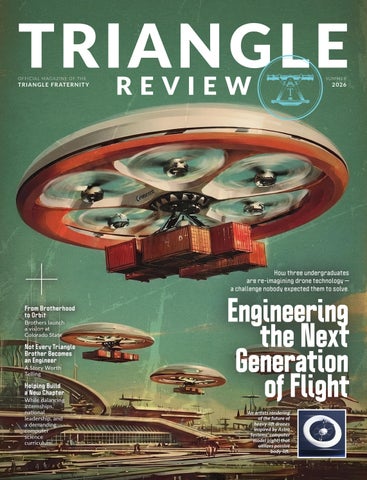
How three undergraduates are re-imagining drone technology — a challenge nobody expected them to solve.
From Brotherhood to Orbit Brothers launch a vision at Colorado State
Not Every Triangle Brother Becomes an Engineer A Story Worth Telling
Helping Build a New Chapter
While dalancing internships, national leadership, and a demanding computer science curriculum.
Triangle_Sum26_P5_SmallerTrim.indd 1
Engineering the Next Generation of Flight An artists rendering of the future of heavy-lift drones inspired by Astro Systems’ computer model (right) that utilizes passive body-lift.
7/9/26 2:25 PM
GIFTS OF IMPACT
Why I Give CREATING LASTING IMPACT THROUGH MY IRA “In 1988 after working for 11 years at the mega-corporation that once was General Electric, I moved to a 750 person, 100% employee owned engineering consulting firm. They had only been employee owned for 2 years and there was an outstanding loan to be paid off in the next 5 years. Along with studying Mechanical Engineering at Iowa State University and joining Triangle, it was one of the best decisions I ever made. The employee ownership allowed me to accumulate a significant tax deferred savings account that allowed for full retirement at age 59. Once I reached the age of 70.5 years, Qualified Charitable Contributions (QCD) from my IRA account allowed me to become more generous to organizations I want to support. My first large commitment to Triangle for the purchase of our current chapter house shocked my wife. I will give the tax man his due, but nothing more than I have to.” — Bob Balsbaugh is74
To learn more about supporting the Triangle Education Foundation through a qualified IRA charitable gift, scan the QR code or visit triangleef.org/ira-gifts.
Triangle_Sum26_P5_SmallerTrim.indd 2
7/9/26 1:19 PM
TABLE OF CONTENT S
Official Magazine of the Traingle Fraternity Veritas Omnis Vincit
EDITORIAL STAFF FRATERNITY EXECUTIVE DIRECTOR
Morgan Brickley morgan@triangle.org
DIRECTOR OF COMMUNICATIONS & EXTERNAL RELATIONS
Megan White mwhite@triangle.org
SR. DIRECTOR OF DEVELOPMENT & EXTERNAL RELATIONS
Kayla Ray Spinella kspinella@triangle.org DESIGN & LAYOUT
Tria Designs Inc.
CONTRIBUTING WRITERS
Ellen Carmichael Charlie Trantanella (Tufts/Arizona) Josh Green (Arizona)
08
Engineering the Next Generation of Flight
12
From Brotherhood to Orbit
How three members are reimagining drone technology. A challenge nobody expected them to solve.
Brothers launch a vision at Colorado State
PRINTED BY ROYLE TRAINGLE FRATERNITY
120 S. Center Street Plainfield, IN 46168 www.triangle.org news@triangle.org (317) 837-9640
CHANGE OF ADDRESS
HQ@triangle.org POSTMASTER
Please send address changes to: 120 S. Center Street Plainfield, IN 46168
03
06
Transit
Pride
07
Fraternity News, Expansion, Event Stories and more.
Items for the recent graduate.
Not Every Triangle Brother Becomes an Engineer — And That’s a Story Worth Telling.
14
20
24
Celebrating the stories of today’s brotherhood.
Fueling scholarships, leadership programs, chapter growth, and opportunities that shape the next generation.
Balancing internships, national leadership, and a demanding computer science curriculum.
In My Words
TRIANGLE REVIEW
is the official magazine of the Triangle Fraternity and has been published since 1911.
Look for this icon throughout this issue to discover how far and wide your contribution to the Triangle Fraternity Foundation impacts our brotherhood. Truth Conquers All
Triangle_Sum26_P5_SmallerTrim.indd 1
Through the Telescope
Impact
1
Everyman
Summer 2026
7/9/26 1:19 PM
PRESIDENT ’S LE T TER
A Familiar Place. A New Look. A Stronger Story.
TRIANGLE FRATERNITY STAFF DIRECTOR OF OPERATIONS
Rhonda Halcomb rhonda@triangle.org
I hope you are enjoying the updated Triangle Review, a new look for a magazine that has connected Triangle actives, alumni, family, and friends for more than a century. This reimagined Review reflects our organization itself: grounded in tradition, yet always moving forward and evolving to meet the needs of the day. As we approach 120 years of brotherhood, I am pleased to share encouraging news about our fraternity as it continues to grow and strengthen while remaining true to its core mission: to be a fraternity of engineers, architects, and scientists that develops men of high moral character, promotes academic success, and fosters lifelong friendships. With the effects of the pandemic continuing to fade, Triangle is in a period of strong growth. We are expanding to new campuses, strengthening existing chapters, and continuing to elevate the member experience. A key part of that growth is driven by two programs focused on peer mentoring and alumni chapter coaching. These efforts build on two factors that consistently support chapter success: the steady guidance of engaged alumni, and the fraternal connection that allows chapters to share ideas, successes, and best practices. These programs, proven over time and adapted for today’s challenges, are creating exciting expansion opportunities and generating strong interest across our chapters. Last fall, I had the opportunity to attend the installation of Triangle’s newest chapter at Washington State. Experiencing the excitement of a dynamic new group being welcomed on campus was memorable for everyone involved. I also visited the Armour and Ohio State chapters, both of which are rooted in tradition and reaching new levels of success.
DIRECTOR OF STRATEGIC GROWTH
David Eron david@triangle.org
ASSISTANT DIRECTOR OF LEADERSHIP PROGRAMS
Ethan Rosonke ethan@triangle.org
REGIONAL LEADERSHIP SPECIALIST
Derek Koester Derek@triangle.org
ADMINISTRATIVE ASSISTANT
Barbara Potter Barbara@triangle.org
TRIANGLE EDUCATION FOUNDATION STAFF PRESIDENT & CEO
Scott Bova, CFRE sbova@triangle.org VICE PRESIDENT
Greg Lamb GLamb@triangle.org DIRECTOR OF DEVELOPMENT
Kate Planow KPlanow@triangle.org
EXECUTIVE DIRECTOR
Michael Fouts mfouts@TriangleBHC.org
Thank you for your continued support of our beloved organization.
THE PURPOSE OF TRIANGLE
The purpose of Triangle shall be to maintain a fraternity of engineers, architects, and scientists. It shall carry out its purpose by establishing chapters that develop balanced men who cultivate high moral character, foster lifelong friendships, and live their lives with integrity.
In F, S, and C,
Pete Satre os89 NATIONAL PRESIDENT
Triangle_Sum26_P5_SmallerTrim.indd 2
“With the effects of the pandemic continuing to fade, Triangle is in a period of strong growth. We are expanding to new campuses, strengthening existing chapters, and continuing to elevate the member experience.”
Lilly Bowman lilly@triangle.org
TRIANGLE BUILDING & HOUSING CORP.
Even as we celebrate this momentum, we remain mindful of the challenges ahead. Our graduates and alumni are entering a rapidly changing STEM environment increasingly shaped by AI. Through this period and beyond, Triangle will continue to provide a strong, values-driven and lifelong member experience that helps prepare our members for lasting success.
Triangle Fraternity
DIRECTOR OF CHAPTER SERVICES
2
Veritas Omnis Vincit
7/9/26 1:19 PM
TR ANSIT
The Impact of FIRST How a robotics competition program set one engineer’s career in motion. Dom Catania tamu 25, a computer engineering major and member of the Texas A&M chapter, was first introduced to FIRST Robotics during his sophomore year of high school thanks to a family friend. Shortly after, he was recruited to join his school’s FIRST team, where he was able to dive into robotic design and tools like CAD. Through this experience, Dom developed valuable skills such as teamwork, quick problem‑solving, and determination. Reflecting on competitions, Dom shared, “There is so much energy and fun at tour‑ naments, so it didn’t matter if we won or lost—we just needed to focus on the next match.” Beyond the excitement of competition, FIRST played a significant role in shaping Dom’s future. While he always knew he wanted to pursue a career in STEM, he wasn’t sure which direction to take until FIRST gave him opportunities to explore multiple STEM pathways and connect with professionals already working in those fields. When asked how current Triangle students can support FIRST, Dom em‑ phasized that chapters can get involved in many ways—supporting teams virtually, donating time or funds, or mentoring students. “You never know how you might influence a high school student to pursue a career in STEM,” he said. As a high school‑ er, Dom looked up to the college‑aged men‑ tors who guided him, and those connec‑ tions inspired him to stay involved. Today, he continues to work closely with a high school team, giving back to the program that shaped his path.
Truth Conquers All
Triangle_Sum26_P5_SmallerTrim.indd 3
“There is so much energy and fun at tournaments, so it didn’t matter if we won or lost— we just needed to focus on the next match.” 3
Summer 2026
7/9/26 1:19 PM
T R ANSIT
The Peer Advantage Why Student‑to‑Student Support Is Transforming Triangle
By Morgan Brickley M.Ed., CAE, Fraternity Executive Director and David Eron M.S.Ed, Director of Strategic Growth
In today’s campus environment, students are juggling more commitments than ever, and chapter officers feel like they are expected to become experts overnight. Officer handbooks, workshops, or one‑time trainings cannot answer every question in real time. That’s where Triangle’s Peer Mentor Program has quietly become a game‑changer. What began with a simple idea – stu‑ dents helping students – has grown into one of the Fraternity’s most effective ways to strengthen chapters, build confidence, and support leaders throughout their entire collegiate experience. THE POWER OF CHANGE THROUGH PEER INSIGHT
The heart of the Peer Mentorship Program is straightforward: systems work best when they are intentional and repeatable; and
Triangle Fraternity
Triangle_Sum26_P5_SmallerTrim.indd 4
4
students learn best from peers who relate to their day‑to‑day challenges. Building bridges through virtual connection and an in-person visit to mentee campuses, peer mentors work directly with chapter officers to help them fine‑tune their systems, solve problems, and build better habits. The conversations are collaborative, student‑driven, and grounded in real experience. The program focuses on building systems that chapters can sustain year after year. Mentors help chapters: organize information more effectively set clearer priorities streamline communication improve online presence and brand enhance social skills to impact growth build leadership teams that feel supported, not overwhelmed
Veritas Omnis Vincit
7/9/26 1:19 PM
# TRIANGLE FRATERNITY The result isn’t just improved perfor‑ mance; it’s increased confidence. Officers frequently share that having a mentor makes complex responsibilities feel manageable and gives them someone as a sounding board to help think through challenges and decisions.
“Before this program, we felt disorganized and a bit lost. But after, it was like someone handed us the reins. Not only did we bring on three new team members, but we gained a real sense of long-term security about our future.” — Aaron Bailey tamu25, member of mentee chapter
with students through video calls, campus visits, and regular check‑ins. Because mentors are students themselves, they can adapt quickly, respond to questions in the moment, and offer solutions that fit the realities of campus life. Having a mentor involved made chap‑ ter responsibilities from marketing and recruitment to leadership training “not only effective but genuinely enjoyable,” Kai Erdmann wash24, shared about his experience being a mentee. The structure allows successful ideas, solutions, and tools to move easily be‑ tween campuses. That interconnectedness has become a major asset for chapters navigating officer transitions, busy aca‑ demic seasons, and the natural learning curve of leadership. It’s a collaborative model — one built on shared experience and mutual trust. SYSTEMS THAT OUTLAST A SEMESTER
One of the strongest aspects of the Peer Mentorship Program is that it serves two groups at once. For mentors, the role becomes hands‑on training in: communication project management teamwork across campuses professional accountability
These improvements last after individ‑ ual officers rotate out of their roles. Peer mentorship helps chapters move from “figuring things out as we go” to having repeatable, easy‑to‑use systems anchored in student experience.
They develop skills that mirror re‑ al‑world consulting and leadership roles while deepening their understanding of Triangle’s benefits and values on a national level. For mentee chapters, the program provides steady support from someone who “gets it.” They gain practical tools, better workflows, and a clearer sense of direction. Most importantly, they gain a partner in their leadership journey – someone who has been in their shoes and knows how to help. This shared learning environment strengthens the Fraternity from every angle. NETWORKING THAT MAKES CHAPTERS BETTER
Ten peer mentors are currently sup‑ porting chapters, colonies, and interest groups across the country. They meet Truth Conquers All
Triangle_Sum26_P5_SmallerTrim.indd 5
119 years of Triangle. Since 1907, Triangle Fraternity has been building more than engineers — we've been building leaders, innovators, and lifelong brotherhood.
A recurring theme among chapters is how mentorship strengthens the systems behind their work, not just the outcomes. With the help of mentors, chapters build: consistent calendars better digital organization smoother officer transitions clearer leadership expectations
SKILLS THAT STICK
triangle_fraternity
triangle_fraternity
A STRONGER TRIANGLE, ONE PEER AT A TIME
Triangle’s Peer Mentorship Program represents a thoughtful investment in the student experience. It empowers under‑ graduates to lead with confidence, sup‑ ports chapters with practical guidance, and gives mentors opportunities to grow as professionals and as brothers. It is a model of how peer‑to‑peer educa‑ tion brings Triangle’s values to life: relat‑ able, collaborative, and deeply human. As mentor Aleksey Mikhno waz25, sums up, serving in this role “deepened my personal attachment to Triangle” and made the experience of supporting other students “an absolute blast.” When students learn from each other, everyone benefits — and Triangle becomes stronger for it.
5
🎓 Congratulations to our graduating members! Your time as collegians may be coming to a close, but the experiences, leadership and connections built along the way will continue long after graduation.
FOLLOW US ON SOCIAL MEDIA
Instagram: @triangle_fraternity Facebook: @TriangleFraternity Linked-In: Triangle-Fraternity
Summer 2026
7/9/26 1:19 PM
REPARED. PRIDE
ROFESSIONAL.
RIANGLE.
2
1. Social Professional STEM Sports Polo: Social Professional STEM Sports Polo $34.95 2. Anorak Jacket $69.95
a strong impression and represent gle with confidence. Our Affinity has everything you need to up, stand out, and succeed.
3. Business Card Holder: $16.69 4. Stainless Steel Travel Mug 13 OZ: $30.69
TIMELESS STYLE
1
Classic pieces that represent Triangle with pride.
Crest / Shield Classic Blazer
INTERVIEW READY Professional looks that help you feel confident and prepared.
ON THE GO
4
Thoughtful essentials for wherever your journey takes you.
Business Card Holder
BUILT FOR BROTHERS
Prepared. Professional. Triangle. GEAR UP FOR SUCCESS
Quality items that connect you to something bigger.
3
Explore the full collection. Make a strong impression and represent
Triangle with confidence. Our Affinity Shop has everything you need to show up, FINDGREEK.COM/TRIANGLE stand out, and succeed. Triangle Fraternity
Triangle_Sum26_P5_SmallerTrim.indd 6
SCAN TO SHOP NOW!
Scan to shop now! 6
FindGreek.com/Triangle Veritas Omnis Vincit
7/9/26 1:19 PM
IN MY WORDS
Not Every Triangle Brother Becomes an Engineer — And That’s a Story Worth Telling By Aaron Snider pur98
When I pledged Triangle in the fall of 1998, I came in like most of us did: textbooks heavy, calculator handy, and on a clear path toward an engineering degree. Then Chem 115 happened. Let’s just say Chem 115 and I had a one-sided relationship — and I was on the losing end. Somewhere between failed titrations and a Political Science course I took almost by accident, I realized something important: the subjects that challenged me most weren’t the ones I was meant to pursue. Political Science clicked in a way chemistry never did, and eventually I graduated from Purdue with a degree many people probably wouldn’t expect from a Triangle brother. What surprised me most was how much opportunity came from that pivot. I served as a congressional intern and founded an undergraduate academic journal that still exists today and has become widely respected in undergraduate publishing. More importantly, I learned that Triangle’s values weren’t limited to one profession or discipline. I love what Triangle represents and what our founders built. But I’m writing this for the brothers who started in engineering, architecture, or the sciences — and ultimately found themselves somewhere else. You’re part of this story too. So what do you do with a Political Science degree? In my case: sales. I spent 25 years building a career in the field, enough to retire for the first time at 41. Retirement, however, didn’t last long. After a year of figuring out what came next, I did what many Triangle brothers eventually do: I built something of my own. Truth Conquers All
Triangle_Sum26_P5_SmallerTrim.indd 7
That company became Blackiron Financial, a firm focused on helping small businesses access quality group health coverage and employee benefits. Large insurance agencies often overlook businesses with fewer than 50 employees, despite the fact that small businesses make up the overwhelming majority of companies in America. Blackiron exists to serve those owners — from startups to long-established family businesses — with the same level of guidance and support larger corporations receive. Looking back, engineering taught me how systems work and break, Political Science taught me how policy shapes the people inside those systems, and sales taught me how to listen. Blackiron became the place where all three experiences converged. If you’re a Triangle brother whose career took a turn none of us could have predicted at 19 — into sales, law, finance, the arts, public service, or somewhere else entirely — remember this: while our initial majors and interests brought us together, the bonds we made in Triangle were never just built on majors. They were built on Brotherhood. 7
“Engineering taught me how systems work and break, Political Science taught me how policy shapes the people inside those systems, and sales taught me how to listen.” Summer 2026
7/9/26 2:25 PM
How three undergraduates are reimagining drone technolog — a challenge nobody expected them to solve.
ENGINEERING THE NEXT GENERATION OF FLIGHT by Kayla Ray Spinella, Sr. Director of Development & External Relations
Their answer is a concept they call “passive body lift” ... Astra turns the entire aircraft into part of the lifting system.
If you told most people that a group of college students was going to challenge the fundamental design logic of the drone industry, they’d probably smile politely and move on. Nathaniel Budz ar25, Felix Gonzalez ar25, and Franco Avalos are counting on that reaction — because proving people wrong has become part of the process. The three are the founders of Astro Systems, a student-run aerospace startup developing a drone called Astra — and the technology behind it is unlike anything currently on the market. What began as a side project between ambitious engineering students has evolved into something far larger: a company aiming to rethink the future of heavy-lift drone technology from the ground up. Ironically, it all started with a challenge most people considered unrealistic. DARPA — the Defense Advanced Research Projects Agency — issued a national engineering challenge centered around achieving a 4:1 lift-to-weight ratio in drone design, a benchmark many in aerospace had largely dismissed as impractical. The challenge has drawn interest from innovators across the aerospace and defense sectors — not just students, but anyone bold enough to attempt solving it. At the time, the founders of Astro Systems described themselves as “newbies in drone building.” They weren’t trying to launch a startup. They simply wanted to see if they could solve a difficult engineering problem. So they started running simulations — and what came back surprised even them. Triangle Fraternity
Triangle_Sum26_P5_SmallerTrim.indd 8
8
Veritas Omnis Vincit
7/9/26 2:25 PM
The numbers were promising enough to suggest they weren’t just experimenting with a fun concept — they may have stumbled onto a fundamentally different way of designing drones. That was the moment the project stopped feeling like a class experiment and started feeling real. REIMAGINING FLIGHT Traditional drone design follows a familiar pattern: if you need more payload capacity, you add more power. Bigger motors require bigger propellers, which require larger frames and heavier components. Eventually, the aircraft spends most of its energy simply keeping itself airborne. The industry has largely accepted those diminishing returns as unavoidable — but Astro Systems hasn’t. Their answer is a concept they call “passive body lift,” where the airframe itself contributes significantly to lift rather than functioning as dead weight the motors must fight against. Astra turns the entire aircraft into part of the lifting system, and the result is a dramatically improved payload-toweight ratio without simply scaling up power consumption. It’s a deceptively simple idea — but one that required the team to question nearly every assumption An artists rendering of traditional drone design. (above) of the future The inspiration for Astra’s of heavy-lift drones shape came from a surprising inspired by Astro source: the flying saucer. Systems' passive body-lift computer model (left).
The founders realized early on that the extreme requirements of the DARPA challenge meant conventional thinking wasn’t going to be enough. Adding larger wings or more powerful propellers wouldn’t solve the core problem — they needed a completely different approach.
What makes the breakthrough even more fascinating is that the foundational concept came from a team member without an aerospace background at all; and his outsider Truth Conquers All
Triangle_Sum26_P5_SmallerTrim.indd 9
9
perspective became one of Astro Systems’ greatest strengths. “Our founders have backgrounds in software, electrical, and aerospace engineering,” the team explains. “We apply diverse thinking modalities to conventional problems in order to achieve novel solutions.” Rather than designing within the limitations of one discipline, the group approached problems holistically. Every decision — from structure to software to power systems — was shaped by multiple engineering perspectives working together. When the team finally completed their computational fluid dynamics simulations and reviewed the results, they decided to show them to a professor at their university. His response instantly validated months of work, giving them the green light they needed to go all-in. So they built. BUILDING ASTRA FROM THE GROUND UP Of course, promising simulations and a functioning aircraft are two very different things. Turning Astra into a real-world prototype meant solving problem after problem — many of which they never anticipated when they first began. One of the earliest roadblocks was software. Existing CAD tools weren’t capable of modeling the circular wing design in the way the team needed. Rather than compromise the design, they built their own custom in-house software to generate the 3D models themselves. Then manufacturing the prototype became an engineering challenge. The team’s 3D printer wasn’t large enough to print the aircraft in one piece, forcing them to rethink how the drone would be assembled. Instead of viewing the limitation as a setback, they designed the structure to be fully modular, allowing multiple components to snap together seamlessly. What started as a workaround ultimately became a feature with real, long-term engineering value. After overcoming these initial hurdles, the team’s most pivotal moment came Summer 2026
7/9/26 1:20 PM
Below: Prototype rendering of the Astra heavy-life vehicle. Below Left: Nathaniel Budz ar25, builds Astra in the Triangle workshop.
when things failed completely. During Astra’s first flight test, the drone immediately began spinning uncontrollably. Within seconds, the team lost control, and the aircraft slammed into the ground, snapping both landing gears on impact. For many student projects, that might have been the end — but not for the Astra team. They shouldered on and got right back to work. They troubleshot the software, reinforced the landing gear structure, and rebuilt the damaged components. More importantly, they learned something about themselves in the process. “Even when things get tough, you can’t lose hope,” they reflected. “You just have to see every obstacle that comes up as a new problem to solve.” The next flight went far better. LATE NIGHTS, LONG ODDS, AND ZERO QUIT Engineering challenges weren’t the only obstacles standing in their way. All three founders are full-time students at the Illinois Institute of Technology balancing coursework, exams, and the pressures of college life while trying to build a startup with real commercial potential. Scheduling alone became a challenge. “The hardest part is trying to find time for all of us to meet, plan, and build,” they explain. “We recognize that our primary focus should still be our coursework and studies while still striving to build something we can be proud of.” The sacrifices are real. Free time with friends and family has often been replaced with late-night design sessions and marathon build weekends. Their work sessions have almost become legendary among friends and fellow students. A typical night begins around 6 p.m. with a coffee or tea run before the team locks in on a goal for the evening. Some sessions wrap around 3 a.m. Others stretch into full 24-hour pushes, with team members sleeping in rotation while the rest continue working. Beyond the technical side of the project, there’s another reality most people never see: rejection. Building something ambitious at their age means constantly trying to convince people to take them seriously. That means cold emails, unanswered Triangle Fraternity
Triangle_Sum26_P5_SmallerTrim.indd 10
LinkedIn messages, partnership requests, and difficult conversations. “The amount of outreach piles up,” one founder admits. “But finding the right partners, colleagues, and mentors is worth all the hassle when it finally pays off.” Their persistence has become just as important as the engineering itself. BROTHERHOOD BEHIND THE BUILD Long before Astra ever left the ground, the foundation of the project was the trust the team had already built with each other. It’s impossible to separate Astro Systems from the role Triangle has played in shaping the team behind it. For Nathaniel, Triangle instilled the mindset that pushed him to stop waiting and start building. “Triangle wholly encourages young men to push themselves towards being something better, not just good enough,” he says. “Building better men will always start with yourself.” 10
RAPID-FIRE: Inside Astro Systems CURRENT BUILD ANTHEM: “Rocketeer” by Far East Movement h ONE WORD TO DESCRIBE ASTRA: The Future. h BIGGEST “AHA” MOMENT:
Finally figuring out CFD software.
h MOST UNEXPECTED CHALLENGE: Finding
the right motor and propeller configuration — it took three attempts.
h TOOL THEY COULDN’T LIVE WITHOUT:
The Bambu Labs H2D printer.
h UNOFFICIAL COMPANY MOTTO:
Ad Astra.
Veritas Omnis Vincit
7/9/26 2:25 PM
Triangle alumni stepped forward with mentorship, guidance, and professional insight. And perhaps most importantly, the Fraternity gave the founders access to a network of engineers constantly willing to help solve problems when they hit technical walls.
“When you’re building something ambitious, conflicts are inevitable ... knowing we are brothers first allows us to challenge ideas, debate technical solutions, and push back without taking things personally.” Left: the 3D printer prototype of the Astra heavy-lift vehicle. Below left: Franco Avalos (GNC Engineer), Nathaniel Budz (Remote Pilot In Command), Felix Gonzalez (Team Lead).
Felix points to the confidence and problem-solving environment Triangle provided. Being surrounded by fellow STEM students created a space where ideas could be challenged, refined, and improved collaboratively. Franco, a friend of the chapter, found something equally valuable: people who genuinely believed in his ideas and were willing to give honest feedback without judgment. That culture of support became foundational to Astra Systems. For the founders, brotherhood isn’t just a slogan — it’s part of how the company functions. “When you’re building something ambitious, conflicts are inevitable,” they explain. “But knowing we are brothers first allows us to challenge ideas, debate technical solutions, and push back without taking things personally.”
WHAT’S NEXT FOR ASTRO SYSTEMS? Looking ahead, Astro Systems believes its technology could have major implications for logistics and defense — industries where payload efficiency and rapid transport are becoming increasingly important — but the founders are thinking even bigger than a single drone. Their long-term vision is to create a fully American-built hardware ecosystem for unmanned aerial systems: affordable, adaptable, and domestically produced. “We want to own the hardware we sell,” they explain. As this story goes to print, the team is awaiting DARPA’s response to submitted flight test materials — the latest milestone in a journey that began with late-night simulations and now finds three college students competing in a national defense challenge that could help reshape the future of drone technology and autonomous flight. Still, despite the ambitious goals, the founders already view the project as a success. “Getting to where we are right now is still a win for us,” they say. “Taking the steps to commit to building something this ambitious is a success no matter the outcome.” To learn more about Astro Systems or connect with the founders, visit astrosystems.us.
Triangle also provided very tangible support. The chapter house makerspace and 3D printer helped the team build their early prototypes. Truth Conquers All
Triangle_Sum26_P5_SmallerTrim.indd 11
11
Summer 2026
7/9/26 1:20 PM
From Brotherhood to Orbit
How Triangle Brothers Launched a Vision at Colorado State by Andrew Holland csu24
Triangle Fraternity
Triangle_Sum26_P5_SmallerTrim.indd 12
12
Veritas Omnis Vincit
7/9/26 1:20 PM
T
his team would not have been possible without Triangle. Open Orbit, Colorado State University’s CubeSat team, was founded in Fall 2024 by Triangle brothers Andrew Holland csu24, Jacob Auman csu24, Chinmay Jayanty csu24, Nicholas Debey csu24, and Mason Maynell csu24. Because we were brothers before founding the team, we already knew each other, how to communicate, and how to trust one another. Triangle teaches you to take responsibility within the brotherhood, and Open Orbit mirrors that each member must take responsibility over an aspect or subsystem of the project. That foundation gave us a significant head start when building a team focused on designing and eventually launching “Because we CSU’s first were brothers student-built satellite. before Triangle founding played a major role in making the team, Open Orbit we already possible. The knew each responsibility, other, how to communication, communicate, and leadership emphasized and how to within the fratrust one ternity transanother.” lated directly into building an engineering organization. Triangle’s structure of officers, committees, and long-term mentorship provided experience that could be applied within technical teams. Before founding Open Orbit, I served as president of the Colorado State chapter in 2024, where I learned how to delegate responsibility, keep a team moving forward, and trust others to lead alongside me. Triangle was,
in many ways, my first engineering leadership role. The idea for Open Orbit began while attending the 2024 Triangle National Convention in Milwaukee. There, I met Mark Tolliver ill70, and Ted Bowlds miss72, who became early mentors for the project. Throughout Fall 2024 and Spring 2025, they supported the development of the team and helped guide us through the early stages of turning an idea into a real organization. If I had not attended National Convention and had the opportunity to speak with these alumni, this team would never have existed. Open Orbit’s mission is to expand aerospace opportunities at CSU by giving students hands-on experience designing, building, testing, and eventually launching a satellite. While CSU has a history of satellite research through CIRA and the atmospheric science department, students have had limited opportunities to directly participate in those missions. Open Orbit brings together students across disciplines, including electrical engineering, mechanical engineering, computer engineering, and computer science, because modern space systems require collaboration across every field. Each of them is important as satellites are deeply interdisciplinary systems, where everything from embedded systems to in-orbit autonomy is now central to almost every mission. Beyond satellite development, the team has already built a ground station capable of supporting communications with partner universities, including Aalto University in Helsinki, Finland. Open Orbit has also
completed two successful high-altitude payload launches reaching nearly 80,000 feet, giving students experience with real-world testing, mission planning, systems engineering, and team coordination in ways that traditional classrooms often cannot replicate. When we started, Open Orbit was just a conversation between a few brothers with an idea and no roadmap. Now, we have a ground station supporting a mission in Helsinki, two successful launches behind us, and a growing team working toward something CSU has never done before. None of this existed two years ago, and that’s what hits the hardest. There’s no single milestone that sticks out; the most rewarding part is seeing the distance between where we began as a simple idea and where we stand now. Watch a video of the launch of the 1U CubeSat here:
1U CubeSat Format “When people hear of a satellite, they think of the James Webb or similar large satellites, but a CubeSat is a small, standardized satellite form factor built of units called a “U”, which is a 10cm x 10cm x 10cm cube. They still contain many of the same subsystems, but the CubeSat form factor provides some starting requirements that simplify the challenges when dealing with a complex system and allows students to get hands-on experience with the challenges of space.” Truth Conquers All
Triangle_Sum26_P5_SmallerTrim.indd 13
13
Summer 2026
7/9/26 1:20 PM
THROUGH THE TELESCOPE UNIVERSITY OF COLORADO BOULDER
Leading Through Innovation
At University of Colorado Boulder, Triangle earned the university’s Innovation Award for pushing boundaries in STEM and chapter programming. Individual brothers were also recognized for their leadership: Nathan Bish colo25 received the Emerging Leader Award, while Marco Cordova colo25 earned an Honorable Mention for Best Fraternity President. Together, the honors reflect a chapter culture focused on leadership, creativity, and impact.
IOWA STATE UNIVERSITY
Top Tier
Triangle at Iowa State University earned the prestigious President’s Circle distinction in the Fraternal Awards of Excellence; the highest recognition a chapter can receive. The honor places ISU Triangle among the top six Greek organizations out of 60 chapters across the university community this year. The chapter also received the Collaboration Award from the Interfraternity Council, recognizing its commitment to partnership, campus involvement, and leadership across the Greek community. PURDUE UNIVERSITY
Boilermaker Brothers Honored
Pictured left: Arnav Aggarwal pur24. Pictured right: Oak Stevens pur71.
Two Triangle brothers from Purdue University were recognized during the university’s FSCL Awards Night celebrations. Arnav Aggarwal pur24 earned IFC Brother of the Year honors for his leadership and service within the fraternity community, while Oak Stevens pur71 received the Distinguished Service Award in recognition of his continued impact and lifelong support of Purdue fraternity life.
Chapter Eternal This list reflects all those members who entered Chapter Eternal since March 2025 Triangle Fraternity
Triangle_Sum26_P5_SmallerTrim.indd 14
Lorna Onizuka Robert Schlaf Bruce Murray Allen Koleff Robert Hauss Robert Lawlace Donald Grover David Andree James Knodel James Holmstrom Zane Oaks
ar54 ar55 ar56 cin31 cin46 cin47 cin48 cin48 cin50 cin57
Theodore Brown Virgil Tharp Bill Steiner Michael Cohen Robert Williams Gary Baumgartner Elias Friedman Bruce Relyea, MD Nathaniel Skinner Kevin Lucht Syndi Pritchard
14
cin65 cin65 cin67 cin90 cl57 cl59 conn88 cor54 ill01 ill80 is
Ronald Beguin Thomas Greedy Dale Hanson David Boylan, Jr. Robert Kleist Willis Reddick Duane Dewerff William Hudson Jon Hope Michael Michellich David Blasiar
is64 is68 is74 is78 kan49 kan53 kan56 kan57 kan63 kan63 ks64
Veritas Omnis Vincit
7/9/26 1:20 PM
UNIVERSITY OF CALIFORNIA, IRVINE
Big Wins in Irvine
SOUTH DAKOTA MINES
Leadership Hall of Fame Brother Dade Gomez sdm26 was inducted into the Leadership Hall of Fame at South Dakota Mines — one of the university’s highest student leadership honors. Only five to six students are selected each year, with their photos permanently displayed in Upper Surbeck. Over the past four years, Dade has become a cornerstone of the Triangle chapter through his leadership, service, and lasting contributions to campus life. His impact will continue long after graduation.
Triangle at University of California, Irvine celebrated a standout year at the 2026 UCI Sorority & Fraternity Life Awards. Chapter president Justin Canas uci26 was named 2026 IFC Chapter President of the Year, while the chapter also earned IFC Excellence in Recruitment & Retention. The recognition highlights the chapter’s strong leadership, member engagement, and continued growth on campus.
PENNSYLVANIA STATE UNIVERSITY
Excellence Across the Board
South Dakota Mines Board of Regents Organizational Leadership Award: Triangle Fraternity has been a vital part of campus life this year. The chapter brought in the most new members of any Greek organization, and over the past two semesters brothers have contributed more than 250 volunteer hours to the campus and surrounding community. This award from the South Dakota Board of Regents reflects the chapter’s commitments to academics, service, and the goals of building better men. It means a great deal to be recognized at the state level, and it motivates brothers to keep raising the bar going forward.
Don Cobb David Yardley Jay Glass William Stoskopf Elmer Young James Martin Frank Campbell, JR.,USN RE William Ulrich John Masick Robert Ethier Robert Anderson
ks64 ks66 ks66 ks67 ky57 ky75 lou49 lou50 lou62 marq50 marq52
Truth Conquers All
Triangle_Sum26_P5_SmallerTrim.indd 15
Barry Fleming, PE Marly Hemp Richard Bettler Ronald Kollmansberger John Lyons David Smith John Wyatt, P.E. David Veith Michael Thomes Harold Schaefer Eldon Bearden
At Pennsylvania State University, Triangle was recognized with multiple FSL Greek Column Awards, earning honors in Excellence in Alumni & Family Engagement, Excellence in Campus & Community Involvement, and Standards of Excellence. The awards reflect a year defined by strong chapter connections, campus impact, and a commitment to building lasting relationships within the Penn State community.
marq53 marq53 marq57 marq57 marq66 mich59 mich76 minn58 minn66 minn71 miss74
Richard Ashley J. Victor Spalding Warren Kaiser William Bennett Charles Paschedag Morton Mullins James Close Dennis Hunnicutt Arthur Evans Robert Aubuchon Ronald Harris
15
miss75 mom36 mom47 mom50 mom50 mom53 mom54 mom54 mom55 mom55 mom55
Richard Thompson James Johnson Jerome Rogenski John Baumgardner Paul Degonia Thomas Stark H. Hurter Charles Turner Michael Wall
mom56 mom57 mom57 mom59 mom60 mom60 mom62 mom64 mom65
Continued on p. 16
Summer 2026
7/9/26 1:20 PM
THROUGH THE TELESCOPE
IOWA STATE UNIVERSITY
Still Carving Turns Iowa State Alumni Revive a Classic Ski Tradition Triangle alumni from Iowa State University are still hitting the slopes nearly 50 years after the chapter’s original spring break ski trips began. What started in the 1970s as packed cars heading west to Colorado has evolved into an annual “old guy ski trip,” reconnecting brothers year after year. The 2022 reunion brought seven alumni together at Breckenridge to continue the tradition. From left to right: Jeff Siders is77, Peter Rasmusson is78, Ron Sippel is76, John Greene is73, Paul Slack is76, Mike Goeser is73, Bob Balsbaugh is74
SOUTH DAKOTA MINES
UNIVERSITY OF ILLINOIS
A Legacy of Service Jeff Allen sdm74 was named the 2026 recipient of the prestigious Guy E. March Medal at South Dakota Mines. A retired Caterpillar executive and lifelong supporter of the university, Jeff has spent decades mentoring students, strengthening alumni engagement, and helping expand scholarship support for Triangle brothers. His impact continues to shape generations of Hardrockers.
Continued from p. 15 David Robinson Gar Adams msoe65 Steven Roling msoe70 Richard Quick David Karecki Jeffrey Robinson Justin Keller
mom81
msu55 msu65 mtu95 neb01
Triangle Fraternity
Triangle_Sum26_P5_SmallerTrim.indd 16
Back in the Saddle Brothers Reconnect Through Cycling
Four Triangle alumni from University of Illinois Urbana-Champaign found their way back to each other, and themselves, decades after graduation. Jay Crain ill81, Gary Welk ill81, Pat McGovern ill81, and Dr. Greg Welk ill83, reconnected through cycling, health, and shared support during midlife transitions. What started with bike rides and personal transformation evolved into Grinta for Life, a new wellness-focused community, book, and program aimed at helping midlifers reclaim identity, purpose, and health. Their documentary GRINTA! recently screened at film festivals worldwide.
Robert Glenn, II. Steven Mortenson John Johnson, PE Edward Bischoff, PE PS Milan Johnson Mark Evrard Larry Adams Richard Farrar J. Jensen Joseph Richard, Jr. Richard Steele
neb63 neb86 nu50 os53 os59 ps70 ps83 pur42 pur50 pur54 pur55
Richard Leinbach Thomas Smith William Schmitt Ernest Deaton, Jr. Stephen Hostetler Christopher Chaney Michael Yaro Melvin Bartlett Larry Flowers John Laehy Randy Vaal
16
pur57 pur57 pur61 pur64 pur67 pur73 pur79 rose67 rose68 rose68 rose76
“What started as four Triangle brothers reconnecting became something much bigger.” Robert Turner Max Gassman W. John Versteeg Justin Keough Goutham Hariharan Noah Jones Scott Fitzenrider George Kunkel Colin Dincher David Taube Robert Safford
sdm50 sdm54 sdm64 sdm91 tol21 tol25 tol88 ucla60 utah16 uwm77 wis48
Veritas Omnis Vincit
7/9/26 1:20 PM
TEXAS A&M UNIVERSITY
Building Toward Brotherhood Texas A&M Colony Continues Momentum The Triangle Colony at Texas A&M University wrapped up a successful academic year with 25 active members and continued progress toward full chapter status. Following two strong recruitment cycles, the colony celebrated the year with a formal event recognizing leadership transitions, alumni support, and the growing brotherhood helping shape Triangle’s future at Texas A&M.
UNIVERSITY OF OKLAHOMA
Brotherhood Without Walls Oklahoma Alumni Launch Retreat Tradition Despite the absence of an active chapter on campus at the University of Oklahoma, the chapter’s alumni remain committed to fostering their brotherhood. In 2025, they launched the first Oklahoma Alumni Retreat at Quartz Mountain State Park, bring-
ing together brothers, spouses, and families for a weekend of fellowship, games, and reconnection. For many attendees, it felt like stepping back into the best moments of chapter life all over again.
IOWA STATE UNIVERSITY
Mental Health Awareness Week The Iowa State chapter came together the week of April 19th to support mental health awareness and honor the memory of Brother Jeremy Onyango is20, who we lost due to suicide, through a series of events including a cookout, wellness activities, and a campus walk. Through their efforts, the chapter raised more than $2,500 to support Jeremy’s Memorial Scholarship and mental health initiatives across Iowa. “Our goal was to remind brothers why we stick around, and we take the time to give our reasons to stay,” said Zach Wood is25. “This event means a lot to our chapter because Jeremy was one of
our brothers and we want to honor him and his fight as best we can. Jeremy has a very big impact on our chapter. We place a lot of emphasis on our mental health and helping everyone as much as possible. We also host crucible sessions once a month, a time for brothers to slow down and talk about everything going on, as well as many other wellness events.” We’re proud to highlight the meaningful impact these brothers are making — creating space for important conversations, supporting one another, and continuing Jeremy’s legacy through action and awareness.
“This event means a lot to our chapter because Jeremy was one of our brothers, and we want to honor him and his fight. He had a big impact on us. We place a lot of emphasis on mental health.” Truth Conquers All
Triangle_Sum26_P5_SmallerTrim.indd 17
17
Recruitment Momentum Across Triangle This year, chapters across Triangle proved that strong recruitment starts with authentic brotherhood, campus involvement, and members willing to share what makes their experience meaningful. From tabling events and professional workshops to intramurals, service projects, and late-night study sessions, chapters found creative ways to connect with students looking for something deeper than the traditional fraternity experience. The result? Recruitment goals exceeded, growing memberships, and momentum heading into next year. Groups that met their growth goals were Armour, Iowa State, Louisville, Michigan, Michigan State, Michigan Tech, Missouri Mines, MSOE, Nebraska, Rose, TAMU, UCSD, Washington, Washington State and Wisconsin. Summer 2026
7/9/26 1:20 PM
HOUSING
The Windows That Wouldn’t Budge And What They Taught Us About Protecting Our Home
Triangle Fraternity
Triangle_Sum26_P5_SmallerTrim.indd 18
18
Veritas Omnis Vincit
7/9/26 1:20 PM
EVERY CHAPTER HAS “THAT THING”
Every winter at the Michigan State chapter house, somebody fought with the windows. Push harder. Lift slightly. Try again. The old aluminum frames stuck constantly, letting cold air pour inside and frustrating generations of members who learned the same unofficial lesson: every fraternity house has that thing. The door that never quite shuts. The radiator that clangs at 2 a.m. The draft you can never fully escape. At Michigan State, it was the windows. For decades, the aging single-pane frames warped, oxidized, and struggled against the natural settling of the house. Every class found ways to manage them while continuing to care deeply for the home they shared. Generations of alumni supported and maintained the house through ongoing volunteer leadership, financial contributions, and an enduring commitment to the chapter experience. Eventually, however, the scale of the project became larger than a typical repair. Replacing every window in the house would require significant planning, capital, and long-term coordination.
Protecting the house means protecting Triangle’s future at Michigan State. MORE THAN JUST A WINDOW PROJECT
Replacing the windows had been at the top of the chapter’s wish list for years. But the challenge extended far beyond the cost. The chapter house sits within a historic district in East Lansing, making even exterior-facing upgrades complicated. Projects require approvals, careful coordination, and patience. On top of that, replacing the windows would cost nearly $150,000 — a major investment for any fraternity property. As Sean Powers, msu15, MSU Chapter Coach, explains: “Replacing the windows on the chapter Truth Conquers All
Triangle_Sum26_P5_SmallerTrim.indd 19
house has always been at the top of everyone’s list. The old single-pane windows did very little to insulate from outside temperatures and many allowed drafts as if they were wide open. Aside from the cost itself, the chapter house sits in a historic district making it even more challenging to change anything exterior-facing on the house. The completion of this project has had a very positive impact on the chapter.” Like many fraternity houses across the country, the Michigan State chapter house has been sustained through decades of alumni dedication and volunteer leadership. But large-scale capital projects — especially within historic districts — require significant long-term planning, funding, and coordination that can span generations of alumni involvement. That is where the Triangle Building and Housing Corporation (TBHC) helps chapters build on that legacy with strategic planning, financial stewardship, and long-term support. PLANNING FOR THE LONG HAUL
After acquiring the Michigan State chapter house in 2018, TBHC approached the property with a long-term mindset focused on stability, safety, and sustainability. Over time, TBHC invested nearly half a million dollars into improvements throughout the facility, including structural repairs, modernization projects, and infrastructure upgrades designed to preserve the house for future generations. The windows remained one of the final major projects. TBHC didn’t rush the project. It planned for it. Funding had to be secured. Historic district approvals had to be navigated. The work had to fit into a responsible long-term strategy for the property. This past year, that planning finally paid off. The new windows were installed, immediately improving insulation, comfort, efficiency, and appearance throughout the house. Then came the surprise. The project finished under budget. For the first time in the house’s history, TBHC was able to install central air conditioning — replacing aging window units and dramatically improving both comfort and safety throughout the chapter house. What started as a window project became a transformational upgrade. 19
Today, members walk into a house that reflects decades of alumni commitment — now warmer in the winter, cooler in the fall, quieter, safer, and better prepared for the future. PROTECTING MORE THAN A BUILDING
The real story isn’t about windows. It’s about permanence. At campuses like Michigan State, where fraternity houses sit within historic districts, losing a property can mean losing a presence permanently. Once a chapter loses its place, getting back can be nearly impossible.
Brotherhood is built by people — but the right environment helps it grow stronger. Protecting the house means protecting Triangle’s future at Michigan State. That’s why TBHC operates with what many leaders describe as an “infinite timeline.” Undergraduate members graduate every four years. Volunteer leaders rotate over time. But TBHC remains focused on the bigger picture — ensuring Triangle chapters have stable, sustainable homes for generations to come. And when housing improves, chapters improve alongside it. Standards rise. Pride increases. Recruitment strengthens. Members take greater ownership of their environment. Brotherhood is built by people — but the right environment helps it grow stronger. A SYMBOL OF SOMETHING BIGGER
For years, the windows were a reminder of a project generations of alumni hoped to see completed. Today, they represent something entirely different. A chapter worth investing in. Alumni who never stopped caring. And a brotherhood building not just for today’s members — but for generations of Triangles still to come. Summer 2026
7/9/26 1:20 PM
IMPAC T
90%
of participants who reported strong readiness for their leadership role a result of attending LTW.
Leadership & Training Weekend 2026: By the Numbers
162
Total students registered
140
Total students attended
24
Total facilitators, alumni, and staff
36
Chapters Attended
20
Chapters with three or more in attendance
Six
Chapters with attendees in all tracks: Louisville, Marquette, Michigan State, Ohio State, Rose Tech, Wisconsin
77%
1st time attendees
Triangle Fraternity
Triangle_Sum26_P5_SmallerTrim.indd 20
Bigger Than a Weekend HOW LEADERSHIP & TRAINING WEEKEND 2026 STRENGTHENED THE BROTHERHOOD NATIONWIDE The 164 students, facilitators, staff, and National Council who attended Leadership & Training Weekend (LTW) in January made the experience more than a return to Jameson Camp — it was a record-breaking weekend that reflected the growing momentum of Triangle’s undergraduate leaders. With almost 80% of attendees experiencing LTW for the first time, these Triangles brought fresh energy, curiosity, and a strong appetite for connection. That energy was noticeable from session one through the final farewell. Despite long days packed with learning, discussion, and collaboration, attendees remained 20
deeply engaged, leaning into conversations, asking thoughtful questions, and building relationships beyond their own campuses. As the weekend unfolded, several themes emerged organically: brotherhood, peer learning, empowered leadership, and connection beyond the chapter. LEARNING FROM EACH OTHER, NOT JUST THE CURRICULUM
LTW offered six leadership tracks: Steven L. Miller Presidents’ Leadership Academy (SLMPLA), Elevate Recruitment Workshop, Finance Workshop, Wakerly Service-Learning Workshop, New Member
Educator Workshop, and Risk Prevention Workshop. But one of the most powerful learning environments wasn’t confined to a session room or outlined in the schedule — it was each other. Post-event feedback reinforced LTW’s impact: 87% of participants said learning from other chapters was the best part of the weekend, and many highlighted new friendships, peer knowledgesharing, and improved leadership confidence and self-awareness. When sessions ended, students had late-night conversations, shared meals, and informal discussions where they compared approaches, traded best practices, and built relationships that will shape their chapters long after LTW. EMPOWERED LEADERS, STRONGER CHAPTERS
Beyond connection, Triangles saw measurable gains in confidence and preparedness. Participants reported strong readiness, with about 90% saying that LTW made them more prepared for their leadership Veritas Omnis Vincit
7/9/26 1:20 PM
87%
of participants who said learning from other chapters was the best part of the LTW weekend.
Building the Next Generation of Triangle Leaders
role. Students unanimously agreed that group facilitators were clear and knowledgeable on the topics presented. When leaders leave feeling prepared and supported by a national network of peers, chapters benefit. With 20 chapters sending three or more members and six chapters represented in all six tracks, LTW created layered learning that will ripple back through chapters and campuses. CONNECTION THAT EXTENDS BEYOND CAMP
For many students, LTW was their first exposure to the broader Triangle network. What began as a leadership program quickly became something deeper: a sense of belonging to a brotherhood that extends far beyond any one chapter. They gained a network of brothers they can call for support — on any topic from recruitment to leader burnout. WHAT THIS MEANS FOR THE FUTURE OF TRIANGLE
LTW 2026 showed that Truth Conquers All
Triangle_Sum26_P5_SmallerTrim.indd 21
undergraduates are eager for growth, connection, and purposeful leadership. Their learning focused on practical leadership challenges like: h Managing risk, insurance, and emergency response h Understanding chapter finances and Chapter Endowment Funds h Improving recruitment conversations h Delegating responsibilities and building stronger executive teams h Distinguishing between service and philanthropy h Developing greater selfawareness as a leader Alumni investment in Leadership & Training Weekend helps students show up on campus feeling prepared, connected, and confident — making a lasting impact on chapter culture. This is how Triangle’s future leaders begin to see themselves as part of something larger — and brotherhood grows stronger nationwide.
Last summer, 54 Triangles from 26 campuses gathered in Dayton, Ohio for the Herbert F. Scobie Leadership School (HSLS or “Scobie”), Triangle’s premier institute for emerging leaders. Held July 31–August 3, 2025, Scobie gives members a strong foundation in leadership, grounded in brotherhood, values, and personal growth. Supported by the Triangle Education Foundation and annual chapter funds, the program remains accessible while delivering a high-impact experience. Assessment data showed growth across key leadership areas, including: Understanding and using personal strengths Communication and conflict styles Values-based and ethical leadership Team collaboration and group dynamics Leading change and navigating challenges
One defining feature of Scobie was the small group “Shop” experience, where participants formed close bonds, reflected meaningfully, and translated big leadership ideas into practical habits. Hands-on activities, discussions rooted in Triangle’s Ritual and Code of Ethics, and approachable facilitators made leadership development both personal and actionable. Beyond individual skill-building, HSLS helped participants see Triangle on a national scale. Many arrived focused on their own chapter and left with a broader sense of connection and shared purpose. For alumni and supporters, Scobie is an investment in Triangle’s future: developing emerging leaders who return to campus more self-aware, values-driven, and prepared to strengthen their chapters and communities.
Participants didn’t just feel inspired in the moment; they reported sustained confidence and realworld application of these skills six weeks later. Many were already using what they learned to guide decisions, strengthen conversations with brothers, take ownership of their actions, and lead change within their chapters. 21
Summer 2026
7/9/26 1:20 PM
IMPACT Some of Triangle’s most impactful gifts never come from a checkbook. Many alumni are discovering they can make a larger impact than they ever imagined — often using assets they already own. From appreciated stock and retirement assets to cryptocurrency and donor‑advised funds, non‑cash giving has become a strategic and increasingly popular way to support the future of Triangle. These gifts help fuel scholarships, leadership programs, chapter growth, and opportunities that shape the next generation of Triangle men. GIVE SMARTER Non‑cash gifts allow donors to maximize their impact while potentially unlocking meaningful tax advantages.
Many alumni discover they can make a larger impact than they ever imagined — often using assets they already own. TURN INVESTMENTS INTO IMPACT
Expanding Your Impact THE POWER OF NON‑CASH GIVING TO THE TRIANGLE EDUCATION FOUNDATION Triangle Fraternity
Triangle_Sum26_P5_SmallerTrim.indd 22
22
One of the most tax‑efficient ways to give is through appreciated stock or securities. By transferring stock directly to the Triangle Education Foundation, donors may avoid capital gains taxes while also receiving a deduction for the full market value of the asset. A FLEXIBLE GIVING STRATEGY Donor‑advised funds (DAFs) have become a powerful tool for philanthropy and long‑term charitable planning. If you already utilize a DAF, recommending a grant to the Triangle Education Foundation is a seamless way to include Triangle in your giving strategy. RETIREMENT ASSETS WITH PURPOSE For donors age 70½ or older, a Qualified Charitable Distribution (QCD) from a traditional IRA can be one of the most strategic ways to Veritas Omnis Vincit
7/9/26 1:20 PM
give. Individuals can transfer up to $100,000 annually from their IRA directly to a qualified nonprofit without the distribution counting as taxable income. Once donors reach age 73 and begin Required Minimum Distributions (RMDs), a QCD can satisfy part or all of that requirement while supporting the future of Triangle. THE FUTURE OF GIVING The Triangle Education Foundation also accepts cryptocurrency donations. For donors with appreciated crypto assets, this can provide benefits similar to gifts of appreciated stock while supporting programs that strengthen the Fraternity experience nationwide. A LEGACY BEYOND A LIFETIME For alumni looking to make an impact for generations to come, estate commitments through wills, trusts, retirement accounts, or life insurance designations help ensure future Triangle members continue to benefit from scholarships, leadership opportunities, and educational experiences. Alumni who include Triangle in their estate plans are recognized as members of The Living Oak Society. YOUR VALUES, REALIZED Whether your goal is maximizing impact today or creating a legacy that lasts for generations, non‑cash giving offers powerful ways to support the future of Triangle. To explore which option best matches your goals, the Foundation’s staff is ready to help. Please learn more at www. triangleef.org/ways-to-give, consult with your tax advisor, or email the Triangle Education Foundation staff today at tef@triangle.org.
Truth Conquers All
Triangle_Sum26_P5_SmallerTrim.indd 23
President’s Men
The Triangle Education Foundation proudly recognizes the active members who stepped up and joined the President’s Men for the 2025–2026 school year by making a $25 investment in the future of Triangle. As the Fraternity’s undergraduate giving society, the President’s Men is made up of collegians who believe in giving back to the programs and experiences that help shape Triangle leaders. Their support helps fund opportunities like the Herbert F. Scobie Leadership School and Leadership & Training Weekend (LTW) — experiences that strengthen chapters, build leadership skills, and create lifelong connections across the country. More than just a donation, becoming a President’s Man is a statement that you believe in brotherhood, leadership, and leaving Triangle stronger for the men who come after you. We proudly recognize the following members for leading by example and investing in the future of the Fraternity they call home.
Armour Henry Nguyen, ar Daniel Lee, ar Nathaniel Budz, ar25 Cincinnati Rafe Tenbarge, cin23 Colorado Justin Morris, colo26 Brendon Smith, colo25 Nico Ross, colo26
Colorado State William Beyer, csu25 Illinois Charles Li, ill25 Joey Magee, ill25 Iowa State Brian Dickinson, is24 Will Sterenchuk, is24 Kentucky Zachary Young, ky24 Cade Brown, ky24
Jayden Wolford, lou26 Mark Boyd, lou24
Marquette Alejandro AguilarCarrera, marq25 Nicholas Sweeney,
marq25 Andrew DunRoseman, marq25
Michigan Aiden Becker, mich25 Miles Kohn, mich25 Connor Madriago, mich25 Jack Galasso, mich24 Elan Ronen, mich25 Thomas Hayman, mich25
Michigan State Ryan Tanzer, msu23 Minnesota Clayton Saunders, minn24 Matt Huesman, minn23
Louisville Drew Zopff, lou25 Reid Parker, lou24 23
Milwaukee School of Engineering Alek Olson, msoe23 Justin Benthien, msoe25
Nebraska Magdiel Monzon,
neb24 Brendan Urioste, neb25 Tynan Degroff, neb24 Brayden Ebbers, neb25 Ethan Vermeeren, neb24
Penn State-Behrend Kirk Jeffries, psb24 Benjamin Pratkanis, psb25 Nathan Good, psb25 Logan Boyle, psb24 Griffin Frazier, psb24
Pittsburgh Josh Knight, pitt24 Benjamin Osband, pitt24 Conrad Gargani, pitt25
Purdue Colin Leahy, pur25 Arnav Aggarwal, pur24
Rose Tech Alexander Huynh, rose24
Daniel Allen, rose25 Dale Loveland, rose24 Haldor Buck, rose06 Myles Schulz, rose25 Jacob Kern, rose24
Texas A&M Gur Machol, tamu25 Dominic Catania,
tamu25 Clayton Linneman, tamu25 Camilo Alba, tamu25 Jacob Vincent, tamu25
Texas-Austin Jonathan Wilkinson, tex26
California-Irvine Garret Reynolds,
uci26 Jacob Huefner, uci26 Devin McCaw, uci Justin Canas, uci26
UCSD Bryan Ochoa, ucsd24 Washington Maxwell Zhao, wash25
Washington State Kyan KotschevarSmead, waz25 Wisconsin Rory Shore, wis25
Special Thank You Gift Current undergraduate members can now join the President’s Men for the 2026–2027 school year. With a $25 gift to the Triangle Education Foundation, members will receive an exclusive, one-of-a-kind Triangle wallet while helping support the leadership programs and experiences that impact Triangle men nationwide.
Summer 2026
7/9/26 1:20 PM
E VERYMAN
KYAN KOTSCHEVAR-SMEAD, WASHINGTON STATE
DJ K Smeady Kyan Decoded
Quick Bytes from the Man Behind the Code: h FAVORITE BOOK: Never Split the Difference by Chris Voss — “Probably the most practical book I’ve ever read.” h WHAT SONG HAS BEEN ON REPEAT LATELY: “Paradise City” by Guns N’ Roses. h DREAM TRAVEL DESTINATION: Spain. h MOST-USED APP: Claude Code. h SPACE EXPLORATION OR DEEP OCEAN EXPLORATION: Space — no hesitation. h GO-TO LATENIGHT FOOD ORDER? Pizza. Preferably Domino’s.
“With puppies, flowers, and handwritten letters, we went door-todoor introducing ourselves. From then on, they loved us.” Triangle Fraternity
Triangle_Sum26_P5_SmallerTrim.indd 24
As one of Triangle Fraternity’s newest alumni, Kyan Kotschevar-Smead waz25 has already made an impressive impact on the Fraternity and beyond. A founding member and first President of Triangle’s Washington State Chapter, Kyan helped establish the chapter’s culture while also serving as the Undergraduate National Councilman and earning his degree in Computer Science from Washington State University. After gaining valuable software engineering experience through multiple internships, he recently began his career with Boeing as an Embedded Systems Engineer.
Q: What’s something
you’re really passionate about outside of academics or Triangle?
A: Fitness. I’ve been consistently going to the gym for about five years, and it’s still my favorite part of the day.
Q: What’s one skill or hobby you’ve always wanted to learn? A: I’ve always wanted to become a strong chess player. I’m stuck around a 1200 ELO rating and haven’t managed to break through yet. Q: What’s one lesson Triangle has taught you that will stick with you long after graduation? A: As a leader, if you want someone to do something, you have to make it easy for them to succeed — and never underestimate the power of momentum and shared wins. Q: What’s your favorite Triangle memory so far?
A: As founding President, building social relationships on campus wasn’t easy. At first, no sororities wanted anything to do with us. Through a combination of luck and creativity, we got our hands on puppies, flowers, and handwritten letters and went door-to-door introducing ourselves. From then on, they loved us. Q: If you could
give one piece of advice to younger members, what would it be?
A: Before you focus on leadership, focus on yourself. Build strong grades, communication skills, confidence, discipline, a professional network, and a solid work ethic. Leadership becomes much easier when that foundation is already in place.
Q: What’s something people would be surprised to learn about you? A: I’m a DJ, and I absolutely love it! Q: What’s the best piece of advice someone has ever given you?
Q: What’s something you’re looking forward to in the next year?
A: “The world belongs
to those who dare to take it.” That mindset has influenced how I approach opportunities, leadership, and growth.
A: I’m excited to start my career as an engineer at Boeing and contribute to some incredibly interesting defense projects.
24
Veritas Omnis Vincit
7/9/26 1:20 PM
FROM THE ARCHIVES
The Gavel That Built Triangle First presented at Triangle’s Fourth National Convention in 1913, this ceremonial gavel has connected generations of Triangle leadership for more than a century. Crafted from black walnut taken from a table used in the original Illinois chapter house (right) and at Triangle’s first National Convention, the gavel also contains maple pieces contributed by charter member and first national president Milton H. McCoy ill07, and second national president Harry H. Burgess ill08. Hidden inside is a list of the Illinois Chapter’s charter members. In 2023, the historic piece was paired with a custom sounding block featuring an embedded 1907 U.S. half dollar coin. The sounding block and storage box were furnished by Past National Councilman Brad Keller neb69. As the gavel was presented in 1913, Brother Willard A. Knapp ill08 expressed the hope that it would continue “in unbroken succession of presidents” for as long as Triangle fulfills its founding purpose — a tradition still carried forward today.
Triangle_Sum26_P5_SmallerTrim.indd 3
7/9/26 1:20 PM
120 S. Center Street Plainfield, IN 46168
TRIANGLE IS GROWING BUILDING STRONGER CHAPTERS. REACHING MORE STUDENTS. Thanks to the work of our chapters, volunteers, and engaged alumni, we’re seeing meaningful momentum across undergraduate membership.
+12%
+5%
Total bids accepted year-to-date are up 12% over this time last year and up 19% compared to two years ago.
Retention has increased by 5% from last year and now sits at its highest level since 2022.
RECRUITMENT GROWTH
+34%
MEMBERSHIP GROWTH SINCE 2022
Undergraduate membership is up 34% compared to 2022.
1,429
AVERAGE CHAPTER SIZE
Today, the average Triangle chapter has 37 members — the highest it’s been since 2015.
Undergraduate membership is up 12% in the past year alone.
8
CAMPUSES ADDED SINCE 2023 Our blueprint is expanding. We’re not slowing down.
Together, these trends tell a simple but meaningful story: we are reaching more students, keeping more of those we recruit, supporting them more effectively, and building healthier chapters that are positioned to thrive better than they were just a few years ago.
Triangle_Sum26_P5_SmallerTrim.indd 4
37
UNDERGRADUATE MEMBERS NATIONWIDE
NEW MEMBER RETENTION
3
ADDITIONAL CAMPUSES PLANNED FOR 2026-2027 Expansion efforts are already planned for the 2026–2027 academic year.
THANK YOU
FOR HELPING BUILD TRIANGLE’S FUTURE.
7/9/26 1:20 PM