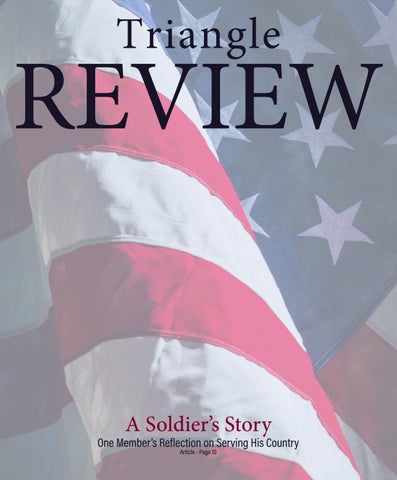
Triangle
REVIEW A Soldier’s Story
One Member’s Reflection on Serving His Country Article - Page 10
Randy Katz cor74 named vice chancellor for research Article adapted by Robert Sanders, UC Berkeley Media Relations
Randy Howard Katz cor74, who helped develop many of the wireless tools and fast, reliable computer storage we take for granted today, has been appointed vice chancellor for research at UC Berkeley. Katz, the United Microelectronics Corporation Distinguished Professor in the Department of Electrical Engineering and Computer Sciences, assumed the position January 1st, from G. Steven Martin, who served as interim vice chancellor.
(Noah Berger photo, 2015)
A 1980 Ph.D. graduate of UC Berkeley who joined the faculty in 1983, Katz is well known in the computer industry for his work in the development of RAID computer storage systems in the 1980s. Short for Redundant Arrays of Inexpensive Disks, RAID storage today is a multi-billion dollar business that allows storing data in multiple places across an array of many small, parallel drives for quick retrieval and protection against loss or corruption of the data. In February he was inducted into the Silicon Valley Engineering Hall of Fame for this work.
storage and ways of managing and protecting computer networks. He currently is involved with the RISELab - Real-time Intelligent Secure Execution - where he collaborates on projects to use machine learning to assess and control complex infrastructures, like buildings, energy and transportation systems, in real time.
He is also known as the scientist who brought the nascent Internet to the White House. In the 1990s, he set up the email accounts of then-President Bill Clinton and Vice President Al Gore and built the original whitehouse.gov site, which has been the main portal into the executive branch ever since.
“The entire apparatus of research administration is really to support the faculty at the end of the day, and to make Berkeley the best possible environment for pursuing world-changing research,” he said. “Without that, we will not be able to continue to recruit the best and brightest faculty, which is the reason why grad students and undergraduates want to come to Berkeley. That is going to be the obvious high priority for me.”
“I feel blessed to give back in leadership at this stage of my career, after a 40-year history at Berkeley,” Katz said. “I bring long experience with many dimensions of the research enterprise on campus, from research and student mentoring to government service and international collaboration.” Katz became a member of Triangle in 1974 while attending Cornell University, then began graduate studies at Berkeley in 1976. After earning his Ph.D., he served as an assistant professor at the University of Wisconsin, Madison, before being asked to return to the Berkeley faculty in 1983. He left for two years in 1993-94 to serve as the deputy director of the Defense Advanced Research Projects Agency’s Computing Systems and Technology Office, during which time he worked with other agencies to bring the executive branch into the Internet age. In 1996, Katz became the first computer scientist to be appointed chair of the EECS department, a position he held until 1999. At the time of his appointment he was working on a new concept called wireless computing - an alternative to tying desktop computers to the Internet through wires. Katz has also helped shepherd other innovations into common usage: wide-area wireless networks for mobile devices, cloud-based applications and 2
As vice chancellor, he is also eager to advance efforts already underway to streamline research oversight and management systems on campus.
Katz lives in San Francisco with his wife, psychologist Zoi Eliou, and his two rescue dogs, Benji and Lulu. An avid Giants fan his parents gave him the same middle name as Willie Mays He is also an amateur actor and play-writer and a voracious reader of fiction and history.
Know about any notable alumni accomplishments that you think are worth highlighting? We want to hear about them! Send Triangle Triumphs to editor@triangle.org to be featured in the next REVIEW!
CONTENTS
FALL 2018 || VOL. 106 NO. 3 FEATURES TRIANGLE’S TRIUMPHS
2
Brother Randy Katz cor77 named vice chancellor for research at UC Berkeley
6
HERB SCOBIE LEADERSHIP SCHOOL IN REVIEW
8
MEMOIRS OF A BRIDGE-MAN
Take a look at some of the most memorable moments from 2018 HSLS
The life of alumnus Ken Philo kan48 and his time as a bridge-man
14
A YEAR IN REVIEW
20
CHAPTER ENDOWMENT FUNDS MAKING A DIFFERENCE
Take a look back as we breakdown the numbers from the 2017-2018 academic year
Celebrating the good use of chapter endowment funds
COLUMNS 5 10 12 22 26
PRESIDENT’S ANGLE COVER STORY REMEMBERING CHARLIE BARBOUR ps43 TRIANGLE BUILDING & HOUSING THE IMPORTANCE OF STAYING INVOLVED
One of the groups at the 2018 Herb Scobie Leadership crafting their design project
3
TRIANGLE LE ADERSHIP National Council
National Headquarters
National President Brian K. Jarman pur01
Fraternity Executive Director Tom Pennington tom@triangle.org
Vice President Joe M. Cerrato os05 Secretary Stuart J. Masuda uci07 Treasurer Bryley K. Murphy ky12 Past President Randy E. Drew rose67 Active Councilman Kyle Godfrey psb16 Councilmen John C. Cottage ps04 Jon E. Eklund msoe99 Brad N. Keller neb69 Merle Newlon lou73 Pete L. Satre os89 Ryan M. Sunyak tol10
Building & Housing Corporation Board of Directors Chairman Richard F. Beaubien mich64 Secretary/Treasurer James R. Marshall pur65 Assistant Secretary Donald S. Hatfield msu88 Director Shawn G. Diedtrich minn90 Director John M. Malmquist wis72
Director of Operations Rhonda Halcomb rhonda@triangle.org Director of Chapter Services Drew Hopson drew@triangle.org Director of Communication & Education Ariel Tarosky ariel@triangle.org Director of Chapter Growth Augie Farwig augie@triangle.org Administrative Assistant Shirley Humble adminasst@triangle.org Administrative Assistant Connie Sieferman connie@triangle.org Education Foundation President Scott Bova, CFRE sbova@triangle.org Vice President Aaron Girson, CFRE agirson@triangle.org Sr. Director of Development Amy Buchheit, CFRE abuchheit@triangle.org Director of Business Operations Polly Courtot pcourtot@triangle.org Administrative Assistant Kathy Elliott kelliott@triangle.org Building & Housing Corporation Executive Director Mike Fouts mfouts@trianglebhc.org Director of Business Operations Polly Courtot admin@trianglebhc.org
Connect with Triangle Fraternity www.triangle.org
4
Education Foundation Board of Directors Chairman Donald E. Knebel pur65 Vice Chairman John P. Pritchard is82 Secretary John C. Gargani pitt82 Treasurer Gordon K. Mortin mich63 Undergraduate Director Conner M. Daniel clem15 CEL Ex Officio Director Tyler J. Moore tol09 Directors Lt. Gen Ted F. Bowlds USAF (Ret) miss72 RADM Melvin H. Chiogioji USN (Ret) pur58 Michael P. Chu ill86 Robert G. Halgren mich05 Randall L. Herrel pur70 Gregory A. Lang mom74 Michael H. O’Connor marq74 Kyle R. Robertson is01 Joseph V. Salvucci pitt76 James E. Schier ky66 Mark E. Tolliver ill70 Stanley L. Walker neb67
The Triangle REVIEW is a triannual educational journal of college life and alumni achievement. It is the official publication of Triangle Fraternity, published since 1911 and currently distributed to over 20,000 members and friends. Articles in the Triangle REVIEW represent the opinion of the authors and do not necessarily reflect the positions or policies of Triangle Fraternity, Triangle Education Foundation, and the Triangle Building & Housing Corporation. Triangle Fraternity is a proud member of:
O
PRESIDENT ’S ANGLE ne of the privileges of being national president is writing the President’s Angle for each Triangle Review. I’m always amazed how themes emerge each time I sit down to write a new President’s Angle. This article is no exception.
Since the last Review, we have finished another school year, changed some staff responsibilities to better serve our members, gathered together for the Herb Scobie Leadership School and have introduced a growth initiative to help our groups to grow. We are very excited at everything happening to help expand our membership and spread Triangle’s message. As the year has progressed, a theme has emerged relating toward action, particularly, being biased toward action. In some instances we have seen the positive impacts of our members being biased to act. These include new chapter houses at Michigan Tech and Iowa State as well as improved GPA’s at several groups. We have also seen negative impacts from a delay or failure to act.
National President Brian Jarman pur01
In the vast majority of hazing and substance abuse situations among college fraternities, a bias toward action would have made all the difference. Challenging group think, seeking medical care, or involving others early in a situation can be the difference between life and death.
Don’t make the mistake of thinking that I’m advocating for action without thought or care. My education and training as a mechanical engineer have helped me to identify, evaluate, and assess problems before acting too quickly. While care is needed, it must be balanced with acting quickly or even acting at all. We can’t let our desire to have more information, a more thorough assessment, or a better plan delay our action.
As we move through the Fall semester, I want to ask each of you to be biased toward action. Join the ranks of the creators, the builders, and the change agents by asking what you can do to make your family, your chapter, your community, and your world better. Be biased to act early, learn from our mistakes, and continue on. Whatever situation sits in front of you, take action. When you act, you lead, and others will join you.
We sometimes think that Triangle is different, that Triangle is better. That line of thinking is just another delay. While we can be different and better, we must act to show it. This is true for our national leadership, our local leadership, and our individual members. Our bias toward action must begin with each individual member asking how they can act to make something better.
Taking action can be hard and it can be painful. It can also be worthwhile. Join me in acting together to grow our membership, lead our communities, and be good brothers. Your National Council, Staff, and brothers are here, ready to help.
I am amazed at the stories I hear of our brothers making the world a better place. Innovators, job creators, managers, leaders, community members, and family members all share the common trait of acting.
We’re looking for articles! Have an idea for an article and want to submit it? We accept a variety of submissions, ranging from alumni and chapter updates to descriptions of events and highlights of successes. We also welcome general interest and lifestyle pieces. Please email article information and hi-res photographs to editor@triangle.org.
In F, S, C, and T,
Brian Jarman, pur01 National President
Don’t forget to update your contact information! Visit www.triangle.org to update mailing and other contact information. You may also call Triangle Fraternity Headquarters at 317-837-9640.
REVIEW Team Editor Ariel Tarosky editor@triangle.org Copy Editors Kevin Fong ucla84 Marcos Stocco ok93
5
The 2018 graduating class of the Herbert Scobie Leadership School
BUILDING
BETTER
MEN
2018 celebrated the 23rd summer of the Herb Scobie Leadership School, named after Triangle’s past Executive Director, Herbert Scobie minn32. While the curriculum and teachings have been updated through the years, the primary mission has remained the same - to provide our members with innovative educational experiences that provide them with awareness, motivation and skills necessary to elevate their chapters, communities, and world. 6
A
By Ariel Tarosky, Director of Education & Communication
s our staple leadership event, I felt that the Herb Scobie Leadership School needed a face lift. We continuously talk about Triangle being different. We talk about offering our members something you can’t get at other fraternities. So, I wanted to make sure that we were actually doing that.
Similar to most fraternity summer leadership schools, we would bring our active members together for four days from all across the country to discuss the issues we are facing as a community and consider how we can fix those issues. We would do this through team builders, general discussions, small group conversations, and personal reflections. While the conversations were always good, and the energy always high, I felt like we needed something more. After watching a Ted Talk on “tinkering”, I decided to shape Scobie around just that. Rather than a week of just talking about leadership, values, and courage, it was a week of practical application through building projects that could potentially be used to build a better world. It was awesome to see all of the hard work our active members put into their projects, and how we could relate it to their fraternity experience. I am excited to make it even better for 2020.
Putting the final touches on their design
Leaving the supply store before the build
The building has begun
7
MEMOIRS OF A BRIDGE-MAN THE LIFE OF KEN PHILO KAN48
T
By Drew Hopson, Director of Chapter Services
riangle alumni have made and continue to make a lasting impact within their fields and communities. One such alumnus is Brother Ken Philo kan48, whose bridge-building career spanned nearly 60 years, the breadth of the country, and numerous projects that affect thousands of Americans (perhaps even you) every day. Ken’s autobiographies, “Making of America” and “Memoirs of a Bridge-Man, tell his personal and professional story, and highlights Ken’s deep belief in the rewarding nature of a career in civil engineering. “Making of America” follows Ken from his home in Southern Illinois to his tour in the United States Army to the University of Kansas. It was there in 1948 that he and his pledge class all beneficiaries of the G.I. Bill-joined Triangle Fraternity. Ken remembers fondly the unifying effect Triangle had on the members of the different branches of military service. He also remembers being social chairman for the chapter, and that on his watch Triangle at Kansas was no stranger to the tea parties and mixers that marked the fraternity and sorority social scene at the time. Ken didn’t let the parties keep him from graduating with a Bachelor of Science in Civil Engineering in 1952, nor from taking a job with what is now known as U.S. Steel. It was during his first project, a bridge across the Albany Falls Dam, that Ken proposed to his girlfriend Janet Joy Flaherty. Ken and Janet would marry in 1952, a partnership that produced six daughters (“each born in a different state!), and is still going strong today.
Triangle was a foundational piece of Ken’s life, and one which he valued greatly. Not only did it unite veterans, it united men in their particular fields of study. Just recently, Ken reconnected with Derrell Sweem kan54, who had reached out about a clam bake in Santa Barbara. Of course, Ken and Janet jumped at the opportunity. As Ken aptly summarized, “Triangle is a continuous community”. Ultimately, Ken penned his memoirs for two main reasons: to leave his story for his family, and to encourage the pursuit of careers in civil engineering. Ken had heard of Triangle Fraternity’s recent partnership with FIRST Robotics, and commended the initiative. He said, “Civil Engineering I’ve found to be the most honest and greatest and beneficial career that you could get”. Ken certainly has the experience to back up his belief, and his story is one in which the Fraternity is proud to claim a role. Whether you’re a prospective college student, an active member, or an alumnus, we hope that Triangle will or has helped you create a story that you, too, are proud of. If you are interested in learning more about Ken’s two books or would like to purchase them, you can find them at blurb.com.
Ken took his young, and soon-to-be-growing family across the country, building bridges from California to West Virginia. Eventually, Ken and Janet sought to settle down, so Ken took a job with Massman Construction Company, opening their San Francisco office. It was with Massman that Ken did work on the Golden Gate Bridge, BART (Bay Area Rapid Transit), and perhaps most notably, the Cold Spring Bridge in Santa Barbara, an ASCE (American Society of Civil Engineers) designated Historic Civil Engineering Landmark. Ken would leave Massman, and work for a number of years with Bechtel’s Nuclear Fuels Organization, before finally retiring.
Images of Philo’s publishings, Making of America and Memoirs of a Bridge-man, including him sharing his Kansas pledge class in Making of America.
9
ONE TRIANGLE’S REFLECTION ON SERVING HIS COUNTRY By Jim Hedtke minn68
Jim’s officer graduating class from Nuclear Power School in Bainbridge, Maryland, in 1972. Jim is on the far right.
I
don’t remember the demonstrations on campus back in the sixties. All I wanted to do was to get my Aeronautical Engineering degree, which I finally did in the spring of 1969. I started work at the United Aircraft Research Laboratories in East Hartford, Connecticut in July 1969. Like many young men at the time, I was concerned that I might get drafted and have to go to Vietnam. Fortunately, I had a job deferment. But it looked like I was about to lose my job deferment since Pratt & Whitney was bidding on a defense contract to install its jet engines into destroyers. P&W lost that contract to a Canadian company (and I thought I would lose my deferment as a result). A coworker suggested I look into the Nuclear Navy. I went to the recruiter in Hartford and told him that I was interested in joining the Nuclear Navy. Since I had a college degree, I was eligible to apply for Officer Candidate School as well. The name of the program back then was NUPOC or Nuclear Power Officer Candidate. To get into that program, I had to fly to Washington, D.C. and go through several interviews, including one final one with Admiral Hyman G. Rickover. The Navy sent me my plane tickets and I was on my way to D.C. Fortunately for me, there was a Naval Captain on board that was flying as a passenger. I introduced myself and told him that I had an interview with Admiral Rickover tomorrow and was wondering if he could give me any advice. He started chuckling and told me: “Look, Admiral Rickover is going to try to get you to admit to something that you may not want to. Come up with your story and stick to it!” I roomed that night with other young men who were also scheduled for interviews in Crystal City. I had to go through four interviews before I even got to the Admiral. They were all technical interviews asking me questions about my college courses. 10
Of course, I had forgotten most of that stuff since I was out of college for almost two years. The final interviewer asked me how I would explain how airplanes could fly to little kids. I told him that I would tell the children that air is made up of small particles that are like little children. When an airplane wing moves over the particles (or children), the wing would squeeze the children together. Now the children could see that the children above the wing had lots of room which they thought was unfair. To get even with those children, the children below the wing would all push the wing up together to squeeze those children and give the ones below the wing more room. That is how the airplane flies! I guess the answer was good enough since he passed me along to the Admiral. (Later on, I found out that Admiral Rickover did not want theory people in his program. He wanted practical people that could understand how machines operated and how they were likely to break.) I met with the Admiral at about 2 pm. He asked me why I wanted to join his Navy. I told him that I wanted to learn about nuclear power and that I liked his program. He immediately said “Bulls___! You just don’t want to go to Vietnam!” I told him that I had a job deferment and was not going to Vietnam. He told me that he didn’t believe me and was going to call my draft board. I told him to go ahead. He then told me to stand in the hall while he would check up on me. I stood out in the hall until 5 pm when a Commander walks by and asks me why I am standing there. I told him that the Admiral told me to stand in the hall while he called my draft board. He then said “Admiral Rickover went home!” So I said “Great! What am I supposed to do?” He asked me my name and told me he would check to see if I was on the list of people who did not make it. After checking, he told me: “Nope, you are not on here. I guess you made it!”
ALUMNI NEWS & LIFEST YLE Phase I As a successful NUPOC candidate, the first phase is to become an officer. This entails six months of officer school at Newport, Rhode Island. No big deal since this school is not like boot camp for the enlisted personnel. Phase II All NUPOC candidates must now complete a six-month course in Nuclear Power. We were taught several subjects including Materials, Mathematics, Chemistry, Electrical Engineering, Nuclear Power Operations and Safety. These were taught by returning officers and by civilians who signed up for this duty. One memorable event for me was in the Materials class. Our instructor was telling us about the Charpy V-notch tests and Drop Weight Tests that were done to calibrate the strength and tensile properties of various materials and that he would bring in some samples the next day. Now, our Nuclear Power School was in Bainbridge, Maryland. This was an old WWII base that was now in a state of decay. So after school I went to the dilapidated buildings and found some scrap metal. I then work-hardened the metal pieces and carefully labeled them and placed them in my desk drawer at school. The next day, when the Materials instructor began passing around his samples, I would add mine intermittently. When all the “samples” reached the last desk, the student looked like he had a junk pile on his desk!! Phase III The next phase was another six-month course at a nuclear power prototype. This is where we learned how to operate an actual nuclear reactor. I took the course at S1C in Windsor, Connecticut. There were other prototypes in upstate New York and in Idaho. The “S” stood for submarine, the “1” stood for the first type of its class, and the “C” stood for Combustion Engineering who constructed the reactor. Admiral Rickover made all students work on rotating shifts, 12 hours per shift. One week we would be on the 0800-2000 shift, then the next week the 1600-0400 shift, then the 0000-1200 shift. After we got qualified on our watch stations, we could relax to 8-hour shifts. But this did not happen until we were basically done with the program. Phase IV The final phase of training was an 8-week Submarine course at Groton, CT. With the use of simulators, we were able to judge the buoyancy of submarines and their response to various speed and inclination maneuvers, more commonly known as “angles and dangles.” One part of the training was entering the escape tower with a Steinke hood. This hood was like a life preserver and was placed over the head. The tower had two entry points, one at -100 feet and one at -50 feet. They no longer used the -100-foot entry since the Navy considered it too dangerous. (Note: I understand that this tower is no longer used for training because of medical reasons.) So about 10 of us entered the small spherical chamber along with our instructor. The chamber (at the -50-foot level) was then flooded to just below our chins and pressurized. The hatch to the escape tower could now be opened. We were instructed to enter the tower and shout “Ho, Ho, Ho” all the way to the surface. Navy divers accompanied us to the surface to make sure we were exhaling; if we were not, they would punch us in the gut to get us to exhale. If we did not exhale, our lungs would embolize causing serious medical complications. Submarine Duty All the above training finally culminated in my assignment to the USS Flying
Fish (SSN 673)in May 1973, almost two years after first reporting to OCS. USS Flying Fish was based in Norfolk, VA and would go on patrols in the north Atlantic Ocean, which meant parking ourselves off the coast of the USSR in the Barents Sea. My longest stint underwater was about 75 days without setting my feet onto dry land. We made our own water and oxygen and scrubbed the carbon dioxide on-board. Our only limitation was the amount of food we could carry. Some highlights: Since I was the new officer on board, I was assigned to tape the conversations in the Control Room during Battle Stations. This entailed making sure that the 3M Wollensak tape recorder had enough blank tape during exercises. We were on Battle Stations off the coast of the USSR to observe a test firing of a new Soviet rocket from a destroyer. Since the test was at night, the control room was rigged for red, so that the periscope observer could see more readily. After being on station for about three hours, one of the reels was just about out of tape. I figured that it would be easier to thread the tape if there was still tape on both reels. I looked around and perceived that nothing significant was happening, so I stopped the recorder and lifted the take-up reel. No sooner did I do that than the Captain shouted: “Missile away!” So I pressed the record button and now the tape was wrapping itself around the spindle! I tried to flip the reel around to straighten out the tape during which time the Captain turned to me and said: “Are you getting all this, Mr. Hedtke?” I said: “Yes, sir!” After we secured from the exercise, we shipped all the visual and audio information to Washington, D.C. with me hoping that I would never hear from them! Fortunately, I never did! I was the Reactor Officer on board for about 15 months and then the Communications Officer for another 9 months. During that time I qualified in Submarines which meant I got to wear the gold dolphins. I was the youngest qualified person at the 1975 Submarine Birthday Ball in Norfolk, VA which meant that ComSubLant (Commander, Submarine Force, Atlantic Fleet) cut a piece of the birthday cake for me and the oldest qualified person present. ComSubLant was Admiral “Jumpin’” Joe Williams. The Birthday Balls are held every year in various parts of the country. At each one, the youngest and oldest qualified people are singled out and honored. Brother Hedtke pictured center
11
TRIANGLE REMEMBERS CHARLIE BARBOUR ps43 Forward by Brad N. Keller neb69 Memories by Gerald “Jake” Jakuboski tol74
C
harles S. Barbour III entered chapter eternal September 6, 2017. He was initiated in 1943 at Penn State and a few years later earned an Industrial Engineering degree from there. He taught management courses at the University of Toledo from 1950 to 1954 and from 1975 to 1977. Between his academic jobs he was Manager of Salaried Employment at Champion Sparkplug Co. and Manager of Training at DeVilbis Corp., both in Toledo.
Charlie was an excellent manager, planner and trainer and he brought to Triangle a tremendous amount of professional experiences. He put routine annual activities on a strict schedule, for example, the publishing of Triangle Review, the solicitation for annual alumni dues and other fund raising activities. Charlie was a workaholic; he literally had Triangle on his mind 24/7. Charlie was very frugal with Triangle’s funds. To save on rent, he found an apartment for the National Office at the U of T’s Sorority Apartment Complex. To save on custodial services, he himself would sweep and vacuum the floors, empty the trash and clean the bathrooms. He would always look for the least expensive places to have meetings and minimize the travel costs to get to these places.
After Herb Scobie minn32 retired in 1978, Charlie became Executive Director of Triangle, holding that position until 1986. He moved the national office to Toledo. The staff of the office, which included the Triangle Education Foundation, consisted of Charlie, a part-time secretary, and unpaid Field Director Bill Krack pur33. From 1986 to 1991, Charlie continued on as CEO of TEF.
Charlie wanted to be where the action was taking place – he wanted to interact with as many actives and alumni as possible. He set a goal for himself, i.e., to visit one-third of the chapters every year – and he did! I seem to recall there were one or two Founders still living when Charlie was ED and several key alumni who were the next generation up from the Founders. Charlie wanted to meet them all – and he did! And it was I who had to accompany him on many of these trips.
During his tenure as Executive Director, Triangle added chapters at Oklahoma, Virginia Tech, Connecticut, and laid the ground work for UT-Arlington, Texas A&M, Michigan Tech, and Tri-State. Other accomplishments during his tenure include: 1982 Alumni Directory (first since 1962), 1982 75th Anniversary Leadership School, 1983 Convention prohibiting hazing, and 1983 acceptance of computer science as an approved major.
I would travel with Charlie to conventions, council meetings, chapter consultations, workshops, chapter installations, and one-on-one meetings with key alumni at their homes, hospitals and even other members’ funerals. It was on these trips with Charlie that I really got to know him. He would teach, coach and mentor me, which was very helpful to me in my later professional career.
My Fond Memories of Charlie Barbour I was on National Council when Herb Scobie announced his intent to retire in 1978 and Council immediately started a search for his replacement. I was on the faculty at the University of Toledo at the time. One day I received a phone call from a guy named Charlie Barbour asking if he could meet with me at my office. When we met he told me that he likewise was on the faculty at the University of Toledo in the Business College, he was a member of Triangle Fraternity, he knew I was on National Council and he wanted to know more about the soon-to-bevacant Executive Director position. That was the beginning of what would become a long and cherished friendship.
I could go on ad nauseam about Charlie’s outstanding traits, but let me add just one more. Deep down inside, Charlie was young at heart and an educator. He enjoyed meeting, interacting with and teaching active members. I remember at the dinner/dance following the Connecticut Chapter installation in 1982, Charlie was out there partying and dancing and having as much fun as the actives despite the large age difference.
Charlie was offered the position and he accepted on the proviso he could move the National Office to Toledo, which was both a blessing and a curse to me. It was convenient to have the National Office in my hometown while I served on Council including my two terms as National President and having access to Charlie Barbour. It was a curse with Charlie having access to me. He always was loaded with ideas that he wanted to bounce off of me; he would either come to my office or I had to meet him at the Triangle Office – sometimes several times per week and sometimes several times per day! He seemed to forget I had a full-time job! Nevertheless, Charlie brought professionalism to the Office and to the Fraternity. Let me mention a few of his many outstanding traits.
My interactions with Charlie continued after his retirement as ED when he served as staff member of the Education Foundation and I was on the Foundation Board. Unfortunately, I lost contact with Charlie after he retired as CEO and was diagnosed with his debilitating Alzheimer’s disease. Nevertheless, I thought of him frequently and I still do. I have nothing but many fond memories of our much-shared time together. May Charlie forever rest in peace.
12
Charlie did have time for other things. He enjoyed people, had a great personality, was funny and could be very entertaining. He was active in his church including singing in its choir. He loved golf, travel and cooking.
SHOP AT THE OFFICIAL ONLINE STORE AND
SHOW OFF YOUR TRIANGLE PRIDE!
VISIT US ONLINE AT FINDGREEK.COM/TRIANGLE/GALLERY
YEAR IN
REVIEW
While growth has been slow in the last two years, Triangle has hired a full-time staff member dedicated to chapter growth and new expansion. We have also introduced a Recruitment Coaches program to train alumni volunteers to coach their chapters to success in growth. 2018-2019 will also offer a Growth Incentive program which provides financial credits to chapter accounts with the National Headquarters for positive growth partnership. And finally, a new colony has started at the University of Texas at Austin in Fall 2018.
MEMBERSHIP GROWTH | 2016 - 2019 550
AVERAGE CHAPTER SIZE
INITIATION COUNT BY YEAR
500
34 CHAPTERS | 2 COLONIES 3 INTEREST GROUPS
450 400
FY19 GOAL | 350
ACTIVE CHAPTER SIZE BRE AKDOWN
FY 16
FY 17
22%
40 OR MORE
17%
26-39
25%
21-25
12%
16-20
12%
11-15
12%
10 or less
1,350
TOTAL MEMBERS
FY 18
FY 19
2017-2018 |
33.0 MEMBERS
3-YEAR GOAL AVERAGE CHAPTER SIZE
2020-2021 |
46.0 MEMBERS
E D U C AT I O N A L P R O G R A M M I N G
62.7% AVERAGE PYRAMID SCORE The Pyramid is the Fraternity’s National Chapter Accreditation Program
11,000 HRS. OF PROGRAMS OFFERED 60%
OF CHAPTERS GPA ABOVE ALL-MEN’S AVERAGE
100%
CHAPTERS RECEIVED PROGRAMMING
C H A P T E R AT T E N D A N C E
100 80 60 40 20
0 HERBERT F. SCOBIE LEADERSHIP SCHOOL LEADERSHIP & TRAINING WEEKEND GENERAL EDUCATIONAL PROGRAMMING
$31, 332
A LU M N I D U E S
WITH HOUSING/PROPERT Y
ALMOST 300 BROTHERS ATTENDED NATIONAL EVENTS LAST YEAR. 100% OF CHAPTERS RECEIVED EDUCATION PROGRAMMING EITHER THROUGH EVENT ATTENDANCE OR CHAPTER VISITS.
V O LU N TA R Y N AT I O N A L
O R G A N I Z AT I O N S
84% 76%
CHARITABLE DOLLARS RAISED
26
100%
$52,000 CONTRIBUTED
15
“You earn brotherhood - the purest friendship, trust, love, whatever you want to call it - moment by moment through how you treat others.” - “Outside In,” Doug Cooper
Scobie group members after their finished service project
Rose Tech chapter members honored those fallen on 9/11 by helping to place American flags along campus walk ways.
Illinois Chapter brothers supporting their team against Kent State 16
Purdue Chapter’s new booth featuring the National new recruitment kit!
Kentucky Chapter brothers at their school’s Amazing Race
Kansas Chapter brothers at homecoming
Houston Chapter brothers with the ladies of Phi Sigma Rho
Scobie members showing pride through the Delta T
Louisville Chapter alumni night hosted during recruitment
Social gathering of the Triangle Education Foundation’s Council of Emerging Leaders this past July
Penn State Behrend brothers doing some community service
Brothers playing a game of Dodge ball Battleship
17
JANUARY 18-20, 2019
LEADERSHIP &
TRAINING WEEKEND INDIANAPOLIS
LEADERSHIP & TRAINING WEEKEND 2019 NEW ROUND TABLES NEW RESOURCES NEW EMPHASIS ON HEALTH & SAFETY
GRANTS AVAILABLE | CEF ELIGIBLE REGISTRATION OPENS IN NOVEMBER FOR ACTIVES & ADVISORS
CHAPTER E TERNAL
T ARMOUR Walter McWilliams Edwin Loutzenheiser John Olson William Feliss David Pasik Robert Stollstorff Wayne Christensen Stanley Goszczynski Clyde Layne Roy Moreau George Bradburn Gerald Wilks James Phillips Stanley Mrozinski CINCINNATI David Arnold Joseph Busken, Jr. Robert Hettrick Donald Ebel Peter Miller Richard O’Neal CLARKSON James Lepsch William Cogley James Jantosciak CORNELL Jimmie Killian Raymond Rissler, Jr. G. Ronald Wenninger Kerry Kleckner Edmund Cranch Bruce Johnson COLORADO STATE Eddie Ferree IOWA Robert Hughes Edward Hill-Schneckloth ILLINOIS Harry Prince Leverett Jenks Richard Conklin Roger Dooley Robert Lebduska Robert Lankston Robert Turner Richard Banter Carl Hoffee Edwin Friesendorf Arthur Stellmach, PE Donald Akers Philip Lulewicz Robert Petzing David Opperman Gavin Murphy
ar29 ar37 ar43 ar48 ar49 ar50 ar51 ar53 ar54 ar60 ar61 ar69 ar73 ar82 cin48 cin49 cin49 cin51 cin59 cin61 cl59 cl62 cl62 cor42 cor47 cor52 cor59 cor73 cor74 csu67 ia38 ia40 ill38 ill40 ill42 ill43 ill46 ill49 ill53 ill54 ill54 ill55 ill56 ill62 ill67 ill70 ill80 ill95
CHAPTER ETERNAL
IOWA STATE John Ladwig, MD William Hermann Richard Lerwick KANSAS Gerald Pauls John Hamilton Harry Rogers Donald Bush John Carey Alan Akers Charles Periman Larry Moyer David Brooks James Pender KANSAS STATE Frederick Hoppe KENTUCKY Albert Lawrence Sam Welch Joseph Dicker William Martin Thornton Johnson, Jr. Fred Mahan Loren Tune Henry Steilberg James Goff Richard Saunders LOUISVILLE Clarence Howard, Jr. William Arnold Warren Dennis Raymond Meyer Joe Welker, Jr. Donald McIntosh William Branch James Hissam, MD MARQUETTE Raymond Entringer Joseph Weyrough Charles Peifer Henry Retter E. Carl Schneider, Jr. Robert Panlener Edward Kass Martin Silovich Frederick Moritsch James Foley Paul Thiel John Ganey Warren Luy Thomas Schimmels Edwin Jax John Baietto Robert Riedl
is67 is72 is78 kan48 kan49 kan49 kan50 kan51 kan53 kan54 kan57 kan60 kan96 ks88 ky26 ky31 ky31 ky46 ky46 ky47 ky49 ky52 ky55 ky09 lou43 lou45 lou45 lou47 lou48 lou48 lou48 lou65 marq37 marq38 marq39 marq39 marq41 marq43 marq44 marq44 marq45 marq46 marq47 marq47 marq48 marq48 marq49 marq50 marq50
Roland Voith James Boyle Robert Bregantini Robert Doering James Abler MICHIGAN James Hood, Jr. Harry Criel Julian Kycia Billy Monk Warren Norquist Edward Vallorani Gordon Godwin Rhody Nornberg, USAF(Ret.) MINNESOTA Leslie Weselik Lindley Parkinson Earl Fairbanks David Morton Frederick Bereswill Gordon Handberg MISSOURI MINES Edward Gygax Charles Smith Frederick Crossman Randal Garten, PE Albert Bagi Herman Hemken Hugh Sample William(dec) Love Dennis Reeder James Stark MSOE Clemens Schultz Paul Sampson MICHIGAN STATE John Ahlquist Steven Strong Jerry Snider John Templeton Donald Smith Wayne Kirkby David Shidle NEBRASKA Richard Ronnau Ernest Gerloff Howard Rickel Richard Dworak Glenn Gillett NORTHWESTERN Arthur Whale William Sheehan John Burton Richard Walker Robert Stoffels Richard Borsos
marq51 marq53 marq53 marq60 marq68 mich49 mich50 mich50 mich50 mich50 mich50 mich54 mich54 minn26 minn31 minn41 minn46 minn54 minn55 mom41 mom45 mom46 mom49 mom51 mom53 mom55 mom57 mom60 mom60
msoe69 msoe80 msu55 msu55 msu55 msu55 msu56 msu62 msu62
Mark Hammer Ronald Malecki Clarence Watson Robert Newhoff Donald Bolen James McGinn, III OKLAHOMA William Hargis, II OHIO STATE Joseph Pompura Norman Van Hyning Arthur Brandyberry Robert Gemmell, PhD William Hamilton Bertan Morrow William Goodman Jeffrey Long Matthew Beltz PENN STATE Herbert Oppel Joseph Hower James Jones Carl Bethel, Jr. Charles Fatzinger, Jr. John Bowman, PE James Stevenson Ernest Hartsky James Babb Bert Oberg Robert Osborne Gary Robinson Anthony Chernoske David Stone David Arbasak Daniel Sitler PURDUE Albert Cramer Alan Johnson Robert Griner John Turner, Jr. Fred Stoddard Craig Jennings Don Franklin E. Lowell Dinius SOUTH DAKOTA MINES Warren Goodhope Stewart Romans Delbert Bakeman Roland Grosz Donald Thorson Norman Buck Charles Lien James Kelley William Willging Jerome Stratman
nu52 nu52 nu52 nu58 nu68 nu79 ok79 os48 os50 os52 os53 os55 os56 os62 os86 os88 ps29 ps32 ps35 ps38 ps38 ps46 ps46 ps49 ps52 ps53 ps53 ps59 ps61 ps65 ps70 ps74
pur29 pur38 pur42 pur46 pur49 pur52 pur58 pur59
ENDOWED SCHOLARSHIP PROGRAM UPDATE neb63 neb64 neb64 neb79 neb82 nu43 nu46 nu47 nu48 nu49 nu49
sdm31 sdm40 sdm42 sdm42 sdm44 sdm47 sdm47 sdm47 sdm49 sdm50
Eugene Skinner James Buck Harold Nuss Reuben Rieger Lyle Mudge Gregory Nelson Joseph Langenfeld Willard Goodman Marlin Brendsel Roy Pulfrey TOLEDO Donald Ewing, Jr. Robert Behrendt UCLA Saul Volansky UWM William Long, Jr. WISCONSIN Walter Lindemann Donald Horock Robert Miller, PhD Gordon Duquemin Roy DeMeyer Hans Preu Charles Strasse Paul Greenman Howard Eggert Frederick Klaus
sdm51 sdm53 sdm55 sdm56 sdm57 sdm57 sdm62 sdm66 sdm68 sdm73 tol77 tol78 ucla59 uwm62 wis27 wis41 wis44 wis44 wis47 wis47 wis47 wis48 wis52 wis56
KNOW THAT A BROTHER HAS PASSED ON TO CHAPTER ETERNAL? PLEASE CONTACT THE NATIONAL HEADQUARTERS AT 317-837-9640 TO NOTIFY US OF THEIR PASSING. 19
TRIANGLE EDUCATION FOUNDATION
Michigan Chapter at the 2018 Herb Scobie Leadership School receiving the Chapter of the Year Award from National Councilman John Cottage ps04. Additionally, Michigan took home 2nd place ($25,000) in the Judy & Larry Garatoni Building Better Men Program.
The Kansas Chapter’s newly renovated study room.
CHAPTER ENDOWMENT FUNDS MAKING A
DIFFERENCE By Aaron Girson, CFRE, Vice President, Triangle Education Foundation
Chapter Endowment Funds (CEFs) are restricted funds within the Triangle Education Foundation supporting the educational needs of a specific chapter. A CEF provides an annual grant to the designated chapter that can be used for scholarships, educational programs, leadership development initiatives, and improvements to educational space in chapter houses. CEFs are established through tax-deductible contributions from alumni and friends of Triangle who designate their gifts to a specific chapter. In total nearly $100,000 was made in grants from Chapter Endowment Funds during the 2017-18 school year. Kansas Chapter uses Kleist Chapter Endowment Fund for Study Room Upgrade Our Kansas Chapter used $4,600 from the Robert & Barbara Kleist Chapter Endowment Fund for improvements to the Study Room in the chapter house to transform an outdated facility with broken furnishings to a modern functional space conducive to studying. The upgrade included a new study table, bookshelves, computer monitors and keyboards. The chapter’s goal is to provide a place in the chapter house that is a great place for members and guests to study. Illinois Utilizes Newly Established CEF Sending Two Members to UIFI The newly established Illinois Chapter Endowment Fund provided funding for Brothers Bill Laitar ill18 and Kevin Callahan ill18 to attend the Undergraduate Interfraternity Institute leadership program this past summer. Bill and Kevin feel 20
they have grown as leaders and the training will help them in their chapter and future leadership roles. Bill shared the following about his UIFI experience, “This experience has allowed me to connect and learn from my Greek brothers and sisters in a way that I never believed was imaginable. I hope to take this newfound knowledge and begin to make an impact for the Greek community as a whole.” Michigan Funds Additional Attendees to Triangle Leadership Programs The Michigan Chapter used a portion of its Chapter Endowment Fund to send more members to Triangle’s 2018 Leadership & Training Weekend and Herbert Scobie Leadership School. The chapter Illinois brothers at UIFI funded scholarships for four members for Leadership Training Weekend and scholarships for three leaders attending the Herbert Scobie Leadership School. This was an increase over prior year participation that was made possible by the chapter’s growing Chapter Endowment Fund. If you have questions about how to support the Chapter Endowment Fund program, please contact Foundation Vice President Aaron Girson at agirson@triangle.org or 317-203-4510.
TRIANGLE EDUCATION FOUNDATION
THANK YOU PRESIDENT’S MEN
The Triangle Education Foundation would like to thank the 40 men who have joined President’s Men, the giving society exclusively for undergraduates! Is your name missing from this list? Want to join? Contact Amy Buchheit at the Foundation office at 317-203-7759 or abuchheit@triangle.org to get signed up. As a thank you, we’ll send you this limited-edition Comfort Colors t-shirt!
Conner Daniel, Clemson Tristan Gordon, Clemson Nick James ODell, Colorado State Michael Ard-Kelly, Georgia Tech Kett Dickens, Kansas State Noah Cribelar, Kentucky Jake Listowski, Marquette Emmett Marinic, Marquette
Jacob Lohrke, Michigan Eric Reuss, Michigan Ryan Skop, Michigan Alec Rospierski, Michigan Tech Benjamin Beaudoin, Minnesota Leyzer Danilo Carrera, Minnesota Valera Demyanuk, Minnesota Michael Diaz, Minnesota
Griffin Higley, Minnesota Kieran Hynes, Minnesota Brian King, Minnesota Neel Kumar, Minnesota Michael Lambert, Minnesota Alex LaValley, Minnesota Khang Le, Minnesota Stefan Moses, Minnesota
Nikolas Pardoe, Minnesota Derek Schmidt, Minnesota Michael Schnall, Minnesota Thuan Thai, Minnesota Garrett Mulklerin, MSOE Derek Boyer, Ohio State Robert Kramer, Ohio State Utkarsh Choudhary, Penn State
Matthew McPherson, Penn State Henry Wang, Penn State Jonathan Ramey, Purdue Mark Rooney, Toledo Benjamin Willoughby, Toledo Cameron Anderson, Utah Kobi Baker, Utah William Moen, Wisconsin
TRIANGLE EDUCATION FOUNDATION T
SCHOLARSHIP WINNERS By Amy Buchheit, CFRE, Sr. Director of Development
Triangle Education Foundation is pleased to announce our 2018-2019 scholarship recipients! This scholarship cycle saw the addition of two new scholarships, endowed by generous gifts left to the Foundation through estate plans. “It was another record-breaking year for applicants and awards!” enthused Scott Bova, CFRE, President of the Foundation. “I want to offer my congratulations to all award winners! I know the scholarship selection committee had a very hard time choosing the recipients because every applicant was exceptional! The Foundation has worked very hard to streamline the application process to a totally online process and extended the application opening date to better coincide with the financial aid process that students go through at their campus. I strongly encourage every Triangle to apply for a scholarship for next school year!” Christopher Blatt mtu17, James Rust Scholarship Sidharth Parwani gt17, Lee Templin Scholarship Leyzer Carrera minn15, Foglesong Family Scholarship Elliot Chibe ar15, The Kevin Robertson marq92/Triangle Presidents Scholarship Cole Dalquist mtu17, Homi Kapadia Scholarship Emerson Ford utah17, James Marshall pur65/Triangle Volunteers Scholarship Mark Gjeloshaj msu16, Homi Kapadia Scholarship Brendan Karafinski ps18 James Rust Scholarship Ethan Klein mtu16, Homi Kapadia Scholarship Logan Kutzer pitt16, Purdue Old House Men Scholarship Jonathan Lelek kan15, Pierce E. Healey Memorial Scholarship
Matthew Maynard csu14, Bill & Louise Schmitt Scholarship Matthew Monge marq17, Foglesong Family Scholarship Devan Pavlicek marq15, Gordon & Malinda Mortin Scholarship Sean Powers msu15, Homi Kapadia Scholarship Brooks Reno msu16, Homi Kapadia Scholarship Pratyaksh Sharma pur17, John Sonnenburg pur72 Scholarship Joseph Taylor mich16, Homi Kapadia Scholarship Joshua Turner mtu17, Homi Kapadia Scholarship Hansel Hobbie rose16, Edward Sevcik Scholarship Allen Young marq17, Peter & Barbara Bye Scholarship
The applications for the 2019-2020 school year are open until February 15, 2019 and can be completed at triangleef.org/scholarships
21
TRIANGLE BUILDING & HOUSING CORPORATION
The new Iowa State chapter house (previously Sigma Chi house), which was dedicated October 26th.
ONE TRIANGLE EXEMPLIFIED
By Iowa State Alumni Corporation
W
hen an opportunity unexpectedly arose to purchase a house for the growing Iowa State Chapter, time was of the essence. Circumstances necessitated an extremely short purchase window. John Pritchard is82, President of the Iowa State Alumni corporation, explains, “In order to seize the opportunity, we needed to close in 30 days – which didn’t allow time to process a typical mortgage loan. We needed a quick, short-term loan which we could later replace with a mortgage and donations.”
and Triangle Building and Housing Corporation – all worked toward one common goal: the support of a chapter’s request. National President Brian Jarman pur01 commented, “The speed and effectiveness with which the three organizations worked was extremely impressive.”
One of the first calls John made was to Brother Jim Marshall pur65 of the Triangle Building and Housing Corporation. “Typically, calls that begin with, ‘Hi Jim. Can you loan me <a very large sum of money> within 30 days?’, end with a dial tone.”, laughs Pritchard. “But without hesitation, Jim’s response was ‘Yes.’”.
Dick Beaubien mich64, Chairman of the Triangle Building and Housing Corporation, said, “Although this request was unique, its objective was consistent with the historical mission of TBHC which is to support chapter houses. So we wanted to help.”
That phone call initiated a series of fast-paced activities to attempt to accomplish something which had never been done before. The three organizations - Triangle National, Triangle Education Foundation, 22
Gordon Mortin mich63 spearheaded the Triangle Education Foundation efforts to support TBHC’s ability to loan the funds. Everyone’s efforts culminated in the funds being available at closing and the successful purchase of the new ISU chapter house in July.
The three organizations, distinct due to tax and legal reasons, again displayed their unity toward a common objective - the betterment of Triangle Fraternity. Don Knebel pur65, Chairman of the Triangle Education Foundation, summed it up aptly, “We are truly One Triangle, and this instance truly demonstrated three organizations working together to benefit Triangle Fraternity.”
TRIANGLE BUILDING & HOUSING CORPORATION
MICHIGAN TECH CHAPTER HOUSE GETS A FACE LIFT Renovation that began on the Michigan Tech house on July 1st wrapped up just before the start of the fall semester on August 14, 2018. We are excited to share some of the houses upgrades! [1] The newly installed glowing Delta T was a perfect final touch to chapter house renovations. [2] The main entrance to the chapter house, proudly displaying the fraternity’s colors of “old rose and gray”. [3] A Michigan Tech chapter brother pauses for a photo while cooking dinner in the chapter’s updated kitchen. [4] A quick glimpse into one of the bedrooms in the Chapter house. The house has 8 bedrooms and can accommodate 16 brothers. [5] The updated living space includes all new sitting furniture and a large logo celebrating the Huskies, Michigan Tech’s mascot. [6] New tables and chairs, and a large white board adorn the chapter’s study room.
[1]
[3]
[2]
[4]
[5]
[6] 23
PROPERTY IMPROVEMENT CONTEST OBJECTIVE To encourage Active Chapters to undertake improvement projects in their Chapter Houses and/or communities. Project examples could be, but are not limited to, such things as improving life safety (fire safety, security, accessibility), general home improvement projects (landscaping, paint, room remodeling, bike racks, flooring, LED lighting, etc.) and community improvements/involvement (playground equipment, FIRST Robotics sponsor/volunteer).
GRANT AMOUNTS Grants totaling up to $10,000 per year will be disbursed based on the following: • Total number of project proposals submitted • Estimated costs of proposed project • Quality of proposal and the project • Impact of the project
HOW TO APPLY Visit www.triangle.org/housing. There you will find information on the PIC contest and how to submit your proposal. Tip: Applications should detail the improvement (pictures and drawings are encouraged), the estimated costs, the time-line, and a list of the individuals performing the work. Please include the chapter’s and project’s primary contact. Permission from the owner of the property is also required. By entering the TBHC Property Improvement Contest, the Chapter warrants the information provided is complete and truthful. Failure to provide complete and truthful information or to mislead the Contest Committee in any way, or to not complete the work as described will be grounds to deny an award and prohibit subsequent submissions at the Committee’s and TBHC Board’s sole discretion. Should the Chapter have received any award based on incomplete, misleading, or false information or if the work as described is not completed, the Chapter shall be required to immediately refund the full award to TBHC. The individual submitting the application represents and warrants that it has the authority to bind the Chapter according to these terms.
SAVE THE DATE 2019 NATIONAL CONVENTION INDIANAPOLIS | JULY 17-20 Have a reunion group you’d like to get together at Convention? Contact Executive Director, Tom Pennington at tom@triangle.org to see how HQ can help!
THE IMPORTANCE OF STAYING INVOLVED By Tom Pennington, Fraternity Executive Director
Triangle alumni who have not been connected with their chapter recently or who know little of current campus issues other than what they see and hear in the media may ask today, “Are fraternities still relevant?” It’s a fair question, based on the news stories and tragedies that have been reported recently. Certainly, the public portrayal of fraternity life has not been very positive in the last few years. Rest assured, what’s in the news is the exception rather than the rule. The incidents and accidents that have occurred – senseless and tragic as they were – represent bad actors or bad chapters in a very large community where most are doing good. National organizations and thousands of volunteer alumni are doing good work to insure our values and ethics drive our chapters, and the vast majority of our members are having fulfilling and rewarding experiences. In fact, recent surveys and research show those involved in fraternities and sororities are more likely than non-members to: a) have higher grades; b) persist in college to graduation; c) graduate on time; d) be employed within 6 months of graduation; e) persist in their relationship with their alma mater; f) become donors to their alma mater; and g) be involved in service to their communities. All these are indicators of value to campuses and communities. Fraternities have existed for over 200 years because they meet two needs essential to college students – friendships and opportunity. We create and foster lifelong friendships during one of the most important times in a young man’s life, when they are moving from dependence to independence. Further, we provide opportunities for leadership, citizenship and service, as well as experience in working with others to achieve common goals. These are invaluable to success in life.
Triangle in particular provides a support network for men pursuing challenging STEM and architecture degrees. These men are, on average, smarter and more mature than their college peers, but also can be more stressed by the rigors of their academic programs. The benefits provided by a close-knit group all focused on similar degree plans is incalculable to helping them succeed. Not surprisingly, it’s also the reason mentioned most by our members when asked why Triangle attracted them and why joining was a good decision. We are part of a larger fraternity community, but we also play an important role with STEM and architecture majors and their professions. We expect and support academic achievement. We encourage strong partnerships with our colleges and with STEM education and organizations such as FIRST Robotics. We promote the Triangle Code of Ethics as a guide for life. We honor continued interest and involvement from our alumni. In these ways we parallel other fraternities, but with a focus on the impact STEM professionals can make on improving our world. So long as our chapters are populated by students 18-22 years old, there will be challenges to overcome. The best plan to prevent problems is to have alumni involved as advisors, coaches, mentors and resources – at both the chapter and individual level. Our students need and want contact with alumni, to learn lessons of life, share advice and counsel, and to help them find their way to stable and productive careers. There are and will continue to be opportunities within Triangle for alumni to be involved and we will promote those in the pages of the REVIEW, online and through direct outreach. Find the one that’s right for you and get involved!
GET INVOLVED THROUGH:
A CHAPTER MEMBER DEVELOPMENT BOARD CHAPTER HOUSING CORPORATIONS THE COUNCIL OF EMERGING LEADERS NATIONAL RECRUITMENT COACH PROGRAM BECOMING A CERTIFIED FRATERNAL HEALTH & SAFETY FACILITATOR NATIONAL COUNCIL FACILITATING ONE OF OUR NATIONAL PROGRAMS THE CAREER CONTACT PROGRAM TO LEARN MORE ABOUT OPPORTUNITIES FOR INVOLVEMENT VISIT WWW.TRIANGLE.ORG/ALUMNI/STAYINVOLVED
YOUR VOLUNTARY NATIONAL ALUMNI DUES ARE MAKING A DIFFERENCE Thanks to your Voluntary National Alumni Dues (VNAD) payments, we’re beginning to turn the tide on membership growth! In 2016 and 2017, we saw a dip in membership across the nation and made a decision to invest more staff time and resources into helping chapters grow. We developed a Recruitment 2.0 philosophy, built recruitment scholarship programs and have now hired a full-time Director of Growth – Augie Farwig. These actions, financed in part by VNAD investment, are making a difference. For 2018, we introduced our Recruitment Coaches program with five coaches supporting ten chapters in concentrated recruitment training. Coaches helped chapters build recruitment targets, identify prospective students and follow through on events and activities that promote visibility and personal contacts. For most of the chapters involved, there was positive growth as well as improvement in retention. In addition, the coaching program has helped chapters build recruitment into their annual schedules – not just for a couple weeks each term. We hope to train and assign another 5-10 coaches this January, but need VNAD income to help us reach our goal. VNAD dollars are currently less than 5% of Triangle income. In comparison, almost 75% of our income comes from undergraduate dues and fees – from less than 5% of our total membership. While the bulk of our resources are directed back to chapters, it is undergraduates who often have the least amount of income and ability to contribute. VNADs allow alumni to take some of the pressure off student fees and keep undergraduate Triangle costs competitive. If you’re giving already to the Triangle Education Foundation, Thank You! We appreciate all tax-deductible gifts to help our educational programs. For those who want to give at lower levels or who don’t need a tax-deduction, the VNAD program also provides a Vvehicle to make a difference. Whichever your choice, a contribution to help Triangle grow is a gift everyone will appreciate! To make your VNAD payment, contact Triangle HQ at 317-837-9640, or make a one-time or recurring gift via credit card online at: https://www.triangle.org/alumni/vnad Please consider a recurring VNAD payment of $10 or more per month, today! 27
Triangle REVIEW Vol 106, No.3, Fall 2018 120 S. Center Street | Plainfield, Indiana 46168-1214
THE CHARITABLE IRA ROLLOVER ACT NOW TO SAVE ON TAXES Your required minimum distribution can make a difference for all Triangles! For instructions on making a gift to the Triangle Education Foundation through your IRA, contact Amy Buchheit at 317-203-7759 or abuchheit@triangle.org