
Trent University MAGAZINE
This is the place you know, reimagined for what comes next at Trent.
VISION
Trent is the place to be and become, engage in meaningful learning and build community. We provide the space and experiences that forge pathways to opportunity.
MISSION
At Trent University, we stand out by standing closer. We connect people and ideas, championing the potential in all – from learning to legacy.
ARE YOU USING YOUR
TRENT ALUMNI PERKS?
• Access to exclusive perks, contests, your digital alumni card, alumni business directory, and more
• Discounts on CAA memberships
• Access to over 5,000 exclusive perks on shopping, travel, and attractions with Perkopolis
• Plus: Special offers from TD Insurance and Manulife

Scan the QR code to start saving!

Trent University
MAGAZINE
Trent Magazine is published once per year by Trent University. Trent Magazine has undergone a thoughtful redesign of its nameplate, visual style, and colour palette. This refreshed look reflects the magazine’s commitment to highlighting the relevance, leadership, and impact of the Trent community.
The new design supports the magazine’s purpose: to celebrate excellence, inspire action, spark dialogue, and foster a deep sense of belonging and pride. Through stories of success, innovation, and community, the magazine now reflects a visual identity that strengthens connection and honours Trent’s legacy.
Opinions expressed in these pages do not necessarily represent views of the editors, contributors, or the University.
Trent University
Peterborough
1600 West Bank Drive
Peterborough, Ontario, K9L 0G2
Durham GTA
55 Thornton Rd. S, Oshawa, ON, L1J 5Y1
1.800.267.5774
alumni@trentu.ca
alumni.trentu.ca/trent-magazine
PUBLISHER
Naomi Handley
EDITOR
Ruth-Ann Dafoe
ART DIRECTION & DESIGN
Amber Moon, Jetstar Design
CONTRIBUTORS
Isabel Botha, Elie Dolgin, Dr. Michael Eamon, Dr. Zabeen Hirji ’25 (hon), Phillip Dwight Morgan ’03, and Kyla Woods
EDITORIAL BOARD
Marilyn Burns ’00
Sandy Marett
Naomi Handley
Kathryn Verhulst-Rogers
Ruth-Ann Dafoe
Celia Ernst Kyla Woods
Elizabeth Bower-Gordon
PRINTING and BINDING
Trent University Campus Print

ON THE COVER
Nationally recognized photographer and assistant professor in the School of Environment, Neil Osborne ’97 (Champlain College) captures ice thaw on Georgian Bay. See more photos by Neil on pg 10 in the piece titled “What we missed beneath the ice”.
We’d love your feedback on our refreshed publication. What resonates with you? What could we do better? Share your thoughts at alumni@trentu.ca.

The Ideas That Bring Us Closer
A renewed vision for Trent –and the stories that shape our community
ON MY LISTENING tour across Trent’s campuses and the broader community, I heard a phrase that stayed with me. In conversations with students, faculty, alumni, and partners, someone described Trent this way: “We stand out by standing closer.”
Closer to one another. Closer to the questions that matter. Closer to the communities around us and the futures our students are striving for every day.
That simple idea captured something essential about Trent. It became a guiding thread as we talked together and began shaping a renewed vision and mission for the University.
Our vision is both simple and powerful: Trent is the place to be and become, engage in meaningful learning, and build community. We provide the space and experiences that forge pathways to opportunity.
For Trent alumni, this idea will feel familiar. Many of you first discovered your own pathway here – through a conversation with a professor that opened new possibilities, through connections that still endure, or through moments on campus that changed the direction of your life.
Those experiences are exactly what our mission speaks to today: At Trent University, we stand out by standing closer. We connect people and ideas, championing the potential in all – from learning to legacy.
This beautifully renewed Trent Magazine carries that same spirit forward. Designed to linger a little longer –on coffee tables, in shared spaces, and across digital platforms – it creates room for stories that invite reflection,
conversation, and inspiration. It is an important way to share more widely the remarkable impact and influence of Trent faculty, staff, and in particular Trent alumni.
In these pages, you’ll encounter powerful stories that explore changing winters across the Great Lakes, alumni voices helping shape Canada’s public conversation, and reflections on the iconic places that connect generations of Trent students – from the Faryon Bridge to the gathering spaces where friendships, debates, and traditions are founded.
Together, they remind us that Trent has always been more than a campus. Trent is a community where ideas move between generations and where people help shape one another’s journeys, with substance and soul and space.
My hope is that this new chapter of Trent Magazine brings you a little closer to the Trent of today and the Trent of tomorrow – and that you will share these stories widely within your own communities.
Because wherever life has taken you since your time here, you remain part of a university that continues to grow, learn, and imagine what comes next in our legacy together.
Warmly,

Cathy Bruce, Ph.D. President & Vice-Chancellor

5 Community Conversations bringing local voices to the table
VISION & MISSION
BY
THE NUMBERS
8
Listening Tour meetings with the Board, Senate, Senior Management Committee, students, faculty, and staff
209
survey responses from staff, faculty, alumni, students, and community members
150
additional survey responses collected through more than 10 feedback meetings with governance bodies, faculty, staff, students, and community partners
362
student perspectives gathered through pop‑up engagement campaigns

Learn more about how Trent is the place to be and become.
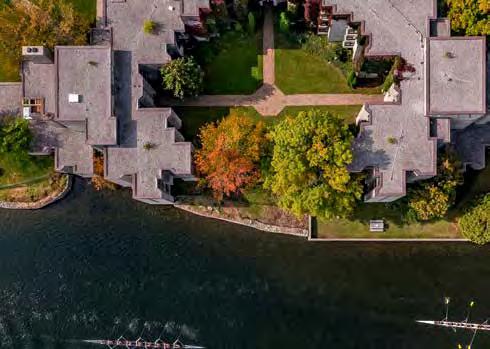
1 | Champlain College
“I lived in K-L staircase in Champlain College for two years and after I moved into town it was my second home, as many friends stayed in residence their entire time at Trent. It is always the first place I stop when I visit Trent, and it always brings back a flood of memories. The mixture of concrete and wood in all the public spaces was unique to Champlain, and being awakened at 6:00 a.m. by the rowing team going by under my window every fall was always a treat!”
David Evans ’76 (Champlain College)
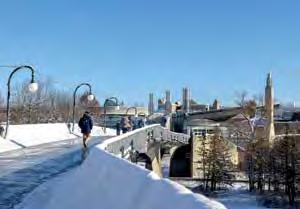
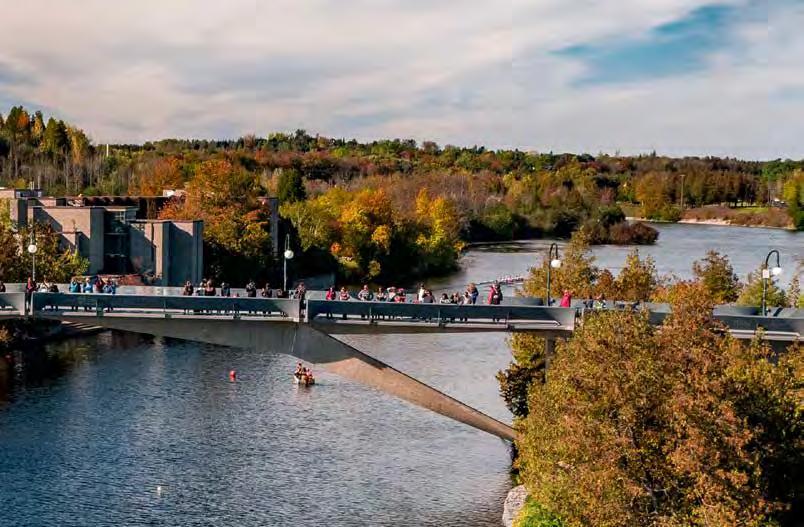
2 | Faryon Bridge
“My boyfriend, Brett, who is also a Trent alumni, and I return to campus throughout the year to enjoy the river and the sense of calm it brings. With the beautifully restored shoreline, the view of the bridge has become even more striking, offering a whole new perspective as you walk alongside the water. Sitting by the river is incredibly peaceful and remains one of our favourite summer traditions—driving up to campus, taking in the view, and appreciating the quiet beauty that makesTrent feel like home.”
Sierra Sumner ‘18 (Gzowski College)
DECADES of DESIGN
TRENT ALUMNI SHARE THEIR
TOP 10 ARCHITECTURAL GEMS AT TRENT UNIVERSITY
Trent’s campuses have always been defined by the way spaces make people feel - from quiet corners that shaped friendships to bold architectural features that sparked imagination. In a recent alumni survey, we asked graduates to share the places that meant the most to them, helping us shape this Top 10 list of Trent favourites.
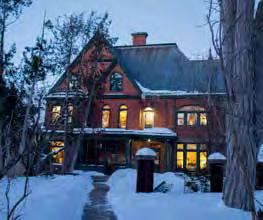
4 | Sadleir House
“I work remotely as an editor atThe Narwhal and rent an office on the third floor of Sadleir House. Once or twice a year, someone pokes their head in and says, ‘I used to live in this room.’ It feels right for a place like this. It’s a real treat to work in such a beautiful building - the craftsmanship and attention to detail in the mouldings, fireplaces, and stained glass are something to behold.”
Will Pearson ’07 (Champlain College)
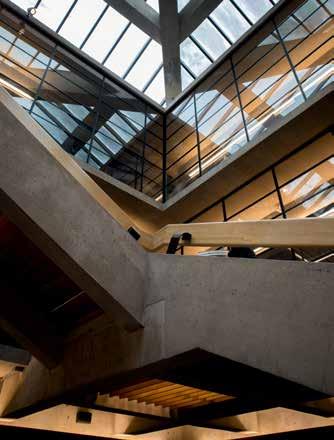
3 | Bata Library
“Bata Library is my favourite building primarily because it elegantly blends with the landscape and Otonabee River with its meticulous form and natural stone finishes. It anchors the University main campus as a place to gather with its thoughtful amphitheatre-like steps and bespoke exterior and interior architectural design features like the brise soleil envelope structure and skylights which allow for lots of natural light inside the library.”
Tony Mukangura ’89 (Lady Eaton College)
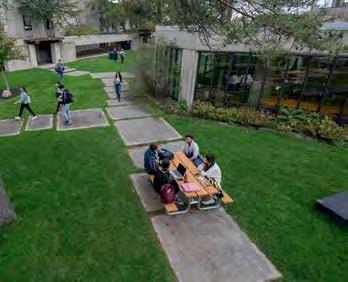
5 Traill College
“Catharine Parr Traillso beautiful! Love the old windows; wished I had that college as mine (sorry Otonabee)!”
Lara Kuzyk ’94 (Otonabee College)
6 | Lady Eaton College
“Lady Eaton College has long been, and will always remain, my favourite building on campus. When I first visited Trent in 2014, I was struck by the distinctiveness of its architecture and the intentionality behind every detail - from the design of the common spaces and their furnishings to the way the natural light filters through the dining hall windows.”
Shannon Featherston ’15 (Lady Eaton College)
8 | Environmental Science Building
“Architect Richard Henriquez had a dilemma when asked to designTrent’s long awaited Environmental Science Building. The building site was on the east side of the Otonabee River and would adjoin the existing Sciences Complex. But a railway line ran through the middle of the site. The line was undergoing a formal process of abandonment with both local and national governments involved. Delays crept into the process. So, Henriquez imagined a building that had been the subject of a collision with a speeding train. If you stand outside on the upper deck where the buildings meet, you can see an architectural sense of humour at play. Look south and there remains a section of track in the Walter Ward Garden. Look north and pay close attention to the materials - red brick and red block. They are jumbled as if this is where they landed after the collision.”
Tony Storey ’71 (Champlain College)

Vote for your favourite Trent building or space.
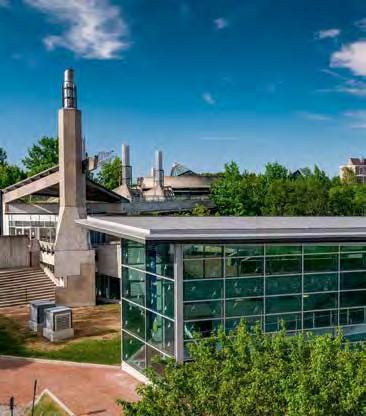
7 | Chemical Science Building
“The Chemical Science Building was the home to many of my friendships, mentors, and Eureka moments! It’s the background to my most favourite memories - the halls, the divot, and the laboratories.”
Mark Robinson ’99 (Otonabee College)
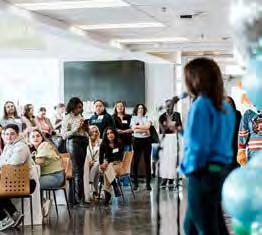
9 | Trent Durham Atrium
“To me, the Atrium represents the heart of Trent Durham. It’s a space where students, staff, and visitors naturally come together, drawn in by the beautiful daylight that fills the space. It’s the first space that greets you upon entering, setting the tone for what the University offers: community, possibility, and a place to belong.”
Nilo Honarbakhsh ’16 Trent Durham GTA
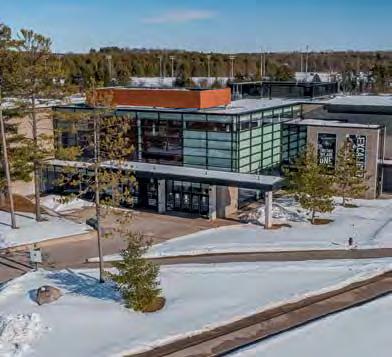
10 | Athletics Centre
“I love the look of the Athletics Centre, especially from the back when you are walking down the path. The vines that grow on it add so much character to the building.”
Linnea Cooke ’19 (Otonabee College)
WHAT WE BENEATH THE ICE
DR. MAGGIE XENOPOULOS IS HELPING SCIENTISTS RETHINK WINTER, REVEALING THE HIDDEN SEASON THAT SHAPES THE FATE OF LAKES.
WRITTEN BY: ELIE DOLGIN PHOTOGRAPHY BY: NEIL EVER OSBORNE ‘97 (CHAMPLAIN COLLEGE), ROB VISCARDIS, AND CLAIRE STEVENS


aggie Xenopoulos is helping scientists rethink winter, revealing the hidden season that shapes the fate of lakes.
In 2014, Dr. Xenopoulos thought she was beginning a routine study of carbon cycling in Lake Erie. Instead, she stumbled into a problem that would quietly upend how scientists understand winter itself.
For decades, lake research had treated winter as a kind of ecological pause, a frozen interval between the real work of spring and summer. But when an unusually fierce polar vortex derailed her team’s plans to conduct research aboard a Canadian Coast Guard icebreaker, Professor Xenopoulos was forced into a far riskier alternative: landing by helicopter on the frozen lake and drilling through the ice by hand.
What she found there challenged a long-standing assumption at the heart of freshwater science. Beneath the ice, the lake was not still. It was alive.
“Winter is not a pause, it’s one of the most important seasons shaping the future of the lakes.”
Prof. Xenopoulos, a Tier 1 Canada Research Chair in Global Change of Freshwater Ecosystems and a Biology professor at Trent University, says, “We can no longer understand or manage the Great Lakes by studying only the open-water season. Winter processes are central to ecosystem function and to climate feedback and human risk.”
At the time, though, she was simply trying to salvage a study that nearly fell apart.
A COLD BEGINNING
The original plan had been straightforward: sample the lake yearround from the Coast Guard ship Griffon. But that winter, ice spread thickly across the Great Lakes, and the ship was reassigned to keep commercial routes open. The research was sidelined.
“I was completely devastated,” Prof. Xenopoulos recalls.
A last-minute solution changed everything. With access to a helicopter, the team landed directly on the frozen lake. In brutal winds and biting cold, they augered through the ice and began collecting data, measuring carbon chemistry and biological activity

during a season most lake scientists had long avoided.
The gamble paid off. The data revealed that Lake Erie remained far more active in winter than previously understood, continuing to cycle carbon even under ice.
But the more profound shift was conceptual. What began as a logistical workaround became the start of a new way of seeing lakes.
THE SEASON SCIENTISTS FORGOT
The implications were hard to ignore. For generations, limnology had been built on a seasonal blind spot.
“We were missing nearly half the year.”
Under the ice, lakes are anything but dormant. Algae continue to grow, sometimes reaching nearly 40 percent of their summer productivity.
Zooplankton, a critical food source for fish, persist as well, even in low light and cold temperatures. Meanwhile, nutrients such as nitrogen accumulate beneath the ice as microbes continue breaking down organic matter.
All of it matters. These winter dynamics do not stay confined to the colder months; they shape what happens long after the ice melts. In some lakes, strong winter growth draws down nutrients, limiting summer algal blooms. In others, nutrients build up, priming the system for explosive growth when temperatures rise.
The lake, in other words, never really stops.
This idea gained traction in 2016, when Xenopoulos joined an international team to synthesize winter data from lakes around the world. Their findings challenged a core assumption of the field: that winter was a biological lull. Instead, it emerged as a
“WINTER IS NOT A PAUSE, IT’S ONE OF THE MOST IMPORTANT SEASONS SHAPING THE FUTURE OF THE LAKES.”
season of quiet but consequential activity, one that helps determine the trajectory of the entire year.
A CHANGING WINTER
Over the past decade, Prof. Xenopoulos has helped push winter limnology from a niche pursuit into a growing research frontier. She has organized collaborative sampling efforts, contributed to international research initiatives, and trained a generation of scientists willing to venture onto frozen lakes.
That work is becoming increasingly urgent.
Across the Great Lakes, winters are changing in ways that are both visible and subtle. Ice forms later, melts earlier, and sometimes fails to form at all. Shorelines that were once protected by ice are now exposed to stronger waves and erosion. Travel routes that communities once relied on are becoming less predictable.
Beneath the surface, the changes are even more complex.
Lake ice, Prof. Xenopoulos explains, acts as a kind of master regulator. It slows biological processes, stabilizes habitats, and buffers the system against rapid environmental change. When that buffering effect weakens, the consequences ripple outward, altering carbon cycling, microbial activity, and oxygen levels in ways that can reshape the ecosystem months later.
“Intuitively, people know winters aren’t what they used to be,” she says. “What limnology does is translate that lived experience into evidence and mechanisms that society can act on.”

WHAT THE ICE HOLDS
Recent research is beginning to reveal just how much winter has been doing all along.
In a study published earlier this year, Prof. Xenopoulos and her collaborators found that lake ice itself stores biologically active forms of carbon. When the ice melts, it releases that material in a concentrated pulse, an early-season surge of energy that fuels microbes and organisms at the base of the food web.
As winters shorten, that pulse may weaken or disappear altogether.
Other work, drawing on more than two decades of data from Lake Erie, shows that the timing and duration of ice cover are linked to the size and composition of summer algal blooms. As Prof. Xenopoulos and a Ph.D.
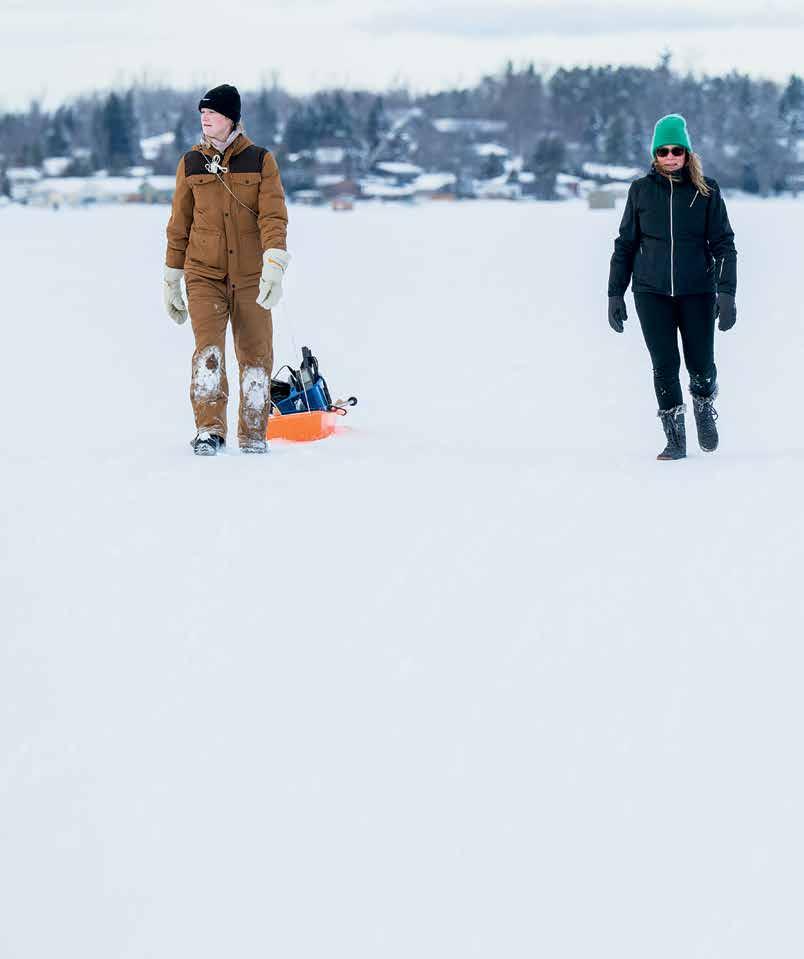
student in her lab, Claire Stevens, discovered, subtle shifts in winter conditions can echo forward into the most visible, and economically significant, events of the year.
What happens beneath the ice does not stay there.
“Ice is easy to forget about,” Stevens says, “but it really does have these profound and far-reaching effects, not just on the ecology of lake but on the people who live there.”
A FRAGILE FUTURE
Some consequences of winter’s decline are already impossible to ignore. In recent years, unstable ice has led to an increase in winter accidents, including a March incident near Owen Sound, where more than 20 people had to be rescued after an ice shelf broke free and drifted into Georgian Bay.
But most of winter’s changes are quieter.
They show up as variability, un-
predictable seasons, shifting conditions, systems that behave in ways they didn’t before. And by the time those changes feel unmistakable, many thresholds may already have been crossed.
“Winter loss doesn’t announce itself as a crisis, it shows up as more variability, more weird years.”
For Prof. Xenopoulos, that is what makes this moment so critical.
“The lakes may be changing in ways that we’re not prepared for,” she says.
THE WINDOW THAT REMAINS
For all its warnings, the science also carries a sense of urgency that is not yet resignation.
There is still time to understand what winter is becoming, and to adapt.
That means paying closer attention to ice conditions, expanding year-round monitoring, and recog-
nizing that winter is not simply a backdrop to life around the Great Lakes, but a force that shapes everything from water quality to fisheries to shoreline stability.
“The next five years are critical,” Xenopoulos says. “There is still a window to understand winter change in ways that can shape adaptation, rather than just document loss.”
After that, the patterns that once defined winter in the Great Lakes may no longer hold.
The danger is not that winter will disappear all at once. It’s that it will fade unevenly, subtly, until the systems it once regulated begin to behave in ways we no longer fully understand.
By then, the season scientists once overlooked may prove to have been the one that mattered most. “We were missing nearly half the year.”
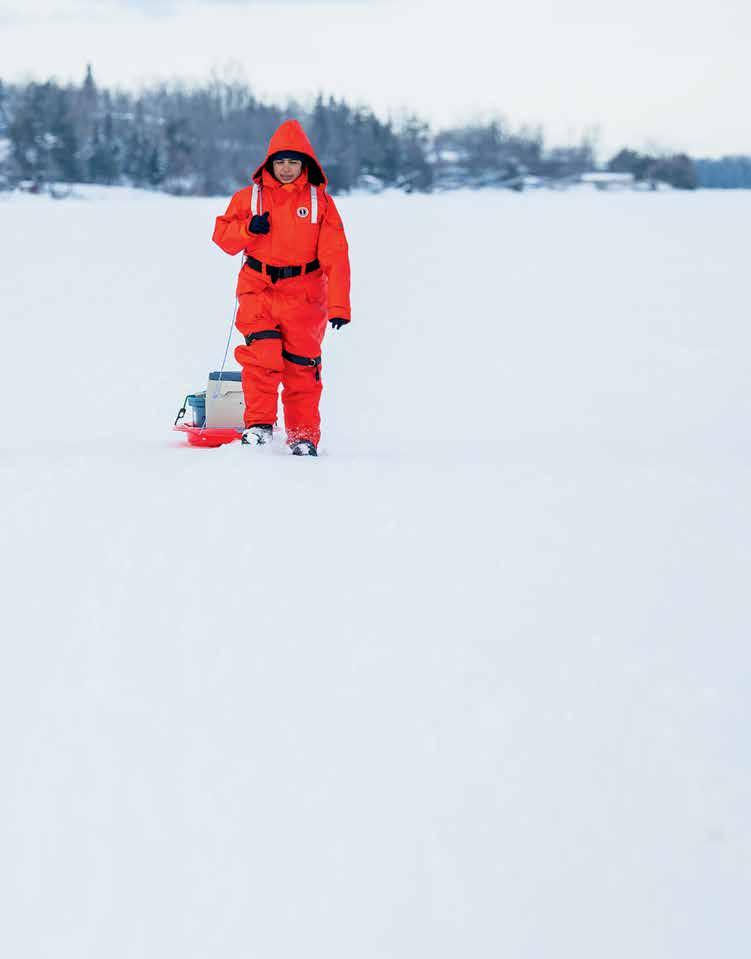
“WINTER LOSS DOESN’T ANNOUNCE ITSELF AS A CRISIS, IT SHOWS UP AS MORE VARIABILITY, MORE WEIRD YEARS.”
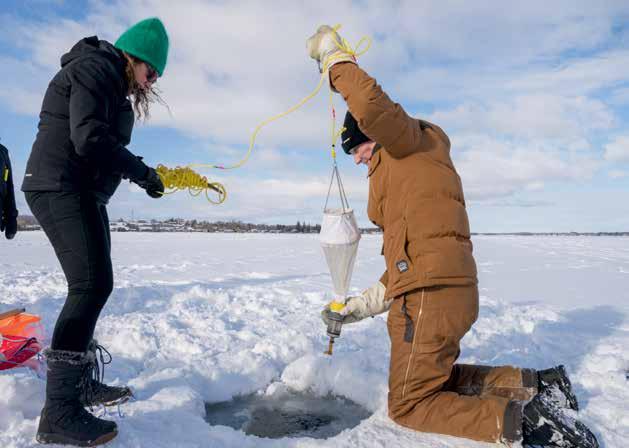

Watch the video Step onto the ice and see winter research in action.
moments
THAT MATTER
The achievements, honours, and milestones shaping Trent’s story right now
Trent ranked #1 undergraduate university in Ontario
Trent has once again been named Ontario’s top undergraduate university in the 2026 Maclean’s rankings, also earning #1 in student awards, student services, medical/science grants, and best overall reputation, placing among the top five undergraduate universities nationally in each.
Governor General honours Trent Arctic scholar
One of Canada’s foremost Arctic scholars, Dr. P. Whitney Lackenbauer, has been awarded the Governor General’s Polar Medal, among the country’s highest honours for polar research and service. His work with Northern communities and the Canadian Rangers is community-centred policy and advancing knowledge of Arctic governance, Northern sovereignty and security.
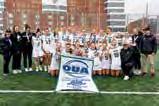
Ontario University Athletics (OUA) gold for the Excalibur women’s lacrosse
The Excalibur women’s lacrosse team claimed the Patterson Cup with a commanding championship performance in Waterloo, securing the program’s fourth OUA title. Led by head coach Jocelyne Lemay, the team now looks ahead to hosting next year’s championship at Justin Chiu Stadium. 1 2 3


Trent statistician earns one of Ontario’s top teaching honours
Dr. Wesley Burr is the recipient the Ontario Confederation of University Faculty Associations Teaching Award, one of Ontario’s highest honours for university educators. At Trent, he rebuilt the statistics curriculum, created 11 new courses and a new specialization within Mathematics, and launched mastery-based grading in Canada.
Three scholars renewed as Canada Research Chairs
Drs. Whitney Lackenbauer, Anne Pasek, and Naomi Nichols will continue their nationally recognized work in Arctic sovereignty, climate and media, and community-based social justice, supported by renewed Canada Research Chair appointments. These renewals reflect the extraordinary calibre and sustained impact of Trent’s research community.
Trent student wins national Fessenden-Trott Scholarship
Destiny Vimalendiran (Gzowski College), a Forensic Science and Business joint major, is one of four Ontario students selected to receive the Fessenden-Trott Scholarship. The prestigious award recognizes academic distinction and leadership already evident in her work as a student leader and campus ambassador.
Governor General’s Award for imaginative translation
Translating science fiction demands both scholarly precision and creative invention. Trent’s Dr. Sylvie Bérard and collaborator Suzanne Grenier reimagined Larissa Lai’s The Tiger Flu, crafting new language and cultural textures in Les Sœurs de la Muée, earning them a Governor General’s Literary Award.
Experience one-of-a-kind art collection in person or online
The Patterson-Ainsley Collection, a 47-piece gift of blown glass, painting, photography, and mixed media, is now accessible across Trent’s campuses and through a new online gallery. It is the largest collection of its kind at a Canadian university and a striking addition to campus life.
Professor receives one of Canada’s highest academic honours
Election to the Royal Society of Canada’s College of New Scholars marks a prestigious national honour for Dr. Bharati Sethi, whose research advances equity and inclusion for newcomers, racialized communities, and aging populations. It is one of the country’s highest scholarly distinctions.
New Trent Durham programs respond to a changing world
Trent Durham GTA has launched Canada’s first B.A. in Artificial Intelligence (AI) plus a B.Sc. in AI, preparing students to engage emerging technologies with insight and responsibility. It also boasts a new Black Studies specialization and Black Life and Community Knowledge Lab to strengthen research and action rooted in equity and systemic change. 4 5 6 7 8 9 10









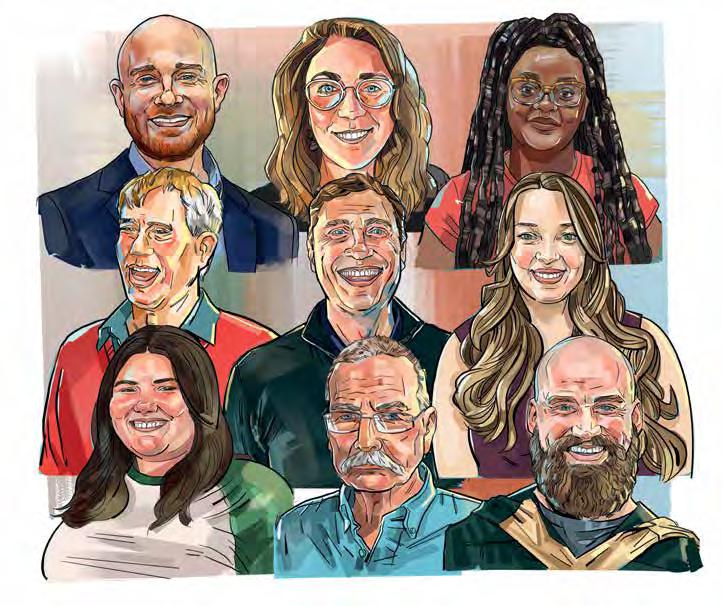
What Makes a Trent Alumni
Remarkable?
WRITTEN BY: ISABEL BOTHA
ILLUSTRATION BY: JASON WILKINS
This year’s Alumni Award recipients reflect on the Trent “magic” that continues to shape their work
hat makes Trent alumni remarkable? On paper, the answer is clear. They lead internationally recognized research. They influence national conversations on public policy. They build institutions, strengthen communities, and mentor emerging leaders.
Each year, the Trent University Alumni Awards recognize graduates and students whose contributions reflect the values of the University. These awards are presented annually to celebrate the achievements of graduates and current students who have made exceptional contributions both during and after their time at Trent.
The 2025 recipients are being honoured for leadership in public health research, family-law policy, forensic science, student governance, sport, and community building. Their achievements are significant. Yet when asked what shaped them, many describe something less tangible.
“There is something magic about Trent. I do not know how to define it. You just have to experience it.”
Jordan MacDonald ’21 (Catharine Parr Traill College), recipient of the Young Leader Alumni Award, calls it Trent’s “magic.”
“There is something magic about Trent. I do not know how to define it. You just have to experience it,” he says. “Trent prepared me for life beyond university through this magic. Through the unspoken, hard-to-define qualities.”
For MacDonald, who pursued graduate studies while raising a young family, that magic lay in compassion and belief. Faculty advocacy and peer support shaped his academic path, research, and advocacy. His work is changing how we understand and support teen parents and advances policies that help young parents overcome barriers, complete their education, and thrive.
THE FREEDOM TO QUESTION
For some, the magic lies in the freedom to question, to find one’s purpose.
Dr. Zach Conrad ’02 (Champlain College), recipient of the Distinguished Alumni Award and an internationally recognized food systems scientist, traces it to the freedom to explore. As an undergraduate studying biology and anthropology, he was encouraged to pursue interdisciplinary questions and define his academic passions.
“I believe that, under the right conditions, young adults can be inspired to identify and pursue independent passions that lead to positive self-identity, meaningful interpersonal connections, a productive career, and a good life,” he reflects.
For Dr. Robert Glossop ’67 (Champlain College), fellow Distinguished Alumni Award recipient, the magic lies in ideas grounded in purpose. A distinguished researcher on family dynamics, he spent more than three decades studying how families navigate economic, social, and cultural change. His work has directly influenced social policy and family law across Canada, informing supports that strengthen family wellbeing. Throughout his career, he has returned often to lessons first encountered at Trent. “Trent is, without hesitation, my academic home,” he says.
Dr. Theresa Stotesbury ’07 (Gzowski College), recipient of the Young Leader Alumni Award, speaks about creativity and interdisciplinarity. Her forensic science research explores how biological materials change in the environment and how that knowledge strengthens investigations. She credits Trent’s encouragement to challenge assumptions and push intellectual limits in shaping how she mentors students today.
FINDING BELONGING IN COMMUNITY
For others, that Trent magic lies in community.
Neil Horne ’96 (Champlain College), honoured with the Spirit of Trent Award, has devoted years to organizing the Head of the Trent regatta. His advice to students is straightforward: get involved. Participation, he believes, opens doors and builds lifelong relationships.
The late Chris Leach ’70 (Peter Robinson College), recognized with the inaugural Founder’s Spirit Award, established rowing as a defining part of Trent life. His legacy continues each fall when boats and community gather on the Otonabee River.
This year’s student award recipients describe similar experiences of community and shared responsibility. Each speaks about stepping forward, not for recognition, but to ensure others feel seen and supported.
Anne Warigia Kitheka ‘18 (Lady Eaton College), recipient of the Robert W.F. Stephenson Prize, sees leadership as relational. “My experiences showed me the value of leaning on your community, but also being someone others can lean on.”
Rylin Wormington ‘22 (Otonabee College), also receiving the Stephenson Prize, echoes that perspective. “This honour is less about recognition and more about the importance and privilege of serving the community.”
For Izzy Miranda (Peter Gzowski College), recipient of the David Glassco Prize, involvement has meant welcoming new students and fostering connection through theatre and mental health advocacy.
THE HALLMARK OF TRENT’S MAGIC
What makes Trent alumni remarkable, then, is not only where they lead or what they build. It is how they lead. They carry forward a belief that intellectual curiosity should be paired with care for others. They understand that opportunity magnifies when community is strong. If there is magic at Trent, it lives in that combination.

Learn more about our complete list of winners
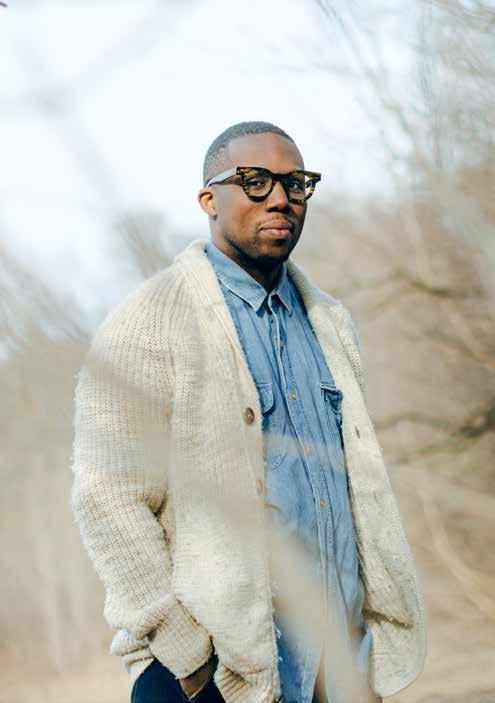
WRITING MYSELF into the Canadian Landscape
Phillip Dwight Morgan ’03 (Champlain College) reflects on finding his voice as a writer, exploring the Canadian outdoors, and searching for a place that feels like home
he question usually arrives disguised as small talk.
Where are you from?
Scarborough, I say.
But where are you really from?
It is a familiar exchange for many first-generation Canadians, but for me, the question has always carried a deeper resonance. Beneath it sits another question I’ve been circling for most of my life: where, exactly, do I belong?
I’ve spent years thinking about that question as a writer.
It surfaces in my work on Black identity in Canada, in my essays on wilderness and landscape, and in my memories of arriving at Trent University, searching for a way to start again.
Writing became the way I tried to explore this question.
My forthcoming collection of essays, scheduled for publication in 2027, gathers that work. It moves through memory, race, and the natural world. It’s the culmination of decades spent living in between identities and experiences that many others take for granted.
Some of my earliest memories of school are marked by distrust.
On my first day of grade one, my teacher asked me which language I spoke at home. I said “Jamaican.” and, with that, she had received enough information to relegate me down the hall to the ESL class despite English

being my first language. My mother had to advocate for me–playful, precocious six-yearold me–to get me out of that class. I spent all of one day in ESL.
This story is mine but not mine alone. When I tell it now, it is often met with recognition. For many Black students in Canada, misplacement and lowered expectations are part of a shared experience.
When I remember those early days, I recall small acts of kindness from school yard friends and a few beloved teachers sprinkled amongst regular trips down polished school hallways toward the principal’s office and the many subtle signals that told a young Black boy he was somehow out of step with the expectations around him.
One of my grade four report cards contained a sentence that has stayed with me for decades. It notes that while I seemed knowledgeable when speaking, Phillip “requires a great deal of individual attention” and “has difficulty putting his ideas in writing.”
At the time, I absorbed those words the way children often absorb authority: as truth. The idea that I was somehow inadequate with language became part of the story I told myself about who I was.
When my father died two days before my 14th birthday, that narrative of not quite being enough became my autobiography. I was grieving, struggling in school, and drifting toward a future that felt increasingly uncertain.
In that chapter of my life, obtaining a university degree did not seem like part of the
Photography by: Christine Lim


“Canada often presents nature as a shared national inheritance. But the questions of where that inheritance originated and who feels entitled to claim it are seldom discussed.”

script. Yet when I applied to three schools, Trent was the one that took a chance on me.
Arriving in Peterborough felt like stepping into unfamiliar territory in more ways than one. I didn’t know anyone there. No one from my neighbourhood in Scarborough had come with me. That anonymity offered something I hadn’t realized I needed: the possibility of reinvention. For the first few years, I drifted academically. I studied mathematics for two and a half years, unsure whether it was truly my path.
But alongside those courses, I found myself drawn toward history classes. My professors began noticing something in my work that I hadn’t yet recognized in myself.
One of them was the late Professor Emerita Carolyn Kay. At critical points in my life, I have been blessed to encounter people who offered me alternatives to the stories that others had projected onto me in the past and that I eventually internalized. Carolyn told me that she saw potential in my thinking but also recognized that I needed to improve the clarity of my writing to better communicate my ideas. I remember her telling me, quite plainly, that I was capable of more. Then she did something more important: she showed me how to improve it. She invited me to her office hours and made a list of books for me to take out of the library. She introduced me to style guides like Strunk & White. She challenged me to think more carefully about how ideas move across a page. She expected better sentences.
What I remember from that time is the immense pride that I felt knowing that someone of Carolyn’s stature, a leader in her field, educated at some of the most prestigious universities in the world, saw potential in me and took my intellect seriously. Whenever I visited Peterborough from time-to-time during the almost twenty years since I graduated, I would reach out to Carolyn to see if she was available to grab a coffee. When Carolyn retired in 2023, I drove to Peterborough with flowers in tow to celebrate an important mentor and friend. I was pleasantly surprised to see my face in the slideshow playing behind her as she reflected on her 32-year career at Trent. Somewhere in a box of memories tucked away at my mother’s house in Scarborough, I still have that list from Carolyn, along with all the essays that I wrote not only for her classes but for myself.
THE LANGUAGE OF THE LAND
Trent also introduced me to a different relationship to the natural world.
Growing up in Scarborough, nature as I understood it existed mostly at the edges of my life; it felt like a luxury, almost like a vacation, but certainly not part of regular, daily life. Wilderness belonged to documentaries, to distant provincial parks, to landscapes that seemed both beautiful and vaguely threatening.
At Trent, that distance collapsed almost immediately. Students around me spoke about backcountry camping and canoe portages. They spoke of the fruit-bearing and flower trees near the villages and hamlets where they grew up. Conversations drifted easily from Thoreau to the Group of Seven to favourite lakes in Algonquin Park. I listened. Realizing how foreign this kind of relationship to nature was to me.
When classmates discovered that I had only been in a canoe once before, during a grade-six trip, they reacted with disbelief. For so many of them, the Canadian outdoors represented familiarity and nostalgia. For me, it felt like an inherited mythology that I had somehow missed.
The experience forced me to confront a larger reality.
Canada often presents nature as a shared national inheritance. But the questions of where that inheritance originated and who feels entitled to claim it are seldom discussed. For many Black Canadians, that sense of belonging has historically been fragile.
In a class that I took with former professor, Stephen Bocking, he took us on a walk around campus and highlighted some of the ways that with time and care and attention, we could learn to read the land. Along the drumlin, he pointed out the root system of a tree that had fallen over. Its roots had spread outward rather than downward because the species wasn’t native to the region; the soil was too difficult for it to penetrate, so the tree adapted by growing its roots laterally.
Years later, I would attempt to confront that distance directly. In 2012, a friend and I cycled across Canada, travelling 7,708 kilometres from Vancouver to St. John’s. The journey was exhausting, exhilarating, and at times unsettling.
We encountered extraordinary kindness from strangers who opened their homes to us. Locals in small towns offered food, conversation, and encouragement. But the trip also contained moments that reminded me how precarious belonging can feel. There were places where my presence seemed to raise quiet questions, places where, as my mother taught me to recognize, “not every smile is a grin.”
With each passing year, I’ve reflected more deeply on that journey. What began as an adventure gradually
revealed itself as something else: a search. Not just for scenery or accomplishment, but for a place in Canada where I might feel ease and comfort and safety.
My path into journalism began almost accidentally.
In 2016, I wrote a journal entry about how Black Lives Matter protesters, disrupting Toronto’s Pride Parade, were being portrayed in the media. When I finished, I sent the piece to the independent news outlet Rabble. They published it, and suddenly I was writing publicly.
Since then, my work has appeared in outlets including The Walrus, CBC News, and Maclean’s.
Much of my writing focused on politics, activism, and media representation. But over time, I found myself returning to another subject: our relationship with nature and the wilderness.
Today, many of my essays explore the intersection of Black identity and the Canadian landscape.
Nature can be deeply restorative. But it can also expose the complicated histories that shape who feels welcome in certain spaces and who feels like a visitor.
In 2025, my essay about visiting Point Pelee received the RB C Bronwen Wallace Award for Emerging Writers, recognition that affirmed the importance of telling these stories.
Yet the deeper motivation remains personal. I am still trying to understand my relationship with this country’s landscapes.
I often think back to those early report cards that suggested my writing might not be my strength. The irony is not lost on me.
Today, writing is the tool I use to examine the question that has followed me my entire life: Where do I belong?
I don’t yet have a final answer. But I have learned that the act of writing, much like cycling across a vast country or paddling across unfamiliar water, is itself a way of moving through uncertainty.
Phillip Dwight Morgan ’03 (Champlain College) is aTrent History graduate and award-winning writer and journalist. His forthcoming essay collection exploring Black identity, memory, and nature in Canada will be published in 2027.

Read an excerpt of Phillip’s essay, Point Pelee by visiting https://alumni.trentu.ca/trent-magazine.

BRIDGE THE BETWEEN
WRITTEN BY: DR. MICHAEL EAMON
Designed to anchor the University around the river, Faryon Bridge has become a vital link and lasting symbol of connection across generations of Trent students

n The Diviners, Margaret Laurence ’72 (hon) wrote of an “impossible contradiction” – a river that seemed to “flow both ways.” Many readers have long suspected the image was drawn from the Otonabee River in Peterborough, whose currents twist and fold back on themselves as they wind through the city.
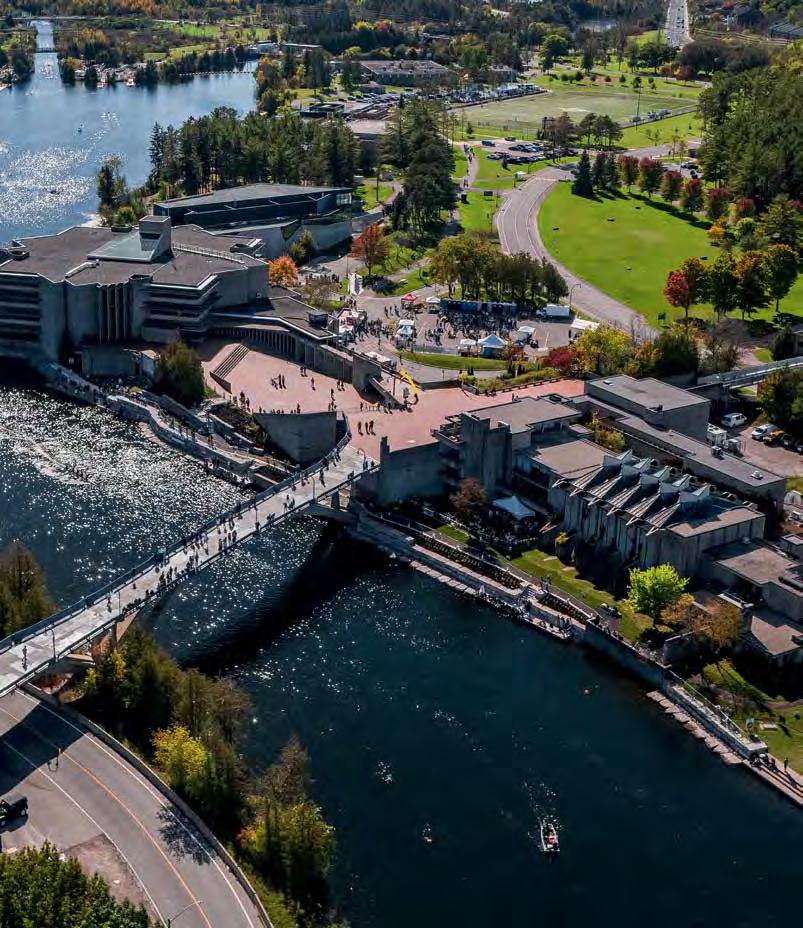
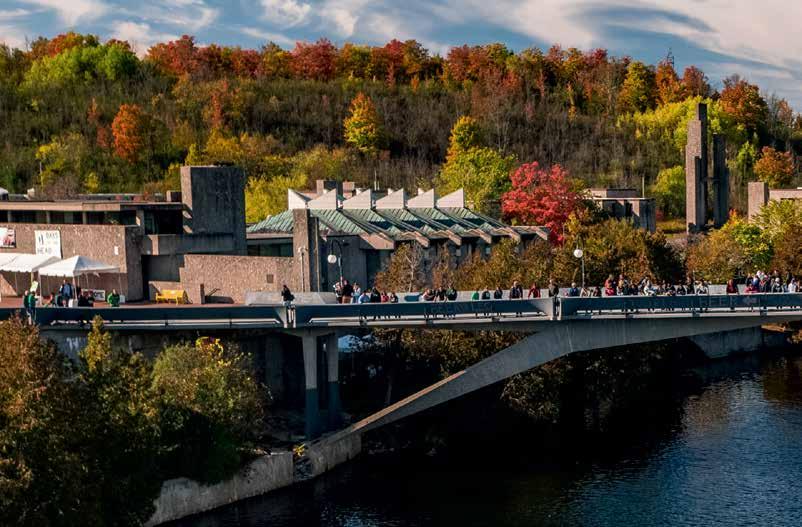
For nearly six decades, Faryon Bridge has spanned that same stretch of water at the heart of Trent University. Each day, thousands of students and faculty cross its concrete deck between the East and West Banks, often without pausing to consider the structure beneath their feet or the role it has quietly played in shaping the life of the campus.
Now, as the bridge enters a major rehabilitation after more than half a century of use, its story offers a window into the architectural ambitions that shaped Trent’s riverside campus and the generations of memories that have accumulated along its span.
WHERE THE CAMPUS MEETS THE RIVER
On paper, Faryon Bridge is defined by a series of practical considerations. It is the only pedestrian link across the Otonabee River on campus. Beneath the walkway, it also houses key electrical and communications networks that connect the East and West Banks. Its central arch is designed to be 25 feet above the river to accommodate boat traffic on the Trent-Severn Waterway, a federal waterway that is part of the Great American Loop.
Yet, for anyone who has walked across it, rowed under it, or just gazed at its silhouette from the shore, the bridge is also the metaphorical heart of campus. The river it spans is known in Anishinaabemowin as Odoonabii-ziibi, meaning “the river that beats like a heart”. It is fitting, then, that this crossing has long served as the symbolic centre of the University and unsurprisingly has done so by design.
THE ORIGINS OF AN ICON
When architect Ron Thom began designing Trent’s campus in the early 1960s, he imagined a university organized around the river itself. He designed a pedestrian-focused, collegiate university that would embrace the “spirit of place” by surrounding the river.
“The Otonabee River is the main feature of the University site,” he wrote. “A vital feature of such importance could hardly fail to be considered as the centre of the campus.”
Paul Merrick, lead architect for the Chemistry Building and Bata Library, was tapped to design the “northern bridge” with renowned structural engineers Morden Yolles and Roland Bergmann.
Stretching 182 feet across the Otonabee, the bridge reflects Thom’s architectural vision and the distinctive rubble aggregate features seen elsewhere on campus. Their design incorporated parabolas for the arches below and gull-winged balustrades for the decking above.
WHERE PATHS CROSS
The bridge is a cornerstone of campus life – a gathering place, a vantage point, and a backdrop to countless small moments that now form part of Trent’s collective memory.
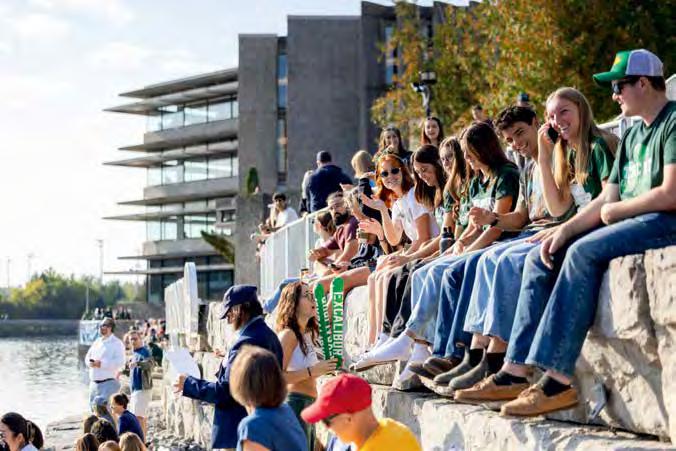
As Sierra Sumner ‘18 (Gzowski College) fondly recounts: “We waited by the water for the Head of the Trent to begin, with Faryon Bridge behind us and a quiet sense of anticipation in the air.”
For Sierra and her friends, “wearing our Trent gear and ready to cheer,” formed a quintessential Trent moment where “it felt like the calm before the action as the riverbanks filled with spectators. Moments like this perfectly capture the spirit of Trent and the traditions that bring us back year after year!”
Regardless of the era, crossing the bridge in every imaginable weather condition is considered a badge of honour for Trent students.
“It was a day after a freezing rainstorm in late November,” recalls Geoff Backa ’84 (Lady Eaton College). “I was crossing the bridge to class, trying to juggle a drink, a sandwich, and my binder when suddenly my frictionless plastic binder slipped from
under my arm, hit the not-quite-melted ice, and with a horrifying acceleration went sliding into the river. A term’s worth of notes gone in the blink of an eye!”
Over the years, Faryon Bridge has played a supporting role in many of Trent’s love stories. Countless students have walked across it together, exchanged phone numbers, or paused to admire the sweeping view, and sometimes each other.
For Dawn Berry-Merriam ’72 (Champlain College), the bridge was where she first met her future husband, John, on September 13, 1972. “The bridge offers a wonderful vista to look across the water,” she recalls, “and if you look carefully, you can see the future – we did.”
Years later, after John passed away, Dawn created a shadow box of memories that includes a small but meaningful keepsake: the medallion she gave him for Christmas in 1972, engraved with the words “meet you on the bridge.”
For Maria Tullio ’10 (Otonabee College) and Nathaniel Palmer ’11 (Gzowski College), whose wedding was postponed due to the COVID-19 pandemic, Faryon Bridge became a place to hold onto connection.
“Nathaniel and I met through mutual friends while

studying at Trent. The significance of taking the photos on the bridge is that we went to school and met there,” Maria shares. “So many amazing things happened for us while we studied at Trent, and we are eternally thankful for our experiences there. They led us straight to each other, exactly where we were meant to be!”
RESTORING FARYON BRIDGE
In just a few years, Trent will mark the 60th anniversary of its iconic Faryon Bridge.
Over time, the bridge has become more than a point of crossing. It is a place of celebration and protest, of quiet conversations and shared milestones, woven into the everyday rhythms of campus life.
Yet landmarks like this cannot be taken for granted. After more than 50 years of service, Faryon Bridge requires significant rehabilitation to remain safe, functional, and true to its original design.
The rehabilitation project, now underway, will preserve both the structure’s function and its distinctive architectural form. The work will unfold over multiple construction seasons and includes renewing the deck and balustrades, restoring the beams and arches that support
the span, and strengthening the piers and foundations beneath it. Environmental safeguards will guide every phase to protect the Otonabee River and its surrounding habitat. Trent has raised more than $6 million in donations towards the rehabilitation project, led by a transformational gift from Doug Kirk ’70 (Champlain College), former chair of Trent’s Board of Governors, and his partner, Mary ‘26 (hon) and donations from other alumni.
When the work is complete, Faryon Bridge will continue to carry the daily crossings of students, faculty, staff, and alumni, its span linking not only the East and West Banks, but generations of memories shaped along the river it crosses.
Like the current beneath it, the story of Faryon Bridge continues to flow through the life of the University.

Support the rehabilitation of Faryon Bridge
Contact Sandy Marett, Associate Vice President of Philanthropy & Alumni Engagement at sandymarett@trentu.ca or scan the QR code to make a gift

Class Notes

Rann SHARMA ’97
(Peter Robinson College)
John BUTCHER ’67
(Traill College)
“My work in hockey has long been driven by a commitment to teaching and supporting those who officiate it.
I was honoured to receive a Lifetime Achievement Award for Hockey Officiating from Ottawa Sports Awards, recognizing more than 50 years of volunteer service to the sport. Over five decades, I have contributed as an on-ice official, administrator, and, most recently, as a coach and mentor with referees and linespersons working in University, Junior, and elite Minor hockey. This journey has been filled with rewarding, memorable, and occasionally controversial experiences, reflecting both the challenges and the deep satisfaction of giving back to the hockey community, and especially to the on-ice officials within it.”
Catch up on the lives, careers, and accomplishments of Trent alumni near and far
Rann SHARMA ’97
(Peter Robinson College)
“My work is driven by a commitment to developing people, strengthening organizations, and creating meaningful impact through leadership.
Since graduating from Trent University, I have built an impactful career in Human Resources, with a focus on leadership development, mentorship, and organizational excellence. I have been honoured to be recognized as one of Women We Admire’s Top 50 Women Leaders in Toronto for three consecutive years (2023–2025).
I was proud to serve as an Action Canada Fellow, an experience that deepened my understanding of public policy, social impact, and strategic leadership. Most recently, I was nominated and recognized in Human Resource Development’s inaugural Canada’s Top Women in HR: Elite Women list, alongside inspiring leaders shaping the future of the profession.”

Julia WEAGLE ’06
(Otonabee College)
Julia WEAGLE ’06
(Otonabee College)
“Sport taught me resilience, leadership, and how to rise to every challenge.
In 2024, I came out of competitive curling retirement to skip for Team Nunavut at the 2025 Scotties Tournament of Hearts and am so excited to have returned to compete at the tournament again in 2026. Saying yes to this opportunity has been life changing, especially the chance to connect with the community in Iqaluit and experience northern culture.
Sport has always shaped who I am, teaching skills I now bring to my role as Senior Manager of Guest Experience at Ottawa Sports and Entertainment Group.
My time on Trent’s Varsity Curling Team, along with the coaches and teammates who supported me, played an important role in building that foundation.“
Mapfumo CHIDZONGA ’09
(Otonabee College)
“My work is about turning equity from aspiration into action.
I serve as director of engagement, equity and belonging with Nova Scotia’s Department of Labour, Skills and Immigration, leading strategies that embed equity across the provincial public service. I previously served as the City of Halifax’s first embedded Diversity and Inclusion Advisor in Planning & Development, supporting underrepresented community voices in meaningfully shaping city-building processes. I have also led province-wide equity and anti-racism engagement and completed a certificate in Equity, Diversity, and Inclusion through Dalhousie University. As a member of Speakers Nova Scotia, I bring Africentric storytelling and culturally rooted leadership to every space I enter, with a focus on amplifying underrepresented voices and fostering meaningful change.”
Hannah ST. LOUIS ’17
(Otonabee College)
“Trent gave me the foundation to dream bigger and the confidence to pursue it around the world.
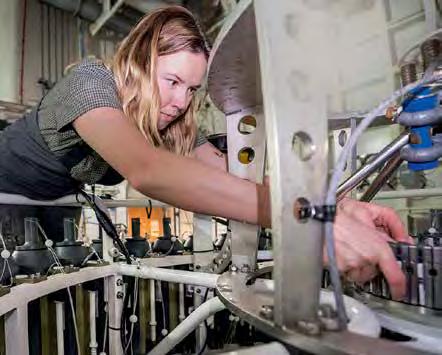
Starting my Bachelor’s in Environmental Science & Studies at Trent in 2017 was one of the most important decisions I have made. During my degree, I studied abroad in Sogndal, Norway, an experience that sparked my ambition to pursue global research.
After graduating, I moved to Malta to complete a master’s in oceanography, focusing on Mediterranean model and satellite data. Today, I am based in New Zealand pursuing a Ph.D. on submarine volcano hazards in the Pacific. A recent 34-day research expedition at Hunga Volcano is now shaping my work and international collaborations.
I feel incredibly fortunate to be on this path, and I credit Trent for setting it in motion.”
Hannah ST. LOUIS ’17 (Otonabee
College)
Lisa TREFZGER CLARKE ’21
(Traill College)
“My work is grounded in curiosity, community, and creating meaningful impact.
After defending my doctoral thesis in 2025 through the Frost Centre for Canadian Studies, I joined Carleton University as a postdoctoral research associate. My current work focuses on research into women in philanthropy in the Canadian context. Alongside my research, I teach at Trent University in Social Work and Arts Management and remain active as a board volunteer and arts educator. I am based in Nogojiwanong-Peterborough, where I balance academic work with family life and community involvement.”

Share your news! Big or small, personal or professional, we want to hear it
A rockstar DREAM
REWRITTEN ON A DIFFERENT STAGE
From a teenage dream sparked by The Beatles to a lifetime in entertainment and service.

“I MEAN, HOW MUCH FUN HAVE I HAD BEING CHANCELLOR? THIS ROLE MAKES ME HAPPY.”
tephen Stohn ‘66, ‘15 (hon) (Champlain College) still remembers the anticipation in the room. It was the mid-1960s at Maple Leaf Gardens. The audience shifted restlessly in anticipation. Then the lights went out.
A single spotlight snapped on, illuminating the drum kit. A roadie sprinted out and ripped away the covering. The words “The Beatles” appeared. The arena erupted.
“And that was the moment that I knew I was destined to be a rockstar,” Stephen says.
Stephen laughs when he tells the story now. He never became a rockstar. But that night did help him discover what he wanted from life: creativity, connection, and the joy that comes from pursuing something meaningful – a journey that would prove to be a long and winding road.
Reflecting on his student days, career and time serving as Trent’s 12th Chancellor, Stephen often returns to a simple question: What gives meaning to your life?
FINDING HIS CALLING
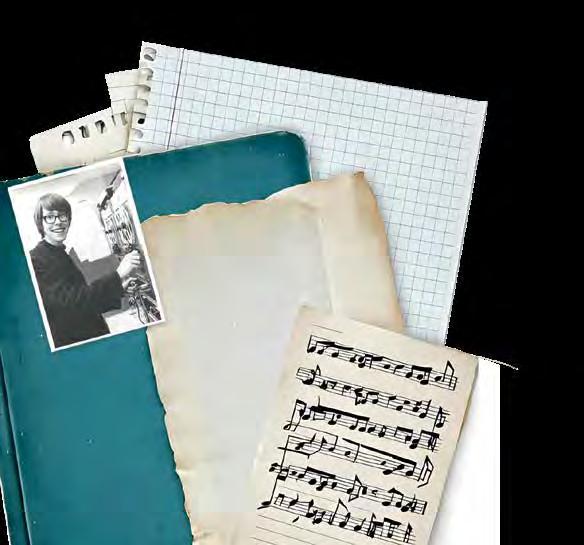
When Stephen arrived at Trent in 1966, music was already at the centre of his life.

“I was in bands at Trent, but I started to realize that if I couldn’t be a rockstar – because there aren’t that many – I wanted to be in the entertainment industry,” he shares. “Working on a newspaper or starting a radio station, well, that’s media.
He helped launch Arthur, Trent’s student newspaper, and establish Trent Radio. Both remain part of campus life today.
After graduating in 1969, Stephen explored his creative ambitions. He collaborated with fellow alumni Peter Northrop ’74 (Lady Eaton College) and Christopher Ward ’67 on musical endeavours and later tried to launch Canada’s first major feature film. The project failed just before production.
“We were devastated at the time,” he recalls. “People often remember the successes – the television shows, the awards, the cultural impact of projects like Degrassi. However, behind those milestones lies a long list of attempts that never worked out. If you’re not failing, you’re not pushing the envelope.”
THE CHANCELLOR WHO SHOWED UP
Returning to Trent as Chancellor gave Stephen a new way to pursue what had long guided him: meaningful work and connection.
“I mean, how much fun have I had being Chancellor? This role makes me happy,” Stephen reminisces with a smile.
During his seven-year tenure, he was a visible and engaged champion for the University, bringing his distinctive, or, as he would say, “nerdy” touch to Trent’s campuses and communities. He attended campus events, joined academic discussions, and represented Trent at alumni gatherings.
Wherever he was, the approach was consistent: show up, be present, and connect. That spirit was most visible at convocation, where he ensured every graduate felt seen, often lingering for a conversation or photo.
“There’s no question that every student who crosses that stage during convocation is a special moment,” he says. “As Chancellor, I can look each of them in the eye, call them by name, and have a quick conversation.”
By the end of his term, Stephen estimates he will have shared nearly 20,000 of those celebratory moments. “That’s what a chancellor, to me, is there for.”
THE WORLD NEEDS MORE TRENT
For Stephen, the question of finding meaning is increasingly practical, and universities have a fundamental role to play.
In his installation address, he introduced a theme that would define his term: A New Hope, a reference to Star Wars: Episode IV - A New Hope
“That is how I think of you, of us, a small group of rebels whose mission is to save the world, if not the universe,” he said at the time, also challenging alumni to continue carrying out the founding principles of Trent. “Let us all always remember what our job really is: saving the world, being a new hope.”
For him, that message is more relevant now than ever before. Artificial intelligence (AI) is advancing rapidly, with systems that may begin to resemble human reasoning. The transformation will bring real challenges, including misinformation and disruption to work. Yet Stephen believes the bigger story is one of possibility.
“AI has the potential to solve major global challenges,” he explains. “But it will require a shift in how we define success.”
Trent’s growing work and new AI programs, he says, are critical to addressing misinformation and broader questions of meaning and happiness. Its multidisciplinary model remains its strength, giving graduates what he calls Trent’s “secret sauce”: adaptability, flexibility, and compassion.
“The only thing we can be certain of is that things are going to change,” he says. “And so, when I say the world needs more Trent, that is truer now than ever.”
SETTING THE STAGE FOR WHAT’S NEXT
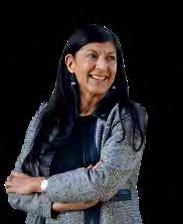
Dr. Zabeen Hirji ’25 (hon) steps into the next chapter of her Purposeful Third Act as Trent’s 13th Chancellor
After a full and demanding career, many of us arrive at a moment of reflection: What comes next? How might we deepen our impact, and above all who do I want to be in this next act? For me, these questions led to my Purposeful Third Act, where I am centred on unlocking human potential and building inclusive prosperity.
Being conferred an honorary degree from Trent in June 2025 opened the door to a meaningful opportunity. As I learned more about Trent, I was drawn to its commitment to interactive, interdisciplinary learning and to developing graduates who combine intellectual rigour with character and community leadership. These values have long guided my own path. I also came to see that generations of Trent alumni share a strong desire to contribute with intention.
As technology reshapes our economy, institutions like Trent, and the students they prepare, matter more than ever. Trent equips graduates with both advanced knowledge and the distinctly human capabilities that have always mattered, and are now essential in an AI-driven world: critical thinking, curiosity, empathy, and sound judgment.
This belief has guided my work in advancing youth education, employment readiness, and entrepreneurship. Alumni understand this instinctively. Whether you graduated five years ago or fifty, you carry Trent’s values into your work and communities.
The task ahead is to ensure that the next generation graduates with that same strong foundation, equipped not only with knowledge, but with the insight and adaptability needed to navigate an increasingly complex world.
I am deeply honoured to serve as Chancellor and to contribute to Trent’s enduring story of leadership and impact.
NEW AND NOTEWORTHY BOOKS
BY TRENT ALUMNI AND FACULTY

A Place of Secrets
by Shane Peacock ’75 (Champlain College)
In the quiet town where everyone knows everyone, some secrets refuse to stay buried.
When 100-year-old Evelyn Massey dies peacefully in her sleep, the case appears routine - until poison is found in her system and human remains are uncovered in her basement, hidden for sixty years. Sergeant Alice Morrow is determined to uncover the truth, but each answer only leads to more questions.
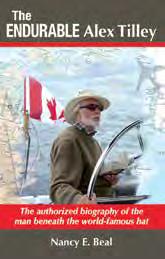
The Endurable Alex Tilley
by Nancy Beal ’81 (Lady Eaton College)
Behind one of Canada’s most iconic hats lies a story as tough and unexpected as the product itself.
The Endurable Alex Tilley follows the unlikely rise of the Tilley Hat, a hat built to float, endure almost anything, and outlast most of its owners. What began as a series of frustrations and failed ideas became a world-famous brand known for its legendary lifetime guarantee.
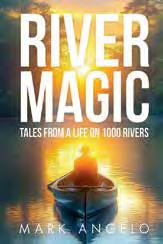
River Magic: Tales From a Life on 1000 Rivers
by Mark Angelo ’19 (hon)
Some lives are measures by miles. Mark Angelo’s are measured by rivers. From wild landscapes to remote cultures, Angelo’s adventures reveal the beauty, danger, and deep human connections shaped by the rivers we depend on. But these waters are disappearing. Blending heart-pounding exploration with a powerful message of conservation, RiverMagic is an unforgettable true story that will change the way you see the natural world.

A SCHOOL FOR TOMORROW

A School for Tomorrow: The Story of Canada World Youth
by Mark Dickinson ’02 (Traill College), Assistant Professor, Canadian Studies, Trent University
What does it take to prepare young people for a shared global future?
A School forTomorrow tells the story of Canada World Youth, a bold experiment in international education that brought young people from vastly different cultures together to learn and live side by side.
Tracing the organization’s origins, its impact, and the challenges it faced in a rapidly changing world, the book reflects on education as a powerful tool for empathy and lasting peace.
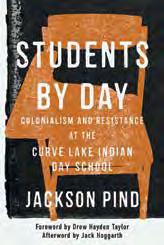
Students by Day
by
Jackson Pind, Assistant Professor,
Chanie Wenjack School for Indigenous Studies, Trent University
The devastating legacy of Canada’s residential schools is widely known, but a quieter history remains largely unheard. Both a recovery of a suppressed history and a testament to survival, Studentsby Day is an essential work of truth-telling, one that honours lived experience while affirming Indigenous activism and hope in the face of educational injustice.
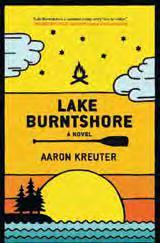
Lake Burntshore
by Aaron Kreuter, Assistant Professor, English, Trent University
A witty, emotionally sharp comingof-age novel set during a pivotal summer at a Jewish sleepover camp.
In 2013, 21-year-old counselor Ruby arrives at Camp Burntshore expecting late nights and familiar summer rituals. When Israeli soldiers are hired to fill a staffing gap, Ruby, a committed anti-Zionist, is forced to confront thorny questions of politics and desire, especially as she falls for Etai, one of the soldiers.

Help
Critical Illness
Receive

Maintain
THE STORY OF CANADA WORLD YOUTH
MARK DICKINSON
In Memoriam
Trent Magazine publishes In Memoriam to inform the community of the passing of alumni, board members, and Trent professors. The below list was compiled April 8, 2026 for inclusion in the magazine.
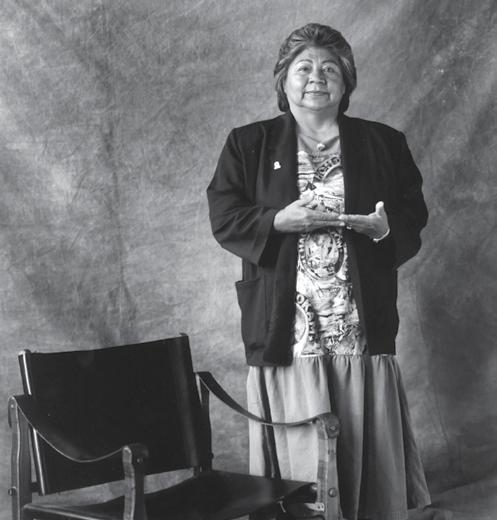
Shirley I. WILLIAMS ’79
Marcia J. Anderson ‘73
Ashley A. Appleby ‘06
Jane I. Argent ‘77
Jamie C. Auld ‘93
Albert C. Baggs ‘81
Robert W. Beaty ‘74
Michael P. Bencze ‘98
Judy Bernard-Julian ‘75
Stephen J. Bitton ‘69
Robert A. Boyce ‘66
Theresa A. Boyd ‘70
Richard E. Bridges ‘79
Linda Brough ‘85
Karen G. Carter-Edwards ‘67
Peter G. Chrisomalis ‘70
Alan D. Cole ‘80
Jean M. Cole ‘04 (hon)
Elizabeth E. Comrie ‘86
Timothy R. Cook ‘90
Jeffrey A. Copeland ‘68
Kathleen E. CopelandNyberg ‘72
Ferne M. Cristall ‘72
Phillip G. Day ‘85
Margaret E. Debruyn ‘01
Judith L. Dolan ‘71
Marcia Doyley ‘09
Glen A. Dunham ‘76
Mary K. Easson ‘78
Ann E. Farquharson ‘76
Michael E. Ferguson ‘74
Margo S. Fines ‘73
Walter J. Fowlie ‘89
Kevin M. Fox ‘75
Danny J. Frei ‘69
Denise Gagne ‘77
Evelyn Gorringe ‘70
Michael J. Gough Former Board
Joan F. Graham ‘75
David G. Greig ‘76
Robyn Guest ‘88
Vaughan R. Harris ‘78
Marion L. Harrison ‘75
Susan M. Hathaway ‘93
Janet E. Heath ‘81
Gertrude E. Hendrikx ‘87
Karen E. Hill ‘75
Wilfrid S. Hughes ‘68
Alwyn J. Huigens ‘78
Nancy L. Hutchinson ‘68
Laverne Iavarone ‘99
Roy R. Kakegamic ‘81
Karen Y. Kawawada ‘94
Dorothy E. Koster‘80
Barbara E. Kyselka ‘88
Chris C. Leach ‘70
David F. Little ‘69
Kathryn J. Loucks ‘88
Joyce E. Mackenzie ‘66
Sherryl K. Malcomson ‘89
Elizabeth F. Mallory ‘87
Ralph B. Mann ‘64
Julie A. Mann ‘84
Ernest E. Mansell ‘68
Bonnie J. Maracle ‘89
Raymond E. March
Professor Emeritus
Carol A. Mazeikis ‘88
Lucile A. McGregor ‘74
Grant N. McKay ‘80
Linda S. McKay ‘67
Linda J. McMullen ‘74
Norma E. Miller ‘71
Marilyn A. Milne ‘70
Leanne Mitcheson ‘93
Robert W. Newland ‘72
Kaitlin B. Newton ‘07
Andrew A. Nicholls ‘01
Douglas G. North ‘83
Keith B. Oldham
Professor Emeritus
David F. Page
Professor Emeritus
Beverley A. Powles ‘68
Percival M. Powles
Professor Emeritus
Marina R. Puffer-Butland ‘74
Karina E. Rammell ‘82
Katherine A. Richlark ‘82
Christopher L. Rodgers ‘80
Doreen E. Roland ‘68
Jennifer B. Ronca ‘87
Elizabeth Rua ‘94
Adam D. Ryan ‘12
William J. Saunderson
Board Emeritus
Bruce A. Saville ‘64
Alvin I. Schieck ‘84
Paul W. Sisson ‘70
Marie M. Sloan ‘70
Denis Smith ‘89 (hon)
Allan R. Smith ‘66
Paul A. Spenser ‘76
William G. Stedwill ‘65
Ellen J. Stewart ‘83
Ronald W. Suggitt ‘69
Robin P. Sutton ‘86
Joan E. Tickle ‘76
Romas Vastokas
Professor Emeritus
Donald R. Veno ‘77
Natalie Wasserlauf ‘96
Patricia D. Weir ‘81
Susan J. Wesley ‘73
Robert G. Wheeler ‘72
Valorie M. Whetung ‘70
Jean I. White ‘65
Ilona C. Wille ‘87
Shirley I. Williams ‘79
Sharon L. Willshaw ‘72
P.S.B. Wilson ‘96 (hon)
Ralph D. Wood ‘67
BECAUSE THE FUTURE DESERVES EVERY CHANCE
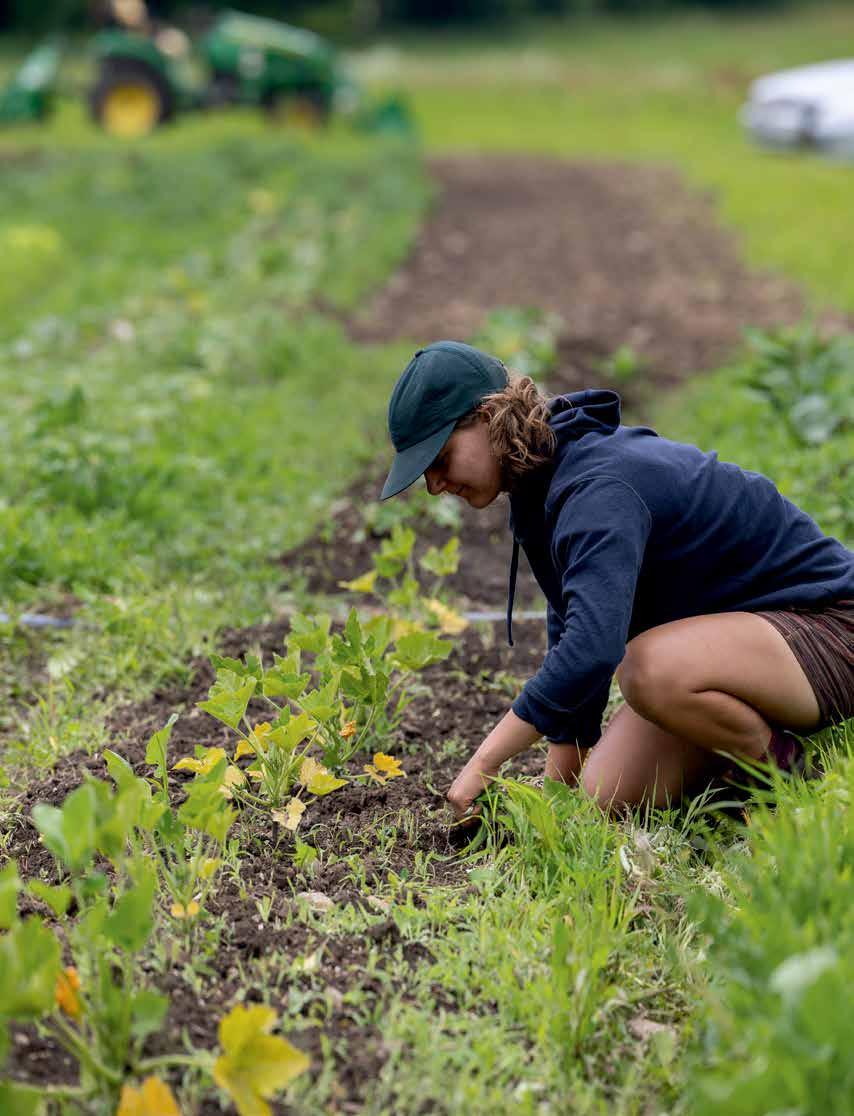
FOR SO MANY PEOPLE, Trent University was the place where students discovered who they could become.
When you leave a gift in your will, you help make that moment possible for someone else.
Your legacy lifts up students who dare to dream, students who work hard, take risks, and carry forward the spirit that makes Trent such a special place.
A legacy gift is more than a gesture. It is a way to let your values, your hopes, and your belief in others live on.
Let your generosity echo through the lives that follow.

Raise a Glass to Our CAMPUS PUBS
WRITTEN BY: KYLA WOODS ILLUSTRATION BY: BROOKLIN STORMIE
We posed a spirited question to our alumni community: Which Trent campus pub deserves the title of all-time favourite? The responses poured in – through emails, comments, and lively threads across our social channels - and we’ve crunched every last vote. Now, the results are in. Here’s to the pubs that shaped count less Trent memories, conversations, and friendships - according to the people who knew them best: our alumni.

The Commoner quickly became the on‑campus hotspot on East Bank – famous for its packed lineups, legendary late‑night pizzas, and its dis tinct identity as a fully student‑run space with no college affiliation. Known equally for its lively crowds and its long‑rumoured ghostly hauntings, The Commoner remained a Trent icon until its clo sure in 1999, and it came in as our top alumni pub pick with a resounding 58% of the vote!
“The Commoner. Without a doubt. An old farmhouse turned pub, with an ancient pinball machine, old furni ture out by the river.”
– Jeff Hubbell ’81 (Julian Blackburn College) commented on Facebook


The CÉILIE
The Céilie, also known as ‘The Keep,’ in the early days, is a cozy and familiar pub with in Champlain College, now beloved as a fireside retreat serving comforting pub clas sics. But alumni also remem ber a livelier past – one touted as the centre of the commu nity – fun, loud, hot, and crowded; a place where the energy was as memorable as the company.
“From hanging out between classes to late nights dancing away before heading back to AB staircase to sleep it off –the Céilie was the place to be! Sure, there were other pubs, but the best was the Céilie!”
– Laura Bright ’97 (Champlain College)

3
The TREND
The Trend, nestled in Wallis Hall at Traill College, opened in 1968 and quickly became a vibrant hub of Traill life. With its welcoming atmosphere, creative energy, shuffleboard table, music, and great beer selection, it’s fondly remembered as a favour ite gathering place for generations of students.
“The Trend! Many a Thursday night was spent there drinking way too much beer, playing shuffleboard and listening to Van Morrison’s Moondance album.”
– Grégoire
Crevier ’81 (Traill College)
4
The JOLLY HANGMAN
Beloved for its creative, any thing‑goes energy, The Jolly Hang man at Peter Robinson College grew into a spirited cultural hotspot where students explored music, art, and bold ideas. By day it offered a quiet, student‑run retreat; by night it shifted into a lively, crowded, and smoky pub – complete with rowdy music, weekly dances, and live bands. Tiny, vibrant, and affectionately dubbed ‘the shack by the tracks,’ it remains remembered as a place where community and late‑night imagination thrived.
HONORARY MENTION
“Pig’s Ear (I know, I know – it technically wasn’t a campus pub but much of Traill College could be found there at all hours of the day!)” – Wendy Henderson ’87 (Traill College) commented on Facebook

CAT’S ASS
“Jolly Hangman...never knew who would drop by and join the band or what wackiness might ensue!”
– Shawn Heard ’84 (Peter Robinson College)
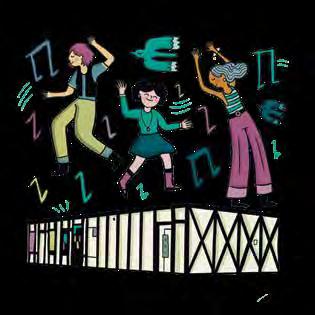
The Cat’s Ass was Otonabee’s go‑to spot for unbeatable music and the liveliest dancing – paired with fa mously questionable ventilation. Beloved for its laid‑back chaos and campus camaraderie, it stood as a defining hub of OC student life. There was simply something about the place that encouraged people to make complete fools of them selves – and have an unforgettable time doing it.
“The Cat’s Ass Pub was my first on-campus job at Trent. It’s where I met many friends, had a ton of fun, and learned to be a bartend er/bouncer! There were many late nights at the Cat’s Ass Pub, tearing up the dance floor, playing intense rounds of trivia, and listening to great OC musical talents at coffee houses. It was always a place for community building and creating lasting memories.”
Crawpadies PUB
A legendary fixture of Lady Eaton College, Crawpadies – originally known as Thee Place – offered great music, competitive pool games, busy dance floors, and the kind of welcoming pub atmosphere alumni still reminisce about. Though long since closed, its spirit lives on in LEC lore, fondly remembered by all who packed its dance floor.
“I, the Mountain is a pop folk band that began at Lady Eaton College in 2012. Matt Lamers ’10 and I met there, and Crawpadies quickly became our spot. Some of our first jams, ideas, and late-night conversations happened in that pub. So much of the band’s early spark came from those nights at Crawpadies.” – Matthew Rappolt ’11 (Lady Eaton College)
– Chris Glover ’01 (Otonabee College)





A Dash of Humanity
or AI?
Once a poetic expression of individuality, the em dash now reveals the limits of AI-generated voice
WRITTEN BY: ISABEL BOTHA
s artificial intelligence (AI) reshapes how we write, one small punctuation mark is raising a larger question: can style still signal something distinctly human?
The em dash once signaled something unmistakably human: a mind mid-thought, shifting and interrupting itself. Now, it may signal something else entirely.
As AI-generated writing becomes more common, this once-expressive mark has taken on a new role, not as a flourish of individuality, but as a recognizable pattern. What was once a stylistic choice is becoming a formulaic tell.
“It is quite ironic,” says Elizabeth Palermo (Traill College), Master’s student in Public Texts and a former journalist for Citytv and Toronto Star. “Writers have used the em dash for centuries. It reflects how people actually think, with ideas interrupting and unfolding mid-sentence. It adds rhythm and personality, but only when it’s well-placed and used sparingly. AI is based on patterns of human writing and its use of them is formulaic, which is why cultivating your own voice is more important than ever.”
The use of dashes stretches back centuries to when it was first written, meaning “to
“Expressing ourselves through storytelling and oral history is inherently human”
strike violently,” which is a fitting origin for punctuation that disrupts a sentence midstream. It appeared in 17th-century printed editions of Shakespeare’s plays and gained devoted champions in the 19th century, when writers used em dashes to signal pauses, shifts in thought and emotional undercurrents that conventional punctuation could not capture. That expressive quality still resonates with writers today.
“Expressing ourselves through storytelling and oral history is inherently human,” Palermo explains. “The em dash allows writers to play with pacing, to spotlight certain words, and to shape voice as it unfolds on the page.”
And yet, that same flexibility, is what makes the em dash so easy for AI to replicate. Trained on vast datasets of human writing, AI systems reproduce not just vocabulary and grammar, but stylistic tendencies. The em dash, versatile, expressive and easy to deploy, becomes a convenient shortcut to sounding thoughtful. The result is writing that gestures toward nuance without always earning it.
So, has AI ruined the em dash?

Share your thoughts

Elizabeth PALERMO (Traill College)