Take me home! Your free copy
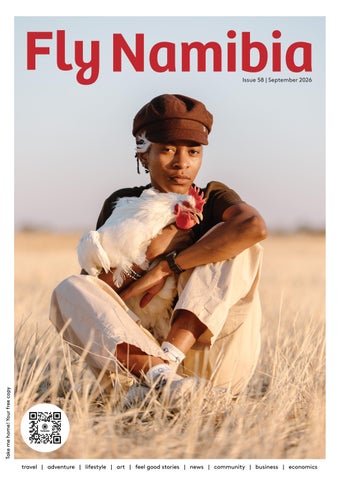
Issue 58 | September 2026
travel | adventure | lifestyle | art | feel good stories | news | community | business | economics
Save together, cheer together with FNB weSave
Experience the thrill of the big game with your friends! With FNB weSave, every member can save towards your match-day plans, track contributions, and watch your money grow with interest. Simple, transparent, and ready when the whistle blows. Visit your nearest FNB branch today and open your FNB weSave Account. 061 299 2222
081 953 6262
www.fnbnamibia.com.na
CONTENTS Welcome on Board
9
Five things to know about Jessica
10
This is Namibia: The Ovahimba
13
The Brief
14
Love Local Arts
17
Safari in Windhoek? A capital reconsidered.
18
Native Leaves: Zambezi Teak
23
Eyes in the wild: How camera traps are safeguarding Namibia’s natural heritage
24
Afrikan Child Kindergarten
27
Macro Pulse: History Rhymes, Differently
28
Namibia and Botswana strengthen ICT cooperation
31
More than a crown: Charene’s vision to turn empowerment into action
32
Namibia and South Africa push for stronger economic integration
35
UNDP opens its doors to showcase development impact in Namibia
36
Reflections: When talking can save a life
39
BE Wellness: The backpack we cannot see
40
Injectables, explained: What does your skin actually need?
45
We’re for Namibians: Kanyanga Simaho
46
Living Well: What if you do know? The quiet intelligence intuition
49
The silent loneliness of working in hospitality
50
Financial discipline, lifestyle choices and smarter living
53
We rise by lifting others: Championing the Namibians who make Namibia extraordinary
54
Time as a concept of motion
57
Where conservation meets community
58
From neighbourhood walk to national movement: Inside Cleanup Namibia
61
Mapping Namibia’s creative industry ecosystem
62
Ubuntu to welcome the world as Cricket World Cup 2027 takes shape
65
Fire in the night sky
67
The story isn't first oil. It's what happens before it.
69
Echoes of Omusati: The long road home
70
Did you know?
72
Love Namibia
76
18
32
58 FLYNAMIBIA SEPTEMBER 2026
1
Welcome to the September edition of the FlyNamibia Magazine
brought to you by At Venture Media, we’re more than just a publisher - we’re a multi-media content creation powerhouse. Our expertise includes awe-inspiring photography, striking videography, impeccable design, and crisp podcasts. With a reputation for excellence spanning three decades, we bring unparalleled storytelling to life. In our boutique publishing and content marketing house, stories that matter take center stage. Every page you turn reflects our commitment to quality and innovation. Dive in and experience the difference that top-tier content creation can make. Cover image by Andreas Elifas Read more on page 10. Editor Elzanne McCulloch elzanne@venture.com.na Production Manager Liza Lottering liza@venture.com.na Sales Daleen Small daleen@venture.com.na Layout & Design Richmond Ackah Jnr. design@venture.com.na Admin and Enquiries Bonn Nortje bonn@venture.com.na Printing John Meinert (Pty) Ltd
Venture Publications (Pty) Ltd. PO Box 21593 Windhoek Namibia Disclaimer: Please note that while every effort has been made to ensure the accuracy and reliability of the content within this magazine, Venture Publications Pty Ltd and FlyNamibia accept no responsibility for any errors or omissions. The views expressed by individual authors are solely their own and do not necessarily reflect those of the publisher or FlyNamibia. All material, including text and images, is the property of its respective authors and cannot be reproduced or used without explicit permission from Venture Publications Pty Ltd.
2
our services. Creative Professional Concept & Photography Campaign Development
Creative Design
Social Media Management
Video Production
Creative Storytelling & Content Creation
Want to be part of our content creation revolution? Find our contact details here.
+264 81 285 7450 | info@venture.com.na | www.venture.com.na
our publications.
From the Publisher
our storytellers.
Order any of these publications from bonn@venture.com.na
54
23
Agnes Shivute
An environmental consultant with interest in indigenous flora, nature enthusiast, Namibia Botanical Society awardee and aspiring author.
32
Elzanne McCulloch
Writer, editor and publisher of Stories that Matter. Managing Director of Venture Media.
53
Rukee Kaakunga
Glen-Nora Zeupereje
A Windhoek-based Tjipura communications specialist, is a writer and filmmaker, blogger and freelance fashion passionate about stories, writer. whether reading or consuming
31 45
35 49
61
Emily Kandanga-Erastus
46
Cerina Bezuidenhout
36
David Penda
Maggie Forcelledo Paz
A digital content creator News & Content Editor. Windhoek-based creative & Haasbroek capturing Namibia's stories Passion and dedication to movement enthusiast. A creator, guide, and curious through bold visuals and real keep the nation abreast with Usually building, creating, and soul inspired to help people moments. My work celebrates what’s happening on national storytelling, blending wellness, reconnect with their bodies, and international level. purpose, and a passion for find their flow, and reclaim their the people, places, and pulse of the nation. bringing meaningful ideas to life. health – naturally.
39
18
40
David Bishop
Host of Nova Sunrise on Nova 103.5, climbing wall owner, voracious reader, sometime writer, active lifestyle proponent, family man, and coffee lover.
Jana Vermeulen
Educational Psychologist. “Much of what triggers us as parents stems from the legacy of our own childhood.”
Madeleen Duvenhage Windhoek-based writer perpetually scouting for hidden gems and offbeat narratives found in the ordinary.
FLYNAMIBIA SEPTEMBER 2026
3
LOCAL IS ST! BE
#b
u y n a m ibi
an
PROUDLY NAMIBIAN. READY FOR THE WORLD. BUILT FOR ADVENTURE.
GEAR THAT TAKES YOU FURTHER. Premium outdoor & camping equipment for every journey.
HOME OF GREENSPORT
OUTDOOR & CAMPING SOLUTIONS FOR EVERY EXPLORER. OFF-ROAD EQUIPMENT
Suspension, recovery, navigation & more. Go further. Travel safer.
KITCHEN & COOKING
Everything you need to cook great meals anywhere.
From weekend getaways to extreme expeditions, CYMOT equips you with premium gear you can trust - wherever the journey takes you. OUTDOOR LIGHTING
TENTS & SHELTERS
Light your adventure with reliable, high-performance lighting.
CAMPING FURNITURE
CYCLING EQUIPMENT
FISHING EQUIPMENT
Rest easy. Sleep warm. Wake rested.
Top brands. Superior performance. Built for any terrain.
Quality gear for every and any cast.
Shelter from the elements. Built strong. Made to last.
GADGETS
Versatile. Durable. Always ready.
LUGGAGE & STORAGE
Smart storage solutions. Organised and protected.
TRUSTED BRANDS. EXPERT ADVICE. GEAR YOU CAN RELY ON. PREMIUM BRANDS Quality you can trust.
EXPERT ADVICE From people who love the outdoors.
ADVENTURE IS EVERYWHERE. BE PREPARED. Explore further. 4
TESTED & PROVEN Gear that performs in any conditions.
WIDE RANGE The best from near and far.
VISIT CYMOT TODAY In-store. Online.
(083) 295 6000
info@cymot.com
www.cymot.com
LOCAL SUPPORT Proudly Namibian. We are here for you.
Need To Knows. with FlyNamibia
How to buy
a ticket online www.flynam.com
Select your flight Select which tickets you would like to purchase: destinations, travel dates, morning/afternoon departure. We offer multiple fare options such as: Saver, Classic or Premium
Additional flight information / rules Read up on all our additional information regarding terms and conditions, and tick the selection box once completed to continue.
Passenger details
Payment
Please enter names as they appear on passport or travel documentation
Fill in your payment details in our DPO paygate to make final payment.
LOGIN to upload passenger details from previous booking.
More options for the perfect trip
Confirmation Mail Transaction confirmation will be sent to passenger email entered.
Baggage policy, sporting equipment, over weight luggage or to add an additional bag(s)
How can you make
You can also purchase
from:
a payment?
Cash payment at: Eros Airport, Ondangwa Airport
Electronic Funds Transfer (EFT)
Windhoek Eros Airport Office Ondangwa airport office Katima Mulilo airport office Hosea Kutako airport office All major travel agents
Online card transaction
PayToday app Buddy SuperApp
Check-in
prior to flight Online check-in opens 24 hours before departure of the flight on Fly Namibia Check-in opens 1h 30min before domestic flight and 2 hours before international flight. Check-in CLOSES 30 min prior to domestic flight and 50 min prior to international flight.
Luggage
restrictions Items NOT allowed in hand luggage:
MAX 20kg Per person
Lotions and aerosols above 100ml, flammable aerosol, sharp objects, i.e. nail files, nail scissors, Leatherman, matches. See full conditions of carriage by scanning the QR code
FLYNAMIBIA SEPTEMBER 2026
5
DOMESTIC & SAFARI FLIGHTS Katima Mulilo (via Maun) Bwabwata National Park
Ondangwa
Skeleton Coast Park
Rundu
Mokuti
Etosha National Park
Khaudum National Park
Tsumeb
Ongava
Otavi
Grootfontein
Mudumu National Park Nkasa Rupara National Park
Maun
Twyfelfontein Otjiwarongo
Waterberg Plateau Park
Dorob National Park
BOTSWANA Okahandja
Swakopmund
Windhoek
Walvis Bay
Gobabis
NamibNaukluft Park
Mariental Keerweder (Sossusvlei)
Keetmanshoop
Lüderitz
Ai-Ais/ Richtersveld Transfrontier Park
Oranjemund
with FlyNamibia Contact The Call Centre | +264 83 339 0011 Schedule as per date of going to print. Please check the FlyNamibia website to stay updated on flight destinations, routes and schedules.
Victoria Falls ZIMBABWE
DOMESTIC FLIGHTS FLIGHT NO.
DEPARTURE
FROM
TO
ARRIVAL
DAYS
WV*4Z8505
06:30
Eros - Windhoek
Ondangwa - Toivo Ya Toivo
07:30
Tue
WV*4Z8506
08:00
Ondangwa - Toivo Ya Toivo
Eros - Windhoek
09:00
Tue
WV*4Z8595
16:20
Eros - Windhoek
Ondangwa - Toivo Ya Toivo
17:20
Tue, Wed, Thu, Fri, Sun
WV*4Z8596
17:50
Ondangwa - Toivo Ya Toivo
Eros - Windhoek
18:50
Tue, Wed, Thu, Fri, Sun
WV*4Z8137
13:30
HKIA - Windhoek
Katima Mulilo (via Maun)
15:30
Mon, Wed, Fri, Sun
WV*4Z8138
16:00
Katima Mulilo
HKIA - Windhoek (via Maun)
18:15
Mon, Wed, Fri, Sun
REGIONAL FLIGHTS FLIGHT NO.
DEPARTURE
FROM
TO
ARRIVAL
DAYS
WV*4Z8137
13:30
HKIA - Windhoek
Maun
14:30
Mon, Wed, Fri, Sun
WV*4Z8138
17:05
Maun
HKIA - Windhoek
18:15
Mon, Wed, Fri, Sun
WV*4Z8135
09:15
HKIA - Windhoek
Victoria Falls
10:40
Tue, Wed, Thu, Fri, Sat, Sun
WV*4Z8136
11:15
Victoria Falls
HKIA - Windhoek
12:50
Tue, Wed, Thu, Fri, Sat, Sun
Mon-Sun
in Partnership with 4Z341
11:40
Cape Town
Walvis Bay
13:55
4Z342
14:40
Walvis Bay
Cape Town
16:45
Mon-Sun
4Z320
07:00
Cape Town
HKIA - Windhoek
09:10
Mon, Tue, Wed, Thu, Fri, Sat
4Z326
10:40
Cape Town
HKIA - Windhoek
12:50
Mon-Sun
4Z328
18:15
Cape Town
HKIA - Windhoek
20:25
Mon, Tue, Wed, Thu, Fri, Sun
4Z329
07:05
HKIA - Windhoek
Cape Town
09:10
Mon, Tue, Wed, Thu, Fri, Sat
4Z321
09:50
HKIA - Windhoek
Cape Town
11:55
Mon, Tue, Wed, Thu, Fri, Sat
4Z327
13:40
HKIA - Windhoek
Cape Town
15:45
Mon-Sun
*Code Share ** For Luderitz flights please contact your nearest Travel Agent or FlyNamibia offices for the newest updates. HKIA - Hosea Kutako International Airport
Our main routes
The seasonal FlyNamibia Safari schedule will resume on 1 May 2026 and run until 30 November 2026. Our daily shuttle flight operates in a clockwise circuit seven days a week. The exact departure and arrival times are determined the day before the flight and will be communicated directly to lodges, tour operators, and transfer companies. A minimum of two passengers is required per sector. All destinations remain available on a private charter basis. The departure time from Sossusvlei is between 08:30 and 11:00, meaning arrival in Swakopmund and Twyfelfontein will be in time for lunch, and arrival at Etosha will be between 12:30 and 15:30. The arrival time in Windhoek will be between 16:00 and 17:00, or earlier if necessary to ensure connections with various airlines. It’s important to note that no activities should be booked on the day of departure to the next destination until the departure time is confirmed the day before. All destinations remain available on a private charter basis. For more information, contact: Email: safari@flynamibia.com.na
FROM
TO
Windhoek
Sossusvlei
Sossusvlei
Swakopmund
Swakopmund
Twyfelfontein
Twyfelfontein
Ongava
Ongava
Mokuti
Mokuti
Windhoek
Additional route options FROM
TO
Swakopmund
Ongava
Swakopmund
Mokuti
Twyfelfontein
Mokuti
Ongava
Windhoek
Sossusvlei
Twyfelfontein
Sossusvlei
Ongava
Sossusvlei
Mokuti
Twyfelfontein
Windhoek
Swakopmund
Windhoek
IS CORPORATE GUARANTEE YOUR SOLUTION? Alternative Risk Transfer isn't designed for everyone. It requires financial maturity, Strategic thinking, Strong governance and a long-term view. If you're looking for the cheapest insurance policy, we're probably not the right fit. If you're looking for a strategic partner that helps protect capital, strengthen resilience, and support sustainable growth... Let's have a conversation.
Insurance structured differently and trusted by leading Namibian businesses. GET IN TOUCH 083 331 3032 clientcare@corporateguarantee.com
ON BOARD Dear Guests, Welcome on board FlyNamibia. There is something exciting about watching our network grow, not simply in the number of flights we operate, but in the connections those flights make possible.
Read our previous issues
WELCOME
We are delighted to announce that from 1 April 2027, we will add an additional weekly frequency to our Maun and Katima Mulilo service, bringing the route to five flights per week, operating on Mondays, Tuesdays, Wednesdays, Thursdays and Saturdays. Maun remains an important destination within our growing regional network, connecting travellers to one of Southern Africa’s most remarkable tourism regions. Increasing our frequency is another step towards making travel across our corner of Africa easier, more accessible and better connected. Closer to home, August also saw the FlyNamibia team participating in the Namibia Mining Expo. Namibia’s mining industry plays an important role in our economy, and aviation plays its own part in connecting the people, businesses and opportunities that keep industries like these moving. Being present at the Expo gave us the opportunity to engage with partners, clients and the wider business community, and to once again demonstrate that FlyNamibia is proudly invested in the country we call home. And speaking of proudly Namibian, we have a new face joining our family. After an incredible journey that saw Namibians and our FlyNamibia team cast their votes, Jessica Amoonga has been named the new Face of FlyNamibia. Jessica brings with her an infectious creativity, curiosity and love for this country. Over the months ahead, we look forward to getting to know not only Jessica, but Namibia through her lens: the places, people, cultures, stories and unexpected moments that make this country extraordinary.
As we continue to grow, connect and tell the stories of the country and region we serve, thank you for choosing to travel with us and for being part of our journey. Wherever you are headed today, we are glad to have you on board. Nerine Uys CEO, FlyNamibia
On the cover
Jessica, congratulations and welcome to the FlyNamibia family. We cannot wait to see where this journey takes you.
SC A
Five things to know about Jessica Amoonga See page 10
NM
E!
Photography: Andreas Elifas
Je s
Five things to know about
10
s
Amoonga a ic
M
eet Jessica Amoonga, the new Face of FlyNamibia. Creative, curious, wonderfully expressive and very much someone who follows her own path, Jessica has a way of finding joy in the people, places and little things around her. Here are five things she thinks you should know about her.
1. I’m a creative entrepreneur Creating is how I experience life. I paint, dance, design, take pictures, make videos, edit, make jewellery, work with wood and plants… basically, if I can make something with my hands, I’m probably going to try it. I also host creative, leadership and team-building camps where I create spaces for people, especially young people, to discover their skills and a little more about themselves. My guest house and Xtream Content House are other spaces where I get to bring all these different parts of my creative world together. 2. I absolutely HATE texting I’m probably one of the worst texters you’ll ever meet. It’s not personal, I promise. I’m usually somewhere doing something, making something or working with my hands. For business, I literally have to stop everything and enter what I call my “texting zone”, because I know I need to reply to people and run my businesses. Personally? I’d much rather you just call me. Let’s have the conversation, get straight to the point and carry on with our lives. If I reply after three weeks, please know I probably still love you. I’m trying! 3. I went to seven different schools From Grade 1 to Grade 12, I attended seven different schools. Moving around that much taught me how to adapt, how to read people and how to find my place in completely new environments. Looking back, I think it’s part of the reason I can go almost anywhere and somehow find a way to make it feel like home. 4. I’m very intentional, and I REALLY hate lies I don’t do things simply because I’m bored, lonely or because everyone else is doing them. I’m intentional about the people, experiences and situations I allow into my life. And please, just be honest with me. You can tell me something I don’t want to hear and I’ll respect you for telling me the truth. But lying to me is probably the quickest way to lose my trust. I’m even intentional about love. I’ve been single for nine years, not because I don’t believe in love, but because when I love, I love deeply. I’d rather wait for the right person than date simply for the sake of dating. And trust me, I’ll know when the person is right for me. 5. I’m a nature woman at heart Give me plants, animals, stones, water, gardens, sunsets, swimming and the outdoors and I’m happy. I genuinely struggle to hurt animals. So if you find a spider in the house, please don’t kill Grace. Yes, the spider has a name. I’ll probably relocate her somewhere safe and send her on her way. Nature is where I feel most like myself and where I go to reset. My favourite colours are green and yellow. Green for life and nature, and yellow for sunshine and happiness. And, of course, because I’m basically a pineapple. I love pineapples. I love hearts. And I love LOVE. Blessings, Jessica
FLYNAMIBIA SEPTEMBER 2026
11
Book your conference
at Khorixas Camp
Discover unparalleled conference facilities amidst breathtaking natural landscapes with Namibia Wildlife Resorts. At Khorixas Camp, immerse yourself in the rich history of ancient civilizations while enjoying modern conference conveniences.
Elevate your business travel with the NWR NAMLEISURE CORPORATE CARD! Enjoy exclusive discounts on accommodation and activities, ranging from 50% for Namibian to 10% for international cardholders. With a validity of three years and easy renewal, it’s tailored for businesses with a minimum group size of 10. Experience convenience, savings, and unparalleled benefits for your corporate outings.
+264 61 285 7108 |
MICE@nwr.com.na |
www.nwr.com.na
This is Namibia black cloth around their waist. A distinctive feature of Ovahimba women is the ochre colour of their skin. This mixture of butter fat, herbs and powdered ochre (otjize) not only protects their skins, but also keeps insects at bay and prevents their hair from falling out. Head ornamentation and hairstyles still feature prominently in the Ovahimba culture. A young girl typically has plaits (ozondato). Once she has completed her puberty ceremony, she wears the ekori – a headdress made from tanned sheep’s hide or goatskin with three leaf-shaped points, often decorated with iron beads.
THE OVAHIMBA
T
he Ovahimba of Namibia’s remote northwestern Kunene Region, formerly known as Kaokoland, are semi-nomadic pastoralists who migrate in search of grazing and water for their cattle. They are the descendants of Ovaherero who remained in Kaokoland when the rest of the Ovaherero migrated further south. They came under attack from Oorlam Nama commandos who raided their cattle from the mid-1800s to the end of the 19th century, leaving them destitute. Most of them took refuge north of the Kunene River in southern Angola where they gradually rebuilt their herds and returned to Namibia in the 1920s. Despite the influences they have been exposed to in the past few decades, they have largely retained their traditional way of life. The Ovahimba live in semi-permanent settlements throughout the Kunene Region. Tall, slender and statuesque, they are characterised especially by their proud and friendly bearing. The women are noted for their sculptural beauty, enhanced by intricate hairstyles and traditional adornments. Ovahimba homes (ozondjuwo) are simple, cone-shaped structures of saplings bound together with palm leaves and plastered with mud and dung. The structures which have a short tunnel-shaped entrance are built by men, while the women do the plastering. A fire burns in the headman’s hut day and night to provide light, heat and keep insects away. Every homestead has a holy fire (okuruwo) in the middle of the main dwelling and the cattle enclosure. The fire has to be kept smouldering as it serves as the sacred link between the ancestors and the living. Families may move from one home to another up to ten times a year to search for grazing for their cattle and goats. As they are frequently on the move, a family may live in hundreds of dwellings in a lifetime. Women wear a short calfskin front apron and a black skirt made of calfskin, while most men nowadays wear a
Ovahimba males also wear different hairstyles such as the single plait (ondato) worn by young boys down the back of the head. Men of marriageable age wear the twoplait ozondato. Married men must keep their hair covered, except when mourning the death of a close relative, and wear a fabric scarf that covers the head and is decorated with an ornamental band. Children, men and women wear a variety of body adornments made from iron and shells that are indicative of their status. One of the most prized adornments worn by women between their breasts is the ohumba, a sea shell which is passed on from mother to daughter.
EXPERIENCING OVAHIMBA CULTURE
The Ovahimba Living Museum, one of six living museums established by the Living Culture Foundation of Namibia, offers a fascinating insight into the culture and traditions of the Ovaherero. Visitors can experience the daily routine of the Ovahimba by joining several programmes, ranging from traditional life, bush walks and craft-making to singing and dancing. The village is 42 km north of Opuwo on the D3700/ C43 road to Epupa Falls. Find more Namibia travel inspiration at www.thisisnamibia.com Follow @thisis_namibia on Facebook and instagram for extraordinary Namibia travel stories.
THE OVAHIMBA LIVING MUSEUM
The Living Museum allows visitors to discover the mysteries and wonders of Ovahimba culture. An exhilarating, energetic demonstration, the living museum gives you the opportunity to learn about the intriguing traditional life of the Himba people. This includes their dress, food and crafts (wood carving and metal work). Guests learn about how the homestead is built, with the Holy Fire at its heart, where all the important communication with the ancestors takes place. They also have the unique opportunity to sit in a hut with a bevy of Himba women learning about their intricate beauty rituals. The Ovahimba Living Museum was opened officially in November 2016 and is the sixth of its kind. The museum can be found on the C43, 40 km north of Opuwo.
FLYNAMIBIA SEPTEMBER 2026
13
A monthly wrap-up of News Worth Knowing NAMIBIA INFLATION RISES TO 4.4% AS FUEL, TRANSPORT COSTS SURGE
inflation at 5.3%, largely due to transport and recreation costs, while northern regions had the lowest at 3.6%. Despite higher annual inflation, monthly inflation moderated to 0.1% in July from 0.3% in June, while core inflation stood at 3.7%. NAMRA EYES APRIL 2027 ROLLOUT OF NAMIBIABOTSWANA FAST-TRACK CUSTOMS SYSTEM
Namibia’s annual inflation rate rose to 4.4% in July 2026, up from 3.5% a year earlier, mainly driven by higher transport, housing and fuel costs, according to the Namibia Statistics Agency (NSA). Transport was the largest contributor, adding 1.4 percentage points to headline inflation. Transport inflation climbed to 9.3%, compared with a 1.2% decline in July 2025, following a 15.5% increase in petrol and diesel prices. Public transport inflation surged to 14.7%, while the cost of operating personal vehicles rose by 11.3%. Housing, water, electricity, gas and other fuels contributed 1.2 percentage points, with inflation in the category increasing to 4.8% from 3.6%. Food and non-alcoholic beverages added 0.7 percentage points, although food inflation eased to 3.7% from 6.1%. Fruit and vegetable prices increased significantly, while inflation for fish and meat slowed sharply.
Namibia and Botswana are targeting April 2027 for full implementation of a Mutual Recognition Arrangement (MRA) allowing trusted businesses to move goods between the two countries with faster customs clearance and fewer inspections. The initiative will begin with an eight-month pilot on 18 August 2026, testing whether customs authorities can recognise and provide preferential treatment to accredited Authorised Economic Operators (AEOs).
Services inflation rose to 4.8%, while goods inflation increased to 4.2%. Khomas recorded the highest regional
Initially, the arrangement will cover the Trans Kalahari/ Mamuno One-Stop Border Post and the Port of Walvis
Namibia
SCAN HERE Finance
14
thebrief.com.na
miningandenergy.com.na
@thebrieflive.nam
Namibia Mining and Energy
@thebrieflive
@miningandenergy
@thebrieflive
Namibia Mining and Energy
MINING
TO FOLLOW OUR
WHATSAPP CHANNEL
ENERGY Business
Bay. Accredited traders in both countries will receive reciprocal recognition, faster clearance, reduced inspections, greater predictability and improved supply-chain efficiency. The agreement aims to eliminate duplicated customs procedures, allowing authorities to focus on higher-risk shipments while speeding up compliant cargo. NamRA, Botswana’s revenue service, the SACU Secretariat and other agencies recently conducted a final dry run to assess readiness.
Since its establishment, DBN has invested more than N$23 billion in productive sectors of Namibia’s economy. The bank plans to continue its nationwide outreach programme to promote entrepreneurship, investment and job creation, following earlier engagements in Erongo, Oshana and Omusati. LAW FORMALISING NAMIBIA’S SOVEREIGN WEALTH FUND TO REACH PARLIAMENT BEFORE YEAR-END
NamRA currently has 10 accredited AEOs, with the programme open to other eligible businesses. Lessons from the pilot will guide procedures before full implementation. DBN INJECTS OVER N$819 MILLION INTO NORTH-EAST NAMIBIA
The Development Bank of Namibia (DBN) has approved more than N$819 million in development finance for projects in the Omaheke, Kavango East and Kavango West regions as part of efforts to expand funding access for businesses, women and young entrepreneurs. The approvals include N$356.19 million for Omaheke, N$331.92 million for Kavango East and N$131.34 million for Kavango West. The funding was highlighted during a four-day stakeholder outreach programme involving regional governors, councillors, businesses and entrepreneurs. DBN said there was strong interest in its DBN for Her financing facility, which supports women-owned businesses, and the National Youth Development Fund, administered on behalf of the Ministry of Finance. CEO Titus Ndove said the strong participation demonstrated growing demand for accessible, tailored development finance to help entrepreneurs establish and expand sustainable businesses.
Namibia’s Welwitschia Sovereign Wealth Fund Bill is expected to reach Parliament before the end of 2026, after the legislative drafting process was completed, according to the Bank of Namibia. The certified draft is currently being reviewed by the Ministry of Finance before being sent to the Attorney General for legal certification and eventual tabling in Parliament. Launched in May 2022, the fund was established to strengthen national savings, support fiscal and foreign-reserve stability, and preserve wealth for future generations. It was initially capitalised with N$300 million from a government contribution and central-bank dividends. The proposed legislation will establish a permanent governance framework for managing and investing revenues from Namibia’s natural resources, including potential future income from oil, gas and green hydrogen. The fund has two portfolios: a Stabilisation Account, intended to protect the economy from external shocks and commodityprice volatility, and an Intergenerational Account, focused on long-term wealth preservation. As of February 2026, the fund was valued at approximately N$478.72 million and remains managed by the Bank of Namibia under an interim arrangement.
FLYNAMIBIA SEPTEMBER 2026
15
Meet Epakete, our newest team member!
The name of our cargo box, ‘Epakete’, means package in Oshiwambo
He likes sunny days by the pool and travelling. He’ll take your stuff to any of FlyNamibia’s destinations!
Cargo 16
making your stuff fly
LO C AL O V E
ARTS
HUNOTJARI
From saleslady to successful entrepreneur, Bertha Pakarae has built Hunotjari into a proudly Namibian brand. Her beautiful handmade clothing, handbags and accessories are crafted with love in Windhoek, celebrating local creativity and vibrant African design.
MORRIS Meet Morris, a long standing artist at the Namibia Craft Centre known for his innovation and talent. His work spans from striking statement pieces to delicate beaded designs, each crafted with remarkable skill.
RUSTIC WIRE & BEADS From colourful mobiles to earthy bracelets, Rustic Wire and Beads celebrates natural materials and playful design.
MIRACLES ARTS AND CRAFTS From Namibia, with love. Hand-painted enamel mugs(amongst other things!) by Miracles Arts & Crafts, found exclusively at the Namibia Craft Centre.
OASA TARADI TRUST Discover the art and heart of Oasa Taradi: 'Busy Women' crafting beauty through needlework and embroidery. Come support these talented women and their community initiative!
The Namibia Craft Centre is located in the heart of the city and has become known as the leading retail space for handmade crafts, gifts, and curios in Namibia. It provides a platform for Namibian handicrafts ranging from jewellery to carved tree roots.
Find us at 40 Tal Street, Windhoek +264 61 242 2222
FLYNAMIBIA SEPTEMBER 2026
17
SAFARI IN WINDHOEK?
A capital reconsidered.
Y
ears ago, while backpacking in Tanzania, hosts and friends would say this parting blessing as I would leave their homes: “Safari salama rafiki!” Safe journey, friend. Go well. This was always followed by “Tutaonana” – we will see each other again. One can argue that, in most parts of Africa, goodbyes are always openended and rarely final. In Swahili, the word “safari” means a journey of any kind – not just a wildlife expedition with open 4x4 pop-top Land Cruisers and starchy khaki apparel. It is so much more than that. The word conveys the uninterrupted loop of multiple sojourns and seasons, surprise reunions with fellow travellers and strangers turning kindred: “Well, here we meet again!” Etymology aside, this is, in essence, how it feels to travel in Namibia. Here, one should discard a rigid itinerary
18
GocheGanas Private Nature Reserve and Wellness Village
and embrace slow stops, quiet roads, relentless midday sun and the gentle, outstretched shade of a faithful camelthorn tree. The strange, yet welcoming bounty of desolate, mysterious landscapes needs to be discovered along the way. Travelling Namibia is about the journey itself as much as the destination, moving from one remote place to the next and lingering longer for one more spontaneous roadside conversation. Windhoek, though the capital of Namibia, is often overlooked as a mere transitory town, en route to the rugged, rural hinterlands the country has to offer. That has changed in recent years. The city, ensconced and cradled in a swoop of hills, has plenty of spaces that warrant more than one night’s stay. ere is a list (by no means extensive) of a few places, H ranging from more personal countryside stays to lavish adventures, that are still far enough from the urban
scuttle, where guests can gaze at a dizzyingly brilliant Namib night sky with countless stars, and yes, even hop onto the back of a rumbling, moss-green Land Cruiser and see the wild up close: N/A’AN KU SÊ LODGE AND WILDLIFE SANCTUARY Set within a vast private reserve just outside Windhoek, this conservation-led lodge pairs understated luxury with meaningful encounters in the wild. It offers rare, behind-the-scenes access to Namibia’s wildlife rehabilitation efforts, creating a stay that is as purposeful as it is immersive. Guests can enjoy game drives, carnivore experiences, rhino tracking, horseback safaris and guided walks across the reserve. MOONRAKER OUTDOOR ADVENTURE CAMP At the foot of the Auas Mountains, this quietly charming bush camp delivers a pared-back, naturefirst escape rooted in simplicity and space. The atmosphere is intimate and unpolished in the best sense, inviting guests to slow down and reconnect with the land. Days unfold through hiking, mountain exploration, relaxed farm-style encounters and fireside evenings.
Moonraker Outdoor Adventure Camp
N/a’an ku sê Lodge and Wildlife Sanctuary
FLYNAMIBIA SEPTEMBER 2026
19
Gmundner Lodge
GMUNDNER LODGE A striking fusion of European elegance and African aesthetic, this expansive private lodge offers a polished, design-forward safari experience. Its carefully curated activities balance adventure with indulgence. Guests can explore with game drives, e-biking and horseback safaris, or unwind with spa treatments, tennis and sundowners. HAKOS GUEST FARM Perched high on the Gamsberg, Hakos is a remote sanctuary where silence, altitude and starlight define the experience. Renowned for its exceptional night skies, it draws astronomers and travellers seeking a deeper
Namibia’s journeys rarely end where they begin, yet so often they find their way back to Windhoek – the city between the wild and the patiently waiting, wide open road. connection to the cosmos and the desert below. Activities centre on guided stargazing, observatory sessions, 4x4 explorations and contemplative hikes. GOCHEGANAS PRIVATE NATURE RESERVE AND WELLNESS VILLAGE Elevated above a sprawling private reserve, GocheGanas blends safari tradition with a refined wellness offering. The property’s serene setting and expansive views create a sense of retreat, where wildlife encounters meet restorative calm. Guests can enjoy game drives, guided walks, mountain biking, birdwatching and a full suite of spa and wellness experiences.
Hakos Guest Farm
20
River Crossing Lodge
RIVER CROSSING LODGE Just beyond the city’s edge, River Crossing Lodge offers a seamless transition from urban energy to bushveld tranquillity. Its elevated position provides sweeping views over the surrounding landscape, making it an ideal first or final stop in Namibia. Experiences include guided nature walks, game drives and horseback excursions through the reserve. OKAPUKA SAFARI LODGE Set within a vast private reserve just a 30-minute drive from Windhoek, Okapuka captures the essence of a classic safari escape with effortless elegance. Wide-open savannahs dotted with camelthorn trees create a timeless backdrop for close-up wildlife encounters. Guests can enjoy game drives tracking rhino and plains game, guided walks, birdwatching and relaxed sundowners during the cooler winter months. Safari salama! Namibia’s journeys rarely end where they begin, yet so often they find their way back to Windhoek – the city between the wild and the patiently waiting, wide open road. Madeleen Duvenhage
Okapuka Safari Lodge
First published in the Winter 2026 issue of Travel Namibia magazine. Subscribe to Travel Namibia here: www.travelnam.com
FLYNAMIBIA SEPTEMBER 2026
21
ADVENTURE AWAITS!
Tel: 264 61 232871 | 24hr emergency no: 081 129 3355 Email: info@africa-on-wheels.com www.africa-on-wheels.com 22
Scan the QR code to access the website
Native Leaves:
ZAMBEZI TEAK Scientific name: Baikiaea plurijuga Common name: Zambezi teak/ Rhodesian teak
T
ravelling from Ohangwena through the Kavango and up to the Zambezi Region, I am reminded of the fact that the trees here are much bigger than in the rest of the country – an observation I made as a student more than a decade ago during a field excursion. Apart from the fact that the type of trees that grow here are just generally bigger and taller, the average size of the trees growing in these regions is simply bigger in comparison to the same trees in other regions. The Zambezi teak is one of those big trees. A tree with a spread crown and a long, thick stem, it is known to grow in the northeastern part of Namibia but can be spotted in areas around Ruacana in the Omusati Region. This is probably owing to the soils in both these areas, as well as the high rainfall. The soils here are organic-rich sandy soils, and the rainfall can be extremely high, sometimes resulting in floods. The Zambezi teak can grow to a height of up to 20 metres. The surface of its bark is usually grey, becoming rough and scaly, flaking off gradually. The flakes are edible to goats and cattle. The leaves of this tree are slightly broad and alternate with between four and six paired leaflets. Their colour is dark green on the upper surface while the lower surface is pale green. Nature chose a rather leathery texture for them. Flowering of the Zambezi teak occurs from November to May, with the peak flowering season known to be during March and April. The tree produces flowers that are pinkish or light purple. Petals of the Zambezi teak happen to be crinkled in shape, especially at the end. It then develops pods that can be compared to those of the camelthorn except that they are brownish. These flat and woody pods are known to split open with a little popping sound when ripe. This splitting shoots seeds in different directions – a rather unique seed dispersal method.
The Zambezi teak is well-known for producing excellent wood. This unique wood becomes dark red with black marks when it dries. It is quite hard and heavy when dry, which makes it suitable for constructing houses, as firewood, pestles for pounding, canoes, furniture and wooden dishes. The wood is also good for making utensils and a popular choice for artisans making the beautiful carvings we often buy in our local curio shops or at vendors along the roads. But the uses of this tree go beyond handcrafted products. Its bark is recorded to be of great use in home remedies – one of the most common being the treatment of colds, where it is usually boiled until the water turns red. This colour comes from the pigment contained within the bark. The boiled water is then drunk after it has cooled. It is further recorded that the bark is boiled in salt water, cooled and used for the treatment of measles, whereby the liquid is taken orally or as a poultice. While these are all proven traditional methods, it is advisable to consult a medical doctor if there is no supervision of expert healers who are familiar with these home remedies. The Zambezi teak is often heavily utilised for its timber. Knowing that our native trees take years to mature, let us remain hopeful that we will soon have reforestation initiatives within our communities that know what to plant, where to plant and in what quantities to do so in a way that does justice to our underground water resources. Because protecting our trees not only preserves our ecosystems; it equally preserves our cultures. Agnes Shekupe Shivute
FLYNAMIBIA SEPTEMBER 2026
23
EYES IN THE WILD
HOW CAMERA TRAPS ARE SAFEGUARDING NAMIBIA’S NATURAL HERITAGE
A
t dawn in the Kwandu Conservancy, an elephant pads silently across the floodplain. Unseen by human eyes, its image is captured by a hidden lens nestled in the underbrush. This photo is more than a marvel; it is proof that conservation is working.
Namibia’s biodiversity is under increasing pressure. Poaching, habitat degradation and human-wildlife conflict threaten the delicate balance of our ecosystems. However, in the Zambezi Region, a quiet transformation is underway. Thanks to the Wildlife Credits initiative, supported by Germany’s Development Bank (KfW), FirstRand Namibia, The Lion Recovery Fund and Distell, communities are using technology to protect wildlife and reimagine conservation. FROM TRADITION TO TECHNOLOGY Namibia has long been a global leader in community-based conservation. Since the 1990s, communal conservancies have empowered local people to manage and benefit from their natural resources. Today, camera traps are adding a new layer to that legacy. Using new-generation camera traps that submit images in real-time, we can already gain valuable insights into wildlife activity across Bamunu, Sobbe, and Kwandu Conservancies. These motion-sensitive devices quietly capture animals in their natural habitats, helping conservancies confirm the presence of species and monitor
24
In Namibia, conservation is not just about tools. It is about trust, tradition and the tireless footsteps of those who walk in the wild. biodiversity. From buffaloes to towering elephants, the cameras are revealing patterns in population size, habitat use and movement, providing critical data to guide conservation efforts. “We are already seeing a rich stream of data flowing in through the online platform. It is a promising sign of how conservation technology can truly empower communities to protect biodiversity,” says Matthew Walters, WWF Namibia Programme Officer for Science and Technology. Furthermore, camera traps act as silent guardians across conservancy landscapes, capturing the movements of wildlife and detecting human activity. By recording
Photography: FAO/David Mansell-Moulin
species presence and alerting community game guards to unexpected human intrusion, they help monitor biodiversity while serving as an early warning system against illegal activities. This dual function strengthens protection efforts and ensures that core wildlife areas within conservancies remain safe and undisturbed. Camera traps may capture the movements of Namibia’s wildlife, but it’s the people behind them who bring the wilderness to life. Game guards and community members read the land like a living map, placing cameras where footprints whisper stories and trails hint at hidden journeys. Their instincts, honed by generations of tracking and protecting, turn technology into a powerful ally in conservation. In Namibia, conservation is not just about tools. It is about trust, tradition and the tireless footsteps of those who walk in the wild. CONSERVATION THAT PAYS In Namibia’s communal conservancies, wildlife is more than a symbol of natural beauty; it is a vital part of the local economy. It is a source of income. Through Wildlife Credits, conservancies receive performance-based payments for verified sightings of key species and the protection of wild spaces. Notably, when camera traps capture images of species listed on the IUCN Monitoring List, conservancies earn bonus payments in addition to their standard Wildlife Credits, further reinforcing the value of preserving endangered wildlife. This approach rewards communities for maintaining healthy ecosystems and protecting biodiversity. Camera traps are essential to the Wildlife Credits model. By capturing clear, time-stamped images of species like elephants, lions and African wild dogs, they provide verifiable data that confirms their presence in each conservancy. These species all have significant value for conservation, but can cause high levels of human-wildlife conflict by damaging crops, killing livestock and causing other problems. Wildlife Credits helps communities to live with and conserve these species. Besides verified sightings of particular species, Wildlife Credits rewards conservancies for maintaining wildlife corridors and zones. For instance, the Ehi-Rovipuka
Conservancy receives payments through the Kunene Lion Project for tolerating and conserving desert-adapted lions in a region prone to human-wildlife conflict. Meanwhile, the Kwandu Conservancy earns credits for preserving vital wildlife corridors that support the movement of elephants and predators. The better a conservancy protects and documents its biodiversity, the greater its financial reward, thus incentivising communities to actively safeguard their natural resources. This ensures conservation efforts are recognised and sustained. This system establishes a direct connection between conservation and community benefits. Funds earned through Wildlife Credits are managed by the conservancy itself, allowing the community to decide how best to reinvest them, whether in ranger patrol uniforms infrastructure, or education. It ensures that conservation efforts are practical, measurable and led by local communities. LOOKING AHEAD Imagine a Namibia where conservation is an integral part of everyday life, where wildlife thrives and communities grow stronger. Lions roam freely, elephants carve paths through the savannah and each image captured tells a story of resilience, renewal and community dedication to conservation. Namibia’s wildlife is more than a national treasure; it is a living legacy. By championing community-led conservation, promoting sustainable land use and harnessing tools like camera traps, we take meaningful steps toward protecting that legacy for generations to come. WWF Namibia’s Wildlife and Landscape team Join the movement today. Every action counts in preserving Namibia’s wildlife and supporting the communities that protect it. To learn more or support this initiative, visit: www.wildlifecredits.com or contact info@wildlifecredits.com
First published in the Conservation and the Environment in Namibia 2025 issue. Read more stories here: www.conservationnamibia.com
FLYNAMIBIA SEPTEMBER 2026
25
Local Expertise, Global Reach Make every international transaction seamless with guidance from our Forex Helpdesk, offering foreign exchange solutions that take you around the world. For any queries or information, contact our expert team on +264 61 299 1434 or fxhelpdesk@bankwindhoek.com.na. Come, journey with us.
26
Afrikan Child Kindergarten
T
en years ago, toddlers had become a nuisance and a disturbance to Festus Mbangula of Ondangwa. Because he had a niece and nephew, then aged 3 and 5, in his home, children from neighbouring houses would always come to play with them in his yard.
“They became a nuisance because every morning when their parents left for work, they would come to play with my niece and nephew. By that time, I was busy doing some vehicle repairs in my yard, and they were always disturbing me and my assistant,” Mbangula remembers. One day, a customer who had brought his vehicle for repairs asked him if all the children were his. “After I told him only two were from my house, he jokingly told me it would be better for me to start a kindergarten to keep them under control. This was after one of the children had spilled a whole 5-litre container of engine oil intended for that man’s car.” After considering the noise and mayhem caused by the children each day, Mbangula took his customer’s advice seriously. “All the children were from the neighbourhood. The parents all knew me. They did not have a problem with their children spending their days at my house because we had a boundary wall and it was secure,” he says. Mbangula approached his neighbours with the idea of establishing a kindergarten at his house to keep the children busy. “They liked the idea, but many of them were worried about where we would get a teacher. There was a Zimbabwean national who was teaching at a nearby private school, and he had a brother who was at home doing nothing. So, I approached them and asked the brother to assist us with the kindergarten.” “I told him there would be no fixed salary, but parents would be providing a few dollars for him to keep body and soul together.” To Mbangula’s surprise, he agreed and stepped in to help. In the beginning, a simple corrugated iron structure with a zinc-sheet roof was erected to provide basic shelter. During a visit to a local government school, he also acquired an old chalkboard, helping to create a modest learning space. “I informed the parents to get books, newspapers and magazines, whether new or old. Anything readable, pencils and crayons. I told them to buy kiddies chairs for their children and to prepare lunchboxes for them each school day,” he notes, further adding that parents were also requested to pay a monthly N$100 contribution to remunerate the volunteer teacher and buy chalk and other necessities.
After these preparations, Afrikan Child Kindergarten officially opened its doors with seven children and one teacher in April 2016. Mbangula continued with his vehicle repair work, while the teacher looked after the kids. Fortune smiled on them in late 2016, when the Social Security Commission (SSC), through its social corporate investment wing, granted a donation of N$90,000 towards education and construction. “One journalist happened to write our story in the local daily newspaper. The SSC contacted us and subsequently donated the sum of money. I think they were intrigued by a male teaching in a kindergarten – something which was somehow still strange in these parts of the country,” he reflects. Mbangula notes that the SSC donation empowered the kindergarten, improving and enhancing teaching and learning. “We built two proper classrooms, bought chairs for the children and teacher and we bought stationery as well. The SSC donation was such a blessing. We would not be where we are today if it were not for them. We are very much grateful to them,” he says. Today, the kindergarten has 57 children, two teachers, a caregiver and a housekeeper. “We have grown tremendously over the past ten years. We have children coming from all over Ondangwa and surrounding villages. Our teachers are qualified and certified to teach kindergarten children, and they attend training now and then,” he points out. Mbangula plans to expand the school to start offering grades 0 to 3. “We are awaiting approval from the Ministry of Education to offer those grades. If all goes well, by next year we will be offering grades 0 to 3, and our children will be attending all those grades here,” he shares excitedly. Mbangula remains the director of the school while he continues with his vehicle repair work on the same yard. “I know nothing about education, so I keep in my lane. The teachers deal with the school. I only provide direction, advice and guidance. They are running the show. But we also work together with the parents to ensure that we improve things at the school,” he says, stressing that he involves parents in the school’s activities as much as possible. “During graduation ceremonies for the children, for instance, teachers and parents are the ones organising. They do everything. My role is very much limited, and I plan to keep it that way in the future also,” he humbly concludes. Marx Itamalo
FLYNAMIBIA SEPTEMBER 2026
27
History Rhymes, Differently Namibia's three El Niño episodes and the 2027 fork in the road
G
lobal headlines about El Niño tend to focus on Pacific sea-surface temperatures and probability percentages. For a small, importdependent economy like Namibia's, the number that matters more sits thousands of kilometres away, on a maize farm in South Africa's Free State. That distinction is the difference between reading this year's forecast correctly and reading it wrong. Start with what is actually confirmed, rather than forecast. NOAA's Climate Prediction Center assigns an 81% probability that the current El Niño reaches "very strong" intensity between October and December 2026, and a 97% probability that conditions persist into early 2027. But the region's own expert panel, the SAWS and ARC ENSO Reference Group, classified the event as of 23 July 2026 as merely "moderate" and strengthening, not yet strong or very strong. That gap between a confident forecast and a more cautious present-tense reading is the first thing anyone assessing Namibia's exposure should hold onto. Why 2024 was different Namibia has lived through three major El Niño droughts since 1991, and each one has told the same story slightly differently. In 1991/92, the worst drought of the twentieth century, consumer price inflation rose from 13.5% to 21.6% as crops failed and livestock died across the country. In 2015/16, food inflation more than tripled, climbing from 4.1% to 13.2% inside little more than a year. And in 2023/24, the most recent episode, food inflation barely moved at all, rising from just 4.3% to 6.4%. Three droughts, three very different outcomes, and domestic agricultural output collapsed by a broadly similar magnitude in both 2015/16 and 2023/24. The more interesting explanation for the very different inflation results is that Namibia's food-price outcome has never depended only on Namibian rainfall. In 2024, as the domestic harvest failed, Namibia leaned hard on imported maize from South Africa, with imports surging 46% to a record high. That channel did much of the work of keeping food inflation contained. Rainfall timing, exchange-rate movements and the government's own policy response all played a part too, since a sample of two episodes cannot cleanly isolate one cause, but the scale of the import response is hard to ignore. A peg with no buffer This matters because Namibia's exposure to South Africa runs far deeper than most people realise, and it is not just about maize. On customs data, roughly 38% of Namibia's imports originate in South Africa. Bank of Namibia balance-of-payments figures, which capture indirect trade and goods re-routed through South African ports, put the real figure at 60 to 66%. Refined petroleum, motor vehicles, pharmaceuticals, chemicals and cereal products are all sourced predominantly from or via South Africa. Namibia, South Africa, Eswatini and Lesotho also share a
28
customs union and a common monetary area, which keeps transaction costs low but means Namibia absorbs South African price and policy shocks with almost no friction or buffer. Most of what Namibia consumes crosses the border priced in Rand, in an economy permanently pegged oneto-one to the currency next door. There is no exchangerate movement between the two currencies to transmit anything; the actual channels are shared import prices, common regional monetary conditions, and the Rand's own moves against the rest of the world. Which is why the most useful question for 2027 is not how much it will rain in Namibia, but how exposed South Africa's own maize crop is this time. Namibia's own seasonal rainfall outlook for the critical October 2026 to March 2027 window has not yet been published by the Namibia Meteorological Service or the regional climate forum SARCOF. A University of the Western Cape study on Namibia's currency peg found the two countries' inflation rates are positively correlated with no statistically significant difference between them, and Namibia's transport inflation already reached 12.9% year-on-year in June 2026 as fuel prices swung sharply, closely tracking a comparable move in South Africa's own fuel index. A thinner buffer, unevenly spread Namibia enters this cycle with less room to absorb a shock than it had even eighteen months ago. The country's cattle herd is still rebuilding from the last drought: marketing volumes were up 34.4% year on year in the first quarter of 2026, with retention rates running near 60% against a normal 2 to 5%, as farmers hold back breeding stock rather than sell. A second destocking cycle before that rebuilding is complete would cost considerably more than the first one did. Fiscally, the government has already spent roughly N$1.86 billion, around 0.7% of nominal GDP, on drought relief across the 2024/25 and 2025/26 financial years. And the Bank of Namibia lifted its repo rate to 6.75% in June 2026, partly in response to an unrelated oil price shock, leaving less room to cut rates if a fresh food price shock arrives on top. The exposure is not evenly spread across the economy. Communal livestock farmers and commercial rain-fed crop growers sit at the sharp end, alongside the banks and agricultural lenders who finance them, where livestock collateral values and borrower cash flow have historically come under pressure together. Grain importers, transport operators, and solar and irrigation suppliers, by contrast, tend to see higher volumes when Namibia leans harder on imports and adaptation, as it did in 2023/24. Watch South Africa's fields, not Namibia's sky Namibia is not alone in facing this risk. A continent-wide assessment rates Namibia's overall vulnerability to this El Niño as Moderate to High, meaningfully above South Africa and Botswana but well below Zambia and Mozambique,
Macro Pulse
Three droughts,three outcomes
Where Namibia's imports come from
Namibian and South African inflation move together
which carried Very High ratings through the 2023/24 episode. Both have since recovered a great deal of ground: Zambia's 2025/26 maize harvest is forecast at a record 4.9 million tonnes, up from just 1.5 million tonnesat the depth of the 2024/25 drought, and the water level behind the Kariba Dam has climbed back to 48% of usable storage, from just 13% two years ago. None of this amounts to a forecast that Namibia is heading for a repeat of 2015/16, let alone 1991/92. The evidence points instead to a genuine fork in the road. A milder path resembles 2023/24, in which an adequate South African harvest again cushions the shock. A central case sees
Simonis Storm is known for financial products and services that match individual client needs with specific financial goals. For more information, visit: www.sss.com.na
below-normal local rainfall and a weaker South African crop push food inflation up by perhaps four to nine percentage points. A more severe tail risk would see consecutive poor seasons and regional electricity strain combine with a sharp maize price spike, forcing a fiscal response on the scale of 2024's emergency programme. The single most useful thing to watch between now and the end of the year is not Namibia's own sky, but South Africa's fields, and the maize price that sets the tone for both countries' food inflation long before Namibia's own harvest is in the ground.
NETWORK
FLYNAMIBIA SEPTEMBER 2026
29
Practical wisdom. Trusted advice. Specialising in comprehensive legal solutions, we combine deep local knowledge with personalised service to navigate your legal needs with confidence.
ferasmuslaw.com | +264 83 332 5300 | info@ferasmuslaw.com.na
30
Namibia and Botswana strengthen ICT cooperation
I
nformation and communication technology (ICT) has become a critical driver of development in Namibia, enabling greater connectivity, improved access to information and more efficient service delivery. As the country continues to embrace digital transformation, ICT is playing an increasingly important role in supporting economic growth, creating employment opportunities and improving the lives of citizens. From education and healthcare to banking, agriculture and government services, ICT is helping to bridge geographical distances and connect communities to essential services and opportunities. The sector also supports innovation, entrepreneurship and investment, enabling Namibia to compete more effectively in the global digital economy. As such, Namibia and Botswana have strengthened cooperation in ICT with the signing of a memorandum of understanding (MoU) aimed at improving digital connectivity, cybersecurity, digital transformation and technical cooperation between the two countries. Strengthening regional cooperation Speaking at the signing ceremony, Namibia’s Minister of Information and Communication Technology Emma Theofelus said the agreement reflects the two countries’ commitment to using technology to support economic growth, improve public services and deepen regional integration. Theofelus said the agreement follows directives from the second Namibia–Botswana Bi-National Commission (BNC) held in Windhoek in October 2025. “The MoU provides a comprehensive framework for cooperation in key areas of information and communication technology. It facilitates the exchange of knowledge, best practices and expertise in digital government, ICT policy and regulation, as well as digital transformation,” she noted. Among the key areas of cooperation are improving telecommunications coverage along the Trans-Kalahari Corridor, reducing data roaming costs, exploring number portability, strengthening cybersecurity and expanding digital infrastructure. According to the minister, a connectivity assessment along the Trans-Kalahari Corridor identified the need for 13 additional telecommunication sites at an estimated cost of N$52 million to achieve seamless 4G coverage. Theofelus also highlighted progress between Mobile Telecommunications Limited (MTC) and Botswana Fibre Networks (BoFiNet), including the completion of a fibre connection between Gobabis and the Buitepos border, which is directly interconnected with the BoFiNet network in Botswana. Cybersecurity and implementation framework The two countries are also working to strengthen cybersecurity cooperation through Namibia’s Cybersecurity Incident Response Team (NAM-CSIRT) and Botswana’s BW-
Ministry of Information and Communication Technology
CIRT, including knowledge sharing, capacity building and policy cooperation. Theofelus called for the establishment of a dedicated working committee to oversee implementation of the agreement and develop an action plan with clear timelines and costs. “I wish to emphasise the importance of establishing a dedicated working committee that will coordinate and oversee the effective implementation of this MoU, ensuring that our shared commitments translate into tangible results for the people of Namibia and Botswana. Additionally, the envisaged committee should develop an implementation action plan with clear timelines and cost implications which should be ready by the mid-term review of the second session of the BNC,” she added. David Tshere, Botswana’s Minister of Communication and Innovation, said the agreement was intended to move the two countries from cooperation in principle to practical initiatives that deliver tangible benefits for citizens and businesses. The minister said the success of the agreement would ultimately be measured by its implementation, calling on joint working teams to focus on practical outcomes such as: • • • • • • • •
Affordable and reliable connectivity Cybersecurity and digital trust Digital skills development Innovation and entrepreneurship Cross-border digital trade Digital public services Infrastructure and knowledge sharing Opportunities for technology companies to access larger regional markets
“Let us use it to create opportunities for our young people, strengthen our institutions and businesses, and position Botswana and Namibia as active contributors to the digital transformation of the SADC region and the African continent,” said Tshere. Tshere further noted that Botswana is expanding international connectivity and investing in data infrastructure, including the Digital Delta Data Centre, while developing digital government services such as electronic identification, payments, passports and revenue collection. As technology continues to evolve, investment in ICT infrastructure, digital skills and innovation will remain essential to ensuring that all Namibians benefit from the opportunities presented by the digital age while contributing to the country’s long-term economic and social development. Maggie Forcelledo Paz
FLYNAMIBIA SEPTEMBER 2026
31
Photography: Miss Namibia Organisation
More than a crown
M
Charene’s vision to turn empowerment into action
any girls dream of wearing the Miss Namibia crown and sash, but just over a month ago, that dream became a reality for Charene Labuschagne when she was crowned in Gobabis.
As the judges’ final decision was announced, Charene was in disbelief and shock. “I don’t think my mind had caught up with what had just happened. For a few seconds, everything went completely quiet. I had spent so much time preparing, questioning myself, hoping, praying and imagining that moment, and then suddenly I was standing there, and my name had been called,” she recalls vividly. That first moment brought about an overwhelming combination of disbelief and gratitude. “And then I looked around and realised that this wasn’t just a personal
32
achievement anymore. I had been given the responsibility of representing an entire country,” says the headstrong Charene, whose poise, charisma and intelligence won over the hearts of the judges and an entire country. A life-changing journey As the top 10 finalists engaged in preliminary activities aimed at ushering them towards self-discovery and growth, Charene embraced it all and admits that the journey to the crown was life changing. “When I first got the call as a semi-finalist, there was still a part of me wondering whether I was enough – enough for the stage, enough for the title, enough to represent Namibia. But as the journey continued, I became much more comfortable with who I already was.”
On top of helping her gain more confidence, the experience also changed her perspective of where she fits into the image of the modern Namibian woman. “I realised I don’t need to fit into one particular idea of what a Namibian woman looks or sounds like. I can be ambitious, outspoken, creative, imperfect, deeply proud of where I come from and still be exactly the woman Namibia needs.” By the crowning night, she was no longer trying to convince anyone that she deserved the crown. She stood on the stage as herself, and the rest, as they say, is history. A reign of realising plans, hopes and opportunities Looking ahead, Charene envisions her reign to be one that will create opportunity. T hrough her advocacy, she has shed light on the importance of giving women the tools, confidence and access to build something for themselves. Aptly called Thrive Collective, the advocacy has already given Charene the chance to work with young women in entrepreneurship, creativity and opportunity mapping, and she wishes to take that work further through the Miss Namibia platform. She says, “I don’t want empowerment to be a beautiful word we use on a stage. I want it to mean practical skills, access to resources, mentorship, networks and the confidence to say, ‘I can build a life for myself.’ If, at the end of my reign, more young Namibian women feel capable of creating their own opportunities rather than waiting for someone to give them one, then I’ll feel that I used this title well.” Gearing up for Miss Universe As she steps into her role as Miss Namibia, Charene is simultaneously preparing for the Miss Universe competition. For her, international pageant preparation is more of a marathon than a performance that can be perfected overnight. The work required to get ready includes a fitness regimen of strength, stamina and posture training. Mentally, she intends to spend even more time understanding the woman she is, the country she is representing and the story she wants to tell.
stands for. And I want to enjoy it. Namibia has given me an extraordinary opportunity, and I want to be present enough to experience it,” she says confidently. A proud and patriotic Namibian to her core, Charene gushes when speaking about her country. “Namibia is so much more layered than people realise. We are a young country with an incredibly rich and complicated history, and we have so many different cultures, languages, landscapes, traditions and stories living alongside one another. But there is also a very modern side to Namibia – ambitious young people, entrepreneurs, artists, conservationists, innovators and women who are building extraordinary things.” During her reign and especially when she represents Namibia at the Miss Universe pageant, she wants people to see Namibia beyond its beautiful landscape. She sees her crown as the perfect opportunity to continue doing her outreach work on a bigger platform. “For me, being Miss Namibia isn’t about becoming more important. It’s about becoming more useful,” she says. A message to the youth For the young girls currently witnessing Charene’s reign and wishing to be just like her when they grow up, Miss Namibia has this piece of advice: “Don’t make yourself smaller because you are afraid that your dream is too big.” She is also careful to stress that winning a crown should not be seen as the ultimate form of validation. “I want little girls to understand that their worth isn’t dependent on winning a crown. The crown is simply one possible expression of what you can become. You don’t have to become Miss Namibia to be extraordinary. You can become a scientist, an entrepreneur, an artist, a mother, a conservationist, a leader, whatever speaks to you.” For her, believing that you are allowed to take up space in any shape or form is the ultimate mark of success, and every girl deserves to grow up knowing this. Rukee Kaakunga
“I don’t want to arrive in Puerto Rico trying to imitate other contestants or other ideas of what a successful Miss Universe looks like. I want to arrive as an incredibly wellprepared Namibian woman who knows exactly what she
FLYNAMIBIA SEPTEMBER 2026
33
OUR MINING EFFORTS ARE FOR THE GOOD OF OUR COMMUNITIES We work with our stakeholders to ensure that communities thrive, sustainably, through enabling quality healthcare and education. At Namdeb, we are about more than mining. We are about mining for good. NAMDEB. GOOD TODAY. BETTER TOMORROW. 34
www.namdeb.com
Namibian Presidency
Namibia and South Africa push for stronger economic integration
P
residents Netumbo Nandi-Ndaitwah and Cyril Ramaphosa co-chaired the fourth session of the Namibia–South Africa Bi-National Commission (BNC) in Pretoria, pledging to accelerate the implementation of key development projects, enhance regional integration and address longstanding bilateral matters for the benefit of both nations. President Nandi-Ndaitwah described Namibia and South Africa as sister republics bound by a shared liberation history, saying the BNC was established not only to preserve historical ties but to deliver tangible economic benefits for the people of both countries, stressing that good neighbourliness should continue to guide bilateral relations and cooperation. Energy cooperation featured prominently during the discussions. Namibia proposed formalising plans to transmit electricity from Angola through Namibia to South Africa, describing interconnected energy infrastructure as essential for regional industrialisation, market integration and sustainable economic growth. Nandi-Ndaitwah also welcomed future cooperation in nuclear energy once Namibia has finalised its legal and policy framework. One of the key issues raised during the summit was the long-standing Orange River boundary dispute. “As good neighbours, guided by the principle of good faith under international law, we have engaged constructively on the matter of the Orange River boundary, and it is my sincere hope, Comrade President, that we will, in due course, urgently find a solution to this long-standing matter between our two countries to create legal certainty not only for ourselves but also for future generations,” said NandiNdaitwah. The leaders further reaffirmed their shared positions on regional and global issues, including support for the people of Palestine and Western Sahara, the lifting of the embargo against Cuba, and efforts to restore peace in conflictaffected African countries. Signed agreements Bilateral agreements and instruments of cooperation between the two nations include: • Memorandum of Understanding (MoU) in the field of employment and labour. • MoU between the National School of Government of the Republic of South Africa and the Namibia Institute of Public Administration and Management (NIPAM). • Bilateral air services agreement. • MoU on cooperation in the legal field. • MoU on cooperation in the field of correctional services.
• Economic partnership agreement between the Namibia Chamber of Commerce and Industry (NCCI) and the South African Chamber of Commerce and Industry (SACCI). • MoU on bilateral cooperation in the field of gender equality and women empowerment. Regional trade and value addition As part of the BNC, the leaders engaged with business executives during a business forum aimed at strengthening economic cooperation and investment between Namibia and South Africa. Speaking at the forum, Nandi-Ndaitwah highlighted a decision taken at African Union (AU) level that at least 15% of Africa’s raw materials should be processed on the continent before being exported. The president noted that Namibia is placing greater emphasis on value addition to ensure a more balanced trade relationship between exports and imports. “Namibia has decided to pay special attention to value addition so that there will be a balance between our exports and imports,” she said. Addressing business leaders, South Africa’s President Cyril Ramaphosa described Namibia and South Africa as “Siamese twins” whose relationship is built on shared history, strong ties and common aspirations. “Shared history must become shared prosperity and friendship must become investment,” said Ramaphosa. He added that the two countries have a unique opportunity to strengthen economic cooperation and develop regional value chains that create jobs and stimulate growth across their borders. “South Africa and Namibia have a remarkable opportunity. African countries grow faster when they integrate their economies,” he said. Among the major outcomes of the commission were renewed commitments to complete the Presidential Drought Relief Programme, revive discussions on the Kudu Gas Power Project, strengthen regional transport links through the Trans-Kalahari Corridor and explore the use of a digital scorecard system to monitor implementation of BNC decisions. President Nandi-Ndaitwah stressed that implementation would be the true measure of the commission’s success, saying it was “no longer business as usual” and calling on ministers and senior officials to deliver measurable results before the next BNC session which Namibia is expected to host in 2028.
Maggie Forcelledo Paz
FLYNAMIBIA SEPTEMBER 2026
35
Photography: UNDP Namibia
UNDP opens its doors to showcase development impact in Namibia
T
he United Nations Development Programme (UNDP) in Namibia opened its doors to the public in Windhoek, showcasing its work and partnerships aimed at advancing sustainable and inclusive development in the country. The UNDP Namibia Open House 2026 was the first event of its kind hosted by the organisation’s country office, providing an opportunity for the public, development partners, government representatives, civil society, the private sector and communities to gain a closer look at UNDP’s work in Namibia. The Open House featured an interactive exhibition where visitors could engage with UNDP programme teams and partners, explore development solutions and learn more about initiatives supporting Namibia’s development priorities. The event also highlighted the importance of partnerships in delivering development results, with UNDP bringing together government, development partners, civil society, the private sector and communities in pursuit of shared development goals. A key focus of the event was demonstrating how development programmes are translating into practical solutions for communities and contributing to Namibia’s progress towards the UN Sustainable Development Goals (SDGs). Through exhibitions and interactive content, visitors were able to gain insight into the breadth of UNDP’s portfolio and the organisation’s contribution to areas of sustainable development.
36
“This year also marks 35 years of partnership between UNDP and Namibia. Thirty-five years is a significant milestone. But I don’t see it simply as something to celebrate. I see it as a responsibility. After three and a half decades, what matters is not how long we have been here. What matters is whether we have earned your trust,” said Amanda Kabejja Serumaga, UNDP Namibia Resident Representative. More than US$7.5 million mobilised Highlighting the organisation’s recent work, Serumaga said UNDP Namibia supported 26 projects and worked with 14 development partners during 2025, while mobilising more than US$7.5 million in support of Namibia’s national priorities. In the governance sector, UNDP worked with Integrity Committees from 14 ministries to strengthen ethics, transparency and whistleblower protection. She said stronger institutions were essential to building public trust, improving service delivery and strengthening accountability in government. In the environmental sector, Namibia completed its first Biodiversity Policy and Institutional Review and began laying the groundwork for a Biodiversity Finance Facility. According to Serumaga, the objective is to strengthen sustainable domestic financing for the conservation of Namibia’s natural resources and reduce reliance on external support. Supported conservancies reduced the average response time to human-wildlife conflict incidents to approximately 24 hours, helping farming families protect livestock and livelihoods. Nearly half of the people who benefited directly from these interventions are women.
The organisation also supported livelihood initiatives, including improved auction facilities that enabled farmers to generate more than N$5 million in cattle sales, with almost N$4.8 million returning directly to producers. Other initiatives have focused on developing green skills among young people through biomass enterprises, while women have been supported to increase their incomes through climate-smart agriculture, irrigation schemes and sustainable harvesting initiatives. Risks The UNDP Namibia Country Programme Risk Register for 2025–2029 identifies a range of potential risks that could affect programme implementation, while also outlining mitigation measures to manage these challenges. The report identifies rhino and elephant poaching as an “almost certain” risk with a “severe” impact, making biodiversity and natural resource management an important area for continued attention. Proposed measures include strengthening anti-poaching operations and intelligence, supporting community ranger programmes and enhancing cross-border cooperation. Other risks, including digital inclusion and connectivity gaps, youth unemployment and social unrest, environmental and social safeguards, and climate-related pressures such as droughts, floods and desertification, are rated between “likely” and “possible”, with impacts generally assessed as major. The report also identifies stakeholder engagement, governance and policy implementation, operational efficiency, community health and safety, data security and regulatory changes as areas requiring continued monitoring and mitigation. Political and socioeconomic instability is rated as “unlikely”, although its potential impact is assessed as major. Data security and digital privacy risks, as well as compliance and regulatory changes, are similarly assessed as unlikely, with moderate potential impacts. UNDP has outlined mitigation measures across these areas, including strengthening institutional capacity, improving
coordination and stakeholder engagement, expanding climate-resilient solutions, enhancing cybersecurity and data protection, and maintaining preparedness for emerging challenges. Priorities for 2026 Under its governance priorities, UNDP plans to support the co-design of youth engagement platforms in collaboration with local authorities and the private sector. It will also seek to expand digital civic tools and gender-parity mentorship programmes. In the area of economic growth, UNDP has identified the operationalisation of the Namibia Centre of Excellence for Energy as a key priority. The organisation also plans to work with the government on co-designing derisking platforms and blended-finance models aimed at supporting economic opportunities and investment. UNDP will further support the delivery of competencybased entrepreneurship training under EMPRETEC, while contributing to the development of a green taxonomy for sustainable financing. For climate and natural resource management, UNDP’s priorities include strengthening national systems to meet climate transparency and reporting obligations. The organisation also plans to support evidence-based biodiversity governance and conflict management, strengthen national capacities for transboundary climate adaptation and resilience, and advance integrated landscape governance and restoration systems. Serumaga emphasised the importance of collaboration in achieving sustainable development, noting that “lasting development happens when government, communities, business, civil society and development partners work together.” Maggie Forcelledo Paz
FLYNAMIBIA SEPTEMBER 2026
37
38
Reflections
A
When talking can save a life
few weeks ago I was scrolling through Facebook when I saw a post that completely took the wind out of my sails – a friend of mine had killed himself!
one psychiatrist available per one million people”. UNICEF and the WHO also pointed out that “financial investment in mental health across SSA has been significantly low” at “only one-quarter of the WHO recommendation”.
He was not the first friend I have lost to suicide but for some reason his death hit me even harder than I expected. I knew that he had gone through hard times and had battled with mental health issues for some time. In fact he and I had even spoken about some of his struggles in the past, sharing experiences and trying to help him see some kind of light at the end of the tunnel. I know that talking about something once is not a cureall and that something as pernicious as mental health is an ongoing battle, which is what makes it such a difficult thing to combat, but I still felt – if not responsible – in some way guilty of not having done enough to help him.
While the new Health Bill proposes “promoting communitybased care and integrating mental health into primary health services”, access still remains a challenge for many Namibians, with mental health services often located very far away and spread far too thin. Even private patients in major cities have difficulty at times accessing and paying for mental health services, with private practitioners often fully booked and medical aids limiting their funding for counselling.
September is Suicide Prevention Month, and while I have never seen myself as, or particularly wanted to be, a campaigner for anything, I have at the same time always felt that, seeing as I have a platform to speak about things that matter, both here and on the radio, I have a responsibility to do so.
I know that talking about something once is not a cure-all and that something as pernicious as mental health is an ongoing battle, which is what makes it such a difficult thing to combat...
It is estimated that between 720,000 to 746,000 people die by suicide annually at a mortality rate of 9.0 to 9.1 deaths per 100,000 people. Namibia, meanwhile, had a suicide mortality rate of 9.7 deaths per 100,000 in 2022/23, with data suggesting it has risen even higher in recent years. Figures for 2026 are hard to come by but, speaking at the commemoration of World Mental Health Day last year, Prime Minister Dr Elijah Ngurare said that in 2023/2024, a total of 542 cases of suicide and 2,937 attempts had been reported.
Things are getting better, though, and with 2026 the final year of the International Suicide Prevention Month triennial theme of “Changing the Narrative on Suicide”, and the call to “Start the Conversation”, people are starting to talk more openly about suicide and mental health. More avenues for getting help are also opening up and, perhaps because more and more people have had to face suicide so frequently in recent years, many of the taboos and preconceptions about the subject are being dismantled.
Bringing things back to my friend, and that terrible afternoon when I saw the news of his death, I hope that – if you ever find yourself in the position he did – you have someone you can talk to, something to hold on to, and a reason to stay. David Bishop
The Minister of Health and Social Services last year tabled the Mental Health Bill 2025 (adopted by the National Assembly on 9 June 2026 but yet to be considered by the National Council) with a view to transforming mental health care in Namibia. It remains a serious challenge though, because, as Thanises & Meshelemiah noted in a paper published in 2024, “The number of mental health professionals in Namibia pale in comparison to those in need of mental health services”.
I hope that, until next time, you enjoy your journey. And remember, if you are in need of someone to talk to, you can reach out to organisations like:
Namibia is of course not unique in this regard, joining the rest of sub-Saharan Africa in facing what the United Nations Children’s Fund and World Health Organisation said is “a dire shortage of mental health professionals, with only
The Delivery Room Foundation: deliveryroom.org Wingman Namibia: wingmannamibia.com
Lifeline/Childline Namibia: +264 61 232 221 The Mental Health Centre at the Windhoek Central Hospital: +264 61 203 9111
FLYNAMIBIA SEPTEMBER 2026
39
The backpack we cannot see
The backpack we cannot see
40
B
efore a child starts school, we carefully prepare the things they will carry. A lunchbox. A water bottle. Shoes. A correctly labelled jersey that will probably disappear before the end of the first week. But every child also arrives carrying an invisible backpack. Inside it are the things no stationery list mentions: the ability to cope with frustration, to wait, to ask for help, to separate from a parent, to make a mistake without falling apart and to trust that one difficult day does not mean that everything is going wrong. This may be the most important “school readiness preparation” we do. Readiness is not a performance We often prepare children for school by teaching them to perform like schoolchildren. We practise letters, numbers, pencil grip and sitting still. These skills are useful, but they are only part of the picture. A classroom asks much more of a child.
Your child will have to share an adult’s attention with many others. They will not always be understood immediately. Someone else may get the chair, toy or turn they wanted. Instructions may be difficult. Their work may not look like the teacher’s example. A friend may choose somebody else. School readiness is therefore not just the ability to complete a task. It is the ability to remain reasonably okay when the task, the teacher, the friend or the entire morning does not go according to plan. That kind of readiness is not developed through worksheets. It grows in ordinary family life. Do not remove every stone from the road Parents naturally want to make the path smoother for their children. We remind them repeatedly, carry what they have forgotten, speak on their behalf and step in when they are uncomfortable. We do this because we love them. Yet, if we remove every stone from the road, children never discover that they can walk over stones.
BE Wellness
Capability grows through small experiences of manageable difficulty. Let your child struggle briefly with a button. Allow them to explain their own problem to an adult. Expect them to carry their bag, pack away their belongings and to help clean up what they have spilled.
Expect the after-school collapse Some children behave beautifully at school and fall apart the moment they reach home. This can confuse parents. If they managed all day, why can they not manage now? Because home is safe.
When they say, “I can’t,” resist the urge to take over immediately. The goal is not to make childhood unnecessarily hard. It is to give children regular proof that hard things do not have to be avoided. Confidence is not something we talk children into. It is something they build by meeting a challenge and discovering: I managed!
After hours of listening, waiting, sharing, coping with noise and trying to get things right, a child’s resources may simply be finished. Their distress may emerge as tears, irritability, silliness or a complete crisis over the wrong-coloured cup.
Practise being unimportant This may sound strange, but one of the best ways to prepare a child for school is to let them experience moments when they are loved, but not the centre of attention. Perhaps the family attends a sibling’s match. Perhaps they wait while an adult finishes a conversation. Perhaps the restaurant is not chosen around their preference. Perhaps they help with a task that benefits everyone but is not especially entertaining. A child-centred home can easily become a child-managed home. These are not the same thing.
School readiness is therefore not just the ability to complete a task. It is the ability to remain reasonably okay when the task, the teacher, the friend, or the entire morning does not go according to plan.
Children need to know that they matter deeply. They also need to know that other people matter. In a family, everyone belongs and everyone contributes. Sometimes we lead. Sometimes we wait. Sometimes we celebrate somebody else. This prepares children for the social reality of a classroom far more effectively than repeatedly telling them to share. Be careful what your face is saying When children enter unfamiliar situations, they do not only listen to our words. They study our faces, voices and bodies. We may say, “School is going to be wonderful,” while checking repeatedly whether they are nervous, warning the teacher about every possible difficulty and appearing distressed at the classroom door. The child notices the things we do not say. Before a transition, ask yourself: “What story is my nervous system telling my child?” Calm does not mean pretending that everything is easy. It means showing your child that feelings are manageable. Children borrow our calm before they can reliably create their own.
Try not to turn the first few minutes after school into an interview. Offer food, water, movement and quiet connection. Let their nervous system arrive home before expecting conversation or cooperation. Sometimes the most helpful question is not, “What happened today?” but, “Do you need closeness, space or something to eat?”
Give them something that stays the same Transitions are easier when children have reliable anchors. Choose a few simple rituals that will remain steady when school begins: a particular goodbye, an afternoon snack together, a familiar bedtime routine or pancakes on Saturday morning. Rituals create predictability. Predictability creates safety. Safety gives children somewhere solid to stand while everything else is changing. Your child does not need to begin school fearless, perfectly independent or academically ahead. They need to know that they can feel nervous and still take the next step. They need adults who believe in their capability, boundaries that make life feel predictable and a home where belonging does not depend on performance. Long after the lunchbox is lost and the labelled jersey belongs to somebody else, this is the backpack they will continue to carry. Jana Vermeulen Educational Psychologist
FLYNAMIBIA SEPTEMBER 2026
41
REST - INDULGE - EXPERIENCE
Where every moment is an escape
W
EN DING
ED
Y
OU
W
NG
TS EN
C
CI
N
E
V
NG AND
G EV
S
DI
DIN
T
D
E
E
W
R
G
CONFE
ED
HOSTIN
CH
ST MEALS
AT
O
Wake up slowly in a thoughtfully designed room or suite, step outside into lush gardens and begin your morning with breakfast surrounded by nature. Spend the afternoon wandering beneath mature trees, relaxing in one of the estate’s peaceful spaces, enjoying a leisurely picnic or simply finding a quiet corner to unwind. As evening approaches, settle in for exceptional dining at The Birdcage Restaurant, where seasonal flavours, beautiful surroundings and a carefully selected glass of wine provide the perfect end to an
N
J
ust minutes from the heart of Windhoek, Droombos Estate offers leisure travellers a peaceful retreat where beautiful accommodation, exceptional food and tranquil gardens come together in one unforgettable destination. Close enough to the city for complete convenience, yet surrounded by greenery and a sense of calm, it feels wonderfully removed from the pace of everyday life.
T
BE
N
TOP
Close to the city, Far from the ordinary.
ERENCI
G
THE EDITION
NF
O
R DREA
M
Every part of a stay at Droombos invites you to slow down. From the individually styled accommodation and warm hospitality to memorable food experiences and tranquil gardens, the estate brings together everything you need for a relaxing stay without ever having to venture far. Whether Droombos is your first stop as you begin exploring Namibia, a relaxing final night before heading home, a romantic getaway or simply a weekend away from everyday life, it offers the rare opportunity to feel completely removed while remaining just minutes from Windhoek. Come for the beautiful surroundings, stay for the food and comfort, and leave feeling rested, refreshed and ready for wherever your journey takes you next.
unhurried day.
LUXURY ACCOMMODATION
THE BIRDCAGE
CURATED EXPERIENCES
TASTING MOMENTS
Beautifully designed rooms surrounded by tranquil gardens, made for rest and relaxation.
Fresh, seasonal flavours served in a relaxed garden setting, from breakfast to dinner.
High tea, peaceful walks and thoughtful moments designed to help you slow down and unwind.
Fine wines, handcrafted spirits and memorable flavours, always with a reason to linger.
Discover Droombos Estate Where42 every moment is an escape.
+264 81 2888 352 reservations@droombos.com.na www.droombos.com.na
SETTING THE STANDARD IN AVIATION Westair Aviation is a leading, global, fully integrated aviation service provider, offering OGP operations and a wide range of tailored aviation solutions. With an extensive fleet of over 30 aircraft, we are equipped to meet diverse client needs globally.
PRIVATE & VIP CHARTERS FLYNAMIBIA SAFARI WET & DRY LEASING AEROMEDICAL SEARCH & RESCUE
AIRCRAFT MAINTENANCE FREIGHT & AIR CARGO AVIATION TRAINING HELICOPTER SOLUTIONS
www.westair.com.na
Crafting comfort for Africa’s finest hospitality
CAVELLI LINEN For more than 30 years, Cavelli Linen has been creating quality hospitality linen for hotels, boutique establishments and game lodges across Africa. Built on a commitment to quality, reliability and exceptional value, the Cavelli name has become synonymous with linen that performs beautifully, wash after wash. As the only linen manufacturer to offer a oneyear guarantee, Cavelli stands confidently behind the quality of its products. From leading five-star hotels to intimate boutique lodges, the brand continues to provide hospitality linen designed to meet the exacting demands of the industry. Designed for exceptional stays A great night's sleep begins with quality linen. Cavelli's collection of bed sheets, duvet covers and pillowcases has been approved by five-star hotels and tested against stringent quality standards. Available in a selection of fabrics, colours and designs, the collection combines comfort, durability and timeless style to complement a wide range of hospitality environments. The attention to detail continues beneath the covers. Cavelli's duvet inners are available in a variety of sizes and fillings, offering warmth, comfort and breathability. Natural fillings provide a durable and naturally breathable sleeping experience, while the hypoallergenic synthetic microfibre options deliver the soft texture and weightless warmth associated with natural down.
and snagging. More durable than conventional woven towels, they are made to withstand repeated washing while retaining their softness and high absorbency, making them a trusted choice for the hospitality industry. For added protection, Cavelli offers a comprehensive range of mattress and pillow protectors designed to safeguard bedding without compromising guest comfort. From waterproof PVC-backed covers to quilted polyester protectors, the range accommodates everything from single and double beds to king and super king sizes. Crafted for hospitality Cavelli Linen's extensive range extends beyond the bedroom, with banqueting linen and spa products, as well as bespoke embroidery to incorporate logos and designs across its products. Made from finely woven fabrics using superiorquality Asian and African cotton, every product is developed to meet stringent specifications and the practical demands of professional hospitality. For three decades, Cavelli Linen has understood that the smallest details can make a lasting impression. From the softness of a towel to the comfort of a perfectly made bed, every touchpoint contributes to the guest experience. Bespoke hospitality, crafted with passion for 30 years.
Quality that works as hard as hospitality In hospitality, linen needs to withstand more than just a good night's sleep. It needs to perform through constant use, washing and demanding daily routines. Cavelli's Snag Free® towels feature a unique warpknit construction designed to prevent pulling
... anyone can shop at
INJECTABLES, EXPLAINED
I
What does your skin actually need?
n this month's Skin Series, Dr. La-toya MwoombolaHamutenya shares her trusted aesthetic-medicine insights, helping you make confident, informed choices about your skin and health.
Injectables can feel like a maze of options, and one question Dr. La-toya hears often is: "How do I know what to inject for what?" The answer starts with understanding your skin, not with chasing trends. Rather than picking a treatment because it's popular, Dr. La-toya recommends starting with a proper skin analysis and consultation. This gives your practitioner a clear picture of your concerns, and helps determine which treatment, if any, is right for you. FOUR TYPES OF INJECTABLES 1. Hydration & skin boosters Think of these as a deep drink of water for dull, dehydrated skin. Hydration benefits almost everyone, which makes skin boosters a popular entry point across age groups.
THE RIGHT TREATMENT STARTS WITH THE RIGHT QUESTION Here's the takeaway: there's no single injectable that suits everyone. The right treatment depends on what you want to address, not on what's trending or which product has the best marketing. Fillers, anti-wrinkle treatments, skin boosters, and collagen stimulators all have their place, but knowing which one is right for you starts with understanding your skin and having a real conversation with a professional. Aesthetic medicine, at its core, is about informed choices. Whether you're after better hydration, softer expression lines, restored volume, or a collagen boost, the best first step is always a consultation with a qualified practitioner. Your skin is unique. Your treatment plan should be too. Emily Kandanga-Erastus
2. Anti-wrinkle injections Neuromodulators, better known as anti-wrinkle injections, target expression lines and wrinkles. They work differently from other injectables, so knowing your specific concern matters before choosing this route. 3. Collagen stimulators Also called biostimulators, these treatments work behind the scenes to revitalise collagen, supporting a more lifted, youthful look over time. Dr. La-toya highlights that they're often worth considering from around age 35 onwards, depending on the individual. 4. Fillers Fillers play a different role entirely, restoring volume lost over time. As the face changes with age and gravity, strategically placed filler can help bring back what's been gently "misplaced" along the way.
Dr. La-toya is an aesthetic medical doctor passionate about helping you better understand your skin and make confident, informed skincare decisions. She’ll be back next month with more expert insights and practical skincare advice.
FLYNAMIBIA SEPTEMBER 2026
45
We’re for Namibians By Namibians. For Namibia.
FROM WASTE TO WONDER
Kanyanga Simaho is making Namibian creativity take flight Visual Artist. Maker. Creative Entrepreneur.
F
or Kanyanga Paulus Simaho, creativity begins with seeing possibilities where others might seewaste. A second-year Arts and Design student at the University of Namibia, Kanyanga is amultidisciplinary visual artist and the founder of Partipaul Arts And Investment Cc, a growing creative business built around craftsmanship, sustainability and Namibian storytelling. Based in Windhoek, Kanyanga works across painting, pencil drawing, sculpture, and handmade crafts, transforming recycled and locally sourced materials into unique pieces. From aircraft and helicopter models to key holders and decorative crafts, every creation
46
is made by hand and carries a story of its own. “I have always believed that art has the power to tell stories, preserve memories, and bring people together,” Kanyanga says. That belief is at the heart of everything he creates. Rather than seeing discarded materials as something to throw away, Kanyanga sees them as raw materials waiting for a second life. Through his hands, ordinary objects become something meaningful, something beautiful, useful and distinctly Namibian.
His work sits at the intersection of creativity and environmental responsibility. His handcrafted products can serve as gifts or décor, but they also encourage people to think differently about what they consume, what they discard and what can be created from what is left behind. One of his most meaningful creations is an aircraft model inspired by Namibia’s growing aviation industry and the role aviation plays in connecting people across the country’s vast landscapes. For Kanyanga, the aircraft represents more than transportation. It represents dreams, opportunity, movement and the belief that determination can help anyone rise above challenges. There is also a deeper symbolism in the materials themselves. Building the aircraft from recycled materials reflects his broader creative philosophy: that something overlooked can be transformed into something valuable and inspiring. In many ways, that philosophy mirrors Kanyanga’s own journey. As a young artist and entrepreneur, he is building his craft while studying, experimenting and finding ways to turn his creativity into a sustainable business. Being selected as a FlyNamibia Maker has therefore become more than an accolade. It is recognition that handmade Namibian products have value,and that local creativity deserves to be seen, supported and celebrated.
And Namibia remains his greatest source of inspiration. From the country's landscapes and wildlife to aviation, transportation, cultural diversity and its growing commitment to sustainability, Kanyanga finds stories everywhere. His work is his way of interpreting those stories and turning them into something people can hold, display and remember. “I want every product to reflect the resilience, creativity and beauty of our country,” he says. His ambitions extend far beyond creating individual pieces. Kanyanga dreams of building a recognised Namibian brand that produces high-quality handmade products for both local and international markets. He also hopes to create opportunities for other young people by teaching them creative recycling and craftsmanship.
I want every product to reflect the resilience, creativity, and beauty of our country,” he says.
“Being a FlyNamibia Maker means believing that Namibian creativity can take flight, inspire others, and create opportunities for communities across the country.” The opportunity has given Kanyanga greater confidence and visibility, while motivating him to continue creating products that proudly represent Namibia. The seed funding will also help him take the next step, allowing him to invest in better tools, quality materials, production supplies and improved packaging and presentation. Most importantly, it gives him room to experiment. With the ability to improve both the quality and quantity of his products, Kanyanga can explore new designs and continue developing a creative business that is still very much in its early stages.
The vision is clear: a business that becomes a symbol of innovation, sustainability and proudlyNamibian creativity. For now, Kanyanga is still learning, experimenting and building. But every sculpture, drawing and handcrafted model brings him one step closer to that vision.
His story is a reminder that creativity does not always begin with expensive equipment or perfect conditions. Sometimes, it begins with an idea, a discarded piece of material and the willingness to see what it could become. That is why FlyNamibia is proud to celebrate Kanyanga as a FlyNamibia Maker. Because when we say We’re for Namibians, we mean the young creators who see opportunity where others see limitations and who are using their hands, their imagination and their determination to build something of their own. Kanyanga is not just making art from recycled materials. He is turning yesterday’s waste into tomorrow’s possibilities. And he is proving that Namibian creativity can take flight. David Penda
FLYNAMIBIA SEPTEMBER 2026
47
Connecting dreams to a decade of knowledge and experience The leading aviation training organisation in Africa.
www.signaaviation.com 48
NCAA ATO 00077
Living Well
What if you do know? The quiet intelligence of intuition
W
e often say, “I don’t know.”
Or try the question that has stayed with me:
What should I do? Should I stay or go? Is this the right decision? What do I actually want?
“What if I do know?” What would you choose if you trusted that you already had some of the information you needed?
Sometimes, of course, we genuinely do not know. But I wonder how often “I don’t know” is actually shorthand for something else: “I know, but I’m not yet ready to face what I know” We live in a world that encourages us to look outside ourselves for answers. We ask friends, search Google, read books, consult experts, make lists and analyse every possible outcome. There is value in all of this. But somewhere beneath the noise, there is often another form of knowing – quieter, less logical and harder to explain. We call it intuition.
What would your future self tell you is important now? What feels aligned with the life you are trying to create? These questions do not magically produce answers. They create room for answers to emerge. There is also an important distinction between intuition and fear. Fear often feels urgent, repetitive and catastrophic:
What would you choose if you trusted that you already had some of the information you needed?
Intuition is often described as a gut feeling, a sixth sense or simply “knowing”. It does not necessarily arrive as a clear sentence in your head. Sometimes it is a sense of ease around one decision and resistance around another. Sometimes it is the feeling that something is not quite right, even though you cannot yet explain why. The challenge is that intuition can be difficult to hear when the mind is busy.
Our brains are constantly processing information, comparing possibilities and trying to predict what might happen next. Add stress, fear, other people’s expectations and the pressure to make the “right” decision, and our own inner signals can become almost impossible to distinguish from the noise. This is why creating space matters. You do not necessarily need another answer. You may need fewer distractions. Try sitting quietly for a few minutes. Go for a walk without your phone. Write without editing yourself. Ask a better question: not “What should I do?” but “What do I already know about this?”
What if everything goes wrong? What if I regret this? Intuition can be much quieter. It may simply say, “This isn’t right,” or “Go this way.” Learning to recognise that difference takes practice. And perhaps intuition is not about becoming more certain. Perhaps it is about becoming more willing to listen.
The next time you find yourself saying, “I don’t know,” pause before immediately looking for someone else to tell you. Try asking: “What if I do know?” You may be surprised by what becomes audible when you finally make enough space to hear it. Cerina Bezuidenhout Haasbroek
Living Well is a monthly wellness column exploring functional health, natural rituals and conscious living in Namibia. Follow @cerinabzd on Instagram for tips, workshops and holistic health guidance, or read more on Substack at cerinalife.substack.com
FLYNAMIBIA SEPTEMBER 2026
49
THE SILENT LONELINESS
T
he hospitality industry can be one of the most misunderstood industries amongst the thousands of industries around the globe. It teaches us to smile through exhaustion and remain calm under continuous pressure. It also makes you realise that, regardless how chaotic the week can get, you will have to come back next week and do it all over again. Emotionally draining, relentless stress, unforgiving customers and – last but not least – the inevitable feeling of loneliness throughout it all. Hospitality is not there to comfort your feelings; it shows you how to stick it out and get over it. I have always maintained in all my years in the hospitality industry (and having worked with over thousands of individuals in hospitality) that anyone working in this industry must have a little bit of crazy in them. No normal person willingly comes back day after day when going through days that sometimes feel like they will never
50
OF WORKING IN HOSPITALITY
end. In fact, the constant rough days is the main reason why people usually do not last in the industry. Being surrounded by people every minute of the day is normal. Communicating every second of the day is natural. But what might be surprising to some is that most days you will be feeling alone, misunderstood and sometimes isolated from a normal life. Some days are enjoyable and some days can be a nightmare. The pressure to always perform can be tough. Even though we work in environments that require constant interaction, it can feel like there is no real connection. When we put on our work uniform, it often comes with putting on a different personality – a more resilient, happier exterior to get through the days when guests or customers can be difficult. Add to that the pressures from bosses and the day-to-day responsibilities. Showing emotion is deemed unprofessional and unacceptable. The feeling of emotional isolation grows slowly and hits you silently. You get used to
saying everything is fine while crying on the inside, smiling through exhaustion and putting the day behind you hoping the next day will be better. Missing your life outside of the industry is a thought that runs through your head with every moment of high tension on days that just feel like hell. Hospitality establishments are rarely a 9 to 5; it is a life commitment that can be unforgiving to your personal life. The emotional cost of working in the industry comes at a huge price. You rarely get off weekends, festive seasons are your busiest time and constantly having to make excuses to your friends and family why you cannot attend their events gets you invited less to social gatherings or special occasions outside of your work. The disconnect starts growing bigger and you eventually isolate yourself from friend and family groups. Being alone becomes who you are and the comfort of your own home turns into a safe haven – a sanctuary for peace and quiet. Ultimately you spend more time with colleagues than with friends or family and this becomes your social life. This is not the case for all hospitality workers, but it is a common trend among individuals in the industry.
Making sure you cook or eat your favourite meals on your off days helps, because getting a full meal and enjoying it at a normal pace is beneficial for nutrition and mindfulness. Most hated, but most beneficial in so many ways for the mind, is the bodily exercise. This does not mean hardcore gym-junky exercising; just taking a 30-minute walk is already a small step towards a calmer head. Those 30 minutes clears the mind and gets your body moving a bit – it might sound insignificant, but it really does benefit you and it will become a routine.
Missing your life outside of the industry is a thought that runs through your head with every moment of high tension on days that just feel like hell.
Long hours and broken routines take its toll on every hospitality worker. Sometimes working 14-hour shifts and still making time for yourself can be difficult to balance. You sacrifice personal time for sleep, substitute healthy eating for quick takeaways and delay home responsibilities for a little downtime to relax. Workdays feel like they are going at a snail’s pace but those off days pass by like they never existed.
It might sound tough and people find it easy to feel pity for hospitality workers. But, trust me, there is a reason why only a certain type of personality can endure these conditions, learning to cope and bounce back even when running on empty. Whatever does not kill you makes you stronger – that is the mantra by which we have to live day after day. Managing your days when you are not at work is the only way to survive in the long run. Always make sure the few hours you have free in the evenings or in the mornings are properly utilised. Feeling demoralised and drained on off days is normal and the important part is to really disconnect from work life. Getting lost in time doing what you enjoy, spending time outside and just clearing your mind from any and all stress-related things is the simplest way of restoring some kind of normal life.
Having hobbies is another important stress reliever. Whether it is playing video games, journalling, reading a book at a cafe or even playing a sport, investing time in something that makes YOU feel happy and accomplished will keep you positive. Getting excited about the free time to enjoy doing these hobbies can help you get through the tough weeks.
Make time to visit family and friends on off days even just for an hour or a quick coffee, just to talk about things other than work, because we tend to always be thinking and talking about work most days. Our personal life is rarely important at work, but spending time with friends and family gives you a sense of belonging and care which benefits mental health. Basically the main focus is to clear the mind when it is not wired to work. Constantly thinking and stressing about things when you are not at work can have detrimental consequences to your personal life and mental stability. Hospitality has always been an industry driven by passion, resilience and the desire to create the best experience for others. Yet, behind the perfect settings, warm smiles and busy establishments are people quietly carrying exhaustion, pressure and emotional sacrifice. The loneliness and struggles are rarely loud or visible, which is perhaps the reason why it is so easily overlooked. Persevering, staying resilient and believing in yourself to pursue your passion for the industry will keep the drive to come back every day, but balancing your free time and prioritising your personal life is just as important to keep you healthy and excited to stay in the industry. Jeandre Basson
FLYNAMIBIA SEPTEMBER 2026
51
Join the Business Breakfast Club Namibia – an exclusive membership platform by the Namibia Trade Network. Connect with business leaders, gain valuable industry insights, and learn from expert speakers driving Namibia’s trade and innovation forward.
daleen@venture.com.na
www.bbcnam.com
JOIN OUR NEXT EVENT
My conversation with Professor Sulaiman Atiku on financial discipline, lifestyle choices and smarter living
D
uring a recent circular economy dialogue hosted through a partnership between the Embassy of Finland, the Namibia Investment Promotion and Development Board and the Namibia University of Science and Technology, I managed to catch a brief but meaningful conversation with Professor Sulaiman Olusegun Atiku of the Harold Pupkewitz Graduate School of Business. Professor Atiku was part of the panel discussions, and I approached him during a tea break after the formal sessions. He speaks with precision – the kind that holds attention without effort. Even in a room filled with policymakers, academics and industry voices, his presence stood out for its calm authority. The conversation began with a remark that caught me slightly off guard. He pointed to hybrid vehicles and questioned the choice of driving a conventional car in a time where efficiency and cost saving are becoming increasingly important. His tone was firm, direct, but not dismissive. A hybrid car, he explained, is one of the more practical choices available today. It reduces fuel consumption, lowers longterm running costs and contributes to a more efficient use of resources. In Namibia, where transport and fuel expenses continue to affect households and professionals, he noted that such decisions matter more than people often realise. In Windhoek, public charging infrastructure is slowly expanding, signalling early steps toward greener mobility. Some of the existing locations include The Grove Mall of Namibia, which has a public charging station on the lowerlevel parking area near the Game entrance. Another key point is the City of Windhoek Head Office, where an electric vehicle charging port was inaugurated in September 2025 as part of the city’s gradual move towards supporting electric mobility. Professor Atiku then shifted the conversation towards financial behaviour, especially among young people. He observed that many young adults are drawn to fast, expensive cars and lifestyle choices that reflect success outwardly, without fully accounting for the long-term financial burden. Maintenance costs, insurance, fuel and loan repayments often accumulate into pressure that outlives the initial excitement of ownership.
“A lot of young people focus on the image,” he said, “but they do not sit with the financial weight that comes with it.” He spoke about debt with equal clarity. In his view, borrowing to finance consumption often leads to a cycle where income is immediately absorbed by obligations that do not generate long-term value. “Your salary comes in and it is gone,” he said. “Bills, repayments, lifestyle. There is nothing left to grow from.” He returned repeatedly to a central principle: living below one’s means is not deprivation, but protection. It creates room for stability, planning and future financial growth. I responded by highlighting a reality many young people face today, where financial pressure often feels constant and unavoidable. He acknowledged this with a brief smile and a soft chuckle before offering a different perspective. “That is the narrative many people carry,” he said, “but the real issue is that people do not look beyond the pay cheque.” He stressed that even small, consistent savings can become the foundation for building additional income streams. According to him, opportunities exist, but they require discipline and a willingness to think beyond immediate consumption. If one can set aside even a small portion of income, he said, it should be directed towards investments or productive financial activity. That, he emphasised, is where long-term change begins. As the tea break ended, he returned to a simple but firm conclusion. Financial wellbeing is not only about income levels, but about intentional decision making. Diversifying income is important, but so is developing a mindset that prioritises long-term stability over short-term gratification. The conversation ended there, but the message remained. Beyond cars, debt and lifestyle choices, it is ultimately about the discipline behind everyday decisions, and how those decisions quietly shape the quality of life that people build over time. Glen-Nora Tjipura
FLYNAMIBIA SEPTEMBER 2026
53
We rise by lifting others FlyNamibia: Championing the Namibians who make Namibia extraordinary
As Namibia’s home-grown private scheduled passenger airline, FlyNamibia connects people and places every day. But alongside the business of flying has grown something equally important: a commitment to using the airline’s reach, voice and resources to celebrate, support and create opportunities for the people of Namibia. It is an approach captured in the words that have become central to the FlyNamibia brand: We rise by lifting others. They are words that have increasingly become something to live by. Giving Namibian stories the spotlight One of the clearest expressions of this philosophy is FlyNamibia’s ongoing We’re for Namibians series. Across its digital platforms, social media channels and inflight magazine, FlyNamibia regularly hands its platform over to Namibians doing remarkable things, often without the recognition their work deserves.
54
k Mariane A
What connects them is not celebrity or status. It is purpose. FlyNamibia believes that the stories a country tells about itself matter. When businesses use their platforms only to speak about themselves, an opportunity is lost. But when those platforms are opened to the people building businesses, protecting landscapes, creating art, growing food, representing Namibia internationally and changing their communities, corporate visibility becomes something that can be shared. And sometimes being seen is the beginning of something much bigger. From giving a platform to creating an opportunity In 2026, FlyNamibia took that philosophy a step further with the launch of the FlyNamibia Makers Project. The premise was simple: instead of only talking about supporting local businesses, become their customer. Namibian artisans, entrepreneurs and small-scale crafters were invited to pitch products that could become part of FlyNamibia’s corporate gifting and retail offering. Selected makers receive N$5,000 in seed funding to help produce their first batch, a guaranteed first purchase order from
rL
D
we nye
They are conservationists and creatives. Musicians and makers. Entrepreneurs, athletes, community builders and people who simply decided to do something meaningful with what they had.
The stories are deliberately different because Namibia is different.
a-Toy ‘Lioness a
us
It means being for Namibians.
ras m
For FlyNamibia, being a proudly Namibian airline has always meant more than having Namibia in its name.
amut a e ny
Sometimes it is through investment. Sometimes through employment, sponsorship or infrastructure. And sometimes it is simply by recognising the value of the people around you, and using the platform you have built to help the rest of the country recognise it too.
There is designer and craftsman Leon Engelbrecht, who left a corporate career to build a business around traditional craftsmanship and now passes those skills on to other Namibians. There is The Yesterdaye, a group of young musicians determined to prove that Namibian creatives do not have to leave the country to build something extraordinary. There is national cricket captain Gerhard Erasmus, carrying Namibian pride onto the international sporting stage. And there are grassroots initiatives such as Juvenile Tycoon Investment CC, whose young team has helped hundreds of Namibians establish backyard gardens while teaching practical skills in agriculture, composting, poultry production and entrepreneurship.
’H
T
here are many ways for a company to contribute to the country it calls home.
Gerhard
E
FlyNamibia, exposure across the airline’s platforms and the opportunity to develop into longer-term suppliers.
It does not necessarily require the biggest cheque or the loudest campaign.
It shifts the traditional corporate-support model in an important way.
It requires a company to understand the influence it already has and then ask how that influence can create value beyond its own balance sheet.
FlyNamibia is not simply giving something away. It is using something every company already has, its procurement spend, and asking how more of that value can remain within Namibia. A corporate gift becomes an order for a Namibian maker. An order becomes income. Income can become equipment, employment, skills and growth. The result is also something FlyNamibia can proudly put into the hands of passengers, partners and clients knowing that it was imagined and made here. It is the difference between showcasing local talent and investing in it. Playing for something bigger The same thinking extends beyond entrepreneurship and into the causes that protect Namibia's natural and social heritage. On 25 September 2026, FlyNamibia will once again host its annual Padel for a Purpose, bringing Namibia’s corporate community together for a day built around sport, connection and giving back. What began as a corporate charity day has become another practical expression of the airline's philosophy. Teams come to play, compete, laugh and connect, but the reason for stepping onto the court is bigger than the game. This year, Padel for a Purpose will raise support for various conservation NGOs working to protect Namibia's wildlife, landscapes and natural heritage. There is something fitting about that. An airline whose success is intrinsically connected to Namibia as a destination also has a responsibility to contribute to the country that makes those journeys worth taking in the first place. And rather than doing so alone, Padel for a Purpose invites other Namibian businesses into that responsibility too.
For FlyNamibia, that means connecting Namibia to itself and the region through aviation. But it also means using an inflight magazine to tell the story of someone doing extraordinary work in a small community. It means giving a young creative an audience. It means placing an order with a local maker. It means putting corporate teams onto a padel court so that conservation organisations can continue their work. It means looking at growth not only in terms of where the airline can fly next, but in terms of who can rise alongside it. FlyNamibia describes its values as “Growth at home, building a nation, opportunities for all.” Its own philosophy recognises that the airline's growth is intertwined with the growth of the communities it serves. That is ultimately what corporate citizenship should be. Not standing apart from the country in which you operate, but seeing yourself as part of it. Part of its economy. Part of its communities. Part of its challenges. Part of its potential. Because Namibia's greatest champions are not always the people standing on the biggest stages. Sometimes they are building something in a garage. Growing vegetables in a backyard. Making music after work. Protecting wildlife in a remote corner of the country. Starting a small business with an idea and very little else. The role of a corporate champion is not to take their place in the spotlight. Sometimes, it is simply to shine the light their way. We're for Namibians. Because we rise by lifting others. Elzanne McCulloch
Corporate champions of Namibia Perhaps this is where the idea of a corporate champion becomes most meaningful.
ob
i-K h
ur B Vesta
Scan the QR code to read their stories of inspiration.
Ur
I Juv enile Tycoon
ger
n ve stment
By Namibians. For Namibia.
n Simso FLYNAMIBIA SEPTEMBER 2026
55
Elegance redefined in the heart of Ondangwa Emirates Hotel, where comfort and warm hospitality converge to offer you an unforgettable experience. Situated in the vibrant town of Ondangwa, our hotel is more than just a place to stay; it is a refined retreat designed for both business and leisure travellers. With carefully curated interiors, personalised service, and state-ofthe-art amenities, we aim to redefine what it means to feel at home away from home.
www.emirateshotel.com.na
INFRASTRUCTURE
CONSULTING ENGINEERS AND PROJECT MANAGERS
MEETS DEVELOPMENT SPECIALIST ENGINEERING SERVICES:
Water Roads Sewer Structural Electrical Mechanical Geotechnical Mining Infrastructure www.lithon.com
56
Time as a concept of motion
T
he physical world rests on three fundamentals. Matter, energy and space.
A clock does not detect an independent flow called time. It simply registers its own internal cycles. Whether the mechanism is a swinging pendulum, a vibrating crystal or oscillating atoms, the clock counts how many times a certain configuration of matter completes a cycle while moving through space under the influence of energy. We then give those accumulated cycles a name and call them seconds, minutes or hours. Time is a derived measurement of movement. It has no independent existence outside the physical processes we choose to count. When we define a standard unit of time, we are selecting one reliable cycle and declaring it to be our reference. That definition remains valid only while the relationship among matter, energy and space inside the measuring device stays constant. Any alteration in one or more of those three factors changes the rate at which cycles accumulate. Two identical clocks can therefore disagree after one has its factors influenced. The disagreement does not mean time itself has changed. It means one clock has operated under different physical conditions than the other.
Clocks moving at high speed accumulate different readings from clocks that remain at rest. These differences are real, repeatable and essential for modern technologies. A pendulum clock on a ship in rough seas experiences constant changes in acceleration. Energy is added and removed from the pendulum in varying amounts. The relationship between its mass, the effective pull it feels, and the distance of each swing is no longer steady. Its rate therefore drifts relative to a clock on stable ground. An atomic clock on an orbiting satellite travels at high velocity, so the electromagnetic signals used to measure the atoms cover longer effective paths. These factors alter how quickly the clock completes its internal cycles. In every case, time dilation arises because the factors of measuring have changed. Many equations in physics contain time as a variable. Replacing time with the explicit factors of matter, space and energy can make relativistic effects easier to understand and to compensate for in practice. The equation E = mc² provides a clear illustration. The constant c stands for the speed of light. Speed is distance divided by time. The entire equation is therefore constructed from matter (the mass m), energy (the E on the left), and space (the distance component inside c). Time enters the equation only indirectly through the definition of speed. Engineers who must apply relativistic adjustments can then reason about the actual physical differences between two situations rather than about an independent time that has somehow dilated. The numerical results remain the same. The thinking that leads to those results becomes more direct. Leon de Klerk
We could define a unit of time as a certain amount of mass with a certain amount of energy across a certain amount of space (distance).
Scan the QR code to view Leon's GitHub repository.
FLYNAMIBIA SEPTEMBER 2026
57
S
WHERE CONSERVATION MEETS COMMUNITY
tretching along Namibia’s southern coastline, the Namibian Islands’ Marine Protected Area (NIMPA) is Africa’s second largest marine protected area. Its offshore islands once supported thriving seabird colonies, including the African Penguin and Cape Gannet. Both these species had large breeding colonies on the uninhabited islands off the Namibian coast. Today, the African Penguin is listed as critically endangered and the Cape Gannet as endangered, indicating significant declines during the past few years. Many of Namibia’s islands have gone silent. When islands appear to be empty, seabirds are less likely to use them for breeding, even if their population numbers recover. This is because small colonies are much more vulnerable to predators than large colonies of birds – no bird wants to lay their eggs in an “unsafe-looking neighbourhood”. To remedy this, scientists have come up with a way to trick the birds into thinking that an island is already home to a large seabird colony. They do this by putting up decoys that look like the birds and using loud playbacks from thriving breeding colonies. In Namibia, community members in Lüderitz are playing a vital role in this restoration effort for the penguins and gannets. Through a unique community-based conservation initiative, local residents are helping to produce life-like seabird decoys. For Sizwe Shawa, a Lüderitz resident born and raised in the coastal town, being part of this effort is deeply personal. Sizwe is one of several community members involved in producing the African Penguin and Cape Gannet decoys that will be placed on key islands within the NIMPA.
58
I was born and raised in Lüderitz. I enjoy the ocean and the life in it – especially the animals on the islands like the African Penguins,” he says. “I joined this project because I want to help prevent them from going extinct. I have seen them with my own eyes, and I want my children and even my great-grandchildren to see them in the future. Scientific research has shown that such methods are highly effective in restoring seabird populations to former or new breeding sites. In a global review, Jones and Kress (2012) found that techniques such as decoys and acoustic playbacks successfully attract seabirds back to restoration sites, often leading to the establishment of stable breeding colonies. In several cases, species that had disappeared from an area returned and began nesting again within a few years. Bianca Langs, another Lüderitz resident involved in the project, describes the work as both challenging and meaningful. I am a member of a small-scale fishers’ association in Lüderitz (known as BIFHA) and a mother of one child. I was born and raised in Lüderitz,” she explains. “I am part of the group helping the seabirds return to the islands because right now they are very empty. The team was tasked with producing a total of 50 seabird decoys as part of the pilot phase of the project. These include Cape Gannet and African Penguin decoys made from cement or wood – the team will test which materials are most suited to this environment during the pilot. Creating them requires a combination of specialised skills such as welding, sculpting and painting along with patience
and careful craftsmanship. The work also depends heavily on weather conditions along the windy southern coast.
they are also helping to shape a future where Namibia’s seabirds may once again return to their island homes.
“One of the main challenges is the weather,” Bianca explains. “Sometimes the materials we use need time to dry before we can paint them. When the weather is wet or the wind is strong, we cannot continue working.”
Namibian Foundation for the Conservation of Seabirds (NAMCOB)
Despite these challenges, the motivation behind the project remains strong. For Bianca, the initiative represents an opportunity not only to support conservation but also to create awareness around the state of our environment and how people in the community can help, no matter how small the effort is. By involving community members directly in restoration work, the project is helping to build local ownership and pride in protecting Namibia’s marine environment. For Sizu, the possibility of seeing seabirds return to the islands carries deep personal meaning. “If this is successful,” he says, “I will be able to say that I was part of helping bring the penguins back to the islands. That is something I can tell my children and my great-grandchildren one day.” Through their hands and dedication, community members in Lüderitz are not only shaping decoys, but
This restoration effort is the result of collaboration between the Namibian Government, conservation practitioners, scientists, and community members. Research scientists from the Ministry of Agriculture, Fisheries, Water and Land Reform (MAFWLR), working alongside partners from the Southern African Foundation for the Conservation of Coastal Birds (SANCCOB) and the Namibian Foundation for the Conservation of Seabirds (NAMCOB), have been instrumental in designing and guiding the seabird restoration techniques being piloted on Namibia’s offshore islands. The initiative has also been made possible through the financial support of the Pupkewitz Foundation and the NIMPA+ Project, whose contributions are helping to turn innovative conservation ideas into practical action.
FLYNAMIBIA SEPTEMBER 2026
59
www.bfs.com.na
admin@bfs.com.na
Financing Namibia’s Future OVER
N$2.5
BILLION INVESTED
60
14
OVER
ACROSS ALL
JOBS CREATED
REGIONS OF NAMIBIA
7,000
OVER
650
FACILITIES FINANCES
From neighbourhood walk to national movement Inside Cleanup
N
Namibia
amibia is famous for its endless horizons, the dunes of Sossusvlei, the wild Skeleton Coast, the open plains where wildlife still roams free. But what about the streets, riverbeds and neighbourhoods Namibians pass through every day? That question is at the heart of a new national movement, Cleanup Namibia. Founded by Dr La-Toya "Lioness" Mwoombola-Hamutenya, a medical doctor, performing artist and proud Namibian, the campaign officially previewed itself at a pre-launch event on 6 August 2026 at Future Media in Windhoek. The gathering drew partners, media, environmental stakeholders and community voices, all rallying around one idea: cleaner spaces build a prouder nation. For Dr Mwoombola-Hamutenya, the idea began close to home, on a neighbourhood walk that revealed just how much litter had become part of the everyday landscape. That moment sparked a bigger vision - a celebrityled, community-powered platform bringing together Namibia's public figures, schools, corporates and citizens for visible environmental action. The movement has already secured backing from the City of Windhoek, the Khomas Region Governor's Office, the Namibia Tourism Board, Gondwana Collection Namibia, Plastic Packaging and Future Media, with Plastic Packaging supplying refuse bags, recycling bags and gloves for upcoming clean-ups. Cleanup Namibia's first major activation is set for Saturday, 19 September 2026 in Windhoek, combining a hands-on clean-up in local constituencies with a community celebration. From there, organisers hope to grow the campaign into an annual platform, spawning localised chapters such as #KeepWindhoekClean and #KeepOranjemundClean across the country.
As Dr Mwoombola-Hamutenya put it, this is not about blame, it's about shared responsibility, from government to citizens. For a country that markets its beauty to the world, Cleanup Namibia is asking Namibians to make that same pride visible at home. Emily Kandanga-Erastus
FLYNAMIBIA SEPTEMBER 2026
61
MAPPING NAMIBIA’S CREATIVE INDUSTRY ECOSYSTEM “If we can show it, we can grow it”
Creative Industry Guide 2019/2020 The launch of the second edition of the Creative Industry Guide, continuing CIIA’s work to map, document and increase the visibility of Namibia’s growing creative sector.
Governing Mayor of Berlin Visits CIIA CIIA welcomed Berlin’s Governing Mayor, Kai Wegner, and his delegation to its creative hub in Windhoek as part of Sister Cities in Action, an initiative coordinated by CIIA to strengthen partnerships between Berlin, Windhoek, Jakarta and Mexico City.
62
Berlin State Secretary and Khomas Delegation at CIIA Berlin State Secretary for Economic Affairs Michael Biel during a visit to CIIA, joined by Khomas Regional Governor Hon. Sam Shafiishuna Nujoma, former City of Windhoek Mayor Councillor Queen Kamati, and CIIA Creative Director Joel Haikali, pictured with Berlin’s latest creative industries mapping publication. Inspired in part by Namibia’s Creative Industry Guide, the Berlin mapping has opened further exchange between the two cities on their creative economies.
N
amibia’s creative industries are easy to see, but much harder to measure. They are present in the films we produce, the buildings we design, the music we listen to, the fashion we wear, the crafts visitors take home, the stories we publish and the cultural experiences through which Namibia presents itself to the world. Together, these activities represent far more than cultural expression. They generate businesses, income and employment, attract visitors and investment, stimulate innovation and contribute to how Namibia is experienced and understood as a destination. Yet one fundamental question remains surprisingly difficult to answer: What does Namibia’s creative economy actually look like? Since February 2026, the Creative Industry Institute Africa (CIIA), in partnership with the Ministry of Education, Innovation, Youth, Sport, Arts and Culture, through its Directorate of Arts, and other partners, has been working to answer this question through the Creative Industry Guide 2026/2027 National Mapping Campaign. First launched in 2018, the Creative Industry Guide pioneered the systematic mapping of Namibia’s creative sector, providing valuable data and context at a time when the economic contribution of the creative industries received far less attention. Three editions have since been produced, including a special Film & Technology edition in 2021. The 2026/2027 edition builds on this foundation while responding to a creative landscape that has changed considerably. The timing is significant. Namibia’s creative industries are increasingly being recognised for their potential to contribute to economic growth, employment, entrepreneurship and innovation. But recognition must be supported by evidence. How many creative businesses are operating in Namibia? Where are they located? How many people do they employ? How do creative products and services reach their markets? What skills and infrastructure are needed for businesses to grow? And what challenges require targeted intervention? Without reliable information, it is difficult to answer these questions or to design effective policies, programmes and investment strategies. Better data allows us to move the conversation about the creative economy from assumptions to informed decision-making. Information collected through the Creative Industry Guide will therefore be analysed to provide a clearer picture of the sector’s structure, economic activity, employment, market reach, skills, infrastructure needs and key challenges. Individual research responses will remain protected, with findings presented in aggregated and anonymised form.
Yet one fundamental question remains surprisingly difficult to answer: What does Namibia’s creative economy actually look like? A comprehensive national directory makes Namibia’s creative professionals, businesses and organisations easier to discover. It creates greater visibility for potential clients, collaborators, investors, institutions and development partners, both locally and internationally. For a country seeking to position itself as a destination for tourism, investment, innovation and cultural experiences, this visibility has real economic value. Namibia’s filmmakers, musicians, designers, architects, craftspeople, artists, writers, performers and cultural entrepreneurs are not only part of the country’s cultural identity; they are part of its economic story. Their work creates products, services, intellectual property, businesses and employment while shaping the way Namibia is presented to the world. The National Mapping Campaign is therefore an invitation to the entire creative sector to help build a more complete picture of this ecosystem. Creative practitioners, businesses, organisations and institutions across Namibia are encouraged to claim their existing listing or create a new one while the national mapping process is still underway. Participation is not simply about being included in a directory. It is about contributing to the evidence needed to demonstrate the scale, diversity and potential of Namibia’s creative economy. “Because if we can show the creative economy, we can better understand its value. And if we can understand its value, we can grow it.” CIIA Team Are you a Namibian creative, business or organisation? Scan the QR code to claim or add your listing. Your creative work deserves to be seen.
The guide also serves an important practical purpose.
FLYNAMIBIA SEPTEMBER 2026
63
STAY CONNECTED. FOR LESS. 20% OFF eSIMs until 31 October 2026
Use promo code RENNIESNAMIBIA20
This This year year we'rewe're focussing on telling and and sharing focussing on telling sharing This year we're focussing onacross telling and sharing STORIES THAT MATTER across our our various STORIES THAT MATTER various This year we're focussing on MATTER telling andacross sharingour various STORIES THAT magazines and digital platforms. Join Join the journey and and magazines and digital platforms. the journey STORIES THAT MATTER across our various magazines andwith digital platforms. the journey share youryour stories audiences thatJoin understand and and share stories with audiences that understand and magazines and digital platforms. Join the journey and stories with audiences valueshare why your certain things matter. value why certain things matter. that understand and share your stories with audiences that understand and value why certain things matter. value why certain things matter. Why Why ethical business, conservation, tourism, people ethical business, conservation, tourism, people ethical business, conservation, tourism, people and Why communities matter. HowHow these elements and communities matter. these elements Why ethical and business, conservation, tourism, people communities How these elements interrelate and and how how wematter. can bring about change, interrelate we can bring about change, and communities matter. How we these elements interrelate and how can bring about change, contribute to the worldworld and and support each other. contribute to the support each other. interrelate and how weto can bring about support change, each other. contribute world Whether for anfor entire nation, anand industry, a community, Whether an the entire nation, an industry, a community, contribute to the world and support each other. Whether forindividual. an nation, an industry, a community, or even just an or even just an entire individual. Whether for an entirejust nation, an industry, a community, or even an individual. or even just an individual. Visit Visit www.travelnam.com to subscribe to our www.travelnam.com to subscribe to our Visit www.travelnam.com subscribe to our digital publication on Zinio or to to physical digital publication on Zinio or order to order physical Visit www.travelnam.com to subscribe to our digital publication on Zinio or to order physical copies of the magazine. copies of the magazine. digital publication ontheZinio or to order physical copies of magazine. copies of the magazine.
SUBSCRIBE SUBSCRIBE SUBSCRIBE SUBSCRIBE
TOTO TRAVEL NAMIBIA ON TO TRAVEL NAMIBIA ON TRAVEL NAMIBIA TO TRAVEL NAMIBIA ON ON
www.venture.com.na www.venture.com.na
www.venture.com.na or email us atusinfo@venture.com.na for afor curated proposal. or email at info@venture.com.na a curated proposal. www.venture.com.na or email us at info@venture.com.na for a curated proposal. or email us at info@venture.com.na for a curated proposal.
64
Ubuntu to welcome the world as Cricket World Cup 2027 takes shape
T
he African philosophy of Ubuntu – "I am, because we are" – will be at the heart of the ICC Men's Cricket World Cup 2027, setting the tone for a tournament that promises to be about far more than cricket. Rooted in the values of unity, compassion and community, Ubuntu reflects the spirit with which South Africa, Zimbabwe and Namibia will welcome the world when they co-host the tournament in October and November 2027. That spirit was celebrated at a colourful launch event in Johannesburg, where the ICC unveiled the tournament's "Make the Circle Bigger" brand and announced the 12 host venues. Returning to Africa for the first time in 24 years, the ICC Men's Cricket World Cup will be played across eight venues in South Africa, three in Zimbabwe and one in Namibia, bringing the world's top teams and thousands of fans to the region. Inspired by the traditional African woven bowl, the tournament's visual identity symbolises inclusivity, hospitality and unity. The message behind "Make the Circle Bigger" is an invitation for people from around the
world to become part of the celebration; not only through world-class cricket, but also by experiencing the cultures, landscapes and warm hospitality that make Southern Africa unique. Held under the theme "Three Nations, One Heartbeat", the launch brought together cricket administrators, current players and legends from all three host nations, underscoring the strong partnership behind the tournament. Beyond the action on the field, the event aims to inspire new generations of players and leave a lasting legacy for cricket across the region. The ICC Men's Cricket World Cup 2027 will feature 57 matches in a new three-stage competition format designed to create more competitive contests and an even better experience for fans. As preparations gather pace, the tournament is shaping up to be a memorable celebration of sport, culture and African unity on the world stage.
FLYNAMIBIA SEPTEMBER 2026
65
Get Hooked on Indoor Climbing Boat Cruises, Sandwich Harbour, Quad Biking, Car Hire, accommodation and unforgettable tours to Sossusvlei, Damaraland, Etosha, Spitzkoppe and Cape Cross. +264 81 145 5566 | ladyvictoria@topazatlantic.com www.victoriaadventures.com
Book us for your next event next event Built around mobility and connection, the custom coffee trailer allows the team to serve expertly crafted espressobased drinks wherever people gather. +264 81 886 6317 howdoyoubrew1@gmail.com
66
Join our growing climbing community or pop in for a session while you’re in town. All ages and skill levels welcome!
Where? Level 1, Checkers parking area, Maerua Mall (under Virgin Active) Open 7 days a week.
AVIATION
INSURANCE AIRCRAFT
CREW
LIABILITY
AND MORE
+264 81 124 5942 • aviation@welwitschia.com.na • www.welwitschia.com.na
FIRE
L
IN THE NIGHT SKY
ong before astronomy explained the motion of celestial bodies, people looked to the sky and interpreted its wonders through beliefs and traditions. Meteor showers are no exception. Across Africa, the sudden appearance of a shooting star has often been understood not merely as a physical event, but as a sign carrying meaning. Among Oshiwambo-speaking communities in Namibia, for example, a shooting star is often taken as a sign that someone has died. Science explains the same event in a different way. A shooting star is not a star, but a small piece of dust or rock entering Earth's atmosphere at high speed. As it moves through the air, it heats up and glows, producing the brief streak of light seen from the ground. Most of these particles are small, often no larger than grains of sand or tiny stones, yet their speed makes them appear dramatic. Meteor showers occur when Earth passes through streams of debris left behind by comets, and sometimes asteroids, as it orbits the sun. When these particles enter the atmosphere, they burn up in quick flashes. What appears to us as a sudden event is therefore part of a regular cycle within the solar system. These displays are not random accidents, but recurring events linked to the paths of celestial bodies. During August, the Perseid meteor shower is often the one that receives the most attention. It is known for bright, fast meteors and is especially impressive in the northern
hemisphere. In southern Africa, however, it is not always ideally placed, since its radiant lies lower in the sky. Some brighter Perseids may still be visible, but local observers are often better served by showers that favour southern skies, such as the Southern Delta Aquariids. Under dark conditions, even a modest display can be worth watching. Namibia is particularly well placed for this kind of viewing. Much of the country still offers dark skies, little light pollution and broad horizons. In such conditions, meteor showers become one of the easiest astronomical events to observe. They require no telescope and no special equipment, only a clear view of the sky and a little patience. These events matter for more than their appearance. They remind us that Earth is moving through a solar system filled with the debris from older celestial bodies. At the same time, they show how the sky can be understood in more than one way. Tradition gives such sights cultural and spiritual meaning, while science explains their physical cause. Neither response cancels the other. Together, they show that the night sky remains both something to study and something to reflect on. When a meteor crosses the Namibian sky, it is easy to see why such moments stay with people. The flash is brief, but it connects the observer to something larger: the motion of the Earth, the history of the solar system and the long human habit of looking upward for meaning. Victoria N Nakafingo
FLYNAMIBIA SEPTEMBER 2026
67
Sustainability. Our compound interest. Financial solutions for environmental impact
SUSTAINABLE FINANCE 68
Advertorial
THE STORY ISN'T FIRST OIL. IT'S WHAT HAPPENS BEFORE IT.
M
uch of Namibia’s oil and gas story is being told offshore, but the more interesting story is unfolding on land. While attention remains focused on exploration results, final investment decisions (FIDs) and the prospect of first oil, a quieter transformation is taking place across the country. It is visible in ports preparing for increased activity, logistics companies expanding, international recruitment firms establishing a presence, accommodation developments breaking ground and businesses positioning themselves for opportunities yet to materialise. Together, they signal how the market is responding. Businesses are committing capital before certainty exists, infrastructure is being developed ahead of demand, skills are being built before they are fully required and partnerships are forming around where companies believe the market is heading. These signals suggest Namibia may be entering a significant development window. Reading a market requires understanding where investment is occurring, how supply chains are evolving and which sectors reinforce one another. The conversation around oil and gas often begins and ends with hydrocarbons. In reality, the opportunity is much broader. Namibia is developing an interconnected industrial economy in which growth in one sector creates demand across many others. Offshore energy is accelerating activity in logistics, infrastructure, engineering, professional services and skills development. Meanwhile, mining projects continue to advance, renewable energy investment is gathering momentum, green hydrogen initiatives are progressing and new industrial opportunities are emerging. This is how economic momentum builds. Investment does not arrive all at once; it compounds. One project creates demand for another, which creates further investment. Expanded port infrastructure may support offshore energy, but it can also strengthen mining and trade. New logistics capabilities can serve several industries, while training develops transferable skills. That momentum is already visible. In Walvis Bay, preparations are underway to support future offshore activity through expanded port infrastructure, shore-based development and greater logistics capability. Companies are investing in warehousing, marine services and industrial facilities, while accommodation providers are expanding capacity for larger workforces and specialists. In Lüderitz, businesses are positioning themselves for future activity and investing in supporting facilities. International recruitment firms are entering the market, and Namibian-international partnerships are becoming increasingly common. These are not isolated investments. They are early indications of how businesses are interpreting Namibia’s prospects. Much of what is being developed today will not serve one project alone. Namibia’s development pipeline extends across mining, energy, logistics and industrial development. New mines are progressing towards construction, renewable energy projects continue to advance and green
hydrogen initiatives are creating demand for supporting infrastructure. Many investments could generate value across sectors for decades. Namibia is also not building its industrial capability entirely from the ground up. Mining has helped establish regulatory experience, internationally recognised operating standards, financial systems and a network of engineers, technical specialists, contractors and service providers. It has also given the country experience with complex, capitalintensive international projects. The opportunity now lies in expanding this capability. Countries are not transformed simply because they discover natural resources. They are transformed by what they build around those resources. Roads, ports, industrial land, logistics, education, healthcare, technical skills and competitive businesses can become part of the economic legacy. The opportunity is therefore not the resource alone, but the capability and infrastructure its development makes possible. Economic transformation does not happen overnight. FIDs do not immediately translate into widespread growth. Development happens in stages: construction creates demand for infrastructure, infrastructure creates demand for services, and those services support employment, investment and new industries. For Namibian businesses, the opportunity will favour those that prepare early. Mining, oil and gas, and energy projects operate to rigorous international standards and require specialist skills, strong governance, technical capability and trusted partnerships. Businesses that invest in these capabilities now will be better positioned as projects move forward and supply chains deepen. Decisions made during periods of rapid investment can shape an economy long after projects have been completed. Managed well, infrastructure developed during this period can support industries that do not yet exist, connect Namibia more effectively to regional and global markets, and create opportunities for generations. The story unfolding across Namibia is therefore much bigger than first oil. It is the story of a country entering a rare development window in which investment in infrastructure, skills and industrial capacity could reshape the economy for decades. Focusing only offshore risks missing the transformation already taking place on land.
Angelique Peake Group Head: Oil & Gas Strategy
FLYNAMIBIA SEPTEMBER 2026
69
A DOCUMENTARY FEATURE BY MORNA IKOSA AND OSHOVELI SHIPOH
ECHOES OF OMUSATI
REPUBLIC OF NAMIBIA MINISTRY OF INFORMATION AND COMMUNICATION TECHNOLOGY
70
The long road home
T
here is a particular kind of silence that settles over a family waiting for a loved one they have never met. It is not the silence of emptiness, but of anticipation, the kind that’s been there for thirtyseven years.
On 18 September 2026, that silence breaks on screen when Echoes of Omusati comes to Ster-Kinekor, Lusaka. It won't be the film's first outing, it held its national premiere on 27 March 2026 at Ster-Kinekor, Maerua Mall, in Windhoek, where it drew large, moved crowds, but for many Zambian audiences, it will be their first chance to meet the story. Directed & co-produced by award-winning Namibian filmmaker and founder of Streetleader Creative, Oshoveli Shipoh, the documentary tells the true story of Ndilimeke Katanga, a Zambian-born woman who, after nearly four decades without knowing her father, finally makes the journey north to Namibia's Omusati Region to meet him. It begins, as so many Namibian stories do, with the liberation struggle. Ndilimeke's father, Konis Shaanika, left Namibia during the war for independence, moving through Angola before settling in Zambia, where he met the woman who would become Ndilimeke's mother. Ndilimeke's mother died when she was only two years old, and she was raised by her uncle and aunt, growing up without siblings, without her father, and largely without answers. She had seen only a single photograph of him, taken when he was a young man.
historians, and family members who explain Kwaluudhi tradition, including how a pregnant woman is cared for within the culture, a detail that resonates with Ndilimeke's own experiences as a mother of two. Konis himself remains unseen until the instant his daughter does. It is, by every account, unbearably moving. But Echoes of Omusati is not only a family story, but it is also a cultural one. Woven through Ndilimeke's homecoming is the broader history of the Aawambo people, and specifically the Aakwaluudhi of Omusati, the land from which the region takes its name, and, fittingly, also the name of a tree known for its remarkable durability. As former Omusati Governor Erginus Endjala reflects in the film, a structure built from Omusati wood endures, "just like the people of Omusati." That endurance is really what this film is about. Namibia's liberation struggle scattered families across borders, and many children – like Ndilimeke – grew up in exile from a homeland and a parent they had never known. Echoes of Omusati gives that generational wound a face, a name, and, at last, a reunion.
Even if you see me happy and you see tears, just know it is tears of joy," she says.
For thirty-seven years, father and daughter searched for one another with only a name and an old photo as reference. Then came the call that changed everything. What follows is one of the most heartwarming and heartwrenching sequences in recent Namibian documentary filmmaking. In Omusati, Ndilimeke's aunt, Selma Nelago Uushona, prepares for her niece's arrival the way generations of Owambo families have welcomed those returning home — cooking oshifima, the staple pearl-millet porridge; brewing omalodu, the traditional fermented beer; even setting aside a cow in her honour. "Even if you see me happy and you see tears, just know it is tears of joy," she says. In a single sentence, she captures the emotional weight the entire family carries toward this reunion. The film deliberately withholds its most anticipated moment. Viewers travel alongside Ndilimeke on her drive north, hearing her recount a childhood spent searching for belonging, intercut with interviews from cultural leaders,
Director Oshoveli Shipoh, who traces his own roots to the Omusati Region, describes the film as an intimate portrait rather than a straightforward record. "I wanted the audience to experience the quiet emotions between words," he has said of the project, the anticipation of arrival, the warmth of a shared meal, the wisdom of elders keeping tradition alive in a changing world.
For travellers passing through Namibian skies, Echoes of Omusati offers something rare: a documentary that is at once deeply personal and unmistakably national, a story of one woman's search for her father, and, through her, an entire people's search for home. Laudika Hamutenya
Windhoek has already embraced it. Now it's Lusaka's turn, with wider screenings across the region expected to follow. Readers outside Zambia who would like to bring the film to their own cinema, festival, or community screening can reach out directly to executive producer Morna Ikosa of Ikosa Media Productions at micommunicationscc@gmail.com
Echoes of Omusati screens 18 September 2026 at Ster-Kinekor, Lusaka.
FLYNAMIBIA SEPTEMBER 2026
71
SEPTEMBER IN NUMBERS
22
WORLD RHINO DAY A day to celebrate one of Africa’s most iconic species; and highlight the importance of protecting rhinos across Namibia and the continent.
4
10–35°C
Sept
Spring, Wildlife and Conservation
1
Dry Season Finale September marks the final stretch of Namibia’s dry season, when wildlife remains concentrated around precious water sources.
2,000+ km
BIG CATS OF NAMIBIA Lion, leopard, cheetah and caracal all call Namibia home, each perfectly adapted to its unique landscapes.
1
THE ZAMBEZI RIVER Lions, leopards, cheetahs and One of Africa’s great rivers, the Zambezi flows through six countries before reaching the Indian Ocean, connecting some of the continent’s most spectacular wilderness areas.
72
SPRING TEMPERATURES September brings warmer days to Namibia, with cool mornings giving way to increasingly hot afternoons, particularly in the north.
6,700+ BLACK RHINOS IN AFRICA Africa’s black rhino population has made a remarkable recovery from historic lows, with conservation efforts helping the species slowly rebuild.
SPRING EQUINOX Around 22–23 September, day and night are nearly equal as the Southern Hemisphere moves into spring.
100% WILDERNESS From desertadapted rhinos and elephants to vast open plains and ancient landscapes, Namibia’s wilderness remains one of Africa’s great conservation stories.
10 September
11 September
22 September
27 September
World Suicide Prevention Day
9/11 Remembrance Day
World Rhino Day
International World Tourism Day
CROSSWORD
1 2
3
5
8
9
73
9 6 8 4 7 3 5 1 2
4 2 3 1 5 9 6 7 8
6 1 9 5 4 2 8 3 7
7 5 2 8 3 6 9 4 1
3 8 4 9 1 7 2 6 5
SUDUKO
5 7 1 6 2 8 3 9 4
FLYNAMIBIA SEPTEMBER 2026
2 9 6 7 8 1 4 5 3
1 5 7 3 1 2 4 3 7 4 5 8 6 9 8 4 3 1 4 1 8 2 7 1 7 5 6 2 8 5 3 4 1
1 3 5 2 9 4 7 8 6
9
9
10
8 4 7 3 6 5 1 2 9
1
6
7
DOWN: 1. A meteor shower known for bright, fast meteors that receives particular attention during August. (From Fire in the Night Sky) 4. The short-term satisfaction that Professor Atiku says should not take priority over long-term financial stability. (From My conversation with Professor Sulaiman Atiku) 5. Life-like models used to make seabirds believe an island is already home to a thriving colony. (From Where Conservation Meets Community) 6. Describes the worst-case thinking that often accompanies fear. (From Living Well: The quiet intelligence of intuition)
The goal of Sudoku is to fill a 9×9 grid with numbers so that each row, column and 3×3 section contain all of the digits between 1 and 9.
4
Down: 1. Perseid 4. Gratification 5. Decoys 6. Catastrophic
ACROSS: 2. Local areas in Windhoek where Cleanup Namibia’s first major activation will take place. (From Neighbourhood Walk to National Movement) 3. A structured programme of exercise that Charene follows while preparing for Miss Universe. (From More than a crown: Charene’s vision to turn empowerment into action) 7. The interconnected network of Namibia’s creative professionals, businesses, organisations and activities. (From Mapping Namibia’s creative industry ecosystem) 8. The quality that helps hospitality workers persevere and bounce back despite exhaustion and pressure. (From The silent loneliness of working in hospitality) 9. What Jessica prefers to do with a spider rather than kill it. (From Face of FlyNamibia: Five things to know about Jessica Amoonga) 10. A value symbolised by the tournament’s wovenbowl-inspired visual identity, alongside hospitality and unity. (From Ubuntu to welcome the world as Cricket World Cup 2027 takes shape)
Find the words in the articles throughout this magazine. Each word relates to a key topic or person featured in the stories.
Across: 2. Constituencies 3. Regimen 7. Ecosystem 8. Resilience 9. Relocate 10. Inclusivity
Celebrate, observe and take part!
WIN FREE TICKETS! We want to know who our passengers are, complete the survey to win.
T&Cs Apply
www.flynam.com
You said it Real compliments. Real smiles. Thank you for flying with FlyNamibia.
The staff were very helpful. e I really enjoyed th , lity ita sp ho rm wa smooth check-in process, and the comfortable flight. llEvery thing felt we e organized, and th ole crew made the wh ee experience stress-fr le. ab joy en and
Exceptional ser vic e and delicious food.
e njoyed th I really e d efficient n a smooth as process, check-in friendly e well as th sional fes ro p d n a was e flight staff. Th le and on ab comfort e ich mad ce h w , e m ti en ri e p x ll e the overa nt. a s a very ple
Clean flight with a professional cabin staff.
You made our day! Your kind words means the world to us.
I underestimated the weather and didn’t dress warm . So I think the hostess kind of sa w that and every now and then kept checking up on me and went an ex tra to give me tea just to keep wa rm and reach out for my bag so I get my jersey. The whole flight I felt safe and knew someone ca red about me. She also share with me friendly comfortable flight clothes I should consider.
great ser vice, Thank you for the perience was ex My ! bia mi FlyNa m start to finish. fro le truly enjoyab ss was quick and The check-in proce re friendly we ff sta e th , efficient e flight th d an , and welcoming d comfortable. an th oo sm s wa itself punctuality, I appreciated the ept aircraft, ll-k the clean and we sionalism fes pro s w’ cre e and th y. It really rne jou e throughout th hands, I’ll od go in s wa I e lik felt ward to flying definitely look for ain. ag with FlyNamibia
We’re proud to serve you. Thank you for being part of our journey. FLYNAMIBIA SEPTEMBER 2026
75
Love Namibia
Where Stillness Speaks There are moments in the bush when stillness feels deliberate, almost choreographed. Two figures pause within it, tall and composed, held between presence and distance. Suné van Wyk
76
TEA, COFFEE OR Keep it real and order the drink you really want. Choose barley, hops, and water — nothing else.
REAL BEER, FOR REAL PEOPLE.
Not For Persons Under The Age Of 18. Enjoy Responsibly.
MORE THAN A CROWN Behind every queen’s journey powers a vibrant youth-led creative industry, creating opportunities for designers, artists, storytellers, entrepreneurs and businesses across Namibia.
POWERED BY NAMIBIA’S NATURAL DIAMONDS. CREATING BEAUTY, LIVELIHOODS AND LASTING IMPACT.