Take me home! Your free copy
Issue 60 | November 2026
travel | adventure | lifestyle | art | feel good stories | news | community | business | economics
We share your aspirations Tailored financial solutions for your unique journey at FNB Private Clients Whatever you aspire to, the FNB Private Clients offering goes above and beyond to provide a richer banking experience. Exclusive access to your dedicated team and suites
Comprehensive wealth solutions
Global solutions:
• Wealth management • Wills drafting and estate planning
Lending solutions tailored to Private Clients
• Offshore banking and investment solutions • Global Account offerings
Family banking solutions:
FNB Rewards:
• Spousal offering and more
• Eam up to N$1850 monthly cash back
Value for money:
Travel benefits:
• Monthly fee includes: ᵒ Free local debit card purchases ᵒ Free internal and external debit orders ᵒ Free withdrawals up to N$8,000 at local FNB ATMs, CashPlus or Cash@Till
• 4 complimentary visits per month to selected airport lounges with the FNB Credit Card • Free Travel Insurance when flights purchased with credit card
Ts & Cs apply.
061 299 2838
privatesales@fnbnamibia.com.na
Private
CONTENTS Welcome on board
9
The Brief: A monthly wrap-up of news worth knowing
10
This is Namibia: The Damara
13
Namibia's conservation success and Germany's steadfast support
14
Native Leaves: The Ana tree
19
Under Namibia’s dark skies
20
The bridge between opportunity and growth
27
Macro Pulse: Namibia Trade Statistics - August 2026
28
First gentleman pushes for targeted programmes to support boys
31
Road to Sydney: Debmarine’s N$40m investment lays the foundation for Desert Jewels’ dream
32
Rosina Atelier: Slow luxury meets legacy building
34
Quality and variety, under one roof
37
Nandi-Ndaitwah advances Namibia’s development agenda at UNGA
38
MIRT calls for greater export diversification
41
The Project Room: Custodians of the future
42
Reflections: Are we suffering from “car brain”?
45
We’re for Namibians: Agnes Shivute
47
World space week inspires next generation
48
Living Well: About hustling, the nervous system and the art of finding your balance
51
A well-deserved night off
52
From potjie victory to changed lives: Desert Range delivers on its promise
55
BE Wellness: The art of staying you in a world that demands more
56
3 things I wouldn’t do to my skin
59
NOMAD Community Arts Project
60
The science of taste: Mastering seasoning and flavouring
64
How Namibia can make astronomy accessible
68
Did you know?
70
Love Namibia
72
20
38
32 FLYNAMIBIA NOVEMBER 2026
1
Welcome to the November edition of the FlyNamibia Magazine
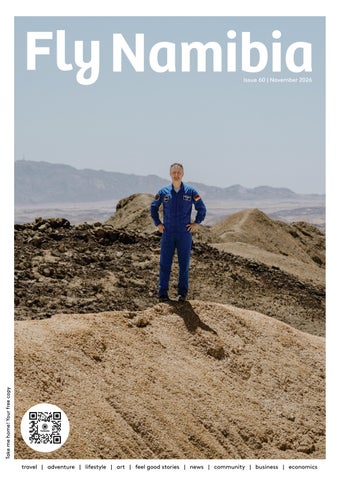
brought to you by At Venture Media, we’re more than just a publisher - we’re a multi-media content creation powerhouse. Our expertise includes awe-inspiring photography, striking videography, impeccable design, and crisp podcasts. With a reputation for excellence spanning three decades, we bring unparalleled storytelling to life. In our boutique publishing and content marketing house, stories that matter take center stage. Every page you turn reflects our commitment to quality and innovation. Dive in and experience the difference that top-tier content creation can make. Cover image by Suné van Wyk Read more on page 20. Editor Elzanne McCulloch elzanne@venture.com.na Production Manager Liza Lottering liza@venture.com.na Sales Daleen Small daleen@venture.com.na Layout & Design Richmond Ackah Jnr. design@venture.com.na Admin and Enquiries Bonn Nortje bonn@venture.com.na Printing John Meinert (Pty) Ltd
Venture Publications (Pty) Ltd. PO Box 21593 Windhoek Namibia Disclaimer: Please note that while every effort has been made to ensure the accuracy and reliability of the content within this magazine, Venture Publications Pty Ltd and FlyNamibia accept no responsibility for any errors or omissions. The views expressed by individual authors are solely their own and do not necessarily reflect those of the publisher or FlyNamibia. All material, including text and images, is the property of its respective authors and cannot be reproduced or used without explicit permission from Venture Publications Pty Ltd.
2
our services. Creative Professional Concept & Photography Campaign Development
Creative Design
Social Media Management
Video Production
Creative Storytelling & Content Creation
Want to be part of our content creation revolution? Find our contact details here.
+264 81 285 7450 | info@venture.com.na | www.venture.com.na
our publications.
From the Publisher
our storytellers.
Order any of these publications from bonn@venture.com.na
37 56
19
Agnes Shivute
An environmental consultant with interest in indigenous flora, nature enthusiast, Namibia Botanical Society awardee and aspiring author.
60
34
Theresa Gertze
Clinical Psychologist. Her work is guided by the belief that meaningful change begins with a safe space and strong therapeutic relationship.
Rukee Kaakunga
Madeleen Duvenhage
Windhoek-based writer A Windhoek-based communications specialist, perpetually scouting for hidden blogger and freelance fashion gems and offbeat narratives found in the ordinary. writer.
31 52
38 51
59
Emily Kandanga-Erastus
47
Cerina Bezuidenhout
41
David Penda
Maggie Forcelledo Paz
A digital content creator News & Content Editor. Windhoek-based creative & Haasbroek capturing Namibia's stories Passion and dedication to movement enthusiast. A creator, guide, and curious through bold visuals and real keep the nation abreast with Usually building, creating, and soul inspired to help people moments. My work celebrates what’s happening on national storytelling, blending wellness, reconnect with their bodies, and international level. purpose, and a passion for find their flow, and reclaim their the people, places, and pulse of the nation. bringing meaningful ideas to life. health – naturally.
20
45
Suné van Wyk
Capturing meaningful moments through photography, social media, and the occasional written word sharing stories and celebrating human connection.
64
David Bishop
Host of Nova Sunrise on Nova 103.5, climbing wall owner, voracious reader, sometime writer, active lifestyle proponent, family man, and coffee lover.
Jeandre Basson
Chef with over a decade of kitchen experience, aspiring food/hospitality writer and enthusiast of anything foodrelated, with a passion for all sports.
FLYNAMIBIA NOVEMBER 2026
3
OUR MINING EFFORTS ARE FOR THE GOOD OF OUR COMMUNITIES We work with our stakeholders to ensure that communities thrive, sustainably, through enabling quality healthcare and education. At Namdeb, we are about more than mining. We are about mining for good. NAMDEB. GOOD TODAY. BETTER TOMORROW.
www.namdeb.com
Need To Knows. with FlyNamibia
How to buy
a ticket online www.flynam.com
Select your flight Select which tickets you would like to purchase: destinations, travel dates, morning/afternoon departure. We offer multiple fare options such as: Saver, Classic or Premium
Additional flight information / rules Read up on all our additional information regarding terms and conditions, and tick the selection box once completed to continue.
Passenger details
Payment
Please enter names as they appear on passport or travel documentation
Fill in your payment details in our DPO paygate to make final payment.
LOGIN to upload passenger details from previous booking.
More options for the perfect trip
Confirmation Mail Transaction confirmation will be sent to passenger email entered.
Baggage policy, sporting equipment, over weight luggage or to add an additional bag(s)
How can you make
You can also purchase
from:
a payment?
Cash payment at: Eros Airport, Ondangwa Airport
Electronic Funds Transfer (EFT)
Windhoek Eros Airport Office Ondangwa airport office Katima Mulilo airport office Hosea Kutako airport office All major travel agents
Online card transaction
PayToday app Buddy SuperApp
Check-in
prior to flight Online check-in opens 24 hours before departure of the flight on Fly Namibia Check-in opens 1h 30min before domestic flight and 2 hours before international flight. Check-in CLOSES 30 min prior to domestic flight and 50 min prior to international flight.
Luggage
restrictions Items NOT allowed in hand luggage:
MAX 20kg Per person
Lotions and aerosols above 100ml, flammable aerosol, sharp objects, i.e. nail files, nail scissors, Leatherman, matches. See full conditions of carriage by scanning the QR code
DOMESTIC & SAFARI FLIGHTS Katima Mulilo (via Maun) Bwabwata National Park
Ondangwa
Skeleton Coast Park
Rundu
Mokuti
Etosha National Park
Khaudum National Park
Tsumeb
Ongava
Otavi
Grootfontein
Mudumu National Park Nkasa Rupara National Park
Maun
Twyfelfontein Otjiwarongo
Waterberg Plateau Park
Dorob National Park
BOTSWANA Okahandja
Swakopmund
Windhoek
Walvis Bay
Gobabis
NamibNaukluft Park
Mariental Keerweder (Sossusvlei)
Keetmanshoop
Lüderitz
Ai-Ais/ Richtersveld Transfrontier Park
Oranjemund
with FlyNamibia Contact The Call Centre | +264 83 339 0011 Schedule as per date of going to print. Please check the FlyNamibia website to stay updated on flight destinations, routes and schedules.
Victoria Falls ZIMBABWE
DOMESTIC FLIGHTS FLIGHT NO.
DEPARTURE
FROM
TO
ARRIVAL
DAYS
WV*4Z8505
06:30
Eros - Windhoek
Ondangwa - Toivo Ya Toivo
07:30
Tue
WV*4Z8506
08:00
Ondangwa - Toivo Ya Toivo
Eros - Windhoek
09:00
Tue
WV*4Z8595
16:20
Eros - Windhoek
Ondangwa - Toivo Ya Toivo
17:20
Tue, Wed, Thu, Fri, Sun
WV*4Z8596
17:50
Ondangwa - Toivo Ya Toivo
Eros - Windhoek
18:50
Tue, Wed, Thu, Fri, Sun
WV*4Z8137
13:30
HKIA - Windhoek
Katima Mulilo (via Maun)
15:30
Mon, Wed, Fri, Sun
WV*4Z8138
16:00
Katima Mulilo
HKIA - Windhoek (via Maun)
18:15
Mon, Wed, Fri, Sun
WV*601
08:00
Eros - Windhoek
Lüderitz
08:50
Mon - Fri
WV*602
13:05
Lüderitz
Eros - Windhoek
13:55
Mon - Fri
Lüderitz Flights from 26 October 2026 - 31 July 2027
REGIONAL FLIGHTS FLIGHT NO.
DEPARTURE
FROM
TO
ARRIVAL
DAYS
WV*4Z8137
13:30
HKIA - Windhoek
Maun
14:30
Mon, Wed, Fri, Sun
WV*4Z8138
17:05
Maun
HKIA - Windhoek
18:15
Mon, Wed, Fri, Sun
WV*4Z8135
09:15
HKIA - Windhoek
Victoria Falls
10:40
Tue, Wed, Thu, Fri, Sat, Sun
WV*4Z8136
11:15
Victoria Falls
HKIA - Windhoek
12:50
Tue, Wed, Thu, Fri, Sat, Sun
Please visit our website for the latest Victoria Falls flight schedule, as operating days are subject to change.
in Partnership with 4Z341
11:40
Cape Town
Walvis Bay
13:55
4Z342
14:40
Walvis Bay
Cape Town
16:45
Mon-Sun Mon-Sun
4Z320
07:00
Cape Town
HKIA - Windhoek
09:10
Mon, Tue, Wed, Thu, Fri, Sat
4Z326
10:40
Cape Town
HKIA - Windhoek
12:50
Mon-Sun
4Z328
18:15
Cape Town
HKIA - Windhoek
20:25
Mon, Tue, Wed, Thu, Fri, Sun
4Z329
07:05
HKIA - Windhoek
Cape Town
09:10
Mon, Tue, Wed, Thu, Fri, Sat
4Z321
09:50
HKIA - Windhoek
Cape Town
11:55
Mon, Tue, Wed, Thu, Fri, Sat
4Z327
13:40
HKIA - Windhoek
Cape Town
15:45
Mon-Sun
*Code Share ** For Lüderitz please contact your nearest Travel Agent or FlyNamibia offices for the newest updates. HKIA - Hosea Kutako International Airport
Our main routes
The seasonal FlyNamibia Safari schedule will resume on 1 May 2026 and run until 30 November 2026. Our daily shuttle flight operates in a clockwise circuit seven days a week. The exact departure and arrival times are determined the day before the flight and will be communicated directly to lodges, tour operators, and transfer companies. A minimum of two passengers is required per sector. All destinations remain available on a private charter basis. The departure time from Sossusvlei is between 08:30 and 11:00, meaning arrival in Swakopmund and Twyfelfontein will be in time for lunch, and arrival at Etosha will be between 12:30 and 15:30. The arrival time in Windhoek will be between 16:00 and 17:00, or earlier if necessary to ensure connections with various airlines. It’s important to note that no activities should be booked on the day of departure to the next destination until the departure time is confirmed the day before. All destinations remain available on a private charter basis. For more information, contact: Email: safari@flynamibia.com.na
FROM
TO
Windhoek
Sossusvlei
Sossusvlei
Swakopmund
Swakopmund
Twyfelfontein
Twyfelfontein
Ongava
Ongava
Mokuti
Mokuti
Windhoek
Additional route options FROM
TO
Swakopmund
Ongava
Swakopmund
Mokuti
Twyfelfontein
Mokuti
Ongava
Windhoek
Sossusvlei
Twyfelfontein
Sossusvlei
Ongava
Sossusvlei
Mokuti
Twyfelfontein
Windhoek
Swakopmund
Windhoek
STRONG BUSINESSES DON’T WAIT FOR UNCERTAINTY TO BECOME DISRUPTION. THEY PREPARE FOR IT. At Corporate Guarantee, we help businesses take a more strategic approach to risk through Alternative Risk Transfer solutions designed around their unique needs. By planning ahead, businesses can structure their insurance to retain the risks they can manage, transfer the risks they cannot, and ensure financial capacity is available when losses occur. Because when disruption comes, the advantage belongs to those who were prepared for it.
Insurance structured differently and trusted by leading Namibian businesses. GET IN TOUCH 083 331 3032 clientcare@corporateguarantee.com
ON BOARD Dear Traveller, There is something about November that makes us all look towards the horizon. The year is drawing to a close, deadlines are piling up, calendars are overflowing, and the familiar rush to get everything done before December is well underway. But perhaps that is exactly why this is the perfect time to start dreaming about your next journey.
Read our previous issues
WELCOME
Whether it is a long-awaited family holiday, a few quiet days at the coast, an adventure into Namibia's extraordinary wilderness, or simply the chance to reconnect with loved ones, there is nothing quite like having a journey to look forward to. And at FlyNamibia, we are here to help you get there. Speaking of journeys, we are particularly excited about the return of our Lüderitz route, connecting Windhoek's Eros Airport with one of Namibia's most fascinating coastal towns. Operating Mondays to Fridays from now until the end of July 2027, this service opens up opportunities for business travellers, holidaymakers and those eager to rediscover the remarkable beauty and character of Namibia's south. From its colourful historic architecture to the wild Atlantic coastline and the nearby ghost town of Kolmanskop, Lüderitz is a destination well worth exploring. November is also an important month for Namibia's tourism industry. We are proud to sponsor the Namibia Travel Market, taking place in Windhoek on 18 and 19 November. With the Minister of Environment, Forestry and Tourism as its official patron, this exciting new platform brings together tourism operators, travel professionals, industry leaders and innovators to connect, collaborate and explore the future of Namibian tourism. If you work in travel and tourism, I encourage you to attend. Our industry's greatest strength lies in the partnerships we build and the opportunities we create together.
As we approach the festive season, I hope you find a moment amid the year-end rush to make plans, pack a bag and embrace the joy of going somewhere. Thank you for choosing to fly with us. We rise by lifting others. Warm regards, Nerine Uys Chief Executive Officer FlyNamibia
On the cover
That spirit of partnership is something we celebrated at the beginning of this month at our annual FlyNamibia Awards. It was a privilege to recognise the dedicated travel agents, tourism partners and industry professionals who champion our airline and our destination every day. Their commitment, enthusiasm and continued support play an invaluable role in connecting people with the places and experiences that make Namibia so special.
SC A
Under Namibia's dark skies See page 20
FLYNAMIBIA NOVEMBER 2026
9
NM
E!
A monthly wrap-up of news worth knowing MICT PUSHES FOR LOWER DATA COSTS TO EXPAND DIGITAL ACCESS IN NAMIBIA
EL NIÑO RAISES DROUGHT RISKS FOR NAMIBIA IN 2026/27
The Ministry of Information and Communication Technology (MICT) has called for reduced data costs and expanded broadband coverage to improve digital inclusion and economic opportunities in Namibia. Speaking at the 9th ICT Summit, Executive Director Linda Nakale highlighted the importance of affordable connectivity in supporting education, employment, entrepreneurship and access to digital services, particularly in underserved communities. The ministry is prioritising investment in digital infrastructure, digital literacy and artificial intelligence to strengthen economic participation. The summit, themed “Harnessing ICT for Inclusive Growth,” brings together industry stakeholders to develop practical solutions aimed at reducing inequality, unemployment and poverty through digital transformation.
Namibia faces increased drought risks during the 2026/27 rainfall season as strengthening El Niño conditions are expected to bring below-normal rainfall and higher temperatures. United Nations Resident Coordinator Hopolang Phororo warned that these conditions could threaten agricultural production, water security, food supplies and livelihoods. The forecast follows a season marked by both flooding and dry spells across the country. Over the past year, the UN supported more than 167,000 Namibians through drought-response initiatives and mobilised over US$28 million for climate priorities. Authorities are urged to strengthen early warning systems, climate-smart agriculture and disaster preparedness to protect vulnerable communities.
Namibia
SCAN HERE Finance
10
thebrief.com.na
miningandenergy.com.na
@thebrieflive.nam
Namibia Mining and Energy
@thebrieflive
@miningandenergy
@thebrieflive
Namibia Mining and Energy
MINING
TO FOLLOW OUR
WHATSAPP CHANNEL
ENERGY Business
GOVERNMENT CONSIDERS CAP ON NAMRA SALARY DEDUCTIONS FOR TAX DEBTS
processing facility into a commercial operation. Previously estimated at N$20 million, the expansion is expected to receive 20% funding from UNAM and 80% from government. The facility currently produces approximately 100 litres of juice per hour and processes mango, mutete and maguni jams. Future production will include dried mango products, targeting domestic, regional and potentially international markets while supporting agricultural development in the Zambezi Region. NAMIBIA’S MILK PRODUCTION RISES TO 1.52 MILLION LITRES
The Namibian government is considering limits on salary deductions imposed by the Namibia Revenue Agency (NamRA) to recover outstanding tax debts. Finance Minister Ericah Shafudah said the proposed measures aim to protect employees from financial hardship while ensuring tax obligations are met. Possible reforms include capped deductions, negotiated repayment arrangements, reviews of historical tax debts and relief on penalties and interest. The ministry will consult NamRA, employers and organised labour before determining appropriate limits. Taxpayers could also receive opportunities to verify or dispute outstanding debts before deductions occur. No specific deduction ceiling or implementation date has yet been announced. KATIMA MANGO PLANT TARGETS EXPORT MARKETS AS PROJECT REACHES PROCUREMENT STAGE
The planned mango processing plant in Katima Mulilo has reached the procurement stage, supporting Namibia’s efforts to expand agricultural value addition and export opportunities. The project involves upgrading the University of Namibia’s existing fruit and vegetable
President Netumbo Nandi-Ndaitwah has called for regular skills audits and labour market assessments to ensure Namibia’s workforce is prepared for emerging industries, including oil and gas, green hydrogen, renewable energy, advanced Namibia’s raw milk production increased by 1.12% to 1.52 million litres in August 2026, marking a fourth consecutive monthly improvement, according to the September Poultry & Dairy Market Watch. Production rose from 1.50 million litres in July, while the year-on-year decline narrowed to 1.01%, signalling a gradual recovery in domestic output. Despite these improvements, Namibia remains dependent on imported dairy products, primarily from South Africa. Producer prices have remained relatively stable at approximately N$6.70 per litre since 2025. However, rising feed costs, particularly soybean prices, continue to place financial pressure on dairy farmers and the sector’s recovery.
FLYNAMIBIA NOVEMBER 2026
11
Our car hire welcomes you to
NAMIBIA
4x4 Rentals for Your African Adventure
AFRICA IS WAITING LET’S GET YOU ON THE ROAD!
Scan the QR code to access the website
Discover Africa with Africa On Wheels, offering a versatile fleet of reliable 4x4 vehicles for your next adventure. Choose from Hilux, SUVs & Land Cruisers, with or without camping equipment.
Tel: +264 61 232871 24hr emergency no: 081 129 3355 Email: info@africa-on-wheels.com Website: www.africa-on-wheels.com
This is Namibia
One of the interesting cultures of Namibia
A
The Damara
nthropologists have long puzzled over the origins of the Damara people, with several intriguing facets still shrouded in mystery. Notably, despite their physical distinctions from the Nama and Hai||om peoples, the Damara share the Khoekhoegowab language, adding complexity to their ancestral lineage. Additionally, apart from being darkskinned, they differ from other Namibian populations of Bantu origin with various other characteristics. Together with the San, the Damara are one of the oldest nations in Namibia and their origins are unrecorded. Historically, Damara sustenance mirrored that of the San, relying on hunting, gathering veld food, and herding small stock, particularly goats. The Damara community consists of a number of subdivisions called haoti. These are clusters of clans and extended families that were formerly concentrated in specific areas, consisting of about 11 sub-groups. Phonological research of Khoekhoegowab dialects has provided evidence that the Damara were Khoespeakers before they came into contact with the Nama. Their original distribution in the central part of Namibia extended from Otavi southwards to Rehoboth and the Khomas Hochland west of Windhoek as well as the areas between the Kuiseb and Swakop rivers. Other areas inhabited by the Damara include the Tsumeb, Grootfontein and Otavi triangle, as well as the arid proNamib from Sesfontein southward to the Brandberg. The Damara were ousted from their traditional areas by the advancing Nama and Ovaherero. In German colonial times they were settled in the Okombahe area, as well as other smaller reserves, including land
that was subsequently proclaimed as the Daan Viljoen Game Reserve, west of Windhoek. An area of close to 4.7 million hectares was proclaimed as Damaraland by the South African administration in 1973, with Khorixas as its administrative capital. Following independence, this area became part of the Erongo Region.
EXPERIENCING DAMARA CULTURE Explore the authentic way of life of the Damara people at the Damara Living Museum, conveniently located just 8 km from the Twyfelfontein World Heritage Site. Delve into the desert existence of the Damara and discover the ingenious methods they employed for daily tasks, from using native plants as toothbrushes to traditional remedies for ailments predating modern medicine. Immerse yourself in a captivating re-creation of bygone eras, offering a hands-on interpretation of history. This unique experience provides insight into how ancient cultures thrived, relying on profound knowledge of the land and the resources offered by the natural environment. By visiting a living museum, you are actively contributing to preserving the traditional wisdom of indigenous cultures while assisting communities in generating income from their rich Findheritage. more Namibia travel inspiration at www.thisisnamibia.com The annual Damara Festival, a vibrant two-day event held@thisis_namibia at Okombahe, approximately 60 instagram km west for of Follow on Facebook and Omaruru, happens every stories.. November. This festival pays extraordinary Namibia travel tribute to departed Damara leaders and endeavours to instil awareness of Damara traditions among younger generations through captivating cultural performances. It’s a celebration of heritage and a testament to the resilience and richness of the Damara culture.
FLYNAMIBIA NOVEMBER 2026
13
Photography credit: GIZ
I
NAMIBIA’S CONSERVATION SUCCESS AND GERMANY’S STEADFAST SUPPORT
n Namibia, nature conservation and sustainable use are enshrined in the constitution, making it a global leader in this regard. Namibia’s approach to protecting natural heritage focuses on empowering communities as stewards of the land, rather than relying solely on regulation and law enforcement.
Over 40 percent of Namibia’s land is designated for conservation and sustainable use, exceeding the international goal to conserve 30% of the earth’s surface by 2030. Central to this achievement is Namibia’s communitybased conservation model, which grants rural communities rights to use their natural resources sustainably. Through communal conservancies and community forests, local people manage wildlife and benefit from its protection. This approach has transformed conservation into a grassroots movement, with 86 communal conservancies and 47 community forests covering around 20 percent of Namibia’s territory and benefiting over 244,000 people. This model has gained international recognition, thanks to the Namibian Government’s vision for sustainable and inclusive use of natural resources for the benefit of all Namibians. A key partner in this journey has been the Federal Republic of Germany, which has provided consistent financial, technical and policy support since 1990 through institutions like KfW Development Bank and
14
Deutsche Gesellschaft für Internationale Zusammenarbeit (GIZ). With over € 1.6 billion (approx. N$ 32 billion) in development assistance to Namibia over the last 35 years, Germany has made a significant contribution towards Namibia’s achievements in conservation and sustainable development. We share a few highlights from this long and productive partnership here. KFW – SUPPORTING NATIONAL PARKS AND COMMUNITY CONSERVATION Through the Namibia National Parks Programme (known as NamParks), KfW helped build and upgrade critical infrastructure in national parks for the Ministry of Environment, Forestry and Tourism (MEFT) – including 13 new park management stations, administrative buildings, staff accommodation and tourism facilities. These investments have improved the efficiency and professionalism of park management, made parks more accessible and attractive to tourists, enhanced biodiversity monitoring, and contributed to job creation in neighbouring communities. This support programme has strengthened the livelihoods of an estimated 180,000 Namibians and improved wildlife management in these critical protected areas. Looking ahead, sustainability is a pressing concern. While donor support has been vital, reliance on projectbased funding leaves Namibian national conservation
Namibia’s unique nature and landscapes may be ancient, but its conservation thinking is ahead of its time.
efforts vulnerable to economic shocks and geopolitical developments. Recognising this, KfW committed €3 million toward establishing a sustainable financing mechanism for Namibia’s state-protected areas. Beyond state-protected areas, Germany has supported Namibia’s Community-Based Natural Resource Management Programme (CBNRM). The Community Conservation Fund of Namibia (CCFN) was established with support from KfW to provide long-term support to community conservation areas. Through the CCFN, conservancies receive grants to support operational costs, invest in tourism infrastructure, and maintain wildlife monitoring and anti-poaching patrols. This financial stability was vital during the COVID-19 pandemic, which caused a sharp drop in tourism revenues for many communities. Around 9,400 local beneficiaries and their families received support during this time of need through the Conservation Relief, Recovery and Resilience Facility (CRRRF) managed by the CCFN. Germany has also played a significant role in mitigating human-wildlife conflict. In regions like Kunene and Zambezi, communities face numerous threats from wildlife – including elephants eating crops and destroying water infrastructure, or predators such as lions attacking livestock. These events can provoke retaliation against wildlife and erode community support for conservation. KfW has therefore funded numerous mitigation measures, including predator-proof livestock kraals, early warning systems and water access points for wildlife away from villages, providing communities with both security and incentives to continue coexisting with wildlife. In the Ombonde landscape alone, the conflicts with lions declined by 80%.
Poaching remains a threat within and beyond stateprotected areas, especially to high-value species like rhinos and pangolins, which stretches conservation resources. KfW has bolstered anti-poaching efforts by providing equipment, trainings, and infrastructure to support the MEFT’s Wildlife Protection Services (WPS). GIZ – PROVIDING TECHNICAL SUPPORT FOR POLICIES, RESILIENCE AND LIVELIHOODS The support Germany provides through financial cooperation is complemented by Namibian-German Technical Cooperation partnerships. Technical Cooperation – implemented mainly through GIZ – is designed to strengthen natural resource management, policy development and implementation while promoting good governance and capacity development. Since the 1990s, GIZ (formerly GTZ) has been a consistent partner of the Namibian Government and civil society in shaping and scaling up environmental policies and initiatives. These include the CBNRM Programme, biodiversity finance initiatives and targeted policy development. The Environmental Management Act (EMA) and Namibia’s ambitious climate goals (Nationally Determined Contributions, NDCs) under the Paris Climate Agreement are among the policies developed with GIZ assistance. GIZ is currently supporting the development process of the third National Biodiversity Strategy and Action Plan (NBSAP). This will ensure crucial policy support in the future for the conservation and sustainable use of biological diversity, particularly in the face of emerging challenges such as increased mining and exploration as well as energy infrastructure development in and around conservation areas and communal conservancies. Technical Cooperation has also continuously focused on diversifying livelihoods and income opportunities. Partnerships between Namibian and European companies have promoted the sustainable use of indigenous natural products, such as through the Eudafano Women’s Cooperative, which processes Marula oil and supports over 2,500 women. The regulation of access to such natural resources and the fair and equitable sharing of benefits from their use has created important incentives
FLYNAMIBIA NOVEMBER 2026
15
LOCAL IS ST! BE
#b
u y n a m ibi
an
PROUDLY NAMIBIAN. READY FOR THE WORLD. BUILT FOR ADVENTURE.
GEAR THAT TAKES YOU FURTHER. Premium outdoor & camping equipment for every journey.
HOME OF GREENSPORT
OUTDOOR & CAMPING SOLUTIONS FOR EVERY EXPLORER. OFF-ROAD EQUIPMENT
Suspension, recovery, navigation & more. Go further. Travel safer.
KITCHEN & COOKING
Everything you need to cook great meals anywhere.
From weekend getaways to extreme expeditions, CYMOT equips you with premium gear you can trust - wherever the journey takes you. OUTDOOR LIGHTING
TENTS & SHELTERS
Light your adventure with reliable, high-performance lighting.
CAMPING FURNITURE
CYCLING EQUIPMENT
FISHING EQUIPMENT
Rest easy. Sleep warm. Wake rested.
Top brands. Superior performance. Built for any terrain.
Quality gear for every and any cast.
Shelter from the elements. Built strong. Made to last.
GADGETS
Versatile. Durable. Always ready.
LUGGAGE & STORAGE
Smart storage solutions. Organised and protected.
TRUSTED BRANDS. EXPERT ADVICE. GEAR YOU CAN RELY ON. PREMIUM BRANDS Quality you can trust.
EXPERT ADVICE From people who love the outdoors.
ADVENTURE IS EVERYWHERE. BE PREPARED. Explore further.
TESTED & PROVEN Gear that performs in any conditions.
WIDE RANGE The best from near and far.
VISIT CYMOT TODAY In-store. Online.
(083) 295 6000
info@cymot.com
www.cymot.com
LOCAL SUPPORT Proudly Namibian. We are here for you.
to conserve Namibia’s rich natural heritage for current and future generations. To ensure that resources are being put to good use and that the governance of communal conservancies is delivering results for their members, GIZ has been providing support for financial management trainings in all regions. It has further advised MEFT during the introduction of a CBNRM digital monitoring and reporting system to continuously improve management and accountability. Over the years, Technical Cooperation has helped communities adapt to climate challenges. In response to recurrent droughts, GIZ worked closely with the MEFT to improve water infrastructure, such as replacing diesel pumps with solar pumps in the Kunene Region. These pumps have provided clean water for over 4,300 people and many wild animals while reducing human-wildlife conflict and avoiding 450 tonnes of carbon dioxide emissions annually. CELEBRATING ACHIEVEMENTS, LOOKING TO FUTURE CHALLENGES The Namibian-German Cooperation can be proud of the many achievements during the last few decades. From 1990 to 2022 community conservation contributed an estimated N$13,466 billion to Namibia’s net national income, supporting around 3,200 direct jobs in community conservation and generating income from tourism and small enterprises. Despite the many successes and progress, some challenges remain. These include competing land uses (e.g. mining and energy infrastructure vs. conservation and tourism) and climate change, which is intensifying pressures on Namibia’s ecosystems. Increasingly unpredictable rainfall, prolonged droughts, and extreme weather events demand adaptive strategies, particularly in water management, land restoration, and managing wildlife migration corridors. At the same time, Namibia’s conservation model must keep demonstrating that the people benefit directly from natural resources and that biodiversity improves the lives of all Namibians.
What makes Namibia’s conservation model remarkable and fit for the future is its integration of social, economic, and environmental priorities. It is not only about saving wildlife; it is about creating systems where people and nature can coexist and thrive together. This philosophy aligns closely with Germany’s own development principles, which prioritise sustainability, local ownership, and longterm impact while emphasising capacity building and inclusive development. The partnership between Namibia and Germany is characterised by mutual respect and shared vision. German Development Cooperation has consistently aligned with Namibia’s own priorities, thus fostering trust and enabling vital reforms. This partnership serves as a model for other countries, demonstrating that conservation and development can go hand-in-hand. From building infrastructure and institutions to supporting communities and financing futures, Germany has contributed to Namibia’s national success story. The road ahead will require continued commitment, innovation, and adaptation from both partners. But the foundation is strong, and the vision is clear. Namibia’s unique nature and landscapes may be ancient, but its conservation thinking is ahead of its time. With Germany as a steadfast partner, Namibia has created a legacy of environmental conservation, inclusive and sustainable use, offering a blueprint for balancing ecological responsibility with economic resilience. As global attention shifts toward nature-based solutions, the NamibianGerman partnership stands as an inspiring example of what is possible, and urgently needed, worldwide. GIZ and KfW First published in the Conservation and the Environment in Namibia 2025 issue. Read more stories here: www.conservationnamibia.com
FLYNAMIBIA NOVEMBER 2026
17
BOOK YOUR CONFERENCE WITH US!
Popa Falls Resort | Gross Barmen Resort | Khorixas Camp | Hardap Resort Discover unparalleled conference facilities amidst breathtaking natural landscapes with Namibia Wildlife Resorts. Host your next event at Popa Falls Resort, where the serene Okavango River meets nature’s tranquility. Gross Barmen Resort offers a rejuvenating retreat, blending wellness with state-of-the-art conference amenities. At Khorixas Camp, immerse yourself in the rich history of ancient civilizations while enjoying modern conference conveniences. Lastly, Hardap Resort presents a lakeside haven, perfect for inspiring creativity and fostering collaboration. Elevate your conference experience with us!
+264 61 285 7108 |
MICE@nwr.com.na |
www.nwr.com.na
Elevate your business travel with the NWR NAMLEISURE CORPORATE CARD! Enjoy exclusive discounts on accommodation and activities, ranging from 50% for Namibian to 10% for international cardholders. With a validity of three years and easy renewal, it’s tailored for businesses with a minimum group size of 10. Experience convenience, savings, and unparalleled benefits for your corporate outings.
Native Leaves:
THE ANA TREE
E
Scientific name: Faidherbia albida Common name: Ana tree
very year, on the second Friday of October, Namibia celebrates Arbour Day, where one tree is at the centre of attention, and tree-planting activities happen countrywide. This year, the ana tree has been announced tree of the year – a tree species with a height ranging between 10 and 20 metres, but with a history of classification confusion. While they are quite a bit taller than the acacia trees found countrywide, they have resemblances, which initially led to the ana tree being wrongly classified as an acacia species. However, the differences were noticed, and the tree was reclassified. The ana tree has a combination of straight thorns, spiked flowers and produces new leaves and flowers in winter. Those were the main differences leading to its reclassification. The ana tree is found in the northwest, central west and in areas of the Kavango and Zambezi regions. This tree species thrives along rivers, where it has access to water most of the time. Its bark is smooth and becomes scaly with age. Older bark is irregularly fissured, forming scales. The range of bark shades varies: the bark of young trees has grey and brown shades, while older trees have bark with dark grey scales. The branches appear to be pale grey with a little greenish appearance on them. The leaf arrangement of the ana tree is bipinnate. The leaves are quite small, paired in a range of 3-8, while a leaflet can have 7-20 leaflet pairs. The tree produces flowers in the form of fluffy spikes that have a dull yellowish colour, and the fruits are hairless and sickle-shaped pods with a red to brown appearance. The pods remain intact and do not split open as they mature, while their seeds are dark brown and have a smooth texture. The ana tree is a protected species under our forest act because it is heavily utilised by both livestock and game such as elephants and baboons, which browse the pods as a delicate snack. The composition of the pods is recorded
to have protein, carbohydrates and oil, and they contain tannin. Tannin is a naturally occurring water-soluble polyphenol and is found in parts of the plant such as the bark, leaves, fruits and seeds. It is produced to defend the plant against pathogens and insects. Tannin from the green bark of the ana tree is used to dye leather, and there are traditions where the water from the boiled bark is known to be used as a remedy to treat diarrhoea. The wood of the ana tree is soft and dries easily. It is therefore easy to work with but unfortunately not resistant to termites, although it is used to construct hut frames or to make drinking and feeding troughs for animals. The tree is known to grow fast in the right conditions, but it does not tolerate severe frost. We are fortunate that frost is not a dominant weather condition in our arid country. Due to its large size, the tree is an important shade tree for livestock and game, especially in the arid areas in the west. In addition, the ana tree plays various roles in serving the ecosystem, such as the prevention of soil erosion in riverbeds. This makes it an important tree for its surroundings, especially in ephemeral rivers. I will always advocate for indigenous plants, and this is one of our protected species that can be easily grown from seeds. Namibia has set a target to grow a million trees by 2030. As a plant enthusiast, I am delighted to hear that our country is considering such a great initiative. My hope is that we will grow indigenous plants only and that thorough identification and mapping of the deforested areas have been done throughout the country. I also hope that species selection was done carefully to cater for all angles, support livelihoods, consider the tourism sector and preserve our water resources, amongst other things. If this has been done, I fully support this initiative. After all, today’s seedlings will be tomorrow's forests. Agnes Shekupe Shivute
FLYNAMIBIA NOVEMBER 2026
19
UNDER NAMIBIA’S DARK SKIES From the mountains of Gamsberg to the mysteries of the Universe, Namibia is helping bring space science into focus
20
T
here are few places in the world where the night sky feels as close as it does in Namibia. Far from the glow of cities, the Milky Way stretches across the darkness, inviting us to look a little longer. For most of us, it is a beautiful sight. For scientists, it is an opportunity to explore some of the Universe’s greatest mysteries. During World Space Week, from 4 to 10 October 2026, European Space Agency (ESA) astronaut Dr Matthias Maurer visited Namibia to share his experiences of space exploration and inspire curiosity about science. His tour took him across Namibia, from the capital and northern towns to the coast, Gobabeb and the remote heights of Gamsberg, reaching around 8,000 students and adults through educational talks and engagements and exploring the country’s growing role in astronomy. Supported by FlyNamibia, the German Embassy, the Namibia Scientific Society, ESA, the University of Namibia (UNAM) and the National Commission on Research, Science and Technology (NCRST), the visit highlighted an important message: space science is not reserved for countries sending rockets into orbit. Namibia, with its remarkable landscapes, dark skies and growing scientific expertise, has a place in the conversation too. A MOUNTAIN WITH A VIEW OF THE UNIVERSE Our journey into Namibia’s astronomical landscape took us towards the Gamsberg, a mountain rising above the Khomas Highlands. Reaching its upper heights is an adventure in itself. The steep, winding 4x4 track was built between 1970 and 1972 to give the Max Planck Institute for Astronomy access to the plateau for its planned astronomical research station. Today, the challenging ascent remains a reminder of the effort required to establish scientific facilities in such a remote location.
The mountain offers an exceptional setting for observing the night sky, away from the artificial light that interferes with astronomical research. Our visit brought together astrophysicists, members of the Africa Millimetre Telescope (AMT), the Namibia Scientific Society and the Deputy Head of Mission and Chargé d’affaires ad interim of the German Embassy along with Dr Maurer. Before heading up Gamsberg, we visited the site earmarked for the future AMT. Here, we examined rock samples drilled and brought to the surface to help researchers assess the site's geological conditions and suitability. The findings will inform decisions about how to establish the facility while minimising unnecessary disturbance to the surrounding environment.
FLYNAMIBIA NOVEMBER 2026
21
22
The AMT aims to put Namibia on the global astronomy map. Initially planned near the H.E.S.S. observatory, the 14-metre telescope is eventually intended for the Gamsberg plateau. It will join the international Event Horizon Telescope network, which captured the first images of black holes, helping scientists produce more detailed observations of these cosmic phenomena. Namibia’s dry climate, high altitude and radio-quiet environment make it an ideal location, while the project will also create opportunities for local scientists and engineers through research, training and education. LOOKING BEYOND VISIBLE LIGHT The visit also gave us an opportunity to learn about the High Energy Stereoscopic System (H.E.S.S.), a landmark of Namibian astronomy. Its five telescopes capture faint flashes produced when high-energy gamma rays interact with Earth's atmosphere, helping scientists study extreme cosmic events such as supernova remnants and black holes. The largest, standing at 28 metres, is the largest Cherenkov telescope with mirrors ever built.
minutes when we coincidentally spotted the International Space Station moving across the sky. Knowing that Dr Maurer had once called the ISS home made the moment feel all the more extraordinary. There we stood beneath the vast sky, watching the station glide silently overhead, a reminder of how closely Namibia’s skies connect us to the wider Universe. WHAT NAMIBIA BRINGS TO THE TABLE Beyond the technology, Dr Maurer's visit highlighted a broader question: what can Namibia contribute to the future of space exploration? His public talks brought space closer to everyday life. Through stories from his own mission, he explained the preparation required before launch, the experiments conducted in space and the realities of living in orbit. He also discussed returning to Earth and readjusting to gravity, offering audiences a glimpse of the human experience behind the science.
Namibia may not be launching rockets into space yet, but it is helping expand our view of what lies beyond Earth.
During our visit, demonstrations and a presentation brought the science to life. One comparison stood out: if the electromagnetic spectrum were represented by a 15-metrelong piano, visible light would occupy just one octave. Inside the control room, we saw the precision behind the observations, while outside, the telescopes moved into position. We also got a closer look at the small mirrored components that help direct light into the telescopes’ cameras.
As night fell on Gamsberg, we had the chance to experience its dark skies for ourselves. With a planetarium app as our guide, we had only been looking up for a few
His talks explored future lunar missions, including specialised training environments designed to recreate the Moon's surface. These facilities help astronauts prepare for working in unfamiliar terrain while scientists and engineers continue to investigate what future missions will require. So, where does Namibia fit into this picture?
Our clear night skies offer exceptional conditions for observing the cosmos, while our desert environments provide opportunities to study how life survives in extreme conditions. Plants growing in sandy, dry landscapes, for example, may offer insights into resilience and biological systems that could inform future research into growing food in challenging environments, including space.
FLYNAMIBIA NOVEMBER 2026
23
24
Dr Maurer remarked that Namibia's night sky could even rival the night sky from the International Space Station. Having spent 177 days in space during his Cosmic Kiss mission, he knows what it is like to see Earth from orbit. It is a powerful reminder that some of Namibia's greatest assets are already here, above our heads and beneath our feet. He also used a simple analogy to explain international collaboration. Imagine a picnic where everyone arrives with the same dish. There might be plenty to eat, but the experience would be rather limited. A much better picnic happens when everyone contributes something different. The same principle applies to space science. One country may contribute launch technology, another advanced engineering or spacesuit design, while Namibia offers its dark skies, established observatories, distinctive natural environments and people with the curiosity and skills to investigate them. Progress happens when everyone contributes what they do best. A NIGHT SKY WORTH PROTECTING Scientific research is only one reason to look upwards. For travellers, Namibia offers some of the most rewarding stargazing experiences imaginable. The country's arid climate, generally low rainfall and wide-open landscapes can provide excellent observing conditions, particularly away from artificial light. On a clear night, the Milky Way can appear so vivid that it becomes a feature of the landscape itself. NamibRand Nature Reserve is an especially important destination. Designated Africa's first International Dark Sky Reserve in 2012, it protects naturally dark skies alongside its unique desert environment. Visitors can enjoy guided stargazing, learn about constellations and planets, or simply spend time beneath a sky filled with stars. Other rewarding places include the remote Namib Desert, the southern landscapes around the Fish River Canyon and the quieter reaches of Damaraland. Conditions vary with the season, moon phase and weather, but opportunities extend well beyond dedicated observatories. Stargazing is also one of the simplest ways to connect with Namibia's natural environment. All you need is a clear evening, a dark location and time for your eyes to adjust. Binoculars or a telescope can reveal more, but they are not essential. A knowledgeable guide can help identify constellations, explain planetary movements and put the immense distances of space into perspective.For a country increasingly recognised for its conservation and wilderness experiences, protecting the darkness above the landscape is another way of preserving Namibia's natural heritage. Responsible outdoor lighting and awareness of light pollution help keep these skies available for future generations, whether they visit to appreciate their beauty or study them for science.
BRINGING THE BIGGER PICTURE INTO FOCUS Dr Maurer's tour brought science to communities and educational institutions across Namibia, encouraging curiosity and showing that careers in research, engineering and space exploration are not beyond reach. For Namibia, the opportunity extends beyond inspiring the next astronaut. It is about connecting education, research, tourism and international partnerships while developing the skills needed to participate in scientific projects on our own soil. Standing on the Gamsberg, with the proposed AMT site nearby and the H.E.S.S. telescopes already looking towards some of the Universe's most energetic events, that possibility feels tangible. The science is complex and the questions are enormous. Yet the starting point is simple: a willingness to look up, ask questions and work together to find answers. Namibia may not be launching rockets into space yet, but it is helping expand our view of what lies beyond Earth. And on a clear night beneath its extraordinary skies, it is easy to understand why. Suné Van Wyk
Operating since the early 2000s, H.E.S.S. has helped map the Milky Way in very-high-energy gamma rays, revealing cosmic sources invisible to conventional telescopes. Visits can be arranged in advance, subject to operational requirements. Contact contact.hess@hess-experiment.eu to enquire.
FLYNAMIBIA NOVEMBER 2026
25
Trees and seas apply. Financial solutions for environmental impact
SUSTAINABLE FINANCE
Advertorial
THE BRIDGE BETWEEN OPPORTUNITY AND GROWTH
W
Why execution may matter more than ambition in Namibia's next chapter
e spend a lot of time talking about opportunity. Far less time talking about what it takes to realise it.
That thought stayed with me after RMB Namibia’s recent mining and logistics client engagement in Walvis Bay. Throughout the discussion, speakers returned to different challenges, infrastructure, competitiveness, skills, investment and collaboration. Yet beneath all of them sat the same question: are we building fast enough, and well enough, to support the opportunities ahead? Midway through the conversation, a fellow panellist offered a simple answer. They described infrastructure as the bridge between government and business. Government on one bank, business on the other, both reaching for the same thing: prosperity for all. Infrastructure is what lets that shared objective become something you can actually walk across. It was a simple observation, but one I have not stopped thinking about since. Looking down the road The conversation began with a question that sounds simple until you try to answer it. What infrastructure do we need to support development now, and what will we need later? The answers went well beyond infrastructure. One panellist spoke about planning, maintenance and foresight. Another encouraged us to recognise how much progress Namibia and the region have already made, because today’s opportunities are built on foundations laid over many years. What struck me was that nobody spoke about a single intervention. The conversation kept returning to the same theme: growth depends on systems. Infrastructure matters. Skills matter. Capital matters. Policy certainty matters. Competitiveness matters. Each is important on its own. Together, they determine whether opportunity translates into economic activity, investment and jobs. Namibia does not lack opportunities. The opportunities are increasingly visible across mining, logistics, energy as well as oil and gas. The question is whether the broader ecosystem is developing quickly enough to support them. That is when the conversation sharpened.
therefore our production costs, must increasingly align with global norms. That responsibility does not belong to one business or one sector. It belongs to the entire value chain: ports and roads, transport and logistics, financial services, government bodies, regulators and service providers. Everyone has a role. Because one strong business cannot carry a weak value chain. Four plain words Looking back, the panel reflected the very challenge we were discussing. One voice spoke to foundations and foresight, another to the cost of competing, another to the people and capital needed to get there. None could have built the bridge alone. Each brought a plank, and the structure only made sense when they were laid side by side. Boiled down, the answer was not a grand strategy. It was four plain words: planning, coordination, reliability and execution. Not just from government, not just from business, not just from banks. From everyone. They are not glamorous words. They are what separates a pipeline of projects from a pipeline of missed opportunities. At RMB, we are committed to turning connected value chains into shared progress. By partnering with our clients, we become strategic thinking partners, because what keeps you up at night is what gets us going in the morning. A bridge is only as strong as its weakest span, and a supply chain is no different. Every link has an owner: the port, the road, the regulator, the lender, the supplier, the exporter, the service provider. Most of us are quick to spot the weak link in someone else’s patch. The harder, more useful exercise is to look at our own. So here is the question I took home from Walvis Bay, and the one I shall leave with you: Which link in the chain is yours, and what are you doing to strengthen it?
Kegan Strydom Relationship Manager - Mining Kegan.Strydom@rmb.com.na
One contributor spoke about global competitiveness. If Namibia is to compete internationally, our pricing, and
FLYNAMIBIA NOVEMBER 2026
27
NAMIBIA TRADE STATISTICS – AUGUST 2026 SPECIAL FEATURE | THE RACE FOR THE ORANGE BASIN SHORE BASE PART I OF III: SOUTH AFRICA MAKES ITS MOVE South Africa is advancing a greenfield deep-water port at Boegoebaai in the Northern Cape, roughly 20 km south of the Namibian border. The port is costed at about R13.8 billion, and the wider programme, including a 550 km rail line to the Northern Cape mining belt and the Namakwa Special Economic Zone (SEZ), has been cited at around R123 billion, a figure we could not confirm in primary documents. Transnet’s ports authority shortlisted three consortia in July 2023, whose members include the Port of Rotterdam, Meridiam, Vinci, A.P. Moller Capital and the Coega Development Corporation, and Infrastructure South Africa expects to name a preferred bidder in the first half of 2027.
proximity offers no advantage; Boegoebaai’s edge would be deep water and open land.
As designed, Boegoebaai is a minerals and green-hydrogen port, with a dry-bulk export berth for manganese and a break-bulk berth; an offshore oil and gas supply base is not in the tendered scope, and first operations are unlikely before 2030. Boegoebaai sits roughly as close to the Venus field as Lüderitz, and at about half the distance of Walvis Bay, Saldanha Bay or Cape Town. Against Lüderitz,
The starting point is modest. Lüderitz handled just N382 million in August against Walvis Bay's N12.8 billion, a reminder of how small Namibia’s natural shore base still is. Whether South Africa’s challenge materialises depends less on geography than on capability, the subject of Part II.
The strategic risk to Namibia is therefore not the port as designed but what its adjacent SEZ could become. TotalEnergies now operates both Venus and, since September 2026, Mopane, while also holding acreage on the South African side of the basin. Today it is supported from Lüderitz, while Shell and Galp have used Walvis Bay. An operator straddling the maritime border has every incentive to consolidate shore logistics wherever draught, land and cost are most favourable, and South Africa’s offshore industry body already presents Saldanha Bay as a base for drilling in both countries.
Approximate distance to the Venus field (km) PART II OF III: WHAT AN OIL PORT ACTUALLY NEEDS Capability starts with what the oil industry actually asks of a port. The FPSO itself rarely touches one: units are built or converted in Asian yards, sail or are towed to the field and stay moored for 20–25 years, with maintenance carried out offshore. Venus’ FPSO will sit about 320 km south-west of Lüderitz in roughly 3,000 metres of water, tied back to up to 40 subsea wells, and crude will be offloaded at sea to export tankers, so Namibia’s oil exports will largely bypass its ports. Integrating FPSO topsides at a quayside would require cranes for 3,000-tonne-plus modules and quays rated above 25 tonnes per square metre, a capability very few ports in the world possess. The port opportunity lies instead in the supply chain that keeps rigs, installation vessels and the FPSO running, and its size follows the project lifecycle. Exploration and appraisal need one rig, supported, as an industry rule of thumb, by two to three platform supply vessels (PSVs). Development, about five years for Venus, is the peak: several rigs, subsea installation (SURF) vessels, heavy cargo and the largest laydown need. Production then settles into 20+ years of 28
FPSO resupply, crew changes and maintenance. A credible supply base needs 24/7 berths for PSVs of up to 100 metres, liquid-mud and dry-bulk plants, fuel and water bunkering, tens of hectares of bonded laydown, waste handling and a helicopter base. Guyana shows the scale required. To support ExxonMobil’s multi-FPSO programme, Guyana Shore Base expanded its logistics area from 35 to 96 acres (about 39 hectares), added four berths, a 3.5 million-litre fuel farm and an integrated waste facility, and handled some 1,835 vessel calls in 2021 with traffic expected to rise 2.5-fold. A separate US260million,20-hectaresubseabasefollowedatVreed-enHoop,includingoverUS60 million of channel deepening. By comparison, Lüderitz’s entire port covers 25 hectares. Measured against this checklist, Walvis Bay has depth and land but not proximity, Lüderitz has proximity but neither depth nor space, and Boegoebaai has neither yet. Part III quantifies how many operators Namibia can serve today and what is at stake if it falls short.
Macro Pulse
39 ha
Guyana Shore Base logistics area
1,835
vessel calls in 2021 (to rise 2.5x)
US$260m Vreed-en-Hoop subsea base
6,100+
Guyanese in offshore jobs (2024)
Supply-base requirements checklist (SS Assesment)
PART III OF III: NAMIBIA’S READINESS GAP AND WHAT IS AT STAKE Our assessment is that Namibia’s ports can credibly support one, perhaps two, operators in full development mode, but not more. A single Venus development, about two rigs and four to six PSVs on our rule of thumb, fits within Lüderitz’s first expansion phase (targeted for mid-2027) with Walvis Bay as overflow. If Mopane holds to its 2028 FID target, the two developments would overlap, doubling vessel and laydown needs at a port whose berths already run near 95% occupancy and whose private supply-base tender was cancelled in August 2025. A third developer would push activity to Walvis Bay’s longer sail or across the border, and Namport’s own phasing, which ties later build-out to a second operator’s FID, means capacity is designed to lag demand. The stakes are considerable. At a 150,000 b/d plateau, Venus alone would generate crude exports of roughly N6 billion a year at US70 per barrel, or N89 billion at (Brent trade near US101 in late September), equal to 50-70% of Namibia's 2025 merchandise exports and enough, other things equal, to turn the N24.9 billion trade deficit into a surplus. Much of that value will flow back out through cost recovery and profit repatriation, so the durable domestic gain lies in services. Guyana’s local suppliers earned GY170billion(aboutUS0.8
Q4 2026
H1 2027
Venus Boegoebaai FID bidder (Pending)
Mid-2027
2028
2030
2030+
Lüderitz Phase 1
Mopane FID target
Venus first oil
Boegoebaai ops
Source: Namport, African Energy Chamber, TNPA/ISA, SS assessment
The Guyana Benchmark
billion) in 2024, and more than 6,100 Guyanese worked in offshore operations; the shore base is where much of that local spend is captured. The window is narrow. Venus’ FID remains pending on fiscal and legal terms, Boegoebaai’s preferred bidder is due in H1 2027 and Lüderitz’s first phase targets mid-2027, so each quarter of FID delay pushes Namibia’s peak logistics demand closer to the point at which a South African alternative could exist. The trade data already show the pre-investment phase: mechanical handling equipment, steel tubes and civil-engineering plant cost N$1.2 billion in August. For policymakers, the priorities are to re-tender the Lüderitz supply base with defined draught, tariff and third-party access terms; to sequence Walvis Bay’s North Port energy cluster with Lüderitz rather than in competition with it; to embed local-content requirements in the port concessions; and to conclude the Venus fiscal framework. South Africa’s project carries its own social-licence risk, as Richtersveld community members have contested the SEZ land access agreement. For investors, port, logistics and oilfield-services exposure is a 2027–2030 call that depends on Namibia securing the shore base before its neighbour does.
Critical Path, 2026 - 20230 What Venus could add to exports (N$ bn a year)
Simonis Storm is known for financial products and services that match individual client needs with specific financial goals. For more information, visit: www.sss.com.na
NETWORK
FLYNAMIBIA NOVEMBER 2026
29
Practical wisdom. Trusted advice. Specialising in comprehensive legal solutions, we combine deep local knowledge with personalised service to navigate your legal needs with confidence.
ferasmuslaw.com | +264 83 332 5300 | info@ferasmuslaw.com.na
Namibian Presidency
First Gentleman pushes for targeted programmes to support boys
N
amibia’s First Gentleman, Lieutenant General (Retired) Epaphras Denga Ndaitwah, has called for coordinated national efforts to address the challenges facing boys and men, including educational disadvantages, mental health concerns and high suicide rates.
Speaking at the Male Engagement Symposium, Ndaitwah said fragmented initiatives and duplicated efforts had limited the impact of programmes aimed at engaging men and boys in gender equality and wellbeing. He stressed that government, civil society organisations, faith-based groups, traditional leaders and communities must work together to achieve sustainable change.
Prime Minister Dr Elijah Ngurare, officiating at the DEN Impact Foundation launch, highlighted concerns such as declining educational performance, unemployment and mental health struggles, calling for a coordinated national response involving government, families, schools, communities and the private sector. He stressed that empowering the boy child does not come at the expense of the girl child but promotes a more inclusive Namibia where every child has equal opportunities to succeed.
...Namibia could draw lessons from its coordinated response to the HIV pandemic to strengthen national efforts to support boys and men.
Ndaitwah commended the Ministry of Gender Equality and Child Welfare for its Third National Gender Equality and Equity Policy 2025–2035 and Strategic Plan 2025–2030, which promote equal rights and dignity for men, women, boys and girls. He noted that the policy recognises that male students are lagging in higher education and calls for measures to address the imbalance, while encouraging boys to share responsibility for protecting and empowering girls. The First Gentleman also announced that he launched the DEN Impact Foundation on 18 August 2026 in response to what he described as a “growing boy child crisis” in Namibia and globally. “The launch of the Foundation was prompted by the realisation of the boy child crisis in Namibia and globally. The realisation that the growing social, educational and psychological neglect of boys and young men for more than three decades, if left unaddressed, will weaken the very fabric of our society, boys and girls alike,” said Ndaitwah.
Ndaitwah further raised concerns about male mental health and the culture of silence surrounding emotional struggles, which he said contributes to disproportionately high suicide rates among boys and men. He acknowledged the work already being done by nongovernmental organisations, faithbased organisations, community groups, traditional leaders and government, but said more needs to be done to reach vulnerable and underserved boys.
He urged programme implementers to develop interventions that respond specifically to boys’ needs, cautioning that programmes designed for girls cannot simply be repackaged for boys. Ndaitwah called on men and boys to take ownership of the agenda. He said Namibia could draw lessons from its coordinated response to the HIV pandemic to strengthen national efforts to support boys and men. The symposium was held under the theme “Coordinating Namibia’s Work with Men and Boys for Gender Equality and Wellbeing in Namibia”. Maggie Forcelledo Paz
FLYNAMIBIA NOVEMBER 2026
31
ROAD TO SYDNEY
D in 2027.
Debmarine Desert Jewels player Cornelia Mupenda
Debmarine’s N$40m investment lays the foundation for Desert Jewels’ dream
ebmarine Namibia’s investment of approximately N$40 million in netball since 2017 has helped transform the Debmarine Desert Jewels into a rising force in African netball, laying the foundation for their return to the Netball World Cup in Sydney, Australia,
The qualification ends a 31-year wait since Namibia’s last appearance at the global showpiece in 1995. As preparations begin, the achievement has renewed calls for stronger corporate partnerships, improved athlete support and the professionalisation of sport as an economic industry. For head coach Julene Meyer, the team’s progress demonstrates what sustained investment can achieve. “Debmarine Namibia does not feel like a sponsor to us – they feel like family,” she says. “Since 2017, they have walked this journey with us and enabled the Jewels to play more than 70 test matches in the past nine years. For any national team to climb the world rankings, you must play regular international competitions. Debmarine Namibia made that possible.” FROM 37TH TO 14TH IN THE WORLD When the partnership began, Namibia ranked 37th globally. The team has since climbed to 14th, supported by international exposure, regular training camps and consistent competition. Funding has also allowed Namibia to travel with 15 to 18 players, including training partners, rather than only the final 12. This strengthens competition for places,
32
builds squad depth and gives more athletes international experience. Support extends to grassroots development, with coaches travelling to different regions to develop players and train school-level coaches. Long-term sponsorship also enables preparation around four-year Commonwealth Games and two-year World Cup cycles, helping players peak at the right time. A WIDER NATIONAL AMBITION Debmarine Namibia CEO Willy Mertens says the company recognised netball’s reach among women and girls and its potential to create opportunities for Namibian athletes. “We saw potential where others saw obstacles and made a deliberate decision to stand behind women and girls in sport,” he says. The investment supports player development, coaching, training camps, competitions, equipment, infrastructure and administration. It has also funded court renovations at the Vineta Sports Facility in Swakopmund. For Mertens, the World Cup qualification demonstrates what consistent support and a shared vision can achieve. Beyond 2027, the ambition is to strengthen youth development, coaching capacity and infrastructure, while positioning Namibia to host international competitions. “Sport also has the potential to strengthen tourism by attracting regional and international competitions that showcase Namibia as a destination while generating economic activity for local communities,” he says.
Advertorial
Julene Meyer, head coach of the Debmarine Desert Jewels
PREPARING FOR THE WORLD STAGE Meyer stresses that qualification is only the beginning. Competing against the world’s leading netball nations will require additional international exposure and broader corporate support. “This is the first time in 31 years that Namibia has earned a merit invitation to the pinnacle event of World Netball. It is a collective achievement for our country, and preparing properly will require a collective effort,” she says. Companies can contribute beyond direct funding through medical services, physiotherapy, strength and conditioning, recovery programmes, training venues, accommodation, transport, nutrition and sports psychology. Technology, including video analysis, performance data and specialist software, can also strengthen preparation. “Over the next 10 months, that kind of support can help shape a historic World Cup campaign,” Meyer says, referring to partnerships that could provide international exposure and help the team prepare for high-pressure competition. She believes Namibia has the potential to become a top10 netball nation, provided partnerships between Netball Namibia, government and corporate investors remain strong beyond 2027. Meyer advocates a collaborative sponsorship model in which companies contribute according to their capacity, whether financially or through services and equipment. She also calls for greater commercialisation, including exploring broadcasting and media rights, while extending investment to the Baby Jewels, Under-19 players, men’s netball and grassroots programmes. STRENGTHENING THE GAME AT HOME Debmarine Namibia is not alone in investing in netball. Telecommunications company MTC has supported the sport since 2021, focusing on the domestic game and professionalising the Namibia Netball Premier League.
Willy Mertens, chief executive officer of Debmarine Namibia
athletes nationwide, including through minimum monthly player payments. The investments offer complementary approaches: Debmarine Namibia strengthens the national team’s international competitiveness, while MTC supports the domestic structure needed to develop talent at home. SPORT AS AN ECONOMIC INDUSTRY The Desert Jewels’ qualification comes amid President Netumbo Nandi-Ndaitwah’s calls to professionalise sport and develop it into an industry that creates employment, supports livelihoods and contributes to economic growth. This aligns with the government’s Sixth National Development Plan (NDP6), which recognises sport’s potential contribution to employment and development. Professional sport can create opportunities not only for athletes, but also for coaches, officials, administrators, event organisers, journalists, hospitality workers and entrepreneurs. Hosting international competitions can further generate tourism revenue and benefit local communities. Namibian netball is already showing what these opportunities might look like. Cornelia Mupenda recently signed a two-year contract with the Peninsula Waves in Victoria, Australia, demonstrating how investment and international connections can open pathways for local players to compete professionally abroad. Her move offers inspiration to young athletes and highlights the potential for players to gain international experience and bring valuable knowledge back to the national setup. The challenge now is to turn the Desert Jewels’ World Cup qualification into a lasting legacy: one that strengthens development structures, creates professional opportunities and ensures Namibian netball continues to progress long after 2027.
MTC Chief Human Capital, Corporate Affairs and Marketing Officer Tim Ekandjo says the sponsorship aims to improve the league’s competitiveness and create opportunities for
FLYNAMIBIA NOVEMBER 2026
33
Amali jumpsuit
Rosina Atelier Photography: AM Photogography & rosinalphotography
Slow luxury meets legacy building when you understand the different fibres, weights and yarns available – from silk and vicuña to cotton, bamboo, hemp, raffia, alpaca and specialised blends,” says Rosina. With so many exquisite fibres and yarns to choose from, one can crochet any fashion item imaginable. For Rosina, luxury pieces are where it is at, and she envisions her handcraft as quiet, slow luxury.
D
riven by the desire to leave a lasting legacy by enriching the lives of others, Rosina Leonard uses crocheting to start building on that dream.
Starting her working life as a geologist, Rosina soon felt the creative bug bite her as she fell more and more in love with creating, and it eventually became her calling. In her words, it is when she is creating a masterpiece with her own two hands that she feels most alive and like her “best self”. According to Rosina, her creative process keeps a fire burning within her that she never felt before. The art of crocheting Crochet art was long considered a casual or household craft, but in recent years, younger Millennials and Centennials (Gen Z) have taken to it like never before. “Crocheting is often perceived that way (a household hobby), because people have had limited exposure to what the craft can become. It is incredibly versatile, particularly
34
Building the Rosina Luxury brand Rosina’s Luxury Crochet Atelier was created with an understanding that each product requires its own unique yarn, thread, lining and hardware. Asked to describe the brand’s core positioning, Rosina enthuses, “At the centre of our work is a dedication to exceptional craftsmanship, attention to detail, consistency and refined finishing. That combination of material selection, design and execution allows us to reimagine crochet as a contemporary luxury medium.” For their ready-to-wear pieces, particularly handbags, the production process usually starts with a design sketch and the development of the crochet or knitting pattern. Inspiration can come from colour, texture, shape, nature or even a yarn that catches Rosina’s attention. She says, “Where necessary, I create a paper prototype to assess the size, shape and structure, then source the materials and test the pattern to see whether the structure I envision can be achieved. Once I am satisfied, we produce the first sample, which is tested for strength, weight, functionality and quality before the design is reproduced.”
Oia and Letu
Custom pieces, like bridalwear and special-occasion womenswear, start with a one-on-one consultation. It is a collaborative process, with the client involved at every stage – from developing the design and selecting materials to fittings and adjustments, if needed. Legacy through community impact Training women artisans is very close to Rosina’s heart. “We are a women-led business, and our model is centred around capacitating women through heritage craftsmanship,” she says. Crochet is a specialised, intergenerational skill that exists because it is passed from one generation to the next. Through her incubation and training programmes, Rosina creates opportunities for women of different ages and backgrounds, particularly those who were previously disadvantaged or are living with disabilities. The Tjiwa-Tjiwa Okutunga Women Group at Otjindjerese Conservancy is one of her beneficiaries. “Since our training ended in 2024, their products have continued to be stocked at Namibia Craft Centre in Windhoek and Opuwo Country Lodge. They continue to participate in local trade fairs and have recently opened an incubation stall at Opuwo Industrial Park,” says Rosina. The programme continues to create opportunities beyond the training of many of the women artisans, some of whom have gone on to start their own businesses. Rosina considers this her greatest pride: the ability to preserve the craft of crocheting while creating sustainable economic opportunities for women. Bridging the gap between local fashion craftsmanship and luxury tourism Rosina’s crocheted handbags bring Namibian craftsmanship into spaces where people are already looking for premium, distinctive and meaningful products. These are not traditional souvenirs but contemporary luxury handbags, handcrafted in Namibia. There is something special about carrying a Rosina Leonard bag. “We want our customers to stand out, to carry a piece that is distinctive and not readily available to everyone. Because our pieces are handcrafted and produced in limited quantities, that sense of individuality and exclusivity is an important part of our offering,” she says.
Pietra
“Our market extends beyond tourism. We are looking to develop international B2B opportunities with boutiques, concept stores, sustainable fashion platforms, showrooms and fashion agencies.” Marrying geology, photography and design “Geology introduced me to some of the most beautiful and extraordinary corners of Namibia, many of which have become part of my creative visual language,” says Rosina. An example of this is the Rosina Atelier handbag campaign, which has been shot at locations such as Solitaire, along the Kuiseb Pass, in the Moon Landscape Valley near Goanikontes, amongst the dunes and around the Swakop River mouth. These are places which Rosina had visited many times during her geological fieldwork. She adds, “My first geological field excursion as a student was to Solitaire and the Namib-Naukluft, so returning almost 20 years later to scout locations for a fashion campaign felt like a full-circle moment.” One of her first handbags to sell out, the Pietra, was named after the mineral pietersite. Interestingly, the crochet pattern naturally resembles a pietersite specimen, so the connection felt very fitting. What’s next for Rosina Atelier? The next major milestone for Rosina is moving from a predominantly founder-led business into a more structured manufacturing atelier. She plans to scale the business by expanding her team, increasing production capacity and establishing a dedicated crochet-manufacturing atelier. Rukee Kaakunga Ultimately, the vision is to establish Namibia’s first luxury crochet atelier – one that can produce worldclass, handcrafted-in-Namibia crochet fashion and accessories, create meaningful opportunities for women artisans and position Namibian craftsmanship within the global luxury fashion space. FFor now, selected Rosina Leonard handbags can be purchased at the Paragon duty-free store at Hosea Kutako Airport departure hall. For those looking to contact Rosina directly, she can be reached via her Instagram page. @rosinaleonardofficial
FLYNAMIBIA NOVEMBER 2026
35
Bring a little more sparkle to the occasion with Simonsvlei
SIMONSVLEI Part of the Simonsvlei range, Bellini and Mimosa offer a choice between vibrant peach and lively orange flavour. Whether you are looking for something to share with friends or simply want to make an everyday occasion feel a little more special, these two fruit-forward drinks are made for enjoying life’s lighter moments. SIMONSVLEI BELLINI Peachy, juicy and beautifully bubbly Vibrant and refreshing, Simonsvlei Bellini is a peachflavoured sparkling spritzer crafted with sharing in mind. Light, juicy and beautifully bubbly, it brings a fresh, fruity character to the glass and makes an easy addition to relaxed social occasions. Serve it chilled for brunch with friends, bring it along to a celebration or enjoy it when an ordinary afternoon calls for something a little more special. Its bright peach character and gentle sparkle make Bellini an uncomplicated choice for sharing. Whether you are entertaining at home or simply enjoying time with friends, Simonsvlei Bellini adds a playful touch to the occasion. SIMONSVLEI MIMOSA Bright, crisp and full of sparkle For a livelier citrus note, Simonsvlei Mimosa is a refreshing sparkling spritzer infused with orange flavour. Light, crisp and delightfully bubbly, it offers a bright and refreshing take on a familiar favourite. Made for moments of celebration, Mimosa is equally at home on a brunch table or enjoyed simply as a refreshing drink when the mood calls for something sparkling. The lively orange flavour brings a fresh, fruity character, while the bubbles add an element of fun to every pour.
It is an easy choice when you want to turn a gathering into an occasion, without making things complicated. TWO FLAVOURS, PLENTY OF OCCASIONS Bellini and Mimosa each bring something different to the glass, making it easy to choose a favourite depending on the occasion. BELLINI Vibrant peach flavour with a light, juicy and beautifully bubbly character. Ideal for sharing at brunches, celebrations and relaxed social occasions. MIMOSA Bright orange flavour with a light, crisp and delightfully bubbly character. A refreshing choice for brunch, celebrations or simply enjoying life’s sparkle. Made for sharing Some occasions call for a little planning. Others simply call for good company, something chilled and a reason to raise a glass. Simonsvlei Bellini and Mimosa are designed for those easy-going moments. Open a bottle when friends arrive, add a little sparkle to a brunch table or bring them along when it is time to celebrate. With two distinctive fruit flavours to choose from, there is plenty of reason to keep both on hand.
Web
... anyone can shop at
Photo credit: Komnik & Franck
Quality and variety, under one roof
F
or more than seven decades, Komnik & Franck has been part of Namibia’s commercial landscape. Founded in 1954 by Anton Komnik and George Franck as a manufacturing representative business, the company has evolved considerably over the years. Since 2015, under the ownership of Jürgen Cronjé, it has grown into an established wholesaler supplying hotels, restaurants, coffee shops, lodges and guesthouses, as well as corporate companies and major retail customers. Today, that evolution is reflected in a new space. At the beginning of September, Komnik & Franck officially launched its newly revamped and more spacious showroom, creating an accessible warehouse-style environment where customers can see, explore and select from its growing range of products. For Dawn Fourie from the marketing department, the company’s focus has always been on providing the best possible products to lodges, hotels and the wider hospitality industry. The showroom now takes that philosophy a step further, offering customers a place to engage directly with the products and with the people behind the business. In Namibia, word-of-mouth often still takes precedence over social media and digital marketing. This traditional sentiment favours in-person relationships and networking. A physical, central space such as this showroom therefore creates an opportunity for clients to come and explore for themselves.
to Jura coffee machines, tea, wine, seasonings and other amenities, the range is deliberately diverse. There is also room for something more bespoke: Komnik & Franck can accommodate custom-made products such as bathroom mats embossed with the name of a lodge, allowing businesses to bring their own identity into the finer details of their spaces. At the heart of it all is a simple commitment to quality. For Jürgen, the emphasis will always be on uncompromising, durable quality. “The brands sells itself. Customers know that when they walk into Komnik & Franck, they can expect quality,” adds Dawn. While the showroom has a particular appeal for the hospitality sector, it is not reserved exclusively for businesses. Members of the public are welcome to visit the showroom, browse the range and make use of the knowledgeable sales team on hand for assistance. After more than 70 years, the company continues to evolve. The new showroom is both a reflection of that growth and a return to something more enduring: the value of seeing a product in person, speaking to someone who knows it, and finding what you need under one roof. Madeleen Duvenhage
There is a practical appeal to having such a variety of products gathered in one place. As Komnik & Franck’s product range has expanded, additional storage and display space became increasingly necessary, particularly with new additions such as Cavelli Linen products. The result is a showroom designed with the hospitality industry in mind, bringing together the everyday essentials and finer details that help shape guest experiences. “Our aim is to provide a one-stop option in Windhoek. Rather than customers having to rush from one end of the city to the next, we offer an all-in-one, smooth and seamless ‘pick-up-and-go’ experience,” explains Dawn. From luxury bedding and hospitality necessities
Web
Find us at 26 Merensky Street, Windhoek
FLYNAMIBIA NOVEMBER 2026
37
Namibian Presidency
Nandi-Ndaitwah advances Namibia’s development agenda at UNGA
P
resident Netumbo Nandi-Ndaitwah has called for comprehensive reforms of the United Nations and the global financial system, saying international institutions must become more representative, inclusive and responsive to the needs of developing countries.
Addressing the 81st session of the United Nations General Assembly (UNGA) in New York, Nandi-Ndaitwah said declining confidence in the international system, persistent conflicts and humanitarian crises highlight the need to restore trust in multilateral cooperation. Speaking under the theme “Restoring Trust, Managing Transformation: A United Nations That Delivers for All”, she reaffirmed Namibia’s commitment to peaceful conflict resolution, dialogue and international cooperation. The president also called for urgent reform of the UN Security Council to reflect contemporary geopolitical realities, with equitable representation in its decision-making processes. She said Africa’s longstanding demand for greater representation, as outlined in the Ezulwini Consensus and Sirte Declaration and reaffirmed in the Pact for the Future, could no longer be delayed. Nandi-Ndaitwah warned that prolonged negotiations and stalemates over reform risk further eroding confidence in the United Nations.
38
Meanwhile, outgoing UN Secretary-General António Guterres called for the urgent reform of the Security Council, saying its current structure fails to reflect the realities of the modern world. He said the council, established in the aftermath of the Second World War, has not kept pace with global changes, particularly in its representation of Africa. “Today, Africa still has no permanent representation on the council. A 21st-century Security Council without permanent African seats is unjust and indefensible. This must change,” he said. Economic governance The president said reform of the international financial architecture was critical to creating a more equitable and inclusive global economy, calling for greater access to financing and policy space for developing countries to add value to their natural resources, including critical minerals, so that their populations could benefit more directly from their wealth. She welcomed the establishment of the Africa Credit Rating Agency, launched in Mauritius in October 2026. “This development is a building block of Africa taking ownership of its development and prosperity agenda. It demonstrates progress in Africa’s ambition to drive impetus for the reform of the international financial architecture, in order to ensure a level playing field,” said Nandi-Ndaitwah.
On national development, the president called for the effective implementation of the Pact for the Future, which Namibia co-facilitated with Germany. She said its commitments could support Namibia’s priorities in sectors such as agriculture, sports, youth empowerment, education and training, creative industries, health and social welfare, land, housing and sanitation. “As part of our development agenda, we are preparing our young people for the emerging industries such as oil and gas, renewable energy and green hydrogen, amongst others,” she noted. She also pointed to the National Youth Development Fund, established in 2025, as an initiative supporting young entrepreneurs in sectors such as healthcare, legal services, milling and poultry production. International partners On the sidelines of the UNGA, the president further engaged international education, energy and diamond industry representatives seeking to strengthen partnerships in investment, skills development, trade and tourism. NandiNdaitwah met with Monroe University President Marc Jerome to explore opportunities for academic cooperation and skills development for young Namibians. She also met with Namibia’s Honorary Consuls to the United States, Jamaica and the Bahamas to discuss investment and trade promotion, tourism, diaspora engagement and development partnerships. Namibia’s ambassador to the United States, Wilbard Hellao, said the meeting advanced the Honorary Consuls’ action plan, which includes mobilising resources for development initiatives in the ||Karas Region. In the energy sector, representatives of Chevron briefed the president on the company’s planned development and
operational activities in Namibia. Discussions focused on investment and the need to ensure that the development of natural resources contributes to employment, skills development and economic growth. In a meeting between Nandi-Ndaitwah and De Beers Group Chief Executive Officer Al Cook to discuss the diamond industry’s contribution to Namibia’s development, Cook highlighted a five-year programme with the National Geographic Society, in partnership with Namibia, Botswana and Angola, to protect the Okavango Basin, conserve biodiversity and support local livelihoods. He also expressed interest in attracting more tourists to Namibia, linking the country’s diamond industry with environmental conservation. With just days left in office, Guterres pledged to continue to stand up for the values of the United Nations Charter. “Wherever I will be, whatever I will be doing, I will keep championing the conviction that peace is possible. That human dignity is universal. That the power of law must prevail over the law of power. And that our common future is worth fighting for,” he said. Nandi-Ndaitwah congratulated Guterres, commending his leadership during the implementation of the Sustainable Development Goals (SDGs) and efforts to advance the Pact for the Future, pledging that Namibia remained ready to work with the incoming secretary-general and contribute to strengthening multilateral cooperation. Maggie Forcelledo Paz
FLYNAMIBIA NOVEMBER 2026
39
40
NIPDB
MIRT calls for greater export diversification
The Ministry of International Relations and Trade (MIRT) has called for greater export diversification and increased local value addition as Namibia seeks to expand its presence in regional, continental and global markets. MIRT Executive Director Ndiitah Nghipondoka-Robiati made the call during the official launch of the first edition of the Namibia Exporters Guide in collaboration with the Namibia Investment Promotion and Development Board (NIPDB). Nghipondoka-Robiati said the guide is intended to equip Namibian enterprises, particularly micro, small and medium enterprises (MSMEs), with practical information to facilitate their expansion into international markets. “With a domestic market of approximately 3.2 million people, sustained economic expansion and business growth depend heavily on our capacity to look beyond our national borders, compete internationally and integrate our producers into broader regional and global value chains,” she noted. Namibia has set a target of reaching N$168 billion in total exports by 2030, which Nghipondoka-Robiati said will require changes to the structure of the country’s trade through increased local value addition and product diversification. She said the Namibia Exporters Guide is aligned with several national policy frameworks, including the Sixth National Development Plan (NDP6), the National Trade Policy, the AfCFTA National Strategy and the MIRT Strategic Plan 2025–2030. The policy framework includes targets to increase the share of manufactured goods in total exports from 42% to 60%, while increasing the contribution of the agro-processing sector to the GDP from 7.5% to 10% by 2029. Other targets include doubling non-resource Namibian goods exports by 2028 and facilitating the integration of MSMEs into export markets, with a target of N$100 million in MSME export revenues by 2028. Simplifying the export process Namibian businesses have preferential access to several international markets through trade arrangements, including the African Continental Free Trade Area (AfCFTA), Southern African Customs Union (SACU), Southern African Development Community (SADC), the EUSADC Economic Partnership Agreement, the UK-SACUM Economic Partnership Agreement, the SACU-MERCOSUR Preferential Trade Agreement and the African Growth and Opportunity Act (AGOA).
“However, negotiated market access alone does not automatically yield trade volumes. To convert trade agreements into actual commercial transactions, businesses require trade intelligence, clear operational guidance, regulatory compliance capabilities and accessible support systems. For many businesses, especially MSMEs, navigating export procedures, technical standards, documentation requirements, customs regulations, transport logistics and foreign buyer verification can present complex challenges. This publication addresses that precise gap,” said Nghipondoka-Robiati. Structured handbook Spearheading the development of the guide, NIPDB Acting Chief Executive Officer Julia Muetudhana emphasised that growing Namibia’s exports would require more than increasing sales abroad. Businesses would also need to diversify their products and markets, increase local value addition and move towards higher-value production. “Achieving this requires a collective effort from the government, institutions and the private sector,” she noted. She said Namibian MSMEs had already begun accessing markets such as Botswana, Zambia and China, particularly in sectors including cosmetology, agro-processing and manufacturing. “At NIPDB, we remain committed to supporting export-led growth through initiatives such as the High Potential Pool (HPP), market intelligence, policy advocacy and business advisory services. However, the success of this guide will ultimately depend on how businesses use it to identify opportunities and take action,” said Muetudhana. The 74-page guide targets first-time and established exporters, particularly MSMEs. Its 12 chapters cover export readiness, IMEX registration and permits, trade agreements, market selection, export strategies, documentation, customs clearance, logistics, certification, finance, pricing, risk management, buyer relations, sustainability and digital exporting. Appendices include an export readiness checklist, Namibia’s trade agreements, export support services and contact details for selected Namibian embassies. Maggie Forcelledo Paz
The Namibia Exporters Guide is available on the NIPDB website: www.nipdb.com
FLYNAMIBIA NOVEMBER 2026
41
Photography credit: Stephané Conradie
CUSTODIANS OF THE FUTURE Shaping the future through care and responsibility For Memo, Phillip, Yona, Paula & Maya
42
W
hat if being a custodian was not only about preserving the past, but also about shaping the future?
We usually think of custodians as people who protect what has been entrusted to them: traditions, histories, places or values that should be preserved for generations to come. But what about the things that do not yet exist: the changes we hope to see, the freedoms we want future generations to enjoy, or the communities we are still trying to build? This is the idea behind The Custodians of the Future, a group exhibition opening at The Project Room in Windhoek on 21 November 2026. I have come to think of custodianship as something active and forward-looking. It is not simply about holding on to what we have inherited, but about recognising what matters to us and taking responsibility for its future. Sometimes this means protecting something valuable. Sometimes it means questioning established ideas, changing traditions or creating space for something entirely new. In this sense, I see the artists in this exhibition as custodians of the future. Through the way they live, work and engage with the world, they are contributing to the kind of future they believe in. They may have very different ideas about what that future should look like, but they share a willingness to participate in shaping it. The artists in this showing were not just chosen because of the subjects they explore. I chose them because, through their practices and over time, I have witnessed their continued commitment to the people, histories, values and environments which they believe deserve our attention. They do not merely observe; they actively engage. Custodians of the Future brings together Dörte Berner, Tuli Mekondjo, Stephané Conradie, Ina Maria Shikongo, Anne Lacheiner-Kuhn, Jo Rogge, Lynette Musukubili and the duo Maria Mbereshu and Janina Totzauer, who work collaboratively. Their artistic practices are as varied as their experiences. Through sculpture, textiles, paintings, assemblage and other forms of expression, they make visible what might otherwise be overlooked, give new meaning to what has been inherited and start conversations about how we want to live together. Interesting to me is the relationship between what we preserve and what we create. A tradition can remain meaningful while changing with the times. A difficult history can be revisited
to help us understand the present and imagine a different future. Caring for a place or a community may mean protecting it, but it may also mean challenging the things that prevent it from becoming what it could be. For many of these artists, their artworks are an expression of a much longer commitment. Their practices grow out of years of observing, questioning, learning and actively participating in the world around them. The work does not end when an artwork is finished. The artists are at very different stages of their careers. Some can look back on more than sixty years of artistic practice, while others are only beginning their journeys. Yet each, in their own way, is actively shaping the future. What they create, preserve or challenge today may become part of the history that future generations will value and wish to protect. Seen this way, custodianship of the future and custodianship of the past are not opposites. They are part of the same continuous process. What we choose to care for and create today becomes part of what tomorrow’s generations will inherit. Custodians of the Future is both a celebration of these artists and an invitation to reflect on our own role in shaping the future. We all have something we care about, and we all have something to contribute. Change does not always begin with grand gestures. It often begins with paying attention, getting involved and continuing to care. The future is not simply something we inherit. It is also something we help create. Frieda Lühl
Custodians of the Future Curator: Frieda Lühl Opening: Saturday, 21 November 2026 Venue: The Project Room, Windhoek, Namibia
The Project Room - Namibia www.theprojectroom.com.na
FLYNAMIBIA NOVEMBER 2026
43
Reflections
I
Are we suffering from “car brain”?
have been cycling to work for the last few months, which has allowed me to see just how dirty, cracked, and patched up Windhoek’s roads really are, but also to observe the consequences of the phenomenon known as motonormativity, or “car brain”, on an almost daily basis.
Environmental psychologist Prof. Ian Walker defines car brain as “the cultural blind spot that makes people apply double standards when they think about driving.” Put another way, traffic expert and writer Andy Boenau explains it as “an affliction that causes people to justify or ignore antisocial behaviour that involves an automobile. It’s when someone who respects others in nearly every context suddenly becomes selfish, reckless, or even hostile just because a car has become part of the interaction.” It is why people who would hold the door for a stranger and allow them to enter a building first insist on driving into the middle of an intersection even when it is clear that there is no way they will not end up stuck in the middle, blocking all the other drivers and causing massive backups in all directions. It is why I witnessed a driver hooting at a police vehicle which had stopped to attend to a breakdown to get out of his way. It is also why a parent, who had presumably just attended the same school play I had and had his own children in the car with him, drove directly at a group of children crossing the road, prompting me to step in front of him to force him to stop (to give him the benefit of the doubt, it was dark, and the way vehicles have been redesigned over the years does make it harder to see children walking in front of them).
January and 6 April 2025, and which is frequently ranked among the top countries globally for road deaths per capita, car brain can be seen repeatedly in people speeding excessively, overtaking on blind rises or multiple vehicles simultaneously. Or those drivers simply not caring about anyone other than themselves – sadly very often to the point that they do not even seem to care about the lives of those in the car with them. It goes further than simply not caring, though, as, according to a research paper published by Monash University Institute of Transport Studies senior lecturer, Dr Alexa Delbosc and her colleagues: drivers who are not cyclists themselves view cyclists as “less than human” and “cockroach-like”. This perception, Dr Delbosc says, makes it “easier to justify hatred or aggression towards them”.
Understanding that, rather than being someone who is “stuck in traffic”, you are part of that traffic.
Vehicle design does, in fact, play a large role in the prevalence of car brain. Cars have, for a long time, been designed to convey power and dominance through aggressive or ‘angrylooking’ lights and grills. They have become increasingly soundproof, with more immersive infotainment systems, creating a ‘bubble’ which, while it is very pleasant (especially on long journeys), cuts drivers off from the rest of humanity. This, along with decades of advertising associating cars with speed, luxury, and success, has led to a situation in which individual speed and comfort have been prioritised over collective efficiency and the belief that car dependency is necessary for modern life – car brain. Car brain is also not confined to the city limits. In a country that recorded 743 crashes and 130 fatalities between 1
Clearly, something needs to be done about the prevalence of this phenomenon, but combatting car brain requires both individual and systemic change.
Starting with individual action, you can try to be conscious of, and avoid, car brain by being mindful and present – focusing on remaining calm and recognising that there are people just like you in the vehicles that might be causing your blood to boil. Understanding that, rather than being someone who is “stuck in traffic”, you are part of that traffic. A lot more, though, has to do with overcoming years of infrastructure design and policy decisions that prioritised driving, especially in your own vehicle, as the default mode of transport. Here, mobility options like bicycle lanes, pedestrian walkways, as well as safe and reliable public transportation that reduce reliance on private vehicles are key, along with adopting urban planning concepts like the “15-minute city”. We have been so conditioned to see private car ownership as a status symbol that wanting to move away from a dependence on cars might not make sense to many people, but as former Colombian President Gustavo Petro famously said: “A developed country is not a place where the poor have cars. It’s where the rich use public transportation.” Until next time, enjoy your journey. David Bishop
FLYNAMIBIA NOVEMBER 2026
45
We’re for Namibians By Namibians. For Namibia.
AGNES SHIVUTE IS PLANTING THE SEEDS OF CONSERVATION THROUGH CREATIVITY
F
Through Native Leaves, environmentalist Agnes Shekupe Shivute is helping Namibian children discover a different side of their natural heritage, one indigenous plant at a time.
or Agnes Shekupe Shivute, Namibia’s natural beauty has always told a story. From the mountains of the south to the trees and vegetation of the north, her journey across two very different landscapes shaped the way she sees the world and, ultimately, the work she wants to do. Born in Onawa, at Okafitu Kakamba Village in the Anamulenge Constituency of the Omusati Region, Agnes was raised in Rosh Pinah in the Karas Region. She attended Hoeksteen Primary School before completing her secondary education at P. K. de Villiers Secondary School in Keetmanshoop. Her academic journey later took her to the
46
University of Namibia, where she graduated in Environmental Studies and developed a keen interest in Namibia’s indigenous plants. It was here that she recognised a gap in conservation education: while much attention goes to wildlife, the plants that shape Namibia’s landscapes, sustain livelihoods and form part of our cultural heritage often receive less attention. Agnes saw an opportunity to change that. Through Native Leaves, she brings indigenous plants closer to young Namibians with simple, interactive, educational booklets that encourage children to colour, explore
and learn. Her first booklet introduces children to Namibia’s indigenous plants, opening the door to conversations about their importance, their uses and why they deserve to be protected.
For Agnes, that opportunity is especially meaningful because it connects production with a real market, while creating room to reach new customers and expand her educational impact.
“One indigenous plant at a time for the kids” is the thinking behind her work.
Looking ahead, her dream for Native Leaves is bold. What began as an idea shared through a picture and a story on WhatsApp could one day grow into a series of children's books, perhaps even a film and eventually an educational and tourism destination dedicated entirely to Namibia’s indigenous plants.
The idea began as a dream of creating a children's book series, with each book dedicated to a different indigenous plant. When financial constraints made that vision difficult to pursue, Agnes adapted her approach. She recognised that children learn best when curiosity and fun come together, and the interactive booklet became a practical first step towards a much bigger ambition.
The idea began as a dream of creating a children's book series, with each book dedicated to a different indigenous plant.
What makes Native Leaves special is its focus on a part of Namibia’s natural heritage that is often overlooked in children's learning materials. For Agnes, wildlife is not only about animals. It is also about the Welwitschia, the baobab, the !nara and the many other indigenous plants that define our landscapes and connect us to our identity, traditions and livelihoods.
Her vision extends beyond the pages of a booklet. Agnes is preparing to take her passion into classrooms through the Indigenous Plants Environmental Education Program (IPEEP), an outreach initiative approved for Grade 11 and 12 learners in the Omusati Region. The programme aims to raise awareness about indigenous plants, explore their importance and uses, and introduce learners to locally made products derived from these natural resources. A planned seed-collection and seedbanking phase will also contribute to future reforestation efforts. Being selected as a FlyNamibia Maker marks an important step in bringing these ambitions to life. After approaching potential partners for shelf space and collaboration opportunities without success, Agnes now has an opportunity to take her product from production to sales. The N$5,000 seed funding, together with a ready buyer, offers more than financial support. It creates a pathway to produce her booklets, reach more children and build momentum for the work she hopes to grow.
She imagines a place where visitors can experience these plants through living displays, images, educational experiences and locally made products. A place where science moves beyond academic journals and becomes something children and adults can explore, appreciate and contribute to together.
It is a vision rooted in a simple but powerful belief: protecting Namibia’s natural heritage begins with understanding it. And sometimes, that understanding starts with a child, a colouring pencil and a little booklet about a plant growing right here at home. Being a FlyNamibia Maker means we are definitely getting better with this journey, and there is more to come. At FlyNamibia, we believe in the people who are shaping our country’s future through their ideas, creativity and determination. Agnes’s journey reminds us that supporting Namibian makers is about more than helping businesses grow. It is about nurturing knowledge, preserving our heritage and empowering the next generation to see the value in what makes Namibia unique. We’re For Namibians. We’re for the people planting the seeds of a brighter future. David Penda
FLYNAMIBIA NOVEMBER 2026
47
German Embassy, Windhoek
WORLD SPACE WEEK INSPIRES NEXT GENERATION
N
amibia joined the global celebration of World Space Week under the theme “Rocket Revolution”, highlighting the role of space science and technology in innovation and sustainable development.
The National Commission on Research, Science and Technology (NCRST), in collaboration with the Ministry of Education, Innovation, Youth, Sports, Arts and Culture (MEIYSAC) and its partners, officially opened the celebrations at the Windhoek High School (WHS) stadium. Speaking at the opening ceremony on behalf of MEIYSAC Minister Sanet Steenkamp, Deputy Executive Director (ED) Dr Lisho Mundia said that space technology presents opportunities for national development, particularly for young people. Dr Mundia said that Namibia adopted its first Space Science and Technology Policy in 2021 to harness space resources for socio-economic growth. He noted that the Cabinet directed the Ministry in 2025 to develop a Space Science and Technology Bill to establish a legal and institutional framework for regulating and promoting activities in the sector. The proposed legislation is expected to support research, innovation, investment, skills development and employment creation.
48
The deputy ED also highlighted the commissioning of Namibia’s satellite ground data receiving station, established through collaboration with China. The facility will strengthen the country’s ability to receive and process satellite data for government planning and decision-making, while creating opportunities for graduates to gain practical experience. He said that Namibia’s clear skies, low levels of light pollution and favourable atmospheric conditions also give the country a strategic advantage in astronomy and related research. Mundia encouraged learners to pursue careers in science, technology, engineering and mathematics (STEM), highlighting opportunities at the University of Namibia (UNAM) and the Namibia University of Science and Technology (NUST) in fields including astrophysics, geoinformation, earth observation and engineering. “You are the wheels and the engine of our country’s future development. I therefore encourage you to take your education seriously, remain curious, think creatively, embrace innovation and prepare yourselves for the opportunities of the future,” said Dr Mundia. A key highlight of this year’s celebrations was the visit of European Space Agency (ESA) astronaut Dr Matthias Maurer,
who engaged with learners and the public throughout the week to promote science, technology, engineering and mathematics education.
freely available European satellite data with artificial intelligence (AI) to develop services that could benefit farmers, government institutions and local businesses.
Hailing from Germany, Dr Maurer spent 177 days aboard the International Space Station in 2021 and 2022. He is currently preparing for the NASA Artemis mission to the Moon, scheduled for 2028. His visit to Namibia also included visits to Namibia’s scientific and astronomical research sites, including the Gobabeb Desert Research Station, the High Energy Stereoscopic System (H.E.S.S.) observatory, the Africa Millimetre Telescope (AMT) under construction and the International Amateur Observatory in the Gamsberg area.
He added that such innovations could turn space data into commercially viable services while addressing Namibia’s development needs. On the sustainable use of outer space, Maurer highlighted the growing number of satellites and the need for stronger international cooperation as more countries and private companies expand their activities in space.
The visit further aimed to strengthen scientific links between Namibia and Europe, raise awareness of the peaceful and sustainable use of outer space, and highlight opportunities for research, technological advancement and economic development. SPACE DATA OPPORTUNITIES FOR NAMIBIA Dr Maurer says Namibia could benefit from international cooperation in satellite operations, ground stations, student research and the use of freely available earth observation data. He identified opportunities for the country to work with the ESA and other international scientific institutions, including the use of satellite data provided by European Earth observation satellites to develop solutions for local challenges and create business opportunities. Maurer distinguished between the upstream and downstream space economies, explaining that while the upstream sector involves building and launching rockets and satellites, the downstream economy focuses on analysing space data and developing services from it. According to him, the downstream sector offers significant opportunities for Namibia, particularly for students, entrepreneurs and start-ups. Maurer encouraged young Namibians to combine
Pointing to the 1967 United Nations Outer Space Treaty, Maurer said that Namibia could consider joining the agreement to strengthen its participation in international space cooperation and its ability to benefit from space activities. He also spoke about the preparations for NASA’s Artemis programme and a possible future mission to the Moon. He clarified, however, that he has not yet been assigned to a lunar flight and that no launch date has been confirmed. He explained that preparing for a Moon mission differs from training for a mission to the International Space Station, where astronauts conduct research in microgravity. A lunar mission requires additional geological field training because of the Moon’s surface, rocks and dust. Astronauts also undergo helicopter training to prepare for the visual challenges associated with landing in dusty conditions. Maurer said that he is among a small group of astronauts training for the possibility of a future lunar mission. Meanwhile, Dr Mundia said that Namibia could eventually send its own people into space, provided the country continues investing in infrastructure, education, technical skills and human capacity. Maggie Forcelledo Paz
FLYNAMIBIA NOVEMBER 2026
49
Connecting dreams to a decade of knowledge and experience The leading aviation training organisation in Africa.
www.signaaviation.com
NCAA ATO 00077
Living Well
I
About hustling, the nervous system and the art of finding your balance
n 2021, I wrote down one of my goals for the year: I wanted to learn how to regulate my nervous system. At the time, I was fascinated by the idea that we could influence how we respond to stress through breathwork, rest, awareness and simply becoming more conscious of overstimulation.
I was never a “hustle hard” kind of person. I worked hard, but I believed in alignment, balance and protecting my mental health. Then, in 2022, I burned out. Not the “I need a holiday” type of burnout. I mean the kind where my body reacted, my brain stopped cooperating and I needed to take a leave of absence. It took a long time for me to recover. You would think that would have taught me everything I needed to know, but then came 2025. I was building something new, excited about what I was creating and determined to make it work. After nine months without work, there was financial pressure too. The combination of ambition, excitement and responsibility became fuel for working harder and harder. At one point, I was working late into the night, day after day. And suddenly I caught myself: Where is the balance, Cerina? I had somehow become the person I had spent years teaching others not to become. Regulation is more than a breathing exercise We often talk about nervous-system regulation as something we do: breathe deeply, meditate, walk in nature, take a break. These things matter. But there is a bigger question: What if the way you have designed your life demands more from your nervous system than your body can recover from? You can do ten minutes of breathwork in the morning and then spend the next fourteen hours answering messages, solving problems, rushing between responsibilities and working until midnight. At some point, the breathing exercise is no longer the solution. The solution is to look at the load. Your capacity is not constant One of the most useful things I have learnt is that I cannot expect the same capacity from myself every day.
I can work intensely for a few days. I can be highly productive and deeply focused. But I also know that if I push beyond my limits for too long, my body will eventually demand recovery. Learning this has changed how I think about balance. Balance is not necessarily working four hours and resting four hours. It is understanding your own rhythms and respecting them. It is knowing when a demanding period is sustainable and when you are borrowing energy from tomorrow. Listen before your body has to shout Your body often gives you information before it gives you a crisis. Perhaps you need more sleep. Perhaps you are becoming unusually irritable. Perhaps you cannot switch off at night. Perhaps everything suddenly feels harder than it should. These are not inconveniences to push through. They may be information. I now pay much closer attention to those signals because I know what happens when I do not. Learning to regulate your nervous system is not about eliminating stress. Life will always contain demanding seasons. It is about knowing your capacity, your boundaries and your signals – and having the courage to respond to them. Because balance does not necessarily mean doing less. Sometimes it means knowing when enough is enough. And perhaps the greatest lesson from my journey is this: You can know everything about nervous-system regulation and still forget to practise it in the life you are actually living. The real work is noticing, and then choosing differently. Cerina Bezuidenhout Haasbroek Living Well is a monthly wellness column exploring functional health, natural rituals and conscious living in Namibia. Follow @cerinabzd on Instagram for tips, workshops and holistic health guidance, or read more on Substack at cerinalife.substack.com
FLYNAMIBIA NOVEMBER 2026
51
52
F
A well-deserved night off
or one evening, the usual demands of motherhood could take a back seat. The fourth annual Mom’s Night Off brought women together for an evening of connection, celebration and the simple reminder that mothers deserve time for themselves, too.
Created around the idea that mothers spend so much of their time caring for everyone else, the event offered them a chance to pause, reconnect with themselves and celebrate the journeys they are on. It was an evening to feel seen, heard and appreciated, without the usual expectation of having to be everything for everyone. The evening began with a panel featuring Vincia Cloete, Adél Oosthuizen, Ntokozo Magadla and Tuwilika Shitaleni. Sharing their own experiences, the panel explored the realities of motherhood, from balancing family responsibilities and personal goals to maintaining a sense of identity along the way. At the heart of the evening was South African sports personality, entrepreneur and philanthropist Rachel Kolisi, who joined the celebration for an open and inspiring conversation. Known for her work both on and off the field, Rachel shared personal reflections from her own journey, touching on motherhood, resilience, purpose and the importance of making space for yourself. Together, these conversations offered an honest reminder
that there is no single way to navigate motherhood, and that taking time for yourself is not a luxury, but an important part of the journey. And, of course, a night off calls for a little music. Performances by Niita and Sally Boss Madam brought energy to the evening, giving guests even more reason to relax, let their hair down and enjoy the moment. Beyond the speakers, panel discussions and performances, it was the atmosphere in the room that made the evening special. Friends caught up, new connections were made, stories were shared and plenty of laughter filled the room. For a few hours, the to-do lists could wait. Motherhood Namibia extended its gratitude to lead sponsor FNB Namibia, along with Pupkewitz Motors and Bakpro, whose generous support helped make the special gathering possible. FlyNamibia and Venture Media were also proud event partners, capturing the evening through photography and storytelling. Taking a night off is not about stepping away from the people and things that matter. Sometimes, it is simply about remembering that you matter too. Emily Kandanga-Erastus
FLYNAMIBIA NOVEMBER 2026
53
FROM POTJIE VICTORY TO CHANGED LIVES
E
Desert Range delivers on its promise
arlier this year, the Ariamsvlei community came together for the “Cooking for a Cause” Potjie Food Competition at Jolien’s Rest Camp. The event was organised to raise funds for a printer for Ariamsvlei Primary School, while also promoting unity, generosity and community spirit.
One of the standout teams on the day was Desert Range, a private group that embraced a cowboy theme and won both the Best Potjie and Best Table Decoration categories. At the time, the group pledged to use its prize money to purchase school shoes and socks for needy learners at Ariamsvlei Primary School. Recently, that promise became a reality. Through careful planning and the support of the Desert Range team, school shoes and socks were purchased and officially handed over to selected learners. The handover brought excitement and gratitude as children received items that will not only support their education but also boost their confidence and comfort at school.
New school shoes and socks purchased with Desert Range’s prize money before being handed over to deserving learners
For many families, basic school necessities can be difficult to afford. A pair of school shoes represents far more than just footwear. It provides learners with dignity, a sense of belonging and the opportunity to attend school properly equipped for the day ahead. The handover served as a reminder that the success of community projects is measured not only by funds raised but also by the positive impact they have on people’s lives. What started as friendly competition around a potjie pot has now become a meaningful investment in the future of local children. The Desert Range team expressed their gratitude to everyone who supported the Potjie Food Competition. They emphasised that this achievement would not have been possible without the participants, sponsors, organisers and community members who embraced the vision of “Cooking for a Cause”.
Learners from Ariamsvlei Primary School proudly display the school shoes and socks donated by Desert Range following the Potjie Food Competition
Teachers at Ariamsvlei Primary School welcomed the donation and acknowledged the difference it will make in the lives of the learners who received the shoes and socks. The contribution demonstrates how collective efforts, no matter how small, can create lasting change. As the children proudly carried home their new school shoes and socks, they also carried a message of hope: that their community believes in them and is willing to invest in their future. The story of Desert Range is proof that true success is not measured by trophies or prizes, but by the willingness to give back. Through a simple act of generosity, a winning potjie has left footprints that will continue to make a difference long after the competition has ended.
Members of the Desert Range team at the “Cooking for a Cause” Potjie Food Competition, where they won Best Potjie and Best Table Decoration
Martha Hagemann
FLYNAMIBIA NOVEMBER 2026
55
The art of staying you in a world that demands more Who are you beneath the noise?
W
e live in a world that constantly asks us to become more. More productive. More successful. More accomplished. More available. We are encouraged to pursue bigger goals, build meaningful careers, maintain relationships, raise families and somehow find the energy to keep everything together. In the midst of these demands, we can become so consumed by who we are expected to be that we gradually lose touch with who we really are.
begin to associate our worth with what we accomplish rather than who we are.
The paradox of modern life is that we are more connected than ever, yet increasingly at risk of becoming disconnected from ourselves.
We may find ourselves pursuing goals we never consciously chose, adopting expectations that do not align with our values and feeling inadequate despite objectively making progress. Without realising it, we begin living in response to the world rather than in alignment with ourselves.
When life becomes a performance Identity is more than our names, professions, relationships or social roles. From a psychological perspective, identity encompasses our values, beliefs, experiences and the internal sense of who we are. It gives us continuity through change, influences our decisions and shapes how we understand our place in the world. However, in a fast-paced society, identity can quietly become something we perform rather than something we experience. We learn to measure ourselves by productivity, achievement, appearance and the approval of others. We
56
Social media can intensify this process. We are constantly exposed to carefully curated versions of other people’s lives – their achievements, relationships, careers and milestones. Although comparison is a natural human tendency, repeated exposure to these idealised portrayals can distort our perception of what a successful or meaningful life should look like.
The danger of becoming everything to everyone As human beings, we occupy multiple roles. We may be professionals, parents, partners, friends, caregivers and leaders. Each role carries expectations and responsibilities, and many of them are deeply meaningful. The challenge arises when these roles begin to consume our entire sense of self. We become so accustomed to meeting other people’s needs that we struggle to identify our own. We become so focused
BE Wellness
on fulfilling our responsibilities that we forget what brings us joy beyond them. We become so committed to being dependable that we find it difficult to admit when we are exhausted, uncertain or simply need a moment to breathe. Over time, this disconnection can leave us feeling emotionally depleted, directionless or unfamiliar with ourselves. The problem is not that we have multiple roles; it is that we can begin to mistake our roles for our entire identity.
Perhaps most importantly, we must learn to separate our worth from our output. We are not more valuable on the days we accomplish everything, nor are we less worthy when we struggle, pause or begin again.
You are more than what you do for a living. More than the responsibilities you carry. More than the expectations you meet. And certainly more than what other people perceive you to be.
The courage to remain yourself In a world that constantly rewards visibility, achievement and speed, there is something profoundly powerful about knowing who you are when no one is watching.
Growth should not require self-abandonment Identity is not static. Throughout our lives, we evolve through relationships, adversity, parenthood, career transitions, loss and personal discovery. We outgrow certain beliefs, reconsider our priorities and develop new perspectives. Change is not a threat to identity; it is part of being human. Psychological development involves integrating these experiences into an evolving understanding of ourselves. We can become more confident, more compassionate, more ambitious or more intentional without abandoning the values that ground us.
It is the ability to pursue success without allowing it to define your worth. To celebrate other people’s journeys without diminishing your own. To embrace change without losing sight of your values. And to build a life that feels meaningful from the inside, not merely impressive from the outside.
The distinction lies between growing into a fuller version of yourself and becoming someone you believe you must be to earn acceptance. One is driven by authenticity and personal meaning. The other is often driven by fear – fear of falling behind, disappointing others, being judged or not being enough.
Sometimes, finding ourselves does not require becoming someone new. It requires letting go of the expectations that have made it difficult to recognise who we already are.
The paradox of modern life is that we are more connected than ever, yet increasingly at risk of becoming disconnected from ourselves.
This raises an important question: Is the life I am building a reflection of who I am, or a response to what the world expects of me?
It is a question worth asking whenever our ambitions begin to cost us our peace, our relationships or our connection to ourselves. Learning to hear yourself again Protecting our identity in a fast-paced world does not require us to withdraw from society or abandon our ambitions. It requires us to become more intentional about how we live. It begins with self-reflection: creating space to examine our values, recognise our emotional needs and question the expectations guiding our choices. It means learning to distinguish between what genuinely matters to us and what we have been conditioned to believe should matter.
You do not have to keep up with every trend, meet every expectation or become every version of yourself that the world rewards. You are allowed to grow at your own pace, redefine your priorities and choose a path that reflects your own understanding of a meaningful life. Perhaps the most important question is not whether we are doing enough, achieving enough or becoming enough. Perhaps it is whether, in the pursuit of all these things, we are still connected to ourselves. In a world that rarely slows down, the greatest act of self-preservation may be learning to pause long enough to recognise yourself again.
Because success is not only about how far you go. It is also about whether, in getting there, you still recognise the person you have become. Your identity should be your anchor, not another performance. Theresa Gertze Clinical Psychologist
It also requires boundaries. Saying no to certain demands is not necessarily selfish; sometimes, it is about protecting the commitments and values that matter most. Resting does not make us unproductive, and changing direction does not make us failures.
FLYNAMIBIA NOVEMBER 2026
57
FROM BOARDROOM TO BEACH, WE HANDLE EVERY MILE Proudly Namibian. Trusted for 70 Years.
A full-service travel management company delivering seamless corporate and leisure travel. Flights • Accommodation • Car Hire • Airport Transfers • Travel Insurance • Visa Assistance • Holiday Packages • Corporate Travel Management trip.com.na | info@trip.com.na
Save smart today. Grow boldly tomorrow.
Capital Bond helps Namibian businesses and sole proprietors build financial strength for the future. Set money aside during profitable periods and access it when opportunities arise, whether for expansion, equipment upgrades, seasonal cash flow, or future plans. Don't just dream of growth. Secure it.
info@liberty.com.na | +264 61 294 2343
58
3 Things
I wouldn't do to my skin
W as beneficial.
hen it comes to skincare, we're often focused on what we should be doing, which products to use, which treatments to try and what we can add to our routines. But sometimes, taking something away can be just
As an aesthetic doctor, there are a few things Dr. Latoya says she would avoid when it comes to her own skin. And while they may seem simple, they all come back to one important principle: give your skin time and don't overdo it. Think twice before dermaplaning at home Dermaplaning has become a popular at-home trend, with people using blades to scrape away the surface of the skin. But according to Dr. La-toya, this is one treatment she would leave to the professionals. The procedure involves using a sterile blade, and hygiene is an important part of the process. When equipment isn't properly sterilised, there is a risk of spreading bacteria across the skin, which can contribute to breakouts and other skin concerns. If dermaplaning is something you're considering, having it done in a professional clinic is a very different proposition from attempting it yourself at home. Give your skin time The next thing? Constantly moving between different clinics in search of faster results.
Don't overload your routine The same goes for skincare products. With new products and trends appearing all the time, it can be tempting to change your routine every time something promises better or faster results. But introducing too many products too quickly can leave the skin in a constant state of irritation. Rather than continuously adding something new, sometimes a simple routine followed consistently for several months is the better approach. Your skin needs time to adjust, and giving it that time can help you understand what actually works for you. When it comes to skincare, consistency often matters more than constantly chasing the next product trend. The bottom line Good skin isn't about doing everything. It's about understanding what your skin needs, and knowing when to leave it alone. Avoid unnecessary at-home treatments, give professional treatments time to work and resist the urge to change your entire routine every few weeks. Skincare is a journey, and sometimes the best thing you can do is simply stick with it and wait it out. Emily Kandanga-Erastus
It's understandable to become impatient when you're not seeing changes as quickly as you'd hoped. But skin doesn't work on an overnight timeline. According to Dr. La-toya, patience is an important part of any skincare journey. Seeking a second opinion is completely reasonable, particularly when you have concerns about your treatment. But if you've found a clinic and practitioner you trust, sometimes the best thing you can do is give the treatment plan enough time to work. Not every result happens immediately — and constantly changing direction can make it difficult to know what is actually working.
Dr. La-toya is an aesthetic medical doctor passionate about helping you better understand your skin and make confident, informed skincare decisions. She’ll be back next month with more expert insights and practical skincare advice.
FLYNAMIBIA NOVEMBER 2026
59
NOMAD
Community Arts Project
A
long Swakopmund’s main road, tucked behind the greenery of Swakop Flora Nursery, something transformative is gradually and quietly unfolding. A paved pathway winds past succulents and potted trees before arriving at an unexpected little shed, pieced together from recycled wood. Inside, shelves spill over with cardboard, broken tiles, fabric offcuts, paper, shells and other discarded materials: the wonderful, sprawling mess any artist unashamedly resonates with, and which undeniably hints at works in progress. This is the home of the NOMAD Community Arts Project, a space where art becomes a means of bringing people together. NOMAD, the non-profit initiative of NOMAD Home of the Arts, is about far more than what is made around its tables. Through free arts and crafts workshops, it creates a space where people can learn creative skills, make handmade products, connect with others and, perhaps most importantly, simply take a moment to be. The project is the brainchild of photojournalist Karin Retief, originally from South Africa and founder of Life in Namibia (LIN), which she established in 2014. LIN began as a print magazine and evolved into an online storytelling
60
platform with a community of around 10,000 followers. At its core is a fascination with the human stories that often go unnoticed: artists, entrepreneurs, makers, community projects and cultural narratives. For Karin, NOMAD grew organically from this same instinct to seek out stories that matter. Her own life`s trajectory had taken her through some extraordinary environments. She spent years working in the field - capturing sports news and reporting on political turmoil during the Apartheid era. But entering motherhood at 40 brought a profound change in pace and perspective. It softened her ambition, and slowed the frenetic energy her line of work often came with. “I wanted to focus on beauty, on stories that uplift,” she recalls. Life in Namibia, and the stories Karin encountered through her work, gradually shifted her focus towards people and communities. Over the years, stories of women, empowerment and vulnerable communities stayed with her, eventually finding an outlet in something much more hands-on. In 2025, Karin began sending messages around Mondesa(Swakopmund`s informal settlement), inviting anyone interested to join her for a few hours of arts and crafts. For the very first workshop, forty women arrived. Many of the women who attend are mothers and grandmothers, carrying the relentless pressures and responsibilities of everyday life. For them, the workshops offer more than an opportunity to acquire a new skill. They offer a few hours away from the demands of home and work, a chance to connect with other women and the quiet satisfaction of creating something with their hands.
Being a nomad is not only about the road you travel, but about the people you find along the way — the ones willing to walk beside you. “For many of them, it’s me time,” says Karin. There is also a therapeutic quality to the process. Children can spend three hours engaged in creative activities, while adults are given space to slow down, talk, experiment and simply enjoy being present. The practical skills and potential income-generating opportunities are important, but Karin believes the emotional wellbeing that comes from creating together is just as significant. NOMAD’s environmental ethos is woven into the project, too. Recyclable and discarded materials are deliberately incorporated into the workshops and finished products, both to reduce waste and to help keep the initiative as self-sustaining as possible. It is a practical approach that reflects the project's broader social and environmental message: finding value in what is overlooked, whether that is a discarded piece of cardboard or a person whose story might otherwise go unheard. Even the name NOMAD carries a deeper meaning. “We are all nomads, in some way,” Karin reflects. It is an idea that extends beyond physical travel. People move
through life searching for security, meaning, identity, connection and a sense of home. Around the tables at NOMAD, that search is met with the simple act of making something together. “Being a nomad is not only about the road you travel, but about the people you find along the way — the ones willing to walk beside you.” For Karin, this is the heart of the project: creating traces of home and belonging, wherever people happen to find themselves. NOMAD continues through donations, partnerships and sponsorships, with support from a growing network of local businesses; including Southern Namibia Hake Fishing Industries, WB Hardware, OBECO, Waterkant Construction Company, Michiel Coetzee Architect, Paratus, Timeware and Emssence. And while the little shed at the back of Swakop Flora Nursery may look unassuming from the outside, step inside and the evidence of what is happening there is everywhere: colourful fabrics, pieces splattered with playful swathes of paint, ceramics, recycled materials and, most importantly, people making, learning and connecting. “The more hands that help carry it, the further we can go together,” says Karin. Madeleen Duvenhage Karin can be reached at karin.retief.media@gmail.com Find NOMAD on Facebook and Instagram, or visit nomadhomeofthearts.com
FLYNAMIBIA NOVEMBER 2026
61
WIN FREE TICKETS! We want to know who our passengers are, complete the survey to win.
T&Cs Apply
www.flynam.com
You said it Real compliments. Real smiles. Thank you for flying with FlyNamibia.
Friendly staff and good food.
rvice.
Best flight locally.
Good se
I always enjoy your ser vice.
What I enjoyed mo st about the experie nce was the food!!
You made our day! Your kind words means the world to us.
You guys have good ser vice and I enjoyed the snacks you provided me.
We’re proud to serve you. Thank you for being part of our journey.
nt The flight attenda well and explained safety so t. sis as to d kin s she wa
THE SCIENCE OF TASTE Mastering seasoning and flavouring
E
ver wondered what chefs do to make those perfectly balanced dishes that you try at home and ultimately fail to recreate? Everyone watches these food shows and wonders what are the secret ingredients which bring out the best combinations in dishes. The answer? Seasoning and flavouring.
By definition, seasoning is the process of adding salt, herbs, spices or acid to food to enhance or balance the natural flavour. Understanding how to season food is the foundation of cooking perfect dishes every time. Mastering the balance between saltiness and sweetness, while pairing the right herbs with the right protein, can transform an ordinary dish into something truly exceptional. Examples of seasoning would be: • Salt – enhances and intensifies existing flavours • Pepper – adds mild heat and earthiness • Acid – lemon juice, lime juice or vinegar can brighten and balance food • Sugar – balances bitterness, acidity and excessive heat • MSG – enhances savoury/umami flavours • Soy sauce – contributes saltiness and umami • Fish sauce – adds salt and deep umami Umami is the fifth basic taste, alongside sweet, salty, sour and bitter. In simple terms, it is that deep, savoury, mouthwatering flavour that makes food taste richer, fuller and more satisfying.
64
Flavouring, on the other hand, is where cooking becomes creative. It is the moment when a dish moves beyond its basic ingredients and begins to take on a personality of its own. It is where two individual ingredients fuse together to create its own flavour profile. Examples of this would be mixing fresh garlic cloves with oil to create garlic oil, transforming a flavourless oil into something more by changing its fundamental taste. Frying rosemary with plain butter infuses the butter with flavour and that in turn infuses any protein seared or basted with it. It is not just enhancing what is already there; it is creating a totally new flavour profile which is different in aroma and taste. Examples of flavours (to name a few): • • • • • • •
Garlic – sweetness, savouriness Onion – sweetness, savouriness, depth Thyme – earthy, herbal character Rosemary – aromatic herbal flavour, woody aroma Basil – fresh, sweet, aromatic notes Cumin – warm, earthy, nutty flavour Lemon zest – bright citrus aroma
Understanding when and how to season is quite important. For me personally, seasoning is about layering your dish in stages. You do not want to add too much salt too soon for fear of reducing your liquid content and oversalting your dish. The same goes for flavouring: avoid overpowering dishes with certain aromatics. One of the first lessons every chef learns is the importance of tasting throughout the
cooking process, because a great dish is built on constant adjustment and balance. You can always add to a dish, but you can never remove ingredients, so adjusting little by little goes a long way. Some ingredients affect seasoning and flavour on their own when cooked together with other ingredients. Examples would be carrots, peppers and even onions releasing natural sweetness when cooked. Bacon, ham and smoked salmon add saltiness, while potatoes and starchy vegetables absorb seasoning. These are all things to keep in mind when you want to cook a dish and you do not understand why it sometimes tastes unbalanced. For those individuals curious to know how a chef’s thought process works, here is a little insight on how to balance dishes. Chefs always strive to get a balance of flavours and seasoning. You never want something too acidic, too salty or too sweet. Chefs always try to find the perfect amount of everything to complement each other. Balancing food does not mean adding more flavour. It means correcting what is out of proportion.
Too acidic – add sweetness or richness Example: If a tomato sauce is excessively acidic, a little sugar, butter or cream can help reduce it. Too bitter – add sweetness, salt or acidity Example: If vegetables taste bitter, a little salt, lemon or sweetness can make the bitterness more pleasant. Too spicy – add fat, sweetness or acidity Example: If a curry is overly hot, coconut milk, yoghurt or a touch of sweetness can ease the heat.
Cooking is not simply following a recipe and adding ingredients in the order it is written. It is about learning and understanding how to taste food or dishes properly...
Think of taste as a seesaw: Too salty – add a little sweetness or acidity Example: If a sauce is too salty, a small amount of sugar can soften the saltiness. Too sweet – add acidity Example: If a sauce or dessert is overly sweet, lemon juice or vinegar can introduce acidity and make the sweetness feel less overwhelming.
Too flat – add salt, acid or umami Example: If a stew tastes dull, it may need salt, a splash of vinegar/lemon, or an umami ingredient such as stock, soy sauce or Parmesan. Correcting and balancing dishes should be done with patience – just add a little, then taste. Do not add a huge amount of something that creates another imbalance. Understanding how to season and balance dishes comes with practice, patience in understanding and obviously trial and error.
Cooking is not simply following a recipe and adding ingredients in the order it is written. It is about learning and understanding how to taste food or dishes properly, closing your eyes and actually identifying what you are tasting. Seasoning brings balance and flavouring gives personality – knowing this difference will completely change the way you cook. Once you learn to taste with intention, you will stop cooking by guesswork and start cooking with understanding. Jeandre Basson
FLYNAMIBIA NOVEMBER 2026
65
WEALTH
A legacy built by design Wealth isn’t only what you accumulate. It’s what you build, deliberately. A considered plan can create continuity across generations through long-term strategy, structuring, and guidance designed around your life. Scan to design your legacy and begin your journey with us.
INSURE I BORROW I INVEST Old Mutual Wealth is brought to you through several authorised Financial Services Providers in the Old Mutual Group who make up the elite service offering.
66
EXPLORE NAMIBIA WITH US
AVIATION
INSURANCE AIRCRAFT
CREW
LIABILITY
AND MORE
+264 81 124 5942 • aviation@welwitschia.com.na • www.welwitschia.com.na
From the coast to the desert, discover Namibia your way with unforgettable experiences including boat cruises, Sandwich Harbour tours, quad biking, car hire, accommodation, towable tube adventures, and excursions to Spitzkoppe and Cape Cross. Explore further with tours to Sossusvlei, Damaraland and Etosha National Park. Your Namibian adventure starts here.
+264 81 145 5566 ladyvictoria@topazatlantic.com www.victoriaadventures.com
Adventure Starts Here Join our growing climbing community or pop in for a session while you’re in town. All ages and skill levels welcome!
Where?
�� Level 1, Checkers
parking area, Maerua Mall (under Virgin Active) Open 7 days a week.
SUBSCRIBE TO TRAVEL NAMIBIA ON www.venture.com.na
FLYNAMIBIA NOVEMBER 2026
67
How Namibia can make astronomy accessible
T
he question is not whether Namibia has the right skies. It does arguably the finest on Earth, dark enough and clear enough that the Milky Way casts its own faint shadow across the desert floor. The question is whether a child growing up beneath those skies is given any reason to look up with scientific curiosity, rather than simply with wonder. In the past two decades, regions that once occupied the margins of global astronomy Latin America and Southeast Asia have answered that question with conviction. Their methods are instructive, and Namibia would do well to study them. Latin America built its astronomy community not through a single grand gesture but through a network of small, targeted interventions that accumulated over time. The most visible of these is the Latin American Astronomy and Astronautics Olympiad, a regional competition that brings together middle school students and teachers from across the continent to test their knowledge and kindle their ambition. Its founding logic was simple: competitive events create aspiration in a way that textbooks alone cannot. A student who has prepared, travelled and represented their school or country returns home as an advocate. The Olympiad's founders also pushed for astronomy to be formally taught in Latin American schools and over time, in a number of countries, it has been. At the university level, the Cenca Bridge programme demonstrated what mentorship across borders can achieve. Founded by astronomers from Central America and the Caribbean who had navigated
68
elite institutions with little support, Cenca Bridge connects undergraduate students in the region with graduate-level guidance, paid internships, and pathways to postgraduate study worldwide. Funded initially by a modest grant from the International Astronomical Union's Office of Astronomy for Development, it has since sent participants to graduate schools and inspired them to build programmes of their own. The model is self-replicating: those who were helped feel compelled to help others. Colombia added a further strand through citizen astronomy, using remote access to professional telescope networks to let secondary school students in under-resourced communities conduct real observations. The lesson here was that access to professional infrastructure need not wait for a country to build its own. Southeast Asia's transformation is perhaps the more striking parallel, because it happened in countries with large rural populations and uneven infrastructure conditions Namibia shares. Thailand's turning point was institutional. In 2005 the Thai parliament established the National Astronomical Research Institute with an explicit mandate to bring astronomy to the public, not only to conduct research. Before its creation there had been no adequate national astronomy body in the country at all. Two decades later, the institute's outreach team reaches 700,000 people a year, including disadvantaged and physically challenged communities. It achieved this through a network of regional education centres spread across the country, an outreach division embedded in the institution from the start, and
sustained advocacy to include astronomy in the national school curriculum. Regionally, Southeast Asian nations built a shared astronomy network that allowed smaller, lessresourced countries to contribute to global science through collective weight rather than individual capacity. Working groups on public outreach, education and radio astronomy kept momentum alive between annual meetings. The Philippines complemented this with mobile astronomy sessions that travel to remote communities because a fixed observatory, however well-equipped, serves only those who can reach it. Astronomy education that moves, that goes where children already are, reaches an entirely different population. Namibia is not starting from nothing. The H.E.S.S. observatory has operated in the Khomas Highland since 2002, placing Namibia firmly on the map of international astrophysics. The University of Namibia holds partnerships with institutions including Oxford, Radboud University and the Netherlands Research School for Astronomy the kind of international scaffolding that Cenca Bridge had to construct from scratch. A mobile planetarium already travels to Namibian schools, run by a student-led team. At NamibRand, the Namib Desert Environmental Education Trust runs astronomy education at Africa's first gold-tier International Dark Sky Reserve, with outreach programmes extending into schools and communities that cannot reach the reserve in person. The pieces exist. What they lack is coordination, sustained funding, and the kind of national commitment that turned Thailand's institute from an idea into an institution. The roadmap is not difficult to sketch. A sustained mobile planetarium programme funded, scheduled, and linked to teacher training and local-language curriculum materials would extend the work already begun. A regional school-level astronomy competition open to southern African countries, perhaps convened through the Square Kilometre Array Organisation that already spans the continent, would create the aspirational pull that the Latin American Olympiad created elsewhere. A formal mentorship programme pairing
Namibia already has the telescope. It already has the skies… What it needs now is the decision that its children will not be left to wonder at the universe alone. University students with researchers at partner institutions abroad, supported by IAU development grants, would show young Namibians that international careers in astronomy are not closed to them. And a portion of revenue from dark sky tourism — an industry that depends entirely on the same skies children grow up beneath channelled back into school astronomy programmes would create a self-reinforcing loop between economic and educational development. Thailand did not wait until it had a world-class telescope before deciding to teach its children about the stars. Brazil did not wait for perfect conditions before staging a competition that made tens of thousands of young people feel that science was something they could do. Namibia already has the telescope. It already has the skies, the international partnerships, the mobile planetarium, and the recognised dark sky reserve. What it needs now is the decision, clear, funded, and sustained that the children growing up beneath one of the universe's finest natural classrooms will not be left to wonder at it alone. Victoria N. Nakafingo
FLYNAMIBIA NOVEMBER 2026
69
NOVEMBER IN NUMBERS
20%
22 70
NETWORK OF WILD PLACES Namibia’s national parks span some of the country’s most extraordinary landscapes, from the Skeleton Coast and Etosha to the Namib-Naukluft. Together, they form an important part of a national conservation system covering more than 17% of the country.
STORIES ETCHED IN STONE The rock engravings of Twyfelfontein or / Ui-//aes record ritual practices of huntergatherer communities dating back at least two millennia. Today, the site stands as an extraordinary link between Namibia’s present and its distant past.
Giraffe Conservation Foundation
1
SHARED RESPONSIBILITY Conservation in Namibia is not confined to national parks. Across communal land, private farms and protected areas, wildlife conservation increasingly depends on collaboration between communities, conservationists, landowners and government.
CONSERVATION BEYOND THE PARKS Around a further 20% of Namibia’s land is under community-based natural resource management through communal conservancies and community forests. It is a model that connects wildlife conservation with local stewardship and livelihoods.
2,000+
PROTECTED BY NATURE More than 17% of Namibia’s terrestrial area is covered by statemanaged protected areas, forming the backbone of the country’s formal conservation network. But Namibia’s conservation story extends well beyond park boundaries, with communities and private landowners also playing an important role.
80,000+ km²
17%
A country shaped by nature and people
COMMUNITIES CONSERVING COUNTRY Namibia’s communal conservancies collectively cover vast areas of the country, placing communities at the centre of wildlife management, tourism and naturalresource stewardship. Older government figures put the communal conservancy network at more than 160,000 km², so I’d avoid using a current figure unless we verify it against the latest NACSO/MEFT data.
Celebrate, 11 November observe and Armistice Day take part! (Remembrance Day)
CROSSWORD
14 November
20 November
25 November
World Diabetes Day
Africa Industrialisation Day
International Day for the Elimination of Violence against Women
Find the words in the articles throughout this magazine. Each word relates to a key topic or person featured in the stories.
1
2
3 4
5 6
7
2 8 3 5 7 4 9 1 6
5 4 1 2 6 9 3 7 8
8 6 2 7 3 1 5 9 4
3 5 4 8 9 6 1 2 7
9 1 7 4 2 5 8 6 3
SUDUKO
7 9 6 1 8 3 2 4 5
1 8 2 4 7 3 1 5 7 4 2 8 4 9 6 7 6 4 8 5 1 1 6 8 4 3
6 7 5 9 1 8 4 3 2
3
4 2 9 3 5 7 6 8 1
6 7 2 8
1 3 8 6 4 2 7 5 9
1
Down: 1. Overstimulation 3. Umami 4. Authenticity 5. Empowerment
The goal of Sudoku is to fill a 9×9 grid with numbers so that each row, column and 3×3 section contain all of the digits between 1 and 9.
Across: 2.Pietersite 4. Assemblage 6. Haoti 7. Observatories
ACROSS 2. A distinctive mineral that inspired the name of one of Rosina Atelier’s first handbags to sell out (From Rosina Atelier: Slow Luxury Meets Legacy Building) 4. An artistic technique that combines different objects or materials to create a single artwork (From Custodians of the Future) 6. A traditional Damara grouping made up of clans and extended families (From This is Namibia: The Damara) 7. Special facilities equipped with instruments used to study stars, planets and other objects in space (From Under Namibia’s Dark Skies)
DOWN 1. A state in which the mind or body receives more sensory or mental input than it can comfortably manage (From Living Well: About Hustling, the Nervous System and the Art of Finding Your Balance) 3. The fifth basic taste, known for its rich, savoury quality that makes food taste fuller and more satisfying (From The Science of Taste: Mastering Seasoning and Flavouring) 4. The quality of living in a way that reflects your true self and personal values (From BE Wellness: The Art of Staying You in a World That Demands More) 5. The process of helping people gain skills, confidence and opportunities to improve their lives (From NOMAD Community Arts Project)
FLYNAMIBIA NOVEMBER 2026
71
Love Namibia
SMALL FACE, WILD SPIRIT Low to the earth, the mongoose rises just enough to see beyond the grass. There is no hesitation in it, only sharp awareness wrapped in something unexpectedly delicate. In the smallest watchful face, the wild feels just as vast. Suné van Wyk
72
Not For Persons Under The Age Of 18. Enjoy Responsibly.
MORE THAN A CROWN Behind every queen’s journey powers a vibrant youth-led creative industry, creating opportunities for designers, artists, storytellers, entrepreneurs and businesses across Namibia.
POWERED BY NAMIBIA’S NATURAL DIAMONDS. CREATING BEAUTY, LIVELIHOODS AND LASTING IMPACT.