Take me home! Your free copy
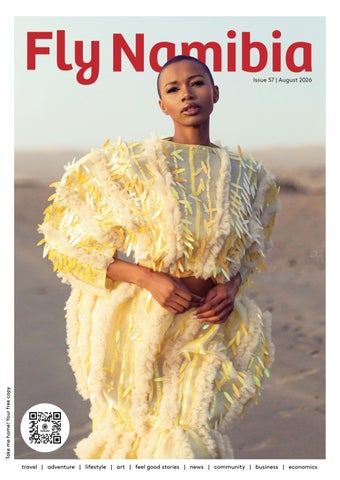
Issue 57 | August 2026
travel | adventure | lifestyle | art | feel good stories | news | community | business | economics
Where legacy meets the courage to grow We’re here to back the unstoppable spirit of Namibian businesses. Help Changes Everything Change to FNB
061 299 8877
First National Bank of Namibia Reg. 2002/0180. A division of FirstRand Namibia Limited.
CONTENTS Welcome on Board
9
This is Namibia: Get to know the Aawambo
11
Brown hyaena vs. Cape fur seal
12
Native Leaves: Purple-pod terminalia
15
More than a garment: The quiet luxury of .about Namibia
16
The Project Room: Signs of the times
19
More than a balloon ride: The Legacy of Namib Sky Balloon Safari
20
Forests for the future: How the NILALEG project is supporting Namibia’s new generation of State Forest Reserves
27
Lighthouse Ministry: A safe space in Rehoboth
28
BE Wellness: Hair thinning after 40
31
Best of Namibia: Celebrating our 2026 Winners
32
Debmarine Namibia employees support Vision Life Care Organisation
35
Dr Nangula Mbako: Using law, leadership and compassion to transform lives
36
Body Care Basics: Your simple routine for healthy skin
39
We’re for Namibians: The Cortex Collective - Creating a space where every ability belongs
40
Living Well: The most underrated and neglected source of health
43
From Paris to Milan: House of Poulton continues its global journey
44
Reflections: Who really benefits from blaming immigrants?
47
The Brief: A monthly wrap-up of news worth knowing
48
Unlocking sustainable growth from Namibia’s ocean resources
51
The slow fade of home cooking in a world that prefers convenience
52
Dr Theuns’ Top Tips
55
Agriculture at the heart of Namibia’s development agenda
56
Ondangwa youth entrepreneurs aim high
59
President welcomes new heads of mission, bids farewell to German ambassador
60
Macro Pulse: Trade Balance Analysis for May 2026
64
A hidden gem of relaxation: Inside Lui Heavenly Touch Spa
67
Ore in the ground is a resource. Ore processed is an economy
69
Love Local Arts
71
Did you know?
74
Love Namibia
76
12
20
56
FLYNAMIBIA AUGUST 2026
1
Welcome to the August edition of the FlyNamibia Magazine
brought to you by At Venture Media, we’re more than just a publisher - we’re a multi-media content creation powerhouse. Our expertise includes awe-inspiring photography, striking videography, impeccable design, and crisp podcasts. With a reputation for excellence spanning three decades, we bring unparalleled storytelling to life. In our boutique publishing and content marketing house, stories that matter take center stage. Every page you turn reflects our commitment to quality and innovation. Dive in and experience the difference that top-tier content creation can make. Cover image Massimo Fredericks Photography Read more on page 44. Editor Elzanne McCulloch elzanne@venture.com.na Production Manager Liza Lottering liza@venture.com.na Sales Daleen Small daleen@venture.com.na Layout & Design Richmond Ackah Jnr. design@venture.com.na Admin and Enquiries Bonn Nortje bonn@venture.com.na Printing John Meinert (Pty) Ltd
Venture Publications (Pty) Ltd. PO Box 21593 Windhoek Namibia Disclaimer: Please note that while every effort has been made to ensure the accuracy and reliability of the content within this magazine, Venture Publications Pty Ltd and FlyNamibia accept no responsibility for any errors or omissions. The views expressed by individual authors are solely their own and do not necessarily reflect those of the publisher or FlyNamibia. All material, including text and images, is the property of its respective authors and cannot be reproduced or used without explicit permission from Venture Publications Pty Ltd.
2
our services. Creative Professional Concept & Photography Campaign Development
Creative Design
Social Media Management
Video Production
Creative Storytelling & Content Creation
Want to be part of our content creation revolution? Find our contact details here.
+264 81 285 7450 | info@venture.com.na | www.venture.com.na
our publications.
From the Publisher
our storytellers.
Order any of these publications from bonn@venture.com.na
16 15
27
Agnes Shivute
An environmental consultant with interest in indigenous flora, nature enthusiast, Namibia Botanical Society awardee and aspiring author.
Elzanne McCulloch
Writer, editor and publisher of Stories that Matter. Managing Director of Venture Media.
28
67
Madeleen Duvenhage
Glen-Nora Zeupereje
Windhoek-based writer Tjipura perpetually scouting for hidden is a writer and filmmaker, gems and offbeat narratives passionate about stories, found in the ordinary. whether reading or consuming
51
43
39
Emily Kandanga-Erastus
40
56
44
60
Cerina Bezuidenhout
David Penda
Maggie Forcelledo Paz
News & Content Editor. Windhoek-based creative & A digital content creator Haasbroek movement enthusiast. capturing Namibia's stories Passion and dedication to keep A creator, guide, and curious Usually building, creating, and through bold visuals and real the nation abreast with what’s soul inspired to help people storytelling, blending wellness, moments. My work celebrates happening on national and reconnect with their bodies, international level. purpose, and a passion for find their flow, and reclaim their the people, places, and pulse of bringing meaningful ideas to life. the nation. health – naturally.
19
Laschandre Coetzee
A strategic dreamer, working in sustainability and communication strategy. Partner of local gallery The Project Room.
47
31
David Bishop
Host of Nova Sunrise on Nova 103.5, climbing wall owner, voracious reader, sometime writer, active lifestyle proponent, family man, and coffee lover.
Dr Bettina Allgaier-Zalto Obstetrician & Gynaecologist. “At the heart of my approach lies a holistic perspective”
FLYNAMIBIA AUGUST 2026
3
Connecting dreams to a decade of knowledge and experience The leading aviation training organisation in Africa.
www.signaaviation.com 4
NCAA ATO 00077
Need To Knows. with FlyNamibia
How to buy
a ticket online www.flynam.com
Select your flight Select which tickets you would like to purchase: destinations, travel dates, morning/afternoon departure. We offer multiple fare options such as: Saver, Classic or Premium
Additional flight information / rules Read up on all our additional information regarding terms and conditions, and tick the selection box once completed to continue.
Passenger details
Payment
Please enter names as they appear on passport or travel documentation
Fill in your payment details in our DPO paygate to make final payment.
LOGIN to upload passenger details from previous booking.
More options for the perfect trip
Confirmation Mail Transaction confirmation will be sent to passenger email entered.
Baggage policy, sporting equipment, over weight luggage or to add an additional bag(s)
How can you make
You can also purchase
from:
a payment?
Cash payment at: Eros Airport, Ondangwa Airport
Electronic Funds Transfer (EFT)
Windhoek Eros Airport Office Ondangwa airport office Katima Mulilo airport office Hosea Kutako airport office All major travel agents
Online card transaction
PayToday app Buddy SuperApp
Check-in
prior to flight Online check-in opens 24 hours before departure of the flight on Fly Namibia Check-in opens 1h 30min before domestic flight and 2 hours before international flight. Check-in CLOSES 30 min prior to domestic flight and 50 min prior to international flight.
Luggage
restrictions Items NOT allowed in hand luggage:
MAX 20kg Per person
Lotions and aerosols above 100ml, flammable aerosol, sharp objects, i.e. nail files, nail scissors, Leatherman, matches. See full conditions of carriage by scanning the QR code
FLYNAMIBIA AUGUST 2026
5
DOMESTIC & SAFARI FLIGHTS Katima Mulilo (via Maun) Bwabwata National Park
Ondangwa
Skeleton Coast Park
Rundu
Mokuti
Etosha National Park
Khaudum National Park
Tsumeb
Ongava
Otavi
Grootfontein
Mudumu National Park Nkasa Rupara National Park
Maun
Twyfelfontein Otjiwarongo
Waterberg Plateau Park
Dorob National Park
BOTSWANA Okahandja
Swakopmund
Windhoek
Walvis Bay
Gobabis
NamibNaukluft Park
Mariental Keerweder (Sossusvlei)
Keetmanshoop
Lüderitz
Ai-Ais/ Richtersveld Transfrontier Park
Oranjemund
with FlyNamibia Contact The Call Centre | +264 83 339 0011 Schedule as per date of going to print. Please check the FlyNamibia website to stay updated on flight destinations, routes and schedules.
Victoria Falls ZIMBABWE
DOMESTIC FLIGHTS FLIGHT NO.
DEPARTURE
FROM
TO
ARRIVAL
DAYS
WV*4Z8505
06:30
Eros - Windhoek
Ondangwa - Toivo Ya Toivo
07:30
Tue
WV*4Z8506
08:00
Ondangwa - Toivo Ya Toivo
Eros - Windhoek
09:00
Tue
WV*4Z8595
16:20
Eros - Windhoek
Ondangwa - Toivo Ya Toivo
17:20
Tue, Wed, Thu, Fri, Sun
WV*4Z8596
17:50
Ondangwa - Toivo Ya Toivo
Eros - Windhoek
18:50
Tue, Wed, Thu, Fri, Sun
WV*4Z8137
13:30
HKIA - Windhoek
Katima Mulilo (via Maun)
15:30
Mon, Wed, Fri, Sun
WV*4Z8138
16:00
Katima Mulilo
HKIA - Windhoek (via Maun)
18:15
Mon, Wed, Fri, Sun
REGIONAL FLIGHTS FLIGHT NO.
DEPARTURE
FROM
TO
ARRIVAL
DAYS
WV*4Z8137
13:30
HKIA - Windhoek
Maun
14:30
Mon, Wed, Fri, Sun
WV*4Z8138
17:05
Maun
HKIA - Windhoek
18:15
Mon, Wed, Fri, Sun
WV*4Z8135
09:15
HKIA - Windhoek
Victoria Falls
10:40
Tue, Wed, Thu, Fri, Sat, Sun
WV*4Z8136
11:15
Victoria Falls
HKIA - Windhoek
12:50
Tue, Wed, Thu, Fri, Sat, Sun
Mon-Sun
in Partnership with 4Z341
11:40
Cape Town
Walvis Bay
13:55
4Z342
14:40
Walvis Bay
Cape Town
16:45
Mon-Sun
4Z320
07:00
Cape Town
HKIA - Windhoek
09:10
Mon, Tue, Wed, Thu, Fri, Sat
4Z326
10:40
Cape Town
HKIA - Windhoek
12:50
Mon-Sun
4Z328
18:15
Cape Town
HKIA - Windhoek
20:25
Mon, Tue, Wed, Thu, Fri, Sun
4Z329
07:05
HKIA - Windhoek
Cape Town
09:10
Mon, Tue, Wed, Thu, Fri, Sat
4Z321
09:50
HKIA - Windhoek
Cape Town
11:55
Mon, Tue, Wed, Thu, Fri, Sat
4Z327
13:40
HKIA - Windhoek
Cape Town
15:45
Mon-Sun
*Code Share ** For Luderitz flights please contact your nearest Travel Agent or FlyNamibia offices for the newest updates. HKIA - Hosea Kutako International Airport
Our main routes
The seasonal FlyNamibia Safari schedule will resume on 1 May 2026 and run until 30 November 2026. Our daily shuttle flight operates in a clockwise circuit seven days a week. The exact departure and arrival times are determined the day before the flight and will be communicated directly to lodges, tour operators, and transfer companies. A minimum of two passengers is required per sector. All destinations remain available on a private charter basis. The departure time from Sossusvlei is between 08:30 and 11:00, meaning arrival in Swakopmund and Twyfelfontein will be in time for lunch, and arrival at Etosha will be between 12:30 and 15:30. The arrival time in Windhoek will be between 16:00 and 17:00, or earlier if necessary to ensure connections with various airlines. It’s important to note that no activities should be booked on the day of departure to the next destination until the departure time is confirmed the day before. All destinations remain available on a private charter basis. For more information, contact: Email: safari@flynamibia.com.na
FROM
TO
Windhoek
Sossusvlei
Sossusvlei
Swakopmund
Swakopmund
Twyfelfontein
Twyfelfontein
Ongava
Ongava
Mokuti
Mokuti
Windhoek
Additional route options FROM
TO
Swakopmund
Ongava
Swakopmund
Mokuti
Twyfelfontein
Mokuti
Ongava
Windhoek
Sossusvlei
Twyfelfontein
Sossusvlei
Ongava
Sossusvlei
Mokuti
Twyfelfontein
Windhoek
Swakopmund
Windhoek
LOCAL IS ST! BE
#b
u y n a m ibi
an
PROUDLY NAMIBIAN. READY FOR THE WORLD. BUILT FOR ADVENTURE.
GEAR THAT TAKES YOU FURTHER. Premium outdoor & camping equipment for every journey.
HOME OF GREENSPORT
OUTDOOR & CAMPING SOLUTIONS FOR EVERY EXPLORER. OFF-ROAD EQUIPMENT
Suspension, recovery, navigation & more. Go further. Travel safer.
KITCHEN & COOKING
Everything you need to cook great meals anywhere.
From weekend getaways to extreme expeditions, CYMOT equips you with premium gear you can trust - wherever the journey takes you. OUTDOOR LIGHTING
TENTS & SHELTERS
Light your adventure with reliable, high-performance lighting.
CAMPING FURNITURE
CYCLING EQUIPMENT
FISHING EQUIPMENT
Rest easy. Sleep warm. Wake rested.
Top brands. Superior performance. Built for any terrain.
Quality gear for every and any cast.
Shelter from the elements. Built strong. Made to last.
GADGETS
Versatile. Durable. Always ready.
LUGGAGE & STORAGE
Smart storage solutions. Organised and protected.
TRUSTED BRANDS. EXPERT ADVICE. GEAR YOU CAN RELY ON. PREMIUM BRANDS Quality you can trust.
EXPERT ADVICE From people who love the outdoors.
ADVENTURE IS EVERYWHERE. BE PREPARED. Explore further.
TESTED & PROVEN Gear that performs in any conditions.
WIDE RANGE The best from near and far.
VISIT CYMOT TODAY In-store. Online.
(083) 295 6000
info@cymot.com
www.cymot.com
LOCAL SUPPORT Proudly Namibian. We are here for you.
ON BOARD Dear Guests, As we welcome you to our August issue, we're reflecting on another memorable month for the FlyNamibia family. July was filled with exciting milestones, beginning with our participation in the Namibia Mining Expo alongside the wider Westair Group of Companies. It was a valuable opportunity to connect with partners, showcase our aviation capabilities and demonstrate the important role aviation continues to play across Namibia's key industries.
Read our previous issues
WELCOME
July also marked the conclusion of our search for the next Face of FlyNamibia. By the time you're reading this, our new ambassador has been selected, and we can't wait to introduce you to them in our September issue as they begin sharing authentic Namibian stories with the world. Our current Face of FlyNamibia, Namafu Amutse, also enjoyed an unforgettable adventure to Victoria Falls during July, creating inspiring content from one of Southern Africa's most spectacular destinations. We'll be sharing that journey with you in next month's magazine. As you know by now, our motto is “We Rise by Lifting Others.” We are thus always very eager to share the stories and passions of proud Namibians reaching for the sky. Turn to page 44 to read about Melisa Poulton's exciting journey to Milan Fashion Week, a wonderful reminder that Namibian talent continues to make its mark on the international stage. For visitors looking to experience the very best of Namibia, FlyNamibia Safari remains one of the smartest and most rewarding ways to explore our country. Our daily scenic shuttle flights connect many of Namibia's most iconic destinations, from the magnificent dunes of Sossusvlei and the Atlantic coastline to Etosha, Damaraland and beyond. By taking to the skies, travellers spend less time driving and more time discovering the remarkable landscapes, wildlife and hospitality that make Namibia unlike anywhere else on earth. Whether you're travelling for business, leisure or the adventure of a lifetime, thank you for choosing FlyNamibia.
SC A
Enjoy the journey, and thank you for flying with us. Nerine Uys CEO FlyNamibia
FLYNAMIBIA AUGUST 2026
9
NM
E!
BOOK YOUR CONFERENCE WITH US!
Popa Falls Resort | Gross Barmen Resort | Khorixas Camp | Hardap Resort Discover unparalleled conference facilities amidst breathtaking natural landscapes with Namibia Wildlife Resorts. Host your next event at Popa Falls Resort, where the serene Okavango River meets nature’s tranquility. Gross Barmen Resort offers a rejuvenating retreat, blending wellness with state-of-the-art conference amenities. At Khorixas Camp, immerse yourself in the rich history of ancient civilizations while enjoying modern conference conveniences. Lastly, Hardap Resort presents a lakeside haven, perfect for inspiring creativity and fostering collaboration. Elevate your conference experience with us!
+264 61 285 7108 |
MICE@nwr.com.na |
www.nwr.com.na
Elevate your business travel with the NWR NAMLEISURE CORPORATE CARD! Enjoy exclusive discounts on accommodation and activities, ranging from 50% for Namibian to 10% for international cardholders. With a validity of three years and easy renewal, it’s tailored for businesses with a minimum group size of 10. Experience convenience, savings, and unparalleled benefits for your corporate outings.
This is Namibia
GET TO KNOW THE AAWAMBO THE TRADITIONAL LAND OF THE AAWAMBO PEOPLE A large percentage of Namibia’s inhabitants live in the Omusati, Oshana, Ohangwena and Oshikoto regions between Etosha National Park and Namibia’s northern border with Angola. After the capital Windhoek, this region has the largest urban concentration of people in the country. The major portion of these four regions, which have a total surface area of just over 56,100 km², consists of communal farming land – that is land without individual ownership or demarcation and where the majority of the inhabitants live from subsistence farming. Life on the vast plains of these essentially agricultural regions depends on the seasonal efundja, the floods that feed the rivers and iishana. The latter are flat, shallow depressions, many of which light up with copious growths of white lilies soon after they have filled with water in the rainy season. The highlands of Angola are the origin of these waters. After a long journey southwards, the Cuvelai River disperses its contents into many channels, covering the sandy flats of southern Angola and spreading into northern Namibia to form a large expansive delta of rivulets and iishana. These, in turn, provide drinking water for humans and animals, protein in the form of fish and a habitat that supports large numbers of aquatic birds. The essentially flat landscape is characterised by huge expansive marula trees and sporadic stands of the tall makalani palm, Hyphaene petersiana. Sap is tapped from the growing tip of the stems of these palms and left to ferment into a potent drink called palm wine. The fruit of the makalani palm takes two years to mature and has a white, bony kernel. Referred to as vegetable ivory, the hard kernel is suitable for carving small ornaments, jewellery and curios. THE AAWAMBO The people collectively referred to as the Aawambo live in central northern Namibia, an area formerly known as Owambo and southern Angola. In about 1550, groups of these people, who have a common origin and culture, moved southwards from the Great Lakes in East Africa and settled between the Kunene and Okavango rivers. Eight of these communities, representing around half of Namibia’s population, live in northern Namibia, while four communities live in Angola’s southern Cunene Province. The Aawambo
communities are administered by traditional authorities headed by a king, queen or a chief. The Aandonga, Aangandjera and Aakwaluudhi are ruled by a king, while the Aakwanyama made history when a queen was installed in November 2005. The traditional authorities of the Aakwambi, Aambalantu, Aambadja and two small communities in western Owambo, the Aakonlonkadhi and Unda which are under a single traditional authority, are administered by traditional authorities headed by a chief. A council of seniors and councillors assists the king, queen or chief in the performance of his or her duties. It is often mistakenly assumed that Oshiwambo is the language of the Aawambo, but it is in actual fact a cluster of closely related dialects. The languages of the Aandonga and the Aakwanyama, the two largest communities, as well as the Aakwambi have been developed into written languages. The Aawambo people who live on the land practise a mixed economy of subsistence agriculture and stock farming with cattle and goats. Omahangu (pearl millet), sorghum and beans are the main dryland crops. A wide variety of leafy green vegetable plants and wild fruits are collected to supplement the staple diet of oshithima (pearl millet porridge). Fish are caught in the watercourses (iishana) during seasonal floods and in the rainy season. Aawambo houses are traditionally of the rondavel type, mostly surrounded by wooden palisades and often connected by passages. Cattle kraals (enclosures) usually form part of the complex which is surrounded by fields cultivated seasonally. Numerous small bars, locally known as cuca shops, small enterprises and locally owned shopping complexes are testimony to the business acumen of the Aawambo. Open markets, a feature of all the towns in Owambo, are bustling places where vendors sell a variety of traditional food and other products. EXPERIENCING AAWAMBO CULTURE The Uukwaluudhi Traditional Homestead at Tsandi in the Omusati Region is a good place to learn about the history and culture of the Aakwaluudhi. Guides take visitors through the homestead, the former palace of King Josia Taapopi, pointing out the customs and history of the Aakwaluudhi. Historic photos and maps of the Finnish Mission Society and early Owambo can be viewed in the Nakambale Museum at Olukonda. There are also several displays of traditional domestic implements, clothing, decorations and weapons of the Aandonga. The museum forms part of the historic Finnish mission complex which is a national monument that includes the church and the nearby cemetery. A guided tour through the adjacent traditional Aandonga homestead provides an interesting insight into the history, culture and way of life of the Aandonga people. The Oshituthi Shomagongo (Marula Fruit Festival) is rotated among the eight communities. The two-day event is usually held in March or April during the marula season. The festival was inscribed in the UNESCO Representative List of the Intangible Cultural Heritage of Humanity in 2015. Find more Namibia travel inspiration at www.thisisnamibia.com Follow @thisis_namibia on Facebook and instagram for extraordinary Namibia travel stories.
FLYNAMIBIA AUGUST 2026
11
An epic struggle and a first for science
T
ivat, a female brown hyaena, was afraid of seals when she first encountered them. Over a few months, she learned to kill seal pups - not unusual for a brown hyaena. Just one year after her first encounter with seals, Tivat did something that (to our knowledge) no other brown hyaena has achieved: she killed an adult Cape fur seal! To understand this achievement, you need to know a little more about brown hyaenas. Every carnivore textbook will tell you that they are primarily scavengers, with only 6-16% of their meals coming from things they have killed. They are known to eat snakes, insects, and even fruits and vegetables! The hyaenas living along the coastline of Namibia are renowned for killing seal pups, and probably hunt more than their inland relatives. Nonetheless, they prefer taking pups that are sleeping or not paying attention to their surroundings. The unsuspecting seal pup is quickly dispatched with a crushing bite to the head. Dr Marie Lemerle of the Brown Hyena Research Project thought she had witnessed all of the brown hyaena’s hunting strategies, until Tivat showed up. “I’ve spent over 3,000 hours watching brown hyaenas foraging near seal colonies,” she says, “sometimes they pretend to be sleeping to get the pups to relax and forget that a predator is there; other times they dash into the colony and grab any pup that is too slow to get away.”
extremely skittish when we first spotted her in October 2023,” Lemerle recalls, “she even ran away from the seals!” The research team has since discovered that this hyaena most likely originates from an area without a seal colony, which explains her unusual nervousness.
hen Tivat first showed up at the Baker’s Bay seal colony W south of Lüderitz, she was an unlikely candidate for pushing the boundaries of hyaena hunting abilities. “She was
That assumption was shattered on 9 July 2025. Lemerle and Natacha Anglade (a Master of Science student) spent the whole day at Baker’s Bay seal colony, watching from
12
In May 2024, after several months of visiting the seal colony, Tivat discovered what many other hyaenas had before her: seal pups are quite easy to kill. By January 2025, she had become a prolific pup-killer, managing to take 12 of them in just over an hour of hunting. et Tivat had already set her targets on bigger prey: “I was Y amazed to witness her trying to take down an adult female seal during October 2024, but unsurprised that her hunt was not successful.” After 90 seconds of struggling, the seal managed to escape. Dr Lemerle’s assumption that Tivat was being overly ambitious is based on her knowledge of the species and extensive personal observations. Brown hyaenas have never before been recorded taking down prey larger than themselves. Hyaenas only weigh 50 kg maximum, while the average weight of a female Cape fur seal is 57 kg (the massive male seals weigh over 240 kg). Only lions are known to successfully hunt adult Cape fur seals from the land, as recorded by Dr Philip Stander on the Skeleton Coast. Lions are way above brown hyaenas in the predator pecking order, so surely Tivat’s dream of killing an adult seal was unrealistic?
Photography by Marie Lemerle
Brown hyaena vs. Cape fur seal
different vantage points. Their patience paid off, as they witnessed something that no scientist had before. Tivat arrived at the colony in mid-morning and started creating havoc among the seals. She ran up to each group of seals in turn, causing most of them to flee into the sea. Sometimes, the seals would charge back at her, ‘knowing’ that they are too big for a brown hyaena to subdue. One struggle lasted only three seconds before the seal freed itself from the hyaena’s grip. Tivat was undaunted and tried her luck with four seals that day. Her fourth attempt earned her the ultimate prize. The final victim initially lunged at Tivat, but it seems that the hyaena had learned how to fight during the previous struggles and latched onto the seal’s neck. “We filmed the battle from our distant observation points, but we knew it would soon be over when blood spurted from the seal’s carotid vein,” Lemerle remembers this brutal, fascinating scene clearly. It took about eight minutes from the first attack to the seal’s last breath. s it turns out, this incredible feat wasn’t a once-off event. A Tivat has since killed at least one more adult seal, and the researchers noted that the most recent kill was highly efficient. “It seems like she is specialising in taking adult seals due to the lack of pups in the colony at this time,” observes Lemerle, “it will be interesting to see if other hyaenas will learn her hunting tactics.” To learn more about this remarkable hyaena, the Brown Hyena Research Project fitted Tivat with a GPS collar in August 2025. “While we were collaring her, we estimated her age at 10-12 years old, and she weighed 43 kg, making her seal-hunting feats even more impressive!” Lemerle and the research team hope to learn more about Tivat and her clan. Since brown hyaenas from the same clan often forage
separately, it is challenging to determine which clan they belong to solely by observing their hunts. With GPS data, the researchers are likely to find the clan’s den where they raise their cubs and thus identify Tivat’s clan mates. This discovery demonstrates the value of long-term observational research, where scientists simply watch their subjects and record their behaviour. It also shows what we can learn when animals are not disturbed by human presence. These brown hyaenas inhabit the Tsau ||Khaeb (Sperrgebiet) National Park, which is off-limits to all but a select few researchers and permit-holding visitors. The researchers watch the hyaenas from a distance to ensure that their presence isn’t influencing the hyaena or seal behaviour. As Tsau ||Khaeb opens to the public with plans for tourism, the impacts on the animals that have lived with minimal human presence need to be minimised as much as possible. This is possible with well-managed tourism, says Lemerle: “If there are a limited number of vehicles operating in the area, we can work with them to establish best practices for viewing hyaenas and seals.” Rule-breakers are relatively easy to identify and report when there are few of them. If the Park is opened up for industrial development, however, such rules and regulations are likely to be trampled, along with the unique plants found here. The plans to produce hydrogen in this area include large industrial plants, solar panels, wind turbines, pipelines, roads, and pylons. With so many people involved in the construction and maintenance of such infrastructure, it will be impossible to limit their disturbance of wild animals, not to mention the plethora of other impacts of this ill-conceived idea. While concerns about the future of Tsau ||Khaeb National Park remain in the background, the hyaena researchers will continue to study this resilient and adaptable carnivore. Tivat may even be a pioneer of new hyaena behaviour if others start copying her methods. Follow the Brown Hyaena Research Project on Facebook for future updates about Tivat and insights into the lives of these remarkable coastal carnivores. Gail Thomson First published in the Conservation and the Environment in Namibia 2025 issue. Read more stories here: www.conservationnamibia.com
FLYNAMIBIA AUGUST 2026
13
ADVENTURE AWAITS!
Tel: 264 61 232871 | 24hr emergency no: 081 129 3355 Email: info@africa-on-wheels.com www.africa-on-wheels.com 14
Scan the QR code to access the website
Native Leaves:
PURPLE-POD TERMINALIA
W
Scientific name: Terminalia prunioides Common name: Purple-pod terminalia
inter gave us the best of cold weather – shivers with an “I’ll do it later because it’s just too cold” vibe. This led to a little more slumber and snacking than usual. We remain grateful for technology that came to rescue us with the switch of a button, because switching on a kettle to prepare a cup of coffee or tea is quite the elite convenience in this extreme cold. In our country, coffee and tea imports amount to millions of Namibian dollars. However, my recent discovery of the purple-pod terminalia tea – made in Namibia – was a proud moment. I get extremely excited when I see Namibian products, especially those made from our indigenous natural resources. For me, the purple-pod terminalia tree was just another regular tree with rather colourful pods, until I came across the tea made from it. A deciduous tree, the purple-pod terminalia grows as either a shrub or a tree with a relatively fissured and rough bark. The older branches are usually brownish grey and sometimes a bit purplish but more finely fissured. With age, the branches become harder. The leaves are simple and form cluster arrangements at the tip of its branches. In most cases, the leaves happen to be dark green on the upper surface and dull green on the lower surface, with the veins quite visible on the upper surface.
The purple-pod terminalia tree is also known for its medicinal properties, where crushed bark is boiled and administered to treat coughs. The tree is not one of those much soughtafter species, but the strength of its wood is a quality that might lead to it being overutilised in communities where wood has become scarce. The wood is also known to be used for making implement handles and poles for fencing off fields or as a supplement for making livestock kraals. The beautiful purple-pod tree is easy to identify, with the bark and pods its distinct features. Not only is it an attractive tree, but it is also known for its ability to tolerate drought and frost. This enables it to survive in places with variable weather patterns. Finally, I had a taste of the original purple-pod terminalia tea. It is definitely to my liking, and their marketing hits the spot: “Sourced from pristine, mineral-rich soils, offering a distinctive profile. You are choosing a connection to ancient Namibian wisdom and natural quality.” I was delighted to discover that there are more flavours available: ginger, lemon and mint. Winter is not over yet, so a sip of all these flavours is definitely on the bucket list. Agnes Shekupe Shivute
Flowering of the purple-pod terminalia occurs from November to April, but sometimes it can last up to July or even August. The flowers are spikes that can have a length of up to 50 mm, composed of small white or cream-coloured flowers with a strong floral scent. The tree produces fruits with a colour like that of modern-day red bricks, which is in fact more purplish than red. The fruits are described as pods. These pods have a single wing around the actual seed in the centre. Generally, these wings are broad, flat and hairless. The purple-pod terminalia occurs across central and northern Namibia through to the Kavango regions as well as the Zambezi, where its leaves are commonly being browsed by livestock and game such as giraffes. The tree’s wood is strong and suitable for making fires, but unfortunately its availability in certain areas is limited for sourcing wood on a daily basis.
FLYNAMIBIA AUGUST 2026
15
More than a garment 16
The Quiet Luxury of .about Namibia
I
n a world of fast fashion and fleeting trends, there is something deeply refreshing about clothing that asks us to slow down. Clothing that is designed not for a season, but for a lifetime of adventures. Clothing that belongs as naturally beneath a camelthorn tree as it does around a beautifully set dinner table.
This is the philosophy behind .about Namibia. Proudly made in Namibia, .about creates timeless linen garments that celebrate simplicity, craftsmanship and a slower way of living. Every piece is ethically produced using premium natural linen, a fabric that has been treasured for centuries for its remarkable comfort, durability and understated elegance. There is perhaps no better fabric for Namibia. From the cool mornings of the central highlands to the warm afternoons of Etosha and the humid waterways of the Zambezi, linen naturally regulates body temperature, allowing it to breathe in the heat while remaining comfortable as temperatures change throughout the day. It is lightweight without feeling delicate, soft against the skin and remarkably resilient, becoming even more beautiful with every wear. Its characteristic texture and gentle creases are not imperfections but reminders of authenticity. Linen was never meant to look untouched. It is made to move, to travel and to collect stories. This effortless elegance has become synonymous with modern luxury. Today's discerning traveller increasingly values quality over quantity, choosing garments that are thoughtfully crafted, versatile and designed to endure. Rather than chasing trends, linen celebrates timeless design, allowing each piece to remain relevant season after season. Sustainability lies at the heart of that philosophy. As one of the world's oldest natural fibres, linen requires significantly fewer resources than many conventional textiles. It is biodegradable, exceptionally long-lasting and encourages a more conscious approach to fashion by replacing disposable wardrobes with carefully curated collections of garments designed to be worn again and again. That same philosophy extends naturally into Namibia's luxury safari industry.
To curate a bespoke safari collection for your lodge, contact: anna-mart@about-clothing.com Or shop online for your own timeless linen wardrobe piece at: www.about-clothing.com
Each lodge has the opportunity to commission its own bespoke collection, selecting colours that reflect its brand identity, interiors and surrounding landscape. Whether inspired by the warm ochres of the Namib Desert, the muted greens of Etosha's mopane woodlands or the soft earthy tones of Damaraland, every collection can be tailored to create an exclusive retail experience that feels authentically connected to its destination. The result is a boutique offering that extends the guest experience long after departure. Instead of leaving with a generic souvenir, guests take home beautifully crafted garments they will continue to wear for years to come, each piece carrying memories of sunrise safaris, quiet moments in nature and Namibia's extraordinary landscapes.
Recognising that guests increasingly seek meaningful keepsakes rather than mass-produced souvenirs, .about has developed an exclusive Safari Collection for lodges, safari camps and boutique retailers across the country.
In many ways, that is what .about Namibia represents.
Designed specifically for life on safari, the collection combines relaxed silhouettes, breathable linen and timeless styling that transitions from early morning game drives to leisurely lodge lunches and sunset dinners around the fire.
Because true luxury isn't simply something we wear. It is a way of experiencing the world more slowly, more consciously and more beautifully.
What makes the collection unique is its flexibility.
It is about choosing natural over manufactured. Quality over excess. Timelessness over trends.
Elzanne McCulloch
FLYNAMIBIA AUGUST 2026
17
ONE PRODUCT FLEXIBLE ACROSS DIFFERENT INDUSTRIES
Insurance structured differently and trusted by leading Namibian businesses. GET IN TOUCH 083 331 3032 clientcare@corporateguarantee.com 18
Those stories centre on people who are rarely the focus of artistic attention. Signs of the Times honours construction workers – the men and women responsible for building the roads, bridges and infrastructure that quietly shape everyday life. It is a subject Nghipandulwa knows intimately, having spent years working alongside construction crews on projects across the country. “I have a deep respect for hard work,” he says. “We live in a world that constantly pressures people to achieve more, earn more and become more, but I don’t believe there’s anything ordinary about dedicating yourself to honest work that benefits everyone else.” The works do not romanticise labour, nor do they seek to make heroes of their subjects. Instead, they recognise the dignity that exists within everyday work. These are the people who build the roads we travel, maintain the infrastructure we depend upon and often do so without recognition.
Signs of the times
R
oads have shaped Ndako Nghipandulwa’s life in more ways than one. As a civil engineer, they have been his workplace for years. As an artist, they have become an unexpected source of inspiration. Opening at The Project Room, his latest exhibition, titled Signs of the Times, sees these two worlds converge in a compelling new body of work created on discarded road signs. “I work in the road construction industry, so road signs are something I’m surrounded by almost every day,” he explains. “Using them in my art felt like a natural step because it brings together two sides of my life that have always existed separately.” The weathered road signs carry with them a history before the artist ever touches them. Designed to guide, warn and direct motorists, they become something altogether different once transformed through his intricate string drawings. Instead of instructing movement, they invite pause and reflection. “I wanted to use that same visual language to tell different kinds of stories,” Nghipandulwa says. “By working on discarded road signs, I’m giving these objects a second life and turning something that once controlled movement into something that encourages people to stop, look and reflect.”
Engineering has profoundly shaped the way Nghipandulwa sees the world. His work has taken him to remote parts of Namibia where he has encountered people and stories that have quietly accumulated over time, eventually finding their way into his artistic practice. This exhibition becomes less a departure than a culmination – a reflection of years spent observing the country through the eyes of everyday labourers. Looking back, the artist reflects on a journey he never expected. What began simply as a love of drawing has led to exhibitions, international residencies and collectors far beyond Namibia’s borders. Yet despite these milestones, he remains guided by curiosity rather than certainty. “My practice is shaped by my experiences,” he says. “I can’t predict what my future work will look like because I don’t know what life is going to bring me. Every new place I visit, every person I meet and every experience I have has the potential to influence the stories I tell.” In many ways, that openness is what makes this exhibition so compelling. Signs of the Times is not simply about roads or construction; it is about recognising the value of the people whose work often goes unnoticed. Through discarded road signs, Nghipandulwa gives visibility to those who quietly build, reminding us that every road has a story, and every story begins with someone willing to do the work. The exhibition Signs of the Times will open at The Project Room on 22 August 2026 and run till midSeptember. Laschandre Coetzee
The Project Room - Namibia www.theprojectroom.com.na
FLYNAMIBIA AUGUST 2026
19
MORE THAN A BALLOON RIDE 20
The Legacy of Namib Sky Balloon Safaris
A
s the first light begins to spill across the dunes of Sossusvlei, a hot air balloon quietly lifts into the morning sky. Below, ancient rivers snake through the desert, gemsbok move silently across the plains and towering dunes glow shades of gold and burnt orange. For many visitors, it becomes the defining memory of their Namibian adventure. But the story of Namib Sky Balloon Safaris reaches far beyond the hour spent drifting above one of the world’s oldest deserts. It is a story of perseverance, family, conservation and a community that has grown alongside a business built from little more than a dream. A dream that crossed continents Namib Sky Balloon Safaris was founded in 1991 by Eric and Nancy Hesemans, but the dream began years earlier in Central Africa.
Eric, a conservation biologist living in the Democratic Republic of the Congo, became captivated by hot air ballooning after watching the 1985 blockbuster movie Out of Africa. Determined to experience it for himself, he travelled to Belgium, completed his balloon pilot’s licence and purchased a second-hand balloon, convinced that there was no better way to experience Africa’s wild landscapes. Before that dream could take shape, however, conflict swept through the region. The family fled the Democratic Republic of the Congo, then Rwanda, and later Burundi, losing almost everything they owned along the way. Travelling across Central Africa in a Hilux with little more than a mattress in the back, a trailer carrying their balloon, and an unwavering determination to keep going, they searched for a place where they could finally begin again.
FLYNAMIBIA AUGUST 2026
21
Botswana offered little opportunity, but everything changed when they crossed into newly independent Namibia. “We immediately felt welcomed,” recalls Denis Hesemans, senior accountable manager and designated examiner for Namibia, who now runs the company alongside his wife, Andreia. “There was so much space and opportunity.” That opportunity became Sossusvlei. Helping build tourism in the Namib The Namib they arrived in looked very different to the destination visitors know today. Working alongside conservation visionary Albi Brückner, founder of the NamibRand Nature Reserve, the Hesemans family became part of a much larger vision: protecting vast tracts of desert through sustainable tourism. At the time, there were almost no tourism facilities in the area. To make ballooning possible, Eric and Nancy built one of the region’s first tented camps, giving guests somewhere to stay before taking to the skies. As Namibia’s tourism industry steadily grew during the 1990s, so did the business. International media coverage helped introduce the country to travellers around the world, and more lodges began appearing across the landscape. Eventually, the family sold their lodges to focus entirely on what had inspired the journey in the first place: ballooning. Today, Namib Sky Balloon Safaris continues to build on the
22
values established in 1991, offering authentic hot air balloon safaris over the Namib Desert with the same unwavering commitment to safety, professionalism and personal service. For Denis, who grew up in the Namib Desert and has logged more than 2,000 balloon flights, every sunrise still holds the same sense of wonder. More happens before sunrise Guests see the calm. They do not always see everything that makes that calm possible. Every flight depends on an intricate combination of aviation, logistics and hospitality. While conditions may appear perfect on the ground, balloon pilots are studying winds hundreds of metres above the desert, monitoring temperatures, air currents and weather systems that guests never see. “It isn’t just about flying,” Denis explains. “A good balloon pilot combines airmanship with showmanship.” Pilots do not simply navigate the balloon. They guide guests through the landscape, point out wildlife, explain the desert below and help transform a flight into an unforgettable experience. Behind the scenes, around 40 people work
together to make each morning possible, from pilots and maintenance crews to reservations, catering, logistics and ground operations. Even the balloons themselves demand remarkable care. Standing almost 38 metres tall when fully inflated, each balloon completes roughly 750 flights before needing replacement. New balloons take around six months to manufacture, while the company uses between 13 and 15 tonnes of LPG every month simply to keep its fleet airborne. A lifelong relationship with the Namib Having spent his entire life in the desert, Denis has watched landscapes transform in ways few people ever will. He has flown over rivers flowing where he never imagined water would appear, watched carpets of wildflowers emerge after rare rains and witnessed migrations of birds filling the morning skies. Yet perhaps the greatest lesson the desert has taught him is how fragile it all is. Many visitors assume the desert constantly reshapes itself, but Denis says the opposite is often true. Vehicle tracks driven across fragile surfaces can remain visible for decades, sometimes forever. Operating from the air has reinforced the responsibility Namib Sky carries to protect the landscape that has sustained the company for more than three decades.
FLYNAMIBIA AUGUST 2026
23
A school born from one simple question While ballooning shaped the business, it was motherhood that inspired one of its greatest legacies. When Andreia became a mother, she naturally began thinking about her own daughter’s future. She realised she had options that many families living around Sossusvlei simply did not. The nearest schools were more than 130 kilometres away. For many parents, the choice was heartbreaking. Either send very young children to distant hostels far from home or keep them nearby without access to education. “If I have all these resources for my own child,” Andreia wondered, “what do parents with far less have?” Mariette, who oversees the school’s educational programmes, says that question became impossible to ignore. The answer started in the most unlikely place. What is now the Namib Sky Community School began in Denis and Andreia’s bedroom, temporarily transformed each day into a tiny daycare centre for just three children. Those three children became one classroom. One classroom became two. Today, the school has grown into a thriving early childhood development centre and primary school, recently expanding to include Grades 4 and 5. It remains the only school in the Sossusvlei area and now provides quality education to 52 children. Everything is provided free of charge: Education. School uniforms. Books. Transport. Meals. No child is excluded because their family cannot afford it. Learning beyond the classroom As the school grew, so too did the understanding that education alone was not enough. Teachers quickly recognised that children who arrived hungry struggled to learn. A nutrition programme followed. Families living too far away needed transport. A school bus was introduced. Some children carried emotional burdens far beyond their years. Counselling and family support became part of the programme. Workshops now help parents with nutrition, positive parenting, supporting homework at home and addressing challenges such as alcohol abuse within the community. For Mariette, every addition came from listening. “You come with a vision, and then you get humbled,” she says. “You realise you cannot teach a hungry child.” The results have been extraordinary. The school proudly maintains a 0% dropout rate. Children leave with strong academic foundations, confidence, curiosity and, perhaps most importantly, a genuine love of learning.
24
Mariette laughs as she recalls one young learner who became so upset about being sent home sick that he returned to school in his own clothes and quietly waited outside until he was allowed back into class. “When children are disappointed because school is closed for holidays,” she smiles, “you know you’re doing something right.” Building opportunity together The Namib Sky Community Trust reaches beyond education. One of its most successful initiatives is a sewing programme designed specifically for adults in the surrounding community. Participants receive sewing training completely free of charge, together with access to the workshop, sewing machines, equipment and materials. Once they have developed their skills, they create handcrafted products which are purchased by Namib Sky before being sold to visitors and selected lodges throughout the Sossusvlei region.
own household, but also helps to sustain the school their children attend.
The model is intentionally different from traditional charity. The artisans are not employed by Namib Sky. Instead, they become independent creators, earning an income from every item they produce. Namib Sky then provides the market by purchasing their work and introducing it to visitors.
More than memories Over the years, Denis has flown everyone, from royalty and celebrities to first-time travellers who spent years saving for the experience.
The proceeds generated through those sales help to support the school’s ongoing operations, creating a cycle in which tourism directly contributes to education.
“The silence.”
For Mariette, that cycle is what makes the project so meaningful. Rather than simply giving people assistance, it creates opportunity. Parents are able to provide for their families through their own work. They see the direct impact of their efforts, knowing that every item they sew not only supports their
It creates pride. It creates ownership. It creates dignity. The project becomes something built with the community, not merely for the community.
Yet he says one thing never changes.
There comes a point during almost every flight when conversation fades away. Cameras stop clicking. The basket becomes completely still. “People just know,” he says. They know they are witnessing something extraordinary. When asked how he hopes Namib Sky Balloon Safaris will be remembered decades from now, Denis does not talk about balloons. He talks about the community. He hopes the company will be remembered for helping create opportunities where there once were none. For giving children growing up in the desert access to an education that can change the course of their lives. For proving that tourism can leave a place better than it found it. The sunrise flights may be what first bring visitors to Sossusvlei. But perhaps Namib Sky’s greatest legacy is what has been built on the ground beneath them. Suné van Wyk Photography by Suné van Wyk & Liam Compion
FLYNAMIBIA AUGUST 2026
25
E L E VATE E
V
ER
Y SLICE
Be the first to experience the glow
Forests for the Future
I
n a country where landscapes often define both identity and survival, Namibia’s forests remain among its most overlooked natural assets. Yet in April 2026, a significant step was taken toward changing that narrative with the official launch of three new state forest reserves – Hamweyi in Kavango West, Kanovlei in Otjozondjupa and Zambezi State Forest in the Zambezi Region. Together, the reserves represent more than 175,000 hectares of protected woodland ecosystems. Gazetted in 2022 and now moving into active management, they form part of a broader national effort to strengthen conservation, improve biodiversity protection, and create sustainable opportunities for rural communities that depend directly on forests for their livelihoods. At the heart of this effort is the NILALEG project – the Namibia Integrated Landscape Approach for Enhancing Livelihoods and Environmental Governance – implemented with support from the Global Environment Facility (GEF) and the United Nations Development Programme (UNDP). Through NILALEG, Namibia is pursuing a model that views conservation not as a restriction on development, but as a foundation for long-term economic and social resilience. Speaking at the official launch ceremony in Windhoek, Minister of Environment, Forestry and Tourism Hon. Indileni Daniel described forests as “pillars of economic stability, social well-being and national resilience.” It is a sentiment reflected in the structure of the reserves themselves. Unlike traditional conservation models that separate people from protected landscapes, these state forests are designed around community partnership. Local communities remain active participants in the sustainable management of the reserves, with continued access to grazing, firewood, medicinal plants, thatching grass and other forest resources. This approach recognises that conservation success in Namibia is inseparable from the wellbeing of the people living alongside these landscapes. The scale of the new reserves is substantial. Zambezi State Forest spans more than 142,000 hectares, while Kanovlei covers nearly 22,000 hectares and Hamweyi over 11,000 hectares of ecologically important woodland savanna. These forests provide habitat and movement corridors for wildlife species including elephants, kudu and numerous bird species, while also playing a critical role in protecting soils, storing carbon and supporting climate stability. Through the NILALEG project, the reserves are now supported by structured management plans, governance
How the NILALEG project is supporting Namibia’s new generation of State Forest Reserves systems and community engagement strategies aimed at ensuring long-term sustainability. The project focuses on three interconnected priorities – healthier ecosystems, stronger livelihoods and improved environmental governance. Importantly, the initiative also opens the door to emerging economic opportunities linked to sustainable natural resource management. From forest-based enterprises and eco-tourism potential to future carbon finance and biodiversity-linked investment opportunities, the reserves position Namibia to increasingly view its forests as valuable natural capital. At the same time, the challenges remain real. Illegal logging, uncontrolled wildfires, poaching, land clearing and unsustainable harvesting continue to threaten woodland ecosystems across the country. Effective management, law enforcement and strong collaboration between government, traditional authorities, communities, and conservation partners will be essential to ensuring these reserves fulfil their promise. For communities living in and around these forests, the benefits extend beyond environmental protection. The reserves represent livelihood security, sustainable access to resources and greater participation in decisions that shape the future of their landscapes. The launch of Hamweyi, Kanovlei and Zambezi State Forests therefore marks more than the expansion of Namibia’s protected area network. It reflects a growing recognition that conservation, community wellbeing and economic resilience are deeply interconnected. Through the support of the NILALEG project, Namibia is laying the groundwork for a future where forests are not simply protected spaces on a map, but living landscapes that sustain biodiversity, strengthen rural livelihoods and contribute meaningfully to the country’s long-term environmental and economic future. Elzanne McCulloch
Spearheaded by the NILALEG project, that is implemented by the Ministry of Environment, Forestry and Tourism in partnership with the United Nations Development Programme and funded by the Global Environmental Facility.
FLYNAMIBIA AUGUST 2026
27
LIGHTHOUSE MINISTRY
A SAFE SPACE IN REHOBOTH
A LIGHTHOUSE IN REHOBOTH On the outskirts of Rehoboth, where sand-laden winds frequently sweep across informal neighbourhoods such as Block E, a different routine starts the day. Children arrive in small groups – some for early household duties while others are simply drawn by habit and familiarity. By mid-morning, the property at Lighthouse Ministry is already humming with activity: voices, laughter and the scattered focus of learning in progress. For more than 140 children, Lighthouse Ministry is a safe space and a place of consistency in a world that offers very little of it. With seven programmes running across after-school care, youth development, social work, a hostel programme, skills centre, community outreach and targeted support for vulnerable girls, its work stretches beyond education alone. It is equally concerned with the realities that face children here: teenage pregnancy, alcoholism and the growing number of children forced to run households on their own. FROM THREE MONTHS TO FIFTEEN YEARS The story of Lighthouse Ministry begins with co-founder Gerlinda Shipipa-Bruijnes, who first arrived in Rehoboth from the Netherlands 15 years ago for a short internship. She did not plan to stay. But something about the place – and more specifically, the children – shifted that trajectory. “I lost my heart there,” she says. “I saw how children were growing up and how little investment there was in helping them reach their potential.” She returned to the Netherlands to complete her studies, but the decision to come back to Namibia was already made. The day after graduating, she was on a plane. Years followed in Windhoek, where she worked for a similar child-focused initiative and met her husband, Kenneth Shipipa, from Namibia. However, the pull towards Rehoboth remained. Eventually, the newlywed couple relocated and began opening their home to children in the neighbourhood. “You would find children everywhere: in the living room, the kitchen, the yard…” she recalls with a laugh. What began informally soon outgrew their home. The need was too visible, too constant. With support from board members in Namibia and the Netherlands, Lighthouse
28
Ministry was formally established six years ago. The name was chosen to reflect what they hoped it would become: a beacon in a place where many families navigate daily uncertainty. For a while, the work continued from their home. Then came the turning point: a five-hectare plot near Block E was offered to the organisation, opening up space for something more structured. From then on, programmes began to multiply. Today, the centre have 16 full time staffs and offers a wide range of support, from structured learning and after-school care to youth mentoring, social work and home visits. One of the centre’s vital initiatives is a support group for pregnant teenagers – young girls navigating adulthood long before they should have to. In 2025, another significant shift came when the land was officially donated by its Dutch owners, securing the future of the site and allowing for long-term planning. New classrooms are now in development, intended to replace the current outdoor learning areas where children sit beneath shaded nets that offer little relief from Rehoboth’s persistent wind and heat.
join the programme. Here, they are given time to figure out what they are good at, while developing practical, hands-on skills. Through a structured curriculum, they are introduced to the fundamentals of agriculture, sustainability and small-scale food production, while also building habits that improve long-term employability. In the Hope Garden, learning is tangible. Children and young adults plant, tend and harvest their own crops, gaining an understanding of seasons, soil and the patience required to grow something from seed. The vegetables they cultivate are used in the daily meals prepared at the centre, creating a direct and visible link between effort and outcome. Each day, around 80 children pass through the centre. For many, it is the only place where they can pause, where childhood is not interrupted by responsibility. They receive a warm meal, often their only one of the day, along with time to read, play and learn. Learning here is deliberately orientated around play. “Everything we teach, we teach from the principle of play,” Gerlinda says. It is an approach designed not only to educate, but to reawaken curiosity in children who have often fallen behind or disengaged from formal schooling. Alongside educational support, the centre introduces conversations that rarely happen elsewhere: about emotional awareness, physical boundaries and personal safety. In a context where genderbased violence and domestic abuse are present realities, these lessons carry immeasurable weight. There is also space for creativity and sport, for structure and routine, for simply being a child. Before leaving the centre, children are given fruit and a small food parcel for breakfast the next day, along with basic toiletries – practical gestures that extend care beyond the centre.
But the programme extends beyond agriculture. Mornings begin with personal development – an intentional focus on confidence and communication. “We had a student with intense shyness,” says Norris, programme coordinator at the Hope Garden. “By the end of the year, she was dancing in front of her classmates.” Alongside this, participants are introduced to financial literacy and basic business principles. They manage small “plots” of land as their own, learning about responsibility, planning and the value of consistency. The idea is simple but powerful: effort, when sustained, can translate into both income and ownership.
Alongside educational support, the centre introduces conversations that rarely happen elsewhere: about emotional awareness, physical boundaries and personal safety.
SKILLS CENTRE Yet one question continued to surface for the team: What happens after school? For many young people in Rehoboth, and in the rest of Namibia, finishing school does not necessarily lead to opportunity. It often marks the beginning of joblessness and passivity. It was within this gap that Lighthouse Ministry began the Skills Centre, designed to help young people navigate life beyond the classroom. THE HOPE GARDEN One of these initiatives is the Hope Garden, an agricultural project that has grown into something far greater than its modest beginnings. When it started in 2022, the garden functioned simply to grow, harvest and share produce. But its potential was clear. By 2024, it had become the foundation of the skills centre. Young people taking a gap year after school are invited to
Still, the challenges are not only practical. According to Gerlinda, mindset remains one of the biggest obstacles. “When things get difficult, as they often do, many want to give up. There’s a deeply rooted belief that they are not enough.” It is this belief that the programme actively works to dismantle, starting with personal development as its foundation.
Students move into internships, first within Lighthouse Ministry itself, where they are guided in punctuality, teamwork and responsibility. In their second year, they begin stepping outwards into placements at local businesses such as Lake Oanob Resort or small enterprises like car washes. In some cases, these opportunities have led to long-term employment. The Skills Centre also connects with a wider network of programmes at Lighthouse Ministry. From cooking and baking to woodwork, needlework, metalwork and dance, each initiative feeds into a broader ecosystem of learning. Madeleen Duvenhage Find out more by scanning the QR code or visit their social media pages: @lighthouseministry.nl @lighthouseministry.nl
FLYNAMIBIA AUGUST 2026
29
SETTING THE STANDARD IN AVIATION Westair Aviation is a leading, global, fully integrated aviation service provider, offering OGP operations and a wide range of tailored aviation solutions. With an extensive fleet of over 30 aircraft, we are equipped to meet diverse client needs globally.
PRIVATE & VIP CHARTERS FLYNAMIBIA SAFARI WET & DRY LEASING AEROMEDICAL SEARCH & RESCUE
AIRCRAFT MAINTENANCE FREIGHT & AIR CARGO AVIATION TRAINING HELICOPTER SOLUTIONS
www.westair.com.na
BE Wellness
Hair thinning after 40
P
What every woman should know
anic is a common reaction when a woman notices significant hair loss – seeing hair on her pillow, in her brush or clogging the shower drain – and starts comparing old photos with the woman in the mirror.
Hair loss is not an inevitable part of ageing, nor is it something women should “just live with.” It can profoundly affect self-esteem because hair influences both how a woman feels and how she is perceived. Hair loss is often one of the body’s most reliable medical signals, reflecting an underlying biological process. Hair follicles are among the body’s most metabolically active structures and respond to hormonal changes, inflammation, nutritional status, stress and sleep disorders. When several of these factors shift simultaneously, as often occurs during perimenopause and menopause, the follicles weaken and hair growth declines. Hair loss deserves a proper medical evaluation and an individualised treatment plan.
4. Thyroid disorders: Especially hypothyroidism, a common cause of hair loss. Other causes: Vitamin D deficiency, other nutritional deficiencies, chronic illness, autoimmune disease, medication, psychological stress and sleep disorders. Recommended laboratory tests include ferritin (target 40–60 ng/mL for optimal hair growth rather than the laboratory lower limit of about 15 ng/mL), a thyroid panel, vitamin D level, basic metabolic panel, medication review and hormone testing when signs of androgen excess, irregular menstrual cycles, acne or hirsutism are present.
Hair loss is not an inevitable part of aging, nor is it something women should "just live with."
The main causes include: 1. Female pattern hair loss (androgenetic alopecia): The most common cause. During perimenopause, declining oestrogen makes follicles more sensitive to androgens, producing thinner, shorter, less pigmented hairs until visible hair growth stops. It typically causes diffuse thinning over the crown while preserving the frontal hairline. 2. Telogen effluvium: A diffuse shedding in which handfuls of hair are lost during washing or brushing for weeks to months. It is triggered by illness, surgery, medication changes, psychological trauma, nutritional deficiencies, thyroid disorders, hormonal changes, pregnancy or breastfeeding. A large number of follicles enter the resting phase simultaneously, with shedding appearing several months later.
Treatment is successful in most cases, and combination therapy is often more effective than a single treatment. Options include topical or low-dose oral minoxidil (with results typically showing after at least six months), antiandrogens such as finasteride or contraceptive pills containing antiandrogenic progesterone, correction of nutritional deficiencies, procedural treatments including microneedling, laser therapy, platelet-rich plasma or hair transplantation, as well as natural agents such as curcumin, pumpkin seed oil and horsetail. Please keep in mind that your hair is a mirror of what is going on in your body. Insist on thoughtful medical evaluation and proper therapy. You deserve it! Dr Bettina Allgaier-Zalto Gynaecology - Obstetrics
3. Iron deficiency: Frequently overlooked. Low ferritin – not necessarily low haemoglobin – can significantly impair hair growth.
FLYNAMIBIA AUGUST 2026
31
This year, you spoke, and the results are here! Across every category, your votes crowned the best of the best: the restaurants you can’t stop talking about, the personalities who inspire, the places that feel like home, and the services that make life better. These are our 2026 winners, the people and places that truly make Namibia shine. Congratulations to every winner and nominee! Your passion, talent, and dedication are what make Namibia extraordinary. FOOD & DINING Where do you take the family out for a great meal? Goodfellas Pizza & Pub Where’s the best place for sushi or Asian cuisine? Daisho Sushi & Wine Bar Who serves the freshest seafood in town? Cape Town Fish Market Where’s your go-to pizza spot? Goodfellas Pizza & Pub Where’s your favourite spot for a hearty breakfast or bistro-style meal? Mugg & Bean Who makes the juiciest ribs in town? Spur Where do you go for a top-quality steak meal? Butcher’s Block Where do you get the best slap chips? OK Foods Bains Who serves the tastiest burgers? Rocco Mamas
Where do you go for a cosy bed & breakfast stay? Arebbusch Travel Lodge
Which courier service never lets you down? Nampost
Where’s your favourite weekend getaway spot? Midgard
Which plumbing company do you trust for home or business repairs? Namibia Leak Detection and Plumbing
Where’s the best place to pitch your tent and camp? Etosha Safari Camp
Where do you go for electrical services that get the job done? Dirkies Electrical and Plumbing
Where can you enjoy a luxurious ‘glamping’ experience? Kalahari Anib Lodge
Which accounting or audit firm do you trust with your finances? PwC
Which travel agent do you trust to plan your trips? Gondwana Travel Centre
LIFESTYLE
SERVICES
Where’s the best place to hit the gym? Virgin Active
Which insurance company gives you the best service? Old Mutual
Which spa or wellness centre helps you relax and recharge? Life Day Spa
Where do you bank for the best experience? FNB
Where do you get the best nail treatments? @joja.nailedit’
Which law firm do you trust the most? Kadhila Amoomo Legal Practitioners
VEHICLES & MOBILITY
Where do you buy the best biltong? Wilhelmstal Farm Stall
Where do you go for top medical and health services? Lady Pohamba Private Hospital
Where do you go when you’re craving the best chicken in town? Galitos
Which medical aid do you trust to take care of you and your family? Namibia Medical Care (NMC)
TRAVEL & ACCOMMODATION
Which pharmacy is your go-to for medication and wellness products? Dis-Chem
Lodge or Safari offers the best experience Mokuti Etosha Which hotel do you love staying at? Strand Hotel Swakopmund
32
Who is the most reliable internet provider? Paratus
Where would you go to buy a brandnew car? Pupkewitz Motors Where do you find the best deals on second-hand cars? Pupkewitz Automark Where do you take your car for a reliable service or repairs? Pupkewitz Motors Who do you trust to fix your car after an accident? Star Body Works Where do you go for new tyres or maintenance? TrenTyre
Celebrating our 2026 Winners Who do you rely on when you need to rent a car? Namibia 2Go
Where do you go for top-notch conferences or corporate events? Droombos
What’s your go-to ride or taxi service? Yango
Who serves up the best meals at weddings or big celebrations? Droombos
Where do you go for all your bicycle needs? CYMOT
Where do you go for the freshest and most beautiful flowers? Flowered Earth
Which fuel station do you always stop at to fill up? Shell
EDUCATION
RETAIL
Which pre-primary or daycare centre gives little ones the best start? Delta Kindergarten
Where do you shop for the latest fashion trends? Woolworths
Where would you send your child for a great primary school education? Delta Primary School
Where do you go to buy locally made fashion or lifestyle products? Shilongo Leather
Where do you think high schoolers get the best education? Windhoek High School
Where do you do your weekly grocery shopping? Model
Where would you go for further studies or higher education? University of Namibia
Where do you go for all your hardware and DIY needs? Pupkewitz Megabuild
Which vocational training centre provides top-notch skills development? Namibian Institute of Mining and Technology
Where do you buy home appliances? Megabuild Lifestyle
PERSONALITIES & ICONS Which Namibian musician do you love the most? Exit Which local sports star makes you proud? Peter Shalulile Which band always puts on a great performance? One Blood Who is the funniest local comedian? Blacksmith Which creator do you follow for great content? Maria Nepembe Which photographer turns memories into art? Raw Media Which visual artist creates the best work? Nally
BEVERAGE HOTSPOTS Where do you go for the best nightlife and drinks? Brewer & Butcher
CHARITIES
Which coffee shop serves the best brew? Mugg & Bean
Which charity does the most for health and wellness? Cancer Association of Namibia
Where’s your go-to bottle store for your favourite drinks? Metro Liquor
Best place to buy fresh produce Food Lovers Market
Which organisation makes the biggest impact in education and youth development? United Youth Charity Association
Where do you pop in for a quick drink at your local neighbourhood pub? Nico’s Pub & Grill
Where do you always go to get your weekend braai meat? Food Lovers Market
Who is leading the way in environmental conservation? Cheetah Conservation Fund
Which shopping mall or centre is your favourite? Grove Mall Where’s the best neighbourhood convenience store? Spar
WEDDING & EVENTS Where in Nam would you host the wedding of your dreams? Droombos
Which charity makes the biggest difference in social services and community development? Gondwana Care Trust Which organisation is doing amazing work in animal welfare? Cheetah Conservation Fund
Scan the QR code to visit our website, or visit bestofnam.com
FLYNAMIBIA AUGUST 2026
33
Practical wisdom. Trusted advice. Specialising in comprehensive legal solutions, we combine deep local knowledge with personalised service to navigate your legal needs with confidence.
ferasmuslaw.com | +264 83 332 5300 | info@ferasmuslaw.com.na
34
Advertorial
DEBMARINE NAMIBIA EMPLOYEES SUPPORT VISION LIFE CARE ORGANISATION
T
he Mineral Resources Management (MRM) team at Debmarine Namibia recently raised N$6,500 to support Vision Life Care Organisation in Groot Aub, situated on the outskirts of Windhoek. As part of its practice of amplifying employee initiatives, Debmarine Namibia matched the amount, bringing the total contribution to N$13,000. With these funds, the team purchased eight mattresses and food supplies for the centre. Founded in 1988 by Clara Baitsewe, Vision Life Care Organisation provides shelter and care for children from disadvantaged backgrounds. The centre currently houses 32 children, 18 girls and 14 boys between the ages of 2 and 20. Clara has dedicated nearly four decades to supporting children in need, drawing inspiration from seeing them overcome challenges and pursue their dreams. Financial support for the organisation is irregular, with assistance coming from private donors from time to time. The contribution from Debmarine Namibia employees and the company itself provided muchneeded relief and stability for the centre.
The mattresses arrived at a crucial time, improving the living conditions of the children. Clara extended her thanks, saying the gesture brought hope and encouragement to both the children and the organisation. Beyond providing shelter, Vision Life Care Organisation has recently started a sewing project, now in its second week of training. Although limited to six participants due to space constraints, the initiative has already sparked enthusiasm among young people eager to build brighter futures. Plans are underway for participants to sell their products at street markets and, in time, to take part in monthly markets across Namibia. The project also aims to produce items for annual shows, offering opportunities for sustainable income and skills development. The contribution from Debmarine Namibia’s MRM team and the company’s matching support has provided immediate relief and long-term encouragement to Vision Life Care Organisation. The gesture not only addressed pressing needs but also reinforced the organisation’s mission of empowering children and young people to rise above their circumstances.
Clara expressed her gratitude to the MRM team, noting that the donation eased the burden of worrying about daily meals. She highlighted how the visit by employees inspired the children, who reflected on the importance of education and resilience. One child remarked that love and care have no colour, emphasising that the team gave from the heart without judgement.
FLYNAMIBIA AUGUST 2026
35
DR NANGULA MBAKO Using law, leadership and compassion to transform lives
work reflects her long-held belief that leadership is ultimately about service. That same philosophy inspired her involvement with Project Never Walk Alone (PNWA), where she serves as spokesperson.
A
s a lawyer, humanitarian, media personality, television host, advocate and founder of the Nangula Mbako Foundation, Dr Nangula Mbako wears many hats. Yet, despite her diverse professional journey, a single purpose connects them all: creating meaningful impact in the lives of others. “At their core, all these roles are about people, service and impact,” she says. “Law allows me to advocate for justice, media gives me a platform to inform and inspire, humanitarian work enables me to serve communities directly and leadership through the Nangula Mbako Foundation allows me to create sustainable solutions.” Over the years, Dr Mbako has established herself as one of Namibia’s respected voices in public engagement and social advocacy. Whether in the courtroom, on television screens, through community initiatives or in boardrooms, she has consistently used her platform to champion empowerment, dignity and opportunity. As the founder and chief executive officer of the Nangula Mbako Foundation, she leads programmes focused on social development, community upliftment and creating opportunities for vulnerable individuals. The foundation’s
36
“The mission resonated deeply with me because it focuses on restoring dignity to vulnerable children,” she explains. “Throughout my humanitarian work, I have seen firsthand how small interventions can significantly transform lives.” As the spokesperson, Dr Mbako’s responsibilities include stakeholder engagement, partnership development, advocacy, communication strategy and sharing the stories that bring the project’s mission to life. “Communication is one of the most powerful tools for social change,” she says. “My media experience has helped me tell stories that connect people to the cause, raise awareness about children’s realities and inspire individuals and organisations to become part of the solution.” Her outreaches with PNWA have exposed her to both the challenges and resilience found within Namibia’s communities. “Behind every statistic,” she says, “is a child with dreams, talents and untapped potential.” “I have learned that many children possess remarkable resilience despite facing significant hardships. Their determination inspires us to work even harder to create opportunities for them.” Central to Dr Mbako’s philosophy is the concept of dignity-driven development, a belief that humanitarian work should empower people rather than simply provide assistance.
Behind every statistic,” she says, “is a child with dreams, talents and untapped potential." “Dignity-driven development means helping people in ways that preserve their self-worth, respect and humanity,” she explains. “Humanitarian work should never be about charity alone; it should create pathways for sustainable growth.” This principle guides both the Nangula Mbako Foundation and PNWA. Though their programmes may differ, their goals remain remarkably aligned: restoring hope, creating opportunities and empowering people to reach their full potential. Like many women in leadership, Dr Mbako has faced obstacles along the way, including scepticism, limited resources and balancing multiple responsibilities. However, she credits resilience, faith and consistency for helping her navigate these challenges. “Every challenge has become an opportunity for growth,” she reflects. Amongst her most cherished memories with PNWA are the moments when children receive their shoes. “The smiles on their faces are incredibly rewarding,” she says. “Knowing that something so simple can restore confidence and bring joy is truly fulfilling.” For young Namibians hoping to make a difference, her advice is straightforward: start where you are, with what you have. “You do not need to be wealthy or famous to create impact. Use your talents, your voice and your influence to serve others.” Looking towards the future, Dr Mbako remains optimistic about Namibia’s next generation. “What gives me hope is the resilience of our children, the compassion of our people and the growing number of individuals and organisations committed to making a difference.” The legacy she hopes to leave behind is one of service, empowerment and transformation – a legacy that inspires others to believe in their potential and uplift those around them. Through law, leadership, advocacy and humanitarian action, Dr Nangula Mbako continues to demonstrate that true leadership is measured not by position, but by the lives that one touches along the way. And in doing so, she is helping countless Namibians walk confidently towards a brighter future. Charlene Somses
FLYNAMIBIA AUGUST 2026
37
Local Expertise, Global Reach Make every international transaction seamless with guidance from our Forex Helpdesk, offering foreign exchange solutions that take you around the world. For any queries or information, contact our expert team on +264 61 299 1434 or fxhelpdesk@bankwindhoek.com.na. Come, journey with us.
38
Body Care Basics
I
Your Simple Routine for Healthy Skin n this month's Skin Series, Dr. La-toya MwoombolaHamutenya shares her trusted aesthetic-medicine insights, helping you make confident, informed choices about your skin and health.
Let's be honest, our faces get all the attention when it comes to skincare, while the rest of our skin travels economy. But your body deserves the same care, and the good news is: you don't need a complicated routine to get there. A few simple, consistent habits are all it takes to keep your skin glowing from head to toe. 1. Start with a gentle body wash Choose a body wash suited to your skin type, one that cleanses without stripping away natural oils. If you step out of the shower feeling tight or dry, your cleanser is likely too harsh. A gentle formula should leave skin feeling clean, fresh and comfortable.
premature ageing, pigmentation and long-term sun damage. 5. Remember your feet After all the walking and adventuring, your feet deserve love too. Keep them clean, gently exfoliated, and well moisturised to avoid dryness and cracked heels. Healthy skin isn't about complexity, it's about consistency. Cleanse, exfoliate gently, hydrate, protect with SPF and don't forget the easy-to-overlook areas. Keep it simple, and your skin will thank you for the journey. Emily Kandanga-Erastus
2. Exfoliate, but don't overdo it Exfoliation sweeps away dead skin cells and smooths rougher areas like knees, elbows and inner thighs, while improving hyperpigmentation. Look for gentle acids like glycolic or lactic acid, and stick to once a week, remember over-exfoliating does more harm than good. 3. Lock in moisture With Namibia's dry climate, hydration deserves top priority. Apply a nourishing body moisturiser right after showering, while skin is still damp, to seal in moisture. Body oils are a great addition too, and there are many affordable options that offer long-lasting hydration and soft, healthy-looking skin. 4. Don't skip sunscreen If you've read this column before, you know: SPF is nonnegotiable. And it's not just for your face, your arms, shoulders, chest and legs need protection too, especially under Namibia's bright skies. Daily SPF helps prevent
Dr. La-toya is an aesthetic medical doctor passionate about helping you better understand your skin and make confident, informed skincare decisions. She’ll be back next month with more expert insights and practical skincare advice.
FLYNAMIBIA AUGUST 2026
39
We’re for Namibians By Namibians. For Namibia.
The Cortex Collective
Creating a space where every ability belongs Educator. Inclusion Advocate. Champion of Possibility.
I
n a quiet space in Windhoek, progress is measured differently.
It is found in a child’s first attempt at communication, a small step towards independence, a shared smile or the moment they discover they are capable of more than the world expected. For The Cortex Collective, these moments are milestones. Built on the belief that every person has potential, The Cortex Collective creates a space where neurodivergent children are seen beyond diagnoses and labels. Here, different ways of learning, communicating and experiencing the world are recognised as strengths.
40
At the heart of this work is an educator whose passion for inclusion began through growing up alongside a family member with Down syndrome. “They are so kind, and they actually teach me a lot more than I could ever teach them,” she shares. That experience shaped her journey into education and special needs support, leading her to create a space where children receive personalised care and where their abilities are recognised first. Different needs. Shared dreams. The Cortex Collective’s message is simple: different needs, shared dreams.
They just want to feel seen and loved and heard as well,” she says. For every child, success may look different. It could be a first word, a first step, learning to communicate a need or gaining confidence to try something new.
The vision also extends beyond childhood, creating conversations around future opportunities, independence and continued inclusion for neurodivergent individuals. Celebrating every victory Success is measured in moments others may overlook: • • • • •
A child sitting independently. Trying something new. Learning to communicate. Taking a first step. Connecting with others.
Every achievement matters.
The team works from one powerful belief: always presume competence first.
The team tracks progress in areas such as communication, development, social engagement and independence, knowing that every child’s journey is unique.
A child’s way of communicating does not define their understanding or their potential. Instead, support is adapted to each individual, helping them find their own path to growth.
A community where everyone belongs The Cortex Collective also supports families who often face challenges around acceptance, education and finding spaces where their children are truly understood.
Finding every child’s voice Communication is one of the biggest challenges many neurodivergent children face. The Cortex Collective uses a variety of approaches, including communication cards, sign language and assistive technology, to help children express themselves.
Inclusion begins with awareness — learning, changing perceptions and recognising that being different does not mean being less.
Because communication is not only about speaking. It is about being understood.
That message reaches beyond the centre. It is a reminder that creating an inclusive Namibia is something we all contribute to.
More than a centre The Cortex Collective is more than a learning space. It is a place where children are accepted, supported and encouraged to grow.
Building a more inclusive future The vision for The Cortex Collective is to continue growing while keeping the personal, meaningful support that makes the centre special.
Through individualised support, the centre focuses on each child’s unique developmental journey rather than a onesize-fits-all approach.
David Penda
“They just want to feel seen and loved and heard as well,” she says.
FLYNAMIBIA AUGUST 2026
41
Award winning W
NG AND
EN DING ED
OU
W
TS EN
Y
E
V
NG CI
N
DI
G EV
S
D
E
E
W
O
R
DIN
T
CONFE
ED
G
CH
ST MEALS
AT
N
T
BE
N
HOSTIN
ERENCI
TOP
MEET. CONNECT. STAY.
NF
O
G
C
Where every moment.is an escape.
R DREA
M
TRANQUIL SETTING
EXCEPTIONAL DINING
CURATED EXPERIENCES
LUXURY ACCOMMODATION
CLOSE TO EVERYTHING
Gardens, Trees & open spaces
Seasonal cuisine crafted with care
Picnics, high tea & memorable moments
Refined comfort for rest & relaxation
Only 5 minutes from Windhoek city centre.
Business meets tranquillity at Droombos Estate, where productive conferences and executive meetings are seamlessly combined with an exceptional accommodation experience. Just minutes from Windhoek, the estate provides a peaceful environment that encourages focus, creativity, and meaningful collaboration. Guests can transition effortlessly from productive sessions in one of our 14 versatile venues to the comfort of elegant accommodation, surrounded by beautifully landscaped gardens and warm Namibian hospitality. Whether hosting a strategy session, leadership retreat, board meeting, or multiday conference, every stay is designed to balance productivity with relaxation. Outstanding dining is an essential part of every conference experience. From energising breakfasts before a full day of meetings and coffee breaks between sessions to business lunches and refined dinners beneath ancient camelthorn trees, every meal is thoughtfully prepared using fresh, seasonal ingredients.
Whether continuing conversations over dinner or celebrating a successful event, our restaurants provide the perfect setting for networking, connection, and memorable shared experiences. For organisations seeking more than just a conference venue, Droombos Estate offers a destination where business and comfort come together. Multi-day events become effortless with luxurious on-site accommodation, personalised service, award-winning hospitality, and dedicated event coordination. Guests can work, connect, unwind, and recharge without ever leaving the estate. Combining sophisticated meeting facilities, exceptional cuisine, tranquil surroundings, and seamless overnight stays, Droombos Estate creates conference experiences that are productive, inspiring, and truly unforgettable.
Contact : +264 81 2888 352 | reservations@droombos.com.na | www.droombos.com.na 42
Sleep
W
e wear poor sleep like a badge of honour. “I’ll sleep when I’m done.” “I only need five hours of sleep.” “I’ll catch up on sleep over the weekend.”
In a world that rewards busyness, sleep is often treated as optional – something we sacrifice to squeeze more out of the day. But what if we completely misunderstand the purpose of sleep? Sleep is not the absence of activity. In many ways, it is when the most important work in your body begins. While you sleep, your body starts its night shift. What happens while you sleep? One of the most fascinating discoveries in recent years is that your brain has its own waste-clearing system, known as the glymphatic system. Throughout the day, your brain accumulates metabolic waste as a natural result of thinking, processing information, stressing and simply being alive. During deep sleep, the spaces between the brain cells temporarily expand, allowing fluid to flow through the brain and help clear these by-products. Think of it as your brain’s overnight cleaning crew. While waking between 02:00 and 04:00 at night can happen for many different reasons, regular sleep disruption may interfere with the deeper restorative stages of sleep where some of this important maintenance takes place. When sleep becomes consistently inadequate, waste clearance may become less efficient over time, potentially contributing to brain fog, poor concentration and memory difficulties. But the brain is not the only organ working at night. Your body also uses sleep to regulate hormones and coordinate repair. Growth hormone, essential for tissue repair and cellular regeneration, is released predominantly during deep sleep, supporting muscle recovery, immune function and the repair of everyday wear and tear. Stress hormones also reset during sleep. Cortisol naturally follows a rhythm: lower at night and increasing towards the morning to help you wake up feeling alert. Poor sleep can disrupt this rhythm, leaving many people feeling wired at night and exhausted in the morning. Even metabolism is affected. Sleep influences insulin sensitivity – the way your body manages blood sugar. Just a few nights of inadequate sleep can make the body behave as though it is under stress, increasing cravings and making energy levels feel unstable. And then there are your mitochondria – the tiny energy factories inside your cells. During sleep, the body shifts into repair mode, helping to reduce oxidative stress and support cellular recovery. In simple terms: sleep helps to restore your ability to create energy.
Living Well
The most underrated and neglected source of health Your body runs on a clock All of this happens according to your circadian rhythm – your internal biological clock – which ticks as follows: Morning sunlight signals: wake up and produce energy. Evening darkness signals: slow down and prepare for rest. One of the simplest and most powerful ways to support this system is through natural light exposure early in the day. Getting outside and allowing natural light into your eyes within the first 30–60 minutes after waking helps send a signal to the brain that it is morning. This helps to regulate cortisol release, increase alertness and set a timer for melatonin production later that evening. Interestingly, evening twilight also matters. Watching the sunset or simply spending time outdoors as the light begins to soften provides another cue to the brain that the day is coming to an end. Together, these natural signals help to reinforce the body’s internal rhythm of waking and resting. Modern life often disrupts this process. Blue light from phones, televisions and laptops mimics daylight, suppressing melatonin and telling the brain to remain alert. But screens not only expose us to light; they also keep the mind busy. Emails, scrolling and the constant information flow leave the nervous system stimulated long after the body wants to rest. One practical guideline is the 3–2–1 rule: stop eating three hours before bed, stop taking in large amounts of fluid two hours before bed, and stop looking at screens one hour before bed. A different perspective on sleep Sleep is not simply resting after productivity. Sleep creates productivity. While you are sleeping, your brain is cleaning, your hormones are recalibrating, your cells are repairing and your body is preparing you for tomorrow. You are not sleeping because nothing is happening. You are sleeping because everything is. Cerina Bezuidenhout Haasbroek
Living Well is a monthly wellness column exploring functional health, natural rituals and conscious living in Namibia. Follow @cerinabzd on Instagram for tips, workshops and holistic health guidance, or read more on Substack by scanning the QR code or visit cerinalife.substack.com.
FLYNAMIBIA AUGUST 2026
43
Photography by Massimo Fredericks Photography
From Paris to Milan
House of Poulton continues its global journey
W
hen FlyNamibia Magazine first featured Melisa Poulton, founder of House of Poulton, she spoke passionately about her dream of taking Namibian fashion beyond the country's borders. Since then, that dream has continued to unfold in remarkable ways. Following a successful showcase at Paris Fashion Week last year, House of Poulton has now been selected to participate in Milan Fashion Week this September —another significant milestone for the brand and a proud moment for Namibia's creative industry. Recognised as one of the world's leading fashion capitals, Milan offers designers the opportunity to present their work to an international audience of buyers, media, industry professionals and fellow creatives. For Melisa and her team, it is an opportunity to showcase designs that reflect Namibian craftsmanship and creativity while building relationships that could shape the brand's future. The invitation is a testament to the consistency, determination and innovation that have become synonymous with House of Poulton. It also highlights the growing recognition of Namibian designers on the global stage, demonstrating that local talent continues to earn its place among internationally respected brands.
44
Preparing for an international showcase of this calibre requires months of planning, coordination and investment. Like many independent fashion houses, House of Poulton relies on the strength of its network — including collaborators, partners and supporters — to help transform opportunities such as these into reality. For Melisa, the journey has always been about more than fashion. It is about telling authentic Namibian stories through design, creating opportunities within the local creative industry and inspiring the next generation of designers to believe that their work can compete on the world's biggest stages. As September approaches, House of Poulton is putting the final touches on a collection that will once again carry Namibia's name onto an international runway. It is another exciting chapter in a story of ambition, resilience and creative excellence — one that FlyNamibia Magazine is proud to continue following. David Penda
FLYNAMIBIA AUGUST 2026
45
Cargo
We move your event, you focus on business Your Cargo Partner for Ongwediva Trade Fair From exhibition booths and branding materials to equipment and promotional items, FlyNamibia Cargo delivers reliable logistics solutions for trade fairs and events across Namibia. Let us handle the transportation of your cargo safely, efficiently, and on time — so you can focus on showcasing your business. Whether you are a small business or a large exhibitor, FlyNamibia Cargo is your trusted logistics partner for seamless event transportation.
46
making your stuff fly cargo@flynamibia.com.na | www.flynam.com
Reflections
N
Who really benefits from blaming immigrants?
ear the end of June, South Africa was on edge, not knowing if the anti-immigrant protests planned for 30 June would boil over into the kind of violence and looting seen in July 2021 when rioters, mainly in KwaZulu-Natal and Gauteng, caused the death of 354 people and approximately R50 billion in economic damage. While the 2021 unrest was ostensibly triggered by the imprisonment of former President Jacob Zuma for contempt of court, and this year’s protests by heightened xenophobic sentiment, both could also be traced back to deep-seated anger and frustration about the level of unemployment, crime, and inequality faced by the majority of South Africans. South Africa is of course not alone in suffering these three social ills, nor is it alone in the resulting anger being deflected towards, or focused on, anti-immigrant or anti-foreigner sentiment. At around the same time as South Africa was bracing for potential violence, US President Donald Trump was fighting a very public battle with the Supreme Court over the country’s so-called “birthright citizenship”. Trump, while falsely claiming that the United States of America is the only country that has a system of birthright citizenship in place, has long argued that the system is a “magnet for illegal immigration”.
that immigrants raise patenting per capita, which ultimately contributes to productivity growth and the prospects for long-term economic growth. In a separate study for the National Bureau of Economic Research, Professor of Economics at Boston University and a visiting professor at Harvard University, Tarek Hassan, found that “more immigrants creates more economic growth. And because it creates more economic growth locally, it raises the wages of the people who are already there”. In fact, far from the trope that “the foreigners are taking all the jobs”, a World Bank report found that “immigrants in South Africa had a positive impact on employment and wages for locals… with each immigrant worker generating approximately two jobs for citizens.” Anecdotally, in South Africa (where unemployment is so high), foreigners are also very often prepared to do the jobs locals won’t. As one Zimbabwean returnee said: “They are used to us working for them… we have been doing all the menial jobs that they have been incapable of doing.”
Immigrants in South Africa had a positive impact on employment and wages for locals... with each immigrant worker generating approximately two jobs for citizens.”
Funnily, at around the same time that Trump was railing against the Supreme Court ruling affirming that babies born in the US have a constitutional right to citizenship (saying he was “ashamed” of the justices who ruled against him and calling them “unpatriotic”), the country was celebrating their football team’s victories at the FIFA World Cup – victories in a large part thanks to the efforts of star striker Folarin Balogun, who is only eligible to play for the United States because of birthright citizenship. The irony of the anti-immigrant argument, especially in a country like the US where so much of its history is based on people moving there from other parts of the world (including Trump’s own mother and two of his three wives), is of course that, rather than dragging a country down, multiple studies have shown that immigrants deliver a net positive.
Sticking with the United States, it is easy enough to think of many famous immigrants who have benefitted the country. Just think of the likes of Albert Einstein, Nikola Tesla, Levi Strauss, Jensen Huang, Sergey Brin, Arianna Huffington, Arnold Schwarzenegger, or even Elon Musk. It is not only those whose names we know though who contribute to the country they migrate to – a report from the US’ National Academies of Sciences, Engineering, and Medicine found
Immigrants are also often blamed for high levels of crime, with South African Social Attitudes Survey data showing that most Africans feel that immigrants are to blame for the nation’s crime. Contradicting that though, when asked who commits crime in their communities, most people point the finger at locals, and in fact in 2022 only 2.3% of South Africa’s total prison population were immigrants.
Why then the level of anger directed at immigrants? Highlighting the truth behind the cartoon by Australian artist Denis Lushch, where Rupert Murdoch (sitting with a large pile of cookies) warns a worker (who has one cookie) “Careful mate, that immigrant (who has no cookies) wants your cookie,” the Institute for Security Studies, in an article published on 19 June 2026, suggested that South Africans should ask: “Who finances and coordinates anti-migrant mobilisation?”, arguing that “the scale and sophistication suggest these demonstrations are not spontaneous expressions of public frustration.” With psychologists explaining that blaming immigrants allows us to transfer responsibility for our country’s problems from bad governmental and personal decisions to individuals who were born outside our country, it is worth stopping to ask ourselves who really benefits when we put all the blame on immigrants. Until next time, enjoy your journey. David Bishop
FLYNAMIBIA AUGUST 2026
47
A monthly wrap-up of News Worth Knowing U.S. ENDS ROUTINE VISA SERVICES AT WINDHOEK EMBASSY, SHIFTS PROCESSING TO SOUTH AFRICA
NAMIBIA IMPORTS 97% OF ITS FRUIT AS N$600,000 ENTRY COSTS STALL LOCAL PRODUCTION
The United States will stop processing routine visa applications at its embassy in Windhoek from 1 August 2026, requiring Namibian citizens and residents to apply through the U.S. Consulates in Cape Town or Johannesburg. The U.S. Department of State said the change is part of a broader restructuring of visa operations across Africa, shifting services to regional hubs to strengthen security screening, improve efficiency and better align resources with U.S. national interests. Applicants will need to book appointments and pay visa fees through the South African consulates. According to the Department, the regional hub model promotes more consistent screening, vetting and adjudication standards, and similar systems are already operating in several African countries and parts of Europe. The move is part of the Trump administration’s wider efforts to streamline government operations and enhance border security. The U.S. Embassy in Windhoek will remain open and continue its diplomatic, consular and bilateral functions, while guidance is being provided to affected applicants.
Namibia imports about 97% of the fruit consumed locally, highlighting the country’s heavy reliance on foreign produce as high production costs, limited financing and inadequate infrastructure continue to hinder domestic horticulture. Speaking at an information-sharing session in Windhoek, Namibian Agronomic Board (NAB) General Manager Gilbert Mate Mulonda said commercial fruit production remains out of reach for many farmers, with orchard establishment costing between N$300,000 and N$600,000 per hectare. Limited agro-processing capacity, insufficient storage facilities and high transport costs further reduce the competitiveness of local produce. Potatoes also remain heavily imported, with about 70% of annual demand sourced from abroad at a cost of N$162 million. To reduce import dependence, the NAB is implementing support programmes across fruit, potato and grain value chains, including subsidies for orchard establishment and potato production, alongside free mentorship, capacity building and market access. The Board also aims to strengthen grain production through its irrigation support initiative.
Namibia
SCAN HERE Finance
48
thebrief.com.na
miningandenergy.com.na
@thebrieflive.nam
Namibia Mining and Energy
@thebrieflive
@miningandenergy
@thebrieflive
Namibia Mining and Energy
MINING
TO FOLLOW OUR
WHATSAPP CHANNEL
ENERGY Business
NAMIBIA, SOUTH AFRICA SIGN SEVEN AGREEMENTS TO DEEPEN ECONOMIC COOPERATION Namibia and South Africa have signed seven bilateral agreements aimed at strengthening cooperation in labour, aviation, legal affairs, public sector capacity building, correctional services, business development and gender equality. The agreements were concluded during the Fourth Session of the NamibiaSouth Africa Bi-National Commission, co-chaired by President Netumbo NandiNdaitwah and South African President Cyril Ramaphosa. The two leaders directed ministries and agencies to develop implementation plans with clear timelines to ensure measurable outcomes. Key agreements include a Bilateral Air Services Agreement, labour and legal cooperation memoranda, a partnership between South Africa’s National School of Government and NIPAM, and an Economic Partnership Agreement between the Namibia and South African chambers of commerce to promote trade and investment. Both countries also reaffirmed commitments to expanding regional value chains, industrialisation, mining, energy, agriculture, transport and water cooperation, including advancing the Kudu Gas Power Project and strengthening the Trans-Kalahari Corridor through regular progress reviews. NOGC 2026 TO SPOTLIGHT LOCAL SUPPLIERS AS NAMIBIA’S OIL INDUSTRY SHIFTS TOWARDS DEVELOPMENT The Namibia Oil and Gas Conference and Exhibition (NOGC) 2026 will take place in Windhoek from 18–20 August, bringing together government, investors, operators and local businesses to prepare for the country’s transition from offshore discoveries to project development. Hosted by the Economic Association of Namibia, the Namibia Investment Promotion and Development Board and the Hanns Seidel Foundation, the event will focus on investment, local content, workforce development and infrastructure under the theme, “From Decision to Dividend: Making Namibia’s Oil Work for Namibians.” A highlight will be the second NIPDB Local Content Pitching Session, where 15 Namibian businesses will present directly to operators and contractors for potential commercial opportunities. The programme also includes supplier development masterclasses, youthfocused skills initiatives, executive discussions on advancing offshore projects to production, and technical sessions covering exploration, infrastructure, technology and environmental management, with organisers aiming to deliver tangible business partnerships and long-term economic value.
NAMIBIA, SOUTH AFRICA LAUNCH BUSINESS COUNCIL TO DRIVE CROSSBORDER INVESTMENT The Namibia Chamber of Commerce and Industry (NCCI) and the South African Chamber of Commerce and Industry (SACCI) will launch the Namibia-South Africa Business Council to strengthen trade, investment and cross-border partnerships between the two countries. Established following a directive from the 2023 Namibia-South Africa BiNational Commission, the council aims to convert strong political ties into tangible commercial outcomes by promoting joint ventures, addressing trade barriers and expanding investment opportunities. The platform will provide businesses with a permanent mechanism to collaborate on market access, logistics, regional value chains and regulatory challenges. NCCI CEO Titus Nampala said the council is designed to deliver practical business results for both large companies and MSMEs, while SACCI President Mtho Xulu described it as a long-term forum for building stronger commercial relationships. The initiative also supports regional integration under the African Continental Free Trade Area by encouraging industrial cooperation and investment in sectors including green hydrogen, critical minerals, agro-processing and logistics. KELP BLUE PLANS N$280M COMMERCIAL FACTORY AS PRODUCTION OUTGROWS PILOT PLANT Kelp Blue plans to invest about €15 million (N$280 million) in a commercial-scale processing facility in Lüderitz as growing harvests and rising demand outstrip the capacity of its pilot plant. The new factory, targeted for completion by mid-2027, will increase processing capacity from the current 9,000 litres per day — expected to be optimised to 15,000 litres — to around 80,000 litres daily. In the interim, the company will invest €1 million to upgrade its existing facility to meet nearterm demand. Kelp Blue expects revenue to grow from €3 million this year to €5 million next year as production expands. The company is also investing in additional farm infrastructure, automation and expanded cultivation areas to support future growth, while exploring commercial uses for processing by-products. As part of its sustainability strategy, Kelp Blue continues working with Gold Standard to validate a methodology for measuring carbon sequestration from its seaweed farming operations.
CRAZY DISPLAY DEALS STANDARD PULL-UP Banners
N$1 000.00 EXECUTIVE PULL-UP Banners
N$1 200.00
PVC BANNER with Eyelets N$250.00 per SQM
CANVAS FRAME A3 - N$250.00 A2 - N$400.00 A1 - N$500.00 A0 - N$850.00 Custom Sizes Available Prices Excludeds VAT
CALL US TODAY
FLYNAMIBIA AUGUST 2026
49
OUR MINING EFFORTS ARE FOR THE GOOD OF OUR COMMUNITIES We work with our stakeholders to ensure that communities thrive, sustainably, through enabling quality healthcare and education. At Namdeb, we are about more than mining. We are about mining for good. NAMDEB. GOOD TODAY. BETTER TOMORROW. 50
www.namdeb.com
Photography: Namibian Presidency
Unlocking sustainable growth from Namibia's ocean resources Strategic advantage As countries around the world seek new pathways to sustainable economic growth, the blue economy has emerged as one of the most promising frontiers for development. For Namibia, with its Atlantic coastline, the blue economy presents significant opportunities to drive industrialisation, create jobs, strengthen food security and diversify the national economy. Unlike traditional marine industries that focus primarily on resource extraction, the blue economy promotes responsible management of ocean resources by balancing economic development with environmental conservation. Namibia’s location along the Atlantic Ocean provides the country with a unique competitive advantage. The port of Walvis Bay serves as a strategic gateway to Southern Africa and connects regional markets to international trade routes. Combined with abundant marine resources, strong offshore wind potential and increasing investment in green hydrogen and renewable energy, Namibia is well positioned to become a regional leader in the blue economy. Speaking at the round table on the blue economy in Nairobi, Kenya, Vice President Lucia Witbooi said Africa must decide whether the blue economy will remain a chapter of extraction or become a driver of meaningful industrial development across the continent. “For too long, the value chain of African resources has followed an unequal pattern. Africa must no longer remain only a supplier of raw materials, but must become a driver of beneficiation, industrialisation, innovation and equitable economic growth. We must change that equation,” said Witbooi. She emphasised that Africa’s extensive coastline of more than 30,000 kilometres, along with its rich marine resources, presents a major opportunity for economic growth, but warned that challenges such as illegal fishing, pollution and climate change continue to limit the continent’s potential. According to Witbooi, the global blue economy is valued at over US$300 billion, yet Africa continues to export around 70% of its fish in unprocessed form, resulting in significant loss of value and economic opportunity.
“This cannot continue,” she said, stressing the need for African countries to retain more value within their own economies through processing, packaging and branding of marine products. The vice president said Namibia is already shifting its approach under its Sixth National Development Plan (NDP6), moving from a catch-and-ship model to a catch, process, package and brand strategy. Driving industrialisation and value addition One of the central goals of Namibia’s blue economy strategy is to retain more value within the country by processing marine products locally rather than exporting raw resources. “Africa must no longer remain only a supplier of raw materials, but must become a driver of beneficiation, industrialisation, innovation and equitable economic growth. We must change that equation,” she noted. Witbooi highlighted Namibia’s partnership with French academic institutions to establish a Franco-Namibian Marine Institute, which will train 1,000 technicians in shipbuilding, aquaculture and marine robotics by 2030. She further pointed to the planned Atlantic Blue Corridor, which will link Walvis Bay, Dakar, Abidjan and Marseille through a green shipping route aimed at improving efficiency and reducing clearance times to 24 hours, while introducing hydrogen-powered feeder vessels by 2029. Across Africa, the blue economy is increasingly recognised as a key driver of economic transformation under the African Union’s Agenda 2063 and the African Continental Free Trade Area (AfCFTA) with many African coastal states working together to improve maritime security, strengthen regional trade, develop sustainable fisheries and build resilient ocean economies. The vice president called for a shared African vision for the Atlantic Blue Economy by 2035; one defined by local industrial capacity and equitable prosperity. Maggie Forcelledo Paz
FLYNAMIBIA AUGUST 2026
51
The slow fade of home cooking in a world that prefers convenience Why society should turn back to tradition and ways to make home cooking easier
T
here was a time when home cooking was a daily routine and not so much a choice. Asking “What’s for dinner?” was filled with curiosity and excitement at the prospect of sitting around the dinner table and enjoying a few laughs and a delicious meal. With our ever-changing daily lifestyles, these moments are slowly fading away and substituted with ready-made meals, takeaways and the convenience of modern life. Over the years, ordering in or dining out has become a more desirable option and individuals have packed away the pots and pans for a quick call to order in or dine out. Is this reason for concern, or are we accepting the new norm? Home cooking is the reason why I started my cooking journey many years ago. What started as just helping my mother to prepare a dinner for our family sparked a curiosity which led to perfecting meals on my own. To this day, even as an experienced chef, I still love and prefer my mother’s cooking. Home cooking represents so much for so many people and cultures all over the world, and seeing
52
the decline of it in the modern world is quite disheartening. Whether treasuring a favourite recipe passed down for generations or the nostalgia of enjoying a favourite childhood meal, home cooking emphasises so much more than just food. It is about the memories created through the emotional connection of cooking at home. Careers have become so time-consuming that most people spend the majority of their day and life in work environments rather than at home. This is where opting for the quick takeaway seems like a justified reason not to switch on the stove. Home cooking can easily turn into an internal conflict: wanting to cook but lacking the energy. Not to mention the mental effort of planning a meal, buying the groceries and the constant battle of convenience versus the satisfaction of a home-cooked meal. I fall victim to all these reasons more often than not, but there are ways to conquer these challenges and get the pots simmering again.
"Perhaps home cooking has not yet disappeared completely in a world shaped by convenience, but it is struggling to find a place in most people’s lives. " 1. Simplify the idea of cooking Cooking does not need to be complicated and elaborate – simple can be satisfying. Focus on three to five ingredients instead of ten. Remove the pressure of cooking a five-star dish and enjoy a comforting dish. 2. Plan smart, not perfect Planning two or three meals ahead removes the effort of having to buy groceries every day for different meals. Repeat the meals you enjoy cooking, as it removes decision fatigue about what to cook. Having a few meals you enjoy makes it easier and less daunting to plan the week.
6. Create a comfortable cooking environment and enjoy the moment People often see cooking as effort and work, so why not make it more enjoyable? Switch on your favourite playlist, pour your favourite drink and slow down the process. Cooking will feel less like work and more like a fun way to relax, unwind and to enjoy a meal at the end of the whole process. There are so many reasons to start cooking at home rather than taking the convenient takeaway option. Financially, you will be saving much more money in the long run instead of overpaying for some takeaway that is consumed immediately. We have all seen the rise in prices with our favourite takeaway and eat-in restaurants over the years. The nutritional and health benefits of home cooking are undeniable, and the most underrated and obvious reason to start cooking today. Understanding what is in your meal and controlling what goes into your meal not only makes you feel more conscious about what you are eating, but it helps with weight management and a healthier lifestyle in the long run. Cooking at home also offers an emotional and sensory escape. Being in the moment of creating, tasting and being focused on the task puts you in a zone that is calm and calculated. It is a break from the outside world, even if just for a moment. On chaotic and stressful days, finding time to cook may seem like mission impossible, but where there is a will, there is a way. Perhaps home cooking has not yet disappeared completely in a world shaped by convenience, but it is struggling to find a place in most people’s lives. Takeaways and dining out should not be a replacement, but a luxury alternative. Satisfying, therapeutic, nostalgic and beneficial to health, home cooking is not about instant gratification, but a better way of life. Jeandre Basson
3. Use smart shortcuts without the guilt Buy precut vegetables and ready-made sauces. These products are there to make it more convenient to cook at home. Frozen products are not always worse than fresh ones, and preparing them right can save a lot of effort and time. Cooking at home does not mean doing everything yourself. It is about creating a meal that you will enjoy and not about impressing other people. 4. Cook once, eat twice Cook a little more of your ingredients and use it for a different meal tomorrow, or cook extra and store leftovers for another time in the week. For example, roast chicken today and make chicken pasta with the leftover roast chicken tomorrow. Stews and soups can be easily frozen and do not lose flavour or structure when defrosted. If time and effort is a challenge, this will make things a little easier. 5. Clean as you go Draw up a hot, soapy sink for washing up and wash as you cook. Washing a single pot quickly is much better than having to wash 20 items all at once after the meal. Besides, a clean kitchen makes cooking feel less like a chore at the end of a long day.
FLYNAMIBIA AUGUST 2026
53
Join the Business Breakfast Club Namibia – an exclusive membership platform by the Namibia Trade Network. Connect with business leaders, gain valuable industry insights, and learn from expert speakers driving Namibia’s trade and innovation forward.
daleen@venture.com.na
www.bbcnam.com
JOIN OUR NEXT EVENT 54
Dr Theuns' Top Tips In partnership with short-term insurance
A
Available paid add-on for Five Star Plus Policy Holders
s veterinarians, we often see the same questions and concerns from pet owners. Whether you're thinking about getting a puppy, wondering when your dog needs urgent medical attention, or considering giving your pet medication from your medicine cabinet, here are some important tips every pet owner should know. Thinking of Getting a Puppy? Bringing home a puppy is exciting, but it is also a big responsibility. Before you take the plunge, keep these five tips in mind: 1. Do Your Research Every breed is different. Each breed comes with its own personality, care requirements, energy levels, and potential health concerns. Make sure the breed you choose is the right fit for your lifestyle. 2. Remember It's a 15-Year Commitment A puppy is not a short-term project. Most dogs will be part of your family for 10 to 15 years or more. The effort you put into training and socialising them while they are young will reward you with many years of companionship. 3. Budget Before You Buy Some dogs are expensive to purchase, while others may be more costly to care for over time. Food, vaccinations, veterinary visits, grooming, training, and unexpected medical expenses all need to be factored into your budget. 4. Don't Get Your Puppy Too Young Puppies should stay with their mother and littermates for at least eight weeks. This early development period is important for learning social skills and makes training much easier later on. 5. Prepare Your Home Puppies love to explore and chew on everything they can find. Puppy-proof your home by removing anything that could be dangerous, including electrical cords, medications, chemicals, and small objects that could be swallowed. Five Signs Your Dog Needs to See a Vet Immediately Dogs cannot tell us when something is wrong, so it is important to recognise the warning signs that should never be ignored. 1. Vomiting Repeated vomiting can quickly lead to dehydration and may indicate a more serious underlying problem.
petmed 2. Diarrhoea Persistent or severe diarrhoea can be caused by infections, parasites, dietary issues, or other health concerns that require treatment. 3. Difficulty Urinating If your male dog is struggling to urinate, it could indicate a urinary blockage or another serious condition that needs immediate attention. 4. Trouble Breathing Any signs of breathing difficulties, excessive panting, wheezing, or laboured breathing should be treated as an emergency. 5. Sudden Loss of Appetite If a dog that normally loves its food suddenly refuses to eat, it may be a sign that something is seriously wrong. If your dog displays any of these symptoms, contact your veterinarian as soon as possible. Early treatment can make a significant difference to the outcome. Why You Should Never Give Human Medicine to Animals When your pet appears to be in pain or discomfort, it can be tempting to give them medication intended for humans. However, this can be extremely dangerous. The biggest problem is dosage. The amounts that humans can safely take are often far too much for dogs and cats. In some cases, common medications such as headache tablets can cause severe organ damage and even lead to liver failure. Animals also process medications differently from humans, meaning a medicine that is safe for you may be toxic to your pet. If your pet is unwell, always contact your veterinarian before giving any medication. A quick phone call can prevent a potentially life-threatening situation. When it comes to your pet's health, it is always better to be safe than sorry. Dr Theuns Laubscher (BVSc) Veterinarian
Five Star Plus
FLYNAMIBIA AUGUST 2026
55
Agriculture at the heart of Namibia’s development agenda
T
he agriculture sector remains one of the most important pillars of Namibia’s economy, supporting livelihoods, creating employment and contributing to national food security. Despite the country’s arid climate and recurring droughts, the sector continues to play a crucial role in sustaining rural communities and driving economic growth. The importance of agriculture extends beyond food production. The sector serves as a major source of income for thousands of households, particularly in rural areas where farming and livestock rearing are often the primary means of survival. Agriculture also supports industries such as food processing, transport, retail and exports, creating opportunities throughout the value chain. Food security has become a national imperative as global supply chain disruptions, climate change and rising food prices continue to affect countries around the world. The government’s focus is therefore on empowering farmers through improved access to financing, modern farming technologies, irrigation infrastructure, extension services and agricultural markets. Particular attention is being given to green schemes, crop production projects and the development of climate-resilient agricultural practices that can withstand Namibia’s challenging environmental conditions. Green Schemes As Namibia pursues its vision of inclusive and sustainable growth, agriculture is expected to remain at the centre of national development efforts. President Netumbo Nandi-Ndaitwah recently undertook a comprehensive tour of major agricultural projects in regions such as Omusati, Ohangwena, Kavango West and Kavango
56
East, assessing production levels and engaging farmers and management teams to identify opportunities to strengthen agricultural output. The visits formed part of the government’s broader strategy to reduce Namibia’s dependence on imported food, improve rural livelihoods, create employment opportunities and advance national food security. One of the most significant highlights of the tour was the visit to the Ndonga Linena Green Scheme in the Kavango
East Region, where management reported a projected maize harvest of approximately 4,754 tonnes from 574 hectares under cultivation. The expected harvest represents a substantial increase from the previous season and positions the scheme as the largest contributor within the Green Scheme Programme for the 2025/2026 summer cropping season. Preparations for the winter cropping season are already underway, with wheat and oats planted using revenue generated by the farm itself. This development reflects growing financial sustainability within the project and demonstrates the potential of green schemes to become self-supporting contributors to national food production. However, challenges relating to transportation costs and access to reliable markets for maize continue to require attention, according to the farm manager, Janno Rentel. Further positive developments were observed at the Shadikongoro Green Scheme, where improved production levels have been recorded with the successful completion of its sunflower harvest and a strong maize harvest expected in the coming weeks. Plans to diversify production through watermelon, pumpkin, cabbage and butternut cultivation are also expected to further enhance food production and market opportunities. At the Uvhungu-Vhungu Green Scheme, the first-time achievement of full land utilisation marks a significant milestone in efforts to maximise agricultural productivity. Through the production of maize, wheat and horticultural crops, the project continues to contribute to food security, employment creation and the empowerment of small-scale farmers. The Sikondo Green Scheme in the Kavango West Region remains a strategic component of Namibia’s agricultural development agenda. Situated along the Kavango River, the irrigation project supports the cultivation of maize, potatoes and garlic, while contributing to rural economic growth, job creation and food self-sufficiency. In the Ohangwena Region, the Ekoka Brownfield Green Scheme has strengthened its production capacity through investments in infrastructure, including perimeter fencing, boreholes and irrigation systems. The successful cultivation of mahangu, maize, cowpeas and sorghum further demonstrates the project’s growing contribution
to local food production. The scheme also provides valuable employment opportunities, particularly for young people, whose participation is considered essential for the long-term sustainability of the agricultural sector. Meanwhile, the Etunda Green Scheme in the Omusati Region continues to expand its contribution to agricultural production and value addition. Ongoing trials involving more than 2,000 banana trees, together with grape production and the development of the Etunda Feedlot, illustrate efforts to diversify agricultural activities while creating employment and strengthening food production systems. Collectively, these projects demonstrate the importance of the Green Scheme Programme in expanding irrigated crop production, supporting small-scale farmers and strengthening national food security. Beyond ensuring a stable food supply, agriculture contributes significantly to economic growth by creating jobs, generating income, supporting rural livelihoods and reducing dependence on imported food products. As climate change, population growth and global supply chain disruptions continue to challenge food systems worldwide, investment in agriculture and irrigation infrastructure is becoming increasingly important. The progress recorded at green scheme projects across the country highlights the critical role agriculture continues to play in strengthening Namibia’s food security and supporting economic development. Maggie Forcelledo Paz
FLYNAMIBIA AUGUST 2026
57
58
Ondangwa youth entrepreneurs aim high after they had paid,” he explains. He reiterates, though, that they have not received a single complaint regarding their operations. Operating from Ondangwa, he co-owns Ndapanda Holdings (Pty) Ltd with fellow entrepreneurs Etuwina Shatilwe and Anna Nelenge. Although based in Ondangwa, they assist people from across the north. “Just last week, someone received a laptop and two desktop computers which she ordered from South Africa through us. Everything arrived well and the client was happy.”
W
hen Robert Haufiku wanted an imported cellphone back in 2018, he entrusted the whole process to a man introduced to him by a friend. The man, according to him, used to import many things for people from abroad. “I handed him the money, and he promised me that the handset would be delivered within a month,” he recollects. A month turned into three months, and he subsequently did not get the smartphone or the money. The importer vanished into thin air. “Once bitten, twice shy,” he says. However, that experience conceived an idea. After hearing similar tales from other people, Haufiku teamed up with two young entrepreneurs and started a company that imports goods from abroad, especially China. “We discovered that a lot of people have lost huge amounts of money due to fraud in the importing business. That is why we decided to come up with a solution, especially for young people who want to import items such as cellphones, laptops, clothes, watches, hair products and shoes,” he says about the early beginnings. “Since 2018, we have helped many people from Ondangwa and surrounding areas to import their products from abroad,” says Haufiku, adding that they operate differently from other people. “When a person wants something, they fill in two forms. We take one, which we use, and the client is left with the other one. On the client’s form we attach copies of our identity cards. So clients can always trace us if their product hasn’t arrived
According to Haufiku, they usually use DHL and The Sea for shipping. “These two companies are affordable when it comes to shipping rates and this also lessens the burden on the client,” he adds, noting that shipment with DHL takes less than three weeks from countries like China, whilst The Sea typically takes less than a month. The young entrepreneurs intend to expand their business operations to include, among other things, importing vehicles, trucks, buses and heavy construction machinery. “In the next two years, we see ourselves doing that. It is possible. It’s a matter of focusing and working hard,” Haufiku says. His advice to fellow young people is to not always wait for the government to provide. “Do something for yourself. There are many opportunities.” Shatilwe underscores the importance of good customer care, emphasising that clients should be treated with care, as they have the power and capacity to build a business or destroy it. “The reason why many businesses don’t last longer is because people don’t treat customers well. If you treat a customer well, that customer will tell five people. But if you treat them badly or provide them with bad service, they will inform fifteen others,” he states. Regular client Wisdom Mushabati says the trio has made things easier for him. “I own a printing shop and most of the time I need new devices like computers, printers and cameras. What I do is to search for the cheaper ones online, and they do the rest. Their service is awesome,” he states. Marx Itamalo
FLYNAMIBIA AUGUST 2026
59
Photography: Namibian Presidency
President welcomes new heads of mission, bids farewell to German ambassador
60
P
resident Netumbo Nandi-Ndaitwah has reaffirmed Namibia’s commitment to strengthening international cooperation after receiving letters of credence from six newly accredited heads of mission while also bidding farewell to Germany’s ambassador, whose diplomatic tenure in Namibia has come to an end. During a ceremony at State House, President NandiNdaitwah officially received letters of credence from Ambassador Pedro de Castro da Cunha e Menezes of the Federative Republic of Brazil, Ambassador Erika Álvarez Rodríguez of the Dominican Republic, High Commissioner Air Chief Marshal Group Captain Rajapaksa (retired) of the Democratic Socialist Republic of Sri Lanka, Ambassador Karin Poulsen of the Kingdom of Denmark, Ambassador Abdelkerim Ahmadaye Bakhit of the Republic of Chad and Ambassador Anna Karin Eneström of the Kingdom of Sweden. The presentation of letters of credence is the formal diplomatic process through which ambassadors and high commissioners are officially accredited as heads of mission to the Republic of Namibia, while also serving as an opportunity to reaffirm bilateral relations and explore new avenues for cooperation between Namibia and partner countries. President Nandi-Ndaitwah encouraged the newly accredited diplomats to continue strengthening relations between Namibia and their respective countries, with a focus on promoting mutual benefit, economic cooperation and shared prosperity. She also conveyed her best wishes for continued good health, success and prosperity to the heads of state of the nations they represent. Additionally, the president also received a farewell courtesy call from Germany’s ambassador to Namibia, Thorsten Hutter as he marked the conclusion of his threeyear tenure. During the meeting, the president expressed appreciation for Ambassador Hutter’s contribution to strengthening Namibia–Germany relations and commended Germany’s participation in the recently concluded EU–Namibia Business Forum. She noted that the longstanding partnership between the two countries continues to expand across several sectors of mutual interest. Reflecting on his tenure, Ambassador Hutter described his time in Namibia as both a privilege and one of the most rewarding chapters of his diplomatic career. He expressed gratitude for the opportunity to serve in the country and highlighted the strong bilateral cooperation that exists in development, education, culture and business. The outgoing ambassador said extensive travel across Namibia had given him the opportunity to witness the impact of German-supported development initiatives in communities throughout the country. Among the
highlights of his tenure, he singled out the inauguration of German-funded facilities at the University of Namibia (UNAM) Katima Mulilo Campus, describing the project as a significant milestone in bilateral development cooperation and an important investment in higher education, research and skills development. Discussions between President Nandi-Ndaitwah and Ambassador Hutter also focused on the growing cooperation between Namibia and Germany in renewable energy and green hydrogen, as well as opportunities to further strengthen economic ties. The two also exchanged views on the ongoing Joint Declaration process, acknowledging the importance of continued dialogue on issues relating to the shared history between Namibia and Germany. Ambassador Hutter stressed the need to address the past with honesty, openness and mutual respect while maintaining a forward-looking partnership based on reconciliation, development and shared prosperity. The accreditation of new heads of mission alongside the conclusion of Ambassador Hutter’s tenure reflects Namibia’s continued commitment to strengthening diplomatic relations and expanding international cooperation in support of the country’s development priorities. Maggie Forcelledo Paz
FLYNAMIBIA AUGUST 2026
61
A Celebration of African Luxury
ROYAL RHINO LIQUEUR Inspired by the untamed beauty of Africa, Royal Rhino Liqueur brings together exceptional craftsmanship and premium ingredients to create a cream liqueur that is both refined and unmistakably African. Drawing inspiration from one of the continent's most iconic animals, the collection reflects strength, character and a deep appreciation for Africa's natural heritage. Created for those who enjoy smooth, fullbodied flavours, Royal Rhino offers a luxurious tasting experience that combines quality with authenticity. Every bottle is designed to be savoured, whether enjoyed during a celebration, shared with friends or poured as a well-earned treat at the end of the day.
AN EXPRESSION OF AFRICAN HERITAGE Royal Rhino is more than a premium cream liqueur, it is a tribute to the landscapes, wildlife and traditions that make Africa unique. The collection embodies confidence, elegance and authenticity, celebrating the continent through carefully crafted flavours and timeless presentation. Its distinctive character makes it equally suited as an after-dinner indulgence, a sophisticated gift or the perfect addition to memorable gatherings. Wherever it is enjoyed, Royal Rhino brings a touch of African luxury to the occasion. SAVOUR EVERY MOMENT From the rich, velvety Original Cream Liqueur to the smooth and fruity Marula Cream Liqueur, every bottle reflects a commitment to quality and craftsmanship. Royal Rhino invites you to experience premium African flavour, appreciate the finer moments in life and raise a glass to a heritage that continues to inspire.
CRAFTED FOR EXCEPTIONAL TASTE The Original Royal Rhino Cream Liqueur blends rich dairy cream with aromatic Arabica coffee and subtle notes of floral vanilla. The result is a beautifully balanced liqueur with a silky texture, gentle sweetness and a lingering finish that makes every glass a memorable one. Expanding the range is the Royal Rhino Marula Cream Liqueur, inspired by the distinctive flavour of Africa's celebrated marula fruit. Smooth and creamy with delicate fruit notes, it delivers a refreshing twist while maintaining the luxurious character that defines the Royal Rhino collection. Best enjoyed chilled or served over ice, it offers a refreshing yet indulgent experience.
... anyone can shop at
BOOK REVIEW
BIRDS of Namibia
I
What immediately distinguishes Birds of Namibia is the depth of field experience that underpins it. The Braine family’s decades of guiding, research, and photography in Namibia’s most remote regions are distilled into 691 species accounts, each enriched with identification details, behavioural notes, and clear distribution maps. The result is a guide grounded not only in scientific rigour but also in an intimacy born of long observation – an understanding of how light, season, and habitat shape the lives of birds in this uniquely challenging environment.
Suné van Wyk
n a country defined by vast horizons and staggering biodiversity, Birds of Namibia – A Photographic Field Guide emerges as both a scientific milestone and a love letter to the land’s avian wonders. Authored by Steve, Sean, and Dayne Braine – Namibia’s most respected birding family – this volume fills a longstanding gap in the nation’s natural history literature. For the first time, birders, guides, and travellers alike have a single, comprehensive reference dedicated solely to Namibia’s birds, from the haunting deserts of the Namib to the lush floodplains of the Zambezi.
In doing so, the book reminds readers that birdwatching in Namibia is not merely a pastime; it is an act of connection to the living landscape. The guide’s design and structure enhance its usability in the field. Distribution maps and the concise notes on habitat, calls, and distinguishing features make quick identification possible even for amateurs. Yet there is enough depth to satisfy professional ornithologists and tour guides. The balance between accessibility and authority is one of the book’s greatest achievements. Ultimately, Birds of Namibia – A Photographic Field Guide is more than a reference – it is a celebration. It pays homage to Namibia’s wild spaces, its people, and the photographers who have captured these fleeting moments of feather and flight. For lodges, guides, conservationists, or simply those who find joy in the sound of birdcall against a desert dawn, this book will become an indispensable companion. It stands as both a record and a reminder: that to know a country’s birds is to know its soul and is a true reflection of your depth of love for nature.
Beyond its scientific and visual value, Birds of Namibia functions as a tribute to place and attempts to find interesting new ways in helping birders, both experienced and beginners, identify species based on location or behaviour.
Suné van Wyk
Visually, the book is nothing short of spectacular. Hundreds of high-quality photographs – the majority taken within Namibia’s borders – reveal a breadth of diversity few realise the country possesses. The images celebrate both Namibia’s endemic and migratory species: from the desert-adapted Dune Lark, found nowhere else on Earth, to the iridescent Carmine Bee-eaters that line the Zambezi River’s banks. The photography does more than illustrate; it captures moments of motion, courtship, and survival, making this as much an art book as a field guide. The authors: Dayne Braine, Steve Braine, and Sean Braine
Order now at bonn@venture.com.na
FLYNAMIBIA AUGUST 2026
63
Trade Balance Analysis for May 2026 The export basket in May 2026 was led by mining and quarrying (53.5% of total exports at N$6.6 billion), with manufacturing in second position at 42.8% (N$5.3 billion). Uranium emerged as the single largest export product (22.3% at N$2.8 billion), followed by fish (11.4% at N$1.4 billion), precious stones and diamonds (10.8% at N$1.3 billion), non-monetary gold (10.8% at N$1.3 billion), and nickel ores and concentrates (7.7% at N$952 million, all re-exports). Together, these top five exports accounted for 63.0% of total exports, reinforcing the narrow and mineralconcentrated composition of Namibia's export base.
Exports, Imports & Trade Balance (N$ m)
N
amibia’s trade deficit narrowed meaningfully in May 2026, improving to N$3.1 billion from N$4.4 billion recorded in April 2026. Total merchandise trade reached N$27.9 billion, with the import cover ratio exports as a share of imports at 79.9%, a sharp deterioration from 101.0% in May 2025 when Namibia recorded a modest trade surplus. The improvement was driven by a 25.9% month-on-month rebound in export earnings to N$12.4 billion, while imports rose a more moderate 9.3% to N$15.5 billion. Year-on-year, exports increased by 6.6% while imports surged by 34.6%, reflecting a structural acceleration in import demand. The export recovery was led by uranium (up N$1.3 billion month-on-month), non-monetary gold, and fish, with re-exports also surging to N$3.3 billion from N$2.2 billion in April, a 49.8% month-on-month increase. On a cumulative basis, Namibia's 2026 exports amounted to N$53.4 billion through May, ahead of the N$52.2 billion recorded over the same period in 2025, while cumulative imports stood at approximately N$68.3 billion, significantly above the prior-year figure. The cumulative trade balance remains firmly in deficit, reflecting how year-to-date import volumes have significantly outpaced export growth across every month of 2026.
64
On the import side, Namibia continued to display strong dependence on foreign energy and industrial inputs. Petroleum oils (21.3%) surged to become the largest import item at N$3.3 billion, followed by nickel ores and concentrates (7.7% at N$1.2 billion), motor vehicles for goods transport (3.7% at N$575 million), sulphur and unroasted iron pyrites (3.3% at N$520 million), and motor vehicles for persons (2.4% at N$380 million). The spike in petroleum imports was the single largest driver of the yearon-year import increase. Navigating between East and West: Namibia’s trade partnerships at a crossroads May 2026’s trade data delivered a historic shift: China displaced South Africa as Namibia’s single largest export destination, receiving N$3.1 billion in goods 25.2% of total exports. South Africa, which has held the top position for decades, fell to second at 18.7%. This inversion did not occur in isolation. It coincided with the run-up to President Netumbo Nandi-Ndaitwah’s state visit to Beijing from 5 to 11 July 2026 her first major bilateral engagement as Head of State and a signal of where Namibia’s foreign economic policy is heading. The visit produced a series of agreements covering infrastructure financing, green hydrogen cooperation, agricultural trade facilitation and expanded market access for Namibian fish and beef. At the core of the agenda was deepening the Comprehensive Strategic Cooperative Partnership signed in 2018, now elevated to reflect Namibia’s status as a founding member of the Forum on China-Africa Cooperation (FOCAC) and one of China’s most valued mineral partners on the continent. The May surplus with China of N$1.5 billion, driven by uranium, fish and diamonds, underscores how consequential this relationship has become for Namibia’s export revenues. Against this deepening Eastern partnership, Namibia’s relationship with the United States is under strain. The African Growth and Opportunity Act (AGOA), the cornerstone of
Macro Pulse
US-Africa trade preferences, expires in December 2026, and Congress has yet to pass a renewal. AGOA has provided duty-free access on over 6,500 product lines to qualifying sub-Saharan African countries, and Namibia has benefited particularly in fish and seafood exports. The uncertainty is compounded by the broader shift in US trade posture under the current administration, which has imposed a wave of tariffs on trading partners globally and signalled a more transactional approach to African engagement. While Namibia is not among the primary targets of US tariffs, the indirect exposure through commodity price disruption, particularly if US tariffs dampen global demand for metals and through potential AGOA conditionality changes, is real. Namibian officials have raised concerns privately that the December 2026 deadline may slip, potentially exposing fish exporters to the standard 0–15% US Most Favoured Nation (MFN) tariff rates at the margin. The simultaneity of these two developments China’s rise to top-export-partner status and AGOA uncertainty, places Namibia at a genuine crossroads. May’s data show that BRIC+ countries now absorb 28.4% of Namibia’s exports, almost exactly matching SACU at 29.8%, while OECD countries account for 21.9%. This is a dramatic departure from the trade geography of even five years ago, when OECD and SACU dominated. The structural pull toward China is partly driven by uranium China’s rapidly expanding nuclear fleet requires increasing volumes of yellowcake and partly by Namibian diamonds re-exported through Chinese supply chains. However, the relationship also carries structural risks: Namibia exports raw commodities eastward and imports manufactured goods westward from China, perpetuating the very pattern of low-value-add trade that government’s industrial policy seeks to break. The N$1.5 billion surplus with China masks an asymmetry in the terms of trade that will compound over time unless Namibia can capture more processing value domestically. Namibia’s diplomatic balancing act is a rational response to a multipolar world but it carries real execution risk. The West particularly the EU through its Critical Raw Materials Act and Germany through its raw materials partnership is actively competing to lock in African mineral supply chains on terms that require local processing and adherence to environmental, social, and governance standards. China’s engagement model has historically been faster, less conditional, and more willing to finance infrastructure in exchange for commodity access. Both have something to offer Namibia and President Nandi-Ndaitwah’s government has signalled it intends to engage both simultaneously rather than choose. This is sometimes characterised as strategic non-alignment, but it is more accurately strategic portfolio diversification: Namibia is hedging its export dependence across multiple geopolitical blocs while using
Simonis Storm is known for financial products and services that match individual client needs with specific financial goals. For more information, visit: www.sss.com.na
Trade balance by Partner (N$ m), May 2026
the competitive bidding between them to secure better terms. The risk is that this approach works best when both sides remain eager a US retreat from African engagement via AGOA non-renewal could reduce Namibia’s leverage and accelerate a de facto tilt toward China by default rather than by design. The medium-term trade trajectory will be shaped by decisions taken in 2026 and 2027. If AGOA lapses without renewal, Namibia’s seafood and apparel exporters will face an adjustment challenge and the incentive to deepen China-oriented supply chains will intensify. If the Beijing visit translates into concrete infrastructure and processing investment particularly in uranium conversion or fish processing then the shift in Namibia’s trade geography will have been accompanied by genuine value-chain gains rather than simply a reorientation of raw commodity flows. The challenge for policymakers is to ensure that the deepening of the China relationship is structured around terms that advance Namibia’s industrialisation agenda: local content, skills transfer and processing investment. At the same time, active engagement with the US on AGOA renewal and with the EU on the Critical Raw Materials partnership must continue, because the leverage Namibia holds today as a politically stable, mineral-rich nation with a green hydrogen strategy and credible governance is at its peak. The trade data for May 2026 has quantified the shift. The diplomatic and industrial challenge is to manage it on Namibia’s terms.
NETWORK FLYNAMIBIA AUGUST 2026
65
focussing on telling sharing This This year year we'rewe're focussing on telling and and sharing This year we're focussing onacross telling and sharing STORIES THAT MATTER various STORIES THAT MATTER across our our various This year we're focussing on MATTER telling andacross sharingour various STORIES THAT magazines and digital platforms. the journey magazines and digital platforms. Join Join the journey and and STORIES THAT MATTER across our Join various magazines andwith digital platforms. the journey share stories with audiences understand and share youryour stories audiences that that understand and and magazines and digital platforms. Join the journey and share your stories with audiences that understand and why certain things matter. valuevalue why certain things matter. share your stories with audiences that understand and value why certain things matter. value why certain things matter. ethical business, conservation, tourism, people Why Why ethical business, conservation, tourism, people ethical business, conservation, tourism, people and communities matter. these elements and Why communities matter. HowHow these elements Why ethical and business, conservation, tourism, people communities How these elements interrelate we can bring about change, interrelate and and how how wematter. can bring about change, and communities matter. How we these elements interrelate and how can bring about change, contribute to the support each other. contribute to the worldworld and and support each other. interrelate and how weto can bring about support change, each other. contribute world Whether an the entire nation, an industry, a community, Whether for anfor entire nation, anand industry, a community, contribute to the world and support each other.a community, Whether forindividual. an nation, an industry, or even just an entire individual. or even just an Whether for an entirejust nation, an industry, a community, or even an individual. or even just an individual. www.travelnam.com to subscribe to our Visit Visit www.travelnam.com to subscribe to our Visit www.travelnam.com subscribe to our digital publication on Zinio or order to order physical digital publication on Zinio or to to physical Visit www.travelnam.com toonsubscribe digital publication Zinio or toto our order physical copies of the magazine. copies of the magazine. digital publication ontheZinio or to order physical copies of magazine. copies of the magazine.
SUBSCRIBE SUBSCRIBE SUBSCRIBE SUBSCRIBE
TO TRAVEL NAMIBIA ON TOTO TRAVEL NAMIBIA ON TRAVEL NAMIBIA ON TO TRAVEL NAMIBIA ON
www.venture.com.na www.venture.com.na
www.venture.com.na or email at info@venture.com.na a curated proposal. or email us atusinfo@venture.com.na for afor curated proposal. www.venture.com.na or email us at info@venture.com.na for a curated proposal. or email us at info@venture.com.na for a curated proposal.
www.bfs.com.na
admin@bfs.com.na
Financing Namibia’s Future OVER
N$2.1
BILLION INVESTED
66
14
OVER
ACROSS ALL
JOBS CREATED
REGIONS OF NAMIBIA
6,200
BFS Fund Manager
(PTY) LTD
OVER
600
FACILITIES FINANCES
A hidden gem of relaxation
Inside Lui Heavenly Touch Spa
N
ot every travel experience needs grand entrances or sweeping views. Sometimes, the unexpected stops – the ones you almost miss – leave the deepest impression. Tucked opposite Walvis Bay’s old power station is one such place: Lui Heavenly Touch Spa, a sanctuary for the senses where wellness, food and everyday life come together in the most effortless way. At the heart of the spa is Luise Nghiwete, whose passion for beauty and wellness is backed by over a decade of industry experience. Alongside her cousin and co-owner Monica Moses, the two have shaped a space that feels both practical and deeply personal. “We wanted a place where you can do everything at once,” Luise explains. “You come in, have your car washed and have a meal, while at the same time you can relax and enjoy being taken care of.” The setup itself is part of the charm. A converted container has been transformed into an intimate, cosy and inviting spa space – compact, yet thoughtfully designed to offer privacy, comfort and a sense of calm. It is warm, unpretentious and quietly indulgent. Outside, a creatively crafted sitting area gives the space character, adding an artistic touch that makes the environment feel lived-in and authentic rather than staged. This family-run business is about more than just spa treatments. It offers a seamless blend of services: a car wash, a restaurant serving both traditional and modern dishes and a wellness space that fits naturally into your day. You can arrive with a to-do list and leave feeling completely reset. And then there is the experience itself. While your car is being cleaned, you can enjoy a meal, sip on a drink and step into a treatment that allows you to pause, unwind, recharge and restore. It is convenience elevated into something far more meaningful: a moment of calm in the middle of everyday life. The spa treatments are where Lui Heavenly Touch Spa truly stands out. With her extensive experience, Luise brings both confidence and precision to her work. During my visit, I opted for a waxing session, often something I approach with hesitation, but this was different.
Luise calmly welcomed me into the spa, and the intimate space immediately created a sense of ease. She reassured me every step of the way, and the experience was, quite simply, one of the least painful waxing treatments I have ever had, not to mention the fastest. That ease comes down to technique and care. “You have to make people feel comfortable,” Luise says. “That’s always the most important part of the service.” Beyond waxing, the spa offers massages, nail care, eyebrow and other beauty treatments, all delivered with attention to detail. The intimate setting enhances the experience, allowing for a more personalised, attentive approach that larger spas often struggle to replicate. What makes this space even more special is its versatility. It is not somewhere you necessarily plan to go; it is somewhere you just happen to stop. A place to refuel with good food while taking care of yourself. A place where everyday routines are softened with moments of care. Adding to the full-service experience, Lui Heavenly Touch Spa also offers airport pick-ups for guests who have arranged it in advance, making the transition from arrival to relaxation completely seamless. The spa extends beyond the city, also offering a coastal experience. This means guests can enjoy the same thoughtful service and wellness philosophy in a different setting, making it more than just a stop, but a journey of relaxation across different locations. It may not announce itself loudly but once you find it, it becomes exactly the kind of place you did not know you needed. Glen-Nora Tjipura
Connect with Luise and her team: Email: Inoluiseianna@gmail.com Phone: 081 696 9778 Scan the QR code to explore their website
FLYNAMIBIA AUGUST 2026
67
68
Advertorial
E
Ore in the ground is a resource. Ore processed is an economy.
very mining conversation in Namibia eventually arrives at the same aspiration: stop exporting rock and start exporting value. It is the right instinct. Ore in the ground is a resource. Ore processed, certified and sold at a premium is an economy. The distance between those two things is exactly what delivery needs to close. This year’s Mining Expo, under the theme “From Dialogue to Delivery: Assessing Progress in Creating Mining Led Economic Growth and Employment since NamPPF”, is asking one honest question: How much of that distance have we actually closed? The answer is not a single fix. Closing this gap means four things happening roughly at the same time, because each one is currently a bottleneck for the others. First, the economics of processing have to work before anyone invests in it. Industrial electricity in Namibia runs 35–40% above the regional average. The corporate tax rate, at 37.5%, is among the highest in Southern Africa, with no structured incentive framework to soften it – compare that to Botswana’s 22% or Mauritius’ 15%. Nobody builds a smelter or a cutting-and-polishing facility on those terms, no matter how good the geology looks. The fix is not a blanket subsidy; it is tiering – a lower effective tax rate for qualifying processing investment and industrial tariffs that make a Namibian facility genuinely competitive with one in Zambia or South Africa. This decision sits above the mining sector, in Cabinet, which is exactly why it tends to stall. Second, the legal and licensing infrastructure has to move out of draft form. Capital is unlikely to flow into a beneficiation hub while the Special Economic Zone (SEZ) regulations, the Minerals Bill and the ownership frameworks remain unresolved. Investors typically price regulatory uncertainty as risk, and the absence of clear implementation timelines can delay investment decisions. The path forward is relatively straightforward: promulgate the SEZ regulations, get the digital e-licensing and cadastre system live and clear the backlog of pending approvals on a fixed timeline. None of this requires new money. It requires sequencing and political will to complete what has already been drafted. Third, traceability and certification need to be built as infrastructure, not treated as paperwork. This is where the premium half of the equation is actually earned. Luxury and technology buyers pay more for provenance because it can be proved through a chain of custody, credible due diligence and sometimes even digital tracking. Namibia’s gemstone sector is currently moving in the opposite direction: raw stone exports have grown faster than processed value, which means stones are leaving the country before anyone captures the certification premium they carry. The concrete answer already exists on paper. Regional lapidary and certification centres in regions like Erongo and //Karas, run in partnership with local institutions, backed by a national quality infrastructure programme, so that certification happens domestically instead of being outsourced abroad at a steep cost premium. A stamp of certification means
little without the domestic capacity to process what is being certified. Fourth, financing must be directed towards the stages of the value chain that private markets are often unwilling to fund independently. Global mining capital right now is chasing production-stage assets, not exploration or early-stage processing. Namibia cannot out-compete that trend; it has to work around it. This requires strengthening development finance mechanisms that support exploration, geological mapping, equipment leasing and the formalisation of small-scale mining activities. It also requires greater use of blended finance structures – the combining of concessional and commercial capital – to reduce the risks associated with pre-commercial beneficiation projects that are often too early-stage for purely private sector funding. International processing capital pledged towards Namibia is a genuine opportunity, but it comes with a caution: processing capital that arrives ahead of the mines meant to feed it risks sitting idle. The ore supply and the processing capacity need to be funded together, not one after the other. Here is why all four have to move together. A tax incentive is meaningless if the regulation authorising it has not been signed. A certification centre creates no premium if the underlying mining licence took eighteen months to clear. Capital will not flow into exploration if the fiscal terms downstream make the eventual processing plant unbankable. This is the real mechanism behind the opening paragraph of this article: it is not one missing ingredient; it is four half-finished systems that only generate value once they are running in parallel. The real measure of progress at this year’s Mining Expo is not whether beneficiation is a shared priority. There is already broad consensus on that. The question is whether the enabling pieces are being put in place. Has the tax framework been enacted? Have the SEZ regulations been signed? Has a certification centre broken ground? Has the development fund received its committed capital? These are not abstract policy debates; they are practical milestones. Ultimately, Namibia’s beneficiation ambitions will be judged not by the quality of its plans but by the speed and consistency of its execution. The goal is straightforward: to replace “in progress” with “done”.
For more information, contact: Kegan Strydom Relationship Manager – Mining Kegan.Strydom@rmb.com.na
FLYNAMIBIA AUGUST 2026
69
AVIATION
INSURANCE AIRCRAFT
CREW
Book us for your next event next event LIABILITY
AND MORE
+264 81 124 5942 • aviation@welwitschia.com.na • www.welwitschia.com.na
Built around mobility and connection, the custom coffee trailer allows the team to serve expertly crafted espressobased drinks wherever people gather. +264 81 886 6317 howdoyoubrew1@gmail.com
Windhoek’s Indoor Climbing Hub Join our growing climbing community or pop in for a session while you’re in town. All ages and skill levels welcome!
Where? Level 1, Checkers parking area, Maerua Mall (under Virgin Active) Open 7 days a week.
70
LO C AL O V E
ARTS
MEWILIKO TRADING Art in every detail! From painted ostritch eggs to handcrafted horn spoons and bottle openers, every piece is a story of patience, love and creativity inspired by Namibian landscapes and local talent.
INDIGENOUS BATIK DESIGNS A crowd favourite at Namibia Craft Centre, Indigenous Batik Designs offers eye catching designs such as unique purses and soft t-shirts inspired by Namibian flair.
SUIKERBOSSIE Add a touch of colour and culture to your everyday lifestyle with beautifully crafted bracelets and keychains. Designed with love and inspired by African culture, they bring colour, culture and character to every outfit.
LIMBANDUNGILA From travel-sized treasures to statement pieces for your home, Limbandungila’s wooden carved animals bring warmth and character wherever they go.
KABO Explore the delicate beauty of Kalahari sand art with Kobo at the Namibia Craft Centre. Each plate tells a story through its intricate designs.
The Namibia Craft Centre is located in the heart of the city and has become known as the leading retail space for handmade crafts, gifts, and curios in Namibia. It provides a platform for Namibian handicrafts ranging from jewellery to carved tree roots.
Find us at 40 Tal Street, Windhoek +264 61 242 2222
FLYNAMIBIA AUGUST 2026
71
WIN FREE TICKETS! We want to know who our passengers are, complete the survey to win.
T&Cs Apply
www.flynam.com
You said it Real compliments. Real smiles. Thank you for flying with FlyNamibia.
The friendly staff, and how efficient they are working.
Very welcoming and helpful crew. kind Our host was very g my and helpful makin le. rab mo me ht flig
dly air The frien o the food Als ! s s hoste l! eptiona was exc
Exceptionally frien dly staff.
You made our day! Your kind words means the world to us.
The care and kindn ess of Yolanda our air hostess.
Smooth
Pilot.
We’re proud to serve you. Thank you for being part of our journey. FLYNAMIBIA AUGUST 2026
73
AUGUST IN NUMBERS
26
Celebration, Nature and Stories
2–25°C WINTER TEMPERATURES August mornings remain crisp while afternoons are sunny and comfortable — perfect weather for exploring.
1 50+
100%
HEROES’ DAY Namibia celebrates Heroes’ Day on 26 August, honouring those who fought for the country’s freedom and independence.
PEAK WILDLIFE EXPERIENCE Animals continue gathering around waterholes, making August one of the best months for unforgettable safari sightings.
CLEAR SKIES August is one of Namibia’s driest months, offering crystal-clear blue skies ideal for photography and scenic flights.
FLAMINGO THOUSANDS The Walvis Bay Lagoon and Sandwich Harbour welcome thousands of flamingos during winter, creating spectacular pink landscapes.
4 74
BIG CATS Lions, leopards, cheetahs and caracals all roam Namibia, making it one of Africa’s premier predator destinations.
300 km+
1
12+ Hours SUNSHINE DAILY Enjoy long sunny days with minimal rainfall, ideal for road trips, hiking and outdoor adventures.
SKELETON COAST The dramatic Skeleton Coast stretches for hundreds of kilometres, where towering dunes meet the Atlantic Ocean.
MILKY WAY SEASON Dry winter air and little cloud cover make August one of the finest months for stargazing in the Southern Hemisphere.
Celebrate, observe and take part!
7 August
10 August
12 August
15 August
19 August
26 August
International Beer Day
World Lion Day
World Elephant Day
World Honey Bee Day
World Humanitarian Day
Heroes Day
CROSSWORD
Find the words in the articles throughout this magazine. Each word relates to a key topic or person featured in the stories. 1
2
3 4
5
6 7 8 9
10
75
4 8 5 2 6 1 7 9 3
7 6 2 3 9 8 4 5 1
8 5 7 6 3 4 2 1 9
2 4 1 9 8 7 3 6 5
9 3 6 5 1 2 8 4 7
SUDUKO
1 9 3 7 4 5 6 8 2
FLYNAMIBIA AUGUST 2026
6 7 8 1 5 3 9 2 4
7 8 8 5 2 1 8 4 3 5 5 3 9 8 7 2 1 4 6 2 2 9 8 1 6 3
5 2 9 4 7 6 1 3 8
9
3 1 4 8 2 9 5 7 6
1 9 5
Down: 2. Sossusvlei 3. Glymphatic 5. TrenTyre 6. Xenophobic
The goal of Sudoku is to fill a 9×9 grid with numbers so that each row, column and 3×3 section contain all of the digits between 1 and 9.
DOWN: 2. Namibia’s famous desert destination where the hot air balloon safaris take place. (from More Than a Balloon Ride: The Legacy of Namib Sky Balloon Safaris) 3. The brain’s waste-clearing system most active during deep sleep. (from Living Well: Sleep, the Most Underrated and Neglected Source of Health) 5. The 2026 Best of Nam winner for the best place to go to for new tyres or maintenance (from Best of Namibia: Celebrating our 2026 Winners) 6. Showing prejudice or hostility towards people from other countries. (from Reflections: Who Really Benefits from Blaming Immigrants?)
Across: 1. Oxpeckers 4. Littermates 7. Efundja 8. Hostel 9. Follicles 10. Biodegradable
ACROSS: 1. Small birds often seen riding on the backs of large mammals. (from The Project Room: Job is Job) 4. Young animals from the same birth that grow up together. (from Dr Theuns’ Top Tips) 7. Seasonal floods that bring life-giving water to northern Namibia. (from This is Namibia: Get to Know the Aawambo) 8. A place where children can live while attending school or receiving care. (from A Lighthouse in Rehoboth) 9. Tiny structures in the skin that produce hair. (from BE Wellness: Hair Thinning After 40) 10. Able to break down naturally without harming the environment. (from More Than a Garment: The Quiet Luxury of .about Namibia)
Love Namibia
A Kudu's Quiet Presence Through a veil of leaves, the kudu’s gaze finds ours, calm and measured. Two red-billed oxpeckers ride the curve of her back, small companions in a larger rhythm. Hidden and revealed all at once, she carries the bush with her. Suné van Wyk
76
TEA, COFFEE OR Keep it real and order the drink you really want. Choose barley, hops, and water — nothing else.
REAL BEER, FOR REAL PEOPLE.
Not For Persons Under The Age Of 18. Enjoy Responsibly.
ÿ ÿ ÿ ÿ ÿ ÿ ÿ ! ÿ " ÿ #ÿ" $ÿ ÿ% ÿ $ #ÿ #ÿ !! #ÿ ÿ ÿ ÿ " ÿ& ' (
)*+,-,.ÿ01ÿ234505367ÿ2389-3:ÿ.534*2.7;ÿ <-,3852=ÿ0,3981>ÿ:5?,:5@**.7ÿ32.ÿ:37852=ÿ54)3<8;