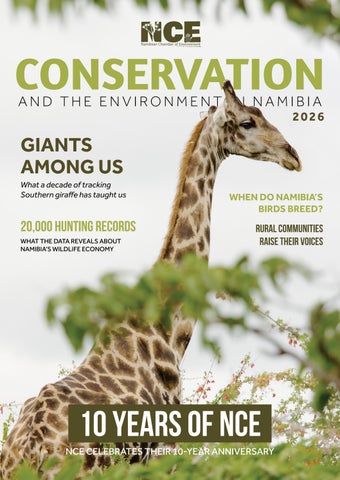
CONSERVATION AND THE ENVIRONMENT IN NAMIBIA
2026
GIANTS AMONG US What a decade of tracking Southern giraffe has taught us
20,000 HUNTING RECORDS WHAT THE DATA REVEALS ABOUT NAMIBIA’S WILDLIFE ECONOMY
WHEN DO NAMIBIA’S BIRDS BREED?
RURAL COMMUNITIES RAISE THEIR VOICES
10 YEARS OF NCE NCE CELEBRATES THEIR 10-YEAR ANNIVERSARY
CONSERVATION AND THE ENVIRONMENT IN NAMIBIA
2026
CONSERVATION AND THE ENVIRONMENT IN NAMIBIA 2023
T H E G R E AT E R E T O S H A C A R N I VO R E PROGRAMME THE STORY OF NAMIBIAN BUSH
TURNING PROBLEMS INTO OPPORTUNITIES
A TRIUMPH FOR
GIRAFFE C O N S E R VAT I O N I N NAMIBIA T H E N YA E N YA E PA N G O L I N P R O J E C T N A M I B I A’ S C L I M AT E
A N D T H E N E E D T O A D A PT T O A N U N C E R TA I N F U T U R E
PUBLISHING EDITORS Elzanne McCulloch elzanne@venture.com.na Gail Thomson gailsfelines@gmail.com PRODUCTION Liza Lottering liza@venture.com.na LAYOUT & DESIGN Richmond Ackah Jnr. design@venture.com.na Silas M. Nangolo silas@venture.com.na CUSTOMER SERVICE Bonn Nortjé bonn@venture.com.na PRINTERS John Meinert Printing, Windhoek The editorial content of Conservation and the Environment in Namibia is contributed by the Namibian Chamber of Environment (NCE), freelance journalists, employees of the Namibian Ministry of Environment, Forestry and Tourism (MEFT), and NGOs. The views expressed do not necessarily reflect the opinions or policies of the NCE or the publisher. Material published in this magazine may be used freely in the interests of promoting good conservation and sustainable development, provided that appropriate credit is given to the original source and due care is taken to avoid plagiarism.
Visit our website by scanning the QR code or visit: https://conservationnamibia.com
Conservation and the Environment in Namibia is published by Venture Publications Pty Ltd in Windhoek, Namibia www.venture.com.na
Tel: +264 81 285 7450, 5 Conradie Street, Windhoek PO Box 21593, Windhoek, Namibia
CONTENTS About Venture Media From the Publisher About NCE Foreword
2 3 4 10
Watching Giants Walk: What a decade of tracking Southern giraffe in Namibia has taught us Giraffe Conservation Foundation
12
Mistaken identity: The vulnerable reality of black-footed cats Martina Küsters & Alexander Sliwa (Black-footed Cat Working Group)
20
Learning from history: What can past El Niño years teach us? Cornelis van der Waal & Paul Berry (Ongava Research Centre) & Gail Thomson (NCE) Why are elephants in the Ugab River declining? Christin Winter (Elephant-Human Relations Aid)
Zambezi livestock farmers are being inspired to restore their rangelands Mareike Voigts & Vasco Samwaka (Namibia Nature Foundation) & Gail Thomson (NCE)
Superfood for Superkids: The promise of agroforestry with moringa trees Berthold Malyata (Namibia Nature Foundation) & Gail Thomson (NCE) 45 Years Young: Namibrand nature reserve celebrates formal recognition Nils Odendaal (NamibRand Nature Reserve)
88
30
92
38
Rural communities raising their voices: Democratising Namibia’s environmental impact assessment system Elia Mvula (Namibia Nature Foundation) & Gail Thomson (NCE) Cheetahs on the edge: Latest survey suggests declining numbers in Namibia Ruben Portas, Jörg Melzheimer & Bettina Wachter (Leibniz Institute for Zoo and Wildlife Research, Berlin) and Kenneth /Uiseb (Ministry of Environment, Forestry and Tourism) Who Speaks for Nature? Rethinking environmental laws in Namibia Willem Odendaal
54
Saving Namibia’s Succulents: The Hidden Conservation Work of the National Botanical Garden Leevi Nanyeni & Tulonga Kalipi (National Botanical Research Institute)
78
How Namibian seabird rangers are helping to conserve African penguins NAMCOB
46
Nurturing Guardians of the Kavango: Where Nature Becomes the Teacher Renate Jacobs
74
84
42
When do Namibia’s birds breed? Chris Brown, Peter Bridgeford, Steve Braine, Mark Paxton & Wilferd Versfeld
70
The Botanical Society of Namibia: 30 years of celebrating Namibia’s flora Botanical Society of Namibia & Gail Thomson
24
How Namibia is changing the future of cheetah conservation: Thirty-six years of science, innovation and hope Dr Laurie Marker, Dr Bruce Brewer, Dr Anne Schmidt-Küntzel & Dr Matti Nghikembua (Cheetah Conservation Fund)
What 20,000 Hunting Records Reveal About Namibia’s Wildlife Economy Alexander Chidakel (University of Florida)
Young scientists helping to chart a sustainable future for people and elephants in Kunene Morgan Hauptfleisch (Namibia Nature Foundation), Simiyandi Buiswalelo (University of Namibia), Gideon Haingura (North West University), Luca Feuerriegel, Jessica Tacey and Darragh Hare (Oxford University)
58
64
Recognising the Contribution of the Ju|’hoansi to Conservation in Khaudum National Park Dr Jennifer Hays (University of Tromsø, Norway), Dr Willem Odendaal (Human and Environment Law Programme – HELP Trust) & Andrew Botelle (Mamokobo Video & Research) From Following the Poacher to Following the Money Jo Tagg & Hassan Sesay
98
102
108
112
NCE Supports: Mine closure in Namibia Namibian Chamber of Environment
118
Leonard the Land Rover: A Desert Classic Reborn Elzanne McCulloch
124
CONSERVATION AND THE ENVIRONMENT IN NAMIBIA 2026
1
Madeleen Duvenhage
about venture media
Sharing stories that matter.
TELL, GROW, SHARE YOUR STORY WITH US IN 2021
That’s our mantra at Venture Media. Sharing stories, information and inspiration to an audience that understand and value why certain things matter. Why conservation, tourism, people & communities, businesses and ethics matter. How these elements interrelate and how we can bring about change, contribute to the world and support each other. Whether for an entire nation, an industry, a community, or even just an individual. We find, explore, discover, teach, showcase and share stories that matter.
www.venture.com.na
or email us at info@venture.com.na for a curated proposal.
In 2021, we're focussing on telling and sharing STORIES THAT MATTER across our various magazines and digital platforms. Join the journey and share your stories with audiences that understand and value why certain things matter. Why ethical business, conservation, tourism, people and communities matter. How these elements interrelate and how we can bring about change, contribute to the world and support each other. Whether for an entire nation, an industry, a community, or even just an individual.
WWW.VENTURE.COM.NA or email us at info@venture.com.na for a curated proposal
2
from the PUBLISHER
Elzanne McCulloch
Stories that matter. A future worth protecting.
A
t Venture Media, we have always believed in the power of stories. Not simply to inform or entertain, but to connect people, challenge perspectives, inspire conversations and create change. It is the philosophy behind everything we do: sharing stories that matter. And few stories matter more than those of our natural world, the people who protect it, and the relationship between conservation and the communities whose futures depend on it. This year’s edition of Conservation and the Environment in Namibia is particularly meaningful as we celebrate ten years of the Namibian Chamber of Environment (NCE). A decade of collaboration, research, advocacy and action. Ten years of bringing people and organisations together around a shared responsibility for Namibia’s environmental future. The stories in these pages demonstrate why that work matters. We discover what a decade of tracking Southern giraffe has taught us, explore 36 years of cheetah conservation research, and examine what 20,000 hunting records reveal about Namibia’s wildlife economy. These are stories of science, persistence and the importance of evidence in shaping conservation decisions. Beyond wildlife, we explore the bigger picture. From farmers restoring rangelands in the Zambezi to the protection of our indigenous plants and endangered African penguins, we see how environmental stewardship and human wellbeing are inseparable.
greater space in conservation conversations. Rural communities advocating for participation in environmental decision-making. The Ju|’hoansi and their contribution to conservation in Khaudum. Young scientists discovering their role in protecting our natural heritage. For me, this is where the true value of storytelling lies. In connecting science with society, challenges with solutions, and the remarkable work happening quietly in the field with the people who need to understand why it matters. Conservation cannot exist in isolation. It intersects with tourism, agriculture, industry, education and economic opportunity. Its success depends not only on protecting what we have, but on understanding how we can prosper alongside it. As publishers, we are privileged to provide a platform for these perspectives, to keep conversations alive and ensure that important work does not go unnoticed. My sincere thanks to the NCE, our editorial partner Gail Thomson, and every contributor who has helped bring this edition to life. Because the future of conservation will be shaped by what we collectively choose to value, understand and protect. These are Namibia’s stories. And they matter. Elzanne McCulloch Publisher | Venture Media
Perhaps most importantly, we hear voices that deserve
CONSERVATION AND THE ENVIRONMENT IN NAMIBIA 2026
3
Suné van Wyk
about Namibian Chamber of Environment The Namibian Chamber of Environment (NCE) is a membership-based and -driven umbrella organisation established as a voluntary association under Namibian Common Law to support and promote the interests of the environmental NGO sector and its work. The members constitute the Council – the highest decision-making organ of the NCE. The Council elects members to the Executive Committee at an AGM to oversee and give strategic direction to the work of the NCE Secretariat. The Secretariat (staff) of the NCE comprise a CEO and Co-Director. Only the CoDirector is employed full-time. The NCE currently has 74 full members – Namibian registered NGOs whose main business, or a significant portion of whose business, comprises involvement in and promotion of environmental matters in Namibia; and 14 associate members – individuals running environmental programmes and non-Namibian NGOs likewise involved in local to national environmental matters in Namibia. A list of members follows. For more information on each member, their contact details and website link, please go to the NCE website at www.n-c-e.org/members.
Established in 2016, the NCE is celebrating its 10-year anniversary this year. Here, we highlight some of the main achievements during this period, which can also be found in our 2016-2026 Impact Report. THE NCE HAS FOUR ASPIRATIONAL OBJECTIVES AND FIVE OPERATIONAL OBJECTIVES: Aspirational Objectives • Conserve the natural environment • Protect indigenous biodiversity and endangered species • Promote best environmental practices • Support efforts to prevent and reduce environmental degradation and pollution Operational Objectives • Represent the environmental interests of members • Act as a consultative forum for members • Engage with policy- and lawmakers to improve environmental policy and its implementation • Build environmental skills in young Namibians • Support and advise members on environmental matters and facilitate access to environmental information
4
The NCE espouses the following key values: • To uphold the fundamental rights and freedoms entrenched in Namibia’s Constitution and laws, including the principles of sustainable use, protection of biodiversity and inter-generational equity; • To promote compliance with, uphold and share environmental best practice, recognising that the Earth’s resources are finite, and that human health and wellbeing are inextricably linked to environmental health; • To recognise that environmental best practice is best promoted by implementing the following seven principles: sustainability, polluter pays, precautionary equity, effectiveness and efficiency, human rights and participation; • To develop skills, expertise and passion in young Namibians on environmental issues; • To ensure political and ideological neutrality, be evidencebased and counter fake information; and • To promote inclusiveness and to fiercely and fearlessly reject any form of discrimination.
THE NCE HAS DEVELOPED EIGHT STRATEGIC PROGRAMME AREAS, AND ACHIEVED THE FOLLOWING DURING THE LAST 10 YEARS: 1. Support to Members and the sector The NCE exists to support its 88 members (74 full, and 14 associate) and the conservation, environment and sustainable development sectors by channelling investments into areas and issues that need it most. During the last 10 years, our support has included access to office facilities, capacity building, environmental information, advocacy, policy research, registration and research permit facilitation, and aircraft and 4x4 vehicles for our members’ use at cost price. NCE does not compete with its member organisations for funding, nor does it implement projects in sectors where our members are already active. Instead, we play supporting and facilitative roles to bring our members together to address common issues. Where gaps have been identified, we have assisted our existing members to fill them, helped members to restructure their organisation, established new organisations, or national networks to coordinate the efforts of existing organisations (see logos below of some of these organisations).
Membership growth over time
Rangeland monitoring
Suné van Wyk
2. National facilitation By joining forces, our members can scale their efforts to the national level. The NCE has established four topical working groups that bring together NCE members and relevant government departments to address urgent issues that require extensive collaboration. These groups – covering carnivores, invasive alien plants, pangolins and lead poisoning – produce joint action plans, publications, and activities that address nationwide threats.
EIA Tracker
Key to our efforts is to promote information sharing among our members and with the Namibian public. The NCE has published five books that fill knowledge gaps on groups of species, ecosystems, socio-economic matters, and industry best practices. To promote knowledge sharing within the sector, the NCE has hosted and facilitated symposia and workshops on topical and priority issues. Online platforms that track rangeland condition during the rainy season and the status of Environmental Impact Assessments are among the public information services supported by the NCE.
Examples of published works
CONSERVATION AND THE ENVIRONMENT IN NAMIBIA 2026
5
3. Training and mentoring young Namibians The future of Namibia depends on the decisions and directions that our young people choose to take. NCE reaches schoolchildren through to early career professionals through education, inspiration, and financial support. Over the past nine academic years (2018-2026), the NCE has provided 297 post-graduate bursaries in the broad environmental field and 52 internships, mainly for NCE bursary-holders, that involve close mentoring by experienced environmental professionals. The aim is to build the capacity and confidence of young Namibians to become the environmental leaders of tomorrow. In 2024, NCE supported the establishment of the Namibian Youth Chamber of Environment, which seeks to inspire and equip young (18-35 years) Namibians with the confidence and skills to advocate for the environment during their studies, within their communities and in their professional settings. NYCE was formally established during their first AGM held in June 2024. They use social media, in-person events (clean-up campaigns and tree-planting) and regular informative webinars to reach young people Youth Chamber interested in the environment across the country. Membership in early 2026 stood at 370 individuals and eight youth organisations, with membership structures in 9 370 Individuals regions of Namibia. The School Environmental Clubs of Namibia was established in April 2024 by a high school student, Inomuinjo Kapimbi, to encourage his classmates to look after the environment. With NCE’s support, this initiative has expanded to a network of over 60 environmental clubs in the Khomas and Erongo Regions. Since 2022, the NCE has supported the publication of Pako Kids Magazine, which is widely distributed to reach schoolchildren in Namibia.
Cumulative number of students supported
Home regions of the recipients
17 Leaders 9 Regions 8 Youth Organisations
Regions where NYCE members come from:
This approach is often misunderstood in Western industrialised countries, which think of the environment as being just the green environment. The NCE therefore produced a series of educational films aimed at Western audiences to explain the conservation role of the sustainable use of wildlife, known as the “wildlife economy”. Similarly, NCE worked with the mining sector to develop mining environmental best practices, funded a thorough study on urban informal settlements in Namibia, and has produced reports and articles relating to the energy sector. The NCE produced newsletters relating to drought relief (2019) and Environmental Impact Assessments (2026) to inform relevant stakeholders at the nexus of the environment, development and social sectors.
6
Read more:
4. Environmental policy research When we talk about the “environment”, we mean the interrelationship of ecological, social and economic aspects – essentially sustainable development. Rather than promoting strict environmental protectionism, the NCE recognises the need for natural resources to support socioeconomic growth. The NCE provides targeted information and data that inform policy and practice at the national level.
Watch here:
Visit website:
Mining Environmental Best Practices
5. Grants making An online grant application process allows NCE members to apply for funding. To date, 270 grants have been awarded to the value of over N$ 36 million, with 90% going to NCE members. The focal areas for NCE grants include combating wildlife crime through aerial support (establishing EcoWings) and the Pangolin Rewards scheme to incentivise anonymous tip-offs leading to the arrest of pangolin poachers and traffickers. Another key focus is environmental education and research initiatives that reach schoolchildren through to university graduates.
Learn more about EcoWings:
Plant and animal research and conservation grants include studies on seabirds, carnivores, giraffes, crocodiles, fish, wildlife surveys, succulents, and other plants. Ecosystem grants include projects focusing on: alien invasives, landscapes, human-wildlife conflict mitigation, and powerline impacts. Finally, grants have funded promising nature-based enterprises such as the black soldier fly farm that turns organic waste into fertiliser and animal food, and the OFULA project that is researching the use of succulents for livestock fodder.
Education Partners
6. Environmental advocacy The NCE addresses national threats to Namibia’s environment and natural resources by first attempting to work constructively with the relevant government or other entity but, if necessary, through public exposure. The NCE provides support or critique of projects, policies or decisions on a case-by-case basis. We consistently advocate for a rational, evidence-based approach that minimises negative impacts and maximises benefits for Namibia. The NCE has addressed the issue of Chinese incentivised poaching and illegal trade in specially protected wildlife, the over-fishing of pilchards and other species in Namibian waters, illegal and unsustainable timber harvesting and export, and the need to reduce and eliminate single-use plastic from Namibia’s environment.
Elzanne McCulloch
In 2024, it published a position paper on the proposed hydrogen developments for the Tsau ||Khaeb (Sperrgebiet) National Park, explaining that this product is correctly termed red hydrogen due to the major potential impacts on biodiversity. The NCE also produced an opinion on the in-situ leach uranium mining in the transboundary Stampriet aquifer in the Kalahari. Our position is simple – you don’t pollute and contaminate one of our most important groundwater resources for years and decades for short-term uranium mining benefits. This would put at risk the entire economy of the Kalahari, and many sectors beyond this aquifer. In support of the government’s policies, the NCE has produced a series of articles in the media to address the threat that hunting trophy import bans pose to our wildlife economy.
Hydrogen position paper
Threats to the Succulent Karoo
Article on leach mining
In partnership with SAUMA
CONSERVATION AND THE ENVIRONMENT IN NAMIBIA 2026
7
7. Fundraising The NCE’s approach to fundraising follows principles in the King IV and V Reports on Corporate Governance. Part of this approach is to provide a platform for multiple companies to co-invest in all of NCE’s programmes. Our corporate donors are more interested in outcomes than in bureaucratic processes and box-ticking. NCE’s agenda is not controlled by donors, but driven by the membership. All initiatives and position statements are thus independent of special donor interests. Emphasis is placed on legacy initiatives that have tangible outcomes. Core funding for the NCE is currently provided by B2Gold Namibia. This means that all additional funding received from other sponsors is invested directly into environmental projects and programmes – there are no overhead costs. The NCE focuses on corporate support and avoids targeting funding sources that may compete with its members. The corporate sector assists with fundraising by approaching their clients, partners and networks. By setting up new networks and organisations, NCE has used its seed funding to generate greater donor interest. For every N$1 that NCE invested from its funds, N$71 has been leveraged from other donors to support the sector.
Proportions of sponsorships received
Our Sponsors
8. Environmental information Information and transparency are critical elements of developing a strong civil society and engaged citizens. NCE has therefore established free-to-access platforms for scientists, practitioners, policymakers, and the public. In partnership with Paratus Telecom, NCE hosts and supports the development of Namibia’s Environmental Information Service (EIS at www.the-eis.com), a one-stop shop for all environmental information on Namibia. The EIS comprises an e-library with nearly 32,000 reports, publications, maps, data sets, theses, etc., which are searchable and downloadable. Included are all Environmental Impact Assessment (EIA) reports since 2020 (over 6,700), over 800 wildlife survey reports and counts (some going back to 1926), and wildlife crime reports (over 4,500). It provides an Atlasing platform for citizen science data collection that currently covers mammals, reptiles, amphibians, butterflies, plants (both indigenous and invasive alien) and archaeology. Records are conveniently entered via a free cell phone App.
8
The NCE has also established a free, open-access scientific e-journal – Namibian Journal of Environment – now in its tenth year (www.nje.org.na). NJE was recently listed on the Directory of Open Access Journals (DOAJ). The NCE and Venture Media’s environmental website “Conservation Namibia” (www.conservationnamibia.com) tells Namibia’s conservation stories via blogs, factsheets, video and articles from this magazine. The NCE partners with the NYCE to inform the public and youth on topical environmental issues on its website (www.n-c-e.org), Facebook page, LinkedIn profile, Instagram page (NYCE) and WhatsApp groups (NYCE). The Namibian Environment and Wildlife Society (NEWS), with support from the NCE, maintains the EIA Tracker (https://eia-tracker.org.na/). This transparent, userfriendly system presents and maintains information on all development projects that require EIAs, with a current database of 3,086 proposed and existing projects.
EXECUTIVE COMMITTEE
Mr Charles Loots (Chairperson)
Ms Maria Johannes
Mr John Roos
Mr Mendes Vinte
Ms Ottilie Fillipus
Mr Stephan Bezuidenhout
Dr Malan Lindeque
Ms Des-Rose Dr Chris Brown Ms Henriette Engelbrecht Krohne
MEMBERS Full members A. Speiser Environmental Consultants cc African Conservation Services cc Africat Foundation Aligned Sustainability & Environmental Consultants (ASEC) Ameib Scientific Station Anchor Environmental Consultants (Pty) Ltd Ashby Associates cc Beekeeping Association of Namibia (BAN) Biodiversity Research Centre, NUST (BRC-NUST) Botanical Society of Namibia Brown Hyena Research Project Trust Fund Bwabwata Living Museum Canyon Nature Trust Cheetah Conservation Fund (CCF) Conservancy Association of Namibia (CANAM) Desert Lion Conservation Trust Development Workshop Namibia (DWN) Environmental Assessment Professionals Association of Namibia (EAPAN) Earthlife Namibia Eco Awards Namibia Eco-logic Environmental Management Consultancy cc Ecological Logistics EduVentures Elephant Human Relations Aid (EHRA) Environmental Compliance Consultancy (ECC) EnviroScience Felines Communication and Conservation Consultants cc Giraffe Conservation Foundation (GCF) Gobabeb Research and Training Centre Greenspace Integrated Rural Development and Nature Conservation (IRDNC) JARO Consultancy Knight Piesold Consulting Kunene Conservation Kwando Carnivore Project LM Environmental Consulting Museums Association of Namibia
N/a’an ku sê Foundation Namib Desert Environmental Education Trust (NaDEET) Namibia Archaeological Trust Namibia Biomass Industry Group (N-BiG) Namibia Bird Club Namibia Nature Foundation (NNF) Namibia Professional Hunting Association (NAPHA) Namibia Scientific Society (NSS) Namibian Association of CBNRM Support Organisations (NACSO) Namibian Environment and Wildlife Society (NEWS) Namibian Hydrogeological Association Namibian Lion Trust NamibRand Nature Reserve Nyae Nyae Development Foundation of Namibia (NNDFN) Ocean Conservation Namibia Omba Arts Trust Ongava Game Reserve / Research Centre Orange River-Karoo Conservation Area (ORKCA) Otjikoto Environmental and Education Trust Pangolin Conservation and Research Foundation ProNamib Nature Reserve Progress Namibia TAS cc Rare and Endangered Species Trust (REST) Rent-A-Drum Research and Information Services of Namibia (RAISON) Rooikat Trust Save The Rhino Trust (SRT) Scientific Society Swakopmund Seeis Conservancy SLR Environmental Consulting Southern African Institute of Environmental Assessment (SAIEA) Stampriet Aquifer Uranium Mining Association (SAUMA) SunCycles Namibia Sustainable Solutions Trust Tourism Supporting Conservation Trust (TOSCO) Twin Hills Trust Venture Media
Associate members Bell, Maria A Black-footed Cat Research Project Namibia Bockmühl, Frank Braby, Justine Desert Elephant Conservation Herta Kolberg Botanical Consulting Irish, Dr John Leibniz Institute for Zoo and Wildlife Research
Lukubwe, Dr Michael S Namibia Animal Rehabilitation, Research and Education Centre (NARREC) Seabirds and Marine Ecosystems Programme Sea Search Research and Conservation (Namibia Dolphin Project) Strohbach, Dr Ben Wild Bird Rescue
CONSERVATION AND THE ENVIRONMENT IN NAMIBIA 2026
9
B2Gold Namibia and Namibian Chamber of Environment celebrate a decade of partnership
Suné van Wyk
Foreword
Anchoring conservation
10
T
he conservation funding landscape often resembles a treacherous obstacle course, with hidden dangers that non-governmental organisations (NGOs) must navigate successfully to survive. Donor expectations and NGO agendas don’t always align, and competition between donors for recognition and NGOs for funding can turn conservation into a race more about reputation than on-theground impact. The Namibian Chamber of Environment’s (NCE) partnership with B2Gold Namibia, our anchor sponsor since 2016, contrasts with most donor-NGO relationships. From the beginning, B2Gold approached its support as an investment in an independent institution. NCE therefore has its own identity and vision, which it can implement without being branded as one company’s charitable arm. NCE’s independence from its anchor sponsor is a key ingredient to our success as a representative of the environmental sector. NCE is guided solely by its member organisations (the NCE Council), which elect an Executive Committee (ExCo) that oversees a small staff contingent. B2Gold has one representative on this nine-member ExCo. A further benefit of working with the private sector is the focus on tangible outcomes, efficient reporting and an aversion to unnecessary bureaucracy. The reporting requirements of most conventional bilateral and multilateral donors demand huge amounts of unnecessary paperwork that ties the best NGO staff to their offices rather than to a focus on implementation, innovation, and productivity. With its small staff of two, the NCE has been able to have an impact far beyond its size and budget, largely because it is not bogged down by donor reporting (see pp. 4-9). Reports for the year are presented at Annual General Meetings (AGMs), which provide the members a chance to critique the work and suggest new priority areas for the coming year. NCE is thus driven by its member organisations, rather than by its sponsor’s agenda. At no stage has B2Gold requested NCE to use its voice for its own benefit or that of the mining sector. Nor has it decided which projects NCE would fund or which advocacy topics it would address. One of the constraints on conservation organisations is the lack of a stable administrative budget. Many NGOs therefore struggle to retain core staff and office facilities between projects. At the same time, project-specific donors often limit how much of their donation can go to these necessary expenses. NCE’s role in the environmental sector requires strong administration to succeed. B2Gold’s annual core funding of approximately N$1 million plus two staff salaries is therefore critical to our long-term sustainability. With NCE’s operational costs covered, other donors are assured that 100% of their contributions go towards implementing programmes. B2Gold has also contributed a further N$2 million per year to support environmental
projects. NCE members and the Namibian public benefit directly from these funds through grants, scholarships, advocacy, research and environmental information services that NCE provides or funds (see pp. 4-9 for details). B2Gold’s investment strategy has further unlocked opportunities for NCE to grow its donor base. Other corporates have invested in NCE and have received due recognition alongside B2Gold. Further, companies that work with B2Gold (e.g., in logistics or supply) have been encouraged to contribute to this larger cause. These donors are following one of the principles in the King IV Report on Corporate Governance: multiple companies co-investing in a common fund can scale their impact beyond what they can do individually. B2Gold facilitated an introduction between NCE and the Chamber of Mines, resulting in a productive partnership that included publishing the Environmental Principles for Mining in Namibia: Best Practice Guide, as well as co-investment by mining companies in several sustainable development offset projects. On its own mine, B2Gold has allowed NCE to review the environmental management plan and provide extensive input on its mine closure plan. This led to a world-leading cradleto-cradle concept: initiating an approach to socio-economic closure (not just bio-physical closure) and developing new industries to take over from the mine, leaving the mining area with diversified economic activities and greater economic productivity than before mining started (see pp. 114-119 for more details). Together, NCE and B2Gold have broken new territory for responsible mining globally. This 10-year partnership would not be possible without visionary private sector leadership. B2Gold’s former Managing Director, the late Mark Dawe, shared Dr Chris Brown’s vision for NCE, and together they set this partnership in motion. The current Managing Director of B2Gold, John Roos, has taken up the mantle by embracing this partnership with the same dedication and foresight. The NCE-B2Gold partnership model has worked in Namibia’s environment sector, and there is no reason it cannot work in other sectors and countries too. First, key people within the NGO sector and private sector partners need a shared vision and mutual trust. Next, the organisation must establish a governance structure to maintain independence, ongoing consultation, and transparency, ensuring it remains dynamic and responsive and prioritises real environmental issues. Third, the umbrella body must add significant tangible value to the sector and not compete with its members on project implementation or fundraising. Finally, both parties need to commit to a stable, long-term agreement to keep administrative overheads minimal but adequately covered. Once these core ingredients are in place, the partnership can flourish. Yours in Conservation, Henriette Kröhne, Chris Brown & Gail Thomson
CONSERVATION AND THE ENVIRONMENT IN NAMIBIA 2026
11
12
WATCHING GIANTS WALK What a decade of tracking Southern giraffe in Namibia has taught us Text and photos by Giraffe Conservation Foundation
T
hey move like slow amber rivers across the Namibian landscape – unhurried, deliberate, unmistakable. But despite their size, giraffes have long been among Africa’s least understood large mammals. We knew they were there. We didn’t know how many there were, where they went, how far they roamed, or what the land meant to them across the full arc of a life. That is changing. And Namibia is where much of that change is taking shape. For over two and a half decades, the Giraffe Conservation Foundation (GCF) has fitted GPS tracking devices to all four giraffe species across Africa as part of our Twiga Tracker initiative, the largest giraffe tracking programme in Africa. Namibia sits at the heart of this effort – not merely as a field site, but as the proving ground where technology is tested, challenged, and continually refined. Every new generation of GCF’s giraffe tracking technology is field-tested here first: on real animals, across vast and demanding landscapes, by the people who stake critical management decisions on the data these units produce.
CALIBRATING NEW TRACKING DEVICES IN NAMIBIA One cannot use a simple tracking collar for a giraffe, as you would for a lion or elephant. The giraffe’s immense height, unique head shape, and extraordinary, tapered neck require devices uniquely designed for them. Getting a GPS unit to sit reliably, transmit consistently, survive the physical demands of daily life, and last long enough to produce scientifically meaningful conservation data is a genuine engineering problem. GCF’s answer to that problem has been shaped, tested, and refined over decades right here in Namibia. Operating from our hub in Windhoek, GCF has worked directly with tag manufacturers to brainstorm and adapt designs specifically for giraffe. The communal areas of northwest Namibia and the Etosha Heights Private Game Reserve serve as our proving grounds. After many design revisions and moving from large neck collars similar to elephant collars to head harnesses and smaller, solar-powered units attached to their ossicones (horn-like structures on a giraffe’s head), we are now using solar-powered tail and ear tags. Only after field-testing on Namibia’s Southern giraffe are these tracking units rolled out to GCF’s network of more than 100 partner organisations across Africa.
CONSERVATION AND THE ENVIRONMENT IN NAMIBIA 2026
13
hile GCF does not engineer the internal circuitry, our team W is on the front line fitting these units in the field. Countless fireside discussions and office brainstorming sessions have sparked new placement and fitment techniques. Our team’s field observations in Namibia directly inform both device design and how GCF interprets tracking data across the entire continent. By watching tracked giraffes in the field, we have learned what a sudden cluster of locations signifies, how terrain impacts GPS fix quality, or how movement signatures differ when an animal is healthy versus stressed. Through this constant cycle of testing and learning, Namibia is more than a test bed. It is the calibration environment for our entire continent-wide programme, and a living lab that strengthens wildlife conservation far beyond our borders.
THE LONGEST WATCH What makes GCF’s tracking dataset truly remarkable isn’t just a single breakthrough discovery - it is its unprecedented duration. GCF holds the world’s largest GPS satellite database and the longest continuous tracking records for wild giraffes in history. In northwest Namibia, for instance, a single unit actively tracked a female Southern giraffe named Wrinkle for more than six years. Across the broader Namibia dataset, 182 Southern giraffes have been monitored for a combined total of over 300 animal years. Across Africa, GCF has tracked 767 giraffes representing all four species, accumulating nearly 800 years of data. This scale of movement and habitat information simply has not existed until now. Those numbers matter because giraffes live long lives. Females can live for over 30 years in the wild and males somewhat less, though the more we study them, the more we learn. Understanding how an individual animal uses space, not just over a season, but across years as it ages, as rainfall patterns shift, and as social dynamics change, requires following them for long time periods. Yet most wildlife tracking studies last only a year or two. GCF’s records in Namibia push far beyond that, revealing spatial patterns that remain invisible on shorter timescales.
GCF holds the world’s largest GPS satellite database and the longest continuous tracking records for wild giraffes in history. Map of Namibia showing two key Angolan giraffe deployment sites — Etosha Heights Private Reserve and northwest Namibia (Kunene Region).
14
hat does a decade of data show? Some findings confirm W what GCF’s team long suspected. Southern giraffes in Namibia’s northwest cover an average home range of 700 km² – considerably larger than populations in more productive savannah environments, reflecting the sparse, patchy vegetation of their semi-arid home. Yet they are not wandering aimlessly. They regularly visit specific resource patches, key tree species, connecting river systems, and particular drainage lines – even apparently using rocky outcrops as landmarks in their movement decisions. Our findings also reveal that no two giraffes are quite the same. While some individuals roam far afield across vast
distances, others remain within much tighter ranges, utilising the habitat and seasonal resources in entirely different ways. FROM TRACKS TO LIVES: THE DEMOGRAPHY CONNECTION GPS data tells you where an animal is. It does not, on its own, tell you whether a population is growing or shrinking, what threats it faces, or who is who and friends with whom. For that, you need targeted field-based monitoring. In Namibia, GCF runs the world’s longest-running demographic study of giraffes in Africa. This effort integrates our tracking dataset as a foundational input, combining GPS locational history with regular field surveys and individual identification. Powered by the citizen science platform GiraffeSpotter, which uses pattern-recognition algorithms to identify individuals from photographs of their unique coat markings, the study is building new survival and recruitment estimates for tracked individuals and their social associates. This represents a major first for Southern giraffe. This is the kind of work that takes years to produce results robust enough to act on, and the longevity of GCF’s tracking programme in Namibia is precisely what makes it possible. The implications reach far beyond Namibia’s borders. Demographic parameters derived from well-studied populations are frequently used to model population viability across a species’ entire range, including in areas where long-term data do not yet exist. By virtue of being among the most thoroughly tracked on the continent, Namibia’s Southern giraffes are directly expanding our understanding of all giraffe species across Africa.
CONSERVATION AND THE ENVIRONMENT IN NAMIBIA 2026
15
A GiraffeSpotter individual ID panel – a grid of giraffe photographs with pattern-matching overlay, illustrating how the platform links physical re-sightings to the GPS-tracked individuals FOUR SPECIES, NOT ONE: WHAT NAMIBIA’S SOUTHERN GIRAFFE REVEAL ABOUT THE BIGGER PICTURE For centuries, science recognised just one giraffe species: Giraffa camelopardalis, divided into a patchwork of subspecies defined largely by coat pattern and geography. That picture has now been substantially revised, driven largely by GCF’s targeted efforts. Extensive studies on giraffe genetics, head shape and movement patterns have led to the conclusion that there are four species of giraffe rather than one. This has major implications for how populations are managed, prioritised, and conserved across the continent. For Namibia, GCF’s detailed datasets of numerous giraffe genomes reveal that almost all giraffes in the country – with the exception of Bwabwata National Park – are Angolan giraffe, a subspecies of the Southern giraffe. This subspecies derives its name from the country where it was first described, even though few remain in Angola (a situation GCF and its partners are working hard to remedy through reintroductions).
Masai giraffe Giraffa tippelskirchi
GIRAFFE CONSERVATION FOUNDATION
16
Northern giraffe Giraffa camelopardalis
Reticulated giraffe Giraffa reticulata
Southern giraffe Giraffa giraffa
©2023 GCF
20
Southern giraffe species (and subspecies) range map for southern Africa, highlighting Angolan giraffe distribution in Namibia.
This is far more than a taxonomic footnote. With a population estimated at just over 13,700 individuals, Namibia holds the largest and most significant Angolan giraffe population in the world – representing a staggering 97% of the total subspecies. This distinction carries an immense conservation responsibility. Because many genetic samples were collected directly from GPS-tagged individuals here, we know the genetic health of this population matters for the whole subspecies. It also means that translocation decisions, moving animals between reserves or across borders for conservation reinforcement or population management, must be made with strict genetic provenance in mind to protect biological diversity. Mixing lineages that have been genetically distinct for a hundred thousand years or more could dilute the gene pool, reduce biodiversity, and eliminate adaptive traits that allow them to survive in that area. Taken together, these multiple streams of data give Namibia’s wildlife managers a far more complete picture than any single approach could provide alone, ensuring every decision safeguards the true heritage of the species.
CONSERVATION AND THE ENVIRONMENT IN NAMIBIA 2026
17
A PLATFORM BUILT FOR THE LONG GAME The GCF Twiga Tracker initiative does not run on enthusiasm alone. Behind every GPS fix transmitted from a unit on a giraffe moving through the Namibian bush is a robust infrastructure of data management, quality control, partner coordination, and analytical capacity – built and continually expanded by GCF’s conservation team. Data from Namibia’s tracking deployments flows through EarthRanger, where it is validated, visualised, and made accessible to partners and platforms. This technical infrastructure transforms raw locational data into targeted analysis, allowing GCF’s lean team, working across 21 countries, to maintain scientific rigour at scale.
To fit a GPS tracker to a giraffe, the animal has to be chemically immobilised, and physically captured and restrained. Once the unit has been securely fitted to the tail, the giraffe is safely released and their movements can now be monitored remotely.
18
he research and development behind the tags is T constantly evolving. New generations of tracking devices are in regular development, improving battery longevity and data transmission frequency, along with advanced sensor capabilities. Integrated accelerometers and environmental sensors will soon allow for real-time behavioural inference directly from the device – revealing not just location, but activity state, social proximity, and potentially stress indicators derived from movement signatures. Namibia will remain the primary proving ground for these advancements and for many other critical giraffe conservation efforts. The landscape is demanding enough to thoroughly stress-test equipment, whilst the local giraffe population is well-known enough to interpret the incoming data appropriately. Crucially, partnerships with government authorities, private landowners, and communal conservancies, built over decades of collaborative fieldwork, provide the access and trust that long-term science requires.
Total giraffes tracked in Namibia Longest giraffe deployment Longest giraffe deployment in Namibia
1,035.8
Total giraffe tracking years
517.1
Total giraffe tracking years in Namibia
YEARS
YEARS
The Giraffe Conservation Foundation (GCF) is a Namibia-based NGO dedicated to conserving all four species of giraffe in Africa. GCF is the only NGO in the world that concentrates solely on the conservation and management of giraffes in the wild throughout Africa. GCF’s conservation technology programme supports partners across 21 African countries with tracking, individual identification, and data management tools.
Total giraffes tracked
YEARS
756 184 6.6 6.6
YEARS
THE GOAL REMAINS THE SAME While technology is an ever-evolving tool to help us understand animals better, the goal never changes: to protect them more effectively. Wrinkle - the Angolan giraffe carrying a GPS unit for over six years in northwest Namibia – has a movement history, home range, and network of places to which she faithfully returns. She has survived droughts and floods, predation attempts, and increasing human pressures. This kind of continuously accumulated knowledge about a specific animal in a specific landscape over many years elevates GCF’s tracking programme to a new level of monitoring and conservation in Africa. Namibia’s Southern giraffes are sharing insights into their lives that we could not have uncovered any other way. After decades in the field, we are still listening.
4,125,413 Total GPS fixes GPS fixes 2,002,810 Total in Namibia
43
Number of giraffes tracked in Namibia through GPS / EarthRanger
CONSERVATION AND THE ENVIRONMENT IN NAMIBIA 2026
19
Alexander Sliwa
MISTAKEN IDENTITY
the vulnerable reality of black-footed cats Text and photos by Martina Küsters & Alexander Sliwa (Black-footed Cat Working Group)
H
ave you ever seen a black-footed cat? If you think you have – but were unable to verify your sighting with an expert – there is a good chance that you’re wrong! Africa’s smallest wildcat species is very often confused with its bigger, more common cousin – the African wildcat. Sometimes, it may even be mistaken for domestic cats with exotic-looking markings. Why does it matter if we misidentify black-footed cats? Knowing where a species occurs is critical for estimating how many there are, and both pieces of information guide conservation action. With the rise of citizen science facilitated through platforms like iNaturalist and Namibia’s Atlasing tool, recorders can identify species more accurately, and researchers can find new areas where their study species occurs. These wonderful new tools
20
are, however, of limited use if the citizens who report their sightings are wrong about what they saw. In the case of black-footed cats, their various common names may add to the confusion. The soles of their feet are indeed black, but so are the soles of the African wildcat and some domestic cat breeds. While their other English common name – small-spotted cat – is suitably descriptive of the prominent black spots on their body, servals, genets, young African wildcats and some domestic cats also have spots. Adult African wildcats, by contrast, have a few pale vertical stripes. In Afrikaans, the name miershooptier describes typical black-footed cat behaviour (they often use holes in termite mounds as dens), while dikkop kat refers to their looks (their heads, particularly those of adult males, appear
quite large relative to their bodies). Yet sometimes other wild cats, like the serval, are nicknamed tier (tiger), which is again not so helpful. The holy grail for records from citizen scientists is thus a clear photograph or video footage that is easily identifiable, but such records are rare. In reality, if you ever see a live black-footed cat, the sighting is likely to be fleeting, far away, or at night, making good photos or videos (especially using mobile phones) nearly impossible. As researchers, we often rely on detailed descriptions of reported sightings, linked with habitat information, to determine which species was sighted and whether to include it in our black-footed cat database. To date, we have fewer than 80 verified records of black-footed cats in Namibia. Besides rare, verifiable sightings of these tiny cats, one might think camera trap studies would be an excellent source of records for our database. Unfortunately, camera trap surveys aimed at other species are not effective at detecting black-footed cats because of their low population density and cryptic, nocturnal habits. Unlike studies of large cats like leopards and cheetahs, a systematic camera
trap survey for black-footed cats that confirms its presence and produces reliable population density estimates will not work. Another source of records we can use is photos of dead cats. While these are 100% verifiable (with an image), they also serve as sad reminders of the threats these little cats face. Cats may be killed by dogs or shot during nighttime predator control activities (usually unintentionally), or they may be caught in gin traps or cage traps set for other species. If they have not been in the cage trap for too long, they may still be healthy enough for immediate release. Gin traps are usually deadly, as the damage done to the paw or leg is often too severe to survive. Other records of mortalities include roadkill, although this represents only a small portion of our records. As part of the Black-footed Cat Working Group (BFCWG), we use all of the above sources of information to determine the current state of the species. Conservation status requires more than current data, however, as the International Union for the Conservation of Nature (IUCN) Red List also indicates population trends over time.
CONSERVATION AND THE ENVIRONMENT IN NAMIBIA 2026
21
Pollution is not monitored anywhere.
22
istorical distribution records are rare and unreliable, H yet they form part of the species research history. Old museum records and reports of carnivore occurrence are not easy to verify and are no longer included in distribution analysis. Sources as early as 1931 state that the species is rare even where it occurs and that its presence is difficult to confirm. Despite these difficulties, the BFCWG updated the IUCN Red List assessment in 2026 by collating 33 years of long-term distribution, population and ecological data from populations in the Central Karoo, South Africa, and southern Namibia. These assessments require verified species occurrence data, habitat, ecology, threats (including causes of mortality), and existing conservation measures. Data on the cats’ habitat and ecology come from our long-term studies in South Africa (running since 1992 near Kimberley and De Aar in the Northern Cape) and more recent work in Namibia since 2020 (study site near Grünau).
e estimate as few as 6,188 mature individuals left in the W wild, with no subpopulation exceeding 1,000 individuals and a declining population trend. The species is endemic to southern Africa, occurring only in Botswana, Namibia and South Africa. Within those countries, it lives in arid grasslands, dwarf shrub, and savannah habitats of the Nama Karoo, Kalahari and Highveld biomes. The updated map (see below) shows a patchy distribution and a 63.3% decrease in area when compared to the previous IUCN Red List range, published in 2016. Although our latest estimate is lower than the previous one from 2016, we do not think this is necessarily due to habitat loss. It is more likely a better presentation of where the species occurs and the size of subpopulations. The species therefore remains Vulnerable on the IUCN Red List.
Artisanal mining for gold close to the Cubango River
IUCN range maps The status of this little cat remains precarious – it has the most restricted distribution of any endemic African wild cat species, and much of this area lies outside formally protected areas on farmland. It certainly requires more conservation attention than its ‘cousin’, the African wildcat, which is widespread and relatively common (listed as Least Concern on the Red List). To improve the quality of data from citizen science platforms, the BFCWG has created posters and social media content to clarify key differences between blackfooted cats and African wildcats, and why correct identification is important. With increased awareness, we hope to improve further the quality of our data on blackfooted cat distribution and the threats they face across their range.
We invite citizen scientists, farmers, tour guides and researchers to report sightings and records of blackfooted cats by email: bfootedcat@gmail.com Please provide photos or videos so we can verify the record. If that is not possible, record as many details as possible about what the cat looked like, its habitat and behaviour. With your help, we can further improve our database and determine how best to conserve Africa’s smallest cat.
CONSERVATION AND THE ENVIRONMENT IN NAMIBIA 2026
23
ZAMBEZI LIVESTOCK FARMERS ARE BEING INSPIRED TO RESTORE THEIR RANGELANDS
Christin Winter
Text and photos by Mareike Voigts, Vasco Samwaka (both Namibia Nature Foundation) and Gail Thomson
24
L
ivestock farming in Namibia’s Zambezi Region can be a difficult and risky business. Disease prevalence, predation by large carnivores and crocodiles, and increasingly degraded rangelands limit livestock productivity. Zambezi farmers have limited access to formal markets for their livestock, which further hinders their ability to use cattle as a path out of poverty. Technical fixes such as improved vaccination or predator-proof livestock kraals (night-time enclosures) offer partial solutions to these challenges, but something more fundamental needs to change to make a lasting difference across the whole landscape. According to Jacques van Rooyen of REHerd Africa, the first step on the journey towards restoration starts with hope. When a situation seems too difficult to overcome or too complex to understand fully, we tend to lose hope that we can do anything to change it. Hopelessness often results in a lack of motivation to change our behaviour or expend effort – what is the point if nothing we do will make a difference? Livestock farming in the Zambezi Region seems to be in such a situation, and it is therefore not surprising that many farmers feel uninspired and hopeless about changing the status quo. Yet this is starting to change. Several groups of farmers in southern Africa have found inspiration and hope in a holistic rangeland management model known as the REHerd model of strategic herding and kraaling. REHerd Africa employs these holistic principles to guide livestockowning communities through a process of generating hope, improving herding practices, healing the land, animals and people, and finally harvesting – improved livelihoods generated from thriving ecosystems. They have employed this model in five African countries as a technical partner for communities and the non-government organisations (NGOs) that support them. In the Zambezi Region, Namibia Nature Foundation (NNF) commissioned the REHerd team to conduct a thorough situational analysis in the Mudumu North Complex, with funding from the KAZA Arise project (KAZA refers to the Kavango-Zambezi Transfrontier Conservation Area, which covers parts of Angola, Botswana, Namibia, Zambia and Zimbabwe). This important baseline study involved extensive interviews with people living in the four conservancies that cover this area – Kwandu, Mashi, Mayuni and Sobbe. The analysis revealed that many farmers own very few cattle on a subsistence basis, while a few keep larger herds on a more commercial basis. Farmer meetings and interviews captured the main challenges and desires expressed by people in each community. The researchers assessed the current state of rangelands, animal health, and socioeconomics. This information included detailed recommendations for pilot projects to demonstrate the REHerd model. The next step was to inspire farmers to form Grazing Area Committees that would proactively manage their livestock as large, combined herds, moved in accordance with a carefully implemented grazing plan. To this end, NNF and REHerd facilitated exchange visits to communities in
CONSERVATION AND THE ENVIRONMENT IN NAMIBIA 2026
25
During their initial study, REHerd found that many herders in the Zambezi Region are poorly paid and unmotivated young Zambian men whom their employers do not trust. Botswana and Zimbabwe, allowing Namibian farmers to see how the system works and to ask questions directly to other farmers. Implementing the plan depends on the presence of well-trained, fulltime herders. Training these herders and building their capacity is at the heart of REHerd’s approach. Without good herders, the cattle go wherever they want, which usually means overgrazing areas close to homesteads, while leaving more distant areas untouched. This combination of over- and under-grazing creates an unhealthy rangeland, including bare land and bush-encroached areas that reduce the area’s productivity for both livestock and wildlife. The absence of herders during the day in the Zambezi Region contributes to livestock vulnerability to both predation and disease, as they may encounter lions or disease-carrying buffalo while out in the field. Cows that wander away from the herd may be missed by a herder who only comes to gather them in for the evening (a common practice in this area). The missing animals are especially vulnerable to lion and hyaena predation as they wander around unprotected at night. By combining expert herders with mobile livestock kraals, one can reduce predation while improving rangeland health. A mobile kraal is set up in under-grazed areas far from the homesteads during the wet season when surface water is available away from the river. In the dry season when the river becomes one of the few water sources, mobile kraals are used to fertilise crop fields by keeping cattle on them overnight. In this way, cattle become an instrument for healing rangelands and fertilising crop fields. Twenty herders were selected based on farmer recommendations to be trained by the Southern African Wildlife College, whose staff came to the Zambezi Region to deliver the training. The trainees thus obtained certification to recognise them as skilled herders. Certification plays an important role in boosting the social status of herders and making this role more attractive as a career option. Untrained herders may be employed to assist trained herders in controlling large herds and to learn from them, thereby enhancing the community’s capacity.
26
Selected herders for training by the Southern African Wildlife College
The day begins as the cattle head out to pasture
CONSERVATION AND THE ENVIRONMENT IN NAMIBIA 2026
27
Opening the kraal and setting the herd free to graze
uring their initial study, REHerd found that many herders D in the Zambezi Region are poorly paid and unmotivated young Zambian men whom their employers do not trust. Some of the young unemployed Namibians that REHerd interviewed would not consider becoming herders due to the stigma and low social status associated with this work. This strategic model elevates herders to the status of livestock managers and guardians who bear most of the responsibility for implementing grazing plans. The situational analysis, farmer exchange visits, and herder training were all funded by the KAZA Arise project, along with four durable mobile kraals that can be packed up and transported by a 4x4 vehicle. KAZA Arise has since concluded, providing a critical test of whether inspiration and hope were sufficient to mobilise the farmers to act on their new-found knowledge. With funding from the OAK Foundation, NNF’s Vasco Samwaka continues to provide advice and logistical assistance to move the kraals, but only the farmers could turn the plan into reality. In December 2025, two farmer groups comprising 14 farmers with 600 cattle in total in Kwandu Conservancy decided to make it happen. They organised their Grazing Area Committees and engaged with conservancy management to identify suitable grazing areas that align with the conservancy’s zonation plan (i.e., by keeping livestock out of wildlife-only zones).
28
The Kwandu farmers employ 16 herders among them, and each group of farmers operates one mobile kraal. These kraals were constructed using designs that have been tested over many years in other southern African countries and have been optimised for durability and light weight. By combining their resources, the farmers can afford to pay the herders a living wage, plus provisions, tents, and blankets when herders have to stay out in the grazing areas. The farmers take turns checking in with the herders while the herders are in the field. In May 2026, six farmers from the Sobbe Conservancy were similarly inspired to combine their herds into a single group of 190 cattle, with eight herders. These farmers have already reported improvements in their cattle’s condition and increased survival rates among calves born during this period. In line with the REHerd model, which includes the concept of One Health (that the health of humans, animals, and the environment is interconnected), the farmers are working with the Department of Veterinary Services to improve cattle health. Part of the herder training included administering basic veterinary care, such as vaccinating and treating animals for parasites. Since implementing strategic herding and kraaling, the three groups of farmers have reported only one calf loss to
predation and one ox dying due to disease. These losses are negligible compared to their previous experiences of predation and disease, which bodes well for the future. hile these initial results are highly encouraging for the W farmers engaged with the pilot schemes, this marks only the beginning of the Zambezi Region’s journey with the REHerd model. By reducing disease prevalence and improving cattle condition, the cattle will fetch higher sales prices. Since some of the pilot farmers are commerciallyminded, they are ideally placed to mentor other farmers in their groups on how to prepare their cattle for market and navigate the current trade environment. With help from their supporting organisations, farmers are already in negotiations with local lodges to supply meat for their workers’ rations, a first step towards accessing this market. Other regional markets are waiting to be tapped, especially through the abattoir in Katima Mulilo, which is run by a farming cooperative. When diseases such as Foot and Mouth are properly controlled, and cattle grazing is managed to improve their body condition, the meat becomes more marketable. The long-term plan is therefore to produce high-quality meat consistently for markets that offer better prices. The meat may also qualify for a ‘wildlife friendly’ certification in future, since these farming practices increase humanwildlife coexistence. This is especially good news for the subsistence farmers with small individual herds who would not be able to reach commercial markets on their own. Beyond meat markets, carbon markets offer an interesting opportunity for the farmers involved. Better rangeland
management through active herding improves carbon retention in the soil, which can be measured as tonnes of carbon captured and sold on international markets. Income from carbon will further buffer the system against the impacts of climate change, which is predicted to cause more severe droughts in the Zambezi Region. hile the farmers are driving the project with hope for a W better future and inspiration from their training, they are not alone. The REHerd model is not a typical project idea, whereby a donor covers the start-up costs and then leaves the farmers to continue without external support. Instead, the farmers are viewed as part of a larger system that includes support organisations, government agencies and private-sector partners (e.g., lodges) that all stand to benefit from better management of the rangelands and cattle. As the pilots continue, the farmers will adapt their grazing plan as required with input from NNF. NNF is part of a Community of Practice alongside implementers from other parts of KAZA who are supported by REHerd, enabling ideas and lessons learned to be shared across countries and passed on to farmers. As these three pilot farmer groups continue to see tangible benefits from their efforts, other farmers in the Mudumu North Complex are showing interest in this farming model. NNF, REHerd and their partners are helping these new farmers join the programme by forming their own Grazing Area Committees and farmer groups. The seed of hope planted in the hearts of these pioneering farmers is thus growing into thriving, productive rangelands that sustain people, livestock and wildlife.
Herders monitoring livestock in the mobile kraal
CONSERVATION AND THE ENVIRONMENT IN NAMIBIA 2026
29
HOW NAMIBIA IS CHANGING THE FUTURE OF CHEETAH CONSERVATION Thirty-six years of science, innovation and hope Text and photos by Dr Laurie Marker, Dr Bruce Brewer, Dr Anne Schmidt-Küntzel & Dr Matti Nghikembua (Cheetah Conservation Fund)
F
or more than three decades, Namibia has demonstrated how long-term science can become practical conservation. Cheetah Conservation Fund’s work now points to the next challenge: restoring the working landscapes where cheetahs, livestock, wildlife and people must thrive together. Namibia is internationally recognised as a conservation leader. Progressive environmental policies, communitybased natural resource management, private land stewardship and long-term scientific research have shown that biodiversity, healthy ecosystems and rural livelihoods can reinforce one another. No species better illustrates both the achievements and the continuing challenges of this approach than the cheetah. hen the Cheetah Conservation Fund (CCF) was W founded in 1990, Namibia held the world’s largest remaining population of free-ranging cheetahs, with most living outside protected areas. The best estimate at the time was 4,500 adults. Yet little was known about their ecology, health or behaviour. Human–wildlife conflict, habitat fragmentation and declining prey threatened their
30
future, while management decisions were often based on limited evidence. CCF therefore developed an integrated conservation framework linking ecology, genetics, veterinary medicine, restoration ecology, livestock management, education and community development. Thirty-six years later, scientific findings from Namibia have influenced cheetah conservation across Africa and Asia. Yet the recent International Union for Conservation of Nature (IUCN) Red List assessment for the southern African cheetah indicates that Namibia’s population has declined by more than half over approximately the past fifteen years, to an estimated 1,226 adults (see map on page 38 for current cheetah range in Namibia). This sobering trend shows that knowledge and individual interventions, although essential, are not enough on their own. The central lesson is that conserving cheetahs requires more than protecting a species. It requires restoring ecosystems, reducing conflict, strengthening rural livelihoods and enabling people and wildlife to coexist across shared working landscapes. UNDERSTANDING THE SPECIES
CONSERVATION AND THE ENVIRONMENT IN NAMIBIA 2026
31
Density Map of cheetahs in Namibia, gradations show density of cheetahs per 100km2
CCF’s first question in 1990 was deceptively simple: how does a wild cheetah live? Long-term studies on Namibia’s farmlands documented how cheetahs use extensive landscapes, interact with other carnivores and respond to environmental change. Research revealed very large female home ranges, territorial male coalitions and a preference for wild prey where it remains available. Veterinary research expanded knowledge of nutrition, reproduction, stress physiology, ageing and disease, while monitoring improved understanding of survival, movement and population dynamics. Genetics research confirmed the species’ exceptionally low diversity and helped assess population structure, connectivity and the origins of animals confiscated from illegal trade. CCF’s Conservation Genetics Laboratory now supports wildlife forensics, population monitoring and conservation planning, while cryopreserved genetic material provides an important resource for future research. on-invasive sampling has added another layer of N knowledge. Conservation detection dogs locate scat across large landscapes, allowing researchers to examine genetics, diet, hormones, parasites and disease without disturbing the animals. CCF and its collaborators have produced nearly 200 peer-reviewed papers, book chapters and technical reports.
32
Studies of cheetah nutrition, reproduction, infectious disease and genetics have informed both wild and managed populations. The 2018 volume Cheetahs: Biology and Conservation brought together more than 80 specialists and remains a major synthesis of global cheetah science. Together, these publications established that cheetahs depend not only on protected areas, but on connected working landscapes where people, livestock, game and predators interact.
Research has also guided CCF’s rehabilitation and release programme. Decisions about whether a cheetah can return to the wild draw on veterinary assessment, behaviour, hunting ability, genetics, suitable habitat and post-release monitoring. This work has improved protocols for managing orphaned, injured and conflict animals, while reinforcing that release is successful only when the surrounding landscape can support the animal. The same experience informed cheetah
translocations within Namibia and technical support for India’s reintroduction programme. In this way, individual animal care has generated broader knowledge about adaptation, movement, survival and the conditions required for successful rewilding. It has also shown why rescue must remain connected to population monitoring, habitat protection and long-term management rather than being treated as an isolated conservation outcome.
Geneticist, Hafeni Hamalwa, processing samples in CCF’s Conservation Genetics Laboratory
SCIENCE IN ACTION: BUILDING COEXISTENCE Because most Namibian cheetahs live on freehold and communal land outside national parks, their future depends on coexistence. Long-term research showed that improved livestock management is more effective than removing predators. CCF’s Livestock Guarding Dog Programme, launched in 1994, demonstrated that well-selected and managed guarding dogs can reduce losses by more than 80% on most participating farms. More than 800 dogs have been placed across Namibia since then. uarding dogs are part of a wider strategy. Through the Future G Farmers of Africa programme, CCF has trained thousands of farmers, extension officers and conservancy members
in livestock husbandry, grazing management and wildlifefriendly farming. The evidence is clear: conflict declines when management improves. Technology has strengthened this approach. Satellite telemetry, GPS tracking, camera traps and remote sensing have revealed movement corridors, fragmentation risks and exceptionally large cheetah home ranges—averaging about 1,500 km² in some studies. These data support CCF’s Early Warning System, which integrates GPS collars with real-time communication to farmers and conservancies. Alerts allow vulnerable livestock to be protected before a collared cheetah reaches an area, shifting management from conflict response to prevention.
An Anatolian shepherd, Livestock Guarding Dog, protecting a sheep herd on a Namibian farm. This Turkish dog breed has been protecting livestock for over 6,000 years and has a formidable bark that keeps predators away from the herd.
CONSERVATION AND THE ENVIRONMENT IN NAMIBIA 2026
33
RESTORING HEALTHY ECOSYSTEMS Bush encroachment is one of Namibia’s major ecological challenges, reducing grass production, biodiversity and habitat quality. Research showed that carefully managed thinning can restore savanna function and improve both wildlife habitat and agricultural productivity. This science underpins BUSHBLOK®, which converts encroaching bush into renewable biomass fuel while restoring rangelands. Ongoing research assesses vegetation recovery, biodiversity, soils, carbon and ecosystem resilience. Restoring open savanna strengthens resilience to drought and climate change, making habitat restoration an important part of Namibia’s climate adaptation. BUSHBLOK® demonstrates that ecological restoration and rural development can reinforce one another: healthy landscapes support biodiversity, productive livestock systems, employment and green enterprise. For a wide-ranging predator, restoring habitat is as important as saving individual animals.
protect domestic animals, rural communities and wildlife, while research on lead exposure in scavengers has highlighted the wider effects of environmental contaminants. This integrated work contributed to CCF’s recognition by the Global Alliance for Rabies Control (GARC) as a Centre of Excellence for Rabies in 2026, reflecting its leadership in integrating wildlife conservation with veterinary medicine and public health. ducation has remained equally important. Nearly a million E Namibian learners have participated in CCF programmes, while hundreds of Namibian and international interns, graduate students, veterinarians and conservation biologists have contributed to research and training. Many now hold leadership positions in Namibia, across Africa and internationally. This investment in people has strengthened Namibia’s scientific capacity while maintaining CCF’s long-term datasets. Students and early-career researchers learn to connect field observation with laboratory analysis, animal care, farmer engagement and policy. By training Namibian and international practitioners together, CCF has helped build a professional network able to adapt lessons from Namibia to other species, landscapes and communities while keeping local experience at the centre of conservation practice.
Science developed in Namibia has also informed policy through IUCN, the Convention on International Trade in Endangered Species (CITES) and the Convention on Migratory Species. It supported the historic return of cheetahs to India through expertise in ecology, genetics, veterinary medicine and translocation planning. Since 2018, CCF’s Cheetah a. Before harvest b. After harvest Rescue and Conservation Centre in Somaliland has addressed illegal wildlife trade through animal care, law-enforcement support, education and community engagement. Whether supporting a farmer in Namibia, caring for confiscated cheetahs in Somaliland or contributing to restoration in India, the principle is the same: longterm science provides the foundation for effective conservation. d. Harvested area c.Bushblok The year 2026 marked another important milestone in CCF’s evolution. The International Big Cat Alliance a. Pre-harvest, b. Post-harvest and restored savanna, recognised CCF as a Centre of Excellence for Cheetah c. BUSHBLOK® packaged, d. harvested bush is chipped in Conservation, acknowledging more than three the field. Global certification assures appropriate harvest decades of leadership in research, education and and proper tools for workers. CCF’s biomass programme is a applied conservation. Nationally, CCF received Best of full-circle approach to secure habitat Namibia Awards for Environmental Conservation and Animal Welfare, recognising the collective efforts of its staff, researchers, students, farmers, communities ONE HEALTH, EDUCATION AND GLOBAL REACH and conservation partners. In the same year, Dr Laurie Marker The health of wildlife, livestock, people and ecosystems is received the Lifetime Achievement Award from the Namibia interconnected. CCF’s research has linked veterinary medicine, Commission on Research, Science and Technology (NCRST), disease ecology and conservation biology for more than recognising more than five decades of contributions to wildlife three decades. Studies of cheetah nutrition, reproduction, research and conservation. These honours recognise not only infectious disease and genetics have informed both wild individual and organisational achievement, but also Namibia’s and managed populations. Rabies vaccination programmes emergence as a global leader in conservation science.
34
CF’s One Health programme includes a community rabies vaccination C campaign. CCF’s Community Development Officer, Veisy Kasaona, and an intern collecting information from a dog owner before the dog is vaccinated. Over 10,000 dogs have been vaccinated through this campaign in cooperation with the State veterinarians, local authorities, community leaders, and conservancy committee members
THE NEXT CONSERVATION CHALLENGE Over 36 years, CCF has conducted more than 1,500 medical workups on cheetahs in Namibia, re-released over 600, and rehabilitated over 100 orphaned or injured animals. This work improved veterinary care, release protocols and post-release monitoring, but it also showed that saving individual animals cannot secure a species without healthy landscapes. The recent IUCN Red List assessment confirms that cheetahs continue to decline. The most serious threats are habitat loss, degradation, and fragmentation, which are driving escalating
human–wildlife conflict. Agricultural expansion, livestock and intensive game production, infrastructure and other land-use changes divide habitat, restrict movement, isolate populations and reduce wild prey. Because most cheetahs live outside protected areas, these pressures bring them into working landscapes where poor husbandry, poverty and limited livelihood options can lead to killing. Illegal capture and trade, disease, climate change and competition with larger carnivores intensify the pressure.
hirty-six years of research have helped T address key parts of this challenge. Ecology, satellite telemetry and GPS tracking have defined home ranges, movement corridors and conflict hotspots. Genetics, scat monitoring and wildlife forensics have strengthened population assessment and illegal-trade investigations. Veterinary science and One Health principles have improved disease surveillance and animal care. Livestock guarding dogs, farmer training and the Early Warning System show that better husbandry and timely information can prevent losses. BUSHBLOK® and restoration research demonstrate that recovering savanna and productive rangelands can support prey, livestock and employment while building climate resilience.
CONSERVATION AND THE ENVIRONMENT IN NAMIBIA 2026
35
36
he research also shows why isolated interventions T are insufficient. Habitat degradation and prey depletion increase conflict; weak land-use planning and unclear wildlife responsibility allow fragmentation to continue; limited enforcement enables illegal trade; and inadequate capacity restricts monitoring. Conflict has declined on many livestock farms, but commercial game farms remain a growing challenge because cheetahs naturally prey on valuable antelopes. Going forward, conservation must protect and reconnect habitat, restore rangelands and prey, strengthen livestock and game management, expand conflict prevention, support conservancies and livelihoods, and improve veterinary surveillance, planning, enforcement and regional cooperation. Awareness alone is insufficient. Success requires predictable finance, capable institutions, community participation, measurable biological objectives and incentives that make coexistence worthwhile for land managers. The cheetah has always been more than the focus of our work. It has been our teacher. It has shown that conservation is never about wildlife alone, but about restoring ecosystems, strengthening rural livelihoods and creating working landscapes where people, livestock, game and predators can thrive together. The next thirtysix years must ensure that cheetahs thrive.
The authors acknowledge Cheetah Conservation Fund (CCF) staff, researchers, veterinarians, students, interns, farmers, conservancies, communities, government agencies, universities, donors and partners whose commitment has sustained thirtysix years of science in action. We particularly recognise the Government of Namibia, the Ministry of Environment, Forestry and Tourism, the Directorate of Veterinary Services, Namibia University of Science and Technology (NUST), University of Namibia (UNAM), National Council on Research Science and Technology (NCRST) and the Namibian Chamber of the Environment (NCE).
r Laurie Marker: Founder and Executive Director of CCF and D a conservation scientist, specialising in wildlife ecology, biology, One Health and human-wildlife conflict, received her PhD from Oxford University in the UK and is the recipient of the 2026 NCRST Lifetime Achievement Award. r Bruce Brewer: CCF Namibia’s General Manager and a D conservation scientist specialising in habitat restoration, rangeland ecology, BUSHBLOK® and applied ecosystem management. r Anne Schmidt-Küntzel: Director of Animal Health and D Research at CCF, specialising in the application of science to conservation, with a focus on genetics and a One Health approach to wildlife health. r Matti Nghikembua: Senior Ecologist and Forest Steward at D CCF,specialising in restoration ecology, bush encroachment, ecosystem function and sustainable rangeland management.
CCF has produced nearly 200 scientific publications, including its major 2018 global cheetah reference book involving 80+ specialists in cheetah science.
CONSERVATION AND THE ENVIRONMENT IN NAMIBIA 2026
37
Superfood for superkids The promise of agroforestry with moringa trees Text and photos by Berthold Malyata (Namibia Nature Foundation) and Gail Thomson
S
choolchildren attending two schools in the Kavango West and East Regions are learning to grow their own superfood to supplement their daily school meals. The superfood comes in the form of dried leaves from moringa trees, which are grown in the school gardens alongside other crops. This pilot project has strong prospects for expansion to new schools and for providing locally grown food supplements. Since 2024, Namibia Nature Foundation (NNF) has worked closely with Faustinus Haididira Combined School and Mbandu Murangi Primary School along with two groups of farmers in the Kavango regions to establish gardens based on agroforestry principles. Funded by the German development organisation Solidaritätsdienst International e.V. (SODI), the gardens initially required fencing and
38
water infrastructure, along with suitable governance mechanisms and training. For the schools, governance included three teachers and a caretaker for each garden, while the cluster gardens involve helping groups of farmers (five and ten per garden) to work together. In both cases, NNF provided intensive training and mentorship in agroforestry. This farming system combines trees with other crops in ways that improve soil health and water retention while increasing crop diversity and drought resilience. WHY MORINGA TREES? While many different kinds of trees can be used for agroforestry, moringa trees have special appeal. This moringa species (Moringa oliefera, originally from India) is known as a ‘miracle tree’ for its many uses. The highly
nutritious leaves, once dried and processed into powder, can be added to food and drink as a supplement. The leaf powder has especially high levels of protein, iron, vitamins A and C, calcium, potassium and antioxidants. The nutrients that occur naturally in moringa leaves are currently lacking in the diets of many Namibian households, especially in rural areas. Under-nourished children are frequently sick and will struggle to concentrate at school. The National School Feeding Programme therefore includes micronutrients in the maize meal provided to schools across the country. Due to the logistical difficulties experienced with a centralised programme, Namibia is moving towards a Home-Grown School Feeding system that encourages schools to source food from local farmers. Rather Training with the learners and community farmers than buying expensive supplements to add to local maize purchases, moringa leaves could be exactly what schools need. compost and perform maintenance tasks like weeding. Among the many benefits of moringa are reduced They have also learned how to harvest, dry and process tiredness and fatigue, boosted immunity, increased moringa leaves into powder, which is safely stored at muscle growth, a healthier digestive system, higher the school until it is added to the maize served during energy, and reduced stress levels. Children who receive school mealtimes. Lessons at the school include nutrition regular moringa supplements in their food are therefore education to raise awareness among schoolchildren about the importance of a healthy diet. likely to perform better at school. Besides eating the produce of their gardens, 135 of the BEYOND SCHOOL GARDENS learners in the two schools (with a combined 900 learners Scaling this initiative to schools across the Kavango East attending) have been actively engaged in gardening under and West, and ultimately to more schools in Namibia, the supervision of six teachers (three at each school). The will require ramping up supply beyond school gardens. children learn how to prepare seedbeds for planting, use Establishing and running a school garden takes time the drip irrigation system, transplant vegetables, make and intensive support during the early years, which is
Farmers harvesting moringa leaves for drying
CONSERVATION AND THE ENVIRONMENT IN NAMIBIA 2026
39
Farmers drying Moringa leaves
Strong learners start with strong nutrition, and moringa makes it possible...
unlikely to be available to all schools. Yet they can benefit from moringa leaves if this product is locally available at reasonable prices. This is where Namibian farmers can contribute. The two pilot cluster farms established under the SODI project have assisted 15 farmers to start planting moringa alongside their other crops. Each garden now has a structure for drying the leaves in the shade, which helps retain nutrients. Farmer training includes basic business and financial management skills to prepare them to sell this product and other surplus crops from their gardens. While the schools process their leaves by hand, largerscale production will require machine processing. To this end, NNF approached Namib Desert Jojoba – a Namibian company that runs a Mongongo processing facility (producing oil from the seeds of this plant) in Sivara
Learners installing driplines
40
Village, Kavango West. By expanding this facility and bringing a machine that turns dry leaves into fine powder, this partner will become a commercial buyer for farmers who produce moringa. These pilot projects are the start of a much larger vision for the role of moringa in improving nutrition levels among Namibian households. If the benefits of moringa can be proven in these schools, it may become part of government recommendations for schools nationwide. The domestic market for the product is also expected to grow as awareness increases. GROWING THE EVIDENCE BASE FOR MORINGA IN NAMIBIA NNF has teamed up with the Namibia University of Science and Technology (NUST) to bolster the scientific case for moringa further and develop other moringa-based
Moringa Powder
One of the community gardens
Agroforestry system at one of the school gardens
Vegetables and harvested moringa
products for the local market. Professor Habauka Kwaambwa and Dr Marius Mutorwa of NUST are leading a team of 15 chemistry students at thirdyear or Honours level to conduct moringa-related studies. Within the pilot schools, the team is monitoring performance after moringa has become a regular part of school meals. One metric they are interested in is the number of sick days reported. Children with stronger immune systems should be sick less often. Other metrics, like concentration levels and participation in sport, may be harder to measure, although teachers’ observations will be a valuable source of qualitative data. Already, the teachers at the pilot schools are singing the praises of moringa. “Strong learners start with strong nutrition, and moringa makes it possible,” said one teacher from Faustinus Haididira Combined School. Another from Mbandu Murangi Primary School stated: “The programme has helped our learners with attendance – they are coming daily. Also, we are providing them with supplements that we are getting from moringa.” The NUST students were tasked with chemically analysing moringa powder produced by the schools and developing new moringa-based products. Among these products are two moringa-mutete (Hibiscus sabdariffa) iced tea formulations that are in the late stages of testing. The students are also involved in developing moringa-based porridge and recipes for adding moringa to local dishes. In future, the existing NNF Zambezi Cookbook will be expanded and adapted by adding these new recipes to produce a school meal handbook. By developing the production system, value chain, market, and scientific evidence simultaneously, this project hopes to put moringa production on Namibia’s nutrition map. The pilot school gardens and cluster gardens can inspire other schools and farmers to start their own gardens within the Kavango regions and beyond. Ultimately, moringa may become the nutritional supplement of choice for schools and households, creating a strong domestic market for farmers using climate-resilient agroforestry production systems. For now, the ‘superkids’ in the two pilot schools are learning how to produce their own moringa superfood, giving them a physical and mental boost to reach their potential.
CONSERVATION AND THE ENVIRONMENT IN NAMIBIA 2026
41
45 YEARS YOUNG Namibrand nature reserve celebrates formal recognition Text and photos by Nils Odendaal (NamibRand Nature Reserve)
T
he NamibRand Nature Reserve, established in 1981, is well-known in Namibia and worldwide as a private reserve that prides itself on upholding high standards of conservation and tourism. It may therefore come as a surprise that NamibRand was officially recognised as a protected area by the Namibian government as recently as 31 March 2026. Why has it taken 45 years for formal recognition? The answer lies in how one defines a ‘protected area’. Until now, Namibia has only counted state-owned protected areas (national parks), communal conservancies and community forests as ‘protected’ because they are gazetted by the Minister of Environment, Forestry and Tourism (MEFT). Private reserves, by contrast, are not formally gazetted. This does not, however, mean that the contribution of private reserves has been ignored. For our part, NamibRand has enjoyed good working relationships with MEFT, Namibian universities, neighbouring communities and other stakeholders. Even without
42
recognition, private reserves like ours have formed an integral part of Namibia’s conservation landscape. At NamibRand, we have long desired to be a formally protected area, but could not find a suitable path to recognition. The path has now opened via the United Nations Convention on Biological Diversity’s (CBD) Kunming–Montreal Global Biodiversity Framework (GBF). As a Party to the CBD, Namibia is committed to achieving the targets set out in the GBF. The best known of these is Target 3, which aims to effectively conserve at least 30 per cent of the planet’s land and sea areas by 2030 (also known as the 30 x 30 target). Rather than declaring more state-protected areas or increasing the size of existing ones, Parties to the CBD can expand the area under protection by recognising areas beyond state control that are already delivering conservation outcomes. The CBD defines these as Other Effective Area-based Conservation Measures (OECMs). By recognising OECMs, Parties can acknowledge the contributions of diverse actors and governance arrangements in securing long-term biodiversity and social outcomes.
CONSERVATION AND THE ENVIRONMENT IN NAMIBIA 2026
43
While Namibia can already boast that 42% of its land is managed as state- or community-protected areas, thereby exceeding the 30 x 30 target on land, it now stands to boost its international reputation further. Recognising existing private reserves that meet the CBD definition of an OECM was seen as a test case for pioneering this new concept. It is hoped that other OECMs in the marine sector, freshwater fishing areas and lands that are not currently gazetted may follow suit. To guide the process, Namibia embarked on developing its own national OECM framework in 2024. A technical working group, headed by MEFT and composed of representatives from the Ministry of Fisheries and Marine Resources, the World Wildlife Fund Namibia (WWF), the Namibia Nature Foundation (NNF), and the Namibian Association of CBNRM Support Organisations (NACSO), adapted the OECM application guidelines for Namibia. It evaluated the first application in late 2025. The first three OECM sites formally recognised in Namibia are NamibRand Nature Reserve (188,980 hectares), ProNamib Nature Reserve (84,500 hectares) and Canyon Nature Park (45,000 hectares). Collectively, these sites cover 318,480 hectares of land managed for long-term biodiversity conservation, contributing significantly to landscape connectivity and ecosystem protection across Namibia. Speaking on behalf of the technical working group, Kenneth /Uiseb, Deputy Director of Wildlife Monitoring and Research at MEFT, explained the basis for recognising the
44
They demonstrate that well-managed landscapes can deliver long-term conservation outcomes even when not formally proclaimed as protected areas. sites: “They demonstrate that well-managed landscapes can deliver long-term conservation outcomes even when not formally proclaimed as protected areas.” The recognition of these first OECMs took place during a Validation Workshop and Certification Ceremony held from 30 to 31 March 2026 in Windhoek, marking the culmination of a consultative process to validate Namibia’s Framework and Guidelines for OECMs.
Officiating at this ceremony, Sikongo Haihambo, Executive Director of MEFT said, “OECMs demonstrate that effective conservation cuts across communal, private and mixeduse landscapes where people live and work as stewards of our natural heritage.” ECMs do not inherently require changes in land tenure, O new land-use restrictions, or the transfer of governance authority to the state. Instead, they recognise existing governance and management systems that already deliver effective and sustained conservation outcomes for biodiversity. Their role is to acknowledge and strengthen existing conservation efforts, bring a wider set of actors into national biodiversity strategies, and support longterm stewardship. Unlike state-protected areas, which are established primarily for conservation purposes, OECMs may have other primary purposes. Yet, biodiversity is conserved either to achieve those goals or as a by-product. For example, reserves established primarily to generate income from wildlife- and landscape-based tourism must conserve their environments to remain in business. The environment thus benefits alongside the financial bottom line. Other potential OECMs include community-managed rangelands, small-scale fisheries, rural research facilities, municipal or military lands and production landscapes.
The first three OECM sites formally recognised in Namibia on 31 March 2026. (WWF Namibia)
Adding the OECM category is more than an accounting exercise. Formal recognition encourages other landowners and communities to manage their areas with conservation in mind. These areas already deliver meaningful conservation results alongside other social and economic benefits, but have largely been overlooked until now. OECMs can act as a bridge between biodiversity conservation and sustainable economic development. As the Chief Executive Officer of NamibRand, I was afforded the opportunity to speak on behalf of the recognised OECMs during the ceremony. I indicated that formal recognition affirms the dedication of land managers, conservation partners and communities who have worked consistently to achieve real conservation outcomes. Recognition as OECMs further highlights the strength of partnerships and shared stewardship for Namibia’s biodiversity. As the first OECMs, NamibRand Nature Reserve, ProNamib Nature Reserve and Canyon Nature Park are pioneers for others like them across the country. The national OECM framework, refined through the assessment of these reserves, will guide others seeking OECM status. As more sites become OECMs, Namibia will blow past its already impressive 42% figure and break global records for its commitment to conservation.
From left to right: Nils Odendaal (NamibRand Nature Reserve), Nadja Le Roux (Canyon Nature Park), Sikongo Haihambo (Executive Director of the MEFT), Murray Tindall (ProNamib Nature Reserve), Timoteus Mufeti (Environmental Commissioner of the MEFT)
CONSERVATION AND THE ENVIRONMENT IN NAMIBIA 2026
45
WHEN DO NAMIBIA’S BIRDS BREED? Text by Chris Brown, Peter Bridgeford, Steve Braine, Mark Paxton & Wilferd Versfeld Photos by Dayne Braine (The Naturalist Collection)
Carmine Bee-eater breeding colony
46
White-tailed Shrike incubating eggs on nest
P
eople have recorded details about bird breeding for thousands of years – Aristotle was recording his observations as early as 350 BC. Charles Darwin and successive field ornithologists recognised that the huge diversity of breeding times, clutch and egg sizes, incubation and nesting periods and other reproductive parameters of birds around the world were driven by natural selection. Since the early 1900s, bird conservation and research groups have kept high-quality, standardised records of bird distribution, movements, and breeding patterns. Why is knowing when birds breed important? First, reproduction is the driving force behind life on Earth breeding success is critical to the long-term survival of any species. Knowledge of species’ breeding biology helps explain avian life history patterns and theory. Breeding data provide important evidence for how animals respond reproductively to changing habitat, human pressure and global climate change. It also helps explain why population declines are occurring in endangered species. If breeding success dips, we must act urgently to conserve species. Second, we can use trends in bird breeding times to track climate changes, habitat quality, and food availability. Birds are indicators of healthy ecosystems – if they change breeding times or stop breeding, we need to investigate the causes. The first bird breeding records for what is now Namibia are from the 1400s, when mariners noted penguins
and other seabirds nesting on the islands off our coast. Whalers, sealers and later guano collectors added to those records. The first recorded breeding observations of land birds probably belong to the Swedish trader and explorer Charles Andersson, who found four White-backed Mousebird nests in the 1850s. Axel Eriksson, who came to Namibia in 1866 to work for Andersson, made the first collection of Namibian bird eggs between 1876 and 1887. The Vänersborgs Museum in Sweden now holds that collection. A systematic effort to collect information on bird breeding biology in Namibia began in 1969, when Charles Clinning, then an ornithologist in the Directorate of Nature Conservation, started a nest record card scheme for the country. Over the next 45 years, more than 330 contributors submitted 7,231 nest record cards. Add to these over 300 publications and reports, museum and private egg collections, notebooks and correspondence, and it becomes possible to say, for most of our birds, when they lay, how many eggs they lay and, for species that nest in colonies, how many pairs nest together. We collated and published this information in 2015 in a 105-page article in the online open access journal Ornithological Observations, now renamed Biodiversity Observations. Here, we highlight some of our more interesting findings.
CONSERVATION AND THE ENVIRONMENT IN NAMIBIA 2026
47
ARE WE COLLECTING ENOUGH DATA ON KEY SPECIES? We estimate that 514 bird species are likely to breed in Namibia. Of these, 449 (87%) had been confirmed breeding while 65 (13%) were expected to breed but had not yet been recorded doing so. In 1979, we had no breeding records for 53% of our breeding birds; in 1987 that figure dropped to 44%, and to 17% in 2015. This marks significant progress, but our overview of the current database reveals some important gaps that remain to be filled. The 16,399 breeding records assembled here represent over 3.28 million clutches. Across species, however, the data are thinner than that figure suggests. Only 134 species (26%) had more than 30 records of laying month, 89 species (17%) had more than 50, and just 37 species (7%) reach 100 or more. We know a lot about a handful of species and not enough about many of our breeding birds.
Of the 55 Red Data species on our list, six have no breeding information at all, 40 (73%) have fewer than 50 records, and only six exceed 100 records. The species that are well covered – the Lappet-faced and White-backed Vultures (1,274 and 872 breeding records respectively) and the Damara Tern (1,073 records) – are all subject to focused research and long-term monitoring. Vultures Namibia tags vultures and invites citizens to report their sightings of these birds via their website. The YourTern project is dedicated to studying Damara Terns and creating awareness of their importance among Namibians and tourists who visit our coastline.
We know a lot about a handful of species – and not enough about many of our breeding birds.
The lack of information is especially concerning for birds that occur entirely or almost entirely in Namibia (endemic/ near-endemic) and those that are of conservation concern (Red Data listed species). Of Namibia’s 16 endemic and near-endemic species, seven have fewer than 20 nesting records, and only two exceed 100. These two are the Damara Tern and Monteiro’s Hornbill, which have received more intensive research than the rest of our uniquely Namibian birds. THE GROWTH OF BREEDING INFORMATION ON NAMIBIA’S BIRDS YEAR
NEST RECORD CARDS
PUBLICATIONS
BREEDING RECORDS
SPECIES WITH BREEDING DATA
SPECIES WITH >50 RECORDS
1979
2,484
101
2,477
239
7
1987
5,000
142
5,148
289
20
2015
7,231
305
16,399
425
89
Female Purple-banded Sunbird approaching nest with spider web to help bind the nest
48
Peter Bridgeford, Vultures Namibia
BIRDS TIME THEIR BREEDING TO MAXIMISE SURVIVING OFFSPRING Bird breeding times are closely linked to food availability, wherever they occur in the world. Birds time their breeding to be most successful at producing offspring and to give those young birds the best chance to survive once they become independent of their parents. The most demanding stages of the cycle are usually the mid-nestling period, when parent birds must provide the most food, and when young birds become independent and learn to feed themselves. In temperate regions, most birds breed within a narrow spring window when day length and temperature increase, vegetation starts to grow, and food becomes abundant. Changing day length triggers breeding. This cue for seasonal change is strong in northern Europe, where the day length changes by more than five minutes per day during spring. Birds in Namibia do not get such a clear signal – in Windhoek, the change from one day to the next in spring is less than 55 seconds. In more arid areas such as Namibia, food availability is also not linked to spring, but to the timing of the rainy season, which usually starts several months after spring and progresses from north-east to south-west across the country. When birds decide to start laying eggs also depends on the length of their breeding season. This can range from about one month to eight months in different species. Birds with long breeding seasons often start breeding when food is in low supply, so that critical stages later in the breeding cycle will coincide with a time when food is more abundant. Finally, rainfall affects food availability differently depending on what different species eat. The following examples discuss these effects.
Large Lappet-faced Vulture chick on nest fitted with a patagial tag.
Birds time their breeding to be most successful at producing offspring and to give those young birds the best chance to survive once they become independent of their parents. RAINFALL PLAYS A BIG ROLE Namibian rainfall is low, variable and seasonal. The northeastern parts of the country receive 400-700 mm, mostly between November and March, peaking in January. The central area receives 150-400 mm, most from December to March, peaking in February. The Namib and Karoo in the south-west receive under 150 mm, most from January to March, peaking in March.
Rüppell’s Parrot emerging from nesting cavity in tree trunk
CONSERVATION AND THE ENVIRONMENT IN NAMIBIA 2026
49
While the rainy season starts at roughly the same time across Namibia, effective rainfall that triggers seed germination and grass growth occurs later in the drier areas. At a north-eastern site averaging 538 mm a year, about 150 mm has fallen by December. At a central site averaging 320 mm, the December figure is about 60 mm. At a Namib-Karoo site averaging 114 mm, it is just 16 mm. Only by February or March has enough rain usually fallen in the arid zone for the vegetation to respond.
Consequently, arid-adapted species start laying about two months later, in January rather than November, and continue about two months longer, to May rather than March, than their cousins (species from the same families) in the wetter areas. The hornbill family is a good example. The median laying months of the African Grey and Southern Yellow-billed Hornbills that occur in wetter parts of Namibia fall in December-January, while those of the near-endemic Monteiro’s and Damara Hornbills occurring in more arid areas fall in February-March.
Rainfall seasonality across Namibia’s three broad rainfall and ecosystem belts. The peak in the most arid west and south falls about three months later than the peak in the northeast.
The 28 most arid-adapted species start laying about two months later than other members of the same 14 families and continue about two months longer (n=number of breeding records).
50
The patterns for fish-eating birds depend on whether they live on the coast or inland. Plankton blooms from September draw concentrations of pelagic fish inshore and provide a rich source of food for seabirds until January. The inland fish-eaters breed during the much longer period from February to September, with peaks around FebruaryMarch and August. The early peak coincides with the rivers rising and spilling onto floodplains where fish move in to feed and breed; later in the year the wetlands subside, and the fish become concentrated and easier to catch. White-breasted Cormorants provide a perfect example, because some live along the coastline, while others live inland. Although they are the same species, coastal colonies follow the marine breeding pattern, while inland birds follow the freshwater pattern.
Peter Bridgeford, Vultures Namibia
THE INFLUENCE OF DIET Beyond the overarching rainfall trend, the birds’ dietary needs play a major role in determining the best time to breed. Ideally, they want maximum food supplies when chicks are growing and during the early stages of independence. Whether birds eat seeds or fruit, meat or fish, this rule applies. For example, larks that are predominantly insect feeders have a peak laying season from November to February/ March – in the rainy season when insect life is abundant. Predominantly seed-eating larks lay mainly after the rainy season in April and May, once the grass has grown and seeded. Fruit-eating birds like parrots and barbets have a very narrow window for breeding of just three months, from January to March, determined by Namibia’s dominant trees and shrubs producing fruit. Birds with a wider range of dietary options like bulbuls and mousebirds – whose diet includes fruit, buds, flowers and leaves – have a wider breeding window of six months, from October to March. Birds of prey maintain the same pattern, although their chicks take longer to hatch and grow. Vultures lay mainly in May and June. The young birds become independent of their parents only about seven months later, when carrion (dead livestock and game) is most abundant. Large eagles such as Tawny, Martial, and Verreaux’s Eagles, which feed on prey the size of hares and dassies, have similar laying dates to vultures. They time their breeding so their inexperienced young eagles become independent when an abundance of inexperienced young prey animals is available to hunt. Laying dates for birds of prey that feed on small mammals (e.g. rodents), reptiles, and birds peak in September and October, timing their nesting and fledging periods to coincide with periods of sparse ground cover and abundant young mice and birds, respectively.
Young Lappet-faced Vulture chick on nest
Adult Lappet-faced Vulture with large chick on nest
CONSERVATION AND THE ENVIRONMENT IN NAMIBIA 2026
51
Meat-eating birds sort themselves by diet: scavengers and eagles taking medium-sized mammals lay in the cold months; predators of small mammals, reptiles and birds lay in spring (n=number of breeding records).
Vulture egg-laying months against carrion availability, with the stages of the breeding cycle marked. Laying falls in the leanest months so that the late nestling and independence stages coincide with the carrion peak (n= number of breeding records; the average annual carrion availability to vultures is about 5.6 kg/km2).
52
Coastal and marine fish-eating birds lay from October to January, following the September upwellings; inland freshwater fish-eaters lay across a longer, bimodal season from February to September (n=number of breeding records).
PRIORITIES FOR FURTHER RECORDING We found that egg-laying in Namibia peaks two or three months later for many species than published dates from elsewhere in southern Africa. Even within the country, there is a two-to-three-month difference between the north-east and the south and west. There is only one reliable way to find out when Namibian birds breed: by observing them directly. We cannot rely on records from other parts of the world for the same species, or guess what triggers our birds to start breeding based on theory alone. Bird biology studies cannot be done behind a computer – we need people out there watching them and recording their behaviour. Priorities for further recording are as follows. Red Data species come first, then endemics, then the species of the south-west arid zone for which Namibia holds a significant share of the world population, and then any species with fewer than 20 records. Local students, researchers, visiting scientists and keen birders could not do better than to direct their efforts there.
Besides collecting more records, this field is ripe for more detailed studies into what triggers birds with long breeding cycles to start breeding. These birds must lay their eggs long before conditions look suitable for feeding their chicks. Without clear day length changes, how do they know when it is the right time to breed? These and other scientific questions invite more analysis of our current database and will hopefully spark future research projects.
Damara Tern adult with chick on Namib gravel plains
The data behind this work are freely available to anyone who wishes to take it further: https://the-eis.com/elibrary/search/12987
eference: Brown CJ, Bridgeford PA, Braine SG, Paxton M, Versfeld W 2015. Breeding data R on the birds of Namibia: laying months, colony and clutch sizes and egg measurements. Ornithological Observations, Vol 6: 92-196. It can be viewed and downloaded here: https://the-eis.com/elibrary/search/12988
CONSERVATION AND THE ENVIRONMENT IN NAMIBIA 2026
53
NURTURING GUARDIANS OF THE KAVANGO Where Nature Becomes the Teacher Text by Renate Jacobs Photos by Eric Averdung and Renate Jacobs
54
T
he Kavango River is one of Namibia’s most important natural resources. Rising in the highlands of Angola before flowing through Namibia and into Botswana’s world-renowned Okavango Delta, this remarkable river system provides water for more than a million people, supports agriculture and fisheries, sustains wildlife and nourishes one of Africa’s richest and most biodiverse landscapes. For communities living along the Kavango, the river is far more than a source of water. It provides food and livelihoods, supports transport and agriculture, and is deeply connected to culture and identity. But the river and the ecosystems around it face growing pressures, from plastic pollution and water contamination to habitat degradation and the unsustainable use of natural resources. The Kavango Wilderness Project (KWP) works towards a future in which a healthy river supports thriving communities. Our work brings together conservation science, community stewardship and environmental education, recognising that protecting the Kavango depends not only on understanding the river, but on the people who live alongside it. What began with a single school in Kamutjonga, Kavango East, in 2024 has grown rapidly. Today, KWP reaches approximately 250 Grade 7 learners across four schools along the Kavango River each week. We aim to expand the programme to reach at least 500 learners across 10 schools in the Mukwe constituency by 2027. Today’s Grade 7 learners will become tomorrow’s teachers, rangers, farmers, tour guides, scientists, community leaders, policymakers and parents. The way they understand the Kavango and its natural resources will influence decisions made along this river for decades to come.
CONSERVATION AND THE ENVIRONMENT IN NAMIBIA 2026
55
Our classrooms are unlike most. Sometimes the lesson begins beneath the shade of a giant tree. Other times it takes place knee-deep in a floodplain. The learners may sit quietly beside the river, watching birds skim the water. On some days, we investigate insects beneath fallen logs or study fish, reptiles, mammals and aquatic life through hands-on exploration. The environment is our classroom and nature is our teacher. Learners identify trees, birds, fish, mammals, reptiles and insects. They discover how ecosystems function and how species depend on one another. But if conservation education stopped at memorising names, we would have missed the point. We are not simply teaching biodiversity; we are teaching belonging, respect and wonder. We believe conservation begins not just with knowledge, but with connection. Some of our most memorable lessons begin with an animal that learners are afraid to touch. Take a chameleon, for example. Many children have grown up hearing that chameleons are venomous or dangerous, beliefs that can create unnecessary fear and even lead to these harmless animals being killed. Then something extraordinary happens. A child gently cups a chameleon in their hands, and the fear is replaced by curiosity.
The Chameleon – one of the many little friends that visited our classroom.
They notice its tiny feet carefully gripping their fingers. They watch, wide-eyed, as each eye moves independently, scanning the world in completely different directions. They laugh in amazement as they learn that these incredible reptiles can see almost all the way around themselves. Suddenly, this creature is no longer something strange to fear. Instead, it becomes something wonderfully strange to admire. Just as much can be learnt from less conspicuous creatures. Take the humble dung beetle. By recycling nutrients, improving soil health, burying waste, reducing parasites and dispersing seeds, dung beetles play an
56
Some of our most memorable lessons begin with an animal that learners are afraid to touch. important role in keeping ecosystems healthy. They show learners that size is no measure of a species’ importance. Conservation is often associated with large, charismatic animals such as elephants and lions. Protecting these species matters, but healthy ecosystems also depend on the tiny insects beneath our feet, the frogs calling from the floodplains, the spiders weaving webs between grasses, the dragonflies dancing above the river, the fungi breaking down fallen wood and every unseen organism that helps keep the ecosystem alive. When learners begin to understand these connections, their questions start to change. They stop asking, “What is this?” and begin asking, “Why is it important?” That curiosity is exactly what we hope to encourage. This philosophy extends beyond individual lessons. Through field excursions into Mahango National Park, river and floodplain investigations, environmental cleanup campaigns, biodiversity surveys, creative projects and citizen science activities, learners discover that they are not separate from nature; they are part of it. In 2025, learners also collected data on disposable nappy waste along the Kavango River, contributing to KWP’s work to address plastic pollution. This year KWP, together with Safarious, gave 90 women in Kamutjonga modern reusable cloth nappies, hoping to reduce the number of disposable nappies found along and in the river.
The future of the Kavango cannot depend on conservation organisations alone. Scientific research helps us understand what is happening within the river system. Good governance and effective management help determine how natural resources are protected and used. But the everyday decisions made by the people who depend on the river are equally important. Choosing not to throw plastic into the river, protecting an animal once feared, planting a tree or using natural resources more carefully may seem like small decisions in isolation. Across communities and over many years, those decisions add up. The Kavango itself demonstrates the importance of connection. Water originating in Angola flows through Namibia and onwards into Botswana, eventually feeding the Okavango Delta. What happens in one part of this system can have consequences far beyond it. We cannot know exactly where the Grade 7 learners we work with today will find themselves in 10 or 20 years. Our hope is not simply that they leave our programme able to identify more species than when they arrived, but that they remain curious about the natural world around them, confident enough to ask questions about it and able to recognise that even the smallest species has a place within a much larger system. If a learner can look differently at a chameleon they once feared or understand why a dung beetle matters, they have already begun to see their environment differently. And from there, they can begin to understand what it means to protect an entire river.
They begin taking these lessons home. Parents hear stories about dung beetles over dinner. Siblings learn why chameleons should not be killed. Neighbours hear why rivers should remain free from plastic pollution. One child inspires many voices. That is how conservation grows.
CONSERVATION AND THE ENVIRONMENT IN NAMIBIA 2026
57
SAVING NAMIBIA’S SUCCULENTS
The Hidden Conservation Work of the National Botanical Garden Text and photos by Leevi Nanyeni & Tulonga Kalipi (National Botanical Research Institute)
W
hen most people visit the National Botanical Garden of Namibia, they come to enjoy the beauty of indigenous plants, learn about Namibia’s remarkable flora or spend time in a peaceful natural setting. Few visitors realise that the Garden also serves another important conservation function: the rescue, rehabilitation and long-term care of protected succulent plants confiscated from the illegal wildlife trade. Over the past few years, illegal harvesting of Namibia’s succulent plants has become an increasing conservation
58
concern. Many of these species occur nowhere else in the world and have evolved over thousands of years to survive in some of the harshest environments on Earth. Their slow growth, specialised habitats and restricted distributions make them particularly vulnerable to overharvesting. Once removed from their natural environment, these plants cannot simply be returned to the wild. Many have damaged roots, suffer from dehydration or have been stored for extended periods under unsuitable conditions. Without immediate intervention, many would die.
Rehabilitation involves much more than watering plants. Each specimen is documented and incorporated into the Garden’s EarthRanger system. This is where the National Botanical Garden of Namibia (NBGN), under the National Botanical Research Institute (NBRI), plays a vital role. While much attention is often given to law enforcement and confiscation, the work that follows is equally important. Every rescued plant represents a second chance for a species that has already been removed from its natural habitat. FROM CONFISCATION TO CONSERVATION Whenever law enforcement authorities confiscate protected succulent plants, the NBGN is called upon to provide botanical expertise and coordinate the rehabilitation of the living material. The NBGN works closely with several government institutions and conservation partners to ensure that confiscated plants are handled correctly. Once released by the law enforcement authorities, the plants are transported to Windhoek, where they enter a carefully managed rehabilitation programme. During 2026, the Garden received several consignments of protected succulent plants, including Adenia pechuelii (Elephant’s foot), Cyphostemma bainesii (a botterboom species), Commiphora virgata and Commiphora saxicola (two corkwood or kanniedood species). Together, these consignments comprised hundreds of living plants requiring immediate care. One of the first consignments comprised 96 specimens, including 37 Adenia pechuelii, 56 Commiphora saxicola and three Commiphora virgata. Shortly afterwards, a second, much larger consignment of 331 Adenia pechuelii was received for rehabilitation. More recently, the Garden also received 212 specimens of Cyphostemma bainesii, another protected Namibian succulent that required immediate rescue and restoration following confiscation. ach of these consignments presents unique challenges, E but they all have one thing in common: every plant requires individual attention.
Adenia pechuelii (Elephant’s foot)
Staff member documenting a specimen
EHABILITATION BEGINS IMMEDIATELY AND IS WELL R DOCUMENTED Unlike ordinary nursery stock, confiscated plants rarely arrive in good condition. Many have been uprooted without care, leaving damaged or completely missing root systems. Others have spent days or weeks packed tightly into bags or containers before being recovered. During this time, they are exposed to physical damage, dehydration and fungal infections. For this reason, rehabilitation begins as soon as the plants arrive at the National Botanical Garden. Every specimen is unpacked individually and carefully inspected. Staff members assess the overall condition of each plant before assigning it a unique identification label. This ensures that every plant can be tracked throughout the rehabilitation process. The plants are then potted individually using specialised growing media suitable for arid-adapted succulents. Where roots have been damaged or removed, rooting
CONSERVATION AND THE ENVIRONMENT IN NAMIBIA 2026
59
hormone is applied to encourage new root development. Fungicide treatments are also used where necessary to reduce the risk of infection. The restored plants are housed in the Garden’s Desert House, where environmental conditions can be managed while the plants recover. Although the work may appear straightforward, it requires considerable patience, experience and attention to detail. Some plants recover quickly, while others require months before signs of new root growth become visible. Rehabilitation involves much more than watering plants. Each specimen is documented and incorporated into the Garden’s EarthRanger system. Individual identification labels allow staff to monitor survival, rooting success and long-term performance. Accurate records are essential because they provide valuable information about rehabilitation methods and improve future conservation practices. he Living Plant Collection maintained by the National T Botanical Garden also serves important scientific purposes. Conserved plants contribute to research, education and public awareness while providing valuable reference material for future generations.
60
Illegal traders pack the plants in bags and often damage the roots. They are often in poor condition when they arrive at the garden.
WHY WE CARE ABOUT SUCCULENTS o many people, succulents are simply attractive T ornamental plants. In reality, they form an important part of Namibia’s natural heritage. Many species occur nowhere else on Earth. They provide habitat for insects and other wildlife, contribute to ecosystem functioning and represent millions of years of evolutionary adaptation to arid environments. Because most succulents grow extremely slowly, populations cannot quickly recover once mature plants have been removed. The loss of a single mature specimen may represent decades of natural growth. Protecting these plants therefore contributes not only to biodiversity conservation but also to preserving Namibia’s unique landscapes for future generations. One of the most remarkable aspects of this work is that no two plants are the same. Some Adenia pechuelii specimens arrive as small juvenile plants, while others are mature individuals that may have taken decades to reach their current size. Likewise, species such as Commiphora saxicola and Commiphora virgata are slow-growing woody succulents that cannot easily be replaced once removed from the wild. The recent rescue of Cyphostemma bainesii further illustrates the scale of the challenge. This distinctive species, recognised by its swollen trunk and sculptural appearance, is one of Namibia’s characteristic succulent plants. Successfully rehabilitating such a large number of specimens requires significant planning, infrastructure and ongoing care. Each rescued plant represents years, and in many cases decades, of natural growth that would otherwise have been lost. CONTRIBUTING TO CONSERVATION IN THE WILD The ultimate objective is not simply to keep confiscated plants alive. Where conditions permit, the long-term goal is to restore healthy specimens to suitable natural habitats. This can only happen once plants have successfully re-established their root systems and once appropriate release sites have been identified. Returning plants to the wild requires careful planning. Conservation staff must ensure that environmental conditions are suitable and that restored plants have the greatest possible chance of survival. Although this process takes time, successful rehabilitation significantly increases the possibility that rescued plants will once again contribute to natural populations.
Some of the Commiphora plants seized in Divundu.
The National Botanical Garden provides technical support beyond rehabilitation. Botanical specialists assist with the accurate identification of protected species and provide scientific evaluations of confiscated plant material where required. Accurate identification is essential because many Namibian succulents closely resemble one another, yet differ significantly in their conservation status. The Garden’s expertise therefore supports broader conservation efforts by ensuring that plant species are correctly documented and understood. AWARENESS AND PARTNERSHIPS TO TACKLE ILLEGAL HARVESTING Preventing illegal harvesting requires more than responding after plants have already been removed from the wild. The National Botanical Garden actively participates in awareness programmes aimed at improving knowledge of Namibia’s protected flora among law enforcement officers and the public.
CONSERVATION AND THE ENVIRONMENT IN NAMIBIA 2026
61
Staff members carrying out rehabilitation work
This collaborative approach ensures that living plant material receives appropriate care while supporting broader national conservation objectives. The illegal plant trade has put pressure on NBGN’s budget, since each plant requires pots, fertiliser and intensive care from staff.
62
raining workshops and awareness campaigns introduce T participants to protected succulent species, explain why these plants are important and demonstrate the procedures that should be followed whenever protected plants are encountered. Educational materials, presentations and practical demonstrations help build capacity among officials working at roadblocks, border posts and other operational areas. These activities also encourage members of the public to recognise the value of Namibia’s indigenous plants and discourage illegal collection from natural habitats. he rehabilitation of confiscated succulents is not the work T of one institution alone. It depends upon close cooperation between the NBGN, the Ministry of Environment, Forestry and Tourism, the Namibian Police Force, the Intelligence Investigation Unit, the Blue Rhino Task Team, the Namibia Revenue Agency and several conservation partners. Each organisation contributes specialised expertise that strengthens Namibia’s response to illegal plant harvesting. This collaborative approach ensures that living plant material receives appropriate care while supporting broader national conservation objectives. LOOKING AHEAD As illegal harvesting continues to threaten Namibia’s succulent flora, the role of the NBGN continues to
evolve. Beyond maintaining beautiful plant displays, the Garden has become an important centre for plant rescue, rehabilitation, scientific documentation and conservation education. very confiscated plant that arrives at the Garden presents E both a challenge and an opportunity: a challenge because of the care required to restore it, and an opportunity because successful rehabilitation gives that plant another chance to survive. The rescue of hundreds of Adenia pechuelii, Cyphostemma bainesii and Commiphora species demonstrates the increasing importance of this work. Although much of our work takes place behind closed nursery gates, the impact extends far beyond the Garden itself. It contributes directly to the conservation of Namibia’s extraordinary succulent flora, strengthens national efforts to combat illegal plant harvesting and ensures that future generations will continue to experience the remarkable plant diversity for which Namibia is internationally recognised. Protecting Namibia’s succulents is therefore not only about saving individual plants. It is about safeguarding an irreplaceable part of the country’s natural heritage through science, collaboration and long-term conservation.
CONSERVATION AND THE ENVIRONMENT IN NAMIBIA 2026
63
WHAT 20,000 HUNTING RECORDS REVEAL ABOUT NAMIBIA’S WILDLIFE ECONOMY Text by Alexander Chidakel (University of Florida) Photos by Gail Thomson
64
W
ildlife returned to Namibia because it began to pay. That is the unsentimental core of a conservation record other countries now study, and it follows from a decision made in 1967, and extended to communal land in 1996, to let the people who live alongside wild animals profit from them. Although wildlife pays in more ways than one, the most closely recorded wildlife-based industry is trophy hunting. The Ministry of Environment, Forestry and Tourism records a return on every animal taken under a trophy permit, amounting to nearly 20,000 entries for 2023. Matched to the property on which each hunt took place, and to what that property can ecologically sustain, those records describe the industry at the level where land-use decisions are actually made. Our analyses of these records yield two findings worth dwelling on. First, trophy hunting is a substantial and unusually durable business, which matters chiefly because the revenue wildlife earns determines how much land is kept for wildlife (as opposed to livestock or other purposes). Second, communal conservancies, which hold much of the land where hunting occurs, generate a fraction of
what comparable freehold ground produces from the same resource. HE SCALE OF THE INDUSTRY T The most instructive feature of the 2023 season is the hunting industry’s resilience. Since the last comparable assessment in 2016, the sector absorbed a severe drought, a pandemic that closed international travel for most of two years, and steadily mounting political pressure in the markets its clients come from. Despite these difficulties, it emerged with revenues intact in real terms and serving 11.5 percent more hunters, having taken on new entrants at lower average spend per client. The figures themselves are substantial. Trophy fees and professional services came to N$456 million in 2023, drawn from 4,199 clients spending over 14,000 days in the field collectively. Taxidermy, domestic transport and other goods and services the visiting hunter buys lift the direct contribution to somewhere between N$577 and N$760 million. After accounting for multiplier effects – the indirect contributions to the broader economy from the hunting industry – the total contribution comes to between N$1.1 and N$1.4 billion.
CONSERVATION AND THE ENVIRONMENT IN NAMIBIA 2026
65
The employment figure in this dataset counts only jobs the hunting enterprise itself sustains and excludes staff working in livestock and tourism operations on many of the same farms. Counted this way, private farms supported roughly 2,350 positions with a wage bill near N$140 million; a further 186 people were employed in conservancy hunting operations. Although these figures are modest nationally,
they matter in rural areas where jobs are scarce. They also do not count the number of people supported by those employed. Besides money and jobs, the industry put as much as 1.6 million kilograms of game meat into circulation, most of it oryx, zebra, kudu and eland, though only the 90,000 kilograms distributed to conservancy households is accurately recorded rather than estimated
How the headline figures accumulate. Trophy fees are recorded in permit returns. Daily rates, ancillary spending and multiplier effects (i.e., knock-on effects of spending) are estimated.
The dual market structure of trophy hunting, as revealed by fee revenue in 2023. Freehold farms generate 85 percent of trophy fee revenue and draw mainly on European clients hunting plains game, while conservancies and state concessions depend mainly on North Americans hunting dangerous game.
66
THE REVENUE THAT KEEPS WILDLIFE ON THE LAND Sentiment makes an unreliable foundation for land use. Arguments that farmers should keep wildlife for its own sake – especially if that wildlife is dangerous or causes damage – work for very few people, translating into minimal land made available for wildlife. Money in the bank, by contrast, requires no persuasion or ethical argument. In the semiarid centre of the country, the monetary value of wildlife has resulted in large areas being used for wildlife ranching – either exclusively or alongside livestock. Jeremy van der Riet conducted a farm-level survey of 40 enterprises across Khomas, Kunene and Otjozondjupa, where cattle and game commonly share a boundary fence. He found that hunting alone returned around N$357 per hectare in gross revenue, compared with N$258 for livestock, while diversified wildlife enterprises (including hunting and tourism) averaged around N$604. After costs are taken into account, wildlife makes roughly double the profit of livestock farming alone. Roelie Venter’s 2015 assessment of what a hunting ban would cost Namibian cattle farms reached the same place by another road, finding that operations combining cattle farming with hunting carried twice the permanent staff compared to farms with cattle alone and roughly tripled the return on capital invested. and use follows revenue. Hunts were recorded on L 620 properties covering over nine million hectares in 2023. However, that figure flatters the sector, since one hunt on a large cattle farm is not evidence of a wildlife estate meaningfully supported by hunting. As with most industries, revenue is heavily concentrated: 90% of all trophy fees came from a subset of properties covering some 3.36 million
hectares. Hunting is plainly among the main reasons these properties are held for wildlife, and they are roughly 20% the size of Namibia’s national parks (much of which cover desert with limited land-use options). A fair question follows: if wildlife is so valuable, wouldn’t farmers push up their quotas and allow too much hunting? We can test this on fenced freehold land, where the farmer sets the quota and may, in principle, take the lot. Ministry inspection reports carry population estimates for individual farms, which allowed us to compare these with hunting offtake (measured using permit returns). From a random sample of 16 farms, we found that hunting offtakes for all species were well below the rate at which those populations replace themselves. They are also generally lower than the conservative ceilings drawn up for conservancies in drier parts of the country. While a sample of 16 farms is not enough to prove that all farmers maintain low hunting quotas, our finding makes commercial sense. An emptied farm has nothing left to sell, so farmers would be foolish to overharvest wildlife on their land. This suggests that entrusting the resource to the owner produces conservation without any requirement or heavy-handed control by conservation authorities.
Every property on which a trophy hunt was recorded in 2023, shaded by tenure. The darker shading marks the properties that, between them, produced ninety per cent of the country’s trophy fees (“High performance properties”), where hunting is among the principal reasons the land is held for wildlife. Freehold farms are individually small and collectively dominant, and they cluster through the central regions closely enough that the map describes a conservation landscape which does not yet formally exist, though how far internal fencing has been dropped between neighbours is not currently known. The hunting areas on state land are concessions that private hunting outfitters run in agreement with the Ministry.
CONSERVATION AND THE ENVIRONMENT IN NAMIBIA 2026
67
WHAT HUNTING PAYS FOR IN THE CONSERVANCIES In the communal conservancies, hunting revenue keeps the machinery of conservation turning. Operators paid N$49 million directly to 48 conservancies in 2023. Roughly three-quarters of this income went to game guard salaries, fuel, vehicle repairs, patrols and administration, with the balance funding infrastructure and social services. The wildlife economy of the conservancies tends towards specialisation, with few meaningfully combining hunting and tourism. Hunting is the largest single income source for more than 40% of the 54 commercially active conservancies, and for most of those it supplies more than half the income. Among those conservancies, 49 earned something from hunting; 31 earned something from tourism. Geography accounts for most of the divergence. Zambezi conservancies took roughly 70% of their collective income from hunting. In Kunene, tourism is dominant and hunting negligible, partly because a severe multi-year drought reduced gemsbok, springbok and mountain zebra to a remnant of their former numbers. While some wildlife is being introduced, full recovery will likely take years.
Where Namibia’s commercially active conservancies got their money in 2023. Each column is one conservancy, ordered by the share of its total income earned from hunting. Financial data from NACSO’s CONINFO database. Where hunting and tourism revenues are generated in the same conservancy, they complement each other. Most hunting money (in the form of trophy fees) is paid to the conservancy as an institution, the body that manages the wildlife. Tourism money reaches communities mainly as wages paid by lodge operators to individual households, with a lower proportion going to the conservancy. Both are needed, and the distinction is lost whenever people debate them as substitutes. How much weight the hunting contribution carries becomes clear when it is removed. Of the 54 conservancies earning commercial income from wildlife in 2023, 93% met their operating costs from their own income (33 other conservancies recorded no income or ran almost entirely on grants). Absent hunting revenue, only 48% of the 54 would have covered their costs; without tourism revenue, 63% would still cover their costs. Conservancies meeting their costs from grant income alone depend on a donor’s continuing goodwill, and grant dependence is precisely the condition a ban would impose on the 54 that currently generate their own income.
68
North American clients supplied 63% of conservancy trophy revenue in 2023, of which elephants accounted for 37%. Proposals to restrict trophy imports – especially of charismatic species like elephants – that surface periodically in European and American legislatures would leave hunting in Namibia entirely legal while removing much of its market by preventing hunters from taking their trophies home. Import bans from North America would hit communal conservancies that rely heavily on this market, while bans passed by Europe would make many private wildlife-based enterprises unprofitable.
Share of commercially active conservancies covering their operating costs in 2023, as recorded, without hunting income, and without tourism income. Financial data from NACSO’s CONINFO database. WHY COMMUNAL LAND EARNS LESS The most interesting finding from the 2023 data is the revenue gap between freehold and communal land. Freehold hunting properties returned about N$72 per hectare in trophy fees. Inside communal conservancy hunting zones, the figure was about N$7 per hectare. Standardising by what each property can biologically support, which corrects for the rainfall and soil conditions, barely narrows the difference. The land is not the problem. What land could support and what it actually carries are different things, and the gap points to fewer animals on communal land than its potential allows. Conservancy hunting zones are not exclusive wildlife areas. The same rangeland carries cattle and small stock, whose forage is unavailable to game, so the wildlife a conservancy can hold depends on how grazing across it is managed. Where rangeland has declined, and where drought has struck hardest in the west and north-west, that ceiling falls further. Managing grazing collectively means agreeing where and how many animals graze, keeping outside herds off, and enforcing both, and the effort pays back only over years. Capacity of that kind grows around a prospect worth organising for, and three-year hunting leases offer none. A partner on a longer agreement would have reason to invest in the wildlife and in the planning that protects it, and would give the conservancy a return visible enough to make restraint worth the trouble. Short leases instead reward the extraction of what is already there. Given firmer authority over grazing and partnerships long enough to justify investment, the incentives that restored wildlife on freehold land could favour both livestock and wildlife on communal land. UNFINISHED BUSINESS The map suggests one opportunity plainly. Freehold hunting properties cluster tightly through the central regions, often adjacent and already managed as informal blocks with internal fencing dropped. The prospect of
landscape-scale conservation networks across private land – freehold conservancies – is visible in the data and largely unrealised on the ground due to lack of support for this kind of conservancy. A second observation is perhaps less interesting, yet more urgent. Much of this analysis used farm inspection reports which exist only on paper and had to be found, copied and typed up one at a time. A country running one of the more successful devolved conservation models anywhere deserves functional systems to monitor it. Electronic reporting, integrated property registries and digitised inspection records would insure the hunting economy against risk, if not help guide its growth. These measures would improve adaptive management and facilitate an evidence-based defence of Namibia’s wildlife economy. Such a system would therefore pay for itself quickly. Without monitoring, one cannot improve the current system or defend Namibia’s approach to wildlife conservation. The 2023 records provide strong evidence for hunting as a conservation tool in Namibia, while also highlighting weaknesses in the current system. Imagine how much stronger the case would be, and how much more we would learn, if the records from the last few decades could be analysed? The next step for Namibia’s hunting industry is to take data collection and analysis seriously. This article draws on The State of Namibia’s Trophy Hunting Industry, 2023 Economic and Conservation Contributions, forthcoming from the Ministry of Environment, Forestry and Tourism and Life Through Wildlife. Jamma Conservation & Communities funded the study, which the University of Florida conducted. Farm-level revenue and employment data come from a survey conducted by Jeremy van der Riet, whose fuller analysis is forthcoming. Conservancy financial data are from NACSO’s CONINFO database.
CONSERVATION AND THE ENVIRONMENT IN NAMIBIA 2026
69
YOUNG SCIENTISTS HELPING TO CHART
A SUSTAINABLE FUTURE FOR PEOPLE AND ELEPHANTS IN KUNENE Text and photos by Morgan Hauptfleisch (Namibia Nature Foundation), Simiyandi Buiswalelo (University of Namibia), Gideon Haingura (North West University), Luca Feuerriegel, Jessica Tacey and Darragh Hare (Oxford University)
I
n northwest Namibia, elephants roam across one of Africa’s most remarkable conservation landscapes. They move between rugged mountains, communal conservancies, freehold (commercial) farms and protected areas, following routes their ancestors have used for centuries. Having recovered from historically low numbers, their presence is a conservation success story. Yet for many people sharing this landscape, elephants can also be a source of daily concern: damaging fences, breaking water infrastructure, raiding crops, disrupting livelihoods, and threatening human safety. Human-elephant conflict is one of Africa’s most complex conservation challenges today, and Namibia is no exception. Finding sustainable ways to live alongside elephants will not be possible through a focus on elephant ecology alone, or by social science in isolation. To find lasting solutions, we
70
need to understand how elephants use the landscape, how they interact with human activities, and the needs, interests, and concerns of people who live alongside them. Four student researchers from three universities are answering the call from conservancies, freehold farmers and the Ministry of Environment, Forestry and Tourism. They are working together to understand multiple aspects of the enduring and urgent challenge of coexisting with elephants in the Kunene Region. WHERE DO THE ELEPHANTS GO, AND WHEN? PhD student Gideon Haingura uses GPS-collared elephants to map corridors linking key resources across north-west Namibia. These pathways help explain where elephants travel and where future conflict hotspots may emerge. Protecting connectivity allows elephants to move between
habitats while reducing pressure on communities and farmers. By combining satellite tracking with local ecological knowledge, researchers are helping identify corridors that are both ecologically important and socially practical to implement. In the arid Kunene, water drives elephant movements. Simiyandi Buiswalelo’s research using GPS data from
collared elephants shows that elephants alter the timing of their visits to waterpoints depending on land use and human activity. Many water sources occur on farms and near villages, making them an area of conflict between people and elephants. Understanding when elephants use waterpoints can help landowners, conservancies and communities reduce risk and manage shared resources more effectively.
Visualising the movement of elephants as electrical current flowing through a circuit helps identify corridors where elephants prefer to move.
Viewing each image as a 24-hour clock shows that elephants in the national park drink during the heat of the day, while they tend to use the cover of darkness in areas where they are less welcome.
CONSERVATION AND THE ENVIRONMENT IN NAMIBIA 2026
71
Elephant curiosity and boldness is being tested by placing novel/out of place objects in their environment and documenting their responses. In this case, the object is two traffic cones stuck together and painted blue
UNDERSTANDING ELEPHANT AND HUMAN BEHAVIOUR Understanding elephant behaviour is an essential piece of the puzzle. PhD student Jessica Tacey and her field team are taking a creative approach to learn how elephants respond to unfamiliar objects. How elephants respond might depend on where they are in the landscape. For example, in protected areas such as near Etosha National Park, elephants may be more curious towards things they don’t recognise, while elephants moving through freehold farmland may be more wary or destructive. Understanding these fine-scale behaviours alongside broader movement patterns across the Kunene Region could help inform how to manage human-elephant conflict across different land use types. uman-elephant conflict is also a social issue. The Kunene H landscape is a mosaic of different stakeholders, including government, conservation organisations, communal conservancies, commercial livestock farmers, and resettlement farms. These different stakeholders have different priorities and use the land for different purposes. Jessica’s research also explores how different people perceive elephants and their management. Freehold farmers, conservancy members, government officials, tourism operators and international stakeholders often have different experiences and priorities. Understanding these perspectives helps ensure that management interventions are not only effective but also socially acceptable. MEASURING THE VISIBLE AND INVISIBLE COSTS OF ELEPHANTS While communal areas have received a good deal of research attention on human-elephant coexistence, freehold farmland in Namibia has been relatively overlooked. On freehold farms, many game and livestock producers experience severe damage, while other landowners benefit from the presence of elephants through tourism. Master’s student Luca Feuerriegel has been interviewing these farmers to gain a nuanced understanding of elephants’
72
Perspectives on how elephants should be managed are dominated by the public and scientists, yet the voices of those affected are often not heard. Here a research assistant speaks to an elder of the community.
positive and negative impacts. Tangible impacts such as damaged fences, pipelines, and infrastructure (negative) or tourism revenues (positive) are only the tip of the iceberg. Farmers also experience intangible impacts, such as stress, uncertainty, and disruptions to daily life or cultural traditions. All of these factors can strain freehold farmers’ relationships with other stakeholders in the landscape, influence how willing they are to tolerate elephants on their land, and ultimately whether they support wildlife conservation more generally.
Fixing fences broken by elephants is a daily task on many freehold farms in Kunene
BUILDING A MORE COMPLETE PICTURE AND A SHARED FUTURE Namibia’s conservation success has shown that people and wildlife can coexist. Yet coexistence requires continual adaptation as landscapes and communities change. Without a clear understanding of how people and elephants use the landscape, and differences in stakeholder perspectives and priorities, interventions to promote coexistence may have unintended negative consequences for elephants and people. Each project contributes a different piece of the puzzle that is needed to understand the system and chart the way forward. Movement ecology reveals where elephants travel. Water studies show how they adapt to human activities. Social research uncovers diverse experiences of living
Movement ecology reveals where elephants travel. Water studies show how they adapt to human activities. with elephants and areas of agreement and disagreement on how to manage elephant populations now and in the future. Impact studies explain why tolerance varies among individuals and communities. Together, the students’ findings will provide a stronger ecological, behavioural, and social evidence base, which is essential for guiding conservation that effectively supports wildlife populations and benefits communities. Lasting solutions will come not from focusing on either elephants or people, but from understanding the relationship between the two. The future of north-west Namibia depends on keeping landscapes connected, protecting critical resources, listening to those affected by conflict and ensuring that both people and elephants can thrive.
The studies highlighted here are the result of a new partnership between the Namibia Nature Foundation (NNF) and the University of Oxford’s Wildlife Conservation Unit (WildCRU). This collaboration is supported by Oppenheimer Generations Research and Conservation and Jamma Conservation & Communities. The core research team are PhD students Gideon Haingura (North West University/NNF) and Jessica Tacey (WildCRU), and master’s students Simiyandi Buiswalelo (University of Namibia) and Luca Feuerriegel (WildCRU). Gideon, Jessica, Simiyandi, and Luca are supervised by Oppenheimer Generations Research Fellows Morgan Hauptfleisch (NNF) and Darragh Hare (WildCRU).
CONSERVATION AND THE ENVIRONMENT IN NAMIBIA 2026
73
LEARNING FROM HISTORY What can past El Niño years teach us? Text and photos by Cornelis van der Waal, Paul Berry (both Ongava Research Centre) and Gail Thomson
74
W
hat does a potential “Super El Niño” really mean for Namibia? Whether it is “super” or not, El Niño increases our risk of drought. But the rainfall in any particular part of the country also depends on many other factors. The El Niño phenomenon occurs when the central and eastern tropical Pacific Ocean reaches above average temperatures, with ramifications for many parts of the world. The opposite, called La Niña, occurs when the Pacific Ocean is cooler than usual and generally brings wetter seasons to Namibia. In some years, ocean temperatures are average, often producing neutral climate conditions. Climate science institutions therefore closely track ocean temperature in this part of the Pacific and issue forecasts of how the system is likely to develop during the coming year. While these forecasts suggest how the system may develop, they cannot tell us exactly how much rain Namibia will receive. Each year, actual ocean temperatures are recorded, published, and stored in publicly accessible archives, allowing past seasons to be classified. In Namibia, the Rangeland Early Warning Monitoring System tracks grazing conditions countrywide using satellite-derived data. Maps are produced three times a month during the rainy season to track vegetation growth and condition, which are generally linked to rainfall. The cumulative vegetation condition during the main part of the growing season (Feb-May) in response to rainfall is therefore indicative of whether we had a ‘good’ or a ‘poor’ season. The resolution of these maps lets you zoom in on individual farms or compare regions. By comparing historical Pacific Ocean temperature records with Namibia’s rangeland condition recorded at the end of each season, we can find out what El Niño conditions really mean for Namibia. Generally, one would expect El Niño years to coincide with drought, La Niña years to bring good rainfall, and neutral years to be average, or a mix of good and bad. EXAMINING THE PAST Over the last 25 seasons, there have been eight El Niño years, 12 La Niña years and five neutral years. In general, the expected trend holds. Namibia’s rangelands were mostly in worse condition in El Niño seasons, and mostly in better condition in La Niña seasons, while neutral years were less predictable. The three maps to the right show average rangeland condition within each category. Because the sample is relatively small, the maps should be read as a historical comparison rather than a precise estimate of probability.
Average February to May rangeland condition during the eight El Niño seasons (top), five neutral seasons (middle) and 12 La Niña seasons (bottom) in the 25-year record. Green indicates better-than-average vegetation condition and red indicates poorer-than-average condition, relative to the long-term seasonal baseline. Sources: Famine Early Warning Systems Network (FEWS NET) and NOAA Relative Oceanic Niño Index records.
CONSERVATION AND THE ENVIRONMENT IN NAMIBIA 2026
75
Average rangeland condition for the growing season (Feb-May) across Namibia for the last 25 years. Green indicates better-than-average vegetation condition, red indicates poorer-than-average, and yellow indicates close to average. The bar above each map indicates whether El Niño (red), neutral (grey) or La Niña conditions were recorded for that season. Sources: Famine Early Warning Systems Network (FEWS NET) and NOAA Relative Oceanic Niño Index records.
76
Individual years reveal some important exceptions, however: 2017/18 and 2022/23 were La Niña seasons, yet most of the country recorded poor vegetation condition (see maps on the opposite page). The 2012/13 year was neutral, yet Namibia experienced widespread drought comparable to El Niño years. The 2009/10 El Niño year was relatively good for northeastern Namibia, but poor for the southwest. The last “Super El Niño” occurred in 2015/16, yet it produced a much less severe drought (some places were even slightly above average) than 2018/19, which was classified as a weak El Niño year. Results also varied unpredictably across regions. The 2011/12 La Niña year, for example, was a good one for most of the country, yet western Kunene, Erongo and southern //Karas were all below average. Even some patches of the Kavango East and Zambezi were not as good as expected. Paradoxically, some of the driest parts of Namibia – the Tsau //Khaeb (Sperrgebiet) and Namib-Naukluft National Parks in the southwest – had excellent seasons while the rest of the country was gripped by drought. This pattern was reversed in the excellent 2010/11 La Niña year, when most of Namibia was green except for the southwestern corner and a few other patches near the coast. Namibia’s patchy rainfall means that forecasts cannot reliably predict which areas will have a good or bad year, even when an El Niño or La Niña event is expected. During the strong 2015/16 El Niño event, for example, several green patches appeared among areas of average or poor vegetation condition. This reflects the nature of summer thunderstorms, which can drench one farm and leave the neighbouring one bone dry. Past seasons tell us two important things. El Niño increases the risk of a poor rainy season in Namibia, but drought is by no means certain. Rainfall also varies widely from one place to another: some areas may receive good rain in an otherwise dry year, while others may remain dry even when most of the country has a good season. PREPARING FOR UNCERTAINTY In the face of uncertainty, should we still prepare for a drought season based on El Niño predictions? The data from the previous 25 years cautions us to consider this carefully. Reducing livestock numbers early may help avoid grazing shortages, but it could also mean losing income if the rains are better than expected. The best approach will depend on local conditions and each farmer’s circumstances.
Managers of game and livestock on fenced properties might, for example, review whether stocking rates leave enough room for a poor season. Some parts of the farm could be reserved for later-season grazing by managing water points. Preparing firebreaks early in the season could reduce the chances of grazing reserves burning in the late dry season. Livestock farmers in communal areas may sometimes be able to move cattle towards better grazing. However, in a season such as 2018/19, when poor conditions extended across whole regions, the options become more limited. Crop farmers with rainfed fields (no irrigation) in the northeast may consider resting their lands rather than ploughing and planting, or postponing the decision to plough until rainfall predictions become more confident. Decisions about whether to postpone or reduce planting will depend on multiple factors, such as the crop being planted and other potential sources of food and income available to the household. Since many communal conservancies generate income from tourism, which is less affected by drought than agriculture, conservancy committees could start early discussions on how to support their members (especially the most vulnerable households) if drought becomes a reality. Municipalities and national and regional decisionmakers could also use the warning period to consider a range of scenarios. Agreeing on thresholds for when to take action in each region or constituency and planning locally relevant drought relief responses ahead of time will improve Namibia’s readiness for the coming season. The possibility of drought needs to be taken seriously, but it is too early to know exactly how the season will unfold. Declaring a major drought inevitable would go beyond the evidence; while ignoring El Niño altogether would also be unwise. Past seasons suggest a greater chance of dry conditions, but they cannot tell us how severe or widespread these might be. As forecasts are updated and the rainy season begins, the risks and the possible costs of different responses will need to be considered together. El Niño is therefore a warning, not a verdict. It gives Namibia good reason to watch the season closely and consider sensible precautions, while adjusting plans as the rainfall picture becomes clearer.
CONSERVATION AND THE ENVIRONMENT IN NAMIBIA 2026
77
WHY ARE ELEPHANTS IN THE UGAB RIVER DECLINING? Text and photos by Christin Winter (Elephant-Human Relations Aid)
D
uring my nine years working as an elephant conservationist with ElephantHuman Relations Aid (EHRA), I have been part of a successful effort to reduce human-elephant conflict around the Ugab and Huab rivers. Yet our mission to protect these elephants is becoming increasingly difficult due to several complex factors. I am especially concerned about the Ugab West desert-dwelling elephants, which may vanish if we do not work together to protect them. When EHRA was established in 2003, its goal was to closely monitor and conserve a very specific population of desert-dwelling elephants in northwest Namibia: the Ugab and Huab West elephants. The problems they faced then were not easy to resolve, yet they seem relatively simple in retrospect. Elephants had returned to an area that had been without them for a couple of decades. Driven by misunderstanding and fear, local people saw elephants as dangerous and destructive, and for good reason. The elephants were mostly attracted to water tanks, which they broke; windmills, which they pushed over; and pipes, they pulled out of the ground. The resulting damage put communal residents at risk of being unable to provide water for themselves or their livestock. he situation required immediate, practical solutions. Protecting water installations with T sturdy walls was the kind of intervention people needed, and EHRA provided this over the next 23 years. Approximately 300 protection walls later, the same problems and the same solution still apply across an ever-increasing project area of now over two million hectares. Elephants need water, and villages often have it. In addition to protecting water near villages, EHRA now also builds strategically placed elephant dams near elephant corridors and far from settlements. In these areas, elephants no longer need to walk straight through villages to access water, thus reducing the risk of confrontations. EHRA also replaced 50 diesel water pumps with solar systems so that providing water for elephants no longer comes at the cost of communities. These practical solutions have helped people and elephants coexist in the areas where we work.
78
CONSERVATION AND THE ENVIRONMENT IN NAMIBIA 2026
79
I n 2009, EHRA was approached by communities to share information about elephants: their nature and behaviour, and how people could live more safely alongside them. In response, the education initiative People and Elephants Amicably Co-existing – the PEACE Project – was born. Since then, we have trained over 10,000 rural community members in often life-saving elephant safety protocols. This work has become part of our backbone. Through regular elephant monitoring patrols, EHRA aims to provide accurate, up-to-date data on elephant numbers, herd composition, and distribution. Satellite collars and other technology support this work. Today, early warning systems also play an essential role in mitigating conflict and protecting communities. Despite our success so far in reducing conflict, our monitoring results are cause for grave concern.
Population trends of elephants in our two focal areas over the last 26 years.
A POPULATION UNDER PRESSURE The Huab elephant population increased rather rapidly over sixteen years, from 2000 to 2016, and has since plateaued. Worryingly, the Ugab West population has nearly halved from over 30 individuals in 2000 to 16 in 2026. One of the main concerns in both rivers is the lack of male elephants who remain in the area. They tend to visit and breed, then move away again. In the Ugab, male elephant numbers were reduced from 13 in 2016 to 4 in 2026.
major reason for the decline in the Ugab is human-caused A mortality – including trophy hunting, illegal killings, snares, wounds obtained through people’s activities, problemanimal hunts, and culls. The Huab elephants have been subjected to far fewer human-caused deaths. Natural mortality is also deeply concerning in both rivers, especially among calves since 2016. In the Ugab River, 16 calves were born, and only one survived. In the Huab River, 18 calves were born, and seven survived. These numbers are grim.
Comparison of mortality rates and causes between the two elephant populations that EHRA monitors.
80
HUMAN-CAUSED MORTALITY AND THE BURDEN ON COEXISTENCE In most parts of the world where people and wildlife share a landscape, a species’ survival outside national parks depends heavily on whether local communities can accept its presence. This is especially true for elephants. According to our data, 38% of recorded elephant mortality in the Ugab West and Huab West elephant populations was linked to human-elephant conflict. This makes it vital that we continue improving the relationship between people and elephants. EHRA has invested significantly in coexistence between elephants and people. While human-elephant conflict still exists, and most likely always will to some degree, we have learned that coexistence is only possible when we address many different layers. Properties need to be elephantproof. It must not cost people more than they can bear to live with elephants. Communities should have access to knowledge about elephants and be able to protect themselves. And there needs to be a clear benefit. That benefit may come through employment or other financial opportunities. It may also come through health and hygiene support, school renovations, solar water pumps, or other tangible improvements in people’s lives. Looking back, we have seen change, and that is very encouraging. People who once advocated removing elephants are now proud to show their grandchildren their big wild neighbours. Coexistence work remains essential, but the situation has become more complicated than it was in the beginning, especially as elephants move across larger areas and into places where support is not yet in place. When we spoke with elders over 90 years of age who grew up in the area and still live there today, we heard strikingly
similar stories. Independently of one another, they spoke of landscapes that were once much grassier, with game animals roaming far and wide. There were lions, they said, and there were elephants. But the elephants stayed far away from settlements because there was enough food in the field. According to them, the 1990s changed everything. From then onward, the rains became less reliable. In the more than twenty years EHRA has worked in the area, we have also recorded changes in rainfall and weather patterns. This may not be unusual for Namibia, but it makes coexistence planning very difficult. Elephants, like much of the wildlife, follow the rain and the new shoots of grass. We may spend years helping one area become more elephant-proof, and just as people begin to feel safer and more accepting of elephants, the elephants move. They enter new areas where communities may not have lived with elephants for long. In practical terms, this means coexistence work often has to start again from the beginning. Fear and conflict increase in these new areas, putting both people and elephants at risk.
CONSERVATION AND THE ENVIRONMENT IN NAMIBIA 2026
81
When elephants lose their natural caution around people, tourists, local communities and elephants are put at risk. Another important, less visible aspect of human-caused mortality is social disruption. Elephants are highly social creatures. This does not only mean that they have strong family ties or that they feel deeply when one of them is killed. They can handle losses, often remarkably well. But their development into adulthood, which takes a very long time and is comparable to our own, depends on a healthy social structure. Young male elephants entering adolescence need brothers, cousins, and older bulls. They need other males to spar with, which teaches them about boundaries, tests their strength, helps them understand social hierarchy, and helps release the immense energy that comes with rising testosterone levels. This is not unlike human teenagers. In the Ugab West population, most males are now gone. The few that remain cover an area so large that they interact very little with young males that are still with their mothers in the herds. One teenage male remains in the core Ugab West herd. He is 13 years old, the son of the current matriarch, and the rest of the herd is female. He has so much pent-up energy that he cannot take it out on a brother or cousin, so he takes it out on livestock. The community faces a young bull who targets their animals, which is unfair to them and to the elephant. He is acting out in a situation that, in many ways, we – people – helped create.
he Ugab West population consists of four experienced T cows and one teenage male. Three adult males that visit this herd to mate frequently also move far into the east and north. Are we watching this population slowly disappear? What can we do to stop this from happening? NATURAL MORTALITY AND THE QUESTIONS WE STILL NEED TO ANSWER Human-caused mortality is only part of the story. Natural mortality is also deeply concerning, particularly because calf survival has been so low in both rivers. While the causes are not yet fully understood, the pattern is serious enough that it cannot simply be ignored. EHRA has recently started investigating the high calf mortality in collaboration with scientists and the Ministry of Environment, Forestry and Tourism. We need to understand better whether stress, genetics, heavy metals, environmental conditions, or a combination of factors are contributing to the low survival of newborn calves. Without understanding why calves are not surviving, we cannot know what kind of intervention is even possible. This is where the changing climate matters again. In a landscape where rainfall, movement patterns, food availability, and risk are becoming increasingly difficult to predict, it becomes much harder to understand what drives mortality and what support is needed. More research into calf mortality is urgently needed, and this work has already started. ELEPHANT-BASED TOURISM AND THE RESPONSIBILITY IT CARRIES At the same time, tourism in both areas is flourishing. Tourism provides job opportunities for local community members who otherwise bear the main burden of living with wildlife. Elephants are part of what makes northwest Namibia so special and are therefore a key tourist attraction. But elephant-based tourism is not without challenges. In the high season, it is not uncommon to see 20 to 25 vehicles surrounding the same group of elephants. In both rivers, we have heard reports of visitors feeding elephants by throwing bread and fruit out of vehicles. Feeding erodes the natural boundaries between people and elephants. When elephants lose their natural caution around people, tourists, local communities and elephants are put at risk. Elephants approach vehicles expecting food and extend
Andreas Simbudhi
Erosion of boundaries between elephants and humans: Elephant juvenile poking safari car spare tyre.
82
EHRA
EHRA Staf picking up discarded tyres in the Ugab River.
Anna Sheehama
Elephant Education Project (SEED) with school children. their trunks into open game viewers. We have observed and received reports of young elephants pushing cars, touching people, and raiding campsites. Some elephants have been labelled as problem animals and removed as a result. When we combine this behavioural shift with the low calf survival rate and the overall population trend, the future of these elephants looks increasingly uncertain. EHRA and Tourism Supporting Conservation (TOSCO) developed tourism guidelines for responsible elephant viewing, and many relevant stakeholders endorsed them. The challenge is implementation and enforcement. Guidelines only make a difference if people know them, respect them, and actively monitor and enforce them. We need to recreate a healthy, respectful space between people and elephants – one in which elephants are not encouraged to approach us, depend on us, or lose their natural caution. Our goal should always be to protect their wild behaviour, not change it. This is where everyone can help. Tour guides, lodge owners, self-drive visitors, conservation organisations, conservancies, and tourism bodies all have a role to play in making it clear that feeding elephants is unacceptable and that responsible viewing distances are non-negotiable. Every person who visits these elephants has a choice: be part of the problem, or part of the solution. THE CHALLENGE HAS CHANGED At first, the urgent question was how to stop elephants from breaking water infrastructure and how to help people
feel safer. That work remains essential. But today, the conservation questions are more complex. How do we protect communities while also protecting the survival, social structure, and natural behaviour of the elephants themselves, in a landscape where rainfall, movement patterns, and risk are becoming increasingly difficult to predict? At the moment, it often feels as though elephant-based business interests and coexistence-based conservation efforts are more polarised than ever. On one side of the spectrum, businesses benefit from the existence of a small group of elephants and may struggle significantly should those elephants disappear. On the other side, the erosion of natural boundaries between people and elephants makes coexistence harder for the communities who live with them every day. If this continues, it may cost more elephants their lives. Whilst the killing of elephants may have served an immediate purpose at the time, either for hunting income or as part of conflict management, in a small and vulnerable population, the long-term consequences can be severe. When key individuals are lost, especially mature males, the impact can be social, behavioural, and generational. As a result, coexistence becomes more difficult as young males act out. To turn this situation around, all stakeholders need a joint plan. Tourism businesses, hunting outfitters, government, conservancies, traditional authorities, farmers, researchers, and conservation NGOs are not separate parts of the picture. Everyone holds a stake. We do not serve separate purposes; we fulfil different roles in the same shared responsibility. I will close with a few questions: • If our work, businesses, and livelihoods depend on these elephants, what do we owe them in return? • If coexistence becomes harder for communities, who should help carry that burden? • What would it look like if everyone who benefited from these elephants also helped carry the responsibility of protecting them? • If we want these elephants to be here for the next generation, what are we willing to change now? In the end, I believe most people mean well. Most people want to contribute to a better world. But we need to adopt a collective approach that sees the bigger picture. Perhaps something like a collective dream. At EHRA, we dream that elephants and people can coexist. That elephants can still thrive. That people are proud of their wildlife and have the knowledge, support, and resources they need to live safely with these special animals. Although we may not live to see this become reality, we can build the foundation of that dream, together. Scan for the Self-Drive Elephant Safety Guide
Scan to visit EHRA’s website
CONSERVATION AND THE ENVIRONMENT IN NAMIBIA 2026
83
Sonjia Meier
Albertina Kampungu leading a guided walk through the Desert House.
THE BOTANICAL SOCIETY OF NAMIBIA
30 YEARS OF CELEBRATING NAMIBIA’S FLORA Text by Botanical Society of Namibia and Gail Thomson Photos by Barbara Curtis
T
he Botanical Society of Namibia (Botsoc) will be celebrating 30 years of promoting Namibia’s diverse and often unique plants in 2027. From a small group of like-minded people who first met in March 1996, it has become a strong, vibrant society of 124 members today. Botsoc was officially constituted on 24th April 1997 and held its first Annual General Meeting on 5th August 1998, with 40 members in attendance. The affairs of the society are run by a group of committed volunteers known as CAPP – Core of Active Plant People. e are excited to share some highlights of Botsoc’s W achievements over the last 30 years, and we look forward
84
to continued growth in membership and activities in the years ahead. THE TREE AWARDS AND CHAMPION TREES In the first year, 20 indigenous trees were donated to Botsoc and planted at various schools in Windhoek. Promoting the value of indigenous trees and other plants is one of Botsoc’s chief aims. This includes planting trees and recognising those who take particular care of our trees. Indigenous trees use less water than exotic (alien) species and provide food and habitat for wildlife, including many bird species. When we truly appreciate these trees, we will
plant them in our gardens and avoid cutting them down to build new houses or other developments. In 2007, Botsoc, under the guidance of Mrs Luise Hoffmann, our chairperson at the time, established the annual Tree Awards. These awards recognise the positive actions of individuals, organisations, schools or anyone else who has made an effort to save and protect our indigenous trees. Municipalities, construction companies, architects, and many other deserving candidates have won the awards. A public call for nominations is made each year, and the award ceremony is held in celebration of Arbour Day, the second Friday in October. Anyone may nominate a candidate for these awards. Botsoc’s latest project is to initiate Champion Trees of Namibia, in conjunction with Champion Trees of southern Africa and Big Trees of South Africa. Worldwide, Champion Trees are individual trees or groups of trees that deserve special protection because of one or more outstanding characteristics, such as age, size, and cultural and historical value. With this project, Botsoc aims to
volunteer guides who lead an informative walk through the garden, introducing participants to the indigenous flora of our country. Refreshments, books and promotional items are for sale, and an entrance fee is charged to non-Botsoc members to cover costs. The number of visitors to the garden for these guided walks has increased over the years, peaking at 90 on one Saturday earlier this year. Educational institutions and safari organisations regularly use this opportunity to introduce schoolchildren, students and overseas visitors to Namibia’s plants. Many Namibians, who were unaware that Windhoek had a Botanic Garden and who would not normally be able to visit because it is only officially open during office hours, have expressed pleasure in experiencing a truly indigenous garden in the heart of the city. The Desert House is one of the highlights of our garden tours. Since Windhoek receives more rainfall than the more arid parts of the country, the house has a semitransparent roof that keeps the rain out while maintaining fairly ‘sunny’ conditions. It also keeps summer rainfall off the winter-rainfall species rescued from mining and other developments. Two Welwitschia plants are currently growing here alongside iconic Quiver Trees and many wonderful succulent species that people may otherwise not have a chance to see. The continued success of the Desert House and other parts of the garden is thanks to the green fingers of the present curator, Mr Leevi Nanyeni. Botsoc also provides financial support to the garden where needed, including three benches for people to sit and enjoy the garden. Besides the regular Saturday walks, Harpagophytum procumbens, Botsoc held several Open Days at the Devil’s claw. garden with support from NBRI staff. During these days, NBRI explained its work, which helped generate public awareness about plant conservation, while Botsoc sold indigenous plants and create awareness of special trees, and trees in general, organised stalls to sell food. These Open Days were filled to preserve and hopefully eliminate indiscriminate felling. with a sense of camaraderie between Botsoc and NBRI, More information is available via the QR code at the end showing how partnerships between government and civil of this article. society can be mutually beneficial. SUPPORTING THE NATIONAL BOTANIC GARDEN FIGHTING INVASIVE ALIEN PLANT SPECIES Another important aim for Botsoc is to promote and The problem of invasive alien plants was noted at the first support the Botanic Garden, situated below the National Botsoc meetings, although it took several years before we Botanical Research Institute (NBRI) in Windhoek. We have could begin implementing control measures. In 2021, we successfully lobbied the Directorate of Forestry to allow collaborated with Rhodes University and several Namibian the garden to be open to the public on one Saturday of institutions to introduce two biocontrol agents into stands each month. During these open days, Botsoc provides of invasive cactus species around Windhoek. Cacti are
CONSERVATION AND THE ENVIRONMENT IN NAMIBIA 2026
85
Vlei lilies (Nerine laticoma).
Botsoc
Guided walk in National Botanic Garden
86
among the biggest alien invasive threats to Namibia, as they thrive in our dry environment and effectively prevent animal and human access to areas where they grow in thick, thorny stands. Dr Iain Paterson from the Centre for Biological Control at Rhodes University is an expert on this method of controlling cacti. Biocontrol is a means of fighting alien plant species using the plants’ natural enemies. These are usually insects that attack these species in their native environment, thus limiting their spread. One reason why some exotic species become invasive is that they have no natural enemies in the new country. After years of testing to ensure the biocontrol agents will only attack the alien plants and not harm indigenous species, experts like Paterson release them in invaded areas. After the biocontrol agents were released in 2021, the Windhoek Cactus Clean-up team has monitored their progress alongside students from the Namibia University of Science and Technology (NUST). Botsoc assists the Cactus Clean-up team financially in their ongoing effort to manually clear the Windhoek area of invasive aliens. The combination of manual clearance and biocontrol agents (which apply only to some species) supports the city’s environmental health and helps hold back the invasion from rural areas, where cacti threaten to overwhelm rangelands and reduce farm productivity.
Botsoc excursion to Solitaire.
Botsoc’s latest project is to initiate Champion Trees of Namibia. FIND OUT MORE AND JOIN BOTSOC Botsoc members and the public are invited each month to attend interesting talks on plants and related topics at the NBRI. Other activities include plant identification courses for interested people and professional guides, and outings to various areas of the country to enjoy Namibia’s variety of vegetation types. Botsoc has hosted presentations at the coast and in Omaruru, thus expanding our reach beyond Windhoek.
Dennis Liebenberg
acti are often planted in gardens as attractive plants C that need minimal water. This is the source of many of our current invasive species, as the garden plants’ seeds make their way into public urban spaces and quickly take over. Creating awareness of the threat of alien species is therefore a critical component of our fight against this environmental hazard. To create awareness of the invasive aliens, Botsoc has produced and distributed hundreds of Alien Watch fliers to the public. The fliers include photographs and identifying characteristics of the invasive aliens, helping the general public recognise, destroy, and stop the increasingly alarming spread of these damaging plants. Botsoc is a proud member of the Namibian Invasive Alien Species Working Group (NIASWG), established under the auspices of the Namibian Chamber of Environment, to mitigate the danger these plants present to our land and to raise awareness of the problem. We look forward to future collaborative projects with other members.
If you want to learn more about Botsoc and how you can join us, or about Namibia’s flora, visit our website www.botsoc.org.na, or sign up to receive occasional newsletters with information about our indigenous flora and the society’s events. As the Society celebrates 30 years of existence, we continue striving to promote plant conservation by inspiring Namibians and our international visitors to appreciate the beauty of our indigenous flora.
Champion Trees
One of the winners of a Tree Award 2025. Ringwood tree (Maerua schinzii), being protected from browsing giraffe by corrugated iron strips.
CONSERVATION AND THE ENVIRONMENT IN NAMIBIA 2026
87
HOW NAMIBIAN SEABIRD RANGERS ARE HELPING TO
CONSERVE AFRICAN PENGUINS Text and photos by NAMCOB
W Seabird Ranger, Kaurimbi Mberirua, at work along the shore in Lüderitz
88
e stepped off the boat and onto the rocky shoreline of Ichaboe Island just as the chilly wind rolled in from the Atlantic. It was midJune, and our team of seabird rangers had just started our six-week deployment, taking over from another team. We knew the work would be tough – long hours, isolation, and unpredictable weather – but we also knew what was at stake: the survival of some of the most threatened seabirds. From day one, our mission as seabird rangers and technicians was clear: to monitor the colonies and protect the birds and their habitats by responding to threats. We began by patrolling the island twice a day, covering the same routes at different times to understand how bird activity changed throughout the day. During our patrols, we photographed key sites to build a visual record of colony conditions, nest behaviours, and habitat changes. It may sound routine, but these images often captured the subtle signs of stress or success that written records might miss.
s seabird rangers working for the Namibian Foundation A for the Conservation of Seabirds (NAMCOB), we call ourselves island champions. Established as a Voluntary Association, NAMCOB supports the Ministry of Agriculture, Fisheries, Water and Land Reform (MAFWLR) in conserving vulnerable coastal birds in the Namibian Islands’ Marine Protected Area (NIMPA). When we are deployed, our “office” is frequently buffeted by wind and covered in dust, fog and guano. The soundtrack to our day is a cacophony of bird calls, reminding us daily how wild and extraordinary this work is. We are not just working in nature; we are working for it. ACING THE THREAT OF SEALS F During the routine monitoring days, none of us anticipated just how quickly things would change. By the second week, seal activity around the island began to increase. These were not just seals lounging in the surf; these were problem individuals, entering bird colonies under the cover of darkness. n the morning of the 22nd of June 2025, we discovered O a gruesome scene: three adult African Penguins and 21 Cape Gannets killed overnight. Another 15 gannets were seriously injured. The birds were visibly shaking; the island was eerily silent. It was one of the loudest silences on an island and the hardest days we faced. From that moment on, our work shifted from observation to intervention. Using materials available on the island –
It is difficult to witness a collapse like that and not feel a sense of urgency. These penguins do not have time. Their future depends on the decisions we make now...
mostly unused wooden planks and old crates – we built seal barriers at the key entry points. In addition, we started early morning patrols, beginning before sunrise, trying to deter seals from coming ashore. Some mornings, we caught them in the act. One large adult seal approached the corner of the barrier wall just before 6 a.m. The moment it saw us, it turned and slipped silently back into the sea. That small victory was enough to keep us going. Not all the news was grim. Whilst we worked tirelessly on Ichaboe Island, our team in Lüderitz prepared an aviary at our small rehabilitation centre. Six of the injured Cape Gannets were dispatched on the emergency vessel to receive treatment from local vets. Over the next six
CONSERVATION AND THE ENVIRONMENT IN NAMIBIA 2026
89
One of the biggest problems they face is a lack of food, driven by overfishing in our waters. months, our team reported that Cape Gannet numbers grew steadily despite predation, from tens to thousands in just a few months. We could see them building nests and preparing for another breeding season. Unfortunately, we could not say the same for the Critically Endangered African Penguins. Their numbers dropped from over a hundred adults when we arrived on Ichaboe Island to fewer than 50 when we left after our 6-week deployment. The situation on Ichaboe was a major concern for the wider team. NAMCOB has been monitoring breeding activity over the past three years across the four key islands in NIMPA: Possession, Halifax, Ichaboe and Mercury. With fewer than 50 penguins left on Ichaboe Island, the breeding season started poorly and has been limited over this period. It is difficult to witness a collapse like that and not feel a sense of urgency. These penguins do not have time. Their future depends on the decisions we make now, how we manage predators, protect habitat, support breeding, and respond to environmental change. Our positive interventions thus far have demonstrated some success, but more is required at such a critical juncture.
THE IMPACT OF GUANO HARVESTING The multiple, interconnected threats that penguins face require a multi-pronged approach. In support of MAFWLR, NAMCOB is investigating ways to address many of these issues. One such intervention is to deploy artificial nest boxes. Historically, African Penguins burrowed deep into the thick guano (bird droppings and sand) that covered these islands in the early 1800s. In these burrows, their eggs and chicks were safe from predators such as seals. I n the mid-1800s, the “guano rush” hit Namibia’s offshore islands. Guano was a major source of fertiliser at the time and was incredibly valuable. After the first commercial shipment of guano from Ichaboe Island to the UK, thousands of people descended upon the island to scrape up the guano for export. In just two years, an island that was covered by guano (over seven metres deep in places) was reduced to bare rock. This rush soon spread to the other islands, stripping them of guano just as quickly. Although guano harvesting off Namibia’s coastline was phased out in 2016, African Penguins are still suffering the consequences. They are now forced to nest in the open, exposing them to the elements and leaving their eggs and chicks vulnerable to predators. At the same time, they face food shortages from overfishing, along with direct threats from climate change, disease, pollution, and oil spills. HOW ARTIFICIAL NEST BOXES MAY HELP Recent studies point to the potential success of artificial nest boxes in enhancing recruitment and breeding success amongst African Penguins. With over 100 artificial nest boxes deployed across Possession, Halifax, Penguin, Ichaboe and Mercury islands, our team are working handin-hand with MAFWLR to monitor the success of this intervention. These are not simply boxes, but carefully engineered shelters designed to mimic natural nesting sites. Early designs included halved plastic bins buried in the ground and fibreglass dome-shaped structures. Initial trials revealed that these early designs were sometimes prone to overheating in direct sunlight and during heatwaves.
The NAMCOB team is experimenting with different designs of arificial nest boxes for penguins.
90
earning from these experiments, our team deploys a L newer nest box design made of double-layered ceramic material, typically having a rounded, dome-shaped chamber with a short entrance tunnel. The two ceramic layers are separated by an air gap that insulates and helps regulate internal temperatures. We are grateful to the National Aviary in Pittsburgh for providing these boxes for trials in Namibia and to the MAFWLR for helping deploy the nests. Our trials involve close monitoring of each artificial nest and natural nests for comparison. We record incubation, hatching success, chick growth, and survival at each nest. We also record nest location, shade, and exposure to the elements to see which factor plays the biggest role in breeding success. Early results are encouraging. On Ichaboe and Halifax, 80% of the boxes were used by African Penguins to rest or lay their eggs, while breeding activity increased. Building on these positive outcomes, NAMCOB envisions deploying more nest boxes next year, targeting areas where breeding habitat remains limited or vulnerable to flooding.
nce we have collected enough data, we can compare O breeding success between artificial and natural nests to establish how much this intervention has helped the penguins. We will be installing temperature and humidity data loggers in the nests to identify the best conditions for penguins and adjust nest placement and design accordingly. Furthermore, NAMCOB has secured funding to purchase heat-sensing cameras for continuous monitoring, which will reduce disturbance during monitoring. Finally, we have embarked on a Decoy Project to attract more birds to these islands by playing bird calls and placing fake birds on the islands – the apparent presence of many birds sends the message that this island is safe for breeding. ISLAND INTERVENTIONS ALONE WON’T SAVE PENGUINS While these combined interventions on breeding islands will help our penguins, they may not be enough to save them. One of the biggest problems they face is a lack of food, driven by overfishing in our waters. This also contributes to seal predation, as seals with enough fish to eat are less likely to hunt seabirds. Without reducing fishing pressure and restoring our fish stocks, artificial nests and other islandbased interventions may only slow the rate of penguin decline. As seabird rangers, we will continue working hard on these remote islands to protect the penguins from seals through constant vigilance. We hope that the artificial nests will result in more chicks surviving, and that these colonies may begin to recover. We invite you to join NAMCOB in calling for more sustainable fisheries that will help penguins and people. Together, we can restore islands that were once stripped bare and save the seabirds that call these remote, wind-swept islands home.
CONSERVATION AND THE ENVIRONMENT IN NAMIBIA 2026
91
RURAL COMMUNITIES RAISING THEIR VOICES Democratising Namibia’s environmental impact assessment system Text and photos by Elia Mvula (Namibia Nature Foundation) and Gail Thomson
EIA awareness meeting at Ohungu Conservancy
92
D
o Namibians living on communal lands know their environmental rights? Are they afforded sufficient opportunities to assess new development projects before they are approved? Can they navigate complex Environmental Impact Assessments (EIAs) and other pertinent documents well enough to spot flaws and raise concerns? If the answer to these questions is no, then Namibia is failing to meet its goal of inclusive, sustainable development as described in National Development Plan 6. Recent examples suggest that Namibia’s current system for scrutinising development projects excludes the voices of the most affected and vulnerable communities. In Kunene and Erongo, new mines are being approved in sensitive wildlife areas, while illegal mining is increasing. In the Kavango regions, many external parties opposed oil and gas exploration, while local communities found it nearly impossible to voice their opinions. These situations, affecting communities on opposite sides of the country and different sectors of industry, reveal systemic problems with the current EIA procedures. They further highlight the vulnerability of communal area residents to unethical and unsustainable development practices. A NEW PROJECT TO CREATE AWARENESS AND PROVIDE TRAINING IN THE EIA PROCESS One of many steps needed to remedy this situation is starting to happen. With funding from the European Union, the Namibia Nature Foundation (NNF) is implementing a project titled: “Strengthening the capacity of CommunityBased Organisations (CBOs) in Namibia to engage in EIA processes”. This three-year initiative works through the regional associations that represent conservancies and community forests in three areas: Kunene South, Erongo Region, and both Kavango regions. In 2024, the NNF team met with the Department of Environmental Affairs and Forestry (DEAF) under the Ministry of Environment, Forestry and Tourism (MEFT) to explain the project’s purpose and objectives. MEFT regional environmental officers were identified as champions for this initiative, as it falls within their mandate and they have the greatest understanding of the process. MEFT has endorsed the project, recognising that informed communities will
help fulfil their mandate to achieve national sustainable development goals. A critical aspect of this project is appointing EIA focal point persons for each of the above-mentioned regional associations. These locally-selected individuals are trained on the EIA process, how to register as interested and affected parties (IAPs), and how to use the online EIA Tracker. They have also been trained in personal risk management to protect themselves from harassment and victimisation. The EIA Tracker maintained by Namibian Environment and Wildlife Society (NEWS) shows where development projects that need EIAs are happening across Namibia and their current status – i.e., whether there is still time to comment on their proposals, or if a decision has been reached. By navigating the EIA Tracker or the associated database (sent to them directly when Internet access is limited), focal point persons can identify new and existing development projects in their area and take the necessary steps to help their communities provide input. STEPS IN THE EIA PROCESS WHERE COMMUNITIES CAN PROVIDE INPUT The first step applies especially to new projects in the initial stages of the EIA process. To receive all the reports and documents related to a development and updates on its progress, one needs to register as an Interested and Affected Party (IAP). After flagging a relevant project, the focal point person will register their association as an IAP and alert the local conservancy, community forest, or other relevant stakeholders who could also register as IAPs. Before this project, none of the local community-based organisations had registered as IAPs for developments in their areas. Now, the associations have registered as IAPs for five projects in their respective landscapes. The next important step is to attend the public consultation meetings the developer is required to hold, which allow people to scrutinise their plans. These meetings provide people from affected communities a chance to flag gaps or issues in the presented documents (e.g., the EIA or Environmental Management Plan, EMP). The focal point person is tasked with ensuring that the local community is aware of these meetings and can attend (in some cases, with transport assistance).
CONSERVATION AND THE ENVIRONMENT IN NAMIBIA 2026
93
EIA awareness meeting at Ncamagoro Community, Kavango West
NNF and Ohungu Conservancy conducted a field assessment of small-scale mining sites, highlighting environmental and social risks from unrehabilitated trenches.
94
The regional associations have faced some challenges during the process. In one instance, Ncamagoro Community Forest in Kavango West tried and failed to register as an IAP because the environmental practitioner did not respond to their request. In another case, the Southern Kunene Conservancy Association registered as an IAP. Still, it did not receive the EMP or scoping report for the project and was not kept up to date with the EIA process. Preventing IAP registration or refusing to send relevant documents to IAPs is illegal and reveals misconduct by some environmental assessment practitioners. These matters have been reported to MEFT. Even when the environmental practitioner adheres to the law, meaningful participation in the EIA process can be challenging for community members. EIA documents are often lengthy, highly technical, and written in English. To identify and raise potential environmental and social concerns effectively, communities need to understand these documents. They also need to be aware of stipulations in Namibia’s environmental legislation, yet community members are often neither environmental nor legal specialists. In addition to training focal point persons on the details of the EIA process, NNF held a series of workshops for wider audiences in each region. Thus far, they have reached 77 participants from 30 community-based organisations, three regional associations and two non-government organisations working in these areas. These workshops focused on local communities’ right to know what is being planned for their area.
Abandoned tailings dumps at the Oamites mine near Windhoek that closed in 1985.
hese training and awareness efforts will ultimately put T communities in a better position to participate in the EIA process. This does not mean that they will protest all potential projects, but rather that they will understand the costs and benefits associated with each one. Their informed opinions and detailed inputs will lead to better management of development projects in future. THE BIGGER PICTURE – LEGISLATION, POLICIES AND STAKEHOLDERS While engaging with specific development projects is critical, the overall system in which these projects operate is governed by legislation and policies. When the government reviews existing legislation and policies or develops new ones, it creates an opportunity to improve the system. NNF has assisted the regional associations to attend meetings and provide input on two important policy and legislative documents: 1) the new Wildlife and Protected Areas Management Bill; and 2) the draft National Policy on Prospecting and Mining in Protected Areas, Areas with High-Value Species, and Environmentally Sensitive Areas. Both have significant implications for communities living in conservancies and community forests. At the regional level, the NNF project has facilitated several multi-stakeholder dialogues that bring together MEFT, the Ministry of Industries, Mines and Energy (MIME), traditional authorities, and community organisations. These dialogues give stakeholders a space to raise concerns
When communities are organised and aware, they can flag unethical or illegal practices with MEFT and MIME as required. and recommendations that may not otherwise be adequately addressed through formal EIA consultations. While traditional authorities hold communal land in custodianship, underground minerals belong to the State (on behalf of all Namibians). Meanwhile, conservancies have zoned some of their land as exclusive wildlife areas to attract tourism. This complex land situation leads to conflict when a new development (e.g., a mine) clashes with existing land
CONSERVATION AND THE ENVIRONMENT IN NAMIBIA 2026
95
Small-scale miners in Ohungu showcase fluorite for sale. uses (e.g., tourism). Multi-stakeholder dialogues therefore provide an important opportunity to clarify stakeholders’ rights and responsibilities, identify where processes may not have been properly followed, and explore actions to address concerns. During the dialogue in southern Kunene, communities could query recent mining developments in conservancies that were approved despite insufficient consultation. In the Kavango regions, the traditional authorities raised concerns about the loss of medicinal plants when land is cleared for development. HOW COMMUNITIES CAN BECOME ‘EYES AND EARS’ TO DETECT ILLEGAL ACTIVITIES Illegal mining and legal mines not adhering to their EMPs, as required by law, are both challenges the DEAF currently struggles to monitor and control. Eight community monitors – including game guards and other volunteers – are therefore being trained to detect and report illegal activities. These monitors report to their respective focal point persons and regional MEFT environmental officers. As part of their training, the community monitors learn how to maintain anonymity when reporting illegal activities to protect themselves from harassment or victimisation.
Above: Exploration activities on a rocky outcrop in the Namib, which is likely to host special rock-dwelling plants, reptiles and invertebrates. Left: Mining trenches left unfilled and uncovered can be a hazard.
96
If development is not inclusive, it cannot be sustainable. During field trips to Erongo, the team met people who have been illegally mining fluorite on a small scale for the last few years. These miners dig pits to access the fluorite and leave them open and unattended once the mineral is depleted, posing a threat to people, livestock and wildlife. They often erect shelters near their mines, and their cooking fires pose veld-fire hazards. Some may poach local wildlife for sustenance. Beyond being illegal, these activities threaten conservancies’ conservation goals. Like poaching, illegal mining at the grassroots level is often driven by desperation and poverty rather than greed and malice. The miners the team met did not know the legal procedures required to register their claims and said that travelling to Windhoek to register would be too expensive. They nonetheless showed willingness to change their current practices and status. This illegal industry benefits intermediaries who buy the raw product at low prices and sell it at high prices, rather than the miners trying to make a living. Small-scale miners therefore need practical support from the Ministry of Industries, Mines and Energy (MIME), through the small-scale miners’ association, to formalise their claims and access legal markets. They will be required to adhere to mining regulations (including closing their pits) and the conservancies’ rules. Miners who refuse to follow the legal path when it is available to them should be prosecuted accordingly. THE FUTURE OF DEVELOPMENT PROJECTS AND COMMUNITIES If development is not inclusive, it cannot be sustainable. The current EIA system has allowed some developers to bypass local communities and avoid their legal responsibilities related to public consultation. Communities that are not aware of how the process works or how their rights are being violated are therefore disempowered and excluded from development. When communities are organised and aware, they can flag unethical or illegal practices with MEFT and MIME as required. Rather than fighting these ministries, communities can make their jobs easier by holding developers and regulators to account, thus weeding out bad actors in the industry. Ultimately, all Namibians will benefit when good laws and policies are developed, enacted and enforced to ensure truly sustainable development.
An un-rehabilitated, abandoned dimension stone quarry in the Kunene Region.
Earth-moving machinery operating on a legal mine. Such machinery must be used responsibly.
The trees near this borrow pit were not felled, but they will not survive after the all the soil around them was removed.
CONSERVATION AND THE ENVIRONMENT IN NAMIBIA 2026
97
CHEETAHS ON THE EDGE Latest survey suggests declining numbers in Namibia
Ruben Portas
Text by Ruben Portas, Jörg Melzheimer and Bettina Wachter (Leibniz Institute for Zoo and Wildlife Research, Berlin) and Kenneth /Uiseb, (Ministry of Environment, Forestry and Tourism). Photos by IZW Cheetah Research Project
C
heetahs are difficult to count, yet knowing how many there are is critical to determining whether conservation efforts are successful. If we don’t monitor their numbers accurately over time, we may miss warning signs on the road to extinction. Our latest cheetah survey warns that Namibia’s population is not as safe as some may think.
98
OW TO COUNT CHEETAHS AS ACCURATELY AS H POSSIBLE To obtain a reliable Namibian cheetah population estimate, we started a long-term survey and monitoring programme in September 2015. We first selected seven study areas aiming to capture the full range of environments where cheetahs are found in Namibia. These include wetter areas
in the east through to the drier desert in the west, and areas with or without other large carnivores (e.g. lions and hyenas). The final factor we considered was human land uses – our study areas include livestock farms, hunting areas, and public and private protected areas. Previous camera trap studies of cheetahs used a random grid design, in which cameras are placed within grid squares overlaid on a landscape map. This design works best for species that use the landscape relatively evenly as they move within a territory and look for prey or mates (as leopards do). Cheetahs, however, move through the landscape differently. They spend most of their time around communication hubs – areas that have several popular marking sites – and not much time elsewhere.
Movement patterns of cheetahs visiting communication hubs where the marking sites are located (represented by the green triangles).
CONSERVATION AND THE ENVIRONMENT IN NAMIBIA 2026
99
If you were to put up a camera trap randomly, even if placed on a road where cheetahs may walk, you may get zero photos of cheetahs over several weeks. One could then conclude that there are no cheetahs in this area. Yet if you placed the camera at a popular marking site, you would soon have photos of the territorial males marking all over it. Nonterritorial males and females will also visit the site frequently to read the “social media posts” from the territorial males and each other. To know where to put our cameras for the best chance of detecting cheetahs, we first had to find the communication hubs in each study area. Some of the sites are obvious – a prominent tree spattered with cheetah poop is a good sign that you have found a marking site. Yet other sites are much less obvious, and we can only find them by tracking the cheetahs. We therefore caught cheetahs using cage traps at the sites we knew about and fitted them with GPS collars weighing as little as 300g (programmed to drop off after a set period). After collaring, the cheetahs’ movement patterns quickly revealed the locations of regularly visited
marking sites within other communication hubs in each study area. Once we identified at least 30 individual marking sites across at least three communication hubs in each study area, we deployed two camera traps at each site. When a cheetah visits a marking site, we often get good photos of both sides of the cat, which allows us to use its spots to identify it as a unique individual. When it visits another marking site, we can identify it as already counted, rather than counting it twice. The camera traps stayed at each site for 28-90 days, until we were fairly sure we had photographed all the cheetahs in the study area. In total, our camera traps took 1,471 photos of cheetahs representing 73 individuals or groups (male coalitions or females and cubs visiting the site together). Our method for identifying communication hubs before setting up cameras was successful, as we achieved a higher capture success rate than in all previous cheetah camera trap studies.
Map of our study areas (coloured dots) overlaid on the main land use types in Namibia The high capture success rate allowed us to estimate cheetah density with high accuracy in each of the seven study areas, which we then extrapolated to similar areas across Namibia. For the national estimate, we used the latest cheetah distribution map, which shows where cheetahs are found and breeding (known as resident). We applied the density estimates only to the known range of resident cheetahs in the country. ur final estimate is 1,226 adults, with a range of 952O 1,500. The previous national estimate from 2015 was
100
around 1,500, while estimates before then ranged from 2,000 to 3,000. Because the previous estimates used different methods than ours, they are difficult to compare. Our long term data and regular population monitoring from east-central Namibia and the Namib nonetheless confirm that cheetahs are declining at an alarming rate – by as much as 55% since 2010. Namibia is one of the last strongholds of the species where cheetahs can still be found outside protected areas. We therefore strongly support the calls to uplist this species from Vulnerable to Endangered internationally.
Population density estimates for each of our study areas
he IZW Cheetah Research Project continues to work T alongside farmers to reduce their conflict with cheetahs by applying our research findings to their livestock management strategies. Still, more needs to be done across the country to halt the decline. Our latest survey should serve as a wake-up call: we need better dissemination of successful strategies alongside new strategies for reducing livestock losses and more incentives for people living with cheetahs. Livestock and game farmers, conservationists and other stakeholders need to come together with the relevant government ministries to chart a new way forward before the cheetah population slips any further toward extinction.
Ruben Portas
BEYOND MONITORING: CONSERVATION ACTION URGENTLY NEEDED Besides producing a recent estimate, we have collected data since 2002 on the causes of cheetah mortality. Nearly two-thirds of these deaths (65.5%) were due to conflict with humans, which dwarfed natural causes (23.1%), deaths due to fights between cheetahs or with other large carnivores (6.3%), road accidents (4.2%) and unknown causes (1.7%). Addressing human-cheetah conflict therefore remains the single most important conservation action we can take to halt the cheetah’s decline. Other threats include habitat loss from bush encroachment, overgrazing and increased mining activity in parts of western Namibia. High game fences and increased road traffic fragments cheetah habitat, limiting their ability to move across the landscape. Cheetah prey species are declining in some areas due to competition with livestock, drought and poaching. With less natural prey on farmlands, cheetahs tend to catch more livestock, leading to more conflict with farmers. Finally, leopards, brown and spotted hyaenas seem to be increasing in Namibia; these species are likely to steal the cheetahs’ kills and kill their cubs whenever they get the opportunity. Multiple threats thus combine to reduce the cheetahs’ chances of survival and reproduction. As the co-host with neighbouring Botswana of the world’s largest free-ranging cheetah population, Namibia has a special responsibility to conserve this big cat. Our new monitoring method will help the country to track the cheetah population better in the future. Still, we need to move beyond monitoring towards action to address the many threats mentioned above.
CONSERVATION AND THE ENVIRONMENT IN NAMIBIA 2026
101
WHO SPEAKS FOR NATURE? Rethinking environmental laws in Namibia Text by Willem Odendaal Photos by Gail Thomson
102
W
hen Namibia gained independence in 1990, its Constitution was hailed as one of Africa’s most progressive. Article 95(l) was, and remains, forward-looking – committing the country to principles of sustainability and environmental protection. It was a bold declaration that natural resources must be managed not only for the benefit of present generations but also for those yet to come. Yet more than three decades later, one fundamental question remains unresolved: who may speak on behalf of nature when its survival is at stake? THE PROBLEM OF STANDING The answer lies in our rules of locus standi, or the legal concept of standing: a party’s right to bring a legal action before court. In Namibia, these rules remain narrow and conservative. A litigant must demonstrate a “direct and substantial interest” before a court will hear a matter. This requirement stems from our Roman-Dutch common law heritage, inherited from South Africa during its administration of Namibia. Ironically, South Africa itself has since moved away from this restrictive approach. Its 1996 Constitution explicitly broadened standing in public-interest matters, allowing civil society organisations and interest groups to litigate on behalf of affected communities or the environment. This shift opened the door to forms of class action that remain unavailable to Namibians under our current interpretation of standing. The implications of Namibia’s restrictive approach are stark. Imagine an oil company seeking to explore for oil in Etosha National Park. If the company fulfils its statutory obligations under the Environmental Management Act (EMA) and obtains an environmental clearance certificate, the government may approve the exploration. Under Namibia’s strict standing rules, the public would have virtually no legal avenue to challenge such a decision, because most individuals or organisations would be unable to prove the required “direct and substantial interest.” In such cases, the environment effectively has no voice.
CONSERVATION AND THE ENVIRONMENT IN NAMIBIA 2026
103
This silence is not theoretical. It has already played out in Namibia’s courts. The Valencia uranium case is a striking example. In 2008, farm owners near the Namib-Naukluft Park challenged Valencia Uranium (Pty) Ltd over its plans to establish a large open-pit uranium mine. Their concern was not only the mine itself but the enormous volumes of water it intended to abstract in an arid and environmentally sensitive area. The applicants argued that someone needed to “speak on behalf of the environment,” warning that the mine’s water use would cause irreparable harm to farming practices and the ecosystem. The High Court dismissed the application on technical grounds, avoiding the question of environmental standing. On appeal, the Supreme Court acknowledged that standing in environmental cases was an important issue. Still, it declined to rule because the water permits had already been withdrawn, rendering the matter moot. Consequently, Namibia still has no clear precedent allowing anyone to litigate purely in defence of the environment. The Valencia case remains emblematic of how restrictive standing rules silence environmental concerns, even when the risks are obvious and irreversible. THE ULTIMATE SAFARIS CASE More recently, the Ultimate Safaris case raised questions similar to those in the Valencia dispute, this time in the Kunene Region where mining interests collided with conservation priorities. The Ultimate Safaris case concerned proposals to mine within the Doros Joint Management Area set aside by local communities for, among other things, black rhino conservation and tourism. Ultimate Safaris, together with its joint-venture communal conservancy partners Ûibasen-
104
This silence is not theoretical. It has already played out in Namibia’s courts. The Valencia uranium case is a striking example. Twyfelfontein and Doro !nawas, argued that mining in that area would undermine conservation efforts and jeopardise the economic model built on rhino-based tourism. Because these operators had a direct and substantial interest in the area through their tourism businesses, they could meet Namibia’s restrictive standing requirements and bring the matter to court. Without their commercial stake, the situation might have been very different: a poorly conceived mining operation could have proceeded unchecked, without the scrutiny, safeguards, or financial resources that Ultimate Safaris and its partners invested in challenging the proposal. Once again, as in the Valencia case, the courts were asked to weigh extractive development against environmental and community interests. The case highlighted just how vulnerable Namibia’s conservation areas are when faced with mineral exploration. It underscored the urgent need for legal mechanisms that allow the environment itself to
If the EMA is not applied correctly, as in these examples, concerned Namibians may have no recourse.
be represented in court, for example, by an environmental interest group acting solely out of concern for ecosystems, rather than only by parties with direct and substantial financial interests at stake. THE NEED TO APPLY EXISTING NAMIBIAN LAWS The Valencia and Ultimate Safaris cases together paint a picture of a legal system struggling to balance development with environmental protection. Because of Namibia’s restrictive standing laws, applying the EMA properly becomes vital for sustainable development. If the EMA is not applied correctly, as in these examples, concerned Namibians may have no recourse. The EMA requires transparency in Environmental Impact Assessments (EIAs), yet these processes are too often vague, rushed, or inaccessible to the very communities they affect. Free, Prior and Informed Consent (FPIC) is critical for ensuring that all of Namibia’s communities have a genuine voice in decisions that may impact them. Without FPIC, EIAs risk becoming perfunctory box-ticking exercises rather than meaningful participatory processes. Scientific evidence must also be central. Yet many EIAs rely on consultants who minimise risks or fail to conduct thorough studies, undermining both the process’s credibility and ecosystem protection. Another dimension of who speaks for nature is access to information. Practitioners have repeatedly raised concerns that the Ministry does not maintain a reliable, accessible website where Interested and Affected Parties (I&APs) can follow EIA processes or obtain Environmental Management Plans (EMPs) – the key documents guiding monitoring, mitigation, and accountability. The Office of
the Environmental Commissioner often makes documents “accessible” online only briefly, then removes them. This practice allows officials to claim compliance while preventing communities from downloading and keeping permanent records. Without long-term access, communities cannot make informed decisions, challenge determinations, or hold developers accountable for implementing EMPs. This gap undermines transparency and contradicts the core purpose of Namibia’s Access to Information Act 8 of 2022 (passed but not yet in force), namely, the right of access to information held by public and private entities. Consider, for example, a community in the Marienfluss, northern Kunene Region, where electricity and internet are luxuries. If even those with connectivity cannot download and print EIA documents, how can offline communities track projects that affect their well-being? Permanent access to these records is essential to ensure accountability and safeguard rights. The government, including the Environmental Commissioner’s office, has a constitutional duty under Article 18 of the Namibian Constitution to ensure administrative justice. Article 18 guarantees that persons aggrieved by administrative decisions have the right to seek redress before a competent court or tribunal. Failure to make EIA and EMP information permanently accessible therefore frustrates FPIC and risks violating constitutional obligations to fairness, transparency, and environmental justice. RIGHTS OF NATURE: GIVING ECOSYSTEMS A VOICE This brings us back to the idea of the rights of nature. Rights of nature is a legal and philosophical framework that recognises ecosystems and natural entities such as rivers, forests, mountains and species as having inherent, enforceable rights, similar to human rights. The core idea is simple but profound: nature has the right to exist, flourish, regenerate, and evolve, and humans have a corresponding duty to respect and protect those rights.
CONSERVATION AND THE ENVIRONMENT IN NAMIBIA 2026
105
oncrete examples help to illustrate what this means in C practice. In Ecuador, the Constitution grants rivers and forests legal rights, allowing guardians to sue on their behalf. In New Zealand, the Whanganui River was granted legal personhood, with local Māori guardians appointed to act as its representatives. In Spain, courts have recognised the rights of the Mar Menor lagoon, enabling citizens to act as guardians of its ecological integrity. In Peru, similar recognition has been extended to forests and species, embedding ecological guardianship into law. South Africa, while not adopting rights of nature, has nonetheless broadened standing. Civil society organisations have successfully challenged developments in sensitive areas, such as mining projects near wetlands, using the Constitution’s expanded provisions. Section 38 of the South African Constitution explicitly allows “anyone acting in the public interest” to approach the courts. This has enabled non-government organisations and community groups to litigate on behalf of ecosystems and communities, ensuring that environmental protection is not left solely to individuals who can prove personal harm. Legal scholar Cormac Cullinan has argued in Wild Law that human legal systems must align with ecological realities. He contends that traditional doctrines, including the narrow Roman-Dutch interpretation of standing, are inadequate for addressing modern environmental challenges such
106
as biodiversity loss and climate change. His argument resonates strongly in Namibia, where extractive industries are already testing the limits of our legal system. THE WAY FORWARD FOR NAMIBIA The pressing question is what Namibia should do next. Countries that have adopted the rights of nature often operate in very different socio-economic contexts. Namibia faces urgent challenges of economic growth, inequality, and poverty. Thus, while the rights of nature framework is intellectually compelling, it may not yet be politically or practically feasible. A more realistic interim step is to broaden standing rules, enabling stronger environmental protection through litigation, for example, by empowering civil society and environmental interest groups to act in the public interest. This is not a new idea. In 2012, Namibia’s Law Reform and Development Commission recommended reforms to expand standing in public-interest matters. Those proposals have not been taken up, but the current mineral rush makes reopening this debate urgent. Relaxing standing in Namibia would democratise access to justice and lay the foundation for future recognition of the rights of nature. It would ensure that Namibia’s rivers, forests, soil, iconic landscapes, and wildlife are not treated merely as exploitable resources, but as entities deserving of protection.
This shift would give ecosystems a voice in court, ensure extractive projects are properly scrutinised, and align Namibia with international commitments such as Principle 10 of the Rio Declaration, which guarantees access to justice in environmental matters. At the same time, Namibia could begin to pilot rights of nature initiatives. Even if full constitutional recognition is not immediately feasible, granting legal personhood to a river or an iconic landscape could test how guardianship works in practice. Such pilots would allow Namibia to learn from global precedents while tailoring them to local realities. Critics of relaxing the rules on standing often warn that broadening standing will open the floodgates to frivolous litigation. Yet experience elsewhere suggests otherwise. In South Africa, expanded standing has not overwhelmed the courts. In Ecuador, courts have carefully managed rights of nature cases, requiring evidence and legal guardianship. The fear of floodgates is therefore largely unfounded, because litigation costs themselves act as a natural deterrent. The deeper issue is whether Namibia is willing to move beyond doctrines inherited from apartheid-era jurisprudence. Our courts continue to apply restrictive standing rules as they were interpreted under South African administration – even though South Africa itself has reformed. This paradox undermines Namibia’s own Constitution, which is otherwise progressive and forward-looking. At its core, the question of who speaks for nature is not a matter of legal technicality but of values. If rivers, forests, and wildlife are treated only as resources, they will be consumed until they are gone. If they are recognised as rights-bearing entities, they will be protected for generations to come. Namibia’s Constitution already points us toward sustainability; now courts and policymakers must take the next step. By broadening standing, enforcing transparency, and embracing the rights of nature, Namibia can ensure its environment is not only protected in principle, but defended in practice for the benefit of present and future generations alike.
Willem Odendaal
The Doros Joint Management Area, which is under threat from mining, despite being zoned for conservation.
CONSERVATION AND THE ENVIRONMENT IN NAMIBIA 2026
107
Romanus identifies a roan antelope skull we found near Tsoanafontein viewpoint, while his wife |Koce looks on. "N!ô... This is one that our parents used to kill with arrows – we ate this a lot! I am grateful to be back here and to find a part of this animal that we used to eat…”
Recognising the Contribution of the Ju|’hoansi to Conservation in Khaudum National Park Text and Photos by Dr Jennifer Hays (University of Tromsø, Norway), Dr Willem Odendaal (Human and Environment Law Programme – HELP Trust) and Andrew Botelle (Mamokobo Video & Research)
108
I
n December 2025, a group of five Ju|’hoan elders from the Tsumkwe district visited Khaudum National Park. It was the first time most of them had set foot in the area since the South African Defence Force (SADF) removed them in 1979.
“I didn’t want to go out of Khaudum forever. I thought I was only going to work for a while in Aasvoëlnes and then I would go back. But then things changed, and we never went back again. I don’t know what happened.” Romanus |Kunta, Ju|’hoan elder These people are Ju|’hoansi, a sub-group of the San people, and their ancestors lived sustainably in this area for countless generations, long before it became part of the conflict zone during the liberation struggle, then a game reserve in 1989, which was upgraded to a national park in 2007. Some people can still remember living in Khaudum in their youth, but they are getting older, and many who used to live there have died. We, and the Ju|’hoan community, felt that it was important to ensure that these stories are not lost. As part of a project to record their memories about their park and their relationship with the land, we visited Khaudum with this group of elders for two days in 2025. This article describes what we learned.
Christof Van Niekerk, Motionbones
The shaded area on this map depicts what was probably the broader extent of the ancestral territory of the Ju/’hoansi. This includes Khaudum National Park, and much more. Current settlement patterns, oral histories, place names, and archaeological evidence strongly suggest that that the Ju/’hoansi once lived as hunters and gatherers throughout this vast area straddling Namibia and Botswana.
According to all available evidence – archaeological, linguistic, genetic, oral histories – the Ju|’hoansi once occupied a large territory, from Khaudum in the north to what is now the Omaheke Region in the south; from the Omatako valley (and perhaps as far as Grootfontein) in the west and east into Botswana, up to the western edges of the Okavango Delta. Over the past century, this land has steadily been reduced as other groups claimed rights over territory where they had previously lived freely and autonomously. Today, the Ju|’hoansi still live across this entire area, but the only place where they have rights over their land and resources is in the Nyae Nyae Conservancy, which was the first communal conservancy gazetted in Namibia in 1998. Elsewhere they are surrounded by, and often subservient to, other groups, and their traditional practices are restricted. In some places they have virtually no access to their traditional land at all – this is the case with Khaudum National Park. It is easy to forget that what is today a conservation area was once a people’s home. The visit in 2025 made it clear
Xoan, N!ae, |Koce, Romanus, and Lukas
that the Ju|’hoansi who lived there still feel an intense connection to the land and maintain specific knowledge about its resources. These elders described to us how, as children, they used to follow their fathers into the bush to retrieve an animal that had been shot, and how they divided the meat, rejoicing at the prospect of a feast. They told us about which animal skins they used to make the clothes they wore. They showed us the shallow water holes where they would swim on the way home from a gathering expedition and described how they would prepare the plants they had collected. They vividly depicted a home territory full of different kinds of veld foods they knew and depended on for survival. “We were wearing skins from the animals. In front you cover your body with a steenbok, and at the back, it’s a duiker, because they are a little bit bigger. The skin of the young kudus- that is how we covered our tops, and we used the kudu skin to carry the babies.” |Xoan G|aqo, Ju|’hoan elder. Behind these simple stories is a depth of ecological
Dussi Pan viewpoint. The Ju/hoan elders spent many hours talking about the Khaudum landscapes and veld foods, and their memories came flooding back.
CONSERVATION AND THE ENVIRONMENT IN NAMIBIA 2026
109
Khaudum was a home of people – us Ju|’hoansi – and animals. But after we were taken out, only the animals now remain... When we asked ‘how do you feel to be back in Khaudum?’ the Ju/’hoan group started dancing. ‘My heart feels happy to be here’ said Romanus. the south, do not. “The main thing is, we left our resources… Those resources, those animals, they were the ones our parents have taught us about, and fed us with. Who is going to benefit from those resources? And who is using those resources right now?” Romanus |Kunta, Ju|’hoan elder. Today tourists speed by Ju|’hoan villages in 4x4 vehicles on the way to Khaudum, usually without stopping or ever knowing that the people living there once inhabited the park they have travelled so far to visit. Although donorsponsored posters on game viewing platforms at the water holes in Khaudum acknowledge that hunters and gatherers once lived there, they can no longer access the resources that once belonged to them. Romanus and Lukas act out for us how they used to hunt animals in Khaudum. knowledge and local environmental history. One goal of our project is to acknowledge this and increase awareness that this area, today considered pristine wilderness, was once occupied by people who lived sustainably through hunting and gathering and carefully maintained the resources others now enjoy. The park and the conservancies to the south where the Ju|’hoansi live (Nyae Nyae and N‡a Jaqna) are still linked ecologically with Khaudum, as game moves between these areas on a seasonal basis. However, a regional boundary divides them. Because Khaudum falls within the Kavango East Region, communal conservancies to the north receive benefits from the park. The Ju|’hoansi, whose conservancies and villages are in Otjozondjupa Region to
110
“Khaudum was a home of people – us Ju|’hoansi – and animals. But after we were taken out, only the animals now remain. MEFT staff are staying there, and there are people from overseas like tourists – they pay for the days they are there. But we, the owners of Khaudum, are no longer allowed to go back and stay there.” Kallie N!ani, Ju|’hoan man born in Khaudum. For those who used to live in Khaudum and their descendants, this ignorance of their connection to the park is painful. Our visit highlighted how deeply the people who were moved out still feel sadness about this, and how much they long for their former home. The Ju|’hoansi did not choose to move away; they were lured out of Khaudum with promises of employment by the SADF and then denied the opportunity to return. “After the war, the South Africans just didn’t take us back. They wanted to take us to South Africa, but we refused. We wanted to stay close to our home. But we never went back
N/ai points, ‘Our village was there, in the bush behind those trees...’ Kallie N!ani, our translator, sits in the back; Willem Odendaal, project leader, is driving. to Khaudum.” Former soldier interviewed at Aasvoëlnes. The people we have spoken with throughout this research have made it clear that they never intended to leave forever – the life they wanted was the one they had within Khaudum. Instead, they got caught up in a war that was not their own and later became the victims of conservation legislation that prevented people from living in the park. “Khaudum was really good…it had plenty of veld food. We depended on that food, there were many different kinds of fruits, there was honey… really, we had plenty of veld food there. But where we are now, it’s not so much food.” |Xoan G|aqo, Ju|’hoan elder. People emphasised the park’s plentiful food, the huge variety of plant foods, and the abundance of animals. In other words, the biodiversity that exists in the park today is not simply a result of modern conservation. Today Khaudum is increasingly important as a biodiversity site – but it was the people that lived there for countless generations, the Ju|’hoansi, that allowed these plants and animals to flourish, at the same time that they relied upon them for survival. “That is always in my thoughts – are we going to go back? Are we going to have those foods back? Now we are staying outside the park, and sometimes I still think, how am I going to go back? How am I going to show my children the kinds of food we were eating?” N!ae Kommtsa, Ju|’hoan elder. All of these elders expressed a strong desire to return to the park, benefit from it, and have their children experience the bounty of Khaudum. We can think of several constructive ways that this could happen. For example, their deep local environmental knowledge makes them ideal candidates for employment as park rangers. They could also work as tour guides, or start their own business within the park, guiding
tourists, conservationists, and other visiting experts. Wider access to the park could be facilitated through ‘bush schools’ for Ju|’hoan youth, and perhaps for others interested in learning about their unique skills. There are many possibilities. Importantly, solutions should create ways for the Ju|’hoansi to continue their ancestral relationship with Khaudum. This would also be a satisfying example of justice. As hunter-gatherers, the Ju|’hoansi had little impact on their environment. They did not cut down trees or clear land; they did not graze livestock or put up fences; they never built permanent structures. They did not drive vehicles through the northern Kalahari, leaving tracks that will take hundreds of years to disappear. Khaudum National Park is the wilderness area that it is today because of the way the Ju|’hoansi lived there. It is time that acknowledgement of their contribution to Khaudum moves beyond lip service and signboards to tangible benefits and increased access to their former home.
The symbols ‡, !, and | represent click sounds that are common in the Ju|’hoan language. We are thankful for the five Ju|’hoan elders for their insights: N!ae Kommtsa, |Xoan G|aqo, |Koce Boo, |Ukxa “Romanus” |Kunta, and |Ae “Lukas” Kommtsa, and for our translator “Kallie” Kashe N!ani, who was also born in Khaudum. The research described in this article was supported by Kalahari Peoples Fund, Nia Tero, and the University of Tromsø (UiT) – Arctic University of Norway.
CONSERVATION AND THE ENVIRONMENT IN NAMIBIA 2026
111
Cyphostemma uter is one of the succulent plant species that has been traded illegally by criminal syndicates.
Karen Nott
FROM FOLLOWING THE POACHER TO FOLLOWING THE MONEY Text Jo Tagg and Hassan Sesay Photos by Karen Nott and NAMPOL
112
“W
e will follow you to your bedroom.” That was the blunt and unambiguous warning Advocate Olyvia M. Imalwa, the ProsecutorGeneral (PG), gave wildlife criminals at the 2024 National Stakeholder Forum on wildlife crime. The PG’s warning was not empty. Namibia’s law enforcement partners are no longer just chasing the person with the rifle, but chasing the proceeds of crime – right into bedroom wardrobes, garages and livestock kraals. The usual sequence of events begins in the bush. A carcass is discovered, trackers pick up the spoor and investigators pursue the poachers and traffickers. If they are fortunate, they make an arrest. Even when poachers are arrested, the proceeds of wildlife crime often remain untouched, free to finance lifestyles or the next poaching expedition. This
does not only apply to high-value species such as rhino and pangolin, but covers the broad spectrum of wildlife crimes from meat poaching to illicit trafficking of plants. The profit from crime makes it worth the risk of arrest – unless we start pursuing both the suspects and their ill-gotten gains. The Blue Rhino Task Team (BRTT), together with other law enforcement agencies and with support from the Rooikat Trust, has heeded the clarion call from the PG and doubled down on combating money laundering and organised financial crime. Since 2021, authorities have applied charges under the Prevention of Organised Crime Act of 2004 (POCA) to wildlife crime, with 9% of accused that year charged under POCA. With increased focus on following the money related to wildlife crime, that rate increased to 40% in 2025 (2026 was not yet complete at the time of writing).
Number of accused individuals per year charged under POCA
NAMPOL
The principle behind this approach is both simple and time-tested. A criminal should never be allowed to keep the proceeds of their crime. By treating poaching and trafficking as the financial crimes that they are, investigators can reach further up the chain than the man with the rifle. They can freeze assets, seize property and hit criminal networks where it hurts most. Namibia already has the legal machinery needed to do this. The POCA gives investigators and prosecutors the power to pursue the proceeds of crime, whatever the underlying offence. What was missing before 2021 was not the law itself, but its application: investigators trained to think financially and prosecutors ready to build cases around it. Political will, along with the commitment of the leadership cadre of law enforcement agencies, is the key driver. This resolve to use financial investigations as a serious weapon against organised wildlife crime is taking the disruption and dismantling of criminal syndicates to the next level.
Cash confiscated during an investigation relating to wildlife crime
CONSERVATION AND THE ENVIRONMENT IN NAMIBIA 2026
113
NAMPOL
Rhino horn that was wrapped in tin foil by traffickers.
The phrase that best captures the philosophy is the mantra of the officers doing the work themselves: “financial investigation means following criminals into the bedroom.” DEVELOPING A MANUAL TO GUIDE FINANCIAL INVESTIGATIONS A well-trained cohort of investigators and prosecutors is central to mainstreaming financial investigations. Motivation of investigators has never been a limiting factor to “follow the money” but rather the complex nature of the criminal and civil procedures of POCA legislation. The Namibian Police Force (NAMPOL) identified the need for a manual that could act as both a training resource and a guide during investigations. Rooikat Trust accepted the challenge and facilitated the process with key individuals from the Financial Intelligence Centre (FIC), the Blue Rhino Task Team (BRTT), and NAMPOL’s Anti-Money Laundering Unit. Rather than relying on expensive foreign experts, NAMPOL and FIC brought together local stakeholders to develop the handbook with Rooikat’s support. Written by Namibians for Namibians, this low-cost resource provides clear guidance on investigating wildlife crime-related financial flows, from identifying unexplained wealth to building cases that can withstand forfeiture proceedings in court. The handbook was made possible through funding from the United States
114
Bureau of International Narcotics and Law Enforcement Affairs and the Wildcat Foundation, USA. Training material has an unfortunate habit of gathering dust once the workshop photographs have been taken, but not this handbook. It has formed the backbone of training for roughly 200 NAMPOL investigators, prosecutors and officials from the Ministry of Environment, Forestry and Tourism. Now, enough people across the justice system understand the approach and use it in their daily work. It is a partnership at heart, drawing together police, prosecutors and wildlife officials around a single method rather than leaving financial investigation as the speciality of a handful of individuals. The phrase that best captures the philosophy is the mantra of the officers doing the work themselves: “financial investigation means following criminals into the bedroom.” It is not enough to look at what a poacher possesses. Investigators now ask what lifestyle the poacher’s household enjoys and where the money for it really came from. A new vehicle, a renovated house, or recently acquired livestock paid in cash can all become evidence once investigators link it to the crime. A NEW LEGAL PROVISION TESTED FOR THE FIRST TIME This shift in practice has coincided with a broader move toward a more progressive and adaptive model of criminal justice in Namibia, one that allows courts to act against unexplained wealth even where a direct link to a specific offence is difficult to prove beyond a reasonable doubt. This provision was added to POCA in 2023. When this provision (Section 50A of POCA) was first applied in a wildlife crime matter, it marked a genuine turning point. Financial investigation was no longer a theoretical add-on to a poaching case. It had become a live legal tool with real teeth, capable of reaching assets that traditional evidence alone could never touch.
This ground-breaking case story started in December 2023, when a suspected rhino poacher (since deceased) and four co-accused were stopped at a police checkpoint, where officers found N$68,000 in cash hidden under the driver’s seat. The occupants could not explain the origin of this cash, which was believed to be part of the proceeds of selling rhino horns. That relatively modest discovery triggered a full financial investigation, which turned up further funds in bank accounts and, in a related matter, a rifle, ammunition and seven vehicles. Rather than waiting for the criminal case to run its course, the PG used the new “unexplained wealth” provision, in force for only months at that point, to bring an urgent application in the High Court. It succeeded, and a final forfeiture order recovered over N$300,000 for the state, making this the first Unexplained Wealth Order secured in a wildlife crime matter in Namibia. This pivotal moment demonstrated that the state could strip criminals of illicit gains even when the criminal case has not been finalised. The case was escalated, and the suspects were linked to other rhino-related crimes. While the case is still in progress, seven vehicles have been seized and will follow the legal forfeiture process. The suspects’ ultimate loss will run into millions of Namibian dollars once finalised. INANCIAL INVESTIGATIONS AT EVERY LEVEL F Asset seizure, where appropriate and applicable, is now sought at every level of involvement in wildlife cases. Everyone from the low-level courier to the financier bankrolling the operation now receives attention from investigators, as deterrence works best when nobody in the chain is left untouched.
This ground-breaking case story started in December 2023, when a suspected rhino poacher (since deceased) and four co-accused were stopped at a police checkpoint, where officers found N$68,000 in cash hidden under the driver’s seat.
In one such seizure following the arrest of a suspected member of a rhino poaching syndicate, investigators went well beyond cash and vehicles. It was clear the suspect had recently gone on a shopping spree that didn’t match his usual lifestyle. The items identified and seized included high-end footwear, expensive clothing brands, an expensive cell phone, a newly acquired bed, and 20 recently bought quality goats and sheep. Most clothing items still had price labels.
NAMPOL
Pangolin skin seized by the Namibian Police (NAMPOL)
CONSERVATION AND THE ENVIRONMENT IN NAMIBIA 2026
115
Karen Nott
Following the poacher or trafficker will always be part of the fight against wildlife crime.
A piece of rhino horn that was seized during a police operation.
Adenia pechuelii is one of the succulent species targeted by plant trafficking syndicates.
NAMPOL
When the state signals that it will trace assets all the way into a criminal’s home life, right down to the clothes in the wardrobe and the animals in the kraal, the message to criminal networks is unambiguous. No place is safe to hide dirty money. Conventional wisdom and jurisprudence hold that sanctions should fit the crime and be an appropriate societal deterrent. Seizures such as these deter others in the rural setting where the accused resides. The accused had a small window of “fame” which some in the surrounding communities may view as aspirational, tempting them to join poaching syndicates. Losing all the ‘loot’ so soon after the poaching payday will hopefully send a strong message
116
to those who knew the accused or have heard about the case. Wildlife crime awareness campaigns serve a purpose, but such legal sanctions send clear messages that cannot be ignored. INANCIAL INVESTIGATIONS ADD TO THE RAP SHEET F Financial investigations are not only concerned with seizing the proceeds of crime. They provide a legal means for adding to the charges against convicted wildlife criminals. Their usefulness has been especially highlighted in cases related to trafficking of endemic Namibian plants, which is increasing alarmingly. The present fines and other sanctions provided for under the Forest Act 12 of 2001 do not adequately address the economic aspects of these crimes.
A trained cohort of investigators and prosecutors who instinctively ask, in every case, “where did the money go?” That question, more than any single arrest, is what will make wildlife crime a genuinely high-risk, low-reward enterprise in Namibia.
NAMPOL NAMPOL
In November 2023, Tanzanian national Diana Mushiku and three Namibian co-accused were arrested at Okonjombu in the Kunene Region with 46 illegally harvested Adenia pechuelii (elephant’s foot) plants. These rare plants were destined for international collectors. Because Namibia’s Forest Act penalties alone were too weak to deter further illegal harvesting, or to justify opposing bail, investigators undertook a detailed financial investigation. This uncovered cross-border payments tied to the plant trafficking network – sufficient evidence to add POCA charges. Bail was refused on the strength of that evidence, and in May 2024 Mushiku pleaded guilty to illegal possession of protected plants, disguising the unlawful origin of property under POCA and operating a business in Namibia without a permit. She was sentenced on three counts. Convictions under the Forest Act and the Immigration Control Act resulted in a combined fine of N$8,000. The POCA charge added a fine of N$20,000. WHY IT MATTERS Following the poacher or trafficker will always be part of the fight against wildlife crime. Someone still has to walk the spoor and make the arrest. But this effort will be largely wasted if the profit from crime outweighs the risks involved. After each careful, risky investigation finally puts one poacher behind bars, another five will be drawn into syndicates that still profit from their crimes. Following the money reaches the people who fund and profit from poaching, not only those who pull the trigger. It recognises wildlife crime for what it actually is – organised, profit-driven crime that can be fought with the same financial tools used against any other organised criminal enterprises. Through the Blue Rhino Task Team’s partnership with support from Rooikat Trust and other parties, Namibia has built something that did not exist until a few years ago. A trained cohort of investigators and prosecutors who instinctively ask, in every case, “where did the money go?” That question, more than any single arrest, is what will make wildlife crime a genuinely high-risk, low-reward enterprise in Namibia.
Vehicles confiscated, as they were bought using the proceeds of wildlife crime
CONSERVATION AND THE ENVIRONMENT IN NAMIBIA 2026
117
NCE Supports
MINE CLOSURE IN NAMIBIA FROM ABANDONMENT TO NEW BEGINNINGS Photos by B2Gold
M
ining in Namibia was historically characterised by extraction and abandonment. Current laws and regulations have improved the situation, yet most mine closure practice in the country still focuses mainly on reducing negative biophysical impacts. A new vision for mine closure – known as the cradle-to-cradle model – is being piloted by B2Gold Namibia, which aims to leave the area around their Otjikoto mine with more diverse development options than before they started mining. HISTORICAL MINE ABANDONMENT Before Namibia’s independence in 1990, when no legislation on mine closure existed, approximately 250 mines were abandoned after closure. The cost of rehabilitating them is exorbitant, and there has been no nationwide attempt to do so. At many abandoned mines, mine tailings (what is left over after mineral extraction) containing hazardous substances were left to leach into the soil, blow away in the wind, or wash into nearby rivers and dams during the rainy season.
118
In some cases, concentrated hazardous substances used to extract minerals were left in containers such as metal drums on site, which rusted and broke open over time. Waste rock dumps – some also containing high levels of toxic substances – were left open to the wind. The resulting dust covered nearby towns and settlements, causing health problems for residents. Abandoned mines thus cause water, land and air pollution. Open pits and shafts that were left abandoned pose a physical risk to people and wildlife. At that time, there was no physical rehabilitation of the mine site, no securing of the area to prevent contamination and pollution, and no rehabilitation of the vegetation to protect and stabilise the site and reduce erosion. These abandoned mining sites remain in far worse condition than before mining started. Beyond the environmental hazards of mine abandonment, people working in these mines lost their jobs and had to seek employment elsewhere. In some cases, they received no extra training or on-the-job skills. The towns near these
Environmental officers at B2Gold Otjikoto mine recording rainfall and progress of vegetation rehabilitation.
Properly planned mine closure helps mine employees gain skills in new fields and helps local municipalities prepare for closure. mines shrank in size as workers left in droves, becoming little more than ghost towns. Since independence, Namibia has passed legislation and policies that require mined areas to be rehabilitated. Section 54 of the Minerals (Prospecting and Mining) Act of 1992 obliges a licence holder who abandons a licence area to remove its infrastructure and to remedy any damage to the “reasonable satisfaction” of the Minister of Industries, Mines and Energy. The Minerals Policy of 2002 goes further, committing government to develop closure guidance, to require a closure plan and a funding mechanism before a Mining Licence is granted, and to investigate mandatory funding for final closure plans. A policy, however, does not legally bind anyone the way an Act does. The Environmental Management Act of 2007 requires that measures to rehabilitate the environment must be included in the Environmental Management Plan (EMP) of any development. This must detail how the area will be rehabilitated and how future pollution will be reduced at closure.
All of the above are reasonable regulations, but the legislative language remains too vague, and the penalties for ignoring the rehabilitation requirement are low. Namibia currently has no legal framework for mine closure, relinquishing a rehabilitated site back to the State or a new owner, or setting money aside for the work. Further, the Office of the Environmental Commissioner continues to approve some substandard EMPs with vague or incomplete closure plans. These legal loopholes and lack of enforcement allow unscrupulous mining companies to do little more than abandon their mines. THE DRAFT MINERALS BILL Legislative change is on the horizon that will help Namibia prevent poor mine closure practices in the future. The Ministry has developed a mine closure framework that the draft Minerals Bill will give legal effect to. Its central requirement is that a mine must plan for closure from the outset, cost that plan properly, and put up financial assurance to cover it before it is allowed to break ground. Financial assurance is not the same thing as cash in a government account. It can take the form of a bank or parent company guarantee, an insurance bond, a security, cash or collateral, a trust fund, or a combination of these, with the mine proposing the mechanism and the Ministry approving it. The amount is not fixed at the eventual cost of closing the mine. It is calculated against the disturbance the mine has actually created and expects to create over the next two years. It is recalculated on that rolling basis for as long as the mine operates. This creates a direct financial incentive to rehabilitate as you go. A mine that rehabilitates progressively reduces its outstanding liability and, with it, the assurance it has to keep in place, freeing up money rather than tying it down for decades. At the other end, once final rehabilitation is complete and the approved closure plan has been signed off, the Minister may issue a mine closure certificate, and any assurance not needed to manage remaining risks can
CONSERVATION AND THE ENVIRONMENT IN NAMIBIA 2026
119
be released back to the company. If the mining right is cancelled, an insolvency practitioner is appointed, or the company fails to start implementing its approved plan after being given notice, the State can call on the assurance and have the work done itself. Taken together, these provisions promise to greatly reduce the rate of mine abandonment and ensure that closure and rehabilitation plans are followed. The mining industry recognises that poor mine closure practices damage the industry’s reputation as a whole, including the companies that meet or exceed their commitments. Many large international mining companies operating in Namibia adhere to international standards for rehabilitation and mine closure. These companies should not be lumped together with the disreputable ones that have walked away from their obligations in the past. BEST PRACTICE GUIDELINES To clearly define good mining practices in the absence of sufficiently detailed legislation and enforcement, the Chamber of Mines (CoM) and Namibian Chamber of Environment (NCE), working with the two ministries of Mines and Environment, produced the Environmental Principles for Mining in Namibia: Best Practice Guide in 2019. The final chapter of the guide covers mine closure, which builds on the CoM’s 2010 Namibian Mine Closure Framework. Most established mining companies in the country are members of the CoM, and the guide encourages them to consider both socio-economic and bio-physical (environmental) factors in their closure plans. Following the guide is voluntary, however, which is exactly
120
The game farm next to the Otjikoto mine includes accommodation facilities and an environmental education centre.
Part of the land owned by B2Gold surrounding the Otjikoto mine is used for crop farming, which will continue producing food and employing people after the mine has closed.
why the legislative change matters. Physical and environmental rehabilitation should aim to restore the mining area to a state where it can be used for non-mining purposes (e.g., farming, tourism or other industrial purposes), with the intended post-mining land use agreed up front rather than settled at the end. Where open-cast pits cannot be filled in or restored, they should at least be made safe to prevent accidents involving people, wildlife, and livestock. Deep underground shafts must be stabilised to prevent collapse and to prevent access. Plant and animal biodiversity should be restored where it was previously cleared or removed. The health of surrounding communities, their livestock, and wildlife must also be protected by removing pollutants and disposing of hazardous waste responsibly. The local environment should be monitored for soil, air and water pollution throughout the life of the mine and during and after the mine closure period. If significant pollution levels are uncovered, measures must be taken to stop pollution
from the source and treat the pollutants. Mine closure has numerous socio-economic impacts on surrounding communities. While operating, mines create hundreds of jobs at varying skill levels. Once the mine closes, employees must find work elsewhere. Often, the nearby town or settlement grows during mine operations (bringing its own challenges), and then shrinks again once the mine closes. Properly planned mine closure helps mine employees gain skills in new fields and helps local municipalities prepare for closure. These efforts may include establishing new businesses using seed money from the mine, or exploring options for using the mine’s land productively after closure. The mine may also assist the local town to develop in ways that attract future investment and retain some of the new inhabitants (e.g., by providing serviced municipal land for housing).
Accommodation at the Otjikoto Nature Reserve.
CONSERVATION AND THE ENVIRONMENT IN NAMIBIA 2026
121
to support the trained education staff. This income will continue to subsidise environmental education for school groups, particularly those from disadvantaged areas.
This solar farm currently sells energy to the Otjikoto mine. Once the mine has closed, it will sell to the national grid.
Another farm near the mine was earmarked for irrigated agriculture. Using a strong underground water supply, six 15-hectare and three 30-hectare pivot-irrigated fields have been established. Good farming practices have enabled these fields to produce high yields of summer maize, winter wheat, fodder, and other crops. This agricultural centre serves as a research hub; most of the Green Scheme managers from other parts of the country have visited the farm to share best practices. With mine closure, this highly productive crop farm will continue to contribute to Namibia’s food security and local employment. Another part of the overall business model is the Otjikoto Solar Plant, which sells energy to the mine. After mine closure, it will sell to the national grid under the Modified Single Buyer framework, thus sustaining the business in the long term. B2Gold has set up a Namibian Trust to manage these non-mining assets during and after the life of the mine. Profits generated by the Trust will be ploughed back into corporate social investments in Namibia. These new industries in the tourism, agriculture and energy sectors will provide a sustainable source of income and employment in perpetuity. Further, they provide a sound foundation for further diversification into the wildlife economy and other land-based enterprises.
All of the above good practices will take the mine ‘from cradle to grave’ in a way that limits negative impacts and maximises the mine’s benefits. To achieve this, mines must plan for closure from the start of their mining activities and keep updating these plans as mining progresses. Once legislation catches up with best practice, this kind of closure process should become mandatory for all mines in Namibia. Importantly, the framework the Ministry has developed is meant to apply to existing operations as well as new ones, after a transition period once it becomes law, rather than leaving a two-tier industry in place for another generation. CRADLE TO CRADLE – A MODEL AT THE LEADING EDGE OF BEST PRACTICE B2Gold’s Otjikoto mine goes beyond the best practices outlined above, putting it at the leading edge of how responsible mining is done in Namibia. Their new model can be described as ‘cradle to cradle’, whereby mine closure (the usual ‘grave’ phase) marks a new beginning for the mining area and the people living around it. When it first started mining at Otjikoto, B2Gold bought three farms around the mine area that are covered by their Exclusive Prospecting Licenses.. This created a buffer area that minimises the mine’s impact on neighbouring farmers while increasing mine security. Rather than keeping these buffer farms as they found them, B2Gold is using them as part of its ambitious closure plan. One of the farms was turned into a game farm, on which they built the Otjikoto Environment Centre (a conference facility) and the Otjikoto Environmental Education (EE) Centre, both with accommodation facilities. This EE Centre hosts school groups to educate children on conservation, land use and the mining sector (visits to the farm include mine visits). Accommodation at the Environment Centre includes several ‘glamping’ units, making it ideal for corporate events, workshops and conferences. Once the mine closes, this productive game farm with accommodation facilities can develop tourism options to generate income
122
A shift from mining to multiple sectors, rather than simple mine closure, will provide other avenues for mine employees and buffer Otjiwarongo and Otavi from the impact of closure. B2Gold has commissioned socioeconomic studies in these towns to identify how mine employees affect town growth and the economy, which will support the socio-economic aspect of the closure. While not every negative impact can be eliminated (e.g., mine employees moving away), the cradle-to-cradle approach aims to leave Otjiwarongo and Otavi with hope for the future.
The Otjikoto Nature Reserve has been registered with the Namibian Tourism Board and is already used to host national and international events, conferences and workshops.
On-going rehabilitation work at Otjikoto mine is an example for mining companies elsewhere.
A NEW BEGINNING FOR NAMIBIAN MINING? While rehabilitating abandoned mines is a problem that can no longer be ignored, the future of the mining industry can be more responsible and sustainable. While individual mines cannot be sustained forever due to the extractive nature of mining, the industry itself can move towards sustainability by adopting best practices – especially when it comes to closure. B2Gold has already inspired another company to adopt a cradle-to-cradle approach. Osino Resources (now owned by Shanjin International Gold, formerly Yintai Gold), which operates the Twin Hills mine near Karibib, has already established baseline socio-economic conditions in the adjacent towns to guide its closure vision. Their
commissioned study collated local expectations of the new mine and the priority needs and concerns raised by people living in the towns and farms around the mine. While the exact nature of how Twin Hills (or any other mine) will develop a new ‘cradle’ of economic activity after closure will look different to Otjikoto, the philosophy remains the same. If more companies take up the cradle-to-cradle approach, mining in Namibia will no longer be marked by extraction and abandonment – it will be a source of new beginnings and opportunities. In doing so, Namibia is setting a challenge for mining across the globe: to create conditions for new, productive, and diverse life around operations once the life-of-mine ends.
CONSERVATION AND THE ENVIRONMENT IN NAMIBIA 2026
123
LEONARD THE LAND ROVER A DESERT CLASSIC REBORN
Illustrator Nicky Marais (daughter of Christine Marais, who illustrated the original edition decades ago) carries forward a legacy of desert artistry. Her work strikes a balance between whimsical and stark, capturing the Namib’s fierce beauty and quiet melancholy.
T
here are books that entertain, and then there are books that leave you with dust in your hair, stars in your eyes, and an ache in your heart. Leonard the Land Rover belongs to the latter.
Nad Brain’s narrative, based on lived encounters in Namibia’s desolate yet beautiful desert, unfolds through the unusual perspective of Leonard – a short-wheelbase Land Rover who longs for connection. The genius of the story lies in its anthropomorphism: Leonard is at once machine and companion, vulnerable and loyal, humorous and tragic. His attempts to befriend a troop of desertdwelling baboons read like a parable of trust and patience, reminding readers that belonging is often hard-won but deeply rewarding.
This revival edition is more than nostalgia. It’s a story that resonates with today’s readers – one about survival in harsh environments, the importance of empathy, and the power of unexpected friendships. Whether you are a lover of Land Rovers, a conservationist, or simply someone drawn to welltold tales of resilience, Leonard the Land Rover will linger with you long after the final page. This book carries an especially poignant significance, as Dr Conrad ‘Nad’ Brain passed away unexpectedly just before it went to print. Leonard the Land Rover is dedicated in his honour, and in recognition of a life lived in deep connection with nature. This book, and the sequels to follow, are a tribute to Nad, and to all those who share his love for the wild, his respect for the land, and his unwavering dedication to conservation.
Order now at bonn@venture.com.na or buy online by scanning the QR code:
124
Promoting and supporting conservation of the natural environment. A membership-based organisation established as a voluntary association to support and promote the interests of environmental NGOs and their work to protect Namibia’s environment, biodiversity and landscapes. The NCE currently has 88 members and associate members, comprising environmental NGOs and individuals running nationally significant environmental projects and programmes.
www.n-c-e.org
I SS N 2 0 2 6 - 8 7 8 5
Anchor Sponsor:
Also proudly supported by: