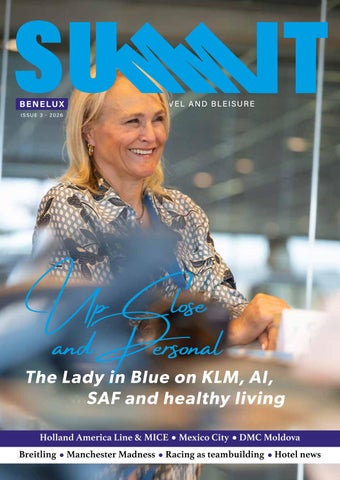
B E N E LU X
M I C E , B US I N E S S T R AV E L A N D B L E I SU R E
I S SU E 3 - 2 0 2 6
Up Close and Personal
The Lady in Blue on KLM, AI, SAF and healthy living Holland America Line & MICE Breitling
Manchester Madness
Mexico City
DMC Moldova
Racing as teambuilding
Hotel news
#3 2026
PEOPLE BUSINESS I guess we are adults now, in every nation of the world. For 21 years, we have been making a magazine with a focus on MICE, and later more and more on business travel and, most recently, bleisure. So much has changed, and at the same time, not very much. It is travel that unites people, gives new inspiration, takes away boundaries and clears the mind. It is the perfect antidote to small-mindedness, and worse, really. And that is why it is always such a pleasure to make a magazine about our beloved field of business. We did face some storms, though, and somehow the industry always pulled through. That is because, all technology and mechanics aside, this is a people business. And people are resilient, especially those who work in, and have a deep love for, travel. In this last note, I thank those who work in our great business and keep it going, twenty-four hours a day, seven days a week. This is our latest print magazine, but we’ll meet again. Because that is what we do… Bon voyage.
CONTENTS
Tijn Kramer Editor-in-chief
10
MICE Expert Panel
13
Interview with KLM CEO
16
Manchester
20
Holland America Line
24
Mexico City
29
Racing Team Spirit
30
DMC Moldova
33
Guatemala
37
Breitling
42
Greenland
COLOPHON Editor-in-chief
Design:
Tijn Kramer
Iris Beenen
tijn.kramer@travmedia.nl Publishers: Editors:
Tom van Apeldoorn
Arjen Lutgendorff, Sharon Evers,
T.J. van Apeldoorn
Dylan Cinjee, Theo de Reus. Sales & Marketing: Press releases and info:
Sales and information about
info@summitbenelux.com
advertising, etc. Tina Bakker, Dennis Ebbers,
TRAVelMEDIA
Christy Hoogstraten
Summit Benelux. Arendstraat 33A,
Sales@travmedia.nl
1223 RE, Hilversum. www.summitbenelux.com
SUMMIT Benellux is a TRAVelMEDIA publication. SUBSCRIPTION: 29 euro per year
Year 2, issue 3
3
TUI Care Foundation We believe in the positive impact of tourism
To ensure that local communities benefit from tourism, the TUI Care Foundation was established. By introducing holidaymakers to local projects, the TUI Care Foundation helps boost education for children and young people, the protection of nature and the environment, and the local economy and employment. In this way, the positive impact of tourism is expanded worldwide.
Young Generation and Education We help underprivileged young people on their path to a better future. For example, young people in the Dominican Republic are given the opportunity to follow vocational training in the tourism sector, in collaboration with Plan Netherlands. In Zanzibar, young people are trained to become guides.
Nature and Environment We are also committed to protecting endangered species. In Cape Verde, Greece, and Turkey, sea turtles and their eggs are protected. In Kenya, we work together with IFAW to protect elephants in and around Tsavo National Park.
www.tui.nl/tuicarefoundation
Local Economy and Employment We ensure that local communities benefit from tourism. In Marrakech, we support the local partner Pikala with an innovative cycling project. They encourage both tourists and locals to use bicycles, create employment opportunities, and facilitate training programmes for guides, mechanics, and marketers.
THE LAUNCH
AEROMEXICO NAMED WORLD’S MOST PUNCTUAL AIRLINE AGAIN Aeromexico has been recognised as the world’s most punctual global airline for the second consecutive year, according to Cirium’s On-Time Performance Review 2025. The carrier operated 188,859 flights during 2025, completing 99.74% of its
scheduled operations. Some 90.02% of flights arrived within 15 minutes of their scheduled arrival time, while 91.88% departed on schedule. Aeromexico was recognised six times during 2025 as the world’s most punctual airline and three times as the
most punctual airline in Latin America. During the same year, the carrier expanded its international network with seven new routes and additional codeshare agreements.
KLM Cityhopper celebrates 60 years KLM Cityhopper is celebrating its 60th anniversary, marking six decades of regional aviation and its growing role within the KLM network. The airline began operations in 1966 as Nederlandse Luchtvaart Maatschappij (NLM), with two leased Fokker aircraft and a handful of domestic routes.
Relais & Châteaux adds ten new members Relais & Châteaux has expanded its international collection with ten new hotels and restaurants in France, Italy, Portugal, Switzerland, the United Kingdom, Japan, Mexico and the United States. The additions include historic palaces, boutique hotels, country estates, restaurants and traditional ryokans. New members include Verride Palácio de Santa Catarina in Lisbon, Masseria AuraTerrae in Puglia, Megève Bois in the French Alps and Hiiragiya in Kyoto, a family-run ryokan dating back to 1818.
Today, KLM Cityhopper operates 58 aircraft, serving more than 80 destinations with over 350 daily flights from Amsterdam Schiphol. Around 11 million passengers travel with the airline each year, connecting European destinations with KLM’s intercontinental network. Recent additions include Biarritz, Exeter, Dubrovnik, Ljubljana, Cork, Jersey, Santiago de Compostela and Oviedo. The airline also acts as a testing ground for innovation, including virtual reality pilot training and OptiClimb, which helps reduce fuel consumption and CO₂ emissions. KLM Cityhopper has participated in The Aviation Challenge for four consecutive years, testing solutions involving AI, sustainable aviation fuel, weight reduction, food waste and electrification of ground operations.
Mexico City restaurant Quintonil, led by chef Jorge Vallejo, has also joined the collection. The restaurant holds two Michelin stars and is ranked among The World’s 50 Best Restaurants. The final addition is The Nell New York, scheduled to open near Rockefeller Plaza in autumn 2027 with 134 rooms, restaurants and a spa.
5
#3 2026
ADVERTORIAL
BALTIC ELEGANCE: LATVIA’S PREMIER VENUES FOR HIGH-END CORPORATE EVENTS From the medieval grandeur of Riga’s Old Town to cutting-edge industrial transformations and tranquil countryside estates, Latvia is rapidly positioning itself as a sophisticated hub for the MICE sector. Latvia offers a remarkably diverse selection of venues, ranging from contemporary architectural landmarks to luxurious historical estates. Whether you are planning a high level conference, an elegant gala dinner, or a memorable incentive event, Riga and its surrounding regions provide an exceptional variety of locations to meet every requirement. The capital city presents numerous urban venues within convenient walking distance of major hotels, creating a
seamless experience for international guests. Riga’s Old Town, with its charming cobblestone streets and rich heritage, is home to several luxury venues housed in restored historical buildings enhanced with modern design elements. The House of the Blackheads, prominently situated on Riga’s Town Hall Square, stands out as one of the most prestigious event settings in the city. Its magnificent façade draws attention even from afar, while the interior—characterized by ornate halls and refined décor—is ideal for high profile receptions, gala dinners, and ceremonial gatherings. For a more intimate yet equally distinguished atmosphere, the Small Guild offers versatile room layouts and a warm historical ambiance, making it a preferred choice for smaller luxury events. Riga’s contemporary venue scene is just as compelling. The Latvian National Library, one of the city’s most iconic modern structures, serves as a multifunctional venue for conferences, exhibitions, and receptions of various
6
scales. Purpose-built to accommodate both cultural activities and corporate events, it has become a favored location among international organizers. Hanzas Perons, a striking transformation of a former railway cargo warehouse, offers a unique blend of industrial heritage and modern aesthetics. Its openplan layout, high ceilings, and flexible technical infrastructure make it particularly suitable for creative corporate functions, product launches, and largescale receptions. Beyond the capital, Latvia’s luxury offering extends into its countryside, where numerous manors and castles provide exceptional event possibilities. Many of these estates—some meticulously restored, others enriched with contemporary extensions—offer facilities for conferences, gala dinners, and team building activities in tranquil natural surroundings. Within a short drive from Riga, guests can experience the charm of Latvia’s historical heritage while enjoying high-quality hospitality and exclusive settings that lend themselves perfectly to multi-day events, retreats, and incentive programs.
48 UUR MILAAN
MILAN: WHERE BUSINESS AND LA DOLCE VITA MEET Milan is one of Europe’s most attractive destinations for business travellers, combining a strong corporate economy with fashion, design, gastronomy and culture. October brings another wave of international business. CPHI Worldwide, one of the world’s major pharmaceutical industry events, takes place in Milan from 6 to 8 October, while BIMU, focused on machine tools, robotics and automation, follows from 13 to 16 October. Other events include the Franchising Exhibition, NetZero Milan and several international technology and industry shows. November is equally interesting. EICMA, the international motorcycle exhibition, takes over Fiera Milano from 5 to 8 November, while Allianz MiCo hosts a busy programme of international congresses and business events. The venue’s November calendar includes the World Business Forum, Salone dei Pagamenti and several international professional congresses. For business travellers, Milan also offers plenty beyond the conference room. The city has an impressive choice of high-end hotels, many of which are
suitable for meetings, dinners and client entertainment. Excelsior Hotel Gallia, a Luxury Collection Hotel, Milan, close to Milano Centrale, is particularly convenient for travellers arriving by train, while Milano Verticale | UNA Esperienze combines accommodation with restaurants, terraces and event facilities. For a more traditional luxury experience, Mandarin Oriental, Milan and Park Hyatt Milan put business travellers within easy reach of the city centre, the Duomo and Milan’s luxury shopping districts. And that is perhaps Milan’s biggest advantage. Meetings can be combined with an excellent dinner, an evening at La Scala, contemporary
art, shopping or a stroll through Brera. The city is compact enough to make this practical, while its restaurant and hotel scene offers plenty of options for entertaining clients. For Dutch business travellers, getting there is straightforward too. With easyJet, you can fly directly from Amsterdam to Milan up to four times a day, with connections to both Milan Linate and Milan Malpensa. This combination gives business travellers plenty of flexibility, with a wide choice of departure times and airports. Whether it’s a day trip or a longer business stay, travellers can easily choose a flight that fits their schedule.
7
#3 2026
ADVERTORIAL
TAILOR MADE MICE EXPERIENCES: SEASIDE COLLECTION & RIVERSIDE LUXURY CRUISES
At Seaside Collection, we create inspiring MICE experiences by combining premium hospitality, carefully selected destinations and seamless organization. Our portfolio of 12 exclusive resorts and city hotels across Germany, Spain, the Canary Islands and the Maldives offers versatile settings for meetings and incentives — always with a strong focus on quality, service and authenticity.
Our properties in the Canary Islands are particularly well suited for MICE groups seeking a balance between productivity and leisure. From flexible meeting spaces and bespoke catering to wellness facilities and beachfront locations, every detail is designed to enhance engagement and creativity. Spotlight: Seaside Los Jameos– Lanzarote Following an extensive renovation, Seaside Los Jameos has reopened in September 2025 featuring upgraded conference facilities, elegant new interiors and enhanced public spaces. Located just steps from the beach, the hotel combines modern functionality with Canarian charm, making it an excellent choice for meetings, incentives and exclusive group events.
Our MICE-friendly properties in the Canary Islands include: • Grand Hotel Residencia*****GL – Member of The Leading Hotels of the World • Palm Beach***** – Member of Design Hotels™ • Seaside Sandy Beach**** • Los Jameos**** (reopened September 2025) Riverside Luxury Cruises – A Unique MICE Experience on Europe’s Rivers For clients looking for something truly distinctive, Riverside Luxury Cruises offers an exceptional MICE alternative on Europe’s most iconic rivers, including the Rhine, Danube, Main, Rhône and Saône. Riverside’s fleet of ultra-luxury river ships provides an intimate, high-end setting
ideal for executive meetings, incentives, product launches or board-level retreats. Events can be tailored for small groups from around 10 guests or expanded to full ship charters, offering maximum exclusivity and branding opportunities. Spacious suites, refined dining concepts, elegant lounges and flexible event areas create a sophisticated yet relaxed atmosphere. Onboard meetings can be seamlessly combined with curated shore experiences, private excursions and cultural highlights — all while changing destination without changing hotel. With personalized service, exceptional cuisine and the comfort of a floating five-star venue, Riverside Luxury Cruises transforms business events into unforgettable journeys.
#3 2026
HOTEL
NIMB COPENHAGEN: A FAIRY TALE STAY IN THE HEART OF THE CIT Y
Few hotels in Copenhagen have an entrance quite as memorable as Nimb. Set directly alongside Tivoli Gardens, the five-star boutique hotel occupies an extraordinary Moorish-inspired building dating back to 1909. With its distinctive white façade, domes, arches and ornate details, Nimb looks almost like a palace from another era – and its location makes it one of the city’s most recognisable hotels. The real privilege of staying at Nimb, however, is that Tivoli is effectively your backyard. Hotel guests enjoy complimentary admission to Tivoli Gardens, including access to the rides, allowing you to wander into the park whenever you feel like it, whether for an evening stroll, dinner or simply a few minutes among the lights and gardens. Inside, Nimb continues the sense of understated luxury. The 38 rooms and suites are individually designed, combining Danish design with antiques, artwork and carefully selected materials. Rather than feeling like a conventional luxury hotel, the rooms have a distinctly residential character, with plenty of personality and attention to detail. Food is another major part of the Nimb experience. The hotel offers several restaurants and bars, ranging from French-inspired dishes at Nimb Brasserie to traditional Danish open sandwiches at Fru Nimb. There is also
the atmospheric Nimb Bar, while Nimb Roof provides a rooftop setting for cocktails and sunset views during the warmer months. And mind you, it has a heated pool! What a view. For business travellers and the MICE market, Nimb is equally interesting. Together with Tivoli Gardens, the property offers more than 20 meeting spaces, ranging from intimate rooms for small groups to venues capable of accommodating large events. The combination of historic surroundings, high-end catering and the possibility of incorporating Tivoli into an event gives meetings an experience far removed from a standard conference hotel. And then there is the location. Nimb sits directly opposite Copenhagen Central Station, making it exceptionally convenient for travellers arriving by train or heading to Copenhagen Airport. The airport can be reached by direct train in around ten minutes, with the station just steps from the hotel. End the day in Nimb Bar, where elegant surroundings, cocktails and a relaxed atmosphere provide a fitting finale. It is perhaps this combination – extraordinary architecture, excellent gastronomy, beautiful rooms, business facilities and one of Copenhagen’s most convenient locations – that makes Nimb feel less like a hotel and more like a destination in its own right.
Tijn Kramer Editor-in-chief SUMMIT Benelux
9
THE SUMMIT MICE EXPERT PANEL We welcome back our SUMMIT Expert Panel: experienced MICE professionals who share their answers to questions from the editor. Do you have a question yourself? Mail us! Our two questions: 1. If you could choose any destination in the world for an incentive trip for a fictional client, where would you go and why? 2. You clearly enjoy travelling yourself. Which destination is currently number one on your personal bucket list, and why? Nathalie Jacobs, Managing Partner FAME Travel Designers 1. Incentive destination I was at an event where numerous destinations and DMCs were represented. I unexpectedly got talking to a local agent from Suriname – a destination that is reasonably well known in the Netherlands, but hardly ever mentioned in Belgium. It really sparked my interest because Suriname combines so many different facets. The jungle is incredibly beautiful, the culture and history are remarkably diverse and, rather wonderfully, Dutch is widely spoken. That feels quite special when you have travelled all the way to the other side of the world. 2. Personal bucket list At the end of this year, I am travelling to Australia with my family for a month – definitely my number one bucket-list destination at the moment. I love the idea of heading towards the sun while it is winter here. The contrast in nature, fauna and flora compared with Belgium is enormous, and I am very curious to experience that. The distances are also gigantic, which means you travel in a completely different way. Slow travel, enjoying the views and glamping in some of the most incredible locations. I can’t wait!
Annemieke Stuurman, GI Travel 1. Incentive destination Without a doubt, somewhere on the African continent. With a fictional client with a truly generous budget, I would choose South Africa. The combination of possibilities is what makes the destination so strong: the energy and creativity of Cape Town, gastronomy and the wine regions, followed by a complete change of scenery in the bush. You can build a programme in which the group feels as though it is stepping into a different world again and again, with both small and large surprises along the way.
10
Tijn Kramer Chief editor SUMMIT Benelux
2. Personal bucket list Privately, I would really love to visit Mongolia one day. Everything I have seen of the country fascinates me: the overwhelming landscapes, endless plains, vast open spaces and silence, but also the nomadic culture and a way of life that is so far removed from our own. That enormous sense of space, and the feeling of being completely removed from the familiar world, is what attracts me most. It seems like a destination you do not simply visit, but truly experience.
EXPERT PANEL
#3 2026
Rob van Helvoort, Owner Travel Legends 1. Incentive destination Last year, we had the opportunity to organise a dream assignment: flying 500 people to Curaçao from different parts of the world for an event. We took over an entire resort and arranged the entertainment, including well-known DJs and artists. The programme included activities all over the island, from catamaran cruises and a submarine excursion to Antillean cooking and dance workshops. I still think about that trip often. Not only was it a hugely successful event, but it was also wonderful to spend three weeks working in the sunshine during winter! For a future event, Cape Town is definitely high on my list for a programme like this. 2. Personal bucket list Number one on my bucket list is Peru. It is the last of the Seven New Wonders of the World that I still have to discover. That is going to happen next January, when we will take on the four-day Salkantay Trek to discover Machu Picchu. Another dream is to explore Antarctica, but preferably without travelling on a large cruise ship! So if anyone has any tips, I’d be very interested.
Evelien Schepers, Head of International Events at Event Masters 1. Incentive destination One of my fondest incentive memories is a trekking trip with around 20 C-level participants in the Atlas Mountains of Morocco. That journey stayed with me because of the beauty of the landscape, the friendliness of the people and the physical challenge involved. If I am really allowed to dream, I would love to create a similar programme in Bhutan. A trek towards Tiger’s Nest, combined with sections of the Trans Bhutan Trail, really captures my imagination. 2. Personal bucket list Last November, my boyfriend and I obtained our Open Water diving certification. Although we have only done a handful of dives so far, I already know that diving will become an activity we want to include more often in our holidays. With that in mind, I dream of travelling to the Galápagos Islands to see whale sharks, to Hawaii for a night dive with manta rays and, of course, to the Great Barrier Reef. In the latter case, I would also love to take part in a volunteer programme focused on reef restoration.
Marije Breuker, CEO Motivation Travel 1. Incentive destination Without a doubt, somewhere on the African continent. With a fictional client with a truly generous budget, I would choose South Africa. The combination of possibilities is what makes the destination so strong: the energy and creativity of Cape Town, gastronomy and the wine regions, followed by a complete change of scenery in the bush. You can build a programme in which the group feels as though it is stepping into a different world again and again, with both small and large surprises along the way. 2. Personal bucket list Privately, I would really love to visit Mongolia one day. Everything I have seen of the country fascinates me: the overwhelming landscapes, endless plains, vast open spaces and silence, but also the nomadic culture and a way of life that is so far removed from our own. That enormous sense of space, and the feeling of being completely removed from the familiar world, is what attracts me most. It seems like a destination you do not simply visit, but truly experience.
11
12
#3 2026
INTERVIEW
INTERVIEW KLM CEO MARJAN RINTEL
KEEPING HEALTHY AND TOUGH DECISIONS Top executive Marjan Rintel began her second term as President Tijn Kramer Editor-in-Chief SUMMIT Benelux
and CEO of KLM last summer. In this personal interview, a look back at the first four years and a perspective on what lies ahead.
When Marjan Rintel took office as CEO of KLM in mid-2022, the aviation sector was still fully engaged in recovering from the COVID crisis. KLM has now entered its next phase. “It has been a massive development,” says Rintel. “The first phase was primarily focused on recovery. We had to part ways with a lot of people during COVID and needed to bring our capacity back up. At the same time, KLM chose to invest. For instance, newer, more fuel-efficient aircraft were ordered, including the Airbus A350. KLM also noticed a clear evolution in customer preferences during the pandemic period. We said right away: if the trend shows that people want to travel more in Business Class and Premium Economy Class, we are going to invest more heavily in that as well.” Recovery In recent years, the focus has also been on restoring relations with the government, seeking
synergies within the group, and creating a stable environment around Schiphol. According to Rintel, much has been achieved in these areas. “If you look at how people in the Netherlands view aviation now and how the government recognizes the contribution of aviation, we have managed to turn the tide to some extent. Independent research was conducted: 78 percent of Dutch citizens support aviation in the Netherlands.” According to Rintel, the next phase is about building further. “What we are essentially saying is: we are reconfirming who we are. We are simply that hub-and-spoke carrier. We have that network of 160 destinations for all those Dutch travelers, but also for all those other people connecting through Schiphol.” Remaining Competitive A key objective in this regard is remaining competitive. “KLM must also be able to stay competitive from the Netherlands. And you shouldn’t throw the baby out with the bathwater
13
#3 2026
by driving costs up too high.” At the same time, KLM wants to continue investing in its fleet and customer experience. The arrival of the Airbus A350 and further investments in the Premium Comfort product are part of that strategy. “That is naturally crucial for the future, alongside a tight focus on cost reduction and lower operational costs, both externally in the Netherlands and internally within KLM.” Always Unpredictable Her first term can undoubtedly be described as one filled with numerous challenges. But could she have foreseen what awaited her when she started in 2022? “No,” Rintel says. “But I think in every stage of life, whichever stage it may be, you simply don’t know. Whether it’s expanding your family or starting a new job, it always turns out differently than you expect.” When she took office, for example, there were severe staff shortages. Furthermore, little to nothing had been announced at that point about a potential downsizing of Schiphol. “That came almost on the day I stepped into the role. You just see the landscape shifting rapidly, and you adapt accordingly.” What occupied her mind most during that period was highlighting the significance of KLM for the Netherlands, the CEO shares. “How can we show the Netherlands the contribution that we as KLM— with 30,000 colleagues dedicated heart and soul to this company every day—deliver? Showing that, so we can take pride in it once again.” According to Rintel, it is essential that KLM works closely with its stakeholders. “It would certainly be much better if we could do that far more side-by-side with our
stakeholders, including the government, so that we can remain competitive as KLM within Europe and globally.” Financially Stronger For her second term, Rintel again has clear ambitions. “You always have goals. You draft your own five-year plan, which you discuss with your Supervisory Board.” Developments within the Air France-KLM Group also play an important role. “From a group perspective, it is important that we continue to count as a group and remain relevant. Hence the consolidation and the addition of SAS at the end of the year.” Synergy is a key principle here. “It is important to find synergies together, to do things smarter and better as a collective.” In addition, KLM needs to become financially stronger. “Then you are better equipped to absorb headwinds. One moment it’s jet fuel prices, the next it’s something else. You become better able to weather setbacks while continuing to invest in your customer experience.” Another key goal is maintaining operational improvements. “What we are seeing is a major improvement. We are doing quite well across all fronts, but we really need to maintain that momentum, for our customers as well.” Tough Decisions Rintel is known as a CEO who is visible on the work floor and pays close attention to employees. At the same time, she has to make difficult decisions that sometimes affect staff. A challenging balance? “You must always keep in mind why you are doing things. The most important thing is that we guide KLM toward a healthy future. Doing that always in connection with people, and with appreciation for everyone. Tough decisions are part of that process.” AI: Quality vs. Quantity Artificial intelligence has also become a major theme at KLM. “Extremely major. It is a highly relevant topic. KLM has already achieved concrete results. Take catering as an example: we managed to reduce onboard waste by 50 percent using AI. We are also looking into fuel management. How can we use AI to predict our needs more efficiently and save fuel in the process?” However, its implementation requires a helicopter view: KLM wants to avoid AI leading to a proliferation of small projects. “The risk with AI is that you end up with a thousand ideas, each yielding only a tiny margin.” That is why KLM favors a targeted approach. “Let’s pick two or three major areas to execute at scale that truly take us to the next level.” According to Rintel, this is mainly happening in service, recovery,
Marjan Rintel
INTERVIEW
a company needs sufficient financial leeway.” That is why she also calls attention to the competitive position of Dutch aviation. “With the current cost levels in the Netherlands, achieving sustainability becomes increasingly difficult. We need to collectively consider what cost level is responsible and how we can remain competitive amidst rising airport charges and taxes, such as the flight tax.”
and complex operational planning systems. “Things change constantly there, and so many divisions depend on one another—whether it’s catering, pilots, ground staff, towing, or refueling. Simplifying those operational aspects through AI is where the real value lies.” What’s in a name… Following SAS joining the group, discussions arose last summer regarding the future name of the group. Would KLM remain recognizable? Would the KLM brand name survive at all, headlines speculated... There is only one way to get a definitive answer on whether the KLM brand name will vanish in the arena of global aviation conglomerates: ask the boss. Rintel is crystal clear. “That is complete nonsense. I don’t understand why people think the KLM name would disappear. The group name is primarily relevant for shareholders and analysts.” The individual brands will continue to exist, she emphasizes. “One of the key
brands, a brand that generates revenue, a brand with a 107-year track record in the market, a brand known by vast numbers of people that instills a sense of pride in many Dutch citizens—that brand stands like a rock.” She draws a comparison with other corporate giants. “It’s no different from Unilever or other large corporations. They all have various brands, and those brands are the face to the customer.” And so, Rintel stresses: “KLM is the face to the customer, and that is here to stay.” Sustainability A topic that remains of critical importance in her second term is sustainability. How does she look back and ahead? “I think we have achieved quite a lot, but we absolutely cannot do it alone. The primary ways to make aviation more sustainable are the deployment of SAF (Sustainable Aviation Fuel) and renewing the fleet with quieter, more fuel-efficient aircraft. We are investing heavily in that, including through our partnership with SkyNRG. But for those investments,
Relaxation Finally, the question is justified in a corporate life requiring relentless attention: does the CEO actually have any time left for herself? “That is the eternal dilemma when you pour full energy and commitment into something. You naturally devote a tremendous amount of time to it. But I look for relaxation mainly at home. I try to keep my calendar clear for a day once in a while. Enjoying time on the water, getting a breath of fresh air on a boat. Or doing some gardening. Or cruising on my boat along the Vecht river and enjoying the beautiful surroundings.” Can you clear your mind then, or does the circus keep spinning? “No, I definitely manage to step back for a moment. It is vital to maintain the energy needed for my job. And that means staying fit and healthy: staying active, getting enough sleep, and eating healthy...” And her own wanderlust, for which KLM serves as the engine for so many travelers? “I certainly still travel privately. But I also enjoy staying in my own country.” About her preferred vacation style, she is quite clear. Laughing: “Someone recently scolded me again, saying: ‘Why don’t you just go lie on a beach and do nothing for once?’ No, I always end up heading off in search of adventure after all.”
15
#3 2026
MANCHESTER: THE HEART OF FOOTBALL (AND MUSIC) There are cities you visit, and there are cities you experience. Manchester belongs firmly in the second category. Beyond its industrial roots, the northern English city has reinvented itself as a lively centre of culture, music, food and world-class sport. But while the old cotton mills, red-brick railway viaducts and canals tell the story of Manchester’s industrial past, it is football that arguably provides the soundtrack to everyday life. For visitors, that makes Manchester an unusually rewarding city break. You can spend the morning exploring the Northern Quarter, discover the city’s musical heritage over lunch, wander along the canals of Castlefield in the afternoon and, come matchday, find yourself swept along with thousands of supporters towards Old Trafford. That was precisely the experience on a recent trip organised with P1 Travel, combining a stay in Manchester with
16
one of the great rituals of British football: a Premier League match at Old Trafford. A city built on industry, music and football Manchester’s identity is impossible to separate from its industrial past. The city was at the centre of the Industrial Revolution, and its former warehouses, cotton mills and railway infrastructure remain an important part of its character. Castlefield is perhaps the most atmospheric place to see that history. The canals, old railway arches and imposing red-brick buildings have been transformed into bars, restaurants and places to sit beside the water. What was once an industrial powerhouse is now one of the city’s most pleasant areas to spend an afternoon.
Then there is the Northern Quarter. Just northeast of the city centre, this is Manchester at its most creative and independent. Oldham Street and Thomas Street are lined with independent cafés, vintage shops, record stores, street art and small bars. Next door, Ancoats has undergone an equally dramatic transformation. Former cotton mills have become loft apartments, restaurants, bakeries and craft beer venues. For music lovers, these neighbourhoods are particularly significant. Manchester’s musical history stretches from The Smiths and Joy Division to Oasis, New Order and the Madchester movement. The Night & Day Café remains one of the city’s best-known small venues, while Band on the Wall has an international reputation for live music. For something
MANCHESTER
Düsseldorf
more intimate, Matt & Phreds Jazz Club combines live jazz, funk and soul with a relaxed basement atmosphere. And then, of course, there is football. Football is everywhere Manchester has two Premier League clubs, but for Manchester United supporters, the pilgrimage has a very specific destination. Old Trafford has been Manchester United’s home since 1910 and has become one of the most recognisable stadiums in world football. Its nickname, the “Theatre of Dreams”, is hardly subtle, but once you are standing outside the stadium on matchday, it becomes rather difficult to argue with. The history is immense.
the stadium and the club’s history away from matchday. The current stadium tour takes visitors into areas including the dressing rooms, players’ tunnel, pitchside and press room.But there is another way to understand Manchester football. Go to a pub on matchday. The ritual before kick-off On a Manchester United matchday, the atmosphere starts building long before the players appear on the pitch. Around Old Trafford, pubs fill with supporters wearing red shirts and scarves. Songs begin, conversations become increasingly focused on the afternoon
ahead and groups of fans make their way towards the stadium. The Bishop Blaize, just a short walk from Old Trafford, is one of the bestknown United pubs and can become an extraordinary spectacle before kick-off. Nearby, The Tollgate offers another large gathering place for supporters, while The Quadrant provides a somewhat more traditional pub atmosphere. You don’t necessarily have to be a lifelong United supporter to appreciate what is happening. There is something fascinating about seeing an entire neighbourhood temporarily reorganised
Manchester United’s story encompasses the Munich air disaster of 1958, the rebuilding of the club under Sir Matt Busby, European glory, the extraordinary reign of Sir Alex Ferguson and generations of players who have become household names far beyond England. That history is not confined to the stadium. It is part of the city itself. For a first-time visitor, the National Football Museum in the city centre is an obvious starting point. Housed in the distinctive Urbis building, the museum explores the history of the game through memorabilia, interactive displays and historic artefacts. Manchester United also operates its own Museum & Tour at Old Trafford, where visitors can explore
17
#3 2026
for the club. Inside, the atmosphere is considerably more relaxed than the concourses outside. There are high tables, comfortable seating, club memorabilia and large windows overlooking the stadium surroundings. The hospitality area provides a place to meet fellow supporters, have a drink and eat before taking your seat. The food is very much in keeping with the idea of an upgraded British football experience: pies, sausage rolls, salads and hot dishes, accompanied by drinks from the bar. But the most important part of hospitality is arguably not the food or the drinks. It is the time. You don’t have to arrive at the last minute, queue for everything and immediately squeeze into your seat. There is time to absorb the occasion. You can talk about the teams, study the team sheet and watch the stadium gradually fill. P1 Travel’s Manchester United hospitality packages are designed around precisely that combination of comfort and matchday atmosphere. Depending on the package, visitors can choose from different lounge and seating options; current offerings include the Sports Bar, Executive Lounge and Victoria Warehouse experiences. And eventually, of course, you have to leave the lounge. Because this is why you came. around a football match. And then you see it. Old Trafford. Entering the Theatre of Dreams Stepping off the Metrolink and onto Sir Matt Busby Way, the atmosphere changes almost immediately. Streetfood stalls compete with souvenir sellers. Supporters pose for photographs. Scarves are everywhere. Groups of fans sing as they walk towards the turnstiles, while the stadium itself rises above the surrounding streets. For this particular match, the experience was organised through P1 Travel. Rather than simply providing a match ticket, P1 Travel’s Manchester United offering focuses heavily on hospitality experiences, with options ranging from premium seating and lounge access
18
to packages that combine the match with accommodation. P1 Travel is an Authorised Reseller of the Manchester United Executive Club and currently offers a range of hospitality options at Old Trafford. Our package was the 500 Club. Passing the famous United Trinity statue – George Best, Denis Law and Bobby Charlton standing together outside the stadium – we headed towards the North East Stand and the hospitality entrance. The difference between arriving this way and simply walking into a normal football stand is immediately apparent. The 500 Club The 500 Club is named after the select group of Manchester United players who have made more than 500 appearances
Old Trafford comes alive Our seats were in the North East Quadrant, high enough to provide an excellent overview of the pitch. From there, Old Trafford looks enormous. Across the stadium is the Sir Alex Ferguson Stand, while the Stretford End is immediately recognisable to the right. You can see the scale of the ground in a way that is difficult to appreciate from television. Then the teams appear. The stadium lights, the noise, the red shirts and the familiar opening music combine into something that is difficult to reproduce anywhere else. As Manchester United walked out to The Stone Roses’ This Is the One, the noise rose around the stadium. And suddenly this isn’t a museum piece or a tourist attraction. It is a football stadium.
MANCHESTER
The Crystal Palace supporters brought their own vocal energy, while the home crowd responded with chants that rolled around the stands. Whatever the result, this is the moment when the history and mythology of Old Trafford become something tangible. A match worthy of the occasion The match itself provided plenty of drama. Crystal Palace stunned the home crowd by taking the lead after just four minutes, Maxence Lacroix heading home from close range. United dominated much of the first half but went into the break still behind. The second half changed everything. Ten minutes after the restart, Lacroix was sent off, leaving Palace with ten men and giving United a route back into the match. Bruno Fernandes converted the resulting penalty to make it 1-1. With the numerical advantage, United continued to push. And then came the winning goal. Benjamin Šeško finished in the 65th minute to complete the comeback and send Old Trafford into celebration. From comfortable hospitality seats, the entire sequence was a reminder of why people travel thousands of kilometres to watch football in England. The food and drinks are nice, the padded seats and extra legroom are certainly appreciated, but
ultimately none of that is the reason you are there. You are there for that moment when 70,000 people react simultaneously to a goal. More than a football trip What makes a Manchester United match particularly attractive as a city break is that the football doesn’t have to dominate the entire trip. Manchester itself is worth discovering. Spend a day in the Northern Quarter. Visit the National Football Museum. Walk the canals around Castlefield. Explore Ancoats. Go looking for the city’s musical history. Find a traditional pub. Eat in one of the
many restaurants that have helped turn Manchester into one of Britain’s most interesting food cities. Then make your way to Old Trafford on matchday. That combination is what turns a football match into a proper travel experience. For international visitors, the practical side of arranging the trip can also be important. P1 Travel allows visitors to arrange Manchester United match tickets and hospitality, with hotel accommodation available as part of the booking process. The company currently describes its Manchester United offering as official tickets, dedicated service and secure booking, while its city-trip proposition allows travellers to combine an event with a hotel stay. That is particularly useful for visitors who are not familiar with the complexities of obtaining tickets for a major Premier League fixture. The trade-off, naturally, is price. Hospitality is considerably more expensive than a basic match ticket. But you are buying more than a seat: you are buying an experience that starts several hours before kick-off and continues through half-time. And for a visitor travelling from abroad, that can make a significant difference.
19
#3 2026
FARAH BARHORST: ‘OUR PERFECTLY SIZED SHIPS PROVIDE AN UNFORGETTABLE EXPERIENCE’
THE AMAZING POSSIBILITIES FOR MICE ON HOLLAND AMERICA LINE
Tijn Kramer Editor-in-chief SUMMIT Benelux
Corporate meetings and incentive travel have long been synonymous with hotel ballrooms and resort conference centers. But a quieter shift is underway, and Holland America Line is leading the charge into new territory: the Benelux market. As Holland America Line expands their charter and incentive proposition into the Netherlands and wider Europe, backed by four ships arriving in the region from 2027 we sat down with Farah Barhorst, who leads Global Charter & Incentive Sales for Holland America. Having spent 13 years working onboard Holland America Line ships, and a further 5 in the shoreside team, Farah brings a rare shoreside-and-shipboard perspective to the conversation; one that’s shaping how European planners think about what a group or full-ship charter can actually deliver. For someone who has never considered a cruise for a corporate event, what is the biggest misconception about using a cruise ship for meetings or incentives? The biggest misconception is that a ship is purely a leisure environment, that once you’re onboard, it’s impossible to run a serious, professional program. In reality, our ships carry dedicated conference and meeting spaces with full AV support, and the flexibility to run anything from a boardroom meeting to
20
a townhall style session for hundreds of delegates. The ‘vacation’ feel doesn’t compete with the business agenda, it actually elevates it, because delegates are relaxed and engaged and in an environment that meets the needs of the whole event.
group size and stateroom needs, budget, the region the client wants to be in, and the tone they’re after. We also look at the shape of the itinerary; how many sea days versus port days and build in dedicated meeting and event time around that.
Holland America Line has 11 ships. How do you determine which ship and which itinerary are right for a particular group or corporate client? It comes down to a handful of factors:
What are the main advantages of chartering an entire ship compared with holding a large corporate event at a hotel or resort? With a hotel or resort, you’re
INTERVIEW
negotiating room blocks, meeting space, catering and entertainment as separate line items, often with separate vendors. A full-ship charter covers all of it - accommodation, every meal, entertainment and meeting space with a single point of contact managing the whole program. There are also elevated experiences such as the Spa and specialty dining venues which can be sprinkled throughout. Unlike a hotel, the venue itself changes daily, which allows you to further expand the experience with excursions in our ports of call.
can a company combine conferences or training sessions with leisure and incentive elements during the same sailing? Absolutely, our clients are able to tailor their program to fit their needs…as much work or leisure as needed! We also often see conferences and training delegates invited with spouses, so they can also enjoy all the amenities the ship and ports are able to offer throughout the cruise.
How much easier does it make the logistics when accommodation, meeting rooms, restaurants, entertainment and activities are all in the same place? It removes almost all the moving parts a planner normally has to manage. There’s no shuttling delegates between a hotel and an off-site venue, no coordinating separate caterers and AV vendors, no risk of half the group getting lost between sessions. Meeting rooms, restaurants, entertainment and guest rooms are all a short walk apart.
What types of companies or industries are currently using Holland America Line for incentives and corporate groups? Our incentive and corporate client base spans financial, insurance and corporate services, tech, automotive, real estate, consumer sales and various medical fields.
Can you actually create a completely bespoke programme on a full-ship charter — from branding and entertainment to food, meetings and excursions? Yes, completely. We’ve branded terminals, elevators and stateroom keys, built theme nights around a company’s brand story, and woven bespoke excursions into the itinerary alongside the meeting and dining schedule. From the moment guests check in to the moment they disembark, it can all be built around that one client’s vision and needs.
Incentives
Holland America Line: Company Profile Founded in 1873 as the NederlandschAmerikaansche Stoomvaart-Maatschappij (NASM) in Rotterdam, Holland America Line (HAL) is one of the oldest and most recognized names in passenger shipping. Headquartered in Seattle, Washington, the brand positions itself in the premium cruise sector, offering classic, destinationfocused ocean travel to all seven continents. Although the line operates under American corporate ownership today, its Dutch origins remain fundamental to its overall brand identity, hospitality style, and aesthetic. Holland America Line operates a fleet of 11 mid-sized, modern-classic ships. This mid-size scale allows access to smaller ports that larger megaships cannot reach while still supporting comprehensive onboard amenities, specialty dining, and live music venues. The European Headquarters are based in Rotterdam, and all the ships are carrying the Dutch flag.
Do you see significant differences between, for example, a financial-services company looking for a sophisticated incentive and a technology or lifestyle company looking for something more energetic and informal? No two clients have the same objectives, and no two charters look exactly alike. Each charter has
How flexible are you when it comes to the business side of the programme? For example,
21
#3 2026
its own personality, and we help shape the program around it. A financial services incentive often has a business performance element and leans into recognition moments (galas, executive dinners, formal awards), while a tech or lifestyle brand wants energy: DJ-led deck parties, branded activations, more spontaneity in the day-to-day. What makes an incentive cruise genuinely memorable for employees or clients, rather than simply being a holiday with a few meetings added? The personalization opportunities are truly endless. It’s also a fantastic opportunity for the teams to spend time together, whether that’s at dinners hosted by executives who rotate tables throughout the week, or mixing and mingling at a cocktail party. The various venues onboard also provide a perfect backdrop to smaller, more intimate breakout sessions or meetings for niche sets of the business. Are there particular destinations or itineraries that work especially well for incentive travel? A cruise with a good mix of port and sea days allows time for meetings, while actively getting to your next port. If the company is regionally specific, finding a voyage that departs close to home is often preferable, however we do find companies are looking to differentiate each year so we may do Northern Europe, followed by Alaska, the Mediterranean, Caribbean islands and even Asia.
What can a corporate client customise that perhaps isn’t possible on a standard cruise booking? Really just about anything they would like! We often also see personalization ranging from terminal decoration, onboard window and elevator branding, events and activities woven throughout our standard programming, theme nights, stateroom turndown logo merchandise and custom dining arrangements. Charters also offer the unique opportunity to customize the itinerary, including preferred ports, extended time ashore, and overnight destination experiences where possible.
The Netherlands & Europe The Dutch market has not really been targeted with the charter and incentive proposition until now. Why do you think this is the right moment to change that? Holland America will see 4 ships coming to Europe from 2027 onwards, with Nieuw Statendam beginning her year-round Europe deployment in the fall. Our Flagship, Rotterdam and her sister vessel Nieuw Statendam will sail round trip from Rotterdam 40 times in 2027, with an additional 16 calls to Amsterdam with Zuiderdam. This gives us great opportunity to offer a variety of itineraries and cruise lengths. Cruising is really enjoying a brilliant value moment as well, when you compare the cost of hosting a large group of delegates at a hotel or resort, in both
accommodation, food and beverage plus the incredible service and welcome you receive by our award-winning shipboard team members, many of our clients tell us cruising wins hands down! What are you seeing in the European corporate travel market at the moment? Are companies becoming more interested in travel as a reward and employee-engagement tool? Yes, very much so. Employee engagement and retention have become boardroom topics, not just HR ones, and experiential reward is just as, if not more effective than a bonus check for building loyalty, as well as additive business performance element through the ‘qualification’ thresholds. Sustainability is obviously an important issue for European companies. How does that influence conversations with corporate planners considering a cruise? Sustainability is also an important topic for us, our corporation and for the longevity of the cruise industry as a whole. We are able to host insightful and educational presentations and smaller group Q&As with shipboard leadership around this critical topic. This helps communicate with transparency what we are doing at a shipboard and corporate level to achieve our short and long term goals in this arena and unique challenges cruising has, that we are working hard to overcome. Holland America Line has a range of European deployments and itineraries. How important could Europe become for the charter and incentive business, rather than simply being a seasonal destination? Europe is becoming a cornerstone rather than a seasonal add-on. With four ships deploying there from 2027, we can offer year-round itineraries in the Mediterranean, Northern Europe, and the Baltics, which means clients can return annually without repeating an itinerary. This is particularly appealing for those who favor a cooler climate, less crowded ports and easier access to iconic European landmarks.
The practical side Suppose I’m an event planner in The Benelux and I come to you with a large group. What happens next — how does the process work from the first enquiry to actually sailing? It starts with a conversation about goals, ideal itinerary/region and what the client wants the group to feel and achieve. From there we match a vessel and itinerary to the group size, budget and dates, build a proposal, and once terms are agreed we get to work on any unique needs such as F&B, meeting space and shore excursions. From first enquiry to sailing is typically a 12 month runway, though we can turn smaller groups around faster. Are smaller groups also possible, and what can you offer them? What range in number of people can you accommodate? Absolutely, our groups program starts from as few as 8 staterooms and can go to half a ship group (anywhere from 300-600 staterooms depending on the class of vessel.) What would you say to a Dutch meeting or incentive planner who has never considered a cruise before? Why should they put a Holland America Line charter on their shortlist? It solves a problem hotels cannot: keeping a group together and engaged, uninterrupted, for days at a time For a planner who’s never considered it, the real pitch is value and cohesion. One rate covers accommodation, dining, entertainment and meeting space, and the destination changes daily without anyone having to leave the venue. We are also incredibly proud
that Holland America Line has been voted ‘Best in Service’ for 4 consecutive years, which has never been accomplished before. Farah, you have actually worked onboard Holland America Line ships. How did that experience shape your understanding of what makes a successful group or incentive programme? Working onboard for 13 years has allowed me a comprehensive understanding of what it takes to meet the unique needs of our different groups and charter clients. There is an element of needing to mirror the values and culture of the company and provide a wow experience for both the leaders and the attendees of the program. For many of our clients, we very much have a legacy partnership and know how to meet and exceed their expectations, and what the nuances to their program are. That consistency is what turns a one-off charter into a standing relationship. And finally, if you had to name one thing that a full-ship charter can do for a corporate client that a land-based venue simply cannot, what would it be? What we’ve found is that organizations initially come to us looking for a venue, but often realize the greatest value is the environment itself. Because everyone travels together, dines together, and experiences the destination together, the event becomes far more immersive than a traditional conference. Ultimately, our perfectly sized ships provide an unforgettable experience, alongside the meetings and events side of the business, reflected in both in the bespoke shipboard opportunities and in the shoreside ports of call.
23
#3 2026
40 REASONS TO FALL IN LOVE WITH MEXICO CITY Tijn Kramer Editor-in-Chief SUMMIT Benelux
The oh so trendy hot spot of the year Mexico City is not a city you simply visit. It is a city you eat, hear, watch, walk and experience. Ancient Aztec history sits underneath Spanish colonial architecture; world-class museums compete with taco stands; football fans worship at the Estadio Azteca while masked wrestlers fly through the air at night.
Here are 40 very good reasons to put Mexico City on your business travel list. 1. Start at the Zócalo Begin where the story of Mexico City begins: the enormous Zócalo, one of the world’s great urban squares. Surrounded by the cathedral, the National Palace and layers of history, it gives you an immediate sense of just how much has happened here. 2. Discover the Aztecs beneath the city The ancient Aztec capital of Tenochtitlan is not simply a chapter in a history book. Its remains are still being uncovered in the heart of modern Mexico City. At the Templo Mayor, you can literally walk through the archaeological remains of the empire that once dominated this part of Mesoamerica.
24
3. Lose yourself in the Anthropology Museum The Museo Nacional de Antropología is enormous, spectacular and absolutely essential. Its collections take you through Mexico’s preHispanic cultures, from the Aztecs and Maya to civilisations that many international visitors know far less about. 4. Meet Frida Kahlo at home In Coyoacán, the bright blue Casa Azul was Frida Kahlo’s home and is now one of Mexico City’s most famous museums. Seeing her clothes, possessions, paintings and personal surroundings makes the artist feel surprisingly close. 5. Explore Diego Rivera’s Mexico Diego Rivera’s murals are everywhere, but the National Palace is particularly spectacular. His enormous murals
tell Mexico’s history on a scale that makes the country’s past feel almost cinematic. 6. Go contemporary at MUAC Mexico City isn’t trapped in the past. At the Museo Universitario Arte Contemporáneo, contemporary Mexican and international art gets a suitably modern stage. It is a reminder that this is a creative capital, not simply a historic one. 7. Admire the Soumaya The Museo Soumaya is almost as extraordinary from the outside as it is inside. Its futuristic silver façade houses an eclectic collection ranging from European masters to Mexican art and sculpture. 8. Take a taco class You haven’t really understood Mexico until you’ve made your own tacos. If
MEXICO you really want to understand Mexican food, you have to get your hands dirty. That is exactly what I did at Aura Cocina Mexicana in Mexico City, where a morning cooking class turned into one of the tastiest experiences of my trip. We started with a visit to Mercado de Medellín, exploring the colourful stalls and learning about the ingredients that form the backbone of Mexican cuisine. Then it was time to head into the kitchen. Under the guidance of the Aura team, I learned how to make three classic street tacos: al pastor, barbacoa and campechano, along with fresh tortillas and three different salsas. The best part? We didn’t just watch – we cooked, tasted and experimented ourselves. And after all that hard work, we sat down to enjoy the tacos we had made, accompanied by a Mexican craft beer, wine or artisanal mezcal. I left with a very full stomach, a handful of new recipes and a much better appreciation of what makes a great Mexican taco. Aura Cocina is a delicious way to get beyond the restaurants and experience Mexican food culture from the inside. It is a highly recommended adres that offers various tours and cooking classes in different neighborhoods. www.auramexcooking.com 9. Eat mexican for breakfast Forget the hotel buffet. Mexico City mornings can begin with tacos. Al pastor, carnitas, barbacoa or whatever looks irresistible from the grill — breakfast here can be considerably more exciting than cereal and toast. Or delicious sweet pastries or baked goods. Go ahead, we know you want to. 10. The obvious roade to an early start with Mexican hospitality is by flying from Amsterdam to Mexico City. That we put it on number 10 is no surprise. Aeromexico is celebrating 10 years of direct flights between Amsterdam Schiphol and Mexico City. The route launched on 30 May 2016 with three weekly flights and has since grown into a daily service and an important part of Aeromexico’s European network. Country Manager
Mark Mooren highlighted the role of Schiphol and the partnership with KLM and SkyTeam in the route’s success. The service attracts both Dutch travellers and passengers from across Europe connecting through Amsterdam. Local marketing, including sponsorship of PSV Eindhoven when several Mexican players were at the club, also helped raise the airline’s profile in the Netherlands. The airline now operates 120 routes with a fleet of 166 aircraft. It has also received several industry awards, including a 5-star APEX rating for the seventh consecutive year in 2026, and was named Best Airline of North America. 11. Experience Mexican haute cuisine Mexico City has developed into one of the world’s most exciting gastronomic capitals. Restaurants such as Pujol and Quintonil have put Mexican ingredients and traditions firmly into the international fine-dining conversation. 12. Eat at a market For something completely different, head to one of the city’s markets. The colours, smells and sheer variety can be overwhelming in the best possible way. Fruit, spices, meat, flowers, tortillas and things you may not immediately recognise all compete for your attention.
13. Discover the world of mole Mole is not simply a sauce. It is a culinary universe. Recipes vary enormously, and tasting different versions is a delicious way to understand how indigenous ingredients and Spanish influences became part of Mexican cuisine. 14. Go in search of the perfect taco The great thing about tacos in Mexico City is that there is no single answer. Tiny neighbourhood taquerías can be every bit as memorable as celebrated restaurants. The fun is in making your own shortlist — and eating your way through it. 15. Drink mezcal properly Mezcal deserves more attention than simply being taken as a shot. Visit a specialist bar and explore the extraordinary differences between agave varieties, production regions and ageing techniques. 16. Discover pulque Long before craft cocktails became fashionable, Mexico had pulque. The ancient fermented agave drink is still available in traditional pulquerías — and trying it is a deliciously different way to connect with Mexico’s preHispanic drinking culture. 17. Spend an afternoon in Roma Roma Norte is one of the city’s
25
#3 2026
most enjoyable neighbourhoods for wandering. Art galleries, independent shops, cafés, restaurants, tree-lined streets and beautiful architecture make it almost impossible not to stop every few minutes. 18. Then discover Condesa Next door, Condesa has its own personality. Think Art Deco buildings, leafy streets, fashionable restaurants, cafés and parks. It is perfect for the traveller who likes a little urban glamour without losing the Mexican atmosphere.
streets make it one of the best places simply to wander without a plan. 21. Ride a colourful trajinera Head south to Xochimilco and climb aboard a traditional trajinera. These colourful flat-bottomed boats cruise the old canals while mariachi musicians, food vendors and floating gardens provide the entertainment. 22. Turn Xochimilco into a party Xochimilco isn’t necessarily a quiet sightseeing experience. Bring friends, order drinks, hire a boat and let the city come to you. It can be one of the most memorable afternoons in Mexico City. 23. Explore Chapultepec Chapultepec is far more than a park. It is a vast green escape in the middle of the metropolis, with museums, monuments, gardens and the spectacular Chapultepec Castle.
19. Go upscale in Polanco Polanco is where Mexico City’s luxury side comes out to play. Designer boutiques, galleries, sophisticated restaurants and some of the city’s finest hotels make it the place to experience the capital at its most polished. 20. Wander around Coyoacán Coyoacán feels like another city altogether. Colonial buildings, quiet squares, cafés, markets and colourful
24. Visit a castle in the middle of a capital Castillo de Chapultepec sits high above the city and offers one of Mexico City’s best viewpoints. The building itself is impressive; the views across the enormous metropolis are even better. 25. Walk Paseo de la Reforma Mexico City’s grand boulevard is ideal for seeing the city in motion. Monuments, skyscrapers, museums and parks line Reforma, making it particularly enjoyable on foot or by bicycle.
26. Go cycling on Sunday On certain Sundays, major roads are opened to cyclists and pedestrians as part of the city’s recreational programmes. Hire a bike and see Mexico City from a completely different perspective — without a car between you and the architecture. 27. Watch lucha libre Few evenings are more entertaining than a night of Mexican lucha libre. The masks, costumes, theatrical entrances, spectacular moves and extremely enthusiastic crowds make it much more than a wrestling match. 28. See it at Arena Coliseo For a particularly atmospheric lucha libre experience, head to Arena Coliseo in the Centro Histórico. The venue has been part of Mexico City’s wrestling culture since 1943 and has hosted some of the sport’s legendary encounters. 29. Go to the Estadio Azteca Football is not simply a sport in Mexico. It is an emotional language. A match at the legendary Estadio Azteca — the stadium that hosted World Cup finals in 1970 and 1986 — is a chance to experience that passion first-hand. 30. Walk through football history Even if there isn’t a match during your visit, the Azteca’s history makes it worth seeking out. Pelé, Maradona, Mexico’s greatest players and some of football’s most famous moments are part of its extraordinary story.
26
MEXICO 31. Visit Teotihuacán Just outside Mexico City lies one of the great archaeological sites of the Americas. Teotihuacán’s enormous pyramids and the Avenue of the Dead create an experience that is difficult to forget — especially when you realise how sophisticated this ancient city once was. 32. See the pyramids at sunrise Take the early option and arrive before the heat and crowds build. Watching the first light spread across the ancient landscape is a very different experience from arriving in the middle of the day. 33. Take a hot-air balloon over Teotihuacán For a serious “wow” moment, take to the air. Hot-air balloon flights over the pyramids offer an extraordinary perspective on the scale and geometry of the ancient city. 34. Visit the Basilica of Guadalupe One of Mexico’s most important religious destinations is the Basilica of Our Lady of Guadalupe. Even visitors who aren’t religious can appreciate the extraordinary cultural importance of the site and the devotion surrounding it. 35. Discover the city’s hidden archaeological sites Mexico City is built on layers. Cuicuilco, Templo Mayor and other archaeological sites reveal different chapters of the region’s pre-Hispanic history. The fascinating part is that archaeology doesn’t feel separate from the modern city — it is woven into it. 36. Take a street-food tour A guided food tour can be one of the smartest ways to begin a visit. A local guide can take you beyond the obvious tourist stops and introduce you to stalls, markets and neighbourhood institutions you might otherwise walk straight past.
37. Explore La Merced La Merced is one of the city’s great market districts and an assault on the senses in the best possible way. Come hungry, curious and prepared to see another side of Mexico City. 38. Go gallery hopping The city’s art scene extends far beyond the major museums. Roma, Condesa, Polanco and San Miguel Chapultepec are packed with galleries and creative spaces, making an afternoon of contemporary art surprisingly easy to organise. 39. Experience Día de Muertos If your timing is right, experiencing Día de Muertos in Mexico City is unforgettable. Marigolds, altars, costumes, music and memories transform the city into one enormous celebration of life and death. 40. Take a trip to Puebla Puebla makes an excellent escape from the capital. Its elegant historic centre, colourful Talavera ceramics and famous cuisine provide a completely different flavour of central Mexico.
27
It’s great to have you with us
Welcome to KLM World Business Class
Enjoy plenty of space, privacy, and comfort to rest. Discover travel with peace of mind. Welcome to KLM World Business Class. Discover your next journey on klm.com
#3 2026
REPORT
A DAY AT THE RACES: SPEED AND TEAM SPIRIT For Race Planet, driving a fast car around Circuit Zandvoort is about much more than speed. The company has increasingly developed its activities into tailor-made corporate events and incentives, using the excitement of motorsport as a way to bring people together. The story of Race Planet dates back to 1978, when it was founded by Sebastiaan Bleekemolen’s father, himself involved in motorsport from an early age. The original idea was simple: give people who could not afford a racing car the opportunity to experience what it was like to drive one on a circuit.
“Very often, people in a group do not know each other very well,” he explains. “They arrive, exchange polite introductions and there can be a slightly tense atmosphere. Then they go driving, and afterwards they are standing next to each other with their arms around each other’s shoulders. They have become friends.”
Today, the fleet includes between 120 and 150 cars, ranging from Porsches and Ferraris to Lamborghinis, McLarens, Mercedes and BMWs. The latest addition is a Corvette. Race Planet also continues to explore electric driving, although fully electric circuit experiences are not yet considered practical for the same performance and duration as petrolpowered sports cars.
The driving experience can be combined with meetings, presentations and lunches at Circuit Zandvoort, followed by drinks or a barbecue. There is no fixed format: around 90 percent of Race Planet’s corporate arrangements are tailor-made. Groups can range from fewer than ten participants to much larger events. One event even welcomed around 1,400 people, effectively turning the circuit into a temporary motorsport theme park. There are plenty of activities beyond circuit driving, including karting, 4x4 driving, drifting, slalom challenges and simulators. Safety remains central, with participants receiving clear instructions and being closely monitored by
C o r p o ra t e ev e n t s h a v e b e c o m e an important part of the business, particularly for relationship marketing and incentives. According to Bleekemolen, the experience creates a natural connection between participants.
instructors. Nervous drivers can, for example, be given a different position in the driving group. Race Planet also works with international clients and DMCs. The return of Formula 1 to Zandvoort and the rise of Max Verstappen have increased international awareness of the circuit, although Bleekemolen stresses that the company does not depend on Formula 1. “We can also benefit from the fact that we are driving on a Formula 1 circuit. That is something special in itself.” Corporate bookings generally require around six weeks’ notice for weekdays and three to four months for weekends, although last-minute arrangements are sometimes possible. The company’s philosophy can perhaps be summed up as “handing over the wheel, while also taking the wheel”. For participants, it means trusting an instructor. For companies, Bleekemolen sees it as a metaphor for leadership and learning to trust others. And in all fairness, once you are there, you really have to try it. Five laps in a Porsche 911 around the famous Zandvoort circuit is something you do not easily forget. It was my first time in a Porsche – and on this legendary racing ground. A memory to take home. Highly recommended!
Tijn Kramer Editor-in-Chief SUMMIT Benelux
29
#3 2026
DMC-TALK
DISCOVER MOLDOVA: FROM MONASTERIES TO UNDERGROUND WINE CELLARS Moldova is not a destination that immediately springs to mind when thinking about European MICE. That is precisely what makes a discovery tour through the country so interesting. In just two days, the programme combines history, culture, nature, gastronomy, wine and even a glimpse of the former Soviet Union. The tour starts in Chișinău, Moldova’s administrative, scientific and cultural centre. With a professional guide, the city’s history and culture quickly become tangible, providing a first introduction to a destination that remains relatively unfamiliar to many international travellers. From Chișinău, the journey continues into the countryside towards Curchi Monastery. Surrounded by a high stone wall and towers at its corners, the monastery has the appearance of a fortress. The next destination is Orheiul Vechi, where history and landscape come together. The area is described as a natural amphitheatre, shaped over millions of years by geological forces. The highlight for many visitors, however, is likely to be the afternoon visit to Cricova Cellars. Around 80 metres underground, Cricova is effectively an underground city, covering 53 hectares and featuring approximately 120 kilometres of streets. The cellars were created in former limestone quarries and provide ideal conditions for storing wine. A guided tour is followed by a tasting of four different wines – a quintessentially Moldovan experience and one with obvious potential for incentive and corporate groups. The second day takes a very different direction, with a journey to Tiraspol, the capital of Transnistria. The panoramic tour is presented as a journey back into the Soviet past, with monuments to Vladimir Lenin and tanks left from the Second World War among the sights. The atmosphere provides a sharp contrast with the cultural and wine experiences of the previous day. It is a hidden gem within a hidden gem. The final stop is the awesome Aquatir Sturgeon Farm, one of the largest fish hatcheries in Europe according to the tour programme. Visitors are introduced to the farm and its production facilities before taking part in a caviar tasting. It is another example of how Moldova can combine unusual, locally rooted experiences with a programme designed for international groups. In only two days, the tour demonstrates a small sample of Moldova as a potential MICE destination: a compact mix of capital-city culture, religious heritage, dramatic landscapes, traditional hospitality, wine and highly distinctive experiences. For planners looking for somewhere beyond the established European destinations, that variety may be Moldova’s strongest card.
30
DMC talk: ‘Best kept secret’ Moldova may still be one of Europe’s best-kept secrets, but according to Tatrabis DMC owner Emilian Dzugas, that is precisely what makes it interesting for the MICE market. From underground wine cellars and private tastings to authentic rural experiences and Brutalist architecture, the country offers something increasingly valuable: the opportunity to surprise. Emilian Dzugas has been promoting Moldova as a tourism destination since 2005, when he and his business partner Tatiana Lazar founded their company. What started as a small inbound tour operator has developed into a DMC and event agency specialising in tailor-made programmes for international and corporate groups. Moldova is still relatively unknown. Why should a MICE planner consider it? Because we can offer experiences that are difficult to find elsewhere. Our wine cellars are a good example. In Cricova, you have an enormous underground network, with around 200 kilometres of streets and wine collections dating back more than a century. You can actually drive through the cellars or take an electric train.
But wine is only part of the story. Moldova is a multicultural country, with Moldovan, Romanian, Ukrainian, Russian, Bulgarian and Gagauz influences. Every region has its own traditions, food and culture. For a small country, there is a surprising amount of diversity. And it is very compact. That is a major advantage. You can leave Chisinau and be in the countryside very quickly. Most destinations are within relatively short driving distances. You don’t spend half your incentive programme sitting on a bus. A group can stay in Chisinau, enjoy the restaurants and nightlife in the evening, and make excursions into the countryside during the day. What kind of experiences can you create for corporate groups? We try not to offer the standard tourist programme. We want to create something tailor-made. We can arrange private museum visits, traditional craft workshops and visits to local producers. At wineries, groups can learn about production, take part in tastings or combine wine with food, chocolate or cigars. We can also create more unusual experiences. For example, in Transnistria there are possibilities to visit a sturgeon facility and arrange a caviar tasting. The idea is to give people something they haven’t done before. So it is more about experiences than sightseeing? Exactly. Even our architecture can become an experience. We have had groups specifically interested in Brutalist architecture from the Soviet period. It depends on the audience. Some people don’t want to see it, but others find it fascinating because it tells a story they don’t know. The same applies to our countryside. We still have traditions, local food, music and festivals that are very authentic. Wine seems to be the strongest card. Definitely. And our wineries have become much better at creating experiences. They don’t simply offer a tasting anymore. Some have restaurants, accommodation, conference facilities and spaces for large events. Others use film, projections and storytelling to explain the history of wine. For a corporate group, that makes the winery itself part of the programme.
What about Chisinau as a MICE destination? Chisinau works very well as a base. There are good hotels, restaurants, parks and conference facilities, while the airport is close to the city. And there is a growing restaurant and wine-bar scene. You can combine a modern city experience with a very traditional countryside experience on the same trip. What is the biggest misconception about Moldova? That is probably that people simply don’t know what to expect. When we first started going to international trade shows, people literally didn’t know where Moldova was. We had to put a map on the stand and show them: Moldova is here, between Romania and Ukraine. It is better now, but awareness remains our biggest challenge. How do you sell Moldova internationally? We work very directly with tour operators and DMC partners. We research companies that already sell destinations such as Romania, Georgia or Armenia. If they have those destinations in their portfolio, Moldova can be a logical addition. We also participate in trade shows such as IMEX and IBTM and invite selected partners on familiarisation trips. But simply attending a trade show isn’t enough. You need to keep talking to the market afterwards. Do you see potential for combining Moldova with Romania? Absolutely. For some long-haul markets, a Moldova-Romania programme makes a lot of sense. Moldova can also be combined with destinations such as Armenia and Georgia. The important thing is that Moldova does not necessarily have to compete with other destinations. It can complement them. And what would you say to a Dutch MICE planner who has never considered Moldova? Come and see it. Don’t expect another Prague or Budapest. Moldova is different. You have wine, gastronomy, culture, nature and unusual experiences – and everything is relatively close together. You can create a programme that feels genuinely new to the participants. And that, for a MICE planner, is perhaps our biggest advantage. More information: www.tatrabis.md
31
Enjoy Holland’s
FINEST BEACH Some occasions deserve a setting beyond the everyday. At Grand Hotel Huis ter Duin, the sea creates space for fresh thinking, meaningful connections and moments that stay with you. With versatile event spaces, exceptional hospitality and everything under one roof, every gathering has the potential to become something special. A unique family owned and operated hotel;
Directly located on the beach, making it perfect
255 rooms, including 20 suites and 5 penthouses;
for incentives and social activities;
19 multifunctional rooms, all with direct
Three-time winner of the M&IT Award for ‘Best
daylight and air conditioning. The largest room
Overseas Hotel’;
has a ceiling height of 5.7 meters and can
Only 25 minutes from Schiphol Airport and 30
accommodate up to 500 people in cabaret style
minutes from Amsterdam and The Hague;
with ‘back projection’;
Free WIFI in the rooms, meeting rooms, and public areas.
G R A N D H OT E L H U I S T E R D U I N | KO N I N G I N A S T R I D B O U L E VA R D 5 , 2 2 0 2 B K N O O R D W I J K A A N Z E E W W W . H U I S T E R D U I N . C O M | T. + 3 1 ( 0 ) 7 1 3 6 1 9 2 2 0 | E - M A I L : E V E N T S @ H U I S T E R D U I N . C O M
#3 2026
DESTINATION REPORT
A TRAVELER’S DREAM: GUATEMALA & EL SALVADOR
What a place, so easy to love. Guatemala is a beautiful country of contrasts, a place where the memories of the once mighty Mayan civilisation still resonate in modern society. For travellers looking for authenticity, nature and culture, this Central American country offers wonderful opportunities to escape the dreary Dutch winter. And there is an absolute cracker of a surprise waiting in one of the neighbouring countries. Come along for the ride.
The word Guatemala sounds wonderfully sunny when spoken during the Dutch winter. The reality is even better… The history of Guatemala is deeply intertwined with the Mayan civilisation, which flourished here from the fourth century BC onwards. Following the Spanish conquest from 1519 onwards, the country underwent a profound transformation, resulting in a unique blend of indigenous traditions and colonial influences. In 2026, the country is above all a much-loved destination on the tourist map, and quite rightly so. And the great thing is: whatever you are coming for, Guatemala has it! Nature, activities, relaxation or culinary delights.
Tijn Kramer Editor-in-Chief SUMMIT Benelux
Guatemala City The journey often begins in the capital, Guatemala City. Although many travellers continue straight on, the city has its own raw and energetic character. We certainly are not going to miss the opportunity. A visit to the historic centre around the National Palace of Culture, Plaza Mayor and the Metropolitan Cathedral takes you to places that form the political and religious heart of the country. The wonderfully chaotic Central Market, like so many markets across Latin America, offers a highly authentic introduction to local food, culture and
customs. Let it be said: the local cuisine is an excellent travel companion, packed with fresh avocados, corn and beans. A mandatory stop is the famous Popol Vuh Museum, which offers a closer look at the rich Mayan culture. Alongside the old centre, there is also the contemporary architecture of Zone 10, with the Torre del Reformador, the Monument to Peace and Paseo la Reforma. You can even enjoy trendy shopping and dining in Ciudad Cayalá, an extremely modern part of the city. Volcanic adventure But let’s be honest, the real gem of
33
#3 2026
the region is Antigua. This former capital, quite rightly listed as a UNESCO World Heritage Site, feels like an open-air museum. Its cobbled streets and colourful colonial buildings make Antigua one of the most popular and visited places in Central America. The landscape around Antigua is dominated by a series of impressive volcanoes. One of the most accessible is Pacaya, which rises to around 2,500 metres. It can easily be visited on a day trip: on foot, by spectacular quad bike or, as I did, on horseback! Imagine yourself as a real cowboy as you slowly make your way uphill with magnificent views. Besides Pacaya, two other prominent volcanoes dominate the view from Antigua. Fuego is one of the most active volcanoes in Central America, as the recent news has once again made abundantly clear, and shows some form of activity almost every day, ranging from plumes of ash to small eruptions. Nearby is Acatenango, a dormant volcano and a popular destination for multi-day treks, as from the summit you have an uninterrupted and spectacular view of eruptions from neighbouring Fuego.
But on horseback we discover another recommendation: local tour operators make it possible to bake your own pizza on the volcanic rocks. How fun, and slightly strange, is that? A mini pizza workshop on a volcano you have just reached on horseback. It certainly puts a smile on your face. So, in a moment of recklessness, I simply had to do what the Dutch band De Dijk once sang: ‘dance, dance, dance, on the volcano…’ Chocolate Another must is enjoying two local specialities: the excellent coffee and, of course, chocolate. For this, pay a visit to Finca La Azotea, for example, for a fantastic chocolate workshop, where you can discover the traditional process of turning locally grown cacao beans into chocolate. Also ideal for groups! Back in the colonial heart of Antigua, you will of course want to visit the main historical sights. The route often begins at the famous Arco de Santa Catalina, the yellow archway that is one of the most photographed landmarks in the city. From there, the walk continues to Plaza Mayor, the central square surrounded by historic buildings such as the cathedral and city hall. These are the must-sees, but part of Antigua’s charm lies in simply getting wonderfully lost. Although Antigua is undoubtedly touristy, it is still fairly easy to escape the crowds and find small, charming restaurants where you can try the national dish, Pepián, a rich stew that you really should not miss. You can visit local markets, find a beautiful rooftop and enjoy an icecold Gallo beer, or treat yourself to a massage for a reasonable price –
34
especially welcome if you have just returned from a trek. The downside Guatemala does have one major disadvantage (he writes with a wink). There is so much to see that you either have to stay longer or, inevitably, come back. Besides Antigua, Guatemala is home to a multitude of cultural and natural highlights, including the vast Mayan city of Tikal in the jungle of El Petén and the spectacular Lake Atitlán, surrounded by volcanoes. Falling in love It is difficult not to fall in love with Guatemala almost immediately. Guatemalans quickly become your friends; they are modest, yet incredibly warm and welcoming. The diverse nature, rich history and pleasant weather make the destination a true bucket-list icon. Personally, however, I struggled with the lack of time. I really do have to come back to see more of this fascinating country with my own eyes. What a wonderful prospect. Because I have to move on. San Salvador While Guatemala is already a relatively well-established top destination, El Salvador is, of course, ‘the new kid on the tourist block’. But the first stories that reached me were overwhelmingly positive, so I continue my journey to the capital, San Salvador. Surprise For a long time, San Salvador was a city that travellers mainly passed through. The capital of El Salvador did not exactly have the reputation of being an attractive holiday destination. Gangs, violence and crime dominated the image for
years. But anyone walking through the city centre today sees a different city. A city that appears to be reinventing itself. The difference is striking. El Salvador has seen a spectacular decline in crime in recent years. The situation for tourists has improved significantly as well. But perhaps most importantly, San Salvador has once again become a city where people are out on the streets. Where terraces are full, families are out walking and culture is once again a visible part of everyday life. The new city centre The historic centre is the great showcase. Where there was previously little reason to spend much time, a large part of the area has now been renovated and redesigned. The cathedral, the Palacio Nacional and the surrounding squares form a setting where old and new come together in a remarkably natural way. And then, suddenly, there it is: the Biblioteca Nacional de El Salvador, or BINAES for short. A library? Absolutely, but one of a completely different kind. The futuristic building opened in 2023 and has become one of the city’s most striking landmarks. Seven floors, enormous open spaces, modern technology and room for thousands of visitors. It is more a 21st-century cultural centre than the quiet library you might expect. In 2025, more than two million people visited.
Pupusa, of course But you simply cannot leave San Salvador without eating a pupusa. The national dish – a thick corn tortilla filled with, for example, cheese, beans or meat – is simple but irresistible. It is best served straight from the griddle, with curtido and salsa on the side. Not haute cuisine, perhaps, but exactly the kind of food that stays with you long after a trip is over. For art lovers, the Museo de Arte de El Salvador, MARTE, is an excellent next stop. The museum provides an overview of Salvadoran art from the nineteenth century to the present day and also hosts temporary exhibitions. It shows that the country’s cultural development extends far beyond its famous beaches and volcanoes. Destination of the future And perhaps that is exactly what makes San Salvador so interesting. The city is not simply trying to repair its past; it is visibly building a new identity. Greater security has created room for tourism, culture and entrepreneurship. The historic centre is once again becoming a place to stay rather than simply a place to pass through. San Salvador is not yet a classic tourist icon. And that is precisely what makes it interesting. Those who visit now get to see a destination in full development. A city that, after years of negative headlines, can finally tell a different story. San Salvador? Put it on the list. This could well become one of the surprises of Central America in the years to come. More information: https://www.visitcentroamerica.com/en/, www.visitguatemala.gt,elsalvador.travel/esp/en/ and inguat.gob.gt.
35
#3 2026
INTERVIEW
“MADE BY ADVENTURERS, FOR ADVENTURERS.” Jan-Paul ten Hoopen is CEO Breitling The Netherlands. The big news of the year is the launch of Gallet, a renaissance of a famous brand. We ask him about this latest timepiece...
You are known as CEO of Breitling Netherlands, but the big news now is the launch of Gallet from the family. Gallet has a long and rich history, but one that is relatively unknown to many consumers. What should Dutch consumers know about the brand? Gallet is a Swiss watchmaker with a history dating back to 1826. But more important than simply its long history is what the brand has stood for: Gallet has always made watches for people who went beyond the familiar. From early aviation and motorsport to sailing, expeditions and long-distance travel. A great example is the Wright brothers’ first flight in 1903, which was timed with a Gallet stopwatch. That moment actually perfectly captures what Gallet stands for: measuring time at moments when people push boundaries and discover new worlds. Today, we call that spirit of adventure “The Great Escape” and “Wanderlust since 1826.”
the Flying Officer are directly connected to the history of air travel, while the MultiChron Clamshell from 1938 was one of the early waterproof chronographs, developed for use under demanding conditions. Gallet is therefore not just about travel; it is a watch that wants to be part of the journey.
Why is Breitling bringing Gallet back now? The brand has been relatively dormant for quite some time. Gallet’s bicentenary is, of course, a unique moment to bring the brand back to life. At the same time, we see a clear demand for high-quality Swiss watches at a more accessible price point, watches that you can wear without a second thought during work, leisure and travel. Gallet also has a story that feels more relevant today than ever. The desire to escape from the everyday, discover new places and seek out your own adventure—that is exactly what we mean by “wanderlust.” So we are not simply bringing back a historic brand; we are giving it a new meaning for a new generation. It looks like a true watch brand for travel enthusiasts. Do you see it that way too? Absolutely. Gallet was designed around the idea: made by adventurers, for adventurers. Wanderlust has been part of the brand’s DNA from the very beginning.
Jan-Paul ten Hoopen, CEO of Breitling Netherlands © JelleDraper
Tijn Kramer Editor-in-Chief SUMMIT Benelux
36
You can also see that reflected in the watches themselves. Models such as
Is Gallet intended to be an independent watch brand within the Breitling family, or do you see it primarily as an extension of the Breitling universe? Actually, both. Gallet has a very clear identity and positioning of its own, but at the same time it naturally benefits from Breitling’s expertise and infrastructure. Gallet is produced by Breitling and can therefore make use of our technical expertise, production infrastructure, global distribution and after-sales organisation. This gives Gallet the best of both worlds: its own history and adventurous identity, combined with Breitling’s knowledge and scale. We see Gallet as an adventurous Swiss watch brand in the entry-luxury segment. How important will the Netherlands be for the international launch of Gallet? Is the Netherlands a test market or a fully fledged core market? The Netherlands is our pilot market and therefore also the first country in the world where Gallet will be fully rolled out. We are deliberately opting for broad distribution: Gallet will be launched at the leading jewellery houses in the Netherlands as well as in our own Breitling boutiques. It is remarkable that from the outset you can find a new watch brand at such a broad selection of leading jewellers.
#3 2026
ADVERTORIAL
MONACO, EVERYTHING AT ONCE: ALL THE FACILITIES FOR MEETINGS, INCENTIVES AND CONFERENCES IN ONE PLACE Monaco knows better than most that a successful business event is about more than just a meeting room. It is about creating the right environment to connect, exchange ideas and experience something together. In this respect, the Principality offers a rare combination: an inspiring setting, high-quality facilities and the convenience of having almost everything within easy reach.
Whether you are planning a large conference, an incentive, an inspiring meeting, a corporate event or a trade show, Monaco brings everything together in one compact destination. Within its unique 2 km², Monaco offers around 2,500 hotel rooms across 12 properties, each with its own character. From iconic luxury properties to international brands and more intimate establishments, the accommodation offer provides options for a wide range of business events. What they have in common is a high level of service, quality accommodation and professional meeting facilities. For larger groups requiring several hotels, properties work closely with the Monaco Convention Bureau and local partners to coordinate the different elements and ensure a seamless experience.
Monaco’s compactness is one of its greatest practical advantages. From Nice Côte d’Azur Airport, the Principality is easily accessible by taxi, bus, train, private transfer or even helicopter. Once there, hotels, meeting venues, restaurants and activities are all within easy reach. Less time spent travelling between different parts of the programme means more time for what business travel is really about: connecting, collaborating and experiencing. At the same time, Monaco provides an inspiring Mediterranean setting. Business meetings can easily be combined with gastronomy, culture, sport and wellbeing. A dinner overlooking the Mediterranean, a visit to the Oceanographic Museum or an activity on and around the water can turn a standard business programme into a memorable experience.
Monaco is also well suited to events outside the traditional summer season. Autumn and winter offer opportunities to combine high-quality facilities with the destination’s unique atmosphere, while the Principality’s compact layout allows organisers to achieve a great deal within a relatively short programme. The Monaco Convention Bureau provides professional support throughout the planning process, helping organisers identify the right hotels and venues, coordinate local partners and bring together all the key components of a successful event. In Monaco, everything is close, connected and designed to work together. Monaco. Everything At Once.
With more than 300 days of sunshine a year and a mild Mediterranean climate,
37
#3 2026
TRAVEL GEAR: THREE SOLID WINTER MUST HAVE’S Some travel gear looks good in a catalogue but only really proves itself once you have carried it through airports, squeezed it into a car and used it in changing weather. I re c e n t l y t ra v e l l e d with three pieces that quickly became useful companions: the Fjällräven Färden CarryOn Pack, Helly Hansen’s Guide Duffel Bag 70L and the Swift 3-in-1 Jacket. Fjällräven Färden Carry-On Pack The Färden is a very practical travel backpack that manages to combine a g e n e ro u s 4 2 - l i t re capacity with a relatively compact footprint. What I liked most was the organisation. The large main compartment is easy to access, while separate spaces keep a laptop, documents and smaller travel essentials under control. The bag can be carried in several ways, and the comfortable shoulder straps make it perfectly manageable when you are walking through an airport or heading to a hotel on foot. After a few days, I found myself appreciating the thoughtful details rather than thinking about the bag itself – which is probably the best compliment you can give a piece of luggage. And above all, it beats the trolley on the airplane that you sometimes have to hand in. This piece makes life a lot easier…
38
Helly Hansen Guide Duffel Bag 70L The Guide Duffel is the more straightforward travel companion of the three: big, sturdy and made for carrying a lot. And cool in orange! At 70 litres, there is plenty of room for clothes and equipment without having to play luggage Tetris every morning. The wide opening makes packing and finding things considerably easier, while the concealed shoulder straps mean it can be carried comfortably as a backpack when necessary. I also liked the robust feel of the fabric, particularly when travelling in wet conditions. It is the kind of bag that feels equally at home on an adventure trip or thrown into the back of a rental car. Helly Hansen Swift 3-in-1 Jacket The Swift 3-in-1 proved particularly useful when the weather could not quite make up its mind. The waterproof outer jacket and insulated inner layer can be worn separately or together, giving you three combinations from one jacket. On milder, wet days I used the shell on its own; when temperatures dropped, adding the insulated layer made a noticeable difference. I appreciated the practical details, including the pockets, ventilation and adjustable cuffs. Although designed with skiing in mind, I found it equally useful for general travel in cold and changeable conditions. Take your hikes in changing weather, or even a possibly raine citytrip, it is perfect. The verdict None of these pieces tries to reinvent travel gear. That is part of their appeal. They simply make travelling a little easier: the Färden keeps everything organised, the Guide carries whatever you need, and the Swift adapts when the weather changes. After using all three on the road, I would happily pack them again.
GADGETS
KOBO LIBRA COLOUR & KOBO ST YLUS 2: A SMARTER WAY TO TRAVEL WITH WORDS For frequent travellers, every item in the hand luggage has to earn its place. The Kobo Libra Colour does that by combining an e-reader with many of the functions of a notebook, without turning into another glowing tablet. I used the seven-inch Kobo Libra Colour on flights, in airport lounges and hotel rooms, both for reading and for work. Its glare-free colour E Ink screen is particularly well suited to travel. Unlike a conventional tablet, it remains easy to read in bright sunlight, while the ComfortLight PRO front light makes it comfortable in a dark aircraft cabin without illuminating the entire row. The real surprise, however, is what happens when you add the Kobo Stylus 2. Colour annotation makes marking
up documents considerably more intuitive, while the built-in notebook functions are useful for jotting down ideas, interview notes or observations while travelling. Documents can also be accessed through services such as Google Drive and Dropbox, making it possible to review material without reaching for a laptop every time. Then there is the practical side. With 32GB of storage, an IPX8 waterproof rating and a battery that lasts for weeks rather than hours, it is very much designed for life on the road. I particularly appreciated not having to worry about a hotel pool, a wet beach bag or an unexpected drink spill. Great and versatile product.
THEFLIGHT WALL: YOUR OWN LIT TLE CONTROL TOWER There are useful travel gadgets, and then there are gadgets that simply make you smile. TheFlightWall is firmly in the second category. This small LED display tracks aircraft in real time, showing details such as flight number, airline, route, altitude and speed. Connected to Wi-Fi, it turns the planes passing overhead into something you can actually follow. I found myself checking it surprisingly often: spot an aircraft outside the window, glance at the FlightWall and suddenly you know where it is heading. Is it essential? Absolutely not. Is it fun? Definitely. For anyone who enjoys airports, aircraft and the idea that there are always people somewhere on their way to somewhere else, it is a wonderfully unnecessary addition to the home office
39
#3 2026
WE HAVE NEVER BEEN MORE CONNECTED. SO WHY DO TEAMS NEED TO GET AWAY? As technology makes working together easier than ever, the moments when we actually meet are becoming more valuable. Perhaps it is time to rethink what a business meeting should achieve.
A new question for event professionals We can meet without travelling. Brainstorm without sharing a room. Present to colleagues across borders and ask AI to summarize the meeting before we have even closed our laptops. Work has become more efficient. And yet, there are things efficiency cannot replace. The conversation that continues over dinner. The idea that emerges during a walk rather than a scheduled brainstorm. Colleagues discovering a completely different side of each other while taking on a challenge together. Or simply having enough time and space to talk without the next online
40
meeting starting in five minutes. Perhaps that is why the question for event professionals is changing.
Not simply “Where should we meet?” but “What should bringing everyone together actually achieve?” From meeting time to meaningful time When people make the effort to travel and spend a day or several days together, expectations are higher. A room, a screen and good coffee are no longer the answer. A successful offsite should
create something that is much harder to achieve online: connection. That changes how meetings can be designed. Instead of organizing the meeting, team activity, dinner and overnight stay as separate elements, they can become one experience. Start with a strategy session in the morning. Take the conversation outside after lunch. Challenge the team with an activity. Share dinner without watching the clock. Stay overnight and continue the next morning. Suddenly, the informal moments between program elements can become just as valuable as the program itself.
ADVERTORIAL
continue the experience the following morning. It is a very different rhythm from the traditional nine-to-five meeting. And that is precisely the point. One destination. Many possibilities. A leadership retreat for twenty people requires something entirely different from an annual conference for hundred. A team-building program has another objective than a conference or incentive. Center Parcs Meetings & Events brings those possibilities together in one destination: meeting facilities, accommodation, restaurants, activities and nature.
Being connected is not necessarily the same as feeling connected Sometimes you need to get away to come closer This is where an environment can make a genuine difference. At Center Parcs Meetings & Events, nature is not simply the view outside the meeting room. It is part of the experience. Forests, lakes, beaches and open spaces create a setting that feels removed from everyday working life. Yet many of our locations are surprisingly close to the cities, airports and transport connections people are travelling from. Just far enough to disconnect and close enough to make sense. Park Zandvoort, for example, combines the Dutch coast with proximity to Haarlem, Amsterdam
and Schiphol and is accessible by public transport. De Eemhof offers another very different natural setting, centrally located near Utrecht, Amsterdam and Schiphol. What happens when the meeting ends? Imagine finishing the formal program and not having everyone immediately disappear into taxis, trains or hotel rooms. Instead, your team steps outside. Depending on the location and objective, the next part of the program could be active, creative or simply relaxing. Center Parcs offers activities ranging from adventure experiences and escape rooms to bowling and beach clean-ups. Afterwards, there is dinner. Time to talk. Perhaps another drink. And rather than travelling home, colleagues can stay in cottages surrounded by nature and
For organizations wanting to take the idea even further, there is another possibility: an entire park like Limburgse Peel or Parc Sandur can be transformed into a company’s own temporary “village”. The venue is no longer simply the place where your event happens, but actually becomes part of the event itself? Make getting together count Technology will continue to make our working lives faster, smarter and more connected. That does not make meeting in person less important. It makes choosing when, why and how we meet more important. So perhaps the next great business meeting should not feel like another day at work in a different building. Give people room to think. Give them something to experience together. Give conversations time to continue. And occasionally, give everyone permission to get away. Because sometimes getting away from the everyday is exactly what brings a team closer together.
MEET. CONNECT. EXPERIENCE. Discover a different way to bring people together with Center Parcs Meetings & Events. www.centerparcs.nl/business
41
#3 2026
GREENLAND
A HIDDEN GEM IN MIGHTY GREENLAND HAS SISIMIUT: ADVENTURE ABOVE THE ARCTIC CIRCLE Greenland is a bucketlist champ, no doubt about it. But there is more to this massive destination than you may think. It has it icy classics, but also some hidden gems. Like Sisimiut. An ideal place for a unique meeting or incentive, especially outside the high season. We found an ideal partner in the Hotel Soma, a non profit hotel with a heart and soul, that cares for the local people and offers the best and most awesome activities for interested visitors from around the world.
Located in one of Greenland’s most spectacular Arctic settings, Soma offers a combination that is difficult to find elsewhere: comfortable accommodation, good food, private meeting facilities and direct access to the kind of wilderness that makes people travel to Greenland in the first place. For business travellers, incentives and smaller groups, that combination is particularly interesting. Soma is not simply positioning itself as a hotel in Sisimiut, but as a base from which companies can work, meet, eat and explore – often away from the crowds and, particularly outside the main summer season, with a remarkable degree of privacy.
Tijn Kramer Editor-in-Chief SUMMIT Benelux
42
A different kind of Greenland experience Sisimiut is Greenland’s second-largest town, but that description does not really explain what it feels like to be here. The town sits between mountains and the sea, with colourful houses climbing the hillsides and an enormous Arctic landscape beginning almost immediately beyond the last road. This is a place where the transition between civilisation and wilderness is remarkably short. That is one of the strengths of Soma. After arriving at the hotel, there is no need to organise a complicated expedition before experiencing the landscape. The mountains, fjords and small settlements
of the region are effectively on the doorstep. The hotel provides a comfortable counterpoint to the rawness outside. Rooms and suites are designed to make the most of the surroundings, with views across the landscape providing a constant reminder of where you are. Waking up here is rather different from waking up in a conventional city hotel: the view is part of the experience. For visitors travelling as couples or small groups, the suites offer additional space and a more private atmosphere. For corporate travellers, meanwhile, Soma provides something equally important: somewhere to bring people together without losing the feeling that they
Getting to Sisimiut have actually travelled somewhere extraordinary. Meeting in the Arctic The business proposition is perhaps one of Soma’s most interesting aspects. The hotel has meeting rooms suitable for companies and private groups, creating the possibility of combining meetings with accommodation, dining and outdoor activities under one roof. And there is a growing logic to taking a management team or small corporate group somewhere like Sisimiut. In a conventional conference destination, the meeting itself can easily become the entire trip. Participants arrive at a conference hotel, spend several hours in a meeting room, have dinner and fly home. Sisimiut changes that equation. A meeting can take place during the day, followed by an excursion into the landscape, before the group returns to the hotel for dinner. The surroundings become part of the programme rather than merely a backdrop. This is also where the quieter periods of the year become particularly attractive. Companies can come to Soma outside the busiest season and meet with a high degree of privacy. For management meetings, board sessions, strategy retreats or incentive groups, that sense of being removed from everyday distractions can be valuable.
There is something inherently different about discussing the future of a company when the view outside the window is an Arctic fjord rather than an office block. And then there is dinner. From meeting room to gourmet table Soma’s hospitality is not limited to providing a bed and a meeting room. Food plays an important role in the experience, with gourmet dining offering a more sophisticated end to a day spent outside. That transition – from Arctic wilderness to an elegant dinner – is one of the pleasures of staying here. After several hours in the landscape, Greenlandic surroundings take on a different meaning when you return to a beautifully prepared meal. The contrast is part of the experience: rugged mountains and fjords during the day, a warm and comfortable hotel in the evening. For corporate groups, this also creates an easy rhythm. Meeting in the morning, adventure in the afternoon and a
For international travellers, the journey to Sisimiut is part of the experience. There are no direct international flights to the town. Most visitors connect through Nuuk, Greenland’s main international gateway, or Kangerlussuaq. Air Greenland operates direct domestic flights between Nuuk and Sisimiut, with the flight taking approximately 55 minutes. The route is operated year-round, with additional capacity during the summer season.
Exploring Sisimiut Sisimiut is compact enough to discover largely on foot, and simply walking through the town is an experience in itself. The streets climb steeply from the harbour, with colourful wooden houses, small shops and views towards the sea and mountains. For visitors who want more context, guided city walks and e-bike tours provide an introduction to the town and its history. For a Soma guest, that means the hotel can function as much more than accommodation. A morning exploring Sisimiut, an afternoon meeting or UTV adventure and an evening gourmet dinner at the hotel can easily become a complete Greenland programme – without ever feeling like a conventional organised tour. More about marvelous MICE in Greenland? www.visitgreenland.com, www.airgreenland.com en hotelsoma.com.
43
#3 2026
proper dinner in the evening is a much more memorable format than another standard conference programme. But it is the excursions that really demonstrate what Soma can offer. We had the pleasure to do two experiences out of a wide range: the UTV adventure to the First Fjord and the sailing trip to Sarfannguit. Four hours into the Arctic wilderness The UTV tour is perhaps the most immediate way to experience the landscape around Sisimiut. The journey begins by driving upwards towards Solbakken, Sisimiut’s popular ski slope. Even before the real adventure starts, the
road provides a sense of the terrain. The town gradually falls behind as the route climbs into the mountains. We also come across the bueautiful Greenlandic dogs, simular to huskies, but not quite the same. Very pettable wgen they are pups, that is fors ure. And it is adviced to leave the grown dogs just be, so we just admire from a distance. From Solbakken, the journey continues through Flaskehalsen – literally the “bottleneck” – before heading towards Udsigten. The name is appropriate. From this viewpoint, the landscape opens dramatically, with wide views across the mountains, the town and the surrounding Arctic terrain. It is the sort of place where
photographs rarely do justice to the scale of what you are seeing. And then the route continues. If conditions allow, the UTVs descend towards the First Fjord, taking the group further into raw and largely untouched terrain. This is where the excursion becomes more than simply a sightseeing trip. The machines provide access to places that would otherwise require considerably more time and effort to reach, allowing visitors to experience the Arctic landscape at close quarters. There is no theme park here and no carefully constructed attraction. The attraction is the landscape itself.A short stop provides time to take photographs, absorb the silence and have a light snack with something warm to drink. Then the route turns back towards Sisimiut, following the scenic trail back through the mountains. The entire experience takes around four hours, but the impression lasts considerably longer. For an incentive group, it is an ideal afternoon activity: adventurous without requiring a full expedition, spectacular without taking an entire day and sufficiently unusual to give a business trip a genuine sense of place. Sailing to Sarfannguit The second excursion changes the perspective completely. Instead of climbing into the mountains, visitors take to the water. Sarfannguit is a small settlement approximately 43 kilometres east of Sisimiut. Reaching it by boat takes visitors into another side of Greenland – one defined not by mountain trails and vehicles, but by the sea and the communities that have depended on it for generations. The journey is guided by a local sailor, which gives the experience a very different character from a standard sightseeing cruise. Nice guy, lots a stories, that kinda atmosphere. The route passes through the spectacular fjords of Amerloq and Ikertooq. Along the way, the sailor explains the area’s fishing and hunting traditions, providing context for the landscape outside the boat. This
44
is important in Greenland. The fjords are beautiful, but they are not simply scenery. They are part of a living landscape and have shaped the communities that exist along them. On arrival in Sarfannguit, the group explores the village and its important landmarks, including the fish factory and sustainable wind-power projects. There is also an opportunity to learn about the settlement’s connection to the Aasivissuit–Nipisat UNESCO World Heritage area, as well as its continuing relationship with the sea and traditional ways of life. For international visitors, this is perhaps one of the most interesting aspects of the excursion. It moves beyond simply looking at Greenland and provides an opportunity to understand something about how people actually live here. The luxury of being somewhere else That may ultimately be Soma’s strongest proposition. The hotel does not try to compete with a large international resort. Its appeal is almost the opposite. It offers a comfortable and relatively intimate base from which to experience one of Greenland’s most dramatic regions. The rooms and suites provide the comfort; the restaurant provides the evening; the meeting rooms provide the business infrastructure. Outside, however, there
are mountains, fjords, boats, trails and small communities. For companies, that combination is increasingly relevant. A private strategy meeting in Sisimiut followed by a UTV adventure and a gourmet dinner is not simply another corporate event. A management retreat combined with a sailing trip to Sarfannguit becomes something participants are likely to remember long after they return home. And outside the busiest season, there is another valuable commodity: space. Privacy. The possibility of bringing a group together without the feeling of being surrounded by other conference groups or tourists. That makes Soma particularly interesting for companies looking for an Arctic setting for meetings, incentives or smaller corporate gatherings. Sisimiut is not the easiest destination in the world to reach. That is precisely part of its appeal.
hotel stay. It is a Greenland experience – with a comfortable place to come home to. An dit is just that. Everything has more a high sense of adventure, of authenticity, of roads less traveller in a world full of busy roads. Greenland is not your typical business travel destination. The weather is an issue, the cost is higher, and there are no 5 star hotels. And that makes it great for a niche of business travellers: the true adventurers, the real travellers. The ones that know the famous quote from Life magazine, famously heralded in The Secret Life of Walter Mitty: “To see the world, things dangerous to come to, to see behind walls, draw closer, to find each other, and to feel. That is the purpose of life.” Mission accomplished, what a ride it has been…
You have to make an effort to get here. But once you arrive, the reward is a destination where adventure begins almost immediately outside the door. At Soma, you can spend the morning talking strategy in a meeting room, the afternoon bouncing across an Arctic trail towards the First Fjord, and the evening sitting down to a gourmet dinner with the mountains outside.That is more than a
45
#3 2026
HOTEL
THE RITZ-CARLTON, SANTIAGO:
REFINED COMFORT AND STRATEGIC EFFICIENCY IN EL GOLF
Strategic Location in El Golf Situated in the prestigious financial district of El Golf—often referred to as “Sanhattan”—The Ritz-Carlton, Santiago positions corporate travelers directly within the city’s primary business hub. The surrounding neighborhood is safe, modern, and walkable, populated by international corporate headquarters, embassies, and fine dining establishments. For business travelers prioritizing connectivity, the location offers practical transit links: the El Golf Metro station (Line 1) is just a short walk away, providing direct access to the historic city center, while the nearby Costanera Norte highway ensures efficient transfers to Arturo Merino Benítez International Airport (SCL) in approximately 25 to 30 minutes. Elegantly Appointed Guest Rooms The property features 205 guest rooms and suites designed to balance classic elegance with business functionality. The
46
interior decor utilizes rich woods, warm neutral tones, and classic Chilean accents. For working professionals, practical details are well executed: spacious, ergonomic work desks, well-positioned power outlets, reliable high-speed Wi-Fi, and thorough soundproofing that guarantees rest. The Italian marble bathrooms feature separate soaking tubs, walk-in showers, and luxury amenities. Upper-floor accommodations deliver expansive views of the city skyline framed by the Andes mountain range. Rooftop Wellness & The Glass Cupola The hotel’s architectural highlight is its rooftop health and fitness center. Enclosed beneath a glass cupola on the top floor, the heated indoor pool allows guests to swim year-round while taking in views of the skyline and the Andes. The facility includes a full-service spa, steam rooms, and a fully equipped fitness center, offering
Tijn Kramer Editor-in-chief SUMMIT Benelux
a quiet environment for relaxation or exercise after meetings. Sophisticated F&B and Lounge Spaces On-site dining and networking spaces cater effectively to corporate needs. The Thirty Degree Bar provides an intimate atmosphere with dark wood details, ideal for informal client meetings or evening drinks. The menu emphasizes high-end Chilean wines, premium spirits, and signature cocktails incorporating local ingredients like Pisco. For dining, the hotel’s restaurant venues serve refined Chilean and South American cuisine using locally sourced ingredients, serving as a solid setting for executive breakfasts or dinners. Comprehensive Corporate & Meeting Facilities With over 9,000 square feet of flexible event space, the hotel is a major venue for corporate gatherings, board meetings, and regional conferences. The
facilities include a grand ballroom capable of hosting large receptions alongside several fully equipped boardrooms designed specifically for high-level executive discussions. Dedicated on-site audiovisual technical teams and conference concierges ensure efficient execution. City Highlights for Corporate Travelers For guests with downtime in their itinerary, Santiago offers concise options within easy reach. A short drive or metro ride to the Historic Center brings visitors to Plaza de Armas, the Metropolitan Cathedral, and La Moneda Palace, offering direct insight into Chile’s administrative and political history. Nearby San Cristóbal Hill, reachable via funicular, provides clear panoramic views across the entire Santiago valley. Additionally, neighboring districts such as Lastarria and Vitacura offer world-class culinary experiences, while famous wine regions like the Maipo Valley lie under an hour away.
47
#3 2026
ADVERTORIAL
CREATIVE AND DISTINCTIVE EVENT VENUES IN AND AROUND RIGA Riga, the capital of Latvia, offers a dynamic mix of event venues that go far beyond the conventional. From re-purposed cultural landmarks to modern creative hubs, the city provides spaces that are not only functional but also rich in character and atmosphere. These venues are ideal for organizers seeking to create memorable, engaging, and purpose-driven experiences.
In the heart of Riga, historic markets, museums, and contemporary event spaces offer a refreshing alternative to standard conference halls. Many of these locations have been thoughtfully revitalized to support a wide range of formats—from corporate meetings and exhibitions to concerts and community gatherings. Their architectural uniqueness and cultural significance add depth and authenticity to any event, while modern infrastructure ensures comfort and accessibility. Creative hubs throughout the city cater to flexible event needs, supporting everything from largescale conferences to intimate workshops. These spaces often feature industrial-chic interiors, advanced AV setups, and customizable layouts, making them suitable for photo shoots, product launch-
es, and hybrid events. Their proximity to the city centre and transport links adds convenience without compromising on style. Beyond the city, Latvia’s countryside offers a selection of manor houses that serve as exceptional venues for retreats, incentive programs, and exclusive gatherings. These estates, often surrounded by nature and steeped in history, provide a serene backdrop for focused, high-impact events. Restored with care, they blend historical elegance with modern amenities, offering tailored services, gourmet catering, and luxurious accommodations. Manor venues typically include spacious halls, salons, and outdoor areas that can be adapted for seminars, gala dinners, or wellness activities. Their secluded locations ensure privacy and immersion, fostering creativity and meaningful interaction among participants. Whether hosting a strategic offsite or a celebratory occasion, these venues offer a distinctive atmosphere that elevates the experience. Together, Riga’s urban spaces and Latvia’s rural estates showcase the country’s capacity to host events in settings that inspire and engage. Whether in a vibrant market, a sleek creative hub, or a tranquil manor, these venues reflect a commitment to quality, innovation, and cultural richness—making them ideal for those seeking something truly out of the ordinary.
48
Fly straight into London with Eurostar. Four hours all to yourself. How will you spend them? Catch up on some work, gaze out of the window, or sit back with a book and a cappuccino. Next thing you know, you’re stepping off the Eurostar at St Pancras International, right in the heart of London. No long queues, plenty of legroom. And your luggage? It just comes with you – no weigh-ins, no fuss. That’s how relaxing London by train can be.
DESIGNED FOR DREAMS. Relax with luxurious Missoni designed amenities in Delta One®.