The Ultimate Guide To Sound Designing During Post Production Once a film director announces, “that’s a wrap!” and the cameras stop rolling, the film is ready to move into the final phase, which is known as post-production. The post-production phase involves editing the audio and visual resources to breathe life into the film or video production. It also consists of the inclusion of other sound and visual effects. All these elements are woven together to produce the outcome.
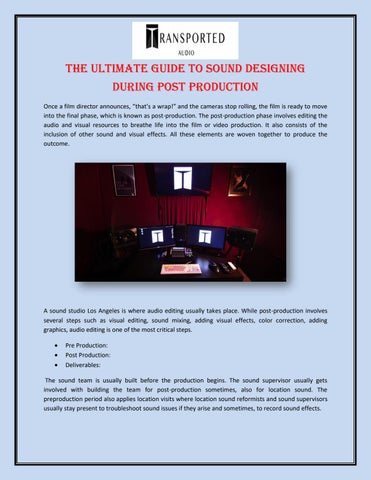
A sound studio Los Angeles is where audio editing usually takes place. While post-production involves several steps such as visual editing, sound mixing, adding visual effects, color correction, adding graphics, audio editing is one of the most critical steps. • • •
Pre Production: Post Production: Deliverables:
The sound team is usually built before the production begins. The sound supervisor usually gets involved with building the team for post-production sometimes, also for location sound. The preproduction period also applies location visits where location sound reformists and sound supervisors usually stay present to troubleshoot sound issues if they arise and sometimes, to record sound effects.
Spotting session also takes place during preproduction, where the supervising sound editor or good designer meets the director to perform a thorough analysis of the film and the critical sound assets. Custom sound effects recording is where the recordist captures sounds that add authenticity and character to the film. Preproduction sound design is also usually created before production begins so that it can be played on set for actors’ cues or, if need be, to meet the director's approval on time to start post-production. This is usually followed by session preparation, dialog editing, and sound effects editing. This is the most critical sound design stage because it gives the final shape to a film. Sound Designers in Los Angeles, California, work tirelessly to piece together everything. While the pre-mix stage involves each section of the track lay (dialogue, foley, backgrounds, sound effects, music) being individually mixed into the film, the final mix is a stage that is usually conducted in a specialist mixing environment. The re-recording mixer usually performs the Final blend after all the track lay is completed and the director has given the green signal to the work. The re-recording mixer takes the audio tracks that have been assembled, decides which elements will remain, and their overall tonal balance, distance perception, and technical needs for the final deliverables of the sound mix. Another crucial factor to sound mixing is the distance perception of sounds. Another essential thing to note is that the final mix for a theatrical release usually has a more dynamic range (the difference between the loudest and quietest sounds) than a mix for television or online platforms. This is the final product that is delivered to the editor, the director, and the producer to use in the final master version of the film. Tips: Here is some useful advice before you dive down to mix sounds for video production: consider the project timeline, do tell your picture editor what file formats you will need from their editing software, have a fair idea of what the director or producer expects as a final output, i.e., a stereo or 5.1 Surround, ask the picture editor what sample rate and bit depth they would like the files in for your final export and have a good loudness meter handy. We at Transported Audio are a team of fast, creative, detail-oriented storytellers. We pride ourselves in taking on groundbreaking content with a positive, can-do attitude no matter the circumstances. A onestop-shop for all your post-production audio needs, our Theatrical Sound Studio Los Angeles stays busy with several post-production activities such as dialog editing, foley, final mixing, sound editing, sound designing, ADR, and voiceover, and final mixing. To book a project with us, click here.
For more Visit here :- https://transportedaudio.com/