CHANGE, RESILIENCE AND COMPLEXITY

MICHELLE EGGLESTON SCHWARTZ, CPTM

HOW L&D CAN BUILD CAPACITY FOR CHANGE
In a world where the only constant is change, the best place to focus our energy is on what we can actually influence. For learning and development (L&D), that means building the capabilities that help employees adapt, problem-solve and move forward, even when the environment around them feels uncertain.
intelligence continues to reshape how work gets done.
Our columnists push the conversation even further. They explore whether L&D can play a stronger role in strengthening leadership pipelines, how to better prepare our brains for ongoing change and the costs that sometimes accompany smart technology.
WHEN ORGANIZATIONS INTENTIONALLY BUILD THE SKILLS THAT SUPPORT ADAPTABILITY, THEY ALSO BUILD THE CAPACITY TO THRIVE WITHIN IT.
L&D plays a critical role in helping organizations build the capacity for change. And right now, uncertainty is everywhere. Our newsfeeds keep us informed, but they also take us on an emotional roller coaster. In a single scroll, we can move from sadness to fear to excitement and back again. It’s no surprise that many employees feel the strain of working in an unpredictable environment.
This is where L&D can make a real difference. By focusing on the human capabilities that support adaptability and resilience, L&D can help employees navigate change with greater confidence and clarity. When organizations invest in these capabilities, they strengthen their collective ability to respond to disruption and keep moving forward.
In this issue of Training Industry Magazine, we explore how organizations can build that capacity for change while bringing balance to complex work environments. Articles examine communication frameworks that help teams navigate complexity, stress regulation techniques for today’s leaders and ways organizations can proactively prepare for disruptions before they occur. You’ll also find perspectives on the human capabilities L&D must champion as artificial
While change has always been part of the business landscape, the pace and intensity of disruption have accelerated dramatically over the past five years. The encouraging news is that organizations are getting better at responding to skills disruption. Research from the World Economic Forum suggests the rate of disruption is beginning to stabilize, thanks in part to the upskilling and reskilling efforts many organizations have invested in over the past several years.
But our work in L&D is far from finished. Learning is an ongoing experience, and L&D must continue to design meaningful learning journeys that help employees grow, adapt and stay curious. When organizations intentionally build the skills that support adaptability, they also build the capacity to thrive within it.
I hope the articles in this edition spark a few fresh ideas as your team develops the capabilities needed for your organization’s next chapter.
Michelle Eggleston Schwartz, CPTM, is the editor in chief of Training Industry, Inc., and co-host of “The Business of Learning,” the Training Industry podcast. Email Michelle.


DESIGN
FLEXIBLE PATHWAYS

42 PREPARE FOR UNKNOWNS
FEATURES
THE COSMIC FRAMEWORK: RETHINKING LEARNING FOR COMPLEX ORGANIZATIONS
By Dr. Bill Brantley
Why training models fail in complex environments, and how to rethink them.
THE MISSING LEADERSHIP SKILL: TRAINING LEADERS TO REGULATE STRESS
By Paige Palermo, CPTM
Leadership skills break under pressure. Learn how regulation keeps them working.
5 HUMAN CAPABILITIES L&D MUST CHAMPION AS AI CHANGES WORK
By Candice Mitchell
Move beyond AI basics by building judgment, adaptability and decision-making skills.
SKILLS, NOT ROLES: HOW L&D CAN BUILD WORKFORCE AGILITY AND READINESS
By Viren Kapadia
Shift from static roles to dynamic capabilities that enable mobility, safety and real-time readiness.
THOUGHT LEADERS
FROM THE EDITOR
By Michelle Eggleston Schwartz, CPTM
LEARNING LEADER SPOTLIGHT
By Heather Balcerek, CPTM
L&D CAREERS
By Amy DuVernet, Ph.D., CPTM
SCIENCE OF LEARNING
CULTURE ISN’T A PROGRAM: HOW LEADERS CREATE LASTING BEHAVIOR CHANGE
By Darren Bridgett
Why culture change fails and how to make behavior change stick in real work.
HOW L&D TEAMS CAN PREPARE FOR DISRUPTION BEFORE IT HITS
By Jenessa Jacobs, CPTM
Build the infrastructure, processes and alignment that keep learning teams steady under pressure.
DRIVING GRASSROOTS CULTURE CHANGE FROM THE BOTTOM UP
By Laura Smith Dunaief
How L&D can turn employees into change agents to accelerate culture shift.
WHAT’S NEXT IN TECH? By JD Dillon 3 9 11 13 15 59 61 63
By Srini Pillay, M.D.
CAREER DEVELOPMENT
By Julie Winkle Giulioni
CULTURE AND WELL-BEING
By Dr. Kristal Walker, CPTM
BUILDING LEADERS
By Marshall Goldsmith and Suzie Bishop
INFO EXCHANGE
UPSKILLING
By Scott Rutherford, MBA, CPTM
Break through information overload.
HOW-TO
By Lynda Silsbee
Reduce change fatigue for yourself and your team.
STRATEGIES
By Taylor Tagg
Learn how to make change stick.
PERSPECTIVES
By Mira Neal, CPTM
Make microlearning impactful.


CASEBOOK
By January Immer, Julie Heyn and Barbara Trautlein, Ph.D.
Learn five lessons from International Motors on building change capability at scale.
CLOSING DEALS
By Sarah Gallo, CPTM NIIT and SweetRush team up on AI-powered learning solutions.
COMPANY NEWS
Review the latest training news from the last quarter.
STAFF ABOUT OUR TEAM
CEO
Ken Taylor ktaylor@trainingindustry.com
EDITOR IN CHIEF
Michelle Eggleston Schwartz meggleston@trainingindustry.com
SENIOR EDITOR
Sarah Gallo sgallo@trainingindustry.com
SENIOR EDITOR
Carla Rudder crudder@trainingindustry.com
VP OF BRAND STRATEGY
Amanda Longo alongo@trainingindustry.com
SENIOR DESIGNER
Mary Lewis mlewis@trainingindustry.com
BRAND MANAGER
Kellie Blackburn kblackburn@trainingindustry.com
DESIGNER
Cassandra Ortiz cortiz@trainingindustry.com
EDITORIAL BOARD
JUDI BADER, CPTM Senior Director of Culture, Learning and Development Willy’s Mexicana Grill
BARBARA JORDAN, CPTM Group Vice President, Global Learning & Development Sims Metal Management
CATHERINE KELLY, MA, BSN, RN, CPTM Director of Learning Programs Brookdale Senior Living
SHIREEN LACKEY, CPTM Senior Management and Program Analyst, Office of Business Process Integration Veterans Benefits Administration
SCOTT NUTTER Principal/Owner Touch & Go Solutions
MATTHEW S. PRAGER, CPTM Executive Training Manager U.S. Government
DESIGNER
Rylee Hartsell rhartsell@trainingindustry.com
DESIGNER
Sha’Meire Jackson sjackson@trainingindustry.com
ADVERTISING SALES sales@trainingindustry.com
MARC RAMOS Chief Learning Officer Cornerstone OnDemand
KELLY RIDER Chief Learning Officer PTC
DR. SYDNEY SAVION Vice Chancellor for People, Culture & Belonging Vanderbilt University
KERRY TROESTER, CPTM Director, North America Sales Training Lenovo
NATASHA MILLER WILLIAMS Head of Diversity & Inclusion Ferrara
KEE MENG YEO Adjunct Professor Grand Valley State University & Davenport University
MISSION
Training Industry Magazine connects learning and development professionals with the resources and solutions needed to more effectively manage the business of learning.
SUBSCRIPTIONS
ELECTRONIC: Sign up at TrainingIndustry.com to receive notification of each new digital issue.
PRINT: Print copies are available for purchase at magcloud.com for $17.95.
ARTICLE REPRINTS
To order reprints of articles, please contact Training Industry at editor@trainingindustry.com.
PUBLISHER
Training Industry Magazine is published quarterly by:
Training Industry, Inc. 110 Horizon Drive, Suite 110 Raleigh, NC 27615-6520


























HEATHER BALCEREK, CPTM
THE LEARNING LEADER SPOTLIGHT WITH HEATHER BALCEREK
In this issue, we are pleased to spotlight Heather Balcerek, CPTM, senior learning and development (L&D) leader at Maximus. With nearly 20 years in the field, Heather’s career path has taken her from frontline training to leading enterprise learning and leadership development programs that help people grow with confidence and clarity.
Read on to learn about Heather’s career journey.
Q: HOW DID YOU GET STARTED IN LEARNING AND DEVELOPMENT?
A: I studied psychology in college and was drawn to how people learn and succeed at work. When I realized our company lacked training for key systems, I created a full training manual for my senior capstone. That work opened the door to my first official L&D role after graduation.
Q: WHAT’S YOUR MOST MEMORABLE TRAINING EXPERIENCE, GOOD OR BAD?
A: Running our executive development program this year. Hearing participants share how much they learned — and how the relationships they built will support their continued success — was incredibly meaningful. Their appreciation and growth made the impact of the work feel real in a new way.
Q: WHO WOULD YOU CONSIDER YOUR MOST VALUABLE ROLE MODEL? WHAT WERE SOME QUALITIES THAT MADE THEM GREAT?
A: Eric Miller, a trainer at Verizon Wireless, remains one of my most influential role models. He made learning real through stories and analogies, encouraged
people as they stretched into new skills, and he deeply believed in me — often speaking my name in rooms I wasn’t in. His example still guides me.
Q: WHAT ARE THE MOST PRESSING ISSUES ON YOUR PROFESSIONAL PLATE RIGHT NOW?
A: Right now, I’m focused on shifting from building standalone programs to building capabilities and skills across the organization. My priority is defining a clear, repeatable process that helps the business identify and grow the skills we’ll need over the next few years, ensuring development is practical, scalable and future ready.
Q: WHAT’S THE MOST CHALLENGING ASPECT OF YOUR JOB?
A: Managing diverse stakeholder expectations as we shift from program based learning to true capability building. Everyone wants something slightly different, and aligning those needs into a clear, sustainable process takes time and patience. Navigating those conversations is complex, but it’s essential to doing this work well.
Q: WHAT’S THE MOST REWARDING ASPECT OF YOUR JOB?
A: Watching learning take shape in real time. Recently, I was training a new class and there was a moment when the group moved from hearing the idea to truly engaging with it. The conversation opened up, and you could feel the shift. Moments like that remind me why this work matters.
Q: WHAT’S YOUR PREFERRED TRAINING METHODOLOGY?
A: My preferred training methodology is human-centered and supportive.

I focus on creating a space where people feel safe exploring, reflecting and trying new skills. I use stories, real examples and guided discussion to help concepts take shape. When people feel seen and supported, learning becomes meaningful and lasting.
Q: HOW DO YOU FIND THE TIME TO CONTINUE YOUR OWN PROFESSIONAL DEVELOPMENT?
A: I fit my own development into everyday moments — listening to podcasts while getting ready, watching short videos while doing chores or reading during travel. I also carve out time for classes and certifications. Blending small daily habits with intentional learning helps me keep growing without adding pressure to my schedule.
Q: ANY RECOMMENDATIONS FOR FOLKS OUT THERE: BOOKS, PARTNERS, RESOURCES, ETC.?
A: I always recommend resources that support practical, human-centered leadership. “Trust & Inspire” by Stephen M.R. Covey has been especially meaningful, and I regularly learn from the podcasts Coaching for Leaders and L&D Must Change. I also rely on Training Industry’s resources and membership for fresh insights and research.
Q: “IF SOMEONE WANTS TO FOLLOW IN MY PROFESSIONAL FOOTSTEPS, I’D TELL THEM TO BE SURE TO …”
A: Invest in your own growth the same way you invest in others’. Build your skills, keep learning in the small moments and create spaces where people can grow. When you lead with intention and humanity, the impact tends to take care of itself.

Make skills visible. Make learning count.

When it comes to learning and development, executives want to see impact, not just activity. Accredible’s digital credential platform elevates employee training from transactional to strategic, by:
➜ Credentialing verifiable skills with rich metadata and third party endorsements
➜ Making hidden skills visible to drive readiness, retention, performance, & mobility
➜ Proving business outcomes of training programs Transform
AMY DUVERNET, PH.D., CPTM

HOW TRAINING MANAGERS STAY RELEVANT IN TIMES OF CHANGE
When organizations face change, we all tend to look inward. We think about how it will impact us, our teams and our processes. This is natural, but for training professionals, it can mean missing a critical moment.
Organizational change reshapes roles, skills and expectations, leading employees to question where they fit. Leaders are expected to help with this uncertainty while also facing ambiguity themselves. Training professionals are not immune to this pressure.
And yet, it’s at this very moment that visibility matters most.
STOP LOOKING INWARD
As part of their work in the Certified Professional in Training Management program, I often see participants approach change scenarios by focusing on how the training function must evolve. They discuss restructuring the team, adopting new technologies or improving internal processes. This reflects strong operational thinking, but it centers the training function instead of the organization.
According to Training Industry research, the number one reason change efforts fail is a lack of communication around expected changes, and the second is not addressing obstacles related to culture and structure. These issues can’t be solved with better systems alone. They require a focus on people, behavior and performance.
THIS IS TRAINING’S MOMENT
Change is a human challenge and learning leaders are uniquely positioned to lead by:
• Clarifying expectations
• Building capability
• Supporting and preparing leaders to guide their teams through uncertainty
• Reinforcing behavior change and new skill adoption
This isn’t support work; it’s central to whether a change effort succeeds or fails.
THREE WAYS TO STEP FORWARD
Learning leaders must position training as a necessary lever for successful change.
1. Get involved before solutions are defined. Don’t wait for training requests to come in. Ask to be involved in planning conversations and help identify capability gaps upfront. Make sure you fully understand the goals of the change and the mechanisms for rolling it out.
2. Lead with business outcomes Executives are not looking for courses. They are looking for results. Frame your work around adoption, productivity and business outcomes.
3. Make your value impossible to ignore. Don’t assume stakeholders understand the role training plays in change. Be explicit about how L&D can support the business during this process.
CAREER IMPLICATIONS
While change strikes fear in most, it also offers positive career opportunities. Learning leaders can leverage these moments to shape how their role is perceived after the initiative is over.
To take advantage of this opportunity, be intentional about how you position yourself:
• Expand your scope beyond traditional L&D. Take on responsibilities that intersect with adjacent areas like talent, workforce planning or organizational design and use these opportunities to build new cross-functional relationships.
• Attach yourself to high-impact initiatives . Look for opportunities to be visibly connected to key transformation efforts.
• Document your impact and what you’re learning. Keep track of what you are doing. This becomes valuable not only for improving your performance, but also for telling a clear story about your role in driving change.
• Build a narrative about your role in change. Be intentional about how you talk about your work. Practice telling the story of how you helped the organization adapt, where you influenced outcomes and what problems you helped solve.
These actions are less about immediate visibility and more about long-term positioning. They shape how others understand your capabilities and the types of opportunities that come your way.
Training managers who approach change this way are not just supporting transformation. They are using it to expand their influence, redefine their role and create new pathways for growth.
Amy DuVernet, Ph.D., CPTM, is the vice president of learning products at Training Industry, Inc., where she oversees all processes related to Training Industry’s courses for training professionals, including program development and evaluation. Email Amy.
• Align yourself with where the organization is headed. Whether your organization is focused on AI adoption, new operating models or shifts in customer strategy, position your work around building the capabilities that will matter in the future, not just solving today’s problems.
Our experts think global-first so they can easily consult, transform and translate your eLearning content - no matter the size or scale.
We understand cultural, technological and accessibility nuances worldwide to ensure you and your learners are set up for success right from the get-go.

Next-level global eLearning starts here rws.com/elearning
SRINI PILLAY, M.D.
PREPARING YOUR BRAIN FOR CONSTANT CHANGE AI BRINGS
Keeping up with change feels harder than ever. The old playbooks are starting to crack. Consider the classic leadership advice in Kotter’s 8-step model, which begins with a powerful premise: Create a sense of urgency. Yet, while urgency is meant to mobilize action, the human brain isn’t wired to respond cleanly to large-scale urgency. When a threat feels vast or affects many people at once, we diffuse. We normalize. We look away. Paradoxically, the more widespread and frightening a situation becomes, the less individually urgent it can feel. In fact, people (and their brains) often freeze.
Even for those still adapting, keeping up often comes at a significant cost: cognitive fatigue, burnout and weakened decision-making.
So, how do you respond to relentless change like what we are experiencing in learning and development (L&D) as artificial intelligence (AI) reshapes the industry? You stop reacting, and you put yourself in the driver’s seat. That means activating the brain systems responsible for foresight and strategic planning. This does not happen through focus alone. In fact, it requires strategic unfocus.
STRATEGIC UNFOCUS
The brain does its most powerful predictive and creative work when it is not locked into nonstop execution mode. When you are constantly reacting — answering emails, attending meetings, solving immediate problems — you are primarily using narrow, task-oriented circuits. That’s necessary for performance but makes you a prisoner to adaptation, which is fundamentally unsustainable.
Strategic unfocus is a deliberate stepping back that allows deeper integration, simulation and vision. It is not rest. It is preparation for authorship. It means making AI work for your vision, rather than adapting yourself to its pace.
The first step is self-reinvention — the process of outgrowing an identity that once worked but no longer serves the future you are stepping into. This isn’t about trying harder as your current self. It’s about recognizing that the version of you built for yesterday’s environment may not be equipped for tomorrow’s challenges.
Research shows that identity directly shapes cognitive performance. In one study, participants asked to adopt the mindset of an “eccentric poet” generated significantly more creative and original ideas than those asked to think like a “rigid librarian.”
In other words, who you believe you are influences what you notice, what you imagine and what you attempt.
So instead of asking, “How do I solve this problem?” ask, “Who do I need to become to solve the problems of tomorrow?”
That question shifts the locus of control inward. It moves you from tactics to identity, from short-term problemsolving to long-term evolution. When identity changes, perception changes. When perception changes, strategy follows. Reinvention is not cosmetic; it restructures how you interpret risk, opportunity and possibility. And once your internal model shifts, your decisions begin aligning with a future

you are actively shaping rather than passively inheriting.
Start with three shifts. Regulate your physiology — tension narrows thinking; agility expands it. Define one compelling future and let it guide your present decisions. And deliberately upgrade your skills and mindset rather than rationalizing stagnation.
INSTEAD OF ASKING, “HOW DO I SOLVE THIS PROBLEM?” ASK, “WHO DO I NEED TO BECOME TO SOLVE THE PROBLEMS OF TOMORROW?”
This requires a willingness to move toward a future that does not yet exist. The most adaptive thinkers tolerate paradox: stability and change, discipline and imagination, control and surrender. Stop being a passive operator by reclaiming authorship — ensure your goals, your calendar and your identity reflect contribution rather than compliance. In the age of AI and constant change, the greatest risk isn’t replacement by machines; it’s surrendering your agency and becoming one.
In short, you don’t win this era by keeping up. You win it by creating what comes next.
Dr. Srini Pillay is the CEO of NeuroBusiness Group. He is a Harvard-trained psychiatrist and neuroscientist, on the Consortium for Learning Innovation at McKinsey & Company, and author of “Tinker Dabble Doodle Try.” Email Srini.
ALIGN YOUR LEADERSHIP KPIS WITH BUSINESS GOALS
Determine the leadership solutions your organization needs the most. Download the Aligning KPIs to Organizational Goals template to get started.

CAN L&D SAVE LEADERSHIP?
Leadership is losing its appeal. According to a recent study by Zety, 49% of employees report having no interest in becoming managers, with the leading reason cited as a desire to avoid the stress and demands of people management. At a moment when organizations need capable, human-centered leadership more than ever, fewer people are willing to step up.
Leadership roles, as currently constructed and supported (or not), often feel unsafe, unclear and unforgiving — especially at the point of entry. Employees aren’t rejecting leadership itself, rather the experience of leadership modeled around them.
At the same time, organizations are racing to automate work, embed artificial intelligence (AI) and streamline operations. While technology is increasingly effective at handling tasks, it cannot replace the essential human elements of leadership.
THE CHALLENGE IS BIGGER THAN LEARNING ALONE
To be clear, the conditions discouraging people from leadership extend well beyond the direct control of learning and development (L&D). Today leaders are under relentless pressure to deliver on results, day after day. And they’re doing it with a workforce experiencing overwhelm and stress themselves. Spans of control have expanded, frequently across distance and time zones, making people leadership difficult even for seasoned professionals. Add the complexity of managing across age, experience and perspective, and it’s no surprise the role feels daunting.
These are not problems L&D can solve single-handedly. But learning leaders are uniquely positioned to surface these realities, to name and frame them
constructively, advocate for change and to partner with executives to make the work of leadership more doable and attractive.
FROM “PREPARE IN POSITION” TO “TRY BEFORE YOU BUY”
There’s also plenty that L&D can do directly to address this impending leadership gap. Too often, leadership development begins after someone assumes the title. Even when highpotential employees are exposed earlier, the learning is frequently abstract and disconnected from lived experience.
A more effective approach allows people to “try leadership on” before the stakes are high. Small, bounded experiences — project leadership, mentoring others, task forces, temporary rotations — give employees a realistic preview of what leadership entails. These low-risk opportunities demystify the role and replace hesitation with informed commitment.
Confidence does not come from titles; it comes from rehearsal. This is where learning design matters most today. Simulations, scenario-based and AIenabled learning allow people to practice judgment, decision-making and difficult conversations before the consequences may be irreversible.
CRITICAL SKILLS ON BOTH SIDES OF LEADERSHIP
Leadership may also be getting a bad rap because, in the name of authenticity, many leaders have become comfortable speaking candidly about the strain of their roles. Transparency clearly builds trust. But when honesty slips into unfiltered venting, it can distort how leadership is perceived. Employees hear only the stress and
frustrations without equal visibility to those meaningful and rewarding moments.
L&D can help by coaching leaders to balance challenges with learning, purpose and impact to position leadership as demanding and worth it. How leadership is talked about shapes who is willing to step into it.
The experience of leadership is shaped as much by followers as by leaders themselves. When employees are equipped to manage up, give feedback and take ownership, the burden of leadership lightens. Training in productive followership improves day-to-day functioning and makes leadership roles more sustainable — and more attractive.
CONFIDENCE DOES NOT COME FROM TITLES; IT COMES FROM REHEARSAL. THIS IS WHERE LEARNING DESIGN MATTERS MOST TODAY.
LEADERSHIP AT A CROSSROADS
L&D finds itself in a powerful position today: deeply connected to how work gets done and empowered to shape how people grow into responsibility. In this way, learning professionals can influence not just skills and readiness but also a new mindset when it comes to people leadership — one that inspires a willingness to try the new role on before ruling it out. That’s how L&D will save leadership.
Julie Winkle Giulioni is the author of the bestselling books, “Promotions Are SO Yesterday” and “Help Them Grow or Watch Them Go.” Email Julie.
IS THE CERTIFIED PROFESSIONAL IN TRAINING MANAGEMENT (CPTM™) PROGRAM
RIGHT FOR ME?
My career goals include...
• Obtaining a promotion or moving into a new role.
• Building credibility with others in my company and/or in the L&D field.
• Increasing my earning potential.
• Gaining new skills and continued education.
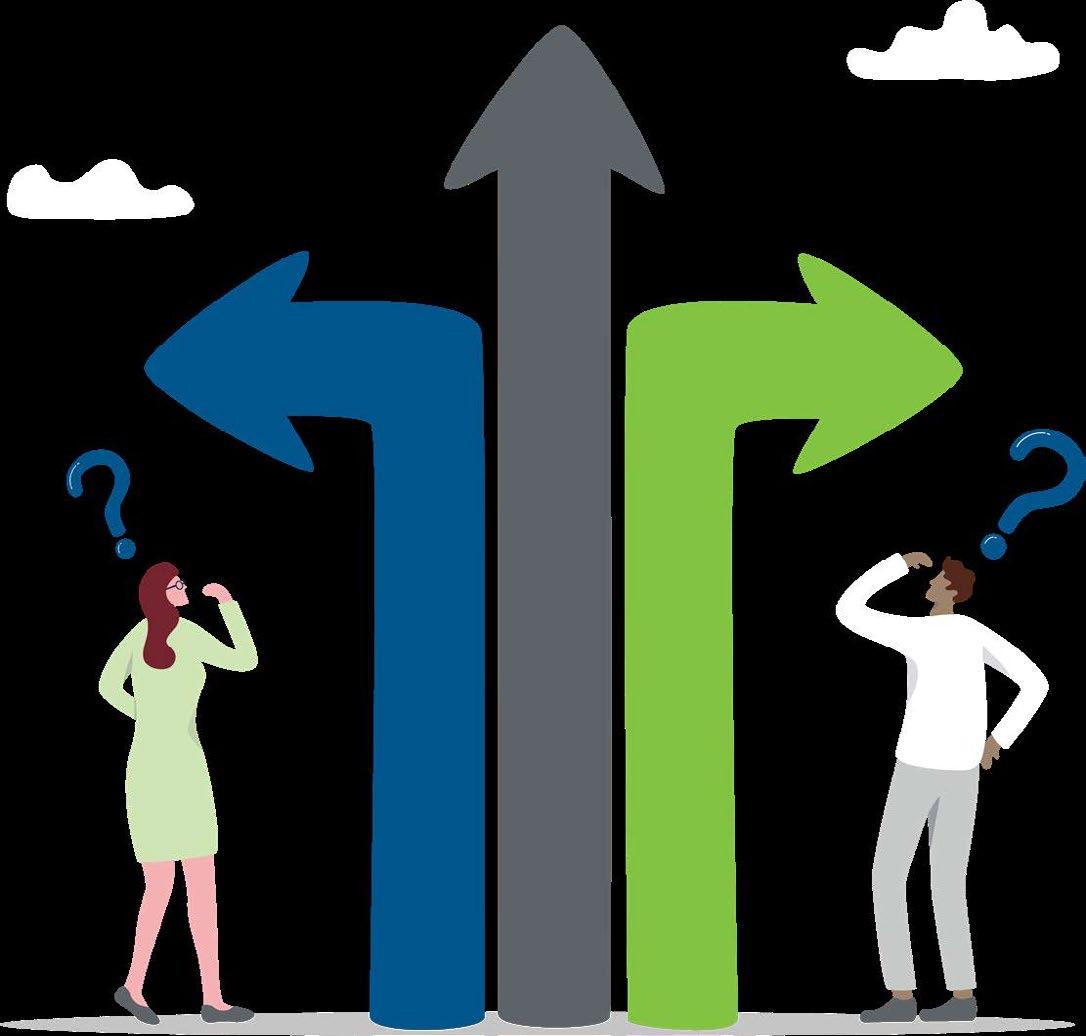
Complete the quiz to find out if the CPTM program will help you meet these professional goals and more!
TAKE THE QUIZ
Learn More About the CPTM Program
HOW LEARNING CAN BREAK THROUGH IN THE AGE OF INFORMATION OVERLOAD
BY SCOTT RUTHERFORD, MBA,
CPTM
It’s a typical Tuesday morning in Newton, Massachusetts, where Sam and Cris live with their young son Dylan and two cats. Typical because Dylan is adamantly resisting getting dressed for preschool, and typical because Cris knows he’s already running late and will need to stop to get gas in the car because it’s nearly empty.
Already this morning, since they woke up from their cell phones’ alarms, they’ve dealt with the morning flurry of notifications — a weather app says there’s a chance of rain later, and Cris’s sleep tracker tells him his REM sleep last night was shorter than usual. Then there’s the news alerts, which seem to be a never-ending series of things to be concerned or angry about. Sam’s quick scroll through a friend’s social media gives her a fix of cute, sandwiched between barely relevant sponsored content. A quick look at the calendar and a few replies shot off, all before getting dressed. Then it’s down to the kitchen and an Alexa with its reminders to buy more trash bags and that a delivery will arrive today.
Now at the gas station, Cris taps his card to start the pump while trying to ignore the relentless yammer of 10-second content clips and ads coming from the gas pump screen. On the T, Sam studies her phone as she rides, doing her best to avoid the trolley’s distractions while her earbuds give her a loosely strung together sequence of songs punctuated by awkward ad breaks.
Cris, meanwhile, drops Dylan at his daycare, and drives the rest of his 40-minute trip to work. His phone is
clipped on the dashboard so Google Maps can help him keep an eye on traffic, but he can’t help but notice the notifications accumulating, one after the next. He resists checking while driving, but he knows they’re lurking, waiting.
So why is there a story about a couple of young parents in Boston in this learning and development (L&D) magazine?
Because this scenario is typical. Specifics will change, but the underlying truth is this: before your learners connect to work or walk in the workplace door, they’ve already been subjected to a barrage
BEFORE YOUR LEARNERS CONNECT TO WORK OR WALK IN THE WORKPLACE DOOR, THEY’VE ALREADY BEEN SUBJECTED TO A BARRAGE OF INPUTS.
of inputs. Each interaction or piece of information is individually small, but each requires their attention, evaluation and processing: Do I need to do something? Is it important? Can I ignore it?
Despite being armed with the same human brain our species has had for many hundreds of years, we exist in a society where the ambient cognitive load has grown immensely. UC San Diego researchers Roger Bohn and James Short found in 2012 that the average person consumes 34 gigabytes of information on a typical day. This includes about 12 hours per person, per day, of information consumed outside of the workplace. That’s more information than a person would have consumed in an entire lifetime a half-millennia ago.
For L&D professionals, it’s important to recognize that starting point as you try to develop a strategy to engage your learners with new information.
THE MYTH OF MULTITASKING IN THE WORKPLACE
The challenge is amplified when we consider the on-the-job information processing and attention demands made of the typical worker. Especially in an environment where workers are asked to do more with less or asked to absorb new tasks because of an expectation that new artificial intelligence (AI) tools will help them do more, faster. The reality is the L&D professional is truly fighting an uphill battle for learner attention.
Multitasking, once a prized workplace ability, is now increasingly understood to be
Overcoming Information Overload: In
The Words of L&D Leaders
“When learning gives people choice, relevance and a clear line of sight to what it unlocks for their future, it stops feeling like an interruption. Forget what you think you know about your learners and actually get curious about them, their interests, how they prefer to learn and what they’re working toward.”
— Sara Pieczarka, senior learning design and development consultant
“The most powerful action a manager can take is to frame learning around behavior change, focusing on what will be different on the job and why it matters, rather than an LMS task to complete. When leaders consistently connect learning to purpose and business outcomes, they cultivate curiosity, accountability and a healthy sense of FOMO that accelerates growth.”
— Pam Moyer, senior learning executive with 25+ years L&D experience
“You can engage learners who may seem distracted or too busy by both linking training outcomes directly to their personal or career goals, and by using modern approaches like snackable sized learning. Also, many in the workforce thrive when training is aligned with their values and offers a sense of purpose and isn’t training for the sake of training.”
— Susan Nabonne Beck, vice president of instructional design and strategy, AXIOM Learning Solutions
a misnomer. Every task someone begins is done in a specific context: What is the goal, what are the rules, what has been done and what needs to be done? When switching between tasks, there is an additional effort required to switch from one task to another. A review of research led by researchers at the University of Michigan suggests there are measurable “switch costs” when moving between tasks.
In another study of performance in the high-consequence environment of a hospital emergency department, researchers found increasing task switching in the workplace created an even larger proportional decrease in productivity. In other words, performance is slowed and errors increase, because the same task requires more mental effort.
This mental load is a factor alongside what psychologists understand to be the brain’s ability to keep multiple items in the mind at once. This type of memory is called “working memory” and has been the
subject of extensive research in the past seven decades. It tells us most people can meaningfully hold about four things in their working memory at a time, though some estimates are as high as seven. Whatever the number, the dynamic is straightforward: At the limit of your working memory, when you try to remember a new item, you risk forgetting one of the others.
3 WAYS L&D CAN COMPETE WITH A CLUTTERED MIND
We’ve spent some time exploring the challenge. Let’s turn now to what you can do.
1. Set Expectations With Learners and Colleagues
Firstly, L&D must be aware of the problem and be an active counselor of our colleagues. For many years, there have been discussions between line managers and training leads, balancing the need for a training session against the direct and
indirect cost (learners’ time away from their job, for example). Given what we now understand about task switching, cognitive load and working memory, the conversation can and should shift to understanding the information demands experienced by the learner and making proactive decisions to make cognitive space for learning.
This can be as simple as setting expectations (such as helping ensure learners don’t feel they must juggle other obligations during a training session) or making structural changes (even if temporary) to enable learning, like building in a set-aside time for learning activities into a department’s calendar every quarter.
The reality is that many managers won’t make the extra time for learning unless they understand how and why what you’re suggesting is an important enabler of success. Advocating and educating about
cognition becomes an important task for you as the expert L&D advisor.
2. Design Training With Cognitive Load Theory in Mind
Secondly, consider how your learning assets and experiences contribute to your learners’ cognitive load. Cognitive Load Theory, as coined by educational psychologist John Sweller, outlines three categories of mental load: intrinsic load (the inherent difficulty of the task), extraneous load (unnecessary or competing demands in the learner’s environment), and germane load (the learner’s effort devoted to learning and understanding).
In many cases, L&D professionals focus our efforts on presenting material clearly, in a structured way, which addresses the learner’s intrinsic load. We also have expectations (and may develop external reward structures) to support the learner’s “engagement,” which often is equated with their germane load — their effort. Many in L&D have seen how effective microlearning assets can be, and this is completely aligned with this
model, as short, coherent segments with a clear, singular learning objective are one concrete step that can reduce the learner’s extraneous load.
In practice, this facet of Cognitive Load Theory can be applied to create learning experiences that anticipate the inherent limitations of working memory, improving experiences and outcomes.
3. Upskill in Judgment and Decision Making
Thirdly, L&D can build on the understanding that task switching is a choice and a learnable skill. Research led by Laura Broeker at the German Sport University in Cologne suggests managing multiple tasks through the lens of active “judgment and decision making” (JDM) may present a path to reduce the disruption when switching tasks — a human skill that can be developed with the support of L&D.
If we develop support for workers’ active prioritization of tasks and help develop a workplace culture in which individuals are empowered to make decisions to
prioritize, we can help equip workers to take an active role managing their information intake and tailoring their focus.
ENABLE LEARNING IN A DISTRACTED WORLD
The information demands our learners face are unlikely to be reduced. The task before us is to advocate for and help create the space and structure necessary to enable learning and the resulting and desired behavior change. With this, the impetus falls to us to help our colleagues understand these cognitive frameworks and why we are doing what we are doing. It’s a path that can empower us as a stronger, more strident ally in favor of performance outcomes.
Scott Rutherford, MBA, CPTM, is a communications and learning professional with a background in broadcast journalism, corporate communications and learning and development. He is vice president for marketing at AXIOM Learning Solutions, hosts the AXIOM Insights L&D Podcast and is a board member of the Greater Philadelphia chapter of ATD. Email Scott.
FIND AND COMPARE CORPORATE
LEARNING AND DEVELOPMENT VENDORS
Explore our directory of 2,000+ L&D vendors. Search for and connect with verified training companies to solve your training needs.

SEARCH VENDORS
Does your company provide training solutions? Sign up for a vendor listing.
CHANGE FATIGUE IS REAL: HOW TO BUILD RESILIENCE DURING ORGANIZATIONAL TRANSITIONS
BY LYNDA SILSBEE
Organizational change has become so constant that many leaders treat it like background noise. New systems roll out, structures shift, strategies pivot and priorities are “refreshed.” Again. And again. Yet beneath the surface, something far more human is happening: People are tired.
Change fatigue is not the same as change resistance, laziness or negativity. It is the natural psychological and physiological response to sustained uncertainty, cognitive overload and emotional strain. When organizations underestimate this reality, even well-intentioned change efforts stall. When they address it directly, resilience becomes possible.
This article explores what change fatigue is, why it shows up so frequently in today’s workplaces and how leaders can build individual and collective resilience during periods of ongoing transition.
WHAT IS CHANGE FATIGUE?
Change fatigue occurs when employees experience exhaustion, disengagement or apathy due to repeated or prolonged organizational changes. Unlike short-term stress, change fatigue accumulates over time. Each new initiative draws from a limited reservoir of attention, adaptability and emotional energy. When withdrawals exceed deposits, people begin to protect themselves.
Common signs of change fatigue include:
• Cynicism or skepticism about new initiatives
• Decreased engagement or discretionary effort
• Slower adoption of new processes
• Increased errors or decision paralysis
• Emotional withdrawal or burnout
Importantly, change fatigue is not a character flaw. It is a signal that the system has exceeded human capacity.
WHY CHANGE FATIGUE IS INCREASING
Several workplace realities are amplifying the experience of change fatigue:
1. Change Without Recovery
Many organizations move from one transformation directly into the next without allowing time for stabilization. Neuroscience tells us that adaptation requires consolidation. Without recovery, people remain in a constant state of alert.
2. Volume Over Velocity
It is not just how fast change happens, but how much happens at once. Multiple overlapping initiatives — often launched by different parts of the organization — create competing demands and cognitive overload.
3. Ambiguity and Loss of Control
Unclear decision-making, shifting priorities and incomplete communication
erode psychological safety. When people feel they lack control or clarity, stress intensifies.
4. Emotional Labor
Change often involves loss: of roles, routines, relationships or competence. Leaders may focus on logistics while underestimating the emotional work required to let go and reorient.
THE COST OF IGNORING CHANGE FATIGUE
Organizations that push through change fatigue often see shortterm compliance but long-term consequences. Engagement drops, trust erodes and talent leaves. Teams may appear busy while becoming less effective.
More subtly, change fatigue undermines learning. When people are overwhelmed, the brain shifts into survival mode. Curiosity narrows, experimentation declines and innovation suffers. Ironically, the very capabilities organizations need during transformation are the first to disappear.
REFRAMING RESILIENCE
Resilience is often framed as an individual trait: grit, toughness or personal stamina. While individual skills matter, this framing is incomplete and unfair. Sustainable resilience is largely systemic.
Resilient organizations do not simply ask people to cope better. They design
change in ways that respect human limits and strengthen collective capacity.
5 LEADERSHIP PRACTICES THAT REDUCE CHANGE FATIGUE
For learning and development (L&D) professionals, these practices represent more than leadership advice — they are clear training opportunities. L&D plays a critical role in equipping leaders with the mindset, skills and tools needed to reduce change fatigue and build resilient, adaptable teams.
1. Make the Invisible Visible
Acknowledge the cumulative impact of change; it builds trust. Leaders who say, “We know this has been a lot,” give people permission to be human while staying engaged.
Practical actions: Map current and recent initiatives to show the full load employees are carrying. Explicitly connect how new changes relate to or replace existing ones.
2. Prioritize Ruthlessly
Not every initiative deserves equal attention. When everything is urgent, nothing truly is.
Practical actions: Clarify the top 1-3 priorities that matter most right now. Pause, sequence or stop lowerimpact initiatives. Then, align metrics and incentives to reinforce focus.
3. Increase Clarity Before Speed
People move faster when they understand where they are going and why. Ambiguity drains energy.
Practical actions: Clearly articulate what is changing, what is not and what is still unknown. Share decision criteria, not just decisions, and repeat key messages consistently across levels.
Practical actions: Build reflection time into meetings after major milestones. Normalize short check-ins that focus on workload and energy, not just progress. Encourage boundaries that protect focus and rest.
5. Strengthen Local Control
Autonomy is a powerful antidote to fatigue. When people can influence how change is implemented locally, resilience increases.
Practical actions: Invite teams to adapt processes within clear guardrails and involve employees early in problemsolving, not just execution. Equip managers to translate change into meaningful local actions.
A BRIEF EXAMPLE: TWO PATHS THROUGH CHANGE
Consider two departments facing the same system implementation.
In the first, leaders emphasize urgency and compliance. Training is delivered quickly, questions are deferred and concerns are labeled as resistance. Adoption is uneven, errors increase and informal workarounds proliferate.
In the second, leaders slow down early. They acknowledge previous changes, clarify priorities and involve team members in identifying risks and sequencing learning. While the initial rollout takes slightly longer, adoption is stronger and performance stabilizes faster.
The difference is in the design.
MEASURING RESILIENCE DURING CHANGE
Resilience can feel abstract, but it is observable and measurable. Useful indicators include:
CHANGE FATIGUE UNDERMINES LEARNING. WHEN PEOPLE ARE OVERWHELMED, THE BRAIN SHIFTS INTO SURVIVAL MODE.
4. Create Micro-Recovery Moments
Recovery does not require long breaks or retreats. Small pauses can restore capacity.
• Engagement and energy levels
• Error rates and rework
• Speed of adoption after initial rollout
• Quality of decision-making
• Retention of key talent
Leaders who track these signals can adjust course before fatigue turns into failure.
DESIGNING CHANGE FOR HUMANS
Change fatigue is a predictable outcome of how many organizations approach transformation. Treating it as a personal weakness misses the point.
When leaders design change with human capacity in mind — acknowledging loss, prioritizing focus and building in recovery — resilience becomes a shared strength rather than an individual burden.
The question is not whether organizations will continue to change. They will. The real question is whether they will learn to change in ways that people can sustain.
Lynda Silsbee is a leadership expert and organizational effectiveness consultant with more than three decades of experience helping leaders navigate complexity and change. She focuses on building practical leadership capacity that improves performance while honoring the human side of work. Email Lynda.
By Dr. Bill Brantley

5 Practical COSMIC Moves for L&D Professionals
Surface assumptions early in training programs.
Teach leaders how to facilitate dialogue, not just meetings.
Use systems maps to show how actions connect across the organization.
Make reasoning explicit by practicing “why” conversations.
Train narrative skills so leaders can frame change clearly and honestly.

Two leaders can face the same data and take very different actions because their mental models differ. One might see risk; another might see opportunity.
Organizations Are Built Through Communication
COSMIC treats organizations as ongoing communication processes.
Training exercises might ask participants to unpack phrases like “we need to move faster.” By identifying the hidden assumptions behind such statements, teams clarify expectations and reduce friction.
Instead of asking, “What content do people need?”
COSMIC asks, “How
do people make sense of their work together?”

make sense of complexity together.


The Missing Leadership Skill: Training Leaders To Regulate Stress
By Paige Palermo, CPTM

The ability to remain steady under stress has become one of the most decisive factors in leadership effectiveness today. Yet despite decades of investment in core competencies like communication, influence and strategy, most leadership development programs overlook the condition that allows those skills to function when it matters most.
Stress regulation has long been framed a wellness issue, but research across neuroscience, psychology and organizational behavior increasingly shows it is a foundational leadership competency. When leadership development overlooks this capability, even the most thoughtfully designed programs tend to fall short under pressure.
Recent research makes the urgency of this gap hard to ignore. Gallup’s State of the Global Workplace 2025 report shows that manager engagement has declined to just 27%, while
employee stress and burnout remain persistently high. Gallup’s findings also show that leadership quality — particularly a manager’s ability to support well-being — has a direct impact on retention, productivity and engagement. Deloitte’s 2025 Human Capital Trends report reinforces this shift, emphasizing that sustained performance now depends not only on technical expertise, but on leaders’ ability to perform under pressure.
This creates a leadership paradox. Leaders are expected to show clarity and composure in increasingly complex situations yet are rarely taught how stress alters communication and decisionmaking in real time. Neuroscience shows that prolonged stress limits executive functioning, impulse control and empathy — the very capabilities required to lead effectively. As a result, leaders absorb stress but are not trained to regulate it.
Together, this research points to a clear conclusion: stress regulation — remaining centered under pressure, modeling composure and fostering resilience across teams — belongs at the core of leadership development. It is a measurable leadership competency directly tied to engagement, psychological safety and performance.
Embedding Stress Regulation Into Leadership Programs
The future of leadership development doesn’t require entirely new programs, and stress regulation is highly trainable. Rather than launching new initiatives, learning and development (L&D) teams can strengthen existing frameworks by embedding stress regulation into moments where pressure already exists. The following approaches outline practical, scalable ways to do so.
1. Start Leadership Sessions With Grounding Practices
How leadership development begins matters. Opening sessions with brief grounding practices, rather than jumping straight into content, signal that a leader’s internal state is foundational to learning and performance. The pace set at the beginning of a session often sets the tone for everything that follows.
Simple grounding practices may include:
• One minute of intentional breathwork
• Brief somatic check-ins (such as posture or feet on the floor)
• Short tension-and-release exercises
• Closing background applications to reduce cognitive distraction
The purpose of these practices is to help leaders shift from reactive, fragmented attention into a state that supports learning, reflection and thoughtful engagement.
2. Integrate Stress Literacy Into Case Studies
Leadership case studies almost always involve pressure, conflict or high-stakes decision-making, yet they rarely address the physiological stress
3 Steps to Stress Literacy: Identify-Pause-Regulate
Stress literacy may sound complex, but it begins with three simple skills any leader can develop.

1. Identify: Identify means noticing what stress feels like in the body, such as tight breathing, muscle tension or racing thoughts. Awareness is the first step toward regulation.
2. Pause: This step is essential. Under stress, the brain’s threat response activates faster than rational thinking. A brief pause allows the nervous system to settle so the prefrontal cortex, the area of the brain responsible for judgment and communication, can reengage.
3. Regulate: From that steadier state, leaders can choose words, tone and timing intentionally. Grounded leaders can better assess if their team needs encouragement, guidance or reframing.
5. Model Regulation Through Scheduling and Program Design
Meeting density, pace and breaks directly influence stress. L&D can model healthier norms simply by being thoughtful in how leadership development programs are scheduled and designed.
Small but meaningful design choices include:
• Starting meetings five minutes past the hour
• Ending sessions early to allow for transition time
• Limiting learning blocks to 90 minutes without breaks
• Encouraging protected “heads down” time
response driving behavior in those moments. This represents a missed opportunity for L&D.
Case studies can be redesigned to build stress literacy by prompting leaders to:
• Identify stress triggers
• Pause before escalating reactions
• Regulate their response before communicating or deciding
Teaching leaders to identify, pause and regulate as part of problem-solving reinforces that emotional dynamics are not distractions from leadership — they are central to it.
3. Embed Stress Regulation Into Simulations
Simulations, whether digital or inperson, are ideal environments for practicing regulation under pressure. Role-plays, coaching conversations and decision-making exercises already replicate stress. The missing element is intentional regulation before response.
Facilitators can prompt leaders to consider:
• “What emotion is present?”
• “What stress cues are showing up?”
• “What regulation strategy would support a clearer response?”
Repeated practice builds awareness and reduces reactive behavior. Over time, regulation becomes more automatic, strengthening leader performance in real-world situations.
4. Reinforce Regulation in Coaching
Coaching, whether formal or managerled, is where awareness turns into sustained behavior change. Real-time reflection allows leaders to notice stress responses that may not surface in training scenarios.
Effective coaching questions include:
• “What happens in your body when you feel challenged?”
• “What shifts do you notice before you interrupt or withdraw?”
• “What helps you reset after a difficult conversation?”
By helping leaders identify stress responses in real situations, coaching reinforces regulation as a practical leadership competency rather than a theoretical concept.
When leaders see regulation intentionally built into scheduling, it empowers similar choices in their own calendars. Over time, these norms reduce cognitive load, improve focus and support sustainable performance across teams.
Since L&D owns capability-building, it must also own the conditions that allow those capabilities to function.
Overcoming Resistance to Leadership Development
Despite growing evidence supporting stress regulation as a leadership competency, organizations can expect resistance. These objections are less about the desired outcomes and more about how stress regulation is positioned and owned.
1. Category Resistance: “This feels like wellness, not leadership.”
One common concern is that stress regulation belongs to wellness rather than leadership development.
However, resilience is not self-care; it is performance capacity. Leaders cannot think strategically, influence effectively or solve problems creatively if they cannot regulate their response to stress.
Studies on emotional contagion demonstrate that a leader’s stress response transfers quickly to teams, particularly in remote or hybrid environments where misunderstandings escalate more easily. When viewed through this lens, stress regulation becomes inseparable from leadership development.
2. Ownership Resistance:
“We don’t have a wellness team.”
A lack of a wellness function is often mistaken for a barrier. Stress regulation does not require a wellness team; it requires leadership development. When organizations position stress regulation as a leadership competency rather than an employee benefit, ownership naturally shifts to L&D.
Importantly, integration does not require new programs or significant investment. Small enhancements to existing development efforts can deliver meaningful impact, allowing L&D to lead low-cost, high-value initiatives.
Research and Resources
Supporting Stress Regulation in Leadership Development
3. Credibility Resistance:
“This feels too soft.”
A final hesitation often centers on measurability. Yet, many high-performing organizations have embraced emotional intelligence, empathy and psychological safety as leadership competencies because of their impact on performance and trust.
Stress regulation is the foundation that allows these skills to function under pressure. When framed correctly, it directly supports executive presence, decision velocity and psychological safety — hallmarks of effective leadership. In high-pressure environments, regulation enables leaders to respond intentionally rather than reactively, reinforcing its role as a core leadership skill.
Why Leaders Need Stress Regulation Now
The case for stress regulation in leadership development has never been more urgent. Leadership demands are intensifying as workforce expectations shift, creating a gap that leadership development can no longer ignore.
Today’s leaders are carrying increasing cognitive and emotional load. Artificial intelligence (AI) adoption, global and hybrid teams and sustained talent volatility have accelerated the pace and complexity of leadership roles, while employee engagement remains fragile.
At the same time, the rising workforce demands a different set of expectations. According to Deloitte’s 2025 Global Gen Z and Millennial Survey, younger workers prioritize learning, meaningful work and well-being. Gallup’s State of the Global Workplace 2025 report further indicates higher stress among employees under 35, reinforcing the need for leadership development that builds resilience and regulation.
Together, these trends make one thing clear: Stress regulation is no longer a “nice to have.” Instead, it is a strategic requirement for leaders who must perform, adapt and inspire amid sustained complexity.
Moving Forward
The future of leadership will not be determined by what leaders know, but by how they respond under pressure. As organizations navigate rapid change and rising emotional demands, clarity, connection and composure are no longer optional. They are essential leadership competencies — and this is where L&D plays a critical role.

A growing body of research supports stress regulation as a core leadership competency. The following resources provide additional context for learning and development (L&D) professionals:
• Gallup (2025). State of the Global Workplace. Links manager well-being to engagement, retention and performance.
• Deloitte (2025). Human Capital Trends. Explores rising leadership complexities and the subsequent need for human-centered capabilities.
• Arnsten, A. (2015). Stress weakens prefrontal networks. Explains how prolonged stress impairs prefrontal cortex functions, such as executive functioning and decision-making.
• Rock, D. & Schwartz, J. (2006). The Neuroscience of Leadership. Connects brain science to leadership behavior under pressure.
By embedding stress regulation into existing programs, L&D can prepare leaders for the demands ahead, shifting leadership from external competence alone to resilience from the inside out.
Paige Palermo, CPTM, is a mindful leadership expert with over a decade of experience leading teams in both the corporate and wellness sectors. A former merchandising leader turned learning strategist and the founder of Peace with Paige, she helps individuals and organizations cultivate presence, resilience and performance through research-backed mindfulness, yoga and leadership development practices. Email Paige.
5 human capabilities l&d must champion as ai changes work
By Candice Mitchell
The conversation around artificial intelligence (AI) has become increasingly binary. Either AI is framed as an existential threat to jobs, or it is dismissed as just another tool people will “figure out” over time. Neither view is particularly helpful, especially for learning and development (L&D) leaders who sit at the intersection of people, performance and the future of work.
AI is already changing how work gets done. Content creation, data analysis, scheduling, reporting and even elements of instructional design are being automated at speed. This shift is not coming; it is here.
But the real risk for L&D is not replacement. It is irrelevance.
When AI can execute tasks faster and cheaper, the value of human work shifts. What matters is no longer output alone, but thoughtful decisionmaking, connection, interpretation and adaptability. The organizations that thrive will be those that deliberately build the capabilities that allow people to work with technology rather than be sidelined by it.
The World Economic Forum’s Future of Jobs Report 2025 underscores this shift, showing that nearly half of core skills are expected to change within the next five years, with the fastest growth in analytical thinking, resilience, leadership and social influence, curiosity and emotional intelligence. Deloitte’s Journey to 2030 reinforces the same message,
arguing that the future of work depends on human–technology collaboration, not substitution.
For L&D, this is not a call to chase AI training. AI literacy is quickly becoming table stakes. The real work is deciding which human capabilities must be strengthened now, before irrelevance sets in.
the problem with vague “human skills”
Most organizations agree that human skills matter more than ever. The problem is that this agreement often leads to broad, well-meaning lists that lump together communication, collaboration, adaptability and
emotional intelligence as if they are interchangeable.
They are not.
If L&D is serious about future readiness, it must be more precise in building the specific capabilities that allow people to add value in complex, AI-augmented environments.
Five capability areas consistently emerge across global research and real-world practice. Together, they represent the work that technology can support but not replace.
Because AI lacks true understanding, it sometimes produces confident but incorrect statements, a phenomenon known as hallucination. Teaching this
early demystifies the tool and helps learners see that errors are not failures of technology but natural results of prediction without comprehension. This clarity prevents misplaced trust in AI outputs and encourages a more critical, guided approach.
1. CONNECTING THE DOTS: STRATEGIC THINKING IN A NOISY WORLD
AI is excellent at producing information. It is far less capable of determining what matters most.
Strategic thinking is the ability to connect signals across data, people and context, and then make sound decisions in imperfect conditions. This is why analytical and systems
If L&D is serious about future readiness, it must be more precise in building the specific capabilities that allow people to add value in complex, AI-augmented environments.
Knowing how to use AI is important. Knowing when to question it, validate it or override it is where value lives.
thinking remain at the top of the World Economic Forum’s skills rankings. As information increases, clarity becomes scarce.
For L&D, this requires a shift away from knowledge transfer and toward sense-making. People do not need more models to memorize. They need opportunities to practice prioritization, judgment and trade-off thinking. This is the difference between knowing frameworks and being able to navigate reality.
What this looks like in practice:
Instead of starting learning with answers, start with ambiguity. Present real, messy business scenarios where information is incomplete and priorities conflict. Ask participants not just what they would do, but why, and what they would consciously deprioritize.
A simple but powerful practice is to ask leaders to identify what they would stop doing before discussing what they would start. This builds strategic muscle by forcing choices, not accumulation.
2. CONNECTING WITH PEOPLE: COMMUNICATION THAT BUILDS ALIGNMENT
As work becomes more digital and distributed, misalignment becomes one of the most expensive hidden risks in organizations. Messages lose nuance, decisions feel abrupt and trust can quickly erode.
Connecting with people is not about presentation skills or confidence. It is about creating shared understanding across roles, functions and levels. The World Economic Forum identifies leadership and social influence as one of the fastestgrowing skill areas globally because alignment, not execution, is increasingly the bottleneck.
This capability is often confused with emotional intelligence, but communication is about external clarity. It is about how ideas are framed, decisions are explained and expectations are aligned. A person can be highly self-aware and still struggle to communicate effectively in complex systems.
What this looks like in practice:
L&D can move communication development away from polish and toward translation. The most valuable communicators are those who can explain the same idea clearly to different audiences without losing intent.
One practical exercise is to have leaders practice explaining a strategic decision in under a minute, first to a peer, then to someone outside their function. The reflection on what changed and why often reveals more than any slide deck ever could.
3. OPTIMIZATION: CRITICAL THINKING AND INTELLIGENT USE OF TOOLS
AI raises the baseline for productivity. As a result, effort alone no longer differentiates people.
Optimization is the capability to evaluate processes, reduce friction and use tools intentionally rather than reflexively. Deloitte describes this shift as moving from mechanized work models to human-technology collaboration, where machines execute and humans decide.
In practical terms, this means L&D must help people develop discernment, not just digital fluency. Knowing how to use AI is important. Knowing when to question it, validate it or override it is where value lives.
What this looks like in practice:
Instead of teaching tools in isolation, integrate critical evaluation into learning. Give participants AIgenerated outputs alongside humancreated ones and ask them to identify gaps, risks and assumptions.
This reframes AI as an input, not an authority, and reinforces that judgment remains a human responsibility.
4. RESILIENCE: AGILITY, LEARNING SPEED AND RECOVERY
Resilience is often misunderstood as endurance or grit, as though the goal is simply to push through change without complaint. In reality, resilience is about adaptability. It is the ability to respond when conditions shift, to reassess when assumptions no longer hold and to move forward without clinging to ways of working that no longer serve the role, the team or the business.
The World Economic Forum highlights a sharp rise in the importance of resilience, flexibility and agility as roles continue to evolve and destabilize. What keeps people relevant is not the depth of a single skill set, but the capacity to let go of what has expired, learn what is now required and reorient quickly. In environments where expectations change faster than job descriptions, relevance belongs to those who can adjust their approach without losing momentum.
For L&D, this reframes resilience entirely. It is not a wellness initiative or a personal coping strategy. It is a performance capability, closely tied
what the data is telling us
The World Economic Forum’s Future of Jobs Report 2025 identifies analytical thinking, leadership and social influence, resilience, curiosity and emotional intelligence as among the fastest-growing skills through 2030.
Deloitte’s Journey to 2030 reinforces this direction, emphasizing that organizations must design work around human-technology collaboration rather than automation alone.
Together, these findings point to a clear conclusion: technical capability matters, but human capability determines long-term relevance.
to learning speed. L&D plays a critical role in shaping how quickly people can absorb new information, experiment with different approaches and translate learning into action. When resilience is built deliberately, organizations are not just better at managing change, they are better at moving with it.
What this looks like in practice:
Build learning cycles that normalize experimentation and reflection. Instead of asking whether something worked, ask what was learned and how it will change future decisions.
A simple but effective practice is to close projects or programs with three questions: What did we try? What surprised us? What will we adjust next time? This reinforces learning as an ongoing capability, not a one-time event.
5. EMOTIONAL INTELLIGENCE: THE HUMAN DIFFERENCE THAT STILL MATTERS
As work becomes more automated, emotional intelligence (EQ) becomes more visible, not less.
EQ includes self-awareness, emotional regulation, empathy and the ability
to navigate interpersonal dynamics under pressure. The World Economic Forum highlights empathy, active listening, motivation and self-awareness as skills increasing in importance through 2030.
In digital environments, small human choices stand out. Picking up the phone instead of sending a message. Pausing before reacting. Reading the emotional context before responding. These are not personality traits. They are skills that can be practiced.
What this looks like in practice:
Treat emotional intelligence as a daily discipline, not a workshop topic. Encourage leaders to build micro-habits, such as pausing before responding in emotionally charged situations and consciously choosing how they want to show up.
Even a brief pause can change outcomes, relationships and trust.
why this is an l&d leadership moment
Taken together, these five capabilities form a clear picture of what makes
people valuable in an AI-driven workplace. They also redefine the role of learning and development.
L&D is no longer responsible for keeping people busy with training. It is responsible for shaping how people think, decide, relate and adapt as work continues to change.
AI will continue to evolve. Tools will come and go. Job titles will shift. The organizations that thrive will be those that invest deliberately in human capability, not as a reaction to technology, but as a strategic advantage.
That work is thoughtful, practical, and it belongs at the center of L&D’s agenda.
Candice Mitchell is CEO of Talent Collective and creator of the Talent Development Academy®, a councilbacked, triple-accredited membership that develops strategic, business-ready L&D leaders. She facilitates workshops on capability building, the future of L&D and how learning teams can build the human capabilities organizations rely on for growth, performance and transformation. Email Candice.
How L&D Can Build Workforce Agility and Readiness Skills, Not Roles:
By Viren Kapadia
Work is changing at a pace most organizations can’t match. Jobs that once lasted decades can now become outdated in months. Artificial intelligence (AI) is accelerating task automation, reshaping how work gets done across nearly every industry. New technologies, tools and regulations are emerging faster than traditional learning programs can respond. And organizations operating in high-stakes environments — such as aerospace, defense, life sciences, critical infrastructure and emergency response — feel this pressure most intensely.
When skills fail to keep pace, the consequences extend beyond productivity. Safety, readiness and compliance are put at risk.
For decades, workforce planning has been built around roles: welldefined responsibilities, hierarchical ladders and fixed job descriptions. These structures offered stability and predictability in a slower-moving world.
But roles are static by design. Skills are not. A role can remain unchanged on paper even as the knowledge, judgment and capabilities required to perform it evolve dramatically.
This creates a fundamental tension for learning leaders today. How do organizations prepare people for what comes next, not just what exists now? How do they ensure workers are ready for emerging risks, technologies and responsibilities when job descriptions lag reality?
The answer requires a shift in mindset — from managing jobs to enabling skills.
Why Roles Alone Aren’t Enough Anymore
Roles provide clarity. They define accountability, reporting structures and expectations. But in environments where mission-critical tasks evolve rapidly,
roles often obscure the underlying capabilities required to perform safely and successfully. Two people in the same role may have vastly different skill profiles, yet traditional workforce models treat them as interchangeable.
This creates several challenges:
• Talent becomes trapped in boxes instead of being redeployed to urgent or emerging needs.
• Learning programs struggle to keep pace with operational changes.
• Career mobility is unclear, particularly as new capabilities emerge.
• Job descriptions become “historical documents” rather than futurefocused guides.
At the same time, employees increasingly want more than a title. They want to grow, contribute meaningfully
and see a future for themselves within the organization. Skills give people a language to describe what they can do today and what they want to develop next. If a role is a destination, skills are the map.
Skills as the Foundation of Workforce Agility
A skills-based approach creates the flexibility organizations need to respond to constant change. Instead of anchoring workforce decisions solely to job titles, leaders gain visibility into what people are capable of doing and where gaps exist.
When skills become the foundation, organizations can:
• Map workers to capabilities, not just positions.
• Shift talent more quickly as priorities, risks or technologies change.
• Personalize development instead of relying on one-size-fits-all training.
• Identify strengths and vulnerabilities before they become critical issues.
• Align learning investments with strategic competencies rather than assumptions.
In regulated or safety-sensitive industries, this shift is especially important. A single skill gap — whether technical, procedural or behavioral — can lead to costly errors, compliance failures or safety incidents. Skillsbased workforce planning helps surface these gaps early, when they can still be addressed through targeted development.
With a skills-first framework, learning and development (L&D) teams can ensure the right people have the right capability at the right moment.
Two people in the same role may have vastly different skill profiles, yet traditional workforce models treat them as interchangeable.
How L&D Shifts From Job Training to Skills Enablement
Transitioning to skills-based talent development does not require dismantling existing programs overnight. Leading organizations take an incremental, structured approach that builds momentum while minimizing disruption.
1. Define a Skills Taxonomy: Start by identifying the core, technical and behavioral skills required for operational excellence. This should reflect how work is performed, not just how it is described. Many organizations begin with a single department, mission area or job family to validate the approach before scaling.
2. Connect Skills to Learning: Every course, certification, simulation or on-the-job experience should clearly map to one or more skills. When learning outcomes are explicitly tied to skills, development becomes purposeful rather than incidental.
3. Assess and Record Skills Objectively: Skills should be demonstrated, not assumed. Observations, simulations, proficiency checks and real-world performance evidence provide a far more accurate picture than tenure or completion records alone.
4. Track Skill Growth Over Time: Competency is not binary. Skills develop through stages — exposure, practice, reinforcement and mastery. Tracking this progression is particularly important in regulated environments where ongoing validation is required.
5. Enable Skills-Based Mobility: When skills are transparent, employees can move horizontally as well as vertically. This creates new pathways into mission-critical roles and helps organizations respond faster to changing demands.
This is how learning evolves from a support function into a strategic lever for organizational resilience.
Skill
Assurance:
The New Standard for High-Stakes Work
In environments where readiness matters every day, credentials alone are no longer sufficient. Organizations must know, not assume, that people can perform safely and effectively under real-world conditions. This elevates the importance of skill assurance.
Skill assurance relies on evidence such as:
• Performance-based evaluations tied to defined criteria
• Practice in simulated, hazardous or high-pressure environments
• Field observations conducted by qualified assessors
• Recurring validation aligned with regulatory or operational timelines
This approach protects organizations from operational risk, but more importantly, it protects people. It ensures a pilot can respond effectively to a system failure, a lab technician can prevent contamination or a frontline worker can execute emergency shutdown procedures with confidence.
Readiness becomes something that can be measured, monitored and improved — not a slogan or a checkbox.
From Static Roles to Dynamic Skills Pathways
One of the most meaningful outcomes of a skills-based approach is the clarity it provides employees. Instead of seeing a narrow ladder tied to a single role, people can see multiple pathways shaped by the skills they develop.
Skills-based learning gives individuals a sense of progress grounded in real capability growth and visibility into future opportunities across the organization. It also fosters motivation rooted in contribution, not just promotion.
Employees are far more likely to stay when they feel they are going somewhere. Skills provide that sense of direction.
Organizations benefit as well. Retaining experienced workers is significantly less costly than replacing them, particularly in industries with long training cycles, specialized certifications or security requirements. Skills-based mobility helps preserve institutional knowledge while preparing the workforce for what lies ahead.
5 Steps to Launch a Skills-Based Workforce Strategy
Organizations do not need to redesign their entire talent system to begin shifting toward skills-based development. These five steps can help learning leaders build early momentum:
• Start with one high-impact role or job family.
• Identify 8-12 critical technical and behavioral skills.
• Map existing training programs to those skills.
• Introduce performance-based assessments to validate proficiency.
• Share transparent skill pathways with employees.
Small, focused pilots make it easier to demonstrate value, refine processes and scale a skills-based approach across the organization.
Designing Personalized Learning With AI and Data
AI is expanding what’s possible for L&D but its value lies in how thoughtfully it is applied. When used responsibly, AI can help organizations move from generic training to precision-aligned development.
AI-enabled systems can:
• Recommend learning based on individual skills gaps.
• Adapt content to a learner’s pace and demonstrated proficiency.
• Anticipate future skills required for emerging technologies or regulations.
• Analyze patterns in performance, compliance and operational data.
This is not about replacing instructors, mentors or hands-on experience. It is about amplifying human expertise with better insight. Learning becomes continuous rather than episodic, and development becomes aligned to actual performance needs rather than assumptions. Leaders gain clearer insight into whether the workforce is truly mission-ready.
The Role of Leaders in a Skills-First Transformation
A shift to skills-based workforce development is a culture change in addition to a system change. Leaders play a critical role in setting expectations and reinforcing new behaviors.
Effective leaders champion mobility rather than protecting roles. They treat
Recommended Resources on Skills-Based Workforce Development
Learning leaders looking to deepen their understanding of skills-based talent strategies may find the following open-access resources helpful:
• World Economic Forum — Future of Jobs Report
• U.S. Department of Labor — O*NET Skills Database
• Josh Bersin — Research on skills-based organizations
• McKinsey & Company — Workforce transformation studies
These sources offer research, frameworks and practical examples for mapping skills, aligning learning investments and building future-ready workforce capabilities.
skills development as a strategic priority, and build trust by making pathways transparent and attainable. Learning, growth and adaptability are all rewarded — not just tenure
When leaders model curiosity and continuous improvement, the organization follows. Skills-based thinking becomes embedded in how work is planned, how talent is developed and how success is measured.
Measuring Outcomes, Not Completion
Traditional training metrics often focus on attendance and completion. While necessary for compliance, these measures say little about performance.
Skills-based approaches allow organizations to measure outcomes that matter, such as reductions in human error, faster time to competency, improvements
With a skills-first framework, L&D teams can ensure the right people have the right capability at the right moment.
in operational readiness, increased mobility in critical skill areas, and greater workforce resilience during change.
When learning metrics align with operational outcomes, L&D can clearly demonstrate its value to the organization.
Skills Power the Future of Work
The organizations that will thrive tomorrow are those future-proofing today — by developing capabilities, not simply filling positions.
Learning leaders are uniquely positioned to drive this transformation. By championing skills-based development, they protect mission success, support employee growth and strengthen organizational resilience.
The workforce is ready for evolution. Skills are how we get there.
Viren Kapadia is president and CEO of Gyrus Systems, a Virginia-based learning technology company serving government, defense, life sciences and highly regulated industries. He leads the company’s mission to deliver secure, compliant and scalable training platforms that enable workforce readiness and long-term organizational performance. Email Viren.
CULTURE ISN'T A PROGRAM:
How Leaders Create Lasting Behavior Change

By Darren Bridge
a more human-centered workplace has produced statistically better business outcomes. Unfortunately, that is not the clear case.
For example, between the 1950s and early 1970s, labor productivity in the U.S. grew 2-3% per year. Since then, despite massive investment in leadership development and workplace culture, productivity growth in most advanced economies has slowed to below 1% While worker satisfaction is difficult to benchmark, a 2024 Gallup report showed U.S. employee engagement to be at a 10-year low
In theory, empowering, respecting and supporting workers works. In practice, generating evident business outcomes has not yet produced a definitive answer.
What Successful Culture Change Looks Like in Practice
Fortunately, there are places where the shift toward human-centered workplaces has succeeded.
When Google studied what made managers effective, technical skills weren’t the top predictor. The best managers coached, empowered, communicated clearly and showed genuine interest in people’s well-being. When Google scaled those behaviors across the company, they saw significant gains in retention, performance and satisfaction.
At Microsoft, Satya Nadella steered the company culture away from internal competition and toward growth,
collaboration and empathy. This cultural shift coincided with smarter, faster innovation, which fueled their $3 trillion market cap turnaround.
In theory, empowering, respecting and supporting workers works. In practice, generating evident business outcomes has not yet produced a definitive answer.
innovation. Collaboration happened. Creativity happened. Action didn’t.
This story highlights a common misstep. Kodak treated a culture of innovation more like an isolated marketing campaign. Google and Microsoft, by contrast, treated their culture initiatives like infrastructure.
When Google decided to level up their managers, they didn’t just distribute new guidelines. They embedded those guidelines into the very fabric of the company. Change wasn’t isolated; it was reinforced by data, systems and everyday norms. At Microsoft, Satya Nadella’s “learn-it-all” culture became

Creating Culture Change: Step
If you’re trying to turn culture change into everyday behavior, start here:
• Recognize what’s already working
• Support small experiments
• Share stories, not scripts
• Reward reflection, not perfection

Empower experimentation and play after the training. Allow change to percolate up from within and over time.
A product team, for example, invents a simple, interpersonal rule. When tensions rise, anyone can say “pause,” and everyone takes five silent minutes to reflect and reset. The rule lowers defensiveness and improves decisionmaking. Word gets out. Other teams adopt it. And what began as a scribbled note on a whiteboard becomes a
The next step is to create the conditions for change. Business leaders and L&D especially should resist the urge to force fit. Empower experimentation and play after the training. Allow change to percolate up from within and over time. Sense what’s working and amplify what spreads.
In one regional office, a director begins hosting short Friday learning huddles. No slides, just storytelling. “Here’s something I learned this week.” Participation grows. Other departments ask to join. One department spins off a monthly crossfunctional version. Another turns the idea into a Slack thread. The concept wasn’t rolled out. It rippled out. Not because it was mandated, but because it felt useful.
How Culture Really Spreads
The first step is to integrate humancentered practices into the company’s
Conclusion
The effort to put human attributes like morale and motivation at the center of work has been underway for decades. Results from a purely business outcome perspective have, at times, been less than kind. But the pattern is clear: Change takes hold when the behaviors organizations want are reinforced by everyday practices, incentives and leadership actions.
When these elements click, change doesn’t just happen. It sticks. It spreads. And when that happens, we all have ample reason not to give up on this human-centered workplace project just yet.
Darren Bridgett serves as chief learning architect at Learnit, leading the design of
ure What Make S Change Spread
When leaders ask if culture work is “working,” the answer can be difficult to capture. Use two practical measures that predict spread.
Friction removed. What got simpler? Were there fewer escalations, faster decisions, clearer handoffs, shorter meetings? Capture and track concrete examples weekly.
Behavior density. How often did the new behavior occur? Measure feedback given, dissent invited, assumptions tested, etc. Count occurrences, not intentions.
Then amplify or add an accelerator. Get curious about what worked. If you spot a keystone behavior, consider scaling it. If not, suggest an accelerator of your own, like a phrase they can reuse under pressure. If friction drops and behavior density rises, you have a change worth scaling. If not, adjust the trigger, the tool or the incentive — not the people.
WE ARE ALL WE WERE BEFORE... .... AND NOW THERE’S SO MUCH MORE. Let’s do great things together.
What’s your AI-powered learning experience challenge that’s too important to fail ? Chances are we can show you a solution!
Have you been thinking about monetizing your knowledge ? You’ll be amazed at the certifications we’ve created!
Are you ready to upskill your people to AI literacy, fluency, and then innovation ? We’re that partner who can show you how to make it happen!
Would really good talent—quickly when you need it—help get the job done ? You’ll want a high-performer, and that’s our speciality!

• NIIT extends our reach—we now have a global footprint.
• Together with NIIT, we can take on large L&D-managed service engagements.
• Now with NIIT, we can handle major facilitation efforts.
What about our Rainbow Heart and commitment to the UNPROMPTABLE VALUES of caring, trust and imagination ? Stronger than ever!
info@sweetrush.com
www.sweetrush.com/get-in-touch
HOW L&D TEAMS CAN PREPARE FOR Disruption BEFORE IT HITS
BY JENESSA JACOBS, CPTM

I didn’t grow up with hurricanes. I grew up out West — wide open land, cowboys, predictable weather patterns. Storms came and went, but they didn’t linger. So when I moved to Florida and bought a home right on the Alafia River, I thought I understood risk. I was wrong.
My first hurricane season delivered Helene and Milton, back-to-back. I remember standing in my living room, watching the forecast update every few hours, listening to the language shift from “possible” to “probable.” The river rose, and preparation suddenly mattered in a way I had never experienced before. The people who had planned well moved with purpose; the people who hadn’t were reacting minute by minute.
This feeling was familiar.
I had seen this before, just not with sandbags and evacuation routes. I had seen it in learning and development (L&D) teams when business forecasts became unsteady, budgets tightened, leadership changed or when demand surged overnight. The teams that stayed calm weren’t lucky — they were prepared. They had clear processes, strong infrastructure and a plan before disruption arrived.
In L&D, organizational change, resource constraints, shifting priorities and unexpected demands can hit learning teams with little warning. Much like natural disasters, these moments expose weaknesses in infrastructure, communication, operations and planning.
By thinking about L&D challenges through the lens of disaster readiness, we can proactively design systems, processes and partnerships that help learning functions weather the storm.
TORNADOES: SUDDEN ORGANIZATIONAL CHANGE
Tornadoes and sudden organizational change share one defining trait: They can alter everything in a matter of moments. A tornado can wipe the landscape clean, leaving familiar landmarks unrecognizable. Sudden organizational changes such as layoffs, mergers, leadership turnover or rapid restructuring have a similar effect on L&D. Not only do learning priorities shift overnight, but key stakeholders often


change as well. New leaders arrive with different expectations, new definitions of success and little context for the work that came before.
When this happens, learning teams may feel like they are starting from scratch — rebuilding trust, re-explaining decisions and recreating roadmaps that once felt stable. Organizations with strong learning operations can quickly reorient, tell a clear story of impact and rebuild with intention rather than urgency.
Prepared teams maintain continuity, document processes, reassign work smoothly and pivot with confidence.
How to prepare:
• Document institutional knowledge and learning processes.

• Cross-train team members to reduce single points of failure.
• Build modular, flexible learning programs that can adapt quickly.
FLOODS: OVERWHELMING DEMAND AND BACKLOGS
Floods and overwhelming demand in L&D share a common threat: volume without control. A flood becomes destructive when there’s no system in place to channel it, contain it or release it at the right pace. In L&D, an influx of training requests, often driven by
urgent business needs or compliance requirements, can feel the same way. Requests arrive faster than the team can absorb them, capacity is stretched thin and priorities blur.
Just as communities rely on levees, drainage systems and flood plans to manage rising water, learning teams need structured intake, transparent prioritization and clear capacity planning. When those systems are in place, demand doesn’t overwhelm the team — it flows through it in a controlled, sustainable way.
Prepared teams stay focused, manage demand realistically, have a secondary outlet for request creation and protect capacity.
CONTAIN THE storm

Firebreaks are structural barriers that stop emergencies from spreading unchecked. In L&D, these operational guardrails act as firebreaks to protect your team and your work.
• Clear intake and prioritization processes that prevent every request from becoming urgent
• Defined lead times and SLAs that set expectations before work begins
• Capacity planning and workload visibility so teams know what can realistically be delivered
• Governance forums or decision paths that prevent last-minute escalations
How to Prepare:
• Standardize intake and prioritization criteria.
• Set clear service-level expectations.
• Use data to guide decisions, not urgency alone.
WILDFIRES: BURNOUT AND CONSTANT FIRE DRILLS
Wildfires, like burnout in L&D, spread quickly and leave lasting damage behind. In L&D, a culture of lastminute requests, reactive work and continuous “emergencies” creates the same conditions. What begins as an occasional fire drill becomes the norm,
leaving teams in a perpetual state of urgency. Over time, this constant reactivity exhausts people and erodes capacity for strategic thinking.
Just as wildfire prevention depends on firebreaks, controlled burns and clear response plans, L&D teams need boundaries, realistic lead times and proactive planning. Without these safeguards, burnout is inevitable.
How to Prepare:
• Establish clear lead times and planning cycles.
• Communicate capacity constraints early.
• Normalize proactive planning with business partners.
EARTHQUAKES: WEAK LEARNING INFRASTRUCTURE
An earthquake tests the strength of what already exists beneath the surface. Structures built without reinforcement collapse quickly. In L&D outdated systems, undocumented processes and disconnected tools create the same kind of vulnerability. When pressure hits, whether through rapid growth, compliance demands or organizational change, these weaknesses become impossible to ignore.
Strong learning infrastructure acts like seismic reinforcement: documented workflows, integrated platforms and centralized knowledge allow teams to absorb disruption without falling

Organizational change, resource constraints, shifting priorities and unexpected demands can hit learning teams with little warning, exposing weaknesses.
apart. Prepared teams operate with stability, clarity and confidence during disruption.
How to Prepare:
• Audit and document core learning processes.
• Invest in an integrated learning tech stack.
• Centralize knowledge and assets.
SANDSTORMS: LACK OF VISIBILITY AND ALIGNMENT
You can’t move forward safely when you can’t see clearly. In a sandstorm, familiar landmarks disappear, direction becomes uncertain and people are often expected to keep moving despite limited visibility. The same thing happens in L&D when priorities are unclear, stakeholders are misaligned and communication breaks down. Teams continue working hard to deliver training and respond to requests, but without a shared line of sight.
Just as navigation tools and clear signals help travelers find their way through a sandstorm, learning teams need shared roadmaps, transparent priorities and
Organizational change, resource constraints, shifting priorities and unexpected demands can hit learning teams with little warning, exposing weaknesses.

consistent communication. Visibility helps teams move faster, together.
How to Prepare:
• Establish governance and alignment forums.
• Use dashboards and roadmaps to show progress.
• Clarify roles, ownership and decision paths.
BUILD THE SHELTER BEFORE THE STORM
L&D teams are being asked to do more with less. That reality calls for readiness. When the right processes,
CONTROLLED BURNS
IN L&D
infrastructure and alignment are in place, L&D teams don’t just survive uncertainty. They protect their people, create clarity in chaos and continue delivering value when it matters most.
The goal isn’t to predict every disaster. It’s to be ready when one arrives.
Learning teams have two choices: embrace and harness the disruption or be disrupted. Organizations that start now will be ready to lead in the future.
Jenessa Jacobs, CPTM, is an executive L&D professional, author and speaker with extensive success in redesigning new-hire experiences to give organizations a strategic and competitive edge. Email Jenessa.

In wildfire management, firefighters deliberately remove excess fuel so that when a real wildfire occurs, it has less to consume.
A controlled burn in L&D is the intentional reduction of reactive work before it turns into chronic burnout. This might look like:
• Sunsetting outdated or low-impact programs that continue to consume time but no longer serve the business
• Saying no — or not yet — to work that isn’t aligned to current priorities
• Consolidating duplicative training that exists across teams or departments
• Automating or templating repeatable learning such as onboarding, compliance refreshers or product updates
DISRUPTION READINESS CHECKLIST: IS YOUR TEAM PREPARED?

Use this checklist to assess how well your learning function is prepared to weather disruption. The more boxes you can check, the more resilient your operation is likely to be when the next storm hits.
Alignment and Governance
Learning priorities are clearly aligned to business goals
Stakeholders understand how learning requests are evaluated and prioritized
There is a defined governance or decision-making structure for learning
Intake and Demand Management
A standardized intake process exists for all learning requests
Requests are prioritized using clear, agreed-upon criteria
Capacity and timelines are communicated transparently
Processes and Documentation
Core learning processes are documented and easy to access
Roles and responsibilities are clearly defined across the learning lifecycle
Knowledge is not dependent on one individual
Infrastructure and Tools
Learning systems are integrated and support end-to-end workflows
Content, assets and data are centralized and searchable
Reporting and dashboards provide visibility into work and impact
Measurement and Adaptability
Success metrics are defined beyond completions
Feedback loops exist to improve learning continuously
The team can pivot quickly when priorities change
Team Sustainability
Workloads are monitored to prevent burnout
Expectations and lead times are clearly communicated
Time is protected for strategic and proactive work
TRAINING INDUSTRY
SENIOR LEADERS PROGRAM

Rise to the C-Suite.
Your Executive Leadership Journey Starts Here.
Participation in this program has been a career highlight for me. The programming, facilitators and guests are top notch, and the curriculum is thought out and well-rounded to provide participants with experiences in all realms relating to senior leadership.
- MELISSA AHERN, CPTM, COMMERCIAL LEARNING SENIOR DIRECTOR, TELADOC HEALTH
Explore a program that combines executive-level rigor with a business-first design built specifically for senior L&D leaders.
LEARN MORE
Driving Gr assroot s Cul ture Change
From the Bottom Up
By Laura Smith Dunaief
What does it take to transform an organization’s culture? Conventional wisdom tells us that success starts at the top, where leadership support is the most important factor. Learning and development (L&D) is then tasked with delivering programs that teach leaders how to drive and manage the change.
Still, culture changes often stall because they rely too heavily on executive sponsorship. According to a 2021 McKinsey study, visibly engaged executives are not enough; roughly 70% of top-down change initiatives still fail to achieve their strategic goals and maintain long-term momentum.
What if there’s another way? One that starts at the bottom and harnesses employees’ intrinsic motivation to improve workplace culture.
McKinsey’s findings point to frontline employee engagement as a key differentiator. These employees then provide senior leaders with feedback, lead transformation initiatives and serve as thought partners to managers.
This suggests that L&D can add significant value by building and supporting employees working
toward “grassroots” culture change to accelerate the success of top-down initiatives — or even drive change from the bottom up.
Why Does Grassroots Culture Change Work?
Grassroots change taps into employee energy and its proximity to real work so the organization can respond faster and adapt to local realities. Employees are more likely to trust and engage with grassroots change efforts, which they often view as more credible. Bottom-up efforts can also be less resource-intensive, which has its own appeal in modern, resourceconstrained organizations.
In a 2024 blog post, Harnessing Grassroots Visionary Leadership in Your Organization, organizational researcher
and consultant, Jonathan Westover, advocates for this approach, noting that grassroots leadership is an often untapped organizational asset. To make his case, Westover provides examples of successful bottom-up changes that have propelled companies to industry leadership positions, such as the renowned grassroots innovation at 3M that resulted in Post-It Notes.
As examples like this demonstrate, organizations that build on grassroots efforts realize important benefits: increased agility, higher employee engagement and morale and better use of internal talent and networks. All of these have significant bottom-line impacts.
L&D fits into this equation by equipping employees with the interpersonal and political skills, language and confidence they need to act and drive change themselves.
Employees are more likely to trust and engage with grassroots change efforts, which they often view as more credible.
This is where learning leaders get to flex their internal consulting skills and leverage their own business acumen. Grassroots efforts also lean more heavily on designing informal learning solutions than formal ones.
The benefits don’t just serve the broader organization — they serve employees in their own career development. They gain increased visibility, influence, crossorganizational acumen and stronger professional networks.
Where Do We Start?
The first steps are identifying and understanding opportunities that already exist within the organization — those individuals or small groups who want culture change, along with pockets where change is already occurring.
Find and Support “Tempered Radicals”
This term was coined by Debra Meyerson and Maureen Scully in their 1995 paper for Organizational Science, “Tempered Radicalism and the Politics of Ambivalence and Change.” Tempered radicals are the “outsiders within” organizations who bring different realities and personal perspectives to the worlds in which they operate. Meyerson and Scully provide examples of diverse voices that have nudged their organizations to be more inclusive.
What makes them “tempered?” They don’t present as rebels and are often successful in their jobs. They challenge the status quo in small, cautious ways and work incrementally, quietly and persistently to effect change. Over time their impact compounds with small wins.
Key characteristics are their credibility within their organizations, their willingness to question assumptions and their strategic patience and emotional intelligence. They understand the political environment and know when to speak up and advocate for themselves and others.
Meyerson and Scully observe, though, that it’s a lonely and frustrating role that
can ultimately drive these changemakers to leave or disengage.
L&D can support these tempered radicals by connecting them with communities of supportive believers, skills and mentors to amplify their effectiveness and reduce burnout.
Core Skills for Grassroots Change Leaders
Relationship building
Strategic thinking
Facilitation
Influencing without authority
Storytelling and communication
Negotiation and conflict resolution
Mentoring and peer-coaching
Analyze and Expand Existing Culture Bubbles
Even in organizations that are stuck culturally, there are often departments or subsets operating differently. In her book “The Fearless Organization,” Amy Edmondson refers to these as “cultural oases.” Whatever you call them, visionary leaders sit at the heart of them, often without leadership titles.
Understanding the unique characteristics of visionary leaders helps identify what makes them so effective and provides hints into training that can elevate their skills.
Key qualities often include:
• Belief in an innovative vision
• Experience building relationships
• Ability to influence without authority
• Willingness to challenge norms, despite initial resistance
• Deep understanding of customer and operational realities
Wearing its consulting “hat,” L&D can identify those who are effective and amplify their business successes. Analysis findings will also suggest skillbuilding opportunities for other potential leaders. In addition, by bringing them together with peers and mentors, L&D can end their isolation.
Create Informal Pathways
We create the conditions for culture change to flourish when we turn believers into builders. This requires creating informal pathways to develop skills. L&D can be the architect of these pathways.
L&D plays its most powerful role when it:
• Connects people across informal networks
• Legitimizes experimentation that’s already happening
• Scales what’s working instead of inventing what isn’t
Informal learning, which includes both social and on-the-job learning, is lower risk and low-resistance and encourages experimentation to find what works best in different subsets of the organization.
“Change begins where people gather,” as the saying goes. This community organizing truism is also true for companies. We can leverage “gatherings” to design informal learning specifically targeted to support grassroots culture change.
All of the following informal techniques can be facilitated in person or virtually.
Host forums, roundtables and listening sessions . Provide opportunities for visionary leaders and tempered radicals to hear and share what’s working and what’s not and to brainstorm approaches that might gain traction.
Leverage internal networks. Employee resource groups support “outsiders
within” and are natural starting places to establish peer-mentoring, traditional mentoring and intentional skill-building support programs.
Even in organizations that are stuck culturally, there are often departments or subsets operating differently.
Build rotational programs. Experiencing different work groups or roles helps expand employees’ business acumen, expose them to different perspectives and increase their visibility and influence.
Nurture communities of practice Providing venues and conversation starters helps employees share frustrations and successes, provides access to peer-mentoring and fosters belonging. Successful communities are driven by a clear, shared vision. L&D can facilitate creating this, along with community guidelines and engagement norms.
Celebrate informal wins . Momentum with culture change is a win, even when the finish line is still far in the distance. L&D can amplify interim wins and design celebrations. These could be as small as a pizza day or as visible as a congratulatory email from the CEO.
Customizing Core Skills for Grassroots Change Agents
Of course, potential change agents might need to develop or enhance key skills. Some core skill programs may already exist. Others might need tailoring to reconsider their context and make them relevant.
To maximize effectiveness, customize them with an array of practice, support and community reinforcement opportunities, such as:
Cohort-based learning. This creates a natural support community for learners to lean on.
Peer-facilitated labs . These provide structure and promote experiential learning. Peer-facilitation of a discussion or practice session creates a safe space for active engagement and in-session coaching.
Story-sharing and reflection. Successfully influencing others requires telling authentic, compelling stories of our own experiences. Embed story-sharing in learning sessions to provide regular practice, reflection and feedback opportunities.
Manager-as-coach reinforcement . L&D can make this easier by providing managers with guidance and question guides to encourage coaching employees on new skills.
Practical First Steps
To design a plan for incorporating bottom-up approaches into your
culture change initiatives, start by identifying grassroots leaders already modeling change.
Rather than roll out an expansive program, pilot small learning experiences and measure momentum. Implementing periodic culture surveys can provide a leading indicator for later business results. Don’t stop there, though. Identify metrics that align with organizational goals and that will be influenced by culture change. Common ones include employee retention, customer satisfaction, revenue and profitability.
Create plans that protect spaces for experimentation and reflection. Change always meets resistance, and employees need time to reflect on what is working — or not.
Grassroots culture change is not a program, it’s a practice. By identifying opportunities and tools to meet the needs of tempered radicals and visionary leaders and turn believers into builders, L&D can create conditions that accelerate culture change.
No single action creates a revolution, but we can enable the accumulation of actions that lead to evolution and to meaningful results.
Laura Smith Dunaief is the founder of CareerCraft , a consultancy that partners with organizations to design, facilitate and manage leadership, change, communication and diversity training solutions that achieve strategic goals. Email Laura.
Case Study: Learning From an Inclusive Sub-Culture
A customer service organization I worked with struggled to retain diverse employees because of its “locker room,” competitive culture. However, a subset of employees and their supervisor successfully built a department subculture of mutual respect, collaboration, learning and innovation. Retention increased to 96% from 14% in six months. Customer survey scores improved dramatically and costs to recruit and train new employees dropped almost 80%.
L&D identified skills used to facilitate these results and created programming, both informal and formal, that they piloted with other potential visionary leaders. Within three months of improved results in the pilot groups, those not included were requesting access to the programming.


5 BUSINESS STRATEGIES L&D MUST SUPPORT DURING ORGANIZATIONAL CHANGE
BY TAYLOR TAGG
Change can be a difficult process for any company to understand and navigate successfully. Not only must organizations consider technical solutions, but they must also address the adaptive, people-centered aspects of change. Large transformations don’t succeed by accident. The difference often comes down to a few critical areas of focus and decisions made early in the process.
Stratas Foods’ vision of building a new operations system to support future growth required nothing short of a complete business transformation. This
EMPLOYEES NEED TIME TO PROCESS AND ADJUST TO THE NEW NORMAL. ESTABLISHING NEW NEURAL PATHWAYS AND ADAPTING TO NEW WAYS OF WORKING REQUIRES REPETITION.
meant designing a new IT system that would take multiple years to implement while simultaneously addressing the people-centered challenges that arose along the way. This comprehensive change was daunting and could have easily overwhelmed the workforce without a well-thought-out strategic plan, a clear vision and sufficient resources.
Stratas Foods ultimately succeeded in its transformation, though not without navigating many obstacles. Below are five key concepts — along with professional change management tips and learning and development (L&D) support functions — that helped Stratas manage the complexity of change and can help your organization enable its own transformation.
DO THE DUE DILIGENCE BEFORE YOU COMMIT
Before committing to new technology and a large-scale change, confirm it’s worth the intense effort it will take to transform. Make sure the new technology fits your company’s workflows, culture and longterm goals. Speak with and demo multiple vendors, review the latest industry research, conduct readiness assessments for both leadership and the workforce, and connect with organizations that have undergone similar transformations.
How L&D Can Support This: When speaking with other organizations, ask what worked well — and, more
importantly, what they would change if given a “do-over.” L&D professionals should evaluate and champion vendor feedback, research and assessments while facilitating deeper discussions on the factors most critical to success. Then they should lead the discussion on what will differentiate success from failure.
RESOURCE CHANGE LIKE A REAL PROJECT, NOT A SIDE JOB
Many companies assume organizational change can be managed as someone’s second job. As project scope increases, this approach quickly becomes unsustainable. Stratas dedicated project capital, up to 20 full-time employees, external consultants and several part-time contributors to a multi-year effort.
Statistics around insufficient resourcing tell a sobering story. According to McKinsey research, only three out of ten significant change initiatives reach completion and even fewer are delivered on time and on budget. Stratas achieved both due to the breadth of resources allocated to the initiative.
How L&D Can Support This: Recruit top-level, full-time contributors from across the organization, with clear entry and reintegration plans once the work is complete. Failing to support the full lifecycle signals that the change is not a true priority. L&D
Training Approaches That Backfire During Change
Rogue Training Methods
When teams deviate from proven training methods, downstream progress slows and project risk increases. L&D plays a critical role in reinforcing alignment and consistency so every participant has equal access to effective training.
Inconsistent
Training Times
Uneven learning schedules reduce readiness. L&D should safeguard consistent training windows across teams and facilities, especially before implementation.
Impatient Facilitation
Frustration is natural during change. Facilitators must carefully accommodate different learning styles and speeds while maintaining patience throughout the learning cycle — project success depends on it.
professionals can assist by organizing and deploying strategic messaging on the realities of organizational transformation — facts, fears and expectations. This messaging must be constant and persistent throughout the life of the project.
PROTECT TIME FOR PEOPLE TO LEARN THE NEW WAY OF WORKING
Time is money and resources are finite. However, time to train, learn and grow from mistakes becomes increasingly critical as projects progress. Employees need time to process and adjust to the new normal. Establishing new neural pathways and adapting to new ways of working requires repetition. Project timelines and embedded change management activities should be reviewed periodically to ensure people and processes have adequate time to mature.
How L&D Can Support This:
Establish minimum training periods or “learning zones” prior to implementation that cannot be shortened, regardless of solution readiness. L&D professionals should
safeguard these dedicated handson practice periods that allow learning to take root. Insufficient time to experiment and practice often results in rushed solutions and an overwhelmed workforce.
LISTEN TO THE WORKFORCE EARLY AND OFTEN
Change requires intentional listening and a genuine understanding of what employees experience throughout the process. Conduct regular checkins with key power users and frontline employees to assess sentiment and surface issues early before frustration spreads. Recognize when certain teams carry heavier workloads due to new processes and be prepared to allocate additional support. While stories of overwhelm may surface, dedicating time and attention ensures employees feel heard and supported. Over time, many will adapt, especially when they see that the new system actually makes work easier.
How L&D Can Support This: Summarize feedback from checkins and share it with project leaders.
Provide outlets, such as on-demand wellness resources, and encourage simple stress-relief practices. While some attrition is expected, proactively addressing stress builds trust and reinforces commitment.
L&D professionals can build internal momentum by organizing peer-topeer connection through engaging team-building activities. Stratas L&D arranged an improv workshop facilitated by a local acting company. It allowed the team to decompress, gain new insights and enjoy one another’s company without project pressures.
CELEBRATE VISIBLE PROGRESS, NOT JUST THE FINISH LINE
It is easy to focus on challenges and adopt a “glass-half-empty” mindset during large-scale change. While issues must be addressed, they also create opportunities to recognize progress. Take time to acknowledge what works. Employees often value a sincere thank-you from leadership. Stratas celebrated milestones along the way, including hosting a midproject employee appreciation week.
Regular recognition reinforces desired behaviors and allows employees to pause, reset and refocus.
How L&D Can Support This: Leverage small wins to share success stories. During major change, there is no such thing as over-communicating what goes right. L&D professionals should amplify these stories across the workforce. These moments not only demonstrate progress but also humanize the effort and highlight perseverance.
MAKING CHANGE STICK
Significant transformation requires determination, flexibility and a willingness to stretch beyond perceived limits. When leadership invests in the right solutions, resources and time to support both technical change and cultural adaptation, transformation becomes far more likely
to succeed — a far less disruptive to the workforce.
Taylor Tagg is a connector, strategic planner, relator and achiever with extensive experience in organizational change management. At Stratas Foods, he supported the enterprise resource planning business transformation and led learning and development efforts, including content creation, strategic planning, program delivery and evaluation. Email Taylor.
MANY COMPANIES ASSUME ORGANIZATIONAL CHANGE CAN BE MANAGED AS SOMEONE’S SECOND JOB. AS PROJECT SCOPE INCREASES, THIS APPROACH QUICKLY BECOMES UNSUSTAINABLE.
THE BUSINESS OF LEARNING PODCAST









DESIGNING MICROLEARNING FOR IMPACT
BY MIRA NEAL,
CPTM
Microlearning has become an essential component of the modern training environment. But how can we ensure this strategy is impactful for remote, distracted mobile-first learners? This article will explore research and best practices to ensure your microlearning is rooted in strategy, not just novelty, and designed to drive measurable outcomes.
A NEW DIGITAL LANDSCAPE
The corporate learning environment has experienced a major shift since the 2020 pandemic. Remote work enabled individuals to continue to run their business all from the comfort and safety of their own home. But as the pandemic died down, remote work remained and continues to be a staple in the modern workplace. This shift not only impacted where employees preferred to work but also how they preferred to learn, with growing demands for flexible, mobile and asynchronous learning opportunities.
In response, corporate training programs have widely adopted remote learning worldwide by turning to microlearning to deliver accessible, targeted and “just-intime” training.
WHAT IS MICROLEARNING AND WHY IS IT EXPLODING?
Microlearning is an instructional approach where learning is broken down into bite-sized chunks, which can be easily processed by learners. Each segment contains one or two key objectives ranging from soft skills development to technical proficiencies, targeted for the learner and their
specific challenges. It can come in many different formats including videos, text, audio clips, virtual reality (VR) and mobile games, making it a versatile training tool. It has especially gained traction in the training industry as it aligns with how people consume content today: both quickly and on-the-go.
A GOOD RULE OF THUMB IS: IF YOU CAN’T CLEARLY EXPLAIN THE VALUE, THE LEARNER WON’T SEE IT EITHER.
The rise of online learning has created a huge shift from traditional classroombased training. Not only do learners prefer this type of content, but it’s better for business. Organizations that opt for microlearning see several different benefits including higher engagement, improved development time and reduced time away from work. Completion matters; if learners don’t finish a course, then it can’t make an impact. Microlearning modules are faster to develop and more cost effective as content is focused on the most important information, freeing up learning and development (L&D) time
and resources to be spent elsewhere within the organization.
THE CHALLENGE: DESIGNING FOR THE DISTRACTED LEARNER
With smartphones in every pocket and social media being engineered to capture attention quickly, training faces a new challenge: a distracted learner. Cognitive load, originally introduced in the 1980s by John Sweller, highlights that our working memory can only handle a limited amount of information at a time, which suggests critical implications for instructional design.
Furthermore, we are battling an epidemic of shrinking attention spans. Psychologist Gloria Mark, Ph.D., has discovered that since the early 2000s, attention spans have decreased from over two minutes to only 47 seconds on average. Learners are constantly juggling notifications from social media apps, email and messaging all at once, which may make it difficult to retain new information. Without intention, microlearning may become another form of digital noise for the learner. So, by focusing on only one or two key objectives and avoiding unnecessary details, learners can concentrate on mastering the skill at hand.
MAKING MICROLEARNING STICK: DESIGN AND IMPLEMENTATION
To ensure microlearning is focused on key learning objectives, consider the five Ws of writing as a guiding framework for purposeful content.
• Who is the training being delivered to?
• What is the objective, or what skill should be retained?
• When will the training be delivered?
• Where can the training be accessed?
• Why does the training matter?
Keeping these five questions in mind will help you create learning experiences that are easy to apply and meaningful to the learner. Microlearning should be designed so the main objectives are clear without being oversaturated with information. Learning should fit into the flow of work and utilize tools they are already familiar with. Bonus points if the content is mobile-friendly.
Identifying delivery timing is also essential. The forgetting curve, a concept introduced by psychologist Hermann Ebbinghaus, shows that without any reinforcement, knowledge retention can decline up to 70% in just one day and up to 90% within a month. Being able to deliver the training right at the point of need so learners can immediately apply the skill, will minimize wasted time and promote practical application, reducing the effect of the forgetting curve. Repeated exposure to the material via microlearning techniques ensure individuals’ performance improvements are sustained over time.
And finally, content or objectives should be apparent to avoid becoming digital clutter. A good rule of thumb is: If you can’t clearly explain the value, the learner won’t see it either. Avoid assigning meaningless training to fill time and personalize the training to the individual and their role within the business. Aligning design and delivery to the five W framework will ensure accessibility, personalization and just-in-time training.
MEASURING IMPACT
Impact of any training should go beyond course completion rates. While completion can tell us how many learners engaged with the training, it cannot tell us if the training provided value. Establishing metrics that are more aligned with performance or behavior ensures the organization is intentional about impactful learning.
Leading and lagging indicators, a concept popular in business performance management, can provide valuable insight into training’s effectiveness. Leading indicators are predictive and can provide evidence early on as to whether training will have a positive or negative outcome. Lagging indicators, however, are reflective and can give you more insight into the final impact of the training. In short, one will anticipate the outcome while the other will confirm the results.
• Leading indicator examples: Knowledge retention, behavior change, participation rates, practice accuracy and task completion speed.
• Lagging indicator examples: Reduced time away from work, lower incident rates, increased revenue, error reduction and customer satisfaction.
For example, if a construction company is experiencing an abnormal amount of ladder-related incidents, they may issue microlearning focused on safe ladder techniques and the 3-point contact rule. After capturing course completion, everyone is passing a skills exam on the first attempt and, in the first month, no ladder-related incidents are reported (leading). At the end of the year, the company’s recordable incident rate has reduced from 2.0 to 1.8 (lagging). Similarly, a pharmaceutical company trialing a new product line may initially see more sales meetings scheduled during the first quarter (leading) and later calculate an increased total revenue of 10% (lagging).
These indicators can be used individually but are more powerful when both are applied. Regardless of the method you choose, always establish a baseline before rolling out the training to ensure that any change is accurately documented. In doing so, you are transforming training metrics into a strategy for driving performance instead of just a compliance checklist.
FINAL WORDS
Microlearning must meet the learner where they are. Learners are more distracted than ever, battling pings and notifications designed to catch their attention at every turn. Simply being digital is no longer enough, learning professionals must find ways to cut through the digital noise to create meaningful, just-in-time learning tools so content doesn’t become lost in the endless amounts of digital clutter.
Learning professionals can leverage the short length and accessibility of microlearning to create scalable training that meets learners right at the point of a need, minimizing disruption and maximizing retention. Microlearning transforms the way we deliver and connect with training in a world that never slows down.
Mira Neal, CPTM, is the training program manager at Absher Construction. With a background in sociology and psychology, she brings a people-centered approach to instructional design and leadership development. Email Mira.
Quick Tips for Effective Microlearning Modules
• Identify a real workplace problem
• Focus on 1-2 learning objectives
• Keep it under 8-10 minutes
• Make it mobile friendly
• Reinforce the material within 24 hours
TRANSFORM YOUR LEARNING STRATEGY
Move beyond theory and into action with collaborative, workshop-style sessions built for learning leaders.
Explore the Agenda



BUILDING CAPACITY: THE NEW MANDATE FOR L&D
With each new wave of industry change comes a new set of buzzwords. Right now, we’re hearing terms like “Agentic AI” and “GenAI” make their way into every business conversation, despite having different interpretations within each organization.
The training industry has its own set of fuzzy terminology, including the word “capacity.” While the term is familiar to our profession, the way we think about it is evolving. Many L&D teams are focused heavily on skill acquisition and development. This is important work, and it’s often supported by metrics and dashboards. But functioning effectively in ongoing change also requires emotional stability, mental flexibility and cultural connection.
This is the capacity that learning and development (L&D) must build now. Here’s how.
EMOTIONAL STABILITY
When learners are overwhelmed, performance will inevitably decline. In times of high stress, teams will emulate their leaders’ behaviors. An anxious or reactive leader can signal a threat to the rest of the team, even if their actions are unintentional. In return, employees might respond with disengagement, productivity paralysis or burnout from conforming to reactionary pressures.
Building emotional capacity cannot be accomplished through a standalone training session. It requires partnership. Here is where L&D should focus:
• Partner with leadership to incorporate priority disciplines: Advocate for a capacity check before launching a new initiative and reflection time after major changes.
• Partner with HR on policy and performance expectations : Align promotion criteria with behavior, not just results.
• Partner with internal communications: Create message toolkits for managers so that desired behaviors are communicated consistently.
When these partnerships align, emotional capacity shifts from an individual expectation to an organizational standard.
MENTAL FLEXIBILITY
While emotional stability helps individuals regulate their reactions, mental flexibility helps them adapt their thinking when a situation calls for it.
Consider a frontline customer service manager whose team is implementing a new customer welcome strategy while also absorbing responsibilities from a recent restructuring. Rather than forcing the new strategy to unfold exactly as planned, the mentally flexible manager evaluates shifting demands, clarifies priorities and communicates changes clearly to their team.
There are two practical ways to build mental flexibility:
• Design for accuracy and ambiguity: Incorporate case studies and scenarios with incomplete information that provoke employees to think about multiple solutions.
• Make design thinking a cultural norm: Create in-person and virtual spaces that enable no-cost, low-tech solutions that solve a user’s deepest unmet need.
Building mental flexibility requires intentional learning design that pushes learners to think in gray areas and reassess outdated assumptions.
CULTURAL CONNECTION
Culture is tested the most during seasons of change. Without strong culture, change can lead to communication gaps, bias thinking and silos. Managers
sit at the intersection of strategy and employee experience. Because they play such an important role in all facets of business, they cannot be treated as passive recipients of training.
Here are three way L&D professionals can strategically partner with managers on cultural connection:
• Equip managers with toolkits: Provide managers with practical language, structure and examples so that cultural development feels more operational and less abstract.
• Build cultural connection into leadership expectations: Managers should see cultural connection as part of their job, not a “nice-to-have.”
• Create exclusive learning communities for managers: Allow managers to learn from each other as they navigate various cultural dynamics.
The capacity to build connections only becomes durable when it’s embedded in the culture, managers are supported and it’s treated as a shared responsibility.
BUILD CAPACITY FOR FUTURE DISRUPTIONS
The business landscape will continue to introduce new terms that describe our evolving realities. While buzzwords help organizations describe change, they don’t prepare people to endure it. That responsibility belongs to learning leaders committed to building human capacity to lead, adapt and perform through whatever change comes next.
Dr. Kristal Walker, CPTM, SHRM-CP, is the vice president of learning and talent development at Sweetwater Sound. Kristal is also a facilitator for Training Industry’s Certified Professional in Training Management (CPTM) program. Email Kristal.
DR. KRISTAL WALKER, CPTM
LEADERS
MARSHALL GOLDSMITH & SUZIE BISHOP
HOW LEADERS CAN BETTER CARRY THE WEIGHT OF CHANGE
Leading through change isn’t a theoretical exercise. It’s a lived, daily experience — and often an isolating one.
Most leaders live in the gap between expectation and execution as they liase between the C-suite decision makers and the frontline workers they manage. This involves implementing decisions they didn’t make, explaining changes they’re still processing and maintaining operations while absorbing the added weight of change. Yet the effort often goes unseen and underappreciated.
The exhaustion leaders feel is not a sign of inadequacy. It reflects the true magnitude of the responsibility. But within that responsibility lies opportunity.
To lead change effectively, a leader must start with themselves. A grounded, focused leader can approach change from a big-picture perspective, not only preparing themselves and their team for the change in front of them, but preparing them to better address future changes as well.
LEADING SELF
Change can naturally trigger stress responses: panic, frustration, doubt. The urgency around change often pushes leaders to immediately communicate with their team and start problem solving. But, left unchecked, a leader’s emotions around the change can spill into their communication and impact how their team experiences change.
When a leader walks into a team meeting stressed and overwhelmed, their team members feel that. The message they receive is that this change is going to
cause them that same stress. They start questioning the reasoning behind the change, side conversations begin, and anxiety and discontent brew.
Leaders must take a moment to pause and reflect on their own needs before engaging their team around the change. Here are a few measures you can take as a leader to be intentional about processing change:
• Give yourself time to process what’s happening: Not only are you leading a change, but you’re also experiencing it. Don’t skip over your own concerns or questions around change. Write down what you’re thinking, where you are aligned with next-level leadership and where you still need to gain buy-in.
• Clarify what you know and what remains unclear : You are the connection between next-level leadership and frontline team members. You need to go into any communication with your team with absolute clarity. If you’ve identified any areas where you have questions or concerns, share them with your leader and get aligned on how you will address those issues with your team. That’s the only way you can continue that alignment down to the people you lead.
• Find a confidant : Leaders are people with complex emotions, past experiences and dreams for the future. It’s not realistic that you will be able to completely reconcile every change and fully embrace it. That’s why it’s important that you have a coach or peer with whom you can openly express your emotions. Ideally this person is outside of your

organization who isn’t as deeply invested or impacted by the situation. This person can give you the chance to express your true feelings and concerns, but also ground you in the present. You should leave these conversations focusing on what is in your control — your own actions and how you show up.
Adaptability thrives when stress is acknowledged and managed, not ignored. Use self-regulation to fuel clear thinking and deliberate action so your team can anchor in your steadiness.
LEFT UNCHECKED, A LEADER’S EMOTIONS AROUND THE CHANGE CAN SPILL INTO THEIR COMMUNICATION AND IMPACT HOW THEIR TEAM EXPERIENCES CHANGE.
BUILD ADAPTABILITY AS A PRACTICE
When leaders regulate themselves they set themselves up for success in communicating with clarity, distributing ownership and modeling thoughtful adaption. They do more than manage change. They cultivate teams that know how to move through it — steady, capable and confident in their ability to respond.
Marshall Goldsmith is the world authority in helping successful leaders get even better. Suzie Bishop is the vice president of product development at The Center for Leadership Studies. Email the authors.

WHAT’S NEXT IN TECH
JD DILLON
THE COST OF SMARTER TECHNOLOGY
I was training a new cast member at The Great Movie Ride at Disney-MGM Studios. She was performing in front of guests for the first time when we hit a technical snafu near the end of the ride. We were buying time for engineering when a fellow trainer popped over and asked, “Wanna go to lunch?”
“Sure…” I whispered, with a look that clearly translated into “Really, now?”
This moment captured how much we valued our group lunches. This time mattered because cast members relied on their peers to keep a complex operation running. Many formed friendships that continue years later. We knew back then, even amid stressful situations, that learning was about connection.
FROM CLASSROOM TO CLICKS
Since then, technology has changed how we train. Classrooms and hands-on activities still exist, but digital alternatives often take the lead. eLearning delivers speed, scale and consistency that are hard to match. As organizations grow and change accelerates, online content becomes the default.
At the same time, learning has become more isolated. Employees move through online courses alone, eyes on their screens, even when seated beside others. Zoom and Teams connect people across locations, yet many interactions are purely transactional. We log in, consume information and move on.
Technology optimized delivery, but not connection.
TRUST, FRIENDSHIPS AND SHARED UNDERSTANDING
This pattern is playing out across the workplace. Systems are more efficient and expectations are higher, but human connection is thinning.
From a business perspective, technology has delivered. Labor productivity has increased by roughly 60% since 2000 and corporate profits have more than tripled over the same period. Organizations clearly know how to maximize processes.
The same cannot be said for the human side of work.
TRUST HELPS TEAMS HANDLE UNCERTAINTY AND RECOVER WHEN THINGS BREAK. WITHOUT IT, PERFORMANCE MAY HOLD, BUT RESILIENCE FADES.
Only 1 in 5 employees strongly trust their company’s leadership. While up to 90% say workplace friendships influence engagement and retention, 40% report feeling lonely at work. As connection weakens, people pull back. They’re less likely to share, explore new opportunities or go beyond what is required.
The risk goes beyond disengagement. Trust helps teams handle uncertainty and recover when things break. Without it, performance may hold, but resilience fades.
We are in the midst of the next digital transformation of work. Artificial intelligence (AI)-powered assistants and coaches promise instant answers, personalized training and on-demand guidance. Employees no longer need to ask a peer or wait for a manager. Information is always available, right when it is needed.
But what happens when people stop needing one another?

As work becomes more frictionless, something important is lost. These moments were opportunities to compare perspectives and build shared understanding. When they disappear, trust is harder to build. Work moves faster, but it also gets quieter.
L&D’S ROLE: DESIGN FOR CONNECTION
Organizations must confront this tension as part of their AI strategy. The value of these tools is real, but so is the risk of designing work that prioritizes systems over relationships. We don’t have to choose between technology and people. Instead, we must decide which human moments are worth protecting as work evolves.
L&D plays a critical role in this process. How we design programs like onboarding and job training signal what the organization values. Each experience can either reinforce isolation or create space for people to meaningfully connect with one another.
As AI expands, L&D must pay close attention to how technology is shaping the work experience. We must intentionally create moments for people to pause, ask questions and learn together. Like those group training lunches, these moments shape how teams collaborate, navigate change and respond when disruption hits.
JD Dillon is a respected advisor, speaker and author of “The Frontline Enablement Playbook” and “The Modern Learning Ecosystem.” With 25 years of experience leading operations and talent development with companies like Disney, AMC, Kaplan and Axonify, he partners with organizations to reimagine enablement strategy and architect AI-powered performance ecosystems.. Email JD.
5 LESSONS FROM INTERNATIONAL MOTORS ON BUILDING CHANGE CAPABILITY AT SCALE
BY JANUARY IMMER, JULIE HEYN AND BARBARA TRAUTLEIN, PH.D.
All too often, change management starts as a reaction across an organization and is applied when disruption becomes unavoidable. Five years ago, International Motors, LLC* (International) made a proactive choice: to treat change as a core organizational capability, not a situational response.
That decision fundamentally reshaped how International leads, supports and sustains change across the enterprise. Today, change management at International is enabled by a dual-learning framework: Change Leadership and Change Practitioner. This effort is supported by a network of more than 100 certified practitioners who actively coach and lead change on projects across the company.
Dive deeper into International’s fiveyear change-management journey, including the choices made and lessons learned along the way.
START WITH A CUSTOM FRAMEWORK, NOT A TEMPLATE
International’s journey began with a simple realization: off-the-shelf change frameworks alone would not meet the needs of a complex, industrial organization undergoing continuous transformation.
We partnered with a consulting firm to co-create a custom changemanagement framework tailored to our culture, operating realities and
leadership expectations. This early work focused on three foundational elements:
• Clear frameworks that leaders and practitioners could easily understand and apply
• Common toolsets embedded in real project work for change practitioners
• Shared language for discussing change across functions and levels
Rather than positioning change management as a specialized function, we intentionally designed the framework to be accessible and practical, reinforcing that effective change is everyone’s responsibility, especially leaders.
This foundational work allowed us to move beyond theory and begin embedding change management into how work gets done.
DESIGN DISTINCT BUT CONNECTED LEARNING PATHS
As our transformation agenda accelerated, it became clear that one size would not fit all. Leaders and practitioners experience and influence change differently, and they require different skills, mindsets and support.
In partnership with a learning vendor and Change Catalysts, creators of the CQ® for Developing Change Intelligence®**, we designed two complementary programs:
1. CHANGE LEADERSHIP: LEADING SELF FIRST
Change Leadership is designed for leaders at every level who are navigating change while simultaneously delivering results. The program is grounded in two core principles:
1. Leading self through change before leading others
2. Understanding the neuroscience of change and how the brain responds to uncertainty, loss and transition.
Using Change Catalysts’ CQ® Assessment**, leaders gain insight into the kind of change leader they are, how they show up under pressure and where they may unintentionally create resistance.
The program emphasizes selfawareness, emotional regulation and intentional leadership behavior. It also acknowledges that how leaders experience change directly influences how others experience it.
2. CHANGE PRACTITIONER: BUILDING INTERNAL EXPERTISE AND CREDIBILITY
The Change Practitioner program is an internal certification designed for employees who lead or support change initiatives as part of their role. The program goes beyond foundational knowledge and includes:
• Deep application of International’s change framework and tools, which includes the CQ® Assessment** and
supporting eLearning course and on-the-job application resources
• A six-week project-based learning lab, where participants apply change methods to real initiatives
• Coaching and feedback to strengthen practical capability, not just conceptual understanding
More than course completion, certification reflects demonstrated competence in leading change-management work inside the organization.
Over time, the program upskilled International employees from every organization to own change management capabilities without relying solely on internal or external consultants.
CREATING A CHANGE COMMUNITY, NOT JUST CERTIFIED INDIVIDUALS
One of the most important decisions we made was to treat certification as the beginning, not the end.
As the practitioner population grew, we intentionally formed a change community of more than 100 practitioners who:
• Coach project teams and leaders
• Apply change management across diverse initiatives
• Share tools, lessons learned and emerging practices
This community creates consistency without rigidity. Practitioners operate within a shared framework but adopt approaches based on context, project complexity and stakeholder needs.
By 2025, this network supported more than 90 projects across the company, significantly expanding our capacity to lead change effectively.
MEASURING WHAT MATTERS: ENGAGEMENT AND CAPABILITY
Like many organizations, we were cautious about exaggerating impact. Change capability is complex, and attribution matters.
However, we did observe meaningful indicators of progress:
WE INTENTIONALLY DESIGNED THE FRAMEWORK TO BE ACCESSIBLE AND PRACTICAL, REINFORCING THAT EFFECTIVE CHANGE IS EVERYONE’S RESPONSIBILITY, ESPECIALLY LEADERS.
• In the second and third years following the program rollout, change-related engagement survey scores increased by 4%
• Leaders reported greater confidence in navigating change conversations
• Project teams increasingly requested change support earlier in the lifecycle
These signals reinforced what we were seeing anecdotally: When leaders and practitioners share a common approach to change, uncertainty decreases and adoption improves.
FIVE LESSONS FROM FIVE YEARS OF CHANGE CAPABILITY BUILDING
Reflecting on our journey, five lessons stand out:
1. Start with leadership, but don’t stop there: Leadership commitment is essential, but sustainable change requires distributed capability. Practitioners make change real at the project level.
2. Ground change in self-awareness: Understanding how individuals experience change, emotionally and neurologically, creates better leaders and more humane change processes.
3. Build, don’t buy, capability: External expertise accelerates learning,
but internal ownership creates sustainability. Certification and coaching build credibility and trust.
4. Create community, not silos: A practitioner’s network fosters learning, consistency and resilience, especially in complex organizations.
5. Treat change as a long-term capability: Change management is not a program with an end date. It is an evolving organizational muscle that strengthens with practice.
LOOKING AHEAD
Five years in, our work continues. Change at International is not an exception; it is constant. Our focus is on deepening capability, strengthening leader effectiveness and continuing to evolve our tools and learning experiences as the organization evolves. In addition, International’s framework and change leadership program has been expanded globally across four TRATON brands.
For organizations early in their change journey, our experience reinforces a simple truth: When change capability is built intentionally, it becomes a competitive advantage — not just a survival skill.
*International Motors, LLC d/b/a International Motors USA LLC in Illinois and Ohio.
**Change Intelligence®, Change Quotient®, and CQ® are registered trademarks in the U.S. and other countries of Barbara A. Trautlein, PhD. All rights reserved.
January Immer is an organizational effectiveness leader with experience spanning change, marketing and shared services leadership.
Julie Heyn, lead of change enablement at International, is a Prosci®-certified change practitioner, mentor, coach and facilitator.
Barbara Trautlein, Ph.D., principal and founder of Change Catalysts, is the author of the best-selling book “Change Intelligence: Use the Power of CQ to Lead Change that Sticks” and the creator of the CQ® System for Developing Change Intelligence®. Email the authors.
CONGRATS TO THE FOLLOWING CPTM GRADUATES WHO HAVE BECOME ALUMNI SINCE OUR LAST ISSUE.
Congrats to these graduates from the same company!
AIRS, powered by ADP
Jonathan Sloan TiffanyGearhart
Arthrex
Auzree Cross
Reid Peterson
Aarthy Chellasamy
Akemie Jones Recovery Innovations
Akshata Malur Independent Insurance Agents of NC
Alejandro Gonzalez Electrical Safety Authority
Alfred Perras
DOD Office of Inspector General
Amanda Heun Saputo
Andre Thomas Electrolux Home Products
Andrew Markley RW Supply+Design
Brian Abrams
Hillsborough Transit Authority
Owens & Minor
Adriana Salinas
Courtney Fuller
Ellen St. Pierre
Sara Runge
State Farm
Catherine Owens
David Weintraub
Brittny Edwards Accendra Health
Carla Adams
Child Development Council of Franklin Co., Inc
Christen Stroh BPMI
Christna Sumpter Berkowitz Pollack Brant Advisors + CPAs
Christine Paulicin SKYGEN USA
Cory Wilson Open Technology Solutions
Danen Grey BNP Paribas
Danielle Quinones-Ortega County of Santa Barbara, Department of Social Services
V2X
Kayla Boston
Kristine Hurd
Lushanya Johnson
Macie Burkhart
Matthias Paretsky
Meranda Aguilar
Rachel Bruin
Shawn Kowalyshyn
Destinee Rea City of Kennewick
Doug Rhodes Securitas Security Services USA, Inc.
Dyane Krupp FirstHealth of the Carolinas
Emily Lewis Roche
Erica Lange GCON
Erika Bordner Apria Healthcare
Ernest Owens ACMI
Estella Hilario
Esther Margarita Ramirez Aguilar Amazon
Gabriella Valdivieso Southland Industries
Hallie Kennedy OhioGuidestone
Haylee Lazzaro United Radio
Helena Debald Nestle Purina
Ivy Avila Mocse Credit Union
Jessie Decker Chatham Bars Inn
Joe Kleine Visa
Johnny Ta Airspace
Karla Blanco H2M Architects and Engineers
Kelly Henderson ConMed
Kevin Levins Vancouver Island University
Kheyana McCoy VHB
Kim Seale Cisco
Koty Frazier Nordstrom
Laura Dowling Sisters of Mercy
Leah Howard North Carolina Rate Bureau
Lisa Murwin Wisconsin State Legislature
Marie Christopherson ARRT
Matthew Boehmcke
Meghana Rao DKD Property Management
Phil Weber WellSense
Rachel Black Lazard
Raven Tolson TISTA Science and Technology Corporation
Rebecca Raulfs Mutual Capital Group
Russell Rodriguez First Hawaiian Bank
Stephanie Brown Navy Federal Credit Union
Sue Berstler Hankin Apartments
Susan Yenne Applied Materials
Thomas Wehrenberg Herbalife
Tim Burton Coastal Winair
Tomasz Wszolek Procept Biorobotics
Tracey Bennett Dept. Of Veterans Affairs
Vijayshree Rautela Innovativz Solutions LLC
Wendy Damianidis Allstate Insurance Company of Canada
Xia Wendao ENERCON Taiwan Ltd.
Yolanda Juarez Rakuten Group Inc.
Yolanda Robinson LexisNexis Risk Solutions
Zoe Epstein NovoEd
Visit trainingindustry.com/cptm to learn more about how you can earn the CPTM credential and join over 3,000 CPTM graduates. Your accomplishment places you amongst an elite group of learning and development professionals. We cannot wait to see how you will lead the change!
CLOSING DEALS
NIIT AND SWEETRUSH TEAM UP TO ADVANCE HUMANCENTERED, AI-DRIVEN LEARNING
Many learning providers have adopted artificial intelligence (AI)-powered solutions to stay competitive in today’s workplace. However, the most innovative providers recognize the continued need for learning experiences to remain human centered.
Earlier this year, NIIT Learning Systems Limited (NIIT) announced that it has acquired SweetRush, Inc. (SweetRush), a provider of AI-enabled custom learning experience design and strategic training interventions. This partnership brings together NIIT’s managed learning services scale with SweetRush’s expertise.
LOOKING AHEAD, BOTH NIIT AND SWEETRUSH ARE FOCUSED ON HELPING CLIENTS NAVIGATE THE AIENABLED FUTURE OF WORK.
BEHIND THE ACQUISITION
For NIIT, the acquisition was driven largely by SweetRush’s reputation in the learning design market. Sapnesh Lalla, NIIT’s CEO, says, “Over time, we began to realize that SweetRush uniquely stood out in the market.” In fact, “Many times when we had the chance to discuss with clients who were working with SweetRush, they highlighted to us the unique quality of the company’s creative design and the extremely polished and engaging content they delivered.” Lalla says. “We saw a consistent pattern and that made us more than curious.”
BY SARAH GALLO, CPTM
In addition, “Every time we spoke to someone in the industry about SweetRush, pretty much everyone had a knee jerk reaction and told us it was ‘the bar’ and was admired both for its culture and capabilities,” Lalla says. NIIT was also impressed by SweetRush’s specialty in staff augmentation and their ability to attract and source high-performing talent through what they call “relationship recruiting,” an approach Lalla says they are now working with the company to expand. And finally, SweetRush seemed to have captured the market for creating revenue generating learning products and certifications for the extended enterprise. After considering other mid-sized learning vendors in the market, it became clear that “having SweetRush as part of the family would be a tremendous addition to our value to clients.”
For SweetRush, the decision also came down to finding the right partner. Arturo Schwartzberg, the company’s co-founder, says SweetRush was looking for a strategic acquirer where “value and capabilities would be added in both directions.”
“We consider our culture to be the foundation of our success,” Schwartzberg says, so it was vital that the companies were culturally aligned. “We’re talking about the legacy of a company we think is very special and the people who we care about deeply. We wanted a company that not only valued our culture but wanted us to protect it. NIIT met those ideals. SweetRush’s brand, team and culture remain fully intact, and there were no layoffs as a result of the deal.
ENHANCED CUSTOMER VALUE
Schwartzberg says the partnership gives SweetRush the ability to deliver its design expertise at a much larger scale. “NIIT has a truly global reach and
is a powerhouse in managed services, facilitation and learning management system (LMS) administration, and they are putting tremendous resources into AI innovation. Now we can offer so much more to our clients.”
Lalla says the two companies’ strengths are highly complementary. He compares their partnership to a kitchen responsible for feeding a household: Most of the time, the kitchen must reliably deliver daily meals — requiring consistent, efficient operations that ensure everyone is fed. But occasionally, the kitchen hosts something more elaborate, such as a holiday dinner or special event.
NIIT has built its business around delivering those “daily meals” of managed learning services at scale, while SweetRush excels at designing high-impact, creative learning experiences. The combined organization can excel at both.
FUTURE PLANS
Looking ahead, both NIIT and SweetRush are focused on helping clients navigate the AI-enabled future of work. Lalla notes that individually and collectively, the companies have been expanding their ability to provide strategic insights and guidance, particularly around AI and its growing impact on L&D.
“These are challenging times, and clients are seeking guidance,” Lalla says. “NIIT, and that now includes SweetRush, is in a strong position to provide this guidance, and we are doing so more and more. This is the added value we are now offering to clients, and I believe it’s a winning formula for our combined future.”
Sarah Gallo, CPTM, is a senior editor at Training Industry, Inc., and co-host of “The Business of Learning,” the Training Industry podcast. Email Sarah
ACQUISITIONS AND PARTNERSHIPS
NINJIO has partnered with Emtrain to expand its cybersecurity training ecosystem by adding behavioral sciencedriven compliance, ethics and inclusion courses. The collaboration helps organizations modernize workforce training, consolidate processes and reduce human risk through more engaging and effective learning solutions across cybersecurity and HR domains.
Bridge has partnered with Skillsoft to launch two compliance training bundles featuring 900+ regularly updated courses. Covering legal, safety and regulatory topics, the content helps organizations reduce risk and administrative burden while ensuring accuracy. Fully integrated into Bridge, the offering supports flexible delivery, mobile access and robust analytics for L&D teams.
Echo360 has partnered with Epiphan Video to make EchoVideo compatible with Epiphan lecture capture devices. The integration expands flexibility for higher education institutions, enabling more accessible, interoperable and costefficient video learning. The collaboration allows schools to leverage existing technology while delivering high-quality, engaging learning experiences at scale.
Alchemist Group has acquired The Experiential Learning Group, expanding its portfolio with PCA, PCA Law and Youd Andrews. The move strengthens its global experiential learning capabilities across leadership and sales, enabling scalable, high-impact development solutions. The acquisition supports continued growth following its earlier integration of RAIN Group into the business.
INDUSTRY NEWS
AI ROLE-PLAY FOR FRONTLINE TEAMS
Whatfix has launched AI Roleplay, combining adaptive AI-driven customer conversations with enterprise workflow simulations in a single environment for frontline teams. Built into its Mirror platform, the capability enables employees to practice realistic interactions while navigating system workflows. Early enterprise deployments report improvements in time to proficiency, efficiency and customer outcomes, as Whatfix expands into performancefocused, AI-powered training solutions.
MEASURE AND SCALE AI PRODUCTIVITY
Pluralsight has launched AI Academy, a three-level learning solution designed to help enterprises move from AI experimentation to measurable business
outcomes. Combining courses, labs and expert-led sessions, the program builds AI literacy, productivity and agentic capabilities. AI Academy aims to close skills gaps, increase adoption and enable organizations to scale AI initiatives with greater confidence and impact.
MANAGER-LED EMPLOYEE DEVELOPMENT
Go1 has launched Go1 Pay, a solution that enables manager-led employee development beyond traditional eLearning. The platform allows HR teams to fund real-world learning like coaching, certifications and conferences within controlled budgets. Backed by new research, the launch addresses the gap between how employees seek support and how development is typically delivered in organizations.
Cornerstone OnDemand has expanded its partnership with Cognota through a reseller agreement, integrating learning operations into its AI-powered Cornerstone Galaxy platform. The collaboration helps enterprises improve planning, budgeting and execution of learning programs, enabling L&D teams to better demonstrate impact, optimize resources and strengthen confidence in training investments.
V2X has extended its $100 million partnership with General Motors through 2030, continuing to deliver technical training for nearly 4,000 dealerships. The collaboration supports over 40,000 technicians annually, with updated curricula and certification programs that ensure workforce readiness, technical excellence and high customer satisfaction across GM’s service network.
BEHAVIORAL INTELLIGENCE FOR RISK AND COMPLIANCE
WILL Interactive has launched Guardian Suite, an AI-powered behavioral intelligence platform designed to identify and manage workforce risk before incidents occur. The solution combines behavioral diagnostics with immersive training to measure knowledge, attitudes and intent, enabling early intervention. Guardian Suite helps organizations shift from reactive compliance to proactive risk management and sustained behavior change.
INTERESTED IN SUBMITTING COMPANY NEWS?