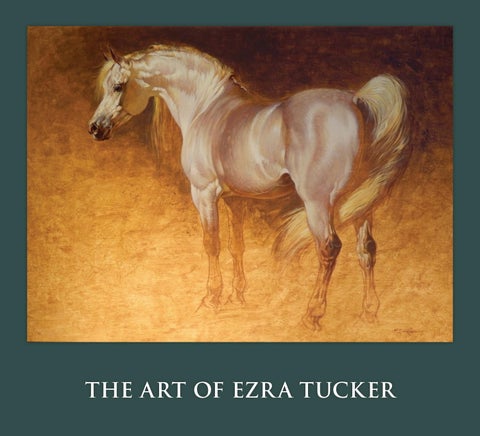
THE ART OF EZR A TUCKER 1
Trailside Galleries and Art Advisory is pleased to present “The Art of Ezra Tucker” comprised of a selection of paintings featured in a nearly three-year traveling museum exhibition spanning May 2023 through December 2025. We are pleased to have the opportunity to offer these works, now available to collectors. Ezra’s signature wildlife paintings, depicting both large mammals as well as avian subjects, highlight his bold, distinctive style of painting. His canvas reflects acute observation and knowledge of his subject and reveals an intimate and emotional portrait quality with adept storytelling. More recent years have seen him depicting the Black experience in the American West, a compelling story that remains unrecognized and too seldom told. Ezra Tucker has found inspiration in the art of preeminent wildlife painters Bob Kuhn as well as Carl Rungius, but also others, notably illustrators like N.C. Wyeth from the Golden Age of Illustration, W.R. Leigh, Antoine Barye and Arthur Wardle. Paintings by Ezra Tucker are internationally collected by both private and corporate collectors many of which are Fortune 500 corporations. Museum collections include The Briscoe Western Art Museum, San Antonio, TX; The James Museum of Western & Wildlife Art, St. Petersburg, FL; and The Booth Western Art Museum, Cartersville, GA.
[cover] DESERT QUEEN, acrylic on illustration board, 30 x 40 inches, $19,000
WOODLAND SPHINX acrylic on illustration board 21 x 40 inches $21,000
3
4
"I thought Ezra Tucker's exhibit was wonderful. It definitely resonated with our regular art crowd, but we were surprised that it also resonated with people who wouldn't otherwise come to the museum. Visitors I spoke to enjoyed the exhibit's animal subject matter, but many said they especially appreciated seeing his broader range including his early work as an illustrator and his current paintings of Black experience in the historic American West." —SUSAN OBERT CEO, The Haggin Museum
"The work is spectacular and easily the most significant collection we've ever had the opportunity to host." —JOHN ALDRIDGE Director of Exhibit Design & Production, The Chicago Academy of Sciences and its Peggy Notebaert Nature Museum
"Ezra Tucker is one of the finest wildlife artists working today. His mastery of the subject and his use of light and shadow create artworks that have the Romantic look of the 18th and 19th centuries yet are fresh and new. From animal portraits to animals in action, Tucker’s paintings never fail to attract the viewer and to present the very essence of the animal." —ROBIN R. SALMON Vice President of Art and Historical Collections and Curator of Sculpture, Brookgreen Gardens
5 Turtle Bay Museum
TETON acrylic on canvas 84 x 48 inches $67,000
6
BREAKING THE SILENCE acrylic on illustration board 30 x 40 inches $36,000
The term “Black Indians” refers to individuals of African American and Native American ancestry. The history of Black Indians dates back to the colonial era when enslaved Africans were brought to North America and often lived and worked alongside Native American communities. During the transitional period of Africans’ becoming the primary race enslaved, Native Americans had been sometimes enslaved at the same time. Africans and Native Americans worked together, lived together in communal quarters, along with white indentured servants. Some intermarried and had mixed-race children. Some tribes encouraged intermarriage with Africans, with the idea that stronger children would result from these unions. Some Black Indians are the descendants of these unions, while others are the result of later intermarriage between African Americans and Native Americans. Black Indians have a rich cultural heritage that is a fusion of African American and Native American traditions. 7
MAJESTY OF THE PLAINS acrylic on canvas 48 x 36 inches $32,000
8
PEAK & BOO acrylic on canvas 48 x 30 inches $28,000
9
Fort Wayne Museum
10
BIG COUNTRY OUTLAW acrylic on canvas 84 x 48 inches $67,000
11
FLAMINGOS NESTING acrylic on illustration board 40 x 30 inches $21,800 12
PROTECTING THE BROOD acrylic on illustration board 40 x 30 inches $21,800 13
"The San Angelo Museum of Fine Arts is thrilled to grace our galleries with the work of an accomplished artist with a long career. Ezra’s works, in addition to being masterful examples of the painter’s art, are especially relevant to our community here in San Angelo, Texas. As home to the 9th and 10th Cavalry (“Buffalo Soldier”) regiments of the 19th century, and built on the culture of ranching, our town is pleased to showcase an artist depicting the Black experience in the American West—stories that demand telling. Also, San Angelo State Park is home to a herd of American Bison. Ezra’s wildlife paintings bring these animals and other creatures native to the Plains beautifully to life and with painstaking accuracy to detail, so viewers can relate to the animals in new ways." —LAURA ROMER HUCKABY Curator, San Angelo Museum of Fine Arts
“Black Experience in the history of The American West has gone untold for too long. Ezra Tucker’s paintings pictorially tell the stories of African American bronco busters, Pony Express riders, Buffalo Soldiers, Indian scouts and others who shaped the frontier.” —THOMAS J. “DR. COLORADO” NOEL, DENVER, COLORADO Professor of History and Director of Public History, Preservation & Colorado Studies at University of Colorado Denver
“On so many different levels, [Ezra] Tucker is an enigma in the world of contemporary wildlife art—in one sense a disciple of the grand, Old-World tradition of painting and America’s Golden Age of Illustration—and yet his work possesses an engaging, modern approach to composition so aesthetically alluring the eye cannot look away. When Tucker paints, it is with a deeply personal conviction that animals are life forces. He does not create merely to commemorate or render subjects. Instead, his scenes activate a wild spirit in the spaces we inhabit.” —TODD WILKINSON, BOZEMAN, MONTANA Author, Last Stand: Ted Turner’s Quest to Save a Troubled Planet
14 San Angelo Museum of Fine Arts
15
HENRY FLIPPER acrylic on illustration board 40 x 30 inches $36,000
Henry Ossian Flipper (1856-1940) was an American soldier, engineer, surveyor, writer and the first African American to graduate from the United States Military Academy at West Point. Flipper was born into slavery in Georgia. After the Civil War, he attended Atlanta University before being appointed to West Point by Congressman J.M. Coghlan. Despite facing racism and discrimination from his classmates and superiors, Flipper graduated from West Point in 1877, becoming the first African American to earn a commission as a second lieutenant in the United States Army. After graduation, Flipper was assigned to the 10th Cavalry Regiment, an all-black regiment known as the "Buffalo Soldiers." He served in the Indian Wars in the western United States, participating in campaigns against the Apache and Comanche tribes. Flipper also authored two publications, “The Colored Cadet at West Point," and a novel, "The Black Frontiersman."
16
ON WATCH acrylic on illustration board 40 x 30 inches $36,000
This painting depicts soldiers of the 10th Cavalry of the United States Army, also known as the Buffalo Soldiers, on guard duty to protect the laborers during the construction of the Pacific Railroad. These courageous men were true to their efforts to prevent chaos and death of workers from any threats that would interfere with the laying of the rails of the Union Pacific to link to the rails of the Central Pacific Railroad under construction coming from the East. The importance of their efforts helped this technology to reach from Coast to Coast which facilitated the settling of the Western territories of our expanding nation. These remarkable men of African descent were instrumental with their many diverse contributions in helping to build the foundations of our country’s economy. We stand on their shoulders to this day. The commitment of these oppressed people, hopeful for full acceptance and citizenship through their honorable deeds, were willing to enforce our government’s policies that helped to build our nation.
17
BASS REEVES-US MARSHAL acrylic on illustration board 40 x 30 inches $36,000
The area that we know today as the state of Oklahoma was called Indian Territory back in the 1800s. The famous Judge Isaac C. Parker was the United States Marshall who wielded the federal gavel from 1875 to 1896. He had the real burden of policing Indian Territory at Fort Smith, Arkansas. Through his appointed deputy marshals, he brought lawbreakers to justice in the courtroom. One of the most interesting was an African American and former slave named Bass Reeves (1838-1910). In 1875, Judge Parker was decisive by appointing Bass Reeves as one of the first, if not the first, African Americans to hold a federal law enforcement position. During the length of his career as a US Marshal, Reeves also became adept with firearms and very skilled to hunt and track down notorious outlaws and bring them to justice. It is estimated that Bass Reeves arrested more than 3,000 felons during his career, and he may have been forced to kill as many as 14 outlaws. Legend speaks of Bass Reeves as the original ‘Lone Ranger.’
18
CHOOSING THE ONE acrylic on illustration board 30 x 20 inches $21,000
The buffalo hunter, as a rule, were men of adventurous spirit that thrived by accepting the dangers of the plains as worthwhile. Some of them were outlaws and hard characters of many ethnic backgrounds. One of the factors that drove the kill-off of millions of American Bison included the completion of the Transcontinental Railroad. Hunters were hired by the railroad companies to supply bison meat for the rail workers. This painting depicts a mounted frontiersman choosing to hunt bison dangerously from horseback by scattering the herd to single out his choice of a bull bison. These rugged frontiersmen took enormous risk during their work to gain their prize in this manner because he could easily be thrown by his horse or lose the horse to being gored by the bison bulls or breaking a leg in a Prairie Dog hole.
19
20
AS THE CROW FLY-JIM BECKWOURTH acrylic on illustration board 30 x 40 inches $36,000
James Pierson Beckwourth (born April 26, 1798, Virginia, U.S.—died 1867?, Denver, Colorado) was an American mountain man, explorer, trader, and interpreter who played an important role in the early exploration and settlement of the American West. He was born into slavery in Virginia in 1798 and was the son of a white plantation owner, Sir Jennings Beckwith, and a mulatto slave woman and legally was born a slave. Beckwourth was eventually sold to a Missouri trader and worked as a blacksmith and trader in St. Louis, where he learned several Native American languages. In 1824, he was hired as a wrangler to handle the horses on an expedition to the Rocky Mountains. While in the West, he married a series of Native American women and eventually settled down for about six years to live among the Crow Indians. Beckwourth greatly impressed the Indians with his strength and skill. His skill and suitability to the wilderness environment in which he found himself made him a powerful and dramatic rare breed of free trappers. In 1850, Beckwourth was credited with discovering what came to be called Beckwourth Pass. A low elevation pass through the Sierra Nevada. The Beckwourth Trail spared the settlers and gold seekers about 150 miles and several steep grades and dangerous passes, such as Donner Pass. Beckwourth’s career spanned almost fifty years and saw him advance from wrangler to cook, then on to hunter, trapper, interpreter, trader, war chief of a band of Crow Indians, explorer, soldier, scout, rancher and ghost writer of an autobiography. “The Life and Adventures of James P. Beckwourth”, which was published in 1856. The book is considered an important firsthand account of life in the American West during the 19th century. Beckwourth is also remembered for his role in founding the town of Pueblo, Colorado, and for his efforts to establish peaceful relations between Native American tribes and white settlers. His significant contributions to the exploration and settlement of the American West, his legacy was largely overlooked for many years, due in part to racism and discrimination against people of African descent during the 19th and early 20th centuries. The truth is that, Black men, too, learned the skills needed in the mountains, met the Natives on their own terms and savored that period of history that we know today as the era of the fur trade. They were as much a part of the story of the early days of the West as anyone and they deserve to be remembered.
21
DESERT DANDY acrylic on illustration board 15 x 40 inches $16,000
TRAILSIDE GALLERIES ONLINE FINE ART SALES CONTACT US: (307 ) 733-3186 | (480) 945-7 751 TRAILSIDEGALLERIES.COM | INFO@TRAILSIDEGALLERIES.COM