2 ISSUE
Letter from the Audemars Piguet Foundations | Autumn 2026
EDITORIAL
2–6
Headline Solutions worth sharing
7–8
Perspective A society for all ages
9–10 Story from the field A fresh momentum for food solidarity across the UK 11
Snapshots The oak tree: a little-known giant
12
Find out more Resources and links to take it further
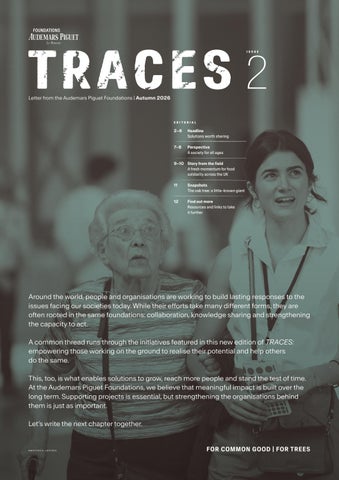
Around the world, people and organisations are working to build lasting responses to the issues facing our societies today. While their efforts take many different forms, they are often rooted in the same foundations: collaboration, knowledge sharing and strengthening the capacity to act. A common thread runs through the initiatives featured in this new edition of TRACES: empowering those working on the ground to realise their potential and help others do the same. This, too, is what enables solutions to grow, reach more people and stand the test of time. At the Audemars Piguet Foundations, we believe that meaningful impact is built over the long term. Supporting projects is essential, but strengthening the organisations behind them is just as important. Let’s write the next chapter together.
©MATTHIEU JOFFRES
FOR COMMON GOOD | FOR TREES
HEADLINE E D U CAT I O N A N D O R G A N I SAT I O N A L DEVELOPMENT
Redefining pathways to employment
IN FRANCE, YOUNG PEOPLE ARE FORGING THEIR OWN PATHS
In Marseille, the power of collective action is opening up new opportunities for vulnerable young people.
Finding your place in the world is not always straightforward. In Marseille, many organisations work alongside young people facing hardship, school dropout or other barriers that can limit their access to employment. It is demanding work that requires time, resources and strong expertise. With support from the Audemars Piguet Foundations, the Institut Européen de Coopération et de Développement (IECD) partners with several non-profits helping vulnerable young people regain confidence, explore their options and move towards employment. These include Appel d’Aire, Contact Club, Le Paysan Urbain, Massajobs and Wake Up Café. By supporting them in developing their practices, strengthening their teams and building on their experience, IECD contributes to improving employment prospects for 700 young people. Across Marseille, more than 200 professionals from 60 organisations regularly come together through seminars, workshops and networking events hosted by the institute. These valuable gatherings provide opportunities to learn from one another, share experiences from the field, step back from everyday realities and explore solutions to common challenges.
©APPEL D’AIRE
KEY FIGURES
700
200
young people supported
professionals engaged
60
partner organisations
©PIERRE VERGNES
HEADLINE EDUCATION
Empowering teachers to make a difference
Across Sub-Saharan Africa, teachers play a vital role in shaping the future of millions of young people. Yet in many rural areas, limited access to training and professional isolation make their work challenging. To address these issues, the Audemars Piguet Foundations support TeachUNITED, an organisation working in Kenya, Tanzania and Zanzibar. Its approach is based on a simple belief: when teachers grow, their students do too. Through a mentoring and leadership development programme, TeachUNITED trains experienced educators to guide their peers in the field and share effective teaching practices.
FROM KENYA TO ZANZIBAR, MENTORING IS HELPING SCHOOLS THRIVE
The results are already visible. In Tanzania, several schools have recorded significant improvements in academic performance while fostering strong learning communities among teachers. Evaluations conducted by TeachUNITED show that students in classrooms led by programme participants gain, on average, two additional years of growth in reading and three and a half years in mathematics compared with students in schools not supported by the programme. This momentum is set to grow. Over the coming years, nearly 2,000 teachers will benefit from the programme, with an expected impact on more than 86,000 students across the three regions.
©TEACHUNITED
“Since 2023, Engutoto Secondary School has moved from tenth to first place in the Monduli District thanks to significant improvements in teaching and learning practices. More importantly, we are now able to retain our teachers.” Given Jonathan Moye | Academic Officer for Secondary Education, Monduli District Council (Tanzania)
| AUTUMN 2026
2
FOR COMMON GOOD | FOR TREES
HEADLINE SOCIAL EQUITY
Food aid as a driver of inclusion
A meal can be much more than a source of food. At the Annual Forum of the European Food Banks Federation (FEBA), held last July, representatives from European institutions, grassroots organisations and civil society came together around a shared ambition: to better support people in vulnerable situations.
ACROSS EUROPE, FOOD BANKS ARE BROADENING THEIR IMPACT
This ambition is backed by a network operating on a large scale. In 2025, FEBA and its members distributed more than 106,000 tonnes of food through the European Social Fund Plus (ESF+), benefiting more than 5 million people across the continent. Beyond meeting immediate needs, food banks connect beneficiaries with relevant services, provide social support and often serve as a first point of contact for other forms of assistance.
To go even further, FEBA is developing new tools for its network. With backing from the Audemars Piguet Foundations, it is continuing to roll out a common framework that will enable food banks to better measure and demonstrate their social and environmental impact. The initiative will also facilitate the sharing of best practices and equip network members to strengthen their work with the communities they serve.
As the European Union prepares its future strategy to tackle poverty, this collective effort highlights how food aid can drive cooperation and innovation, helping to deliver solutions that are ever more effective, inclusive and sustainable.
Across Europe, food aid can be the first step towards greater autonomy, stronger social connections and lasting inclusion. ©FEBA
| AUTUMN 2026
3
FOR COMMON GOOD | FOR TREES
HEADLINE ENVIRONMENT
Rethinking nature in the city
IN SWITZERLAND, LA CHAUX-DE-FONDS IS REIMAGINING ITS URBAN TREE HERITAGE
Three years after the storm that profoundly affected La Chaux-de-Fonds and its urban tree population, the city continues its recovery with a clear focus on the future. Following the loss of nearly 1,500 trees on public land, one question quickly emerged: how can the city’s tree canopy be rebuilt to withstand the challenges of the decades ahead? This reflection led the city to fundamentally review its approach to green space management. Beyond replanting efforts, it is the very role of trees in the urban environment that is being reconsidered. The storm highlighted the vulnerability of a tree canopy that covers only around 13% of
Supported by the Audemars Piguet Foundations, the project also relies on new mapping tools that offer a more comprehensive understanding of the city’s tree heritage and how it is evolving over time. This information will help guide future planting efforts and ensure that every tree contributes to climate resilience, landscape quality and residents’ well-being.
the municipality’s territory. The objective now is to identify areas that need strengthening, prioritise species better suited to future climate conditions and update certain arboricultural practices inherited from the past. Among
the measures being explored is the gradual restoration of regularly pruned trees, allowing them to regain a more natural shape and denser foliage, providing shade, cooling and valuable habitats for biodiversity.
Beyond recovery, La Chaux-deFonds is turning a challenge into an opportunity: building a greener, more resilient city that is better prepared for the future.
In La Chaux-de-Fonds, replanting is part of a broader vision: understanding today’s trees in order to shape tomorrow’s canopy. HEADLINE EMERGENCY AID
Training, sharing, responding
IN SWITZERLAND, RESCUE TEAMS UNLIKE ANY OTHER
When disaster strikes or someone goes missing, every minute counts. For more than 50 years, the Swiss NGO REDOG has helped locate and rescue people trapped beneath rubble or reported missing in forests and mountains, both in Switzerland and abroad. What makes REDOG unique? Its teams bring together technical search specialists and highly skilled dog-handler teams deployed in rescue operations. Whether in the wilderness, a collapsed building, or in the aftermath of an earthquake or major climate-related event, these missions demand rigorous preparation. Across 12 regional groups, REDOG’s 800 volunteers and their canine partners train throughout the year to maintain the high level of readiness that is essential to their effectiveness in the field. Their expertise extends beyond emergency response. REDOG also shares its knowledge internationally through training and capacity-building programmes. For example, since its deployment to Fukushima in 2011, the NGO has worked with Japanese search and rescue organisations and fire services to train specialist teams in disaster search operations and strengthen rescue practices. The Audemars Piguet Foundations know REDOG well. After supporting its operations in the wake of natural disasters, they now accompany its continued development. This partnership helps preserve the expertise and operational capabilities that are at the heart of REDOG’s work.
©FABIEN NISSELS
| AUTUMN 2026
4
FOR COMMON GOOD | FOR TREES
WHEN AP EMPLOYEES STEP INTO ACTION
The Audemars Piguet Foundations’ commitment to REDOG also extends through Audemars Piguet’s corporate volunteering programme. During large-scale training exercises, employees take on the roles of victims, witnesses or bystanders, helping recreate realistic emergency scenarios. Their participation is an asset in preparing rescue teams for real-life operations.
BEHIND EVERY R E S C U E O P E R AT I O N LIE THOUSANDS OF HOURS OF TRAINING AND A UNIQUE BOND BETWEEN HUMANS AND DOGS. ©FABIEN NISSELS
| AUTUMN 2026
5
FOR COMMON GOOD | FOR TREES
©REDOG, DAGMAR WURZBACHER
K I S H A & K ATJA H E I N I G E R- L A M P R E C H T REDOG SEARCH AND RESCUE TEAM
In service since: 2014 Latest mission: Venezuela, 2026 What motivates them “It all started with my love of dogs,” says Katja. When she discovered search and rescue dog teams during her military service, she immediately knew it was the right path for her. A few years later, that path led her to REDOG, where she now works side by side with Kisha. A memorable deployment Venezuela was a mission that left a lasting impression. It was their very first deployment. Katja remembers the distress of the families, the
uncertainty and the scale of the needs on the ground. It was a challenging experience, but also a deeply meaningful one. Despite the suffering she witnessed, Katja is grateful to have been there with Kisha and to have brought a little hope to those affected. Kisha off duty At the farm where she lives, Kisha gladly welcomes all visitors... or almost all. Alpacas, horses and other animals are more than welcome. Cats, however, are subject to a very strict security policy: no entry under any circumstances!
After supporting REDOG’s operations in the wake of natural disasters, the Foundations now accompany its continued development.
©FABIEN NISSELS
| AUTUMN 2026
6
FOR COMMON GOOD | FOR TREES
PERSPECTIVE SOCIAL EQUITY
How can we ensure older people remain fully engaged in society?
In 2020, for the first time in history, the number of people aged 60 and over surpassed that of children under the age of five. By 2050, their global population is expected to grow from one billion to 2.1 billion. Longer life expectancy is one of the great achievements of our time. Yet it also prompts an important question: what place do we give to older generations in our societies?
“I can no longer visit museums, so I am delighted that museums now come to me.”
Isolation: a vulnerability that often goes unseen
Beyond questions of retirement and dependency, ageing also challenges our ability to maintain social connections for older people. Bereavement, family members living far away, reduced mobility and the digital divide can all contribute to growing isolation.
encourage social interaction. Yet staying active is about more than exercise alone. Cultural outings, leisure activities and social gatherings also contribute to maintaining a rich and stimulating social life.
Today, the World Health Organization (WHO) regards loneliness and social isolation as major public health concerns. Globally, nearly one person in six experiences loneliness, while around one quarter of older adults are considered socially isolated. In some ageing societies, this phenomenon has reached alarming levels. In South Korea and Japan, the concepts of godoksa and kodokushi describe people who die alone and whose deaths remain undiscovered for long periods, illustrating how severe this often invisible form of isolation can become.
In Switzerland, Pro Senectute Vaud offers a wide range of activities tailored to the needs of older people, including guided excursions, cinema screenings, sporting activities and even exercise sessions at home. Some activities are also integrated into Audemars Piguet’s corporate volunteering programme, through visits to the Musée Atelier or meals shared in an alpine chalet alongside company employees.
When culture becomes a meeting place
Meanwhile, the Bel Âge programme run by CSP Genève supports individuals who are often older or more vulnerable. Among its nearly 300 members, almost half are over the age of 80. Adapted walks, home visits, organised transport and a weekly telephone chain help maintain regular contact, even when travelling becomes difficult.
To help combat isolation, the Audemars Piguet Foundations support organisations that foster social connections among vulnerable groups. Some, such as Fondation Art Explora, use art as a way of creating opportunities for meaningful interaction. Created during the Covid-19 pandemic, its Les apARTés programme offers residents of care homes the opportunity to take part in discussions centred on works of art, led by trained volunteers. A resident of Korian Monceau in Paris, where an art discussion takes place every week, explains: “I can no longer visit museums, so I am delighted that museums now come to me.” Margot, Activities Coordinator at Korian Monceau, observes that these sessions stimulate memories, strengthen self-esteem and encourage interaction among residents. In her view, conversations about art play both a social and therapeutic role, helping participants express themselves and connect with others. Today, the programme operates in more than 270 care facilities through a network of 16 regional offices and more than 325 volunteers.
Rethinking ageing
Population ageing is often approached through the challenges it raises. Yet it is equally important to recognise the role older people continue to play in society. As volunteers, carers, grandparents and active members of community organisations, they contribute every day to the cohesion of our communities through the experience, skills and time they share. Changing the way we view ageing is essential. The goal is not simply to add years to life, but also to ensure that everyone can continue to learn, share and contribute, regardless of age. An inclusive society is measured not only by how it supports older generations, but also by the place it enables them to occupy within it.
Preserving autonomy to stay connected
Physical activity plays an essential role in older people’s well-being. Research shows that it helps maintain functional abilities, prevent frailty and ©REBECCA BOWRING
| AUTUMN 2026
7
FOR COMMON GOOD | FOR TREES
DEMOGRAPHIC CHANGE | SOCIAL ISOLATION
AN INCLUSIVE SOCIETY IS MEASURED N O T O N LY B Y H O W I T S U P P O R T S O L D E R G E N E R AT I O N S , B U T A L S O B Y T H E P L A C E I T E N A B L E S T H E M T O O C C U P Y W I T H I N I T. 1 IN 6 PEOPLE AFFECTED BY LONELINESS WORLDWIDE 1 IN 4 OLDER A D U LT S C O N S I D E R E D S O C I A L LY I S O L AT E D
BEL ÂGE PROGRAMME | CSP GENÈVE
300 MEMBERS S U P P O R T E D , N E A R LY 50% OF WHOM ARE OVER 80 YEARS OLD
LES APARTÉS PROGRAMME | ART EXPLORA
270 PARTNER CARE FACILITIES REACHED THROUGH THE SUPPORT OF MORE THAN 325 VOLUNTEERS ©ART EXPLORA
| AUTUMN 2026
8
FOR COMMON GOOD | FOR TREES
STORY FROM THE FIELD SOCIAL EQUITY
Stronger together?
A FRESH MOMENTUM FOR FOOD SOLIDARITY ACROSS THE UK
very year in the UK, millions of perfectly edible meals go to waste while many families still struggle to put food on the table. Faced with this paradox, The Felix Project and FareShare have long worked, each in their own way, to rescue surplus food and redistribute it to those who need it most.
Partners of The Felix Project and FareShare since 2024 and 2025 respectively, the Audemars Piguet Foundations are supporting this transition through their organisational development programme. In collaboration with Nonprofit Builder, they are helping Felix strengthen its strategy, structures and volunteer engagement as it grows.
In 2026, these two leading food redistribution charities joined forces to create a new organisation: Felix. The merger marks an important milestone for food redistribution in the UK. Together, they now form a single entity with the reach and capacity to extend its impact across the country.
Charlotte Hill, CEO of Felix, reflects on the origins of the merger, the challenges it has involved and the opportunities it creates for the future of food aid in the UK.
©FELIX
STRONGER ORGANISATIONS FOR LASTING IMPACT
While the Audemars Piguet Foundations fund projects on the ground, they also invest in strengthening the organisations behind them. This approach, known as organisational development (OD), aims to reinforce non-profits’ strategies, governance, skills and ways of working in order to increase their resilience and long-term impact. As part of this commitment, the Foundations offer their food aid partners tailored capacity-building support through Nonprofit Builder, a network of consultants specialising in strengthening non-profit organisations. Until 2027, around 15 organisations will benefit from customised advice, coaching and strategic guidance tailored to their needs.
| AUTUMN 2026
9
FOR COMMON GOOD | FOR TREES
Charlotte Hill | CEO of Felix
FareShare and The Felix Project were already two leading charities in food redistribution across the UK. What prompted the decision to bring them together under Felix? It came from a simple truth: we had to be ambitious to meet the scale of the challenge. We’re living in a time of urgent need. Nearly one in seven people in the UK face food insecurity, and demand for support is rising. At the same time, more than a billion meals’ worth of good-quality food goes to waste every year. That has to change. FareShare and The Felix Project were already leaders in food redistribution and worked closely together. By joining forces, we have created a stronger organisation with greater national reach, deeper community impact and increased capacity to tackle both food waste and food insecurity. A merger is not only about bringing activities together, but also teams, cultures and ways of working. What were the main people-related challenges encountered during this transition? Any merger is fundamentally about people. One of the biggest challenges
was preserving the identity and culture of two remarkable organisations while building something new that everyone could feel part of. FareShare was founded in 1994 by the supermarket chain Sainsbury’s and the charity Crisis to provide food to homeless shelters. Over time, it became the UK’s leading food redistribution charity. The Felix Project was established in 2016 by Justin and Jane Byam Shaw in memory of their son Felix, who died suddenly from meningitis at the age of 14. It grew rapidly to become London’s largest food redistribution charity. Creating the new Felix identity was about listening to the people and organisations involved in both charities. Change can create uncertainty, so it was essential to build trust and ensure that everyone understood not only what was changing, but also why.
By joining forces, we can unlock more food, attract more funding and ultimately do more to support communities and help people thrive. This partnership also strengthens our ability to encourage government and the food industry to take action on a larger scale. Last May, former Prime Minister Keir Starmer announced the National Programme to Redistribute Surplus Food, bringing together government, the food industry, businesses and charities to take food redistribution to the next level and reduce food waste. Felix brings together an extensive network of partners, volunteers and community organisations. How do you succeed in uniting so many stakeholders around a shared mission? Our purpose, which we describe as “rescuing food for fuller lives”, has a transformative impact on communities across the UK. It provides a clear and tangible goal that helps unite a wide range of stakeholders around a common mission. By being transparent about our purpose and the difference we are making, we help volunteers, staff, partners and community organisations feel part of that story. We also celebrate every contribution and make sure people understand the value of their involvement, helping them remain committed to the mission.
What role can organisational development support play in this process? Creating a new national organisation that combines food redistribution and fundraising is no small task. To achieve our ambitions, we will need to mobilise and engage even more volunteers. Felix already relies on tens of thousands of volunteers every year. The organisational development support offered by the Audemars Piguet Foundations will be key to helping us build a national volunteering strategy and strengthen our ability to deliver on our mission.
Your 10-year vision is a United Kingdom where no good-quality food goes to waste and no one experiences hunger. What will be the key steps towards achieving this vision? As a new organisation, we are still shaping our long-term strategy. One thing is certain, however: over the next
How does the creation of Felix enable you to amplify your impact in tackling food waste and food insecurity today? Felix gives us a single, unified platform to tackle food waste and food insecurity with far greater impact.
10 years, we want to triple the amount of food redistributed by our sector. Collaboration will be fundamental to achieving this objective. We need long-term investment in the infrastructure required to store and distribute food. We also need government policies that make food donation easier and more financially viable. Finally, food businesses must make redistribution the default route for all unavoidable edible surplus.
“Be brave enough to imagine something bigger.” If you were to draw one lesson from this merger for others in the philanthropic or charitable sector, what would it be? Be brave enough to imagine something bigger. In our sector, mergers can feel daunting, emotionally, operationally and culturally. But when a challenge is too great for any one organisation to tackle alone, choosing to join forces is an act of leadership. The process is not always easy. Yet when the conditions are right, the collective impact that can be achieved far exceeds what each organisation could have accomplished on its own.
©FELIX
| AUTUMN 2026
10
FOR COMMON GOOD | FOR TREES
I ts s c is fo ientific und gen No r th A across us, Qu fr e Cen E tral ica, an urope rcus, , As dN Am ia orth eric a. and ,
Found across much of the Northern Hemisphere, the oak is one of the most familiar trees in our landscapes. Behind this apparent familiarity, however, lies a diversity that often goes unnoticed.
KEY FACTS
More than 500 species of oak have been identified worldwide.
SNAPSHOTS
Some trees live for centuries and hold a special place in our collective imagination. The oak is one of them, long associated with strength and longevity. Yet how much do we really know about this remarkable tree?
s ak o f r o pe. e b ro um n Eu n i all lly a m r a s tu ly r na n O cu oc
Beneath the surface
While the oak’s silhouette is impressive, its hidden underground world is even more remarkable. For nearly 40 years, Austrian scientists Lore Kutschera and Erwin Lichtenegger studied the root systems of European trees and plants. Their research resulted in more than 1,200 highly detailed scientific drawings, now preserved and shared by Wageningen University & Research in the Netherlands.
c pe
ie
s
rt ppo birds, u s can c ts , o a k of i n s e e r at u ies s. le m f spec mmal g n i A s reds o all ma d m hun i and s g fun
An oak’s root system can extend for dozens of metres beyond the tree itself.
These illustrations reveal the invisible part of the tree: a complex network of roots that anchors it firmly to the ground, supports its growth and helps it withstand environmental stresses.
©ILLUSTRATION: LORE KUTSCHERA & ERWIN LICHTENEGGER, WURZELATLAS MITTELEUROPÄISCHER WALDBÄUME UND STRÄUCHER, LEOPOLD STOCKER VERLAG. DISTRIBUTED BY WAGENINGEN UNIVERSITY & RESEARCH. LICENCE CC BY-NC-ND 4.0.
| AUTUMN 2026
11
FOR COMMON GOOD | FOR TREES
This issue reflects a shared commitment. We warmly thank our partners, as well as all those who agreed to tell their story and share their experience. Their daily work demonstrates that the most sustainable solutions are built collectively. To continue the journey, follow our latest news on our website and LinkedIn page. Let’s write the next chapter together.
| AUTUMN 2026
linkedin.com/company/audemars-piguet-foundations
FOR COMMON GOOD | FOR TREES
©PIERRE VERGNES
Audemars Piguet Foundations Route de France 16 | 1348 Le Brassus, Switzerland ap.fondation@audemarspiguet.com
fondationsaudemarspiguet.org
Impressum Writing and editorial oversight: Leila Mansour | Communication Manager Print run: 3,600 copies (English, French, Italian, Spanish, Japanese, Simplified Chinese, Traditional Chinese) Issue: 11.2026 | Frequency: semi-annual
12
Photographs: photographic credits are specified on the pages in question Editorial design: Marks Paper: Cradle to Cradle®, from a cohesive CO 2-neutral circular economy Printing: Cavin-Baudat (Vallée de Joux) SA, Switzerland Finishes: Institution de Lavigny, socio-professional department