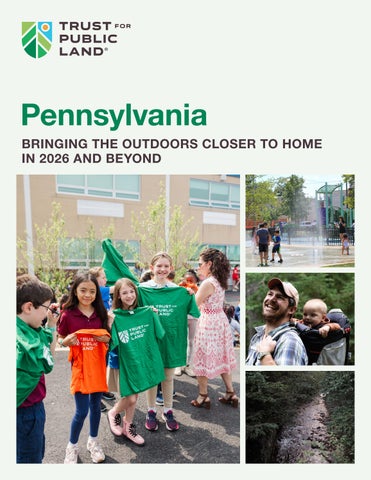
Pennsylvania BRINGING THE OUTDOORS CLOSER TO HOME IN 2026 AND BEYOND
Connecting Everyone to the Outdoors in Pennsylvania
PHOTO BY CHRIS BENNET T
Access to nature isn’t a luxury; it’s essential. You make it possible for Trust for Public Land to protect and create community-centered outdoor spaces that improve health and wellness, increase climate resilience, and bolster social connections. You help TPL advance this important work through on-the-ground project delivery and comprehensive systems change, in Pennsylvania and across the country. In the last year, we have advanced major schoolyard projects in Philadelphia and Scranton, protected an iconic natural monument in Luzerne County, and secured all the funds necessary to begin a transformative highline park project in Easton. Each effort reflects our shared commitment to support both people and the places that matter most to them.
communities. With your continued support, we can rise to meet this moment. Thank you for joining us as we connect everyone to the outdoors.
As we celebrate all we have accomplished, there is more work to be done. The need for equitable access to nature continues to grow, and so do the challenges and opportunities facing our health, climate, and
Elizabeth Class-Maldonado State Director
2 |
T R U S T F O R P U B L I C L A N D I N P E N N SY LVA N I A
With gratitude,
Roots and Relics Your philanthropy ensures public lands, parks, trails, and schoolyards reflect the full breadth of our nation’s stories and the people who shaped them. These places are living reminders of where history unfolded—where cultures and people met, clashed, blended, and existed beside one another to become America. Protecting these spaces keeps our shared history alive and deepens our connection to one another. For generations, the riverside city of Easton has been defined by its unique geography, where the Lehigh and Delaware Rivers meet beneath the gaze of Mt. Ida. This natural confluence positioned the region as a critical industrial and transportation hub throughout the 19th and 20th centuries, with railroads and canals connecting major economic markets in New York City and Philadelphia. Like many great industrial centers, Easton’s manufacturing decline in the 1960s rendered its railways obsolete. TPL is collaborating with Greater Easton Development Partnership and the City of Easton to reclaim the region’s industrial heritage for public good. Together, we are transforming a long-abandoned rail line into a linear greenway offering miles of trails for recreation and connection. The Easton Highline will reconnect the city’s growing downtown business and residential areas
with the 144-mile Delaware & Lehigh (D&L) Trail and put 22,000 residents within half a mile of vibrant green space. This year, TPL secured all necessary funding to transform an iconic trestle bridge along the highline into a hiker-biker pathway and park connecting residents with Easton’s business corridor.
In November 2025, we secured funding to permanently protect 246 acres of Campbell’s Ledge! This Natural Heritage Area nestled in Luzerne County has been long revered for its scenic vistas and cultural significance. The landscape’s steep cliffs and unique geological features sustain vital wildlife habitat and a rich anthropological history: native tribes utilized the cliffs for sending visual signs over long distances; early settlers told time by the shadows on the rock face; and evidence of human activity dates back 9,000 years. Today, it is a beloved recreation spot and a natural wonder just south of Scranton. TPL is actively working on a second phase of the project that would safeguard all 440+ acres of Campbell’s Ledge and provide a direct hiking connection to the Borough of Duryea, ensuring this remarkable place remains open, protected, and accessible for generations to come.
TPL team exploring the future Easton Highline site. PHOTO BY JT HORN
T R U S T F O R P U B L I C L A N D I N P E N N SY LVA N I A
| 3
Connection through Community Schoolyards When we build shared and inclusive parks and activate them with locally relevant programming, we create a future defined by connection—to the land and to each other—and a feeling of deep communal belonging. Students and families at James Logan Elementary have long dreamed of outdoor play and learning areas on the school’s two-acre asphalt lot. With over 10,000 residents living within a 10-minute walk, the schoolyard is wellused by the community despite being hot, barren, and in poor condition. Last October, The Pew Charitable Trusts awarded TPL $1.3 million to create a new green space at Logan Elementary and conduct research on the relationship between public space improvements and social connectedness. The transformed schoolyard, designed by students, will open in 2027 and feature updated play equipment, two full-sized basketball courts, a multi-use sports field, green infrastructure elements to mitigate stormwater runoff, an outdoor classroom, and a path for biking and walking. TPL is working closely with Community School Coordinator Eli Prosper to ensure the renovated schoolyard is student-focused and community-first. Eli knows first-hand how the schoolyard’s lack of amenities and shady areas can lead to fewer kids interacting outside and less people enjoying the neighborhood, especially in warmer months. To increase engagement and generate meaningful impact, he convenes local partners to improve the school’s shared public spaces and coordinates activities like free bike riding and swimming lessons for students.
Photos top to bottom: ELYSE LEYENBERGER; ELI PROSPER
AT LOGAN, WE ARE: • De-paving 25% of asphalt surface (23,877 sq ft) • Managing 2.78 million gallons of stormwater per year • Planting 37 new trees • Installing a rain garden, bioswale, and subsurface retention system • Leveraging $1.7 million in public investments
How far a green space is from you shouldn’t dictate the benefits we can and should receive from that infrastructure...With this space, we are actively exposing students to a future of hobbies, adventure, and more opportunities for nature integration. I see purpose, relationships being built, programming, and so much more. The community has been waiting for this for 50+ years! This is a generational investment.” — Eli Prosper, Community Schools Coordinator at James Logan Elementary
Growing an Evidence Base The Pew Charitable Trusts’ generous investment in TPL is bringing community-led visions to life in Philadelphia. Catherine Fuller, senior officer of Pew’s civic initiatives, shares more on Pew’s interest in how quality public spaces strengthen social connectedness within neighborhoods: Why was TPL’s Community Schoolyard at Logan an appealing project for Pew? There are many aspects of the Logan schoolyard transformation that made the project a great fit for us. Pew’s civic initiatives portfolio has a long history of supporting the transformation of underused and under resourced public spaces into welcoming, vibrant places where residents can participate in community life. TPL brings 50+ years of experience reimagining accessible public lands, trails, and parks into meaningful community spaces. This partnership allows us to provide muchneeded green space to 10,000 students and residents in North Philadelphia. How is Pew using data to inform your work in Philadelphia? Pew advocates for evidence-based approaches that help policymakers and the public solve some of the world’s most pressing challenges. In Philadelphia, our research and policy analysis looks at neighborhood, citywide, and regional trends to help leaders make evidence-based decisions, while our grantmaking, technical assistance,
and capacity building help local leaders and nonprofits drive positive change for residents. Our grantees use data-informed approaches to enhance access to quality jobs and public benefits, community safety, neighborhood vitality, and social connectedness. We believe that together, this work contributes to the safety, stability, economic mobility, and vitality that is needed for Philadelphians to thrive. Why is this an important moment to examine the relationship between public space and social connectedness? According to the Pew Research Center, a subsidiary of The Pew Charitable Trusts, Americans trust each other less than they did a few decades ago, and a government report shows that social connection has been on the decline. As Pew seeks to strengthen the community and cultural vitality of Philadelphia, we see social connectedness as a key ingredient. We want to strengthen social infrastructure—the spaces, institutions, and systems that build connection, trust, and community life, while also expanding the evidencebase. Neighborhoods where residents are more connected to each other are more resilient in the face of challenges, and it’s been widely documented that greater social connectedness is associated with a host of health benefits, including better cognitive function and longer life expectancy.
The Pew Charitable Trusts’ volunteer day at Logan Elementary. Catherine Fuller is in the front row, third from the left. PHOTOS BY SOPHIA PEAKE T R U S T F O R P U B L I C L A N D I N P E N N SY LVA N I A
| 5
Improving Health Outcomes Every child deserves access to safe, welcoming outdoor spaces that support learning, health, and well-being. Yet many students attend schools with little access to nature, quality play spaces, or nearby parks. With your support, we are transforming outdated and overlooked schoolyards across the country into meaningful spaces that reflect the visions and needs of their communities. We are excited to share that TPL is partnering with Valley in Motion, City of Scranton, and Scranton School District to transform a second schoolyard in Scranton! In May, we celebrated the groundbreaking of a new community schoolyard at Whittier Elementary. Students engaged in a participatory design process over the last year to reimagine their schoolyard as a green, welcoming gathering space. The school’s previously uninspired asphalt playground will soon feature a multi-purpose turf field, running and walking track, picnic tables and benches, new play equipment, a rain garden, and green stormwater infrastructure. Opening this fall, the renovated schoolyard will provide quality park space for over 4,000 residents within a 10-minute walk.
Partnerships with organizations like TPL and Valley in Motion are helping us reimagine schoolyards as places of joy, wellness, and community connection. This is about far more than playgrounds. It is about investing in the overall well-being of our students and neighborhoods for generations to come.” — Erin Keating, Ed.D., Superintendent Scranton School District
The Power of Play TPL is demonstrating that safe, accessible, welcoming green spaces can serve as powerful public health infrastructure. Our research, published in 2026 in the International Journal of Behavioral Nutrition and Physical Activity, reveals that students at our renovated schoolyards were 1.5 times more likely to engage in moderate-to-vigorous physical activity than nonrenovated schoolyards. These schoolyards experience three times greater overall use and nearly six times greater increases in visits by children. Time in nature can also support our mental health. TPL’s Literacy Outside program invites students into our schoolyards to learn more about their rain gardens, enjoy reading activities, and express their thoughts and feelings through facilitated nature journaling. This reflective time outdoors reduces stress, improves mood, and helps kids feel calmer.
Whittier Groundbreaking. P H O T O B Y P AT R I C I A L E E
6 |
T R U S T F O R P U B L I C L A N D I N P E N N SY LVA N I A
A Greener Future
Increasing green space and nature-based climate solutions makes communities healthier, stronger, and more resilient. Whether helping a city increase its tree canopy to combat extreme heat, conserving critical wildlife habitat, or partnering with neighbors on green infrastructure initiatives to capture stormwater and prevent flooding, we bring our climate expertise to every TPL project to ensure Pennsylvanians can meet the conservation needs of the moment. In the Kensington neighborhood of Philadelphia, Webster Elementary is a K–5 school that prides itself on being a home for their students. Webster’s current schoolyard is well-used by students and community members, despite it being hot, unshaded, and in need of repair. Like many neighborhoods in Philadelphia, Kensington has historically dealt with flooding brought on by antiquated stormwater infrastructure. The Philadelphia Water Department is investing over $1 million in TPL’s efforts to install green infrastructure at the site to alleviate combined sewer system overflows and mitigate flood risk. TPL partnered with Webster Elementary in the fall of 2024 on a participatory design process where students engaged their peers, families, and neighbors to create a shared vision for their new green space. The completed schoolyard will include a rain garden and an underground system capable of managing 1.74 million gallons of stormwater annually, along with 17 new trees
Photos top to bottom: LEAH OVERSTREET; ALEX ANDRE DA VIEGA
that will increase shade cover and help cool the surrounding neighborhood. Students will also enjoy new play equipment, a turf field, a running track, painted games, tables, benches, a half basketball court, and a kindergarten play area.
Ongoing Climate Work When TPL purchased 1,125 acres in Carbon County, now known as Penn Haven, we revitalized a dead waterway at Hazle Creek into prime trout fishing grounds. The creek now supports a resilient, thriving riverine ecosystem and is creating new opportunities for a rural community to benefit from the ever-growing outdoor recreation economy.
T R U S T F O R P U B L I C L A N D I N P E N N SY LVA N I A
| 7
MEET THE TEAM Elizabeth ClassMaldonado Associate Vice President, Pennsylvania State Director
Raeva Bali FAO Schwarz Fellow, Philadelphia
Kari Sannino Program Director, Pennsylvania
Jared Abell Project Manager II, Pennsylvania Land Protection
Patricia Lee Program Manager I, Pennsylvania
David Washousky Project Manager II, Appalachian Land Protection
Dan Brown Stewardship Program Manager
Jon Goff Regional Director of Philanthropy
Charlie Baranowski Director of Institutional Giving, Pennsylvania and Ohio
THANK YOU for helping create parks, protect special places, and connect more people to the outdoors in Pennsylvania and beyond.
2401 Walnut Street, Suite 703 Philadelphia, PA 19103-4340
Join Us Your gift ensures everyone has access to the outdoors. Every park we create, schoolyard we transform, trail we extend, and landscape we protect is thanks to supporters like you.
Elizabeth Class-Maldonado Pennsylvania State Director elizabeth.class@tpl.org | 267.946.7349 Jon Goff Director of Philanthropy jon.goff@tpl.org | 267.939.9262
tpl.org/donate
PHOTO CREDITS: COVER, L ARGE: SENECA RYAN CO; TOP TO BOT TOM: SARA RUBINSTEIN; ALE X ANDRE DA VIEGA; L ARGE: CHRIS BENNET T; THIS PAGE: © TPL STAFF; DAN BROWN