SP SR PI R NIG N/G S /U SM UME MR ER 20 22 06 26 A BA E NBEEFNI T E FTI O T TMOE M MB EE MRBSE R OSF O TR F UTSRTU F SO T RF O PR U BPLUI B C LLI C A NLDA N D
Land&People TRUST FOR PUBLIC LAND SPRING/SUMMER 2026 VOL. 38, Nº1
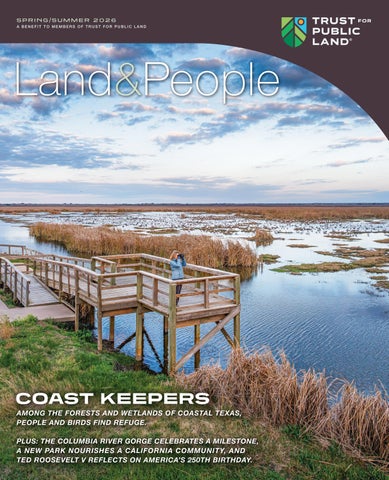
COAST COASTKEEPERS KEEPERS AMONG AMONG THE THE FORESTS FORESTS AND AND WETLANDS WETLANDS OFOF COASTAL COASTAL TEXAS, TEXAS, PEOPLE PEOPLE AND AND BIRDS BIRDS FIND FIND REFUGE. REFUGE. PLUS: PLUS: THE THE COLUMBIA COLUMBIA RIVER RIVER GORGE GORGE CELEBRATES CELEBRATES A MILESTONE, A MILESTONE, A A NEW NEW PARK PARK NOURISHES NOURISHES A A CALIFORNIA CALIFORNIA COMMUNITY, COMMUNITY, AND AND TED TED ROOSEVELT ROOSEVELT V REFLECTS V REFLECTS ONON AMERICA’S AMERICA’S 250TH 250TH BIRTHDAY. BIRTHDAY.
NATURE SUSTAINS US EVERY DAY Return the Favor: Become a Monthly Donor Help us connect everyone to the benefits and joys of the outdoors with a recurring monthly gift. It’s easy, automatic, and secure. Our members make our work to create parks and protect public land possible.
START TODAY
In 2016, TPL partnered with the Sisters of Our Lady of Christian Doctrine to protect a former summer camp about 30 miles north of Manhattan, adding acreage and a new hiking trail to Hook Mountain State Park. (See page 60 for more on our work to preserve kids’ camps in New York.)
CHRIS BENNETT
tpl.org/monthly
c o n t en t s
SOPHIA C.
30 40 “Urban Orchard represents a new way of thinking about parks in an urban environment.” ~ M AYO R J O S H UA B A R R O N , I N B O U N T I F U L B E G I N N I N G S, P G . 3 0
S E A N F I T ZG E R A L D
STELL A K ALININA
F E AT U R E S
Bountiful Beginnings ..................................................................................................... 30 An oasis just outside Los Angeles brings fresh, local food; cleaner air and water; and shared spaces for play and reflection to the city of South Gate.
The Green Brigade ............................................................................................................. 40 Our work to conserve land in the Tennessee Valley, including Civil War battlefields and sections of the Trail of Tears, enhances public access to green spaces and to the lessons of our country’s history. We and future generations will be better for it.
Gimme Shelter ............................................................................................................................ 48 The coastal forests of Texas are essential to the region’s climate resilience and to the 239 million birds who find refuge there each year, and they’re similarly precious to the people who’ve discovered their charms. That’s why we’ve spent decades protecting them.
48 T P L .O R G · 1
GIVING GUIDE With a variety of ways to give, we offer something to suit everyone. Send your gift by using the envelope bound inside this magazine, donate online, or learn about more ways to give at tpl.org/support.
Grow Your Giving Simplify your charitable giving and meet your philanthropic goals by giving through your donor-advised fund (DAF), individual retirement account (IRA), or appreciated securities. Learn more at tpl.org/support.
Give the Gift of the Outdoors Share your love of nature and outdoor adventures with someone you care about. Make a difference and honor a friend or loved one with a tribute gift at tpl.org/tribute.
Become a Conservation Champion Donate $1,000 or more annually and receive the recognition due a champion, such as invitations to special events and insider updates on our projects. Call 415.495.4014 or email champions@tpl.org to learn more.
Leave a Legacy Consider including us in your will or trust, or name us as a beneficiary of your retirement fund, life insurance policy, or donor advised fund (DAF). There are many other tax-savvy ways to give. Call 202.856.3748 or email plannedgiving@tpl.org to learn more.
Donate Your Vehicle Car recycling benefits people and the environment by conserving natural resources, reducing pollution, and lowering energy consumption. Call 855.500.RIDE (7433) or visit tpl.org/cars to get started.
Scan with your mobile device’s camera to make a gift today. Trust for Public Land depends on your support. You make our work possible. tpl.org/support
and Waters Pipestone CampDE HalePA R T M E N T S
year, our CEO examines what it means to protect land for the past,
20
N AT E PA DAV I C K
During America’s 250th anniversary
WILLIAM POOLE
From the President · 11
c o n t en t s
present, and future.
Board Spotlight · 12 After 20 years, Tom Reeve has a
Medgar a nd My Evers Hom rlie e
new mission.
First Look · 13 Buzzworthy updates on exciting TPL projects, an intro to nature journaling, and a timely conversation about land
16
e del Norteand wildfire. Rio Grandconservation
On Topic · 58
shington George Wa ce Birthpla
STELL A K ALININA
A roundup of book, podcast, and film recommendations from partners and staff.
TPL Near Me · 60 Eagle Scout Alex Zablocki reflects on his youth at Staten Island’s Pouch Camp—and his time as an adult working with TPL to save it.
Member Center · 62 Offices · 63 Trail’s End · 64 Ted Roosevelt V, a TPL national board member, looks back at the conservation movement his greatgreat-grandfather helped found and reflects on how it’s grown and where it’s going.
on the cover
Moccasin Pond Loop at San Bernard National Wildlife Refuge in Texas features a wheelchair-accessible observation platform and birds galore. Photo: Sean Fitzgerald
18 T P L .O R G · 3
4 · L AND&PEOPLE · SPRING /SUMMER 2026
c o n t en t s
Sardine Meadow Sierra County, California Connecting a network of streams, lakes, and forests, Sardine Meadow—where TPL protected 569 acres—is vital to the health of the region. The boundless benefits of this recent conservation win are clear: A crucial habitat for fish, birds, and mammals, it’s also a scenic destination for hikers and birders. Restored meadows improve local water quality, plants and their root systems capture carbon, and the valley itself acts as an important wildfire buffer. Learn more about TPL’s wildfire strategy in this issue.
24
REUBEN HER ZL /GROUNDM A K ING
Page · 24
T P L .O R G · 5
c o n t en t s
Tennessee Riverwalk Chattanooga, Tennessee Without public green spaces, where would we assemble our first leaf collections, discover the joy of watching clouds morph into animal shapes, or learn to ride a bike? In Chattanooga and cities across the U.S., TPL works with communities to develop outdoor spaces that reflect their priorities, including creating spaces for the youngest residents to discover their love of nature. Here, two young cyclists get their bearings at the Tennessee Riverpark, which includes a 13-mile family-friendly route along the Tennessee River. The path runs from Chickamauga Dam to the base of Lookout Mountain, one of many sites we’ve protected in the region that are important to American history. Explore TPL’s work in Chattanooga and the Tennessee Valley in this issue.
40
DA RCY K IEFEL
Page · 40
T P L .O R G · 7
8 · L AND&PEOPLE · SPRING /SUMMER 2026
c o n t en t s
San Bernard National Wildlife Refuge Texas Coast The only type of spoonbill found in the Americas, roseate spoonbills— seen here at San Bernard National Wildlife Refuge on the Gulf Coast, where many reside year-round— are joined annually by thousands of migrating birds in search of rest and refueling as they journey hundreds of miles to and from nesting grounds. People feel restored by time spent here as well, as 75,000 annual visitors take advantage of the hiking, fishing, and wildlife viewing the preserve offers, all within a two-hour drive of Houston. Read more about our impact along the Texas coast in this issue.
48
SE A N FIT ZG ER A LD
Page · 48
T P L .O R G · 9
C HR IS B E N N E T T
Lead the Way Become a Conservation Champion, and help us connect even more people to the outdoors with your annual leadership-level contribution of $1,000 or more. Discover the impact you’ll have as a Conservation Champion by contacting us at 415.495.4014 or champions@tpl.org.
Stay Connected Join us online for project updates, stunning photos, and inspiring stories. Follow us on social media: @trustforpublicland @TheTrustforPublicLand @the-trust-for-public-land @trustforpublicland TrustforPublicLand @tpl_org Be sure to tag us in your posts!
Sign up for our emails: tpl.org/email-signup
And listen to our podcast, People. Nature. Big Ideas. tpl.org/podcast
A DAIR RU TLEDG E
tpl.org/champions | champions@tpl.org
A N TH ON Y TRU TH G A RY
fro m t he pr es id en t
WE REMEMBER WHAT WE PROTECT executive editor
Public lands are not accidental
& publisher Jennifer Ramsey
—they are choices, passed down
editorial director
and renewed by each generation, shaping the
Deborah Williams
places where a nation’s story is written.
managing editor
Long before the United States existed, Tribal
Amy McCullough senior writer
Lisa W. Foderaro a s s o c i at e c r e at i v e director
Ben Whitesell designers
Rachel Andrade Miya Su Rowe Elizabeth von Oehsen photography manager
Elyse Leyenberger photography c o o r d i n at o r
Amber Garrett contributing writers
Natalie Ohlsen Ted Roosevelt V Alex Zablocki contributing photographers
& i l l u s t r at o r s Sophia C. Sean Fitzgerald Stella Kalinina Nate Padavick proofreader
David Sweet
© 2026 Trust for Public Land. All rights reserved. All In for Outdoors, Connecting Everyone to the Outdoors, Conserving Land for People, Fitness Zone, Land&People, LandVote, Northwoods Initiative, Our Land, Outside Matters, ParkEvaluator, Parkology, Parks for People, ParkReviewer, ParkScore, ParkServe, 10-Minute Walk, The Trust for Our Land, Trust for Public Land, TPL, and all other names of Trust for Public Land programs referenced herein, as well as their logos, are registered or common-law trademarks of Trust for Public Land.
nations and Indigenous peoples were the original stewards of the land, living in relationship with it and sustaining cultures that endure today. As the United States approaches its 250th anniversary, Americans are being invited to consider where the country has been, whose stories have defined it, and what the next generation will inherit. That ref lection must also reckon with the painful parts of our history— marked by dispossession, exclusion, and lasting trauma—that continue to shape communities and their relationships to land. Forever striving to be “a more perfect union,” America is marked by progress achieved and the potential that lies ahead. Public lands play a powerful role here. They’re where history lives, communities gather, and heritage takes root— bearing witness to a journey of innovation and struggle, constant reinvention, and an ongoing experiment in democracy. Across the country, Trust for Public Land works alongside communities to ensure public lands preserve the American experience, leaving room for chapters still unwritten. That story unfolds over lifetimes—darkened at times by division and brightened at others by resilience and progress. At Maroon Sanctuary Territorial Park, histories that have too often been overlooked are preserved —through remembrance of Black resistance, selfdetermination, and cultural survival. Working alongside partners in the U.S. Virgin Islands, TPL helped protect nearly 2,500 acres as both a cultural refuge and a public natural area (see page 22). In Tennessee and Georgia, residents and visitors experience history at Chickamauga and Chattanooga National Military Park, where Civil War sites sit alongside far older stories. This includes sections of the Trail of Tears and territory that is the homeland of the Cherokee Nation. Missionary Ridge and Billy Goat Hill are permanently protected, and
the park’s southern end will soon be more accessible thanks to the Battlefield Connector Trail (read more on page 40). Along the Los Angeles River, Urban Orchard—a community park designed and built with resident input—does more than add green space to a neighborhood long burdened by air pollution and underinvestment. It nourishes the community, strengthens food security, supports stormwater management and climate resilience, encourages outdoor learning and play, and provides job opportunities (see page 30). In Texas, San Bernard National Wildlife Refuge represents a 27-year legacy of conservation in a state where over 90 percent of land is privately owned. In collaboration with local landowners, TPL has added more than 7,800 acres to this coastal refuge, supported by federal tools such as the Land and Water Conservation Fund (read more on page 48). This land safeguards historic Texas ecosystems while providing flood protection for coastal communities. Although differing in scale and setting, these projects share a common outcome: They reflect TPL’s long-standing approach—grounded in listening, persistence, and expertise—that preserves history while investing in the future. They demonstrate how public lands advance climate resilience, public health, community connection, and a sense of belonging, turning ambitious visions into permanent public assets. As America celebrates its 250th birthday, the nation’s responsibility is clear. Public lands, trails, and parks help anchor who we become—and what we choose to remember. (Read TPL National Board Member Ted Roosevelt V’s reflections on page 64.) Through these collective efforts, we’re contributing to a more complete story of our country and what we aspire to be. This moment requires us to honor the past and act with intention, so the places we protect today strengthen our future.
Carrie Besnette Hauser, PhD president & ceo T P L .O R G · 11
Board of Directors
chair
Lucas St. Clair Jodi Archambault J. Franklin Farrow Mickey Fearn Anita Graham Carrie Besnette Hauser Allegra “Happy” Haynes Alex M. Johnson Jennifer Jones Philip June Chris Knight
Get to Know
STE V E H OR N
boa r d s p ot lig h t
Tom Reeve TOM REEVE IS AN INTEGRAL PART OF Trust for Public Land’s sphere. A dedicated volunteer for more than 20 years, he’s visited over 100 TPL projects and helped support the work that made many of them a reality. He’s served on numerous boards—including as chair of our National Board of Directors—and is now taking on a new challenge: leading our emeriti program, which engages alumni who want to stay involved with TPL’s mission. Reeve (pictured with his wife, Sally) says supporting TPL is the most effective way he can “help more Americans, in more communities, in a broad variety of ways.” With deep ties to the Pacific Northwest and Hawai‘i (where he’s from), Reeve sees land protection as crucial to the American experience. With gratitude, we’re eager to see what this next chapter brings for him.
Emeritus Board Member and Chair since 2025 • National Board of Directors, 2009–2025, and former Chair • Hawai‘i Advisory Board Member since 2015 • Northwest Advisory Board Member since 2002 and former Chair • Former Chair of TPL’s National Leadership Council
Christopher G. Lea Joseph E. Lipscomb Eliot Merrill Ignacia S. Moreno Julie Parish Michael Parish David Poppe Laura Richards Ted Roosevelt V Anton Seals Jr. Sheryl Crockett Tishman Taylor Toynes Jerome C. Vascellaro Alvin Warren Keith E. Weaver Susan D. Whiting Lindi Mutius Widell Florence Williams
You’ve been involved in so many of TPL’s accomplishments. Is there one that stands out to you most? The way TPL has broadened and deepened its impact while staying true to its land-for-people mission. The same organization that worked with the Black Panthers on urban lots in Oakland in the ’70s is working with hundreds of city governments to advance the 10-Minute Walk® goal and nurture true community partnerships. That ability to take tremendous local impact and scale it to change the entire country is incredible. What do you have in store for our emeriti program in your new role? The members of our Emeritus Board are an amazingly diverse, talented, and accomplished crew. Some of them have been with TPL for decades and all have wisdom and insights to share. I want to celebrate the individuals and their accomplishments while finding ways to grow the impact we’ll have on TPL.
Kenneth Wong
You’ve described supporting TPL as the best conservation investment you could make. Why is that? I really want everyone to enjoy the benefits of the outdoors. TPL makes that happen with two unmatched attributes: First is their best-in-the-world reach, skill, and expertise. 12 · L A N D & P E O P L E · S P R I N G / S U M M E R 2 0 2 6
On top of that, they have an unselfish passion for being the tide that lifts all boats—whether that be through governmental influence, passing ballot measures, creating respected metrics, setting up other nonprofits to succeed, or encouraging local community groups so they’ll thrive and grow. In TPL, I’ve found a team that I trust to really determine where the needs are and understand how to best achieve communities’ goals. What’s a current problem you see in the world, and how is TPL poised to help address it? Our communities are fraying. We can help mend that social fabric by bringing people together and giving them experience in addressing challenges as a team. That’s true of a neighborhood in the Bronx or a rural timber community in Montana. And that’s exactly how TPL works with communities. How do you most enjoy connecting to the outdoors? Whether I’m helping to replant native forests or off on my own enjoying wildflowers, I try to understand how the pieces fit together and enjoy being a part of that picture—hopefully leaving things a little better than I found them. le a r n m o r e @ TPL.ORG/REEVE
First Look TURN THE PAGE FOR Nature Journaling Know-How A New Park in the Caribbean Wise Words on Wildfire
Those words from the famed southwestern painter Georgia O’Keeffe likely ring true for anyone who’s spent time in New Mexico’s natural areas. They’re wild, alluring, and seemingly endless. Trust for Public Land has been working to protect land in the state for over three decades, including nearly 25,000 acres in and around Rio Grande del Norte National Monument. Expanding the monument opens recreation opportunities for millions of visitors to bike, hike, camp, and whitewater raft—whatever scratches their itch to get outdoors. Learn more about national monuments TPL has supported on page 20. read more @
TPL.ORG/NATIONAL-MONUMENTS
DAVE COX
“If you ever go to New Mexico, it will itch you for the rest of your life.” — Georgia O’Keeffe
F I R S T L O O K · 13
buz z wo r t h y
Relics of the Past, a Park for the Future
Although his name might not be as familiar, Fred Harvey’s influence on the American West was as significant as Wyatt Earp's and Wild Bill Hickok’s. He was an English immigrant who, in the late 1800s,
natural spaces through the creation of Verde River
established a chain of restaurants and hotels from Chicago
Headwaters State Park. Trust for Public Land first acquired
to Los Angeles along the Atchison, Topeka and Santa Fe
734 acres surrounding Del Rio Springs, at the river’s
Railway. His Fred Harvey Company raised hospitality
headwaters, and subsequently added 23 acres within the
standards, delivering high-quality accommodations and
park’s future boundaries.
dining to tourists visiting Taos and Santa Fe, New Mexico,
That recent parcel is rich with history: It’s the site of
as well as Grand Canyon and Petrified Forest National
Arizona’s first territorial capital. And it includes an important
Parks—all perceived as “exotic” locations at the time.
piece of the Fred Harvey legacy—the only remains of one of his
Indeed, Harvey helped attract travelers and transplants
farms. Harvey supplied his hotels and restaurants—which were
to the American Southwest, where they marveled at the
often in remote areas where fresh food wasn’t available—with
natural beauty of the area. It’s a landscape that continues
crops from farms he owned in Kansas and Arizona, making
to enchant visitors today—and a place where TPL has been
him an early purveyor of the farm-to-table approach. His
protecting land for decades.
business model even inspired the Oscar-winning 1946 musical
Now, in partnership with Arizona State Parks and Trails,
The Harvey Girls starring Judy Garland. (And there’s a group of
we’re working to preserve and grow the region’s precious
fanatics called “FredHeads” who gather in Santa Fe every fall.)
14 · L A N D & P E O P L E · S P R I N G / S U M M E R 2 0 2 6
COL OR A DO PL ATE AU DIG ITA L COL LEC TION / N ORT HER N A RIZO N A UNIV ERS IT Y
Verde Headwaters State Park will provide opportunities for mountain biking (left), rock climbing, hiking, and more. A Fred Harvey touring group (inset) takes in the sites of the Southwest. R CH
IS
HI
NK
LE
The Peavine Trail takes advantage of an abandoned rail line, making it one of only a few rail-to-trail projects in the state. The new leg will span 25 miles from Watson Lake near Prescott to the forthcoming state park and support a variety of recreational uses, including horseback riding.
The forthcoming state park will span over 1,000 acres,
Chino Valley Mayor Tom Armstrong shares Patrick’s
giving residents of Chino Valley and Prescott—as well as
enthusiasm for the project, noting that everyone in the area
tourists—greater access to the outdoors. This spring, TPL
has been on board with the park’s development, from
secured 10 additional acres along the river, including Upper
members of Indigenous communities who recognize the
Sullivan’s Canyon, a popular climbing area. The land also ensures
land as culturally significant, including the Yavapai-Prescott
vital drinking water for more than 4 million Arizonans, including
Indian Tribe, Hopi Tribe, and Yavapai-Apache Nation, to local
Phoenix residents downstream. Indeed, local waterways have
business owners. “Every business we’ve talked to has been in
long been cherished resources in this arid place.
favor of the park and is looking forward to it,” he says.
These latest acquisitions are part of TPL’s Verde River program,
Armstrong is also eager to realize the educational
which previously added over 200 acres of riverside land to
potential of the Fred Harvey Farm buildings: “We’ll be
Coconino and Prescott National Forests. “I’ve never worked
refurbishing them and making sure they're stable and
on a project with so many stacked benefits,” says TPL Senior
well-labeled, so we can allow folks to come in, especially
Project Manager Michael Patrick—which, for a 25-year TPL
school-age kids, for the history value, to be able to actually
veteran, is saying something. “The ecological importance of
see what's there and learn about our past.”
the river, the amazing history of the springs providing water to so many communities (by railcar, no less), the land used by
Visit tpl.org/harvey to listen to NPR’s coverage of the project on the Earth Notes podcast.
the Fred Harvey Farm, and the outdoor recreation benefits— especially the upcoming extension of the Peavine National Recreation Trail—it’s just incredible.”
read more @
TPL.ORG/ VERDE-RIVER
F I R S T L O O K · 15
Roll On, Columbia Once you see the Columbia River Gorge, you never forget it. Whether you’re a transplant arriving along Interstate 84 and marveling at the arid plateaus of eastern Oregon or a born-and-bred Northwesterner, hiking a beloved trail in the temperate rainforests near Portland, this singular landscape stamps itself on our memories. Formed by Ice Age floods and volcanic forces, the gorge’s
expertise were a winning combination: Russell’s dream
towering cliffs, hidden coves, and epic waterfalls offer grandeur
couldn’t have come true without the involvement, expertise,
that’s hard to come by. And it’s not just a scenic wonder; it’s
and hard work of TPL, and enthusiastic advocates like her
a living, working landscape with farms, forests, and towns
help us pull in the right partners and build public buy-in.
intertwined with world-class recreation supporting 75,000
Through collaboration with local communities, Tribes, and
people across six counties. At more than 80 miles long and up
public agencies, the gorge was permanently protected 40 years
to 4,000 feet deep, it’s also a vital transportation corridor.
ago, when President Ronald Reagan signed the act establishing
Despite its magnificence, the gorge has faced many threats
Columbia River Gorge National Scenic Area—making this
over the years, including logging, mining, and development.
year a milestone conservation anniversary. Pushed forward
But in 1986, it was designated a national scenic area thanks
via a bipartisan voting bloc assembled by TPL and Russell,
in large part to TPL—and to a dedicated naturalist named
it was one of the only significant pieces of conservation
Nancy Russell.
legislation passed during Reagan’s tenure.
Russell (who passed away in 2008) founded Friends of the
About a third of the national scenic area is now conserved—
Columbia Gorge, which joined forces with TPL and acted
the rest remains privately owned. As such, our work in
quickly to ward off eager developers. With no guarantee of
this iconic river valley continues, where we aim to ensure
success, TPL took a chance and purchased land at Cape Horn
clean water, protect wildlife habitat, promote sustainable
and Beacon Rock, both beloved recreational spots, protecting
growth, and support vibrant local economies along the
them until long-term stewardship could be secured.
Mighty Columbia.
Meanwhile, Russell carried a suitcase full of maps and photos everywhere she went, showing developers and
TPL.ORG/GORGE
4N A DIA /ISTOCK
lawmakers exactly what was at stake. Her passion and TPL’s
e x plo r e m o r e @
“Once you witness some of the gorge’s most iconic stretches—Multnomah Falls, Beacon Rock, Bridal Veil—you’ve experienced why this place inspires so many people to protect it,” says Stephen Hatfield, TPL’s northwest associate director of philanthropy.
16 · L A N D & P E O P L E · S P R I N G / S U M M E R 2 0 2 6
At Charlotte’s Blueberry Park in Tacoma, Washington, visitors can pick berries, explore the playground, or join in community gardening.
A Fruitful Endeavor
AD
AIR
RU
TL
ED
GE
Fingertips tinted with fresh fruit juice, the mellow warmth of summer in the Pacific Northwest, the patter of running feet, and giggles from children at play. You’ll find all of these and more at Charlotte’s Blueberry Park in Tacoma, Washington. Here, over 4,000 organically maintained blueberry bushes are available—and free—for the picking from July to September. Once known as Berg’s Blueberry Farm, this beloved green space was renamed in honor of park advocate Charlotte Valbert, who led efforts to deter development, clear out unwanted species, and preserve the blueberry plants. But it’s not just a place for berries. The 23-acre site, which
The play equipment is made from natural materials and
is managed by Parks Tacoma, encompasses wetlands, meadows,
features muted colors to blend in With the surroundings.
and woods. It also features a thriving community garden
Plus, it has an elevated lookout where children can see out over
with veggies such as kale, carrots, and beets, and a food
the blueberry bushes. Musical features such as wind chimes,
forest lush with trees bearing everything from apples and
drums, and a xylophone invite creative play and nod to the
pears to pomegranates, guavas, and almonds. (Read about
park’s former use as site of the Blueberries and Blues festival.
another TPL community garden on page 30.) And—thanks to TPL—the park also includes an enchanting
Perhaps most impressive, the park and playground are within a 10-minute walk of home for 3,600 Tacoma residents,
playground. The layout of the playground and park allows
including 900 children. In a neighborhood where the overall
parents to help out in the community garden or pick berries
life expectancy is six years less than the Washington average,
while kids play within sight, facilitating a variety of activities
that’s a big boon to community health—not to mention food
for all ages in proximity to one another.
security. It also means there are plenty of people nearby to
Opened in 2019 and designed with input from residents,
enjoy all the bounty this park has to offer.
the playground is a staple of many families’ outdoor time. In one neighbor’s words, it makes the park a “more inviting space for the community and not just during blueberry season.”
le a r n m o r e @
TPL.ORG/BLUEBERRY-PARK F I R S T L O O K · 17
pro t ips
COURTESY OF M A RLE Y PEIFER
Drawing on Nature Whatever you do, don’t call it a field guide. Nature journaling—the craft of documenting time spent outdoors via drawings and notes— isn’t about what you know; it’s about what you notice. It may sound straightforward, but nature journaling is a highly rewarding pastime that can help you engage with the outdoors in a deeper way—and get to know yourself better in the process. By Amy McCullough with Marley Peifer Nature journaler and educator
wherever you’re going to nature journal most—and that’s
Marley Peifer (above) has impressive skills. He can adeptly
usually close to home. Perhaps that’s watching birds at a
create watercolor paintings of live jaguars from a bobbing
backyard feeder, noticing fresh spring growth breaking
canoe, for instance, as he did on a recent trip to South
ground, or taking a closer look at a tree right outside your
America’s Pantanal wetlands. But he didn’t start out that way,
window. “For most people, the closer to home, the better—
and you don’t have to be a pro to give it a try. All you need is
and the more realistic,” Peifer notes. Essentially, you can
a pen, paper, and your own curiosity. Follow Peifer’s tips for
practice nature observation and self-awareness just about
how to move past “the horror of the blank page” and learn to
anywhere.
see more in the nature all around you.
BUDDY UP. You might think of journaling as a solitary undertaking, but Peifer says there are many perks to making
leaf. If you can’t find a leaf due to location or time of year, try FIND A LEAF. It’s just that simple. Start with a single
it a partner or even group activity: “Partnering makes you
drawing a twig or seed pod instead. Or if botany’s not your
much more likely to continue a practice.” He credits this
thing, observe a stationary insect or bird, a body of water, a
effect to both habit formation and accountability. “We’re
spider’s web, or patterns in the sky. Then sketch and/or take
social animals,” he says. “The human brain is wired for
notes on what you see. Find drawing daunting? Consider a
learning and community.” Nature journaling can also be a
leaf or bark rubbing, where you place paper over a leaf or
great way for parents or grandparents to connect with
against a tree and run a crayon or chalk over it to reveal
younger family members, and it eases kids into appreciating
shape and texture. Writing the date, time, and a description
the outdoors. An added bonus? “When you have more eyes on
of the weather is a good way to get something on the page
the trail, you see more things,” says Peifer. He also suggests
before you draw your first line. “Don’t worry about any one
adding a challenge or obligation, such as owing a friend or
drawing being flawless,” says Peifer. The result isn’t meant
sibling a favor if you don’t fill a certain number of pages in
to be a work of fine art. It’s meant to be a meditation on
your journal per week.
something from the living world—as you see it.
EXPLORE YOUR FEELINGS. Peifer hosts The Nature Journal Show on YouTube, and in one episode he addresses the
excuses for putting off natural journaling is the notion that THE CLOSER THE BETTER. One of the most classic
note-taking side of nature journaling. In addition to drawing
you need a better place—more fantastic source material.
what you see, he encourages people to explore how what
Peifer says he’s heard “I can’t nature journal because I don’t
they’re doing makes them feel—and to embrace those
go to cool places” countless times. But the best location is
emotions. For example, in one of his tutorial videos, next to
18 · L A N D & P E O P L E · S P R I N G / S U M M E R 2 0 2 6
R TA GR EI NE GH T: SH AS PE IFE R; RI M A RL E Y UR TE SY OF LE F T: CO
A page from Peifer’s journal (left) shows that you can have fun and insert your own personality while capturing the natural world around you. A boy works on drawing a bird (above) during summer camp at TPL’s Story Mill Community Park in Bozeman, Montana.
a sketch of fall leaves, he writes, “My inner perfectionist is
be freeing. “At the end of a nature walk, if one of my students
trying to freak out.” That may be true, and that’s okay. It’s all
says, ‘Marley knows so much about nature,’ that’s a sign that I
part of the experience—and the therapeutic mindfulness of
have failed,” Peifer attests. “What they should be saying is,
nature journaling.
‘Wow, I’m amazing in nature. I can notice so much now.’”
EMBRACE LIMITATIONS. Nature isn't always cooperative. Perhaps all you encounter on a given day are
Nature journaling is best fueled by curiosity and observation
rocks, raindrops, or snow; go with it. Offseasons and unusual places can offer pleasant surprises. “A lot of the best art and
and not about how much scientific detail you can recall. While it’s fine to include those things, don't get too focused on it as a beginner.
strong limiting factors,” Peifer notes. Try giving yourself a
HAVE FUN. This might seem obvious, but we all take ourselves too seriously sometimes. Don’t forget to loosen
time limit, for instance, and see what you can achieve during
up, appreciate your surroundings, and think creatively
a 15-minute work break. Or challenge your inner perfectionist
about what you see, draw, and write. Silly observations are
by ruling out erasing or redrawing and accepting what you
worthwhile and keep the activity light and enjoyable.
create as authentic and honest.
You might write “reminds me of a crispy taco” next to your
AVOID NATURE-SPLAINING. Reciting memorized information—what Peifer calls “nature-splaining”—isn’t
sketch of a folded yellow leaf, for instance. The goal is to find
most interesting human observations come when there are
fruitful. Think about what you’re observing in the moment
joy in the small things and grow a deeper connection to the nature outside your door.
and try to come at your subject with an open, childlike mind. “You’re not making a field guide,” says Peifer. A lack of
Visit marleypeifer.com to learn more about Peifer’s nature
biological knowledge is not a limitation and can, in fact,
journaling practice. F I R S T L O O K · 19
m a pping o u r impact
Monumental Conservation
America’s 130 national monuments designate sites that are historically, culturally, ecologically, or scientifically significant. Under the 1906 Antiquities Act, 18 of the past 21 U.S. presidents have added new places to the list. Both natural and man-made, on land and underwater, they are, effectively, Cascade-S national museums with and, more often, iskiyou without walls. TPL’s advocacy and conservation policy efforts have supported many of these designations. Frequently, we circle back after a monument is created to improve public access by protecting adjacent land. Here are a few recent and notable examples.
Bears Ears
Cascade-Siskiyou: Within its 114,000 acres of forest and grassland on the OregonCalifornia border are nearly 100 dwellings and root-gathering sites—with more likely to be discovered—of the Modoc, Klamath, and Shasta Tribes. In 2021, TPL helped raise funds to protect 6,000-plus nearby acres in Siskiyou County, including 2.5 miles of river habitat and a critical spur connection to the Pacific Crest Trail. | Designated in 2000 by President Clinton California Coastal: Originally a 1,100-mile string of islands and reefs within 12 miles of California’s coast stretching from Oregon to Mexico, the monument safeguards habitat for seabirds, marine mammals, and fish. President Obama expanded it in 2014, and in 2017 it grew again when TPL safeguarded 7,000 acres of coastline and inland hills by purchasing the Cotoni-Coast Dairies property, which includes Coast Dairies State Park, a unit within the national monument. | Designated in 2000 by President Clinton
2 0 · L AND&PEOPLE · SPRING /SUMMER 2026
By Deborah Williams Illustration by Nate Padavick
California C
oastal
Bears Ears: Home to thousands of rock paintings, ancient cliff dwellings, and ceremonial kivas, this monument in present-day Utah is sacred to many Native American Tribes. TPL supported its creation in 2016 and rallied supporters and legislators against a massive reduction that shrank it by 85 percent in 2017. Our advocacy was successful, and in 2021, the original boundaries were restored. | Designated in 2016 by President Obama
orte Rio Grande del N Rio Grande del Norte: Its deep gorges, volcanic cones, grassy plains, and mountain peaks are scenic play areas for people and sustaining habitat for elk, mule deer, bighorn sheep, cougars, and black bears. Pit houses, petroglyphs, and other artifacts found here point to prehistoric habitation, and the Jicarilla Apache, Ute, and peoples of the Taos and Picuris Pueblos call it home. TPL has protected 25,000 acres—some before its monument designation and some after—of this unique New Mexico landscape. | Designated in 2013 by President Obama
Pipestone: Named for its soft, red stone that Indigenous peoples have quarried and made into ceremonial pipes for more than 3,000 years, this site is culturally significant to nearly two dozen Tribal nations. In 2007, TPL conserved land adjacent to the monument to protect a nearby signature attraction, Minnesota’s Winnewissa Falls. | Designated in 1937 by President Franklin D. Roosevelt
Katahdin Woods and Waters Pipestone
Katahdin Woods and Waters: In the heart of Penobscot homelands, this monument’s designation recognizes the deep significance of the land to the Indigenous people who have called it home since time immemorial. Now, the Penobscot Nation and TPL are working to restore 30,000 acres of adjacent land—known as Wáhseht k w—to the Tribe. When completed, it will be one of the largest land returns between a U.S.-based nonprofit and a Tribal nation in recent history and will create much needed southern access to the national monument. Designated in 2016 by President Obama
Stonewall: The first monument dedicated to telling the story of the LGBTQ+ rights movement, Stonewall is also one of only a few modern, urban structures designated as a national monument. Trust for Public Land helped New York City prepare for the transfer of the property to the National Park Service, paving the way for its permanent protection. Designated in 2016 by President Obama Stonewa
ll
George Washington Birthplace: This monument’s significance is right there in its name. Trust for Public Land helped conserve 2,000 acres of the Virginia property and its viewshed, allowing visitors to experience the sights and sounds that would have been familiar to the Washington family and also to the n to hundreds of enslaved people who lived g in h s George Wa ce and worked here when it was a tobacco Birthpla plantation. Today, its historic importance and rural charm draw visitors who hike nature trails, learn about 18th-century colonial life, and picnic along the Potomac River. Our latest acquisition was just last year, and we have plans to protect 800 more acres. | Designated in 1930 by President Hoover
Medgar a nd My Evers Hom rlie e
Freedom Rid
ers
Alliance for Civil Rights Historic Sites: Across the South, TPL is working to protect, enhance, and activate sites that hold the stories of the Black American experience through our Alliance for Civil Rights Historic Sites. These unique places—including Freedom Riders National Monument in Alabama and Medgar and Myrlie Evers Home National Monument in Mississippi—are being protected for future generations in partnership with the National Park Service, community advocates, and philanthropic leaders. Medgar and Myrlie Evers Home: Designated in 2020 by President Trump | Freedom Riders: Designated in 2017 by President Obama FIRST LOOK · 21
l a n d s s p ot lig h t
A Living History On the island of St. Croix, Trust for Public Land supported a decades-long effort to create a new territorial park honoring the history of the Maroons. Now, it’s a natural area for Virgin Islanders to enjoy forever.
Maroon Sanctuary Territorial Park provides new opportunities for outdoor recreation while protecting the cultural heritage and natural beauty that make St. Croix special.
2 2 · L AND&PEOPLE · SPRING /SUMMER 2026
E AGIVEN / ISTOCK
By Lisa W. Foderaro
OL
AS
EE
D AV I
S
When you go to the Maroon Sanctuary . . . you feel a spirit. You know that this place is special. It’s a living history for the people here.” TE
SY
— O L A S E E DAV I S , H I S T O R I A N A N D AC T I V I S T CO
U
R
Before St. Croix was emancipated
the first meeting on the project. Thanks to his early efforts,
in 1848, thousands of enslaved laborers toiled in the fields
important partnerships were formed, and the development
under brutal conditions. Some of them fled for the remote
proposal was eventually defeated.
hills and ridges in the northwest corner of the island. These self-liberated Africans, known as Maroons, inhabited
Davis then pursued the vision for a park for decades. In a recent episode of TPL’s People. Nature. Big Ideas podcast
a densely forested landscape of secret settlements. They
that focused on the project, he said he occasionally
fended off recapture by English, Dutch, and Danish colonists
became disheartened by the lack of funds and political
thanks to their intimate knowledge of the environment—
will. But thinking about the ancestors of today’s 50,000
as well as innovative techniques such as booby-trapping
islanders—those intrepid Maroons—sustained him. “It was
paths with small, carefully concealed poisonous stakes.
discouraging a lot of times,” he says, adding “I didn’t give up.”
The Maroons’ contribution to local history and culture is just
The new park will commemorate the Maroons by protect-
one of the elements that makes the newly created Maroon
ing cultural and historic sites. Grave markers, artifacts, and
Sanctuary Territorial Park so compelling.
remnants of early dwellings will be documented and preserved.
The largest of its kind in the U.S. Virgin Islands (USVI),
A management plan is now underway to explore educational
the park encompasses 4 percent of St. Croix, stretching
and recreational opportunities, as well. “When you go to
across nearly 2,500 acres and protecting 1.8 miles of shore-
the Maroon Sanctuary . . . you feel a spirit,” says Davis.
line. A territorial park is the equivalent of a state park in
“You know that this place is special. It’s a living history for
the contiguous U.S., and they’re new to the USVI, having
the people here.”
launched in 2022 to preserve the islands’ natural heritage, offer sustainable recreation, and promote biodiversity.
The property is not only culturally significant. It contains St. Croix’s most contiguous stretch of forests and coastal
Working with the Trust for Virgin Islands Lands and the
lands. Cliffs, tidal pools, and pristine beaches offer intact
USVI’s Division of Territorial Parks and Protected Areas, TPL
wildlife habitat and opportunities for recreation. The park
secured the land last August in a complicated transaction
will protect the many endemic animal and plant species
that had to address an existing lien on the property, uncertain
that live there and will promote water quality and healthy
funding streams, and absentee landowners. The property
shorelines—including safeguarding nearby Cane Bay Reef, a
has since been incorporated into the Territorial Parks System
popular diving and snorkeling site.
and will be managed by the Division of Territorial Parks
Melissa Hill, TPL’s senior project manager in Florida and
and Protected Areas. “This is a historic achievement for the
the U.S. Virgin Islands, says the project was a win for equitable
Government of the Virgin Islands and the brand-new Territorial
access to the outdoors in St. Croix. That’s no small thing on
Parks System. This land will be protected in perpetuity and
an island dotted with private resorts and with much of the land
managed by and for Virgin Islanders,” says Territorial Parks
held in private ownership. Now, a culturally and ecologically
Director Kristina “Kitty” Edwards, who was raised on the
important area has been saved. “This land should have
nearby island of St. Thomas.
belonged to the Virgin Islanders all along,” Hill notes. “The
The quest to protect the historic and ecologically sensitive
people of St. Croix and the Virgin Islands have been weaving
property dates to the 1980s. It came in response to a developer’s
this tapestry for five decades. TPL provided the last few
contentious plan to rezone the land to accommodate a hotel
stitches to see it protected.”
complex. That’s when Olasee Davis, an educator, historian, and ecologist with the University of the Virgin Islands, held
Visit tpl.org/podcast and check out episode 23 to learn more. FIRST LOOK · 2 3
t pl in c o n v er s at i o n
Fighting the Burn As wildfire risk continues to increase nationwide, TPL is taking action to fight fire with land conservation. Fueled by data and supported by local and state partnerships, our work is fluid and ever shifting to meet the needs of the communities we serve.
At Mountain Meadows in northeastern California, TPL has protected more than 4,300 acres—ensuring the second-largest meadow in the Sierra Nevada can provide habitat for wildlife and protect people from wildfire by holding water and acting as an important buffer. 24 · L AND&PEOPLE · SPRING /SUMMER 2026
Last spring, TPL’s Northern Rockies Director David Weinstein and Hugh Coxe, a project manager and leader of our California wildfire resilience program, appeared on Past Forward’s The Fire Problem podcast. The series is billed as an educational program that explores the growing frequency and intensity of wildfires in California and around the world. Weinstein and Coxe spoke with host Jon-Barrett Ingels about how wildfires are influencing TPL’s approach to conservation. Throughout the hour-long conversation, they dug deep into the challenges wildfires present to our efforts to provide healthy, equitable outdoor spaces for all. (You can listen to the full episode at tpl.org/fire-problem.) Here, we unpack some of the key takeaways from the conversation, with expanded details and commentary from Weinstein and Coxe about a threat that isn't going to burn out anytime soon.
ON THE DRAMATIC INCREASE IN WILDFIRE FREQUENCY AND INTENSITY DAVID WEINSTEIN: Climate change is an existential threat that affects everything we do. It keeps many people up at night. We’re learning that this is an all-hands-on-deck approach. Every organization, every business, every person has their own lane in which they can work to do better on behalf of the crisis we’re facing collectively. Trust for Public Land works with communities across the country that are facing a wide range of climate impacts. Some confront harsher realities and more immediate risk, like California, but it’s now imperative everywhere to become proactive, not reactive. We hear a steady drumbeat of feedback from partners, local officials, and stakeholders who look to us for conservation-forward strategies. One of our signature projects in California was conserving the land that holds the Hollywood Sign in Los Angeles. We did that in 2010, not only to protect a culturally significant landmark that was being threatened by development, but also to ensure incredible recreational access for residents and visitors to the city who can hike the sign’s Cahuenga Peak, now part of Griffith Park. The most recent Los Angeles–based fires underscore that we safeguarded more than important iconography. That conservation effort, completed 16 years ago, created a buffer for communities that we serve who might have otherwise been in direct danger. It’s an example of what we are now looking at in nearly every project
ROBB HIRSCH
we undertake.
of the land, the health of the wildlife, and the health of people. It takes a lot of different shapes and a lot of different forms. Schoolyards are a great example. In L.A. and elsewhere, they’re generally paved in asphalt and often don’t have shade. They heat up quickly, sometimes reaching surface temperatures well over 120 degrees, and they retain and radiate that heat. At some schools, the heat anomaly—the difference in average temperature between the schoolyard and the surrounding city—exceeds 20 degrees. So with TPL’s community schoolyards program, we find ways to transform the spaces, adding plenty of trees for shade and cooler surface materials. Places like these, that make neighborhoods healthier and more livable as the world heats up, will serve a lot of people, especially in urban areas. In a very different approach, we look at large landscape-scale conservation to make sure that there’s refugia for wildlife—places that contain many well-connected microclimates with robust biodiversity. It’s important to know that those places will continue to be available and accessible to wildlife as climate change pushes them to higher elevations and shifts their migration paths. One of our projects in the Transverse Ranges region, the Wind Wolves Preserve, is a great example. Ranging from 640 to 6,005 feet above sea level, the preserve includes an array of landscapes and habitats that serve as critical wildlife corridors and are home to numerous species, such as the San Joaquin kit fox and blunt-nosed leopard lizard. So it really ranges. We’re looking at it, we’re mapping it, we’re analyzing the projects at the micro
HUGH COXE: We are very focused on climate
and macro scale. For example, a single, relatively
conservation—looking at all of our conservation and
small schoolyard delivers important outcomes at the
park projects through a climate lens, for the health
micro, local level. When that approach is repeated FIRST LOOK · 2 5
HE
Z- G O
NZ ALEZ
Water, wildlife, way of life. These things resonate with communities everywhere. Within the last 10 years, we’ve seen a fourth w pop up, and that is wildfire.” N
SA
NC
— DAV I D W E I N S T E I N , T P L N O R T H E R N R O C K I E S D I R E C T O R I
A
and multiplied in cities and towns across the country, as
like air quality, not just direct
we’re doing with our schoolyards program, that’s macro-scale
fatalities. Our supporters and
systems change.
donors see the throughline between
AD
R
When it comes to our landscape work, we look at patterns
fire-resilience funding and human- and environmental-
in historical wildfire data and do future modeling to identify
health outcomes. We live in interconnected systems, and
buffer zones with high potential for long-term resilience.
fires are not isolated. Those massive fires in Canada in 2023
The literature on climate change suggests you get spikier spikes,
covered about 50 million acres. This is the size and scale that
so to speak: The droughts are longer and more unforgiving;
reaches around the globe.
the wet years are wetter and last longer. And both of those can
Conservation finance at Trust for Public Land began in
work to increase fire hazard. There’s quite a bit of evidence that
1996, and we’ve long been in Washington, DC, making sure
these variations are going to be more extreme as a result of
that we’re working with federal agencies and Congress to
climate change. We’re always thinking about how to use land
appropriate the kind of funds that we need to do conserv-
conservation as a natural solution to those effects.
ation work—and that includes wildfire mitigation efforts.
DW: Fire ecology is becoming sophisticated enough to
Public opinion research is one major step in this process.
understand how TPL’s work can deliver preventative action and to make sure that communities are adapted and ready for these catastrophic wildfires. Everybody’s holding their breath. We all know that wildfires are going to continue to pop up, and they’re going to result in more loss of property and life. Communities can and should understand how wildfire moves from the backcountry into urban areas, and they should focus on hardening their built environments to protect themselves and their neighbors. These catastrophic fires with the wind events that we’ve seen in places like California are pushing embers up to
Our pollsters have traditionally talked about three w’s that matter: water, wildlife, way of life. These things resonate with communities everywhere. Within the last 10 years, we’ve seen a fourth w pop up, and that is wildfire. Part of the shift in our approach over the last decade or so has been to work with fire chiefs and other policy experts in the wildfire space, putting packages in front of voters that impact all four of the w’s that matter to them. Voters are saying yes, because they understand the threat. We expect to see growing support at federal, local, and individual levels for conservation strategies that address
5 miles, often across the wildland-urban interface into
climate risks, especially wildfire.
communities. We’re seeing more policies enacted around
ON WILDFIRE RESILIENCE AND MAPPING EXPERTISE
building standards, such as fire-resistant fencing design and material, shrubbery setbacks, covered vents on houses, and other solutions to harden homes against wildfire. We’re thinking more carefully about how people are building into
HC: Trust for Public Land’s wildfire resilience program, which started in Southern California, flows out of work we did in the Transverse Ranges [see sidebar]. One of the impacts
the wildland-urban interface.
of increased development is an increased wildland-urban
ON CLIMATE CHANGE AND FUNDING STRATEGIES
a bit in California, and there’s a lot of literature out there to
interface, especially throughout the West. We’ve seen it quite
DW: There’s more and growing recognition among the
suggest that the increases over the last couple of decades in
general public and among philanthropic donors about the
housing and infrastructure put people in harm’s way, but
risks of wildfire. We know that forests need lots of fire to
also potentially create ignition sources.
maintain a healthy, balanced ecosystem. There’s also more recognition about all the health risks and impacts of fire, 2 6 · L AND&PEOPLE · SPRING /SUMMER 2026
Our spatial analysis experts have used geographic information systems (GIS) to create a series of maps in order
money to achieve wildfire mitigation and prevention. They look at topography, weather patterns, fuel moisture, and vegetation types as well as land management and fire histories. We leverage our data and maps with those of other specialists to maximize results. For example, California has a set of high-fire-hazardseverity maps that assess the lay of the land—things like the aspect
R EUBEN HER ZL /G ROUNDM A K ING
to identify and prioritize where we want to invest our time and our
and the steepness of slopes. They also have data on fire history and potential fuel sources in a given area. Some of those are relatively static over time, and some are pretty dynamic. Fuels, particularly in Southern California, can change dramatically from season to season.
Protecting land for wildfire resilience also means more natural areas for people to enjoy; here, visitors to Sardine Meadow stop for a scenic streamside break.
Layering that information over features such as critical habitat, existing infrastructure, and residential developments helps reveal areas that are at risk. We use all of the data sources we can to identify high-risk areas, and having our own geospatial team is extremely useful. And we’re leveraging our proprietary data with experts and local communities across the state to enhance our mapping capabilities for pinpointing areas of risk. When we share and build on this information with our partners, the sum is truly greater than the parts. It’s becoming a model for how we approach our work in other places.
ON INDIGENOUS LAND- AND FIRE-MANAGEMENT STRATEGIES DW: Indigenous peoples have been burning productively and safely for millennia. The 20th century kind of annihilated those traditions and that knowledge. But now we’re learning from
Three Wins for Fire Prevention in California Sardine Meadow In the northern Sierra Nevada, TPL protected 569 acres of meadows and other natural areas near the historic mountain town of Truckee that provide nearby communities with natural fire prevention. Firefighters use meadows to control wildfires; with greater water retention and fewer trees, they work as natural firebreaks. Visit tpl.org/sardine to learn more.
Indigenous peoples and not trying to compartmentalize their
North Campus Open Space
cultural practices and knowledge into a Western viewpoint
A restored wetland that was once the site of a nine-hole golf course, North Campus Open Space near Santa Barbara is truly a landscape reborn; TPL helped launch its new life as a birding paradise by protecting 64 acres in 2013. Now, UC Santa Barbara is partnering with the local Chumash community to conduct prescribed fires and raise awareness about sustainable practices of Indigenous land management. Learn more at tpl.org/ncos.
about how fire ecology works. There are several examples in California where TPL has negotiated complex agreements in order to return forest stewardship to Tribal nations, from the Kashia Band of Pomo Indians on the central coast to the Amah Mutsun Tribal Band near Monterey Bay. Their leadership will facilitate restoration and conservation using traditional and contemporary Indigenous knowledge and methods [also see sidebar].
HC: In California, our forest health task force has robust discussions in public sessions where they talk about things such as traditional Tribal practices like prescribed burning and barriers to implementing those, as well as how to take these broad state-level goals and rightsize them at the community level and for specific projects.
DW: We’re seeing more fire-minded community networks pop up. Many of these groups include wildfire specialists, and they’re working closely together, partnering with TPL and other organizations to advance our collective wildfire prevention capabilities. Read about our work creating a climate-resilient park in L.A. on page 30.
Crooked Palm In 2025, TPL protected over 100 acres near an urban area in Ventura County, within the Transverse Ranges. This land, once an oil refinery, will be restored as a public natural area, improving access to the Ventura River and adding a new connection to the popular Ventura River–Ojai Valley Trail, all while acting as a natural firebreak and reducing wildfire risk to nearby communities. Explore more at tpl.org/crooked. FIRST LOOK · 27
TRUST FOR PUBLIC LAND would like to thank the following supporters. We couldn’t achieve our goal of connecting everyone to the outdoors without their generous financial contributions to our mission and our work.
For elevating Trust for Public Land’s visibility through the donation of space on LG’s Times Square 3D billboard in New York City during our 2025 year-end giving season—highlighting our shared commitment to mental health, community resilience, and sustainability through impactful philanthropy.
Parks for People Boston, Massachusetts & Los Angeles, California
Community Schoolyards Los Angeles, California Parks for People Renton, Washington
Colorado Neighborhood Parks for People Colorado
Trails Initiative Georgia, Florida, New York, North Carolina, Pennsylvania & Tennessee
Community Schoolyards New York AI Seed Funds Nationwide
2 8 · L AND&PEOPLE · SPRING /SUMMER 2026
Director of Land Conservation California
Parks for People Northern & Central California
John H. Webster Community Schoolyard Philadelphia, Pennsylvania
JOE SORRENTINO
Here Now. Here Always. Because of You. PROTECT OUR OUTDOOR SPACES FOR GENERATIONS TO COME. By naming Trust for Public Land as a beneficiary in your will or living trust, retirement plan, life insurance, donor-advised fund, or other financial account, you can create a legacy that lasts beyond a lifetime. Your gift will protect access to public lands for all, now and in the future. Preserve your values across generations. Leave a legacy with Trust for Public Land. To learn more, visit our website via the QR code or at tpl.planmygift.org.
FIRST LOOK · 2 9
Bountiful
A grandmother and granddaughter explore the bounty of fresh-grown produce at Urban Orchard, a new park along the Los Angeles River. 3 0 · L AND&PEOPLE · SPRING /SUMMER 2026
Beginnings In the predominantly Latinx city of South Gate, 7 miles southeast of downtown Los Angeles, a barren expanse of postindustrial land was sandwiched between the Los Angeles River and the 710 Freeway. Now it’s a vibrant community park providing fresh food, local history, and opportunities for more than 2,000 residents to connect with nature—all within a 10-minute walk of home. BY LI S A W. FO D E R A RO ∙ PH OTOS BY S TE LL A K A LI N I N A
I
n the shadow of the 710 Freeway, just over the
Friendship, Peace, and Welcome. In that spirit, they are
border from Los Angeles, an unlikely tableau
rendered in three languages—English, Spanish, and Tongva.
comes into focus on a patch of parkland in the city
special new green space stretches back nearly a decade and
water tanks, kumquats glisten in the sun. Fat oranges hang
involves dozens of partners, chief among them Trust for
from delicate branches. A stream burbles over rocks into a
Public Land. The new park, called Urban Orchard, opened in
wetland where yellow-rumped warblers and golden-crowned
July 2025. South Gate’s 100,000 residents, who are predom-
sparrows move among sycamores and willows.
inantly Latinx, have long struggled with poverty, lack of
Residents pick fresh kumquats and oranges, along with BRE T T BU T TERSTEIN /A NNIE BA NG PH OTOG R A PH Y
The story of how a former brownfield evolved into such a
of South Gate. Within view of high-tension power lines and
park access, and air pollution. The CalEnviroScreen 3.0, a
lemons and limes, on select harvest days. Young and old
pollution burden index, identified the area around the park
exercise on outdoor fitness equipment (no gym membership
as in the 100th percentile, the worst score possible.
required) and explore walking paths that hug the newly created wetlands. Children scramble on a playground with design elements inspired by the culture of the Tongva people, who first populated the region. A focal point of the park, called the Knoll, offers an elevated lookout, decorated with a resplendent glass-and-tile mosaic. Carved into the walkway beneath the mosaic are words the community chose when helping to design the park, words that evoke the hospitality of South Gate: YASON YA /ISTOCK
T P L .O R G · 3 1
To that end, the park does double duty as a pollution
Two single mothers—best friends who brought their
sponge of sorts. Trees trap particulate matter on their leaves.
children for a picnic dinner—were also drawn by the natural
As they grow, they’ll also absorb harmful gases drifting over
landscape. “This is simplicity at its best,” says Edith Lima, 36,
from the freeway, the main artery for cargo-laden trucks
who was there with her youngsters Myrla, 3, and Marcial, 5.
leaving the Port of Los Angeles. More impressive is the giant
“It allows you to forget the hecticness of daily living. We’ll eat
waterworks that stretch across—and beneath—Urban
dinner and then let the kids run around for a while.”
Orchard. Wetlands, pumps, and filters capture and clean
Bellis Serrano agrees. She was there with her own children:
runoff; that water is then used to irrigate nearly three-
Kaleb, 4, and Kattaleya, 8. “You get more nature vibes than at
quarters of the park.
other parks,” she says. “Here, you get to experience views and
Residents in the city had long headed to South Gate Park, prized for its recreational amenities, from baseball fields and
the water. For me, seeing the water is relaxing.” Urban Orchard’s water features are some of the most
basketball courts to an Olympic-size swimming pool. But
beguiling elements of the park, to be sure. They include an
park space made up only 3 percent of the city’s land area,
upper and lower wetland, which support wildlife such as
one-fifth the national average. What an improvement, then,
butterflies, birds, fish, reptiles, and amphibians, as well as a
to now find a nature oasis in one of the city’s remaining
stream lined with native irisleaf rush, common spikerush,
industrial corners, on 7 acres squeezed between the freeway,
and monkeyflower, among other aquatic plants. It’s all part
the concrete-lined Los Angeles River, and Thunderbird Villa,
of a carefully constructed and complex water filtration
a mobile-home park reserved for people over 55.
system, much of it underground, all of it man-made. These water structures also make the park’s orchards
FRO M EGY P T TO L . A .
possible. City officials landed on the idea for an orchard early
Soon after it opened, Dan D’Andrea, a 56-year-old
in the planning stages—partly in response to residents’
photographer who’s lived in South Gate for 20 years,
long-standing desire for a community garden. But citrus trees
incorporated the park into his daily walk—two and a half
are thirsty, and given the region’s perpetual struggles with
miles that had previously looped from his house to the
water, there was concern about how best to irrigate them.
mobile home park and back. “I didn’t know about it, but
Running between Urban Orchard and the L.A. River is the
someone who lives in Thunderbird told me it had opened,
Bandini Channel. The slender canal carries rainwater and
so I came over to have a look,” he recalls. “I was like, ‘Oh dear
runoff from several cities and meets up with the L.A. River
god, this is beautiful.’ The plants are native, and it smells like
south of Urban Orchard, where it carries trash-strewn gray
you are in the mountains. It’s fantastic.”
water to the Pacific Ocean. City officials believed the system not only contributed to pollution, it was wasting potentially useful water. At around
Oh dear god, this is beautiful. The plants are native, and it smells like you are in the mountains. It ’s fantastic. – DA N D’A N DREA , S O U TH GATE RES IDENT
32 · L AND&PEOPLE · SPRING /SUMMER 2026
Family and friends enjoy a walk along one of the park’s restored wetlands, which provide habitat for wildlife, climate benefits for people, and water filtration underground.
the same time, South Gate’s then-city manager, Michael Flad,
What’s more: Residents of the nearby mobile home park,
got an idea from his sixth-grade daughter, Bella. She was
some of whom have volunteered on planting days for the
studying ancient Egypt and its ingenious use of irrigation.
orchard and gardens, can look forward to better flood control
“She’s like, ‘Dad check this out,’” recalls Flad, now the
during severe weather due to intentional water management.
assistant city manager in Jurupa Valley, California. “She said,
Overall, the system reduces pollutants across an area
‘This is the first irrigation system. They watered farms using
measuring more than 6 square miles, or 4,000 acres—about
water from the Nile River.’ A light goes on, and I think, ‘Why
the size of Griffith Park. “It’s all runoff from people watering
aren’t we doing this with the L.A. River?’ Which is why you
their lawns and washing their cars, so it’s really dirty water,”
should do homework with your kids. You never know where
says TPL project manager Matilda Reyes of the resource that
inspiration will come from.”
now gets captured and cleaned by the park. “The calculations
That germ of an idea, an ancient one at that, set in motion
were done for dry weather, and there is always water in the
a system that diverts water from the Bandini Channel into
Bandini Channel, which means we will always have water
the park, where it flows underground via gravity into a
here on site.”
so-called hydrodynamic separator (think giant salad spinner).
Reyes, a landscape architect by training, continues:
There, any loose trash is removed by the spinning motion.
“We don’t have enough water in Southern California.
Next, the water goes through a large subterranean filter
By extracting it, cleaning it, keeping it on site, and using it,
before being pumped into the upper wetland. (Wetlands are
we are saving all that water from just going directly to the
famous for their own water-filtration powers; the two at
ocean. The filtration system was the most expensive part of
Urban Orchard hold 162,000 gallons.) The water then flows
this project, most of which the community doesn’t see.”
into the main wetland, where it’s available for irrigation—
Despite the cost, it will deliver a solid return on investment
and pumped out to hydrate the park’s 196 fruit trees. Excess
by using readily available water in the long term (rather than
water, now clean, is returned to the Bandini Channel.
piping it in from elsewhere). T P L .O R G · 3 3
D E S I G N E D W ITH I NTE NTI O N With a price tag of $33 million—more than half of which covered the underground network of chambers, pipes, pumps, and wetlands—the park would have to deliver multiple, overlapping benefits. Trust for Public Land was instrumental in securing more than $14 million from private and public funders who were eager to invest in the short- and long-range, visible and invisible outcomes. Like the subterranean filtration system, the aboveground elements, including 18 picnic tables of molded concrete, were built to last— and designed with intention. The playground, for example, emerged after consultations with two members of the Tongva Tribe. The Tongva were the earliest inhabitants of the Los Angeles Basin, known for their robust trade. Among the play structures are sturdy, synthetic versions of a ti’at (plank canoe); a kiche (straw and willow hut), and an arroyo chub, a native freshwater fish that is being reintroduced to local waters. A design motif in the playground evokes an Indigenous abalone fishhook. All the cultural references are conveyed in lively signage. Fernando Verduzco, an HVAC technician and father of two, says his 4-year-old daughter Esmeralda makes a beeline for the playground on their trips to the park. The Indigenous elements, he believes, will spark her learning, if not now, then as she matures. “I like the history behind it,” he says of the play space. “The fact that you were able to add that in a place where kids are going to be involved—I think it’s great. They are going to play and then think, ‘Hey, there is something else happening behind the scenes.’ It gets their curiosity going.”
Every aspect of Urban Orchard was designed with community input, including culturally relevant play 3 4 · L AND&PEOPLE · SPRING /SUMMER 2026 structures and a mural depicting local history.
Atop the Knoll, the 50-foot mural glistens with thousands
The layers of benefits at Urban Orchard—ecological,
of pieces of colored glass, stone, and ceramic. Trust for Public
cultural, social, recreational, and aesthetic—didn’t happen
Land commissioned professional Los Angeles–based artists
overnight or in a vacuum. Dayana Molina, a community
to create the mosaic, which functions as an illustrated
organizer for TPL, oversaw much of the community
timeline of South Gate’s relationship with the L.A. River.
engagement, which involved some 40 meetings with
Scenes of Tongva people canoeing and fishing give way
residents, held by TPL and partners over several years.
to Spanish missions, modern agriculture, and heavy
Some were open brainstorming sessions. Others were
industry. Apartment buildings and recreation on the
smaller gatherings with specific groups, including residents
river, like kayaking, make an appearance toward the end.
of the 240-unit mobile home park, students from the local
There’s even a young couple taking a selfie.
high school, members of a veterans’ group, and parents
Opposite the mural, a single California oak rises in the plaza. Now small, the tree will reach a height of 80 to 100 feet, creating a pool of shade for
whose children were enrolled in Best Start, a county program targeting high-need communities. City officials reached out to Trust for Public Land for help
visitors admiring the mural. The
after conceiving of the orchard. When Molina began talks
tree, too, was chosen with
with residents, it was clear they liked the idea of fruit trees.
purpose. One of the Tongva
But they wanted more. Among the ideas that bubbled up from
consultants advised that
the community—and found their way into the final
“the oak tree was a symbol
design—were raised garden beds for growing vegetables,
of strength and of a
shade structures, picnic tables, fitness equipment,
welcoming gathering
bathrooms, and a nod to South Gate’s history.
space,” Reyes notes.
“One thing that’s interesting is that many of the younger residents, and by that I mean people [who are now] 30 to 50, went off to college, came back, and wanted to improve their city,” Molina observes. “There is a heavy influence from people who were very aware of the history and wanted it represented in the park.”
This California oak, a symbol of strength and togetherness, could eventually grow to be 100 feet tall. Local families will be able to watch its progress across generations.
T P L .O R G · 3 5
A project like this was exactly what the community needed. –DAYA NA M OLIN A , T P L C O M M U N I T Y O R G A N IZER
A PA R K TH AT PAYS Another boost came when the nonprofit Conservation Corps of Long Beach (CCLB) signed on to assist with park maintenance. Dan Knapp, executive director of CCLB, acknowledges the ongoing challenge of keeping parks pristine after a ribbon cutting. But as TPL’s California team recognized, challenges often present possibilities. So when residents asked if the park could help train and employ some of South Gate’s young adults as part of a workforce development effort, we reached out to
ROA D B LO C KS A LO N G TH E WAY When COVID-19 hit, the in-person community engagement came to a halt. Early on, there was concern that even snail mail might
CCLB with a proposition that served everyone’s interests. In the 1970s, California Governor Jerry Brown started the state’s conservation corps program, which initially sent young people into rural areas to do trail work and habitat
contain the virus; outdoor meetings were also suspect.
restoration. When it spread to San Francisco and Los
Soon, everything moved online. Molina found herself in
Angeles, the focus shifted to community gardening,
an IT support role in tandem with being a professional
recycling, and graffiti abatement. The Conservation Corps
organizer. “I’m on speaker phone in front of my screen,”
of Long Beach is one of 14 certified conservation corps in
she recalls, “and telling people to go to this website and
the state and has become a stepping stone for careers in
click on this, then click on that. There was a lot of hand-
local government and the outdoors.
holding. But we kept the conversations going.” “COVID showcased the inequities when it came to green space,” Molina points out. “A project like this was exactly what the community needed. But at the same time, there was a digital divide we had to acknowledge.” There were other disruptions on the long road to the park’s opening. The project broke ground in the summer of 2021 but abruptly stopped in early 2023. That’s when the County of Los Angeles notified the city that necessary paperwork related to environmental remediation at the park in the 1940s had never been filed. New on-site methane testing was also required. Work paused until April of 2024, as the outstanding issues were addressed. During this time, the city—unhappy with aspects of the project—switched construction firms as well. Yet another setback. As construction neared completion, Trust for Public Land and the city set to work ensuring there would be money to operate the complicated water-filtration system and maintain the orchard and other plants in the park. In addition to fruit and avocado trees, there are hundreds of native trees, shrubs, and perennial flowers—many of which are still getting established. That requires a lot of irrigation. Fortunately, in 2018, Los Angeles County voters approved Measure W—the W stands for “water.” A grant from the measure’s Safe, Clean Water Program will provide three years of dedicated funding to capture, treat, and reuse stormwater—tailor-made for Urban Orchard. 3 6 · L AND&PEOPLE · SPRING /SUMMER 2026
In South Gate, about 13 percent of residents live below the poverty line, and a number of major industrial employers
have closed in recent decades, limiting local jobs. Hiring
biology. A born and bred Angeleno, Chancellor is regularly
young people to maintain the park was a natural fit.
assigned to Urban Orchard, where she and fellow
Over the years, what started as temporary job placements through the program have turned into full-time positions for many of Knapp’s alumni. In fact, seven former corpsmembers
corpsmembers do everything from weeding the citrus grove and raking gravel paths to taking out trash. Tending the fruit trees and other native plants has
who were initially based in South Gate are now employed in
presented the biggest learning opportunity—and challenge.
parks and recreation, code enforcement, and public works.
“You have to make sure you get the weeds out by the root so
In this way, TPL doesn’t merely support the creation of
they don’t grow back,” she notes. “I try my best to do that,
green spaces. By developing parks thoughtfully and with
but they are so sneaky. The weeds will prevent the plants
a big-picture strategy, we’re fundamentally changing the
from growing to their full potential.”
economic and social landscape of places like South Gate
She also takes in the wildlife around the wetlands and has
by facilitating job development, inspiring careers, and
discovered a love of birds in particular. So far, she's identified
connecting neighbors through a sense of hometown pride.
songbirds such as phoebes and warblers, and wading birds
There are about half a dozen CCLB members stationed in Urban Orchard on any given day. “We are using the park as
like American coots. “I have to give them
a means for job training around stormwater systems and
a good hard look and
urban agriculture,” Knapp says. “We are still being trained
really listen to
on the wetlands system and filtration, which is pretty
identify them,”
sophisticated and complicated.”
says Chancellor,
Joy Chancellor is a 19-year-old budding naturalist who
who plans to
joined CCLB in early 2025. She divides her time between the
become a science
corps and a local community college, where she studies
teacher.
Urban Orchard is maintained in part by the Conservation Corps of Long Beach. Members like Joy Chancellor (right) learn about urban agriculture, and their presence contributes to park safety.
A N E W WAY O F TH I N K I N G
As excited as he is about the promise of Urban Orchard for
For residents like Fabiola Inzunza, who grew up in South
his constituents, Barron is equally enthused about the
Gate, the development of Urban Orchard points the way
potential for its green infrastructure to become a model.
toward the future. She holds a master’s degree in community
After all, Los Angeles’ water woes are well known and
development and now works as a planner for the City of Los
ongoing. They’ve inspired movies like 1974’s iconic Chinatown,
Angeles. Previously, she served on South Gate’s planning
starring Jack Nicholson and Faye Dunaway. More recently,
commission. Given her background and expertise, Inzunza
the TV series Goliath plumbed the issue of water rights in the
readily joined community workshops for Urban Orchard.
state’s Central Valley.
She’s most excited by the potential health benefits of the
Climate change is now bringing weather extremes like
park: fresh fruit for residents, walking paths and fitness
megadroughts and catastrophic wildfires such as the Eaton
equipment, and trees for fighting air pollution.
and Palisades Fires, which occurred a mere six months prior
According to the City of South Gate, in 2010 the local
to Urban Orchard’s opening. Those are interspersed with
obesity rate among students was 51 percent, one of the
biblical amounts of rainfall. So solutions to managing water
highest in the state. In addition, about 40,000 residents
are more urgent than ever.
lacked a park within a 10-minute walk of home. Access to fresh, affordable food is another challenge. “We are an environmental justice community, and there’s
Urban Orchard is expected to clean and reuse 32 million gallons of polluted runoff annually; that's 45 times the amount of water that flows over Niagara Falls every second.
been a lack of investment over time,” Inzunza said shortly
“If we can prove it to be successful,” Barron says of the
before the park opened. “But the city has made a huge effort
system, “that will be an amazing accomplishment. Cities up
around the parks conversation.”
and down the river should be able to replicate the system.”
Mayor Joshua Barron watched as Urban Orchard progressed
Meaning Urban Orchard isn’t simply one amazing park: It has
from abstract idea to finished product. Before joining the
the potential to inspire a whole new approach to how parks
city council, he served on the city’s parks and recreation
are built—in the Golden State and beyond.
commission. He’s captivated by the park for the same reasons as Inzunza: “This is a very different type of green space,” says Barron, who grew up running and playing ball with friends
Lisa W. Foderaro is a senior writer and researcher for Trust
in the more typical South Gate Park.
for Public Land. Previously, she was a reporter for The New
“Urban Orchard represents a new way of thinking about
York Times, where she covered parks and the environment.
parks in an urban environment,” he adds. “It’s not just for recreation, but a place where the environment is sustainable. It’s really a space for people to spend time with family and be one with nature.”
3 8 · L AND&PEOPLE · SPRING /SUMMER 2026
For more on wildfire, see page 24.
Urban Orchard represents a new way of thinking about parks in an urban environment. – JO S H U A B ARR ON, MAYOR OF SOUT H GATE
South Gate residents—of which there are nearly 100,000— use Urban Orchard for a variety of reasons. From getting out of dense nearby neighborhoods to walk dogs (left) and honing gardening skills at bilingual workshops held by the City of South Gate (center) to playing in the fresh air (this page), this 7-acre park's offerings are truly innumerable. T P L .O R G · 3 9
SOPHIA C.
4 0 · spaces L A N D & P such E O P L Eas · Sthose P R I N Gat / SChickamauga U M M E R 2 0 2 6 and Shared public Chattanooga National Military Park invite reflection on our country’s past—and where we go from here.
T P L .O R G · 41
retaliatory expeditions that pushed the Cherokee to present-
In the Tennessee Valley, a sense of layered history is everywhere. From cliffs high above the Tennessee River to remnant battlegrounds in northwest Georgia, America’s past has left an indelible stamp on this region. Nowhere is that more true than Chattanooga. During the Civil War, it was a city within a battlefield, where fighting between Union and Confederate forces ultimately changed the course of the war and the nation. More than a century later, on a cold winter afternoon, TPL’s David Johnson surveys the city from high ground. The sky stretches a uniform gray above, adding a solemn tone befitting such a storied place. “This is the northern part of Missionary Ridge,” he says, sweeping his arm toward the ridgeline and gesturing to the distant silhouettes of Lookout and Signal
day Chattanooga. Later in the 1830s, the cruelty of the Indian Removal Act unfolded here as thousands were forced west along the Trail of Tears. Noel Durant, who serves as TPL’s Tennessee state director and is from Chattanooga, says, “Just about every place TPL helps the city protect, preserve, and create access to has a story about the region’s history.” The area’s importance to the Civil War, in particular, helped drive some of the nation’s earliest federal battlefield preservation efforts. In the 1890s, before the National Park Service existed, Congress authorized the creation of Chickamauga and Chattanooga National Military Park, which straddles the Tennessee-Georgia state line and includes sites in both of its namesake towns, separated by about 13 miles. It became the first and largest military park and eventually formed a model for public land stewardship in the U.S.
Mountains—so named for their roles during the war.
Even so, early preservation efforts fell short. Congress
“The landscape here and position of Chattanooga
intended to acquire around 10,000 acres of battlefield land
regionally had everything to do with why it’s such an
but never came close. “A lot of property remained in private
important place in our military history,” adds Johnson,
hands,” explains David Powell, a Civil War historian.
director of Trust for Public Land’s parks and community schoolyards program in Tennessee. The ridge is where Union and Confederate forces battled for control of the decisive city of Chattanooga, with cannons atop the ridge firing down and soldiers desperately trying to regain lost positions. It and nearby Chickamauga Battlefield, in Georgia, were pivotal sites in the Western Theater. Some of the fiercest fighting of the Civil War took place here, and it’s where the Union Army ultimately gained the upper hand, taking hold of the region and opening a gateway to the Deep South.
OF TOPOGRAPHY AND TIME For the preceding 12,000 years, that same gateway through the mountains—where gaps and corridors created a passage between the interior valleys of the Southeast and the bountiful resources of the Tennessee River—provided a home SOPHIA C.
and livelihood to Indigenous peoples who would eventually be forcibly removed from their land. Over centuries, the terrain shaped trade, military strategy, railway routes, and voluntary and forced migration. During the Revolutionary War, a breakaway faction of Cherokee known as the Chickamauga allied with the British to carry out attacks against colonists settling in the Tennessee Valley. The colonists, in turn, undertook 42 · L AND&PEOPLE · SPRING /SUMMER 2026
TPL’s David Johnson among the historic sites at Missionary Ridge.
One example is Billy Goat Hill, a prominent rise on
owned by a timber company and later neglected. “There were
Missionary Ridge known for its sweeping views and surviving
no protections on Missionary Ridge,” explains Johnson, noting
Civil War entrenchments. It’s also notorious for its proximity
the mature hardwood forest that has been cut at random in
to where Union forces broke Confederate lines during the
recent years. “Neighbors were more and more concerned.”
1863 Battle of Missionary Ridge. (Union troops erroneously
This negligence mirrors broader challenges Chattanoogans
charged the hill, only to find the summit separated from
faced as an industrial downturn hollowed out the city’s
Missionary Ridge, delaying their assault.)
communities in the mid-19th century and pushed
Despite its historic importance, the hill was at one point
preservation concerns to the margins.
“These parcels are more than just open space; they hold an immense amount of this region’s unique history.”
An aerial view of Lookout Mountain shows how regional topography shaped Civil War battlegrounds.
T P L .O R G · 4 3
The Battle of Lookout Mountain, as depicted in an 1874 painting by James Walker.
COURTESY OF NPS
RON LOWERY
– DAVID JOHNSON, TPL’S TENNESSEE PARKS AND COMMUNITY SCHOOLYARDS PROGRAM DIRECTOR
“TPL's efforts to transfer historically significant places . . . to public, accessible space makes room for more complex stories about major historical events, like the Civil War or the Trail of Tears.”
Since 2001, TPL has purchased five Civil War battle sites and historical transportation corridors on Lookout Mountain, as well as two historic properties in the Moccasin Bend Archeological District, all of which have been transferred to the National Park Service for permanent protection and management. Today, more than a million people come to visit the
– MAIA COUNCIL, ADJUNCT HISTORY PROFESSOR, MIDDLE TENNESSEE STATE UNIVERSITY
battlefields and protected sites annually, from local students on field trips to military leaders from around the world—all of whom come to learn about the nation's history. Others come to remember and reflect on Indigenous history, observing landscapes where Native Americans lived, hunted, and cultivated maize. “TPL’s efforts to transfer historically significant places from private ownership to a more public, accessible space makes room for more complex stories about major historical events, like the Civil War or the Trail of Tears,” says Maia Council, an adjunct professor of history at Middle Tennessee State University who remembers picnicking at Chickamauga Battlefield as a child. “Despite [its history], I remember it as a place of beautiful fields and Frisbee with my parents,” she says. “I think that’s one of the weird tensions of battlefields being green spaces.” But there’s value in that tension: “Public land that people
A peaceful scene at Chickamauga and Chattanooga National Military Park.
SOPHIA C.
can more freely engage with allows more narratives about the past to be explored and interrogated,” Council explains, “making for a richer understanding of history and enabling new perspectives to be shared more democratically.” Thanks to TPL’s involvement, key parts of Lookout
PLACES OF REFLECTION
Mountain and Missionary Ridge—including Billy Goat Hill—
Fortunately, the tides did change in the mid-20th century.
now reside within Chickamauga and Chattanooga National
“City leaders woke up and said, ‘How do we think about where to go from here?’” Durant attests. Transitioning some of these vacant private properties into public outdoor spaces was one answer to that question—and just the thing TPL could help accomplish. “By the 1890s, Chattanooga was recovering from its Civil War footprint, and most of the battlefield at Missionary Ridge
Military Park. In 2025, TPL donated another five historically and environmentally significant parcels on the ridge to the City of Chattanooga, extending the total land protected in perpetuity on the ridge to some 150 acres. But TPL’s land conservation ethos is about more than memorializing the past. It’s also about shaping the future.
was already becoming a residential neighborhood,” says Jim
THE POLLUTION SOLUTION
Ogden, staff historian at Chickamauga and Chattanooga
Not so long ago, Chattanooga’s prospects looked bleak.
National Military Park. “TPL is the only [environmental]
In 1969, it carried an unflattering reputation: “Dirtiest City
organization that has focused on its conservation potential.”
in America.” The epithet, echoed by famed news anchor
Trust for Public Land has been deeply embedded in
Walter Cronkite, was not an exaggeration.
Chattanooga and its surrounding areas for over 30 years,
Thick industrial smog clung to the Tennessee River
working to preserve landscapes where America’s history
Valley. On bad days, residents were unable to see the
unfolded and to create inclusive outdoor spaces so everyone
hillcrests framing their city. Some drove with their
can experience and learn from that history.
headlights on at midday. And the mortality rate from
4 4 · L AND&PEOPLE · SPRING /SUMMER 2026
The greenway, which was built section by section over a GACY PROTECT D & LE ED L A N ACR E S PRO T EC T E
150
period of nearly 30 years, runs alongside Chattanooga’s first
D
pre–Civil War rail line and links a series of previously isolated historic sites, including an interpretive section of the Trail of Tears. Trust for Public Land has protected critical
tuberculosis was roughly three times the national average due to particulate pollution. More than 50 years later, however, Chattanooga is almost unrecognizable from what it once was, with preserved sites of historic importance, healthy outdoor spaces, and a respect for nature that’s woven into the community. “We’ve seen a lot of change,” says Brian Smith, communications and marketing director for the city’s Parks and Outdoors Department. “Over various decades, we got together more than 50 organizations and created teams and commitments that made the difference in helping Chattanooga become the city it is today.” Among the most notable: Trust for Public Land. He ticks through a long list of projects as evidence:
sites along the Trail of Tears National Historic Trail route in both Tennessee and Georgia.
BUILDING A GREENER FUTURE In 2012, Chattanooga reached a tipping point when the parks department dissolved entirely, leaving responsibility for parks and natural spaces scattered across multiple divisions without a unifying vision. “There wasn’t a park professional providing information to policymakers and guiding the city as it decided what to do next,” Johnson says. But a welcome change came under the leadership of Mayor Tim Kelly, who once volunteered with TPL. “It was at that time that I began to realize that our park assets and green spaces were really what made our city so different—and special,” he says.
historic landscape preservation such as Missionary Ridge, the Tennessee Riverwalk and neighborhood connections, key property acquisitions and easements, various grants, and community schoolyards (urban playgrounds with an emphasis on resident engagement). Beginning in 1994, TPL partnered with the City of Chattanooga and the Chattanooga– Hamilton County Regional Planning Commission to plan, acquire, and build a metropolitan network of greenways along the city’s stream corridors. The first completed, the South Chickamauga Creek Greenway, is a landmark project that extends roughly 13 miles through Chattanooga. “There are minimal amenities, no flashy artwork or lighting. Even though it’s squarely within city limits, it doesn’t feel very urban or even suburban,” Johnson says. “People come to be immersed in the landscape.” Erastos Evdoxiadis, a Chattanooga local, says he was “thoroughly impressed” with the South Chickamauga Creek Greenway and has both kayaked alongside it and walked a large portion with his family. “The path is made amazingly well,” he says. “It's very easy in most parts to walk. All the bridges that have been created are beautiful.” T P L .O R G · 4 5
AMERICA’S FIRST NATIONAL PARK CITY In 2025, Chattanooga was designated the third National Park City in the world and the first in North America, defining what it means to be “a city within a park.” Learn more at tpl.org/chatt-npc. During Kelly’s first term, a new administrator with
affected by segregation and inequality in the mid-19th century.
national expertise, Scott Martin, was recruited to rebuild the
“In most places, you have to claw your way to get support,” says
city’s parks and outdoors capacity from the ground up, and
Jessica Bonham, a resident and community member, noting
an advisory committee brought together community
TPL’s focus on imagining how to connect the neighborhood
members and partners, including TPL, to guide a long-term
with the South Chickamauga Creek Greenway. “TPL came to
vision that culminated in the 2023 adoption of Chattanooga’s
us saying, ‘This can happen.’”
Parks and Outdoors Plan.
The organization’s impact is also seen along sections of
It formally established the concept of ecological preserves
land overlooking the Tennessee River, where TPL protected
and laid the groundwork for tangible, on-the-ground action,
92 acres of Stringer’s Ridge, a wooded ridgeline that was
including the proposed creation of 34 new neighborhood
threatened by the development of 500 condominiums.
parks and 118 miles of additional greenways and connectors.
Trust for Public Land’s work is now shaping the emerging
“It was a historic moment in its own right; never before had
Battlefield Connector Trail, a 2.2-mile pedestrian path that
there been such a deep commitment to and far-reaching
will join neighborhoods in Chickamauga, Georgia, with
goals set for the city’s public land,” Durant says.
major Civil War sites. “Safe walking and cycling corridors
To that end, in 2025, the city agreed to steward 15
linking to public lands allow people to experience the
additional acres on Missionary Ridge that TPL had been
health benefits of time outdoors, and due to the background
holding for over 20 years and ultimately donated. “We knew
of our region, they also provide space for contemplation
we were working on a long time scale,” Durant says. “But
about time periods and people who came before us,” says
being able to save that land—knowing it would be worth it
Durant. “That connection to the land is part of TPL’s mission
to the community in the end—made those periods of
in Tennessee and nationwide.”
uncertainty manageable. We found new ways to deepen our
On a recent day, resident Rodger Ling happened upon the
partnerships and achieve shared goals to carry this work
trail and walked the greenway section from Wilder Road at
forward together with the city.”
the southern boundary of the park to Osborn Road, passing
Separately, TPL also engaged neighborhoods shaped by
underneath a four-lane road. “I applaud the vision of making it easier to walk or bike into the park,” Ling says.
SOPHIA C.
complicated histories, like Glass Farms, which was severely
4 6 · L AND&PEOPLE · SPRING /SUMMER 2026
The route of the South Chickamauga Creek Greenway winds through much of Chattanooga, providing easy, safe access to the outdoors.
“What’s happening now is a larger integration of what were once scattered sites that nobody could access,” adds Powell, the Civil War historian. “They’re being tied together into a pattern of trails and interpretive sites, which is a very intelligent use of land.”
MISSION POSSIBLE SOPHIA C.
Having successfully shed it’s “dirty” reputation, Chattanooga was ready for a nickname befitting its revamped identity. That’s just what it got in April 2025 when it became the first city in North America (and third in the world) to be designated a National Park City (NPC). The title recognizes and conveys a commitment to public wellness through access to nature and
Even on a chilly day, locals enjoy the South Chickamauga Creek Greenway.
serves as a global model for future city planning. “Chattanooga remade itself,” Johnson says. But if there’s one key takeaway, he adds, it’s how much work still lies ahead. In late 2025, TPL broke ground on the first phase of the Alton
the NPC designation and respond directly to neighborhood concerns,” he says. Some of the natural areas that TPL has spent decades
Park Connector, a trail over 20 years in the making. The effort
protecting also lack easy public access, so creating trails and
will clean up a brownfield and link the currently isolated
connections should be the next step for ensuring residents can
neighborhoods of Clifton Hills and East Lake to the Tennessee
experience outdoor places firsthand, adds Durant. He envisions
River and the rest of the city—bringing nature closer for the
a Chattanooga built on a network of safe, high-quality parks
1,800 people who live within a half mile of the trail.
and trails, serving all parts of the city. “Every family’s health
As an organization with a steady presence in land conservation, trail development, and park improvements,
and happiness depends on it,” he says, citing the proven physical and mental wellness benefits of time spent outdoors.
TPL also built trust that proved critical to achieving the city’s
That makes connecting isolated pockets of land all the
long-term goals, especially during periods when Chattanooga
more important, which provides an opportunity for TPL’s
itself lacked stability.
geospatial team. They’re currently working on maps that
“To see what TPL has been doing since day one to transform Chattanooga is amazing,” says the parks department’s Smith, acknowledging it wouldn’t have been named a National Park City without TPL’s help. While the National Park City designation has brought
illustrate prospective connections and a timeline for the implementation of an even broader trail system. Of paramount importance, Johnson also notes some neighborhoods farther away from East Chattanooga remain underinvested—and shares his hope that Chattanooga’s
excitement and publicity, TPL is working to bring practical
renaissance will be more evenly felt in the future. “We have to
meaning to the title. “The goal is to make sure the city is
meet challenges across all parts of the city,” he says.
resourced to invest wisely and build a truly high-quality
Once Chattanooga creates an outdoors for everyone, Johnson
parks system worthy of a place that markets itself as an
adds, the city’s—and TPL’s —mission will truly be accomplished.
outdoor destination,” Johnson says. That includes asking foundational questions, such as: What
But as the history of this region shows, America and its communities are works in progress. And TPL will continue to
does it mean to protect nature and wildlands at a citywide scale?
be there, helping guide the region toward a brighter future
How can urban trees and native plants thrive further? How should
while protecting its past.
the historical story of Chattanooga’s landscapes be told better? And how can assets be protected and leveraged in the long term? Protecting other properties as preserves is one way Johnson
Natalie Olsen is a writer living in the West. A former editor for the Associated Press, she has also written for The New
hopes the city will take further action. “Moving forward with
York Times, The Washington Post Magazine, and other
additional acquisitions would be an easy, early way to honor
publications.
T P L .O R G · 47
GIMME SHELTER
Snow that pass through San Bernard National Wildlife Refuge, 4 8 · L Ageese N D & P E are O P L one E · S of P Rmany I N G / S Umigratory M M E R 2 0 2species 6 where TPL has protected thousands of acres of land.
For millions of birds—and people—a precious, fragmented ecosystem on the Texas Gulf Coast offers a wild wonderland within two hours of Houston. Hidden among its natural wonders is a bounty of climate benefits too. BY AMY McCULLOUGH
PHOTOS BY SEAN FITZGERALD
T P L .O R G · 4 9
W
hen you think of Texas, what comes to mind? Cowboys sauntering through Panhandle tumbleweed, Friday Night Lights–level high school football,
the Alamo’s iconic limestone frontage, and legendary barbecue are all likely suspects. What you might not think of—but should—is birds. A number of sources, including BWD magazine (formerly Bird Watcher’s Digest), list Texas as the number one state for birding in North America. That’s right, the best. And Trust for Public Land’s work along the Texas coast is an important part of why. Billions of migrating birds flock to the Lone Star State every year, stopping for food and rest—and many gather along or pass through the coast. For nearly three decades, TPL’s been protecting a crucial landscape there known as the Columbia Bottomlands. We’ve secured more than 7,800 acres, largely within San Bernard National Wildlife Refuge. And for the 239 million birds that visit the ecosystem annually, this coastal forest is essential to their survival. It’s their first available place to land after a long and taxing journey.
“By the time [birds] get here, they’re exhausted. They’re looking for shelter, totally depleted.” – Suzanne Simpson, ecologist and author
“Especially in spring, when neotropical migrants take the trans-gulf route, where they’re basically going 600 miles right over the Gulf of Mexico, it has to be done really quickly—in one go—a straight shot,” says Suzanne Simpson, a Houstonbased ecologist and land conservation professional who’s also coauthor of the book Wild Houston. “By the time they get here, they’re exhausted. They’re looking for shelter, totally depleted.” What’s more, that first 24 hours after arrival is when bird mortality is highest, and it’s exactly when they’re spending time on the Texas coast. “This place is providing all the nutrition and the respite that they need in order to continue their journey northward,” says Simpson. Opportunities for people exist here too: The refuge is a mere hour and a half from Houston, the country’s fourthlargest city. Urban dwellers in need of a break from traffic and smog are met with awe-inspiring beauty and impeccable wildlife viewing in a tranquil setting. Birder Susan Heath, also the former director of conservation research at the Gulf Coast Bird Observatory, says the refuge gives her “a feeling of peace . . . where I can enjoy nature without dealing with all the confines of the human world.” In a state where over 90 percent of land is privately owned, San Bernard “provides excellent access to wildlife that isn't available elsewhere,” she adds. “It’s a fantastic resource for people from the Houston area to see wild spaces and experience wildlife.” Despite these offerings, San Bernard is, for now, a well-kept secret. On an initial visit with Simpson and TPL Project Manager Carrie Kasnicka, it felt like we had the entire place to ourselves. “Probably a lot of people haven’t even heard of this place before,” Simpson observes. “A lot of migratory birds have heard of this place,” she adds with a laugh.
THE SPICE OF LIFE One reason San Bernard National Wildlife Refuge is so The boardwalk at Bobcat 5 0 ·offers L A N D &excellent PEOPLE · SPRING /SUMMER 2026 Woods Trail wildlife viewing.
bountiful with bird species is the variety of habitats it offers.
A great egret takes off from Moccasin Pond.
Refuge Manager Curtis Jones elaborates: “You could
“It’s a tremendous resource,” says Mike Lange, a wildlife
start your morning standing on the beach looking at
biologist who’s spent over 40 years working in or around the
the gulf and finish in the forest because we stretch
refuge. “There’s use by birds in all seasons: wintering species,
60 miles inland.”
resident species, and then the nearctic-neotropical migrants that
He’s been at San Bernard since 2007 and says, “It’s just a
breed there in the summer . . . as well as waterfowl and
unique refuge in the fact that you can see that transition
shorebirds. I’ve never seen any place else in the country like it.
from the gulf inland to the forest and work your way through
Texas is known for bird diversity, but the bottomlands are
the salt marsh and the fresh marsh” along the way.
incredible. In that part of Texas, if you look in the sky, you’re
Ecologists call that a “habitat mosaic,” which serves a wide
going to see a bird.”
and overlapping assortment of plants and animals. They’re
But the refuge serves more than birds (and human bird nerds).
extremely robust and desirable—enabling high biodiversity
It’s home to 95 species of reptiles and amphibians, including
by contributing cover and forage for all kinds of wildlife,
sea turtles and tree frogs, and 130 species of butterflies and
year-round.
dragonflies, plus mammals such as bobcats, hogs, and deer, and
An estimated 237 bird species come through the refuge
plenty of insects. The first fauna we spot walking the elevated
every spring, including dowitchers, lovely golden shorebirds
boardwalk of the Bobcat Woods Trail is an American alligator,
with long narrow bills; songbirds such as warblers, orioles,
an exciting find—especially for Simpon.
tanagers, and grosbeaks; and various sandpipers. Two dozen
“I like herps,” she proclaims, by which she means herpetofauna,
types of ducks and four species of geese overwinter there.
or the branch of zoology comprising reptiles and amphibians.
Other noteworthy avian visitors include sandhill and
“The biggest rat snake I’ve ever seen was in the bottomlands,
whooping cranes, easily recognized by their calls; roseate
and it was just a delight.” While huge snakes might not be
spoonbills, which true to their name give flamingos a run
everyone’s cup of tea, rich ecosystems include and provide
for their blush; regal-looking crested caracaras; elegant
for all manner of creatures. “That’s the stuff that I love,” says
kites; adorable killdeer; and raptors including bald eagles
Simpson, who has a seeming ability to summon critters. “But if
and Harris’s hawks.
I could see a cerulean warbler out here, that’d be great too.” T P L .O R G · 51
6.
The Big Pond parcel houses a Motus tracking tower, which is part of a system that helps monitor wildlife populations, such as bats and monarch butterflies.
Cerulean warblers and golden-winged warblers, she
4.
5.
explains, are two species “that are really closely associated with the migration pulses of the Columbia Bottomlands.” And they both have designations of conservation concern. Simpson credits the biodiversity in the “CB” to a largely native, natural forest dominated by old-growth species with distinct layers: Massive live oaks (“live” because they’re evergreen, and we’re talking crowns up to 100 feet wide) provide the canopy, along with other native Texas oak species, as well as pecan and cedar elm trees. The midstory consists of shrubs including dwarf palmettos and buttonbushes (with white blooms that look like exploding fireworks). And redflowering Turk’s cap and inland sea oats, a shade-loving grass, fill the ground level. Each supports wildlife in its own way; for example, buttonbushes supply nectar for bees and seed for birds.
All sorts of living things call San Bernard home, including 1. American alligators, 2. bracket fungi, 3. southern leopard frogs, 4. black vultures, 5. white-tailed deer, and 6. dwarf palmettos.
That eclectic mix (or habitat mosaic) is what makes this region special. “That’s all typical of a healthy Columbia Bottomlands ecosystem,” says Simpson. So typical that researchers created a floristic survey—or botanical checklist—of a section known as Dance Bayou. Published in The Texas Journal of Science in 2005 and based on a series of collecting trips, the study catalogued 356 species of vascular plants representing 83 families and 237 genera: a sort of blueprint for restoration ecologists. And this type of forest occurs only in Texas: “The plant community here isn’t [found] anywhere else,” says Simpson, pausing to view a trailside kingfisher, “which just makes it all the more important.”
52 · L AND&PEOPLE · SPRING /SUMMER 2026
3.
1.
2.
T P L .O R G · 5 3
between storms and [inland communities], it makes all the
“These forests have evolved to take on large quantities of water for an extended period of time. They’re very much a wetland. That helps with impacts that we see from storms.”
sense in the world to protect it. It’s also the most cost-
– Curtis Jones, refuge manager
Another reason the Columbia Bottomlands landscape is so critical is that it serves as an important buffer between people and severe weather. The Texas coast and its inhabitants— 8 million in the greater Houston area—are no strangers to storms, most recently Hurricane Beryl. “Here on the coast, by virtue of our geology and the soils that support the plants, we don't have a lot of coastal forested systems,” Simpson notes. “So having this actual barrier
effective solution in terms of protecting our coast while making sure people are out of harm’s way.”
all the wind that comes in with these strong storms. If we
ONE FOREST, ONE PEOPLE, ONE HEALTH
see from storms,” says Jones. That means less damage to
For Curtis Jones, the refuge manager, those benefits to people are the clincher when highlighting the forest’s importance. Jones and the U.S. Fish and Wildlife Service (USFWS) have
can maintain these forests, that helps with impacts that we people’s homes and more buildings left standing. Add to those protective benefits other positive factors such as cleaner air, cooler temperatures, water filtration, and trees’ unmatched ability to capture atmospheric carbon (the
long contended with nearby agriculture, grazing, and
number one driver of climate change), and this area’s worth
infrastructure from oil, gas, and chemical industries. He says
is evident.
those dealings have been mostly amicable and cooperative
There are also well-documented public health advantages
due to long-standing relationships. But the big threat now is
that come with accessible nature and outdoor recreation,
population growth: “We’re going to see more pressure from
including reduced anxiety and depression and lower levels of
development as the Houston metroplex expands,” he says.
obesity. And there’s a deeper relationship intrinsic to the
Indeed, the city might overtake Chicago as the country’s
well-being of both people and ecosystems. Simpson calls it
third largest within a decade.
“One Health.”
Noting that pressure, he says: “Some people don't see the
“The One Health concept is that our human systems and
value in the forest. But with all the infrastructure in this
our ecological systems are dependent upon one another, and
county, the forest can serve as flood mitigation. I don’t think
the health of each is interdependent too,” she explains. “So if
that’s really known.” The bottomlands capture heavy rainfall
we don’t have healthy environments, healthy waterways,
and prevent flooding from impacting neighboring towns and
healthy habitat for wildlife, we are affected by that as
cities. “These forests have evolved to take on large quantities
humans.” Essentially, “their success is our success.”
of water for an extended period of time,” Jones explains. “They’re very much a wetland.”
While touring the refuge, Jones notes that there are also two satellite trails, at Hudson Woods and Dow Woods, as well as
They’re a windbreak too: “We talk about marshes being a buffer for storm surge, but these forests are also buffers for
units like Cannan Bend Recreational Area, where TPL conserved 190 acres. All are open to the public—and all are popular.
The Columbia Bottomlands forest protects communities against severe storms and hurricanes. High Winds Storm Surge
Cities and Neighborhoods 5 4 · L AND&PEOPLE · SPRING /SUMMER 2026
Bottomlands Forest
Coastal Marshes
Gulf Coast Beaches
One of the wondrous things about the Columbia Bottomlands is the density of growth. Here, a live oak along the Dow Woods Trail is covered in Spanish moss and resurrection ferns—which, true to their name, revive after rainfall.
“We get a lot of people that are just out hiking,” he says,
Farther inland, a short trail guides visitors to the San
noting increased visitation due to these additional areas.
Bernard Oak, an award-winning (i.e., gargantuan) live oak
(In total, the refuge sees around 75,000 visitors annually.)
tree. And a drivable path known as Moccasin Pond Loop
Dow Woods sits just outside Lake Jackson, a town of 28,000.
circles a marsh that was flush with birds on a November
Its 2.5 miles of trails get used frequently, giving residents a
afternoon. Jones notes the birding is especially spectacular if
close-to-home connection to nature—where being immersed
you’re the first (human) to arrive on any given day. The loop
in a thick forest is mere steps from residential cul-de-sacs.
features a wheelchair-accessible ramp and an observation
“We have people that walk that trail system almost daily,”
platform, offering excellent wildlife viewing for those
says Jones.
with limited mobility.
It’s no wonder, as the outlying trails are peaceful and clean, wheelchair accessible, and feature plenty of picnic spots. Locals describe Dow Woods Trail as a hidden gem and appreciate having a peaceful place to walk their dogs or just to get lost for a while. And for wildlife enthusiasts, there’s plenty to observe: Common sightings include deer, armadillos, raccoons, squirrels—and of course birds. At San Bernard proper, fish are clearly a big draw. Trucks with boat trailers flank the Cedar Lake Creek pier and boat launch on the refuge’s shore side. The launch leads
The McNeill Tract includes the San Bernard Oak, one of the largest live oaks in Texas. It measures more than 30 feet in circumference, stands 67 feet high, and has a crown spread of 100 feet.
to several lakes, the intracoastal waterway, and ultimately, the Gulf of Mexico. That means freshwater and saltwater fishing all within reach. T P L .O R G · 5 5
The drivable Moccasin Pond Loop, which features a wheelchair-accessible observation platform, offers impeccable birding, especially early in the day.
OUTWARD BOUNDARIES For Mike Lange, the wildlife biologist, a special place known as Dressing Point Island sparked his fire to protect this coastal habitat. Dressing Point Island is an offshore rookery (or breeding ground) for a variety of egrets and herons, plus brown pelicans and other birds. “It was such an important project,” says Lange. “It had almost 10,000 nesting pairs of birds.” Once he got involved, his taste for land protection grew—and his focus shifted from biology to land acquisition, including a brief stint with TPL. “[TPL is] willing to take on tough projects,” he says of his time on the Texas team, during which he worked primarily on growing San Bernard. “I learned a lot in those three years.” Both Jones and TPL’s Kasnicka credit Lange with much of the refuge’s expansion—which Jones cites as ambitious and a bit unusual. “Most refuges are not growing like San Bernard is,” he notes. “Part of that can be directly attributed to Mike Lange. When he understood that we needed to conserve this habitat type, that became his mission. He’s still working on it today.”
In 1997, the USFWS implemented a regional land protection effort known as the Austin’s Woods Conservation Plan. It called for the conservation of 28,000 acres in Brazoria and Matagorda Counties, where San Bernard is located, as well as nearby Fort Bend and Wharton Counties. Then, in 2013, that acreage cap was increased to 70,000. “I guess when they created the [Austin’s Woods] initiative, they didn’t realize how quickly we were going to have success,” Jones remarks with a hint of pride. Every wildlife refuge has an acquisition boundary, and they can acquire land within those perimeters, Jones explains. “The San Bernard boundary is unbelievable—it’s great because it’s so large. We never had to worry about whether we were in or out.” Decades of persistence and close, trusting relationships built between the USFWS, TPL, the National Fish and Wildlife Foundation, and local land trusts such as the Cradle of Texas Conservancy (for which Lange is an advisor) led to numerous acquisitions—including one funded by the Land and Water Conservation Fund. (Visit tpl.org/lwcf to learn more.) About two-thirds of the current 70,000-acre max has been saved to date. “If they hadn’t worked so hard, we wouldn’t
"I've never seen any place else in the country like it. In that part of Texas, if you look in the sky, you're going to see a bird.” – Mike Lange, wildlife biologist and land conservationist
have all this, and we wouldn’t still be growing,” says Jones. “Making those arguments and getting TPL on board . . . we needed everybody’s help to accomplish this goal.” And the work isn’t done yet. “With just about every land transaction, you think it’s going to fall through about three times before you land the deal,” says Kasnicka, acknowledging the cooperation and effort that goes into saving each piece of these special landscapes. That’s where TPL’s knack for navigating the complexities of purchasing, donating, and conveying land comes into play.
5 6 · L AND&PEOPLE · SPRING /SUMMER 2026
She recently scored another 32 acres of Columbia Bottomlands habitat about 25 miles outside San Bernard (near the town of West Columbia), where it will be managed by the Brazoria County Parks Department. Though not in the refuge itself, the land is adjacent to twin lakes totaling 300 acres and will serve as a stepping stone along the Central Flyway, as this migration path is known, guiding birds on their trek to northern breeding grounds.
The San Bernard sighting of a mountain bluebird is the only on record for Brazoria County. Zone-tailed hawks and Aplomado falcons are other exciting bird reports.
As someone whose family owns and manages a hay ranch in the Hill Country, Kasnicka has an appreciation for the
nature’s wonders lie in wait. Take the “knees” on bald cypress
diverse natural landscapes and wildlife of Texas. But time in
trees. As Simpson writes in Wild Houston, “Some 200 years
southwest Florida piqued her interest in birds. “If you don't
after [they] were described, their exact function remains a
like birding there,” she says, “you don't like birds: They’re big,
mystery. The bottomlands do not reveal their secrets easily.”
they're colorful, they make noise. You can’t fail.” Walking out
This ecosystem once covered 700,000 acres. There are fewer
to see the championship oak, we pause to listen to the warbly
than 175,000 left, making San Bernard National Wildlife
bugle-like calls of sandhill cranes overhead, and she smiles.
Refuge and the fragments of bottomlands around it all the
Kasnika’s excited to see this work along the Gulf Coast
more precious. In a rapidly developing part of the country,
continue as a testament to TPL’s legacy in the state. Keeping her eye on the prize, she says, “If Curtis has further goals to expand the refuge, I would love to help him.”
the absence of buildings and people is noteworthy. The wilderness can be felt, and seen, especially at night, after the county roads are gated. Along the eastern border of the refuge, a stark contrast is apparent: One side twinkles
DARKNESS SPEAKS Primordial. It’s a word that comes swiftly and easily to mind in the Columbia Bottomlands.
with the lights of civilization—houses, factories, boats at anchor. The other side is pitch black. This is where birds rest and eat, where deer wait in quiet thickets, where bats and spiders dine on bugs galore, and
You practically anticipate the footfall of a brontosaurus
where gators find their off-season mud holes. They’re able to
among the towering live oaks draped in Spanish moss and
do all this because TPL and partners prioritized their home
the fan-shaped leaves of dwarf palmettos filling the
and—in doing so—safeguarded our own.
understory. Instead, you find an alligator in a shallow pool of murky water, where it will stay, more or less, all winter.
Amy McCullough is a senior writer for Trust for Public Land
Brumation, or a type of reptile hibernation, is just one of
and managing editor of Land&People magazine. She’s also
many things you can learn about in this landscape—where
the author of The Box Wine Sailors, an adventure memoir. T P L .O R G · 5 7
o n to pic
Read. Watch. Listen. A community compendium of recommendations to bring you closer to the outdoors. Last Child in the Woods by Richard Louv Remember playing outside all day and being told by your parents to be back by dark? And they had no idea where you were or what you were doing? Riding bikes around the neighborhood, building forts, exploring parts unknown in your gradually expanding world? This affinity for “the good old days” is not a generational nostalgic trip down memory lane; rather, it’s fueled by the nagging feeling that in our hyperconnected world with addictive digital distractions and unfounded
our nation’s public spaces, but not someone with a landscape architecture background, I learned how to look through a different lens while exploring the rich natural and societal histories of 12 parks across North America. The various essays include an entry by TPL Black History and Culture Advisory Council Member Brent Leggs and another by Thomas Woltz of Nelson Byrd Woltz, who’s collaborating with TPL to restore and honor a sacred space known as the Field in Red Bank, Tennessee. As I read through them, it brought me back to my childhood experiences in Brandywine Park, the largest urban park in Delaware. Established in 1886, it owes its origin to the late-19th-century Natural Landscape movement of Frederick Law Olmsted. Each piece, from Houston to Alberta, made me appreciate even more the work TPL does with communities across the country—to listen to
“fears” of nature, children are becoming increasingly
the land, work with partners, and take the time to do it right.
disconnected from the outdoors. In this environmental
— Rodger Krussman, Vice President, Director of Conservation,
classic, Louv does a wonderful job shedding light on the
Jerry Tone Conservation Fellow of Land Protection,
importance of helping our kids experience the natural world
Trust for Public Land
and avoiding what he terms “nature-deficit disorder.” — Chris Fulcher, Senior Director, Land and People Lab, Trust for Public Land
Read more about our work in Tennessee on page 40. Learn about the Field at tpl.org/the-field.
Read about communities—and children—connecting to nature on pages 17 and 30.
Wild Houston by Suzanne Simpson and John Williams
The Land Is Full: Nelson Byrd Woltz Landscape Architects edited by Bradford McKee
Part of a series by Timber Press, this urban field guide
The Land Is Full tells
highlights the rich biodiversity
the story of parks
of Houston, Texas—and injects
and public gardens
the learning with a jolt of fun.
designed by Nelson Byrd
Written with a lively, engaging
Woltz and shows the
voice and featuring sections
importance of public spaces
on various flora and fauna,
to our communities. As
regional history, and land use
someone who’s spent the
(plus suggested field trips), it’s
past 30 years protecting,
chock-full of helpful photographs and laced with a sense of
enjoying, and appreciating
wonder. With other editions exploring NYC, Los Angeles,
5 8 · L AND&PEOPLE · SPRING /SUMMER 2026
Miami, Philly, and beyond, these books help city dwellers
Mountain & Prairie
find nature where they are—which might be where they
The Mountain &
least expect to.
Prairie podcast
— Amy McCullough, Managing Editor & Senior Writer, Trust for Public Land
features thoughtful conversations about the conservation, resilience,
Learn about TPL’s work along the Texas coast on page 48.
and future of the American West. Conservationist and
Voices of Wáhseht k
host Ed Roberson elevates
w
the voices of farmers,
Through stunning visuals and poignant interviews, the short film Voices of Wáhseht kw, coproduced by TPL and the Penobscot Nation, explores a special partnership to return nearly 30,000 acres to the Tribal nation, which has inhabited the Penobscot River watershed for thousands of years. The effort will also create vital access to Katahdin Woods and the Waters National Monument, opening opportunities for gateway communities, such as
ranchers, and Indigenous land stewards with a focus on wildlife management and natural resource conservation. This podcast covers meaty topics relevant to anyone’s geography. If you’re looking to get your feet wet, I recommend the episode featuring photographer, scientist, and advocate Tony Bynum— a fascinating conversation!
the small town of Millinocket, Maine, to benefit from public
— Suzanne Simpson, author of Wild Houston; ecologist;
visitation. As Chuck Loring Jr., director of natural resources
and Director of Land Protection, Galveston Bay Foundation
for the Penobscot Nation, says, “Rivers are strong, unique, and wild,” a fitting description of Wáhseht k w, a land
Read about land conservation in the West on page 14.
beautifully captured in this film. — Lorie Graham, TPL New England Advisory Board Member
Ologies Listening to Alie
Visit tpl.org/wahsehtekw to watch the film.
Ward interview
REDBIRD MEDIA GROUP
guests on her science podcast Ologies is an absolute joy. It’s similar a one-hour, deep-dive class with passionate experts guiding us to look closer at our world. I’ve learned so much about the natural sciences and how our brains work from listening. She really covers it all—crows and their rituals, otters, houseplants, ADHD, dogs with jobs, Indigenous fire management, cabins, sleep, and more. The episode I have on repeat is “Bryology with Dr. Robin Wall Kimmerer,” where a favorite author among TPL staff covers the topic of moss. — Jennifer Clinton, Senior Parks & Conservation Economist, Trust for Public Land Deepen your engagement with the natural sciences through nature journaling; see page 18. Indigenous archeologist Dr. Bonnie Newsom gathers birch tree bark in the film Voices of Wáhseht k w. T P L .O R G · 5 9
L AU R A B A R I S O N Z I
t pl n e a r me
Campers have fun and learn the basics of boating at Staten Island’s Pouch Camp, which TPL has protected in perpetuity.
Be Conservation Minded. Be Prepared. Be Brave. In 2025, TPL and partners saved Staten Island’s William H. Pouch Scout Camp. The only Scouting America camp within New York’s five boroughs, it’s been in existence for over 60 years and has introduced thousands of kids to the joys of the outdoors. Former camper and Eagle Scout Alex Zablocki was one of them. He explains what this special place means to him and why he wasn’t about to sit by and watch it get developed. By Alex Zablocki Scouts are conservation minded.
a stove made from a can with a little kindling underneath.
That’s part of our code. And our motto is “Be Prepared.”
We also learned wildnerness survival—skills you use later in life.
I guess you could say those are core tenets behind why I got involved—plus the memories I have at Pouch Camp.
I was so lucky to have had that opportunity. I remember staying overnight in the woods and playing games on the
It’s tough not to get emotional thinking about it. Pouch
Camp-O-Ree Field, where there are different programs and
Camp has many special stories for a lot of people. For me, it’s
events and an annual celebration; that’s the last section that
where lifelong friendships were made. I went on my first
was protected of 120 total acres, all with TPL’s help.
hike there. It helped make me who I am today. And it was an escape. I vividly remember being a kid,
In fact, that was the site of one of our first “Save Pouch” demonstrations. We held a rally at Wagner High School,
going to Pouch Camp, and walking on the trails and thinking
my alma mater, which is located across the street. It was a
I was in upstate New York or some deep, wooded place that
cold December night, and scouts and supporters marched
was nowhere near civilization. In reality, I was probably
carrying candles over into the Camp-O-Ree Field. It was a
hundreds of feet from the road. But I never realized that
way to raise awareness—to really bring the issue to the
when I was a kid.
forefront that this place could be lost.
Pouch Camp is where I learned how to build a fire and cook in the woods. I remember making hamburgers with my dad on 6 0 · L AND&PEOPLE · SPRING /SUMMER 2026
It was in November 2009 that I heard Pouch Camp might be at risk of being sold, lost forever, like too many other
— A L E X Z A B LO C K I , A D V O C AT E A N D F O R M E R C A M P E R
A B LO C K I OF ALEX Z C O U R T E SY
I vividly remember being a kid, going to Pouch Camp, and walking on the trails and thinking I was in . . . some deep, wooded place that was nowhere near civilization.”
A boyhood Zablocki poses with Scouting leader Fred Corelli at an event.
natural, open spaces on Staten Island. I called on fellow Eagle Scouts Brandon Linker and Dominick DeRubbio to join me, and that first rally, which had over 500 participants, ignited the spark that became a movement to save our beloved camp.
national angle—the experience and knowledge that comes
Our plan was to save it through some type of conservation
with that—helped make it a reality. Together, we executed
easement. We took that approach for a few reasons, primarily
three thoughtfully planned phases, and they all needed
because we knew it had been successful in similar situations
public support and fundraising dollars. That’s where having
—including on Staten Island. Also, we learned that we could
an organization like TPL on board was a big help.
potentially have multiple years to complete an easement,
Trust for Public Land has been involved since 2012,
making it all the more realistic. And in the long run, the
and when the announcement came in 2025 that we had
land could still be used by the Greater New York Councils of
completed the puzzle by protecting the 25-acre Camp-O-Ree
Scouting America (formerly Boy Scouts), plus the public would
Field, that was a full circle moment for me.
have access to some of it. Shortly after the rally, I got together with Kathy Vorwick,
I grew up in Great Kills, a small town in a big city in the middle of the borough, and there was a stream next to my
who was chair of the Institutional Land Task Force, which
house and these woods that my friends and I played in when
looked at land use issues on Staten Island and preservation.
we were younger. Then one day it became a roadway.
(Sadly, Kathy has since passed away.) And we brought in other
The stream was diverted underground, and townhouses were
nonprofits, including Trust for Public Land. We also involved
built there. I wish someone in my community had made an
Protectors of Pine Oak Woods, the Alzheimer’s Foundation,
effort like this when I was a kid. We took that outdoor space
and of course the Scouting community. We started hosting
for granted. No more. When I learned that Pouch Camp was
meetings at a pizzeria on Forest Avenue—very Staten Island of
at risk of being sold, I said, “Not on my watch.”
us—and we devised a strategy to save Pouch Camp. We built a
The island would not be the same if we’d lost Pouch Camp.
coalition, and the Committee to Save Pouch Camp was born.
We should all be asking what we can do in our communities
We collaborated with the New York City Parks Department,
to ensure the places we love don’t disappear. They’re not
the New York State Department of Environmental Conser-
making more land, that’s for sure. Saving Pouch Camp
vation, and local elected officials. TPL was instrumental in
proves what community advocacy can achieve. Today, across
having so many connections; everybody knew someone who
the country, places like Pouch are at risk of being lost to
could help. We really brought everyone to the table. We made
development. Progress is inevitable, but preservation can
a website, distributed over 1,000 lawn signs across Staten
and must be central to that.
Island, got some 14,000 signatures on our petition, and even
One of the twelve points of Scout Law is that a Scout is
marched on city hall. And we did it. It took over a dozen years
brave. There’s a list of attributes: “A Scout is trustworthy,
and a lot of dedicated people, but we saved Pouch Camp!
loyal, helpful, friendly, courteous, kind, obedient, cheerful,
It was a win for Scouting America; it was a win for Staten
thrifty, brave, clean, and reverent.” What we did in 2009 was
Island; it was a win for our city and state; and it was a win
brave. I hope it’s a model for others—an inspiration. Remain
for the public. Along with saving the camp, it preserves the
conservation minded.
greenbelt and extends an adjacent public park. And it was by design—not by accident. That was due to the strength of our community but also
Alex Zablocki is an Eagle Scout and former camper at Pouch Camp and an advocate for outdoor spaces. He currently
to partners like Trust for Public Land. If you look across the
serves as executive director of the Public Housing Community
country, a lot of Scouting camps are actually lost. The TPL
Fund in New York City. T P L .O R G · 6 1
Member Center OUR MISSION: TRUST FOR PUBLIC LAND CREATES PARKS AND PROTECTS LAND FOR PEOPLE, ENSURING HEALTHY, LIVABLE COMMUNITIES FOR GENERATIONS TO COME. As a Trust for Public Land member, you’re a leader in the movement to create healthier, more resilient, and more equitable communities for all. Together, we’re connecting everyone to the outdoors. Since 1972, supporters like you have helped protect 4 million acres of public land; create more than 5,500 parks, trails, schoolyards, and iconic outdoor places; raise over $110 billion in public funding for parks and public lands; and connect nearly 10 million people to the outdoors. Our work depends on the generous contributions of people like you. Land&People magazine is a benefit to members of Trust for Public Land. Renew your membership today:
Other Ways to Support Our Mission:
Contact Us
Donate
donor.outreach@tpl.org.
Use the envelope inside this magazine or visit tpl.org/land&people to make
For questions about our work, call 800.714.5263 or email Letters to the editor can be sent to mailroom@tpl.org.
an additional gift. Match Many employers match donations made to nonprofit organizations. Ask your workplace if they participate, and sign
Charity Ratings Trust for Public Land is a registered 501(c)(3) public charity. Because we
up to start doubling your impact today.
spend so little to connect everyone
Share
the country’s top-rated nonprofit
When you’ve finished reading this issue, pass it on! Or give a gift subscription to Land&People by making a donation on behalf of someone special.
62 · L AND&PEOPLE · SPRING /SUMMER 2026
to the outdoors, TPL is one of organizations. Explore our standings at tpl.org/stewardship.
Trust for Public Land is a California nonprofit organization which is dedicated to facilitating and funding the creation of parks and protected lands, located at 23 Geary Street Suite 1000 San Francisco, CA, 94108, 1-800-714-LAND. The charity encourages you to send it a written request for its financial report. The charity may be exempt from registration as a charitable organization in a number of states; however, if it is required to comply with laws related to charitable contributions, residents of the following states may obtain information as follows: CALIFORNIA – The official registration and financial information regarding the charity can be obtained from the Attorney General’s Web site at https://oag.ca.gov/charities. FLORIDA – Florida Registration No. CH104 A COPY OF THE OFFICIAL REGISTRATION AND FINANCIAL INFORMATION MAY BE OBTAINED FROM THE DIVISION OF CONSUMER SERVICES BY CALLING TOLL-FREE, WITHIN THE STATE, 1-800-HELP-FLA (800-435-7352) or visiting www. FloridaConsumerHelp.com. GEORGIA – A full and fair description of our programs and our financial statement summary are available upon request at the office and phone number indicated above. MARYLAND – Copies of documents and information submitted by Trust for Public Land under the Maryland Charitable Solicitations Act are available for the cost of copies and postage from the Secretary of State, 16 Francis Street, Annapolis, MD 21401, 1-410-974-5534 (1-800-825-4510 within Maryland). MICHIGAN – MICS-12834. MISSISSIPPI – The official registration and financial information of Trust for Public Land may be obtained from the Mississippi Secretary of State’s Office by calling 1-601-359-1048. Registration by the Secretary of State does not imply endorsement. NEW JERSEY – INFORMATION FILED WITH THE ATTORNEY GENERAL CONCERNING THIS CHARITABLE SOLICITATION AND THE PERCENTAGE OF CONTRIBUTIONS RECEIVED BY THE CHARITY DURING THE LAST REPORTING PERIOD THAT WERE DEDICATED TO THE CHARITABLE PURPOSE MAY BE OBTAINED FROM THE ATTORNEY GENERAL OF THE STATE OF NEW JERSEY BY CALLING (973) 504-6215 AND IS AVAILABLE AT http://www.state.nj.us/lps/ca/charfrm. htm. REGISTRATION WITH THE ATTORNEY GENERAL DOES NOT IMPLY ENDORSEMENT. NEW YORK – You may obtain information on charitable organizations and obtain a copy of the Trust for Public Land’s latest financial report from the New York Attorney General’s Charities Registry at www.charitiesnys.com or, upon request from our organization at the address above, or by contacting the Office of the Attorney General, Charities Bureau, 28 Liberty Street, New York, NY 10005, or calling (212) 416-8401. NORTH CAROLINA – Financial information about Trust for Public Land and a copy of its license are available from the State Solicitation Licensing Branch at 1-888-830-4989 (within North Carolina) or (919) 814-5570 (outside of North Carolina). The license is not an endorsement by the state. PENNSYLVANIA – The official registration and financial information of Trust for Public Land may be obtained from the Pennsylvania Department of State by calling toll-free, within Pennsylvania, 1-800-732-0999. Registration does not imply endorsement. VIRGINIA – A financial statement for the most recent fiscal year is available upon request from the Division of Consumer Affairs, Department of Agriculture and Consumer Services, P.O. Box 1163, Richmond, VA 23218; 1-804-786-1343. WASHINGTON – You can obtain financial and other information of The Trust for Public Land at the Charities Program, Washington Secretary of State, 1-800-332-4483 or online at www.sos.wa.gov/charities. WEST VIRGINIA – West Virginia residents may obtain a summary of the registration and financial documents from the Secretary of State, State Capitol, Charleston, WV 25305. WISCONSIN – A financial statement of the charitable organization disclosing assets, liabilities, fund balances, revenue, and expenses for the preceding fiscal year will be provided to any person upon request. REGISTRATION WITH A STATE AGENCY DOES NOT CONSTITUTE OR IMPLY ENDORSEMENT, APPROVAL OR RECOMMENDATION BY THAT STATE.
Offices NATIONAL OFFICES National Office 23 Geary St., Suite 1000 San Francisco, CA 94108 415.495.4014
Executive Leadership president & chief executive officer
Carrie Besnette Hauser executive vice president
& chief program officer
Jeff Danter general counsel
D. Malcolm Carson chief financial officer
Keysha Bailey c h i e f a dva n c e m e n t o ffi c e r , m a r t h a w y c k o f f c o n s e r vat i o n
Office of Federal Relations 100 M St. SE, Suite 925 Washington, DC 20003 202.543.7552 Office of the President 3333 Larimer St. Denver, CO 80205 303.837.1414
STATE AND LOCAL OFFICES ca lifo r n i a
California State Office 23 Geary St., Suite 1000 San Francisco, CA 94108 415.495.4014 Also serves: Nevada Pasadena Office 135 W. Green St., Suite 210 Pasadena, CA 91105 323.223.0441
fellow
Patricia Watson v i c e p r e s i d e n t, s e n i o r a d v i s o r for equit y & belonging
Ronda Lee Chapman v i c e p r e s i d e n t, c o m m u n i c at i o n s
& i m pa c t s t r at e g y Keith Maley v i c e p r e s i d e n t,
p e o p l e & c u lt u r e
Kate Vlasak
Sacramento Office 1107 9th St., Suite 810 Sacramento, CA 95814 916.557.1673 co lo r a do
Colorado State Office 3333 Larimer St. Denver, CO 80205 303.837.1414 Also serves: Kansas, Nebraska, South Dakota co n n ecticut
Connecticut State Office 470 James St., Suite 7 New Haven, CT 06513 203.777.7367 flo ri da
Florida State Office 1834 Hermitage Blvd., Suite 100 Tallahassee, FL 32308 850.222.7911 Also serves: the Caribbean g eo rg i a
Georgia State Office 600 W. Peachtree St. NW Suite 1840 Atlanta, GA 30308 404.873.7306 Also serves: Alabama
h awa i ‘ i
ohio
Hawai‘i State Office 1164 Bishop St., Suite 1512 Honolulu, HI 96813 808.913.5736
Ohio State Office 5500 South Marginal Rd. Suite 280 Cleveland, OH 44103 216.928.7518
i lli n o is
Illinois State Office 55 W. Monroe St., Suite 3360 Chicago, IL 60603 312.750.9820
o r ego n
Northwest Field Office 15 SW Colorado Ave., Suite 100 Bend, OR 97702 541.322.0133
maine
Maine State Office 30 Danforth St., Suite 106 Portland, ME 04101 207.772.7424
pe n n sy lva n i a
Pennsylvania State Office 2401 Walnut St., Suite 703 Philadelphia, PA 19103 215.240.7710
m assach u s e tts
Massachusetts State Office 6 Beacon St., Suite 615 Boston, MA 02108 617.367.6200 Also serves: Rhode Island
te n n ess e e
Tennessee State Office 1810 E. Main St., Suite 200 Chattanooga, TN 37404 423.265.5229 Also serves: Kentucky
m i n n esota
Minnesota State Office 2610 University Ave., Suite 300 St. Paul, MN 55114 651.917.2240 Also serves: Indiana, Iowa, Michigan, Missouri, North Dakota, Wisconsin
te x as
Texas State Office 3000 Pegasus Park Dr. Suite 752 Dallas, TX 75247 214.377.8750 v e r m o nt
m ississi ppi
Mid-South Regional Office P.O. Box 16667 Jackson, MS 39236 601.213.8077 Also serves: Arkansas, Louisiana, Oklahoma m o nta n a
Northern Rockies Office 1007 E. Main St., Suite 300 Bozeman, MT 59715 406.522.7450 Also serves: Idaho, Wyoming new jersey
New Jersey State Office 60 Park Pl., Suite 901 Newark, NJ 07102 973.998.9440 n e w m e x ico
New Mexico State Office 607 Cerrillos Rd., Suite F1 Santa Fe, NM 87505 505.988.5922 Also serves: Arizona and Utah
Vermont State Office 3 Shipman Pl. Montpelier, VT 05602 802.223.1373 Also serves: New Hampshire was h i n gto n
Northwest Regional Office 1218 Third Ave., Suite 1700 Seattle, WA 98101 206.587.2447 Also serves: Alaska Northwest Field Office 18 N. Wenatchee Ave. 2nd Floor Wenatchee, WA 98801 509.888.0844 was h i n gto n , dc
Chesapeake and Carolinas Office 100 M St. SE, Suite 925 Washington, DC 20003 202.543.7552 Also serves: Delaware, Maryland, North Carolina, South Carolina, Virginia, West Virginia
n e w yo r k
New York State Office 632 Broadway, Suite 902 New York, NY 10012 212.677.7171
T P L .O R G · 6 3
t r a il’s en d
OOSE
D R TE OF
SY TE
Conservation is a deliberate decision, not only about what’s worth protecting but why, how, and for whom. While ensuring cherished landscapes remain, it also demands and facilitates growth, progress, and evolution.
V E LT V
What the Land Holds CO
U
R
By Ted Roosevelt V This July 4 marks the 250th anniversary of the signing of the United States’ Declaration of Independence. Such anniversaries are not meant only for celebration. They’re moments of reckoning—opportunities to ask whether we’ve been worthy stewards of what we inherited. For the first 125 years or so, as Americans depleted local resources, they’d simply move a bit farther west to extract more. But by the turn of the 20th century, this paradigm of
A park that welcomes everyone— children with disabilities, families new to the country, neighbors who’ve never felt that public land was meant for them—is a quiet but powerful expression of the nation’s best self.”
westward expansion—a move that pushed Indigenous peoples,
— T E D R O O S E V E LT V
the original stewards of these lands, out—reached its limit at the Pacific Ocean. Bison that once roamed the Great Plains by the millions had been reduced to mere thousands. What once
moral foresight: a willingness to sacrifice short-term gain
felt infinite and everlasting proved finite and ephemeral.
for the benefit of future generations. Today, we are those
It was in that moment, amid the excesses of the Gilded Age, that the American conservation movement was born. The resulting creation of national parks required a radical act
generations. The conservation movement has rightly evolved over the past 125 years, broadening our understanding of what
of self-restraint. Americans chose to
conservation can do. It’s not only the protection of land but
leave timber uncut, minerals
the preservation of history and culture, the strengthening
unmined, and landscapes undeveloped—not
of communities, and the cultivation of a shared sense of belonging.
because the land
Look at Martin Luther King, Jr. National Historical Park in
lacked value, but
Atlanta, Georgia. The land itself matters, but so does what it
because its highest
holds: the story of a movement that expanded the promise
value could only
of American freedom and recalibrated the nation’s moral
be realized by
compass. Protecting places like this isn’t about nostalgia.
preserving it. It was
It’s about ensuring that future generations can encounter
a decision rooted in
our history not as abstraction but as lived experience— grounded, physical, and honored. In our own time, conservation must address new and deeper
OL
IVE
DIA
PRODUCTIONS
Trust for Public Land was honored to partner with residents in Colorado Springs, who designed Panorama Park to welcome all users.
6 4 · L AND&PEOPLE · SPRING /SUMMER 2026
questions: Who has access to the outdoors? And who feels that public land is truly theirs? In Colorado Springs, Colorado, Panorama Park was designed from the beginning for all-
abilities play. It’s a reminder that creating green spaces is
it for unborn generations. Today, that also means protecting
not enough, if access to nature depends on physical ability,
our history, communities, and access.
zip code, or circumstance. A park that welcomes everyone—
At its best, conservation is an act of faith: a belief that our
children with disabilities, families new to the country,
restraint, care, and shared stewardship of the land today will
neighbors who’ve never felt that public land was meant for
benefit and inspire our descendants tomorrow. In the next
them—is a quiet but powerful expression of the nation’s
250 years, conservation will continue to evolve, ideally to
best self.
reflect the best of us.
Today we understand the economic, social, and health benefits that nature provides, particularly for those who’ve
Ted Roosevelt V has been a member of TPL’s National Board
historically had the hardest time accessing it. In dense urban
of Directors since 2022. He’s the great-great-grandson of
neighborhoods, parks are more than amenities; they’re
President Theodore Roosevelt, a trustee at the Theodore
critical infrastructure. They improve public health, strengthen
Roosevelt Presidential Library, host of the Good Citizen
social bonds, and help people find commonality through
podcast, and the managing partner at Redwood Grove
shared space. These are places where civic life takes root.
Capital, an investment firm for the era of climate change.
making deliberate choices—about what we value, what we preserve, and who we include. The conservation movement began when Americans recognized their own excesses and that some land’s value can only be maximized by preserving
CSONDY/ ISTOCK
From Yosemite National Park in California (below) to Martin Luther King, Jr. National Historical Park in Georgia, TPL has protected lands important to American history across the nation. President Roosevelt (inset) stands at Yosemite’s Glacier Point in 1903.
N ATION A L PA RK SERVICE
As we embark on the next 250 years, we must continue
National Office 23 Geary St. Suite 1000 San Francisco, CA 94108
nonprofit us postage
paid
the trust for public land
STAND BY YOUR LAND
America’s public lands are essential for our health, our happiness, and our future. They’re at risk and need your support now. Donate today.
TPL.ORG/DONATE
Beloved destinations like Zion National Park in Utah, which TPL has protected key portions of, might seem invulnerable, but they still contain private property and face threats.
CHRIS HINKLE
Scan this code to donate today: