SPRING/SUMMER 2025 A BENEFIT TO MEMBERS OF TRUST FOR PUBLIC LAND
THE LONG VIEW GETTING KIDS INTO THE WILD FOSTERS A LIFELONG LOVE OF NATURE PLUS: PROTECTING NATIONAL SCENIC TRAILS, AN EXPEDITION INTO MINNESOTA’S NORTHWOODS, AND A MESSAGE OF HOPE
T P L .O R G · 6 7
NATURE SUSTAINS US EVERY DAY Return the Favor: Become a Monthly Donor Help us connect everyone to the benefits and joys of the outdoors with a recurring monthly gift. It’s easy, automatic, and secure. Our members make our work to create parks and protect public land possible.
START TODAY
Kids enjoy the freedom found outdoors at Hudson Farm in New Hampshire, which TPL permanently protected in partnership with community leaders and the National Park Service.
MIM ADKINS
tpl.org/monthly
c o n t en t s
J E R R Y A N D M A R CY M O N K M A N
30 40 “I used to view hunters as people who only take from the landscape.” ~ K E N G YA N G , I N T H E H U N T A N D T H E H A RV E ST, PG. 50
A N DY R I C H T E R
J O R G E R I VA S
F E AT U R E S
Going Where the Wild Things Are ........................................................ 30 We’re helping local communities in California and Washington get into the wild so kids and their families can experience the joy of camping and the wonders of nature.
Where Heritage and Hiking Meet .......................................................... 40 Our national Trails initiative is expanding the Appalachian Trail corridor with newly protected land that will benefit explorers and nearby rural communities.
The Hunt and the Harvest ................................................................................... 50 Our Minnesota team partnered with Backcountry Hunters and Anglers to launch a Mentored Hunting program. Join their journey.
50 T P L .O R G · 1
GIVING GUIDE With a variety of ways to give, we offer something to suit everyone. Use the envelope bound inside this magazine to send your gift, or donate online and learn about more ways to give at tpl.org/support.
Grow Your Giving Simplify your charitable giving and meet your philanthropic goals by giving through your donor-advised fund, IRA, or appreciated securities. Learn more at tpl.org/daf.
Give the Gift of the Outdoors Share your love of nature and outdoor adventures with someone you care about. Make a difference and honor a friend or loved one with a tribute gift.
Become a Conservation Champion Donate $1,000 or more annually and receive the recognition due a champion, such as invitations to special events and insider updates on our projects. Call 415.495.4014 or email champions@tpl.org to learn more.
Leave a Legacy Reimagine the future. Consider including us in your will or trust, or as a remainder beneficiary of your retirement fund or DAF—and explore other tax-wise ways of giving. Call 202.856.3748 or email plannedgiving@tpl.org to learn more.
Donate Your Vehicle Car recycling benefits both people and the environment by conserving natural resources, reducing pollution, and lessening energy consumption. Call 855.500.RIDE (7433) or visit tpl.org/cars to get started.
Scan with your mobile device’s camera to make a gift today! Trust for Public Land depends on your support. You make our work possible. tpl.org/support
DE PA R T M E N T S
more than ever, TPL is championing access to vital green spaces for everyone, everywhere.
14
20
KURT BUDLIGER
Renewal is found outdoors, and now
E LY S E L E Y E N B E R G E R
From the President · 11
c o n t en t s
Board Spotlight · 12 Get to know Jennifer Jones.
First Look · 13 Buzzworthy updates on exciting TPL projects nationwide, a communitygardening primer, our ongoing impact on America’s national scenic trails, and a deep dive into our conservation finance efforts.
A N DY I S A AC S O N
On Topic · 58 A roundup of insightful book, TV series, and podcast recommendations from partners and staff.
TPL Near Me · 60 A New York chef shares what the QueensWay, an in-development urban trail, will mean for him and his community.
Member Center · 62 Offices · 63 Trail’s End · 64 A welcome message of hope and inspiration from Dr. Howard “Howie” Frumkin, who served as TPL's senior vice president and director of the Land and People Lab.
on the cover
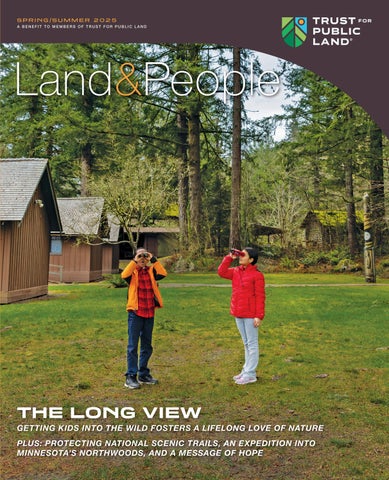
Students at Waskowitz Outdoor Education Center in Washington State goof around with binoculars. Photo: Jorge Rivas
60 T P L .O R G · 3
4 · L A N D & P E O P L E · S P R I N G / S U M M E R 2 0 25
c o n t en t s
Forever Northwoods Minnesota, Wisconsin, and Michigan Trust for Public Land has protected over 200,000 acres for public use in the Northwoods of Minnesota, Wisconsin, and Michigan, where 40 million people live within a day’s drive of a truly breathtaking landscape. This area offers endless recreational opportunities, from fishing and paddling to hunting and hiking— including along the North Country National Scenic Trail. We’re actively working to conserve even more land in the region, including 25 miles of shoreline with public access. Read about our work on national scenic trails and vicariously join a Minnesota hunting trip in this issue.
20 &50
A N DY R I C H T E R
Pages · 20 & 50
T P L .O R G · 5
6 · L A N D & P E O P L E · S P R I N G / S U M M E R 2 0 25
c o n t en t s
The Learning Garden and Food Forest at Story Mill Community Park Bozeman, Montana Story Mill Community Park is an award-winning park and nature sanctuary—and it’s easy to see why. It undid heavy damage from prior industrialization to reveal natural streams, restore a riverfront, and nurture healthy wetlands that support wildlife and improve local water quality. Its planning included space for affordable housing, demonstrating thoughtful development in a quickly growing city. And within its 60 acres lies a community garden and food forest that supply the Gallatin Valley Food Bank with produce to fight food insecurity in the area. Learn how to start your own community garden in this issue.
18
A D R I A N S A N C H E Z- G O N Z A L E Z
Page · 18
T P L .O R G · 7
8 · L A N D & P E O P L E · S P R I N G / S U M M E R 2 0 25
c o n t en t s
Appalachian Trail Tyringham, Massachusetts If you’re like us, you appreciate nature at all times of day, and this glorious look at the night sky from a campsite along the Appalachian Trail (or AT) fills us with wonder— and a yearning to get outside and hit the trails. Recently, TPL protected 194 acres along the AT near Tyringham, Massachusetts, the site of a historic Shaker settlement. This area is also rife with sweeping pastoral landscapes and important wildlife habitat. Our work supports local communities by preserving the character of the region and ensuring immersive nature experiences are available for recreation and economic vitality. Read about our work along the AT in this issue.
40
I A N M AC L E L L A N
Page · 40
T P L .O R G · 9
C HR IS B E N N E T T
Lead the Way Become a Conservation Champion, and help us connect even more people to the outdoors with your annual leadership-level contribution of $1,000 or more. Discover the impact you’ll have as a Conservation Champion by contacting us at 415.495.4014 or champions@tpl.org.
Stay Connected Join us online for project updates, stunning photos, and inspiring stories. Follow us on social media: @trustforpublicland @TheTrustforPublicLand @the-trust-for-public-land @tpl_org TrustforPublicLand Be sure to tag us in your posts!
Sign up for our emails: tpl.org/email-signup
And listen to our podcast, People. Nature. Big Ideas. tpl.org/podcast
10 · L A N D & P E O P L E · S P R I N G / S U M M E R 2 0 25
A DAIR RU TLEDG E
tpl.org/champions | champions@tpl.org
fro m t he pr es id en t
As warmer weather settles in and the days lengthen, executive editor & publisher
Jennifer Ramsey
I naturally turn to the outdoors—as many of us do—spending more time in nature. Strolls in a park, floating on a winding river, or hikes through
editorial director
Deborah Williams managing editor
Amy McCullough s ta f f w r i t e r s
Lisa W. Foderaro Amy McCullough Deborah Williams designers
Rachel Andrade Miya Su Rowe Ben Whitesell media production manager
Elyse Leyenberger
© 2025 Trust for Public Land. All rights reserved. All In for Outdoors, Connecting Everyone to the Outdoors, Conserving Land for People, Conserving Nature Near You, Creating Parks and Protecting Land for People, Fitness Zone, Land for People, Land&People, LandVote, Northwoods Initiative, Our Land, Outside For All, Outside Matters, ParkEvaluator, Parkology, Parks for People, ParkReviewer, ParkScore, ParkServe, Parks Unite Us, 10-Minute Walk, The Trust for Our Land, Trust for Public Land, TPL, and all other names of Trust for Public Land programs referenced herein, as well as their logos, are registered or common-law trademarks of Trust for Public Land.
forested canopies and open meadows can bring a welcome respite and sense of renewal. At Trust for Public Land, we know access to the outdoors is essential, and now more than ever, it must be championed for all. This past year, with the help of our supporters and partners, we protected over 67,000 acres of public land and created 52 new parks, trails, and community schoolyards. And over the last 50-plus years, we’ve put a park or green space within a 10-minute walk of nearly 10 million people. We tipped the scales in generating more than $110 billion in public support through TPL’s 28-year track record of unique expertise in conservation finance (see page 24). And we can now boast having conserved more than 700,000 acres in Montana alone. In November, we helped design and advocate for local ballot initiatives totaling $16 billion to fund projects across the country. All 23 measures passed— in small, large, rural, and urban communities—and with support from voters of all political leanings. Another example of seemingly rare bipartisan support happened in the closing days of the 118th Congress. Lawmakers from both parties came together to approve the EXPLORE Act, which includes the transformative Outdoors for All Act, a TPL-led initiative that will expand access to parks nationwide for those who need it most, including rural communities and tribal nations. Community schoolyards are another shining example of our efforts. As you’ll read on page 14, we’re scaling our work to revitalize these outdoor places and bring the benefits of nature close to home for millions, including 28 million children. Our work builds communities that are healthier and more resilient. And it invites the broadest mix of people to the table—a uniquely TPL approach where strangers become friends as they help create
A N TH ON Y TRU TH G A RY
ACCESS TO THE OUTDOORS IS ESSENTIAL FOR EVERYONE
the spaces their neighborhoods need to thrive (see page 22). As you’ll read in this issue, these cherished places are uniting communities and improving people’s physical and mental health. In Dallas, we're anticipating the development of Woody Branch Park, the final installment in the transformative Five Mile Creek Greenbelt. It consists of 82 forested acres and represents the biggest addition to the Dallas park system in more than two decades (learn more on page 17). In Mississippi, our efforts to preserve Black History and Culture can be seen at Forks of the Road, where we're working to tell a more complete narrative of the American experience. Protecting sites before they disappear to development—or succumb to decades of neglect—ensures that stories of Black resilience are honored and remembered (read more on page 16). This issue also contains the tale of Ronda Lee Chapman, TPL’s associate vice president of culture and belonging and senior advisor to the president, joining a group of first-time grouse hunters as part of the TPL-supported Mentored Hunting program in Minnesota’s iconic Northwoods (see page 50). We’re working to protect 25,000 acres there and in two neighboring states. You can hear more about Ronda’s experience on TPL’s podcast, People. Nature. Big Ideas. Whether your passion is hunting in the deep woods, fishing or paddling a tranquil lake, or spending time in your neighborhood park, the feelings of renewal and rejuvenation are the same. These experiences should be available to everyone, and with your continued support, we’ll keep working to ensure that they are. Thank you again for your support and partnership. See you in the great outdoors!
Carrie Besnette Hauser, PhD president & ceo T P L .O R G · 11
Get to Know
boa r d s p ot lig h t
chair
Lucas St. Clair
AS SENIOR DIRECTOR OF CONTENT CREATION in the development office at Rockefeller University—a biomedical research institute in New York City—Jennifer Jones knows the power of storytelling. In fact, it’s part of her job to translate scientific discoveries into meaningful stories for a general audience. It’s no wonder, then, that she gravitated to TPL’s Land and People Lab, where she chairs the advisory committee. The Lab’s team of experts supports TPL’s work with research-based evidence National Board of Directors since 2022 and an eye toward influencing policy and practice. Jones also New York Advisory Board since 2020 understands the importance of Chair, Land and funding and is an avid supporter of People Lab Advisory TPL's mission. This spring, we Committee, checked in to see what's been since 2023 inspiring her about our work lately.
COURTESY OF JENNIFER JONES
Board of Directors
Jennifer Jones
Jodi Archambault J. Franklin Farrow Mickey Fearn Anita Graham Carrie Besnette Hauser Allegra “Happy” Haynes Alex Martin Johnson Jennifer Jones Philip June Chris Knight Christopher G. Lea Joseph E. Lipscomb Eliot Merrill Ignacia S. Moreno Julie Parish Michael Parish David Poppe Thomas S. Reeve Laura Richards Ted Roosevelt V Anton Seals Jr. Sheryl Crockett Tishman Taylor Toynes Jerome C. Vascellaro Lindi von Mutius Alvin Warren Keith E. Weaver Susan D. Whiting Florence Williams Kenneth Wong
You’ve long championed our community schoolyards; why do es that initiative speak to you? One big reason: A community schoolyard has the power to improve the quality of everyday life for a lot of people, especially in cities. I observed how people used a TPL schoolyard one day from afternoon through dusk: There were teens horsing around on the basketball court. Two families arrived with pizza and shared dinner at one of the tables. A group of young professionals met for a workout. Some residents from the nearby senior center walked the track, and a girl teetered on a bike with training wheels. And it’s a bonus that TPL is transforming a resource already in the hands of the public into a community asset. What TPL projects inspire you right now? The Chattahoochee RiverLands in Georgia. Like so many waterways in our nation, the Chattahoochee is recovering from its industrial role in the preceding centuries. Revitalizing these waters is complex work that requires expertise, creativity, partnership, and long-term commitment. This describes how TPL shows up in communities and engages in meaningful work with the people who live there—which also describes an exciting project
12 · L A N D & P E O P L E · S P R I N G / S U M M E R 2 0 25
that is close to home for me: the QueensWay in New York. Read more on page 60. What’s a top-of-mind concern for you at the moment, and how is TPL poised to address it? I worry that our commitment to each other is disintegrating under the stresses of daily life. We can forget to be gentle when we are depleted by challenges. Still, humans have this incredible capacity to recharge and rebound in good company or the right environment. TPL is creating those kinds of places, making it easier for the time-pressed or resource-depleted among us to get outdoors. How do you most enjoy connecting to the outdoors? Some of my best time outdoors is spent in my vegetable garden at home in Brooklyn. I love the process of tending the seeds and the soil . . . and being teased by the ravens, who keep rearranging the labels on my pepper plants. Beyond home, I love a good day hike with friends or family. Eating a well-earned peanut butter sandwich while sitting on a sun-warmed rock makes for a great day. le a r n m or e @ TPL.ORG/JONES
First Look TURN THE PAGE FOR:
Author, naturalist, and founder of the Chattanooga Audubon Society, Robert Sparks Waller wrote the words below in 1943. But his assertion that real value in life can be found in the beauty and benefits of nature rings just as true today. Here, a young girl gestures toward
Advice on Starting a Community Garden
downtown Chattanooga from an overlook on
An Artsy New Pocket Park in Denver
Stringer’s Ridge, where TPL preserved 92 acres
How Democracy Works for the Outdoors
of trails and forest for all to enjoy. Learn how TPL is connecting young people to the outdoors through first-time nature experiences starting on page 30. read more @
TPL.ORG/STRINGERS
BRO OK E BR AGGER
“It is a beautiful world, and I am so glad that early in life I learned to love many things better than money. That is what I should love to teach every child.” — Robert Sparks Waller
F I R S T L O O K · 13
buz z wo r t h y
Cheer-Worthy Schoolyards from Coast to Coast
At F. Amedee Bregy School in Philadelphia, TPL partnered with the community to transform their schoolyard into a safe, fun, and vibrant green space that's within a 10-minute walk of nearly 10,000 residents. 14 · L A N D & P E O P L E · S P R I N G / S U M M E R 2 0 25
At Jennie Reed Elementary School in Tacoma,
Washington, students have to shout to hear each other at recess. And the building’s HVAC filters are replaced twice as often as at other area schools. The reason? Noise and air pollution, respectively, from traffic whizzing down Interstate 5, which sharply abuts the property, separated only by a retaining wall. But students and teachers alike have a new reason to shout—a celebratory one. A renovated community
greatly improving park equity in a city that
schoolyard opened at Jennie Reed
currently has one of Washington’s largest
in May 2024, offering a vibrant place
park access gaps.
for students to learn and greater
“We’re proud to bring access to the outdoors to
park access for nearby residents.
Tacoma neighborhoods that needed more space for
The site includes climate-smart
people to gather and play,” says Sarneshea Evans,
features such as built-in drainage to
a Washington program director for TPL. And play
capture rainwater and prevent
they will: For students, the overarching health and
flooding, and a line of newly planted
climate benefits fly under the radar while they’re
trees will reduce noise and air
busy enjoying cleaner air, colorful new play
pollution in a big way over time.
equipment, and fun local features such as a new
Just a few months earlier, a similarly
lion statue at Stafford in honor of its mascot.
revamped play area was unveiled at
Nearly 3,000 miles away in Philadelphia,
nearby Helen B. Stafford Elementary
Pennsylvania, students at F. Amedee Bregy School
School. Both schoolyards are among five
celebrated their own community schoolyard
pilot sites that Trust for Public Land
opening in late 2023, adding to TPL’s growing
is creating in the state in partnership
list of 350-plus schoolyards nationwide that have
with Tacoma Public Schools and Metro Parks
been transformed from asphalt lots with dated
Tacoma. The sites were designed, like all TPL
play structures to thriving outdoor spaces ready
community schoolyards, with creative input
for learning.
from students and residents. Altogether, the five schoolyards—which
These sites include green infrastructure working behind the scenes, as well. The updated schoolyard
remain open to neighbors after school hours—
at Bregy, for instance, can capture 1.5 million
will serve more than 25,000 people, increasing
gallons of stormwater and provides further climate
the percentage of Tacoma residents within a
benefits by way of 30 new trees.
10-minute walk of a park from 31 (in 2020) to 75,
At Add B. Anderson Elementary School, where TPL transformed another Philadelphia playground about 6 miles away, former Principal Dr. Laurena
EL
YS
E
LE
YE
NB
ER
GE
R
Zeller applauds the process: “We gave our students
We’re proud to bring access to the outdoors to Tacoma neighborhoods that needed more space for people to gather and play.” — S A R N E S H E A E VA N S , T P L WA S H I N G T O N P R O G R A M D I R E C T O R
the opportunity to dream a little bit bigger and wider in a space that is meaningful to them,” she says. From coast to coast, Trust for Public Land and our local partners are bringing joy, togetherness, and climate resilience to students and neighborhoods, one community schoolyard at a time. That’s certainly something to cheer about. read more @
TPL.ORG/SCHOOLYARDS
F I R S T L O O K · 15
RORY DOY LE
An Infamous Legacy, the Full Story Now we’ll be able to tell a more complete story by providing a place of learning and remembrance of the lives shattered at this notorious slave market.” — S TAC E Y S H A N K L E , T P L M I D - S O U T H PROGR AM DIRECTOR
At Forks of the Road, a former slave market in Natchez, Mississippi, chains remain cemented in the ground as a reminder of the site's prior use.
In a Mississippi town called Natchez, the second-largest slave market in
the United States plied its evil enterprise from the 1830s to the 1860s, leaving an infamous legacy along the Mississippi River. Tens of thousands of enslaved people were forced to walk there in shackles for hundreds of miles—from Maryland, Virginia, the Carolinas, and Kentucky. If they survived the journey, their grim march culminated in their sale. For many years the slave market, called Forks of the Road, was all but forgotten, with nothing left of its infrastructure.
and a home that had belonged to a freed slave who became a successful businessman.
In fact, when the market finally closed during the Civil War,
Working with the National Parks Foundation and National
members of both the 12th Wisconsin Infantry and the newly
Park Service, Trust for Public Land has helped the park acquire
created 58th Regiment of U.S. Colored Troops gleefully tore
five total plots within the 18-acre site, with plans to purchase
down the slave pens in a single night to extract lumber for
several more. Stacey Shankle, TPL’s mid-South program
building a new barracks. Some were, themselves, former
director, is committed to acquiring and protecting as much
slaves who had been sold there.
new parkland as possible.
As one soldier in the 12th Wisconsin Infantry wrote at the
In the meantime, meetings with the community will assist
time, “This order was received just at evening and was hailed
the park service in better understanding how residents want
with the wildest enthusiasm by these men who had been
to see the grounds interpreted. Of Forks of the Road, Shankle
chained, gagged, and whipped, and suffered tortures unutter-
says: “Now we’ll be able to tell a more complete story by
able within these same walls.”
providing a place of learning and remembrance of the lives
Thanks in part to TPL’s efforts, Forks of the Road is the
shattered at this notorious slave market.”
latest open-to-the-public addition to Natchez National Historical Park, an achievement that aligns with the goals of our Black History and Culture program. Other units of the park include an antebellum mansion, a former French fort, 16 · L A N D & P E O P L E · S P R I N G / S U M M E R 2 0 25
read more @
TPL.ORG/FORKS
A Greenbelt Grows in Dallas
buz z wo r t h y
What’s impactful, beneficial, and green all over? Our Five Mile Creek
Greenbelt in Dallas, Texas. A 17-mile trail network connecting over a dozen city parks and three new TPL-led parks, it will bring outdoor access to part of the city that’s long been left out of green space improvement efforts. With one park open and one underway, next up is development of the greenbelt’s final installment, Woody Branch Park. In this case, “park” is a bit of an understatement. We’re
director, says, “People in southern Dallas along Five Mile Creek
talking about a whopping 82 acres of protected forest right
deserve access to nature that connects them to the rest of the
in a major metro area. That’s no small feat. In fact, it’s the
city’s trail network, to an option of a safer route if they want
largest addition to the Dallas park system in over 20 years.
to walk somewhere.”
Notably, the land includes trees that can capture over 3,700
Woody Branch Park will add immensely to the equitable
metric tons of carbon annually—the equivalent of 3,000 gas-
development of southern Dallas. TPL staff began the
powered cars driven for a year—lessening the impacts of
community engagement process earlier this year, meeting
climate change and reducing temperatures in an already
with residents to get their input on the park’s features and
hot city.
design, taking health, safety, and accessibility into account.
Of the 186,297 people living within the creek’s watershed, only 54 percent have access to a park or trail within a
TPL.ORG/FMC
JASO N FLOWE R S
10-minute walk of home. Molly Morgan, TPL’s Texas state
read more @
Only 54 percent of residents living within the Five Mile Creek watershed have a park or trail within a 10-minute walk of home, far below the citywide average of 73 percent. But TPL is working hard to improve that reality. F I RT SP T LL.O OR OG K · 17
pro t ips
How to Grow Together From bolstering your produce bounty to making lifelong friendships and supporting local food networks, community gardens are worthwhile, rewarding undertakings that connect neighbors, support pollinators, and grow much more than food.
SHELL
E Y EL AN
By Amy McCullough with Jennifer Steverson Jennifer Steverson knows a thing or two about community gardens.
FIND YOUR PURPOSE. People really need to think through the vision of what they want a community garden
As environmental program coordinator for the community
for,” says Steverson. “That could be vegetables, herbs, fruit
gardens program at Austin Parks and Recreation in Central
trees, a pollinator-supporting pocket prairie; you name it.”
Texas, she’s spent five years helping people come together
She mentions a garden in Harlem that grows only roses:
to plant and maintain all manner of community gardens.
“They have beautiful roses, and people love it.”
For her, it’s all about connectedness, getting outside, and achieving something together. Here are her tips on how to get started, how to make a garden last, and how to flourish along with it.
BE FLEXIBLE ABOUT LOCATION. “Try to be open minded about where you want to start a garden,” advises
Steverson. That vacant lot you saw on your bike ride home might very well be owned by an LLC and not available.
A N G E L A D EC E N ZO
She suggests working with your county extension office— university-based units that offer guidance on agriculture and gardening—or your city government to find opportunities. Also consider reviving and improving an existing garden that needs some love and attention: “That’s a much easier entry point.” REACH A QUORUM AND ASSIGN LEADERSHIP ROLES. “In Austin, we require you to have a leadership
team of four people and signatures from at least 10 people who are interested in becoming gardeners,” says Steverson. “That’s four people who are actively working on grant applications and figuring out what the design looks like and setting up the membership webpage—all of that, and then 10 people who are saying, ‘Yes, I want this.’” Plus, with that size group, you’ll learn to collaborate from the beginning and as you build. START SMALL. At the beginning, build enough garden beds for the people who you know are committed, and leave
Gardeners chat among the plots at San Geronimo Valley Community Garden in Marin County, California, where TPL turned a former golf course into a 157-acre public natural area. 18 · L A N D & P E O P L E · S P R I N G / S U M M E R 2 0 25
some space that you can define later. “Grow some cover crops or wildflowers in that space in the meantime,” says Steverson, who notes that one bed per member or household is typical.
A
ACCOUNT FOR WATER USE— AND LET IT INFORM YOUR PLANT
Texas, some gardens use pecan shells as
CHOICES. “You have to think through
Depot,” she adds. Also keep an eye out for
how you’re going to water,” Steverson
free materials via neighborhood boards
observes, including working with your
and salvage lots.
city or county on irrigation. She suggests supplementing irrigation with waterwise techniques, such as using ollas (unglazed ceramic pots), wicking beds, and rain barrels. Plant choices matter here, too. Gardening for your climate can lead to variety and discovery; for instance, in Texas, you might grow drought-hardy native pequin chiles rather than a more widely available
mulch. “It doesn't all have to be Home
CONNECT WITH OTHER GARDENS. “A lot of times, there are
things that one garden might be struggling with that another garden is fantastic at,” says Steverson, who strongly encourages peer-to-peer learning. Agricultural extension offices or urban agriculture departments can also be great sources of knowledge and advice—not to mention
pepper—and then cook with them.
YouTube.
There’s creativity that comes with asking,
HAVE A LONG GAME. “Community gardens are often run by small groups
“What recipe can I make with that?” TEST YOUR SOIL FOR HEAVY METALS. “I can’t stress this enough,”
says Steverson. It’s important if you’re growing food but also for safety in general. If you plan on inviting children to spend time in the garden, for instance, “You need to know if there's lead in your soil because you can't control what a kid
of people who’ve been involved since the beginning, and they love it,” notes it’s important to recruit a fresh influx of members. “Are there community groups you can approach? Where can you put up flyers?” Consider local schools that may want to use the garden for science education.
knowing look. Check with your local
ENJOY YOURSELF—AND EMBRACE THE BENEFITS. Community
raised beds lined with cardboard and filled with fresh organic soil as a precaution.
gardens help people get outside, and that’s worth celebrating in and of itself.
CONSIDER FUNDING, DONATIONS, AND FREE STUFF.
“People are beginning to crave spaces
Don’t be intimidated by applying for
is something that requires you to be
grants. Steverson says she’s seen many community garden grants that are geared toward the layperson. Membership fees are another source of funding, and never underestimate the potential of donations and partnerships. Local libraries may have seed banks, and some cities will pay the water bill if you start and maintain a
that aren’t just virtual, and gardening outside,” says Steverson. “That connection with nature is important, as is the connection with people. It’s good for our nervous systems and our anxiety.” She also loves that gardening is something you can start at any point in your life and continue doing for years to come— at whatever level is manageable for you.
garden. And explore what regional industries’ by-products could be useful— and free or low cost; e.g., in Central
Since our earliest days, we’ve helped create community gardens all across the country. These are just a few of those special places.
Oakland Community Gardens Oakland, California In the mid-1970s, TPL collaborated with Oakland residents and the Black Panther Party to turn vacant properties into neighborhood gardens. Oakland continues to have a strong community garden network, enriching residents’ lives and producing new generations of gardeners.
Steverson, “but to keep a garden going,
puts in their mouth,” she adds with a extension office for guidance, and use
TPL Gets Growing Too
e x plo r e m o r e r e s ou rc e s @
TPL.ORG/HAPPIESTOUTSIDE
Story Mill Community Park Bozeman, Montana Folded into this 60-acre park, which opened in 2019, is a community learning garden where youth organizations raise their own crops and have the opportunity to learn firsthand where food comes from. The produce grown helps feed local families that are in need.
Early Street Community Garden Morristown, New Jersey This garden started in 2009 when three women turned a vacant lot into a community gathering and growing space. When the lot was threatened by development, residents rallied to preserve the garden, and TPL helped raise $2.1 million to save this beloved space.
F I R S T L O O K · 19
m a pping o u r impact
Preserving America’s Iconic Trails The United States is home to 11 national scenic trails—and TPL has had a hand in all but one. Each of these important paths offers recreational opportunities, facilitates natural wildlife migration, restores sensitive ecosystems, and contributes to climate resilience for surrounding communities. Many of the trails pass through unprotected land, leaving critical corridors at risk of development. We’re leading the effort, alongside partners, to close those gaps, hundreds—or in many cases, thousands— of acres at a time.
By Deborah Williams Illustration by Nate Padavick
Pacific Northwest Trail Total Trail Length: 1,200 miles TPL Trail Corridor* Protected: 5,090 acres This trail traverses three mountain ranges and is known for its diverse and challenging terrain. Our work here started in 1986, when we first protected 50 acres in Island County, Washington. Notable project: In the early 2000s, we saved roughly 400 acres on Whidbey Island in the Puget Sound, where the route includes the sweeping shorelines and coastal bluffs of Ebey’s Landing National Historical Reserve.
Pacific Crest Trail Total Trail Length: 2,650 miles TPL Trail Corridor Protected: 51,979 acres For two decades, TPL has protected vast swaths of land around this beloved trail, including its viewshed, watershed, wildlife corridors, and access points. Notable project: Recently, we helped safeguard 7,000 acres of trail corridor between the Trinity Alps and Castle Crags Wildernesses in a move the U.S. Forest Service called a “landmark donation.”
Arizona National Scenic Trail Total Trail Length: 800 miles TPL Trail Corridor Protected: 2,084 acres Designated by Congress in 2009, the Arizona Trail is particularly beloved by mountain bikers. It passes through the Grand Canyon, near Tucson and Flagstaff, and runs through dozens of rural communities that benefit from the economic activity it generates. Notable project: Part of the route passes Rincon Creek in Saguaro National Park, where TPL added 300 acres in 2016. 2 0 · L A N D & P E O P L E · S P R I N G / S U M M E R 2 0 25
Continental Divide Trail Total Trail Length: 3,100 miles TPL Trail Corridor Protected: 28,963 acres The CDT passes through five states, from Southwestern deserts to the Rocky Mountains, and holds many locations sacred to Indigenous tribes. For years, parts of the trail forced hikers onto roads. Thanks to TPL, those sections now go through nature, making the route safer and more scenic. Notable project: We recently expanded the trail corridor by 605 acres at Upper Bear Creek, which is now part of Gila National Forest in New Mexico.
North Country and Ice Age Trails
New England Trail
Total Trail Length: 5,800 miles TPL Trail Corridor Protected: 94,201 acres
Total Trail Length: 235 miles TPL Trail Corridor Protected: 2,312 acres
Designated in 1980, the North Country Trail is the longest of the 11 scenic trails and runs along Great Lakes and through deciduous forests while Wisconsin’s Ice Age Trail includes fascinating glacial landscapes. We’ve completed more than 40 projects on these trails, including over 1,200 acres along the Ontonagon River in Michigan. Notable project: We’ve added over 13,000 acres to the Ottawa National Forest, including 245 acres along a popular section of the NCT.
This trail passes within 10 miles of 2 million people. Notable project: In 2023, we helped conserve 200 acres in Southwick, Massachusetts, protecting the NET footpath and high-value wildlife habitat that is being managed as part of the Silvio O. Conte National Fish and Wildlife Refuge.
Potomac Heritage Trail Total Trail Length: 710 miles TPL Trail Corridor Protected: 7,851 acres This trail passes through several sites with historic and natural significance, such as the Great Allegheny Passage, the Chesapeake and Ohio Canal Towpath, the Civil War Defenses of Washington Trail, and George Washington’s Mount Vernon Estate. Notable project: We helped conserve 2,000 acres at George Washington Birthplace National Monument.
Appalachian Trail Total Trail Length: 2,190 miles TPL Trail Corridor Protected: 340,000 acres Designated in 1968, the AT is the longest hiking-only trail in the world. Since 1977, we’ve helped protect 160 parcels in 14 states, including critical watersheds and wildlife corridors. Notable projects: In 2000, we conserved over 16,000 acres at Sterling Forest State Park outside New York City. More recently, we protected 2,600 acres around Bald Mountain Pond in Maine. Read more on page 40.
Florida National Scenic Trail Total Trail Length: 1,500 miles TPL Trail Corridor Protected: 29,016 acres This trail is within a one-hour drive of most Florida residents. It passes through three national forests, nine wildlife management areas, 16 state forests or parks, two NPS properties, and a wildlife refuge. Notable project: In 2002, TPL added the 470-acre Mills Creek Woodlands along 2 miles of trail.
*A trail corridor includes land within a half mile of a trail on either side, with the exception of the AT, which uses a wider corridor measurement based on watershed boundaries.
FIRST LOOK · 21
CO U R TESY O F THE CIT Y A N D CO U NT Y O F D E N V E R
pa r ks s p ot lig h t
From Substation to Pocket Park TPL is creating fresh public spaces with the Denver communities that need them most. By Natalie Olsen For years, no one thought much of an abandoned energy substation at a heavily trafficked intersection in southwest Denver, Colorado. The decommissioned lot was dotted with electric poles and
space,” says DPR Executive Director Jolon Clark. “This project exemplifies the power of repurposing underutilized land to create meaningful, accessible public spaces for residents who otherwise may have been underserved by existing park infrastructure.”
transformers. A fence surrounding the parcel was covered in
Today, the park features skateboarding elements, a
graffiti. And the corner that it stood on, at Kentucky Avenue
basketball half-court, a mural wall, custom seating, shade
and Irving Street, was known as “Killer Kentucky” for the cars
structures, improved pedestrian connections, and more.
that plowed through the four-way stop. The lot “was right there on the corner of our building, and
For Antonnio Benton, a TPL project manager for the Colorado Parks for People program, it also exemplifies what
it was just an eyesore,” recalls Alex Magaña, executive
happens when community members see what they're capable
principal of Kepner Beacon Middle School in Denver. “There
of—and when organizations stick around for the long haul.
was no purpose to it.” After years of work by Trust for Public Land, Denver Parks
Although park engagement efforts formally began in 2018, Benton traces the origin of the park all the way back to 2013,
and Recreation (DPR), community stakeholders, and other
when TPL became involved in Denver’s Westwood neighbor-
partners, the abandoned lot has been reimagined and reborn
hood through a collaboration focused on transforming
as a functional neighborhood asset. The once-dangerous corner
alleyways into art-filled corridors.
is now a treasured public space: Westwood Pocket Park. “We take immense pride in the transformation of a neglected
“It started with the alley cleanup, and more than a dozen projects later, we’re still here—that’s how we work,” Benton
energy substation into a vibrant community park, especially
says. “In Colorado, our model is going deep and working with
in a neighborhood that previously lacked adequate green
communities to identify a series of projects.”
2 2 · L A N D & P E O P L E · S P R I N G / S U M M E R 2 0 25
It started with the alley cleanup, and more than a dozen projects later, we’re still here—that’s how we work.” — A N T O N N I O B E N T O N , T P L C O LO R A D O
AS
E HL
E
WE
AV E
R
VE
R
PA R K S F O R P E O P L E P R O G R A M M A N AG E R
D
EN
While Westwood has the highest population of children in the city, it lags when it comes to easy access to quality parks. Historically, it’s also a neighborhood that has seen some of the least investment in green space
C O U RT ESY O F
C THE
IT Y
AN
D
C
N OU
TY
O
F
over the last few decades. As a result of the alleyway enhancement project, a
his nonprofit, D3 Arts, where
coalition known as Cool Connected Westwood was formed
he’s executive director.
by residents and dozens of community-based organizations and partners. Together, they envisioned the Westwood Via Verde, a 3-mile pedestrian greenway that would connect parks, schools, and businesses using safe walking and biking routes; it also included plans for structural changes that would improve water quality and provide more shade. Once finished, the greenway will provide a way for more than 45,000 Westwood residents to reach a green space within a 10-minute walk of home—including this new pocket park, which is close to Kepner Beacon Middle School and public housing. In 2019, DPR acquired the parcel from Xcel Energy and turned to TPL to help bring the project to fruition, knowing the organization was already engaged in the area. “Trust for Public Land was integral in the community engagement process, working alongside Denver Parks and Recreation throughout the park’s visioning and design stages,” says Clark. More specifically, for TPL that meant contributing to the park’s distinctiveness by incorporating input from the youth who would use the park most. “Nothing was too small or too big, and that’s where we really hoped to help the youth and residents flex their civic leadership muscle,” Benton says. “It’s exciting for people to see the reflection of their own involvement based on decisions that show up in the park.” Santiago Jaramillo, a third-generation Westwood resident
In a city that’s highly vulnerable to the impacts of climate change, another overarching goal was to incorporate green infrastructure, including sustainable landscaping practices, adding trees for shade and erosion control, and planting rain gardens to manage stormwater runoff, in addition to the remediation of hazardous soils and materials. Roadway improvements in the surrounding area also decreased the distance it takes to cross the street, helping improve safety for pedestrians—something crucially important at an intersection known to be “killer” in the negative sense of the word. While Westwood Pocket Park is formally complete, TPL’s work with Colorado communities continues—in Denver as well as Greeley, about an hour northeast. There, TPL staff have spent years working with residents to transform the formerly neglected Delta Park into a vibrant, culturally relevant green space that promotes belonging. They’re also helping establish a forested outdoor classroom at a Greeley community center, and there’s a 975-acre natural area coming along the Cache la Poudre River. In all these cases, TPL works with residents to deliver the outdoor spaces that will serve them best. “You really get to know folks working hand in hand with them,” Benton says. “And it resonates and makes the work all the more meaningful when you see those people enjoying what you helped create.”
who attended Kepner decades ago, says TPL’s approach gave the
Natalie Olsen is a writer living in the West. A former editor
community room to create space not just for recreation, but
for the Associated Press, she has also written for The New
for Westwood’s culture as a predominantly Latinx neighbor-
York Times, The Washington Post Magazine, and many other
hood with a high concentration of foreign-born residents.
publications.
“Just being able to say, ‘Now there is going to be this [park], and this is yours,’ is special,” says Jaramillo, who helped paint the park’s murals—and others along the Via Verde—through
read more @
TPL.ORG/ WESTWOOD-VERDE
FIRST LOOK · 2 3
t pl in c o n v er s at i o n
ED
M S
H C
How TPL’s Conservation Finance program is helping communities nationwide put their votes where their values are: in parks and green space.
IA
Democracy at Work COU
E RT
SY
OF
SA
Last fall on Election Day, Trust for Public Land reached a milestone, surpassing $100 billion in public financing for conservation generated by state and local ballot measures. The achievement—a combined total of $110 billion—was the result of more than a quarter century of research and advocacy. That funding has led to hundreds of thousands of acres of newly protected lands, as well as new parks and trails, forest restorations, and climate initiatives, among other conservation successes. TPL Senior Writer and Researcher Lisa W. Foderaro caught up with Will Abberger, who leads TPL’s Conservation Finance program, to find out how the work began all those years ago, how it has evolved, and where we go from here.
DA RCY K IEFEL
The golden glow of sunrise highlights Spanish moss hanging from trees on Hunting Island in Beaufort County, South Carolina, where voter-approved ballot measures funded the conservation of 25,000 acres.
2 4 · L A N D & P E O P L E · S P R I N G / S U M M E R 2 0 25
WILL ABBERGER: Our mission has always been about connecting people to the outdoors—about access and equity. To advance that mission, our Conservation Finance program
M A RIN COUN T Y PA RKS
LISA W. FODERARO: First, can you explain what we mean by “conservation finance”?
works at the state and local levels to create new sources of public funding for parks, conservation, and climate. We do that primarily through ballot measures, which are questions placed before voters, asking them to decide whether to dedicate funding for those goals. We also work at the state and local levels to create funding legislatively, but the majority of our work is through ballot measures.
How many ballot initiatives have we supported over the years? We’ve done several hundred successful ballot measures since the program was founded in 1996. Specifically, we’ve won
In 2022, TPL supported a ballot measure in Marin County, California, to finance a $23 million bond for the conservation of Tiberon Ridge. Voters approved the measure by 79 percent.
681 measures out of 813 in 38 states. That represents a passage rate of 84 percent. We’ve worked on many statewide ballot
right amount, for the right purposes, on the right ballot, with
measures, but our particular expertise is at the county and
the right accountability provisions—then that’s really the key
municipal levels, from big cities such as Dallas to small towns
to our success.
like Exeter, New Hampshire.
Take us back to the beginning. What were some of our early ballot victories? And why did TPL decide to be a pioneer in this area?
TPL started out working on ballot initiatives that primarily funded land conservation. But that has expanded to include other goals in recent years. Tell us about those.
Those would be in Los Angeles County, California, and Miami-
While that continues to be a goal, we’ve worked on lots of
Dade County, Florida, where we helped put referenda before
measures that don’t include funding for land acquisition, but
voters in 1996 that collectively raised more than a half-billion
for park development or building new trails, for instance.
dollars for parks. Both were called the Safe Neighborhood
Today we’re increasingly focused on climate resilience. Ballot
Parks Act, and both passed overwhelmingly. That was a real
measures can fund natural climate solutions, such as preserv-
eye-opener for TPL. The fact that voters would approve a
ing forests that store carbon, and climate-related strategies
small tax increase for parks and that it could be done in two
like weatherization, clean energy, and transportation
very different parts of the country proved that we were onto
alternatives. In fact, in 2020, Denver was the first major city
something big.
to approve a new sales tax devoted solely to climate mitigation. The city’s Climate Protection Fund raises about $40
How exactly does TPL support the various ballot measures around the United States?
million a year, with half of that money going to communities
It’s through what we call our conservation finance method-
as a priority focus recently, with the severe fires we’re seeing
ology. We do a lot of homework up front to understand things like finance mechanisms (a property tax, a sales tax, or a bond), voter perspectives, ballot language, and election
most impacted by climate change. Wildfire has also emerged in the West. We anticipate many wildfire mitigation and resilience funding measures appearing on ballots.
it gets on the ballot, we’re out there running campaigns to
What’s a ballot measure that stands out among the hundreds TPL has supported?
raise awareness and gain support. If we can get the ballot-
The Massachusetts Community Preservation Act in 2000 was
measure design right—the right finance mechanism, for the
certainly a milestone for us. It was actually a state legislative
requirements. Once we know we have a viable proposal and
FIRST LOOK · 2 5
measure. TPL helped write the enabling legislation, which did two key things. One, it authorized towns and cities to take ballot measures to their voters, asking them to increase the local property tax for conservation, parks, historic preservation, and affordable housing. And two, it created a state trust fund (the Community Preservation Trust Fund) that provides matching funds for those communities that vote to tax themselves. Last fall marked an important milestone: More than 200 cities and towns in Massachusetts have now passed
One of the gratifying things about this work is that it unites communities. We find that voters—Republican, Democrat, and independent alike—all support land conservation.” — W I L L A B B E R G E R , T P L C O N S E R VAT I O N FINANCE DIRECTOR
the Community Preservation Act, raising over $3.4 billion. If your town says we want to increase our property tax by
nities. We find that voters—Republican, Democrat, and
1 percent for parks, conservation, historic preservation, and
independent alike—all support land conservation. Another
affordable housing, then your town is guaranteed matching
recent measure to highlight is Proposition 4 in California.
funds from the state. So that’s a very strong incentive.
Last year, California voters passed a truly historic climate and environmental bond measure that will provide $10 billion
Are there more recent ballot measures you’d like to highlight?
over 40 years and be transformative for the state.
most recent measure appeared on the ballot in 2022. That’s
In November, TPL campaigned for 23 ballot measures, and all of them passed. In addition to taking a well-deserved victory lap, what are we focused on next?
a total of $260 million for land protection. With that money,
I think the future of our conservation finance work lies in
the county has been able to conserve about 25,000 acres.
climate and equity, which is consistent with TPL’s strategic
That’s a pretty conservative part of the country. But one of
priorities. We want to focus on places where we can have a
the gratifying things about this work is that it unites commu-
significant impact in these areas. But there will come a time
Of course. In Beaufort County, South Carolina, voters have approved measures funding the conservation of critical lands and natural areas in seven different elections since 2000. The
when all critical natural areas and wildlife habitat will have been acquired or developed. We’ve reached that point in many parts of our country already. So the issue then becomes restoration—taking land that may have been developed residentially or commercially and turning it back into parkland. That’s where the future is.
Finally, some people might wonder why it’s important to support organizations like TPL when voters are directing state and local governments to fund conservation. What’s the role of private philanthropy? The magic of our work for private donors is leverage. For every $1 of private funding contributed to Trust for Public Land, we’re able to turn that into $2,000 of new public funding for MIM A D K IN S
parks and conservation. The climate crisis and biodiversity
The Massachusetts Community Preservation Act in 2000 was a conservation finance milestone for TPL. Here, residents enjoy picnicking and tossing a frisbee at a park in the town of Lincoln. 2 6 · L A N D & P E O P L E · S P R I N G / S U M M E R 2 0 25
crisis and lack of equitable access to the outdoors in the United States are big problems, and it’s going to take a lot of money and all of us working together to help solve them. read more @
TPL.ORG/CONFIN
M CK IN LE Y WILE Y
t ppies Outside.
M CK IN LE Y WILE Y
Ha
We’re happiest outside, and science proves it. Time spent outdoors relieves stress, improves sleep, and makes us mentally sharper. As a Trust for Public Land member, you know we’re working hard to bring those benefits to more and more people all the time. That includes you. Use our resources to find your joy outside and share it with others: TPL.ORG/HAPPIESTOUTSIDE
TRUST FOR PUBLIC LAND invites you to join us in thanking the following supporters. We could not achieve our commitments to climate, equity, community, and health without their generous financial contributions to our mission and our work. Thank you for helping connect everyone to the outdoors.
Capital One is committed to partnering with TPL to build thriving, resident-centered communities that catalyze opportunity and promote well-being. From the Dallas Greening Initiative to the Major Taylor Trail in Chicago, Capital One is proud to support the development of welcoming, safe, and accessible outdoor spaces with TPL. For funding TPL’s On Common Ground program, which is working to enhance social cohesion through community engagement and park-based activities across the country by supporting programs such as Welcome to Raleigh Parks in North Carolina as part of our ongoing commitment to connecting everyone to the outdoors.
Parks for People Renton, Washington
Parks for People Boston, Massachusetts
TPL Trails Initiative Alabama, Georgia, Illinois, New York, Ohio, Pennsylvania & Tennessee
Community Schoolyards New York City & Newark, New Jersey
Parks, Trails & Community Schoolyards Atlanta, Georgia; Chicago, Illinois; Dallas, Texas & Seattle-Tacoma, Washington
Judge Charles R. Rose Community Park Dallas, Texas
Parks & Trails Maine & Nationwide
TPL Trails Initiative & Tribal Schoolyards Nationwide
India Basin Waterfront Park San Francisco, California Los Angeles Schoolyards Initiative Los Angeles, California
2 8 · L A N D & P E O P L E · S P R I N G / S U M M E R 2 0 25
MIM A DKINS
Here Now. Here Always. Because of You. PROTECT OUR GREEN SPACES FOR GENERATIONS TO COME. By naming Trust for Public Land as a beneficiary of your will or living trust, retirement plan, life insurance, donor-advised fund, or other financial account, you can create a legacy that lasts beyond a lifetime. Your gift will protect access to public lands for all, now and in the future. Preserve your values across generations. Leave a legacy with Trust for Public Land. To learn more, visit our website via the QR code or at tpl.planmygift.org.
T P L .O R G · 2 9
In California and Washington, TPL is cultivating a new generation of campers and nature enthusiasts by getting young people into the wild—many of them for the first time. STORY AND PHOTOS BY JORGE RIVAS
Campers at Wind Wolves Preserve in Southern California. 3 0 · L A N D & P E O P L E · S P R I N G / S U M M E R 2 0 25
A
deep sense of nostalgia takes hold when you arrive at Camp Waskowitz. Nestled in the
In 2024, Trust for Public Land conserved 345 forested acres at the camp, ensuring this
picturesque foothills of Washington’s North
treasured place remains accessible for generations
Cascades, it recalls the sleepaway camps of
of students and campers to discover nature and
coming-of-age movies and young adult novels.
hone vital life skills. “The surrounding forest is
The region is often referred to as the American
integral to the feeling of a wilderness adventure,”
Alps because of the stunning scenery.
says Laurie Benson, TPL’s Washington State
That dramatic mountainscape surrounds the original cabins, built in 1935 and remarkably
conservation director, who was deeply involved in the effort to protect the landscape.
well preserved. The flowing water of the South
“It’s a once-in-a-lifetime experience for fifth
Fork Snoqualmie River serenades trees draped
graders who camp here,” says 17-year-old high
with neon green moss. Rustic wooden signs with
school senior and camp leader Star Whiteley,
bright hand-painted lettering welcome you and
who first visited the camp two years ago. “I just
provide directions across the camp. It’s nothing
feel so comfortable being here.”
short of idyllic.
Students at Waskowitz Outdoor Education Center in Washington State. T P L .O R G · 3 1
“It’s a once-in-a-lifetime experience for fifth graders who camp here.” – STAR WHITELEY, CAMP LEADER AT WASKOWITZ OUTDOOR EDUCATION CENTER
spoken at home. Many of the students come from workingclass families, and after-school trips to parks are rare. But regardless of background or familiarity with nature, the students find their connections to the wilderness and each other during their time at camp. Whiteley, who describes herself as awkward and suffers from allergies, says she hated the outdoors before she was introduced to Camp Waskowitz. Then she discovered the calm of being immersed in the forest. “It’s so peaceful here; I will keep coming back here as much as I can.” While high schoolers like her lead some activities, classroom teachers also morph into wilderness guides for the week, giving students the chance to see them in a different light. While learning about insects, wildlife, and the ecology Star Whiteley, a peer educator and camp leader at Waskowitz, discovered her love for the outdoors after just one visit.
of the woods, campers connect with their peers and teachers in a new way and develop leadership and communication skills. “It’s just a perfect way to dive into the deep end of mak-
As a peer educator and camp leader at Waskowitz, Whiteley helps younger students feel comfortable here too. She’s made
ing friends and building community,” Whiteley affirms.
the hour-long journey from her home in Sea-Tac to Camp
MAKING CONNECTIONS
Waskowitz—now called Waskowitz Outdoor Education Cen-
Fifth graders visiting Waskowitz learn and live together in a
ter—almost a dozen times as a high school leader.
way that’s more impactful than just going to school during
“My role is to encourage and uplift students on their educa-
the day. The outdoor education element provides these young
tion journey here,” says Whiteley. She leads groups on hikes,
students with opportunities for social-emotional learning along
science lessons, and games. She’s also there to be a supportive
with science understanding.
peer, answering questions and calming fears to ensure everyone has a joyful time. Throughout the four-day camp excursions—which take place during the regular school year in fall or spring—students explore outside, rain or shine. And no one is left out: Every
When Yusuf, 10, struggled to hike up a steep hill because he’s afraid of heights, tears flowed down his face. “I was so high up, and then I got super scared,” Yusuf says. This was his first hike and his first time camping. His classmates, however, didn’t make
fifth grader in the Highline School District south of Seattle is
fun of him. They supported him
invited to the camp and outdoor school as part of the regular
with patience and encouraging
academic curriculum. In fact, Washington State covers the
words. The students under-
cost for any student who wants to attend through an organiza-
stood that they couldn’t
tion called Outdoor Schools Washington.
leave anyone behind,
That means introducing a lot of kids to hiking and camping
and to get up the hill,
for the first time. Highline has an extraordinarily diverse stu-
they needed to
dent body. There are notable populations who speak Spanish,
operate as a unit.
Somali, Arabic, and Vietnamese—a total of 89 languages are 3 2 · L A N D & P E O P L E · S P R I N G / S U M M E R 2 0 25
“When I grow up, I’m going to hike more. I love hiking and cabins now,” Yusuf shares. The students reassured each other again as they crossed a
keeping them constrained,” explains Lim, who’s brought her students to the camp for the past three years. She describes one of the loudest cheerleaders on the tension
50-foot-long tension bridge that wobbled back and forth with
bridge as a student whose “personality often feels too big for
each step. It’s a highlight for most of the campers, but the
the classroom.” At camp, that student was able to channel
shaky walk traversing a stream can be equally nerve-racking
his energy to boost the confidence of his classmates.
and exhilarating.
His enthusiasm was so infectious that even students
One by one, students crossed the bridge, gripping both handrails for dear life. With each student who successfully
who aren’t as outspoken joined in and boisterously rooted on their classmates.
traveled over, the cheer squad on the other side grew. “They were screaming until they were red in the face,” attests Dasol Lim, Yusuf’s teacher. These moments build lasting bonds among students—and that closeness extends to their educators too. “I like my teacher more now,” says Yusuf, who also shares that seeing his
“When I grow up, I’m going to hike more. I love hiking and cabins now.” – YUSUF, A FIFTH-GRADE STUDENT AT WASKOWITZ OUTDOOR EDUCATION CENTER
instructor outside the classroom was fun. “I’ve noticed that I’m joking around and laughing with them a lot,” adds Lim. She says quiet students become more comfortable making connections outdoors. “I feel like they’re able to thrive when they’re outside, and there are no walls Yusuf, like many students at Waskowitz, felt triumphant upon crossing a suspension bridge.
T P L .O R G · 3 3
“If we all had more opportunities to be outside and to feel that calm, grounding connection . . . I just think the world would be a better place.” – MEREDITH VON TRAPP, DIRECTOR OF WASKOWITZ OUTDOOR EDUCATION CENTER
Students at Waskowitz form deeper bonds with their classmates and teachers (above left and right). Meredith von Trapp (above) says they also leave feeling compelled to take care of the planet.
Lim adds that in a technology-driven world where kids are
A LASTING IMPACT
on their screens all the time, it can be harder to create spaces
Students also walk away with a sense of responsibility
for students to cultivate community. “Being outside and
toward nature, an understanding that “human interactions
removing technology allows students to make connections as
are impacting the natural world just like nature is impacting
human beings out in nature rather than through a screen,”
humans,” says Meredith von Trapp, director of Waskowitz
she explains.
Outdoor Education Center.
Those human connections, says Lim, give students a sense
It starts with leave-no-trace lessons at lunchtime. If a napkin
of belonging that makes them more excited to attend school
or food wrapper falls, you hear the students calling on their
afterward.
classmates to pick up after themselves.
3 4 · L A N D & P E O P L E · S P R I N G / S U M M E R 2 0 25
In their end-of-camp surveys, students write things like,
But as in many beautiful places, development has inched
“I care so much about the environment now,” and “I’m excited
closer to the site in recent years. This is where Trust for
to care for the land,” according to von Trapp.
Public Land came in. Highline Public Schools tapped the
“If we all had more opportunities to be outside and to feel
organization to help protect the camp, and TPL successfully
that calm, grounding connection to the land while connecting
negotiated a $7.3 million conservation easement to save the
to each other, I just think the world would be a better place,”
land from development in perpetuity.
she reflects.
“It’s such an important experience for these kids,” says
The interpersonal connections both Lim and Von Trapp
TPL’s Benson, “especially considering that the learning takes
mention are especially significant given the increasing feel-
place in this magnificent forest. It’s an opportunity that a
ings of loneliness reported by young people. There is a strong
lot of these students just wouldn’t have otherwise, and for
body of evidence that supports time in nature as essential to
many, it can be life changing.”
our mental, emotional, and physical well-being—especially during childhood development. And the growth students experience isn’t fleeting—it goes
In a collaborative effort that included the Mountains to Sound Greenway Trust and funding from King County, the arrangement means that the school district will continue
well beyond post-camp surveys. The lessons and memories
running its outdoor education programs, and when school
stay with the former campers decades later.
programs are not in session, the 300-plus acres of forest and
A 10,000-member Facebook group of Camp Waskowitz
trails will be open to the public. This newly established access
alumni is filled with comments about visits as early as the
is a direct result of the deal brokered by TPL. “It’s a win-win
1950s. “I still remember Mr. Harry Lemon teaching us about
for outdoor education and public access,” says Benson.
the age of trees, in 1961,” wrote one alum on the page. Another
“Not only is the land around the camp protected, but the
member posted a picture of his license plate frame that reads,
funds generated from the conservation easement are going
“I’d rather be at Camp Waskowitz.” And someone who was at
straight back to endow the camp,” she adds. “They’ll be used
the camp in 1972 wrote, “I absolutely loved it so much, I cried
to help preserve the outdoor education facility and maintain
all the way home on the bus. This place was magical.”
the historic CCC buildings.”
Perhaps even more telling is that Camp Waskowitz
Benson says the partnership aimed to “take as much of the
alumni have gone on to become leaders in their commun-
burden off the school district as we possibly could.” She cred-
ities. Alumni include former U.S. Secretary of the Interior
its much of the effort’s success to the Jim Ellis Fund for Land
Sally Jewell, former Washington Congressman and Governor
Conservation, which was started by TPL and the Mountains
Jay Inslee, and Washington State Superintendent of Public
to Sound Greenway Trust to invest in complicated, expensive,
Instruction Chris Reykdal.
but high-impact projects in the area. “Conservation is a team sport,” says Jon Hoekstra, executive
IT TAKES A VILLAGE—AND SERVES ONE TOO
director at the Mountains to Sound Greenway Trust. “We were
One of only a few overnight camps in the nation owned and
all able to combine our strengths and capabilities to develop a
operated by a public school district, Waskowitz is a rare site
project that’s really special and is going to make a huge differ-
through and through: a place where outdoor education, envi-
ence for generations to come.”
ronmental conservation, and historic preservation meet. It’s also a testament to the power of collaboration. The camp was constructed by the Civilian Conservation
In this way, TPL’s work goes far beyond land protection: It influences life interests and, potentially, career paths. Whiteley says she didn’t know what she was going to do after high school, but
Corps (CCC), a Depression-era government work program
hiking with younger students at Wasko-
that made a huge impact on parks nationwide. Waskowitz
witz helped her find direction.
was used as a base for U.S. Forest Service projects in the Snoqualmie Valley area until 1942.
“I was just so happy being able to talk with fifth graders and
Highline Public Schools, in south King County, began
[having] them look up to me
sending students to Camp Waskowitz in 1947 and purchased
that I told myself, ‘This has to
the camp 10 years later. In 1993, it was added to the National
be my lifetime goal, to be a
Register of Historic Places. Every year, about 3,000 fifth-grade
teacher,’” she announces
students attend its outdoor school.
with a huge smile. T P L .O R G · 3 5
A FAMILY AFFAIR
“The schoolyard was completed last year, so this program is
A thousand miles south of Camp Wasko-
a way for us to continue relationships with those families and
witz and just minutes from downtown
continue to connect them with nature—both near home and
Los Angeles sits the Jose A. Castellanos
now a bit farther from home,” says Molina, who accompanies
Campus—an elementary school that’s home
campers on most OBA trips. Each round of the program serves
to TPL’s first community schoolyard in the
20 families at time, with introductory day trips followed by
city. It’s part of a larger effort (named 28x28)
overnight camping.
to transform 28 asphalt playgrounds into high-quality green spaces by 2028.
There have been a handful of TPL–OBA excursions so far. But over the course of the next three years, the organizations
The Pico Union district, where the school is located, has
will take hundreds of people camping in nearby natural areas
a long legacy of welcoming immigrant communities. In the
including the Santa Monica Mountains and Angeles National
1930s and ’40s, it became a hub for many Europeans, includ-
Forest, which borders a number of TPL-protected landscapes
ing Greeks, Norwegians, Swedes, and Russians. By the 1980s,
that, stitched together, make a large expanse of wilderness.
Central Americans fleeing civil wars also made the area home. Today, you can get falafel at Papa Cristo’s Greek Grill
INTO THE WILD
and a Salvadoran pupusa on the same block. But parks in the
On a crisp Saturday morning in October, families gathered
neighborhood are few and far between. Before TPL made the
with their duffel bags and suitcases at 8:00 a.m. in front of
community schoolyard a reality for Castellanos students,
the Castellanos school. One even came with a grandmother—
the closest greenery was Angelus Rosedale Cemetery across
three generations being introduced to camping in one fell
the street from the school.
swoop. The youngest camper was just 3 years old.
Trust for Public Land partnered with the school's adminis-
Pasadena-based Outward Bound Adventures (not to be
tration, students, and neighbors to reimagine how the previ-
confused with the similarly named international nonprofit
ous, traditional schoolyard could become a vibrant outdoor
organization) provided transportation, food, tents, sleeping
learning space. TPL Community Organizer Dayana Molina and
bags, and sleeping pads.
TPL Project Manager Matilda Reyes collaborated with design-
These resources open camping up to families that might not
ers and planners to create a space where students and neigh-
otherwise be able to try it. The federal government classifies
bors could actively share their vision for the project.
Castellnos as a “high poverty” school.
Many of their wishes came true, including a soccer field
Funding comes from the state’s Outdoor Equity Grants
and new playground equipment. Other changes nod directly
Program (which was created through AB 209 and administered
to nature: Instead of metal benches, there are large logs for
by California State Parks’ Office of Grants and Local Services);
sitting. Bright green grass, wood chips, and granite pebbles
TPL and OBA applied for the grant together. Molina says it was
replaced asphalt and bare ground. And more than two dozen
an intuitive partnership since OBA specializes in “customized
native trees were planted, which will provide vital shade and
activities that engage families to get out and learn about the
cooling from the increasing heat.
environment,” with a focus on underrepresented communities.
Several students who helped design the schoolyard have
Diverse camp leaders and culturally relevant programming
remained connected to TPL and attended an after-school
also add comfort to the outing: “It truly elevates the experience
program run by Molina. Through a unique partnership
that kids and adults see themselves in the instructors and can
between Trust for Public Land and local nonprofit Outward
connect with them,” says Molina.
Bound Adventures (OBA), those students—and their parents—
During the two-hour journey to the campground, Castella-
got even more immersed in nature on a one-night camping
nos families learned about everything from how to read paper
trip last fall.
maps to the Indigenous history of the region. Nathan Nuñez,
The families traveled to Wind Wolves Preserve two hours
an OBA field instructor, told families about the different Native
north of the city, a popular outdoor destination where, in part-
American tribes with historic and current ties to the area, add-
nership with the California Rangeland Trust, TPL permanently
ing context to the landscape and imbuing it with richness.
protected 14,631 acres in 2021—and added another 13,515 acres
Nuñez says that when young people understand how
in February of this year. It’s a majestic place with peaks and
they’re connected to the elements in the environment, from
valleys as far as the eye can see.
rocks to plants, “it really helps us take that connection to the
3 6 · L A N D & P E O P L E · S P R I N G / S U M M E R 2 0 25
Clockwise from top: Campers of all ages explore aspects of nature such as stream biology. Everyone pitches in on setting up camp. TPL’s Dayana Molina and a camper take a closer look at the local plant life.
“This program is a way for us to continue relationships with those families and continue to connect them with nature.” – DAYANA MOLINA, TPL COMMUNITY ORGANIZER
T P L .O R G · 3 7
next level of building the next generation of stewards.”
But OBA staff are on hand and ready to show families how to
The scenery doesn't hurt either: During spring months, the
set up their campsites, and the families leaned on each other and
fields burst with bright yellow and purple wildflowers, attract-
worked as a team. It eased some of the insecurity Karla mentions,
ing travelers from afar. In the fall, the hills glow in golden
knowing they were all in this new experience together.
hues at sunset. In any season, nature puts on its best show.
From making barbacoa for dinner to roasting s’mores for
“Camping was scary at first because I felt a bit clueless,”
dessert, campers began to loosen up. Kids played soccer in
confesses a mom named Karla, who brought her 7-year-old
a clearing, and señoras sat chatting under shade trees until
son, Anthony, and 3-year-old daughter, Aniyah. Despite being
sunset. An uncle napped in a tent during some down time. As
the adult in her party, it was also Karla’s first camping trip.
Molina puts it, “The families made this trip their own.”
Clockwise from top left: Campers Anthony (left) and Aniyah. OBA instructor Maggie McSparran demonstrates tent assembly. The campsite at night.
3 8 · L A N D & P E O P L E · S P R I N G / S U M M E R 2 0 25
“Nature is the best thing there is.” – BERTHA, A CAMPER ON THE TPL–OBA TRIP
A SENSE OF STEWARDSHIP Karla came to the United States when she was 6. Her mother had a close relationship with nature in Mexico, which she fostered in her children. Karla grew up visiting parks in L.A., but she says going away camping was more daunting—and requires more resources. She suspects the families in her neighborhood don’t go camping because of cost and lack of information—including multilingual resources; roughly half of the students at Castellanos are classified as English-language learners. But she’s hoping to inspire an interest in the outdoors in her children by
Bertha (left) came camping with her grandson Danny and encourages her family to make the most of their time together outdoors.
taking part in programs like this. And it seems to be working. “I had a bad dream,” 3-year-old Aniyah reports, “but I love
“Nature is the best thing there is,” she says, adding that
camping.” Even being scared of some off-putting insects didn’t
she encourages her sons and daughters to take their children
deter her overall positive takeaway. In fact, the rustling leaves
outdoors, even if they’re tired or short on time. In fact, she
and howls of coyotes at night created more excitement than
persuaded her daughter to attend the Castellanos camping
fear—and gave campers moments to remember.
trip by reminding her that such opportunities are fleeting:
Time is another barrier to camping for Pico Union families. “Sometimes you just can’t make the time to go outdoors
“Those moments don’t come back,” Bertha attests. When a leaf falls from a tree, she picks it up and stops her
because work is the priority,” explains Bertha, the grand-
grandson. He understands what to do. He closes his eyes, and
mother in the group, who joined her daughter, son-in-law, and
Bertha places the leaf on his face and says a prayer.
grandson.
“I pray that I’ll be able to repeat this experience one day,”
Bertha grew up in an adobe house in the mountains of
Bertha says, expressing a desire to spend more time outdoors
Oaxaca, Mexico, where there was a natural sense of steward-
with her family—and take camping trips like this on their
ship to the earth. She recounts long outdoor walks to school
own. Now that they’ve grown more comfortable, they’re
and a home that only burros could reach, with cars nowhere
much more likely to.
in sight. And she visited a nearby river regularly. Then she moved to the U.S., where she says she’s had to
Jorge Rivas is dedicated to crafting narratives that inform,
“work, work, work.” While Bertha is grateful for an income
inspire, and connect people across different experiences. He
that allowed her to put her children through college, the
has been recognized with a GLAAD Media Award and medals
disconnection she feels from nature as an urban resident is
from the National Association of Hispanic Journalists for his
acute. For her, this was a one-of-a-kind trip she’ll never forget.
investigative reporting. T P L .O R G · 3 9
4 0 · L A N D & P E O P L E · S P R I N G / S U M M E R 2 0 25
WHERE HERITAGE AND HIKING MEET How a group of cousins came together to protect a portion of the Appalachian Trail corridor, secure their family legacy, and preserve a piece of history—with TPL’s help.
BY LISA W. FODERARO PHOTOS BY IAN MACLELLAN
W
ith his silver hair and trim build, John Fawcett walks purposefully along
Jerusalem Road, surveying the land in the Berkshire Hills that his great-
grandfather first purchased in the 1890s. Then, the 1,000 acres in Massachusetts contained a Shaker settlement that had recently been disbanded. The handsome buildings and rural landscape, with meadows rolling down to a forested valley, surely beckoned to his ancestor, a lawyer from New Jersey. The land briefly fell out of the family’s hands but was repurchased by the next generation in 1929, with a slightly smaller footprint. Today, the property still beckons: Seven cousins, who own it collectively, come back often to reconnect with nature and to a place that, itself, feels like family. Those cousins, including Fawcett, forged strong bonds with the land and each other during their childhoods. T P L .O R G · 41
While Fawcett’s immediate family lived on the property in
HOLDING ON TO FERNSIDE
the town of Tyringham year-round—his parents were school-
“My generation had a really unique experience,” says Fawcett,
teachers and raised sheep in the summer—other cousins con-
who’s now 62. “In the 1960s and ’70s, we were all together
verged there during summers from New York and elsewhere.
here every summer. We spent a lot of time outdoors and
Like many country kids, they’d joust with stalks of jewelweed,
became very close.”
swim in local ponds, wander the nearby forest, and search for shooting stars in the inky sky once the sun went down.
His cousin, Hawley Truax, echoes that. “In retrospect, it was idyllic, but it was also just our reality,” he says of his early
As the decades slipped by, the property, known as Fernside,
experience on the property. “It was a big place, and we had
remained much the same—a smattering of houses and barns
a tremendous amount of freedom. Our parents kept an eye
surrounded by hundreds of acres of field and forest. The Berk-
[out], but we would spill out of doors in the morning, come in
shires were changing, however. The area has grown increas-
for meals, and entertain ourselves. We had our own little kids’
ingly popular as a weekend destination for New Yorkers and
ecosystem.”
Bostonians alike, drawn by its rural New England charms, as
Those memories fueled a desire to protect the land and its
well as the renowned Tanglewood Music Festival. Those attri-
legacy. First, in 2022, the family sold 258 acres that rise up
butes spawned new houses and faster roads, while faded mill
behind their houses to the state Department of Conserva-
towns were reinvented with museums and craft breweries.
tion and Recreation. The land extended the boundaries of
And so, after much discussion, the cousins decided to pre-
Beartown State Forest, a 12,000-acre expanse of woodlands
serve this unspoiled corner of western Massachusetts. Working
laced with streams and trails. Last summer, they protected an
with TPL and other partners, members of the family reached an
additional 194 acres along the Appalachian Trail (or AT) with
agreement on a complex set of transactions, protecting the land
Trust for Public Land’s help.
from development in perpetuity in a move that benefits the
That land still belongs to the family, but the National Park
environment and local communities. The deal also preserves
Service, which oversees the trail, now holds a conservation
the experience of the Appalachian Trail—the first of America’s
easement on the property, preventing all future development.
11 national scenic trails—so that a hundred years from now,
Even the family, by their own agreement, can’t pursue any
hikers will still be surrounded by sweeping pastoral landscapes
activities on a buffer area closest to the trail, whether gardening
and deep woods, not housing subdivisions.
or adding a footpath. This complicated negotiation wouldn’t have been possible without TPL’s expertise and guidance. “We dissected and finely tuned the easement terms, for months really, to ensure the AT’s boundary was protected and the family could continue to use the land in the same way that they have for generations, and even possibly reclaim some agricultural uses that have fallen by the wayside,” says Honor Lawler, the project manager for Trust for Public Land who helped bring the deal to fruition. James Fawcett, John’s younger brother at 52, says the decision reflected a growing protectiveness his generation felt about the landscape. Once the property’s ownership passed to the cousins from their parents’ generation, the possibility of conserving the land started to pepper conversations at Thanksgiving and on long weekends. “Ridgelines that used to just be forest are now dotted with homes; areas that were farms are no longer,” says James. “It’s easy to forget how quickly something you know and value can disappear. We realized that 20 years from now, we might see lots of lights instead of a forested hillside. Not that things
The distinct style of Shaker architecture adds to the region’s character.
need to be static, but where the landscape can be preserved in its natural state, that has always been of interest to us.”
4 2 · L A N D & P E O P L E · S P R I N G / S U M M E R 2 0 25
We dissected and finely tuned the easement terms . . . to ensure the AT’s boundary was protected and the family could continue to use the land in the same way that they have for generations.” – HONOR L AWLER , TPL PROJE C T MANAGER
TPL project manager Honor Lawler (above) says it was meaningful for the family to be so instrumental in protecting part of this beautiful, historic landscape. The Appalachian Trail (below) skirts the Fernside property, the preservation of which means idyllic views for hikers. T P L .O R G · 4 3
A BEAUTIFUL, BENEFICIAL BUFFER
has suffered in areas. That’s because the trail itself forms a
The land protection in Tyringham fits in with TPL’s larger
tight corridor in many places, with development able to creep
vision of conservation along the Appalachian Trail, which runs
right up to its borders.
from Spring Mountain, Georgia, to the summit of Katahdin in
Jim Pelletier, natural resources coordinator for the
Maine’s Baxter State Park. At 2,190 miles, it’s the longest
Massachusetts Appalachian Trail Management Committee,
hiking-only footpath in the world. About 3 million people
part of the Appalachian Mountain Club, says the corridor of
enjoy a section of the trail a year. And 3,000 of those attempt
the AT in Tyringham is unusually slender, with only about 400
to hike the entire length—a feat considered something of a
to 500 feet officially protected. “What this addition did was
rite of passage, and bragging right, for serious outdoor enthu-
augment the trail along the narrow corridor,” he explains.
siasts. A quarter of those achieve it.
“This substantially adds to the protection of the trail as a place
Given that the trail traverses some of the most populated states in the nation along the Eastern Seaboard, its ambience
where you can have what feels like a wilderness backcountry experience.”
This substantially adds to the protection of the trail as a place where you can have what feels like a wilderness backcountry experience.” – JIM PELLETIER , NATURAL RESOURCES COORDINATOR FOR THE MASSACHUSET TS APPAL ACHIAN TRAIL MANAGEMENT COMMIT TEE
4 4 · L A N D & P E O P L E · S P R I N G / S U M M E R 2 0 25
Trust for Public Land has identified 39,000 acres near the
The vulnerability of the Appalachian Trail in the Berk-
trail in need of protection, and agreements to purchase land
shires was one of the reasons the Fernside project made so
are already in place with willing landowners. J.T. Horn, senior
much sense for TPL to pursue, Horn notes: “The AT is open to
director of TPL’s national Trails initiative, points out that the
everyone, and this section offers a glorious pastoral landscape
bulk of the soon-to-be-protected land lies in Maine. That’s
with a big dose of history. If this farm was broken up and
where we’re partnering with the Penobscot Nation to return
developed, then hikers would be walking just a few feet from
30,000 acres of ancestral lands adjacent to Katahdin Woods
newly developed properties.”
and Waters National Monument to the tribe. In fact, in the 53 years since TPL’s founding, we’ve protected
On the flip side, the dense population around this section of the AT means it brings recreational opportunities and beau-
340,000 acres across more than a hundred conservation proj-
tiful hiking close to millions of people. Hikers and outdoor
ects in and around the Appalachian Trail. “That is by far the
recreation professionals are equally enthusiastic about the
largest amount of acreage for TPL of any of the long-distance
conservation deal’s impact on surrounding communities and
trails we have protected,” Horn says of our work on the AT.
the trail’s dedicated influx of thru-hikers.
A campsite along the trail (above) features tent platforms to reduce environmental impact and feels remote thanks to a protected trail corridor. A favorite hike in the area, known as Tyringham Cobble (left), passes around the Fernside property, offering additional recreational experiences for thru-hikers and locals. T P L .O R G · 4 5
Stone walls like this one give the Fernside property—and nearby areas along the Appalachian Trail—a rustic feel. Proceeds from the easement and the sale of the state forest parcel will help the family maintain such features.
PRESERVING SHAKER HISTORY That big dose of history refers to the Shakers. Members of a
style with traditional features ranging from stone piers to
religious group that lived communally, the Shakers shared
wrought-iron door latches. (Tellingly, John works in architec-
tasks as they pursued a life of simplicity. They also practiced
ture and says growing up among the Shaker buildings and
celibacy, and as such did not marry or have biological chil-
architecture of the Berkshires influenced his career choice.)
dren. (Shaker communities gained members through conver-
In addition to the Great Barn, the most striking Shaker
sion and often adopted orphaned children.) And they were
buildings on the property are a cluster of imposing houses
known for their ecstatic dancing: thus the name “Shakers.”
clad in clapboard and brick. But it’s the view that makes you
Their handmade furniture and utilitarian objects, widely
stop in your tracks. Undulating hills as far as the eye can see,
admired for their austere lines, are still prized by collectors.
a quilt of ridges and vales, hayfields and conifer stands. And,
In the 1800s, there were 20 Shaker communities with several
of course, the silence. The Massachusetts Turnpike, part of
thousand members. Today, just one survives: the Sabbathday
Interstate 90, cut through the Berkshires in the 1950s, and
Lake Shaker Village in Maine, with only two members as of
while it emits a faint glow in the distance at night, its thrum
2024. Incidentally, TPL protected that 1,700-acre property from
is blessedly absent from the perch of Fernside. The only
development in 2007, coordinating a deal that allowed for
sounds: wind swirling around homes and farm buildings,
sustainable farming and low-impact recreation.
punctuated by the buzzy trill of a black-capped chickadee.
According to the National Park Service, the Tyringham
The Shaker settlement in Tyringham is listed on the
Shaker Village, founded in 1792, was the fourth community
National Register of Historic Places, and while Jerusalem Road
established in Massachusetts. The land the cousins’ ancestor
is a public thoroughfare, the property on either side of the
bought at the turn of the last century included a complex that
road is private. (About 40 minutes north, visitors can explore
was considered the center of the community. It also contains
Hancock Shaker Village, with 20 historic buildings and a work-
most of the surviving buildings. “The Great Barn, built in the
ing farm open for self-guided tours from April to December.)
1790s, is a quintessential Shaker building—post and beam architecture with a gable roof, stone foundation, and a clap-
TOWN AND COUNTRY
board exterior,” the park service relates on its website.
The allure of the area goes beyond the Shaker settlement, how-
During a period in the early 20th century when the property
ever—and the AT is a huge part of the draw. The Appalachian
briefly fell to another landowner, some Shaker buildings either
Trail doesn’t just offer remarkable outdoor experiences; it pro-
collapsed or were moved to other sites in town. But since 1929,
vides local economies with a valuable attraction that supports
the extended Fawcett-Truax family has taken pains to restore
nearby businesses. Consider the town of Lee, the closest com-
and preserve what remains. The one new structure built since
munity of any size—with a population of about 6,000—which
then, aptly named the New House, was designed in the Shaker
relies on the AT and related recreation for its livelihood.
4 6 · L A N D & P E O P L E · S P R I N G / S U M M E R 2 0 25
According to the Appalachian Trail Conservancy (ATC),
as a result of climate change. In one large study in the 1990s,
every season brings thousands of tourists to the Berkshires in
researchers pumped carbon dioxide—the main greenhouse
search of bucolic views and outdoor activities. The Lee Cham-
gas fueling climate change—across multiple forest plots over
ber of Commerce boasts offerings such as swimming and golf,
a period of several years. The goal was to mimic atmospheric
a botanical garden, farm-to-table dining, and plenty of scenic
conditions projected for 2050. Vines flourished under the
drives. And among the tourists to places like Lee, the ATC
carbon-dioxide spritz, and poison ivy took the lead—growing
claims, are “Appalachian Trail hikers looking for a resupply,
70 percent faster than plants without the extra CO2. It also
hot showers, lodging, and something other than trail food.”
became more toxic.
A study by the U.S. Department of Commerce’s Bureau of
Climate resilience was a motivating factor for TPL’s involve-
Economic Analysis found that outdoor recreation in Massa-
ment, too, as we know protected green spaces store carbon
chusetts generated $13.2 billion in value added to the state’s
dioxide and help keep communities cool. A landmark study
economy in 2023 and created 103,600 jobs—a boon that would
by the National Oceanic and Atmospheric Administration, for
likely diminish if the Appalachian Trail and its surroundings
instance, found that heavily vegetated parks in Washington,
were infringed upon by the dense urban scenes and congested
DC, and Baltimore were at least 16 degrees cooler on a hot
day-to-day that many visitors are looking to escape.
summer day in 2018 than other parts of the two cities.
Beyond tourism, agriculture is also important to local
As vice president for state affairs at the Environmental
economic health. From fresh dairy products to maple syrup,
Defense Fund, Hawley has long been concerned about climate
pick-your-own orchards to roadside produce stands, keeping
change, calling it “the inevitable reality of what we have
the Berkshires rural is key to its charm. “The scenery is stun-
wrought.” He adds, "It’s meaningful to have the Appalachian
ning,” says Horn. “What’s unique about this landscape is it has working farms and small pockets of agriculture interspersed with the mountains. You can be hiking in a heavily wooded area, and then you pop out into these beautiful farm fields and get to walk across a wide valley. It’s one of these places that makes you yearn for a quiet countryside setting.” At Fernside, the Fawcetts’ sheep farm operated from 1962 to 2018, and the family hayed the fields for more than 50 years.
It’s meaningful to have the Appalachian Trail as a resource connecting all of these natural areas along the East Coast.” – HAWLEY TRUAX, FERNSIDE FAMILY MEMBER
Now, that work is performed by local farmers, who will also benefit from the property’s preservation.
NATURAL INCENTIVES Protecting their land was important to the Fawcett-Truax
Trail as a resource connecting all of these natural areas along the East Coast. It allows for the adaptation and migration of species, especially if you can add land that surrounds the trail.”
family for a variety of reasons, climate change among them.
While 194 acres might sound diminutive in the grand
Their physical closeness to nature—as both enlisted farm-
scheme of the AT corridor, the Fernside property’s small size
hands and outdoor enthusiasts—has made the cousins
is one reason it’s special in Pelletier’s view: “Sometimes even
especially attuned to the changes caused by a warming
a 40- or 50-acre parcel would add a lot of protection where the
climate. Longer heat waves. Later frosts. Fewer opportunities
AT corridor is very narrow,” he says, lamenting the challenge
to skate on local ponds. Even wildfires, once a rarity.
of conserving smaller chunks of land along the trail.
“We had a wildfire just about a month ago,” James observes.
He identifies the Tyringham area as important habitat for
“It was near Great Barrington and Sheffield, but the smoke
black bears, noting they come out of hibernation and fill up on
blew over into Tyringham Valley. That was scary.”
skunk cabbage, which is prevalent in the spring. Pelletier says
For his part, John has seen shifts in the flora on the family’s land. “We have spent a lot of continuous time here, and it’s
the forest also supports deer, coyotes, foxes, turkeys, and bobcats. Horn agrees, calling the Appalachian Trail in this region a
very noticeable just the way the plant life has changed,” he
biodiversity hotspot for birds, mammals, and amphibians.
observes. “We used to have a little spot along one stone wall
“The section of the AT from Berkshire County all the way to
where there was poison ivy, and now you see it all around.”
northern New Jersey is about as important as it gets for keep-
Scientists say poison ivy is, in fact, becoming more robust
ing a connected landscape,” he says. “If we don’t preserve a T P L .O R G · 47
Brothers James (left) and John Fawcett stand in front of a historic family home. TPL worked with them and their extended family to put a conservation easement on the land around the Shaker buildings, ensuring the Appalachian Trail is buffered by beautiful countryside for nearly a mile and a half. 4 8 · L A N D & P E O P L E · S P R I N G / S U M M E R 2 0 25
connected corridor of natural lands, then species will not be able to move from south to north along the spine of the Appalachian Range,” including many rare plants and animals.
It’s been in the family off and on since the 1890s, and I’d hate to see it destroyed.” – EUGÉNIE FAWCET T, FERNSIDE FAMILY MEMBER
LOOKING BEYOND In the fading afternoon light, Eugénie Fawcett, John and James’s 85-year-old mother, is working on a crossword puzzle
have a working landscape, with the forest sustainably harvested
in the kitchen of their large yellow house. A retired Latin
and a working farm. TPL did a ton of work to articulate the list
teacher for the Berkshire Country Day School, she’s lived on
of rights we wanted to keep, along with the things we were giv-
the property full time since the early 1960s, when she and her
ing up. It was very powerful for the cousins to do this together.
late husband, Gerald, began running the sheep farm.
“There were moments when it didn’t seem like it was going
She gives full credit to her four children and her nieces and
to happen—for all sorts of reasons,” Hawley confides. “But we
nephews for the decision to conserve the property: “They did
worked through it, and it gave us confidence to think about
all the work. I just sat here and said, ‘Yes.’ But I think it was
what we might do next.”
a wonderful idea. It’s been in the family off and on since the 1890s, and I’d hate to see it destroyed.” Hawley says the family was grateful to make a difference by
Lisa W. Foderaro is a senior writer and researcher for Trust for Public
helping preserve the wilderness here. And he praises Trust for
Land. Previously, she was a reporter for The New York Times, where she
Public Land for serving as an intermediary between the family
covered parks and the environment.
and the National Park Service. “It was really important to have the guidance of TPL,” says Hawley. “Part of our vision was to
Read more about TPL’s work on national scenic trails on page 20. T P L .O R G · 4 9
The Hunt and the Harvest
Reaping co nnectio n in Minnesota's Nor thwo ods ture of hunting can For the uninitiated, the act and cul a distance. But a unique, feel unrelatable and best kept at nding that paradigm by if unexpected, par tnership is upe ng stereotypes. breaking barriers and challengi
into were disrupting norms by walking Ronda, Mai, and Andre knew they how was grouse. What they didn’t expect nature with firearms in search of and r relationships with the outdoors dramatically it would redefine thei onal convictions. public land—and reshape their pers by tored Hunting program dreamed up All three participated in the Men ters a volunteer with Backcountry Hun TPL's Nick Bancks and Keng Yang, ections , Minnesota. Designed to forge conn and Anglers (BHA) in Minneapolis , the ract ters who might not otherwise inte between new and experienced hun ethics, ne educatio n about hunting safety, program star ts with weeks of onli and a weekend of firearms training and hist ory, and it culminated with h of the State Park, about four hou rs nort guided grouse hunting in Itasca state capital. These are their reflectio ns—before, Photos by Andy Richter
5 0 · L A N D & P E O P L E · S P R I N G / S U M M E R 2 0 25
s.
during, and after—in their own word
On this Expedition:
Keng
Ronda
• TPL Associate Vice Pre sident of Culture and Belonging • First-time hunter
Nick • TPL Minnesota Project
Manager
• Liaiso n between TPL and
Backcountry Hunters and Anglers • Mentored Hunting and Angling cofounder
• Backcountry Hunters and Anglers board member and volunteer • Mentored Hunting and Angling cofounder • Experienced hunter
Mai
• Backcountry Hunters and Anglers mentee • Hunting for about nine months
Andre
• Backcountry Hunters and Anglers mentor • Experienced hunter T P L .O R G · 51
BEFORE - AUGUST 2024 QUESTIONING KENG] I call myself an adult-onset hunter.
RONDA] What have I gotten myself into? I accepted an invitation to take part in a grouse hunt in northern Minnesota. Me, a city person. Or at least a city amenities person. Sure, I go hiking every chance
I’m the son of Hmong immigrants who were subsistence
I get. I love camping and being outdoors. I even have
hunters in Laos. But since I was growing up in the U.S.,
fantasies about living in the country, but that would
I rejected my family hunting tradition. I used to view
require a shift in how I live day-to-day. I’m not ready
hunters as people who only take from the landscape.
to go there.
It wasn’t until I got my hunting dog in my late 20s
I’ll have to use a gun, or at least carry one. Guns make
that I gave it a try and came to realize that hunters
me uncomfortable. They have the ability to take life in
are some of the biggest contributors to conservation,
an instant. I’ve never imagined myself taking the life
and they have a deep appreciation for wildlife, for the
of an animal, let alone having to dress it. They call
environment, and for the importance of one to the other.
it dressing even though what you’re really doing is
An individual hunter might take one deer or one
undressing it. You’re stripping its “clothes.”
pheasant or one squirrel off the land, but hunters as
The fact that we call animals “game” is also conflicting
a whole are always thinking about how to keep those
for me. If I’m playing a game, there’s an agreement with
species thriving in partnership with the landscape.
my opponent. We've agreed to the rules. These grouse
Once that realization crystalized, I had to question what
haven’t agreed to anything. It’s not a game to them.
other misconceptions I held. One of the biggest: that
When I think of hunters, my mind only sees those grip-
hunters are mostly white men. Popular media perpetuates
and-grin photos. Usually men, usually white, weapon
that image. My lived experience challenges it.
in one hand, an animal in the other. They don't appear
I wondered if the American hunting community is more diverse—or eager to be—than I thought. I’m glad I found Nick and that TPL and BHA joined forces to answer that question by bringing more people along on this journey of discovery.
NICK] I've been struggling with how we can make the outdoors more equitable and diverse here in Minnesota. This
to value nature or animals the same way I do. I wouldn’t have done this of my own accord. But my job at TPL is to collaborate with staff and partners to provide as many equitable opportunities to connect with nature as possible. I focus primarily on people of color who have been strategically left out. And in the realm of hunting, I figured that was me. I’m a Black woman. I primarily live in cities. I don’t really know many hunters. They’ve certainly never invited me to join, except fishing a couple of times.
program is the answer. Talk about mission alignment
I’m also not one to back away from first-time
and impact.
opportunities. I relish trying new things. It gives my
I hope . . . no, I believe what we’re doing can be a blueprint. After all, what good is public land if people don't feel safe, welcome, and empowered to enjoy it? Our work to preserve these incredible places is made
mind a lot of ease that I’ll be doing this with other women and people of color who’ve never hunted, and that I don’t have to show up in any certain way to prove myself. Deep breaths. Let’s see what I’m capable of.
even more valuable because groups like BHA expose
Maybe this program will change my perceptions. Maybe
more people—more diverse people—to public land and
it can it be a model for how TPL builds inclusivity in
teach them how to be stewards.
order to extend our impact on outdoor equity.
5 2 · L A N D & P E O P L E · S P R I N G / S U M M E R 2 0 25
at we're I hope . . . no, I believe wh ter all, doing can be a blueprint. Af people what good is public land if d don't feel safe, welcome, an ick empowered to enjoy it? – N
Now I share Keng’s desire to spread the goodness and conservation ethics of hunting, so I easily said "yes" when he asked me to do this. But now I’m nervous.
MAI]
ANDRE]
My grandmother would flip out if she knew I was doing
I’ve been hunting for well over a decade, and I love
Historically, in Hmong culture, it’s men who do the
it. But can I teach someone else to love it, especially
hunting. The women stay behind. They clean and cook
someone like Ronda who isn’t even sure she’s ready to
the animals, but they don’t hunt them. I always felt
fire a gun?
left out. I wanted to bring in the meat or at least try it.
We’ve never met in person, only over a video call a
During COVID, I became even more interested in and
couple weeks ago. When Keng first asked if I’d do this, I
conscious about where my food comes from. That’s
assumed all the mentees were eager to hunt. It’s clear
when I started exploring hunting, but it’s really
Ronda’s open to learning, but I don’t get the sense she’s
male dominated. I wished there was a space for
intent on becoming a hunter.
women and women of color to learn how to hunt and
I can relate because when I was younger, I loved
this. She thinks it’s not safe and not a woman’s role.
where I’d feel safe.
animals, so I hated hunting. I saw the two as being
I found this program through an online BIPOC
in conflict. But I met some friends at church who were
community. I didn’t know anybody, but I signed up nine
lifelong hunters, and they just said, "Let's go out."
months ago and tried to recruit family and friends.
Little by little, I collected equipment and began
I dragged my boyfriend along for the first program—
to dabble more myself. I learned a lot by taking my
a turkey hunt—and he really enjoyed it too. We’ve gone
stepson out. It's hard to bond with kids, especially
on turkey- and duck-hunting trips, but I’ve yet to get
a stepchild. It's even more awkward than regular
a bird. I’m not gonna lie; I’d like to catch one. I don’t
parenting. We connected through hunting.
know if I can truly call myself a hunter until I do. T P L .O R G · 5 3
DURING - OCTOBER 2024 EXPLORING
KENG]
RONDA]
We have men, women, and nonbinary mentees. We have
DAY 1
Validation. That’s what I felt this evening looking around the room at our second cohort of participants. white, Black, and Hmong mentors—some who’ve been
Lots of orange. Lots of beards. That’s what I saw when
hunting for decades and others who came to it in the
I walked into the main cabin at the start of this
past few years. A few have never even hunted this part
weekend. We’d gathered to get to know each other over
of Minnesota or grouse. The only criteria for being a
a spaghetti dinner. One man had a gun on his hip—at
mentor is being comfortable hunting on public lands.
dinner! All I could think was these are not my people. Is that what they thought when they looked at me?
Most of the mentees seem excited. One or two are still nervous; I can tell. But I'm hopeful that we’ve paired
But then I remembered they’re not here to judge me;
them with mentors who will meet them where they are.
they’re here to embrace and welcome me into something
Most importantly, we want everyone to feel empowered
they enjoy and hold dear. I owe it to them and to myself
and that they belong here.
to remain open.
ANDRE] I feel a lot of pressure. I like to think I’m a good hunter and that my dogs are good at it. But we mainly hunt
Most importantly, we want everyone to feel empowered an d that they belong here. – Keng
pheasant on open prairie. This part of Minnesota is new to us. Will I be able to give Ronda a meaningful experience? And, for that matter, what will make it meaningful? How do I define success? How does she?
There are a lot of reasons this program is growin g, but I think it boils down to on e thing: representation. – Nick 5 4 · L A N D & P E O P L E · S P R I N G / S U M M E R 2 0 25
MAI] When will I see myself as a hunter? When will others, even though I look different? What I like about what Keng and Nick are doing is that they’re bringing people together who normally don’t interact with each other. This community is welcoming. Just hearing these mentors’ stories and their passion and drive for building this community . . . I’m glad I can be part of that. This program makes me feel safe and welcome as a woman and a person of color.
NICK] There are a lot of reasons this program is growing, but I think it boils down to one thing: representation. This isn’t just about bringing in diverse mentees. It’s about pairing them with mentors across the identity spectrum. It’s no wonder some of the first-time mentees still look a little nervous; they’ve been led to believe hunters
I was energized by this morning’s brisk autumn air
are a monolith driven only by a trophy mentality.
and the sharp aroma of wet pine. We could smell the
Hunters don’t necessarily do themselves any favors on
dampness as we set out through the thick growth of
social media. We’re here to set that record straight by
the forest. I wasn’t prepared for the physicality of it.
widening the aperture of what’s real.
It’s nothing like hiking on a trail; we were bushwacking
For most of us in the room, it’s not about bagging the biggest animal or the most. It’s not even about the harvest. It’s about the experience of being in nature, and seeing the land through different eyes or from a different angle than they have before. If the mentees
through dense forest and underbrush. It’s mental. You’re looking and listening for the animals to show you the way; you’re going toward them; you’re reading the landscape; you’re assessing the light and the wind for guidance; you’re trying to think like a bird.
don’t quite see that yet, I’m confident they will
What a different and deeply immersive way to connect
tomorrow.
with nature.
RONDA]
DAY 2
I was anxious this morning. I didn't know what to expect of Andre, or what he would expect of me. But his calm, patient temperament was great for my nervous
We didn’t see any grouse today. Am I disappointed? No. Did it diminish the experience? Not one bit. Am I open to trying again tomorrow? Absolutely.
ANDRE]
system. I was happy to learn that his philosophy
We came up empty today. Ronda says she’s not worried
is less about harvesting an animal and more about
about seeing a bird, let alone getting one. But as a
having an experience and connection to nature. I was
hunter and a mentor, I feel like it’s my job to at least
concerned about being paired with someone who would
present the opportunity. For me, as a hunter who has
be aggressive or overly instructive, but he’s none of
brought others along, I really think it's a bonus if you
those things. He’s quiet. So today, I was quiet too. And I
can get a new person to see it and to harvest something.
was open to experiencing nature the way he does.
I wanted that for Ronda.
T P L .O R G · 5 5
Aside from learning how most important thing I’ to hunt, the ve learned is that these public lands ar e out there waiting for us. – Mai ANDRE] Today, I didn’t take a gun, and I let Ronda take the
KENG]
lead. Late in the afternoon, we had two flushes. The
A few groups harvested birds today—grouse and wood-
tree several yards away. Ronda saw it. She raised her
cocks. Even the groups that came back empty-handed
gun. She quietly asked me if she should take the shot,
were thrilled for their cohorts and got to experience
and in that moment, I felt like a good mentor. “Up to you,”
dressing, preparing, and eating the food for dinner.
I said.
first grouse flew away. But the second one landed in a
Sometimes people are hesitant with this, but I push them a little. Giving them an opportunity to hold and see the bird hopefully gives them a deeper respect for the animal and for hunting in and of itself.
RONDA] I mounted the gun. I had the grouse in sight. I remember thinking, “What a great way to conclude the weekend.” I felt incredibly ready. So I pulled the trigger.
ANDRE There are a lot of movements around wholesome
Click.
eating or eating organically, locally sourced. It's
It didn’t fire. I looked down at the gun and instantly
like, guys, instead of going to the store and looking
realized it was my mistake. I either didn’t push the pin
for these labels or shipping in organic food, you
the right direction, or I didn’t pack the shell correctly.
can have organic, locally sourced food if you hunt
The bird flew away. My heart sank.
near home on public lands. I work in waste reduction and prevention. A lot of waste is because we're not connected to our food. Hunters put a lot of effort into obtaining our food. If we understand that effort, we're going to learn not to waste.
RONDA]
DAY 3
My first thought when I woke this morning was fleeting: "Will we see any grouse today?" My second thought accompanied me all day: "If a bird presents itself, am I ready and willing to shoot?" Late this afternoon, I got the answer. 5 6 · L A N D & P E O P L E · S P R I N G / S U M M E R 2 0 25
There’s no antibiot ics. There’s no filler. It’s pure game, and it was all delicious—harvested public land. – Rondaon
AFTER - LATE NOVEMBER REFLECTING
the woods to having a true, deep desire to harvest the grouse. Even though there was some regret that the bird flew
MAI]
away, there was also a sense that it didn’t matter
Aside from learning how to hunt, the most important
when she was able to make the transition from
thing I’ve learned is that these public lands are out
uncertain to certain that she was ready.
there waiting for us. The whole idea of public lands . . . I never really thought of them as being for hunting.
because the moment itself was enough. The moment
We need more people like Ronda who seek more insight about something before they judge it. Whether it’s
I still haven’t harvested anything, but something
hunting or religion or politics or ethnic groups. I think
happened today that made me realize I am a hunter.
we could solve the world’s problems if we all did that.
We were driving and noticed a slight opening in the woods. Directly across the road from it was another opening. We could tell that was a deer trail, and we knew it was the path the deer regularly take to get to a food or water source. We've become aware of roosting environments. Now we see those things everywhere.
This story was compiled and edited by TPL Editorial Director Deborah Williams. To hear more about this experience, check out episode 14 of our podcast, People.
Nature. Big Ideas. Visit tpl.org/podcast.
I still consider myself an environmentalist, but I didn’t let my bias get in the way of trying something new. And now my friends are expressing interest in hunting. I know what Keng and Nick are doing: They’re trying to turn us into mentors. I’m a newbie, but . . . even just participating in some of these hunts, now I consider myself a hunter.
like Ronda who le op e p e or m d We nee about something t h g si in e or m k see e it. – Andre before they judg
RONDA] I thought the sting of my missed shot would last longer, but I released my disappointment after a few minutes. The question I had going into this wasn’t whether I would harvest a grouse. The question was whether I’d be willing to take the shot. Would I open myself up enough to the experience, to the discomfort, to this different way of connecting with nature? Now I have the answer.
ANDRE] Ronda and I were only together for a day and a half, but I saw her evolve in that time from being content just to walk in T P L .O R G · 5 7
o n to pic
Read. Watch. Listen. A community compendium of recommendations to bring you closer to the outdoors. The Emerald Mile: The Epic Story of the Fastest Ride in History Through the Heart of the Grand Canyon and A Walk in the Park: The True Story of a Spectacular Misadventure in the Grand Canyon by Kevin Fedarko “With deep connections to the Grand Canyon, I’m often asked to recommend a book to those seeking to understand this complex and magnificent place. Until recently, the answer was easy: The Emerald Mile: The Epic Story of the Fastest Ride in History Through the Heart of the Grand Canyon. However, with the 2024 release of A Walk in the Park: The True Story of a Spectacular Misadventure in the Grand Canyon, I’d now recommend one author: Kevin Fedarko. In The Emerald Mile (2014), while telling the story of the once-fastest run through the heart of the canyon in a dory boat, Fedarko seamlessly weaves in the history and impacts of Glen Canyon Dam, hydrology and geology, and his dream of becoming a river guide. This time around, A Walk in the Park journals Fedarko’s epic journey along the entire length of the Grand Canyon—750 miles. While near-death mishaps and laugh-out-loud moments make this second book a page-turner, his interactions with Native Americans illuminate another story. Fedarko thoughtfully presents the notion that Grand Canyon National Park, perhaps the grandest example of our cherished public lands, was created at the expense of 11 tribes that have called the region home for generations. Even so, these same Indigenous peoples continue to fight for its protection from modern-day threats, including excessive tourism, uranium mining, and over-allocation of the Colorado River to seven arid states per the 1922 Colorado River Compact that left tribes out of its negotiations and subsequent economic benefits. TPL is dedicated to protecting lands and ensuring that nature is accessible to everyone. A Walk in the Park is a wonderful read and a poignant reminder to recognize moments in history when the concept of ‘everyone’ omitted important voices, particularly those who cared for these lands before any of us.” — Carrie Besnette Hauser, PhD, President and CEO, Trust for Public Land Learn about the Arizona National Scenic Trail, which passes through the Grand Canyon, and other national scenic trails TPL has helped protect on page 20. Turn to page 40 for more about thru-hiking and the Appalachian Trail. 5 8 · L A N D & P E O P L E · S P R I N G / S U M M E R 2 0 25
Digging Into Nature: Outdoor Adventures for Happier and Healthier Kids by Drs. Pooja Tandon and Danette Swanson Glassy “Digging into Nature is a treasure—an engaging read that’s part health-focused parenting guide, part nature handbook. The authors, including TPL Health Director Dr. Pooja Tandon, blend their clinical expertise with creative activities, reflections, and
how the outdoors can significantly
having withdrawal and throwing
impact our health, wellness, and the
tantrums. These were mostly 12-year-
quality of our relationships.”
olds. After a few days, they started
— Sloan Rios, Associate Director of Field Marketing, Trust for Public Land
reporting positive feelings, saying, talking with my friends. I get bored,
See page 18 and visit tpl.org/happiest outside for ways to connect with nature.
What If We Get It Right? Visions of Climate Futures by Ayana Elizabeth Johnson “This New York Times bestseller,
the science of the outdoors approach-
written by a marine biologist,
able. They break down concepts like
is a collection of interviews,
how trees cool cities while offering
poems, and essays putting forward a
fun, straightforward ways to bring
hopeful vision for a just, equitable,
more nature into daily life: outdoor
and climate-smart future. Featured
crafts, celebrations, and simple time
voices include a variety of important
outside. This book is a powerful remind-
viewpoints, from environmental experts
er of the many health and character-
and farmers to advocates, architects,
building benefits of outdoor time. It’s my
and investors. It’s very well written,
go-to gift for new parents, but also a
approachable, and includes sections
must-read for parents of kids of all ages
on nature-based solutions, the built
and anyone looking to strengthen their
environment, and more. Check out the
connection with nature.”
NPR Book of the Day podcast episode on it
— Vanessa Martin, Senior Director of Communications, Trust for Public Land
for more insights from the author.”
The Nature Fix: Why Nature Makes Us Happier, Healthier, and More Creative by Florence Williams
so I go outside and do things.’ The teachers reported more eye contact, more enthusiasm and engagement in
fascinating nature nuggets, making
Learn how TPL community schoolyards are creating high-quality outdoor learning spaces for kids on page 14.
‘I’m less anxious. I sleep better. I'm
class. Students were connecting. It’s a good lesson and reminder for all of us to get outside and off our devices more— and to help young people do that too.” — Yvan Lemoine, Chef, Small-Business Owner, Queens resident Turn the page to hear from Yvan about how TPL's work on the QueensWay will bring nature to his New York community. channel4.com
The Food Programme “This is a BBC food podcast that I love. Their slogan is, ‘Investigating every aspect of the food we eat,’ and they cover a lot of issues. Episodes look at everything from community gardens and AI in the food
— Taj Schottland, Associate Climate
industry to how experiencing food can
Director, Trust for Public Land
be different for neurodivergent people, or those on the autism spectrum. They
For more on hope and its importance to our future, see page 64.
also have a whole collection of clips exploring ingredients from the Ark of Taste, which is a biodiversity program
Swiped: The School That Banned Smartphones
“I've always felt better when
“I grew up in Venezuela, and
I'm outside, but I didn’t
as kids, we would meet our
realize there was scientific
friends and go ride bikes.
evidence to support this feeling until
We would ride anywhere and every-
I read The Nature Fix by TPL National
where, and it gave us a sense of
Board Member Florence Williams.
wonderment. I watched this series
It turns out that a wealth of data
about an experiment at a school in
and research highlights the positive
Sussex, England, where they took kids’
effects that nature can have on the
phones away for 21 days. They put the
human brain. In our increasingly
phones in a transparent box at the
digital world, Williams emphasizes
entrance to the school, and kids were
by the Slow Food Foundation to raise awareness about—and hopefully save— foods that are coming close to extinction. It gives you a global perspective on what's happening in the food world. It’s phenomenal.” — Jennifer Steverson, Former Community Gardens Program Coordinator, Austin Parks and Recreation Department To learn more about community gardening, see page 18. bbc.co.uk/programmes/ b006qnx3 T P L .O R G · 5 9
CO U R TESY O F TPL
t pl n e a r me
After numerous community feedback sessions, residents get to see their ideas come to life in QueensWay renderings like this one.
A Unicorn in the City New York City is a place of abundance, but if there’s one thing that’s hard to come by, it’s green, carbon-free transportation routes that connect people to schools, work, and commerce. In Queens, such a place will be mythical no more: TPL is working with partners and local communities to build the QueensWay, a 47-acre park and trail along 3.5 miles of abandoned rail line in the heart of this diverse borough. For resident Yvan Lemoine, a chef, small-business owner, and father, having nature nearby will mean a healthier, happier life for his family and his neighbors. By Yvan Lemoine My journey back to Queens was circuitous. My family moved here from Venezuela
Queens, in Forest Hills, and they wanted to retire. They were
when I was a teenager, so I spent my formative years in
a little bit older, and COVID had hit them really hard. So we
Queens. The high school I attended had a culinary program,
bought their business and came back to where I grew up.
and I knew I wanted to be a chef. Feeding people makes me
We took a chance on Queens.
happy. I’ve lived and cooked in the Bronx and Long Island and in Manhattan too. 6 0 · L A N D & P E O P L E · S P R I N G / S U M M E R 2 0 25
My wife and I have friends who owned a restaurant in
That was four years ago. Now, our business—which is a restaurant, event space, and catering service—is growing and
becoming more well-known. I’m also the vice president of the
The QueensWay by the Numbers
Metro Village neighborhood association, which includes a lot of entrepreneurs like me who operate on Metropolitan Avenue.
245,000 people live within a mile of the future QueensWay
They’re mostly independent business owners, which is what America used to be. It’s like a kaleidoscope of small businesses, from local paint shops to the oldest ice cream parlor in all of
6 neighborhoods: Rego Park, Forest Hills, Glendale, Richmond Hill, Woodhaven, Ozone Park
Queens. And you can get incredible ethnic food. Queens is a little bit mom-and-pop. We’re interested in giving back to our community, raising our kids, and just
Within a 10-minute walk: • 28 schools • 7 subway stops • 35 bus stops
making a living. I think people kind of miss that. The businesses that are here are multigenerational. Many times, they get passed down from generation to generation: Those families live here. So when you support a small local business, you keep your money in the community—you invest in and support your neighbors.
TESS M AY ER
The kids take the store, and then their kids take the store.
As a chef and restauranteur, creativity is really important. Parks and green spaces are a great place to get lost in your thoughts, have your head in the clouds, and connect with nature. I take a lot of inspiration from nature. Growing up and living in an urban landscape, it’s kind of difficult sometimes. For instance, Manhattan is wonderful, but it’s very difficult to find nature besides Central Park. I found out about the QueensWay a couple of years ago, and I’m a true believer in the concept and its promise for our community. You have to ask of these vacant places, “What if we don’t tear it down? What if we build something within it?” And then after it’s built, you breathe life into it. You bring people in and activate it with art and music and food. I think that’s the opportunity we have in this forgotten piece of land. We can work with Trust for Public Land, or the parks department, or the government, and together we can build
Chef and small-business owner Yvan Lemoine says the QueensWay will bring vital health benefits to his community.
Our daughter is only 1 year old, but just walking around
something for the neighborhood that’ll last generation after
and seeing the birds and the trees and looking at the
generation. We can create an amazing ecosystem to raise our
squirrels—just disconnecting—it’s therapeutic, and it makes
kids in and to thrive as happy, loving, creative human beings.
us both healthier. It makes us happier. It’s good for us.
I believe exposure to nature and art makes us more cultured, more diverse, better people.
I know, at some point, I’m going to have to quell my fears and let her go and bike ride with her friends. In the city,
I love walking outside, looking at the crowds. At My Kitchen,
it’s difficult to find a safe space. But this trail has so much
our business, my wife books events, and I do all the cooking
attention and love and positivity poured into it. It will be
and maintain the space. We have a baby, and we basically
a place where they can connect with nature and be kids.
take turns. So when she has a meeting and we don’t have a
I think it’s beautiful, and it’s something that’s kind of
babysitter, I take our daughter to Forest Park, where they’re
dying in New York City. That’s what’s special about the
already building part of the QueensWay.
QueensWay. It’s this piece of undeveloped land with all this
If you consider Forest Park to be this great lake, the
potential. It’s like a unicorn in New York.
QueensWay is going to be a river that runs through it and connects it to all these other neighborhoods. Which is wonder-
Help us bring the QueensWay to life. Visit tpl.org/
ful because the park, as it is now, can be a little inaccessible.
queensway to learn more and donate. T P L .O R G · 6 1
Member Center OUR MISSION: TRUST FOR PUBLIC LAND CREATES PARKS AND PROTECTS
CHARITABLE SOLICITATION DISCLOSURE
LAND FOR PEOPLE, ENSURING HEALTHY, LIVABLE COMMUNITIES FOR
A copy of our latest financial report may be obtained by writing to The Trust for Public Land, 23 Geary St., Suite 1000, San Francisco, CA 94108. Telephone number (415) 495-4014. The Trust for Public Land has been formed to facilitate the transfer of privately held land into protective public and not-for-profit ownership, and to promote other ways to ensure healthy livable communities for generations to come. If you are a resident of one of these states, you may obtain financial information directly from the state agency: FLORIDA – A COPY OF THE OFFICIAL REGISTRATION AND FINANCIAL INFORMATION MAY BE OBTAINED FROM THE DIVISION OF CONSUMER SERVICES BY CALLING TOLL-FREE, 1-800-435-7352 (800-HELP-FLA) WITHIN THE STATE OR VISITING www.800helpfla.com. REGISTRATION DOES NOT IMPLY ENDORSEMENT, APPROVAL, OR RECOMMENDATION BY THE STATE. Florida Registration number CH104; GEORGIA – A full and fair description of the programs of (The Trust for Public Land) and our financial statement summary is available upon request at the office and phone number indicated above; MARYLAND – For the cost of copies and postage, Office of the Secretary of State, State House, Annapolis, MD 21401; MISSISSIPPI – The official registration and financial information of (The Trust for Public Land) may be obtained from the Mississippi Secretary of State’s office by calling 1-888-236-6167. Registration by the Secretary of State does not imply endorsement; NEW JERSEY – INFORMATION FILED WITH THE ATTORNEY GENERAL CONCERNING THIS CHARITABLE SOLICITATION AND THE PERCENTAGE OF CONTRIBUTIONS RECEIVED BY THE CHARITY DURING THE LAST REPORTING PERIOD THAT WERE DEDICATED TO THE CHARITABLE PURPOSE MAY BE OBTAINED FROM THE ATTORNEY GENERAL OF THE STATE OF NEW JERSEY BY CALLING (973) 504-6215 AND IS AVAILABLE ON THE INTERNET AT http://www. state.nj.us/lps/ca/charfrm.htm. REGISTRATION WITH THE ATTORNEY GENERAL DOES NOT IMPLY ENDORSEMENT; NEW YORK – Office of the Attorney General, Department of Law, Charities Bureau, 120 Broadway, New York, NY 10271; NORTH CAROLINA – FINANCIAL INFORMATION ABOUT THIS ORGANIZATION AND A COPY OF ITS LICENSE ARE AVAILABLE FROM THE STATE SOLICITATION LICENSING BRANCH AT 1-888-830-4989. THE LICENSE IS NOT AN ENDORSEMENT BY THE STATE; PENNSYLVANIA – The official registration and financial information of (The Trust for Public Land) may be obtained from the Pennsylvania Department of State by calling tollfree, within Pennsylvania, 1-800-732-0999. Registration does not imply endorsement; VIRGINIA – Virginia State Office of Consumer Affairs, Department of Agricultural and Consumer Services, P.O. Box 1163, Richmond, VA 23218; WASHINGTON – Charities Division, Office of the Secretary of State, State of Washington, Olympia, WA 98504-0422, 1-800-332-4483; WISCONSIN – a financial statement of (The Trust for Public Land) disclosing assets, liabilities, fund balances, revenue, and expenses for the preceding fiscal year will be provided upon request; WEST VIRGINIA – Residents may obtain a summary of the registration and financial documents from the Secretary of State, State Capitol, Charleston, WV 25305. Registration with any of these state agencies does not imply endorsement, approval or recommendation by any state.
GENERATIONS TO COME. As a Trust for Public Land member, you’re a leader in the movement to create healthier, more resilient, and more equitable communities for all. Together, we’re connecting everyone to the outdoors. Since 1972, supporters like you have helped protect 4 million acres of public land; create more than 5,500 parks, trails, schoolyards, and iconic outdoor places; raise over $110 billion in public funding for parks and public lands; and connect nearly 10 million people to the outdoors. Our work depends on the generous contributions of people like you. Land&People magazine is a benefit to members of Trust for Public Land. Renew your membership today:
Other Ways to Support Our Mission:
Contact Us
Donate
donor.outreach@tpl.org.
For questions about our work, call 800.714.5263 or email
Use the envelope inside this magazine or visit tpl.org/land&people to make an additional gift.
Charity Ratings
Match
Trust for Public Land is a registered
Many employers match donations made to nonprofit organizations. Ask your workplace if they participate and sign up
501(c)(3) public charity. Because we spend so little to connect everyone to the outdoors, TPL is one of
to start doubling your impact today.
the country’s top-rated nonprofit
Share
at tpl.org/stewardship.
When you’ve finished reading this issue, pass it on! Or give a gift subscription to Land&People by making a donation on behalf of someone special.
6 2 · L A N D & P E O P L E · S P R I N G / S U M M E R 2 0 24 25
organizations. Explore our standings
Offices NATIONAL OFFICES National Office 23 Geary St., Suite 1000 San Francisco, CA 94108 415.495.4014
Executive Leadership president & chief executive officer
Carrie Besnette Hauser executive vice president
& chief program officer
Jeff Danter general counsel
D. Malcolm Carson chief financial
& a d m i n i s t r at i v e o f f i c e r
Jim Obendorf c h i e f a dva n c e m e n t o ffi c e r , m a r t h a w y c k o f f c o n s e r vat i o n fellow
Patricia Watson a s s o c i at e v i c e p r e s i d e n t o f c u lt u r e & b e l o n g i n g , s e n i o r advisor to the president
Ronda Lee Chapman
h awa i ‘ i
ohio
Hawai‘i State Office 1164 Bishop St., Suite 1512 Honolulu, HI 96813 808.913.5736
Ohio State Office 1250 Old River Rd., Suite 202 Cleveland, OH 44113 216.928.7518
i llin o i s
o r ego n
Office of Federal Relations 100 M St. SE, Suite 925 Washington, DC 20003 202.543.7552
Illinois State Office 55 W. Monroe St., Suite 3360 Chicago, IL 60603 312.750.9820
Northwest Field Office 15 SW Colorado Ave., Suite 100 Bend, OR 97702 541.322.0133
Office of the President 1410 Grant St., Suite D210 Denver, CO 80203 303.837.1414
m a in e
pe nn sy lva ni a
Maine State Office 30 Danforth St., Suite 106 Portland, ME 04101 207.772.7424
Pennsylvania State Office 1201 Walnut St., Suite 703 Philadelphia, PA 19103 215.240.7710
m as sach u s e tt s
te nn es s e e
Massachusetts State Office 6 Beacon St., Suite 615 Boston, MA 02108 617.367.6200 Also serves: Rhode Island
Tennessee State Office 1810 E. Main St., Suite 200 Chattanooga, TN 37404 423.265.5229 Also serves: Kentucky
m inn es ota
te x as
Minnesota State Office 2610 University Ave., Suite 300 St. Paul, MN 55114 651.917.2240 Also serves: Indiana, Iowa, Michigan, Missouri, North Dakota, Wisconsin
Texas State Office 3000 Pegasus Park Dr., Suite 752 Dallas, TX 75247 214.377.8750
STATE AND LOCAL OFFICES ca lifo r ni a
California State Office 23 Geary St., Suite 1000 San Francisco, CA 94108 415.495.4014 Also serves: Nevada Pasadena Office 135 W. Green St., Suite 210 Unit Q25-2 Pasadena, CA 91105 323.223.0441 Sacramento Office 1107 9th St., Suite 1050 Sacramento, CA 95814 916.557.1673 co lo r a do
Colorado State Office 1410 Grant St., Suite D210 Denver, CO 80203 303.837.1414 Also serves: Kansas, Nebraska, South Dakota co nn ecti cut
Connecticut State Office 101 Whitney Ave., 2nd Floor New Haven, CT 06510 203.777.7367 flo ri da
Florida State Office 1834 Hermitage Blvd., Suite 100 Tallahassee, FL 32308 850.222.7911 Also serves: the Caribbean g eo rg i a
Georgia State Office 600 W. Peachtree St. NW Suite 1840 Atlanta, GA 30308 404.873.7306 Also serves: Alabama
m i s s i s s i ppi
Mid-South Regional Office P.O. Box 16667 Jackson, MS 39236 601.213.8077 Also serves: Arkansas, Louisiana, Oklahoma m o nta n a
Northern Rockies Office 1007 E. Main St., Suite 300 Bozeman, MT 59715 406.522.7450 Also serves: Idaho new jersey
New Jersey State Office 60 Park Pl., Suite 901 Newark, NJ 07102 973.998.9440 n e w m e x i co
New Mexico State Office 607 Cerrillos Rd., Suite F1 Santa Fe, NM 87505 505.988.5922 Also serves: Arizona and Utah n e w yo r k
New York State Office 632 Broadway, Suite 902 New York, NY 10012 212.677.7171
v e r m o nt
Vermont State Office 3 Shipman Pl. Montpelier, VT 05602 802.223.1373 Also serves: New Hampshire was h in gto n
Northwest Regional Office 1218 Third Ave., Suite 1700 Seattle, WA 98101 206.587.2447 Also serves: Alaska Northwest Field Office 18 N. Wenatchee Ave. 2nd Floor Wenatchee, WA 98801 509.888.0844 was h in gto n , dc
Chesapeake and Carolinas Office 100 M St. SE, Suite 925 Washington, DC 20003 202.543.7552 Also serves: Delaware, Maryland, North Carolina, South Carolina, Virginia, West Virginia w yo m in g
Northern Rockies Office P.O. Box 917 Jackson, WY 83001 307.739.3941
T P L .O R G · 6 3
t r a il’s en d
Finding Hope in Action, for Our Health and Our Planet A recently retired member of TPL’s Executive Leadership team— who’s also a physician and an epidemiologist—on the topic of hope and why it’s so important to our future. By Dr. Howard “Howie” Frumkin
ST
EP
HA
Contemporary news is grim. N
HU
DSO
The planet is warming, species
N
are going extinct, weather disasters
sleeves rolled up. Hopeful people are actively engaged in defying the odds or changing the odds.” This underscores that action is intrinsic to hope. What about hopelessness? Commonly equated with despair,
are regular occurrences, and key resources are becoming
hopelessness seems to dominate contemporary discourse.
scarce in many places. These changes threaten human health
For example, recent years have seen an explosion in “doomer”
in far-reaching ways. Beyond the direct impacts, there is a
genres such as climate fiction, or “cli-fi,” which serves up
less obvious casualty: hope.
films, books, and stories brimming with apocalyptic imagery.
Hope is very much a health concern. There is considerable
Novelist Jonathan Franzen, for example, writes: “The climate
reason to believe that hope promotes well-being, and that
apocalypse is coming. To prepare for it, we need to admit that
hopelessness is toxic. Evidence suggests that hopeful people
we can’t prevent it.”
feel better, weather stress more successfully, and live longer— even when diagnosed with serious diseases.
And popular media foregrounds climate anxiety, despair, and hopelessness. Some young people are forgoing higher
Hopelessness, on the other hand, is associated with increased
education, believing that the impending climate catastrophe
risk of hypertension, cancer, anxiety, depression, and cognitive
makes it pointless (one slogan is “Why should I study for a
decline. Among young people, hopelessness predicts violent
future I won’t have?”) or opting not to have children—one of
behavior, substance abuse, and early sexual activity. Little
the most elemental expressions of human hope. In a 2021
wonder that hope has been called a therapeutic tool. Never-
survey of 10,000 people ages 16 to 25 across 10 nations, 75
theless, we often overlook its power—and underrate it as a
percent endorsed the statement that the future is frightening
health asset.
and 56 percent that humanity is doomed.
Perhaps that’s because hope is an elusive concept to define, and one that’s often conflated with optimism. But hope and
So how do we shift our viewpoints away from this feeling? The counternarrative is hope. Embracing hope has many
optimism are different. Psychiatrists have written, “Optimism
advantages. One is simply that hopeful people feel better
is an individual’s confidence in a good outcome, whereas
than hopeless people. A second is that hope leads to action—
hope is a goal-oriented way of thinking.” Similarly, environ-
and addressing the climate crisis demands action. A third is
mental thinker David Orr writes, “Hope is a verb with its
that hope is empirically justified. Technology is advancing
6 4 · L A N D & P E O P L E · S P R I N G / S U M M E R 2 0 25
I S A A C L A N E KO VA L
rapidly, and the cost of key technologies is falling fast.
good of those doing the hoping, and for the good of the
Renewable energy use—a key to reducing greenhouse gas
planet, action is indispensable. The scale of action, however,
emissions—is growing exponentially. And climate activism is
needs to be manageable. Setting out to keep global heating to
blossoming. Climate scientist Michael Mann calls for “hope
1.5 degrees Celsius likely feels daunting. But engaging with
that is grounded in entirely legitimate and defensible reasons
climate action at the local level can afford many opportuni-
for cautious optimism that the worst can still be averted.”
ties for involvement and the generation of hope.
If propelling hope is not only legitimate, but also necessary, how should this be done?
Engagement also cultivates social solidarity. Climate action is rarely an individual undertaking, and collective action is
First, tell the truth. With respect to climate change, two
itself healing. Bonding with others, the camaraderie of team
linked truths must be told: We confront a crisis, and there is
effort, and the satisfaction and reinforcement of shared success
much we can do. As author Rebecca Solnit writes, “We don't
are pillars of hope.
know what is going to happen, or how, or when, and that very uncertainty is the space of hope.”
Finally, make room for joy. Joyful undertakings lift the spirit. Laughter, too, is good for us and may open the door to
We must also acknowledge grief. As is true with many
hope, empathy, and fortitude. The challenge of our time is
types of grieving, recognition brings a sense of relief and an
to confront, address, and reverse the damage humans have
increased determination and capacity to act.
done to the planet to assure health and well-being for people
Next, it’s important to envision success. A goal is intrinsic
today and future generations. We must nurture and sustain
to the process of hoping, and a compelling vision of humans
hope if we are to meet this challenge. In doing so, we will
thriving in a post-carbon world can provide that foundation.
better care for ourselves and our communities.
Exposure to positive “solutions journalism”—journalism that covers not just problems, but responses, including evidence of effectiveness—can also help. It’s difficult to sustain hope without knowing that pathways to success exist and function effectively. And we must empower people to act. Hope requires agency— the capacity to strive actively to reach goals. Both for the
Dr. Howard “Howie Frumkin” was the director of Trust for Public Land’s Land and People Lab from 2021 through 2024. This essay is excerpted from a longer article in The Journal of Climate Change and Health; read the full text at tpl.org/hope. T P L .O R G · 6 5
National Office 23 Geary St. Suite 1000 San Francisco, CA 94108
nonprofit us postage
paid
the trust for public land
Support Our Work Connecting Everyone to the Outdoors by Making a Gift Today TPL.ORG/DONATE
Day campers let loose at Glen Helen Nature Preserve in Yellow Springs, Ohio, which TPL helped permanently protect. 6 6 · L A N D & P E O P L E · S P R I N G / S U M M E R 2 0 25
KELLY FORTENER
Scan this code to donate today: