SPRING/SUMMER 2024 A BENEFIT TO MEMBERS OF TRUST FOR PUBLIC LAND
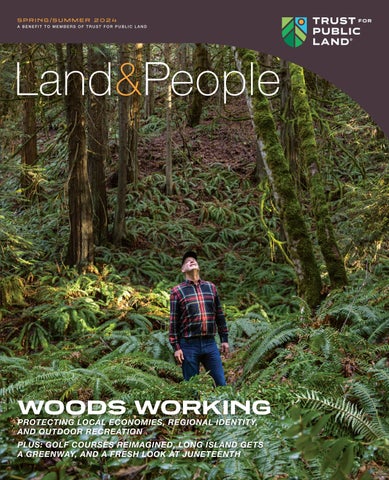
WOODS WORKING PROTECTING LOCAL ECONOMIES, REGIONAL IDENTITY, AND OUTDOOR RECREATION
PLUS: GOLF COURSES REIMAGINED, LONG ISLAND GETS A GREENWAY, AND A FRESH LOOK AT JUNETEENTH
CHRIS BENNET T
NATURE SUSTAINS US EVERY DAY Return the Favor: Become a Monthly Donor Help us connect everyone to the benefits and joys of the outdoors with a recurring monthly gift. It’s easy, automatic, and secure. Our members make our work to create parks and protect public land possible.
START TODAY
tpl.org/monthly
Wolcott Community Forest, which is adjacent to Wolcott Elementary School in Vermont, is frequently used by local children for outdoor recreation and education. A · L A N D & P E O P L E · S P R I N G / S U M M E R 2 0 24
26
38
TA R A R I C E
c o n t en t s
“The relationship we have with local food— we want to have that with timber.” ~ S A R A H S PA E T H , I N T H E G I V I N G T R E E S, P G . 4 8
T E G R A S TO N E N U E S S
A N G E L A D E C E N ZO
F E AT U R E S
Tee Change: Rethinking Golf Courses for Climate Resilience .............................................................................................................. 26 We’re partnering with communities to transform former golf courses into thriving outdoor oases that are accessible, biodiverse, and working to fight climate change.
A Trail to Make New York Whole ............................................................. 38 The Long Island Greenway will stretch from Manhattan all the way to Montauk. At 200 miles long, it will bring 27 communities within a 10-minute walk of the outdoors. And when complete, it will change how Long Islanders and New Yorkers play, commute, and live healthy lives.
The Giving Trees ..................................................................................................................... 48 Working lands such as forests, farms, and ranches are an important part of our conservation efforts toward climate resilience. These places also support local economies and regional identities.
48 T P L .O R G · 1
GIVING GUIDE With a variety of ways to give, we offer something to suit everyone. Use the envelope bound inside this magazine to send your gift, or donate online and learn about more ways to give at tpl.org/support.
Give the Gift of the Outdoors Share your love of nature and outdoor adventures with someone you care about. Make a difference and honor a friend or loved one with a tribute gift.
Grow Your Giving Simplify your charitable giving and meet your philanthropic goals by giving through your donoradvised fund. Learn more at tpl.org/daf.
Become a Conservation Champion Donate $2,000 or more annually and receive the recognition due a champion, such as invitations to special events and insider updates on our projects. Call 415.495.4014 or email champions@tpl.org to learn more.
Leave a Legacy Consider including us in your will or estate plan, learn about the benefits of designating retirement funds to TPL, and explore other tax-wise ways to give. Call 202.856.3748 or email plannedgiving@tpl.org to learn more.
Donate Your Vehicle Car recycling benefits both people and the environment by conserving natural resources, reducing pollution, and lessening energy consumption. Call 855.500.RIDE (7433) or visit tpl.org/cars to get started.
Scan with your mobile device’s camera to make a gift today! Trust for Public Land depends on your support. You make our work possible. tpl.org/support 2 · L A N D & P E O P L E · S P R I N G / S U M M E R 2 0 24
DE PA R T M E N T S
of gratitude and expresses faith in
14
18
CHRIS BENNET T
Our departing CEO shares a message
RICH REID
From the President · 11
c o n t en t s
TPL’s future.
Board Spotlight · 12 Get to know Kenneth Wong.
First Look · 13 Advice for beginning birders, a tour of climate-smart TPL parks, historymaking tribal lands work, and a conversation about equity and climbing the world’s tallest peak.
On Topic · 58 show, and podcast recommendations to bring you closer to the outdoors.
TPL Near Me · 60 A Dallas, Texas, high school student on the healing power of her community park.
60
B R I T TA N Y G R Y D E R
A compendium of insightful book,
Member Center · 62 Offices · 63 Trail’s End · 64 Juneteenth has more to do with public lands than you might guess.
on the cover
TPL Senior Director of Field Programs Richard Corff marvels at the towering trees and lush growth along a trail near Washington’s Chimacum Ridge Community Forest. Photo: Tegra Stone Nuess
T P L .O R G · 3
4 · L A N D & P E O P L E · S P R I N G / S U M M E R 2 0 24
c o n t en t s
Panorama Park Colorado Springs, Colorado Besides being a gathering place for events and recreation, Panorama Park—which affords an incredible view of Pikes Peak— brings much-needed green infrastructure to a community that has suffered longstanding inequities, such as being about 7 degrees hotter than surrounding neighborhoods. In 2022, TPL completed the renovation of this 13.5-acre park, which features 250 newly planted trees, 20 shade structures, a splashpad, and a hammock zone where residents can find respite from intense summer weather. Even the bike course, shown here, helps retain and manage stormwater. Read more at tpl.org/panorama-story and discover 10 TPL parks that are models for green infrastructure across the country in this issue.
16
OLIVEDIA PRODUCTIONS
Page · 16
T P L .O R G · 5
6 · L A N D & P E O P L E · S P R I N G / S U M M E R 2 0 24
c o n t en t s
Peshastin Pinnacles State Park Chelan County, Washington Once privately owned and closed to recreational use, the striking sandstone spires of Peshastin Pinnacles State Park are now open to climbing enthusiasts forever. Thanks to TPL, Chelan-Douglas Land Trust, and other partners, the park welcomes thousands of climbers and hikers every year to experience the beauty of the Central Cascades and Wenatchee Valley. In this issue, hear from members of Full Circle Everest, the first all-Black team to summit Mount Everest, on the joys and challenges of mountaineering.
20
A DA I R R U T L E D G E
Page · 20
T P L .O R G · 7
8 · L A N D & P E O P L E · S P R I N G / S U M M E R 2 0 24
c o n t en t s
San Geronimo Commons Marin County, California At San Geronimo Commons, a golf course turned community green space nestled in the forested hills north of San Francisco, a major landscape renovation is under way. The changes, which are returning the site to a more natural state, will greatly benefit both people and wildlife. Rather than pesticide-treated grass that requires irrigation, drought-hardy native plants are being added. Wild creeks that were previously forced underground will see daylight for the first time in decades. And residents can now use the site for a wide variety of outdoor recreation. Read more about TPL’s work transforming golf courses into natural areas in this issue.
26
A N G E L A D E C E N ZO
Page · 26
T P L .O R G · 9
CHRIS BENNET T
Lead the Way Become a Conservation Champion and help Trust for Public Land connect even more people to nature. With your annual leadership-level contribution of $2,000 or more, you’ll receive invitations to special events and insider updates on our projects and conservation strategies.
Learn more about the impact you’ll have as a Conservation Champion. Contact us at 415.495.4014 or champions@tpl.org.
Stay Connected Join us online for project updates, stunning photos, and inspiring stories. Follow us on social media: @trustforpublicland @TheTrustforPublicLand @the-trust-for-public-land @tpl_org TrustforPublicLand Be sure to tag us in your posts!
Sign up for our emails: tpl.org/email-signup
And listen to our podcast, People. Nature. Big Ideas. tpl.org/podcast
10 · L A N D & P E O P L E · S P R I N G / S U M M E R 2 0 24
A DA I R R U T L E D G E
tpl.org/champions | champions@tpl.org
fro m t he pr es id en t
NICHOL AS LEA BRUNO
THE POWER OF HOPE IN ACTION As I write my final Land&People letter
executive editor & publisher
Jennifer Ramsey editorial director
Deborah Williams managing editor
Amy McCullough s ta f f w r i t e r s
Lisa W. Foderaro Amy McCullough designers
Rachel Andrade Miya Su Rowe Ben Whitesell media production manager
Elyse Leyenberger
© 2024 Trust for Public Land. All rights reserved. 10-Minute Walk, Community Schoolyards, Conserving Land for People, Conserving Nature Near You, Creating Parks and Protecting Land for People, Fitness Zone, Land for People, Land&People, LandVote, Northwoods Initiative, Our Land, Outside For All, Parks for People, Parks Unite Us, ParkScore, The Trust for Our Land, Trust for Public Land, TPL, and all other names of Trust for Public Land programs referenced herein, as well as their logos, are registered or common-law trademarks of Trust for Public Land.
as Trust for Public Land’s president and CEO, I’m filled with gratitude, hope, and faith in TPL’s future. I joined TPL six years ago because I was inspired for the benefit of by the organization’s unwavering commitment to expanded public equity—the cornerstone of our mission in connecting access to the outdoors everyone to the outdoors. I’ve carried that sentiment and enhanced biodiverwith me throughout my journey here. It is our sity, their hope for climate people and our collective vision for a better future resilience and a sustainable recreation-based that drives us forward. It is our hope in action. What economy is self-fulfilling (page 26). an honor it’s been to work alongside staff, Every TPL project reflects our “community at the supporters, partners, and advocates who’ve helped center” commitment. Our work doesn’t just change this extraordinary organization achieve so much. landscapes; it changes lives. Together, we’ve accelerated our land protection Our work is made possible by the involvement and efforts to enhance economic and recreational support of people who, like us, believe that grassroots opportunities. We’re spearheading a movement to efforts can generate national impacts. We’ve built make Community Schoolyards® projects a national trust and credibility through our community-led standard. And we’ve strengthened our focus on approach to placemaking that’s positioned our leaderequity with our Black History and Culture program ship to drive national momentum in securing federal and our Tribal and Indigenous Lands program. policies like the current EXPLORE and Outdoors for Our work has connected millions of people to All Acts. More mayors and parks departments are vital green spaces, bringing opportunities to signing TPL’s 10-Minute Walk® pledge. And we’re connect with nature and each other and instill a leading a nationwide movement to grow awareness deeper sense of community. Every park, trail, and support for parks as critical infrastructure and community forest, landscape, or schoolyard adds climate-smart solutions. to our collective power of hope in action. As I prepare to pass the baton, I know this isn’t the When students design their own Community end of the race but a continuation. Each of us plays a Schoolyards projects, the results are far more than vital part in this team effort. We must keep pushing new playgrounds. By participating in this work, forward with vigor because our work is vital to our children experience the power of civic engagement; individual happiness and the well-being of our nation. they develop a sense of responsibility to their As we approach the elections and the national neighbors and a pride of collective effort. They have discourse intensifies, I take great solace in the fact a hand in making their communities more climate that our work, rooted in hope borne of action, bridges resilient and experience the wonders of nature in divides among us. At TPL, we’ve always believed in safer, cooler, greener play spaces (page 16). the transformative power of land to bring people Acquiring 30,000 acres of forest in Maine’s together. That’s never been more relevant, and Katahdin region is hope in action because it not only because of it we can look to the future with hope. expands public access in the region, but it’s also Thank you for joining me as a fellow TPL supporter. important for environmental and economic health, I am profoundly grateful to be a part of the TPL and it’s sacred to the Penobscot Nation. When the community, and eager to continue to support and largest land return between a U.S.-based nonprofit champion this critical work. and a tribal nation is complete, the Penobscot will again be connected to Wáhsehtәk w (page 18), the land central to their identity and culture. When communities like San Geronimo in Marin diane regas County, California, reimagine former golf courses president & ceo T P L .O R G · 11
Board of Directors
chair
Lucas St. Clair Jodi Archambault J. Franklin Farrow Mickey Fearn Jody S. Gill Allegra “Happy” Haynes Alex Martin Johnson Jennifer Jones
Get to Know
C O U R T E SY O F K E N N E T H W O N G
boa r d s p ot lig h t
Kenneth Wong A RECENT ADDITION to our National Board of Directors, Kenneth Wong is deeply experienced in real estate and has held numerous high-profile positions. During his 40-plus-year career, he’s developed all types of buildings and places, including theme parks, affordable housing complexes, cruise ships, and master-planned communities. Today, Wong is chief operating officer of Related Companies and cofounder of energyRe, a leading renewable energy development company with projects across the United States. His diversified business experience, track record of creating places for people, and entrepreneurship in energy transition make him a unique member of TPL’s community. We asked him why Trust for Public Land is deserving of his time and energy.
National Board of Directors since 2023
Chris Knight Christopher G. Lea Joseph E. Lipscomb Eliot Merrill Ignacia S. Moreno Julie Parish Michael Parish
What initially brought TPL to your attention? I was always aware of TPL at a distance and had a vague impression of it doing good things—boy, I had no idea! A few years ago, I began a personal quest to find an organization I could invest in, and that’s when I discovered how amazing this organization is.
David Poppe Thomas S. Reeve Diane Regas Laura Richards Ted Roosevelt V Lex Sant Anton Seals Jr. Sheryl Crockett Tishman F. Jerome Tone Taylor Toynes Jerome C. Vascellaro Lindi von Mutius Keith E. Weaver
What particular project or initiative speaks to your values and goals? There are many, but the topper is TPL’s Community Schoolyards® initiative. As someone who has worked in cities and real estate development my entire career, it is the ultimate crossroads of themes that matter: providing safe, clean, outdoor space for all (including kids), reducing heat islands, filtering urban runoff, improving health outcomes, and using the planning and design process to create ownership by the community. Climate change is truly the largest-scale threat to our future, and while every TPL program and initiative is making a difference, schoolyards have the potential to change the world for many people fast.
Susan D. Whiting Florence Williams Kenneth Wong
What types of challenges do you think TPL is uniquely poised to address? TPL is peoplecentered and values-centered. It builds solutions that produce both immediate results and longterm endurability. There are other fantastic
12 · L A N D & P E O P L E · S P R I N G / S U M M E R 2 0 24
organizations in the conservation space, but TPL is extraordinarily skillful in this way. What are you most looking forward to achieving as a member of TPL’s national board? I’m most excited about helping TPL scale its best work as powerfully and quickly as possible. I also want to build bridges. We need to find like-minded partners, not just in the nonprofit sector, but with universities, research centers, governments, and across the private sector, to magnify our impact. On a personal note, how do you most enjoy connecting to the outdoors? Nature and the outdoors have always given me a sense of peace, strength, and connectedness. I love big nature that makes me feel small (mountains, ocean, a desert, a deep forest), as well as little pockets of nature like city parks and squares that connect me to other people. I’m lucky to have access to the outdoors year-round, and to share all those experiences with family and friends. I don’t take it for granted one bit, and that makes me even more passionate about the mission of TPL: we need to help connect everyone to the outdoors.
le a r n m or e @ TPL.ORG/BOARD/KW
First Look T U R N T H E PAG E FO R : Avian Advice for Beginning Birders Historic Land Return in Maine A Climbing Conversation with Full Circle Everest
Famed marine biologist Sylvia Earle said, “We are at a point in time where we have a choice. Imagine if you didn’t have the facts about what the problems are. Imagine if you didn’t have the solutions. But you have both.” By helping create community green spaces such as Historic Fourth Ward Park in Atlanta,
C H R I S TO P E R T. M A R T I N
Georgia, TPL is addressing the problem of climate change with smart design solutions that prevent flooding, limit pollution, and cool communities—all while providing places to play. Also see page 16. le a r n m o r e @ TPL.ORG/H4WP
F I R S T L O O K · 13
pro t ips
Birding provides opportunities to experience nature in a deep, fulfilling way—and it can connect you to a whole community of outdoor enthusiasts too. Follow these pro tips to get started, and you’ll soon be appreciating avian life all around you.
KO N O C T I / I S TO C K
Being in the Moment with Birds
COU
RTES
Y OF T
YKEE JA
MES
By Amy McCullough with Tykee James To bird expert and advocate Tykee James, birds are all about joy. He felt his first jolt of winged wonder at age 18, when he witnessed a female belted kingfisher (above) leap off a cattail and sing as it flew across a creek. He was mesmerized. “That bird made nature come to life,” says James (left). This is what birders call a “spark bird,” the species that ignites your interest. And finding yours is just one of several ways to ease into the activity known as birding. Here are a few more pointers to get you started:
1. Start where you are. Whether you’re
that makes you a birder,” says James. “It’s the joy you have about birds and how you share it.”
4. Notice the details. James says there’s a lot to
at home, in a park, or
be gained from paying attention to the little things when
even in a parking lot, there
observing birds. “‘Small brown bird’ describes a lot of birds,”
are birds to be seen. You
he notes. Notice that the little brown bird also has a white
don’t have to go far. You only
bar above its eye, and a little black bib, and a yellow beak,
need to be curious, spend a little
and it’s bigger or smaller than this other bird you know. “All
time, look around, and be prepared to appreciate what you see. Keeping it simple helps demystify the practice. And while you
of a sudden these details start to collect,” says James.
5. Take a class and/or download an app. Many birding groups offer in-person and online
don’t need special gear, binoculars are a helpful tool.
courses. Enroll in one—or download one of the many free
2. Find your spark bird. As a TPL supporter,
apps. James likes Merlin Bird ID for beginners because it
you’re very likely a nature lover. While you’re enjoying
includes real-life photos of birds in their habitats. And it can
whatever activities take you outdoors, look for birds. Sooner
help you narrow down species by taking factors such as
or later, you’re bound to see one that trips your trigger. Take
time of year, your location, and migration routes into
its picture and identify it with the help of a field guide,
account. But James cautions sound-only IDs because birds
another bird enthusiast, or an app (see tip #5). Once you
are excellent mimics.
know which bird wowed you, learn more about it.
6. Tell your bird story. And ask others for
3. Set a realistic goal. James recommends
theirs. “I always go back to the idea that everybody has a
starting with a “familiar five,” as it’s likely you know at least
story about birds,” says James, “whether it’s about the robin
a handful of birds already. Identify five species you’re
in your garden or the cardinal you hear on your commute.”
comfortable with; then move to a familiar 15 and so on. But
Find your own bird story, tell it, and make a space for others
try not to get overwhelmed. “It’s not the knowledge of birds
to share theirs.
14 · L A N D & P E O P L E · S P R I N G / S U M M E R 2 0 24
TPL-Protected Places to Go Birding
7. Get engaged. Consider recording your observations in an online database like eBird, or particiChristmas Bird Count or the Cornell Lab of Ornithology’s Great Backyard Bird Count. These activities offer a way to engage with other birders and support research that relies on
DE ANNA L. NICHOLS
pate in events such as the Audubon
community input.
8. Support birds at home. Bring birds to your yard or neighborhood green space by adding feeders or birdhouses. Such offerings welcome local and migrating species and make for easy birdwatching—from your own window or on a daily walk, for
One of the touchstones of spring is the biannual migration of songbirds. TPL’s efforts have helped conserve many important migration paths. Here are a few locations that offer stunning birding opportunities. And don’t worry if you miss the current migration, which winds down in June. These parks and wildlife refuges have plenty of year-round residents too, from songbirds and shorebirds to hummingbirds and hawks.
By Lisa W. Foderaro
instance. Be sure to provide a diverse mix of seeds and follow other best practices, such as cleaning feeders and raking hulls to prevent the spread of disease.
9. Enjoy the moment. In the end, don’t forget to acknowledge the journey these creatures make and enjoy the moment. “Birds are going all across the hemisphere,” says James, “and the fact that one stopped in a tree near you and did a little ‘tweet’ before
RACHEL CARSON NATIONAL WILDLIFE REFUGE | MAINE In May, all manner of warblers, thrushes, vireos, and flycatchers show up at this sprawling refuge along a 50-mile stretch of coast in southern Maine. One of the most beautiful sites in the preserve is Timber Point, a peninsula south of Portland where some 270 species of birds have been recorded.
variety of bird life, from Swainson’s hawks, western kingbirds, and northern rough-winged swallows in spring and summer to northern harriers, horned larks, and Savannah sparrows in fall and winter. The refuge is a mix of hayfields, desert, and bosque, a cottonwood forest habitat that flourishes along rivers and streams in dry regions of the United States.
MOORE’S BRIDGE PARK | GEORGIA This 485-acre green space along the Chattahoochee River, just 40 miles from Atlanta, is a terrific place to see migrating songbirds such as northern waterthrushes, Cape May warblers, and Canada warblers. The woodlands, thickets, and river draw breeding warblers too. And keep your ears open for the squeaky dog-toy sound of the brown-headed nuthatch, which lives among pines in the southeastern U.S.
HANNING FLAT AND DESERT SPRINGS | CALIFORNIA To fuel their amazingly long migrations, songbirds need food and water. Two properties in the southern Sierra Nevada, Hanning Flat and Desert Springs, provide both in abundance. Lark sparrows, Savannah sparrows, horned larks, prairie falcons, and golden eagles are found in the grasslands at Hanning Flat, while its higher-elevation pine-oak woodlands welcome Cooper’s hawks and sharpshinned hawks. Twenty miles south lies Desert Springs, which attracts neotropical birds flying north. Western tanagers move through in large numbers, as well as blue grosbeaks, black-headed grosbeaks, and a half dozen species of warbler.
going on in its flight, being in that moment is absolutely magical.” Turn to page 26 to read about how we’re improving wildlife habitats in California.
Tykee James hosts the podcast On Word for Wildlife, is cofounder of the Freedom Birders movement, and was an organizer of the first Black Birders Week in 2020. A former government affairs coordinator for the National Audubon Society, he is currently co-chair of Amplify the Future, which supports environmental education, and board president of the DC Audubon Society, which is in the process of changing its name.
VALLE DE ORO NATIONAL WILDLIFE REFUGE | NEW MEXICO In the shadow of Albuquerque, the Valle de Oro National Wildlife Refuge (pictured above) hosts an impressive
F I R S T L O O K · 15
m a pping o u r impact
Parks with Climate Superpowers When you enjoy the simple pleasures of a park—a shady spot to read or the sight of a duck gliding across a pond—you might not be thinking about what’s going on behind the scenes in the service of climate resilience. But at TPL, we are. When we design and build parks with residents and partners, we incorporate all kinds of climate-smart green infrastructure to improve resilience to heat, floods, and other threats. In doing so, we’re creating a replicable model for park development nationwide. Here are some of our most impactful green spaces— all of which couple function with form in a big way.
By Amy McCullough Illustration by Nate Padavick
Alleys Green Los Angeles, CA The Central-Jefferson and Quincy Jones Green Alley networks near South L.A.’s Central Avenue jazz district turned 11 underused alleys into safe, shaded pedestrian routes featuring trees, flowering vines, and colorful murals. They’re also engineered to manage stormwater, capturing more than 1.5 million gallons per year and replenishing underground aquifers that provide water to a region increasingly at risk of drought.
Mill Community Park Story Bozeman, MT This award-winning park and nature sanctuary—which is home to over 100 species of birds—undid heavy damage from prior industrialization. Now, its 60 acres include a restored riverfront, regenerated wetlands, and natural streams that greatly improve local water quality, plus a community garden to feed residents. Mile Creek Five Greenbelt | Dallas, TX
Montbello Open Space Park | Denver, CO
Once a trash-strewn vacant lot, this 5.5-acre park, which serves 42,000 nearby residents, is now a restored native shortgrass prairie with an outdoor classroom, walking trails, interactive play spaces, and art designed with local students. It also features a central arroyo that collects and cleans stormwater before releasing it. 16 · L A N D & P E O P L E · S P R I N G / S U M M E R 2 0 24
This ambitious greenbelt will include three new TPL parks and a 17-mile trail stretching across southern Dallas, adding vital green space for nearly 200,000 residents who increasingly face recordsetting heat. Climate-smart features include native rain gardens and lighting that’s 100 percent solar-powered, which will save $71,000 in electricity costs over the next 20 years. See page 60 for a deeper look at the greenbelt’s first park.
Midway Peace Park St. Paul, MN Residents of nearby Skyline Tower once had scant access to green space. Now, the community enjoys a climate-smart park with playing fields, bike paths, two rain gardens, a playground, and features that collect and filter 1.5 million gallons of runoff annually, keeping polluted water from flowing into the Mississippi River.
Park Rockefeller Cleveland, OH
Island Dundee Park | Passaic, NJ
Once complete, this renovated park—the city’s largest, covering 200 acres—will connect five nearby neighborhoods to the outdoors and to the Cleveland Cultural Gardens, a series of public gardens celebrating the region’s ethnic diversity. A watershed restoration at Doan Brook will also address dangerous stormwater flooding.
Previously underused, this park— which serves 20,160 residents within a 10-minute walk—was transformed with local input and now includes a boat launch, soccer field, community garden, and walking trails. And its climatesmart design accommodates Passaic River flooding events, mitigating damage to surrounding neighborhoods.
Pacific School The Brooklyn, NY This project, which reduces neighborhood flooding and pollution of nearby Gowanus Canal, is among several Community Schoolyards® projects to be completed with New York City’s Extreme Weather Task Force. It’s capable of managing 1.2 million gallons of rainwater a year, enough to cover a football field in 4 feet of water.
Fourth Historic Ward Park Atlanta, GA
WACA Bell Park | Chicago, IL
Based on ideas sourced from residents, TPL worked with partners to reinvent this once-vibrant park, which serves 9,487 residents within a 10-minute walk. Its transformation includes new trees, which will combat rising temperatures in an urban heat island, permeable surfaces that reduce flooding, and upcoming solar panels that will power lighting and Wi-Fi throughout the park.
Part of the Atlanta BeltLine—a 22-mile green space network— “H4WP,” as it’s known, gives people a place to cool off, play, and enjoy outdoor gatherings—all while providing safety against floods that previously inundated surrounding communities. The park’s infrastructure can decrease peak stormwater flow by as much as 44 million gallons of rainwater per day. le a r n m or e @
TPL.ORG/CLIMATE-PARKS F I RT SP T LL.O OR OG K · 17
t r iba l l a n d s s p ot lig h t
In Partnership toward Conservation Communities are at the core of TPL’s mission. In Maine, Trust for Public Land’s Indigenous partners are playing a critical role in advancing important—and historic—land conservation. By Maulian Bryant, Penobscot Nation Tribal Ambassador As director of natural resources for the Penobscot Nation, Charles “Chuck” Loring Jr. has a lot on his plate. Lately, he’s been working with Trust for Public
high school classmate, and now, as a professional colleague—
Land toward restoring nearly 30,000 acres to the Penobscot
many federal programs that exist that work with the
Nation—acres that are central to his tribe’s identity. When
Penobscot Nation’s desire to gain back ancestral homelands.”
achieved, it will be the largest land return between a
sees his role as an opportunity to be both an important voice for his people and a crucial partner to TPL. “The most significant challenge is fundraising,” he says. “There are not
Many of us grew up within large families that take great
U.S.-based nonprofit and a tribal nation in history.
pride in our tribe’s outdoor traditions. We are taught from a
Protecting this land, called Wáhsehtәk w by the Penobscot
young age about hunting and fishing and, most importantly,
(and pronounced “WAH-seh-teg”), will ensure preservation
that harvesting game is part of the balance and reciprocity of
and Indigenous stewardship of the tribe’s ancestral
the relationship between all living things. These are core
homelands and sacred waters. It will also greatly enhance
values for our people: sustainability, sustenance, respect,
public access to Katahdin Woods and Waters National
trust, and the knowledge that the health of the natural world
Monument, benefiting surrounding communities and
is ingrained in everything.
enhancing the region’s outdoor recreation economy for
Those values are reflected in the magnitude of what this
years to come.
project means for our tribe. Located in the heart of the
The Penobscot’s natural resources department oversees the
Penobscot Nation’s territory, the land carries profound
management of these lands. Pretty consequential. But Chuck—
importance for our people, who rely heavily on the Penobscot
who I’ve known for years as a fellow tribal member, a former
River and consider it a valued member of our community. “We are looking at this as a significant landscape-scale restoration project where we can let the forests heal from their previous industrial uses and focus on improving fish
Chuck Loring Jr. holds a striped bass caught on the Penobscot River.
habitat, as well,” says Chuck. But this partnership with Trust for Public Land to regain our ancestral land is not just about restoration and growth. It is about healing. The lands heal from generations of misuse. The Penobscot people heal from generations of theft and disruption of connection to these places of our creation stories. When we can harvest game and medicine or do J O E “ H U G G A” DA N A
ceremony in sacred places where our ancestors did these
18 · L A N D & P E O P L E · S P R I N G / S U M M E R 2 0 24
same things, our connection is restored, and our communities and families are given new life. Our tribe finds a great amount of joy and hope in what this collaborative land return means.
TT
NE
N IS
BE
–
C
H
R
I haven’t met with a single tribal citizen whose eyes didn’t light up at the prospect of us gaining back the Wáhsehtәk w parcel.” C H U C K L O R I N G , P E N O B S C O T N AT I O N D I R E C T O R O F N AT U R A L R E S O U R C E S
“This land back work is some of the most rewarding and
to do the right thing by our land for our people.” It’s a
important work I’ve been involved in,” says Chuck, who also
sentiment shared by many members of our community.
serves as an advocate for our tribal administration and
Diane Regas, TPL’s president and CEO, agrees: “Trust for
councilors. He sees its value on a regular basis: “I haven’t met
Public Land recognizes the profound and vital significance of
with a single tribal citizen whose eyes didn’t light up at the
returning land,” she says. “It’s not just an isolated act, but a
prospect of us gaining back the Wáhsehtәkw parcel,” he reflects.
deep acknowledgment and reaffirmation of a timeless bond,
Chuck finds himself focused on the sacredness of the land itself and what it means to protect it; for him, it’s an
a rich history, and a promising future.” Though there are certainly obstacles to progress, our tribe
opportunity to practice that same reciprocity that comes
is cautiously optimistic and hopes that through storytelling
from being in balance with nature—a reciprocity he learned
and cultural exchanges, we can fully express to potential
about as a boy, sitting in the forest, feeling the breeze, and
funders and supporters how much this land means to our
appreciating the peace and stillness of the hunt.
people—past, present, and beyond.
Now, as a key spokesperson for TPL’s Wáhsehtәk land back w
And as a father to a young daughter, Chuck is certainly
effort, Chuck gets to weave together his life experience as a
looking ahead. He feels a responsibility to make things
Penobscot tribal citizen and his education in forest
better, just as his family felt while he sat as a boy in a
operations. “As a tribe that relies on sustainable timber
hunting stand, listening to the forest and the lessons of our
harvesting for our main source of income, Wáhsehtәk
ancestors carried on the breeze.
w
affords us more opportunities now and in the future to provide for our people’s needs while also returning our ancestors’ land into our care,” he says with enthusiasm. “We once had claim to all of this land, which ultimately dwindled,” he continues. “We held that land in our minds in perpetuity. We are not your typical landowner. We have no record of development of any of our current lands; we are not a threat to shoreland or wetlands. We are responsible stewards, guided by our ancestors, elders, chief, and council
Maulian Bryant has been Penobscot Nation Tribal Ambassador since 2017. She is working closely with TPL’s Federal Affairs team to help identify funding sources for the Wáhsehtәk w land return. Show your support for land conservation across the country by making a gift today at tpl.org/land&people. le a r n m or e @
TPL.ORG/ TRIBAL F I R S T L O O K · 19
t pl in c o n v er s at i o n CO UR
SY
OF M I TS U I WA S A KI
Embracing the joys and challenges of climbing— including breaking down racial barriers—with the first all-Black team to summit Mount Everest.
TE
A Higher Education
Last fall, TPL Northwest Director Mitsu Iwasaki (right) was joined in conversation by three members of Full Circle Everest, the first all-Black team to summit Mount Everest. Together with seven other people of color, expedition lead Philip Henderson and mountaineers Demond “Dom” Mullins and Adina Scott climbed the highest mountain on Earth in May 2022. Read an excerpt from their enlightening discussion with Iwasaki about inclusion
E VA N G R E E N
and equity in outdoor recreation, presented in partnership with Seattle Arts and Lectures.
The Full Circle Everest team at base camp (left to right): Eddie Taylor, James “KG” Kagambi, Demond “Dom” Mullins, Adina Scott, Philip Henderson, Abby Dione, Manoah Ainuu, Rosemary Saal, Thomas Moore, and Fred Campbell. 2 0 · L A N D & P E O P L E · S P R I N G / S U M M E R 2 0 24
PHILIP HENDERSON: Full Circle is about giving back. In the early ’90s, when I started working in the outdoor industry, I realized that there were people out there who wanted to know about camping and hiking and skiing and climbing. They just didn’t know how—at least from my community. MI: How did this team come together?
C O U R T E SY O F S E AT T L E A R T S & L E C T U R E S
MITSU IWASAKI: What is Full Circle?
DOM MULLINS: It was all sort of happenstance. Philip was kind of a unicorn—this African American dude who worked in the outdoor industry for 30 years. Philip had the opportunity to meet, by chance, all these other athletes that wound up being part of our project. ADINA SCOTT: I did a trip to Denali in 2013 . . . Philip was there. Fast-forward a while, I get this phone call [from Phil]: “Hey, how ya doin’? We’re going to Everest. You coming?” I think a lot of the people on the team have a similar phone-
Trust for Public Land Northwest Director Mitsu Iwasaki (far left) chats with Full Circle Everest Members Dom Mullins, Adina Scott, and Philip Henderson (left to right) about the joys and challenges of climbing and what it means to create inclusive spaces in the outdoor industry.
call-coming-from-out-of-the-blue story. PH: When I was building the team, it wasn’t like, “I’m going
was conducive to all of that. I learned how to climb with a
out to find 10 Black people to climb Everest to make a point.”
veterans’ group. It became a vehicle for community for me,
All of our paths just happened to [cross]—everybody has a
after service, and also to get myself into the sort of exciting
story. Our lives were just there, so we made it happen.
trouble that I missed. PH: The joy in climbing to me is just that I like doing things
MI: Climbing is a lot of work. There’s a bit of suffering in
with my hands. It’s the technical aspect and the problem
there—and a lot of time and resources invested. There’s
solving. As well as, if you’ve ever had birds flying below you,
also a great deal of joy in it. What is the joy that you find
to me that’s one of the joys of climbing. Being outdoors . . .
in climbing?
I’m just peaceful. I’m happy. I’m free.
AS: To me, it’s become really integral in spending this time outside, and with people, and in places that are magical.
MI: For Full Circle, there is an incredible amount of
Finding the right people to do it with, there’s nothing like it.
responsibility in representing your community—and a
DM: I grew up in Brooklyn. I didn’t know anything about
sense of not having space to fail. Can you talk about that?
wilderness. I learned about wilderness when I was in the
AS: I think the really scary thing about showing up publicly
army. I fell in love with it, but it didn’t even have a name for
and showing up out loud is that people are going to think
me. It was like, “This is army stuff.” Stacy [Bare, a fellow
what they think. People are going to judge a community
climber] introduced me to mountaineering. Part of the joy of
based on [us]. We do have expertise. Everybody there has a lot
climbing for me was realizing that I had an education that
of experience. But it’s like, “Did I show up right? Are my
The joy in climbing to me is . . . the technical aspect and the problem solving. Being outdoors . . . I’m just peaceful. I’m happy. I’m free.” –
PHILIP HENDERSON, FULL CIRCLE EVEREST E XPEDITION LE AD
FIRST LOOK · 21
Climbing is a lot of work. There’s a bit of suffering in there—and a lot of time and resources invested. There’s also a great deal of joy in it.” –
M I T S U I WA S A K I ,
K E N DA L L K R AU S E
T P L N O R T H W E S T D I R E C TO R
Before joining TPL as our Northwest director, Mitsu Iwasaki served as chief executive officer at the American Alpine Club, where he also worked to amplify the conversation about equity and inclusion in American climbing. Here, he’s seen circumnavigating Mount Hood near Portland, Oregon.
crampons good?” All of those extra anxieties. The outdoor
Now is a productive moment in the outdoor industry,
industry can be a pretty darn judgy place at times, and
where we’re starting to have conversations about how to
sometimes it’s for good reasons [such as safety], and
make these spaces more conducive to diverse peoples. It’ll
sometimes it’s not. Being confident in our own abilities is
lead to better outdoor education, and it’ll lead to better
kind of hard.
rapport and even earnings for the companies in the outdoor industry. It’s a win-win situation for everyone involved.
MI: Can you talk about what it means to be different
PH: When I started working at NOLS [National Outdoor
among often intimidating and exclusive climbing
Leadership School], I was the only Black American instructor
communities?
there for six years. None of my coworkers—in the office or in
DM: Particularly in mountaineering, I know we all have had
the field—looked like me. But whatever is in the past is in the
experiences where we find ourselves the only person of color
past. We want to normalize being in the outdoors and that
in a whole situation. I had become accustomed to having that
connection to the outdoors. I can blame all the things that
type of experience in other institutions—in my professional
happened previously, but if I don’t change that moving
life, when I was in the military. When I encountered that in
forward, then that’s on me. [I can] provide [that experience]
the outdoor community, it was actually funny to me, because
for someone else because I know what the benefits are. So
I didn’t realize it at first. I had become so used to it. It was
that’s full circle.
other people who noticed it before I did. watc h the v id eo @
TPL .ORG/FULL-CIRCLE 2 2 · L A N D & P E O P L E · S P R I N G / S U M M E R 2 0 24
buz z wo r t h y
A Perfect Landing Trust for Public Land recently completed the first phase in a complex land protection project that offers an array of benefits for people and wildlife in Colorado and beyond. Planes and plains come together on the unique piece of land known as Bohart Ranch, part of which TPL protected last fall. Located east of
been many years in the making. “Through the SOAR initiative,
Colorado Springs, the site includes a remote runway known as
vibrancy of the Colorado Springs region,” says Jim Petterson,
Bullseye Auxiliary Airfield, a critical training area for the U.S. Air
TPL’s Mountain West region vice president.
Force; the wide-open skies above the ranch are also used by the Air Force Academy. Protecting the site from encroaching development is
we have a once-in-a-generation opportunity to make major progress in securing the natural, economic, and cultural
This is the first acquisition in a multiphase project that will result in the permanent conservation of the entire 75-squaremile ranch. In one more boon to local communities, the
important for a variety of reasons. Beyond the airfield, an active
Colorado State Land Board will direct the proceeds from this
cattle ranch—maintained by multiple generations of the same
and related projects toward its mission to support public
family—helps sustain the area’s economy and identity, as
education. “You know you’re onto something when a project
cattle ranching is the lifeblood of many rural communities. (The
emerges that conserves important wildlife habitat and open
same family will continue to lease and steward the land moving
space, supports agricultural production, provides much-
forward.) Plus, the rolling grasslands and miles of streams at
needed funds for public education, and enhances national
Bohart Ranch provide native habitat to over 200 plant species
security," adds Petterson. Turn to page 48 to learn more about
and iconic fauna such as bison and elk.
our conservation of working lands.
An outcome of the SOAR initiative (which stands for Security, Open space, and Agricultural Resilience), the effort with partners such as The Nature Conservancy, and it’s
le a r n m or e @
TPL .ORG/SOAR
T E G A N M AY /T H E N AT U R E C O N S E R VA N CY
protection of this 11,900-acre property was a collaborative
FIRST LOOK · 2 3
TRUST FOR PUBLIC LAND would like to thank the following supporters. We couldn’t achieve our commitments to climate, equity, community, and health without their generous financial contributions to our mission and our work. Thank you for helping us connect everyone to the outdoors.
Community Schoolyards® initiative & Parks for People |
Transformation of ‘A‘ala Park | Honolulu, Hawai‘i
Boston, Massachusetts; Los Angeles, California; & Denver, Colorado
Community Schoolyards® initiative | California; Pennsylvania;
Wildfire Resilience Initiative | Southern California
Washington, DC; & Washington State
Park Creation & Accessibility | Nationwide
Dalio Center for Health Justice support of the Community Schoolyards® initiative | Brooklyn & Queens, New York
Community Schoolyards® initiative | Los Angeles, California Tribal Schoolyards projects | Nationwide
2 4 · L A N D & P E O P L E · S P R I N G / S U M M E R 2 0 24
A DA I R R U T L E D G E
Here Now Here Always Because of You
SHARE YOUR LOVE OF NATURE WITH FUTURE GENERATIONS. Through a bequest, life-income gift, or other tax-wise option, TPL can help you secure your financial future and support our shared goal of creating parks, protecting land, and ensuring livable communities for all. Leave a legacy of equity, protection, and community. Leave a legacy with Trust for Public Land. Contact us to learn more: Call 202.856.3748 Email plannedgiving@tpl.org Visit tpl.planmygift.org T P L .O R G · 2 5
A N G E L A D E C E N ZO
Since its transition from golf course to public green space, San Geronimo Commons has become a beloved setting for the community, including runners from the nearby San Domenico School, who enjoy the rolling terrain and beautiful scenery.
2 6 · L A N D & P E O P L E · S P R I N G / S U M M E R 2 0 24
In California, communities and partners are working with Trust for Public Land to turn former golf courses into resilient, biodiverse sanctuaries where wildlife can thrive and more people can connect with nature. By Amy McCullough In the snug, emerald valley of San Geronimo, California, three words mark a paved trail in thick white chalk: “You’ve got this!” Written by the coach of a local high school cross-country team, the message was meant to encourage runners during a recent race. But it’s indicative of much more. It reflects the positive attitude and proactive manner of a community that’s working together to meet the challenges of climate change. The 157-acre site where these words appear, once an 18-hole golf course, has been undergoing a transformation since 2018, when Trust for Public Land bought it and began working with residents to best realize its next iteration as a community asset. Soon after, irrigation stopped, and a grand and complex effort to restore the landscape began. And in the months and years to follow, people started visiting the site for a wide variety of uses. San Geronimo Commons, as this public space is now known, is one of three former privately owned golf courses TPL is helping reimagine along the California coast—an area plagued in recent years by extreme heat and devastating weather events such as floods and wildfires. Marin County Fire Chief Jason Weber puts it bluntly, “It seems like a year-round business of disasters,” he says. “It has certainly changed in the last 10 years. You can’t say ‘the new norm’ anymore. It’s really just the normal.” That reality is why communities are partnering with TPL to make the most of their landscapes—and gaining a host of benefits for wildlife and people in the process.
T P L .O R G · 2 7
A N G E L A D E C E N ZO
“The community saw pretty early on the value of the property for public use and public safety.” – M A R I N C O U N T Y F I R E C H I E F JA S O N W E B E R He sees an added bonus, since the fire department will be more centrally positioned than in their previous headquarters, greatly improving response times, which is more important than ever for this region. “The community saw pretty early on the value of the property for public use and public safety,” Weber observes. He’s glad the fire station is at a local nexus too: “The community gathers here pretty regularly,” he says, citing a weekly food pantry, track meets, cycling events, even a recent car show. “Everyone’s finding so many uses for the property as a commons, and it’s good for us to interact.” Churchill, who teaches biology in addition to coaching, says SGC “has everything: hills, trails, vistas, and great parking,” adding that it’s not only beautiful but also feels safe. Her student athletes agree. George Kunze, a graduating senior, race in where I’ve made a lot of valuable memories.” Of course, not everyone was on board. Alexa Davidson, a lifelong resident of the area and executive director of the nearby San Geronimo Valley Community Center, says there Marin County Fire Chief Jason Weber says he used to be able to set his watch to fire season in California; in the past 10 years, that has changed dramatically.
IT TAKES A VILLAGE
was a sense of real loss for people who had used the space as a golf course. Homeowners who’d grown accustomed to having a manicured golf course outside their doors are also adjusting. Davidson and other local leaders embraced the community engagement process and saw the site’s evolution as a time to do a lot of listening. They focused on being good neighbors, asking, “How can we support each other?” And as residents enjoy more regular access to the land for walking and recre-
Mary Churchill, the aforementioned cross-country coach, says
ation—and the broader community sees new possibilities at
training at San Geronimo Commons (SGC) has provided her
the property—attitudes are shifting.
team with an enhanced appreciation for nature and a connec-
Erica Williams, a senior project manager at TPL, says
tion to their community. “Students see an area being used by
community engagement efforts and transparency about the
the public, their neighbors, their classmates, and shared with
process, including a monthly newsletter, helped assuage some
animals,” she explains. “They are also aware that we work in
concerns. The pandemic also played a role: “It represented a
collaboration with the fire department to use the area.”
paradigm shift,” she says, “with property users reaching out
She’s referring to Chief Weber and his staff, who have
to express their gratitude for the land and deep appreciation
turned the former golf course clubhouse into the Marin
for its natural beauty, easy access, and trails.” Many neighbors
County Fire Department’s administrative headquarters.
have since come forth as land stewards, offering to help how-
Weber, a strong advocate for the restoration project, says the
ever they can: “They really are very in touch with the land
new natural area is in alignment with Marin’s vision, noting
and care about it,” says Williams. “We’re not philosophically
that more than 50 percent of land in the county is preserved
opposed to golf,” she adds. “There was just an incredible resto-
for open space.
ration opportunity that also had a lot of community benefits.”
2 8 · L A N D & P E O P L E · S P R I N G / S U M M E R 2 0 24
A N G E L A D E C E N ZO
describes the site as “a pleasant, secluded area to train and
A N G E L A D E C E N ZO
The acquisition also connected San Geronimo Commons to four adjacent green spaces: Roy’s Redwoods, Gary Giacomini Open Space Preserve, Maurice Thorner Memorial Preserve, and French Ranch Preserve. That connectivity not only expands recreational opportunities for the public; it also improves wildlife habitat, enhancing the region’s biodiversity and climate resilience at once. A return to native plants is part of that resilience. Restoring the region’s natural grasslands will help mitigate climate change, as their deep root systems hold carbon, reducing the amount of greenhouse gases released into the atmosphere. And reconnecting waterways to the floodplain will create a moister landscape that is resilient to fire. “That’s where the restoration piece is really important as a climate benefit,” says Williams. Chief Weber agrees: “We’ve been able to prove that this space can be used for public access, along with fire protection.”
Current community uses for the site include a food pantry (right), where an estimated 750 individuals receive groceries each week. Coach Mary Churchill (below, in blue) and runners from the nearby San Domenico School regularly train on site.
T P L .O R G · 2 9
EVERY DROP COUNTS
channel with floodplains,” she says, which is what TU is helping achieve in the San Geronimo Valley. For other wildlife,
In Marin County hotel bathrooms, prominent signs recom-
too, such as birds, insects, amphibians, and mammals, “there’s
mend keeping shower durations to five minutes or less in the
this really great opportunity to create seasonal wetlands.”
name of water conservation. A rest area near Salinas displays
The golf course had previously covered—literally, with
a similar “every drop counts” message on a placard near the
dirt—much of Larsen Creek and directed its water into a hold-
vending machines. Clearly, this is a state with water issues—
ing pond, which was then used for irrigation. Now, TPL and
and a population concerned about usage.
Trout Unlimited are redesigning the landscape to hold water
“Certainly, from the standpoint of water conservation, that’s a very glaring example of how this work is beneficial,” says Williams. Removing fertilizer and pesticide from stormwater
for as long as possible, which will protect the community from natural disasters. A restored, naturally functioning floodplain means a more
runoff is another collateral benefit of transitioning golf courses
saturated water table, increased fire resilience, and better
to natural landscapes. In addition to being better for residents,
flood protection. “We want to have that buffer for those big
cleaner water is hugely important to fish populations.
weather events,” says Halligan, noting that natural streams
Anna Halligan of Trout Unlimited (TU), a national nonprofit and important TPL partner on the SGC project, explains how the watershed restoration will benefit both endangered coho
allow fish refuge from strong storm flows, “so it’s not all just rushing downstream.” Another aspect of the project will specifically benefit coho salmon. “There’s a limit to how far they can get upstream
know is really beneficial for fish is reconnecting the stream
right now,” says Halligan, TU’s north coast coho project director.
A N G E L A D E C E N ZO
salmon and threatened steelhead trout: “One thing that we
3 0 · L A N D & P E O P L E · S P R I N G / S U M M E R 2 0 24
San Geronimo Creek, one of the waterways that runs through the property, provides roughly 40 percent of the available coho spawning habitat in the entire Lagunitas Creek watershed, and TU is working with TPL to restore this creek, maximizing the Bay Area’s largest remaining coho salmon run. California has committed to the goal of conserving 30 percent of its lands and coastal waters by 2030, known as the 30x30 initiative. The transformation at San Geronimo Commons “checks that box right out of the gate” Halligan notes— as do TPL’s other golf course restoration projects in the Golden State, all of which support climate resilience. As TPL Climate Director Brendan Shane puts it, “While each location is unique, these large sites provide amazing opportunities for each community to address climate risks. The same restored natural landscapes that improve habitat, biodiversity, and water quality can buffer against coastal storms, manage extreme precipitation, and recharge groundwater supplies. These restored public landscapes also capture and store carbon in their forests, wetlands, and soils—helping address the
“These large sites provide amazing opportunities for each community to address climate risks.” – T P L C L I M AT E D I R E C TO R B R E N DA N S H A N E
OFF TO THE RACES
A N G E L A D E C E N ZO
root cause of climate change.”
Trout Unlimited is working with TPL to restore Larsen Meadow
About 150 miles down the coast, Tim Frahm, also with Trout
(above and opposite) and other parts of the Lagunitas Creek
Unlimited, leans over a bridge and joyfully points out a juve-
watershed to support wildlife such as coho salmon.
nile steelhead trout in the Carmel River. Here, the Monterey Peninsula Regional Park District (MPRPD), Trust for Public Land, and TU are partnering with
central coast. And the transition will heal the landscape from
the California State Coastal Conservancy and others on an
prior damage, help prevent flooding, and provide new oppor-
ambitious riparian (riverside) restoration that will improve 40
tunities for recreation.
acres of habitat along 1 mile of the river.
Christy Fischer, TPL’s conservation director for coastal North-
Formerly Rancho Cañada, a 36-hole golf course, the land
ern California, describes the project as “stunningly successful”:
was purchased by TPL and granted to MPRPD, who—like the
stunning because it very easily could not have happened. Previ-
Marin County Fire Department—moved their headquarters
ously the executive director at the Santa Lucia Conservancy,
to the clubhouse, even converting the prior pro shop into a
Fischer and MPRPD General Manager Dr. Rafael Payan each
Discovery Center focused on environmental and cultural edu-
heard about the possibility of the golf course purchase on the
cation. The golf course property adds a 185-acre parcel to Palo
same day—and both reached out to contacts at Trust for Public
Corona Regional Park, a significant open space on California’s
Land, knowing we’d have the expertise to help. T P L .O R G · 3 1
Facing competition from developers for both the land and the water, the groups needed to move quickly. They had a mere two and a half weeks to get under contract on the property—including a $100,000 deposit. That was before the challenge of raising an almost $11 million purchase price in 12 months. It seemed impossible, but TPL marshaled the resources necessary to quickly close the deal. And “off to the races we went,” says Payan. Rethinking the resource of the Carmel River—which had previously provided irrigation to the golf course—was key, says Fischer. Frahm, who serves as TU’s central coast steelhead project manager (and happens to be Fischer’s husband), realized there was an opportunity to dedicate the irrigation water back to the river, enhancing its natural flow to the benefit of also means better resilience to the effects of climate change and cleaner drinking water for surrounding communities.
A CLIMATE MITIGATION SWISS ARMY KNIFE
Much like the quest for funding, the proposed floodplain restoration at the former Rancho Cañada site requires plenty
M O N T E R E Y C O U N T Y W E E K LY/ N I C C O U R Y
fish and other wildlife. A healthier, more natural Carmel River
of creativity—not to mention flexibility. “This is going to be a process-based restoration, where we
Bringing the landscape down to the water table will create an
create the footprint; we provide revegetation; but then the
accessible, drought-resistant water source for wildlife and pro-
river is going to start carving her own locations,” says Frahm.
vide greater capacity during storms—including an increased
Designs of this type used to attempt to keep rivers structurally
ability to capture and retain sediment—which is important to
in the same place, he explains. “Happily, we’ve evolved away
climate resilience.
from that.”
Smith adds that a “nice wide, wet, intact riparian corridor
Frahm consistently refers to the river as “she” and “her”—
also has the potential to buffer a lot of the negative effects of
an affectionate habit that reveals his close relationship with
fire.” In other words, a healthy river and functioning flood-
the landscape. Jake Smith, MPRPD’s planning and conser-
plain mean better protection from wildfires. If a fire starts on
vation program manager, describes the site with a similar
one side of the Carmel River, for instance, a saturated land-
rapture. When recommending the hike to Inspiration Point—
scape could help keep it from spreading to the other side.
which provides a bird’s-eye view of Carmel Bay—he advises planning in plenty of time for “blissing out” at the top.
The restored Rancho Cañada property will, in effect, act as “a kind of Swiss Army Knife to really mitigate a lot of
And he’s similarly excited about discussing the forthcoming
climate change impacts and increase our capacity to adapt or
restoration, which is where the creativity comes in. The resto-
respond to those events,” says Smith. This is great news for
ration team had to come up with new ways to allow the river
local communities, as flooding and wildfires are both top of
to meander since they weren’t starting with a blank slate,
mind for residents in California.
given considerations such as nearby homes, existing roads, and the park next door.
Much of the removed earth will be mounded in a manner that’s “sympathetic with the landscape,” according to Frahm,
They also had to remedy issues caused by the landscape’s
meaning the restoration aims to re-create a natural topogra-
former use as a golf course. That includes cutting away earth
phy. The project team is also carefully considering the needs
to lower the floodplain, dropping it as much as 15 feet in places.
of wildlife, removing invasive species and adding native veg-
3 2 · L A N D & P E O P L E · S P R I N G / S U M M E R 2 0 24
“One of our driving motivators, like TPL, is to reach and provide services to underserved, underrepresented, and under-resourced communities.” – D R . R A FA E L PAYA N , M O N T E R E Y P E N I N S U L A R E G I O N A L PA R K D I S T R I C T G E N E R A L M A N AG E R
Dr. Rafael Payan (opposite) and the Monterey Peninsula Regional Park District are partnering with TPL and Trout Unlimited to maximize water quality, steelhead trout habitat, and flood safety of the Carmel River (inset).
just getting started. Some parts are open now but will close during upcoming phases of construction, while other areas that are currently closed will open. “We’re designing it to maintain access,” says Smith, noting that its final design will strive to serve all ages and mobilities. Payan is likewise concerned with equity and accessibility. CHRIST Y FISCHER
“One of our driving motivators, like TPL, is to reach and provide services to underserved, underrepresented, and under-resourced communities,” he says. He hopes the park will become a beloved natural area to all in the region, from the Salinas Valley’s agricultural workforce and their families to elderly residents from nearby retirement communities to etation for a healthier ecosystem with improved refuge and new food sources. Like San Geronimo Commons, Rancho Cañada fills a miss-
members of local Indigenous groups. Payan, who is of San Carlos Apache and Mexican descent, is also interested in preserving local cultures and
ing piece in a checkerboard of conserved land, in this case
educating users of the park through interpretive signage
between Los Padres National Forest along the Big Sur coast
and educational programming. He says the community
north to Fort Ord National Monument near Monterey. Smith
overall has been very supportive, and keeping residents
sees such connectivity as providing wildlife with a “pressure-
informed of the project’s progress and benefits is one of
release valve,” allowing species access to more habitat if theirs
his primary goals.
is adversely impacted by an event like wildfire. He mentions
“It’s easy to see what resonates with people when you start
black bears as one animal that has endured challenging cir-
ticking off all the things that this multibenefit project does,”
cumstances by taking advantage of such openings.
adds Frahm. “Reducing flood risk for the retirement commu-
PARKS FOR ALL PEOPLE
nity living upstream? That’s a big deal. Protecting a domestic water source? That’s a big deal. Creating a favorable, stable environment for threatened steelhead trout and other wild-
Humans take advantage of new routes into nature, as well.
life? That’s a big deal.” And while partners like the MPRPD,
Already, visitors can be seen walking dogs at the former
Trout Unlimited, and the California State Coastal Conservancy
Rancho Cañada site, pushing strollers along former golf cart
are invaluable to seeing it through, all agree this is truly an “if
paths, and generally enjoying the property—even though it’s
not for TPL” project. T P L .O R G · 3 3
C O U R T E SY O F S AG E H I L L F I L M S
C O U R T E SY O F S AG E H I L L F I L M S C O U R T E SY O F U C S B
BIRDS OF A FEATHER
It takes all of two minutes on a trail with Dr. Lisa Stratton, director of ecosystem management at the University of California Santa Barbara’s Cheadle Center for Biodiversity and Ecological Restoration, to see the strength of community at C O U R T E SY O F U C S B
North Campus Open Space (NCOS). This is where TPL secured 64 acres of a former golf course for a wetland restoration that is benefiting residents—including students of all ages—and endangered shorebirds. Stratton, who showed up on a bicycle and with a backpack full of aerial site images, sees a familiar face and shouts, “Hi, Jim!” at a birder passing by. “Hi, Greg!” and “Hey, Jeremiah!” are soon to follow, and each interaction focuses on birds, from American bitterns and black-crested night herons to killdeer, sandpipers, and pipits. Jim, who’s carrying a large scope, is on his way to (hopefully) view a horned lark, causing Stratton to exclaim, “Oh! I gotta see that. That’s a new bird for us. Cool.” Jeremiah, encountered a bit later, explains that the lark is a juvenile so not as recognizable, or so he’s heard on the birding grapevine. Stratton is overseeing the restoration at North Campus Decisions about the restoration at NCOS, led by Dr. Lisa
Open Space—which ceased being Ocean Meadows Golf Course
Stratton (above right), are made to optimize habitat for a
in 2013, broke ground in 2017, and fully opened to the public
variety of wildlife, including western snowy plovers, tidewater
in 2022—and is the property’s biggest ambassador, according
gobies, and Baja California tree frogs (from top to bottom).
to Alex Size, TPL conservation director for Southern California.
3 4 · L A N D & P E O P L E · S P R I N G / S U M M E R 2 0 24
Indeed, it’s not uncommon to hear her described as a force of nature—or, rather, a force for it. As Mark Holmgren, former curator of the Cheadle Center’s vertebrate collections, puts
THE PROOF IS IN THE POLICIES In 1965, developers added an estimated 500,000 cubic yards of
it, “Lisa is a unique person, able to blast ahead and ignore
soil to Devereux Slough to create the nine-hole course, essen-
obstacles that hold normal humans back.”
tially covering up a natural estuary. Once TPL bought the land
Though retired from UCSB, Holmgren has continued working closely with Stratton as a member of the local Audubon
and conveyed it to UCSB, removing and rethinking some of that fill was an early step in planning North Campus Open Space.
chapter’s science and conservation committee. “We take on
Stratton says they excavated 350,000 cubic yards of earth,
issues locally that are meaningful to birds,” he says, which has
likening the effort to a ballet of machine operators. Nearby resi-
led to many discussions about how to best restore the NCOS
dents—many of whom are university faculty—were mostly very
site, located on Devereux Slough, to provide for shorebirds at
supportive of the changes, she says. In recent years, new arriv-
risk of losing habitat due to climate change.
als have even told her they moved here because of the project.
Western snowy plovers are one example; Belding’s Savan-
“But,” she continues, “the public had to psychologically con-
nah sparrow is another. The former breed on sandy shores,
ceive of the change. Guiding that change and communicating
using beach material to build nests. The latter is a wetland-
[about it] was more of a nuanced challenge.”
dependent species that resides in Southern California’s coastal salt marshes year-round.
Both Holmgren and Stratton credit the project’s genesis, in part, to Duncan Mellichamp, an emeritus professor of chemical
Holmgren began conducting bird surveys at the property
engineering at UCSB and a onetime member of TPL’s California
in 2011, when it was still a golf course—and while, in fact, he
Advisory Board. “He realized this is part of what institutions can
was simultaneously golfing. “We were having so much fun
do: preserve open space and manage it,” says Holmgren. “It has
watching birds that we gradually weened ourselves off the
created a fabulous perception in the community.”
golf,” he says with a chuckle. Data shows that the restoration
“Thanks to you guys and other groups,” adds Stratton,
has, without a doubt, improved bird diversity. “We have more
“there was bond money available.” By “you guys,” she means
variation in habitats,” he observes. “Now we have freshwater
TPL—specifically our expertise and leadership in supporting
riparian, salt marsh, grassland, coastal sage scrub, and vernal
environmental ballot measures, which can result in impor-
pool habitats”—all of which also serve other wildlife.
tant funding for projects like hers. Rachel Couch, a project
Beaming from under a bucket hat, he reports that the beach
development specialist with the California State Coastal
at Devereux Slough has the largest population in the county
Conservancy who worked on both Rancho Cañada and North
of breeding western snowy plovers; more than 60 nests have
Campus Open Space, describes it this way: “Everyone wanted
been recorded annually. Belding’s Savannah sparrows have
to be a part of such a cool idea to undo the damage that the
also been documented breeding on-site.
golf course had done to this coastal watershed.”
“Another thing we’re really proud of,” says Stratton, “is that K ENCA NNING /ISTOCK
we have two populations of federally endangered plants here”: Ventura marsh milkvetch and salt marsh bird’s beak. It’s not just about putting native plants in the ground, she says. It’s about asking, “How can we create these unique ecological niches for different organisms?” And, as with the other former golf courses, NCOS connects with adjacent natural areas—such as Ellwood Mesa, a 137-acre overwintering site for monarch butterflies that TPL and partners protected in 2005—linking more than 600 acres of land. “The connections are as important as the open spaces themselves,” comments Holmgren. “Because if one area is hit by fire or disease or some other kind of calamity, wildlife needs those corridors to quickly recolonize.” Horned larks are one of many bird species to visit NCOS. T P L .O R G · 3 5
Stratton identifies several climate benefits tied to the res-
ing water levels. “Instead of being bermed behind a sandbar,”
toration, which is ongoing, but points to one very convincing
says Stratton, “it becomes tidal, which drops the water level
piece of evidence: “All these people don’t have to buy flood
by about 5 feet.” Couch puts it more simply: “It basically just
insurance anymore,” she says, gesturing to a line of houses
provides more room for the water to go.” Guillermo Rodriguez, TPL’s California state director, says these
a half, which took all these people out of the danger zone.”
projects “bring critical green infrastructure to landscapes and
While protecting nearby communities, they also designed
communities that need it, with benefits ranging from increased
the wetland so it can become tidal for longer during rain
public access and flood control to reviving critical habitats.”
events, knowing that as sea levels rise, such topographical
He notes that TPL is also providing technical assistance to a
changes will protect the salt marsh habitat. Much like the
local land trust in Palm Springs, where three contiguous for-
floodplain restoration at Rancho Cañada, it does this by lower-
mer golf courses will be developed into a nature preserve.
“All these people don’t have to buy flood insurance anymore.” – D R . L I S A S T R AT TO N , D I R E C TO R O F
BILL DEWEY
adjacent to NCOS. “We dropped flood elevations by a foot and
E C O SYS T E M M A N AG E M E N T AT U C S A N TA B A R B A R A’ S C H E A D L E C E N T E R FO R
BILL DEWEY
B I O D I V E R S I T Y A N D E C O LO G I CA L R E S TO R AT I O N
3 6 · L A N D & P E O P L E · S P R I N G / S U M M E R 2 0 24
North Campus Open Space during restoration (inset) and recently (opposite), showing much-improved water capacity. Planting native species such as purple sage (right) was an important part of returning the NCOS
AL FRESCO EDUCATION
All of this intentional, thoughtful design is why Stratton uses
C O U R T E SY O F U C S B
landscape to a natural state.
the term “rewilding” with caution, noting it can give the impression of letting something go, with little to no management. “We’re making conscious decisions,” she says, which is true of each of these former golf course sites. TPL’s Christy Fischer makes a similar point, noting that “golf courses left to their own devices go to hell in a handbasket really quickly,” typically with invasive species running rampant. In essence, deliberate effort, planning, and cooperation are needed to best serve wildlife and people. Plus, we can’t truly go back to a pristine, “wild” state. From agriculture and ranching to golf courses and development, people have been affecting these landscapes for centuries. What we can do is learn from the past and strive for healthy, functioning ecosystems moving forward. In Holmgren’s words, “History informs restoration, but it doesn’t necessarily dictate restoration.” The educational aspect is key. Exposure to restored landscapes teaches such ecological lessons, and there are plenty of students who will benefit, from children at Lagunitas Elementary School and West Marin Montessori Preschool near San Geronimo Commons to attendees at environmental education programs led by the Santa Lucia Conservancy at Rancho Cañada—and certainly by college students at UC Santa Barbara. “Doing this through the university has been special beyond what we ever anticipated,” Holmgren remarks. Stratton agrees: “Being on campus is our biggest asset. We are a place with 5,000 new students every year. They’re out here collecting data; they’re getting that field experience.” It’s become a living laboratory that’s engaging students who are otherwise often divorced from the land around them. “There are about 30 classes that use the space in some way,”
school each morning. And there are two nearby preschools that use the site for outdoor education, even helping plant native species and watching them grow. UC Santa Barbara is also working with members of the local Chumash community to raise awareness about Indigenous land management, such as controlled fire. “Cultural burning was a really important practice here,” says Stratton, who conducted a burn in partnership with the Chumash in fall 2023. “We want to bring back their practices and help highlight how sustainable they are while educating people and engaging the community in their value and importance.” When asked about her favorite use of the site, Stratton pauses, then says, “I think birding is really cool because there are new discoveries all the time, but I’m really proud that it’s used for all this different education.” And she’s particularly moved by the experience of her own students. “They go into this environmental studies program, and all they hear about is disaster,” she says. But many have told her that working on the NCOS restoration made them feel something unfamiliar: hope. “This made them feel like they made a difference.” It’s a feeling that recalls those three encouraging words written by the cross-country coach: You’ve got this. When it comes to fighting climate change, we do have this—we can, that is, if we work together to conserve land with resilience in mind. See page 58 for reading and viewing recommendations from community members and partners in this story. For more on birding, turn to page 14.
says Stratton—“not just ecology and biology, but also writing courses, anthropology, field trips.”
Amy McCullough is senior writer and editor for Trust for Public
The site also serves as a route for Isla Vista Elementary
Land and managing editor of Land&People magazine. She is
School students, who bike through NCOS on their way to
also the author of The Box Wine Sailors, an adventure memoir. T P L .O R G · 3 7
A Trail to Make New York Whole From Manhattan to Montauk, Trust for Public Land’s Long Island Greenway will fill a major gap in a statewide corridor for hiking and biking while supporting local economies, combatting climate change, and connecting 27 communities to the outdoors. By Bradford McKee · Photos by Tara Rice
Suffolk Nassau
Brentwood State Park Bethpage State Park
Queens
Eisenhower Park 25-MILE SECTION 1
proposed off-road alternative off-road proposed on-road alternative on-road existing on-road existing off-road
The first 25-mile section of the Long Island Greenway will lie in reach of 250,000 residents. It will begin in Nassau County at Eisenhower Park, then run east to Bethpage State Park and continue into Suffolk County to Brentwood State Park. Construction is planned to start in 2025, but more funding is needed to make the full trail a reality. Help us bring projects like the Long Island Greenway to communities across the country. Donate at tpl.org/land&people. 3 8 · L A N D & P E O P L E · S P R I N G / S U M M E R 2 0 24
S
Em pi
re
ail e Tr tat
In late 2020, the State of New York provided a way for anyone to hike or bike its vast expanse almost entirely— almost. Despite two routes totaling 750 miles, the Empire State Trail, the nation’s longest multiuse state trail, stopped short of Long Island. Between Manhattan and Long Island’s tip near Montauk, not far from some of the world’s most beautiful beaches, there was still no trail. It’s this glaring omission that TPL’s Long Island Greenway proposes to remedy. A new trail stretching 200 miles, the Long Island Greenway will provide 27 communities with greater access to green space and connect to 26 existing parks, all while offering New Yorkers an escape into nature. And it will link residents of Long Island, including those in Brooklyn and Queens, to the Empire State Trail (inset, left). Urban trails like the Long Island Greenway are also important for mitigating growing climate risks. Of course, building the Empire State Trail was no easy feat. It took almost four years, 58 construction projects, and $297 million to become a reality. But trail advocates still quickly took note of—and issue with—Long Island’s omission. “That’s 8 million people you’re not serving,” says Danny Gold, TPL’s project manager for the Long Island Greenway. He adds that the greenway will connect to communities that don’t currently have easy access to trails. Someone close to the early planning process for the Empire State Trail surmised that Long Island’s dense development would be prohibitively difficult to navigate. According to Gold, TPL challenged that opinion. Difficult maybe, but not impossible. In 2018, as the Empire State Trail was under construction, TPL conducted a study. It concluded that a multiuse trail extension on Long Island was, indeed, feasible. And the island’s density could be seen as making an even stronger case for the trail: more people to reach with its benefits.
A Bid to Counter a Changing Climate
Then there’s climate mitigation in the form of green infrastruc-
Multiuse trails like the Long Island Greenway support
ture along the trail. For example, TPL recently transformed
climate resilience in many ways. Reducing greenhouse gas
a roadside stormwater ditch into a thriving native landscape
emissions is a major one. Long Island is carpeted with cars—
and rain garden near the proposed greenway at Edgewood
more than 2 million of them. Nassau and Suffolk County
Oak Brush Plains Preserve. It can soak up the heavier down-
drivers are said to travel 70 million daily vehicle miles. And
pours global warming brings to the region, and the palette of
three-quarters of them drive to work alone. If a portion of
plants—such as milkweed and native mint—is a magnet for
these people swapped their gas-powered commutes with
pollinators. The addition of plants and trees also cleans the
active transportation alternatives provided by the new trail,
air, mitigates high temperatures, and captures carbon—while
such as walking or cycling (or by using it to more easily
providing cooling shade for trail users. Exposure to green
access public transit), Long Island could see a meaningful
space also nurtures people’s passion for the outdoors, raising
reduction in carbon emissions.
awareness and cultivating climate advocates of all ages. T P L .O R G · 3 9
Planning the Impossible That study positioned Trust for Public Land to spearhead the
Island towns and villages. There is also the broader public
Long Island Greenway—an ideal match, as creating trails
to enroll in favor of the idea: the landowners, residents, and
under challenging circumstances is one of the things TPL does
businesspeople who will find themselves near the greenway
best. And there is plenty of incentive: Extensive multiuse trails
route. And of course, there is an urgent need to raise
bring numerous benefits, such as improving public health,
millions of dollars for the project from various federal and
generating new economic activity, and reducing environ-
state programs, grantmaking organizations, and individual
mental hazards such as air and water pollution and—the big
donations small or large.
one—greenhouse gas emissions. And they make excellent
Mike Lieberman, who strategizes planning and devel-
community amenities, enabling active transportation. People
opment for the Long Island Greenway as senior program
can commute, run errands, visit friends, go out to dinner, and
manager for community trails in TPL’s New York State office,
engage in other routine activities without having to use a car.
has carved the greenway’s planning into five sections. As
While it’s a great advantage to Long Island residents that
TPL implements them, there could be a dozen concurrent
the greenway will connect to so many communities and
construction projects in multiple locations and on various
parks, the complexities and nuances of mapping such a route
schedules, all working toward completion.
can’t be overstated. For TPL project planners, route-finding is
The built terrain of Long Island is quite complex. It’s densely
among the most critical—and technically challenging—steps.
populated and developed, with few pedestrian or cycling
“If you’re thinking about laying out a trail in an urban land-
routes as alternatives to some of the state’s most hazardous
scape like Long Island, existing linear features are one of the
roads—the roaring expressways, parkways, and highways
best ways to connect people,” says J.T. Horn, director of Trust
built chiefly as rapid conduits in and out of New York City. As
for Public Land’s national Trails initiative. “When there’s a rail
Lieberman puts it, the Long Island Greenway project “sounds
line or a utility corridor, it can be used for a dual purpose,” he
almost impossible—and is also the perfect fit for TPL.”
explains. In fact, the existing 10-mile North Shore Rail Trail, which runs between Port Jefferson and Wading River on Long Island, follows a former train route turned electric path. Trust for Public Land is working with the Long Island Power Authority to share similar right-of-way access for stretches of the Long Island Greenway. The Long Island Greenway effort, which is projected to cost $114 million and is actively fundraising, needs to win support among public officials and agencies in Brooklyn, Queens, the counties of Nassau and Suffolk, and in multiple Long
4 0 · L A N D & P E O P L E · S P R I N G / S U M M E R 2 0 24
The Long Island Greenway sounds almost impossible—and is also the perfect fit for TPL.” – M I K E L I E B E R M A N , T P L S E N I O R P R O G R A M M A N AG E R
T P L .O R G · 41
4 2 · L A N D & P E O P L E · S P R I N G / S U M M E R 2 0 24
A Matter of Necessity Elsewhere in recent years, TPL has led the development of
“But that’s also the real necessity of it,” he adds. “Suffolk
similarly ambitious trails that seemed improbable, such as the
County, especially, wasn’t designed for the amount of traffic
Five Mile Creek Greenbelt, a 17-mile trail in Dallas to connect
it holds. It was originally a rural county, and you have roads
more than a dozen parks in one of the city’s most destitute
that were originally rural county roads now being absolutely
districts when it comes to green space; the Atlanta BeltLine,
choked at rush hour.”
a 22-mile trail that encircles the city on former rail lines; and
Having ridden bikes in 27 countries and in almost every
the 3-mile Bloomingdale Trail and linear park at The 606 in
state, Buchman laments that “Long Island is the absolute
Chicago, which also repurposed a former railway.
worst place to ride.” He and his wife have ridden from London
The 606 has brought public health benefits to surrounding
to Krakow, through Israel, Spain, Italy, and Thailand. He’s
communities; the BeltLine has improved Atlanta’s climate
been hit by vehicles twice on his bike—both times on Long
resilience and economic stability; and the Five Mile Creek
Island. One instance happened to occur on a Bike to Work
Greenbelt is on track to revitalize local neighborhoods and
Day (though he regularly biked 26 miles to his job as a history
improve urban ecosystems. Numerous other TPL greenways
teacher in Plainview before retiring to teach yoga) in a spot
have added substantial new outdoor space and connectivity in
where he had the right of way. It was a busy road, he says, but
parts of cities where they had been lacking.
“at that section of Long Island, there was no alternative.”
In 2019, Trust for Public Land conducted a detailed survey of
Crucially, 60 percent of the planned Long Island Greenway
the first section of the Long Island Greenway, a 25-mile stretch
trail would be off-street, meaning users wouldn’t have to travel
from Eisenhower Park to Brentwood State Park (see map, page
alongside cars. The first portion is planned to follow a major
38). The site analysis included lidar imaging (a remote sens-
corridor for utility lines, and in satellite images, a good deal of
ing technique that uses pulsed radar light) from aircraft to
the prospective route already resembles a trail in the rough.
produce detailed images of the ground features; such granular
It’s a practical approach to adding trails in dense areas—and
information helps planners consider the finer points of topog-
a strategy TPL employs in projects across the country. This
raphy and overall feasibility of the route.
typically positions trails away from roads, as well, meaning
Trust for Public Land also led a public engagement process that helped elicit insights about the trail’s development from
cooler, shaded places to ride or walk—and, for people like Buchman, the peace of mind that comes with safety.
nearby residents, businesspeople, and public officials—all of whom stand to benefit from its realization. In doing so, TPL gained support for the greenway by bringing people together and guiding them toward a common goal. Marty Buchman, a cyclist and trail advocate who lives in Port Jefferson, on the island’s North Shore, says the sheer density of development and people on Long Island poses the greatest difficulty in bringing the greenway to life.
Long Island is the absolute worst place to ride.” – M A R T Y B U C H M A N , T R A I L A D V O C AT E
T P L .O R G · 4 3
Making Believers Michael Vitti of Glen Head, a North Shore community not
Eventually, Vitti managed to connect with Gold. “He
far outside New York City, is a serious mountain biker and
explained he was from the Trust for Public Land,” Vitti says.
president of a group called Concerned Long Island Mountain
“So, I did some research, and [thought], ‘Wow, this is a national
Bicyclists, or CLIMB. He describes the group as “the premier
organization. They’re amazing. And they want to do this on
advocate” for bike paths in the area.
Long Island? Yeah, I’ll help them. But I hope they don’t give
He estimates the group, which he and some friends started in 1990, has built and continues to maintain more than 200
up.’” When TPL hired an engineering firm to aid in planning, he knew things were getting serious.
miles of mountain bike trails on Long Island, and long-
Vitti invited other trail advocates to a meeting TPL con-
distance paths like the greenway would make those trails
vened. The guest list included Denis Byrne, who has studied
easier to reach without a car. “We don’t like putting our bikes
the history of the Long Island Motor Parkway extensively. “We
in cars to drive an hour to go ride a bike,” Vitti says.
provided input on which ways to go, because we’d already
In the late 2000s, CLIMB joined 10 other stakeholder groups
been planning this, our dream greenway,” Vitti explains.
in assembling a vision plan. The idea was to build a multiuse
Byrne has long hoped a formal trail could help preserve his-
trail across Nassau and Suffolk Counties, largely along the
toric remnants of the parkway. Otherwise, “the route is going
former path of the Long Island Motor Parkway, much of which
to get erased by time,” he says.
the first section of the Long Island Greenway aims to follow.
Having overcome their initial reservations, Vitti and his fel-
Opened in 1908 (and closed in late ’30s), the route is also
low bikers at CLIMB are now eager partners, helping TPL gain
known as the Vanderbilt Motor Parkway and hosted one of the
wider community input and support. And you can bet your
earliest auto-racing events, the Vanderbilt Cup.
knobby tires they’ll be ready to hit the trail as soon as the first
On Long Island, as with many of its previous trail projects,
section opens.
Trust for Public Land is leading an effort to realize a vision that had percolated among residents and grassroots advocates for years, but who ran into repeated roadblocks toward their goals. As TPL began formulating its strategy to create the Long Island Greenway in 2018, Danny Gold called, among others, Vitti, because he was widely known as a biking and trail advocate. “He wanted to pick my brain about a Long Island Greenway,” Vitti recalls. “To be honest, I wasn’t really interested in calling him back. Because I’m like, ‘This is crazy! This guy is nuts. He’ll never be able to do it. He doesn’t know how much patience you have to have, and all this other stuff.’”
4 4 · L A N D & P E O P L E · S P R I N G / S U M M E R 2 0 24
We don’t like putting our bikes in cars to drive an hour to go ride a bike.” – MICHAEL VIT TI, PRESIDENT OF CONCERNED LONG I S L A N D M O U N TA I N B I CYC L I S T S ( C L I M B )
T P L .O R G · 4 5
4 6 · L A N D & P E O P L E · S P R I N G / S U M M E R 2 0 24
Trails Connect Communities— and Families Too Kim Covell of Water Mill, New York, near Southampton,
organization with an office in DC and staffers who have deep
describes herself not as a dedicated activist but says, “I just
knowledge and backgrounds in this work, we can provide
give my two cents here and there where the trails are con-
insight and influence to help secure federal funding for these
cerned.” When it comes to trails, Covell, who works at an
local communities,” says TPL’s J.T. Horn. “Federal grants are one
area news organization, qualifies easily as a superfan. “I ride
of the most important ways that TPL can add value.”
mountain bikes. I ride road bikes. I ride fitness bikes, and I also walk,” she says.
The end goal is to get trail users away from roads and speeding vehicles—Long Island accounts for about one-third of the
Getting out on trails to ride bikes is also something she and
state’s bicycle fatalities. Improved climate resilience and the
her husband and son enjoy doing together. “You know, every
health benefits that come with time spent outdoors are note-
weekend, and when we’re off [work], we’re usually out doing
worthy outcomes, as well.
a trail,” she says. Covell also follows several social media feeds
Lieberman wants people to depend on the greenway and
that focus on trails, observing, “You get all sorts of tips on
feel good about it—for it to serve as an active transportation
trails and hidden places.” She and her brother, who also lives
corridor that connects communities. “It begins with people
on Long Island, go out together on mountain bike trails such
walking for exercise,” he says. “The next step, if the infra-
as the 9-mile Calverton Mountain Bike Trail loop near the
structure is there, is that it becomes part of their commute,
North Shore town of Wading River.
part of their lifestyle. It becomes a part of the way they see the
Covell has ridden the length of Long Island twice as part
world.” Or even just the state—the entire state.
of a fundraising event but says twice was enough: “I paid my dues. I don’t need to do it again.” That said, her attitude would change with a new route. And she is aware of the Long Island Greenway project. “When they start getting [the trail] out here, I’m going to get super excited.” As it happens, the Long Island Greenway’s easternmost segment, near where Covell and her family live, is second in line on Lieberman’s planning structure. It will run from Riverhead, near where Long Island forks north and south, to Montauk at
When they start getting [the trail] out here, I’m going to get super excited.”
the island’s eastern tip. For this approximately 50-mile seg-
– K I M C O V E L L , T R A I L A D V O C AT E
ment, Suffolk County was awarded a $3.8 million RAISE grant in 2023 from the Department of Transportation (the acronym stands for Rebuilding American Infrastructure with Sustain-
Bradford McKee has written about architecture, landscape,
ability and Equity).
and the public realm since 1993. From 2010 to 2020, he was
Trust for Public Land experts helped write the winning RAISE
editor in chief of Landscape Architecture Magazine. He lives in
application, an effort that exemplifies the organization’s experi-
Washington, DC, where he serves on the board of Rock Creek
ence and ability to get the job done. “Because we are a national
Conservancy.
T P L .O R G · 47
The
Giving Trees How working forests offer a bounty of benefits, ensuring sensitive ecological systems flourish while local economies thrive. By Lisa W. Foderaro photos by Tegra Stone Nuess
Sun glints through the trees in a lush, mature forest atop Chimacum Ridge in Washington State (above). Sarah Spaeth of Jefferson Land Trust sits among young, thriving white pine trees (opposite) and shows where deer or elk have rubbed bark with their antlers (center). 4 8 · L A N D & P E O P L E · S P R I N G / S U M M E R 2 0 24
On a brisk afternoon, the earthiness of damp leaves and pine needles perfuming the air, Sarah Spaeth surveys the 853-acre forest in Chimacum, Washington, that her organization, Jefferson Land Trust, recently acquired with TPL’s help. “We’ve got cedar, we’ve got maple, we’ve got some spruce coming in,” she says, looking pleased as her footfalls trace an old logging road that cuts through the property. “In the far-off corner where you see the tree line—there’s a native cranberry bog down in there.” For contrast to that natural diversity, she points out the remnants of the forest’s recent past, when Douglas firs were planted so densely the branches were stunted and a fungal disease, laminated root rot, was allowed to spread. Years ago, a patch that had been clear-cut was replanted with a monoculture of “Doug fir,” as locals call it, the ultralucrative source of lumber that thrives here on the Olympic Peninsula in Washington State. “They wanted those tall skinny firs with no branches,” Spaeth says, referring to the timber company that previously owned the land. “But we want a diversity of trees that have more green growth and get bigger in girth.” T P L .O R G · 4 9
5 0 · L A N D & P E O P L E · S P R I N G / S U M M E R 2 0 24
Richard Corff, TPL’s senior director of field programs,
life that has dominated this scenic stretch west of Seattle for
walks alongside Spaeth, gesturing toward the healthy
generations. It protects logging and milling jobs. It provides
understory of huckleberry shrubs and ferns. He notes that in
locally sourced timber for woodworkers and craftspeople
negotiating the purchase terms, TPL and Jefferson Land Trust
in the region. And it demonstrates an ecologically sensitive
arranged for two conservation easements (or deed restric-
approach to managing timberlands.
tions) on the property, respectively. One prevents any future
A lighter touch—logging less frequently and thinning trees
real estate development. The other lays out a series of rules
rather than clear-cutting—reduces the threat of erosion and
regarding future timber harvests, letting trees grow longer,
holds huge climate and environmental benefits. Without
for instance, and allowing for a variety of tree species.
runoff from lawns and streets, creeks that support salmon
“That will create longer harvest rotations that are not
on either side of Chimacum Ridge will remain clear and cold.
only productive but incredibly healthy for the forest,” Corff
And carbon stored in the forest will stay largely put.
explains. “It will ultimately create landscapes that store a lot more carbon too.” An earlier owner had considered selling to a developer
Working Lands Are Conservation Lands In the public imagination, conservation groups look to protect
that envisioned building a subdivision. Trust for Public Land
undeveloped land by locking it up for wildlife habitat and
worked with Jefferson Land Trust to protect and ultimately
maybe allowing the public a toehold for recreation. Indeed,
buy the property, now called Chimacum Ridge Community
Trust for Public Land often conserves lands that become state
Forest. Instead of adding houses, lawns, and paved streets,
and local parks or that get added to existing national parks or
crews are busy blazing trails on the property. They’ll soon be
wildlife refuges that include broader public access for recreation.
available to the public for healthy pursuits such as hiking,
But that approach isn’t best for every community or land-
fishing, birdwatching, horseback riding, and mountain biking.
scape. Working farms, ranches, and timberlands are corner-
Unlike a lot of conserved lands, however, this property also
stones, economically and culturally, of the nation’s diverse
doubles as a working forest. The model, with Jefferson Land
regions. Yet with populations rising in recent decades, devel-
Trust poised to harvest trees sustainably, preserves a way of
opment has swallowed many of these working lands.
TPL Senior Director of Field Programs Richard Corff (opposite) among the trees and ferns of Valley View Forest, the gateway to Chimacum Ridge Community Forest. We work with local partners to protect land in perpetuity—that is, forever (this page).
T P L .O R G · 51
Chimacum Ridge is adjacent to more working land, in this case farmland, which is seen flooded with water from nearby Chimacum Creek.
Although Jefferson Land Trust wound up purchasing the
Most of the communities where we focus our energy rely on working lands for their economic well-being, as well as their identity.” – DAV I D PAT TO N , T P L N AT I O N A L L A N D S I N I T I AT I V E D I R E C TO R
Chimacum Ridge property, most working land projects are achieved through conservation easements, in which timber companies or ranchers sell or donate their development rights. Those deals are cheaper than buying land outright, and as a result, we can protect more acreage. “Most of the communities where we focus our energy rely on working lands for their economic well-being, as well as their identity,” explains David Patton, TPL’s national Lands initiative director. “Imagine if you were to take 50,000 acres and cut them up into 40-acre mansion lots. You would have
Open space and good-paying jobs have given way to shopping
a much different environment than if you retain an intact
centers, subdivisions, and road networks. That, in turn, has
ecosystem. People continue to benefit from those jobs, and
consequences for the environment and public health, with
residents and tourists continue to use the land, whether for
aquifers becoming depleted, streams contaminated, and
hunting or fishing or hiking.”
wildlife corridors blocked. In addition, the amount of time and tailpipe emissions required to transport products to market
A Cornucopia of Benefits
increases. For the public, the erasure of working landscapes can
Trust for Public Land has protected hundreds of thousands
mean the collateral loss of recreational access to woodlands—
of acres of working lands across the country in recent
access often granted informally by timber companies.
decades. Much of that conservation has centered on the
5 2 · L A N D & P E O P L E · S P R I N G / S U M M E R 2 0 24
West, with its vast stretches of coniferous forests and fertile grasslands.
Perhaps nowhere are our ambitions greater than in Montana. We recently pledged to protect a million acres of land through
In Colorado, we’ve protected a half dozen ranches in the
our Forever Montana campaign in response to rising develop-
Upper Arkansas Valley, ranging in size from 400 to 3,200 acres.
ment pressures there. That is on top of a half million acres
In the nearby Gunnison Valley, located four and a half hours
we had already protected in the state, as well as in northern
southwest of Denver, TPL was part of a coalition that protected
Idaho, most of it in the form of working forests.
Trampe Ranch, whose operation comprises a fifth of Gunnison County’s agricultural economy. At 6,000 acres, Trampe Ranch extends from the city of Gun-
Some protected timberlands were transferred to the U.S. Forest Service and the Montana Department of Natural Resources and Conservation, agencies that permit some logging. But the
nison to beyond Mount Crested Butte. Its protection yielded
majority have remained in the hands of timber companies such
a cornucopia of benefits: Beautiful, wide-open spaces attract
as Stimson Lumber, Green Diamond Resource Company, and
visitors that sustain the area’s outdoor recreation economy.
F.H. Stoltze Land and Lumber Company. Conservation ease-
Scientists from the Rocky Mountain Biological Laboratory
ments on these lands require that timber harvesting be done in
conduct research there, including studies on climate change.
accordance with certified sustainability protocols.
And animals such as sage-grouse, elk, mule deer, black bears, and mountain lions consider the ranch home.
Regardless of ownership, the forests are available for public recreational use, and their protection ensures that watersheds
Conserving this ranchland also saved some of the most
and habitats will remain intact for centuries to come. “If you
striking scenery in Colorado. “Trampe Ranch is in view of
scope out far enough, you’ll see that our conservation efforts
some of the state’s most epic trails and the ski runs of the
protect almost all the private forests across northern Montana,
Crested Butte Mountain Resort,” notes Jim Petterson, TPL’s
knitting these ecosystems together,” explains Dick Dolan,
Mountain West region vice president and Colorado and South-
TPL’s Northern Rockies director. “The valleys are still pri-
west director. “So, from a visitor standpoint, we are preserving
vate because that’s where people live. But essentially, all the
the outdoor experience for people who ski, mountain bike,
uplands will be conserved. Not every last acre, but if you look
camp, and hike in the wider region.”
at the map, it’s a very large contiguous area.”
WHERE CATTLE AND SACRED LAND MEET
And a cultural easement held by the Amah Mutsun Land
Sometimes, providing public access to working lands is
Trust—a novel and historic achievement TPL and partners
tricky. Think roaring chainsaws, high-pressure irrigation
hope will serve as a model moving forward—allows the tribe
systems, or 1,200-pound heads of cattle roaming the land.
regular access to the property for Indigenous stewardship
At the Harvey and Gladys Nyland Property in San Juan
and ceremonial and educational activities without having to
Bautista, California, for instance, active ranching coexists with public access and cultural preservation. While
ask permission first. “We hope to share our traditional Indigenous knowledge
currently leased for cattle grazing, the land once belonged
and practices regarding land management with our partners
to the Amah Mutsun Tribal Band, for whom access is still
and the public, so we can all learn from each other,” says
important. The current arrangement, which serves a variety
Valentin Lopez, president of the Amah Mutsun Land Trust
of purposes, was carefully and thoughtfully worked out
and chairman of the Amah Mutsun Tribal Band.
when Trust for Public Land partnered with three different land trusts to conserve the 540-acre ranch. After the property—a patchwork of grasslands, wetlands,
For the public, the San Benito Agricultural Land Trust opens the property on the first Sunday of every month. These well-attended “Ranch Days,” as they’re called, invite
and seasonal streams—was transferred from TPL to the
visitors to go on a guided hike or help out with horticultural
San Benito Agricultural Land Trust, two other land trusts
maintenance, such as planting and pruning. The idea is to
stepped in to oversee specific conservation easements:
give residents a window into the working cattle ranches that
One held by the Land Trust of Santa Cruz County ensures
underpin the local agricultural economy—and serve as a
continued agricultural use while protecting wildlife habitat.
source of scenic beauty. T P L .O R G · 5 3
One project that stands out for both its size and grandeur
In 2015, Trust for Public Land led an effort to protect some
is the Kootenai Forestlands. A few years ago, TPL and our
6,300 acres of working forest along the Dosewallips and
partners conserved 50,000 acres in the northwest corner of
Duckabush Rivers, between Olympic National Forest and Hood
Montana. There, the rugged Cabinet Mountains are carpeted
Canal. In 2020, also on Hood Canal, we conserved more than
with Douglas firs, white pines, and ponderosa pines, while
2,100 acres of the Dewatto Headwaters Forest, a timberland on
free-flowing rivers teem with rainbow trout and bull trout.
the Kitsap Peninsula.
Stimson Lumber continues to employ local residents in
That same year, TPL completed a landmark conservation proj-
sustainable timbering jobs. Wildlife benefits from the protec-
ect at the southern reach of Puget Sound totaling 20,400 acres.
tion of the 133-mile border between the timberlands and the
Stretching from Case Inlet to Hood Canal, the South Puget
Kootenai National Forest. And the public, meanwhile, has a
Sound Coastal Forest will remain in active timber production,
seemingly endless playground in which to hunt, fish, forage,
protected from development and accessible to the public for-
and hike.
ever. Another bonus: the landowner, Green Diamond Resource
Such is Montana’s popularity that in 2021 the state boasted the most expensive residential property sale in the nation.
Company, manages the land under a habitat conservation plan that seeks to protect 51 aquatic and terrestrial species.
That’s when media magnate Rupert Murdoch plunked down
Then there was Camp Hahobas. The 430-acre site, a pris-
$200 million for a 340,000-acre ranch (more than twice the
tine expanse of mature forest and streams on the shores of
size of Chicago) in southern Montana, near Yellowstone
Hood Canal, was a longtime Boy Scout camp. An hour west of
National Park. As further evidence of the runaway market,
downtown Seattle, Hood Canal is not a manmade canal at all,
Dolan says some land prices in the area have tripled in the
but a dramatic inland waterway that draws millions of visitors
past three years.
a year. It is also the only true fjord in the lower 48 states. On
“We have a choice,” says Dolan, referring to Kootenai Forestlands and other projects in the pipeline. “We either conserve
a clear day, the snowy peaks of the Olympic Mountains are reflected in its calm waters.
these working forests, or their fate will be death by a thou-
In 2019, TPL helped protect the Boy Scout property, transfer-
sand driveways. That’s the crossroads we’re at. The develop-
ring part of it to the Great Peninsula Conservancy, a nonprofit
ment pressures will not abate.”
group. The conservancy now oversees Hahobas Shoreline Preserve, the portion of the former camp that includes a half
From Eelgrass to Orcas
mile along Hood Canal, where beds of eelgrass sway in the
Back in Washington State, real estate interest continues to
water. The state manages the rest of the property as a working
seep west from Seattle and Tacoma into the Olympic Peninsula
forest, with revenues supporting public schools.
and environs. The 3,600-square-mile peninsula presents a
A key ecological reason for protecting the shoreline from
diverse ecosystem, with glacier-topped peaks, temperate rain-
development was preservation of the natural edge. “When the
forests, and an expansive coastline. Much of it is protected,
shoreline is armored with retaining walls, you degrade
thanks to Olympic National Park and Olympic National Forest.
the habitat and you lose that eelgrass,” says Nathan Daniel, the
But a large swath of open space between Olympic National
conservancy’s executive director, while maneuvering an aerial
Park and Seattle—studded with farms, forests, and even a
photography drone over the preserve. “All these things are
fjord—is being eyed for residential development. “A town like
interconnected. The resident orca whales feed on the adult
Bremerton in Kitsap County has grown dramatically,” observes
salmon, particularly the Chinook, and the Chinook, in turn,
TPL’s Richard Corff. “People commute to Seattle from there,
eat smaller forage fish that live in the eelgrass. The nutrients
which they didn’t use to do.”
coming off the land feed the eelgrass too.”
In recent years, TPL has completed a string of conservation
Habitat protection is foundational to Jefferson Land Trust’s
projects that together boost the region’s recreational appeal,
stewardship of Chimacum Ridge, as well. Recently, Spaeth,
economic vitality, and climate readiness. In fact, lands pro-
who is a certified wildlife tracker, found a cougar kill-site at
tected by TPL on the Olympic Peninsula capture nearly 37,000
one end of the property, with deer the target. Maintaining
metric tons of carbon annually, roughly equivalent to emis-
open space is critical for large animals such as cougars, also
sions from 30,000 gas-powered vehicles driven for one year.
called mountain lions, that range over huge territories.
5 4 · L A N D & P E O P L E · S P R I N G / S U M M E R 2 0 24
Forest Manager Ryen Helzer (below) works to clear downed trees from a trail on Chimacum Ridge.
We have a choice. We either conserve these working forests, or their fate will be death by a thousand driveways.” – D I C K D O L A N , T P L N O R T H E R N R O C K I E S D I R E C TO R T P L .O R G · 5 5
Woodworker Cody Wayland in his Port Townsend workshop (left) uses locally sourced timber as much as possible. Richard Tucker, executive director of Jefferson Land Trust (inset), envisions Chimacum Ridge as a living classroom. Betsy Davis, executive director of the Northwest School of Wooden Boatbuilding (right), shows off a beautifully crafted wooden boat.
When I go into a building that has that connectivity to the place or the land it sits on, I find it much more satisfying.” – C O DY WAY L A N D, LO CA L WO O DWO R K E R
5 6 · L A N D & P E O P L E · S P R I N G / S U M M E R 2 0 24
Local Material, Local Identity In fact, biodiversity will inform the forest's management plan, which Jefferson Land Trust recently hired someone to oversee and implement. Richard Tucker is executive director of the land trust and formerly served as a Trust for Public Land attorney and interim state director of Georgia. “We want an older forest,” he says of Chimacum Ridge. “We want mixed species. We want mixed ages. And we want woody debris and snags.” Tucker also hopes to turn Chimacum Ridge Community Forest into a living classroom, instilling an appreciation of forests in children and adults alike. For adults, the land trust already offers guided nature walks and workshops on the ABCs of using a chainsaw. For youngsters, Tucker envisions expanding the school groups that now visit the property to something deeper. “Port Townsend has a maritime curriculum where kids learn how to sail,” he says, referring to the city on the northeast tip of the Olympic Peninsula. “We could have a working-landscape curriculum for students in Chimacum, where they learn about forestry and agriculture, as well as related products and careers.” To be sure, local woodworkers are looking forward to the first harvest from Chimacum Ridge Community Forest. Cody Wayland, a sawyer, furniture maker, and homebuilder in Port Townsend, strives to use locally sourced tree species whenever possible. That lumber might wind up being a bit more expensive than farther-flung, industrially extracted timber, but he
Spaeth, who directs conservation and strategic partnerships
thinks it’s worth it. “It’s hard for some clients to choose local
for Jefferson Land Trust, makes the analogy to the local food
lumber for something they will never see, like a stud inside a
movement that took off in the 1980s, when people began to
wall,” he allows. “But for me, when I go into a building that
think and care about the origins of what they eat. “The rela-
has that connectivity to the place or the land it sits on, I find it
tionship we have with local food—we want to have that with
much more satisfying.”
timber,” she explains.
Betsy Davis, executive director of the Northwest School of
To encourage this, the land trust did a pilot project a few
Wooden Boatbuilding, agrees. The school, in Port Hadlock,
years ago: it offered local nonprofits and lumber mills a free
educates 40 to 60 students a year in the skills and artistry
tree from its Valley View Forest, the 65-acre property adjacent
required to become a successful boat builder. Instructors even
to Chimacum Ridge. “We did a small harvest and said, ‘We’ll
lead student groups into the woods so they can see the living
cut down the tree if you haul it away,’” she recalls. The uptake
trees before they become boats.
was good.
Douglas fir and western red cedar are favored materials, but
The event showed there is an appetite for local wood and
generally the trees need to grow for an unusually long time
raised awareness about what’s possible. “We’d like to see that
before they’re harvested. Davis plans to ask Jefferson Land
chain of timber stay local,” says Spaeth. With groups like Trust
Trust to set aside an acre or two of trees that are left to grow
for Public Land working to keep forests functioning with and
for hundreds of years. “We are trying to be sensitive to our
for their communities, there is a much better chance it will.
carbon footprint, so the more we can source our wood locally, the better,” she says. “I think it’s amazing for a community
Lisa W. Foderaro is a senior writer and researcher for Trust
to have a working forest, especially a community that places
for Public Land. Previously, she was a reporter for the New
such a premium on craftsmanship.”
York Times, where she covered parks and the environment. T P L .O R G · 5 7
o n to pic
Read. Watch. Listen. A community compendium of recommendations to bring you closer to the outdoors. Consider these suggestions from TPL community members and staff on topics from this issue of Land&People, including climate change, community engagement, and landscape restoration.
The Heat Will Kill You First: Life and Death on a Scorched Planet, by Jeff Goodell
Finding the Mother Tree: Discovering the Wisdom of the Forest, by Suzanne Simard
“This is an important book for
“This book explores the
anyone seeking to understand
relationship between mycor-
the current and future
rhizal fungi and forest
only to realize later that we’ve caused unforeseen problems. She also explains why our narrow-minded ‘solutions’ aren’t effective or can even become detrimental. The book acknowledges that we’re going to have to be comfortable taking big risks to offset the
impacts of a warming world. Goodell
ecology. Simard was working for the
covers the effects of extreme heat
U.S. Forest Service and was tasked with
negative effects of climate change. The
driven by climate change on cities you’d
figuring out why all their nursery trees
Rancho Cañada floodplain restoration
expect, like Phoenix—where officials
were dying. There was this whole idea
project is an example of the big moves
reported nearly 500 heat-related deaths
that if they clear-cut everything, the
in the summer of 2023—and those you
nursery stock would grow better because
might not, such as Boston. The poor are
there wouldn’t be competition from
the face of increasingly dire projections.”
especially vulnerable in neighborhoods
other vegetation. What she found was
that radiate heat and where residents
that the lack of the forest, the actual
lack air conditioning. Nonurban
plant communities, was the problem,
— Jake Smith, Planning and Conservation Program Manager, Monterey Peninsula Regional Park District
communities aren’t spared, either.
because they support each other by
Agricultural producers face heat and
sending nutrients back and forth.”
drought that reduce harvests. At TPL,
— Anna Halligan, North Coast Coho
such knowledge brings urgency to our work to find public land solutions that lower urban temperatures and protect rural communities.” — Jeff Danter, Chief Program Officer, Trust for Public Land Explore some of TPL’s climate-smart parks on page 16.
5 8 · L A N D & P E O P L E · S P R I N G / S U M M E R 2 0 24
Project Coordinator, Trout Unlimited See pages 26 and 48 for more on forest ecology.
Under a White Sky: The Nature of the Future, by Elizabeth Kolbert “Kolbert provides a lot of
we need to make, where we embrace natural systems to build resilience in
Read more about landscape restoration starting on page 26.
The Book of Wilding: A Practical Guide to Rewilding, Big and Small, by Isabella Tree and Charlie Burrell “Tree and Burrell have written an engaging and accessible book on bringing nature back
examples of how we’ve
to our fragmented, drained, and polluted
modified natural systems
world with many real-life examples
and graphics from their UK farm. The tional conservation practices, which have clear and specific outcomes, and wilding (or ‘rewilding’), which is focused, instead, on dynamic processes with uncertain results—for example, influencing the timing and severity of floods. These efforts create the conditions that set the stage for recovery
T P L S TA F F
reintroducing hooved animals or People. Nature. Big Ideas. host Ronda Lee Chapman
E ASTERN ADVENTURE /OVRLND STUDIO
authors distinguish between conven-
Skiier Torey Lee Brooks in 300 Miles Melting
without being prescriptive.” — Dr. Lisa Stratton, Director of Ecosystem Management at the Cheadle
ski areas like the Catamount Trail in
inspiring bird life, and leaves you
Center for Biodiversity and Ecological
Vermont. The 300-mile trail extends
feeling like seemingly impossible goals
Restoration, University of California
the length of the state and draws
can be achieved. The kicker? This
Santa Barbara
cross-country skiers from across the
group brought back a plant, the
Northeast. This documentary follows
Ventura marsh milkvetch, that was
skier and activist Torey Lee Brooks
considered extinct—yes, gone for good.
as she attempts to ski the entire trail
Now NCOS is home to the world’s
amidst a turbulent (and fickle)
largest population—which is unirri-
See page 26 for more on restoring landcapes.
Live to 100: Secrets of the Blue Zones
winter. The film, cosponsored by TPL,
gated, to boot. How’s that for hope?”
“This Netflix docuseries
intersperses interviews with climate
studies communities where a
heavyweights like Bill McKibben and
— Amy McCullough, Senior Writer
high percentage of the
conservation gurus such as TPL’s own
and Editor, Trust for Public Land
population lives to over 100. It has to
Shelby Semmes, vice president of our
do with physical environment, social
New England region. Come for the story,
environment—all the things that allow
but stay for the sumptuous, hypnotic
people to find purpose and health
cinematography.”
“Subscribe to TPL’s own
throughout their lives. As the director
— Lisa W. Foderaro, Senior Writer and
podcast for fascinating
of a community center, I found it really
Researcher, Trust for Public Land
interesting. What makes a community healthy and long-lasting? Recreation, shared space, and gathering are big parts of it.” — Alexa Davidson, Executive Director, San Geronimo Valley Community Center See page 26 for more on our work with communities in California.
300 Miles Melting
Also see page 26. vimeo.com/813893043
People. Nature. Big Ideas.
conversations that reframe what it means to have quality
See pages 26 and 38 for more on climate change. 300milesmelting.com
Bringing Back Our Wetland
outdoor experiences. Host Ronda Lee Chapman, TPL’s equity and belonging director, challenges listeners to consider the stories land holds for all of
“We at TPL talk a lot about
us, and her guests share unique insights
hope. The story of North
on topics from birding and advocacy to
Campus Open Space, an
outdoor access for all abilities. No
in-process landscape restoration and
matter the subject, each episode
public natural area at the University
celebrates the importance of getting
of California Santa Barbara, is an
outside and connecting with nature.”
“Climate change is hitting the
example of what partnership can
ski industry especially hard.
achieve on behalf of wildlife, public
Large ski areas can compen-
health, and climate resilience. This
sate, to some extent, by making their
film by Michael Love features testi-
own snow—but not so for backcountry
monials from students, showcases
— Deborah Williams, Editorial Director, Trust for Public Land To subscribe and listen, visit tpl.org/ podcast. T P L .O R G · 5 9
Nature Rx Seventeen-year-old Dallas, Texas, resident Ke Meh has a lot on her plate. A South Oak Cliff High School student and a Dallas College student, she’s also involved in extracurricular activities. South Oak Cliff Renaissance Park—the first completed public park in TPL’s Five Mile Creek Greenbelt—is her nearby green space where she goes to rest and recharge. By Ke Meh, South Oak Cliff High School, Class of 2025
South Oak Cliff Renaissance Park is where I go to relax and relieve stress, which has allowed me to persevere in my studies
Junior Reserve Officers’ Training Corps (JROTC), both of which
and succeed academically. As a junior in the P-TECH (Path-
scrolling on my phone, and losing motivation due to
ways in Technology Early College High School) program at
procrastination and stress. As a teen who has naturally
South Oak Cliff High School, I balance both high school and
fallen under the hypnosis of screens, I’ve found that getting
college classes, the demands of which can take a toll on my
outdoors is a better way of escaping. Going to this park,
mental health. I’m also on the golf team and a member of the
which is a mere five-minute walk from my high school,
6 0 · L A N D & P E O P L E · S P R I N G / S U M M E R 2 0 24
require time and focus outside of my classes. Honestly, it’s a lot. I’ve found myself languishing in bed,
B R I T TA N Y G R Y D E R
South Oak Cliff High School cheerleaders celebrate the opening of South Oak Cliff Renaissance Park, a TPL project across the street from their school.
t pl n e a r me
When the weight of my future feels too heavy to handle, I visit the park.” –
K E M E H , S O U T H OA K C L I F F H I G H S C H O O L S T U D E N T
gives me a sense of relief and peace—allowing room for
card games like Uno or spades. Overall, the park is a great
motivation and positivity.
place to connect and catch up, as well as have some fun.
I don’t just go to the park because it’s convenient. I go
Going there alone is also fulfilling. The park is like an oasis
because it was built on the same values I advocate for, such as
in a desert. When the weight of my future feels too heavy
the importance of connecting with neighbors and with nature.
to handle, I visit the park by myself. I sometimes sit on the
I usually go to the park with my friends; we join in games
benches near the entrance and enjoy a good book (currently,
with other people and build friendships through basketball,
I’m reading Fahrenheit 451), or I walk around while listening
dodgeball, and board games. If I didn’t go to the park, I’d miss
to my favorite musical artist, Daniel Caesar, and breathe in
having simple conversations with my neighbors and compet-
the crisp air. And when I need something to conquer, I like
ing in casual, low-pressure sports.
climbing the boulders and using the exercise equipment. I
I started an outdoor garden at South Oak Cliff High School called SOC Cultural Garden for similar reasons: I wanted a
also appreciate how environmentally friendly the park is, with things like rain gardens and solar power.
welcoming space where student-grown crops could feed the
I feel happier coming to school and more motivated to do
community and give my classmates an outdoor activity with
my best because my body and mind feel great after time
purpose. I took into account that our community has limited
spent outdoors. It gives me the confidence to feel like I can
access to fresh groceries and came together with a group of
balance everything. For all of these reasons, this park will
classmates who shared the same ideas and worked with staff
always be a special place to me.
to execute the plan. As a result, the garden has 13 plots as
le a r n m or e @
of now, growing about eight different kinds of produce
TPL.ORG/FMC
including leafy greens, peppers, and baby root vegetables. It’s run and taken care of weekly by a committee of 11 students, including myself. South Oak Cliff Renaissance Park, like the cultural garden, is a uniting place for the community—and it was designed with the community. Trust for Public Land worked with us to create the park we wanted, incorporating requested features such as climbing boulders. It reflects the values of my school too; like the park, South Oak Cliff High School has an outdoor learning space for students to enjoy being outside while still benefiting from teaching. This space is also used by the JROTC program to hold lessons or practice different marches. Similarly, South Oak Cliff Renaissance Park can be used for larger high school or community events. For all these reasons, I was happy when I initially heard, while still in middle school, that a park was being designed by the community and would be located near my future high school. Now, South Oak Cliff Renaissance Park is a great
year. Usually, we sit together and chat about school, our personal lives, and our future plans. Or we sometimes play
F KE ESY O
spring semester, since the weather is the best that time of
COURT
there since my freshman year, especially after school during
MEH
setting where I hang out with friends. We’ve been going
Ke demos one of the park’s climbing boulders. T P L .O R G · 6 1
Member Center OUR MISSION: TRUST FOR PUBLIC LAND CREATES PARKS AND PROTECTS
CHARITABLE SOLICITATION DISCLOSURE
LAND FOR PEOPLE, ENSURING HEALTHY, LIVABLE COMMUNITIES FOR
A copy of our latest financial report may be obtained by writing to The Trust for Public Land, 23 Geary St., Suite 1000, San Francisco, CA 94108. Telephone number (415) 495-4014. The Trust for Public Land has been formed to facilitate the transfer of privately held land into protective public and not-for-profit ownership, and to promote other ways to ensure healthy livable communities for generations to come. If you are a resident of one of these states, you may obtain financial information directly from the state agency: FLORIDA – A COPY OF THE OFFICIAL REGISTRATION AND FINANCIAL INFORMATION MAY BE OBTAINED FROM THE DIVISION OF CONSUMER SERVICES BY CALLING TOLL-FREE, 1-800-435-7352 (800-HELP-FLA) WITHIN THE STATE OR VISITING www.800helpfla.com. REGISTRATION DOES NOT IMPLY ENDORSEMENT, APPROVAL, OR RECOMMENDATION BY THE STATE. Florida Registration number CH104; GEORGIA – A full and fair description of the programs of (The Trust for Public Land) and our financial statement summary is available upon request at the office and phone number indicated above; MARYLAND – For the cost of copies and postage, Office of the Secretary of State, State House, Annapolis, MD 21401; MISSISSIPPI – The official registration and financial information of (The Trust for Public Land) may be obtained from the Mississippi Secretary of State’s office by calling 1-888-236-6167. Registration by the Secretary of State does not imply endorsement; NEW JERSEY – INFORMATION FILED WITH THE ATTORNEY GENERAL CONCERNING THIS CHARITABLE SOLICITATION AND THE PERCENTAGE OF CONTRIBUTIONS RECEIVED BY THE CHARITY DURING THE LAST REPORTING PERIOD THAT WERE DEDICATED TO THE CHARITABLE PURPOSE MAY BE OBTAINED FROM THE ATTORNEY GENERAL OF THE STATE OF NEW JERSEY BY CALLING (973) 504-6215 AND IS AVAILABLE ON THE INTERNET AT http://www. state.nj.us/lps/ca/charfrm.htm. REGISTRATION WITH THE ATTORNEY GENERAL DOES NOT IMPLY ENDORSEMENT; NEW YORK – Office of the Attorney General, Department of Law, Charities Bureau, 120 Broadway, New York, NY 10271; NORTH CAROLINA – FINANCIAL INFORMATION ABOUT THIS ORGANIZATION AND A COPY OF ITS LICENSE ARE AVAILABLE FROM THE STATE SOLICITATION LICENSING BRANCH AT 1-888-830-4989. THE LICENSE IS NOT AN ENDORSEMENT BY THE STATE; PENNSYLVANIA – The official registration and financial information of (The Trust for Public Land) may be obtained from the Pennsylvania Department of State by calling tollfree, within Pennsylvania, 1-800-732-0999. Registration does not imply endorsement; VIRGINIA – Virginia State Office of Consumer Affairs, Department of Agricultural and Consumer Services, P.O. Box 1163, Richmond, VA 23218; WASHINGTON – Charities Division, Office of the Secretary of State, State of Washington, Olympia, WA 98504-0422, 1-800-332-4483; WISCONSIN – a financial statement of (The Trust for Public Land) disclosing assets, liabilities, fund balances, revenue, and expenses for the preceding fiscal year will be provided upon request; WEST VIRGINIA – Residents may obtain a summary of the registration and financial documents from the Secretary of State, State Capitol, Charleston, WV 25305. Registration with any of these state agencies does not imply endorsement, approval or recommendation by any state.
GENERATIONS TO COME. As a Trust for Public Land member, you’re a leader in the movement to create healthier, more resilient, and more equitable communities for all. Together, we’re connecting everyone to the outdoors. Since 1972, supporters like you have helped protect 4 million acres of public land; create more than 5,400 parks, trails, schoolyards, and iconic outdoor places; raise over $94 billion in public funding for parks and public lands; and connect nearly 9.7 million people to the outdoors. Our work depends on the generous contributions of people like you. Land&People magazine is a benefit to members of Trust for Public Land. Renew your membership today:
Other Ways to Support Our Mission:
Contact Us
Donate
donor.outreach@tpl.org.
For questions about our work, call 800.714.5263 or email
Use the envelope inside this magazine or visit tpl.org/land&people to make an additional gift.
Charity Ratings
Match
Trust for Public Land is a registered
Many employers match donations made to nonprofit organizations. Ask your workplace if they participate and sign up
501(c)(3) public charity. Because we spend so little to connect everyone to the outdoors, TPL is one of
to start doubling your impact today.
the country’s top-rated nonprofit
Share
at tpl.org/stewardship.
When you’ve finished reading this issue, pass it on! Or give a gift subscription to Land&People by making a donation on behalf of someone special.
6 2 · L A N D & P E O P L E · S P R I N G / S U M M E R 2 0 24
organizations. Explore our standings
Offices NATIONAL OFFICES National Office 23 Geary St., Suite 1000 San Francisco, CA 94108 415.495.4014
Executive Leadership president & chief executive officer
Diane Regas
Federal Affairs 100 M St. SE, Suite 700 Washington, DC 20003 202.543.7552
STATE AND LOCAL OFFICES
h awa i ‘ i
ohio
Hawai‘i State Office 1164 Bishop St., Suite 1512 Honolulu, HI 96813 808.524.8560
Ohio State Office 1250 Old River Rd., Suite 202 Cleveland, OH 44113 216.928.7518
i lli n o is
o r ego n
Illinois State Office 55 W. Monroe St., Suite 3360 Chicago, IL 60603 312.750.9820
Northwest Field Office 15 SW Colorado Ave., Suite 100 Bend, OR 97702 541.322.0133
maine
pe n n sy lva n i a
Maine State Office 30 Danforth St., Suite 106 Portland, ME 04101 207.772.7424
Pennsylvania State Office 1608 Walnut St., Suite 302 Philadelphia, PA 19103 215.240.7710
m assach us e tts
te n n ess e e
Massachusetts State Office 6 Beacon St., Suite 615 Boston, MA 02108 617.367.6200 Also serves: Rhode Island
Tennessee State Office P.O. Box 3240 Chattanooga, TN 37404 423.265.5229 Also serves: Kentucky
m i n n esota
te x as
Minnesota State Office 2610 University Ave., Suite 300 St. Paul, MN 55114 651.917.2240 Also serves: Indiana, Iowa, Michigan, Missouri, North Dakota, Wisconsin
Texas State Office 3000 Pegasus Park Dr., Suite 752 Dallas, TX 75247 469.615.5448
ca lifo r n i a chief program officer
Jeff Danter c h i e f i m pac t o f f i c e r
Luis Benitez senior vice president & chief philanthropy officer
Patricia Watson senior vice president & director of l and & people l ab
Howard Frumkin senior vice president
& general counsel
D. Malcolm Carson senior vice president o f p o l i c y, a d v o c a c y & g o v e r n m e n t r e l at i o n s
Bill Lee
California State Office 23 Geary St., Suite 1000 San Francisco, CA 94108 415.495.4014 Also serves: Nevada Pasadena Office 135 W. Green St., Suite 4400 Unit Q25-2 Pasadena, CA 91105 323.223.0441 Sacramento Office 1107 9th St., Suite 1050 Sacramento, CA 95814 916.557.1673
m ississippi co lo r a do
Colorado State Office 1410 Grant St., Suite D210 Denver, CO 80203 303.837.1414 Also serves: Kansas, Nebraska, South Dakota
Mid-South Regional Office P.O. Box 16667 Jackson, MS 39236 601.213.8077 Also serves: Arkansas, Louisiana, Oklahoma m o nta n a
senior vice president & chief financial & a d m i n i s t r at i v e o f f i c e r
Jim Obendorf
co n n ecticut
Connecticut State Office 101 Whitney Ave., 2nd Floor New Haven, CT 06510 203.777.7367 flo rida
Florida State Office 1834 Hermitage Blvd., Suite 100 Tallahassee, FL 32308 850.222.7911 Also serves: the Caribbean
Northern Rockies Office 1007 E. Main St., Suite 300 Bozeman, MT 59715 406.522.7450 Also serves: Idaho new jersey
New Jersey State Office 60 Park Pl., Suite 901 Newark, NJ 07102 973.998.9440 n e w m e x ico
g eo rgi a
Georgia State Office 600 W. Peachtree St. NW Suite 1840 Atlanta, GA 30308 404.873.7306 Also serves: Alabama
New Mexico State Office 607 Cerrillos Rd., Suite F1 Santa Fe, NM 87505 505.988.5922 Also serves: Arizona and Utah n e w yo r k
New York State Office 632 Broadway, Suite 902 New York, NY 10012 212.677.7171
v e r m o nt
Vermont State Office 3 Shipman Pl. Montpelier, VT 05602 802.223.1373 Also serves: New Hampshire was h i n gto n
Northwest Regional Office 1218 Third Ave., Suite 1700 Seattle, WA 98101 206.587.2447 Also serves: Alaska Northwest Field Office 18 North Wenatchee Ave. 2nd Floor Wenatchee, WA 98801 509.888.0844 was h i n gto n , dc
Chesapeake and Carolinas Office 100 M Street SE, Suite 700 Washington, DC 20003 202.543.7552 Also serves: Delaware, Maryland, North Carolina, South Carolina, Virginia, West Virginia w yo m i n g
Northern Rockies Office 690 W Broadway, Suite 200 Jackson, WY 83001 307.739.3941
T P L .O R G · 6 3
t r a il’s en d
Juneteenth Is Much More Than a Day in the Distant Past It’s a commemoration and celebration of Black Americans using land for their own purposes. By Dr. Jocelyn Imani, TPL National Director of Black History and Culture
I didn’t grow up celebrating Juneteenth. Not all Black Americans do. I’m from Tennessee, and—for a long time—Juneteenth was a
colleges and universities, and other Black celebrations that evoke similar feelings of strength and belonging. As TPL’s national Black History and Culture director, I think about land—a lot. I think about the ways it’s used by and
regional holiday that became a national one. I did, however,
meaningful to all people. This is why Juneteenth is important
grow up going to African street festivals, Black family
to me in my role at TPL: because it marks a time when Black
reunions, classics and homecomings at historically Black
Americans began to use public land for their own purposes.
Americans celebrating Juneteenth in the East Woods of Austin, Texas, on June 19, 1900. 6 4 · L A N D & P E O P L E · S P R I N G / S U M M E R 2 0 24
E M A N C I PAT I O N DAY C E L E B R AT I O N , J U N E 19, 19 0 0, P I C A 0 5 476 , AU S T I N H I S TO R Y C E N T E R , AU S T I N P U B
LIC LIBR ARY
holiday recognized primarily in Texas and Louisiana. It’s a
JO SP
EH SM ITH
This is how Juneteenth is celebrated—by Black communities gathering outdoors, on public land, and asserting our humanity.” –
D R . J O C E LY N I M A N I , T P L N AT I O N A L D I R E C TO R O F B L AC K H I S TO RY A N D C U LT U R E
As you may know, Juneteenth marks the day, June 19, 1865, when Union troops arrived in
Black people have used public parks as settings for community building from the late 19th century to the present, and Juneteenth is no different. Public parks allow people to
Galveston, Texas, and announced that enslaved people were
engage in cultural connections that satisfy needs beyond
free by executive decree.
what their nuclear families or personal situations may provide.
But Juneteenth isn’t the only Emancipation Day celebrated
The events in my own history that are akin to Juneteenth
in this country. The first was in Washington, DC, in 1862,
celebrations—the parades and festivals—included kids’ dance
when Congress passed the Compensated Emancipation Act to
groups, high school bands, and church step teams; they’re
end slavery there, and the bill was signed into law. Mind you,
proving grounds. I remember watching the festivities when I
this was a year before the Emancipation Proclamation, which
was very young and looking forward to participating in
marks the second Emancipation Day, on January 1, 1863.
them when I got older—to being out in front of my commu-
In fact, Juneteenth is one of many emancipation days. It’s
nity. Now, I’m the adult cheering the younger ones on from
the one now known for spreading the final word of freedom.
the crowd. These gatherings and annual emancipation
But the “news,” when shared with enslaved people in
celebrations are different, but they all facilitate intergenera-
Galveston, wasn’t news at all. It’s a common misconception
tional cultural transmission and memory making; that's
that Black people didn’t already know they were free.
powerful to me.
In 1937, the Works Progress Administration published a
This is how Juneteenth is celebrated—now and long before
landmark series of interviews with former slaves, many of
it was a national holiday: by Black communities gathering
whom said they were aware of the 1863 Emancipation
outdoors, on public land, and asserting our humanity. By
Proclamation long before they were granted their freedom.
elevating and rejoicing in our culture, we remind ourselves
“I done heard [in March of that year], but they didn't turn us
that we have worth. We are loved and have a place to belong.
loose then,” said Henry Lewis, a Black man born in 1835 in
Black people have been leveraging public land for our
Pine Island, Texas, northwest of Houston. Enslaved people knew. But when the period of legal
collective benefit for a long time. Street festivals, church picnics, cookouts, family reunions, and Juneteenth celebra-
enslavement ended, there was no slavery-to-freedom transition
tions happen on public land—and represent a consistent way
or 12-step program, no mass psychological counseling, no job
we connect to public land. They are places where Black folks
corps, no fifty bucks to help you on your way. Many Black
can see our own beautiful reflections and share that beauty
people were, in essence, stuck where they were.
with the next generation. These events provide the opportu-
Immediately, however, Black Texans began the search for family members, and very soon after started celebrating Emancipation Day. In 1872, four formerly enslaved Black men
nity to use land—the same land our ancestors worked on and invested in—as a space to exert our freedom. We can use public land to do so many things: feed people,
secured a permanent home for Juneteenth celebrations in
educate people, employ people, raise policy awareness, and
Houston. They pooled their money, purchased 10 acres of land,
build community. In these spaces, we can reconcile the past
and named the place Emancipation Park. In 1918, it became a
and realize who we actually are, and that gives us the
city park—and it still exists today as the oldest park in Texas.
backbone and fortification to go boldly into our future.
Let that sink in: a group of people who’d been held in dehumanizing captivity for much of their lives amassed enough resources to secure a landscape for annual freedom celebrations just seven years after gaining their freedom. That’s pretty incredible.
Get to know Dr. Imani and TPL’s Black History and Culture work at tpl.org/imani and tpl.org/bhc. Subscribe to our podcast and stay tuned for a related episode at tpl.org/podcast. T P L .O R G · 6 5
National Office 23 Geary St. Suite 1000 San Francisco, CA 94108
nonprofit us postage
paid
the trust for public land
Support Our Work Connecting Everyone to the Outdoors by Making a Gift Today TPL.ORG/DONATE
KRISTYN MILLER
Scan this code to donate today: