FALL/WINTER 2024 A BENEFIT TO MEMBERS OF TRUST FOR PUBLIC LAND
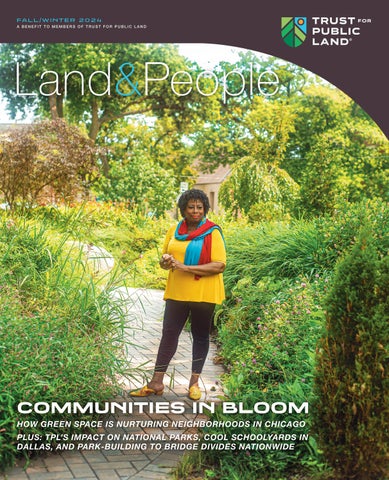
COMMUNITIES IN BLOOM HOW GREEN SPACE IS NURTURING NEIGHBORHOODS IN CHICAGO PLUS: TPL’S IMPACT ON NATIONAL PARKS, COOL SCHOOLYARDS IN DALLAS, AND PARK-BUILDING TO BRIDGE DIVIDES NATIONWIDE T P L .O R G · 6 7
IS DECEMBER 3 DONATE THROUGH MIDNIGHT ON TUESDAY, DECEMBER 3, AND YOUR GIFT WILL BE TRIPLED. Your year-end, tax-deductible contribution will protect beloved outdoor places and create new ones for future generations.
Students enjoy the outdoors at a Community Schoolyards® project in New York City.
TRIPLE YOUR IMPACT Visit tpl.org/givingtuesday or scan the code to donate today.
TIMOTHY SCHENCK
Thank you for your support!
c o n t en t s
D O U G L A S S 18 PA R T N E R S / L I N C O L N PA R K ZO O
26 32 “We’re nothing without community partnership.” ~ LO L A J E N K I N S , I N FO L LO W T H E L E A D E R S, P G . 3 2
J A S O N F LO W E R S
J O R G E R I VA S
F E AT U R E S
42 Perfect Strangers ................................................................................................................. 26 How parks and community engagement are helping Americans find common ground.
Follow the Leaders ............................................................................................................ 32 With Black culture and public land as tools for change, Chicago leaders are building fruitful relationships with TPL’s help.
More than a Makeover ................................................................................................ 42 From combatting climate change to improving health and learning outcomes, Community Schoolyards® projects are a sustainable solution to the nation’s need for more parks.
A Park for the Community, Built by the Community ........................................................................................... 50 Because of an ambitious plan that involves residents in its visioning and construction, India Basin Waterfront Park serves as a model for enhancing communities and reducing displacement. T P L .O R G · 1
GIVING GUIDE With a variety of ways to give, we offer something to suit everyone. Use the envelope bound inside this magazine to send your gift, or donate online and learn about more ways to give at tpl.org/support.
Grow Your Giving Simplify your charitable giving and meet your philanthropic goals by giving through your donor-advised fund. Learn more at tpl.org/daf.
Give the Gift of the Outdoors The holiday season is the perfect time to share your love of nature and outdoor adventures with others. Make a difference and honor someone special with a tribute gift.
Become a Conservation Champion Donate $1,000 or more annually and receive the recognition due a champion, such as invitations to special events and insider updates on our projects. Call 415.495.4014 or email champions@tpl.org to learn more.
Leave a Legacy Consider including us in your will or estate plan, learn about the benefits of designating retirement funds to TPL, and explore other tax-wise ways to give. Call 202.856.3748 or email plannedgiving@tpl.org to learn more.
Donate Your Vehicle Car recycling benefits both people and the environment by conserving natural resources, reducing pollution, and lessening energy consumption. Call 855.500.RIDE (7433) or visit tpl.org/cars to get started.
Scan with your mobile device’s camera to make a gift today! Trust for Public Land depends on your support. You make our work possible. tpl.org/support
DE PA R T M E N T S
president and CEO, shares what drew her to the role and how she connects
14
18
J E N N A S TA M M
Dr. Carrie Besnette Hauser, TPL’s new
R AC H I D DA H N O U N
From the President · 11
c o n t en t s
to our mission.
Board Spotlight · 12 Get to know Anton Seals Jr.
First Look · 13 Camping tips from a pro, transformation at scale through our Community Schoolyards® initiative, growing America’s national parks, and a conversation about health and the outdoors.
A roundup of insightful book, film, and podcast recommendations from partners and staff.
TPL Near Me · 60 Small-business owners in Trinidad,
60
B E R G R E E N P H OTO G R A P H Y
On Topic · 58
Colorado, look to Fishers Peak State Park for a brighter future.
Member Center · 62 Offices · 63 Trail’s End · 64 Parks can connect us to family and friends in sometimes surprising ways.
on the cover
Naomi Davis, founder and CEO of nonprofit Blacks in Green, stands in the Mamie Till-Mobley Forgiveness Garden, which TPL helped improve, on Chicago’s South Side. Photo: Gracie Hammond
T P L .O R G · 3
4 · L A N D & P E O P L E · FA L L / W I N T E R 2 0 24
c o n t en t s
Pacific Crest Trail California, Oregon, and Washington One of the original National Scenic Trails established by Congress in 1968, the Pacific Crest Trail (PCT) features some of the most beautiful and diverse terrain in the western U.S. It traverses 26 national forests and seven national parks. Trust for Public Land has protected over 50,000 acres along the trail, with more in the works, ensuring this special route will continue to thrive for future generations of hikers to enjoy. In this issue, discover more National Park Service sites TPL has helped expand.
16
R AC H I D DA H N O U N
Page · 16
T P L .O R G · 5
6 · L A N D & P E O P L E · FA L L / W I N T E R 2 0 24
c o n t en t s
David G. Burnet Elementary Schoolyard Dallas, Texas Trust for Public Land’s Community Schoolyards® projects are vibrant green oases where kids can play and learn outdoors. If all of our nation’s schoolyards were improved in this way—and opened to the community after hours—80 million people would have access to a new park within a 10-minute walk of home. In Dallas, Texas, we talked to students, teachers, and residents to learn how they’ve benefited from these safe, climatesmart green spaces. Read more about TPL Community Schoolyards projects in this issue.
42
J A S O N F LO W E R S
Page · 42
T P L .O R G · 7
8 · L A N D & P E O P L E · FA L L / W I N T E R 2 0 24
c o n t en t s
India Basin Waterfront Park San Francisco, California Once completed, India Basin Waterfront Park will total over 10 acres and close a critical gap in the San Francisco Bay Trail, bringing green space to the more than 35,000 residents who live within a mile of it. Planned park features include local art, a floating dock for recreational water use, and landscape restoration to benefit wildlife and combat sea level rise. The best part? It’s being built by—and with direct input from—the people who love it most, reflecting their community’s rich history and identity and providing lasting economic and health benefits for generations to come. Read more about this remarkable park in this issue.
50
DT M M E D I A / S H U T T E R S TO C K
Page · 50
T P L .O R G · 9
CHRIS BENNE T T
Lead the Way Become a Conservation Champion, and help us connect even more people to the outdoors with your annual leadership-level contribution of $1,000 or more. Discover the impact you’ll have as a Conservation Champion by contacting us at 415.495.4014 or champions@tpl.org.
Stay Connected Join us online for project updates, stunning photos, and inspiring stories. Follow us on social media: @trustforpublicland @TheTrustforPublicLand @the-trust-for-public-land @tpl_org TrustforPublicLand Be sure to tag us in your posts!
Sign up for our emails: tpl.org/email-signup
And listen to our podcast, People. Nature. Big Ideas. tpl.org/podcast
10 · L A N D & P E O P L E · FA L L / W I N T E R 2 0 24
R IC H FR EEDA
tpl.org/champions | champions@tpl.org
fro m t he pr es id en t
INTRODUCING OUR NEW PRESIDENT AND CEO
executive editor & publisher
Jennifer Ramsey
Whether in Colorado’s high Rocky Mountains, where I live now, or in Arizona’s Grand Canyon, near where I grew up, I’ve always felt a profound connection to the outdoors.
editorial director
Deborah Williams managing editor
Amy McCullough s ta f f w r i t e r s
Lisa W. Foderaro Amy McCullough Deborah Williams designers
Rachel Andrade Miya Su Rowe Ben Whitesell media production manager
Elyse Leyenberger m e d i a c o o r d i n at o r
Amber Garrett
© 2024 Trust for Public Land. All rights reserved. All In for Outdoors, Community Schoolyards, Connecting Everyone to the Outdoors, Conserving Land for People, Conserving Nature Near You, Creating Parks and Protecting Land for People, Fitness Zone, Land for People, Land&People, LandVote, Northwoods Initiative, Our Land, Outside For All, Outside Matters, ParkEvaluator, Parkology, Parks for People, ParkReviewer, ParkScore, ParkServe, Parks Unite Us, 10-Minute Walk, The Trust for Our Land, Trust for Public Land, TPL, and all other names of Trust for Public Land programs referenced herein, as well as their logos, are registered or common-law trademarks of Trust for Public Land.
From climbing to the Mount Everest basecamp and summiting Mount Kilimanjaro, to rafting iconic and fragile rivers, to daily walks with our dog, Gracie, nature has been a cornerstone of my life. These experiences have reinforced my belief that access to nature is essential and must be championed for all. I’ve dedicated my career to public service, community engagement, and the promotion of equitable access to education and the outdoors. I’m honored to join Trust for Public Land as its next president and CEO. TPL forges paths—both literally and figuratively—to bring the benefits of outdoor experiences and nature to millions, including and especially those who haven’t always seen themselves ref lected in our shared public spaces. It will be a privilege to build upon the successes of my predecessor, Diane Regas, whose leadership significantly enhanced TPL’s impact nationwide and elevated the national conversation about the power of parks to create equity and opportunity for communities everywhere. As a national organization, TPL must scale its work to connect more people to the benefits and joys of the outdoors while also tailoring its approach to the hyperlocal needs of each community. Two projects that resonate deeply with me illustrate this balance. In southern Chattanooga, Tennessee, residents of historically underserved neighborhoods have been physically cut off by an old, unused rail corridor as a renaissance in the city’s nearby South Broad area unfolded in plain sight but out of reach. But TPL is changing that: from our advocacy efforts and relationship building in Alton Park, we secured a new $20 million EPA grant for that community and are now transforming that railway barrier into the green Alton Park Connector trail, designed and activated through our uniquely cooperative,
community-centered approach that reflects local identity and needs. Similarly, in the Bayview–Hunters Point neighborhood of San Francisco, California, India Basin Waterfront Park is a shining example of centering community while creating recreational opportunities and addressing environmental justice. As you’ll read on page 50, the park’s groundbreaking Equitable Development Plan aims to prevent displacement and ensures that residents who have been deeply involved in planning and building this beautiful space will benefit from it for generations to come. Trust for Public Land’s work addresses urgent challenges. Green spaces are essential for everyone’s well-being, for managing stormwater and reducing urban heat, and for capturing carbon and providing environmental resilience to combat climate change. Parks also bolster democracy, address social isolation, and bridge divisions, as highlighted in the On Common Ground profiles from East Baton Rouge Parish, Louisiana, that you’ll read in this issue (page 26). As the organization moves into its next 50 years, your support will help advance TPL’s mission to protect and create all kinds of special outdoor public places and spaces. With optimism and determination, I look forward to our journey together to shape the future of our communities and the health of our planet. I am eager to lead TPL into its next chapter, continuing to innovate, advocate, and collaborate to make the outdoors accessible and welcoming for all.
Carrie Besnette Hauser, PhD president & ceo T P L .O R G · 11
Get to Know
boa r d s p ot lig h t
chair
Lucas St. Clair Jodi Archambault J. Franklin Farrow
AS LEAD STEWARD AND COFOUNDER OF Grow Greater Englewood, Anton Seals Jr. comes to Trust for Public Land’s National Board of Directors with a wealth of experience in community organizing, operations, and strategic planning. Established in 2017, Grow Greater Englewood uses food economies and land sovereignty to help residents of Chicago’s South Side grow and thrive— much like the land they activate as farms, gardens, and community green spaces. Seals got involved with TPL while organizing the upcoming Englewood Nature Trail, a public green space that will anchor the National Board nation’s first agro-eco district of Directors (read more on page 32). We since 2024 asked what inspired him to join our board.
TA FA RI MELISIZ WE / THE INDIG EN OUS LENS
Board of Directors
Anton Seals Jr.
Mickey Fearn Jody S. Gill Anita Graham Carrie Besnette Hauser Allegra “Happy” Haynes Alex Martin Johnson Jennifer Jones Philip June Chris Knight Christopher G. Lea Joseph E. Lipscomb Eliot Merrill Ignacia S. Moreno Julie Parish Michael Parish David Poppe Thomas S. Reeve Laura Richards Ted Roosevelt V Anton Seals Jr. Sheryl Crockett Tishman F. Jerome Tone Taylor Toynes Jerome C. Vascellaro Lindi von Mutius Alvin Warren Keith E. Weaver Susan D. Whiting Florence Williams Kenneth Wong
How did you first hear about TPL? From the Bloomingdale Trail project (also known as The 606). I’ve witnessed the ongoing growth of this organization since then. TPL has a collective of committed and inspired people who continue to expand the work of conservation and land stewardship.
public health crisis in our country by providing access to nature. But also, TPL can bring more voices to the conservation table and redefine the work we do as an essential need of all communities. I see TPL making sure we have a much more racially diverse sector that helps steward Mother Earth.
What part of TPL’s work most reflects your own values and goals? Community, health, and climate are essential to work we are doing on the South Side of Chicago and align with TPL’s core mission. At Grow Greater Englewood, we believe in long-term efforts to create holistic communities. We aim to improve the overall well-being of life within spaces that were historically marginalized and have degraded air and water quality and limited services.
What are you most looking forward to achieving as a member of TPL’s board? Making sure that I continue to center voices that are critical to defining conservation, sovereignty, and open spaces in the 21st century. The preservation of Black land and communities in America is crucially important to the future of our country.
TPL and its broad network across the U.S. can further the conversation, informing the public interest and building trust. The value of collective work and responsibility—also known as ujima, or the third principle of Kwanzaa—is where I see inroads. What challenges do you think TPL is uniquely poised to address? First, addressing the evolving
12 · L A N D & P E O P L E · FA L L / W I N T E R 2 0 24
How do you most enjoy connecting to the outdoors? Being a native Chicago kid, I had the pleasure of growing up a couple blocks from Lake Michigan. Now, I want to work with people repurposing urban land across the country to instill stewardship of the outdoors in others. le a r n m or e @ TPL.ORG/SEALS
First Look T U R N T H E PAG E FO R : Pro Camping Tips for Fall
In the conservation classic A Sand County Almanac, author Aldo Leopold wrote, “When we see land as a community to which we belong, we may begin to use it with love and respect.” His words exemplify what TPL sets out to achieve when we protect land at beloved natural areas such as Zion National Park— ensuring access to spaces that enrich the human
Leveling Up Schoolyards
experience and connect us to the outdoors in a
Building a Network of Outdoor Allies
meaningful way. By leading complex projects with a variety of partners, we ensure remarkable public lands are available to communities nationwide, fostering a love of nature and respect for the outdoors that will grow well into the future. Learn more about our work to protect land at national parks on page 16. le a r n m o r e @
C HR IS HIN K LE
TPL.ORG/ZION
F I R S T L O O K · 13
pro t ips
COURTESY OF LINDSE Y JOHNSON
Get Outdoors, Pitch a Tent The prospect of sleeping outside—even in the refuge of a tent—can be daunting for those new to camping. Follow these handy camping tips from a seasoned pro for a cozy, comfortable, and memorable outdoor experience. With L.L.Bean’s Lindsey Johnson Lindsey Johnson is no stranger to the outdoors. As an Outdoor Discovery Program
choice—is for insulation. And the outer layer, such as rain
Coordinator with TPL partner L.L.Bean, she heads expeditions
but also be breathable.
ranging from hiking and kayaking to archery and stand-up
gear with vents, should keep environmental moisture out 4. Don’t underestimate your water bottle.
paddleboarding in eastern Pennsylvania. For Johnson, a great
Johnson’s favorite cold weather hack? Use your water
day at work includes showing others the joy of being outside.
bottle as a foot warmer: “On a really cold night, I’ll heat
Here, she shares her best camping advice for fall and beyond.
up some water on the campfire while I’m getting ready to
You needn’t go far. “One of my earliest outdoor
turn in,” she says. She then fills her bottle with the warm
memories is setting up our tent in the backyard and
water, sticks it in her sleeping bag, and lets it radiate
learning the ropes from my dad,” says Johnson, who
through the night. “It’ll warm your toes right up,” she
recommends going somewhere you’re comfortable with
attests. Slip a sock or neck gaiter around the bottle to
1.
to start—even if that’s your yard. If you’re outside, you’re
ensure you won’t get burned if it’s too hot at the start.
closer to nature than you are in your bedroom, she notes.
5. Be creative. Lots of home items can be repurposed
If that feels too pedestrian, locate your closest state park
in your camping kit. An old toolbox might become a first aid
with a campground and start there.
kit or a caddy for cooking utensils. A doormat you’re about to
2. Separation from the cold, hard ground is key
retire can do wonders at keeping dirt outside your tent—and
to your comfort. A sleeping pad goes a long way in
is a good reminder to leave your boots outside. Johnson
keeping you warm and ensuring a good night’s sleep. “For a
likes to bring shower caps for packing shoes in at the end
foam pad, I recommend using one with a metallic layer to
of a trip, especially if it’s muddy where you’re headed.
help retain heat,” says Johnson. Inflatable pads, on the
6. Get tactical about toiletries. If you’re easing into
other hand, can provide more cushion. For the best of both
things at a campground with more facilities, such as
worlds, she suggests stacking one of each for extra comfort
showers, Johnson’s must-have item is a toiletry organizer.
plus insulation.
She recommends a water-resistant, hanging version with
3. Mind your fabrics and layers. When it comes to
clothing, Johnson likes to have a base layer, a mid-layer, and an outer shell. The layer closest to your skin should
clear or mesh pockets, which make it easy to see and grab what you need. For sites with pit toilets, always bring extra toilet
wick perspiration away. Silk, bamboo, and many
paper and hand sanitizer—and secure your personal items
synthetics are good at wicking; cotton, not so much.
when visiting. If your phone, sunglasses, or wallet fall in,
Synthetics blended with natural fibers, such as wool or
“it’s essentially impossible to retrieve them,” says Johnson.
alpaca, have the added bonus of being antimicrobial, so
Going even more rustic? Take a collapsible shovel, dig a
they resist odor. Your mid-layer—fleece is a common
hole, do your business, and cover to leave no trace.
14 · L A N D & P E O P L E · FA L L / W I N T E R 2 0 24
CHRIS BENNE T T
A fireside shelter at Bald Mountain Pond, a TPL project along the Appalachian Trail.
7. Hone your fire game. “I look at fire building as an art form,” says
Johnson. “Everybody can do it, but with practice you get to be more of a master at it.” She’s a fan of teepee-shaped fire construction and advises starting with smaller pieces of wood. Her best insider kindling trick is to empty your dryer lint and bring it along. “It catches really fast and is super easy to pack.” Another DIY fire-starter is wine corks soaked in rubbing alcohol. Of course, always ensure there isn’t a burn ban in your area, and use local firewood to reduce the spread of invasive insects. 8. Go with the glow. An easy hack Johnson shares is hanging glow sticks
from your tent zippers. “When you get up in the middle of the night to visit the bathroom, you’ll easily find your tent and won’t have to fumble around for the zippers in the dark,” she says. 9. Don’t trip. “Pool noodles are a great way to eliminate the tripping hazard
FIRESIDE GRUB
What could be more fun and empowering than preparing a feast over an open fire with your campmates? A campfire dinner is more than a meal; it’s an event. Here are two of Johnson’s favorite cool-weather dishes, plus a few pointers for success:
Chili Food for Chilly Times •
Measure spices out in a bag before leaving home.
•
Precut your vegetables so they’re ready to toss in a pot.
•
For a group, bring a variety of toppings and let everyone choose their own adventure: shredded cheese and tortilla chips, fresh cilantro and onions, sour cream and Fritos—or all of the above.
of your tent lines,” says Johnson. Just slice one open along the long side and slide it over your tent lines. The brighter the color, the better. 10. Duct tape is a camper’s best friend. “I always bring a roll tucked
in with my supplies,” Johnson shares. When she’s packing extra light, she wraps multiple layers of duct tape around her water bottle, where it
Rock the Banana Boats •
Slice a banana down the side, leaving the peel on.
•
Fill it with whatever you want—the sky’s the limit! Suggestions include: – chocolate sauce or pieces – fresh berries or preserves – marshmallows – peanut butter or chopped nuts
Another way to engage is to learn something new, whether it’s with
•
Wrap it in foil and toss it over the fire.
field guides or a nature app. “I walk around the campsite, and if I see a
•
Cook for a few minutes; then carefully extract with tongs and allow it to cool.
•
Unwrap the foil, grab a fork, and eat it right out of the peel.
naturally ends up on adventures when you might need it. “Use it for a quick tent tear or pole repair, hang a strip at your site as a fly trap, even use it as a last resort for a pesky splinter when you forgot your tweezers.” 11. Engage with nature. “I really like nature journaling,” says Johnson,
“and all you need is a piece of paper and a pencil or pen. You can do whatever you want as long as you’re taking the time to observe and reflect on the natural world.”
flower I’ve never seen before or hear a beautiful bird call, I take a picture or record it,” explains Johnson. While she acknowledges it’s also good to unplug (and you should plan for some phoneless time), a photo or recording can lead to later discoveries.
F I R S T L O O K · 15
TPL s
N PS
OUR WORK WITH THE NATIONAL PARK SERVICE Illustration by Nate Padavick
U O Y D DI ... W O N K
PACIFIC CREST TRAIL Preserved 50,000+ acres of trail corridor, ensuring recreational access, habitat connectivity, and climate resilience
TPL regularly works to secure lands for national parks, scenic trails, monuments, and historic sites? Here are some of our biggest achievements over the years.
WESTERN U.S.
VOLCANOES NATIONAL PARK
YOSEMITE NATIONAL PARK
ZION NATIONAL PARK
Protected a remote ecosystem and an array of cultural sites with 16,000+ acres saved at Pohue Bay
Added 400 acres in the park's largest restoration project to date, expanding visitor access and improving critical wetland habitat and biodiversity
Protected 6,700 acres in and around this beloved park, including the iconic Narrows Trail
HAWAI‘I
CALIFORNIA
UTAH
16 · L A N D & P E O P L E · FA L L / W I N T E R 2 0 24
NICODEMUS NATIONAL HISTORIC SITE
CUYAHOGA VALLEY NATIONAL PARK
APPALACHIAN TRAIL
Expanded the oldest and only remaining post-Civil War Black settlement west of the Mississippi River
Created this very popular 33,000-acre park, providing opportunities to bike, hike, and paddle for 3 million annual visitors
Protected 100,000+ acres across 14 states-including Maine’s Bald Mountain Pond-benefiting people, wildlife, and climate adaptation
KANSAS
OHIO
EASTERN U.S.
SAGUARO NATIONAL PARK
MARTIN LUTHER KING, JR. NATIONAL HISTORICAL PARK
TIMUCUAN ECOLOGICAL AND HISTORIC PRESERVE
Saved 2,200+ acres, enhancing access for recreation and preserving wildlife habitat along with many cultural sites
Preserved key properties in MLK’s childhood neighborhood, visited by millions per year
Saved 100+ acres at Black Hammock Island, a beloved recreational and historic site that supports climate resilience
ARIZONA
GEORGIA
FLORIDA T P L .O R G · 17
sch o o lya r d s s p ot lig h t
Scaling Up Schoolyards Our mission to address park equity and improve climate resilience across the country begins with a thoughtful big-picture strategy that puts playgrounds to work. By Lisa W. Foderaro For years, Trust for Public Land has pioneered a new way of thinking about often-overlooked schoolyards. Their typical blank asphalt offers little to spark
That was before Francesca de la Rosa and Juan Altamirano entered the fray. De la Rosa, TPL’s California green schoolyards campaign manager, methodically set out to expand and support the Living Schoolyards Coalition, a group of
the imagination, and it bakes in the sun and floods in the
L.A. nonprofits that includes TPL. Meanwhile, Altamirano,
rain. But our Community Schoolyards® initiative swaps out
director of government affairs for TPL’s California program,
blacktop for garden beds, native trees, up-to-the-minute play
worked the halls of the state capitol, convincing officials to
equipment, and outdoor classrooms, transforming recess and
dedicate $120 million to a new statewide green schoolyards
turning school grounds into neighborhood parks.
program, highlighting its urgency. “We have moved the
In just the past five years, we’ve ramped up the program
needle in both getting broader buy-in from the Los Angeles
and extended its reach to include 50 school districts in
school district and pushing policies forward across the state
more than a dozen states. But the need is so great—and the
to advance comprehensive greening,” says de la Rosa.
potential of schoolyards to address equity and climate change
The result? Five TPL schoolyards are currently in the works
so promising—that TPL has embarked on a new strategy.
in L.A.—plus an additional 40 renovations being led by
For the first time, we are advocating on all three levels of
partners across the district, some of which will adopt
government—federal, state, and local—with a coordinated
elements of our Community Schoolyards model. The model
strategy on a single priority policy issue: scaling our Commu-
emphasizes climate resilience, educational outcomes, and
nity Schoolyards program to become a national standard.
park access—with schoolyards available to the wider
At the state and local levels, there is perhaps no better example of advocating on all fronts than in Los Angeles,
community after school and on weekends. For Danielle Denk, TPL’s Community Schoolyards initiative
California. Only a few years ago, we struggled to convince the
director, investing in schoolyards has never been more
school district there to sign off on even a single schoolyard
important. One hundred million Americans don’t have a park
renovation.
within a 10-minute walk of home, including 28 million
EL
YS NBE
RGER
18 · L A N D & P E O P L E · FA L L / W I N T E R 2 0 24
YE
DA N I E L L E D E N K , D I R E C T O R O F T P L’ S C O M M U N I T Y S C H O O LYA R D S ® I N I T I AT I V E
LE
–
E
When you cross the line into an underfunded school district, there is a very stark reality of inequity. We’re leveraging every single tool in our toolbox to change that and give all children inspiring green spaces to play and learn.”
public schools and our nation’s mental health crisis, and the transformation of schoolyards into green spaces that do double duty as neighborhood parks is clearly a win.
JOE SORREN TIN O
children. Add to that the persistent inequities that plague
“When you see the state of school facilities in a high-wealth community, they have been able to invest in high-quality amenities and green spaces that support learning,” she says. “But when you cross the line into an underfunded school district, there is a very stark reality of inequity. We’re leveraging every single tool in our toolbox to change that and give all children inspiring green spaces to play and learn.” Until now, funding for Community Schoolyards projects has come mostly from school districts, private philanthropy, and in large cities such as New York, water departments eager to support green infrastructure (think rain gardens and absorbent turf fields). But asking school boards to cover a substantial portion of the costs is tricky since we prioritize districts serving low-income populations. To unlock funding at the state level, we lobby for continuing,
invested in the work happening on the ground, in the present. Elizabeth Class-Maldonado, the Pennsylvania
dedicated sources such as lottery revenue or sales tax. “The
program director, holds monthly meetings with the Philadel-
gold standard would be new stand-alone programs for
phia school district to maintain momentum. “It’s about
schoolyards, durably funded by legislatures or approved by
showing up,” she says. To date, TPL has completed 15 school-
voters through ballot measures,” explains David Weinstein,
yards in the city and recently identified three more projects.
TPL’s western conservation finance director.
(Watch a related video at tpl.org/bregy.)
Weinstein and his team are also exploring existing state
In Sacramento, California, Altamirano has kept the pressure
education and conservation funding streams while pursuing
on. Fresh off the success of securing $120 million in state
one-time appropriations for individual schoolyard projects.
funding, our California team set its sights on a $10 billion
One recent success came in Oakland, California, where voters
school facilities bond being negotiated for the November
in 2020 approved a $735 million bond for public schools. TPL
ballot. As part of this effort, the L.A. teachers’ union got on
successfully advocated for a $6 million share to help pay for
board, and an editorial in the Los Angeles Times championed the
new schoolyards. And just this year, we launched new
idea, calling the “desolate state” of many schoolyards a “hazard
programs in 10 states to lobby for additional funding.
to kids and an environmental injustice.”
In Washington, DC, Jessica Montoya, TPL’s senior director
“When we first started, we weren’t taken seriously,”
of park equity and federal relations, says a grant program
Altamirano recalls. “That didn’t deter us. We continued to
through the U.S. Department of Education would provide
advocate and organize and wound up with 16 members of the
critical support for schoolyards. We’re working closely with
state legislature signing a letter that said they, too, wanted
New Mexico Senator Martin Heinrich, a champion of
support for community schoolyards.” Thanks to TPL’s efforts
revitalizing schoolyards, to get support for a bill that would
to rally support, these projects will be eligible for up to $7.3
unlock such federal funding.
billion in grant funding. And we’re building on that
Montoya is also encouraged that in April of 2024, the Biden
momentum at all levels of government and at sites across the
administration hosted the first-ever White House Summit for
country. After all, our public schools already own 2 million
Sustainable and Healthy K-12 School Buildings and Grounds
acres of land. With Community Schoolyards projects, we can
(to which TPL was invited): “We see the administration
make the most of it.
moving toward more energy-efficient, health-focused schools,
Turn to page 42 for a deep dive into our Community Schoolyards
and community schoolyards are a great complement to that.”
projects in Dallas, Texas.
While the horizon for state and federal funding may be long, and progress is sometimes delayed, TPL staff are fully
SIGN A PETITION TO SUPPORT SCHOOLYARDS: TPL.ORG/CSP F I R S T L O O K · 19
C
O
U RT
t pl in c o n v er s at i o n
ES
Y OF
TA N D O N
(With a Little Help from Our Friends)
DR.
We Can All Be Outdoorsy When it comes to enjoying the outdoors, it’s not just about finding your place; it’s about finding your people.
One of the biggest barriers to equity in the outdoors is access. But it’s hardly the only one. Here, TPL’s editorial director, Deborah Williams, joins our new health director, Dr. Pooja Sarin Tandon (above), in conversation about how to overcome those barriers—and what it really takes for people to feel welcome outside. Even when we achieve our goal of putting a quality park within 10 minutes of every person in this country, the unfortunate reality is that many people still won’t go. As a practicing pediatrician, Tandon thinks a lot about how we can remedy that situation. It starts, she says, by shifting people’s perceptions of nature and their sense of belonging in it. Ironically, it wasn’t
A DAIR RU TLEDG E
until adulthood that she began to question her own views on the topic.
Friends enjoy hiking together at a park in the Mountains to Sound Greenway, where TPL protected more than 10,000 acres in Washington State.
POOJA TANDON: I broadened my definition of what “outdoorsy” means. Until this became a professional passion
STELL A K A LININ A
DEBORAH WILLIAMS: What changed about your perception of nature as you got older?
for me, I viewed outdoorsy within a typical American or Western framework of what you’d see in an outdoor retailer catalog: rock climbing, camping, activities that take place in the wilderness or faraway outdoor places. Then, as my professional work about the importance of connecting children to nature evolved, I recognized the importance of nearby nature and different ways people, especially children, can connect with nature. I reflected on my own childhood.
You describe your upbringing in your 2022 Ted Talk: “The Power of Belonging in Nature,” and it doesn’t sound as if you felt particularly outdoorsy. I was born in India and spent most of the first 10 years of my
A woman stops to appreciate the beauty of a single leaf along TPL’s Ventura River Parkway project in California.
life in a pretty urban area in the city of Lucknow. I never
and guide us into new experiences in nature. Even if you
went hiking there. I don’t remember ever being in the woods,
can’t show someone how to use a compass or read a map, you
and I don’t think I even knew what camping meant. But
can be a mentor by lending them gear or urging them to
here’s what I did do: We lived in a second-story apartment,
examine the veins in a leaf or listen to the sound of the wind.
and we had a rooftop terrace, and I spent a lot of time up
Likewise, we all need one or more nature allies: those folks
there. In the summertime when it was too hot to be indoors,
who are always game to accompany us on an outdoor
we would set out cots and sleep under the stars. I have slept
excursion. Whether we seek out guidance or give it, we
on that terrace more than a hundred times.
become part of a virtuous cycle of outdoor allyship—and
Do you think experiences like sleeping on the terrace, taking walks around the neighborhood, or having family picnics in the park are ways people experience nearby nature without realizing it? Yes. It’s a way of connecting with nature that is often undersold and that we don’t always highlight. We should encourage each other to recognize those moments when we find ourselves in nature—to stop and enjoy them. Even these brief respites bring great mental and physical health benefits.
those allies are crucial to our having positive experiences outside, which means we’re more likely to do it again.
Your new book, Digging Into Nature [cowritten with Dr. Danette Swanson Glassy], is grounded in your research about the correlation between nature access and health, but it’s really a practical guide for parents and caregivers. Why was that focus important to you? We’ve seen patients and families from so many different lived experiences, backgrounds, and resources, and we wanted this book to be of service to people facing a range of
In your Ted Talk, you also bring up the idea of nature mentors and allies, that it’s not only about helping people discover where—but also with whom—they feel safe and inspired outdoors. Can you expand on that?
barriers. That could be anything from their zip code and
Sure. I’d describe nature mentors as people who encourage
being outdoors can and should look like.
what their neighborhood has to offer to the physical health status of family members or their own individual health situation, as well as their cultural perceptions about what
What I love about the park prescription movement is that it’s a formal acknowledgment that healthcare providers and institutions have a role in connecting people to nature because nature has a role in promoting health and well-being.” – D R . P O O JA S A R I N TA N D O N , T P L H E A LT H D I R E C T O R FIRST LOOK · 21
J A S O N F LO W E R S
A family connects during a walk along Five Mile Creek, where TPL is creating a vast network of parks and trails in Dallas, Texas.
The metrics for proximity and quality of green space that
offer challenges at the fine and gross motor level, whether
TPL uses are very relevant. And we know from TPL’s and
that’s jumping off a log when you’re 2 or climbing a tree
others’ work that having parks and building trails is not
when you’re 6. There’s something unique about running
enough. This idea of “if you build it, they will come” has been
through a field uninhibited. Think about the exuberance
debunked. Different barriers require different solutions.
and motor skills that come from being able to do something
Can you elaborate—and give an example of a solution? Most people, no matter their geography or socioeconomics, can relate to the barrier of time poverty. In the book, we acknowledge that many families are juggling jobs, school, homework, activities, and other priorities. So even if they have the desire to go outside more, it’s just hard to fit it into their schedule. We have a section in the book about this, and we offer some simple ideas. Think about the activities you’re already doing and see if there’s an opportunity to do them outside. Take homework or reading outside, whether to your porch or a nearby park, for example. Kids might otherwise spend that time at the kitchen table or at a desk in their bedroom. You can still get the schoolwork done while also getting your daily dose of fresh air and nature.
in an unconfined space. You can’t find that indoors. For children of all ages, including teenagers, immersive experiences in nature evoke a sense of awe and attention restoration—those are developmental opportunities in the cognitive and emotional realm that are hard to find inside.
Beyond the nuclear-family level, there are also systems-level solutions. One of these, the concept of park prescriptions, has been gaining momentum. What are your thoughts on the trend toward time spent outdoors as literal medicine? As physicians, we think about the things that impact our patients’ health. We should prioritize talking to them about getting outdoors and moving their bodies. What I love about the park prescription movement is that it’s a formal acknowledgment that healthcare providers and institutions have a role in connecting people to nature because nature
You talk a lot in the book about how outdoor playtime, particularly, facilitates children’s development.
has a role in promoting health and well-being.
Interactions in the natural world support all kinds of
follow it, especially if it’s in a form that’s generic, like, “Spend
milestones and the acquisition of life skills. We address the different realms of development—speech, motor, behavioral, emotional.
But, like any advice from a doctor, people don’t necessarily X number of minutes outside per day.” That’s where having support from our community is critical for motivating us and helping us overcome our unique barriers to getting outside.
In the early years, the outdoors offers really unique opportunities for developing motor skills that are hard to create indoors. For example, uneven, inconsistent surfaces 2 2 · L A N D & P E O P L E · FA L L / W I N T E R 2 0 24
watc h the ted ta lk @
TPL.ORG/ TANDON-TED-TALK
buz z wo r t h y
By Leaps and Mounds We’re partnering with the Ocmulgee National Park and Preserve Initiative, the Muscogee Nation, and the National Park Service to bring Georgia its first national park. The world is rife with human-made wonders: consider the Egyptian pyramids, Chichén
attractions, national parks provide scenic destinations,
Itzá, or the moai of Easter Island. Lesser known—but equally
preserve history, protect crucial ecosystems, and often limit
fascinating—are the Ocmulgee Mounds in modern-day
consumptive uses such as mining.
Georgia, which TPL is working to level up into a full-fledged national park.
The title indicates a certain cachet; our best-known natural
Such designation would also honor the Muscogee Nation by establishing a cooperative approach to management that
Constructed around 900 CE by a cultural group known as
includes both the tribe and the National Park Service. This
the Mississippians—ancestors of the Cherokee and Choctaw
plan recognizes the tribe’s rich history in the area and pays
Nations, among other Indigenous peoples—the Ocmulgee
respect to Indigenous cultural knowledge.
Mounds have served various purposes, such as housing
Improvements will enhance the existing historical park and
village chiefs and acting as funerary sites. The mounds
connect it to nearby Bond Swamp National Wildlife Refuge,
evolved over time to accommodate roughly 60 towns (or
creating a grand 23,000-acre park along the Ocmulgee River.
chiefdoms) comprising the Muscogee Nation, also known as
Since the 1990s, TPL has preserved nearly 3,000 acres of
the Creek or, in their own language, Mvskoke (pronounced
land that will be integrated into the new national park—
“mus-KOH-gee” in English).
signifying our deep recognition of what this area has meant
17,000 years—could become Georgia’s first national park. TPL, in partnership with the Muscogee Nation and the Ocmulgee National Park and Preserve Initiative, is working to elevate the site from national historical park to national park—a move that would contribute an estimated $206.7 million annually in tourism.
to previous and current generations and what it will mean well into the future. Turn to page 16 to learn more about our work securing lands for National Park Service sites. le a r n m or e @
TPL.ORG/OCMULGEE
N ATION A L PA RK SERVICE
Now, this land—which has been inhabited by humans for
FIRST LOOK · 2 3
TRUST FOR PUBLIC LAND would like to thank the following supporters. We couldn’t achieve our commitments to climate, equity, community, and health without their generous financial contributions to our mission and our work. Thank you for helping us connect everyone to the outdoors.
For their partnership and support of TPL’s Community Schoolyards® initiative. Guided by their social purpose platform, Mission Every One, Macy’s has helped transform public schoolyards into community parks nationwide, ensuring healthy, livable communities for generations to come. To date, more than $3.7 million has been raised, directly impacting nearly 10,000 students and providing access to green spaces for over 285,000 community members.
Through its Corporate Citizenship program, Northrop Grumman has contributed $1.15 million to enhance community well-being through support of TPL’s SOAR (Security, Open space, and Agricultural Resilience) initiative, Tribal Community Schoolyards Pilot Program, and California Community Schoolyards® projects. In doing so, Northrop Grumman has helped conserve over 11,000 acres of land for environmental sustainability and national security and transformed schoolyards into culturally relevant spaces to learn and thrive. For their support of TPL’s transformational work to increase access to public green space in Dallas, Texas. Oncor’s $1 million gift represents their longstanding commitment to our mission and will help us bring more than 17 miles of new trails and three signature parks to historically underserved neighborhoods, providing access to nature for nearly 200,000 residents who don’t currently have a park or trail within 10 minutes of home.
Community Schoolyards® initiative California; Pennsylvania; Washington, DC; & Washington State
Community Schoolyards® projects, Trails initiative projects & Community Forests South Dakota & Washington; Maryland, Montana, Utah & Wisconsin; & Maine 2 4 · L A N D & P E O P L E · FA L L / W I N T E R 2 0 24
Chattahoochee RiverLands Gateway Park Atlanta, Georgia
Woody Branch Park & Judge Charles R. Rose Community Park Dallas, Texas
Elementary School Gardens Newark, New Jersey
Sierra Nevada Land Conservation Program Northern California
Community Schoolyards® projects New York City & Colorado
JU LIE TA V ERG INI
Here Now. Here Always. Because of You. SHARE YOUR LOVE OF NATURE WITH FUTURE GENERATIONS. By utilizing your individual retirement account, donor-advised fund, or appreciated securities for your charitable giving, you can support parks, protect land, and build vibrant communities while maintaining your financial future. Leave a legacy of equity, protection, and community. Leave a legacy with Trust for Public Land. To learn more, visit our website via the QR code or at tpl.planmygift.org.
A N G E L A D E C E N ZO
PerfEct Strangers
Community advisory council members Stanley Spring (left) and Levar Robinson outside BREC’s administrative offices. 2 6 · L A N D & P E O P L E · FA L L / W I N T E R 2 0 24
How parks and community engagement are helping Americans find common ground. Story and photos By Jorge Rivas
Katrina Coots Ward, Andrea Roberts, and Brett Wallace (left to right) from the Recreation and Park Commission for the Parish of East Baton Rouge received more than six months of community engagement training from TPL staff.
When Levar Robinson and Stanley Spring greet each other, it’s with a hug—the kind with tight arms and a long embrace. But a year ago, they were complete strangers. The two men came together during an effort by the Rec-
parks department put together its most diverse community advisory group yet, with input and support from TPL. The 15-member community advisory council helped BREC shape a plan that was presented to voters ahead of this year’s
reation and Park Commission for the Parish of East Baton
tax election. With funding assistance from TPL, BREC was
Rouge (BREC) to solicit community input for a 10-year system-
able, for the first time in its 75-year history, to compensate
wide park plan. The project was supported by a community
community members with $1,000 stipends as part of an effort
engagement grant from Trust for Public Land, funded by the
to supplement time spent away from work and ensure mem-
Walmart Foundation. TPL also guided park practitioners in
bers from low-income neighborhoods were included.
tried-and-true community engagement strategies, providing
The strategy was a success, with representation that better
more than six months of training to BREC staff. Similar efforts
reflected the population. The department received applica-
have been completed at eight other sites nationwide as part of
tions from across the parish, which is made up of 47 percent
TPL’s On Common Ground program—and the results will be
Black residents, 47 percent white residents, and smaller com-
published so others can learn from and emulate them.
munities of Latinx, Asian, and Indigenous residents. When it
The park system in East Baton Rouge Parish, Louisiana, has an extraordinarily eclectic list of facilities. It includes everything from your typical neighborhood park to a water park with a
comes to divisions among racial groups, locals say there’s a lot of “history.” East Baton Rouge Parish desegregated schools under a court
surfing simulator and even a velodrome—one of an estimated
order in 1970—16 years after the landmark 1954 Supreme
two dozen cycling arenas still operating in the country.
Court Brown v. the Board of Education ruling declared segregated
And then there are golf courses, lakes, a zoo, an equestrian center, and an RV campground all spread across the parish.
schools to be unconstitutional. It was a divisive time, and remnants of those tensions still exist today.
There are 175 parks in total for a locality of 450,000 people. To
This park-planning effort aimed to facilitate cooperation
inform its next-decade planning effort for all of these sites, the
despite that history and take steps toward easing those tensions. T P L .O R G · 2 7
Odd Couples, Fast Friends
to be the outcome of [collaborating with] someone new.” He
Under guidance from TPL, leaders from BREC intentionally
found himself questioning if Spring would accept him and his
assigned council members into pairs that cut across lines of
opinions: “Is he going to be okay with what I feel, how I think?”
difference—paying particular attention to racial and geo-
Robinson asked himself. But that quickly changed once they
graphic diversity—to maximize interactions between people
spent a little time together.
from different parts of the city and life backgrounds and to build bridges across historic divides.
Spring was asking himself the same questions. “I looked around at all the different people, and I was really nervous
Each pair of partners was tasked with organizing an
about it, but when I got to know them and got that mutual
“Imagine Your Parks” event at a local BREC facility to collect
understanding, we got rid of that polarization,” he notes.
feedback from residents on the 10-year plan. In addition to
Spring acknowledges that if it wasn’t for parks, he and
helping formulate the surveys, they worked to spread the
Robinson would never have met. Robinson agrees. But due
word about the effort.
to this experience, they’ve exchanged numbers and keep in
At each event, council members distributed surveys asking
touch. “When you intentionally invest in parks programs to
East Baton Rouge Parish residents to consider parks and facili-
bring people together, bonds form,” says Cary Simmons, who
ties as well as programming their communities could benefit
leads the On Common Ground program as TPL’s director of
from. Residents were asked questions such as, “How can
community strategies.
BREC’s facilities contribute to a more resilient community,
In the nine very different communities where TPL tested its
especially considering flooding and extreme heat?” Or “What
strategies, data shows participants grew closer together through
would creating a more inclusive and equitable system look
programming and collaboration at parks. “We saw that over a
like to you?”
diverse range of communities coming from backgrounds across
In less than a year, the council members went from untrained
geography, ability, race, and income, not only did people come
volunteers to BREC ambassadors collecting data and sharing
closer together,” Simmons notes, “but they also enjoyed them-
messages from their communities, an achievement that wouldn’t
selves and said working in these mixed groups felt like they
have been possible without TPL’s support. And in the end, lasting
were making a positive impact in their communities.”
friendships have flourished between council members—people
The experience had a positive impact on staff, as well: “I
like Levar Robinson and Stanley Spring—who say they wouldn’t
learned more in the first five months of working with my
have crossed paths outside of this process.
community advisory council about different communities
“I didn’t expect Stanley and I to click,” Robinson, 46, told
and areas in this parish than I have in my 18 years working
a room full of colleagues as he affectionately pointed to his
in recreation,” says Katrina Coots Ward, BREC’s partnership
council partner. The room erupted in laughter when Robinson
and development director, “because you really have to engage
made this declaration.
with the community.”
“I think they laughed because they identified with what Levar said,” Spring, 72, explains, referring to the nervous tension of working with someone who comes from another part of the parish—someone with a different cultural background and lived experience. “I had reservations when I first met Levar,” says Spring, but in the first five minutes, they hit it off. “It was just like that,” he says as he snaps his fingers. Robinson is the founder and CEO of Fathers on a Mission, a local nonprofit community organization; he’s a Black man who was born and raised on the north side of Baton Rouge, the historically Black, working-class side of town, which he describes as underserved. Spring is white and a retired litigator from the south side of Baton Rouge, the more affluent and white part of town. Says Robinson, “Even as a grown man, because of past experiences and trauma, you don’t necessarily know what’s going 2 8 · L A N D & P E O P L E · FA L L / W I N T E R 2 0 24
“I learned more in the first five months of working with my community advisory council . . . than I have in my 18 years working in recreation.” – K AT R I N A C O O T S WA R D , B R E C PA R T N E R S H I P AND DE VELOPMENT DIRECTOR
Paying It Forward
and Robinson, who both have children, hope to develop a
Robinson and Spring co-organized their event at a BREC golf
program that uses golf to get dads and sons together to build
course. About 60 people—parents and children—attended
stronger relationships.
on a cold Sunday in January. Parents filled out surveys while
“If folks aren’t working in the same profession or go to the
their children enjoyed free snacks and competed to win cash
same church or in the same community, then they’re likely
prizes. Children and teens were split into age groups and each
in their own silos. All we had to do . . . was offer the bridge,
given a putter and five golf balls; whoever got closest to the
and everyone in our committee is crossing it and connecting
hole won a prize. Spring says he was happy with the turnout,
and forming friendships,” says Ward, who facilitated advisory
especially considering the weather.
council meetings and served as a liaison between members
Now, as the national election is just around the corner
and park leadership.
and the advisory council program winds down, Spring and
TPL’s Common Ground Framework, a first-of-its-kind
Robinson say they will continue collaborating. Spring recently
resource, proves with academic rigor that parks can and do
applied to join the board of directors at Fathers on a Mission,
bring people together.
which offers resources to help fathers become positive roles
Employing community advisory councils is one of more
models for their loved ones and in their communities. Spring
than 50 engagement strategies that Trust for Public Land
“Is he going to be okay with what I feel, how I think?” – L E VA R R O B I N S O N , C O M M U N I T Y A D V I S O RY C O U N C I L M E M B E R
“I looked around at all the different people, and I was really nervous about it.” – S TA N L E Y S P R I N G , C O M M U N I T Y A D V I S O RY C O U N C I L M E M B E R
Levar Robinson (left) and Stanley Spring collaborate on a park event.
T P L .O R G · 2 9
includes in the framework, which guided their efforts in
Staff from BREC—with support from Trust for Public Land
East Baton Rouge Parish and the other pilot sites. It asserts
advisers and an outside consultant TPL hired—also facilitated
that green spaces are inherently inclusive places that foster
complex discussions between advisory council members about
belonging, and that the shared experience of engaging in
race, class, and the equitable distribution of resources. These
park planning strengthens social ties and creates connec-
conversations, which took place over several months and
tions among residents.
meetings, were important to ensure that every community in
Making Connections
the parish was included as they developed the 10-year plan. Getting out into the field was an eye-opening experience
Meaningful and authentic community engagement was a
for many council members. They took a daylong tour of parks
priority for Trust for Public Land’s work with BREC and an
they had never visited. “I didn’t know there were so many
integral part of the program’s success. Park directors often
parks,” says Dr. Evelyn Thomas, an advisory council member.
attended meetings, and advisory council members saw their
Thomas grew up in a rural area where she says backyards
concerns and suggestions taken seriously and reflected in
were the closest thing to parks. When she moved to Baton
proposals. Members of the advisory council knew BREC Super-
Rouge, she told herself she would never move away. Parks
intendent Corey K. Wilson not just by name but by face, for
became safe spaces where she could meet people and grow
example, because he was a regular attendee.
her community. “Parks helped me open up to more people,” says Thomas, who was paired with Rex Cabaniss, 68, a prominent local
“Parks helped me open up to more people.” – D R . E V E LY N T H O M A S , C O M M U N I T Y A D V I S O RY C O U N C I L M E M B E R
Dr. Evelyn Thomas (left) and Rex Cabaniss planned a Mardi Gras–themed event to solicit feedback on local parks from Baton Rouge residents. 3 0 · L A N D & P E O P L E · FA L L / W I N T E R 2 0 24
architect and urban planner, both with deep community roots. Together they organized a Mardi Gras–themed event where kids were encouraged to enter contests and win prizes.
Thomas, a Black woman, is a community advocate in North
Through its On Common Ground pilot projects—and its
Sherwood Forest, a historically Black neighborhood that in
50-plus years of community-centric green space creation—TPL
recent years has seen more Latinx and Asian neighbors move
has found that parks are capable of transforming neighbor-
in. A registered nurse with a Ph.D. in human behavior, she’s
hoods into truly engaged networks, bridging divisions that
also a Doctor of Divinity and the senior pastor at the local
might otherwise tear us apart.
interdenominational ministry.
The research findings from the other On Common Ground
Residents of North Sherwood Forest come to her for advice
sites mirrored what’s happening in the East Baton Rouge
on a range of issues, from guidance on dealing with landlords
Parish: programming at parks can lead to the development
to other forms of conflict resolution. Recently, a community
of social connections, cohesion among participants, and
member working to bring outdoor lighting to a neighborhood
increased civic participation.
park reached out to ask if Thomas could help.
Once participants make that connection, there’s a ripple
As a council member, Thomas was able to contact facilities
effect that continues to spread. Levar Robinson and Stanley
leaders, which accelerated the process. The park now has tall
Spring, for example, started collaborating around parks and
lighting posts that illuminate the grounds after dark.
now will continue working together to address concerns that
“If I wasn’t connected to BREC, then I would not have known who to contact and what person to follow up with,” Thomas shares.
go beyond green spaces. Amid heated political debates in East Baton Rouge Parish and nationwide, parks have the potential to be neutral and
She says she feels a sense of accomplishment knowing she
welcoming spaces where people can come together. That’s
was a small part of a process to help the community feel safer
why Simmons says he hopes other communities will look to
at the park and hopes more people will visit it now.
the success of BREC and follow suit.
Thomas’s advisory council partner, Cabaniss, a white man,
“The human connection we have with our parks and public
says it was inspiring to be part of the committee. As a member
spaces is one of the things that just continues to bond us
of numerous organizations and boards in Baton Rouge, Caban-
all universally,” says Simmons. And he’s not just touting an
iss is used to seeking community input on projects. “Organiza-
idealistic theory. Thanks to the efforts of TPL and partners, the
tions often talk about being collaborative with citizens,” he
proof is in the parks—and the people they bring together.
says, but this project “really walked the talk of serving the mission to enhance the quality of life in Baton Rouge.” That’s exactly the type of deep community engagement TPL is cultivating with its On Common Ground program.
Parks with Purpose What Trust for Public Land’s work with BREC has proved is that if you invest in programming and planning to bring people together around parks, you develop camaraderie and leaders. “It doesn’t surprise me at all because parks are natural settings for community building,” says Simmons. The interactions fostered in parks enable people to express their unique identities, offering neighbors a fresh perspective
“The human connection we have with our parks and public spaces is one of the things that just continues to bond us all universally.” – C A RY S I M M O N S , T P L D I R E C T O R O F C O M M U N I T Y S T R AT E G I E S
on their community through a different and new lens, he explains. Even though these bonds can happen organically—for example, residents of Baton Rouge might spark conversations
Jorge Rivas is a firm believer in the power of storytelling and
and discover mutual interests while waiting to ride the waves
visual communications to inform and move people into action.
at the surfing simulator or renting a kayak at the swamp—
He has been recognized with a GLAAD Media Award and
parks departments can also cultivate meaningful exchanges
medals from the National Association of Hispanic Journalists
between locals through intentional programming.
for his investigative reporting. T P L .O R G · 3 1
FOLLOW THE
LEADERS With Black culture and public land as tools for change, Chicago leaders are building fruitful relationships in their communities. BY ARIONNE NETTLES · PHOTOS BY GRACIE HAMMOND 3 2 · L A N D & P E O P L E · FA L L / W I N T E R 2 0 24
D O U G L A S S 18 PA R T N E R S / L I N C O L N PA R K ZO O
IT WAS JUST A MATTER OF MEETING PEOPLE, LISTENING TO WHAT THEIR GOALS AND AMBITIONS WERE, AND FIGURING OUT HOW TPL CAN HELP.” – C A R O L I N E O ’ B OY L E , T P L I L L I N O I S S TAT E D I R E C T O R
The Douglass 18 Mini Golf Course provides residents of Chicago’s North Lawndale neighborhood with a cheery outdoor place to play.
L
ast April, as Chicago shook off the lingering effects
nient and fun outdoor activity. There hadn’t been any upkeep
of winter, Douglass Park on the city’s West Side
of the facility—resulting in peeling turf and other hazards
gleamed with signs of spring and renewal.
caused by neglect and extreme Chicago weather—leaving an
The grass in the ample 162-acre park had returned to a
vibrant shade of green, the trees were no longer barren and
inoperative space McNary describes as “totally messed up.” Enter Haman Cross III, a successful artist from North Lawn-
dull, and flowers were starting to bloom. That included the
dale who wanted to reimagine the course as a community
yellow daffodils in the park’s renovated 18-hole miniature golf
asset. Cross connected with the NLCCC to make it a reality,
course, which TPL helped create.
knowing they could assemble the right stakeholders; the
While this attraction may be new to some, it’s actually a return to its original use—but for a later generation. “When I first moved here in 2001, I used to take my grandsons over there to play,” says Sheila McNary, an executive
NLCCC, in turn, invited Trust for Public Land to collaborate and provide expertise. Together, they held weekly planning meetings with residents. Today, the course is the opposite of a mess: the bright reds,
member of the North Lawndale Community Coordinating
blues, and yellows that highlight each hole add contrast to
Council (NLCCC), which along with Trust for Public Land, was
the lush greens of Douglass Park—named after 19th-century
involved with the project. Back then, “it was just a regular
abolitionists Frederick and Anna Douglass—inviting visitors to
miniature golf course,” says McNary, who remembers its green
come in, enjoy nature, and explore the park’s features. Beyond
turf and a fountain spouting water.
the fresh turf and crisp colors, a view of the Chicago skyline
After the early 2000s, however, the course was ignored and
peeks from behind the trees.
fell into an unusable state, depriving neighbors of a conveT P L .O R G · 3 3
THEY’LL PLAY A ROUND OF MINIATURE GOLF. THEN THEY’LL GO FISHING IN THE BROOK, AND THEY CAN GO SWIMMING IF THEY WANT.” – S H E I L A M C N A RY, E X E C U T I V E M E M B E R O F T H E N O R T H L AW N DA L E C O M M U N I T Y C O O R D I N AT I N G C O U N C I L
WINGS AND WELLNESS
The park has more than 200 species of birds, and Cross
project, and then I just started showing up for meetings, ask-
wanted to honor them with an avian-inspired design focus.
ing what else can we do?” says O’Boyle. “It was just a matter
Local teenagers worked with Cross, architecture professors,
of meeting people, listening to what their goals and ambitions
and staff from the Lincoln Park Zoo to design each hole with
were, and figuring out how TPL can help.” That often includes
a special theme to feature one of these unique birds and
the important aspect of identifying funding mechanisms (in
their habitats.
this case, support from TPL, the City of Chicago, and L.L.Bean).
This project was one way TPL could help advocate for the
McNary says she wanted Douglass 18 Miniature Golf Course
North Lawndale neighborhood in Chicago, explains Illinois
to be a place for community connection, an anchor, a main-
State Director Caroline O’Boyle. But doing so for Chicago com-
stay where kids can hang out or adults can relax after a long
munities means letting local organizations like the NLCCC lead.
day at work—pointing out the lack of other similar options
In any town or city, residents who wish to improve their
nearby. What’s more: it’s affordable at only $5 per game, plus
neighborhood are the authorities about what is or isn’t needed. Trust for Public Land’s role, O’Boyle says, is being a connector
weekly discounts on certain days. Since the renovated course opened in 2021, she’s seen young
for resources, building support for ideation, and often being a
people, especially, take advantage of this updated amenity—
liaison between community leaders and government officials.
including hundreds of day campers from Chicago Park District
In this vein, TPL works as an ally, a friend, and a collabora-
cultural centers. “They’ll play a round of miniature golf,” she
tor with organizations like the North Lawndale Community
says. “Then they’ll go fishing in the brook, and they can go
Coordinating Council as their guide. But much like an Oscar-
swimming if they want.”
winning supporting actor can make a great film, TPL’s involvement is crucial to the overall success of these projects. “We got a seat at the table for the Douglass Park golf course 3 4 · L A N D & P E O P L E · FA L L / W I N T E R 2 0 24
Numerous studies show that safe, quality green spaces and exposure to nature improve people’s physical and mental health, and Mount Sinai Hospital, Saint Anthony Hospital, and
few of the events North Lawndale residents enjoyed over the
says the course has already been helpful for those seeking
summer. And coming soon, lights and Wi-Fi powered by solar
treatment and rehabilitation. “[Schwab] brings some of their
panels will help keep activities going after sundown.
patients over to play,” she says, noting that all but three holes are ADA accessible. The course has been open for three seasons, and this year,
Jenkins’s parents created WACA in the early 1970s as an intervention-based organization that used mentorship to address and reduce youth violence. When Jenkins and her sis-
the NLCCC is opening a concession stand, which McNary
ter took the baton, they decided to focus on prevention. That’s
hopes will attract even more visitors. Proceeds from the stand
why WACA has recently honed its focus to offer even more to
will support the mini golf course and employ and train neigh-
the community in the form of wraparound services that help
borhood youth.
at-risk individuals’ entire families. “We’re nothing without community partnership—that’s any
INCLUSION FOR THE WIN
organization, especially one that’s grassroots or community
About a mile away, tucked between residential streets not far
based,” Jenkins explains. “And TPL has been really instru-
from busy Ogden Avenue, WACA Bell Park broadcasts cheer
mental in assisting us, fostering that collaboration by driving
from behind a protective fence. The basketball court, with its
this process for the [basketball] court and taking it to a place,
paint reminiscent of the Chicago flag’s red stars and light blue
honestly, that we didn’t even consider to be imaginable.”
stripes, is flanked by a long bench plus short colorful stools on
One specific way TPL’s partnership helped was by creating
one side and picnic tables in a tree-filled section on the other.
what Jenkins describes as a truly inclusive input process, one
Those trees are newly planted and, like this renovated park,
in which North Lawndale residents were able to share their
are expected to grow and flourish in the coming years.
thoughts about what the space should offer. The feedback loop
Lola Jenkins, Westside Association for Community Action
was very intentional. After residents shared their thoughts, those
(WACA) vice president, says this space has a long history,
ideas were transferred into designs that WACA could then show
but she’s excited for what’s ahead. Basketball games, roller-
community members during subsequent meetings. Then, WACA
skating, and mixers for older community members are just a
would get more feedback, and the same would happen again.
Ground murals, a basketball court, and new seating options are some of the features residents prioritized in community meetings about WACA Bell Park.
T P L .O R G · 3 5
S C OT T S H I G L E Y/ S I T E D E S I G N G R O U P LT D.
D O U G L A S S 18 PA R T N E R S / L I N C O L N PA R K ZO O
Schwab Rehabilitation are all nearby. McNary, who’s a nurse,
This kind of process, Jenkins explains, is rare. Oftentimes, inclusion is something organizations claim to deliver but may not prioritize. But this renovation is the culmination of many ideas from many people, a feat that was accomplished, in part, due to TPL’s involvement. The idea for picnic tables and nontraditional seating not often seen at a basketball court stemmed from community feedback and a desire to be able to use the court area to gather for meals, for example. It was a way to make WACA Bell Park even more of a welcoming space—a safe space for residents. “I think the feedback that has been the most heartfelt is that sometimes in situations like this, where there’s a lot of change happening within a community, a lot of people feel like there’s just an illusion of inclusion, and their thoughts or feelings aren’t really being taken into consideration; their ideas won’t be heard,” says Jenkins. This process was different, and the focus on true involvement means the new WACA Bell Park will more fully serve its community.
WE’RE NOTHING WITHOUT COMMUNITY PARTNERSHIP . . . AND TPL HAS BEEN REALLY INSTRUMENTAL IN ASSISTING US, FOSTERING THAT COLLABORATION . . . AND TAKING IT TO A PLACE, HONESTLY, THAT WE DIDN’T EVEN CONSIDER TO BE IMAGINABLE.” – L O L A J E N K I N S , W E S T S I D E A S S O C I AT I O N F O R C O M M U N I T Y AC T I O N V I C E P R E S I D E N T
3 6 · L A N D & P E O P L E · FA L L / W I N T E R 2 0 24
K ' V O N J AC K S O N / R E P R I N T E D W I T H P E R M I S S I O N F R O M T H E C O LU M B I A C H R O N I C L E ( C O LU M B I AC H R O N I C L E .C O M )
Blacks in Green is working to turn the childhood home of civil rights martyr Emmett Till into a museum and theater, where visitors can learn and reflect.
GO WITH G.O.D.
the civil rights movement when in 1955, her 14-year-old son,
Dr. Jocelyn Imani is TPL’s national director of Black History
supremacists in Mississippi. She bravely put her son’s body
and Culture, a role she describes as “chief dot connector.”
on display at his funeral—so the world would have to reckon
That’s because Imani’s position leads her to intimately know
with the truth of what happened to him. And she spoke out
and understand the work of TPL partners and friends across
against racial injustice and worked as an activist and educator
the U.S.—and to notice the various opportunities to connect
until her death in 2003.
leaders working throughout these cities. Imani’s role also means she oversees two distinctive types of
Emmett Till, was kidnapped, tortured, and killed by white
Now, an abundance of perennial flowers fills Mamie’s namesake garden along with freshly planted trees. While the
projects: those that are Black historic sites and those that are
garden is meant to honor the past, it’s also purposeful about
using Black culture for change. She sees harnessing the impact
the community’s present. There are places throughout for
of Black culture and public land as an important marker of
people to sit and think, paths for walking, and opportunities
what’s happening in Chicago and what other organizations
to stop and smell the flowers.
can do for their communities to prevent violence, create safe spaces, and battle food insecurity. One project that sits in both buckets of TPL’s Black history and
“It's really those three r’s,” says Naomi Davis, founder and CEO of Blacks in Green. “Reflect, relax, and remember that there is a higher way forward.”
culture portfolio is the Mamie Till-Mobley Forgiveness Garden in
Blacks in Green (BIG) is the environmental and economic
West Woodlawn, a neighborhood on Chicago’s South Side. TPL
organization that created the garden and is also renovating
helped make improvements to the garden and is supporting
the adjacent Till family home into a museum and theater.
related efforts through its Equitable Communities Fund.
Davis says she wants visitors to be able to pull from Till-
Till-Mobley made international news and became a face of
Mobley’s spirit of forgiveness. T P L .O R G · 3 7
"As mere mortals, we’re always caught up in some kind of
“meaning the act of listening and responding, rather than
drama: somebody said something or did something, or we felt
speaking first or leading. And I think we’re a good follower.”
slighted, or they shouldn’t have done that, and we’re easily
The Mamie Till-Mobley Forgiveness Garden is just one of 16
offended inside of our sort of daily drama,” Davis notes. “But
planned throughout the West Woodlawn neighborhood that
how many of us could call on ourselves to forgive that kind of
will focus on local luminaries of the Great Migration. In sup-
perpetration?” she asks, referring to Till-Mobley’s experience.
port of that larger effort, TPL helped BIG purchase two plots
Something else Davis was aware of while dreaming up the
for additional gardens, and as BIG cultivates these spaces, they
garden was the prevalent narrative that Black neighborhoods
will also be connected by greenways. This is what Davis calls
are filled with violence. That narrative also extends to the idea
“G.O.D.” or “garden-oriented development.”
that they lack the kind of calm, peaceful spaces that Blacks in Green is creating.
“It’s designed to be an ecological anchor, meaning we are building an oasis of resilience against the harms of [the]
“People rarely associate us with that system change and
climate crisis, which after all, hit our communities first and
transformational mission,” Davis explains. “But it’s fundamen-
worst,” Davis says.
tal to our work; we’re changing the narrative of what it means
Imani echoes this sentiment, describing the work of TPL’s
to be Black in America, where Black communities are synony-
partners in Chicago as “an example of using culture to deter
mous with beauty, prosperity, comfort, and joy.”
gentrification, fight against climate change, defend our chil-
Trust for Public Land supports Blacks in Green’s mission for change. “Naomi talks about ‘followship’ a lot,” says O’Boyle,
dren, or whatever the bottom-line thing is; we’re leveraging Black culture as a means to connect.”
WE’RE CHANGING THE NARRATIVE OF WHAT IT MEANS TO BE BLACK IN AMERICA, WHERE BLACK COMMUNITIES ARE SYNONYMOUS WITH BEAUTY, PROSPERITY, COMFORT, AND JOY.” – N AO M I DAV I S , F O U N D E R A N D C E O, B L AC K S I N G R E E N
3 8 · L A N D & P E O P L E · FA L L / W I N T E R 2 0 24
Cultivation Nation
“Their guidance and resources helped us organize a global community and protect our green space in perpetuity—
TPL grows community and careers in Compton, California.
and sparked my personal interest in advocating for land
In Compton, California, gardener Johnny Fajardo saw the
Trust Alliance Rally in Portland, Oregon, an international
power of urban land to feed his community. In working to
conference of land conservation practitioners, and has
sustain that situation, he developed his own potential too.
since taken a role as California community advocate with
Created in 2013, Compton Community Garden (CCG)
trusts as a pathway to true community ownership.” Not long after, Fajardo joined TPL at the 2023 Land
GreenLatinos, an environmental justice organization.
occupies a mere 900 square feet, but its impact on food
“I had the opportunity to speak with some of the most
justice is significant: each of its 66 garden beds can feed
thoughtful and experienced environmental and commu-
a family of four for a year. And its impact goes beyond
nity leaders,” Fajardo says of the event. “Listening to the
sustenance, with donation drives that incorporate home
shared struggles we face across cultures and communi-
essentials and volunteer days when anyone can help gar-
ties—and how leaders are addressing these issues demo-
den or join activities such as guided meditations, nutrition
cratically and inclusively—brought clarity to me in how I
workshops, and intro-to-gardening classes.
wanted to move forward as a professional organizer, com-
But the future of this small-but-mighty garden was in
municator, and leader.”
jeopardy when, after 10 years in operation, the landowner
“He grew,” says Dr. Jocelyn Imani, TPL’s national director
decided to sell it. The community rallied to save it, raising
of Black History and Culture, who sees TPL’s role as going
$500,000 in small-dollar donations in a single week (the
beyond land conservation to include development and net-
average gift was $26). Trust for Public Land contributed,
working. In fact, she feels a responsibility to introduce people
too, as the garden’s largest donor. (The property is now
and organizations—such as Compton Community Garden
held by the Los Angeles Neighborhood Land Trust, where it
and our partners in Chicago—that could benefit from the
remains community owned.)
type of shared learning and collaboration Fajardo describes.
It was during that fevered period of organizing and
“Johnny got access to a profession that he’s trying to make
fundraising that Fajardo, CCG’s head gardener, connected
waves in that he didn’t have prior to TPL” she says. And that’s
with TPL. "The TPL team were true allies and friends in
where an investment in both land and people matters—
a moment of uncertainty for our garden,” says Fajardo.
because both go on to support communities over time.
BLAZING TRAILS, GROWING FOOD
featuring murals, sculptures, and mosaics throughout its
The “followship” O’Boyle mentions is also at play in TPL’s
design. When possible, existing trees along the trail will be
relationship with Grow Greater Englewood (GGE) and Anton
preserved, and new trees will be planted throughout the
Seals Jr., its lead steward (a.k.a. executive director) and
17-acre green space—something residents expressed was a pri-
cofounder. A nonprofit with the motto “community health is
ority during public meetings. And it will serve as the nation’s
wealth,” GGE has many Chicago-area projects based around
first agro-eco district, transforming vacant lots into an urban
food justice that work with agriculture and land development.
agriculture zone.
But it was the creation of the Englewood Nature Trail—turn-
Seals, who now serves on TPL’s National Board of Direc-
ing an abandoned railroad track into an elevated recreation
tors (see page 12), says GGE had been networking with other
area in the Englewood neighborhood on the city’s South
organizations to get the project going when he first connected
Side—that brought GGE and TPL together.
with TPL. He describes having the wisdom and support of TPL
The trail will be a 1.75-mile dedicated right-of-way where people can walk and bike safely, with accessible ramps, and
staff—especially that of O’Boyle—as extremely helpful. “That’s how you allow for a natural relationship to grow,” he says. T P L .O R G · 3 9
THE WAY THAT BLACK PEOPLE— BLACK AMERICANS IN PARTICULAR WHO ARE DESCENDANTS OF THOSE WHO WERE ENSLAVED—RELATE TO LAND, IT IS A UNIQUE KIND OF ONGOING HEALING PROCESS.” – A N T O N S E A L S J R . , L E A D S T E WA R D A N D C O F O U N D E R O F G R O W G R E AT E R E N G L E W O O D A N D T P L N AT I O N A L B OA R D M E M B E R
The project to transform the railroad track had been a goal of residents for years. For Seals, this kind of development speaks to the heart of how Black people, like those who live in predominantly Black Englewood, relate to land. The ideology that land is public, and that people are stewards of it—are a part of it—and are integrated into a larger ecosystem is rooted in Indigenous and African belief systems, he explains. The history of land in America and how enslaved Black people both worked on it and, at one time, were denied the ownership of it creates a specific relationship. That connection makes projects such as the Englewood Nature Trail even more meaningful. “The way that Black people—Black Americans in particular who are descendants of those who were enslaved—relate to land, it is a unique kind of ongoing healing process,” he says. “Our work is around putting our flag in the ground and saying, ‘We don’t need to move.’ That’s what preservation is all about.” The connectedness of GGE’s urban farm cooperative is an example of such stewardship: its network of Black farmers— as well as those from other communities of color—helps build food-related businesses along 59th Street; a weekly farmers’ market on a nearby corner sells locally grown food and other products to residents; and this now-essential corner will also be the entry point to the Englewood Nature Trail. 4 0 · L A N D & P E O P L E · FA L L / W I N T E R 2 0 24
A MODEL FOR CHANGE
As these projects continue and these neighborhood leaders
Preserving not only land, but the investment and interest
keep talking, it’s O’Boyle’s goal to keep listening. “We’re just
in these projects, is how leaders say they create their own
keeping our ears to the ground for things that we can play a
change. This correlation is not lost on O’Boyle.
role in helping to advance,” she says.
“Land is power, land holds meaning, land holds history, land
After all, O’Boyle says that has been the winning formula
holds culture—all those things,” she says. “Especially with
that’s created such strong relationships—which have now
leaders like Naomi and Anton, they’re staking a very specific
bloomed into true friendships.
claim, the sort of cultural history of the neighborhoods that they’re living in.” North Lawndale, Englewood, and West Woodlawn are all Chicago neighborhoods with Black residents whose lives collectively build up the essential telling of the city.
“None of it was TPL coming in with an agenda of ‘here’s what we think should happen,’” she says. “It was really—and still is—listening and hearing and building trust and finding opportunities.” And as Imani explains, Chicago is unique because of special
“You can almost tell the story of Chicago through what’s
leaders who are guiding the way. “They’re in community with
happening in those neighborhoods,” O’Boyle explains. “And
each other. Even though they’re doing different things, they’re
our partners are very intentional about claiming the Black his-
doing it together, and they’re magnifying and multiplying the
tory of those neighborhoods and making them places that are
benefits of their work.”
going to be thriving for the people who are living there now.”
It’s the blossoming of these benefits that shows just how far
“Honestly, in terms of TPL’s nationwide goals, Chicago is
this model of working toward a united goal, along with a little
kind of a crown jewel,” says Imani. “It’s a community-wide
“followship,” can go.
effort with multiple nonprofit partners working together toward the same goal over multiple projects and over long
Check out episode five of TPL’s People. Nature. Big Ideas. podcast for
periods of time.” And it’s a type of collaboration that should
an enlightening conversation with Naomi Davis of Blacks in Green and
and can be modeled.
Anton Seals Jr. of Grow Greater Englewood. Visit tpl.org/podcast.
With collaboration, public land can be used effectively to achieve financial autonomy, improve health, and support climate resilience in Black communities. “It feels like we’re Arionne Nettles is a professor, culture reporter, and
cally from the grassroots, and that particularly in Chicago, we
podcasting aficionado from the South Side of Chicago. She
have the privilege of playing a significant role in helping to
is also the author of We Are the Culture: Black Chicago’s
manifest that,” says Imani.
Influence on Everything. TA FA R I M E L I S I Z W E / T H E I N D I G E N O U S L E N S
part of a nationwide movement that is bubbling up organi-
Grow Greater Englewood supports a network of farmers with a community garden and weekly farmers’ market.
T P L .O R G · 41
4 2 · L A N D & P E O P L E · FA L L / W I N T E R 2 0 24
More than a Makeover
By Amy McCullough Photos by Jason Flowers While beautification is part of the process, TPL’s Community Schoolyards® projects deliver far more than a pretty playground. They reinvent schoolyards from the ground up, incorporating climate-smart design features that mitigate flooding and combat heat, gardens that educate children about natural science, space for outdoor classrooms, and artwork that reflects the identities of the communities they serve.
T P L .O R G · 4 3
RESIDENTS OF DALLAS, TEXAS, ARE FEELING THE HEAT. In 2023, the metro area experienced an
and wants in its schoolyard. That might include drought-
oppressive 21 consecutive days with temps above 100 degrees
that also captures stormwater; or shade structures and seat-
Fahrenheit. And it’s predicted to get worse. Heat waves in
ing for outdoor learning.
tolerant, pollinator-supporting plants; a colorful sports field
Dallas–Fort Worth now last an average of four days longer
For students, these schoolyards offer essential physical
than they did in the 1960s, according to an Environmental
and mental health benefits, as time spent outside has been
Protection Agency analysis published this summer. And a
shown to reduce both obesity and stress. Community School-
report by the Office of the Texas State Climatologist predicts
yards projects also foster a love of learning, promoting better
the number of 100-plus-degree days will nearly double state-
attendance and improved academic performance. And they
wide by 2036, especially in concrete-laden urban areas.
connect young people to nature, cultivating a new generation
Consider how that affects children and staff at elementary schools, where recess should be a time of joy and release—not
of environmental stewards and activists. What’s more: TPL Community Schoolyards projects—of
one of danger. But when temperatures hit 90 and up, which
which there are 350 nationwide from California to New
they often do during the school year, asphalt gets so hot it
York—provide greater access to green space for the surround-
can cause third-degree burns. That makes many school play-
ing area. Because they remain open to neighbors after school
grounds risky places to be, in Dallas and beyond.
hours and on weekends, they do double duty as local parks.
In contrast, areas shaded by trees can be as much as 20
In the Dallas area, where we’ve completed 20 schoolyard
degrees cooler. That’s a noteworthy difference. Also note-
projects, that means nearly 72,000 people have gained access
worthy is the fact that our nation’s public schools occupy 2
to a park within a 10-minute walk of home. That also means
million acres of land. That’s plenty of room to plant trees and
all the health benefits that come with time spent outside are
make sweeping improvements toward safer, more climate-
available to nearby residents. It’s a win-win-win-win for health,
resilient play spaces, which is exactly what Trust for Public
equity, climate, and community—TPL’s four commitments.
Land is doing through its Community Schoolyards® initiative.
In the following testimonials, Dallas community mem-
And every playground renovation we work on involves
bers who’ve benefited from having TPL schoolyards in their
students, teachers, neighbors, and parents from the start—
neighborhoods share what they love about these inventive
ensuring the amenities match what the community needs
green spaces.
4 4 · L A N D & P E O P L E · FA L L / W I N T E R 2 0 24
Pamela Murtuza Fourth Grade Teacher Arturo Salazar Elementary School
and recycling through compost collection in the cafeteria and reusing materials in our green space. “We’ve been lucky to have a neighborhood couple conduct
“After much planning, collaboration, manual labor, and sweat,
a lesson on keeping our plants watered through the creation
our progressing garden has become a highlight in our outdoor
and use of ollas [unglazed ceramic pots]. Another community
space. In addition to our playground’s adventuresome hill,
member provided cantaloupe plants and keeps watch over our
webbed climbing tower, and netted swing, the greenery has
garden space. Others in the neighborhood have come forward
provided recreation and learning through observation and
to help by watering and weeding throughout the summer.
hands-on experiences.
“Last spring, we added a chicken coop, which houses Coco
“By examining the soil, exploring how plants’ structures aid
and Chicken Nugget, our Salazar hens. You can only imagine
in their survival, observing life cycles through native butterfly
the engagement and excitement this has created. Though our
plants, and maintaining and harvesting our vegetables and
environmental journey has been one of much trial and error,
fruits, I have been able to provide real-world, project-based
it’s been worth every misstep when witnessing the enthusi-
learning with my fourth graders and other students. We also
asm and eagerness of our students as they experience learning
work on understanding the role of conservation, disposal,
through a different lens and soiled hands!” T P L .O R G · 4 5
Alex Rivera | Fifth Grade Student | Arturo Salazar Elementary School “I want to be a farmer when I grow up. I loved taking care of the chickens this summer for Mrs. Murtuza. We’ve found over 15 eggs in the bushes where they like to nest.”
4 6 · L A N D & P E O P L E · FA L L / W I N T E R 2 0 24
C A R LO S R O D R I G U E Z
Alejandra Camargo
for children to become co-protagonists of its story. Specifically,
Mural Artist, The Secret Garden David G. Burnet Elementary School
imagination, and nature.
I wanted to show the connection between the children, their “This mural is dedicated to Virginia Escalante, a devoted
“There’s a movie I watched when I was little called The Secret
school volunteer and PTA treasurer who died of COVID-19. I
Garden. In the movie, three children who were going through
had no knowledge of Virginia when I did the sketches, but
difficult situations discover an amazing secret garden that
during my first presentation at the school, a staff member
allows them to be happy (it’s more complicated than that, of
started crying. They said one of the girls in the drawing, who
course). We asked students to imagine how their secret garden
had red glasses and was sort of riding a turtle shell, reminded
would look, and then I used their drawings for inspiration.
them of Virginia, who had recently passed away. Everyone at
“As I looked at their drawings, I imagined the children creat-
the school loved her dearly. She used a wheelchair and wore
ing them, each one filling blank pages with their imagination,
red glasses. So, I decided to modify the turtle shell into a
creating unique worlds, just as I did when I was little. I wanted
wheelchair to represent Virginia as a tribute to her. I loved the
this to become the interconnecting thread of the mural—and
idea to include children with disabilities, as well.” T P L .O R G · 47
Mario MondragÓn
rooms when they returned. It gave people a safe open area
Former Principal | Esperanza “Hope” Medrano Elementary School
well as required curriculum.
that could be used for lessons and learning about nature, as “We saw a lot more of that after the playground was
“The biggest challenge faced in this community is poverty.
updated. Teachers were able to take multiple age groups
That’s the true challenge—low socioeconomic status. These
outside, and it allowed us to be more flexible and give the kids
students didn’t have access to nice things, to safe places like
more experiences outdoors. I saw kids come back and say,
parks, where they could play.
‘Hey, I planted this tree!’ and take ownership of caring for the
“Our playground suffered a lot of vandalism in the past. My
plants and gardens. It has a lasting effect.
hope was, if we open the schoolyard in the evenings, maybe
“And we saw positive trends in teacher retention. When I
parents will come walking, and people will use the space and
arrived, our workplace satisfaction survey was really low. A few
act as a deterrent. And that actually worked. Vandalism went
years later, the survey results were much better, some of the high-
down after the renovation.
est in our district. The park did have something to do with that.
“There was also a lot of uncertainty after the pandemic, so
Just that feeling of having more space. I was glad to experience the
our teachers were fortunate to have room for outdoor class-
positive changes it brought to our students, teachers, and staff.”
4 8 · L A N D & P E O P L E · FA L L / W I N T E R 2 0 24
Shirley Garza Neighbor, Grandmother, and Former Student | F.P. Caillet Elementary School
to go. We’d go out a little farther, to different parks. “The current playground is a lot safer, and it looks so much prettier. It’s starting to look really good with all the
“I’ve lived in this neighborhood all my life. I went to Caillet
trees they planted. Before, it was just grass and there was
myself. I have nine grandkids, and seven of them go to school
nowhere to sit, nowhere to watch the kids play.
here. I bought a house right where I grew up, next to my mom and dad’s. My parents are still there. “I love how the schoolyard is looking. I pass by there all the
“My daughters take their kids out there a lot, and the kids really enjoy the playset and the little mountain. They love that mountain. This gives them variety and lets them use their
time because I’m about two blocks away. I see kids there all
imaginations and run from one place to the other. The kids
the time. When my kids were young, there wasn’t anywhere
are enjoying it, and I do too.”
Amy McCullough is senior writer and editor for Trust for Public Land and managing editor of Land&People magazine. She is also the author of The Box Wine Sailors, an adventure memoir. T P L .O R G · 4 9
A PARK FOR THE COMMUNITY
BUILT BY THE COMMUNITY Because of an ambitious plan that involves residents in its visioning and construction, India Basin Waterfront Park serves as a model for enhancing communities and reducing displacement. BY DAPHNE YOUNG PHOTOS BY JUSTIN KATIGBAK
5 0 · L A N D & P E O P L E · FA L L / W I N T E R 2 0 24
The Bay Area is known for its breathtaking parks and
This is where the park’s Equitable Development Plan comes
outdoor attractions, but not all neighborhoods have such
in. Created by TPL along with APRI, the San Francisco Recre-
bragging rights. Thanks to TPL, that’s changing in the Bayview
ation and Park Department, and the San Francisco Parks Alli-
Hunters–Point community with the unveiling of a transforma-
ance, the plan is a genuine game-changer. It will influence how
tive new gem: India Basin Waterfront Park.
urban parks are designed going forward, becoming a model for
The $200 million project is an innovative, farsighted effort
how to build public space with equity in mind.
that’s expected to guide the creation of equitable public green
Part of its ingenuity is that workforce development was
spaces for years to come. But it’s the neighborhood that makes
baked in from the start—meaning the park project recruited
this park remarkable.
and offered job training to locals who were interested in
Terence Wu, a project associate at Trust for Public Land,
construction careers. Now, the park’s neighbors are helping
says, “I grew up in San Francisco, maybe a 15-to-20-minute
overhaul the 10-acre site (part of shoreline open space compris-
drive from this area, and this park wasn’t someplace a lot of
ing 64 acres overall). The plan also incorporated community
people visited. It was a neglected piece of the city.”
input in its design, ensuring park features and amenities reflect
Jacqueline Bryant, executive director of the A. Philip Ran-
residents’ needs.
dolph Institute (APRI) in San Francisco, agrees: “We’re not
“Seeing so many people dedicate so much time and energy in
used to hearing about those iconic [outdoor spaces] in the
the investment of their neighborhood—into building this huge,
southeast part of San Francisco,” she says. “There has been a
amazing park—it’s something to be really proud of,” says Wu.
historic neglect of doing anything on this side of the city.”
Bryant describes the hiring as “hyperlocal,” adding that it’s
An important TPL partner on India Basin Waterfront
very important that staff “work and live and have grown up in
Park, APRI is a nonprofit that advocates for racial equity and
the neighborhood,” so they really care about the quality and
economic justice through civic participation. Achieving those
longevity of the space and are able to reap the benefits that
goals in Bayview–Hunters Point meant putting residents first
come with a statement park—benefits that more typically come
when planning a park renovation of this magnitude.
to wealthier communities. T P L .O R G · 51
MEET THE WORKFORCE Yoshida Ellis Pitts is one of the construction workers on the project. Her family is from the Bayview community, and she remembers what India Basin used to look like. “It was nothing but a field with water,” she recalls. “I would take my dogs down there and let them jump in. It was dark then,” she adds, referring to the park’s tumbledown state. Now she’s playing an active role in its betterment. “Once I got into construction, I really liked it,” she says. “Plus, I’m following in the footsteps of my father and my brother, who
Once I got into construction, I really liked it. Plus, I’m following in the footsteps of my father and my brother, who both worked in construction for years.” – YO S H I DA E L L I S P I T T S , W O R K F O R C E D E V E L O P M E N T P R O G R A M G R A D UAT E
both worked in construction for years.” For Pitts, this opportunity is more than just a job; it’s a chance to make a tangible difference in her community by
holding a globe in her hands as a nod to the self-determina-
improving the quality of nearby green space and enhancing
tion of this community, to the ambition of women like Pitts.
recreational options along the shore and in the water. “I love
A wife and mother of three, Pitts has embraced her new job
it. I love what we’re doing and the artwork all over the park,”
wholeheartedly, and she’s not the only one.
expresses Pitts. “Just being able to canoe in San Francisco— over here in this neighborhood—I am so excited for it.”
Josue Martinez, 33, who works alongside Pitts and others, says he, too, was thankful for the chance to be part of this
One new piece of art is Lady Bayview, a large mural on the
renovation project: “I first heard about this program through
deck of the pier (pictured, below). By Raylene Gorum, an art-
the pastor of my local congregation,” says Martinez, who lives
ist with local ties, it depicts a 5,500-square-foot female figure
in nearby Ingleside.
5 2 · L A N D & P E O P L E · FA L L / W I N T E R 2 0 24
T P L .O R G · 5 3
“I’m grateful for the opportunity because I was struggling,
included hazardous material training, OSHA protocols, and
trying to break into the construction industry,” he recalls. “I
aspects related to health and safety on-site. “These [are] certifi-
was applying to get into construction, but there were a good
cations they can use throughout their career,” says Bryant.
amount of roadblocks. If you don’t know people, if you don’t have the necessary skills, it’s hard.”
“Learning how to use power tools effectively and appropriately” is one skill Martinez mentions, along with “knowing
Martinez, Pitts, and a cohort of 48 other residents got the job
certain codes, like how guardrails are supposed to be done at
skills and connections they needed with the help of TPL, APRI,
a certain length and width and carrying things correctly with-
and the San Francisco Recreation and Park Department. That
out harming yourself or others.”
5 4 · L A N D & P E O P L E · FA L L / W I N T E R 2 0 24
There were also soft skills he developed: “Being professional, being on time—being on time in construction is important,” he says. “It’s a team effort.” As a pre-apprentice, he felt a respon-
walk, or bike. “That would be phenomenal,” he says of the future he’s helping create. Martinez is referring to the San Francisco Bay Trail, a
sibility to be qualified and competent. “Now I feel confident
planned 500-mile route that circles the bay. “It’s a pedestrian
being able to say, ‘Hey, I can do this,’” Martinez shares.
and bicycle path that is largely complete but had excluded
He currently bikes to work, and once the park is finished,
Bayview prior to this project,” says Šárka Volejníková, Bay
he looks forward to riding his bike around the waterfront,
Area program director at Trust for Public Land. She describes
noting there will be a long stretch where people can run,
the India Basin stretch as “crucial to ensuring equitable access to outdoor recreation and the benefits it brings residents.” There are also plans to include shuttles to and from the new India Basin Waterfront Park from other areas of the city once it’s open, another way the park will support local jobs.
GET TO KNOW BAYVIEW–HUNTERS POINT Geographically, India Basin is a body of water in southeast San Francisco. It’s also an icon—for better or worse—of the Bayview–Hunters Point neighborhood, a predominantly Black community that is considered one of the city’s most isolated. The area is also known as the location of the decommissioned Hunters Point Naval Shipyard. The former shipyard property was the site of nuclear testing in the 1940s and ’50s, and it was abandoned, leaving toxic chemicals in the ground. Not coincidentally, Bayview is known to have the highest level of asthma cases among children in the city of San Francisco. The land’s industrial and commercial use has taken its toll on the area in other
I’m grateful for the opportunity because I was struggling, trying to break into the construction industry. If you don’t know people, if you don’t have the necessary skills, it’s hard.” – JOSUE MARTINEZ , WORKFORCE DEVELOPMENT P R O G R A M G R A D U AT E
ways, as well. “Bayview is a community that has historically been disenfranchised by city investments,” says Bryant. But this ambitious project and collaboration with TPL are changing that. “The city now has an opportunity to invest $200 million in a shoreline restoration and renovation project,” she says. Volejníková adds that $15 million of that sum is dedicated to the Equitable Development Plan, “an integral part of the project with significant resources going into it.” There are two primary sections of the new India Basin Waterfront Park. The first opened in October of this year and included the debut of several new buildings and the renovation of a San Francisco landmark: the historic Shipwright’s Cottage located at 900 Innes Avenue. The park’s welcome center, which is housed in the Shipwright’s Cottage, will also serve as a museum, with artifacts and information for people to learn about the history of the space. “A lot of what we heard from community members was a desire to keep that [nautical] history,” Bryant says of planning meetings with residents. T P L .O R G · 5 5
A new multiuse building (pictured, opposite), meanwhile, will be geared toward education. A local nonprofit called Rocking the Boat will offer courses in boatbuilding, rowing, sailing, and local marine ecology; summer employment and job-readiness training; and STEM-focused field exploration. A food pavilion with the community in mind is also being created. “Not only is Bayview–Hunters Point a food desert,” says Bryant, “but there are a lot of local entrepreneurs who can’t quite afford brick and mortar spaces. This will be a great opportunity to create a commercial kitchen space for [them].” A future farmers’ market is also in the works, which will fur-
Bayview is a community that has historically been disenfranchised by city investments . . . San Francisco is well-known for its parks, but oftentimes, this part of the city isn’t even on tourist maps.” – J AC Q U E L I N E B RYA N T, E X E C U T I V E D I R E C T O R O F A P R I SAN FRANCISCO
ther address food scarcity in the area.
LOOK TO THE FUTURE
slopes much more gently into the water.” Restoring the area’s natural wetlands and marshlands is
While locals enjoy the 2.5-acre portion of the park that’s now
also vital to the park’s success; it will ensure a more climate-
open, renovation of the second, 7.5-acre section is currently
resilient waterfront for nearby communities while support-
underway. “There will be two basketball courts and two
ing sensitive ecological networks of fish, birds, and other
playgrounds, one for younger kids and one for older kids and
wildlife. “We’ve restored approximately a mile of wetlands,”
adults, so that everyone can enjoy playing,” says Volejníková.
Volejníková notes. That means better opportunities for observ-
But the India Basin park project signifies more than just the
ing nature too.
creation of a recreational space; it symbolizes the revitaliza-
Making the park a safe, welcoming, versatile green space is
tion of a neglected community in an area of the city where
the ultimate goal, adds TPL’s Wu. “At Trust for Public Land, we
attention is long overdue.
focus on park equity because it impacts folks’ physical health,
“San Francisco is well-known for its parks,” says Bryant. “But
their mental well-being, and their social ties.”
oftentimes, this part of the city isn’t even on tourist maps.”
Numerous studies show that time spent outside is key to
She sees India Basin Waterfront Park as “a great beacon to get
our health, with access to green space associated with reduced
people to come and visit this other side of town. And it should
risk of obesity, stress, and depression. By building this high-
be just as beautiful as any other part of San Francisco,” she says.
quality park, TPL is providing a healthful benefit for genera-
“We’re really looking forward to having waterfront access,”
tions to come—and to a neighborhood that hasn’t previously
Bryant adds. She’s not alone in her enthusiasm. Residents
enjoyed such amenities.
remark on that aspect frequently when asked what they’re
Which brings us back to Yoshida Pitts and Josue Martinez.
anticipating most. This community has never had an easy
Their stories exemplify the transformative power of community-
route to the water, despite living so close to it. With the open-
driven initiatives and the importance of investing in local tal-
ing of the park, they’ll be able to fish and launch watercraft
ent and resources. Through perseverance and dedication, they
such as kayaks and stand-up paddleboards from the shore-
and their peers are not only rebuilding a park but also paving
line—a huge improvement in recreational equity.
the way for a brighter future.
But as any coastal dweller knows, sea-level rise is a real
That bright future includes a reality where residents aren’t
concern. This is where Trust for Public Land’s incorporation of
displaced from the neighborhoods they know and love. “The
climate-smart design and green infrastructure elements into
goal for me is to buy a house up here in San Francisco,” Pitts
its park projects is vastly important. “We’ve included thought-
says, something a reliable construction job and living wage
fully selected native plantings, permeable surfaces, and areas
can help her achieve. “I was born and raised here, and this is
that can absorb rainwater throughout,” says Volejníková.
where I wanna be. I want to raise my son here.”
“There are stormwater retention areas that will hold water
Indeed, children who grow up nearby will now have a
for a while and let it seep out into the bay slower than it
enchanting place to play and a closer relationship with nature.
would if these areas were not there,” she explains. “So, water
“The kids are excited about the pier,” adds Pitts. “I just want to
that could contribute to rising or higher tidal levels enters
see the faces and the smiles and hope everyone’s able to enjoy
in smaller volumes. And the whole park is graded so that it
[the park].”
5 6 · L A N D & P E O P L E · FA L L / W I N T E R 2 0 24
Everyone includes residents like Ronda Simpson, who’s been coming to the prior version of the park for years. To
her family look forward to most, she puts it simply: “Serenity, peace, safety.”
her, the renovation at India Basin Waterfront Park (which is expected to be fully complete in 2026)—and the new attention
Visit tpl.org/india-basin to take a virtual tour of the completed park.
being given to Bayview–Hunters Point—is a welcome change. “I’ve always brought my kids here because it’s the closest
Daphne Young has written stories for the San Francisco
thing to the neighborhood,” she says, “and now my daughter
Bay View National Black Newspaper and the San Francisco
brings her kids.” But Simpson never imagined the park would
Chronicle. She also served as an anchor and reporter at
improve in such a dramatic way. When asked what she and
KQED radio station.
T P L .O R G · 5 7
o n to pic
Read. Watch. Listen. A community compendium of recommendations to bring you closer to the outdoors. Consider these suggestions from TPL community members and staff on topics from this issue, including community building, connecting to the outdoors, and the recreation economy.
Braiding Sweetgrass: Indigenous Wisdom, Scientific Knowledge, and the Teachings of Plants by Robin Wall Kimmerer “Written by a Potawatomi mother, professor, and
Camping Grounds: Public Nature in American Life from the Civil War to the Occupy Movement by Phoebe S. K. Young
Higher Ground: How the Outdoor Recreation Industry Can Save the World by Luis Benitez with Frederick Reimers
“What is the definition of
“Turns out the guy who has
camping, and how has our
been at the heart of nearly
concept of public nature
every outdoor recreation
evolved over time? Camping Grounds
policy breakthrough of the last decade
the connection between people and
explores just this. Beginning with the
has now literally written the book on
place. It weaves together personal
post–Civil War era and moving up to
it. In making the case for a national
stories and scientific teachings with
the 21st century’s contrast between
outdoor recreation office, author Luis
Indigenous knowledge to offer readers
glamping and activism, Young focuses
Benitez, Trust for Public Land’s former
a wonderful collection of essays
on the social, environmental, and
chief impact officer, illuminates the
about nature, culture, and the
political movements of the last 150
heart and soul of the outdoor
reciprocity between humans and
years that have shaped our views on
recreation economy. But it’s the
the ecosystems we live in. Kimmerer
one of America’s favorite pastimes.
storytelling around his life in nature—
is a great storyteller, and her book
Through her research, Young brings
ranging from discovering his passion
is both charming and insightful,
light to the nuanced histories of
for climbing as a Missouri high
certainly one worth sharing once
camping and the disparities in access
schooler to ending up at the heart
finished.”
to the United States’ public lands. It’s
of an international incident while
a great read for anyone interested in
climbing Cho Oyu—that moves this
how sleeping in the woods became a
book from pertinent to page-turner.”
dream vacation for many!”
— Drew Simmons, Contributor,
botanist, this book explores
— Jennifer Ramsey, VP of Brand Impact, Trust for Public Land For recent news related to TPL’s Tribal and Indigenous Lands work, see page 23.
— Lindsey Johnson, Outdoor Discovery Program Coordinator, L.L.Bean Also see page 14.
5 8 · L A N D & P E O P L E · FA L L / W I N T E R 2 0 24
elevationoutdoors.com Read more about the recreation economy on page 60.
partnership with People for story of environmental justice pioneer Hazel Johnson (pictured, right), the ongoing work of her daughter Cheryl, and the history of the Altgeld Gardens community on Chicago’s South Side. Trust for Public Land is now partnering with PCR to explore opportunities to create a greenway and park at Altgeld Gardens to honor Hazel’s legacy and continue her work by educating visitors through interpretation and art. The podcast is inspirational throughout and an important and sobering lesson in how to show up to support communities and respect
EG
L
N
— Brendan Shane, Climate Director,
NA
TO
Production and Media, in
AN
ES
“This podcast from Respair
leadership only they possess.”
Community Recovery (PCR), shares the
ARE
the expertise, innovation, and
Trust for Public Land Also see page 32. peopleforcommunity recovery.org/help-this-garden-grow
International Fly Fishing Film Festival “We recently showcased this international film series, also called IF4, for the second year in a row. We’re trying to make this an annual event in Trinidad, [Colorado], working in conjunction with our Trout Unlimited chapter here. It was really
into the Amazon jungle in search of a Peacock bass. The festival is based out of Vancouver, BC, but they host showings globally, so they’re in South Africa, South America, Canada—last year they even had some in Iceland.”
nice. There were about nine short films
— Carlos Lopez, Co-owner,
in the series, including Pinawaca, which
Fishers Peak Outfitters
follows an explorer and his friends
Also see page 60. flyfilmfest.com
CHRIS BENNE T T
Help This Garden Grow
Fly fishing on the Moose River in Vermont, where TPL is working to protect 327 acres and expand Victory State Forest.
T P L .O R G · 5 9
BERG R EEN PHOTOG R A PH Y
t pl n e a r me
Access to an Iconic Mesa Grows a Business—and a Town How two Trinidad, Colorado, locals are making the most of Fishers Peak State Park, a recreational wonderland TPL helped shepherd into being. By Amy McCullough When asked if the opening of Fishers Peak State Park—which Trust for Public Land played a key role in—affected their business,
exactly why Carlos and his wife, Leigh Elliott-Lopez (pictured,
Fishers Peak Outfitters co-owner Carlos Lopez chuckles
passion for the outdoors and community engagement by
good-naturedly and says, “Well, our business has the same
creating a store that provides gear for adventure, offers
name as the park. We didn’t call it Spanish Peaks Outfitters.”
guided f ly-fishing trips and classes, and also hosts free
He takes on a more serious tone when he adds, “I can tell
community events such as trail cleanups, foraging walks,
you this, we wouldn’t have started the business without it.”
opposite), thought it would be the ideal place to start their business. Seeing the potential in Trinidad, the couple combined their
and group hikes.
He has a point. The flat-topped symbol of Trinidad,
“I believe outdoor recreation is for everyone,” says Leigh.
Colorado (pictured, above), has always been visible. But it
“Whatever you like doing, there’s a place for you out there. You
hasn’t always been accessible. It was privately owned land
just have to get out there and have fun.” But she acknowledges
until just a few years ago, with only dedicated climbers who
that many Trinidad residents needed a gentle nudge to start
were willing to jump through a number of hoops getting
experiencing the outdoors. The creation of Fishers Peak State
permission to visit. Then TPL stepped in.
Park gave them a welcome push.
In 2020, Trust for Public Land and partners, including The
“We just want to build the outdoor community here,” she
Nature Conservancy, purchased the 19,200-acre property and
says. “It’s been very neglected.” The Lopezes have found that
conveyed it to Colorado Parks and Wildlife. That fall, Fishers
many locals who join their guided hikes have never been on
Peak State Park opened to the public—providing opportuni-
the trails around Trinidad, “even though they’ve lived here
ties to hike, climb, bird-watch, and mountain bike—and
their whole lives,” says Leigh. “They didn’t know [the trails]
Fishers Peak Outfitters launched in 2021.
were here.”
Prior to the state park, Carlos says people didn’t visit the
Leigh is grateful to have grown up backpacking and hiking
area enough to warrant an outdoor gear and supply store.
with her family in the mountains outside Atlanta, Georgia,
And Trinidad—near the southern border of the state—is a
fostering an appreciation of nature. Carlos, who’s from
town of just 8,000 people. But that small-town atmosphere is
Trinidad, learned to fish, camp, and hunt at a young age.
6 0 · L A N D & P E O P L E · FA L L / W I N T E R 2 0 24
But it was a stint working in the outdoor retail industry in
Mountains or places that are more well-known and don’t
Breckenridge that gave him the confidence to start a business
realize that they can stop and have a really similar
with his wife. Formerly a neurological ICU nurse, Leigh says
experience here with no crowds.”
she knew running a business couldn’t be harder than that.
Looking to the future, they believe the park will help the
The beauty of Fishers Peak—beyond its scenic grandeur—
region become more appreciated, and they anticipate greater
is its accessibility. “It’s five minutes away,” says Leigh of the
visitation—and additional customers for their shop—once
recognizable mesa. “We can drive up there, hike, and be back
new trails and sections for horseback riding and car camping
in town to take a shower and get to work within two hours.”
open. It’s a testament to the connection between outdoor
With the state park being so close to downtown, they
recreation and public lands: One rarely thrives without the
anticipate an influx of both new residents and businesses. And
other. And both support the health of residents and the
they’ve already witnessed some growth firsthand; while the
strength of local economies that depend on them.
population tends to be more elderly, the Lopezes, who are 37
As the town and park grow, Carlos and Leigh are gearing
(Leigh) and 45 (Carlos), say other younger people are visiting
up for the next chapter in their lives: parenthood. After
more, moving in, and even opening businesses in the area.
sharing the news of their forthcoming family member, Leigh
From a vintage clothing store to a new plant store, they
smiles and says, “I’m six months pregnant and still rocking
feel Trinidad is building the ground-level infrastructure for
those trails every week.”
a robust shopping district that Leigh describes as “still cute le a r n m or e @
and quirky.” These days, their quaint shop—with its green
TPL.ORG/FISHERS
frontage, flyers for local events in the windows, and a
COURTESY OF CA RLOS LOPE Z
Colorado state flag proudly flying—shares a stretch of Main Street with a neighborhood grill, artists’ lofts, a coffee shop, and a purveyor of natural bath products. Fostering relationships with other smallbusiness owners supports their goal to create a vibrant way of life in Trinidad. Carlos similarly saw the power of collaboration as a member of the Trinidad City Council, where he advocated for the state park before its inception. “Being an outdoorsperson myself, I knew this was a win-win to really help our economic vitality for the City of Trinidad and Las Animas County,” he says. “There’s a political connectivity in that nexus that’s vital for us to make sure we’re able to stay and grow and know our business will be successful,” he adds. But what really drives them is the joy they get from spending time outdoors. Leigh, who’s also a painter and sells her nature-inspired work in the store, describes the landscape around Trinidad as “just so beautiful and magical.” And wild. “Every time we go on a trail, we see prints for elk and deer and foxes and mountain lions and bears. You can be joking around with your friend and turn a corner, and there’s a fox in the middle of the trail,” she says. “It’s a shame that so many people cruise right through Trinidad on I-25 and don’t get out and explore,” adds Leigh. “Most people who are passing through are going to the Rocky
Being an outdoorsperson myself, I knew this was a win-win to really help our economic vitality for the City of Trinidad and Las Animas County.” –
C A R L O S L O P E Z ( R I G H T ), C O - O W N E R OF FISHERS PE AK OUTFIT TERS T P L .O R G · 6 1
Member Center OUR MISSION: TRUST FOR PUBLIC LAND CREATES PARKS AND PROTECTS
CHARITABLE SOLICITATION DISCLOSURE
LAND FOR PEOPLE, ENSURING HEALTHY, LIVABLE COMMUNITIES FOR
A copy of our latest financial report may be obtained by writing to The Trust for Public Land, 23 Geary St., Suite 1000, San Francisco, CA 94108. Telephone number (415) 495-4014. The Trust for Public Land has been formed to facilitate the transfer of privately held land into protective public and not-for-profit ownership, and to promote other ways to ensure healthy livable communities for generations to come. If you are a resident of one of these states, you may obtain financial information directly from the state agency: FLORIDA – A COPY OF THE OFFICIAL REGISTRATION AND FINANCIAL INFORMATION MAY BE OBTAINED FROM THE DIVISION OF CONSUMER SERVICES BY CALLING TOLL-FREE, 1-800-435-7352 (800-HELP-FLA) WITHIN THE STATE OR VISITING www.800helpfla.com. REGISTRATION DOES NOT IMPLY ENDORSEMENT, APPROVAL, OR RECOMMENDATION BY THE STATE. Florida Registration number CH104; GEORGIA – A full and fair description of the programs of (The Trust for Public Land) and our financial statement summary is available upon request at the office and phone number indicated above; MARYLAND – For the cost of copies and postage, Office of the Secretary of State, State House, Annapolis, MD 21401; MISSISSIPPI – The official registration and financial information of (The Trust for Public Land) may be obtained from the Mississippi Secretary of State’s office by calling 1-888-236-6167. Registration by the Secretary of State does not imply endorsement; NEW JERSEY – INFORMATION FILED WITH THE ATTORNEY GENERAL CONCERNING THIS CHARITABLE SOLICITATION AND THE PERCENTAGE OF CONTRIBUTIONS RECEIVED BY THE CHARITY DURING THE LAST REPORTING PERIOD THAT WERE DEDICATED TO THE CHARITABLE PURPOSE MAY BE OBTAINED FROM THE ATTORNEY GENERAL OF THE STATE OF NEW JERSEY BY CALLING (973) 504-6215 AND IS AVAILABLE ON THE INTERNET AT http://www. state.nj.us/lps/ca/charfrm.htm. REGISTRATION WITH THE ATTORNEY GENERAL DOES NOT IMPLY ENDORSEMENT; NEW YORK – Office of the Attorney General, Department of Law, Charities Bureau, 120 Broadway, New York, NY 10271; NORTH CAROLINA – FINANCIAL INFORMATION ABOUT THIS ORGANIZATION AND A COPY OF ITS LICENSE ARE AVAILABLE FROM THE STATE SOLICITATION LICENSING BRANCH AT 1-888-830-4989. THE LICENSE IS NOT AN ENDORSEMENT BY THE STATE; PENNSYLVANIA – The official registration and financial information of (The Trust for Public Land) may be obtained from the Pennsylvania Department of State by calling tollfree, within Pennsylvania, 1-800-732-0999. Registration does not imply endorsement; VIRGINIA – Virginia State Office of Consumer Affairs, Department of Agricultural and Consumer Services, P.O. Box 1163, Richmond, VA 23218; WASHINGTON – Charities Division, Office of the Secretary of State, State of Washington, Olympia, WA 98504-0422, 1-800-332-4483; WISCONSIN – a financial statement of (The Trust for Public Land) disclosing assets, liabilities, fund balances, revenue, and expenses for the preceding fiscal year will be provided upon request; WEST VIRGINIA – Residents may obtain a summary of the registration and financial documents from the Secretary of State, State Capitol, Charleston, WV 25305. Registration with any of these state agencies does not imply endorsement, approval or recommendation by any state.
GENERATIONS TO COME. As a Trust for Public Land member, you’re a leader in the movement to create healthier, more resilient, and more equitable communities for all. Together, we’re connecting everyone to the outdoors. Since 1972, supporters like you have helped protect 4 million acres of public land; create more than 5,400 parks, trails, schoolyards, and iconic outdoor places; raise over $94 billion in public funding for parks and public lands; and connect nearly 9.7 million people to the outdoors. Our work depends on the generous contributions of people like you. Land&People magazine is a benefit to members of Trust for Public Land. Renew your membership today:
Other Ways to Support Our Mission:
Contact Us
Donate
donor.outreach@tpl.org.
For questions about our work, call 800.714.5263 or email
Use the envelope inside this magazine or visit tpl.org/land&people to make an additional gift.
Charity Ratings
Match
Trust for Public Land is a registered
Many employers match donations made to nonprofit organizations. Ask your workplace if they participate and sign up
501(c)(3) public charity. Because we spend so little to connect everyone to the outdoors, TPL is one of
to start doubling your impact today.
the country’s top-rated nonprofit
Share
at tpl.org/stewardship.
When you’ve finished reading this issue, pass it on! Or give a gift subscription to Land&People by making a donation on behalf of someone special.
62 · L AND&PEOPLE · S FA PLRLI N /W G I/N S TUEMRM2E0R242 0 24
organizations. Explore our standings
Offices NATIONAL OFFICES National Office 23 Geary St., Suite 1000 San Francisco, CA 94108 415.495.4014
Executive Leadership president & chief executive officer
Carrie Besnette Hauser
Federal Affairs 100 M St. SE, Suite 700 Washington, DC 20003 202.543.7552
STATE AND LOCAL OFFICES
h awa i ‘ i
ohio
Hawai‘i State Office 1164 Bishop St., Suite 1512 Honolulu, HI 96813 808.913.5736
Ohio State Office 1250 Old River Rd., Suite 202 Cleveland, OH 44113 216.928.7518
i lli n o is
o r ego n
Illinois State Office 55 W. Monroe St., Suite 3360 Chicago, IL 60603 312.750.9820
Northwest Field Office 15 SW Colorado Ave., Suite 100 Bend, OR 97702 541.322.0133
maine
pe n n sy lva n i a
Maine State Office 30 Danforth St., Suite 106 Portland, ME 04101 207.772.7424
Pennsylvania State Office 1608 Walnut St., Suite 302 Philadelphia, PA 19103 215.240.7710
m assach u s e tts
te n n ess e e
Massachusetts State Office 6 Beacon St., Suite 615 Boston, MA 02108 617.367.6200 Also serves: Rhode Island
Tennessee State Office P.O. Box 3240 Chattanooga, TN 37404 423.265.5229 Also serves: Kentucky
m i n n esota
te x as
Minnesota State Office 2610 University Ave., Suite 300 St. Paul, MN 55114 651.917.2240 Also serves: Indiana, Iowa, Michigan, Missouri, North Dakota, Wisconsin
Texas State Office 3000 Pegasus Park Dr., Suite 752 Dallas, TX 75247 214.377.8750
ca lifo r n i a chief program officer
Jeff Danter senior vice president & chief philanthropy officer
Patricia Watson senior vice president & director of l and & people l ab
Howard Frumkin senior vice president
& general counsel
D. Malcolm Carson senior vice president o f p o l i c y, a d v o c a c y & g o v e r n m e n t r e l at i o n s
Bill Lee senior vice president & chief financial & a d m i n i s t r at i v e o f f i c e r
Jim Obendorf
California State Office 23 Geary St., Suite 1000 San Francisco, CA 94108 415.495.4014 Also serves: Nevada Pasadena Office 135 W. Green St., Suite 4400 Unit Q25-2 Pasadena, CA 91105 323.223.0441 Sacramento Office 1107 9th St., Suite 1050 Sacramento, CA 95814 916.557.1673
m ississi ppi co lo r a do
Colorado State Office 1410 Grant St., Suite D210 Denver, CO 80203 303.837.1414 Also serves: Kansas, Nebraska, South Dakota
Mid-South Regional Office P.O. Box 16667 Jackson, MS 39236 601.213.8077 Also serves: Arkansas, Louisiana, Oklahoma m o nta n a
co n n ecticut
Connecticut State Office 101 Whitney Ave., 2nd Floor New Haven, CT 06510 203.777.7367 flo rida
Florida State Office 1834 Hermitage Blvd., Suite 100 Tallahassee, FL 32308 850.222.7911 Also serves: the Caribbean
Northern Rockies Office 1007 E. Main St., Suite 300 Bozeman, MT 59715 406.522.7450 Also serves: Idaho new jersey
New Jersey State Office 60 Park Pl., Suite 901 Newark, NJ 07102 973.998.9440 n e w m e x ico
g eo rg i a
Georgia State Office 600 W. Peachtree St. NW Suite 1840 Atlanta, GA 30308 404.873.7306 Also serves: Alabama
New Mexico State Office 607 Cerrillos Rd., Suite F1 Santa Fe, NM 87505 505.988.5922 Also serves: Arizona and Utah n e w yo r k
New York State Office 632 Broadway, Suite 902 New York, NY 10012 212.677.7171
v e r m o nt
Vermont State Office 3 Shipman Pl. Montpelier, VT 05602 802.223.1373 Also serves: New Hampshire was h i n gto n
Northwest Regional Office 1218 Third Ave., Suite 1700 Seattle, WA 98101 206.587.2447 Also serves: Alaska Northwest Field Office 18 N. Wenatchee Ave. 2nd Floor Wenatchee, WA 98801 509.888.0844 was h i n gto n , dc
Chesapeake and Carolinas Office 100 M St. SE, Suite 700 Washington, DC 20003 202.543.7552 Also serves: Delaware, Maryland, North Carolina, South Carolina, Virginia, West Virginia w yo m i n g
Northern Rockies Office P.O. Box 917 Jackson, WY 83001 307.739.3941
T P L .O R G · 6 3
t r a il’s en d
On the Familiar—and Familial— Comfort of Parks For me and my family, outdoor spaces facilitated togetherness amid the challenge of mental illness, even if we didn’t quite realize it. By Amy McCullough “Do they know I’m crazy?” My mom has
loves to make and share food. Yet she’s so uncomfortable
asked me this self-deprecating question countless times over
having people in her space, touching her belongings, sitting
the course of my life, typically before meeting someone for
on her furniture, that the idea of hosting a dinner party is a
the first time—a friend of mine from work, a college room-
nonstarter. It would elicit more worry than it’s worth—and
mate, a new boyfriend. My mom isn’t crazy, but she does
outweigh the joy that comes with breaking bread at your
suffer from obsessive compulsive disorder (OCD). She’s dealt
own table.
with a severe form of it for nearly five decades, and it can make get-togethers with family and friends difficult. My mom’s compulsions revolve around cleanliness, which
During and after college, I lived on Chicago’s west side; my mom lived in nearby Oak Park; and my brother bounced around the western suburbs. For anyone not enduring mental
includes the avoidance of dogs (though other animals are off
illness, it might seem natural to have
limits too) and anything related to the floor or the ground.
your kids and their friends over
When I was a kid, this had an undeniable effect on my social
for food and games. But this
life. It meant no hosting sleepovers, no pets, and decontamina-
wasn’t natural to my mother.
tion during and after outings. It meant, among other things,
After I joined Trust for
an ever-present supply of disinfecting wipes. (In a wry stroke
Public Land and began
of luck, my mom was incidentally very well-trained for
thinking about how I
dealing with COVID-19.) To this day, my brother and I are well aware of the “rules,” so to speak, and how to behave to reduce her triggers and stress. For instance, we know whether to hug someone or just shake their hand (and then wash ours) when our mom is present. Others certainly aren’t expected to know these parameters, but their unintended missteps cause her—and, by extension, us—anxiety nonetheless. It’s complex and, for my mother, both embarrassing and distressing. To complicate matters, my mom is an incredible cook. She 6 4 · L A N D & P E O P L E · FA L L / W I N T E R 2 0 24
connect to TPL’s mission, it occurred to me that parks and the
biking. Meeting up
outdoors have helped our family navigate my mom’s OCD and
outside came easily,
the ongoing challenges it presents. They’ve allowed me to
which is perhaps why
spend time with my mother—and introduce her to other
I never really
people I care about—in settings where she feels at ease.
considered the
A homemade picnic at a park, a game of euchre at an
mental health
outdoor table, and some bocce ball on a patch of evenly
benefit of our
mowed grass—that was more my mom’s speed than hosting
family picnics in
dinner at home. Taking family and social gatherings outside
Chicagoland.
was fun and less stressful for all of us. At a park, we could
The National
simply be together. It was more comfortable because we were
Institute of
outside, and—an added bonus—my mom’s quirks could fly
Mental Health
under the radar. I mean, who’s to bat an eye at someone
(NIMH) estimates
cleansing their hands between a game of croquet and sitting
that 2.3 percent of adults exhibit a lifelong prevalence of
down to eat lunch?
OCD, defined as “a disorder in which a person has
Fortunately, my mom loves the outdoors. I recall wandering
uncontrollable, reoccurring thoughts and behaviors that he
Illinois riverbanks with her as a child, looking for fossils and
or she feels the urge to repeat over and over.” It's an affliction
fungi; exploring trails at Starved Rock State Park; and
that can be socially and emotionally devastating.
spending hours enjoying local parks while my parents played
You’re likely familiar with some version of the quote,
tennis nearby. Later, I joined my mom and stepdad on
“Be kind, for everyone you meet is fighting a hard battle.”
summer trips to Colorado for trout fishing, hiking, and
It’s true. Many of us are dealing with challenges behind the scenes, and the symptoms of mental illness aren’t always pronounced. Thankfully, nature is a salve in many ways— including this park perk that inadvertently snuck up on me.
A homemade picnic at a park, a game of euchre at an outdoor table, and some bocce ball on a patch of evenly mowed grass—that was more my mom’s speed. Taking family and social gatherings outside was fun and less stressful for all of us.
PC
HVE
CT OR /IST
OCK
T P L .O R G · 6 5
National Office 23 Geary St. Suite 1000 San Francisco, CA 94108
nonprofit us postage
paid
the trust for public land
Support Our Work Connecting Everyone to the Outdoors by Making a Gift Today
Scan this code to donate today:
6 6 · L A N D & P E O P L E · FA L L / W I N T E R 2 0 24
Thanks to TPL, 257 acres at Mā‘alaea Mauka—including valuable water resources for the community—have been protected in Central Maui.
SCOTT DREXLER
TPL.ORG/DONATE