FA FL AL L/L W/ W I NIT NETR ER 20 22 03 23 A BAE N BEF NIETF T I TO TM OE M ME BM ER BS E ROSF OTFR U TR ST U SFTO R F OPRU B PU L IBCL ILCA N LD AND
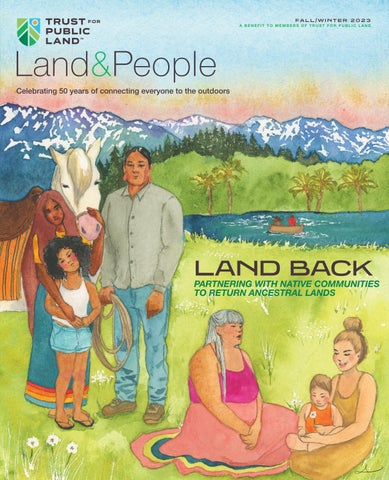
Celebrating Celebrating 5050 years years ofof connecting connecting everyone everyone toto the the outdoors outdoors
Land&People TRUST FOR PUBLIC LAND FA L L / W I N T E R 2 0 2 3
LAND LAND BACK BACK
VOL. 35, Nº2
PARTNERING PARTNERINGWITH WITHNATIVE NATIVECOMMUNITIES COMMUNITIES TO TORETURN RETURNANCESTRAL ANCESTRALLANDS LANDS
IS NOVEMBER 28 DONATE TO TRUST FOR PUBLIC LAND THROUGH MIDNIGHT ON TUESDAY, NOVEMBER 28, AND WE'LL TRIPLE YOUR GIFT. Your year-end, tax-deductible contribution will aid our efforts to protect our beloved outdoor places and create new ones for future generations. Together, we’re connecting everyone to the outdoors. Thank you for your support!
TRIPLE YOUR IMPACT
adair rutledge
Visit tpl.org/givingtuesday or scan the code to donate today.
A · L A N D & P E O P L E · FA L L / W I N T E R 2 0 2 3
F E AT U R E S K AMIL KR Z ACZ YNSKI/COURTESY OF TIMBERL AND
38
Growing Hope .................................................................................................................. 26 Through land protection, cultural recognition, and historic preservation, we’re working to elevate and celebrate the story of the Black experience
“In order to have the landscape take care of us, we need to take care of the landscape.” ~ LU CA S S T. C L A I R , I N WO R K I N G T O WA R D J U ST I C E FO R N AT I V E P E O P L E S, P G . 5 0
A LY M C K N I G H T
26
IAN MACLELL AN
c o n t en t s
50
in America.
Putting Community at the Center ................................................ 38 From a ski resort in Vermont to a fishpond in Hawai‘i—plus a new community engagement model—local residents are at the heart of all we do.
Working toward Justice for Native Peoples ............. 50 We support returning ancestral lands to Native peoples primarily to right past injustices. In doing so, we also act in favor of biodiversity and climate resilience. T P L .O R G · 1
GIVING GUIDE With a variety of ways to give, we offer something to suit everyone. DOUBLE YOUR IMPACT : In celebration of our first 50 years of connecting everyone to the outdoors, all gifts* made from November 29 through December 31, 2023, will be matched dollar for dollar. Use the handy envelope bound inside this magazine (page 48) to send your gift, and double your commitment during this milestone year. You can also donate online and learn more about ways to give at tpl.org/support. *Excludes planned gifts
Give the Gift of the Outdoors The holiday season is the perfect time to share your love of nature and outdoor adventures with others. Make a difference and honor someone special with a tribute gift.
Grow Your Giving Simplify your charitable giving and meet your philanthropic goals by giving through your donor-advised fund.
Conservation Champions Donate $2,000 or more annually and receive the recognition due a champion, such as invitations to special events and insider updates on our projects. Call 415.495.4014 or email champions@tpl.org to learn more.
Leave a Legacy Consider including us in your will or estate plan, learn about the benefits of designating retirement funds to TPL, and explore other taxwise ways to give. Call 202.856.3748 or email plannedgiving@tpl.org to learn more.
Scan with your mobile device's camera to make a gift today! Trust for Public Land depends on your support. You make our work possible. tpl.org/support 2 · L A N D & P E O P L E · FA L L / W I N T E R 2 0 2 3
DE PA R T M E N T S
strengthen community bonds and improve lives.
12
18
L AUR A BARISONZI
Fifty years in, TPL’s work continues to
M A R LY S E D U G U I D
From the President · 11
c o n t en t s
Retrospective · 12 Two members of the TPL community take on challenges inspired by our 50th anniversary.
Board Spotlight · 16 Get to know Ted Roosevelt V.
First Look · 17 Community gardens grow more than food; parks as tools for equity and know info on new federal conservation funding.
Member Center · 62 Offices · 63
22
A LE X DIEK M A NN
climate resilience; and need-to-
Trail’s End · 64 We’re closing our golden anniversary with the words of those who know TPL best.
on t he cove r
In this issue’s cover story, learn how TPL is helping return land to Indigenous stewardship across the country (page 50). About the artist: Aly McKnight is a Shoshone-Bannock artist and self-proclaimed lover of “big Indigenous energy.” Her work has appeared in Teen Vogue, IllumiNative, and the Wall Street Journal and will soon be featured in The Gift of the Great Buffalo, a children’s book by Carole Lindstrom. T P L .O R G · 3
4 · L A N D & P E O P L E · FA L L / W I N T E R 2 0 2 3
c o n t en t s
Meadowood Simsbury, Connecticut In 2021, TPL helped protect the former tobacco farm where a young Martin Luther King Jr. worked for two summers during his college years. In letters home, King described the experience as liberating and later traced his calling as a minister “to the summer of 1944 when I felt an inescapable urge to serve society.” Now that story—and the land—is permanently protected. Read more about TPL’s work to preserve sites important to Black history and culture in this issue.
26
KESHA L AMBERT
Page · 26
T P L .O R G · 5
6 · L A N D & P E O P L E · FA L L / W I N T E R 2 0 2 3
c o n t en t s
Katahdin Region Maine Few things in life are as peaceful as the mirror-flat reflection of a gorgeous landscape in a lake at dawn. This rosy view of Katahdin or Ktaadn—which translates to “greatest mountain”—is in the heart of the Penobscot Nation’s ancestral and current homelands. Today, TPL is working with the Penobscot community to return nearly 30,000 acres near Katahdin to their stewardship. Learn about TPL’s Tribal and Indigenous Lands work, past, present, and future, in this issue.
50
JERRY AND MARCY MONKMAN
Page · 50
T P L .O R G · 7
8 · L A N D & P E O P L E · FA L L / W I N T E R 2 0 2 3
c o n t en t s
Olympic Sculpture Park Seattle, Washington In Seattle, a once-contaminated stretch of waterfront is now a 7-acre public space featuring native plants, salmon habitat, and notably big art. “It could have been gated,” says Martha M. Wyckoff, a northwest advisory board member who helped with the project, “but it’s open and free to the public every single day.” In this issue, hear from other members of the TPL community on what excites them most about our work.
64
ADAIR RUTLEDGE
Page · 64
T P L .O R G · 9
chris bennet t
Lead the Way Become a Conservation Champion and help Trust for Public Land connect even more people to nature. With your annual leadership-level contribution of $2,000 or more, you’ll receive invitations to special events and insider updates on our projects and conservation strategies.
Learn more about the impact you'll have as a Conservation Champion. Contact us at 415.495.4014 or champions@tpl.org.
Stay Connected Join us online for project updates, stunning photos, and inspiring stories. Follow us on social media: @trustforpublicland @TheTrustforPublicLand @the-trust-for-public-land @tpl_org TrustforPublicLand Be sure to tag us in your posts!
Sign up for our emails: tpl.org/email-signup
And listen to our new podcast, People. Nature. Big Ideas. tpl.org/podcast
10 · L A N D & P E O P L E · FA L L / W I N T E R 2 0 2 3
adair rutledge
tpl.org/champions | champions@tpl.org
fro m t he pr es id en t
nichol as lea bruno
HONORING HISTORY AND MAKING IT Over the past year, I’ve visited more than a dozen TPL project sites, meeting with executive editor & publisher
Jennifer Ramsey editorial director
Deborah Williams managing editor
Amy McCullough s ta f f w r i t e r s
Lisa W. Foderaro Amy McCullough Geneva Vest designers
Rachel Andrade Miya Su Rowe Ben Whitesell media production manager
Elyse Leyenberger
© 2023 Trust for Public Land. All rights reserved. 10-Minute Walk, Community Schoolyards, Conserving Land for People, Conserving Nature Near You, Creating Parks and Protecting Land for People, Fitness Zone, Land for People, Land&People, LandVote, Northwoods Initiative, Our Land, Outside For All, Parks for People, Parks Unite Us, ParkScore, The Trust for Our Land, Trust for Public Land, TPL, and all other names and logos of Trust for Public Land programs referenced herein, as well as their logos, are registered or common-law trademarks of Trust for Public Land.
hundreds of partners, supporters, and donors who make our work possible. Every time I set foot on a TPL project, I witness joy, well-being, and community cohesiveness. I’m reminded why we’ve spent 50 years striving to connect everyone to the outdoors. In April, I joined orator Donivan Brown for a tour of a ravine filled with unmarked graves in Red Bank, Tennessee. He shared the emerging story behind the century-old, forgotten burial ground, rediscovered during our work to create the White Oak Connector Trail (page 26). Walking up the steep hill, I was moved by the histories of hundreds of Black Americans who helped make the city what it is today. By helping uncover, restore, preserve, and interpret their contributions, we’re joining the effort to bring the area’s full history and identity to light. Later that month, U.S. Secretary of the Interior Deb Haaland recognized the significance of TPL’s expanded tribal and Indigenous work. Through our partnership with the Bureau of Indian Education, we’re working to create nine new tribal Community Schoolyards® projects that will benefit kids and their communities (page 57). We’re advancing new opportunities to partner with tribal communities, such as the Upper and Lower Sioux and Mille Lacs Band of Ojibwe in Minnesota, in their efforts to restore their ancestral homelands and create educational spaces that reflect their rich history and culture (page 50). These places matter, not just to Black and Indigenous people but to everyone. When we work together to conserve them, we mend and build bridges where there have been historic divides. We learn as part of that process, strengthening bonds and fostering understanding. It’s easy to think—and therefore be discouraged— that complex, global problems like climate change, political division, and democratic erosion can only be corrected with global-scale responses. But I take great solace and hope in this: park equity is a form of social, racial, and climate justice. TPL’s work is a vital part of the solution (page 20).
Can a community schoolyard solve global warming? Not on its own. But our nation’s public schools sit on 2 million acres of land. Transforming asphalt playgrounds into greener, healthier spaces means millions of people will be more resilient to heat and flood risks. We won’t erase decades of inequity and disenfranchisement simply by building more parks in more places. But we know that when residents in communities like Greeley, Colorado (page 38), are deeply engaged in the process of creating a local park, they often become more connected to each other and more civically engaged in projects and processes that improve the places where they live. That’s why community engagement is so essential to TPL’s success. We have 50 years of evidence that spaces as relatively simple as a neighborhood park, as hyperlocal as a revitalized schoolyard, or as low-tech as a hike or bike trail can materially change the day-to-day quality of life in a community. That matters, and it ripples outward. When we protect green spaces today, we sow the seeds of hope for future generations. For half a century, we’ve protected history, but we’re also making it. As you’ll read in this issue, our focus for the future will remain rooted in our commitment to equitable access to the outdoors. I hope you’ll continue showing future generations that they matter by investing in their communities, their health, and their quality of life through the amazing regenerative, healing, and restorative power of the outdoors.
diane regas president & ceo T P L .O R G · 11
r e t ro s pect i v e
Cheers to 50 Yea Two members of the TPL community take on unique challenges in celebration of our 50th anniversary. By Robyn Castellani
Home Is Where Your Park Is Longtime national and state advisory board member Tom Reeve explores one project for each of TPL’s years—and discovers the power of green spaces from coast to coast. Tom Reeve has been a Trust for Public Land board
And Tom knows that service goes deeper than most would
member for more than 20 years. In that time, he’s heard
imagine. Time and again, he’s seen TPL’s impact in action as
probably thousands of stories about parks, and he’s visited
kids gather under cooling shade trees for outdoor lessons,
hundreds of TPL parks in person. For TPL’s 50th anniversary,
race across green infrastructure elements designed to protect
he wanted to go a little deeper.
their neighborhoods from flooding, or—in this case—play on
“I’d spent so much time reading old stories, talking to people who had been project managers, hearing about new
equipment specially themed to mimic famous New York architecture.
places,” he says. “I wanted to see some of them for myself.” So Tom spent the first five months of this year visiting 50
CLINTON COMMUNITY GARDEN | NEW YORK, NY
TPL projects, mostly on the East and West Coasts. “Each visit
In 1981, Clinton Community Garden was a small garden lot
was different,” he says. But in the end, they all taught him the same lesson: parks feel like home.
MANHATTAN SCHOOLYARDS | NEW YORK, NY
surrounded by abandoned buildings in Hell’s Kitchen. The community wanted to save the space from commercial development but didn’t have the resources to buy the land on their own. So they purchased it, with TPL’s support, literally
Tom visited a range of sites owned and stewarded by urban
one square inch at a time, with people around the country
land trusts. “We invented the concept of an urban land trust
donating $5 for each incremental piece of land.
because it was needed,” Tom says, referring to TPL’s early
“Every single community garden that we developed really
work securing vacant lots in cities and working with
has its own story,” remembers Lisa Cashdan, a former TPL
residents to turn them into community green spaces.
staff member instrumental in this early urban project. “What
Now, TPL is helping turn a different form of existing urban
TPL has done best, whether it be urban or rural, is to really
space, elementary school playgrounds, into flourishing
harness the energy of local leadership and people who care
neighborhood parks that stay open to communities after
about where they live to try to improve it.”
school hours. Tom was struck by that when he walked past
Forty years later, Tom found the garden thriving, a
Manhattan’s Chelsea Prep, one of more than 200 TPL
perpetual green space in the center of Manhattan. It offers
Community Schoolyards® projects in New York City.
sanctuary for flowers, birds, and honeybees—and people, who
He was drawn to the towering buildings around the park.
today submit postcards in order to be put on the waitlist for a
“They were large public housing projects,” he says. “You could
sacred patch of green to tend. (Read more about TPL
see the number of people being impacted by this green space.
community gardens on page 18.)
This was the core of New York being served.”
12 · L A N D & P E O P L E · FA L L / W I N T E R 2 0 2 3
j o h n w i s n i e w s k i / f l i c k r ( c c b y - n d 2.0 )
steve
horn
snoho
mish c
ounty
pa r k s
ars of TPL History a waits at Na Heritage Barn nort kashima h of S ea tt le.
y, wife, Sall ve and his Island z e p Tom Ree o L n home o . et Sou n d near their ton’s Pug g in h s a in W
arden ommunity g courtesy o
f clinton c
a l e x a h oy er
Stonewall National Monument flies pride flags on a sunny day in Greenwich Village.
A green-clad pe rgola flourishes at Clinton Community Ga rden in Hell’s Ki tchen.
® t at Schoolyards projec TPL’s Community y arb ne s rve nhattan se Chelsea Prep in Ma . nts de stu as ll residents as we
T P L .O R G · 13
STONEWALL NATIONAL MONUMENT | NEW YORK, NY
COTTAGE LAKE PARK | WOODINVILLE, WA
Parks are places that remind us where we come from. Brent
Cottage Lake Park east of Seattle used to be a lakeside resort,
Leggs, a member of TPL’s Black History and Culture Advisory
“one of those classic early-20th-century resorts on a lake with
Board, talks about parks as another form of storytelling.
boats,” says Tom, “where you spend your weekend.” It’s the
“I think a big part of our work is to stimulate curiosity,” he
type of place where you might have made memories fishing
says, “to understand that we must visit these kinds of spaces
with your family, rowed your own boat for the first time, or
if we want to fully understand the full history of our nation.”
got the courage to jump off the swim platform and felt the
On his TPL 50th anniversary quest, when Tom passed
cold rush of swimming up from below, years ago. As Happy
through Christopher Park, the green space across the street
Haynes, a TPL national board member, puts it: “Parks are
from the Stonewall Inn, it was bustling. Tours were being
narratives of people’s lives.”
given, and visitors were attentively reading and talking about what happened on the land beneath their feet. When we preserve a park, as Leggs notes, we preserve
Like many such places, Cottage Lake Park fell into hard times. It was in danger of being sold, turned into private property or commercial development. But in 1990, TPL
more than land. Tom saw that in action at Stonewall National
stepped in and saved the park for good. Now it offers all of
Monument, where TPL facilitated property negotiations. The
the above as well as summer camps, free community
site offers not just history around the LGBTQ+ movement; it
concerts, and even a high ropes course. This May, when Tom
hosts festivals, educational workshops, and art exhibits.
visited near the end of his 50-projects-for-50-years tour, he
“It made me proud to realize I was part of an institution that
saw “an incredibly vibrant park,” alive with activity. “Kids
could help give visibility and prominence to such important
were swimming in a really cold lake. I can’t imagine they
places,” says Tom.
were having fun,” he adds with a laugh. This park is one of thousands we, as TPL supporters, have
NAKASHIMA HERITAGE BARN | SNOHOMISH COUNTY, WA
created together, and one of thousands still to come. But for
Tom found the next story nearly by accident, starting with a
docks are more than just a park. They're home.
those kids, the cold water, the fresh air, and the bobbing
dot on a map in a rural area off Route 9 in Snohomish
Nakashima, who were among the earliest Japanese farmers in the area. The Nakashimas operated a dairy farm until 1942,
photogr ap
He found a lovely trailhead, part of a greenway. And he found something else: the story of Kamezo and Miye
r o b w at t s
when I got there,” he says.
hy
County, Washington. “I had no idea what I was going to find
when, like many other Asian Americans, they were forcibly placed in an internment camp during World War II. In 1997, TPL helped purchase the farmland and its prominent red barn, which is on the state’s heritage barn register—the first and only belonging to an Asian American farming family. Situated at the head of the Snohomish County Centennial Trail, the site is now a park. Today, as you walk or ride a bike along the path, you can stop and pay witness to the red barn that still stands, as well as a “history quilt” with photos of the farm and area throughout the years. More historical background is offered along the trail. “A long and painful story is interpreted at that site,” says Tom. But it’s a story that deserves telling.
14 · L A N D & P E O P L E · FA L L / W I N T E R 2 0 2 3
A peaceful mor
ning at Cottage Lake Park in Washington State.
br andon loo
Nature Fast and Slow TPL staff member Walker Holmes is biking and hiking 50 miles each in honor of our 50th anniversary. In celebration of TPL’s 50th president of the mid-Atlantic
uguid
region, and Connecticut Advisory
m a r ly s e d
anniversary, Walker Holmes, vice
Board Chair David Berkowitz organized a bike ride in partnership with the East Coast Greenway Alliance. “It took on a lot of
Walker Holmes (right) and fellow cyclists Lisa Dahill (center) and Scarlett Buckman on the East Coast Greenway.
momentum that none of us expected,” Walker says. They hosted the ride on National Trails Day (the first Saturday in June),
changing over time. We
and “suddenly it turned into a 50-mile
talked about ash trees and
ride with 150 people,” says Walker. Their
their demise due to the
path traversed a portion of the 3,000-
emerald ash borer,” says
mile East Coast Greenway, a 14-mile chunk of which—Maryland’s Gwynns Falls Trail—TPL helped secure in 2004. Hop River State Park Trail, Charter
) and TPL’s Duguid (left ut Dr. Marlyse a Connect ic about to hike es m ol l. H ai r Tr an Walke e Appalachi sect ion of th
Oak Greenway, and Air Line State Park Trail all figured in, with much of the route covering rail trails, recreation corridors that repurpose defunct railways. “I had no idea how beautiful it would be,” remarks Walker. Struck by the experience, she decided to continue the
Walker. The latest challenge, she learned, is beech leaf disease, which foresters estimate will adversely affect all
beeches in the forest by the end of next year. It’s a sad reality—and all the more reason to get outside now. “We can’t control time. We’ll never conquer our to-do list,’ says Walker. “It’s about accepting that and making choices accordingly.” Already, she’s grateful she decided to devote
celebration. But this time, she would spread it out. Instead of
some of her time to walking in nature with others—a perfect
biking 50 miles, she would walk 50 miles along Connecticut
way to honor TPL, an organization that champions
sections of the Appalachian Trail. And rather than tackling it
connecting everyone to the outdoors.
all in one day, she decided to do it gradually. “Fifty miles is not that long,” she says, “but I’m spreading it
“Being in that forest with Marlyse, seeing it through her eyes, changed the way I experience it,” says Walker. “The
out over a long time with a lot of people.” She went on her
next section I walk, I will notice if there’s a fourleaf
first hike in June with Dr. Marlyse Duguid, a professor at Yale
milkweed on the side of the trail. Last week I wouldn’t have
School of the Environment, and has completed about 20 miles
noticed, but next week I will.”
as of September. “As an ecologist, Marlyse knows more about
Follow Walker’s journey on Instagram @walkerholmesct,
plants than any human I have encountered,” says Walker. TPL has helped protect 319,000 acres of Appalachian Trail
#WalksWithWalker.
landscapes since its first AT project in 1977. Of the section she walked with Duguid, Walker says, “It’s greatly overlooked by many outdoor enthusiasts; they wouldn’t think of this section of the AT as rugged or interesting or beautiful,” but it is. Even Walker came to appreciate new things about it. “We talked about forest dynamics, how forests are
Robyn Castellani is a thought leader in behavior change and social marketing. Her firm, Castle & Spark, is built on a lifelong passion for science-driven storytelling. Her favorite park from childhood is Lullwater Preserve at Emory University in Georgia. T P L .O R G · 15
Get to Know
boa r d s p ot lig h t
TED ROOSEVELT V remembers his family talking about climate change at the dinner table long before it was an everyday term. As the great-great-grandson of President Theodore Roosevelt, environmental topics at home were commonplace, which is perhaps why his career has always been entwined with conservation. When he’s not volunteering for TPL or as a trustee at the Theodore Roosevelt Presidential Library, Ted is the managing partner at Redwood Grove Capital, an investment firm for the era of climate change. An avid outdoorsman, he makes time to fish, hike, and enjoy nature National Board with his family. As our 50th of Directors anniversary year comes since 2022 to a close, we asked him to envision the future of TPL.
c o u r t e s y o f t e d r o o s e v e lt v
Board of Directors
Ted Roosevelt V
chair
Lucas St. Clair Luis Benitez J. Franklin Farrow Mickey Fearn Jody S. Gill F. Whitney Hatch Allegra “Happy” Haynes Ben Jealous Jennifer Jones Chris Knight Christopher G. Lea Joseph E. Lipscomb Eliot Merrill Ignacia S. Moreno Caroline P. Niemczyk Michael Parish David Poppe Thomas S. Reeve Diane Regas Laura Richards Ted Roosevelt V Lex Sant Sheryl Crockett Tishman F. Jerome Tone Taylor Toynes Keith E. Weaver Susan D. Whiting Florence Williams Kenneth Wong
Describe a moment that exemplifies why you contribute time and energy to TPL. I knew about TPL and their great work for years, but it was not until I moved to Brooklyn that I really started to appreciate what made them unique. My children and I often went to the local schoolyard because it was the nearest green space to our house. I knew TPL had helped develop it, but it was not until I was working with TPL that I learned the playground renovation was also done with an eye toward improving the city’s climate resilience, and that it was part of a larger system of parks in Brooklyn designed toward this goal. It was then that I started to understand the scope of TPL’s work. What speaks to you about our mission to connect everyone to the outdoors? I’ve worked with a wide range of conservation groups for decades now, and many struggle to connect to new audiences. People that did not grow up spending time in nature are sometimes seen as beyond the reach of conservation groups. TPL’s efforts to meet people where they are, whether rural or urban,
16 · L A N D & P E O P L E · FA L L / W I N T E R 2 0 2 3
has been instrumental in bringing everyone into the fold. TPL’s work serves underrepresented communities. It’s not just the right thing to do; it is critical to broadening support to continue protecting our natural resources. What are you most looking forward to achieving with us in the coming years? TPL’s work over the last 50 years has had a huge impact on millions of Americans. But the fact is, the next 50 years are going to be even more important and impactful. Increasingly, we—myself included—are disconnected from nature. We live our lives in more urban areas, and much of it can be looking at our screens. This has numerous adverse effects. TPL’s unique ability to develop and protect green spaces is critical: it increases park access for everyone, strengthens our climate resilience, builds stronger community spaces, and improves our physical and mental health. It’s going to be amazing! le a r n m or e @ TPL.ORG/BOARD/ TRV
First Look
T U R N T H E PAG E FO R : Gardens That Grow Community Parks for All People Historic Conservation Funding
When author Sandra Cisneros wrote, “You can never have too much sky,” she could have been describing the view from Fishers Peak in Trinidad, Colorado. Protected by TPL and our partners at The Nature Conservancy and conveyed to Colorado Parks and Wildlife in early 2020, the 19,000-acre landscape is now a state park serving residents who have long considered the iconic mesa a symbol of home. The park provides access to biking, hiking, climbing, and breathtaking panoramic vistas. bergreen photogr aphy
Read about our Parks initiative on page 20. le a r n m or e @ TPL.ORG/FISHERS
T P L .O R G · 17
fo o d & d r in k
e arly street communit y garden morristown , new jersey
Greater than the Sum of Its Plots A community garden provides more than sustenance; it brings people together, facilitates food sovereignty, and assuages climate anxiety. By Geneva Vest
It was a strange summer for Early Street Community Garden. In Morristown, New Jersey, where the garden is located, heavy rains fell in May and June, drenching raised beds that
Today, the garden has over 100 plots, and as Alexander
struggled to dry out beneath skies made hazy from forest
puts it, “every plot has a story.” Towering sunflowers, vines
fires in eastern Canada.
festooned with tomatoes, and small pots containing seedling
Midsummer days were reminiscent of the tropics: the air
experiments tell the stories of local families with a place to
was hot and thick with humidity until around 2 p.m., when
cultivate both healthy foods and a connection to the land.
condensation gave over to a spurt of heavy rain. Even if you’re
Morristown is an affluent town in central New Jersey with
not going out every day to tend a garden, climate change felt
a growing population of immigrants, predominantly from
especially visceral this summer.
Latin America. The garden is an important place for parents
But the intimacy that Early Street gardeners have with the
from more agrarian countries to continue the legacy of
changing climate is inextricably tied to their plots, which
working the land with their children. Grow It Green Morris-
despite everything, were flush with fruit on a July visit. Lisa
town does extensive community outreach to ensure the
Alexander, executive director of nonprofit Grow It Green
garden is not just physically accessible, but culturally accessible
Morristown (GIGM), plucked a raspberry that was so red and
for neighbors who are foreign born, neurodivergent, low
perfectly faceted it could have been a precious jewel. The
income, and other demographics that are often not represented
raspberry was grown by community member Jenn Ponder, a
in community gardens. You see the effort pay off not just in
longtime gardener and local chef (see recipe, right).
the diversity of gardeners, but in the expression of plant
Grow It Green Morristown started in 2009 when three local
preferences, methods for growing, even garden decorations.
women turned a vacant lot into what is now Early Street
At just 1 acre, Early Street is greater than the sum of its
Community Garden. For several years, neighbors gardened
plots. A small public space carved into the entrance of the
under precarious conditions, cleaning and stewarding land
garden is meant to draw in passersby, including the 400-plus
that the owner planned to eventually build on. In 2013, the
students who walk by on their way to nearby Morristown
lot was slated to become multifamily housing, but residents
High School and residents of the low-income senior living
rallied to preserve the garden and locate housing elsewhere.
facility next door. This way everyone can enjoy the calm
TPL coordinated public and private fundraising for the $2.1
gardeners feel while tending to their plots.
million land purchase; the town now owns the lot and has been leasing it to GIGM for over a decade. 18 · L A N D & P E O P L E · FA L L / W I N T E R 2 0 2 3
The garden was designed by one of its founders, landscape architect Carolle Huber, and at its heart is a rain garden,
COURTESY OF GROW IT GREEN MORRISTOWN
Jenn Ponder’s Garden-Fresh Braised Greens
disguised as a beautiful eruption of native grasses and flowers. This low-set area helps collect and infiltrate stormwater runoff. Early Street is also designed to attract and support pollinators, which helps all of the plots thrive. “We have so many flowers and pollinators,” says Alexander; “there’s a whole community.” From the start, the garden was meant to be a place for people to meet who otherwise wouldn’t have had the chance. “The garden was just the tool we used to create community,” says Huber—and the tool appears to be working. Cricket Vander Ploeg, a recent Morristown graduate, was part of an immersive environmental science class that held classes in the garden. A bilingual high school class would occasionally overlap with hers, and though there was a language barrier, the two groups communicated through the shared language of heaps of vegetables. “We wouldn’t have ever met if it weren’t for the garden,” says Vander Ploeg. Gardening has also relieved some of the climate anxiety affecting Vander Ploeg’s generation, which is often made to feel like climate change is their problem to solve. One day, she came back to the garden after a long weekend to find her class’s seedlings transformed into a veritable wall of green.
•
2 tablespoons grapeseed or safflower oil
•
3 chicken sausage (or chorizo) links, casings removed (meat optional)
•
2 medium cloves garlic, roughly minced
•
1 cup+ chicken or vegetable low-sodium stock
•
1 (15.5-ounce) can cannellini beans, rinsed
•
1 medium bunch braising greens—pick one or use any combination of red Russian kale, Vates blue curled kale, Swiss chard, broccoli leaves, or mustard greens—chopped into bite-sized pieces
•
1/4 cup dry white wine
•
Salt, pepper, and crushed red pepper to taste
•
Pecorino romano or feta cheese to taste
Place one tablespoon of oil in a sauté pan and heat over medium-high heat. Once the oil is hot, add the sausage. Break the links into smaller pieces as they cook. Once the sausage is browned, remove it from the pan. Add the remaining tablespoon of oil and diced garlic, being careful not to let the garlic burn. Pour in a cup of stock once the garlic is fragrant. Turn the heat to medium-low and let the liquid come to a simmer, then add the cannellini beans. After about 5 minutes, add the chopped greens and cook until wilted. Return the cooked sausage to the pan and add a bit more stock if the pan is getting dry. After cooking for another 5 minutes, add wine, salt, pepper, and red pepper flakes. Stir to combine. Garnish with shredded pecorino romano or crumbled feta cheese. Serve with grilled crusty bread, on top of rigatoni, or eat as is.
“It was a little crazy to know that we were capable of doing that,” she says, adding, “Seeing this gave me a little bit of
Recipe courtesy of chef Jennifer Ponder, Early Street gardener and owner of B.L.L. Culinary Gardens.
hope.” Now, Vander Ploeg realizes it’s not her versus climate change. She has the garden on her side. le a r n m or e @
TPL.ORG/EARLY-ST s e to r y/i s to c k
F I R S T L O O K · 19
jason flowers
ini t i at i v e : pa r ks
Parks as a Green Solution How TPL’s Parks initiative is using green spaces to improve lives. By Tianna Faulkner Parks have the power to improve lives, but too few exist.
across the country within the next five years, a goal she
And even those that do are often underutilized due to lack of
expects to meet and exceed. “Each of these green space
amenities, safety, or accessibility. Trust for Public Land has
projects demonstrate innovative practices, always working
created thousands of parks, trails, schoolyards, and iconic
with community members—and especially those historically
outdoor places since its founding in 1972. And since the begin-
excluded from decision-making,” she says. “Our Parks
ning, TPL has focused on ensuring green spaces are nearby.
initiative works across sectors and with communities to find
Thanks to this work, more than 9 million people have a
creative solutions for increasing park equity. We listen and
green space within a 10-minute walk of home.
find out what people want and need in their green spaces—
However, TPL’s research on park availability shows that 100 million people in the United States still lack access to parks.
and pursue collaborative and partnership-focused projects.” A great example is TPL’s South Oak Cliff Renaissance Park
And low-income neighborhoods and systemically under-
(above) in Dallas, Texas, where residents were deeply involved
resourced communities of color have access to significantly
in the park’s design. The park opened in 2021 and is the first
less park space than residents of high-wealth, majority white
to be completed in TPL’s Five Mile Creek Greenbelt effort.
neighborhoods.
Trust for Public Land worked with the City of Dallas on a
This is why TPL prioritizes park equity and focuses on
master plan for the greenbelt, which identified three park
community-centered places that provide diverse experiences
projects to be connected by 13 miles of trails within the city’s
and benefits. “These are places to relax, exercise, connect
historically underserved southern neighborhoods.
with neighbors, express ourselves, and explore nature within
Community member Randy Bowman, founder of
walking distance of home,” says Bianca Shulaker Clarke,
educational nonprofit At Last!, which neighbors South Oak
TPL’s Parks initiative lead and senior director of the 10-Minute
Cliff Renaissance Park, says everyone occasionally needs to
Walk® program.
“take a step away, go outside, recenter, recharge your batteries,
To accelerate park access around the U.S., Clarke says TPL is working with communities and cities to create 35 parks 2 0 · L A N D & P E O P L E · FA L L / W I N T E R 2 0 2 3
come back with a clean palette.” Once complete, the greenbelt network will provide 10-minute-walk access to
er
gryd ta n y
brit
We listen and find out what people want and need in their green spaces—and pursue collaborative and partnership-focused projects.” — Bianca Shulaker Clarke, TPL Parks initiative lead more than 56,000 people, including 22,000 who previously
used as a benchmark
lacked a close-to-home park.
on progress being made.
Of course, none of this is achieved without funding—and a
The index provides a
lot goes into the cost of building a park. Funding can come
data-driven view of our
from any combination of local and government sources. One
cities’ park systems, which
challenge, Clarke says, is that city leaders and community
helps identify where
members have numerous important priorities, such as
improvements are needed.
improving affordable housing, health equity, and economic
Climbing boulders are among the features residents envisioned for South Oak Cliff Renaissance Park in Dallas.
“TPL works with cities and communi-
development. The truth, however, is that quality green spaces
ties to take a comprehensive look at what park
work in tandem to achieve all of these goals.
equity means—and to create action plans,” says
San Francisco’s India Basin Waterfront Park, for example,
Clarke. And she stresses the urgency of her team’s work:
is environmental justice in action. As part of its Equitable
“Communities without parks are often the same as those at
Development Plan, the park is being developed with local
the highest risk for environmental disasters. Parks are
communities in an effort to minimize gentrification and
needed in places that experience health and societal chal-
displacement. And residents of the nearby Bayview–Hunters
lenges and require creativity and commitment to create,
Point communities will also profit from the park profession-
maintain, and sustain.”
ally, as the plan includes job training for those interested
Sometimes that means putting green spaces in unexpected
in careers as laborers, with project-specific opportunities
places, such as alleys, as TPL has been doing for years in Los
prearranged with local unions and contractors. “If you don’t
Angeles. Resident and community volunteer Sonia Rodriguez
address equity, you’re not going to move the needle on climate
says the green alleys in her neighborhood—which repurpose
or environmental justice,” says Jackie Flin, executive director
public space and manage stormwater with green design
of the A. Philip Randolph Institute San Francisco, one of TPL’s
elements—make it easier for her family to leave the car at home.
many partners on the project.
“We can walk to the store, or go running and biking,” she
But cities need information to help understand what steps
explains. “We can just sit and read with our kids. Our house
to take. TPL’s annual ParkScore® index—which ranks park
doesn’t have a yard, so the alley is like our own little park.”
systems in the 100 most populous U.S. cities according to
Cases like hers support TPL’s belief that improving and
equity, access, investment, amenities, and acreage—is often
building parks will create the best outcomes for communities in America—now and in the future. Challenges exist, to be sure. But Clarke puts it quite simply: “Parks are powerful,
Volunteers add greenery to a renovated alley in Los Angeles.
a key part of the solution to today’s most pressing issues.” To find a TPL park in your area, visit tpl.org/our-work. For more
annie bang
on our community-centric approach, turn to page 38.
Tianna Faulkner is a freelance journalist based in Atlanta, Georgia, where her favorite park is Piedmont Park. She covers arts and entertainment, business, health, and lifestyle features. Her work has appeared in the Guardian, BET.com, Atlanta magazine, the Atlanta Journal-Constitution, and the Atlanta Voice. T P L .O R G · 2 1
andrew propp
in s ig h t
Making the Most of Historic Funding TPL is leveraging federal conservation funds like never before. Lisa W. Foderaro
These are exciting times in the field of conservation. In the past two years, Congress passed a pair of historic bills: the Bipartisan Infrastructure Law (also known as the Infrastructure Investment and Jobs Act) and the Inflation Reduction Act (IRA). Together, they channel billions of dollars into conservation and park creation. Those two laws come on the heels of another momentous
the grant programs are targeted to
boost: in 2020, Congress fully and permanently funded the
communities generally left behind. Many
Land and Water Conservation Fund—for decades, the
cities, towns, and Native communities don’t have
centerpiece of conservation financing—at $900 million a
lobbyists in Washington, and they don’t get in line for
year. Thanks to your support, Trust for Public Land staffers
federal grants. But there is language in both of these
are busy leveraging the new funds for scores of projects
programs that says they are designed for under-resourced
around the country, from parks and schoolyards to trails
areas. So it’s a perfect marriage of our mission to get parks
and forests. We sat down with Bill Lee, TPL’s senior vice
and trails to the communities that stand to benefit the
president of policy, advocacy, and government relations, to
most.
learn more.
The Bipartisan Infrastructure Law and Inflation Reduction Act, the latter considered the nation’s first real climate legislation, finance programs across many sectors of society. Can you explain how the two laws support the work we do at Trust for Public Land? We are living in a really special moment right now for conservation and equity. The Bipartisan Infrastructure Law and the IRA provide historic amounts of funding. We estimate there’s about $18 billion between the two that we could potentially tap for our projects and for our partners. Of course, other organizations are applying for that as well. But this is a once-in-a-generation influx of money, and it’s for our mission writ large—parks, trails, land conservation, and climate resilience.
Can you talk about some of the funding TPL has tapped through the Bipartisan Infrastructure Law? A good example is the Five Mile Creek Greenbelt in southern Dallas. There is a great trail system in Dallas, except for southern Dallas, where residents are predominantly Black. But now there is a planned trail there that would connect communities and parks as well as bus lines, a university, and a couple of schools. We are using funds from the Department of Transportation’s RAISE program to plan and build this greenway. We just got the first grant, which is for $6.5 million. Most of the department’s budget is for highways and bridges. But there is a large amount for getting people off the road and onto trails. For TPL, that means pedestrian and bike trails, especially in neighborhoods that don’t have them. Similarly, in New York State we just received $3.8 million for the
You mention equity, which is one of TPL’s core commitments. How do the new laws address that?
planning of the Long Island Greenway. Getting these two
One of the things that makes this really exciting is that
Creek Greenbelt.
2 2 · L A N D & P E O P L E · FA L L / W I N T E R 2 0 2 3
grants was just a home run. See page 20 for more on the Five Mile
This is a once-in-a-generation influx of money, and it’s for our mission writ large—parks, trails, land conservation, and climate resilience.”
by t he n umb er s
Trust for Public Land’s work has major climate benefits, including:
— Bill Lee, TPL senior vice president of policy, advocacy, and government relations
174.8 MILLION
Trees not only make communities more resilient in the face of climate change, but forests absorb and store carbon dioxide. Is there new money for forest protection?
metric tons of carbon stored by lands TPL has protected, equivalent to emissions from over
Yes, absolutely. Under the Inflation Reduction Act, there is an additional $700 million over 10 years for the Forest Legacy Program. That’s a huge increase. The Forest Service has announced a plan to spend the new
72 BILLION GALLONS of gasoline
money on once-in-a-lifetime keystone projects, as well as funding tribal forest conservation efforts. We have several we would love to see funded in the greater Pacific Northwest and New England.
How is TPL using the new funds to help towns, cities, and rural areas adapt to climate change? The Environmental Protection Agency has a new $3 billion block grant program for environmental justice. We’re going to use those grants to help communities become more resilient. Parks and Community
724,000 METRIC TONS
Schoolyards® projects can cool neighborhoods and prevent flooding with trees, rain gardens, and absorbent playing fields. There’s also $1.5 billion from the Forest Service’s Urban and Community Forestry Program. A lot of that is going toward tree plantings in cities, especially in redlined
of additional carbon stored by these lands each year
neighborhoods. We’ve been awarded a $10 million grant, most of which will support community partners working on greening schoolyards to create tree canopy and cooling effects. That will pay for a lot of trees!
All of this follows another big victory—the full and permanent funding of the Land and Water Conservation Fund (LWCF). What impact is that having on our efforts to make sure highneed communities have access to parks? The Land and Water Conservation Fund is the cornerstone of
99,734 ACRES
conservation. Much of the $900 million is for big landscape protection, which is foundational to what TPL does. But there is another part of LWCF, called the Outdoor Recreation Legacy Partnership (ORLP), that
of floodplain protected by TPL within FEMA 500-year flood zones
provides between $100 million and $125 million a year to parks in under-resourced cities. In fact, TPL helped create ORLP. We noticed that LWCF grants were mostly going to state parks and forests, and cities were not getting their cut. So we worked with Senator Charles Schumer to carve out a share for park-deprived urban areas. That’s right in our
d i scov er m or e @
TPL.ORG/CONFIN-WINS
jerry monkman
bull’s-eye of 10-minute walk access and close-to-home nature.
le a r n m or e @ TPL.ORG/CLIMATE
FIRST LOOK · 2 3
TRUST FOR PUBLIC LAND would like to thank the following supporters. We could not achieve our commitments to climate, equity, community, and health without their generous financial contributions to our mission and our work. Thank you for helping us connect everyone to the outdoors.
For their partnership and support of TPL’s Community Schoolyards® initiative. Guided by their social purpose platform, Mission Every One, Macy’s has helped transform public schoolyards into community parks nationwide, ensuring healthy, livable communities for generations to come. To date, more than $2.7 million has been raised, directly impacting nearly 5,300 students and providing access to green spaces for over 125,000 community members.
For funding TPL’s On Common Ground program, which is working to enhance social cohesion through community engagement and park-based activities in eight cities across the country—such as the Welcome to Raleigh Parks program in North Carolina— as part of our ongoing commitment to connecting everyone to the outdoors. Read more on page 38.
Community Outreach with Resident Experts Fellowships
Montana Great Outdoors Project
Atlanta, Georgia; Chicago, Illinois; & Los Angeles, California
Northern Rockies
Chattahoochee RiverLands | Atlanta, Georgia Parks & Trails projects | Chattanooga, Tennessee
Community Schoolyards® projects
TPL Trails initiative | Nationwide
New York City & Newark, New Jersey
Community Schoolyards® project
Community Schoolyards® projects
Harold O. Levy School | New York City
New York City & Denver, Colorado
2 4 · L A N D & P E O P L E · FA L L / W I N T E R 2 0 2 3
Here Now Here Always Because of You
ADAIR RUTLEDGE
SHARE YOUR LOVE OF NATURE WITH FUTURE GENERATIONS. Through a bequest, life-income gift, or other taxwise option, TPL can help you secure your financial future and support our shared goal of creating parks, protecting land, and ensuring livable communities for all. Leave a legacy of equity, protection, and community. Leave a legacy with Trust for Public Land. Contact us to learn more: Call 202.856.3748 Email plannedgiving@tpl.org Visit tpl.planmygift.org T P L .O R G · 2 5
HOPE
Places make great storytellers, if we know how to listen. By preserving sites that are significant to Black history and culture in America, we get to hear and experience narratives of celebration and healing, hope and growth. BY AMY McCULLOUGH
2 6 · L A N D & P E O P L E · FA L L / W I N T E R 2 0 2 3
MEG A N LEDBE T TER
Growing
A GROUP OF NEIGHBORS sits at an outdoor table on a pleasantly warm evening in Red Bank, Tennessee, an enclave of Chattanooga. There are cold drinks and light snacks. A leafy tree canopy rustles overhead; ice shifts in a cooler. The scene is friendly and convivial, but when conversation shifts to a gruesome history that lies beneath nearby Stringer’s Ridge, the group struggles to find the right words. Less than a half mile away, in a deep ravine blanketed with invasive kudzu, hundreds of people, mostly Black, were buried between 1890 to 1912—though not all of their bodies remain. “Are there headstones?” someone asks. No, there are not. So “cemetery” feels inaccurate. “What about ‘burial ground’ then?” another chimes in. No, that won’t work either. According to reports some of the group are familiar with, graves were at times covered by only a thin layer of leaves, hardly a proper burial. “Mass grave” doesn’t quite apply, as it evokes images of war. Though the history of this place—known, for now, as “the Field”—is rife with brutality. Bodies were packed in inadequate goods boxes and left exposed, some to be consumed by wild animals; cadaver theft for monetary gain or medical study (or both) was commonplace. The stories
Trust for Public Land first learned of the Field— a place forgotten for 110 years—while building the White Oak Connector Trail. The .8-mile path
connects Stringer’s Ridge, a beloved natural area overlooking Chattanooga and laced with hiking and mountain biking trails, to White Oak Park in Red Bank. Two researchers—one a historian from Georgia, the other a member of the African American Cemetery Preservation Fund—were attempting to locate burial sites connected to their work, believing the graves to be in the vicinity of the White Oak Connector Trail. Their paths eventually converged with TPL and the City of Red Bank. And with that, what began as a relatively straightforward project: creating a trail to connect two parks and two nearby communities, suddenly became a priority on our Black History and Culture roster. For decades, TPL has worked to preserve sites that tell the experience of Black life in America. The Field, we now know, is one of these places. This land was what is often called a “potter’s field” or “paupers’ cemetery,” where residents whose families couldn't afford burial costs were interred. Among them were unnamed infants, industrial laborers, immigrants, and a great many Black Chattanoogans—including Henry Hightower, a veteran of the U.S. Colored Troops, and Alfred Blount, one of two
A M Y MCCULLOUGH
of injustice go on.
A
TRAGIC HISTORY, REDISCOVERED
LOCATION The Field
Invasive kudzu blankets a ravine in Red Bank, Tennessee, where a long-forgotten burial ground was recently rediscovered. T P L .O R G · 2 7
Black men to be lynched on Chattanooga’s Walnut Street Bridge for a crime he didn’t commit. (The other was Ed Johnson, a memorial to whom now marks the south entrance to the bridge.) Their graves are mostly unmarked. Though some numbered cast-iron plates (see right) remain today, the accuracy of their placement is dubious at best. In the words of Maia Council, a research fellow with Middle
The people buried in the Field made Chattanooga what it is. They were the lifeblood of this city.”
Tennessee State University’s Center for Historic Preservation, “The people buried in the Field made Chattanooga what it is. They were the lifeblood of this city.” Undervalued in life
– MAIA COUNCI L , R ESE ARCH FELLOW, CENTER FOR HIS TOR I C PR ESERVATI ON
and mistreated in death, they were the powerful workforce behind the Dynamo of Dixie. “It’s really important to honor them as citizens of Chattanooga,” she says. “Those are your
plications of Black history and culture,” describing it as a
community members.”
piece of land with a “shameful legacy.” But it’s also a project
Dr. Jocelyn Imani, director of TPL’s Black History and
that, with proper support, she believes TPL is uniquely poised to address.
J A DA MS PH OTOG R A PH Y
Culture efforts, sees the Field as an example of “the com-
LOCATION Stringer's Ridge 2 8 · L A N D & P E O P L E · FA L L / W I N T E R 2 0 2 3
Via the White Oak Connector Trail, recreationists can now easily hike, bike, or run from Chattanooga’s Stringer’s Ridge to White Oak Park in Red Bank.
M A RTIN G R A NUM
To that end, TPL is working with Donivan Brown, former
Making it something new is where collaboration, funding,
chair of the Ed Johnson Project and our lead community
and patience are crucial. Imani recognizes that “it’s a jour-
consultant on the Field. He believes “history leads us back to
ney that’s going to take some time.” But she—and everyone
places that inform us in areas that we need to heal as people.”
involved—feels a need to “champion the stories of the dead
Brown is researching those interred at the Field and collabo-
who are there.”
rating with TPL, the Cities of Red Bank and Chattanooga,
Sal Arrigo, chair of the Red Bank Cemetery Citizens’ Advi-
Hamilton County, and the local community to determine how
sory Board, which will eventually help steward care of the
best to restore and remember the site.
site, says stories like these must not be forgotten: “It’s part of
F
our nation’s history, no matter what people try to tell you.”
ROM HORROR TO HEALING
Trust for Public Land’s Tennessee state director, Noel Durant,
“There are wounds, pains, traumas that we as a
feels a deep responsibility toward the land and says he’s been
nation are being haunted by,” says Brown, but
fortified by “the broad base of support” from all sides.
there is hope and “a sense of jubilation” that
“There’s a clear humanity behind it,” says Durant. “When
comes with recognition and healing. He sees his work as a
faced with situations where the dignity of fellow people has
path toward that goal and has even proposed a funeral for
been undermined or completely disregarded, it comes as such
those buried at the Field.
an affront. We can do better.”
“I don’t think we’re a country that processes grief all that
Imani agrees there is something uniquely unifying about
well,” he says. “The way through this as a community is to
the horror of the Field’s story: “When it comes to desecrated
be up front and to process that grief. Having grieved, it will
sacred space, it invokes another modality,” she says. In case of
allow people who want to invest in this to fully engage in the
the Field, that modality is teamwork.
creative endeavor of making it something new.” That new life
At an early meeting to discuss the site’s future, Red Bank
could take many forms, from private tours to interpretative
City Manager Martin Granum recalls there being “a quiet reso-
signage along the trail, to an elevated walkway for visitors to
lution and commitment.” Everyone in the room was on the
pay respects from above.
same page: “We’ll get there. All of us will get there together.” T P L .O R G · 2 9
STE V EN M A RTIN /FLICK R (CC BY-NC -ND 2.0)
A
recognition of painful events is being similarly employed as a
E
means to heal trauma—an approach Lizzie Robinson Jenkins
is using the funds to help the local community envision and
is very familiar with.
design a museum building and grounds that will be sustain-
LIFELONG ASSIGNMENT It’s exactly this type of teamwork and collaboration that TPL is facilitating with its Black History and Culture work nationwide. Take our
Rosewood Museum project in north central Florida, where
Jenkins’s purpose started with her mother. While some kids
MPATHY THROUGH EDUCATION Kate Brown, TPL senior project manager for the Rosewood Museum, says the project is “making more progress than ever” since TPL received a
$480,000 grant from the Florida legislature meant for capital improvements related to Black history. Trust for Public Land
able into the future.
receive a recurring list of chores or encouragement to take up
To be located near Gainesville in Alachua County—where
a particular career, Jenkins was given a lifelong assignment—
Carrier and other survivors rebuilt their lives—the Rosewood
at the age of 5—to remember her family’s history and share it.
Museum will be managed in partnership by the county and
That history is embedded in the story of the Rosewood Massacre, in which a white mob decimated a thriving African
the Real Rosewood Foundation. Brown says the goal is to “interpret, remember, and memo-
American town in 1923, forcing those who survived to flee and
rialize” while uplifting the tale of a community that rebuilt
ultimately relocate.
itself. Though rooted in trauma and racial violence, the story
Jenkins’s aunt, Mahulda Gussie Brown Carrier, was attacked
is also one of agency and determination. “The joyful part of
during the raid. But she survived. Carrier’s story was untold
the story is not just surviving but thriving,” says Brown, who
for many years, until Jenkins’s mother shared it with her chil-
marvels at the Rosewood community’s fortitude.
dren. She essentially told them to follow a now-familiar Black Lives Matter creed: “Say her name” and never forget.
Jenkins, who wowed attendees at the National Council of Black Studies conference earlier this year by singing Rose-
Jenkins founded the Real Rosewood Foundation in 2003
wood’s history in the form of a folk song, pictures the museum
and has been working for 20 years to elevate the story of the
as a community gathering space and a safe place for reflection.
massacre and—perhaps more important—the resilience of the
“I’m no longer angry,” says the 85-year-old. “I’m happy because
community and its now far-flung descendants.
so many people have stepped forward and wanted to help.”
3 0 · L A N D & P E O P L E · FA L L / W I N T E R 2 0 2 3
K ATE BROWN R A E RIISK A / THE A LLIG ATOR
LOCATION Rosewood Museum
Lizzie Robinson Jenkins (below) has made it her life’s work to tell the story of Rosewood, Florida.
History is who we are. Good, bad, or ugly, we cannot erase it or change it.” – LI ZZI E ROBI NSON JENKI NS, FOUNDER AND PR ESI DENT OF THE R E AL ROSE WOOD FOUNDATI ON T P L .O R G · 3 1
COURTESY OF N ATION A L PA RK SERVICE
LOCATION Medgar and Myrlie
(above). The site includes a garden dedicated to Myrlie (below). COURTESY OF N ATION A L PA RK SERVICE
Evers Home National Monument
Myrlie Evers (seated) and Keena Nichelle Graham exchange a meaningful glance at the opening of the national monument
3 2 · L A N D & P E O P L E · FA L L / W I N T E R 2 0 2 3
The Real Rosewood Foundation sees remembrance as way to “underscore the urgent need for education, empathy, and justice in our society today.” Jenkins would like to see younger generations visit the museum and learn from the past. “History is who we are,” she says. “Good, bad, or ugly, we cannot erase it or change it.” But we can use it to forge a path to a better future.
B
EING THERE MATTERS
When we set foot in the spaces and places where these stories happened, it allows for reflection on the full truth of history.”
You might wonder: What does Black history have to do with land conservation? In the words
– DIANE R EGAS, TPL PR ESI DENT AND CEO
of TPL cofounder and former president Martin
Rosen, “merely everything.” His thinking—which is mirrored in Imani’s leadership of
TPL’s current Black History and Culture work—is that engaging with all communities in public spaces, indoors and out, enriches everyone’s lived experiences. Imani says we need to meet communities where they are by creating safe gathering spaces such as the Rosewood Museum and the Medgar and Myrlie Evers Home National Monument in Jackson, Mississippi. TPL and the National Park Service celebrated the opening of the latter in June of this year. According to Keena Nichelle Graham, the park superintendent, “Working with a partner like TPL, who understands that community engagement is just as important as getting the physical work done, made all the difference in the world. [TPL staff] treated our neighbors with respect and dignity,” she adds. “I can say without exaggeration that TPL was the alpha and omega for opening the Medgar and Myrlie Evers Home National Monument.” The project is the first in TPL’s Alliance for Civil Rights Historic Sites—where, in partnership with the National Park Service, community advocates, and philanthropic leaders, we’re restoring and investing in historic National Park Service sites across the south, including the Birmingham Civil Rights and Freedom Riders National Monuments in Alabama, the
Trust for Public Land Mid-South Program Director Stacey Shankle says it’s likely tens of thousands of people have already been visiting the home each year, often on buses as part of civil rights tours that have been disruptive to neighbors. Now, thanks to TPL’s conversion of a nearby vacant lot, there’s a proper entry point and room for discourse and contemplation outside the home, which has limited interior capacity. “There’s a hunger for that conversation,” says Shankle. “The impact and lessons the Evers provided us as a country only get amplified from this point forward.” He also notes that the site helps put Jackson on the map when it comes to civil rights tourism, a boon to the local economy—especially in tandem with the Mississippi Civil Rights Museum, which opened in 2017. Designation of the Evers’ home as a national monument by the National Park Service elevates the experience with quality interpretation and on-site experts. So far, “reception from the community has been spectacular,” says Shankle. Diane Regas, Trust for Public Land’s president and CEO, attended the Medgar and Myrlie Evers Home National Monument opening, which took place during the week of the 60th anniversary of Medgar’s murder. Her experience at the site testifies to the importance of physically being there: “When we
Natchez National Historical Park in Mississippi, and others.
set foot in the spaces and places where these stories happened,”
“Places hold meaning,” says Imani of the effort. “They play a
O
critical role in constructing our collective memory and guide what we value as a society.” The Evers’ former home is the site of civil rights leader Medgar Evers’s assassination—a catalyst for passage of the Civil Rights Act of 1964—but the national monument also signifies and celebrates the couple’s legacy of activism and courage, where they organized, as Graham puts it, “a revolution of the soul of this country.”
she says, “it allows for reflection on the full truth of history.”
RDINARY PEOPLE, EXTRAORDINARY LIVES The Medgar and Myrlie Evers Home National Monument celebrates Black culture and the
impact the Evers had on their community in Jackson and beyond. Medgar was the NAACP’s first field secretary for Mississippi.
He also served as program director for the Regional Council of
T P L .O R G · 3 3
Negro Leadership, which encouraged Black voter registration
Graham’s words could be describing another advocate for
and business ownership. Myrlie worked alongside him and
Black Americans: Jesse Allen, a community organizer and city
steadfastly continued their efforts after his death; in fact, she
council member in Newark, New Jersey, who was considered
is still advocating for social justice and racial equity today.
one of the most effective leaders of the Newark Community
The Evers’ home is in the historic Elraine district, the first
Union Project.
neighborhood owned, developed, and designed by African
The NCUP was associated with Students for a Democratic
Americans in Jackson, which is emblematic of the time and
Society, a radical political movement that organized disenfran-
place in which the couple lived. Medgar’s status as a decorated
chised African American communities against discriminatory
World War II veteran helped him acquire a VA loan when
practices in the mid-1960s. Described by community member
many Black Americans were denied mortgages by white-
Edna Thomas as “down to earth and sincere,” Allen was said to
owned banks. The neighborhood’s background is included at
be especially effective because of his ability to relate to others.
the new entry point for the monument, which also includes a garden dedicated to Myrlie Evers. In the words of Superintendent Graham, the site will help
He specialized in tenant organizing, including rent strikes intended to force landlords to repair neglected buildings. He was also said to be a great listener—an aspect mirrored in
people realize that the civil rights movement “consisted of
the renovation of his eponymous park, on which TPL was a
normal people in neighborhoods making things happen.” The
partner. A core tenet of Trust for Public Land’s work is our
Evers raised kids, held jobs, and socialized with their neigh-
participatory design process, where we center residents in
bors—all while “doing extraordinary things,” says Graham.
envisioning what their green spaces can be (for more on our
“I hope to foster an environment that inspires people— regardless of background—to look within their neighbor-
community-centric approach, see page 38). Jesse Allen Park first opened in 1979, but by the time Trust for Public Land got involved in 2009, planning to update it to
tunities to make a positive change,” she adds.
better serve community needs, the park had become an eye-
FR A NCES M. ROBERTS
hoods, within their homes, and within themselves for oppor-
3 4 · L A N D & P E O P L E · FA L L / W I N T E R 2 0 2 3
CHRYSTOFER DAVIS
LOCATION Jesse Allen Park
Once considered an eyesore, Jesse Allen Park now boasts a full-size football field—among many other neighborhood amenities.
sore and was “torn up and dilapidated,” per Donna Kirkland, TPL’s senior director of community engagement in Newark.
A
GREEN SPACE REBORN Three phases and 13 years later, the park’s rebirth was complete. Fully renovated in 2022, it now features a long walking path, facilities for
basketball, volleyball, soccer, lacrosse, and tennis; a full-size (yes, full size!) football field; a playground and multiple seating areas; a skate park—the first in a Newark park; and a Fitness Zone®️ area (see left). Players from the New York Jets and chil-
We have to get outside. We have to breathe fresh air and put our feet in the grass. It is a matter of life and death.” – DR . JOCELY N I MANI , TPL BL ACK HIS TORY AND CULTUR E DI R ECTOR
dren from the nearby Boys and Girls Club of Newark worked
yards—in addition to historic sites. And she emphasizes the
side by side to design the latter, an outdoor exercise space.
importance of time spent outdoors and connecting with
“What I think is important about that park,” says Imani, “is its
neighbors: “There is a kid in some neighborhood who needs
culture. It’s in the heart of a community.”
to come across old men playing chess in their community
The city’s second-largest municipal park, it now provides more than 18,000 people who live within a half mile with easy
park and learn from them,” she says. “They can’t do that if we haven’t built the park.”
access to park space. What’s more, its design incorporates
In most cities, there are fewer and/or smaller parks in
green infrastructure elements that help combat the effects
neighborhoods of color and low-income communities, which
of climate change, such as rising heat and floods. The play-
are often areas that have been systematically disinvested in
ing fields feature a sophisticated stormwater capture system
through redlining or other forms of discrimination. This has
that holds rainwater in underground storage tanks and then
created a gap in park equity that green spaces like Jesse Allen
releases it into the city’s sewer system over time, helping
Park are helping to close.
reduce overflows of untreated water into Newark Bay. Imani sees TPL’s Black History and Culture efforts as encompassing community gardens, urban parks, and school-
“We have to get outside,” says Imani. “We have to breathe fresh air and put our feet in the grass. It is a human necessity, and it is a matter of life and death.” That’s not hyperbole. T P L .O R G · 3 5
K A MIL K R Z ACZ Y NSK I/COURTESY OF TIMBERL A ND
Every place has a story. You find those places and lift them up. We call it the narrative of triumph.” – NAOMI DAVIS, FOUNDER AND CEO, BL ACKS I N GR EEN
Lacking green space has serious consequences to mental and physical health—while access to it has major benefits. Numerous studies have shown that time spent outside is associated with reduced risk of obesity, stress, and depression. Parks also provide a sense of pride and belonging and foster social cohesion, something Jesse Allen championed. He saw that when people came together, change was possible.
S
LOCATION Mamie Till-Mobley Forgiveness Garden Naomi Davis speaks at a community planting event.
TRENGTH IN NUMBERS Naomi Davis, founder and CEO of Chicago-based nonprofit Blacks in Green, also believes in the
lawn neighborhood, invites visitors to heal from decades of
power of united communities—and the role of
painful racism and honors Emmett’s mother, a teacher and
green space in uplifting them. The group is known for its Sus-
advocate for civil rights and children’s education.
tainable Square Mile concept, a model for Black community
It will also serve as an anchor for the Great Migration Gar-
development designed to increase household income and cre-
dens of West Woodlawn to come, which will be dedicated to
ate an oasis of resilience through green economies in energy,
other important figures of the era, such as playwright Lorraine
horticulture, housing, tourism, and waste. Davis says only a
Hansberry and sculptor Richard Hunt.
whole-system solution “can transform the whole-system problem common to Black communities everywhere.”
Trust for Public Land helped with improvements to the TillMobley garden and drew on our Equitable Communities Fund
Blacks in Green relies on synergy between many mov-
and contributions from the Doris Duke Charitable Foundation
ing pieces for its vision of environmental justice and green
and L.L.Bean to purchase two plots for additional gardens near
community development to be realized. Part of that vision
the Till home, which is slated to become a museum, theater, and
includes an ambitious plan to create 16 community gardens
heritage hub under the direction of Blacks in Green.
by the designation of a national monument in their names
P
this summer.)
Davis to ask, “Trick or treat?” Davis did, and O’Boyle surprised
dedicated to luminaries of the Great Migration. TPL helped launch the third of these, the Mamie Till-Mobley Forgiveness Garden, in 2019. Its namesake is the mother of Emmett Till, who, in 1955, was kidnapped, tortured, and killed by white supremacists at the age of 14 while visiting family in Mississippi. (Both Emmett and his mother were recognized
ROPERTY IS POWER Illinois State Director Caroline O’Boyle recalls getting word that TPL was going to provide Blacks in Green with $100,000 to help purchase
the additional lots: “I went to a Halloween event with a mock $100,000 bill in my pocket,” she says. O’Boyle then prompted
In an act of extreme courage, Mamie Till-Mobley famously
her with the funds. “She started bawling,” says O’Boyle. Near-
held Emmett’s funeral with a glass-topped casket, putting the
by onlookers seemed concerned. “No, they’re happy tears,”
brutality of his murder on display for the world to see—and
she recalls with a smile.
be horrified by. The Mamie Till-Mobley Forgiveness Garden,
As Davis sees it, buying land is the most effective means of
which is near the Till family home in Chicago’s West Wood-
combatting wealth disparity and displacement in this country.
3 6 · L A N D & P E O P L E · FA L L / W I N T E R 2 0 2 3
sure there is a through line that connects it,” adding, “the
A
expertise that we bring to bear in completing that initiative
ted in Chattanooga, Rosewood, Jackson, and across our coun-
is really exciting.”
try, we can move forward with acknowledgment and respect.
“You must buy the land,” she says. “Nothing trumps ownership of the land. We have enough money if we work together—and with friends like TPL.” In addition to assisting with property acquisition, O’Boyle views TPL’s role in the garden series as “making
She also mentions a possible opportunity to help advance
PATH FORWARD Back in Tennessee, the stories of the Field are still being uncovered. Donivan Brown says the dead don’t ask for
anything. But they deserve something: “a solemn place left free of violation.” While we can’t undo past wrongs commit-
On another warm early summer day, the scene along the
the Sustainable Square Mile using data and insights from TPL’s
White Oak Connector Trail (below) is bright and peaceful.
Land and People Lab. Blacks in Green has applied for a grant
Black-eyed Susans and fleabane sway in a breeze that pushes
from the Environmental Protection Agency that, if received,
the occasional, welcome cloud between the sun and the earth.
will fund the use of TPL’s Natural Solutions Tool to complete
Despite everything wrong that took place in the hilly ground
an economic analysis and identify places in West Woodlawn
adjacent to this trail, the people whose bodies remain in the
where green infrastructure would be most beneficial. (TPL
Field are now part of a beautiful, calm, natural place—a solemn
assisted with the application and will receive a portion of
place, free from violation. And it will only get better from here.
grant funds if it’s awarded.) Success is all about agency and ownership. “We’ve got to
AMY McCULLOUGH is senior writer and editor for Trust for Public Land and managing editor of Land&People
You find those places and lift them up. We call it the narrative
magazine. She is also the author of The Box Wine Sailors,
of triumph. We are people of triumph.”
an adventure memoir.
A M Y MCCULLOUGH
tell our own stories,” Davis remarks. “Every place has a story.
T P L .O R G · 3 7
PUT TING
At TPL, we believe green space development should happen with people, not to them, which is why our projects include residents every step of the way. By Lisa W. Foderaro
3 8 · L A N D & P E O P L E · FA L L / W I N T E R 2 0 2 3
IA N M ACLELL A N TIN A AIU
AT THE CENTER
T P L .O R G · 3 9
It might be an understatement to say Shelley Seward’s
block of forest that will capture yet more carbon and buffer
entire life has revolved around Mount Ascutney, where
rising temperatures.
Vermont’s first alpine hiking trail was cut through the dense forests of red spruce, hemlock, and white pine in 1825.
The ski area now hearkens back to a simpler time, operating with only three paid staff and more than a hundred active
She has lived a mile from the base of the ski area there
volunteers. There is no snowmaking, nor are there equipment
in southern Vermont since she was born. She joined the ski
rentals. After the bankruptcy, the chairlifts were removed and
patrol, following in her father’s footsteps. She met her hus-
sold to help investors recoup their losses. So there is one rope
band, formerly the ski area’s general manager, on the slopes.
tow and a T-bar to whisk skiers to the 3,144-foot mountain’s 10
And in 1978, the two had their wedding on the mountain.
trails, as well as a tubing lift. But daily passes are just $20, and
So when the ski area went belly up in 2010—the third
a season pass only $100—a tiny fraction of what the ski-resort
foreclosure or bankruptcy in as many decades—the Sewards,
behemoths charge.
along with everyone else in this tight-knit community, felt
“Our goal is to keep it sustainable,” says Seward, taking
bereft. Ascutney was never blessed with as much snow as its
a breather from her duties as chair of Ascutney Outdoors
much larger competitors at Okemo and Killington, and pro-
on an overcast day in late June. “We want to do what we do
spective operators had no interest in reviving it.
well, and we want it to last. There are many local people
“Once it was clear that there was never going to be another
who now feel that maybe something like this is what was
commercial ski area here, we were devastated,” Seward says.
always meant to be here.” She adds that the effort has helped
“We had real history here. I’d rather have nothing than the
longtime and newer residents find common ground: “Every-
‘start, stop, start, stop’—just the emotional roller coaster.”
body is so interested in the resurrection of the mountain;
But the 1,340 residents of West Windsor, where the defunct
there is much more camaraderie.”
Ascutney Mountain Resort was located, had a better idea.
Rodger Krussman, former Vermont state director and cur-
Instead of a private ski area dependent on the vagaries of cli-
rent director of field programs at TPL, says the conservation of
mate change, what if the town bought the property and turned
Mount Ascutney “created an opportunity for the town to craft
it into a year-round recreation destination, one with biking and
a new vision for its future,” adding, “communities across New
hiking from spring to fall, and skiing and tubing in winter?
England are learning the benefits of owning and managing
In 2015, with a big assist from Trust for Public Land, the
their local forests, providing places to play close to home, out-
town did just that. To make the property accessible to people
door classrooms for our kids, economic benefits for our local
of all incomes, the town leased the 470 acres it had purchased
businesses, and natural resource protection for wildlife.”
to a newly formed nonprofit called Ascutney Outdoors for a
Thanks to all these incentives, Wanner recalls, “There was
dollar a year. Thus began a new chapter in West Windsor.
a uniquely crowded town meeting in which residents voted
Protection of the ski area included a conservation bonus.
overwhelmingly in favor of acquiring the property and put-
TPL convinced the town to donate an easement on an exist-
ting money into it. This was really driven by the community.”
ing (and much larger) town-owned forest that borders the newly acquired land. This will prevent future development
Beyond the Mountain
and brings the total protected area to nearly 1,600 acres. The
The purchase and protection of Mount Ascutney attracted
town also agreed to provisions for sensitive ecological areas
notice, including a glowing feature in the New York Times. And
at higher elevations that support a diversity of plants and
it typifies the kind of community-first approach that Trust for
animals, which means no new trails or tree cutting.
Public Land pursues, not only in New England, but around
“It’s all about wildlife habitat, biodiversity, climate resil-
the country, from Hawai‘i to Colorado to North Carolina.
ience, and carbon sequestration,” explains Kate Wanner,
The idea that a community is the best arbiter of its
senior project manager at TPL, “complementing the other
parks and green spaces counters decades of top-down
half of the town forest that is focused on recreation.” On a
conservation approaches. At Trust for Public Land,
larger scale, the acquisition knit together a 6,640-acre
we pursue community engagement with the
Young skiers enjoy a day on the mountain, an experience that’s enhanced by donated 4 0 · L A N D &ski P E Oequipment P L E · FA L L / Wthat I N T Eis R 2free 0 2 3 to use.
IA N M ACLELL A N
T P L .O R G · 41
same rigor and commitment we devote to identifying crucial
be the catalyst for community members to get meaningfully
pieces of land to protect or neighborhoods where parks are
involved in civic processes.
most needed. Community engagement includes soliciting ideas from residents, tapping local leaders, forming partner-
From Activation to Preservation
ships, earning trust, and designing green spaces as demo-
Perhaps no state has put a premium on the importance of
cratically as possible.
community like Hawai‘i, where TPL is actively engaged in land
The benefits for the community extend well beyond any giv-
conservation and park development across the islands. Two
en park, explains Cary Simmons, TPL’s director of community
years ago, we teamed with Mālama Hulē‘ia, a nonprofit on the
strategies. “By developing local leadership where we work,
island of Kaua‘i, to save the ancient Alakoko Fishpond.
we make space for community members to bring the whole
Nestled in a bend in the Hulē‘ia River, the 600-year-old
picture of what is happening in their communities,” he says.
fishpond holds a sacred place in Hawaiian culture. Over the
“When we invest in people, we are also investing in issues
centuries, Alakoko was the ultimate practice in aloha ‘āina,
that transcend the boundaries of the park.” And when
or love of land, where stewards of the land would maintain
we reframe the purpose of community engage-
the pond’s health, and in doing so, the pond would express
ment from checking a box to organizing neighbors, a green space project can
its love back by feeding and homing them. It is a striking example of early aquaculture on Kaua‘i that, for centuries, provided the island with a reliable food source. In 2021, TPL purchased the 102-acre property, protecting it from future development, and turned it over to Mālama
4 2 · L A N D & P E O P L E · FA L L / W I N T E R 2 0 2 3
Hulē‘ia, which has worked with the community to restore
of Mālama Hulē‘ia, says that “gaining knowledge and mobiliz-
it. The property had been listed for sale, raising fears among
ing community were all steps in the process of building the
residents about the fishpond’s fate. A petition calling for its
vision” for Alakoko, as both a cultural touchstone and an edu-
protection drew 5,500 signatures.
cational resource. In the past year, hundreds of students—from
Peleke Flores, director of ‘āina (land, or that which feeds)
preschoolers to college interns—have visited the fishpond to
and community engagement for Mālama Hulē‘ia, says the
help restore it and learn about its ecology and historic role.
group has removed 26 acres of invasive mangroves that threat-
Reyna Ramolete Hayashi, TPL’s Aloha ‘Āina project man-
ened the fishpond’s integrity. Now, it’s working to restore
ager, says residents began approaching TPL long before the
the pond’s 2,700-foot-long stone wall while also removing
property came on the market. “Everyone was worried that
sediment that’s built up over a hundred years. In October, the
someone would buy it and build a luxury vacation home right
group hosted about 2,000 volunteers in a substantial day of
on the water,” she recalls. Once the pond was listed, however,
restoration work on the fishpond wall. That should right the
local community members deluged the county with letters
balance of salt- and freshwater, allowing traditional species
asking for open space funding to protect the site; dozens gave
such as mullet, milkfish, and oysters to thrive once again.
emotional testimonies at public hearings.
“Once we get the wall fixed and sediment removed, we can
In the end, Trust for Public Land’s efforts to secure private
say that the fishpond is healthy, and we’ll see what mother
philanthropy averted the need for public money. The acquisi-
nature does with it,” Flores explains.
tion, project costs, and mission support were covered entirely
Looking back on the process of protecting the fishpond,
by a $4 million gift from Priscilla Chan and Mark Zuckerberg
Mason Chock, a founding member and current board member
through the Chan Zuckerberg Kaua‘i Community Fund of the Hawai‘i Community Foundation. Ramolete Hayashi attributes the project’s success to the community’s passion and knowledge. “It was a testament to the power of community and their love for this place. They are the experts. They led us, and it was our privilege to support them,” she says. “Now that Alakoko is back in community hands, they can steward and carry out their vision for the
TIN A AIU
fishpond far into the future.”
Peleke Flores (left) has seen the power of community engagement and volunteer efforts firsthand. Volunteers help with land restoration at the Keawāwa Wetlands (inset), another TPL project.
T P L .O R G · 4 3
VICTORIA EN YA RT
Residents Know Best
immigrants for the past 20. “She’s our rock star,” Benton says,
In a very different biome, the High Plains of northern Colorado,
adding that we recently brought on two more women—both
another community is partnering with Trust for Public Land to
originally from Africa and both Muslim—to engage the com-
reshape the future of its green spaces. The community is Greeley,
munity alongside Galindo.
a city set amid the sage shrublands north of Denver. It’s home
For the past year, Galindo has convened what she calls “cof-
to 108,000 residents, many of them recent immigrants and
fee chats” in the community room of an apartment building
refugees, and nearly a third of children live in poverty.
overlooking Delta Park. (Read more at tpl.org/coffee-chat.)
Antonnio Benton, Trust for Public Land’s Colorado Parks for
Over Moroccan mint tea, Ethiopian coffee, and chicha morada
People project manager, is working with residents in and around
(a Peruvian juice made with purple corn), more than a dozen
Delta Park, a hardscrabble space with just a handful of trees, a
residents brainstorm ideas for the future of Delta Park.
few concrete benches, and almost no amenities across its nearly
The wish list, now reflected in a master plan, includes a
6 acres. As in other cities around the country, TPL identified
splashpad, playground, soccer field, volleyball court, basket-
resident leaders: paid community members who engage with
ball courts, walking trails, native plants, and a gazebo. “We
neighbors and bring a sense of trust, inclusivity, and belong-
definitely talk about Delta Park,” Galindo says, “but it’s also
ing to ongoing projects in their areas. Extremely important
about building community.”
liaisons, they’re plugged into the community and understand
She adds: “I give them any resources I know of out in the
its needs—as well as the historic obstacles to meeting them.
community. I tell them about English and citizenship classes,
In Greeley, Trust for Public Land recruited Gloria Galindo
summer reading programs, clothing giveaways, free legal
to serve as Delta Park coordinator. Galindo lives near the
services. Anything that might be useful.” It’s also important
park and has worked with refugees for the past 14 years and
to the success of the group that the members are financially
4 4 · L A N D & P E O P L E · FA L L / W I N T E R 2 0 2 3
compensated for their time, which encourages a sense
Delta Park is just the beginning in Greeley. TPL recently
of ownership, inclusion, and civic empowerment.
acquired a 975-acre property that is about 25 minutes from
In addition to the weekly Coffee Chat Group, Trust for
the Delta Park neighborhood. The plan is to transfer the land
Public Land and its resident experts continue to work with
to the city next summer for use as a public green space and
the local Boys and Girls Club and a Montessori school for
environmental rehabilitation site. The acquisition effectively
input and collaboration. And the group has hosted festivals
doubles the amount of natural area in Greeley, the population
and special events to engage with residents—sometimes with
of which has itself doubled since 1980.
irresistible attractions: when Galindo couldn’t get permission
Bordering the Cache la Poudre River with sweeping views of
from the city to have pony rides for one such event in Delta
the Rocky Mountains, the new property will feature hiking and
Park, she brought in a mechanical bull instead.
mountain biking trails, as well as trails for all ages and abilities.
The master plan for the park—written in English, Spanish,
The community’s vision for the future park is still developing,
and Somali—was recently presented to the community. The
but one thing is certain: TPL will continue to follow guidance
design for the $2.8 million renovation is set to be finalized in
from residents—including the same group of refugees and
November, with construction scheduled to begin in March of
immigrants who contributed to plans for Delta Park.
next year. Plans, heavily influenced by residents, call for the addition of over 100 new trees and two native plant gardens, along with other amenities the community asked for. Money for the project is coming from the City of Greeley, foundation grants, and private philanthropy that TPL is busy securing. “Delta Park represents one of the most creative and deep ways TPL has worked with a community,” says Benton, who is also the field advisor for our national community strategies team. “It lifts up members into decision-makers,” he adds. “You can see the power dynamic shifting. Usually, a process like this is dictated by a municipal body. This flips that on its head. It builds relationships with people who may not have thought they had a voice in this space, but who now understand that
– A N TO N N I O B E N TO N , T P L C O LO R A D O PA R KS FO R P E O P L E P R O J E C T M A N AG E R
CIT Y OF G REELE Y
‘hey, my voice matters.’”
You can see the power dynamic shifting . . . people who may not have thought they had a voice now understand that ‘hey, my voice matters.’”
Gloria Galindo (second from right) facilitates community discussions that will drive upcoming changes at Delta Park (above). Greeley’s newest natural area (opposite) will connect even more locals to the outdoors.
T P L .O R G · 4 5
CHO N A K ASING ER
4 6 · L A N D & P E O P L E · FA L L / W I N T E R 2 0 2 3
code and maybe even the same apartment complex, but they don’t know each other.”
When we invest in people, we are also investing in issues that transcend the boundaries of the park.” – CA RY S I M M O N S , T P L D I R E C TO R O F C O M M U N I T Y S T R AT E G I E S
Lauryn Kabrich, a park planner for the city, says Raleigh wants to make sure all residents are exposed to the “breadth of opportunities” available through the parks. Those include English-language-learning programs, intergenerational ceramics workshops, outdoor movie nights, pickleball classes, and fishing trips. The program culminates in a potluck event where the participants present their recommendations to department leaders, further elevating their voice to positions of power. “We are hoping people will form connections and relationships over the course of this program and that
Finding Common Ground In the past year, TPL launched a new program called On Com-
those will continue after [it] ends,” Kabrich adds. Cary Simmons explains that the initiative in Raleigh is one
mon Ground, an effort to grow community success stories
of nine such programs TPL is funding around the country, with
at scale across the country. In Raleigh, North Carolina, we’re
the goal of enhancing social connections. The Walmart Founda-
partnering with the city to enlist residents, but not necessarily
tion has provided financial support for these efforts, which are
to create new parks. Instead, the intent is to bring together
part of our ongoing commitment to community engagement.
two groups from the same zip codes who are often placed at
Other cities that received TPL grants include Fayetteville,
odds in society—newly arrived immigrants and refugees who
Arkansas, where the parks department has designed a pro-
are primarily Spanish speakers on one hand, and residents
gram to convene senior citizens and teenagers; Cleveland,
who receive financial assistance from the city and are primar-
Ohio, where young, foreign-born refugees and American stu-
ily English speakers on the other.
dents will be recruited to play on the same soccer team; and
The Welcome to Raleigh Parks program, funded by TPL, is
Buffalo, New York, where the Ralph Wilson Park Conservancy
hosting residents at a series of events that highlight parks and
is overseeing major renovations to the waterfront park in the
recreation offerings—from art classes and sports leagues to
coming years. The conservancy will assemble the diverse com-
historic trolley tours—this year.
munity around the park to help plan future programming.
The city is focusing on these two groups for a number of
Beyond the grants, TPL is supporting the cities in other ways.
reasons: First, tensions between them stem from perceived
We have tapped a social psychology professor, Linda Tropp of
competition, whether in the job or housing markets (there are
the University of Massachusetts Amherst, to provide technical
only a handful of landlords in the city, for example, who do
assistance to the various parks departments. In February, Dr.
not require a credit history or background check). Second, the
Tropp—whose research explores relations between members of
two groups experience social alienation, despite living so close
groups that differ in status and power, among other things—led
to each other. If there were a way to forge social connections,
an online workshop attended by TPL staff and more than 60
the theory goes, the groups could become social resources for
parks employees from participating cities.
each other.
Moreover, TPL plans to study the various programs and to
“Raleigh is rapidly growing, and we have a lot of new
publicize the results. “We want to learn from the best projects
people coming into the area,” observes Debbie Huston, the
that are happening across the country,” says Simmons. “Then
financial assistance program administrator in Raleigh’s
we will share data, tools, and best practices with a wide swath
Parks, Recreation and Cultural Resources Department.
of practitioners. Essentially, we are field-testing activities that
“We have patrons who might be in the same zip
we hypothesize will have broad applications.”
Cary Simmons (left), director of community strategies at TPL, is leading our work to bridge historically divided communities and connect people to the outdoors through programming and activities at local parks.
T P L .O R G · 47
Grassroots Go Deep
They were helped by generous lease terms for the build-
In Vermont, where Mount Ascutney was a shining example of
ing, which needed extensive renovations; the rent was
a community taking control of its destiny, another grassroots
only $1 a year for the first two years. It has since become a
initiative also strengthened the community of West Wind-
mainstay in the community, selling local meats and produce,
sor. After the ski area was foreclosed on, condominium prices
along with made-from-scratch pastries, soups, and sandwich-
collapsed, and the town’s only retail business—the Browns-
es. There’s also a highly curated selection of groceries, wines,
ville General Store—closed its doors. Inspired by the town’s
and toiletries.
purchase of the ski area, about twenty couples pooled their
The couple, who welcomed twins earlier this year, bought
money to purchase the building that had housed the general
the property from the original twenty couples in 2021, which
store and set out to find a new operator.
was always the plan. They are now the largest employer in West Windsor, with 25 part- and full-time staff members. “It
on the store until they didn’t have it,” notes Shelley Seward.
was a very intriguing opportunity,” Varkonyi says. “The idea
She says the town won the culinary lottery when Peter Var-
was predicated on an extraordinarily reduced rent because
konyi and his wife, Lauren Stevens, raised their hands. Peter is
there was a level of sweat equity that Lauren and I would put
a chef and butcher with experience in sustainable restaurants,
in. The townspeople provided an opportunity to young entre-
while Lauren had worked on a vegetable farm in the state. The
preneurs, and in return, they got back a sense of place, which
two opened Brownsville Butcher & Pantry in 2018.
the store represents.”
IA N M ACLELL A N
“I don’t even think people realized how much they relied
The townspeople provided an opportunity to young entrepreneurs, and in return, they got back a sense of place.’” – P E T E R VA R KO N Y I , C O - OW N E R O F B R OW N S V I L L E B U TC H E R & PA N T RY 4 8 · L A N D & P E O P L E · FA L L / W I N T E R 2 0 2 3
Skiing, of course, is also integral to West Windsor’s sense
ends during the summer, the nonprofit leases the property
of place. Seward says Ascutney Outdoors is determined
to mountain biking and trail-running events that can draw
to expose local youngsters to the sport. A free afterschool
as many as 2,000 people. At the end of the year, there is an
program began in 2015 with 16 students who came one day
annual fund drive that usually raises $100,000.
a week to ski. It has since grown to 110 students, who arrive
Then there is money from the sale of lift tickets and about
two afternoons a week in winter, conditions permitting, to
400 season passes, which Seward calls “supporter passes”
schuss the mountain.
since even nonskiers buy them.
To remove any financial barriers, the program is free, and
“Maybe they hike, maybe they bike, maybe they just like
Ascutney Outdoors receives equipment donations from local
what this has done for the town in terms of recovering real
ski shops. In late fall, employees from an area ski shop come
estate values,” Seward muses. “People support us because of
to fit children with skis, boots, and poles. The gear remains at
the community. For every person who skis in town, there are
the base lodge, marked with students’ names, allowing them
probably nine who don’t. But they still support us.”
to access it all winter, including on weekends. In addition to grants, Ascutney Outdoors raises revenue to pay its small staff, maintain the property, and oversee capital improvements. (Workers were on site in summer converting
for Public Land. Previously, she was a reporter for the New York Times, where she covered parks and the environment.
JERRY A ND M A RCY M ONK M A N
the rope tow from gasoline power to electric.) Several week-
Lisa W. Foderaro is a senior writer and researcher for Trust
Once at risk of economic downturn, the community of West Windsor rallied to create a multiseason recreational paradise at Mount Ascutney, offering skiing, biking, and more throughout the year.
T P L .O R G · 4 9
Working toward Justice for Native Peoples Ahead of its time decades ago, Trust for Public Land’s Tribal and Indigenous Lands program is now pushing forward with more momentum than ever. By Dina Gilio-Whitaker Artwork by Aly McKnight
5 0 · L A N D & P E O P L E · FA L L / W I N T E R 2 0 2 3
THE UNITED STATES IS A COMPLICATED PLACE.
be a meaningful partner in the effort to restore homelands
It’s a land of many contradictions, representing hope for
to American Indian and Native Hawaiian community control
some and disappointment for others. The promises of free-
as a form of land back. “Land back” refers to returning
dom and justice for all have existed at the margins for many
ancestral homelands to Indigenous stewardship.
in this country—and still do. For America’s Native peoples, in particular, land theft has been a legally sanctioned form of systemic oppression.
Land and Indigenous Peoples Belong Together
Yet, if we believe the old axiom about the arc of history
Since 1972, TPL’s mission has been based on the understand-
bending toward justice, we can catch glimpses of light pierc-
ing that the health of human communities is inseparable
ing through the folds of structural inequity. These are spaces
from the health of the natural world. The connection between
in civil society where individuals and institutions embrace
people and land is no more direct and profound than it is for
an ethos where social responsibility and restorative justice
Indigenous peoples. “Really focusing on what keeps land and
are possible and even necessary for the good of not just a
people healthy, TPL knows they are the same things, and that
few, but all. Trust for Public Land occupies just such a space.
the two work together,” says Michael Madrigal, a member
Celebrating decades of partnering with some of the most
of the Cahuilla Band of Indians and president of the Native
vulnerable U.S. populations, TPL has been and continues to
American Land Conservancy, both in Southern California.
T P L .O R G · 51
American Indian and Alaska Native peoples have always been at the bottom of social indicators for health and mortality on the continent, a fact mirrored in Hawai‘i among the Native Hawaiian population. Research consistently shows the multilayered impact of land dispossession. A recent exhaustive study conducted primarily by Yale School of the Environment researchers and published in Science showed that not only did American Indian people in the contiguous U.S. lose 98.9 percent of their original territories, but the subpar lands they were forcibly migrated to also continue to expose them
[TPL] has shown they really care about people and land, which coincides with Indigenous views.” – MICHAEL MADRIGAL , PRESIDENT OF THE N AT I V E A M E R I CA N L A N D C O N S E R VA N CY
to diminished economic opportunity and greater climate change risks. The process of Indigenous land dispossession played out formulaically through a toxic combination of foreign disease, forced assimilation, violent wars of expulsion, and dubious
developing a stewardship plan,” says St. Clair. “It means cultivating a relationship with the land. This has really changed the way I see things.” Of TPL, Madrigral says, “The organization has shown they
treaty negotiations—culminating in a land grab of 90 million
really care about people and land, which coincides with
acres via the Dawes Act of 1887. Meanwhile, homesteaders,
Indigenous views.” TPL worked with the Native American
railroads, and other corporate interests inherited confiscated
Land Conservancy in 2005, helping them acquire land near
Indigenous lands while Native peoples languished in starva-
the Salton Sea, a place of great cultural significance to the
tion, poverty, and homelessness.
Cahuilla people. “It was an honor to collaborate with TPL,”
In the early 20th century, a new generation of Indian lead-
Madrigal reflects. “I applaud [them] for upholding that view
ers began mobilizing for tribal rights, which was reflected
that people need land and the land needs people. It’s exciting
in a succession of pro-Indian rights laws and policies. But
that they have partnered with people who have been margin-
justice for Native peoples is never universal or complete, and
alized in the past and present. They are improving quality of
Indian policy vacillates with shifting political winds. Trust for
life for everyone,” he adds.
Public Land is playing an important role in the contemporary movement to recognize that and restore Indigenous control of
A Different Approach
ancestral lands.
The history of conservation in the United States has troubled
TPL’s Tribal and Indigenous Lands program actively seeks to
beginnings with the establishment of the first national park
reverse historic patterns of disenfranchisement for American
(Yellowstone) in 1872. National parks are often referred to as
Indians and Native Hawaiians and restore control of territories
America’s “greatest idea,” but they began with the belief that
and resources to those whose ancestors inhabited these areas
wilderness was (or should be) free of people, despite long
and best managed them for untold generations. In the words
histories of human habitation in what is now known as the
of Tribal and Indigenous Lands Director Dr. Ken Lucero, who
United States.
joined TPL in August and is a member of Zia Pueblo in New
Such models for conservation rely on a view of nature
Mexico, “I am fortunate for my pueblo to be in the place our
as separate from the human communities who live there,
forefathers settled—where we are meant to be. I want the
ignoring Indigenous land tenure and traditional ecological
same for other tribes and their people.”
knowledge. In the U.S., conservation groups are increasingly
Another major proponent of TPL’s Indigenous lands work
working to restore land tenure to Native control, but most
is National Board Chair Lucas St. Clair, whose family founda-
are focused primarily on biodiversity protection, not land
tion was involved in returning land to the Penobscot Nation in
justice—and this is what makes TPL different.
Maine. “I’ve learned while working with Indigenous community members that in order to have the landscape take care of us, we need to take care of the landscape. This doesn’t mean
5 2 · L A N D & P E O P L E · FA L L / W I N T E R 2 0 2 3
T P L .O R G · 5 3
5 4 · L A N D & P E O P L E · FA L L / W I N T E R 2 0 2 3
“While our nation has made some progress in righting past
and Snake Rivers converge is the homeland of the Chief
wrongs, tribal nations often lack the resources to acquire and
Joseph Band, who were forcefully removed from their land by
steward land, a problem only magnified by frequent exclusion
the U.S. Cavalry in 1877.
from public funding programs,” says TPL President and CEO
Then, in 1997, TPL helped transfer nearly 4,000 acres of
Diane Regas. Over the years, TPL has worked with more than
highly sensitive coastal forest habitat (which includes some of
70 tribes and Native groups to protect homelands and cultur-
the last few remaining old-growth redwoods) in the Sinkyone
ally significant places such as ancestral burial grounds, fishing
tribal territory. The land was then purchased by the InterTrib-
sites, and lands that supply traditional foods and medicines.
al Sinkyone Wilderness Council, which has been successfully
Through these efforts, they have protected or helped return
managing it based on tribal ecological knowledge ever since.
more than 200,000 acres of land to Native Americans and Native Hawaiians.
Hawk Rosales was there in the early days of the Sinkyone land struggle. “It was an extremely complex transaction, and TPL
TPL’s Tribal and Indigenous Lands program formed on the
provided a structure to enable the land return,” remembers
heels of the 1996 reacquisition of 10,000 acres of the Wallowa
Rosales, who formerly directed the ISWC. Ruminating on the
Valley in Oregon on behalf of the Nez Perce people. The eco-
future of TPL’s tribal lands program, Rosales sees the potential for
logically rich Wallowa Valley where the Salmon, Grande Ronde,
TPL to strengthen its work with tribes and Native communities. “TPL has been an ally, and with more direction from tribes and tribal leaders, TPL can provide even greater leadership in land protection efforts,” he says.
It was an extremely complex transaction, and TPL provided a structure to enable the land return.” – H AW K R O S A L E S , I N D I G E N O U S L A N D A N D O C E A N D E F E N D E R A N D C O N S U LTA N T Building on the activism of early Native-led movements to defend, remain on, and return to Native homelands, TPL’s Tribal and Indigenous Lands program is one of the foremost organized iterations of the contemporary land back movement. Before TPL’s work for the return of the Wallowa Valley and the InterTribal Sinkyone Wilderness, TPL had been involved in protecting important tribal cultural sites, such as Snake Warrior’s Island near Miami, Florida, and Wanaket Wildlife Refuge in northeastern Oregon (projects completed in ’92 and ’93, respectively). In 1994, TPL aided in the the reacquisition of a 2,500-acre working farm for the Red Lake Band of Ojibwe in Minnesota after the previous owners expressed interest in returning the land to the tribe. The property became part of the Red Lake Chippewa Reservation, and to this day the farm produces traditional wild rice and related products under the label Red Lake Nation Foods. T P L .O R G · 5 5
Love of Land in the Aloha State
Making meaningful contributions to the protection of
Throughout the mid to late 1990s, TPL expanded its Native
Native Hawaiian homelands, in turn, aids in the revitalization
lands work and began land return projects in the Hawaiian
of traditional culture. “Trust for Public Land has worked to
Islands. On the island of Moloka‘i, the Hālawa Valley is an
place over 77,000 acres of Hawaiian land into protected sta-
ancestral Native Hawaiian site where kalo (taro) cultivation
tus,” says Lea Hong, TPL Hawai‘i state director. “TPL is the only
once thrived. In 1997, community members began restoring
land trust organization in Hawai‘i that works to return land
lo‘i (terraces) and ‘auwai (canals), reintroducing the production
exclusively to Native Hawaiian nonprofits and public agencies,
of this staple ancestral food to the valley’s community.
including the Office of Hawaiian Affairs,” she adds.
With private donor funding, Trust for Public Land assisted
Other significant land- and ocean-based projects TPL has
community leaders in acquiring key parcels of the land, which
led are visible across the islands. Alakoko Fishpond (also see
is now owned by the Hālawa Valley Land Trust. The area now
page 38) and 102 surrounding acres in the Hulē‘ia watershed
functions as an outdoor classroom, teaching the growing of
on Kaua‘i faced an imminent threat of development when the
kalo in a culturally thriving environment. The Hālawa Val-
privately owned land went up for sale in 2021. Trust for Public
ley project marked the beginning of what TPL now calls its
Land partnered with nonprofit Mālama Hulē‘ia and other com-
Aloha ‘Āina program, drawing on the Native Hawaiian concept
mitted donors to protect the 600-year-old site in perpetuity.
meaning “love of the land.”
It also now serves as an outdoor classroom, a place for Native Hawaiian youth to learn and sustain Hawaiian aquaculture and history. In 2006, TPL joined forces with several state and federal agencies to permanently conserve over 25,000 acres of sacred lands in the Wao Kele o Puna forest, transferring it to the Office of Hawaiian Affairs (OHA) on behalf of Native Hawaiian people. On the island of O‘ahu, TPL assisted with the acquisition of 276 acres of rare agricultural land for MA‘O Organic Farms, adding to its land inventory and its mission of teaching the business of organic farming to local youth. Also on O‘ahu, TPL worked alongside OHA and Hi‘ipaka LLC to preserve over 1,878 acres within the North Shore’s iconic Waimea Valley and Pu‘ukua, places of special significance to Native Hawaiians for heiau (religious shrines), burial sites, wildlife, and stunning botanical gardens. TPL has accomplished a great deal, but it is not an organization to rest on past achievements. As its 50th anniversary year comes to a close, staff and partners share news of in-the-works projects and exciting developments on the horizon.
Building Better Futures In 2022, TPL launched the Tribal Community Schoolyards Pilot Program, expanding the organization’s schoolyards initiative and adapting it to fit the specific needs of tribal communities. Chiloquin Elementary School in Klamath, Oregon, was the first to receive a redesigned playground and will serve as a prototype for others now planned across the country (see sidebar, right). In addition to the schoolyards program, several projects are in the works for land transfers to Native peoples across the country, from the Penobscot Nation and Upper Mattaponi on the East Coast to Native Hawaiian communities and beyond. 5 6 · L A N D & P E O P L E · FA L L / W I N T E R 2 0 2 3
Bringing New Energy to Tribal Schools Chiloquin, Oregon, is in the homeland of the Klamath, Yahooskin, and Modoc peoples, collectively known as the Klamath Tribes. The land holds some of the most breathtakingly beautiful forest in the U.S. but also a devastating history: the federal government terminated the Klamath Tribes’ status and confiscated 1.8 million acres of treaty land in the 1950s, after which poverty set in. In 1986, the tribes’ federal status was restored, but no land was returned. Chiloquin is still a Native place, and the tribe, with nearly one-third of its population under the age of 18, continues to rebuild its community. Until recently, Chiloquin Elementary Schoolyard had none of the amenities of a well-appointed playground. But with the help of Trust for Public Land, it has become not just a great place for kids to play, but a beacon of cultural revitalization. The 8-acre site now boasts swings, climbing features, slides, a covered basketball court, and culturally important plants. Signage and audio recordings in English and the Klamath language impart knowledge about Klamath land-based practices. Playground Project Community Coordinator Art Ochoa, who’s also a tribal member and retired educator, says the playground has had a positive impact: “We’ve seen a reduction in behavioral issues, significant academic improvement, and better relationships between students and staff. There is an overall sense of pride and safety.” With the disappearance of public funding for
With TPL’s schoolyards program, the focus is on kids, and that results in a sense of worth.”
things like after-school programs and even school
– A R T O C H OA , C H I LO Q U I N PL AYG RO U N D
improvements, especially in low-income areas, com-
C O M M U N I T Y C O O R D I N ATO R
munities have to be proactive in creating programs and spaces where youth can flourish. “There is such a
Pueblo tribal member. Haaland relayed a story of
scarcity of resources,” says Danielle Denk, director of
a tribal community member telling her, “Our kids
TPL’s Community Schoolyards® initiative. “When we
need a place to play . . . where they can be active
can bring partnerships together and make environ-
and feel supported and happy.” TPL’s Community
ments healthier for students and better for learning,
Schoolyards initiative, which has renovated nearly
it really does lift all ships, so to speak.”
300 schoolyards nationwide, was a perfect fit.
Chiloquin’s new playground will serve as a
Future projects have been identified in New
model for TPL’s Tribal Community Schoolyards Pilot
Mexico, South Dakota, Wisconsin, Idaho, Arizona,
Program, a partnership with the Bureau of Indian
and Montana. “With TPL’s schoolyards program, the
Education conceived, in part, due to a conversation
focus is on kids, and that results in a sense of worth,”
between TPL President and CEO Diane Regas and
says Ochoa. “I think the program will bring the same
U.S. Secretary of the Interior Deb Haaland, a Laguna
sentiments to other sites.” T P L .O R G · 5 7
Halulu Fishpond, Kaua‘i
Access is granted but not guaranteed and could easily be cut
At Hanalei Bay on the island of Kaua‘i, a group of local farm-
off by a new landowner. With development always threat-
ers and families banded together to form Waipā Foundation
ening Hawaiian cultural sites, it is critically important that
more than three decades ago in the interest of stewarding
Waipā Foundation secure access to the fishpond to continue
over 1,600 acres of land leased from the Kamehameha
its restoration and educational programs. TPL is working
Schools. Waipā Foundation leads a thriving network of edu-
with Waipā to purchase the .25-acre property, ensuring man-
cational programs, watershed-scale natural resource manage-
aged access to the fishpond and coastline in perpetuity—and
ment, a farmers’ market, and more in this culturally based
allowing Waipā to deepen its already strong roots in the
outdoor learning center.
Hanalei community.
The land is part of the Waipā ahupua‘a, the traditional
Addressing the impact that private development pressures
Hawaiian land tenure arrangement that recognizes the holistic
have on Native Hawaiian communities and their ability to per-
nature of ecosystem management from mauka to makai, or
petuate their culture, Hong says, “It’s always a challenge. We
mountain to sea. The Waipā ahupua‘a ecosystem includes the
can’t put a value on intangibles like the use of land for culture
Halulu Fishpond, a place thousands of people visit each year.
and the connection between people and land. These values are
A key entry to the fishpond is currently under private
impossible to quantify. But the question for private developers
ownership, the land surrounded by luxury oceanfront homes.
5 8 · L A N D & P E O P L E · FA L L / W I N T E R 2 0 2 3
is always, what’s the highest and best use of the land?”
Katahdin Region and Penobscot Homelands, Maine The state of Maine is a land of seemingly endless forests and waterways. And with a population of only 1.4 million people, that means a lot of undeveloped land and abundant wildlife. Maine is also part of the homeland of the Wabanaki Confederacy, which includes the Passamaquoddy, Maliseet, Mi'kmaq, Abenaki, and Penobscot Nations. In 2016, the Obama administration created Katahdin Woods and Waters National Monument under the Antiquities Act. Now, TPL is working to return nearly 30,000 acres adjacent to the monument to Penobscot Nation ownership and stewardship. At the same time, the effort will establish vitally needed new public access to the national monument from the south. The property—which includes 53 miles of rivers and streams and 4,628 acres of wetlands, ponds, and forests—is critically linked to the Penobscot River and sits near the foot of Mount Katahdin. It is considered sacred to the health and well-being of Penobscot community and culture.
Speaking about how the effort will impact his people, Chuck Loring, the Penobscot Nation’s director of natural resources, says, “The first thing we talked about was the raw potential; there’s moose habitat, the possibility for salmon restoration, and resources for tribal members.” Loring mentions subsistence hunting as a use the Penobscot community looks forward to, as well as educational opportunities: “There is hope for a cultural center, which would provide the community a place outside Indian Island [the Penobscot’s primary village and seat of government] for cultural immersion programs for the youth,” he says enthusiastically. The tribe is fundraising along with TPL, pursuing a grant through the National Fish and Wildlife Foundation’s America the Beautiful Challenge program, among other sources. Loring notes that the tribe and TPL have set a hard deadline of 2028 to raise the nearly $30 million that is needed for the land return. SUPPORT THIS WORK: TPL.ORG/DONATE T P L .O R G · 5 9
Big Elk Lake, Minnesota Big Elk Lake in central Minnesota is historically the ancestral homeland of the Dakota people. Over time, the Anishinaabe (Ojibwe) migrated to the area, and the land came to be considered shared territory. Today, the Upper Sioux Community, the Lower Sioux Indian Community, and Mille Lacs Band of Ojibwe are most closely associated with Big Elk Lake.
They’ve heard us every step of the way. The original plans were very different compared to now, because they’ve heard us.” – S A M A N T H A O D E G A R D, U P P E R S I O U X
In December 2022, Trust for Public Land announced that it
C O M M U N I T Y T R I B A L H I S TO R I C
had transferred 430 acres to Sherburne County to create a new
P R E S E R VAT I O N O F F I C E R
nature-based regional park, which will include partnerships with all three tribal groups. The site will double the amount of
experience “has been a collective collaboration in which we’ve
county parkland, add nature-based recreational activities, and
been able to fortify past relationships regarding this land—
provide Indigenous cultural interpretation—all of which are
and form new relationships with local municipalities such as
lacking in the area.
Sherburne County. Usually we work at the federal level, so
The land contains sensitive cultural resources, which makes tribal involvement imperative. While the county technically
working at the local level has been exciting.” How the various tribes’ cultures and histories will be repre-
owns the property, project participants envision a collab-
sented is part of what a comanagement process will navigate.
orative management model, reflective, for instance, in the
The park will include a “foraging forest” of traditional plants
naming of the park. Gina Hugo, parks director for Sherburne
for food and medicine, for instance, which Hugo says will
County, says, “We have a parkland development committee
be a way to work out messaging for signage but also convey
that includes Tribal Historic Preservation Officers (THPOs) and
traditional knowledge.
other stakeholders. We agree the name should be descrip-
Samantha Odegard, THPO for the Upper Sioux, says there’s
tive of the landscape and encompass both Dakota and Ojibwe
been an “openness to address sensitive things” between the
languages. And we are hoping for a model that ensures tradi-
tribe, Sherburne County, and TPL. “They’ve heard us every
tional land management practices are employed.”
step of the way,” she notes. “The original plans were very dif-
Cheyanne St. John, THPO for the Lower Sioux, says the 6 0 · L A N D & P E O P L E · FA L L / W I N T E R 2 0 2 3
ferent compared to now, because they’ve heard us.”
From Chesapeake Bay to Oregon and Beyond
the Klamath Tribes, suckerfish are culturally important foods.
The Upper Mattaponi Indian Tribe was historically part of the
Both c'waam and koptu are considered sacred; both are also
Powhatan Confederacy, the original people encountered when
currently endangered, and tribes cannot legally harvest them.
English settlers established Jamestown in 1607. Over four cen-
TPL is working with the Klamath Tribes and a large timber
turies, much was lost, but in 2018 they were granted federal
company, Green Diamond, on several important initiatives in
recognition and thus enhanced ability to rebuild their nation.
the region that will improve fish and wildlife habitat, includ-
In 2023, TPL helped the tribe secure a grant from the National
ing waters benefiting suckerfish.
Oceanic and Atmospheric Administration for a project addressing coastal protection, restoration, and management.
Across the country in southern Oregon, in the homeland of
According to TPL Oregon State Program Director Kristin Kovalik, our work in this area will also support opportunities
The project will reacquire 866 acres within the Chesapeake
for reforestation and restoration, ecosystem resilience in the
Bay watershed along the tribe’s namesake river as part of the
face of climate change, and the economic self-sufficiency and
tribe’s climate resilience strategy and riparian habitat conser-
resource needs of tribal members. What’s more: it offers the
vation plan. Lynda Frost, TPL senior project manager in the
possibility of returning healthy fire to the land.
area, notes the Upper Mattaponi Tribe is also developing a
In 2021, the Bootleg Fire burned 647 square miles in the
fish hatchery to restore stocks of culturally significant species,
Klamath Basin. This fire illustrates what research increas-
such as American shad and river herring, which are caught in
ingly suggests—that the escalation of wildfires in the West is
seines made from bushes—a tradition that continues today.
due not just to climate change but to over a century of forest
Freshwater mussels were another dietary staple, and their
mismanagement on public land. Such oversight banned tribal
shells were used to create beads for a variety of purposes.
cultural burning throughout the 20th century. In recent years, tribes have been working with the U.S. Forest Service to bring prescriptive fire back. This project to restore land to tribal ownership would expand the Klamath Tribes’ use of traditional ecological practices, including managed fire. History shows, and Trust for Public Land knows, that Native peoples have always understood how to live on the land sustainably, and that’s what land return to Indigenous communities has to teach the rest of the United States. Dina Gilio-Whitaker, Colville Confederated Tribes descendant, is a renowned scholar and author in American Indian studies. Her most recent book is As Long as Grass Grows: The Indigenous Fight for Environmental Justice, from Colonization to Standing Rock.
T P L .O R G · 6 1
Member Center OUR MISSION: TRUST FOR PUBLIC LAND CREATES PARKS AND PROTECTS
CHARITABLE SOLICITATION DISCLOSURE
LAND FOR PEOPLE, ENSURING HEALTHY, LIVABLE COMMUNITIES FOR
A copy of our latest financial report may be obtained by writing to The Trust for Public Land, 23 Geary St., Suite 1000, San Francisco, CA 94108. Telephone number (415) 495-4014. The Trust for Public Land has been formed to facilitate the transfer of privately held land into protective public and not-for-profit ownership, and to promote other ways to ensure healthy livable communities for generations to come. If you are a resident of one of these states, you may obtain financial information directly from the state agency: FLORIDA – A COPY OF THE OFFICIAL REGISTRATION AND FINANCIAL INFORMATION MAY BE OBTAINED FROM THE DIVISION OF CONSUMER SERVICES BY CALLING TOLL-FREE, 1-800-435-7352 (800-HELP-FLA) WITHIN THE STATE OR VISITING www.800helpfla.com. REGISTRATION DOES NOT IMPLY ENDORSEMENT, APPROVAL, OR RECOMMENDATION BY THE STATE. Florida Registration number CH104; GEORGIA – A full and fair description of the programs of (The Trust for Public Land) and our financial statement summary is available upon request at the office and phone number indicated above; MARYLAND – For the cost of copies and postage, Office of the Secretary of State, State House, Annapolis, MD 21401; MISSISSIPPI – The official registration and financial information of (The Trust for Public Land) may be obtained from the Mississippi Secretary of State’s office by calling 1-888-236-6167. Registration by the Secretary of State does not imply endorsement; NEW JERSEY – INFORMATION FILED WITH THE ATTORNEY GENERAL CONCERNING THIS CHARITABLE SOLICITATION AND THE PERCENTAGE OF CONTRIBUTIONS RECEIVED BY THE CHARITY DURING THE LAST REPORTING PERIOD THAT WERE DEDICATED TO THE CHARITABLE PURPOSE MAY BE OBTAINED FROM THE ATTORNEY GENERAL OF THE STATE OF NEW JERSEY BY CALLING (973) 504-6215 AND IS AVAILABLE ON THE INTERNET AT http://www. state.nj.us/lps/ca/charfrm.htm. REGISTRATION WITH THE ATTORNEY GENERAL DOES NOT IMPLY ENDORSEMENT; NEW YORK – Office of the Attorney General, Department of Law, Charities Bureau, 120 Broadway, New York, NY 10271; NORTH CAROLINA – FINANCIAL INFORMATION ABOUT THIS ORGANIZATION AND A COPY OF ITS LICENSE ARE AVAILABLE FROM THE STATE SOLICITATION LICENSING BRANCH AT 1-888-830-4989. THE LICENSE IS NOT AN ENDORSEMENT BY THE STATE; PENNSYLVANIA – The official registration and financial information of (The Trust for Public Land) may be obtained from the Pennsylvania Department of State by calling tollfree, within Pennsylvania, 1-800-732-0999. Registration does not imply endorsement; VIRGINIA – Virginia State Office of Consumer Affairs, Department of Agricultural and Consumer Services, P.O. Box 1163, Richmond, VA 23218; WASHINGTON – Charities Division, Office of the Secretary of State, State of Washington, Olympia, WA 98504-0422, 1-800-332-4483; WISCONSIN – a financial statement of (The Trust for Public Land) disclosing assets, liabilities, fund balances, revenue, and expenses for the preceding fiscal year will be provided upon request; WEST VIRGINIA – Residents may obtain a summary of the registration and financial documents from the Secretary of State, State Capitol, Charleston, WV 25305. Registration with any of these state agencies does not imply endorsement, approval or recommendation by any state.
GENERATIONS TO COME. As a Trust for Public Land member, you’re a leader in the movement to create healthier, more resilient, and more equitable communities for all. Together, we’re connecting everyone to the outdoors. Since 1972, supporters like you have helped protect 4 million acres of public land; create more than 5,300 parks, trails, schoolyards, and iconic outdoor places; raise $93 billion in public funding for parks and public lands; and connect nearly 9.4 million people to the outdoors. Our work depends on the generous contributions of people like you. Renew your membership today! Land&People magazine is a benefit to members of Trust for Public Land.
Other Ways to Support Our Mission:
Contact Us
Donate
donor.outreach@tpl.org.
For questions about our work, call 800.714.5263 or email
Use the envelope inside this magazine or visit tpl.org/support to make an additional gift.
Charity Ratings
Connect
Trust for Public Land is a registered
Follow us on social media. Sign up for our emails at tpl.org/emailsignup. And share our stories and
501(c)(3) public charity. Because we spend so little to connect everyone to the outdoors, TPL is one of
updates with your network.
the country’s top-rated nonprofit
Share
at tpl.org/stewardship.
When you’ve finished reading this issue, pass it on!
62 · L AND&PEOPLE · S FA PLRLI N /W G I/N S TUEMRM2E0R2 32 0 2 3
organizations. Explore our standings
Offices h awa i ‘ i
ohio
Hawai‘i State Office 1164 Bishop St., Suite 1512 Honolulu, HI 96813 808.524.8560
Ohio State Office 1250 Old River Rd., Suite 202 Cleveland, OH 44113 216.928.7518
i lli n o i s
o r ego n
Illinois State Office 120 S. LaSalle St., Suite 2000 Chicago, IL 60603 312.750.9820
Northwest Field Office 15 SW Colorado Ave., Suite 100 Bend, OR 97702 541.322.0133
maine
pe n n sy lva n i a
Maine State Office 30 Danforth St., Suite 106 Portland, ME 04101 207.772.7424
Pennsylvania State Office 1608 Walnut St., Suite 302 Philadelphia, PA 19103 215.240.7710
m as sach u s e tt s
te n n es s e e
Massachusetts State Office 6 Beacon St., Suite 615 Boston, MA 02108 617.367.6200 Also serves: Rhode Island
Tennessee State Office P.O. Box 3240 Chattanooga, TN 37404 423.265.5229 Also serves: Kentucky
m i n n es ota
te x as
Sacramento Office 1107 9th St., Suite 1050 Sacramento, CA 95814 916.557.1673
Minnesota State Office 2610 University Ave., Suite 300 St. Paul, MN 55114 651.917.2240 Also serves: Indiana, Iowa, Michigan, Missouri, North Dakota, Wisconsin
Texas State Office 3000 Pegasus Park Dr., Suite 752 Dallas, TX 75247 469.615.5448
co lo r a do
m i s s i s s i ppi
NATIONAL OFFICES National Office 23 Geary St., Suite 1000 San Francisco, CA 94108 415.495.4014
Executive Leadership president & chief executive officer
Diane Regas
Federal Affairs 100 M St. SE, Suite 700 Washington, DC 20003 202.543.7552
STATE AND LOCAL OFFICES ca li fo r n i a
executive vice president of programs
Jeff Danter executive vice president & director of l and & people l ab
Howard Frumkin senior vice president
& general counsel
D. Malcolm Carson senior vice president o f p o l i c y, a d v o c a c y & g o v e r n m e n t r e l at i o n s
Bill Lee senior vice president & chief philanthropy officer
Patricia Watson senior vice president & chief financial & a d m i n i s t r at i v e o f f i c e r
Jim Obendorf
California State Office 23 Geary St., Suite 1000 San Francisco, CA 94108 415.495.4014 Also serves: Nevada Pasadena Office 135 W. Green St., Suite 200 Pasadena, CA 91105 323.223.0441
Colorado State Office 1410 Grant St., Suite D210 Denver, CO 80203 303.837.1414 Also serves: Kansas, Nebraska, South Dakota co n n ecticut
Connecticut State Office 101 Whitney Ave., 2nd Floor New Haven, CT 06510 203.777.7367 flo r ida
Florida State Office 306 N. Monroe St. Tallahassee, FL 32301 850.222.7911 Also serves: the Caribbean g eo rg i a
Georgia State Office 600 W. Peachtree St. NW Suite 1840 Atlanta, GA 30308 404.873.7306 Also serves: Alabama
Mid-South Regional Office P.O. Box 16667 Jackson, MS 39236 601.213.8077 Also serves: Arkansas, Louisiana, Oklahoma m o nta n a
Northern Rockies Office 1007 E. Main St., Suite 300 Bozeman, MT 59715 406.522.7450 Also serves: Idaho new jersey
New Jersey State Office 60 Park Pl., Suite 901 Newark, NJ 07102 973.998.9440 n e w m e x ico
New Mexico State Office 607 Cerrillos Rd., Suite F1 Santa Fe, NM 87505 505.988.5922 Also serves: Arizona and Utah n e w yo r k
New York State Office 632 Broadway, Suite 902 New York, NY 10012 212.677.7171
v e r m o nt
Vermont State Office 3 Shipman Pl. Montpelier, VT 05602 802.223.1373 Also serves: New Hampshire was h i n gto n
Northwest Regional Office 1218 Third Ave., Suite 1700 Seattle, WA 98101 206.587.2447 Also serves: Alaska Northwest Field Office 18 North Wenatchee Ave. 2nd Floor Wenatchee, WA 98801 509.888.0844 was h i n gto n , dc
Chesapeake and Carolinas Office 100 M Street SE, Suite 700 Washington, DC 20003 202.543.7552 Also serves: Delaware, Maryland, North Carolina, South Carolina, Virginia, West Virginia w yo m i n g
Northern Rockies Office 690 W Broadway, Suite 200 Jackson, WY 83001 307.739.3941
T P L .O R G · 6 3
t r a il’s en d
We Are TPL AS OUR 50th ANNIVERSARY YEAR COMES TO A CLOSE, we’re taking a moment to hear from some of the staff, supporters, volunteers, donors, and advocates who have helped us achieve so much. And we’re looking to the future, excited about the impact we’ll make together in
Senior Legal Counsel, TPL Staff Since 2003
Whitney Hatch
“I love being an attorney at
National Board Member, Former New England State Director
TPL because the work is
“Everybody needs a place to
intellectually challenging and
play, a place to reflect, a place
fun, and we have a great
to roam. Be those places in
mission! TPL strives to ensure
cities or in the boonies, those
that the community is at the
lands, those street corners,
center. Whether we’re helping a county raise funds for
those playgrounds, those gardens, those park benches need
public outdoor spaces, or constructing a new park or
to be there to receive us. We at Trust for Public Land need to
schoolyard, TPL listens so that the needs and desires of the
ensure they are available, maintained, and nearby to all.”
sa r a c ozo lin o
Peggy Chiu
a i ko r ei dy
the years to come.
Executive Vice President of Programs “TPL is the only national
Bianca Shulaker Clarke Parks Initiative Lead & Senior Director of the 10-Minute Walk® Program
organization that's really
“I love TPL because we take to
conserving public land for the
heart the concept that when
betterment of people.
you affect one thing in nature,
We are addressing some of
you find it’s connected to the
the most significant problems
rest of the world. Our parks work is inextricably tied to
facing people in our country today, such as climate change
every part of the communities in the places we partner.
and building community public health. When I consider
And this makes our work urgent, relevant, and very
TPL’s future, I’m excited about the real impact we’ll
important.” Read more about our Parks initiative on page 20.
m at t h e w c l a r k e
Jeff Danter
nichol as lea bruno
communities are met.” Read more on page 38.
Mickey Fearn National Board Member
We are addressing some of the most significant problems facing people in our country today, such as climate change and building community public health.” – J E F F DA N T E R 6 4 · L A N D & P E O P L E · FA L L / W I N T E R 2 0 2 3
“The people in my zip code in North Carolina, Black people in East Raleigh, live 13 years less than in a zip code 5 miles away because of park deserts, food deserts, lifestyle, a whole bunch of things. It’s not just
courtesy of micke y fe arn
continue making.”
Our ability to explore opportunities spanning multiple generations creates space to approach problems that might otherwise seem impossible.”
creating the space for outdoor activity to occur that is important; it’s creating a relationship with it. That’s where TPL’s work to connect everyone to the
Associate Vice President & Northwest Director
— M I T S U I WA S A K I in the winter and swimming in the warmer seasons. Eventually, they sold the property to the county to become a regional park. The idea that my great-great-
“TPL holds a unique
grandfather was ahead of his time and doing the work
space as a national
that Trust for Public Land does today just reinforces
conservation organiza-
my belief in what we do.”
tion sitting firmly at
Maggie Madden
the intersection of access, land protection, and
project managers and state directors creates space to
Vice President & Associate General Counsel, TPL Staff Since 1990
see and approach problems and solutions that might
“I grew up with the Jewish value of
otherwise seem impossible.”
tikkun olam (making the world a better
community. Our ability and willingness to explore opportunities spanning multiple generations of
ned brooks
Mitsu Iwasaki
kendall kr ause
outdoors is so meaningful.”
National Black History & Culture Director
embodies this concept. I am very lucky to contribute to TPL’s delivery of mission on the ground and equally lucky to do it alongside dedicated, smart, and innovative colleagues. TPL and the world have changed over the last 50 years. An important constant is the commitment of past
“How do we go beyond
and present staff, community leaders, and supporters.
lip service and theory to
That is quite an accomplishment.”
actually do things that matter in people’s lives?
Guillermo Rodriguez
I remember learning in physics that work equals have indelible legacies that last? That’s the framing
Vice President Pacific Region & California State Director
of how I approach this work at TPL.” Read more about
“What excites me about the future is
our Black History and Culture work on page 26.
how TPL is bringing its skills, talent,
force times distance. How do we get distance so we
David Patton Associate Vice President, National Lands Initiative & Field Programs “This work is in my DNA. Over a century ago, my family owned property with a lake and would invite the community to enjoy ice skating
ta l u s f i l m s
and experience to address climate change: from strategic land conservation acquisitions that enhance critical watersheds and contribute to minimizing devastation from wildfires to designing parks, schools, and urban trails that not only increase public access and help close the park equity gap but also serve as flood control, stormwater protection, and to cool neighborhoods.” Visit tpl.org/leadership to learn more about our staff, experts, and board members.
amy osborne
Jocelyn Imani
joseph smith
place). Trust for Public Land’s work
National Office 23 Geary St. Suite 1000 San Francisco, CA 94108
nonprofit us postage
paid
the trust for public land
TPL.ORG/DONATE Gifts made by midnight on November 28 will be tripled! Gifts made from November 29 through December 31, 2023, will be matched (excludes planned gifts). Scan this code to donate today:
ADAIR RUTLEDGE
Support 50 more years of connecting everyone to the outdoors.