#445 October 2026 www.furniturenews.net
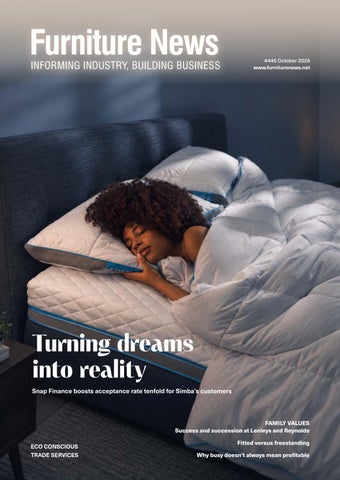
Turning dreams into reality
Snap Finance boosts acceptance rate tenfold for Simba’s customers
FAMILY VALUES Success and succession at Lenleys and Reynolds ECO CONSCIOUS TRADE SERVICES
Fitted versus freestanding Why busy doesn’t always mean profitable
3
Paul Farley Editor-in-chief
01424 776101 paul.farley@lewisbusinessmedia.co.uk @FurnitureNewsED @Furniture News www.furniturenews.net
Editor's comment “When a business stays in the family, that injection of new blood is assured “Some are born great, some achieve greatness, and some have greatness thrust upon them.” Succession is one of the biggest challenges facing the furniture industry. For secondary school kids, a career in healthcare, sports or the arts looks far more attractive, so our recruitment pool can seem little more than a puddle. Yet the cream rises. Coming back to The Bard’s quote, it’s astounding how many of our industry’s leaders seem so well suited to the job, and independent furniture retail is a perfect example. While the sad fate of so many businesses is sale or liquidation, plenty survive the old-fashioned way, handed down from generation to generation. And they’re often more than just shops – they’re part of the community, places our parents and grandparents relied on to furnish their homes. When a business stays in the family, that injection of new blood is assured. And the insights that come from being born into a ‘furniture family’ – learning the ropes at a young age, sharing the perspectives of the next generation of furniture shoppers – are unbeatable. Admittedly, inheritance can go wrong. Maybe they didn’t ask to be part of this industry, wanted to do something different, or are just not cut out for leadership. We’re lucky that so many of ours have proved themselves capable of being the figureheads of tomorrow. The interviews in this month’s issue (and accompanying supplement) put family succession front and centre. Dominic and Freya Reynolds discuss the highs and lows of working together as the former’s retirement nears (p10), while Lavinia Watts recounts the growth of Lenleys as it reaches its 90th anniversary (p20). On p66, our feedback panel share their own handover plans (or lack thereof), and on p28 Think Rugs reflects on the growth of the family business. Then there’s our supplement celebrating the golden anniversary of Associated Independent Stores (AIS), chronicling the buying group’s past, present and future with a trove of retail succession stories – including accounts from Sarah Bianchi (Arighi Bianchi), Peter Harding (Fairway Furniture), Michael Roome (Roomes), Miranda Llewellyn Jenkins (Arthur Llewellyn Jenkins), William Barker (Barkers Home) and many more. They all face a common challenge – modernising to meet today’s challenges, without losing sight of where they came from. This month, you’ll see them rising to that challenge in style. When it comes to greatness, the next generation of furniture retailers are more than holding their own.
Paul Farley
Telford International Centre, Telford, UK 10 and 11 March 2027
Visitors were serious companies looking for solutions and ideas. I’d recommend this for anyone to exhibit or visit that’s in our industry.
The UK’s premier trade show of products and services for the furniture manufacturing industry
Exhibition packages and sponsorship opportunities
3D Ply
Scan here
Follow us on LinkedIn
fcexpo.co.uk
CONNECT
COLLABORATE
CREATE
5
Contents 10
6
NEWS
10 INSIGHT
COVER FEATURE
16 SNAP FINANCE UK
COO Emma Sharp emmas@lewisbusinessmedia.co.uk
18
Meta Home Group
26
Neville Johnson
20
28
Think Rugs
30
Getting personal
32
In this month …
36 EVENTS
Lavinia Watts Lenleys Home
26
46 PRODUCTS 48
Eco conscious
50
Trade services
52 OPINION
Cari Bateman Neville Johnson
30
PRODUCTION EDITOR Allan Norbury allan@lewisbusinessmedia.co.uk SUBSCRIPTIONS Kay O’Brien kay@lewisbusinessmedia.co.uk PUBLISHER AND CEO Simon Lewis SUBSCRIPTIONS (UK-£65, Europe-£85, RoW-£95)
Snap Finance UK Lenleys Home
DIGITAL MANAGER Nyall McCurrach nyall@lewisbusinessmedia.co.uk
DESIGNER Tony Godwin
16 20
PRODUCTION COPY ADMINISTRATOR Steve Merrick steve@lewisbusinessmedia.co.uk
ART EDITOR Sarah Crowhurst sarah@lewisbusinessmedia.co.uk
Reynolds Furniture
Dominic and Freya Reynolds Reynolds Furniture
EDITORIAL EDITOR-IN-CHIEF Paul Farley 01424 776101 paul.farley@lewisbusinessmedia.co.uk SALES SALES AND MARKETING DIRECTOR Sam Horscroft 07764 650655 sam@lewisbusinessmedia.co.uk
10
52
Ben Wain
53
Andy Stockwell
54
Andrew Goodacre
56
Gordon Hecht
58
John D Moulton
59
Roy Graves
60
Clare Bailey
62
Luke-Keegan Floyd
63
Megan Jones
65
Partner comment
66
Feedback
Paul Sheldon Furniture To Go
REPRO, PRINT AND DISTRIBUTION Stephens & George
LEWIS BUSINESS MEDIA (ARTS) LTD The Courtyard, River Way, Uckfield East Sussex TN22 1SL, UK 01825 983105 info@lewisbusinessmedia.co.uk WWW.FURNITURENEWS.NET
Disclaimer: All material submitted for inclusion in Furniture News is done so entirely at the contributor’s own risk. No responsibility is accepted for the safe-keeping of contributors’ materials. Whilst all attempts are made to ensure accurate reproduction, Furniture News accepts no responsibility for variations. Artwork undertaken by our studio remains the copyright of Lewis Business Media (Arts) Ltd and may not be reproduced or stored without prior permission. Some articles in Furniture News have been submitted by companies and organisations. Monies may have been accepted in some instances to offset production costs. All rights reserved. In respect of artwork originated free of charge as part of a booking, clients should know that excessive work (more than one set of corrections, known as ‘authors corrections’) is chargeable at £55 per hour. Data protection statement: Readership data held by Lewis Business Media (Arts) Ltd may be shared with any member of Lewis Business Media (Arts) Ltd and associated companies for the purposes of customer information, direct marketing or publication. Data may also be made available to external parties on a list rental/lease basis for the purposes of direct marketing. If you do not wish data to be made available to external parties for list rental or lease please write to: Lewis Business Media (Arts) Ltd, The Courtyard, River Way, Uckfield East Sussex TN22 1SL, UK. Subscriptions: Refunds on cancelled subscriptions will only be provided at the publisher’s discretion, unless specifically guaranteed within the terms of the subscription offer. ISSN No: 1475-373 © Lewis Business Media (Arts) Ltd 2026
6 NEWS
IKEA UK invests £54m in lowering product prices Ingka Group, the largest IKEA retailer, other IKEA franchisees, and Inter IKEA Group are investing €1.2b in lowering prices across Europe – with £54m invested in the UK, where the retailer says it has slashed the prices of 435 of its products by up to 25%. “Keeping prices low is our long-term commitment and part of our promise to side with the many people,” says Juvencio Maeztu, CEO of Ingka Group | IKEA. “The investment is not an activity or short-term campaign – it’s about making IKEA more affordable when people need it most, even if it means accepting a lower margin. At the same time, we are investing to make IKEA more accessible
by opening many smaller stores as part of our omnichannel experience.” Dave McCabe, CEO of IKEA UK and Ireland (pictured), adds: “Affordability is at the heart of everything we do. We know many people are still feeling the squeeze on household budgets, and we’re committed to helping our customers create a home they love without stretching their finances. At a time when every pound matters, we’re proud to be making it easier for people to get the products they need for their homes at even better value.” The reductions follow investment made in FY24, when prices were lowered across IKEA markets for thousands of products, contributing to increased footfall and order placement. The initiative concentrates on Europe, but Ingka Group says it will also invest €70m to help offset inflationary and currency pressures in Asia and North America.
MBO leaves Tetrad in new hands Tetrad has announced the completion of a management buyout (MBO), with the business now under the ownership of its existing directorship team alongside key industry figures. The new owners include Chris Fletcher (MD), Luke Stenchion (FD), Ryan McNeish (creative consultant), and previous owner Janus Cooper, who together hold overall control. They are supported by a consortium of additional investors, providing the business with “a strong platform for future growth”. The team says the MBO has been backed with “significant investment, enabling Tetrad to build on its existing success while accelerating future opportunities across product development,
manufacturing and the continued growth of the brand”. Chris Fletcher comments: “This marks a hugely exciting new chapter for Tetrad after a challenging few years within the Belfield group. The investment and new ownership give us the confidence and freedom to accelerate our ambitions while staying true to the values that have defined the business for decades.” The transaction also includes Clinchplain Foam & Fibre, which will continue to operate through its existing structure and leadership. As part of the transaction, previous PE backer Blandford Capital has exited.
NBF research confirms squeeze on consumer spending The latest survey conducted by the National Bed Federation (NBF) on consumer mattress buying habits confirms that the cost-of-living crisis is affecting the price that people are prepared to pay for a new mattress – although they are replacing their mattresses more regularly. The 18th annual NBF Consumer Bed Buying Survey, which questioned 1,000 adults who purchased a new mattress within the last year, reveals that the mean price paid fell YoY by 16% to £543. Furthermore, almost half the respondents paid less than £400 compared to only 40% last year, while the proportion spending £800 or more fell from 28% to 20%. NBF executive director Tristine Hargreaves says: “This is a clear indication of the challenges facing our members and bed retailers across the country. With ever-increasing cost pressures on businesses, any drop in consumer spending in our sector is a concern.” Mattresses purchased separately continued to increase, accounting for 64.5% of all purchases, up
from 52% in the previous report. This rise was driven by a strong increase in roll-up mattresses, which accounted for 33% of purchases (up from 23.5%). Flat mattresses accounted for 32%, up from 28%. Mattress and bedstead combinations accounted for 22%, down from 29%, while traditional divan sets accounted for only 13%, down from 19%. The average age of the mattresses being replaced was 6.84 years, down from 7.28 years in the previous report. More than three-quarters (76.5%) were replaced before they were 10 years old, and almost 40% were replaced in under five years. Despite the general assumption that younger consumers are more conscious of the environment and sustainability, they are still the most likely to replace their mattress within five years. Online purchases accounted for 55%, up from 52.5%. In-store purchases accounted for 41%, down from 44%. The 45-54-year olds were the strongest online purchasers at 63%, just ahead of the 35-44 age group at 60%. More than 55% of the over-55s – and only 50% of the 16-24-year-olds – bought online.
Prestige Beds will open a new 5000ft2 showroom on Golden Hill Lane in Leyland, Lancashire next month, following a full renovation of the former NatWest Bank.
Dreams now operates 225 stores nationwide – more than any other bed retailer – after opening at Manchester Fort Shopping Park.
Mamas & Papas has completed a refinancing process, with Bluegem Capital Partners reinvesting alongside new investors including Cheyne Capital following “a record financial year”.
GfK reports that consumer confidence reached its highest level for two years in August, despite the economy’s challenges. Its Major Purchase Index rose five points to -7, its highest score since December 2021.
Heli-Beds of Swindon (Beds by Bedtime) MD Steve Marr and his friend Dan Phillips took on the Rust Box Rally in aid of Mencap last month, in a car bought for just £450.
Time4Sleep has transitioned to an Employee Ownership Trust (EOT), putting its future in the hands of its 13 employees. MD Jonathan Warren and his family retains a 20% personal shareholding, and he will continue in his role.
Loft closed its Manchester warehouse last month, consolidating its operations at its newly completed 45,000ft2 HQ at Trafford Park.
Tempur stepped up its support for child bed poverty charity Zarach last month, with 30 members of staff taking on a fundraising challenge to climb Mount Snowdon.
READ MORE ONLINE AT WWW.FURNITURENEWS.NET
7
Heal’s has appointed Sarah Coonan as CEO. The former Liberty MD takes over from Hamish Mansbridge, who is stepping down following an 11-year tenure.
Flair Furniture Group, the business behind Bed Kingdom, has appointed Paul Atherton as group CEO. Founder Ashley Hainsworth will become chairman, and has also launched the website in Ireland.
National Bed Federation (NBF) president Fara Butt stepped down on 11th September to focus on “new strategic developments”. Matt Richardson, Dreams’ production director and the NBF’s VP of manufacturing, took on the role of acting president.
The Natuzzi Group is to appoint Aldo Uva as CEO. Aldo served as its CEO from May 2008 to March 2009, “giving him direct knowledge of the company’s heritage, brand identity and international positioning”.
The Cotswold Company has entered a multi-year collaboration with the National Trust, focused on heritage-inspired design, craftsmanship and conservation, and launched a furniture range with Marks & Spencer.
Fairway Furniture opened its fifth store, on Brannams Retail Park, Barnstaple, last month.
John Lewis Partnership has reported sales growth of 2% to £6.3b in the H1 ended 1st August. Loss before tax and exceptional items (LBTBE) was £89m, compared to £34m last year.
Oak Furnitureland has opened a 17,000ft2 showroom on Euro Retail Park, Ipswich. READ MORE ONLINE AT WWW.FURNITURENEWS.NET
OKA returns to growth following restructure
OKA has grown sales by 25% and trebled profits, just two years after a financial restructuring. Sales of its furniture, lighting and homewares rose to £46.1m for the 12 months to the end of June, up from £36.8m the previous year. EBITDA increased from £1.7m to £5.3m – a margin of 11.5% (from 4.7% in 2025) – driven by improved gross margin and a continued reduction in its cost base. The business also turned an operating loss of £4.8m into a profit of £1.3m over the same period. The brand says its performance reflected a growing ‘buy less, buy better’ trend among British consumers, with homeowners making fewer but more considered purchases and investing in statement pieces built to last.
The results mark a turnaround for the business, which closed its US operations in 2024 to focus solely on the UK. OKA has since reduced its cost base, rebuilt gross margin and resumed expansion of its store estate and investment in its brand. CEO Mark Saunders says: “We’ve taken some difficult decisions, re-focused on the UK market and rebuilt OKA around the things that make us unique – design, quality, craftsmanship and exceptional customer service. We’re also making the range far more accessible through our investment in the bricks-and-mortar estate as well as our online business, which is introducing new and younger customers to the brand. There is great momentum in our trading performance and we’re confident our strategy will help us deliver sustained sales growth.” OKA, whose flagship store is in Chelsea, opened three concessions with Fenwick and John Lewis over the year. Its ecommerce business now accounts for 50% of total sales. The brand has also expanded into adjacent categories, launching its first wallpaper collection and a collaboration with textile firm Lewis & Wood featuring MTO beds. OKA expects to open further stores and concessions in the current FY.
Next calls pay ruling a “victory for common sense” Next says it has won a “landmark victory” in its ongoing Equal Pay litigation, succeeding in its appeal to the Employment Appeal Tribunal on the key issue of basic pay. The retailer says the case revolves around whether retail and warehouse employees must be engaged on the same terms, “even if those jobs require very different terms in order to effectively recruit, retain and motivate colleagues”. It says the appeal judgment endorsed its position that it should not have to pay shop assistants and warehouse operatives the same amount of basic pay, in circumstances where “the market and working conditions are very different”. “The importance of this decision is that the appeal tribunal has confirmed that it was justifiable for Next to rely on market forces to distinguish between different groups of employees, where there was a good rationale to pay one group more than the other,” says Next. “In this case, Next had to pay a higher market rate to warehouse operatives because of recruitment and retention pressures, which did not apply to the workforce in its stores. Next believes this element of the judgment is not only correct in law, but also a victory for common sense. The judgment affirms a principle at the heart of any effective employment market – that employers must be able to pay what is necessary to recruit the people they need, and that doing so does not oblige them to raise the pay of other employees where there is no reason to do so. “Had the judgment gone against Next, it would have created a threat to the ongoing viability of
many of our stores. It would also have had the perverse effect of putting retailers who operate their own warehousing at a material disadvantage to competitors who contract out their warehouse operations, which makes no sense.” Both the original employment and appeal tribunals found that there was no direct discrimination when it came to gender. Next says it has now won the vast majority of the terms challenged by the claimants, including bonus pay to warehouse staff, and now basic pay. It believes that the same rationale applies to the small number of other terms, which were not overturned in the appeal, including paid rest breaks. It intends to seek permission to appeal in relation to those terms. “This important decision respects the aims of the Equal Pay legislation whilst restoring the relevance of market forces in determining the differences between the pay and conditions of different groups of workers,” Next concludes. “This judgment has come at the right time – the UK economy desperately needs jobs, and the loss of this appeal would have represented a hammer blow to retail employment in the UK.” Next enjoyed full-price sales growth of 7.7% in the first six months of 2026, with total sales (including markdowns) up 8.9%. Group sales (including subsidiaries) were up 9%. Group PBT was £569m (up 10.5%). Accordingly, it increased its profit guidance for the year by £12m to £1,255m – which it says is the result of “a small upgrade in sales expectations and some additional cost savings, mainly in warehousing”.
8 NEWS
DFS enjoys strong profit growth
DFS has announced its preliminary results for the 52 weeks ended 28th June 2026 (FY26), citing highlights including “significant earnings growth in a subdued market”, with uPBT(A) up 48.7% to £44.9m. Market share stood at a record high of 40%, says the retailer: “Distinct brand propositions provided resilience, with Sofology outperforming the wider market, delivering order intake growth of 2.6%, supported by its higher-income customer base, strategic range refreshes, and successful promotional execution”. The year also saw DFS scale its non-upholstery ‘Home’ category, delivering 10.9% order intake growth across beds, mattresses, dining and living room furniture, supported by mezzanine rollout trials that provide “a strong blueprint” to grow its share in this adjacent £5b market.
DFS says its order intake in the first 12 weeks of FY27 was down 2.5% YoY, in line with expectations (notwithstanding extreme weather affecting footfall and upholstery consumer demand in July and August). “While cautious on the broader macroeconomic backdrop and anticipating a subdued market environment, our operational execution and disciplined cost management position us to deliver moderate profit growth in FY27 in line with analyst consensus,” says DFS. Group CEO Tim Stacey comments: “The performance delivered in FY26 demonstrates the fundamental strength, agility and resilience of the DFS Group. By maintaining disciplined cost management, improving gross margins to 58% and empowering our colleagues through data and technology, we delivered robust earnings growth and significantly strengthened our balance sheet. “Looking ahead into FY27, market uncertainty continues to influence consumer confidence and footfall, and we remain appropriately cautious regarding the broader macroeconomic environment. However, our scale, culture and technology investments – all fuelled by our new purpose and values – provide us with a clear advantage.”
NBF Bed Industry Awards winners revealed The National Bed Federation (NBF) crowned its eight 2026 Bed Industry Awards winners on 22nd September at the Bed Show awards ceremony and gala dinner in Telford. Celebrity host Clare Balding announced winners across bed manufacture, supply and retail. Judges across the furniture, business, sleep and sustainability sectors selected the winners from a shortlist of finalists comprising NBF members and UK bed retailers. This year’s winners in the NBF member awards were: the Clover 3000 Wildwood mattress by Harrison Spinks for Bed Product of the Year; Serene Soft Foam by Carpenter for Component Product of the Year; Harrison Spinks for Bed Manufacturer of the Year; and John Cotton Nonwovens for Supplier of the Year.
The winners in the retail awards were: Dreams for National Bed Retailer of the Year; MattressOnline for Online Bed Retailer of the Year; Prestige Beds for Medium NBF Retail Champion of the Year; and Dreamland Bedding Centre for Small NBF Retail Champion of the Year. Matt Richardson, acting NBF president, says: “As we edge towards two decades of the esteemed NBF Bed Industry Awards, they continue to provide a valuable opportunity to recognise the stand-out companies in the UK and Irish bed sector who have truly gone above and beyond over the past year. Congratulations to all the worthy winners and finalists, and those who put themselves forward to be judged.” See next month’s issue for the official celebratory feature.
Dunelm reveals three-year growth plan Dunelm has shared details of its FY26 performance, alongside a three-year strategic growth plan entitled Winning Hearts & Homes. In the year ended 27th June, the retailer achieved sales of £1,825m, up 3.1% on FY25, and a PBT of £211m, in line with the prior year. It opened two new stores – in Wandsworth, and Kingston-uponThames – and reopened its Yeovil store following a fire. It launched a new Dunelm app, with a beta-level AI-powered shopping assistant added in July. CEO Clo Moriarty says: “We delivered a solid performance for the year, growing sales,
maintaining profits and generating strong cash returns for shareholders.” The retailer has launched a self-funded growth plan to deliver “a bigger, better and bolder Dunelm” across the next three years. It envisages a return to sustainable mid- to high-single-digit sales growth, supported by increasing LFL sales, digital acceleration and store investment, aiming for an adjusted PBT margin of around 11%. Clo explains: ““The strength of our business and balance sheet means we are well placed to invest for the future and accelerate our growth trajectory.”
Oak & More has appointed Toolstation co-founder Lucy Lynch as CEO. She took over from longtime leader Paul Isom in June.
The Furniture Makers’ Company says this summer’s East Anglia Golf Day, organised by Paul Glasswell and Peter Mallinson, raised £8,512 for the industry charity.
IKEA will open a brand-new Plan and Order Point in Union Square, Aberdeen on 14th October.
The European Bedding Industries’ Association (EBIA) has appointed Diana Harlova, COO of Bulgarian mattress manufacturer TedBed, as its president, replacing Geert Geerkens.
ercol Furniture’s sales and marketing director Arno Koch has left the business, prompting the promotion of two existing team members. Geoffrey Stafford has joined the board as sales director, and Monika Witney is now head of marketing.
MattressNextDay has appointed Kim Scriven (ex-House of Fraser, House UK, Smiley Company) as its buying and merchandising manager.
The Wycombe Furniture Forum (WFF) has closed after supporting the local furniture manufacturing sector for two years.
Spinks has announced the expansion of its portfolio of spring solutions across North America through HS2, its long-standing joint venture with Hickory Springs Manufacturing.
READ MORE ONLINE AT WWW.FURNITURENEWS.NET
THE NEXT MOVE IN LIVING A global setting, an all-round presentation: the interior trends at Living. At the most important consumer goods fair, you will experience furnishing and equipping interiors in each and every style. From furniture to home textiles and accessories – with products for private, commercial and public spaces. Living sets up successes ambiente.messefrankfurt.com/living info@uk.messefrankfurt.com Tel. +44 (0) 14 83 48 39 84
29. 1. – 2. 2. 2027 FRANKFURT / MAIN
MUST-SEE INTERIOR LOOKS
10
Dominic and Freya Reynolds
Family values MD Dominic Reynolds started out in the industry nearly 50 years ago, and has spent 45 of them in the family retail business in Bognor Regis, selling everything from cabinets to coffins. His daughter Freya joined in 2010 and was made a director in 2022. As Dominic bows out (as much as anyone in this industry ever truly leaves it) and his daughter takes the reins ahead of Reynolds Furniture’s 160th anniversary, Furniture News asks them about their experiences …
INSIGHT 11
What’s unique about Reynolds Furniture? Freya: I think our long history is one thing that makes us unique, but, similar to other independent furniture retailers, there’s something our customers enjoy. I hate calling it ‘traditional service’ because it sounds old fashioned, but it means having really knowledgeable staff and great customer service – no pushy sales tactics. Another unique thing about Reynolds is that the family feel doesn’t stop with the Reynolds family itself. Right now we have three team members whose children also work here, a set of cousins, and a couple
Reynolds’ directors – Dominic, Stephen, James and Matthew from the family’s fifth generation (back), and Freya and Rebecca from the sixth generation
Can you share a potted history of the business? Dominic: Reynolds was founded in 1867 by Samuel Reynolds, a cabinetmaker who at the age of 19 started his own business in West Street, Bognor. By 1870 he had moved, accompanied by his brother Alfred, to 27 High Street, and the business was advertised as auctioneers, appraisers, house agents, cabinetmakers, upholsterers and undertakers. Over the years adjoining properties have been purchased and extended, making Reynolds the largest furniture store in Sussex. It’s set over four floors, and it’s deceptively spacious inside – customers call it the TARDIS! The business now consists of the furniture store, funeral service, self-storage and property. It’s run by the fifth generation (myself, James, Matthew and Stephen Reynolds), and the sixth-generation Freya and Rebecca Reynolds. Freya: We’re one of the oldest independent furniture retailers in the country. We’re approaching our 160th anniversary in 2027, which is a remarkable milestone for any family business. Over the generations the business has grown and diversified, but is all still under family ownership (people always think this is random, but because Samuel Reynolds made furniture, he also made coffins, and that’s how we have these very different businesses!). The furniture showroom is our flagship – 26,000ft2 across four floors, stocking premium British and global brands including Stressless, Duresta, Parker Knoll, Venjakob, G Plan, Harrisons, Hypnos, Bontempi, Fama and many more. We also work with lots of other great manufacturers, and we’ve built those relationships carefully over many years.
Reynolds Furniture, Bognor Regis
What’s keeping you busy? Dominic: We’re constantly looking at ways to improve the store and are presently looking at replacing our lighting, redecorating, purchasing screens and improving product presentation. Presently, a lot of time is taken up promoting products, attracting new customers and trying to maintain sales and footfall. Freya: Planning all the celebrations for Dad’s 45 years at Reynolds! But also, working as a director in the business full time you wear so many different hats, so I’m always busy with different things depending on the day of the month – it could be performance reviews with staff, planning promotions and marketing, or health and safety audits.
– and over the years we’ve had a few people meet and get married here too. When someone trusts you enough to recommend their own family member for a job, I think that speaks for itself. We must be doing something right. Dominic: Reynolds is a family business and is well known for personal service, product knowledge, presentation and returning customers. Many of the staff have worked here for a long time – Michael Marland, the store manager, has worked at Reynolds for 41 years, and Aaron Strong (bed manager) and Shuan Clark (warehouse manager) have just completed 25 years. The store has a wide selection of quality furniture, ››
“If they’re through the door, they’re serious about buying
12 INSIGHT
at Butlin’s was going to be over, and Dad asked if I wanted to come to work in reception. And that’s where I started – I spent the next few years learning different jobs, from reception to accounts and sales. Once I knew I wanted to stay, I started a degree in business, and the rest is history – I became a director in 2022 and I’ve been here for 16 years.
Long-serving team members Michael Marland (store manager, left) and Shaun Clark (warehouse manager, centre) were both 16 when they joined the business
Did it come naturally? Or did you have doubts about inheriting your positions? Freya: I never really felt any pressure from Dad to take over, it just naturally happened – we’ve always got on and worked well together. I think when you start building on something and making positive changes, you feel you have a responsibly to make the business a success for everyone who works here, and then your heart’s invested. Dominic: In my younger days I wanted to join the Royal Navy, but wasn’t able to due to asthma. I remember my grandfather, Gordon Reynolds, telling me I would be a fool not to join the family business, and in hindsight he was right. It was a good thing to go to London and work, and Perrings was a good place to learn the furniture trade. I was lucky to have some very experienced and knowledgeable people to work alongside when I joined Reynolds, who helped and inspired me a lot.
beds and floorcoverings under one roof. You’d be hard pushed not to find something in-store which fits your furnishing needs. The sales staff are very knowledgeable and build good relationships with customers, many of whom have been with us for many years and several generations. Family members are always available to answer queries and serve. Our warehouse and delivery staff are well trained and offer an impeccable white-glove service. We also deliver, unpack, assemble and dispose of customers’ old furniture and packaging.
“I’ll be pushing him around the January Furniture Show in a wheelchair when he’s 80
How did you each start out in the family business? Dominic: Whilst at school aged 15-18 I worked on the vans delivering furniture, and selling in the soft furnishings department, working out customers’ requirements in yards, feet and inches without the help of a calculator! I also helped out in the funeral department. I started full time at Reynolds in September 1981 at the age of 21, having worked as a salesman for Perrings at their Brent Cross Store, and also at their Hemel Hempstead store as carpet manager, for just over two years. I attended the College for Distributive Trades and got a NARF diploma with distinction and the Childs Cup for excellence in floorcoverings. I also got a City & Guilds diploma in distributive management. Working away for a group business gave me a different perspective of the furniture trade, the best aspects of which I was able to introduce to Reynolds when I returned. Freya: I’d finished college and my summer job
What has proved your strongest skillset, Dominic? And which areas need more work? Dominic: Over the years I believe I’ve built some great relationships with suppliers and customers, and the business has grown considerably due to a policy of continuous improvement in product presentation, investment and marketing. Understanding social media and how to maximise its use is probably my biggest weakness in this respect – I’m lucky that Freya has a much better understanding and skillset than I have! What do you enjoy most about the work? Dominic: Interacting with people. We’re very fortunate to have a great team, customers and suppliers, and I still get a buzz out of selling. I enjoy sourcing new products, attending shows and developing marketing plans. Surprisingly, Freya seems to switch off when I meet someone and reminisce about ‘the good old days’. She’s heard it all before! Freya: Ha! I do love it when I get to be creative, either in the shop with displays or in marketing. I love interiors anyway so it’s always been fun to get involved in styling and choosing products or paint colours for the shop. … and the least? Freya: Any kind of conflict, but it’s inevitable sometimes. I truly believe a calm, open and honest conversation can solve anything. I always try and defuse a situation before it gets too heated. Dominic: Dealing with complaints and clearing unwanted stock.
13
What’s been the biggest challenge in evolving the business in recent years? Dominic: Increased costs due to the hike in business rates, National Insurance and energy prices. Marketing support from some suppliers is minimal. Many do not see the advantages of good product photography, which is very important for marketing and the website, and they don’t communicate range changes, discontinued fabrics, etc very well. Nearly all reps and agents have very large areas, so are unable to call regularly to inform you of any updates. What are the ups and downs of working with family? Freya: You get to see them every day … but also that you see them every day! Dominic: As there are several departments – furniture, funerals, storage and property – we all have separate responsibilities. Freya and myself are responsible for the furniture side, my brother Matthew the financial side, and my brothers Matthew and Stephen and my niece Rebecca are responsible for the funeral side of the business which has several branches, so the day-to-day running of the business is taken care of. We all have the same values and objectives of offering good service and continual investment and improvement, and get on well, having known each other all our lives! Dominic, how are you feeling about stepping away from the business after all that time? Dominic: Very sad, as I’ve met some wonderful people over the years and had some fantastic times ››
Reynolds through the ages – in 1900, 1905, 1929 and 1930
What have been the most significant changes you’ve seen in your time – in the industry, retail, and the customer? Dominic: The decline of British furniture manufacturing is probably one of the most significant changes I’ve experienced. Household names Ducal, Stag, Bevan Funnell, Cintique, Nathan, Cambria and Outline have all gone. Many suppliers have switched production to the Far East. There’s a huge amount of packaging we now need to dispose of. When I started, nearly everything was delivered to us and the customer blanket-wrapped. There’s also a growing lack of independent furniture retailers. When I started at Reynolds there were eight shops selling furniture in the town, now there’s just us. Back then, the promotions were run with mail-outs, adverts in the local press and radio. The coming of the internet has meant an online transactional website, email marketing and posting on media platforms such as Facebook and Instagram are essential for a successful campaign. Freya: After lockdown I noticed a real shift in how customers shop. Footfall has never fully recovered to 2019 levels, but that doesn’t tell the whole story. Even if footfall is down, sales haven’t always been any worse – the people who do come in are more considered about it. If they’re through the door, they’re serious about buying.
14 INSIGHT
“It feels like an important moment for the business, and for Bognor
despite the ups and downs. I will miss my workmates, customers and suppliers, as well as going to the shows and sourcing new products. Do you plan to remain close to it? Dominic: I will always be on hand to help out when needed and to offer advice. Having spent 45 years at Reynolds, it’ll be hard not to show an interest, and hopefully I’ll still be included in decision making. Freya, how do you feel about taking the reins more formally? Freya: In many ways I’ve been running the business for a while now, so it’s less of a dramatic handover and more of a gradual evolution. Dad isn’t going
anywhere – he’ll still be here two days a week, and honestly, his knowledge and the relationships he’s built over 45 years are irreplaceable. He just gets to spend a bit more time fishing, golfing, spending time with his wife and grandkids and enjoying life. Any changes in the pipeline? Freya: Because of the way the world is at the moment, we’re not chasing any big changes right now. However, the focus is on getting the fundamentals right, and one thing we do need to improve is our store lighting which is really old in some areas. It sounds quite simple, but it can make a real difference to the customer experience, so we want to get it right. Beyond that, it’s our 160th anniversary in 2027, and it’s something we want to mark properly – this is very much in the planning stage, but it feels like an important moment for the business, and for Bognor.
Delivering the King’s personal effects to Windsor Castle in 1929
What gives you hope for the future of furniture retail? What needs to change? Dominic: The housing market needs to pick up and interest rates come down. The Government needs to cut tax and increase the personal allowance in line with inflation so people have more disposable income to purchase furniture. Energy costs need to be addressed. Any parting words as this new chapter begins? Freya: One thing my dad has always said is, ‘You’re a long time dead, so enjoy life,’ and he’s worked really hard and achieved so much over the last 45 years. But he’s also really enjoyed the journey, and all the friends he’s made along the way. They’re pretty big boots to fill, but Dad has taught me so much over the years so I know I’ll be fine, plus he’s not really going anywhere – we’ve always joked that I’ll be pushing him around the January Furniture Show in a wheelchair when he’s 80 … www.reynoldsfurniture.co.uk
SCAN TO EXPLORE
TWO LOOKS. ONE TIMELESS CLASSIC. A proven Shaker favourite in oak, cashmere, black and white, offering coordinated furniture for bedrooms, living spaces, hallways and home offices.
Furniture To Go – best-selling furniture, next-day delivery, no MOQ and UK & Ireland dropshipping. Become a Furniture To Go retailer – we’d love to help grow your business.
BARCELONA
Call us at 02380 517067 - Let’s see how we can help. sales@furniture-to-go.co.uk | www.furniture-to-go.co.uk
MADRID
MADRID
COVER STORY
16 INSIGHT
Finance that thinks differently
“Choice at checkout matters
Snap is helping more customers enjoy a good night’s sleep with Simba
Snap Finance UK and Simba Sleep’s partnership – featured on this month’s cover – demonstrates how inclusive, multi-lender retail credit strategies can unlock a significant sales boost, increase consumer confidence and choice, and convert those who have been declined finance …
“Whether it’s a mattress, sofa or bedroom furniture, for high-value purchases, consumer confidence is key to conversions, and one route to supporting this is retail credit,” says Snap. “Today, however, more than 20 million UK adults are financially underserved and struggle to access mainstream credit, leading to risk of financial harm through riskier, unregulated credit. Consequently, the commercial and ethical argument for retail finance strategies encompassing inclusive, responsible lending is growing.” As one of the UK’s most recognisable sleep technology brands, combining highly engineered products and socially conscious B Corp status, Simba recognises the value of inclusive credit, and wants to ensure every customer has an opportunity to benefit from its innovative products. The brand had already adopted a multi-lender strategy to offer a range of credit options – but recognised that access to credit could not become a barrier for the customers it had worked hard to win. The credit access challenge has underpinned Snap’s mission to offer retailers and customers “finance that thinks differently”, giving financially underserved customers that vital second chance. “This mission appealed directly to Simba, who partnered with us in 2025 with a collaboration which not only broadened access, but did so without a big APR price tag for customers struggling to access mainstream credit,” says Snap. “They needed a people-first partner. “Inclusive lending does not mean less rigorous checks, it means painting a more holistic picture of customers’ individual circumstances by connecting data to generate richer affordability checks. This also means not relying on a single credit score which often fails to keep pace with customers’ financial lives. “At Snap, we put this into practice, as the first UK lender to combine multi-bureau data with additional sources, including Open Banking and HMRC data. We do this in a fully digital income-verification journey, powered by our award-winning Income Portal.
This helps keep customers in the buying journey whilst enabling accurate, real-time affordability assessments, providing a seamless path to purchase.” Alongside richer affordability checks, Snap’s decisioning includes risk-based pricing with dynamic, rather than static, APRs tailored to individual risk profiles. Compared to a one-size-fits-all approach, this improves credit accuracy and fairness to widen access responsibly, says Snap: “The results speak for themselves. Simba saw a tenfold increase in acceptance rates through Snap, compared to its previous second-line lender.” Snap worked with Simba to onboard its solution directly into the checkout in a short three-week period, thanks to its Shopify plugin. This allowed Snap to quickly enhance Simba’s retail credit strategy – not through lender competition, but by having different lenders complement one another. “For Simba, this means not only providing a responsible alternative route to finance, but by enhancing the credit choice at the checkout to ensure customers access options which could be more suited to them,” Snap explains. “Our surveys show 39% of customers are confident they know which lenders will approve them – so choice at checkout matters. After onboarding our solution, Simba experienced a 50% higher AOV than the site norm, illustrating how having enhanced credit choice means boosted customer confidence and wider access to a broader range of complementary products.” There is a growing shift towards multi-lender strategies, as consumers continue to seek flexibility and choice when making considered, essential, or investment-led purchases, concludes Snap – and Simba’s experiences show how harnessing complementary credit providers delivers measurable results. “The lesson is simple – as retailers plot sales plans, the first step can be to examine whether their retail credit strategies are unlocking all available demand.” www.snapfinance.co.uk/retailer
I N PA RT N E RS H I P W I T H
A multi-lender strategy doesn’t split your sales it recovers the ones you were already losing. Here’s what happened when Simba Sleep added Snap Finance alongside its primary lender.
10X
higher acceptance vs previous second-line lender
“
3weeks
50%
to go live via Snap's Shopify plug-in integration
higher average order value than the site norm
Our acceptance rates have skyrocketed, and we're thrilled more people are able to access great sleep via a Simba product. Jon Moore • Marketing & Ecommerce Director, Simba Sleep
”
Finance that thinks differently. Complement, not compete
Dynamic, not one-size-fits-all
A fuller picture of affordability
Snap sits alongside your existing provider as a complementary second line, approving eligible declines to boost sales - not competing for the same customer.
Risk-based pricing with APRs tailored to each customer’s risk profile, widening fair access responsibly.
The first UK lender to combine multi-bureau data with Open Banking and HMRC data, in a fully digital journey powered by our award-winning Income Portal.
Recover lost sales through flexible and inclusive finance.
snapfinance.co.uk/retailer
18 INSIGHT
Meta Home Group steps up engagement Meta Sofa is entering a new chapter, with its transition to Meta Home Group, a move that reflects the rapid expansion of the business beyond upholstery and its ambition to offer customers a broader, more complete home furniture proposition.
“One of the company’s most engaging customer events to date
The supplier says the evolution from Meta Sofa to Meta Home Group represents much more than a change of name: “Since launching Meta Sofa, the business has grown significantly in both scale and product breadth. What began with a strong focus on upholstery has developed into a much wider collection spanning motion sofas, stationary upholstery, sofabeds, U-shapes, dining and compressed mattresses.
“The new Meta Home Group identity better reflects where the business is today – and, importantly, where it is heading next.” VIP Preview To mark this next phase, Meta Home Group is preparing an ambitious winter programme, beginning with an exclusive VIP Preview from 14-17th December which will give customers an opportunity to experience the latest products and collections firsthand, bringing together the breadth of the new Meta Home Group proposition under one roof. Customer engagement will be at the heart of the event, says Meta. Every customer attending will receive a complimentary gift (whether they place an order or not), while customers ordering three containers or more will receive a free iPad or 60in television, limited to one promotional gift per qualifying customer. January Expo This momentum will continue into the new year with the Meta Home Group January Expo, taking place from 22nd-29th January in Leamington Spa. “The aim is simple – to create one of the company’s most engaging customer events to date and give retailers every reason to experience Meta Home Group for themselves,” says the supplier. “Targeted marketing around the NEC will form part of the campaign, encouraging relevant visitors to make the journey to Leamington Spa.” Meta Home Group will offer complimentary transport, an overnight hotel room for customers who wish to stay,
19
“We are here to create a tsunami
free gifts, and complimentary food and refreshments throughout the event. The three-container incentive will also continue, with qualifying customers receiving their choice of a free iPad or 60in television. However, the January Expo will be about more than incentives, says Meta: “It will provide an opportunity to communicate one of the central messages behind the next phase of Meta Home Group – strong product, stable pricing and dependable supply.” Through its partnership with Man Wah Group, Meta Home Group says its buying strength, product development and supply chain capabilities provide confidence moving forward. Despite continued pressures within the global marketplace, the business intends to maintain stable pricing and provide its customers with consistency and confidence. First Class Lounge Another important part of the company’s development will be First Class Lounge, created by Meta Home Group in collaboration with Man Wah. Replacing the original Cheers Gallery direction, First Class Lounge will be positioned as “more than simply another gallery concept”, says Meta, which aims to create a distinctive identity centred around comfort, innovation, premium presentation and customer experience. Meta Home Group is working alongside Man Wah and Cheers on the supporting marketing package, incorporating product and lifestyle photography, video and digital content, branding, PoS materials, showroom graphics and launch assets. The wider transition to Meta Home Group will also be supported by increased trade marketing activity, including campaigns in Furniture News across October, December and January, additional industry media coverage and planned digital screen activity at the NEC during the January show period. “The transition from Meta Sofa to Meta Home Group signals the beginning of a much bigger
proposition – more categories, more products, stronger partnerships and an increased commitment to giving independent retailers a compelling reason to engage with the business,” the supplier states. “With two major customer events approaching, and the relationship with Man Wah continuing to develop, the ambition behind Meta Home Group’s next chapter is unmistakable.” Company founder Alan Marnie makes that ambition clear: “We are not here to create a ripple in the furniture market – we are here to create a tsunami.” www.metahomegroup.com
20
Dominic and Freya Reynolds
Preservation and progress Kent-based independent Lenleys Home turned 90 this year, giving its principals the perfect opportunity to reflect on what had gone before, and what’s ahead. Furniture News asked Lavinia Watts, who runs the business with her cousin Oliver Greenfield, about modern retail, balancing work and family, and making Lenleys fit for the future while preserving its heritage – and it turns out she’s more than up to the task …
INSIGHT 21
How did Oliver come to work in the business, and how do you complement one another? Oliver’s route into the business has given him a broad and valuable perspective. After university, he worked with a marketing agency that partnered with Lenleys, before joining the business and gaining experience across multiple departments. He later spent time outside the business, including working in sales
Lenleys managing partners Oliver Greenfield, Lavinia Watts and Jonathan Watts
Was there a specific moment when you accepted your role in guiding the family business? Was it an easy decision? There was never a single moment when I decided to take on a leadership role in the business, it has been a very natural and gradual transition. One of the things I value most about Lenleys is that, despite being a family business, we operate as a senior management team with shared responsibility. We each have our own areas of focus, but there is a great deal of collaboration and involvement across the business. I’ve also been incredibly fortunate that my family has always trusted me with responsibility. From an early stage in my career, I was given the freedom to make decisions and learn through experience. Of course, not every decision worked perfectly, but having that support network around me gave me the confidence to grow, knowing there was always guidance when needed. As for whether it was an easy decision? Absolutely. I developed a passion for both the business and the furniture industry very early on. I genuinely enjoy the variety that comes with retail, from working with customers and suppliers to shaping the future direction of the company. Being able to build on what previous generations created, while helping to guide the business forward, is both a privilege and a responsibility that I’ve always been excited to take on.
The founding partners with the second generation – Jonathan Watts, Jacky Adsett, Stanley Adsett and Leonard Watts
This summer, Lenleys Home marked its 90th anniversary by welcoming customers, brand partners, local artisans and members of the community to its Canterbury showroom for an evening dedicated to design, craftsmanship and community, with live music, refreshments, a makers market, and interactive demonstrations from Vispring, Duresta and JAB. “Reaching 90 years in business is something we’re immensely proud of, and the event was a wonderful reminder of the relationships and loyalty that have helped Lenleys reach this point,” says Lavinia. “As a family business, we’ve always believed that creating homes is about creating connections, and it was fantastic to bring so many people together to celebrate our shared history and look ahead to the future.” The business was founded in Canterbury in 1936 by childhood friends Leonard Watts and Stanley Adsett. Today, Leonard’s grandchildren Lavinia and Oliver are at the helm, running stores in Canterbury and Maidstone, and keeping the flame of family ownership very much alive. Succession planning can be risky business – but it seems some are simply born to retail. But what else lies behind the Lenleys’ success?
management and tourism, before returning with additional skills and insight. We complement each other because we bring different strengths, perspectives and experiences to the business, but ultimately share the same values and long-term vision for Lenleys. While we each have our own areas of focus, there is a great deal of trust and collaboration between us, which allows us to challenge one another constructively and make wellrounded decisions. Oliver brings a calm, thoughtful and measured approach, while I tend to be more dynamic and fast paced. That balance enables us to make wellrounded decisions and provides strong leadership for the business. Most importantly, there’s a great deal of trust and mutual respect between us. We challenge each other when needed, support one another through the inevitable pressures of retail, and remain focused on the same goal – ensuring Lenleys continues to thrive for future generations. ››
“When retailer and supplier are aligned, the customer benefits
22 INSIGHT
What do you enjoy most about furniture retail? What I enjoy most about furniture retail is the people and the relationships. As a family-run business, we have the privilege of working closely with customers, suppliers and our team over many years, which creates a real sense of connection and trust. I also love the opportunity to travel and visit manufacturers, see products being made, and gain firsthand insight into the craftsmanship and innovation that underpin our industry. No two days are ever the same, which keeps the business both challenging and rewarding. … and least? The part I enjoy least is dealing with factors that are outside our control. Whether it’s economic uncertainty, shifts in consumer confidence or wider industry challenges, there are always elements that can impact the market regardless of how well you plan. That said, being in business for 90 years has taught us the importance of resilience and adaptability. Some of the toughest periods often provide the greatest opportunities to learn, evolve and emerge stronger.
“The toughest periods often provide the greatest opportunities
How do you balance parenthood and retail management? Do the two ever align? Balancing parenthood and retail management is something I’m still learning every day. I would never pretend it’s easy, and there are certainly times when one demands more attention than the other. The reality is that you can’t do it alone. I’m incredibly fortunate to have a huge amount of support, both within the business and at home. My husband, family, colleagues and wider support network all play an important role, and I genuinely couldn’t do what I do without them. Having that support allows me to give my best to both roles, even if there are occasional days when the balance feels more challenging than others. In many ways, the two do align. Parenthood has given me a different perspective on leadership, patience and prioritisation, while working in a family business reinforces the importance of relationships, trust and building something for the long term. Both are demanding, but both are incredibly rewarding, and I feel very lucky to be able to do both.
What are the most notable things you’ve achieved in the business to date? Looking back, I’m proud of a number of initiatives that have helped modernise and strengthen the business while positioning it for future growth. One of the most significant was leading the implementation of a fully integrated digital business system in 2019-20, bringing together multiple functions across the company and supporting the launch of a new website. It was a major investment at the time, but one that transformed how we operate and gave us a much stronger platform for the future. Since then, we’ve developed a fully transactional ecommerce business that has become, in effect, our third store. Not only has it delivered substantial growth in online turnover, but it has also significantly increased brand awareness and helped expand categories such as home accessories, allowing us to engage with customers in new ways. Another key milestone was the rebrand to Lenleys Home, including the complete rebranding of our Maidstone store. This was about creating a clearer identity for the business and ensuring our brand reflected the breadth of what we offer customers today, beyond traditional furniture retail. I’m also particularly proud of developing our direct sourcing programme in the Far East. What started as an opportunity to broaden our product offer has grown into an important part of the business, giving us greater flexibility, exclusivity and control over our ranges while ensuring we continue to deliver excellent value and quality to our customers. Collectively, these projects have been about balancing heritage with progress. As a thirdgeneration family business, it’s important to preserve what makes Lenleys special, while continuing to evolve and invest so we’re well positioned for the next chapter of our journey. … and what plans do you have for the immediate future? We have no shortage of ideas, and our focus is on continuing to evolve the business while enhancing the customer experience. One exciting opportunity is the launch of a storage division, operating from our distribution centre. It’s a natural extension of the services we already provide and allows us to offer customers a more complete solution while creating an additional revenue stream for the business. We’re also planning to reopen our in-store cafe, creating a more welcoming destination experience and strengthening our partnerships with local food and drink brands. As retail continues to evolve, giving customers more reasons to visit and spend time instore is increasingly important. Digital remains a major area of investment. We are currently working on a new website, building on the success of our existing online platform. Customer expectations continue to change, and we firmly believe this is an area where you can never stand still. Our aim is to further integrate the online and in-store experience,
23
ensuring customers can engage with the Lenleys brand seamlessly wherever they choose to shop. Ultimately, our ambition is the same as it has always been – to continue investing in the business, strengthen our brand and ensure Lenleys remains relevant and thriving for the next generation of customers. Has it been difficult to modernise the business while preserving its heritage? One of the biggest challenges has been making sure we evolve without losing sight of what made the business successful in the first place. As a third-generation family business, there’s a real responsibility to respect the legacy that has been built over the last 90 years, while ensuring we remain relevant to today’s customer. For me, modernisation isn’t about changing who we are, it’s about improving how we do things. A good example was our investment in a new internal system during Covid. While our stores were closed, we focused on strengthening the business behind the scenes, which ultimately put us in a much stronger position when we reopened. More recently, we’ve continued to invest in our website, digital marketing and customer experience to meet changing consumer expectations. At the same time, the fundamentals haven’t changed. We remain fiercely independent, familyrun and committed to offering quality products, expert advice and a level of service that is becoming increasingly rare on the high street. The brands, products and ways customers shop may have evolved, but the values my grandfather built the business on are still very much at the heart of Lenleys today. I think that balance between heritage and innovation is what has enabled us to reach 90 years in business, and gives us confidence for the future. Since joining the business, what are the biggest changes you’ve observed in how the customer behaves? How do you meet their demands today? One of the biggest changes I’ve seen is how much more informed customers are before they enter the showroom. Many have already spent considerable time researching products, reading reviews and gathering inspiration online, so they arrive with a clear idea of what they’re looking for. At the same time, they still value expert advice and reassurance when making significant purchases for their home, and they still need to see an inspiring display. We’ve also seen customers become more focused on quality, longevity and value. Rather than simply buying furniture, they’re investing in products that will stand the test of time and genuinely enhance how they live. Comfort, craftsmanship and service have become increasingly important factors in the decision-making process. Perhaps the greatest shift has been in marketing and the ways we communicate with customers. When I first joined the business, the customer journey was far more linear. Today, customers are engaging with brands across multiple channels, all before they make contact.
That creates a challenge because there are more touchpoints to manage and customer expectations are higher than ever. However, it also presents a huge opportunity for an independent retailer like Lenleys. We can tell our story, showcase our expertise and connect with customers in ways that simply weren’t possible a decade ago. To meet these expectations, we’ve worked hard to combine the best of both digital and physical retail. We continue to invest in our website, marketing and online presence, while ensuring our showrooms offer an inspiring environment where customers can experience products first hand and benefit from knowledgeable advice. Our strength lies in providing a personal level of service, helping customers make confident decisions and building long-term relationships, rather than simply completing a transaction. Can you name some of the suppliers you’re working closely with? What makes those partnerships successful? We work closely with a number of suppliers across different areas of the business, but Vispring and Duresta are two particularly longstanding and important partners. Alongside these heritage British brands, we’ve also developed strong relationships with a number of our direct sourcing partners in the Far East. While these partnerships are very different in nature, the foundations of their success are remarkably similar – mutual trust, honesty, and a shared commitment to quality. The strongest supplier relationships are those where both sides understand that the customer experience is the ultimate priority. From product development and availability through to delivery and after-sales service, we all have a role to play in protecting the reputation of each other’s brands. As an independent family business, we value suppliers who view the relationship as a true partnership. The most successful collaborations are built on open communication, shared objectives and a willingness to work together through both opportunities and challenges. Ultimately, when ››
“We are constantly looking forward
24 INSIGHT
That said, being independent remains one of our greatest strengths. We can move quickly, make decisions without layers of bureaucracy and stay closely connected to our customers. The more support available to help independents embrace change while maintaining those advantages, the stronger the sector will be as a whole.
“I was given the freedom to make decisions and learn through experience
retailer and supplier are aligned, the customer benefits, and that’s what drives long-term success for everyone involved. … and can you name any trade institutions which are making a difference to the business? I often find that some of the most valuable support comes from the relationships within the industry itself. One of the things I enjoy most about furniture retail is how collaborative it can be. Whether it’s conversations with fellow retailers, suppliers or industry experts, there’s a willingness to share experiences and knowledge that helps businesses navigate both challenges and opportunities. We have benefited from the support and insight provided by organisations such as AIS and the broader furniture industry trade press, including titles like Furniture News. They play an important role in keeping retailers informed about market trends, legislation, consumer behaviour and developments across the supply chain. As an independent retailer, what would you say is missing in terms of support and information for professionals like you? I think one of the biggest challenges is cutting through the sheer volume of information available and finding practical, relevant guidance that can be applied to a business of our size. Much of the discussion around retail innovation, technology and AI is aimed at larger organisations with dedicated teams and significant resources, whereas independents need solutions that are realistic and commercially viable. There is also an opportunity for greater collaboration and knowledge sharing across the industry. Independent retailers face many of the same challenges, from changing consumer expectations and marketing trends to recruitment and digital transformation. Access to more real-world case studies and practical examples of what is working in businesses similar to our own would be hugely valuable.
What do you think the business will look like when it reaches the centenary milestone? If there’s one thing the last 90 years have shown, it’s that the business has never stood still. I’d like to think that when Lenleys reaches its centenary, it will still be recognised for the same values it was built on – quality products, personal service and strong family ownership, delivered in ways that reflect how customers choose to shop in the future. I expect technology will play an even greater role, both behind the scenes and in how customers interact with us, but I don’t believe the importance of physical retail will disappear. For many furniture purchases, customers still want to see, touch and experience products for themselves. The challenge will be in continuing to blend the best of digital convenience with an exceptional showroom experience. Personally, I hope Lenleys remains a thriving independent business at the heart of the communities we serve. If we can continue to evolve, invest in our people and maintain the trust of our customers, then I believe the foundations are there to take the business forward and celebrate its 100th anniversary in even stronger shape than it is today. What makes you optimistic about Lenleys’ future? That, even after 90 years, our drive and ambition remain unwavering. Celebrating our 90th anniversary was a powerful reminder of the strength of the Lenleys brand, the loyalty of our customers and the special place the business holds within the communities we serve. The anniversary brought together generations of customers, suppliers and local partners, reinforcing just how much trust and goodwill has been built over the years. That loyalty gives us a fantastic platform to build from as we continue to adapt to the needs of today’s consumer. I’m also confident in our position within the market. As an independent, family-run retailer, we can combine the heritage, service and expertise that customers value with the agility to evolve and embrace change. Whether that’s investing in our showrooms, our digital presence, new product categories or enhancing the overall customer experience, we are constantly looking forward. Retail will always face challenges, but our history has shown that Lenleys is a resilient business. With a strong team, a clear vision and a willingness to continue investing in the future, I believe we are well positioned not only to thrive in the years ahead, but to lay the foundations for the next generation of the business. www.lenleys.co.uk
Autumn/Winter 2026 Complete the look with Gallery’s new Autumn / Winter collection – featuring over 200 fresh new lines across home accessories and textiles. Key ranges featured: Deco Luxe Snowflake Napkins & Napkin Rings, Deco Luxe Scallop Placemats & Organic Beaded Plates. View our full collection online at www.gallerydirect.co.uk Scan the QR code for more
SINCE 1973
26 INSIGHT
Fitted or freestanding? Home library with Kensington doors in Charcoal
“I think we’ve moved away from the hyperneutral era
What problems can fitted furniture solve, which less bespoke or freestanding alternatives can’t address? Beautiful fitted furniture looks as though it has always belonged in the room. Because it’s designed specifically for the space, there’s no wasted area, awkward gaps or compromises around ceiling heights or uneven walls. It’s also designed around the client’s lifestyle, so every cupboard, drawer and shelf has a purpose. You can redecorate the room over the years, but a thoughtfully designed fitted piece becomes part of the architecture of the home for decades. How have our homes changed in the last five years? Has hybrid working influenced demand for fitted furniture and home office solutions? Homes have become much more personal. We’ve moved away from the very minimalist, neutral look towards interiors with warmth, personality and a layered feel. Hybrid working has also transformed what people want from their homes. Rather than simply squeezing a desk into a spare room, clients are creating beautiful studies and library spaces that work hard during the day but still feel inviting in the evenings. It’s about designing a room that’s both functional and
Cari Bateman
Fitted furniture versus the freestanding alternatives? It is a decision that many deliberate when designing their homes. For Cari Bateman, senior designer at bespoke fitted furniture specialist Neville Johnson, the answer is obvious …
somewhere you genuinely enjoy spending time. What are you seeing today’s homeowners prioritising most – aesthetics, storage, sustainability or flexibility? Storage and flexibility are usually where every
27
Bespoke home office in Earthy Green
conversation starts. Most of us have far more belongings than we’d like to admit, so creating practical, organised storage is essential. Clients are also thinking much more long term. They want furniture that will evolve with them and continue to work as family life changes.” What common design mistakes do home-owners make before seeking professional advice? The biggest mistake is rushing into decisions. I completely understand it – I’m probably one of the most impatient people you’ll meet! But living in a space for a little while before making major decisions helps you understand how you’ll actually use it. Taking that time nearly always leads to a better design and avoids expensive compromises later. What furniture trends do you predict for 2026/27? I think we’ll continue to see interiors become more layered and personal. Vintage and antique pieces mixed with contemporary furniture create homes with real character. Rich textures, tactile fabrics, patterned wallpapers and collected objects all help create warm, inviting spaces that feel lived in rather than overly styled.
A bespoke dressing room created for stylist Erica Davies
… and what about colour trends? Earthy, nature-inspired colours are still incredibly popular. We’re seeing lots of terracotta, mustard yellows, burnt orange, olive greens and warm taupes, which all help create calm, welcoming interiors. I think we’ve moved away from the hyper-neutral era. Homes are becoming warmer, more individual and reflective of the people living in them.
Fitted furniture tops freestanding, then? For me, great fitted furniture isn’t just about storage – it’s about improving the way people live in their homes. When a space is carefully considered, beautifully made and designed around the people using it, it brings a sense of calm, organisation and enjoyment that lasts for years. That’s what makes bespoke design so rewarding. www.nevillejohnson.co.uk
“Homes have become much more personal
28 INSIGHT
Think Rugs hits 30 Founded by Gary and Diane Tippett, the business is now led by their son Sam alongside his wife Steph, with Gary and Diane still actively involved. From its early days operating from a small warehouse, Think Rugs has grown into an operation in excess of 40,000ft2, offering more than 2,500 product options across its own collections and licensed brands. To mark the milestone, Think Rugs is putting two of its latest wool collections, Arcadia and Quartz, front and centre. Arcadia pays tribute to traditional flat-weave artistry, while Quartz combines 100% wool with a clean, tailored flat-weave finish designed to work across both classic and contemporary interiors. “Reaching 30 years in business is a proud milestone for our family and the entire Think Rugs team,” says director Sam Tippett. “From the early days of my dad driving his own van to Belgium to buy rugs directly from manufacturers, Think Rugs has grown into one of the UK’s leading rug suppliers, but the principles we built the business on haven’t changed – strong relationships, trust, quality and exceptional service. “Three decades in the industry has given us a real understanding of what our retail partners need, and that continues to shape how we develop the business today. As we celebrate 30 years, we’re incredibly grateful to the retailers and partners who have grown alongside us.” The company’s operations have evolved significantly over three decades. What began with handwritten invoices and warehouse picking sheets is now a highly digitised B2B operation, holding more than 100,000 rugs in stock. Alongside its core collections, Think Rugs continues to grow its portfolio of licensed interiors
Sam Tippett with Quartz, part of the company’s 30th Anniversary Collection
Family-run rug specialist Think Rugs is celebrating 30 years in business, marking three decades of growth from a small family startup into a modern B2B operation supporting more than 1,000 retailers across the UK and Ireland, including Dunelm, Next, Argos, ASDA and Furniture Village.
and lifestyle brands, with current partners including Catherine Lansfield, Clarke & Clarke, Harlequin, Scion and Laurence Llewelyn-Bowen. Its next phase of growth will see further collections from Joules, Sophie Robinson and the William Morris Society join the portfolio, alongside an additional British heritage brand set to be revealed in the coming months. Sam says approximately 350 new SKUs are also currently in development, supported by continued investment in Think Rugs’ B2B platform and retailer services. www.thinkrugs.co.uk The Think Rugs team
“We’re incredibly grateful to the retailers and partners who have grown alongside us
30
GETTING PERSONAL
Paul Sheldon Paul is the director of sales and operations at Furniture To Go, a UK wholesale furniture supplier specialising in flatpack furniture and home delivery. Over the past 30 years he has worked across retail, buying, sourcing, operations, ecommerce and marketplace development. An early career with Tesco and B&Q provided the foundations that still influence how he approaches business today.
“Customers see a finished piece of furniture. They don’t see the sourcing, compliance, logistics, inventory management and customer service behind it
INSIGHT 31
Sali
How might a child describe what you do? I help people buy furniture and make sure it gets delivered to the right house. What’s the biggest long-term challenge you face? Balancing increasing customer expectations with rising costs and growing compliance requirements, while remaining competitive. If you had 10 x your working budget, what would you spend it on? Technology, automation and data. The businesses that make the best decisions and operate most efficiently will be the ones that succeed. What would be the title of your autobiography? Common Sense Isn’t Common. What does work/life balance mean to you? Staying fit and healthy while still achieving results at work. Running gives me time to clear my head, think through challenges and maintain perspective. Completing the London Marathon was a personal achievement I’m incredibly proud of. Looking after yourself makes you more effective in every area of life. Who’s been your most influential professional mentor? Rather than one individual, I would point to the leadership culture I experienced during my time at Tesco. The focus on standards, continuous improvement and putting the customer first shaped much of how I work today. What advice would you give your younger self? Back yourself more. Experience comes with time, but confidence helps you make the most of opportunities when they arise.
Madrid
What’s been your best day in business to date? Being appointed director at Furniture To Go. It was the culmination of many years of hard work, learning and progression. Having started my career on the shop floor, reaching board level was a proud moment, and proof that persistence pays off.
What’s the biggest myth about our industry? That it’s simple. Customers see a finished piece of furniture. They don’t see the sourcing, compliance, logistics, inventory management and customer service behind it. What should everyone in our industry either stop or start doing? Stop competing solely on price. Start focusing more on service, availability, compliance and customer experience. Where do you see the industry going in the next 5-10 years? Greater use of AI, more automation, increased compliance requirements and even higher customer expectations around service and delivery. Businesses that embrace change will outperform those that resist it. What question do you wish we’d asked? How would you have answered it? Q: What has been the biggest lesson from your career? A: The fundamentals still matter. Technology changes, routes to market evolve and consumer behaviour shifts, but businesses that consistently get the basics right will always have an advantage. www.furniture-to-go.co.uk
“Businesses that embrace change will outperform those that resist it
32 INSIGHT
In this month … From a “mixed bag” Budget to industry staffing as a political football, Furniture News puts today’s issues in perspective, looking back at what happened in the industry five and 10 years ago today …
“We took a deep dive into the blurred lines between D2C and B2B trading
Five years ago (October 2021) In the news, consumer confidence took a downturn following a robust H1, despite strengthened retail footfall. The BRC warned of higher shop prices in the run-up to Christmas and described the Chancellor’s autumn Budget as “a missed opportunity for retail” that prevented the sector “from maximising its contribution to the Government’s levelling-up agenda”. “It’s a mixed bag of announcements from the Chancellor, which falls far short of the truly fundamental reform that is needed and was promised in the Government’s 2019 manifesto,” said BRC chief executive Helen Dickinson. In retail, Furniture Village opened on Sheffield’s Drakehouse Retail Park, and Moda Outdoor Furnishings opened a flagship store in its native Manchester. ScS reported a PBT turnaround to £22.7m (from a loss of £3.1m in 2020), retail sales at The Very Group were up +24.9% to £1535.6m, and Dunelm reported strong quarterly growth. Dreams revealed Sleep Like Log, its first brand campaign since its category-driving Replace Every 8 campaign in 2015, and announced the promotion of long-time COO Jonathan Hirst to the position of CEO, replacing Mike Logue. IKEA’s parent company Ingka Investments signed a conditional purchase agreement to acquire a property at 214 Oxford Street (Oxford Circus) in London – formerly a Topshop flagship – for £378m, with part of the vacant space to be utilised by IKEA UK & Ireland. Further up the supply chain, listed Swedish company Storskogen purchased a majority stake in supplier Julian Bowen, and Hypnos embarked on a long-term partnership with the Eden Project. Emma Rackley was appointed director of furniture and home at AIS (replacing Julian Cox), the British Furniture Manufacturers (BFM) appointed Sean Holt as MD, and the Young Furniture Makers exhibition returned as a month-long virtual event. The industry also paid tribute to the “face of Belgian furniture” Bernard Deheegher, and Glasswells director Peggy Reardon, daughter of the business’s founder Jerry Glasswell. In the magazine, we took a deep dive into the blurred lines between D2C and B2B trading, with words of caution from retailers and suppliers, plus insights from established D2C brands which had embraced trade sales. We also spoke to Simba’s co-founder and CEO Steve Reid, and La-Z-Boy’s new designer Trevor Hailes, and looked at the extensive responsibilities of retail sales staff.
Ten years ago (October 2016) In the news, retail sales grew, but GfK’s Joe Staton said: “Declining optimism about economic prospects for the wider UK economy has depressed the consumer mood this month.” DFS announced further record results including a PBT of £64.5m, while the business’s founder Lord Kirkham opened the first store belonging to his new retail brand, Fabb Sofas, on Southampton’s Hedge End Retail Park. BHS revealed plans to grow its international business, including new department stores starting in Qatar. Leekes reported another rise in sales and profitability, and True Capital announced the majority acquisition of Blackbird Retail Holdings, owner of The Cotswold Company. ScS revealed healthy growth and plans for more store openings, and Habitat launched a 2000ft2 Mini Habitat store in Sainsbury’s new Nine Elms store in London – the first concession to be opened by Habitat inside a Sainsbury’s supermarket. ScS announced the opening of three new stores on Boxing Day – in Straiton, Plymouth and Thanet – taking its UK total to 100 retail units. The John Lewis Partnership signalled the appointment of Paula Nickolds as MD, and opened a 255,000ft2 John Lewis regional flagship store in Leeds, anchoring Hammerson’s £150m Victoria Gate Development. Simba closed a £5m investment round to grow international sales, bed manufacturer Matza invested £400,000 in equipment and job creation, and Premier Housewares prepared to open its newly refurbished Glasgow showroom. Alpha Designs Upholstery appointed Barry Webb as sales director, and Gainsborough MD Jerry Yates announced his retirement (and his replacement, Nick Gigg). Matt O’Flynn, the MD of Hastings-based manufacturer Collins and Hayes, hit back against claims made by Home Secretary Amber Rudd, that the majority of the business’ staff were recruited from Romania and Poland rather than the UK, and industry leaders met with the Minister of State for International Trade at the House of Commons to discuss investment in developing export markets. In the magazine, we looked at technological developments in retail, explored Carpetright’s newconcept flagship in Croydon, and interviewed the principals at The French Bedroom Company, Kobe UK and Soak&Sleep. The issue also featured profiles of High Point Market and designer Samuel Chan.
33
BUILD MOMENTUM
Furniture News continues to lead the way, cutting through the noise ahead of the trade’s busiest period. In November’s issue, our Bed Industry Awards supplement, commissioned by the NBF, puts this year’s winners and finalists centre stage – but there’s much more besides, including: • Reviews of the NBF Bed Show, Minerva’s Autumn Furniture Show and autumn Long Point • A spotlight on Reclaimed & Recycled furniture • Our monthly round-up of the latest in Bedroom, Living, Dining and Trade Services.
BOOK BY FRIDAY 9TH OCTOBER 2026 #437 February ws.net www.furniturene
nent Expo
’26 awaits
Sterling Home
MATTRESSES PILLOWTOP IOUS ECO CONSC ES TRADE SERVIC
“WE TOOK A DOUBLE JANUARY SALE!
Your Event Manager was brilliant, he’s a real diamond, he fitted in with our team perfectly and was really helpful. We will book again!” Sam Stephenson, Accountant and Store Manager, Sinclair’s of Scarborough. January 2026
“THREE MONTHS SALES IN A MONTH! HAPPY DAYS! What more do you want, especially
in this dreadful economy? After 18 Greenwood Sales they’re still flying! Roll on the 19th Sale!” Cy Fogel, M.D., You’re Furnished, Takeley, Essex. January 2026
“OUR SECOND GREENWOOD SALE GENERATED A QUARTER OF A YEAR’S SALES IN ONE MONTH! Your Event Manager
was extremely professional, and he went above and beyond – I could not have asked for better!” Gary Cooney, M.D., Cooney’s Home Interiors, Letterkenny, Co. Donegal. January 2026
WHEN IS THE BEST TIME TO ADVERTISE?
Some advertise to boost a quiet time but, those in the know, always advertise when it’s busy. By far your best R.O.I. is achieved when the market is at it’s most active and there’s no bigger month for furniture than January. Greenwood Sales work. To find out more, call Bernard Eaton on 07771 700247 to hear about the exciting options and possibilities for holding your record-breaking Greenwood Sale, without obligation.
NOW BOOKING 2027 SALES CALL TODAY - 07771 700247
CONNECT, E, COLLABORAT CREATE Furniture Compo
BANK A DOUBLE JANUARY SALE…
When data
S TILLY THRILL the bar
refurb raises
Steed rides
again per
gatekee partners turn
23/01/2026
12:23
dd 1
cument-v4.in
FN437-full-do
Contact Sam Horscroft on 07764 650655 or email sam@lewisbusinessmedia.co.uk
GREENWOOD RETAIL LTD
UK & Ireland’s Leading Experts in Retail Sales Promotion sales@greenwoodretail.com www.greenwoodretail.com
36 EVENTS
Show of strength IFHS would like to thank everyone who helped make this year’s Irish Furniture & Homewares Show (IFHS) a success – and to celebrate the worthy winners of the Irish Furniture & Homewares Awards …
“There was a real sense of energy throughout the event
The industry again came together over three busy days at the National Indoor Arena, Blanchardstown, late this summer, and the show’s organiser is extremely pleased with the results: “The atmosphere across the show floor was strong from the very beginning, with a great mix of returning visitors, new faces, long-standing exhibitors and brands joining the show for the first time. “For us as a team, one of the most rewarding parts of IFHS 2026 was seeing so many valuable conversations taking place. Whether it was retailers discovering new ranges, suppliers meeting new customers or industry contacts reconnecting face to face, there was a real sense of energy throughout the event. “We were also incredibly impressed by the standard of the exhibitor stands and product presentations this year. The effort that went into preparing for the show is clear to see, and the creativity, quality and attention to detail across the floor helped make IFHS 2026 feel particularly strong.” Best in show The Irish Furniture & Homewares Awards were a highlight of the show, recognising stand-out products, leading exhibitors and excellence in innovation, sustainability, presentation and sales. Held on the evening of the show’s opening day, the awards reflected the quality, diversity and fresh thinking across this year’s exhibitor line-up. Competition was strong across the categories, says IFHS, with head judge Amanda Bone – a registered architect and judge on RTÉ’s Home of the Year – assessing entries in the Global Product, European
Product, Sustainability Initiative and Display & Exhibition Stand categories, alongside awards recognising supplier and sales excellence. Highgrove Beds took home Best Global Product for The Elements Collection, while Cirtex was awarded Best Sustainability Initiative. GlamMore secured Best European Product with Eclipse, and Bluebone was recognised for Best Display & Exhibition Stand. Respa Beds was named Best Supplier, while Conor Peacock from Faith & Ethan received the award for Best Sales Representative. This year’s awards also provided an opportunity to recognise Lebus Upholstery, Bluebone and Signature Living for their long-standing support of the show, marking 10 years of exhibiting at IFHS. “Congratulations again to all of this year’s winners, highly commended entries and recognised exhibitors,” says the show team. “It was a great opportunity to celebrate the products, people and businesses that stood out across the show.” Building value IFHS concludes: “As a team, we are always looking at how we can improve IFHS and make the experience even better for both exhibitors and visitors. “Feedback from this year’s event has already given us plenty to build on, and planning is firmly under way for 2027. “IFHS will return to the National Indoor Arena, Blanchardstown, next year, and we are already working on ways to make the show bigger, stronger and even more valuable for the industry. “Thank you once again to everyone who joined us in 2026. We cannot wait to welcome everyone back next year.” www.ifhs-tradeshow.ie
37
Top cut The winners of this year’s Irish Furniture & Homewares Awards were: Best Global Product: Highgrove Beds, The Elements Collection (Bluebone’s Mammoth Dining Table was highly commended, and Alcore Living’s Sindhu also shortlisted) Best Sustainability Initiative: Cirtex (Respa Beds was highly commended, and Cirtex also shortlisted) Best European Product: GlamMore, ECLIPSE (Sealy’s Select Medium Luxe was highly commended, and Adjust-a-Bed’s Wallhugger Adjustable Base also shortlisted) Best Display & Exhibition Stand: Bluebone (Welcome Furniture the runner up) Best Supplier: Respa Beds Best Sales Representative: Conor Peacock (Faith & Ethan)
Head judge Amanda Bone and show director, Image Furnishings’ Mark Gannon, presented the winners and long-standing exhibitors with their awards. Pictured, left to right, top to bottom, are: Sealy (highly commended, Best European Product); GlamMore (winner, Best European Product); Bluebone (winner, Best Stand, highly commended, Best Global Product, and 10-year supporter); Highgrove Beds (winner, Best Global Product); Conor Peacock (Best Sales Rep); Welcome Furniture (highly commended, Best Stand); Respa Beds (highly commended, Best Sustainability Initiative); Cirtex (winner, Best Sustainability Initiative); Respa Beds (Top Supplier); Lebus Upholstery (10-year supporter); and Signature Living (10-year supporter)
38 EVENTS
Enter the Decosystem Brussels Furniture Fair returns to Brussels Expo, Heysel from 8-11th November, and is inviting visitors to see the event not merely as a trade fair where new collections are presented, but as a complete professional ecosystem and an all-encompassing experience, under the strapline, ‘Enter the Decosystem – Your habitat reimagined’ …
“A more immersive and wide-ranging approach to interiors
“The term ‘decosystem’ refers to a vibrant environment where manufacturers, brands, retailers, interior specialists, designers and partners come together,” explains the show’s organiser. “Products naturally remain at the heart of the fair, but are presented within a broader context that brings together inspiration, encounters, innovation and commercial opportunities.” Nature and the future Nature is an important recurring theme within this story, the organiser continues: “It inspires the furniture sector in terms of materials, colours, shapes and textures, while also encouraging us to think more consciously about how furniture is designed, produced and (re)used. Today, the relationship between nature and interiors therefore extends far beyond aesthetics alone. “For visitors, this means a more immersive and wideranging approach to interiors and interior design. They come not only to discover furniture, but are also invited to reflect on the evolution of living, new lifestyles, comfort, materials, sustainability and the ways in which indoor and outdoor spaces can be reimagined. “We also look towards the future and those shaping it. Young designers and design students are given a special platform at our fair, known as Belgian Design Island. There, they present their work to interested buyers while connecting with experienced furniture manufacturers. This creates valuable cross-pollination and opens up new opportunities for collaboration, innovation and further development.” Broadening range and reach The product range presented at the fair has grown significantly in both scale and quality in recent years, says the show organiser, which adds that it has welcomed an increasing number of manufacturers and brands with a clear focus on quality and
relevance to the professional market. Since 2025, a new outdoor segment has also been added, responding to a growing focus on outdoor living and the increasingly blurred boundaries between indoor and outdoor spaces. Building on this expansion, this year a dedicated area in Hall 9 is being reserved for the development of a new textile segment, where various suppliers of upholstery fabrics, bedding textiles and other textile solutions for interiors and home comfort will present a diverse product range. “Alongside the continued expansion of our offering, we are also firmly committed to broadening the market reach available to our exhibitors,” says the fair organiser. “Furniture retailers and interior specialists remain our primary target audience, but we aim to extend the fair’s reach to professional buyers in sectors including hospitality, food service, contract furnishing and new-build projects.” This broader focus does not represent a departure from the fair’s identity, but a natural extension of the existing ecosystem, it clarifies: “Hotels, restaurants, property developers and other professional clients are placing ever greater emphasis on furniture, comfort, appearance and the overall experience of a space. This creates valuable additional sales opportunities for our exhibitors in the contract and project markets. “By connecting our existing offering more closely with segments such as outdoor living, contract business, hospitality and contract furnishing, we aim to strengthen both the fair’s commercial relevance and the opportunities available to exhibitors.” Visitors can register to attend this year’s show via the link below. www.furniturefairbrussels.be/tickets
SUN. 8 - WED. 11 NOV. 2026
Registration code
UKFN26349
40 EVENTS
Discover what’s next at JFS Registration is now open for the 37th January Furniture Show (JFS), returning to the NEC Birmingham from 24–27th January 2027.
“The most important buying moment of the year
Bringing together more than 500 UK and international brands and over 50,000 products, JFS will once again provide an essential start to the furniture-buying year. From design-led launches and emerging names to trusted commercial bestsellers, buyers can discover, compare and source many of the collections set to shape the market in 2027. The show is expected to welcome 20,000 buyers, including senior decision-makers from leading retailers, independent businesses and buying groups across the UK and internationally. Spanning four curated halls, JFS places sourcing at its heart. Hall 1 – Premium Design will present a refined selection of brands recognised for quality craftsmanship, innovative design and elevated product offerings. Hall 2 – Home, Garden & Lifestyle will showcase the latest furniture, interiors, accessories and outdoor living collections. In Hall 3 – Living, Dining & Cabinet, buyers will find contemporary designs and craftsmanship across living, dining, bedroom and cabinet furniture. Meanwhile, Hall 5 – Upholstery & Beds will bring together the newest upholstery, bed and bedroom collections across every market level. New exhibitors for 2027 include Knitty Gritty, Estro Milano, Sofro, DHL Supply Chain, Apricot Sofa, WilliamSpace, Surya, Wersal and HomeEdit. They will join established names including Buoyant, Whitemeadow, Baker Furniture, Lebus, At The Helm, La-Z-Boy, Maxfurn, Skovby Møbelfabrik, Actona Group, Sits, Flexlux, Alfons Venjakob, 3C Candy Polstermöbel and Scatterbox. Hall 5 will also spotlight specialist logistics and service providers including DHL, Grays Transport, Allports, Maxi Mover, Empire Delivery and Charnwood. Their expertise will help retailers and brands explore solutions across transportation, warehousing, delivery and supply chain management. Beyond sourcing, a newly designed Lounge Bar
will create a luxurious focal point in Hall 2. Featuring statement draping, layered textures, comfortable sofas and considered finishing touches, the space promises to provide an inviting backdrop for meetings and informal networking. The Lounge Bar will also host the official show party and Best Stand Awards on the Sunday evening, while happy hour will return on the Tuesday afternoon. Visitors can also gain fresh perspectives at the Retail Revealed Live Stage, where experts will explore the issues and opportunities shaping the sector. The programme will include two Women in Furniture Network (WIFN) panel discussions, giving influential industry voices a platform to share their experiences and insights. JFS will once again partner with The Furniture Makers’ Company, the furnishing industry’s charity. For 2027, the partnership will introduce a new initiative welcoming young people to the event, connecting emerging talent with brands, professionals and potential employers to help accelerate their journey into furniture careers. VIP buyers will receive complimentary parking, refreshments and access to a dedicated VIP Lounge, supported by the VIP customer team. Padraig Wallace, director of sales, says: “For 37 years, the show has brought the furniture industry together at the most important buying moment of the year. For 2027, we are building on that trusted legacy with an elevated show experience, curated collections and new opportunities to connect, celebrate and support the future of our industry.” Register to attend for free on the show website. www.thefurnitureshows.com
Register Now
thefurnitureshows.com
The Home of Furniture Trade Discover 500+ brands and 50,000+ products across four carefully curated halls. Meet leading suppliers, explore new collections and source your next best-sellers at the UK’s largest furniture trade event.
42 EVENTS
Elevating Vietnam’s global industry role Vietnam’s furniture industry has achieved remarkable growth, driven by strong export results and competitive advantages in manufacturing, establishing the country as a key player on the global furniture map – and two prominent furniture exhibitions have truly helped drive that evolution …
“An indispensable destination
The fourth Vietnam ASEAN International Furniture & Home Accessories Fair (VIFA ASEAN 2026) took place from 2nd-5th September at the Saigon Exhibition and Convention Center (SECC, Tan My Ward, Ho Chi Minh City), featuring 200 exhibitors (and 565 booths) from across Vietnam and 12 countries and territories including the US, Canada, China, India, Japan, Korea, Netherlands, Slovakia, Bangladesh, Singapore, Malaysia and Cambodia. Its diverse product offer comprised 55% furniture, 18% furnishings, 12% handicrafts, and 15% furniture materials, machinery, wood and supporting services. This year’s show welcomed 7,890 visitors over four days, reports organiser Lien Minh VIFA Corp, including 1,601 international visitors from 83 countries and territories. With 53% previous visitors re-visiting, and 67% seeking business-matching services, the international visitors primarily came from Asia, and principally China, Canada, the US, India, Philippines, Japan, Cambodia, Taiwan, Singapore and Malaysia. As the second show in this autumn’s Asian
Furniture Fair Series, VIFA ASEAN cemented its position as “an indispensable destination for the autumn sourcing season”, says its organiser, alongside other prominent regional events including Kofurn (South Korea), MFFM (Malaysia), CIFF Shanghai and WMF (China), Furniture China and Maison Shanghai (China), and IFFINA (Indonesia). VIFA ASEAN offered an attractive programme to support global buyers’ travel and accommodation, such as airport support, a free shuttle bus, exclusive deals from official hotels, and a complimentary hotel stay for VIP buyers. Four industry seminars during the show focused on the furniture industry and ecommerce market, and another highlight of the fair was the showcase of 75 entries in the VIFA Expo Mascot Design Contest. VIFA ASEAN 2026 was also held in parallel with the Vietnam International Sourcing – VIS 2026 event, bringing global buyers a wider variety of products from Vietnam across four sectors – F&B, lifestyle and healthcare, furniture and home goods, and export supply chain and supporting industries. At VIFA ASEAN 2026, the SIGTEX Vietnam Pavilion was officially introduced for the first time, showcasing solutions in the green technology, industrial machinery and accessories, electrical and electronic equipment, and clean and renewable energy. “VIFA ASEAN is a crucial export-import bridge for the global furniture community to meet and connect with the Vietnamese market,” states Lien Minh. “The success of VIFA ASEAN 2026 affirmed the growing position of the role of trade promotion in Vietnam, and positively contributed to the development of the South East Asian furniture sector.” VIFA Expo 2027 – one show, two venues The 18th Vietnam International Furniture & Home Accessories Fair (VIFA Expo 2027) will be held from 26th February to 1st March at two large exhibition centres in Ho Chi Minh City – SKY Expo Vietnam Center (Trung My Tay Ward) and WTC Expo
43
“Creating new directions for the industry’s development
International Exhibition Center (Binh Duong Ward). This specialised trade event promises to bring together more than 3,000 booths across a total area of 55,000m2, and in excess of 650 businesses from Vietnam and countries worldwide. The fair will showcase various furniture, home decor, handicraft and wooden products, and more. VIFA Expo 2027 will be part of the March 2026 International Furniture Fair Chain in Asia, which includes IFEX (24-27th February) in Indonesia, MIFF (1st-4th March) and EFE (2nd-4th March) in Malaysia, 3F (15-19th March) and CIFF (18th-21st and 28th-31st March) in China. As the second show in the circuit, VIFA Expo promises to be a crucial stop for global visitors and buyers seeking high-quality furniture, home decor and handicrafts from Vietnam. The show will offer international buyers complete support for their travel and accommodation, from exclusive deals (30-50% discounts) with official show hotels, a free shuttle bus between hotels, the venues and the city centre, factory visit tours, and complimentary hotel stays for VIP buyers (available from November).
Featuring more than 650 exhibitors and reportedly attracting some 17,200 visitors – including more than 6,300 international buyers from 110 countries – this year’s event affirmed VIFA Expo’s leading role in Vietnam’s furniture industry, says its organiser: “This strong appeal highlights VIFA Expo’s ability to effectively connect the Vietnamese furniture suppliers with the global market, fostering sustainable business relationships and creating new directions for the industry’s development. “Currently, Vietnam is a rapidly growing global furniture manufacturing hub. VIFA Expo 2027 offers an ideal platform and an effective bridge that helps manufacturers and exporters strengthen their brand on the international market, as well as helping buyers and importers find the finest furniture sources from Vietnam. Therefore, VIFA Expo is a must-attend event for manufacturers, exporters and buyers in the industry. “Register to join the oldest, largest furniture fair in Vietnam, and meet with VIFA Expo’s business community in 2027.” www.vifaasean.com
44 EVENTS
HawaExpo promises risk-free sourcing From the latest design, green materials and hand-crafted furniture to smart homes and noise-cancelling working pods, the fourth edition of HawaExpo 202, taking place from 3rd-6th March 2027 at the SECC in Ho Chi Minh City, promises to bring the latest innovations from Vietnam, the world’s second-largest wooden furniture exporter, onto the international stage …
“Assuring global partners total sourcing integrity
“The verified exhibitors, along with an extensive visitor support package, make this exhibition a must-attend part of the Asian furniture fair circuit this coming March,” says the fair’s organiser, Vietnam’s handicraft and wood industry association, HAWA. Bringing together 500 exhibitors across 2,700 booths and showcases, HAWA guarantees that 85% of its exhibitors are top Vietnamese manufacturers, enabling attendees to bypass middlemen, and facilitating direct C-level engagement with factory owners. “This executive-level access empowers buyers to negotiate agile customisation and proprietary original design manufacturing directly with production heads,” says HAWA. “Moving far beyond basic contract assembly, every participating factory is audited for operational capacity, verifiable timber traceability back to sustainable plantation origins, and full compliance with international green certifications, assuring global partners total sourcing integrity.” At HawaExpo, advanced product diversification and next-generation lifestyle trends are set to take centre stage, reflecting Vietnam’s rapidly growing industrial maturity. “The fairground showcases cutting-edge commercial and hospitality solutions, led by acoustic privacy pods, ergonomic height-adjustable workstations, and specialised contract furniture,” HAWA explains. “Addressing the global shift toward compact urban living, HawaExpo exhibitors debut high-utility modular systems such as reconfigurable shelving units, multi-functional sectional sofas, and space-saving storage beds. “Smart furniture can be found through IoT-driven ergonomics, seamless wireless charging surfaces, and built-in ambient entertainment, juxtaposed with Vietnam’s signature biophilic craft excellence, where sustainably sourced timber harmoniously blends with hand-woven chunky rattan, bamboo and seagrass. “Unprecedented commercial and logistical support policies from both exhibitors and organisers also
form a stand-out operational highlight. Responding directly to modern inventory pressures and the volatile international economic landscape, HawaExpo’s exhibitors are rolling out newly adopted commercial policies – notably smarter, highly flexible MOQs alongside mixed-container consolidation options. “This supporting policy allows buyers to trial novel design collections, replenish bestsellers, and manage cash flow with minimal balance-sheet risk. “Additionally, recognising the logistical strain of the spring trade show tour, HawaExpo 2026 has streamlined the buyer journey into a seamless, highefficiency experience. International delegations and registered buyers benefit from tailored hospitality infrastructure, including dedicated airport pick-up and drop-off services, on-ground transit allowances, and comprehensive hotel accommodation assistance.” Another factor that sets HawaExpo apart is its built-in regulatory de-risking and official market intelligence, with Vietnam being the safest trade sourcing gateway in Asia, says HAWA: “Endorsed by Vietnam’s Ministry of Industry and Trade, the Ministry of Agriculture and Rural Development, and the Ho Chi Minh City Department of Industry and Trade, organised by Viforest Fair and operated directly by HAWA, the event anchors institutional trust. “Through specialised forums, regulatory clinics, and dedicated one-to-one B2B matchmaking, trade partners gain direct, transparent intelligence on landed costs, rules of origin, and certified compliance with relevant benchmarks. “For international commercial partners seeking to de-risk their supply chain while capturing distinctive, high-margin collections, HawaExpo 2027 is where market intelligence meets verified capability,” HAWA concludes. “Secure your competitive advantage for the 2027 buying season today via our website.” www.hawaexpo.com
45
FURNITURE COMPONENT EXPO www.fcexpo.co.uk
“In today’s challenging furniture landscape, landing high-value projects hinges on strategic access – connecting with the right decisionmakers through targeted, outcome-driven conversations,” begins the British Furniture Association (BFA), organiser of the Furniture Component Expo (FCE). “Simply showing up isn’t enough – you must engage serious buyers where it counts. “FCE 2027 delivers exactly that. As the UK’s premier event for furniture manufacturing
and components, its audience comprises specifiers, procurement leaders, and influencers with defined sourcing agendas and active budgets. For exhibitors, this creates a focused two-day window to convert conversations into contracts. “Attendees arrive seeking solutions across the full supply chain – foams, fibres, fabrics, machinery, hardware, wood products, adhesives, finishes, mechanisms, packaging and more. This breadth reflects
industry complexity, while the depth of buyer intent ensures every interaction is commercially relevant.” Feedback underscores the event’s impact. Amelia Reeves, who leads new business development at Neida Products, praised “the variety and quality of exhibitors”, noting how the show made it “easy to discover new ideas and have meaningful conversations”. Similarly, Zafran Javed, MD of Somnior Beds, highlighted access to “manufacturers and technical experts” as key to understanding production trends and identifying partners. For suppliers, FCE 2027 directly addresses critical challenges, adds the BFA: “Safeguarding market share by meeting project-ready buyers, accelerating innovation through real-time product feedback, strengthening supply chains via new partnerships, and revitalising brand presence through unmatched face-to-face engagement. “This isn’t just another trade show – it’s a strategic platform to position your brand as a trusted advisor and secure the next generation of high-value projects. Be where decisions happen. Be at FCE 2027.”
F Edmondson & Sons
European Furniture Transport Specialising in the collection, distribution and delivery of high quality furniture throughout the UK and Europe for manufacturers, retailers and private clients.
+44 (0)1524 382211 sedmondson@edmondsonfreight.co.uk
www.edmondsonfreight.co.uk FEd_424JA.indd 1
05/12/2024 09:43
46 PRODUCTS
GALLERY DIRECT Gallery has further strengthened its UK distribution and delivery capabilities with the addition of a new delivery hub in Potters Bar, increasing capacity across its national transport network ahead of the peak trading season. The strategically located hub will strengthen delivery coverage across London and areas north of the Thames, while giving Gallery greater flexibility to manage growing delivery volumes. The investment will see Gallery’s dedicated home delivery fleet increase to 17 vans during peak trading, operating from four delivery hubs across the UK. This network forms part of Gallery’s wider transport infrastructure, which also includes articulated lorries, 18-tonne vehicles and dedicated technical support vans, supported by its extensive UK warehousing
Gallery’s Chesterfield HQ
www.gallerydirect.co.uk
and distribution facilities. Ciaran Aldous, operations director at Gallery, says: “Potters Bar is another important step in the continued development of our distribution network. Its location gives us greater flexibility and improved access across a key delivery area, while adding
valuable capacity ahead of one of our busiest trading periods. “By continuing to invest in our own locations, vehicles and teams, we can maintain greater control over the delivery experience while building the capacity needed to support our customers as we grow.”
BEEHIVE FURNITURE WHOLESALERS
Ohio
Beehive Furniture Wholesalers welcomes two new additions to its upholstery collection: Ohio, a feature-packed electric reclining corner sofa; and Kendal, a contemporary floating sofabed designed around flexible living. Pictured here in beige, and also available in grey, Ohio combines generous corner seating with an impressive specification, says Beehive. Dual electric recliners allow two users to independently find their preferred seating position, while powered adjustable headrests provide additional support at the touch of a button. It also features built-in Bluetooth speakers and integrated audio controls, plus a wireless charging pad and USB ports, built-in cup holders and storage. The upholstery is finished with distinctive quilted detailing on the outer arms, giving the Ohio a more premium appearance. The Kendal floating sofabed takes a simpler approach, centred around adaptable seating and clean, contemporary styling. Available in grey and dark grey, Kendal features remote-controlled extending seats, and can offer occasional sleeping space without the appearance of a traditional pull-out sofabed. It also features
Kendal
www.beehivefurniture.co.uk
adjustable headrests and discreet side pockets. With over 20 years in the furniture industry, Beehive offers fast nationwide delivery,
dropshipping direct to customers, a live inventory system and API integration for stock information – plus no MOQ.
SMART FUNCTIONALITY. MODERN COMFORT.
BEEHIVE FURNITURE WHOLESALE
We’re a family-run business that have specialised in sofas since 2009 with a passion for quality furniture and a drive to do things differently. With nearly 100,000 square feet of warehouse space and over 70 models in stock (with new styles arriving all the time), our warehouse and showroom is located in Lincolnshire, surrounded by scenic countryside. Accepting new customers, whether you are a shopkeeper or a dropshipper!
HELENA MODULAR CORNER GREY LIFESTYLE
No minimum order, 7 day nationwide delivery, apply now at beehivefurniture.co.uk, sofa pictured is £999 + VAT.
Beehive Furniture Wholesalers, Honeypot Lane Colsterworth, Grantham NG33 5LY Email: sales@ beehivefurniture.co.uk Call 01476 338780 / 07858 577922
For more information visit: beehivefurniture.co.uk
48 PRODUCTS ECO CONSCIOUS
Preparing for a new era of product transparency
By Matthew Ekholm
The clock is ticking. Large- and medium-sized furniture businesses have just three months – to 30th December 2026 – until the EUDR application deadline. To place products on the EU market, businesses will need to demonstrate that the timber used within their products is deforestation-free and can be traced back to its source. For many furniture manufacturers, this requires a level of visibility into sourcing and supplier networks that they have never previously needed. The risks of siloed compliance The challenge that manufacturers are facing is that much of the information needed for compliance with the EUDR is often spread across suppliers, manufacturers, importers and certification bodies. While businesses may already collect supply chain information for procurement and operational purposes, EUDR requires a far more detailed understanding of where materials originate, how they move through the supply chain, and the evidence needed to support compliance claims. As supply chains become larger and more complex, obtaining this information can quickly become a significant operational challenge. Yet while EUDR is driving immediate action, the need for greater transparency extends far beyond a single regulation. The shift to broader transparency Customers, investors and regulators are increasingly demanding greater visibility into how products are sourced and manufactured. For furniture businesses, traceability is rapidly becoming more than a compliance requirement – it is becoming an essential business capability. Many of the foundations needed for EUDR compliance are also being established through other sustainability initiatives. From DPPs under the EU’s Ecodesign for Sustainable Products Regulation (ESPR) to wider environmental reporting requirements, businesses are being asked to build a much clearer picture of their products and supply chains. The ESPR is part of the European Commission’s broader Circular Economy Action Plan. It came into force in the summer of 2024 and will apply to any furniture business placing products on the EU marketplace, regardless of where they are made.
Provenant specialises in DPP solutions
For furniture manufacturers that rely on timber and wood-based materials, the EU Deforestation Regulation (EUDR) is introducing a new level of scrutiny into supply chains. However, writes Matthew Ekholm, digital product passport (DPP) and circularity specialist at Provenant, while much of the conversation surrounding the regulation has focused on compliance deadlines and due diligence requirements, many businesses are discovering that the biggest challenge lies elsewhere – accessing the data needed to prove compliance …
As part of the ESPR, the use of DPPs will be mandated to hold product data pertaining to its sustainability, in order to encourage circular business practices. The regulation outlines the ambition for products to be longer lasting, less energy intensive, be easier to recycle and repair, contain fewer harmful materials, and include more recycled content. Furniture businesses need to adopt a ‘sustainabilityfirst’ mindset across all aspects of their processes and supply chain management to remain aligned with these evolving priorities. Therefore, rather than viewing EUDR as a standalone regulatory hurdle, furniture manufacturers should see it as part of a broader shift towards product transparency. The introduction of the EUDR and the implementation of DPPs on the horizon is an opportunity for organisations to strengthen supplier visibility, improve product data management and enhance traceability. The number of sustainability regulations is only increasing, and businesses who’ve implemented DPPs are likely to find themselves better prepared – as DPPs, and the data they require, can be used as a tool to simplify compliance with future sustainability regulations. Taking a holistic view of sustainability While accessing the data from suppliers, manufacturers, importers and certification bodies is required for compliance with EUDR, furniture businesses can utilise this data for additional sustainability initiatives down the line. Rather than seeing these requirements as siloed, separate tasks, those that combine data, and take a step back to a more holistic view, will be creating a futureproofed business. www.provenant.com
“The introduction of the EUDR and the implementation of DPPs on the horizon is an opportunity for organisations to strengthen supplier visibility, improve product data management and enhance traceability
49
Peak targets energy-optimised manufacturing
IoT monitoring technology has been employed throughout the factory
The Derbyshire-based business initially invested in solar power with the aim of supplying its entire manufacturing operation through renewable energy. Over the past 12 months, the company has not only met its own energy demand but has also been exporting surplus electricity back to the National Grid. However, following its 2025 British Furniture Association (BFA) Excellence in Sustainability Award win, the business concluded that generating clean energy alone is only part of the solution, and would not deliver the long-term environmental gains it was seeking. Consequently, Peak redirected its efforts towards energy efficiency, process optimisation and waste reduction across its manufacturing operations. A key part of this strategy has been the implementation of real-time Internet of Things (IoT) monitoring technology throughout the factory. The system provides machine-level visibility of energy consumption, downtime losses and production inefficiencies, enabling more informed operational decision-making. Alongside energy reduction initiatives, Peak has also reduced paper consumption by 80% through the adoption of digital production systems and invested in new gluing technology designed to significantly minimise adhesive overspray and material waste. According to MD Mike Crowshaw, the company’s solar investment provided valuable insights into where further efficiencies could be achieved. “Following our solar installation, analysis showed that overall energy consumption remained higher than initially expected,” he says. “Energy generation was strong, but machine idle time, uncontrolled heating and process inefficiencies were limiting progress. “By monitoring machine-level electricity usage in real time and tracking energy data by machine, production line and downtime event, rather than simply measuring total site consumption, we can identify sources of energy waste, compare energy intensity between similar equipment and better understand the relationship between production output and energy usage.”
Peak Converters’ HQ in Wirksworth, Derbyshire
“We can better understand the relationship between production output and energy usage
Mike Crowshaw says the solar panels were just the start
Two years after installing a 500-panel solar array across its manufacturing facility, foam and fibre converter Peak Converters says its sustainability strategy has evolved beyond renewable energy generation to focus on reducing overall energy consumption and operational waste.
Mike believes that lasting sustainability improvements require cultural change as much as technological investment. As a result, sustainability metrics are now incorporated into capital investment planning, maintenance strategies and operational performance indicators, with accountability established at both strategic and operational levels. Energy dashboards displayed throughout the facility provide employees with live information on electricity consumption, machine downtime impacts and solar generation performance, enabling teams to take a more active role in performance improvement. Looking ahead, Peak’s ambition is to transition from renewable energy generation towards what it describes as “energy-optimised manufacturing”. Over the next five years, the company plans to reduce reliance on gas heating, align production schedules more closely with solar generation capacity and continue driving down absolute energy consumption. www.peakconverters.co.uk
50 PRODUCTS TRADE SERVICES
FIBRELINE www.fibreline-ltd.co.uk
Fibreline believes that exceptional comfort should never be a compromise, and that belief sits at the heart of its Encore range, a carefully engineered cushion system designed to deliver “comfort that lasts”. “Combining foam, fibre and feather in a variety of constructions, Encore offers outstanding comfort on a production scale,” says Fibreline. “But it’s not simply about the materials inside – every cushion is made with care and consistency to create a luxurious sit that performs day after day.” Behind the scenes, the Encore manufacturing process is just as considered. Carefully controlled fill weights and precise construction help every cushion maintain its shape, comfort and appearance over time. “What really sets Encore apart is its versatility,” the manufacturer explains. “From the traditional softness and indulgence of feather to the supportive resilience of foam, each Encore construction is designed to bring out the very best in its chosen filling. “Encore delivers more than great comfort – it
gives you confidence in the finished product. Whether you’re developing a new flagship range or refining an existing collection, Encore provides the flexibility, consistency and
performance to support your vision. “Because when the comfort feels right, everything else falls into place. Think Encore. Experience the comfort.”
ADP DISTRIBUTION
PROLOG FULFILMENT
www.adp-distribution.co.uk
www.prologfulfilment.com
With over 50 years of combined experience, ADP Distribution promises reliable, cost-effective store roll-out distribution and project management solutions for large-scale, multi-site projects. “We help businesses across sectors including food, flooring, IT, furniture and clothing retail to deliver projects on time, on budget and to the highest standard,” says ADP. “Whether opening new stores or refurbishing existing locations, our experienced team is here to support you from start to finish.”
Luxury homewares brand Birdie Fortescue has selected global fulfilment specialist, Prolog Fulfilment, as its partner to support the company’s continued growth, which has seen it expand from a regional Norfolk antiques business into an international label. Prolog will manage Birdie Fortescue’s end-to-end fulfilment, including secure warehousing for its full product range, from smaller homewares to bulky furniture. Specialist handling procedures and quality checks will aim to ensure high-value and fragile products are protected throughout the operation. Orders will be picked, packed and dispatched using packaging appropriate to the brand. For larger furniture, Prolog says it will co-ordinate a two-man, white-glove delivery service, offering booked delivery slots, room-of-choice delivery, unpacking, positioning and packaging removal. The partnership also includes value-added services, including assembly and finishing work, alongside returns management and aftercare.
THE PRICE IS RIGHT: how ESLs can modernise furniture retail, without compromise In most retail environments, a price change generally means updating a sticker here, a tag there. Furniture retail’s different. A price update can mean the same model of sofa priced differently across six fabrics, three sizes and two showrooms – and every single combination has to be right the moment a customer looks at it. Two thirds of furniture shoppers still want to see, touch or try before buying. But most have already checked the price online. If what’s on the showroom floor doesn’t match what they saw online you may not get the chance to talk. The sale will likely walk out the door before you’ve even said ‘hello’. Typically, electronic shelf labels (ESLs) have been associated with the FMCG (fast-moving consumer goods) market. Today, customers are used to them – they are no longer a novelty, they’re now an ingrained part of a retail experience. In a world in which customer experience is paramount, the wider adoption of ESLs enables retailers to close the price-accuracy gap between store and online, and in doing so removes a potential hurdle that otherwise may be difficult to overcome. How ESLs can add value to furniture retail A furniture showroom may contain hundreds, if not thousands, of products – different sizes, fabrics, finishes, configurations and promo offers, too. Add supplier costs and multiple stores into the mix, and maintaining accurate pricing becomes a major operational challenge. Every time a price changes, new labels have to be produced, distributed and physically replaced on the showroom floor. ESLs simplify that price change. Update the price centrally, and it’s reflected on the showroom floor in an instant – removing hours of manual admin, and creating more time to spend talking customers through new sofa configurations or mattress options.
It also addresses an everyday commercial risk. Changing supplier costs and human error are potential sources of lost margin. By digitising the connection between your retail system and your showroom label, you can reduce the possibility of an outdated paper price tag being left on display – and because that label is pulled from the same system as your point of sale, the price a customer sees on the shelf will match what they’re charged at the till. The surprising benefits of ESLs Furniture is an info-heavy purchase. Customers need dimensions, materials, options, product features – more detail than can fit on a conventional ticket. ESLs display product and promotional information, creating the potential for your showroom to work much harder for you, leaving your staff free to have more informed conversations with potential customers. This ultimately creates a greater customer experience – one that is confident and considered, rather than rushed and uncertain. Narrowing that gap between digital convenience and personal service is a key challenge. ESLs handle the pricing, so your team can focus on what actually sells furniture: knowing which fabric holds up with kids and pets, which frame will still be solid in a decade, and ensuring customers make a suitable choice for their space.
Discover the power of ESLs Swan Retail provides integrated retail technology designed specifically for furniture and homeware retailers.
For more information and to book in a complementary demo, scan the QR code.
52 OPINION
Busy doesn’t always mean profitable
By Ben Wain
I love hearing the till ring. I love seeing a salesperson land a great order and celebrating with a team that has delivered a strong day. Now, I’m certainly no sales prevention officer. But over the years, I’ve learned to ask a question before getting too carried away – what actually made it a great day? Was it the footfall, the number of orders, or the £10,000 sale everyone is talking about? And what did the business actually earn from all that activity, and where is the next opportunity? Last month, I wrote about getting ready for peak trading. As we move into October, that preparation needs to include understanding what all the extra effort will return. A busy showroom is encouraging, but it’s the money left after fulfilling those orders and covering the costs that pays for the business’s future. I’ve seen campaigns built around eye-catching entry-price products generate plenty of excitement. A £299 sofa can get customers through the door, and promotional products absolutely have their place. They can offer genuine value and introduce people to a retailer they might otherwise never have visited. The problem comes when attracting customers becomes the entire strategy. You sell more of the advertised model than expected, AOV drops and the delivery diary fills up. There are more orders to process, more products to handle and more enquiries to answer. Everyone is working harder, but there may be very little extra money left for the business. That’s how we become busy fools. The existing overheads still need covering, and extra activity can bring extra costs. A lower-priced sofa doesn’t necessarily take less time to sell, handle or deliver. When reviewing a campaign, I want to understand footfall, conversion, order numbers and AOV. Is the marketing bringing people in? Are we converting them? What are they spending? Those figures need to sit alongside gross profit, because growing the order value doesn’t automatically mean we’re making more money. I’ve had excited salespeople bring me enquiries for sofa groups originally priced above £10,000. The customer has found a substantially cheaper offer elsewhere and wants us to match it. Even after a heavy discount, the order still looks impressive, until you work through what remains. Once VAT is accounted for correctly, what gross profit is left after the product cost? How much will then be absorbed by selling, delivery and potential aftercare?
Image courtesy Shutterstock/Unai Huizi Photography
In retail, it’s easy to fall into the trap of working harder, not smarter. In the second of his series exploring the fundamentals of independent furniture retail, sales and operations consultant Ben Wain, the founder of Wain Consultancy & Coaching, suggests a review of pricing strategy and product worth as the year end nears …
Sometimes you’re left wondering whether you’re running a retail business or simply collecting money to pass to the supplier. It’s easy to become romantic about a big sale. I often describe it in coaching as ‘vanity over sanity’. That commercial responsibility belongs with the leadership team. Personally, I don’t believe salespeople should be targeted on product margin. I want their advice guided by what suits the customer, without a personal financial incentive pushing them towards whichever product pays best. Buyers, merchandisers and managers should support them with good buying terms, sensible pricing, considered promotions and clear boundaries around discounting. Give the sales team an offer they can confidently stand behind, then train them to sell it well. I remember campaigns where sales were good, but AOV started below expectations. A few focused sessions mid-way through helped the team recognise opportunities they were missing, turning a good sales event into a hugely profitable one. There’s a big difference between the two. Sometimes it was a matching footstool, a rug that completed the room, or another relevant addition the customer hadn’t considered. We weren’t asking them to load orders with things people didn’t need. We were helping them have a more complete conversation. Someone arriving for the advertised sofa may find it the perfect product. Equally, a strong conversation might reveal that
“A busy showroom is encouraging, but it’s the money left after fulfilling those orders and covering the costs that pays for the business’s future
53
another model offers the size, comfort or appearance they really want. Explain the choices, respect their budget and let them decide. Holding a price also requires confidence in the business behind it. When I bought my last car, I chose an authorised ‘approved’ dealership despite seeing a similar car advertised elsewhere for roughly £3,500 less. I felt more confident buying from the dealership versus the unknown back street garage. I knew where I could go if something went wrong, and that reassurance mattered enough for me to pay more. If price had been my only consideration, I would have bought elsewhere. Furniture customers can make the same judgement. Your trading history, customer reviews, knowledgeable people, showroom standards and delivery service all help explain why somebody should choose you. Those strengths need to be real and consistently delivered, but they also need explaining. We can be so familiar with our own business that we forget that a new customer might know very little about it. Does your sales team actually talk about the service behind the purchase, or do they go straight to discussing the discount? Some of the best salespeople I’ve worked with could explain a modest reduction confidently, justify the price, and retain the customer’s goodwill. They didn’t automatically open the retailer’s wallet
whenever somebody asked for more. For October, that is where I would invest time – objection handling and confidence in the product, the offer and the organisation. Can your team explain why they are proud to work for you and why a customer should buy from you? I’d also review which products still have confirmed pre-Christmas availability. For a customer who needs a dining table for Christmas Day, dependable delivery has real value. That product may not need your deepest discount to make it compelling. Be clear about availability and only make promises you can fulfil. There are other ways to create excitement too, whether through a new range, an attractive package or keen pricing supported by excellent buying. Another price reduction shouldn’t be the only idea on the table. You cannot simply put your prices up and expect customers to pay. You have to earn their choice through the whole experience, from the first impression of your showroom to the way you handle a problem after delivery. Be proud of your business, be confident in your offer and understand what you keep from every sale. Then give customers the very best reasons to choose you over anyone else – the lowest price doesn’t have to be one of them.
“Sometimes you’re left wondering whether you’re running a retail business or simply collecting money to pass to the supplier
www.wainconsultancy.co.uk
The dangers of making assumptions Even some of the most experienced retail salespeople can overlook the basics of customer service from time to time, says freelance retail consultant and senior retail manager, Andy Stockwell … By Andy Stockwell
I had a customer today who twice ignored my greeting. But her complete lack of reaction suggested there was more to it than being rude, so I approached her head-on and tried again. Turns out she was deaf. She looked apprehensive, tapping the words ‘potato masher’ into her phone, followed by the action of somebody pulling a pint at the bar. I’d already seen her look at the potato mashers, so I knew she didn’t want those. I asked her if she wanted a potato ricer, but she didn’t seem to understand. So, I gestured to her to follow me. She looked somewhat confused as I guided her out of the shop to the Denby store next door, until I pointed to a sole remaining potato ricer hanging on the back wall which I had spotted earlier. I left her to it. A few minutes later, she stopped as she walked past the shop, looked in, smiled and
waved, tapped her hand against her heart, mouthed the words ‘thank you’ and waved again as she went about her day. There are several lessons here: Don’t make assumptions about your customers Watch their actions as much as you listen to their words Know your competitors Do your best to help, even if you don’t have the answers yourself – it builds trust, and gratitude Retail is a human business – it’s something the internet cannot match www.improveretail.co.uk
“Do your best to help, even if you don’t have the answers yourself
54 OPINION
Still time to seize the golden opportunity Image courtesy Shutterstock/Anastasiya_Rav
This month, Andrew Goodacre, CEO of the British Independent Retailers Association (Bira), talks about why retailers’ Golden Quarter preparations should be in full swing by now – and why it’s not too late to get started … By Andrew Goodacre
There’s a temptation to treat the run-up to half term as a quiet pause before the real business begins. But in my experience, this is not a pause at all. By now, your Golden Quarter preparations should be well under way, and how you use this month will shape everything that follows. The retailers who go into November feeling confident are rarely the ones who started planning in November. They’re the ones who had their house in order by October, while there was still time to make changes without panic setting in. If that’s already you, keep the momentum going. If it isn’t quite you yet, there’s still time to close the gap, so don’t let this become a source of stress rather than a spur to action. It’s worth taking stock of the market too. Last Christmas, independent retailers grew sales while many larger chains saw theirs fall. Shoppers are telling us clearly that tighter budgets don’t mean less Christmas, they mean more considered spending, and that tends to favour businesses offering something thoughtful rather than merely convenient. The clearest trend across our membership is a preference for provenance and personality over anything generic. Customers want to know where something came from, who made it, or why it’s worth choosing over the mass-produced alternative. That’s true of a piece of furniture bought with proper advice behind it as much as anything else. It plays to exactly what independent retailers do best. Timing has shifted too. A significant share of shoppers now treat Black Friday as the start of their Christmas budgeting, while a growing number deliberately hold off until December, wanting more certainty before they commit. That means your stock, your messaging and your offers need to work across the full quarter, not just peak in one narrow window.
Stock is the obvious place to check first. Rather than simply reordering what sold well last Christmas, look at what your customers have been asking for since the summer. If you haven’t reviewed this yet, it’s a good first job for this week. Staffing deserves the same attention. If you’re bringing in seasonal help, you should be recruiting and training now, not in November. A new member of staff thrown into a busy shop floor without proper grounding will struggle, and so will your customers’ experience of them. Cashflow is where I’d urge particular discipline. The temptation at this point in the year is to spend ahead of the returns you expect. Speak to your accountant now, understand what buffer you’ll need before the Golden Quarter revenue lands, and avoid discovering a gap in November when your options are far more limited. There’s also a digital dimension that’s easy to overlook. Whatever you’re planning for social media, email campaigns or your website, the groundwork should already be happening. Photograph new stock properly. Write your campaign content while you have time to do it well. None of this is about creating unnecessary pressure at a busy time of year. It’s the opposite. A little structure now buys you calm later, at exactly the point when calm becomes hardest to find. So, my advice this issue is simple – if your preparations are in full swing, keep going and stay disciplined through to December. If they’re not quite there yet, don’t panic, just start now. The businesses that get this right consistently aren’t the biggest or the best resourced. They’re simply the ones who treated this month as preparation, not as a pause. www.bira.co.uk
“A little structure now buys you calm later, at exactly the point when calm becomes hardest to find
56 OPINION
Now paying 20% commission (or more) Image courtesy Shutterstock/Dragon Images
In retail, it pays to look to other sectors for inspiration – and that applies to the sales floor too. This month, our US correspondent Gordon Hecht, writing for trade magazine Your Source News, offers a few ‘tips’ on earning commission … By Gordon Hecht
Many of our readers are living, or have lived, the retail sales associate life. Others feel like they were born on commission. They know that every added point on the commish scale means extra bucks in the paycheck. Can you imagine earning 15-20% commission on every item you sell, and having your clients ask you to sell them more?! Such is the life of the restaurant server. Most make a measly hourly wage – even below minimum in most states. They live on commission, only they don’t call it that – they call it tips. There are some exceptions – tight-tipping diners and generous tippers – but it averages about 15-20%. That is, of each check – so every time you order an extra appetiser, second cold Yuengling, or yummy dessert, you increase your bill. That increases the tip. Some restaurant checks now have suggested tip amounts at the bottom – 15%, 18%, and 20%. Many eateries have a tabletbased bill where you just click and the check is paid, tip and all. Restaurant add-ons are a triple win. Restaurant owners are happy because they sold more items (average sale), the server is happy because he or she earned a few extra bucks without having to work more hours or cover more tables (sales per guest), and we, the dining public, are happy because of the full bellies and good times that come with a great meal (a ‘10’ on the product satisfaction scale). In fact, each extra course or beverage adds to
our total experience in the restaurant. Chances are slim (even if we aren’t) that we would return to an establishment that we left still feeling hungry! Flip that around to our retail world. Most stores carry some sort of accessory items. Pillows, sheets, lamps, cookware and more are all accessories dying to go home to your shopper. Most stores pay commission on those items – some even pay extra commission or spiffs on them. And, just like that tofu-nacho mash-up or pistachio creme brulee, each added item increases the overall experience with your store and your products. Likewise, it’s a triple bonus for you, your team, and your customers. There still seems to be some reluctance among salespeople and owners to display and present accessory items to customers. Some people tell me that it’s the cost. The concern of not being competitive with Wal-Mart and Target on some items. You can think about that while sipping your $10 Blue Moon at your local pub, while I’m grabbing a sixpack for $8.99 at the local beer cave. Or you may think that the customer already has the items at home. But I’ll bet you’ve had times when you spent $250 on groceries at Ginormous Mart or the Frugal Hoosier and then stopped for a pizza on the way home. Successful servers and successful sales associates understand that they sell the coolest and best items in the marketplace. They convince their customers of the same thing, regardless of price.
“Can you imagine earning 15-20% commission on every item you sell, and having your clients ask you to sell them more?!
57
Make your guests welcome and invite them to spend money Me and my everlovin’ bride have made several overnight trips this year to her home state. We always stay at the same hotel. Mostly because of Eddie, the breakfast server. We’ve stayed at that hotel about six times this year. Eddie always greets us by name and knows what we like for breakfast. He has an award-winning smile that just makes you feel at home. The hotel offers a cool breakfast buffet, very fresh and (somewhat) healthy. They’ll cook omelettes, pancakes and waffles to order. And unlike Hampton and Holiday Inn Express, they charge about $15 for the privilege of dining there. No matter what you eat and drink, the bill is the same. Most people leave a tip. At 20% that computes out to about $3 per person. Eddie can suggest items to eat until they have to roll you out, and the bill will always be the same. And the tip (think commish) is about the same. Eddie recruits his diners. He steps outside the buffet area and says “good morning” to the people checking out at the front desk. He invites them in to have “a good breakfast to start out the day”. In short, he’s recruiting guests to become diners to become tippers. He knows that every chair he fills is worth three bucks in his pocket. Sure, you spend big on advertising, but what are you and your team doing to maximise tickets in your store? Here are three short suggestions:
Call every customer that bought (or got) a pillow or sheet set from your shop more than two years ago. Tell them that it’s probably worn out and due for replacement. Let them know that you’ll pay them $10-25 for their old pillow or sheets when they buy a new one Check your inventory on accessory items. Where you have an abundance of stock, mark it down to convert it to cash. Next, call all your customers who forget to accessorise and let them know you’re closing out some great merchandise and thought they would want to take advantage of the bargains. You’ll even hold one for 24 hours for them. I’ll bet you’ll reduce inventory in 5-10 days! Incentivise multiple item accessory purchases. Offer 10% off on two items, 15% off on three, 20% off on four, and a whopping 25% off on five items Vegas odds have it at 5-1 that a customer will add at least one more thing. And the odds of your customers knowing that you care improve 100%! Some will visit, some will buy, and all will think of your store when they need to purchase. Best wishes for a successful season. I’ve a flaming cherry Snickers cheesecake that’s calling my name! This article was originally published by Your Source News. Gordon can be reached at gordon.hecht@aol.com.
“He’s recruiting guests to become diners to become tippers
58 OPINION
When sales directors don’t stop selling Image courtesy Shutterstock/PeopleImages
Being a sales director is about much more than sales, and represents a unique opportunity to influence the entire business for the better, writes John D Moulton, author of The Instant Sales Director – Ready from Day One … By John D Moulton
During my years in the furniture trade I worked under and alongside sales directors who simply could not stop selling. They saw themselves as Top Gun, owned the company’s key accounts and occasionally rode roughshod over members of their own sales team in pursuit of the biggest order. So, what’s wrong with this superstar status? Actually, quite a lot. Of course there are times when a sales director needs to be close to a major buyer, and occasions when personal selling skills can help the team. But selling is only one small part of the job. In small- to medium-sized furniture companies, the sales director may be the business’s strongest in-house influence on product development, marketing and customer strategy. Even in larger organisations, where these functions have their own departments, the sales director should be deeply involved in the decisions being made. Otherwise, ‘sales director’ risks becoming little more than a grand title for ‘sales manager’. Sales directorship brings with it a phenomenal opportunity to influence a business in ways few other positions can. Walk the factory floor and thank operatives and supervisors for good work and quality output. Visit the loading bay and tell the team when customers have commented favourably on deliveries. Drop into accounts and acknowledge the way a difficult late-payment issue or customer query was handled. Customer service, the sales office, production, dispatch … all influence the way a customer ultimately perceives the company. The sales director occupies an unusual position, carrying the voice of the market back into the business and the achievements of the business back to the market.
Retailers need to be encouraged to speak of what is working, what is failing and where competitors may be gaining ground. That knowledge should find its way back to the organisation. Equally, when someone behind the scenes has helped save an account or delighted a customer, hearing that directly from the person responsible for sales can make their contribution feel worthwhile. People at every level of the business need to know that what they do matters. Lifting the spirit of the whole organisation has a very real effect on quality, service and output. Helping people smile as they think about coming to work, rather than only when they leave for the day, is worth its weight in gold. And then, of course, there is the sales force itself. Whenever I accompanied a salesperson on a customer call, I would introduce myself, ask the buyer how things were going, how our products were performing and how they felt about their dealings with the company generally, right down to delivery. Then I would step aside: “Thank you for that. I’m going to leave it with Joe now to talk you through what’s on offer this month.” That done, unless ‘Joe’ invited me back into the discussion, I stayed out of it – painful as that may occasionally be. A live customer call is not the place for a sales director to demonstrate that they can still outsell their own salesperson. The successful sales director no longer needs to prove they are the best salesperson in the company. Success should be measured by something much larger – how effectively the whole organisation sells, serves and performs when the sales director is not doing the selling. www.theinstantsalesdirector.com
“Sales directorship brings with it a phenomenal opportunity to influence a business in ways few other positions can
59
Building ercol’s talent pipeline With furniture manufacturers across the UK grappling with skills shortages and an ageing workforce, building a sustainable future takes early engagement with schools and colleges, collaborative training partnerships, and investing in people, explains Roy Graves, technical manager at ercol, who shares five practical lessons for SMEs looking to overcome recruitment challenges, develop specialist skills and create a sustainable talent pipeline …
Recruiting and nurturing the right talent presents both opportunities and barriers for an SME’s growth journey. Our sector, like many others, is faced with the challenge of an ageing workforce and the need to attract new talent into what might be seen as a more specialised vocation. We work to help preserve traditional furnituremaking skills while introducing modern manufacturing techniques and technologies. So, investing in a pipeline of skilled younger workers has always been a key part of the company’s workforce strategy. Our experience has shown that the most successful recruitment strategies focus on potential, investment in training, and building strong partnerships. And we’ve learnt a lot of lessons along the way …
By Roy Graves
Don’t wait until you have a vacancy SMEs should build recruitment into their annual business planning rather than treating it as a reactive exercise. One of the biggest mistakes businesses make is only recruiting when someone leaves. Building relationships with local schools, colleges, careers advisers and community groups creates awareness of your business long before vacancies arise. It also helps build a pipeline of future candidates. Jobcentre Plus can help introduce employers to people looking for work or considering a career change, broadening your recruitment reach beyond traditional advertising. For ercol, this support enabled us to reach a diverse range of motivated young people and in turn, has increased awareness of careers in furniture manufacturing and helped attract candidates who may not previously have considered an apprenticeship or a career in the sector. Recruit attitude, train for skills Many candidates may not arrive with all the skills, qualifications or confidence required for a role, but this should not be seen as an obstacle – technical skills can be taught through good training, but a positive attitude and strong work ethic can’t. Our experience has shown that these qualities are often far more valuable. For the technical skills, there are excellent programmes out there, such as the Youth Guarantee scheme offered by Jobcentre Plus. These initiatives provide valuable work experience and training opportunities, giving you chance to see if a candidate is the right fit. Through the scheme, we’ve been able
to help young people gain recognised qualifications while developing practical skills on the job. Make your business visible and accessible Lack of awareness can be a huge barrier to recruitment. Many young people simply don’t know the careers available within manufacturing or other specialist industries, and it is the business’ role to change this by opening their doors. Factory tours, open evenings, careers fairs and school engagement all help potential recruits understand what your business does and where they could fit in. We’ve also found that showcasing real employee stories can make a significant difference. Sharing authentic stories helped demonstrate that apprenticeships are open to people from a range of backgrounds and career stages, while showing the real opportunities available through work-based learning. Build partnerships, not transactions Working closely with organisations such as Jobcentre Plus, apprenticeship providers and local education partners, we have been able to access expertise, candidate networks and structured training programmes that would otherwise be difficult to develop independently. We’ve built long-standing partnerships with organisations including the Engineering Training Trust (ETT) and Rycotewood Furniture Centre. We also work with the British Furniture Association to promote careers across the wider furniture sector. These relationships have helped us create stronger development pathways and allowed us to ensure young people receive the support they need. Think long term Training should be a long-term investment. By providing opportunities for people to learn, develop, and progress, businesses not only address their own skills needs but also create loyal, capable employees who add value to the organisation and grow professionally. Young people bring fresh ideas, new perspectives and enthusiasm, while helping businesses preserve valuable skills and embrace new technologies. By utilising Government schemes offered through Jobcentre Plus, we have been able to help individuals overcome barriers by investing in training, mentoring, and educational support, developing them into skilled, long-term employees within the business. www.ercol.com
“The most successful recruitment strategies focus on potential, investment in training, and building strong partnerships
60 OPINION
Halloween isn’t just about pumpkins Does the customer see a spooky display, or a table that needs replacing? (Image courtesy Shutterstock/Romashko Yuliia
It’s autumn, the night are closing in, and there’s a chill in the air. What better time to remind people why their home comforts matter? This month, retail strategist and author Clare Bailey explains why Halloween isn’t about pumpkins, it’s about selling the home – and that makes it a great opportunity for furniture retailers … By Clare Bailey
I’ll admit it. Halloween and furniture are not the most obvious retail bedfellows. Nobody wakes up on 1st October thinking, ‘I really must buy a new sofa for Halloween’. For years, that has been enough justification for furniture retailers to ignore the occasion, apart from the occasional plastic pumpkin perched apologetically on a display table – but I think we’re missing a trick (or treat!). Halloween has changed. What was once largely an American import involving children, questionable costumes and industrial quantities of sweets has become a sizeable retail occasion. Broader consumerspending estimates put UK Halloween expenditure at around £779m in 2025, up 45% from £536m in 2020. GlobalData’s research also shows spending on decorations continuing to gain momentum, with the proportion of Halloween shoppers buying them rising significantly for the second consecutive year. That should make all retailers – including those in furniture – sit up. Halloween might not sell sofas directly, but it sells the idea of ‘home’. It marks the point when evenings get darker, people retreat indoors and thoughts turn towards entertaining, nesting and (dare I say it in October?) Christmas – so furniture and interiors retailers have an opportunity do something different now. And you don’t need a showroom full of plastic
skeletons. In fact, please don’t. Move away from the tat! Let’s think autumn rather than Halloween. A beautiful dining table dressed for a dark, decadent supper. Deep aubergine, burnt orange and forest green. Candles, glassware, throws and atmospheric lighting. A console styled with foliage, pumpkins and an oversized mirror. You are still selling the furniture. You are simply giving customers a reason to see it differently. So the merchandising has to entice and engage, and sell the feeling, not the gimmick. A dining table with six chairs tucked neatly underneath it is a product. Dress it for an autumn dinner with friends and suddenly it becomes a scene. Customers can see themselves sitting there, entertaining there, living there. Creating the vision and the lifestyle, the cosy nights together – all these autumnal scenes, with a dash of Halloween ‘magic’ helping it sell. Your showroom is also your content studio. One strong seasonal installation can become a window display, social content and an email campaign. You barely need to accessorise – the product is what other retailers have to buy to present what they sell! Interiors retailers have an advantage – you already sell the beautiful backdrop everyone else is trying to create. There is money to be made at the lower end too. The customer who is not ready to spend £3,000 on a
“Halloween might not sell sofas directly, but it sells the idea of ‘home’
61
sofa might happily spend £35 on a cushion, throw or piece of tableware. That smaller purchase gets them into your ecosystem and introduces them to your brand and larger ranges. Make them feel as special as you would a £3,000 customer, get their contact details, and keep them engaged with your business, brand and ranges – today’s cushion buyer could be tomorrow’s sofa buyer. Then there’s the really interesting bit – Halloween is only weeks away from when customers start seriously thinking about Christmas. Suddenly, that dining table that’s been ‘fine for another year’ looks rather less fine when 12 people are coming for dinner. The sofa that has survived another year becomes considerably less acceptable when the relatives announce they are staying. Spare bedrooms, seating and storage all come under scrutiny. For retailers working with Christmas delivery deadlines, October is exactly the right time to start that conversation. Halloween can even become an experience rather than a display. A seasonal decorating workshop, a styling event, or even a collaboration with a local florist gives people another reason to visit. Halloween becomes the hook. The commercial opportunity lasts beyond 31st October. None of this means you have to go full haunted house. What matters is interpreting the occasion through your own brand. Go dark and sophisticated, embrace harvest and autumn foliage, or create a
dramatic dinner-party setting. The style should fit the season and be on-brand as well. If plastic skeletons fit your customer, crack on. If they don’t, leave them in the box. All that matters is grabbing attention and relevance to your core customer. Seasonal moments are an opportunity for retailers to change the scenery, refresh the window, create content and give customers another reason to walk through the door. Physical retail needs those reasons. Mintel continues to highlight the importance of stores as places consumers enjoy visiting. So, this October, don’t just put a pumpkin in the window and call Halloween done. Make it special – maybe give your more creative staff free rein to dress the dining tables, change the lighting, style the sofa. Create (dare I say it?) Instagrammable moments – something people want to photograph. Give customers ideas for the season ahead. Get talked about for all the right reasons! You might sell a few cushions and candles today, but in the future it could be a sofa, a dining set or a new bed – and that’s why it’s worth inspiring customers with seasonal displays. Halloween is the start – now you can plan Christmas, Valentine’s, Mother’s Day and Easter too … Have a great October!
“I think we’re missing a trick (or treat!)
Subscribe to Clare’s Retail Reckoning podcast at https://bit.ly/3MEqSXR. www.retailchampion.co.uk
2021 #385 October ews.net
www.furnituren
HOT PROPERTY
#388 January 2022 www.furniturenews.net
Sizzling CGI
from Chilli
Pepper Designs
D2C DIRECTIONS | BEDROOM HOME OFFICE SERVICES LIVING | TRADE
FN385_Pages.1.indd
The D2C dilemma hybrid cons of going The pros and boxes clever Simba’s CEO need a holiday Why salespeople 30/09/2021
12:19
1
VOYAGE OF DISCOVERY
Join At The Helm’s bold adventure
A man’s world?
Evaluating gender equality in the furniture industry JANUARY FURNITURE SHOW INDX FURNITURE | BEDROOM LIVING | DINING | TRADE SERVICES
Behind the rise and rise of Qualita Forecasting the product trends of 2022
FN388_1_Front PF1.indd 1
20/12/2021 14:53
The International Alliance of Furnishing Publications (IAFP) comprises 17 of the world’s leading industry trade publications. As the IAFP’s UK representative, Furniture News can offer exporters and importers market information, contacts and reach through the most effective B2B channels.
2021 #383 August news.net
www.furniture
PICTURE PERFECT Sit pretty with
g CGI
Orbital’s award-winnin
www.iafp.info
AWARDS READERS’ CHOICE | TRADE SERVICES ROLLED MATTRESSES
FN383_Pages.1.indd
IAFP_2021_QP.indd 1
Channel hopping routes to market OKA takes new shipping crisis Notes on the lockdown trading out of
The ethics of
28/07/2021
13:08
1
20/12/2021 19:51
62 OPINION
It’s what’s inside that matters Image courtesy Shutterstock/Hryshchyshen Serhii
Provenance matters – especially when customers are making comparisons on the shop floor. For Luke-Keegan Floyd, director of Australian joinery and upholstery hiring agency Trial By Fire Recruitment, the industry should be more open about what goes into the construction of furniture … By Luke-Keegan Floyd
I think furniture manufacturers should show people more of what actually goes into making their furniture. We see plenty of the finished product. The sofa’s in the showroom, the fabric looks great, the cushions are sitting perfectly and everything is presented exactly as you would expect. What I do not see nearly as often is what that same sofa looked like before the fabric went on. I want to see the frame. I want to know what it’s made from, how it has been put together, what suspension has been used and what goes into the cushions. I want to see it halfway through being upholstered, and I want to see the people actually doing the work. If you’re making high-end or bespoke furniture, I think you should be proud to show that. There can be a huge difference between two sofas that look fairly similar once they’re finished – the materials can be different, the construction can be different and the skill and time that have gone into making them can be completely different. The problem is that once everything is covered up, most customers have no way of knowing that. They see two finished sofas, perhaps at very different price points, but they don’t necessarily understand what’s underneath or why one has been made to a different standard. I’m sure there are manufacturers who probably don’t want customers looking too closely underneath the fabric, and I can understand why. But if you’re doing things properly and you are genuinely proud of what you’re producing, why would you not show it? This is something I’ve started thinking about more because of the work I do in recruitment. I spend a lot of time speaking with upholsterers, furnituremakers and other skilled tradespeople who are already
employed. Quite often, I’m asking somebody to consider leaving a workshop they know and joining one they know very little about. I can tell them it is a good company. I can tell them they produce quality furniture and that the workshop is well run. But realistically, that only means so much coming from a recruiter. It becomes a much easier conversation when I can actually show them. If I have photos of the workshop, frames being built, furniture halfway through production, the machinery being used and the finished work coming out the other end, then I have something real to talk about with that person. They can look at it and decide for themselves. Good tradespeople are interested in those details. They want to know what they’re going to be working on and what sort of standard the business works to. If somebody has spent years getting good at upholstery or furnituremaking, it makes sense that they would care about the quality of the work they’re going to be doing every day. And I don’t think businesses need professional photographers or highly produced videos to show this. Sometimes I would rather see a photo somebody has taken in the workshop that morning. Show a frame before it gets covered. Show something halfway through production. Show your upholsterers working on it. Explain why you use a particular material or why you build something the way you do. There’s a lot of skill inside furniture businesses that customers never get to see, and quite often potential employees don’t get to see it either. If you’re doing good work, show people what good work actually looks like. www.trialbyfirerecruitment.com.au
“There’s a lot of skill inside furniture businesses that customers never get to see
63
AI search doesn’t need a new strategy Image courtesy Shutterstock/Koupei Studio
Megan Jones, an SEO executive at performance marketing agency Door4, explains why Google’s first official AI search guide confirms what furniture retailers should already be doing … By Megan Jones
Google has just published its first official guide to how AI Overviews and AI Mode actually work, and for retailers currently being pitched AIO (AI optimisation) and GEO (generative engine optimisation) strategies, or charged for llms.txt implementation, the useful part is what it tells you to stop paying for. It’s what we’ve been telling clients for a while now. There isn’t a strategy pivot necessary. AI tools aren’t using llms.txt files, and everything else works exactly as it always has. If you’re doing solid SEO (search engine optimisation), you’re also doing solid GEO. They’re not two separate things. That isn’t to say structuring your content well is a bad idea – it is a good one. But it won’t, on its own, get you ranked in an AI Overview or cited by a chatbot. The assumption I hear most often is that a retailer’s current SEO strategy somehow doesn’t cover the GEO field. If you have a solid SEO strategy, you have a solid GEO strategy. Trying to treat them as separate disciplines is where budget gets wasted. Where the bar has genuinely moved is around originality. Google is full of information, and because research for news and product buying is now done primarily on Google, it’s becoming rare for content to say anything Google hasn’t already seen. That’s made it far more important to include real insight from specialists and professionals in the field you’re writing about, rather than generic copy repeated across the web. EEAT (experience, expertise, authoritativeness, trustworthiness) has always mattered, but it feels
more decisive now than ever. For furniture retailers, that means the comparison content only you could credibly write – which fabric actually holds up against pets or kids, which frames are worth the extra spend, drawn from real returns and repair data rather than a spec sheet. That’s the kind of thing an AI system can’t source from anywhere else, which is exactly why it gets cited. This also applies below the content layer. AI features and shopping surfaces lean on structured, current product data to compare what you sell. That means keeping dimensions, materials, assembly requirements and delivery timelines accurate and consistent across your product feed, not just on the page itself. If those details are thin, outdated or don’t match what’s on your website, you make yourself harder to surface, even when your on-site content is strong. Treat the feed as a living catalogue rather than a one-off upload. Almost every business we’ve worked with this year has had the ‘do we need to pivot our strategy’ conversation, and the answer is no. The ones who’ll do best out of this aren’t the ones scrambling to rewrite their strategy, they’re the ones who already have something worth citing – honest comparisons, real product knowledge, and data that’s kept current. That was true before Google published this guide, and it still is now. www.door4.com
“If you have a solid SEO strategy, you have a solid GEO strategy. Trying to treat them as separate disciplines is where budget gets wasted
PARTNER COMMENT OPINION 65
FURNITURE INDUSTRY RESEARCH ASSOCIATION (FIRA)
Navigating the Machinery Regulations Levent Çaglar, the standards and regulatory expert at the Furniture Industry Research Association (FIRA), and head of consultancy and senior ergonomist at FiraInternational (part of Element), explains how the regulatory landscape around electrically operated furniture is shifting … By Levent Çaglar
The classification of electrically operated furniture under machinery legislation has been debated for many years. However, under European machinery legislation, electrically operated furniture is regarded as machinery and must therefore be assessed against the applicable essential safety requirements of the Machinery Regulations. This includes products such as recliner chairs and sofas, rise-and-recline seating, height-adjustable desks and tables, and other furniture incorporating electrically powered movement. Manufacturers currently need to comply with the Machinery Directive (2006/42/EC), implemented in the UK through the Supply of Machinery (Safety) Regulations 2008. From 20th January 2027, the Machinery Directive will be replaced by the Machinery Regulation (EU) 2023/1230. For furniture manufacturers, the practical implications are limited, as the essential safety requirements remain largely unchanged. The UK is also expected to update its machinery legislation in due course. Around 2016, European standards bodies agreed to split responsibility for addressing Machinery Directive requirements for electrically operated furniture. CEN would cover mechanical safety, stability, durability and ergonomics, while CENELEC would address electrical safety requirements. The aim was to develop complementary standards that would provide manufacturers with a recognised route to compliance. This led to the development of two standards: CEN - EN 17684: Furniture. Electrically Operated Furniture. Stability, Strength, Durability and Mechanical Safety Requirements; and CENELEC - EN 60335-2-116: Particular Requirements for Furniture with Electrically Motorised Parts. The expectation was that both would become harmonised standards and provide a straightforward route to demonstrating conformity with the European Machinery Directive. However, at the beginning of 2026, both standards were reviewed by a health and safety consultant, the independent experts responsible for assessing whether standards adequately address the essential safety requirements of European legislation, and both standards received negative assessments. The principal concern was that two separate standards
were attempting to address the safety of the same category of products. As a result, neither standard is currently expected to achieve harmonised status under the Machinery Regulation. Without harmonisation, manufacturers lose the benefit of presumption of conformity normally provided by harmonised standards. CEN has therefore requested the removal of the direct link between EN 17684 and the Machinery Regulation, allowing it to be published as a non-harmonised standard. Although it will not provide presumption of conformity, EN 17684 remains a valuable tool for assessing mechanical safety, stability, strength, durability and ergonomics. Ideally, compliance would be demonstrated through a harmonised standard. In its absence, manufacturers will need to adopt a more comprehensive risk-based approach. In my view, EN 17684 should remain the foundation for assessing electrically operated furniture. Evidence from compliance can then feed into a risk assessment in accordance with EN ISO 12100:2010 - Safety of Machinery. Risk Assessment and Risk Reduction. Electrical safety and other hazards can be assessed using appropriate CENELEC or IEC standards, including IEC 60335-2-116 where applicable. The assessment should form part of the product’s technical file, demonstrating that hazards have been identified, risks assessed and appropriate controls implemented in line with the Machinery Regulation. The most effective long-term solution would be for CEN and CENELEC to develop a single harmonised standard covering all aspects of electrically operated furniture, including mechanical safety, durability, ergonomics and electrical safety. However, this is unlikely to happen in the near future. Until a harmonised solution becomes available, manufacturers should focus on robust risk assessment, the use of relevant standards and comprehensive technical documentation. Although the route to compliance may currently be more complex than originally envisaged, the industry’s responsibility to deliver safe electrically operated furniture remains unchanged. www.fira.co.uk
INDUSTRY PARTNERS
“Ideally, compliance would be demonstrated through a harmonised standard BRITISH FURNITURE
ASSOCIATION
Young Furniture Makers exhibition.
Women in
FURNITURE
66 OPINION FEEDBACK
THIS MONTH, WE’RE ASKING …
Does your business have a succession/handover plan? I still feel young at 51, so hopefully I’ve a few
Yes. We are now well into a structured handover
years left in me yet! However, we’ve deliberately
process, which represents an exciting new chapter
built a strong leadership structure around the
for Dreamland. While there are still some formalities
business. In 2025 we promoted Katie Neary to
to complete before we can share the full details, the
director of operations and strengthened our senior
focus throughout has been on ensuring a smooth
management team across finance, sourcing,
transition and protecting everything that has made
marketing, logistics and customer services. Both
the business successful. Most importantly, there
of our sons, Ewan (24) and Brad (21), work within
is a real sense of excitement about the future.
the senior team so are already getting involved
Dreamland has been part of the local community for
in the business
50 years, and everyone involved is looking forward to
Boyd Hargreaves, Loom Loft Furniture & Interiors
seeing the business continue to develop, grow and build on that legacy for many years to come Matt Randle, Dreamland Bedding Centre
We’re a young company with ambitious growth plans. Succession has been discussed, but right now the priority is building the business quickly and sustainably
As a consultant, I’m effectively a one-person business, so
Victoria Ross, Furniture Flow
succession looks slightly different for me. What I am very conscious of is making sure my knowledge and support
Yes. Being a family business, succession is something we approach openly rather than as a lastminute conversation. The focus is entirely on stability
aren’t bottlenecked through one-to-one consultancy forever. Longer-term, I’d love to create more accessible tools, resources and workshops for businesses that need
and keeping our core values intact. That means focusing on building a strong internal team so the business is never reliant on just one person. It is about continuity, smooth transitions for our staff, and setting up the company for long-term growth Lloyd Bellis, Furniture Outlet
WE WANT TO HEAR FROM YOU!
• Follow Furniture News on LinkedIn • Join us on X @FurnitureNewsED • For editorial enquiries, email paul.farley@lewisbusinessmedia.co.uk • To advertise email sam@lewisbusinessmedia.co.uk • For anything else, see p5
support but may not require full consultancy Kirsty Whyte, creative director and consultant
DISCOVER THE FUTURE OF FURNITURE DESIGN. The New Furniture Makers exhibition returns to the City of London
W E D N E S D AY 4 N O V E M B E R 2 0 2 6 2.00–9.00PM Furniture Makers’ Hall and the Dutch Church, Austin Friars, London
HEADLINE SPONSOR
REGISTER FREE
Experience an inspirational showcase of emerging furniture and furnishing design talent. Organised by The Furniture Makers' Company, this not-for-profit exhibition brings together the industry's brightest new designers, leading educational institutions and furniture professionals for one unmissable day. Be among the first to discover 75+ innovative designs from graduates and rising talent from the UK's leading universities, colleges and design schools. Whether you're looking for fresh ideas, future collaborators or the next generation of designers, this is where tomorrow's talent is found today. WHY AT TEND? • View 75+ inspiring new furniture and furnishing designs • Connect with emerging designers ready to shape the future of the industry • Network with manufacturers, retailers, specifiers and industry colleagues • Meet representatives from top educational establishments across the UK.
BE INSPIRED. BUILD CONNECTIONS. DISCOVER THE FUTURE OF BRITISH FURNITURE DESIGN.
THE UK’S NUMBER ONE LOW LOADER
THE ULTIMATE HIGH PAYLOAD
FURNITURE DELIVERY VAN HIGH PAYLOAD UPTO
1380KG
DISCOVER THE AEROMAX LOW LOADER VAN RANGE... 35
PRO +
VISIT US ONLINE
+
OR SPEAK WITH OUR LCV EXPERTS FOR MORE DETAILS: 01673 863300
+
UNMATCHED UNRIVALLED LOW LOADER