To provide quality community services and facilities, which meet the needs of the current and future residents of Osoyoos, in a socially, economically, and environmentally sustainable manner.
Table of Content
Message from the Mayor
On behalf of the Osoyoos Town Council and Staff, I am pleasedtopresentthe2025AnnualReport.
This report provides our community with an update on projects that have been identified in our Strategic Priorities Plan. Over the year, the priorities and objectives have been reviewed and updated on a quarterly basis. Due to increased cost and the ongoing challenge of finding skilled workers, some projects have been delayed. A Communications Director was hired this year, to provide better communications with residents. Water matters remain top of mind. Completingandimplementingourwaterandwastewater masterplans,installingwatermeters,andplanningfora Water Treatment Plant have taken a great deal of staff time. Quarterly Utility billing was started, which allowed customers various options in paying annual costs. Water conservation continues to be a very important issue. 2025 was a drought year in the Okanagan, and Osoyoos residents responded by winning the trophy awarded by the Okanagan Basin Water Board “Make Water Work” challenge with the most pledges per capita.
Councillors are proactive in meeting with Provincial and Federal Ministers, both in person and on webinars. Council members serve as directors on many local and regional boards, including Destination Osoyoos (DO), South Okanagan Chamber of Commerce, the Okanagan Regional Library (ORL), The Regional District Okanagan Similkameen (RDOS), Okanagan Basin Water Board (OBWB), International Lake Osoyoos Board of Control (ILOBC), and the Economic Trust of the Southern Interior (ETSI-BC), School District #53 meetings and the Border MayorsAlliance.
I would like to acknowledge and thank the many local volunteers, community groups, coaches, businesses, and mentors who contribute countless hours to provide a variety of festivals, conferences, farmers markets, live music, art shows, and sporting events for our residents and visitors. Working together with unity and resolve, we show our commitmenttofosteringapositiveandinclusiveenvironmentforall.
SueMcKortoff Mayor
Our Organization
Behind the day-to-day operations of the Town of Osoyoos is a dedicated team of employees committed to providing reliable services and supporting the community. From utilities and public works to administration, and community services,staffplayanimportantroleinmaintainingtheprograms,facilities,andservicesresidentsandvisitorsrelyon throughouttheyear.
In 2025, Town staff continued to demonstrate professionalism, adaptability, and a strong commitment to public service.
We are proud to recognize the employees whose hard work and dedication help make Osoyoos a welcoming, safe, andvibrantcommunity.
Our Community
Located in the southern Okanagan Valley on the traditional territory of the Syilx Okanagan Nation, Osoyoos is knownforitswarmclimate,beautifullandscapes,andsenseof community.
Home to Canada’s warmest freshwater lake and one of the country’s driest climates, Osoyoos attracts people year-round to enjoy its beaches, parks, trails, and outdoor activities. Hiking, cycling, boating, and golf remain popularthroughouttheregion.
Agriculture and tourism continue to play an important role in the local economy. Osoyoos is well known for its wineries,vineyards,orchards,andlocallygrownproduce.
Residents and visitors can experience local flavours through wineries, restaurants, farmers’markets, and seasonal fruitstandsthatshowcasetheregion’sagriculturalrootsandgrowingculinaryreputation.
From local events and festivals to volunteer organizations and recreational programming, Osoyoos continues to fosterawelcomingenvironmentthatreflectsthespiritandcharacterof theSouthOkanagan.
Community Support
In 2025, the Town of Osoyoos continued its commitment to supporting local organizations and enhancing community well-being through a variety of financial assistance programs. Community Service Grants provided funding to non-profit organizations delivering valuable programs, services, and events that contribute to a vibrant andinclusivecommunity.
The Town utilized Resort Municipality Initiative (RMI) funding to support tourism-related events, amenities, and initiatives that help strengthen the local economy and enhance the visitor experience. In addition, Permissive Tax Exemptions were granted to qualifying non-profit organizations, helping reduce operational costs and allowing more resourcestobedirectedtowardcommunityservicesandprogramming.
2025 Grant Recipients
Wide Arts National Association: $12,000ResortMunicipalityInitiativeGrantProgram
Council Priorities identify the strategic shifts, improvements and changes that are important to Council, the community and the organization. The approach is designed to take immediate action on what’s important to residentsandguidetheTown’sbusinessplanningandinvestmentdecisions.Councilreviewsthestrategicpriorities quarterly.
Land and Infrastructure: Plan for future needs
Throughout2025,theTowncontinuedadvancingseverallong-termplanningandinfrastructureinitiativesfocusedon parks, transportation, utilities, and community assets. Preliminary findings from the Parks Master Plan were presented to Council, followed by additional public engagement to gather community feedback. The project is expectedtoreturntoCouncilwithfurtherrecommendationsinspring2026.
TheTownalsocontinuedworkonlong-termwatersustainabilityandinfrastructureimprovements.Afeasibilitystudy reviewing municipal water treatment processes was completed, and a year-long pilot project was initiated to evaluate treatment options and ensure compliance with Interior Health requirements. In addition, a test site exploringtheuseof surfacewaterwasimplemented,withmonitoringandevaluationcontinuinginto2026.
TheUniversalWaterMeteringProgramalsoprogressedthroughouttheyear,withmetersinstalledonthemajorityof propertiesacrossthecommunity.Theprogramisintendedtosupportlong-termwaterconservationefforts,improve system management, and reduce overall water consumption. To further support conservation initiatives, amendments were made to the Water Conservation and Staged Restriction Bylaw, including the implementation of athree-zonewateringscheduledesignedtobettermanageseasonalwaterdemandandreducestrainonmunicipal infrastructureduringpeaksummerperiods.
Work also began on a Cemetery Master Plan to help guide future planning and operational improvements for cemetery services. In addition, the Airport Master Plan was completed and an updated airport management agreementwasdrafted.
Transportation planning was another major focus in 2025. The Town awarded a contract for the completion of a Transportation Master Plan and comprehensive Road Condition Assessment. Road condition assessments were completed during the year, and the project is anticipated to return to Council in mid-2026 to help guide future decision-makingrelatedtotransportationinfrastructure,roadmaintenance,andlong-termcapitalplanning.
Recreation & Facility Improvements
The Town continued investing in recreational infrastructure and community facilities to improve accessibility, functionality, and user experience for residents and visitors. Improvements were completed at several recreation facilities,includingupgradestotheplaygroundatKinsmenParkandtheinstallationof newfitnessequipmentinthe weight room at the Sonora Community Centre. Additional facility enhancements included replacement of entrance doorsattheSonoraCommunityCentre,replacementof tablesandchairsusedforcommunityprogrammingand
At Sun Bowl Arena, a new reverse osmosis system was installed to improve water quality and support ongoing facilityoperations.
Land Use Regulations: Update of bylaws and regulations
The Town completed several major bylaw updates to address new legislative requirements and support evolving community needs. Amendments were made to the Official Community Plan, Zoning Bylaw, Business Licence Bylaw, and other land use regulations to help guide future growth and development within the community. As part of these updates, the Town also introduced a trial short-term rental program aimed at improving the regulation and managementofshort-termrentalaccommodationsinOsoyoos.
Organizational Efficiency and Leadership: Recruit senior positions and establish policy
The Town continued to strengthen organizational capacity through recruitment and policy development. In 2025, thepositionsofDirectorofOperationsandDirectorofFinancialServicesweresuccessfullyfilled,whilerecruitment fortheDirectorofProtectiveServicespositionwasinitiated.
Council also adopted a Paid-on-Call Firefighter Policy to support operational consistency and recruitment within OsoyoosFireRescue.
Communication: Improve two-way communication with residents & stakeholders
Improving communication and public engagement remained a key Council priority throughout 2025. The Town formally established a Corporate Communications function to enhance information sharing, community outreach, andresidentengagement.Planningalsobeganforexpandedcommunicationchannelsandimprovedopportunities fortwo-waycommunicationwithresidentsandstakeholders.
Community Services
During 2025, Community Services continued to expand programs, improve facilities, and support community accessibilityandtourisminitiativesthroughoutOsoyoos.
The Accessibility Committee helped enhance inclusive recreationopportunitiesthroughthepurchaseofeTrikes for free community use and also hosted an accessibility workshop for local businesses to promote awareness andaccessibilityimprovementswithinthecommunity.
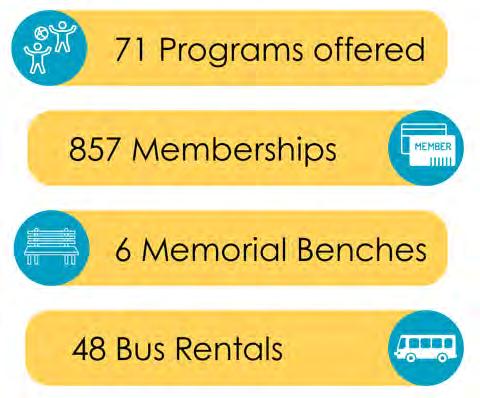
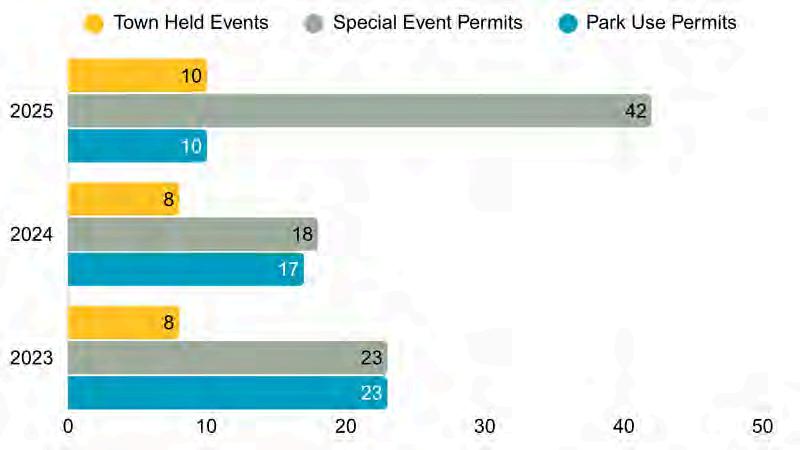
Recreation programming continued to grow with the introduction of new activities, including Jujitsu, as well as the return of the popular TGIF youth program. The Town also updated the Special Event Application Form andPolicy,alongwiththeRecreationFeesandCharges Bylaw, to support improved service delivery and event coordination.
Facility improvements included the completion of a new roofontheArtsBuildingandan
energy audit at Sun Bowl Arena completed in partnership with FortisBC to help identify future energy efficiencyopportunities.
Through the Resort Municipality Initiative (RMI) program, the Town supported several tourism and visitor experience enhancements, including new park information signage, visitor activity enhancements, giant puppet arts programming, museum and heritage interpretive signage, and multiple phases of community grantfunding.
In addition, discussions continued with Harness Racing BC regarding potential use opportunities at Desert Park RecreationComplex.
Looking ahead to 2026, work will continue on the Parks Master Plan following community engagement and feedback,withtheplanexpectedtoreturntoCouncilfor further consideration. Council also approved the terms of reference for the new Childcare Advisory Committee. Thecommitteewasestablishedin2025andisexpected tobeginmeetingsin2026tohelpsupportlocalchildcare initiativesandcommunityneeds.
Corporate Services
During 2025, the Corporate Services Department continued to support the effective operation of local government through legislative services, records management, bylaw enforcement, communications, and administrativesupport.
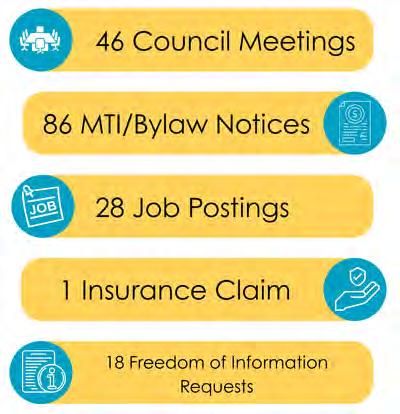
Corporate staff coordinated and administered 46 Council meetings throughout the year and recorded a total of 592 Council resolutions. In addition, 43 bylaws were processed through the required readings and formallyadopted.
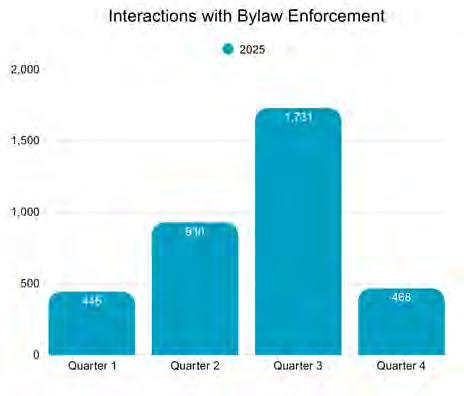
BylawEnforcementstaffcontinuedtofocusonproactive compliance efforts, particularly in the areas of animal control and unsightly properties, helping maintain community standards and public safety throughout Osoyoos.
WorkalsobeganonacomprehensiveCemeteryMaster Plan review to help guide future planning, operations, and long-term improvements for the Town’s cemetery services.
Late in 2025, the Town established a new Corporate Communicationsfunctiontoenhancepublic
engagement, improve information sharing, and support communications across all municipal departments.
Looking ahead to 2026, Corporate Services staff will begin preparations for the 2026 general local election, including securing equipment, facilities, and staffing resources required to support the election process.
The department will also continue its records digitization initiative by scanning paper records of enduring value and securely backing them up for long-term retention and improved accessibility.
The Cemetery Master Plan is expected to be completed in spring 2026, with implementation of key recommendations anticipated later in the year.
Corporate Communications initiatives planned for 2026 include a municipal website upgrade, development of public engagement surveys, and the establishment of an expanded social media presence to improve communication and community outreach.
Financial Services
The Financial Services Department continued to support the Town’s operations through effective financial management, timely processing, and ongoing system improvements throughout 2025. During the year, 5,240 invoices totaling $30,788,639 million were processed and paid to 669 suppliers. In addition, the department issued 479 invoices related to landfill tipping fees, cost recoveries, municipal services, and rural utility and fire protection services.
A total of 20,375 payments were processed in 2025, representing more than $29 million in revenue collection and financial transactions. At year-end, property tax accounts included 39 arrears accounts and 173 current outstanding accounts, with no delinquent accounts remaining. Utilities accounts included 22 rural sewer accounts, 136 rural water accounts and 995 in-town water accounts outstanding.
Work also continued on several key initiatives. The Town’s water metering database is now reading meters effectively, with billing based on metered water usage scheduled to begin January 1, 2027. In 2025, Council also appointed a new Director of Financial Services following the retirement of the previous Director, ensuring continued leadership and support for the department’s operations and long-term financial planning.
TOTALREVENUE$28,427,449
TOTALEXPENSES$16,306,152
NETREVENUE$12,121,297
Fire Department
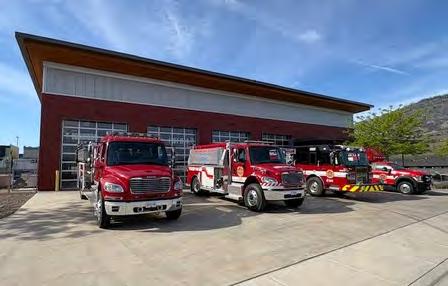
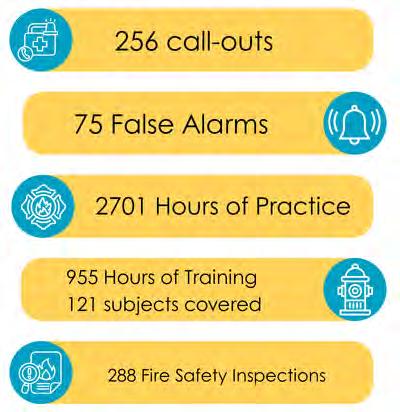
In 2025, the department achieved certification in Superior Tanker Shuttle Service, recognizing its ability to maintain a reliable water supply in non-hydranted areas for extended periods of time during emergency incidents.
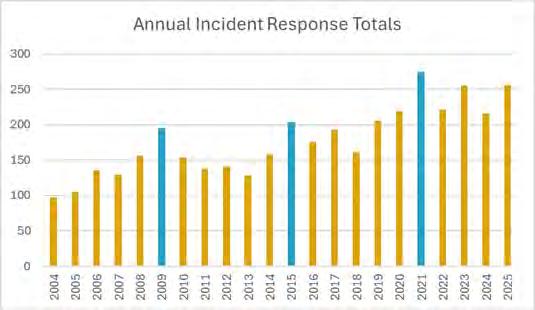
Fire crews responded to several significant incidents throughout the year, including a wildfire along Highway 3. Resources from across the South Okanagan, including aerial firefighting assets, assisted in the coordinatedresponse.
Training remained a major focus throughout the year, with firefighters participating in specialized annual training programs including hazardous materials response (Hazmat), water and swift water rescue, live firetraining,vehicleextrication,andwildfiremitigation.
The department also added a new battery-operated extrication tool to its fleet, improving response capabilities and operational efficiency, particularly in remoteordifficult-to-accesslocations.
Work continued in 2025 toward procuring a used ladder truck for the department. The Fire Department also continued toward the implementation of a Marine Rescue program through the acquisition of specialized equipmentandtrainingresources.
Osoyoos Fire Rescue remained actively involved in the community throughout the year by participating in local eventsincludingtheFarmersMarket,CherryFiesta,and Easter Eggstravaganza. Public education and fire prevention efforts also continued to expand, with firefighters delivering safety presentations to seniors and participating in educational programming for Grade 2studentsatthePentictonSafetyVillage.
Several important initiatives will continue into 2026, including: ImplementationofalocalFireSmartprogram ExpansionoftheFireDepartmenttraininggrounds Development of a High School Firefighter Work ExperienceProgram
Operational Services
Operational Services continued to focus on maintaining and upgrading essential infrastructure while advancing long-term sustainability initiatives throughout the community. In 2025, the Town further strengthened its water conservation efforts through amendments to the Water Conservation and Staged Restriction Bylaw. Changes included the implementation of a three-zone watering schedule designed to reduce peak water demand and help manage pressures on the Town’s infrastructuresystemsduringthesummermonths.
Flood mitigation improvements were also completed at sewer lift stations located within the floodplain. Through grant funding support, critical infrastructure at these facilities was raised to better protect the Town’s sewer systemduringemergencyandfloodevents.
TheTownalsocompletedtheroll-outofnewsolidwaste and yard waste collection carts to residential properties throughout the community. The new carts are intended to improve the efficiency and consistency of curbside collection services in partnership with the Town’s collectioncontractor.
To support future infrastructure planning, the Town awarded a contract for the completion of a Transportation Master Plan and Road Condition Assessment. The study, anticipated to be completed in mid-2026, will provide important data to guide future transportation planning, roadway maintenance, and capitalinvestmentdecisions.
Severalcapitalprojectswerecompletedduringtheyear, including water main replacements on 74th Avenue, reconstruction work on Magnolia Place including water, sewer,androadinfrastructureupgrades,andinstallation ofanewwatermainonHighway3at51stStreet.
Due to ongoing staffing capacity challenges within the Operational Services Department, some projects originally scheduled for 2025 have been deferred and carriedforwardinto2026.
Looking ahead, the Town will continue advancing several major infrastructure and operational initiatives. Work is ongoing toward completion of the Water Treatment Pilot Study in summer 2026, with preliminary designstagesexpectedtobeginbyyear-end.Additional efforts will focus on further water conservation measures through public education and seasonal watering restrictions, completion of the universal water metering program, utility upgrades on 89th Street and Quail Place, and continued public education initiatives aimed at reducing contamination in curbside recycling programs. The Town will also be renewing its solid waste collection contract and continuing recruitment efforts to address vacancies within the Operational ServicesDepartment.
Planning & Development
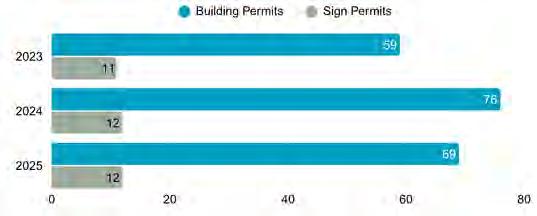
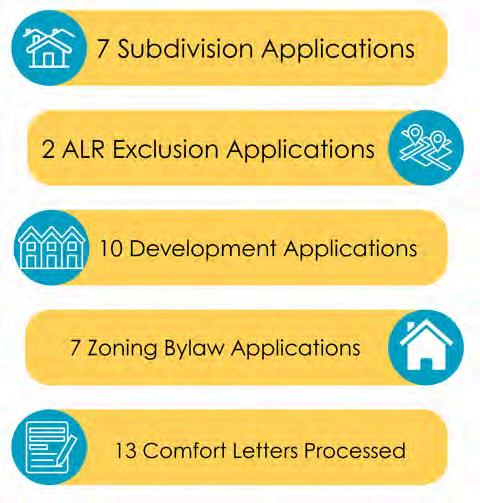
Council approved several updates to municipal bylaws and planning policies in 2025 to support housing, tourism, and long-term community growth. A new Business Licence Bylaw adopted in October 2025 introduced regulations for short-term rental accommodations and aligned with zoning changes established in 2024. Amendments to the Official Community Plan were also approved to support Phase 2 implementation of small-scale multi-unit housing initiatives.
The Town completed a review of mobile vendor regulations, resulting in updated policies that established designated vendor locations and a firstcome, first-served site assignment process.
The Town also worked collaboratively with the Regional District of Okanagan-Similkameen, the City of Penticton, and the Village of Keremeos to update the regional Housing Needs Report.
Several planning initiatives continued into 2026. The Town is updating its 2016 Development Cost Charges (DCC) Bylaw No. 1322. The proposed DCC Bylaw No. 1394, 2025 received three readings in July 2025 and is expected to be adopted following provincial review. Work also continued on floodplain management regulations following completion of the Town’s Flood Mitigation Plan in 2022, with proposed bylaw amendments anticipated to proceed to Council and Public Hearing in early 2026.
In addition, the Town is reviewing regulations for Campground Commercial (CT2) zones as part of a broader zoning bylaw update. The review includes consideration of campground operations, tourist accommodations, and site-specific zoning amendments, with ongoing Council review and opportunities for public input.
The financial statements included in this Annual Report have been prepared by management in accordance with Canadianpublicsectoraccountingstandards.Managementisresponsiblefortheaccuracy,integrity,andobjectivity of the financial information presented, as well as ensuring the information is consistent with the accompanying financialstatementsandschedules.
Management is also responsible for maintaining appropriate internal controls and financial management systems to providereasonableassurancethatfinancialinformationisreliableandassetsaresafeguarded.
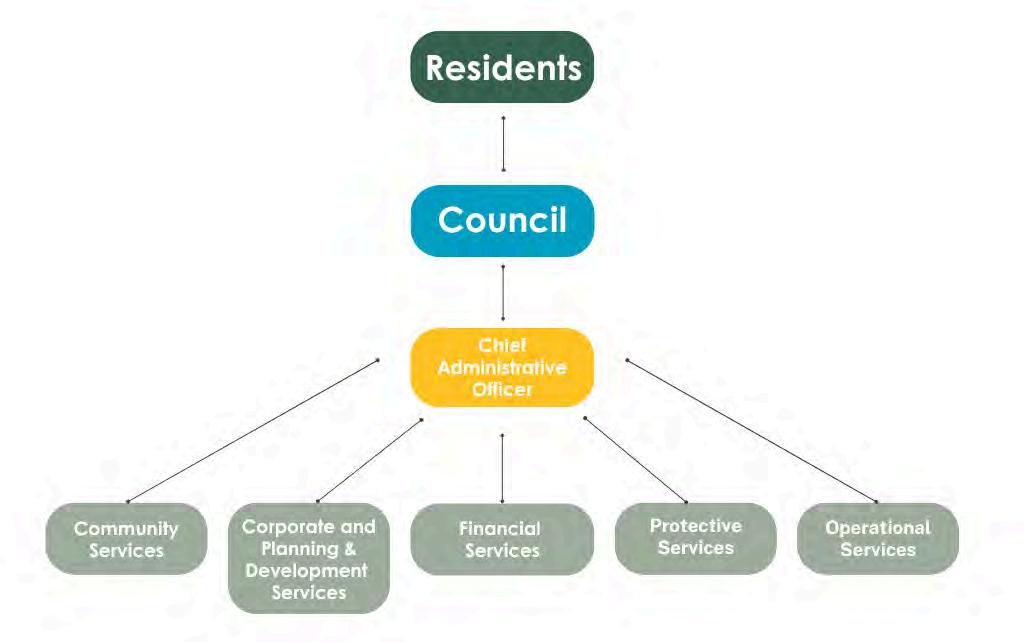
Council is responsible for overseeing the Town’s financial reporting processes and ensuring management fulfills its responsibilities related to financial reporting and internal controls. This oversight is exercised through the Chief AdministrativeOfficer,withCouncilreceivingregularfinancialupdatesthroughouttheyear.
The Town’s Director of Financial Services is responsible for assessing and supporting the Town’s financial managementpracticesandinternalcontrolsystems.
The Town’s external auditors, MNP, conduct an independent audit of the financial statements in accordance with generally accepted auditing standards and provide an opinion on whether the statements fairly present the financial position of the Town. As part of the audit process, the auditors review and assess internal controls and perform testing and procedures necessary to support their opinion. The external auditors have full access to Council and meetwiththemannually.
OnbehalfoftheCorporationoftheTownofOsoyoos.
Nicolette Keith Director of Financial Services
Corporation of the Town of Osoyoos
1.Elected
2.Other
List all employees with remuneration and expenses exceeding $75,000, exluding those listed in Section 1
We have audited the financial statements of the Town of Osoyoos (the "Municipality"), which comprise the statement of financial position as at December 31, 2025, and the statements of operations and accumulated surplus, changes in net financial assets and cash flows for the year then ended, and notes to the financial statements, including a summary of significant accounting policies.
In our opinion, the accompanying financial statements present fairly, in all material respects, the financial position of the Municipality as at December 31, 2025, and the results of its operations, changes in its net financial assets and its cash flows for the year then ended in accordance with Canadian public sector accounting standards.
Basis for Opinion
We conducted our audit in accordance with Canadian generally accepted auditing standards. Our responsibilities under those standards are further described in the Auditor’s Responsibilities for the Audit of the Financial Statements section of our report. We are independent of the Municipality in accordance with the ethical requirements that are relevant to our audit of the financial statements in Canada, and we have fulfilled our other ethical responsibilities in accordance with these requirements. We believe that the audit evidence we have obtained is sufficient and appropriate to provide a basis for our opinion.
Responsibilities of Management and Those Charged with Governance for the Financial Statements
Management is responsible for the preparation and fair presentation of the financial statements in accordance with Canadian public sector accounting standards, and for such internal control as management determines is necessary to enable the preparation of financial statements that are free from material misstatement, whether due to fraud or error.
In preparing the financial statements, management is responsible for assessing the Municipality’s ability to continue as a going concern, disclosing, as applicable, matters related to going concern and using the going concern basis of accounting unless management either intends to liquidate the Municipality or to cease operations, or has no realistic alternative but to do so.
Auditor's Responsibilities for the Audit of the Financial Statements
Our objectives are to obtain reasonable assurance about whether the financial statements as a whole are free from material misstatement, whether due to fraud or error, and to issue an auditor's report that includes our opinion. Reasonable assurance is a high level of assurance, but is not a guarantee that an audit conducted in accordance with Canadian generally accepted auditing standards will always detect a material misstatement when it exists. Misstatements can arise from fraud or error and are considered material if, individually or in the aggregate, they could reasonably be expected to influence the economic decisions of users taken on the basis of these financial statements.
As part of an audit in accordance with Canadian generally accepted auditing standards, we exercise professional judgment and maintain professional skepticism throughout the audit. We also:
Identify and assess the risks of material misstatement of the financial statements, whether due to fraud or error, design and perform audit procedures responsive to those risks, and obtain audit evidence that is sufficient and appropriate to provide a basis for our opinion. The risk of not detecting a material misstatement resulting from fraud is higher than for one resulting from error, as fraud may involve collusion, forgery, intentional omissions, misrepresentations, or the override of internal control.
Obtain an understanding of internal control relevant to the audit in order to design audit procedures that are appropriate in the circumstances, but not for the purpose of expressing an opinion on the effectiveness of the Municipality’s internal control.
Evaluate the appropriateness of accounting policies used and the reasonableness of accounting estimates and related disclosures made by management.
Conclude on the appropriateness of management's use of the going concern basis of accounting and, based on the audit evidence obtained, whether a material uncertainty exists related to events or conditions that may cast significant doubt on the Municipality’s ability to continue as a going concern. If we conclude that a material uncertainty exists, we are required to draw attention in our auditor's report to the related disclosures in the financial statements or, if such disclosures are inadequate, to modify our opinion. Our conclusions are based on the audit evidence obtained up to the date of our auditor's report. However, future events or conditions may cause the Municipality to cease to continue as a going concern.
Evaluate the overall presentation, structure and content of the financial statements, including the disclosures, and whether the financial statements represent the underlying transactions and events in a manner that achieves fair presentation.
We communicate with those charged with governance regarding, among other matters, the planned scope and timing of the audit and significant audit findings, including any significant deficiencies in internal control that we identify during our audit
Vernon, British Columbia
May 26, 2026
Chartered Professional Accountants
Corporation of the Town of Osoyoos Statement of Cash Flows
Town of Osoyoos
Notes to the Financial Statements
For the year ended December 31, 2025
1. Incorporation and operations
The Corporation of the Town of Osoyoos (the "Municipality") was incorporated as a Town in 1983 under statute of the Province of British Columbia. Its principal activities include the provision of local government services to residents of the incorporated area. These include general government, protective, water, sewer, recreation and cultural, environmental, transportation, and public health services. The financial statements include the results of operations for all services.
2. Significant accounting policies
These financial statements are the representations of management, prepared in accordance with Canadian public sector accounting standards and including the following significant accounting policies:
a) Basis of accounting
The Municipality follows the accrual method of accounting for revenues and expenses. Revenues are normally recognized in the year in which they are earned and measurable. Expenses are recognized as they are incurred and measurable as a result of receipt of goods or services and the creation of a legal obligation to pay.
b) Property tax revenue
Property tax revenue is recognized at the date property tax notices are issued, based on property assessment values issued by B.C. Assessment for the current year and tax rates established annually by bylaw. Assessments are subject to appeal and tax adjustments are recorded when the results of appeals are known.
c) Government Transfers
The Municipality recognizes a government transfer as revenue when the transfer is authorized and all eligibility criteria, if any, have been met. A government transfer with stipulations giving rise to an obligation that meets the definition of a liability is recognized as a liability. In such circumstances, the Municipality recognizes revenue as the liability is settled. Transfers of non-depreciable assets are recognized in revenue when received or receivable.
d) Deferred revenue
Deferred revenue includes grants, contributions and other amounts received from third parties pursuant to legislation, regulation and agreement which may only be used in certain programs, in the completion of specific work, or for the purchase of tangible capital assets. In addition, certain user charges and fees are collected for which the related services have yet to be performed. Revenue is recognized in the period when the related expenses are incurred, services performed, or the tangible capital assets are acquired.
e) Revenue
Revenue from transactions with performance obligations is recognized when the Municipality satisfies a performance obligation by providing the promised goods or services to a payor. The performance obligation is evaluated as being satisfied either over a period of time or at a point in time.
f) Cash and cash equivalents
Cash and cash equivalents include cash and highly liquid investments with a term to maturity of 90 days or less at acquisition and readily convertible to cash.
g) Investments
Investments consist of short-term bonds, money market funds and guaranteed investment certificates and are recorded at cost.
h) Long-term debt
Long-term debt is recorded net of principal repayments and actuarial adjustments.
For the year ended December 31, 2025
2. Significant accounting policies (Continued from previous page)
i) Asset retirement obligation
A liability for an asset retirement obligation is recognized at the best estimate of the amount required to retire a tangible capital asset (or a component thereof) at the financial statement date when there is a legal obligation for the Municipality to incur retirement costs in relation to a tangible capital asset (or component thereof), the past transaction or event giving rise to the liability has occurred, it is expected that future economic benefits will be given up, and a reasonable estimate of the amount can be made. The best estimate of the liability includes all costs directly attributable to asset retirement activities, based on information available at December 31, 2025. The best estimate of an asset retirement obligation incorporates a present value technique, when the cash flows required to settle or otherwise extinguish an asset retirement obligation are expected to occur over extended future periods.
When a liability for an asset retirement obligation is initially recognized, a corresponding asset retirement cost is capitalized to the carrying amount of the related tangible capital asset (or component thereof). The asset retirement cost is amortized over the useful life of the related asset.
At each financial reporting date, the Municipality reviews the carrying amount of the liability. The Municipality recognizes period-to-period changes to the liability due to the passage of time as accretion expense. Changes to the liability arising from revisions to either the timing, the amount of the original estimate of undiscounted cash flows or the discount rate are recognized as an increase or decrease to the carrying amount of the related tangible capital asset.
The Municipality continues to recognize the liability until it is settled or otherwise extinguished. Disbursements made to settle the liability are deducted from the reported liability when they are made.
j) Liability for contaminated site
A liability for remediation of a contaminated site is recognized at the best estimate of the amount required to remediate the contaminated site when contamination exceeding an environmental standard exists, the Municipality is either directly responsible or accepts responsibility, it is expected that future economic benefits will be given up, and a reasonable estimate of the amount is determinable. The best estimate of the liability includes all costs directly attributable to remediation activities and is reduced by expected net recoveries based on information available at December 31, 2025
At each financial reporting date, the Municipality reviews the carrying amount of the liability. Any revisions required to the amount previously recognized is accounted for in the period revisions are made. The Municipality continues to recognize the liability until it is settled or otherwise extinguished. Disbursements made to settle the liability are deducted from the reported liability when they are made.
k)
Non-financial assets
Non-financial assets are not available to discharge existing liabilities and are held for use in the provision of services. They have useful lives extending beyond the current year and are not intended for sale in the ordinary course of operations.
l)
Tangible capital assets
Tangible capital assets are recorded at cost which includes amounts that are directly attributable to acquisition, construction, development or betterment of the asset.
Annual amortization is charged in the year of acquisition. Amortization is charged to the date the asset is sold in the year of disposal. Assets under construction are not amortized until the asset is available for productive use.
The cost less residual value of the tangible capital assets, excluding land, are amortized on a straight-line basis over their estimated useful lives as follows:
Town of Osoyoos
Notes to the Financial Statements
For the year ended December 31, 2025
2. Significant accounting policies (Continued from previous page)
Tangible capital assets (Continued from previous page)
ii) Contributions of tangible capital assets
Tangible capital assets received as contributions are recorded at their fair value at the date of receipt and also are recorded as revenue.
iii) Natural resources
Natural resources that have not been purchased are not recognized as assets in the financial statements.
iv) Works of art and cultural and historic assets
Works of art and cultural and historic assets are not recorded as assets in these financial statements.
v) Interest capitalization
The Municipality does not capitalize interest costs associated with the acquisition or construction of a tangible capital asset.
l) Use of estimates
The preparation of financial statements requires management to make estimates and assumptions that affect the reported amounts of assets and liabilities, and disclosure of contingent assets and liabilities at the date of the financial statements, and the reported amounts of revenues and expenses during the period.
Significant estimates include assumptions used in estimating provisions for accrued liabilities, estimated useful lives of tangible capital assets, valuation of accounts receivable, and asset retirement obligations.
Liabilities for contaminated sites are estimated based on the best information available regarding potential contamination where the Municipality is responsible.
m) Debt charges
Debt principal repayments are not included in the statement of operations pursuant to PSAB disclosure. Interest expense is recorded on an accrual basis and is expensed to the current year operations.
n) Deferred development cost charges
Certain user fees and development charges are collected for future services and acquisitions. These revenues are deferred and recognized in the period in which the specified expenses are incurred, services performed, or the tangible capital assets acquired.
o) Employee future benefits
The Municipality and its employees make contributions to the Municipal Pension Plan. As this plan is a multi-employer defined benefit pension plan, the Municipality's contributions are expensed as incurred.
p) Expenses
Expenses are recognized as they are incurred and measurable based on receipt of goods or services and/or the creation of a legal obligation to pay.
q) Inventory
Inventory is valued at the lower of cost and net realizable value, with cost determined on a first-in, first-out basis.
r) Leases
Leases are classified as capital or operating leases. Leases which transfer substantially all of the benefits and risks incidental to ownership of property are accounted for as capital leases. All other leases are accounted for as operating leases and the related lease payments are charged to expenses as incurred.
For the year ended December 31, 2025
2. Significant accounting policies (Continued from previous page)
s) Prepaid expenses
Various items are included in prepaid expenses including insurance and deposits. These items are intended to be included in expenses in the next financial reporting period and as such are not considered financial instruments.
t) Tax collections for other governments
The Municipality is required by legislation to collect property taxes on behalf of other governments. These collections and requisitions are not included in the Municipality's financial statements as part of the statement of operations.
u) Trust funds
Trust funds and the related assets and liabilities held by the Municipality for cemetery care are not included in the statement of financial position. A Statement of Cemetery Care Trust Funds is provided for information purposes.
v) Financial instruments
The Municipality recognizes its financial instruments when the Municipality becomes party to the contractual provisions of the financial instrument. All financial instruments are initially recorded at their fair value.
At initial recognition, the Municipality may irrevocably elect to subsequently measure any financial instrument at fair value. The Municipality has not made such an election during the year
The Municipality subsequently measures investments in equity instruments quoted in an active market and all derivative instruments, except those that are linked to, and must be settled by delivery of, unquoted equity instruments of another entity, at fair value. Fair value is determined by punlished price quotations. Transactions to purchase or sell these items are recorded on the trade date. Net gains and losses arising from changes in fair value are recognized in the statement of remeasurement gains and losses. The Municipality has not presented a statement of remeasurement gains and losses as it does not have any items giving rise to remeasurement gains (losses). Interest income is recognized in the statement of operations. Investments in equity instruments not quoted in an active market and derivatives that are linked to, and must be settled by delivery of, unquoted equity instruments of another entity, are subsequently measured at cost. With the exception of those instruments designated at fair value, all other financial assets and liabilities are subsequently measured at amortized cost using the effective interest rate method.
Transaction costs directly attributable to the origination, acquisition, issuance or assumption of financial instruments subsequently measured at fair value are immediately recognized in operating annual surplus. Conversely, transaction costs are added to the carrying amount for those financial instruments subsequently measured at cost or amortized cost.
All financial assets except derivatives are tested annually for impairment. Management considers whether the investee has experienced continued losses for a period of years in determining whether objective evidence of impairment exists. Any impairment, which is not considered temporary, is recorded in the statement of operations. Write-downs of financial assets measured at cost and/or amortized cost to reflect losses in value are not reversed for subsequent increases in value. Reversals of any net remeasurements of financial assets measured at fair value are reported in the statement of remeasurement gains and losses.
4. Temporary investments
Interest earned on the various GICs ranges from 2.22% to 5.69% (2025 – 4.00% to 6.55%) per annum depending on the maturity of the GIC and is accrued as earned over the term of the investment. All investments mature between 3 and 18 months after year and and are held in the general fund.
5. Accounts receivable
Notes to the Financial Statements
For the year ended December 31, 2025
7. Asset retirement obligation
The Municipality opened a landfill site in 2011, and is legally required to perform closure and post-closure activities upon retirement of this site, which is estimated to be in 17 years. The Municipality recognized a liability for the asset retirement obligation ("ARO") and a corresponding amount has been capitalized as an asset retirement cost and added to the carrying value of the landfill site. The asset retirement cost is amortized on a straight-line basis over the useful life of the site.
The Municipality estimated the amount of the liability using a present value technique wherein cash flows are discounted using a borrowing rate of 3.87% (based upon the Municipality's long term historic rate) and using the period remaining for the retirement of the asset from the year of recognition. The estimated liabilities at retirement are based on a 2% inflation rate based on the midpoint of Bank of Canada's target inflation range of 1% to 3%. The reported liability is based on estimates and management assumptions with respect to events extending over the post closure period using the best information available to management. Future events may result in significant changes to the estimated total expense, capacity used or total capacity and the estimated liability, and would be recognized prospectively, as a change in estimate, when applicable.
The Municipality owns a number of buildings which contain asbestos, which represent a health hazard as per the Canadian Environmental Protection Act and B.C. Hazardous Waste Regulation, and is legally required to perform closure activities upon renovation or demolition of these sites. The Municipality recognized a liability for the asset retirement obligation and a corresponding amount has been capitalized as an asset retirement cost and added to the carrying value of each of the buildings.
The Municipality estimated the amount of the liability by engaging third party contractors to provide quotes on the cost to remove the asbestos and to further renovate the buildings. These fixed quotes were received during the 2023 financial year, with all priority 1 abatements completed by 2026. The remainder will be completed thereafter, on a priority basis.
Federal Gas Tax Funding (Community Works Fund) is provided by the Government of Canada. The use of the funding is established by a funding agreement between the Municipality and the Union of British Columbia Municipalities. Federal Gas Tax funding may be used towards designated public transit, community energy, water, wastewater, solid waste and capacity building projects, as specified in the funding agreements.
9. Deferred development cost charges
For the year ended December 31, 2025
10.Long-term debt
The estimated aggregate repayments on long-term debt over the next five years are as follows:
Interest paid on the long-term debt totaled $337,958 (2024 - $286,712) and is expensed in the segment to which the debt relates (Note 18). The actuarial adjustment for the year was $61,562 (2024 - $50,489).
11.Accumulated surplus
Accumulated
represented by:
The restricted surplus represents reserves set aside for future expenses. Non-statutory reserves represent an appropriation of surplus for specific purposes. Reserves for future capital expenditures represent funds to finance incomplete capital projects. Statutory reserves are restricted by the Community Charter and the associated municipal bylaws that establish the reserves. A schedule accompanying these financial statements provides details of the various restricted surpluses held and the changes during in the current year.
For the year ended December 31, 2025
12.Commitments and contingencies
a) The Municipality, as a member of the Regional District of the Okanagan-Similkameen (“RDOS”) and the Regional Hospital District ("RHD"), is responsible for its portion of any operating deficits or long-term debt related to functions in which it participates. Under provisions of the Local Government Act, the RDOS debt is a joint and several liability of the RDOS and each of its member municipalities.
b) The Municipality and its employees contribute to the Municipal Pension Plan (a jointly trusteed pension plan). The board of trustees, representing plan members and employers, is responsible for administering the plan, including investment of assets and administration of benefits. The plan is a multi-employer defined benefit pension plan. Basic pension benefits are based on a formula. As at December 31, 2024, the plan has about 273,000 active members and approximately 133,000 retired members. Active members include approximately 47,000 contributors from local governments.
Every three years, an actuarial valuation is performed to assess the financial position of the plan and adequacy of plan funding. The actuary determines an appropriate combined employer and member contribution rate to fund the plan. The actuary’s calculated contribution rate is based on the entry-age normal cost method, which produces the long-term rate of member and employer contributions sufficient to provide benefits for average future entrants to the plan. This rate may be adjusted for the amortization of any actuarial funding surplus and will be adjusted for the amortization of any unfunded actuarial liability.
The most recent actuarial valuation for the Municipal Pension Plan as at December 31, 2024, indicated a $2,675 million funding surplus for basic pension benefits on a going concern basis.
The next valuation will be as at December 31, 2027.
The Municipality paid $304,525 (2024 - $310,997) for employer contributions to the plan in 2025.
Employers participating in the plan record their pension expense as the amount of employer contributions made during the fiscal year (defined contribution pension plan accounting). This is because the plan records accrued liabilities and accrued assets for the plan in aggregate, resulting in no consistent and reliable basis for allocating the obligation, assets and cost to individual employers participating in the plan.
c) Debentures are covered by a loan agreement with the MFABC which provides that, if at any time the payments provided for in the agreement are not sufficient to meet the authority's obligations in respect of such borrowings, the resulting deficiency becomes a proportional liability of each local government member. As these demand notes are contingent in nature, no liability is recorded (Note 13).
d) The Municipality rents a space for a fire hall under an annual operating lease which expires in May, 2029. Future minimum payments under the operating lease for the firehall space are as follows:
e) The Municipality, along with the RDOS, jointly appoints members to a recreation commission having responsibility for the management of the Sun Bowl Arena. The Municaplity provides management services under a contract that allows for the supervision and operation of the Sun Bowl Arena. The operations of the Sun Bowl Arena are wholly consolidated by the RDOS.
Town of Osoyoos
Notes to the Financial Statements
For the year ended December 31, 2025
13.Municipal Finance Authority of B.C. deposits
The Municipality issues its debt instruments through debenture financing obtained from the MFABC. A condition of the MFABC borrowing is that a portion of the debenture proceeds are withheld by the MFABC as a debt reserve fund. The Municipality executes demand notes in connection with each debenture and the related debt reserve, whereby the Municipality may be required to loan certain amounts to the MFABC (Note 10). The details of the cash deposits and demand notes at the year-end are as follows:
14.Government transfers
Government transfers are included in the revenues identified as Grants – provincial, Grants – other, and Grants in lieu of taxes. In 2025, the Municipality received and recorded as revenue the following transfers:
15.Budget
data
The budget data presented in these financial statements is based upon the 2025 operating and capital budgets adopted by Council on December 10, 2024. Subsequent amendments have been approved by Council and are not reflected in the financial statement budget figures presented. The following table reconciles the approved budget to the budget figures reported in these financial statements.
for budgeted cash items not included in statement of operations
For the year ended December 31, 2025
16.Growing communities fund
The Province of British Columbia distributed conditional Growing Communities Fund ("GCF") grants to communities at the end of March 2023 to help local governments build community infastructure and amenities to meet the demands of population growth. The GCF provided a one-time total of $1 billion in grants to all 161 municipalities and 27 regional districts in B.C.
The funding did not meet the criteria to defer the unspent portion, so the full amount was recognized as revenue in 2023. The amounts spent as of December 31, 2025 are:
17.Comparative figures
Certain comparative figures have been reclassified to conform with current year's presentation.
18.Financial Instruments
The Municipality as part of its operations carries a number of financial instruments. It is management's opinion that the Municipality is not exposed to significant interest, currency or credit risks arising from these financial instruments except as otherwise disclosed.
Credit Risk
Credit risk is the risk of financial loss because a counter party to a financial instrument fails to discharge its contractual obligations. The Municipality is exposed to credit risk with respect to accounts receivable.
The carrying amount of the Municipality’s financial instruments best represents the maximum exposure to credit risk. There has been no change in risk exposure from 2024.
Risk management
The Municipality manages its credit risk by providing allowances for potentially uncollectible accounts receivable.
Interest rate risk
Interest rate risk is the risk that the value of a financial instrument might be adversely affected by a change in the interest rates. Changes in market interest rates may have an effect on the cash flows associated with some financial assets and liabilities, known as cash flow risk, and on the fair value of other financial assets or liabilities, known as price risk. The Municipality is exposed to price risk with respect to its long-term debt which is at a fixed rate. The Municipality also ensures that they have sufficient cash to meet the outstanding debt debt obligation if interest rates should rise. The Municipality monitors expected cash outflow through budgeting and maintenance of loans payable and investments. There have been no significant changes from the previous year in the exposure to risk or policies, procedures and methods used to measure the risk.
Town of Osoyoos
Notes to the Financial Statements
For the year ended December 31, 2025
19.Segmented information
The Corporation of the Town of Osoyoos is a municipal government that provides a range of services to the citizens of Osoyoos and area. The Municipality is governed by an elected Council comprised of a Mayor, four Councillors, and two Water Councillors, whose authority is set out in the Community Charter and Local Government Act. The Municipality’s operations are organized and reported by Fund. The Funds have been segmented into the various services provided and summarized below.
General government services include administration, finance, legislative, information, customer services, and human resources functions. Revenue and expenses in this segment relate to operations of the Municipality and cannot be directly attributed to another segment.
Protective services include fire protection, bylaw enforcement, animal control, community planning and development services, and occupational health and safety functions of the Municipality. Fire protection is provided by a fire chief and volunteer members whose duties include inspections, enforcement, and fire suppression.
Transportation services include road and sidewalk maintenance, street lighting maintenance, storm drain maintenance, snow removal, and the equipment used within these functions.
Environmental services include garbage collection, recycling, and landfill operations of the Municipality.
Recreation and cultural services include various recreational programs, the Desert Park facility, Sun Bowl arena, the Sonora Centre, the marina, the museum, the library and the parks operations.
Public health services include the operations related to South Okanagan Emergency Preparedness, Emergency Social Services, the health centre and cemetery functions.
Sewer services include the operating activities of the Sewer Fund that relate to the collection and treatment of wastewater, maintenance of the related equipment, and capital upgrade of the sewer system of the Municipality.
Water services include the operating activities of the Water Fund that relate to the treatment, distribution, maintenance, and capital upgrade of the water system of the Municipality and the outlying Irrigation District.
Corporation of the Town of Osoyoos
Notes to the Financial Statements
For the year ended December 31, 2025
19. Segmented information (continued)
Corporation of the Town of Osoyoos
Notes to the Financial Statements
For the year ended December 31, 2025
19. Segmented information (continued)
Schedule 1 - Restricted Surplus - Reserves for
Included in tangible capital assets are fully depreciated assets with cost and accumulated amortization of $2,753,956 (2024$4,462,410).
Corporation of the Town of Osoyoos Statement of Cemetery Care Trust Fund Statement of Financial Position As at December 31, 2025
The Cemetery Care trust funds are administered by the Town have not been included in the statement of financial position. The trust fund is used for the perpetual maintenance of the cemetery.
Financial Statements
December 31, 2025
Osoyoos Sun Bowl Arena
Independent Auditor’s Report
To the Advisory Committee of the Osoyoos Sun Bowl Arena,
Opinion
We have audited the financial statements of the Osoyoos Sun Bowl Arena (the "Arena"), which comprise the statement of operations for the year ended December 31, 2025, and notes to the financial statements, including a summary of significant accounting policies.
In our opinion, the accompanying financial statements present fairly, in all material respects, the results of its operations for the year ended December 31, 2025, in accordance with Canadian public sector accounting standards.
Basis for Opinion
We conducted our audit in accordance with Canadian generally accepted auditing standards. Our responsibilities under those standards are further described in the Auditor’s Responsibilities for the Audit of the Financial Statements section of our report. We are independent of the Arena in accordance with the ethical requirements that are relevant to our audit of the financial statements in Canada, and we have fulfilled our other ethical responsibilities in accordance with these requirements. We believe that the audit evidence we have obtained is sufficient and appropriate to provide a basis for our opinion.
Responsibilities of Management and Those Charged with Governance for the Financial Statements
Management is responsible for the preparation and fair presentation of the financial statements in accordance with Canadian public sector accounting standards, and for such internal control as management determines is necessary to enable the preparation of financial statements that are free from material misstatement, whether due to fraud or error.
In preparing the financial statements, management is responsible for assessing the Arena’s ability to continue as a going concern, disclosing, as applicable, matters related to going concern and using the going concern basis of accounting unless management either intends to liquidate the Arena or to cease operations, or has no realistic alternative but to do so.
Those charged with governance are responsible for overseeing the Arena’s financial reporting process.
Auditor's Responsibilities for the Audit of the Financial Statements
Our objectives are to obtain reasonable assurance about whether the financial statements as a whole are free from material misstatement, whether due to fraud or error, and to issue an auditor's report that includes our opinion. Reasonable assurance is a high level of assurance but is not a guarantee that an audit conducted in accordance with Canadian generally accepted auditing standards will always detect a material misstatement when it exists. Misstatements can arise from fraud or error and are considered material if, individually or in the aggregate, they could reasonably be expected to influence the economic decisions of users taken on the basis of these financial statements. As part of an audit in accordance with Canadian generally accepted auditing standards, we exercise professional judgment and maintain professional skepticism throughout the audit. We also:
Identify and assess the risks of material misstatement of the financial statements, whether due to fraud or error, design and perform audit procedures responsive to those risks, and obtain audit evidence that is sufficient and appropriate to provide a basis for our opinion. The risk of not detecting a material misstatement resulting from fraud is higher than for one resulting from error, as fraud may involve collusion, forgery, intentional omissions, misrepresentations, or the override of internal control.
Obtain an understanding of internal control relevant to the audit in order to design audit procedures that are appropriate in the circumstances, but not for the purpose of expressing an opinion on the effectiveness of the Arena’s internal control.
Evaluate the appropriateness of accounting policies used and the reasonableness of accounting estimates and related disclosures made by management.
Conclude on the appropriateness of management's use of the going concern basis of accounting and, based on the audit evidence obtained, whether a material uncertainty exists related to events or conditions that may cast significant doubt on the Arena’s ability to continue as a going concern. If we conclude that a material uncertainty exists, we are required to draw attention in our auditor's report to the related disclosures in the financial statements or, if such disclosures are inadequate, to modify our opinion. Our conclusions are based on the audit evidence obtained up to the date of our auditor's report. However, future events or conditions may cause the Arena to cease to continue as a going concern.
Evaluate the overall presentation, structure and content of the financial statements, including the disclosures, and whether the financial statements represent the underlying transactions and events in a manner that achieves fair presentation.
We communicate with those charged with governance regarding, among other matters, the planned scope and timing of the audit and significant audit findings, including any significant deficiencies in internal control that we identify during our audit.
Vernon, British Columbia
May 26, 2026
Chartered Professional Accountants
Osoyoos Sun Bowl Arena
Notes to the Financial Statements
For the year ended December 31, 2025
The organization is a joint committee appointed by the Town of Osoyoos (the “Town”) and the Regional District of Okanagan Similkameen (“RDOS”), and its principal business activity consists of the operation of an ice arena. It is the policy of the Osoyoos Sun Bowl Arena (the “Arena”) to follow Canadian public sector accounting standards for British Columbia municipalities as prescribed by the Public Sector Accounting Board (“PSAB”), and to apply such provisions consistently.
1. Significant accounting policies
(a) Basis of accounting
The Arena follows the accrual method of accounting for revenues and expenses. Revenues are normally recognized in the year in which they are earned and measurable. Expenses are recognized as they are incurred and measurable as a result of receipt of goods or services and the creation of a legal obligation to pay.
(b) Revenue recognition
Revenue from the sale of services is recognized when services are provided. The Arena recognizes a government transfer as revenue when the transfer is authorized and all eligibility criteria, if any, have been met.
(c) Expenses
Expenses are recognized as they are incurred and measurable based on receipt of goods or services and/or the creation of a legal obligation to pay.
2. Budget data
The budget figures presented are from the Five-Year Financial Plan Bylaw No. 3102, 2025 adopted by Directors of the Regional District of Okanagan-Similkameen (the “District”) on March 6, 2025. Subsequent amendments have been approved by Council.
3. Other financial information
The Town has not prepared a statement of financial position, statement of changes in net debt or statement of cash flows as they would not provide additional information.
Corporation of the Town of Osoyoos
APPROVAL OF FINANCIAL INFORMATION
FIR,Schedule1,Section9
Town of Osoyoos
Statement of Financial Information Approval
The undersigned, as authorized by the Financial Information Regulation, Schedule 1, subsection 9(2), approves all the statements and schedules included in this statement of FinancialInformation,producedunderthe Financial Information Act.
Name: Nicolette Keith
Position of: Director of Finance
Date: June 3, 2026
Name: Sue McKortoff
Position of: Mayor
Date: June 3, 2026
Prepared pursuant to the Financial Information Regulation, Schedule 1, section 9
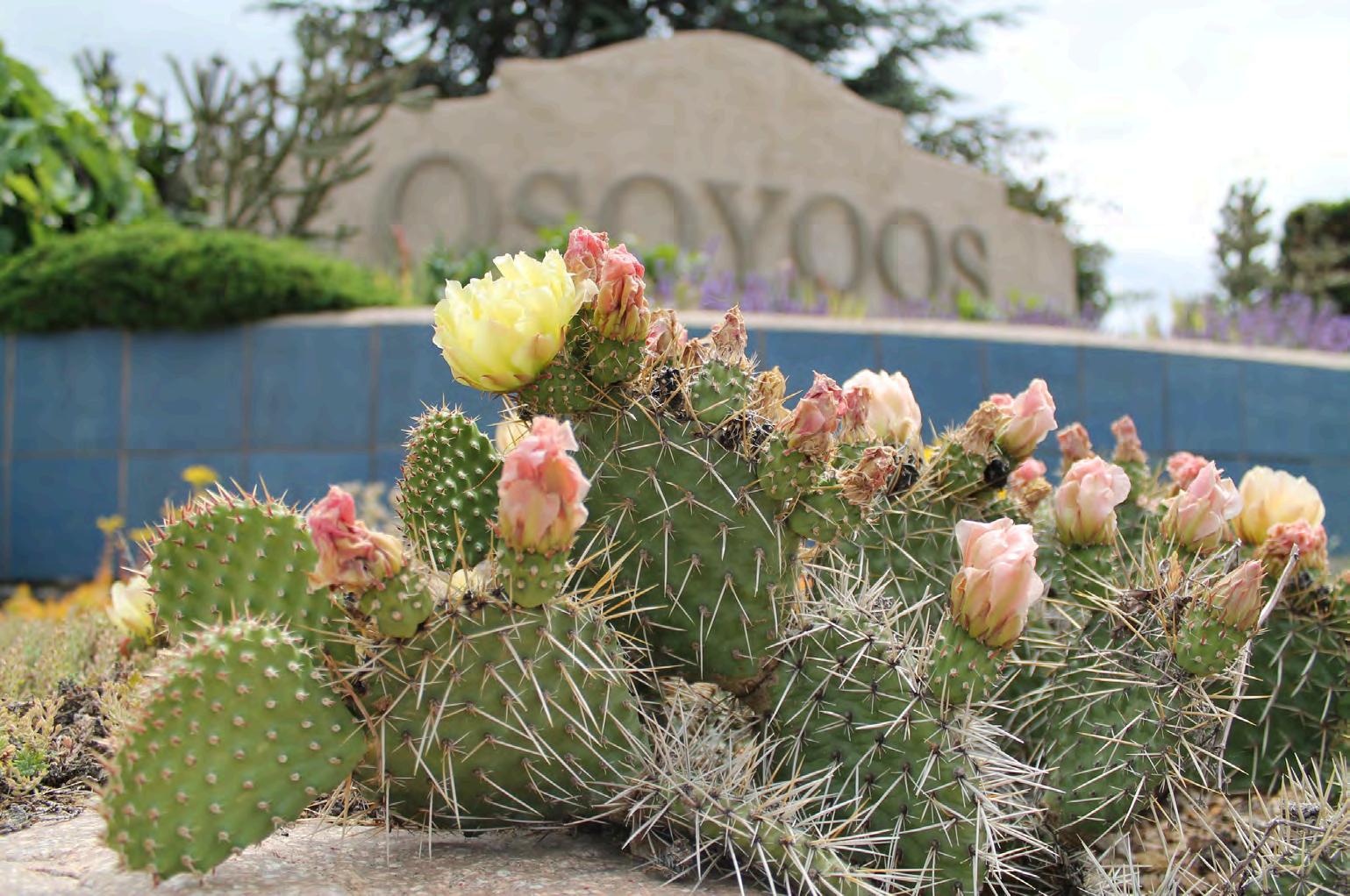
The Annual Report is produced by the Corporate Services Department of the Town of Osoyoos, in cooperation with all departments. Images are provided by Destination Osoyoos, unless otherwise noted.