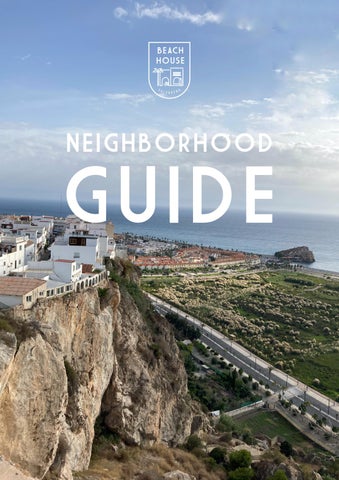
NEIGHBORHOOD
GUIDE
Neighborhood Guide
Get to know Map Costa Tropical Where locals go on vacation. The atmosphere at Costa Tropical is like nowhere else. The costal life is influenced by tourism – but it hasn’t turned everything upside down. The local relaxed but vibrant way of life still rules the area in an unmistakable southern Spanish way. The bars are Spanish. The food is Spanish. The people are Spanish. But no pubs and no fast food - thanks heaven. Beach, beer and tapas is the theme around here. Everything served in the friendly and relaxed Spanish way. 1: Malaga Airport 2: Nerja Caves 3: Almunecar 4: Motril
5: Sierra Nevada 6: Granada 7: Alhambra
1
6
7
5
2
3
4
Neighborhood Guide
The Town
The Town
Salobrena have app.15.000 inhabitants and 30-40 bars and restaurants. They all have great coffee. And They all serve tapas along the drinks. The town have Plenty of supermarkets like Lidl, Dia, Super Sol and Marcadona, many bakerys, farmacias and special stores. All kind of normal shopping can be done here - and always in a cosy and local atmosphere. Most is open from 10 - 21 but closed for siesta 14 - 17. Most is closed sunday. Remember the casual Spanish way of looking at exact opening hours and days. The town is divided in 2 areas; The old town, build on the steep rock around the castle. And the new part on the footstep of the rock and along the beach. At the old white town on the rock, things are as they always has been. You can choose your own way to the top, and if you dare some few narrow steep roads are also open for cars. Park all the way up beside the round radio house. Enjoy the view and walk to restaurant "Pesetas" with the great panorama terrasse. Go to the picturesque old townhall square with the café and small market or locate Restaurant Roka where the view of the sunset is phenomenal. On the footsteps on the rock is the modern part of Salobrena. With more shops, more bars, more trafic and more life. Here is the little market hall located, where you can buy fresh fish, meat, vegetables and others - or just enjoy the great coffee and churros in the morning. All bars and restaurants in the town are open all year, while only a few at the beach area are open in the vinter. Everywhere drinks are followed by free tapas - so order drinks and wait to your tapas arrive before ordering any food. Otherwise, you might end up ordering something you already received.
Neighborhood Guide
The local area
The local area
The coast of Granada province is known as the Costa Tropical. The coast of Costa Tropical offers hundreds of beaches and costal towns. While Costa del Sol, on the other side of Malaga, is packed with high end tourism, English pubs and other foreign activities, Costa Tropical is mostly visited by Spanish locals and tourists. Here you can meet the traditional Spanish life. On both side of Salobrena you will meet other great beaches. On one side only 10 km away, the tourist center of Costa Tropical; Almunecar, is located. Higher houses, more shops and more activities - but still a great atmosphere. A couple of kilometers in the other direction you will find Playa Granada with the local golf course, more advanced villas and among others our favorite beach bar: Bonobo. Drive in both directions. And you will have a great time at the beach and on most corners you will have plenty of bars and restaurants to choose among. 6 km from Salobrena and 2 km inland is the local capital, Motril, situated. The town have more advance shops and international koncept-shops. The best part of Motril is the narrow streets in the center, so park you car, and explore by foot. Great food, Coffee and beer is available everywhere.
Neighborhood Guide
Granada Province
Granada Province
Salobrena is placed on the coastline of the Granada Province which contains app 170 towns. The Granada province is divided in the coast, the inland and the mountains. Every aspect of the southern European nature is available here. The province attracts large numbers of both Spanish and foreign holiday-makers. The main resorts on the coast are Almuñecar, Salobreña and La Herradura. The city of Granada brings in tourists from all over the world thanks to its Moorish architecture, especially the famous Alhambra palace. Granada is a highly recommendable city, where you always can discover new buildings and places. And the inferno of bars and restaurants seem endless. Just be aware of the temperature in the summer. Granada is a hot city. In the winter the mountains of the Sierra Nevada play host to Europe's most southerly ski resort. Hiking and eco-tourism also attract a number of visitors to areas such as the Alpujarras and Lecrin Valley.
Neighborhood Guide
Andalucia Region
Andalucia region
Andalusia is the southernmost autonomous community in Peninsular Spain. It is the most populous and the second largest autonomous community in the country. It is officially recognised as a “historical nationality”. The territory is divided into eight provinces: Almería, Cádiz, Córdoba, Granada, Huelva, Jaén, Málaga, and Seville. Its capital city is Seville. The seat of the High Court of Justice of Andalusia is located in the city of Granada. Andalusia is the only European region with both Mediterranean and Atlantic coastlines. The small British overseas territory of Gibraltar shares a three-quarter-mile land border with the Andalusian portion of the province of Cádiz at the eastern end of the Strait of Gibraltar. Andalusia has historically been an agricultural region, compared to the rest of Spain and the rest of Europe. Still, the growth of the community in the sectors of industry and services was above average in Spain and higher than many communities in the Eurozone. The region has a rich culture and a strong Spanish identity. Many cultural phenomena that are seen internationally as distinctively Spanish are largely or entirely Andalusian in origin. These include flamenco and, to a lesser extent, bullfighting and Hispano-Moorish architectural styles, both of which are also prevalent in some other regions of Spain.
Neighborhood Guide
Alhambra
Alhambra
The Alhambra is a palace and fortress complex located in Granada, Andalusia, Spain. It was originally constructed as a small fortress in 889 CE on the remains of ancient Roman fortifications, and then largely ignored until its ruins were renovated and rebuilt in the 11th century by the Amazigh king Badis ibn Habus of the Zirid dynasty and later completed in the 14th century by the Arab Nasrid dynasty. It was converted into a royal palace in 1333 by Yusuf I, Sultan of Granada. After the conclusion of the Christian Reconquista in 1492, the site became the Royal Court of Ferdinand and Isabella(where Christopher Columbus received royal endorsement for his expedition), and the palaces were partially altered in the Renaissance style. In 1526, Charles I of Spain commissioned a new Renaissance palace better befitting the Holy Roman Emperor in the revolutionary Mannerist style influenced by humanist philosophy in direct juxtaposition with the Nasrid Andalusian architecture, but it was ultimately never completed due to Morisco rebellions in Granada. Alhambra’s last flowering of Islamic palaces was built for the final Muslim emirs in Spain during the decline of the Nasrid dynasty, who were increasingly subject to the Christian kings of Castile. After being allowed to fall into disrepair for centuries, the buildings occupied by squatters, Alhambra was rediscovered following the defeat of Napoleon I, who had conducted retaliatory destruction of the site. The rediscoverers were first British intellectuals and then other northern European Romantic travelers. It is now one of Spain’s major tourist attractions, exhibiting the country’s most significant and well-known Islamic architecture, together with 16th-century and later Christian building and garden interventions. The Alhambra is a UNESCO World Heritage Site.
Neighborhood Guide
Sierra Nevada
Sierra Nevada
Sierra Nevada is a mountain range in the region of Andalucia, in the province of Granada with the skiing center Pradollano situated app. 95 km from Salobrena - one hour by car. It contains the highest point of continental Spain: The peak of Mulhacén, at 3,479 meters above sea level. It is a popular tourist destination, as its high peaks make skiing possible in one of Europe’s most southerly ski resorts, in an area along the Mediterranean Sea predominantly known for its warm temperatures and abundant sunshine. At its foothills 30 minutes away in car is found the city of Granada. In clear weather Africa can be seen from the highest piste of Sierra Nevada. Parts of the range have been included in the Sierra Nevada National Park. The range has also been declared a biosphere reserve. The Sierra Nevada Observatory and the IRAM radiotelescope are located on the northern slopes at an elevation of 2,800 metres (9,200 ft).
Neighborhood Guide
The Mosque of Cordoba
The Mosque of Cordoba
The Mosque-Cathedral of Córdoba officially known by its ecclesiastical name, the Cathedral of Our Lady of the Assumption is the cathedral of the Roman Catholic Diocese of Córdoba dedicated to the Assumption of Mary and located in the Spanish region of Andalusia. The Great Mosque was constructed on the orders of Abd ar-Rahman I in 785 CE, when Córdoba was the capital of the Muslim-controlled region of Al-Andalus. It was expanded multiple times afterwards under Abd ar-Rahman’s successors up to the late 10th century. The mosque was converted to a cathedral in 1236 when Córdoba was captured by the Christian forces of Castile during the Reconquista. The structure itself underwent only minor modifications until a major building project in the 16th century inserted a new Renaissance cathedral nave and transept into the center of the building. Today, the building continues to serve as the city’s cathedral and Mass is celebrated therein daily. The mosque structure is regarded as an important monument in the history of Islamic architecture and is considered by many scholars to have been highly influential on the subsequent “Moorish” architecture of the western Mediterranean regions of the Muslim world. It is also one of Spain’s major historic monuments and tourist attractions, as well as a UNESCO World Heritage Site since 1984.
Neighborhood Guide
Nerja Caves
Nerja Caves
The Caves of Nerja are a series of caverns close to the town of Nerja in the Province of Málaga, Spain. Stretching for almost 5 kilometres, the caverns are one of Spain’s major tourist attractions. Concerts are regularly held in one of the chambers, which forms a natural amphi theatre. The caves were re-discovered in modern times on 12 January 1959 by five friends, who entered through a narrow sinkhole known as “La Mina”. This forms one of the two natural entrances to the cave system. A third entrance was created in 1960 to allow easy access for tourists, just south of the Sierras of Tejeda, Almijara and Alhama Natural Park. The cave is divided into two main parts known as Nerja I and Nerja II. Nerja I includes the Show Galleries which are open to the public, with relatively easy access via a flight of stairs and concreted pathways to allow tourists to move about in the cavern without difficulty. Nerja II, which is not open to the public, comprises the Upper Gallery discovered in 1960 and the New Gallery discovered in 1969. In February 2012 it was announced that possibly Neanderthal cave paintings dated in 42,000 years have been discovered in the Caves of Nerja.
WWW.BEACHHOUSE.DK
STRANDSTEDRENTAL@GMAIL.COM