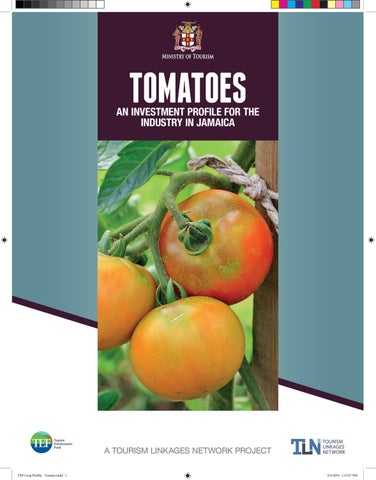
TEF Crop Profile - Tomato.indd 1
5/3/2019 1:13:57 PM
TEF Crop Profile - Tomato.indd 2
5/3/2019 1:13:59 PM
Messages
3
Minister of Tourism Hon. Edmund Bartlett It is an honour for the Ministry of Tourism, through our dynamic Tourism Linkages Network, to share viable investment opportunities in locally produced fresh produce, which are in high demand. Like many other initiatives of the Network, the findings in these crop profiles, create a unique opportunity to bring us another step closer to bridging the gap between our hospitality and agriculture sectors. We have long since recognized that tourism and agriculture are intimately linked and are of the firm belief that our farmers have the ability and the potential to supply our tourism sector. If a linkages approach is not explicitly encouraged, it is too easy for our hotels, restaurants and attractions to purchase only the basics locally while continuing to source goods and services from already-familiar overseas suppliers. Therefore, as part of our ongoing efforts to bridge this gap, the Network has been actively researching and creating opportunities for our local suppliers to better meet the increased demands of our sector. It is this belief, coupled with the knowledge of potential earnings from supplying the sector that my Ministry has been on a drive to build capacity for our suppliers to capitalize on these earnings.
Hon Edmund Bartlett, Minister of Tourism
our farmers and by sharing the findings of our studies to guide the crop selection for the sector.
I am very proud of this new initiative, which highlights findings of six key crops in high demand within the tourism sector. Some of these produce include strawberries, onions, tomatoes, pineapples, In 2015, we completed the first Tourism Demand sweet peppers and Irish potatoes. Study, which revealed that there was a high percentage of leakages, in products that we are either able to I must commend the entire team who worked produce or are already producing. Buyers stated that tirelessly to make these crop profiles a reality. I would the high imports of particular produce, that are like to specially praise the Linkages Network’s grown locally, are because of the poor frequency of Technical Working Group on Agriculture, which supply and the quality were deemed inconsistent. commissioned this initiative. I additionally want to thank our partnering Ministries and key stakeholders We have been working very closely with the Ministry who will be helping us to facilitate the build-out of of Industry, Commerce, Agriculture and Fisheries to this currently scarce commodity. combat this issue by providing renewed support to
TEF Crop Profile - Tomato.indd 3
5/3/2019 1:13:59 PM
4
Messages
Adam Stewart Chairman, Tourism Linkages Network With arrivals to Jamaica at an all-time high, the tourism industry’s ability to continue being the pipeline for the growth and advancement of other sectors is tremendous. One such mutually beneficial and exemplary relationship exists with the agricultural sector; even more so as we continue to work assiduously to further reduce the country’s import gap by contracting the marketing space between local demand and supply. Over the years, the Tourism Linkages Council has developed strategies and implemented tactical reform aimed at contracting said marketing space, bringing together tourism stakeholders and local farmers. This interconnectivity is critical to the long-term viability and sustainability of not just Jamaica’s tourism industry but the country’s economic development as a whole. Today’s opportunities were unheard of yesterday and the tourism platform is now set for even greater explosion, taking other sectors along with it.
Adam Stewart, Chairman, Tourism Linkages Network
The six investment crop profiles being presented – onions, strawberries, irish potatoes, tomatoes, pineapples and sweet peppers - are essential to the growth of agriculture in our country as it will open doors to increasing opportunities for these crops. We When the Tourism Demand Study in 2015 therefore encourage our stakeholders to embrace highlighted the loss of revenue due to an import bill these opportunities as there are huge potential for all which could be offset by local production, the parties. Tourism Linkages Council accelerated its efforts to foster new strategies for agricultural expansion to This is an awesome initiative for Jamaica! Our Island plug this gap. Compared to many other countries in never ceases to amaze me; we are truly the land of the region, Jamaica’s climate and soil is rich for multi- opportunities. Let us re-commit, keep the focus and crop cultivation and with the right support, cohesive get it done! relations and alignment, we now find ourselves at a crucial juncture with the impetus to charge fullspeed ahead.
TEF Crop Profile - Tomato.indd 4
5/3/2019 1:13:59 PM
CONTENTS MESSAGES............................................................................................................................................. INTRODUCTION....................................................................................................................................... WHY INVEST IN TOMATOES................................................................................................................... INVESTMENT ANALYSIS......................................................................................................................... FINANCIAL VIABILITY AND BANKABILITY............................................................................................. ANNEXES................................................................................................................................................ REFERENCES..........................................................................................................................................
TEF Crop Profile - Tomato.indd 6
3 6 8 13 17 19 31
5/3/2019 1:13:59 PM
TEF Crop Profile - Tomato.indd 7
5/3/2019 1:14:01 PM
8
Introduction
Background Tomato (Solanum lycopersicum) is an edible red fruit. The species originated in Western South Africa. The Spaniards during their visits to the Americas brought it back to Europe and the other colonies. The fruit is consumed in various ways such as an ingredient in many dishes, sauces, salads and drinks. Many varieties of tomato are widely grown in temperate climatic conditions across the world by using greenhouses to facilitate production throughout the year. Tomato plants usually grow 1-3metres in height and have a week stem hence the need for continuous support throughout the crop cycle. It is a perennial but cultivated as an annual. Information from Medical News Today, explains that a tomato is a nutrient-rich superfood that is beneficial to a range of bodily systems. Its nutritional content supports healthy skin, weight loss and a healthy heart. Tomato is said to be rich in vitamin c and is a powerful antioxidant Tomato varieties include: • Beefsteak tomatoes are 10 cm (4 in) or more in diameter, often used for sandwiches and similar applications. Their kidney-bean shape, thinner skin, and shorter shelf life make commercial use impractical. • Plum tomatoes, or paste tomatoes (including pear tomatoes), are bred with a lower water /higher solids content for use in tomato sauce and paste, for canning and sauces and are usually oblong 7–9 cm (3–4 in) long and 4–5 cm (1.6–2.0 in) diameter; like the Romatype tomatoes, important cultivars in the Sacramento Valley. • Cherry tomatoes are small and round, often sweet tomatoes, about the same 1–2 cm (0.4–0.8 in) size as the wild tomato. • Grape tomatoes are smaller and oblong, a variation of plum tomatoes
History of Tomato in Jamaica The cultivation of tomato in Jamaica has undergone various changes. In the early years tomatoes were primarily cultivated in the open field. Salad/table and cherry tomatoes were the primary varieties. Over time there was the introduction of medium sized hybrid varieties such as Roma that are well known locally as plummy. The liberalization of the economy provided an opening for the importation of other hyhbrid varieties of tomato. Local input supplies also went into distribution arrangements with seed producing companies in the United States. This
TEF Crop Profile - Tomato.indd 8
5/3/2019 1:14:01 PM
Introduction
9
allowed farmers to have access to the seeds of the varieties that were imported. The introduction of growing crops under protected structures added a new dimension to the production of tomatoes. Farmers growing tomato under protected structures realized improvement in the quality of produce and that it was comparable to the imported fresh tomatoes. Farmers have now adopted technology such as applying nutrients in the liquid form in open field operations. This has resulted in increased yields and provided there is water available, there is an opportunity for better scheduling of production to allow continuous yearly supply.
Photo of tomato farm
Local Investment Opportunity The production of tomato presents a viable investment opportunity as local consumers continue to demand locally produced fresh produce. Local consumers are also becoming more environmentally conscious and are concerned about the processes used to lengthen the shelf life of imported produce. Data in Table 1 from the Ministry of Industry Commerce Agriculture and Fisheries (MICAF) Data Bank Division shows a 42% increase in the production of tomato over the ten-year period 2008-2017. The average annual production for the period was approximately 25 thousand tons (25 million kgs). The highest production for the period was in 2016 when production levels rose by 31% from 23,
TEF Crop Profile - Tomato.indd 9
5/3/2019 1:14:02 PM
10
Why Invest in Tomatoes 890 tons (23.89 million kgs) to 31, 427 tons (31.427 million kgs). An annual average of 2,497 acres was reaped over the period with 2016 recording the highest acreages (3,120 acres) reaped. The industry continues to suffer from postharvest losses both at the primary and secondary levels. Postharvest losses have been averaging between 2030% and this continues to impact negatively on marketable yields and ultimately revenue. Farmgate prices averaged J$126/kg for the period under review with 2017 recording the highest market price of J$164.42. There have been moderate price fluctuations year-on-year for most of the period except for 2014 and 2016 when there were significant upward price movements in the magnitude of 55%. The value of tomato production has grown over period by over 130% from J$1.56 billion in 2008 to $J3.62 billion in 2017. Table 2 below illustrates quarterly production levels over five years (2013-2017). Production levels were highest in the second quarter for most years and lowest the in the last quarter. This trend follows the production cycle since there are some farmers who rely directly on rainfall for irrigation. Table 3. Shows the changes in farmgate prices for each quarter over the five-year period. The most significant price changes, 118% and 99% were recorded in third quarters of 2014 and 2015 respectively. The greatest increase in farmgate prices (64%) occurred in the last quarter. The United States of America is the major exporter of fresh or chilled
TABLE 1 Annual Tomato Production and Value Items
2008
2009
2010
2011
2012
2013
2014
2015
2016
2017
Production (Tonne)
19,387
21,190
19,006
26,950
26,526
29,128
25,238
23,890
31,427
27,545
Area Reaped (Acre)
1,568
1,978
2,045
2,381
2,781
3,068
2,821
2,715
3,120
1,470
Marketable Yield
15,510
16,952
15,205
21,560
21,221
23,302
20,190
19,112
251,42
22,036
Farmgate Prices (J$)
100.3
95
159.42
97.16
97.37
113.57
118.66
184.39
130.56
164.42
1,555,613
1,610,440
2,423,949
2,094,770
2,066,269
2,646,454
2,395,793
3,524,062
3,282,487
3,623,159
Value of Production (J$)
Source: MICAF Annual Crop Estimates 2008-2017
TEF Crop Profile - Tomato.indd 10
5/3/2019 1:14:02 PM
Why Invest in Tomatoes
11
tomato to Jamaica. Over the five-year period shown in the Chart 1 below, 2015 recorded the highest quantity of imported (53,550kgs) fresh tomatoes from the USA. Average quantity of imports for the period was 17,737kgs and the average value was US$18, 141. There has been over 200% decline in the importation of tomato from the USA moving from 16,742 in 2013 kilograms to 5,147kgs in 2018.
Cost of Production A summary of the cost of production for establishing one acre of tomato is provided in Table 4 below. A detailed cost of production is attached in the Appendix. In the summary table, labour cost was estimated at J$280,000 representing 35%% of the total cost. The cost for procuring materials was $127,772 (16%) while other costs inclusive of transportation and supervision were estimated to be $389, 070 (49%). The overall cost for establishing one acre has been estimated at $796,842. The cost of production per kilogram was estimated at $64.96/kg. The
TABLE 2 Estimated Tomato Production: 2013-2017 Quarter
2013
2014
2015
2016
2017
Jan – Mar
7,089
7,613
7,352
8,859
8,324
Apr – Jun
7,224
6,980
6,783
8,281
6,736
Jul – Sept
7,547
4,100
3,960
7,250
6,957
Oct – Dec
7,268
6,544
5,793
7,037
5,527
Total Production
29128
25237
23888
31427
27544
Source: MICAF Annual Crop Estimates 2008-2017
TABLE 3 Estimated Tomato Farmgate Prices: 2013-2017 Quarter
2013
2014
2015
2016
2017
Increase in Farmgate Price 2013 - 2017
Jan – Mar
94.84
94.11
172.93
107.77
108.46
14%
Apr – Jun
86.11
100.85
114.99
112.68
124.41
44%
Jul – Sept
108.92
220.07
228.47
130.93
186.77
71%
Oct – Dec
163.96
102.68
250.08
172.43
269.3
64%
Maximum price changes during the year
26%
118%
99%
32%
44%
Source: MICAF Annual Crop Estimates 2008-2017
TEF Crop Profile - Tomato.indd 11
5/3/2019 1:14:02 PM
12
Why Invest in Tomatoes
2013 2014 2015 2016 2017 2018 CHART 1
0
Fresh and Frozen Tomato Imports (kg): 2013-2017
10000
20000
30000
40000
50000
60000
Source: Statistical Institute of Jamaica (STATIN)
estimates assumed 10,892 plants per acre, an estimated marketable yield of 21.784kg and average farmgate price of J$126/kg thus deriving a profit margin of 52 %.
Export Investment Opportunity
TABLE 4
COP and Profit Margin Calculation based on Local Market
Labour Cost
Material Costs
Other Costs
COP (per acre)
COP (per kg)
Planting Density (per acre)
Estimated Yield (kgs/acre)
Farm Gate Price 2017 (kg)
COP/ Farmgate Margin
280,000 (35%)
127,772 (16%)
389,070 (49%)
796,842
64.96
10,892
21,784
126
52%
TEF Crop Profile - Tomato.indd 12
5/3/2019 1:14:03 PM
Why Invest in Tomatoes
13
According to information from the International Trade Centre (ITC) trade statistics database, the global trade of fresh tomatoes was valued at approximately US$9 billion in 2017 averaging $8.7 billion annually. The Netherlands had the largest export market share value of 22.3%, followed by Mexico (21.9%), Spain (12.8%), Morocco (6.5%) and Canada (4.5%). The United States of America had the highest (4%) potential for growth (Chart 4) among the top 5 fresh
25 20 15 % 10 5 0
Netherlands Mexico
Spain
Morocco
Canada
Source: ITC Database
CHART 2 Export market share value (%) of top 5 exporters of fresh tomatoes
Canada Morocco Spain Mexico Netherlands -10
Source: ITC Database
TEF Crop Profile - Tomato.indd 13
-5
0
%
5
10
15
20
CHART 3 Export growth (%) of top 5 countries for 2017
5/3/2019 1:14:03 PM
14
Why Invest in Tomatoes tomato importing countries in 2017. The remaining four countries growth and the world had negative growth for the same period.
Technical Requirements
Russia 9%
Other 6%
USA 38%
UK 11%
France 12%
Germany 24%
CHART 4 Import market share(%) for tomatoes in the top 5 countries (2017)
Source: ITC Database
Russia United Kingdom France Germany USA World -15
CHART 5 Import growth value (%) for 2017/2018 in the top 5 countries
TEF Crop Profile - Tomato.indd 14
-12
-9
-6
%
-3
0
3
6
Source: ITC Database
5/3/2019 1:14:03 PM
Investment Analysis
15
Climate Tomatoes require daily maximum temperatures between 25 to 35 ⁰C for ideal plant growth. (UCDavis) Providing soil moisture is consistent and at tolerable levels tomato plants are able to grow in relatively high temperatures. Long exposure to temperatures above a 35⁰C can adversely affect fruit development. Image of tomato plant
Soil Tomatoes grow best in loam or sandy loam soils although they can in wide varieties of soil. Sandy soils drain better than denser soils such as clay. If planting on dense soils like loam and clay loam, the fields must be properly drained and carefully irrigated. Generally speaking all soils must be well prepared prior to planting. Tomatoes prefer slightly acidic soils, pH between 6.0 to 6.8.
Planting Material The enterprise can either purchase seeds and establish a nursery for growing seedlings or purchase seedlings from local suppliers. Seedlings for transplanting should be dark green, stocky plants six to 10 inches tall, with stem the thickness of a pencil. Spindly plants with leaves spaced far apart or with leaf spots, yellow or curling leaves. Plants that are already fruiting should also be avoided. Tomato varieties can determinate or indeterminate. Determinate varieties will grow up to a certain size and all the fruit will ripen within several weeks. Indeterminate varieties continue to grow all throughout the year and are usually grown in greenhouses.
Land Preparation The selected area should be properly tilled by ploughing, harrowing and farrowing to get a fine tilth which will allow that the delicate roots of
TEF Crop Profile - Tomato.indd 15
5/3/2019 1:14:03 PM
16
Investment Analysis seedlings to have direct contact with the soil particles. A properly tilled soiled will allow the roots to maneuver freely through the soil and root hairs will be able to absorb water and nutrients.
Planting Density It is estimate that 45-50 grams of seeds are required to plant an acre of plummy tomato. Seedlings can be planted based on the level of production that is envisaged. A 2ft x 2ft configuration (2ft between and within rows) or 2ft x 1ft can be used. Higher planting density will require more intense management.
Planting Planting/transplanting should be done once the seedlings have been ‘hardened off’ early in the morning or in the evening when the sun has gone down. Plants should be set into the soil two inches deeper than they were growing in previous containers. In the case where plants are long stemmed a small trench can be created in the soil and the stem is buried horizontally under two to three inches of soil leaving the cluster of top leaves uncovered. Roots will grow from the covered stem in a few days and the plant will assume its vertical position thereafter. Proper drainage is critical during land preparation as the soil should be properly drained to avoid being waterlogged especially if the enterprise is located on flat lands and/or if the soil is moderate to heavy clay. Planting on slopes will require that keen attention is given to good land management practices and include conservation measures such as reverse slopes, strip cropping, live or dead barriers and dry mulching.
Irrigation Tomatoes should have adequate supply of water. Blossom end rot can be prevented by keeping the soil evenly moist. The drip system is the most preferred irrigation system for growing tomatoes as water is low released into soil consistently over time. Storage tanks should also be installed and connected to drip system. The size of the storage tank is dependent on the size of the operation. For a five acre plot a 1,000-gallon capacity storage tank is adequate. There is however no limit on the amount of water that can be stored on the farm to reduce the risks that comes along climate change. 20mm drip lines from 40mm bulk lines will be used to convey water to the plants.
TEF Crop Profile - Tomato.indd 16
5/3/2019 1:14:04 PM
Investment Analysis
17
Fertilizers As a rule of thumb soil tests should be conducted to determine the appropriate fertilizer regime that is most suited for the crop and the existing soil. Tomatoes are heavy feeders, hence a good nutrient regime is critical to getting good crop yield. Organic compost can be ploughed into the land during land preparation or the placed into induvial holes two weeks Image of harvested tomatoes prior to transplanting. Nutrients can be supplied in the liquid form by using a venturi pump to introduce nutrients into the irrigation lines. Foliar fertilizers can also be applied. The current common practice is to supply the nutrients to the crop through existing irrigation systems (fertigation). A complete fertilizer is good for starting off the crop. In addition to the macro nutrients (nitrogen, phosphorus and potassium) the nutrient regime must also include micro nutrients such as calcium, magnesium, boron, Sulphur, iron, manganese, molybdenum chlorine, and zinc.
Pest and Disease management The most common pest of tomatoes are leaf minors, whiteflies, caterpillars and stink bugs. Tomatoes are also susceptible to fungal diseases such as Blosson end rot, Mosaic virus, Cracking, Septora leaf spot, Early blight and Late blight. These can be controlled by using the wide spectrum of control chemicals available on the local market. The farmer should develop and implement an integrated pest management programme which will include: conducting regular scouting of fields to identify the presence of insects or diseases and thereafter take the necessary precautionary measures, planting compatible barrier crops and using sticky traps.
Harvesting and Yield Tomato will have matured seven weeks after seedling transplant provided that the correct agronomic practices are followed. On
TEF Crop Profile - Tomato.indd 17
5/3/2019 1:14:05 PM
18
Investment Analysis commercial enterprises tomatoes are harvested when they are mature but still have its green colour. This done to increase shelf and reduce postharvest losses. Each tomato plant can produce 12-20lbs and if indeterminate and a good nutrient regime is maintained the yields can be greater. Plastic crates should be used for harvesting to reduce the occurrence of compaction and bruising.
Post Harvest Management Tomatoes should be harvested in morning or late afternoon to reduce field heat and the onset of condensation. Mature green tomatoes are best stored at temperatures 13-21⁰C for 1-3weeks while ripe tomatoes are stored at the same temperature but only for 4-7days.
Marketing Proper storage will allow the farmer to hold the tomato until it can be sold at the best market pice although tomato has a relatively short shelf life. Tomatoes are either sold to purveyors/middle men through informal contracts, higglers at the farmgate or some farmers will take the produce directly to market. Framers are encouraged to secure contractual arrangements before planting a crop which reduces the risk of losses if proper storage is not available. Tomato production goes through a cycle each year with plenty supply during the first quarter and tapers off during the later part of the second to third quarter. This follows the local rainfall pattern. To get high prices, the crop should be irrigated so that production can occur in the summer months when rain-fed dependent operations stopped producing.
Project Cost In the financial model, the unit cost of developing of 5 acres of plummy tomato has been prepared. This can be modified to fit other scale of
TEF Crop Profile - Tomato.indd 18
5/3/2019 1:14:05 PM
Financial Viability and Bankability
19
operations taking into consideration the attendant changes to the variables used.
Working Capital Working capital represents the operational liquidity that is available to the business enterprise. For this 5-acre model the working capital was calculated as 30% of the total operational cost. This is the minimum amount of cash that the business should have at hand to cover at least 30% of the operational cost.
Image of man reading the business section of a newspaper
Bank Loan For this venture the cost of capital was estimated at 8%. Interest rates are retailed between 8-11%. 60% of the development cost for the investment will be funded from equity. The remaining 40% will be funded from a bank loan. The loan is required to purchase a 3-4years old pickup truck.
Rate of Interest For this venture the cost of capital was estimated at 8%. Interest rates for agricultural loans are retailed between 8-11%.
Security The project will be guided the financial stipulations laid out by Agricultural Bank for agricultural loans. The tenets of Good Agricultural practices will be adhered to ensure high productivity and produce that is safe for consumption. Proactive actions such as scouting will be implemented for early detection of pest and diseases. The irrigation system established will ensure that the plants are adequately irrigated to give the maximum yield.
Financial Analysis Financial analysis was carried out for five acres (2.5 hectares) of Irish
TEF Crop Profile - Tomato.indd 19
5/3/2019 1:14:06 PM
20
Financial Viability and Bankability
potato cultivation. For financial analysis, the income was assessed on a conservative basis. The detailed calculation of project’s income and expenditure has been indicated in the Annexes. IRR and NPW for the model work out to be 72 %, J$9.8 million respectively and the details are given in Annexure X.
Repayment of loan Based on the cash flow the detailed repayment schedule has been worked out and furnished in the Annexure IV. The repayment period works out to five years including 6 months grace period for repayment of principal.
TEF Crop Profile - Tomato.indd 20
5/3/2019 1:14:06 PM
ANNEXES
TEF Crop Profile - Tomato.indd 21
5/3/2019 1:14:06 PM
Annex
I
TABLE 1 Basic Assumptions PARAMETERS
VALUE
Exchange rate USD:JMD
132
Area Planted (acres)
5
Area Planted (hectares)
2
Time to maturity (months)
3-4 months
Marketable yields per acre (kg)
10000
Marketable yields per Hectare (kg)
24700
Number of crops per year
2
Number of plants per acre
10890
Sales distribution Local to exporters via middlemen
40%
Local to higgglers for municipal markets
50%
Prices USD/kg: Hotels and supermarket via direct sales
0.6
Local to higgglers for municipal markets
0.4
TABLE 2 Capital costs CAPITAL COSTS
UNITS
NUMBER OF UNITS
Shed/storeroom
ft2
100
2,500
250,000
Fencing (barb wire)
acre
5
20,000
100,000
Pickup truck
each
1
3,000,000
3,000,000
Knapsack sprayer
each
2
10,000
20,000
Mist-blower
set
1
40,000
40,000
Irrigation Equipment
acre
5
150,000
750,000
Each
1
90,000.00
90,000
each
1
200,000
200,000
Water storage tank (1000gal) Miscellaneous equipment and tools Total
TEF Crop Profile - Tomato.indd 1
RATE/UNIT
TOTAL
4,450,000
5/3/2019 1:14:06 PM
II
Annex
TABLE 3 Monthly Operating Costs ITEMS
UNIT
QUANTITY
UNIT PRICE (J$)
YR1
Tomato (estimating 2 crop cycles /year)
acres
5
500,000
2,500,000
Marketing expenses
yr
1
100,000
100,000
Contingency
5%
Direct Expense Crop establishment
130,000
Subtotal
2,730,000
Indirect expenses Land lease
acres/yr
5
10,000
50,000
Owner/manager
mth
12
65,000
780,000
Security
mth
12
5,000
60,000
Fuel
mth
12
50,000
600,000
Accounting and audit fees
mth
12
5,000
60,000
Equipment Maintenance
mth
12
10,000
120,000
Motor vehicle expense/servicing
mth
4
30,000
120,000
Motor vehicle insurance
yar
1
120,000
120,000
Salaries and wages
Utilities
-
Water
mth
12
20,000
240,000
Telephone internet
mth
12
10,000
120,000
Stationary &office supplies/printing
mth
12
3
36
Bank charges
mth
12
3,000
36,000
Contingencies
5%
388,302
Sub-Total
2,694,338
Total Operating Costs
5,424,338
TEF Crop Profile - Tomato.indd 2
5/3/2019 1:14:06 PM
Annex
III
TABLE 4 Annual Operating Costs ITEMS
YR1
YR2
YR3
YR4
YR5
Tomatoes (2 crop cycles/year)
2,500,000
2,600,000
2,700,000
2,750,000
2,800,000
Marketing expenses
100,000
110,000
121,000
133,100
46,410
Contingency
130,000
143,000
157,300
173,030
190,333
Subtotal
2,730,000
2,853,000
2,978,300
3,056,130
3,136,743
-
-
-
-
Direct Expense Crop establishment
Indirect expenses Land lease
50,000
Salaries and wages
55,000
60,500
-
-
66,550 -
73,205
-
-
Owner/manager
780,000
858,000
943,800
1,038,180
1,141,998
Security
60,000
66,000
72,600
79,860
87,846
Fuel
600,000
660,000
726,000
798,600
878,460
Accounting and audit fees
60,000
66,000
72,600
Equipment Maintenance
120,000
132,000
145,200
159,720
175,692
Motor vehicle expense/servicing
120,000
132,000
145,200
159,720
175,692
Motor vehicle insurance
120,000
132,000
145,200
159,720
175,692
Utilities
-
-
79,860
87,846
-
-
Water
240,000
264,000
290,400
319,440
351,384
Telephone internet
120,000
132,000
145,200
159,720
175,692
36
40
44
48
53
Bank charges
36,000
39,600
43,560
47,916
52,708
Contingencies
388,302
427,132
469,845
516,830
568,513
Sub-Total
2,694,338
2,963,772
3,260,149
3,586,164
3,944,780
Total Operating Costs
5,424,338
5,816,772
6,238,449
6,642,294
7,081,523
Stationary & office supplies
TEF Crop Profile - Tomato.indd 3
5/3/2019 1:14:06 PM
IV
Annex
TABLE 6 Annual Marketing Yield ITEM
YEAR 1
YEAR 2
YEAR 3
YEAR 4
YEAR 5
Tomato (kgs)
88,000
99,000
137,500
132,000
126,500
Total
88,000
99,000
137,500
132,000
126,500
ITEM
YR1
YR2
YR3
YR4
YR5
Tomato
55.00
70.00
75.00
85.00
120.00
YR1
YR2
YR3
YR4
YR5
Tomato sales
4,840,000
6,930,000
10,312,500
11,220,000
15,180,000
Total
4,840,000
6,930,000
10,312,500
11,220,000
15,180,000
TABLE 6 Selling Price
TABLE 7 Gross Revenue Schedule ITEM
TEF Crop Profile - Tomato.indd 4
5/3/2019 1:14:06 PM
Annex
V
TABLE 8 Financing Plan TOTAL FINANCING REQUIRED
EQUITY
LOAN
GRANT
TOTAL
CAPITAL COST Shed/storeroom
250,000
250,000
250,000
Fencing (barb wire)
100,000
100,000
100,000
Pickup truck
3,000,000
3,000,000
3,000,000
Knapsack sprayer
20,000
20,000
0,000
Mist-blower
40,000
40,000
40,000
Miscellaneous equipment and tools
200,000
200,000
200,000
3,610,000
3,610,000
3,610,000
Physical contingencies (10%) Sub-Total OPERATING COSTS Crop establishment Tomato (estimating 2 crop cycles /year)
2,500,000
2,500,000
2,500,000
Marketing expenses
100,000
100,000
100,000
Contingency
130,000
130,000
130,000
Subtotal
2,730,000
2,730,000
2,730,000
50,000
50,000
50,000
Owner/manager
780,000
780,000
780,000
Security
60,000
60,000
60,000
Fuel
600,000
600,000
600,000
Accounting and audit fees
60,000
60,000
60,000
Equipment Maintenance
120,000
120,000
120,000
Motor vehicle expense/servicing
120,000
120,000
120,000
Motor vehicle insurance
120,000
120,000
120,000
Water
240,000
240,000
240,000
Telephone internet
120,000
120,000
120,000
36
36
36
Bank charges
36,000
36,000
36,000
Contingencies
388,302
388,302
9388,302
Sub-Total
92,694,338
92,694,338
92,694,338
Total
99,034,338
95,424,338
Equity
60%
Leverage
40%
Indirect expenses Land lease Salaries and wages
Utilities
Stationary &office supplies
TEF Crop Profile - Tomato.indd 5
93,610,000
9,034,338
5/3/2019 1:14:06 PM
VI
Annex
TABLE 9 Loan Repayment Schedule MONTHS
LOAN
LOAN
PRINCIPAL
INTEREST
INTEREST
TOTAL DEBT
LOAN
Months 1-3 = YR0
Disbursement
Balance at SOY
Payment at EOY
Payment at EOY (12%)
Accrued but not paid (12%)
Serviceable Debt at EOY
Balance at EOY
1
3,610,000
3,610,000
722,000
433,200
-
1,155,200
2,888,000
2
2,888,000
722,000
346,560
-
1,068,560
2,166,000
3
2,166,000
722,000
259,920
-
981,920
1,444,000
4
1,444,000
722,000
173,280
-
895,280
722,000
5
722,000
722,000
86,640
-
808,640
-
3,610,000
1,299,600
TOTAL
4,909,600
Notes Moratorium - 6 mths Loan period - 5 Yrs (including moratorium) Interest rate: = 8% per Annum
TABLE 10 Depreciation Schedule ASSET
ORGINAL COST
RESIDUAL VALUE
DEPRECIABLE COST
ESTIMATED LIFE (YRS)
DEPRECIATION PER YEAR
Shed/storeroom
250,000
20000
230,000
10
23,000
Fencing (barb wire)
100,000
30000
70,000
10
7,000
Pickup truck
3,000,000
300,000
2,700,000
10
270,000
Knapsack sprayer
20,000
2,000
18,000
10
1,800
Mistblower
40,000
5,000
35,000
5
7,000
Irrigation Equipment
750,000
50,000
700,000
5
140,000
Miscellaneous equipment and tools
200,000
2,000
198,000
5
39,600
TEF Crop Profile - Tomato.indd 6
5/3/2019 1:14:07 PM
Annex
VII
TABLE 11 Projected Net Income YR1
YR2
YR2
YR4
YR5
Gross Revenue
4,840,000
6,930,000
10,312,500
11,220,000
15,180,000
Operating Cost
5,424,338
5,816,772
6,238,449
6,642,294
7,081,523
Operating Profit
(584,338)
1,113,228
4,074,051
4,577,706
8,098,477
Depreciation
465,400
465,400
465,400
465,400
465,400
Shed/Storeroom
23,000
23,000
23,000
23,000
23,000
Fencing (Barb Wire)
7,000
7,000
7,000
7,000
7,000
Pickup Truck
270,000
270,000
270,000
270,000
270,000
Knapsack Sprayer
1,800
1,800
1,800
1,800
1,800
Mistblower
7,000
7,000
7,000
7,000
7,000
Irrigation Equipment
140,000
140,000
140,000
140,000
140,000
Miscellaneous Equipment And Tools
39,600
39,600
39,600
39,600
39,600
Residual Value
409,000.00
409,000.00
409,000.00
409,000.00
409,000.00
Interest Payment
433,200
346,560
259,920
173,280
86,640
Profit Before Tax
(1,891,938)
(107,732)
2,939,731
3,530,026
7,137,437
Taxable Profit
(1,891,938)
(107,732)
2,939,731
3,530,026
7,137,437
Tax (33.3%)
(630,015)
(35,875)
978,931
1,175,499
2,376,767
Net Profit After Tax
(1,261,923)
(71,857)
1,960,801
2,354,528
4,760,670
Cumulative Net Profit
(1,261,923)
(1,333,779)
627,021
2,981,549
7,742,219
TEF Crop Profile - Tomato.indd 7
5/3/2019 1:14:07 PM
Annex VIII
TABLE 12 Summary of Project Costs & Benefits
YEAR
CAPITAL REPL
WORKING CAPITAL
OPER. COST
TOTAL COST
SALES REVENUE
SALVAGE & RESIDUAL VALUE
WORKING CAPITAL (REC)
TOTAL BENEFIT
NET BENEFIT
LOAN INFLOW
OUTFLOW
(2,170,538)
EQUITY
453,668
1,155,200
1,068,560
3,501,131
3,610,000 1,522,228
981,920
6,156,014
(4,625,338) 9,084,031
4,483,051
895,280
6,876,301
1,745,031
12,593,035
7,051,294
6,681,883
1,627,301
409,000.00
1,871,535
13,621,688
808,640
409,000.00
6,930,000
409,000.00
1,992,688
7,490,523
4,840,000
7,561,803 10,312,500
409,000.00
17,713,457
11,50¹,639
5,816,772 8,109,983 11,220,000
2,124,457
5,424,338
1,745,031 6,238,449 6,570,394
409,000.00
1,627,301
2 1,871,535 4,577,706
15,180,000
4,450,000
3 1,992,688 10,222,934
1
4 8,098,477
$9,385,732
2,124,457
72%
$9,888,524
5
NPV = Assuming a real discount rate of 10%
Conclusion: Project is viable if NPV positive
IRR =
5/3/2019 1:14:07 PM
TEF Crop Profile - Tomato.indd 8
Annex
IX
TABLE 13 Annual Cash Flow Projection ($) YR1
YR2
YR3
YR4
YR5
6,930,000
10,312,500
11,220,000
15,180,000
5,816,772
6,238,449
6,642,294
7,081,523
INFLOWS
Loan
3,610,000
Equity
5,424,338
Grant Sales
4,840,000
OUTFLOWS
Capital Cost
4,450,000
Operating Cost
5,424,338
Capital Replacement
-
-
-
-
-
Working Capital
1,627,301
1,745,031
1,871,535
1,992,688
2,124,457
Outflows before Debt & Tax
11,501,639
7,561,803
8,109,983
8,634,982
9,205,980
Cash Flow before Debt & Tax
2,372,699
(631,803)
2,202,517
2,585,018
5,974,020
Debt service
1,155,200
1,068,560
981,920
895,280
808,640
Tax
790,109
(210,390)
733,438
860,811
1,989,349
Net Cash Flow
427,390
(1,489,973)
487,159
828,927
3,176,031
Cumulative Net Cash Flow
427,390
(1,062,583)
(575,424)
253,503
3,429,535
Net Present Value
TEF Crop Profile - Tomato.indd 9
J$2,061,398
5/3/2019 1:14:07 PM
X
Annex
TABLE 14 Profitability Analysis PROFITABILITY ANALYSIS RATIOS
YR 1
YR2
YR3
YR4
YR5
AVERAGE
Profitability (Net profit/gross income)
-39%
-2%
29%
31%
47%
0.1
Operating ratio(total operating expense/gross income)
1.1
0.8
0.6
0.6
0.5
0.7
Fixed ratio (fixed expense/ gross income)
0.6
0.4
0.3
0.3
0.3
0.4
Capital turnover(gross income/ capital investment)
1.1
1.1
1.1
1.1
1.1
1.1
Parameters
UNIT
YR 1
YR2
YR3
YR4
YR5
Projected sales unit
kg
88,000
99,000
137,500
132,000
126,500
Total fixed costs
J$
388,302
427,132
469,845
516,830
568,513
Fixed cost per unit
J$
4.413
4.314
3.417
3.915
4.494
Total variable cost
J$
2,730,000
2,853,000
2,978,300
3,056,130
3,136,743
Variable cost per unit
J$
31.02
28.82
21.66
23.15
24.80
Selling price
J$/kg
55.00
70.00
75.00
85.00
120.00
Breakeven price
USD/kg
35.44
33.13
25.08
27.07
29.29
Breakeven revenue
USD
890,702
726,030
660,642
710,304
716,585
Breakeven sales units
Kg
113,858
69,278
55,837
49,414
32,948
BREAKEVEN ANALYSIS
TEF Crop Profile - Tomato.indd 10
5/3/2019 1:14:07 PM
References
31
References
1. Cost of Production Estimates (2017), Ministry of Industry Commerce Agriculture and Fisheries, Databank Division 2. Crop Production Estimates (2016), Ministry of Industry Commerce Agriculture and Fisheries, Databank Division 3. https://www.medicalnewstoday.com/articles/276714.php 4. International Trade Centre (ITC), https://www.trademap.org/Index.aspx 5. Medical News Today, (September 2017) everything you need know about tomatoes. https://www.medicalnewstoday.com/articles/273031.php 6. Production Guide for Commercial Strawberrie(2008), Iowa State University, University Extension 7. Tourism Demand Study (2015), Ministry of Tourism Linkages Hub, Linkages Hub 8. Trade Data, Statistical Institute of Jamaica Library 9. USDA Market News, https://www.marketnews.usda.gov/mnp/hm-home
TEF Crop Profile - Tomato.indd 31
5/3/2019 1:14:07 PM
32
References
TEF Crop Profile - Tomato.indd 32
5/3/2019 1:14:09 PM