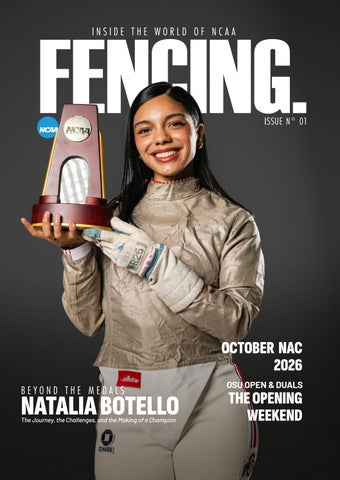
FENCING. INSIDE THE WORLD OF NCAA
ISSUE N° 01
OCTOBER NAC 2026 BEYOND THE MEDALS
NATALIA BOTELLO The Journey, the Challenges, and the Making of a Champion
OSU OPEN & DUALS
THE OPENING WEEKEND
2
INSIDE THE WORLD OF NCAA - FENCING
3 INSIDE THE WORLD OF NCAA - FENCING
INSIDE THE WORLD OF NCAA - FENCING
Editorial
Inside the World of NCAA Fencing — Issue N°01
A season opening new paths Every season brings new stories. Some are written on the podium; others begin much earlier, in training sessions, in decisions that change the course of a career, and in the daily work of everyone who is part of a team. The 2026–2027 season arrives at a time of transformation for collegiate fencing in the United States. New eligibility rules, changes to the national ranking system, and the addition of new programs are expanding the competitive landscape and creating opportunities for the next generation. In this edition of Inside the World of NCAA Fencing, we look back at the 2025–2026 campaign and recognize its defining achievements: two NCAA team national championships for Notre Dame, six individual champions, and performances that marked important milestones. We also follow the start of the
4
new season, from the first collegiate competitions to tournaments on the national circuit. On our cover is Natalia Botello. Her NCAA women’s sabre title with Ohio State was a historic achievement for the Buckeyes. But her journey represents much more than a victory: it is a story of decisions, growth, perseverance, and new beginnings. We also introduce the coaches shaping collegiate programs, the athletes and teams worth watching, and the competitors who are beginning to write the next chapter of this sport. At TouchéWorld, we continue to believe that fencing deserves to be told in all its dimensions: its results, its people, their journeys, and the legacy each generation builds.
Touché
CONTENT 2025-2026 The season we lived through A new era
The new era
New eligibility rules
The Champions
Six champions. Six stories. One legacy
The legacy
of the 2025-2026 season
The new generation
renewal, talent and new stories
52 54 56 60 66
The opening weekend
The first test of the 2026-27 college fencing season
The OSU Open
Six events, six champions
The OSU duals
Team strength, individual contributions
What the weekend revealed
INSIDE THE WORLD OF NCAA - FENCING
6 10 14 22 26 28 30 34 36 38 42 44
six takeaways from the opening weekend
Natalia Botello Beyond the medals
Athletes to watch The names that stood
The teams to watch
The programs that will shape the 2026-27 collegiate season
The road to the National Championship October 2026 - March 2027
October NAC 2026
The national circuit raises the curtain
Coach Nikki Franke Classic 2026 The collegiate season begins to take shape
NYU Invitational 2026
NYU opens its season at home
The coaches
The people behind the programs
5
INSIDE THE WORLD OF NCAA - FENCING
2025-2026 The season we lived through A new era, two national championships for Notre Dame and six individual champions who defined the season. One championship, two national titles The 2025–2026 season will be remembered as a year of transformation for American collegiate fencing. From the first tournaments of the campaign through the conference championships and the national event in March, teams and athletes went through months of intense competition, in a season that also brought a historic change to the format of the NCAA Championships. For the first time since 1989, the national team titles were contested separately for men and women. Notre Dame took both, while six fencers from five different universities won the individual titles across the three weapons.
6
From March 19 to 22, the University of Notre Dame hosted the NCAA Fencing Championships in South Bend, Indiana. The 2026 edition reinstated separate team titles: instead of a single combined team title, two national champions were crowned, one men’s and one women’s. Notre Dame made the most of the opportunity and took home both trophies. In the women’s competition, the Fighting Irish scored 102 points and edged Columbia/Barnard, which finished with 99, by just three. Princeton took third place, followed by Harvard. Ohio State finished seventh, while
The men’s competition had a similar outcome. Notre Dame reached 91 points and finished ten ahead of Columbia/Barnard, which once again placed second. St. John’s finished third and Harvard took fourth. The double victory made Notre Dame the team story of the season. Yet the margin of just three points on the women’s side made clear that the fight for the championship stayed open until the very end.
Six champions, six defining moments The national championship also crowned six individual champions, one for each combination of gender and weapon. In women’s épée, Notre Dame’s Eszter Muhari won her third individual national title and defended the crown she earned in 2025. With victories in 2023, 2025 and 2026, she now has three individual NCAA titles.
Women’s foil belonged to Harvard’s Jessica Guo. She captured her second national championship, following her 2024 title, in a season in which her university finished fourth in the women’s team standings. In women’s saber, Natalia Botello took Ohio State to the top of the individual podium. Her victory carried special meaning for the program: it was the first individual national title in women’s saber in the university’s history. Botello reached the semifinals as the top seed after going 21–2 in the pool rounds. In the semifinals she defeated Notre Dame’s Siobhan Sullivan, 15–11, and in the final she beat Notre Dame’s Magda Skarbonkiewicz, 15–5. Men’s épée produced a historic result for North Carolina. In his first collegiate season, Youssef Shamel defeated Notre Dame’s Kruz Schembri, 15–7, in the final. The win made him North Carolina’s first individual national champion in 43 years and the university’s first in men’s épée. Shamel had already claimed the men’s épée title at the Atlantic Coast Conference (ACC) championships, completing an exceptional season.
Notre Dame celebrates the NCAA men’s team national title in South Bend, the first under the separate-titles format.
7
INSIDE THE WORLD OF NCAA - FENCING
Yale, Cornell and Stanford, all tied at 42 points, rounded out the top ten.
In men’s foil, Columbia’s Samarth Kumbla became national champion and added another standout result to the Lions’ season. Finally, Notre Dame’s Ahmed Hesham won the men’s saber title, one more individual victory for the Fighting Irish to celebrate. The six individual titles were spread across five universities: Notre Dame (two), Harvard, Ohio State, North Carolina and Columbia. It was a sign that, even though Notre Dame dominated the team competition, individual talent was spread across many programs.
INSIDE THE WORLD OF NCAA - FENCING
The road to march The national championship was the culmination of months of competition. From the invitational tournaments of the fall through the dual meets and the conference championships, college programs had numerous opportunities to measure their performance, adjust their lineups and prepare for the decisive stretch of the season. In February, the Ivy League delivered one of the most thrilling competitions of the campaign. Columbia
8
finished undefeated (6–0) on the women’s side and clinched the title with a pair of 14–13 wins over Harvard and Princeton. On the men’s side, Columbia and Harvard shared the championship. In the ACC, Notre Dame won its fifth consecutive women’s title. In the men’s competition, Duke and Boston College finished with identical 3–1 records, and the tiebreaker went to the Blue Devils, who took the championship. Ohio State also made its mark at the Central Collegiate Fencing Conference (CCFC) championships. The men’s team won its sixth consecutive title, while the women’s team finished second. In the individual competition, Natalia Botello defended her women’s saber crown; Carter Berrio won men’s saber and Solin Li took men’s foil. Stanford also had reason to celebrate. Arianna Cao won the ACC women’s individual foil title and was named the conference’s foil Fencer of the Year. The NCAA regional championships in March completed the road to the national event and offered one last chance to secure a spot.
The season once again showed that college success is not built in a single weekend. It is the result of months of preparation, demanding matchups and decisions that end up making the difference when the key moment arrives.
A season that opens the future The 2025–2026 campaign left behind a renewed structure for the national team championships, two titles for Notre Dame and six individual champions from five different universities. It also left stories of continuity, like Eszter Muhari’s; of consolidation, like Jessica Guo’s; and of historic achievement, like those of Natalia Botello and Youssef Shamel. Columbia/Barnard confirmed its ability to contend for the top honors on both sides, while other
programs showed they could challenge the favorites at the conference championships and on the national stage. But the legacy of a season is not measured in titles and medals alone. It also lives in the athletes who reached new milestones, the teams that grew over the course of the campaign and the experiences that prepare every fencer for the next challenge. For some, the season marked the end of a collegiate chapter. For others, it was one more step toward new goals. All of them left their mark on a campaign that is now part of the history of American collegiate fencing. The 2025–2026 season now has its champions. The next page is yet to be written.
9
INSIDE THE WORLD OF NCAA - FENCING
Natalia Botello (Ohio State) celebrates her win in the women’s saber final at the 2026 NCAA Championships in South Bend.
The new era New eligibility rules, more college programs and changes to the national circuit are transforming the future of American fencing. The 2026–2027 season begins at a moment of change for collegiate fencing. While the NCAA redefines the eligibility conditions for its athletes, several institutions are expanding their programs and USA Fencing is launching a new national points system.
10
These reforms do not stem from a single initiative, but they share one essential feature: they are changing the opportunities and decisions that follow fencers from their first years of competition through college.
More universities are betting on fencing
In June 2026, NCAA Division I approved a new eligibility model based on age and entry into college. Division II followed in August with a reform aligned with Division I’s and in effect starting in 2026–2027.
The sport’s growth is also reflected in the addition of new teams.
The system sets a continuous period of up to five years for athletes who meet the requirements. The clock starts at the earlier of an athlete’s first full-time college enrollment or the start of the academic year after their 19th birthday. This does not mean every athlete will automatically get five seasons to compete. Enrollment date and compliance with academic and athletic rules remain decisive. The new model also eliminates redshirt years and waivers: the clock can be paused only for pregnancy, active-duty military service or official religious missions. The transition will be gradual. Students who enroll in 2026–2027 and those who retain eligibility after 2025– 2026 may be evaluated under either the previous model or the new one, whichever is more favorable. For those who begin college in fall 2027 or later, the new system will apply. The reform applies to Divisions I and II. Division III keeps its own rules for now and is studying a proposal of its own. For fencers, understanding these conditions will be essential when deciding when to start college. For coaches, it will mean reviewing roster planning and the length of their athletes’ college careers.
Denison University, in Ohio, added a men’s program for the 2026–2027 season, building on a structure that already included an established women’s team in Division III. Other institutions are preparing new teams. Fairleigh Dickinson University, which already has a women’s program, will add men’s fencing in 2027–2028, while Arcadia University plans to launch both men’s and women’s teams in the same period. Trinity College, in Hartford, Connecticut, announced a women’s program for 2027–2028 and plans to add a men’s team in 2028–2029, depending on how the initiative develops. The City College of New York also announced the return of its men’s team for 2027– 2028. Each new program represents an additional opportunity for young fencers. However, its real impact will depend on continued resources, coaching staff, facilities and institutional support.
Growth is not just about starting teams, but about building programs that can last and develop talent for years.
11
INSIDE THE WORLD OF NCAA - FENCING
Eligibility: New rules for planning ahead
INSIDE THE WORLD OF NCAA - FENCING
Recruiting: Look beyond the results University expansion widens the options for those who want to combine higher education with competitive fencing.
For every fencer, the challenge remains finding a university that meets both their athletic aspirations and their academic goals.
Choosing a university, however, requires looking beyond its athletic standing. Academic offerings, costs, financial aid, facilities and the relationship with coaches are factors that can matter as much as team performance.
USA fencing launches a new points system
USA Fencing offers College Connect, a platform that lets prospective student-athletes showcase their results, explore programs and get in touch with college coaches. Access requires a USA Fencing membership. The tool makes outreach easier, but it does not guarantee admission, financial aid or a spot on a roster.
12
Since August 1, 2026, USA Fencing has applied a new points structure for the Cadet, Junior and Division I categories (USA Fencing’s national senior level, not to be confused with NCAA Division I). The system, set up initially as a two-year trial, combines results from different competitions into a single ranking for each category. Each athlete’s six best results within a rolling one-year period are counted.
A future taking shape The ranking is used to order participants, set seeding and determine access to certain levels of national competition, including the Elite and Challenger events.
The new rules, the expansion of programs and the changes in rankings show a sport trying to adapt to the needs of its athletes.
During the trial, the previous system remains in use to select the U.S. teams that compete internationally, at least through the 2028–2029 season.
Some consequences will be immediate, especially in the planning of college careers. Others, such as the consolidation of new teams, will need several seasons to become visible.
For fencers who compete in both the national and the college circuits, understanding these differences will be essential when planning their calendars.
The 2026–2027 season begins with more options, new decisions and questions that have yet to be answered. The future of college fencing will not depend only on those who win the next championships. It will also be built on the opportunities found by those who are preparing today to reach them.
13
INSIDE THE WORLD OF NCAA - FENCING
It is important to tell the two circuits apart: USA Fencing’s points list does not replace the qualifying criteria for the NCAA Championships.
INSIDE THE WORLD OF NCAA - FENCING
The Champions
Six champions. Six stories. One legacy. The stars of the 2026 NCAA Fencing Championships individual titles. Every championship leaves behind names worth remembering. In 2026, six fencers reached the top of the podium in their respective weapons and wrote a new page in the history of American college fencing. Representing five countries and five universities, these athletes arrived at the title by very different paths.
14
Some had already shone at world championships and the Olympic Games; others found in the NCAA the stage for a decisive leap in their careers. This gallery brings together their stories and celebrates the six individual champions of a season that will be remembered in college sports.
INSIDE THE WORLD OF NCAA - FENCING
Eszter Muhari University of Notre Dame · Hungary | Women’s Épée
Three-time national champion Eszter Muhari won the women’s individual épée title again in 2026, claiming her third national collegiate championship after victories in 2023 and 2025. She is one of only six women in NCAA history with three or more individual titles. The Hungarian thus closed out an exceptional career at Notre Dame. Her college career ran alongside outstanding performances on the international circuit, including the individual épée bronze medal at the Paris 2024 Olympic Games. In the 2026 final she defeated Hadley Husisian of Princeton, 13–1. It was a dominant victory that confirmed her place among the great figures in NCAA history.
Career Highlights • NCAA individual champion: 2023, 2025 and 2026. • Olympic bronze medalist in individual épée: Paris 2024. • ACC Women’s Épée Fencer of the Year: 2026.
15
Jessica Guo Harvard University · Canada | Women’s Foil
A second national crown In 2026, Jessica Guo claimed her second NCAA women’s individual foil title, two years after winning her first in 2024.
INSIDE THE WORLD OF NCAA - FENCING
The Canadian arrived at the championship with 20 wins and only three losses in pool play. In the elimination rounds she kept up the pace and secured the title for Harvard. Her international résumé already included two Olympic Games, Tokyo 2020 and Paris 2024, as well as the 2024 junior world foil title. With this latest collegiate victory, Guo added another achievement to a career that spans the junior, Olympic and collegiate stages.
Career Highlights • NCAA women’s individual foil champion: 2024 and 2026. • Junior world foil champion: 2024. • Olympic Games participant: Tokyo 2020 and Paris 2024.
16
The Ohio State University · Mexico | Women’s Saber
A title that made history Natalia Botello made history for Ohio State by becoming the university’s first NCAA women’s individual saber champion. The Mexican fencer was outstanding from pool play onward, going 21–2 with a touch differential of +56, which earned her the top seed going into the semifinals. There she defeated Siobhan Sullivan of Notre Dame, 15–11. In the final she faced Magda Skarbonkiewicz, also of Notre Dame, and won 15–5 to secure the championship. The title followed her third-place finish in 2025, when she earned First Team All-America honors. In just two collegiate seasons, Botello went from reaching the podium to becoming the first women’s saber champion in Buckeyes history.
Career Highlights • NCAA women’s individual saber champion: 2026. • NCAA individual third place and First Team All-America: 2025. • USFCA Women’s Saber Collegiate Athlete of the Year: 2026.
17
INSIDE THE WORLD OF NCAA - FENCING
Natalia Botello
INSIDE THE WORLD OF NCAA - FENCING
Youssef Shamel University of North Carolina · Egypt | Men’s Épée
A season to remember Youssef Shamel had a collegiate debut that will be hard to match. In his first season at North Carolina he won the ACC men’s individual épée title and, weeks later, was crowned NCAA national champion. In the national final he defeated Kruz Schembri of Notre Dame, 15–7. The result ended a 43-year wait for North Carolina, which had not won an individual national championship since 1983. Shamel also became the first fencer in school history to win the national men’s épée title. His season did not end there. In April 2026 he also won the individual junior world épée championship, establishing himself as one of the standout names of his generation.
Career Highlights • NCAA men’s individual épée champion: 2026. • ACC men’s individual épée champion: 2026. • Junior world individual épée champion: 2026.
18
Samarth Kumbla Columbia University · United States | Men’s Foil
A win for columbia Samarth Kumbla won the 2026 NCAA men’s individual foil title after a day of high-stakes bouts for Columbia. After going 15–8 in pool play, he advanced to the final rounds. In the semifinals he defeated teammate Marsel Nagimov, 15– 14, and in the final he beat Chase Emmer of Notre Dame, 15–8.
Kumbla had already reached the international podium in 2024, when he won individual bronze and team gold at the Junior World Championships. The collegiate title added a new chapter to his story.
Career Highlights • NCAA men’s individual foil champion: 2026. • Junior World Championships team gold medal: 2024. • Junior World Championships individual foil bronze medal: 2024.
19
INSIDE THE WORLD OF NCAA - FENCING
His win gave Columbia its first individual NCAA men’s foil title since 2022.
Ahmed Hesham University of Notre Dame · Egypt | Men’s Saber
From the world podium to collegiate gold
INSIDE THE WORLD OF NCAA - FENCING
Ahmed Hesham arrived at the 2026 NCAA Championships with experience on the most demanding stages of international fencing. The Egyptian saber fencer had won individual bronze at the senior World Championships in Tbilisi in 2025. Fencing for Notre Dame, he again showed his level. In the semifinals he defeated Colin Heathcock of Harvard, 15–10, and advanced to a final against his countryman Adham Moataz of St. John’s. Hesham took the title, 15–12, adding the NCAA individual championship to his international résumé. He had also won the ACC men’s individual saber title earlier that season.
Career Highlights • NCAA men’s individual saber champion: 2026. • Individual bronze medal at the senior World Championships: Tbilisi 2025. • ACC men’s individual saber champion: 2026.
20
INSIDE THE WORLD OF NCAA - FENCING
Six champions. Six stories. One legacy. Six athletes, five countries and five universities. Different paths led them to the same stage: the highest podium in American college fencing. Their names are now part of the 2026 champions’ record. Their stories, however, go on.
21
INSIDE THE WORLD OF NCAA - FENCING
The Legacy
of the 2025–2026 season A season of champions, great performances and new marks A season is not remembered only for its champions. It also lives on in the performances of those who reached the podium, in the athletes who competed among the best all year long, and in the teams that took their universities to new heights.
For Ketkar, the bronze capped an exceptional season. She won the Ivy League individual épée title and earned her third All-America honor. She was also the first Cornell fencer to win an individual championship at that conference.
The 2025–2026 campaign brought together talent from around the world and debuted a historic format, with separate national team championships for men and women. Notre Dame won both titles, while six athletes from five different universities claimed the individual championships.
In women’s foil, Jessica Guo of Harvard took the gold. Carolina Stutchbury of Columbia finished second, and Zander Rhodes, also of Columbia, shared third place with Lucia Zhang of Harvard. In addition to her NCAA bronze medal, Rhodes won the Northeast Regional again, her third title at that event.
Beyond the champions
In men’s épée, Youssef Shamel of North Carolina won the final over Kruz Schembri of Notre Dame. The result carried special meaning for the Tar Heels: it was the university’s first men’s épée national title and the second individual NCAA fencing champion in its history.
In women’s épée, Eszter Muhari of Notre Dame won her third NCAA title. Behind her, Hadley Husisian of Princeton was the runner-up, while Ketki Ketkar of Cornell and Nicole Xuan of Columbia shared third place.
In men’s foil, Samarth Kumbla of Columbia took the title, followed by Chase Emmer of Notre Dame. Brandon Lee
22
INSIDE THE WORLD OF NCAA - FENCING
Carolina Stutchbury (Columbia), 2026 NCAA individual women’s foil runner-up.
of Princeton placed among the top eight and earned Second Team All-America honors.
Klughardt finished eighth in épée and earned Second Team All-America honors. Solin Li, for his part, won the CCFC men’s individual foil title.
Men’s saber went to Ahmed Hesham of Notre Dame. Colin Heathcock of Harvard and William Morrill of Columbia shared third place, confirming their universities’ presence among the leading contenders in the weapon.
These results show different ways of building a successful season: reaching the national podium, holding a place among the best, or contributing to a university’s collective performance.
The strength of consistency
Teams made history too
Some of the season’s most notable performances were not limited to a single competition.
The new team championship format had Notre Dame as its leading protagonist. The Fighting Irish won the women’s competition with 102 points, just three ahead of Columbia/ Barnard. They also took the men’s title, with 91 points to Columbia’s 81.
In women’s épée, Tierna Oxenreider of Columbia finished sixth at the national championship and won gold at the Northeast Regional, defending her title from the previous year. Ohio State also had a standout presence. Alongside Natalia Botello’s historic women’s saber title, Gloria
Columbia was national runner-up in both events. Its individual and team results confirmed the depth of a program that competed for the top honors all season long.
23
INSIDE THE WORLD OF NCAA - FENCING
A legacy that goes beyond the medals Cornell also closed out a historic campaign. Its women’s team finished ninth at the national championship, the first time the program placed among the top ten. The result came in a season in which Ketki Ketkar opened another chapter for the university by becoming its first individual Ivy League champion. Ohio State, meanwhile, added Natalia Botello’s individual title and a seventh-place finish for its women’s team in the national standings. On the men’s side, the Buckeyes won their sixth consecutive CCFC championship.
The 2025–2026 season produced new champions, hardfought podiums and programs that reached important milestones. It also confirmed the international character of college fencing, where athletes of many nationalities share teams, classrooms and goals. The legacy of a season does not belong only to those who lift the trophy. It also lives in those who return to compete among the best, in teams that surpass their own records, and in athletes who open paths for those who come after them. The results of 2025–2026 are now part of history. What each of its protagonists builds from them will be the next chapter of that story.
24
INSIDE THE WORLD OF NCAA - FENCING Three of the 2026 individual champions on the podium with their NCAA trophies. Left to right: Samarth Kumbla (Columbia, foil), Ahmed Hesham (Notre Dame, saber) and Youssef Shamel (North Carolina, épée).
25
INSIDE THE WORLD OF NCAA - FENCING
The new
generation Renewal, talent and new stories in college fencing Every season, college fencing welcomes new athletes ready to take on one of the great challenges of their sporting careers: competing on the demanding NCAA circuit while beginning a new stage of academic and personal development.
For those arriving in the United States, joining a college team also means adapting to a new sporting culture, sharing experiences with teammates from different countries and continuing to develop under the guidance of new coaches.
The 2026–2027 season brings another renewal to college programs. Fencers from around the world are joining teams, bringing talent, experience and varied athletic backgrounds that enrich the competition.
Much more than competing
A community without borders The presence of international athletes is one of the features that sets college fencing apart. On NCAA strips, different training schools, cultures and fencing styles come together, creating an increasingly diverse competitive environment.
26
The college experience goes beyond results. Balancing studies with training and competition demands discipline, organization and adaptability. In that process, newcomers are not only looking to grow as fencers. They also begin to build bonds, take on responsibilities within their teams and become part of a community that grows stronger with each generation.
INSIDE THE WORLD OF NCAA - FENCING
Northwestern fencers celebrate in a huddle at Ryan Fieldhouse.
The beginning of new stories The first competitions of the season offer early signs of what these athletes can bring to their teams. For some, it will be the moment to discover the level of college fencing; for others, a chance to bring their international experience to a new stage. As the calendar moves forward, their performances will help define the place they hold in their programs and the path they begin to build in the NCAA.
A new generation is arriving on the strip with its own goals, experiences and dreams. Each athlete brings a story; together, they will help write the next chapter of college fencing. New faces. New stories. A generation beginning to leave its mark.
27
INSIDE THE WORLD OF NCAA - FENCING
Athletes
to watch The names that stood out between October and the first week of November, and why. Every season opens with results that say more about what they announce than what they award. Between October 3 and the first week of November, four kinds of competition took place: an individual open in Columbus, the October NAC in Orlando, an individual classic in Philadelphia and a dual-meet invitational in San Diego. Several fencers stood out in them, each for different reasons.
Victor Lyu lost only one of his 17 in men’s foil. The team finished with a combined record of 11–2. Away from the dual meets, Sophia Elston of Northwestern, also a firstyear, finished 12th in Elite women’s épée at the October NAC: she won four of her five pool bouts and entered the direct-elimination rounds as the No. 16 seed, in a field open to fencers from across the circuit, not only collegiate athletes.
The newcomers who didn’t wait May Kagan of Ohio State won the women’s foil at the OSU Open on October 3 as a first-year student. She entered the elimination rounds as the No. 2 seed and beat Lira Cannon 15–9 in the semifinals, then won the final 15–6. Three weeks later, Kaitlyn Tan, also a first-year at Penn, took the women’s foil at the Coach Nikki Franke Classic by defeating teammate Allison Chen, 15–9. At Stanford, the new arrivals were the story of the Western Invitational. Chloe Tolsma won 20 of her 21 bouts in women’s épée, the best record of the day, and
28
Experience that delivers Grace Hu, a senior at Penn, defended her women’s épée title at the Franke Classic by beating teammate Victoria Kuznetsov, 15–11. In men’s saber, Antonio Heathcock, a junior at Penn and a 2026 Second Team All-America selection, finished undefeated in pools and won the final 15–13 over Flavio Vinci of Wagner.
INSIDE THE WORLD OF NCAA - FENCING
The comeback
How to read these results
Ayush Shah of Ohio State shows that the initial seeding does not tell the whole story. He finished pool play at the OSU Open as the No. 14 seed and still won men’s épée, with victories of 15–13 in the quarterfinals, 15–10 in the semifinals and 15–9 in the final.
These are early results from different formats, among individual events, an open NAC and team dual meets, so they cannot be compared directly. Nor are they a complete picture: Columbia and Cornell, for example, opened their dual-meet seasons on November 15, after the period this analysis covers. What comes next on the calendar will show how many of these names hold up.
29
INSIDE THE WORLD OF NCAA - FENCING
The teams
to watch The programs that will shape the 2026–27 collegiate season The 2026–27 season begins with two major reference points: Notre Dame, winner of both the women’s and men’s national championships in 2026, and Columbia/ Barnard, runner-up in both. But American collegiate fencing has much more to offer. Established programs, rising teams and new generations of athletes promise a season with many protagonists. These are some of the names that deserve our attention.
The national benchmarks
titles, while Kruz Schembri (épée) and Chase Emmer (foil) were men’s runners-up. Columbia/Barnard finished just three points behind Notre Dame in women’s competition and ten behind in men’s, with 99 and 81 points, respectively. The result confirmed that it has the depth to contend for the national lead again. Samarth Kumbla, the men’s individual foil champion, was one of its standout performers.
The contenders Harvard, Princeton, Penn and St. John’s
Notre Dame and Columbia/Barnard: A Rivalry for the Lead Notre Dame arrives as the team to beat. At the 2026 NCAA Championships it scored 102 points in women’s competition and 91 in men’s, finishing ahead of Columbia/ Barnard in both. Its strength also showed in the individual results: Eszter Muhari (épée) and Ahmed Hesham (saber) won national
30
Harvard showed consistency by finishing fourth in both competitions, with 69 points in women’s and 62 in men’s. Its 2024 national title and its 2026 results keep the program among the leading names in the sport. Princeton finished third in women’s competition with 71 points and had standout individual performances, such as Hadley Husisian’s runner-up finish in women’s épée.
INSIDE THE WORLD OF NCAA - FENCING
The Duke men’s team celebrates the 2026 ACC title alongside the trophy and the champions banner.
Penn took fifth place in both women’s and men’s competition, a sign of its competitive balance. St. John’s, for its part, finished third in the men’s standings with 63 points. Adham Moataz also reached the individual saber final. It is a result that confirms the program’s ability to compete with the best.
Conference strength Ohio State and Northwestern Ohio State opened the season with a standout performance: at the OSU Open, the Buckeyes won five of the six gold medals. It is a strong starting point for a program that finished seventh in women’s and tenth in men’s at the 2026 NCAA Championships, and that counts Natalia Botello, the 2026 women’s saber national champion, among its athletes. Northwestern also arrives with strong credentials. The Wildcats won the team title at the Central Collegiate
Fencing Conference (CCFC) and finished sixth in the NCAA women’s standings. Elaine Lu, who placed seventh in saber at the national championships and earned All-America recognition, provides continuity for a team looking to stay among the best.
The road to durham Duke and North Carolina, Front and Center The 2027 NCAA Championships will be held in late March at Cameron Indoor Stadium, home of Duke University. The Blue Devils finished sixth in men’s and eleventh in women’s competition in 2026. North Carolina, for its part, took seventh place in men’s competition and had in Youssef Shamel one of the championship’s biggest stories: he won the individual national épée title. Both programs will have extra motivation competing close to home, although performance on the strip will be what decides their place in the national race.
31
INSIDE THE WORLD OF NCAA - FENCING
New stories, new opportunities Yale, Cornell, Penn State, Stanford, Denison and Wayne State Yale opened the 2026–27 season at the NYU Invitational on November 1, aiming to match or improve on the ninth-place finish it earned at the 2026 women’s national championship. Cornell also deserves attention: its tenth-place women’s finish in 2026 was the first top-10 result in program history at the NCAA Championships, an important step forward. Penn State, winner of 13 national team titles in fencing, is looking to reclaim a leading role. Stanford, now part of the Atlantic Coast Conference (ACC), finished eighth in women’s and fifteenth in men’s at the 2026 NCAA Championships, and continues to expand its presence on the national stage.
State, the 2026 CCFC men’s runner-up, is another name to follow.
A season yet to be written The road to Durham will be shaped by competitions, cross-conference rivalries and the evolution of every roster. Notre Dame and Columbia/Barnard begin with the most recent results as their reference. Yet Harvard, Princeton, Penn, St. John’s, Ohio State, Northwestern and a new generation of programs have every reason to make this one of the most compelling seasons on the collegiate calendar. The season is only beginning. Durham is waiting.
Among Division II and Division III programs, Denison is adding men’s fencing to its varsity lineup, while Wayne
32
INSIDE THE WORLD OF NCAA - FENCING
Notre Dame poses with its trophies after winning the 2026 NCAA fencing national championships.
Harvard poses with its 2026 NCAA Championships trophies.
33
INSIDE THE WORLD OF NCAA - FENCING
The road to
the National Championship October 2026 – March 2027 The regular season October 2026 – February 2027 October 2026 | The Start Oct. 3–4 · OSU Open and OSU Duals Oct. 9–12 · October North American Cup — Orlando, Florida Oct. 24–25 · Coach Nikki Franke Classic
January 2027 | Back in Action Jan. 8–11 · Junior Olympics y January NAC — Oklahoma City, Oklahoma Jan. 16–17 · Dave Micahnik Penn Invitational Jan. 23 · Penn State Invitational Jan. 30–31 · Schiller Duals — Evanston, Illinois
November 2026 | Competition Heats Up February 2027 | Conference Championships Nov. 14–15 · Penn Elite Invitational — Philadelphia, Pennsylvania Nov. 20–23 · November North American Cup — Columbus, Ohio December 2026 | Midseason Dec. 4–6 · December SJCC — Milwaukee, Wisconsin Dec. 6 · Brandeis Invitational
34
Feb. 6–7 · Ivy League Fencing Championships Feb. 6–7 · Duke Invitational Feb. 12–15 · February North American Cup — Richmond, Virginia Feb. 20–21 · CCFC Championships — Cleveland, Ohio Feb. 21 · Temple Invitational
The road to the title
The national stage
March 2027
Cameron Indoor Stadium
March 13–14 | NCAA Regional Championships
Duke University · Durham, North Carolina The country’s best collegiate fencers will compete for individual titles in all six weapons, while universities will pursue the men’s and women’s national team championships.
Four regional competitions will determine the qualifiers for the national championship. • • • •
March 13 · Mid-Atlantic/South Regional — University of North Carolina March 13 · West Regional — UC San Diego March 14 · Northeast Regional — Boston College March 14 · Midwest Regional — University of Notre Dame
Six weapons. Two team champions. One national stage. The journey ends here. The legacy continues.
INSIDE THE WORLD OF NCAA - FENCING
March 25–28 | NCAA Fencing Championships
Cameron Indoor Stadium in Durham, set up for NCAA fencing competition. Host venue of the 2027 national championship.
35
INSIDE THE WORLD OF NCAA - FENCING
October NAC 2026 The national circuit raises the curtain on the season The American and international fencing community gathered in Orlando to open the 2026–27 national calendar. The October North American Cup (NAC), held at the Orange County Convention Center from October 9 to 12, brought together athletes of different ages and categories in all three weapons. The competition also marked the debut of a new structure for certain Division I and Cadet events, with two tiers: Elite and Challenger. The change creates new competitive opportunities and reshapes how national tournaments are organized.
A new format: Elite and challenger The system creates two brackets when an event reaches 169 entries or more. Athletes are divided between
36
Elite and Challenger according to USA Fencing’s classification criteria. The rollout of this format was one of the novelties of the Orlando tournament and represents an important change in how the national circuit is organized.
College fencers were standouts, too Among the notable results was that of Cristian Porras of North Carolina, who won Division I Challenger men’s foil against a field of 142 competitors. His teammates Julian Wyman and Sebastian Garcia finished 13th and 14th, respectively.
North Carolina also celebrated Samantha Maryash’s third-place finish in Challenger women’s saber. Other notable results were Sarah Mei’s sixth place in women’s foil and Kaitlyn Zanga’s top-10 finish in women’s épée, both in Challenger. In all, eleven representatives of the university finished among the top 50 in their events. Other programs also made their mark. Stanford won three medals: Luao Yang, silver in Elite men’s foil; Carson Bosita, silver in Challenger men’s saber; and Ruoxi Sun, bronze in Challenger women’s foil. Northwestern placed three fencers in the top 25: Sophia Elston (12th in Elite women’s épée), Brianna Ho (21st in Challenger women’s foil) and Nisha Hild (25th in Elite women’s saber).
The October NAC offered a first opportunity to measure athletes against a broad and diverse field. Its results help identify standout performances and track the growth of new talent, although there is still a long way to go. For college fencers, these experiences are part of a competitive preparation that will continue over the coming months, through national commitments, collegiate meets and conference championships.
The road to the 2027 NCAA championships is under way Editorial note: The October NAC is a USA Fencing national-circuit tournament, separate from the NCAA championship. The results mentioned are selected performances by college athletes and do not represent an overall ranking of the tournament.
37
INSIDE THE WORLD OF NCAA - FENCING
First signs of a long season
INSIDE THE WORLD OF NCAA - FENCING
Coach
Nikki Franke Classic 2026
The collegiate season begins to take shape Penn takes center stage The 2026 Coach Nikki Franke Classic, hosted by Temple University at the Liacouras Center, brought together many of the country’s top programs in Philadelphia and produced early results from a calendar that is just getting started. Formerly known as the Temple Open, the tournament took its current name in 2023 in recognition of the career of Dr. Nikki Franke, who led Temple’s fencing program for 50 years and left a lasting mark on American college sports. The women’s competition was held Saturday and the men’s on Sunday, with individual events in épée, foil and saber.
The University of Pennsylvania (Penn) had a standout performance in Philadelphia, with medalists in all three weapons on both the women’s and men’s sides. In the women’s competition, Grace Hu won gold in épée and Kaitlyn Tan did the same in foil in her collegiate debut. Victoria Kuznetsov (épée), Allison Chen (foil) and Lila Paul (saber) added silver medals, while Cathleen Shi and Leah Blum tied for third in saber. On the men’s side, Antonio Heathcock took gold in saber and Simon Lioznyansky won silver in épée. Conrad Lo and Nicolas Wang rounded out Penn’s medal haul with shared third-place finishes, in foil and saber, respectively. Christian Woo placed fifth in foil. The results reflected the depth of the Quakers’ roster, which blended experienced athletes with new additions.
38
39 INSIDE THE WORLD OF NCAA - FENCING
INSIDE THE WORLD OF NCAA - FENCING
Temple makes the most of home turf The host team also got off to a positive start. Temple recorded ten top-20 finishes in the women’s competition. Auprell Edwards tied for third in épée, Keely Carter placed fifth in saber and Anais Wandji finished eighth in foil. Another notable number was the Temple women’s collective record in pool rounds: 97 wins and 38 losses in five-touch bouts. Competing at home meant something special for the Owls, who welcomed the college fencing community to a tournament named for one of the most important figures in their history.
A look at the college landscape The Coach Nikki Franke Classic does not decide conference championships or NCAA qualification. Its importance lies in offering an early reference on individual performance, roster depth and the work of programs at the start of the season.
40
Penn’s results, Temple’s showing in front of its home crowd and Boston College’s two titles were among the weekend’s top stories. With the calendar moving toward dual meets and conference competitions, Philadelphia offered a preview of what the new season promises.
Boston College adds two titles Boston College also made its mark. Lydia Johnson won women’s saber and Elijah Onik took men’s foil for the second year in a row. The team added three third-place finishes: Piper Cooper and Cameron Cho tied for third in women’s foil, and Yikai Lu also finished third in men’s foil. The Eagles closed out the weekend with 11 top-15 finishes in the women’s competition and eight in the men’s, a sign of their competitive presence across the weapons.
INSIDE THE WORLD OF NCAA - FENCING
Nikki Franke talks with a Temple fencer. The tournament that bears her name is the Owls’ marquee event as hosts.
41
INSIDE THE WORLD OF NCAA - FENCING
NYU
Invitational 2026
NYU opens its season at home NYU opened its 2026-27 season at home with the NYU Invitational, held at New York University’s John A. Paulson Center in Manhattan. The event brought together St. John’s, Yale, Long Island University (LIU), Wagner College and the host school. For the Violets, it was the first chance to measure their level against a range of opponents. The results were positive: the men’s and women’s teams combined for seven victories on a day that also included the annual tribute to their senior athletes.
NYU men undefeated in season opener The men’s team had a perfect day, winning all four of its matches. It began with a narrow 14-13 win over St. John’s, then beat Yale and LIU by the same score, 15-12, and closed with another one-bout victory, 14-13, against Wagner.
42
One of the standouts was Gabe Hilbert, who finished undefeated with eight wins against St. John’s, Yale and Wagner. The last one was especially important: he won the épée bout that sealed NYU’s victory over Wagner.
The women’s team bounces back The Violets finished the day with three wins in four matches. They beat St. John’s 17-10, fell to Yale 11-16 and answered with a dominant 22-5 win over LIU. In their final match, they defeated Wagner 14-13. Yale was one of the day’s top teams. Its women’s squad finished undefeated, with four wins over LIU, NYU, St. John’s and Wagner. In women’s épée, Azniv Basralian led NYU with six individual wins. Katherine Chen, Lily Papadakis and Nina Prihodko added five each.
A tribute to experience and legacy
A first indicator of what lies ahead
The day was also marked by Senior Day, a collegiate tradition that recognizes athletes completing their time at the institution.
The NYU Invitational gave NYU an encouraging start: four wins for the men’s team, three for the women’s, and, according to reports, a perfect showing by Yale’s women’s team.
Head coach Ben Bratton said the honorees came in well prepared and competed with intensity in front of their home crowd, adding that the team will count on them for the rest of the season.
Beyond the scores, the event offered a look at the programs’ level of preparation and at how their athletes performed in the first matches of the calendar. Important challenges still lie ahead, but New York has already offered the first signs of a collegiate competition that promises great matchups.
INSIDE THE WORLD OF NCAA - FENCING
Before the matches against Wagner, NYU honored seven members of the team: Aurora Aschettino, Zhenhao Liu, Lily Papadakis, Audrey Shitamoto, Miriam Shoman, Adam Wong and Madelyn Zamelis.
43
INSIDE THE WORLD OF NCAA - FENCING
The coaches The people behind the programs Behind every collegiate team is a figure who helps set its direction: the head coach. Their experience, vision, and ability to develop athletes influence both competitive results and the identity of each program.
circuit, while others built their careers developing athletes and leading competitive programs. Among them are Olympians, national champions, and mentors who have shaped generations of fencers.
College fencing in the United States brings together coaches with diverse backgrounds and career paths. Some arrived from the international high-performance
We present six coaches who hold prominent positions in the current landscape of American collegiate fencing.
44
Gia Kvaratskhelia University of Notre Dame Originally from Tbilisi, Georgia, Guiorgie “Gia” Kvaratskhelia arrived in the United States in 1994. A foil specialist, he began his coaching career that same year alongside Vladimir Nazlymov at Central Fencing Club in Kansas City. He later directed Kanza Fencing Club in Salina, Kansas, for ten years, developing one of the country’s most recognized foil programs.
INSIDE THE WORLD OF NCAA - FENCING
He joined Notre Dame’s coaching staff and took over as head coach of the program in 2014. Under his leadership, the Fighting Irish have captured eight NCAA team national championships, including the men’s and women’s titles in 2026. A graduate of the Georgian State Physical Training Institute, where he studied Physical Education and Sports, Kvaratskhelia also has a background in sports journalism. His international experience and coaching career have been instrumental in establishing Notre Dame among the leading programs in NCAA fencing.
45
INSIDE THE WORLD OF NCAA - FENCING
Donald Anthony Jr. The Ohio State University Donald K. Anthony Jr.’s relationship with fencing began at the age of seven at Karamu House, a cultural center in Cleveland. He attended Princeton University, where he competed in fencing, and later spent ten years working at IBM in sales and marketing. During that period, he earned an MBA from Wharton, University of Pennsylvania. His career also includes significant contributions to sports administration. He served as president of USA Fencing, is vice president of the International Fencing Federation (FIE), and founded SwordSport LLC, a company dedicated to promoting and advancing the sport. In June 2018, he took over as head coach of Ohio State’s fencing program. His background combines competitive experience, business leadership, and international sports administration knowledge, all of which he has brought to the development of the Buckeyes and American fencing.
46
Michael Aufrichtig Columbia University
Before joining Columbia, he directed the fencing program at the New York Athletic Club from 2006 to 2011. He was appointed head coach of the Lions in June 2011, and since then, the team has won three NCAA team national championships (2015, 2016, and 2019), along with sixteen Ivy League titles: nine men’s and seven women’s, a total reached in 2026. His tenure has also produced seven individual national champions and strengthened Columbia’s position among the country’s most competitive programs. From 2014 to 2016, he also served on the USA Fencing Board of Directors.
47
INSIDE THE WORLD OF NCAA - FENCING
Michael Aufrichtig knows collegiate fencing from both the athlete’s and the coach’s perspectives. He competed for four seasons at New York University, where he served as team captain and qualified for the NCAA Championships twice. He graduated in 1994 with a degree in Marketing and Business.
INSIDE THE WORLD OF NCAA - FENCING
Daria Schneider Harvard University Daria Schneider was an accomplished saber fencer at Columbia University. In 2007, she won the NCAA individual saber championship, and in 2009, she finished third. On the international stage, she was named to the U.S. national team five times and earned two team bronze medals at the World Championships, in 2011 and 2012. She also won the 2011 U.S. national championship. She began her coaching career in 2010 as an assistant at Columbia and served as interim head coach during 2011 while continuing to compete. From 2016 to 2019, she led the fencing program at Cornell University. In September 2019, she was appointed head coach at Harvard. In 2024, she led the Crimson to the NCAA national championship, becoming the first woman to achieve that distinction as a head coach. During the 2025–26 season, both her men’s and women’s teams finished fourth at the NCAA Championships. Her career reflects the connection between high-level competition and the development of future generations.
48
Matteo Zennaro Penn State University
Following his competitive career, he spent a decade coaching the Italian junior national foil team (2007–2017). He later joined the American collegiate fencing circuit, first as an assistant coach at Ohio State during the 2017–18 season and then at Harvard, where he remained until 2023. Penn State announced his appointment in August 2023. He currently leads both the men’s and women’s programs as head coach. His Olympic experience and international coaching background represent a valuable contribution to an institution with a long-standing tradition in NCAA fencing.
49
INSIDE THE WORLD OF NCAA - FENCING
Matteo Zennaro enjoyed an outstanding international career as a foil fencer with the Italian national team. He won the Italian national championship in 1998 and 2004, earned an individual silver medal at the 1999 World Championships in Seoul, and another silver at the 2005 Mediterranean Games. At the 2000 Sydney Olympic Games, he was part of the Italian men’s foil team that captured the bronze medal. In 2002, he was also a member of the European team championship-winning squad.
Andy Ma University of Pennsylvania
INSIDE THE WORLD OF NCAA - FENCING
Andy Ma took over the men’s and women’s fencing programs at the University of Pennsylvania ahead of the 2009–10 season. Since then, he has built a career defined by athlete development and the Quakers’ competitiveness in the Ivy League. His athletic career began in China, where he won two national saber championships and two collegiate titles. He subsequently coached at Beijing Sports University and Ohio State University. He also had two stints as an assistant coach at Penn before taking charge of both programs. From 2003 to 2008, he coached the U.S. cadet saber team, and the United States Olympic Committee recognized him as Coach of the Year in 2005 and 2008. Before permanently joining Penn, he spent fifteen years directing the Fencing Academy of South Jersey in Cherry Hill, where he helped develop national team members and U.S. champions. Under his leadership, Penn’s men’s team won three consecutive Ivy League titles (2016, 2017, and 2018). In 2017, the program also qualified eleven athletes, men and women combined, for the NCAA Championships, establishing an institutional record.
50
Beyond the strip
They also reflect the international character of the sport: different countries, cultures, and training traditions
converge at American universities, with each coach contributing their experience and their own understanding of competition. Behind every team is a vision; behind every athlete, a development process; and behind every program, a person working to build its future.
INSIDE THE WORLD OF NCAA - FENCING
The stories of these six coaches demonstrate that there is no single path to leadership in collegiate fencing. Their careers bring together Olympic experience, international training backgrounds, sports administration, and years of work developing collegiate programs.
51
INSIDE THE WORLD OF NCAA - FENCING
The opening weekend The first test of the 2026–27 college fencing season Columbus, Ohio October 3–4, 2026 The 2026–27 college fencing season began to take shape in Columbus, Ohio. Over two days, the French Field House welcomed several fencing programs from across the United States for an event that offered the first indications of individual talent, team depth, and the ambitions heading into the new season. On October 3 and 4, Ohio State opened its schedule by hosting the OSU Open and the OSU Duals. The two consecutive competitions featured different but complementary formats and objectives: the first focused on individual performance, while the second provided an opportunity to assess each team’s ability to compete collectively. Saturday was dedicated to individual competition. The six events — men’s and women’s foil, épée, and saber — brought together collegiate and club fencers for a day that introduced some of the season’s first standout performers.
52
Ohio State delivered an outstanding performance on home ground, capturing five of the six titles and securing twenty top-eight finishes. The Buckeye champions were Carter Berrio (men’s saber), Ayush Shah (men’s épée), Natalia Botello (women’s saber), May Kagan (women’s foil), and Marie-Frederique Millette (women’s épée). The sixth title went to Edriss Ndiaye, an Ohio State alumnus representing Socal Fencing Center, who claimed the men’s foil competition. The day also carried special significance for Denison University, which is beginning its first season with a men’s collegiate fencing program. In its debut, Mark Rifkind shared third place in foil, while Stanton Hernandez did the same in saber. The women’s team also delivered a strong performance, earning four individual event medals. On Sunday, attention shifted from individual results to team competition. The OSU Duals brought together
The Buckeyes responded with a commanding performance. The men’s team finished undefeated, recording five victories, while the women’s team won all four of its matches. All three men’s weapons finished the day with 5–0 records. On the women’s side, foil also remained undefeated, while épée and saber each recorded three wins and one loss. Denison also offered encouraging signs in its first team competition of the season. The women’s team finished the Duals with four wins and one loss, while the men’s team, competing in its first official
collegiate matches, posted a 1–4 record. Cleveland State recorded identical 3–2 records in both the men’s and women’s divisions, as the participating programs began measuring their strength against collegiate opponents. More than just the opening of the season’s competition calendar, Columbus offered two complementary perspectives on college fencing: the individual ability to stand out and the collective strength required to compete as a team. The first results are now on the board. The season is only beginning, but Columbus has already introduced names, teams, and new stories worth following.
INSIDE THE WORLD OF NCAA - FENCING
Ohio State, Denison, Wayne State, Cleveland State, Purdue, Army West Point, and Ohio State’s club team for six rounds of men’s and women’s team matchups.
53
INSIDE THE WORLD OF NCAA - FENCING
The OSU Open Six events, six champions: The 2026–27 individual season gets underway. Columbus, Ohio October 3, 2026
Six events, six champions
The first individual medals of the 2026–27 collegiate fencing season were contested in Columbus, Ohio, where the OSU Open brought together collegiate and club fencers for a full day of competition across all three weapons.
The women’s competition delivered three titles for Ohio State. First-year student May Kagan won the foil event, Marie-Frederique Millette claimed the épée title, and Natalia Botello took first place in saber for the second consecutive year.
Men’s and women’s foil, épée, and saber provided the first opportunity to assess individual performances in the new season. The results highlighted established competitors, introduced new names, and offered an early look at the depth of several collegiate programs.
In the men’s events, the hosts added two more victories. Ayush Shah captured the épée title after entering the direct elimination rounds as the 14th seed following the pool rounds. Carter Berrio won the saber competition, defeating teammate Samuel Rightler 15–11 in an all-Ohio State final.
Ohio State made the most of its home advantage, delivering an outstanding performance. The Buckeyes captured five of the six titles and secured twenty top-eight finishes. Their presence among the leading finishers was felt across all six events, with victories in men’s épée and saber, as well as women’s foil, épée, and saber.
54
The only title that eluded the Buckeyes was men’s foil, won by Edriss Ndiaye, an Ohio State alumnus representing Socal Fencing Center. The results also reflected the diversity of backgrounds and programs represented at the tournament.
Denison’s women’s team also delivered a strong performance, with seven medalists and four fencers finishing among the top four. Lal Ertun earned silver in foil, while Sasha Enikeeva secured third place in the standings reported by the university. Tessa Randleman and Emilia Salistra shared the bronze medal in épée.
The OSU Open thus delivered the first individual results of the season and an early indication of the competitiveness that will shape the new collegiate fencing cycle. Six events, six champions, and twenty top-eight finishes for Ohio State: an opening performance that showcased the level of competition and depth of the programs gathered in Columbus.
The podiums Men’s foil 1° 2° 3° 4°
Men’s épée Edriss Ndiaye Joseph Guth Tomoaki Ashida Mark Rifkind
Women’s foil 1° 2° 3° 4°
1° 2° 3° 4°
Men’s saber Ayush Shah Gary North Reilly Jones Joshua Hutto
Women’s épée May Kagan Lal Ertun Livia Burberry Lira Cannon
1° 2° 3° 4°
Marie Frederique Anna Klimenko Emilia Salistra Teresa Randleman
1° 2° 3° 4°
Carter Berrio Samuel Rightler Mahmoud Al-Nasser Stanton Hernandez
Women’s sabre 1° 2° 3° 4°
Natalia Botello Maria Alexe Susan Wiggers Luibov Enikeeva
55
INSIDE THE WORLD OF NCAA - FENCING
Denison University stood out, with its men’s team earning two bronze medals: Mark Rifkind in foil and Stanton Hernandez in saber.
The OSU INSIDE THE WORLD OF NCAA - FENCING
Duals Team Strength, Individual Contributions, and Early Signs of the Season One day after the individual competition at the OSU Open, attention shifted to team performance. The OSU Duals brought together several collegiate programs for a day of head-to-head matchups, providing an early opportunity to assess the strength of the men’s and women’s teams at the start of the season. For Ohio State, the home weekend ended with a perfect record. Both Buckeye teams completed their respective schedules undefeated: the men’s team recorded five victories, while the women’s team secured four. It was a commanding start, supported by strong performances across all three weapons.
The Buckeyes set the pace Ohio State’s men’s team defeated all five of its opponents, with particularly convincing victories over Purdue and Cleveland State, winning 25–2 and 26–1, respectively. The women’s team also won all four of its matches, including a dominant 25–2 victory over Purdue. The Buckeyes’ consistency was evident across all three weapons. Men’s foil, épée, and saber finished
56
undefeated, each with a 5–0 record. On the women’s side, foil completed a perfect 4–0 day, while épée and saber each finished with 3–1 records. Individual statistics help explain the strength behind these results. In men’s épée, first-year fencers Reid Kokenge (12–0), Joshua Riggins (13–2), and Cador Beautyman (10–2) combined for 35 victories. Men’s saber also produced outstanding performances: Carter Berrio finished undefeated with nine wins, while Samuel Rightler recorded nine victories and one loss. In foil, Samuel Freedman and Mitchell Huth both finished with 9–1 records. The women’s team had its own standout performers. Marie-Frederique Millette recorded seven wins in eight bouts in épée, while Grace Fan achieved the same record in saber. In foil, Lira Cannon finished with six victories and two losses. These numbers show that Ohio State’s success did not depend on a single weapon. Contributions from fencers across all three disciplines were instrumental in keeping both teams undefeated.
Beyond the host team Although Ohio State set the pace throughout the day, several visiting programs also delivered results worth noting. Denison’s women’s team was one of Sunday’s standout performers. It finished with four victories and one loss, building on the strong showing it had delivered in Saturday’s individual competition. Its wins came against Army West Point, Wayne State, Cleveland State, and Purdue.
INSIDE THE WORLD OF NCAA - FENCING
Wayne State also enjoyed a productive day. Its men’s team finished with three wins and one loss, defeating Purdue, Denison, and Army West Point. The women’s team secured two victories in four matches. Purdue’s men’s team finished with a 4–2 record, including wins over Cleveland State, Denison, Ohio State’s club team, and Army West Point. In the women’s competition, Purdue recorded two victories and four losses. Cleveland State completed the day with identical 3–2 records in both the men’s and women’s divisions, demonstrating its competitiveness across both programs. Army West Point earned one victory in each division and finished with 1–4 records. Ohio State’s club team, meanwhile, closed the competition with records of 0–4 in men’s competition and 0–3 in women’s competition.
57
INSIDE THE WORLD OF NCAA - FENCING
Team Results Women’s Division
Men’s Division
University Ohio State Denison Cleveland State Purdue Wayne State Army West Point
Record 4-0
Ohio State Club
58
Record 5-0
2-4 2-2 1-4
University Ohio State Purdue Wayne State Cleveland State Denison Army West Point
0-3
Ohio State Club
0-4
4-1 3-2
4-2 3-1 3-2 1-4 1-4
A day to measure team strength The OSU Duals complemented the individual results from the previous day. While the Open highlighted the athletes who reached the podium, team competition showed how individual performances translate into collective results.
INSIDE THE WORLD OF NCAA - FENCING
Ohio State closed its home weekend with two undefeated teams and perfect records in all three men’s weapons and women’s foil. Denison’s women’s team emerged as one of the weekend’s standout stories, while Purdue, Wayne State, and Cleveland State also demonstrated their competitive potential. These results provide an early reference point for the season, not a national ranking or a prediction of where the programs will finish at the NCAA Championships. Their value lies in showing where each team stands at the outset and offering an initial measure of its competitive level. The season is only beginning, and the challenges ahead will be different. But in Columbus, the first signs of what the 2026–27 team competition may bring were already on display.
59
INSIDE THE WORLD OF NCAA - FENCING
What the
weekend revealed Six takeaways from the Opening Weekend The opening weekend of the 2026–27 collegiate fencing season delivered much more than the first results of the year. Between the OSU Open and the OSU Duals, individual performances and team matchups provided an early look at the strengths, depth, and ambitions of the programs gathered in Columbus. Some signs were evident from the start. Others will require more competitions to reveal their true significance. Together, these two days of fencing offered six key takeaways worth keeping in mind as the season unfolds.
Ohio State’s depth was on full display Winning individual events is one measure of a program’s strength. Producing strong results across
60
multiple weapons and carrying that performance into team competition is an even greater test. Ohio State captured five of the six individual titles at the OSU Open and secured twenty top-eight finishes. The following day, both Buckeye teams went undefeated at the Duals: five victories for the men’s team and four for the women’s team. The results highlighted Ohio State’s depth across all three weapons. The men’s foil, épée, and saber squads each finished with 5–0 records, while the women’s foil team completed a perfect day with four victories. The opening weekend made it clear that Ohio State has a roster capable of delivering results across multiple events, without relying exclusively on a single weapon.
One of the most interesting performances of the weekend came in men’s épée. Ohio State first-year students Reid Kokenge, Joshua Riggins, and Cador Beautyman combined for 35 victories during the OSU Duals. Kokenge finished with a 12–0 record, Riggins recorded thirteen wins and two losses, and Beautyman closed the day at 10–2. Their results offer an early indication of what the newest members of the program can contribute to a team with an established competitive tradition. The significance of these performances goes beyond individual statistics. In collegiate fencing, having a deep and balanced roster can make a difference throughout the season, particularly when teams face multiple opponents and must distribute responsibilities across all three weapons. In Columbus, Ohio State’s newcomers demonstrated that they are ready to contribute from the very beginning.
61
INSIDE THE WORLD OF NCAA - FENCING
New talent is already making an impact
Denison women’s team is one to watch Denison was one of the programs that left a particularly interesting mark on the weekend in Columbus.
INSIDE THE WORLD OF NCAA - FENCING
In the individual competition, the women’s team produced seven medalists, with four fencers finishing among the top four. On the men’s side, Mark Rifkind and Stanton Hernandez each earned third place in foil and saber, respectively. The following day, Denison’s women’s team finished the OSU Duals with four wins and one loss, while the men’s team, making its first collective appearance, closed with a 1–4 record.
62
The combination of these results is significant. Denison relied on more than individual standout performances; the program also demonstrated its ability to compete consistently in team matchups. The men’s team’s debut expands the university’s presence in collegiate fencing and marks the beginning of a new chapter for the institution. Upcoming competitions will provide a better picture of its development and the position it may establish within the regional landscape.
INSIDE THE WORLD OF NCAA - FENCING
The competition extends beyond the host team Ohio State commanded much of the attention, but the results also showed that the visiting programs arrived in Columbus with strengths of their own. Purdue’s men’s team finished with a 4–2 record, while Wayne State recorded three wins and one loss. Its women’s team finished with two victories in four matches. Cleveland State, meanwhile, posted identical 3–2 records in both the men’s and women’s divisions. These results matter because the strength of collegiate fencing is not built solely around the programs with the highest national profiles. Regional competitions also allow teams to develop their rosters, test different lineups, and measure their progress against familiar opponents. The OSU Duals offered an early glimpse of this competitive landscape, with several programs providing reasons to follow their progress throughout the season.
63
Individual and team results tell different stories The two competitions also demonstrated why the OSU Open and the OSU Duals complement one another, but are not interchangeable.
INSIDE THE WORLD OF NCAA - FENCING
The individual tournament identified the athletes capable of reaching the podium. Team competition showed how those individual abilities, combined with the contributions of teammates, translate into results for each university. Carter Berrio is a good example: he won the men’s saber title at the Open and then finished the Duals with nine victories and no losses. Samuel Rightler, runner-up in the individual event, recorded a 9–1 mark in team competition. Marie-Frederique Millette also delivered two strong performances: she won the women’s épée title at the Open and finished the Duals with seven victories and one loss. Looking at these results together provides a clearer understanding of each athlete’s contribution and the relationship between individual performance and team strength.
64
Early indications, not definitive answers
However, October’s results are only the beginning of a much longer competitive journey. The national landscape will gradually take shape as more
universities enter the competition, rosters continue to develop, and teams face opponents from different conferences. For now, Columbus has provided the season’s first reference points: programs to follow, athletes to watch, and questions that upcoming competitions will begin to answer.
INSIDE THE WORLD OF NCAA - FENCING
The opening weekend delivered an outstanding start for Ohio State, brought Denison’s women’s team into the spotlight, and showcased encouraging performances from Purdue, Wayne State, and Cleveland State.
65
INSIDE THE WORLD OF NCAA - FENCING
Natalia Botello
Beyond the medals The journey, the challenges, and the making of a champion
“The biggest decisions are made with your legs shaking” On the morning of the 2026 NCAA Fencing Championships, Natalia Botello woke up at 5:30 a.m. She usually gets up at 8:00. Two and a half hours earlier than usual, she was already praying. “Nobody wants this more than I do,” she told God. When the tournament ended in South Bend, Indiana, she had become the first Ohio State fencer to win the NCAA women’s individual sabre title. She was 23 years old. But her story cannot be contained in that victory, or in any of the ones that came before it. Before that final,
66
she had been a world champion at 14. Later, she went through a period when the results stopped coming. And eventually, she had to decide whether to leave her home, her city, and her language behind to start over. One lesson remained with her through it all, something she had learned from her parents: “The biggest decisions are made with your legs shaking.” Another phrase of hers completes the first: “At the end of the day, I am Natalia Botello with or without fencing.” This is the story of how she came to say it.
67
INSIDE THE WORLD OF NCAA - FENCING
NATALIA BOTELLO
“In the end, I am Natalia Botello with or without fencing.”
INSIDE THE WORLD OF NCAA - FENCING
The girl who loved to dance Natalia was born in San Diego, California, and grew up in Tijuana, Mexico. She remembers a peaceful childhood filled with school, swimming, and playing with the neighborhood kids. She was an only child until she was 13 and, as she puts it, felt like a princess. She also loved to dance: ballet, tap, and hip-hop. “At the same academy, they had fifty thousand different kinds of dance, and I wanted to do all fifty thousand.” Fencing was never part of her plans. It appeared during recess in fifth grade. A talent identification program from the Tijuana High Performance Center visited public and private schools to identify children and assign them a potential sport. Natalia was playing with her friends when one of the evaluators pointed her out. He asked whether she was right- or left-handed. Lefthanded. What year was she born? 2002. “Fencing,” he said. Natalia thought it sounded strange and went on with her day. Her mother advised her to forget about it. Dance was what awaited her. A month later, a notice arrived inviting her to physical testing, and her father took her. She began training in August 2013. “Fencing came to me,” she says. It was not love at first sight. When the demands increased, she wanted to quit. The evaluator asked her mother to give it one year: if Natalia did not win a National Olympics medal within that time, they would look for another sport. Six months later, she qualified for her first competition and finished among the top eight in the country. Soon afterward, she won the next one. “That was when I decided to stay.”
68
Her first coach, Alain Tandrón, assigned her to sabre. She had been curious about foil, but today she tells the story without regret: “Sabre is sabre.” In sabre, she found an adrenaline rush that even the stage had never given her, because there is so little time to think between one touch and the next. “It was something I had never felt, not even when I was dancing.” The transition from her previous world was complete. She had come from dancing in a group, surrounded by other girls, performing for an audience. Now she was training to win, on her own. It took two months to buy her fencing equipment because it was expensive. When she finally put it on, with the body cord, mask, and plastron, she wondered: “What is this? I look like a mannequin.” Over the years, she says, fencing taught her how to be brave.
April 2017, Plovdiv, Bulgaria. Natalia was 14 and arrived after a junior circuit that had not gone particularly well. She had won the Cadet Pan American Championships. At the Junior event in Cuba, she finished sixth. At World Cups, she could not get past the pools. “It didn’t break my self-esteem, but I did think, ‘I’m not at that level.’” A few days earlier, she had won bronze at the Cadet World Championships. Her coach told her she had already done her job and that, in the junior category, she should simply enjoy herself instead of trying to prove anything to anyone. Her goal was modest: win one direct-elimination bout. “If I make the top 64 here, then I can honestly say I’m the best in the world.” Her family is Christian. Her mother had taught her to ask God for what her heart truly wanted. That morning, she asked for exactly that: the chance to fence a direct-elimination bout. She got it. She defeated a Chilean fencer in the round of 128 and a Russian in the round of 64, 15–14. In the call room, headphones on and worship music playing, she knelt and prayed: “Lord, if this is meant for me, help me. And if it isn’t, I’ll leave just as happy as when I arrived.” She won 15–14 against a Korean fencer in the round of 32. With each round, the fencing she was producing seemed unfamiliar to her. “It was something I clearly understood was not me, but God working through me,” she says, describing her own experience. She reached the medal rounds. “How do you go from not making it out of pools to being in the medals at a World Championship?”
In the final, against Greece’s Theodora Gkountoura, Natalia had been leading 13–7. Then the score tightened until she found herself trailing 14–13. When her opponent’s body cord malfunctioned and had to be replaced, Natalia looked toward her coach and the people shouting encouragement, but she could not hear anything. “I was looking at them as if I were watching TV with the sound muted.” She cried inside her mask. She asked God to help her win. “My mind was blank. I just got into en garde.” She won 15–14. When it was over, she asked her coach, “What did I do?” He held her face in both hands and said, “I love you!” “We just won!” she answered. According to her recollection, no Mexican woman had won a Junior World Championship before her. It took her about six months to process what had happened. After that day, she says, she would watch the video and cry. She does not take away from her own effort: she had trained hard, and she and her parents had sold T-shirts to pay for the trip to the Pan American event that qualified her. “Behind every result, there are so many unseen hands.”
“Behind every result, there are many unseen hands”
69
INSIDE THE WORLD OF NCAA - FENCING
The first world title
The desert
INSIDE THE WORLD OF NCAA - FENCING
After the peak, another one did not come. When she moved from junior to senior competition, Natalia felt she had nothing left to give. She told her parents, and they said they would not hold her back. But she clarifies that she did want to continue. She simply was no longer seeing the results she once had. She struggled at World Cups and on the Pan American circuit. At one World Championship, she did not even make it out of the pools. Meanwhile, the teammates with whom she had shared the podium at the Junior World Championships were making it to the Olympic Games. “That was very painful for me.” Tokyo came and went. Then the Paris cycle arrived, and she did not qualify either. She describes that period as a desert. “I was walking in circles.” She recognizes that, at some point, her way of thinking was not helping her: she believed she had already given everything she had, and an unhelpful “me, me, me” mindset began to take hold.
The decision In January 2022, Dmitri Lapkes, an Ohio State assistant coach and sabre specialist, called her and said the program was interested in her. She also heard from Penn State, Notre Dame, and Cleveland State. Her answer was no. “I spend so much time away from home already. The last thing I wanted was to be away even more.” In April, Dmitri called again with a full scholarship offer. She said no again. He opened his eyes wide, said “okay,” turned around, and walked away.
Natalia speaks about those years without dwelling on the details or dramatizing them. During that time, she asked herself a question that changed the way she understood sports: “I felt that my identity was inside the sport. But during that time, I discovered that my identity is not in the sport. It is in who I am, in what my heart has to offer as a person.”
Natalia was comfortable in Tijuana: her home, her car, her friends, her job. She had not told her parents about the offer because she knew what they would say. Then Julieta Toledo, a 2016 Olympian, former national-team teammate, and Ohio State assistant coach, called her mother. “Ma’am, we are offering your daughter a scholarship, and she doesn’t want to come.”
In her most difficult moments, she says, she asked God for “one last test.” If this was not her path, she asked Him to show her. “I felt lost.” The answer came from a direction she had not expected.
That conversation changed everything. Her parents had never had the opportunity to complete their studies. Her mother told her: “If I had had the opportunity you have, I would not have wasted it.” How many people studying at the university in Tijuana, she asked, would want that chance—and with everything paid for? Natalia accepted, her legs shaking. There was still the paperwork. Donald Anthony Jr., Ohio State’s head coach, emailed her: if she did not send her documents within a week, she would not be admitted to the university. In Mexico, getting school records can take months. “Well, Lord, in Your name,” she thought. Somehow, everything came through. Her mother told her, “If you don’t like it, you can come back.” She arrived in Columbus in January 2024 and began training with the team. “And here I am: three years later.”
70
71 INSIDE THE WORLD OF NCAA - FENCING
A new family
INSIDE THE WORLD OF NCAA - FENCING
The first few months were a reality check. She did not speak English. With her professors, she handled it in the most direct way possible: “No speak English.” They translated slides to help her. Today, she can hold a conversation. Living alone was another lesson. “Going from opening the door and seeing my siblings and my parents to coming home to an empty apartment.” She discovered what it meant to pay rent, electricity, and water, and began to understand everything behind the clean dishes and freshly washed clothes at home. She studies Hospitality Management. What she found at Ohio State was the opportunity to study and train at the same time. “In Mexico, I would not have been able to dedicate myself to sports and school at the same time. They would have told me, ‘It has to be one or the other.’” She also found three different ways of understanding the profession.
72
From Dmitri, she learned to think for herself. She came from a system in which she looked to the coach before every action, and he would turn the question back to her: “You are the one who has to think.” He also repeats something she has adopted as a life rule: “If you are doing well, your fencing will be doing well.” From Julieta, she learned not to be afraid of anything. Natalia describes her as an independent, hardworking woman who goes wherever she needs to go and starts over. They shared a team when Julieta was still an athlete. “I follow her around like a little chick.” From Donald, she learned calmness. “I have never seen him get angry.” His office door is always open, and when she asks to go home for a weekend, he tells her, “Go and say hello to your mom for me.” She sums up that connection in a phrase she often tells Julieta: “I cannot imagine myself at another university. I would never have had this kind of connection anywhere else.”
Her first NCAA Championships came in 2025. She finished third. As she walked toward the Ohio State team area in tears, Dmitri hugged her and told her he was proud. Donald did the same. “I knew my potential was not for third place. But I also knew I was competing against very good people.” In 2026, she began a different process. She became more consistent in her relationship with God. “I kept bothering Him,” she says. A week before traveling, she opened her Bible without knowing where it would fall, and it opened to the Book of Jeremiah. She read a passage about fighting without being defeated. In her experience, it was an answer. She told Donald she would make him very proud the following week. “I am already proud of you,” he replied. On the first day of competition, she won all 15 of her bouts. On the second day, she recorded six victories and two losses, finishing the pool rounds with a 21–2 record. Then came the matchup she had feared: Siobhan Sullivan of Notre Dame, a tall fencer with a style that gives Natalia trouble. She found herself trailing by approximately 11–9. She came back to win 15–11. “This is the test,” she thought. “You have made me brave like David.” Waiting for her in the final was Magda Skarbonkiewicz, also from Notre Dame and the No. 2 seed. Natalia was calm. Before going out, she asked a team physical
therapist, who is also Christian, to pray for her. She and Julieta held hands. Natalia won 15–5. “What I felt when I won the World Championship, I felt again the day I fenced at the NCAA.” Natalia does not consider that title hers alone. She told her teammates in person: “I understand that I was the one who competed and won, but you also helped me be part of this victory. This belongs to you, too.” Several of them drove about five hours from Columbus to Indiana to watch her compete. “It means a lot. I value it, appreciate it, and treasure it.” She is also grateful that they were there to see her lose at her first NCAA and win the next one. In the months that followed, she won individual sabre gold at the 2026 Pan American Fencing Championships in Lima and at the 2026 Central American and Caribbean Games in Santo Domingo. At the latter event, she was also part of the Mexican team that won gold. At the World Championships in Hong Kong, however, her run ended in the table of 32 after a loss to Germany’s Larissa Eifler. “That was when I understood that it simply wasn’t my day.”
“Fencing taught me to be brave”
73
INSIDE THE WORLD OF NCAA - FENCING
The NCAA champion
Behind the mask
INSIDE THE WORLD OF NCAA - FENCING
Her parents, she says, hold her to high standards because they know what she is capable of, but they have never made her feel that her worth depends on winning. “I can go to a competition and not make it out of pools, and when I get home they tell me, ‘It’s okay, honey. There’s always the next one.’” They also taught her to stay humble. “You have to keep your feet firmly on the ground,” her mother told her when the world championship began to go to her head. “People will remember you not only for your achievements, but for the person you are.” Her younger siblings are both her greatest motivation and the thing she misses most. “Every time I leave and come back, they are different.” That is what weighs most heavily on her as a high-performance athlete. “It hurts me so much that I cannot be with my family.” Her faith is part of her life, and she speaks about it as her own experience, not as an interpretation for anyone else. She shares it with her Ohio State teammates, among whom are people of different religions, and respects their beliefs. “I like talking about what God has done in my life, based on my own experience.” She has learned that her emotional state shows up on the strip. “When I feel good, my fencing is fluid and natural. When I am sad or angry, my mind gets clouded.” That is why she places so much importance on psychological support, which she has received since she was 14. “Those are tools that help me not so much as an athlete, but as a person.” The habits she looks after are less extraordinary than people might expect: sleeping, staying hydrated, eating well, and training. “There is no special green juice.” She does not go out much. “I value my bed so much.” And she repeats a distinction she has learned: “There is a difference between ‘I have to’ and ‘I want to.’” All of this leads to one idea: “We are only athletes for a certain period of time. But what we are as people…” And to the phrase that brings everything together: “At the end of the day, I am Natalia Botello with or without fencing.”
74
She is in her final year of college and one of the women’s team captains at Ohio State for the 2026–27 season. She wants to leave collegiate fencing by winning the NCAA title again. If it is not her year, she hopes to leave her teammates something more lasting: enjoy the process, do not underestimate yourselves, and appreciate the opportunity to be there. Beyond that is the dream that has always been in her heart: the Olympic Games. “One day, I am going to be at the Olympic Games.” Los Angeles 2028 appeals to her for one specific reason. It is close to Tijuana, and her family could watch her without having to take a 38hour flight. “In an hour and a half, they could be there.” She imagines her parents, siblings, and grandparents in the stands. “I want my siblings to say, ‘My sister was not afraid.’” The road goes through the Mexican national team. At the 2026 Pan American Championships in Lima, the women’s sabre team, of which Natalia was a member, won bronze and secured its qualification for the 2027 Pan American Games in Lima. Her life after fencing also has a shape. She wants to work in hospitality and become an event planner. “That is my biggest dream.” She would love to create weddings.
A message to the next generation If she could sit across from the 14-year-old girl who had just won the World Championship, she would first congratulate her. Then she would tell her to enjoy the process and listen to her parents. It is okay to have fun, but you also have to make good decisions. Keep fighting for your dreams. “Enjoy it, and do not worry. Everything will be okay.” She would not change anything about what she has lived through. “Everything has brought me to who I am today.” She would give that younger version of herself a hug and say goodbye with two words: “Bye, beautiful.” To the athletes coming after her, she emphasizes the importance of taking care of their mental health. “Psychological support is very important.” She also wants them to understand that difficult periods have a purpose: “They help you be reborn. They help you become the best version of yourself.” And she repeats, once more, what her parents taught her: “The biggest decisions are made with your legs shaking.” The medals, she says, are held up by thousands of unseen hands. The trembling, however, has always been hers alone.
75
INSIDE THE WORLD OF NCAA - FENCING
The road ahead
76
INSIDE THE WORLD OF NCAA - FENCING
77 INSIDE THE WORLD OF NCAA - FENCING