TOTAL LICENSING
brings you Dispatches from MIPJUNIOR and MIPCOM 2026
Dispatch 1. Cannes, 10 October 2026
From Augmented Studios to AI-Native Companies: Animation’s Next Big Rethink At MIPJunior 2026 in Cannes, a discussion about artificial intelligence revealed something rather more significant than the latest production technology. The animation business itself may be undergoing a fundamental redesign.
Nobody in the animation business needs reminding that producing quality content is expensive, timeconsuming and increasingly difficult to finance. But what happens when the technology begins to challenge not just the cost of production, but the entire structure of the studio?
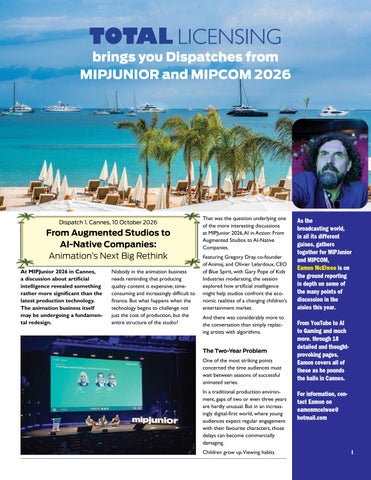
That was the question underlying one of the more interesting discussions at MIPJunior 2026, AI in Action: From Augmented Studios to AI-Native Companies. Featuring Gregory Dray, co-founder of Animaj, and Olivier Lelardoux, CEO of Blue Spirit, with Gary Pope of Kids Industries moderating, the session explored how artificial intelligence might help studios confront the economic realities of a changing children’s entertainment market. And there was considerably more to the conversation than simply replacing artists with algorithms. The Two-Year Problem One of the most striking points concerned the time audiences must wait between seasons of successful animated series. In a traditional production environment, gaps of two or even three years are hardly unusual. But in an increasingly digital-first world, where young audiences expect regular engagement with their favourite characters, those delays can become commercially damaging. Children grow up.Viewing habits
As the broadcasting world, in all its different guises, gathers together for MIPJunior and MIPCOM, Eamon McElwee is on the ground reporting in depth on some of the many points of discussion in the aisles this year. From YouTube to AI to Gaming and much more. through 18 detailed and thoughtprovoking pages, Eamon covers all of these as he pounds the halls in Cannes. For information, contact Eamon on eamonmcelwee@ hotmail.com
1
TOTAL LICENSING market productions and digital-first content.
international distribution agreements are involved.
Premium productions continue to demand exceptional artistic quality, careful creative supervision and rigorous compliance with broadcaster requirements.
A beautifully produced sequence is of limited commercial value if its rights cannot be established or a distributor cannot confidently exploit it.
Here, AI may be most useful in supporting existing workflows: automating repetitive tasks, improving efficiency, assisting with localisation and freeing artists to concentrate on more demanding creative work. Mid-market animation presents a different challenge. With traditional financing under pressure, producers are searching for ways to sustain production values while reducing costs and delivery times. Digital-first content, meanwhile, may offer greater opportunities to experiment with AI-enabled production models, shorter formats and more frequent releases. The point is not that one approach should replace another. Rather, studios may need different production systems for different audiences, platforms and commercial expectations. change. Algorithms move on. And franchises that have spent considerable sums building an audience can lose momentum while their next series remains in production. The challenge is therefore not merely to produce animation more cheaply, but to maintain a continuing relationship with audiences. AI-assisted workflows may help reduce bottlenecks, accelerate production and allow established intellectual properties to generate more regular content across multiple platforms. For rights owners and licensing partners, that continuity could prove particularly valuable. Not All Animation Is Created Equal Another important distinction concerned the different economics of premium television animation, mid-
2
The Copyright Elephant in the Room Of course, there’s an awkward question sitting in the corner of almost every AI conversation: who owns what? For animation companies managing established intellectual properties, copyright, character integrity, training data, contracts and distribution compliance are not minor administrative inconveniences. They are fundamental business considerations. The discussion highlighted the importance of investing time in legal and technical safeguards before introducing new AI processes into commercial production. Broadcasters and global platforms are understandably cautious about the provenance of material, particularly when valuable franchises and
This creates an interesting paradox. AI may accelerate production, but implementing it responsibly can initially require substantial additional work. In other words, there’s little point producing twice as much content if nobody can safely license it. From Production Studios to Franchise Businesses Perhaps the most important commercial implication lies beyond production itself. Animaj’s approach reflects a wider shift towards companies that combine ownership of intellectual property with audience analytics, technology, distribution and ongoing franchise development. The objective is not simply to deliver a television series and wait for the next commission. It is to develop characters and stories that can remain active across
TOTAL LICENSING YouTube, streaming, television, social media, licensing, consumer products and other audience experiences.
deciding where technology could help solve them.
This requires a different understanding of how children’s brands are built.
An animation company can invest heavily in sophisticated tools without necessarily improving the appeal of its characters, the originality of its stories or the commercial potential of its intellectual property.
Traditionally, television exposure helped establish awareness, with licensing and merchandising following successful broadcast performance. Increasingly, audience development, digital distribution and commercial planning are becoming interconnected from the outset. AI may help studios service those different platforms more efficiently, but the underlying commercial challenge remains unchanged: creating characters that children genuinely care about.
That distinction matters.
Equally, smaller studios and independent producers may discover opportunities to develop projects that previously would have been prohibitively expensive. The question is whether those savings translate into better creative work, more sustainable businesses and stronger relationships with audiences.
Technology Is Not the Franchise There was a refreshing degree of pragmatism in the discussion.
A Different Kind of Studio
AI was not presented as an end in itself, nor as a substitute for good storytelling.
The traditional animation studio was largely organised around a production pipeline. The emerging AI-native company may be organised more broadly around intellectual property,
Instead, the focus was on identifying genuine production problems and
What emerged from the session was a picture of an industry beginning to rethink its foundations.
Dispatch 2. Cannes, 10 October 2026
A Princess Who Doesn’t Need Rescuing: Migali, Female Role Models and the Changing Face of Children’s Entertainment
audience engagement, technology, rights management and continuous distribution. That doesn’t necessarily mean the disappearance of conventional animation studios. Indeed, creative judgement, skilled artists and experienced production management may become even more important as the range of available tools expands. But it does suggest that the competitive advantages of tomorrow’s studios may look quite different from those of yesterday. For licensing executives, broadcasters, distributors and producers attending MIPJunior, the implications extend well beyond animation budgets. They concern the speed at which franchises can develop, the frequency with which audiences engage with them and the ability of rights owners to sustain commercial value across increasingly fragmented platforms. AI may provide some of the answers. But as the discussion in Cannes made clear, knowing which questions to ask is probably the more important skill. And that, thankfully, is still a very human business.
Migali, the energetic new animated comedy from Easy Peasy Entertainment and Bardaf! Productions, introduces a young spider princess whose enthusiasm, independence and remarkable ability to create chaos make her rather different from the traditional royal heroines of children’s storytelling. And perhaps that’s no bad thing.
As a mischievous spider princess makes her world premiere at MIPJunior 2026, Eamon McElwee considers why the characters we create for children may have a greater social significance than ever. There was something rather refreshing about the arrival of a new princess at MIPJunior in Cannes this year. For one thing, she has eight legs. For another, she doesn’t appear particularly interested in waiting around for a handsome prince to rescue her.
3
TOTAL LICENSING Meanwhile, Back in the Real World The timing of Migali’s premiere prompted me to think about an altogether more troubling story unfolding back home in Ireland. Earlier this month, broadcaster and former political candidate Gráinne Seoige presented Deepfake Ireland, a documentary examining the devastating consequences of AI-generated sexual imagery and online abuse. During her 2024 general election campaign, Seoige became the target of a manipulated sexual image circulated online.
A Different Kind of Princess Presented at its world premiere screening at MIPJunior on October 10, Migali is a 52 × 11-minute animated comedy aimed at children aged five to eight. Adapted from the successful French comic-book series published by Auzou Éditions, the property already has nine volumes and sales exceeding 150,000 copies. The television adaptation follows Migali at the Royal Academy, where young princes and princesses from different kingdoms come together to develop their extraordinary abilities. Migali possesses an unusual talent for producing spider webs, an abundance of energy and an equally impressive capacity for turning ordinary situations into extraordinary adventures. The series has already attracted broadcasters including TF1, RTBF,VRT and RTS, with Moon-Keys International Content handling international distribution. Moon-Keys International Content +1 At Cannes, producer Adélaïde Ternisien, director Cédric Frémeaux and international distribution executive Isabelle Aghina discussed the journey from publishing to animation. One of the most interesting elements was the decision to preserve the unconventional qualities of the central character.
4
Migali isn’t a passive princess. She’s curious, impulsive, adventurous and sometimes spectacularly unsuccessful. In other words, she’s rather like a real child. Why Female Characters Matter The development team discussed the importance of creating a female protagonist who challenges conventional expectations. Rather than conforming to familiar stereotypes, Migali drives the action herself. Her friends are equally varied, with different appearances, personalities and abilities. The emphasis is on friendship, humour, diversity and individuality. None of this requires the programme to become overtly political. Indeed, one of the great strengths of children’s entertainment is its ability to communicate important ideas without turning them into lectures. Children learn about the world through stories. They identify with characters, imitate their behaviour, absorb their attitudes and develop expectations about what different people can achieve. When girls see adventurous, independent female characters, it broadens the possibilities they can imagine for themselves. And when boys see those characters treated as equals, that matters too.
She has subsequently spoken about the humiliation, distress and intimidation she experienced, and the wider implications for women considering participation in public life. Her documentary raises uncomfortable questions about the relationship between technology, misogyny and the treatment of women in contemporary society. It’s difficult not to see a troubling contradiction. On the one hand, we’re encouraging girls to become more independent, ambitious and confident. On the other, women who step into public life can find themselves subjected to forms of humiliation and intimidation that would have been unimaginable to previous generations. Technology has created extraordinary opportunities for communication and creativity. Unfortunately, it has also provided new instruments for some very old prejudices. Are We Moving Forward or Backwards? There are moments when contemporary debates about women’s autonomy, equality and participation in public life seem to belong to another era. Perhaps not quite the Dark Ages, but occasionally the 1950s don’t feel entirely out of reach. Across different societies, arguments
TOTAL LICENSING combines humour, independence and warmth can appeal across those different expectations without sacrificing entertainment. A Small Spider With a Bigger Message It would be unreasonable to expect a children’s animated comedy to resolve the complex problems of gender inequality, online abuse or the treatment of women in public life. Nor should that burden be placed on its creators.
continue over women’s rights, representation, reproductive autonomy and the roles women are expected to occupy. The circumstances vary enormously between countries, and progress has certainly not been uniform.
tradition. Her strength isn’t that she always gets everything right. It’s that she has the confidence to participate, experiment and occasionally make a complete mess of things. That seems a rather useful quality to encourage in children of any gender.
But the broader concern is legitimate. Rights and freedoms that previous generations worked hard to establish cannot simply be assumed to be permanent. Nor should equality be regarded as a women’s issue alone. Men have an equally important responsibility to challenge intimidation, discrimination and the normalisation of misogyny. And this is where storytelling becomes relevant. Entertainment Has Always Helped Shape Expectations Children’s entertainment has evolved considerably over recent decades. The passive princess waiting for rescue has increasingly given way to female characters who lead adventures, solve problems, make mistakes and determine their own futures.
The Licensing Opportunity Beyond the wider social considerations, Migali also illustrates an important development in children’s intellectual property. The character originated in publishing, where an established readership provided a foundation for expansion into animation. The television adaptation offers opportunities to introduce the property to international audiences and potentially develop further licensing categories. For rights owners, the combination of a recognisable central character, a distinctive visual identity and a world populated by diverse supporting personalities provides useful foundations for long-term franchise development.
Their first responsibility is to entertain children. But storytelling has always played a part in shaping cultural attitudes. The characters we celebrate, the behaviour we reward and the possibilities we present to young audiences all contribute, however modestly, to the way future generations understand the world. At a time when women’s rights and participation in public life remain subjects of intense debate, positive female representation in children’s entertainment feels particularly worthwhile. And perhaps there’s something rather encouraging about a new generation of princesses who aren’t especially interested in being rescued. They’re far too busy having adventures of their own. If only the grown-ups could always demonstrate the same confidence in equality.
But commercial success increasingly depends on more than visual appeal.
Importantly, they don’t have to be perfect. In fact, perfection can make for rather dull television.
Audiences need characters with whom they can establish emotional relationships.
A character who is occasionally impulsive, stubborn, overconfident or spectacularly wrong may be considerably more entertaining and relatable.
Parents, broadcasters and licensing partners are also paying attention to the values that children’s properties communicate.
Migali appears to belong firmly in that
A strong female protagonist who
5
TOTAL LICENSING Dispatch 3. Cannes, 10 October 2026
What Comes After TV? The Answer May Be Everything From fandom and gaming to manga, books and live experiences, children’s IP is escaping the confines of the television screen. For an industry that has spent years discussing the transition from television to digital, one of the more interesting questions at MIPJunior this year was remarkably simple: What comes after TV? The answer, judging by a lively discussion in Cannes, may be almost everything. Moderated by Jo Redfern, SVP Digital at Coolabi Group, the session brought together executives from Disney Kids & Family, Ankama, Auzou Editions and the wider anime and entertainment business to examine how intellectual property develops when audiences no longer experience their favourite characters through one dominant medium.
conventional television episode. And that changes the rules. Fandom Before Format One of the strongest themes of the discussion was that successful franchises aren’t ultimately created by distribution strategies. They’re created by people caring about them. The anime business learned this comparatively early. Anime fans became enthusiastic adopters of streaming and online communities, using whatever technology was available to find other people who shared their interests. Long before the phrase “creator economy” became fashionable, these audiences were discussing characters, producing fan art, dressing as them, sharing recommendations and building communities around the stories they loved.
Television remains enormously important.
That behaviour provides rights owners with something enormously valuable: evidence.
But today’s young audience might encounter an IP through a YouTube clip, video game, manga, book, social post, live event or recommendation from another fan before ever seeing a
If audiences are discussing a character, creating their own material, filling comment sections or turning up at conventions dressed as characters from an IP, they are telling its owner
something. They’re saying: we care about this world. The clever bit is listening. When a Game Becomes a Universe Ankama provided a particularly useful example. Dofus wasn’t originally conceived as an elaborate multimedia franchise. It began with a group of creators who loved games and wanted to make one themselves. Then something interesting happened. The audience became attached not simply to the gameplay, but to its characters, humour and universe. That enthusiasm provided the confidence to go further, into manga, television, publishing and live experiences. The company subsequently became more deliberate about building worlds capable of supporting different forms of storytelling. It is an important distinction. Rather than creating a television programme and subsequently asking what merchandise might be attached to it, producers can increasingly ask at development stage: Is there a world here that people might want to inhabit? That doesn’t mean every children’s idea needs to arrive carrying a video game, clothing range and 10-year licensing plan. Sometimes the audience needs to tell you what it wants first. The Audience as Development Department This may be one of the biggest changes in modern IP development. Traditionally, producers commissioned research, tested concepts and relied on broadcasters and distributors to interpret audience demand. Today, audiences volunteer enormous amounts of information themselves. Comments, shares, fan creations, viewing patterns, cosplay and liveevent attendance can all indicate which elements of an IP are con-
6
TOTAL LICENSING necting. For creators willing to listen, fandom becomes an extraordinary development resource. There was even discussion of taking something approaching an “open source” attitude towards intellectual property, not in the literal legal sense, but in recognising that fans inevitably create around the worlds they love. That requires trust. Attempt to control every interaction and you risk suffocating the community. Give audiences appropriate space to participate and they can become some of the most enthusiastic advocates a franchise could have. And Then Something Unexpected Happened: Books Survived Perhaps the nicest twist in a session called What Comes AFTER TV? was the reminder that the future isn’t necessarily entirely digital. Physical books remain remarkably resilient. Pauline Plaisant of Auzou Editions discussed a French publishing market in which physical books continue to account for the overwhelming majority of sales despite years of predictions about their demise. And publishers themselves are innovating with format. One example discussed was an Advent-calendar-style reading concept: a story divided into daily chapters that readers open as Christmas approaches. It takes one of our oldest entertainment technologies, the printed book and changes the experience around it. The concept proved sufficiently successful to travel internationally. It’s an important lesson for licensing. Innovation doesn’t necessarily mean abandoning traditional media. Sometimes it means understanding what people love about a familiar product and finding a fresh way for them to experience it. Digital Children Still Like Physical Things
There was another wonderfully human observation during the discussion. Children who have grown up surrounded by streaming services are showing renewed interest in owning physical media. Why? One answer offered was wonderfully straightforward: nobody can remove a physical disc because a licensing agreement has expired. For an industry obsessed with digital transformation, perhaps we occasionally underestimate the emotional value of ownership. Books, collectibles, toys, clothing, physical media and live experiences allow audiences to bring fictional worlds into their actual lives. That is, of course, precisely where licensing has always been powerful. From Viewers to Participants The wider shift is from audience as viewer to audience as participant. A successful children’s franchise today may exist simultaneously as television, gaming, publishing, social media, shortform video, consumer products and physical experiences. Not every fan will participate everywhere. Nor should they have to. The opportunity is to create multiple doors into the same world. Someone may discover an IP through a game and subsequently watch the television series. Another child might discover it through a book. Another through YouTube. Another because their friend turned up dressed as one of its characters. There may no longer be a single “correct” route into a franchise. What Comes After TV? Perhaps, then, the title of the MIPJunior session contained its own trick question. What comes after television? Television. And books. And games. And manga. And YouTube. And live events.
And toys. And whatever audiences decide to invent around the characters themselves. The real change isn’t that one medium is replacing another. It’s that audiences increasingly expect stories and characters to move freely between them. For producers and licensing executives, that means the job is becoming less about creating programmes and more about creating worlds worth belonging to. And perhaps the most important part is knowing when to stop talking and listen to the fans. Because they may already be telling you where the franchise should go next.
7
TOTAL LICENSING Dispatch 4. Cannes, 11 October 2026
Game On: Have the Kids Leapfrogged Television While We Weren’t Looking? YouTube, gaming, creators and digital-first production are changing how children’s IP reaches the market. At MIPJunior in Cannes, the traditional television route suddenly looked rather less like the only road into town. There is something mildly alarming about attending a conference devoted to understanding young audiences and gradually realising that the young audiences appear to understand the media business rather better than we do. While broadcasters, producers and distributors have spent the past decade debating streaming, linear decline, digital transformation and the future of television, the kids have been busy. They’ve been watching YouTube. Playing games. Following creators. Sharing memes. Building fandoms. Talking directly to the people making the things they love. And generally moving between platforms without showing the slightest concern for the carefully constructed
boundaries of the international television industry. Frankly, nobody seems to have explained the business model to them.
Develop an idea. Pitch it. Find a broadcaster. Find some money. Find considerably more money. Produce it. Broadcast it. Hope children watch it. And, if everybody has been extraordinarily clever and slightly lucky, start discussing toys, books, games and licensing.
At MIPJunior in Cannes, the YouTubesponsored session Beyond Preschool: Making Great Content for the Gen Z & Teen Audience provided an intriguing glimpse of what happens when we stop asking young audiences to behave like television viewers and start paying attention to how they actually consume entertainment.
It has produced some of the world’s great entertainment franchises.
Featuring perspectives from YouTube, Hasbro and Mediawan Kids & Family, the discussion ranged across digital-first production, fandom, live action, animation, audience analytics and the increasingly blurred boundary between content and community.
A creator can make something, publish it, see whether anybody cares, change it, make something else, build a community and progressively develop an IP.
But underneath it all was a much bigger question. Do you actually need television to launch an entertainment brand anymore? The Old Game The traditional children’s television business had a reasonably understandable order of play.
But it also places an enormous hurdle at the beginning of the process. Somebody has to say yes. Without financing and distribution, an idea can remain exactly that for years. Digital-first changes the sequence.
The audience arrives considerably earlier in the process. Sometimes before the television executives do. Welcome to Level One Perhaps gaming provides the most useful analogy. Television used to be Level One. Complete that successfully and you could unlock Level Two: international distribution. Then perhaps Level Three: licensing. Level Four: consumer products. Level Five: global franchise. But today’s young audiences don’t necessarily enter through Level One. They might discover a character in a game. Or a YouTube Short. Or a meme. Or through an influencer. Or because somebody at school won’t stop talking about it. Then they might watch the long-form programme.
8
TOTAL LICENSING The sequence has become wonderfully untidy. For creators, however, that untidiness creates opportunity.
Young audiences don’t necessarily classify entertainment according to the production categories used by the industry.
quality for teen audiences, including content that encourages curiosity, emotional understanding, wellbeing and useful life skills.
Animation can lead to live action.
But quality isn’t necessarily synonymous with production cost.
The Audience Has Entered the Development Meeting One particularly striking example at the session involved creative designs being tested with a digital community numbering in the tens of thousands.
YouTube can lead to television.
Think about what that means. Traditionally, producers might have relied on small focus groups, research reports and professional instinct. All still useful. But now an audience can begin signalling what it likes while the property is being developed. Hasbro discussed how digital data and audience behaviour can help identify which aspects of long-established brands continue to resonate. My Little Pony, for example, has passed through multiple generations, and audience information can help identify the characters, themes and values with the strongest continuing connection. That isn’t simply marketing information. It can become creative information. The audience has effectively wandered into the development department. Hopefully they’ve brought biscuits. Even Mummy Pig Is an Influencer Now If further evidence were required that the old boundaries are collapsing, consider Mummy Pig. Hasbro discussed experimenting with live-action and influencerstyle content around Peppa Pig, allowing established animated characters and worlds to interact with contemporary forms of digital storytelling. It sounds faintly absurd when written down. But commercially it makes perfect sense.
An internet phenomenon can lead to a feature film.
It can mean relevance.
A game can become a series.
Originality.
A creator can become a studio.
Trust.
The audience simply follows whatever it finds interesting.
And, rather inconveniently for accountants, none of those can be purchased simply by increasing the budget.
Quality Without the Price Tag? This also raises an awkward question about production value. For decades, “premium” has frequently been shorthand for “expensive.”
Authenticity.
Production Barriers Are Falling At the same time, making professional content is becoming more accessible.
Digital platforms complicate that assumption.
Cameras are cheaper and better.
A beautifully produced programme costing millions can fail to connect.
Production can be distributed internationally.
A creator with a camera and a compelling idea can attract millions of viewers.
Virtual tools are increasingly accessible.
That doesn’t mean quality no longer matters. Quite the opposite. The YouTube discussion emphasised
Editing can happen on laptops.
And AI-assisted workflows are beginning to reduce or automate particular production tasks. That doesn’t remove the need for professional skills. Nor does pressing an AI button miraculously produce the next Bluey. If it did, Cannes would be considerably quieter and we’d all be at the beach. But the cost of experimenting is falling. And that matters. A producer may increasingly be able to test a character, visual style or short-form idea before committing to the enormous expense of conventional series production. From Gatekeepers to Partners Perhaps the most interesting implication is what this means for traditional media companies. It would be easy to interpret creator-led entertainment as a threat.
9
TOTAL LICENSING There is another possibility. Partnership. Creators may bring audiences, authenticity, speed and ideas. Established studios, broadcasters and licensing companies bring things creators frequently need: financing, professional production, international distribution, rights expertise, consumer-products relationships and experience scaling IP. One doesn’t necessarily replace the other. The clever businesses may be those that work out how to combine them. And instead of a broadcaster being asked to gamble entirely on whether an idea might find an audience, it may increasingly encounter properties where the audience has already voted. With its thumbs. Its comments. Its shares. Its viewing time. And, occasionally, its parents’ credit cards. Fandom Is More Than Data There is, however, a danger in becoming too excited about dashboards. Young people aren’t data points. They’re people. The most successful creator-led businesses understand this extraordinarily well. They respond to audiences, acknowledge them, listen to their jokes and understand the strange little rituals that develop
around communities. Traditional entertainment companies increasingly need that same sensitivity. Because fandom can’t simply be manufactured.
The new pitch might begin: “Three million of them already do.”
You can buy reach.
That’s a rather different meeting.
You can optimise thumbnails.
Perhaps the next great children’s franchise will begin with a multimillioneuro television commission.
But making somebody genuinely care about a character remains a rather mysterious human business. Thankfully. “They Already Do” None of this means television is finished. Television and premium streaming remain enormously powerful ways of expanding stories, building awareness and creating shared cultural moments. But television may increasingly become one stage of the journey rather than the compulsory starting line.
Disney Meets Digital-First: When a 100-Year-Old Storyteller Starts Thinking Like a Creator
10
The old pitch began with: “We think children will like this.”
You can advertise awareness.
Dispatch 5. Cannes, 11 October 2026
At MIPJunior, Disney Kids & Family explained how audience research, creators, new formats and digital-first thinking are being woven into one of entertainment’s most established franchise-building machines.
understandable if somebody at headquarters occasionally said: “I think we know how to do this.”
Disney has been creating children’s entertainment for more than a century.
Disney knows enormously well how to create, develop and commercialise entertainment, but it also knows that today’s children aren’t watching in the
Which means it would be entirely
And for independent creators, that is potentially transformative.
The interesting message from MIPJunior in Cannes, however, was almost the opposite.
Or perhaps it will begin with an animator, a teenager, a game developer or a couple of friends uploading something peculiar to YouTube on a Tuesday afternoon. The important thing is that there are now more ways into the game. And while the grown-ups are still discussing which platform will win, the kids appear to have discovered something much simpler. They’ll play on all of them! same way their parents did. So even Disney has to keep learning. At the MIPJunior session From First Favourites to Lasting Fandom: Disney’s Approach to Kids & Family, moderator Emily Horgan of The Kids StreamerSphere was joined by senior Disney Kids & Family executives Ayo Davis, Alyssa Sapire, Charlie Andrews, Gino Guzzardo and Zack Olin. The conversation offered a fascinating look inside a company attempting to balance two enormously valuable assets. One is Disney’s heritage. The other is the audience’s future. And increasingly that future is digital-first.
TOTAL LICENSING You Can’t Tell Children Where to Watch There was a time when children’s television had a reassuringly straightforward relationship with its audience. Make programme. Put programme on television. Children watch programme. Possibly sell lunchbox. Repeat. That world has gone. Children now move between streaming,YouTube, games, short-form video, music, live experiences and physical products with remarkable ease. They don’t particularly care which division commissioned it. And they certainly haven’t read the corporate organisational chart. Disney’s response appears to be less about forcing audiences back into an old model and more about meeting them wherever their interests naturally develop.
doors through which children can now enter them.
a licensing perspective: characters and themes can travel with children as they grow.
The Audience Is Apparently in Charge One of the strongest themes across MIPJunior this year has been the increasing importance of listening directly to audiences.
A preschool audience might first encounter a theme or character in animation. As those children get older, the underlying interests can migrate into more sophisticated animation or live action.
That means thinking about different formats, different platforms and different levels of storytelling, while maintaining the values and creative standards associated with Disney.
Disney described regular engagement with preschool children through its internal educational research work, sitting with children, showing them stories and seeing what they actually understand and enjoy.
Digital-First, But Not DigitalOnly This is where Disney’s approach becomes particularly interesting.
Which is probably more useful than asking a room of 50-year-old television executives what a four-year-old wants.
Digital-first doesn’t mean abandoning premium television.
Children, as the panel observed, are also brutally effective critics.
The objective isn’t simply a successful programme.
Nor does it mean taking an existing television programme, cutting it into vertical pieces and declaring victory.
They don’t watch something because the producer worked terribly hard on it.
It’s lasting fandom.
It means recognising that audiences can discover characters and stories in different places and at different moments in their lives.
They don’t care how difficult the financing was.
A short-form idea might create the first connection. A series might deepen it. Music can extend it. A live experience can turn it into a memory. A toy allows the child to take ownership of it. And a park can make the whole thing physically real. Disney has been building entertainment ecosystems for decades. What has changed is the number of
And they are unlikely to continue watching because somebody describes the programme as “strategically important.” They either like it or they don’t. It’s a wonderfully efficient research methodology. Growing Up With the Audience Disney’s approach also illustrates something particularly valuable from
The panel discussed how insights from preschool can inform later storytelling, effectively following children’s evolving tastes rather than treating each age demographic as an entirely separate universe. That creates the possibility of a much longer relationship between audience and brand.
Originals Still Matter Perhaps one of the more encouraging messages for creators was Disney’s continuing appetite for original IP. In a market understandably dominated by established franchises, Disney executives discussed SuperKitties as an example of an original property developing into a wider ecosystem. Long-form episodes can sit alongside specials and shorts, with consumer products and other extensions broadening the relationship. The lesson is important.
11
TOTAL LICENSING greatest responsibilities: trust.
Legacy IP may provide extraordinary advantages, but audiences still want new characters. The next Mickey Mouse cannot be found indefinitely by making another Mickey Mouse.
If the relationship is right, everybody brings something to the table. Including the audience. From Creator to Franchise
At some point, somebody has to create something.
This connects with a wider theme running through Cannes this year.
Enter the Creators And this is where the creator economy becomes increasingly relevant to a company such as Disney.
The distance between “creator” and “studio” is shrinking. A successful digital creator can increasingly develop IP, build audiences, sell products and expand into longerform entertainment.
Digital creators arrive with something traditional studios have historically found difficult to manufacture: an existing relationship with an audience. They understand tone. They understand community. They understand the pace of online culture. And frequently they understand exactly why people come back. For Disney, therefore, the opportunity isn’t simply to hire creators because they have followers. The more interesting proposition is finding creators whose ideas, voices and relationships with audiences can complement Disney’s storytelling values. That is a much more sophisticated partnership. The creator brings authenticity, perspective and perhaps an existing community. Disney brings development experience, production expertise, global distribution and
12
one of the most formidable franchise infrastructures ever constructed.
Parents trust the brand. Children form some of their earliest entertainment relationships through it. Disney therefore has to find creators and ideas that align with the values audiences associate with the company. That might occasionally mean saying no to something enormously popular.In the attention economy, not every viral phenomenon needs to become a franchise. Sometimes the cleverest licensing decision may still be to leave well enough alone.
Meanwhile, major studios are learning some of the techniques creators have mastered: faster feedback, direct audience relationships, experimentation and platform-specific storytelling. The two worlds aren’t necessarily colliding.
First Favourite, Lasting Fandom The session’s title captured the strategy neatly: From First Favourites to Lasting Fandom. A child’s first encounter with Disney may happen astonishingly early. But maintaining that relationship requires continually earning attention as the child grows. That’s where digital-first becomes much more than a distribution strategy. It’s an audience strategy. Disney isn’t throwing away the old rulebook. It has one of the most successful rulebooks in entertainment history.
They may be converging. And that creates opportunities for independent creators who previously might never have imagined themselves sitting across the table from Disney.
But it appears increasingly willing to write a few new chapters with creators, audiences and new platforms sitting around the table. Perhaps that’s the bigger lesson emerging from MIPJunior.
Values Still Matter There is an important qualification. Scale alone isn’t enough. A creator having millions of followers doesn’t automatically make them suitable for a children’s franchise. Disney’s great commercial asset is also one of its
If a company with 100 years of storytelling behind it believes it still has to adapt, experiment and listen to its audience, the rest of us probably shouldn’t get too comfortable either. Even the Magic Kingdom, it seems, occasionally needs a software update.
TOTAL LICENSING Dispatch 6. Cannes, 11 October 2026
The New Kids YouTube Playbook: Millions of Views but Where’s the Money? At MIPJunior, leading digital executives explained how YouTube's changing algorithms, audience analytics and monetisation models are rewriting the rules for children's entertainment. But what does it all mean for the rights holders? There was a time when making money from children's television was reasonably straightforward. Well, perhaps not straightforward. This is television, after all. But at least everybody broadly understood the business. Make a programme. Sell it to a broadcaster. Collect a licence fee. Sell it internationally. Develop some consumer products. And, if the gods of children's entertainment were smiling, watch the royalties arrive. Then along came YouTube. Suddenly, everybody was talking about subscribers, algorithms, thumbnails, watch time, engagement, Shorts, recommendation systems and something called the Creator Economy. And just when producers thought they were beginning to understand it,YouTube changed the rules again. At MIPJunior, the session The New Kids' YouTube Playbook: Platform Changes Decoded offered some welcome practical guidance. Moderated by Caroline Tyre of Spin Master, the panel included Tara Day of Brainchild Entertainment, Jack Luckett of WildBrain and Damien Soriano of Spiritum Entertainment. These are people operating at the sharp end of digital children's entertainment. WildBrain alone manages an extensive network of YouTube channels generating billions of viewing minutes every month. So when its executives talk about what matters on the platform, it's probably worth listening.
Forget the Algorithm. Remember the Audience. Perhaps the most refreshing message was also the simplest. Stop obsessing about the algorithm. Start obsessing about the audience. Tara Day explained how YouTube's systems have become increasingly sophisticated at understanding content itself. The old tricks of loading titles, descriptions and metadata with keywords are no longer sufficient. The platform can analyse what is happening visually and what is being said or heard.
The more important question is whether people actually watch. And keep watching. Watch time matters. So does average viewing duration. So does understanding exactly where audiences stop watching a programme. The platform provides extraordinarily detailed information about these behaviours. For producers, that represents something traditional television could rarely offer at comparable scale: continuous feedback on how audiences respond to individual moments in a programme. The audience has become the research department. And it never seems to take a day off. A View Isn't Necessarily a View The panel also highlighted changes in how YouTube counts views. Public-
In other words, it increasingly understands the programme rather than simply reading the label on the box. That creates opportunities for genuinely good content. But it also makes the competition considerably tougher. There are only so many hours in the day, and even the most enthusiastic preschooler eventually has to go to bed. Subscribers? Apparently Not That Important. One of the more surprising moments came when the discussion turned to subscribers. For years, subscriber numbers have been displayed almost like medals. A million subscribers! Five million! Ten million! Very impressive. But Jack Luckett suggested that subscriber numbers are not necessarily the most meaningful measure of commercial performance. A channel can accumulate enormous subscriber numbers through Shorts without those subscribers necessarily becoming regular viewers of longerform programming.
13
TOTAL LICENSING facing view counts, engaged views and estimated co-viewing can represent different things. That distinction matters enormously. A video registering a view because someone briefly encounters it is not necessarily delivering the same commercial or audience value as a programme watched attentively for several minutes. And co-viewing, particularly important for children's content watched on television screens, complicates the picture further. A family watching together may represent several people but only one playback session. For rights holders, this makes simple comparisons increasingly unreliable. Ten million views sounds impressive. But ten million views of what? A three-second encounter? A five-minute programme? A twenty-minute episode? And where are those viewers located? Which brings us to the money. So How Much Does YouTube Actually Pay? YouTube does not pay children's content owners a universal rate per minute watched. Instead, earnings depend on advertising revenue, monetisation arrangements, audience geography, format, eligibility and other factors. Under YouTube's standard Partner Programme terms, eligible longform creators receive 55% of net
advertising revenue from watch-page advertising. For Shorts, creators receive 45% of the revenue allocated to them from the Shorts creator pool. These percentages are not the same as a guaranteed payment per view. YouTube has also disclosed that it paid more than $100 billion to creators, artists and media companies over four years. That is an extraordinary amount of money. But it is spread across an enormous global ecosystem, and it includes more than children's programming. The question for an individual rights holder is therefore much more specific. What is my revenue per thousand views? How much viewing time am I generating? What proportion of those views is monetised? And how much of the revenue actually reaches the underlying IP owner? Geography Matters A million views in the United States will not necessarily generate the same advertising revenue as a million views in Latin America or Southeast Asia. Advertising markets differ considerably. North America and parts of Western Europe generally attract stronger advertising expenditure than many emerging markets.
However, individual earnings depend on the actual audience, advertiser demand, content category and monetisation conditions. A rights holder with a global children's brand therefore needs to understand not simply how many people are watching, but where they are watching. A useful starting point is to examine four broad territories. North America: Potentially strong advertising demand, but highly competitive, with audience acquisition and production costs to match. Europe: A varied market combining relatively mature advertising economies with considerable differences between individual countries. Latin America: Potentially substantial audiences and strong opportunities for Spanish- and Portugueselanguage localisation, although advertising revenue per view may be lower than in some Western markets. Asia: Enormous scale, but a particularly diverse advertising landscape, making country-by-country analysis essential. For a global IP, localisation and distribution strategy can be just as important as the original production budget. The Children's Advertising Complication There is another important consideration. YouTube restricts personalised advertising on content designated as made for kids. That means children's content cannot necessarily be monetised in the same way as general entertainment. Contextual advertising remains possible, but the absence of personalised targeting can reduce revenue opportunities. For children's producers, this makes scale, repeat viewing, localisation and complementary commercial revenues particularly important. A successful YouTube channel may be valuable not only because of the
14
TOTAL LICENSING advertising revenue it generates, but because it builds awareness and demand for an IP. Which brings us back to licensing. The Real Prize May Be Bigger Than Advertising For established children's franchises, YouTube advertising is only one part of the commercial equation. A successful channel can help generate demand for toys, books, games, live experiences, music and other products. It can introduce characters to new territories. It can maintain engagement between television seasons. It can test new formats. And it can provide valuable information about which characters and stories resonate with audiences. That means YouTube may be simultaneously a distribution platform, research tool, marketing channel and revenue generator. For independent creators, it can also provide something particularly valuable. A route to market without first securing a television commission. The New Rights Holder Perhaps the biggest shift is in the role of the rights holder.
content businesses. The platform is generating significant revenues across the creator economy.
Its analytical tools are becoming more powerful. And its relationship with television, streaming and licensing is becoming
The Financial Picture What Rights Holders Can Expect How much does a million YouTube views earn? There is no reliable official YouTube table of average children’s-content payments by continent, and I would avoid publishing regional figures as established facts. However, we can illustrate the economics using hypothetical revenueper-thousand-view scenarios. Illustrative long-form earnings, not market averages At an RPM of $0.25: 100,000 views = approximately $25 1 million views = approximately $250 10 million views = approximately $2,500 At an RPM of $0.50: 100,000 views = approximately $50 1 million views = approximately $500 10 million views = approximately $5,000 At an RPM of $1.00: 100,000 views = approximately $100 1 million views = approximately $1,000 10 million views = approximately $10,000
The old model often involved licensing content to a broadcaster or distributor and waiting for reports.
At an RPM of $2.00: 100,000 views = approximately $200 1 million views = approximately $2,000 10 million views = approximately $20,000
The new model can involve actively managing channels, commissioning platform-specific content, interpreting analytics, developing localisation strategies and continuously refining the proposition.
At an RPM of $4.00: 100,000 views = approximately $400 1 million views = approximately $4,000 10 million views = approximately $40,000
It requires different skills. A good producer is not automatically a good YouTube channel manager. And a good channel manager is not necessarily a good storyteller. The opportunity is bringing those disciplines together. Show Me the Money and the Watch Time The strongest message emerging from this MIPJunior session was that YouTube is becoming a more sophisticated environment for professional
(These figures are purely illustrative examples, not claimed average YouTube rates. RPM can vary substantially by territory, audience, format, season and advertising demand, and made-for-kids content has particular advertising restrictions.] RPM means revenue per thousand views received by the channel, after YouTube’s applicable share. These are illustrative assumptions, not verified regional rates. For example, imagine a children’s animation library generating 50 million views per month at an illustrative RPM of $0.75. That would produce approximately $37,500 per month, or $450,000 annually, before channel-management fees, localisation, production costs and any revenuesharing arrangements.
15
TOTAL LICENSING increasingly interconnected. But the old rules of business haven't entirely disappeared. You still need a good product.You still need an audience. You still need to understand your costs. And you still need to know whether the money coming in exceeds the money going out. A million subscribers may look lovely on a presentation slide. But as any producer who has ever tried to pay an animation studio will tell you, you can't pay the invoices with subscribers. At least, not yet. But there's an important distinction between the channel operator and the underlying rights holder. If a distributor or channel-management company operates the channel, the producer's eventual payment depends on the contractual revenue
split, recoupment provisions and other deductions. That is why negotiating digital rights carefully matters. What about payment per minute? YouTube does not have a standard per-minute royalty. To illustrate the difference, consider a hypothetical video earning $1 RPM. If the average viewing duration is five minutes, one million views generate five million viewing minutes. At $1,000 total channel revenue, that works out to: $0.0002 per viewing minute. But if the same million views average ten minutes, the effective amount becomes $0.0001 per viewing minute, assuming RPM remains unchanged. These figures are mathematical illustrations, not YouTube payment rates. In practice, longer viewing can affect advertising opportunities and rev-
Dispatch 8. Cannes, 11 October 2026
MIPJunior 2026: Has the Children’s Entertainment Business Reached an Inflection Point? MIPJunior Wrap-Up From AI and YouTube to creators, fandom, public service broadcasting and the changing role of television, a weekend in Cannes suggested that children’s entertainment isn’t disappearing, but almost every assumption about how it is created, financed and distributed is being reconsidered. Spend a couple of days at MIPJunior and a curious contradiction begins to emerge. On one hand, this is an industry under considerable pressure. Traditional commissioning is becoming harder. Streaming economics are being questioned. Production costs remain challenging. Artificial intelligence is arriving at considerable speed. Children’s viewing is fragmenting across
16
YouTube, gaming, streaming and social platforms. On the other hand, children have probably never consumed more entertainment. They just aren’t necessarily consuming it where the grown-ups expected them to. That was perhaps the overriding impression from MIPJunior 2026 in Cannes. Across two days of presentations, screenings and conversations, the same question kept appearing in different forms: What exactly is children’s television when television is no longer necessarily the starting point? From Television First to Audience First
enue, so the relationship is not fixed. Why children's content needs a different calculation Because personalised advertising is restricted on made-for-kids content, producers should be especially cautious about using general YouTube creator earnings as a forecast. For a professional children's rights holder, I'd recommend examining five revenue categories together: YouTube advertising and Premium revenue. International distribution and programme licensing. Consumer products and merchandising. Music, publishing, games and live experiences. Sponsorship and other permitted commercial partnerships, subject to children's advertising rules. The commercial opportunity is often the combination rather than advertising alone. One of the strongest themes was digital-first production. For generations, the route into children’s entertainment was reasonably well understood. Develop an idea. Find a producer. Pitch a broadcaster. Secure financing. Make the programme. Find the audience. Increasingly, that sequence can be reversed. Creators can publish first. They can test characters and stories on YouTube and other digital platforms, develop an audience, analyse its response and then build the wider intellectual property around demonstrated demand. It doesn’t make creating a successful children’s property easy. Nothing at MIPJunior suggested that somebody had discovered that particular button. But it does mean creators increasingly have permission to give themselves permission. YouTube Grows Up YouTube was everywhere in the conversation. Not simply as somewhere to put clips from television programmes,
TOTAL LICENSING Almost everything. Books. Games. Manga. YouTube. Live events. Toys. Fan art. Communities. And, somewhat inconveniently for anyone predicting its demise, television.
but as a genuine entertainment ecosystem. Sessions examining the platform highlighted how sophisticated the relationship between content and audience has become. Subscriber numbers, once displayed almost as digital trophies, may tell only part of the story. Watch time, retention, geography, devices and audience behaviour can provide considerably more useful information. YouTube’s recommendation systems are also becoming increasingly capable of understanding the content itself. The message for producers was surprisingly old-fashioned. Make something people actually want to watch. After years spent attempting to decode algorithms, perhaps we’ve finally rediscovered the audience. The Economics Still Need Work There is, however, a rather large elephant wandering around the Palais. Money. Digital platforms provide extraordinary reach, but reach does not automatically finance professional production. This is particularly challenging in children’s entertainment, where advertising restrictions and production costs can make the economics difficult. Several discussions therefore moved beyond advertising towards a broader
view of IP. YouTube may generate advertising income, but it can also build audiences for toys, publishing, games, live experiences, music and licensing. In that model, the programme isn’t necessarily the finished product. It is the beginning of a relationship. AI Moves from PowerPoint to Production Artificial intelligence was another unavoidable subject. But the conversation seemed noticeably different from even a year ago. The question is becoming less: “Will AI change production?” And more:
The more interesting change is that these things no longer necessarily happen in a predetermined order. A property might begin as a game and become television. It might start on YouTube and move into consumer products. A book can become animation. An online community can help demonstrate whether a character has genuine franchise potential. The old model often created a television programme and subsequently attempted to build a franchise around it. The emerging model increasingly thinks about the world of the IP from the beginning.
“Where exactly should we use it?” Animation provides perhaps the clearest example. AI-assisted tools potentially offer faster production, localisation, versioning and experimentation. But the discussions in Cannes also repeatedly returned to copyright, compliance, creative control and transparency.
The Audience Has Joined the Development Department One recurring theme throughout the weekend was audience feedback. Disney discussed the importance of research and direct engagement with children. Digital-first producers talked about analysing audience behaviour.
The interesting distinction may ultimately be between using AI to replace creativity and using it to make creativity economically possible.
YouTube provides extraordinary amounts of information about when viewers arrive, when they leave and what they watch next.
For an animation industry facing considerable cost pressures, that isn’t an academic distinction.
Fandom itself becomes information.
What Comes After Television?
Comments, shares, fan creations and repeat viewing can tell rights holders which characters and stories matter.
Another fascinating MIPJunior discussion asked precisely that question.
That doesn’t mean handing the script over to the algorithm.
The answer appeared to be:
But it does mean the days when an industry could make programmes
17
TOTAL LICENSING largely behind closed doors and discover what audiences thought months later are disappearing.
Don’t Forget the Parents. Another important theme was coviewing.
The audience is now sitting in the development meeting.
The enormous success of properties such as Bluey demonstrates what happens when children’s entertainment works simultaneously for children and adults.
Hopefully they’ve brought biscuits. Disney Meets the Creator Economy Perhaps one of the more interesting signs of change was hearing an organisation with more than a century of storytelling experience discussing creators and digital-first thinking. Disney isn’t abandoning traditional storytelling. Quite the opposite. But creators bring something different: their own communities, voices, pace, authenticity and direct relationship with audiences. Established studios bring development expertise, production infrastructure, distribution and the ability to turn successful ideas into global franchises.
The television industry has spent years asking what the future of children’s television looks like. After a weekend at MIPJunior, I suspect the children might already be watching it.
Their own media habits are digital, mobile and fragmented. They use YouTube. They understand streaming.
But their positions within the ecosystem are changing.
They play games.
A producer can self-publish.
So perhaps it shouldn’t surprise us that their children don’t regard scheduled television as the centre of the entertainment universe either.
A successful YouTube property can move towards television.
The distinction between children’s content and family entertainment may therefore become increasingly important.
Characters Still Matter For all the discussion about platforms, technology and business models, MIPJunior also provided a useful reminder that children still respond to characters and stories.
Amid all the enthusiasm for digital disruption, Evan Shapiro delivered one of the weekend’s strongest reminders.
There isn’t yet an algorithm for that. Thankfully.
Television isn’t disappearing. Neither are broadcasters, studios or distributors.
A creator can now start building an audience before approaching them.
Make the parents laugh and they might actually remain in the room.
The world premiere of Migali offered one example. Here was a princess character designed for a contemporary audience, energetic, funny and not particularly interested in waiting around to be rescued.
An Industry in Transition Perhaps the biggest mistake would be to interpret everything happening in children’s entertainment as the death of television.
They watch vertical video.
Those two worlds increasingly need one another. The future may therefore be less creators versus studios and more creators plus studios.
Technology changes. Distribution changes. Social attitudes change. But children’s entertainment still ultimately depends on creating characters children want to spend time with.
18
Today’s parents are increasingly Millennials and Gen Z.
The other provides experimentation, direct audience relationships and new routes to market.
That has to be worth something. And Don’t Forget Public Broadcasting
Public service media still matters. At a time when commercial commissioning of children’s programming is under pressure, public broadcasters continue to invest in original programming, local stories and trusted content. They provide cultural infrastructure that algorithms and advertising markets cannot necessarily replace. The future of children’s entertainment therefore shouldn’t require choosing between public broadcasting and digital-first media. We need both. One provides investment, trust and cultural representation.
A broadcaster can use digital platforms to grow rather than cannibalise an audience. And a rights holder can increasingly think of television as one expression of an IP rather than its entire reason for existing. After two days at MIPJunior, I came away thinking that the children’s entertainment business isn’t facing a shortage of audiences. It isn’t facing a shortage of ideas either. What it may be experiencing is the uncomfortable transition between an old business model that no longer works quite as reliably and a new one that hasn’t completely worked out how to pay for itself yet. Somewhere in that gap lie considerable opportunities. For producers, perhaps the most important change is psychological. Don’t necessarily wait for someone to greenlight you. Create something. Publish something. Test something. Listen to the audience. Own as much of the IP as you can. And then find the right broadcasters, distributors, platforms, brands and licensing partners to help make it bigger.