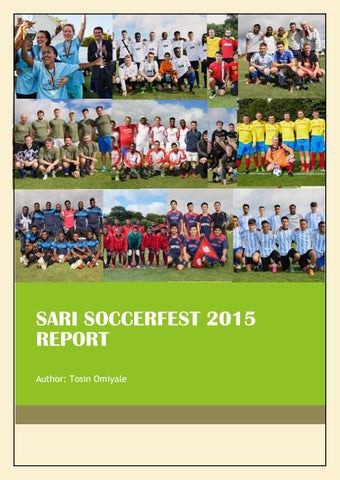
SARI SOCCERFEST 2015 REPORT Author: Tosin Omiyale
1 SUMMARY Soccerfest is an annual 7-aside intercultural football tournament established in 1997. It provides a platform for social inclusion of communities with ethnic minority background. The programme creates an environment for mainstreaming opportunities, in which people from diverse cultures can appreciate their shared passion and compete in a respectful way, while recognising the diversity in the society and available support services. Over the years the programme has successfully engaged a large category of participants from over 90 different nationalities across Ireland, including marginalised communities. The tournament now in its 18th successive year was again held in 2015 at the Garda grounds in Phoenix Park. As a sport programme with a development perspective, Soccerfest 2015 was used as a flagship for the inaugural European Week of Sport sponsored by the Irish Sports Council. This year’s event featured thirty-two (33) teams made up of 29 male teams and 4 female teams. The one-day event was attended by about 600 players and spectators. Overall the event indicates positive outcomes pertinent to the objectives of the programme, which is centered on promoting social participation and inclusion in Ireland.
Soccerfest 2015 Main Results and Outcomes About 600 participants attended the one-day event The profile of participants at the event varied widely with age ranging from 16 years to over 40 years and a mixture of males and females A minimum of 42 diverse nationalities participated in Soccerfest 2015 and were born in 38 or more countries, including Ireland Republic Participants came from 18 Counties with all regions of Ireland represented, thus showing a wide spread in location within Ireland Participants reported increase in diversity, intercultural relations and communication (based on 150 out of 158 survey respondents) Participants noted increase in awareness of local support or public services displayed or circulated at Soccerfest Participants reported Increase in the level of social participation and social bonding among persons of similar nationalities (based on 97 persons out of 153 respondents) Increase in the level of social relation between people of different cultural backgrounds was reported among participants (based on 120 out of 157 respondents) Participants reported better relations with some local support or public services (based on 71 out of 148 respondents)
1
2 INTRODUCTION 2.1 BACKGROUND AND CONTEXT In the late 1990’s, migration to Ireland was as at its peak and immigrants have since settled in different Counties across the country. The social inclusion and integration of immigrants and their children became a necessary debate with the settlement pattern of immigrants and the diverse composition of immigrant population in Ireland. Similar to other Western European countries, Ireland has embraced the need for more inclusive policies and programmes to address various issues that can lead to the exclusion of its population with ethnic minority background, and to also meet their specific needs. According to research, people with ethnic minority background in Ireland are mostly at risk of unemployment, marginalisation, poverty and discrimination (McGinnity, Quinn, O’Connell, & Donnelly, 2009), (Michael 2015), (Fanning, Killoran, Bhroin, & McEvoy, 2011). While progress has been made to a certain degree in addressing the needs of members of ethnic minorities, integration is a long term process that requires continued programme efforts at the local level. The European Union also recently called for the increased support and inclusion of young people with ethnic minority background, as a result of marginalisation, violent extremist tendencies and hate speech. Moreover, Ireland still shows a pattern of strong migration flows, attracting 69,300 immigrants in 12 months; leading up to April 2015. According to the recent estimated migration, 30,400 of these immigrants are non EU nationals, while 26,800 others are EU nationals; excluding Ireland (CSO 2015). Sport Against Racism Ireland, a voluntary organisation using sport as a platform to promote greater social inclusion has implemented projects and programmes to promote integration locally and to develop leadership skills among young people with ethnic minority background. Soccerfest is one of the programmes organised annually to facilitate positive interaction and cultural exchange, involving members of ethnic minority communities, service providers and Irish indigenes.
2.1.1 Overview of Soccerfest 2015 Soccerfest is an annual 7-aside intercultural football tournament established in 1997. The tournament now in its 18th successive year was held in the Garda grounds in Phoenix Park; the same venue as other previous Soccerfest events. As a sport programme with a development perspective, this year’s Soccerfest was used as a flagship for the inaugural European Week of Sport sponsored by the Irish Sports Council. In partnership with Dochas, the event was also used as a medium to raise awareness about the new UN Sustainable Development Goals. Information on public services and how to access these services was made available to participants through SARI partners, such as Dublin Aids Alliance, Cairde, Blue September, Irish Refugee Council, Citizens Information, Dublin City Council Voters Registration Campaign, City of Sanctuary, Sickle Cell Society Ireland, Peace One Day, Worldwise Global Schools Programme, and FARE Football Action Week Against Racism. Since last year, Soccerfest has experienced reduced funding for its activities as a result of discontinued funds and grants from major sponsors. This funding difficulty appears as a challenge to 2
this year’s tournament, which was organised as a one-day event in contrast to last year’s Soccerfest held over 2 days.
Soccerfest 2015 featured thirty-two (33) teams made up of 29 male teams and 4 female teams. The one-day event was attended by about 600 players and spectators. The number of soccer teams that participated was less than 2014 Soccerfest, which featured forty men’s teams, eight women`s teams, eight Under 15 teams and eight Under 13 teams. The difficulty in securing funding and sponsors for the event this year was a challenge to recording high level of attendance as previous years, although the quality of the programme planned was consistent and still promoted cross-cultural engagement and social inclusion using sport.
2.1.2 Rationale for the programme Soccerfest is a platform for social inclusion of communities with ethnic minority background. Soccerfest provides an environment for mainstreaming opportunities in which people from diverse cultures can appreciate their shared passion and compete in a respectful way, while recognising the diversity in the society and available support services. Over the years the programme has successfully engaged a large category of participants from over 80 different nationalities across Ireland, including marginalised communities. The programme has served as a platform for socio-cultural exchange, social inclusion, information on local support services and building positive relations at the local level, which includes the active participation of local service providers such as An Garda Siochana football team.
3 EVALUATION FRAMEWORK OF SOCCERFEST 2015 The evaluation of Soccerfest 2015 is conducted based on data collection from questionnaires completed by the participants that attended Soccerfest 2015. The survey was administered on site during the Soccerfest event and was also made available online after the event. The evaluation seeks to examine the achievements of Soccerfest 2015 in relation to its objectives and to document the impact of the programme in relation to social inclusion. The content of the questionnaire used at Soccerfest 2015 is focused on five relevant categories of question, which are of interest to the programme and its goals. The categories of questions also served as useful indicators for performance evaluation of the event. A total of 158 participants completed the questionnaire, containing both quantitative and qualitative question formats. It was necessary to keep the questions simple and concise considering that some participants are not native speakers of English language, and because long questionnaires decrease the willingness of the respondents to answer fully. The five categories of the questions are as follow: 3
1. 2. 3. 4. 5.
Please tell us about yourself? What do you think about Soccerfest 2015? Information service and social inclusion Please tell us how we can improve on next year’s Soccerfest Please tell us the social impact of Soccerfest since you have been attending
The collated and analysed data from the survey will be written under the following areas:
Profile of participants Event organisation Information and awareness of local support services Social inclusion impact
4 REVIEW AND ANALYSIS OF SOCCERFEST 2015 4.1 PROFILE OF PARTICIPANTS 4.1.1 Gender and Age: 70% of respondents that participated in the event are males and 30% are females 88% of the participants are young people between the ages of 16-39 41% of survey respondents are between the ages of 20-29 and considering the difference with other age groups, it shows that the highest number of participants at Soccerfest 2015 are between this age range.
From the total of 158 that completed the survey, 111 respondents are males and 70 females. As shown in figure 1.1 below, the percentage share for the male represents 70% of the survey respondents while the female represents 30%. Similarly, to last year’s Soccerfest the number of females surveyed was below average, which gives an indication that the event is mostly attended by males. This year, one of the contributing factor is the low turnout of female football teams.
4
In the age profile as shown above in figure 1.2, majority of the respondents that participated in Soccerfest 2015 are aged 16 -29 years. This age group indicates 113 people, which is 72% of survey respondents. This high percentage is influenced by the age of players in the tournament. The ages of all respondents shows a wide range in the group of people that attended this year’s Soccerfest. Participants under 16 years were not given questionnaires to complete at the tournament due to need for parental consent, but participants at the Soccerfest included under-16 and children.
4.1.2 Nationality and Place of Birth: 158 surveyed participants at Soccerfest 2015 were from 42 diverse nationalities and were born in 38 different countries 41% of total respondents indicated to be of Irish national 38% of participants surveyed were born in Ireland
64 persons from the surveyed participants are Irish national and in comparison, to their place of birth that can be seen in figure 1.4, 60 persons from this share are born in Ireland, while the remaining 4 people were born outside Ireland. The total population surveyed were of 42 nationalities from the continents of Europe, Africa, South America, Asia and North America.
5
Figure 1.3: Nationalities of 158 participants at Soccerfest 2015
Figure 1.4: Birthplace of 158 participants surveyed at Soccerfest 2015
The total number of respondents (158) were born in 38 diverse countries. 60 persons were born in Ireland, 14 born in Nigeria and 7 born in the U.K. Other countries such as Congo, Brazil and Mauritius are place of birth to 5 persons each.
4.1.3 County of Residence and Length of Stay in Ireland: 6
At minimum, Soccerfest 2015 participants reside in 18 Counties across Ireland and covered all regions in the republic A large category of the respondents lives in Dublin; this share represents 66% of the total survey population Length of residency of participants in Ireland ranges from less than 1 year to over 40 years
Figure 1.6: County of residence of Soccerfest partcipants in 2015
A minimum of 18 Counties in Ireland Republic were represented at this year’s Soccerfest. It is interesting to note that even though a large number of people were from Dublin, paticipants came from all regions showing a good spread across Ireland. The exact number of people that came from each County to Soccerfest 2015 cannot be determined in this survey, but the data shows that Dublin tops other Counties of residence.
7
Figure 1.7: Length of stay in Ireland of respondents at Soccerfest 2015
The number of years that participants have been residing in Ireland shows a good mix between newcomers, Irish natives and settled migrants when compared to their birthplace, and it shows a positive element for the possibility of social interaction among the participants.
4.2 EVENT ORGANISATION 4.2.1 Purpose of Attending Soccerfest: Data from the survey reveals that the centre of attraction for participants attending Soccerfest 2015 is football, supporting football teams and to support the cause of Soccerfest as a platform for social relations and integration. Other reasons such as to make friends, curiosity and just passing through were also mentioned.
Figure 2.1: Purpose of participating in Soccerfest as mentioned by participants in 2015
8
4.2.2 Perception on the Quality of Food: 77% of the respondents were pleased with the food served at Soccerfest 2015, while quarter (15%) were indifferent about the food. Overall small percentage of the respondents (2%) were of the opinion that the food was bad.
Figure 2.2: Perception of participants on food at Soccerfest 2015
4.2.3 Perception on Intercultural Communication/Exchange: Majority of the respondents (95%) at Soccerfest 2015 considered the event a place of opportunity to meet and communicate with people from other cultures and ethnicities. This share represents 150 individuals out 158 respondents and therefore shows the relevance of the event as a platform for social inclusion and building positive relations.
Figure 2.3: Perception of participants on opportunity for intercultural exchange at Soccerfest 2015
9
4.2.4 Event Advertising & Publicity: The figure below reveals that SARI carried out a good publicity plan for the event making use of different forms of traditional and new media to advertise the event in 2015. Out of the 158 survey respondents, more than half (51%) heard about the event through word of mouth. Poster, flyer, newspaper, radio and social media were other publicity forms mentioned by attendees. It is important to note that 20% of the respondents heard about the event through other means that wasn’t listed on the survey. Having an idea about these other means may be of benefit to SARI.
Figure 2.4: Percentage showing how participants were informed about Soccerfest 2015
4.2.5 Participants Opinion on How to Improve the Organisation of Soccerfest: 112 out of 158 survey respondents expressed their opinion on how Soccerfest can be better improved. Their opinions were based on the organisation of Soccerfest 2015 only. 16 ‘themes’ emerged from the suggestions of respondents. The top 4 themes that were mostly mentioned are as follow: more advertisement; organise Soccerfest as a 2-day event; organise other sports too; Provide more chairs, louder music and cultural foods and get more teams to participate. Other suggestions include:
To get more female teams to participate Provide free food Get more funding Organisation of Soccerfest is good and doesn’t need to be changed Invite celebrities or special guest Get teams without registering online
10
Figure 2.5: Themes suggesting how Soccerfest can be improved as mentioned by 2105 participants
4.3 INFORMATION AND AWARENESS ON SUPPORT & PUBLIC SERVICES 4.3.1 Awareness about Disseminated Information on Support Services: Survey participants were asked if they received information about the support services that were promoted in association with SARI’s partners at Soccerfest 2015. The data shows that participants received information and are aware about these support services circulated at Soccerfest 2015. However, it appears that respondents didn’t understand the importance of this survey question because more than half of them left the question uncompleted, thus making it difficult to state the overall percentage that became aware of the support services circulated at Soccerfest. As seen in figure 3.1 below, awareness about Garda support services received the highest response, but only 82 out of 158 survey participants responded to this question. In response to information about Citizens Information Service, 50 survey participants noted to have received this information. It is important to note that the issue here is not the non-distribution of service information to participants because SARI’s management presented the information on local support services to Soccerfest participants in a package, which was handed to each person. In future, for a better data result, SARI will have to review its method of passing information about support services to participants and ensure that a report technique is in place to record a comprehensive data for evaluation. 11
Figure 3.1: Number of Respondents Who Noted to have Received Information on Support Services
Soccerfest 2015 survey respondents were asked if the information received on support services were of value to them. According to figure 3.2 below, 109 persons (69%) out of 158 respondents stated the received information was of benefit to them. 38 persons did not respond to the question and 11 respondents said that the received information was no added value to them.
Figure 3.2: Percentage of Respondents as per Opinion on the Personal Value of Received Information at Soccerfest 2015
4.3.2 Awareness about European Year for Development and European Week for Sport: 67 of survey respondents indicated that they became aware of the European Year for Development through Soccerfest 2015, while 80 individuals remained uninformed after the completion of Soccerfest tournament. The percentage of the respondents (42%) aware of the European Year for Development is below average when compared to the total number of respondents that took part in the survey. 12
Figure 3.3 Percentage of Respondents aware of the European Year for Development
90
80
80 70
67
60 50
54 46
Frequency
40
Percentage
30 20
Response Yes No Not stated Total
Frequency 67 80 11 158
10 0 Yes
No
46% of the survey respondents got to know about the European Week of Sport through participating in Soccerfest 2015; and 54% stated that they are unaware of the European Week of Sport despite attending Soccerfest 2015. These percentages represent 64 respondents who became aware of the European Week of Sport through the Soccerfest tournament, and 76 others who had no knowledge of the European Week of Sport.
Figure 4.2: Awareness Rate of Respondents at Soccerfest 2015 about European Week of Sport
76
80 70
64 54
60 46
50
Yes
40
No
30 20
Response Yes No Not stated Total
Frequency 64 76 18 158
10 0 Frequency
Percentage
13
4.4 SOCIAL INCLUSION OUTCOMES OF SOCCERFEST 2015 To evaluate the social impact of Soccerfest 2015, participants were asked to complete a key question in response to the indicators below: 1. Have you developed connections with members of your own community/nationality through Soccerfest? 2. Have you developed connection and more confidence in relating with people from different cultural backgrounds? 3. Have you been able to relate better with institutions and public services in Ireland?
These three questions are the indicators used to measure the social benefit of Soccerfest and are formulated in relation to the theory of social capital developed by Robert Putman. According to Putman: Social Capital are the 1‘bonds, links, shared values and understandings in society that enable individuals and groups to trust each other and so work together’. 2
The key varieties of social capital according to Putman are: Bonds: Links to people based on a sense of common identity (“people like us”) – such as family, close friends and people who share our culture or ethnicity. Bridges: Links that stretch beyond a shared sense of identity, for example to distant friends, colleagues and associates.
Linkages: Links to people or groups further up or lower down the social ladder (e.g. service providers, government).
Figure 3.3: Participant's Perception on the Social Inclusion Benefit of Soccerfest 2015
1 2
Taken from OECD Insights on Human Capital, pp. 102-103; Feb 2007 Taken from OECD Insights on Human Capital, pp. 102-103; Feb 2007
14
64% of respondents reported to have met with people of their own nationality and developed social connection with them during Soccerfest 2015 76% of survey respondents were of the opinion that they experienced positive change and improved confidence in relating with people from different cultural backgrounds 48% of respondents are of the opinion that are able to better relate with public or support services in Ireland
The result indicates that Soccerfest is a social medium that assist individuals to participate in sociocultural sphere. The event provides a common ground that encourages social interaction, building of positive relations, social inclusion and social capital. The outcome from the programme shows that participants were able to improve on social bonds, confidence in interacting with people of other cultures, participation with different cultures and building links with some social groups, organisations and service providers existing in Ireland.
Table 3.1: A summary table of the social inclusion outcome of Soccerfest 2015- showing the response of participants in frequency and percentage QUESTIONS
AGREE Nos
%
NEUTRAL Nos
%
DISAGREE Nos
TOTAL
%
Have you developed connections with members of your own community/nationality through Soccerfest?
97
64%
31
20%
25
16%
153
Have you developed connection and more confidence in relating with people from different cultural backgrounds?
120
76%
30
19%
7
5%
157
Have you been able to relate better with some institutions and public services in Ireland?
71
48%
48
32%
29
20%
148
Question 1: Have you developed connections with members of your own community/nationality through Soccerfest? Out of 153 responders to this question, 97 persons agreed to have developed connections with members of their own communities, 31 individuals already had good connection with members of their own community and as a result ticked neutral to the question, while 25 individuals reported not have to build connection with members of their own community.
Question 2: Have you developed connection and more confidence in relating with people from different cultural backgrounds? 157 individuals responded to this question. 120 of these acknowledged to developing connections with people of a different culture and improved confidence in relating with them. 30 individuals noted to already have good relationships and confidence toward relating with people of different cultural backgrounds, while 7 others were of the opinion that they didn’t develop connection or confidence with people of different cultural background through participation in Soccerfest 2015. Question 3: Have you been able to relate better with institutions and public services in Ireland? 15
In question 3, 148 responses were collected. 71 respondents perceived to have improved approach to relating with local organisations and support services such as An Garda Siochana. Another 48 individuals were neutral to the question, signifying no change to the level of good relationship already developed with institutions and public services. In addition, less than a quarter of the respondents (29 persons) disagreed to have seen any changes to how they relate with institutions and public services through participation in Soccerfest 2015.
5 KEY RESULTS, OUTCOMES AND RECOMMENDATION SARI Soccerfest 2015 indicates positive outcomes pertinent to the objectives of the programme and for promoting social participation and inclusion in Ireland. Positive outcomes from Soccerfest 2015 are as follow:
About 600 participants attended the one-day event
The profile of participants at the event varied widely with age ranging from 16 years to over 40 years and a mixture of males and females
A minimum of 42 diverse nationalities participated in Soccerfest 2015 and were born in 38 or more countries, including Ireland Republic
Participants came from 18 Counties with all regions of Ireland represented, thus showing a wide spread in location within Ireland
Participants reported increase in diversity, intercultural relations and communication (based on 150 individuals out of 158 survey respondents)
Participants noted increase in awareness of local support or public services displayed or circulated at Soccerfest
Participants reported Increase in the level of social participation and social bonding among persons of similar nationalities (based on 97 persons out of 153 respondents)
Increase in the level of social relation between people of different cultural backgrounds was reported among participants (based on 120 out of 157 respondents)
Participants reported better relations with some local support or public services (based on 71 out of 148 respondents)
16
5.1 RECOMMENDATIONS:
1. To develop partnership approach with organisations, communities and institutions, to ensure support and sponsorship to continue Soccerfest over a period of 2 days, which can lead to wider participation and social impact in society 2. Result shows that football and interest in diversity is the main attraction for people that participate in Soccerfest. SARI’s management can attract a wider community of participants and new sponsors if a new gender friendly team sport is introduced with football at Soccerfest, such as tag rugby 3. Questionnaire for Soccerfest should include an option for participants to mention the other possible mediums of how they heard about Soccerfest. SARI’s management can consider to include such mediums in their future publicity of Soccerfest 4. To target the participation of more female football teams and the wider public 5. SARI’s management to review its method of passing information about support services to participants so as to ensure that participants are consciously aware of all displayed support services at Soccerfest 6. A more effective report technique should also be developed to record a comprehensive data on participant’s awareness of support services displayed at Soccerfest. As already mentioned in this report, more than half of survey respondents left the question on support services uncompleted, thus making it difficult to state the overall percentage that became aware of the support services circulated at Soccerfest 2015
17
6 REFERENCE LIST Dr. Lucy Michael: Racism against People of African descent; November 2015, Published by ENAR Ireland, Dublin 2
ESRI Research Bulletin: Discrimination in the Labour Market: Nationality, Ethnicity and the Recession; May 5, 2015
Frances McGinnity et al: Annual Monitoring Report on Integration 2010; May 4, 2011
Frances McGinnity et al: Migrants’ Experience of Racism and Discrimination in Ireland: Survey Report publications; November 7, 2006
Professor Bryan Fanning et al: Taking Racism Seriously: Migrants’ Experiences of Violence, Harassment and anti-social Behaviour in the Dublin Area; September 2011; Published by Immigrant Council of Ireland
18