Print Post Approved 100009754
Australia’s Trade Journal For Auto Electricians & Air Conditioning Specialists
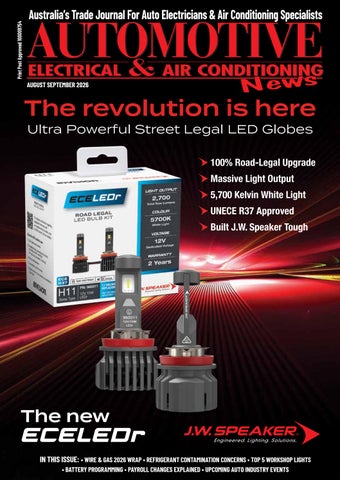
100% Road-Legal Upgrade Massive Light Output AUGUST SEPTEMBER 2026
5,700 Kelvin White Light
Approved The revolutionUNECEisR37 here Ultra Powerful Street Legal Globes BuiltLED J.W. Speaker Tough
100% Road-Legal Upgrade Massive Light Output 5,700 Kelvin White Light UNECE R37 Approved Built J.W. Speaker Tough
The new The new IN THIS ISSUE: • WIRE & GAS 2026 WRAP • REFRIGERANT CONTAMINATION CONCERNS • TOP 5 WORKSHOP LIGHTS • BATTERY PROGRAMMING • PAYROLL CHANGES EXPLAINED • UPCOMING AUTO INDUSTRY EVENTS
MAGAZINE AUTO ELEC & AIR CONaaen.com.au
PUBLISHER
Torque Media Group Pty Ltd
EDITOR
Melanie Cahani
SUBSCRIPTIONS
Australia $69.50 + GST NZ / Overseas $89 AUD Scan the QR Code to subscribe to our magazine:
Or contact our office on: (07) 3353 6017 or 0401 72 75 76 hello@torquemediagroup.com.au
EDITORIAL ENQUIRIES
news@torquemediagroup.com.au
ADVERTISING ENQUIRIES
In this Issue Upcoming auto industry events............................................................ 4 On the cover - JW Speaker road legal LED upgrades............................ 5 Refrigerant contamination concerns ................................................... 11 Manual gearboxes edge closer to extinction ........................................ 12 More EVs in your workshop .................................................................. 13 Turbo Tech Torque with Clinton Brett .................................................. 14 Battery programming explained .......................................................... 16 Lighting feature ................................................................................... 18 Top 5 work lights for every workshop ................................................. 21 MTAA fight for mechanics rights to repair farm machinery ................. 22 Get qualified to teach your trade with MTAQ scholarship ..................... 25 Inside Wire & Gas 2026 ........................................................................ 26 Delco Remy celebrates 130 years......................................................... 27 Century Batteries steps up to back road safety ................................... 28 National lithium battery collection and storage guide ......................... 30 More payroll changes affecting workshops.......................................... 32 Business coaching: systems to keep your workshop thriving ............. 33 Marketplace buy and sell ..................................................................... 34
melanie@torquemediagroup.com.au
GENERAL ENQUIRIES
hello@torquemediagroup.com.au
CONTRIBUTORS Clinton Brett dieselhelp.com.au 0432 738003
Kelly Adams automotivebusinesscoach.com.au VACC motortech.com.au DISCLAIMER
Information on products and services contained in this magazine does not imply the endorsement of any product or services by the publisher, proprietors, staff or its agents. No responsibility is accepted by the Management for any errors, omissions or inaccuracies contained in any editorial or advertisement or for any liability for any loss which may be suffered by any person or organisation who relies either wholly or in part upon any description, photograph or statement contained in any editorial or advertisement in this magazine. This magazine is copyright and no part may be reproduced by any process without the written permission of the management.
The Editor’s Desk After more than 30 years at the helm of this publication, Tony Mc is stepping back and it’s a fitting moment to thank him for the industry he’s built around this magazine. Over three decades he made close friends across the trade and watched the technology in our workshops transform completely. Tony’s dusting off the Chesney caravan and joining the ranks of the Grey Nomads himself, tuning up the Lada 4x4 with new plugs and ignition leads for the road ahead. So if you spot a caravan holding up the traffic on the way to the coast, give him a wave, he’s earned it. Tony’s handed the steering wheel to a new publisher and editor, myself, Melanie Cahani, and Torque Media Group. I’ve spent my career working in marketing and communications, much of it in the B2B space, handling PR and marketing for some of the biggest names in the auto trade. Tony and I have known each other for many years, he and his crew have made us feel welcome, and we look forward to getting to know many of you, our readers, RTOs, TAFEs, business owners, managers and national clients.
These publications have been a genuine resource for workshop operators and service managers for more than 30 years and that’s not something I take lightly. My plan for AE&AC is simple, keep doing what’s made it valuable for 30 years, giving workshop operators and technicians the practical, trade relevant content they’ve come to rely on, while building on that foundation. That means more of the diagnostics, training and industry news you count on, delivered with the same regional roots that have always set this publications apart. Thanks for your support over the years and if you spot us at an industry event, come and say hello. PS, please make a note of our new contact details below. (w) www.torquemediagroup.com.au (e) news@torquemediagroup.com.au (p) 0401 72 75 76
AUGUST/SEPTEMBER 2026 3
MAGAZINE AUTO ELEC & AIR CONaaen.com.au
INDUSTRY EVENTS
Battery Recycling and Manufacturing Summit heads to Melbourne in September Momentum is building for the Australian Battery Recycling and Manufacturing Summit, bringing industry leaders, policymakers, researchers and technology innovators together in Melbourne on 17 September 2026. Hosted by the Association for the Battery Recycling Industry (ABRI) at RACV City Club, the one-day forum follows three sold-out Sydney events and will connect around 150 delegates from industry, government and research. Discussions will cover critical minerals
security, standards development, workforce skills and progress toward battery traceability and certification. A key session, Best Practice & Future Systems, will look at safety, traceability and circular economy outcomes, with contributors from Powering Australia, Standards Australia, TAFE Queensland and CSIRO. ABRI CEO Katharine Hole said the event brings the right people together to share knowledge and build the partnerships needed to move from discussion to action.
Details: www.australianbatterysummit.com.au
EV Technology and Infrastructure zone returns to All Energy Australia For auto electricians building out their EV service offering, All Energy Australia is worth the diary note. The show returns to the Melbourne Convention and Exhibition Centre on 28 and 29 October 2026, with its EV Technology & Infrastructure Zone once again the biggest drawcard for anyone working on chargers, EV components or diagnostics. Spanning more than 1,000 square metres, the zone brings together suppliers of EV chargers, components, software and infrastructure under one roof, alongside a dedicated EV conference stream.
Last year’s event drew more than 16,500 unique visitors, with over 1,000 attending the EV stream specifically, and organisers reporting strong crossover interest between the wider expo and the EV zone. It’s shaping up as a solid one for electricians and infrastructure engineers wanting a look at what’s coming in charging hardware and vehicle-to-grid technology before it lands in the workshop. Details: www.all-energy.com.au
ANZERA brings engine reconditioners together in Melbourne The 2026 ANZERA Engine Reconditioners Conference runs from 15 to 17 October at the Novotel Glen Waverley, described by organisers as the largest Trans-Tasman gathering of engine reconditioning professionals in more than a decade. Hosted jointly by the NZ Engine Reconditioners Association and the Australian reconditioning industry, the threeday event pairs a trade exhibition with technical sessions, workshop tours and business-focused presentations.
Workshop owners, machinists, manufacturers and suppliers from across Australia and New Zealand are expected to attend, with sessions covering new technology, changing market conditions and where the sector is headed next. The event is supported by industry partners ACL Bearing Co, Engine Australia and Nason Engine Parts. Details: www.anzera.com.au
Automechanika Frankfurt returns with record exhibitor numbers Automechanika Frankfurt runs in September 2026, bringing together
4 AUGUST/SEPTEMBER 2026
more than 4,400 exhibitors from over 80 countries across 300,000 square metres, a five per cent increase on last year despite a tough global economic backdrop.
Training gets a bigger footprint too, with certified workshops and a stage program across five exhibition halls covering everything from ADAS diagnostics to alternative drive systems.
The event’s focus this year lands squarely on the trends reshaping the trade, AI, electromobility, digitalisation and autonomous driving, with a new HighTech4Mobility forum covering software-defined vehicles and autonomous tech.
For Aussie techs who can’t make the trip, there’s good news, for the first time this year, the entire stage program will be made freely available online after the fair wraps up, giving local workshops access to the same training content without the airfare.
ON THE COVER
MAGAZINE AUTO ELEC & AIR CONaaen.com.au
J.W. Speaker’s revolutionary street legal ECE LEDr upgrade globes Delivering uncompromising power, precision optics and full ADR compliance for ultimate night-driving confidence. Premium automotive lighting innovator J.W. Speaker has announced a game changing advancement for Australian motorists with the launch of the new J.W. Speaker ECE LEDr replacement globe series, starting with the popular H11 socket fitment. Delivering an impressive 2,700 total RAW lumens (1,350 lm per globe) of daylight quality output while adhering to Australian Design Rules (ADR) via international UNECE R37 certification, this breakthrough range bridges the gap between lighting performance and 100% legal road use. Historically, upgrading halogen headlights to LED retrofits presented a legal grey area for Australian drivers and transport operators. The J.W. Speaker ECE LEDr changes the landscape entirely, bringing factory level beam precision and intense illumination to halogen housings legally and safely.
Key advantages of the J.W. Speaker ECE LEDr include: • 100% road legal upgrade: Fully homologated under UNECE R37 regulations (carrying official E4 and RCM marks for Australian emissions and road compliance), satisfying Australian Design Rules (ADR) for worry free, legal road use. • Light output: Pushes out 2,700 total RAW lumens of light. • Mastered optics & zero glare: Advanced thermal and light management shapes a crisp, controlled beam cut-off that directs high intensity light exactly onto the road where it’s needed, preventing glare into oncoming traffic or rearview mirrors. • Crisp daylight illumination: Delivers a cool 5,700 Kelvin white light beam, reducing eye fatigue and boosting hazard identification during extended night drives. • Built JW Speaker tough: Features aluminium & copper dissipation plus active fan-based cooling for precision thermal management. Along with automotive grade LED chips designed and built to endure Australia’s harsh road conditions. “Australian drivers demand lighting that performs in rugged conditions without stepping outside regulatory boundaries. The ECE LEDr represents the pinnacle of J.W. Speaker engineering, giving drivers unmatched brilliance and contrast while providing absolute peace of mind regarding road legality,” said Steve Douglas, Managing Director, Invision Sales.
Precision performance meets ADR compliance Engineered specifically to satisfy strict UNECE R37 compliance standards recognised under Australian road regulations, the J.W. Speaker ECE LEDr provides a drop in upgrade that eliminates potential beam scatter and glare for oncoming traffic.
For more info contact Invision Sales on (03) 9336 2066 or visit www. invisionsales.com/ece-h11
AUGUST/SEPTEMBER 2026 5
MAGAZINE AUTO ELEC & AIR CONaaen.com.au
AUTO ELEC Vehicles are evolving. So is workshop equipment For today’s auto electricians and workshop technicians, a high powered jump starter is no longer simply an emergency tool, it has become an essential piece of workshop equipment. As modern vehicles incorporate increasingly sophisticated electrical systems, the ability to safely and reliably restore power is critical to maintaining workflow and protecting sensitive electronics. From passenger vehicles to light commercial fleets and heavy diesel applications, battery related issues remain one of the most common reasons vehicles enter the workshop. Deeply discharged batteries, parasitic current draw, extended vehicle storage and accessory related drain can all prevent a vehicle from starting, delaying diagnostics and impacting workshop productivity. The challenge is even greater with modern vehicles equipped with battery monitoring systems (BMS), advanced driver assistance systems (ADAS), stopstart technology and multiple electronic control units. These systems require stable, reliable power during recovery, making the choice of jump starter more
important than ever. Designed for professional workshop environments, the CTEK RB4000 delivers up to 4000A peak current, providing ample starting power for large petrol and diesel engines, including commercial vehicles and 4WDs commonly serviced by auto electrical workshops. Whether moving a vehicle into the workshop, recovering a fleet vehicle or restarting an engine following battery replacement, the RB4000 delivers fast, dependable performance without the need for an additional support vehicle. Equally important is protecting the vehicle’s electrical architecture. The RB4000 incorporates advanced safety features including reverse polarity protection, spark free operation and overload protection, helping reduce the risk of accidental damage to increasingly complex vehicle electronics. For technicians working on
INSTANT STARTING POWER The RB 4000 booster gives you instant power to start vehicles with dead 12V vehicle batteries up to 45 times, before needing a recharge. Powerful, compact and ready to go, it ensures nothing gets in the way of life’s journeys. • Up to 45 starts on one charge • Safe, spark-proof technology • USB-A & USB-C power bank • Built-in flashlight with SOS mode • Protective case included • 4000A battery peak current CTEK – Swedish technology you can trust. Learn more at WWW.CTEK.COM
6 AUGUST/SEPTEMBER 2026
late model vehicles, these safeguards provide valuable confidence when restoring power. The RB4000 has also been designed with mobility in mind. Its compact, lightweight construction makes it equally suited to fixed workshops and mobile service technicians, allowing reliable starting assistance wherever the job takes them. An integrated LED work light improves visibility during roadside call outs or under bonnet work in low light conditions, while USB charging ports provide convenient backup power for diagnostic tablets, scan tools and mobile devices. As vehicle electrical systems continue to evolve, workshops need equipment that evolves with them. Investing in professional grade battery support tools not only improves workshop efficiency but also helps technicians work more safely and confidently across a broad range of vehicle applications. For workshops focused on delivering reliable service with minimal downtime, the CTEK RB4000 is more than a jump starter, it’s an essential addition to the modern technician’s toolkit. To find out more about the entire range of CTEK products visit www.ctek.com
4 FUNCTIONS. 1 UNIT. Multi-Function Light Box SAE CLASS 1 WARNING LIGHT
AMBER LENS
HIGH-LEVEL BRAKE LIGHT
CLEAR LENS
DUAL TONE REVERSE ALARM
1,222 LUMEN TRAY/WORK LIGHT
2.5M LESS WIRING CABLE COMPLEXITY
16FASTER HOURS RUN TIME INSTALLATION
WARNING LIGHT
+
WORK/TRAY LIGHT
BUILT FOR
+
BRAKE LIGHT
+
SAE Class 1, ECE R65 Class 2 & CA T13 Approved IP67 & IP69K rated
VANS
COUNCIL UTES
TRADE UTES COUNCIL VEHICLES MAINTENANCE VEHICLES
7
EASY BUILT TO PERFORM. INSTALL BUILT TO LAST
CLASS 1 IMPROVED SAFETY APPROVED & VISIBILITY
Impact-resistant polycarbonate lens -30oC to +60oC operating temp. 2.9m cable length Selectable Day/Night mode (30% night brightness)
REVERSE ALARM
YEAR WARRANTY
=
1 UNIT
ONE INSTALL. FULLY COMPLIANT. See the NARVA AeroTech Multi-Function Light Box at narva.com.au Scan to see the NARVA AeroTech Multi-Function Light Box in action
MAGAZINE AUTO ELEC & AIR CONaaen.com.au
AUTO ELEC
Dash cams vs all-in-one video telematics and why fleets are making the switch
such as speed, location and g-forces, sending real-time alerts to drivers and managers, often with in-cab audio cues for immediate correction. The gap matters for commercial fleets. Traditional dash cams offer video-only evidence in isolation. All-in-one systems integrate telematics for richer context, use AI to detect and categorise risk as it happens rather than recording passively, and provide immediate in-cab coaching instead of after the fact feedback, streamlining fleet-wide data into a single dashboard rather than managing individual units separately.
Traditional dash cams have long been the standard for fleet evidence collection, recording video in a loop and capturing what happens on the road. They’re affordable and easy to install, but limited. Most only record and store footage, with no analysis or real-time alerts, useful for reviewing an incident after the fact, but not for preventing one in the moment. All-in-one video telematics goes further, combining dash cam hardware with telematics technology. Rather than just recording, it fuses high definition footage with real-time data from sensors, GPS, accelerometers and vehicle diagnostics. AI analyses driver behaviour to detect risks like distracted driving, tailgating, harsh braking and fatigue, and when something happens, the system overlays contextual data
For fleet managers, the case for going all-in-one comes down to three things: safety outcomes, with real-time alerts helping drivers self-correct before an incident occurs; streamlined incident management, with contextual data speeding up insurance claims and helping exonerate drivers in false disputes; and more effective coaching, with personalised, AI-driven insights supporting a culture of accountability and improvement. Geotab’s own GO Focus Plus camera system reflects this approach, using AI to flag distracted driving, tailgating and hard braking as they happen, with instant in-cab voice feedback and a workflow that surfaces urgent cases for managers to review and coach against, tracking follow-up and results along the way. As insurance costs and regulatory pressure continue to build, the shift from reactive evidence collection to proactive safety management is becoming less optional for fleets.
Bendix Ultimate Tow now speaks both languages, 12V and 24V to 12V passenger and light commercial applications, Ultimate Tow™ now covers 24V systems too, opening it up to truck platforms like the Isuzu N Series and Hino 300 Series. These are vehicles increasingly fitted out as tow rigs for oversized caravans and boats, alongside their usual work site duties, and until now they’ve sat outside this controller’s range.
Bendix has given its Ultimate Tow™ Electric Brake Controller a significant upgrade, adding 24V capability alongside the existing 12V functionality, a first for the unit since launch. For auto elec technicians, this is the detail that matters. Previously limited
8 AUGUST/SEPTEMBER 2026
Same reliable engineering underneath. The unit is still developed and tested locally by Bendix engineers, running the same bespoke braking algorithm for consistent performance under load, and it remains compatible with AL-KO ESC equipped caravans and trailers. On the bench, nothing changes in terms of fitment logic, the controller reads brake input from the tow vehicle and applies proportional braking force to the trailer, adjustable via dial, with a sway override button and open circuit
or disconnection warning built in. What’s changed is the vehicle list you can now quote it for. For more info visit www.bendix.com.au
Take the hassle out of recycling batteries
At Century Batteries, we are committed to the environment and responsible recycling of used lead-acid batteries. Our battery recycling programme helps remove many of the challenges associated with recycling used lead-acid batteries (ULABS). We provide secure recycling bins, full documentation, a regular collection service and supporting point of sale material to help promote your business as a approved recycling centre. Contact your local Century Batteries representative today to join us in building a cleaner Australia for future generations!
For more information call 1300 362 287
or visit centurybatteries.com.au
CB123-4207
MAGAZINE AUTO ELEC & AIR CONaaen.com.au
AIR CON
Refrigerant contamination is bigger than most workshops think A candid panel at Wire & Gas 2026 has put hard numbers on a problem many auto air con technicians suspected but couldn’t quantify, refrigerant contamination is running at three to four per cent across sampled vehicles, extrapolating to roughly 850,000 vehicles nationally with some level of contamination under the bonnet. The figure comes from Refrigerant Reclaim Australia’s (RRA) annual underbonnet survey, conducted each summer with VASA members. RRA general manager Kylie Farrelley was careful to frame it as an indicator rather than a hard measurement and noted the member sample likely understates the true scale across the wider market. A key contamination pathway is closer to home than workshops might assume. Farrelley pointed to shared servicing machines as a risk in their own right, warning that the cylinders inside allin-one units aren’t always changed between jobs, meaning contamination can move from one vehicle to the next without a technician ever knowing. It only takes about five per cent hydrocarbon content to make a
refrigerant mix flammable. Behind the contamination numbers sits a bigger structural issue. R1234yf currently sits outside Australia’s refrigerant licensing scheme because it isn’t classed as a controlled substance, meaning it can legally be sold in single use cans from general auto retailer shelves. Australian Refrigeration Council (ARC) technical training manager, Noel Munkman’s core advice to technicians was blunt, use whatever refrigerant the manufacturer specified from the factory. Deviating from this risks voiding warranties, losing manufacturer support and leaving the customer to wear the cost. There’s also a training gap worth flagging to workshop teams. The Certificate II qualification is being rewritten to bring flammable refrigerants into the core curriculum, but there’s no continuing professional development requirement attached to the licence, meaning technicians already in the field can stay licensed without any formal training on R1234yf
handling. However, information on the safe use of R1234yf is available on the ARC website at: www.arctick.org/ information/autogas/ With a federal consultation on refrigerant regulation (IChEMS) expected in September, the panel’s message to the trade was clear, workshops that want a say in how this gets regulated need to make a submission when the window opens, rather than assuming someone else will raise the issue. Auto Elec & Air Con Magazine will bring further updates when the submissions are open or workshops can email ichems.enquiry@ dcceew.gov.au for updates.
New refrigerant study points to major cuts in AC emissions, and it’s relevant here too A new industry study led by refrigerant manufacturers Chemours and Solstice Advanced Materials has mapped out how automotive air conditioning refrigerant emissions could be slashed using technology and practices already available in workshops today, a finding with direct relevance for Australian auto air con technicians navigating our own HFC phase down. The research, developed with input from vehicle manufacturers, suppliers and refrigerant specialists across the full automotive lifecycle, found emissions could be cut by more than 60 per cent annually by 2050, with around half of cumulative emissions avoided over the period from 2030 to 2050, through coordinated action across the value chain rather than any single fix. For Australian workshops, the standout finding is that none of this relies on new refrigerants or unproven tech. The gains come from measures
already within reach, including proper reclamation and recycling practices, better system servicing and end-oflife refrigerant management, the same fundamentals underpinning Australia’s own refrigerant handling licensing requirements under the ARC scheme. The study also found the approach holds up equally well across petrol, hybrid and battery electric vehicles, meaning the emissions and cost benefits of good refrigerant practice don’t disappear as the local fleet shifts toward EVs. Importantly for workshop economics, the study found the changes are broadly cost-neutral for vehicle owners, with upfront investment offset by longer component lifetimes and fewer costly repairs down the track, a message workshops can use when talking customers through proper AC servicing. Joseph Martinko, President of Thermal and Specialized Solutions at Chemours,
said the findings reinforced the case for servicing approaches that reduce emissions while preserving vehicle performance, affordability, serviceability and supporting the circularity of refrigerants. While the study’s data is drawn from the European market, the underlying principles, proper reclamation, recycling and full-system servicing, apply directly to Australian workshops operating under our own refrigerant handling obligations.
AUGUST/SEPTEMBER 2026 11
EV & ADAS
MAGAZINE AUTO ELEC & AIR CONaaen.com.au
Manual gearboxes edge closer to extinction by the end of the decade New trend analysis from UK data firm Vehicle Data Global (VDG) suggests manual gearbox cars, like diesels, could all but disappear from their new car market by 2030, driven as much by hard economics as by changing consumer preference. VDG, which supplies technical and market data across the automotive sector, analysed millions of market data points and found the decline in manual transmissions is accelerating faster than diesel’s own well documented fall. Manual share has halved since 2016 even among petrol and diesel buyers, meaning the shift away from manual isn’t just a side effect of the move to hybrid and EV models, where automatic is effectively the default. The numbers are stark. Diesel has fallen 92% since 2016 and manuals now sit at just 13.7% of the UK car market. Even among buyers who still have a genuine transmission choice, manual share has dropped from 55% in 2019 to 34% in 2025. Ben Hermer, Operations Director at VDG, said the economics of maintaining a manual transmission option are becoming harder to justify given the R&D and certification overheads involved, even with some demand remaining in the market.
He said manufacturers will be weighing up whether shrinking manual programs still make sense as they manage the broader shift away from ICE vehicles. Interestingly, the picture is very different for light commercial vehicles, where diesel still dominates and manual gearboxes held a 63% share last year, compared with fewer than one in five cars. Trend data and figures courtesy of Vehicle Data Global, UK. Republished with permission.
Aussies are choosing EVs for their wallet, not the planet motivations have continued to decline. Fifty five per cent of Australians agree rising petrol and diesel prices make EVs more attractive and EV consideration overall has risen to 41 per cent of drivers. Voortman pointed to global instability as part of the driver behind the shift. “The conflict in Iran and renewed concerns around global energy markets have focused attention on fuel affordability and fuel security,” he said. “Australians are increasingly viewing EVs through a practical financial lens rather than an environmental one.”
New research from the Australian Automotive Dealer Association (AADA) has found cheaper running and recharging costs have overtaken environmental concerns as the top reason Australians would consider buying an electric vehicle, the first time this has happened since AADA began tracking EV sentiment more than four years ago. AADA CEO James Voortman presented the findings to more than 900 dealers and industry stakeholders at the AADA Convention and Expo in Sydney recently. “This is one of the most significant shifts we have seen since AADA began tracking EV sentiment,” Voortman said. “For years, Australians considered EVs primarily for their environmental benefits. Today, the biggest attraction is their lower running and recharging costs compared with petrol or diesel vehicles.” According to the research, 45 per cent of prospective EV buyers now cite lower running and charging costs as their main reason for considering an EV, while environmental
12 AUGUST/SEPTEMBER 2026
The research lands against a fast changing new car market. AADA expects 67 vehicle brands competing in Australia this year, rising to 75 by 2031, with Chinese manufacturers a key driver. Based on recent sales trends, they now expect Chinese brands to reach around 58 per cent of Australia’s new car market by 2035, up from earlier estimates. “The Australian automotive market is undergoing the most significant transformation in its history,” Voortman said. “Consumer preferences are changing, technology is evolving and new brands are entering the market at an extraordinary rate.” For workshops, the brand expansion is arguably the bigger story hiding inside the cost narrative. Every new manufacturer entering the market brings its own diagnostic protocols, EV architecture and parts ecosystem, meaning workshops that have spent years building deep expertise on a handful of established EV brands now face a rapidly widening field. As Chinese brands move toward majority market share by 2035, staying current on diagnostic tool coverage and factory training pathways for these newer entrants is shaping up as a genuine competitive advantage, rather than a nice to have.
EV & ADAS
MAGAZINE AUTO ELEC & AIR CONaaen.com.au
Getting ADAS calibration right starts with the right diagnostic setup As Advanced Driver Assistance Systems (ADAS) become standard across passenger and commercial vehicles, vehicle repairers are facing growing demand for accurate, efficient calibration of the sensors and cameras these systems depend on. Calibration is more than a bolt-on step. Cameras, radar units and other ADAS sensors need to be precisely positioned and referenced for the vehicle’s safety systems to function as the manufacturer intended and getting it wrong can mean a system that fails silently rather than one that simply doesn’t work. This is where Autel’s ADAS calibration systems, now available through CoolDrive Auto Parts, are built for the job. The flagship Autel IA900 and IA1000 platforms combine precise target positioning with the calibration workflow itself, cutting down the setup and cross checking that typically eats into a technician’s time. The IA1000 takes this further with fully robotic operation, automatically positioning calibration targets front to back, vertically and horizontally, while fine tuning pitch, roll and yaw angles to reduce setup time and minimise the risk of human error. Automatic height adjustment continuously tracks vehicle height changes throughout the process to keep calibration targets precisely positioned, addressing a common source of recalibration errors.
Key features, including optical target placement, unlevel floor compensation and support for both digital and physical calibration targets, help technicians achieve consistent, repeatable results across different vehicle makes and models. For workshops needing flexibility across multiple bays or offsite jobs, the Autel IA700 offers a mobile calibration solution, combining optical positioning and alignment pre-check capability in a unit that disassembles in under 90 seconds for easy transport. For further information on the Autel range, contact a CoolDrive Tools & Equipment Specialist or visit www.cooldrive.com.au.
More EVs on the road means more EVs in your bay Electric vehicles accounted for almost one in three new cars sold in Australia in July, according to Electric Vehicle Council data, with combined battery-electric and plug-in hybrid sales reaching a record 32.2 per cent of new car sales. Batteryelectric vehicles alone made up 22.3 per cent of sales, more than tripling the 7.2 per cent recorded in July last year. The national EV fleet has now reached an estimated 650,000 vehicles, around three per cent of cars on Australian roads and year to date EVs have secured 26.7 per cent of the total new vehicle market, more than double the 12 per cent share recorded over the same period last year. For workshops, the brand and model breakdown is arguably more useful than the headline figure. BYD was Australia’s second-largest-selling brand overall in July and the Tesla Model Y series led EV sales specifically, followed by the BYD Sealion 7, Geely EX5 and Zeekr 7X, a spread that points to a fleet diversifying well beyond the handful of models workshops have historically had to know inside out. Electric Vehicle Council CEO Julie Delvecchio said the trend showed no signs of slowing, noting that EV sales remained well ahead of last year’s figures across all car types and price points.
The practical takeaway for workshops is straightforward, the vehicles making up close to a third of new car sales today are the vehicles that will be filling service bays in growing numbers over the coming years. Workshops that build EV diagnostic and servicing capability now are positioning themselves ahead of a shift that’s no longer coming, it’s already here.
AUGUST/SEPTEMBER 2026 13
MAGAZINE AUTO ELEC & AIR CONaaen.com.au
TECH TORQUE
The actuator test that could save you a turbo replacement plenty out there guessing without thorough testing and though after only replacing this actuator and not the entire turbo assembly, the vehicle leaves your workshop without a code, it won’t last. It’ll either return or the owner will be pissed, and you’ll never hear about it again until you read your Google reviews.
By Clinton Brett Due to demand from our readers and DIESEL HELP members, we are introducing a turbo course. Up until now I have not delivered a specific dedicated training course focused on just turbos. After reading this article I’m sure workshops will be interested. The focus is on alternative test methods we’ve been using for PWM (Pulse Width Modulation actuators) to assist taking out the guess work behind turbo diagnostics. This article will cover only some of the many varieties of turbo systems we experience. Our ever-growing technical bulletin library includes dedicated bulletins for specific makes and models which also include the Diagnostic Trouble Code (DTC) for the actual model engine/ECU. Some of these include Ford Ranger, Mazda BT50, Landrover and Jeep. The most common and generic fault code P2263 turbo super charger boost performance, is often considered a vague code. It can be anything from a blocked EGR cooler, stuck open EGR valve or a turbo intake pipe leaking. It can also be the turbo itself or the actuator. But after reading this article, I expect you will take a different tactic when it comes to replacing just the actuator, which appears to be common practice in our industry.
14 AUGUST/SEPTEMBER 2026
Depending on driving conditions, this fault may occur more frequently. Vehicles that are used for short, stopstart trips, predominantly in city driving with extended idling, are more likely to experience reduced turbo lifespan and an increased risk of premature failure with these types of turbos. Almost like your Bunnings car. (see last issue of this mag) Referring to the scan tool data, it is possible to observe when the fault is occurring. This is only possible on turbos adapted with an electronic position sensor which is not always an option on vacuum operated turbo actuators.
TURBO INTERNAL VGT VANES How does an electronic component fail when it worked fine until now? We have done thorough testing to come to this conclusion- the sticking Variable Geometry Turbo (VGT) vanes has been the most common cause. Read more to find out how not to misdiagnose the true cause of most turbo fault codes.
The image below is of a vacuum operated turbo actuator fitted with an electronic position sensor. Note the small vacuum feed tube is accompanied by an electronic harness.
Diagnosis and/or early detection of the fault: Perform a visual inspection of the turbo inlet, outlet pipes and intercooler for excessive oil or air leaks. I suggest a smoke test of the turbo intake system. Remove the intake pipe at the front of the turbo and inspect the condition of the vanes.
VACUUM ACTUATOR TURBO
Symptoms: Intermittently the vehicle goes into limp mode, engine de-rating due to fault code- P2263– Turbocharger/supercharger boost system performance. Failure/Issue: Turbo actuator sticking/seized, or internal turbo damage/failure. Most think it’s the actuator which fails. It is, but like every diagnostic we perform with our members, we want to know and understand the root cause. There’s
investigate failed internal vanes of the Variable Geometry Turbo (VGT). These vanes can bind against the turbo housing, often due to excessive carbon build-up caused by exhaust gases passing through the turbine housing.
IMPELLER DAMAGE If the internal impeller vanes look ok,
Check key ON engine OFF turbo actuator demand/command or desired V actual/measured position. Repeat the check again at idle and warm up the engine, driving under load and then returning to idle to recheck once the engine has become warm. Anything with a difference of more than 3.5% is enough to trigger a fault. Some OEM have greater tolerances, but this depends on the strategy level being used in the ECU.
F
MAGAZINE AUTO ELEC & AIR CONaaen.com.au
TECH TORQUE
F
VSV SWITCH SMOKE TEST SCAN TOOL DATA 1 Here’s some examples of the scan tool data collected from cases… This case had an average difference of 4% between desired and measured and the image below, a difference of 5%.
Remember to take atmospheric pressure into account. Where applicable, deduct this from your scan tool reading.
Electronic actuators only For final confirmation, we recommend performing current draw test. Locate the power supply for the turbo actuator and use an Amp clamp, test cold and then hot. When warm, the amperage increases, which is when failure occurs. Check and compare the power supply to the turbo actuator. If the current drawi is found to be more than 2 amps, this is an indication of the turbo failure.
SCAN TOOL DATA 2 If you are still not satisfied with your findings on the scan tool, check the actuator arm for movement. When cold, remove the turbo arm away from the actuator and feel for freedom of movement. If there is any resistance when the turbo is cold, it will most likely be worse when warm. If the sticking is not present when the engine is cold, it is still vital to check when the engine is hot, as this is when the fault commonly occurs.
Turbo boost confirmation Turbo boost data varies across a broad range of specifications. Therefore it is difficult to list all vehicles boost specs. Advise comparing boost reading on the scan tool to an analogue gauge.
WORN ACTUATOR GEAR When checking for wear in the internal gears of the electronic actuator, there should not be more than 3mm of free play. On the mechanical section, the turbine housing, the arm should be free to move when disconnected from the turbo actuator.
Vacuum actuators only
MAP TESTER (We have a handy kit that can assist testing at this point. DPF & Turbo Boost Kit)
Test the vacuum supply is adequate. Approx 22 mmHg should be present at the vacuum pump and at the end of supply at each vacuum component. Test using an inline vacuum gauge between the vacuum pump outlet and the vacuum switching valve (VSV). Then move the vacuum gauge between the VSV and the turbo actuator observing for similar supply reading. If the vacuum is low from the pump, I advise confirming the entire vacuum system is sealed. This can be done by using a MityVac or smoke tester.
Replace leaking or failed vacuum components. If the turbo vacuum actuator has failed, this must be replaced completely with the turbo. Solution: Replace the entire turbo assembly. In our experience, to avoid doubling your labor cost and time that will be difficult to claim back as well as your reputation, strongly advise using genuine only. Unless of course the supplier is prepared to cover your excessive time wasted trying to get to the root of the cause. Special notes: These turbo actuators rarely fail without the cause being the internal vanes grabbing the turbo housing. When fitted with electronic actuators, when the vanes grab, the actuator current is greatly increased and often has caused the complete failure of the actuator to a point where it no longer actuates. Vacuum operated actuators can tear the internal rubber diaphragm, resulting in inability to hold vacuum. Special note 2: A turbo replacement goes well beyond just swapping a turbo over. Most good turbo suppliers will provide a product disclosure sheet. We have created our own turbo replacement guide. TB1060 – Turbo failures all make. The turbo replacement bulletin is listed under other replacement procedures we recommend- https://www.dieselhelp. com.au/fault_codes/replacementprocedures/ We include advising replacing injector washers, where they seal beneath the valve cover and are the main contributors to blocking oil galleries which a turbo drain and feed are popular victims. Unfortunately, most injectors are damaged as a result and this is where it becomes expensive. But this can be prevented if you are replacing these injector washers more regularly than waiting for failures. We also advise, where fitted, remove the DPF for assessment and cleaning or replacement. Oil is the major cause of failures to DPF amongst other things. For more about the training services we offer Aussie workshops, visit www.dieselhelp.com.au
AUGUST/SEPTEMBER 2026 15
TECH TORQUE
MAGAZINE AUTO ELEC & AIR CONaaen.com.au
New battery fitted? Don’t forget to tell the car. Battery programming explained When it comes time to fit a new 12 volt battery to a car, one battery looks very similar to another and if it is about the correct physical size and the terminals are in the right place, it should be good enough. You might have been able to get away with this sort of thing in the past, but now you might be about to cause trouble for the customer and yourself. There are now many different sorts of batteries designed to accommodate the new features fitted to modern vehicles. This article provides an overview of the various batteries available and the programming that may be required. There are many different types of batteries in the automotive world, but this article will only cover the three most common 12 volt types, without delving into the Lithium-Ion and NickelMetal-Hydride traction batteries used in hybrid and electric vehicles.
Lead Acid Batteries
Enhanced Flooded Battery (EFB) An EFB is a high-performance version of a wet cell battery that has been optimised to allow for some of the earlier stop-start systems. These EPBs have been sealed to eliminate maintenance and enable more charging cycles. For an overview of stop-start systems, see the article on Mazda i stop: Operation and Common Faults Tech Talk March 2017 page 4296.
The wet-cell lead-acid battery has been used for many years. It is typically made of six cells with a liquid electrolyte solution of sulphuric acid and water and supplies a voltage of 12.6V at full charge. These are now referred to as Starting, Lighting, Ignition (SLI) batteries, as more advanced types of batteries are required to run the new features on modern vehicles, which the SLI battery is not compatible with. See Diagram #1
Absorbent Glass Mat Battery (AGM)
Diagram #1
Battery Energy Management Systems
Battery Construction
Lead Acid (SLI), Enhanced Flooded Battery (EFB) and Absorbent Glass Mat Battery (AGM) might all look the same inside and out. However, EFB and AGM batteries feature more advanced plates and separators, which increase capacity and charging cycles.
The structure of an AGM battery is similar to a SLI battery. However, the electrolyte is bound in a glass fibre separator, making it allegedly leak-proof. An AGM battery can charge up to 5 times faster and withstand 3 times as many cycles as a conventional battery. They are used on modern vehicles with a stop-start system. Unfortunately, they are more expensive than a conventional SLI battery. They can be impacted by heat, so are typically not fitted in the engine bay.
Mechanically, the alternator has not changed much since its introduction. However, the way it is controlled has advanced to meet the demands of increased loads, such as heated and cooled seats, power tailgates, infotainment and navigation systems, while also reducing the parasitic load on the engine to reduce emissions. To achieve these goals, Smart or PCMcontrolled charging systems have been introduced. For more information on these systems, see the following article. • PCM Controlled Alternators – TechTalk June 2009 page 2935 • Smart / PCM Controlled Charging Systems- TechTalk Jan/ Feb 2019 page 4631 The introduction of start-stop systems and EFB and AGM batteries has now required the use of Battery Energy Management (BEM) systems, which are also called Battery Management Systems (BMS) to ensure the vehicle operates
16 AUGUST/SEPTEMBER 2026
MAGAZINE AUTO ELEC & AIR CONaaen.com.au
TECH TORQUE Diagram #2
VAG Battery BEM Code Sticker Use these 10 digits as the Serial Number. Drop the 3 letters at the front.
The battery in this Audi and other VAG vehicles is located under the spare wheel in the boot.
Part Number
The Battery Current Sensor mounted on the negative terminal indicates that there is a BEM system
3 digit Vendor Code
correctly. Most vehicles with stop-start systems and BEM can be identified by the fitments of battery current sensors on the negative battery terminal. See Diagram #2 These sensors measure current flow and use this information to determine the battery’s State of Charge (SOC). From this, the BEM system will calculate how much charge the alternator must provide to run the car and keep the battery charged, while minimising emissions. For this system to work, the BEM system needs to know the size and type of the battery fitted. So, when replacing a battery, use one of the same design and specification as specified by the manufacturer. This means if it has an AGM, you will need another AGM of the same capacity, same as EFB, for another EFB. You will then need to update the BEM / BMS system to indicate that a new battery has been installed. There might be a procedure to follow so the control units can read the new battery’s SOC, preventing the system from over- or undercharging the battery. Which brings us to the difference between battery programming and registration/coding.
Battery Programming Some systems will allow you to upgrade to a larger capacity battery or one of a different design; this will require battery programming. Depending on the manufacturer, you will have to enter the new battery’s Make, Model, Part Number, CCA, RC and other details so the system can accommodate the new battery’s specifications.
Battery Registration /Coding If you are replacing a battery with one of the same specifications, you will still have to tell the BEM system that a new battery has been installed. This is so the system will update its stored SOC reading to the full charged new battery from the possibly flat old battery. Unfortunately, there seem to be two different types of BEM systems.
Open BEM Systems Many vehicle manufacturers use an “Open” BEM system, allowing independent workshops to fit replacement batteries with a compatible diagnostic tool.
Closed BEM Systems It seems that Volkswagen Group vehicles, such as Volkswagen, Audi, SEAT, and Skoda, require a compatible diagnostic tool with the correct software to enter a BEM code found on a sticker on compatible batteries. See Diagram #2 The sticker will usually have a QR code and will have various numbers as follows. •
The first line is the Part Number.
• Next is the battery’s serial number. Only use the last 10 digits •
The vendor code, which is 3 digits on the bottom line
NOTE: After-market batteries may not have valid numbers. No matter which type of BEM system you are dealing with, it is highly recommended to program or code the battery to the vehicle to ensure the charging system can operate correctly. Some vehicles might eventually relearn the SOC and other parameters, but the customer might notice some systems not working correctly in the meantime. For more information on battery programming or registration requirements, check with your preferred battery supplier. VACC MotorTech also has procedures online, or you can call VACC’s TechAdvisory Service for assistance. This is an updated version of an article that first appeared in VACC’s TechTalk magazine in August 2022. VACC TechTalk can be accessed with a VACC membership or a VACC MotorTech subscription.
AUGUST/SEPTEMBER 2026 17
LIGHTING FEATURE
MAGAZINE AUTO ELEC & AIR CONaaen.com.au
Lighting up the trade
Workshop & Vehicle lighting
18 AUGUST/SEPTEMBER 2026
MAGAZINE AUTO ELEC & AIR CONaaen.com.au
LIGHTING FEATURE
LED Signalling Grab Kits Upgrading vehicle lighting from traditional incandescent bulbs to LED is a daily routine in modern automotive workshops. To simplify stock management and eliminate messy retail packaging, J.W. Speaker has introduced its LED Signalling Grab Kits alongside a matching range of Trade Bulk Packs.
Bench ready grab kits Available in small (JWSGK1) and large (JWSGK2) sizes, these heavy duty organiser kits keep popular replacement bulbs sorted, protected and ready to install. Buying a kit delivers savings of approximately 15% compared to individual retail packaging: Small Kit (JWSGK1): Features 14 products (58 pieces total). It provides a practical baseline setup including 12V festoons, T10/T16/T20 wedges, standard bayonets (white, amber, red), and 25W load resistors. Large Kit (JWSGK2): Expands to 20 products (78 pieces total). Ideal for higher volume bays, it adds T5 mini wedges, 24V festoons, larger range of T20 and Bayonet offerings, along with 3157/S8 wedges.
Dedicated trade bulk refills To support long-term inventory upkeep, J.W. Speaker offers 5 pack and 10 pack bulk refills covering all 20 products featured in the kits. Purchasing these trade packs provides a 10% savings over retail packaging while reducing shop floor waste.
Seamless inventory control Replenishing depleted stock is effortless. Each Grab Kit features a permanent parts re-order list printed on the inside lid. Technicians can instantly match empty compartments with the exact bulk pack part numbers required, eliminating guesswork and preventing critical stockouts. For more info or where to buy, contact Invision Sales on (03) 9336 2066 or email enquiries@invisionsales.com
Double the beam, none of the hassle
specification bulbs. Utilising Quartz glass to contain high pressure precise xenon and halogen gas mixtures, precision filament placement, and an optimised design, the globe projects a substantially longer, denser beam pattern that significantly improves night driving safety. By extending viewable distance down the highway and broadening light distribution, the Megalight Ultra +200% gives drivers critical extra seconds to react to road hazards, wildlife, and unlit objects. The bulb’s crisp white beam up to 3500K also improves contrast against road markings and signage, easing eye fatigue during long night journeys. “The feedback from the market consistently highlights the immediate difference in beam throw and clarity,” said Reece Walker, Invision Sales “For vehicles designed around halogen headlights, the Megalight Ultra +200% remains the most effective, legal upgrade available, delivering modern lighting performance in a simple, plug-and-play package.”
Tungsram Megalight Ultra +200% As automotive lighting technology evolves, Tungsram’s flagship halogen upgrade, the Megalight Ultra +200%, continues to prove itself as the globe that delivers maximum driver comfort and visibility whilst striking the perfect balance between high light output and life expectancy. Engineered to push traditional halogen technology to its absolute limit, the Megalight Ultra +200% delivers up to double the light output on the road compared to standard
Fully street-legal and compliant with international ECE standards, the Megalight Ultra +200% is directly compatible with standard headlamp assemblies without requiring wiring upgrades or relays. The range includes H1, H4, H7, H11, HB3, HB4 and HIR2 in display twin-packs. For more info or where to buy, contact Invision Sales on (03) 9336 2066 or email enquiries@invisionsales.com
AUGUST/SEPTEMBER 2026 19
MAGAZINE AUTO ELEC & AIR CONaaen.com.au
LIGHTING FEATURE
One box, four jobs, less wiring for workshops As days shorten and worksites keep running well after dark, winter puts real pressure on commercial vehicles, reduced visibility, wet conditions and extended hours in low light all make effective lighting more important, while workshops stay under pressure to build, service and return vehicles as efficiently as possible. Every commercial vehicle build is a balancing act between safety, functionality, installation time and long-term reliability, and every extra warning light, work lamp, reverse alarm or brake light adds complexity, not just during the build but throughout the vehicle’s life. That’s the problem Narva set out to solve with the AeroTech® Multi-Function Light Box, combining a high-output warning light, rear work light, high-level brake light and dual-tone reverse alarm into one compact assembly. The warning light meets SAE Class 1, while the integrated rear work light delivers 1,222 lumens, useful illumination for loading, servicing or working around vehicles after dark. A high-level brake light improves visibility when standard rear lamps are obscured by canopies or toolboxes, and the built-in reverse alarm offers a choice of beep or Squawk/Broadband tones, removing the need for a separate alarm. For workshops and manufacturers building multiple vehicles, the benefit goes beyond safety. “Every component you eliminate is one less part to wire, mount and maintain throughout the vehicle’s life,” said James Pearson, Global
Brand Manager at Narva. Fewer components means less time mounting and wiring, and an innovative cradle mounting system allows fast fitment across a broad range of vehicle types, translating to cleaner installations and workshop time saved, particularly valuable during peak service periods. The AeroTech® box also delivers many of the safety functions typically associated with mine bars, without the size or complexity, useful for service vehicles, council fleets, agricultural machinery, construction vehicles and utilities that need warning lighting and rear illumination without a full width bar. “AeroTech® proves that one well-designed product can replace four separate components without compromising performance,” Pearson said. Durability is built in throughout, a heavy duty polycarbonate housing and virtually unbreakable lens provide impact resistance, while IP67 and IP69K protection handles dust, water ingress and high-pressure washdowns. A selectable Day/Night Mode automatically reduces warning light output after dark to cut glare, and the light carries SAE Class 1, ECE R65 Class 2 and CA T13 approvals, plus Radio Safe Level 3 certification for use around sensitive communications equipment. Available in Amber, Amber with Clear Lens, and Amber/ Green, the AeroTech® Multi-Function Light Box suits utilities, service vehicles, municipal fleets, agricultural equipment, mining vehicles, maintenance fleets and vans. Learn more at narva.com.au
HIGH VOLTAGE DATA Unlock the full potential of your EV & Hybrid servicing & repairs. 1300 687 288 20 AUGUST/SEPTEMBER 2026
| motortech.com.au
LIGHTING FEATURE
MAGAZINE AUTO ELEC & AIR CONaaen.com.au
Light work. Five must haves for the workshop toolkit Good lighting rarely gets much thought until it’s missing and then it’s the difference between a five minute fix and a wasted hour squinting into a shadowed engine bay. From hands-free head torches to slimline clip lights that live in a shirt pocket, we’ve pulled together five workshop lighting essentials worth having on hand, one for every situation from broad under bonnet coverage to the quick torch check nobody plans for. Here’s what’s worth adding to the kit.
Head torch winner: Milwaukee 450Lm Spot/Flood LED Headlamp (HL-SF) Milwaukee’s HL-SF headlamp switches between spot and flood beams, giving a focused beam for pinpointing faults or broad, even light across the engine bay. At 450 lumens it outperforms most disposable battery head torches, built to Milwaukee’s usual trade tool standard. An adjustable strap keeps it stable during extended under-bonnet work, freeing up both hands for the repair.
Under bonnet winner: Kincrome Under Bonnet Work Light Kincrome’s under bonnet light extends from 117cm to 197cm to span everything from a small hatchback to a full-size commercial engine bay, with a 360-degree rotating light bar that adjusts to the exact angle needed. Three brightness settings run from 500 to 2000 lumens, giving a choice between longer runtime or maximum output depending on the job. Built from aluminium alloy with IK07 impact and 2 metre drop resistance, it’s rated to handle daily workshop knocks. USB-C rechargeable, with a 3 year warranty.
Penlight winner: Narva ALS Premium Penlight Built for engine bays and tight spaces, this pocket-sized penlight pairs a 150 lumen COB LED for broad illumination with a separate directional torch LED for pinpointing fault areas. USB-C charging shares a cable with most phones and laptops already in the workshop, and a magnetic pen clip lets technicians stash it hands-free on a guard or chassis rail mid job. Two brightness modes with memory mean it always turns on the way it was last used. Fast charging in 2 to 3 hours keeps it ready for the next job.
Portable LED work light winner: Bosch 18V Cordless Work Light Bosch’s GLI 18V-800 delivers 800 lumens from 20 LEDs across three brightness levels, running off the same 18V battery platform already in most workshops’ cordless kits, no separate charger to manage. Integrated magnets and a swivel hook give flexible mounting in tight or awkward spaces, and its compact size suits technicians working in confined bays. Sold as a skin only, so it draws on batteries you likely already own.
Body light or clip winner: Scangrip Ultraslim MINIFORM Inspection Handheld Light The MINIFORM’s built-in clip is designed for carrying on the belt, backed up by a magnet and hook for flexible hands-free positioning around the vehicle or workbench. Its 20 LED design delivers up to 200 lumens of adjustable light, with a 120 lumen focused beam for detailed inspection work. USB-C rechargeable and rated IP65 for water and dust resistance, it’s built to handle daily workshop conditions without missing a beat.
AUGUST/SEPTEMBER 2026 21
MAGAZINE AUTO ELEC & AIR CONaaen.com.au
TRAINING
New Queensland incentive backs Auto Electrical and AC Apprentices Queensland employers taking on new apprentices in specific trades can now access TradieStart, a new state incentive helping cover the cost of hiring and supporting an apprentice employed from 1 August 2026. The program is limited to the first 2,500 eligible apprentice registrations, so there’s a genuine incentive for employers to move early rather than wait. TradieStart runs across two streams. Small businesses that haven’t previously employed an apprentice can claim up to $10,000 for an apprentice under 21, or $14,000 for one 21 or over, rising to $12,000 and $16,000 respectively if the apprentice is from an identified priority
cohort. Medium and large businesses, along with group training organisations, can claim up to $12,000 or $16,000 for apprentices from priority cohorts. Payments are milestone based, designed to support recruitment and retention rather than a single upfront payment.
The eligible qualifications list leans heavily toward construction and general engineering trades. For auto electrical and ac businesses, the relevant inclusions are the UEE electrotechnology qualifications, covering Electrotechnology Electrician, Air-conditioning and Refrigeration, and Electrical Fitting among others. Core automotive mechanical trade qualifications aren’t part of this particular scheme. TradieStart runs in addition to the Federal Government’s Australian Apprenticeships Incentives System. Full eligibility details are available via the Business Queensland website.
MTAA wants your qualifications recognised for farm machinery repairs equipment. MTAA wants that fixed and it’s arguing the fix should cover more than one type of ticket. MTAA Executive Director Bruce Billson put it simply: “Whether it’s a family sedan or a million-dollar harvester, if you buy it, you should own the right to choose who fixes it.” The Motor Trades Association of Australia (MTAA) is pushing the federal government to recognise a wider range of qualifications when it comes to who’s allowed to repair farm machinery like tractors, harvesters, sprayers and seeders. Right now, regional mechanics often can’t get the information they need to properly diagnose and fix this kind of
The key ask for tradespeople is this, MTAA doesn’t want a single rigid qualification to decide who’s allowed to do this work. A lot of the people already keeping farm machinery running come from different paths, mobile plant technicians, in-house farm workshop staff, mobile field technicians, alongside automotive, light vehicle and heavy vehicle qualified mechanics. MTAA’s position is that if you’re already doing
this work safely and competently, your training and experience should count, rather than being locked out because you don’t hold one specific ticket. MTAA has also been clear the ask isn’t about sidelining dealer networks. Regional dealers still provide essential seasonal capacity, parts stockholding and warranty support that farmers rely on, particularly during peak periods. The goal is more competition and better access for independents without undermining what dealers already provide. Billson said the current gaps mean longer wait times and higher costs for farmers at the busiest times of year. “We need to bring fairness back to the farm gate,” he said.
$2.6 million investment to boost EV and battery training at TasTAFE Tasmanian auto electricians and EV technicians will have access to upgraded training facilities following a $2.6 million investment in TasTAFE’s Alanvale Campus. Funded through the Australian Government’s Clean Energy Capital Investment Fund, the project will expand training capacity for electrotechnology, battery systems, solar technology and electric vehicles, helping build the skilled workforce the automotive industry needs as EV uptake grows. The upgrades will increase training capacity, improve safety and give learners more opportunities to build practical, industry-relevant skills in areas the automotive sector expects to
22 AUGUST/SEPTEMBER 2026
see strong demand for in the coming years. TasTAFE Chief Executive Officer Dr Norman Baker said the investment would help ensure learners and industry were prepared for the workforce shift already underway. “Tasmania’s industries are changing, and so are the skills they need,” Dr Baker said. “This investment will strengthen our ability to deliver futurefocused training and ensure more Tasmanians can access the skills needed for current and emerging industries, including EV and battery technology.” The Alanvale upgrade complements TasTAFE’s existing Water and Energy Trades Centre of Excellence at its
Clarence campus, alongside a $26.4 million Tasmanian Clean Energy Centre of Excellence underway at the Burnie campus, due for completion by the end of 2028.
MAGAZINE AUTO ELEC & AIR CONaaen.com.au
TRAINING
TasTAFE Opens Automotive Facility in Cambridge Our publication is widely read across the country at TAFE’s and other RTO’s so we welcome good news stories like this one from Tassie. TasTAFE has officially opened a new Automotive Training Facility at Cambridge Industrial Park, marking a significant investment in Tasmania’s automotive workforce pipeline. The purpose-built facility was secured through a partnership between TasTAFE and the Tasmanian Automotive Chamber of Commerce, with funding support from the Tasmanian Government. The workshop is designed to replicate a professional service centre environment, featuring six hoists, tyre fitting and balancing areas and three flexible teaching spaces equipped with AV and VR technology. TasTAFE is already delivering Certificate III in Light Vehicle Mechanical Technology at the site, with Vehicle Inspection
and Automotive Air Conditioning training to follow later this year. From 2027, the facility will expand to include Certificate III in Automotive Electrical Technology and EV and hybrid skill set training. TasTAFE CEO Dr Norman Baker said the timing reflects real workforce pressure across the state. “Our need for skilled technicians has never been greater, supporting our freight networks, regional communities and everyday mobility,” he said. “Together with industry, we are preparing the next generation of technicians to service internal combustion engines, diagnose complex electrical systems, and maintain the high-voltage EVs and PHEVs entering our market.” Tasmania’s automotive sector contributes close to $300 million annually to the state economy and employs more than 7,500 people. The state also has the oldest vehicle fleet in Australia, which Dr Baker says makes a skilled local workforce critical to keeping vehicles safe and roadworthy.
Heavy Vehicle Apprentice Takes Out Chisholm’s Top Automotive Award A Drouin apprentice has been named Bill Norling Outstanding Automotive Apprentice of the Year at the 12th annual Chisholm Education Awards, held on 17 June 2026.
Alesha Henare, who completed her Certificate III in Heavy Commercial Vehicle Mechanical Technology, left school in Year 9 before finding her way into a trade apprenticeship through a passion for engines. She has since qualified as a heavy diesel technician. As the only woman in her class, Alesha navigated the challenges common in male-dominated industries and earned the respect of her peers through her work ethic and trade knowledge. As
24 AUGUST/SEPTEMBER 2026
a proud Maori woman, she is also planning to give back by mentoring atrisk youth through Operation Newstart, steering them toward trade careers. Alesha was one of 40 students and staff recognised at the ceremony. Chisholm CEO Stephen Varty said the awards reflected what sustained effort looks like in practice. “Exceptional results come from sustained effort, focus and building your skills over time. It takes grit and that’s what these awards recognise.” For the full list of winners visit chisholm.edu.au/news-and-events/ events/chisholm-education-awards.
TRAINING
MAGAZINE AUTO ELEC & AIR CONaaen.com.au
Know your trade? MTA Queensland wants you to teach it The Motor Trades Association of Queensland (MTA Queensland) is pleased to announce that applications are now open for Round 2 of its VET Trainer Scholarship, providing two experienced automotive professionals with the opportunity to gain a nationally recognised training qualification and help shape the next generation of Queensland’s automotive workforce.
Valued at over $3,000, the Scholarship supports recipients to undertake the TAE40122 Certificate IV in Training and Assessment, equipping them with the skills and qualifications needed to deliver high-quality vocational education and training. MTA Queensland CEO Rod Camm said the scholarship provides experienced automotive professionals with the opportunity to share their knowledge and make a lasting contribution to the industry.
maintaining capability relies on attracting experienced industry professionals into vocational education and ensuring training remains current, practical, and aligned with industry needs.
“The MTA Queensland VET Trainer Scholarship removes the financial barrier to becoming a trainer, allowing those professionals to pass on their expertise, inspire the next generation of automotive technicians, and help strengthen the future of our industry,” said Mr Camm.
“Addressing the industry’s skills shortage requires investment at every stage of the workforce pipeline.” said Mr Camm. “Supporting outstanding trainers is one of the most effective ways we can ensure apprentices receive high-quality training, businesses have access to skilled workers, and our industry continues to thrive.”
The Scholarship reflects MTA Queensland’s ongoing commitment to strengthening workforce capability across the automotive sector. As the industry continues to evolve with advances in electric vehicles and connected technologies,
Applications close Monday, 31 August 2026. For more information, including eligibility requirements and to apply, visit mtaq.com.au
AUGUST/SEPTEMBER 2026 25
MAGAZINE AUTO ELEC & AIR CONaaen.com.au
PEOPLE & TRADE
Better together: inside Wire & Gas 2026 Wire & Gas 2026 marked the first time VASA and The Automotive Technician have joined forces to co-host the event and the “Better Together” theme carried through everything from the Friday night cocktail party to the closing seminars on Sunday. The trade show floor was busy all weekend and the mood among delegates was relaxed and genuinely social, the kind of event where the real value happens as much in the conversations between sessions as in the sessions themselves. The AC Code of Practice gets a refresh after nearly 20 years. The event kicked off with a well attended trade show and industry panel launching the updated Australian Automotive Air Conditioning Code of Practice, the cornerstone document governing how the industry handles refrigerants and meets its compliance and environmental obligations. Delegates heard from Terry Hammoud of the National Environmental Protection Agency (NEPA), Australia’s newly formed federal environment regulator. His input flagged the risk of confusion where environmental and safety requirements sit in separate documents and the importance of closer engagement with Safe Work Australia to keep the Code consistent across every state and territory, a sign of how seriously this update is being taken at a national level. The panel included Kylie Farrelley (Refrigerant Reclaim Australia), Greg Picker (Refrigerants Australia and Chair of ARC), Lesley Yates (AAAA), Ian Strangroome (VASA) and Jeff Smit (TaT) who sat down together to walk the room through what’s changed after an extensive industry consultation process. The line that stuck: the Code is the minimum standard, not the ceiling. As Picker put it, the goal was to make sure the document reflects what technicians
26 AUGUST/SEPTEMBER 2026
are actually seeing on the tools today, not what the industry looked like when the last version was written.
Future proofing was a recurring thread too. EVs are here to stay, refrigerants are changing and the panel was candid that the pace of change means the Code needs to be built around process and understanding rather than a fixed list that dates quickly. Questions from the floor covered everything from how the Code will actually be policed, to the practical reality of low cost, noncompliant refrigerant readily available at auto retail stores and what that means for the workshops doing the right thing. When the Australian Automotive Code of Practice is officially released, copies will be available from the Australian Refrigeration Council (ARC). The bigger picture on gas Saturday morning’s keynote from Dr Paul Taylor put the Code conversation in context. HFCs make up a small but growing share of Australia’s overall greenhouse gas emissions and Australia’s phase down schedule under the Montreal Protocol means import quotas will keep tightening between now and 2036. The practical upshot for workshops is straightforward, supply of familiar refrigerants like R134a will keep getting tighter and demand is already outstripping supply, which flows through to price. The session also flagged where things are heading next. Volkswagen has already moved beyond R1234yf on several EV models, running CO2 (R744) since 2020 and committing to convert its entire battery electric range to the natural refrigerant by 2030. It’s a strong signal of where the industry is headed and means today’s techs will need to get comfortable working with yet another gas sooner rather than later, one that runs at significantly higher system
pressures than what most workshops are used to, so training and handling protocols will matter more than ever. On the training floor Saturday’s four training sessions gave a good snapshot of where the technical bar sits right now. Auto Elec & Air Con Mag contributor, Clinton Brett walked through the diagnostic traps in AdBlue and SCR systems as Euro 6 becomes standard. Clint Flower took on the shift from legacy R134a systems to R1234yf and electrified platforms and what that means for ARCtick compliance in a modern workshop. Scott Thomas tackled the growing complexity of vehicle security and key programming and Brendan Sorensen offered a practical triage framework for working across 48V to full battery electric architecture, useful for any workshop still finding its feet with electrified diagnostics. Saturday night’s Gala Awards Dinner brought the trade show and training day to a close, with the REDARC Young Technician of the Year awarded to Sebastian Moore of Natrad Wagga Wagga, the Grant Hand Industry Mentor Award went to Darrel Hursey at Tumut Auto Electrics and the VASA Legends Awards going to Robert Picone and Shayne Quaile.
F
MAGAZINE AUTO ELEC & AIR CONaaen.com.au
PEOPLE & TRADE
F Cohesion as the closing note
Sunday brought a hard look at where the car parc is headed and where the industry needs to go in response. Lesley Yates opened with a reality check on the pace of ADAS uptake, the surge in new vehicle brands and models hitting Australian roads and where the industry’s right to repair push stands right now. Her message was that a fragmented industry response to fast moving government policy, on right to repair, emissions, licensing and the refrigerant phase down, is a weakness and that a united voice is what actually shapes outcomes and earns trust with regulators. It was a fitting note for an event built entirely around the idea that everyone in this sector does better working together.
To close out the event, Jeff Smit took a closer look at the EV and hybrid sales data reshaping what’s coming through workshop doors, before a technical panel tackled the multi refrigerant future head on, working through the real differences between recovery, recycling and reclamation and why getting that language right matters more as the refrigerant landscape gets more complicated. If you missed Wire & Gas this year, put it in the diary for 2028. The conversations happening on that trade show floor
and in sessions are exactly where this industry’s next few years are being shaped.
Delco Remy marks 130 years of powering commercial vehicle performance Delco Remy, a global leader in starter and alternator technology for commercial vehicle and industrial markets, is celebrating 130 years of its Delco Remy® brand. For over a century, Delco Remy has powered vehicles and equipment operating in some of the most demanding environments, supporting OEMs, commercial fleets and aftermarket customers with starter and alternator technologies engineered for durability, efficiency and uptime. Its products cover medium and heavy duty trucks and buses through to agricultural, construction, marine, power generation and industrial equipment, applications well represented across Australian fleets and workshops. Under PHINIA, Delco Remy holds 172 patents related to starter and alternator technology.
“Reaching 130 years is a testament to the strength of the Delco Remy brand, the performance of our products and the loyalty of our customers,” said Mike Coetzee, VP and General Manager, Americas, PHINIA. “Through every major trend in the automotive and commercial vehicle industries, Delco Remy has continued to adapt, innovate and deliver the dependable electrical systems our customers rely on every day.” Demand for internal combustion engine powered vehicles remains resilient, particularly in heavy duty and long haul segments, where electrification still faces practical and infrastructure challenges. Delco Remy continues to invest in its portfolio and expand its capabilities to support customers across key global markets, including Australia.
AUGUST/SEPTEMBER 2026 27
MAGAZINE AUTO ELEC & AIR CONaaen.com.au
PEOPLE & TRADE
More than just starting the engine, Century backs road safety push Century Batteries has extended its partnership with the Australian Road Safety Foundation (ARSF), building on a collaboration that brings together vehicle safety expertise and road safety advocacy to help reduce trauma on Australian roads. The partnership grew out of ARSF’s role as Charity Partner of the 2025 Century Batteries Ipswich Super 440, and expands significantly through 2026. Century Batteries will support several of ARSF’s national awareness campaigns across the year, including Fatality Free Friday, Rural Road Safety Month, Work Related Road Safety Month and Christmas road safety initiatives. Andrew Bottoms, Marketing Manager, Automotive at Century Batteries, said the partnership reflects the company’s long standing commitment to road safety and Australian motorists. “At Century Batteries, we understand that road safety starts long before someone gets behind the wheel,” he said. “Safe driving behaviours and safe, well maintained vehicles go hand in hand, which is why partnering with the Australian Road Safety Foundation is such a natural fit.” The real hook for workshop readers is the vehicle maintenance angle. Through the partnership, Century Batteries and ARSF will deliver educational content highlighting the connection between battery health and vehicle safety systems, specifically the role a healthy battery plays in powering airbags, emergency braking technology, telematics and hazard lighting. It’s a timely reminder for customers that a tired battery isn’t just a no-start risk, it can affect the systems designed to protect them. “Many drivers don’t realise that today’s batteries power much more than just starting an engine,” Bottoms said. “Modern safety systems rely on a range of electrical systems to function correctly, making regular battery maintenance not only important for reliability, but also an important part of overall vehicle safety.” The two organisations will also collaborate on social media, video and public awareness content encouraging motorists to get their vehicle checked before long distance travel, holiday
periods and seasonal driving conditions, and the partnership extends to major motorsport and automotive events including the Century Batteries Ipswich Super 440, giving both brands a direct line to drivers, trade customers and vehicle enthusiasts. Donna Caley, General Manager of the Australian Road Safety Foundation, welcomed the extended partnership. “Century Batteries shares our commitment to creating safer roads and reducing the impact of road trauma on Australian families and communities,” she said. “This extended partnership allows us to connect with motorists through trusted industry channels and continue building awareness around simple actions that can contribute to safer journeys.” Throughout 2026, expect a run of co-branded educational content, seasonal safety campaigns and community engagement initiatives aimed at encouraging safer driving and better maintenance habits. For more on Century Batteries’ range, or to find out about becoming a stockist, contact your local Century Yuasa representative on 1300 362 287.
Burson marks 55 years in the trade
Burson Auto Parts has launched a new national campaign, “Servicing The Trade Since 1971,” built around a brand film featuring the day-to-day realities of running a workshop, tight turnaround times, sourcing parts fast, keeping vehicles moving. It’s part of marking 55 years supplying the Australian automotive trade. Fiona Gotas, Group Marketing Communications and Marketing Manager for Bapcor Trade, said the campaign was about recognising “the people behind the tools, the mechanics, workshop owners and apprentices who keep Australians moving every day.” Burson’s been a fixture in trade supply since 1971 and this is their most visible brand push in some time, worth watching if it translates into better stock availability, faster turnaround, or new trade support programs.
28 AUGUST/SEPTEMBER 2026
MAGAZINE AUTO ELEC & AIR CONaaen.com.au
PEOPLE & TRADE
Victoria and Tasmania’s best honoured at 2026 Automotive Industry Awards The best businesses, employees and apprentices across Victoria and Tasmania’s automotive sector were celebrated recently, as the 2026 Automotive Industry Awards (AIA) lit up the Palladium at Crown Melbourne. Hosted by actor and motoring enthusiast Shane Jacobson, the night brought together more than 900 guests for a celebration of the sector’s talent. Presented by the Victorian Automotive Chamber of Commerce (VACC) and Tasmanian Automotive Chamber of Commerce (TACC), the AIA recognise excellence across the trade, from small suburban workshops to major metropolitan dealerships. This year’s awards followed a record number of entries, meaning judging was tougher and the standard higher than ever, with businesses assessed on performance, customer service, training and workplace culture, while apprentices
were judged on skill development, progress and commitment to the trade.
Grovedale’s Always There Automotive took out Employer of the Year, while Hayley Barber from Ballarat Performance Auto Wreckers claimed Employee of the Year. Waverley BMW and Jackson Motor Company in Launceston were named the top large businesses in metropolitan Victoria and Tasmania respectively, while Geelong Performance Centre took out Best Small Business, Regional. The standout story of the night belonged to Original Engine Co in Kilsyth, inducted into the AIA Hall of Fame after three consecutive wins in its category. VACC and TACC CEO Peter Jones said, “Winning once is an outstanding achievement, but to win three years in a row shows a level of consistency, professionalism and
commitment that deserves special recognition.” The apprentice categories put a spotlight on the next generation coming through the trade. Joshua Hubble from Langwarrin Auto Care and Ben Moore from Tilford in Hobart took out the top VACC and TACC Apprentice of the Year awards respectively, recognised alongside a strong field of first, second and third year apprentices and trainees from workshops and dealerships across both states.
AAAA sounds alarm on software locked replacement parts The Australian Automotive Aftermarket Association (AAAA) is calling on the federal government to examine anticompetitive practices restricting the use of safe replacement vehicle parts, warning emerging barriers risk driving up repair costs and limiting consumer choice. The call follows renewed public focus on rising repair costs, including recent comments from the Insurance Council of Australia highlighting how restrictions on replacement parts and parts pairing can reduce competition, extend repair times and increase costs. AAAA CEO Stuart Charity said while the recent review of the Motor Vehicle Information Sharing Scheme (MVIS) didn’t extend to parts access, it’s becoming increasingly clear that parts related restrictions deserve closer government attention. “The Australian Government has rightly recognised that competition in vehicle repair and servicing delivers better outcomes for motorists. The same principle should apply to replacement parts,” he said. Charity pointed to “parts pairing” as a key emerging issue, where vehicle software can prevent or restrict legitimate replacement parts from working unless they’ve been digitally authorised by the manufacturer. In
practice, that means a part can be physically correct and fit for purpose, but still refuse to function until the vehicle’s software gives it the green light, an issue with real implications for independent workshops fitting genuine, quality parts. “Parts pairing and other manufacturer-controlled restrictions on replacement parts, software and vehicle functionality can effectively tie consumers to authorised repair networks, reducing competition, increasing repair costs and limiting consumer choice,” Charity said. He noted many high-quality aftermarket parts are made by the same companies supplying original equipment components, “often, the only difference is the branding on the box,” and argued consumers shouldn’t face artificial restrictions if a part meets the required specifications. Charity said the government’s ongoing Right to Repair review, which so far has focused on repair information, diagnostics and software access through MVIS, presents an opportunity
to examine parts access as the next front in competition reform. “If manufacturers can use software or digital authorisation to restrict legitimate replacement parts, many of the competitive gains achieved through the Motor Vehicle Information Sharing Scheme risk being undermined,” he said. “This is fundamentally a competition and productivity issue. When consumers have genuine choice, repair markets become more competitive and repairs become more affordable.” AAAA says it’s looking to work with government, insurers, manufacturers and the broader industry as Australia’s Right to Repair framework continues to evolve alongside rapidly changing vehicle technology.
AUGUST/SEPTEMBER 2026 29
MAGAZINE AUTO ELEC & AIR CONaaen.com.au
PEOPLE & TRADE
New national guide tackles lithium battery safety so teams can more easily navigate the separate standards and codes to work out what’s actually required. ABRI CEO Katharine Hole said the aim is straightforward, businesses need guidance they can apply with confidence. Why it matters for the trade
If your workshop collects, stores or ships used lithium batteries from EVs, hybrids or power tools, there’s a new resource worth having on hand. Standards Australia has released a free guide, Used Lithium Batteries: Guidance on Safe Packaging and Transport by Road and Rail, developed with the Association for the Battery Recycling Industry (ABRI), Powering Australia and a range of industry stakeholders. The 24-page guide is a practical, nationally consistent reference for anyone handling used lithium batteries before they head off for recycling, reuse or repair. It doesn’t replace the legislation and regulations businesses already need to comply with, but it pulls the practical steps into one place
Used lithium-ion batteries carry real fire and safety risks if they’re mishandled, and that risk only grows as EVs, hybrids and battery powered tools become more common in workshops. Getting packaging, labelling and transport wrong isn’t just a compliance headache, it’s a genuine safety issue for staff and anyone handling the load down the line. The guide is built around different roles in the supply chain and workshops will find themselves squarely in the collection point operator category. That section covers battery triage, initial packaging and labelling, the first steps most auto electricians and workshops will actually be doing day to day. From there it moves into guidance for logistics coordinators and dispatchers (dangerous goods documentation, waste tracking, carrier engagement), transport operators and drivers (vehicle requirements, placarding, load restraint, emergency response) and compliance
managers working across the broader regulatory framework. What it covers • Regulatory requirements for transporting used lithium batteries by road and rail • Reducing fire, safety and compliance risk • Consistency across collection, transport and recycling operations • Support for internal procedures and staff training • Practical, day to day packaging and transport decisions. The guide was developed with input from an expert advisory panel spanning battery logistics, dangerous goods regulation and operational practice and it’s expected to be reviewed as regulations, technology and industry practice keep evolving. It’s a starting point rather than the final word. Workshops still need to work through their own legal and regulatory obligations and ABRI recommends speaking with a member specialising in battery collection, logistics or recycling if you need more tailored advice. Get the guide via Standards Australia, www.standards.org.au
Repco Named Australia’s Major Retailer of the Year Repco has been awarded Australia’s Major Retailer of the Year for 2026. The company was presented with the coveted prize by by the Australian Retail Council (ARC) at the ARC Retail Awards 26, a gala event held at the Ritz Carlton in Melbourne recently. The ARC’s Major Retailer of the Year award recognises largescale retailers that demonstrate innovation, growth and exceptional customer service at a national level. The ARC’s 14-strong independent judging panel of retail leaders and industry experts selected Repco for the soughtafter prize ahead of local hardware chain Bunnings.
Kathleen Long, General Manager of Retail at Repco, and Amy Frangos, Chief Operating Officer at GPC Asia Pacific, Repco’s parent company in Australia, accepted the award.
“This award recognises the more-than 8,000 Repco team members in our 300plus stores who make our business the trusted go-to for vehicle owners and automotive trade business across the country,” said Kathleen Long. “As well as offering the biggest in-store product ranges, our passionate people reflect the needs and interests of our customers, which underpins their exceptional customer service every day.” To secure the award, Repco had to consistently demonstrate innovation and growth, even in times of uncertainty, and had to show it had established itself as a sought-after employer and respected brand in the market that prioritised delivering a unique and exceptional customer experience at a national scale.
30 AUGUST/SEPTEMBER 2026
MAGAZINE AUTO ELEC & AIR CONaaen.com.au
PEOPLE & TRADE
From dad’s workshop to three generations behind the counter This Father’s Day, Battery World Maitland is celebrating three generations of one family working side by side, founder Peter Hallinan, daughters Belinda Presland and Katie Hallinan, and grandson Louis Presland.
Peter established Hallinan’s Auto Electrical in Maitland in 1978 before purchasing the Battery World franchise in 2001. More than two decades later, he still drops into the business, now working alongside his daughters and grandson. “It was something I had always hoped might happen, but my main concern for all the kids and grandkids has always been that they are happy,” Peter said. Belinda and Katie grew up around their father’s workshop before taking over Battery World Maitland 19 years ago. “We initially thought it was a male domain and didn’t understand how we’d fit into it. We realised Battery World was so much more than just car batteries. So away we went, and we’ve never looked back,” Belinda said.
For more than four decades, the Hallinan family has supported Maitland’s local families, businesses and sporting clubs, with many early customers now returning as parents themselves. “That’s incredibly special because it means we’ve become part of people’s lives and their family’s story,” Belinda said.
Peter said watching his daughters succeed has been his proudest achievement, and today the next chapter is already underway with Louis representing the third generation. “I love teaching Louis and spending that time with him,” Peter said. Battery World General Manager Johnny Kennedy said the Hallinan family’s story reflected the values shared by many Battery World stores across the country. “It’s a great example of how family
businesses can build strong community connections while creating a legacy that carries through generations,” Mr Kennedy said. For Belinda, the greatest gift her father has given the family isn’t the business itself. “Dad built this business, but what he’s really given us is time together,” she said. For more information on Battery World, visit batteryworld.com.au
ROTATING ELECTRICAL SOLUTIONS YOU CAN TRUST • Extensive range of starter motors and alternators • Quality OEM alternative parts you can rely on • Over 85 years of proven technical expertise • Australia wide parts availability • Comprehensive warranty for total peace of mind Available from BURSON, JAS Auto Electrical Parts, Truckline and auto electrical parts specialists.
AUGUST/SEPTEMBER 2026 31
MAGAZINE AUTO ELEC & AIR CONaaen.com.au
OWNER’S DESK
Payroll just changed again. Here’s what to check before your next pay run. If you run payroll for your workshop, the ground shifted under you on 1 July with changes to superannuation. The Fair Work Commission handed down its 2026 Annual Wage Review decision on 2 June and the changes took effect from the first full pay period on or after 1 July. If you haven’t checked your rates and classifications since, now’s the time.
What actually changed Modern award minimum wages went up 4.75 percent. That’s a bigger jump than last year’s 3.5 percent increase and it applies across the board to award reliant employees, which covers most workshop staff paid under the Vehicle Repair, Services and Retail Award. Here’s what that looks like in real numbers, straight from the Fair Work Ombudsman’s own pay guide for the award, published 24 June 2026: RS&R Level 1, the entry rate, $25.74 an hour, $978.10 a week RS&R Level 2, $26.44 an hour, $1,004.90 a week Tradesperson Level I, $29.45 an hour, $1,119.10 a week Tradesperson Level II, $32.22 an hour, $1,224.40 a week
“It’s the difference between a Tuesday spent on the tools and a very bad Tuesday spent explaining yourself to Fair Work.”
terms, without pushing an increase so large it created its own problems elsewhere. Employer groups had argued for something closer to 2 to 4 percent, unions wanted 6 percent, and the Commission landed at 4.75, closer to the union position than most employers expected. None of that changes what you need to do. It just explains why the jump feels bigger than last July’s.
What to check this week First, confirm your payroll system has actually pulled through the new rates and that they match the figures set in July updates. Most software updates automatically, but automatic doesn’t mean correct, check a payslip against the award directly.
Worth noticing, Level 2’s weekly rate now matches the new National Minimum Wage exactly, $1,004.90. The award’s lowest classifications are directly tied to that national figure, so when the NMW moves, so does the floor of your award.
Second, look specifically at anyone sitting at Level 1. If they’ve been there more than three months, they should already be reclassified and that’s a separate check from the general wage increase.
The classification check that’s easy to miss
Third, if you’ve got staff on annualised salaries or set off arrangements rather than straight award rates, check the maths still clears the new minimums, particularly for anyone working regular overtime or weekend shifts. An annualised salary that comfortably covered award entitlements last financial year might not clear the bar this year.
There’s a change that isn’t about the percentage at all. Since January 2025, the award has limited how long an employee can sit at RS&R Level 1. It’s meant to be a genuine entry point, up to 38 hours of induction training, not a long term holding pattern. Within three months, that employee needs to be reclassified to Level 2 or above and paid accordingly. It’s an easy one to lose track of when you’re flat out on the tools and it sits completely separate from the annual wage review, so a payroll system update alone won’t catch it. If you’ve got anyone who started around April or May and is still sitting at Level 1, that’s worth checking now.
Why this year’s number is bigger than usual The Fair Work Commission was upfront that this was a tighter than normal call. Inflation ran hotter than forecast through the year and the Reserve Bank held monetary policy tight in response. The Commission’s reasoning was that it needed to stop award reliant workers falling further behind in real
32 AUGUST/SEPTEMBER 2026
Where to get it checked If you’re an AAAA member, Employer Assist exists precisely for this kind of check, a short call can confirm you’re covered before you run another pay cycle. If you’re not a member, the Fair Work Ombudsman’s own Pay and Conditions Tool and pay guide for MA000089 are free to use and are the same source the figures above come from. Payroll compliance isn’t glamorous. It’s not the reason anyone got into this trade. But it’s the difference between a Tuesday spent on the tools and a very bad Tuesday spent explaining yourself to Fair Work. Twenty minutes now, against the current award rates, is cheap insurance either way.
MAGAZINE AUTO ELEC & AIR CONaaen.com.au
OWNER’S DESK
Would your workshop still run if you weren’t there?
By Kelly Adam. Why systems, processes and procedures are the difference between owning a business and owning a job, and how to build them in your automotive workshop. If you stopped working in your business tomorrow, would it still function? Would the right jobs get booked, prepared and delivered on time? Would your team know what to do, in what order and to what standard? If the honest answer is no, then what you have is a job, not a business. The good news is the gap between the two is bridgeable, and it is built with systems.
What Is a System, Really? At its simplest, a system is any combination of procedure, tools and energy that produces a repeatable result. The purpose of a well-designed system is leverage: taking the resources and expertise you already have and producing more or better outcomes with them. Not just volume and revenue, but the quality of the experience for your customers, your team and yourself. A system cannot diagnose a noise, feel a brake pedal or decide whether a handbrake needs further adjustment. That is what expertise is for. The goal is to systemise up to the point where expertise takes over. The system provides the structure and the guardrails. Your team’s skill fills in everything the system cannot predict. “Systems are like medicine, they only work when used at the right time in the right dose.”
The Four Ps of an Optimised System A well-functioning system has four components, and skipping any one of them tends to undermine the whole: Policy. The non-negotiables. We do what we say we’re going to do. Process. The big steps. A bird’s-eye view of how the work moves from start to finish. Procedure. The detail within each step. The specifics a trained person needs to execute consistently. Props. The visual tools that support the procedure, checklists, signs, videos, forms and job cards.
Where to Start: The ACDC Model The ACDC model offers a practical map for knowing where to begin: Attract. How you generate new customers. Marketing, referrals, your website and online presence. Convert. Everything between the first enquiry and the car entering the workshop. Booking, quoting, communication and drop-off procedures. Deliver. The actual work. Job cards, service notes, quality control and parts preparation. Collect. Getting paid and following through on commitments made during the job. Behind the ACDC model sit your support systems, staff management, inventory, software and tools, the infrastructure that keeps the four pillars standing.
Where to Begin Pay attention to what already has your attention. Rework, complaints, repetitive questions and team members who don’t know something they should, these are not just annoyances. They are system failures pointing directly at where to start. You probably already have systems. They are just in your head, or your head technician’s head. The task is not to build from scratch, but to capture what exists, transfer it, refine it and make it consistently followable by anyone in the role. Short videos, flowcharts, simple checklists and a living workshop manual your team reviews regularly, these are the building blocks. You are not writing a textbook. You are building a scaffold that lets your people do their best work, every single day, whether you are there or not. For more information head to: automotivebusinesscoach.com.au
AUGUST/SEPTEMBER 2026 33
MAGAZINE AUTO ELEC & AIR CONaaen.com.au
MARKETPLACE Note: Please notify our office when items are sold and to be removed from Marketplace. This service is free to all subscribers. Maximum 30 words. Ad will run for 2 issues. FOR SALE Molnar two post hoist 3.5tonne. Serviced professionally every year. $2,000 Helensvale, Gold Coast. (07) 5573 1231 (e) warren@woods-family. com.au FOR SALE Hoffman Monty 3300-24 tyre changer , Hoffman Geodyna wheel balancer, M&B wheel balancer WB255N. Full details phone Mike 0427 583563 .
FOR SALE EDEA Module and coil tester, GGT-301 Harmonic Balancer Puller, VE and Ford Alternator testers, Carbon pile battery testers, Ritch Armature undercutters, Transpo Electronic reg tester, Fluke 98 auto scopemeter, Bosch starter motor torque tester. Greg 0428 931 831 or greeny3279@gmail.com FOR SALE Safe-T-Stop brake tester (in floor), car shocker tester (in floor), Ravaglioli 6 column mobile heavy truck hoist (5.5 tonne at each column), 3 x Molnar 2 post hoists (1 is 3 tonne, 2 are 4 tonne) and 1 x Molnar 4 post hoist (4 tonne) tyre changer, wheel
balancer, John Beam wheel aligner, air conditioner service station, scan tools G-Scan, Scan Pro, Snap On and more! For full details contact Carol on 0410 410970 or carolalbisser@optusnet.com. au. If your business is closing its doors, taking on new staff or looking to sell equipment, this is the place to say so. To submit your listing for the next issue email hello@torquemediagroup.com.au Submissions are free for subscribers. Space is limited and included at the editor’s discretion.
CoolDrive adds Saber Offroad to its 4x4 lineup. CoolDrive Auto Parts has completed the acquisition of Saber Offroad, the Australian four-wheel drive and adventure vehicle accessories company known for its vehicle recovery gear.
Chief Executive Officer at CoolDrive Auto Parts. Saber Offroad founder Ben Bartlett said the acquisition gave the brand more capacity to grow. “CoolDrive gives us the platform to take that message and our products further than ever before.”
Saber Offroad, like CoolDrive, is Australian owned. The company builds recovery solutions across all vehicle
types and sits on the committee of the Australian 4WD Industry Council. Under CoolDrive’s ownership, Saber Offroad will continue operating under its existing safety and quality focus. “Bringing this business into the CoolDrive family gives us the opportunity to invest in its growth, support it with our national distribution network, and ensure our customers have easy access to the full Saber Offroad range,” said Gerard Belleville,
Two brands. One guide. LED Autolamps and ECCO Safety have combined into a single Safety Product Catalogue for the first time, available in hard copy and digital formats. The layout groups products into clearly marked brand sections with a full spread that removes the guesswork around colours or mounting options, making it easier to find the right solution without decoding specs. The catalogue also includes industry information pages, cheat sheets and practical guides beyond the standard product listings, benefit-focused descriptions help technicians quickly understand how a product fits their specific application.
34 AUGUST/SEPTEMBER 2026
CoolDrive customers will have access to the full Saber Offroad catalogue through CoolDrive’s distribution network. The brand remains available directly through Saber Offroad, Adventure Industries and 4WD retailers. The acquisition adds to CoolDrive’s existing 4x4 portfolio, which includes its own CalOffroad suspension brand alongside Bilstein, Fox, Ignite, HULK 4X4, Jaylec, Bremtec Brakes, Aunger, Jayrad and AFI. Trade customers can enquire about Saber Offroad products through their CoolDrive account representative or nearest branch, or visit www.cooldrive.com.au.
The digital version adds a fully linked, selectable contents page and index, plus “Scan Here” QR codes linking straight to individual product pages for specifications, downloads and the latest updates, so it doubles as a reference tool workshops can keep updated on the go. For workshops juggling multiple safety product ranges, having two established brands consolidated into one guide cuts down the back and forth between separate catalogues. To secure a copy, visit www.eccoesg.com.au or www.ledautolamps.com, or contact ECCO Safety Australia on 1800 815 000.
MAGAZINE AUTO ELEC & AIR CONaaen.com.au
BAY 35
AAA AD May 2013_AAA Ad 30/05/13 4:56 PM Page
BAY 35 - CLASSIFIEDS
YOUR AD GOES HERE
ORDER YOUR NEW CATALOGUE NOW
Don’t compromise on quality... RV & Marine LED Lighting & our NEW Accessory Range • Latest technology • High efficiency • Modern design • Lamps for any use • 12v and 24v
The trade classifieds page read by Auto Elecs & Air Con technicians nationwide.
LED Emergency Lighting • Rotating & Pulse patterns • High output / long life • Quality Construction • Low Profile • Warranty
SECURE THIS SPACE NOW
hello@torquemediagroup.com.au torquemediagroup.com.au Distributors Australia Wide For more information contact QLED Ph: +61 7 5456 2656 or qled.orders@gmail.com
WWW.QLED.COM.AU
DIESEL TRAINING FOR WORKSHOPS
Build real diagnostic capability across your team with training based on how diesel systems actually work — not guesswork. TAILORED TO YOUR INDUSTRY
RECOMMENDED STARTING POINT
2-DAY CORE TRAINING
ULTIMATE COMMON RAIL DIESEL DIAGNOSTICS 2 DAYS 14 HOURS
UP TO 20 PEOPLE
8AM - 4PM FRI & SAT
READY TO BOOK OR PLAN TRAINING?
07 4348 3756 www.dieselhelp.com.au info@dieselhelp.com.au
FROM
$9,900 INC. GST
Diesel engine operation and system design Fuel, air intake, turbo, emissions & aftertreatment systems Scan data interpretation & injector feedback analysis Real-world diagnostic strategies and repair solutions On-vehicle demonstrations and practical testing DPF, AdBlue/SCR operation, common faults & testing Additional service practices to reduce repeat failures
AUGUST/SEPTEMBER 2026 35
THE ULTIMATE POWER SOURCE
ULTIMATE POWER FOR YOUR RIDE With an extensive range of high-performance AGM batteries, OPTIMA®️ has the best fit for many automotive applications. OPTIMA®️ REDTOP®️ and YELLOWTOP®️ AGM batteries provide up to 15x more vibration resistance and 3x longer service life, with flexibility for mounting and faster charging.
OPTIMA® Batteries are distributed Australia-wide by R&J Batteries. To learn more, visit your nearest R&J Batteries Branch, or visit our website: // rjbatt.com.au