







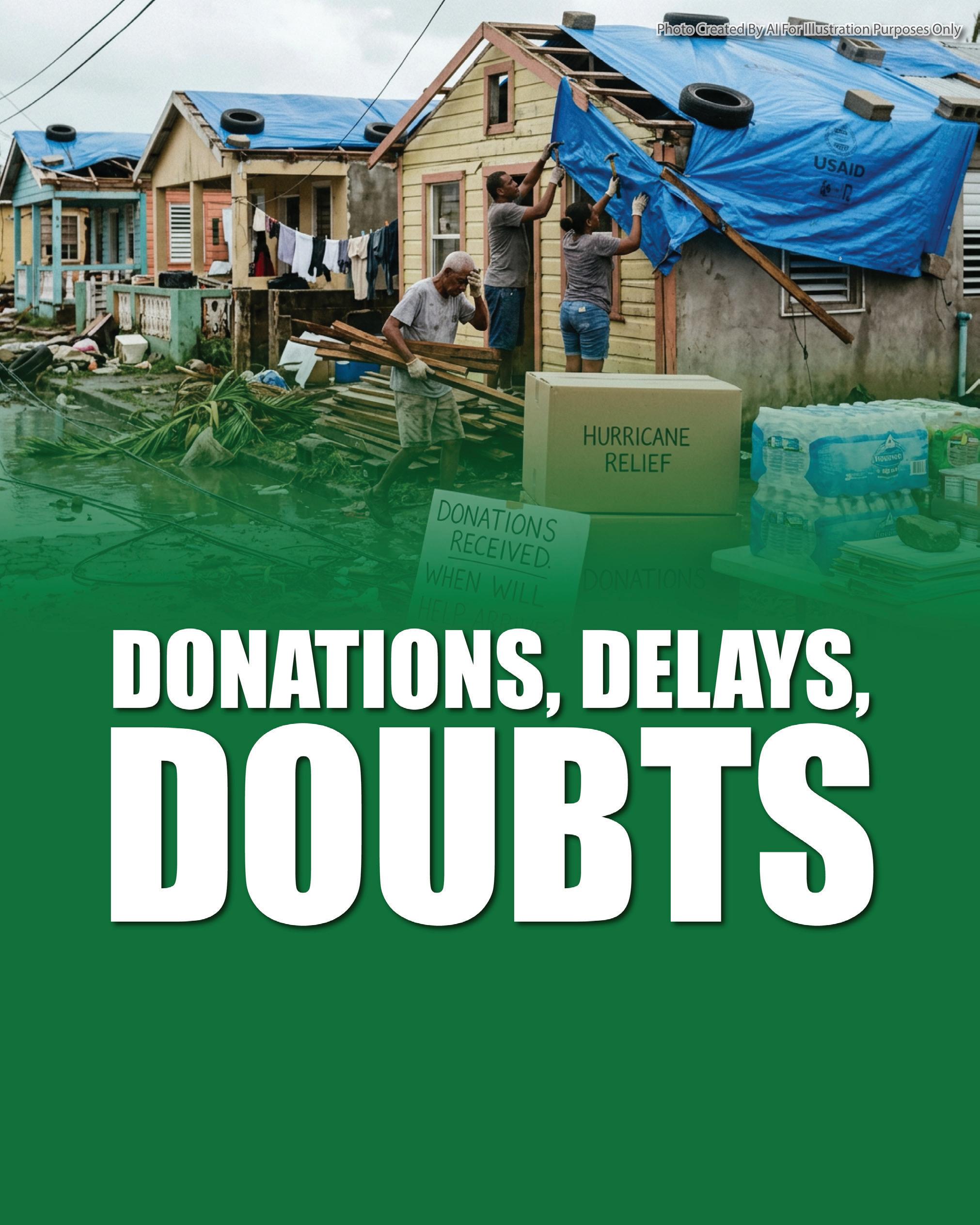
“The first thing you notice is how long it takes to say the number out loud. One point four four billion dollars. That is what Jamaica’s disaster agency says it received in cash donations after Hurricane Melissa tore through...”
STORY - PAGE 8


“The first thing you notice is how long it takes to say the number out loud. One point four four billion dollars. That is what Jamaica’s disaster agency says it received in cash donations after Hurricane Melissa tore through...”
STORY - PAGE 8
The glass of the cruiser was cold against her skin, a sharp contrast to the heat of the Ottawa night. Just moments before, the world had been a blur of motion, a sudden halt, and then the crushing weight of five police officers on her boyfriend’s back. Selam Debs watched as the man she cared for was forced face-down into the pavement, the air leaving his lungs while she was pinned against the steel of the squad car. This was the overt reality she had been warned about, the kind that waited outside the protective, culturally rich borders of Scarborough…
In Scarborough and Regent Park, the racism had been a different beast: systemic, quiet, and woven into the disinvestment of the hood, but inside her home, it was Ethiopia. The air smelled of Injera, the walls echoed with northern Ethiopian music, and the community was a vibrant cornucopia of the African diaspora: Somali, Jamaican, Trini, and Nigerian families all immersed in a shared lingo and care. Selam was the seeker, the firstborn daughter. Her father saw it early, joking that her critical thinking and curiosity meant she should be a lawyer. He sat her at his feet and fed her stories of Black liberation: of Ghana, of Ethiopia, of Rastafarianism, planting a consciousness that would eventually become her shield.
However, the public image of the strong educator often masks the private fractures of a life lived in the crosshairs of multiple systems. To the world, Selam is a powerhouse: a Reiki Master, yoga educator, and the curator of The Antiracism Course. The root truth she sought as a child was often found in the wreckage of personal trauma: the child welfare system, intergenerational wounds, and the lived experience of being a survivor of abuse and sexual assault.
The most profound turning point was a private precipice. At 21, Selam found herself carrying her son. At that moment, she was at a crossroads: continue the generational curse of trauma or change the trajectory of her life. The decision to choose the latter led her into the quiet rooms of therapy, the stillness of meditation, and the disciplined movement of yoga. She was becoming her own first student of healing.
By 2019, Selam was already teaching equity and inclusion, though the words antiracism were still consid-
ered taboo in many circles. She had a small yoga studio and a modest online course with 20 students. Then came 2020. The murders of George Floyd, Breonna Taylor, and Ahmaud Arbery sent a shockwave through her nervous system. While the world sat in the vicarious trauma of the news cycle, Selam sat in her home in Kitchener-Waterloo, unable to eat or sleep.
She reached out to a friend with a simple idea: a small march, maybe 30 people, just to feel the sun and find community. She posted it on Facebook. By Wednesday, 30 people had turned into 35,000. It was one of the largest marches in Canadian history, and it catapulted Selam from a community educator into a spearhead of change.
Organizations began to knock on her door, inviting her into boardrooms to fix their culture, but Selam’s approach is psychologically aware and conversiondriven; she understands that many of these institutions are looking for a press release, not a revolution. They use antiBlack racism as a cliché, while their Black employees are still being interrogated about their hair, or passed over for leadership. She enters these spaces to heal them, if the participants are willing to do the dishes for the kitchen they helped mess up.
Her journalistic edge is sharpest when she presents the complexity of the African experience. She points to the global African consciousness as the path forward, but she refuses to Kumbaya over the issues within the community. She names the elephants in the room: colorism, internalized anti-Blackness, and the misconceptions different parts of the diaspora hold about one another. To her, the most urgent work is the self-work at home.
The tension in Selam’s life today is the cost of visibility. She is an Ethiopian woman working at the intersection of social justice and wellness, a field that often demands the labour of African bodies until they break. She has lived in the state of chronic burnout, and she has seen the aggressive, and too much labels applied to her confidence.
Her response to this is her most radical teaching: “Rest is resistance.”
Influenced by the radical care of Audre Lorde, Selam has redefined activism as an act of self-preservation. She protects


her nervous system with the same ferocity she uses to advocate for African liberation. Rest is a refusal to allow her body to be treated as a mere tool for labour.
When people look back at her legacy, Selam doesn’t just want them to remember the 35,000 people in the streets marching together with intention. She wants them to see a woman who disrupted the very idea of what an activist looks like. She wants them to see a mother who broke a cycle, a writer who used vulnerability as strength, and a human being who chose to thrive rather than just survive.
In her world, the best of the best is about emotional fidelity to oneself. It’s about the as within, so without philosophy that ensures you cannot truly advocate for a community if you are not advocating for your own soul. Selam Debs is modeling liberation, and that liberation, she insists, begins with the quiet, radical decision to simply sit down and breathe.
Selam’s journey of radical rest and systemic disruption now finds its next strategic stage at the intersection of media and liberation. On July 25th, 2026, she will join the vanguard at the African Diaspora News Channel (ADNC) Narrative Power Summit at the Acqua Supper Club in Toronto. This is the moment where the seeker from Scarborough meets the global stage, standing alongside Phillip Scott and Canada’s top cultural creators to dismantle the clichéd press releases of the past.
As the Black Carpet rolls out and the sounds of Juno Award-winning Carlos Morgan fill the air, Selam’s presence signifies a deeper shift; the move from being the subject of the news to being the master of the narrative. In this room of unfiltered media literacy and direct connection, she will continue to model that thriving is a collective necessity for a diaspora ready to turn real connections into real power. The only question that remains is whether you will be in the room to witness the narrative shift.




On a morning when you are already juggling a funeral in Jamaica, a family emergency in Trinidad, or a winter escape you booked months ago, the last thing you expect to hear is that your insurance may no longer protect you from a cancelled flight. Yet, that is exactly the shift Caribbean Canadians need to understand now, because Manulife has said worldwide jet fuel shortages are a known event for its travel insurance, which changes what gets paid and what does not.
If you live in Toronto and move back and forth across the Caribbean, this is a warning that the cost of being connected to home is getting more expensive, more fragile, and less predictable.
Manulife’s update, issued in early May, says that if a policy was bought on or after May 5th, 2026, trip cancellation and interruption benefits related to the current jet fuel shortage generally will not apply, because the problem is now considered a known event. If the policy was bought before May 5th, 2026, some protection may still exist under misconnection or disruption benefits if the shortage causes a delay or interruption.
So, what does that mean in plain
language? It means that if your flight is cancelled because the airline cannot secure fuel or schedules collapse because the system is under pressure, the insurer may say the risk was already known when you bought the policy. In insurance language, once something becomes known, it often stops being insurable.
Caribbean families in Canada rely heavily on air travel that is often expensive, tight, and vulnerable to disruption. A missed connection is not always a nuisance; it can mean a missed funeral, a delayed hospital visit, a wedding left half-finished, or a child left waiting to see grandparents for another year. When you add a fuel shortage to already limited route options, the Caribbean traveller can be left paying more for less certainty.
Manulife says insurance is secondary to the airline’s own remedies, meaning refunds, rebooking, or travel credits from the carrier come first. That sounds reasonable until you remember how often passengers end up in the middle of a chain reaction: one delay, then a missed seat, then a hotel night, then a new fare, then a claim that gets reduced or denied because the event was already known.
This is bigger than one company. It tells you something about where travel risk is moving. Fuel shortages, flight cuts, and route instability are no longer abstract supply-chain problems. They are becoming part of the personal financial risk faced by ordinary travellers, especially those whose journeys are not optional but tied to family responsibility across

borders.
There is also a political edge here. Caribbean Canadians are often told to keep supporting the region, keep visiting home, keep investing in the homeland economy, keep the cultural ties alive. When the insurance net narrows and airfare remains unstable, the burden quietly shifts back to the traveller. The message becomes: yes, keep going home, but carry more of the risk yourself. I want to share this as a consumer alert and as a diaspora economics story.
The Caribbean Canadian traveller is a remitter, a mourner, a wedding guest, a caregiver, and often the bridge between
two households. If airlines can change schedules and insurers can label the shortage a known event, then the family link between Canada and the Caribbean becomes less secure, and more costly to maintain.
So, the questions now are simple but urgent: How many travellers bought policies after May 5th, 2026, and do not know they may be uncovered? How many families will learn the hard way that a fuel shortage is now their problem, not their insurer’s? How much more can Caribbean Canadians absorb before travel home becomes a luxury instead of a duty?




Apply for the City of Toronto's Basement Flooding Protection Subsidy Program and you could receive up to $6,650* in City subsidies towards protecting your home from basement flooding.
During heavy rain, sewers can become overloaded. It is essential that homeowners take appropriate action to reduce the risk of basement flooding.
We’re here to help.
Eligible Work
NEW: Home Plumbing Assessment
Backwater Valves (two device maximum)
Sump Pump
NEW: Sump Pump Battery Backup Power
Foundation drain (weeping tile) pipe severance and capping
TOTAL MAXIMUM SUBSIDY
* If you meet all eligibility requirements
Remove obstructions to floor drain.
Up to $500
Up to $1,600 per device
Up to $2,250
Up to $300
Up to $400
Up to $6,650
Clean out eavestroughs and downspouts of leaves, ice, snow and other debris.
Test your sump pump regularly to ensure it is functioning properly and ready before heavy rainfall occurs.
Clean out your backwater valve every two to three months and before heavy rain.
Install and maintain flood alarm.
Correct grading to direct water at least 2 m away from your foundation.†
† Ensure redirected water does not negatively impact neighbouring properties.
Install window wells that sit 10-15 cm above ground, and window well covers (where fire escape requirements permit). Seal leaks in windows and foundations and seal all window wells.
Disconnect downspouts, cap foundation drains and extend downspouts and sump discharge pipes to direct water at least 2 m from foundation.†
Get information on the City’s Basement Flooding Protection Subsidy Program at toronto.ca/BFPsubsidy

For many people across the Greater Toronto Area lately, life has felt heavy.
Between rising grocery prices, higher bills, long work hours, uncertainty about the future, and now severe storms moving through parts of Ontario causing damage and stress for many families, it feels like people are carrying more than ever before. Everywhere we turn there seems to be another negative headline, another online argument, another reminder of how difficult things have become for everyday people simply trying to get by.
And yet, during moments like these, something powerful always seems to rise to the surface within our communities — people helping people.
Over the past week, we have seen neighbours checking in on one another after storms, helping clean up properties, making phone calls to family members, and offering support however they can. Sometimes it is something as simple as sharing a warm meal, helping an elderly neighbour, or asking someone if they are doing okay. Those small acts may not make headlines, but they matter more than people realize.
One of the beautiful things about Caribbean culture is that community has always been at the centre of who we are. Many of us were raised in homes where family extended beyond bloodlines. Neighbours were treated like relatives, food was shared without hesitation, and people looked out for one another during difficult times. That sense of togetherness helped generations survive hardships, build new lives, and create strong communities here in Canada.
Even today, despite how much the world has changed, that spirit still exists.
You see it at community events, local businesses, churches, cultural celebrations, and family gatherings. You hear it in the laughter, the music, the storytelling, and the way people continue to support one another even while carrying struggles of their own. That resilience is something special, and it is something we should never take for granted.
At the same time, many people
are tired.
There is a growing emotional exhaustion that so many are quietly dealing with right now. Social media has created a world where negativity spreads faster than positivity. People are working harder than ever but still feeling like they are falling behind. Young families are struggling with the cost of housing, seniors are worrying about affordability, and many are simply trying to maintain some sense of balance in a world that often feels overwhelming.
That is why protecting our sense of community matters now more than ever.
Sometimes we become so consumed by stress, politics, online division, and the constant pressure of everyday life that we slowly lose connection with one another. We stop having conversations. We stop checking in. We stop making time for family dinners, cultural events, or moments that remind us who we are and where we come from.
But those are often the very things that help carry people through difficult seasons.
As we move closer toward summer and community event season begins once again across the GTA, perhaps this is a reminder for all of us to reconnect a little more. Support a local Caribbean-owned business. Attend a community event. Call a family member you have not spoken to in a while. Check in on a neighbour. Take a break from the negativity online and spend time with people who genuinely bring peace into your life.
The world may continue to feel uncertain at times, but one thing has always remained true within Caribbean communities — we are strongest when we stand together.
No matter how difficult things become, kindness, culture, faith, family, and community will always matter. And sometimes, even during the hardest moments, simply reminding one another that nobody is alone can make all the difference.




SIMONE SMITH
simone@carib101.com
TC REPORTER
The moment that stays with me is my mother standing in a grocery aisle, hold ing two tomatoes in her hand: one bruised, one overpriced. She sighs, puts both back, and walks away, because the math does not math anymore. Food insecurity in Can ada is a daily negotiation between dignity and survival.
So, when a new report claims that gene editing could make food cheaper, more nutritious, and less perishable, it lands like a promise, or a warning. Depend ing on who you are.
The federal government calls it innovation. Researchers call it precision, but families who are already stretched thin
troduce foreign DNA. It tweaks what is al ready there: strengthening crops, boosting nutrients, extending shelf life. According to the MEI report, tomatoes could carry ten times more lycopene, a nutrient linked to lower cancer and heart‑disease risk. Pro duce could last longer, reducing the $1,300 the average Canadian household wastes in food every year. Farmers could lose fewer crops to pests and weather, saving billions in pesticides and fertilizers.
On paper, it sounds like a break through. A scientific intervention that could lower grocery bills, reduce waste, and strengthen food security, but here is what they did, and did not say.
Innovation doesn’t automatically equal access. We have seen this story be fore: a technology arrives with big prom ises, but the benefits trickle upward, not outward. The people most affected by food insecurity: Afro/Indo Caribbean fami lies, low‑income households, newcomers, single parents, are rarely the first to feel re lief. They are the last.

STEVEN KASZAB
steven@carib101.com
TC COLUMNIST
While gene editing could reduce costs for farmers, nothing in the report guarantees those savings will reach con sumers. Canada’s grocery giants have al ready shown us what happens when profit meets necessity: prices rise, margins widen, and families pay the difference.
So, who is at risk? Anyone who
believes affordability will magically appear without regulation, oversight, or equity at the center. Here is the reveal: the real story is governance. It is the quiet, familiar pat tern of innovation outpacing policy, leav ing vulnerable communities to navigate the fallout.
The proof is in the numbers. Farm ers spend $22.5 billion a year on inputs like pesticides and fertilizers. Gene editing could reduce that, but unless the federal government ensures price transparency and consumer protections, the savings stay in the supply chain, and do not appear in the shopping cart.
Households waste $1,300 in food annually. Gene‑edited produce could last longer, but if those foods are priced as pre mium innovations, the families who need them most will not be able to buy them. Children could benefit from more nutri ent‑dense foods, but if affordability does not change, nutrition gaps will widen, not shrink.
This is the pattern; what they said, “Innovation will help everyone.” What they did is leave the door open for inequity. This affects the same communities already car rying the weight of food insecurity, and yet, the potential is real. Gene editing could transform the food landscape. It could re duce waste, improve health outcomes, and stabilize prices. It could be the tool that fi
nally shifts us from scarcity to sustainabil ity, but only if we ask the right questions now.
Who controls the technology? Who sets the prices? Who regulates the roll out? Who ensures that innovation doesn’t become another barrier disguised as prog ress? The government warns against over regulating too quickly, arguing it could sti fle innovation, but under‑regulating has its own cost; one paid by families who already skip meals so their children can eat.
This is where the human spine of the story sits: in the gap between promise and practice. In the mother choosing be tween tomatoes. In the senior stretching a fixed income. In the newcomer navigat ing a grocery bill that feels like a second rent payment. If gene editing is going to reshape the food on our shelves, then the real question is: who will it nourish, and who will it leave behind?
Now that you know this, what happens next? Will innovation be guided by equity, or swallowed by profit? Will af fordability become a right, or remain a privilege? Will Canada build a food system that feeds everyone, or just the ones who can afford to be fed?
The science is ready. The technol ogy is here. The question is whether the country is ready to use it responsibly, and that answer is still unwritten.
institutions, and scientific communities generate forecasts and models. Early warnings are rarely absent. The problem
is not a lack of information. Too often, competing priorities: political ambition, short term optics, or pet projects, crowd out long term risk planning. The COVID 19 pandemic exposed this gap. Public health experts had warned for decades that a global pandemic was not a matter of if, but when. Yet, stockpiles were insufficient, response plans uneven, and communication inconsistent. Basic measures: masking in high risk settings, physical distancing, and hand hygiene, were widely known but unevenly imple mented early on. Instead of always hop ing for the best, our governments should have been preparing for the worst. The result was avoidable strain on health sys tems, economies, and communities. This pattern extends beyond public health. Consider large scale economic in centives, such as government funding for electric vehicle manufacturing. Ontario, for example, has committed significant public funds to attract battery and vehi cle plants. These investments may create jobs and accelerate the energy transition, but prudent governance requires asking hard questions upfront: What protections are in place if companies scale back or
leave? Are there enforceable agreements to safeguard public investment? What contingency plans exist for workers if projects stall? Preparedness is responsible stewardship.
At its foundation, the government is tasked with maintaining order, protect ing rights, and promoting the general welfare. That includes readiness for emer gencies. Yet, response times in demo cratic systems can be slow, constrained by process, cost considerations, and political calculation. By contrast, more centralized systems can act quickly in crises, though often without the same accountability or safeguards. Speed alone is not the goal; effective, timely, and accountable action is.
There is no shortage of plans for fighting wildfires, mitigating floods, or coordinat ing disaster response. The recurring bar rier is prioritization. Officials often cite limited resources, yet governments rou tinely mobilize vast sums for defense or high visibility initiatives. The issue is less about absolute scarcity and more about allocation and incentives. Programs that quietly prevent harm rarely deliver imme diate political rewards. As a result, essen
tial preparedness can be underfunded. This points to a structural weakness: de mocracies sometimes struggle to hold leaders accountable for risks that have not yet materialized. Preventive action is, by definition, invisible when it succeeds. Still, the cost of inaction becomes pain fully visible when systems fail. Preparedness is not abstract. It requires contracts that protect public investment, supply chains that can surge in emergen cies, clear communication protocols, and leadership willing to act before a crisis peaks. It also requires cultural discipline, treating “what if” as a standing obligation, not an occasional exercise. Ultimately, public expectations matter. Citizens have the right to demand compe tent, forward looking governance. That includes transparency about risks, clarity about trade offs, and evidence that les sons from past failures have been incor porated into current policy.
If the government’s first job is to be pre pared, then preparedness must be visible in budgets, contracts, infrastructure, and response times, not just in reports. The question is when crises come, will we be ready?



Caring for loved ones is one of life’s greatest responsibilities. In moments when support is needed the most, families want assurance that they are turning to professionals who are competent, ethical and accountable.
As the month of May is recognized as Mental Health Month, conversations about mental wellbeing becomes a focal point. It is also a reminder of the importance of knowing where to find trusted and professional support when it matters most. That is where registered social workers and social service workers step in.
We are the Ontario College of Social Workers and Social Service Workers (OCSWSSW). As the provincial regulator of the largest group of regulated mental health professionals in Ontario, we ensure all our registrants follow the Code of Ethics and Standards of Practice to protect the public and to provide ethical, effective and community-centred care.
You care for your loved ones. When one of yours needs one of ours, social workers and social service workers are ready to provide trustworthy and quality care.
When navigating life’s challenges, turning to a professional for support is a critical step. In those vulnerable moments, placing your trust in someone’s hands requires confidence in their expertise and ethical standards. Taking the time to understand a professional’s qualifications is an essential act of empowerment that helps ensure you or your loved ones receive a high standard of care.
The social work and social service work professions are regulated for a vital reason: to protect the public. The OCSWSSW sets strict requirements that applicants must meet to qualify for registration. Once registered, Ontario social workers and social service workers must follow high standards of practice and conduct and participate in ongoing learning to ensure their skills remain current throughout their careers. This framework provides crucial layers of safety and security for everyone receiving services.
As part of its public protection mandate, the OCSWSSW has rigorous complaints and discipline processes. The public can bring forward a complaint against social workers and social service workers, which the OCSWSSW investigates. We take professional misconduct extremely seriously, and disciplinary actions are used when required. This step helps provide an additional level of accountability, reinforcing that the professions are held to the highest ethical benchmarks. This commitment to accountability is fundamental to maintaining public trust and ensuring that you and yours receive safe, ethical and professional care.
The OCSWSSW provides a transparent and accessible Online Register to help you confirm the credentials of all social workers and social service workers in Ontario. Go to ocswssw.org and click on “FIND A REGISTRANT” at the top right corner. This comprehensive and up-to-date tool allows you to confirm a professional’s status in just a few clicks. It is a quick way to be assured that the professional you work with is accountable to the OCSWSSW and held to ethical and professional standards.
With the Online Register, you can:
• Confirm that an individual is registered with the OCSWSSW.
• Check their employment information.
• View any specific terms, conditions or limitations on their practice.
• See if they have any history of disciplinary action.
All Ontarians deserve support on their journey to better mental wellbeing. During Mental Health Month and throughout the year, reaching out to a mental health professional who can provide safe and ethical care is an important step in protecting yourself and your loved ones. Trust one of ours with one of yours.
simone@carib101.com
TC REPORTER
The first thing you notice is how long it takes to say the number out loud. One point four four billion dollars.
That is what Jamaica’s disaster agency says it received in cash donations after Hurricane Melissa tore through the island on October 28, 2025. It is a number meant to reassure. It suggests generosity, urgency, solidarity. It suggests that when a storm hits hard enough, people respond with their wallets as well as their prayers, but then comes the part that should make any reader stop: by February 23rd, 2026, only J$26.2 million of that money had actually been spent. That is 1.8%.
So, what happened to the rest? Who was supposed to move it? Who had the power to approve it? Why, months after one of the worst storms in recent Jamaican memory, was so much relief money still sitting still?
The latest audit from Jamaica’s Auditor General’s Department does not read like a simple accounting exercise. It raises the kind of questions governments dislike because they are larger than bookkeeping: when disaster strikes, is the machinery of relief built to move quickly, or only to collect loudly? When the donations come from ordinary people, diaspora groups, businesses and well-wishers abroad, who is actually answerable when the money does not reach the ground?
According to the audit, the Office
“Digital ID Must Be Accepted by US citizens by 2028; otherwise, risk exclusion from society.’” This quote made by Bill Gates has been making the rounds on social media, and so I have decided to investigate it from a factual point of view. Here is what I have found.
A nonprofit news outlet obtained a draft of the executive order, which states: “It is the policy of the executive branch to strongly encourage the use of digital identity documents.” That was when Joe Biden was president. According to the nonprofit news outlet, this executive order, if implemented, could reshape how Americans access government services and even behave online.
It is common knowledge that governments are working with Big Tech, like with Apple and Google, to build systems that would allow Americans to carry identity documents on their smartphones. This is being sold to the public as something to aspire to, all in the name of
of Disaster Preparedness and Emergency Management, better known as ODPEM, had received J$1.44 billion in cash donations for Hurricane Melissa relief by late February. Yet only J$26.2 million had been disbursed. The agency says the hold-up was not theft, but authorization, or more precisely, the lack of approval from the Ministry of Finance and the Public Service to release the money.
That explanation may satisfy an auditor. It should not satisfy the public, because if a disaster response system can receive billions but cannot spend them when homes are damaged, roofs are gone, and people are waiting, then the failure is not only administrative. It is political. It is structural. It is the difference between a country that can mobilize in an emergency and one that can only promise it later.
This is where the story matters far beyond Jamaica. For Caribbean people in Toronto, New York, London, Brampton, Scarborough, and Mississauga, for all the communities that send money home when storms hit, the audit lands like a test of faith. Diaspora donors do not give because they want a balance sheet. They give because they imagine a family member under a tarp, a nurse trying to clean up a flooded room, a child sleeping in a house with no electricity. They give because they believe the system will move with the same urgency they feel.
What happens when it does not?
Doneisha Pendergrast has emerged as one of the voices insisting that the recovery story cannot be told from Kingston alone. By going into communities such as Petersfield, Westmoreland, and speaking directly about the lack of support reaching residents on the ground, she is forcing attention onto the gap between official
relief announcements and the lived reality of people who are still waiting for help. Her message is essentially a challenge to the system: if donations were collected in the name of urgent recovery, then why are some of the hardest-hit communities still struggling to see meaningful assistance?
That leads to the question whether relief funds should be audited. Of course they should. The question is why a relief system built for emergency response seems to move at the pace of peacetime bureaucracy. Why does a country that lives with hurricanes still appear to struggle with the basic act of releasing the money it has already collected for recovery?
The audit reportedly shows that ODPEM was holding not just Melissa-related donations, but also balances from Hurricane Beryl. That detail matters. It suggests the issue may not be one storm, one accounting period, or one bad week of paperwork. It suggests a deeper problem: a pattern in which donated emergency money accumulates faster than the state can legally, administratively, or politically deploy it.
If that is true, then the public deserves a chain of command. It deserves names, dates, approvals, and explanations. It deserves to know whether the bottleneck sat at ODPEM, at the Ministry of Finance, in procurement rules, or in some mixture of all three. It deserves to know whether the relief system was designed to protect the public, or to protect officials from making fast decisions.
There is a hidden cruelty in slow disaster relief. Delay does not look dramatic. It does not crash through a windshield or blow a roof away. It just lingers. It leaves people waiting in damaged homes. It leaves children living in rooms that should have been repaired. It leaves
communities wondering why the money exists on paper, but not in practice.
That is why this audit should alarm people. It suggests something almost as corrosive; that in moments of national emergency, the state may be too slow to transform public generosity into public relief, and in a country where hurricane seasons are no longer exceptional, that is a dangerous habit to have.
ODPEM has since said part of the unspent money (around J$600 million) is earmarked for modular housing solutions and shelter recovery. That may be necessary. It may even be welcome, but it does not answer the harder question. If the need was immediate, why was the money not already moving? If the donations were received in good faith, why did so little reach families by February? If the answer is authorization, then what kind of disaster system requires months to authorize disaster spending?
This is where accountability becomes the measure of whether the next storm will meet a functioning state or merely a sympathetic one.
Jamaica’s diaspora, especially in Canada, should be asking something simple and uncomfortable: when we send money after a hurricane, are we helping to rebuild, or are we feeding a system that cannot spend in time? If the answer is the latter, then who is fixing that system before the next storm arrives?
There is no shortage of love for Jamaica. There is no shortage of donations, prayers, and fundraising drives. The question is whether the institutions meant to convert that love into shelter, food, and repair are ready to act like emergencies are real.
The audit suggests they may not be, and that is the alarm bell.
ID is being pushed, and Canada is no exception
their safety, of course. However, the real agenda behind Digital ID is beginning to surface.
Michael Rectenwald, Ph.D., author of “The Great Reset and the Struggle for Liberty: Unraveling the Global Agenda,” told The Defender that, “As defined by the World Economic Forum (WEF), ‘digital identity is the sum total of the growing and evolving mass of information about us, our profiles, and the history of our activities online.”
Rectenwald went on to explain, “Digital identity is not merely a new, more handy, lightweight, digital form of identification. It refers to a collection of data that defines who we are, including what we do both online and offline, and not merely to a means by which we can be identified as such.”
As far back as the Biden era, Alexis Hancock, Director of Engineering for the Electronic Frontier Foundation, said, “The Biden administration’s digital ID will disproportionately target the poor and underprivileged.” What do you mean? You may ask.
Hancock indirectly answered your question by saying, “Digital identity and the standards that dictate them are still very new, and yet the White House is expediting digital identity for the most vulnerable populations: people on public benefits.”
“Deploying various technolo -
gies on this population to access their benefits, such as facial recognition, is not something I would encourage or advise. Especially with facial recognition being fraught with issues of discrimination.”
What would Digital ID be used for? “Even if a digital identity system only serves as identification at first, as the Center for Human Rights and Global Justice notes, digital identities are prone to ‘function creep’” that is, they are intended to be used for multiple purposes that are unforeseen when the system is first designed,” Rectenwald said.
In layman’s terms, the citizens of any land where Digital ID is implemented could be lied to as to its real purpose. Remember how Canadians found out later that during the pandemic their government used that opportunity to spy on them in more ways than one?
Let us move to the thought of a mandatory Digital ID. While some may say it cannot happen, let me humbly rewind your cassette to the COVID vaccine era. While the federal government was not able to legally mandate vaccination to all citizens, it went ahead anyway and mandated it to federal employees, and the private sector followed suit. The same can easily happen with digital identity.
This happened in the US and Canada just a few short years ago, all because the people allowed it to happen. The defense folks used was that if I lose
my job, I am finished. No one stopped to think that dead people do not have jobs. Now the death from those mandatory vaccines answers that question loud and clear.
The creators and architects of Digital IDs are hoping that you will again put your job in front of your freedom. Let this sink in. If you accept Digital ID, you would not be able to complain because, just like Justin Trudeau told angry Canadians after threatening them with job loss if not vaccinated, you will be told, “I did not force you.”
Here is what Bill Gates had to say on his Digital ID scheme; Gates was asked what role the private sector would play in cooperating with governments on Digital IDs. Here is his answer, “Once you have the digital money system, then there are all sorts of services and applications that can be built on top of that, whether it is helping with health, education, or agriculture, giving people visibility into their financial status, giving them advice like whether they should take a loan. We will not be able to do that with traditional systems.”
Please take note how non-threatening and diplomatic his words are. At the same time, please remember a vampire never ever shows his teeth in daylight. You have been warned.
simone@carib101.com
TC REPORTER
You can feel it, can’t you? That quiet anxiety sitting in the background of everything right now, where every headline seems to whisper the same question in a different tone: what happens to you when the machines get better? This isn’t abstract or theoretical. It’s the student choosing a major, the newcomer trying to stabilize their life, the Caribbean elder watching industries shift faster than policy can catch up. The part that rarely gets said out loud is that this is about who gets protected and who gets left to figure it out alone.
A new report says 25% of jobs could be automated within ten years, and that number will travel fast, becoming dinner table talk, school guidance advice, and government policy talking points. The real story is what sur-
BY ANYA NICOLA TC REPORTER
vives and what does not. For years, the message was simple: learn to code, master data, get technical, and you will be safe. Now the ground has shifted. The same research shows that data analysis, one of the most promoted and in-demand skills, is also among the easiest for AI to automate. The very path many people were told would secure their future is now one of the most replaceable.
So, what actually holds? Leadership, teamwork, negotiation, mentorship, emotional intelligence, skills often dismissed as soft, but in reality, they are survival skills. Machines can process information, but they cannot read a room where tension is unspoken or build trust with someone who has every reason to be cautious. They can generate language and optimize decisions, but they cannot carry responsibility in moments where real lives are affected. That difference is structural.
This is where the conversation turns toward power. Who gets taught these human skills early? Who has access to leadership spaces and is encouraged to speak, influence, and negotiate? Who is told to work hard, stay quiet, and follow instructions? When education systems overemphasize technical training without developing human judgment,
they reproduce inequality. A Caribbean immigrant youth may be pushed toward practical, technical stability, while leadership and influence are treated as optional rather than essential. So, when automation reshapes the economy, it hits hardest where people were trained to execute, not to lead.
This is why the moment we are in is not just disruption. It reveals what has always been true: the most valuable work has always been about people. The ability to guide a team through conflict, mentor someone who is losing confidence, negotiate outcomes that preserve dignity, and speak in a way that moves people rather than simply informing them, this is social infrastructure, and it is the one domain AI cannot replicate at scale.
So, the question shifts. It is no longer “How do I compete with AI?” It is “Where do I become more human than the system expects me to be?” That might mean learning to read people as carefully as you read data, practicing leadership before you are given the title, and building relationships that extend beyond transactions. In a world shaped by automation, connection becomes currency.
At the same time, this cannot be reduced to individual effort alone. Institutions
must be held accountable for why schools remain structured around memorization and output when the future demands judgment, presence, and relational intelligence. It is not accidental that marginalized communities are often the last to access leadership development, and the first to feel the impact of economic shifts. Naming the system matters, because without that clarity, the burden quietly shifts onto individuals who were never given equal tools to begin with.
Still, there is something here that should ground you. You are not behind. In many ways, you have already been developing the very skills this moment demands. Every time you navigated different cultural expectations, read between the lines in a conversation, adapted to shifting environments, or led without recognition, you were building a form of intelligence that is often invisible, but deeply valuable. That is human intelligence, and it is becoming one of the most critical assets in this new landscape.
AI is the end of the illusion that technical skill alone was ever enough. The future will belong to those who can hold complexity, build trust, and move people forward in ways that machines simply cannot, and that future is already here.
The foyer inside University of Toronto Schools buzzed with possibility on Saturday morning as hundreds of Black students and their families gathered for something unprecedented: a university fair designed specifically for them. The Building Bridges University Fair, organized by 15-year-old Grace Longe, represented a deliberate act of community healing through educational access.
“I go to Harperville, and at my school we have these types of things all the time,” Grace explained, her voice carrying the confidence of someone who refuses to accept inequality as normal. “I realize that my friends at other schools didn’t have that same kind of opportunity, as I go to a private school, so it’s definitely not the same in the public system.”
Grace’s observation reflects a stark reality: while private schools regularly host university recruitment events, students in public schools (particularly Black students) often lack access to the same opportunities. Her solution was characteristically direct: if the resources were not reaching her community, she would bring them together herself.
BY ANYA NICOLA TC REPORTER
The event attracted representatives from across Ontario’s university landscape, including the University of Toronto, Carleton University, and the University of Ontario Institute of Technology. The fair specifically highlighted programs designed to remove barriers for marginalized students.
Abdullah, a University of Toronto recruitment coordinator, outlined numerous pathway programs available to Black students, including Blueprint, a free engineering summer program for Black students in Grades 10-11, and MedLinks, which introduces students to health sciences. “Each of these programs has a coordinator who goes directly to high schools to talk and give presentations,” he explained, though he acknowledged that awareness remains a challenge.
The gap Grace identified is supported by both statistics and lived experience. Multiple university representatives confirmed that, despite numerous support programs, many students, particularly in underresourced schools, simply do not know about them. The result is a cycle where those who need support most are least likely to access it.
Durham District School Board brought one of the largest groups to the fair, supported by their Black graduation coaches.
Teacher Tricia emphasized why events like this matter, “This was focused for black students, and that was one of the things that caught our eye. To see the people behind the table, reflecting on who they are.”
Dr. Belinda Longe, Grace’s mother and an educator for 30 years, shared the months of planning that went into the event. “She had to reach out to all the Ontario universities, and not all of them responded. She tracked who was coming and followed up with details regularly as the date approached.” The dedication required to coordinate such an event while maintaining high school responsibilities speaks to Grace’s commitment to systemic change.
The most powerful aspect of the fair was watching students’ perspectives shift in real-time. Many arrived uncertain about their post-secondary options, overwhelmed by the complexity of university applications and financial aid. By the afternoon, they were armed with specific program information, scholarship details, and direct contacts with admissions counsellors.
Grace’s vision extends beyond this single event. “I’m hoping to make this an annual event,” she announced, already planning follow-up initiatives. Universities approached
her during the fair, offering ongoing information sessions and virtual programming to maintain momentum throughout the year.
The success of Building Bridges reflects a broader truth about educational equity: when barriers are deliberately addressed, students thrive. The fair created space for Black students to see themselves reflected in higher education, to ask questions without judgment, and to envision futures they might not have previously considered possible.
As families left with armloads of brochures and newfound confidence, Grace’s impact was unmistakable. At 15, she had identified a systemic problem and created a solution that will ripple through her community for years to come.
In a world where young people are often told to wait their turn to create change, Grace Longe chose to build bridges instead. Her message to other students is clear: don’t wait for someone else to create the opportunities you need. Sometimes the most powerful thing you can do is refuse to accept that barriers are permanent.
The Building Bridges University Fair proved that when communities organize to support their youth, transformation becomes inevitable.
Recent debates across Europe and North America have intensified around immigration, religious freedom, and cultural integration. At the heart of the discussion is a broader tension: how nations balance cultural continuity with increasing diversity. Many countries, particularly those with long-established traditions, are grappling with how to integrate newcomers while preserving social cohesion. This is not unique to Europe; it is a global conversation playing out across multiple regions.
In some cases, debates arise over accommodations for religious practices. For example, discussions in Japan about burial practices reflect a clash between longstanding customs, such as cremation, and the needs of minority communities seeking alternative options. These situations are often localized and negotiated through policy, rather than evidence of a coordinated global movement.
Similarly, disputes over food, pub -
lic expression of religion, and cultural norms can become flashpoints. These tensions are often framed as questions of mutual respect: to what extent should newcomers adapt to existing customs, and how much should host societies evolve in response to new populations?
The phrase, “When in Rome, do as the Romans do,” is frequently invoked in these debates, reflecting a traditional expectation of assimilation. Yet modern multicultural societies tend to operate on a more complex model, one that attempts, not always successfully, to balance integration with the protection of individual rights and freedoms.
In the United Kingdom and the United States, public discourse has also focused on how communities evolve over time. Cities like Dearborn, Michigan, are often cited as examples of cultural concentration, though such characterizations can be reductive. These communities are shaped by decades of migration, economic opportunity, and civic participation, not simply religious identity.
In Canada, Quebec’s Bill 21 and related policies have sparked ongoing debate about secularism and the visibility of religion in public life. While not a ban on public prayer broadly, the law restricts certain public employees from wearing religious symbols, reflecting the province’s distinct approach to secular governance. Describing it as an outright ban on public prayer misrepresents the scope and intent of the legislation.
Concerns about the influence of religious law, including Islamic law, are also part of the conversation in some regions. These concerns often surface in political rhetoric, though there is limited evidence of widespread efforts to replace national legal systems with religious frameworks in Western democracies. Still, perception plays a powerful role in shaping public opinion and policy responses.
Muslims, like adherents of any religion, hold a wide range of beliefs and approaches to civic life. Presenting them as a monolithic group can contribute to misunderstanding and polarization. Language also matters. Terms like “Islamophobia” are them-
selves contested, often used to describe prejudice against Muslims but also debated in terms of scope and application. Responsible reporting requires acknowledging these nuances rather than presenting them as settled or universally agreed upon.
Ultimately, what is unfolding is not a singular battle, but an ongoing negotiation within pluralistic societies. Governments, communities, and individuals are continuously working through questions of identity, rights, and belonging. The challenge is not simply about one group or one religion, but about how diverse societies function in practice.
Clear, accurate, and balanced reporting is essential in this context.
Mischaracterizations, whether policies, populations, or intentions, can inflame tensions and obscure the significant issues at stake. You, our readers, deserve a grounded understanding that reflects both the complexity of the topic and the humanity of the people involved.
BY JAY BRIJPAUL
TC REAL ESTATE REPORTER
For decades, the Toronto dream was simple and powerful: buy a home, settle, and watch your family thrive. A detached house was not a fantasy, but an attainable goal, the reward of steady work and prudent saving. Fast-forward to today, and that once-firm promise has faded, replaced by uncertainty.
Today’s Toronto housing market is accessible to the wealthy, the deeply indebted, or the lucky few with generous family backing. For much of the middle class, buying a home is not a reward for diligence, but an elusive finish line that recedes no matter how hard they run.
Behind this transformation lies a troubling truth: the people who keep Toronto vibrant: nurses, teachers, public servants, and young professionals, are being priced out of the city they serve. The widening gap between wages and housing costs threatens the city’s social fabric.

PAUL JUNOR
paul@carib101.com
TC REPORTER
Consider this: a young Torontonian earning $80,000 to $100,000 a year would have been comfortably middleclass a generation ago. Now, that same salary barely opens the door to the condo market, let alone a family home.
For families juggling high rents, soaring childcare costs, and student loans, saving for a down payment can feel futile. Increasingly, first-time buyers are turning to the “Bank of Mom and Dad” for support. As Toronto expands, home values continue to surge, locking out the middle class.
Even as prices have cooled slightly from their historic peak, interest rates are eroding purchasing power. Would-be buyers who qualified for large mortgages during the era of cheap borrowing now qualify for only a fraction of what they did then, keeping the door to ownership firmly shut.
The city’s real estate has shifted from shelter to a speculative gold mine. Investors have fueled bidding wars, snapping up multiple properties, and driving prices sky-high. Housing has be -
come a vehicle for wealth accumulation, benefiting those already in the market and leaving aspiring owners on the outside looking in.
Renting, once a temporary stopover on the road to ownership, has become a long-term reality for half of Toronto’s households. Many now spend more than 30% of their income on rent, making it nearly impossible to save for a down payment. The result is a vicious cycle: higher rents erode savings, pushing back ownership as prices rise. Middle-class families find themselves trapped as renters far longer than anyone anticipated.
Toronto’s affordability crisis is reshaping the city’s landscape. Families with children are moving to the suburbs, or even to other provinces in search of affordable homeownership. Communities once dismissed as remote are swelling with former Torontonians eager for space and a shot at the life their parents once enjoyed.
The deepest wound is psychological. For generations, Canadians have
trusted that education, discipline, and steady work would unlock the front door to a home of their own. Now, many first-time buyers feel that no matter how much they save or earn, the dream is slipping out of reach. When a generation loses faith in the promise of upward mobility, the collective confidence that built cities like Toronto begins to fracture.
Toronto’s middle-class housing crisis signals a profound shift in what the Canadian dream means. Homeownership once marked the path to middleclass security, but it now seems to be a privilege reserved for the already affluent.
Unless Toronto can increase housing supply, implement genuine affordability reforms, and align prices with local wages, it risks becoming a city where homeownership is inherited rather than earned. For many in the middle class, the tragedy is not just losing a home, it is losing faith that the dream ever truly belonged to them.
pact.
The death of distinguished cancer biologist Dr. Juliet Michelle Daniel on Tuesday, April 27th, 2026, has been felt far beyond her family and close circle. A pioneering scientist, mentor, and advocate, Dr. Daniel leaves behind a legacy that reshaped cancer research and challenged the systems surrounding it.
Born in Barbados to Lionel and Juliet Daniel, she attended Queen’s College before pursuing higher education in Canada. She earned her Bachelor of Science from Queen’s University and completed her PhD in Molecular Biology at the University of British Columbia. Her postdoctoral training included work at St. Jude Children’s Research Hospital and Vanderbilt University in Tennessee, early signals of a career that would bridge rigorous science with human im-
In 1999, Dr. Daniel joined McMaster University’s Department of Biology as an associate professor, later serving as Associate Dean of Research and External Relations in the Faculty of Science. Her career was shaped by intellectual pursuit and by personal loss. The death of her mother from ovarian cancer when Dr. Daniel was just 21, along with the loss of other relatives, profoundly influenced her decision to enter cancer research.
Her work focused on aggressive cancers, particularly triple-negative breast cancer (TNBC), which disproportionately affects Black women. She was not content with discovery alone. As noted in a tribute, “She insisted that cancer biology could not be separated from health equity.” That belief defined her work. She became a powerful voice advocating that scientific breakthroughs must reach the communities they are meant to serve.
Dr. Daniel also supported community-based organizations, including The Olive Branch of Hope (TOBOH), which centers Black women navigating breast cancer. Her involvement in the GenCARE project at McMaster reflect-
ed her commitment to studying TNBC in women of African ancestry, an area historically underfunded and under-researched. She attended TOBOH’s “Legacy of Hope Gala; Celebrating 25 Years Together” on April 11th, 2026, in Toronto, an event described as a celebration of sisterhood, resilience and community.
Tributes have poured in from across sectors. Mia Amor Mottley, Prime Minister of Barbados, remembered her as both a friend and a national icon: a scientist whose discovery of the Kaiso gene carried her brilliance and her Caribbean identity into the international scientific community. The naming of the gene itself (rooted in Caribbean culture) symbolized Dr. Daniel’s commitment to representation within scientific spaces.
The Consulate General of Barbados described her as an esteemed biologist, professor, and proud Barbadian Canadian. Lydia-Joi Marshall, President of the Black Health Alliance, emphasized Dr. Daniel’s advocacy and mentorship: “The way that she unapologetically mentored Black students and demanded excellence was both a reflection of her Barbadian training and personal ethics.”
Her accolades were numerous, including the Ontario Premier’s Research Excellence Award, the African Canadian Achievement Award in Science, the Harry Jerome Innovation & Technology Award, and WXN Canada’s Top 100 Most Powerful Women designation. Yet her influence extended beyond awards. As co-founder of the Canadian Black Scientists Network, she helped build pathways for Black scholars in STEMM, ensuring visibility, connection, and opportunity.
Dr. Daniel also championed equitable research funding, particularly for women’s health. She consistently challenged gaps in who benefits from scientific progress, pushing for inclusion not just in participation, but in outcomes. She passed away peacefully, surrounded by family, following a stroke.
A Celebration of Life will be held on Saturday, May 30th at 10:30 a.m. at Heartland Church in Mississauga. A virtual Book of Remembrance is also available for those wishing to share reflections.
Dr. Juliet Daniel’s life was about who discovery serves. In that, her legacy is both scientific and deeply human.
This edition’s Community Highlights showcase a vibrant season of culture, creativity, and connection across Toronto and the GTA. From intimate workshops to citywide celebrations, residents are invited to engage with experiences that honour identity, expression, and community spirit.
Highlights include The Art of the Head Wrap at PAMA, exploring emotional wellness and cultural beauty through lived experience. The Image Centre presents the Scotiabank Photography Award and public programs featuring Dawit L. Petros and leading curators. Fashion Art Toronto returns with a bold citywide takeover, while FIFA World Cup 2026 preparations bring global energy to Toronto Stadium and Fan Festival sites.
The Art of the Head Wrap
Date/Time: May 23rd, 2026, 1:00 PM – 4:00 PM
Location: Peel Art Gallery Museum and Archives
Additional information: The Art of the Head Wrap on May 23rd, 2026, is curated to go far beyond defining or making a cultural statement about the history of head dressing. I am intentionally using this opportunity to celebrate women in a deeper, more meaningful way.
Navern Nash Longshaw observed that, regardless of background, many women will experience hair loss at some point in their lives, whether due to life-changing situations, menopause, illness, stress, or genetics. Too often, they are left feeling hidden, unseen, and wrapped in shame. This event is about offering an option that truly speaks to their lived experiences, something more thoughtful than a quick fix or another beauty trend.
She has attended many events focused on women, yet too often they leave feeling defeated instead of elevated. They are spoken to, not with. This is why she curated this experience differently. It is not positioned as an alternative to wigs or weaves,
but as an empowering choice, one that allows women to decide what feels right for them.
This gathering will also explore the psychological and emotional impact of hair loss, encouraging women to embrace their present reality with understanding and compassion. At its core, this experience reminds women that, with or without hair, they are significant, whole, and worthy.
On May 23rd, guests will enjoy an uplifting afternoon featuring light refreshments, music, and thoughtfully selected speakers. There will be conversations around emotional wellness, hair care specialists offering insight, and nutrition guidance to support healthy lifestyle choices. Guests will also experience live demonstrations, have the opportunity for consultations, and receive curated swag bags and a rose.
Registration through @visitpama
Instagram: @castle9couturedesigns
Scotiabank Photography Award: Dawit L. Petros
Date/Time: May 6th –August 1st, 2026
Location: The Image Centre, 33 Gould
Street, Toronto
Additional information: Curated by Gaëlle Morel. Organized by The Image Centre, in partnership with Scotiabank.
Public Programs
Opening Reception
Spring/Summer Exhibitions
Wednesday, May 6th, 6–8 pm
Eventbrite registration required
Artist and Curator in Conversation
Dawit L. Petros and Gaëlle Morel
Thursday, May 7th, 7 pm
IMA-307 | Enter via The Image Centre
Eventbrite registration required
Exhibition Tour
Scotiabank Photography Award: Dawit L. Petros
Wednesday, May 27th, 6 pm
Led by Gaëlle Morel & Helen Tewolde
Exhibition Talk
Lucy Sante on Larry Fink
Wednesday, June 17th, 7 pm
IMA-307 | Enter via The Image Centre
Eventbrite registration required
Student Gallery Opening Reception
Mursal Mohammadi: (The Unforgotten)
Wednesday, June 24th, 6–8 pm
Exhibition Tour
Scotiabank Photography Award: Dawit L. Petros
Wednesday, July 15th, 6 pm
Led by Gaëlle Morel
Events are free and take place at The Image Centre (33 Gould Street) unless otherwise noted.
Toronto’s Longest-Running Multi-Arts Fashion Week Returns
Date/Time: May 23rd –31st, 2026
Location: Multiple Locations across Toronto
Additional information: Toronto’s longest-running fashion week expands citywide with 50+ designers and a bold vision for Canadian fashion
Fashion Art Toronto returns May 23rd–31st, 2026, leading Toronto’s longestrunning multi-arts fashion week into a bold new era with a city-wide takeover that positions Canadian fashion on the global stage.
With more than 50 designers and brands presenting across runway and Offsite programming, this season marks a defining moment of growth, scale and ambition. Expanding across the city while anchoring at its waterfront hub, Fashion Art Toronto continues to evolve as the platform shaping what fashion in Canada looks like today, and where it’s going next.
This season reinforces Toronto’s place as a rising global fashion capital, driven by a community that is diverse, innovative, and unapologetically expressive.
Under the theme “Toronto, Show Yourself”, the season is a call to action, for designers, artists and audiences to show up fully and take pride in their identity, their work and their voice. “This season is about taking up space,” said Vanja Vasic, Founder & Executive Director, Fashion Art Toronto. “We are witnessing a shift. Canadian fashion is no longer emerging, it has arrived. The level of talent, creativity and diversity in this country is undeniable. ‘Toronto, Show Yourself’ is about being loud, being proud, and showing the world exactly who we are and underscoring Toronto’s expanding influence as a fashion destination, firmly in step with established international fashion centres.”
Blending runway, art, retail and performance, Fashion Art Toronto transforms the city into a dynamic cultural land-
scape, from waterfront runways to historic landmarks, unexpected venues and immersive environments, creating one of the most visually exciting and culturally relevant fashion events in the country.
Fashion Art Toronto is open to the public, with tickets now available for purchase online.
One month to kickoff: Toronto prepares to welcome FIFA World Cup 2026™️ Date/Time: May 23rd –31st 2026
Location: Toronto Stadium
Additional information: With one month to go until the Canadian Men’s National Team opens FIFA World Cup 2026™️in Toronto, the City of Toronto is entering the final phase of preparations for the world’s largest sporting event, including the first FIFA World Cup TM men’s match ever played on Canadian soil.
Toronto will host six matches at Toronto Stadium between Friday, June 12th, 2026, and Thursday, July 2nd, 2026, including five group stage matches and a Round of 32 game. The tournament will also showcase Toronto’s diversity through the host city theme, “The World in a City.”
FIFA Fan Festival™️Toronto will serve as the city’s main public celebration site during the tournament, taking place at Fort York National Historic Site and The Bentway across 22 days from Thursday, June 11th, 2026, to Sunday, July 19th, 2026. The festival will feature live match broadcasts, live entertainment, food and beverage vendors and family-friendly activities. General admission is free, but attendees must reserve a digital ticket in advance. The next release of free general admission tickets were available on Friday, May 15th, 2026, at 10 a.m. EST. Premium ticket packages, which include enhanced experiences and priority access, are also available. More information is available on the City’s FIFA Fan Festival webpage: www. torontofwc26.ca/fifafanfestival.
Toronto’s FIFA World Cup 2026™️Mobility Plan is based on a transitfirst approach. Residents and visitors are encouraged to take public transit, walk or cycle where possible and plan ahead for temporary road restrictions near Toronto Stadium, Liberty Village and Fort York during the tournament period. More information is available in the FIFA World Cup 2026™️ Mobility Plan: www.toronto.ca/legdocs/mmis/2026/fwc/bgrd/backgroundfile-285594.pdf


To the uninitiated, the scene is merely a party. To the strategist, it is an orchestration of power, culture, and clinical precision. On the deck of the River Gambler, the Lake Ontario breeze cuts through the humid Toronto summer, but the atmosphere remains controlled, intentional, and draped in black silk. This silk hides the chaotic tangle of wires that defines lesser operations, a silent testament to a man who treats a soundboard like a boardroom table. At the center of this world stands Navi Rai, known as “De Unstoppable,” a man whose story is a masterclass in cultural understanding and strategic longevity.
Navi’s journey is rooted in the psychology of displacement and the rhythm of survival. Born on the borderline of Georgetown and Kitty, Guyana, he carries the weight of a lineage that spans continents and plantations. His ancestors were the indentured labourers brought from India to replace the freed Afro-Guyanese population, fed on lies of gold that never existed. From this soil of struggle grew a deep musical bloodline; a grandfather who was a freestylist singer with a voice that required no microphone, and a family legacy etched into the wood of the Sitar and the skin of the Tabla.
When Navi arrived in Canada on March 9th, 1984, at the age of fourteen and a half, he found himself in a Scarborough that offered no teachers for his craft. The silence of the classroom was the first obstacle; the crackle of his parents’ record collection was the first solution.
He chose vinyl over debt. The defining conflict of Navi’s early adulthood was a choice between the conventional path of debt and the radical path of the entrepreneur. While his
peers were shackled by OSAP loans, Navi looked at his record collection and saw a business asset. He applied the 48 Laws of Power, specifically Law 29: Plan All The Way To The End. He didn’t want to beg his parents for tuition or spend a decade paying off the government. He chose to knock on doors, turning his inherited passion into a professional engine. His rise was fueled by an analytical mind sharpened at Ryerson and Centennial College, where he pursued the path of a Certified General Accountant. While working days at Rogers, leading a deactivation team for the first Cantel Amigo cell phones, he was spending his nights in the neon-lit pressure cookers of Palace Nightclub. He understood a fundamental truth that many in the lifestyle of the entertainment world forget: bad writing shows bad thinking, and a sloppy setup shows a sloppy mind. He was an accountant by day and a sound curator by night, ensuring that every dollar earned at the turntables was reinvested into his growing business rather than blown at the bar.
Navi’s true genius was his refusal to be pigeonholed. In the 1990s, the Toronto scene was fractured by radio politics and geographic labels. You were either an “East End guy” or a “West End guy.” Navi rejected the division. He bridged the gap, playing the Calypso Huts in the West and Roof Garden in the East. He knew that to become a true brand in Canada, he had to adopt the strategy of artists like Deborah Cox and Maestro Fresh Wes: he had to step out to be seen at home.
He stepped out of the Indo-Caribbean bubble and into the urban market. He became the first South Asian DJ to play Soca live-to-air on Flow 93.5,
breaking a seal on a market that had long ignored the depth of the Caribbean sound. He positioned himself where the eyes of the city were watching, ensuring that when he returned to the community, his brand was “Unstoppable.”
The Anatomy of the Craft To read about Navi Rai is to understand that he is a sound curator, not a music junkie. He treats his five-terabyte hard drive like a filing system and his temperature-controlled storage unit in Whitby like a vault. He is obsessed with the science of sound. While other DJs were going tone-deaf by cranking their stage monitors, Navi was teaching his son the discipline of low-volume mixing, protecting the fibers in the ear to ensure a career that lasts decades, not just a few years.
His zero-cuss word policy was a calculated move to invite the entire family back into the dance. He recognized a demographic that the booze cruises and drunk food cruises had forgotten: the mature Indo-Caribbean crowd. By maintaining a standard of clean business, he created a space where a nine-year-old could dance next to her grandmother without the interruption of vulgarity. He transformed a boat cruise into a concert production with stage trussing, LED screens, and fire breathers, bringing the spectacle of the islands to the waters of Toronto.
Navi’s legacy is ultimately one of community empowerment. He used his platform to heal communities. When a Pickering temple was burglarized, he gave them 100 tickets to sell, allowing them to recoup their losses through the power of celebration. When a family in Guyana lost their home to a fire, he sent a stack of 50 tickets to raise funds for
their survival.
His Father’s Day Family Cruise became a cultural cornerstone because he realized that fathers in his community were often relegated to socks and underwear on their special day. He decided fathers deserved more. He brought in ice cream stations with sprinkles for the kids and enough jerk chicken and white fried rice to feed a village, often donating the surplus to halfway houses when the boat docked. He turned a commercial event into a communal sanctuary.
What does Toronto lose if we forget Navi Rai? We lose the standard of the clean professional. We lose a legend who proved that a South Asian kid from Georgetown could build a legacy in the urban North without compromising his roots or his dignity. Ten years from now, you might not see the silkdraped speakers, but you will feel his impact in the way the next generation of DJs, including his son, carries themselves with the discipline of a CEO and the heart of a community leader.
Navi Rai continues to play the soundtrack to our lives; he built the stage where we finally felt seen. His story is a reminder that when you “Do what you say and say what you do,” the rhythm you create becomes an unstoppable legacy

Written by Simone J. Smith Toronto Caribbean News












































































































































There’s no one medical truth
be problematic.

BY DIANA GIFFORD-JONES COMMON SENSE HEALTH
Advice has a habit of changing. One decade, eggs are dangerous. The next, they are back on the plate. Butter was once a villain. Now is got its place. Coffee? Bad, then good, then possibly essential, depending on which expert you ask. It leaves people wondering: if the science is so clear, why does it keep shifting?
Medicine has never been one unified story. Believing that can lead you badly astray.
This is an opinion column, and for over 50 years, a lot of what has been shared has rubbed the medical establishment the wrong way. That is because there has been little patience for hypocrisy and groupthink. If something doesn’t make sense: in medicine, politics, or anything else, you might read about it here.
All things in life are shaped by human nature. Bright ideas compete. Smart people argue their cases. Institutions defend themselves, and when a belief becomes widely accepted, questioning it can
Yet history shows that today’s settled science often becomes tomorrow’s revision.
Part of the problem is that we talk about medicine as though it were a single, consistent approach. It is not. Around the world, and across time, very different models of health have developed. Some focus on drugs and surgery. Others emphasize nutrition, environment, or the body’s internal balance.
Even within modern Western medicine, there are competing schools of thought. And they don’t always ask the same questions or look at the same evidence.
Take something as simple as vitamins. Most of us were taught vitamins are there to prevent deficiency diseases. A little vitamin C to avoid scurvy. Enough vitamin D to protect bones. Just enough to get by, but some researchers have asked a different question: what happens if the body is given not just “enough,” but far more, under careful supervision? Could higher levels change how the body functions under
stress or illness?
That idea makes many experts uncomfortable. Yet it reflects a broader truth about biology: the dosage matters.
A cup of coffee can sharpen your mind. Ten cups will do something very different. The same principle applies throughout the body. Substances that are helpful at one level can behave in entirely different ways at another.
There is another layer to this as well. The body doesn’t operate one chemical at a time. It works as a complex network; systems interacting with systems. Nutrients, hormones, and enzymes influence each other in ways that are still not fully understood.
Some approaches to medicine look at these interactions closely. Others study one factor at a time, because that is easier to measure and test. Neither approach is inherently wrong, but they can lead to very different conclusions, and that’s the point.
When experts disagree, it is not always because one side is foolish or uninformed. Often, they are simply looking
at the problem through different lenses, asking different questions, using different methods, and defining success in different ways.
Unfortunately, once a particular way of thinking becomes dominant, it tends to crowd out alternatives. Medical training, research funding, and professional reputation all reinforce what is already accepted. Over time, that can make the system less open to new or unconventional ideas.
The Gifford-Jones mantra has been to push back against that tendency. It means you should be cautious about believing that any one voice speaks for all of science.
When you hear a confident medical claim, it’s worth asking a few simple questions. What exactly was studied? What wasn’t? Are there other experts who see it differently? If so, why? These are not the questions of a cynic. They are the habits of an informed consumer.


BY IKA WASHINGTON COMMUNITY HEALTH
While the world’s attention is often captured by sudden public health emergencies, a quieter, more insidious crisis is tightening its grip on Black women across Canada. The recently released Voices Unheard report by the Black Women’s Institute for Health (BWIH) illuminates a reality that many in the community have long known but rarely seen quantified with national precision.
This first-of-its-kind communitydriven dataset, drawing on the experiences of nearly 2,000 Black women, girls, and gender non-conforming people, reveals a pattern of medical racism that shapes how Black women are treated, how long they wait, whether they are believed, and whether they receive the care they need to live. To attribute these outcomes to individual choices would be to ignore the structural narrative of systemic inequity driving this public health emergency.
The data paints a sobering picture of the burden Black women carry. According to the report, 42.4% of Black women have delayed or avoided seeking healthcare due to concerns about how they would be treated. Nearly half of Black women are walking away from the healthcare system, knowing something is wrong, but choosing the risk of illness over the certainty of dismissal. When they do seek care, 66.7% report that their health concerns were dismissed or not
BY LISA THOMPSON LEGAL LISA
At 55, I no longer measure success by what I owned, but by what I survived. As a Canadian-born Black woman, this birthday carries a different kind of weight. Not because of the candles on the cake, but because of the storms I endured to still be standing here with dignity, wisdom, and my children grown.
There was a time when survival (not celebration) was my daily assignment. I raised three children on my own after the breakdown of my marriage. Like many women, especially mothers navigating separation, I entered that chapter emotionally wounded and legally unprepared. No one sat me down to explain my rights. No one explained the long-term consequences of financial decisions made during separation. No one warned me how quickly a family can fall into poverty when protection, planning, and legal understanding are absent. “I learned through hardship.”
I fought through verbal abuse, depression, physical illness, financial instability, and the crushing fear of wondering whether I could keep food in the fridge while protecting
BY CHE MARVILLE ASK CHE
Trust is the ground beneath every intimate connection. Without it, love has nowhere to stand. You can feel attraction, you can feel chemistry, you can feel the pull of someone across a room but if trust is absent, you will not be able to stay. You will find a reason to leave, or you will stay and never fully arrive.
Many of us are walking around with a trust that was broken early and never properly repaired. We do not trust our instincts, because our instincts led us toward people who hurt us. We do not trust our own judgment, because we have been wrong before in ways that cost us. We do not trust that good things will stay, because everything we have loved has, at some point, changed or left.
This is not a weakness. It is the rational response of a person who has been hurt, but it is also, quietly, a prison. You cannot love from behind walls. You cannot be known if you will not be seen, and you cannot build trust with someone else if you have not first learned to trust the quiet voice inside yourself that knows what it needs, what it feels, and what it will and will not survive again.
There is also a deeper question that
taken seriously by a provider.
The consequences of this systemic neglect are profound: 27.6% of respondents reported thoughts of self-harm, a rate seven times higher than the national average. Collective care practitioner and research associate, Siobhan Stewart, emphasized this demoralizing reality, noting that constant delays and dismissals erode trust and create a dehumanizing environment. The evidence is unequivocal; access without dignity, being heard, and safety is not care.
This crisis emerges from an interplay of systemic racism, economic instability, and constrained access to culturally competent care.
As Kearie Daniel, Founder of BWIH, articulated during this week’s Queen’s Park press briefing, early intervention and preventative care are foundational to health outcomes. When a significant portion of the population avoids the doctor, the system incurs greater costs, outcomes deteriorate, and people die. The report documents that 48.6% of respondents have experienced gender-based violence, while 68.5% have faced discrimination in the workplace. These social determinants of health, the economic and social conditions that shape individual and group health outcomes, intersect with race and gender to create compounding challenges that demand wholistic, systemic solutions.
The systemic drivers of these disparities are further illuminated by the absence of foundational data and equitable funding. mea-
sure oral healthcare systems continue to operate without the comprehensive race-disaggregated data necessary to identify, measure, or address health inequities affecting Black communities. The inequity is magnified for Black women, who face the compounding effects of misogynoir, the specific intersection of antiBlack racism and misogyny that shapes how Black women are perceived and treated across institutions. The recent passing of Dr. Juliet Daniels, a pioneering researcher who made breakthrough discoveries in breast cancer research identifying higher rates in Black women, serves as a poignant reminder of the vital need for targeted, well-funded research that reflects our realities.
What this moment also makes visible is the extraordinary power of Black women who, despite these barriers, continue to organize, advocate, and build solutions. The Voices Unheard report itself is a testament to that power, a community-driven act of documentation that has moved to the Legislative Assembly floors at Queens Park in a single year. The forward actionable recommendations that demand immediate political will and investment. Such as, the Government of Ontario should implement a provincial Black Women’s Health Equity Framework, complete with mandatory racial equity audits and consequences tied to funding and leadership accountability.
Along with substantial investment in Black-led, community-driven models of care, in-
my children’s emotional well-being at the same time. There were seasons where exhaustion became my identity. Yet somehow, mothers continue. We cook while hurting. We smile while breaking. We carry children while carrying grief.
“What saved me was not pride; it was support.”
My mother and sister became part of the foundation that helped keep my family standing. They stepped in with love, childcare, encouragement, and sacrifice. Even to this day, their support remains part of my survival story.
In many Black families, women become the invisible safety net for one another. Grandmothers, sisters, aunts, cousins quietly hold entire generations together while society often overlooks the labour behind that strength.
Turning 55 has made me reflect deeply on one truth: the decisions we make during crisis can shape a family’s future for decades. Too many women leave relationships without understanding custody rights, property rights, child support, spousal support, insurance protections, estate planning, or the legal importance of documentation. Too many people sign agreements while emotionally vulnerable. Too many parents weaponize children against one
another without understanding the lifelong damage conflict causes.
Love may build a family, but sound decisions protect one. I now understand that legal literacy is not a luxury. Knowing your rights can mean the difference between stability and homelessness. Between generational healing and generational trauma. Between protecting your children’s future or unintentionally damaging it through unmanaged conflict and poor planning.
Families do not only break apart in courtrooms. They also break apart: financially, emotionally, and spiritually when people refuse to plan wisely.
At 55, I have learned that protecting a family sometimes means making uncomfortable choices early:
• documenting finances
• seeking legal advice
• creating wills protecting mental health
• setting boundaries
• pursuing mediation instead of warfare
• and understanding that pride can cost more than peace
cluding fully covered culturally grounded mental health care and a strong pipeline of Black healthcare professionals. Complemented by the mandate of race-disaggregated data collection and the establishment of independent oversight bodies are essential to enforce accountability.
Federally, as the National Framework for Women’s Health in Canada Act evolves, the explicit inclusion of Black women should evolve with it. While at the provincial level, advocates are pressing leaders to follow the precedent of systemic action, much like the Black Health Equity Act (Bill 115) tabled by France Gélinas (NDP), Robin Lennox (NDP), Kristyn Wong-Tam (NDP), and Tom Rakocevic (NDP) to address documented systemic inequalities, often aligned with initiatives like the Black Health Plan for Ontario. As Chenai Kadungure, Executive Director of the Black Physicians’ Association of Ontario, pointed out, deep systemic change is not a zero-sum game; building a healthcare system that works equitably for Black women fundamentally improves the system for everyone.
Change requires policy, investment, and accountability. Community members can take immediate action by contacting their MPP through the BWIH Day of Action portal at voicesunheard.good.do. Black women are not waiting to be saved; they are building the movement themselves. The task before political leaders is to meet that power with the policy and investment it deserves.
My life did not unfold perfectly, but I am proud that my children survived difficult years and reached adulthood with resilience. I am proud that despite every obstacle, I kept moving forward, and I am grateful that the very struggles that once nearly broke me have now given me the voice to help others avoid the same suffering.
“This birthday is not simply about aging. It is about endurance.”
It is about a Black mother who once struggled silently, now understanding that her survival became wisdom. It is about recognizing that behind many strong women are untold stories of sacrifice the world never fully sees. Most importantly, it is about reminding families everywhere that the choices made today (especially during separation, conflict, and hardship) will echo into the next generation.
Choose protection over destruction, wisdom over revenge, planning over denial and healing over pride, because one sound decision can change an entire family’s future.
many of us have never been asked directly: Do you trust yourself enough to be fully present with another person? Not performing. Not managing. Not waiting for them to disappoint you. Actually, present curious, open, willing to be surprised by who they are?
Presence is not passive. It is one of the most demanding things one human being can offer another, and in a culture that has taught us to perform, to optimize, to curate, and to protect ourselves at all costs, genuine presence has become almost radical.
Where to begin.
• Ask yourself: what is the earliest memory I have of trusting someone and being let down? That moment may be quietly directing your love life more than anything else.
• Learn the difference between discerning the wise reading of a person or situation and fear dressed as discernment. One protects you. The other keeps you alone.
• Trust is rebuilt in small moments. Let someone be reliable in a small thing before you ask it of them in a large one. If your distrust feels total or immovable, consider working with a therapist or counsellor. Not because something is wrong
with you but because you deserve support in carrying what you have carried.
Do you feel lovable?
Not loved. Lovable. There is a difference that changes everything.
Many people move through life waiting to be chosen, without ever pausing to ask whether they believe, in the quiet of their own heart, that they deserve to be. If you were told directly, through neglect, through comparison, through the subtle cruelties families sometimes inflict without meaning to that you were too much, or not enough, or difficult, or unworthy of ease, that message did not stay in the past. It lives in the body. It whispers in the moments when love gets close. It arranges for you, over and over, to find exactly the kind of love that confirms what you already secretly believe about yourself.
This is not destiny. It is a pattern, and patterns, once seen clearly, can be changed. There is also the question of whether you like yourself. Not your achievements. Not your resilience. Not the version of you that shows up prepared and capable and together, but yourself: ordinary, uncertain, wanting, afraid sometimes, tender underneath the competence. Can you be with that person? Can you offer that person
patience and warmth? You will not be able to receive from someone else what you cannot first offer yourself.
If you do not believe you are lovable, you will struggle to recognize love when it arrives. You will find reasons to doubt it, deflect it, or destroy it, because love that contradicts our self-image is profoundly uncomfortable, even when it is exactly what we need.
Where to begin.
• Ask yourself, without flinching: do I believe I deserve consistent, calm, available love, or only love I have to earn, rescue, or survive?
• Notice what happens in your body when someone is genuinely kind to you. Do you soften, or do you tighten? Both responses are telling you something important.
• The work of feeling lovable is not about confidence. It is about grief, mourning the love you needed and did not receive, so you stop waiting for the past to be fixed by the present.
Practice receiving small kindnesses without deflecting them. Let them land. Say thank you. Stay with it for a moment before moving on.




There are certain meals that stop being “just food” the second they hit the table. You smell them before you even see them. The aroma fills the kitchen, the backyard, the garage, wherever people are gathered. Someone immediately asks, “How long until it’s ready?” Another person sneaks a taste before dinner is even plated. Music gets turned up a little louder, conversations get longer, and suddenly the entire day revolves around what’s cooking.
That’s the kind of feeling Caribbean food has always carried. It has never simply been about feeding people. It is culture, family, storytelling, tradition, and emotion all wrapped into one experience. Some recipes become memories before the plates are even cleared off the table. They remind people of home, childhood, grandparents, beach cookouts, roadside vendors, family gatherings, and celebrations that stretched late into the night.
And over the years, especially here in Canada, Caribbean cooking has evolved into something even bigger. The flavours remain deeply rooted in history, but generations have started blending cultures, techniques, and influences together in ways that feel both modern and familiar at the same time.
That is exactly where dishes like jerk beef short ribs come in.
Traditional Caribbean jerk cooking is usually associated with chicken or pork, particularly in Jamaica where jerk has deep historical roots going back centuries. The combination of Scotch bonnet peppers, scallions, thyme, allspice, garlic, ginger, and smoke created one of the most recognizable flavour profiles in the world. It is bold, spicy, smoky, slightly sweet, and impossible to forget once you taste it.
But food naturally evolves over time. Especially in places like Toronto and throughout the Greater Toronto Area, where Caribbean culture blends naturally with Canadian comfort food, backyard barbecue culture, smokehouse cooking, and modern culinary trends. You see it everywhere now. Jerk tacos, curry poutine, oxtail burgers, and Rasta pasta are all examples of how Caribbean flavours continue expanding into new spaces. Caribbean fusion is not replacing tradition. It is building on it.
And honestly, that is part of what makes Caribbean cuisine so special. It adapts without losing its soul.
Jerk beef short ribs are a perfect example of that evolution. You take the deep, rich flavour of slow-braised beef and combine it with the heat and complexity of traditional jerk seasoning. The result is something that feels rugged, comforting, smoky, spicy, and refined all at the same time.
This is not fast food. This is the kind of meal that takes patience.
The beef slowly breaks down over hours until it becomes tender enough to pull apart with a fork. The marinade works its way deep into the meat. The spices caramelize. The sauce thickens. The edges char slightly if you finish them on the grill or smoker. Every bite carries layers of flavour that hit differently than your typical barbecue dish.
And maybe that is why fusion cooking has become so popular among younger Caribbean generations growing up in Canada. Many people grew up eating traditional island dishes at family gatherings while also being surrounded by North American food culture. Weekend barbecues, steak houses, smoked
meats, burgers, and comfort foods all became part of everyday life too. Naturally, those influences started blending together in kitchens across the country.
Younger Caribbean cooks are not abandoning tradition. If anything, many are reconnecting with it in their own way. They are experimenting while still respecting where the flavours came from. That is important because food is one of the strongest cultural connections people carry with them throughout life.
The origins of jerk cooking trace back to Jamaica’s Maroons, descendants of enslaved Africans who escaped into the mountains and developed methods of preserving and cooking meat over slow-burning wood fires. Their cooking techniques combined African traditions with Indigenous influences from the Taíno people. Over time, jerk became one of the most iconic cooking styles in Caribbean cuisine.
Traditionally, the meat would be cooked slowly over pimento wood, allowing smoke itself to become part of the flavour. That smoky heat became the signature of authentic jerk cooking. Today, people around the world recognize jerk seasoning almost instantly.
What makes it so interesting though is how well the flavour profile works outside of traditional dishes too. The heat, spice, sweetness, smoke, and savoury balance pair perfectly with rich cuts of beef like short ribs.
And beef short ribs themselves are one of the most underrated cuts of meat out there. For years they were viewed as tougher, cheaper cuts that required slow cooking. Eventually chefs realized that when cooked properly, short ribs become incredibly tender and flavourful.
That is another thing Caribbean cooking has always understood extremely well—how to take humble ingredients and turn them into something unforgettable. Many traditional Caribbean dishes were built around resourcefulness. Families used what they had available. Tougher cuts of meat became centrepieces through patience, seasoning, and slow cooking methods.
Not everything needs to look fancy. Sometimes the messiest, stickiest, slowcooked meals end up becoming the most memorable. Jerk beef short ribs definitely fall into that category. You eat them with your hands. Sauce gets everywhere. Napkins disappear quickly. Nobody cares. That is usually how you know the food is good.
Now while every cook has their own variation, the foundation of good jerk short ribs always starts with the marinade. Fresh ingredients make a massive difference. Scallions, garlic, thyme, ginger, onion, soy sauce, brown sugar, lime juice, allspice, cinnamon, black pepper, and Scotch bonnet peppers all come together to create that unmistakable jerk flavour.
Some people lean heavier into sweetness while others prefer more heat. Some add dark rum for depth while others brighten things with orange juice or vinegar. That is one of the beautiful things about Caribbean cooking. Recipes are rarely rigid. Everybody’s family has their own version they swear is the right one.
For jerk beef short ribs, the marinade should sit on the meat for several hours
minimum, but overnight is ideal. The longer the seasoning works its way into the beef, the deeper the flavour becomes.
After that comes the cooking process itself. Some people smoke the ribs low and slow like traditional barbecue while others braise them in the oven for hours until tender. Some combine both methods by braising first and then finishing them over open flame afterward to build that beautiful charred jerk crust.
The richness of the beef balances perfectly against the spice of the jerk seasoning. The fat melts into the sauce. The sweetness from brown sugar and caramelized onions softens the heat from the peppers. The thyme and allspice create that unmistakable Caribbean aroma that fills the entire kitchen.
It is comfort food with attitude. The kind of meal that feels equally at home at a backyard cookout, family dinner table, food festival, or upscale fusion restaurant downtown Toronto.
That is another interesting thing about Caribbean cuisine right now. For years, Caribbean food was often overlooked in mainstream culinary conversations despite how influential it became globally. But today Caribbean flavours are finally receiving the recognition they deserve in modern food culture.
You now see Caribbean chefs opening high-end restaurants. Fusion concepts are becoming more popular. Jerk flavours appear on menus everywhere. Food creators online are introducing younger audiences to dishes their grandparents grew up eating.
Fusion has always existed in the Caribbean in one form or another. Today’s modern fusion dishes are simply the next chapter of that ongoing story.
And in Canada, particularly throughout Toronto and the Greater Toronto Area, Caribbean food continues evolving again through new generations blending identities naturally. You end up with dishes like jerk beef short ribs because people are combining the flavours they grew up with alongside the foods surrounding them every single day.
That is not dilution. That is culture continuing to grow.
When it comes to serving jerk beef short ribs, there are countless directions you can go. Traditional rice and peas works perfectly because the creaminess balances the spice. Coconut rice is another excellent option. Fried plantain adds sweetness that complements the heat beautifully. Roasted vegetables, mashed sweet potato, grilled corn, or even buttery brioche buns can all work depending on how modern you want to make the presentation.
Some people even shred the beef afterward and use it for tacos, sandwiches, or loaded fries. There really is no shortage of possibilities.
But no matter how you serve it, the key ingredient remains patience.
This is not a rushed weeknight recipe. Good short ribs take time. You cannot microwave flavour like this. You have to marinate it, smell it cooking throughout the day, watch it slowly transform, and build anticipation while it cooks.
That is part of why food has always played such an important role in Caribbean households. Meals were never just about eat-
ing. They were events. Entire Saturdays and Sundays revolved around cooking. Music playing. Relatives visiting. Kids running around the house. Stories being told in the kitchen while pots simmered for hours.
And honestly, some of the best memories people carry through life come from moments exactly like that. Just good food and good people sharing the same space together.
Maybe that is why Caribbean cuisine continues connecting so strongly with younger generations even as food trends constantly change. The flavours evolve, the presentation changes, fusion ideas emerge, but the emotional connection underneath it all stays exactly the same.
Comfort. Community. Identity. And maybe that is exactly why dishes like jerk beef short ribs work so well. Underneath the modern fusion concept, it still feels familiar. It still carries the heart of Caribbean cooking.
Ingredients
For the Jerk Marinade
• 6 scallions, chopped
• 1 medium onion, chopped
• 5 cloves garlic
• 2 Scotch bonnet peppers
• 1 tablespoon fresh ginger
2 tablespoons fresh thyme
• 2 teaspoons ground allspice
• 1 teaspoon cinnamon
• 1 teaspoon nutmeg
• 2 tablespoons brown sugar
• ¼ cup soy sauce
• 2 tablespoons lime juice
• 2 tablespoons vegetable oil
Salt and black pepper to taste
• Optional splash of dark rum
For the Short Ribs
• 4–5 pounds beef short ribs
• 1 large onion, sliced
• 3 cloves garlic, minced
• 2 cups beef broth
2 tablespoons ketchup
• 1 tablespoon Worcestershire sauce
• Extra thyme for garnish
Instructions
1. Blend all marinade ingredients together until smooth. Coat the short ribs generously and marinate overnight if possible.
2. Remove ribs from the fridge about 30 minutes before cooking.
3. Heat a heavy pot or Dutch oven and sear the ribs until browned on all sides.
4. Remove the ribs and sauté onions and garlic in the same pot.
5. Add beef broth, ketchup, Worcestershire sauce, and leftover marinade.
6. Return the ribs to the pot, cover, and braise at 325°F for approximately 3½ to 4 hours until fork tender.
7. For additional flavour, finish the ribs on a grill or smoker for several minutes to caramelize the outside.
8. Serve hot with rice and peas, fried plantain, or your favourite Caribbean side dishes.
And do not forget extra sauce, because once people taste these, there is a very good chance they will be going back for seconds.
BY DR. NATASHA BRIDGMOHAN THE MONEY ILLUSION
A woman recently told me she could not understand why she still felt financially stuck. She worked hard, earned a good income, and rarely made major purchases, yet somehow there was very little left at the end of each month.
When we reviewed her spending, the issue was not one major expense. It was the small, repeated expenses like subscriptions, takeout, impulse purchases, and everyday convenience spending. These are what I often refer to as silent leaks.
Silent leaks are the everyday expenses and emotional spending patterns that quietly chip away at financial progress over time. In isolation, these decisions can feel harmless. Long term, however,
they begin to add up in meaningful ways.
One of the reasons silent leaks are difficult to recognize is because they often become normalized. Many people are moving quickly through life, balancing responsibilities, work, family, and rising costs. Convenience becomes important and habits become automatic. Spending patterns develop quietly through repetition, often without a clear understanding of how much money is leaving each month.
Many people feel pressure to keep up, contribute, attend, buy, upgrade, or participate in ways that stretch beyond what feels comfortable financially. These choices are rarely made from irresponsibility, they are often connected to emotion, identity, or the desire to create meaningful experiences for the people we care about.
What you mock could one day be your reality
BY SYDNEY WALCOTT VARIETY CORNER
Navigating through a breakup is not always easy. The healing journey is like a roller coaster. One day, you are up, the next day, you are down. So, to kick someone when they are down will do nothing but cause more pain for them and eventually for yourself.
On April 25th, 2026, rapper Megan Thee Stallion announced on Instagram Story that she and NBA basketball player Klay Thompson were no longer together after nine months of dating due to Thompson allegedly cheating.
“Cheating, had me around your whole family playing house … got “cold feet.” Holding you down through all your HORRIBLE mood swings and treatment towards me during your basketball season now you don’t know if you can be ‘monogamous, ??? B**** I need a REAL break after this one .. bye yall,” said Megan in her Instagram Story post.
Megan later confirmed in a statement to Billboard and Complex that the two went their separate ways and she would focus on herself for the time being.
“I have made the decision to end my relationship with Klay. Trust, fidelity, and respect are non-negotiable for me in a relationship, and when those values are compromised, there is no real path forward. I am taking this time to prioritize myself and move ahead with peace and clarity,” said Megan in her statement.
The news blindsided many, myself included, because Megan raved about Thompson and referred to him as the nicest person, she has ever met when the former pair made their redcarpet debut as a couple at the Pete and Thomas Foundation Gala a week after they soft-launched their relationship.
While some people showed support for Megan and condemned Thompson, referring to him as the world’s biggest fumbler, others have
At the same time, emotional spending has become deeply woven into everyday life. Ordering take out can feel easier than slowing down to plan. Small online purchases can provide temporary excitement or comfort in the moment. These habits develop gradually and often continue without much reflection because each individual expense feels manageable on its own.
Over time, however, silent leaks begin to compete with larger financial goals. Money that could be directed toward savings, debt reduction, investments, or long-term stability slowly gets absorbed into patterns that offer shortterm convenience or emotional relief. The challenge here is the lack of awareness surrounding where money is consistently going.
When people begin reviewing their accounts carefully, they are often surprised by what they find. Subscriptions that are no longer being used, automatic renewals that have gone unnoticed or frequent purchases that seemed insignificant in the moment. Small leaks repeated consistently can create a larger impact than many realize.
statements carefully.
• Identify recurring charges that no longer serve a purpose.
• Pause before impulse purchases and give yourself time to decide intentionally.
• Create spending categories that reflect your actual priorities and values.
• Notice emotional triggers that influence spending patterns during stressful or overwhelming periods.
• Build small financial habits that create consistency.
These shifts may seem minor at first, but over time they begin to create more control, awareness, and more direction around money. As leaks are reduced, space begins to open for stronger financial decisions and longer-term goals. This is often where people begin to experience a different relationship with money. Greater awareness creates greater choice and spending becomes more intentional. Financial decisions begin to align more closely with future goals instead of temporary emotions or outside pressure.
shown a lack of empathy towards Megan.
Instead of being compassionate and understanding that someone is hurting and going through a healing journey, some men took this as an opportunity to mock Megan’s breakup with Thompson, along with making degrading posts and comments about her dating history.
People did not hesitate to make distasteful assumptions about the relationship ending, either due to Megan’s dating history, assuming that she cannot be taken seriously as a life partner or that she is not “classy enough” because of the content of some of her songs.
Considering that it became known that Thompson has a history of allegedly being unfaithful towards past ex-girlfriends, it seems like people are pointing fingers at the wrong person. Not only that, but overall, the comments made towards Megan are uncalled for and disrespectful.
Megan thought she was finally beginning to have it good when it came to her love life with Thompson, only to find out that the relationship was not what she thought it was. She must wrap her head around that as she proceeds to heal and move on with her life.
One thing about life is that the tables are always turning. No one is untouchable because anything can happen to anyone. Sometimes, laughing is catching. The very same thing that you mock could one day become your reality. While some can navigate through a breakup easily, many cannot. The pain that comes with that is not something to mock. For anyone who thinks a heartbreak is a laughing matter, you will not be laughing when you are experiencing a roller coaster of emotions as you heal from one.
We all deserve to have that special person in our lives who values us. So, it is heartbreaking when a relationship does not work out and should not be looked at as a laughing matter.
Bringing awareness to these patterns does not require shame or extreme restriction. Financial progress is rarely built through deprivation; it is built through intention. Small adjustments made consistently over time often create far more stability than dramatic shortterm changes that cannot be maintained.
It can start with simple steps:
• Review monthly bank and credit card
As those patterns begin to shift, another important conversation naturally follows. While some forms of debt can quietly create stress and instability, other forms of debt can be used strategically to build opportunities, assets, and longterm growth.
In the next article, we’ll explore the difference between debt that supports your future and debt that slowly works against it.

BY SIMONE J. SMITH HUMAN SPECIALIST
The clock on the wall is ticking, but in the silence of your kitchen, it sounds like a hammer. It’s 2:00 AM. You are staring at a spreadsheet or a community proposal, and the steam stopped rising from your mug an hour ago. Your back is tight, carrying the weight of everyone’s expectations: your board, your
family, the youth looking up to you. You feel that sharp pull in your chest, and a voice whispers, “Who are you kidding? You are just a tired person playing a part. Maybe the struggle is just our portion.”
You feel it in your bones. You carry it in your spirit. You wonder when the breakthrough comes. That heaviness? We need to call it what it is. That is pain, and pain is a signal that you are
BY HERBERT HILDEBRANDT POLITICAL PARLEY
Last week, I spent several days in southern Alberta and had the chance to speak to many Albertans from various levels of society. Of course, we discussed the spectre of independence and there was no shortage of opinions. Overall, the consensus is against independence as an outcome and for independence as a negotiating tool with Ottawa, and for good reason, considering the limitations that have been placed on resource movement and revenue stream creation for resource industries in Alberta.
Alberta’s independence movement should not be dismissed as a prairie tantrum. It is a warning signal from a province that believes Confederation no longer respects the bargain on which Canada was built.
Separatist organizers say they have submitted roughly 302,000 signatures for a vote on Alberta independence, far above the 177,732 required under Alberta’s citizen initiative rules. Elections Alberta has received the petition, although verification is on hold because of a court challenge involving First Nations treaty concerns. A petition is not independence. A referendum is not separation, but the political meaning is clear: a considerable number of Albertans are angry enough to put the future of Confederation on the table.
Canada was never designed to be a unitary state run from the national capital. It is a federation, built for regional difference. Provinces were given authority over property, civil rights, natural resources, education, health delivery, and local institutions because local communities know their realities better than distant bureaucracies. Yet over time, Ottawa has grown comfortable using its spending power, regulatory reach, and moral certainty to shape provincial choices from above.
That centralization is not limited to Alberta. It affects every province, but Alberta feels it sharply because its economy is built around energy, investment, and resource development. These sectors have repeatedly been constrained by federal policy. When a populace sees its main industries targeted, its revenues redistributed, and its policy autonomy narrowed, alienation becomes predictable.
Equalization is part of that resentment. Technically, Alberta does not write a cheque to Quebec or any other
province. Equalization comes from federal revenues, but Albertans pay federal taxes, and Alberta has received no equalization payments for years while other provinces receive billions. The Department of Finance lists Alberta at zero equalization for 2026–27, while Quebec is projected to receive nearly $13.9 billion. Whether one supports equalization or not, the optics are politically explosive: one province is told to keep producing, keep paying, and keep quiet, while decisions elsewhere are cushioned by national transfers.
The deeper problem is accountability. When provinces can make policy choices while costs are blurred through national programs, citizens cannot clearly see who is responsible for success or failure. A province that grows its economy, attracts investment, and manages its finances should realize the gains. A province that chooses heavier regulation, higher taxes, or weaker productivity should face the consequences of those choices.
Canada needs a smaller, more disciplined federal government. Ottawa should focus on the things only Ottawa can do national defence, borders, currency, criminal law, foreign affairs, and genuine national infrastructure. It should stop trying to be a national school board, housing ministry, health manager, climate planner, and municipal supervisor.
Decentralization does not mean abandoning national unity. It means saving it. A country as large and diverse as Canada cannot be governed well by pretending that: Calgary, Toronto, Halifax, Montreal, Iqaluit, and rural Saskatchewan all need the same answer from the same department in Ottawa.
Alberta independence may not win a referendum. It may not even reach a final vote if legal barriers hold, but the sentiment behind it will not disappear because of mockery. It will grow wherever citizens believe their province has become an administrative branch of Ottawa rather than a partner in Confederation.
The answer is not to break Canada apart, but one answer is to restore the federal balance. Let provinces choose, keep, and risk more, and then, let them answer to their own citizens. Then we can work towards being a functional Confederation once again.
doing something hard, but that voice telling you that you are broken, or not a real leader? That is a story we choose to believe. We think our thoughts are the gospel truth, but the reality is that your brain is processing 11 million bits of information every second, yet your conscious mind only catches about 50 bits, barely a single sentence.
“If the world is a storm, your beliefs are the only anchor you’ve got.”
For us, the cost of believing the wrong story is too high. When we label ourselves as burnt out or incapable, we are building a cage. This is called identity foreclosure. It’s like looking at a map and forgetting that you are the traveler, not the paper. If you believe the struggle is a sign of your failure, you will quit at the 15-minute mark, long before your strength is actually gone, and family, we know that while sticking with it does not always guarantee the win, quitting is the only thing that guarantees the loss.
It is your responsibility to change the filter.
Your brain was not designed to make you a visionary; it was designed to keep you alive and doing exactly what you have always done because safe feels better than new. It would rather you stay stuck in a familiar struggle than risk a new kind of success. This is why those autopilot habits fail us; they try to skip the heart-work required
to actually shift your perspective. “So, how do we move the mountain? We start with the turnaround.”
Next time that voice says, “I’m not strong enough to carry this community,” don’t fight it. Sit with it, give it a seat at the table, and ask it these four questions:
1. Is it true?
2. Can I be absolutely sure it’s true?
3. How do I treat my people (and myself) when I believe this thought?
4. Who would I be if this thought didn’t exist?
Then, flip the script. What if the opposite is the real truth? Instead of “I am overwhelmed,” try “I am being stretched into a greater version of myself.” Beliefs are tools, not truths. If a hammer is not helping you build the house your ancestors dreamed of, put it down and pick up a saw.
We are all just babies who got bigger, doing the best we can with the tools we were given. If your tools are rusty, if your self-talk is cutting you down, change them. Give yourself grace. Give your community the benefit of the doubt, because love is measured by that very grace.
Take a breath. You are still here. Now, let’s get back to work.
BY DANIEL COLE PERSONAL DEVELOPMENT
Human life is not a straight line of predictable progress. It unfolds in seasons, interruptions, expansions, losses, arrivals, departures, and reinventions. One moment, life appears stable and coherent; the next, everything familiar can shift beneath our feet. A loved one dies. Marriage begins. A child is born. A career collapses. A dream materializes. A betrayal wounds us. Health changes. Business rises or fails. We relocate, begin again, downsize, recover, rebuild, or rediscover ourselves. These transitions are not anomalies of life; they are life itself.
Every human being, regardless of intelligence, wealth, spirituality, religious affiliation, social standing or status, will eventually confront periods of uncertainty and transformation. The illusion that some people are exempt from adversity is a great misconception. Winter comes for everybody. No one is permanently sheltered from disappointment, grief, confusion, or disruption. The only meaningful distinction is not whether transitions come, but how we respond when they do.
Life moves in rhythms. There are seasons of abundance and seasons of scarcity; moments of clarity and moments of bewilderment; emotional winters and psychological springs. Some transitions arrive gently and expectedly, while others descend without warning, dismantling our assumptions about control and permanence. Yet within this unpredictability lies one of life’s deepest invitations: the
BY ANYA NICOLA
invitation to adapt, mature, and evolve. It is said, “If you cannot change the direction of the wind, adjust your sails.” That statement captures a profound truth about human resilience. Much of suffering does not arise merely from pain itself, but from our resistance to reality. We suffer not only because of life changes, but because we expected it not to.
One of the hardest truths to accept is that life is fundamentally unfair. Good people experience tragedy. Honest people are betrayed. Brilliant minds fail. Educated people are jobless. Loving relationships end. Hard work does not always guarantee success. Yet acknowledging this reality is not pessimism; it is psychological maturity. Denial makes people fragile. Acceptance makes them resilient.
At the same time, accepting life’s unfairness should never lead to cynicism. There is a difference between realism and hopelessness. A realistic person understands that suffering is inevitable; a hopeless person believes suffering is meaningless.
During difficult transitions, bitterness often presents itself as a seductive refuge. When people lose jobs, experience divorce, suffer financial collapse, or grieve loved ones, resentment can quietly become a way of interpreting life. Yet resentment rarely heals pain; it prolongs it. The refusal to move forward chains a person psychologically to the very event they wish never happened.
Genuine healing requires honesty. Grief must be felt. Disappointment must be acknowledged. Confusion must
be processed. There is a profound difference between feeling pain and constructing an identity around pain. The healthiest individuals are not those who avoid suffering, but those who refuse to let suffering define the totality of who they become.
Interestingly, human beings often learn more from collapse than from comfort. Success tends to celebrate outcomes, failure forces reflection. Triumph can sometimes inflate the ego, while adversity exposes character. When life breaks our routines and expectations, we are compelled to confront deeper questions: Who am I without this title, relationship, possession, or achievement? What truly matters? What remains when certainty disappears?
It is often in seasons of loss that people discover dimensions of themselves they never knew existed: patience, courage, empathy, discipline, spiritual depth, humility, or resilience. Hardship has a way of stripping away illusion. It reveals both our vulnerabilities and our hidden strengths.
Human beings become psychologically trapped when they remain emotionally fixated on what was lost. Healing often begins when attention shifts from irreversibility to possibility.
Modern society rewards performance, certainty, and external success, but often neglects emotional honesty. As a result, people frequently endure major life disruptions privately while pretending publicly that everything is fine. This is one reason community matters deeply.
Sadine watched her teenage daughter’s face transform as they walked through the University of Toronto Schools’ foyer last Saturday. What started as polite curiosity during the Building Bridges University Fair had shifted into something deeper: recognition, possibility, hope.
“When they first arrived, they didn’t think they would have many questions,” Sadine later reflected about her youth group from CHAYIL Church in Mississauga. “After walking around and speaking with different school representatives, they became more engaged and began asking more questions.”
This transformation from passive observer to active participant in their own future is exactly what healing looks like when it comes dressed as education.
For too long, our community has carried the wound of educational gatekeeping. We have internalized the myth that higher education is not “ for us, that scholarship opportunities are too competitive, and that university life is not a space where we belong. Saturday’s fair did not just provide information; it performed surgery on those limiting beliefs.
One student discovered a child development program that completely shifted their understanding of their own interests. “The student said they had not realized they would be interested in this area until attending the event,” Ika Washington noted in her follow-up interviews. This moment represents more than career exploration; it is the healing that happens when young people are given permission to envision themselves in spaces they never knew existed.
The most powerful healing happened in the conversations about financial aid. A university representative shared that millions of dollars in scholarship funds remain untouched because students simply do not apply. “Some funding opportunities receive very few applications, even when significant money is available,” they explained. This revelation cuts straight to the heart of our generational trauma around scarcity and worthiness.
How many of our parents worked multiple jobs, believing that university was financially impossible, never knowing that scholarships existed for students who looked like us? How many dreams died not from lack of ability, but from lack of information? When our young people learn that students with averages in the eighties qualify for funding opportunities, they are not just learning about scholarships, they are healing from the lie that excellence is not expected or supported in Black bodies.
Sadine understood this healing power. “Events like this help students begin thinking about their futures before they reach the point of making major decisions,” she observed. “Knowledge is important, but being able to see and experience opportunities directly can help young people believe they can pursue them.”
This is what intergenerational healing looks like; parents and mentors creating spaces for young people to access information that was denied to previous generations. When Sadine brought her youth group to this fair, she was breaking cycles. She was saying, “The information that wasn’t available to us will be available to you.”
The students left describing themselves as: “Excited, informed, empowered, hopeful, and somewhat overwhelmed because of the amount of information shared.” That overwhelm is significant; it is the feeling of possibility expanding beyond what your nervous system is used to holding. It is healing happening in real time.
The most profound healing came from the format itself. Students appreciated the intimate setting, comparing it favourably to larger education fairs where they felt lost in the crowd. “This event felt more intimate and easier to navigate,” one student shared. When educational spaces are designed with Black students in mind, when we are centered rather than accommodated, everything changes.
The fair created what Indigenous communities call cultural safety, a space where students could ask questions without judgment, explore interests without having to perform respectability, and envision futures without first proving their worthiness.
Grace Longe’s vision for an annual Building Bridges fair represents ongoing medicine for our community. When knowledge becomes accessible, when representation is intentional, when financial barriers are addressed directly, education stops being a privilege and becomes what it should have always been, a birthright.
This is how we heal: one conversation, one scholarship application, one university tour, one young person who discovers they belong in spaces they never imagined possible. Knowledge is not just power; it is medicine for communities systematically denied access to their own possibilities.



BY JAY BRIJPAUL REAL ESTATE SPECIALIST
A family made the courageous decision to leave their homeland and start anew in Canada. The family consisted of a loving mother, a hardworking father, and three children. They leaned on one another for strength and hope as they faced the uncertainty of their migration to Canada.
Upon arrival, they settled into a modest apartment. The family knew that success in their new country would require sacrifice and unity. Determined to build a future together, the father and three children worked tirelessly. Each held down two jobs, rising before dawn and returning late at night.
Meanwhile, their mother became the heart of their home. She tended to chores, prepared homemade meals, and ensured that when her loved ones returned from long shifts, they could gather around the table and feel cared for. Their home operated like a harmonious hive, with every member playing their part in pursuit of a brighter tomorrow.
Each week, the siblings and their father brought home their pay cheques and handed them to their mother, trusting her wisdom and care. She skillfully managed their finances, creating a strict budget, giving everyone a modest allowance, and searching for bargains to stretch every dollar. Her discipline and love turned their combined effort into real progress. By the end of the year, thanks to her careful stewardship and the family’s unwavering teamwork, they had saved enough to purchase their very own home.
The family continued their tradition of cooperation, pooling their earnings and focusing on paying down the mortgage together. In just a few years, they paid off their first home, and soon after, they bought a second. This cycle of unity and diligence continued until each sibling proudly owned a home of their own, each one fully paid off, a testament to their collective re -
solve and enduring spirit.
With their homes as a foundation, the family took a bold next step. They remortgaged their properties and used the equity to buy their first Tim Horton’s franchise. This leap of faith created opportunities not only for themselves but also for their community, offering jobs and sharing their spirit of perseverance with others.
Years passed, and the seeds of their hard work blossomed. The family grew their ventures, acquiring nine other Tim Horton’s franchises, several gas stations, and other thriving businesses. The siblings, their spouses, and their children all worked side by side, keeping the family spirit alive in every enterprise. Even those who had achieved great wealth could still be found behind the counter, serving coffee with a smile, never forgetting where their journey began.
Reflecting on their inspiring journey, one of the family members offered a simple yet profound metaphor, “If I have an almond, I choose to plant it rather than eat it. With patience and care, that tree will one day bear thousands of almonds.” Their story stands as a gentle reminder that lasting success is born not from seeking instant rewards but from nurturing seeds of hope, working together, and believing in the promise of tomorrow.
As a realtor, I have watched countless newcomers arrive in Canada with little and transform their lives within a single generation. No matter what their background, the pattern is clear: they work hard, save carefully, and invest in real estate. Bit by bit, their efforts grow into lasting security and comfort for their families.
You do not have to follow every step this family took to find your own success. What matters is starting small: save what you can, plan, and try to buy a home, even a modest one. Focus on paying it off, and if you can, team up with people who share your goals. With patience and determination, each step brings you closer to a brighter future.

for the week of May 17 – May 23, 2026
THE LUCKIEST SIGNS THIS WEEK: LEO, SCORPIO, AQUARIUS
ARIES: You’re feeling motivated this week, but don’t rush every decision. Slow down, stay focused, and let consistency bring the results you’ve been chasing.
TAURUS: A conversation you’ve been avoiding may finally happen. Stay calm, listen carefully, and remember not every battle needs to turn into an argument.
GEMINI: Your social side is strong this week, bringing new connections and opportunities. Just be careful not to overcommit yourself trying to please everyone.
CANCER: You may feel emotionally drained from carrying too much lately. Take time for yourself this week and focus on protecting your own peace.
LEO: Confidence comes naturally this week, but don’t let pride get in the way of good advice. Someone around you genuinely wants to help.
VIRGO: You’re noticing details others miss, which works in your favour this week. Stay organized, trust your instincts, and avoid unnecessary stress or drama.
LIBRA: Balance becomes important this week as responsibilities pile up. Make time for yourself, reconnect with loved ones, and avoid spreading yourself too thin.
SCORPIO: Something hidden may finally reveal itself this week. Pay attention to actions over words, and trust your gut when situations feel slightly off.
SAGITTARIUS: Adventure and spontaneity call your name this week. A last-minute opportunity could bring excitement, but think things through before making impulsive commitments.
CAPRICORN: Hard work continues paying off, even if progress feels slow. Stay patient, remain disciplined, and remember success rarely happens overnight for anyone.
AQUARIUS: Creative ideas are flowing strongly this week. Don’t second-guess yourself or wait for permission — sometimes your best moves come from taking risks.
PISCES: Your intuition feels especially sharp this week, helping guide important decisions. Trust yourself, avoid negativity, and protect your energy from unnecessary distractions.
Fill in the grid so that every row, every column, and every 3x3 box contains the numbers 1 through 9 only once.
Each 3x3 box is outlined with a darker line. You already have a few numbers to get you started. Remember: You must not repeat the numbers 1 through 9 in the same line, column, or 3x3 box.